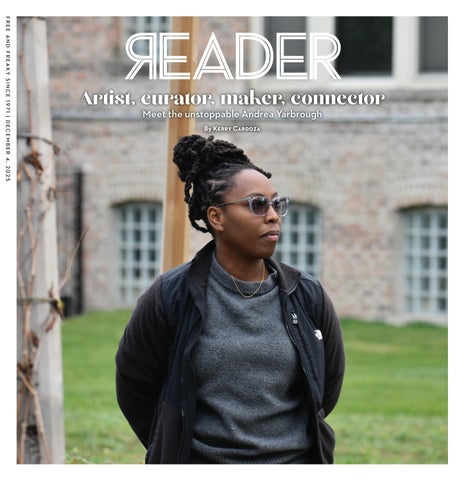
Chicago Reader print issue of December 4, 2025 (Vol. 55, No. 10)

Page 1


Artist, curator, maker, connector

Meet the unstoppable Andrea Yarbrough

THIS WEEK

FOOD & DRINK

04 Feature | Sula The CHAAD Project’s restaurant preparedness tool kit puts la migra on ice.

OPINION

06 On Prisons It’s time for Illinois lawmakers to implement an inclusive parole system and end death by incarceration.

NEWS & POLITICS

08 Investigation When a government contractor’s right to privacy outweighs the public’s right to know

10 Make It Make Sense | Brown, Mulcahy, & Prout Cook County has a new chief judge, Trump slashes housing funding, and American Indian Health Service of Chicago celebrates 51 years.

ARTS & CULTURE

12 Cover Story | Cardoza Andrea Yarbrough wants to share the work and the rewards of artmaking.

THEATER

16 Rhinestone Digest | Renken “Fat” is not a dirty word.

17 Plays of Note White Christmas at Paramount and Who’s Holiday! at Theater Wit; plus retrospective reviews of A Magical Cirque Christmas and Police State at MCA

FILM

18 Moviegoer Full house

20 Movies of Note Chloé Zhao’s adaptation of Hamnet is devastating; The Things You Kill is a confident and impressive drama from director Alireza Khatami.

MUSIC & NIGHTLIFE

22 Chicagoans of Note Nate Coleman, cinematographer and editor with Videowaste 24 Shows and Records of Note Previews of concerts including Adamn Killa, the Catalytic Sound Festival, and Joshua Roman

26 Gossip Wolf | Galil The Chicago Hip Hop Heritage Museum loses its home, the Ugly Hug and Post-Trash throw an indie-rock fest, and more.

27 Jobs

TO CONTACT ANY READER EMPLOYEE, EMAIL: (FIRST INITIAL)(LAST NAME) @CHICAGOREADER.COM

INTERIM PUBLISHER ROB CROCKER

CHIEF OF STAFF ELLEN KAULIG

ASSISTANT MANAGING EDITOR

SAVANNAH RAY HUGUELEY

PRODUCTION MANAGER AND STAFF

PHOTOGRAPHER KIRK WILLIAMSON

SENIOR GRAPHIC DESIGNER AMBER HUFF

GRAPHIC DESIGNER AND PHOTO RESEARCHER SHIRA FRIEDMAN-PARKS

THEATER AND DANCE EDITOR KERRY REID

MUSIC EDITOR PHILIP MONTORO

CULTURE EDITOR: FILM, MEDIA, FOOD AND DRINK TARYN MCFADDEN

CULTURE EDITOR: ART, ARCHITECTURE, BOOKS KERRY CARDOZA

NEWS EDITOR SHAWN MULCAHY

PROJECTS EDITOR JAMIE LUDWIG

DIGITAL EDITOR TYRA NICOLE TRICHE

SENIOR WRITERS LEOR GALIL, MIKE SULA

FEATURES WRITER KATIE PROUT

SOCIAL JUSTICE REPORTER DEVYN-MARSHALL BROWN (DMB)

STAFF WRITER MICCO CAPORALE

SOCIAL MEDIA ENGAGEMENT

ASSOCIATE CHARLI RENKEN

VICE PRESIDENT OF PEOPLE AND CULTURE ALIA GRAHAM

DEVELOPMENT MANAGER JOEY MANDEVILLE

DATA ASSOCIATE TATIANA PEREZ

MARKETING MANAGER MAJA STACHNIK

MARKETING ASSOCIATE MICHAEL THOMPSON

SALES REPRESENTATIVES WILL ROGERS, KELLY BRAUN, VANESSA FLEMING

ADVERTISING

ADS@CHICAGOREADER.COM, 312-392-2970

CREATE A CLASSIFIED AD LISTING AT CLASSIFIEDS.CHICAGOREADER.COM

DISTRIBUTION CONCERNS

DISTRIBUTIONISSUES@CHICAGOREADER.COM

READER INSTITUTE FOR COMMUNITY JOURNALISM, INC.

CHAIRPERSON EILEEN RHODES

TREASURER TIMO MARTINEZ

SECRETARY TORRENCE GARDNER

DIRECTORS MONIQUE BRINKMAN-HILL, JULIETTE BUFORD, DANIEL DEVER, MATT DOUBLEDAY, JAKE MIKVA, ROBERT REITER, MARILYNN RUBIO, CHRISTINA CRAWFORD STEED

READER (ISSN 1096-6919) IS PUBLISHED WEEKLY BY THE READER INSTITUTE FOR COMMUNITY JOURNALISM 2930 S. MICHIGAN, SUITE 102 CHICAGO, IL 60616, 312-3922934, CHICAGOREADER.COM

COPYRIGHT © 2025 CHICAGO READER ALL RIGHTS RESERVED. CHICAGO READER, READER, AND REVERSED R: REGISTERED TRADEMARKS ®

Artist Andrea Yarbrough stands beside House of Kapwa , an “in c/o” project by Alexx Temeña in Woodlawn.
Photo by Kirk Williamson

FOOD & DRINK

The CHAAD Project’s restaurant preparedness tool kit puts la migra on ice

The hospitality worker advocates held a town hall with the aim of protecting at-risk employees from government goons.

One Monday afternoon last month, about 50 kitchen workers, servers, bartenders, managers, owners, and activists gathered in the dining room of a Logan Square restaurant for an emergency meeting. It had been called by hospitality worker advocacy group the CHAAD Project to brainstorm strategies to protect workers from federal immigration enforcement raids.

A few weeks earlier, a veteran cook at a restaurant just up the street had been abducted by agents on his way to work. At the meeting, a worker from a neighboring restaurant reported that their manager witnessed the attack, locked the doors to their own workplace, and ran around the surrounding blocks warning workers at other businesses that Immigration and Customs Enforcement (ICE) agents were in the neighborhood.

That wasn’t an overreaction with masked goons targeting and disappearing mostly Brown people—including lawful immigrant residents and U.S. citizens—during their socalled Operation Midway Blitz over the last few months. The U.S. Small Business Administration says immigrants own 29 percent of all new hospitality businesses. According to the American Immigration Council, immigrants make up 22 percent of all workers in the U.S. food industry. And statewide, it’s 40 percent, Illinois Restaurant Association president Sam Toia told WBEZ.

“We have 17 individuals I can directly confirm as arrested while working as a [street] vendor or at a restaurant,” said a source tracking calls to the Family Support Network hotline, operated by the Illinois Coalition for Immigrant and Refugee Rights. “But we certainly have much more in our data. For instance, anyone who called about a loved one arrested ‘at work’—we don’t know if it’s a restaurant. We have just over one hundred raid reports

that specifically mention restaurants or food vendors, but the number is likely much higher, as it’s not part of our standardized reporting.”

“I’ve worked in spaces with these people who are vulnerable,” said CHAAD Project executive director Raeghn Draper. “They’re some of the hardest-working, kindest people, and so why wouldn’t you want to protect your folks who are doing some of the hardest work and are the most dependable?”

A few days before the CHAAD meeting, hundreds of U.S. Customs and Border Patrol (CBP) agents that had been terrorizing the city for months left town along with their teargas-tossing commander, Gregory Bovino. Although the chaos had significantly decreased, abductions continued—at least a handful of them in surrounding neighborhoods over the previous three days.

What’s more, in the wake of CBP’s departure, the Department of Homeland Security threatened to return in March with one thousand more agents—four times the number of snowflakes that just fled after the city’s first blizzard of the season.

It was too late for anyone to help the recently detained cook, a father of three with no criminal record, who’d worked in the same kitchen for 14 years. By then, he’d already been deported to Mexico. (A GoFundMe campaign to support the family is currently $152 short of its $25,000 goal.) But it wasn’t too late to prepare for the spring.

The CHAAD Project evolved from the Chicago Hospitality Accountability and Advocacy Database, created early in the COVID-19 pandemic to keep track of abuses in the restaurant industry. Many restaurants the group was monitoring were making public statements supporting Black Lives Matter and their BIPOC employees, but these days, relatively few restaurants have been speaking out for

their vulnerable employees—particularly the big, powerful restaurant groups. On its face, the reasoning seems obvious. The two restaurants connected to the Logan Square abduction do not want to be identified for fear of putting a retaliatory target on their employees’ backs. But there is also a pervasive suspicion among workers that some restaurants are more concerned about alienating well-heeled guests who might be sympathetic to the federal government’s aggression.

At the meeting, one worker from a large restaurant remarked that their employer refused to implement any of the standard protocols many types of businesses have put in place to protect their workers, like posting signs forbidding agents from entering private spaces without proper warrants, and implementing “know your rights” trainings for sta .

CHAAD cofounder Molly Pachay remarked that the employee turnover rate among restaurant workers was already high, and if workers didn’t feel safe, it would rise even higher. If that happens, it would only cost owners more, so workers could advocate for themselves with a “hit them in the money” argument.

“That isn’t necessarily about standing up for your workers and protecting your workers,” CHAAD’s Draper told me later. “That is about money. And you lose money every time someone quits or is fired or leaves your establishment, and you have to rehire and retrain. So for the sake of your dollar and the sake of your business, you should be eager to assert your rights and keep your employees.”

Security agents invaded the neighborhood this fall, beginning with a massive raid outside his store in October. “It was complete chaos, helicopters, tear gas,” he said. “They were all up and down our neighborhoods. And they took one of my employees. He was outside unloading our merchandise, and they grabbed him. They tried to grab two. One of them was able to run away.” They returned to Little Village with force the next day but didn’t try to enter the store.

Then, two weeks later, Bovino showed up.

“He walks in with his bodyguards,” said Macías. “Eight or nine of them. He’s surrounded by them. They said they came in to buy some beverages, and that is basically bullshit. They were just intimidating people. My em-

There’s no doubt the business has taken a hit, particularly in aggressively targeted neighborhoods like Little Village, Pilsen, and Brighton Park, where people stayed home and operators locked their doors during business hours or outright closed.

But owners can stand their ground. Carlos Macías, owner of Little Village’s Carnicería y Taquería Aguascalientes, had three harrowing experiences when Department of Homeland

ployees were very frightened. They ran out the back door, hid underneath the tables, and thank god they didn’t take anybody. I told him to get the fuck o my property. He’s laughing, looking around, not looking me in the face, looking at people, smiling. And I said, ‘Get the fuck out of my fucking property.’ And he proceeded to tell me, ‘If you get any closer, you’re gonna get arrested.’”

“‘I don’t care what you do,’” said Macías. “‘Just get the fuck out of my property.’” Bo-

vino backed down, but Macías’s abducted employee spent 23 days in detention before he was released.

Restaurant trade groups like the Illinois Restaurant Association, the James Beard Foundation, and the National Restaurant Association (NRA) have all tucked some guidelines and resources into their websites outlining what restaurants can do when ICE or other agencies show up. Yet all of these organizations are relatively subdued when it comes to publicly speaking out against the government’s abiding immigration injustices.

The NRA seems particularly focused on the bottom line, rather than worker safety. In a statement published last January, its Restaurant Law Center listed the penalties restaurateurs face for employing undocumented workers. It also emphasized I-9 compliance, based on the federal form that verifies employee identity and authorization to work in the U.S. The document does show the di erence between a signed judicial warrant—which authorities are required to secure in order to enter private workplace areas—and administrative warrants—which authorize bupkis, though ICE tries to use them anyway. Besides that, there’s very little else o ered in the NRA boilerplate to advise owners about what to do for their employees when la migra shows up at the host stand.

After separating into breakout groups to brainstorm, the attendees at the CHAAD meeting o ered lots of good ideas. One frontof-the-house worker said that their restaurant had a special code in their point-of-sale system named for a dish not on the menu. When activated, it sends a ticket to every station in the restaurant, alerting workers that the feds have arrived. (That’s adapted from a tactic some restaurants employ when the health inspector shows up.) Others suggested building

Signal chats for the workplace and for neighborhood restaurant clusters in the same way community rapid response groups use them to warn communities when ICE is on the streets, and to disrupt and delay their operations.

The suggestions filled up a whiteboard at the front of the room: Keep nonessential doors locked, and establish lockable sta -only safe rooms. Stock whistles at every station. Use a buddy system for smoke breaks, trash runs, and end-of-shift walks to cars and public transportation.

I reached out to many Chicago owners and operators—large and small—to ask what measures they’ve taken to protect their employees. The great majority of them declined to speak on the record—or speak at all—including big boys like Lettuce Entertain You and One O Hospitality, who collectively employ thousands of workers.

But one of the big players talked: Kevin Boehm, cofounder of the Boka Group, which employs about two thousand people across its twentysome Chicago operations. “I’ve talked to a lot of people around the country,” he said. “I think the most important thing everybody can do is have a real understanding of what [ICE] can do inside your space. It starts there. Know the law. Make sure your people know the law, so you can protect them.”

Smaller independent restaurant groups have been more likely to speak out. Chocolatier Katherine Anne Confections faced down a tornado of negative online reviews after owner Katherine Duncan posted a sign on her store window warning ICE agents that they aren’t welcome to enter.

In early November, more than 30 Asian American chefs packed the Ramova Theatre in Bridgeport for the Tiger Moon Market, raising more than $115,000 for immigrant rights organizations. Another event, featuring dozens of

Latin American chefs, is in the works. Ed Marszewski, cofounder of Marz Community Brewing, Maria’s Packaged Goods, Kimski, and others, is behind the events. “Everybody is doing everything they can for their at-risk employees,” he said. “Through our nonprofit Public Media Institute, we’ve 3D-printed thousands of whistles, given out zines, and worked with neighborhood defense groups. The brutal, criminal activity right now is new, but we’ve been supporting immigrant rights forever, so it’s not new for us.”

On Wednesday, December 3, the CHAAD Project published a seven-page tool kit for restaurant workers and owners on how to prepare and protect their most vulnerable employees.

It o ers a basic outline of ICE activity and identification, community defense resources, know your rights information, and tips on how to identify legitimate warrants versus illegal ones, including what to do when presented with them. There are sections on internal communications (set up a Signal channel), physical safety protocols, and an outline to conduct lockdown drills. There are tips on how to help

FOOD & DRINK

at-risk staff stay safe and protected in the workplace and in their private lives, and how to support them if they are detained. There’s a guide to persuade and prepare owners who may be resistant to implementing these measures. Finally, there’s a detailed timeline on when to implement all of them.

Members of the CHAAD Project plan to host more town halls in different neighborhoods early in the new year, and they hope the tool kit becomes a resource for restaurants nationwide.

ICE is known to change tactics frequently, so I asked Draper if they worried that releasing the tool kit might compromise the strategies within.

“It’s definitely a concern,” they said. “But in our day and age, it is very tricky to keep information completely vetted. We could do something that’s more underground and give people physical copies, and do word of mouth, but it will take on a life of its own. We want to get it into the hands of as many people as possible.” v

m msula@chicagoreader.com

OPINION

Righting systemic wrongs in Illinois prisons

For decades, incarcerated people in the state have had limited avenues for rehabilitation and shorter sentences. It’s time lawmakers make real change.

For far too long, Illinois politicians have been playing politics with people’s lives in the criminal legal system. (I do not call it the criminal justice system because there is no justice in it.) They have used the “tough-oncrime” myth to get elected, claiming that the best way to deter crime is with harsher and longer prison sentences. This has left us all with an entirely broken system.

Democrats have, for years, had a majority in the state house and senate and have controlled the governor’s office. Enacting the SAFE-T Act in 2021—which eliminated cash bail and reduced pretrial detention, among other reforms—was an important step, but little more has been done to fix the systemic issues. Instead, Democrats maintain the unacceptable

status quo. Why? Because we, the roughly 28,000 people in Illinois state prisons, don’t have the right to vote. So, we have been overlooked and underestimated, and far too many of us are serving prison sentences that require us to grow old or die in prison. It’s time that our representatives, including Governor J.B. Pritzker, do more to change that.

“Tough on crime” has always had little to do with public safety. It’s an old standby for not having real answers to the problems that face our communities, like poverty, disinvestment, job deserts, and a lack of educational opportunities. It’s politics with a side order of fearmongering that puts more Black, Brown, and poor people into our prisons.

It has led to Illinois laws that keep people in

earning time o their sentences. This means those with life sentences without parole or de facto life sentences will likely never see life outside of prison again.

Every year, hundreds of people in Illinois are sentenced to terms that will keep them in prison for life. Many of them are younger than 26 years old. And Black Illinoisans are about 11 times more likely than white people in the state to be given life without parole sentences, according to a 2022 Families for Justice Reform (FAMM) report.

How did we get here? How did we get to the point of viewing thousands of people—sons and daughters, fathers and mothers, brothers and sisters, uncles, aunts, and friends—as irredeemable and simply worth throwing away? We got here through racism, political games, the abandonment of rehabilitation as an ideal, and the dehumanization and demonization of young people who commit crimes.

Have a strong opinion or perspective you’d like to share? We invite you to send ideas to letters@chicagoreader.com ON PRISONS

Death by incarceration sentences are unnecessary and inhumane. They violate an individual’s right to life: They are torturous, cruel, and degrading. As someone with a life without parole sentence, I can tell you firsthand that these extreme sentences don’t account for people’s maturation and change behind bars. Isn’t it part of the human experience—learning from mistakes to become better? Despite the Illinois Department of Corrections o ering limited college, vocational, and other rehabilitation programs, many people in our state prisons take it upon themselves to self-rehabilitate. They do so even when they have no outlet or avenue of release other than executive clemency.

prison longer, with few avenues for rehabilitation or parole. Illinois has juvenile transfer laws, where minors can be tried in adult court. Our state also often increases sentences for people with past felonies or firearms in their possession, thanks to the three-strikes law and firearm enhancements. (Not to mention that Illinois is among the states that lead the nation in wrongful convictions.)

Even though Illinois abolished the death penalty in 2011, we allow for “death by incarceration.” Most incarcerated people over 20 in Illinois have no opportunity to earn parole or early release, since the state abolished discretionary parole in 1978. In 1998, the state passed the so-called “truth-in-sentencing” laws, which have restricted most people from

Ashley Nellis and Marc Mauer’s The Meaning of Life: The Case for Abolishing Life Sentences recommends abolishing all death by incarceration sentences and implementing a fair and inclusive parole system, giving everyone the opportunity for parole after 15 or 20 years of incarceration, and expanding the use of executive clemency.

Pritzker is running for a third term in 2026, and it appears he’s positioning himself to run for president in 2028—I think he should focus on helping the state, now. Clemency is one area in which he can take direct action. In 2020, he pardoned nine thousand low-level marijuana convictions, but his record has been less strong on individual pardons and commutations. In 2022, he granted zero clemency petitions. In 2023, he granted 28 pardons and 15 sentence commutations—a grant rate of 7.7 percent. In 2024, he reviewed 502 clemency petitions, but only granted six and commuted four sentences.

“ This is supposed to be a progressive, democratic state. Time to prove it.”
SHIRA FRIEDMAN-PARKS

Clemency promotes equal justice, supports rehabilitation and reentry, brings families back together, and provides meaningful second chances. If he had the will to do it, the governor could commute the sentences of even more people in Illinois.

Incarcerated people may still not have the right to vote in prison, but we do have families, friends, and loved ones who vote. It’s time the politicians in Illinois recognized our political power. My fellow prisoner, Yaphet Davis, and I have formed an organization called the Illinois Prisoner Alliance to try to e ect change in the criminal legal system by having our families, friends, and loved ones withhold their votes from candidates who continue the “do-nothing” policy.

The Illinois Prisoner Alliance seeks to push our lawmakers to end harmful truth-insentencing laws and death by incarceration sentences. We’re seeking to bring back parole for prisoners who’ve served 20 years of their sentences, and for all sentences to be eligible for early release. We want rehabilitation to be a genuine goal for the Illinois Department of

OPINION

Corrections so that all prisoners who want it receive an education, vocational training, and mental health therapy. We also seek to give all prisoners the right to vote and to restart clemency as a viable path to freedom.

These goals are not just morally responsible and needed to right systemic wrongs in Illinois, but they are fiscally responsible as well: Implementing these goals would save taxpayers hundreds of millions of dollars that the government is currently wasting on keeping people locked up. This is money that can go to fund schools and social programs and can be reinvested in disenfranchised communities.

It’s time to end this “do-nothing” policy. This is supposed to be a progressive, democratic state. Time to prove it. If the governor and other Democratic candidates want to keep our loved ones’ votes, they will have to earn them.

Anthony Ehlers is a writer incarcerated at Sheridan Correctional Center. Find out more about incarcerated journalists through the Prison Journalism Project. v m letters@chicagoreader.com

NEWS & POLITICS

INVESTIGATION

For o cial use only

When a government contractor’s right to privacy outweighs the public’s right to know

On a cool night in late May 2020, amid citywide protests triggered by the murder of George Floyd at the hands of Minneapolis police, Safarian Herring, 25, was fatally shot while riding in the car of 63-year-old Michael Williams.

Three months later, Chicago Police Department (CPD) detectives pinned Herring’s murder on Williams, citing a ShotSpotter alert that concluded Herring was hit by gunfire just before midnight near the intersection of East 63rd Street and South Stony Island Avenue.

Despite his protestations of innocence, Williams, a husband and grandfather, languished in the Cook County jail for nearly a year as he waited for his case to be resolved. During that time— the height of the COVID-19 pandemic—he contracted the oft-deadly virus not once but twice.

ShotSpotter objected to disclosing the identity of the forensic examiner who reached the conclusion that there was a sound in Williams’s case that resembled gunfire. Max called those objections “outrageous” in an interview with the Reader. “Imagine if the state crime lab says this DNA matches your client, and they don’t want to tell you

Williams has publicly said that he blames ShotSpotter, which has since rebranded as SoundThinking, for the arrest and criminal charges filed against him. His case was eventually dismissed in July 2021. It dragged on months longer than it should have in large part because of a legal dispute over the company’s socalled “classification continuum” between prosecutors and Williams’s public defense attorneys.

sonable requests for data in criminal proceedings.” The spokesperson noted that the company’s forensic evidence has been admitted in more than four hundred cases across at least 25 states and that its “digital evidence and expert testimony meet rigorous standards.”

But Max said that, whereas state-run crime labs are “very compliant with disclosure

Brendan Max, head of the Law Office of the Cook County Public Defender’s forensic science division, said the fight arose over whether this document constituted a trade secret—legalese for proprietary information that, if disclosed publicly, could give a company’s competitors a leg up.

In addition to claiming the trade secrets exemption for its “classification continuum,”

the name of the DNA examiner, nor give you any information about that person’s qualifications, their training, any proficiency testing they’ve done,” Max explained. “No one in the criminal justice system would ever stand for that.”

A SoundThinking spokesperson defended the company’s approach in a statement, saying it “protects its proprietary tools, including the classification continuum, fully within legal and ethical bounds and cooperates with rea-

clients’ cases, they will voluntarily agree to protective orders shielding the information they obtain from ever being released to the public. Prosecutors have an array of legal tools at their disposal to shield the disclosure of trade secrets at every stage of the legal process. From there, Max said, it’s an “uphill battle” arguing to a judge, “I know this is currently under protective order, but it shouldn’t be.”

of the types of information that we need to assess the reliability of the claims that they make,” private companies that provide similar services are not. “Judges seem to give people or corporations like ShotSpotter a pass,” he said, even when their technologies are, “in part, responsible for your client being locked up.”

Max said defense attorneys are often further on the back foot because, to facilitate the disclosure process and, hopefully, win their

kowtow to ShotSpotter and some of the

Max. Secondly, Max developed a strong

Max ultimately succeeded with that argument in the Williams case, but the judge’s decision to lift the protective order depended on a unique set of factors. For one, judge Vincent Gaughan, who retired in 2022 after 31 years on the bench, had an electrical engineering degree in addition to his legal qualifications and so “wasn’t going to kowtow to ShotSpotter and some of the silly arguments they made,” according to Max. Secondly, Max developed a strong understanding of the science behind ShotSpotter’s gunshot-detection system such that he could explain how its protocols were different from traditional crime labs. Finally, and perhaps most crucially, Max had the time and funding to hire experts who provided statements explaining why nothing about the “classification continuum” was scientifically proprietary. “That’s a big hill for any attorney to climb,” he said, “but it’s even a bigger hill for a private attorney, because they won’t have the funding to hire an expert in that situation.”

the to experts who provided statements

scientifically proprietary. “That’s a big hill for any attorney to climb,” he said, “but it’s even a because they won’t have the

While intellectual property law has a long and wellestablished history in the United States and is at the center of a number of high-profile domestic and international trade disputes—such as those between the U.S. and China or Apple and Samsung—the role of trade secrets in the context of criminal litigations like Williams’s is far more contested. “Battles with ShotSpotter and similar companies go on all the time now,” Max said. “It’s something that needs to be litigated even more.”

Rebecca Wexler, a Columbia law professor and former Biden policy advisor who has written extensively about trade secrets in the criminal legal context, wrote in a statement

2021. It dragged on months
SHIRA FRIEDMAN-PARKS

that “trade secrets should never preempt life or liberty. . . . We do not allow other private property rights to interfere with thorough investigations and fair trials. We should not allow trade secret rights to do so either.”

And yet, with the explosion of for-profit companies providing cities, counties, and states with services such as DNA mixture analysis, recidivism prediction, and facial recognition, opportunities for conflicts between the due process rights of defendants and corporate interests continue to grow. Across the U.S., private firms offer everything from predictive policing and social media monitoring tools to drones and automatic license plate readers.

The consequences of trade secret protections in criminal proceedings thus extend far beyond Chicago. In New York, Glenn Rodríguez was denied parole despite a nearly perfect record in prison because of a high score from recidivism prediction algorithm COMPAS (Correctional O ender Management Profiling for Alternative Sanctions). Equivant, the company that now owns COMPAS, considered the weighting of its inputs proprietary, leaving Rodríguez on his own to identify an error in the assessment. Even after he discovered a mistake, he couldn’t explain its e ect without knowing the input weights, which the company refused to disclose. He eventually made parole, but only after spending extra time incarcerated based on a score he couldn’t meaningfully challenge.

In California, Billy Ray Johnson received a sentence of life without parole for burglaries and sexual assaults he maintains he didn’t commit, based largely on DNA analysis from a software called TrueAllele. When an expert witness in Johnson’s case sought to review the program’s source code to better understand how it worked, the developer claimed trade secret protection, and a California state judge

“Trade secrets should never preempt life or liberty.”

sided with the company in 2017, which an appellate court upheld in 2019, even though Johnson’s attorney o ered to sign a protective order.

That decision was based on a state appeals court decision from 2015, in which judges recognized for the first time in U.S. history a trade secret evidentiary privilege in a criminal proceeding. That case, People v. Chubbs , is

now widely cited to deny defendants access to evidence that could prove their innocence.

According to Richard Gutierrez, a law professor at the University of Illinois Chicago (UIC), defense attorneys have an ethical duty to interrogate the various methods police officers use to arrest and prosecute their clients. Gutierrez pointed to the “unfortunate and infamous track record of all kinds of scientific and technical evidence falling flat on its face under scrutiny” as a reason why defense attorneys should feel confident challenging technologies that may seem sophisticated or opaque. “The last area in which defendants and their lawyers were told to shut up and play ball was in this forensic space, and many of those black boxes—some might say most—did not look rosy when they got opened up,” he said.

Some forensic techniques that have not stood up well to scrutiny include 911 call analysis, bloodstain-pattern analysis, and bite mark analysis, according to ProPublica. Gutierrez argued prosecutors should refuse to rely on technologies from companies that deny requests for transparency or fail to undergo or publish the results of rigorous independent testing. “The idea that a company can forgo what science has made the norm for well over a century,” he said, referring to randomized control trials that demonstrate causal relationships, “and then expect us to believe with any confidence that it isn’t harming people strikes me as insanity.”

Beyond the criminal legal context, the trade secrets exemption exists in the country’s public records laws, meant to provide the public with greater information about government operations while providing companies that work with the government some level of protection. The Illinois Freedom of Information Act (FOIA), passed in 1983 and amended in 2010, also includes a trade secrets exemption.

In theory, this provision allows companies to withhold information about proprietary methods, technologies, and processes—things like recipes, formulas, or algorithms—when a member of the public, a journalist, or a commercial entity asks for this information in connection with a public records request. But in practice, its scope has ballooned. Over the past decade, it has become a default justification for blocking transparency that could reveal potential errors or biases of technological systems in the criminal legal system.

For example, in a 2016 ProPublica investi-

gation of the COMPAS recidivism risk assessment tool, journalists were unable to examine the algorithm itself, instead relying on reams of publicly available court data to determine retroactively that it displayed a marked racial bias against Black defendants, judging them much more of a risk than comparable white defendants.

In 2019, the U.S. Supreme Court ruled that companies could keep information secret under FOIA if they usually treat it as private and give it to the government with the understanding it will stay that way. Legal scholars have said the decision will “likely lead to more information, not less, being withheld from journalists, researchers, and watchdog groups, with significant consequences for public health, safety, and welfare.”

But while that decision isn’t operative at the local level, reporters found that over the past seven years, from 2018 to 2024, Chicago agencies have used the trade secrets exemption to deny requests for information with increasing frequency. The Reader reviewed more than 350 denial letters that cited the trade secrets exemption during that period. That represents a significant shift. The number of trade secrets denials has increased almost threefold since 2018, when agencies cited the exemption 25 times. By 2024, they had cited it 72 times. (It is unclear whether the total number of FOIA requests submitted citywide rose by a similar margin because not every agency publishes its FOIA logs, but for the Department of Finance, the number of FOIA requests rose roughly 2.3 times, according to publicly available records.)

Reporters found that many of the denials were aimed not at corporate competitors but at researchers, journalists, and members of the general public. Of the 350 denial letters reviewed, more than 245 were addressed to the general public or media requesters. In many cases, those requesters were not seeking proprietary technologies or business processes; they were asking for materials related to federal investigations, the grading criteria for firefighter examinations, and tax payments made to the city.

Looking at just ten of the dozens of companies on whose behalf those denials were made— including ShotSpotter/SoundThinking, Wejo, Lyft, and the Millennium Contracting Corporation—the Reader found taxpayers had shelled out more than $110 million in direct payments or benefits. In some cases, agencies cited trade secrets to withhold entire documents. In others, they redacted key sections without specifying what the sensitive trade

NEWS & POLITICS

secrets actually were. Under the Illinois public records statute, agencies are supposed to provide “clear and convincing evidence” that the records or the redactions are, in fact, exempt, under the presumption that “all records in the custody or possession of a public body are presumed to be open to inspection or copying.”

To determine this, reporters filed more than 70 requests with more than 35 city and county agencies. Reporters also filed several appeals with the Illinois attorney general’s public access counselor for records that were not initially provided and even worked with one agency to write code to track its denials by provision cited, despite a legal requirement to do so under the Illinois FOIA. Based on agency responses, reporters found wide disparities in the use of the trade secrets exemption. Whereas the Chicago Department of Public Health did not cite the exemption once between 2018 and 2024, the Department of Finance issued more than 130 denials citing the provision during the same time frame. While many city agencies provided detailed explanations about why the information they were shielding or redacting constituted a trade secret, as required by state law, the city finance department failed to provide explanations in 105 of the 136 trade secret exemptions it claimed.

Although the CPD gave explanations for many of its denials, when investigative journalist Joey Scott asked in late 2023 for ShotSpotter’s gunfire reports and incident scorecards that he’d already obtained from other jurisdictions, the department denied his request entirely in January 2024, pointing to a response crafted by ShotSpotter. “SoundThinking asserts exemption from the Freedom of Information Act, specifically, the trade secrets exemption,” the response read, before regurgitating the statutory language in full.

But even in cases where city agencies did provide detailed rationales behind the exemption, in some cases, their denials failed to stand up to further scrutiny. The use of a “trade secret argument” in the criminal legal context “clearly is yet another way to shroud the government’s use and e cacy of surveillance technology,” said Ed Yohnka, director of communications and public policy at the American Civil Liberties Union of Illinois. “The reality is that surveillance technology is supplied by a vendor whose interests often lie in more secrecy and not for advancing government transparency.”

Yohnka urged the City of Chicago to ensure that all of its vendor contracts, especially for surveillance technology, permit the city to

NEWS & POLITICS

continued from p. 9

fully comply with its FOIA obligations. “If corporations that own or operate supposedly proprietary technologies will not allow the city to own the data generated by those technologies when investigating or surveilling Chicagoans, then the city should not be contracting for or using those technologies,” he added.

In 2022, longtime Chicago Sun-Times investigative reporter Robert Herguth asked the finance department for revenue totals for the parking meters located near the Cook County jail and west-side courthouse complex for a story about how companies profit from people visiting relatives in the jail or showing up for mandatory court hearings. City o cials denied his request entirely, citing the trade secrets exemption. “Chicago Parking Meters, LLC (‘CPM’) has furnished the information to the Department of Finance under a claim that it is proprietary, privileged and confidential, and explains how the release of the information would cause competitive harm,” reads the denial letter.

CPM is a company controlled by private investors, including Morgan Stanley and a Gulf state investment fund, that secured a “fire sale” deal in 2008 to collect much of Chicago’s parking meter revenue for 75 years. After just ten years, CPM investors had recouped nearly the entirety of their $1.16 billion payment to the city, according to an April 2025 audit by the consulting firm KPMG. “When a local government sells o or leases a valuable asset, it’s not too much to ask to let the public examine the effects of that sale,” Herguth said. “It’s audacious that anything would be shielded from review.” The city’s lawyers quickly folded and agreed to release the revenue data after Herguth filed suit against the department.

As of press time, the mayor’s o ce and the city’s finance department did not respond to the Reader’s request for comment.

For Gutierrez, the UIC law professor, the solution is simply greater transparency on the part of companies that sell and market technologies to the public sector. “Every time that you involve algorithms and code, there are transparency needs there, and so algorithmic transparency, at minimum, is really crucial to just understanding how a system works and whether there are flaws in its design,” he said. v

This reporting was supported by the Fund for Investigative Journalism.

m

Moving on, moving up

On Monday, Cook County swore in the first new chief judge in more than two decades. Charles S. Beach II replaces Timothy Evans as leader of the nation’s second-largest unified court system.

Evans presided over historic changes to the judiciary during his quarter-century as chief judge, including issuing a 2017 order that required Cook County judges to set affordable bail—a precursor to the statewide elimination of cash bail. He will return to the courtroom to serve out the remainder of his term as circuit judge, continuing a long and successful career as a city and county political powerhouse. “Evans was one of the last of his generation and brand of politicians still in power,” writes Injustice Watch senior reporter (and longtime Reader sta er) Maya Dukmasova in a brilliant profile of the outgoing judge. “And unlike so many of his peers — Ed Burke and Michael Madigan, most recently — the end of his reign is not coming in a fall from grace.”

Beach takes over at a pivotal time for the Cook County judiciary. The county’s youth detention system, which is overseen by the chief judge’s o ce, has been roiled with controversy for years. The expansive electronic monitoring program is newly under the chief judge’s purview. And State’s Attorney Eileen O’Neill Burke is doubling down on the prosecution of low-level gun possession and retail theft felonies, testing the county’s— and the chief judge’s o ce’s—commitment to pretrial reform.

Beach previously supervised tra c and pretrial courts. Multiple attorneys and advocates who spoke with me said Beach has a reputation as a fairly progressive judge, but the direction he’ll take the office remains to be seen.

Housing funds slashed

On November 13, the U.S. Department of Housing and Urban Development (HUD) issued drastic cuts to permanent supportive housing (PSH), a federal program that provides rental assistance and wraparound services. Nationwide, the cuts will force at least

170,000 people who are currently housed back into homelessness next year.

Chicago’s Continuum of Care (CoC), the local planning body mandated to coordinate federally-funded housing and services, dedicates 90 percent of its funding to PSH. The new rules would cap funding at 30 percent, leading to a projected loss of nearly $67 million for housing for the most vulnerable people in our city.

The loss is catastrophic and will begin during the winter. “People will die,” one program director told me. The director, who declined to provide their name for fear of jeopardizing their organization, said an estimated 1,500–2,000 Chicagoans will lose the funding that keeps them housed. Unless that funding is made up elsewhere, they’ll end up homeless again.

Meanwhile, the city is continuing plans to close at least two encampments this winter: in Legion Park and behind the now-closed Blommer’s chocolate factory . The dozens of people who will be evicted will have fewer temporary housing options available to them,

and unless they were already in the PSH system, are unlikely to be o ered permanent housing. On November 19, the CoC board voted to pause connecting new people to PSH in an e ort to keep people currently in the system housed.

Where will they go? Will the city continue to close encampments in 2026? “This is an evolving situation,” wrote Linsey Maughan , a Department of Family and Support Services spokesperson, in response to both questions. “We cannot speak to specific closure plans and strategies at this time.” —KATIE PROUT

Spirit of 51

If you’ve ever participated in a land acknowledgment at a college event, board meeting, or other public gathering, then the American Indian Health Service of Chicago (AIHSC)—the only Native-led health clinic in Illinois—is challenging you to put your money where your mouth is.

AIHSC turns 51 this month. To celebrate, the clinic is launching the Spirit of 51 campaign to raise funds to expand culturally competent healthcare services and cultural programming for American Indian, Alaskan Native, and other underserved communities. AIHSC integrates traditional and Western healing techniques to o er equitable and culturally responsive care to Native Americans in urban areas.

“We invite everyone who lives and works on Native land to turn acknowledgement into action by supporting Native American health and culture,” said Dr. Albert Mensah, AIHSC executive director, in a press release. “When Native American communities thrive, we all benefit from their stewardship, wisdom, and cultural strength.”

Mensah says the Spirit of 51 campaign is rooted in the belief that true land acknowledgment means supporting the people who continue to steward this land. You can contribute at ze y.com/en-US/donation-form/campaign--51.

—DEVYN-MARSHALL B ROWN (DMB) v

Make It Make Sense is a weekly column about what’s happening and why it matters.

m smulcahy@chicagoreader.com

Judge Charles Beach COOK COUNTY CIRCUIT COURT

ARTS & CULTURE

In 2018, artist Andrea Yarbrough spent a lot of time biking around Chicago. What she saw was striking: houses, schools, businesses—places she had grown up with—all gone.

The unstoppable Andrea Yarbrough

The artist, curator, and all-around doer wants to build a more cooperative art ecosystem in Chicago.

“I hadn’t lived here, like, lived properly here, in almost ten years. And it just felt like so much of what I knew was vacant. I was like, ‘Wow. These things don’t exist anymore. And what does it mean to have lived here for this many years, and now that house is no longer there? Your school is closed and vacant.’ And just really thinking about memory of space and activation of space.”

Yarbrough had just moved back to the city after stints in central Illinois; Albany, New York; and LA. She’d sold her car before returning, reasoning that she could take CTA wherever she needed to go. She had a new job working for the nonprofit Academy for Urban School Leadership, helping to manage the lowest-performing CPS high schools. Instead of taking CTA, she bought a bike. “I was biking to all the schools, south and west side, just biking everywhere,” she said.

You see the world di erently by bicycle. It allows you to observe your surroundings more closely than if you were in a car or bus or train. For Yarbrough, who spent her formative years all over the city, mostly on the south side, biking through her old neighborhoods was galvanizing. The DePaul University Institute for Housing Studies found that a majority of the city’s vacant lots are on the south and west sides; according to data from 2021, Englewood alone had 3,821 vacant lots, compared to 113 in Lakeview.

While moving back to Chicago, Yarbrough was gearing up for other big life changes. She’d decided to go back to school, to work more closely with the arts. And seeing her beloved neighborhoods so underutilized made it clear to her that she wanted to work in public spaces. She wanted to think about urban planning and Black feminist traditions, sites of care and institutional critique. She wanted to make things, to work communally, for the community. Less than ten years later, that’s exactly what she’s done. Her ongoing project “in c/o: Black women” is a placekeeping initiative that exhumes “the (in)visibility of care for Black women.” In addition to a host of other community-minded projects, she’s at work envisioning a multipurpose community arts center in Englewood, alongside her fellow worker–owners at Cooperation Racine.

Yarbrough’s return to Chicago was precipitated by a near-death experience. While on a two-week trip with friends to Hawai‘i, she almost drowned.

“[I] had the moment of, like, my entire life flashed before my eyes type thing, and [I] was just feeling really unhappy, even though, by everybody else’s standards, things were great,” she said. “I had this cushy job in LA, I had my own place, all this great stu . And when I was in the water, I was like, if I live, I’m gonna move back to Chicago, and I’m just gonna do all the things I actually want to do, and not live my life thinking about what other people feel like I should be doing.” Six months later, she was in Chicago. She enrolled in the museum and exhibition studies (MUSE) graduate program at the University of Illinois Chicago. Never the type to just go with the flow, Yarbrough shaped the interdisciplinary program to meet her own interests, petitioning out of several of the core courses. Instead, she took a solidarity economy class and urban planning courses—where she honed her interests in worker cooperatives and building support sys-

tems for artists—as well as an independent-study sculpture class.

The sculpture class, taught by artist Nate Young, was Yarbrough’s first real turn at woodworking. It began shortly before COVID hit. Students were suddenly without access to the woodshop and were instead told to make their projects at home using foam. But Yarbrough, who had a big backyard at her house in Woodlawn, was determined to work with wood and started tooling around at home. At the same time, friends started hitting her up to make desks for their kids, who now had to do their schoolwork at home. (Since it was the height of the pandemic, many items and building materials were sold out at stores.) Slowly, she started to become more familiar with building.

Another formative experience at UIC came when she met the professor and artist Faheem Majeed, who invited her to co-teach a class on social practice—a participatory form of art that engages people and communities. “It helped me understand the city differently. A lot of it was visits to places around the city—so like Theaster

At House of Kapwa , across from the First Presbyterian Church in Woodlawn KIRK WILLIAMSON

[Gates]’s spaces, South Side Community Art Center, things like that, which had me feeling very excited about, like, what does it mean to activate public space?” Yarbrough said of the class. “I think that, compounded with seeing all these vacant lots and places where I knew things existed . . . this really got me interested in, what does it mean to do shows in spaces that are truly accessible? And also just feeling like a gallery, a museum, couldn’t hold the conversation I really wanted to have around Black women and care.”

Her thesis project, “in c/o: Black women,” grew out of these experiences. It started as an assignment for a class on writing for exhibitions. Yarbrough chose work by three di erent femme and/or nonbinary Black artists—photographs centered around care and intimacy. “It got a lot of mixed responses,” Yarbrough remembers. “Some people being like, well, it feels a little exclusionary—it’s just about Black women.” But her teacher, Lucy Mensah, who became her advisor, encouraged the idea, and from there it grew into her thesis.

Yarbrough originally wanted to bring together Black women and nonbinary artists from around the country for a group show in Chicago. She reached out to Anthony Stepter, who was then MUSE’s assistant director, to help find funding. “He basically told me to hone it down to just Chicago. And once I did that, I feel like money fell in my lap,” she said. The group show idea shifted to a plan to activate vacant lots by inviting people to build chairs for tables set up outside.

Since then, “in c/o” has morphed organically based on who Yarbrough is collaborating with. Artist ebere agwuncha was a core part of the project for several years; the two met in 2020 and found that their practices were closely aligned. Agwuncha, who works in various craft mediums, had recently started woodworking as part of her job at Norman Teague Design Studio. Their first project together was building a tabletop at Sweet Water Foundation, where Yarbrough was working at the time. “In that synergy, we kind of felt a pull,” agwuncha said, “to continue working together.”

In 2021, “in c/o” installed a version of the project “tending to” at the #LetUsBreathe Collective’s garden space. “Tending to” archives the stories of Black women and nonbinary folks and their relationships to care. For the project, agwuncha designed a gorgeous two-person bench with a small planter embedded in the center—her first piece of furniture.

That summer, Yarbrough and agwuncha held a series of workshops in Yarbrough’s

home studio for folks to build their own seated objects. “We were hosting so many workshops in this basement free of charge—it was just really a sweet time to meet different Black women, meet di erent folks that were in community that I didn’t know yet, and really just have them be in the space, creating and using woodworking tools,” agwuncha said. “Taking the energy of building and making and creating together in community felt really good.”

Yarbrough’s reputation for reliability and workmanship quickly spread, and soon she was fielding many requests for commissioned projects. “I did not want to take most of it on, because I don’t have a team—like it’s just me,” she said. Many people didn’t realize she also had a day job. She knew she could hire other Black women to help with projects, but then she’d have to provide training—which would take a lot of time and energy. After taking a step back, the idea for a cooperative space started to take shape.

A co-op made sense for a lot of reasons. Making a living as a fabricator can be a challenge. It tends to be seasonal work, with a lot

ARTS & CULTURE

“What I’m ultimately interested in is art that is shifting something about the world and our systems, which I know is a big task.”

of commissions in the summer and very few in the winter. Pooling projects and resources would mitigate some of that. It can also be a feasible career path, and Yarbrough was interested in bringing the opportunities she was fielding to other people.

Yarbrough had recently acquired a mixeduse building in Englewood from the Cook County Land Bank Authority, with the idea of turning it into an alternative gallery or a more accessible woodshop. (The land bank was formed in 2013 to promote the development and reuse of vacant land in Cook County.)

In December 2021, the land bank was having a holiday sale. “I searched the entire website for all the mixed-use buildings. I only found one, and it was one city block away from where I went to elementary school,” she said.

It felt like kismet, so she bid on it just before leaving town for a vacation. “I was in Costa Rica, and I got an email being like, ‘You’re approved, submit a background check.’” It would take close to 18 months for the sale to close.

While the deal was in process, in January 2023, Yarbrough invited a few dozen artists to a Zoom call to float the idea of co-owning the building together. I was like, ‘Hey, y’all, I bought this building, cash. It’s mine, and I’m actually willing to just give it to a co-op that I can be a part of.’” That original group of 40 artists was eventually whittled down to seven. With funding from the Field Foundation, the group embarked on a training to learn about the history of co-ops and some fundamentals of co-op governance, structures, and decision-making. Cooperation Racine, as the collective came to be known, currently consists of Yarbrough and creatives Kayla Reefer, Tavia David, Saleem Hue Penny, and Andrés Lemus-Spont. Reefer, who met Yarbrough in LA, relocated

L: At the installation of "tending to: identidad" in 2024; R: Participants at a yoni steam box building workshop hosted by "in c/o" in 2022 L: KAYLA REEFER; R: ANDREA YARBROUGH

ARTS & CULTURE

continued from p. 13

to Chicago in part to join the co-op. “She was here, and she motivated me to take the leap, start a new course in my life,” Reefer said.

“We were kind of building the plane as we were flying,” Yarbrough said of the co-op’s beginning. While they were doing the training, they were also fielding site visits with potential funders. Cooperation Racine’s founding was auspicious—it came at a time when co-ops were having a bit of a moment. In 2022, then mayor Lori Lightfoot announced a $15 million investment in a community wealth-building initiative that promoted shared asset ownership.

“After I bought the building, I realized I don’t know anything about development. Like here I am just buying buildings, being like, ‘Oh yeah, we just gonna redevelop this building that’s been vacant for 30 years,’” Yarbrough said.

True to her DIY spirit, Yarbrough took a full-time job at the Illinois Facilities Fund, working as a consultant on commercial nonprofit development projects. “I learned how do you put together a capital stack, how do you put together a development budget, how you do feasibility studies—all the things you really need to know to do development. I think what I really took away from it is you actually just need a good team,” she said. “I really saw myself as being able to do that. And so along the way, it was like, ‘All right, I’m gonna go learn how to do development and try to apply it in real time with the group.’” “She’s always had this initiative to whatever she puts her mind to, she’ll do it,” Reefer said. “It’s always community-based, and the intentionality and the authenticity is very clear. . . . I know the word community is so oversaturated in its meaning, but the decisions she makes, I would say, are people-forward. And I, even in friendship and as a partner in business, I’ve never really encountered that until I met Drea.”

than others,” she said. Different architects sent in their requests for proposals, all with di erent visions. The building had numerous code violations, suggesting that the most coste ective solution might be to knock it down and start from scratch. The team talked to neighbors and had a lot of conversations, but

erative model. Though Cooperation Racine is a limited worker cooperative association and cooperatives have long existed, “people don’t see co-ops as small businesses,” Yarbrough told me. “It’s kind of bizarre to me. It’s just a business that’s a partnership. . . . But because the owners are the workers, and it’s just a dif-

eventually the city decided for them, mandating that it be torn down for safety concerns.

While waiting for the sale on the Englewood property to close, Yarbrough wasn’t legally allowed to enter the building. Once she finally had the keys, an environmental study was completed, where she learned about the historic uses of the site. In the 20s, it was a Prohibition-era soda bar. At other times, it was a laundromat, a church, a hair salon. “There were parts that were in a lot worse shape

Today, Cooperation Racine is waiting on paperwork with the city to be fi nalized and for additional funding in order to begin rebuilding. Their plans are ambitious. Across the more than 14,000-square-foot building, they envision a community gallery, podcast studio, incubator kitchen, darkroom, and spaces for events—with retail space on the ground floor and live-work apartments on the top floor. The site will also have gardens and green space, accessible parking, and mutual aid resources. It will ideally open in 2027, but Cooperation Racine is already active. For the past year, they’ve been in residence at Douglass Park, teaching a series of creative workshops.

One challenge to closing their funding gap has been the misunderstanding of the coop-

mowing the lawn in the summer heat. “Nobody’s collecting this,” she said, gesturing at the towering wooden structure. It was a public o ering for the community, a site for rest and sharing grief, but its installation required upkeep and care—in other words, funding.

“Illinois has a billion-dollar art industry.

The question she always asks is, what is enough? When will we feel like we have enough to meet our needs and can stop feeling like we’re competing with others for resources?

ferent governance, people don’t want to lend to you. It’s a lot of challenges. Like, [Small Business Administration] does not give loans to co-ops.”

In addition to fundraising for building costs, the cooperative is also in need of general operations funding to pay themselves and expand their capacity. “Some of the work that I would like to be doing through the co-op that I feel like I can’t do—because I’m not paid and we don’t have capacity—is really building the ecosystem that supports artists,” Yarbrough said. One such project is providing retirement education to artists and Englewood residents. Slated to kick o in January, Yarbrough is partnering with Just Futures—a corporation that helps organizations make sure their investments are values-aligned—in the hopes of signing up 1,500 people for retirement accounts.

“A lot of creatives are freelancers, and so they don’t have just one employer,” Yarbrough said, which can make saving for retirement a challenge. The goal is to get each participant to save $7,000 a year—the annual maximum contribution to a Roth IRA—and to get philanthropy to match those savings. “That would actually seed $10 million in collective savings,” she said.

Yarbrough is always thinking expansively. She dreams of changing the relationship between artists and collectors: Instead of it being built around the exchange of money for an object, what if they helped support an artist’s studio practice? We were talking in late August, at the House of Kapwa, a monumental living sculpture and labyrinth by “in c/o” 2023 artist-in-residence Alexx Temeña, that had recently been moved to the First Presbyterian Church in Woodlawn. Yarbrough was there

How is that money moving through the ecosystem and who is it moving to?” she asked. “I think the irony of the art ecosystem is like the artist is typically suffering, and it’s all of these other folks who are making a lot of money. And just wanting to really challenge some of that in a way that is meeting everybody’s needs.” The question she always asks is, what is enough? When will we feel like we have enough to meet our needs and can stop feeling like we’re competing with others for resources? Yarbrough is already there— that’s what spurred her to want to share her land bank property with other artists, to o er it up for the community.

Yarbrough’s ideas around change and care have also been making their way into her own art practice. She’s been crafting models of the treacherous cobalt mines in the Democratic Republic of Congo, where children and other locals risk their lives digging for the metal needed for cell phones and electric cars. A series of gorgeous collages on handmade paper pays tribute to trailblazing Black women, like the civil rights activist Fannie Lou Hamer.

“What I’m ultimately interested in is art that is shifting something about the world and our systems, which I know is a big task,” she said. “I feel like the work has to happen on a hyperlocal level and not this national thing that we dream it to be. . . . I just feel very committed to the people around me. I feel committed to knowing my neighbors, knowing the artists in my ecosystem, and being able to actually support each other, using art to actually shift things in the city.” v

This reporting was supported by the Andy Warhol Foundation Arts Writers Grant.

m kcardoza@chicagoreader.com

KIRK WILLIAMSON

THEATER

COLUMN

‘Fat’ is not a dirty

word

Size diversity matters in the drag and burlesque community.

“Everything about me is to scale,” says Femme de Violette, drag performer and producer of fat performer showcase Big Fat Fabulous. That’s part of what de Violette says she loves about being a fat performer. With New Year’s resolutions around the corner and weight loss often being an item on people’s lists, now feels like an important time to talk about fatphobia and size diversity in the drag and burlesque community.

“The whole conceit of drag is and should be the larger-than-life aspects of it. Huge hair, huge makeup, huge gender expression—so I think being able to take up more space and inhabit more space is just inherently an advantage to that,” de Violette says.

You might be uncomfortable about me calling de Violette fat. Let’s set the record straight: “Fat” is not a dirty word. Everyone I spoke to for this article either preferred to be called “fat” over other euphemisms or was ambivalent about the term. Some used “plussize” and “fat” interchangeably.

“I think ‘[fat]’ is a pretty direct way to speak about my body,” drag king Bubba Boom says. “For a really long time, there was a negative connotation with the word ‘fat,’ and some people made up all kinds of cutesy words like ‘flu y’ or ‘curvy,’ or whatever. Why are we tap dancing around this word that’s essentially a physical descriptor? So no, I’m not flu y, I’m not whatever other word. I’m fat, and that’s OK.”

While fatphobia is obviously a significant issue, performers I spoke to agreed that within drag and burlesque communities, there does seem to be more room for fat performers than in mainstream entertainment like movies and traditional dance and theater.

“Drag and burlesque are already fringe theater, and because of that, it inherently celebrates different types of experiences and bodies,” drag and burlesque performer and Fat Cat Cabaret producer Mx. Avery Knight (he/they) says. They add that being part of shows that center fat performers, like Fat Cat Cabaret , makes them feel more comfortable and safe than other shows might.

That doesn’t mean fatphobia and discrimination aren’t alive and well in the scene, though.

“One thing that’s difficult for me is that I know costumes are going to have to be edited. There’s not much I can just easily buy. If I want something to flatter me the way I want, it’s going to have to be a bespoke piece,” says burlesque performer Morteisha Addams (she/

they). Having to always tailor clothing or create custom pieces can be a drain on resources for fat performers. Either you have to pay someone to create or adjust clothing (which can be expensive), or you have to do it yourself (which costs time and, in turn, money). Even when lingerie companies do have larger sizes, Addams says their pieces often don’t last as long as she’d like. “I’ve noticed in recent years that the quality of this stu has changed drastically to where I know I’m going to be reinforcing things after a few years.”

There’s also a level of audience expectations around sizes onstage. Fat performers may be expected to be funny (which comes from a place of fatphobic dehumanization), but they

aren’t always expected to be sexy. Gender also has a role to play in that.

“I think fat performers who have a predominantly feminine gender expression are more accepted, booked, and represented than fat performers with masculine gender expression,” Boom says, who notes that performing high femininity “never felt authentic” for him. Audiences often are more ready to accept a fat, feminine expression of sexuality as “curvy” or “voluptuous” than someone who presents as masculine. “I think people forget that I’m a sexual being when I perform masculine gender representation,” Boom says.

While fatphobia makes aspects of performing di cult, there’s also joy for many fat performers in what they do in the body they inhabit.

“What I love most is getting reactions from

plus-size people in the audience and hearing them realize that, yeah, you can be bigger and doing this as well,” Addams says. “I’ve had people come up to me and say, ‘This makes me really proud to have cellulite, to see someone like me onstage.’ And then they’ll ask if I o er classes.” (Spoiler alert, they do.)

“There’s a fat performer that can do every single thing a skinny performer can do. Not every fat performer can do everything that every skinny performer can do, but there are fat pole dancers. There are fat bucking queens who can do every split and dip in the world,” Knight says.

“I’m a person who cherishes my fatness,” Boom says. In one of his acts, he sings a love

Noteworthy drag, burlesque, and variety shows in Chicago

Some venues have age restrictions or recommendations. See venue website for complete information.

BLOOMERS: A BIPOC QUEER NEWBIE CABARET Thu 12/04 8 PM, Newport Theater, from $12 51 A FEMME-TASTIC BIRTHDAY Fri 12/5 8 PM, FearLess Motion Dance Studio, pay-what-you-can, masks required

KRAMPUS KRISTMAS Sat 12/6 8 PM, location to be announced (events. humanitix.com/star-af-krampus-kristmas), $15 -$ 40

DRAG LOTERIA Mon 12/8 7 PM, Simone’s, $ 5 to play, proceeds benefit TaskForce Chicago

THE NAUGHTY LITTLE MADRIGAL Thu 12/11 7 PM, Fri 12/12 9:30 PM, Sun 12/14 7 PM, Fri 12/19 7 PM, Sat 12/20 9:30 PM, Newport Theater, from $28 52

MISCHIEVOUS PLAYGROUND: A POLE & DRAG SIDESHOW Sun 12/14 9 PM, Podlasie Club, $10

THE LAND OF MISFIT TOYS! A FUNDRAISER FOR TRANS LIFELINE Fri 12/19 9:30 PM, Newport Theater, from $ 39 19

EVE OF THE EVE Tue 12/30 7 PM, Untitled, free

NEW YEAR’S EVE BUBBLES & BURLESQUE BASH Wed 12/31 8 PM, Ina Mae Tavern, $95 18

IMHO’S NEW YEAR’S EVE PARTY Wed 12/31 9:30 PM, Den Theatre, from $ 30

song to a bucket of fried chicken onstage and then later devours it. It serves as a kind of “fuck you” to the idea that fat people shouldn’t eat certain foods.

There’s also a sense of community among fat performers. De Violette tells me she’ll often reach out to newer performers who are similar in size to her and o er to let them borrow her clothing. “I’ll tell them, ‘If you ever have any questions, please don’t hesitate to talk to me because it’s often harder to get good stu o the rack.’ My drag mother [Noah Phence] always says, ‘Those girls wear designer, but we wear custom,’” de Violette says proudly. v m crenken@chicagoreader.com

Morteisha Addams (L) and Bubba Boom CHRIS NIGHTENGALE; JAMES MURPHY

THEATER

REVIEWS

RSeasonal circus

A Magical Cirque Christmas delivered delights in its short run.

Every Yule season, you can count on circus to show up, but A Magical Cirque Christmas (presented by Broadway in Chicago last week at CIBC Theatre) went a step further and tossed in some magic. Host and magician Mark Clearview took the audience through a family-friendly winter extravaganza full of his own antics and featuring a grouchy stagehand and a crew of circus artists with a wide range of awe-inspiring disciplines.

At first, it felt like we’d all shown up at a costume ball in our holiday pajamas, but once the magic and the circus tricks took over, the saccharine tone of forced holiday cheer crossed into the realm of plausible— allowing a necessary mental pause from the realities of Chicago’s current mood. Cue the contortion handstand archery by Hannah Finn and jaw suspension by Morgan Barbour, who later paired up with Leila Noone for an unbelievable aerial duo who added hair suspension to the mix. The audience woke up from their winter drowsiness and leaned forward in their seats, finally warmed by the efforts, the humor, and the over-the-top Christmas decor.

The ground acts were especially festive, such as the contortion roller-skating act to rock ’n’ roll on a tiny platform (by Maydelin Leyva Geres and Miguel Morales Muñoz) and a trick bike act (by Jonathan Rinny, a talented fourth-generation Vegas-based circus artist who also performed rola bola and unicycle). World-class juggling by the charismatic Christopher Stoinev revived the crowd a er intermission. Acrobatics provided the adventure and romance with hand-to-hand to banquine performed by all-around legends Noone, Laura Lebrón, Ben Stein, Ryan Gibson, and Joseph Gray. Clearview’s card tricks got kids in the audience hopping. One good illusion paired with a story about his father, and he suddenly struck the right mix of nostalgia and sass for a holiday variety show—one that deserves to be a seasonal tradition in Chicago. —KIMZYN CAMPBELL

RThis is not a drill

Police State at MCA offered an immersive call to action.

Nadya Tolokonnikova’s new performance installation, Police State (which ran through November 30), is heard and felt before it is seen. As you enter the Museum of Contemporary Art from the street level, you’re immediately struck by a thunderous rumble. Is it the sound of trucks? Tanks? A whole battalion? Regardless, even within the surroundings of the museum lobby, it’s disconcerting and distressing enough to rattle you to your core.

The assault on your senses and cortisol level continues as you approach the Edlis Neeson Theater. The volume gets even louder inside, and you can hear snippets of recordings of singing, chanting, and walkie-talkie dispatches layered among the vehicular sounds. On the theater’s floor is a desolate scene: Visitors mill around a handful of fixtures, including gumball machines containing “unidentified toxins” instead of candy, a CCTV monitor, and four long banners swaying from the ceiling with scrawlings across them declaring “punk’s not dead.”

The dimly lit room is illuminated by a giant electric red crosslike symbol created by Tolokonnikova and the glare of a large cube with messages splayed across its

screens: “Big smile for the camera, it’s always on” and “No problems in paradise. We’ll lock them up.”

In the center of the floor is a rectangular cell like a barracks, with only peephole slots for windows. Inside the cramped, sparsely decorated room, Tolokonnikova creates uniformlike garments strewn with tiny stuffed teddy bears and patches with declarations such as “Expired” and “I got tired of being silent, so I made noise permanent.” Watching Tolokonnikova at work through the slots feels like both an acknowledgement and a betrayal, which dovetails into a twinge of guilt when overhearing fellow visitors lightheartedly chat or giggle mere steps away.

The immersive nature of Police State is all the more remarkable for the fact that Tolokonnikova has survived a real-life version of this simulation. As a member of Russian arts and music collective Pussy Riot, she participated in a 2012 anti-Putin demonstration in an Orthodox church called “Punk Prayer,” where members sang a song calling for the authoritarian leader’s removal. She was subsequently arrested and sentenced to two years’ imprisonment. The punishment for nonviolent self-expression was shockingly harsh by Western standards and brought the world’s attention to the severity and brutality of the Putin regime. If Police State can induce such dread and anxiety in museum guests, what must it be like for Tolokonnikova to revisit her trauma for hours on end throughout the exhibition’s run—even in the safety of the MCA?

Since her release in December 2013, Tolokonnikova has made it her mission to draw attention to the dangers of autocratic rule and those who support it. For her efforts, she was placed on Russia’s most wanted list in 2023. And in the midst of her MCA installation, the Russian Ministry of Justice moved to designate Pussy Riot a “terrorist organization.”

But Tolokonnikova’s concerns lie not just in her home country but anywhere authoritarianism rears its head. (In fact, her cell is lined with reproductions of artworks sent to her by current and formerly incarcerated Russian, Belarusian, and American political prisoners.) Police State is her warning and rallying cry for the people to come together and work toward positive, lasting change. In her artist statement, she indicts Donald Trump for his open power grabs and the injustices he’s inflicted on the city of Chicago and elsewhere. “Police State isn’t about the past, it’s about our common future,” she writes. “Or, better put, a dystopian version of our future—that will become reality if we fail to act.”

—JAMIE LUDWIG

OPENING

RLet it snow

White Christmas at Paramount is a spectacular and heartfelt treat.

(directed by Stephen Schellhardt) is stuffed with oldtime glamour and, of course, a sleighful of great Irving Berlin tunes, including the title number. (The song “White Christmas” was first introduced onscreen by Crosby in 1942’s Holiday Inn, which was also turned into a stage musical in 2014.) The book for this 2000 musical (by David Ives and Paul Blake) hews pretty closely to the original screenplay by Norman Krasna, Norman Panama, and Melvin Frank (mercifully, the stage version excises the minstrel show from the film).

But underneath the glitz (and occasionally groanworthy jokes), this is a warmhearted piece about trying to find your place when you’re not sure where you belong. Bob Wallace (Alex Syiek) and Phil Davis (Evan C. Dolan) are WWII vets who’ve found their footing onstage and onscreen (they’re regulars on The Ed Sullivan Show). But they both fear offstage commitment: Workaholic Bob keeps himself distanced from romance, and Phil plays the ladies’ man. And while it’s not spelled out here (this is a happy show, no doubt), we have to wonder how much what they saw in the war affects

them ten years later (the show opens with Bob and Phil performing for their fellow soldiers in winter 1944).

Phil’s pursuit of Judy Haynes (Jessie J. Potter), one half of the sister act the men want to bring into their latest production, takes them to the struggling vacation retreat run by their former commander, General Henry Waverly (David Girolmo). The “old man,” as his former underlings call him, is oblivious to the affection his inn manager, old showbiz maven Martha Watson (Abby C. Smith), has for him, and his desire to return to the army shows how hard reentry into civilian life has been for him.

each other’s hearts.

The entire cast here is excellent, with Syiek and Grimm delivering the greatest vocal heat (alongside the showstopping Smith) and Dolan and Potter showing off terpsichorean virtuosity in “I Love a Piano” (Annie Joe Fischer provided the tap choreography for this number, with Tiffany Krause creating the dances overall for the show). The visual elements, including Jeffrey D. Kmiec’s scenic and projection design and Mara Blumenfeld’s eye-popping costumes (including black-and-white verticals reminiscent of keyboards in “I Love a Piano”), also fill the stage with seasonal color and charm. This is an oldtime holiday show that never feels like a dusty museum piece, because its heartfelt message is placed front and center.

—KERRY REID WHITE CHRISTMAS Through 1/11/26: Wed 1:30 and 7 PM, Thu–Fri 7 PM, Sat 2 and 7 PM, Sun 1 and 5:30 PM; no shows Wed 12/24 or Thu 12/25; open captions Wed 12/17 1:30 PM, ASL interpretation Fri 1/2/26 7 PM; Paramount Theatre, 23 E. Galena, Aurora, 630-896-6666, paramountaurora. com, $46.80–$121.23

RCindy Lou Who is no longer two Who’s Holiday! provides an adult lens on Dr. Seuss.

Cindy Lou Who has seen some things, and we’re not just talking about a green furry weirdo stealing her family’s Christmas tree. Well, we are. But in Matthew Lombardo’s Who’s Holiday!, now in its fi h seasonal outing at Theater Wit with the intrepid and endearing Veronica Garza as Cindy (directed by Christopher Pazdernik), it’s Cindy’s life a er the last chorus of fahoo forays and dahoo dorays has become a memory that concerns us. And yes, that life is still entangled with the Grinch in disturbing ways. But Garza’s Cindy Lou isn’t here to complain. She’s trying to pick up the pieces in her small snow-covered Seussian trailer (designed by Angela Weber Miller), where she’s hoping some friends from the rest of the Seuss universe might join her in some holiday cheer. But darn the luck: Thidwick the Big-Hearted Moose has an antler infection, and Mrs. Yertle the Turtle is having 50 babies. Cindy sees through the excuses— she knows she’s become a pariah in Whoville for reasons that become clear as this 65-minute show unfolds. (There’s a reason that children are charged $500—this is decidedly adult content.)

Despite all the razzmatazz that decks the halls in the Paramount’s production of White Christmas, it was one simple word uttered by a supporting character that really got to me. Mike Nulty (Joe Giovannetti), the harried stage manager of the show within the show inside a barn, orders everyone to places. And then, as if experiencing a minor epiphany, he repeats the word to himself: “places.”

Based on the 1954 film musical starring Bing Crosby, Danny Kaye, Rosemary Clooney, and Vera-Ellen as entertainers who fall in love while saving the embattled Vermont inn run by a former army general, this show

Will they put on a show and save the old man’s business while reminding him how beloved he is? Will the misunderstanding that threatens the blossoming love between Bob and Judy’s sister, Betty (Sophie Grimm), be resolved? Will the general’s moppet of a grandchild, Susan (Omi Lichtenstein, alternating in the role with Tessa Mae Pundsack), get her own little moment in the showbiz spotlight? Yes, for god’s sake—this is a holiday musical, a er all.

But Schellhardt’s production knows how to balance the big production numbers (musical director Kory Danielson conducts the 14-piece orchestra) with the quiet moments of introspection. “Count Your Blessings Instead of Sheep” may be an even better song for a dark winter’s night (this year especially) than the title number, and Bob and Betty’s duet on “How Deep Is the Ocean?” shows these two guarded souls letting their barriers down just enough to see the possibility of a place within

Garza, sporting a Judy Holliday accent (or perhaps it’s more Cyndi Lauper) and bright holiday garb (costumes by Uriel Gómez), is a sheer delight, whether kicking back with multiple drinks and a bong filled with “Who hash” or flirting with audience members in the front row. (Shout-out to Zack from Decatur for downing the entire mini bottle of Malört that Cindy gave him in one go.) Lombardo’s script rhymes like the original, but with far more risque connotations.

The nudge-nudge-wink-wink wordplay might wear out its welcome quickly if Garza didn’t have such a firm and loving handle on how the Cindys of the world have to survive the holidays, even when the jingtinglers and trumtookas are a distant memory and there’s nary a whiff of roast beast in the air. Her performance is a marvel of carefully calibrated resentment covered over with down-but-not-out bonhomie and a glimmer of hope. It’s silly, sure—but with just enough truthfulness to make our hearts grow three sizes. —KERRY REID WHO’S HOLIDAY! Through 12/28: Thu–Sat 7 PM; also Sat 12/13, Fri–Sat 12/19–12/27 9 PM; Theater Wit, 1229 W. Belmont, 773-975-8150, theaterwit.org, $39–$65 (children 12 and under $500) v

Nadya Tolokonnikova in Police State YULIA SHUR

The big room at the Music Box Theatre has a capacity of about seven hundred, a number I know well from my time working for the Chicago International Children’s Film Festival, run by Facets. It was one of my first jobs in the city, and a big part of it involved selling large ticket blocks for school groups. Every fall, we filled venues across Chicago with students arriving by the busload for weekday screenings, and the Music Box was the largest space we used. I spent a lot of time managing head counts, confirming reservations, and making sure teachers had what they needed before bringing hundreds of kids through the doors. After handling so many of those screenings, the seven-hundred-seat capacity stopped being an abstract figure; it was a practical detail I needed to keep the day running smoothly, and one I still remember clearly. Whenever I’m at a sold-out screening, I immediately think about that number and what it represents in actual people sitting in actual seats. It always strikes me that so many individuals chose to show up for the same film at the same time. One example that stays with me is when a screening of one of my all-time favorite films, Bob Fosse’s All That Jazz (1979), sold out. I was genuinely shocked to hear it, in the best way; I had not expected a huge crowd for a late-70s Fosse film. Sitting there in that packed room, watching the film land for people, turned into one of the most ecstatic moviegoing experiences of my life. It reminded me

how electric it can feel when a large audience connects with something you care about deeply.

I had two such sold-out experiences at the Music Box this past week. The first was a screening of Jafar Panâhi’s It Was Just an Accident (2025), which won the Palme d’Or at this year’s Cannes Film Festival. I had already seen it at the Chicago International Film Festival, but I bought tickets the second they went on sale because Panâhi would be there in person. I cannot emphasize how important that is. For years, he has lived under the full weight of Iran’s restrictions on artists: prison time, house arrest, a ban on filmmaking, and a travel ban that e ectively cut him o from the international community. But the landscape in Iran has shifted somewhat in the past couple of years. After the protests following the death of Mahsa Amini and the global scrutiny that followed, there was a small but meaningful easing of pressure on certain fi lmmakers, Panâhi included. His release from prison and eventual ability to leave the country did not happen in a vacuum; it refl ected a moment of internal and external pressure that slightly widened the space for dissenting cultural figures—though he still makes his films in secret so as to avoid censorship. That he could stand in front of an American audience and talk openly about his work felt monumental.

In October, Panâhi came to the United States for the first time in 25 years, to attend the New York Film Festival. There was another delay—this time due to the U.S. government shutdown—but he finally made it, and he had a conversation with Martin Scorsese. He’s now on an “accidental tour” of the U.S., of which the Music Box event was part. As of this writing, Panâhi has again been sentenced to a year in prison, in Iran, and another travel ban, this time for two years, all due to “propaganda activities” against the state.

The plot of Panâhi’s latest film centers on the cyclical nature of justice, mostly of the extrajudicial nature, as it follows a group of Iranians who had been imprisoned and tortured by an interrogator they called Peg Leg, due to the squeak of his artificial limb. When one thinks they’ve found the man, the group works fi rst to determine if it’s really him and then questions whether or not taking revenge is warranted. Some are steadfast in their desire for violent comeuppance, while others are more reticent to continue the cycle of violence (or at least more contemplative of the existential ramifi cations of their actions). The fi lm is also markedly funny; in the Q&A following the screening, Panâhi commented on the Iranian propensity for humor, remarking that just 15 minutes after something bad happens, one can expect the jokes to start. That stuck out to me

the most—it’s cliche to say, but the value of humor in our long-su ering humanity cannot be understated, and it seems Panâhi recognizes that more than most.

My other experience with a full house at the Music Box was a traditional Thanksgiving weekend screening of Robert Wise’s The Sound of Music (1965), the sing-along edition. I’d never done it before, but if there was any year to do it, this was a good one, as it’s the film’s 60th anniversary. (We got bags of props à la 1975’s The Rocky Horror Picture Show , with “60” emblazoned across them.) It was perhaps not as significant as an in-person screening with a legendary Iranian filmmaker, but it was memorable. I went with one of my best friends, and we put away two bottles of champagne during the screening, something I had no idea that one could do at the Music Box but that another party girl dressed as a nun clued us into beforehand. With the crowd, we laughed, we sang, and we cheered for Christopher Plummer as he tore apart a Nazi flag with his bare hands. It’s not quite Panâhi-level subversion, but that we can all together appreciate a beautiful man making a beautiful gesture is equally heartwarming.

Until next time, moviegoers. —KAT SACHS v

The Moviegoer is the diary of a local film bu , collecting the best of what Chicago’s independent and underground film scene has to o er.

ADAPTED & DIRECTED BY MARTI LYONS THROUGH DEC 14 | COURTTHEATRE.ORG

Melisa Soledad Pereyra and Jay Whittaker (Brosilow)

Let’s Play!

NOW PLAYING

RHamnet

Agnes (Jessie Buckley) wakes up alone in the woods, her hawk circling above her as she gathers herbs in the early light. When she steps out toward the farmhouse, Will Shakespeare (Paul Mescal) catches sight of her. Their first flirtatious meeting quickly grows into a swi , unlikely romance—one disapproved of by both families, his wary of rumors about her witch-born lineage, hers dismissive of his impractical scholarly ambitions. But once Agnes becomes pregnant, the two commit to one another and build a life together, raising a daughter and, later, twins.

R The Things You Kill

This is how Chloé Zhao introduces us to her adaptation of Hamnet, Maggie O’Farrell’s novel about the death of Shakespeare’s 11-year-old son. The son, Hamnet (Noah Jupe), is barely a footnote in history, yet he is the center of a grief that shadows Shakespeare’s early work. Zhao opens with a quote that draws attention to how “Hamnet” and “Hamlet” were used interchangeably in the period’s records. It sets the stage for the film’s central heartbreak: Shakespeare wrote a play that shares his son’s name shortly a er the child’s death, a story haunted by the weight of that grief.

The terror of loss looms heavy over the entire movie. Agnes witnessed her beloved mother die in childbirth. But more terrifyingly, Agnes, who claims to have an ability to see the future, relays that there will be two children at her deathbed. When the twins arrive a er the birth of her eldest daughter, the fear of loss threatens her security. Zhao doesn’t rush anything in this film, instead letting this dread seep into us. Even in an explosive bout of pain and panic, delivered with vigor by Buckley in the twins’ birthing scene, the director shows restraint, building up the film’s inevitable, colossal loss.

Hamnet is also set in a time when famine and the bubonic plague threatened all lives, particularly those of children. As Will travels back and forth from their home in Stratford to his theater company in London, Zhao gradually reminds us of this threat. The film reimagines the outbreak through the twins: Judith (Olivia Lynes) falls gravely ill, and Hamnet, in an act of bravery, misleads Death into choosing him over his sister. Shockingly, it’s only the film’s second-most devastating moment. What makes Hamnet devastating is revealed in the final sequence: the play. Zhao spends the entire movie building up Shakespeare’s Hamlet as a byproduct of insurmountable grief. Mescal and Buckley deliver twin but divergent blueprints for mourning, and in the film’s final reckoning, their dual performances offer the year’s most devastating finale. —MAXWELL RABB PG-13, 125 min. Limited release in theaters, followed by wide release

Initially, it feels like the mystery at the heart of The Things You Kill is who killed Ali’s mother. But director Alireza Khatami has woven a spider’s web that’s much more intricate than it presents itself to be. The Things You Kill is a movie that—like Robert Altman’s 3 Women (1977) or David Lynch’s Lost Highway (1997)—jolts its narrative halfway through with something more turbulent and untraceable. Here, it’s men, not women, who find themselves coming apart at the seams, their identities multiplying.

I wouldn’t necessarily call The Things You Kill surreal, but it is very clearly metaphorical. Ali (Ekin Koç) suspects that his commandeering and at times abusive father is the culprit of his mother’s death; he’s heard from his siblings about instances of domestic violence and knows the man’s disposition intimately himself. He recruits his gardener, Reza (Erkan Kolçak Köstendil), to help kidnap his dad, kill him, and bury his body. But Reza is not the timid accomplice he seems. He has more nefarious plans, eventually injecting himself into Ali’s personal life. They bear a passing resemblance, but Khatami requires viewers to suspend a bit of disbelief in the way Reza is so seamlessly able to become Ali’s doppelganger. That’s fine, because the point of the film is much more immediate and devastating.

The entire movie posits its male characters as prone to resentment, violence, and the traditional ideas of “protection,” while the women are o en assigned to roles of quiet mourning. This culminates in a narrative thread that splits into cycles of violence among men. One aims to kill another, another aims to kill a third, and everyone seeks revenge for something or someone without a second’s thought of the blowback.

Khatami’s direction is unpredictable. He cuts at precise moments to keep the narrative’s core mystery intact, only revealing bits of shocking information later. He creates self-reflective imagery, characters who we can mistake for one another or who mistake themselves for someone else. This is a confident and impressive Turkish drama. —SOHAM GADRE 114 min. Limited release in theaters v

Hamnet

MARIACHI HERENCIA DE MÉXICO

A MARIACHI CHRISTMAS ATERCIOPELADOS GENES REBELDES TOUR

DESSA + MERMAID

THE ARMED EVERYTHING NEEDS TO BE DESTROYED + PROSTITUTE

BILLIE MARTEN + NÚRIA GRAHAM

SML & SML (XL) × INTERNATIONAL ANTHEM

PROTOMARTYR THE AGENT INTELLECT 10TH ANNIVERSARY TOUR + ACCESSORY

THE LEMONHEADS LOVE CHANT WORLD

+ ERIN RAE

JD MCPHERSON

SOCKS: A ROCK N’ ROLL CHRISTMAS TOUR + MELISSA

DEFFJAM CELEBRATING THE LIFE OF RYAN DEFFET

BILL MURRAY & HIS BLOOD BROTHERS

THE GRAMMY AWARD-WINNING REBIRTH BRASS BAND JONAH KAGEN

CATE LE BON + FRANCES CHANG

DRY CLEANING + YHWH NAILGUN SHAME

THE INFAMOUS STRINGDUSTERS

+ MOUNTAIN GRASS UNIT

SUDAN ARCHIVES THE BPM TOUR 2026

BERTHA GRATEFUL DRAG

THE BARR BROTHERS + ANNA TIVEL

LOYLE CARNER + NAVY BLUE

THE LONE BELLOW 2026 TOUR

LANGHORNE SLIM THE DREAMING’ KIND TOUR

SAY SHE SHE CUT & REWIND TOUR + KATZÚ OSO

YONDER MOUNTAIN STRING BAND

MUSIC

CHICAGOANS OF NOTE

Nate Coleman, cinematographer and editor with Videowaste

“We’ve done setups as big as six feet wide by eight feet tall. So you’re looking at, like, 20 to 30 TVs.”
As told to JAMIE LUDWIG

Cinematographer and editor Nate Coleman cofounded Chicago analog video art collective Videowaste in 2018. The collective works at the intersection of the city’s music, film, and design communities, contributing to music videos for independent artists such as Pixel Grip and Ganser, creating stage designs with custom live visuals (most notably for the Sanctum Festival), and building installations that incorporate their vast collection of old analog televisions, many of which they’ve rescued and restored themselves. Videowaste’s collaborative spirit and creative problem-solving (as well as their willingness to haul dozens of clunky cathode-ray tube TVs around town) have made them a go-to name for memorable art experiences.

Igrew up in Athol, Massachusetts. It’s a small town in western Mass in the tristate Vermont–New Hampshire area. I always kind of gravitated toward film and photography. Growing up, I took my dad’s 35 millimeter camera and started shooting on it. I was shooting film and doing that whole thing, and I slowly grew into the video sphere. I wasn’t really loving community college out there, and I decided to just jump ship and move to Chicago on a whim—it happened in, like, a month. I went to Tribeca Flashpoint, which was a two-year tech school that’s no longer around. I graduated [with a degree] in cinematography. Within that, I was always experimenting with video. For my cinematography thesis, I took a pipe and filmed through it. I got a bunch of refractions o the pipe and made a video with that.

After I graduated [in 2014], I got into the DIY scene. I was working with a bunch of DIY houses. One was the Dojo down in Pilsen, and that grew the experimentation in a lot of ways. I started doing live visuals for bands that would come in and started curating my own shows. Then I started working with other people, like Playground Social. From there, I started getting into experimental video even further, buying analog switchers and CRT TVs and then getting into analog video synthesis that my buddy was into. Videowaste grew from that. It was a couple people coming together and realizing, “Hey, if we all come together we can tackle a little bit more.” Because moving TVs, projectors, and all this analog gear—you need a team behind you.

[My aesthetic] comes from a lot of makers and people in the space. It’s a really niche community, and a lot of it grew in Chicago. There’s a lot of people that I looked up to, especially when I first got into it. One was [former Chicagoan] Nick Ciontea. He makes modules with Brownshoesonly, and he started his own company, Videoheadroom.systems. I went up to him at one of his shows, probably ten or 12 years ago, and was like, “How do I get into video synthesis?” And he’s just like, “Just go for it.” I am always inspired by people like

that. In terms of, like, the actual art, I can’t really think of a specific person—the people in this community are really great, and it’s so small.

Videowaste started back in 2018. It was kind of like, “We’re all doing all this commercial AV stu , and we want to do something a little bit di erent.” Some of the people I started with, like Parker [Langvardt], who’s also in bands, wanted to blend their worlds a little bit. It kind of fell o for a few years, just because the pandemic slowed down the live-music realm. As I was saying, it takes a team to do this kind of stu , given how work-intensive it is. So it was brought back into my life because of the people getting excited around me, and 2021, 2022 was really when more people came together to really make Videowaste something real.

There’s the three-person core that maintains the admin roles, and then there’s about seven to eight of us. [Our projects] are around fifty-fifty music videos or something that bleeds into live visuals for a buddy that we might do for free. But there are some instances that we do get a little bit more [pay], and we’ve been working towards that.

We’ve also been working with more event brands and doing more event-styled CRT installations and things like that. So we’re blending around fifty-fifty [personal versus commissioned work] in a lot of ways. We always try to help out the community, especially musicians and bands. There’s not much money going around for artists nowadays, so [we try to do] whatever we can to kind of help make their situation and our situation a little bit better.

One of the more recent projects that I’m really proud of is the Panic Priest video for “Wait for Night”—that was really collaborative. We worked with [bandleader] Jack [Armondo] and Devon [Ford] for that—Devon was the director. They came to us with an idea, and we had to slowly execute it. It took about two months of preproduction planning so we could make it all happen in two days.

We’re working on a music video coming up where we’re doing our own ideas and stuff,

MADI ELLIS PHOTOGRAPHY

MUSIC

built this stack of 45 CRT televisions for Panic Priest’s “Wait for Night” video. COURTESY VIDEOWASTE

but in the past, we’ve worked mainly with a director to kind of make their vision come to life—especially with all the analog stu that goes into it. If we’re trying to focus on a bunch of other things, it can kind of get muddy real quick. We did another music video where we did a bunch of set design, for Pixel Grip’s “Stamina [Club Edit].” That was a fun one. It’s all really collaborative.

We always get very positive feedback, which is great. [The negative feedback] comes down to people telling us that we’re insane for bringing all these TVs into a venue to do live visuals and barely getting paid for it. And sometimes I question myself on why I have all these TVs. We haven’t done a full count, but between all of us, we estimate we have around 150 TVs at the studio. In terms of the three people in our immediate collective, it’s got to be over two hundred.

We haven’t done too many massive installations outside of the space, just because the logistics of that is a lot, but we’ve done setups as big as six feet wide by eight feet tall. So you’re looking at, like, 20 to 30 TVs. We had about 70 or 80 TVs at the Jo rey Ballet gala back in 2023, and that was really fun. They wanted a garden of CRTs. So we had a big stack in the back and then a bunch of TVs spread throughout the space. They had some florists come in with flowers and hay bales and make it like a little garden area. That was probably the biggest installation we’ve had outside in the wild.

This was our fourth year that we did the Sanctum Fest. This year was a little different, and we added a digital element to it. It’s usually analog. We basically went into a program to take all the TVs onstage and make the selections all one image. We were taking feeds from multiple cameras and putting the camera feeds up on the screens, like full-on IMAG [image magnification]. It was definitely adventurous in terms of what we were trying to accomplish, but it ended up working great with no issues.

One of the main images we had up there was [from] this multicam tracking. So we had three cameras situated around the stage, [working with] my buddy Rudy [Schieder] from Playground Social, who does a bunch of multicam work. We also were processing that feed with some of our analog gear, using some di erent mixers or switchers with glitch aesthetic or using some video synthesizers to do either generative stuff—either shapes or oscillations moving—or color processing. And a bunch of analog processing. [Sometimes] we’ll take in bands’ images and stuff like that—they’ll send us, say, an hour-long loop. We’ll take that and then process it further. It kind of depends on the band’s discretion too. [But] we just try to stay away from just doing VHS or some sort of blanket visual. We try to stick with either band visuals or something unique and original. With what we’re doing, it’s fun to make something that’s just in the moment that you can’t really

re- create. We have a bunch of audioreactive elements, so when the kick drum hits, we can do a certain visual or color. We’re always trying to make it as immersive to the show as possible.

With Sanctum, we usually try to get a general feel and vibe for the bands that are playing. But with most of the things that we do, it’s kind of o -the-cu . We’ve gotten a good cast and crew of people to come in that we trust. We kind of talk about it like a band. And if you can make it, great; if you can’t make it, we’ll make do. We’re always improvising. We try our best to come up with a color scheme, or we’ll think about, “Let’s go black-andwhite for this or green for this.” But in the end, it’s all just improv.

I think that definitely blows people’s minds, especially when they see three six-foot tables full of analog video gear operating the screens onstage. One of my favorite things is when we have an installation up and someone walks by and says, “I had that TV. My grandma had that one.” That’s one of my favorite things, because it brings back that nostalgia.

I’ve been trying to get the knowledge and bleed into more of the cinema world, because that’s where I traditionally come from. I’ve had some [directors of] short films hit us up recently, like, “Hey, can I rent this TV?” or something, and I’ve been working with more people like that. When you’re watching Severance, for instance, they had those screens and those tablets. Those were CRTs that they actually got to sync with traditional cinema cameras. I feel like there’s an untapped market, especially in Chicago, where maybe there’s not a prop house that’s doing this at the moment. I could be wrong, but I think that could be something fun to explore.

Something we kind of strive for with [live visuals] at Sanctum is like when you’re in a band, you’re playing jazz, and you hit that break, great—and then you start moving into something else. We kind of find that with video. If we can bring up all the visuals when that chorus hits and the crowd goes wild, and we’re also going wild up here because we’re all synced together—that’s one of the best feelings, when everything goes to cue and you all hit the same mark, especially when it’s improv. You just look at each other, and it’s an unbelievable feeling. And that’s kind of what keeps us all going—it’s video jazz. v

m jludwig@chicagoreader.com

Recommended and notable shows with critics’ insights for the week of December 4 b

Chicago rapper Adamn Killa aims for victory beyond virality

ADAMN KILLA

Special guests to be announced. Fri 12/5, 7:30 PM, Reggies Rock Club, 2105 S. State, $27.29, VIP meet and greet sold out. b

AS I WRITE THIS PIECE , south-side rapper Adam Kelly, better known as Adamn Killa, is wrapping up one of his infamous “meetups” with a few hundred fans in Hyde Park’s Harper Court. Meet and greets often come with a hefty price tag, but Kelly’s was free—he just revels in the opportunity to connect with listeners in person. His combination of winning disposition, catchy tunes, consistent online presence, and resolute work ethic has steadily expanded his fan base.

Kelly got his first break in the Soundcloud era; his pink locs and experimental style caught the attention of Stockholm label and artist collective Year0001, which signed him in 2016. That enabled him to collaborate with Swedish rap stars such as Bladee and Yung Lean, but he became disillusioned with the music business after a falling out with his European manager. Though he continued to put out new material, a 2020 kerfu e with Lil Uzi Vert’s management over a feature in Kelly’s single “Cheerio” exacerbated his frustrations with the industry. For a time, he stepped away from making music to focus on other endeavors.

By 2024, Kelly was back in action, dropping new singles (“Prada at 13,” “Torta Pounder”) and harnessing the power of social media. Even if you don’t know his songs, you’ve likely encountered his viral videos, especially a repeated bit where he approaches police or ICE agents with a taunt (“Oooohhhh . . . arrest me, daddy!”) and gyrates his hips in a dance that’s become widely imitated. (Last month, Chicago police did briefly arrest him, detaining him for about 20 minutes and then releasing him without charges.) Kelly’s lighthearted dance videos dedicated to fans whose names start with each letter of the alphabet are admittedly silly as hell, but they’re just as endearing. On the heels of his stint in a support slot on Chance the Rapper’s And We Back Tour,

Adamn is headlining Reggies—a celebration of his own comeback of sorts. With his gusto and his impressive catalog of music, Kelly seems poised to take o again—and even surpass his previous successes. I’d be surprised if this show doesn’t sell out, so grab your tickets fast so you can witness the Adamn Killa lovefest. —CRISTALLE BOWEN

THURSDAY4

Miguel Zenón & Luis Perdomo 8:30 PM, Constellation, 3111 N. Western, $36.27 in advance. 18+

Early in the COVID pandemic, Puerto Rican alto saxophonist Miguel Zenón and Venezuelan pianist Luis Perdomo got together for an impromptu session (they’re both based in New York) and recorded a collection of boleros popularized in the 50s, 60s, and 70s by beloved artists such as Sylvia Rexach, Benny Moré, La Lupe, and Ray Barretto. The duo arrangements on the resulting release, 2021’s El Arte del Bolero, combine jazz and traditional Latin American music in inventive ways that showcase the knowledge and passion of the two players—each celebrated in his own right as a master of Latin jazz—as well as their easy chemistry. Zenón and Perdomo teamed up again on 2023’s El Arte del Bolero Vol. 2, and this time they planned ahead, choosing their material to include songs from Mexico, Panama, Venezuela, and the Caribbean. “En la Soledad,” one of two pieces from the songbook of Puerto Rican bandleader Tito Rodríguez (the other is resplendent opener “En la Oscuridad”), begins with Perdomo sprinkling a series of shimmering arabesques above a pedal tone, over which Zenón breathes a lingering, romantic melody. On “Caballo Viejo,” by Venezuelan singer and composer Simón Díaz, the two musicians engage in gorgeous interplay, their improvisations spinning off each other and then coming back for closer conversations. Their rapport feels especially tight on closer “Silencio,” where their sprightly triplets lock together in a joyful dance. —JAMIE LUDWIG

FRIDAY5

Adamn Killa See Pick of the Week at le . Special guests to be announced. 7:30 PM, Reggies Rock Club, 2105 S. State, $27.29, VIP meet and greet sold out.  b

Catalytic Sound Festival night one See also Sat 12/6 and Sun 12/7. Tonight’s bill, headliner first, is Dietrichs (the duo of Don and Camille Dietrich); Ikue Mori and Ken Vandermark; Bonnie Han Jones, Mabel Kwan, and Michael Zerang; and Sharon Udoh’s Potluck (with Vandermark, Kwan, Angelo Hart, Fred Jackson Jr., and Avreeayl Ra). 9 PM, Hungry Brain, 2319 W. Belmont, $36.27, $56.99 reserved seating, $103.62 weekend pass. 21+

In 2012, 30 experimental and improvising musicians from America and Europe formed Catalytic Sound as a platform to sustainably sell their recordings, using a subscription model similar to membership in a food co-op. The collective has gone on to publish Web- and print-based periodicals, establish a streaming service that fairly compensates artists, operate a mail-order store, and hold festivals in cities on both sides of the Atlantic. This month, the sixth edition of the Catalytic Sound Festival will take place in Chicago, Oslo, New York City, and Washington, D.C. In each city, the collective will

TAYLOR BENNETT

showcase local talent and present collaborations with member artists from elsewhere.

Chicago’s festival (which runs from Friday, December 5, through Sunday, December 7) will host New York–based electronic musician Ikue Mori as its artist in residence. Mori first gained attention in the late 1970s as drummer for the no-wave group DNA. A er they disbanded, she swapped her trap kit for drum machines and eventually computers, which she uses to generate melting, surrealist beats and swarms of flickering neon sound. Mori will perform in solo, duo, and trio settings. She’ll reconnect with reedist Ken Vandermark and drummer Tim Daisy, two Chicago-based Catalytic members with whom she’s recorded, and play for the first time with vibraphonist Jason Adasiewicz.

Mori is just one reason to attend this festival, which includes afternoon and evening events

Han Jones, and Ben Hall (trio) headline; Ava Mendoza (solo) and Ikue Mori, Tim Daisy, and Jason Adasiewicz (trio) open. 9 PM, Hungry Brain, 2319 W. Belmont, $36.27, $56.99 reserved seating, $103.62 weekend pass. 21+

SUNDAY7

Catalytic Sound

Festival day three See Fri 12/5. Ben Hall and Ken Vandermark perform as Ellington Skeletons. 3 PM, Corbett vs. Dempsey, 2156 W. Fulton.  b

Catalytic Sound

at Constellation, Hungry Brain, and Corbett vs. Dempsey. Friday’s program includes a new cross-generational sextet led by pianist Sharon Udoh; an improvising trio of electronic musician Bonnie Han Jones (who recently moved to Chicago from Baltimore), pianist Mabel Kwan, and percussionist Michael Zerang; and family sax-and-cello noise duo Dietrichs, aka Don Dietrich of improvising noise group Borbetomagus and his daughter Camille. On Saturday night, guitarist Ava Mendoza will play a solo set, and Mike Khoury (a Palestinian American violinist from Redford, Michigan) will lead a quartet that includes drummer Ben Hall; Hall and Jones will also perform in a trio with poet and scholar Fred Moten, whose recent appearance at Sound & Gravity was one of that festival’s standouts. Sunday will feature the Chicago debut of a project by Vandermark and Hall called Ellington Skeletons and an evening of ad hoc improvising combos.

—BILL MEYER

SATURDAY6

Catalytic Sound Festival day two See Fri 12/5. Mike Khoury’s Spite of Darkness (with Ali Allan Colding, Indira Edwards, and Ben Hall) headlines; Ikue Mori (solo) and the Lane Tech Workshop Ensemble with Ken Vandermark open. 3 PM, Constellation, 3111 N. Western, $31.09, $51.81 reserved seating, $20.72 student, $10.36 livestream, $103.62 weekend pass. 18+

Catalytic Sound Festival night two See Fri 12/5. Fred Moten, Bonnie

Festival night three See Fri 12/5. Ad hoc small groups featuring Ali Allan Colding, Indira Edwards, Mike Khoury, Ava Mendoza, Kim Alpert, Dorothy Carlos, Garrett Frees, Damon Locks, Beth McDonald, Dave Rempis, and Ed Wilkerson Jr. 9 PM, Hungry Brain, 2319 W. Belmont, $36.27, $56.99 reserved seating, $103.62 weekend pass. 21+

MONDAY8

Joshua Roman 7 PM, the Arbory, 2219 W. Grand, reservations available, face masks encouraged. F b

The prelude from Bach’s Cello Suite no. 1 is one of the most famous pieces written for the instrument. As New York–based cellist and composer Joshua Roman joked in a TED Talk last year, it’s practically “a cellist’s way of saying hello.”

A few years ago, Roman had to reintroduce himself even to this most familiar of works. Prior to 2021, Roman practiced for as many as ten hours a day and had a globe-trotting career, playing not just standard cello repertoire but his own compositions. But then he became ill with COVID. Months later, amid struggles with severe brain fog and fatigue, he was diagnosed with the long-haul version of the disease. At his nadir, he was too weak to play his instrument or climb stairs.

Roman has since built up his endurance enough to release a debut album, last year’s Immunity. He’s also able to perform again, albeit with great effort. Roman now devotes special attention to collaborations with health-care workers. His Chicago appearance at the Arbory is no exception. The concert is free to all with an RSVP, but it’s intended first and foremost for audience members living with long COVID and other chronic illnesses. Expect a mix of Roman’s original compositions, including the rollicking title track of Immunity, and pieces from the album written by others, such as Caroline Shaw’s “In Manus Tuas” and Leonard Cohen’s “Hallelujah.” Throughout the record, Roman often plays and sings simultaneously. —HANNAH EDGAR

TUESDAY9

Wet leg AJR headline; Wet Leg and Out in Front open. 6 PM, Aragon Ballroom, 1106 W. Lawrence, $82.50.  b

The band name “Wet Leg” raises lots of questions: How did the leg get so wet? Is there pee running down it? Excitement juices? At various times, the five-piece from the Isle of Wight who make indie pop under that name have told people that it comes from a term for nonlocals (people who get wet legs disembarking from the boat that sails them across the Solent from mainland Great Britain), a random emoji combination, or a “stupid band name” idea made stupider a er being misheard. It seems like “Wet Leg” isn’t supposed to be anything more than it is: ridiculous but memorable, exactly like the group’s music.

Wet Leg formed in 2019 as the duo of lead vocalist and guitarist Rhian Teasdale and guitarist Hester Chambers. The group blossomed into a five-piece by the time they debuted their first single, “Chaise Longue,” in 2021, which catapulted them to international acclaim. Wet Leg are cheeky and never take themselves too seriously. They overlay poppy rock hooks with breezy, blasé attitude, making each track a perfect argument for an idea that American writer and cultural critic Audrey Wollen first posited in 2015: Girls own the void.

On Wet Leg’s second album, Moisturizer, which dropped on Domino in July, Teasdale bathes listeners in all the drippy goo of puppy love without attempting to elevate it into something more profound or poetic than it is. Opening track “CPR” captures the life-or-death feeling of new love, while “Jennifer’s Body” nods to an obsessive yearning for a friendship to become romantic, like the one in the 2009 horror-comedy film of the same name. “Pillow Talk” is a standout, not only for its fuzzy guitars and punchy drums but also for its uninhibited, matter-offact lyrics. “Every time I fuck my pillow / I wish I was fucking you,” Teasdale sings. Wet Leg’s songs aren’t

Miguel Zenón (right) and Luis Perdomo COURTESY THE ARTIST
Joshua Roman COURTESY THE ARTIST
Ikue Mori is artist in residence at Chicago’s Catalytic Sound Festival. JOHN D. AND CATHERINE T. MACARTHUR FOUNDATION

MUSIC

Find more music listings at chicagoreader.com/musicreviews

GOSSIP WOLF

A furry ear to the ground of the local music scene

deep, and they aren’t supposed to be—they make the kind of smirking, gross, excitable noise that reminds you rock ’n’ roll is fun.

WEDNESDAY10

Béton Armé Dark Thoughts, No Guard, and Consensus Madness open. 9 PM, Empty Bottle, 1035 N. Western, $20.39. 21+

Béton Armé are among a wave of contemporary oi! bands working to reinvigorate the genre, insinuating the dark textures of 80s postpunk bands and in some cases reaffirming the music’s spiritual connection to hardcore. “Most of the lyrics focus on striving to be the best version of ourselves and fighting for it, with a message of positivity and unity in a world that doesn’t fit us,” vocalist Dan Prestone

told music blog Creases Like Knives in 2024, tying the band to the spirit of 80s youth-crew groups. And this month, the Montreal ensemble, who sing in French, dropped an otherwise faithful version of “Glue,” a 1983 song by Boston straightedge outfit SSD that focuses on scene unity, as the B-side of a single. Tradition remains a sturdy part of the skinhead scene, and Béton Armé’s predilection for gang vocals reflects the original British strain of the music—it recalls the likes of Cockney Rejects hollering about football violence. “Sans Limites,” off their latest full-length, August’s Renaissance, is built around a stuttering guitar line that’s complemented by a melodic layer of group-sung whoas. Béton Armé merge their reverence for genre forebears, Francophone oi!, and American hardcore, all of which connects them to a recent wave of oi! bands, among them Chicago’s Fuerza Bruta and Mexico City’s Mess, who stamp a localized and personal perspective on the genre. —DAVE CANTOR v

IN 2021, CHICAGO HIP-HOP pioneer Kingdom Rock , aka Carrico Sanders Sr. , opened the Chicago Hip Hop Heritage Museum (CHHHM) with business partner Brian Gorman and a fellow scene veteran, visual artist Darrell “Artistic” Roberts . The museum shares two floors of a house at 4505 S. Indiana with their Bronzeville Podcast Studio

On Monday, December 1, Sanders and his colleagues announced that the museum and podcast studio will leave the Grand Boulevard building at the end of the year—the last day to visit the museum will be Saturday, December 27.

Sanders says the property owner is retiring and has decided to sell the building. The team at the Chicago Hip Hop Heritage Museum have their eye on a new location for the institution, but at this point Sanders is staying tight-lipped about most of the specifics. He’s shared just a few details: He says the museum’s next home will be new construction in the Bronzeville area, totaling 5,000 square feet, and that he and his colleagues are already working on the paperwork. They’ve gotten help from Third Ward alderperson Pat Dowell “She’s a partner with us now,” Sanders says. “She’s helping us to push things through.”

Sanders doesn’t think the new Chicago Hip Hop Heritage Museum will be ready till summer 2027, but he and his colleagues have other irons in the fire. In May, the CHHHM helped open “On Record: A Legacy of Hip Hop” at Columbia College’s Center Galleries (754 S. Wabash), in conjunction with the school’s hip-hop studies program; the

free exhibit will be up till April 1, 2026. The CHHHM will also continue the Chicago HipHop History Project, a digital archival collaboration with the music department at the University of Illinois Chicago that launched last year. Sanders also wants to present tours and other CHHHM events in the coming months. “We’re making plans to create pop-ups throughout the city,” he says, “where we’re gonna loan some of the items until we move to our new location.”

GOSSIP WOLF IS A BIG BOOSTER of the Ugly Hug , a music-journalism site launched in 2023 by Chicago writer (and sometime Reader contributor) Shea Roney —it focuses on scruffy, endearing indie rock that’s often ignored by the music press. The Ugly Hug is one of the organizers of Ugly Trash Fest , a one-day blowout at the Empty Bottle on Sunday, December 7. The festival bills itself as “a celebration of community and independent journalism,” and it will raise funds for immigration justice collective Organized Communities Against Deportations . The other organizer? Post-Trash, a music-journalism outlet founded by Dan Goldin of Exploding in Sound Records . Goldin ran Post-Trash from 2015 to 2024, when he handed the site over to two editors—one of whom is Chicagoan Pat Pilch , who also manages folkie Carolina Chauffe (aka Hemlock) and in-demand slide guitarist Andy “Red” PK Post-Trash and Ugly Hug have assembled a murderer’s row of emerging Chicago indie acts: From first to last, the bill consists of Answering Machines , Unifl ora , Sleeper’s

continued from p. 25
Béton Armé COURTESY THE ARTIST
Wet Leg IRIS LUZ
Carrico
“Kingdom Rock” Sanders Sr. at the Chicago Hip Hop Heritage Museum

GOSSIP WOLF

Bell , and Cusp . Local zine makers, including the Trash Tape Records crew and Unresolved creator Eli Schmitt , will table at the event. Organizers have also gathered a bunch of rad prizes that they’ll raffle off for OCAD, including a guitar lesson from Andy “Red” PK, advice from Pictoria Vark , a drawing by Owen Ashworth of Advance Base and Orindal Records, and a bundle of merch from Melkbelly.

Tickets to Ugly Trash Fest are $20.39 in advance; the show kicks off Sunday at 9 PM.

LAST MONTH, THE NATIONAL Public Housing Museum named rapper Open Mike Eagle (a Chicago native) its 2026 Artist as Instigator . The museum opened this past April in the lone remaining building of the Jane Addams Homes (919 S. Ada), and Eagle is the seventh artist to participate in this program since its launch in 2019. On Thursday, December 4, Eagle will perform at the museum to celebrate the start of his yearlong residency.

Eagle will spend part of his residency working on an audiovisual project tentatively called The Sound of a Brick Body Complex. Eagle’s work will document musicians who lived in public housing that’s been demolished, a task for which he’s well suited. His 2017 album Brick Body Kids Still Daydream rests on his own research about the Robert Taylor Homes , whose last building came down in 2007. He has a personal connection to the housing complex—one of his aunts and several of his cousins lived there, and he grew to know the place intimately. “I was around there in 1987,” he told the Reader in 2018. Eighty-seven is the year PBS broadcast Rose Economou’s documentary about the homes, Crisis on Federal Street “I could have been in another one of those buildings at that very moment.”

Eagle will be interviewed as part of Thursday’s performance, and Gossip Wolf expects he’ll discuss his residency plans in some detail. The free event begins at 5:30 PM, and space is pretty limited—you should register in advance through Eventbrite if you’re interested.

IN THE TWO YEARS SINCE Chicago hiphop producer Lapgan broke out with the instrumental album History , he’s become a national critical darling—thanks in part to his work with former Das Racist rapper Heems, who recruited Lapgan to produce his 2024 solo album, Lafandar. Lapgan has a new fulllength on the way, Lapgan Is Ecstatic, which remixes one of his favorite hip-hop albums, The Ecstatic , which Yasiin Bey released in 2009 under his first stage name, Mos Def . Lapgan Is Ecstatic comes out Friday, December 5. —LEOR GALIL

Got a tip? Email your Chicago music news to gossipwolf@chicagoreader.com.

CLASSIFIEDS

JOBS

MARKETPLACE

SERVICES

LEGAL

NOTICES

JOBS

Ann & Robert H. Lurie Children’s Hospital of Chicago seeks Cytogenetic Technologists for Chicago, IL to perform clinical assays in the Cytogenetics Lab. Requires: Bachelor’s in Biological Science/ Genetics/related field; ASCP CG eligibility; Meets req’s for moderate or high complexity testing under CLIA; Must be able to discern red/green color; Drug & background check. $60,133/yr-$96,928/ yr. Apply online: https:// careers.luriechildren. org REF: JR2025-3465

Chicago Midwest Home Health, Inc. seeks Systems Analysts for Des Plaines IL location to work w/ datacenter operations, systems admin, & provide tech support for a wide range of hardware & sw systems. Bachelors in Comp Sci/Info Systems Tech/related field +1yr exp req’d. Req’d Skills: Linux Admin IBM Server Admin, SQL, AWS, Azure Cloud Services, Python, Network Admin (LDAP, NFS, DHCP, HTTP, FTP, SSH), Bash Scripting, CISCO Admin, Server Admin. $80,000/yr$90.000/yr. Send resume: chicagomidwest@ gmail.com, Ref: MAM

Consumer Insights & Analytics Manager (Chicago, IL) Act as strategic business partner driving consumer insights & strategy. Min Bach in Marketing, Economics, Psychology, Sociology, Anthropology or related & 2 yrs exp as Design Researcher or related marketing research exp. Salary: $130k to $150k. Benefits: https://www. kellanovacareers.com/ en/working-here/benefits. html. Apply to Kellogg North America Company LLC at work@kellanova. com w/ “Consumer Insights & Analytics Manager” in subject.

fairlife, LLC, a dairy manufacturer headquartered in Chicago, IL, seeks Sr. Developer & Database Admin to drive advanced D365 customizations, integrations, and platform management. Requires M.S. in Computer Science or related and 6 months exp. as Backend Developer, or related, with at least 6 months exp. with SQL, C#, .NET, and Azure DevOps. Req. [LT]10% domestic travel. Salary: $113,235/ yr. Benefits can be found at: https://fairlife.com/ total-rewards/. Resumes to Christine Chakmakjian at christiner@fairlife.com.

Global Technology Leader (Chicago, IL/Telecommute Opportunity) Manage, maintain, oversee, & advance standards & technology of network’s utilities systems & hygienic design. Min

Bach in Industrial Eng, Mechanical Eng or related eng field & 5 yrs exp as Global Technology Leader, Industrial Services Engineer, Industrial Maintenance Manager, Packaging Operations & Projects Engineer or related for water & energy projects. Certified Energy Manager cert required. May live anywhere in US & telecommute from home. Salary: $183,400 to $195,000. Benefits: https:// www.kellanovacareers. com/en/working-here/ benefits.html. Apply to Kellogg Business Services Company LLC at work@kellanova.com w/ “Global Technology Leader” in subject.

Groupon, Inc. is seeking a Software Development Engineer II in Chicago, IL w/ the following responsibilities: Dvlp, construct & implement the next generation of company prdcts & features for Groupon’s web & mobile applications. Up to 60% remote work allowed. Must live w/in normal commuting distance of the worksite.

Sal: $85,500.00 - $97,500.00 + possible bonus. Benefits: Medical, Dental, Vision, EAP, 401(k) Match, ESPP, Life & Disability Insurance, FSAs, & more. Apply at https://job-boards. eu.greenhouse.io /groupon/ jobs/4683793101 by searching keyword Req ID 80.

KGZ Transport Corp. seeks an Operations Manager. Mail resume to 885 Central Ave, University Park, IL 60484

Millenium Medical Group Inc. d/b/a American Medical Lab, LTD seeks a Laboratory Technician (Lab Tech). Mail resume to 10604 SW Hwy, Chicago Ridge, IL 60415

Zensar Technologies Inc. seeks IT Project Managers: Req: Master’s or equiv. in Comp. Sci., IT., Engg. (any) Mgmt. Info. Syst., Bus. or related & 1 yr. relevant indus. exp. Alternatively, will accept Bach. or equiv. & 5 yrs.’ prog. exp. in stated fields & occups. All must have at least 1 yr. exp. in any 5 skills listed: Agile, Scrum, Kanban, Sprint Planning, Daily Standups, Incident Mgmt., Problem Mgmt., Change Mgmt., Release Mgmt., Network Infra., Cyber Security Impl. Mgmt., Bus. continuity, Disaster Recovery Planning, IT Governance & Compliance (ISO Audit), Risk Assmt. & Mitigation, MSSQL, MySQL,

PostgreSQL, MongoDB, Oracle DB, Strategic Tech. Planning, ITIL, API Scripting, .NET, Nexthink exp. & Infinity platform, Prometheus, Grafana, Dynatrace, Splunk, REST API, JIRA, Service Now, or DevOps methodologies. Positions based out of Chicago IL HQ & subj. to reloc. to various locations in US. Rate of Pay: $133,182.00/yr. Medical, dental, vision, HSA, FSA, STD, LTD, Life & voluntary supplemental insurance, EAP, 401(k), PTO, discounts & commuter benefits offered. Submit resume to gmusgreencard @zensar.com or HR Manager, Zensar Technologies, Inc., 55 W. Monroe St, Ste 1200, Chicago, IL 60603.

66Degrees a data and AI solutions co. seeks Sr. Dir., Cloud Engineering, U.S. Duties include: collaborate w/ mgrs & execs to identify & define growth opps; support pre-sales, qualification, scoping & delivery; represent org. in industry events; dev. int & ext. materials to build expertise of primary/ corollary practices; advocate for better cust. exp; dev. webinars, blogs and case studies for the practice; set stds for change m’ment capabilities; lead prac. dev. & infrastructure eng. initiatives; design dev. plans to promote Cloud Eng. expertise; determine KPIs to manage Dept. effectiveness; manage billable hours utilization, & revenue projections. Duties may be performed remotely from anywhere in the U.S. Overnight travel to unanticipated worksites throughout the United States, Costa Rica, United Kingdom, Canada, and India to interact w/

clients/teams req’d 10%20% of the time. Req: Bachelors in Engineering, Electronics, IT, Info. Tech, Info. M’ment, Info. Sys, CS, Telecomms or a closely related field plus 5 years of experience in Cloud Technology Consulting or closely related occupation. Must possess certification in all five of the following on Google Cloud Platforms: Professional Cloud Architect, Professional Cloud Developer, Professional Cloud DevOps Engineer, Professional Cloud Security Engineer and Professional Cloud Database Engineer. To apply & for add’l duties, email resume to HR at Recruiting@66degrees. com Pay range: $205k-$275k. Benefits include: Med. dental, vision, STD/LTD/Life ins, 401k match & health incentives. For more info. visit www.66degrees. com/careers

Matchnode LLC seeks a Facebook Technical Lead in Chicago, IL to plan, design, develop, code and manage JAVAbased applications and software. Req. BS +2 yrs. exp. Telecommuting permitted. To apply: submit resume via email to info@matchnode. com; Must Ref Job Title.

Northwestern University seeks an Clinical Research Associate in Chicago, IL responsible for maintaining scalable processes for exporting, translating and loading data. Req. MS +1yr exp as Data Analyst or Data Analyst Intern. $80,564 /year. To apply & learn of benefits: Email resume to Lynne Goodreau lgoodrea@ nm.org . Must ref job title

LEGAL NOTICES

Go Store It Chicago Northside StorageLakeview, 2946 N Western Ave, Chicago, IL 60618 hereby gives NOTICE OF PUBLIC SALE of the storage space(s) listed below, containing household and other goods will be sold for cash on Dec 15th, 2025 2:00pm with the contents being sold to the highest bidder. Owner reserves the right to bid. The sale is being held to satisfy a landlord’s lien, in accordance with Illinois Compiled Statutes Chapter 770 ILCS 95/, and will be held online at www. storagetreasures.com. G09 Jane Palomar, I08 Alicia Rodriguez, L05 Renato Medina, P47 Ryan Weldon, Q32 Renato Medina Chicago Northside Storage SERVICES

CHESTNUT ORGANIZING AND CLEANING SERVICES: especially for people who need an organizing service because of depression, elderly, physical or mental challenges or other causes for your home’s clutter, disorganization, dysfunction, etc. We can organize for the downsizing of your current possessions to more easily move into a smaller home. With your help, we can help to organize your move. We can organize and clean for the deceased in lieu of having the bereaved needing to do the preparation to sell or rent the deceased’s home. We are absolutely not judgmental; we’ve seen and done “worse” than your job assignment. With your help, can we please help you? Chestnut Cleaning Service: 312-332-5575. www. ChestnutCleaning.com.

715 ILCS 5/4 (from Ch. 100, par. 4), Sec. 4, Notice by Publication Act. NOTICE is hereby given to Accreditation Council for Graduate Medical Education (ACGME) doing business at 401 N Michigan Ave, Ste 2000, Chicago, IL 60611 that KUMAR NAHARAJA, Oregon Medical Board - MD Postgraduate License No. PG159104, enrolled in ACGME Accredited Residency Program at Oregon Health & Science University, Portland, OR, is the FIRST Resident Physician in the United States and its Territories to have been evaluated with ACGME “Milestones” with a legally documented outcome. Phone: 503-610-8646

Turn static files into dynamic content formats.

Create a flipbook
Issuu converts static files into: digital portfolios, online yearbooks, online catalogs, digital photo albums and more. Sign up and create your flipbook.