


![]()


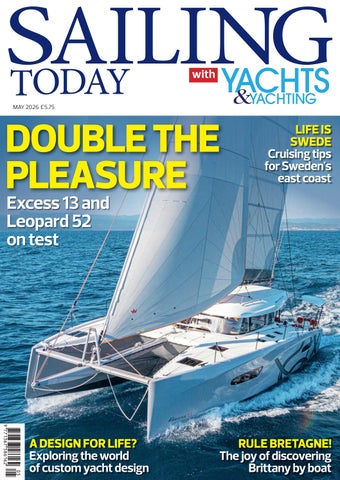
Excess 13 and Leopard 52 on test


RULE BRETAGNE! The joy of discovering Brittany by boat A DESIGN FOR


Powerful tides, legendary sailors, pink granite cliffs and a way of life that slows you down. Sailing Brittany means surrendering to ‘l’Aise Breizh’, as Ingrid Schnabl discovered


Genevieve Leaper joined a couple of friends aboard their Hallberg Rassy 352 on a delightful passage from Copenhagen to Sweden’s southeast coast


e Excess 13 is the latest launch from a manufacturer that endeavours to inject fun into the sometimes languid world of the cruising catamaran. Does it succeed? Sam Je erson nds out


Leopard catamarans is one of the biggest producers of multihulls in the world. Does all that experience pay dividends? Sam Jefferson takes its new 52 for a spin to find out
Leopard Catamarans has a slightly unusual history that the poet Robert Frost would identify with. It was Frost who wrote the immortal lines Two roads diverged in a wood, and I took the one less travelled by, And that has made all the difference. This definitely applies to the South African boatbuilder Robertson and Caine who, until the late 1990s, was getting along quite happily as a medium sized boat builder when its work came to the attention of sailing holiday operator The Moorings. This company felt Robinson and Caine could make catamarans purpose built for its charter fleet. The result turbocharged the business and, in a matter of years, it became one of the biggest boatbuilders in the world and found itself on rather a different road.
If it was a sea change for the boatbuilder, it dealt with it manfully. A prime example would be the Leopard 50, launched in 2018, which has sold a quite staggering 246 units. The new Leopard 52 is the replacement for the 50 and is an all new design. It finds Leopard at something of a crossroads. The hideous experience of Covid 19 created shockwaves across the industry but hit charter fleets incredibly hard. As a result, manufacturers who previously specialised in supplying charter firms, have looked to diversify and make their boats more accessible to private customers.
This was the design brief for Robertson and Caine when it started to draw up a replacement for the 50, and the result is a catamaran that is no less spacious or robust than its predecessor design but one that has a touch more luxury about it and one that gives something of a nod to bluewater cruising. Another key factor was to boost performance and to this end the mast and boom have been lengthened compared to the old 50, while the boom has been lowered to make for easy access to the stack pack. This results in a 17 per cent increase in sail area on the wind, which points to improved performance in light airs. Nevertheless, this is first and foremost a comfortable cruiser and a versatile one at that. In order to cater for both charter and private markets, Leopard opted to offer multiple layout options – nothing so unusual in that – what is unusual is that it offer an eye watering SEVEN different layouts – good news for the customer, less so for the journalist who has to try and explain them all to the reader – more on that later.
for the autohelm which seemed much more competent than me. In terms of sail handling, this was very easy. Everything was to hand and this was great but you did have to be a little careful to keep things organised to ensure you didn’t get into a kerfu e. e electric winches were a real boon and the push button controls were set into the oor which was both good and bad because they freed up your hands but there was a bit of a risk of stepping on them by mistake. e breeze continued to build and, hard on the wind in 12-14kts, we were hitting 7kts without too much e ort.
At this point it’s also worth mentioning the motorisation of this boat. You can choose from either twin 57hp or 80hp diesel engines but there is also the option af a hybrid electric set-up which is what we had on the test boat. e system chosen by Leopard is supplied by French company Jool, a subsidiary of Fountaine Pajot. is consists of two 25 kW electric motors and two 27 kWh lithium batteries, augmented by the 1600W of solar panels. When motoring at a speed of 5kts, each motor consumes 4 kW. On battery power alone, the onboard computer indicated an autonomy of over ve hours, no doubt boosted by the beautiful sunny day. Naturally, with the support of the generator, the autonomy is massive. Leaving the marina and before hoisting the sails we hit 8kts but the range plummeted. However, with the diesel generator o ering backup, you clearly have ample power to get out of a tight corner. Obviously, the electric version is more expensive (in the region of 200,000 Euros) but the upgraded package includes lithium batteries plus the generator.


e Leopard 52 is clearly produced by a boatbuilder that knows its market and has perfected its product for that market. Under sail, the boat is a competent performer without being thrilling. It would do just ne on the Atlantic run and beyond though. Yet the great boon of this boat is the sheer size of it and
Builder: Robertson & Caine
Architects: Simonis Voogd Design
Length overall: 51’8” (15.75 m)
Waterline length: 50’3” (15.31 m)
Beam: 26’9” (8.16 m)
Draft: 5’4” (1.62 m)
Air draft: 81’1” (24.71 m)
Light displacement: 45,232 lbs (20.52 t)
Mainsail: 1,055/1,141 sq ft (98/106 sq m)
Genoa: 757 sq ft (70.3 sq m)
Engines: 2 x 57 HP
Fuel: 237 US gal (900 l)
Water: 185 US gal (700 l)
Price: €899,000 ex-tax
www.leopardcatamarans.com


the high levels of comfort and space. It’s a boat the serves both charter and private clients well and it o ers a very competitive price compared to rivals.
BLUE WATER: ★★★★★ LOOKS: ★★★★★ COMFORT: ★★★★★


