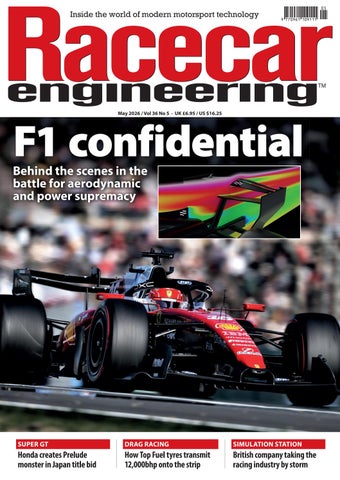
Racecar Engineering May 2026 sample

Page 1


SUPER GT Honda creates Prelude monster in

‘Leaping from 10 per cent sustainable fuel to advanced sustainable fuel has been a big challenge. The available technology, as well as the chemistry we can play around with, is very limited’ Chandramalar Muthiah, fuel technology principal at Petronas

F1’s new fuels have been years in the making. Research into which molecules to use, and how best to combine them to yield optimal combustion properties, has been a continuous process between suppliers and power unit manufacturers

Percentage game

Renewable componentry in F1 fuel has shot up from 10 per cent to almost 100 per cent this year, presenting suppliers with multiple challenges. Racecar investigates

Motorsport’s sustainable fuel revolution has finally arrived at Formula 1’s door. Several other series, such as the FIA World Endurance Championship, British Touring Car Championship and Formula 2, are already using fuel made almost entirely of renewable components, but now it is F1’s turn to implement the technology in some of the most efficient power units ever built.

From 2022 until 2025, grand prix cars ran on E10 fuel, containing 10 per cent ethanol derived from renewable sources. However, a technical revamp for 2026 has brought with it major developments in what feeds the beast. The bar is being raised to near total renewable componentry, as part of F1’s mission to attain carbon neutrality by 2030.

The different fuel suppliers have spent up to the last four years developing fluids that can be ‘dropped in’ without requiring major changes to the 1.6-litre V6 turbo engine structure. Development ran all the way into early 2026, when some of the final blends were homologated, in time for their race debut at the Australian Grand Prix in March.

‘As soon as the old regulations were enforced and the [2022] season kicked off, we had a four-year [development] freeze,’ says Valeria Loreti, technology manager for motorsport operations and marketing at Shell, which supplies teams using Ferrari’s PU. ‘We wanted to exploit it as much as we could.’

Basic requirements

Although the 2026 fuel regulations were still in draft stage at that point, it gave the suppliers a preliminary framework to work with. Notably, that there are two new, fundamental requirements for F1’s latest fuel. One is for it to consist entirely of ‘advanced sustainable’ components, per the FIA’s definition. Such components may also be described as synthetic.

Strictly speaking, and perhaps contrary to popular thought, sustainable components do not make up 100 per cent of the mixture. They form the overwhelming majority, but up to one per cent is reserved for additives and denaturants that are derived from non-sustainable sources.

The second basic requirement is for the fuel to have a minimum 65 per cent greenhouse gas (GHG) emission saving, compared to a standard, reference fossil fuel. The figure, and the reference, come from the European Union Renewable Energy Directive

‘The Renewable Energy Directive is the mother of all the regulations for our fuels’
Valeria

Loreti, technology

(RED), which sets out a legal framework for the development of sustainable content fuels across wider industry. This has added another layer to the homologation process. Where previously F1 suppliers only had to pass a straightforward fuel chemistry test, they now must also undergo a complex assessment of the entire supply chain.

‘The Renewable Energy Directive is the mother of all the regulations for our fuels,’ explains Loreti. ‘That is also what the FIA has taken a lot of inspiration from to define the feedstocks, and what is advanced sustainable. The RED also has a greenhouse gas emission target. You take all the components you want to use [and] calculate how much is the CO2 equivalent for them to be prepared – from the feedstock, to manufacturing and transformation into the molecules you need, and then transport into blending.

‘[The GHG emissions reduction] was not an easy target. Like everything, when you’re doing something new, it’s never easy. You need to work on that and understand how it fits into the bigger picture. On top of that, we also have our performance targets to achieve; that’s all part of the puzzle.’

Chandramalar Muthiah, fuel technology principal at Petronas, which supplies Mercedes AMG High Performance Powertrains, adds: ‘Leaping from 10 per cent sustainable fuel to advanced sustainable fuel has been a big challenge. The available technology, as well as the chemistry we can play around with, is very limited.

‘Besides the challenge in meeting the technology and chemistry, we also have to navigate additional limits in the fuel specifications, such as octane number and distillation profile, to be similar to the road fuel.’

Table 1: F1 2026 fuel suppliers

AngloAmerican icon

From a time when a single chassis could compete in F1 and the Indy 500, we investigate arguably the most beautiful racecar of them all

‘Racecars are neither beautiful nor ugly; they become beautiful when they win,’ Enzo Ferrari is quoted as saying. There is a truth to that, but he was wrong about the Eagle Mk1 Weslake. This car was beautiful long before it was driven to victory in the 1967 Belgian Grand Prix by Dan Gurney. It was only the second ‘American’ car ever to win a grand prix, the rst being a Duesenberg in France in 1921. It was also the rst American car to win an F1 race outside of the Indy 500.

Not only was the Eagle aesthetically pleasing, and constructed from exotic materials, its 3.0-litre V12 must also have been, quite literally, music to Ferrari’s ears.

The Eagle was born from a disastrous Indy 500 for Goodyear, in the early stages of its tyre supply war with Firestone, which was the established player. On the eve of the 1964 edition, all Goodyear shod cars opted to run Firestone tyres instead for the race.

To prevent this from happening again, Goodyear looked at ways to be involved with the development of an Indy car from the outset. Carroll Shelby was called upon for help, but he was too busy guiding Ford towards its famous victory at Le Mans to head the operation himself.

Shelby suggested talking to his good friend and driver, Dan Gurney, who aspired to build his own racecars. A deal was

subsequently struck, and Gurney and Shelby established All American Racers (AAR), with backing from Goodyear.

Twist of fate

While breaking Firestone’s stronghold on the Indy 500 was the primary objective, it was also imperative for Gurney that he could continue his Formula 1 career.

In a fortuitous twist of fate, regulation changes ahead of the 1966 season made it possible for the All American Racers team to produce both a grand prix racer and an Indy car using a single basic design. The most important rule revision was a doubling of the displacement limit from 1.5 to 3.0-litres.

The Eagle was born from a disastrous Indy 500 for Goodyear, in the early stages of [the] tyre supply war

Although Indy car regulations permitted naturally aspirated engines of up to 4.2-litres, the dimensions of the two single seaters would be roughly the same.

For the construction of its new grand prix cars, a satellite ‘Anglo American Racers’ workshop was set up in Rye, England. The historic town near the Sussex coast was a very deliberate choice as the location of the European operations base, for it was right next door to engine specialist Weslake Engineering. Gurney had called on the services of highly experienced engineer, Harry Weslake, before when he commissioned the construction of bespoke alloy cylinder heads for the Ford small block V8 engine.

The eagle on the prominently beaked nose, AAR badging and the blue and white colour scheme are thoroughly American, but the design and construction of the car all took place in Rye, Sussex, near the south coast of England
When the V12 was not ready for the Mk1 Eagle’s debut in 1966, the car was fitted with a 2.7-litre variant of the British Coventry Climax FPF four-cylinder powerplant. Gurney raced the car in this form through the summer of ’66
The car’s 3.0-litre, V12 engine was designed by Aubrey Woods and Peter Berthon and built by Weslake Engineering in the UK with a 60-degree vee angle and four-valve-per-cylinder alloy heads. It used Lucas mechanical fuel injection

Steel appeal

Once a ubiquitous material in racecar construction, advances in materials and technological developments are bringing steel to the forefront once again

Formula 1 in 2026 appears, on the face of it, to be a battle of the power units, with Mercedes gaining an early advantage. However, behind the scenes, the new regulations continue to push the boundaries of materials science and manufacturing technology. In an interesting twist, there has been a resurgence for steel as a viable option for parts where, in the past, it was considered too heavy.

Of course, steel has always been present in F1, and all other racecars. Its presence just tended to be minimised. Parts like crankshafts have been made from nitride, steel forgings for decades and, for such highly loaded parts, it is still the only material that cuts the mustard.

But as higher strength steels have been developed, and manufacturing techniques have advanced, in some cases it is now possible to make steel parts that are lighter and stronger than equivalents in either aluminium or titanium. Notably, the availability of additive manufacturing processes for steel and – this is the important bit – the ability to ensure process repeatability and reliability, has been a game changer.

Recent developments

Now it should be noted, this is not some super, new development. F1 teams have been using additive manufactured steel pistons for about the last eight years. Going further back,

there are some great examples of steel, or at least iron, being used in surprising places. In the 1990s, at the tail end of the V12 era, Ferrari produced a thin wall, investment cast steel / iron block. At a time when cast aluminium blocks were standard practice, Ferrari (thanks to research efforts by parent company Fiat) felt the dimensions of its V12 could be reduced if it used a different manufacturing process. The material’s extra strength meant wall thickness could be reduced, and the result was a more compact block for almost the same weight as an aluminium version. Impressively, the team also experimented with a cast titanium block, though this never saw use in a race.

In its basic form, steel is simply an alloy of iron and carbon, the addition of carbon improving the base element’s mechanical properties

More recently, and well known, is the fact that both Peugeot’s and Audi’s diesel-engined LMP1 cars used steel pistons, for similar reasons to current F1 machines. Due to the very high combustion pressures present in a diesel, the only way to ensure the necessary reliability was to use steel, though at the time, these were regular machined productions. Returning the current day, there is an increasing number of applications for steel in motor racing, with one of the most significant being the pistons. As power unit manufacturers began to master the hybrid regulations brought in for 2014, with an emphasis on very lean combustion and boosting, combustion pressures went through

the roof, especially once so-called fast-burn combustion systems arrived in 2016.

Using Honda as an example (though exact figures are kept under wraps), combustion pressure in its 2014 F1 V6 was said to be ‘nearly twice that of a Honda NSX.’ Given the NSX sits at a BMEP of 21.6bar, one can assume the 2015 engine was at least 40bar. The 2021 F1 engine was around a further 50 per cent higher, in the region of 60bar BMEP. Compare this to, say, the last of the 2.4-litre V8s at around 14-16bar, and it is clear why aluminium alloy pistons weren’t up to the job. What tipped the scales, quite literally, was additive manufacturing, but we will come back to that later. First, what do we mean by steel?

Traditional applications

Away from the exotica of additive manufactured pistons, even the more traditional applications for steel have seen materials evolution.

Take crankshafts, for example. In the past, the standard material for racing cranks tended to be EN40, a chromoly, nitriding steel. Now, at least in the most demanding applications, this has been superseded by 32CDV13 – a three per cent chromium molybdenum vanadium nitriding steel – that has become the industry benchmark. Typically machined from solid billet, it is often produced via single electric melting and vacuum degassing, though vacuum arc re-melted (VAR) variants are deployed when fatigue limits must be pushed. Once nitrided, it achieves a surface hardness of ~850 HV and a UTS exceeding 1300MPa.

The evolution of camshaft materials follows a similar trajectory regarding stability. While EN40B was the standard for many years, thanks to its 61-65HRC case hardness and ductility, the development cycle has shifted towards through hardening steels. These materials offer superior resistance to twist and deflection under the extreme surface loading and shock of modern valvetrains. By prioritising dimensional stability over surface hardness, engineers can ensure timing remains precise, even as thermal and mechanical stresses approach the material’s elastic limit.

In its most common or garden variety, steel is pretty mundane, but even this was a game changer when it first became commercially available.

Steel properties

In its basic form, steel is simply an alloy of iron and carbon, the addition of carbon improving the base element’s mechanical properties. Steel production has been around for at least 3000 years, but it wasn’t until English inventor Henry Bessemer developed his process for steel making in 1855, using ‘pig’ iron as the basis, that its large-scale production became viable. So-called ‘mild steel’ soon replaced wrought iron in industry.

Digital development

A self-proclaimed disruptor in the simulation world, Dynisma has seen rapid growth and is expanding into new territories

The news is hard to avoid. British company, Dynisma, has this year signed to become the official simulator partner of Stellantis Motorsport, and has delivered its stateof-the-art DMG-1 device to Rodin Motorsport’s new Driver Performance Centre, and its DMG-X to TU Graz for advanced driving simulation.

The company’s range of simulators is set to expand further still this year, with a new entry-level platform designed to bring the same patented F1-derived motion technology to a wider range of motorsport programmes, in the hope of further expanding the company’s reach.

Dynisma was founded in 2017 by F1 driving simulator engineer, Ash Warne, who previously led the simulator development programme for McLaren for nearly seven years, before moving to Ferrari as senior vehicle dynamics engineer. In this time, Warne realised that the industry requirements were high bandwidth, low latency and large excursion motion simulation so, after leaving Ferrari, set about developing a range of motion generators for commercial use.

The company’s new, entry-level DMG-S uses F1-derived technology, just without some of the excursions seen in higher level units
Dynisma isn’t yet a decade old but has secured contracts to supply simulators to several high-level race teams and manufacturers, including Ferrari, Genesis, McLaren, Nismo and Stellantis

Warne called the company Dynisma, and settled on Bristol as its home. Less than a decade on, rapid growth has seen it expand to almost 180 personnel who build, service and develop the range of Dynisma Motion Generators (DMGs) that are now in use with racing teams around the world. In fact, such is the demand for the company’s products that there is now a lead time for them, be it from F1, Formula E, the FIA World Endurance Championship or universities.

Composites hub

Based in the heart of a composites hub south of Bristol, Dynisma is ideally placed to build its own simulators. ‘We don’t use ball screws, gearboxes and hydraulic actuators, we generate our motion in quite a different way,’ says commercial director, Simon Holloway, who joined in 2023 from RML and, prior to that, Cosworth. ‘We do all the design, analysis and engineering. We then use the UK supply chain, primarily, to supply those parts.

‘There are other components that we buy in from abroad, such as the magnets we use in the drives, which mainly come from China. We then have motors that come from Germany, and other parts from Europe, but the majority of what goes into our systems comes from the UK.’

‘We don’t use ball screws, gearboxes and hydraulic actuators, we generate our motion in quite a different way’ Simon Holloway, commercial director at Dynisma

The proximity to Bristol’s flourishing carbon fibre industry is important to Dynisma as it means bespoke pieces can be developed and delivered quickly. It also helps with further business opportunities, as helicopter company Leonardo is also in the vicinity, and uses simulators for pilot training.

‘For the DMG-360, we have a very large carbon fibre disc that is made by a marine company in Portsmouth. There are a lot of suppliers around us because of the aerospace and defence businesses based around here.’

Automotive market

While Dynisma was set up to cater to the racing industry, automotive is driving a large amount of its business growth. New players have changed the game, meaning the more established OEMs are now having to play catch up.

‘It’s all about reducing the time that car companies produce cars,’ says Holloway. ‘Western car companies take five to seven years to bring a vehicle into the market, while China is doing it in 36 months, and aiming to get that down to 18 months, from concept of vehicle to market. So, people are now using sims to try and make this process happen a lot quicker.’

Suspension, damper, chassis, aerodynamics and tyre development have all been switched to the virtual world in a bid to reduce that conceptto-delivery timeframe. Testing different dampers, with multiple drivers, for example, can be done far quicker on a simulator than in the real world, and in a completely controlled environment, where validation is key.

Over-the-air updates are another tool that OEMs are using to launch quicker and fix later. ‘You get the car to the market, collect customer feedback and then you update the software and give the customer more features, or functionality,’ explains Holloway. ‘Getting that underlying car, and trying to make it perform at its best, is what everyone is concentrating on.’

Driving experience

Automotive is also frantically developing tools to improve safety, such as lane assist, alongside autonomous driving. Having a passenger in the car while developing a self-driving car is critical to the manufacturer understanding the experience.

‘It then becomes about how does the car hand over?’ continues Holloway. ‘So, in those scenarios, where the driver has to take control again, how does the handover work between the two? Lane assist is a good example; most people are just trying to find out how to turn it off. But in reality, if you can try different types of lane assist, with your target demographic driving in a simulator, so they really experience it, you can then ask more questions. Like how harsh is it? How much does the steering wheel vibrate? Those kinds of things. You can then tune those parameters so you have something ready to go to market that the consumer likes, rather than something they’re all busy trying to turn off.

Simon Holloway
It’s not just the space required for the simulator itself; high-end systems require a dedicated control room (McLaren shown)
Naturally, F1 teams want the best sim available, and McLaren has chosen Dynisma, but automotive is following closely behind

Opel replaces DS on Formula E grid

Opel will replace fellow Stellantis brand DS Automobiles on the FIA Formula E World Championship grid next season, in line with the arrival of the new Gen4 car regulations.

The move will see the end of an 11-season stint in the electric series for DS, which joined back in 2015-’16. DS first aligned with the Virgin Racing squad, before entering a partnership with Techeetah that yielded a pair of

drivers’ and manufacturers’ titles. It then switched to Penske in 2022-’23.

After the current Formula E season ends in August, the company will focus on its new venture in SailGP.

‘We are now taking a new step by orientating our partnership strategy towards SailGP, a unique laboratory of innovation where technological performance and emotion meet,’ said Xavier Peugeot, DS Automobiles CEO.

Opel is adding Formula E to its motorsport portfolio after recently launching an electric Mokka rally car. It will compete with a factory squad called Opel GSE Formula E Team.

‘Joining Formula E marks a new milestone for Opel on our journey towards an electric future,’ said its CEO, Florian Huettl. ‘With Formula E moving to Gen4 cars... we see this as the ideal time to join.’

BMW BREAD VAN TO MAKE UNLIKELY NÜRBURGRING DEBUT

IN BRIEF

Safety equipment firm Racing Force Group has extended its contract with the FIA, whose officials, safety car drivers and medical car staff across its championships will continue to be provided with OMP fire-retardant racewear and Bell Racing helmets.

After just two rounds, Audi F1 team principal Jonathan Wheatley left the squad due to ‘personal reasons’. At time of going to press, multiple reports linked Wheatley to Aston Martin.

Dario Marrafuschi is the new head of motorsport at Pirelli, replacing Mario Isola who is to join ACI Sport, Italy’s motor racing federation. Marrafuschi hails from Pirelli’s road car side but has prior F1 experience.

Lamborghini has named Andrea Reggiani as its new head of motorsport, replacing Maurizio Leschiutta who was in post for less than a year. The Italian-Swiss engineer will report directly to company CTO Rouven Mohr.

Ford’s Hypercar project has recruited three-time Le Mans winning race engineer Leena Gade to work alongside fellow new recruits Grant Clarke, who will lead trackside operations, and Jean-Philippe Sarrazin, who engineered the 2024 WEC title-winning Porsche 963.

Dunlop will join the top class at the Nürburgring 24 Hours, its tyres fitted to a Porsche 911 GT3 R run by the Schnabl Engineering team. Schnabl’s other 911 will run on Falkens, continuing a long-running partnership with that brand. Dunlop and Falken are part of Sumitomo Rubber Industries.

Walkinshaw TWG Racing is under new ownership with new director Scott O’Donnell taking over Zak Brown’s shares in the Australian Supercars team, while TWG Motorsports has acquired the shares formerly held by United Autosports.

Motion Applied has been named a finalist in the 2026 Smarter Sports Awards. The company is nominated in two categories; Smarter Data and Analytics Technology, and Smarter Motorsport Technology.

DS has been in Formula E since 2015 and became a title-winning force with the Techeetah team. It will now pursue its racing interests on water

Turn static files into dynamic content formats.

Create a flipbook