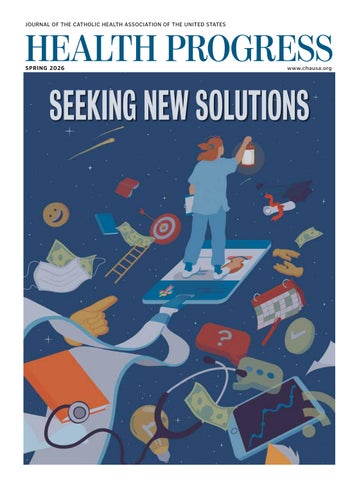
Health Progress - Spring 2026

Page 1


HEALTH PROGRESS®

SEEKING NEW SOLUTIONS

Illustrations by Alice Mollon

4 LESSONS FROM ABROAD FOR CATHOLIC HEALTH CARE

Brian M. Kane, PhD

10 WHERE MISSION MEETS THE MARKET: SOLVING HEALTH CARE FAILURES THAT HURT PEOPLE

Carter Dredge, BusD, MHA

15 STRENGTHEN DISASTER PREPAREDNESS BY UNDERSTANDING RISK

Alexander Garza, MD, MPH

20 CATHOLIC HEALTH SYSTEMS AIM TO BREAK CYCLE OF GUN VIOLENCE AND ACCIDENTS

David Lewellen

26 MAKING THINGS BETTER: MERCY TRANSFORMS THE NURSING EXPERIENCE

Stephanie Clements, MBA, BSN, RN, CENP

32 ACCESS BEGINS WITH A CONNECTION: HOW SIMPLE INNOVATIONS TRANSFORM CARE AND REACH THE VULNERABLE

Mitesh Patel, MD, MBA

35 ‘I HAVE LOVED YOU’: CATHOLIC HEALTH CARE’S ROLE IN APPLYING DILEXI TE TO MEDICAID’S NEW COMMUNITY ENGAGEMENT REQUIREMENTS

Paulo G. Pontemayor, MPH

FEATURE

39 NATIONAL SURVEY HIGHLIGHTS TRENDS AND OBSTACLES TO PROFESSIONAL SPIRITUAL CARE IN CATHOLIC HEALTH ENVIRONMENTS

DEPARTMENTS

2 EDITOR’S NOTE BETSY TAYLOR

46 MISSION

Go and Do Likewise: A Tradition of Caring for Our Immigrant Brothers and Sisters DENNIS GONZALES, PhD

50 ETHICS (Xeno)Transplantation and an Integral Ecology

SAM BERENDES

53 THINKING GLOBALLY

Ethical Global Recruitment: A Call to Embrace Our Shared Responsibility BRUCE COMPTON and CAMILLE GRIPPON

56 FORMATION

The Power of Retreats: Where Spirit Shapes Leadership DARREN M. HENSON, PhD, STL

60 COMMUNITY BENEFIT

Why the IRS Community Benefit Standard for Tax-Exempt Hospitals Has Endured STEPHEN M. CLARKE, JD

31 FINDING GOD IN DAILY LIFE

64 PRAYER SERVICE

Mark Gray, PhD, Jill Fisk, MATM, and Erica Cohen Moore, MA IN YOUR NEXT ISSUE ARTIFICIAL INTELLIGENCE

EDITOR’S NOTE

“Adispute arose between the North Wind and the Sun, each claiming that he was stronger than the other. At last they agreed to try their powers upon a traveler, to see which could soonest strip him of his cloak. The North Wind had the first try; and, gathering up all his force for the attack, he came whirling furiously down upon the man, and caught up his cloak as though he would wrest it from him by one single effort: but the harder he blew, the more closely the man wrapped it round himself.

Then came the turn of the Sun. At first he beamed gently upon the traveler, who soon unclasped his cloak and walked on with it hanging loosely about his shoulders: then he shone forth in his full strength, and the man, before he had gone many steps, was glad to throw his cloak right off and complete his journey more lightly clad.

Persuasion is better than force.” 1

I’ve been thinking about this Aesop’s fable a lot lately, perhaps because it’s cold out as I write this, perhaps because the chill in the air these days sometimes feels more about the frostiness of the times than of the weather. This issue of Health Progress focuses on Seeking New Solutions in health care. We delve into several of the major issues affect ing health care and society, high lighting policy, programs and approaches that make a positive difference or offer education in areas where health care systems can learn from one another. Articles explore topics ranging from crafting public policy that protects poor and vulnerable popu lations, to preventing gun violence, improving staffing flexibility, responding effectively to disasters and caring for immigrants.

versation around a kitchen table), as people may be increasingly uncertain of their trust in institutions, they turn to strengthen relationships with one another.

I generally associate with a fairly civic-minded lot. Many of them work for the media and truly believe that reporting as fairly and accurately as they can is a societal good. Those who don’t work in journalism still tend to consume a lot of media, and they discuss it, and contact their elected officials to voice their views. They’re engaged, but my sense is that they don’t always feel heard these days.

And so why am I returning to a Greek fable from around 600 B.C.? I think it’s because in times of societal uncertainty, I see more examples of warm, informal networks, of people looking out for one another, standing up for one another, and extending support and mercy to others.

Another translation for the lesson at the end of this fable reads: “Kindness effects more than severity.” I think this holds true in our social networks (whether an electronic group chat among real-life friends or an honest-to-goodness con-

Complexity and nuance have taken a back seat to the bombastic in some quarters, and while we may hope that course corrects, are we sure it will? I, for one, don’t want to live in a society where shouting others down becomes accepted practice. A clever social media post has its place, but so do listening, discerning and influencing based on one’s own example and actions, not namecalling. I support a little more Sun and a little less North Wind. I hope that’s reflected in these articles.

NOTE

1. Aesop’s Fables, trans. V. S. Vernon Jones (1912), Project Gutenberg, www.gutenberg.org/ files/11339/11339-h/11339-h.htm. The published version of this work uses the British spelling of the word traveller. It has been adjusted here.

BETSY TAYLOR

MANAGING EDITOR

CHARLOTTE KELLEY ckelley@chausa.org

GRAPHIC DESIGNER

NORMA KLINGSICK

ADVERTISING 4455 Woodson Rd., St. Louis, MO 63134-3797, 314-253-3447; fax 314-427-0029; email ads@chausa.org.

SUBSCRIPTIONS/CIRCULATION Address all subscription orders, inquiries, address changes, etc., to Service Center, 4455 Woodson Rd., St. Louis, MO 63134-3797; phone 800-230-7823; email servicecenter@chausa.org. Annual subscription rates are: complimentary for those who work for CHA members in the United States; $29 for nonmembers (domestic and foreign).

ARTICLES AND BACK ISSUES Health Progress articles are available in their entirety in PDF format on the internet at www.chausa.org. Photocopies may be ordered through Copyright Clearance Center, Inc., 222 Rosewood Dr., Danvers, MA 01923. For back issues of the magazine, please contact the CHA Service Center at servicecenter@chausa.org or 800-230-7823.

REPRODUCTION No part of this publication may be reproduced or transmitted in any form or by any means, electronic or mechanical, including photocopying, recording or any information storage and retrieval system, without permission from CHA. For information, please contact copyright@chausa.org.

OPINIONS expressed by authors published in Health Progress do not necessarily reflect those of CHA. CHA assumes no responsibility for opinions or statements expressed by contributors to Health Progress.

2025 AWARDS FOR 2024 COVERAGE

Catholic Media Awards: Magazine of the Year — Professional and Special-Interest Magazines, Second Place; Best Cover — Small, First Place; Best Special Section, Second Place; Best Special Issue, First Place; Best Regular Column — Spiritual Life, Honorable Mention; Best Coverage — Disaster or Crises, Third Place; Best Feature Article — Professional and Special-Interest, Third Place; Best Reporting of Social Justice Issues — Dignity and Rights of the Workers, Second Place; Hot Topic — Eucharistic Revival, Third Place; Hot Topic — 2024 Election, Third Place; Best Writing — Analysis, First Place; Best Writing — In-Depth, Second Place.

American Society of Business Publication Editors Awards: Print — Special Section, National Bronze Award and Regional Gold Award; All Content — How-To Article, Regional Silver Award.

Produced in USA. Health Progress ISSN 0882-1577. Spring 2026 (Vol. 107, No. 2).

Copyright © by The Catholic Health Association of the United States. Published quarterly by The Catholic Health Association of the United States, 4455 Woodson Road, St. Louis, MO 63134-3797. Periodicals postage paid at St. Louis, MO, and additional mailing offices. Subscription prices per year: CHA members, free; nonmembers, $29 (domestic and foreign); single copies, $10.

POSTMASTER: Send address changes to Health Progress, The Catholic Health Association of the United States, 4455 Woodson Road, St. Louis, MO 63134-3797.

Follow CHA: chausa.org/social

EDITORIAL ADVISORY COUNCIL

Trevor Bonat, MA, MS, vice president, mission integration, Ascension, St. Louis

Sr. Rosemary Donley, SC, PhD, APRN-BC, professor of nursing, Duquesne University, Pittsburgh

Fr. Joseph J. Driscoll, DMin, director of ministry formation and organizational spirituality, Redeemer Health, Meadowbrook, Pennsylvania

Jennifer Stanley, MD, physician formation leader and regional medical director, Ascension St. Vincent, North Vernon, Indiana

Rachelle Reyes Wenger, MPA, system vice president, public policy and advocacy engagement, CommonSpirit Health, Los Angeles

Nathan Ziegler, PhD, system vice president, diversity, leadership and performance excellence, CommonSpirit Health, Chicago

CHA EDITORIAL CONTRIBUTORS

ADVOCACY AND PUBLIC POLICY: Lucas Swanepoel, JD; Kathy Curran, JD, MA; Clay O’Dell, PhD; Paulo G. Pontemayor, MPH

COMMUNITY BENEFIT: Nancy Zuech Lim, RN, MPH

CONTINUUM OF CARE AND AGING SERVICES: Indu Spugnardi

ETHICS: Nathaniel Blanton Hibner, PhD; Brian M. Kane, PhD

FINANCE: Loren Chandler, CPA, MBA, FACHE

GLOBAL HEALTH: Bruce Compton

LEADERSHIP AND MINISTRY DEVELOPMENT: Diarmuid Rooney, MSPsych, MTS, DSocAdmin

LEGAL, GOVERNANCE AND COMPLIANCE: Catherine A. Hurley, JD

MINISTRY FORMATION: Darren Henson, PhD, STL

MISSION INTEGRATION: Dennis Gonzales, PhD; Jill Fisk, MATM

PRAYERS: Karla Keppel, MA; Lori Ashmore-Ruppel

THEOLOGY AND SPONSORSHIP: Sr. Teresa Maya, PhD, CCVI

SEEKING

Lessons From Abroad for Catholic Health Care

The development of health care systems across the world has been a dynamic process shaped by a myriad of political, economic, social and religious factors. These international health care models provide a stark contrast to the United States’ approach to providing equitable health care and to how U.S. Catholic health systems have tried to navigate the complexities of the American health care marketplace. The contrast between these international models and American health care needs to be considered in the evaluation of the future direction of U.S. Catholic health care.

EARLY DEVELOPMENT OF HEALTH CARE MODELS

The mid-19th into the early 20th centuries marked a pivotal period in the evolution of health care systems, with significant reforms and innovations taking place in Europe. Over the decades, nations have developed various models of health care delivery, each reflecting their unique sociopolitical contexts and priorities.

The mid-19th century also marked a turning point in the development of health care systems worldwide. Prior to this period, health care was provided by individual practitioners, religious institutions and charities. Patients paid practitioners directly, or care was provided on a charitable basis. Public health interventions were minimal, and medical care was often expensive and inefficient. However, the Industrial Revolution and the expansion of urban populations in Europe and North America created new challenges that demanded systemic approaches to health care.

insurance program was established in Germany. The program was aimed at providing protection for industrial workers against the financial burden of illness. Bismarck’s social insurance model was based on the principle of social solidarity, where workers, employers and the state shared the cost of health care. This system also reflected Germany’s growing industrial power and its desire to create a stable and loyal working class.

The German system was initially designed to cover working-class individuals, leaving the

The contrast between these international models and American health care needs to be considered in the evaluation of the future direction of U.S. Catholic health care.

Germany played a crucial role in the development of modern social health insurance systems. In 1883, under the leadership of Chancellor Otto von Bismarck, the world’s first national health

wealthy and the poor outside its scope. Over time, the system expanded, and by the 20th century, it had evolved into a comprehensive, multipayer system that covered nearly the entire population. The German model became a template for many other countries, including Japan, and is still largely intact and financially solvent today.1

Switzerland, like Germany, developed a health insurance system in the late 19th century, but its

approach was slightly different. In 1911, Switzerland introduced compulsory health insurance, which required citizens to purchase insurance from private insurers, although premiums were subsidized by the government for the low-income population. The system was designed to offer universal coverage, but the actual implementation of the system varied by region, reflecting Switzerland’s federal structure.2

Unlike the German model, which relied heavily on employer contributions, the Swiss system was based on individual workers paying private insurers, who then managed the delivery of care. In the Swiss system, private insurers fund the system through individual contributions, but, importantly, they do not make a profit. They cover their costs annually. Any profit is directed to lowering premiums in a subsequent year. The government reviews costs annually and determines reimbursement standards.

The Swiss health care system remained relatively decentralized throughout the 20th century, with each canton maintaining a high degree of autonomy over health care delivery. Today, the Swiss system is widely regarded as one of the most efficient and equitable in the world, providing universal coverage through a combination of public regulation and private insurers. The key points to this system are that the government actively assesses costs, and that the funding model does not allow the insurance companies, who manage claims, to benefit from a profitable markup for services. Profit is directed toward cost containment.

In contrast to the German and Swiss systems, the United Kingdom developed a health care model based on social welfare principles. The Beveridge Report of 1942, authored by economist Sir William Beveridge, laid the groundwork for the establishment of the National Health Service (NHS) in 1948. The NHS was designed to provide comprehensive, universal health care to all citizens, regardless of income. It was, and still is, funded primarily through taxation, with health care services provided by the government.

The establishment of the NHS marked a major shift in British health care, moving away from the charitable and private provision of care toward a system of universal public provision. The NHS was based on the principle of equity, aiming to provide health care according to need rather than

ability to pay. The Beveridge model has influenced health care systems in many countries, particularly in Europe and the Commonwealth, and remains a key reference point for debates about universal health care. It is important to note that although the NHS provides universal coverage, the Beveridge model also allows individuals to pay out-of-pocket for private health care insurance or providers outside the system.

Japan’s health care system is another notable example of an evolving model that blends elements of different approaches. Japan introduced universal health insurance in 1961, following a period of rapid economic growth and industrialization. The Japanese system combines elements of the Bismarckian and Beveridge models, with both employer-based and government-administered health insurance programs. The country’s health insurance system is financed through premiums paid by employers and employees, as well as contributions from the government.

Japan’s approach to health care is characterized by a focus on preventive care and a strong emphasis on public health. The government provides extensive health screening programs, and citizens are encouraged to undergo regular health checks. The country’s low-cost, high-quality health care system is often cited as one of the best in the world,3 with Japan consistently achieving some of the highest life expectancy rates globally.4

STRUCTURAL DIVIDE OF AMERICA’S HEALTH SYSTEM

The United States presents a stark contrast to many of these mentioned countries. Its health care system has traditionally been dominated by private sector providers, with minimal public involvement until the mid-20th century. Unlike Germany or the U.K., the U.S. did not introduce a social health care system until the 1960s, with the establishment of Medicare and Medicaid. These programs were designed to provide health care coverage for the elderly, disabled and low-income individuals. Medicare and Medicaid, along with the Veterans Affairs health care system, mimic the U.K. system, with heavy government regulation on services and reimbursement.

For the rest of the U.S., most of the population continues to fund their health care through employer-sponsored insurance, where private employers offer health insurance plans to employees. There is still a significant portion of the popu-

SEEKING NEW SOLUTIONS

The U.S. spends more on health care than any other country, yet it struggles with significant disparities in access to care, quality of services and health outcomes. Its private-sectorsponsored insurance model has led to high costs, inefficiencies and unequal access to care, particularly for marginalized groups.

lation who do not receive sufficient or any coverage from an employer. Instead, their health care needs to be self-funded, if they can afford it.

The U.S. spends more on health care than any other country, yet it struggles with significant disparities in access to care, quality of services and health outcomes. Its private-sector-sponsored insurance model has led to high costs, inefficiencies and unequal access to care, particularly for marginalized groups.5

The U.S. health care system is, in fact, an inefficient mash-up of the described international systems, with the addition of a health care marketplace. There are health care aspects that mimic the best international systems (Medicare, Medicaid and the VA), but for most of the population, we are left with private, profit-driven health insurance, or systems like those in low-income countries where the individual or family must self-pay for their care.

The Affordable Care Act (ACA) expanded coverage options while retaining employersponsored insurance. Knowing that many people cannot afford to self-fund their health care, the ACA tried to create a Bismarck model, where the cost of health care was shared between the government and workers. The immediate problem was that the insurance model in the U.S. was still based on profit from providers, unlike the German system. Further, as recent events have illustrated, Congress has not kept its promise to support those who cannot afford to cover the full costs of their health care insurance.

CATHOLIC HEALTH CARE’S EVOLUTION IN AMERICA

The history of Catholic health care in the U.S. is deeply intertwined with the country’s broader health care development. Catholic hospitals and health care organizations have played a significant role in providing care, particularly in under-

served areas, and have often been at the forefront of caring for vulnerable populations, such as immigrants and those who are poor. While they provided labor due to their calling, and accepted donations and pay for services to help fund care, the sisters realized that this model was insufficient. They had to find ways of having steady revenue streams, and later they navigated the private insurance model, as well as Medicare and Medicaid, to continue providing financially viable care.

Catholic health care in the U.S. dates to the 18th and 19th centuries, with Catholic religious orders, mostly of Catholic sisters, establishing hospitals and health care facilities in cities across the country. These institutions were initially focused on providing care to the poor, immigrants and those with no other means of support. The sisters played a crucial role in the establishment of these early hospitals, often in areas where medical care was scarce or unavailable.

Catholic hospitals were often seen as an alternative to Protestant and secular institutions, especially in places where new communities were created through western expansion. The ethos of Catholic health care emphasized compassion, care for the whole person, and a commitment to the sanctity of life. In many cases, Catholic hospitals were among the first to offer services to marginalized populations, such as African Americans, who were often excluded from mainstream health care institutions.6 At the same time, as historian Barbra Mann Wall has documented, the sisters were entrepreneurs, seeking out specific populations that could help to provide a steady revenue stream, like railroad workers, miners and seamen. Charitable donations “never accounted for more than 9% of total receipts,” for the sisters’ hospitals in the late 19th and early 20th centuries.7

In the 20th century, health care changed significantly because of scientific advances. 8

Catholic health care in the U.S. expanded significantly, as religious orders continued to establish hospitals and health care networks across the country. By the mid-20th century, Catholic hospitals had become a major component of the U.S. health care system, particularly in urban areas. Catholic health care organizations played a key role in the development of health care infrastructure, often filling gaps in services where government programs and private insurers were not active.

The 21st century has brought both challenges and opportunities for Catholic health care in the U.S. On the one hand, Catholic hospitals face

ceeded in providing universal and equitable care. In particular, the German, Swiss and U.K. models offer insights into the role of social solidarity, public funding and regulation in ensuring access to care. These countries have demonstrated that it is possible to provide high-quality, affordable health care for all citizens while balancing the needs of the public and private sectors.

For Catholic health care in the U.S., the key challenge lies in adapting these international lessons to the nation’s unique cultural and political context. Catholic health care organizations can advocate for policies that promote universal access to care, while also ensuring that their services remain grounded in the values of compassion, service to the poor and respect for human dignity.

The challenge that Catholic health care faces is the same that faces American health care. How can we create an equitable health care delivery system that is efficient and still meets the needs of the entire population?

increasing pressure to adapt to the changing health care landscape, particularly as the U.S. moves toward even more market-driven models of care. The rise of for-profit hospitals, mergers and acquisitions, and cost-cutting initiatives have raised concerns about the future of Catholic health care’s mission of serving the poor and vulnerable.

CATHOLIC HEALTH CARE AT A CROSSROADS

The challenge that Catholic health care faces is the same that faces American health care. How can we create an equitable health care delivery system that is efficient and still meets the needs of the entire population? International health care systems have accomplished that by having the government play an important role in regulating health care costs through different mechanisms. As mentioned previously, the federal government has already done that in the Medicaid, Medicare and VA systems. While those systems are not problem-free, the model does work.

Catholic health care institutions in the U.S. can learn valuable lessons from international health care systems, especially those that have suc -

As health care systems continue to evolve, Catholic health care institutions must reflect on the lessons learned from international models. By embracing the strengths of systems that prioritize equity, public responsibility and a holistic approach to health care, the Catholic health ministry can continue to fulfill its mission of serving the most vulnerable members of society. Ultimately, international health care systems provide valuable insights into how Catholic health care in the U.S. can adapt and innovate in the face of growing challenges, ensuring that it remains true to its moral and ethical foundations.

BRIAN M. KANE is senior director, ethics, for the Catholic Health Association, St. Louis.

NOTES

1. “Health Care in Germany: Learn More – The German Healthcare System,” Institute for Quality and Efficiency in Health Care, December 18, 2024, https://www.ncbi. nlm.nih.gov/books/NBK298834/.

2. The following source provides an overview to many different international health systems: “International Profiles of Health Care Systems, 2011,” The Commonwealth Fund, November 2011, https:// www.commonwealthfund.org/sites/default/files/ documents/___media_files_publications_fund_ report_2011_nov_1562_squires_intl_profiles_ 2011_11_10.pdf.

3. Xing Zhang and Tatsuo Oyama, “Investigating the Health Care Delivery System in Japan and Reviewing the Local Public Hospital Reform,” Risk Management and Healthcare Policy 2016, no. 9 (2016): 21-32, https://doi.org/10.2147/RMHP.S93285.

4. Truman Du, “Here’s How Countries Compare on Healthcare Expenditure and Life Expectancy,” World Economic Forum, November 23, 2022, https://www. weforum.org/stories/2022/11/countries-compare-onhealthcare-expenditure-life-expectancy/.

5. Emma Wager and Cynthia Cox, “International Comparison of Health Systems,” KFF, October 8, 2025, https://www.kff.org/global-health-policy/health-policy101-international-comparison-of-health-systems/.

6. Kevin J. Jones, “The Nuns Who Witnessed the Life and Death of Martin Luther King Jr.,” EWTN News, January 19, 2026, https://www.ewtnnews.com/world/us/the-nunswho-witnessed-the-life-and-death-of-martin-lutherking-jr.

QUESTIONS FOR DISCUSSION

SEEKING NEW SOLUTIONS

7. Barbra Mann Wall, Unlikely Entrepreneurs: Catholic Sisters and the Hospital Marketplace, 1865-1925 (Ohio State University Press, 2005), 106-107.

8. There are many examples that could signal this shift. In 1910, for example, the Flexner Report, officially titled “Medical Education in the United States and Canada,” was released by the Carnegie Foundation: https:// ia803109.us.archive.org/32/items/carnegieflexner report/Carnegie_Flexner_Report.pdf. Written by Abraham Flexner, it argued for standards for medical education of physicians. After the report, many substandard medical schools closed. In 1917, the American College of Surgeons proposed minimum standards for hospital accreditation. Around the same time period, in 1915, Catholic health ministry leaders founded the Catholic Hospital Association, now the Catholic Health Association, as a way of ensuring consistency of standards for their hospitals. See the following: Wall, Unlikely Entrepreneurs, 166-68.

This article by CHA’s Brian Kane, senior director, ethics, highlights that the United States “spends more on health care than any other country, yet it struggles with significant disparities in access to care, quality of services and health outcomes. Its private-sector-sponsored insurance model has led to high costs, inefficiencies and unequal access to care, particularly for marginalized groups.”

1. As CHA focuses on its Health Care Reimagined strategic objective, who do you turn to as an innovative thinker on the future of U.S. health care? What do you appreciate about his or her ideas?

2. What did you learn about the history of health care in the U.S. and other countries that you didn’t know? How does that affect your thinking about systemic reform or possible improvements in your own health system or care environment?

3. What change would you most like to see to U.S. health care, particularly to curb staggering medical costs or to assist people deferring care because they can’t afford it?

4. What innovative ideas do you have that will enable Catholic health care ministries to continue our mission to care for the most vulnerable in our communities during an ever-challenging financial, political and social environment?

SEEKING NEW SOLUTIONS

Where Mission Meets the Market: Solving Health Care Failures That Hurt People

My first health care encounters came at an early age, not because of a single illness, but because constant medical intervention was woven into the fabric of my childhood. I grew up in a four-generation home comprised of my great-grandmother, my grandfather, my mother, my twin brother and myself.

My great-grandmother, born in 1899, was legally blind, had heart problems and was homebound. My grandfather suffered from a series of ministrokes. My mother was also homebound for many years, having been paralyzed in a car accident before I was born, which also killed her mother. Given my family’s significant health challenges, my early years were shaped by the rhythms of countless doctor appointments, hospital visits, home care visits and phone calls from specialized care teams.

I was greatly impressed by the good-naturedness of many individuals who chose to work in health care — selecting it not just as a job, but as a vocation — and I frequently saw people go beyond their regular duties to perform heroic acts of care and compassion. Health care also hosts magnificent innovation, from advanced imaging and genomics to life-extending therapies that would have been unimaginable a single generation ago.

Despite the goodness of its people and the brilliance of its science, American health care has a fundamental flaw: It still hasn’t figured out how to make what’s truly essential sustainably affordable and available. This is not a failure of compassion or intelligence; it’s a market failure. We believe the best solution to this type of market failure involves the creation of new structures within the market — structures that achieve dramatically new levels

of competition-driven improvements through the market rather than despite it.

MISSION AND MARKET MISALIGNMENT

After picking a health care career and spending a significant portion of my time in the Catholic health ministry, I became immersed in the structures associated with delivering, financing and regulating health care. I was astonished by its complexity, inspired by its aspirations, and unfortunately saddened by its many flaws and contradictions.

While the system wanted people to be well, it got paid more when people were sick. Some aspects were highly technologically advanced, while others still relied on faxes and paper. One of the most harrowing contradictions of all was that even when something was truly essential, it didn’t mean that it was available.

This essentiality-availability contradiction was particularly troubling given that essentiality is one of the most critically defining characteristics of health care. Health care is not a business that provides consumer-preferred luxuries or entertainment; it’s about alleviating suffering and sustaining life itself. For those of us in Catholic health care, it’s much more than a business; it’s a ministry. It’s not just about the market; it’s about the mission.

No one knows when they will need health care most, and when that moment comes — whether for ourselves or someone we love — availability and affordability become far more important to us than ensuring we have the newest and shiniest toys. Where American health care struggles most is not in inventing what is novel. In fact, it excels at creating breakthrough innovations through its vast and highly mature network of entrepreneurs and investors. Where it fails is in making the old, proven, essential resources reliably available at a price people and communities can sustain.

This is where the health care utility model comes in — and where the work of the Mindshare Institute begins.

WHAT IS A HEALTH CARE UTILITY AND WHY IT MATTERS

A health care utility1 is defined as a self-sustaining nonprofit, nonstock corporation, formed by health care institutions to provide essential products and services at the lowest sustainable cost, using a focused, transparent and scalable business model.2 Health care utilities are not about luxury or preferred items, but about essentials: medicines, core services and infrastructure that everyone should be able to access.

The health care utility model is necessary as essential health care goods behave differently from traditional consumer products because 1) you cannot defer them when prices spike, 2) you cannot substitute them when supply disappears and 3) you often need them urgently, under stress, and without choice. When essentials are treated like discretionary goods, market predictability fails, prices rise, shortages emerge and people get hurt. Health care utilities correct this failure not by replacing markets, but by changing how competition works within them.

CHANGING THE SCRIPT ON PHARMACEUTICALS

The first health care utility was established in 2018 with the launch of a nonprofit pharmaceutical company called Civica Rx,3 created to address chronic shortages and price instability in essential hospital medicines.

Leading up to Civica Rx’s formation, the pharmaceutical market repeatedly demonstrated examples of value being extracted from vulnerable patients through extreme price increases on long-established generic drugs and persistent shortages of basic therapies. One infamous exam-

ple was in 2015, when Turing Pharmaceuticals increased the price of Daraprim, a drug to treat toxoplasmosis, by more than 5000% in a single day. Another example was when Mylan Pharmaceutical increased the price of the EpiPen, injectors to treat allergic reactions, from about $100 in 2007 to more than $600 in 2016.4

Beyond price exploitation, there were also tragic shortages of essential medicines. In a particularly heart-wrenching account, a health system that later helped create Civica Rx shared a story about a patient who was admitted to the hospital for a treatable condition that required medication that was frequently on shortage. The hospital was unable to access the drug and, when faced with uncertainty about future access to the essential drug, the patient tragically committed suicide after being discharged from the hospital.5

Civica Rx was created to avoid the continuation of heartbreaking decisions like this.

Founded by seven health systems and three major philanthropies, Civica Rx took an approach to address market failures called disruptive collaboration, where multiple institutions come together to disrupt an entire subindustry, in this case hospital-use generic pharmaceuticals. 6 To ensure the mission would not drift, this collaboration scaled using a nonprofit, nonstock structure, in this case the newly created health care utility.

And it worked.

Civica Rx’s novel mission-oriented strategy took root — and grew rapidly — improving access and reducing costs for millions of patients.7 As of June 2025, the company has grown to nearly 60 health systems, more than 1,400 hospitals, and has helped treat an estimated 90 million patients.8

When essentials are treated as shared infrastructure rather than profit-maximizing assets, markets can heal themselves. Competition increases, efficiency and agility still matter, bona fide novel innovation in the market is left unharmed, and the end objective is the lowest sustainable cost as opposed to highest achievable margin.

EXPANDING THE MODEL

In 2020, two years after the formation of Civica Rx, the same mission-oriented collaborators who started it wanted to help even more people beyond those in the hospitals. They partnered with a large group of payers — representing

approximately 100 million covered lives — to create a second health care utility, CivicaScript,9 helping people have better access to more affordable retail pharmaceuticals.

As a proof-of-concept drug, CivicaScript selected abiraterone acetate (abiraterone), a high-cost treatment for metastatic prostate cancer. Even though abiraterone had been off patent for approximately four years, it was still prohibitively expensive, often costing more than $2,000 per patient per month. In August 2022, CivicaScript launched its generic version of abiraterone, pricing a bottle of 120 250-mg tablets — typically a month’s supply — at $160, which generated significant cost savings for patients (64% lower amounts paid) and payers (92% lower amounts paid).10

Since the launch of abiraterone in 2022, CivicaScript has continued to expand its portfolio of low-cost generics and biosimilars to provide reliable, affordable medications directly to consumers. Additional medications include medicines that treat multiple sclerosis, neurogenic orthostatic hypotension (a nerve issue that causes dizziness upon standing), cancer, chronic inflammatory conditions, and a long-acting insulin for people with diabetes at the lowest list price available.11

With Civica Rx and CivicaScript established at the national scale — serving millions of patients and saving millions of dollars — other questions began to get asked: Can this model be replicated beyond pharmaceuticals? And if so, what is the best approach to get even more health care utilities started?

CREATING THE HEALTH CARE UTILITY PLAYBOOK

In the summer of 2020, during the intensity of the global COVID-19 pandemic, my wife, Rachel, and I moved with our four children from St. Louis to Cambridge, England, in search of answers. I was serving as SSM Health’s senior vice president and chief strategy officer, working for Laura Kaiser, president and CEO. Kaiser had been instrumental in the establishment and growth of both Civica Rx and CivicaScript, bringing problem-solving vision and a steadfast commitment to missiondriven innovation to address complex problems. We had been discussing the industry’s need to better understand these new utilities and the additional problems they might solve.

SEEKING NEW SOLUTIONS

Rachel and I had identified a unique doctoral program at the University of Cambridge Judge Business School designed for senior executives who had built national-scale companies and wanted to develop new research grounded in their experiences. We saw an opportunity to leverage this program to codify the learnings from Civica Rx and CivicaScript into a more replicable business model. We also identified a leading researcher at Judge Business School, Stefan Scholtes, director of Cambridge’s Centre for Health Leadership and Enterprise, whose background and experience were ideally suited to help develop the new model.

I consulted with Kaiser about the challenges and the potential impact of the work. With support from her and SSM Health’s board, I applied and became the first American to be accepted.

For the next four years, I simultaneously served as an SSM Health senior executive, cofounder and board member of both Civica Rx and CivicaScript, and as a Cambridge doctoral student. This work focused on defining the language, structures and metrics needed to describe, access and guide this new business model, ultimately resulting in what is now known as the health care utility model.12

FROM LEARNING TO SCALING

After completing my doctorate in 2024, my colleagues and I focused on scaling the health care utility model beyond its initial applications. I reconnected with Rob Allen, Intermountain Health’s president and CEO, whom I previously worked with. Together with Kaiser, we had a strong foundation of trust. After several conversations, we agreed I would return to Intermountain to help establish an institute dedicated to addressing health care market failures through large-scale collaborative businesses. We shared a clear conviction that meaningful change in U.S. health care required collaboration.

In January of 2025, that commitment became a reality with the formation of the Mindshare Institute13, created to solve market failures that hurt people. Mindshare would accomplish this purpose primarily by building “winner-benefit-all” businesses — organizations designed to create broad societal benefits and improve entire markets, not just individual company financial gains.

Mindshare’s business model differs materially

from other business creation or investment organizations, such as venture capital. Mindshare focuses on the essential more than the experimental. One distinction is that venture capital helps create new products and services, pushing the boundaries of what’s possible. Mindshare helps democratize the essential, pushing the boundaries of what’s sustainable.

Mindshare also uses nonprofit structures and debt financing as opposed to for-profit structures and equity. Overall, these factors flip the business strategy from asking “What’s the highest price that the market will bear?” to “What’s the lowest sustainable price that we can deliver to the market?”14 It is not charity, although it is charitable. It is not governmental, although it provides market intervention. It is capitalism and compassion.

LAUNCHING A MEDICAL TRANSPORT NONPROFIT

In its inaugural year in 2025, Mindshare began to prove that the health care utility approach can be replicated effectively in a systematized manner. In November 2025, five nonprofit organizations (Advocate Health, Flight For Life Wisconsin, HealthNet Aeromedical Services, Intermountain Health and MedFlight of Ohio), coordinated through Mindshare, joined together to improve the area of medical transport through Aeroterra Health. Covering 16 states, the utility will leverage its collective breadth and capabilities to share resources aimed at solving long-standing, systemic problems in the medical transport industry.

This is only the beginning.

Health care utilities represent a practical, proven way to ensure that the things everyone depends on — medicines, transport, infrastructure — are there when needed and affordable when used.

Health care will always have heart and compassion because of its caregivers. It will always need innovation at the frontier. And if we can collectively harness the power and ingenuity of markets to not only create the novel, but also democratize the essential, that will improve the system for everyone.

CARTER DREDGE is president of Mindshare Institute and executive director of Intermountain Health Institute. He is also a fellow at University of Cambridge’s Judge Business School.

NOTES

1. The term health care utility is currently in the trademark process to preserve the integrity of its meaning: a nonprofit organization designed to operate without an exit strategy.

2. Carter Dredge, Dan Liljenquist, and Stefan Scholtes, “Disruptive Collaboration: A Thesis for Pro-Competitive Collaboration in Health Care,” NEJM Catalyst Innovations in Care Delivery 3, no. 2 (2022): https://catalyst. nejm.org/doi/full/10.1056/CAT.22.0057 (login required to access).

3. Civica, https://civicarx.org.

4. Lydia Ramsey Pflanzer, “The Days of the ‘Pharma Bro’ Have Come to an End—but We Haven’t Made Much Progress on Drug Pricing,” Business Insider, March 10, 2018, https://www.businessinsider.com/whyprescription-drug-prices-are-so-high-and-whatsbeing-done-about-it-2018-3.

5. Carter Dredge, “Structural Transformation in Health Care: Disruptive Collaboration Through Health Care Utilities,” Apollo–University of Cambridge Repository, 2024, https://www.repository.cam.ac.uk/items/ ac847655-467c-4718-97b7-36e3595e8eae.

6. Dredge, Liljenquist, and Scholtes, “Disruptive Collaboration.”

7. Carter Dredge and Stefan Scholtes, “Vaccinating Health Care Supply Chains Against Market Failure: The Case of Civica Rx,” NEJM Catalyst Innovations in Care Delivery 4, no. 10 (2023): https://catalyst.nejm.org/doi/ full/10.1056/CAT.23.0167 (login required to access).

8. Civica, https://civicarx.org.

9. CivicaScript, https://civicascript.com.

10. Carter Dredge and Stefan Scholtes, “Changing the Script on Drug Pricing: A New Type of Supplier Creates Savings for Patients and Plans,” NEJM Catalyst Innovations in Care Delivery 6, no. 6 (2025): https://catalyst. nejm.org/doi/full/10.1056/CAT.24.0417 (login required to access).

11. “BCBS Companies Expand Lower-Cost Insulin,” Blue Cross Blue Shield, January 5, 2026, https://www.bcbs.com/news-and-insights/article/ new-era-of-lower-cost-insulin.

12. Carter Dredge and Stefan Scholtes, “The Health Care Utility Model: A Novel Approach to Doing Business,” NEJM Catalyst Innovations in Care Delivery 2, no. 4 (2021): https://catalyst.nejm.org/doi/pdf/10.1056/ CAT.21.0189 (login required to access).

13. Mindshare Institute, https://mindshareinstitute.org.

14. Dredge, Liljenquist, and Scholtes, “Disruptive Collaboration.”

SEEKING NEW SOLUTIONS

Strengthen Disaster Preparedness by Understanding Risk

God is our refuge and our strength, an ever-present help in distress. Thus we do not fear, though earth be shaken and mountains quake to the depths of the sea, though its waters rage and foam and mountains totter at its surging.

(Psalm 46:2-4)

Emergencies, disasters and catastrophes have been present on Earth since its creation and will continue for however long our planet survives. Throughout its history, Mother Nature has proven a formidable and competent purveyor of events which, by and large, have remained the same in terms of types of disasters (wind, flood, earthquake, etc.) only varying in intensity. With the rise of civilizations, another form of disaster, unique from natural ones, was created and widely known as “man-made” disasters. These types of disasters have morphed and evolved over time, changing along with technological and other advances in society.

Along with these, there is a third type of disaster called “complex disasters,” which has components of both man-made and natural disasters, that have greater reach and more complicated responses than the others alone. Disasters, unfortunately, have been increasing for multiple reasons, including climate change and widespread events that affect larger numbers of the population.

Droughts, wildfires and flooding are becoming more severe in the U.S., where the average number of billion-dollar disasters has risen from approximately three per year in the 1980s to around 19 per year from 2015 to 2024, with 2023 and 2024 setting records for the most billion-dollar disasters.1

Disaster is a term regularly used in health care, describing anything from an individual patient who is very sick, to a community situation. The technical term for a disaster is exhaustive and filled with qualifiers. The United Nations Office for Disaster Risk Reduction describes it as a “serious disruption of the functioning of a community or a society at any scale due to hazardous events interacting with conditions of exposure, vulnerability and capacity, leading to one or more of the following: human, material, economic and environmental losses and impacts.”2

Health care, by the nature of our work, is an essential and integral piece to most disaster scenarios, and it prepares for and responds to

multiple hazards. However, in addition to health care’s critical role in disaster response, it also provides an indispensable and crucial function in society outside of the response. Because of this, it is vital that health care maintains continuous operations, regardless of the circumstances, including in times of extremis.

As a condition of its obligation to serve people and the community — often in very difficult situations — health care finds itself threatened by many hazards that most other sectors of society are spared. In addition to the more commonly understood naturally occurring catastrophic events, such as tornadoes and floods, health care is also exposed to a wide range of other hazards from criminal behavior, such as assaults on the workforce 3 and active shooters, 4 to technical, man-made hazards such as cyberattacks.5-7

After 9/11 and Hurricane Katrina, most hospitals and health care systems are, at a minimum, familiar with the principles of emergency management. These are well laid out in various forums, specifically with the Federal Emergency Management Agency. Most health care systems also employ professional emergency managers for this purpose. However, when it comes to thinking about disasters in terms of risk, it is also important to think about what to consider during the extenuating circumstances of disasters and the peril of planning against the last disaster.

MITIGATING RISK ACROSS HEALTH CARE, COMMUNITIES

Risk is something that is commonly understood in epidemiology and medicine, such as relative risk and attributable risk of disease due to exposure, all based on mathematical probabilities. From my time working at the U.S. Department of Homeland Security, however, “risk” takes on a different meaning, more applicable to the topic of disasters where “risk” equals hazard multiplied by exposure multiplied by vulnerability divided by capacity, or simply R = (H x E x V) / C.

All risks have potential to become disasters, if capacity is outstripped.

“Hazards” are dangerous phenomena, substances, human activities or conditions that may cause a loss of life, injury or other health impacts, property damage, loss of livelihoods or services, social or economic disruption, or environmental damage.

“Exposure” is people, property, systems or

SEEKING NEW SOLUTIONS

other elements present in hazard zones that are subject to potential losses.

“Vulnerability” is conditions determined by physical, social, economic and environmental factors or processes that increase the susceptibility of an individual, a community, an asset or system to the impact of the hazard.

“Capacity” is the combination of all strengths, attributes and resources available within an organization, community or society to manage or reduce the disaster risks and strengthen resilience.

Using this formula, risk can be applied to a situation from the patient level up to the community level.

The concept of exposure and vulnerability plays an important role in any risk. For example, the exposure to a flood is similar for any two homes within a flood zone. However, depending on construction materials and engineering, they can have dramatically different outcomes. One leads to disaster while the other does not.

In health care, this can be extrapolated to multiple scenarios, not just natural disasters, but also risks such as cybersecurity or personal violence. Considering risk in these terms, you can appreciate how to minimize risk by decreasing exposure to the hazard, decreasing vulnerability and increasing capacity through policy, procedure and engineering.

In addition to applying these concepts to a hospital, clinic or health care system, they can also be applied at a community level, which eventually has an impact on health care operations. For example, during the COVID-19 pandemic, people living in poverty frequently had higher exposure to the virus due to higher population density households and inability to work from home. Populations in poverty experience higher rates of chronic illness and poorer overall health, and their limited resources, including access to care, increase both individual and community vulnerability during disasters, demanding extensive mitigation efforts.

NAVIGATING CHAOS THROUGH DECISION-MAKING STRATEGIES

Beyond the acute effects of disasters on health care systems, other challenges and issues can emerge because of the disaster. In the military, we call these the second- and third-order effects of an event. First-order effects are those directly

attributable to the event, such as the destruction of homes from a tornado and the resulting injuries from the debris. The second-order effects have a cause-and-effect relationship that would not exist were it not for the disaster. Using our tornado event, people with homes damaged in the tornado’s path lose access to their medications or medical equipment, such as insulin or an oxygen concentrator, creating a health crisis not as a direct result of the tornado, such as trauma from flying debris, but from the aftereffects.

Third-order effects are even further removed but attributable to the event as well, such as the loss of economic activity in the tornado zone from families moving out due to the destruction, creating even worsening conditions and impacting the overall health of the community. These effects need to be considered by health systems when thinking through responses and the resulting effects to the community in disasters both large and small.

Lastly is the concept of understanding what past disasters have to teach us while avoiding the

and prepare for the next event. By and large, these are appropriate to help with the next disaster, employing the “lessons learned” model. However, we must always remain skeptical that we have complete knowledge of any disaster and practice humility and remain open to the fact that some irreducible knowledge will always exist between what is known and unknown in any disaster or scenario.

Think of how little we understood about COVID-19 during the early phases in 2020. Flexibility in thinking, managing operations and planning are key components to any disaster response, and there are multiple models, usually originated from the military, that can help health care leaders facing highly confusing challenges. One such model is called the OODA loop, developed by Air Force Col. John Boyd. OODA is an acronym for Observe, Orient, Decide and Act. His theory was that by cycling through this loop, he could arrive at a decision at a rapid pace. It involves gathering data (Observe), making sense of the data (Orient), choosing a response (Decide) and executing the response (Act).

We must always remain skeptical that we have complete knowledge of any disaster and practice humility and remain open to the fact that some irreducible knowledge will always exist between what is known and unknown in any disaster or scenario.

belief that the next disaster will follow previous patterns or that we have identified all the hazards to health care. Medicine and health care examine historical data on disease and treatment to predict outcomes, such as a retrospective study that looks at cigarette smokers to understand the increased risk of developing lung cancer. This type of thinking is also important for insight into disaster response.

From past experiences, health care systems recognize how to respond to mass casualties, the steps that must be taken, and the infrastructure required to support those efforts — until we don’t. The knowledge about previous disasters unfortunately comes from experience which, if we are smart, create after-action reviews that drive policies, procedures and technologies to mitigate risk

During the COVID-19 pandemic, the St. Louis Metropolitan Pandemic Task Force used the military decisionmaking process to develop our strategy, employing techniques commonly used for complex operations for our collective response. 8 The key idea is that those who are most successful in disaster response, similar to battlefield commanders, rely on tools that help organize their thoughts. Trying to understand muddled information during a disaster can lead to fog, friction and noise, and place health care leaders in perilous positions. Using a tool grounds the thinking process and forces discipline in what are often confusing situations.

Health care also needs to appreciate that there are unknown disaster scenarios that are over the horizon. Hazards to the health care sector include not only obvious threats but also insidious ones, such as global warming — which can introduce new diseases to vulnerable populations — and health care policies that increase risk by reducing vaccination rates, limiting access to care, and weakening federal response capabilities. Each

of these makes the community more exposed and vulnerable, decreases capacity, and increases the probability of a disaster occurring.

PLANNING BEYOND THE STORM

Disasters have been a normal part of the world since its birth billions of years ago and will continue throughout time unabated. This is a fact that cannot be altered. Whether naturally occurring or man-made, disasters have also become more complex due to the sheer intricacies of society. This requires communities and health care systems to become more adept at understanding risks to the population and developing plans to mitigate, prepare for, respond to and recover from a wide range of hazards to minimize the impact.

Health care must recognize that disasters don’t just stop after the storm passes; they have long-lasting secondand third-order effects that require planning to make communities whole and stable.

DR. ALEXANDER GARZA is chief community health officer for St. Louis-based SSM Health. A colonel in the U.S. Army Reserve with multiple deployments, he is currently the command surgeon for the 108th Training Command. He previously served as the Department of Homeland Security’s assistant secretary for health affairs and chief medical officer. Garza is the winner of CHA’s 2022 Sister Carol Keehan Award.

NOTES

1. “Billion-Dollar Weather and Climate Disasters,” NOAA National Centers for Environmental Information, https://www.ncei.noaa. gov/access/billions/.

2. “Definition: Disaster,” United Nations Office for Disaster Risk Reduction, https:// www.undrr.org/terminology/disaster.

3. “Workplace Violence,” Occupational Safety and Health Administration, https://www.osha.gov/healthcare/ workplace-violence.

4. “Active Shooter Planning and Response in a Healthcare Setting,” FBI, https://www. fbi.gov/file-repository/reports-andpublications/active_shooter_planning_ and_response_in_a_healthcare_setting. pdf/view.

5. “Report: Health Care Had Most Reported Cyberthreats in 2024,” American Hospital Association, May 12, 2025, https:// www.aha.org/news/headline/2025-0512-report-health-care-had-most-reportedcyberthreats-2024.

6. “Healthcare and Public Health Cybersecurity,” Administration for Strategic Preparedness and Response, https://aspr.hhs.gov/ cyber/Pages/default.aspx.

7. “Healthcare and Public Health Sector,” Cybersecurity and Infrastructure Security Agency, https:// www.cisa.gov/stopransomware/ healthcare-and-public-health-sector.

8. Dr. Alexander Garza, Dr. William Claiborne Dunagan, and Dr. Keith Starke, “The COVID-19 War: Military Lessons Applied to a Public Health Campaign,” NEJM Catalyst Innovations in Care Delivery 2, no. 1 (2021): https://catalyst.nejm.org/doi/abs/10.1056/ CAT.20.0549.

Webinar — Understanding What Matters to Patients and Families

April 16 | 1 – 2 p.m. ET

What Counts and Accounting for Community Benefit

April 29 | 1 p.m. – 2:30 p.m. ET

Global Health Networking Call

May 6 | 11 a.m. – 12:30 p.m. ET

Catholic Health Assembly

June 2 – 4

Community Benefit Networking Call

June 11 | 1 – 2:15 p.m. ET

Faith Community Nurses Networking Call

July 21 | 1 – 2 p.m. ET

chausa.org/events

SEEKING NEW SOLUTIONS

Catholic Health Systems Aim to Break Cycle of Gun Violence and Accidents

Maurice Washington always carried a gun on the streets of Richmond, Virginia. Two of his friends were shot to death in front of him. He served time in prison for armed robbery. When he talks about guns, people listen.

Washington is now the violence prevention program coordinator for Real Life, a Richmondbased nonprofit that helps former prisoners rebuild their lives. “We’ve got to gain their trust,” he said. “I give them my background, and they know that I’m here to help.”

Bon Secours Richmond is among Real Life’s partners in violence reduction, referring the organization to gunshot patients who have been discharged from the hospital. “We have a great relationship,” Washington said. “They’ve come on our peace walks. It takes the community, the schools, everyone in the city.”

the root cause of trauma, how to communicate better, how to pause before you react.”

“Hospitals don’t get enough credit. They can do a lot,” said Sarah Scarbrough, founder and director of Real Life. “And Bon Secours has made the investment. They’re very intentional about it.”

“You can’t just tell people to stop shooting. You have to give them something positive as well. We focus on finding the root cause of trauma, how to communicate better, how to pause before you react.”
— MAURICE WASHINGTON

Many Catholic hospitals view reducing gun violence as central to their mission. Working in collaboration with other community groups to prevent shootings and tailoring a program to local needs, several systems say they are making their communities healthier.

“You can’t just tell people to stop shooting,” said Washington, who teaches classes both in prisons and at Real Life headquarters about building healthy relationships. “You have to give them something positive as well. We focus on finding

BREAKING DOWN BARRIERS, BUILDING TRUST

Real Life identifies “the folks who are most likely to shoot or be shot,” Scarbrough said, based on whether they or family members have been involved in gun violence or gang activity. People like Washington, she said, are best equipped to deliver the message of “We know you’re at risk, we don’t want you dead. I changed my life, let me help you change yours.”

“There’s so much fear around medical care and hospitals,” Scarbrough said. “We try to break

down the barrier and show people love and care.”

Elizabeth Richard, Bon Secours Richmond’s community health program manager, said that the hospital’s violence response team talks to victims of gun violence about how and why they were shot, and whether they may be at risk when they are discharged. The team includes forensic nurses, victim service advocates and community health workers.

The hospital’s post-discharge assessment recognizes that those affected by gun violence require different types of support rather than a uniform approach. Richard acknowledges that it can be hard to maintain contact with survivors of violence. “We provide the information and the support that we can while preserving the autonomy of victims,” she said. “We often don’t know much about someone until we have time to get to know them. The work of supporting victims is truly a process.”

Bon Secours’ community violence team will connect a gunshot victim with a Real Life advocate, if the patient is interested. Sometimes, the exchange works the other way: A victim who has been shot but is afraid to go to the hospital for treatment may be persuaded by someone with firsthand experience. Advocates also provide basic mental health education, explaining why people may experience depression or what qualifies as post-traumatic stress disorder.

Bon Secours Richmond participates in a statefunded network of 12 hospital-based violence intervention programs that use the Bridging the Gap model developed at Virginia Commonwealth University.1 The program stresses building community connections with agencies for housing, mental health support and employment to anticipate what a particular patient might need to break the cycle of violence. Among the 8,000 patients served by an intervention program in Virginia since 2019, reinjury rates are 3%, compared to 40% nationally.2

Kelly O’Connor, an assistant professor at Virginia Commonwealth University who studies gun violence, said, “We [as a society] save a lot of money in health care costs and criminal justice costs,” by preventing reinjuries. The program has been successfully implemented at new locations within six to 12 months.

NO SINGLE ANSWER

Different communities, too, have a range of needs and goals to consider when they plan to start a violence reduction program. “Violence is a very

complex issue, and there’s no one single solution,” said Laura Krausa, the system director of advocacy programs for CommonSpirit Health. Five communities across four regions in the system’s wide geographical reach have started gun violence prevention programs in recent years, while 24 CommonSpirit communities have prevention programs addressing other forms of violence. Every locality has its own issues and priorities, and a CommonSpirit program begins by asking the community what they need and taking time to hear from all stakeholders, including schools, churches and police departments.

“If we address gun safety, we prevent all kinds of violence,” Krausa said, including accidents and suicide attempts as well as deliberate shootings. Some facilities, she said, are incorporating questions about guns in the home into their routine intake screening, along with the more familiar questions about mental health and domestic safety. If there have been multiple community efforts to normalize conversations about guns, she said, then patients will not be surprised or put on guard by the screening.

In south central Kentucky, Saint Joseph London, a member of CommonSpirit Health, has focused for the past three years on reducing gun deaths in its rural setting where hunting is the norm. “You’re not going to find us in the medical facility,” said Mollie Harris, violence prevention manager with St. Joseph London. “We identify needs; we make home visits; we make sure people have tools and education.”

In London and surrounding areas, the biggest danger from firearms is accidents. “We approach it in a very positive, nonjudgmental way,” Harris said. “This is not a political program; it’s a safety program.”

As she developed her approach, Harris talked with community members, including veterans, gun shop owners and law enforcement officials. She learned that opening with “Do you have a gun in the house?” was likely to make the other person feel defensive. Instead, she and her co-workers will say, “Firearms are a leading cause of childhood injury. Would you like information on how to keep your family safe?”

St. Joseph London violence prevention coordinator Jara Burkhart said efforts extend to other aspects of fostering overall safety. “We can provide you with a Pack ’n Play [a portable crib], a gunlock, a car seat. It’s not one level of safety but multiple levels.”

Hospital staff also go into schools with the mascot of the National Rifle Association’s Eddie Eagle GunSafe program. Children learn that if they find a gun, they need to leave it alone and find an adult. Now, Harris said, “at events, kids will say, ‘Hey Mom, this is the person who taught us about gun safety.’ We hear from pediatric clinics that kids are coming in and talking about it.”

LISTENING FIRST

Krausa said that the CommonSpirit facilities that are working on gun violence reduction regularly meet together and exchange best practices.

How can a system measure the results of its prevention program? “That’s the $50 million question,” Krausa said. “It’s hard to measure what you’ve prevented. If rates go down, we can’t claim all the credit. Police work on it, too, and schools. You can’t say the hospital alone prevented it.”

Socioeconomic factors also play an important role, and any chart is going to show peaks and valleys within an overall trend. Instead, she prefers surveys that ask patients if they feel safer or better equipped to deal with guns. One early result from the Pacific Northwest shows that after safety training, 85% of participants had a greater aware-

ness of gun safety.

“This is a long-term project,” Krausa said. “We’re not going to change norms in one to five years. It might be more like 10.” After that length of time, she hopes violence prevention will simply be baked into a hospital’s programming. Everything, she said, has to happen within a coalition of other community groups, but the hospital may be in a better position than some other partners to assist with funding or other resources.

CommonSpirit is fortunate to have an endowment fund to work on such projects, Krausa said, but Catholic health care has always realized that “health care is more than what happens within these four walls. It’s in the community, too.”

In the Seattle-Tacoma area, a national CommonSpirit grant has enabled Virginia Mason Franciscan Health to expand its existing programming on violence prevention. “Our job is to come in and provide education and ask (communities) what they need, what they want, and how we can help them get there,” said Cynthia RicksMaccotan, the system’s community integration program manager. “We listen five or six times before we say anything.” Her group addresses deliberate shootings, accidents and suicide. “A

NONPROFIT STRIVES TO LEAVE NO PET BEHIND DUE TO DOMESTIC VIOLENCE

People who are looking to escape violence at home may be held back by any number of fears — including what might happen to their pets.

Some domestic violence shelters do accept pets, but the mission of RedRover, a Sacramento-based national nonprofit, is to make sure that companion animals do not become collateral damage in an abusive relationship.

The Purple Leash Project, a partnership between RedRover and Purina, aims to equip more shelters nationwide to accept pets along with their owners who are getting out of an abusive situation. RedRover spokesperson Sheri Madsen

said that up to 70% of abusers have injured or killed pets, or threatened to do so.

“The bond is strong. Pets are family,” Madsen said. “They’re often used as a tool to manipulate, to get someone to stay or come back. It’s a cruel cycle.”

Different shelters need different modifications to accept pets, but common needs include an enclosed exercise yard; space for kennels or crates; and an air filtration system for those who are allergic. Purina associates have donated 2,000 hours of time to renovate shelters, according to brand marketing manager Noa Hefer, in addition to the company’s ongoing financial support. The

Purple Leash Project has given out $1.8 million in grants since 2019.

Over the past six years, the Purple Leash Project has seen the number of pet-friendly shelters rise from 10% to 19.5%, Madsen said — and her organization also has funds available for temporary boarding if a shelter cannot take dogs or cats.

Just as every shelter’s needs are different, many places have different obstacles to overcome, such as zoning, landlord opposition, and staff or board turnover. “It’s not one-size-fitsall,” Madsen said. “But we’re doing all we can to raise awareness.”

2-year-old is strong enough to pull the trigger on an average firearm,” she said. “Or pets can cause an accident. Horses or cows can step on a trigger. These are real incidents.”

Since its start in 2024, Virginia Mason Franciscan Health’s Violence Prevention Initiative program has distributed more than 1,500 firearm safety devices of various types. The group has collaborated with 30 other community organizations and held 18 public events that reached more than 2,000 people. The program operates in 15 ZIP codes, including five that have among the highest incidents of gunshot wounds in the state.

Ricks-Maccotan described feeling deeply invested in the work. “In addition to being important and believing in the mission, this is my community. I’m a mom, I’ve built family and relationships, and it’s so great to know I make an impact. I’m a credible messenger because I live here.”

BUILDING IMPACT STEP BY STEP

At SSM Health Saint Louis University Hospital, Injury Prevention and Outreach Coordinator Haley Strebler leads a program to help the victims of violence avoid further confrontations. A grant from the city of St. Louis covers two nurses, a social worker and a community health worker who meet victims at the bedside.

Victims of violence usually have multiple challenges, she said, including jobs, housing and food security. Her health team also talks about wound care. “If someone leaves and they can’t afford home health, or that person doesn’t show up because the neighborhood is perceived as too dangerous, how are they supposed to stay out of the hospital? We get them resources that are actually accessible.”

Strebler said that the SSM Health program gives away gunlocks and does safety education programs, including initiatives focused on the importance of holstering. “Maybe they stick it in their waistband and don’t realize that we have a very big artery that runs down our leg,” she said. “In Missouri, we have a lot of hunters, a lot of people who own firearms, and we just want to keep them safe.”

While acknowledging the difficulty of mea-

suring shootings that don’t happen, Strebler pays close attention to “injuries that come in, what types, what numbers, what ages. We can change our injury prevention tactics and methods depending on what the trends are.”

Strebler added, “For violence prevention, there’s no one answer. There’s no five answers.”

But SSM Health’s program tries to address as many problems as possible before a victim leaves the hospital and returns to their neighborhood. Finding housing has become an even harder problem in recent years, but SSM Health will sometimes look for a family member to take a person in, and help with job placement, bus passes and mental health services. The team will try to list the top three needs for each patient, and Strebler said that if those three can be met, others will often fall into place.

“It’s hard to see that impact in the big picture. But when you take it step by step and it builds on itself, you start seeing success,” she said. “You don’t see it right away. It takes five, 10, 15 years, but those efforts have to be continuous.”

Strebler feels like she is in a good place to continue those efforts. “I love the history of SSM Health and the sisters who started the organization, and the basis of caring for every person, regardless of their situation or background,” she said. “I’m very committed to this hospital and this population, and I reflect to myself on how I’m living the mission of the system.”

DAVID LEWELLEN is a freelance writer in Glendale, Wisconsin.

NOTES

1. “Bridging the Gap: Community Violence Intervention at the Bedside,” VCU Health, https://www. vcuhealth.org/services/injury-and-violence-prevention/ ivpp-programs/bridging-the-gap/.

2. “VHHA Foundation Awarded DCJS Grant to Continue Support for Hospital Work Addressing Community Violence,” Virginia Hospital & Healthcare Association, July 16, 2025, https://www.vhha.com/pressroom/vhhafoundation-awarded-dcjs-grant-to-continue-supportfor-hospital-work-addressing-community-violence/.

SEEKING NEW SOLUTIONS

Making Things Better: Mercy Transforms the Nursing Experience

In my earliest days as a nurse, I learned that care is more than clinical expertise; it’s presence, compassion and empathy. I remember standing beside a mother who, after hours of labor, faced an unexpected cesarean section. Her tears spoke of fear, not failure. I held her hand and promised, “You are not alone; we’ll be with you every step of the way.” That moment shaped my belief that healing begins with human connection.

Today, as Mercy’s chief nurse executive, I carry that truth into how I approach leadership. I aim to champion not only protocols in the medical environment but also the rituals of reassurance for patients — introducing every team member, explaining each step and honoring the voices of families.

At Mercy, nursing is the heart of our ministry and connects science, compassion and the people we serve. Each initiative we undertake, from technology and education to flexible work models, has one goal in mind: making things better for nurses so they can continue to provide the highest level of care with confidence and purpose.

Reflecting on my early days in labor and delivery, the biggest challenge I faced was balancing the urgency of clinical situations with the need to be emotionally present for families. Emergencies require quick actions, but families need calm and dignity, particularly during difficult moments. To manage this, I learned to center myself before entering the room by taking a deep breath, making eye contact and using these clear, reassuring words: “We’re here with you.” Mentorship and structured communication tools were pivotal

in helping me speak up with confidence during these highly intense interactions with patients and families.

Over time, I realized that providing accompaniment is as critical as having technical skills. When we explain, reassure and invite questions, we transform fear into trust. The discipline of technical excellence paired with human presence continues to shape how I lead teams and design care models.

The impact of investing in nurses extends beyond the walls of our hospitals and clinics. Nurses are leaders in community health, and they demonstrate this by educating families, supporting preventive care and advocating for wellness. When our nurses have the tools, time and training they need, entire communities benefit.

As I visit Mercy hospitals and clinics across the communities we serve, I am continually inspired by the dedication, expertise and heart of our nurses. Their care ties back to Mercy’s mission, bringing to life Jesus’ healing ministry by providing compassionate care and exceptional service. They show up every day, every shift, for every patient, and they make an extraordinary

difference. The responsibility of health care leaders is to make sure these care providers have what they need to succeed.

INVESTING IN EDUCATION AND CAREER GROWTH

The future of nursing depends on the opportunities we create today, which is why Mercy’s commitment to nurses extends well beyond the workplace.

Across communities served by Mercy, we partner with local high schools, colleges and universities to build pathways into the nursing profession and strengthen the next generation of caregivers.

For current nurses, ongoing education is central to our culture of excellence. Mercy, like many health systems, offers tuition reimbursement, scholarships and continuing education support for nurses who want to expand their expertise, pursue advanced degrees or earn specialty certifications. We encourage nurses to take the next step in their careers, whether that’s becoming a nurse educator, a nurse practitioner or a nursing leader, and we help them get there.

support marketing, interviews and ongoing student check-ins.

Our investment in lifelong learning is reflected in our belief that every nurse deserves the opportunity to grow without barriers. Mercy’s Nurse Residency program is another example. Offered in many of our Mercy communities, the yearlong program supports new graduates as they transition into independent professional practice. Graduate nurses are hired into a specific unit based on their interests and interviews, and they receive evidence-based training that combines residency coursework with unit-specific orientation. Each

They show up every day, every shift, for every patient, and they make an extraordinary difference. The responsibility of health care leaders is to make sure these care providers have what they need to succeed.

nurse resident works alongside experienced preceptors and unit-based educators to develop essential clinical skills and build confidence.

We often heard feedback that the up-front cost of tuition could be a barrier. To respond, one newer program, Win From Within, offers prospective nurses tuition coverage and covers some other educational expenses while they pursue a nursing degree. Participants work part-time at Mercy as patient care associates or in nonclinical support roles. After their first semester in nursing school, they advance to nurse tech positions and transition into nursing roles after graduation. Each Mercy hospital funds and budgets for its own participants. Work requirements vary by community, but often require part-time hours. Caregivers must be in good standing and maintain certain grades; those who don’t meet this requirement enter repayment status.

After an initial launch and success a few years ago in one community, Win From Within has expanded across Mercy, with 20 hospitals participating. Over the past year, 671 caregivers were enrolled, including more than 340 enrolled for the current spring semester. One full-time benefits team member oversees education assistance, tuition reimbursement and loan forgiveness programs, while additional recruiters and leaders

For younger students in our communities, programs like MASH (Medical Applications in Science for Health) and clinical partnerships with area schools give students opportunities to experience real-life health care settings, shadow professionals and envision themselves in nursing and other medical roles. These partnerships address the ongoing nursing shortage while also identifying and nurturing local talent.

CREATING FLEXIBILITY, WORK-LIFE BALANCE

Health care has changed dramatically in recent years and so have the lives of those who provide it. Nurses need flexibility to balance work, family and personal well-being. In response, Mercy offers creative staffing models that support both professional fulfillment and lives outside of work.

Mercy Works on Demand is a nursing program and app that enables nurses to design schedules that fit their lifestyles. The scheduling approach is similar to gig workers on popular ride-share or food delivery services. Through this program, nurses can choose flexible assignments, work across Mercy facilities or take on short-term opportunities without leaving the Mercy minis-

SEEKING NEW SOLUTIONS

try. It’s a new kind of nursing career, one that recognizes that flexibility and connection can coexist. Many nurses — including those who work part-time due to family obligations or who retired but still want to stay active in the profession — use the gig nursing program to pick up flexible shifts that fit their schedules.

Mercy Works on Demand integrates with our scheduling system, giving core nurses the opportunity to choose their preferred shifts, and flex caregivers then fill in the gaps. The scheduling app continuously monitors for unfilled shifts based on staffing grids and census data. These open shifts are then displayed to eligible caregivers, allowing them to browse available opportunities and select the date, time and incentive amount that best suits their preferences. Less attractive shifts are incentivized at a high rate to attract these gig nurses. Once a caregiver chooses a shift, the schedule updates to show their selection.

The impact is clear — the fill rate, which reflects the care and resources available to patients, has risen to the target of 86%. At the same time, the total cost of delivering care has dropped by 12%, and spending on agency staffing has been reduced by half. By expanding scheduling options and promoting collaboration across our ministry, Mercy is creating sustainable, flexible work environments to help prevent burnout and retain experienced nurses who might otherwise feel forced to leave traditional bedside roles.

opment process.

Dragon Copilot works by listening to the natural conversation between the nurse and the patient during care activities and converting that speech into structured flow sheet data within Epic Rover. Nurses simply care for the patient, vocalize the vitals as they’re taken and speak naturally, and the system uses AI to extract clinical details and prepare documentation for nurse review and filing. The nurse’s charting workflow becomes activate ambient; assess and talk; review, correct and file.

We started the work with Microsoft and Epic in fall 2024, with our first location going live in February 2025. Mercy currently has three units utilizing and continuously improving Dragon Copilot in St. Louis and Springfield, Missouri, and Fort Smith, Arkansas, with a larger rollout in the near future.

Through this collaboration, Mercy nurses provided direct input on what features would make the greatest difference in their daily routines. Dragon Copilot listens as nurses narrate patient

Mercy’s nurses were clear: They wanted technology that helped, not hindered, their workflow. So we invited them into the development process.

EMPOWERING NURSES WITH SMARTER TECHNOLOGY

One of the most transformative ways Mercy is improving the nursing experience is through technology designed to reduce administrative burden and restore time for patient care. In partnership with Microsoft, Mercy became one of only nine health systems nationwide to codevelop and trial Dragon Copilot, an ambient artificial intelligence (AI) documentation tool created specifically for and by nurses.

We began by listening to Mercy caregivers, especially the nurses who spend long hours documenting care, coordinating with other providers and ensuring every patient’s story is recorded accurately. Mercy’s nurses were clear: They wanted technology that helped, not hindered, their workflow. So we invited them into the devel-

assessments, which then flow into the electronic health record. The tool learns from nurse feedback to refine its accuracy and tone, ultimately cutting down on time spent typing and charting, and restoring the human connection to nursing. When we first launched it in our innovation unit in St. Louis, there was a 30% accuracy rate and now, less than a full year later, it’s up to 90% accurate.

As Mercy’s Hannah Lambert, RN, recently said, “Ambient dictation has saved me on charting time, hands down. I bet I’m cutting 20 minutes of charting time on each patient.”

FOSTERING A CULTURE OF LISTENING

We know nurses are at their best when they feel seen, heard and valued, and Mercy is committed to a culture of listening. We engage our nurses in decision-making, gather feedback through regular surveys and rounding, and take action based on what we hear. From redesigning workflows to

improving staffing ratios and enhancing professional recognition, we’re continuously evolving by listening to nurses and other care providers and encouraging them to lead the way.

Three lessons from the bedside continue to guide my leadership today: Listen deeply, escalate early and make it easy to do the right thing. As a labor and delivery nurse, listening meant hearing a mother’s unspoken fears, and escalation meant calling for help without hesitation. As a leader, I build systems that reflect these values by implementing huddles that reveal risks, fostering a just

interdisciplinary collaboration, ensuring nurses have a voice in clinical innovation, safety initiatives and improvement in patient experience. We recognize that nurses see the whole picture of patient care, and their perspective is invaluable.

EVERY VOICE, EVERY ENCOUNTER MATTERS

Three lessons from the bedside continue to guide my leadership today: Listen deeply, escalate early and make it easy to do the right thing.

culture that rewards speaking up, and designing workflows that reduce friction. I also carry forward the discipline of pairing metrics with stories. Numbers show outcomes, but stories reveal their meaning.

One example is our Voice of the Caregiver process, which is a structured feedback program designed to capture caregiver insights and translate them into improvements. We conduct a semiannual survey featuring 15 targeted questions on engagement, support and workplace experience. This cadence ensures we gather meaningful data twice a year, with a steady stream of information from digital and in-person care creating continuous feedback loops.

Mercy’s nursing leadership team emphasizes

QUESTIONS FOR DISCUSSION

If I could offer one piece of advice to my younger self starting out in nursing, it would be this: Seek mentors, and embrace lifelong learning. Nursing will challenge you both technically and emotionally, so build habits that restore your spirit. Protect your boundaries, but remain open to opportunities that align with your values. Above all, stay rooted in the sacredness of every patient encounter. Every chart tells a story; every intervention represents trust. Carry those experiences into every meeting and decision. Your voice matters, so use it to make care safer and simpler for your patients.

As we move forward, one truth remains constant: Nursing is both a calling and a craft. It demands compassion, skill and resilience, qualities that define Mercy’s caregivers. By making things better for our nurses, we honor that calling and ensure that compassionate, high-quality care continues for generations to come.

STEPHANIE CLEMENTS, senior vice president and chief nurse executive at Mercy, leads systemwide initiatives to enhance the nursing experience, advance clinical excellence and empower caregivers.

Dedicated nurses bring skill and empathy to patient care, but it’s a profession where people can feel stretched thin. After reading this article by Mercy Chief Nurse Executive Stephanie Clements, consider:

1. What qualities does she describe that you most value in a nursing leader? How can nursing leaders create systems that listen with compassion and keep nurses safe, thriving and free from burnout?

2. What do you think of new measures to allow nurses greater flexibility in scheduling their shifts? If you could change one aspect of care in your health environment to support nurses and improve patient care, what would it be?

“See, I am doing something new! Now it springs forth, do you not perceive it? In the wilderness I make a way, in the wasteland, rivers.

Finding God in Daily Life

(ISAIAH 43:19)

Access Begins With a Connection How Simple Innovations Transform Care and Reach the Vulnerable

Across the country, the people who need care most are often the ones who struggle to access it. For Ascension, expanding access is both a health care imperative and an expression of our Catholic mission to honor human dignity and serve all, especially those who are poor and vulnerable. Primary care should be the foundation of good health, yet for many patients it becomes the first obstacle, creating barriers that prevent timely, compassionate care where it is needed most.

Transportation barriers, mobility limitations and unpredictable work schedules only add to the challenge. Health systems have a unique opportunity to change that dynamic.

EMBEDDED VIRTUAL CARE

Launched in February 2025 in Indiana, Ascension’s Connected Primary Care Model is an approach that embeds a dedicated virtual advanced practice provider within existing primary care practices. This virtual team member works within the same clinical workflows, electronic health record and care protocols as in-person providers. These advanced practice registered nurses help patients manage their chronic diseases and meet their acute needs from wherever the patient may be located.

This model is designed to reduce access barriers without disrupting the trusted relationship between patients and their existing care teams. By embedding a virtual clinician within the same practice, patients benefit from continuity, coor-

dinated care and faster appointment availability. Ascension plans to scale the program beyond Indiana into additional markets as demand grows and access needs persist.

The Connected Primary Care Model also makes the process easier for patients to access same-day appointments for acute care, chronic condition check-ins and mental health visits. For clinicians, it means more efficient scheduling tools and electronic health record integration to enable smoother and more sustainable delivery of virtual care.

This approach differs from the traditional telehealth visits many patients are familiar with, which often function as stand-alone appointments disconnected from a patient’s primary care team. In the Connected Primary Care Model, virtual visits are scheduled, documented and followed up just like in-person visits, allowing clinicians to see a complete picture of the patient’s health and reducing fragmentation.

The model launched with one advanced prac-

tice registered nurse supporting two primary care clinics through virtual care three days a week. In the first six months, the nurse completed approximately 900 virtual visits, averaging about 35 visits per week. Many of these visits replaced in-person appointments, easing scheduling bottlenecks for clinics and reducing travel burdens for patients. By decoupling care delivery from fixed clinic space, the program was able to expand rapidly

Ascension’s rural and critical-access hospitals. By standardizing protocols, quality metrics and response workflows across multiple states, the model ensures consistent, high-quality neurological care regardless of geography.

On average, virtual stroke consults can begin within minutes of activation, supporting faster clinical decision-making and improved door-toneedle times (to shorten the time from diagnosis to beginning treatment).

For rural hospitals, the ability to connect instantly with a neurologist reassures rapid decision-making for their patients. For patients, it can help improve their chances for full recovery.

to additional sites once initial volume goals were met, nearly doubling the number of virtual visits per month across participating practices.

INTEGRATED TELENEUROLOGY

In many rural parts of America, specialty care can be hours away. This can be a dangerous reality during neurological emergencies like stroke or seizure. These access issues disproportionately impact people living in medically underserved regions who cannot simply “go elsewhere” for care.

Teleneurology programs provide 24/7 rapid access to neurologists through a unified systemwide platform, replacing reactively sourced, parttime coverage and fragmented vendor arrangements. For rural hospitals, the ability to connect instantly with a neurologist reassures rapid decision-making for their patients. For patients, it can help improve their chances for full recovery.

In 2023, Ascension’s clinical and technology teams joined forces to reimagine how virtual stroke care is delivered. Together, they built a streamlined system that unites video consults and patient health records in one secure platform for rapid evaluation and earlier intervention.

Ascension’s teleneurology program differentiates itself by replacing fragmented, high-cost vendor coverage with a standardized, internally led model staffed by board-certified neurologists from the Ascension Employed Clinician Network. The program provides rapid consult access for acute stroke, seizure and hemorrhage cases across

The program is actively scaling across Ascension markets, strengthening specialty access in regions where inperson neurology coverage is limited or unavailable. This model also creates a foundation for future expansion into ambulatory neurology follow-up for patients in communities without local specialists.

OUTREACH TO REDUCE DIGITAL HESITANCY

To ensure these services reach vulnerable populations, Ascension pairs technology expansion with targeted education and outreach efforts. Community partners, front-line care teams and local hospitals play a role in helping patients understand how to access virtual services and what to expect from them. These efforts aim to reduce digital hesitancy, increase awareness and ensure new care models are inclusive.

A health care system’s impact on communities is defined by its ability to engage patients in preventive care, including mammograms, colonoscopies, vaccinations and annual wellness visits. Many patients — especially those who are lowincome, rural or otherwise underserved — prioritize immediate concerns, such as emergent medical needs, work and family obligations, over preventive care, which is further hindered by health care systems that can be complex, fragmented and difficult to navigate.

A DIGITAL NUDGE

One of the simplest and most effective innovations health systems can use is a digital nudge — a text message reminding patients of overdue preventive screenings or vaccinations before their primary care visits. Ascension uses these nudges to help patients engage more fully in their care and improve conversations with care providers.

Clinicians and care teams at Ascension craft the message content.

Patients are invited to opt in to receive the digital nudges through existing scheduling and clinical touch points, including appointment reminders, registration workflows and electronic medical record communications. They can opt out at any time.

Enrollment is tied to the patient’s medical record, allowing messages to be personalized based on overdue screenings, vaccinations or recommended follow-up visits. Messages are scheduled to arrive before appointments so patients can plan ahead and make informed decisions. Patients in these nudge programs do not need to download a new app, remember passwords or learn a new platform.

The engagement program was evaluated through a randomized clinical trial across 76 primary care sites, encompassing more than 29,000 patient encounters, with results published in NEJM Evidence. 1

The digital nudge helped patients close more care gaps during their visit: 23.5% of open tasks were addressed the day of the visit, versus 20.3% among those who did not receive the texts. Results suggest receiving the nudge may have resulted in greater patient follow-through after the primary care visits, improving 90-day closure of preventive care gaps. There were also fewer appointment “no shows” in the group of patients who received digital nudges.

Ascension sees a benefit to preparing patients for their visits with these notices and reminders, to get them thinking about health screenings or vaccinations in advance of their appointments so that patients may engage more fully in their care.

Since these early results, Ascension has expanded digital nudge campaigns to additional care areas and geographies. More than 1,300 clinicians now participate in the program, supporting

tens of thousands of wellness visits annually.

This work aligns with Ascension’s broader strategy to improve access, strengthen preventive care and use behavioral science to close care gaps across populations. Future campaigns may extend nudges into maternal health, chronic disease management and post-discharge follow-up.

INNOVATION GUIDED BY MISSION

The choice of “what innovations and for whom” is a challenge facing even the most forwardthinking health systems. If the aim is to improve the health of our communities and the people who are poor and vulnerable, we must commit to our mission to ensure no one is left behind. We must innovate for every person to access timely, trusted care, then we must continue designing solutions that remove barriers, simplify the care journey, and make support available when it’s needed.

Our mission was built on courage, compassion and faith, forged by those who went where care was needed most. That same spirit guides us today as we honor our roots while adapting to meet the needs of the future. Compassion remains at the heart of what we do, and innovation allows us to deliver it at greater scale and impact.

DR. MITESH PATEL is vice president and chief clinical transformation officer at Ascension. Patel was previously the founding director of the Penn Medicine Nudge Unit, a behavioral design team embedded within a health system. He led more than 25 clinical trials testing the design of nudges, gamification and wearables to change clinician decisions and patient behaviors.

NOTE

1. Dr. Mitesh S. Patel et al., “A Digital Care Plan Nudge to Improve Primary Care Outcomes,” NEJM Evidence 4, no. 6 (2025): https://doi.org/10.1056/EVIDoa2400419 (login required to access).

‘I

Have Loved You’ Catholic Health Care’s Role in Applying Dilexi Te to Medicaid’s New Community Engagement Requirements

As states and health systems prepare for sweeping changes to Medicaid under legislation that passed last year, including new mandatory “community engagement” (work, education, training and related activities) for many adults outlined in H.R. 1, Catholic health care leaders have a distinctive lens to bring to implementation: the moral vision articulated in Pope Leo XIV’s 2025 apostolic exhortation Dilexi Te (I Have Loved You).1

Grounded in love for the poor and continuity with Catholic social teaching, Dilexi Te offers practical, ethical guardrails for how we approach policy shifts that risk increasing barriers to care for vulnerable populations. Catholic health care ministries have a unique responsibility and opportunity to meet this critical moment, as states begin implementing these new policies in partnership with the Centers for Medicare and Medicaid Services (CMS).

WHAT IS DILEXI TE?

Pope Leo issued this writing as an apostolic exhortation, which means that he is urging the faithful to heed a conclusion or insight, and to seriously ponder the points made in the document. The document’s style is akin to a chief executive telling the organization’s leaders that a unified focus needs to be given to this matter.2

The theme of Dilexi Te is love and care for the poor. Pope Leo is drawing from his own experi-

ence in this document. Though born and educated in the U.S., he spent more than two decades in South America, the latter part serving as Bishop of Chiclayo, Peru, working largely with poor and indigenous communities. His ministry in Peru convinced him of the penetrating truth in the Church’s teaching on the preferential option for the poor.

As is said, if you want to know or experience God, spend time with those who are poor. This is because all throughout the scriptures, God appears among and remains close to the poor, and they are most often the faithful ones. Those who are poor may not have access to other means, people or efforts to advocate for them. The poor are not just the financially poor. With little influence or access to power structures, poor people are in a precarious position, and decisions that may not be of great consequence for others can be life or death for those without resources. All they may have left is to trust in God’s fidelity, love and

providence. This explains a connection between Pope Leo’s first major teaching and the work of Medicaid.

WHAT CHANGED IN MEDICAID WITH H.R. 1?

H.R. 1 (the “One Big Beautiful Bill Act” or the “Working Families Tax Cut Act”) introduces nationwide community engagement requirements for certain Medicaid enrollees. Adults ages 19-64 in Affordable Care Act expansion groups must document at least 80 hours per month of work, education, a qualifying work program, community service or meet minimum income thresholds by late 2026 and early 2027 timelines; states must also conduct semiannual eligibility redeterminations for expansion groups.3 CMS issued initial guidance on how states should implement new work requirements for Medicaid enrollees in December 2025, and is required to publish an interim final rule by mid-2026.4

We don’t have to look too far to see how these new policies could affect people’s access to Medicaid. Arkansas’ experience with Medicaid work requirements offers a cautionary tale for federal policy. In its 2018-2019 pilot, adults aged 30-49 were required to document 20 hours of work, job training or volunteering weekly. Within just seven months, roughly 18,000 individuals — about 1 in 4 subject to the policy — lost coverage, and very few regained it the following year.

A comprehensive analysis published in Health Affairs confirmed significant coverage declines in Arkansas compared with neighboring states, without any improvement in employment trends.5 Arkansas’ Medicaid work requirement program was halted in April 2019 after a federal court ruled that the policy failed to align with Medicaid’s core purpose of providing health coverage.

These findings underscore how administrative hurdles — not health status or work ability — can drive disenrollment, disproportionately harming low-income residents lacking stable housing, reliable transportation or digital access.

WHAT IS CATHOLIC HEALTH CARE’S ROLE?

Catholic hospitals, clinics and health systems have unmatched reach and trust in communities, making them essential partners in minimizing coverage loss under new Medicaid engagement rules. Drawing on lessons from the Medicaid unwinding of its continuous coverage provision after the COVID-19 Public Health Emergency, and

SEEKING NEW SOLUTIONS

CHA’s response to help aid enrollment and retention through its “Protect What’s Precious: Secure Your Medicaid Coverage Today” initiative, Catholic health care knows that proactive outreach, simplified processes and trusted community partnerships are essential to prevent eligible individuals from losing coverage due to paperwork barriers.

By collaborating with CMS, state health agencies and local organizations, Catholic health care can transform compliance into accompaniment, helping patients navigate Medicaid requirements while safeguarding access to care. Here is a checklist for action that we recommend:

Partner with CMS and state agencies to shape implementation guidance that prioritizes simplicity, grace periods and good-faith exemptions. Deploy patient navigators and financial counselors in hospitals and clinics to assist with reporting and exemption documentation.

Integrate workforce and education resources into care settings, offering qualifying community engagement opportunities.

Mobilize parish, Catholic charities, human services organizations and other community networks for outreach and education in multiple languages and formats.

Advocate for data transparency and monitor disenrollment trends to identify and address inequities quickly.

Provide feedback to policymakers during CMS rulemaking to ensure policies align with Catholic health’s mission of ensuring access to health care. CHA will continue to populate our “Medicaid Makes It Possible” microsite with resources.

Continue to educate your colleagues, associates and communities on new guidance or changes from CMS or your state health agencies as this new policy is implemented this year.

A MINISTRY MOMENT TO LEAVE NO ONE BEHIND

Dilexi Te reminds us that love for Christ is inseparable from love for the poor. Catholic health care is not just a provider; it is a ministry of the Church. The Church is the living presence of Christ Jesus, and we must act and respond in such a way that authentically shows his mercy to the afflicted and his work to bring justice to the structures of injustice.

In the face of policy shifts that could marginalize those with “but little power,” Catholic executives, board members and sponsors can embody

mercy, safeguard access and transform engagement requirements into opportunities for holistic well-being. Rooted in a tradition of justice and compassion, our mission equips us to lead boldly in shaping Medicaid’s future so that no one is left behind by policy or paperwork.

PAULO G. PONTEMAYOR is senior director of government relations for the Catholic Health Association, Washington, D.C.

NOTES

1. Pope Leo XIV, “Dilexi Te,” The Holy See, https://www.vatican.va/content/leo-xiv/en/ apost_exhortations/documents/20251004dilexi-te.html.

2. Valerie Schremp Hahn, “Q and A: CHA’s Darren Henson Explores What Pope Leo’s Dilexi Te Means for Those in Catholic Health Care,” Catholic Health World, October 21, 2025, https://www.chausa.org/news-andpublications/publications/catholic-healthworld/archives/october-2025/q-and-a --chas-darren-henson-explores-whatpope-leos-dilexi-te-means-for-those-incatholic-health-a.

3. These requirements also refer to adult coverage through Medicaid Section 1115 demonstration waivers, which provide benefits to certain adults who would not normally be eligible for Medicaid under federal law.

4. “Working Families Tax Cut Legislation,” Medicaid.gov, https://www. medicaid.gov/resources-for-states/ working-families-tax-cut-legislation.

5. Benjamin D. Sommers et al., “Medicaid Work Requirements in Arkansas: TwoYear Impacts on Coverage, Employment, and Affordability of Care,” Health Affairs 39, no. 9 (2020): https://doi.org/10.1377/ hlthaff.2020.00538.

WE WILL EMPOWER BOLD CHANGE TO ELEVATE HUMAN FLOURISHING

National Survey Highlights Trends and Obstacles to Professional Spiritual Care in Catholic Health Environments

MARK GRAY, PhD

Director of CARA Catholic Polls, Georgetown University’s Center for Applied Research in the Apostolate

JILL FISK, MATM

Director of Mission Services, Catholic Health Association

ERICA COHEN MOORE, MA

Executive Director, National Association of Catholic Chaplains

In the summer and fall of 2025, the Center for Applied Research in the Apostolate (CARA) conducted a survey of those working in professional spiritual care within Catholic health ministries in the United States. This study, commissioned by CHA and the National Association of Catholic Chaplains (NACC), sought to learn from those who lead and serve spiritual care through Catholic health care institutions and Catholic chaplaincy. This follows a similar effort in the fall of 2018, when CHA and NACC first commissioned CARA to bring a more scientific approach to studying trends in health care chaplaincy and spiritual care departments. For more than 25 years, CHA and NACC have partnered to study these trends.

The participants surveyed were employed by a CHA member ministry or were members of NACC. The survey was designed in three parts to assess participants based on their specific roles within the spiritual care team. Part One was for professional health care chaplains and those who support spiritual care and included questions on demographics, health care settings, roles and responsibilities. Part Two was for leaders who oversee spiritual care departments and included questions on organizational structure, staffing, professional standards, training and documentation. Part Three, solely sponsored by NACC, was intended for leaders who oversee spiritual care departments in partnership with their human resources leader, and asked questions on job requirements, compensation and benefits for

spiritual care personnel and comparative data for social workers.

The 748 respondents included spiritual care workers and those with direct oversight of spiritual care personnel or a spiritual care department. The findings add to the insights gained in the 2018 survey1 and in-house surveys conducted in 1998 and 2008.

WHO SERVES IN SPIRITUAL CARE MINISTRY?

The survey sought to identify demographics of the “average” respondent, and slightly more than half are female (53%) and self-identify as non-Hispanic white (70%). Ninety-three percent indicate they use English primarily in their ministry. The average age of respondents is 57, with the youngest being 28, and the oldest is 96.

Many self-identify their faith as Catholic. Overall, 56% of respondents are Catholic and 32% are Protestant or some other Christian faith. Some selected some other faith, and among these respondents, many cited a specific Christian denomination. One percent of respondents selfidentified as Jewish. One percent indicated they did not have a religious affiliation. Twelve percent are Catholic priests, 2% Catholic permanent deacons, 41% Catholic professed religious or lay people, and 45% other non-Catholic clergy or lay people.

The most common precursor to health care ministry is parish ministry. Prior to their current health care ministry, 46% indicated they were working full-time in parish ministry. Twentyeight percent were working in education and 19% in a ministry outside of a parish or health care setting. Sixteen percent were working in the nonprofit sector, and 12% in some other health care profession. Twelve percent were in the for-profit sector and 5% in government. Three percent were involved in social work full time.

new (25%), needing a change to another ministry setting (21%), without looking found the position was open (17%), wanting to earn a better salary (13%), and moving from being a volunteer chaplain to a full-time commitment (10%).

SETTINGS OF CARE

Respondents were asked to indicate the various settings in which they provide spiritual care and could select more than one setting. Seventy-three percent say they serve in a general, community or regional hospital. Fifty-one percent serve in hospice or palliative care. Other common places where chaplains serve are in academic medical centers (43%), outpatient clinics or emergency departments (41%), mental or behavioral health settings (38%), critical access or rural hospitals (34%), and pediatric hospitals (27%).

Respondents are most often certified for their positions and highly educated. Seventy-one percent of respondents are board-certified chaplains.

Respondents are most often certified for their positions and highly educated. Seventy-one percent of respondents are board-certified chaplains. Sixty-nine percent have 4 units of clinical pastoral education (the standard amount needed for board certification). Six in 10 have a bachelor’s degree, 45% a master’s in Divinity, 47% a master’s in theology, spirituality or related field, and 24% some other master’s degree. Twelve percent have a doctorate.

A call to ministry is most often cited as the reason for working in a spiritual care role. The factors selected as most important (or “very much” a factor in the survey’s language) to the decision to enter health care ministry were: feeling called to this ministry (87%), always wanting to help others (77%), their superior or supervisor asked them to do so (71%), a feeling that this ministry would fit their personality (53%), and liking the work environment (50%).

Fewer than half of respondents cited the following as being “very much” of a role in their decision to enter their ministry: felt it would be a good step in their career (48%), wanting to develop a particular skill set (34%), felt that it offered good work-life balance (26%), wanting to try something

Sixty-nine percent indicate their work is at the local level and 17% say they work regionally. Five percent work at the state level and 6% work at the national level. Three percent indicate some other geography, including multiple states, citywide and international.

Eighty-two percent indicate their current employment is full-time, 14% part-time, 2% are on call, and 2% indicate some other arrangement. On average, respondents spend 54% of their time on patient and family care services and 26% on administrative work. Twenty percent, on average, is spent on staff support.

Two-thirds of chaplains say that a Catholic chapel is available in their facility. Forty-seven percent say an interfaith chapel or room is available. Three in 10 say they have a meditation room available in their facility. Thirteen percent have a multipurpose room available to them. Five percent do not work in a facility, and another 5% note the availability of some other facility.

On average, respondents have been serving in spiritual care in a health care setting for 11.8 years (median of 10 years). The minimum time served is less than one year, and the maximum is 44 years.

TYPICAL MINISTRY ACTIVITIES

Within a typical week, in which of the following activities did you engage?

Spiritual care assessment, documentation and/ or intervention of patient/resident, prayer/ritual

Staff support, education, orientation

End-of-life/bereavement care

Administrative duties

Family conferences and support

Emergency department and trauma center services

Collaboration with local clergy and community organizations

Mentorship/student education

Palliative care/hospice

Committee work

Event coordination and planning

Care conference huddles

Clinical ethics and consultations

Overall, the largest segment, 36% of respondents, has been serving for 10 to 14 years.

TYPICAL MINISTRY ACTIVITIES

The figure above shows the allocation of time reported by respondents by three frequency groupings. The first are those activities done by 73% to 85% of chaplains (in other words, most chaplains do these things). The second is done by 40% to 52% of chaplains (some chaplains do these things), and the final grouping is done by 38% or fewer (fewer chaplains do these things).

Eighty-five percent of chaplains engage in spiritual care assessment, documentation and/ or intervention (including prayer and/or ritual).

Source: The Center for Applied Research in the Apostolate (CARA), 2025 CHAUSA/NACC Spiritual Care Survey Report

Eighty-two percent are involved in staff support, education and/or orientation. Seventy-three percent are involved in end-of-life and bereavement care. Also, 73% are engaged in administrative duties.

Fifty-two percent are involved in family conferences and support and 50% in an emergency department and trauma center services. Fortyeight percent are engaged in collaboration with local clergy and community organizations. Forty-four percent are engaged in mentorship and student education. Forty-three percent are involved in palliative care or hospice ministry. Forty-three percent engage in committee work. Four in 10 are involved in event coordination and

planning.

Thirty-eight percent are involved in care conference huddles. Thirty-four percent are engaged in clinical ethics and consultations. Fifteen percent are engaged in virtual care.

CHALLENGES TO THE PROFESSION

Respondents were asked, “What do you consider to be the biggest challenge facing the profession of chaplaincy in health care?” Some 569 respondents wrote responses, which were grouped into eight broad categories (see table below). Examples in the respondents’ own words are provided for the top three responses.

Nearly one-third of respondents identify funding, compensation and overall financial sustainability as the most significant challenges facing their profession. The following are selected excerpts from their responses:

Low compensation. The amount of time, work and education required to become a chaplain is very high, but we remain significantly underpaid compared to similarly trained and skilled health care workers. We are highly trained professionals, but health care does not often recognize compensation commensurate with our education.

Lack of funding will increase noncertified staff and weaken the need for certified chaplains. This will also have consequences.

Financial constraints, dwindling funding — chaplaincy does not create a revenue stream directly.

About 2 in 10 respondents report concerns

about their perceived value, noting a lack of visibility and a feeling of being undervalued or insufficiently understood by hospital administration. The following are a few of their comments:

Compensation held down by historically low salaries, lack of hospital management’s understanding of the importance of chaplaincy to the institution.

Even in health care settings where chaplaincy is seen as beneficial, it is often ‘looked down on’ by administrators and is often one of the first programs to be reduced when budget changes are made.

More than 1 in 10 respondents report that patients, families and other hospital staff lack a clear understanding of chaplaincy and its role within health care settings. Following are a few of their responses:

A general misconception among patients, families and other staff members that spiritual care is only for “religious” people.

The other professions do not have proper understanding of the chaplain’s ministry. There is constant education to staff members of other disciplines.

I think that chaplains need to be able to move beyond the acute care setting and serve where patients are primarily located. I also think that chaplains need to recognize that fewer and fewer of our patients are connected to religious organizations and that we may be the sole provider of spiritual care to patients long-term.

I think one of the biggest challenges is meeting

CHALLENGES TO CHAPLAINCY

What do you consider to be the biggest challenge facing the profession of chaplaincy in health care?*

*Responses were grouped into eight broad categories.

Source: The Center for Applied Research in the Apostolate (CARA), 2025 CHAUSA/NACC Spiritual Care Survey Report

spiritual and emotional needs of increasingly diverse populations. It requires cultural humility, interfaith knowledge and strong communication skills.

PROJECTED YEARS OF WORK

Three percent of respondents plan to work in spiritual care in a health care setting for one more year or less. One in 5 plans to serve two to five more years. Seventeen percent plan to serve six to nine more years. Twenty-one percent plan to serve 10 to 19 more years. Another 21% plan to serve 20 or more years. Eighteen percent have not made plans for how long they will work in spiritual care in a health care setting.

Thirty-five percent say they might leave their current role for growth opportunities. Thirty-four percent would leave for better pay. Twenty-eight percent might leave for personal reasons. One in 5 would leave because of burnout. Sixteen percent would leave for a career change. Eleven percent might leave to move to congregational ministry. Eight percent might leave to advance their education.

Fourteen percent indicate they are financially planned “extremely well” for retirement and 42% say they are “moderately well” prepared for this. Nine percent indicate they are “extremely well” set up for success for retirement because of the benefits and compensation they receive from their current system. Forty-seven percent are “moderately well” set up for success in retirement. Thirty-four percent say they are only “minimally well prepared.” One in 10 say they are “not at all prepared.”

MANAGERS’ PERSPECTIVES

In total, 220 respondents indicated that they have direct oversight of spiritual care personnel or a spiritual care department (34%). The survey asked these individuals additional questions about their perspectives of spiritual care in a health care setting. Three in 10 oversee multiple spiritual care departments.

Managers, who were able to select all categories that applied in their response, reported that their chaplains are most likely to be staffed in acute care (72%) and hospice/palliative care (46%). The next most common areas staffed by chaplains are staff care (44%), cancer centers (40%), mental/ behavioral health settings (40%) and outpatient clinics/emergency departments (39%). A smaller percentage of chaplains said they work in long-

term care/PACE, the Program of All-Inclusive Care for the Elderly (24%), pediatric (19%), virtual care (15%), community care (12%), physician/ clinical offices (6%) and home health (5%).

Forty-five percent of those managing a spiritual care department indicate that spiritual care coverage is provided on-site but not 24/7. Thirtyseven percent indicate spiritual care is provided on-site 24/7. Thirty percent indicate spiritual care is provided off-site or on call 24/7. Five percent say they provide spiritual care virtually 24/7. On average, 57% of chaplains are paid as exempt (salaried) and 43% are nonexempt, including PRN (pro re nata) chaplains (hourly).

Forty-six percent report that their department uses patient satisfaction tools to assess the quality of spiritual care provided. Among the 46% using these tools, the most common reason for this is to utilize The Joint Commission questions for chaplain involvement (50%), followed by utilizing the spiritual care Centers for Medicare & Medicaid Services codes (34%), assessing readmission rates (29%), managing alignment assessment (27%) and acquiring a net promoter score (21%).

Eighty-five percent say their system has a set of standards for spiritual care. Seventy-three percent say their department uses the Association of Professional Chaplains’ Standards of Practice for Professional Chaplains.

Sixty-one percent have a clinical pastoral education (CPE) program in their spiritual care department. Among those using a CPE program, 94% say their CPE-certified educator is certified by the Association for Clinical Pastoral Education. Two percent indicated this was done by Clinical Pastoral Education International. Four percent indicated some other type of certification.

Seventy-seven percent of those managing a spiritual care department cite education requirements as at least “somewhat” of a barrier to finding qualified chaplains. This is followed by salary offered (75%), certifications required (73%) and experience required (65%). Lesser concerns are benefits packages offered (55%), compensation from other employers in the area (52%), that a specific religious affiliation is needed (39%), and limited support from religious institutions in the area (24%). Forty-four percent indicated some other characteristic of their location.

Twenty-one percent of spiritual care departments are now utilizing artificial intelligence (AI). Among the 1 in 5 spiritual care departments

MANAGEMENT RESPONSES

What do you consider to be the biggest challenge facing the profession of chaplaincy in health care?*

*Responses were grouped into 13 broad categories.

Source: The Center for Applied Research in the Apostolate (CARA), 2025 CHAUSA/NACC Spiritual Care Survey Report

reporting AI use, the most common types of things done with it are: modifying or creating prayer reflections (52%), documentation (36%), patient referral (20%) and telespiritual care (20%). Sixteen percent use AI for CPE, 9% for aggregation of spiritual care requests/referrals and 7% for ethics.

Similar to all respondents, managers were also asked specifically, “What do you consider to be the biggest challenge facing the profession of chaplaincy in health care?” Responses from 185 managers were grouped into 13 broad categories (see table above).

Three in 10 managers identify a lack of understanding chaplain ministry as the biggest challenge facing the profession. Following are selected excerpts from their responses:

Acceptance by other departments as a critical part of the care team.

Many still don’t fully understand how to engage with spiritual care beyond the traditional perceptions of the role.

Valuation of spiritual care in the overall wellbeing of the patient.

Twenty-one percent of managers identify budget and finances as the most significant challenges facing their profession. Following are selected excerpts from their responses:

Getting funding for good board-certified chaplains.

Maintaining paid chaplaincy positions as hospitals face severe financial challenges.

The difficulty in relating spiritual care to financial metrics.

Eighteen percent of managers identify issues related to pay and salaries as the most significant challenges facing their profession. Following are selected excerpts from their responses:

Chaplains are leaving due to better pay at either state hospitals or in different disciplines.

No growth opportunities, lower pay, lean staffing.

Outsourcing chaplaincy to volunteers.

The imbalance between the education and experience required of chaplains and the remuneration for chaplains.

WHERE DO WE GO FROM HERE?

A deepened commitment to the essential role of spiritual care in Catholic health care remains a key priority for CHA and NACC. To be successful, we must rely on advocacy and support from all levels of ministry leadership to ensure the provision of spiritual care for patients, families and colleagues, and strategic integration of spiritual care

with mission and interdisciplinary clinical teams. Together, we must stay faithful to what Catholic teaching instructs and what clinical evidence supports: Effective holistic healing must embrace a person’s physical, psychological, social and spiritual dimensions.

In the coming months, CHA and NACC will continue to explore the implications and strategic priorities for spiritual care and spiritual care departments, based on ongoing analysis of survey findings. Interviews with survey respondents who serve as directors of spiritual care are not yet complete; more information is forthcoming.

Additionally, NACC will report further data on the survey’s compensation and benefits review of chaplaincy and social work. To serve as a catalyst across the discipline, we will soon more broadly disseminate the current trends and future opportunities revealed by the survey. CHA also plans

to publish a white paper this year on its website on the essentiality of spiritual care in the Catholic health ministry.

MARK GRAY is a research associate professor at Georgetown University and the director of CARA Catholic Polls at Georgetown’s Center for Applied Research in the Apostolate (CARA). JILL FISK is director, mission services, for the Catholic Health Association, St. Louis. ERICA COHEN MOORE is executive director of the National Association of Catholic Chaplains.

NOTE

1. Brian Smith et al., “Spiritual Care Survey Reveals Challenges for Ministry,” Health Progress 100, no. 5 (2019): https://www.chausa.org/news-and-publications/ publications/health-progress/archives/septemberoctober-2019/mission-and-leadership---spiritual-caresurvey-reveals-challenges-for-ministry.

Peace in Anxiety

For just this moment, bring your attention to your breath.

INHALE deeply and settle yourself into your body.

EXHALE the stress and tension you feel.

In these days of anxiety, a moment to pause is both a gift and a necessity.

GENTLE YOUR BREATHING, your gaze and your heart as you consider:

Where have I found peace in the past days?

THINK FOR A MOMENT.

In these days of anxiety where have I found peace?

[Pause to consider]

DWELL in the peace you have found and bring it with you into the rest of your day.

Even now, God is with you, as near to you as your breath. Continue giving yourself the gift to pause, breathe and heal, knowing you are not alone.

Peace I leave with you; my peace I give you. I do not give to you as the world gives. Do not let your hearts be troubled and do not be afraid. JOHN 14:27 ©

MISSION

GO AND DO LIKEWISE: A TRADITION OF CARING FOR OUR IMMIGRANT BROTHERS AND SISTERS

But because he wished to justify himself, he said to Jesus, “And who is my neighbor?” (Luke 10:29)

“The second is this: ‘You shall love your neighbor as yourself.’ There is no other commandment greater than these.” (Mark 12:31)

On Nov. 12, 2025, the seventh edition of the Ethical and Religious Directives for Catholic Health Care Services (ERDs) was officially released by the United States Conference of Catholic Bishops (USCCB) in Baltimore. For those of us working in the Catholic health care ministry, this was big news with significant implications for our work. Many of my colleagues at CHA and our Center for Theology and Ethics in Catholic Health, along with others from throughout the ministry, had worked tirelessly to inform, provide feedback and offer suggestions on the revised document’s content.

In addition to the release of the updated ERDs, the other big news from the USCCB at the Fall Plenary Assembly involved a pastoral message issued by the bishops on an important topic: immigration policy and its impact on our patients, staff and the communities we serve.

This special message expressed concern about the evolving situation affecting immigrants, those perceived to be immigrants, and many U.S. citizens who share these concerns. This was the first time in 12 years that the USCCB had issued a statement of this kind as a united body. The last time they spoke so urgently on a matter was during the debate over the Affordable Care Act. As a demonstration of the unity displayed by the bishops, the vote to approve the special message was 216 in favor, 5 against and 3 abstentions.1 The rarity of the vote and the increasing urgency of immigration issues nationwide drew extensive media coverage of the bishops’ statement.

The bishops state, “As pastors, we the bishops of the United States are bound to our people by ties of communion and compassion in Our Lord Jesus

Christ. We are disturbed when we see among our people a climate of fear and anxiety around questions of profiling and immigration enforcement. We are saddened by the state of contemporary debate and the vilification of immigrants.”2 They go on to say that “Catholic teaching exhorts nations to recognize the fundamental dignity of all persons, including immigrants.”

The bishops’ statement reminds us not only of the key principles of Catholic social teaching but also of the lessons from scripture that we were all created in the image and likeness of God to care for our brothers and sisters, especially those who are most vulnerable. They point to the parable of the Good Samaritan, the foundational story of Catholic health care, as an example of what it means to care for our neighbors. In their words, “The Church’s concern for neighbor and our concern here for immigrants is a response to the Lord’s command to love as He has loved us.”

RECOGNIZING CHRIST IN EVERY PERSON

In his address to the members of the diplomatic corps earlier this year, Pope Leo XIV reiterated, “In its international relations and actions, the Holy See consistently takes a stand in defense of the inalienable dignity of every person. It cannot

DENNIS GONZALES

be overlooked, for example, that every migrant is a person and, as such, has inalienable rights that must be respected in every situation. Not all migrants move by choice, but many are forced to flee because of violence, persecution, conflict and even the effects of climate change, as in various parts of Africa and Asia.”3

The pope’s statement was further endorsed by Cardinal Pietro Parolin, Vatican Secretary of State, indicating his agreement with the American bishops. He called the current situation “unacceptable” and suggested that “the difficulties, problems and contradictions must be resolved in

website to help guide ministry leaders when these circumstances arise.6

We have a centuries-long history of caring for all our neighbors in our communities, especially those who are experiencing poverty and are vulnerable. This commitment certainly includes our immigrant and migrant brothers and sisters.

other ways.”4 Similarly, Archbishop Paul Etienne of Seattle stated in his recent pastoral letter that “authentic respect for life also extends to refugees and migrants.”5

It is in this environment that we now find ourselves as Catholic health care leaders. Over the past many weeks, I have had the opportunity to speak with several mission leaders and others across the ministry as they navigate the situation. Many of our conversations revolved around the interactions or potential interactions with U.S. Immigration and Customs Enforcement (ICE) and the health ministry. Common questions that arose include: What do we do if ICE agents come into our facility unannounced? Can ICE agents go into restricted areas? What information are we required to provide to agents? If the agent brings a “detainee” to the facility for care, how do we manage those interactions? Is the ICE agent able to listen to or be involved in care conversations and/ or decisions? What rights do the patient detainees and our caregivers have in these situations?

These are all complicated questions that require careful consideration, not only as they relate to our Catholic identity but also in terms of the legal implications involved. In support of our members, CHA has provided resources on our

CHA’s advocacy page asserts that, “As Catholic health providers following the social justice traditions of the Church, CHA remains committed to ensuring that all immigrants, regardless of status, have access to health care and are treated equitably and fairly. Catholic health care organizations serve immigrants, including refugees and victims of human trafficking, in their clinics, emergency rooms and in their facilities. Catholic health care also employs many people who have fled their homeland, seeking a better life for themselves and their communities.”7 We have a centuries-long history of caring for all our neighbors in our communities, especially those who are experiencing poverty and are vulnerable. This commitment certainly includes our immigrant and migrant brothers and sisters. In fact, most of our foundresses were immigrants themselves, courageously journeying to the United States to care for those most in need. The movie Cabrini is a powerful dramatization of that experience, tradition and calling that continues to this day.

In a letter sent to the U.S. Senate signed by 300 Catholic leaders, including 15 bishops and many of our sponsoring religious congregations,8 we are reminded, “Our faith calls us to recognize Christ in every person; this includes the migrant, the refugee and the child who bears the pain of separation.” They continued, “To disregard that suffering is to turn away from a core moral responsibility we share as a society.” This is who we are and always have been.

CALLED TO MERCY AND ACTION

CHA is partnering with the Church and other organizations to cosponsor regional diocesan convenings on the Catholic community’s response to mass deportations of immigrants and to invite members to share how hospitals are continuing to provide care to vulnerable immigrants while navigating interactions with ICE. The sessions are organized by the Center for Migration Studies of New York and the Hope Border Institute and sponsored by the local bishop of the hosting diocese. The USCCB and Catholic Charities USA are also cosponsors.

At the daylong educational sessions, local Catholic leaders (diocesan staff, Catholic agency staff, priests, religious and parish leaders) will learn about topics, including the Church’s teaching and position on immigration, the end of the sensitive locations policy, and how to accompany immigrants. This collaboration is a powerful example of what CHA’s strategic objective, United for Change, looks like on the ground.

Cardinal Joseph Tobin, Archbishop of Newark, and Laurie Carafone, executive director of NETWORK Lobby for Catholic Social Justice, recently spoke at a virtual gathering hosted by Faith in Action, a global organization focused on faith-based community organizing. 9 The interfaith call — which included over 15 speakers representing several Christian denominations, as well as Jewish, Muslim and Buddhist communities — drew more than 8,000 people, including countless Catholic health care leaders, staff and caregivers.

In her remarks, Carafone focused on Catholic social teaching, which “leads us back to the heart of the Gospel: protecting human life and upholding the inherent dignity of every person.” Cardinal Tobin referenced the parable of the Good Samaritan, where the one “who acted as a neighbor to the one who is suffering” is “the one who showed him mercy and compassion.” The question for all of us, then, is how we will now go and do likewise.

AN ENDURING MESSAGE OF PEACE

On the occasion of the 800th anniversary of the death of St. Francis of Assisi in 1226, Pope Leo has proclaimed 2026 the Franciscan Jubilee Year.10 He emphasized that “in this era, marked by so many seemingly endless wars, by internal and social divisions that create distrust and fear, [St. Francis] continues to speak. Not because he offers technical solutions, but because his life points to the authentic source of peace.”

In this regard, Pope Leo highlighted that St. Francis reminds us that “peace with God, peace among people and peace with creation are inseparable dimensions of a single call to universal reconciliation.”11 And so, as we face the challenges before us, let us all continually reflect on the familiar Prayer of St. Francis, “Lord, make me an instrument of your peace.”

DENNIS GONZALES, PhD, is senior director, mission innovation and integration, for the Catholic Health Association, St. Louis.

NOTES

1. “U.S. Bishops Issue a ‘Special Message’ on Immigration from Plenary Assembly in Baltimore,” United States Conference of Catholic Bishops, November 12, 2025, https://www.usccb.org/news/2025/us-bishops-issuespecial-message-immigration-plenary-assemblybaltimore.

2. “U.S. Bishops Issue a ‘Special Message’ on Immigration from Plenary Assembly in Baltimore,” USCCB.

3. Pope Leo XIV, “Address of Pope Leo XIV to Members of the Diplomatic Corps Accredited to the Holy See,” The Holy See, January 9, 2026, https://www.vatican.va/ content/leo-xiv/en/speeches/2026/january/ documents/20260109-corpo-diplomatico.html.

4. Antonella Palermo, “Cardinal Parolin: Violence in Minneapolis Is Unacceptable,” Vatican News, January 29, 2026, https://www.vaticannews.va/en/vatican-city/ news/2026-01/parolin-holy-see-minneapolis-unitedstates-greenland-peace.html.

5. Archbishop Paul D. Etienne, “A Well-Ordered Society Rooted in Truth, Justice, and Peace: A Pastoral Letter by Archbishop Paul D. Etienne,” Archbishop Etienne, https://www.archbishopetienne.com/pastoral-letters/awell-ordered-society-rooted-in-truth-justice-and-peace.

6. “Advocacy Immigration,” CHA, https://www.chausa. org/advocacy/issues/immigration.

7. “Advocacy Immigration,” CHA.

8. Tyler Arnold, “300 Catholic Leaders Including 15 Bishops Ask Senate to Reject ICE Funding If No Reforms,” EWTN News, January 30, 2026, https://www.ewtnnews. com/world/us/catholic-leaders-ice.

9. Michael Centore, “Cardinal Tobin and Executive Director of NETWORK Speak on National Faith Call to Action,” Tomorrow’s American Catholic, January 26, 2026, https://www.tomorrowsamericancatholic.org/p/ cardinal-tobin-and-executive-director.

10. “Pope Leo Declares Franciscan Jubilee Year for the 8th Centenary of St. Francis’s Passing,” Franciscan Mission Associates, January 14, 2026, https://franciscanmissionassoc.org/articles/pope-leo-declaresfranciscan-jubilee-year-for-the-8th-centenary-of-stfranciss-passing/.

11. Almudena Martínez-Bordiú, “Pope Leo XIV Proclaims Franciscan Jubilee Year,” EWTN News, January 12, 2026, https://www.ewtnnews.com/vatican/leo-xiv-proclaimsfranciscan-jubilee-year-and-grants-plenary-indulgence.

Our ministry is an enduring sign of health care rooted in the belief that every person is a treasure, every life a sacred gift, every human being a unity of body, mind and spirit. This vibrant video series shines a spotlight on the contributions of CHA member ministries in promoting human dignity and the common good.

ETHICS

(XENO)TRANSPLANTATION AND AN INTEGRAL ECOLOGY

Currently, there are more than 100,000 patients on the national transplant waitlist, with less than 50,000 transplants performed in 2024.1 This statistic is neither unusual nor a sign of a cultural shift in organ transplantation. Instead, the current mismatch between patients on the transplant waitlist and the number of organs transplanted is a reminder of the chronic organ shortage that has defined transplant medicine for decades. Addressing such a shortage has been no small task, and despite continued innovation and progress in transplant medicine, the shortage continues.

Xenotransplantation (XTx), which involves the use of nonhuman animal organs or tissue in humans, has emerged as a potential solution to the chronic organ shortage. With its modern origins in the 1960s, current XTx efforts have focused on the use of genetically modified pigs to procure organs that are compatible with use in humans.2

In 2022, a patient survived about two months after receiving a genetically modified pig heart, and in recent years several transplants of genetically modified pig kidneys have resulted in relative success.3 Most of these attempts at XTx have occurred through FDA compassionate-use applications, however, the first FDA-approved XTx clinical trial for xenokidney transplantation was announced in 2025.4

Despite concrete progress in XTx, many clinical and ethical uncertainties remain. But the potential for XTx to help improve the chronic organ shortage points to the need for ongoing ethical reflection.

Current ethical reflection on XTx has primarily focused on whether there is an appropriate balance of risk and benefit, potential obstacles to informed consent in XTx research, concerns for animal welfare, and the need for equitable participant selection.5 Turning to the Catholic tradition for additional insight can help to further illuminate these ethical concerns and point to more expansive moral commitments in the context of XTx.

EVALUATING XTx THROUGH A CATHOLIC LENS

Within the U.S., the Uniform Anatomical Gift Act proscribes the buying and selling of human organs and tissue for transplantation.6 Instead, altruistic gift is the desired foundation for the organ transplantation system — we are asked to give the “gift of life” by registering as an organ donor. While an ethic of gift remains important for donors, procured organs are scarce medical resources and are allocated within a framework that recognizes them as such. For these reasons, efficiency and equity have become the predominate ethical principles in organ allocation.7

XTx has the potential to not only fundamentally challenge the existing system of organ allocation, but to uproot it. Companies who have developed and invested in XTx expect a market return — if XTx makes its way into clinical practice, at least some patients will receive (pig) organs through the market economy rather than through the “market of gift.” In this way, XTx challenges us to reconsider our organ allocation system and to consider how disparities in organ allocation might be positively or negatively impacted by the acceptance of XTx.

For Pope John Paul II, it is this ethic of selfgiving to the other that justifies and makes admirable the practice of organ donation.8 This approach requires that organ donation avoid pure utilitarianism and instead faithfully match organs on the basis of “immunological and clinical factors.”9 The good(s) of medicine, for the Catholic

SAM

tradition, are those that attend to the integral good of the human person — a person in their totality, not just their biological and physiological aspects.

Returning to XTx, the question for the Catholic tradition is not just can we pursue it, or even should we, but a question that asks, “Why are we pursuing XTx?” Whether clinical applications of XTx — along with the research necessary to support it — uphold the integral good of the human person still requires further examination.

Pope John Paul II stated that, in principle, XTx can be licit so long as the genetic and physiological identity of the person is not compromised and recipients are not exposed to disproportionate risk.10 The Pontifical Academy for Life similarly evaluates XTx and interrogates the meaning of such human interventions into the created order.11 An ethical appraisal of XTx requires a complex consideration of both Catholic anthropology and ecology.

XTx AND THE MORAL DEMANDS OF INTEGRAL ECOLOGY

Ultimately, because we are human persons, made in the image and likeness of God, all things, medicine included, are to be ordered toward our integral good. Because we are human persons, gifted with rationality, we are given dominion over the created world — a world God made and saw as “good.” (Genesis 1:25-26)

Pope Francis reminded us of our special obligation to the created world, our common home: There is an integral ecology, one which locates human persons and societies within our broader contexts.12 The integral good of the human person cannot be understood or achieved separately from the broader good of our common home. In considering XTx, especially in the potential for the industrial farming of pigs for their organs, this reality is owed special consideration.

While the use of animals to further the good of humans is broadly permissible — even, some argue, within XTx13 — there are definite obligations toward the animals involved. Such an attention to an integral ecology also serves to remind us of what Pope Francis coined the technological paradigm: Unexamined progress is no good in itself; the purpose of technology requires scrutiny and communal consideration.14 A Catholic conception of XTx requires consideration of our obligation to the (vulnerable) other, whether they be a fellow human person or a part of our broader, integral ecosystem.

The questions that XTx pose implicate com-

plex ethical frameworks and a sprawling health infrastructure. Research ethics questions — such as, “How are we to fairly and equitably select research participants for XTx clinical trials?” — arise first in the context of XTx. And, if XTx advances to clinical practice, there will be a need to develop a new framework for allocating organs and bridge therapies.

There are also broader questions in need of consideration, including “Can we justify the potential for the mass farming of pigs for their organs?” and “Should prohibitions on the buying and selling of human organs expand to the buying and selling of organs more generally?”

A CALL TO CARE FOR THE GOOD OF ALL

XTx offers promising technology that requires rich and sustained ethical reflection. What we owe nonhuman animals forms a part of this reflection, but perhaps the more difficult question posed by XTx is what we owe our neighbor. XTx, especially with its corresponding potential to open a (pig) organ market, poses the possibility of both ameliorating and exacerbating existing inequalities, disparities and injustices, as well as creating others.

The Catholic tradition has much to say about these matters, and continued ethical reflection on XTx from within such a tradition can meaningfully shape our understanding of XTx and work toward the integral good of all.

SAM BERENDES is a PhD student in the Department of Health Care Ethics at Saint Louis University. He also serves as an ethics intern for the Catholic Health Association, St. Louis.

NOTES

1. “Organ Donation Statistics,” Organdonor.gov, May 2025, https://www.organdonor.gov/learn/ organ-donation-statistics.

2. L. Syd Johnson, “Existing Ethical Tensions in Xenotransplantation,” Cambridge Quarterly of Healthcare Ethics 31, no. 3 (2022): 355–67, https://doi.org/10.1017/S0963180121001055.

3. Dr. Bartley P. Griffith et al., “Genetically Modified Porcine-to-Human Cardiac Xenotransplantation,” New England Journal of Medicine 387, no. 1 (2022): 35–44, https://doi.org/10.1056/NEJMoa2201422; Natalie Healey, “World-First Pig Kidney Trials Mark Turning Point for Xenotransplantation,” Nature Medicine, March 18, 2025, https://www.nature.com/articles/ d41591-025-00020-0.

4. “United Therapeutics Corporation Announces First Transplant in Expand Clinical Trial of UKidney in Patients with End-Stage Renal Disease,” United Therapeutics, November 3, 2025, https://ir.unither.com/pressreleases/2025/11-03-2025-120022270.

5. Megan Sykes, Anthony D’Apice, and Mauro Sandrin, “Position Paper of the Ethics Committee of the International Xenotransplantation Association,” Transplantation 10, no. 3 (2003): 194–203, https://doi.org/10.1034/ j.1399-3089.2003.00067.x; Daniel Rodger, Daniel J. Hurst, and David K.C. Cooper, “Xenotransplantation: A Historical–Ethical Account of Viewpoints,” Xenotransplantation 30, no. 2 (2023): https://doi.org/10.1111/ xen.12797.

6. “Revised Uniform Anatomical Gift Act,” National Conference of Commissioners on Uniform State Laws, 2006, https://wcmea.com/wp-content/uploads/2020/01/ Uniform-Anatomical-Gift-Act.pdf.

7. Govind Persad, Alan Wertheimer, and Ezekiel J. Emanuel, “Principles for Allocation of Scarce Medical Interventions,” Lancet 373, no. 9661 (2009): 423431, https://doi.org/10.1016/S0140-6736(09)60137-

9; Eline M. Bunnik, “Ethics of Allocation of Donor Organs,” Current Opinion in Organ Transplantation 28, no. 3 (2023): 192-196, https://doi.org/10.1097/ MOT.0000000000001058.

8. Pope John Paul II, “Address of the Holy Father John Paul II to the 18th International Congress of the

Transplantation Society,” The Holy See, August 29, 2000, https://www.vatican.va/content/john-paul-ii/ en/speeches/2000/jul-sep/documents/hf_jp-ii_ spe_20000829_transplants.html; Pope John Paul II, “Address of His Holiness John Paul II to Participants of the First International Congress of the Society for Organ Sharing,” The Holy See, June 20, 1991, https://www. vatican.va/content/john-paul-ii/en/speeches/1991/june/ documents/hf_jp-ii_spe_19910620_trapianti.html.

9. Pope John Paul II, “Address of the Holy Father John Paul II to the 18th International Congress,” section 6.

10. Pope John Paul II, “Address of the Holy Father John Paul II to the 18th International Congress,” section 7.

11. Pontifical Academy for Life, “Prospects for Xenotransplantation: Scientific Aspects and Ethical Considerations,” The Holy See, September 26, 2001, https://www.vatican.va/roman_curia/ pontifical_academies/acdlife/documents/ rc_pa_acdlife_doc_20010926_xenotrapianti_en.html.

12. Pope Francis, “Laudato Si’,” The Holy See, section 137, https://www.vatican.va/content/francesco/en/ encyclicals/documents/papa-francesco_20150524_ enciclica-laudato-si.html.

13. Christopher Bobier, “Xenotransplantation and Ethical Stewardship,” The National Catholic Bioethics Quarterly 24, no. 3 (2024): 467–84, https://doi.org/10.5840/ ncbq202424337.

14. Pope Francis, “Laudato Si’,” section 108.

New CHA Global Health Resources

Scan the QR code to access the PDF or download it at: chausa.org/ globalhealth

THINKING GLOBALLY

ETHICAL GLOBAL RECRUITMENT:

A CALL TO EMBRACE OUR SHARED RESPONSIBILITY

The global health workforce shortage remains one of the defining challenges of our time. Updated analyses by the World Health Organization (WHO) estimate a global shortfall of 11 million health workers by 2030, with the burden falling most heavily on regions that are already below the WHO’s workforce density benchmarks.1 International recruitment has accelerated in the wake of COVID-19, exacerbating inequities in countries with the lowest densities of doctors, nurses and midwives.2

In late 2025, CHA was invited to participate in a U.K. All-Party Parliamentary Group (APPG) inquiry that explored co-investment models for recruiting foreign-trained professionals.3 The inquiry, supported by Global Health Partnerships (formerly THET, the Tropical Health and Education Trust) and the Center for Global Development, gathered evidence from WHO, ministers of health from low- and middle-income countries (LMICs), National Health Service (NHS) leaders, and internationally trained clinicians and their colleagues. The findings were scheduled for release in mid-March at the U.K. Global Health Summit in London.

As Ben Simms, chief executive officer of Global Health Partnerships, states, if we want to build an ethical and sustainable workforce, we must “stop treating international recruitment as a stopgap and start building genuine partnerships with the countries and professionals we rely on.”

HIDDEN COSTS OF UNCHECKED RECRUITMENT

Simms’ reminder that global recruitment cannot remain an unplanned, ad hoc response to workforce shortages underscores an uncomfortable truth: The costs of that approach do not disappear. The hidden costs of unchecked recruitment fall disproportionately on the same countries whose workers make high-income systems viable.

Two well-documented concerns should guide our discernment: losses in public education investment and health and economic impacts.

Many LMICs subsidize the training of physicians, nurses and other professionals who later migrate to high-income countries (HICs). While exact training costs vary, the net transfer of subsidized human capital from LMICs to HICs is substantial and persistent. Health worker migration from LMICs is also linked to excess mortality and significant economic losses, estimated at nearly $16 billion annually due to physician migration alone in one modeling study.4 While these figures underscore the scale of the challenge, they remain contested and highlight the need for continued validation and updated analyses as workforce dynamics evolve.

These massive outflows make it imperative that we are aware of and follow the guidance on the WHO Health Workforce Support and Safeguards List, which identifies 55 countries needing priority support and discourages active international recruitment from them unless adequate safeguards are in place.5 As Manjula M. Luthria, World Bank senior economist and member of the WHO Workforce Expert Advisory Group, points out, “Most destination countries have either ignored the safeguards list or interpreted it as a ban on recruitment from countries facing shortages. Instead, global development would be wellserved if the users of human capital collaborated closely with the producers of human capital to increase the supply of high-quality health sector workers, boost employment prospects and enhance service delivery.”

BRUCE COMPTON and CAMILLE GRIPPON

TWO REALITIES TO GUIDE US

As we move from discernment to future action, Luthria’s sentiment refutes the view of international recruitment as a zero-sum choice. Instead, she frames it as a shared challenge. Translating that vision into practice requires a level of evidence and insight that remains incomplete. Two realities must therefore shape our response.

First, we don’t know enough. Persistent gaps in data on training costs, workforce flows and system impacts limit the design of proportionate coinvestments needed to sustain the flow of health workers. The WHO’s Global Health Workforce Statistics database highlights the variability in coverage, quality and completeness across countries and emphasizes the need for stronger data sets to inform policy and planning.6

Second, we can do better. WHO provides a voluntary framework7 that discourages active recruitment from vulnerable countries while encouraging bilateral agreements, fair treatment of migrant workers and capacity-building in source countries. Recent reporting to the WHO’s executive board highlights an increase in international mobility and underscores the need to pair recruitment with co-investment and transparent monitoring.8

Acting upon these realities requires more than just principles. We need more research and practical tools that translate global standards and Catholic values into active steps. As Damond Boatwright, president and CEO for Hospital Sisters Health System, emphasizes, “Catholic social teaching calls us to uphold human dignity and strengthen the global common good. As Catholic health systems, we must strive to foster reciprocal relationships that reflect our shared responsibility within the global family we serve.”

FROM DIALOGUE TO DIRECTION: CHA’S CHECKLIST

CHA’s Global Workforce Ethics & Strategy Checklist is an important first step toward aligning recruitment practices with the WHO’s Global Code

of Practice and the moral imperatives of Catholic social teaching. Developed by CHA as a practical tool to help ensure that mobility strengthens, rather than depletes, source-country health systems, the checklist applies global standards and Catholic social teaching into actionable guidance for ethical recruitment.9

Highlights from CHA’s checklist include the following:

1. Ethical recruitment practices: Avoid harm to source countries.

2. Support for recruited workers: Provide holistic support, integration and retention.

3. Partnership with source nations: Ensure mutual benefit and capacity strengthening while avoiding dependency.

4. Investment in workforce pipelines: Strengthen domestic and global training systems.

5. Advocacy and policy engagement: Influence ethical recruitment standards and legislation.

6. Education and awareness: Develop staff education and ministry-wide engagement.

7. Monitoring and accountability: Track impact, report transparently and include diverse voices.

This call to uphold dignity across borders invites us to consider how these principles must guide not only our intentions, but also the systems and policies that shape global workforce mobility. Colleen Scanlon, vice chair of Bon Secours Mercy Ministries and former chair of CHA’s Board of Trustees, explains: “As sponsors, we are entrusted with the sacred responsibility to ensure that our ministries reflect Gospel values in decisions and actions. Ethical recruitment is not only a workforce strategy, it is also an expression of solidarity and justice.”

LEADING FORWARD

Overall, our participation in the U.K. APPG inquiry underscores the point shared by Scanlon:

“Catholic social teaching calls us to uphold human dignity and strengthen the global common good. As Catholic health systems, we must strive to foster reciprocal relationships that reflect our shared responsibility within the global family we serve.”

Recruiting a foreign-trained workforce cannot only be a strategy for Catholic health care, but it must also be an expression of solidarity and justice. We recognize that ethical recruitment is a journey, not a destination. Each conversation with global experts deepens the case for stronger data, more innovative policies and sustained collaboration.

As we reflect on these lessons and our response, we should keep in mind Pope Leo XIV’s reminder that true solidarity requires looking beyond our own borders and immediate interests: “The widespread tendency to look after the interests of limited communities poses a serious threat to the sharing of responsibility, multilateral cooperation, the pursuit of the common good and global solidarity for the benefit of our entire human family.”10

With this call to solidarity in mind, CHA’s global workforce checklist serves as a starting point, but the goal is workforce sustainability that advances health equity for all. The global health workforce challenge is too significant for any country or single system to address alone. Together, Catholic health leaders have a unique and powerful opportunity to invest, practice and advocate for transforming international recruitment practices.

In collaboration with the Church and our global partners, Catholic health care can lead with integrity and make a lasting impact on the future of global health.

BRUCE COMPTON is senior director, global health, for the Catholic Health Association, St. Louis. CAMILLE GRIPPON is co-chair of CHA’s Global Health Advisory Council and also system director of Global Ministries for Bon Secours Mercy Health.

NOTES

1. “Global Health Workforce Statistics Database,” World Health Organization, https://www.who.int/data/

gho/data/themes/topics/health-workforce; “Highlight: January 2026,” World Health Organization, https://www.who.int/teams/health-workforce.

2. “Global Strategy on Human Resources for Health: Workforce 2030—Reporting at Seventy-Fifth World Health Assembly,” World Health Organization, June 2, 2022, https://www.who.int/news/item/02-06-2022global-strategy-on-human-resources-for-health-workforce-2030.

3. Grace Money, “APPG Inquiry Launched to Examine Global Health Workforce Migration,” Global Health Partnerships, November 19, 2025, https://www. globalhealthpartnerships.org/appg-inquiry-launched-toexamine-global-health-workforce-migration/.

4. Saurabh Saluja et al., “The Impact of Physician Migration on Mortality in Low and Middle-Income Countries: An Economic Modeling Study,” BMJ Global Health 5, no. 1 (2020): http://www.doi.org/10.1136/ bmjgh-2019-001535.

5. “WHO Health Workforce Support and Safeguards List 2023,” WHO, March 8, 2023, https://www.who.int/ publications/i/item/9789240069787.

6. “Improving Health Workforce Data and Evidence,” WHO, https://www.who.int/activities/ improving-health-workforce-data-and-evidence.

7. “WHO Global Code of Practice on the International Recruitment of Health Personnel,” WHO, May 2021, https://cdn.who.int/media/docs/default-source/ health-workforce/nri-2021.pdf.

8. “Health and Care Workforce: WHO Global Code of Practice on the International Recruitment of Health Personnel,” WHO, January 28, 2025, https://apps.who.int/ gb/ebwha/pdf_files/EB156/B156_14-en.pdf.

9. “The Future of Health Workforce Discussion Paper,” Catholic Health Association, 2025, https:// www.chausa.org/docs/default-source/internationaloutreach/the-future-of-health-workforce081623.pdf.

10. Pope Leo XIV, “Message of Pope Leo XIV for the 111th World Day of Migrants and Refugees 2025,” The Holy See, https://www.vatican.va/content/leo-xiv/en/ messages/migration/documents/20250725-worldmigrants-day-2025.html.

THE POWER OF RETREATS: WHERE SPIRIT SHAPES LEADERSHIP

Acollege friend with a big vision purchased property in her family’s homeland region of Galicia in northwestern Spain. The parcel included old stone buildings, and she transformed the area into a wellness and retreat center. She’s an accomplished global executive, and I’ve always known her to possess business savvy with an eye for emerging trends. This was no exception.

The global wellness and retreat market had an estimated value of nearly $184 billion in 2024 and is expected to double in the next decade. 1 Corporate business journals tout the annual executive retreat as a staple in American business culture, and it boomeranged after a two-year pandemic hiatus.2 Analysts find that more than 70% of mid- to large-size companies host an annual retreat or off-site meeting designed for key leaders.3

With increasingly remote or hybrid teams, the off-site venue and in-person gathering provide added value. These corporate mainstays typically involve the executive leader gathering the leadership team together for multiday discussion, debate or strategic planning with the intention of creating a shared organizational direction.

Dare I suggest that corporate America ripped these pages straight from the book of religious wisdom traditions? The business world is not alone. Psychology also borrows heavily from the retreat tradition.

Psychologists and therapists call retreats beneficial for restoring the body, breaking the monotony of routines, reconnecting with nature and self, rekindling spiritually and renewing one’s sense of self and purpose.4 Still, others cite how retreats can favorably impact neuroplasticity and make lasting changes to the brain and its health.5

As I scrolled through corporate leadership, psychological and spiritual literature, I discovered remarkable consistency between what busi-

ness and psychology observe about retreats and the definition and aims of ministry formation.

I raise examples from business and psychology because the recent findings from CHA data on senior leadership formation programs indicate that most systems conduct some or all their program modules using a retreat model.6 This is good news for several reasons. First, it shows the staying power, if not also the deep hunger, for retreats. The retreat is not only steeped in the spiritual tradition, but it is a common practice among the religious women and men who founded our ministries. They would be very familiar with taking retreats and do so with regularity, annually at least. Second, a retreat is especially conducive to the work and desired outcomes of formation.

As systems consider program enhancements and further development, I encourage and promote the retreat model. It is consistent with our heritage, is invaluable for executive leaders seeking self-understanding, and deepens their experience with ministry and Catholic identity. It provides a useful methodology to the overall intent of formation.

CATHOLIC RETREATS: FROM SPIRITUAL AWAKENING TO DEEPER AWARENESS

A retreat in the Catholic tradition refers to both a place and a spiritual experience. It involves intentional withdrawal with the purpose of prayer, meditation or study by either an individual or group. There are different types of retreats, such as silent or preached retreats with a particular theme or subject matter, and the length can vary from a couple of days to weeks or a month.

DARREN M. HENSON

Whatever the type, the general purpose is deepening the spiritual life and the search for spiritual illumination, insight or awakening. It is an action

Just as a spiritual retreat provides guidance to an individual, a formation retreat guides leaders in carrying out their responsibility to uphold the ministry’s Catholic identity.

taken to respond to the spirit of God during one’s life in the contemporary world.7

Howard Gray, SJ, a Jesuit retreat master in the Ignatian tradition, says that a retreat “is a focused encounter with God that centers on the quality of my personal response to God’s self-revelation in prayer and reflection.”8 The purpose of a retreat is to find guidance and to deepen an appreciation for human life lived with God.

These descriptions of retreat from the Catholic tradition generally cohere with the activities of a formation retreat in Catholic health ministries. The series of retreats that make up the senior leader formation program help participants

to cultivate and assess how they, as leaders, further the work entrusted by the sisters and now sponsors to ensure the ministry flourishes into the future. Just as a spiritual retreat provides guidance to an individual, a formation retreat guides leaders in carrying out their responsibility to uphold the ministry’s Catholic identity. While a spiritual retreat can lead to greater spiritual awakening, formation retreat participants commonly report significantly deeper awareness of the importance of our ministries and their own calling in serving and leading the ministry.

RETREAT BENEFITS AND FORMATION METHODOLOGY

In defining formation, CHA highlights that the connections formation makes between personal meaning and organizational purpose then serve to inspire leaders to articulate, integrate and implement the distinctive elements of our Catholic identity for the flourishing of the ministry.9

These active steps — to inspire, articulate, integrate and implement — make a critical connection to the discussion on retreats. Leaders must first consider how to integrate the formation

experience into their own leadership practices. Some speak of this in terms of behaviors, yet there’s a larger point. It’s not just about doing (behaviors), but about being who we fundamentally are as individuals and as leaders. This exemplifies why most formation programs begin with vocation and reflect on how our work is not just a career but a calling from God, who gifts us with the talents and skills we bring to our roles and leadership.

Psychologists find that retreats are ideal settings for the kinds of shifts and personal adaptations we describe in the definition of formation. For example, they note how retreats offer an ideal setting and space for exploration and the possibility of stretching beyond limitations. They describe how a retreat can help new patterns and insights to take root.10 Furthermore, they explain that retreats provide a “zone of proximal development,” referring to a sweet spot between comfort and overwhelming challenge. At the intersection, optimal growth can emerge.

INTEGRATION INTO DAILY LIFE

Another striking similarity between psychological and business literature and ministry formation is an interest in integration. One psychology author describes the art of integration, poignantly noting, “Perhaps the most crucial aspect of any retreat experience lies not in what happens during the retreat itself, but in how the insights and changes are integrated into daily life afterward.” She continues, “Successful integration requires understanding that transformation is rarely a linear process. Instead of expecting to maintain a perpetual ‘retreat high,’ the goal is to weave the essential insights and practices into the fabric of daily life.”11

In other words, the disciplines ask questions such as “Does it work?” or “Is it valuable?”

As another author explains, integration “involves processing what happened, making sense of it, and applying the lessons in practical and meaningful ways.” It “helps align your external life with the internal transformations that occurred during the retreat.”12

These vignettes from psychology reinforce the benefits of the retreat model for formation. The work of integration is supported in formation programs with intentional processes. Some ministries utilize capstone projects, and oth -

ers employ shared reflection report outs. A related, structured process is the action feedback method. This entails a process in which leaders prepare to represent one aspect learned from the retreat and intentionally share it with their teams in the weeks ahead. They plan for it before leaving one retreat and report back to the full group at the subsequent one. Such an integration practice takes time and benefits from the Catholic health ministries’ current 17-month average program length.

CREATING CONNECTIONS, WELL-BEING

In addition to integration, retreats create connections with self and others. A business executive stated: “Retreats have been traditionally the only time in the year we got together and saw one another. … I feel I have a clearer understanding of the strategic goals and ambition of my peers and how we can collaborate better together.”13 Formation programs do the same. Leaders from one region hear experiences for those in another region. And regional leaders, who may have looked upon the national or system office with skepticism, develop lasting and trusting bonds with system leaders because of their shared experiences in formation retreats.

Lastly, the psychology and counseling literature documents benefits of a sense of self and well-being that flow from a retreat.14 The Church’s wisdom has long held the same. The well-being of the individual is at the heart of a requirement in canon law for clergy, bishops and religious to take a retreat on a regular basis, often stipulated as an annual requirement.15 While this is not a requirement for lay leaders, perhaps it should be.

The requirement that senior leadership formation programs occur in a retreat setting is a great way to approximate a similar intention. The retreat connects us to our heritage and our ecclesial partners. Catholic health care embraces a seemingly small, yet very impactful, aspect of our identity by promoting and utilizing retreats. They need to be standard for senior leadership formation programs, and regular personal retreats can help deepen executive leaders in their vocation and growth beyond their formation program.

DARREN M. HENSON, PhD, STL, is senior director of ministry formation at the Catholic Health Association, St. Louis.

NOTES

1. “Wellness Retreat Market,” Market.US, January 2025, https://market.us/report/ wellness-retreat-market/.

2. Elisa Farri, “What Makes a Great Executive Retreat,” Harvard Business Review, July 4, 2022, https://hbr.org/2022/07/ what-makes-a-great-executive-retreat.

3. Bob Frisch and Cary Greene, “Leadership Summits That Work,” Harvard Business Review, March 2015, https://hbr.org/ 2015/03/leadership-summits-that-work; “Corporate Retreats Statistics (2025): ROI, Trends + Insights,” RetreatsAndVenues, July 12, 2025, https://retreatsand venues.com/blog/corporate-retreatstatistics.

4. Diana Hill, “Why You Should Go on a Retreat,” Psychology Today, December 6, 2023, https://www.psychologytoday.com/ us/blog/from-striving-to-thriving/202312/ why-you-should-go-on-a-retreat.

5. “The Science Behind Mental Health Retreats: How They Rewire Your Brain for Lasting Changes,” Bay Area CBT Center, June 11, 2025, https://bayareacbtcenter. com/the-science-behind-mental-healthretreats-how-they-rewire-your-brain-forlasting-changes/.

6. Darren Henson, “Survey: Senior Leadership Formation Is Fueled by Regular Cadence, Ample Time,” Health Progress 107, no. 1 (Winter 2026): https://www.chausa. org/news-and-publications/publications/ health-progress/archives/winter-2026/ formation---survey--senior-leadershipformation-is-fueled-by-regular-cadence-

-ample-time.

7. The HarperCollins Encyclopedia of Catholicism, ed. Richard P. McBrien (HarperSanFrancisco, 1995).

8. Sean Salai, “What Makes an Ignatian Retreat Different? An Interview with Jesuit Retreat Master, Howard Gray, S.J.,” America: The Jesuit Review, December 7, 2016, https://www.americamagazine.org/ faith/2016/12/07/what-makes-ignatianretreat-different-interview-jesuit-retreatmaster-howard-gray/.

9. “Leadership Formation,” CHA, https://www.chausa.org/focus-areas/ ministry-formation/leadership-formation.

10. “Soul Recharge: Why Retreats Are the Ultimate Catalysts for Change,” Jessi Galvin, https://www.jessigalvin.com/blog/ soul-recharge-retreats-transformation.

11. “Soul Recharge,” Jessi Galvin.

12. Anthony Tate, “What Happens After an Ayahuasca Retreat? Integrating the Experience After Coming Back Home,” Transcendent Psychology, September 23, 2024, https://transcendentpsychology.com/ what-happens-after-an-ayahuasca-retreatintegrating-the-experience-after-comingback-home/.

13. Fari, “What Makes a Great Executive Retreat.”

14. “Enhancing Employee Wellness Through Retreats and Corporate Getaways,” MIT Endicott House, https:// mitendicotthouse.org/employee-wellness/.

15. Code of Canon Law, c. 276 §2, 4, in The Code of Canon Law: Latin-English Edition (Canon Law Society of America, 1983).

Issues are complimentary for those who work for CHA members in the United States.

WHY THE IRS COMMUNITY BENEFIT STANDARD FOR TAX-EXEMPT HOSPITALS HAS ENDURED

Over the past several years, tax-exempt hospitals have faced increasing scrutiny over the level of community benefit they provide. Watchdog groups, researchers, members of Congress and other critics have called for laws requiring hospitals to provide a minimum threshold of community benefit to qualify for tax-exempt status.1

But what these critics seek to overturn — the Internal Revenue Service (IRS) community standard for hospitals’ federal tax exemption — has weathered similar criticism for more than 55 years and endured.

HOSPITAL TAX EXEMPTION STANDARDS

In the 18th and 19th centuries, most American hospitals were operated primarily to serve low-income and vulnerable populations. In the 20th century, even as hospitals evolved from almshouses for the poor to community health centers, state courts commonly denied tax exemptions to hospitals whose primary purpose was to care for and treat paying rather than nonpaying patients.2

In 1956, the IRS followed this “relief of poverty” approach in Revenue Ruling 56-185, its first detailed ruling on tax-exemption qualification criteria for hospitals. Among other requirements, it required exempt hospitals to be operated, to the extent of their financial ability, for those not able to pay for medical services (the “financial ability standard”).

Under the financial ability standard, it wasn’t clear to what extent a hospital needed to treat people who were unable to pay in order to maintain tax-exempt status. Further, the percentage of such patients decreased significantly with the advent of Medicare and Medicaid in 1965, creating less of a need for hospitals to provide free and discounted care.3

To address the uncertainty over how hospitals could qualify for tax exemption and account for the lesser need for charity care, in 1969 the IRS modified Revenue Ruling 56-185 to establish an al-

ternative, more flexible “community benefit standard” for exemption. That ruling set forth two examples, one of “Hospital A,” which was operated primarily to promote the health of its community and thus qualified for exemption, and one of “Hospital B,” which was owned and operated primarily for the private benefit of physicians and thus did not qualify for exemption.

The positive facts suggesting that Hospital A was operated to promote community benefit included its (1) independent community board; (2) open medical staff; (3) emergency room, open to everyone in the community, regardless of ability to pay; (4) provision of nonemergency care to anyone in the community able to pay, either directly or through public programs like Medicare; (5) use of surplus funds to improve patient care; and (6) medical training, education and research.

In Revenue Ruling 69-545, the IRS acknowledged that tax-exempt charitable purposes under Code Section 501(c)(3) can extend beyond relief of poverty and cover a broad array of community benefit activities:

The promotion of health, like the relief of poverty and the advancement of education and religion, is one of the purposes in the general law of charity that is deemed beneficial to the community as a whole even though the class of beneficiaries eligible to receive a direct benefit from its activities does not include all members of the community, such as indigent members of the community, provided that the class is not so small that its relief is not of benefit to the community.4

EARLY CHALLENGES TO THE COMMUNITY BENEFIT STANDARD

In the early 1970s, several indigent rights groups challenged Revenue Ruling 69-545 in court, on the grounds that the community benefit standard was inconsistent with the concept of “charity” and that the IRS lacked authority to promulgate the standard. None of these challenges were successful.

In one such case, the U.S. Court of Appeals in the District of Columbia held that the IRS’s promulgation of Revenue Ruling 69-545 was not an abuse of IRS authority because the standard was founded on a permissible definition of the term “charitable.”5 The court stated, “While it is true that in the past Congress and the federal courts have conditioned a hospital’s charitable status on the level of free or below cost care that it provides for indigents, there is no authority for the conclusion that the determination of ‘charitable’ status was always to be so limited. Such an inflexible construction fails to recognize the changing economic, social and technological precepts and values of contemporary society.”

Revenue Ruling 69-545 has been modified slightly over the years to reflect such changing precepts and values; for instance, in Revenue Ruling 83-157, the IRS clarified that the absence of an emergency room is not a negative factor if other emergency rooms operate in the hospital’s community.

COMMUNITY BENEFIT REPORTING ON FORM 990, SCHEDULE H

On occasion, Congress has held hearings on hospitals’ tax-exempt status and called on the IRS to regulate exempt hospitals more strictly.6 Partly in response to congressional pressure, in 2008 the IRS added Schedule H to Form 990, requiring hospitals to annually demonstrate compliance with the community benefit standard.

In designing Schedule H, the IRS drew on the CHA community benefit framework and calculation methodology and adopted CHA’s eight categories of community benefit. Half of those categories (financial assistance, health professions education, medical research and Medicaid) reflected community benefit types referenced in Revenue Ruling 69-545. The other half (community health improvement services (including community benefit operations), subsidized health services, other means-tested government programs and contributions for community benefit) are either closely analogous to the ruling’s categories or

reflect charitable purposes. For example, both subsidized health services and community health improvement services are conducted to meet a community health need at a financial loss.

In addition to requiring reporting of community benefit expense, Schedule H also requires narrative reporting on how hospitals meet different elements of the community benefit standard. The former is much more closely scrutinized than the latter by community benefit standard critics.

RECENT CHALLENGES AND PROPOSED ALTERNATIVES

In a 2018 study, a group of researchers from Johns Hopkins University published a report on hospital community benefit in which they stated: “There is an expectation that nonprofits provide sufficient community benefit to justify their tax-exempt status.” The researchers didn’t define what a “sufficient” level of community benefit would be to justify tax-exempt status, but concluded that “the value of the tax exemption averages 5.9% of total expenses, while total community benefits average 7.6% of expenses.”7

A number of community benefit standard critics have cited this and similar reports in arguing that exempt hospitals should meet a quantitative standard of community benefit spending to justify their federal tax exemption.8 Some argue that hospitals must justify their exemption by incurring community benefit expense that exceeds the value of their federal and state tax exemptions; for example, the amount of tax hospitals would pay if they were taxable.9

QUANTITATIVE STANDARDS AND TAX EXEMPTION

Proposed alternatives to the community benefit standard that would establish a minimum threshold of community benefit spending are viewed by many as problematic and thus have not been adopted to date, for several reasons. Among the arguments offered by opponents of these alternatives are, first, that they are reductionistic, as they don’t take into account nonquantifiable community benefit or value that hospitals provide to their communities. Second, such standards are unworkable, given that quantifying the value of community benefit a hospital provides is inherently challenging (e.g., the value of curing diseases, saving lives and addressing community health needs) and quantifying the amount of tax it would pay if it were taxable is equally challenging, given the complex tax profiles of hospitals and variables such as credits, deductions and

possible restructuring to minimize tax. Third, such standards are inconsistent with Section 501(c)(3), which requires consideration of qualitative facts and circumstances — not a minimum quantity of expenditures — in determining whether an organization qualifies as a charity.

Other critics argue that the community benefit standard isn’t sufficient, so exempt hospitals should be subject to greater regulation by the IRS.10 Exempt hospitals are already regulated by the IRS in a number of ways, more heavily than most types of exempt organizations. In addition to complying with the community benefit standard, they must (1) comply with general Section 501(c)(3) exemption standards; (2) comply with the financial assistance policy, billing and collections, and community health needs assessment requirements of Code Section 501(r), established by the Affordable Care Act (ACA); (3) annually complete Form 990 Schedule H; and (4) be subject to constant scrutiny and examination by the IRS.

The ACA requires the IRS to review the community benefit provided by every tax-exempt hospital at least once every three years,11 and the IRS Tax-Exempt and Government Entities (TE/GE) division has examined dozens of these hospitals over the past two years. The division still lists taxexempt hospitals as a top examination priority.12

Lastly, some critics contend that exempt hospitals’ operations are substantially identical to those of for-profit hospitals, and therefore they should not be tax-exempt. In response, others point to research indicating that exempt hospitals are more likely than for-profit hospitals to provide needed community services that are not profitable.13 They provide evidence that exempt hospitals operate at significantly lower margins compared with the margins of for-profit hospitals,14 as exempt hospitals prioritize community health needs over shareholder profit. The community benefit standard allows these factors to be considered in evaluating hospitals’ qualification for tax exemption, unlike proposed alternative standards that would establish a minimum threshold of community benefit spending.

ILLUMINATING COMMUNITY BENEFIT

As outlined above, challenges to the community benefit standard and hospitals’ tax exemption highlight the need for exempt hospitals to better explain and promote their community benefit activities, especially their less visible ones. By more fully and accurately reporting their com-

munity benefit on Schedule H and supplemental reports, exempt hospitals can more effectively demonstrate both the quantitative and qualitative community benefit that they provide to their communities.

STEPHEN M. CLARKE is a managing director of the Exempt Organization Tax Services division of Ernst & Young LLP, and a former guidance group manager and project manager in the IRS Tax Exempt and Government Entities division. He currently advises CHA on community benefitrelated tax issues. The views reflected in this article are his own and do not necessarily reflect the views of Ernst & Young LLP or other members of the global EY organization.

NOTES

1. U.S. Senate Health, Education, Labor, and Pensions Committee, “Major Non-Profit Hospitals Take Advantage of Tax Breaks and Prioritize CEO Pay Over Helping Patients Afford Medical Care,” Bernie Sanders, U.S. Senator (VT), October 10, 2023, https://www. sanders.senate.gov/wp-content/uploads/ExecutiveCharity-HELP-Committee-Majority-Staff-Report-Final. pdf; “The Federal Tax Benefits for Nonprofit Hospitals,” Committee for a Responsible Federal Budget (CRFB), June 12, 2024, https://www.crfb.org/papers/ federal-tax-benefits-nonprofit-hospitals.

2. Robert S. Bromberg, Tax Planning for Hospitals and Health Care Organizations: Tax Exemption, Unrelated Business Income, Fund Raising, and Reporting (W, G & L Tax Series), (Warren, Gorham & Lamont, 1977), 7-13.

3. Bromberg, Tax Planning for Hospitals and Health Care Organizations, 7-20.

4. “Rev. Rul. 69-545, 1969-2 C.B. 117,” IRS, https://www. irs.gov/pub/irs-tege/rr69-545.pdf.

5. “Eastern Kentucky Welfare Rights Organization et al. v. William E. Simon, Secretary of the Treasury, et al., Appellants, 506 F.2d 1278 (D.C. Cir. 1974),” Justia, https://law.justia.com/cases/federal/appellate-courts/ F2/506/1278/322745/.

6. “The Tax-Exempt Hospital Sector: Hearing Before the Committee on Ways and Means U.S. House of Representatives, 109th Congress,” GovInfo, May 26, 2005, https://www.govinfo.gov/content/pkg/CHRG109hhrg26414/pdf/CHRG-109hhrg26414.pdf; “Hearing on Tax-Exempt Hospitals and the Community Benefit Standard,” Committee on Ways and Means U.S. House of Representatives, April 26, 2023, https://waysandmeans. house.gov/wp-content/uploads/2024/02/04.26.23-OSTranscript.pdf.

7. Bradley Herring et al., “Comparing the Value of

Nonprofit Hospitals’ Tax Exemption to Their Community Benefits,” Inquiry: The Journal of Health Care Organization, Provision and Financing 55 (2018): 1-11, http://www.doi.org/10.1177/0046958017751970.

8. “Fair Share Spending: Are Hospitals Giving Back as Much as They Take?,” Lown Institute, https://lown hospitalsindex.org/hospital-fair-share-spending-2024/; also see the following 2024 letter to the IRS from nine House of Representatives members calling for the IRS to issue a revenue ruling that restores the financial ability standard of Rev. Ruling 56-185: https://velazquez.house. gov/sites/evo-subsites/velazquez.house.gov/files/evo media-document/Final%20Letter%20regarding%20 medical%20debt%20and%20non-profit%20hospital% 20accountability.pdf.

9. The “Holding Nonprofit Hospitals Accountable Act” was introduced by Rep. Victoria Spartz to require hospitals to spend an amount equal to or greater than the value of their tax exemptions on financial assistance, facilities improvements, training, education and research:

“Holding Nonprofit Hospitals Accountable Act,” Congresswoman Victoria Spartz, 2023, https://spartz. house.gov/sites/evo-subsites/spartz.house.gov/files/

A Guide for Planning & Reporting Community Benefit

evo-media-document/holding-nonprofit-hospitalsaccountable-act.pdf.

10. “Federal Tax Benefits for Nonprofit Hospitals”; U.S. Senators Elizabeth Warren and Charles Grassley (IA) to IRS Commissioner Danny Warfel, Elizabeth Warren, November 19, 2024, https://www.warren.senate.gov/ imo/media/doc/letter_to_irs_on_nonprofit_hospitals1. pdf.

11. “Public Law 111–148,” Congress.gov, March 23, 2010, https://www.congress.gov/111/statute/STATUTE-124/ STATUTE-124-Pg119.pdf.

12. “Tax-Exempt and Government Entities: Compliance Program and Priorities,” IRS, https://www.irs.gov/ government-entities/tax-exempt-government-entitiescompliance-program-and-priorities.

13. Jill R. Horwitz and Austin Nichols, “Hospital Service Offerings Still Differ Substantially by Ownership Type,” Health Affairs 41, no. 3 (2022): https://doi.org/10.1377/ hlthaff.2021.01115.

14. Alan Condon, “Nonprofit, For-Profit Health System Financial Divide Grows,” Becker’s Hospital Review, November 21, 2025, https://www.beckershospital review.com/finance/nonprofit-for-profit-health-systemfinancial-divide-grows/.

PRAYER SERVICE

Cultivating a Discerning Disposition

“Do not conform yourselves to this age but be transformed by the renewal of your mind, that you may discern what is the will of God, what is good and pleasing and perfect.”

(Romans 12:2)

INTRODUCTION

As caregivers, leaders and individuals called to work in Catholic health care, discernment is already familiar to us. Much has been written about this intentional decision-making process, and ministry leaders often speak about it. In recent years, mission leaders, CEOs and sponsors have contributed meaningful insight into the what and how of discernment. CHA also provides a framework for discernment in decision-making.1 In each of these, we are offered spiritual guidance, clinical experience and practical considerations for “discerning the will of God.” What does it mean to discern the will of God?

As you have discerned life, career and family paths, you might also have encountered or attempted to answer this question in your own lives. Age, grace and continued formation have all left their marks as each of us have embarked on life-changing decisions at home and at work. In a recent article on the topic of discernment,2 Fr. Michael Rozier, SJ, names a shift in perspective that articulates well how my own answer has taken shape over time. That is, we discern the will of God through the cultivation of a discerning disposition

This can be fostered by taking time each day to pray, learn something new, and notice what is stirring in our minds and hearts. It is through daily attentiveness and self-awareness that

“Prayer

we cultivate a discerning disposition. The late spiritual writer Henri Nouwen, in his book Discernment: Reading the Signs of Daily Life, articulates it this way:

The books we read, the nature we enjoy, the people we meet, and the events we experience contain within themselves signs of God’s presence and guidance day by day. When certain poems or scripture verses speak to us in a special way, when nature sings and creation reveals its glory, when particular people seem to be placed in our path, when a critical or current event seems full of meaning, it’s time to pay attention to the divine purpose to which they point.

Maybe you have wept upon encountering a poem or scripture passage that speaks “in a special way.” Perhaps you have a deep-felt sense of intuition, a feeling in your gut that leads the way. For others, the process may involve making lists of the pros and cons or conversations with trusted advisors and mentors. Even as we incorporate qualitative and quantitative data in our decisions, Fr. Rozier reminds us to reflect afterward so we can recognize patterns and deepen our practice of discernment.

REFLECTION

With our recognition of patterns and continued reflection, hopefully, our answer to what it means to discern the will of God deepens, becomes more nuanced, and adds more layers to our understanding with each decision we make. As we notice the signs of the times, the presence of the divine, and the inner and outer movements of our heads and hearts, may our attentiveness bring us to know “what is pleasing and perfect.”

Reflect on the following:

In your own life, what does it mean to discern the will of God?

Think of a time when you made a meaningful or life-changing decision. Can you point to specific data or signs that guided you to the right choice?

CLOSING PRAYER

God of transformation, God of quiet stirrings: Root us in prayer deep enough to hear You and in community wide enough to reveal You.

Let Your signs of attentiveness rise gently in our days, in the words that move us, the beauty that surprises us, the people placed before us, and the moments rich with meaning. Teach us to notice, to listen, to follow, so that we might be renewed in mind and discerning in what is good.

Guide our steps in Your healing work. Make wisdom our companion and compassion our practice, so that Your Kingdom can be realized through our work.

Through Christ, our Lord we pray. Amen.

NOTES

1. “Decision-Making Informed by Discernment,” CHA, https://www.chausa.org/docs/ default-source/ethics/cha-na-discernmentguide-covid-v3.pdf.

2. Fr. Michael Rozier, SJ, “How Do We Avoid the Misuse of Discernment in DecisionMaking?,” Health Progress 105, no. 4 (2024): https://www.chausa.org/news-andpublications/publications/health-progress/ archives/fall-2024/how-do-we-avoid-themisuse-of-discernment-in-decision-making.

Healthcare Ethics

Duquesne University offers an exciting graduate program in Healthcare Ethics to engage today’s complex issues.

Courses are taught face-to-face on campus or through online learning for busy professionals.

The curriculum provides expertise in clinical ethics, organizational ethics, public health ethics and research ethics, with clinical rotations in ethics consultation.

Doctoral students research pivotal topics in healthcare ethics and are mentored toward academic publishing and conference presentation.

MA in Healthcare Ethics (Tuition award of 25%)

This program requires 30 credits (10 courses). These credits may roll over into the Doctoral Degree that requires another 18 credits (6 courses) plus the dissertation.

Doctor of Philosophy (PhD) and Doctor of Healthcare Ethics (DHCE)

These research (PhD) and professional (DHCE) degrees prepare students for leadership roles in academia and clinical ethics.

MA Entrance – 12 courses

BA Entrance – 16 courses

Graduate Certificate in Healthcare Ethics

This flexible program requires 15 credits (5 courses). All courses may be taken from a distance. The credits may roll over into the MA or Doctoral Degree (PhD or DHCE).

Ethics on Call is the official podcast of the Center for Theology and Ethics in Catholic Health. Join the center’s leaders, Dan Daly and Tom Bushlack, for monthly reviews of recent scholarship, including two episodes on the updated guidelines for the Ethical and Religious Directives for Catholic Health Care Services (ERDs) .

theologyandethics.org/podcast

Turn static files into dynamic content formats.

Create a flipbook
Health Progress - Spring 2026 by Catholic Health Association - Issuu