We survived all 84 days of January! Why is January so long and exhausting? Hopefully, February will be shorter and warmer. One bright spot we have to look forward to is our Awards Luncheon on February 22 at the Copper Hill Country Club, Ringoes, NJ. We are very much looking forward to seeing everyone and celebrating your achievements.
You can register for the luncheon by going to https://membership.esdcta.org/event-6550153
We’ve been busy with planning and hosting clinics to help you reach your 2026 goals. We are especially excited about the upcoming clinic with Lou Denizard, April 18-19, at Bonnie Halka’s farm in Millstone, NJ! Don’t miss out working with Kendra Clarke’s mechanical horse on February 13 and March 13, or learning about sport psychology from Emma King on February 28. Please make sure to keep an eye on our emails, social media posts, and this newsletter to make sure you don’t miss out on a chance to supplement your training, as we are working to provide more opportunities.
grants@esdcta.org horselover8968@gmail com newsletter@esdcta.org nominations@esdcta.org nominations@esdcta.org
Ashley Mucha Results@esdcta.org
Volunteer Coordinator Jen Koch youthdressgeshows@gmail.com
CROSS COUNTRY...
News Across Our Region
COMMUNITY NEWS
If you’re reading this, you are probably a member of ESDCTA, but I’m sure you know of someone who rides dressage or events who is not a member. You know all about the wonderful things offered like educational programs, clinics with big name trainers, horse shows, year-end awards, and not least, that sense of being part of a community of likeminded people. The more members ESDCTA has, the better the programs we can offer. Our membership numbers are also important considerations when state and local governments decide on legislature that affects us (like open space), and we advocate for our sports (We helped get better footing at the HPNJ). Please reach out to your equestrian buddies and tell them about all of the benefits of membership and have them sign up. The more the merrier!
WHAT’S YOUR TALENT??
Let us know what you would like to help us with in 2026. All skills and interests wanted. Have an idea? We want to hear about it. Remember, this club is what YOU make it. Contact president@esdcta.org if you are interested.
NEWSLETTER COMMITTEE
Have a great article that you would like to share?
Please send article to: Meredith Rogers: newsletter@esdcta.org All submissions are due by the 15th of the month. Due to space considerations, the editor reserves the right to edit submitted articles. If necessary, articles will be edited and returned for your review. AND YOU GET VOLUNTEER HOUR FOR EACH STORY!
Milestone
Please Contact this newsletter if you know any ESDCTA members who have achieved any Milestones. Success at a show, regional/national/international award, new horse, or anything else you want to celebrate.
e-mail: newsletter@esdcta.org
MEMBERSHIP QUESTIONS
For membership questions including updating physical or e-mail addresses please contact: Heidi Lemack membership@esdcta.org
Deadline: 15th of prior month Email: newsletter@esdcta.org
Please have electronic ads in Adobe PDF or .jpg format You will receive an invoice for ad via email.
Email: treasurer@esdcta.org
Amateur Dilemma
By Meredith Rogers
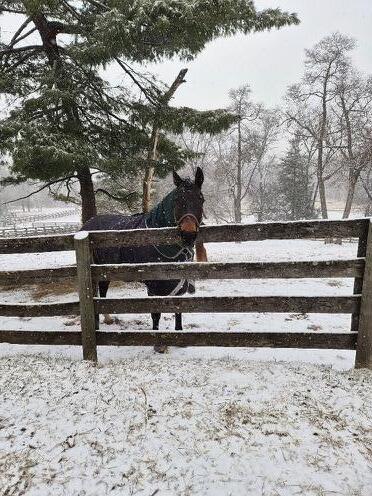
I’m sitting here staring out the window at the snow that’s blowing sideways. Yesterday it was in the single digits. Tomorrow it will be in the single digits. Two days ago I bundled Leo up, kissed him on the forehead, wished him good luck, and told him to make good choices because it would be a few days before I would see him again. I hate winter! I hate being cold. Leo is so much more stiff when the temperature drops, so the work is less productive. I worry all day about him doing something stupid in the paddock and getting hurt. Driving to the barn is treacherous. Walking is an accident waiting to happen.
The only silver lining I can see to winter is that for those of us who don’t trek down to Florida, the unpleasant weather forces us to take a break from training. It’s that time of year when the thought of horse shows dances in our head and our training ramps up. If the panic of trotting up centerline after so much time off impels us to push our horses’ training, the weather puts a kibosh on that. The pause is a good thing for recovering muscles, ligaments, and tendons.
This year I prepared a little better than previous. I bought 2 pairs of fleece-lined breeches, and just last week I found heated breeches! Almost a game changer. To get my mind off the snow, I started planning my summer vacation, which is helping me channel warmer weather. Leo, on the other hand (hoof) is probably having a great time right now – no work and all play! I do think he misses me on those days I can’t make it to the barn because the next day he comes right to the gate when he sees me. I know that all of this complaining does nothing. It is what it is and this too shall pass.
PS. For those less fortunate without access to an indoor, my greatest sympathies.
Horse Treats
By Meredith Rogers
Chinese New Year this year falls on February 17. According to the Chinese calendar, 2026 is the year of the horse, specifically for this year the fire horse, which combines the horse’s dynamic nature with the passionate element of fire. What this means is that the year is expected to be filled with opportunities, rapid changes, and heightened emotions. During this year, we are encouraged to take bold action and embrace new challenges, but we may be hit with chaos, conflicts, and stress. The last year of the horse was 2014 and the next one will be 2038, as the animal zodiac follows a 12-year cycle. The snake was the animal for 2025. Having been born during the year of the dog, I often wondered if I had been born in the year of the horse would I be a better rider.
Those who have been born in the year of the horse are said to be cheerful, popular, quick-witted, changeable, earthy, perceptive, talkative, both mentally and physically agile, magnetic, intelligent, astute, flexible, and open-minded. However, they can also be fickle, arrogant, childish, anxious, rude, gullible, and stubborn. I’m not sure if any of these qualities help develop a better connection with our equine partners, but I guess they couldn’t hurt either.
From Our Friends at Lehigh Valley Dressage Association
2023 On the Levels” - Adding to Your Dressage Knowledge Bank
By Ellen Broadhurst
More from the 2025 USDF Convention: The Assessment and Training of the Dressage Athlete
By Ellen Broadhurst
By Ellen Broadhurst
Tony Sandoval of Coach Sando Training provided an inspirational overview of his approach to training the Dressage Rider to be an athlete in partnership with their horse. Coach Sando is based in Lexington, KY, but provides virtual training opportunities as well as traveling for clinics around the country.
https://www.coachsandotraining.com/
Dressage asks us to treat our horses as true athletes, carefully developing their strength, balance, symmetry, and longevity over time. Yet too often, we fail to hold ourselves to the same standard. The modern dressage rider is not merely a passenger or technician, but an athletic partner whose body directly influences the horse’s movement, confidence, and soundness.
At Coach Sando Training (CST), led by Coach Tony Sandoval an experienced Division I strength and conditioning coach with over 20 years in elite sport the focus is on bringing evidence-based human performance science to equestrian athletes so riders can meet the same athletic expectations they place on their horses.
Before we can make dressage athletes better, we must first understand the current state of their training. If we do not clearly identify what needs to change, and how to change it, progress remains accidental rather than intentional.
Riders often pursue general fitness, but dressage demands specific physical traits: suppleness, balance, coordination, stamina, strength, mobility, stability, and elasticity. Strength alone does not equal effectiveness, and strength without symmetry limits performance. A rider can be strong in the gym yet weak, crooked, or inconsistent in the saddle. The tools we develop off the horse are the tools we bring to the saddle.
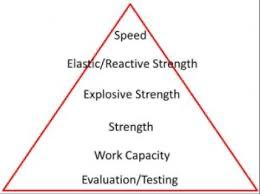
Coach Sando frames rider development through Al Vermeil’s Hierarchy of Athletic Development, which emphasizes that speed and skill sit at the top of a pyramid supported by elastic/reactive strength, explosive strength, strength, work capacity, and at the foundation evaluation and testing.
This model is especially relevant to dressage, where refinement, timing, and harmony cannot exist without a body capable of supporting them. Vermeil’s hierarchy provides a clear roadmap for assessing what a rider’s body can truly handle, ensuring that off-horse training enhances, rather than interferes with, in-saddle performance. The future of dressage rider training is datadriven, individualized development based on each athlete’s current physical reality.
At CST, this process follows a simple but disciplined structure: Assessment → Analysis → Prescription → Performance.
Assessment Tools
● HumanTrak (3D motion capture): Measures posture, movement patterns, and asymmetries, providing objective insight into how a rider stands, moves, and stabilizes.
● Force Plates (ForceDecks): Assess balance, symmetry, and how force is applied through the feet in vertical, forward–backward, and side-to-side directions, capturing differences between left and right sides, ankle excursion, tilt, speed, and proprioceptive control using dressage-specific normative data.
● Dynamometry: Objectively measures isolated muscle strength and force output, particularly in key riding contributors such as hip flexors, abductors, adductors, and glutes, establishing baselines and identifying meaningful imbalances that affect saddle performance.
Analysis
From these assessments, riders receive a clear Report of Findings that compares their personal scores to dressage-specific normative data, highlights areas for development, and integrates riding video analysis with physical testing. This phase reinforces a central principle: the body you have on the ground is the body you bring into partnership with your horse.
Prescriptions
Sando highlighted the most common areas of development for dressage riders, and provided examples of the type of exercise he might recommend:
1. Breathing: Diaphragmatic breathing to activate the parasympathetic nervous system, improving calm focus, postural stability, refined motor control, and a softer, more consistent tone that allows the horse to relax and trust the aids; box breathing (four-count inhale, four-count hold, eight-count exhale, four-count hold) is introduced as a portable, daily regulation tool.
2. Posture and Symmetry: Addressing alignment through the neck, thoracic spine, and hips to develop evenness on both sides of the body, translating to straighter, clearer communication in the saddle. Chin tuck and lift should be held for 10 seconds, 5 reps per day.
Chin Tuck and Lift Video
https://youtu.be/7OgvJ653oxE?si=I0dh7PbJwTFNSu0X
3. Strength: Emphasizing eccentric and isometric work to address asymmetries and support longevity, such as controlled split squat holds that build quiet stability rather than stiffness.
Split Squat Video
https://youtu.be/NmyiMb2XYAM?si=u1_qvXibQptOmj_b
4. Power, Reactivity, and Elasticity: Training age-defying athletic qualities that support quick reactions and timing, including supported single-leg hops that can be used daily or as a pre-ride warm-up.
Simple exercise: hands on the wall, hop on one foot for 20-30 reps in rapid succession, repeat on the other side.
5. Coordination: Integrated exercises that require the lower body and trunk to remain stable while the upper body moves independently, teaching riders to influence the horse without disturbing balance.
Standing in a slight squat, the rider maintains a tall, balanced posture as the core and hips stay steady. The trunk is slightly forward while the arms perform a “row”, pulling a band that is anchored near the floor to the waist. This is a controlled pulling movement using the back muscles. The goal is to keep the shoulders relaxed and the body quiet.
6. Vestibular Training: Exercise designed to improve the function of the vestibular system, which helps regulate balance, spatial awareness, and head-eye-body coordination. By challenging balance, head position, and visual input such as standing on one leg or changing visual focus it teaches the nervous system to stabilize the body more efficiently, resulting in better posture, quicker reactions, and improved balance for riding.
Super simple: stand on one leg, keeping the hips level! If 30 seconds of that is easy, then try it with your eyes closed.
In closing, this approach moves riders away from generic exercise and toward purposeful, dressage-specific athletic development. By assessing, analyzing, prescribing, and refining performance with the same care we give our horses, we become better, more consistent
Super simple: stand on one leg, keeping the hips level! If 30 seconds of that is easy, then try it with your eyes closed.
In closing, this approach moves riders away from generic exercise and toward purposeful, dressage-specific athletic development. By assessing, analyzing, prescribing, and refining performance with the same care we give our horses, we become better, more consistent partners capable of supporting our horses’ athleticism, longevity, and confidence through a body that is prepared, symmetrical, and responsive.
News from Outside the Ring
Eventing Grants Available
If you’re an adult amateur, junior rider, or FEI competitor, you may want to check out these grant opportunities. The Maryland International Equestrian Foundation (MIEF) is accepting applications through February 20 for their scholarships. The MIEF Adult Amateur Scholarship is sponsored by Dale Ganley Clabaugh State Farm Insurance Walkersville and is designed to support adult riders balancing careers, families, and other responsibilities as they pursue their eventing dreams. The scholarship provides a $1,000 credit towards entries at horse trials and clinics at Loch Moy Farm for the 2026 season. The MIEF Junior Rider Scholarship, sponsored by Dover, provides a $500 credit to young riders that can be used for the Highland Series Horse Trials, Twilight Events, Pick Your Time/Test Dressage & Horse, or Jump Round show entries at Loch Moy Farm. FEI riders can apply for 1 of 4 $1,000 awards that can be used to defray entry fees or stabling, travel, or other competition-related costs at the 1*, 2*, 3*, 4* levels at the June Maryland International Horse Trials. For more information and to apply see: https://themarylandhorsetrials.com/maryland-international-equestrian-foundation/scholarships/
Horses and History
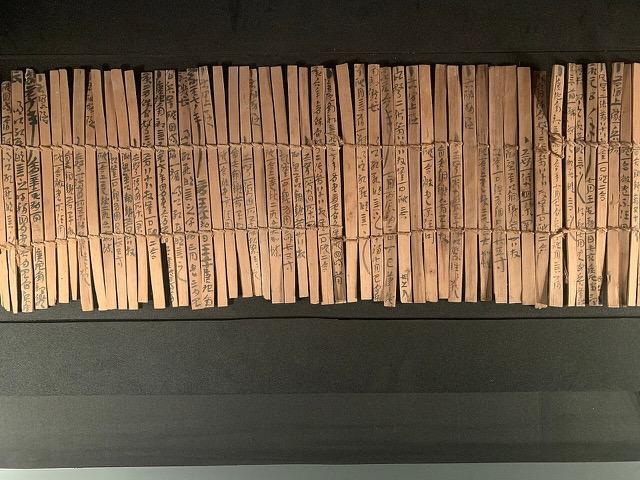
Researchers just identified the oldest Chinese writings about horses among nearly 2,500 bamboo slips acquired by Tsinghua University in 2008. Organizing and understanding these fragile strips have taken the researchers 10 years, and used such stateof-the-art techniques as computational paleography and artificial intelligence to read the often incomplete, faded, and archaic text. The equine-specific strips, which are more than 2,000 years old (475-221 BCE), provide detailed instructions on evaluating, training, and management practices that display a sophisticated understanding of horse physiology, behavior, and needs. These texts not only provide insight into ancient Chinese views on horses, but shows how Chinese culture helped shape early civilization worldwide. For all the details about this amazing discovery, see: https://www.tsinghua.edu.cn/en/info/1245/14429.htm
Another Educational Tidbit
By Earlen Haven
Does your horse’s trot and/or canter get too quick? Is his head up above the bit in transitions?
Try feeling a light contact on your inside rein. Then set your inside hand down on the withers and squeeze and release your outside rein only, to steady his pace. If you are only using one rein, he will not have the need to feel like he has to escape from your rein aids because of discomfort in his mouth by pulling his head up with both reins.
You must have a light contact with both sides of his mouth. When you squeeze the outside rein (which is the stretching side of the horse) you MUST release and repeat rather than HOLD. You must also let your outside hand follow your horse’s head forward as he stretches. Then repeat the system. When a horse gets quick and the rider pulls with BOTH reins, the horse sticks his head and neck up and brings it back toward the rider to attempt to lessen the pressure on his mouth. When you set your inside hand down on the withers (with a light connection), it establishes the length of rein with NO pull. So he does not have any reason to get away from that rein aid. Then squeeze, release, repeat with your outside hand to give him the message to steady his gait. If there is no pull on both reins, there is nothing for the horse to want to run away from.
ALWAYS support rein aids with leg aids, so you are pushing your horse forward into the connection rather than pulling back to make the connection with the rein. Your horse should always be stretching forward to accept your connection. This is what is referred to as “riding back to front” (pushing) as opposed to “riding front to back” (pulling).
Summary of how to steady the gaits without pulling the horse’s head up in the air:
1. Set inside hand on withers with a light contact on mouth to keep horse straight.
2. Close your legs on your horse to ask him to go forward and to stretch into your contact.
3. Squeeze and release your outside rein to tell him to steady his pace without pulling on him. REPEAT until he is at the pace that you want.
4. Let your outside hand follow his neck down and forward as he responds and
stretches to accept your contact. His frame will now be longer and relaxed allowing his back to soften and round as opposed to being hollow and locked with his head above the bit. When he is soft and round, he can keep his hind end underneath him allowing him to freely swing his shoulders and relax his back.
Be sure to keep in mind that you need to push a horse into a light contact in your hand rather than pull your horse into a connection.
If you have any questions or comments, please feel free to contact me at 856-769-1916 or Earlen@countryhavenfarms.com