This year went by so quickly! It’s now coming in to awards season. Did you submit your scores to our awards chair for year- end awards?
With the new year coming, it is time to think about your goals for the year ahead. So I thought I would include (as I did in my first letter), the membership requirements for the goals you have on your wish list:
Goal #1 “keeping it low key” – Local shows, ESDCTA Championships, and ESDCTA Year-End Awards.
If your plan for this season is to show at schooling shows and maybe do introductory level or opportunity classes at USDF/USEF licensed shows, the only membership you need is our ESDCTA membership.
Goal #2 “Some national recognition would be fun” – Local shows, ESDCTA Championships, ESDCTA Year-End Awards, and USDF Rider Awards.
If your plan is to show at schooling shows and USDF/USEF licensed shows, qualify for the ESDCTA Championship Show, get ESDCTA Year-End Awards and hopefully earn USDF Rider Awards. Then you will need the following:
Rider will need:
1. ESDCTA membership – which includes the USDF Group Membership
2. A USEF Competing Membership and SafeSport Training (you will be able to complete this once you have your USEF membership.
Horse will need:
1. Your horse will need either a USDF Horse Identification Number or a USDF Lifetime Registration.
2. Either a USEF Horse Identification Number or Horse Registration
If you are not the horse owner, the owner will need:
1. Either a ESDCTA membership or a USDF Participating Membership
2. USEF Competing Membership.
Goal #3 “All the things” – Goals 1 & 2, plus you want to qualify for GAIG/USDF Regional Championships, USDF Finals, and USDF Year-End Awards.
Rider will need:
1. USDF Participating Membership
2. USEF Competing Membership
Horse will need:
1. USDF Lifetime Registration
2. USEF Lifetime Horse Registration
Owner will need:
1. USDF Participating Membership
2. USEF Competing Membership
Whether you are going “low key” or for “all the things,” remember at the end of the day it is all about your partnership with your horse and the skills you develop. Horse shows should be fun, safe, and a positive environment. If they aren’t, ask yourself, what can you do to change that? Maybe it’s sticking to local events, not going to as many shows, or finding a buddy to show with.
Need help navigating all of these memberships and horse registrations? Feel free to reach out to me, I’m happy to help.
Happy Holidays, I hope everyone is spending it with their families whether it be fur/human or both!
grants@esdcta.org horselover8968@gmail com newsletter@esdcta.org nominations@esdcta.org nominations@esdcta.org
Ashley Mucha Results@esdcta.org
Volunteer Coordinator Jen Koch youthdressgeshows@gmail.com
CROSS COUNTRY...
News Across Our Region
COMMUNITY NEWS
If you’re reading this, you are probably a member of ESDCTA, but I’m sure you know of someone who rides dressage or events who is not a member. You know all about the wonderful things offered like educational programs, clinics with big name trainers, horse shows, year-end awards, and not least, that sense of being part of a community of likeminded people. The more members ESDCTA has, the better the programs we can offer. Our membership numbers are also important considerations when state and local governments decide on legislature that affects us (like open space), and we advocate for our sports (We helped get better footing at the HPNJ). Please reach out to your equestrian buddies and tell them about all of the benefits of membership and have them sign up. The more the merrier!
WHAT’S YOUR TALENT??
Let us know what you would like to help us with in 2026. All skills and interests wanted. Have an idea? We want to hear about it. Remember, this club is what YOU make it. Contact president@esdcta.org if you are interested.
NEWSLETTER COMMITTEE
Have a great article that you would like to share?
Please send article to: Meredith Rogers: newsletter@esdcta.org All submissions are due by the 15th of the month. Due to space considerations, the editor reserves the right to edit submitted articles. If necessary, articles will be edited and returned for your review. AND YOU GET VOLUNTEER HOUR FOR EACH STORY!
Milestone
Please Contact this newsletter if you know any ESDCTA members who have achieved any Milestones. Success at a show, regional/national/international award, new horse, or anything else you want to celebrate.
e-mail: newsletter@esdcta.org
MEMBERSHIP QUESTIONS
For membership questions including updating physical or e-mail addresses please contact: Heidi Lemack membership@esdcta.org
Deadline: 15th of prior month Email: newsletter@esdcta.org
Please have electronic ads in Adobe PDF or .jpg format You will receive an invoice for ad via email.
Email: treasurer@esdcta.org
Amateur Dilemma
By Meredith Rogers
With gift buying, meal planning, and partying, sometimes the important things can get lost during this time of year. Appreciating what you have, thanking those around you, giving back, and remembering those less fortunate are some of those important things. Now, gift buying, meal planning, and partying definitely play a role in appreciating what we have and thanking those around us. We try to pick just the right gift for family and friends (and our trainer) because we want to thank them for being there for us. We cook or buy food to host or to bring to a festive gathering because we appreciate spending time with loved ones. We carry a few extra peppermints in our pockets for our equine partners.
Giving back and remembering those less fortunate can include donating to a charity that you feel passionate about, formally volunteering somewhere, or even just helping a neighbor (or barnmate) out. No gesture is too small, including just having a little empathy. Instead of cursing that driver who forgets to turn off their high beams, cut them some slack. Maybe they’re a bit distracted thinking about their lame horse. The world would be a nicer place if we all assumed each other had good intentions and that we all make mistakes. No extra money or time is needed for that.
We are lucky. We have horses in our lives. Horses are amazing. They inspire us to be better because they need us to take care of them and sometimes we have to get creative to understand what that entails. Horse people are some of the most caring people around, and I’m glad most of my friends are part of the equestrian community.
So, as we enter the holiday season, as you go over the hills and through the woods, take a breath for yourself, and notice the people and horses who make your life that much more shiny and bright.
Product Review: Quick Knot
By Ellen Broadhurst
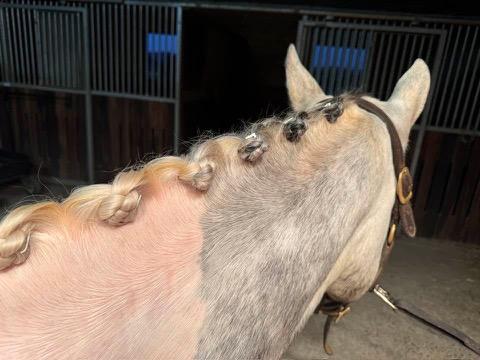
With show season behind us, the last thing you’re probably thinking about is braiding. But let me interrupt your visions of holiday garlands and eggnog with an off-the-wall idea for you and your barn Secret Santa: Quick Knots!
Yes—Quick Knot, the mane-braiding gadget you’ve scrolled past a hundred times on Facebook because, honestly, how could something that stupid-simple actually work?
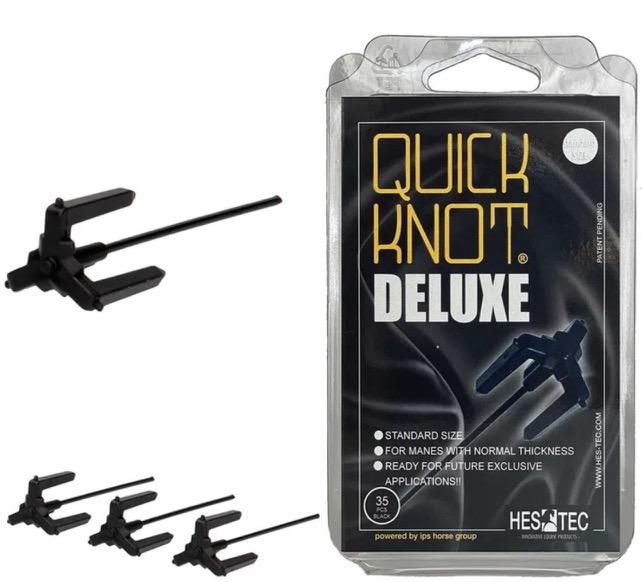
Quick Knots are plastic pins that come in three colors: white, black, and a sort of odd mustard shade that matches no living horse mane anywhere, ever. They’re also hella expensive—just under a dollar a pin on Amazon.
I actually tried them six or seven years ago and was utterly baffled, called it a loss, and eventually gave them away.
Time passed. The Quick Knot folks tweaked the design, put out significantly better how-to videos, and two people in my immediate riding circle tried them and were delighted.
So I took a deep breath, spent another sixty bucks (two horses, two different mane colors), watched the new-and-improved tutorial a few times, and gave it another go. https://www.youtube.com/shorts/Wrwsh5NYrM0
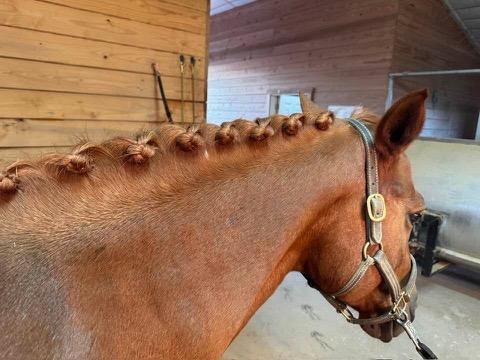
WOW. Life-changing. Quick Knots cut my braiding time by a full third (a big deal when you’re doing two manes), were super easy to use, and stayed in beautifully.
Expensive? Yes. But they’re reusable. I put 8–10 braids in a neck, and there are 35 pins in a $30 package. I’ve used the same pins twice now, and they’ll definitely survive at least one more braiding session—so one package can easily last a whole season.
They come in two sizes:
Quick Knot Deluxe (4 cm) for regular manes
Quick Knot Deluxe XL (6 cm) for thicker manes
My two horses have completely different hair types—one thick, one thin—so I bought one of each.
So with winter upon us and a bit of downtime ahead, it’s the perfect moment to try something new before show season sneaks up again. I’d absolutely recommend giving Quick Knot Deluxe a look. They’re simple, they work, and they just might change your braiding life.
Horse Treats
By Meredith Rogers
Dressage horse are said to dance but these horses really did learn to get jiggy with it. Maybe these tales are the origin of dressage musical freestyles and maybe not. You be the judge!
The story as Aelian, a Roman writer, tells us in his History of Animals (XVI.23) is that the city of Sybaris lost a war to the neighboring city of Croton because of their dancing horses. The people of Sybaris had a reputation for luxurious and extravagant living. So much so, that they trained their horses to dance to the sound of a certain kind of pipe music played during festivals and banquets. Croton spies learned about this and the next time they attacked, they played the music. The horses couldn’t help but dance and ended up throwing their riders. The Croton army took advantage of the disarray and decimated the Sybaris army. This happened in 510 BCE and Sybaris never was able to regain their independence. The city was eventually abandoned.
The Chinese warlord Ch’Eng-szu (704-778) was preparing a sacrificial feast when someone decided to play music to help liven the mood. Upon hearing the tunes, dozens of war horses in the neighboring field formed a line and began to prance and bang their hooves in unison to the music. People watching thought the horses were possessed, but the truth was much more mundane. These horses had been captured from the Emperor Hsuan Tsung (712-756). He was known for his famous dancing horses, 4oo in all who he had dressed up in gold, silver, pearls, and jade, and taught to dance to a particular song called the Upturned Cup. The legend is that at the end of dance, the horses would step forward, take a glass of wine in their teeth, and down the drink before the Emperor, giving the song its name. Unfortunately, since Ch’Eng-szu did not know this, he ordered the horses whipped because he thought they were bewitched. However, the horses thought they were being corrected, and only danced with greater vigor. The warlord panicked, still thinking the horses were possessed, and had them killed.
Buffalo Bill Cody gave his friend, Sitting Bull a circus horse named Rico when Sitting Bull left Buffalo Bill’s Wild West Show. Rico was trained to dance and fall to the ground upon hearing gun shots. You can see how a horse like this could fulfill a significant role in the show, which during one year drew a crowd of a million people. Sitting Bull treasured the horse as a gift from his friend. However, on December 15, 1890, the Indian Agency Police were attempting to arrest Sitting Bull, who was in his 60s by this time, but instead, opened fire, killing the Lakota leader. In the middle of all the gunfire was Rico, who was tethered to a fence. As he was trained to do, he started
dancing upon hearing the gunfire, which enabled him to escape being shot. After the incident, the widows of Sitting Bull sold the horse back to Buffalo Bill, who used the horse in parades and other events.
Jumping “Out of Hand”
By Earlen Haven
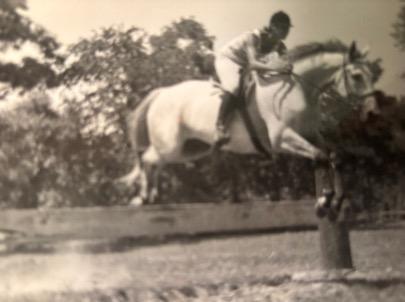
I’m going to show a variety of jump photos at different stages of the jump in 5 photos.
First of all, I have to qualify that this is not the best equitation. Not an excuse but I had just come home from a week at the team headquarters working intensely daily on 3rd level dressage, with 2 Olympic dressage coaches and I had my stirrups way too long for jumping and failed to shorten them. That long a stirrup prevents the hip joint from closing as easily over the fence. It often also makes you round your back, which actually was not too bad in these photos. But I should have shortened my stirrups.
I usually check my stirrup length by having my stirrups touching my ankle bone, (obviously without stirrups), after I have done scissor kicks with my legs then dropped them comfortably. Obviously I did not do that the day of these photos. But definitely having your stirrups at the correct length makes life easier when jumping.
But what I would like you to analyze is the use of the horse’s neck in all phases of the jumps. If we don’t allow the horse to have the ability to stretch his neck as he deems necessary, it greatly impairs his ability to jump correctly, which causes him to lose confidence in his jumping. Once a horse or rider loses confidence, problems develop.
From about 2 strides before the jump to approximately 2 strides after the jump, I let him have the total use of his neck with no restraint with the rein at all. In the photos, I am riding “out of hand,” but a crest release will help riders learn to follow the horse’s neck over the fence without interfering with the horse’s natural bascule until skills improve. Do not push yourself to learn it too early. The crest release lets your body learn the feel of following the neck while the hands are resting on the crest of the neck before, during and after the fence. It keeps riders from catching the horse in the mouth and punishing the horse for doing what we asked them (but didn’t allow them) to do. If you think about it, catching them in the mouth while we’re learning must be terribly frustrating to the poor horse. He’s got to be thinking, why do they punish me for doing what they asked me to do?
I will give you just a brief description of each jump, which asks different questions of the horse.
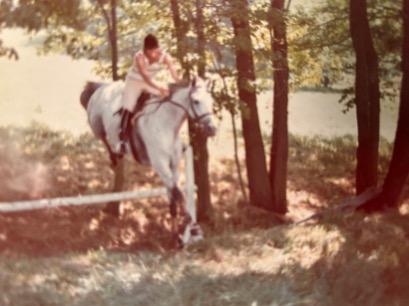
The first photo with the jump by the trees is between 2 hillsides with a ditch at the bottom of the hills and a jump rail over it. So the horse is jumping from bank to bank, requiring a wide jump.
Photo 1
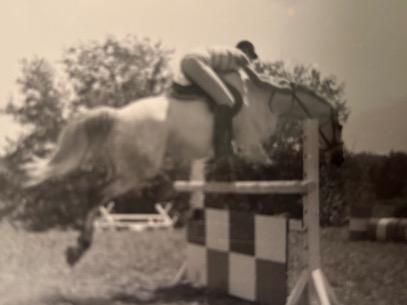
The second photo over the checkerboard is a straight up vertical and often when I get to some height I will put a ground line out a bit further from the jump than usual, to help the horse’s eye more easily see the bascule.
Photo 2
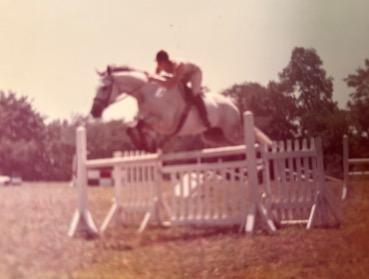
The third, picket jump with the rail is an ascending oxer, which is actually easier for a horse to jump than a vertical jump because the horse peaks over the rail, so the picket part of the jump is within the shape of the bascule, thus giving him a better eye for the bascule.
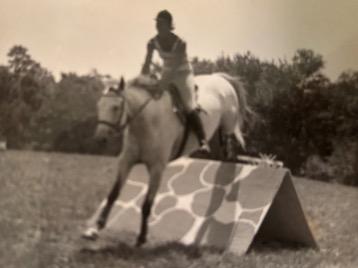
The next photo over the coop painted as stone also helps the horse see the bascule easier. This photo shows the horse starting the landing phase where he has his neck stretched. Allow that.
The last photo shows the horse over a plank which has a big square ditch under it, with the horse at the peak of this jump. Look at the nice use of his body. Look at his upper neck muscles in play (as opposed to his under neck muscles), which allows him to use his whole topline as the bascule should be, round and correct.
Photo 4
And all of this was done in a snaffle bit without various nosebands holding the horse’s mouth closed, or any type of martingale (which you don’t need when your horse is not fighting or evading your rein aids).
I don’t take any more hold of a horse on the flat, (whether it be at a walk, trot, canter, or gallop) than I do over a jump. Let them totally go on their own. If you err, err with a lighter rein, not a harsher one. Learn VERY LIGHT SOFT REIN AIDS, then as you learn to have more feel, you can establish the same light feel with a light contact.
To be really objective in your riding, one needs to watch videos of your riding and look for a concerned or fearful eye, a shortened, jammed up neck, and bulgy under-neck muscles (they should be using their upper neck muscles). Is their mouth open or tied shut, which totally defeats letting the horse learn to respond to a tiny ring finger movement for control by softening their bottom jaw? If you are having a tug of war with your horse, it can’t be pleasant for either horse or rider.
Allowing horses to develop self-carriage, which allows them to balance on their own, is the nicest thing a rider can do for a horse. Learn to communicate rather than demand.
Horses do very well in the field without riders and even in jump courses without bridles. Look up some of the numerous videos available today of horses jumping courses on their own and you’ll see that they don’t make the mistakes that they do when they have riders on them. That ought to tell us something.
Any questions, give me a call @ 856-769-1916 and I’ll be happy to discuss the subject with you, answer questions or whatever, at no charge.
Our website: countryhavenfarms.com has about 40 free articles for you to read and hopefully help you, along with some really short videos. When we get help, the horses get help, and everybody is happier.
And most of all enjoy your riding and let your horse enjoy the riding too!
News from Outside the Ring
Eventing Opportunity
Fitness and pace are two of the most critical skills for eventing. If this is something you want to work on, you may want to apply for the TEAPRO (Training and Education in the Art of Pace and Riding in the Open)
Grant from the USEA Foundation. The grant can help with such initiatives as hosting a seminar on galloping or a clinic on conditioning, or it can go towards improvements to infrastructure, such as building portable steeplechase fences or setting up a fitness track. The grant is open to trainers, facilities, or anyone looking to help others develop these skills. For more information, reach out to Katherine Cooper, USEA Foundation Development Officer, at kcooper@useventing.com, and apply for the grant here: https://www.cognitoforms.com/USEA2/TEAPROApplicationForm.
British Dressage is Making Some Noise
If you are fortunate to be able to cross the pond to ride dressage in Great Britian, you can now talk to your horse while you trot down centerline. Starting in January, British Dressage and British Riding Clubs will allow “discreet” use of voice while showing, including tongue clicking, but it must be unobtrusive and must not interfere with other riders, horses, or officials. The rule does not apply to championships. The change was made in response to rider feedback. Reasons cited included that the voice has long been considered a “natural aid,” that it would help young and inexperienced horses better understand what is being asked of them, and to level the playing field when the environment varies (ie, it’s easier to hide the use of voice during windy and rainy days than when the sun is shining).
Young Horse Adventure
By Paige Zimmerman
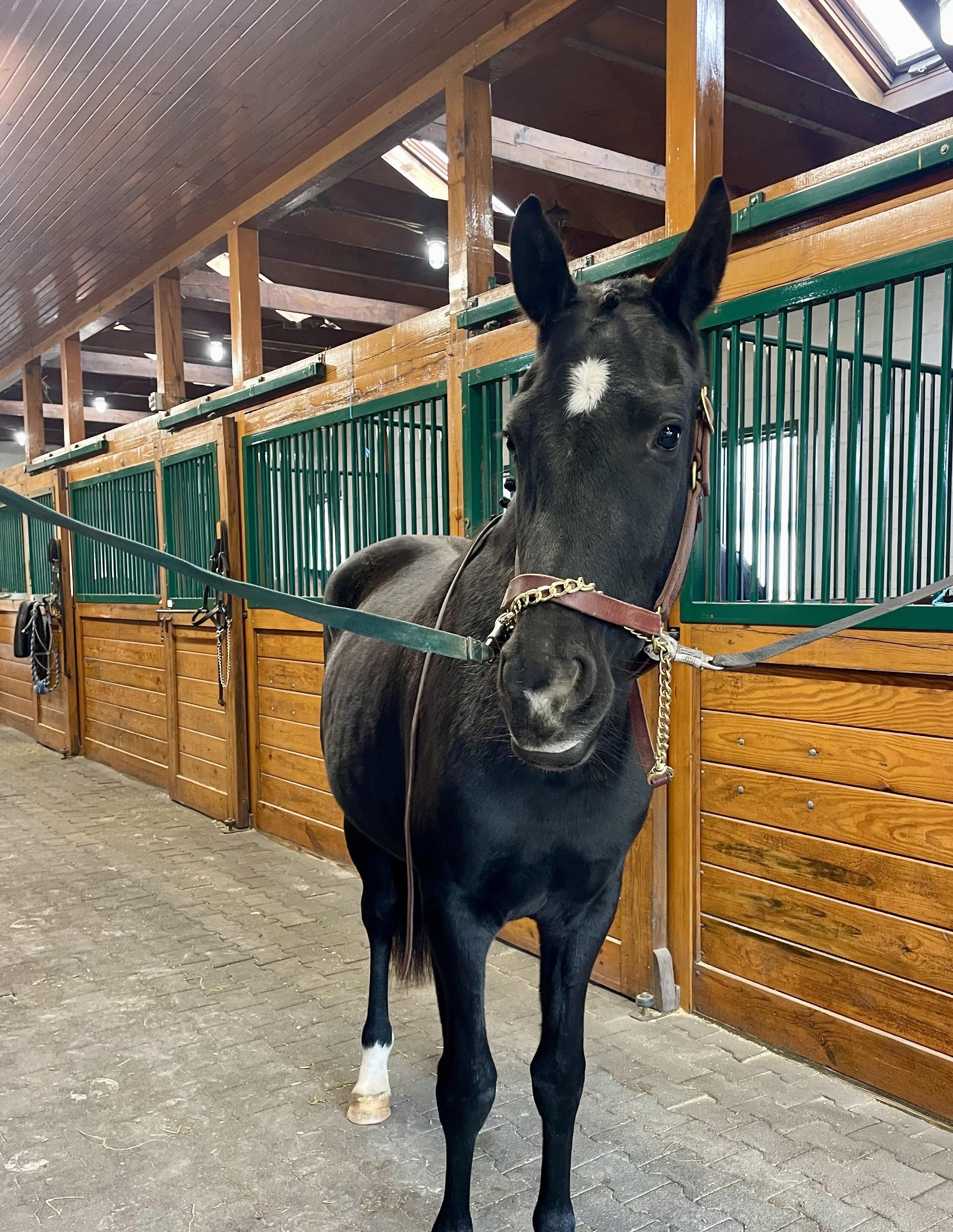
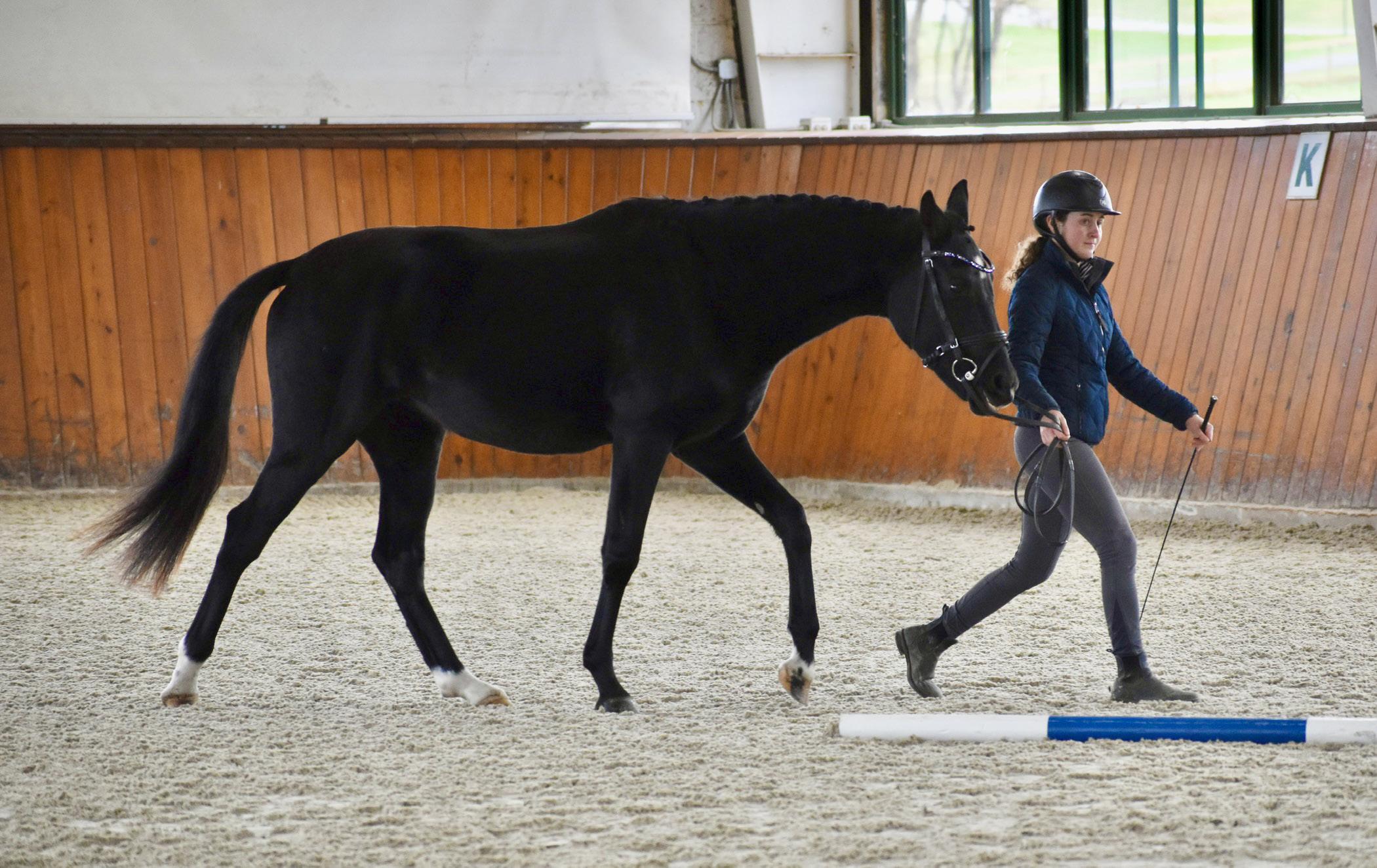
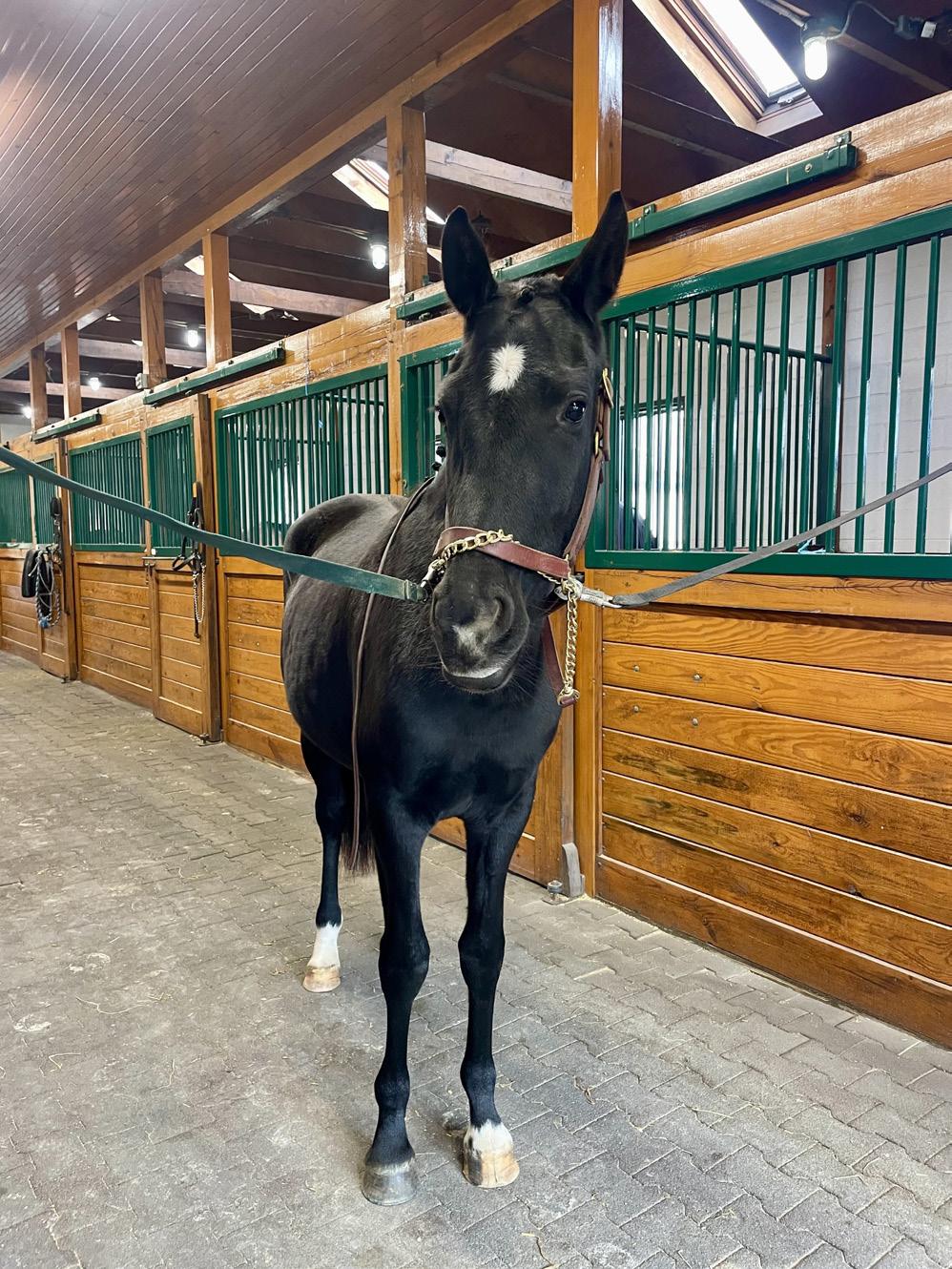
On November 10, I had the opportunity to bring my 2-year-old KWPN filly, Tiara, to Hilltop Farm in Colora, MD, to be a demo horse for the USDF Dressage Sporthorse Judges Forum. It was a great learning experience and a fun day hanging out at such a beautiful facility, meeting new friends, and listening in on the judges’ discussions. Getting to go to Hilltop for this great experience came by chance. In October, Olivia forwarded me a Facebook post from Hilltop Farm in which they were seeking demo horses and riders for the USDF Sporthorse Seminar (November 8-9, 2025) and the USDF Judges Forum (November 9-10, 2025). As per the USDF website, the Sporthorse Seminar is “an essential educational experience for anyone involved in breeding or developing dressage horses. Whether you’re evaluating prospects, preparing for inspections, or honing your judging skills, this seminar offers valuable insights into conformation, movement, and competition structure.” The Judges Forum, which was staggered with the Sporthorse Seminar, served as an educational session for existing judges who are gaining education and experience to either prepare for judging at breed shows or to enhance their skills.
Thinking that it would be a good outing for our young horses, Tiara and Fynchie (his real name is Suffolk Seven), Olivia and I decided to send in our info to participate
on Monday, November 10, the last day of the Judges Forum. Right away, we received a response that we were accepted! Hilltop subsequently posted on Facebook that they were still seeking 4-year-old demo horses. Luckily, our friend and barnmate Maggie O’Leary of Sara Schmitt Dressage has a very nice 4-year-old named Emagine MCS (aka Gin), so we encouraged her to send in her info as well, and she was accepted to be a part of the program too. A few weeks later (at 5:00 AM, no less) the three of us found ourselves heading to Maryland with a trailer full of baby horses. All of them loaded very well and were excellent, quiet travelers.
We arrived early and familiarized ourselves with the facility and the schedule for the day. The Judges Forum was set up sort of like a mock show, including both in-hand and under-saddle classes, with about ten judges making up the forum and Kristi Wysocki (FEI 4* Dressage, FEI 5* Para Dressage Judge, and Dressage Sport Horse judge) as the head of the group. The schedule consisted of a morning of in-hand classes, with young horses presented in front of the judges and then walked and trotted in hand around the “triangle” just as they would be in a real dressage sport horse breed show. The last class of the morning was going to be a group Materiale class, which is an under-saddle class for 3-5 year-old horses where all the horses are in the ring together and are ridden at the walk, trot, and canter to determine their general impression, rideability, and suitability for dressage.
Tiara, Fynchie, and Gin were all to be presented in-hand in their respective classes, and then Fynchie and Gin were going to be a part of the under-saddle Materiale class, as well. Something that I found particularly interesting was that Tiara and Fynchie were going to be a part of the “Produce of Dam” class, which is a unique class in which two or three horses with the same dam are evaluated together as a group. The judges aim to see how well the offspring have inherited their mother’s qualities, highlighting the dam’s ability to produce quality dressage horses.
Since the mare herself is not evaluated, she does not have to be there, which was something I was not aware of. It’s quite a cool class! Tiara and Fynchie were both bred by Kate Landon in California and their dam is Kefiera LH (Negro x Johnson). They each, of course, have different sires: Tiara’s sire is Total Hope, and
Fynchie’s sire is Fynch Hatton. I was very interested to see how this class was to be run, since I was not really familiar with it prior to being told that Tiara and Fynchie would be eligible to participate!
After we arrived, we had time to sit and watch some of the classes, as we didn’t have to go until a bit later in the morning. Listening in on the discussions amongst Kristi and the judges was very educational, as I picked up on rules and tidbits that I hadn’t known before. There were some sneaky rules that came up, with some “tricks” being put into the program on purpose in an effort to make it clear how important attention to detail is during these breed shows. It kept the prospective sporthorse judges sharp. An example of one of these “tricks” was that one handler came in without a helmet on, which is a requirement for the young horse handlers. The judges caught it before the handler could continue. Another time, a yearling filly was put into the yearling colts/geldings class, and that was also caught before the horse continued. I would imagine that at a breed show such as Devon, where things are moving extremely quickly, little details can be hard to catch until it’s too late. But knowing the rules and having a sharp eye can prevent any mishaps from happening in such a high-paced environment.
Another rule that I was not aware of is that 2-year-old horses being presented in-hand are required to wear a bridle. I thought that it was optional, and that you could either use a halter or a bridle. So, when a 2-year-old was presented in front of the group with a halter on, Kristi explained to the group of judges that this horse would need to be eliminated in a real show. Thus, the horse was sent out of the ring and not allowed to continue (understandably). Watching this, all I could think was, “Uh oh. We need to find a bridle for Tiara, or we are going to be eliminated!”
Tiara had never worn a bridle or a bit before, and putting a bridle on for the first time at a new and unfamiliar place (especially a show environment) is far from ideal. Luckily, she just had her wolf teeth removed a few weeks prior, so I
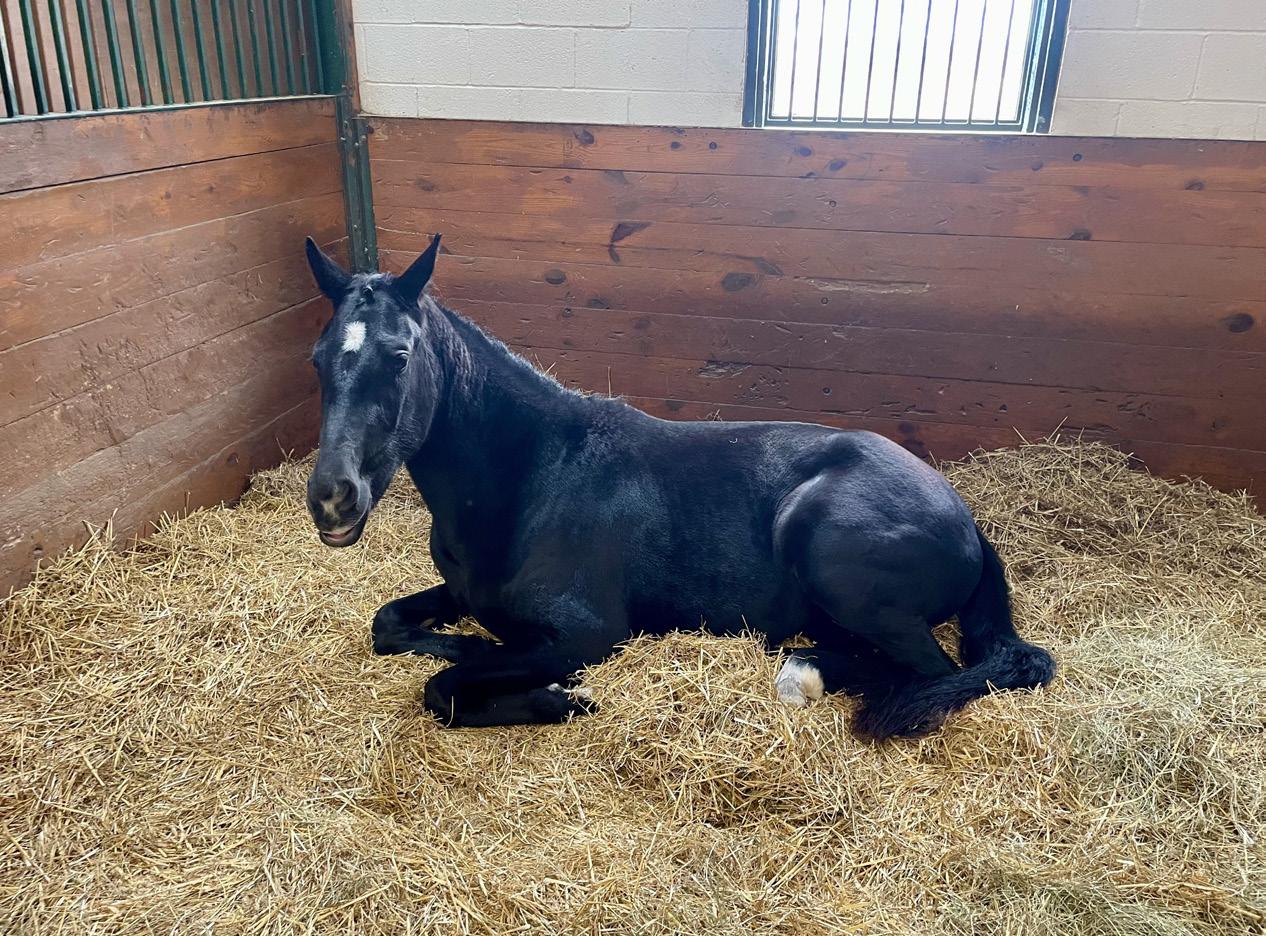
felt like it was okay to give it a shot and see what she thought. Maggie graciously lent me Gin’s bridle and nice soft rubber bit to try. I was mildly worried about how Tiara would react, but upon walking to her stall and seeing her laying down in the soft hay and taking a nice, relaxing nap, I got the feeling that she wasn’t going to be fazed by very much. She let me put it on without much fanfare and then she chewed on the bit for a few minutes, which is completely normal. She then shut her mouth and acted like she’d worn a bridle a hundred times before. I was shocked! She didn’t flip her head or fuss at all. She simply went right to business and was not offended by the strange thing on her head and in her mouth at all.
She presented quite well on the triangle, I thought, and was extremely well-behaved. She is naturally quite a confident horse, but I still was pleasantly surprised at how well she handled everything at such a young age. Since it was more of a judges’ discussion, I didn’t get to hear much specific feedback, but it was a great experience for Tiara and she took it all in stride, even with it being her first day wearing a bridle. It was also fun to see her presented on the triangle with her brother Fynchie, who was very wellbehaved as well. He definitely seemed happy to be there hanging out with Tiara. The judges mainly discussed how they would run this particular class, the Produce of Dam class, as there are many different ways to do it so that you can get a good look at each horse without taking too much time to do so. Since the horses are in the ring at the same time, I’d imagine that it can get tough to maintain efficiency when you have a lot of horses to evaluate. Tiara was a very good demo horse, stood quietly, and walked and trotted when she was asked to. She’s a great student!
Thank you to Natalie DiBerardinis and the entire team at Hilltop Farm for having us and for hosting this judges forum with USDF. I learned a great deal by watching and listening in, and I’m very grateful for the opportunity to bring Tiara to a new environment and get her some good mileage. Her natural confidence and can-do attitude make me very excited for when Olivia and I start her under saddle (hopefully in the spring when she turns 3 in April). As always, thank you Olivia for your photo-taking skills, your help, and for trailering. And thank you Maggie for letting me borrow Gin’s bridle. I am looking forward to more baby horse adventures. I’m sure there will be many to come.
By Meredith Rogers
Rider Fitness: C Track Right
Rider
Fitness: C Track Right
By Meredith Rogers
Last month I outlined what mo7vated me to try Equibody. This month I give you an idea of the process and how the first half has gone, along with a few exercises that I’ve been doing
This new fitness chapter started with me videoing myself running through a series of assessments that showed my range of mo7on and my alignment. A couple of days later I received a video of my assigned “coach” going over my assessment (“see how you round here?”), and later that day I had a call with her to go over in more detail what she saw and how we were going to address it. My coach is lovely and just has a way about her that is both friendly and mo7va7ng. In addi7on to being a cer7fied fitness expert, she’s an event rider, so understands what riders need. The basis of the Equibody system is their “Feel and Flexibility Founda7on,” which focuses on awareness of what our bodies are doing and then strengthening our muscles but in a stretched posi7on.
Each week I am assigned 3 workouts of 8 exercises each, a lower body workout, an upper body workout, and a core workout. I do them on Mondays, Wednesdays, and Fridays; they take about an hour because I have to record myself doing the exercises and upload them, with notes about how I felt, to a website for my coach. I was surprised that most of the exercises were nothing that I’ve ever done in a gym, or were dras7c varia7ons. Every other week I meet with my coach to see how things are going. On our last call I men7oned that the hour was a big chunk of my morning, so she suggested not recording exercises that I found straighSorward to save the 7me it takes to set up my phone.
There’s also a community Slack channel so we can interact with others in the program. I’ve met people from different disciplines and from around the world. Also, each week the founder of the program (Jack) does a Zoom call with whoever wants to dial in about mindset, and on another day my coach does a movement call that breaks down one or a couple of the exercises.
I was pleasantly surprised that aXer 2 weeks, I could feel a difference in my riding. On one day I felt so connected to Leo and could actually use my posi7on to influence his gaits. Wow!!! I just knew that was what I was seeking to get! However, it went away the next day. AXer another week, something else changed – I had access to lower back muscles I had never used before. That lasted a few days. My coach says that these ups and downs are normal. I’ve been in the program for 6 weeks now and not only have the exercises become easier for me to do, but the improvements in my riding seem to s7ck around longer. I am looking forward to seeing how things progress over the next 6 weeks.
Here are a few exercises that I found par7cularly helpful. It is recommended to do about 10 reps per set and two to three sets each. Don’t be afraid to start with only a few reps and build from there.
Weighted buberfly
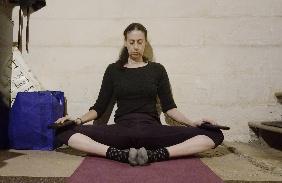
This exercise helps with hip mobility and flexibility. In this version, sit against a wall, have your feet as close to you as comfortable (I’m at about 12 inches), put weights just above your knees on your thighs (I have 5lb), and raise and lower your legs Don’t focus on your knees Instead, lower your legs by squeezing your glutes together The up of the movement is actually your rest period and you don’t have to go very high. Make sure to keep your en7re back against the wall (you may feel like your lower back wants to arch or your shoulders round). As it gets easier to do, increase the amount of weight
and move your feet closer to your body. Also, don’t expect to get very low the first 7me; this picture was taken aXer I had been doing this exercise a number of 7mes.
Band pull aparts
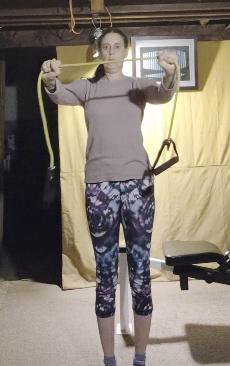
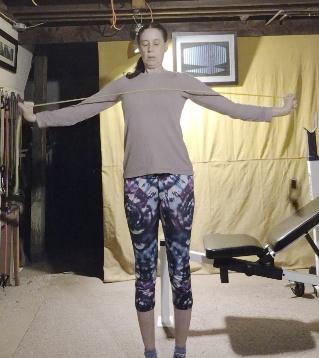
For this one you will need a resistance band. This movement opens up your chest, stabilizes the shoulders, and help strengthen the muscles that support good posture. To do it, stand tall with feet about hip-width apart (mine are a lible close together). Hold the band with your hands shoulder-width apart at shoulder height, then pull the band apart , concentra7ng on your shoulder blades ini7a7ng the movement. Don’t hunch your shoulders and don’t do what I’m doing in the second picture, which is lowering my arms a lible, kinking my wrists, and going past the plane of my body. Because I compromised my posi7on here, I lowered the resistance of the band a lible to allow me to do the exercise correctly the next 7me I did this one.
Core ac7va7ng heel taps
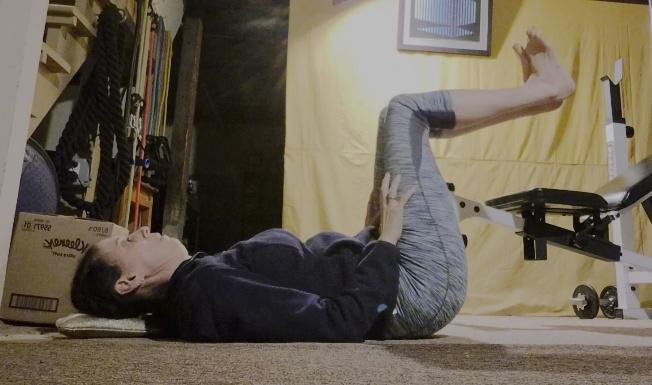
This is an ab exercise that targets the lower abdominal muscles. Start with you knees bent at a 90° angle with your heels on the floor. Then raise them up, and lower back down, keeping the 90° angle the whole 7me. I have my hands on my thighs to remind myself not to go past ver7cal because then your hip flexors engage, and that’s not what we’re going for. Keep your lower back pushed into the floor and your toes flexed to get the most benefit. If it’s difficult to keep your chin in a straight line (not quite tucked but not stretched), put a small pillow like I have, just make sure it’s not pushing on your neck.
I hope you find these exercises helpful. Next month I’ll provide some overarching lessons that I’m only just star7ng to understand about how we move in the saddle.
`2025 ESDCTA Year End Awards:
Achievement Awards:
Leadline:
Zackary Evans and I Found Nemo YR
Charlie Sheridan and Lucky Hero YR
Leia Sheridan and Lucky Hero YR
Walk/Trot:
Caleigh Alfonso and Charlie YR
Ryleigh Koch and Determined CK YR
Rebecca Kuc Evans and Guinness O
Madison Peters and MHF CatNMouse YR
Corinne Sauers and Ravenhill Tsornin+ YR
Walk/Trot/Canter:
Rylee Gerber and Chef YR
Paxton Pendick and Smart As China YR
Training Level:
Elizabeth Hart and Namaste WRF AA
Ryleigh Koch and Bundles of Joy YR
Jenny Morris and Assets to Envy (EV) AA
Grace Roberts and Dimate YR
Bridget Steidle and Impressario YR
Thea Stout and Annabelle’s Wish AA
Kimberly Wojcik and Lucky Hero AA
First Level:
Kazara Aldeborgh and Sukie Rae RH AA
Miina Rafinski and Banderillo AA
Stella Baran and Kevin YR
Brenda Curnin and Wolfstanzer AA
Teresa Drake and Phil Dancer AA
Elizabeth Hart and Namaste WRF AA
Lindsey Martell and Picasso Af Midgard AA
Margaret McKibbin-Favreau and OGO Shawalla Spar ’s Hawk AA
Janina Parmelee and Redfield Mikke AA
Renee Vaughn and Brickyard Bound AA
Achievement Awards Continued:
Second Level:
Nicole McKinley and Pequinesa Mor O
Third Level:
Kazara Aldeborgh and Que RH AA
Beth Kauffman and Saint Peter AA
Fourth Level:
Kazara Aldeborgh and Que RH AA
Sharon Ortepio and Maxima AA
Victoria Weber and Showin’ Off AA
Western Dressage:
Ryleigh Koch and Bundles of Joy YR
Starter Combined Training:
Stella Baran and Kevin YR
Beginner Novice Combined Training:
Barbara Nabors and For Mentor AA
Novice Combined Training:
Barbara Nabors and For Mentor AA
Carey Williams and Jaguar Valor WG AA
Starter Horse Trials:
Rachel Anna Barmore and Mr. Ninja Pendleton AA
Dressage Rider Medals:
Bronze Medal:
Kathy Case AA
Kim Coleman AA
Alyssa Crawford AA
Rebecca Gianotti YR
Melissa Girnius AA
Rachel Landoline YR
Lindsey Martell AA
Andrea Martinez AA
Payton Muto YR
Tyler Trebour AA
Silver Medal:
Kai Glenney AA
Melissa Maginnis AA
Gold Medal:
Ryleigh Koch YR
Kaci Kopec AA
Platinum Medal:
Laura Aber AA
Elizabeth Hart AA
Rebecca Kuc Evans O
Victoria Moricco AA
Dressage Seat Equitation:
Elementary:
Caleigh Alfonso YR
Christin Eason AA
Kora Kubera YR
Accomplished:
Stella Baran YR
Libby Robinson AA
Musical Freestyle High Score Award:
Training Level MFS:
1. Renee Vaughn and Brickyard Bound 64.35% AA
Second Level MFS:
1. Jane Rosenblum and Davidson 70.50% AA
Third Level MFS:
1. Melissa Capozzoli and Xenia fan Willow View 65.88% O
Fourth Level MFS:
1. Paige Zimmerman and Ducati 69.85% AA
2. Laura Aber and HMM Querzacot AA
3. Melissa Capozzoli and Kynynmont Cooper O’Grady O
FEI Intermediare I MFS:
1. Victoria Moricco and Flash
AA
2. Maggie O’Leary and Maxima O
3. Laura Aber and Der Fiete AA
4. Rebecca Kuc Evans and Rumor Has It O
FEI Grand Prix MFS:
1. Tamara Uzman and Griffin
Training Level Pas de Deux:
1. Kim Shoenberger and Blue Jean Knight 69.55%
Kaylee Shoenberger and Walking With Grace
O
Dressage High Score Award:
Western Dressage:
1. Jenny Melander and Wisenheimer 75.0% AA
2. Christin Eason and Scotch the Impulse AA
Starter Rider Walk/Trot Young Rider:
1. Lylah Morris and Top Dollar 69.69% YR
2. Ava Stasulli and Never Say Never YR
3. Saleena Hollis and A Perfect Storm YR
4. Brianna Kresge and Ravenhill Tsornin+ YR
5. Chelsea Storey and I Found Nemo YR
6. Paxton Pendzick and Smart As China YR
Starter Rider Walk/Trot Adult Amateur:
1. Jessica Bown and Native Wave 73.44% AA
2. Christine Mastrogiovanni and Cayja’s March Love AA
Walk/Trot:
1. Jordyn Kollien and Title Holder 72.81% YR
2. Kaylee Shoenberger and Sincerely Yours YR
Starter Rider Walk/Trot/Canter Young Rider:
1. Caleigh Alfonso and Charlie 65.25% YR
2. Claire McCarthy and I Found Nemo YR
3. Brianna Kresge and Ravenhill Tsornin+ YR
4. Rylee Gerber and Blue Collar Man YR
5. Cadee Kaniper and Oliver Twist YR
Starter Walk/Trot/Canter Adult Amateur:
1. Amy Massaglia and Yeti Spaghetti 68.46% AA
2. Mary Anne Gerrity and Fuerst In Line AA
3. Cynthia Vanderlely and So Soleil AA
Training Level Young Rider:
1. Bridget Steidle and A Year In Time 69.4% YR
2. Payton Muto and Sunshine YR
3. Madison Peters and MHF CatNMouse YR
4. Stella Baran and Kevin YR
5. Rachel Landoline and The Hue Of Whiskey YR
6. Eve Childers and Gioconda CDF YR
7. Rebecca Gianotti and Never Say Never YR
Training Level Adult Amateur:
1. Libby Robinson and Limonero do Terroso 69.66% AA
2. Paige Zimmerman and Madam’s Marth AA
3. Gillian Crockford and West Point Cadet AA
4. Maja Bown and Outstanding Alexander AA
5. Kim Coleman and Fagedaboudit Pal AA
6. Julia Nawrocki and After Dark AA
7. Krysia Potter and Wonderstruck AA
8. Renee Vaughn and Brickyard Bound AA
9. Tyler Trebour and Clover All Over AA
10. Lindsey Martell and Picasso Af Midgard AA
11. Melissa Girnius and Cover Girl AA
12. Kim Shoenberger and Blue Jean Knight AA
13. Andrea Martinez and EPA Clementine AA
14. Kathy Case and Helaina H AA
15. Christin Eason and Missed the Call AA
16. Kazara Aldeborgh and Q’Rava JRD RH AA
17. Natasha Worthington and Jayde AA
18. Sara Wittman and Go The Distance AA
Training Level Open:
1. Tamara Uzman and Qlever Trick
First Level Open/Young Rider:
1. Lauren Anderson and Over the Moon
O
YR
2. Nancy Schmidt and Summer Sands O
3. Kaylee Shoenberger and Walking With Grace YR
4. Madison Peters and MHF CatNMouse YR
First Level Adult Amateur:
1. Carey Williams and Jaguar Valor WG 69.17% AA
2. Judith Lalley and Fezzik AA
3. Kathleen Humbert and Ser Prince HP AA
4. Libby Robinson and Limonero do Terroso AA
5. Melissa Maginnis and All That’s Wild AA
6. Tyler Trebour and Clover All Over AA
7. Thea Stout and Annabelle’s Wish AA
8. Christin Eason and Cancanier AA
Second Level:
1. Sophia Wayner and Andy LEF 65.83% AA
2. Jane Rosenblum and Davidson AA
3. Katherine Norton and EnCanto of WIldfire AA
4. Melissa Maginnis and Thirsty Thursday AA
5. Jennifer Pass and Royal Odessa AA
6. Melissa Maginnis and All That’s Wild AA
Third Level:
1. Brenda Curnin and Ducati 67.63% AA
2. Sarah Stinneford and Aramingo FF O
3. Julie Schmitt and Invitation Only AA
4. Alyssa Fudro and Spirits Charming Lady YR
5. Victoria Weber and Showin’ Off AA
Fourth Level:
1. Ryleigh Koch and Ruben D4K 68.33% YR
2. Laura Aber and HMM Querzacot AA
FEI Prix St Georges Young Rider/Adult Amateur:
1. Ryleigh Koch and Ruben D4K 68.82% YR
2. Elizabeth Hart and Ghold Rush AA
3. Kristi Williams and Benedict CF AA
4. Laura Aber and HMM Querzacot AA
5. Paige Zimmerman and Ducati AA
FEI Prix St. Georges Open:
1. Tamara Uzman and HR Zig Zag
2. Maggie O’Leary and Maxima O
3. Melissa Capozzoli and Kynynmont Cooper O’Grady O
4. Eliza Banks and Froom O
5. Olivia Steidle and Flying Colors O
6. Rebecca Kuc Evans and Rumor Has It O
FEI Intermediare I Adult Amateur:
1. Victoria Moricco and Flash
2. Laura Aber and Der Fiete AA
3. Elizabeth Hart and Ghold Rush AA
4. Kaci Kopec and Shiraz AA
FEI Intermediare I Open:
1. Sarah Stinneford and Orchid’s Tamino
2. Maggie O’Leary and Maxima O
3. Eliza Banks and Froom O
FEI Intermediare II:
1. Tamara Uzman and Griffin
FEI Grand Prix:
1. Tamara Uzman and Griffin
2. Linda Butz and BR Dannys Secret AA
3. Nancy Schmidt and Daisy Van Wittenstein P
4. Samantha Hodgson and Wyoming J
Combined Training Awards:
Pre-Starter Combined Training Young Rider:
1. Erin Juniper and Spirits Charming Lady 26.56% YR
2. Kaylee Shoenberger and Walking With Grace YR
3. Caleigh Alfonso and Charlie YR
4. Lylah Morris and Top Dollar YR
5. Cadee Kaniper and Oliver Twist YR
Pre-Starter Combined Training Adult Amateur:
1. Renee Vaughn and Brickyard Bound 30.0% AA (LS 25.31)
2. Sherry Morse and Rowdi Magic Sundancer AA
Starter Combined Training:
1. Rachel Anna Barmore and Mr Ninja Pendleton 31.66% AA
2. Grace Roberts and Dimate YR
Novice Combined Training:
1. Alyssa Fudro and Spirits Charming Lady 30.83% YR
Horse Trials Awards:
Starter Horse Trials: 1. Maja Bown and Native Wave 29.00% AA
Beginner Novice Horse Trials: 1. Nicole Zaccheo and SFF Firefly