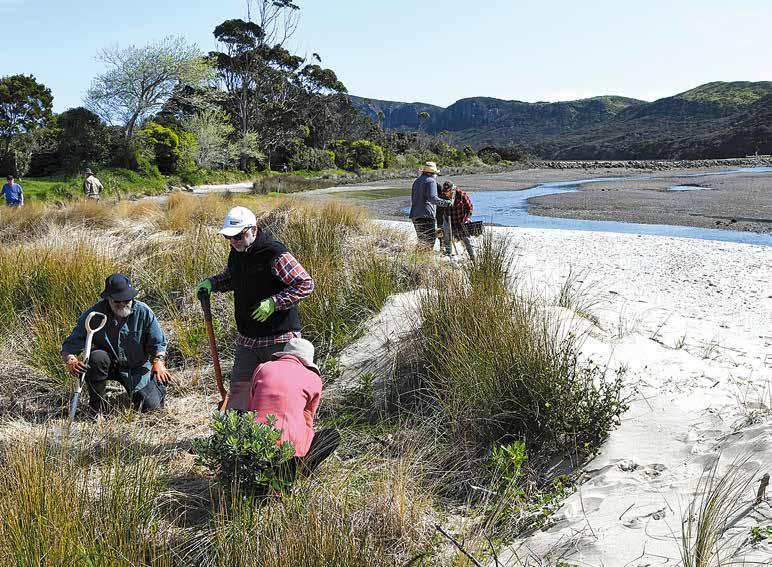
Members of the small coastal community of Pūponga came together last Saturday morning for a hands-on planting session.
In less than two hours the two dozen residents had successfully dug in several hundred coastal plants along the shoreline at Seddon Street Reserve.
The planting represents the first stage of a Coastcare scheme, steered and funded by Tasman District Council (TDC), to improve the appearance of the area and help protect the reserve from costal erosion.
The initiative arose following last year’s felling of several large old man pine trees on the reserve which left the shoreline exposed and unsightly. With the tree canopy removed, sun-loving native sand-binding plants (spinifex and pingao), along with rushes and grasses (including sand coprosma, sand tussock and coastal flax), could be planted.
In January this year a group of Pūponga residents met on site with TDC’s reserves
officer Stephen Richards to discuss an initial planting programme. As a result of that engagement Stephen drew up a plan which began to materialise on Saturday.
Before the eager locals got to work with spades and gloved hands, Rob Lewis of TLC Native Nursery, who had supplied all the plants, explained that the various species should be planted in a position according to their tolerance to salt-water, with the most tolerant – spinifex and pingao – closest to the shoreline. “They recover well from salt-water immersion; others don’t recover so well.”
He added that invasive marram grass on the reserve has been sprayed and cut back but some would remain in order to capture sand until the native species became well established. Rob continued to describe the other species, where they should be planted and how they would contribute to the regeneration of the reserve. “We’re putting the right plants in the right place.”
Stephen explained that part of his role is to
act as Coastcare co-ordinator for the district. “We’re doing this sort of thing all around Golden Bay and Tasman Bay,” said Stephen, adding that it was about people as well as plants. “These events always go really well. There’s a positive social aspect to it and it gives a degree of ownership to the community. It’s engaging and empowering.”
Volunteer Jan Dean agreed. “It’s a good thing for the land and a good thing for the people – to come together and be co-operative.” She said that her family had enjoyed spending time at the reserve over the past 20 years. “We’re regular users of the beach along with our children and eight grandchildren.”
When all the holes had been dug and plants bedded in and mulched, thoughts turned to stage two of the plan – an extension of the scheme along the shoreline. “We’ll have another community planting this time next year for the next 70 metres,” said Stephen, “and as budgets allow.”
Bylaws for pet control
Amongst Tasman District Council (TDC)’s recent spate of hearings, two held particular interest for Golden Bay residents.
Last Tuesday and Wednesday, TDC heard public submissions on draft bylaws for cat and dog management respectively. Both meetings were held in the Richmond council chamber and chaired by Golden Bay ward councillor Chris Hill.
Cats
Of the two drafts, the cat “snip and chip” bylaw has proved less contentious. It attracted a total of 152 submissions, 11 of which were heard during Tuesday’s 75-minute session.
Ten of the speakers were strongly supportive of the draft bylaw, with many urging the council to go further and faster with its cat management regime. One contributor, however, questioned whether TDC had followed a robust legal process in choosing to create a new bylaw.
TDC explains in the preamble to the document that it drafted the legislation “to address several issues associated with the unmanaged cat population, including public health concerns and nuisances caused by stray cats”. The key provisions laid out in the bylaw are as follows: All cats over six months old must be microchipped; all microchipped cats must be registered on the National Companion Animal Register; all cats over six months old must be desexed unless the owner holds registration as a breeder. Existing cat owners shall be granted a transition period (until 1 June 2027) during which they are required to desex, microchip, and register any cats they already own.
The first member of the public to speak at the hearing, Les Cook, described cats as “urban guerillas” and “killers of birds” that “spread disease”. In addition to supporting the provisions in the draft bylaw, he advocated for each household to be limited to a maximum of two cats, for the pets to be confined on their owners’ property, and for the cat population to be “reduced drastically”.
His views and suggestions were largely endorsed by others from Forest & Bird, Predator Free NZ Trust, and Project De-Vine, who were all keen to see the transition period end on 1 June 2026, a year earlier than specified in the draft. It was also clear that these organisations would press for 24/7 confinement of cats at the next bylaw review in five years’ time and, in the meantime, seek to introduce intelligent...
JO RICHARDS
JO RICHARDS
Community volunteers plant native coastal species at Seddon Street Reserve, Pūponga last Saturday morning. Photo: Jo Richards.
We’re your local
Bylaws for pet control
Continued from page 1
...kill-traps that would eliminate non-microchipped animals.
OPEN 7 DAYS
Mon-Fri 8.30am-5pm I Sat & Sun 9am-1pm
7 Commercial Street, Takaka
Email:goldenbay@hammerhardware.co.nz
Website: www.hammerhardware.co.nz
Phone: 03 525 7265
Christine Sumner from SPCA also welcomed the bylaw, but suggested that the age for desexing cats should be brought forward from six to four months.
The lone voice of dissent was Matthias Schaeffer of Tasman Democracy, who criticised the drafting procedure, accusing TDC of having “pushed through” a lot of bylaws “all of them discussed in workshops with the public excluded”. He expressed concern about the “lack of scrutiny” which had resulted in a flawed document that failed to address, or properly define, the problem. “Having all cats microchipped doesn’t solve the problems.”
Referring to section 155 of the Local Government Act, Matthias explained that there was no evidence to show that TDC had considered alternatives to a bylaw, as it was obliged to do under the legislation. “How can it be lawful when the procedure is not followed under the LGA?” He concluded by inviting questions from the panel, but none were forthcoming.
Dogs
of prohibition
controlled
A wide range of views were expressed during the day-long hearing, much of it based on the negative interactions between dogs and wildlife, especially ground-nesting shorebirds. But many dog owners also made well-reasoned presentations, with some stressing the positive social and wellbeing benefits of companion animals and outdoor exercise.
Practising psychotherapist Henriette Politano described the draft bylaw as “a rather punitive Act” that she found “deeply disturbing” and was all about “control”. She posited that in a time of “huge existential and social stress” dogs were proving they were “man’s best friend”. Her argument was backed up by an emotional testimony from Claire Hutt, who explained how owning a dog had provided “joy and healing” following years of mental health struggles.
8am – 7pm 7 days 13 Willow Street, Takaka www.freshchoice.co.nz
One possible solution to the trespassing cat issue, that was not considered, is to own a pet higher up the food chain. However, dog ownership comes with its own complications and is likely to become increasingly challenging. The day after the cat bylaw hearing, a new panel convened to hear public submissions on the council’s draft Dog Control Bylaw.
During the consultation period, 645 submissions were received, around 50 of whom spoke at Wednesday’s hearing. The topic of dog control has a history of raising hackles but, while opinions were clearly divided, mainly between dog owners and conservationists, for the most part, contributors remained respectful.
Speaking on behalf of Forest & Bird’s Golden Bay branch, Cynthia McConville focused on the shorebirds’ wellbeing and advocated for an expansion of dog-prohibited zones on beaches. Pointing out there were “eleven pairs of variable oystercatchers” along Milnthorpe beach, Cynthia said Forest & Bird wanted the beach to be made a no-go area for dogs, but were prepared to settle for less. “We could compromise with on-leash all year round…”
Grant Knowles, on behalf of Golden Bay Community Board, stated that the board “strongly supports the proposed bylaw” and considered the proposed legislation as “a very practical solution to a controversial problem”. He explained that the board’s stance was “based purely on what we’ve heard back from the community over the years”.
Call anytime or email maureen.pughmp@parliament.govt.nz
The draft bylaw incorporates a hierarchy of restrictions –controlled exercise, on-leash, and complete prohibition – using detailed maps to illustrate designated areas. It also overlays seasonal and time-of-day restrictions. The result is a complex mosaic of permitted times and spaces that could provide a bonanza for sign-writers.
Under the new bylaw, Golden Bay will have eight “Controlled Exercise Areas” – six designated beaches plus two recreation reserves – in which dogs “shall be kept under the control of a responsible person” who must carry a leash at all times. Proposed "Leash Control Areas" include Collingwood Campground, Milnthorpe headland, Motupipi Reserve beachfront, and Tākaka CBD.
Prohibited areas include the Rec Park and just about all of the Bay’s estuarine areas and inlets. In Tākaka, the Village Green, Pioneer Park, the old library site, and adjacent playground are also out of bounds. During summer months (defined in the draft as 1 November to 1 March inclusive), dogs are also prohibited from Tukurua beach (camp frontage) and Pōhara beach from in front of the campground to Selwyn Street Reserve. The proposals for beaches at Tata and Ligar stipulate complicated seasonal and time restrictions that involve periods
Representing an alternative position, Gay Hamilton spoke on behalf of Good Dog Owners Golden Bay – an organisation which she said had over 180 members who were “nature lovers”. Gay argued against the negative stereotyping of dogs and their owners. “We don’t deserve to be treated as anti-bird heathens. We’re there picking up rubbish and glass after parties… We’re the ones who tell visitors where they can walk their dogs.” She accused Forest & Bird GB of spreading “utterly false” information relating to the role of dogs in oystercatcher chick mortality and said this raised a “huge red flag” concerning the local organisation’s involvement in future bird surveys – which were vital in providing unbiased evidence to justify changes in bylaw provisions. Gay also suggested subsidised bird-avoidance training for dogs and owners, on-beach signage, and offered the group as an “interested party” in anything dog-related.
Next steps
Earlier this week, TDC staff explained that, due to the high volume and complexity of the submissions received, they would require additional time to ensure all viewpoints were carefully considered. Consequently, the deliberations, originally scheduled for 16 October, have been rescheduled to 20 November. TDC acknowledged that this delay might be disappointing but emphasised the importance of thoroughly reviewing and evaluating each submission to make a wellinformed decision.
A dog takes controlled exercise on one of Golden Bay's beaches. File photo.
and
exercise.
Hui provides food for thought
T he Sustainable Living Centre (SLC) Annual Hui, held recently at the GB Community Hall, discussed the issue of kai resilience. The session attracted a mix of newcomers and longtime locals, ranging from home gardeners to flower growers, and from dairy farmers to hunters.
The group identified several key factors essential for kai resilience. Firstly, there is a need for disaster-proof systems that ensure resilience in the face of natural, medical, and political disasters. Secondly, it is crucial for the local economy to benefit by financially supporting our growers and producers. Thirdly, the health and wellbeing of both the environment and humans, now and in the future, must be prioritised. This includes the health of waterways, biodiversity, and soil. Additionally, food should be integrated into the community, ensuring that everyone can access it through sharing and trading, thereby utilising our abundance and fantastic resources. Lastly, it is important to ensure access for all, particularly supporting vulnerable people and those in need.
In the afternoon, a “world café” exercise explored five key questions:
• What additional networks, or improvements to existing networks do we need to have re community food resilience?
• How do we get better access and utilise the food already produced in the Bay to strengthen our local food economy?
• How can we strengthen our food security for food bank users and other community members in need?
• How do we ensure the food produced is healthy for our people and our environment?
How do we creatively work around regulations and legislative constraints? And what are some successful ways we are doing this?
SLC garden manager Rosie Hadfield commented, “We are well aware that many of the key players in our food system weren’t able to come, so we’d love to reach out to our community for your responses to the questions we explored.“
Rosie encourages anyone interested to email their responses to the five questions above to: gbsustain@gmail.com
"We will then collate these to compile a list of key initiatives suggested to improve food resilience in Mohua. These will be published and will include a feedback process to decide which initiatives are pertinent and plausible.
"As three registered charities (The SLC, Mohua 2042, and Mohua Social Services), we aim to support the businesses in our area, as well as the community, to improve our food systems to be as resilient as possible."
SLC thanks all those who supported the hui, especially Merv Solly, HealthPost, and Trash Palace for sponsoring the first phase of the Kai Resilience Project.
Delegates at the Sustainable Living Centre's recent Sustainable Hui discuss the issue of kai resilience.
Photo: Submitted.
PHONE: 027 525 8679 EMAIL: admin@gbweekly.co.nz
OFFICE HOURS: Monday-Wednesday 9am-5pm
USUAL DEADLINE FOR ALL SUBMITTED ITEMS 9am Tuesday.
USUAL DEADLINE FOR ALL ADVERTISING/LETTERS Noon Tuesday.
LATE SURCHARGE:
Until 4pm on Tuesday (if space available): classified ads $5; display ads 10% surcharge (min $5).
ARTICLE IDEA OR REQUEST
We welcome your suggestions. Please contact us.
SUBMISSION OF A WHAKAARO
We welcome readers to submit a whakaaro. Please contact us with your idea first.
OUR AGENT HAS MOVED:
Stitch ‘n Sew, Room 15, in the Workcentre complex at 84 Commercial Street, Tākaka. (Near Trash Palace) Open Tuesdays and Fridays 10am-4pm or by appointment.
ADVERTISING COSTS:
Classifieds: 60c/word.
Display ads: contact us for details or see the website.
The editor reserves the right to make final decisions on layout of submitted ads. While every effort is made to ensure the accuracy of information in this publication, The GB Weekly does not accept any responsibility for errors or omissions or for any consequences arising from reliance on information published. The content of submitted material is not necessarily endorsed by the owners. Copies can be bought and we have a subscription service.
WHAT WE PROVIDE
SOCIAL WORK – Working with children, young people and their families. Working one-to-one with clients through support and advocacy for positive change.
HEALTH SOCIAL WORK – Making the connections between community and health services from the cradle to the grave
BUILDING FINANCIAL CAPABILITY – Ongoing or one-off assistance with a Financial Mentor.
FOOD BANK AND BEDDING STORE – Available for individuals/families going through hardship.
COUNSELLING – Referrals to specialist counselling.
YOUTH SUPPORT – Working one-to-one with youth.
MONEY MATES – 4-week courses to learn skills and examine choices, options and behaviours towards money.
WHANAU MEETINGS – Guest speaker and community notices, held on the first Tuesday of each month, 12-1pm at the Community Centre.
FAMILY CENTRED SERVICES – Family violence prevention
REFERRALS TO: Public Health Nurse, Well Child, Mental Health, Community Law, Oranga Tamariki, Family Court, PHO and others.
SIT & BE FIT – Community exercise classes in Takaka and Collingwood.
COMMUNITY DEVELOPMENT – Responding to community needs as they arise.
VILLAGE GREEN: Bookings 525 9728
COBB HOUSES: Bookings 525 9728
HALL/ROOM HIRE – kitchen, 80-seat hall, rooms, tables, chairs, crockery, cutlery etc for functions and conference hire. Ph 525 9728.
LIBRARY – a good selection of self-help and inspirational books, videos and DVDs, including GB Cancer Society Library. Free of charge.
LETTERS
The Ministry of Messing Things Up
David Seymour’s plan to remove teacher-only days is another attempted ram raid on education that suggests ministerial inexperience and poor advice. During my 14 years of school-based mental health nursing, I have observed the effects of years of governmental turbo-charged changes of curriculum, policy, infrastructure and budget on schools. School teams work unseen, unpaid hours (including within school "holiday" time) and are the unacknowledged, unpaid social welfare workforce of successive governments, bridging the gaps in services and funding. It is the government's addiction to unsustainable change that robs students of teaching hours, as educationalists are kept busy mopping up and complying to each ministerial whim. Teacher-only days are not holidays, they are integral to planning, learning, culture and wellbeing of our kura.
Michelle Cole
Dog control bylaw submission
In a letter to The GB Weekly (GBW, 27/9) serious allegations were made against the Golden Bay branch of Forest and Bird by a group of dog owners – Louise Grace, Katie Lavers, Nina Griffith, Pauline Watts, Alexandra Purucker, Karen Howieson, Sian Clement, Lee-Anne Parore, Carrie Dobbs, Jane Mulcahy, Ute Kleine, Lisa van der Meer, Gay Hamilton, Robynne Harvey and Royce Heine.
The branch does not conduct its business through the media and we have asked the group to email their letter to us where it will go before our committee for response. However, we would like to publicly correct one of the allegations made about our submission on the draft Dog Control Bylaw.
The letter incorrectly said that our branch “recommend the whole stretch of beach from Milnthorpe to Collingwood be a leash-only area”. The Forest and Bird submission states “Forest and Bird strongly oppose the entire section of this coastline as an off-leash exercise area for dogs. We ask for this to be moved to seasonal – dogs to be prohibited during the nesting season 1 November to 31 March from the Milnthorpe headland up to the Excellent Street walkway and on-leash 1 April to 31 October from the Milnthorpe headland up to the Excellent Street walkway.” This recommendation is supported by crown partners Manawhenua ki Mohua.
The submission also stated that it supports off-leash between the Excellent Street walkway and Collingwood and is available publicly.
Cynthia McConville, chair Forest and Bird Golden Bay The shocking reality of electrosensitivity
I happened recently to strike a friendship with an electrosensitive man. I already know six people in the Bay who are electrosensitive. What they share are very obvious physical reactions when in the presence of electromagnetic fields. In the case of my new friend, he gets piercing migraines, starts to stutter, his whole body feels pain.
He lives in a gully in the middle of nowhere where there is still very little phone coverage.
When he goes out he has to wear a suit that looks like a bee keeper's outfit. Recently, he was so exposed in Tākaka, he had a bad car accident. Now he relies on the kindness of other people for his shopping and necessities. He has to do his shopping online, but through ethernet, not WiFi, and ironically the internet providers are removing copper cables so we'll soon be
ESSENTIAL TELEPHONE NUMBERS
left only with the option of broadband where there are no optic cables. He can't be next to someone who has a cell phone on. I have not kept in touch with all the other electrosensitive people but I know three of them are living similar lifestyles. One, a gorgeous young woman, is mainly bedridden with pain most of the time.
We humans have evolved to thrive with new satellites and antennas multiplying around us...or have we? Or are all those new diseases doctors can't put a name on, immuno disease, chronic pain, turbo cancers, somehow related to this radiation? And, don't we all have a responsibility to protect all other living creatures of this planet?
Shouldn't our government provide large areas where no radiation is present at all, not even from the satellites?
Let's give these people some respite!
Dam bills keep flooding in
email manager@mohuasocialservices.org.nz or phone 03 525 9728 for further information about any of these services
Giuli Morani
Last week I asked Tasman District Council to explain the rise in my rates due to the rising cost of the Waimea Dam.
This was the reply provided under the LGOIMA:
As you state it has risen from $65.45 to $107.09. An increase of $41.64 or 63.8%.
The main two factors that contribute to this are related to costs associated were,
• An increase in the estimate for the operating costs to run the WCD.
• An increase of $10m to close out the project.
Both of these were not expected, and came via Waimea Water Limited.
Regards,
Legal Services Officer
So now we know. How many more unexpected costs are to come?
Reg Turner
Birds and humans: a short history
If we look at our history, from around 1300 the local residents caught and ate every bird, egg, shellfish and fish they could find. Europeans arrived and they did the same right up until the 1950s and '60s. There are many stories of people laying above high tide and shooting up to 20 birds at a time with a double barrel shotgun.
The parts of the beach that my children and I walked and played on was on the hard sand. The birds that are on the hard sand are not feeding and they fly off then return once you have left, whether you are on a motorbike, running, walking a dog, riding a horse or driving a car.
Penguins have always been here and there have been signs up telling us to be watchful of them for the last 70 years that I know of. If one looks at the coastline from Kahurangi to Boundary Bay and works out the small amount of beaches we use and the amount of man-made rock walls including Tarakohe, you will see, I am sure there is enough room for everyone to enjoy. The problem I see is that there are those who can't leave the birds alone. They walk around counting their nests and photographing them. If the busybodies could leave the birds alone they will be here long after we have gone. If you want to save penguins then get rid of the seals as their population has increased dramatically in the last 30 years. Remember they were also harvested.
Paul Sangster
Dog owners care
I refer to and support the open letter to Forest and Bird that was in last week’s GB Weekly (GBW, 27/9). Humans are the worst culprits for interfering with nature. Birds will nest where they
Manaaki Tangata
Mohua Social Services
LETTERS
think it’s safe. There will always be predators – that is nature. However, I cannot help wondering how many chicks perish due to human interference “just checking” to see if the nest is still intact. How many adult birds won’t tend to their young because that well-meaning human is getting in their way?
And why is it that responsible dog owners are getting persecuted for the action of less responsible persons (with or without dogs)? When we walk with our dogs, we are closer to nature than many of these lobbyists will ever be, and we look after it because we care
Helen Beck Board exceeds mandate in dog debate
I'd like to thank all those dog owners who came together to build a list of constructive, pragmatic suggestions to put forward to the TDC Dog Control Bylaw committee. Great work indeed.
I'm well aware that, in the Bay, we have a range of views on the matter and appreciate them – that's what democracy is all about.
However, I was quite concerned by Golden Bay Community Board's (GBCB) submission that, on the one hand agreed that the relaxing of dog controls on Tata and Tākaka have gone well (as they have), then somehow felt that we needed extra restrictions everywhere else. It is noted that Motueka Community Board did not make a submission, leaving it to residents to speak for themselves instead of talking over them.
I was particularly concerned that they called for Central Government to get involved. GBCB exists because we want –no, need – local control of decisions that affect us. If you are calling for controls to be removed and Central Government and TDC to call the shots on local issues, then why are you
even there?
The GBCB advocates for us – you definitely don't have a mandate for handing over control. Personal opinions should go in personal submissions, not board ones.
Gay Hamilton
Volunteers needed for fundraiser
I am looking for volunteers to help out on a stall at FreshChoice between 9.30am and 5pm on Friday 18 and Saturday 19 October, selling raffle tickets for a breast cancer fundraiser raffle.
It’s usually a fun event and if you can spare half an hour it would help. Please text me on 022 649 9035.
If you have contacted the breast cancer volunteer group still contact me please as they don’t pass your details on.
Thank you.
LETTERS TO THE EDITOR
Jennie Morris
The GB Weekly welcomes letters to the editor. Please email your letter to us at admin@gbweekly.co.nz by 12pm Tuesday. Include the writer’s full name, home address and daytime phone number. Letters will be printed over the name of the writer; names are withheld only when compelling reasons can be established. Letters must not exceed 250 words. Letters that are too long will not be considered. All correspondence is at the discretion of the manager, who reserves the right to decline, edit, or abridge letters without explanation or further discussion. Links to third party websites will not be published.The views expressed are those of the correspondents and are not necessarily endorsed or shared by The GB Weekly.
• GBCH continues to collaborate with partner organisations in Mohua to create a wellbeing survey that will provide us with important planning information based on the health and wellbeing needs of our community. This project is led by the Pae Ora Alliance Partnership Group, which includes representatives from various health, wellbeing, and education providers in our area. By participating in this survey, you will help shape a healthier future for everyone in our community. Keep an eye out for the survey in the coming month!
• We have recently employed six new internationallytrained registered nurses to join our amazing existing team: one from Canada, three from India, one from Pakistan and one from the Philippines. We are lucky they are keen to move to Golden Bay and bring their vast nursing experience with them in support of our existing team and our community.
• A friendly reminder that after-hours charges apply from 5pm weekdays as well as weekends, and a missed appointment will be charged a fee if we have not been contacted to explain why the appointment was missed.
• We have just been accepted as a training centre with Otago University in 2025 and will welcome three 5th year medical students for a full year as part of the Rural Medical Immersion Programme.
• Thanks for the ongoing support of our hospital cat Pippi. You can still make donations at the Rural Service Centre vet towards her ongoing care.
If you need emergency care call 111. For same day or routine care, give us a call, ph 03 525 0060.
Conchology talk a shell-out event
Green Tara retreat in the Bay
SCAN TOOL
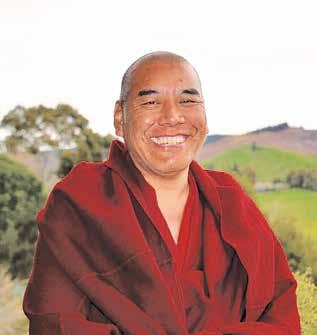
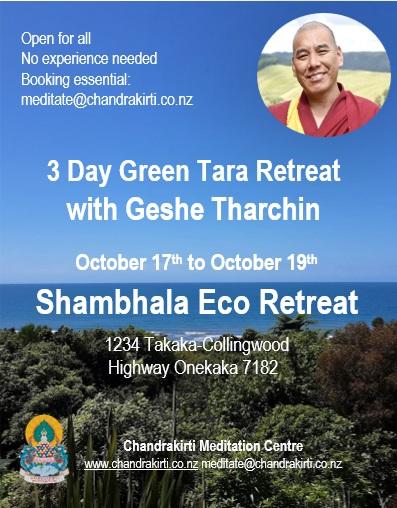
From 17-19 October, Geshe Tharchin will lead a threeday Green Tara retreat at Shambala Retreat in Golden Bay. Green Tara is a female buddha, the active energy of compassion, bringing swift protection, healing and inspiration. A much-loved deity of all spiritual seekers. Geshe Tharchin has been the resident teacher at Chandrakirti Centre for more than 12 years. He has a Lharampa Geshe degree equivalent to a PhD in Buddhist Philosophy and has many years of study, practice, and experience, with a very friendly approach in teaching. Geshe-la emphasises that Green Tara practice is especially effective to heal mental and physical illnesses, natural disasters, and bring swift success. The retreat is open to all, no experience needed. The cost for the three days is $295 which includes all retreat materials, accommodation, three wholesome vegetarian meals and snacks daily. For more information visit: https://www.chandrakirti. co.nz/event/shambala-greentara/ Email: meditate@chandrakirti.co.nz FULL WORKSHOP FACILITIES
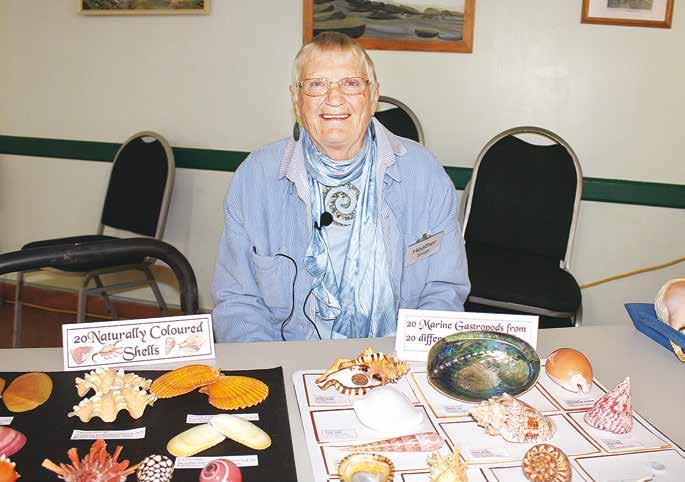
"Shell Lady" Heather Smith began collecting shells four decades ago when she lived briefly in Fiji, and gave a fascinating talk about her passion for conchology to a packed-out Senior Citizens' Hall recently.
Shell searching has taken the retired teacher from the Caribbean to Antarctica and the Great Barrier Reef, preserving specimens and raising awareness of these little-understood creatures. It’s easy to forget that shells are the vacated premises of aquatic animals, but Heather was only too happy to illuminate the very engaged audience with her slides and samples.
One particular image was very close to home – a fossilised ammonite from the east end of Pōhara beach.
“A lot of those rocks have come out of the quarry, and many have fossils in them. When I found this I thought, ‘I'm the first person in 20 million years to see it!”
Her collection includes deep water shells brought up by dredging, which are never found on beaches, and bright blue floating shells which prey on jellyfish. One of the largest belongs to a nautilus, which can regulate its cruising depth by filling and emptying chambers inside its shell, like a submarine.
“I've been a very lucky person to travel so much,” admits Heather. But during one of her five trips to the Great Barrier
Reef she did wonder if she was pushing her luck. “ I was told that I'd need every part of my body covered, because of all the little poisonous creatures there, but you soon learn what you could and couldn't touch.”
Heather used a salad spoon to collect specimens of a cone shell lethal to humans: Conus geographus, which fires a tiny, venomous harpoon at its prey. These samples were used to help create an anti-toxin.
Heather is concerned for the vanishing habitats of shellfish, as reefs disappear each year and increasing coastal settlement alters the alkalinity of foreshore waters. In some places hermit crabs make their homes in plastic waste due to the scarcity of shells. “It’s a sad world, isn’t it?” she laments.
However, lesser populated areas like Stewart Island are still rich in shell diversity and shell collectors like herself bring rare species to public attention. “If it weren’t for some collections around the world we wouldn’t even know these shells exist.” She has dispersed most of her once huge treasury to museums and private collectors, but her art background enabled Heather to record many of the shells in her own paintings, drawings and photographs.
Describing the brightly coloured shells she brought with her as "a mere remnant" of her once impressive collection, one audience member begged to differ. “These aren’t just remnants, they are beautiful.”
ALISTAIR HUGHES
"Shell Lady" Heather Smith with some of her collection, after her well attended presentation. Photo: Alistair Hughes.
RURAL VIEWS: Succession planning
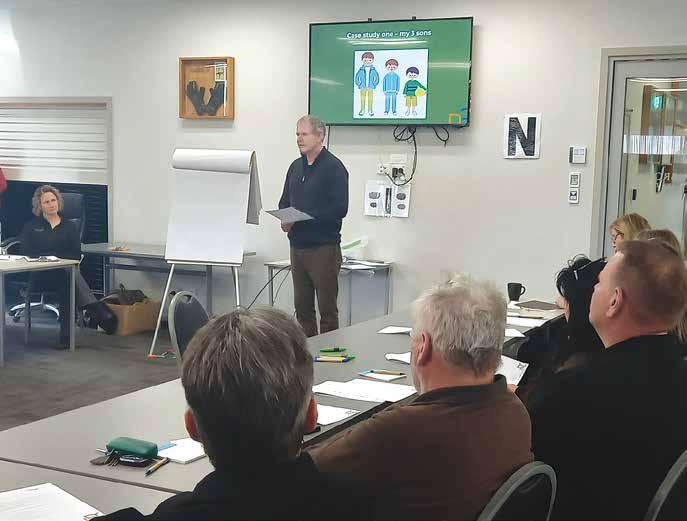
Beef and Lamb NZ hosted a succession planning workshop in Tākaka recently. Over 20 people attended the session held during the busy spring season, highlighting its importance and farmers’ interest. No matter the structures in place (trust, partnership, or company), at some stage, it needs to be passed to the next generation. Better outcomes occur when parents make arrangements this side of the grave.
Rural coach John Redpath prefers the term “transitioning” to describe the process. He encouraged group discussion on what good outcomes of transitioning are, emphasising family harmony and giving all children a hand up. John agreed that “the value of ongoing unity is priceless and the cost to both family and business of not getting this right is high”. He questioned what is in the way of succession talks, with the main issues being emotion, fear of bringing up the topic, upsetting family members, and the financial viability for all parties involved.
Before becoming a rural coach, John worked in banking. He noticed many farming families were “stuck” on transition with resulting conflict, stress, and resentment. He recommends starting the process early, observing that “the probability of achieving a successful succession plan is inversely proportional to time”. Outlining four foundations for transition (see box opposite), he encouraged the group to start today with honest and brave conversations. Succession may be difficult, he said, but the alternative is worse.
The four foundations for transition
Sound relationships and communication. John introduced the family of mum, dad, and three sons with wives, asking the group to consider the perspectives of non-farming siblings, daughters-in-law, the son who wants to farm, and the parents. All family members must be willing to work towards an outcome, participating in the transition process.
• Profitability is vital, including meeting parents’ needs, the future of the farm business, and treating non-farming children fairly.
• Aligning expectations with equity, being realistic about what is possible with existing capital.
John recommended employing a “facilitator” to bring a perspective free from emotions, conflicting interests, and family history. They can handle hard conversations, allowing the family to express their thoughts safely. He explained that “fair is not equal and equal is not fair,” but a good outcome is improved if there are no surprises and everyone feels heard.
Before participants went home with an 11-component plan for their own succession plans, John outlined nine mistakes rural families make: waiting too long, not including everyone, not giving succession planning the time it deserves, not creating a safe space where everyone is heard, assuming the outcome, not being realistic, not adopting a “values-based” approach, not using an independent facilitator, and not putting things in writing. With those warning words, folk returned to their spring routines of feeding lambs and checking ewes.
JOYCE WYLLIE
John Redpath, rural coach, addressing a succession planning workshop in Tākaka. Photo: Joyce Wyllie.
WHAKAARO: The price of gold
SUBMITTED BY ROD BARKER
Gold may shimmer with promises, but this pursuit often comes at a cost far greater than its value. Much like Sméagol in The Lord of the Rings, whose innocent curiosity was corrupted by his obsession with the One Ring, we risk becoming consumed by desires for gold and economic growth. As Sméagol transformed into Gollum, driven by greed and lust for power, decision-makers seem blinded by short-term gains.
Nowhere is this clearer than in the proposal to mine for gold at Sam’s Creek – upstream from Te Waikoropupū Springs. These springs, among the clearest freshwater systems in the world, are now protected by a Water Conservation Order. Yet under the Fast-track Approvals Bill, developers can bypass these safeguards. The proposed mine threatens to contaminate the springs, introducing arsenic-laden waste into aquifers that feed the springs and the community. These waters, revered by local Māori as a taonga (treasure), are irreplaceable, yet like Sméagol’s descent into Gollum, the pursuit of gold risks corrupting something far more valuable.
This is not an isolated issue. Globally, gold extraction has left a trail of destruction. In Papua New Guinea, the Ok Tedi Mine devastated river systems, poisoning water supplies. In Peru, illegal gold mining in the Amazon led to deforestation and mercury contamination, impacting indigenous lands. Even in New Zealand, gold mining in the Coromandel Peninsula left behind scarred landscapes, with rivers still bearing the toxic legacy. In every case, the promise of gold has compromised short-term greed for long-term needs.
The planetary boundaries framework shows us why such decisions matter. Earth’s systems – climate, water cycles, biodiversity have limits, and crossing certain thresholds risks irreversible changes. We’ve already exceeded six of the nine planetary boundaries, including those for climate change, biodiversity loss, and freshwater use. Each boundary crossed weakens Earth systems stability, pushing us closer to tipping points that unleash terrible harms.
At Sam’s Creek, the risks are clear. Arsenic contamination from mining could compromise the water source for Te Waikoropupū Springs and parts of Golden Bay. Exceeding the freshwater boundary by degrading such a critical water source threatens not only ecosystems but also the cultural and economic foundation of the region. Local iwi, who hold kaitiakitanga (guardianship) over the land and water, know that the true value of the springs lies not in what we can extract, but in what water provides. We are water – without it we die.
Gold mining is the opposite of this wisdom. Just as Sméagol’s obsession with the Ring turned him into Gollum, our fixation on economic growth risks turning decisionmakers from careful stewards into reckless exploiters. In the pursuit of gold, we dig deeper, pollute more, and leave behind barren landscapes. And for what? A glimmering metal we cannot breathe, drink or eat.
The Fast-track Approvals Bill, in its rush to accelerate development, threatens to erode the environmental checks that prevent us from crossing critical boundaries. It risks turning decision-makers from Sméagol – who valued connection to the land – into Gollum, obsessed with shortterm profits. The future cannot be one where we trade irreplaceable natural resources for temporary gains. We must live within the limits of Earth’s capacity to sustain life.
Te Waikoropupū Springs is more than a body of water. It symbolises the balance we must maintain between economic needs and environmental responsibility. If we allow the springs to be contaminated, it won’t just be a loss for Golden Bay – it will be another example of how greed, like Gollum’s obsession with the Ring, blinds us to the true wealth that nature provides. Gold may glitter, but it is water, biodiversity, thriving ecosystems and caring communities that sustain us.
We must ask ourselves: is the promise of gold worth the irreversible damage to our ecosystems and cultures? Will we chase the fleeting glint of gold, or safeguard the life-giving elements that sustain us?
Supporting neurodivergent adults
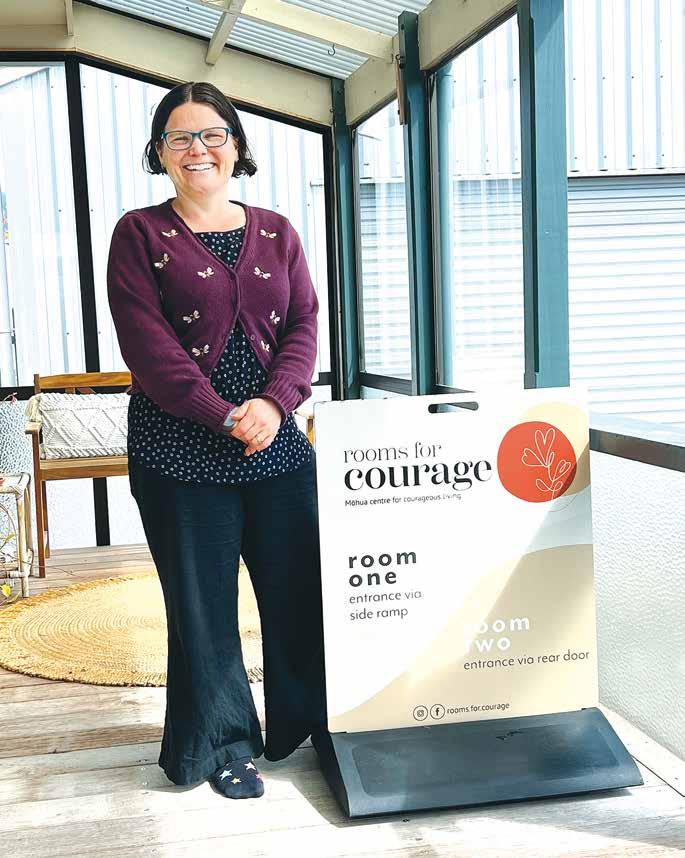
An occupational therapist with a difference, Rebecca RaeHodgson offers unique support for neurodivergent adults through her business, Chronic Resilience.
After lockdown, in 2021 Rebecca returned to Golden Bay from 15 years in Canberra and then Melbourne, where she had gained her Occupational Therapy Degree. Initially she worked for Te Whare Mahana as a coach and care co-ordinator while she slowly set up a social media presence, developed business cards, brochures and ran her first workshop. “I had more people reaching out to me, wanting to work with me and I thought this might be viable.”
This year Rebecca began her private practice working faceto-face with clients on Mondays from the Rooms for Courage on Junction Street, Tākaka. On Thursdays she works online mentoring clients worldwide or hosting workshops via Zoom.
On top of chronic illness, Rebecca was diagnosed as autistic ADHD “not even two years ago”. She now appreciates more about how her brain works and schedules her work routine accordingly. On her Facebook page “The Chronically Resilient OT” (8500 followers) Rebecca shares appropriate examples of her own lived experience.
Working with adults only Rebecca said, “I work with a lot of people in the complex intersection of neurodivergence, like
autism and ADHD plus mental illness, plus chronic illness.” She’s often working with people whose lives are “pretty difficult” especially with late diagnoses people often don’t know who they are. “It’s this whole new chapter for them.” Rebecca helps support her clients to figure out what is important to them and what is getting in the way of achieving it, either work or lifestyle-wise. “Many have executive functioning issues,” she says. “Working memory, planning, prioritising, task initiation. It also includes emotion regulation.”
Defining “occupation” as “all the ways you use your time”, Rebecca explained that neurodivergency “gets in the way”. As everyone is different, there is no one plan for all, so each client is treated as the unique individual they are.
Rebecca spoke at an OT conference in Dunedin recently, is presenting two workshops at an upcoming conference in Hamilton and has just attended an Australian OT conference, which she has submitted to present at next year.
Looking ahead to 2025 Rebecca is keen to get involved with the Golden Bay community and is contemplating running sixweek programmes on understanding neurodivergent brains.
“The local community connection is really important to me,” says Rebecca.
For more information, visit: www.chronicresilienceot.com
RONNIE SHORT
Occupational therapist, Rebecca Rae-Hodgson runs her Chronic Resilience practise from Junction Street, Tākaka.
Photo: Ronnie Short.
Flower show puts on a blooming beautiful display
FREE Community Wellbeing Workshop
Golden Bay
Nelson Bays Primary Health is providing free community wellbeing workshops around the region and we have the following session coming up in Golden Bay
Please come along to enjoy a cuppa and kai with us and take home some tools to use!
Date: Thursday 17 October 2024
Time: 10.00am 3.00pm
Location: Golden Bay Workcentre
*Registrations close Thursday 10 October 2024
Topics Covered:
Anxiety and managing our thoughts
Grief and Loss
Conflict Management
Understanding personal boundaries
Facilitated By:
Vicky Bryant, Mental Health Clinician/Counsellor
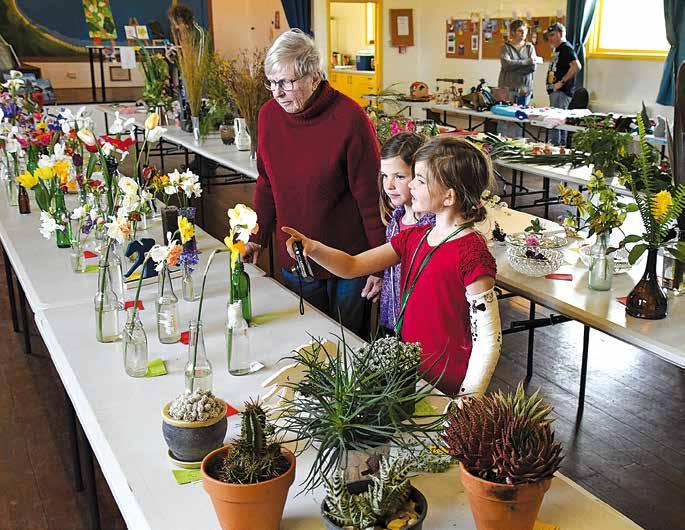
As reliable as the tides and the changing of the seasons, the Aorere Flower Show returned for its spring outing last Saturday. Now in its 115th year, the traditional rural celebration of seasonal fruits, flowers and local arts and handicrafts opened it’s doors at Pākawau Memorial Hall to the public.
Entries in the 183 categories ranged from vivid flowers to juicy fruits and from exquisitely knitted cardigans to colourful photographs and paintings.
Long-term show organiser Lois Benjamin, who does more than anyone to keep the event alive and thriving, was pleased with the displays set out on long trestle tables and on the walls of the hall. “We’ve done well,” said Lois pointing out that the iconic spring narcissi had, unfortunately, been hit by the wet weather. “The daffodils have suffered in the rain.”
Lois highlighted some particularly impressive entries, singling out Glennis Robertson’s stunning spring flower arrangement which scooped first prize in its category and was judged outstanding.
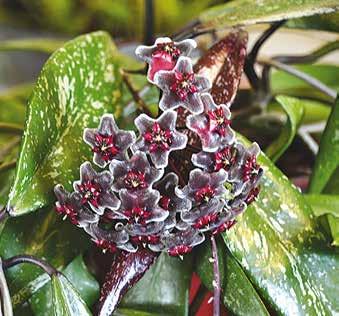
Exhibitors often wait until the morning of the show to choose their flower and veggie entries in the hope that a potential prizewinner may bloom. Karen Jarrett’s Royal Hawaiian Purple Hoya was one such late bloomer. “I just discovered the flower this morning, so I thought ‘I’ll take it’,“ said Karen. “It’s the first time it’s flowered.”
Something that can always be relied upon is the afternoon tea of pastries, sandwiches and cakes, which proved yet again to be arguably the best value feed in the Bay.
After totting up the proceeds from sales of cakes, preserves and second-hand books, Lois reckoned there would around $600 going towards the replacement of Rockville Hall’s roof.
To register, contact:
Golden Bay Community Health Reception at receptiongb@nbph.org.nz or Ph 03 525 0060
Scan the QR Code, or Click Here: https://forms.office.com/r/f5H4Q1WJLd
JO RICHARDS
Visitors of all ages admired the displays at last Saturday's Aorere Spring Flower Show. Photos: Jo Richards.
Karen Jarrett’s Royal Hawaiian Purple Hoya in bloom.
Glennis Robertson's prizewinning arrangement.
Walking for trees
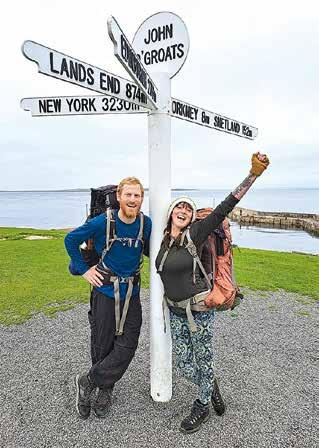
A Golden Bay couple recently completed a mammoth walk from one end of the UK to the other – all in a good cause.
Over 84 days Chai Pyle and partner Tamsin Trendell tramped a total of 1800km from Land’s End in Cornwall to John ‘o Groats in Scotland. “It’s been an epic journey on a personal level through one of the wettest summers on record,” said Chai.
While they were clocking up the kilometres the couple were also raising funds to plant trees, explained Chai. “You can see what we’ve been up to on our Facebook page if you search for ‘walkfortrees’.”
Lemon honey: a treat
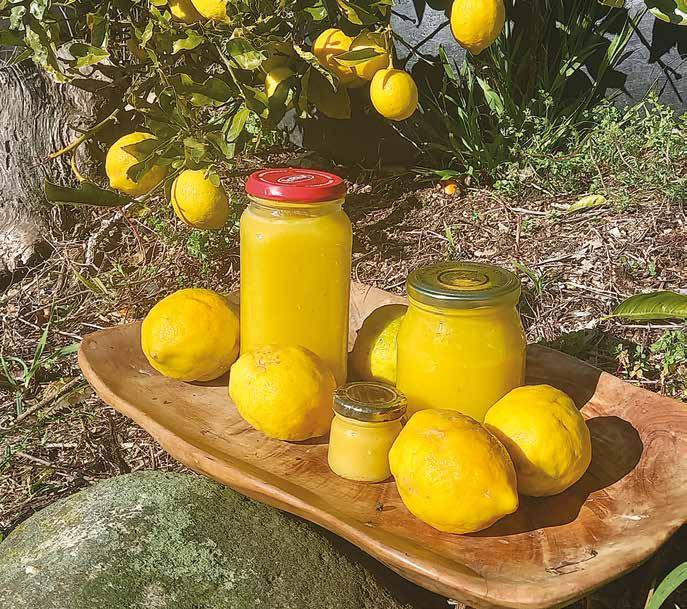
Lemon honey is a treat at any time of the year but now that spring is here and lemons are abundant, this is a delicious use for a few of them.
Lemon honey was one of Mum's specialties to make and she saved small jars so that she could gift them for sales-table fund-raisers. With the amount of butter, and sugar in them and buying eggs she was very careful that her contributions were priced realistically and not sold too cheap.
LEMON HONEY RECIPE
Ingredients
My great-grandmother's recipe from 1939 has a lemon honey recipe which starts with "steaming 3lbs of marrow till tender". This is beaten and strained before adding juice and rind of 3 lemons, rubbing in 2 1/2 lb sugar and 1/2 lb butter. "Boil for 20 minutes stirring all the time". Note that "lbs" means pounds and one pound is about 500g.
That brew has no eggs so would have been quite pale, but the recipe I use has four of them which gives the lovely yellow colour.
500g sugar I 125g butter I 4 eggs beaten I Rind and juice of 4 lemons
Method
1. Grate the yellow parts of the lemon finely. Squeeze the juice and strain pips out. A hint from a friend is that you get more juice if the lemon is warm so I drop them in hot water for a bit.
2. Put all ingredients into a double saucepan or bowl standing in a pot of hot water or bain-marie. Cook slowly until thick and smooth.
3. Pour into hot jars.
Mum would follow that recipe exactly but, being less patient, I risk cooking lemon honey in a pot on a slow heat and
stirring constantly. Sometimes small lumps form so it is not a prize winner at the A&P show, or look so nice on a sales table.
JOYCE WYLLIE
Making lemon honey is a delicious way to use up an abundance
lemons
Photo: Joyce Wyllie.
JO RICHARDS
New musical to preview at fundraiser
The upcoming new musical "Rescue Remedy" by DramaLAB’s physical theatre group is something completely out of the box. This production is huge, involving an enormous setup and expense to premiere with six shows at the Golden Bay Arts Festival in February 2025.
To this end, fundraising is underway, beginning with a separate show at the Mussel Inn on 13 October, offering a theatrical and musical entertainment "taster" of what’s to come.
Joining DramaLAB for half of the evening will be the Playback Theatre Group of Motueka (Tell Tales Collective), providing impromptu improvisation on audience stories. DramaLAB is also currently holding a raffle to be drawn on the evening and welcomes support from interested donors by 8 October.
In November, a four-day retreat with the full crew, supported by the Golden Bay Community Arts Council, will focus on continuing to develop the musical text and scene work.
Having never devised a musical before, DramaLAB has been exploring the concept over the past five months in the way movement and character work and how storytelling is combined, aiming to innovate within this realm. The involvement of other professionals familiar with the Physical Theatre and Viewpoints training methods has been essential to connect with the actors when composing scene work and devising theatre. The expertise of musicians Craig Denham and
Hera Livingston, and choreographer Milo Haigh from Dance Collective Mohua, has given support to DramaLAB’s powerful team of 10 actors exploring beyond their comfort zones, with new ideas, including writing their own songs. Actor Deb Morris said that the process took real courage, “it was a leap of faith, magical and unifying for the whole group”.
“The plot is very close to home, inspired by our local community and the festival community,” says DramaLAB director Martine Baanvinger. “A group of nine healers are all called together by the producer of a festival that brings healing to the damage done to the world by humanity. It’s a very current subject.”
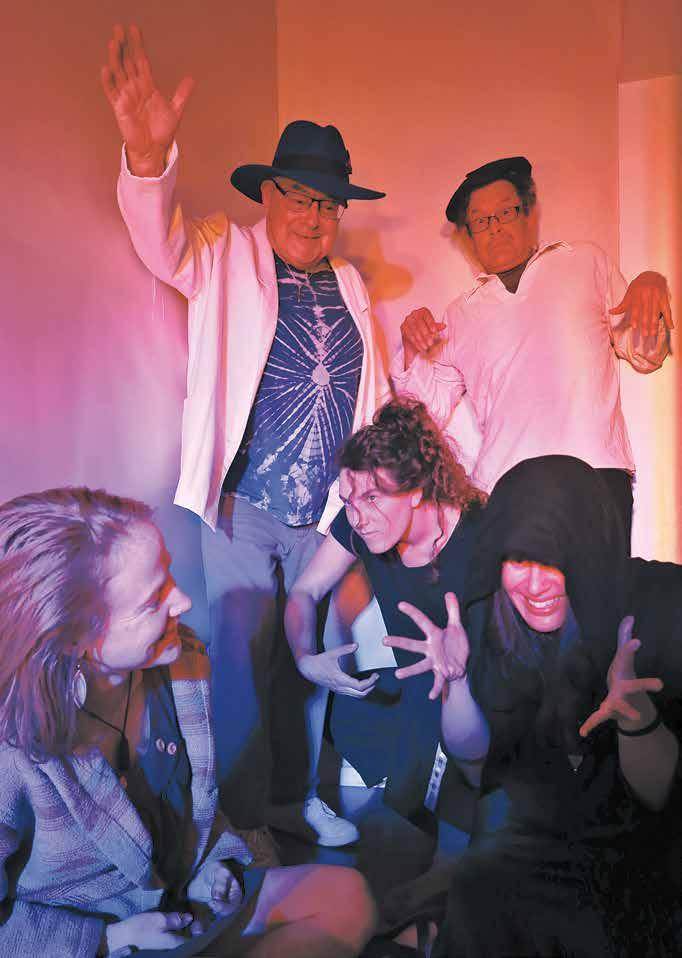
A unique twist is the characterisation of animals by the human actors, the healers, through studying distinctive animal movements, physiques and behaviours to create their individual characters. It felt like “coming back to that core animalistic nature,” said actor Rosie Hadfield. Stef Jongkind was challenged by the animalistic characterisation while still keeping the human element. Mark Roberts, who normally acts to a theatre script, said this style of performing is a totally different process. “There’s so much more depth to it,” he said.
Rescue Remedy preview performance is at the Mussel Inn on Sunday 13 October, 7pm. Tickets are available from Unlimited Copies, price $20. For more information, email: info@dramalab.co.nz
ANITA PETERS
Some of the DramaLAB actors rehearsing their animal characterisations for their upcoming show Rescue Remedy. Photo: Anita Peters.
RESULTS
GOLF
25 September. Stableford: R Dyce 37, W Collie 36, T Cameron 35. Closest to pin: 3/12 W Collie, 4/13 W Rothwell, 8/17 W Collie, 9/18 T Cameron. Twos: H Hills, R Dyce. Best gross: W Collie 74.
28 September. Net: R Miller 66, M Stephens 68, T Cameron 68. Closest to pin: 3/12 A Gourdie, 4/13 R Miller, 8/17 A. Gourdie, 9/18 W Rothwell. Twos: R Miller, R Dyce. Happy wanderer: D Green. Best gross: W Collie 76.
BRIDGE
25 September. Patons Rock Individual Session 9. C Jackson/L Roberts 60.42%; J Cooper/J Edmondson 56.94%; B Burdett/J Kingston 54.86%. H/cap: C Jackson/L Roberts 58.92%; J Cooper/J Edmondson 54.26%; D Sarll/R Smith 53.48%.
27 September. Individual Session 9. K Van Der Struys/P Jayne 57.61%; L Scurr/A Foreman 55.43%; E Bradshaw/J Massey 52.17%. H/cap. K Van Der Struys/P Jayne 60.46%; L Scurr/A Foreman 52.46%; E Bradshaw/J Massey 50.49%.
AGM NOTICES
GOLDEN Bay Community Health Te Hauora o Mohua Trust AGM, 1pm, 7 October, Facilities Room, Golden Bay Community Health, 10 Central Tākaka Road.
GOLDEN Bay Senior Citizens Association AGM will be held in the Hall on Thursday 10 October at 2pm. Speaker: Mr Anthony Tait on the supermarket industry. Anyone interested in being a member is most wecome.
SUSTAINABLE Living Centre (Te Wharerangi Trust), 24 Waitapu Road, are holding their AGM on Thursday 31 October, 6-7pm. Those interested in hearing about the past year's activities or want to get involved are most welcome.
RECENT AGM / Hui
ORGANISATIONS may have their committee members’ names printed in this column for free if emailed to admin@ gbweekly.co.nz
PERSONAL NOTICES / Pānui ake
BENSEMANN, John Barnett. Judy, Leanne, Wayne and families wish to thank friends and family for all the messages, flowers, cards, phone calls and texts received at the time of John’s passing. He will be sadly missed.
PUBLIC NOTICES / Pānui a whānui
KOKALITO back on the Saturday Village Market. As the Saturday Village Market is becoming a weekly event again, our weekly organic produce stall is moving back to the Saturday market. Weekly fresh produce boxes can still be ordered for Wednesday delivery at SLC. For inclusion in the mailing list email us at finefoods@kokalito.co.nz. Many thanks to all those that keep supporting local and organically grown produce GB Animal Welfare Society Inc (ex-SPCA). Ph Carol Wells 525 9494, 8am-5pm weekdays.
WWW.SAMSCREEK.NZ for info/updates/subscribe/ donations.
LEARN to fly with Golden Bay Flying Club. Email: zktkagbfc@ gmail.com
NARCOTICS Anonymous Golden Bay meeting, Mondays 6pm, 42 Commercial Street, hall behind church. All welcome. ALCOHOLICS Anonymous, open meeting, all welcome.
The winner of the September crossword competition is Ann Speirs Congratulations, your prize is at Paper Plus Tākaka.
Thursdays 7pm, 94 Commercial Street. Hall behind the Catholic Church. Ph 0800 229 6757.
FRESH FM needs your help. Are you willing to host a fundraising event to support local radio? Or help run one? Check out our website freshfm.net. We’re a Charitable Trust – a $30 donation (that can be made on our website) is tax deductible.
GB WEEKLY: Stitch ‘n Sew, Tākaka is our agent or you can email us: admin@gbweekly.co.nz (preferred). Office hours are Monday-Wednesday, 9am-5pm. Ph 027 525 8679 .
2024 AGM
GB Shared Recreation Facility Inc Thursday 24th October at 7pm Clubrooms on the Park ALL WELCOME
Now Open
DELIVERY ISSUES?
For any issues with delivery of The GB Weekly please contact the following:
TAKAKA CBD AND SURROUNDS 7110 POST CODE
Anita Hutchinson Ph 0272 639 220
RURAL DELIVERY TAKAKA 7183 POST CODE
Godfrey and Trish Watson Ph 0273 828 760 or email rdservices2018@gmail.com
RURAL DELIVERY TAKAKA - COLLINGWOOD 7182 POST CODE
Brandon and Lesley Sparrow Ph 0273 638 795
COLLINGWOOD RURAL MAIL 7073 POST CODE
Bart de Jong Ph 0204 457 120, email collingwoodruralmail@gmail.com
The Whittaker Trust
Funding Applications – October 2024 (applications close Friday 1 November 2024)
Applications are invited from local organisations seeking financial assistance to improve the quality of life for the sick or elderly members of the Golden Bay community. Application forms are available from: The Whittaker Trust secretary, Jaine Lindsay, email: r-j.lindsay@xtra.co.nz
Completed applications must be submitted no later than 5pm, Friday 1 November 2024 either to: 457 Hamama Road, RD 1, Takaka 7183 or to: r-j.lindsay@xtra.co.nz
wants your old unloved pedal toy tractors, trucks and cars for our future farmers entertainment event at the next show, January 2025. Please ph Bill Callwood 021 556 806.
Abel Tasman Accounting Limited
Xero Certified, Public Practice CA.
Taxation services and general business support for clients of all shapes and sizes. Available evenings and weekends. Ph Bronwyn 027 268 4010, bronwyn@abeltasmanaccounting.co.nz
ACCOUNTANT and tax advisor. All Inland Revenue returns filed for big and small businesses and individuals. Self-employed and rental property reports prepared. Day and evening appointments available. Ph Susan Ayton Shaw 929 7507 or email taxayton@gmail.com
ACCOUNTANT. Long-standing market leader with unbeatable professional qualifications and experience. Warn & Associates, ph 525 9919.
AFFORDABLE websites from $199. Simple, smart design for small businesses. Visit www.yogablokewebdesign.co.nz
ARBORIST, qualified, ph Jack Stevens 021 211 5580.
ARCHITECT services. Building and resource consents. Residential, commercial and industrial. Chris Pyemont Architects, ph 021 0278 4729.
CARS wanted. Will pick up for free (some conditions apply). Motueka Auto Parts. Ph 03 528 9576.
CHIMNEY cleaning, handyman. Ph Ry South 022 513 3947.
GOLDEN Bay Storage, Tā kaka. Dry, safe, secure, alarmed, insurance approved. Furniture trailer available. Ph Marg 027 222 5499, goldenbaystorage@gmail.com
HANDYMAN services, small building, carpentry, landscaping, chainsawing. Other jobs to be discussed. References provided. Ph Shaun 027 880 3535.
HELPING HANDS ph 525 6226. Te Whare Mahana
Supported Employment. Lawnmowing, line trimming, garden maintenance, riparian planting, scrub-cutting, gutter cleaning, recycling, pothole repair, waterblasting, window cleaning, house moves. How can we help?
HEAT pump installation, sales and servicing. Ph Dave McKay 027 404 4740, 525 8538.
KRW Contracting. Tiling, Ardex licensed waterproofing applicator, blocklaying and bricklaying. Ph Ken 021 307 019. No job too big, no job too small.
MOHUA Glass and Glazing. Ph 027 410 9105, mohuaglass@ gmail.com
PAINTER available, call Borrelli Painting for a free quote. All interior/exterior jobs. Ph Luca 022 086 1842.
PAINTING and interior, exterior plastering. Licensed qualified local tradesman. Ph CM Coatings 027 222 0507.
PENINSULA Plasterers for all your interior plastering needs. No job too small. Quality assured. 20+ years’ experience. For a free quote ph Craig 027 472 4376.
SEPTIC TANKS EMPTIED. Ph Shane 027 647 4913.
SEWING SERVICE, NEEDLES, THREADS, WOOL, BEADS. Stitch ‘n Sew ph 525 8177.
STUMP grinding specialist. Tree care and property maintenance. Ph Carl 027 263 5353.
SURVEYING: GPS and drone surveys. Topo, building setout, boundary location. Mohua Uenuku Surveying, ph Alexis 021 023 91 364.
TĀKAKA Garden Services, for all your lawn and garden needs. Ph 027 525 8006 or 525 8806.
TILER. Professional wall and floor tiling and design. Wayne Robinson Tiling. Ph 027 576 1620.
The DBT Residential Trauma Treatment Centre, located in Takaka, is a six- bed residential programme providing intensive DBT and Trauma Treatment Therapy for clients with problems related to being chronically distressed and often chronic self -harming and suicidal behaviours.
Due to an internal promotion, we have an exciting vacancy for a Care Co-ordinator / Social Worker. This role is varied requiring organizational, clinical and interpersonal skills. Candidates need to be flexible and have good computer and time management skills.
The role includes:
• Empowering the client to advocate for themselves
• Liaising with referrers and DBT team in the best interests of the client
• Liaising with external agencies; assisting clients with forms and practical steps
• Coaching clients and helping with action steps to move closer towards ‘a Life Worth Living’.
Preferred applicants will have either social work or occupational therapy NZ registration or training in these areas, as well as DBT knowledge training. However, TWM will invest in training for the right candidate.
Benefits: 4 weeks paid vacation, generous training budget and flexible work schedule. You will also have the amazing lifestyle of living in Golden Bay.
Applications
Open until filled
For a job description and TWM application form please email hr@twm.org.nz
FOR SALE / Hei hokohoko
GOOD lawnmowing business, contact N Shaw, 027 212 4020 or niallshaw_6@hotmail.com
FIREWOOD, good selection. Ph Bay Firewood 027 769 6348.
AUTOMOTIVE, marine and deep cycle batteries in stock now at Steve Prince Auto Electrical. Ph 027 616 5211. TIMBER, lusitanica/Mexican cypress. Locally grown and milled. Durable heartwood. Ph Martin 027 774 9083.
WAIMANGA firewood, old man pine, hot mixes, 4m3 loads. Ph 027 345 4626.
removal 027 255 0570
Ear wax removal 027 255 0570
Gorgeous GLADIOLI Beautiful BEGONIAS
Ready to plant
NOW!
Do
Do you have discomfort and/or a blocked feeling in your ears, or itchy ears?
UPCOMING EVENTS / Mea
FRIDAY 4 OCTOBER
BADMINTON, REC PARK CENTRE, 7.30-9.30pm. All welcome. Ph Kerry 027 525 7007.
SATURDAY 5 OCTOBER
Ph 525 9868 or 027 306 9508 earthgemstakaka@gmail.com
HEALTH & WELLBEING / Hauora
APOTHECARY, medical herbalist, iridology, reflexology, reiki. Lisa Williams, ph 027 451 9797, www.goldenbayiridology.com
INTRINSIC Intelligence Massage. Remedial, therapeutic, deep tissue, myofascial release. Ph/txt Sam Specht 022 044 3323.
MASSAGE. Ph Willem 022 134 1726.
MASSAGE AND REIKI. Emma Sutherland (Ameliorate). First one-hour treatment - $45 for GB locals. www.ameliorate.nz. Ph 027 487 2639. Tākaka and Collingwood.
TRANSMISSIONS of Light with Vicki Lawson. Deep relaxation and restoration. Ph 027 525 9944.
Therapeutic • Trigger Point Therapy for Chronic Muscular Pain/Dysfunction Lymphatic Drainage for Lymphoedema & Post Surgery Contact Care for Impact Injury 30 Years experience. Paul Frika 027 772 7334
Healing with Grac e MASSAGE & WELLNESS
EATING OUT / Kai wahi kē
ANATOKI SALMON fishing and café. Catch your own lunch or order from the menu. Open every day from 10am-4pm. www. anatokisalmon.co.nz
Healing with Grace MASSAGE & WELLNESS
COLLINGWOOD TAVERN. Open 7 days, 11am till late. Catering and large group bookings available. Ph 524 8160.
COURTHOUSE CAFÉ, Collingwood. Open 7 days, 8am-3pm. Ph 524 8194.
AROHA'S BIRTHDAY PARTY NIGHT: dance, food, good time, friends, come along from 7pm. DJ Galanjah playing us some fun beats. Love! See you soon! Donation $11 appreciated. ESSENCE OF AROHA AHORA: Being Presence Centre, Possibilities, 90 Commercial Street.
BALFOLK SPRING BALL, from 6pm, enjoy live music and old folk dances made new. Workshop to learn the dances 3–5pm. Potluck 5-6pm. New to Balfolk or experienced, all welcome. Koha appreciated. Kotinga Hall.
BOARD GAMING AT ONEKAKA HALL, 12.30pm to 5pm. All ages welcome. Koha. See the Facebook group "Board Gaming in Golden Bay", or ph Karen 022 655 9725.
SUNDAY 6 OCTOBER
DISC GOLF: 5.30pm, Park Ave. All levels welcome, disc hire $2. MOTUPIPI SANDSPIT TRACK MAINTENANCE and clean up. Come along to help us, 10am, meet at the Tākaka Golf Club. Bring sturdy clothing and suitable tools. For more details contact: Anna Schreier, ph 027 365 4038 or email: friendsofeastmohua@gmail.com
TUESDAY 8 OCTOBER
Providing Golden Bay with: Professional, Diagnostic, Clinical Physio & Massage Therapy services
ACC registered Provider
• Sports & Accident injuries
• Complex musculoskeletal conditions
• Clinical reviews / Second opinions
• Orthopaedic / Post-operative rehabilitation
• Postural / Biomechanical correction programmes
• Clinical Massage Therapy
No GP referral required
Ask us about our no-cost initial Physio assessment Call 0800 749 739 for info or an appointment today
COURTYARD CAFÉ, Tākaka. Open 7 days, 7am-5pm. Also, bookings for dinner. Ph 525 8681.
DANGEROUS KITCHEN. Open Wednesday-Saturday, 9am8pm. For bookings and takeaways ph 525 8686.
DE-LISH DELICATESSEN . Sumptuous, delicious food. Lunches, catering, coffee, chocolate, cheeses and epicure items. Weekdays from 6.30am. Ph 525 7111. of AROHA AHORA, 90 Commercial St, Tākaka. Fresh frequency food and divine delectable drinks. Vegan, vegetarian, GF, DF. Open everyday, 10am to 10pm. Ph 027 231 7447, 03 525 6111.
Healing with Grace MASSAGE & WELLNESS
AS GOLD CAFÉ, Tākaka. Open Monday-Friday, 7am4pm. Ph 525 8193.
MOLLY B’S, Pōhara. Open 5 days from 9am, weekend brunch 9-11am. Tuesday open from 3pm. Closed Mondays. Ph 525 7678. NIKAU BAR AND CAFÉ, Pōhara. Open 7 days, 8.30am to late. Bookings ph 03 970 3992.
O’SHA. Open Tuesday-Sunday, lunch 11.30am-2.30pm and dinner 5-8.30pm. Ph 525 6117.
THE MUSSEL INN. Open 7 days from 11am. THE WHOLEMEAL CAFÉ. Open 7.30am-3pm daily.
TOTO'S CAFÉ PIZZA. Open Saturdays and Sundays, weather permitting, 11am-4pm. Updates on Facebook and Instagram. Ph 03 970 7934, totoscafegallery@gmail.com
CHURCH SERVICES ON SUNDAYS
GOLDEN Bay Anglican Parish warmly invites you to join them on Sunday, 10am at Tākaka or 4.45pm at Collingwood (starting with a cuppa). Fellowship gatherings (fellowship, songs, prayer and bible study) held fortnightly, 6 and 20 October; traditional services (with a speaker) held on alternate fortnights - 13 and 27 October.
SACRED Heart Catholic faith community new timetable: Mass, 1st and 3rd Saturdays of month 5pm. Service of the Word, 2nd Sunday of month 9.30am. All warmly welcome.
ST Andrews Presbyterian Church extends a warm welcome to join us at 10am for a time of worship and fellowship, including communion, with Neville Malcolm.
BALFOLK DANCE WORKSHOP. Learn old folk dances made new, with live music. Tuesdays 5-6.30pm, Senior Citizens' Hall. Koha appreciated
DISC GOLF: 5.30pm, Park Ave. All levels welcome, disc hire $2. GB WEEKLY DEADLINE: noon on Tuesdays. Stitch ‘n Sew is our agent in Tākaka. Or you can email us: admin@gbweekly. co.nz or phone us 027 525 8679.
WEDNESDAY 9 OCTOBER
O NEKAKA PLAYGROUP, all welcome, Wednesdays 10am12.30pm, Onekaka Hall.
KOKALITO ORGANIC PRODUCE STALL. We have now moved our weekly stall back to the Saturday Village Market. For more info check out Public Notices.
THURSDAY 10 OCTOBER
DAYTIME BADMINTON, Rec Park Centre, 9-11am. All welcome. Ph Kerry 027 525 7007.
LATER EVENTS
PAKAWAU MEMORIAL HALL ANNUAL MARKET DAYS 26 and 27 October, 10am-1pm. Tables $10/day, stallholders, fundraisers and car boots welcome. Enquiries/ideas ph Jules 027 524 8202.
TENNIS SEASON STARTS! Thursday 17 October. Coaching for kids, teens and adults, 3.30pm-7.30pm, GB Tennis Club, Park Ave. See our Facebook page for more details, or email gbtennis@outlook.com
ABBEYFIELD GOLDEN BAY ANNUAL WORKING BEE. Saturday 19 October, 9am-12pm. We welcome you to join us for a community gathering to support this wonderful GB facility. Bring garden tools, bucket and gloves.
GOLDEN BAY STITCH & QUILT GROUP annual show. Labour weekend, Saturday 26, Sunday 27, Monday 28 October, 10am4pm, Collingwood Memorial Hall. All welcome!
Pohara Hall
Twilight Market
Friday 11th October 5pm
Taking site bookings at $10 per site 0272639220 - poharahall@gmail.com
The Mussel Inn Coming Up...
Every Monday night at 7pm: SINGALONG ‘ROUND THE PIANO with Craig Denham. All welcome.
Located in the heart of the National Park with no direct vehicle access
Positioned off the beach down a private right of way The house is well maintained and tastefully decorated The ideal place to make memories! Viewings are tide dependant Call us now
LIFESTYLE BLOCK OR RUN OFF
Located in the fertile soils arou Takaka township is this lovely f ha block split into 3 paddocks owner has been growing maiz grazing young stock the rest o year Are you looking for a nic
OpenHome
home offers modern luxuries with eco-friendly features like solar panels, underfloor heating & central heating system The spacious layout includes a separate laundry, office & large forth bedroom While being just minutes from amenities See you on Saturday Jana McConnon 021 245 2197 Paul McConnon 027
13 Buxton Lane, TAKAKA
PIPEWORX GOLDEN BAY
Located in the CBD and the only dedicated plumbing supply store in the area This established business has a full range of plumbing supplies and a secure lease until 2033 A full info pack is available to genuine purchasers Contact me today
James Mackay 027 359 0892
READY TO GO
A fully renovated large home on half an acre, all you need to do is move on in Not only is it like a new home but it is also rural and private too Set over two storeys this home has ample space So come and see what all the fuss is about Call Jana or Paul today
Jana McConnon 021 245 2197
Paul McConnon 027 504 2872
EAST TAKAKA GEM
This 4 0469 ha of easy grazing land along with a tidy 1920's villa, is just 5mins from Town The land is well fenced, flat & features some lovely old Totara Trees in one corner Give me a call today, to arrange a viewing and for all the information