

















































































































































































































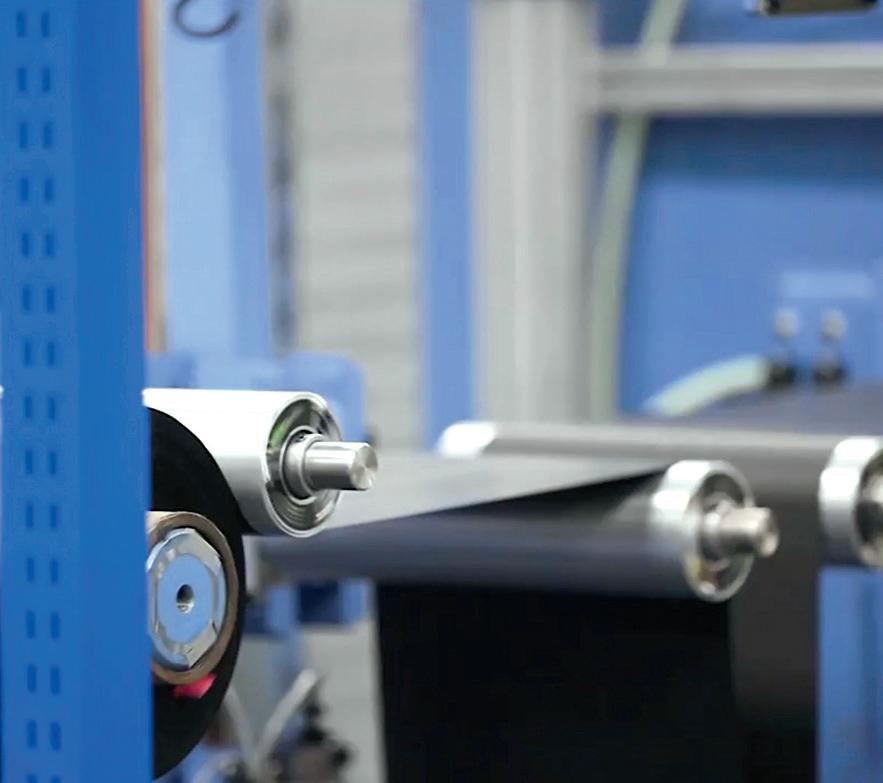
LiCAP Technologies says its dry electrode process can cut manufacturing costs by up to 50%.

Webasto and Maccor team up on EV battery test systems
Infineon to supply 2,000 V SiC modules for Electreon’s wireless road charging
Harbinger launches new business line for off-grid power systems
ANDRITZ Schuler commissions 1.5 GW battery cell formation line
Samsung SDI and KGM to develop 46-series cylindrical EV battery packs

Aperam launches “slinky” production method for motor stators and rotors
BASF tests Ultramid polyamide for EV under-hood coolant exposure
Sensata launches STEV high-voltage contactors
Allegro’s new ACS37200 current sensor for low-loss EV power electronics
onsemi launches advanced cooling package for power MOSFETs
CATL to deploy sodium-ion EV batteries at commercial scale in 2026
Accuenergy debuts AcuDC 260 Series, DC power meters for EV charging
Hyundai and Kia invest in VisIC for power semiconductors

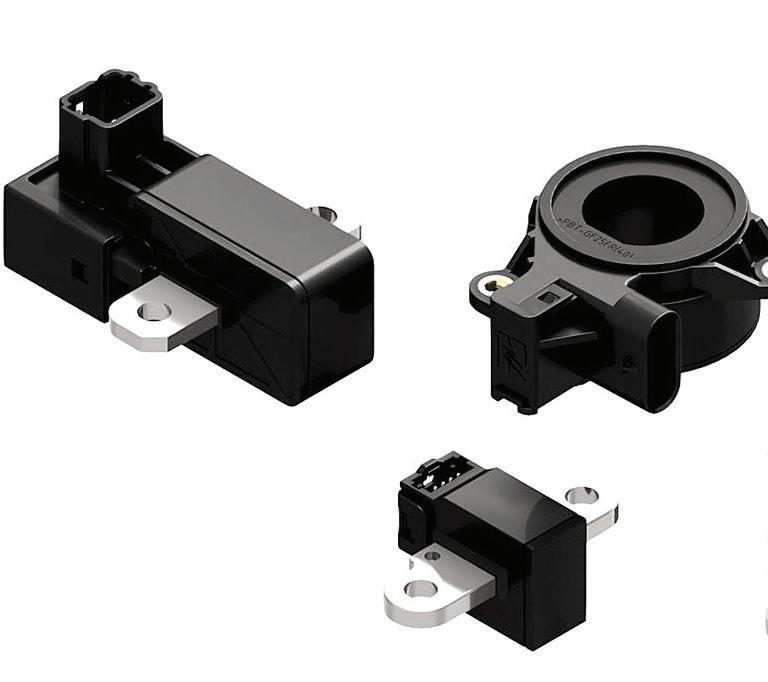
Littelfuse launches new current sensors for EV systems
REE Automotive and Cascadia Motion to develop next-gen EV drive units
The most common EV some Americans will see over the next few years may be the one that delivers their mail.


California’s $200-million EV incentive would require matching automaker funds
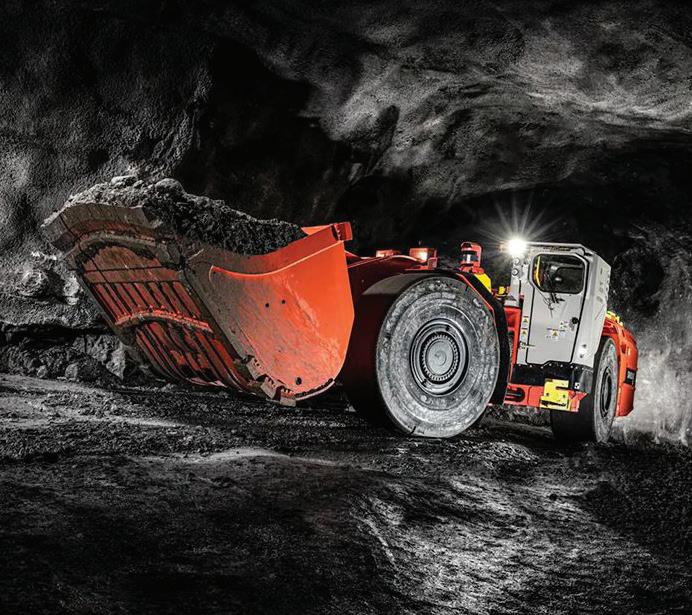
Eldorado Gold orders 10 Sandvik electric vehicles for Québec mining complex
Mercedes-Benz eActros trucks drive 2,400 km in endurance test of MCS
GreenPower Motor chooses New Mexico foreign-trade zone for new EV facility
Harbinger raises $160 million in funding, sells 53 trucks to FedEx
Develon launches new range of electric excavators
Daimler’s electric truck brand RIZON expands US dealership network
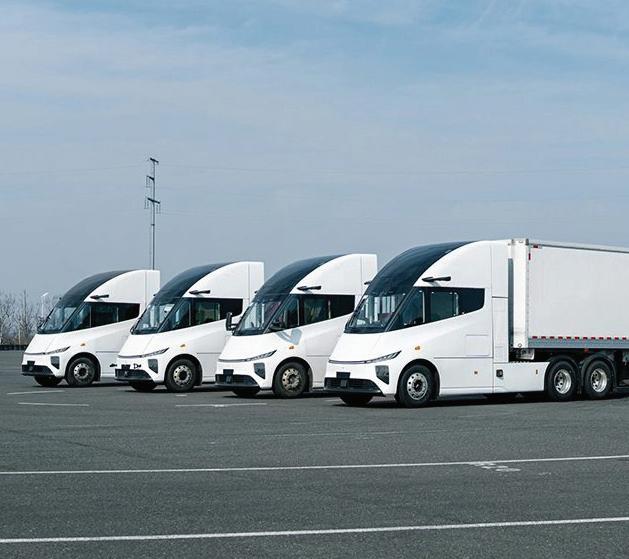
Windrose electric Class 8 truck achieves homologation in US, EU and China
Thomas Built Buses launches its first electric Type D school bus
Kenworth expands zero-emission lineup with new medium-duty electric trucks
Archer to acquire Los Angeles airport, repurposing it as an electric air taxi hub
Taiga’s 2026 Nomad electric snowmobile introduces upgrades
Whale Logistics buys 1,000 battery-swapping electric tractors from U Power
Motiv Electric Trucks now available to public sector fleets
Karlsruhe waste disposal agency deploys 18 Mercedes-Benz eEconic trucks
DHL to electrify 66% of its vehicle fleet by 2030





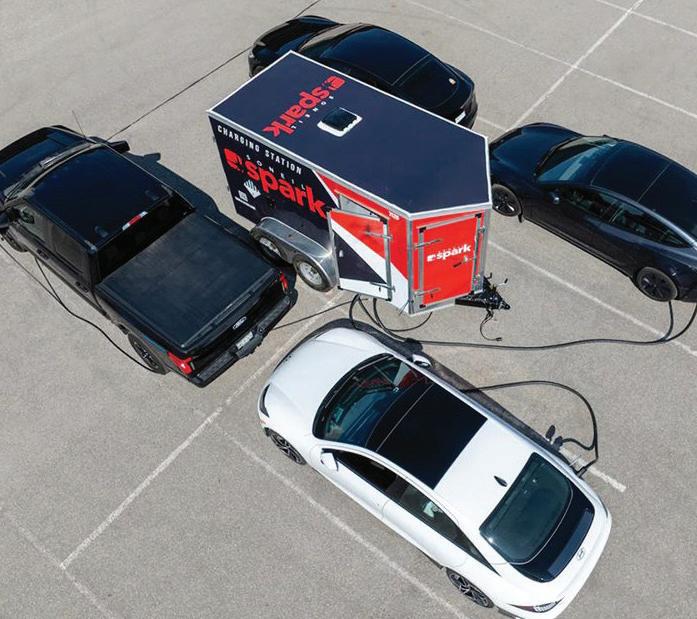

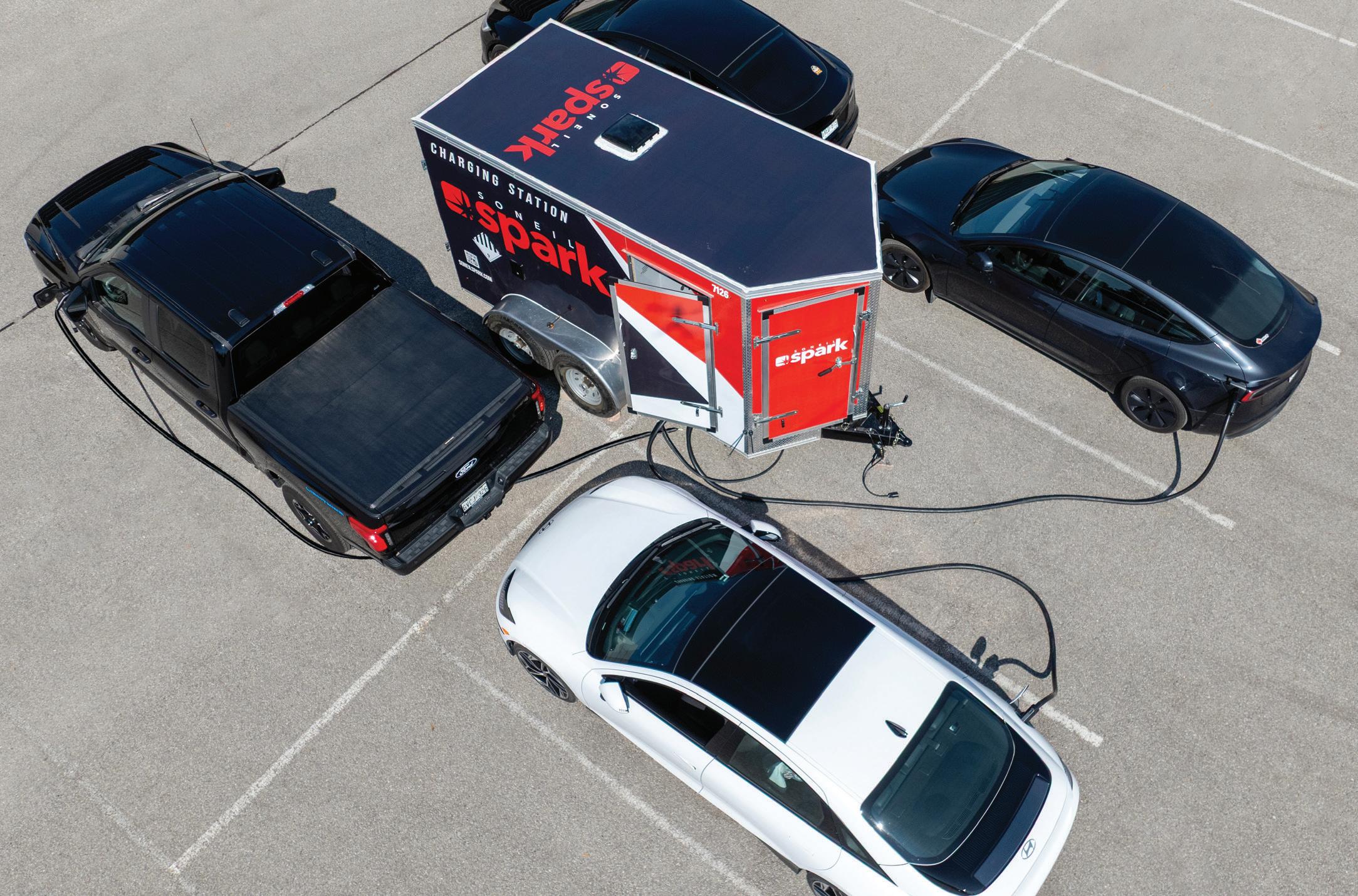
Soneil Spark’s mobile EV charging solution features microgrid capability
GM adds support for Electrify America EV charging network to its branded apps
Managed charging can double the number of EVs the electrical grid can support
EV charging provider L-Charge raises $10 million in new funding round
EVgo to install thousands of EV fast charging stalls at Kroger stores
Kempower and GET Charged to open five DC fast charging stations in NYC
WEX adds public EV charging payments to its fleet fuel card
The Mobility House unveils vehicle-to-grid integration platform for utilities

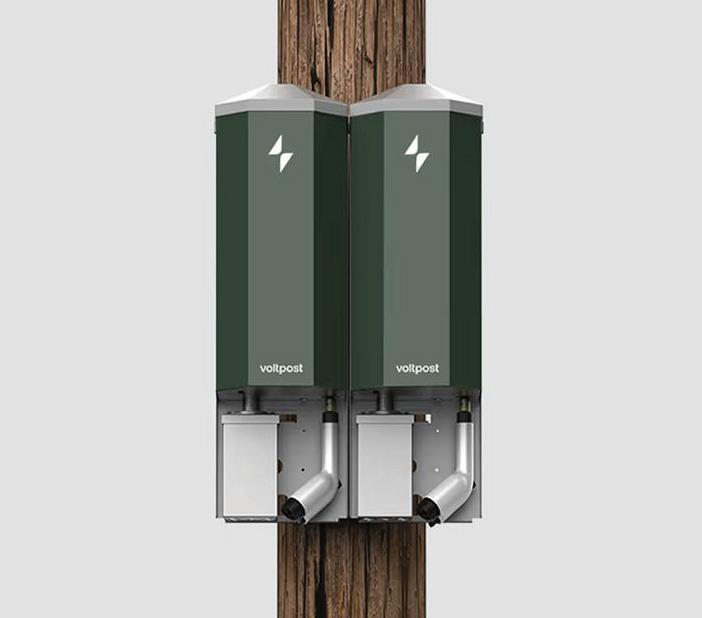
Voltpost partners with EVSE to deploy lamppost EV chargers in the US
UAE gas station chain opens 60-stall EV fast charging highway hub
XCharge and Energy Plus to build an 88-space EV charging depot in Brooklyn
ElectricFish targets gas stations for its Turbo Charge EV charging platform
DeterTech and Formula Space partner

Publisher Senior Editor
Technology
Editor
Business Development
Events Director Graphic Designers
Christian Ruoff
Charles Morris
Jeffrey Jenkins
Joel Franke
Mark Rogers
Jeremy Ewald
Chloe Theobald
Tomislav Vrdoljak
Jeffrey Jenkins
Charles Morris
Christian Ruoff
Nicole Willing
John Voelcker
Oshkosh Corporation
Kelly Ruoff
Sebastien Bourgeois
For Letters to the Editor, Article Submissions, & Advertising Inquiries Contact: Info@ChargedEVs.com
1. PUBLICATION TITLE: CHARGED ELECTRIC VEHICLES MAGAZINE. 2. PUBLICATION NUMBER: 18170. 3. FILING DATE: SEPTEMBER 30, 2025. 4. ISSUE FREQUENCY: QUARTERLY. 5. NUMBER OF ISSUES PUBLISHED ANNUALLY: 4. 6. ANNUAL SUBSCRIPTION PRICE (IF ANY). 7. COMPLETE MAILING ADDRESS OF KNOWN OFFICE OF PUBLICATION: CHARGED ELECTRIC VEHICLES MAGAZINE, 136 4TH STREET NORTH, STE 201, SAINT PETERSBURG, FL 33701. CONTACT PERSON: CHRISTIAN RUOFF. TELEPHONE: (727) 522-0039. 8. COMPLETE MAILING ADDRESS OF HEADQUARTERS OR GENERAL BUSINESS OFFICE OF PUBLISHER: CHARGED ELECTRIC VEHICLES MAGAZINE, 136 4TH STREET NORTH, STE 201, SAINT PETERSBURG, FL 33701. 9. FULL NAMES AND COMPLETE MAILING ADDRESSES OF PUBLISHER, EDITOR, AND MANAGING EDITOR: PUBLISHER, EDITOR, AND MANAGING EDITOR: CHRISTIAN RUOFF, 136 4TH STREET NORTH, STE 201, SAINT PETERSBURG, FL 33701. 10. OWNER. FULL NAME: CHRISTIAN RUOFF. COMPLETE MAILING ADDRESS: 136 4TH STREET NORTH, STE 201, SAINT PETERSBURG, FL 33701. 11. KNOWN BONDHOLDERS, MORTGAGEES, AND OTHER SECURITY HOLDERS OWNING OR HOLDING 1 PERCENT OR MORE OF TOTAL AMOUNT OF BONDS, MORTGAGES, OR OTHER SECURITIES: NONE. 13. PUBLICATION TITLE: CHARGED ELECTRIC VEHICLES MAGAZINE. 14. ISSUE DATE FOR CIRCULATION DATA BELOW: JUL-SEP 2025 (ISSUE 73). 15. EXTENT AND NATURE OF CIRCULATION. A. TOTAL NUMBER OF COPIES (NET PRESS RUN). AVERAGE NO. COPIES EACH ISSUE DURING PRECEDING 12 MONTHS: 11050; NO. COPIES OF SINGLE ISSUE PUBLISHED NEAREST TO FILING DATE: 10500. B. LEGITIMATE PAID AND/OR REQUESTED DISTRIBUTION (BY MAIL AND OUTSIDE THE MAIL): (1) OUTSIDE COUNTY PAID/REQUESTED MAIL SUBSCRIPTIONS STATED ON PS FORM 3541: 9344; 9190. (2) IN-COUNTY PAID/REQUESTED MAIL SUBSCRIPTIONS STATED ON PS FORM 3541: 0; 0. (3) SALES THROUGH DEALERS AND CARRIERS, STREET VENDORS, COUNTER SALES, AND OTHER PAID OR REQUESTED DISTRIBUTION OUTSIDE USPS: 0; 0. (4) REQUESTED COPIES DISTRIBUTED BY OTHER MAIL CLASSES THROUGH THE USPS: 0; 0. C. TOTAL PAID AND/OR REQUESTED CIRCULATION (SUM OF 15B (1), (2), (3), AND (4)): 9344; 9190. D. NON-REQUESTED DISTRIBUTION (BY MAIL AND OUTSIDE THE MAIL): (1) OUTSIDE COUNTY NONREQUESTED COPIES STATED ON PS FORM 3541: 0; 0. (2) IN-COUNTY NONREQUESTED COPIES STATED ON PS FORM 3541: 0; 0. (3) NONREQUESTED COPIES DISTRIBUTED THROUGH THE USPS BY OTHER CLASSES OF MAIL: 29; 15. (4) NONREQUESTED COPIES DISTRIBUTED OUTSIDE THE MAIL: 921; 947. E. TOTAL NONREQUESTED DISTRIBUTION [SUM OF 15D (1), (2), (3) AND (4)]: 950; 962. F. TOTAL DISTRIBUTION (SUM OF 15C AND E): 10294; 10152. G. COPIES NOT DISTRIBUTED: 756; 348. H. TOTAL (SUM OF 15F AND G): 11050; 10500. I. PERCENT PAID AND/OR REQUESTED CIRCULATION (15C DIVIDED BY 15F TIMES 100): .9077; .9052. I CERTIFY THAT 50% OF ALL MY DISTRIBUTED COPIES (ELECTRONIC AND PRINT) ARE LEGITIMATE REQUESTS OR PAID COPIES. 17. PUBLICATION OF STATEMENT OF OWNERSHIP FOR A REQUESTER PUBLICATION IS REQUIRED AND WILL BE PRINTED IN THE ISSUE OF THIS PUBLICATION: ISSUE 74, OCTOBER-DECEMBER 2025. 18. I CERTIFY THAT ALL INFORMATION FURNISHED ON THIS FORM IS TRUE AND COMPLETE. CHRISTIAN RUOFF, PUBLISHER, SEPTEMBER 30, 2025.






People love to read about the imminent demise of EVs—or at least they love to click on headlines announcing the sad news. e slightest setback for EV adoption triggers a new surge of schadenfreude. e US administration’s recent cancellation of EV tax credits and emissions standards sent editors scrambling to compose eloquent obituaries.

Looking below the surface clickstream, we nd a di erent story. At BloombergNEF’s recent Summit, Colin McKerracher shared a resilient global EV outlook that aligns with our view: the sector is far from faltering. Worldwide sales hit nearly 22 million in 2025, and are projected to reach 24 million in 2026. Sales of ICE vehicles peaked in 2017 and are now down 25%. China leads with over 50% market share, while emerging markets in Latin America and Southeast Asia match US rates, driven by cost savings and the need to reduce oil imports. ough the US faces a 15% contraction amid lost IRA credits and weakened standards, diversi cation beyond California and Tesla, plus gains in hybrid sales, o er hope. Wild cards like solid-state batteries, ultra-fast charging (3-5 minutes in mass-market EVs) and range-extended models for pickups/SUVs add to the picture of a “messy middle” of contested growth, not decline.
We’re not saying everything’s rosy—in the US, the Big ree are reeling from an electric shock. Ford killed its F-150 Lightning, doubled down on gas-guzzling trucks, and revived its failed “choice of powertrains” strategy. GM shut down its BrightDrop commercial EV division. Stellantis killed its plug-in hybrid Jeeps (a good move—PHEVs are zombie tech, propped up too long by subsidies). ese cancellations were costly: Detroit’s anti-EV appeasement is expected to cost US automakers over $50 billion. Canada’s slashing of tari s on Chinese EVs, triggered by poor US treatment of its neighbor, may cost the industry and country even more in the long term.
2025 also saw commercial carnage, as several promising OEMs went under (commercial EV startups o en have fruit- y lifespans). Bright spots include Orange EV, quietly selling electric terminal trucks for a decade, and Harbinger Motors—CEO John Harris says IRA subsidy cuts a ected sales not at all (see our in-depth interview online).
More good news: A er a decade of resistance, the USPS is deploying thousands of EVs. John Voelcker drove one of these duck-billed beauties—read his story on page 44.
Charging providers missed the “EVs are dying” memo: Paren reports December 2025 as a record for EVSE installation—over 2,000 ports were deployed amid Q4 acceleration by major CPOs. Tesla, IONNA, EVgo, Mercedes-Benz and Red E led.
Many projects were long-planned, but new deployments abound: Walmart, Kroger, Wawa and other chains plan hundreds more locations soon. EVgo aims to quadruple its network to 20,000 charge points by 2029. EV charging is now just another commercial service—ABM, a corporate services provider, has installed infrastructure for years and innovates in EVs, charging and microgrids at its new electri cation center (page 70).
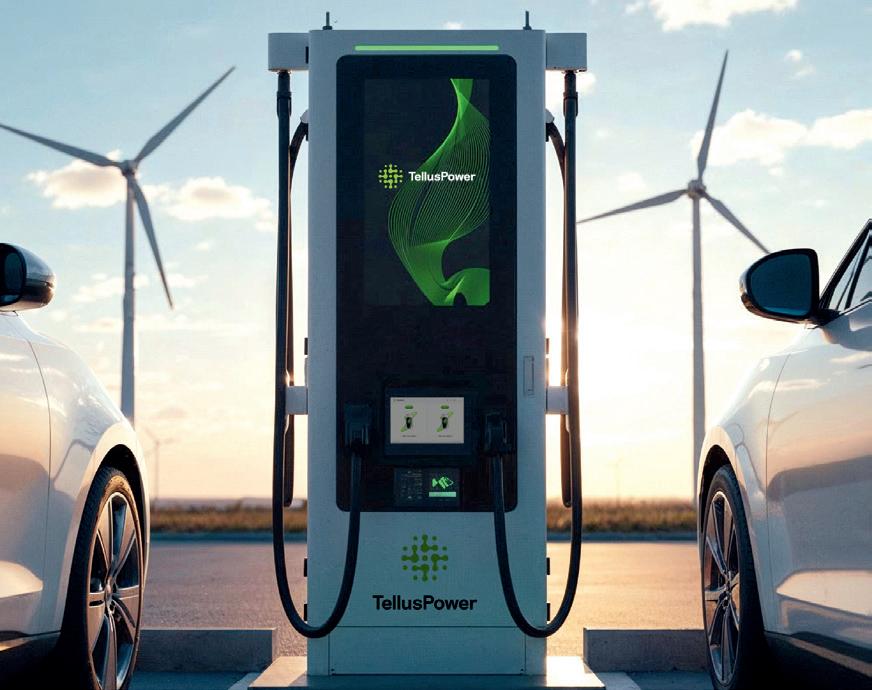
While an EVSE industry shakeout is underway, it’s not due to low demand, but to consolidation as the sector matures. Tellus Power eyes distributed charging but sees strong demand for standalone units (page 62).
Christian Ruoff | Publisher EVs are here. Try to keep up.





At Parker, we’re not just keeping pace with the electrification revolution. We’re leading it. Our diverse portfolio of cutting-edge technologies combines innovation with efficiency to drive the future of electric vehicles.
Our highly engineered solutions, including thermal management materials, adhesives and coatings, enhance safety, reliability and performance across EV applications.
Join us at the Electric & Hybrid Vehicle Technology Expo in Stuttgart, Germany!


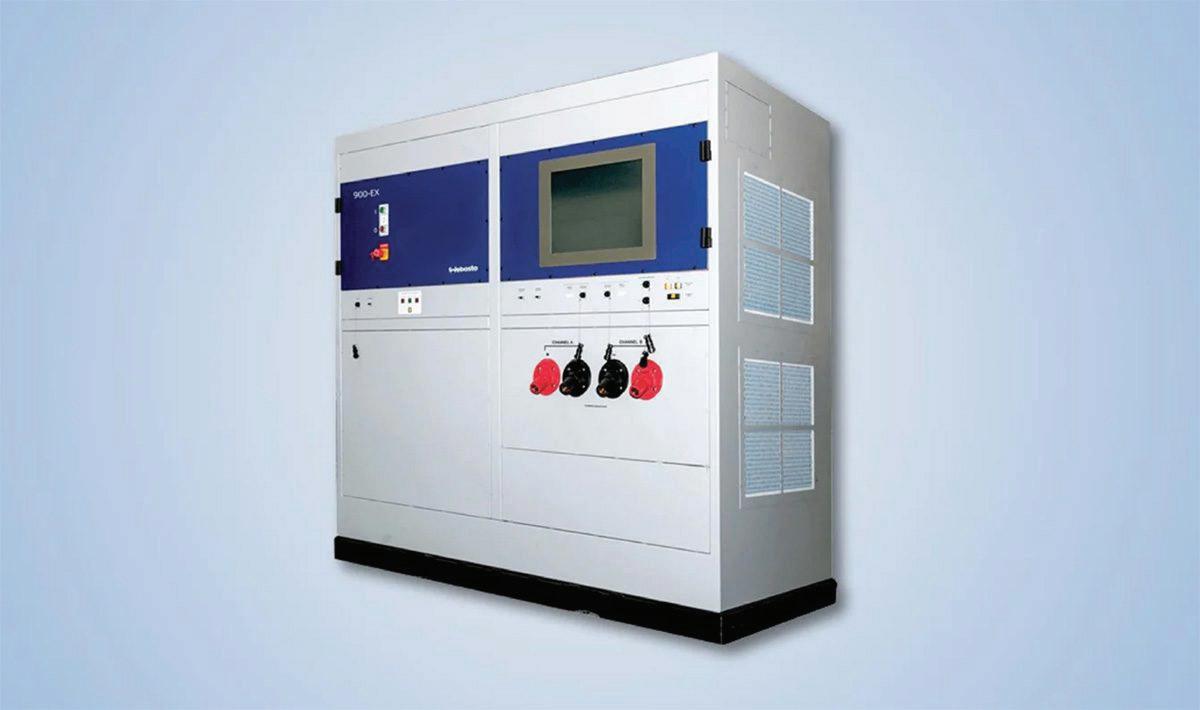
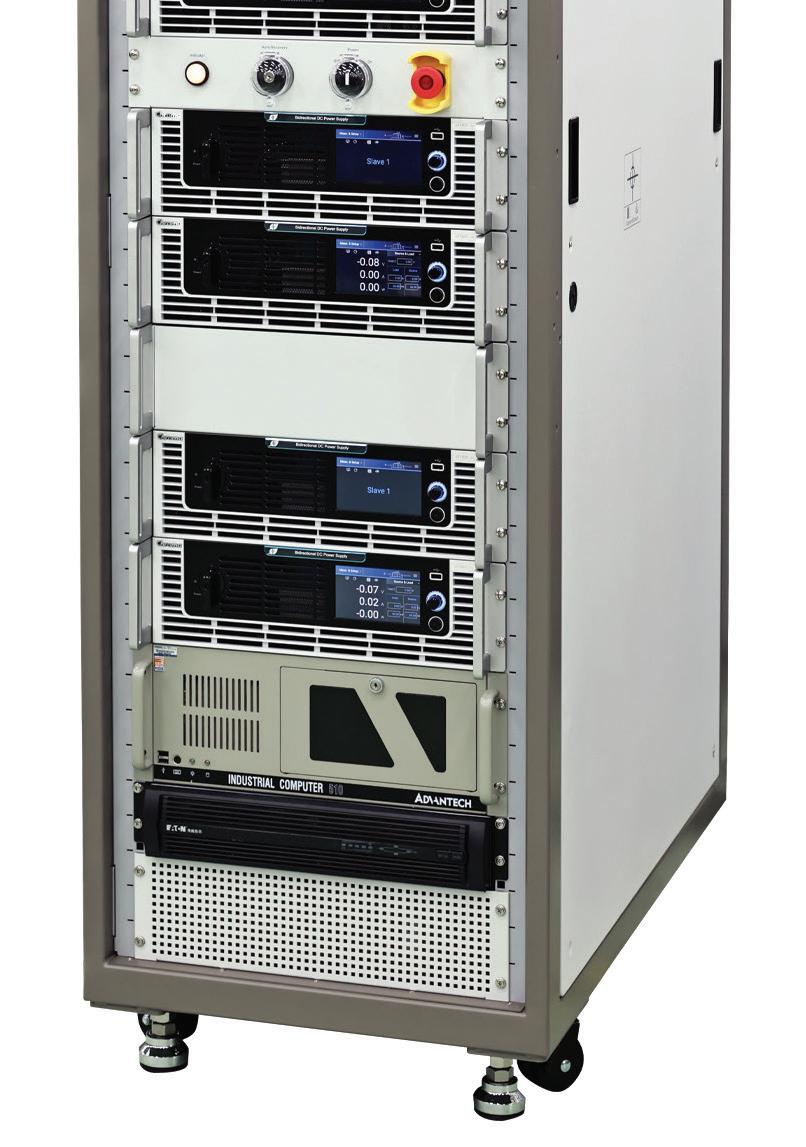
Webasto Power Test Systems has partnered with Maccor to provide integrated electric vehicle testing systems for original equipment manufacturers, battery labs and universities. e companies say the combined o ering spans cell and module cycling through high-voltage pack and drivetrain emulation, aiming to cover a broader set of validation needs as electri cation testing requirements increase.
e collaboration connects customers with Maccor for precision cell, module and pack testing, and with Webasto for high-power bidirectional systems. Webasto says the systems are designed, manufactured and serviced in the US, which supports supply stability, shorter lead times and responsive technical support.
Testing requirements are becoming more demanding, and manufacturers and research teams need solutions that can scale with evolving technologies, meet rigorous safety standards and support realistic performance validation, Webasto says.
Target applications include automotive and commercial vehicles, along with o -highway platforms. e companies also cite aerospace and energy storage applications for the combined test capabilities, which include precision cell cycling and high-voltage pack and drivetrain emulation.
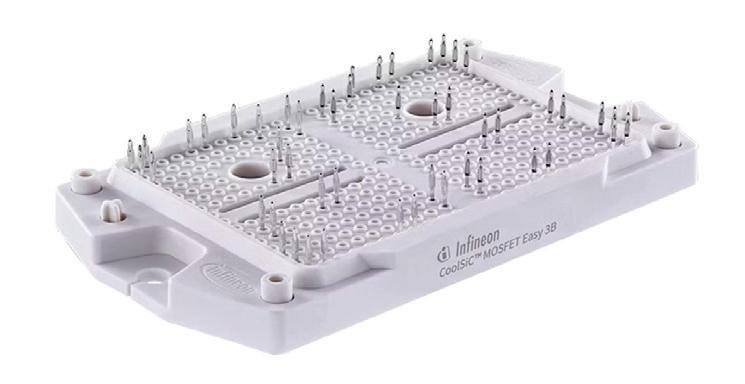
Infineon to supply 2,000 V SiC modules for Electreon’s dynamic wireless EV charging system
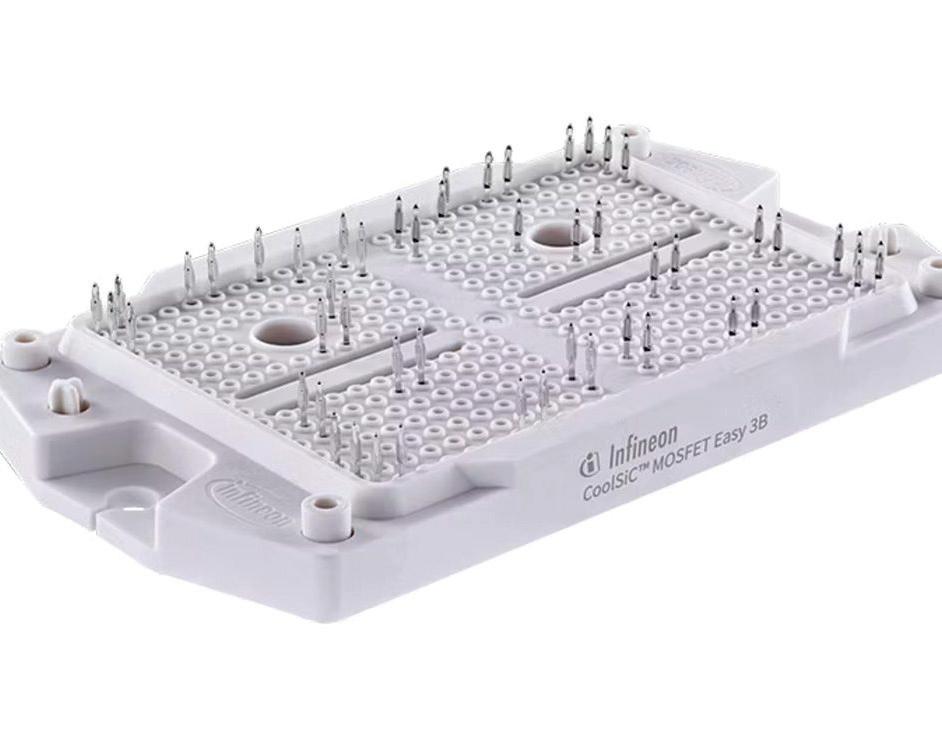
In neon Technologies will supply custom silicon carbide (SiC) power modules to Electreon for use in its dynamic in-road wireless charging system for EVs. e system enables buses, trucks and other EVs to charge wirelessly while in motion using inductive charging via copper coils embedded in roadways.
e system interfaces directly with the power grid and activates when vehicles are positioned above the coils, providing real-time energy transfer and continuous battery charging. In neon’s EasyPACK 3B CoolSiC 2,000 V SiC modules are specially developed for Electreon’s requirements, featuring average power transfer of 200 kW and peaks exceeding 300 kW. is performance was recently con rmed during operation on France’s A10 highway, which Electreon claims is the rst highway able to wirelessly charge moving heavy- and medium-duty trucks, buses, vans and passenger cars.
e in-road wireless charging system could allow vehicles to operate with smaller batteries by recharging on the move, potentially lowering upfront costs and vehicle weights while increasing cargo capacity. Electreon has deployed In neon’s SiC modules across test tracks in the US, Germany, France, Norway, Portugal, Sweden, Italy, Israel and Japan, and plans to integrate them into additional long-distance projects.
“We’re proud to contribute to this groundbreaking innovation with our customized SiC power modules, which e ciently convert electrical energy to charge vehicles on the go, tailored to meet Electreon’s speci c needs,” said Dominik Bilo, Executive Vice President and Chief Sales O cer Industrial & Infrastructure at In neon Technologies.




















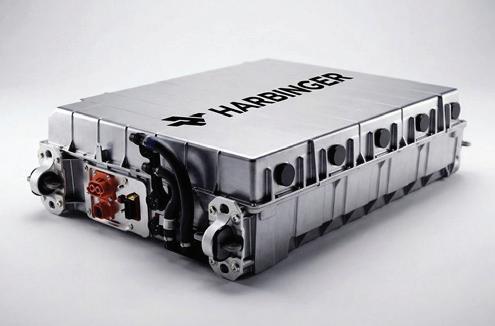
Commercial EV manufacturer Harbinger Motors is branching out into a new line of business. e new Harbinger Industrial division will o er Harbinger battery technology as standalone products for energy storage and auxiliary power.
Airstream, the iconic manufacturer of handcra ed, riveted aluminum travel trailers, is the rst customer to integrate Harbinger’s energy storage technology. Airstream recently unveiled its new Trade Wind 27FB travel trailer, which features the Harbinger Power System to support o -grid camping, air conditioning and integration with solar power.
Other EV startups have been dropping like fruit ies, but Harbinger’s sales grew steadily throughout 2025, and the end of the IRA tax credits didn’t even amount to a speed bump. In a recent in-depth interview, co-founder and CEO John Harris told Charged that the company’s secret sauce includes a deep bench of tech talent, vertical integration, and a narrow focus on vehicle classes in which the company can o er price parity with legacy ICE trucks.
Harbinger designs and manufactures its proprietary high-voltage battery system at its factory in California. e company says its vertically integrated approach enhances performance, durability and cost e ciency. Harbinger’s batteries feature lithium-ion cells from Panasonic Energy, and are built to automotive-grade standards. e Trade Wind 27FB next-generation energy system includes Airstream’s largest travel-trailer battery option (up to 18.5 kWh), a fully integrated 600 W roo op solar array, 50-amp service with dual heat-pump air conditioners, and a powerful 5,000 W inverter that supports a fully inverted electrical system.
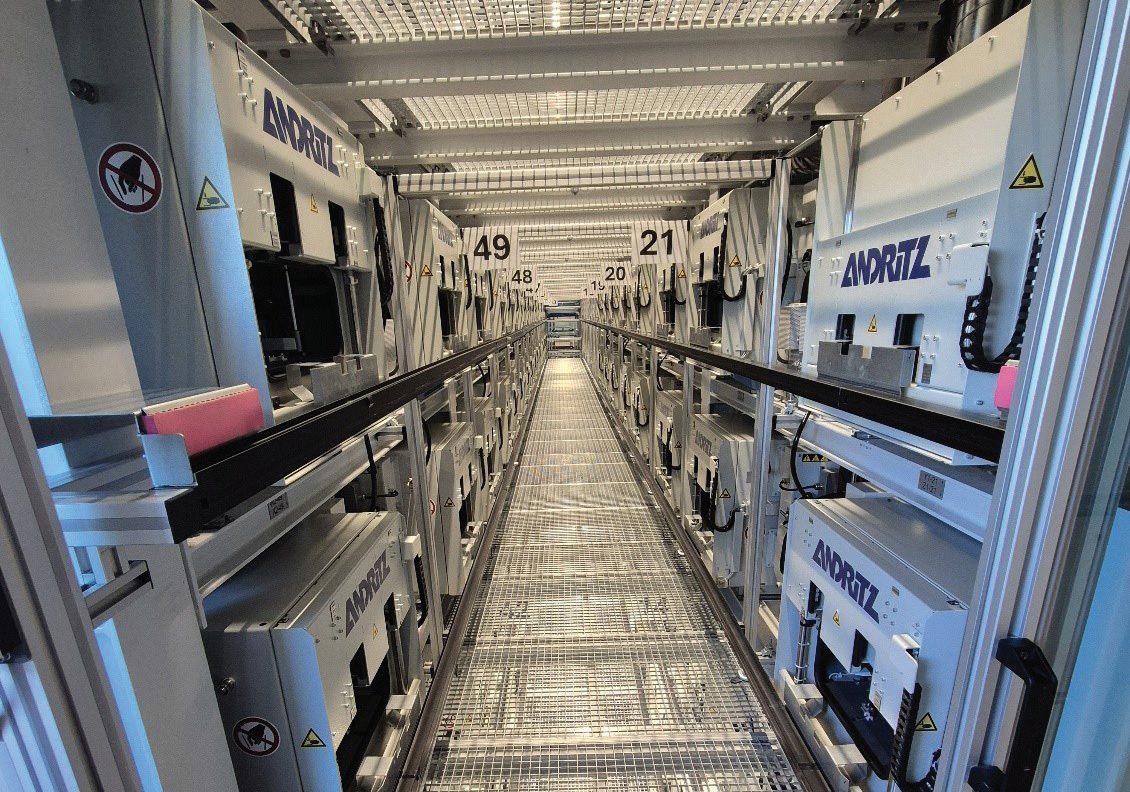
ANDRITZ Schuler’s 1.5-gigawatt battery cell mass formation line for cylindrical booster cells has gone into operation for “a renowned German premium car manufacturer.”
Formation is the nal step in battery cell manufacturing. A er electrode production and cell assembly, the formation process activates cell chemistry through controlled charging and discharging, during which the electrolyte reacts with the anode to create a stable solid electrolyte interphase (SEI) layer that protects the electrodes and enables e cient ion transport. is step is crucial for activating the battery, calibrating its capacity, and ensuring long-term performance, safety and cycle life by minimizing irreversible capacity loss.
e line is powered by technology from ANDRITZ Sovema, which was acquired by ANDRITZ Schuler. e formation line includes more than 50,000 channels, 200 formation chambers, integrated power electronics and a full Track & Trace system. It is described as fully automated, with automated loading and unloading.
e line is 22 meters long and 10 meters wide and high, and is designed for high energy e ciency with an “intelligent service and maintenance concept.” ANDRITZ Schuler says the system collects more than two million data points from the batteries per second.

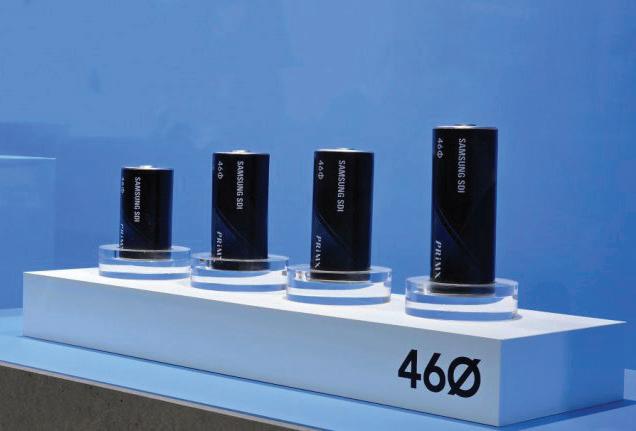
Samsung SDI has signed a memorandum of understanding (MOU) with South Korean automaker KG Mobility (KGM) to jointly develop battery pack technologies for EVs.
e companies will focus on battery pack technologies using Samsung SDI’s 46-series cylindrical battery cells, while expanding their collaboration on technologies to advance next-generation battery pack development.
e packs that the two companies develop through the partnership are expected to be used in KGM’s EVs in the future. e partners also plan to exchange insights into mid-to-long-term global battery market strategies and pursue joint R&D e orts.
Samsung SDI’s 46-series cylindrical battery, which it started producing in 2025, features high-capacity nickel cobalt aluminum (NCA) cathodes and Samsung’s silicon carbon nanocomposite (SCN) anodes, which are designed to reduce swelling while extending battery lifespan. A tabless design reduces internal resistance and optimizes current ow, enhancing high-power output and fast charging performance.
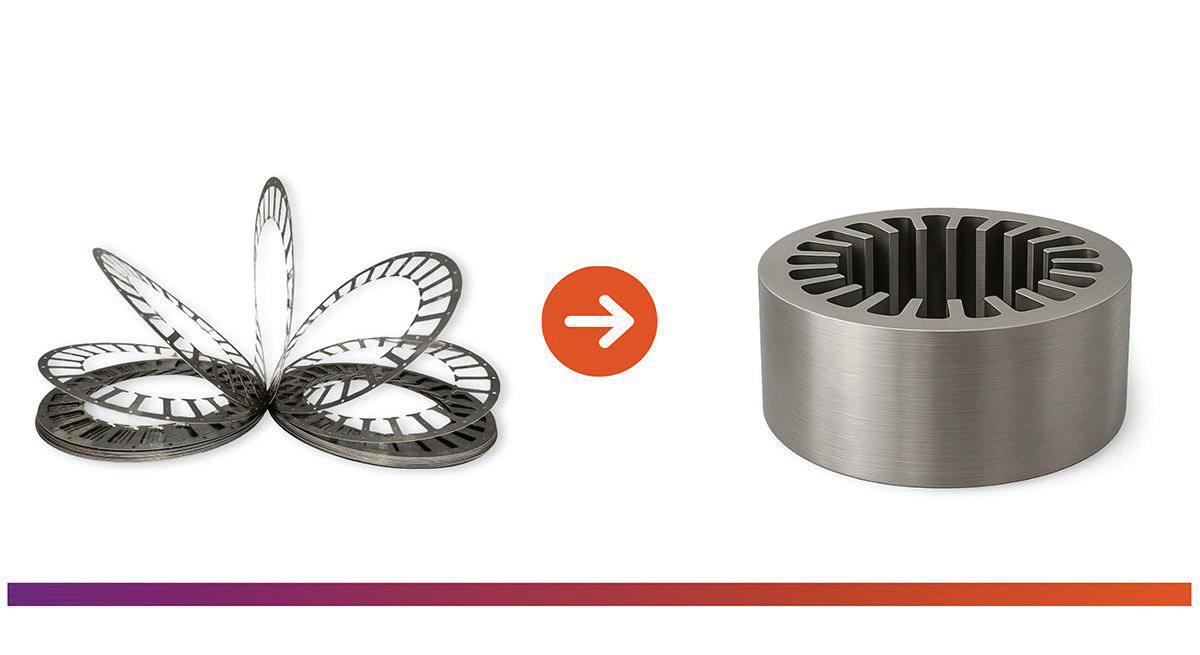
Aperam has announced a new “slinky” production method for making iron-cobalt (FeCo) alloy stators and rotors for high-performance electric motors. e company says the approach adapts an in-plane helical winding process—already used for electrical steel—to FeCo alloys, which it describes as di cult to form despite “exceptional magnetic perforance.”
Aperam’s slinky method forms motor components from continuous strips instead of stamping them from sheet metal. It uses a combination of linear stamping and in-plane helical bending to create slinky stators and rotors. e company says the process reduces metal scrap to 10-30%, versus conventional methods that can waste up to 70% of the high-cost material.
Aperam says that combining FeCo alloys with the slinky process yields 35% more power density for eVTOL aircra , 25% more torque for hypercars and 15% smaller motor size, which it calls essential for aviation weight constraints.
e approach is built around Aperam’s AFK family of FeCo alloys, including IMPHY AFK1, AFK18 and AFK502R.
“FeCo alloys o er unparalleled magnetic performance, but their cost has historically limited their e cient use,” said Frederic Mattei, CEO Alloys and Specialties and CIO at Aperam. “With ‘slinky,’ we drastically reduce waste and also enable the design of more e cient electric motors, helping our customers meet the growing demands of sustainable transportation.”


BASF has reported new durability test results for a glass ber-reinforced, low-halogen Ultramid polyamide grade aimed at eMobility under-hood components exposed to coolant.
e company says that EV operating pro les and frequent battery charging processes increase the required service life of plastics in vehicles under the hood to 45,000 to 55,000 hours at operating temperature, compared with 5,000 hours for legacy combustion engines.
BASF says it has adapted established ageing validation approaches from air-heat testing to hydrolysis storage, de ned as ageing in water-glycol mixtures. To predict


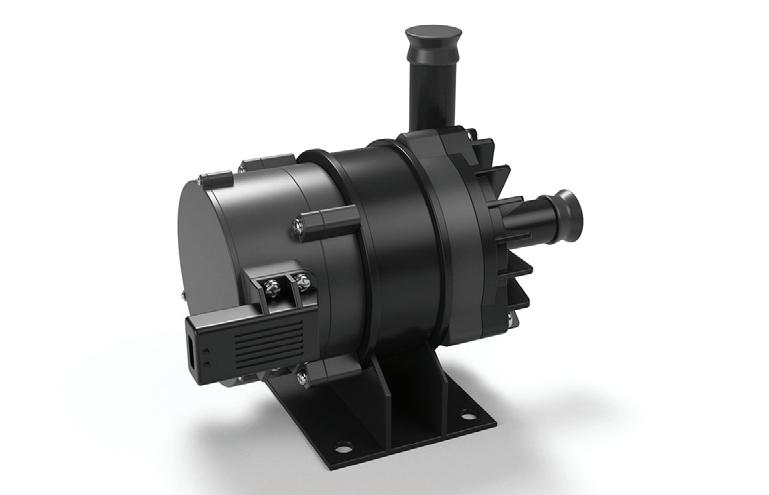
service life under normal conditions, BASF is using analyses based on the Arrhenius equation, which it describes as relating temperature to reaction rate.
BASF’s test program started in August 2020, and evaluated a polyamide from its latest generation of materials. BASF says the Ultramid material is characterized by optimized hydrolysis resistance, laser markability, glass ber reinforcement and low halogen content.
Based on ve years of testing, BASF reports that the tested polyamide’s properties can be extrapolated to more than 100,000 hours.


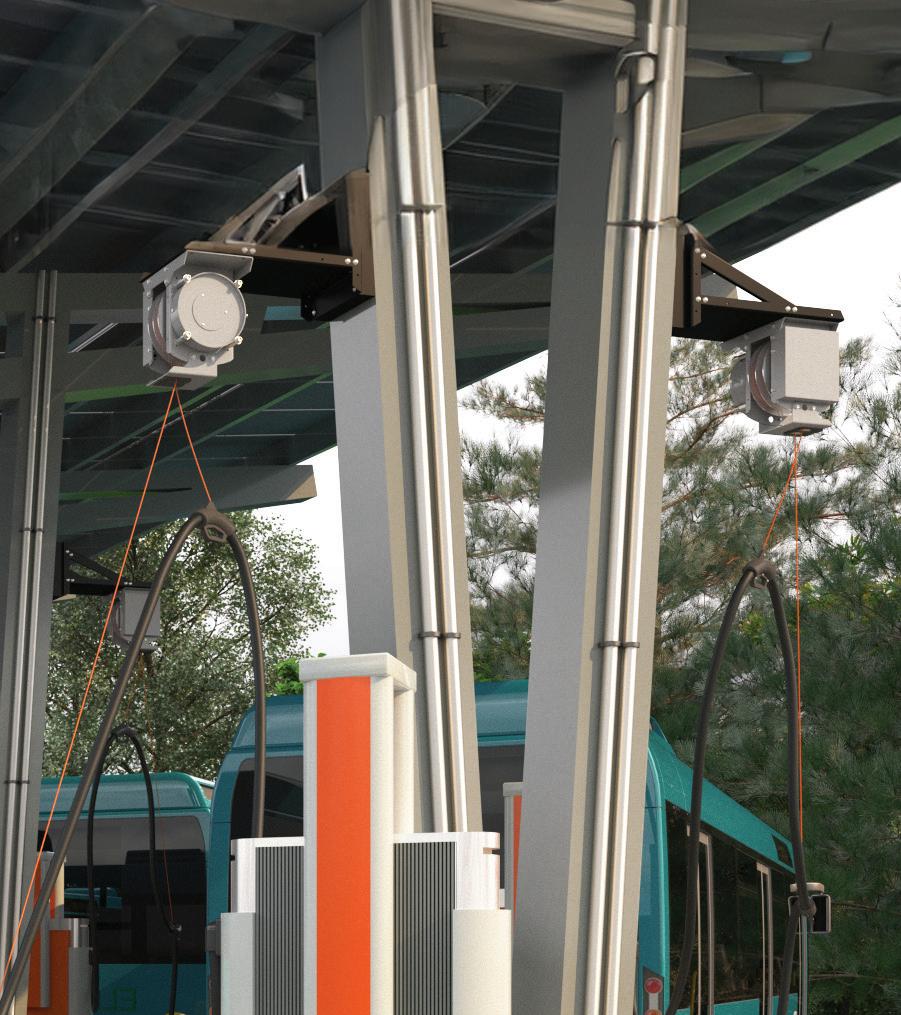

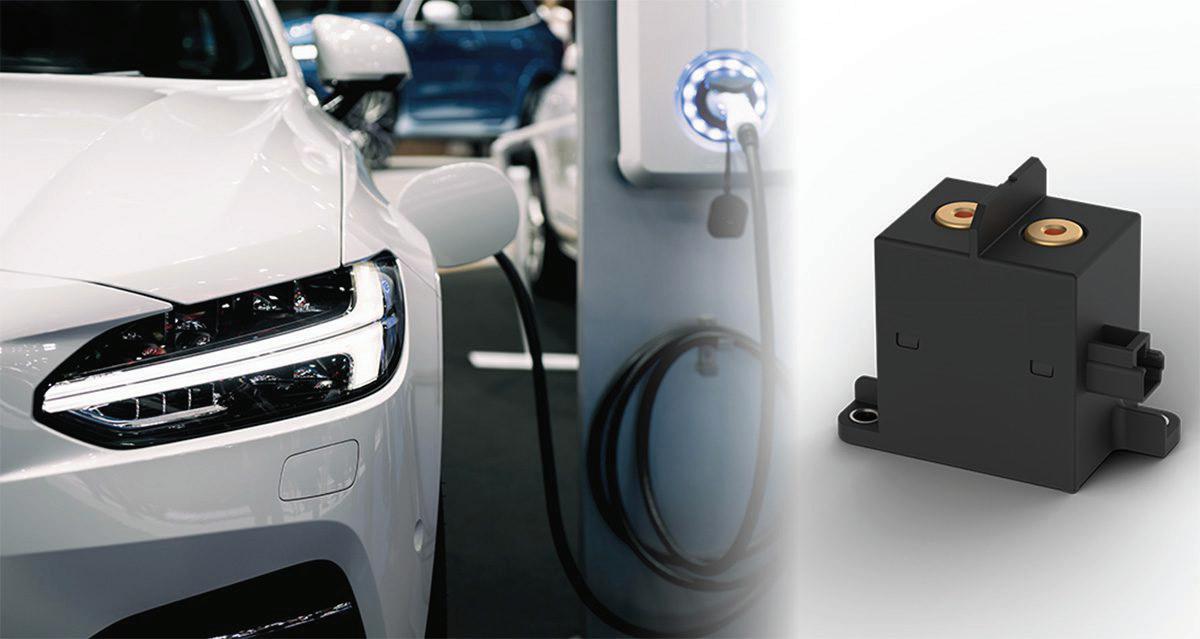
Sensata Technologies has announced its new STEV series high-e ciency switches with robust protection for modern electri ed vehicle platforms.
e contactors are high-voltage switches that open and close an electrical circuit thousands of times over a vehicle’s life. In EVs, contactors control power ow among the battery, inverter and charger, making them part of the vehicle’s protective architecture and linked to safety, e ciency and reliability.
e STEV series scales from plug-in hybrids to Class 8 heavy-duty trucks. is scalability can help OEMs standardize switching technology across multiple vehicle lines to simplify integration and reduce development time, according to the company.
Sensata says STEV contactors are customizable and engineered to meet automotive safety and quality requirements. e contactors support continuous current carry ratings from 150 A to 600 A and high short-circuit withstand capability greater than 20 kA, enabled by hermetic sealing and modular designs.
e contactors have low contact resistance and minimized heat generation, along with: single- or dual-assembly options; bidirectional current capability on select models via non-polarity main contacts; hermetic ceramic sealing for arc containment and environmental protection (with IP67 ingress protection available on speci c variants); and electrical isolation specs including coil-tocontact dielectric strength up to 3.0 kV and insulation resistance of 1,000 MΩ at 1,000 VDC.

Allegro MicroSystems has introduced the ACS37200, a galvanically isolated current sensor designed to increase e ciency and power density in high-current EV applications. Allegro says the ACS37200 addresses a key challenge facing EV and industrial power engineers: the heat and energy loss caused by traditional shunt resistors in high-current designs.
e ACS37200 features a conductor resistance of 50 microohms, which reduces power loss by 90 percent when compared to a conventional 0.5 milliohm shunt resistor in a 100-amp system. For example, a traditional shunt could waste up to 5 watts as heat, while the ACS37200 would limit this loss to 0.5 watts. is reduces the need for bulky heatsinks, enabling more compact and energy-e cient power electronics in EVs and related applications.
e sensor is packaged in a 100-square-millimeter PSOF footprint, which Allegro says is 70 percent smaller than its previous-generation ACS772 CB package and occupies 95 percent less board space than discrete shuntbased solutions. e small size and reduced thermal output allow designers to optimize system layouts for higher power density and reliability.
For EV traction inverters, battery management and other high-voltage power systems, the ACS37200 integrates certi ed galvanic isolation at 1,000 volts RMS (1,414 volts DC) within a single surface-mount package. It meets the UL 62368-1 safety standard and comes factory-calibrated, e ectively replacing shunt resistors, isolation ampli ers and associated passive components. is integration simpli es bills of materials, streamlines supply chains and reduces the complexity of high-voltage isolation design.
onsemi has released its EliteSiC metal-oxide semiconductor eld-e ect transistors (MOSFETs) in the industry-standard T2PAK top-cool package, targeting improved thermal performance and design exibility for EVs, solar infrastructure and energy storage systems. e new o ering combines onsemi’s silicon carbide technology with top-cool packaging.
e initial lineup features 650-volt and 950-volt EliteSiC MOSFETs housed in T2PAK packaging. ese devices prioritize thermal e ciency by channeling heat directly into the system’s heatsink, bypassing the printed circuit board’s thermal limitations. According to onsemi, this enables superior thermal performance, higher power density, compact system design, and reduced operating temperatures—all critical factors for engineers designing

next-generation EV powertrains, on-board chargers and high-density inverters.
e T2PAK top-cool package is designed to directly couple the MOSFET to the application’s heatsink, minimizing junction-to-heatsink thermal resistance. e initial range supports Rds(on) options from 12 milliohms to 60 milliohms, o ering exibility for power electronics design. e approach also helps maintain low stray inductance, supporting fast switching speeds and reduced energy loss.

Chinese battery powerhouse Contemporary Amperex Technology (CATL) announced at a recent supplier conference that it plans to deploy its sodium-ion battery technology at commercial scale across multiple sectors in 2026. e company described expanded applications in battery swap systems, passenger and commercial EVs, and energy storage.
In April 2025, CATL announced the launch of its sodium-ion battery brand, Naxtra, and said that large-scale production of sodium-ion cells had begun. ese products are o ered in both passenger-vehicle power-battery formats and a 24 V battery solution for heavy trucks.
In September 2025, CATL said its next-generation sodium-ion battery achieves speci c energy of up to 175 Wh/kg, and can deliver a driving range of 500 km in passenger-vehicle applications. Advantages of the sodium-ion batteries compared with traditional lithium-ion chemistries include improved safety and improved low-temperature performance. CATL’s sodium-ion cells are designed to operate across a temperature range from -40° C to 70° C.
e company’s sodium-ion battery products have passed China’s latest national battery standard, GB 38031-2025, for EV traction batteries. e national standard, scheduled to take e ect in mid-2026, sets stringent safety requirements for thermal stability, mechanical impact resistance and cycling performance.
CATL plans to follow a “dual-star” policy of developing its sodium-ion and lithium-ion battery technologies in parallel. Analysts cited by Car News China described the global sodium-ion battery industry as shi ing from early commercialization toward scaled deployment, with current market use concentrated in energy storage and low-range vehicles, and predicted substantial growth in the sodium-ion market through 2030 as the technology nds its way into more passenger and commercial vehicles. In 2025, average sodium-ion cell prices remained signi cantly lower than those of lithium-ion equivalents.
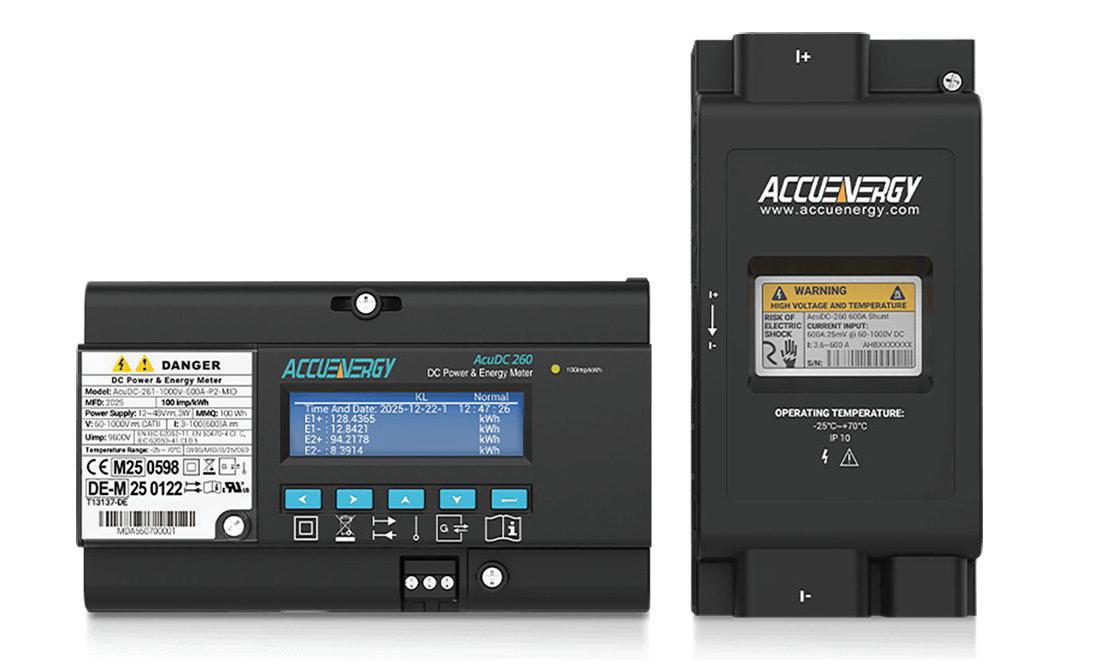
Accuenergy has launched the AcuDC 260 Series, a new generation of revenue-grade DC power meters designed for EV fast charging, battery energy storage systems and high-voltage DC infrastructure.
e series includes two models: the AcuDC-261, which is certi ed for the European market under the Measuring Instruments Directive and Physikalisch-Technische Bundesanstalt requirements, and the AcuDC-262, which is certi ed to UL standards for North America and international markets. e series includes tamper-evident metrology, digitally signed transaction records in the Open Charge Metering Format, and cable-loss compensation to ensure precise billing.
e company says these tools enable OEMs and charge point operators to meet strict metering regulations and support timely product deployment. For regions where MID compliance is not mandated, the AcuDC-262 is designed for global deployment, incorporating UL certication and the core metering capabilities of its European counterpart.
Both models measure direct DC voltage up to 1,000 volts with 0.1 percent accuracy and support dual DC current channels with 0.2 percent current accuracy. Additional technical features include support for shunt or hall e ect sensors, bidirectional energy monitoring, cable loss compensation and integrated data logging for auditing and diagnostics. Data communications are enabled via Modbus RTU and Modbus TCP/IP for integration with energy management systems, SCADA, DCIM and cloud platforms.
VisIC Technologies, which is developing gallium nitride (GaN) power semiconductors for EVs, has announced the second closing of its Series B funding, securing $26 million. e round was led by an unnamed global semiconductor company and included participation from automakers Hyundai and Kia.
e lead investor’s focus on advancing critical semiconductor technologies complements VisIC’s D³GaN platform, which is designed to deliver e ciency, scalability and reliability for automotive drivetrains. HKMC’s participation re ects the company’s focus on integrating GaN technology into EV platforms.
VisIC’s GaN-based technology is designed to address the limitations of silicon technologies in delivering the e ciency and power density required for next-generation EV platforms, especially at higher voltages, by enabling smaller, lighter and more e cient inverters for 400 V and 800 V architectures.
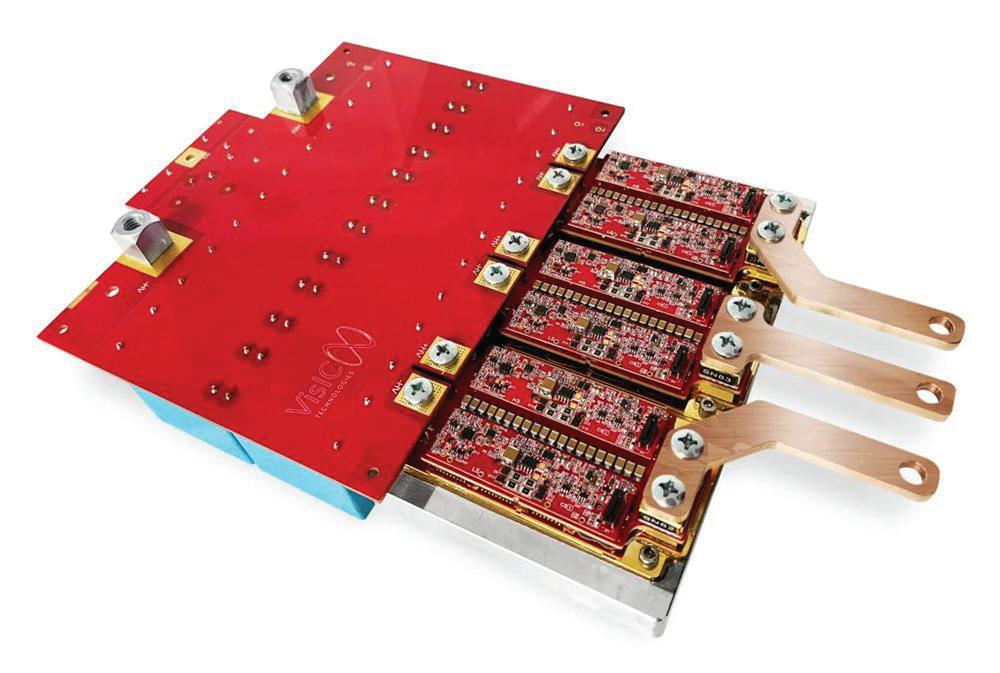
e company will use the new nancing for the optimization, quali cation and release of Gen3 750 V GaN dice and power modules. It will also develop Gen4 1,350 V GaN technology and expand into power requirements for 800 V data centers leveraging the same platform.
“Hyundai Motor Company and Kia are committed to advancing sustainable mobility. Partnering with VisIC enables us to integrate cutting-edge GaN power technologies into our EV platforms, enhancing e ciency, reliability and performance as we shape the future of electric transportation,” the automakers stated.







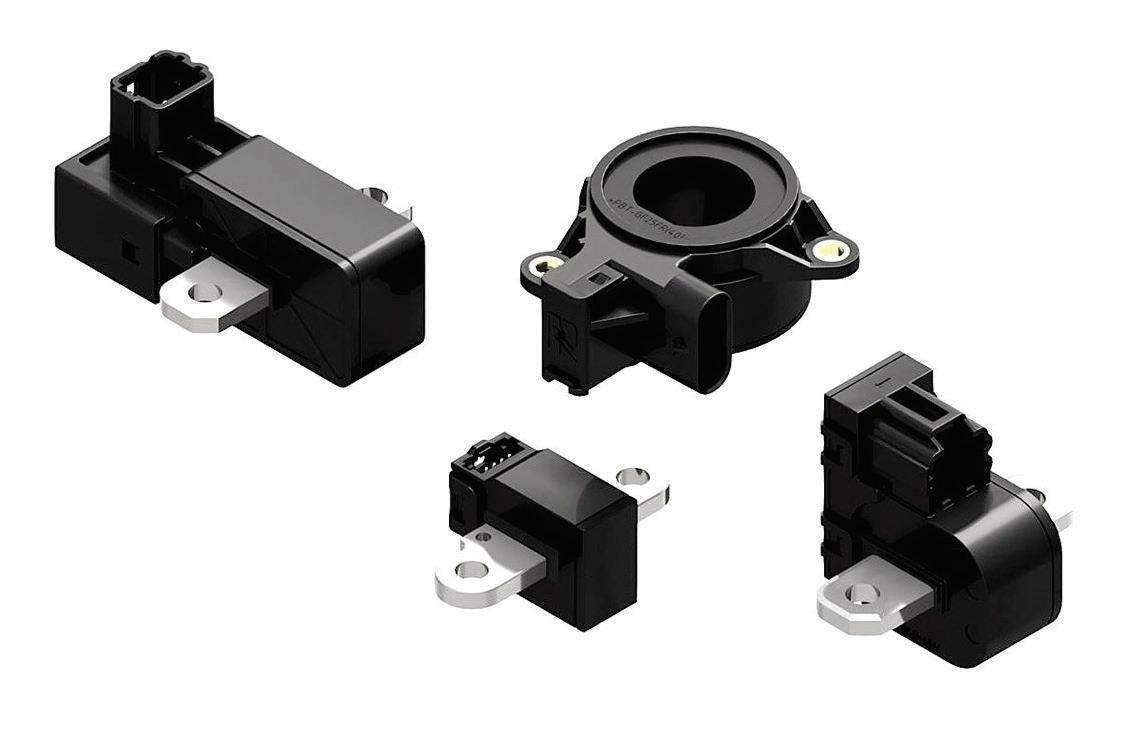
Littelfuse has announced a new family of six automotive current sensors, designed to deliver precise, isolated current measurement in electric and hybrid vehicles. e sensors, available as both analog-voltage and digital output devices, provide system exibility for battery management, motor control and pyro-fuse safety applications in next-generation EV platforms, according to Littelfuse.
Utilizing open-loop Hall-e ect technology, the sensors support busbar mounting in a compact form factor. Littelfuse speci es nominal current ranges up to ±1,500 A, with minimized total error and low thermal dri . Certain models feature Controller Area Network (CAN 2.0B) communication and include AUTOSAR E2E Pro le 1A diagnostics, as well as automotive safety integrity level C (ASIL-C)-capable current measurement for integration into safety-critical systems.
e new range includes battery and motor-control current sensors measuring up to ±1,500 A for BMS/DClink/HV junction-box and inverter applications. It also adds a pyro-fuse trigger module that activates directly in microseconds—three times faster than conventional approaches, according to the company. Littelfuse says the busbar- or PCB-mount design, along with standard automotive connectors and support for CAN or Local Interconnect Network (LIN) communications, allows drop-in replacement or adaptation in both new and legacy architectures.
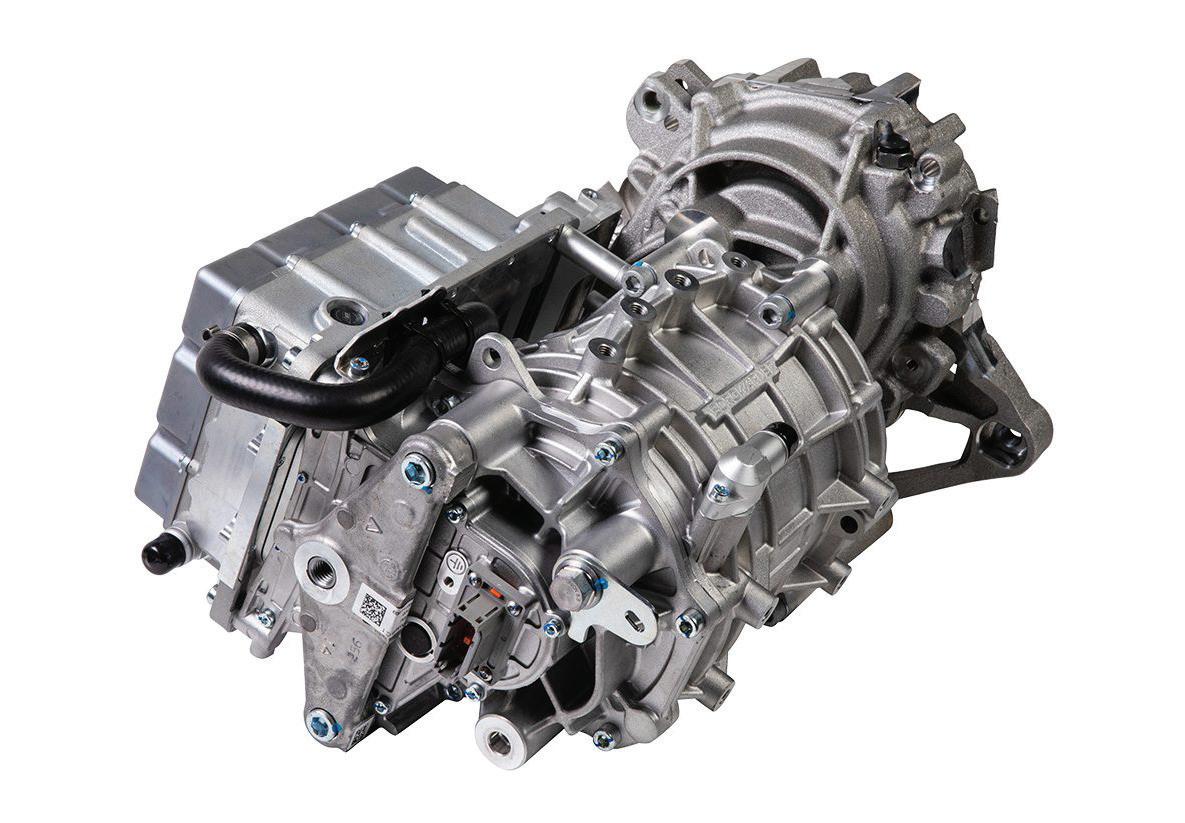
REE Automotive and Cascadia Motion, a subsidiary of BorgWarner, have partnered on the development, manufacturing and commercialization of a new-generation electric drive unit (EDU) designed for EV OEMs.
e compact EDU will integrate REEcorner technology with Cascadia Motion’s iM-125 inverter-motor module. e EDU supports permanent magnet motors operating at 400 volts, with speci ed peak torque of 3,000 Newton-meters at gearbox output for 30 seconds, peak power of 100 kilowatts, maximum speed of 835 revolutions per minute, continuous torque of 2,150 Newton-meters and continuous power of 57 kilowatts. e unit employs a 19.17 gear ratio and features water-glycol cooling (eight liters per minute at 65° C). It weighs 54 kilograms.
e product is expected to address the increasing demand for cross-platform, compact EDUs that enable higher functional safety, with support for ASIL-D certications. e design is intended to simplify integration and reduce development times for OEMs by supporting secure, stable over-the-air updates and pairing with REE’s vehicle control units.
“Integrating Cascadia Motion’s iM-125 drive unit with REEcorner technology bolsters our portfolio of o -theshelf electric drive solutions, providing our customers with even more exibility in their electri cation programs,” said Joseph McHenry, General Manager of BorgWarner Portland and the Cascadia Motion brand. “ is collaboration re ects our commitment to delivering innovative, ready-to-integrate drive units that help OEMs reduce development time and streamline vehicle launch.”
By Je rey Jenkins
Measurement of radiated emissions with EMC probe
Measurement of radiated emissions with EMC probe
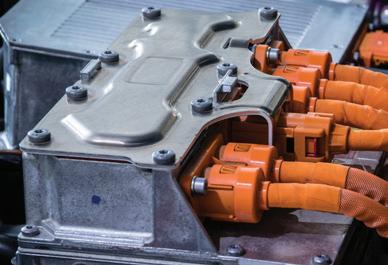
Pretty much every product, device or subsystem involved in power conversion, both onand off-board an EV, will have to comply with both safety and ElectroMagnetic Compatibility (EMC) regulations.
And while most power electronics engineers nd the safety regulations to be relatively straightforward, I’d wager that few feel the same about the EMC ones. EMC compliance is not entirely a dark art, however—a good understanding of the basic physics involved will allow one to sidestep most EMC issues in the design phase, and for the rest there are plenty of purveyors of noise ltering components that are very e ective (so long as
one is not trying to slap a proverbial bandage on an arterial wound).
Regardless of the speci c set of EMC regulations that might be enforced on a given device or product, compliance with them will generally consist of four components: minimizing the emission of, and maximizing the immunity to, both conducted and radiated noise over a speci ed frequency range (e.g. 150 kHz to 2.5 GHz).
Radiation is the dominant route for EMI into or out of a device at higher frequencies, because wiring length and enclosure openings will be more likely to approach half a wavelength (where wavelength, λ, in meters = 300 / f in MHz), which happens to make for a very e cient antenna. Conversely, the attenuation caused by the various stray series inductances and shunt capacitances in wiring, PCB traces, etc, will decline with frequency, hence the conduction of EMI
Compliance with EMC regulations will generally consist of four components: minimizing the emission of, and maximizing the immunity to, both conducted and radiated noise over a specified frequency range.
prevails at the low end of the range. While there isn’t a hard line of demarcation in frequency between the two mechanisms in reality, most EMC testing standards worry about conduction below 30 MHz and radiation above it.
Since the cost of formal EMC compliance testing typically runs into the kilodollars/hr range, it is well worth the e ort to nd and address noise problems before scheduling time at the testing facility. Fortunately, a surprising amount of troubleshooting can be done at modest cost with a set of near- eld EMC probes and a spectrum analyzer (ideally one with a built-in tracking generator).
Near- eld probes are actually much better suited to pinpointing radiated emissions and immunity problems than the antenna-based setup that will be used in the formal tests, and they can also tell you whether such problems are the result of RF currents or voltages (that is, H- or E- eld, respectively).
H- eld probes can also be used to ferret out immunity problems by driving them with an external RF source (such as a spectrum analyzer’s tracking generator) to subject PCB traces, wiring and even enclosure openings to relatively high eld strength levels with just a few mW of power, versus the several W of power needed if driving an antenna in the far eld (though to be fair, the latter is how the certi ed test lab will do immunity testing, so this is a bit of an apples/oranges situation).
Evaluating conducted emissions and immunity requires a specialized lter to decouple the power supply from the Device Under Test (DUT), typically referred to as a Line Impedance Stabilization Network (LISN), and while you can certainly make such yourself, these
lters are also commercially available at reasonable cost. Conducted emissions are measured with a spectrum analyzer by passing one or more power or signal wires to the DUT through a wideband current transformer that is speci ed for EMC testing. Conducted immunity is tested by injecting RF current into one or more wires to the DUT via an inductive (or, less commonly, capacitive) coupler, otherwise known as Bulk Current Injection (BCI).
Most noise problems are the result of common-mode voltages or currents (that is, of similar amplitude and in phase on all wires), but di erential mode noise can be measured or injected by reversing the direction of either the forward or return wire as it passes through the current transformer or BCI, respectively (in which case the measured/injected value should be reduced by 3 dB). For those interested in (or in desperate need of) more information, I highly recommend a 3-part book series on EMC by Kenneth Wyatt as well as EMC for Product Designers by Tim Williams. Two smaller YouTube channels that are particularly helpful are Hans Rosenberg and Dr. EMC.
Avoiding EMC emissions and immunity problems through judicious design is far better than troubleshooting and then ameliorating them, and a high-level design decision that can really pay o here is to go with a “so -switching” (aka quasi-resonant) or a fully resonant converter topology. While these converters can be trickier to get working, they will usually exhibit much less ringing at the switching transitions, which would otherwise be a major cause of EMC testing failure, and they’re o en more e cient to boot.
Moving on to the board level, making one of the inner layers of a multilayer board a solid ground/re-
Since the cost of formal EMC compliance testing typically runs into the kilodollars/hr range, it is well worth the effort to find and address noise problems before scheduling time at the testing facility.
turn plane is the closest thing there is to the proverbial silver bullet. A solid ground plane in close proximity to signal/power traces cancels out almost all of the H- eld that might otherwise radiate from (or impinge upon) them, both reducing noise emissions and susceptibility to such, with the bonus e ect of lowering trace inductance. A corollary to this rule is to not split or otherwise interrupt this ground plane except for galvanic isolation reasons. is runs counter to the advice from yesteryear that ground planes between noisy power or digital circuits and quiet analog ones should be split, with only a single jumper or trace connecting them, but unless you can be absolutely sure that no
Most noise problems are the result of common mode voltages or currents— that is, of similar amplitude and in phase on all wires.
high-frequency signals/currents will have to traverse that trace, it’s best to just use one big ground plane for everything (again, except for galvanic isolation). Galvanically isolated ground planes can be quieted by
The last resort for reducing EMC problems is metal shielding, as it tends to be rather costly from an assembly labor standpoint, but there are times when it will be difficult to avoid.
providing a return path for high-frequency commonmode currents through one or more Y capacitors (i.e. safety agency-rated for line-to-earth use) that tie back to the main (earthed) ground plane. Another helpful tip is to always use some kind of termination on traces or wires carrying high-speed digital signals—either a series resistor at the sending end or “split termination” at the receiving end (or to enable pin-level termination, as is usually an option with FPGAs and most DSPs). Finally, be very wary of capacitively coupling high dV/ dt from the drain tab of any switch operating at high frequency and voltage to the outside world. Clamping a GaN HEMT that is switching > 300 V at 1 MHz onto the inside of an aluminum enclosure to use the latter as a heat sink may very well turn said enclosure into the E- eld radiator of the year.
At the wiring level, any board-to-board interconnects inside a device with a high-power switchmode converter—which is pretty much every major device related to EVs—should either use di erential signaling or else pair up every singled-ended signal wire with a return wire. Ribbon cable makes either option exceptionally easy, and it is even available with twisted-pair construction, which is yet another way to minimize EMC problems (though di erential signaling is needed to get the most out of twisted-pair). Cable shielding can be very e ective at blocking EMI, but it can also be a major source of such. e two main rules here are that the shield should be treated as if it were part of the enclosure, and not a return path for high-frequency current, and that the shield should be bonded over its full circumference at the enclosure ends, and not through a soldered pigtail. en there is the classic panacea for minimizing wiring EMC problem: the clip-on (or molded-on) common-mode
choke (CMC) made of a lossy ferrite material. While the “it can’t hurt” philosophy more or less applies here, a CMC works best on wires/cables that are operating at a low impedance, particularly if emissions are the main concern (conducted or radiated). Also note that the impedance of a half-wave antenna is lowest at the ends, hence the CMC should be placed there on a cable, rather than somewhere in the middle. Similarly, AC or DC power inputs and DC outputs will almost certainly need a common-mode lter of some type, and note that the AC mains type will also need safety agency certi cation, so this is de nitely a case in which going with an o -the-shelf product makes the most sense.
At the device/enclosure level, the most maddening (and o en unavoidable) cause of EMC problems are slots, holes and poorly bonded seams in the enclosure. In this regard, rectangular openings (including poorly bonded seams) make for better antennas than round holes, but in all cases the usual thumb rule is to keep the longest dimension of any opening in the enclosure below λ / 20, though λ / 50 is ideal, relative to the highest frequency found (or expected) to be an issue. is thumb rule seems eminently reasonable at face value, as that would mean that no opening should exceed 24 cm (~9.5 in) if the highest frequency inside a device is a 25 MHz clock, for one common example. If 2.4 GHz cellular/WiFi signals turn out to be a problem, however, then the maximum permissible opening is now a mere 6.25 mm (~0.25 in)!
e issue of poorly bonded seams (e.g. between enclosure and lid) is especially common with aluminum due to the inevitable oxide layer that is present—whether this oxide layer is formed naturally from atmospheric oxygen, or intentionally from anodizing—but careless painting/powder coating, or simply relying on too few fasteners to assemble the enclosure, can cause the same problems with any metal. One very e ective, albeit pricey, solution is to use a metal mesh gasket (like an O-ring made out of steel wool) between any seams, but if all else fails, then nickel plating aluminum will guarantee good contact even without a ridiculous number of fasteners (or pricey metal gasketing).
e last resort for reducing EMC problems is metal shielding, as it tends to be rather costly from an assembly labor standpoint, but there are times when it


will be di cult to avoid. For example, an LCD display is likely to require an opening in the enclosure that lets out (or in) too much EMI, and if the display can’t be moved to a quieter (or more immune) location, then a metal shield may very well be the only e ective solution. e good news is that even very thin shielding will reliably block high-frequency E- or EM- elds as long as it is highly conductive and solidly bonded to ground (read: with minimal inductance). For H- elds, the shielding mechanism shi s from being dependent more on material permeability at low frequencies to the induction of eddy currents as frequency goes up, but in all cases the amount of attenuation a orded by shielding will be proportional to the thickness of the shield itself. e same guidelines as for traces/ wiring apply here, but some of the biggest H- eld o enders are E-core magnetic components with a discrete gap (especially if the gap extends across the legs). Besides con ning the gap to the center post only, another e ective solution is a “ ux band,” which is a metal shield consisting of a single wrap of copper foil that encloses the coil former and legs. Note that any metal shield (including a ux band) needs to be solidly bonded to the enclosure or PCB ground plane, just as with cable shields, to provide a return path for any induced noise currents—failing to do so will turn the shield into an antenna, which is the exact opposite of what you want!
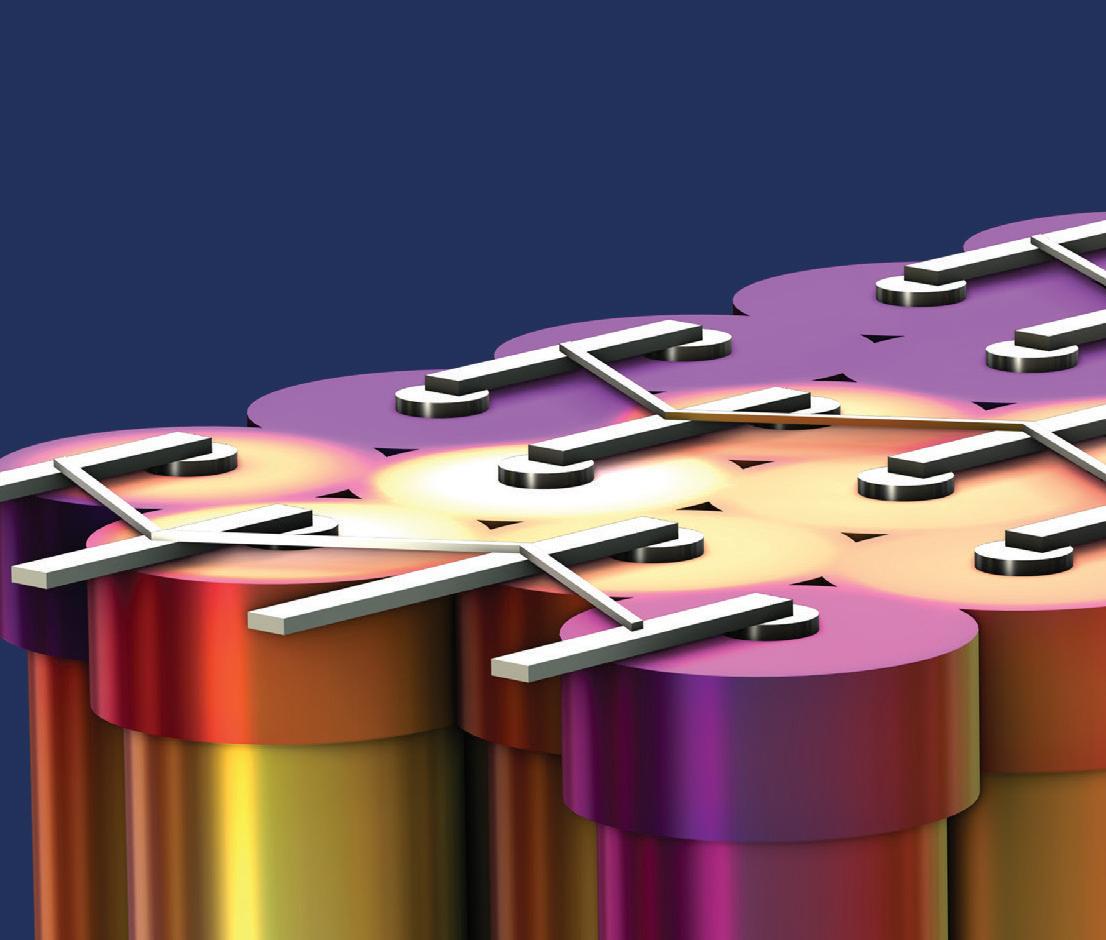


Multiphysics simulation helps in the development of innovative battery technology by providing insight into mechanisms that impact battery operation, safety, and durability. The ability to run virtual experiments based on multiphysics models, from the detailed cell structure to battery pack scale, helps you make accurate predictions of real-world battery performance.
» comsol.com/feature/battery-design-innovation
LiCAP Technologies says its dry electrode process can cut manufacturing costs by up to 50%.
Reducing the cost of batteries is imperative #1 in today’s EV market. Battery costs have plummeted over the past few years, but by some estimates, the battery still accounts for roughly 40% of an EV’s total cost—and the higher upfront cost of EVs is the main impediment to broader adoption.
e most reliable way to reduce the cost of batteries is to reduce the cost of manufacturing batteries, and automakers and battery suppliers are constantly looking for new processes. Of the solutions manufacturers are actively evaluating right now, dry electrode manufacturing has emerged as one of the most promising.
Today, battery electrodes are made using a wet slurry process that requires expensive equipment, lots of energy
By Charles Morris
Q&A WITH PRESIDENT
and the use of environmentally damaging solvents. LiCAP Technologies has developed a dry electrode production process that eliminates solvent and drying ovens from the process. e company claims its process can reduce energy use by about 40% and overall battery manufacturing cost by up to 50%.
In this exclusive interview, Richard Qiu, President of LiCAP Technologies, explained to Charged how dry electrode tech not only lowers costs, but also creates longer-lasting, better-performing electrodes, and could help the US mitigate China’s domination of the EV battery market.
Q Charged: What’s your business model? Are you licensing your dry electrode technology to bat-

tery-makers and/or OEMs, or are you producing electrodes yourself?
A Richard Qiu: A bit of both. We pioneered active dry processing technology years back, and we continue to hone the process. Now we are at a point that we are ready to scale and we have some OEM customers ready to adopt
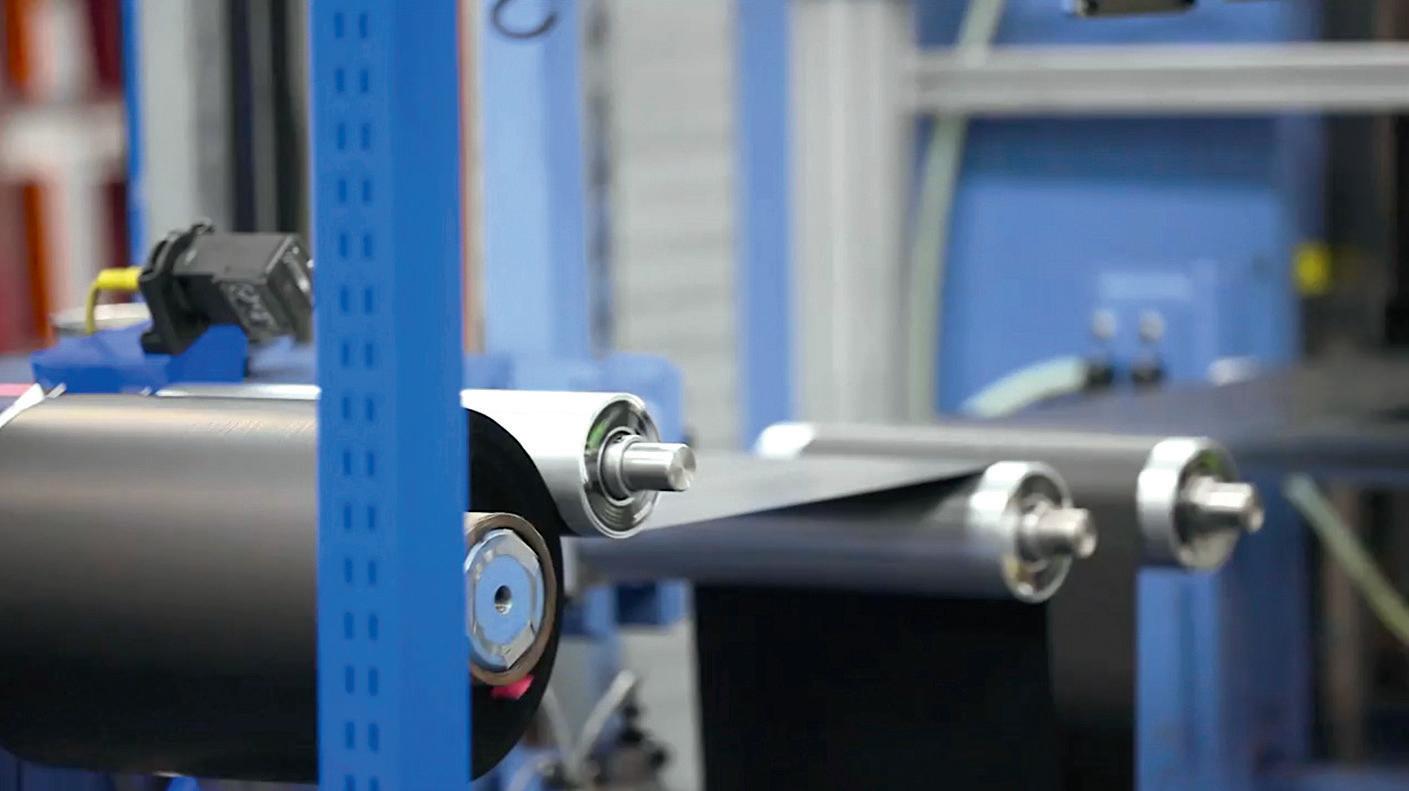
The traditional wet process consists of five steps. We shrink the five steps into three, which substantially reduces the complexity of the process, as well as the size of the facility required to install the equipment.
our technology to do so. Because it takes quite a bit of time and e ort to build a large-scale production line, we’re working with OEMs to license our technology. One of our partners, Dürr, the large equipment manufacturer, has licensed our technology to produce and install the equipment for the OEMs.
Our primary business model is licensing our technology for both the processing technology and the equipment. However, in the meantime, OEMs want to use our product to pilot, to test and to continue innovating. Before getting their large manufacturing lines installed, they want product from us, so we have a small manufacturing capability in Sacramento to produce dry electrodes for those OEMs.
Q Charged: Your process eliminates some steps in the traditional wet slurry process, saving money and complexity. Give us some more details about how that works.
A Richard Qiu: e traditional wet process primarily consists of ve steps. at may not seem like too many, but it’s ve gigantic steps, each with a lot of moving pieces. Obviously, you can improve each step, but the better way to improve the process is actually to eliminate some of those steps. So, we shrink the ve steps into three steps, which substantially reduces the complexity of the process, as well as the size of the facility required to install the equipment. We do a simple three-step process. In the rst one, you mix the materials, you think about formulation, get the right binder and activating materials in there, and prepare for manufacturing. e second step we call the freestanding lm. en the last step is densi cation, calendering. When you do wet processing, you put everything altogether along the way, but when we do our process, we produce freestanding lm. One bene t of doing that
is that you can produce di erent chemistries—that’s why we call our platform chemistry-agnostic. You just have to manage the mixing, make sure the chemistry works well and produce at the speed you want at the thickness you want to produce.
A key element of that is that any waste because of process irregularity or the edge of the lm, you can 100% recycle, meaning that you will save tremendous amounts of raw materials. As we all know, battery raw materials are expensive and they’re hard to nd, particularly here in the US, so 100% recycling is tremendous.
And a er producing the freestanding lm, then you can perform densi cation based on the application, whether it’s EV, energy storage or another application.
Q Charged: Making the transition from the wet to the dry process sounds like it takes some time. Can you give us an idea of how far along in that process you are with some customers, and how long it might be before this process is actually being used on the production line?
A Richard Qiu: Good question. We have two OEM customers that are adopting our technologies. First one is Cellforce, which is part of Porsche in Europe, and they’re working towards bringing a new high-performance car to market. ey have some performance metrics they want to hit, but they are also thinking about cost savings. is is a green eld opportunity—they’re building a gigafactory for that capability. We started working with them last year and we continue to help them ne-tune the di erent pieces. e next project is our partnership with Nissan in Japan. We’re working together to develop new technology for a next-generation all-solid-state EV battery. We’ve been working with them for a couple of years, but we recently expanded our strategic partnership to jointly develop the solid-state battery. ey already built a part of the plant in 2025. Now we are in the process of working with them to re ne the technology, and also building a gigafactory, and we’re targeting production in 2028.
Now the question is, what if you already have a multi-billion-dollar investment in the wet process in place? We start to see people have those conversations about at what point they will convert from wet to dry. is is no di erent than any other technology adoption curve. You will always have better technology coming up, probably cheaper, better, faster. But what are you going to do? You have to switch to new technology.
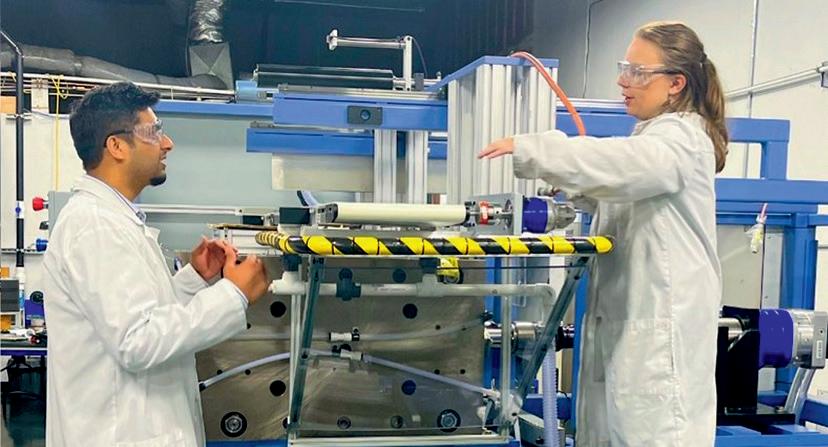
We see a lot of interesting demand for green eld opportunities. When you need to build a new facility, our technology makes it easier for people to do so, because incremental investment for CapEx is typically 50% of what you have to invest for the wet process. And the facility size probably shrinks by 60% and incremental OpEx is reduced by 60-70%.
Some of the process equipment can be dropped in. Some probably needs to be modi ed. Some won’t be needed at all—for example, large solution-drying equipment. And you’re going to use less energy. Sixty percent of the electricity used for electrode manufacturing is used in the drying process. We eliminate that. So, we are in the early stage for conversion projects, but we are in the middle stage in terms of doing new projects.
Q Charged: So, a green eld project versus replacing an existing line, those would have two di erent timelines.
A Richard Qiu: at’s right. I would say the green eld projects will see earlier adoption than the replacement projects.
Q Charged: You say your process is chemistry-agnostic.
A Richard Qiu: Our platform is typically more exible than the wet process, because as you simplify the process, there are fewer things you need to adjust. From our perspective, it’s really two things. One is the chemistry and how you mix the materials. With freestanding lm, you still have to adjust the chemistry, binder and activation, to make sure the lm quality is there and the thickness uniformity is there, because the di erent materials have di erent characteristics—particle size, that sort of thing. But for us, it’s easier to adjust, and also easier to experiment to make sure we achieve the best process parameters so we can achieve the right production throughput.
We have done that for more than half a dozen chemistries, because we’re working with di erent OEMs, di erent customers that have their di erent applications. For example, one of the major enterprises working with us here in US for an energy storage application, they use di erent chemistry and a di erent process, di erent thickness of the electrode.
Q Charged: Tell us more about your work with Nissan to develop solid-state batteries. Is that a separate thing from your production line innovations, or do they complement each other?
A Richard Qiu: It is working together. For all-solid-state batteries, it’s a di erent, new chemistry, and some of the elements are sensitive to the environment, the temperature, that sort of thing, so you have to make them in controlled settings. e solid-state battery has very strong performance metrics and people really love it—fast charging and all this good stu —but it requires a di erent manufacturing process.
Mass-scale production of solid-state batteries is not there yet. We are probably the rst one working with Nissan to bring those barriers down, so we can mass-produce solid-state batteries by 2028. We start by choosing the right chemistry for the desired performance metrics, adding di erent materials, di erent binders, to make sure ionic connectivity is there, because that’s really the most key element for solid-state batteries. en we have to think
about how we can mass-produce them, and achieve the throughput we want to have. So it’s a very large, complex joint development e ort. We have been working with Nissan for almost two and a half years. Now we’re scaling up.
Q Charged: Your process reduces costs, reduces complexity, and improves sustainability because you’re getting rid of the toxic solvents. You also claim to deliver performance improvements—higher energy density and power density. Tell us more about that.
A Richard Qiu: In our process, we don’t use toxic solutions in drying out. Normally, with the wet process, when you dry a solution out, you take things out. For us, because we start out with the mixing technology activation, we can stretch materials, almost like cotton candy. Initially when we thought about this, we thought about shrinking the footprint of manufacturing, reducing complexity, mostly from a cost and speed perspective. But as a result, because there’s no toxic solution drying out and we put the binder activation in that way, all those things actually make the materials stronger. Not to get into material science too deeply, but all those things result in stronger binding, so it creates better density and better ionic connectivity.
Now, we don’t really talk too much about the performance improvement, because today the industry is really focused on cost reduction. But we actually achieve both.
Q Charged: Tell us more about recycling. You’re able to recycle all the scrap from the process. Is that something that other processes aren’t able to do?
A Richard Qiu: If you don’t use freestanding lm, it will be really hard to recycle because as you produce the electrode, you laminate other materials to the electrode material. To recycle, you have to peel those other layers back. People do recycle, but it takes another investment, another set of complex equipment to strip the materials back and recycle. And normally you won’t be able to recycle all of them. But for us, the freestanding lm before densication is almost like the raw material, so you can send 100% back to the feedstock. We don’t say 100% because people make arguments—we normally say 98 or 99%. So that’s one key piece.
e other piece is that when you produce the freestand-
We don’t really talk too much about the performance improvement, because today the industry is really focused on cost reduction. But we actually achieve both.
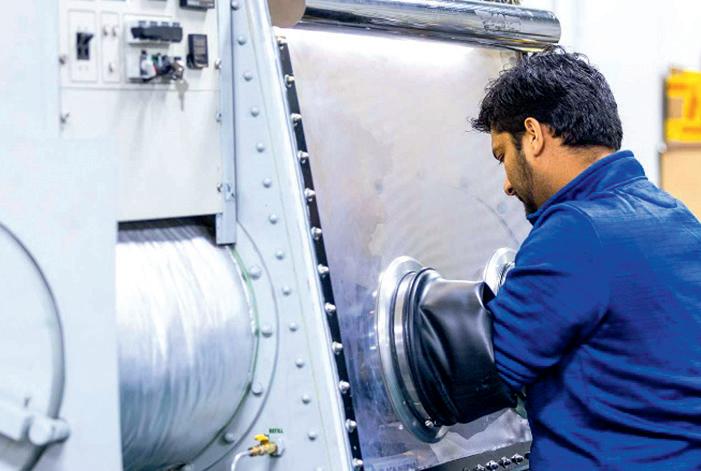
ing lm at high speed, normally the edge is not all straight and you have to cut the edge. at’s part of the manufacturing process—you’re cutting the edge to make sure you have the right width for the application, and the material you’re cutting o goes back to the feedstock.
Q Charged: You have some competitors in this space. AM Batteries makes equipment for the dry coating process, and Tesla has been working on dry coating tech.
A Richard Qiu: In 2019 Tesla bought a company called Maxwell Technologies. e founding team of LiCAP was actually the founding team of Maxwell. Maxwell was making dry electrodes for ultracapacitors, but Tesla bought Maxwell because they were thinking about adapting that technology to produce batteries. I think they are successfully doing that for anode production, a little less for cathode production. Tesla is really, really good at the mechanical side because they’re a car manufacturer, but a little less in terms of how you integrate the chemistry, process and equipment together.
I believe we are ahead of all this competition, in the best
position to capitalize on this opportunity in the market. If you produce lm at high-speed throughput—60 meters or 80 meters per minute—the lm quality needs to be really strong, because of the tension adjustment and other things. And because of that, most people think about the process from the mechanical perspective, but they o en forget that you have to have the right materials, right mix, right lm, right binder, right activation, so the material can be stretched fast enough, but strong enough to produce the freestanding lm.
I think that’s a really key piece for our technology. We have an integrated process—it’s not just thinking about the mechanical part of producing lm, but also the front end, the mixing. A lot of companies talking to us have said we have the best mixing technology, hands down, in the industry.
Can you reproduce a machine? You probably can if you are a really good equipment manufacturer, but you also have to think about the chemistry, the materials, the additive, formula, mixing, all that stu , and that’s a di erent animal. Our team is a combination of material science, chemistry and mechanical equipment guys, and we work together with an integrated approach, a very cross-functional team. Most companies out there, they focus on one, maybe two of these pieces, but we focus on all three together, and that’s unique.




Since the current US administration eliminated federal EV tax credits, several states have implemented their own pro-EV measures, or beefed up existing programs.
In California, the administration of Governor Gavin Newsom has proposed to create a new version of the state’s Clean Vehicle Rebate Program, which ended in 2023 and spent $1.49 billion to subsidize 586,000 vehicle purchases over a decade.
e proposed $200-million incentive program will be limited to rst-time EV buyers, will include price caps adopted by Congress in 2022, and will require automakers to contribute matching funds. e incentive amounts and other key details have not been announced as of this writing.
O cials from the California Air Resources Board recently met with representatives of the Detroit ree automakers to talk about the plans.
CARB would seem to be facing a tough audience. All three automakers recently canceled agship EV programs, causing them to write o a chunk of change in sunk costs (an estimated $19.5 billion at Ford, $6 billion at GM), and arguably sabotaging their long-term competitiveness in the global market. If, as some suspect, their real reason for turning down the voltage was to appease an anti-EV federal administration, then how likely are they to support a new incentive program in California?
One might speculate that relations are a little frosty between California and Detroit at the moment. Automakers have been only too willing to cooperate with the US administration as it undid much of the progress made by the California Air Resources Board towards reducing air pollution over the last few years. (GM estimated that the rollback of federal emissions rules could save it $750 million, temporarily o setting losses on EVs.) Last September, Newsom harshly criticized GM, saying that CEO Mary Barra “sold us out.”
CARB told e Mercury News that it plans to hold a workshop in the spring that will “gather stakeholder input,” and details “will be nalized in the coming months.”
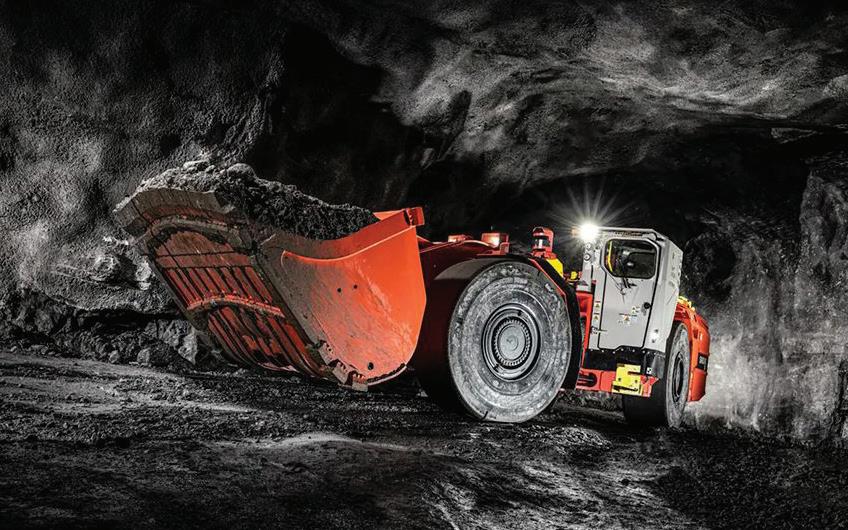
Eldorado Gold, an intermediate gold and base metals producer, has selected Sandvik to supply 10 battery-electric vehicles, plus 10 charging systems, for its Lamaque Complex in Val-d’Or, Québec.
e orders include ve Sandvik TH550B trucks and ve Toro LH518iB loaders. e rst two 50-ton trucks were delivered in October. e remaining three trucks and ve 18-ton loaders will be delivered from mid-2026 into 2027.
e new equipment will support Lamaque’s transition towards an electri ed underground load-and-haul operation.
Sandvik’s TH550B and Toro LH518iB are both purpose-built BEVs, designed from the ground up around their battery systems and electric drivelines. e truck and loader both feature Sandvik’s patented “self-swapping” battery system, including AutoSwap and AutoConnect functions. Sandvik claims to o er the fastest EV “pit stop” in the industry, enabling its equipment to return to operation signi cantly sooner than mining BEVs that depend on DC fast charging.
e Sandvik TH550B and the automation-ready Toro LH518iB also feature sophisticated data collection and analysis capabilities, enabling operators and maintenance personnel to monitor and optimize equipment performance in real time.
“ e rst Sandvik BEVs at Lamaque have proven their capability underground, and expanding the eet lets us move more tons with less energy and heat,” said Sylvain Lehoux, Vice President, Canada at Eldorado Gold Québec. “We see electri cation as a long-term enabler of safer, more e cient and more productive mining.”
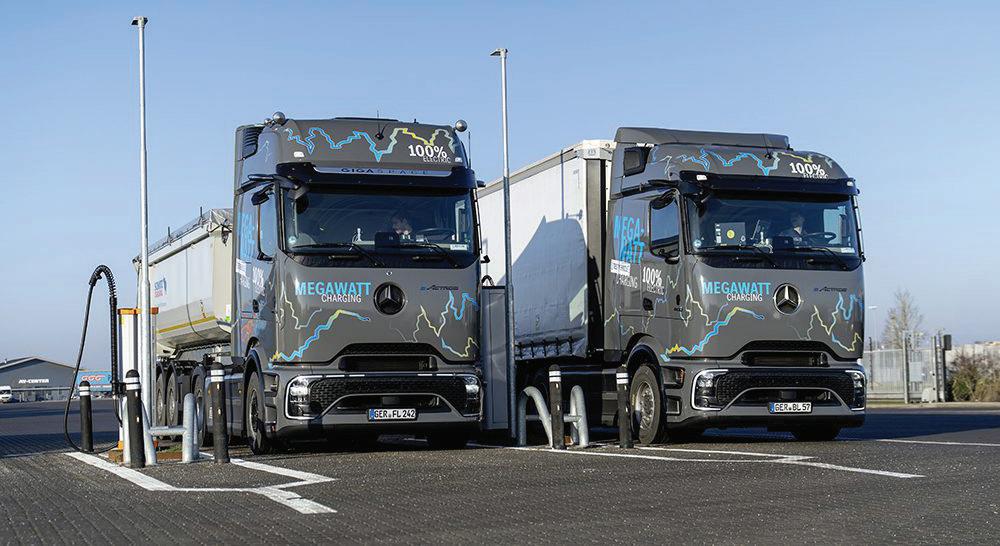
Development engineers from Mercedes-Benz Trucks tested the Megawatt Charging System on a long-distance test drive with two MCS-compatible eActros 600 electric trucks.
e aim was to ensure optimal compatibility between the vehicle and megawatt charging stations from various manufacturers, as well as to gain insights into real-world usability—including under winter conditions—ranging from the charging curve and average charging power to the overall performance of the MCS infrastructure.
e test run covered a route of approximately 2,400 kilometers, from the Mercedes-Benz plant in Wörth am Rhein, Germany, through the Netherlands, Belgium and Denmark, to Linköping in southern Sweden. e vehicles were recharged at both public and private MCS charging sites speci cally designed for trucks.
e MCS standard enables charging at power levels of up to 1,000 kW. Global standards organization CharIN is working to promote uniform interfaces between charging stations and electric trucks, and to facilitate the development of a pan-European fast-charging network for heavy-duty commercial vehicles.
“ e key challenges in megawatt charging lie in harmonizing the vehicle with various charging systems,” said Peter Ziegler, Head of E Charging Components, Mercedes Benz Trucks. “At the same time, the extreme charging currents in MCS charging place high demands on thermal management. e current test run provides an important opportunity to evaluate these aspects under real-world operating conditions.”

EV manufacturer GreenPower Motor has reached an agreement with the New Mexico Economic Development Department (EDD) to establish operations in Santa Teresa. e new 135,000-square-foot facility will become the company’s base for North American operations and US corporate headquarters. GreenPower anticipates setting up operations at the facility in Q1 of 2026, and plans to take possession of the manufacturing plant in June.
e Santa Teresa Borderplex is a special economic zone centered around a key US-Mexico trade hub with major rail links connecting to ports including Long Beach and Houston.
“Santa Teresa’s designation as a foreign-trade zone o ers substantial bene ts for GreenPower,” said Fraser Atkinson, CEO of GreenPower. “ e FTZ allows us to streamline customs procedures and allows the company to take nancial advantage of the designation related to inventory, parts and distribution. e ability to make capital decisions without fear of tari uncertainties is a game-changer in the current environment.”
GreenPower has its headquarters in Vancouver, Canada, and also has facilities in southern California and West Virginia. It builds medium- and heavy-duty EVs serving the cargo and delivery, shuttle and transit, and school bus markets.
In 2025, GreenPower worked with EDD to launch the state’s rst electric school bus pilot project at two Las Vegas public schools and a Santa Fe charter school. e state has committed $14.6 million in nancial incentives for the new manufacturing facility.
GreenPower will o er dealer-level pricing to the state for a lineup of Class 4 commercial EVs, including box trucks, refrigerated trucks, passenger vans, buses, utility trucks and stake-bed trucks for public agencies and commercial operators.


truck maker Harbinger raises $160 million in funding, sells 53 trucks to FedEx
Harbinger, a manufacturer of medium-duty electric and hybrid vehicles, has raised $160 million in a Series C funding round co-led by FedEx, Capricorn’s Technology Impact Fund, and RV manufacturer THOR Industries. With this round, Harbinger has raised $358 million to date.
Along with its investment, FedEx placed an initial order for 53 Harbinger electric trucks. Harbinger will deliver chassis—a mix of Class 5 and Class 6 models— ready for up t by the end of this year.
Harbinger’s proprietary EV stripped chassis includes all major vehicle systems, which the company designs and manufactures in-house in the US. Harbinger’s vehicles are purpose-built from the ground up to be electric. As Chief Production O cer Gilbert Passin told Charged, this vertically integrated approach helps keep costs down, and delivers higher-performing, more durable vehicles than those built on legacy fossil fuel platforms.
“Any vehicle that holds up to our rigorous on-road testing and o ers state-of-the-art safety features with lower total cost of ownership is win-win for drivers and for our business,” said Paul Melander, SVP of Safety and Transportation at FedEx. “As we work toward a goal to electrify the entire FedEx pickup and delivery eet by 2040, this trifecta of performance, price and operational resilience is what we need to be able to continue to scale.”
“FedEx’s participation signals a demand for innovation in the medium-duty truck sector and for an electric model that helps advance business and sustainability goals at the same time,” said Dipender Saluja, Managing Partner of Capricorn Investment Group’s Technology Impact Fund.
Develon (formerly Doosan Construction Equipment) is signi cantly expanding its portfolio of electric-powered excavators.
Develon says its new electric machines o er identical performance to their diesel counterparts, while delivering signi cant reductions in emissions, noise and vibration.
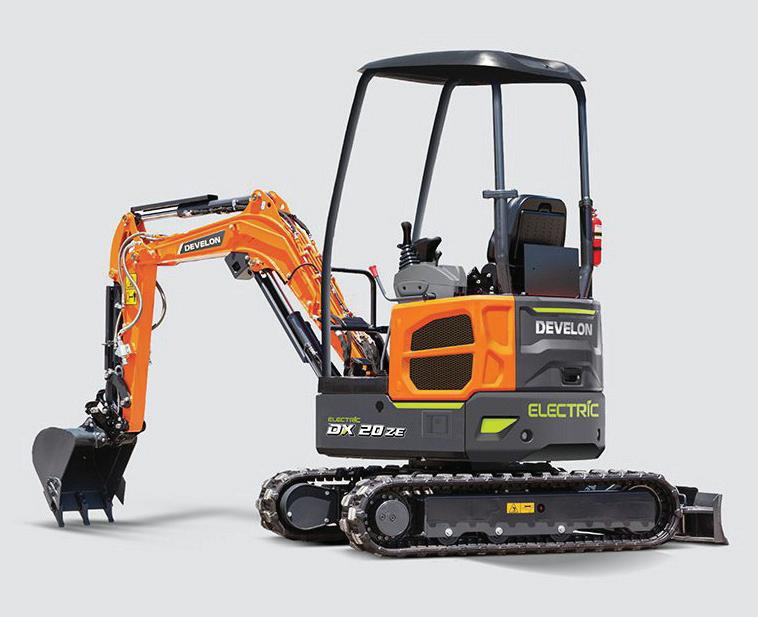
Built on Develon’s proven -7 Series platform, the rst wave of electric machines targets key segments in compact and mid-size classes. e initial lineup features the DX20ZE-7, DX23E-7 and DX85RE-7 electric mini excavators. It also includes the DX100WE-7 and DX160WE-7K electric wheeled excavators in the 10 to 20-tonne class, plus the DX230LCE-7 and DX250LCE-7 electric crawler excavators for the 20-tonne class and above.
e DX160WE-7K o ers all the new features from Develon’s -7K generation of wheeled excavators, combined with 100% electric drive. It features a 105 kW permanent magnet motor and a LiFePO4 battery pack capable of around 10 hours of operation under de ned conditions. It boasts the same digging and handling capability as a legacy diesel machine.
e DX230LCE 7 crawler electric excavator is targeted at heavy applications. It delivers production capacity comparable to that of its diesel counterpart, and o ers operating time of around 9 hours on one charge. e machine is designed with operator familiarity in mind— controls, attachments and service infrastructure align with the diesel model.
e DX250LCE 7 crawler electric excavator is designed for signi cant earth-moving and construction applications. It has all the features of the DX230LCE-7, and sports a larger battery pack, bringing total operating time to 12 hours.
e DX100WE-7 electric wheeled excavator and the DX85RE-7 electric mini excavator will follow next year, covering all core segments from compact to mid-size machines.


18-21 MAY 2026 | MAINZ,
2026 CONFERENCE PROGRAMS
PRE-CONFERENCE TUTORIALS: MONDAY 18 MAY
PRE-CONFERENCE SYMPOSIUM: MONDAY 18 MAY
TUESDAY & WEDNESDAY | 19-20 MAY
CHEMISTRY - PART 1
HEAVY DUTY
RECYCLING
WEDNESDAY & THURSDAY | 20-21 MAY
CHEMISTRY - PART 2

xEV BATTERY TECHNOLOGY

RAW MATERIALS


ENGINEERING
MANUFACTURING
xEV BATTERY APPLICATIONS
MANUFACTURING PRODUCTION

AI FOR ENERGY STORAGE







Join a global audience of battery technologists from leading automotive OEMs and their key suppliers for a must-attend 4 days exploring development trends and breakthrough technologies



RIZON, Daimler Truck’s all-electric commercial vehicle brand for the North American market, has expanded its US sales network with new dealerships in Arizona, New York, New Jersey and Washington state.
RIZON, Daimler Truck’s ninth and newest brand, o ers Class 4-5 electric trucks.
RIZON is working with three new partners, each o ering localized sales, service and eet support: Diversi ed Truck and Equipment Sales (Arizona), Range Zero Emissions (Washington) and Alta eMobility (New Jersey and New York).
“Seeing RIZON trucks at work in such a wide range of industries, from municipal services to hospitality and fuel delivery, underscores the practicality of electric trucks in everyday operations,” said Alex Voets, General Manager of RIZON USA. “Our expanding customer base and dealership network show that more eets are recognizing the environmental and operational bene ts of going electric.”
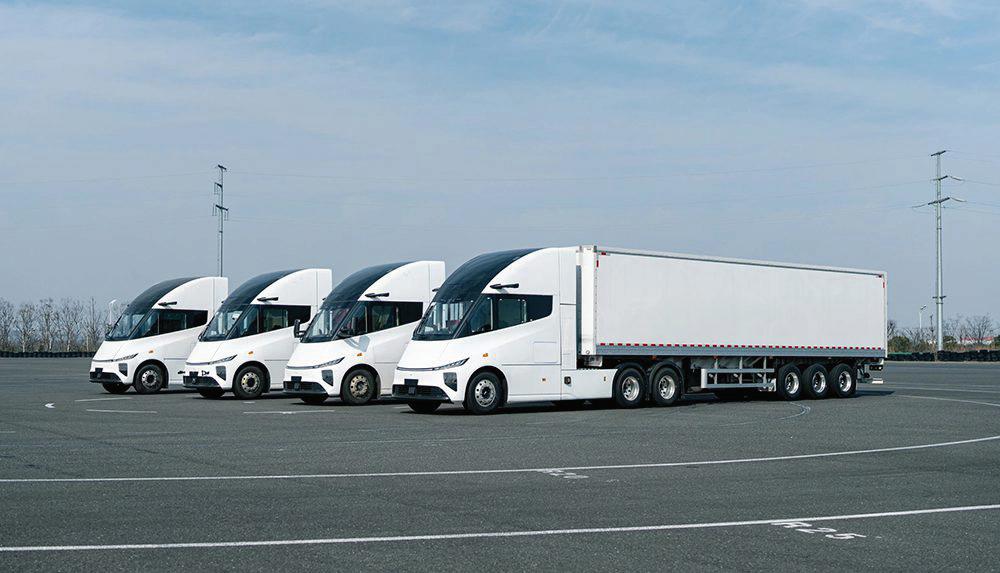
e Windrose R700 battery-electric Class 8 semi-truck has achieved homologation in the US, the EU and China. Homologation, the process of ensuring that new vehicles meet environmental, safety and technical standards, is required before vehicles can be sold in a particular market.
“US homologation was achieved at the end of 2025,” Windrose CEO Wen Han told Clean Trucking. “We’re accepting reservations now. Delivery has already started in California and will extend along the I-10 corridor.”
e R700 features a 729 kWh battery pack and an 800 V high-voltage system that supports megawatt-level dual-inlet charging. Fully loaded, it boasts 420 miles of range at a gross weight of 98,000 lbs. e starting price is expected to be around $250,000.
Windrose, founded in 2022, operates a production facility in Belgium for European deliveries, and plans to expand in France and the US (likely California) in the near future. Major components such as the chassis, e-axles, batteries and suspension are expected to be manufactured in China.
Windrose is currently accepting US reservations with a $15,000 deposit per truck.

omas Built Buses, a division of Daimler Truck Specialty Vehicles, has announced the launch of the Saf-T-Liner eHDX2 Wattson, its rst electric Type D or transit-style school bus. e new model is built on the existing HDX2 platform and is intended for school districts seeking to expand eet electri cation with a familiar, large-capacity vehicle. e company says it has incorporated customer feedback and its experience in electric vehicle manufacturing to create a bus suited for long-term eet planning.
e Wattson uses Accelera’s 14Xe electric axle, a fully integrated unit that combines the electric motor, gearbox and power electronics. is design, previously featured in omas Built Buses’ Jouley Gen 2, aims to improve driving performance, minimize mechanical complexity and reduce maintenance requirements.
Technical speci cations for the Wattson include a 246 kWh liquid-cooled battery system, peak output of 295 horsepower, 750 lb- of torque and a two-speed transmission. e bus has an estimated range of up to 150 miles per charge.
e bus features standard CCS DC charging capability, vehicle-to-grid (V2G) support, and an optional 20 kW onboard charger, providing additional exibility for AC charging. Charging ports are located at the rear by default, and an optional front charging port is available. Initial deliveries are expected to begin late in 2026.
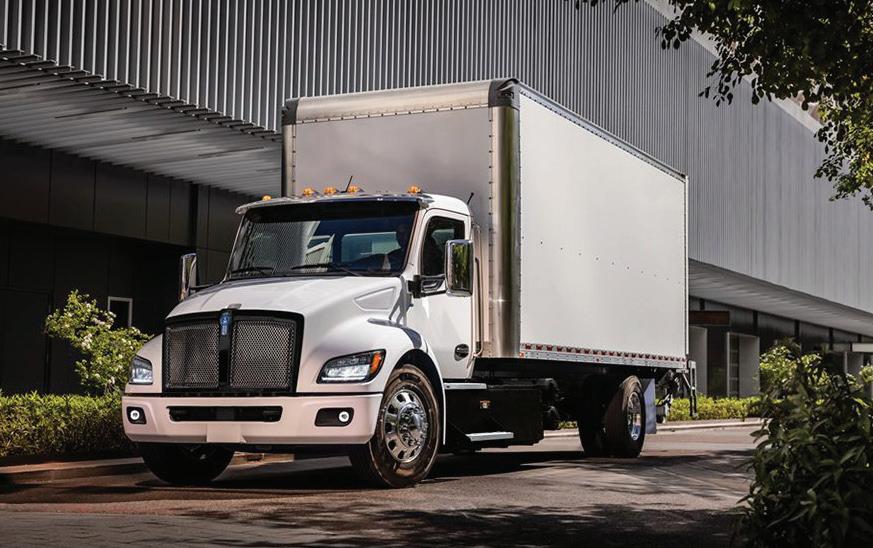
Kenworth, a PACCAR company, has launched its rst conventional medium-duty battery-electric trucks: the T280E, T380E and T480E. ese new Class 6-8 BEV models are designed for a wide variety of applications, including pickup and delivery, utility, regional haul and vocational applications.
e new models are now available for order from Kenworth dealers in the US and Canada. Production is scheduled to begin in 2026.
Kenworth’s medium-duty BEVs are powered by PACCAR’s fully integrated ePowertrain platform, which o ers multiple electric motor ratings from 170 kW (230 hp continuous, 335 hp peak) up to 350 kW (470 hp continuous, 605 hp peak), with peak torque ratings of 1,100 or 1,850 lb- . is exible platform allows customers to spec trucks for local delivery routes, regional distribution or vocational applications that require higher power.
Two battery con gurations are o ered: 250 kWh (up to 200 miles of range); and 375 kWh (280 miles). All models feature DC fast charging capability with peak charging rates up to 350 kW, supported by PACCAR Parts’ full suite of charging solutions.
e T280E (Class 6, 26k GVWR) is o ered with up to 200 miles of range, making it suitable for pickup and delivery, as well as urban routes.
e T380E (Class 7/8, 33-50k GCWR) has up to 280 miles of range—it’s designed for pickup and delivery, regional haul, utility and light vocational applications.
e T480E (Class 8, 66-82k GCWR) is available as a truck or tractor with up to 200 miles of range—it’s suitable for heavier pickup and delivery applications, drayage, utility and select vocational applications.

Archer Aviation has agreed to acquire the master ground lease for Hawthorne Airport in Los Angeles, California and repurpose it as a strategic air taxi network hub.
Hawthorne Airport, also known as Jack Northrop Field, is currently a public-use airport. It’s named for Jack Northrop, who founded Northrop Aircra in 1939. Northrop built and ew many classic airplanes, including the YB-35 ying wing, the P-61 Black Widow and F-89 Scorpion night ghters, and the T-38 Talon jet trainer.
Among other purposes, Archer plans to use the aerodrome as a hub for passenger operations before, during and a er the 2028 Summer Olympics. e air eld is close to multiple major downtown destinations, including the SoFi Stadium, e Forum, Intuit Dome and downtown LA.
Archer recently deployed the company’s Midnight eVTOL aircra in the UAE for test and demonstration ights and, separately, signed a deal with Korean Air for up to 100 aircra .
e Midnight is a piloted aircra designed to carry four passengers. Archer says that the Midnight “can perform rapid back-to-back trips with minimal charge time between ights,” adding that the eVTOL “has the potential to replace 60-minute commutes by car with 10-minute electric air taxi ights that are safe, sustainable, low-noise and cost-competitive with ground transportation.”
Archer has also announced a partnership with Soracle, a joint venture between Japan Airlines and Sumitomo that was established in June 2024 to build an advanced air mobility network in Japan to support eVTOL aircra .
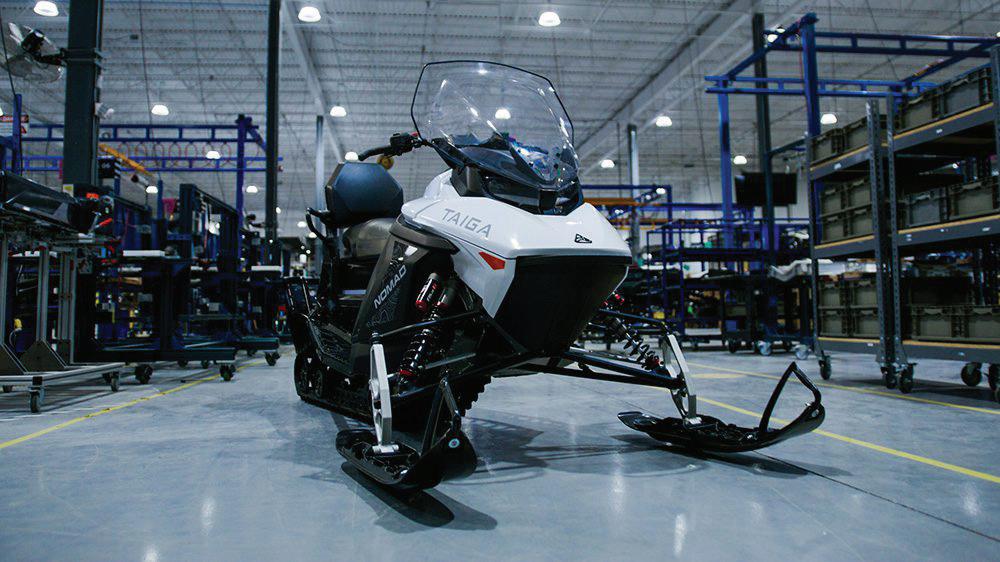
Taiga Motors has begun international deliveries of its 2026 Nomad electric snowmobile. Nomad is now available throughout North America, Europe and Asia.
e latest Nomad model introduces signi cant upgrades to both hardware and so ware. Many of the so ware upgrades will also be available to existing Taiga owners through over-the-air updates.
e 2026 Nomad features new custom drive modes, which enable riders to save personalized performance pro les. Riders can dial back performance for beginners or ne-tune acceleration to match individual riding styles. Admins can restrict access to speci c drive modes, and grant or revoke access to users.
Taiga’s next-generation electric powertrain was designed from a clean sheet and built in-house. e new integrated Tractive Unit combines an IPM motor and inverter in one compact package, and uses a fully redesigned control algorithm for precise and responsive power delivery, even in the harshest winter conditions.
Taiga has introduced an optimized stator winding that boosts thermal e ciency by over 15%, extending peak power duration and improving e ciency at high speeds.
A new battery pack featuring fused cooling panel technology enhances temperature uniformity and continuous power output, resulting in faster warm-up times and superior thermal stability without risk of overheating.
“ e Nomad has always represented the essence of what Taiga stands for—clean, capable adventure in any environment,” said Paul Achard, co-founder and Chief Engineer at Taiga Motors. “ is latest generation not only pushes performance and e ciency further, but also gives riders more control, exibility, and connection to their snowmobile.”









































































Chinese battery swapping technology rm U Power has entered a strategic partnership agreement with Whale Logistics in ailand through its U SWAP subsidiary to promote the deployment of commercial battery-swapping electric trucks in ailand.
Whale Logistics is an integrated logistics service provider o ering warehousing, yard operations and end-toend logistics solutions. It has ordered 1,000 battery-swapping trucks from U Power, starting with 30 units to be delivered in April 2026.
e order is part of U Power’s move into commercial operations in ailand and its long-term growth strategy for the deployment of battery-swapping commercial trucks in southeast Asia. rough the collaboration, U Power aims to establish a repeatable commercial model to accelerate the adoption of its smart battery-swapping solutions in additional markets.
“We are committed to building a comprehensive battery-swapping electric vehicle ecosystem for commercial transportation, and this partnership marks a signi cant step forward to expanding our existence in the ASEAN market,” said Johnny Lee, U Power’s CEO.
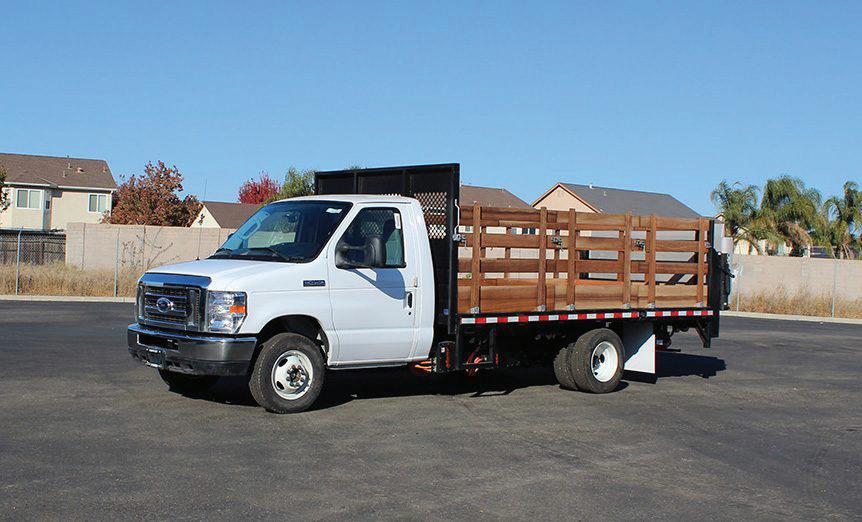
Motiv Electric Trucks builds medium-duty electric trucks and buses. Now the company’s products will be available to public sector agencies through Sourcewell, thanks to a partnership with National Auto Fleet Group (NAFG).
Sourcewell, a self-funded governmental organization established in 1978, administers a program that harnesses the collective purchasing power of more than 50,000 participating agencies. By streamlining procurement with pre-negotiated, competitive pricing contracts, Sourcewell enables government, educational and nonpro t organizations to purchase products and services through a standardized procurement process with preferred pricing.
Motiv’s partnership with NAFG enables municipalities, school districts, transit agencies and other public sector and nonpro t organizations to procure Motiv’s Class 4-6 electric step vans, buses and trucks.
Motiv has deployed electric step vans, box trucks, shuttles and buses for the last 15 years, putting nearly 450 vehicles on the road. Customers include Purolator, Vestis (formerly Aramark Uniform Services), Cintas, Bimbo Bakeries and other North American eet operators.
“Cities, counties and states across the country are recognizing the signi cant health, environmental and operational bene ts of electric trucks and buses,” said Scott Gri th, CEO of Motiv Electric Trucks. “Our partnership with NAFG now gives public eets an e cient and cost-e ective way to purchase Motiv electric vehicles through Sourcewell.”
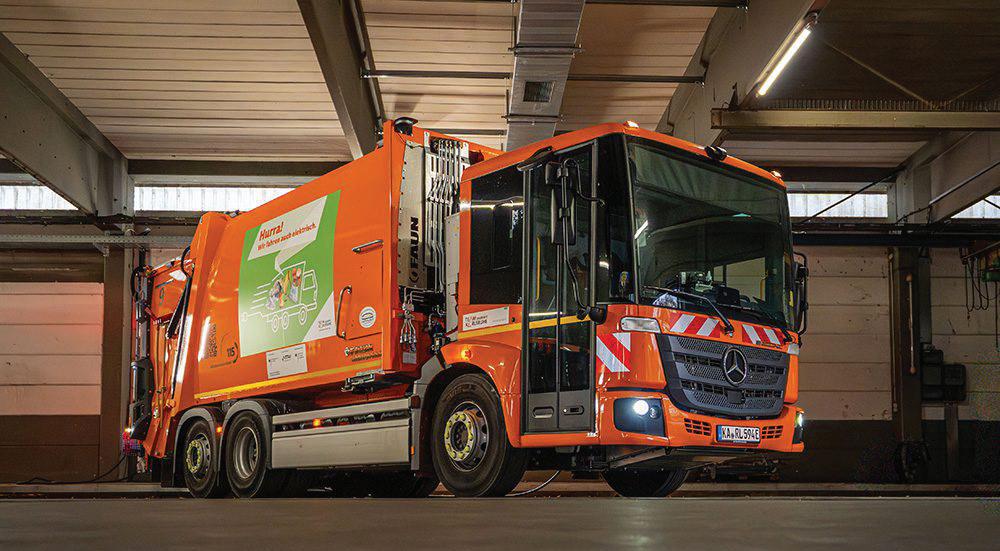
Residents of the German city of Karlsruhe are enjoying quieter mornings these days. Waste collection agency Team Sauberes Karlsruhe (Clean Karlsruhe Team) recently added seven new Mercedes-Benz eEconic electric waste collection vehicles to its eet.
TSK used a test vehicle for over a year to gather experience and test the practicality of the electric drive system in waste collection. TSK employees provided detailed feedback, highlighting the quiet driving, the improved driving experience without vibrations, and the more pleasant working conditions at the rear of the vehicle.
e rear-loading vehicles are equipped with superstructures from FAUN Umwelttechnik. Five of the eEconics have a VARIOPRESS 524 HK body with FAUN X tipping, and can therefore be used exibly for recyclables and waste materials. Two of the vehicles are equipped with the robust POWERPRESS 524H body, which is specially designed for the high demands of bulky waste collection.
Each of the e-trucks has three battery packs, each with a capacity of 112 kWh (nominal) and 97 kWh (usable). is delivers an average range of around 80 km, and in some cases more than 100 km. All routes in Karlsruhe can be completed in single-shi operation without en route charging.
e charging infrastructure consists of a decentralized satellite charging system. Two power units, each with a capacity of 400 kW, supply a total of eight wall-mounted charging points, each with a capacity of 100 kW. Separate power units convert AC to DC.
TSK is continuing the electri cation of its eet: the agency has ordered eleven additional eEconic waste collection vehicles with a low-entry design. By 2035, the municipal eet is to be completely converted to electric drive systems, except for a few legacy vehicles for emergencies.

Global logistics and shipping rm DHL has announced plans to accelerate the electri cation of its vehicle eet.
DHL currently operates some 39,000 EVs in pickup and delivery services, representing more than 41% of its eet. e company plans to raise that proportion to 66% by 2030. New electric trucks and light commercial vehicles are to be deployed across all markets. e company’s largest sources of emissions are air freight, road transport and facilities. erefore, the company is investing heavily in EVs, renewable energy and sustainable fuels.
“Our emissions peaked in 2021,” said Toby Groom, Global Head of EV Logistics Solutions. “If we want to hit these targets coming down from that 2021 number, we need to reduce our emissions signi cantly—and we have to have targeted measures to do that.”
“We doubled our electric vehicle eet between 2021 and 2024,” said Groom. “But this isn’t just about mature markets—we’re rolling out electric vehicles globally. We need structurally sound energy systems to support them, powered by renewable sources, so we’re not shi ing emissions from one scope to another.”
Groom acknowledged that electric truck adoption remains challenging: “An electric truck is still two to three times the price of a diesel truck, but that’s early in the evolution.”
DHL is also focusing on sustainable aviation fuels (SAF), as air freight makes up 68% of its total emissions. SAF now represents 3.5% of DHL’s total jet fuel mix. e company has partnered with fuel producers including Neste and Shell to scale production and advocate for stronger policy support.
Looking to 2050, DHL aims to decarbonize all transport modes. e company foresees that aviation will evolve from SAF to hydrogen and battery-electric aircra . Early electric ight trials are already underway in the US. Shipping will depend on biofuels, methanol and ammonia.















The most common EV some Americans will see over the next few years may be the one that delivers their mail.

By John Voelcker






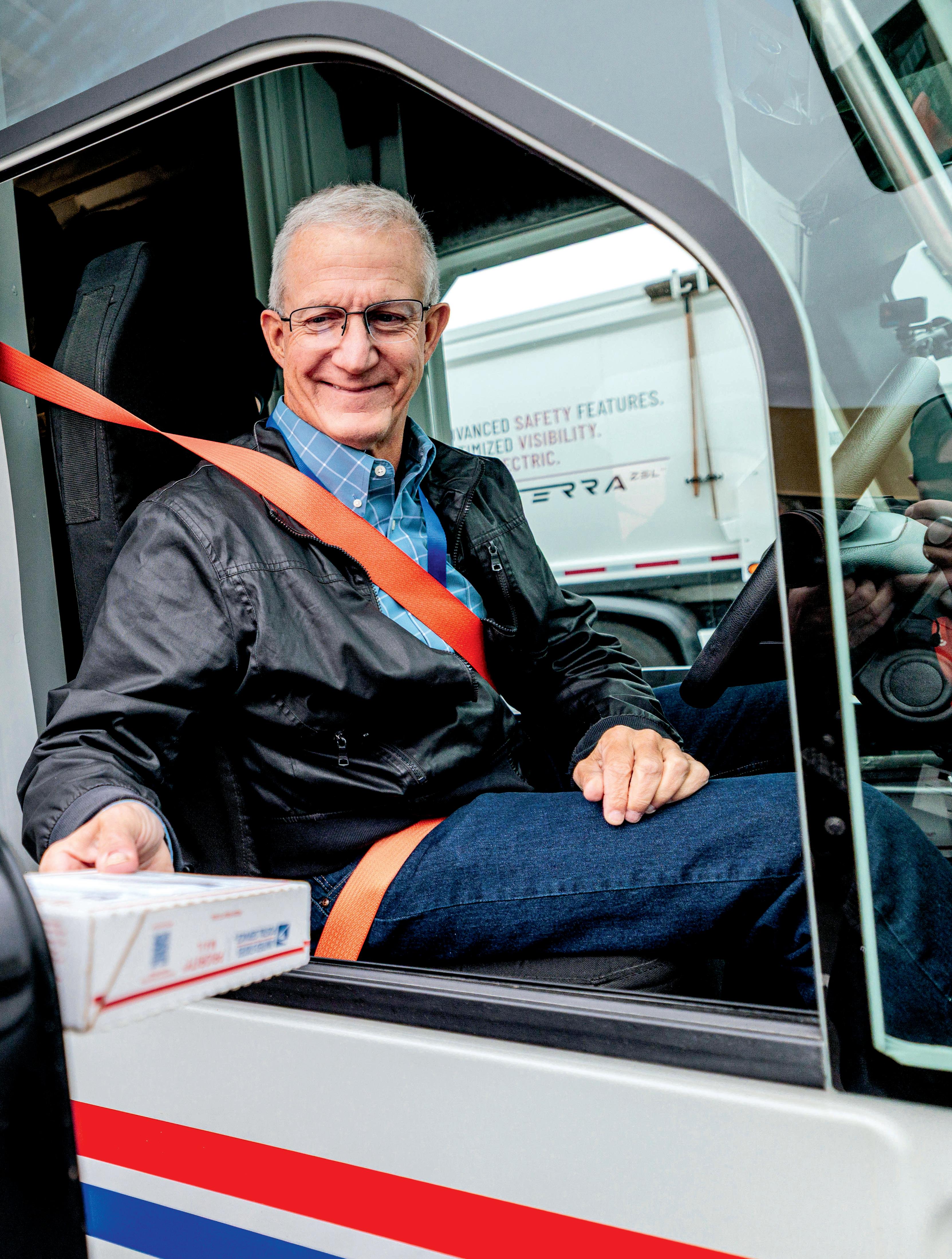




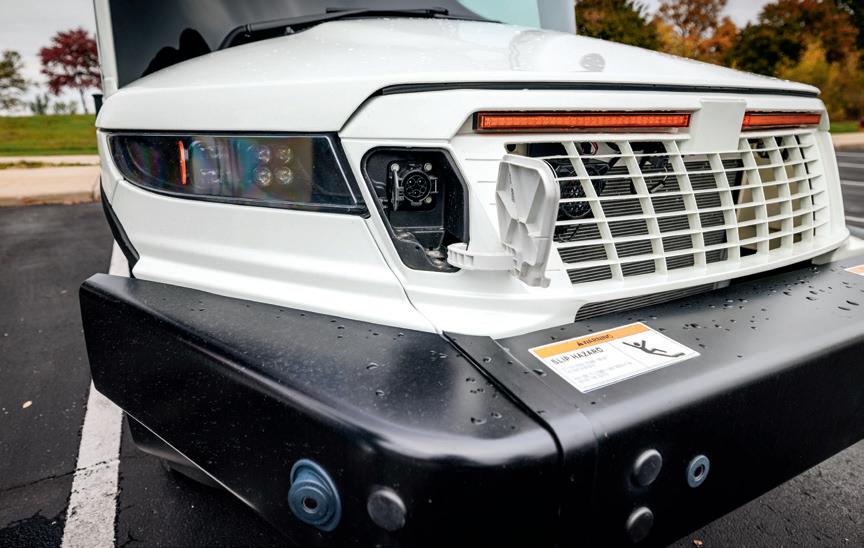


Anew electric vehicle has now quietly launched onto US roads. As of now, you can’t buy one for your own use, but you’re going to see a lot of them in coming years, and they will o er a very public demonstration of the bene ts—or pitfalls—of mass EV adoption into daily delivery eets.
e new EV is the Oshkosh Next Generation Delivery Van (NGDV) now being delivered to US Postal Service locations in many states. NGDVs actually come with two powertrain options. e EV uses a 94 kWh lithium-ion battery pack that powers a 150 kW (201 hp) motor driving the front wheels. EPA documents suggest the combination will give a range of about 120 miles. Even in very cold or very hot weather, that o ers a comfortable safety margin over a delivery vehicle’s average daily mileage of 18 to 24 miles: a whopping 96 percent of the vehicles the NGDVs will replace cover fewer than 40 miles a day.
e other powertrain is a turbocharged 2.0-liter inline-4 gasoline engine, driving the front or all four wheels. ese will be used for routes that cover longer distances, most of them rural, or over challenging terrain. Roughly 5,000 NGDVs, with both powertrains, have been delivered to date, part of 29,000 new USPS vehicles this year. Of 106,500 new vehicles of all types now under contract, the Postal Service says 66,000 will be zero-emission, including NGDVs.
e current contract with Oshkosh calls for 51,500 vans, though ultimately a further 110,000 may be needed.
USPS proposals originally requested bids on a eet of EVs, and then bids on a separate set of gasoline-powered vehicles. According to its CEO John C. Pfeifer, Oshkosh was the sole bidder to suggest a single vehicle that could meet the requirements of both requisitions. e Postal Service liked the idea, which meant drivers could get familiar with just a single vehicle, regardless of powertrain. In the end, Pfeifer told Charged, roughly 90 percent of the parts are common to both versions of the vehicle.
Once a contract was signed, it speci ed that 90 percent of NGDVs purchased would be gasoline, with only 10 percent running on battery power. Over the course of development, as the Postal Service tested and validated prototypes and analyzed the performance and lifetime operating costs, it became clear that the EV models could cover a majority of today’s delivery cycles.
e nal contract speci ed 70 percent EVs and 30 percent ICE models, and that ratio is what’s being delivered
The fi nal contract specifi ed 70 percent EVs and 30 percent ICE models, and that ratio is what’s being delivered today.
today—despite an attempt to slash the EV percentage inserted as a last-minute provision into a major, must-pass Congressional bill by anti-EV elected o cials.
Oshkosh and its lobbyists laid out the enormous added operating costs that reducing the number of EVs would impose on the USPS. In due course this provision was removed from the bill, and the percentage remains at 70-30.
e Postal Service’s NGDV is instantly identi able by its duck-billed appearance, with a low and rounded nose in front of a very tall windshield. e NGDV’s looks have garnered a great deal of criticism, but they’re a prime example of form that follows function.
e low nose, with edges that slope down on either side of the centerline, maximizes visibility from the driver’s seat during neighborhood deliveries. Mail-delivery drivers may encounter small children, mailboxes, driveway posts, cats and dogs, and a host of other hazards along their daily


The load bay is tall enough for a 95th-percentile adult to stand up in: 78.5 inches, or more than six and a half feet, even with the roller door open.



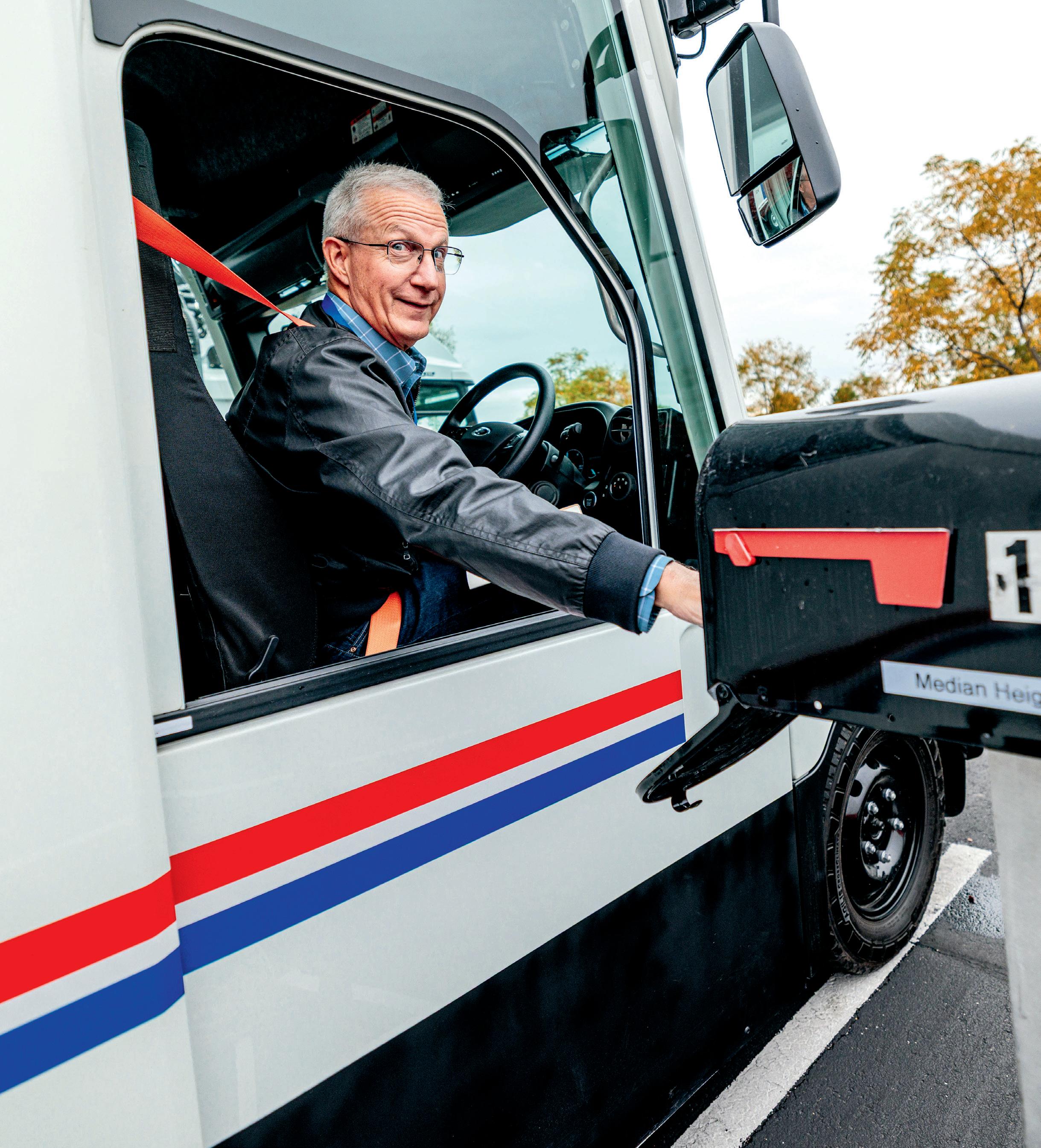

The NGDVs will replace the Long Life Vehicles built by defense contractor Grumman, with an aluminum van body on a Chevrolet S-10 light-truck chassis.
routes. From the rewall forward, that speci c front-end design belongs to the USPS alone. While Oshkosh can sell NGDVs to other customers, they will have to have a di erent front-end design.
e tall cargo body—much taller than that of the decrepit Long-Life Vehicles that these will replace—re ects the Postal Service’s very di erent mission in the 2020s compared to that of the late 1980s, when the LLVs started rolling out. As First Class mail volume is only a tiny fraction of what it used to be, today’s Postal Service has a much higher volume of parcels to deliver, including lastmile deliveries for huge e-commerce vendors like Amazon. As a result, the load bay is tall enough for a 95th-percentile adult to stand up in: 78.5 inches, or more than six and a half feet, even with the roller door open. at’s very different from the LLVs, which required drivers to stoop and/ or walk to the rear doors. Cargo volume has expanded from 120 to 330 cubic feet, and rated payload has doubled: 2,000 pounds rather than 1,000 pounds.
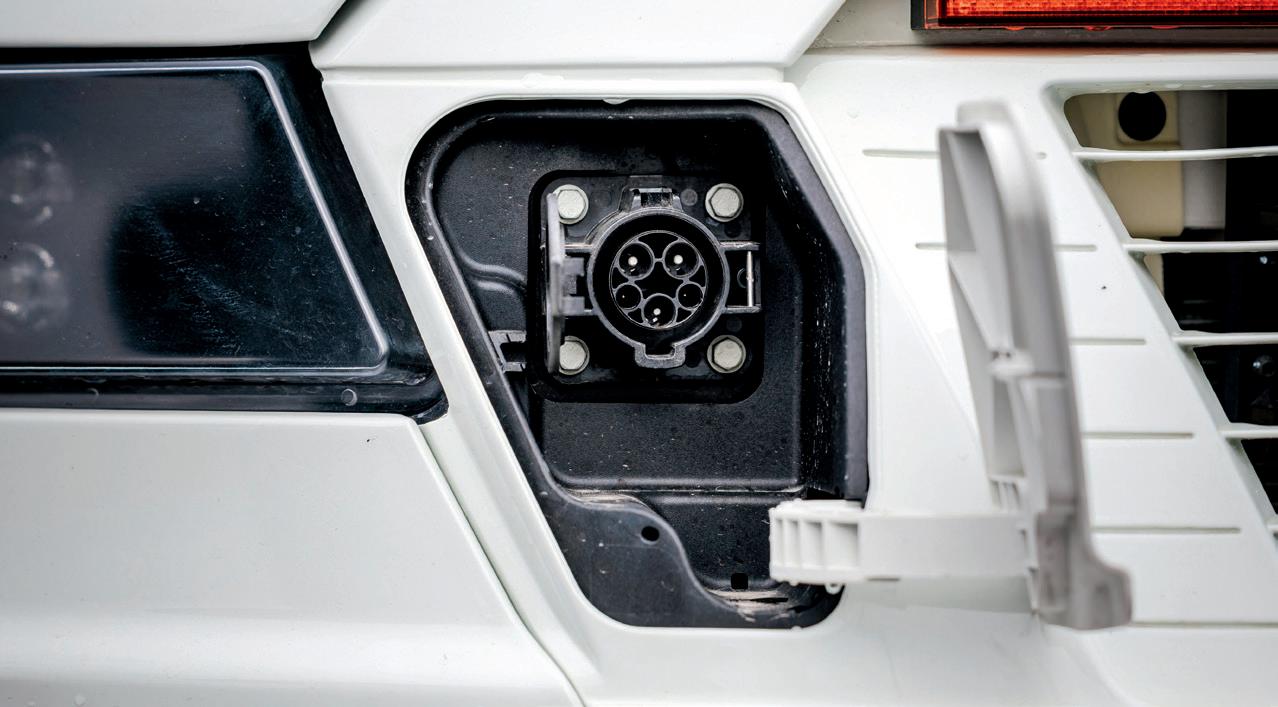
LLVs: living long beyond the plan
e NGDVs will replace the Long Life Vehicles built by defense contractor Grumman, which an aluminum van body on a Chevrolet S-10 light-truck chassis, powered by GM’s pushrod 2.5-liter “Iron Duke” 4-cylinder engine. In 1984, the USPS issued a set of requirements for a standardized vehicle to replace the motley collection of production vehicles it used. e vehicles had to have right-hand drive, be easy to get in and out of, use standardized powertrains that could run 12 hours a day every single day, and be capable of surviving harsh climates and hard use. ey were tested for tens of thousands of miles over pavement, gravel and dirt roads, potholes, and even cobblestone surfaces. Finally, they had to be simple to maintain and easy to repair.


Ultimately 140,000 were built from 1986 to 1994—all designed for a 24-year lifespan—of which 130,000 remain on the roads today. ey lacked amenities new-car buyers take for granted today: airbags, air conditioning, even anti-lock brakes. And in stop-and-start low-speed use, they returned all of 8 miles per gallon of gasoline.
e LLVs were followed by similar Ford UtiliMaster vans, put into service starting in August 1999, though just 21,000 were delivered through 2001. Using a Ford Explorer chassis, they were capable of running on alternative fuels to comply with a government eet-vehicle mandate. eir engine was a 4.0-liter Ford V6 engine that could run on either gasoline or E85 ethanol. Many remain in service as well, with fuel economy even worse than that of the 8 mpg Grummans.
Every one of these vans has now outlived its design life— the rst LLVs are now almost four decades old. As they

Gasoline engines are a terrible powertrain for the duty cycles of postal-route delivery, with perpetual stops and starts, low speeds and low daily mileages.
aged, the Postal Service came up against a core problem: gasoline engines are a terrible powertrain for the duty cycles of postal-route delivery, with perpetual stops and starts, low speeds and low daily mileages.
e average curbside delivery route has 500 stops over just 20.8 miles, covered in roughly 6 hours. Only one quarter of that time is spent in motion, while 64% is spent

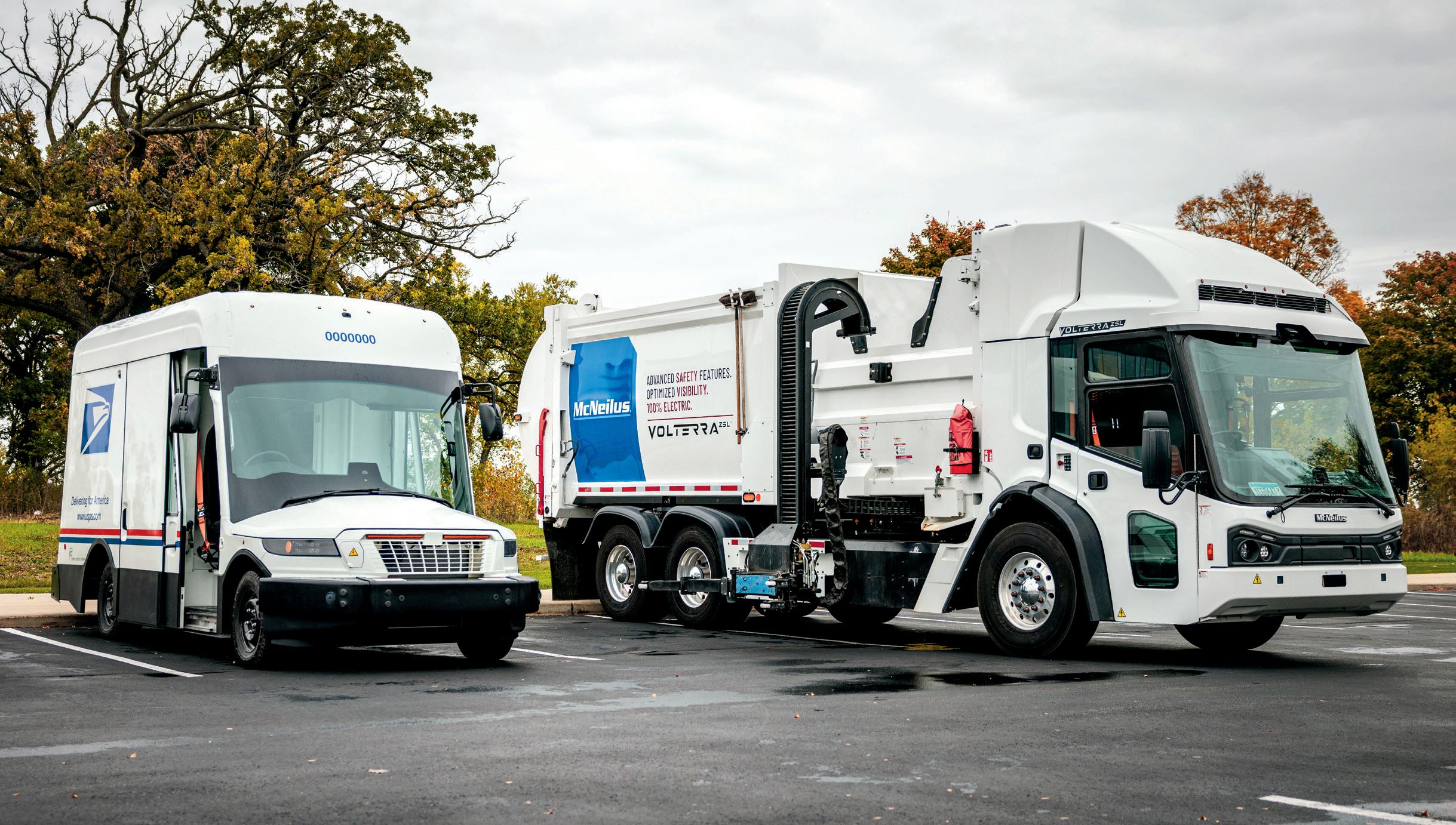


It’s not quick, but the powerdelivery software is predictable, especially at low speeds—while creeping along residential roads from mailbox to mailbox.
stopped during deliveries. e average drive between stops is just 11 seconds. As one mechanic commented, the engine (switched o at stops) never runs long enough to warm up properly, and the continual on/o cycles produce a high proportion of under-lubricated running time before the oil pressure builds back up. Exhausts o en don’t warm up enough to dry the moisture that rots them from the inside. And some USPS rules allow work on the vehicles only if they break, meaning there’s no room for necessary preventative maintenance. Today, each LLV costs the USPS roughly $10,000 a year in maintenance—and more than 100,000 of them are still on the roads.
Under that particularly challenging duty cycle, EVs turn out to be perfect. No oil pressure to build up, no combustion engine to warm up, no exhaust, no need to switch on and o at each stop…and far, far lower cost per mile on electricity than the gasoline burned by an 8 mpg vehicle.
e USPS contract speci es a 20-year lifespan for the NGDVs, slightly shorter than the LLVs. e simplicity of their powertrain, however, suggests that they too may last far beyond their design life—and with considerably less powertrain maintenance. Moreover, should the Postal Service see signi cant battery degradation in some NGDVs, they might conceivably be retro tted with a higher-capacity, less costly battery pack before the end of their lives.
A brief drive in an early prototype electric NGDV showed us that this EV is no Cadillac or Lucid or Tesla. It’s a basic, purpose-built commercial vehicle with rubber mats, vinyl seats, a manually winding window, and large, industrial knobs and switches. It does, however, bring postal workers decisively into the 21st century of vehicle tech: it has modern safety systems like automatic emergency braking, a backup camera (rear visibility is nonexistent), and the feature that will likely matter most
to USPS workers: air conditioning. One mail delivery worker is said to have burst into tears a er her rst drive, owing to that feature alone.
On the road, the electric NGDV proved easy to maneuver despite its size (236 inches long) and he (more than 3 tons). It’s not quick, but the power-delivery so ware is predictable, especially at low speeds—while creeping along residential roads from mailbox to mailbox. e regenerative braking pauses for a fraction of a second before taking e ect, but it’s smooth and linear. And there’s no idle creep, a signi cant safety factor for a vehicle that stops hundreds of times a day in residential areas.
We were surprised to nd that it doesn’t provide full one-pedal driving—the le pedal is required to come to a full stop. is makes the driving behavior of the electric and gasoline versions more similar—meaning


less potential for driver confusion if they move from one type to another. In our brief test drive, we pulled alongside a regulation-height mailbox, reached out the open window, stu ed envelopes and yers into it, and purred on…just as a USPS employee would.
If any use is well suited for EVs, it’s daily mail delivery. Watch for NGDVs in your neighborhood—and ask the postal workers what they think of them. A er all, they may be around for decades.
Oshkosh Corporation provided airfare, lodging and meals to allow Charged to bring you this rst-person drive report.
e company also let us drive its electric re truck, garbage truck and airport emergency vehicles. It was great.




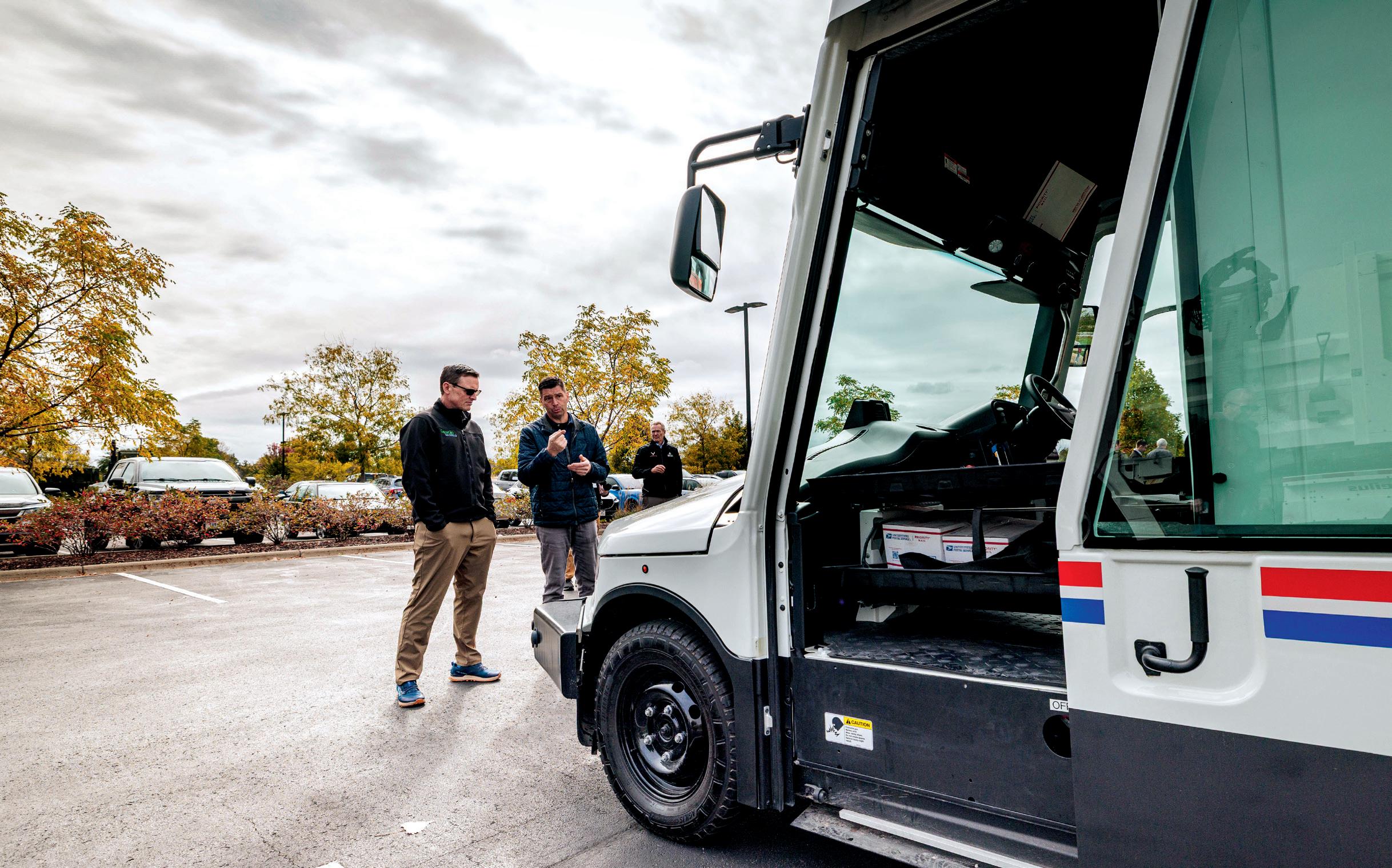

We were surprised to fi nd that it doesn’t provide full onepedal driving—the left pedal is required to come to a full stop.
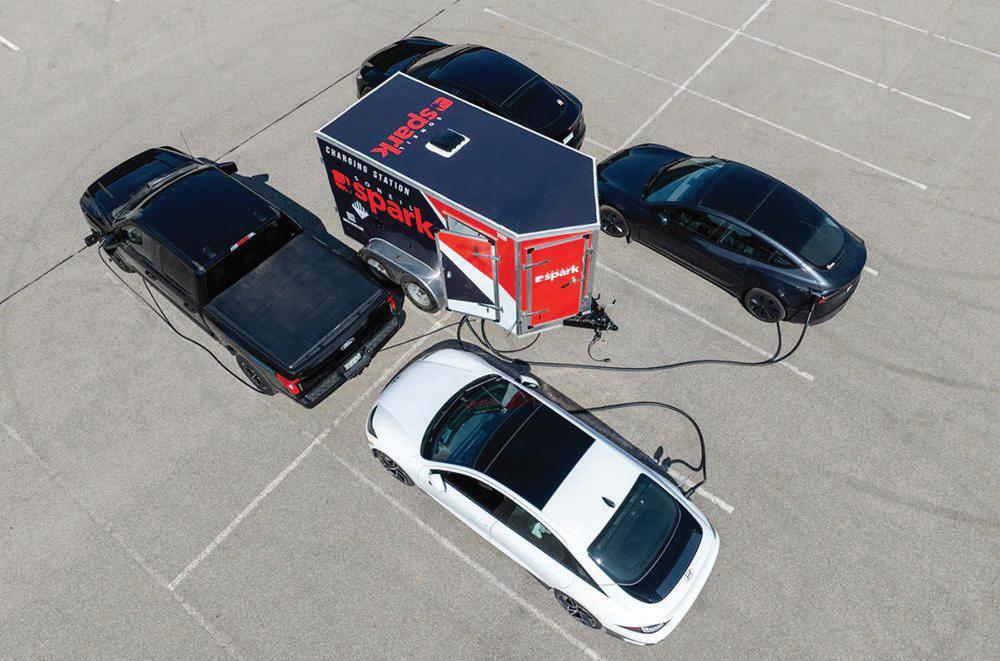
Soneil Spark’s new Spark Mobile EV Charging Station (MCT) provides on-demand charging in remote, underpowered or o -grid locations. It’s suitable for a wide range of commercial operations, including construction and mining sites, municipal eets, outdoor events, emergencies or disaster response, and remote utility projects.
e Spark MCT is equipped with 50 kWh (or more) of battery capacity, can deliver AC or DC charging, and supports multiple energy sources, including solar, wind, methane gas and propane.
e Spark MCT is designed to operate as a fully independent power hub, or to seamlessly integrate with existing energy systems. Spark’s intelligent power management so ware optimizes the use of multiple energy sources, balancing battery storage and generator inputs.
e unit’s modular design makes it customizable and scalable.
Soneil Spark o ers nancing options for the Spark MCT in Canada and the US through strategic partnerships.
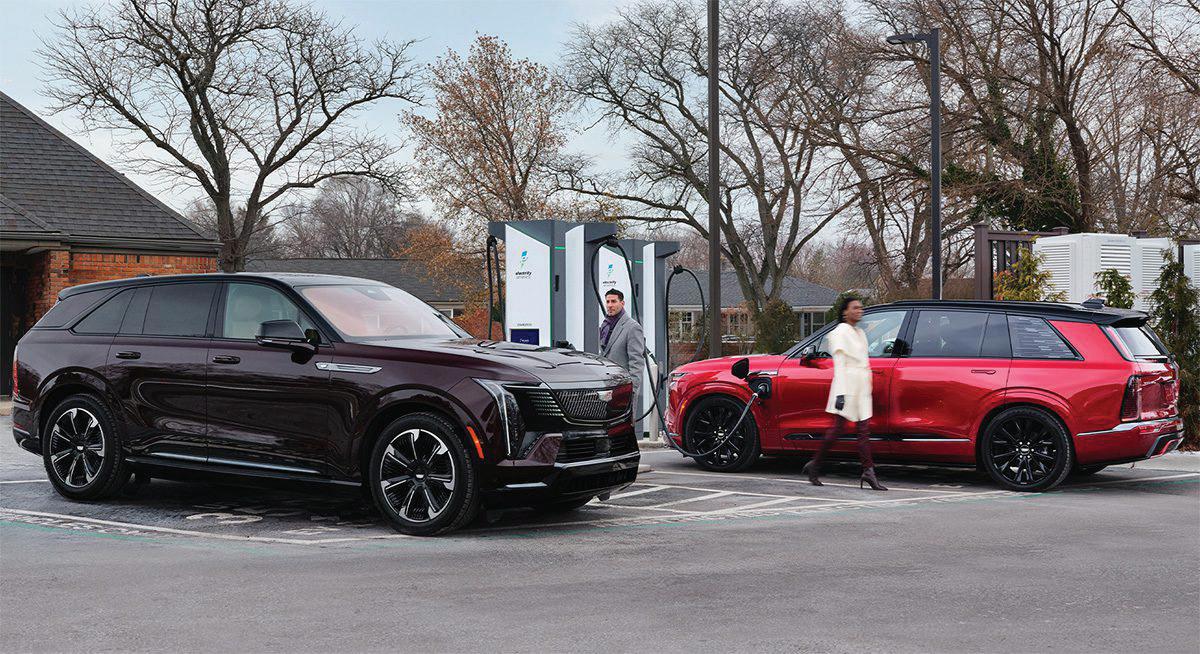
e Electrify America EV charging network, which boasts over 5,000 locations, is now accessible for GM EV customers via the automaker’s branded smartphone apps. Drivers can use their myChevrolet, myGMC or myCadillac apps to nd nearby charging stations with real-time availability information, plan routes, monitor charging session status, and pay for charging directly in the app. Multiple charging apps are the bane of road-tripping EV drivers. Adding support for charging networks within branded apps is one way OEMs can improve the charging experience for their customers. GM aims to connect EV drivers to an expanding ecosystem of public charging infrastructure. GM owners can navigate to the Public Charging page in their myBrand apps and look for supported networks.
“We’re collaborating across the industry to deliver not just more chargers, but better public charging experiences,” said Wade She er, Vice President, GM Energy. “Our work with Electrify America helps make public charging easier to access for GM EV drivers.”
“As EV travel continues to grow, so does the need for convenient charging experiences,” said Robert Barrosa, CEO and President of Electrify America. “ rough this integration, GM EV drivers have more Hyper-Fast chargers to choose from and a seamless experience they can count on nationwide.”


ITEC+2026 delivers high-impact content designed for engineers, researchers, and technical managers working on the most critical challenges in electric mobility
With reduced federal funding, this conference serves as a targeted investment in upskilling, technical alignment, and strategic growth.
A Powerful Par tnership
TEC+2026 trans manufactu


ITEC+2026 and Coiltech US join forces in Novi to create a leading platform for transpor tation electrification and electromagnetic manufacturing. This co-location offers attendees:
Critical updates on EV power train design, battery systems, and charging infrastructure
Exposure to pre-commercial research and emerging standards
Access to DOE, Tier 1, and OEM insights that inform product and investment strategies
Workshops and technical sessions offering hands-on value, not just theory
Ideal for engineers tasked with knowledge transfer to leaner teams
Joint access to both conferences and exhibits
oint co
Cross-industry collaboration
Access to over 300 exhibiting companies with technology and par tnerships to address any technical challenge for motor design, testing and manufacturing. Advance Your Competitive Edge in EV Technology Join the Engineers Defining the Future of Electric Mobility
ross-industry collabora au
Prime location in the U S automotive corridor









of
EnergyHub, a provider of grid-edge exibility solutions, and e Brattle Group have released the results of a study that used real-world EV data from an EnergyHub program in Washington State to quantify the grid reliability and cost savings bene ts of active managed charging.
e Brattle Group’s analysis of EnergyHub’s active managed charging solution shows that optimization of EV charging can help utilities to reduce local grid stress and minimize wholesale market costs, while continuing to ensure that customer charging needs are met.
e report, “Demonstrating the Full Value of Managed EV Charging,” compares two active management strategies tested in real-world trials to both unmanaged charging and charging that takes advantage of passive time of use (TOU) rates.
Researchers found that active managed charging can reduce EV charging peaks by up to 50%, smoothing load at service transformer and feeder levels and easing distribution grid congestion. ey also concluded that managed charging can signi cantly increase distribution system hosting capacity—potentially allowing the network to support about twice as many EVs before upgrades are needed.
e study estimates that managed charging could save up to $400 per EV each year, largely by shi ing charging to lower-cost hours. In practice, it delivered about 95% of charging during o -peak periods and was able to follow complex time-of-use rate schedules to reduce customer bills.
Importantly, customer needs were still met. In the study, 100% of EVs that stayed plugged in long enough to charge reached their target state of charge, and customers overrode charging commands on an average of 2.3 sessions per month under active management strategies.
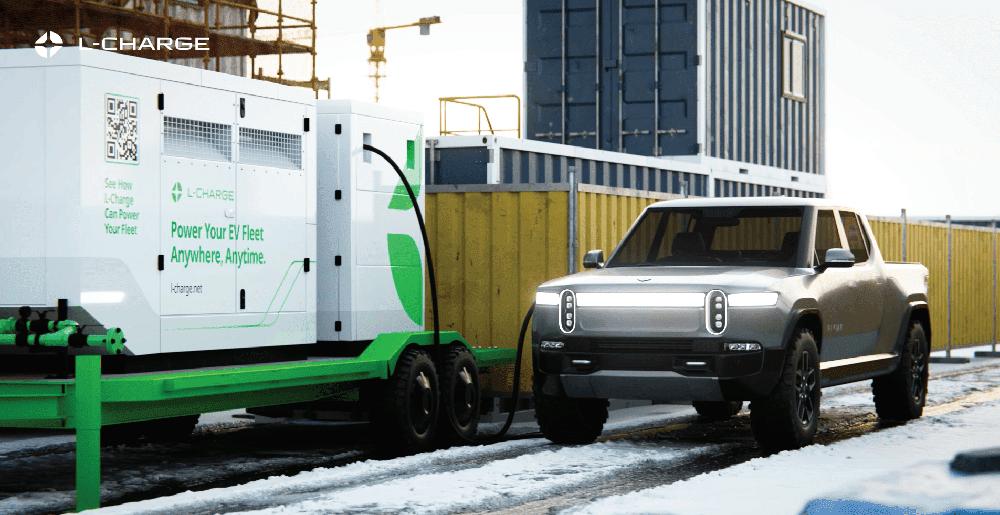
EV charging provider L-Charge has closed a $10-million funding round, led by Ultra Capital.
L-Charge will use the new capital to expand its national installation footprint; add new product categories; expand its portfolio of o -grid chargers; grow sales, operations and customer support teams to support increasing project volume; and strengthen long-term infrastructure and service capabilities. e investment will support rapid growth in installations in the rideshare, last-mile delivery and eet segments.
Fleet operators installing charging infrastructure continue to face permitting delays and infrastructure backlogs that add cost and slow EV deployments. L-Charge aims to address these challenges by delivering modular, o -grid charging solutions that enable eets to electrify in a matter of weeks.
L-Charge’s Charging-as-a-Service and Power-as-aService o erings are designed to provide commercial customers with a exible, zero-CapEx alternative to traditional grid-dependent charging infrastructure.
“Demand for our solutions continues to grow as eet operators look for reliable ways to deploy EVs despite grid limitations and rising costs,” said Stephen Kelley, CEO of L-Charge. “ is investment allows us to scale faster, support more customers, and keep building the team needed to sustain our next phase of growth.”
“L-Charge is solving one of the most critical bottlenecks in eet electri cation today—access to power,” said Kristian Hanelt, Partner at Ultra Capital.
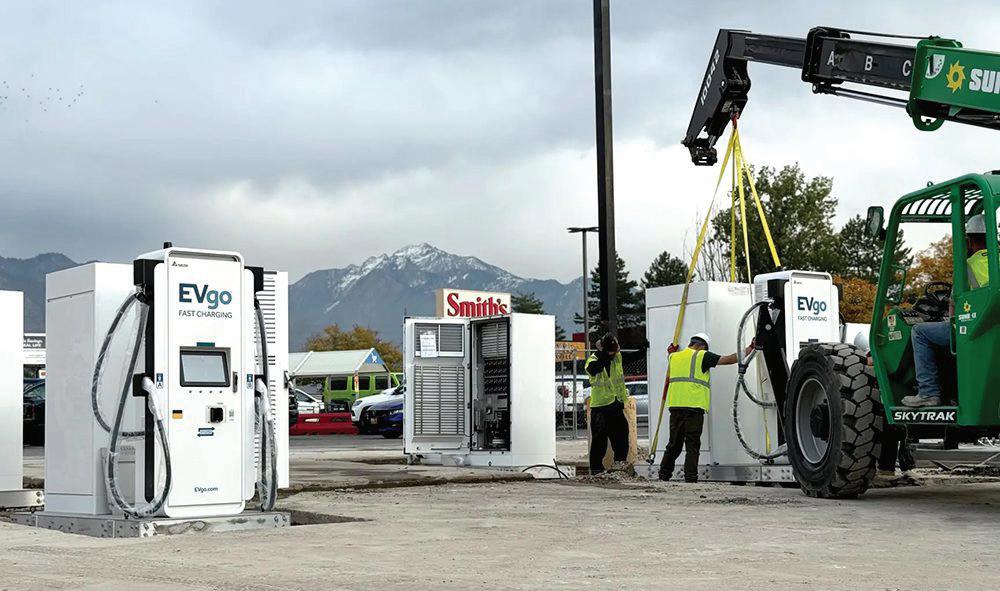
EV charging provider EVgo has committed to a massive deployment of EV charging sites at Kroger Family of Stores locations across the US. e company plans to build at least 150 fast charging stalls per year through 2035 at the company’s sites, which operate under various brands, including Kroger Foods, Fred Meyer, Fry’s Food Stores, Harris Teeter, King Soopers and Smith’s Food and Drug.
Each of the sites will include up to 16 DC fast charging stalls, featuring high-power EVgo chargers that can deliver a full charge in as little as 15 minutes—an ideal t for grocery locations where shoppers tend to spend less than an hour.
e rst charging site of the expanded program is now operational in Salt Lake City. Additional deployments are slated for Arizona, California, Florida, Georgia, Texas, Washington and other states.
EVgo’s current network includes over 4,600 stalls in the US, and the company expects to energize more than 15,000 by the end of 2029.
“Kroger is the grocery destination of choice for millions of Americans,” said Badar Khan, CEO of EVgo. “Adding fast charging to Kroger locations will provide the growing number of EV drivers an essential amenity—the convenience of charging where they shop.”
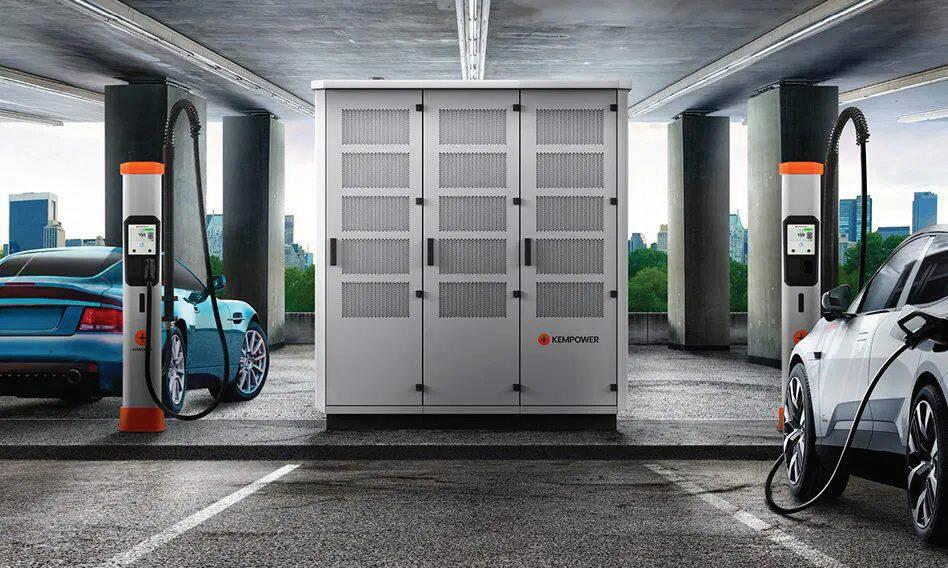
Kempower and GET Charged Fast EV Charging have launched a new EV fast charging station at Glen Oaks Shopping Center in Queens, New York. Four more stations are nearing completion in Queens and Long Island. e new sites, in Whitestone (Queens), Levittown, Elmont and Commack, will open in early 2026.
Each location is powered by Kempower’s distributed charging systems. Each features eight Kempower Satellites, with both NACS and CCS1 connectors. e sites are strategically located at local shopping centers with grocery stores, restaurants and small businesses. e charging stations o er free WiFi and exible payment options, and do not require apps or memberships to access charging.
“EV drivers increasingly prefer charging spots with access to a variety of services like the GET Charged retail-centered charging hubs,” said Kempower North America President Monil Malhotra.
“GET Charged is committed to providing fast, safe and dependable charging infrastructure,” said GET Charged Fast EV Charging Co-Managing Partner Marc Horowitz. “Kempower is the ideal partner for supplying innovative, world-class charging hardware.”
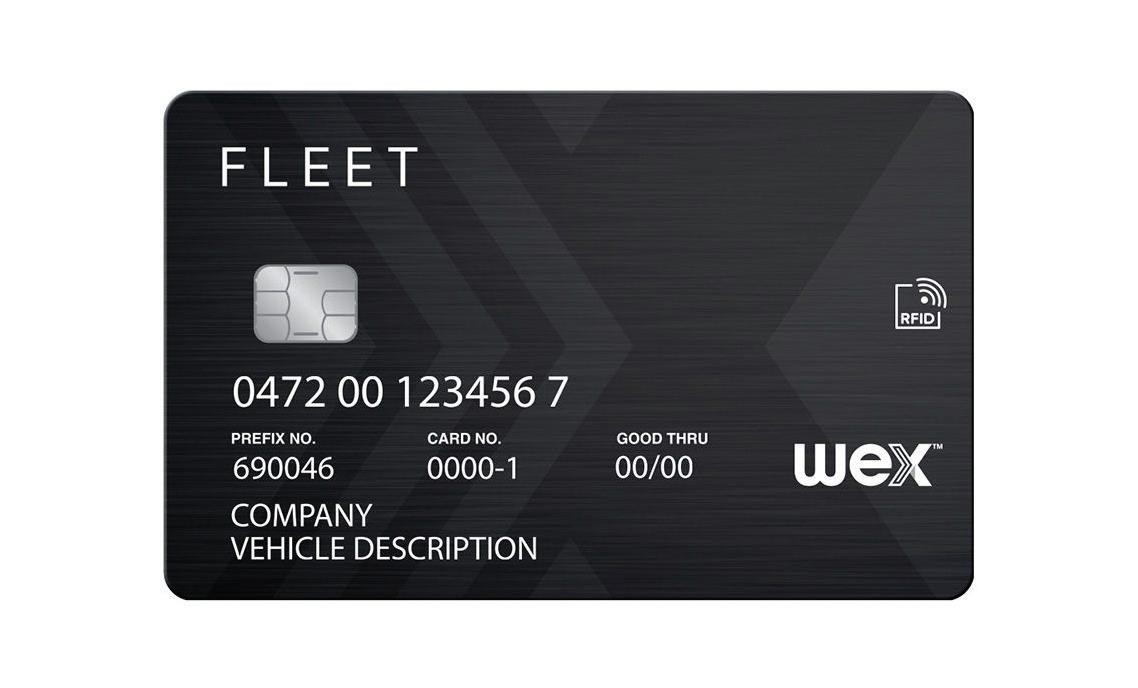
e WEX Fleet card now combines gasoline and public EV charging transactions into one card, one account and one invoice. WEX has uni ed fueling and public EV charging payments across its proprietary closed-loop fuel network, targeting mixed-energy eets that operate both internal combustion engine vehicles and EVs.
e card works at more than 175,000 WEX-accepting public charging ports and at more than 90% of US gas stations that accept WEX cards. e upgraded card embeds RFID technology directly into the standard WEX Fleet card, which WEX says removes the need for a separate EV charging card or mobile app to activate and pay for a charging session. WEX says using its closed-loop eet network, rather than open-loop general-purpose card networks, enables end-to-end transaction control, richer data, stronger security, and eet-speci c purchase controls while maintaining existing fueling work ows. For operations teams, WEX o ers uni ed reporting, purchase controls via the DriverDash app, and a single credit line for both charging and fueling transactions. EV charging can be enabled immediately or added during the next scheduled renewal, and existing EV-enabled customers can request updated cards in the WEX online customer portal.
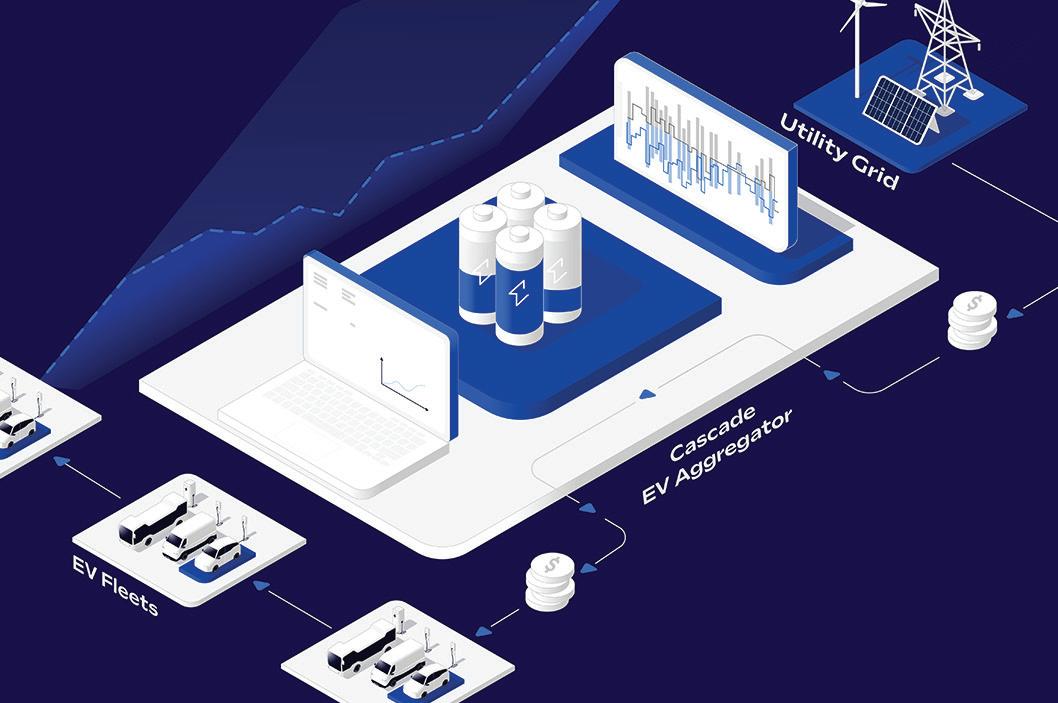
e Mobility House North America has unveiled a new vehicle-to-grid integration platform for utilities. Cascade EV Aggregator is an EV load aggregation tool that enables charging and discharging optimization across a variety of charger and vehicle asset classes, from home chargers to electric school bus eets.
e Mobility House’s Cascade is designed to optimize charging exibility. A charge management system (CMS) such as e Mobility House’s ChargePilot manages charging optimization for a eet operator, but Cascade can work with each CMS at thousands of sites to create exibility for the distribution grid.
Cascade EV Aggregator enables EVs to serve as energy storage assets and provide energy services such as demand response, dynamic rate optimization and grid constraint management. e platform can manage both unidirectional smart charging to incentivize load shi ing (V1G) and bidirectional vehicle-to-grid (V2G) chargers exporting power from EV batteries to the grid. Cascade receives real-time signals from utilities or market programs and engages EV eet charge management systems and residential chargers across a service area.
Cascade is being used to enable V2G features for school bus eets currently being deployed in California, Massachusetts and New York.
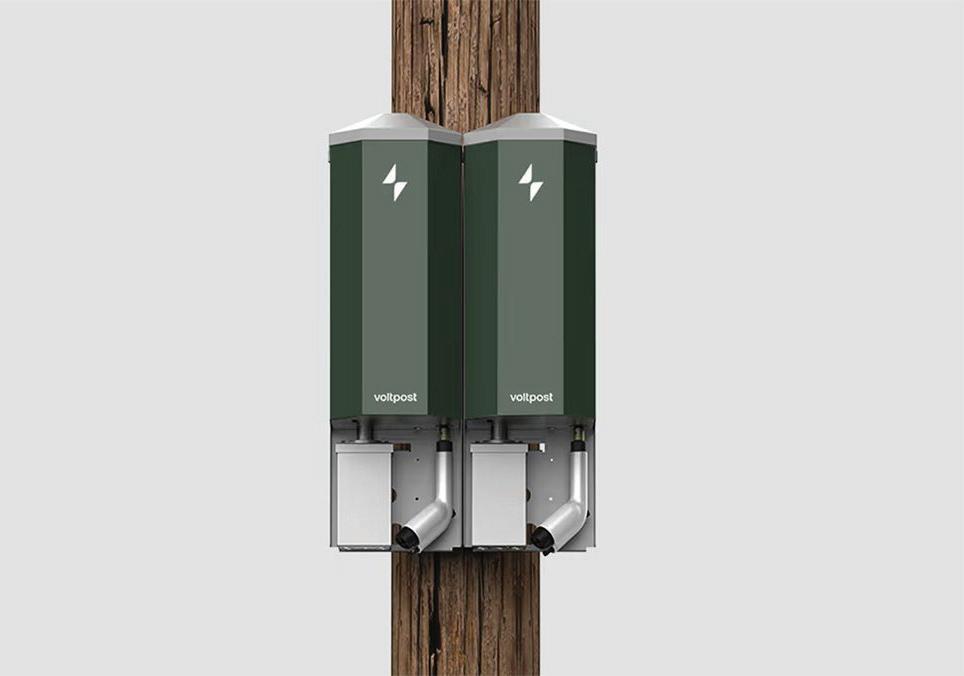
Lamppost charging specialist Voltpost has announced a strategic partnership with EVSE LLC, a subsidiary of Control Module Inc. Connecticut-based EVSE is manufacturing Voltpost’s next-generation lamppost EV charger, the Voltpost Air.
EVSE has executed several successful pilot projects with municipalities and utilities, including the Los Angeles Bureau of Street Lighting.
Voltpost’s lamppost EV charger is designed to be installed in a few hours on an existing public or privately-owned lamppost. Voltpost chargers are equipped with wireless connectivity through AT&T’s network.
“Our mission at Voltpost is to make EV charging accessible to communities across America as fast as possible,” said Je Prosserman, CEO and co-founder of Voltpost. “ is collaboration brings together EVSE’s manufacturing expertise, Voltpost’s intelligent infrastructure platform, and our team’s deployment leadership to create a scalable network of curbside and parking lot chargers.”
James Everley, who led lamppost charging deployments for UK charging network Ubitricity, has joined Voltpost to lead business development in the US market. At Ubitricity, Everley oversaw the deployment of 2,000 lamppost chargers across the UK.
“By uniting the strengths of EVSE and Voltpost, we can ensure that cities, companies and utilities deploy chargers e ciently and reliably,” said Everley.
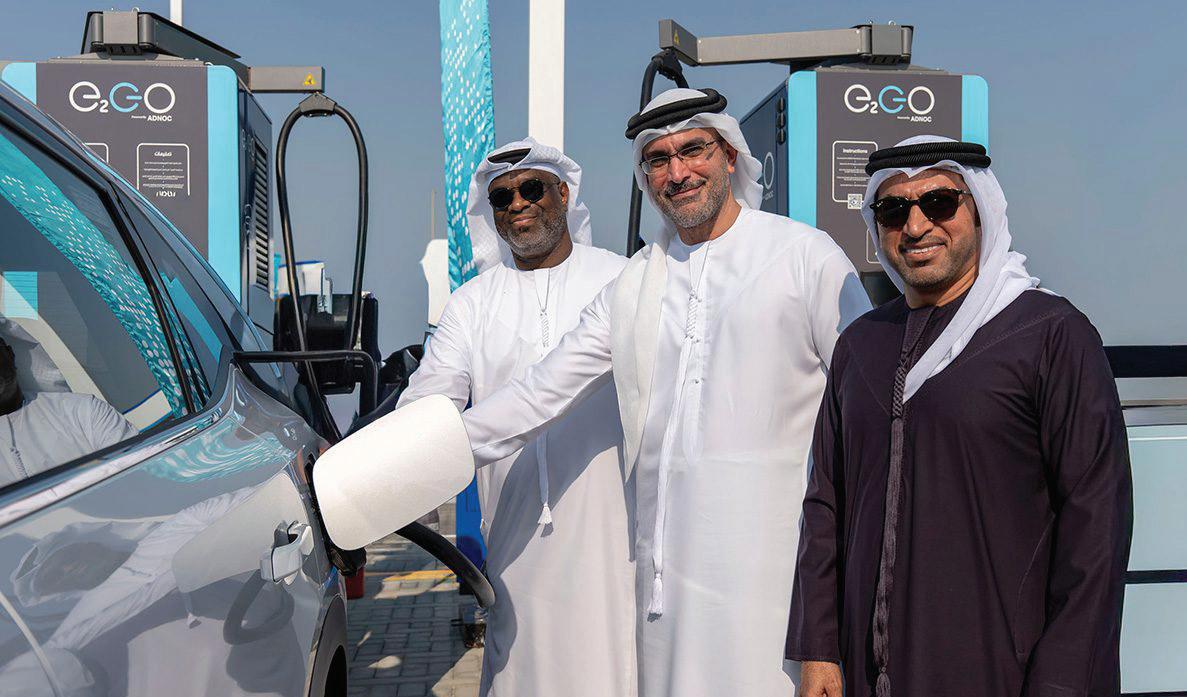
ADNOC Distribution, a gas station and convenience store chain in the United Arab Emirates, has opened a large new EV charging hub, and unveiled a roadmap to electrify the UAE highway network by the end of 2027.
Strategically located at Saih Shuaib on the E11 highway between Abu Dhabi and Dubai, the new EV Mega hub features 60 high-speed EV charging points, and is specifically designed to meet the needs of commuters traveling between the UAE’s two largest cities. It has a footprint three times larger than the company’s traditional service stations, and includes a convenience store with food and a coworking space.
ADNOC plans to open 15 new EV charging hubs by the end of 2026, and another 5 by the end of 2026, providing comprehensive EV charging services across all core UAE national highways.
ADNOC Distribution operates several hundred gas stations, including 562 in the UAE, 172 in Saudi Arabia and 243 in Egypt. It has nearly 370 EV charging points installed under the E2GO brand in the UAE.
“ e inauguration of ADNOC Distribution’s EV Megahub is a signi cant step in implementing the UAE’s National Electric Vehicles Policy,” said H.E. Eng. Sharif Al Olama, Undersecretary for Energy and Petroleum A airs at the Ministry of Energy and Infrastructure.
“ is hub stands out for its strategic location on the E11 highway, one of the country’s most vital corridors. Expanding the high-speed charging network is central to our strategy to cut energy consumption in transport and drive the Global EV Market initiative, which aims to see electric vehicles represent 50% of all cars on UAE roads by 2050.”

XCharge North America has partnered with electri cation contractor Energy Plus to build a large EV charging hub in Williamsburg, Brooklyn. e site will feature 44 XCharge GridLink units, serving 88 parking spaces, and will incorporate 9.46 MWh of energy storage. e site, which will operate under Energy Plus’s Eplug brand, is expected to go live in Q2 2026.
GridLink’s battery storage will help to mitigate pressure on the grid while strengthening local resiliency by drawing energy from the grid at o -peak times and returning it during peak demand periods.
“ rough this strategic alignment with Energy Plus, we’re proving that the EV transition can thrive domestically, setting a model for how public and private companies can come together to accelerate the clean energy transition and make urban energy cleaner, faster and smarter,” said Aatish Patel, co-founder and President of XCharge NA.
“ is is what American-made electri cation looks like in practice: XCharge North America provides the cutting-edge technology and hardware, and we build the infrastructure here with local American labor,” said Moshe Le owitz, founder of Energy Plus. “Together we’re not only creating a model that any US city can replicate, but also laying the foundation for Eplug, a network designed for real urban life—one that’s dependable, familiar, and as easy to use as stepping into your local café to grab a cup of co ee.”
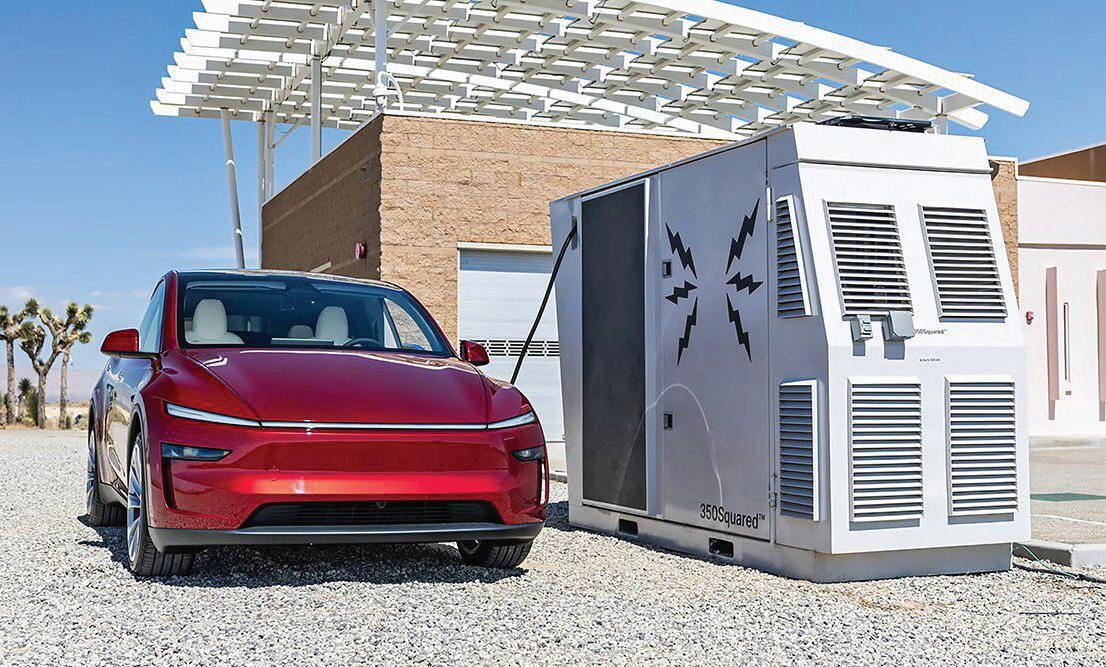
ElectricFish Energy has unveiled a new EV charging platform aimed at gas stations. e new Turbo Charge platform features three integrated components for enhanced EV charging.
e ElectricFish 400squared is an EV charger with built-in energy storage, combining a 400 kWh battery and dual 400 kW DC fast charging ports.
Complementing this, Reef provides real-time management for charging stations, o ering operators insights into sessions, energy ow and performance, while Stargazer, the cloud-based engine, optimizes schedules, predicts demand, and handles grid services to boost revenue for site hosts.
“We don’t sell EV chargers or batteries—we sell time and uptime,” said ElectricFish CTO Nelio Batista. “We’ve decoupled charging speed from grid limits by actively managing when energy ows in or out, so fast charging strengthens the grid instead of destabilizing it.”
ElectricFish has several installations already underway in the US. A commercial deployment is now live in Detroit’s Eastern Market district, where ElectricFish provides charging for a logistics hub’s eet of electric trucks, as well as to the public.
ElectricFish’s battery-supported chargers draw power from their own energy storage systems rather than directly from the grid—they can absorb demand spikes, and can even sell power back to the grid during peak periods. According to the company, its system can deliver 400 kW charging from a 30 kW grid connection, and can be deployed in 4-6 weeks.
Under ElectricFish’s revenue-share program, station owners provide space and a modest electrical connection. ElectricFish covers the hardware and installation and then splits the charging revenue with the host.
e of EV charging cables is a serious problem. For thieves, cables are an attractive target, thanks to the high price of copper. For charging operators, the damage can result in expenses of thousands of dollars to repair and recommission charging stations, and weeks of lost revenue.
DeterTech, the maker of SmartWater, has partnered with Formula Space to integrate SmartWater forensic marking technology into Formula Space’s CableGuard. e goal is to deter the and to ensure that o enders are traceable and prosecutable.
CableGuard is a patented EV cable protection system that makes cables signi cantly harder to cut than standard EV charging cables. Designed for quick and easy installation on both new and existing EV charging infrastructure without a ecting charger performance, CableGuard is designed to act as a visible deterrent and a robust physical barrier.
In case bold thieves manage to breach this protection, SmartWater forensic liquid provides a second line of defense. When a cable is cut, it releases a powerful jet of SmartWater onto the miscreants and their tools, allowing police to identify them and connect them to the protected site. e system is already in use by EV charge point operators.
SmartWater has been available for over 30 years— Formula Space says Toyota used it to reduce catalytic converter the s by 57%, and saw a 100% conviction rate in contested court cases.
“Our crime intelligence analysts have identi ed a sharp rise in EV cable the , and we expect this trend to accelerate as charging networks expand globally,” said Gary Higgins, DeterTech’s Director of Security & Risk. “By integrating SmartWater with CableGuard, we’re giving operators a highly e ective solution to protect critical assets.”
“CableGuard was developed to address the growing issue of cable the ,” said Vern Pollard, Director of Client Relations at Formula Space. “Combining it with SmartWater takes protection to the next level.”
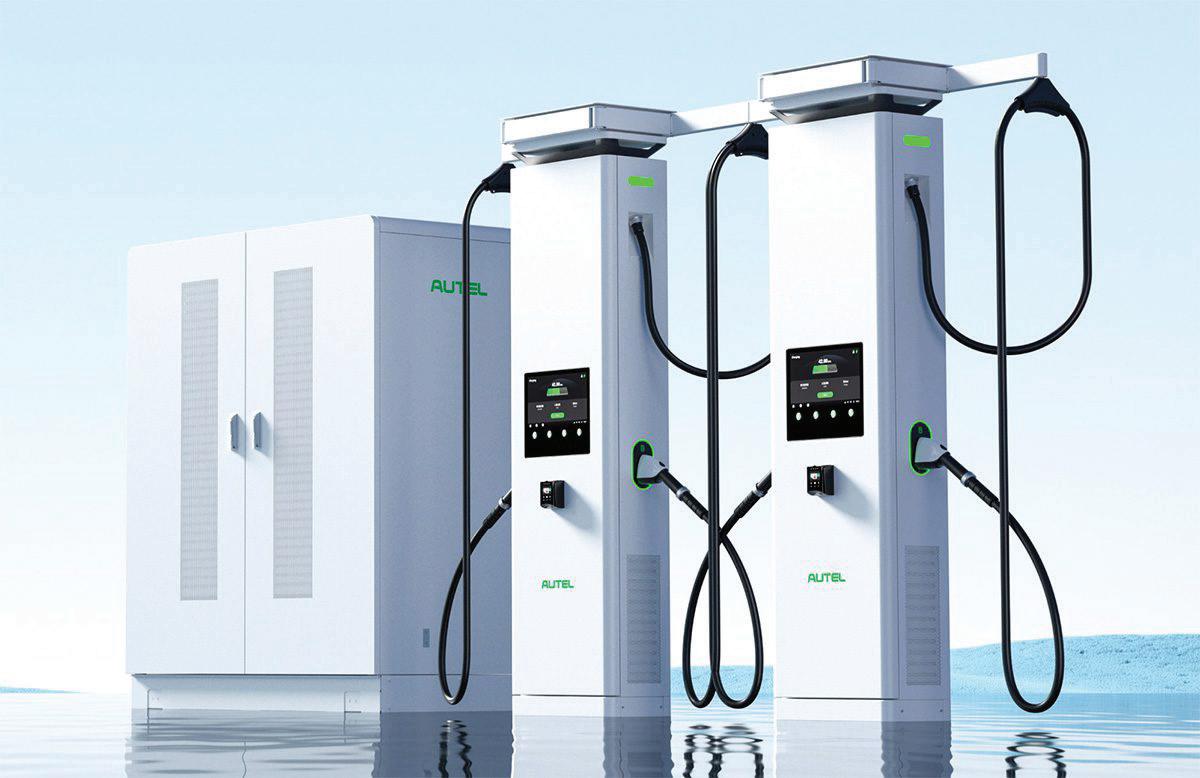
Australian EVSE provider Autel Energy recently launched a next-generation liquid-cooled charging system and all-in-one smart energy solution.
Autel Energy’s next-generation high-power charging solution, the MaxiCharger DS600L Liquid-Cooled System, features new liquid-cooled power modules, and delivers up to 3 MW total output per cabinet cluster. It supports both CCS and MCS standards for eet and depot applications.
e DS600L is compatible with multiple dispensers and terminals, enabling tailored solutions to meet diverse operational requirements.
Autel’s proprietary Energy Management System optimizes energy ow and operational e ciency, and enables seamless integration with battery energy storage systems (BESS) and solar panels.
Autel’s One-Stop Intelligent Charging Network features the new-generation MaxiCharger DC Series, including the DH480 and DT500, and the AC Single Charger for both commercial and residential use. e DH480 supports up to 480 kW dual-port output for simultaneous fast charging, and the DT500 o ers up to 500 A for heavy-duty transport and eet operations. e AC Single Charger delivers 22 kW Level 2 charging, and supports intelligent load balancing for up to 200 chargers.
Autel’s Intelligent Charging Network combines with EV charging and BESS units to form the complete Autel iGreen Charging Solution.


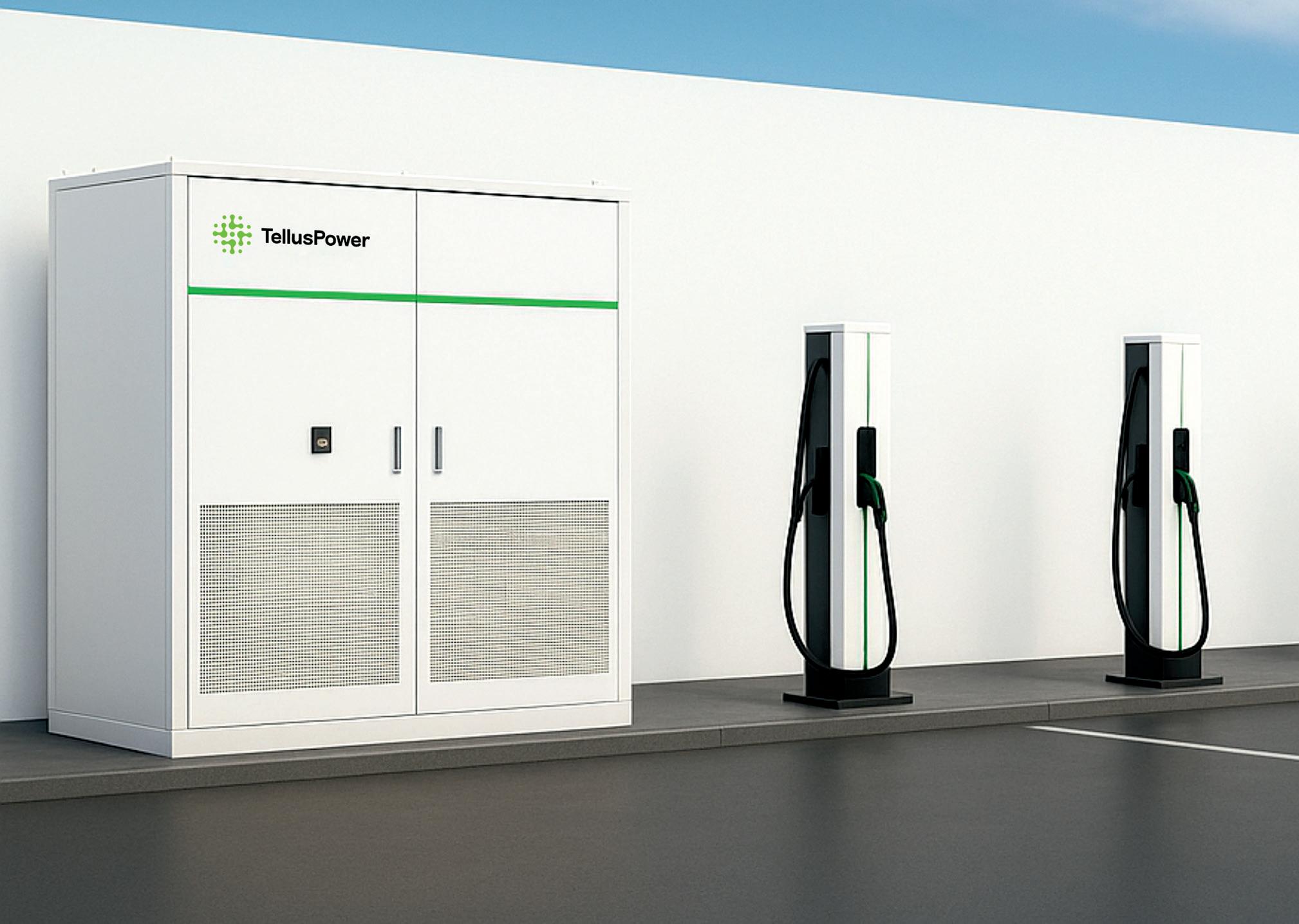
Tellus Power aims to deliver the features customers need today, while preparing for a massive scaling up in the future.
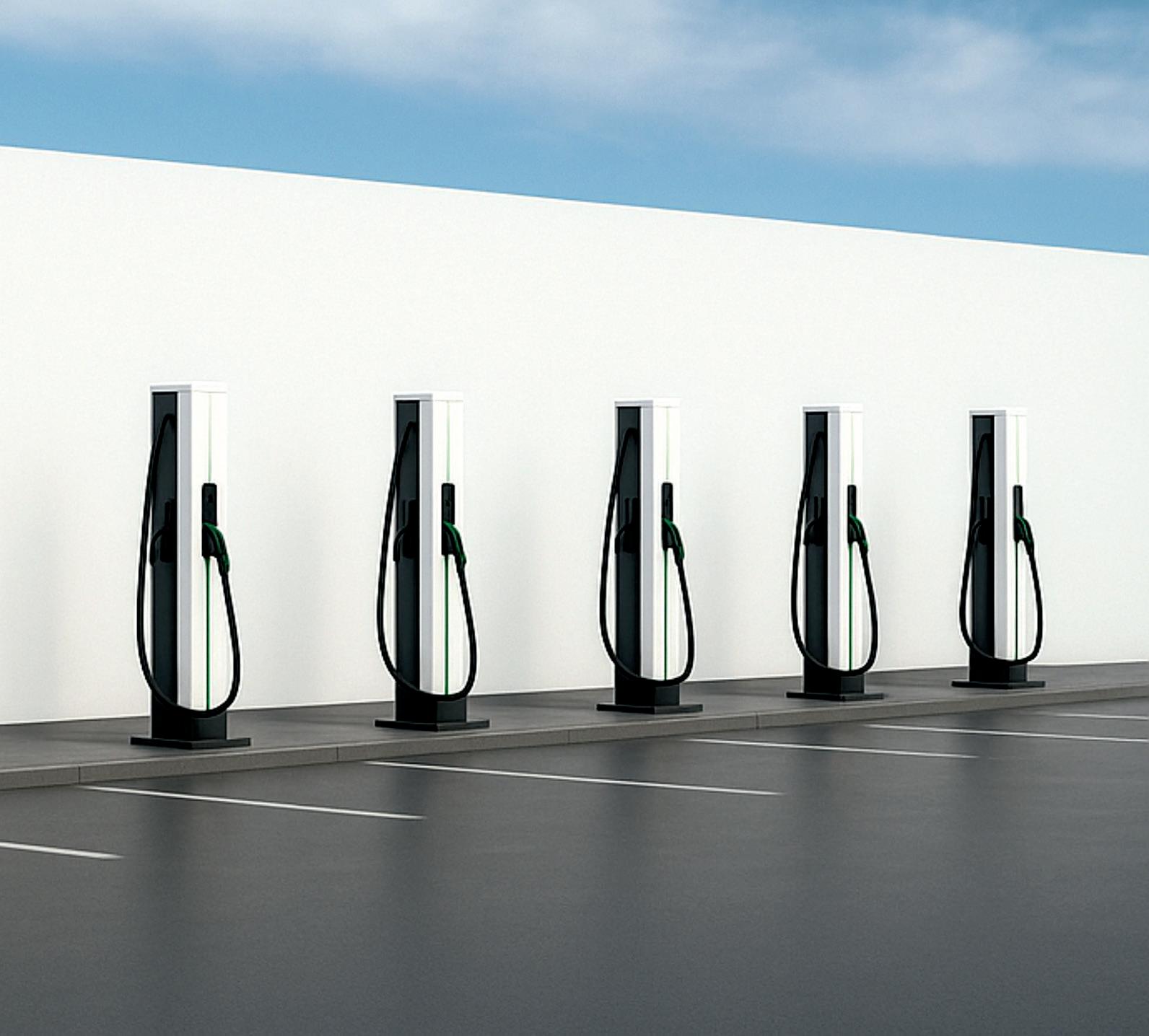
By Charles Morris
It’s tough to keep up with the latest developments in the EV fast charging industry these days. Charging providers are rapidly rolling out fast charging stations around the world, with ever-larger numbers of individual charging points.
At the same time, technical innovations are moving fast, and operators and hardware manufacturers don’t necessarily agree on the most cost-e ective and customer-friendly ways to scale fast charging.
Everyone agrees that the industry needs cost-e ective ways to scale up to larger sites and more coverage, but is it better to use standalone chargers that incorporate the customer interface and the power supply in a single unit, or to use a distributed system with a central power supply and satellite dispensers?
”
“We are in a record time for DC fast charging deployments. The opportunities are exceptional.

Mike Calise Tellus Power CEO
Everyone agrees that user interfaces need to be better—we’re all sick and tired of the proliferation of proprietary, poorly-designed apps. But are credit card readers (mandated in some jurisdictions) the answer, or are they anachronistic devices that introduce another point of failure? And why is it taking so long to get Plug & Charge rolled out?
Tellus Power is attempting to cover all the bases. e company recently unveiled two new 600 kW DC fast charger systems: a distributed system and an all-in-one unit. Both con gurations support 800-volt architecture, and both are compatible with NACS, CCS1 and CCS2 standards.
Charged spoke with Tellus Power CEO Mike Calise, who has been running the company since the beginning of 2025.
Q Charged: Let’s start with a brief history of the company and an overview of what you do.
Mike Calise: Tellus Power is a manufacturer of DC fast chargers and vehicle-to-grid hardware, and a supplier of so ware and storage products, which are critical for grid-friendly infrastructure.
We have our roots in Shanghai, so world-class, lowcost global manufacturing. We have our headquarters in Irvine, California, where we also manufacture DC fast chargers. We manufacture what’s required for Build America, Buy America products—55% US content delivering to the US market. We also have o ces in India, Europe, South America and the Southeast Asian market.
We are in a record time for DC fast charging deployments. e opportunities are exceptional. We see Uber and Ly requiring very fast in and out times, we’re seeing last-mile delivery eets electrifying, we’re seeing the advent of medium-duty and heavy-duty electric trucks. Our mission is to be number one, two or three in all our markets.
Q Charged: You have a pair of new products—a distributed charger and a standalone charger. I recently spoke with a couple of people who say that distributed chargers are the future, but you see good applications for both formats. Where would you want a distributed setup and where would you want a standalone?
Mike Calise: I love the question, and they are correct to say that distributed charging is the future. Well, it was the early present too. ink about Tesla. Tesla was such a streamlined experience. You show up, you plug in and you walk away. You don’t see any big unit, you don’t see a big screen, you don’t see a credit card reader.
But we as a nation went with CCS1, so you have to meet the needs of every EV owner. You need to put a credit card reader on there. Obviously, you need a display to interact. We needed to put those units in to meet a large cross-section of the population’s different driving habits.
Sometimes bigger is better. If you can physically see a unit that’s lit up, you can clearly see where you can get your charge. e trick with standalone integrated solutions is make them with a small enough footprint that they’ll t behind the parking stall. en you just plop
Distributed charging is the future. Because ideally, everybody is feeling that Tesla experience. You show up, there’s a little pedestal, you plug it in, you walk away.
them down—easy to install and easy to maintain. You got one down, electrician shows up, opens up the cabinet, everything is there—the power, the DC, the AC, the recti cation, the cable.
So, there is practical bene t to the all-in-one. And if you look at us and our competition, we’re still selling a lot of all-in-one units. But is distributed charging the future? We believe it is. Why? Because ideally, everybody is feeling that Tesla experience. You show up, there’s a little pedestal, you plug it in, you walk away. e car transacts using Plug & Charge, your credit card or your loyalty program. It’s seamless. No displays, no credit card swipes. Who doesn’t want to streamline?
If you think of the old mainframe businesses and computers, distributed processing is where everything eventually went to. You could say, well, that big power cabinet with those little terminals, that’s almost like a mainframe, right? But the bottom line is the processing—it’s all in the cloud. It’s all in the car. And we’re already there with Plug & Charge.
ere are advantages to that sweet, small pedestal—no display that went bad, no credit card reader that got jammed. A lot of the downtime in these units is not charge-related, it’s display-related, it’s modem-related, it’s credit card-related. e charging isn’t the problem. Every now and then you’ve got to repair it, sure. But the things that fail are those human interface things—displays, buttons.
When we go to this distributed system, here’s another advantage. You’re distributing over a DC bus. If you go AC grid, recti cation, AC to DC, then DC to DC in the car, you’ve got some hops there. When we distribute to pedestals, all of that is DC, so the cost of installation goes down dramatically.
And if one of these units goes down, you just pop open the cabinet and replace an AC-to-DC module or a DC-to-DC module. You deal with the power conversion


back at the cabinet, and that’s transformer-like equipment. at back-of-the-fence grid equipment, you don’t have to make it pretty, so you can keep the cost down. en you make nice, streamlined, aesthetically pleasing pedestals to plug your car into.
Q Charged : Someone was telling me the other day that the credit card readers are the biggest point of failure, but aren’t they required in California and some other states?
Mike Calise: Mary Nichols [Chairwoman of the California Air Resources Board from 2007 to 2020], who drove the most EV-friendly policy in the country, said EVs cannot be just for the wealthy. EVs need to be accessible for everybody. We’re going to require a credit card. You can’t have someone show up and not get a charge because they weren’t sophisticated enough to get the app and put in a QR code. And she made a lot of sense.

Who’s going to argue the equity? But we did, and here’s why. Turns out more people have cell phones than they do credit cards. From the disadvantaged neighborhoods all the way up, everyone has a cell phone. Not everyone has a credit card.
So, we appreciate the well-intended nature of that policy, but actually the credit cards are a mess. Credit cards are not as reliable in outdoor applications as they are in indoor applications. ose credit card readers, the modems, the SIM cards and the connectivity and the displays, they take a beating in the wild. ey weren’t designed for abusive outdoor use, and they’re not even always covered. I believe California recently reversed the requirement.
[Editor’s note: Authority for EVSE standards is being transferred from CARB to the California Energy Commission. A CEC spokesman told Charged that a recently-passed bill, AB 1423, “authorizes the CEC to modify requirements for EV charger payment options in light
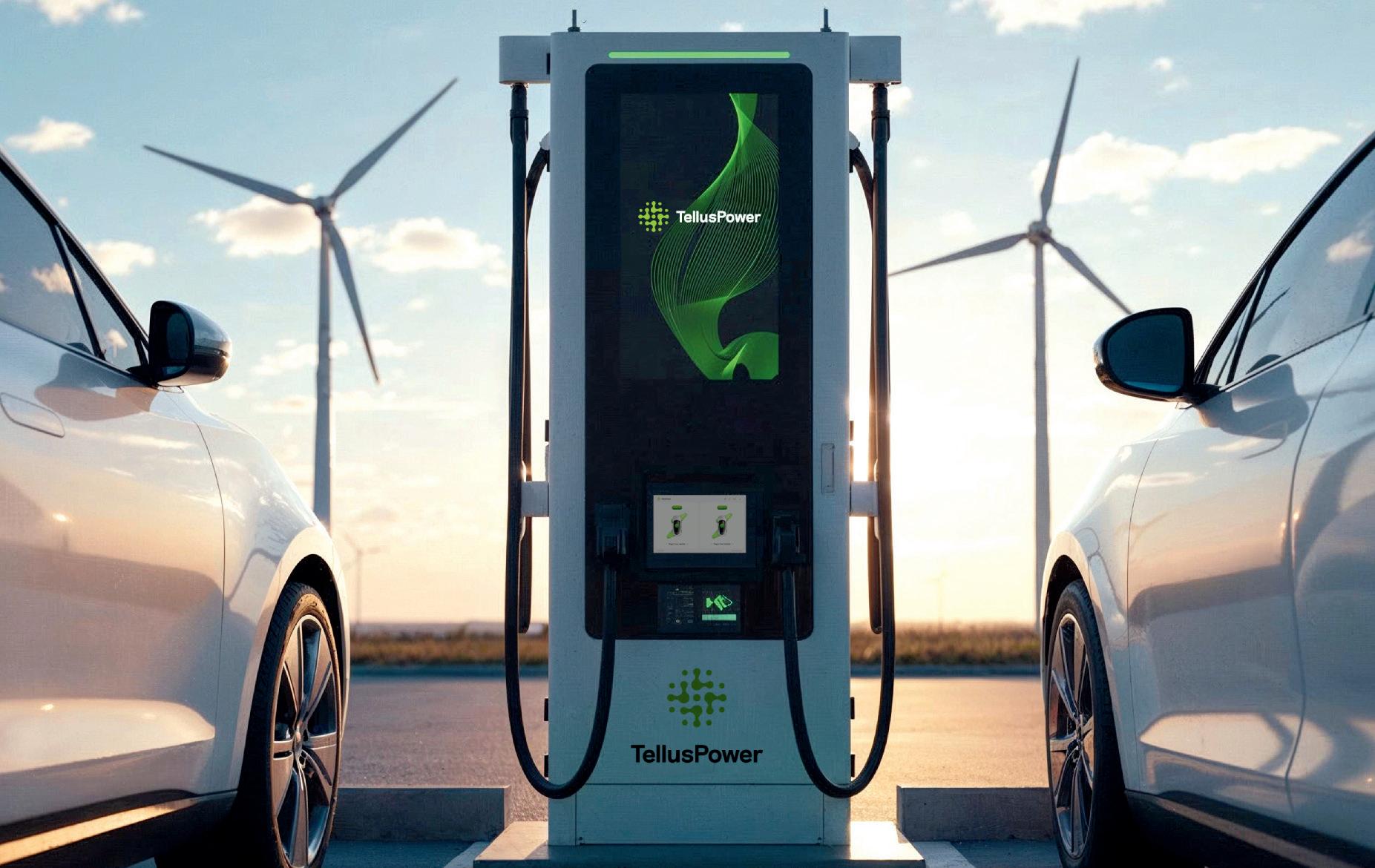
of changing technologies or cost impacts,” and that the CEC is “exploring a process for new regulations.”]
With Plug & Charge, you don’t even need a credit card, an app or a cell phone. You just plug in, and your car does it all. Yes, you have to have a credit card account or some bank account—you can’t pay cash.
Q Charged: How far away are we from seeing widespread implementation of Plug & Charge?
Mike Calise: e Plug & Charge concept and the 15118 standard have been around for several years. It’s not that far out. It’s being used daily today.
Q Charged: I’d love to hear some more about V2G. Is V2G still a pilot-level technology, or are there some real commercial applications going on?
Mike Calise: ere are some real useful projects going on today, so it’s no longer pilots only. We have Oakland Uni ed School District and Fremont Uni ed School
We appreciate the well-intended nature of California’s requirement for credit card readers, but actually the credit card readers are a mess. They weren’t designed for abusive outdoor use.
District right now, using battery storage within the school bus, going back into the building and into stationary storage, which is awesome.
Check this story out, we’re very proud of it. ey have very expensive petroleum in California that they have to purchase for these buses, making their operational costs prohibitive. eir utility bills are through the roof. ey have energy-ine cient buildings, and some of these school districts are operating in the red due to high costs of operation.
e Oakland and Fremont school districts got local
V2G is a complete transformation for the school districts and a positive impact to their communities. It’s a killer application.
municipal funding for a V2G project. ey put solar canopies on their parking lots, producing their own energy. eir energy bills went down a little bit. ey deployed V2G-capable electric buses, and their overall utility and fuel bills went down dramatically. Now they’re operating in the black. ey charge these buses during the nighttime when energy is cheap, then discharge the batteries from the vehicles to the building during times of peak energy costs.
It’s a complete transformation for the school districts and a positive impact to their communities. at’s a model that can be scaled across a massive number of public school districts.
Q Charged: So these school districts are not only paying for all their energy costs, but they’re actually generating a surplus that they can use to pay for other things? Why isn’t everybody doing this?
Mike Calise: You need a lot of stakeholders. You need the utility—they’re critical because they’re going to transact the deal. You need a technology provider like Tellus Power. You need the bus company to say, we’re okay to run these batteries back and forth all day long, not just one way. And when you get all that, it happens. School buses are still the best application, but then you go to transit buses and last-mile delivery vehicles with known routes. If there are known routes, a known time, you can e ectively manage it because you know when the sun will shine during the day, and you know the utility rates for time-of-use. You can then mitigate utility demand fees and even exploit dynamic pricing.
It’s a killer application. O en it takes government grants because these buses are expensive, but we’re way past this phase of testing in the lab to real-world applications. Now you need a little bit of escape velocity—that’s probably in the next three years.
Q Charged: Well, don’t let the politicians nd out about that, because then they’ll just cut the school budgets by the corresponding amount.
Mike Calise: Of course they will. Yeah, we’ve got to be apolitical, and I see the good, the bad and the ugly in multiple administrations. I’ve been through two Obama administrations, one Trump, one Biden, another Trump, and we’re still doing this business. Government grants are good, but even though they are o en well-intended, sometimes there are unintended consequences, and it can get messy. So, we’re just talking about the technology and the value that we bring and the advantages we bring over our competitors as we navigate tailwinds and headwinds alike.
Q Charged: I hear a lot of people saying there’s going to be a big shakeout in the charging eld. With so many companies selling chargers, how do you di erentiate your products?
Mike Calise: Well, there’s already been a shakeout. ere’s been failed companies since 2010. Littered on the highway, there’s probably 100 companies with chargers out there. I can name at least 20 that were around in the early days that looked incredibly promising but failed dramatically. at’s a natural course for all innovative new businesses.
So, who are you going to deal with? e company that still survived a er all these years, or the company that’s gone? I worked for both types. I’m the one who took Blink public back in 2018. e CEO rebranded it from Car Charging, took it public, and created a $2-billion valuation at one time. Right now, they’re around 180 million, depending on the day, and the stock is up over 50% in the last six months.
We’re in an innovative business. ere’ll be successes, failures and consolidation along the way. As any experienced CEO will tell you, we get tailwinds and headwinds. Just like in sailboat racing. at’s what makes Tellus Power di erent—we know how to sail in both headwinds and tailwinds. You’ve got to know when to put up the sails without breaking the masts, and you’ve got to know when to get real light and reduce your load so you can go faster. is is a natural test for strong leadership. e companies that will succeed are the ones that con-



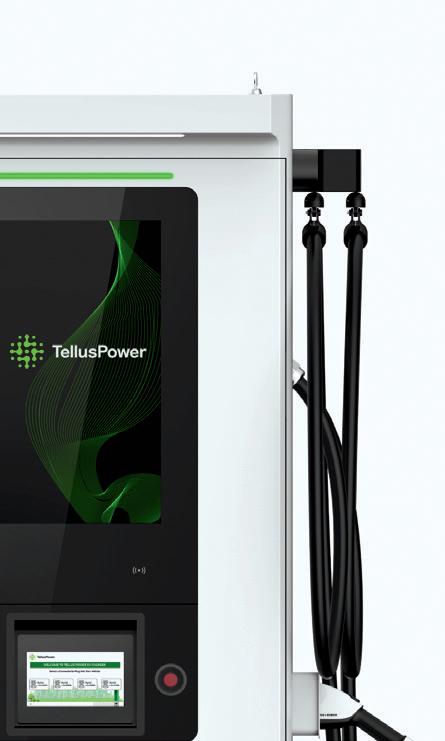

tinue to innovate through an evolving new market, but sometimes innovation isn’t necessarily technology—it’s also the business model. How do you work with a revenue share? How do you work with leasing? How do you work with buy now, pay later? How do you work with percentages of revenue and energy? How do you secure cheaper energy? How do you store the energy that you secured? How do you create your own energy? How do you sell back energy? at’s a complex scenario. And the companies that we’ll see in the future are the companies that gure out that there’s money to be made in hardware, but there’s also money to be made in services, logistics, so ware, energy, tokenization of energy, and transferability of tokenized energy.
Q Charged: What are some other innovations that we’re going to see over the next few years in the fast charging sphere?
Mike Calise: What we’re going to see are e ciency plays within a microgrid. It’s a whole new world of increased load demand. It used to be that transportation was the biggest new load on the grid. Now it’s shi ed to data centers and AI. We have a pressing demand for new, cleaner energy with these industries, and we’re starting
We’re seeing new innovations in transformer technology using intelligent high-switch capability. It’s going to be very important for overall grid efficiency.
to see massive shi s in the way energy production is handled because of those needs.
We’re seeing new innovations in transformer technology using intelligent high-switch capability, which is very e cient transformer technology, excellent for the grid, silicon carbide-based. It’s going to be very important for overall grid e ciency. You start to see the reduction, the removal of these power conversion systems. e grid is AC, so we go from AC to DC, DC to AC, then we go to the DC battery pack, and you’ve got these systems in place that are expensive. So, you have your batteries and renewable energy which are DC, and then you have this system that’s doing all these conversions in a box. In the future, we’re going to get rid of that box, and even get rid of internal transformers. You’re going to have a microgrid that’s highly e cient, less lossy to the tune of…I’m guessing 94 or 95% e cient versus 91 or 92%, maybe as high as 97%.
Everyone says we need this massive battery breakthrough so we can all charge up in ve minutes, but you actually don’t need that. ere’s sustainable innovation and there’s disruptive innovation. Sustainable innovation in battery technologies happens just by changing the anode chemistry or the structural costs associated with building the battery. Now we’re seeing battery technologies incrementally improved to the point where they’re at a $100/kWh price point. It’ll drop to $90, then it’ll continue to drop to $80.
If you’re at $80/kWh, you can basically manufacture a compact EV, the whole car, for less than $20,000. You can get a highly a ordable commuter car for the masses, and with an innovative business model, you don’t even have to buy the car—you can rent it. Waymo and Tesla are exploring autonomous vehicles with new business models. e world will be a very di erent place in the next ve years. I see technology drivers down at the silicon level that are going to unleash tremendous gains to deliver cost-e ective solutions for EVs.





































































































































































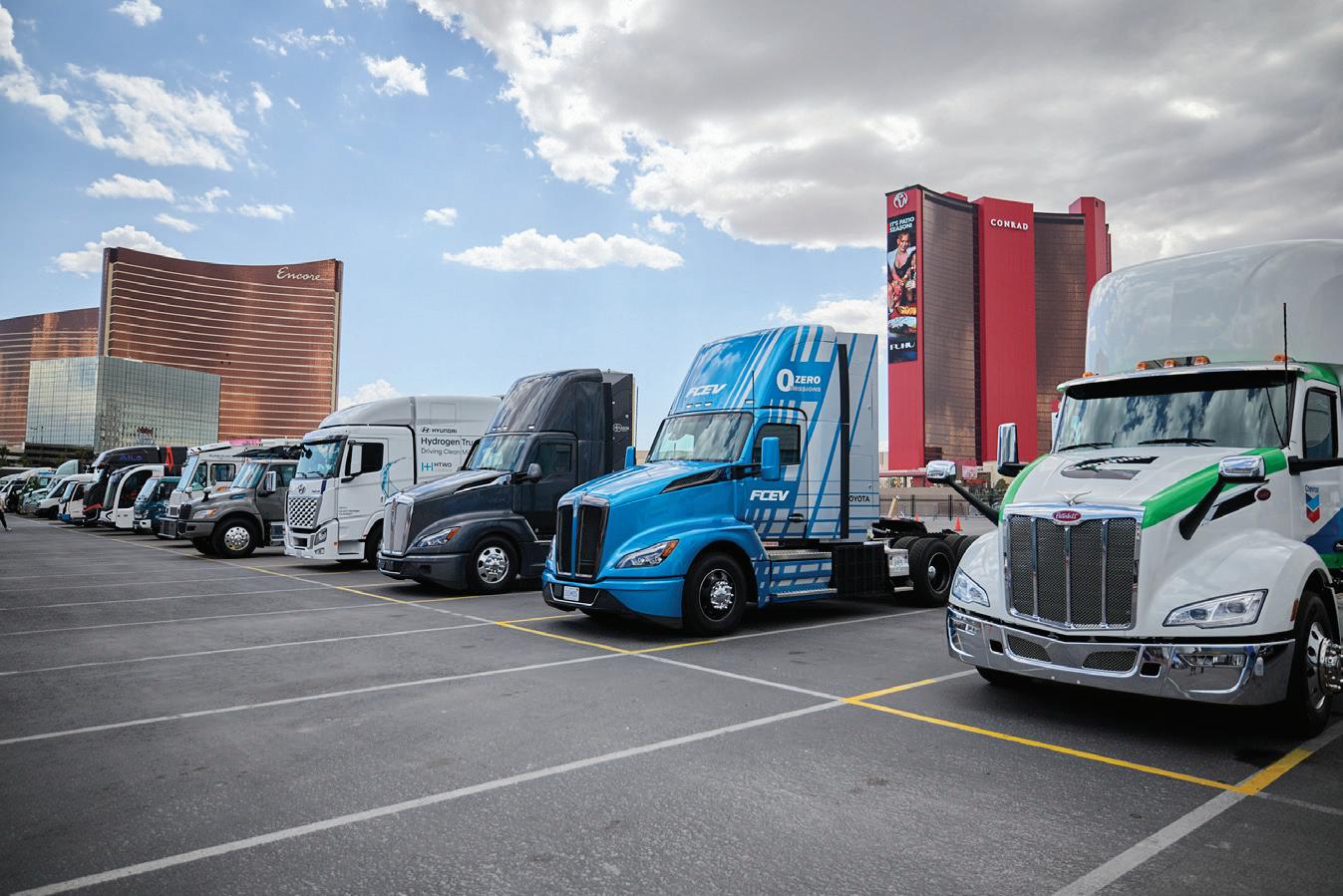








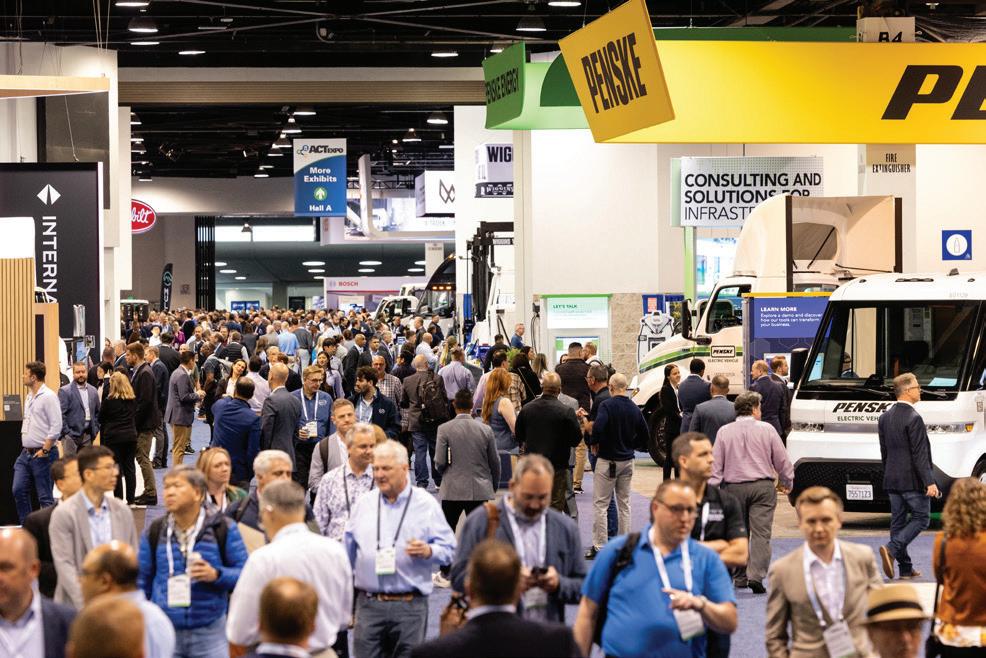
By Charles Morris
“Focus on your core business” is a tried-andtrue business maxim. Companies large and small rely on service providers to take care of logistical tasks so they can concentrate on whatever it is they do to generate pro t. at’s what ABM is all about—it provides a vast array of services for companies, from cleaning and maintenance to installing and running building systems like HVAC to managing mailrooms.
Among ABM’s many o erings are transportation-related services such as managing vehicle eets and parking facilities. As companies have begun to electrify their vehicle eets, ABM has developed an extensive range of EV-related services, including a turnkey EV charging package that lets customers outsource their EV charging infrastructure. Over the years, Charged has covered many companies that provide individual layers of the EV charging infrastructure “stack,” as well as those that o er the complete
package—charging as a service. However, most of these have been fairly new companies that were formed specifically to address EV charging, and their target customers tend to be companies that are in the business of operating eets. ABM is a player in a much larger ecosystem—EV charging infrastructure and eet management is just one part of its portfolio of services, and its EV charging customers could include just about any organization that operates vehicles.
Charged spoke with Satish Jayaram, ABM’s Senior Vice President of eMobility.
Q Charged: How long has ABM been in the EV charging game, and who are your typical customers?
A Satish Jayaram: e charging infrastructure business at ABM started a little over ten years ago. For the rst seven or eight years we were heavily passenger car-focused. e
two segments that existed at the time continue to exist inside our eMobility portfolio. e rst is what we call parking as a segment. is can be a parking garage, an airport, a place of employment…anything other than residential, because we don’t cover residential. Wherever you park your vehicle and need charging infrastructure. e second segment was OEMs. We had a host of OEMs like the Fords, the GMs, the Chryslers, that were introducing electric vehicles and needed their supply chains and dealerships electri ed. We deployed over 30,000 chargers over the rst 8-10 years. We started seeing the introduction of commercial vehicles from 2022 on, and we’ve signicantly pivoted our business to address Class 2 through Class 8 vehicles.
Over the last couple of years, we’ve been focused on private eets. Corporate eets have strong synergies with ABM because we service corporations from a facilities perspective. at was a synergistic space for us, corporate eets that are electrifying, and also public infrastructure such as school bus eets, transit eets, port eets. e vast majority of our business today is eets.
Q Charged: And I imagine you provide other services for those eet operators beyond just EV charging.
A Satish Jayaram: Yes. In the EV charging space, we do complete design and build for eets, as well as operations and maintenance. We take it from a conceptual design all the way through procurement and construction. And we have a central network operations center that delivers a Service Level Agreement (SLA) to the eet operator through the life cycle of the infrastructure. We have a network operation center in Cummings, Georgia, and we have eld engineers that service and support the depots for whatever the SLA is.
In terms of other services that we provide, several of these customers we touch in one form or fashion from ABM’s core integrated facilities management. In many of these examples, we are providing mechanical services, integrated facility services for depots and for the parent entity, so there’s a fair bit of synergy with the electri cation and technical services work that we provide.
We don’t provide vehicles. We have partnerships with third parties that will provide vehicles from a nancing perspective.
Q Charged: Where does your subsidiary RavenVolt t into the picture?
A Satish Jayaram: RavenVolt is wholly owned, it’s integrated with our electri cation business. RavenVolt provides the front-end design engineering—everything to do with getting power to the site, including any necessary utility power upgrades, which is more o en than not the case, especially in the public eet space. O entimes we nd that customers want resiliency, so they need switchgear upgrades. In some cases, depending on the markets that they operate in and the utility jurisdictions they’re in, energy management is required, given the cost of electricity at varying times. RavenVolt provides all of the electrical infrastructure design, build and construction of the microgrid portions of the solution.
Q Charged: Microgrids are a hot topic. Tell us more.
A Satish Jayaram: e way we think about microgrids is essentially three things. One is resiliency. How do we ensure to a eet customer that the vehicles are charged when the shi starts at 6 am, or when you’re delivering a community service that’s really critical?
e second part of what the microgrid delivers is meeting the client’s stated sustainability goal.
And the third is economics. I’ll give you a good example. I was talking to a eet operator last week, and they purchased a bunch of electric vehicles. ey operated internal combustion vehicles for as long as you can remember, and this eet manager said, “I’ve been doing this for 31 years. I know exactly how much diesel to buy, I know how much it costs on a per-mile basis. I can tell you in my sleep what all those numbers are, and how to hedge my fuel. Now I have all these electric vehicles coming in. I don’t know what the cost of power is, or how to manage my cost of electricity denominated by per-mile driven. It’s a whole new space for me.”
So, the third part of the microgrid component of the electrical infrastructure is: how do we help customers and eet operators get the most economic value of electricity from a cost-per-mile standpoint? at’s the energy management piece, and that determines how you design the microgrid in a way that optimizes cost of electricity per mile.
A microgrid could be as simple as having a generator that provides resiliency, or it could be as complex as projects we’ve done that include solar, generators and batteries so you can optimize your type of charging, and reduce the shock to the grid when you have 50 vehicles that all plug in at the same time. Now, not all customers need all of these components—it’s going to be some combination of these things.
Fleet managers are very focused on the cost per mile— and not just the operational cost per mile, which is fuel and maintenance, but also cost per mile from a CapEx investment standpoint. How do I manage that through the life cycle of the asset?
Q Charged: I’ve heard a lot of stories about companies that just buy a bunch of EVs, and a year later they’ve got a mess on their hands because they didn’t properly design the infrastructure. Can you give me a case study about how you were able to solve a problem for a customer?
A Satish Jayaram: I’ll give you a recent example. We were working on a school bus electri cation project. e school district, because there were some funds available from the state and the federal government, purchased a bunch of electric school buses. e school buses showed up, and I think they had 16 Level 2 chargers for 70 buses. e perception was, “Hey, we could just install a few more chargers and we’re good to go.” But for that volume of electric buses, it’s not just putting on a few more chargers. ere’s a whole bunch of infrastructure
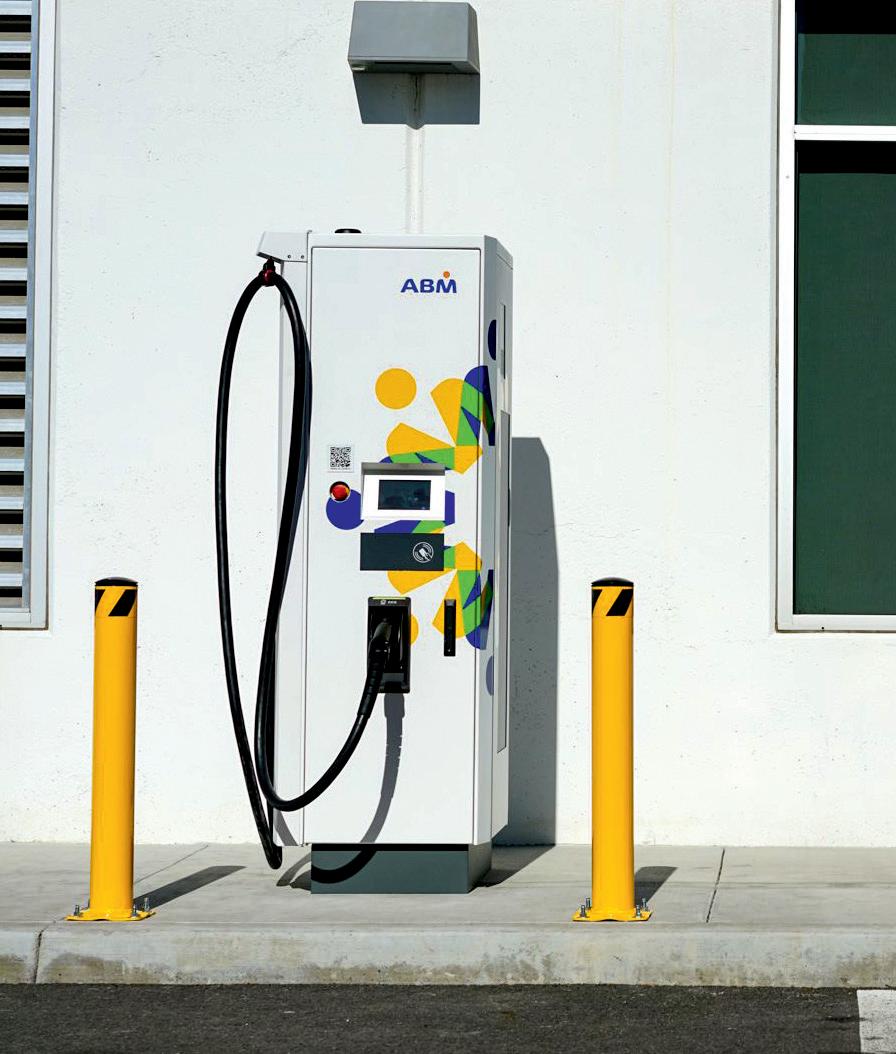
you need to build out, including getting an additional service line from the utility, and upgrading the switchgear. If you’re not a practitioner in the space, you don’t think about these things. How do I plan what the depot looks like and where the vehicles come in, because it’s not the same as internal combustion—you need to have spacing and bollards and striping with a certain amount of space between the buses to get the wires in. ere are a number of examples where vehicles precede the infrastructure, and construction does take time—it’s not something you can do overnight.
In this particular example, we came up with an interim solution for the client until we could build the permanent infrastructure. e answer was not to bring a bunch of diesel generators to power electric buses, because that fundamentally defeats the purpose from an emissions perspective, right? e short-term solution was to provide some batteries combined with propane generators. Propane generators have a signi cantly lower emissions pro le than diesel or gasoline. e batteries in this case were the initial power source that was powered by the grid. In this particular use case that worked well, because you didn’t need as many generators. is use cycle, you’re running these buses from 6:30 in the morning to 3:00 in the a ernoon on di erent shi s. So, the grid was connected to these batteries 24/7, and the backup was the propane generators.
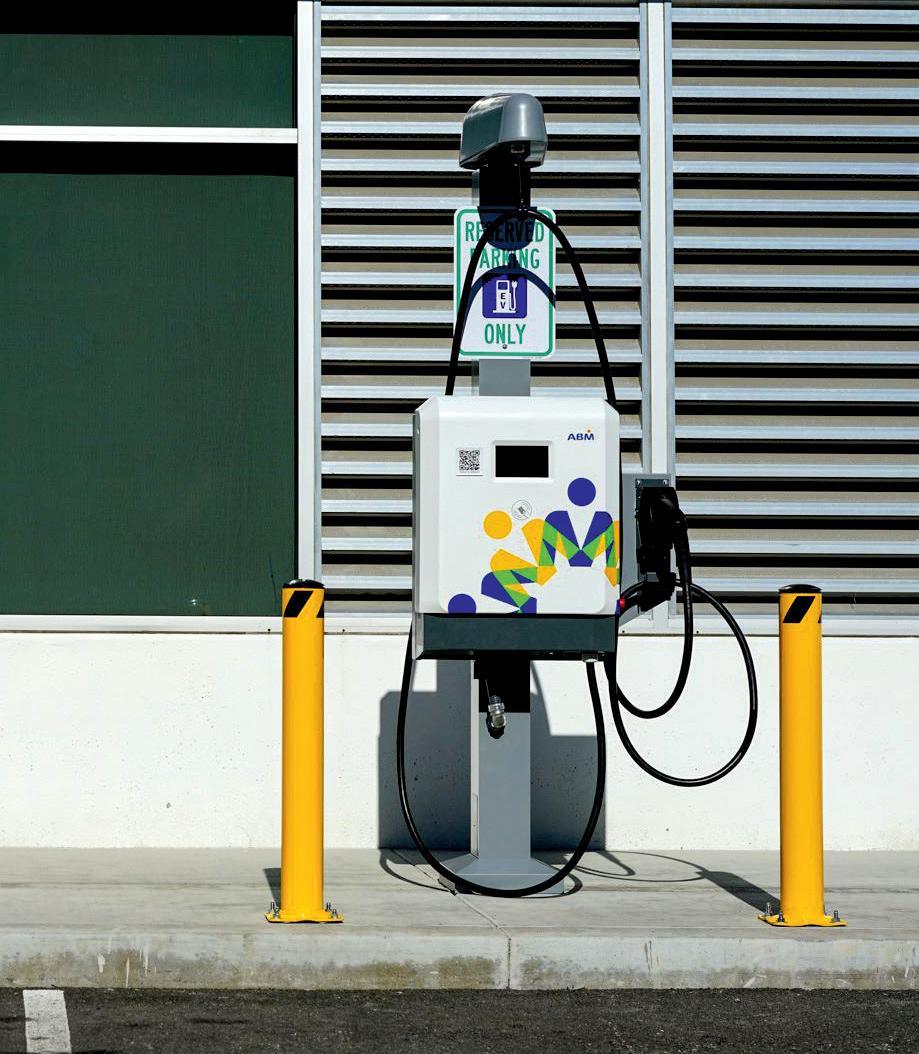
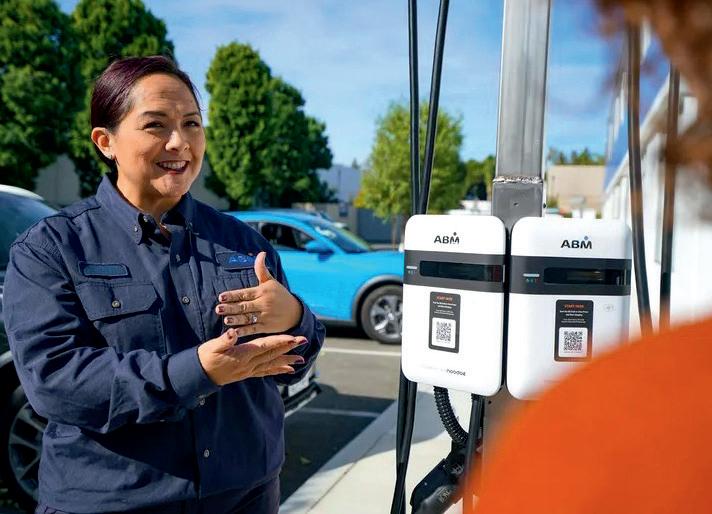
Q Charged: What about vehicle-to-grid? Is that still a pilot-stage technology, or do you have any V2G applications in actual commercial use right now?
A Satish Jayaram: We have pilot projects, but it is not broadly prevalent yet—it depends on the jurisdiction. Obviously electric school buses are a great application for vehicle-to-grid. And I would say, it is not a technology problem to solve as much as it is a distribution-grid interdependency and scheduling and reverse ow of power problem. You can do vehicle-to-grid from a pure charging and vehicle power ow standpoint. But there are other considerations, which is why utilities are really being thoughtful around how best to integrate these into the distribution side of the grid. ere’s safety things
A critical part of the microgrid component of the electrical infrastructure is: how do we help customers and fleet operators get the most economic value of electricity from a cost-per-mile standpoint?
that need to get resolved, there’s standards that have been written and are being piloted right now at several of the utilities.
Q Charged: You provide hardware and so ware as part of the charging infrastructure package. Do you create either of those things in-house, or are you doing a white-label thing?
A Satish Jayaram: We provide hardware that best suits the application. We don’t do white labeling of hardware per se. We work with a leading group of hardware providers and have strong relationships with them. We’re not trying to push a particular hardware, but if we are doing the design and build, and we’re doing the operations and maintenance, we’re going to advocate for the hardware that we believe can deliver the full service life to the client. And that includes having parts and technicians that are trained and ready to work on that hardware.
From a so ware perspective, there’s a lot of EV OS so ware companies or network companies out there. Everybody has a di erent use case and a di erent pro le, and there’s really good networks that meet what that client requires.
We are o en nding, especially in the eet space, that it’s not one network they’ve bought. ey’ve got hardware with network A, network B, network C, three or four or ve di erent depots. e value add that we bring is that it doesn’t matter which network you’ve picked—we will integrate all of that in a single pane of glass. You can see all the network operating systems on the chargers, the generators, the switchgear, you have eyes on all of it. Network companies really only focus on the hardware of the chargers, but we think about it from a systems perspective—how do we provide uptime to the client in a way that brings all the electrical infrastructure together?
Customers often have hardware from multiple vendors at multiple depots. We integrate all of that in a single pane of glass. The chargers, the generators, the switchgear— you have eyes on all of it.
Q Charged: So you use third-party hardware and so ware, but I suppose you do have some in-house so ware that coordinates it all?
A Satish Jayaram: Yeah, there’s internally developed so ware that integrates the di erent components of the electrical infrastructure.
Q Charged: Tell us about your new EV ecosystem hub.
A Satish Jayaram: Electri cation center. EV is only one part of it. We invested in this electri cation center to help drive more innovation across the whole tech stack—batteries, chargers, solar, switchgear, microgrid controls and a variety of charging hardware. What we do there is help clients simulate their end use cases. Say a client comes to us and says, “I’m thinking of buying 100 buses or trucks, and I need to have this infrastructure in place. Help me simulate what that would look like from an operational perspective.” We can plug in di erent components in the electri cation center and show the client what to expect from the coordination and integration of multiple DERs and assets.
Another example: we’ve had clients come to us and say, “I have vehicle Type A, I’m thinking of vehicle Type B. Can you help us do interoperability studies around vehicle charging with di erent charger manufacturers?” We do a lot of interoperability testing work there. We can test utility interfaces and utility communications from an electrical infrastructure perspective. e other thing is simulating problems. If you have a charger problem, you can go back to our testing area and try to simulate the problem, so you can get to root cause analysis much faster than having to send a technician to Boise, Idaho.
It’s also a training center. We bring our eld engineers there to take them through a training program. And we
have a very large warehouse at the center, in addition to our network operations center. Putting those two pieces there helps us deliver high service levels to our customers, because you can see the infrastructure, you can triage it remotely, and we can have the warehouse ship a power module to the client overnight. It’s a fully integrated innovation, training and service delivery facility.
Q Charged: I’ve spoken with hardware manufacturers that have extensive interoperability labs where they test their chargers with di erent vehicles. But I guess that’s not enough, because you still have to do interoperability testing at your level.
A Satish Jayaram: We do, and part of why customers come to us is because we don’t make the hardware. We’re pretty independent about it, because we don’t push any particular hardware. At last count, I think we had upwards of 25 di erent manufacturers’ hardware in there.
Q Charged: Is there any particular kind of hardware or vehicles that have real interoperability problems?
A Satish Jayaram: Yes. Firmware is sort of the bane of the industry from a hardware perspective. Firmware never stays stagnant, and use cases change dramatically, so rmware changes happen a lot. It’s a constant exercise, because everyone is innovating and changing things across the ecosystem. Vehicle manufacturers are trying to drive more e ciency and more range with di erent battery products and battery management systems. Charging manufacturers are sometimes in lockstep, sometimes ahead of where the vehicle manufacturers are in terms of charging capability. en you have the network side of things that’s evolving as well from an OCPP perspective. Keeping all three together, across multiple vehicle types and models, is a constant process of coordination, testing, retesting, revalidation.
Q Charged: I expect charging hardware has to be replaced every few years, not necessarily because it’s worn out but because it’s been made obsolete by new technology. How many years would you expect a charging installation to last before you have to rip and replace?
A Satish Jayaram: Obsolescence versus performance are two di erent vectors. We’re sort of in the rst wave of
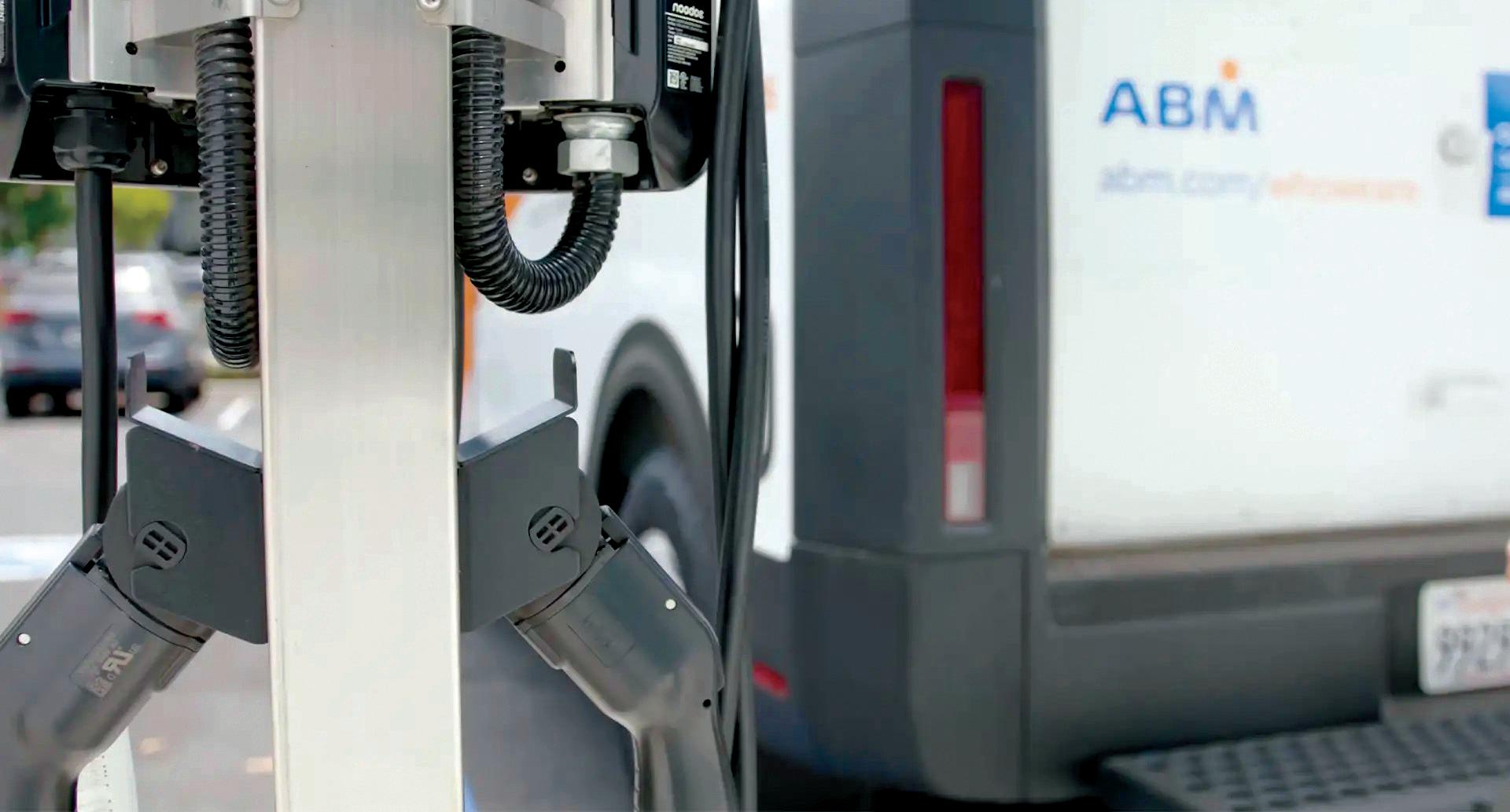
Firmware is the bane of the industry from a hardware perspective. Firmware never stays stagnant, and use cases change dramatically, so firmware changes happen a lot.
large-scale transition on the DC side, probably in the third wave on the AC side. ere has been a step change on the DC side. Battery voltages have gone up signi cantly and charge rates and vehicle discharge rates are improving signi cantly.
e performance conversation is a little di erent—you could run DC chargers for ve, seven, eight years. We’ve seen some of the early generation of DC fast chargers that are still operational. Utilization levels are what drives performance and reliability. We have a client that is running upwards of 85% in charging utilization—unheard of in the industry. But we also have customers that are on average, as you would expect, running 30-40% utilization. And the range between that signi cantly determines the lifespan of the asset.
Q Charged: What do you see as the most important trends in EV charging over the next few years?
A Satish Jayaram: Despite what you hear and read about market conditions, the electri cation of transport is an area that will continue to grow, and the eet side of that is probably the most interesting space from an adoption
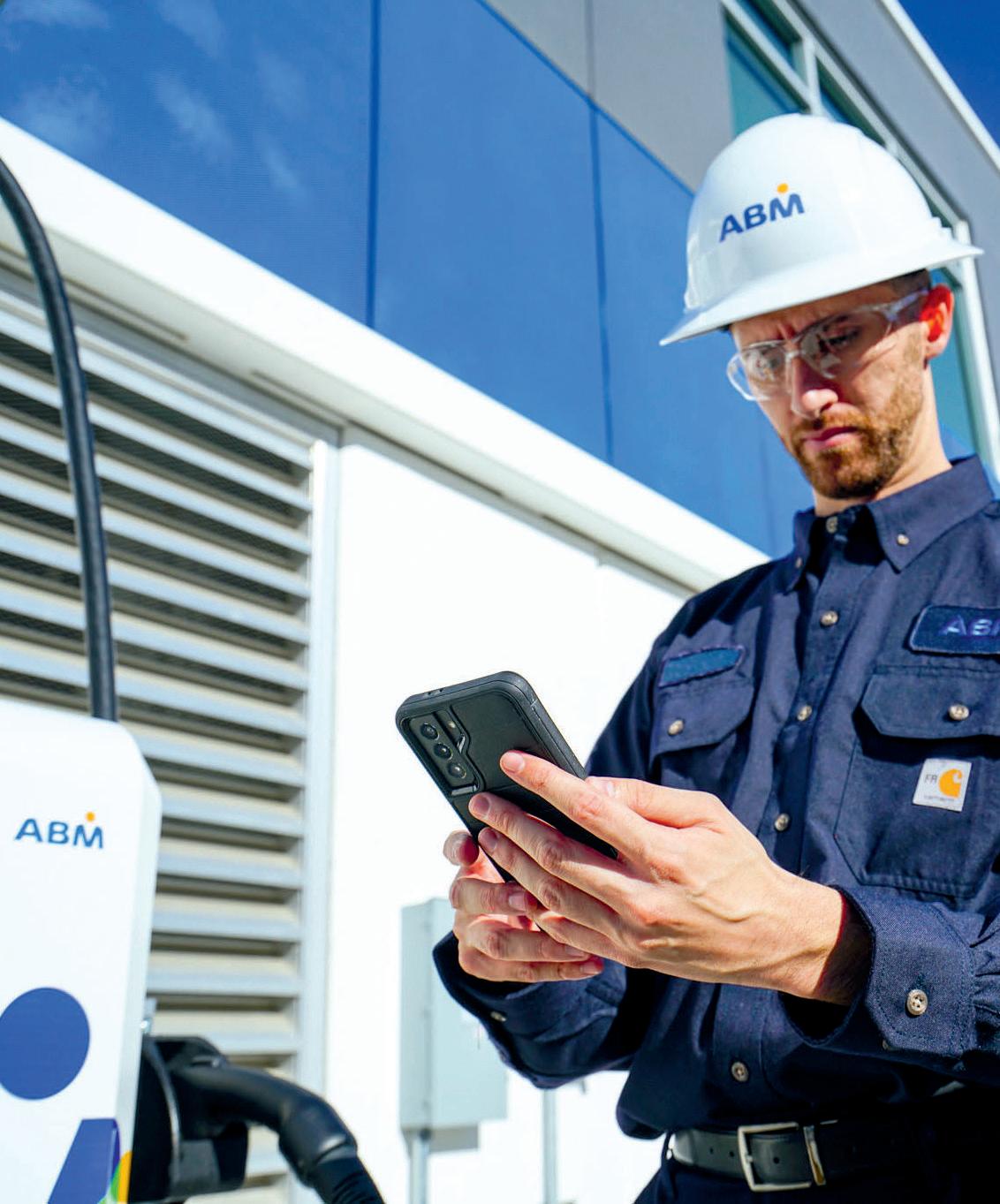
perspective. e numbers speak for themselves. A lot of new vehicles are starting to come out between Class 3 and Class 8. e big thing we’re expecting to see is the Class 7 and Class 8 range of products that are coming out over the next couple of years.
Megawatt charging is a space that we will keep our eyes on and see what that looks like as standards start evolving and take root. And the challenge around the utility keeping up with that is an area that we are very keen on solving for. Between data centers, an aging grid and Class 6 through Class 8 electri cation, we’re going to see all kinds of challenges. By putting our microgrid business and our EV charging business together, we’re able to provide power more quickly and seamlessly to electric infrastructure, and that’s where I think the market will need players like us to come in and innovate.



















Next-Generation
Battery Research
AI for Energy Storage
Lithium-ion Battery Development & Commercialization
Battery Recycling

























High-Performance Battery Manufacturing
Global Supply Chain for Battery Raw Materials
Battery Manufacturing Production
Battery Engineering

Advances in Automotive
Battery Applications
Large-Scale Energy Storage
Battery Power for Consumer Electronics
Battery Technologies for Military Applications
Founded in 1983, the International Battery Seminar & Exhibit has established itself as the premier event showcasing the state of the art of worldwide energy storage technology developments for consumer, automotive, military, grid, and industrial applications. As the longest-running annual battery industry event in the world, this meeting has always been the preferred venue to announce significant developments, new products, and showcase the most advanced battery technology. For example, Sony chose the International Battery Seminar as the platform to first announce its lithium-ion technology in 1991, an accomplishment that has since gone on to change the world.

Battery Safety
AI for Energy Storage
Battery Engineering
Battery Manufacturing Production
SAVE $200 off registration with code 2614-charged200
Every year, technology makes it easier to spend money—except when it comes to EV charging. We can buy a candy bar or a car with one tap of our credit card, but charging on the highway (for non-Tesla drivers) requires dealing with a phoneful of o en poorly-designed apps.
Plug & Charge, a system based on the ISO 15118 standard that handles user authentication and payment automatically, has been in development for several years, and it’s starting to catch on. e system is already widely used in Europe, and starting in 2027, support for ISO 15118-20, the latest version of the standard, will be mandatory in the EU. (To the best of our knowledge, there is no regulatory obligation or timeline mandating ISO 15118-20 support in the US.)
EVSE supplier and charging network operator ChargePoint recently announced that its entire current hardware portfolio supports Plug & Charge. A growing number of other CPOs also support the system. (“Plug & Charge,” with the ampersand, is the o cial form of the name. Some in the industry also use “PnC” for short.)
However, implementing a new standard can be slow, and while waiting for Plug & Charge to gain more widespread adoption, some players have deployed a separate system called Autocharge, based on DIN Spec 70121. EVgo was one of the rst to embrace Autocharge, and the company says that 30% of its charging sessions are now initiated using its version of the system, Autocharge+. Meanwhile, charging provider Emobi is touting its own ISO 15118-based system, which it calls JustPlug.
Is a standards war brewing? Sorry to spoil the fun, but no. Vehicles and chargers can simultaneously support both Plug & Charge and Autocharge. In fact, both ChargePoint and EVgo, among others, support both systems. Furthermore, Tesla’s system is also based on the ISO 15118-2 standard. Some ne day, all the seamless charging systems should be able to work side-by-side without drivers having to worry about it.
It’s also important to note that Plug & Charge and Autocharge are not standards—they are sets of features that are enabled by standards. As CharIN Project Manager Semih Tetik explained to me:
• DIN 70121 provides the baseline DC charging communication protocol that essentially every DC-capable vehicle supports.
• ISO 15118-2 builds on this baseline and introduces advanced features including Plug & Charge.
• ISO 15118-20 extends the framework with more capabilities, such as bidirectional charging (V2G) and wireless charging.
e EVSE experts I’ve spoken to seem to agree that Autocharge is an interim solution that will eventually be replaced by the more secure Plug & Charge. However, “eventually” is a key word here—the gurus also agree that much work remains to be done to enable wide adoption.
Tritium CEO Arcady Sosinov called Autocharge “very rudimentary.” He told me, “All you’re doing is registering the MAC address of your car with the network’s backend, and they link
By Charles Morris
it to an account. But it’s insecure, and it’s sort of a hack. Autocharge has to go away, but the issue is that most vehicles on the road today are not Plug & Charge capable.”
“We are committed to rolling out the Plug & Charge standard once the intricacies around certi cation and implementation have been addressed, [but] in the meantime, we continue to support Autocharge+ as our current solution to o er seamless session initiation,” an EVgo spokesperson told Charged
Juha Hytönen, Senior Director, EVs at security specialist Irdeto, told me: “AutoCharge was developed to address one narrow use case. It’s great because it showcases how simple charging an EV can be, and it has proven the potential for Plug & Charge. However, AutoCharge doesn’t provide the security foundation. I think there is a place for AutoCharge for a few years until ISO 15118 is fully deployed, but Plug & Charge is eventually going to replace it.”
ChargePoint is using Plug & Charge in North America and Europe, but has said that scaling it up to encourage widespread adoption will require overcoming “complex technical, commercial and regulatory hurdles.” Daniel Brown, Senior Director, Product Management at ChargePoint, said: “ e consumer demand for Plug & Charge is clear, but scaling access to drivers is a complex exercise in global alignment across hundreds of market players in four key areas.”
To wit:
• CPOs need to source hardware and backend so ware that is Plug & Charge-compatible.
• E-mobility service providers, which manage user-facing data and process payments, need to align their o erings with backend providers that manage chargers.
• OEMs must enable their vehicles for Plug & Charge, and prepare their backend so ware for certi cate management by a certi cation authority.
• Certi cate authorities must oversee authentication to ensure a trustworthy process.
CharIN’s Semih Tetik: “Autocharge is inherently less secure, as it relies on identi er-based mechanisms rather than cryptographic authentication. Many OEMs have already implemented ISO 15118-2 and therefore have the technical foundation to support secure Plug & Charge using PKI-based authentication. From this perspective, implementing Plug & Charge is not fundamentally complex. ISO 15118-20 introduces additional complexity, [but] it represents a long-term unifying communication protocol, capable of supporting both current and future charging use cases. With advanced features such as V2G, increased complexity is unavoidable, but this is accompanied by higher security, including TLS 1.3 and comprehensive certi cate handling.”
CharIN is actively supporting the development and deployment of Plug & Charge through its periodic Testival events. “ISO 15118-2 interoperability testing is already part of our test scope, and PKI-related tests, which are essential for Plug & Charge, are conducted in cooperation with our partners,” Tetik told us.