DRONE TACTICS TO WIN 21ST CENTURY BATTLES
AREVOLUTIONARY
capability has come of age above the battlefields of Ukraine and dramatically changed the character of modern warfare. The asset in question is the drone – it is omnipresent, provides roundthe-clock surveillance and reconnaissance, and can lay accurate direct fires on an enemy target as soon as it is located.
This In-Depth Briefing argues that the drone, in terms of its technological significance, is as impactful as the tank was when it first deployed as an infantry support weapon during World War I. The author believes it is time to expand its use, and to deploy large concentrations of attack drones as a standalone force – in a similar manner to how the Germans used large tracked formations during World War II. Battle drone tactics, organisation and strategy need to be updated for that to happen, and this Briefing
suggests how those advances can be achieved.
Drones, also known as unmanned vehicles, come in three major forms, corresponding to the three primary domains of physical warfare: air, land and maritime. Those that operate in the air, also known as unmanned aerial vehicles (UAVs) and unmanned aircraft systems (UASs), monopolise popular attention and account for the lion’s share of the world’s military drones. Their significance has reached new heights in the current RussiaUkraine war, with both sides exploiting the technology in an effort to achieve an advantage.
While not as prominent as UAVs, marine drones – known as unmanned surface vehicles –have also seen their role elevated by virtue of the Ukrainian Navy employing them to inflict damage upon, and deny maritime control to, the much superior Russian Black Sea Fleet.1 Such has been
their worth to the war effort that Ukraine has created the 385th Separate Special Purpose Unmanned Surface Vehicle Brigade2 – the world’s first naval unit composed solely of maritime kamikaze drones.
Land drones or unmanned ground vehicles (UGVs), while not yet used on the same scale as their air and maritime counterparts, have great potential, particularly in operational support roles such as mine-clearance. Indeed, the Russians already use small remotely-controlled wheeled robots to bring supplies to exposed positions3 while the
1Marc Santora, “How Ukraine, With No Warships, Is Thwarting Russia’s Navy,” New York Times, November 12, 2023.
2“Ukraine Has So Many Kamikaze Boats That a Specialized Brigade Was Created in the Ukrainian Navy,” Defence Express, August 25, 2023.
3“1st Time in Ukraine War, Russia Uses Robot to Deliver Ammo, Evacuate Troops & Jam Kamikaze UAVs,” Axx Military News, December 5, 2023.
Ukrainians employ UGVs to evacuate wounded personnel and clear routes.4-5
In the not-so-distant future, drones will perhaps also demonstrate their value in the space domain and be used, for example, to neutralise enemy communication satellites.
The appeal of integrating drone technologies for a combined, massed attack is obvious, given it could afford a means of locating and destroying enemy forces in a casualty-light and time-effective manner.
CHARACTERISTICS OF DRONES AS A WEAPON OF WAR
The tactics, operations and strategy of drone warfare are mostly determined by the characteristics of the technology as a weapon of modern war. The author of this article came to the necessity to distinguish these characteristics when studying the theoretical frameworks of tank deployment, mostly developed by the Germans in
4“The First Robotic Complex “THeMIS” Arrived in Ukraine,” Militarnyi, August 31, 2022.
5“Germany Will Transfer 14 THeMIS Unmanned Ground Vehicles to Ukraine,” Militarnyi, November 29, 2022.
6Heinz Guderian, Erinnerungen eines Soldaten (Heidelberg: Kurt Vowinckel Verlag, 1950), 32-39.
7Alia Shoaib, “Ukraine Hails GPS-Guided Excalibur Artillery Shells That Can Hit a Target 25 Miles Away with Pinpoint Accuracy,” Business Insider, April 15, 2023.
8“US. Army Raytheon Successfully Fired 30 GPS-Guided Excalibur Projectiles During Firing Test 0802142,” Army Recognition, February 8, 2014.
9Boyko Nikolov, “55 Mm Shells Price is Growing – $8.6 Million for 1,000 Units,” BulgarianMilitary.com, October 25, 2023.
10Sebastien Roblin, “Drones on the Front Line for Ukraine’s Counteroffensive,” Inside Unmanned Systems, October 19, 2023.
11Army Technology, M777 155mm Ultralightweight Field Howitzer
12Boeing, C-17 Globemaster III
the 1930s. The tank was then a new and promising weapon, just as drones are today. In an article published in the official journal of the National Union of German Officers (Zeitschrift des Reichsverbandes Deutscher Offiziere) in 1937, Heinz Guderian, who was later to command a Panzer corps that spearheaded the 1940 invasion of France, differentiated and analysed three characteristics of tanks: armour plating (panzerung), movement (bewegung) and fire (feuer).6 In a similar fashion, drone characteristics can be classified as: omnipresence on the battlefield, accurate direct fires, discardability and mobility.
Omnipresence on the battlefield relates to the ability of drones to provide a detailed picture of the frontlines and the surrounding areas in real time. Video feeds from a large fleet of reconnaissance and surveillance UASs can be combined into a centralised network that will give commanders and planners the transparency they need to plan and execute offensive and defensive actions based on accurate, real-time intelligence. On the other hand, an adversary like Russia or China, equipped with a similar level of UAS capabilities, will also enjoy this degree of situational awareness,
so achieving a surprise attack to catch the enemy unprepared or concentrating armour, artillery and infantry for a massed offensive will become problematic.
Accurate direct fires form the second characteristic of war drones. The same destructive effect that was achieved by indirect artillery fires in the past can now be attained through kamikaze and munitiondropping drone attacks, with significantly lower ammunition expenditures. For example, it takes 10 to 50 conventional artillery rounds or one $100,0007 M982 Excalibur GPS-guided artillery round8 to hit a target – a mission which could instead be accomplished by a single first-person view UAV. The associated maths is compelling. With the price of 155mm shells now reaching as much as $3,500 per round,9 hitting a target using conventional artillery can cost between $35,000 and $175,000, whereas the drone option comes with a bill of circa $450.10
Also worthy of note is that an artillery piece is a visible asset, it takes time to put it into position and –in the case of an M777 howitzer11 – affords a sustained rate of fire of just two rounds per minute; giving the enemy plenty of time to locate and destroy it with drones of their own.
Discardability is another key characteristic of battle drones. As a result of being inexpensive and their pilots generally being safe from harm (noting autonomy and artificial intelligence may further safeguard human costs in the future), drone forces can sustain high ‘casualty’ rates on a mission and still be considered a success.
Mobility is the final characteristic of military drones and refers to their rapid deployment capability when compared to conventional military hardware. If we assume that a small UAS (with payload) weighs around 7lbs, then 200,000 systems (enough to conduct a small military campaign) will have a combined weight of about 1,400,000lbs, which can be transported by just nine Boeing C-17 Globemaster III transport aircraft.12
With an understanding of the aforementioned characteristics, it is possible to define the best application for battle drones based on theoretical assumptions and practical knowledge gained from current use.
HOW TO USE DRONES TO GREATEST EFFECT: FROM TACTICAL DEPLOYMENT TO OPERATIONAL-LEVEL MASSED DRONE ATTACKS The current use of UASs on the battlefields of the Russia-
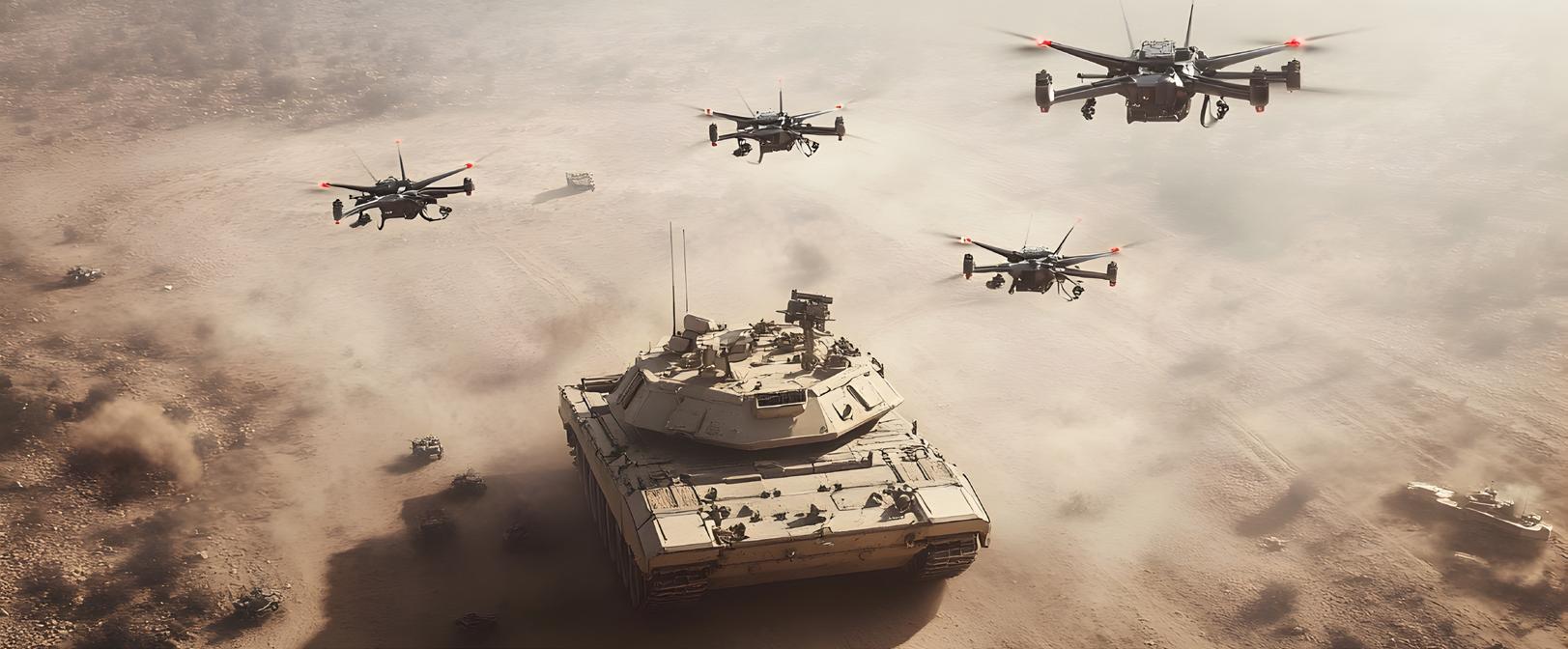
Ukraine war is mostly limited to the infantry support role. More specifically, aerial drones are used in tactical platoon- or battalion-level deployments in the form of small UASs, primarily weaponised commercial drones like the DJI Mavic 3 (sometimes with munition dropping capabilities)13 and kamikaze drones (armed with cumulative armour-piercing rounds for use against armoured vehicles or thermobaric rounds for targeting enemy dugouts).14
While having devastating effects (just as tanks did in World War I), these drone attacks result in only tactical gains on the ground and marginal shifts in the frontlines. To have a much greater impact, and to use drones’ characteristics to their maximum potential, another form of deployment needs to be considered: a massed attack, similar in style to the German Panzer corps’ assaults and breakthroughs of World War II.
Such an operation would involve large concentrations of UASs and electromagnetic warfare forces. As an example of the scale proposed, 36,000 drones attacking enemy positions on a frontline six miles wide and 12 miles deep would equate to a density of 500 UASs per square mile. The same weaponised commercial drones used by Ukraine and Russia today (or better still their military-grade equivalents), in conjunction with ground assault troops in a combined arms operation, would effect operational-level change by – in this example – breaching heavily fortified defensive lines and allowing ground formations to seize the initiative and encircle and destroy enemy forces in a battle of fire and manoeuvre.
ESTABLISHING
DRONE SUPERIORITY
The effectiveness of drones to a large extent depends on the counter UAS actions of an
in a marine environment, such as Taiwan or the Crimea) should also be employed.
Drone Company 1
Company 2
Company 3
adversary and a force’s own counter capabilities. Thus establishing UAS omnipresence on the battlefield necessitates the suppression of enemy counter UAS defences, including electromagnetic warfare systems.
This can be achieved in several steps. Stage 1 would be to select a target area that has lower levels of counter UAS defences, either because the area is neglected/considered unimportant by the enemy or because its geographical features (wooded, hilly terrain) break up jamming emissions coming from electromagnetic systems.
Stage 2 would be to suppress enemy electromagnetic systems and define what tactics to use to ensure that the attacking drone force would successfully fulfil its mission in the current counter UAS environment. For example, a decision could be made that the attacking drones would fly through certain approach routes to evade counter UAS defences and do so at reduced altitudes (the higher the altitude the easier it is for the enemy to jam drones’ communication signals). Also, a chain of signal retransmission drones could be employed to strengthen communication links between and within waves of attacking


UASs. In addition, in areas of extremely high electromagnetic warfare resistance, attack drones could be pre-programmed with artificial intelligence algorithms to act autonomously and seek and destroy any objects that look like enemy troops or assets (move or have certain heat signatures). And, last but not least, identifiable enemy electromagnetic warfare systems should be located and eliminated.
Stage 3 of establishing UAS superiority over the battlefield is to put into position your own counter UAS defences to mitigate any possible interference from enemy drones. Any drones flying outside the designated attack routes (and thus considered to be the enemy’s) will be destroyed through kinetic and electromagnetic warfare action.
A MASSED DRONE ATTACK AS PART OF A COMBINED ARMS OPERATION
Once UAS superiority over the battlefield is established, a massed drone attack can begin. In order to have maximum effect, it should be supported by ground assault forces, artillery and aviation in a combined arms operation. Land drones (remotely-controlled mine-clearing vehicles, for example) and marine drones (if the offensive action is conducted
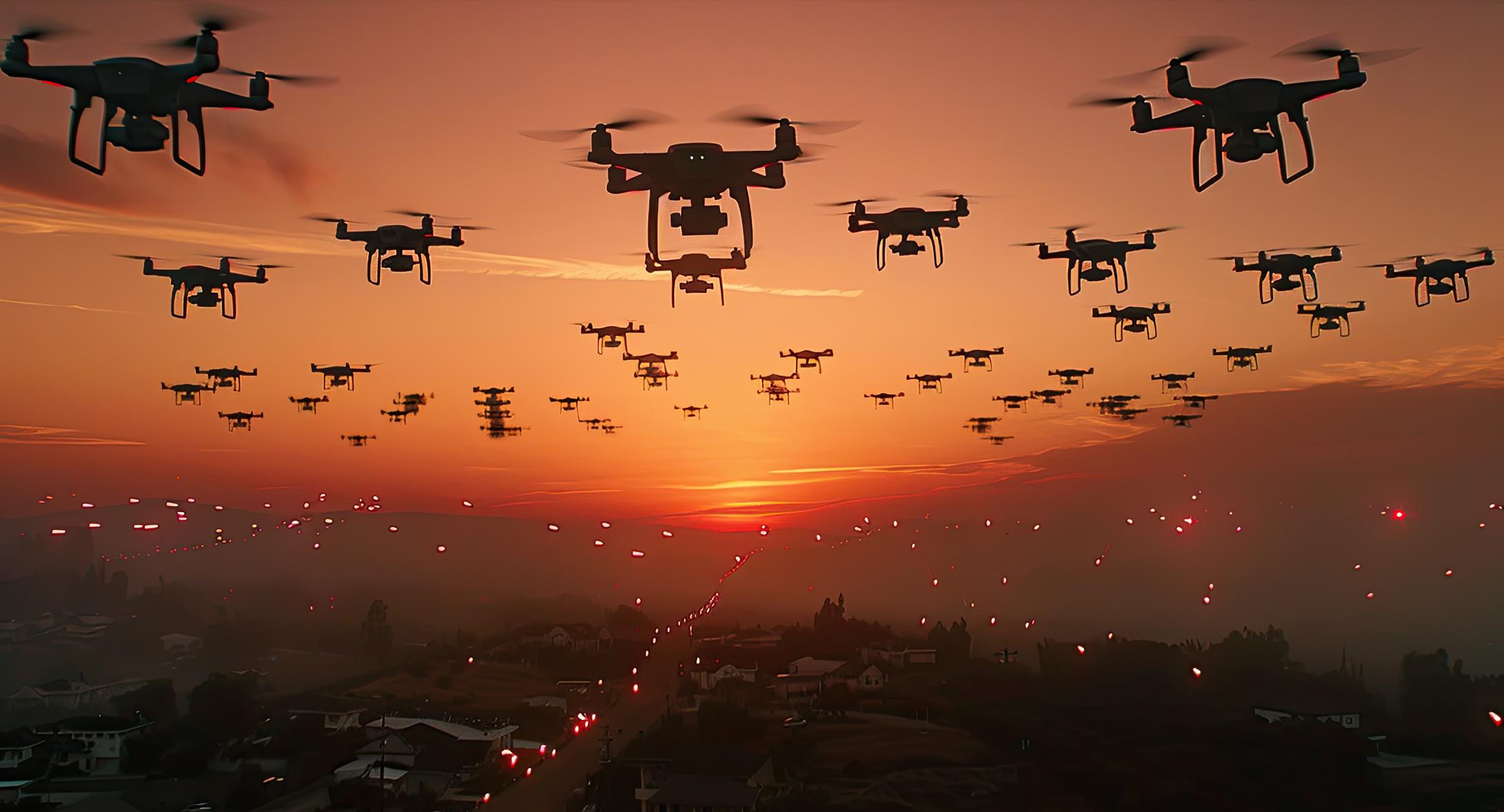
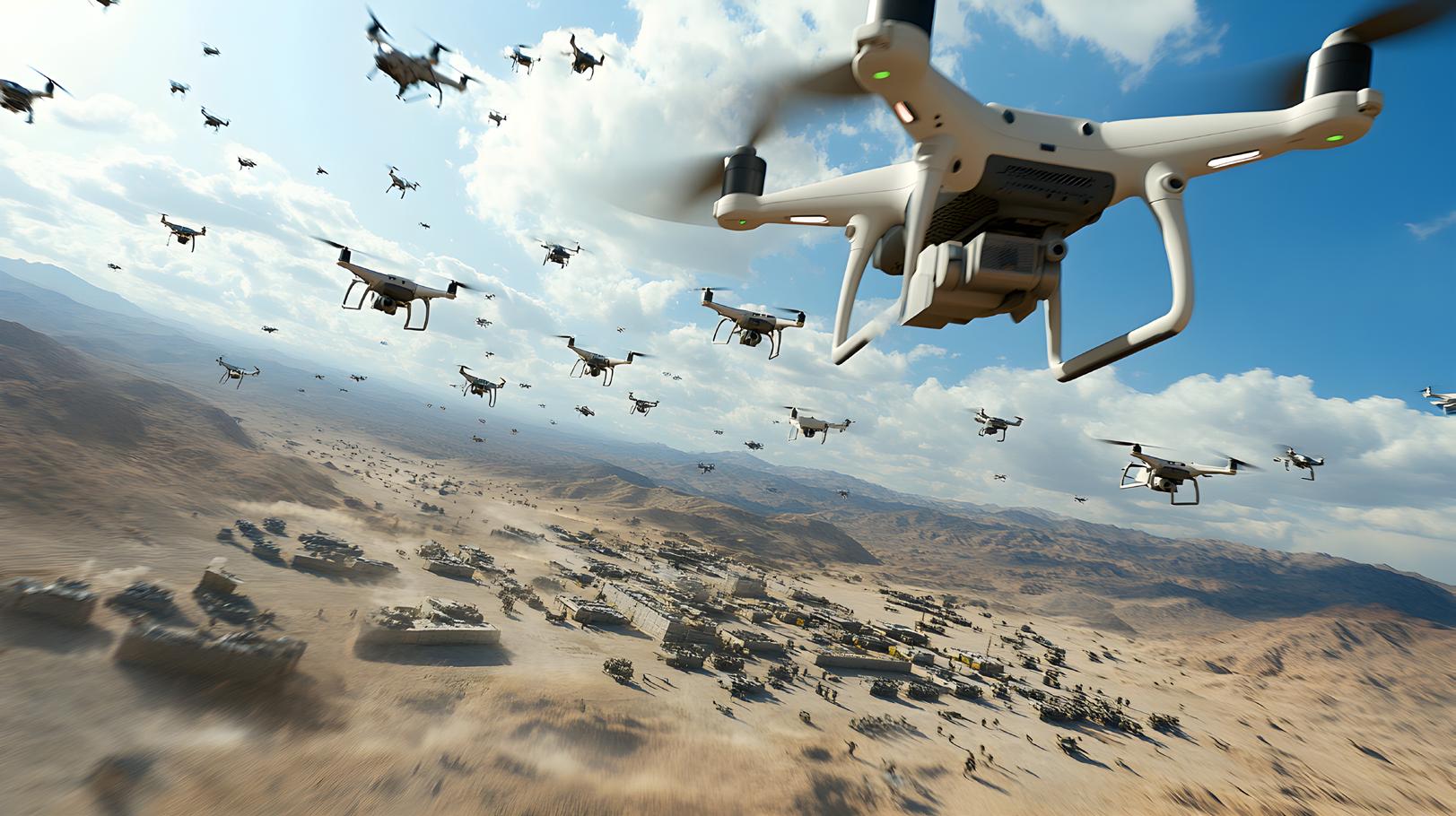
The drone attack should be massive, fast and overwhelming. Thousands of kamikaze and munition-dropping UASs, coordinated via command drones, will attack in waves through pre-determined approach routes at specified altitudes, flying to their designated areas and eliminating all enemy forces there. Where possible, drone-coordinated artillery could also lay additional fires on enemy positions.
The attacked area will be divided into squares, with each set of drones attacking a certain square (see Figure 1). Squares where higher concentrations of enemy forces are expected will receive higher densities of attacking drones. An average drone attack density of at least 500 UASs per square mile would be needed if the attacked area is a defensive line with strong field fortifications, as is the case in the Russia-Ukraine war. While lacking the power to pierce through reinforced concrete, first-person view kamikaze drones, armed with thermobaric rounds, are accurate enough to enter bunkers through machine gun emplacements, ventilation windows or open doors.
The psychological effect of a massed drone attack should not be underestimated. With thousands of drones hovering over their heads, bearing accurate direct fires on anything that moves or shows signs of resistance, enemy soldiers will experience first-hand the lethal effects of 21st century technology.
13Paul Mozur and Valerie Hopkins, “Ukraine’s War of Drones Runs Into an Obstacle: China,” New York Times, 30 September 2023.
14“Pilots of the ‘Adam’ Group Told How FPV Drones Work at the Front and Described Their Needs” (in Ukrainian), TSN, November 1, 2023.
Figure 1
With such strong covering fire, mechanised infantry units, with the help of demining equipment (ideally, remotely controlled robots), will capture the ground areas attacked by the UASs. It is essential that the drone attack is conducted in-depth, with firstperson view drones to distances of up to 12 miles and winged UASs for longer-range offensive actions. The mission of longer-range attack UASs will be to cut the area under attack from enemy reserves, and prevent the use of artillery against advancing infantry.
Anti-aircraft and missile defences should also be a part of this combined arms operation to prevent intervention from enemy aircraft and missiles.
OPERATIONAL EFFECTS OF MASSED DRONE ATTACKS
A massed drone attack can be conducted as an offensive action – for example, to create a breach in deeply fortified enemy lines – or defensive action, to destroy concentrations of attacking enemy infantry, armoured forces or supporting artillery.
A drone force has few visible assets (perhaps some bunkers to shelter operators and house command centres) and requires limited logistics, so is consequently difficult to detect and therefore can deliver an element of surprise. Similarly, with drones at the spearhead, the footprint of supporting mechanised infantry and artillery can also be limited to further conceal military intent.
Thus, as a result of a massed drone attack, penetrations of enemy positions could be executed with low personnel and material losses, allowing mobile forces to take the operational initiative and destroy enemy forces through manoeuvre warfare. Or, if used in a defensive role, as a result of their high mobility, drone forces will enable enemy operation-level offensives
PLATOON
to be easily repelled, perhaps creating an opportunity for a counter-offensive.
WHY NOT JUST USE CONVENTIONAL AIRPOWER?
The use of UASs in a massed drone attack in many respects resembles the air cover provided by conventional army aviation or an air force. However, it has a certain number of advantages that stem from the characteristics of drones as a weapon of war. First, the omnipresence of drones can provide much closer air support than attack aircraft as they can hover – almost literally – over every square foot of ground. Secondly, because they are disposable – as opposed to high-value conventional airpower assets – and have a low radar cross-section, UASs are much more resilient to an enemy’s air and missile defences, which in the case of a near-peer adversary like Russia or China can be expected to be quite formidable.
ORGANISATION OF THE DRONE FORCE
The drones and counter UAS units, including electronic warfare systems, should ideally form a separate branch of an army, as their unique weapons warrant a separate command and control, training and logistics
organisation. Of course, as a transitory form of organisation, UAS forces could be grouped into a separate brigade, which, if proved as viable in war or through military exercises, could then be expanded into a fullfledged branch of the army.
The structure of this UAS and electromagnetic warfare force would be similar to that of any military organisation. Each small attack UAS will be piloted by a crew of two soldiers. A drone squad will consist of five such crews (10 soldiers) armed with first-person view kamikaze drones or small munitiondropping quadcopters. For protection against unexpected encounters with enemy infantry, a fire team of four riflemen can also be added to this squad. The squad leader (staff sergeant) will control their squad with the help of a surveillance quadcopter, thus being able to lay fires on the enemy with up to five attack drones at a time.
Three such drone squads, plus a counter UAS squad armed with machine guns, anti-drone electromagnetic warfare guns and other portable electromagnetic systems, will form a platoon, commanded by a lieutenant with their own tactical reconnaissance drone (see Figure 2). A drone
company will consist of three platoons. Three drone companies, plus a company of longerrange reconnaissance and attack drones, and a company of stationary counter UAS and electromagnetic warfare systems will form a drone battalion, which will consist of circa 180 attack UASs. Each of these UASs will be supplemented with 20 kamikaze drones (considered as loitering munitions) thus a battalion is expected to be armed with around 3,600 attack drones, meaning a five-battalion brigade will have a force of 18,000.
Brigades should also have organic engineer units to help construct defensive fortifications (bunkers, trenches, dugouts) from which drone pilots and their commanders will perform their missions.
Changes in technology, particularly the development of artificial intelligence software, may reduce the number of personnel needed to operate this drone force as some UASs may become fully autonomous. Also, once the technology matures, brigades of unmanned ground vehicles could be formed, following the same organisational template as UAS forces.
THE FURTHER USE OF DRONES
The use of drones and electromagnetic warfare systems in the armed forces should be widespread and not only limited to those conducting massed attacks. At least two reconnaissance quadcopter drones and up to 20 kamikaze drones should be allocated to each platoon in manoeuvre units.
Non-manoeuvre lowerechelon units (platoon- and company-level), such as artillery or engineers, should also be equipped with some reconnaissance drones and electromagnetic warfare systems to increase situational awareness
and offer some protection from enemy drones. In other words, all lower-echelon units should be equipped with drones and counter UAS systems, but their high concentrations are best kept in specialised formations that have the expertise and weaponry to deploy them to the highest effect.
IMPACT ON THEATRESTRATEGIC AND NATIONALSTRATEGIC LEVELS
Massed drone attacks will have profound effects on theatre-strategic and nationalstrategic levels of warfare, as whole campaigns and even the national military strategy could come to rely on them. Drones are inherently more mobile than conventional military hardware and so can appear at an unexpected time and place, and can even be moved easily from one continent to another. Also, by their nature, they are attack weapons (though they are equally potent in defence), so will help armed forces seize and retain the initiative in combined arms operations.
Drones save lives. The casualty rates of drone-heavy armies will be much lower than those that rely primarily on manned weapon systems. In financial terms, the economy that comes with the mass deployment of drones is astonishing. Costing just a tiny fraction of the assets they destroy, UASs will allow nations with fewer resources to compete on equal terms with significantly well-resourced militaries.
Furthermore, drones can be configured to work in chemical, biological, radiological and nuclear contaminated environments.
OVERCOMING RESISTANCE TO CHANGE
Change does not usually come easily to military organisations. Ukrainian civil society has pressured its government to buy more UASs, but Oleksii Reznikov15 – the Ukrainian Minister of Defence for most of the war (from November 2021 to September 2023) – has rebuffed the DJI Mavic 3 (one of the most widely used UASs in the conflict)16 as a “wedding drone” not suited for military use and bought none of them.17 His purchases of other drone types were insufficient with 90 to 95 per cent of those in use by the Armed Forces of Ukraine supplied as donations by nongovernmental organisations and private citizens18 – an extremely ineffective arrangement that relies on charity instead of taxes. While this particular Minister of
Defence is now gone, after facing criticism from the army’s rank and file, his views are still shared by many high-ranking officials and generals in Ukraine.
Equally strong was the opposition to the tank. For example, Field Marshal Paul von Hindenburg, who commanded the Imperial German Army during World War I, noted in a speech in 1932 that in war only simple solutions worked and, in his opinion, tank warfare didn’t look simple.19 Resistance is a natural first reaction to innovation but leaders should have foresight and an open mind. They should not suffer from institutional inertia and should not be afraid to accept and endorse new, radical solutions.
resisted, but there is no resistance to an invasion of ideas).21 As drone technology advances and the production of military UASs ramps up in tandem, so too does the likelihood of a massed drone attack as described in this InDepth Briefing coming to fruition.
The only question cloaked in the mist of uncertainty is will it be the Free World, led by the United States, who will be first to build a strong drone force or the authoritarian regimes of China, Russia, North Korea and Iran? If it is the latter, world be warned. While lacking the Teutonic efficiency and Prussian military traditions that gave the German army a technological and organisational edge in the 1930s, the new axis of authoritarian states may still produce a modernera Chinese or Russian Hitler, who, in a war of aggression, will think nothing of using drone dominance to steamroller and collapse neighbouring countries.


In practical terms, the United States and other NATO countries should include drones, particularly kamikaze class models, in their military aid packages to Ukraine. According to some estimates, in early December 2023 kamikaze drones accounted for almost 90 per cent of all Russian forces destroyed.20 It’s not tanks, artillery, aircraft or any other weaponry that the Ukrainian frontline soldier needs most – it is the drone.
NO ARMY CAN STOP AN IDEA WHOSE TIME HAS COME
French writer Victor Hugo famously remarked: “On résiste à l’invasion des armées; on ne résiste pas à l’invasion des idées” (an invasion of armies can be
15“Minister of Defense Oleksii Reznikov Submits Resignation Letter,” Militarnyi, September 4, 2023.
16Ibid.
17“Reznikov: ‘Mavics’ Are ‘Wedding Drones’, the Military Does Not Order Them,” Lb Live, (in Ukrainian).
18Olga Danylenko, “Air Reconnaissance of the AFU: How Many More Volunteers and People Will Collect Funds for Drones, Where is the State?” BigKyiv, June 19, 2023.
19Ibid.
20Sternenko, “A Critical Problem on the Front Lines! How to Overcome the Shortage of Shells and Strengthen the Defense,” December 3, 2023.