CITIZEN’S GUIDE TO Colorado Groundwater
Citizen’s Guide to Colorado Groundwater
This Citizen’s Guide is part of Water Education Colorado’s series of educational booklets designed to provide Coloradans with balanced and accurate information on a variety of water resources topics. Guides in the series cover: Colorado water law, water quality, water conservation, interstate compacts, water heritage, where your water comes from, transbasin diversions, Denver Basin groundwater, and Colorado's environmental era.
View or order any of these online at www.watereducationcolorado.org.
Water Education Colorado thanks the people and organizations who assisted in the preparation and review of this guide.
Authors: Peter Barkmann, Kevin Donegan, Courtney Hemeway, Tracy Kosloff, Dennis McGrane, Ralf Topper
Editors: Caitlin Coleman, Nelson Harvey Design: Chas Chamberlin
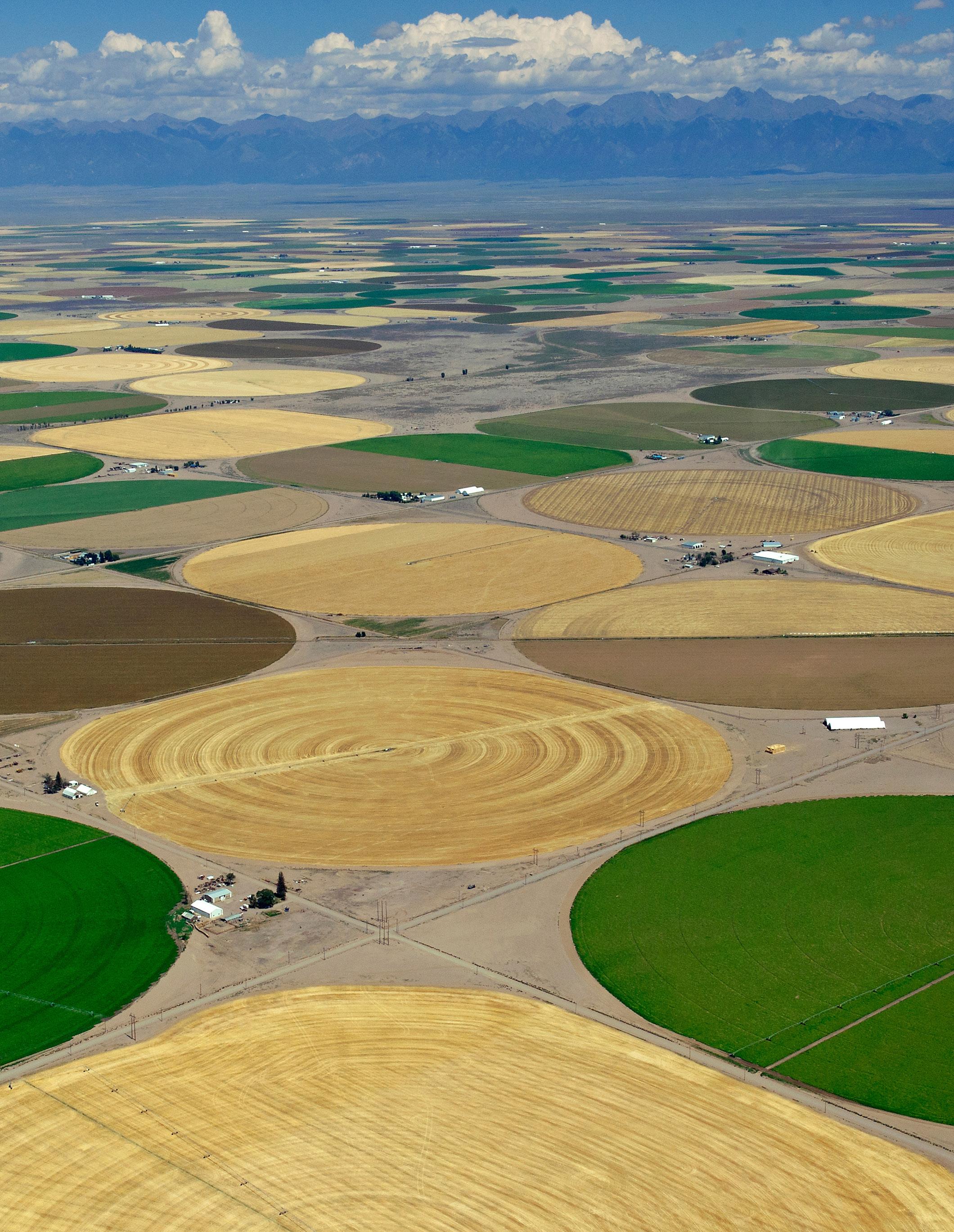
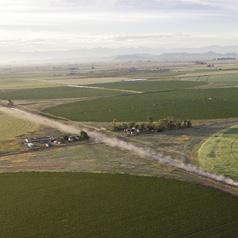
FRONT COVER: Circles across the landscape, created by irrigation using center pivot sprinklers, demonstrate the vast reliance on groundwater in the San Luis Valley. John Wark
BACK COVER: Bathers enjoy the warmth of Strawberry Park Hot Springs, where hot pools of water are created by several geothermal springs in Precambrian granite rocks just outside of Steamboat Springs. Frank DiBona/Flickr
STAFF
Jayla Poppleton
Executive Director
Jennie Geurts
Director of Operations
Stephanie Scott
Leadership Programs Manager
Scott Williamson
Education & Outreach
Coordinator
Jerd Smith
Fresh Water News Editor
Caitlin Coleman
Headwaters Editor & Communications Specialist
BOARD OF TRUSTEES
Lisa Darling President
Gregory J. Hobbs, Jr.
Vice President
Gregg Ten Eyck
Secretary
Alan Matlosz
Treasurer
Eric Hecox
Past President
Perry Cabot
Nick Colglazier
Sen. Kerry Donovan
Paul Fanning
Jorge Figueroa
Matt Heimerich
Greg Johnson
Julie Kallenberger
David LaFrance
Dan Luecke
Kevin McBride
Amy Moyer
Lauren Ris
Rep. Dylan Roberts
Travis Robinson
Laura Spann
Chris Treese
Brian Werner
THE MISSION of Water Education Colorado is to promote increased understanding of water resource issues so Coloradans can make informed decisions. WEco is a non-advocacy organization committed to providing educational opportunities that consider diverse perspectives and facilitate dialogue in order to advance the conversation.
Copyright 2020 by the Colorado Foundation for Water Education DBA Water Education Colorado. (303) 377-4433
WATEREDUCATIONCOLORADO.ORG
ISBN: 978-0-9857071-7-0





























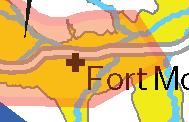







Arapahoe


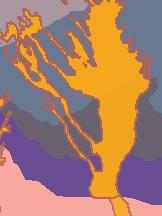





Arapahoe











Introduction
Most Coloradans associate the state’s water supply with its winter snowpack, flowing rivers, and expansive reservoir network, yet beneath Colorado’s surface lie numerous aquifers. From the fractured crystalline rock of the mountains to the vast sedimentary bedrock basins of the Eastern Plains and Western Slope, Colorado’s groundwater resources are a vital and perhaps underappreciated piece of the state’s water portfolio.
The aim of this guide is simple: to shed light on the subterranean world of Colorado groundwater. This guide discusses how groundwater is formed, regulated and used in Colorado. It explores the factors threatening groundwater supplies in some areas and illuminates how the role of groundwater could be expanded in Colorado’s water future.
Groundwater use in the state
stretches back more than a century. The first documented irrigation well in Colorado was drilled in 1886 northeast of Greeley, and it operated using centrifugal pumps powered by steam engines. Today, the Colorado Division of Water Resources puts the number of groundwater wells statewide at more than 284,000. Of these, 79 percent are for domestic or household use. Only about
11 percent serve irrigated agriculture, yet these “high capacity” irrigation wells withdraw the majority of groundwater used in the state—roughly 86 percent of Colorado’s groundwater is used for agriculture. It is difficult to pinpoint how many people in Colorado depend on groundwater: U.S. Geological Survey figures suggest that groundwater supplies around 11 percent of the state’s population, while the Colorado Geological Survey puts that number closer to 20 percent.
Regulation of Colorado’s groundwater has evolved over time, based on improved understanding of the state’s hydrogeology and an ever-growing water demand fueled by population growth. Drilling a groundwater well didn’t require a permit until 1957, with the passage of the Colorado Ground Water Law. Significant groundwater legislation was passed in 1965 and 1969. These laws brought tributary groundwater near rivers under the purview of the state’s prior appropriation system, and codified the connection between groundwater and surface water. More recently, in 1995, the state passed the first rules governing aquifer storage and recovery (ASR) for the Denver Basin aquifers. ASR is the practice of pumping treated water into groundwater aquifers for later extraction during dry times. The Colorado Water Plan identifies ASR as a critical source of future water storage.
Almost since the state’s first well began pumping, questions about the sustainability of Colorado groundwater have loomed over its use. In some areas, groundwater withdrawals exceed natural recharge rates. Yet solutions to this “groundwater mining” are emerging. In the agriculturally rich San Luis Valley, for instance, where farmers must either meet their aquifer sustainability goals or face potential curtailment of groundwater diversions, the local water conservation district has devised an innovative system of assessing fees on farmers and using the resulting funds to fallow land. Across the state, from the Denver metro area to Colorado’s Eastern Plains, water users are banding together to bring their water use into balance.
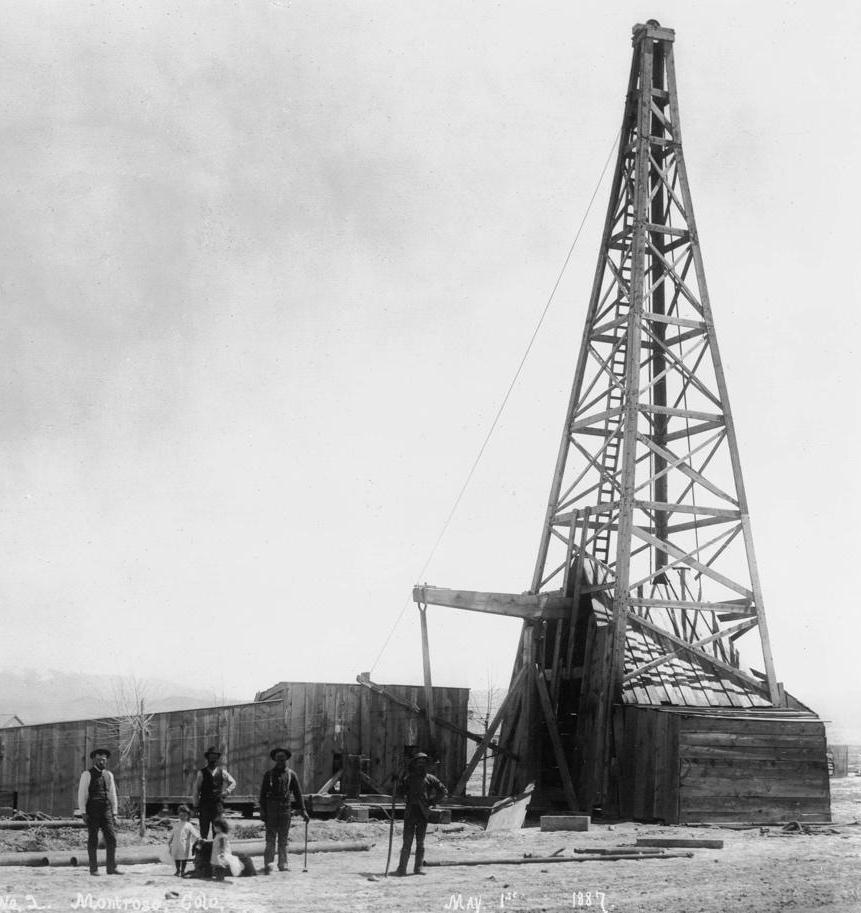
An artesian well near Montrose, circa 1887
The Groundwater Environment
What is groundwater? Groundwater is simply water that occupies the empty spaces in the soil, sand and rocks beneath our feet. Because groundwater is hidden from view, many people erroneously think it occurs in underground lakes, streams and veins. Yet most groundwater occurs as water filling pore spaces between rock grains in sedimentary rocks or in fractures and faults in crystalline rocks.
The water that fills these spaces underground represents a tremendous volume when taken in aggregate. More than 95 percent of all the freshwater in the world (excluding the polar ice caps) is groundwater. Precipitation is the source of all groundwater, as any rain, snow, sleet or hail that does not evaporate or immediately flow to rivers and streams eventually percolates into the ground.
Subsurface water occurs in two zones, the unsaturated zone near the surface and the saturated zone at depth. In the unsaturated zone, the spaces between grains of sediment and cracks within rocks contain both air and water. The upper part of the unsaturated zone is the soil/water zone containing plant roots and animal and worm burrows, all of which enhance infiltration. Water that is not absorbed by plants or evaporated directly into the atmosphere moves downward by gravity until it reaches a depth where all of the available space is saturated with water. The top of this saturated zone is called the water table. Below the water table, water pressure is high enough to allow groundwater to flow into wells.
Groundwater can be found almost everywhere, but the quality of the water and the depth to the water table are highly variable depending on an area’s climate and geology. The water table can be even with the land surface, resulting in springs and seeps, or it can be hundreds of feet deep. Typically, the water table is shallow near permanent bodies of surface water such as streams, lakes and wetlands. The depth and configuration of the water table varies seasonally and annually with changes in the amount, distribution and timing of precipitation.
The Hydrologic Cycle
All of the water on Earth takes part in an endless and dynamic process of circulation between the atmosphere, the
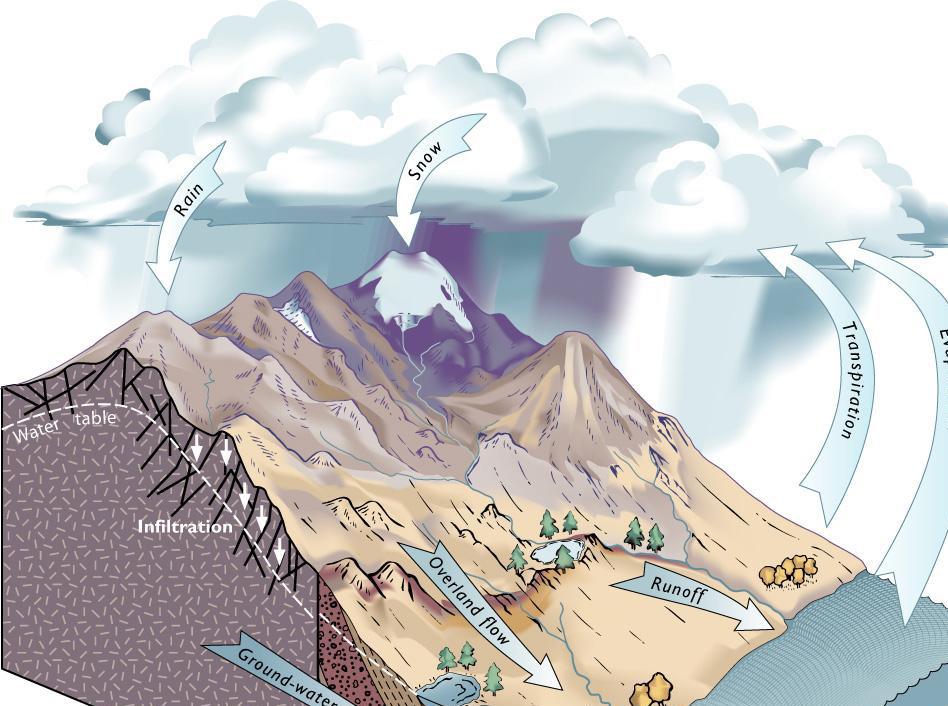
oceans and the land called the hydrologic cycle. The concept of the hydrologic cycle is central to understanding groundwater. The cycle includes the processes of evaporation, transpiration, precipitation, overland flow, infiltration, runoff and groundwater flow. Water vapor produced by surface evaporation and transpiration from plants forms clouds, which return
the water to the surface in the form of precipitation. Approximately 81 percent of the precipitation that falls in Colorado quickly returns to the atmosphere through evapotranspiration. Evapotranspiration is evaporation from exposed moist surfaces and transpiration from vegetation. The amount of infiltration or recharge to groundwater depends on land use, soil properties, and moisture content, as well as the intensity and duration of precipitation. When rainfall is intense, exceeding the rate it can infiltrate into the ground, water accumulates on the land surface and flows downhill as overland flow into streams, lakes or drainages to produce runoff. Water that infiltrates the ground surface becomes soil moisture, which may evaporate or be taken up by vegetation as nourishment. Excess soil moisture is pulled down by gravity and percolates through the unsaturated zone to the water table, becoming groundwater. The hydrologic cycle emphasizes the
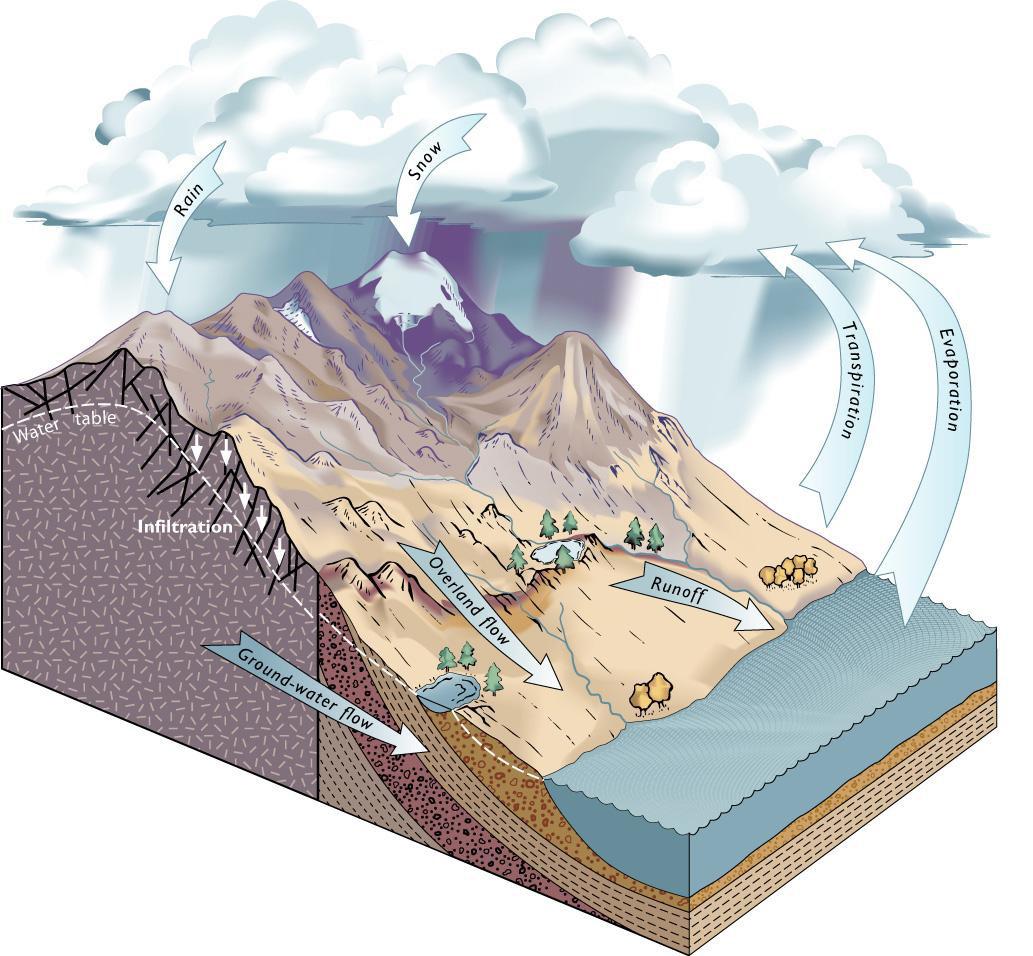
FIGURE 1.1 The hydrologic cycle
The Groundwater Environment
interaction between groundwater and surface water. Just as groundwater may discharge to a stream or the land surface as a spring, surface water can percolate through the streambed and recharge groundwater. This exchange can occur several times before the water moves through the entire system. The water reaching streams by overland flow or groundwater discharge may ultimately migrate to the sea, where its evaporation perpetuates the hydrologic cycle.
Aquifers
Denver’s artesian wells
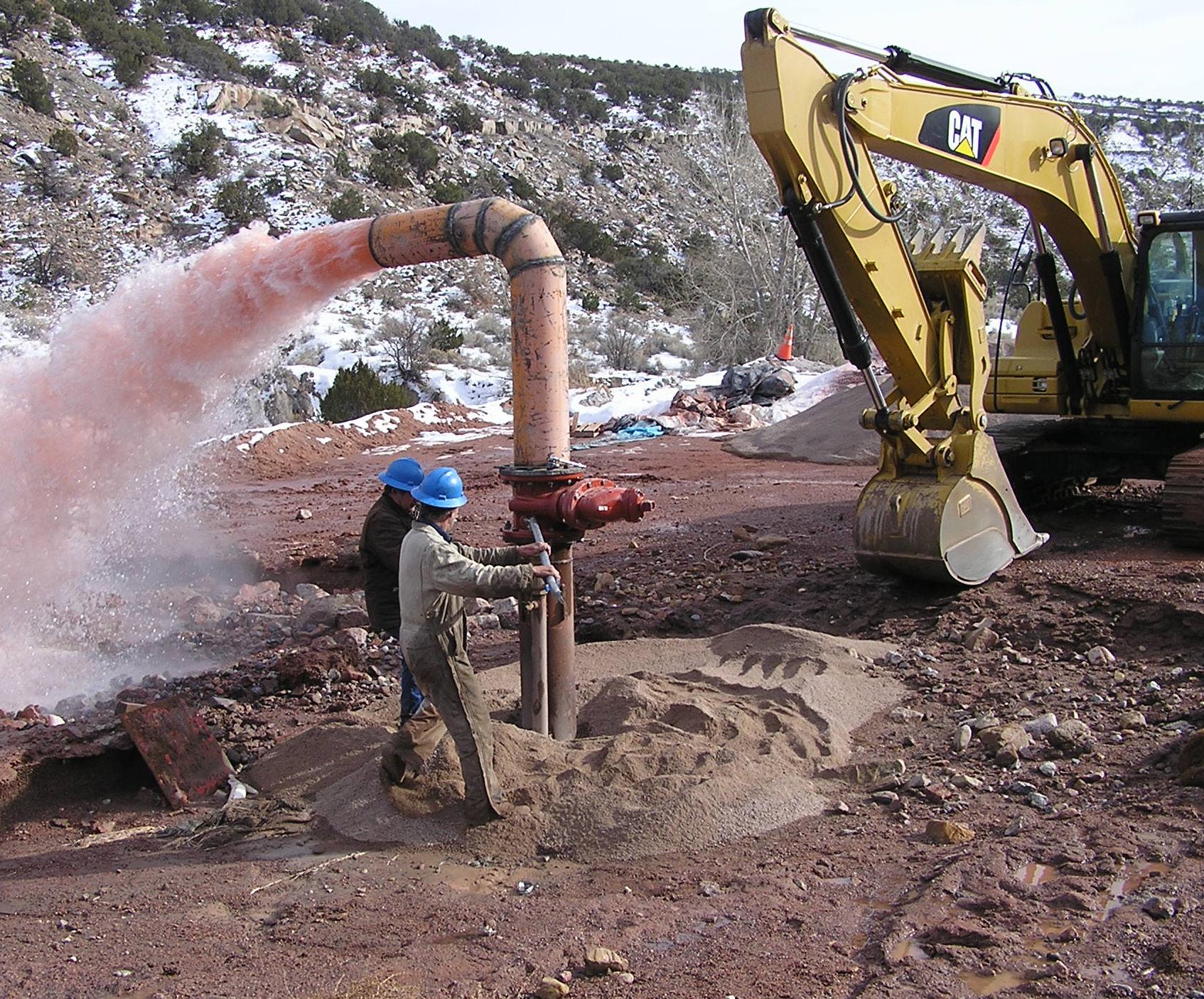
In the early 1870s, the first wells were drilled in the vicinity of Denver. By 1895, nearly 400 wells had been drilled in the vicinity of Denver and its surroundings. Besides commercial applications, the artesian pressure was used for decorative fountains at Union Station, power assist for the elevators at the Brown Palace Hotel, and the operation of the organ bellows at the Trinity Methodist Church.
An aquifer is a groundwater reservoir composed of geologic materials that are saturated with water and sufficiently permeable to yield water in a usable quantity to wells and springs. Sand and gravel deposits, sandstone, limestone, and fractured crystalline rocks are examples of geologic materials that form aquifers. Geologic units consist of either unconsolidated (loose, uncemented) sediments or consolidated rock. Aquifers provide two important functions: They transmit groundwater from areas of recharge to areas of discharge, and they provide a storage medium for groundwater.
Aquifers where there are no confining beds between the zone of saturation and the surface are termed unconfined aquifers (Figure 1.2). When a well is drilled in an unconfined aquifer, the water level in the well will match the depth of the water table in the aquifer. The aquifer’s water table can move freely up and down through the aquifer as water enters (recharges) or leaves (discharges) the system. Unconfined aquifers provide water to wells by draining the pores or fractures of the geologic materials surrounding the well. Examples of unconfined aquifers include the saturated alluvial deposits associated with many of Colorado’s river systems, such as the South Platte, Arkansas and Colorado rivers. These are relatively shallow groundwater aquifers hydrologically connected to the state’s river systems. They also include valley-fill deposits such as the San Luis and Wet Mountain valleys in south-central Colorado.
FIGURE 1.2 A cross section of aquifer types
Water flows from the high-pressure artesian Park Center Well in the Fountain aquifer, just north of Canõn City.
CHAMBERLIN; BOTTOM: DOUG STEPHENSON
Source: Modified after Harlan and others, 1989
Confined aquifers are completely saturated geologic units overlain by confining layers of relatively low permeability that prevent free movement of air and water. The water is thus confined under pressure and, if tapped by a well, rises to a level above the top of the aquifer, but not necessarily above the land surface. If the water level in an artesian well stands above the land surface, the well is known as a flowing artesian well. Recharge of confined aquifers is through subsurface flow from adjacent unconfined zones and slow leakage through adjacent confining layers. For the most part, the Denver, Arapahoe and Laramie-Fox Hills aquifers of the Denver Basin are examples of confined aquifers, where they are overlain by impermeable layers.
Aquifer Hydraulic Characteristics
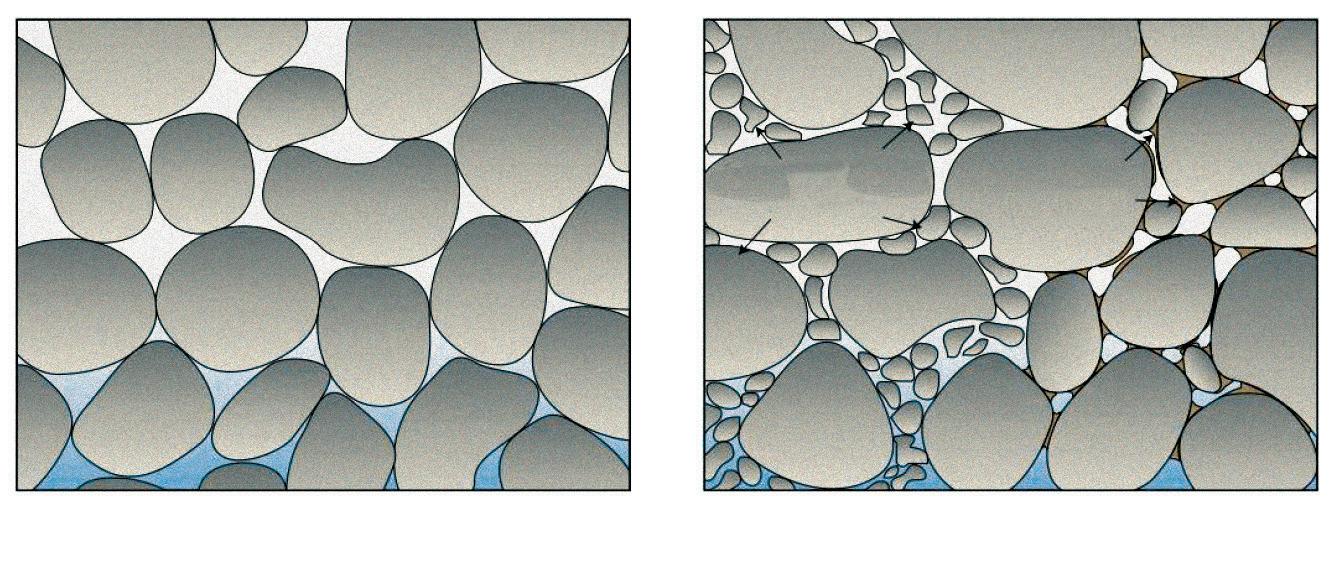
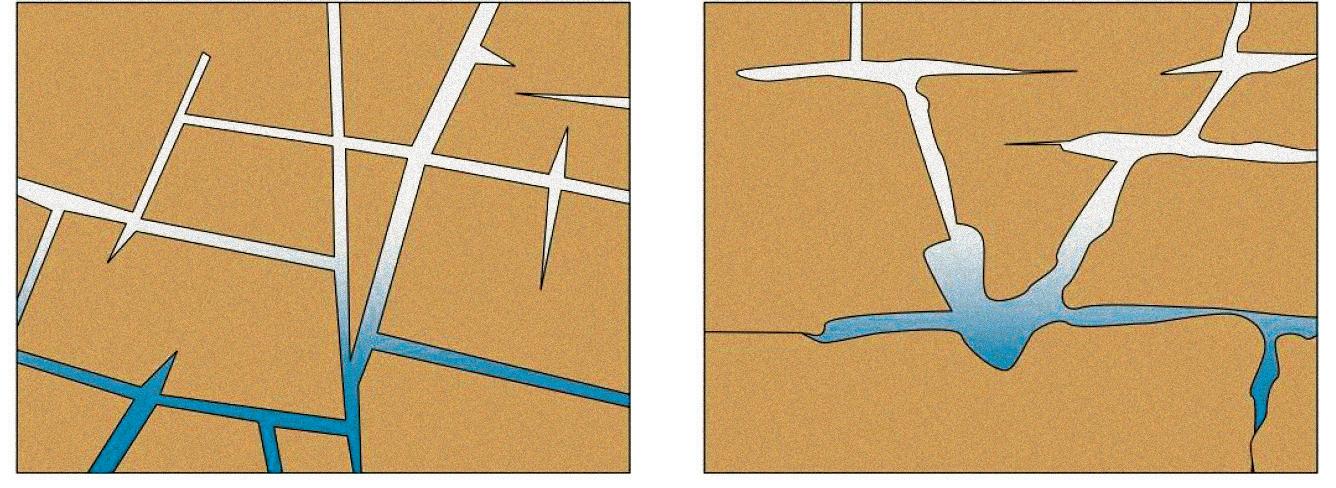
Certain aquifer properties or characteristics are critical for successful groundwater development. The amount of groundwater that can flow through an aquifer depends on the size of the openings or spaces in the soil or rock and how well those spaces are connected to each other. The amount of empty space in the geologic material is termed porosity. Porosity in granular deposits such as sands or gravel may exceed 40 percent of the total rock volume, whereas fractured crystalline rock porosity may be 1 percent or less.
Permeability measures how well those pore spaces are connected and determines the material’s ability to transmit fluid. The most productive aquifers in the world are composed of unconsolidated sand and gravel and cavernous carbonate rocks as they have large connected spaces through which water can flow. The porosity and permeability of common aquifer materials are illustrated in Figure 1.3. If a material contains pores or fractures that are not well connected, as commonly occurs in clay or shale, groundwater cannot move from one space to another.
Water table
Water table
Transmission of water through an aquifer is driven by gravity and pressure changes. In groundwater hydrology, the
Unconfined aquifer
Confining bed
Water table Water table
Unconfined aquifer
Confining bed
Water table Water table
Unconfined aquifer
Pumping well Recharge area Recharge area
Confining bed
Unconfined aquifer
Confining bed
FIGURE 1.3 The rock types that form common aquifers
FIGURE 1.4 Wells withdrawing groundwater impact normal groundwater flow to and from a stream
Groundwater discharge to a stream
Pumping well intercepting discharge to a stream
Well-sorted and rounded sedimentary material (Alluvium of the South Platte River)
Fractured crystalline rocks (Pikes Peak Granite)
Poorly-sorted, or cemented sedimentary material (Dawson, Denver and Arapahoe aquifers)
Fine-grained sediment particle infill
Mineral cement between grains
Cavernous geologic formations (Leadville Limestone)
Source: Winter and others, 1999
The Groundwater Environment
pressure exerted by the water column is defined as total head. Groundwater moves in response to a head (pressure) differential in a direction from areas of high head (higher groundwater elevation) to areas of low head (lower groundwater elevation). The rate of groundwater movement through an aquifer depends on the hydraulic gradient, which is the change in total head over a specific distance.
Groundwater and Surface Water Interactions
Surface water is commonly in hydraulic connection with groundwater, but those interactions are difficult to observe and measure. Withdrawal of water from streams can deplete groundwater, just as the pumping of groundwater can affect streamflow. Due to the interaction of these two resources, pollution in one can also translate into reduced water quality in the other.
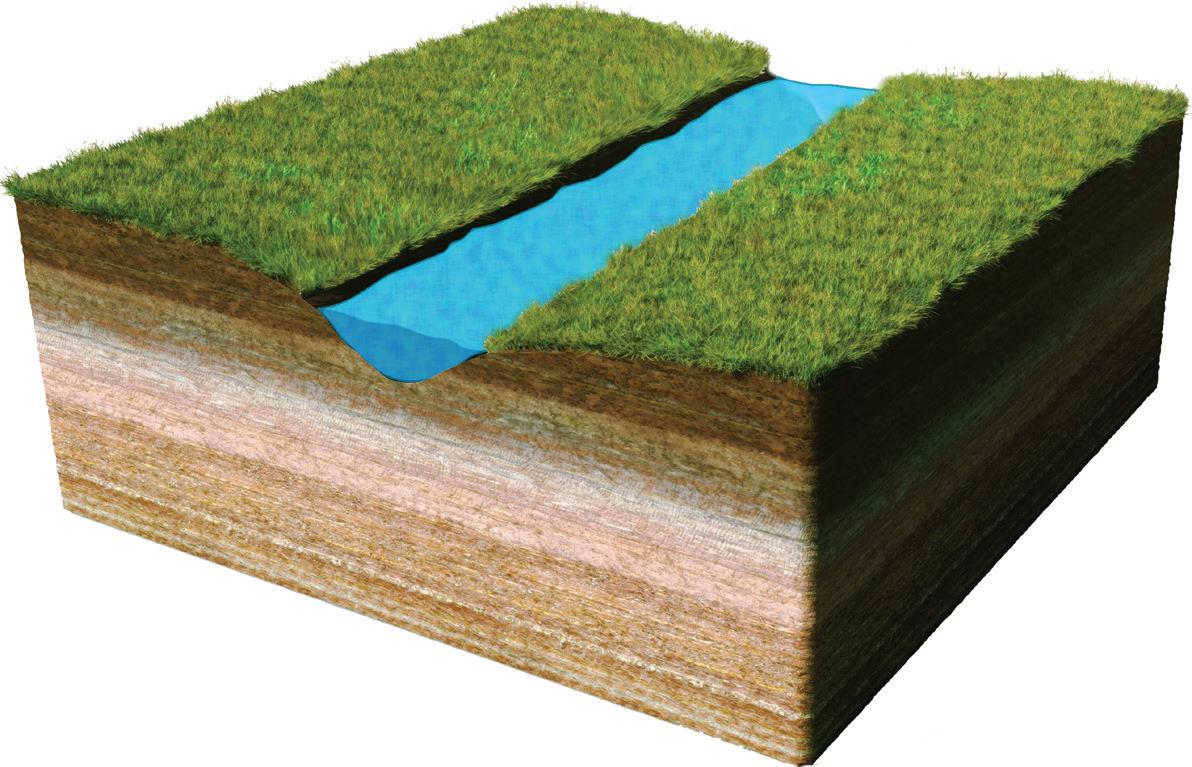
Groundwater moves along flow paths of varying lengths, depths and travel times from areas of recharge to areas of discharge. Water moves both vertically and laterally within the groundwater system. Streams interact with groundwater through their streambed in three basic ways: streams gain water from inflow of groundwater (gaining stream), they lose water to the aquifer by outflow (losing stream), or they do both depending upon location along the stream’s reach.
For groundwater to discharge into the stream channel, the elevation of the water table in the vicinity of the stream must be higher than the elevation of the stream water surface (Figure 1.5). Conversely, in a losing stream the elevation of the adjacent water table is lower than the elevation of the stream water surface (Figure 1.6). Losing streams can be connected to the groundwater system by a continuous saturated zone or be disconnected by an intervening unsaturated zone.
The portion of streamflow derived from groundwater inflow varies across Colorado. Research in high alpine environments suggests that 40 percent of


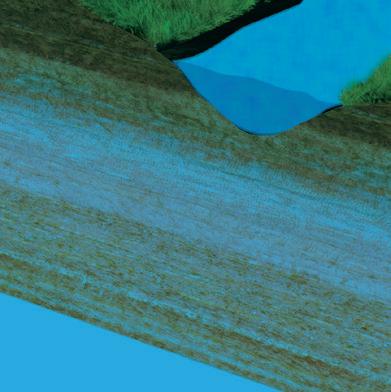













streamflow during spring runoff is actually groundwater inflow. The amount of water that groundwater contributes to streams can be estimated by analyzing streamflow hydrographs (graphs of flow over time) to determine the groundwater component, which is termed base flow. Streamflow during winter, when the ground is frozen and precipitation takes the form of snow, is base flow. Likewise, the minimal streamflow observed in late summer when precipitation is scarce also represents the base flow component attributed to groundwater inflow.


Pumping groundwater from shallow aquifers that are directly connected to surface water bodies can have significant effects on surface water. Groundwater withdrawals from shallow aquifers near surface water bodies can diminish the available surface water supply by capturing some of the groundwater flow that would have discharged to the stream or by inducing flow from the stream into the surrounding aquifer. This groundwater/surface water interaction illustrates the concept that groundwater and surface water are a single resource.
FIGURE 1.5 Gaining streams receive groundwater discharge from an adjacent water table that is higher than the stream surface.
FIGURE 1.6 Losing streams lose water by outflow to an adjacent water table that is lower than
ted zone
rated zo Flow direction
Shallow aquifer
Shallow aquifer
Source: Winter and others, 1999
Colorado’s Aquifers
Groundwater in Colorado occurs in different aquifer types, with the most common being:
• Alluvial aquifers composed of unconsolidated granular sediments
• Sedimentary aquifers composed of consolidated and semi-consolidated granular sedimentary bedrock formations
• Fractured crystalline rock aquifers composed of volcanic materials
The distribution of Colorado’s aquifers depends on local geology and geographic setting. The state’s diverse
geology is characterized in some places by sedimentary formations created by erosion and the windblown deposition of sediment and in others by crystalline rocks formed by past uplift and volcanic activity. Surface water drainage patterns further divide the state into eight major watersheds, each with its own characteristics.
Figure 2.1 is a generalized geologic map of Colorado showing Colorado's major geologic formations classified by age. Rocks and sediments in Colorado tell a complex tale stretching back nearly 3
billion years. Figure 2.2 lists major events from the geologic record in chronological order, with youngest at the top and oldest at the bottom, to convey how the formations may stack on top of each other. The table also summarizes the types of rocks preserved as well as the types of aquifers those rocks form.
Alluvial Aquifers
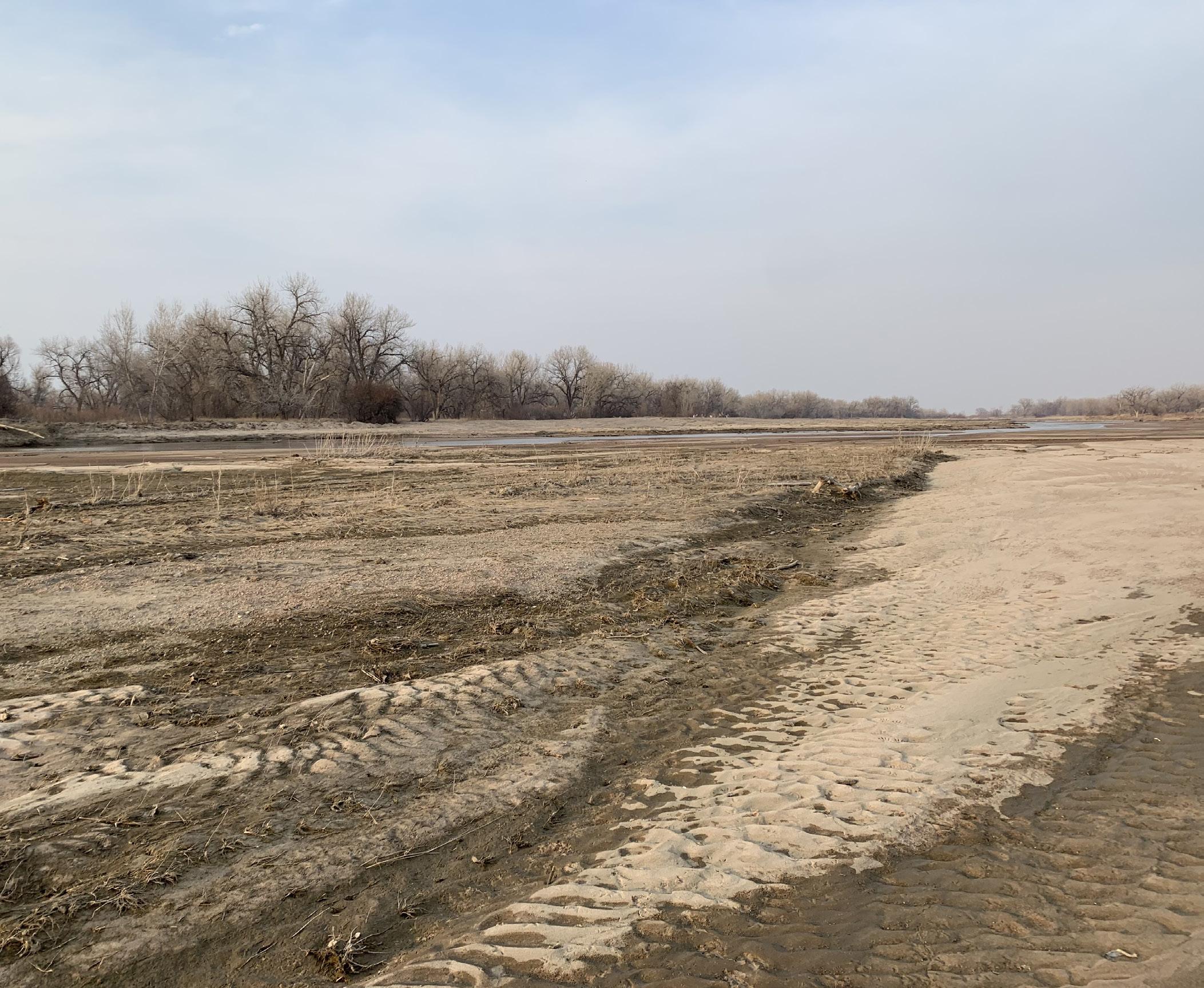
Alluvial deposits associated with major river systems (Figure 2.3) consist of silt, sand and gravel deposited during the last
JAYLA POPPLETON
Sandy alluvium along the South Platte River indicates the location of the South Platte alluvial aquifer. Below the surface, groundwater fills porous spaces between these loose grains of sand and silt.
Colorado’s Aquifers
2.6 million years. Rivers transport these materials down from upstream areas and as the river course changes, deposits are left behind. Groundwater in alluvial aquifers fills pore spaces between loose grains of sand and gravel and typically interacts with surface water. Alluvial aquifers rarely extend deeper than 100 feet and are limited to areas along the rivers that may extend from hundreds of feet to many miles wide. Although often limited in extent, alluvial aquifers are generally the most productive aquifer
type in the state. Mean well yield in the Lower South Platte River alluvium east of Denver is over 400 gallons per minute (gpm) with some wells reaching over 1,000 gpm.
Sedimentary Bedrock Aquifers
Sedimentary bedrock aquifers are composed primarily of consolidated or semi-consolidated granular materials deposited in river, wind, shoreline or deep-sea environments. These originated
as unconsolidated sediments but over time were consolidated by compaction or cementation as minerals formed in the pore spaces. Some may be composed of calcium and magnesium carbonate minerals deposited as shell fragments or precipitated directly from water. Because of consolidation, well productivity in sedimentary bedrock aquifers tends to be lower than in unconsolidated alluvium. Mean well yield from sedimentary bedrock aquifers is generally less than 30 gpm,
FIGURE 2.1 Generalized geologic map of Colorado showing rocks and formations by geologic age
Quaternary
Cenozoic (Age of Mammals)
FIGURE 2.2 Major events that shaped the geologic setting of aquifers in Colorado
Quaternary: glaciation, development of present topography and stream systems
unconsolidated sand and gravel, silt, and clay / alluvial aquifers
Cenozoic Extension: Uplift, block faulting, and formation of deep basins
2.6-23
Mesozoic (Age of Reptiles)
66-145 Cretaceous
semi-consolidated sand and gravel, mudstone and siltstone, basalt flows / bedrock sedimentary aquifers, local fractured bedrock aquifers
Transition to extension: Widespread volcanism
lava flows, volcanic breccias, welded tuff, ash beds, conglomerate, interbeds of sand and gravel / fractured crystalline rock and localized bedrock sedimentary aquifers
Laramide mountain building event: compressional tectonism, uplifting ranges and development of deep basins, K/P boundary and end of “Age of Dinosaurs” and beginning of “Age of Mammals”
semi-consolidated interbedded sandstone, conglomerate, siltstone and mudstone with some coal / basin-centered bedrock sedimentary aquifers
Interior Seaway: regional downwarp with flooding by shallow seas
SIGNIFICANT
Great Sand Dunes, South Platte River Valley
San Luis Valley, Glenwood Canyon, Grand Mesa
San Juan volcanic field, Creede Caldera, Mount Princeton Batholith
Paleozoic (Age of Fishes)
Shale badlands, Mesa Verde National Park, ammonite fossils, Book Cliffs, oil and gas, coal Paleogene Neogene Tertiary Present-2.6
marine shale, limestone, offshore sandstone members, widespread delta and shoreline sandstone deposits with coal / regional bedrock sedimentary aquifers
Mesozoic Sandstones: relatively stable continent with semi-arid and arid conditions
sandstone, siltstone, mudstone with minor conglomerate and non-marine limestone / regional bedrock sedimentary aquifers
Denver Basin, Front Range Upift, Sawatch Uplift, Grand Hogback, Pikes Peak, South Park, Roan Cliffs, oil shale, coal
Permian
Pennsylvanian
Mississippian
Devonian 359-419
Silurian
Ordovician
Cambrian
Proterozoic Eon
Archeozoic Eon
Ancestral Rocky Mountains: uplifting ranges and development of basins with periods of marine flooding; restricted circulation and high evaporation
sandstone, conglomerate, siltstone, and mudstone; marine shale, limestone, and thick accumulations of salt and gypsum / basin-centered bedrock sedimentary aquifers, localized saline aquifers
Paleozoic Carbonates: relatively stable continent with flooding by warm shallow seas
marine and shoreline sandstone and quartzite; marine limestone and dolomite, marine shale / regional bedrock sedimentary aquifers, localized groundwater flow in solution cavities and channels as well as fracture flow
Dinosaur National Park, Colorado National Monument, uranium deposits
Red Rocks Park, Flatirons, Paradox Valley, Maroon Bells, crinoids, gypsum beds in Eagle Valley, evaporite collapse features Glenwood Canyon, proliferation of shelled invertebrates, evolution of vertebrates, Cave of the Winds, Glenwood Hot Springs
Precambrian basement: continental expansion, deposition of sedimentary rocks, regional metamorphism, deformation, igneous intrusions
Gneiss and schist with a variety of composition and texture, intrusive rocks of varying composition, localized quartzite / fractured crystalline rock aquifers
Front Range “core,” Pikes Peak, Rocky Mountain National Park, soft-bodied marine organisms
Colorado’s Aquifers
FIGURE 2.3 Alluvial aquifers in Colorado


and rates over 500 gpm only occur under rare conditions. However, these aquifers can extend over much larger areas than alluvial aquifers.
Sedimentary aquifer distribution, depth and thickness is variable depending on geologic setting, with aquifers spanning large regions or filling deep structural basins. Geologic setting also determines whether an aquifer is confined or unconfined. Not all geologic formations form aquifers. Many are quite impermeable, forming confining layers instead.
Large quantities of groundwater occur in deep basins (Figure 2.4) formed during several of the geologic events shown in Figure 2.2. These basins typically contain multiple geologic formations made up of sand, gravel and mudstone shed off of nearby uplifts. One of the oldest events that shaped Colorado’s modern geology is the Pennsylvanian-Permian Ancestral Rocky Mountain uplift that occurred between approximately 250 and 320 million years ago. Sedimentary formations from this event include the colorful Maroon and Minturn formations of the Eagle Basin as well as thick accumulations of salt and gypsum that filled parts of a deep basin that crosses central Colorado. Not only do salt and gypsum impair water quality locally, but their dissolution by groundwater can cause the ground to collapse in areas where they occur. The next episode of basin development is the Late CretaceousPaleogene Laramide uplift that occurred between approximately 45 and 70 million years ago. The seven major basins formed during this event often contain coal, oil and gas resources as well as large quantities of groundwater. These include the Denver Basin, a Laramide-age structural geologic basin adjacent to most of the Front Range. Based on limited age dating, the groundwater in the Denver Basin aquifers ranges from 8,000 years old near the outcrops of the aquifers to greater than 30,000 years old near the center of the basin. The youngest period of basin development accompanied Neogene uplift of the entire region, and mountainous faulting that created many of the deep intermountain basins.
FIGURE 2.4 Sedimentary bedrock aquifers in Colorado
Colorado spans three main geographic regions: The Great Plains, Southern Rocky Mountains, and Colorado PlateauWyoming Basin. Many geologic formations span all, or parts, of these regions. These are called regional aquifers.
Eastern Colorado is part of the Great Plains region and includes the High Plains and Colorado Piedmont sub-regions (Figure 2.4). It is a broad plain dominated by Upper Cretaceous through Quaternary sedimentary deposits. The High Plains aquifer system covers a large portion of this region and is made up of permeable sand and gravel shed off of the Rocky Mountains during regional uplift in the Neogene period. It is a vital regional water resource. Upper Cretaceous formations deposited during flooding by the Western Interior Seaway blanket this region and consist of thick accumulations of shale, such as the Pierre Shale. Locally, beds of sandstone and limestone within the shale form important aquifers. Organic-rich shales such as the Niobrara Formation are important sources of oil and gas throughout the Rocky Mountain region. The Dakota-Cheyenne aquifer is an extensive regional aquifer deposited in eastern Colorado during this seaway flooding event and is below the layers of shale.
Western Colorado covers portions of the Colorado Plateau and Wyoming Basin Plateau region, an area characterized by deep canyons and high plateaus. Geologic formations at the surface in this area are dominated by Pennsylvanian through Quaternary sedimentary deposits with scattered Neogene volcanic flows and intrusions. Upper Cretaceous marine Mancos Shale, the western equivalent of the Pierre Shale, also dominates much of this region. The deeper Dakota Group underlies large areas and can be an important regional aquifer. Deformation of the sedimentary formations in this area include broad uplifts and large-scale folds formed during the Ancestral Rocky Mountains and Laramide events.
Mountainous Region Aquifers
The Southern Rocky Mountains bisect the state, covering nearly one-third of its area. This Mountainous region (Figure
EXPLANATION
2.5) has the greatest topographic relief with 54 peaks exceeding 14,000 feet in elevation. It is also the most geologically complex region in the state. Within this region are deep valleys formed by Neogene faulting that are filled with complexly deformed sedimentary formations of many ages and areas of intense volcanic activity covered with lava flows, ash deposits, and sediments shed off of eroding volcanoes.
Fractured crystalline bedrock, the third common aquifer type in Colorado, is at or near the surface over large portions of this region where it forms the only available aquifer. Rocks forming this bedrock consist of interlocking mineral crystals with no interconnected pore space to create porosity or permeability. Groundwater only occurs and moves through where fractures and faults crosscut the rock. Because of this, groundwater production is generally low as compared to the sedimentary aquifers. Mean well yields are generally less than
10 gpm and rates over 50 gpm are rare. Production and depth to groundwater can also be variable from well to well.
Crystalline bedrock includes Precambrian igneous rock that intruded in molten form deep within the earth at high temperatures. The most commonly recognized rock is granite, but there are many other varieties. Precambrian metamorphic rocks also make up a large portion of these rocks. These are rocks that were originally sedimentary or volcanic in origin but were changed in form during deep burial under pressure and high temperature.
Volcanic and igneous rocks make up the remainder of the crystalline bedrock within the Mountainous region. These rocks include lava flows and ash deposits that welded under their own heat into very dense rock after coming to rest. Other rocks formed from explosive eruptions and erosion of the volcanoes in this region are often interlayered with the crystalline flows.
FIGURE 2.5 Mountainous region aquifers with intermountain valley outlines
Groundwater Supply & Administration
Colorado has four statutory groundwater definitions or classes: tributary, nontributary, not-nontributary (specific to the Denver Basin), and designated groundwater. Tributary groundwater is connected to a natural stream system through either surface or underground flows. All groundwater in Colorado is presumed tributary until determined otherwise by a water court decree, issuance of a well permit, or determination by rule.
Nontributary water is disconnected from surface water due to geologic conditions such as faulting, confining layers, or great distances. The legal standard for nontributary water is that pumping will not, within 100 years of continuous withdrawal, deplete the flow of a natural stream at an annual rate greater than one-tenth of one percent of the annual rate of withdrawal. So, if you pump 100 acre-feet per year of groundwater from a nontributary aquifer beginning in the year 2000, by the year 2100, there will be
less than 0.1 acre-feet (32,585 gallons) per year of depletion to a stream caused by that pumping.
Nontributary groundwater may be used without developing a plan for replacing depletions to the surface water system, such as an augmentation plan or replacement plan.
Denver Basin Groundwater
Within the Denver Basin are multiple sedimentary bedrock aquifers situated
one on top of the other in layers, like a stack of shallow bowls. Between each aquifer is a confining layer that separates the individual aquifers and the water stored in each of them. Due to the nature of the confining layers and because of the limited connection between these aquifers and surface water, the groundwater in the aquifers is only directly recharged by precipitation along the basin edges where they outcrop. From shallow to deep, the layered aquifers in the Denver Basin are named the Dawson, Denver, Arapahoe and Laramie-Fox Hills aquifers. Nontributary areas in the Denver Basin are mapped in the Denver Basin Rules. Formulated to address specific legislation, the Denver Basin Rules govern the withdrawal of groundwater from the Denver Basin aquifers. Aquifers in the Denver Basin that are
Mapping the unseen resource: How groundwater is measured and monitored
Because groundwater is not typically visible above ground, it can be more difficult to quantify than surface water. Installation of monitoring wells and mapping is required to determine the volume or the direction of groundwater flow.
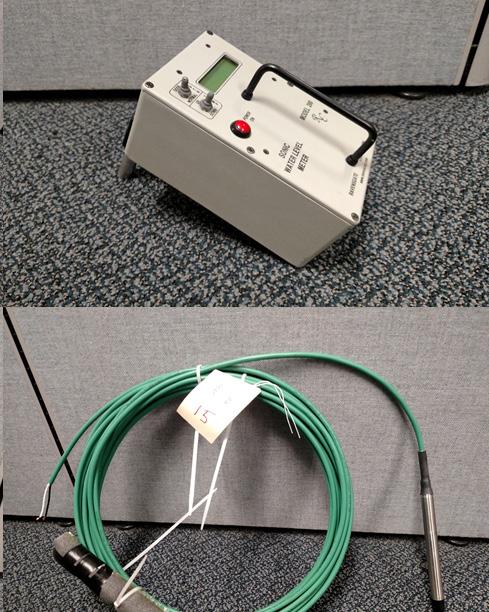
Groundwater levels can be measured manually from the surface or by instrumentation within the well. Steel tapes are mainly used on irrigation wells with surface turbine pumps because they are thin enough to fit in small openings without tangling with equipment down the well. Electronic water-level meters (aka e-tapes or m-scopes) are mainly used in dedicated monitoring wells or wells without down-hole pumping equipment. The least invasive measuring devices, sonic meters or sounders, emit sound waves down the well and measure the depth to water by timing the return of the waves. These instruments are favored because no equipment goes down the well or touches the water, but their accuracy depends on calibration.
well can give a user their water level on demand or at specified time intervals. When paired with a data logger, waterlevel measurements can be recorded at regular intervals and even transmitted via cellular, radio or satellite telemetry.
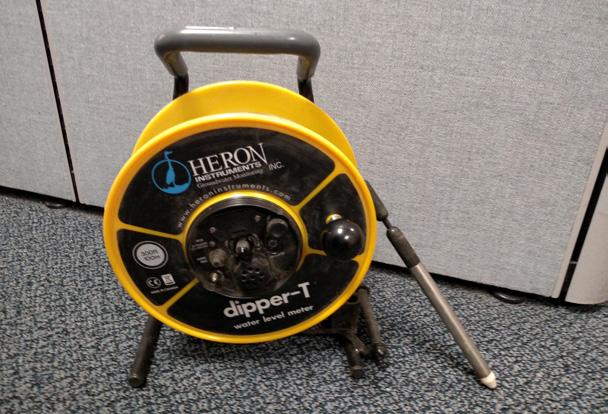
Sonic water level meter (top) and e-tape (bottom) are two common instruments for measuring groundwater levels.
Manual measurements are quite valuable, but also time consuming and expensive. Instruments installed in a well or at the wellhead allow for continuous water-level measurements. Sonic meters installed at the top of the casing or pressure transducers in the
Recently, many geophysical methods previously used in the mining or petroleum industries have been deployed to measure groundwater. These methods include electrical, electromagnetic, seismic and gravity techniques. Some of these surveys are even conducted from the air using drones or helicopters.
All of these techniques provide essential data for groundwater analyses and management decisions. Colorado has recently joined the National Groundwater Monitoring Network which compiles data from state and local providers to assist with planning, management and development of groundwater supplies to meet current and future water needs and ecosystem requirements.
KEVIN DONEGAN
FIGURE 3.1 The Denver Basin aquifers overlain with Colorado’s Designated Ground Water Basins

LEGEND
Denver Basin Aquifers
Upper Dawson Aquifer
Lower Dawson Aquifer
Designated Basins

Daw son Aquifer
Denver Aquifer
Camp Creek
K iowa Bijou
Lost Creek

Upper Arapahoe Aquifer
Lower Arapahoe Aquifer
Arapahoe Aquifer
Northern High Plains
Southern High Plains
Upper Big Sandy

Laramie Formation
Laramie -Fox Hills Aquifer
Boulder Complex Area
Upper Black Squirrel Creek
Upper Crow Creek

0306090 MILES
KEVIN DONEGAN
Groundwater Supply & Administration
The Upper Pierre: New groundwater, and a need for new rules
Nearly 170 years after the construction of Colorado’s first well, new groundwater is still being discovered in the state. The Upper Pierre aquifer, a mostly unexplored formation that reaches depths of 1,500 feet and extends across most of northeastern Colorado, is a prime example. By the spring of 2019, fewer than 100 wells had been drilled there. Theresa Jehn-Dellaport, president of the Lakewood consulting firm Quantum Water and Environment and a founder of the nonprofit group Friends of the Upper Pierre, helped shepherd the first application for nontributary groundwater in the aquifer through water court in 2012. She says that new state regulations are urgently needed to ensure responsible and timely development of the aquifer moving forward.
The Upper Pierre aquifer’s depth varies across the landscape. In places it comes into direct contact with the South Platte River alluvial aquifer (subcrop) or is exposed at the ground surface (outcrop). In other places, where the Upper Pierre is overlain by impermeable shale or mudstone, it is a confined aquifer.
Because the Upper Pierre aquifer interacts with South Platte alluvial groundwater, water providers that rely
not mapped as nontributary are termed not-nontributary. The pumping from those aquifers has an impact on nearby stream systems, although over a longer time span than pumping from tributary aquifers. Those potential impacts are handled differently per the Denver Basin Rules.
Designated Ground Water Basins
There are eight regions in eastern Colorado termed Designated Ground
FIGURE 3.2 Approximate extent of the Upper Pierre aquifer in northern Colorado
on South Platte alluvial groundwater have been legally objecting each time an application for a new Upper Pierre aquifer well is filed, out of concern that new wells could injure their water rights. Such objections have made it difficult for well permit applicants to meet their water demands.
To prevent permit applicants from getting bogged down for years in water court, Friends of the Upper Pierre argues
Water Basins (Figure 3.1). Designated Basins are established when the Colorado Ground Water Commission determines that the groundwater they contain is either not required for the fulfillment of decreed surface rights or is in an area not adjacent to a stream wherein groundwater withdrawals have constituted the principal water source for at least 15 years. Designated Basins encompass alluvial and bedrock aquifers, parts of the Denver Basin aquifers, and the High Plains aquifer. Designated groundwater is administered under a
that the State Engineer should step in and develop well pumping rules for the aquifer. This would require an act of the Colorado Legislature, which in turn would require more research and core sampling by entities like the U.S. Geological Survey and the Colorado Geological Survey. Jehn-Dellaport estimates that all of this could take nearly a decade, but she is actively pursuing funding for the necessary research.
separate legal regime from other waters of the state, with the Ground Water Commission having administrative authority rather than the state’s water courts. There are 13 locally controlled Ground Water Management Districts within the Designated Basins, which have some additional authority to administer groundwater within their boundaries.
The Well Permitting Process
Colorado has the distinction of being the first state to publicly administer
KEVIN DONEGAN
Inside Designated
Basin
Residential with lawn/garden irrigation and domestic/stock animal watering
household uses in up to three single-family dwellings, ≤ 1 acre lawn and garden, domestic/stock animals
Tributary Large Capacity By Request By Permit By permit
Nontributary Large Capacity By Request By Permit
Outside Designated Basin
Exempt residential household use only
Exempt residential with lawn/ garden irrigation and domestic/ stock animal watering
Tributary Non-Exempt By Request By Permit
water law
Management Districts may apply additional restrictions. In a subdivision, usually reqiures a replacement plan.
replacing depletions to the aquifer in overappropriated areas
per year of volume of water underlying the land Requires nontributary determination by Ground Water Commission, Rule, or determination by the State Engineer's Office
Nontributary Non-Exempt By Request By Permit 1% per year of volume of water underlying the land
water development. The oldest, most senior water right in Colorado, the San Luis People’s Ditch, dates from 1852 for a diversion from Culebra Creek in Costilla County. The oldest documented beneficial use of a water well is a 25-footdeep well dug by hand in the northern portion of the San Luis Valley in 1850.
All new wells drilled in Colorado are required to have a well permit issued by the Division of Water Resources. This provision was originally outlined in the Colorado Ground Water Law, also known as the 1957 Act.
Exempt Wells
Originally, stock watering and lowdischarge domestic wells were not required to be permitted. The legal definition of these exempt wells evolved over time and is now defined in statute.
Today, these wells are permitted under the presumption that they will not cause material injury to existing surface and well water users because they individually have relatively minor water consumption. In other words, they are exempt from administration under the prior appropriation doctrine. Exempt wells can only pump at rates of 15 gallons per minute or less and be used for ordinary household purposes, irrigation of less than one acre of lawn and garden, fire protection, and drinking and sanitary purposes in a commercial business.
Groundwater and Prior Appropriation
Wells are administered within the prior appropriation system unless they are nontributary or exempt. This process of incorporating
Requires replacing depletions to the stream system in overappropriated areas
Requires nontributary determination by Water Court, Rule, or determination by the State Engineer's Office
groundwater development into the legal system governing surface water was outlined 50 years ago in a landmark bill, the Water Rights Determination and Administration Act of 1969 (the 1969 Act).
The 1969 Act created seven water divisions across Colorado and corresponding division engineers and water courts for each of them. In order to promote the use of groundwater and increase the available supply of water for beneficial use, the law established augmentation plans. Well users could file a water right to use their tributary well, but most wells would still be junior to surface water rights. An augmentation plan allows a well user to replace (augment) the depletions to the local stream system caused by pumping a tributary well so that they can pump even when they are out of priority. These plans must be approved in the local water court and must show how,
Groundwater Supply & Administration
Augmentation plans keep the South Platte River whole
After the 1969 Act created augmentation plans, many South Platte well users obtained water court-decreed plans for augmentation, but many others relied on annual State Engineer approvals to operate. In 2002, the historic drought coincided with a court ruling to create a crisis. The Colorado Supreme Court determined the State Engineer did not have the authority to approve annual replacement plans. With low river flows due to drought, diverters filling reservoirs placed an unprecedented call for water in the winter, requiring well users to replace stream depletions yearround. This doubled the amount of water required for augmentation of groundwater depletions. Well users scrambled to purchase additional water and complete water court-approved augmentation plans, yet many could not find adequate augmentation water and were ordered by the state to stop pumping beginning in 2006. When 2006 came, close to 1,000 wells were shut down.
Well users who continue to operate tributary groundwater wells replace stream depletions through a combination of sources, including water rights changed from irrigation use to augmentation use, releases of water from storage, transbasin diversions, and water that is delivered into infiltration ponds to recharge the alluvial aquifer. Recharge adds water to the stream system weeks or months after water is delivered to a recharge pond, based upon distance and hydrogeologic conditions. Augmentation plans commonly forecast the impact of well pumping on streams years in advance, to ensure that adequate replacement supplies will be available at the right place and time to replace expected depletions.
The numbers: Recharge amounts in the South Platte Basin vary year to year, but peak recharge increased from 150,000 acre-feet before 2002 to 350,000 acre-feet in recent years. The number of recharge ponds increased from 100 to 700 in that same time frame. The number of decreed augmentation plans in the basin has increased from 600 to over 1,400.
when and where an applicant will replace their well depletions.
Replacement sources for augmentation plans can be any legally available water source, including nontributary groundwater, water stored in a reservoir, or water infiltrated to the underlying aquifer through a recharge pond.
Wells that pump nontributary groundwater are not administered under the prior appropriation system but are still regulated by the Division of Water Resources. A well must be permitted, and the volume the well is allowed to pump is based on the groundwater available for withdrawal underlying the land owned by the user. Colorado law allocates the volume of water under the land over a 100-year period, thus limiting the amount pumped to 1 percent per year of the total calculated volume. In some places, local land use requirements dictate even more limited allocations.
Well Construction
Landowners interested in drilling a well on their property can find permit applications and instructions on the Colorado Division of Water Resources website (colorado.gov/ water). The applications require that a landowner list the proposed well location, land ownership information, the proposed use(s) of their well, and other details relating to the well’s pumping rate and annual production.
The Board of Examiners of Water Well Construction and Pump Installation Contractors (BOE) was established in 1967 to oversee licensing and to establish rules to ensure proper well construction and pump installation techniques. The BOE publishes lists of licensed contractors organized by city or company and should be the first point of contact for a well owner looking to drill.
The Colorado General Assembly recognizes that improperly constructed wells can adversely impact the groundwater resources of Colorado and the public health of its citizens. The most recent revisions to the Well Construction and Administration Rules (in 2016 and 2018, respectively) were widely accepted by the industry and are meant
JOE FRANK
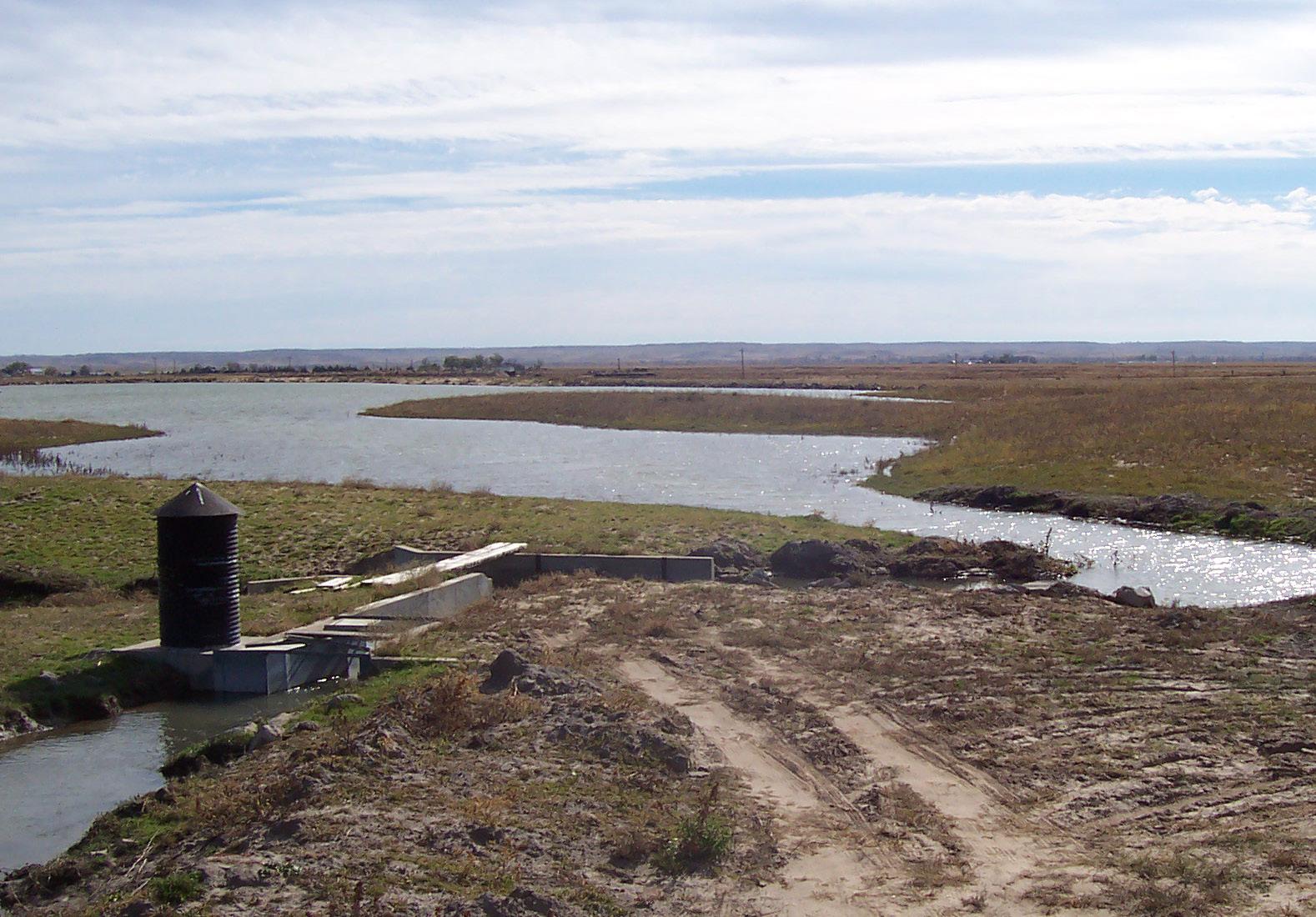
The Lower South Platte Water Conservancy District’s primary recharge pond provides an augmentation supply for more than 70 wells near Julesburg, just upstream of the border between Colorado and Nebraska.
to be even more protective of Colorado’s groundwater than their previous iteration.
The Division of Water Resources has created several online tools to help well owners and contractors research aquifer conditions, well locations and depths, or even water levels. These tools are all accessible through the Colorado Water Conservation Board and Division of Water Resources’ Colorado Decision Support Systems Online Dashboard (dwr.state.co.us/tools). The map viewer tool combines all of the datasets into one map-based user interface. Users can zoom to see other constructed wells in their neighborhood. Various tools allow users to research well permits, construction information, and water levels, and determine the depths and thickness of the Denver Basin and Dakota- Cheyenne aquifers.
Water Quality
The fact that the Colorado Division of Water Resources issues a permit to drill a well does not mean the water produced by that well is safe or abundant enough to drink. Beginning in the 1960s and 1970s, increased awareness of environmental problems like water pollution led to the passage of landmark federal environmental laws like the Clean Water Act (CWA) and the Safe Drinking Water Act (SDWA). Many states, including Colorado, manage and enforce these laws at the state level. In Colorado, the Colorado Department of Public Health and Environment (CDPHE) is the lead agency responsible for the administration, management and enforcement of water quality regulations. The CWA’s original focus was the regulation of “end-of-pipe” (also known as “point source”) pollution in streams, rivers and lakes. The amended Clean Water Act of 1987 continued funding municipal water treatment plants, established a comprehensive program to control toxic pollutants, and addressed non-point source pollution caused by discharges from diffuse sources. The CWA does not regulate groundwater quality, but its discharge permit program requirements,
CONTINUED ON PAGE 21
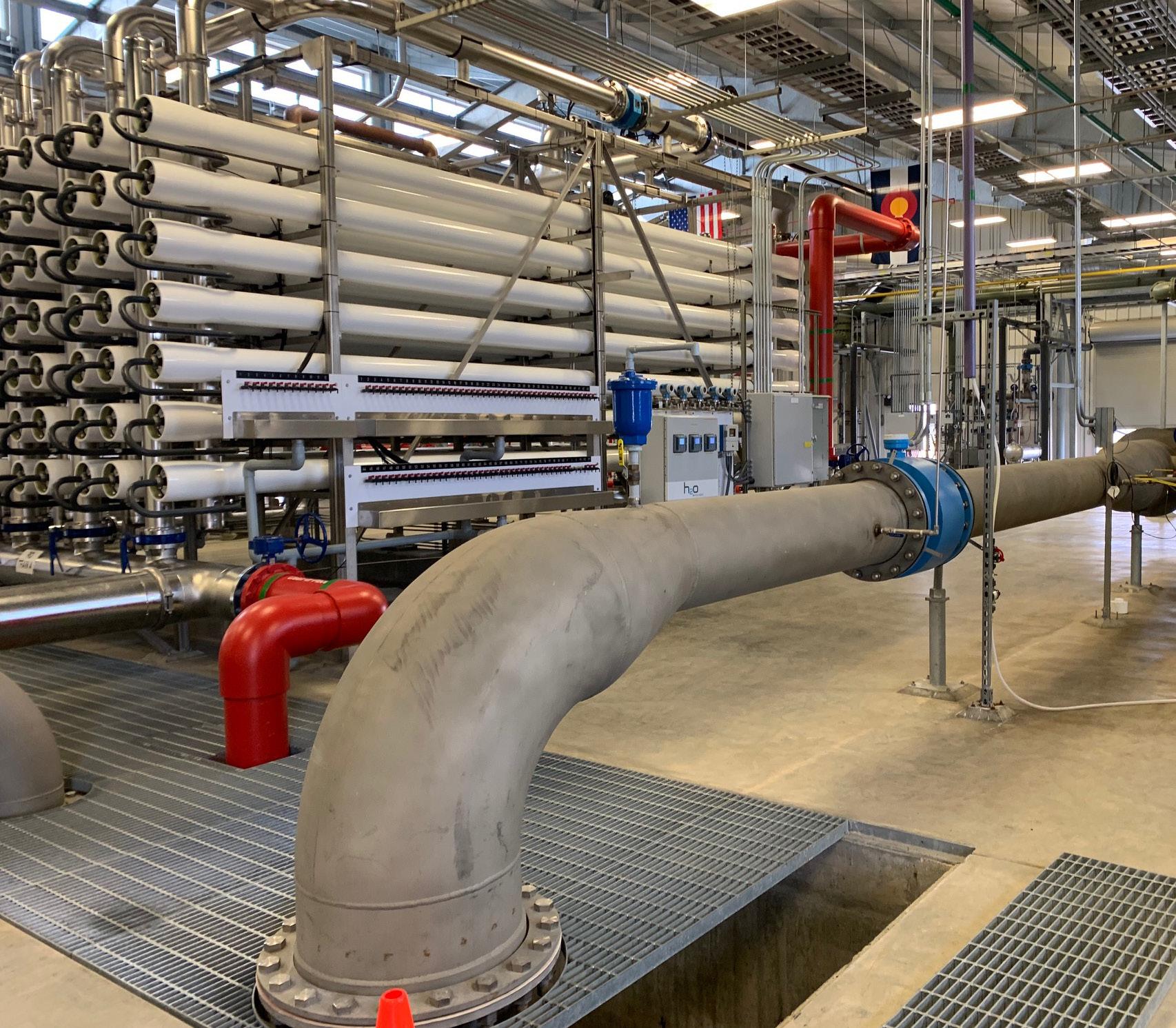
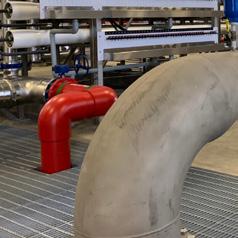
The City of Sterling’s reverse osmosis water treatment plant filters uranium and other contaminants out of the city’s water, drawn from South Platte alluvial wells.
Sterling groundwater gets special treatment for drinking
For Colorado’s water providers, staying in compliance with an ever-changing web of state and federal drinking water regulations is a full-time job. The City of Sterling on Colorado’s Eastern Plains learned this lesson the hard way in 2008, when the U.S. Environmental Protection Agency (EPA) informed the city that it was in violation of a uranium standard that EPA introduced in the year 2000.
EPA ordered the city to mitigate high levels of naturally occurring uranium in the drinking water it drew from its South Platte alluvial wells. The city weighed several remedies, including a conventional treatment plant and a pipeline to a new and less contaminated water source. Ultimately, city officials settled on constructing a reverse osmosis (RO) plant, because it was cheaper than a new water pipeline and would result in cleaner, better-tasting water than a conventional plant.
The RO plant was completed in the fall of 2013. It forces water through a membrane, filtering out uranium and other contaminants into a concentrated brine, which the city pumps into two 6,500-foot-deep injection wells. By comparison, the city’s drinking water wells in the South Platte alluvium are around 75 feet deep.
The plant cost $30 million, which the city financed with a loan from the State of Colorado. Repaying that loan required hiking water rates, a financial hit for Sterling residents. Yet thanks to the new plant, the city’s tap water is now in compliance with safe drinking water regulations.
Groundwater Supply & Administration
Oil and gas drilling and groundwater
Because Colorado’s petroleum reserves are often buried thousands of feet below freshwater aquifers, oil and gas companies frequently drill through those aquifers to access the fossil fuels below. Keeping groundwater from becoming contaminated with petroleum products, drilling chemicals, or the briny water produced during drilling requires the use of concrete and steel casings around oil and gas wells. Casing requirements vary depending on the well, but Colorado law requires that an oil and gas well’s surface casing extend at least 50 feet below the lowest aquifer the well penetrates, or 50 feet below the deepest drinking water well within a mile. Oil and gas companies are also required to take water samples from aquifers before and after they drill to detect any contamination. They also must report surface spills of chemicals or wastewater to the Colorado Oil and Gas Conservation Commission (COGCC).
The enhanced production technique known as hydraulic fracturing or “fracking” requires several million gallons of water. Some oil and gas companies recycle the fracking water left over after drilling, but recycling is unlikely to become widespread unless the price of the freshwater currently used for fracking spikes. When used fracking water cannot be recycled, it is disposed of in deep injection wells. In Colorado, these wells are typically at least 4,000 feet deep, while good quality groundwater rarely exists deeper than 2,000 feet underground. If the geologic layer targeted by an injection well contains high-quality water, the well driller must obtain an EPA aquifer exemption before injecting.
Horizontal drilling takes a vertical well bore and extends it to the side to access unconventional oil and gas deposits. Drill bores can pass through multiple groundwater aquifers, but regulations help protect groundwater.
Colorado requires baseline testing and monitoring of up to four water wells within a half-mile radius of oil and gas wells.
Since 2008 all waste storage pits are required to be lined, and some must be fenced or covered to protect wildlife and migratory birds.



Colorado requires that all wells be cased with multiple layers of steel and cement to isolate fresh water aquifers from the hydrocarbon zone. The casing must extend at least 50 feet below potable groundwater and be tested for integrity.

POINT — WHERE DRILL BORE STARTS TURNING
FIGURE 3.5 Well casing protects groundwater resources during drilling and production
implemented by Colorado via the Colorado Water Quality Act, include:
• Regulation of both surface and groundwater
• Provisions to assure that water quality control does not interfere with established water rights
• A program that addresses potential groundwater quality impacts from agricultural chemicals
The SDWA, which was enacted in 1974, is administered by the U.S. Environmental Protection Agency (EPA) and provides national standards for certain constituents in drinking water to protect public health. Colorado has accepted primacy for enforcing the drinking water standards, and these responsibilities are also under CDPHE’s jurisdiction. The SDWA was amended in 1986 and 1996 and applies to all public water systems serving over 25 individuals per day for at least 60 days of the year. Neither federal nor state regulations address water quality in private wells. As such, users of private drinking water wells should have their water tested periodically to assure the quality is safe for human health.
EPA’s National Primary Drinking Water Regulations set enforceable, health-based maximum contaminant
levels (MCLs) for selected contaminants in drinking water. These MCLs are established by EPA after evaluating numerous toxicological tests and studies and incorporating public comment. Secondary maximum contaminant levels (SMCLs) are available for other constituents where health risks are minimal, but certain levels of a constituent can produce objectionable taste, odor or appearance (e.g., iron staining or rotten egg odor). Further information on drinking water quality can be obtained from the EPA Safe Drinking Water website (epa.gov/safewater).
Under the umbrella of CDPHE, the Colorado Water Quality Control Commission (WQCC) and Water Quality Control Division (WQCD) administer groundwater quality by establishing policies and rules pertaining to waterquality management, including drinking water standards and rules for public water systems and individual septic systems. Their groundwater quality standards are documented in two Regulations, No. 41 and No. 42. Number 41 establishes basic statewide water quality standards, along with a system for classifying groundwater and adopting water quality standards to protect existing and potential beneficial uses of groundwater. Both narrative and
numerical standards have been issued. The key narrative standard is that “ground water shall be free of pollutants” that may be toxic to human beings or a public health danger. Through Regulation No. 42, the WQCC has adopted site-specific water quality classifications and standards.
The 1996 amendments to the SDWA included requirements to assess the vulnerability of all drinking water sources and enact more protections for aquifers that serve as the sole source of a community’s drinking water. The WQCD implemented these objectives through its Integrated Source Water Assessment and Protection (ISWAP) Project Plan. The long-term project goal is voluntary development and implementation of local source water protection plans statewide by informed citizens and advocates. The WQCD’s role is to assist local efforts by supplying the necessary consultation and tools to complete these plans. To date, 1,560 source water assessment reports have been filed with the WQCD.
Water quality data from public water systems supplied by groundwater indicate that the most common contaminants in Colorado are nitrate, fluoride, selenium, iron, manganese, alpha radiation (radon), and uranium. Some of these are naturally present in concentrations in excess of
COURTESY KANSAS STATE
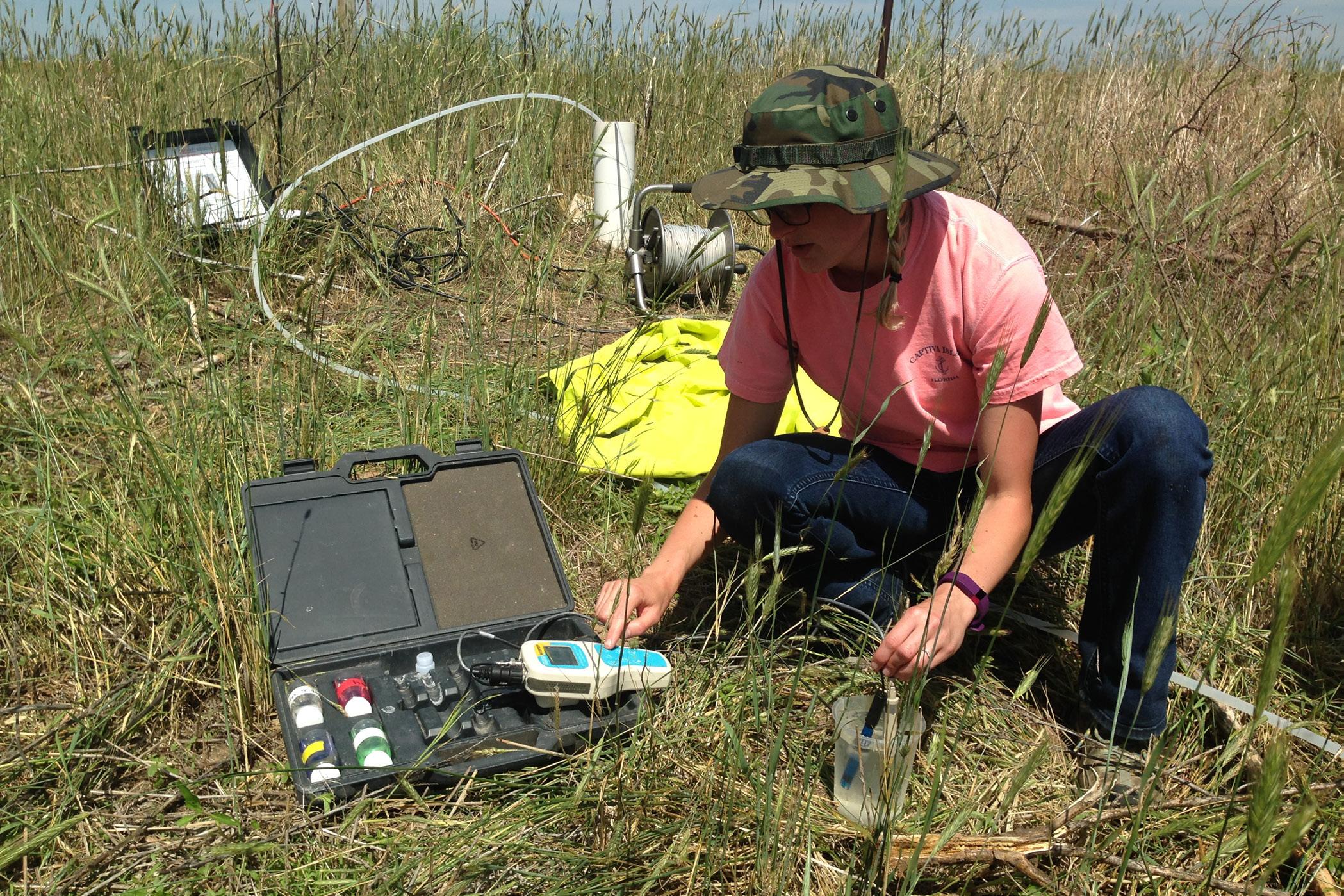
A researcher samples well water as part of a 40-year comparison study of wells in the High Plains aquifer. Her research has revealed increased nitrate levels.
Groundwater Supply & Administration
the drinking water standards while others result from human activities such as industry, agriculture, mining, urbanization and waste disposal systems (Figure 3.4). Federal regulations mandate specifically how water providers must test for these and other contaminants, either by sending their water samples to a certified lab or obtaining a lab certification and conducting their own tests. As private water wells are not regulated at either the state or federal levels, it is the owner’s responsibility to assure that their water is safe to drink.
Groundwater is vulnerable to contamination from both natural and anthropogenic threats. Regions with high clay, limestone, and volcanic rock content, for example, are more likely to have increased levels of arsenic in groundwater. Wells in igneous or volcanic rock are more likely to have higher radioactivity
constituents such as radon. Water systems located near or downstream of farmland may contain higher concentrations of nitrate from fertilizer, whereas water systems in urban areas are more likely to contain higher concentrations of organic chemicals from industrial wastes. In addition to natural contaminants, groundwater is often polluted by human activities such as:
• Improper use of fertilizers, animal manures, herbicides, insecticides, and pesticides
• Improperly built or poorly located and/or maintained septic systems for household wastewater
• Leaking or abandoned underground storage tanks and piping
• Stormwater drains that discharge chemicals to groundwater
• Improper disposal or storage of wastes
• Chemical spills at local industrial sites
There are four primary water treatment options for well owners:
• Disinfection of the well to eliminate bacteria
• Point-of-use treatment, usually under the kitchen sink, to filter contaminants from drinking and cooking water
• Treatment at the point of entry, usually where well water enters the home plumbing system
• Multiple treatments for the household water system, usually near the water storage tank, to filter contaminants or improve water quality for all household uses
CDPHE provides guidance documents and information regarding drinking water and private wells (colorado.gov/ cdphe/drinking-water-private-wells). Their pamphlet “Drinking Water from Household Wells” covers sources of groundwater contamination both naturally occurring and human induced, contaminants of concern and expected risks, groundwater supply protection, and how to test your water and interpret the results. Colorado State University has developed a web-based Water Quality Interpretation Tool (erams.com/wqtool). This resource helps individuals evaluate their drinking, livestock and irrigation water quality test results. Local county health departments are another great resource for questions or concerns regarding water quality. County health departments have information on when to test your well and how to interpret the laboratory results, as well as knowledge of known water quality issues in the county.
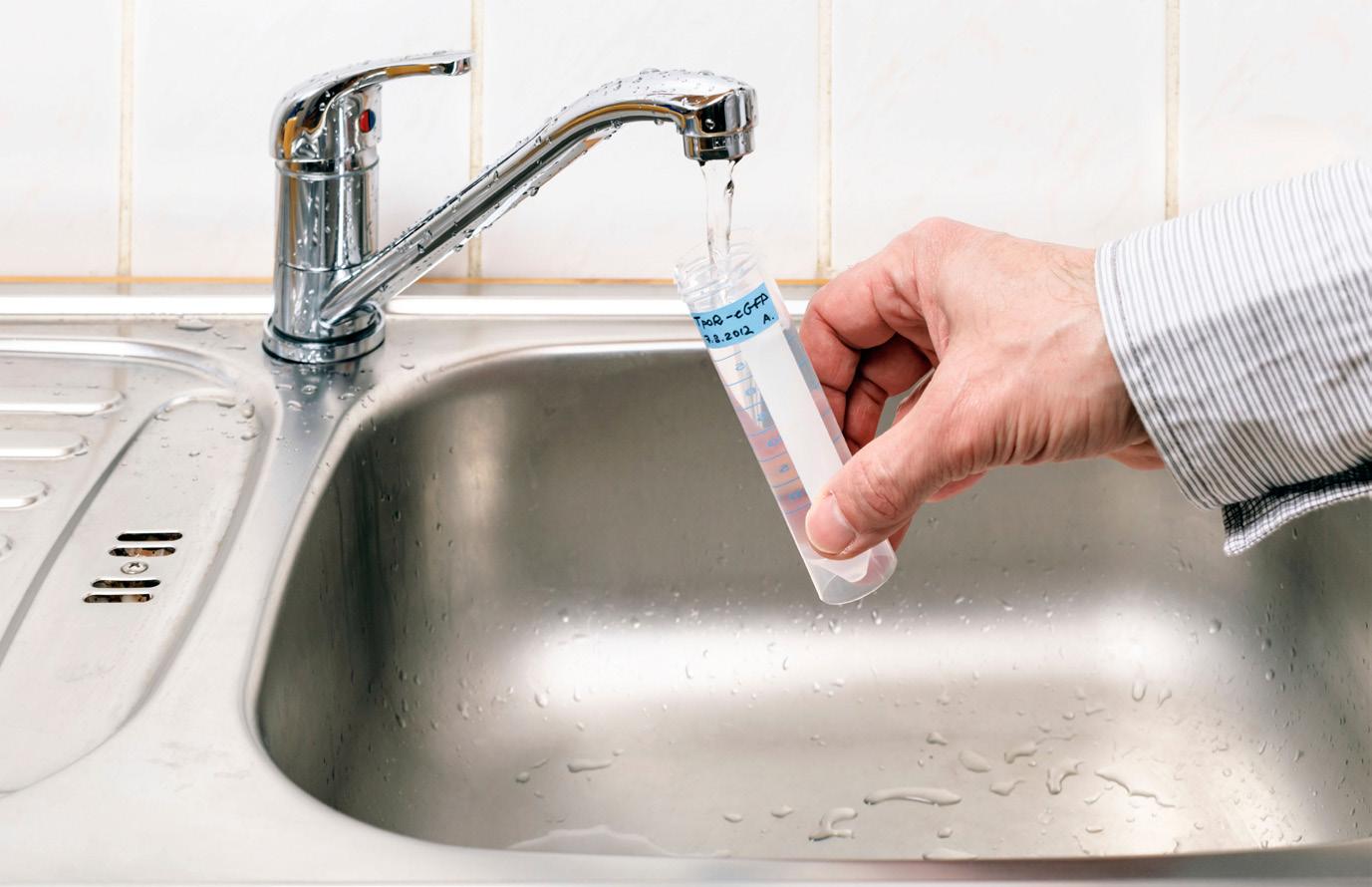
Private wells are not regulated, so homeowners are responsible for testing their own well water.
FIGURE 3.4 Potential sources of common groundwater contaminants in Colorado
Groundwater Supply & Demand
Exactly how much groundwater does Colorado have? A comprehensive assessment of Colorado’s groundwater resources has never been conducted. The variety of its aquifers and the predominance of surface water use suggests that this resource is underdeveloped in some areas. The National Groundwater Association indicates that at any given moment, groundwater is 20 to 30 times more plentiful than the water in all the lakes, streams and rivers of the United States combined. Colorado is no exception to the national trend, so its groundwater resources are significant.
In 2003, the Colorado Geological Survey (CGS) conducted a statewide assessment of underground water storage options that included evaluations of consolidated sedimentary rock aquifers and unconsolidated aquifers. That assessment resulted in the identification of 16 priority unconsolidated, alluvial aquifers and
29 consolidated, bedrock aquifers with large storage capacities. A by-product of this evaluation was a quantification of the existing water stored in the alluvial groundwater reservoirs, which was estimated to be over 37 million acre-feet. Independently, Ralf Topper, principal author of the CGS study, estimated that
the primary bedrock aquifers hold over 740 million acre-feet of water.
The magnitude of this quantity of water is better understood when considering that Colorado’s total surface water reservoir storage capacity is approximately 7.5 million acre-feet within 1,953 reservoirs. The estimated recoverable groundwater reserves in the Denver Basin aquifer system alone are 200-300 million acre-feet, or some 35 times more than all the surface reservoir water storage in the state.
Development of groundwater resources is constrained by economic considerations related to the depth of the resource, productivity or well yield, and water quality. The drilling and completion costs of a water well are substantial, ranging between $30-$60 per foot of depth
FIGURE 4.1 A distribution of all Colorado’s permitted water supply wells, color-coded by use
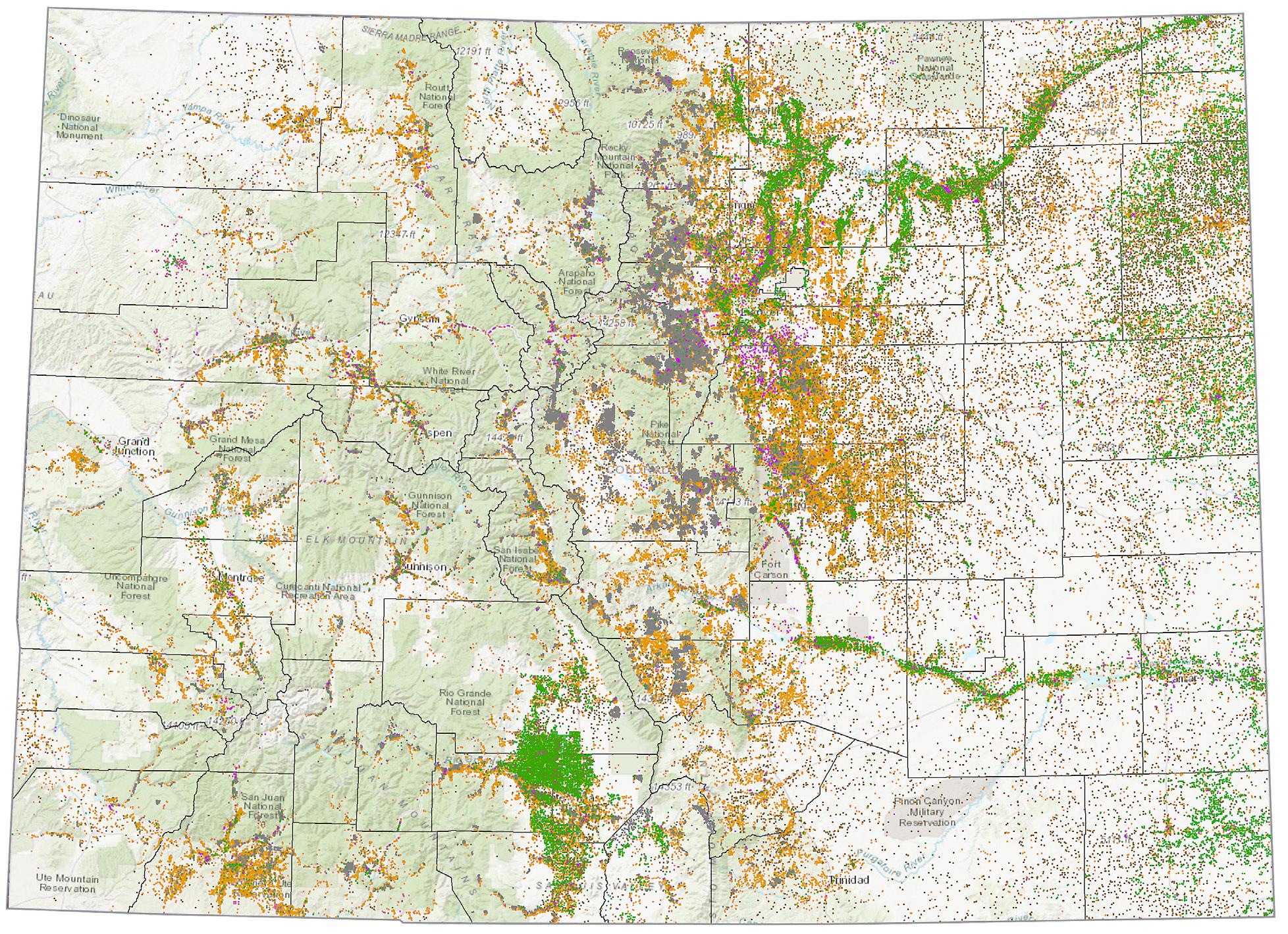
Groundwater Supply & Demand
withdrawing groundwater. Considering those residents self-supplied by wells, groundwater supplies 19 percent of the state’s current population.
Based on the USGS 2015 water use data, of the 64 counties in Colorado, groundwater supplies less than 10 percent of total water use in 36 of them. At the other end of the spectrum, eight counties, all in eastern Colorado, rely on groundwater for 80 percent or more of their total water supply, and 12 counties (mostly located on the Eastern Plains) rely on groundwater for at least 50 percent of their supply.
Groundwater Sustainability Concerns
drilled for a domestic well and $200-$500 per foot for a municipal well. The costs vary by location, geology and construction technique. While wells completed in alluvial aquifers tend to be shallow and therefore less expensive, those in bedrock aquifers can be 1,000 feet deep or more. Municipal water supply wells rarely exceed 2,500 feet in depth, as the cost to produce that water becomes prohibitive.
Water Use by Region
The Colorado Division of Water Resources’ well permit records indicate that over 284,000 water wells have been constructed for domestic, irrigation, stock watering, commercial, and industrial uses. Seventy-nine percent of all constructed wells—or nearly 244,000— are for domestic water supply. The Water Research Foundation, located in Denver, estimates that the average Colorado household consists of 2.65 people. Using these values, Colorado’s domestic/ residential wells supply groundwater to approximately 563,000 residents— approximately 11 percent of the state’s current population.
The U.S. Geological Survey (USGS) publishes the report, Estimated Use of Water in the United States, on a fiveyear interval. The 2015 data compiled by the USGS has been derived from reported, estimated or calculated means which have varying levels of accuracy. While individual water districts and municipalities in Colorado keep track of their water uses, the State of Colorado does not compile groundwater use data. The USGS 2015 report indicates that for that year, total water withdrawals in Colorado were 11.5 million acre-feet. Of that total, 1.68 million acre-feet, or 14.6 percent, was groundwater. The USGS water use report identifies water withdrawals by principal uses such as public supply, domestic, agricultural, industrial, mining, and thermoelectric power. As with surface water, the dominant use of groundwater in Colorado in 2015 (86.9 percent) was for agricultural irrigation. Public water supply was the next highest use, comprising 7.26 percent of total withdrawals by public and private water suppliers. Slightly over 8 percent of Colorado’s population is served by public water suppliers
When groundwater withdrawals exceed an aquifer’s natural rate of recharge, this is called a “mining” condition. Groundwater mining results in declining water levels and loss of water in storage. Mining conditions exist in some areas of the state with a high density of irrigation wells or high-capacity municipal wells. A mining condition has not been documented in aquifers where withdrawals are dominated by exempt domestic water supply wells.
The Denver Basin Aquifer
Groundwater development in the Denver Basin, particularly in the suburbs south of Denver, began to accelerate around 1950, when wells under artesian pressure enabled the pumping of high volumes of water at low cost. Accelerated development and use of Denver Basin water in the 1960s and 70s precipitated concerns about the sustainability of Front Range water supplies. Legislation passed in 1973 (Senate Bill 213), referred to as the 100-year rule, gave landowners the right to develop deep nontributary groundwater underlying their property but limited pumping rates to 1 percent of the calculated aquifer volume per year. At the time, developers and residents intended to transition away from groundwater to renewable surface water supplies. But when the proposed Two Forks water supply project was vetoed in 1990, south metro Denver communities were left only
FIGURE 4.2 The principal uses of groundwater for each Colorado county
with groundwater and the need to search for different renewable supplies.
Between 1990 and 2002, water levels in some Arapahoe aquifer wells throughout the Denver metro area declined by more than 240 feet, and some wells at the western edge of the basin began to dry up. To address this mining condition, counties such as El Paso, Elbert and Douglas have implemented more stringent pumping limits based on allocating water over 300 years.
Around the year 2000, Arapahoe aquifer water levels in the south metro area reached the top of the sandstone units that held the physical water. This changed the character of the drawdown near municipal pumping centers from a drop in pressure to actual draining of pore spaces. This important transition from confined to unconfined conditions reduced the water level decline rates from approximately 20 feet per year to approximately 2 feet per year or less. Other variables that contribute to recent stabilization include: lower well pumping rates, increased use of renewable surface water supplies, reduced peak demand use due to conservation and above-ground storage, tiered billing, and increased costs for new wells. As water levels decline, so does the rate and volume of water produced per well, and production costs go up. Closely spaced wells exacerbate the condition. The point at which the cost for additional groundwater development exceeds the cost of acquiring renewable alternatives has been termed the “economic life” of the aquifer.
Whether additional groundwater development is worth funding depends upon a water provider’s location within the basin and the productivity of the underlying aquifers compared to the cost of renewable alternatives. For example, drilling and completing additional nontributary wells is still the logical choice for new rural and planned higher density developments in Elbert County. Other urban districts like the East Cherry Creek Valley Water & Sanitation District (ECCV) have determined that it is more economical to drill alluvial wells near Brighton and pipe that water back to the district, rather than continuing to drill additional Denver Basin wells.
Well Permit 21905F
Near Highlands Ranch, CO
Well Permit 16582F
Near Cherry Creek Reservoir, CO Pre
Pre 2003
2003 to present
Linear pre 2003
Linear 2003 to present
The above charts show how two Arapahoe aquifer wells located in the south metro area have seemingly stabilized. The first well (Permit no. 21905-F), located near Highlands Ranch, shows a nearly 500-foot pressure drop decline rate between 1985 and 2001, then shows over 300 feet of recovery. The second plot (Permit no. 16582F) again shows a nearly 500-foot decline over the same period, and then a near constant level at an elevation of approximately 4,600 feet since then.
Source: Colorado Division of Water Resources

Data through 12/6/2019
Source: Davis Engineering Service, Inc.
The San Luis Valley Aquifers
Since the statewide drought of 2002, the impacts of groundwater mining have been on display in the upper, unconfined aquifer of the San Luis Valley of south-
central Colorado. The valley is a major producer of potatoes, wheat, barley and other agricultural commodities. As surface water flows dried up in the 2002 drought, irrigators turned to groundwater to nourish their crops, and
FIGURE 4.3 Stabilization in Denver Basin aquifer wells
FIGURE 4.4 Change in unconfined aquifer storage in west-central San Luis Valley
Groundwater Supply & Demand
the aquifer’s savings account began to dwindle. The practice of pumping more than is recharged has depleted almost 1 million acre-feet of groundwater storage. Given the valley’s vital role in the state’s agricultural economy, pressure to solve the problem came from all three branches of government: the legislature, the state’s water courts, and the Division of Water Resources. In response, the local agricultural community devised an incentive system to address the groundwater depletion and bring the aquifer into balance. Starting in 2012, farmers began operation of the first groundwater subdistrict in the valley with a state-approved groundwater management plan, assessing fees on themselves for every acre of land cultivated and every acre-foot of water used. They started two more subdistricts in 2019, will start another in 2020, and the final two in 2021. Today, these subdistricts use the money raised to pay some farmers to fallow their land, reducing total
groundwater withdrawals. The program is still gaining steam, but the efforts have slowed the declines and even replenished the aquifer in wet years. Unfortunately, the dry growing season of 2018 reversed three straight years of gaining water levels. The collaborative project will continue to be adjusted until the aquifer’s long-term sustainability is ensured.
The High Plains Aquifer
The High Plains (or Ogallala) aquifer beneath Colorado’s Eastern Plains is also experiencing declining water levels and loss of storage. The High Plains aquifer is the nation’s largest freshwater aquifer. With limited surface water resources, the region overlying this aquifer relies on groundwater for both domestic use and the region’s main industry, irrigated agriculture. Colorado lies on the aquifer ’s western fringe and due to this geography, has seen dramatic decreases in the aquifer’s water level.
Many shallow eastern Colorado wells have even gone completely dry. In some of the heavily used parts of the aquifer, water levels have dropped 50 to 100 feet since 1950; many lighter use areas have dropped between 5 and 50 feet. The High Plains Water Level Monitoring Study, a congressionally mandated effort that calculates changes in the aquifer’s water storage levels, estimates that the aquifer has lost 273.2 million acre-feet of water since 1950.
To combat the falling water levels, voluntary conservation programs have been organized. Some programs are sponsored by the U.S. Department of Agriculture, like the Conservation Reserve Enhancement Program through the Farm Services Agency or the Environmental Quality Incentive Program from the Natural Resources Conservation Service. These programs offer financial incentives to convert irrigated cropland to dryland farming
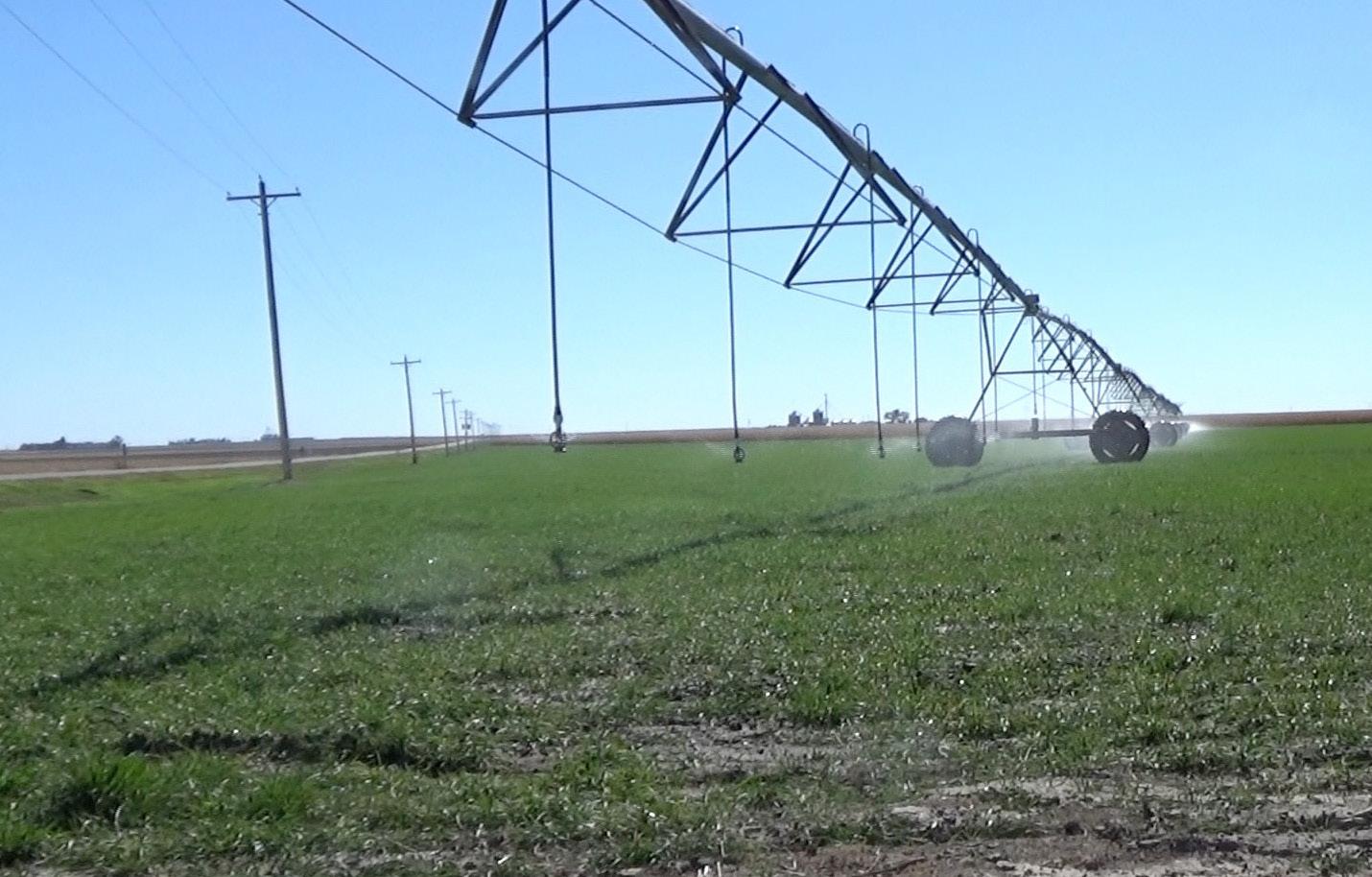
A center pivot sprinkler irrigates with High Plains aquifer water. In some heavily used parts of this aquifer, water levels have dropped
feet since 1950.
FIGURE 4.5 Water level changes in the High Plains aquifer U.S. GEOLOGICAL SURVEY
The High Plains aquifer, also known as the Ogallala aquifer, spans 175,000 square miles under parts of eight states. The U.S. Geological Survey has been conducting an ongoing water level monitoring study. This map shows water level changes from around 1950 to 2015. During that time, about 36 percent of the aquifer area has experienced declines of 5 feet or more, and 8 percent of the aquifer has seen rises of 5 feet or more.
EXPLANATION
SOUTH DAKOTA
WYOMING
COLORADO
NorthPlatteRiver
PlatteRiver
Water-level change, in feet
Rises
5 to 10
10 to 25
25 to 50
More than 50
No substantial change –5 to +5
Declines
More than 150
100 to 150
50 to 100
25 to 50 10 to 25 5 to 10
Area of little or no saturated thickness
KANSAS
U
Area of water-level changes with few predevelopment water levels (Lowry and others, 1967; Luckey and others, 1981; Young and others, 2016) Faults —U, upthrown side
NEW MEXICO
Source: USGS Water-level and recoverable water in storage changes, High Plains aquifer, predevelopment to 2015 and 2013-15. Available at pubs.er.usgs.gov/publication/sir20175040
TEXAS OKLAHOMA
Groundwater Supply & Demand
or to permanently retire irrigation wells and fields. Other conservation initiatives, like the Master Irrigator Program, are designed to assist farmers in their quest to increase their irrigation efficiency. They have proven effective at cutting groundwater use without dramatically impacting farmers’ livelihoods. Groundwater levels are still declining in most areas, but the rates of decline are decreasing. With improved management, the aquifer may sustain the region for many years to come.
Groundwater’s Role in the Colorado Water Plan
The Colorado Water Plan documents the integral role that groundwater resources play in meeting a wide variety of needs throughout the state. The water plan was first published by the Colorado Water Conservation Board (CWCB) in 2015, in response to an executive order from Governor John Hickenlooper. By building on a strong foundation of statewide stakeholder involvement through the Basin Roundtable process and the Interbasin Compact Committee, the plan brings together an immense amount of information on water issues from numerous local, state and federal sources. The water plan culminates in detailed policy recommendations on how to help balance Colorado’s diverse water needs in the years ahead.
The plan provides a summary of laws guiding groundwater use as well as how groundwater is managed and administered. The plan also documents the importance of groundwater to certain parts of the state and summarizes a number of regional groundwater issues documented in more detail by the Basin Roundtables in their individual Basin Implementation Plans. Some of these local issues include: the mining of nontributary and non-renewable groundwater to supply municipal growth in the South Platte and Arkansas basins, as well as sustainability issues of agricultural groundwater use in the Republican, Arkansas, South Platte, and Rio Grande basins. Creative local
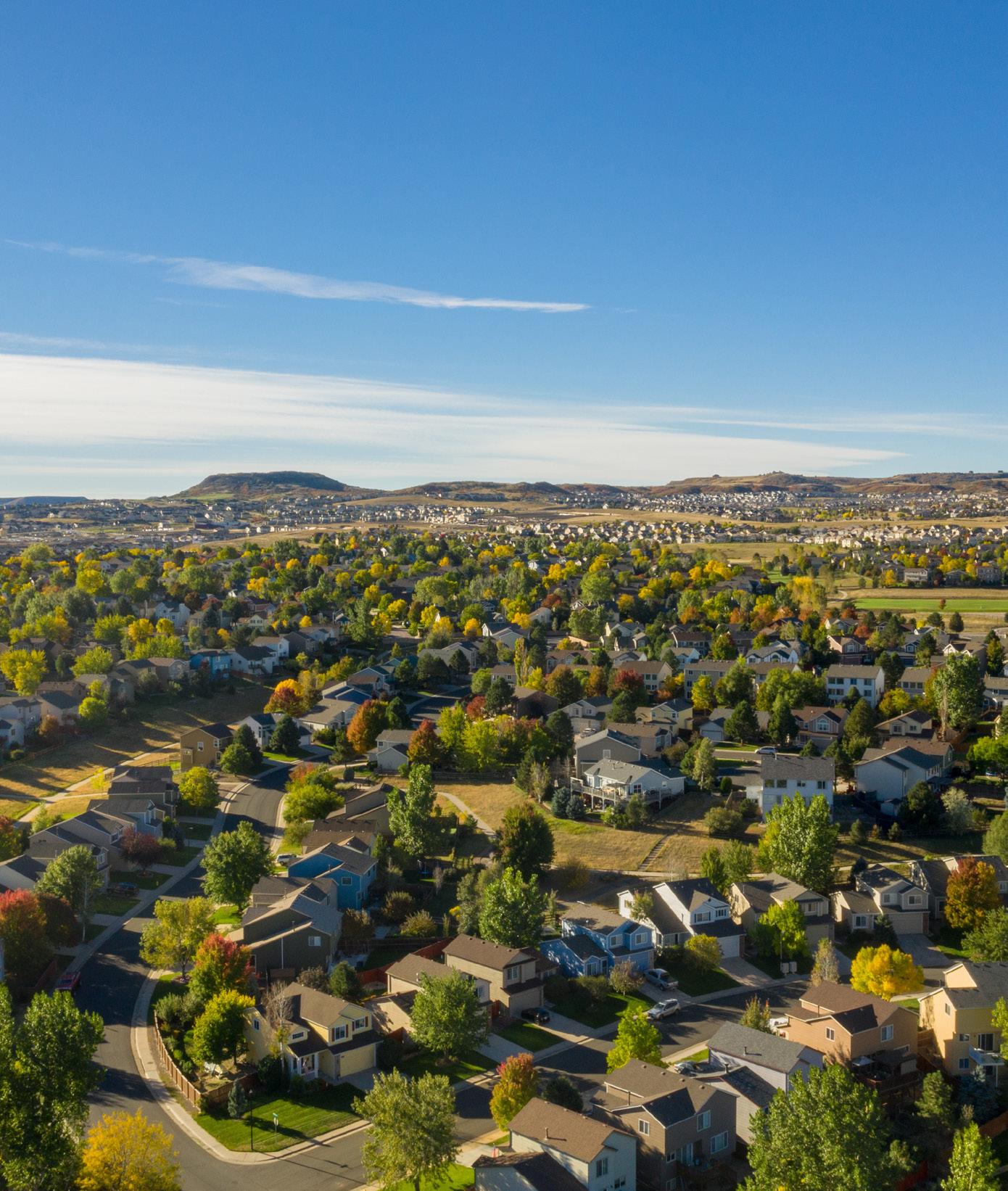
As Colorado’s population continues to grow, the Colorado Water Plan notes the importance of new, innovative water storage technologies, such as aquifer storage and recovery.
solutions also factor prominently, with reference to innovative groundwater management districts in the San Luis Valley, conjunctive use in the south metro Denver area (i.e. the strategic and carefully timed use of surface and groundwater supplies), and the increasing influence of water reuse to stretch supplies from all sources. Other technical issues, such as site-specific water quality degradation and aquifer storage and recovery (ASR) considerations, are referenced but not examined in detail.
The Colorado Water Plan’s groundwater recommendations focus on a measurable objective for future water storage. That objective is “attaining
400,000 acre-feet of water storage in order to manage and share conserved water and the yield of [planned projects] by 2050.” Specifically, the discussion about how to achieve this storage goal notes the importance of using new, innovative technologies such as ASR. Most recently, the 2019 release of the Analysis and Technical Update to the Colorado Water Plan provides a wealth of updated information about Colorado’s water supply, demand, and potential future gaps. Among other things, this updated analysis incorporates more detailed groundwater pumping data from the Colorado Division of Water Resources.
Subsurface Water Storage
History, Terminology and Objectives
The concept of storing water underground has gone by many names. Aquifer recharge, formerly known as “artificial” recharge, is defined as any engineered system designed to introduce water to, and store water in, underlying aquifers, whether the water is recharged at the surface or underground. Aquifer storage and recovery (ASR) adds the extraction component to the water being stored, and both injection and recovery can be implemented through the same well. Many scientific and engineering professional societies (e.g., the American Society of Civil Engineers, the National Groundwater Association) have been promoting the term managed aquifer recharge (MAR) as an umbrella term for a range of technologies to place water into the subsurface. MAR is the intentional recharge of water to suitable aquifers for subsequent recovery or to achieve environmental benefits; the managed process assures adequate protection of human health and the environment.
Although the basic concept of MAR is simple—purposefully filling void spaces in aquifers with water—the applications vary considerably depending on the project’s objective. Most MAR applications are for seasonal, long-term, or emergency storage of drinking water supplies. Recent interest in MAR in Colorado evolved from several factors, including multiple years of drought, water supply security issues since September 11, 2001, limited ability to construct new surface-water reservoirs, the need for additional water supplies for new developments, documented declines in water levels of many aquifers, and legislative funding opportunities for new projects.
Source water options for MAR include: 1) excess legally available surface flows, 2) stormwater runoff, 3) treated effluent, and 4) produced waters such as by-products of oil and gas production.
The objectives of most MAR applications fall into one, or a
combination, of the following categories:
Water Storage
MAR is utilized as a component of water supply including short-term water supply regulation, seasonal storage, long-term storage (drought mitigation), emergency supply, and conjunctive use (the coordinated use of surface water and groundwater).
Meet Legal Obligations
A water user may use water in an MAR project to meet legal obligations for water diversions and decrees such as providing augmentation water, supplementing downstream water rights, or facilitating compliance with interstate agreements. This is common in the South Platte River Basin, where many farmers divert water from the river during spring runoff and pipe it to recharge ponds. The water percolates back to the river by the fall, offsetting the farmers’ late-season well pumping.
Manage/Mitigate Water Quality
Physical, chemical and biological processes in an aquifer have the potential to modify water quality. MAR can take advantage of these natural processes, through soil/aquifer treatment, to improve the quality of the water supply, as applied in Aurora’s Prairie Waters project.
Restore/Protect Aquifers
Unless mitigated, excessive groundwater extraction can decrease the usefulness of an aquifer over time due to water-level declines. MAR can maintain the long-term viability of an aquifer by restoring groundwater levels, limiting aquifer compaction and surface subsidence resulting from excessive groundwater withdrawals, or mitigating saltwater intrusion.
Protection of the Environment
As a water management tool, MAR can also be used to benefit sensitive environments or mitigate environmental contamination by maintaining wetland hydrology, enhancing endangered species habitat, or controlling the migration of groundwater contamination.
Active ASR Projects
Development of ASR facilities in the United States has been on a rapid growth curve for the past 20 years, with 125 wellfields now established in over 20 states. As of November 2016, Colorado had six different operating wellfields consisting of 45 ASR wells.
Testing of ASR technology in the Denver Basin began in the early 1990s with the Centennial Water and Sanitation District and the Willows Water District. The Willows Water District partnered with Denver Water to test ASR in a single Arapahoe aquifer well over a six-year period from 1991 to 1997. The Centennial Water and Sanitation District initiated its ASR program in 1991 with a single Arapahoe aquifer well used to evaluate the feasibility of long-term, high-volume storage of treated water and its subsequent recovery. The initial testing verified that ASR would provide a significant, low-cost water storage option with no evaporation losses. Since 1991, Centennial has continued operating ASR wells and has permitted and equipped 25 wells completed in the Denver, Arapahoe and Laramie-Fox Hills aquifers of the Denver Basin. As of 2019, Centennial had stored over 14,000 acre-feet of water in aquifers underlying Highlands Ranch, Colorado.
Other municipal districts within the Denver Basin have also implemented ASR. The Consolidated Mutual Water Company in Lakewood drilled and completed six wells between 2004 and 2006 that are specifically designed for ASR operations. The wells are adjacent to the Maple Grove Reservoir and provide underground water storage directly beneath the reservoir. Between 2005 and 2006, Colorado Springs Utilities equipped two wells for ASR, one in the Denver aquifer and one in the Arapahoe aquifer. ASR has evolved as an alternative water management strategy for increased water storage along the Front Range. With the completion of Denver and Aurora’s Water Infrastructure and Supply Efficiency (WISE) Project, several additional south metro Denverarea water districts that rely primarily
Subsurface Water Storage
on groundwater are exploring the use of ASR. Deliveries of treated, potable water from the WISE Project typically occur during periods of low demand, thus requiring storage. As of 2019, to meet those storage needs Meridian Metropolitan District, Rangeview Metropolitan District, Inverness Water and Sanitation District, and Cottonwood Water and Sanitation District were all permitting and equipping existing Denver Basin wells for ASR. Denver Water was also evaluating how ASR could be a part of its water supply and storage operations. In 2018 the Colorado Division of Water Resources expanded the existing ASR Extraction Rules to include not only the Denver Basin aquifers, but all nontributary aquifers in the state. The Colorado Water Plan and many Basin Roundtables—the grassroots groups formed to focus on local water needs in the state’s nine river basins—have identified ASR as a valuable way to address water supply and storage issues moving forward.
Subsurface Storage Opportunities
Activities related to ASR in Colorado have a long history. Storing water underground was of interest to the General Assembly as early as 1959, when it passed Senate Bill 336 to develop criteria for the proper management and operation of Colorado’s groundwater reservoirs. In 1995, the development of the first rules governing aquifer recharge and extraction made the Denver Basin a potential site for these operations. Reaction to the drought of 2002 led the Colorado Geological Survey (CGS) to investigate and publish a reconnaissance-level, statewide assessment of available storage capacities in the state’s alluvial and bedrock aquifers. Their report identifies and ranks 13 unconsolidated alluvial aquifer systems and 24 consolidated bedrock aquifer systems throughout the state with potential storage capacities in excess of 100,000 acre-feet each, about the size of Eleven Mile Canyon Reservoir in the foothills southwest of Denver.
In 2006, the Colorado General Assembly authorized an underground water storage study that focused on the alluvial and bedrock aquifer systems on the Eastern Plains. The aquifers within the South Platte and Arkansas River basins were divided into four regions for evaluation: South Platte River Basin alluvial aquifers, Arkansas River Basin alluvial aquifers, Denver Basin bedrock aquifers, and the High Plains and Dakota-Cheyenne bedrock aquifers. The study concluded that numerous areas for potential underground water storage exist in both alluvial and bedrock aquifers in the South Platte and Arkansas River basins, and that available underground storage capacities are on the order of tens to hundreds of thousands of acre-feet. The highest scoring sub-regions in the alluvial and bedrock aquifer systems are shown in Figure 5.1.
Identifying multi-purpose water storage options was again the focus of the General Assembly in 2016 when it passed HB16-1256, authorizing the lower
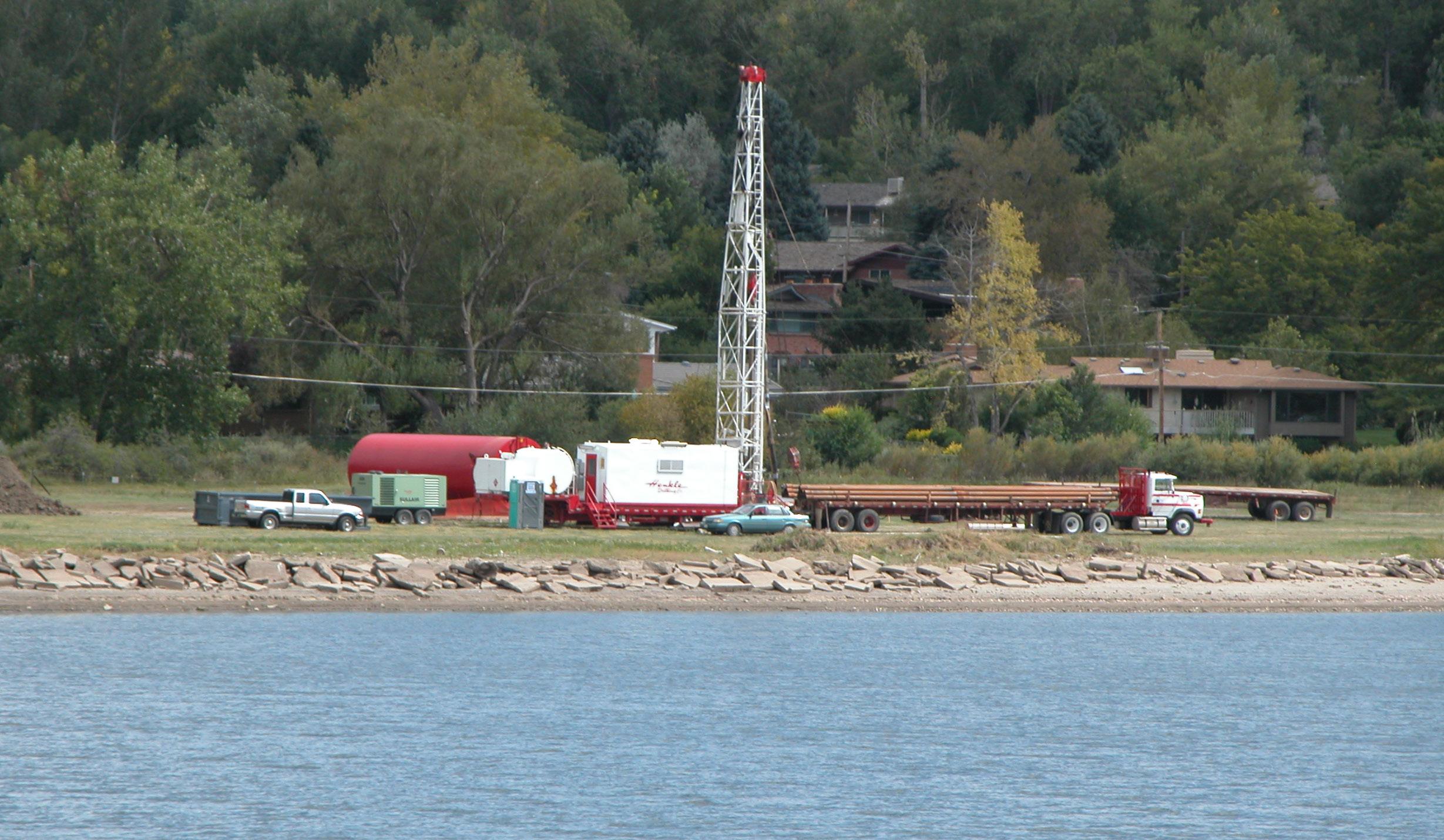
Various water districts have implemented aquifer storage and recovery in Colorado, including the Consolidated Mutual Water Company in Lakewood (shown above), Colorado Springs Utilities, Castle Pines Metropolitan Water District, and the Centennial Water and Sanitation District, among others.
FIGURE 5.1 Promising aquifer areas in the South Platte and Arkansas Basins for underground water storage
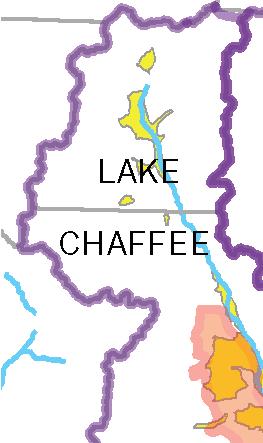






Subsurface Water Storage
South Platte River Storage Study. The study identified 19 aquifer storage sites. It screened out sites that were located too far from the South Platte River mainstem, that did not meet minimum capacity criteria, were clearly inferior to other similar options, or were considered impractical for other reasons. In the end, seven aquifer storage sites remained priority candidates. These include lower and upper Lost Creek, Badger/Beaver Creek, lower and upper Kiowa Creek, and lower and upper Bijou Creek. In the future, these sites could conceivably be used to store surface water diverted from the South Platte River during so-called “free river” periods, when there is more water in the river than is needed to satisfy existing water rights. That water could then be piped back to municipalities or used locally by other entities. The analysis concluded that an ASR project gives a higher firm yield and better storage-toyield ratio than a surface water reservoir of the same storage capacity.
Legal Issues Impacting Subsurface Water Storage
The prior appropriation doctrine, established by Colorado’s Constitution, provides the framework for regulating the use of surface water and tributary groundwater and protects senior surface water right holders from injury that may occur due to out-of-priority diversions.
Thus, while studies have documented tremendous storage capacities in tributary alluvial aquifers, implementation of ASR projects involving pumping stored tributary water may be challenged in water court. By contrast, nontributary groundwater, designated groundwater, and groundwater within the Denver Basin aquifer system are not subject to the doctrine of prior appropriation.
That leaves limited areas in the state where ASR projects can be implemented without modifying Colorado water law. In 1995, the State Engineer promulgated rules and regulations for the permitting and use of waters “artificially” recharged into and extracted from the Denver Basin aquifers. Until 2018, these were the only
rules governing the extraction of water stored in aquifers. As a result, no ASR projects exist outside of the Denver Basin. With the passage of HB17-1076, the State Engineer enacted rules to expand the Denver Basin extraction rules to other nontributary aquifers throughout the state.
While this opens the door for opportunities outside of the Denver Basin, regional or aquifer-specific determinations of nontributary groundwater have not been conducted by the state outside of some oil and gas producing areas. The statutory definition of nontributary
groundwater sets a high standard to receive a nontributary determination. Given their hydrogeological characteristics, however, nontributary aquifers lend themselves to long-term storage of water.
Designated basins offer the only other alternative for storage projects within unconsolidated alluvial aquifers. Due to the hydrogeological character of the unconsolidated aquifers in these basins and their legal distinction, designated basins also offer good locations to implement ASR. The Colorado Ground Water Commission has recently promulgated new rules for ASR Plans.
The role of ASR in Aurora’s future water supply
Aurora’s Prairie Waters potable reuse system uses a variation of ASR—it uses aquifer recharge and recovery (ARR) in its pre-treatment of South Platte River water. Aurora pumps this water through 23 wells, pulling the water through hundreds of feet of sand and gravel to clean out impurities. Then, Aurora continues to emulate natural riverbank filtration through ARR. Water is pumped into lined alluvial basins and extracted at the edges, exposing the water to additional filtration and adsorption through the alluvial sediments and helping remove unwanted constituents. Unlike ASR, water is constantly in motion throughout the process and is not stored in the basin.
Aurora is exploring many options to meet future demands, including additional storage through ASR in the Box Elder and Lost Creek designated basins northeast of the city. Working in a designated basin requires incorporating input from a broad set of stakeholders including the state, agricultural communities, private and industrial users, and municipal entities. It also requires hydrogeologic field studies to predict, monitor and account for the transient nature of underground storage in alluvial aquifers. Similar data-informed planning is happening in the Denver Basin, where Aurora is assessing the use of existing wells for ASR.
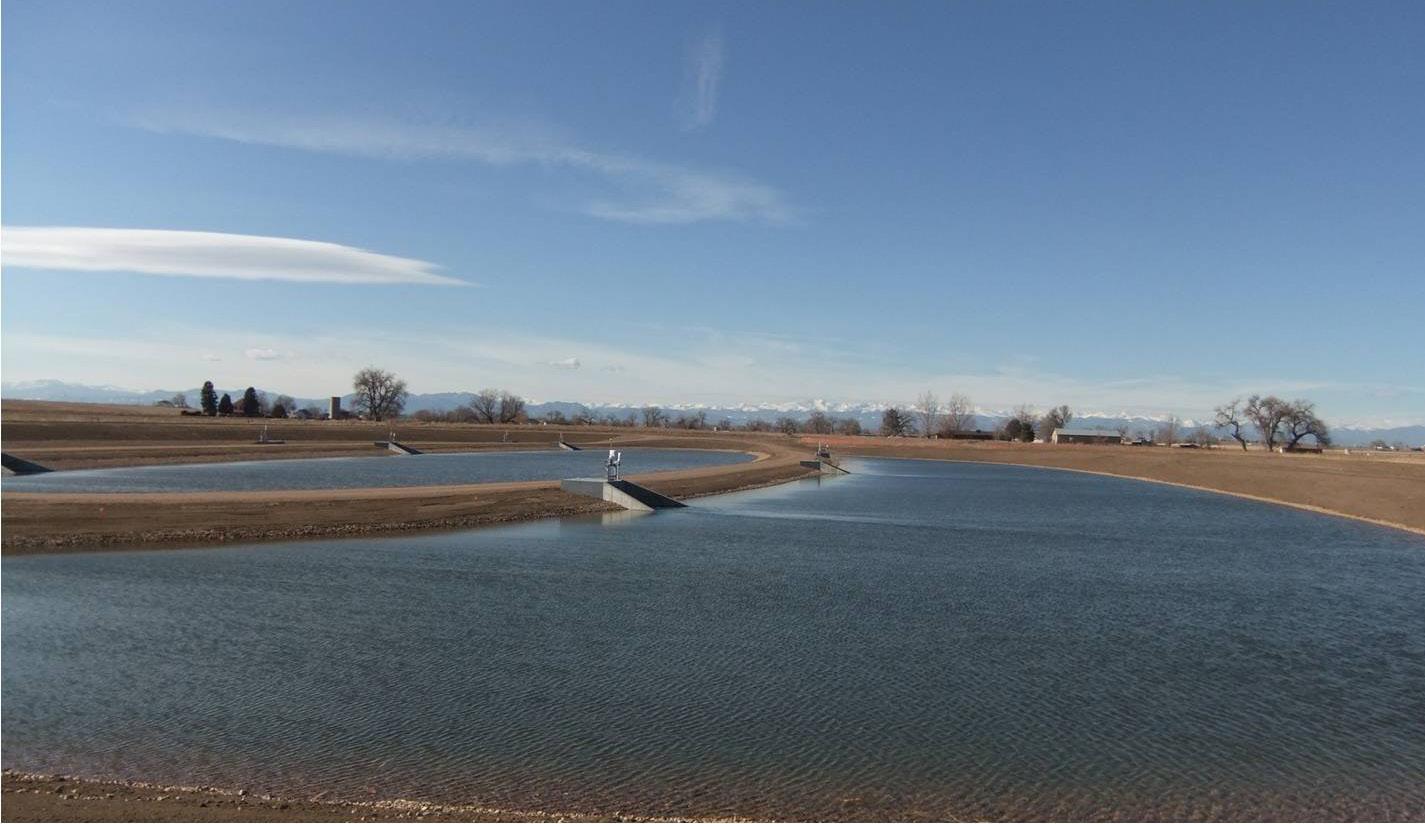
Aurora’s Prairie Waters Project uses aquifer recharge and recovery to emulate natural riverbank filtration.
COURTESY AURORA WATER
Looking Forward
In the future, the role of groundwater in Colorado’s water portfolio is likely to grow, as the state’s population expands and climate change— along with Colorado’s notorious natural weather variability—makes surface water supplies more unpredictable.
In areas where groundwater mining is occurring, it remains to be seen whether the measures devised by local water users to bring their use into balance will succeed. Water levels are still declining overall in much of the High Plains aquifer. In the San Luis Valley, after working for years to cut back their use and seeing a 350,000 acre-foot improvement in the aquifer condition, farmers there saw 70 percent of their gains wiped out during the bone-dry summer of 2018. If they cannot restore the aquifer by 2031, they will face a stateordered shutdown of their water wells. Moving forward, protecting public health from emerging groundwater contaminants like pharmaceutical drugs, personal care products, hormones and others will pose a substantial challenge, as shown by the ongoing battle that many Colorado communities are waging against per- and poly-fluoroalkyl substances (PFAS) in their drinking water. PFAS
are ubiquitous industrial chemicals found in everything from non-stick pans to furniture to firefighting foam, and scientists have linked them to a range of health conditions from low birth weight to cancer. Following their 2016 discovery in groundwater used by the communities of Fountain, Security and Widefield south of Colorado Springs, many other Colorado communities began to detect PFAS in their water supplies. EPA has set a “health advisory level” while it weighs how strictly to regulate these chemicals, leaving it up to individual water districts and private well owners to test and treat their water voluntarily.
For all of the looming challenges, there are also many bright spots in Colorado’s groundwater future. In alluvial aquifers like the South Platte Basin, managed aquifer recharge (MAR) projects have proven a reliable way for agricultural users to offset their well pumping late in the irrigation season. In 2018, the
Colorado Division of Water Resources adopted rules allowing the development of aquifer storage and recovery (ASR) projects in nontributary aquifers around the state. This will likely lead to the expansion of ASR as a way of storing excess water from wet years for use during periods of extended drought, which could benefit municipalities and industries like oil and gas alike.
There are also parts of the state where groundwater use may expand in the future. The deep aquifers of the Piceance Basin near Grand Junction in western Colorado contain substantial groundwater resources, which have remained relatively untapped due to their depth and the abundant surface water of the Colorado River and its tributaries. Yet threats to that surface water abound: The population of the Western Slope is projected to grow more—in percentage terms—than any other region in the state by midcentury, and the flow of the Colorado River is projected to decline substantially in the coming decades due to climate change. In the future, municipalities on the Western Slope may turn increasingly to groundwater to quench the thirst of their growing populations.
Although the City of Fountain has been coping with groundwater contamination from PFAS, the city is now using advanced treatment methods to treat its groundwater so that it’s safe for consumption and, for the children at Fountain’s Aga Park splash pad, safe for play. COURTESY CITY OF FOUNTAIN
Glossary
Alluvium Clay, silt, sand and gravel deposited during recent geologic time by a stream or other body of running water as a sorted or semi-sorted sediment.
Aquifer A geologic deposit that contains sufficient saturated permeable material to store and transmit groundwater and to yield significant quantities of water to wells and springs.
Aquifer Storage and Recovery (ASR)
The placement of water, under controlled conditions, into aquifers for storage and subsequent recovery. Recently, the term Managed Aquifer Recharge is being adopted as an umbrella term to accommodate various technologies of recharge and recovery and include water quality considerations.
Confined Aquifer An aquifer that is bounded above and below by impermeable material. Because of the pressure created, the water level in a well drilled into a confined aquifer will rise above the top of the aquifer and, in some instances, above the land's surface.
Consolidated A process whereby loosely aggregated or soft materials become firm and coherent rock.
Contamination The presence of a constituent or undesirable element not naturally occurring in water or occurring in an amount that presents a health risk.
Crystalline Rocks An inexact but convenient term designating an igneous or metamorphic rock whose mineral particles have a crystal structure, as opposed to a sedimentary rock composed of individual grains.
Decreed Water Rights Water rights that have been officially determined and issued by the court defining the priority, amount, use and location of the water right.
Exempt Wells Wells for which the permit limits the pumping rate to no more than 15 gallons per minute that are exempt from water rights administration under the priority system.
Geologic Formation A body of rock identified by lithic characteristics and stratigraphic position that is mappable at the earth’s surface or traceable in the subsurface.
Hydraulic Conductivity Factor of proportionality in Darcy's equation relating flow velocity to hydraulic gradient having units of length per unit of time. A property of the porous medium and the fluid (water content of the medium).
Non-Exempt Wells Those wells that are governed by the priority system and may be curtailed if not included in an approved augmentation plan.
Nontributary Groundwater
Groundwater outside of the boundaries of any designated ground water basin, the withdrawal of which will not, within 100 years, deplete the flow of a natural stream at an annual rate greater than one-tenth of one percent of the annual rate of withdrawal.
Not-Nontributary Groundwater
Denver Basin groundwater, the withdrawal of which will deplete the flow of a natural stream at an annual rate of greater than one-tenth of one percent of the annual rate of withdrawal.
Permeability Description of the ease with which a fluid may move through a porous medium.
Porosity Fraction of bulk volume of a material consisting of pore space. Porosity determines the capacity of a rock formation to absorb and store groundwater.
Runoff Drainage or flood discharge leaving an area as surface water entering rivers, lakes or reservoirs.
Saturated Zone A subsurface zone in which all the interstices are filled with water under pressure greater than atmospheric.
Sedimentary Rocks A rock resulting from the consolidation of loose sediment that has accumulated in layers or formed by precipitation from solution.
Stream Depletion The capture of some of the ambient groundwater flow, by a pumping well, that would have discharged as baseflow to the stream and/or inducing or increasing seepage directly from the stream bed.
Sustainability Development and use of groundwater in a manner that can be maintained for an indefinite time without causing unacceptable environmental, economic or social consequences.
Tectonism Forces involved in or resulting in the regional assembling of structural or deformational features within the broad architecture of the earth’s crust.
Tributary Groundwater All subsurface water hydraulically connected to a surface stream, the pumping of which would have a measurable effect on the surface stream within 100 years.
Unconfined Aquifer An aquifer that is not bounded above by an impermeable layer; water levels in wells screened in an unconfined aquifer coincide with the elevation of the water table.
Unconsolidated A sediment that is loosely arranged or unstratified, or whose particles are not cemented together.
Unsaturated Zone Also known as the vadose zone, this is the area of soil or rock just above the water table.
Water Table A fluctuating demarcation line between the unsaturated and the saturated zone that forms an aquifer. It may rise or fall depending on precipitation trends.
Resources
RESOURCES FOR WELL OWNERS
Groundwater Fundamentals, National Ground Water Association ngwa.org/what-is-groundwater/About-groundwater
Website for Well Owners, National Ground Water Association wellowner.org
Ground Water and the Rural Homeowner, Roger M. Waller pubs.usgs.gov/gip/gw_ruralhomeowner
Water Well Construction Rules, Colorado Division of Water Resources dnrweblink.state.co.us/dwr/0/edoc/3553067/DWR_3553067.pdf?searchid=f1f7845d-ab97-4975-bc22-a375385bc30a
SOURCES OF GROUNDWATER MONITORING DATA
National Ground-Water Monitoring Network cida.usgs.gov/ngwmn
Colorado’s Decision Support Systems dwr.state.co.us/Tools
ADDITIONAL RESOURCES AND PUBLICATIONS
Alley, W.M., Reilly, T.E., and Franke, O.L., Sustainability of Ground-Water Resources, U.S. Geological Survey Circular 1186 (1999).
Barkmann, P.E., Broes, L.D., Palkovic, M.J.,Hopkins, J.C., Swift Bird, K., Sebol, L.A., and Scot Fitzgerald, F., ON-010 Colorado Groundwater Atlas. coloradogeologicalsurvey.org/water/colorado-groundwater-atlas (2020).
Colorado Department of Natural Resources Division of Water Resources, Guide to Colorado Well Permits, Water Rights, and Water Administration (2012).
CSU Water Center, Aquifer Storage and Recovery, Colorado Water July/August 2017 (2017).
Dieter, C.A., Maupin, M.A., Caldwell, R.R., Harris, M.A., Ivahnenko, T.I., Lovelace, J.K., Barber, N.L., and Linsey, K.S., Estimated Use of Water in the United States in 2015, U.S. Geological Survey Circular 1441 (2018). Matthews, V., Messages in Stone: Colorado’s Colorful Geology (2003).
McGrane Water Engineering, llc., Memorandum—Tasks 1 and 2 Elbert County Groundwater Supply and USGS Modeling, Appendix A in Forsgren and Associates, June, 2018 Elbert County Rural Water Supply Study (2018).
Paschke, S.S., Groundwater Availability of the Denver Basin Aquifer System, U.S. Geological Survey Professional Paper 1770 (2011)
Raynolds, R.G., Hagadorn, J.W., MS-53 Colorado Stratigraphy Chart. Map Series MS-53. Colorado Geological Survey and the Denver Museum of Nature & Science (2017).
Winter, T.C., Harvey, J.W., Franke, O.L., and Alley, W.M., Ground Water and Surface Water: A Single Resource, U.S. Geological Survey Circular 1139 (1998).
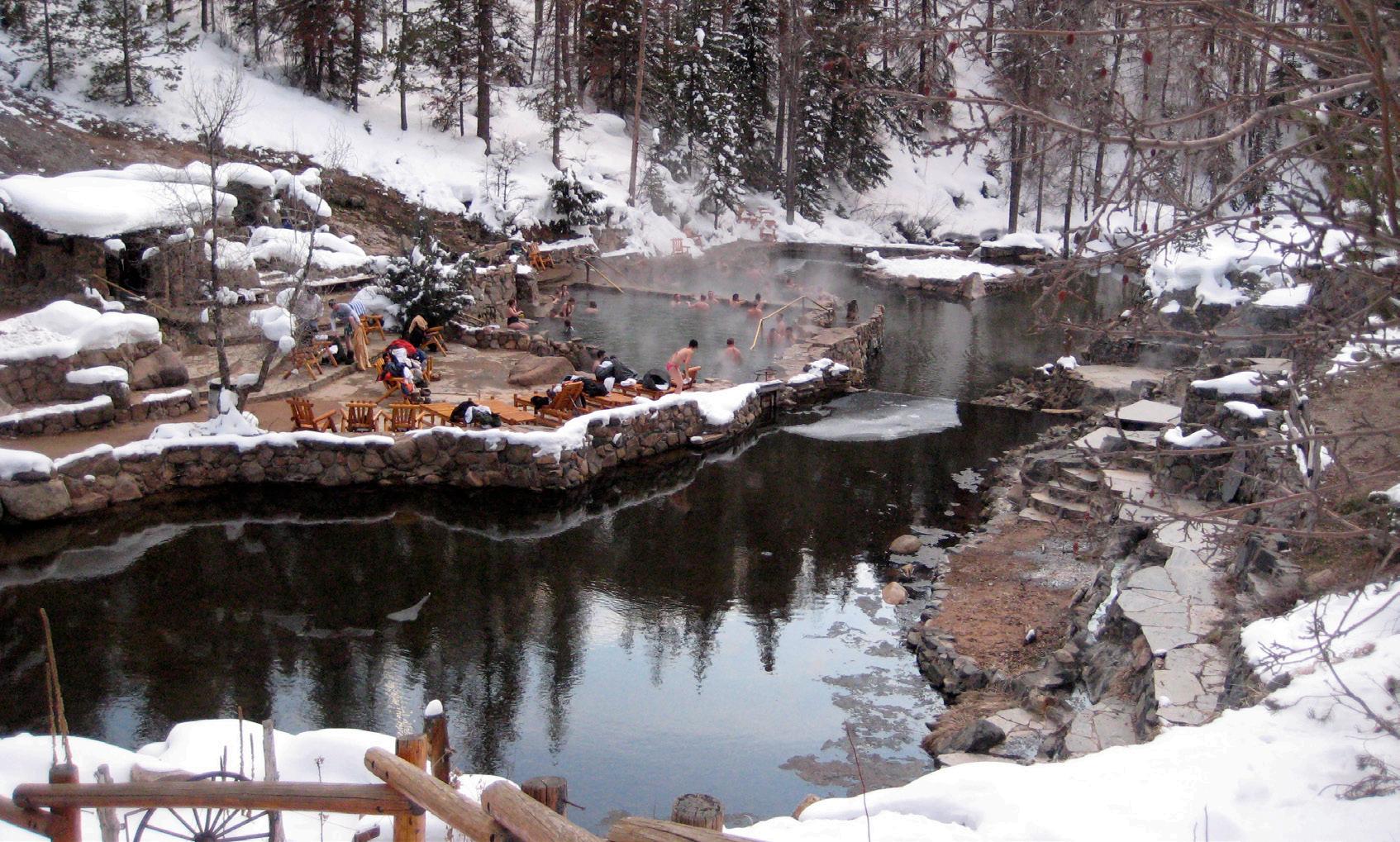
Publication of Water Education Colorado's Citizen's Guide to Colorado Groundwater was made possible by the generous support of the following sponsors: