



In Baltimore, a new narrative is being written, not in a distant future, but right here, right now. The Center for Urban Families (CFUF) believes that true, lasting change begins with a single, powerful act: sowing the seeds of legacy. For more than two decades, we have worked to dismantle poverty by empowering fathers and families to achieve stability and economic success. Our mission goes beyond delivering services; it's about transforming mindsets. As a leading voice in the national conversation on responsible fatherhood, we know that when a father is present, supported, and economically secure, he becomes a cornerstone of his family and a catalyst for community transformation.

This report, themed "The Future is Now," embodies that belief. It reflects the pivotal moments we've shared with countless families—moments that have sparked hope, strengthened resilience, and built the foundation for a better tomorrow. Through our work in workforce development, family stability, and leadership, we are not simply helping individuals; we are building pathways to purpose, strength, and intergenerational success. Our journey begins today, with every father, every family, and every member of our community, working together to shape a future where everyone has the opportunity to thrive.


z A leading voice in the national conversation on responsible fatherhood.
z A support network for Baltimore’s most vulnerable citizens.
z A staunch advocate for child support reform in Maryland.
z A provider of experiences, skills, and information to practitioners who seek to strengthen families with low incomes.
Our mission is to strengthen urban communities by helping fathers and families achieve stability and economic success.
A heartfelt message from one of the STRIVE® 300 graduates deeply moved the CFUF team. She named ten staff members individually, sharing that she had felt deeply respected, never judged, and as though she had awakened from a nightmare to find a sense of belonging and hope.
She wrote that it felt “as if the whole organization was picked to truly help and benefit human growth.”
Seeing our work reflected back through her words was profoundly grounding, for me and for our entire team, especially as we navigate political shifts and changing national priorities around economic opportunity and family wellbeing.
But we’ve faced hard times before. In our 26 years, CFUF has remained consistent—through the Great Recession of 2008, the Baltimore Uprising following the tragic murder of Freddie Gray, and the COVID-19 pandemic, among other defining moments in our history.
Public funding has certainly never been a guarantee, and it never will be. Likewise, contributions from our philanthropic partners and generous donors are earned through the evidence we provide of the transformational impact we create for our members and their children.
Strong board leadership and a devoted staff have guided CFUF through every challenge, and our tenacious organization continues to evolve to meet this moment.
Through our work, members develop resilience and transform the life trajectories of their children. Our approach empowers families by equipping them with the tools to achieve stability, build financial security, and create legacy wealth through career development, homeownership, and estate planning.
CFUF’s power is proven, and over time, we’ve grown more sophisticated and future-focused. Under our strategic plan, we’ve shifted from traditional case management to mobility coaching, tailoring our support to each member’s goals. We collaborate closely with partners to serve the members holistically and build their capacity to advocate for themselves and use their collective voice to advance social and economic mobility. Of course, we’re also a data-driven organization, measuring outcomes and using evidence to continuously strengthen our effectiveness.
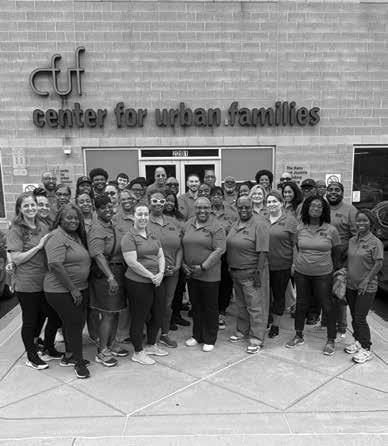
At the same time, we’re cultivating the next generation of CFUF leaders—from the visionary thinkers on our board to the remarkable individuals who show up every day on North Monroe Street. Our team brings lived experience, academic expertise, and boundless compassion to this work.
Our headquarters’ physical footprint is changing as well. We’re more than halfway to our fundraising goal to add 4,800 square feet for occupational skills training to meet the workforce demands identified by our employer partners. The expansion will create space for member amenities, including showers and laundry facilities. Construction could begin as early as next year, thanks to the generosity of our donors and investments pledged by Governor Wes Moore and Mayor Brandon M. Scott.
But the true measure of our organization isn’t found in funding, strategic plans, or building upgrades, important as they are. It’s revealed in the stories of our members and the ripple effects of their achievements in the lives of their children. It’s in the commitment of our board members, the dedication of our staff, and the shared belief that change is possible.
It lives in the strength of the human spirit, and the bonds of family and community, as we walk boldly into the future together.

Joseph T. Jones, Jr. Founder, President, and CEO
The Center for Urban Families (CFUF) has spent over two decades consistently evolving its approach to uplift Baltimore's families, a journey marked by programmatic innovation and institutional growth. Founded in 1999 as the Center for Fathers, Families and Workforce Development (CFWD), the organization established an early, steadfast focus on fatherhood—a commitment that has remained central to its mission. By strategically adapting its business model—expanding from a community program provider to a national technical assistance resource, and eventually a major policy advocate—CFUF built the infrastructure necessary to help CFUF members achieve intergenerational wealth and stability. This timeline chronicles the milestones that define CFUF's success, illustrating a dynamic strategy that has always been anchored by a deep belief in the potential of fathers and families to drive community change.
The Center for Urban Families (CFUF) began its journey with the filing of its Articles of Incorporation in 1999, founding the organization then known as the Center for Fathers, Families and Workforce Development (CFWD). Supported by the Abell and Ford Foundations, it immediately launched its signature STRIVE® Baltimore and Fatherhood programs, establishing its core, enduring mission. The 2000’s marked a period of rapid expansion and national recognition. The decade saw CFUF establish vital partnerships with the Maryland Department of Human Resources and the National Alliance to End Homelessness, launch major programs like the Career Path Initiative and Couples Advancing Together (CAT), and secure significant federal funding for its "Building Strong Families" project. Key milestones included the graduation of STRIVE®'s Cycle 100, achieving national technical assistance contracts, receiving major awards from The Annie E. Casey Foundation and Bank of America, and a crucial organizational name change to CFUF. This period culminated with the acquisition of the old Baltimore Coliseum site, launching an $8 million capital campaign, and celebrating the Grand Opening of its 32,000 square foot facility in 2009.
The 2010’s cemented CFUF’s status as a leader in policy influence and program delivery. The decade began with the establishment of the bi-annual Urban Visionary Awards and saw CFUF achieve direct policy impact when a bill authorizing the CAT pilot was signed into Maryland law. The organization reached national prominence in 2013 with a visit from President Barack Obama and Founder, President, and CEO Joe Jones being selected as a CNN Hero. Programmatic success continued with the graduation of STRIVE®'s Cycle 200 in 2016 and the receipt of the first federal fatherhood grant for the Baltimore Responsible Fatherhood Project (BRFP) in 2015. CFUF further integrated into the community by becoming a partner at TouchPoint Mondawmin in 2017, and closed the decade by launching its encompassing ALL In strategy in 2019.
For self. For family. For future.


Entering the 2020’s, CFUF prioritized strategic growth, data-driven decisions, and advocacy. After winning Morgan Stanley’s 12th Annual Strategy Challenge, the organization formally adopted and launched its Five-Year Strategic Plan to codify its ALL In strategy. Milestones included celebrating its 25th Anniversary Season beginning in 2023 and concluding in 2024, formally establishing its Office of Policy & Advocacy and launching a unique Research and Evaluation collaboration with Johns Hopkins Bloomberg School of Public Health. This year, 2025, CFUF celebrated the graduation of STRIVE®'s Cycle 300 and the awarding of a second major federal fatherhood grant
CFUF is aggressively driving its future, guided by the Five-Year Strategic Plan to solidify its role as a leader in economic and social mobility. Having achieved a significant transformation in the first four years— including adopting the EMPath Mobility Mentoring framework, establishing new Advocacy and 2GEN work, and nearly doubling our staff—we are now focused on the final phase: ensuring long-term sustainability and scale. We are prioritizing workforce preparation for the future economy by aligning with employers to address the jobs created by advancing technology and maximizing opportunities through partnerships like Governor Wes Moore’s Service Year Option. This strategic vision is supported by a shift from traditional case management to holistic mobility coaching, enhancing our data-driven approach, and cultivating the next generation of leadership across our board and staff.
Looking ahead, we are dedicating resources to four scalable, programmatic initiatives: Back to Business, to refresh workforce readiness; Couples Advancing Together (CAT), to sustain healthy family relationships; expanded Occupational Skills Training, to increase earning potential through industry-recognized certification; and Transitional Employment, to provide immediate income stability. This programmatic growth is directly supported by the planned physical expansion of our headquarters, which will add 4,800 square feet for specialized training and member amenities—a project made possible by generous donations and commitments from Governor Wes Moore and Mayor Brandon M. Scott. Ultimately, while our strategic plan and physical growth are vital, our future is defined by the lasting ripple effects of our members' achievements and the unwavering belief that transformative change is possible.

CFUF has long been a catalyst for families on the margins—as we will continue to be.
We begin by listening to the people we serve, learning what they need to sustain strong family units, the foundation for children’s success. Through collective engagement, we identify opportunities for education and training that lead to livable-wage careers and, ultimately, a path toward intergenerational wealth.
Our work has endured through national economic distress, shifts in federal policy, and the upheaval of a global pandemic. Through it all, we have remained steadfast—a trusted resource for families who know they are never alone in facing challenges.
Now, as new challenges emerge, we are preparing for a growing number of people who will need our programs. Looming cuts to SNAP benefits will leave families hungry. Federal enforcement actions will heighten stress. Rising housing costs will strain already tight budgets. And our members will increasingly need mental health support.
Yet in the face of uncertainty, one thing remains constant: CFUF’s unwavering support for families. We are not a placeholder, we are a stakeholder.
Our dedicated staff—many of whom grew up in the very communities we serve—are responding directly to the forces beyond Baltimore that have caused deep hardship within it. When the mayor called for solutions for young people once known as “squeegee kids,” CFUF stepped up to help create new opportunities. Our work with returning citizens and vulnerable families is deeply connected to the city’s remarkable decline in homicides.
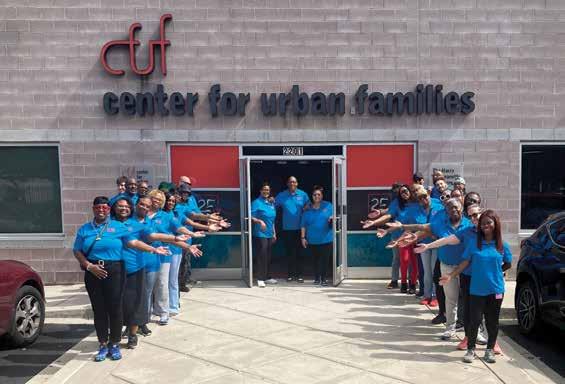
Our center on North Monroe Street stands as a beacon of light. By easing the pain our members face and helping them prepare for the future with hope and possibility, we are proving what it means to be a changemaker with staying power.
We will continue this work even as the systems around us evolve, and we will help shape what comes next. Take the U.S. Department of Education, for instance: while its structure may change, CFUF will remain a trusted voice helping envision its future. We stand ready for this urgent advocacy alongside our partners, donors, and members— who are increasingly using their own voices to drive positive change.
At the same time, CFUF is working closely with employers to prepare our members for the wave of jobs that advancing technology will create. Through partnerships at the city, state and federal levels, including Governor Wes Moore’s signature Maryland Corps and its Service Year Option—we continue to seize every opportunity to uplift our members.
The promise and potential of this city will never be diminished. CFUF continues to prove that member by member, all things are possible for Baltimore families.

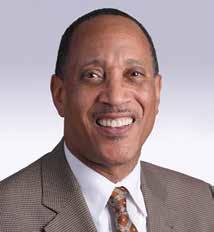
Kenneth M. Jones II CFUF Board Chairman
Senior Vice President, Chief Operating Officer, and Chief Equity Officer for the John D. and Catherine T. MacArthur Foundation


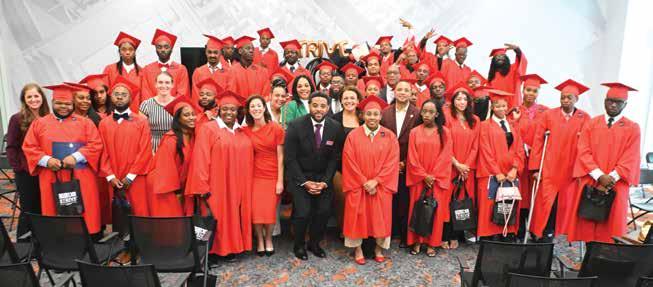
Standing in his red cap and gown among the nearly 40 STRIVE® graduates, Ezekiel Henry felt a renewed sense of confidence, and hope for his future.
Life was changing quickly for the 20-year-old Baltimore native. In the three short weeks since joining the Center for Urban Families (CFUF), he had secured his first job and enrolled in a GED class. Next on his list: finding permanent housing, getting his driver’s license, and beginning to plan for a career, perhaps on the open road as a truck driver or in the trades as a plumber.
“My friend who told me about STRIVE® warned me they were strict," Mr. Henry said. ”But I think everything they did was to try to keep us on track...They actually helped me out—big time.”
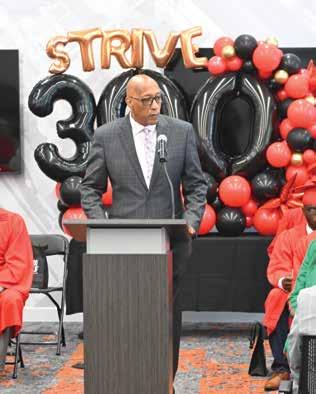
The recent STRIVE® graduation at TouchPoint in the Village at Mondawmin marked the 300th cycle of the life-changing program held in Baltimore since 1998, a remarkable, unbroken succession. A gateway to CFUF, the signature program launches its graduates on a path toward income stability, strong families, and intergenerational wealth—the key components to tackling the structural challenges that create hardship for families in Baltimore.
Now, through a partnership with Thread, CFUF is expanding its reach. Thread supports young people in Baltimore City through high school and beyond with a unique 10-year commitment that begins in 9th grade. By connecting students with a network of volunteers and community partners, Thread helps them build lasting, supportive relationships that empower both students and mentors to achieve their goals.
Thread participants now join thousands of STRIVE® alumni who have found demonstrated success in the labor force through placements with industry partners such as Whiting-Turner Contracting Company and MEC2: Mechanical Engineering & Construction Corp.
Catherine Pitchford, CFUF’s Director of Programs, said word about STRIVE® has spread organically over the years, just as it reached Mr. Henry through his friend.
“You have generations who have gone through it,” Ms. Pitchford said. “The people who complete the program tell their families and friends what it did for them, the opportunity it gave them to see who they really are.”
The pilot partnership with Thread builds on that legacy by adding another layer of relationship-based support for young people transitioning from high school to adulthood. Where Thread has nurtured their confidence and social networks, STRIVE® introduces the realities of the workforce, Ms. Pitchford explained.
Over three intensive weeks, STRIVE® combines job readiness and life-skills training with Cognitive Behavioral Theory to help participants reframe their thinking, separate business from emotions, and strengthen critical thinking and conflict-resolution skills.
For Jaelyn Williams, 22, the program was a continuation of the journey that began when she joined Thread as a freshman at Digital Harbor High School. There, she learned that people outside of her family could care deeply for her and support her growth.
“Before STRIVE® , I spent so much time believing I had lost more than I ever gained in my 22 years of life,” Ms. Williams said during the graduation ceremony. “Yet the past three weeks have shown me I am just getting started.”
Growing up in West Baltimore, Ms. Williams lost two siblings, “one to the streets and one to prison.” But with
the support of Thread and CFUF, she said she will “push through the barriers that once stopped them.”
Ms. Williams recently began laboratory associate training at the BioTechnical Institute of Maryland, preparing for a career in life sciences. Her coursework includes cell culture, sterilization, and an introduction to molecular biology. She said she’ll carry STRIVE® lessons with her to “think like an employer, not just an employee.”
Dr. Sarah Hemminger, Thread’s co-founder and chief executive officer, said the partnership helps young people bridge the transition to adulthood. Joining STRIVE® as a cohort allowed them to draw strength from years of shared experiences, from afterschool programs and community service to camping trips and big celebratory events.
Thread participants in STRIVE®'s 300th cycle are also part of the “Service Year Option” through Maryland’s Department of Service and Civic Innovation, a hallmark of Governor Wes Moore’s administration. Dr. Hemminger said STRIVE®’s lessons will serve them well as they give back to the community and further their own professional development.


“CFUF has this incredible balance of bringing into the STRIVE® training not only hard and soft skills but also discipline and love,” Dr. Hemminger said. “They do a tremendous job of preparing our young people for the workforce. Our community is one community. The CFUF community is the Thread community and vice versa.”
The audience at the milestone graduation included longtime supporters, such as Robert C. Embry, Jr., outgoing president of the Abell Foundation.
Joseph T. Jones, Jr., Founder, President, and CEO of CFUF, recalled that it was Mr. Embry who encouraged him to travel to New York City in the late 1990s to study the groundbreaking STRIVE® program in East Harlem. Both men saw its potential to help Baltimoreans struggling with poverty, chronic unemployment, limited education, and involvement in the criminal justice system.
By teaching “soft skills”—such as reliability and professionalism—STRIVE® became a perfect complement to the Abell Foundation’s broader workforce investments, Mr. Embry said.
“It isn’t a cure-all, but it was a missing part of the total effort to improve the employment situation in Baltimore City,” he said. “We were the initial funder, and we’ve continued to invest in it for nearly 30 years because of the effectiveness of the program. In terms of our methodology, it has met and exceeded our expectations.”
Mr. Embry added, “Society is very lucky that the person and the need happened to meet,” referring to Mr. Jones, “And this new partnership with Thread brings great promise.”
Moses Hammett, who has worked with STRIVE® since its earliest days and now serves as partnership coordinator for CFUF’s Baltimore Communities Assisting and Advancing Neighbors (BCAAN) initiative, said the program’s multigenerational impact continues to amaze him.
He is struck by its impact, from the young people with Thread to the STRIVE® graduates who are now retired.
“I’ve spoken with STRIVE® graduates who are now retired,” Mr. Hammett said. “They tell me the training helped set them up for the rest of their lives. Without it, they might never have held a job that let them save for retirement or contribute to Social Security.”
David Warnock, a longtime board member, said the organization’s unwavering commitment to STRIVE® and its graduates has been key to its longevity. With time, CFUF’s approach has grown more sophisticated, using data to understand members’ challenges and respond effectively.
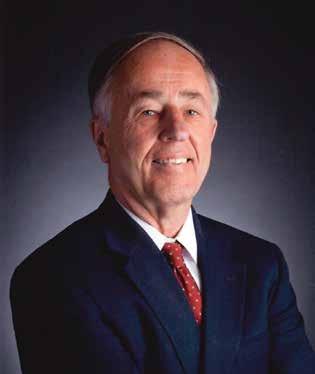
Along the way, the leadership, the board and the staff have all approached the members and the work with desire to learn, adapt and respond with urgency to changing circumstances. Likewise, at CFUF, members find a sense of belonging in a society that is increasingly disconnected, especially for groups the organization serves, including returning citizens and single parents.
“How many initiatives come and go?” Mr. Warnock asked. “If you’re going to make long-term, systematic change, you need to create institutions where you have a sustained level of commitment and an ability to evolve as members evolve.”
"Reaching the incredible milestone of 300 cycles was once only a dream," Mr. Jones said. The first STRIVE® class convened in 1998 at the old Church Square Shopping Center over top a fast food restaurant. The program was initially established as part of the Baltimore City Health Department’s Healthy Start program and became a signature offering of CFUF when Mr. Jones founded the organization a year later.
Today, CFUF is fundraising to expand its workforce training facilities at its North Monroe Street headquarters, supported by $1 million from the state and $500,000 from the city, allocated by Governor
Moore and Mayor Brandon M. Scott. Mr. Jones also credited Maryland State Senators Antonio L. Hayes and Cory V. McCray for their continued advocacy that has contributed to the investments. Both joined CFUF for the STRIVE® graduation at TouchPoint.
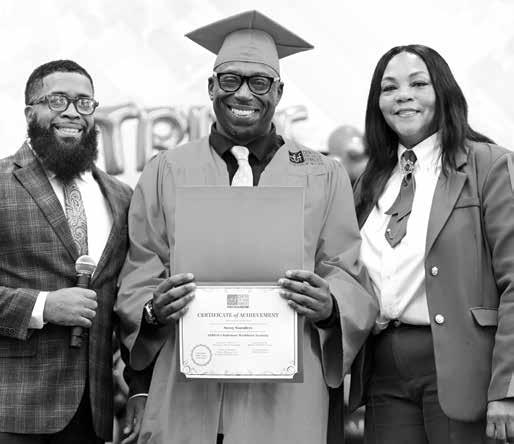
As graduates were called up to receive their certificates, STRIVE® master trainer Lavatte David, herself a STRIVE® graduate who has trained nearly 200 cycles, paused to recognize Ezekiel Henry.
“Ezekiel was one of the most pleasant folks in the whole workshop,” she said. “Congratulations, you have great things ahead.”
Mr. Henry smiled for a photo and offered a humble “thank you.” He is now working with CFUF’s Clean Corps and hopes to earn his GED in the coming months.
Because of STRIVE® , Mr. Henry said he is able to correct mistakes he made in his past and stay focused on the future. “When I was younger, I was hanging out with the wrong people, and I realized time was going way too fast,” he said. “They offered me a chance to do something with my life.”
The STRIVE® graduation was his first, but it won’t be his last.

Building on over 25 years of proven results in advancing racial justice and equity, CFUF is now charting the course for the future. We are focusing our efforts on establishing enduring, intergenerational wealth within our communities. By prioritizing family empowerment and financial stability, we are strategically positioned to dismantle systemic barriers and drive the creation of a fundamentally more equitable and just society.
33,804 MEN’S AND WOMEN’S LIVES TRANSFORMED
73,119 CHILDREN’S LIVES TOUCHED
MEMBERS’ HOURLY WAGES HAVE INCREASED TO: $18.06 AVERAGE WAGE
$18.40 IN HEALTHCARE AND SOCIAL ASSISTANCE
5,857 FULL-TIME JOBS SECURED
245 JOB PLACEMENTS IN 2024
$20.31 IN CONSTRUCTION $20.02 IN MANUFACTURING
$18.94 IN TRANSPORTATION AND WAREHOUSING $16.00 IN RETAIL TRADE $18.00 IN SECURITY $17.27 IN ACCOMMODATION AND FOOD SERVICES $16.17 IN ADMINISTRATIVE, SUPPORT, WASTE MANAGEMENT, AND REMEDIATION SERVICES
Data represents: 1/1/2024–12/31/2024
When Amanda Smith, PhD, MPH, joined CFUF in 2024 as the Director of Research, Evaluation, and Innovation, she wasn’t starting from scratch. She followed in the footsteps of successful predecessors and joined a leadership team long committed to data collection and use. However, she hoped her experience, expertise, and connection to the Johns Hopkins Bloomberg School of Public Health (BSPH) could further evolve an organization already excelling. Dr. Smith joined CFUF as part of a collaboration that has her nearly full time at CFUF while continuing her work at BSPH.

Dr. Smith initially focused her efforts on writing analytic code via R programming language to produce Key Performance Indicator (KPI) reports, internal reports, and grant reports. A common best practice in other fields, analytic code supports CFUF’s work by allowing reproducibility, efficiency, and scalability. CFUF now has documentation of how each metric for a grant report is produced. Additionally, the ability to piece together new code from existing code allows for nimble responses to data requests—demonstrated by the quick turnaround of hundreds of data points for an unforeseen federal grant request.
Analytic code has benefits beyond data reporting—Dr. Smith has been using it to build apps to support CFUF programs. The Baltimore 2GEN Ecosystem requires data entry by multiple people to track multiple referrals, enrollments, and exits across multiple organizations. The current system in place has worked well, but as the 2GEN Ecosystem continued to grow and partners voiced difficulties with the current system, it became clear it needed an overhaul. Dr. Smith and Dr. Brittny Herring-Devore, Director of Family Strengthening and Community Engagement, have built a customized 2GEN Ecosystem Data Portal for data entry and tracking they plan to launch in January 2026. This should not only make data entry easier for partners but improve data quality.
Dr. Smith has also incorporated mapping via GIS software into regular reporting. Mapping can be a powerful tool, especially with the ability to observe data in specific areas. It helps CFUF both enhance planning and better serve members. Identifying neighborhoods in Baltimore where members live, coupled with
public unemployment numbers by census tract, helps CFUF understand if there are areas of Baltimore that need additional outreach or messaging about the organization’s services. Additionally, a mapping tool showing open job orders and public transit routes from any address helps mobility coaches and employment specialists connect members with jobs near their homes or easily reachable by transit.
In addition, evaluation of CFUF’s programs is central to Dr. Smith’s role. Anyone who has attended a STRIVE® graduation has witnessed the magic of CFUF’s programs—the transformation of its members in three short weeks is a testament to the great work being done. A common sentiment from staff is that program completion and job placement data are important, but that it can be challenging to quantify the many personal transformations that occur within CFUF programs. At the request of Joseph T. Jones, Jr., CFUF Founder, President, and CEO, Dr. Smith set out to measure hope to see if it could, in part, explain the effect CFUF’s STRIVE® training has on members. She and the programs team have now collected Trait Hope Scales and General Self-Efficacy Scales from over 100 members both at the beginning and end of STRIVE® cycles. She and others were encouraged by the preliminary data—the STRIVE® training is increasing hope, especially among those that begin with the biggest barriers (e.g., children to support, lack of any degree).
Qualitative data collection is also an integral part of STRIVE® evaluations—in addition to focus groups at the end of each STRIVE® cycle, Dr. Smith and Catherine Pitchford, Director of Programs, recently launched a photovoice project in conjunction with the 300th cycle of STRIVE® . Photovoice is a participatory research method where members use photography and storytelling to document and share their experiences during and after the STRIVE® training. Dr. Smith is optimistic that once complete, this project will show a little bit of the magic that is so hard to measure quantitatively.
Flexibility is an integral part of evaluation at CFUF, as challenges sometimes arise that make it difficult to carry out the original plan. Dr. Smith learned this when low literacy levels created a barrier to use of a newly created survey to evaluate the Baltimore Responsible Fatherhood Services program. CFUF’s members
come first, and that principle extends to research and evaluation—data collection should never be a burden. Dr. Smith worked with Wendy Blackwell-Fortune, Director of CFUF’s Practitioners Leadership Institute, to reimagine an engaging, fun, easy-to-complete survey for fathers. Rather than answering detailed questions about relationships with each of their children, fathers now place a football sticker for each child on a football field to represent the relationship—they could be just starting out on the 10-yard line or have a very strong relationship already in the end zone. Using this survey evolution as an example, Dr. Smith plans to continue to re-envision data collection—it can be simple and enjoyable while still collecting valuable information.
Dr. Smith continues to lean into her dual role as an assistant scientist at the Johns Hopkins Bloomberg School of Public Health (BSPH). This fall, she plans to host a master’s student intern to build an interactive data dashboard for program metrics and KPIs, and a doctoral student intern to use existing CFUF data to develop a predictive model for program success. These projects will help CFUF identify members at risk of dropping out early and ensure they receive additional support from the start. Through these efforts, Dr. Smith aims to strengthen the collaboration between CFUF and BSPH and create ongoing opportunities for mutual learning.
Looking ahead, Dr. Smith is eager to expand this collaboration and continue advancing CFUF’s data capacity. CFUF’s growing ability to track and use data through tools, such as analytic coding and GIS mapping, enhances both the quality and impact of its work. Dr. Smith also maintains a Research, Evaluation, and Innovation “wish list”—a collection of ideas for new data uses, research questions, and ways to share lessons learned. The list is long, but the future is bright.


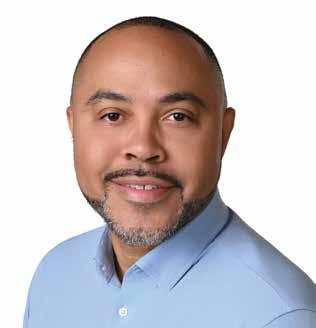
From her days at Edgewood Elementary to her graduation from Baltimore Polytechnic Institute, Kristian Lancaster remembers the morning car rides with her dad, Barry. Their routine was filled with ordinary moments, but that time together left Kristian feeling safe and loved.
Now a computer science student at Morgan State University and the mother of six-year-old Onyx, Ms. Lancaster says she looks to her father’s example— in how he always put her first, made sacrifices for her education, and ensured she could pursue her passion for dance, even when lessons stretched the family’s budget.
Barry Lancaster, Jr. credits the Center for Urban Families (CFUF) for setting off a dramatic shift that
changed his life, bringing opportunity, stability, and a wave of positive outcomes that continue to ripple through his children and grandchildren. He says CFUF intervened at a pivotal time, helping him overcome mistakes from his past and launch a career with a leading financial institution among Fortune 500’s top 25 companies.
“Repeatedly being told ‘no,’ you get defeated,” Mr. Lancaster said. “I was in a bad place. I tried doing it on my own and nothing materialized. I needed them to break down the roadblocks I was facing...God put them in my path to ultimately allow me to get to where I am today.”
He joins nearly 35,000 men and women whose lives have been transformed by CFUF since its founding in 1999. Parents to more than 73,000 children, CFUF members participate in programs that promote mobility across workforce development, family strengthening,

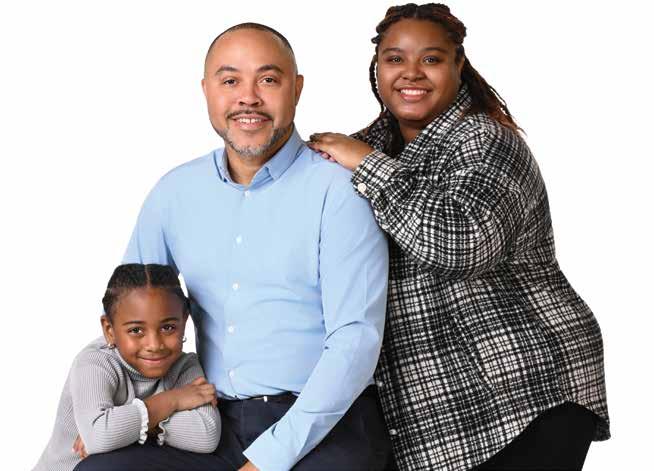
adult education, financial management, housing, health, social support, and social change. They find a dedicated team to help them overcome challenges, and a network of alumni who offer mentorship, job connections, and community.
The result reverses the damage of decades of failed social policy and roots generations in possibility.
“We serve adults, but because most of our members are parents, we are changing the lives of children through our work,” said Joseph T. Jones, Jr., CFUF’s Founder, President, and CEO. “If we help them be their best, they pour that into their children.”
Santorio Martin and his wife, Chauna Brown Martin, have six children, including their youngest Nasir, age 8, born after Mr. Martin joined CFUF.
He signed up for STRIVE® about 15 years ago after returning home from a long incarceration, battling Hodgkin’s lymphoma, and facing limited job prospects outside the underground economy.
Today, he serves as a lead environmental safety for the Whiting-Turner Contracting Company, where he oversees safety on an 84-acre job site employing nearly 800 people building five senior living communities in Bethesda.
Mr. Martin’s remarkable journey, from a difficult childhood and street hustling to career success and family stability, shapes his parenting and his mentorship to other CFUF members. He’s helped build landmarks across his hometown of Baltimore, including Rash Field Park at the Inner Harbor, the Hippodrome Theatre downtown, and TouchPoint in the Village at Mondawmin.
Mrs. Brown Martin works in healthcare enrollment and is an entrepreneur who runs her own business.
Mr. Martin said his older children saw a different version of him than his younger ones. They witnessed his growth—from surviving cancer that left him learning to walk again, to completing programs at CFUF, advancing his education, buying a home, and excelling in his career.
“They seen the raw side; I wasn’t Santorio at that time, I was another person,” he said. “The last two kids get the more polished version of who I am today.”
At CFUF, the Martin family has found a rock-solid support system, starting with Mr. Jones, who was best man at their wedding.
“They bring us such a sense of community,” Mrs. Brown Martin said. “Our kids know what it is like, outside of family, to belong.”
Mr. Martin remains ALL In with CFUF, attending alumni meetings, mentoring members, speaking to STRIVE® classes, and giving back the same loyalty the organization has shown him and his family.
“I represent the struggle of the kids from the ghetto,” he said. “I let the kids from under the poverty line know that we can make it, bringing the same energy
and culture we were raised in to uplift our families and run corporations.”
Moses Hammett, who has been with CFUF since its founding, has watched members like Mr. Martin and Mr. Lancaster transform their lives.
“When you are able to improve the life of the parent, it has a ripple effect,” said Mr. Hammett, now partnership coordinator for CFUF’s Baltimore Communities Assisting and Advancing Neighbors (BCAAN) initiative.
Mr. Hammett grew up with the Lancaster family in West Baltimore and knew Barry Lancaster, Sr., a Marine who tragically died in basic training four months before his son was born. Mr. Hammett mentored the younger Barry and helped him learn about his father through shared stories.
“Seeing where he is today brings me a lot of joy,” Mr. Hammett said. “As a young man, he was a brilliant ‘A’ student at Poly, and he rebuilt his life to overcome all of the challenges he was facing. He was able to rise like the phoenix.”
After earning a degree in financial economics from the University of Maryland, Baltimore County, Mr. Lancaster hoped to work in real estate. But after some trouble following graduation, he found it nearly impossible to start his career. For five years, employers overlooked his applications, and his hope began to fade.
In 2011, he discovered CFUF and joined STRIVE® There, he learned the power of the CFUF network, and how their reputation in the community could open doors.


Catherine Pitchford, CFUF’s Director of Programs, introduced him to a property management company that hired him shortly after he graduated from STRIVE® Starting as a leasing agent, he was promoted within a year to property manager—and his portfolio continued to grow.
Mr. Lancaster stayed with the company for a decade, hiring many CFUF members to join his team as leasing agents and maintenance technicians, among other roles. He said he knew anyone recommended by the center would be an employee he could depend on.
“The center is about giving people the opportunity to build their life and make something of themselves,” Mr. Lancaster said. “The people who work there, they care and you can tell they care—you feel it.”
That, Mr. Hammett said, is the magic of CFUF.
“Most people who come to the center feel as though they cannot achieve their dream, or they’re not even worthy of it,” he said. “This is where the center comes in: to help with self-esteem and self-worth, and help to get them back on track.”
Today, Mr. Lancaster is a senior asset manager at a national financial institution, investing in housing opportunities for families in urban and rural communities. He remains closely connected to CFUF and joined its Board in April 2023.
“I benefited immensely from going through the center, and so have my kids and grandkids,” he said. “Now, serving on the board, I can champion the work to push it further and give more families the opportunity to experience the support mine has.”

The year 2025 represents the last year of our five-year strategic plan. As we look back over the past five years of progress, we see an organization transformed.
We have established two new bodies of work (Advocacy, BCAAN, and 2GEN) and transformed two— the Practitioner’s Leadership Institute, and Research, Evaluation & Innovation—increased our staff from 25 to 47, instituted the EMPath Mobility Mentoring framework focused on long-term self-sufficiency, and bolstered our member journey through the creation of new positions focused on pre-enrollment supportive services and in-depth barrier removal supports.
As we head into the fifth and final year of the strategic plan, we are focused on reimagining and establishing four, long-term sustainable programmatic initiatives:
1. Back to Business: a three-day workforce development training that focuses on refreshing the soft skills and job search skills of individuals with prior work experience.
2. Couples Advancing Together (CAT): programming focused on sustaining healthy relationships for couples.
3. Occupational Skills Training: workforce training that increases members’ earning potential through the development of industry specific skills.
4. Transitional Employment: in-house, short-term employment opportunities for members in immediate need of income, but who have not yet been able to secure full-time employment.
The Baltimore 2Gen Ecosystem (the “Ecosystem”) is a multi-generational approach that builds on CFUF’s longstanding commitment to strengthening families. It advances programming that intentionally includes fathers and provides coordinated services for both caregivers and children, helping families achieve lasting economic stability. Central to the Ecosystem’s design is the identification, development, and retention of strong partnerships with high-quality communitybased organizations in Baltimore City that share CFUF’s mission to help families thrive.
Reflecting CFUF’s overarching 2Gen philosophy, the Ecosystem ensures that a two-generation lens is embedded across all CFUF programming. This approach emphasizes multi-generational impact through supports such as assistance with Supplemental Nutrition Assistance Program (SNAP) applications, enrollment in the Baltimore Responsible Fatherhood Services program, educational scholarships for members and their children, and homeownership assistance to inspire intergenerational wealth-building. To further expand our reach and deepen our impact, CFUF continues to explore new ways to collaborate with additional Baltimore organizations to engage their families and strengthen cross-referral networks.
Through strategic and intentional partner engagement, the Baltimore 2Gen Ecosystem, led by CFUF, provides families with access to a streamlined referral system and collaborative case management that advance outcomes in economic success, education, and health and well-being. The Ecosystem continues to grow and evolve: it now includes 11 partner organizations, nearly tripling from the four original “anchor” partners that launched the initiative in 2021—the Center for Urban Families, Baltimore Healthy Start, DRU Judy Center, and Union Baptist Head Start. Since its inception, the Ecosystem has expanded both geographically and programmatically, now encompassing partners that serve children and adults of all ages and offer a broader array of services.
As we continue to expand, CFUF remains focused on deepening relationships with existing partners, finding new ways to collaborate, align goals, and enhance
shared impact. A strong example of this is our ongoing partnership with Baltimore Healthy Start, an anchor partner that has extended its engagement beyond referrals to integrate CFUF into its new program, Housing University. This initiative supports Baltimore City residents with children under 12 months in securing affordable, safe, and healthy housing. In collaboration with CFUF, Housing University participants also receive introductory workforce readiness workshops, recognizing that families facing housing instability often need employment support as well.
This collaboration exemplifies how the Baltimore 2Gen Ecosystem deepens partnerships, leveraging expertise across sectors, and develops innovative, holistic strategies to meet the multifaceted needs of Baltimore’s families.
In 2024, CFUF significantly enhanced its data and evaluation capacity with the addition of Amanda Smith, PhD, MPH as the Director of Research, Evaluation, and Innovation. Dr. Smith’s initial focus has been on establishing foundational data tools and implementing innovative evaluation methods:
z Establishing Analytic Code and Efficiency: By using R programming language to create analytic code, Dr. Smith has made CFUF's key reports reproducible, efficient, and scalable. This new capacity was immediately demonstrated by the ability to quickly provide hundreds of data points for an unforeseen federal grant request.
z Building Custom Data Portals: To support the growing Baltimore 2Gen Ecosystem, Dr. Smith is co-leading the development of a customized 2Gen Data Portal, set to launch in January 2026. This portal will improve data quality and simplify the process of tracking referrals and enrollments for CFUF’s partners.
z Integrating GIS Mapping: GIS software is now used to map member locations, unemployment data, job opportunities, and public transit routes. This powerful tool enhances strategic planning, helps identify areas needing outreach, and directly assists mobility coaches and employment specialists in connecting members with accessible jobs.
z Measuring Personal Transformation: At the request of Founder, President, and CEO Joseph T. Jones, Jr., Dr. Smith launched an initiative to quantify hope and self-efficacy among STRIVE® participants. Preliminary data from over 100 members suggests the STRIVE® training is effectively increasing hope, particularly for those facing the greatest barriers. This is complemented by a new photovoice project to capture the qualitative "magic" of member transformation.
z Human-Centered Data Collection: Dr. Smith prioritizes making data collection accessible and enjoyable for members. This approach led to the re-envisioning of the Baltimore Responsible Fatherhood Services survey, replacing complex questions with a simple, engaging "football field" sticker activity to represent relationship dynamics.
The Ballmer Group awarded CFUF a grant for the Practitioners Leadership Institute (PLI) to develop a model for promoting active father engagement at Baltimore City Head Start (BCHS) sites. In response to the 2018 federal memo, Integrating Approaches that Prioritize and Enhance Father Engagement, PLI partnered with MEF Associates and BCHS to create a proof of concept aimed at building a prototype for replication in Head Start programs nationwide.
Family Service Coordinators distilled the work into one powerful question: “What if we treated fathers like we treat moms?” That question guided the development of a new paradigm, one that integrates fathers into Head Start by naming them, welcoming them, and recognizing the vital contributions they make in their children’s lives.
After three years of research and implementation, PLI produced several significant contributions to the field. Creating a Culture of Active Father Engagement: A Resource Guide for Head Start Programs outlines key steps for integrating fathers, including: transforming physical spaces to be more father-inclusive, intentionally engaging fathers in meaningful activities, hiring more male staff (especially from among current Head Start fathers), and using continuous feedback from both fathers and staff to strengthen engagement efforts.
In addition to this guide, PLI developed a suite of checklists and collateral materials for Family Service Coordinators, along with a short children’s book, If Your Dad Takes You to School, available on the PLI website (http://www.cfufpli.org). Inspired by Laura Numeroff’s famous children’s book, If You Give a Mouse a Cookie the book features Baltimore City Head Start fathers and celebrates the crucial role dads play in supporting regular school attendance.
In collaboration with Aspen Ascend Fellow Dr. Clinton Boyd, PLI also released three white papers, Unlocking the Power of Fathers: Fatherhood as a Protective Factor for Promoting School Readiness; Father Friendly Checklist: Integrating Fathers into Head Start; and The Head Start Program: A Support System for Young Fathers
We concluded the initial grant celebrating the integration of fatherhood at 10 BCHS sites. Under the leadership of Fatherhood Coordinator Vernon Wallace, more than 800 fathers and children participated in Parent and Child Together (PACT) activities, with 184 fathers engaging in multiple sessions.
Building on the success of the Baltimore City Head Start project, PLI now is focusing on reinvigorating its communities of practice, bringing practitioners together, expanding training and technical assistance opportunities, and managing and enhancing the Baltimore Responsible Fatherhood Services program. This next phase centers PLI’s work on the intersection of fatherhood and the systemic barriers that shape family outcomes, making our work more important than ever.
The Developing All Dads for Manhood and Parenting D.A.D.M.A.P. curriculum remains a cornerstone of our approach to developing leadership and infrastructure to serve fathers effectively. PLI is now in the final stages of revising the curriculum and its accompanying facilitator’s guide.
Funded by the Baltimore Community Foundation, the Family Reading Circle (FRC) and Little Libraries Project, offered a series of book discussions and hands-on activities for early learners (ages four to seven) and their caregivers. These programs reached more than 250 children and families, bringing familiar stories to life. One highlight, Old MacDonald Had a Farm, featured live horses from City Ranch to create an unforgettable experience for young participants. This year, the FRC series began with Room on the Broom and will offer five additional sessions designed to engage fathers, early learners, and community partners from the Baltimore Communities Assisting and Advancing Neighbors (BCAAN) ecosystem.
As outlined in our Strategic Plan, the Center for Urban Families is now more than a year into implementing an advocacy strategy focused on driving broad-scale change and advancing racial and economic justice.
The pillars of our strategy are:
(a) Equipping CFUF members to advocate on behalf of themselves and their communities through quarterly citizen advocacy training and connecting them with legislators and partners who share their priorities.
(b) Conducting issue advocacy in which CFUF identifies systemic barriers to economic and racial justice and collaborates with members, partners, and legislators to create and advance solutions.
In late January, we held CFUF’s second annual advocacy day in Annapolis. Participation grew from eight members, staff, and partners in 2024 to an exciting 35 in 2025! Four teams met with nearly 35 legislators.
CFUF’s policy agenda significantly advanced during the 2025 General Assembly. Four pieces of legislation were signed by Governor Moore into law:
1. Driver’s License Protection for Child Support Obligors:
z Obligors who earn less than 250% of the federal poverty guidelines (approximately $38,000 in 2025) cannot have their driver's licenses suspended for child support arrears.
z This measure helps disrupt the cycle where license suspension leads to unemployment, which in turn leads to further license suspension.
2. Child Support Payments to Custodial Parents:
z By 2031, Maryland will become only the second state to ensure that all child support payments go directly to the custodial parent.
z Child support will no longer be withheld to "repay" TCA (Temporary Cash Assistance) benefits.
3. Multifamily Adjustment to Child Support Guidelines:
z This bill allows all children for whom either parent has a financial obligation to be included in the child support guidelines calculation.
4. Expungement Reform Act:
z Governor Moore's Expungement Reform Act restores expungement access to the 41% of individuals who violate parole or probation but are otherwise eligible for expungement.
In addition, CFUF was awarded $1,000,000 in the Governor's Capital Budget to expand the second floor of its building over the flex space.
Finally, in June, 30 of our trained citizen advocates joined CFUF staff to recognize the three legislators who sponsored passed Child Support legislation as CFUF’s 2025 “Child Support Champions.” We also celebrated the incredible hard work contributed by CFUF members during this successful legislative session. The dinner concluded with a Q&A session, with the legislators discussing upcoming opportunities for future advocacy participation.

For self. For family. For future.


ALL In is CFUF’s comprehensive strategy to tackle the cycles of inequity, accelerate social and economic opportunity, and advocate for policies that promote an inclusive and equitable economy for all. As we make critical adjustments to our services and processes, ALL In remains our long-term attitude to ensure our members' success in achieving economic and social stability.
ALL In leverages two decades of applied learnings to:
Target key critical areas of chronic underemployment and family instability AND
Link individual accountability, person-centered case management, and supportive networks with workforce development training, education, and civic engagement.
The future is not a distant dream; it’s a revolution taking shape right now, built by the visionaries, advocates, and champions of CFUF. They don't just hope for a brighter, more equitable world—they are actively creating it. Join us in celebrating the fearless leaders who make CFUF a beacon of hope and progress. Their innovation, resilience, and unwavering commitment embody our mission and propel us forward, inspiring the transformative change our communities deserve. Together, we can ignite extraordinary progress and amplify the power of our collective purpose.
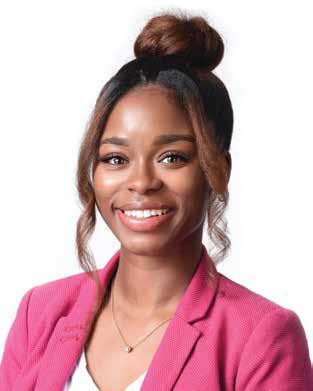
Shakira Barnes knows the drive and stamina required of the members at the Center for Urban Families when they take on new programs while juggling life and setting big goals for themselves. She works full time as program administrator for CFUF while raising two young daughters with her fiancé and studying at night and on weekends for her master’s degree in social work.
“The members keep me motivated,” Ms. Barnes said. “I am inspired by them: If they can do it, I can continue to do it. And I want to show them: If I am able to do it, they can do it.”
Ms. Barnes joined the CFUF team about three years ago as a mobility coach and recently ascended to her new position. In it, she works closely with Catherine Pitchford, the director of CFUF programs, on the day-to-day operations for the workshops and training aimed at helping members achieve economic success and family stability. She helps coordinate internal and external projects and events, such as graduations, alumni gatherings and staff outings. She also helps monitor spending and grants dollars to make sure the programs stay on budget.
“I pour anything I can into others, so they can have a fortunate life, despite the events that occur.”
A native of North Chicago, Ms. Barnes draws on her upbringing and the wisdom and example she learned from her parents. Her mother and father gave her a loving home where they provided for her physically and emotionally. When her father died tragically when Ms. Barnes was just 13 years old, she learned resiliency from her mother, who continued to care and provide for Ms. Barnes and her three younger siblings in the face of their terrible loss.
“Experiencing something like that, it has shifted my life in a way that could have hindered me, but I did not let it,” Ms. Barnes said. “I pour anything I can into others, so they can have a fortunate life, despite the events that occur.”
Along the way, she’s found divine confirmations that she is living her life as she was intended to. The proof comes in the job she helps a member land, the trust Ms. Pitchford and her colleagues put in her, and the hope she sees the CFUF team bring to families.
“Love and loss drew me to this work,” Ms. Barnes said. “I am called to do this, and I truly thank God for this place.”
“People are depending on me because of their situations, and that brings a little bit of pressure, but pressure is a privilege.”
Mr. Cooper said he encounters so many “wise and enlightened people” who work at CFUF and pass through its doors, and he is growing and learning every day. He doesn’t take for granted the trust people show in him when they confide the most difficult parts of their lives.
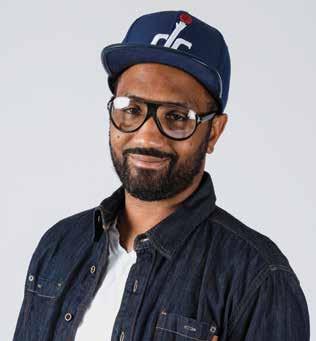
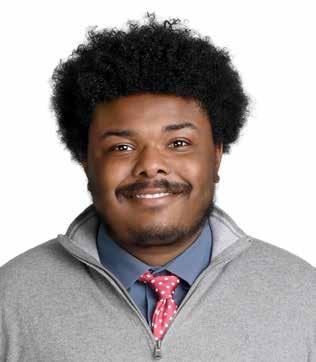
When Deshawn Wayne Cooper started at the Center for Urban Families in the spring of 2025 as an intake and outreach specialist, he didn’t need a typical orientation or staff introductions.
He has been visiting CFUF since before he started kindergarten, when they were still at their old location on Druid Park Drive, with his father, the late Wayne Lamont Cooper, a formidable figure loved and respected by generations of CFUF members.
“I liken it to a family reunion when you get to see all your aunts, uncles, grandparents and cousins, and catch up with everyone,” Mr. Cooper said. “There is a certain type of joyous feeling, and I am fortunate to have that feeling every day.”
Now 26 years old, Mr. Cooper didn’t expect to follow in his father’s footsteps. He studied film at McDaniel College, but he felt a yearning to come home to a place where he felt he could do the most good and get a chance to grow and develop in an environment his father helped shape.
His position has two parts. Mr. Cooper welcomes new members and walks them through the CFUF application and intake process. He talks to them about the programs available, and he helps them determine which ones will get them closer to their goals. Likewise, he brings information about CFUF to community events, front stoops, and business partners.
In every exchange, he carries with him his father’s legacy and a deep understanding of the work.
“It is my job to help people,” Mr. Cooper said. “People are depending on me because of their situations, and that brings a little bit of pressure, but pressure is a privilege. I always try to do right by people.”
His approach moved one member in particular. A recent STRIVE® graduate, Anthony Dowtin said Mr. Cooper set the tone for what he could experience during his time at CFUF. Mr. Dowtin didn’t know Mr. Cooper’s father, but in hearing about the elder Mr. Cooper, he saw his son.
“It runs in the family; you can tell,” Mr. Dowtin said. “He was raised well. He was made for this work.”
CFUF STAFF
WAYNE COOPER
INTAKE AND OUTREACH SPECIALIST
CFUF STAFF
ALL IN MOBILITY COACH
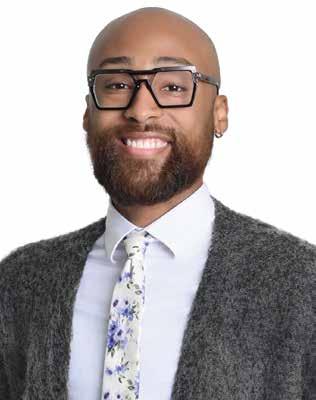
As an ALL In Mobility Coach, Anthony Brown aspires to be the man his grandfather was to him, serving the CFUF members with the same encouragement, inexhaustible compassion, and depth of support.
“My grandfather was the person who held it all together, held me together,” Mr. Brown said. “He pushed me to follow the dreams I wanted to pursue. He said, ‘I will support you. I got your back.’ That keeps me going.”
Arthur Brown, Jr. was 70 years old when he passed away in April, and as he grieves, Mr. Brown hears his grandfather’s voice when he feels uncertain about how to best coach a member in a difficult spot.
Mr. Brown’s job is to be a support system for members going through the STRIVE® program and to re-engage members from past STRIVE® classes. He helps them on their journeys toward self-sufficiency—working on professional development and helping them overcome difficulties to find success in the workforce.
His goal in approaching conversations with the members is to help them see the possibilities they have before them.
“Just because you come from somewhere doesn’t mean you have to stay there,” Mr. Brown said. “I tell all the members I serve that whatever they did yesterday is in the past. We can only worry about what’s happening right now.”
Mr. Brown joined CFUF in October 2023 after working in case management following his graduation from Virginia Union University with a major in psychology. He wanted to study psychology to better understand the way people’s futures are influenced by their pasts and learn how their upbringing, family dynamics, and coping mechanisms may cause them to react to different situations.
“Just because you come from somewhere doesn’t mean you have to stay there.”
He grew up near North and Greenmount avenues in his grandfather’s home with his mother, sisters, aunt, cousins and many foster children the family welcomed over the years. Mr. Brown said his grandfather brought so much positivity to the community by making all who he encountered feel valued.
“I come to work, if I am not sure how to handle a situation, I can sense him tapping me on the shoulder and encouraging me,” Mr. Brown said. “I want to do the best I can for the members, and I draw on his wisdom to help guide me.”
“If I am not helping people in some sort of way, I don’t feel like I am doing what I was born to do.”
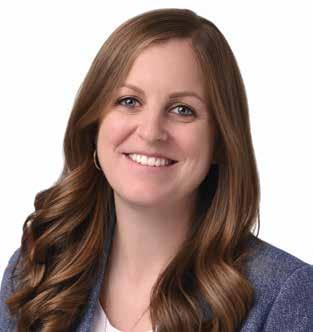
The daughter of a public defender and an educator, Carrie Willemin said the only job she was interested in was one where she could make a meaningful impact.
The path she chose is unique: She’s a social worker with a master’s degree in business administration.
Her goal of earning degrees in psychology, social work and business is to be a bridge between the members served by the Center for Urban Families and the businesses who will eventually employ them. She wanted to better understand the motivations and interests of company executives and use the knowledge to bring opportunities to underserved communities.
“In direct services, there are not enough resources,” Ms. Willemin said. “In business, you can work with people in the decision-making roles to influence the possibilities available.”
CFUF STAFF
SENIOR MANAGER OF WORKFORCE AND EDUCATION
Ms. Willemin joined CFUF two years ago, serving as senior manager of workforce and education. She oversees the organization’s employment pipeline, occupational skills training, and programs tied to workforce development, including Clean Corps, STRIVE® , and Back to Business.
While she works with the CFUF team to continuously adapt the trainings in response to the job market and feedback from business leaders, Ms. Willemin builds trust with employers to identify patterns that lead to high turnover and knock down preconceived notions that limit people disconnected from the labor force.
Before joining CFUF, she worked as a recruiter and a residential case manager, and she started her own businesses. She also spent about a decade working for then-CFUF affiliate Green JobWorks, rising to become the company’s chief operating officer.
Ms. Willemin, a new mom who grew up in Columbia, said one of her new projects is developing a CFUF employer advisory board with representatives from various industries. The board will be designed to guide CFUF in its efforts to ensure the members are provided with every chance they can to earn wages that allow them to sustain their families and create intergenerational wealth.
“If I am not helping people in some sort of way, I don’t feel like I am doing what I was born to do,” Ms. Willemin said. “I am honored to do the work I am doing.”
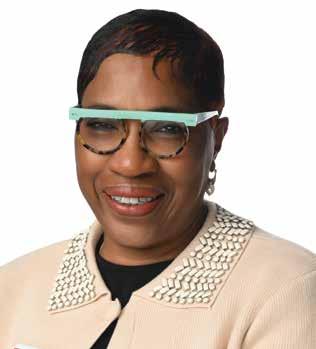
Shevell Rudolph’s a fixer, not for the Olivia Pope variety of problems, but for the ones that threaten the ability of members at the Center for Urban Families to stay focused on their goals.
She steps in to assist if a member is facing housing eviction, the repossession of a personal vehicle, a mental health challenge, or a substance use disorder. She has negotiated lower rent for members, figured out transportation options, lined up treatment programs— and developed many other solutions tailored to a member’s specific circumstances.
“I assess the situation, address it, and remove the barriers,” Ms. Rudolph said. “It could be anything that is impeding the members from moving forward whether it’s a quick fix or a deeply involved problem.”
For more than three years, Ms. Rudolph has served as CFUF’s ALL In support manager. She works closely with the members and the mobility coaches who serve
“I assess the situation, address it, and remove the barriers.”
them, as well as the center’s 2Gen partners. She is a former resource manager for returning citizens and former longtime probation officer with a vast network of contacts and relationships to draw on.
When new members arrive at CFUF, Ms. Rudolph meets with them to talk through any hardships they’re facing. The team handles what they can in-house, enrolling a member in SNAP or helping to restore suspended utilities. For situations that need partners, Ms. Rudolph reaches out to her contacts to find support on expungements, legal services, or a spot in a driving school to resolve traffic violations.
Part of her job is to make sure the problem doesn’t happen again. If a member has fallen behind on rent, for instance, Ms. Rudolph helps them look at their monthly expenses and determines what they can afford to spend on their bills. She investigates options for them, leans on her relationships to expedite requests, and teaches the members how to advocate for themselves.
The conversations are often difficult for the members, who need courage and vulnerability to share the hard things they’re facing.
“When they are meeting with me, it is a safe space; there is no judgement,” she said. “I want them to know, it is OK. We are going to find a solution, and the outcome is going to be favorable."
“All we ask is for members to bring their best, hope for the best and know they are capable of soaring beyond their horizons.”
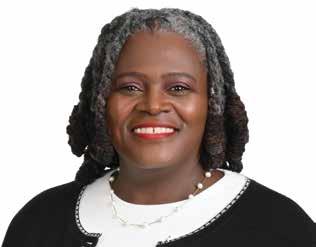
When Kimberly Graham thinks about CFUF’s mission, she sees it as a journey the team accompanies members on through life: from stabilizing to growing to thriving.
As Chief Operating Officer, she oversees programs that empower members to build hope and resiliency, forge strong families and purpose, and achieve careers and intergenerational wealth.
The journey for each member is fluid. The constant is the support they receive from the team—whether they’re stabilizing their lives through STRIVE®, growing their capacity in Back to Business or thriving as homeowners, engaged community members and proud parents.
Ms. Graham understands that the ability of the members to transform their lives is directly linked to the strength of the CFUF team. When she nurtures the team, she nurtures the work.
“To deliver truly compassionate care, we must first and foremost care for our team,” she explained. “Our staff members absorb the heaviness and complexity of the lives they touch. We provide continuous support—not just so they are ‘okay,’ but so they can sustain their deep empathy and passion, preventing the burnout that can lead to desensitization.
“When the staff feel like they are being treated well, it gets passed on to our members.”
Ms. Graham brings to her position more than 20 years in human resources, labor relations and organizational development. She joined CFUF as the Director of People and Culture in November 2024, and her wisdom and experience led to her rapid promotion.
CFUF STAFF
CHIEF OPERATING OFFICER
Most of her career was spent working for government agencies that are closely connected to the lives of members—including social services, housing and public health. Recently, she served as Vice President of Human Resources and Labor Relations for the District of Columbia Housing Authority. She is also a former Senior Vice President of Baltimore Housing, overseeing human resources at both the Housing Authority of Baltimore City and the Department of Housing and Community Development.
“I value community; this is the work I do,” she said. “At the core of who I am is my unwavering belief in the power of shared connection and mutual support.”
A Baltimore native and graduate of Western High School, Ms. Graham earned a bachelor’s degree from Hampton University in media and public relations and a master’s degree from Howard University in organizational communication.
Her deep experience informs how she leads CFUF’s daily operations. She knows that CFUF’s performance, innovation and impact all depend on a healthy workplace culture—one that values mindfulness, rest and recognition for staff at every level. She works closely with the organization’s directors to ensure everyone on the team feels seen, supported and appreciated for their contributions.
She is also dedicated to making the organization financially resilient, guaranteeing it has the resources necessary to sustain its mission for years to come.
“I talk to everybody,” Ms. Graham said. “Doing so keeps me connected to the work and grounded in our mission.”
“At the core of who I am is my unwavering belief in the power of shared connection and mutual support.”
Naysha Conway-Hart said the Center for Urban Families provides collective power for Baltimore to continue to build strength from within.
Growing up in Gilmor Homes, she felt like she had to leave her city to find prosperity. Now, as a CFUF board member, when she tours the North Monroe Street headquarters and watches the staff interact with members, she is struck by a deep understanding that the resources and support provided in those moments create transcendent opportunities.
She can’t help but wonder how things could have been different if CFUF existed when she was a child. Her father, Calvin Conway, was murdered at age 29 when Mrs. Conway-Hart was just 10 years old. She remembers hearing the gun shots ring out.
Her father had spent time in and out of jail, and he was left searching for a way to break free from the cycle. She imagines how word on the street could have reached him: There’s this fella, Joe Jones, who looks just like us, who has a created a program to give returning citizens a chance to change their lives.
That was years, though, before Mr. Jones founded the organization that he continues to lead today.
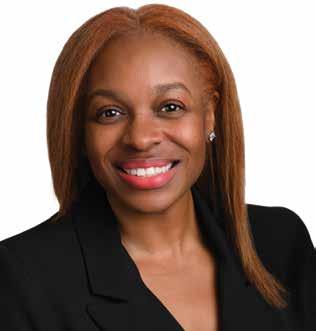
“Just having a conversation with Joe could have changed his whole life trajectory,” Mrs. Conway-Hart said. “This is me doing something in the name of my father.”
Mrs. Conway-Hart joined the CFUF board in 2024. As Constellation’s manager of workforce development, she is dedicated to improving employment opportunities and building an inclusive pipeline by partnering with community organizations and industry leaders.
Whether the CFUF team is coaching a STRIVE® class, working through a complicated child support order, or helping members chart a plan to grow intergenerational wealth, Mrs. Conway-Hart said the care and passion they have shines through.
“That is the secret to CFUF’s success: Everybody is passionate about what they do,” Mrs. Conway-Hart said. “All of the members and staff operate like a family, so the work is like a family intervention."
“There is so much passion and pride that is pouring back into the community where I saw so much devastation and hardship.”
“There is so much passion and pride that is pouring back into the community where I saw so much devastation and hardship. It’s good to see people who come from the community I come from to get a real chance at life.”
CFUF BOARD MEMBER
Brian Andrews, Sr. found himself in an unthinkable situation three years ago: Attending the homegoing service for his beloved younger brother who passed away within a month of being diagnosed with pancreatic cancer.
His brother, Kevin, who everyone called “Bat,” stayed in their hometown of Pittsburgh and opened a barbershop. Mr. Andrews and his sons had been to his brother’s shop many times, but it wasn’t until the service that he learned all Bat had meant to the community. The mayor attended the service and issued a proclamation. The city made plans to name a street after Bat. The young man Bat mentored from age 9 was in his second year at Tuskegee University, about to go to basic training for the Air Force.
“CFUF is a transformative organization that addresses the systemic problems that society chooses to ignore.”
Learning about the impact his brother made in life sent Mr. Andrews on a quest to find a place he could use his passion and expertise to create positive outcomes in Baltimore. His search led him to the Center for Urban Families, where he has served on the board since 2023.
At CFUF, Mr. Andrews saw an opportunity to use his experience as a single father and his executive leadership skills as Director of Safety and Human Performance for Baltimore Gas & Electric Company.
“Seeing CFUF reconnect fathers to their families is very powerful to me,” Mr. Andrews said. “They help kids feel the love of their dad.”
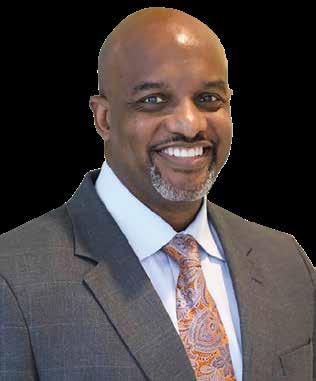
Mr. Andrews can relate to the work. He became a single father when his sons were 9 and 14, and he remembers the surprise at their schools when he showed up to invest in their education. Each year, he would tell the teachers they were entering a contract for the education of his sons, who are now thriving young men in professional careers.
“I was working to change the mindset that these young, African American boys are here not only to learn but to excel,” Mr. Andrews said.
Mr. Andrews witnesses the same investment in outcomes when he watches the rigorous approach of the STRIVE® trainers that leads to the pride they instill in graduates in three short weeks.
In his role on the board, Mr. Andrews said he is working to help quantify the impact, reviewing data to identify behavioral changes and the timeliness and effectiveness of interventions to evaluate the programs.
“CFUF is a transformative organization that addresses the systemic problems that society chooses to ignore,” Mr. Andrews said.
In the programs and the genuine relationships at CFUF, he sees echoes of his little brother all around.
Over two decades, the CASH Campaign of Maryland has worked alongside the Center for Urban Families to help members with free tax preparation, building their credit and gaining the financial education they need to accumulate intergenerational wealth.
They’ve joined forces before the General Assembly, advocating alongside one another for tax credits and many laws over the years that have helped families get ahead.
Together, this is the work of economic justice for underserved communities that is realized in the big and small moments, from conversations with single parents to bill signings with the governor.
“The work is foundational,” said Sara Johnson, the CASH Campaign’s co-founder and chief operating officer. “CFUF understands that someone’s financial health is tied to their ability to provide stability for their family, stay engaged in their community, and live out the hopes and dreams they have for themselves.”
The joint efforts continue year-round at the CFUF headquarters.
find traction for economic advancement. Over the years, the CASH Campaign has also helped members pull their credit reports and find ways to increase their scores.
“The work they’re doing helps members talk to their kids about money and understand that homeownership and things like wills and trusts aren’t just for rich people but tools available to secure their futures,” she said.
At tax season, CFUF serves as one of the CASH Campaign’s sites where people can get help filing their state and federal returns at no cost. If their members owe debt to the IRS, CFUF refers them to the CASH Campaign’s “Back Tax Program,” which helps them create payment plans to confront a situation that is often stressful.
Ms. Johnson said the combined effect is bigger than tax returns and bank accounts: it forms a strategy for stronger families and a thriving city.
“We are able to better serve the community, because we are embedded alongside the CFUF team,” she said. “We are here to work for and with people, and we benefit from the trust people have in CFUF.”
“We are able to better serve the community, because we are embedded alongside the CFUF team.”
The CASH Campaign helps the CFUF team weave financial education into their programs, teaching the trainers, hosting classes, and providing direct support to members, Ms. Johnson said. They show them how to fill out their IRS W-4 to rightsize their withholdings, protect their money using safe financial products and
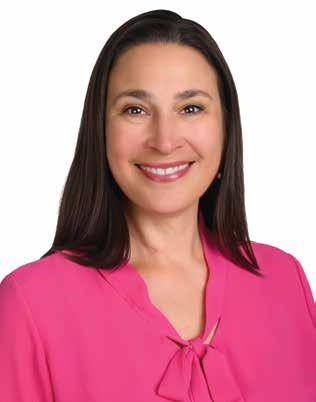

We continue to strengthen and expand our programs, both internally and through strategic partnerships, to ensure that every service we offer aligns with a well-defined set of mobility outcomes: workforce development, family strengthening, adult education, financial management, housing, health, social support, and social change.

An intensive three-week workshop that combines tangible skills, such as resume writing and interviewing, with attitudinal training that prepares individuals to obtain and retain employment.
A three-day job readiness training that focuses on refreshing the soft skills and job search skills of individuals with prior work experience who are seeking employment.

An eight-week program, that utilizes CFUF's Developing All Dads for Manhood and Parenting (DADMAP) curriculum to assist non-custodial fathers, with low incomes, to increase and build their fatherhood knowledge and skills.
The Baltimore 2Gen Ecosystem is a two-generation approach that builds on the existing work of CFUF, promoting the importance of programming that is inclusive of fathers, providing services to both caregivers and children, to strengthen a family's ability to achieve long-term economic stability. Through our partnerships with Union Baptist Head Start, Baltimore Healthy Start, DRU Judy Center, and other local community partners, families have access to a streamlined referral process and collaborative case management services, to support parents’ employment goals and economic stability, while simultaneously supporting and prioritizing children’s health and their educational trajectories.

The Baltimore Communities Assisting and Advancing Neighbors (BCAAN) initiative utilizes partnerships with community-based organizations to implement residentled solutions to help Baltimore’s most vulnerable neighborhoods in the Greater Penn North area of Baltimore City to address the current state of poverty. We consistently engage with 20 community-based organizations that provide services in the areas of workforce development, financial education, health and wellness, family stability, and educational enrichment.
The CFUF Homebuying Assistance program provides CFUF members up to $10,000, each, to assist with the down payment and closing costs. In addition, CFUF provides pre-mortgage readiness support including financial literacy training, credit building, and repair training, and case management support to prepare members to successfully complete a HUDapproved homebuying counseling program and receive a certificate of completion.
PLI is CFUF’s nationally-focused initiative that seeks to promote excellence in the human services industry by providing customized technical assistance and training for new, emerging, and established programs and their leaders, in order for them to better serve low-income fathers and families.
The Center for Urban Families is proud to report another year of strong support from our amazing donors. As we look ahead toward growth and deeper involvement in our communities, we remain committed to fiscal prudence to ensure sustainability and high-quality programming for every individual and family we serve.
LIABILITIES AND NET ASSETS
We extend our heartfelt gratitude to our partners for being ALL In. Your unwavering support is the cornerstone of our efforts, making our work not only possible but truly impactful. Thank you for standing alongside us. Together, we can achieve remarkable things and create lasting change.

























































Foundation





Kenneth M. Jones II Board Chairman
Senior Vice President, Chief Operating Officer, and Chief Equity Officer, John D. and Catherine T. MacArthur Foundation
Joseph T. Jones, Jr. Founder, President, and CEO
Daman C. Blakeney Chair, Governance Committee
Managing Director and Senior Portfolio Manager, Brown Capital Management
John G. McLean, Jr.
Chair, Finance and Audit Committee
Senior Vice President and Chief Financial Officer, Baltimore Symphony Orchestra
Letitia Logan Passarella
Chair, Program Quality Committee Research Director, University of Maryland School of Social Work
Patrick Sissman
Chair, Development Committee Partner, Redwood Holdings
Brian Andrews, Sr. Director of Safety and Human Performance, Baltimore Gas & Electric (BGE)
Naysha Conway-Hart
Senior Workforce Development Specialist, Constellation
Anwar Graves Litigation Partner, O’Melveny
Henry D. Kahn Senior Counsel, Hogan Lovells
Barry Lancaster
Senior Asset Manager, Fannie Mae
John Massie
Executive Vice President and Territory Operations Manager, PNC
Vernā Myers
Founder and Principal, The Vernā Myers Company
Bill Norris
Director, Technical Accounting Consulting, RSM US LLP
Shari Orr
National Program Manager, Enterprise Risk Management and Internal Controls, National Park Service
Ben Seigel Deputy Comptroller for Policy, Public Works, and Investment, Comptroller of Maryland
David L. Warnock Partner, Camden Partners
Dr. James R. Calvin, Ph.D. Professor of Practice, Carey Business School, The Johns Hopkins
Guy E. Flynn Partner, DLA Piper
Jamie McDonald Managing Partner, Jamie McDonald Advisory
Terry Owens
Senior Communications Director, Pulsar
Brandon Scott Mayor, Baltimore City
Scott Sherman Retired, Vice President of Strategic Initiatives, T. Rowe Price Associates, Inc.
Alicia Wilson
Vice President for Civic Engagement and Opportunity, The Johns Hopkins University
Robin Williams Wood Community Leader
Joseph T. Jones, Jr. Founder, President, and CEO
Kimberly Graham Chief Operating Officer
Nicole Jordan Manager of Special Projects and Executive Support
Marilyn Aklin, D.P.A. Director of Development
Zachary Alberts Director of Advocacy and Strategic Initiatives
Wendy Blackwell Fortune Director of Practitioners Leadership Institute (PLI)
Brittny Herring-DeVore, Ph.D. Director of Family Strengthening and Community Engagement
Bryant Jeffers Director of Finance and Administration
Trey Leak Director of People and Culture
Catherine Pitchford Director of Programs
Amanda Smith, Ph.D., MPH Director of Research and Evaluation
Shakira Barnes Program Administrator
Anthony Brown ALL In Mobility Coach
Kellie Carrington Employment Specialist
Deneen Colson SNAP Coordinator
Deshawn Cooper Intake and Outreach Specialist
Heather Davis ALL In Mobility Coach Lead
Lavatte David STRIVE® Trainer
Bessie Griffith ALL In Case Manager (Clean Corps)
Paula Gross ALL In Mobility Coach
Shiloh Jordan Outreach Coordinator (2GEN/BCAAN)
Fatima Lewis ALL In Mobility Coach
Michael Lewis ALL In Mobility Coach
Sean Robinson STRIVE® Trainer
Shevell Rudolph ALL In Support Manager
Monique Speight Intake and Retention Specialist
Timothy Tillman ALL In Mobility Coach and Fatherhood Facilitator
Eddie White ALL In Case Manager and Fatherhood Facilitator
Caroline Willemin Senior Manager of Workforce and Education
Tyler Yutzy Intake and Retention Manager
Amanda Ellis Development Specialist
Cecilia Helmstetter Senior Major Gifts Officer
Rachel Kassman Grants Manager
Kalie Pearson Grants Compliance Manager
Reisa Tomlinson Major Gifts Officer
Michael Tucker Contracts Specialist
Ayana Burrus Accounting Assistant
Richard Konwea Staff Accountant
Bobbi Lewis-Collick Senior Grants Accountant
Arielle Forrest Senior Operations Manager
Wanda Liggins Senior Operations Specialist
Sidney Smith Facilities Assistant
Helena Wise First Impressions Specialist
Lloyd Wright Facilities Manager
Shawn Burnett PLI Academy Program Specialist
Vernon Wallace PLI Father Engagement Coordinator

At the heart of our mission lies a powerful truth: the root of dismantling poverty is seeding legacies for the future. What we do today matters tomorrow. Join us in cultivating lasting change and building a foundation for generations to come.
Stop by our state-of-the-art facility to see our programs, members, and teammates in action.
We’re always looking for inspiring mentors to work directly with our members and make a lasting impact on their lives.
Your support and invested resources help increase the impact of our work for our shared community.
We’ll work with you to figure out the best opportunity for your group.
FOLLOW US. @centerforurbanfamilies
For more ways to get involved, email maklin@cfuf.org or call 410.246.1415