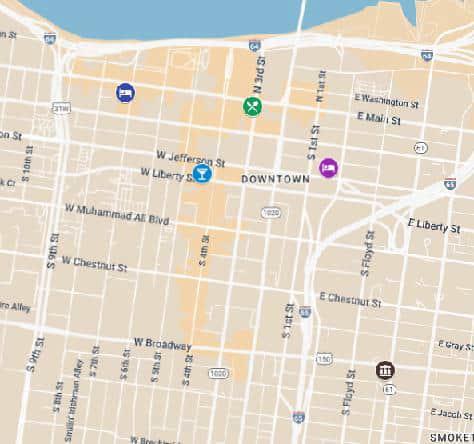
The hotel is about 12 miles from the Louisville International Airport. The airport has a designated areas for hired cars to pick up passengers.
Cost: Approximately $25
Meeting Locations
The meeting will be held at the Metro United Way, which is approximately a 5 – 10 minute Uber ride from either hotel. (The City of Louisville will be providing Uber codes that members can use to travel from the hotel to the meeting space.)
Tuesday, October 21st, 2025
Coalition Meeting
9:00 AM – 5:00 PM Metro United Way
334 East Broadway
Welcome Reception Hosted by Bank on Louisville
5:00 PM – 7:00 PM Chase Bank
416 West Jefferson St
Wednesday, October 22nd, 2025
Coalition Meeting
8:30 AM – 1:00 PM Metro United Way
Louisville Site Visits
334 East Broadway
1:00 PM - 4:00 PM Various locations
Group Dinner
300 W. Main Street Co-Chairs
5:30 PM – 8:00 PM: BBC Bourbon Barrel Loft
Co-Chairs
San Francisco
New York City
Member Cities
Albuquerque
Boston Dallas Denver
Detroit
Hawai’i County
Jackson Lansing
Los Angeles
Louisville
Philadelphia
Rochester
Sacramento
Saint Paul
San Antonio
Shreveport
Tulsa
Thursday, October 23rd, 2025
Coalition Meeting
8:30 AM – 12:00 PM Metro United Way
334 East Broadway
Co-Chairs
San Francisco
New York City
Member Cities
San Antonio
Shreveport
Tulsa
Tulsa
CFE Coalition Forum Agenda Louisville, KY
October 21st – 23rd, 2025
Tuesday, October 21st, 2025 Metro United Way
334 E. Broadway, Louisville, KY 40202
9:00 – 9:30 a.m. Breakfast
9:30 – 9:45 a.m. Welcome and Agenda
Facilitated by: José Cisneros, City of San Francisco and Nichole Davis, City of New York
9:45 – 10:15 a.m. Louisville City Update & Delta Homes Program Spotlight Facilitated by: Erin Waddell and Ce Garrison, Louisville Metro Government
10:15 - 10:45 a.m. City Updates San Francisco, Dallas
10:45 - 11:00 a.m. Break
11:00 a.m. – 12:00 p.m. Local Elected Officials Championing Financial Empowerment Work Facilitated by: Vicky Selkowe, CFE Fund
Deputy Mayor Nicole George, Louisville Metro Government
12:00 – 1:15 p.m. Working Lunch: CFE Coalition Member City Updates Saint Paul, Denver, Sacramento
1:15 – 1:45 p.m. Rochester City Update & Positive Rent Reporting Spotlight Facilitated by: Angela Rollins, City of Rochester
1:45 – 3:00 p.m. Emergency Financial Empowerment
Facilitated by: Sol Vilera Ramos, CFE Fund
Kasey Wiedrich and Rick Schute, City of Saint Paul
Cruz Correa and Cassandra Wallace, City of Dallas
Angela Rollins, City of Rochester
3:00 – 3:15 p.m. Break
3:15 – 4:00 p.m. Building Legacy Planning into the FEC Model Facilitated by: Courtney Bettle, CFE Fund
4:00 p.m. Adjourn
5:00 – 7:00 p.m. Welcome Reception Hosted by Bank On Louisville Chase Bank 416 W Jefferson St, Louisville, KY 40202
Wednesday, October 22nd, 2025
Metro United Way
334 E. Broadway, Louisville, KY 40202
8:30 – 9:00 a.m. Breakfast
9:00 –
9:30 a.m. CFE Fund Update
Facilitated by: Amelia Erwitt, CFE Fund
9:30 – 10:15 a.m. Los Angeles City Update & FE Support for Immigrant Workers Spotlight
Facilitated by: Veronica McDonnell and Aaron Strauss, City of Los Angeles
10:15 – 10:30 a.m. Break
10:30 - 11:45 a.m. Systems Change & Outcome Identification for OFEs
Facilitated by: Katie Plat, CFE Fund Brandon Coffee-Borden, National Opinion Research Center (NORC), University of Chicago
11:45 a.m. – 1:00 p.m. Working Lunch: CFE Coalition Member City Updates Detroit, Boston, Tulsa
1:00 – 4:00 p.m Louisville Site Visit Options
Louisville Urban League: The Louisville Urban League (LUL) is a non-profit, nonpartisan organization founded in 1921 that works to achieve social and economic equity for marginalized communities in Louisville. As an affiliate of the National Urban League, LUL provides direct services and advocates for change in key areas including jobs, justice, education, health, housing, and black business development. LUL has operated an FEC team since 2022.
Goodwill West Louisville Opportunity Campus: Opened in 2024, WLOC is a collaborative of more than 10 community partners. The opportunity center offers residents regular access to a child-care service, computer labs, dental services, second-chance banking, a business center, restorative justice services, workforce training, behavioral health therapy, meeting rooms, a prayer and meditation room and a café.
Neighborhood Place: Neighborhood Place is a collaborative partnership of public sector agencies that have come together to create a network of community based, “one-stop” service centers. The purpose is to provide blended and accessible health, education, employment, and human services that support children and families in their progress toward self-sufficiency. OFE and FEC is intentionally integrated into services like rental and utility assistance, SNAP, and JCPS parenting supports. This model of social service delivery serves as a nation-wide model with several states looking to Louisville for best practices.
5:00 p.m. Travel to Group Dinner
5:30 – 8:00 p.m. Group Dinner
BBC Bourbon Barrel Loft
300 W. Main Street, Louisville, KY 40202
Thursday, October 23rd, 2025 Metro United Way
334 E. Broadway, Louisville, KY 40202
8:30 – 9:00 a.m. Breakfast
9:00 – 9:30 a.m.
9:30 – 10:30 a.m.
Philadelphia City Update & Consumer Debt Navigator Spotlight
Carolina Rodriguez, Education Debt Consumer Assistance Program (EDCAP)
10:30 – 10:45 a.m. Break
10:45 – 11:15 a.m. New York City Update & Tax Season Spotlight
Facilitated by: Nichole Davis, City of New York and Grace Louis, City of New York
11:15 a.m. – 12:00 p.m. CFE Coalition Member City Updates Albuquerque, Lansing, Jackson
12:00 p.m. Adjourn
Facilitated by: José Cisneros, City of San Francisco and Nichole Davis, City of New York
12:00 p.m. Boxed Lunch (Grab & Go)
City Updates
Coalition
LOUISVILLE- JEFFERSON COUNTY
METRO GOVERNMENT
Office of Financial Empowerment
We have a new name and mission statement!
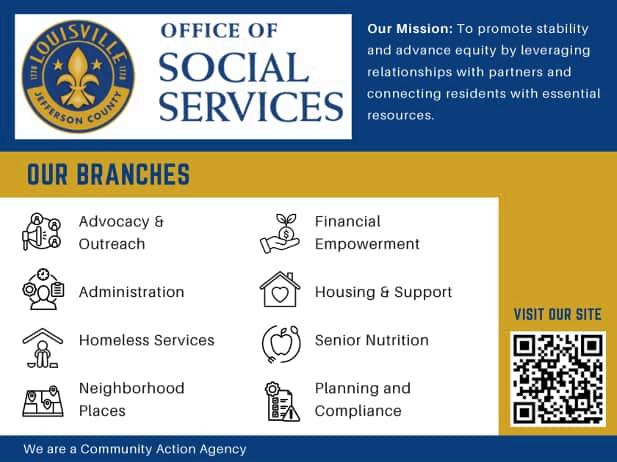
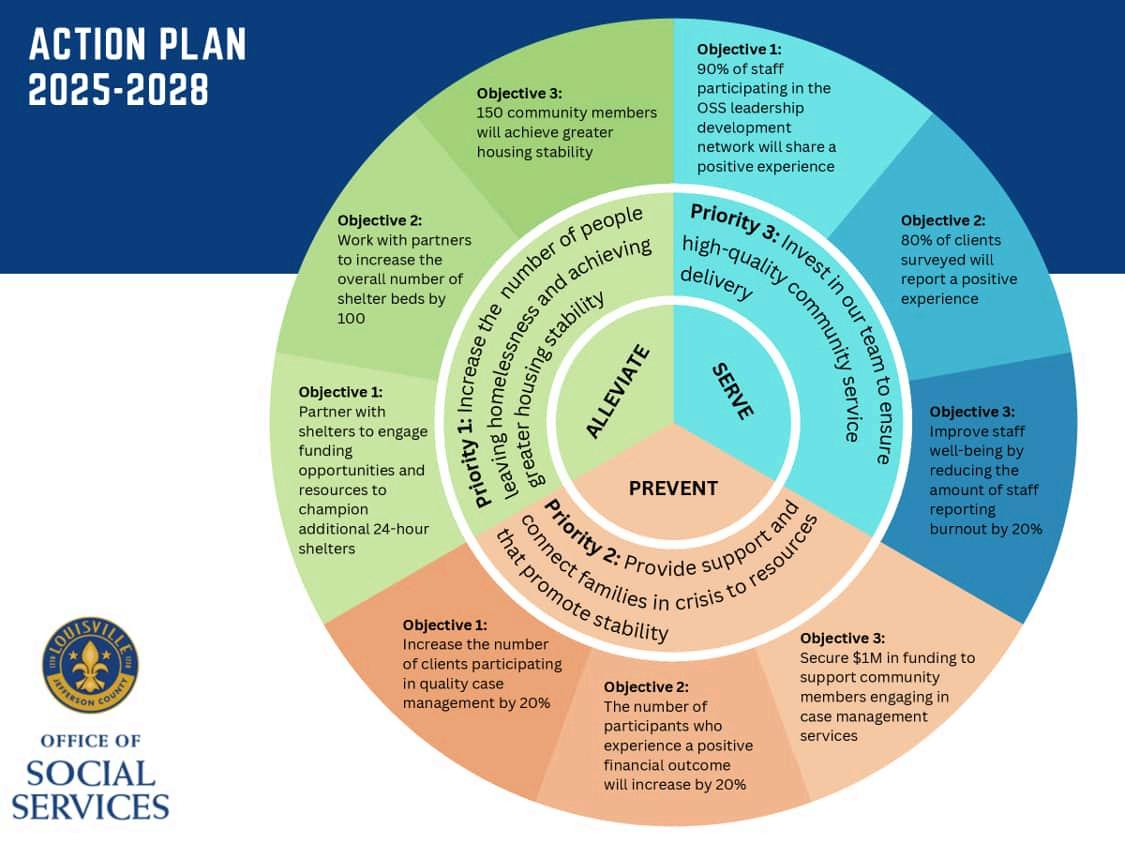
The Office of Resilience & Community Services has officially rebranded as the Office of Social Services. The name change reflects the work of our newly publicized action plan. Community feedback surveys indicated that the old name was confusing and residents didn’t always know what our department does. We are converting branding and hope to have completed by December 2025!
OFE's Mission
To strengthen the impact of OSS through enhanced economic opportunities that build financial resilience, promote economic justice, and provide access to high quality resources regardless of identity or community
OFE's Commitment to Equity
Recognizing the harmful effects of practices such as redlining and lending discrimination on generational wealth building and the systemic injustice faced by black, brown, and indigenous Louisvillians in the financial space, OFE commits to persistent learning, inspiring action, continuous dialogue, challenging systems of power, and transparency.
OFE Structure
Louisville's OFE is a branch of Louisville Metro Government's Office of Social Services, the city's social service department RCS is a public Community Action Agency OFE integrates into department social services such as rental assistance, LIHEAP, and CSBG funded poverty alleviation programs. OFE and OSS also provide financial and administrative support to the Louisville Asset Building Coalition, the local nonprofit that operates VITA. OFE funding consists of general fund dollars, CSBG funds, national nonprofit funding, foundation funding, support from financial institutions and consists of 6 full-time staff and four FEC staff employed through the Louisville Urban League
OFE is a cornerstone of the new action plan in Priority 2. All OFE programs including FEC are indicated as a key prevention strategy. As we continue to embed OFE services into all OSS branches and external partnerships, we have been able to secure sustainable funding and support by weaving our work into all aspects of Louisville’s social services ecosystem.
Strategy Highlight
OSS administers all housing and social services funding to community nonprofits through the External Agency Fund. Beginning in the FY25 year, all 71 agencies who receive funding are contractually required to meet with OFE for a technical assistance session and presented a menu of services that translates into a partnership proposal which is now required to be updated each new funding year. FY26 meetings will begin in November 2025.
LOUISVILLE- JEFFERSON COUNTY METRO GOVERNMENT
Office of Financial Empowerment Branch Highlights
OFE Strategy Areas
Integration into other branches of OSS
HEART Homeless Outreach- ~20% of FEC clients are homeless and receiving services to help boost their income and gain/maintain housing Housing & Support- joint recipient of a Bezos Day 1 Family Fund grant for over $750k to assist unhoused families with a stepping stone rent support with case management and financial counseling Scan the QR code for more information.
Senior Nutrition- Congregate meal sites receive “avoiding consumer scams” placemats with information and resources; homebound meal delivery clients with Meals on Wheels will receive OFE postcards with meal deliveries beginning when we have fully launched and announced legacy planning
Outreach & Advocacy- OSS is taking a major role in supporting residents through benefits changes under the OBBBA, and OFE is leading a workgroup to create a coordinated response Planning & Compliance- integration into external agency funded recipients through contracting process
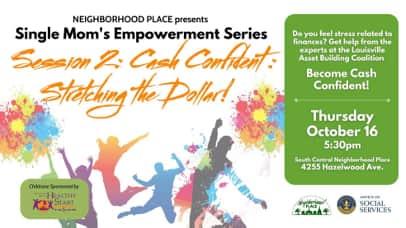
Neighborhood Place- all clients receiving rental assistance and LiHEAP services can identify “income & asset building” supports which is an immediate referral to FEC counseling as a part of their case plan We are partners in the Single Moms’ Empowerment Series and the Men’s MENtal Health Symposium workshops and case management and have served 75 families so far through these partnerships
Integration into other LMG departments
Public Health & Wellness, Human Resources, Metro Animal Services, Parks & Recreation, Office for Women, Office for Immigrant Affairs, Louisville Free Public Library, Human Relations Commission, Office of Equity, Louisville Economic Development Alliance, Office of Housing & Community Development, LMPD, Metro Corrections, Louisville Fire, Office of Violence Prevention
Strengthening and growing our network of community partnerships with agencies from for and nonprofit sectors to build outreach capacity and sustainability.
OSS is a public Community Action Agency, and OFE is supporting and consulting for National Community Action Partnership’s Collaborative on Economic Mobility and was highlighted in September for this work Scan QR code to go to presentation.
Focusing on an “efforts to outcomes” approach to build capacity and streamline efforts.
LOUISVILLE- JEFFERSON COUNTY METRO GOVERNMENT
Office of Financial Empowerment
Program Highlights
Financial Empowerment Center (launched 2022)
Enhanced Program Assets
Small Business Boost
Financial Health Equity
Protect Borrowers
FEC Leadership Fellows
Fines & Fees/ Eviction Diversion
Delta Home Down Payment Assistance Outcomes
2415 clients served
$3.1 million in non mortgage debt reduced
1293 clients with outcomes
157 community partnerships
Strategy Highlight
Over the summer, LFEC partnered with Center for Accessible Living and Gathering Stength to offer classes and one on one appointments with a focus on the intersection of finances and disability We served over 50 participants with Center for Accessible Living series and nearly 200 participants including individuals with disabilities and service providers across several states with tools and resources locally and connecting providers to other FECs who serve their local population.
Strategy Highlight
Bank On Louisville (launched 2010)
Enhanced Program Assets
Digital Equity partnership
Banking integration with housing authority
Final report for Kroger partnership released
Workforce integration with Chefs for Success Outcomes
175,000 accounts opened
12 financial institution partne
15 years of continuous operat
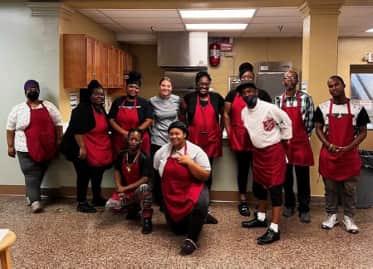
Bank On Louisville has partnered with Salvation Army for their Chefs for Success program where participants looking to start a career in the culinary field receive hands on training with a chef instructor who teaches ServSafe certification, cooking and plating techniques, and flavor pairing over 6 weeks. BOL teaches a class each week for the first four weeks covering banking and budgeting, consumer rights, asset building, credit and debt, and small business in partnership with LFEC and Small Business Boost
CFE Coalition Meeting City Update, October 2025
OFE convenes, innovates, and advocates to strengthen the economic security and mobility of all San Franciscans
WHAT’S NEW
Youth Accounts
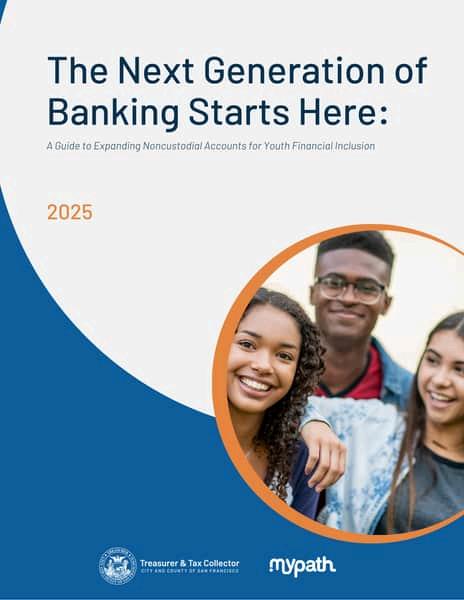
We’ve published a new report on noncustodial youth accounts in collaboration with MyPath. In this report, we dispel common myths and identify several noncustodial youth accounts offered in the SF Bay Area.
In partnership with the SF Juvenile Probation Department, we've expanded banking access for young people in the city's Juvenile Detention Center, allowing them to open free bank accounts and receive financial counseling to manage their money confidently.
“Finances is a lot like riding a bike You can talk about it all day, you could even have a PhD in riding a bike, but you have to ride it in order to learn You also need to actually have a bike to ride in the same way that youth need a bank account to learn how to manage their finances. Youth might make mistakes at first, but those are important to help us learn.”
- Norel, MyPath Youth POWER Leader
Socially Responsible Banking
In a new report, we summarize the findings from our listening session findings and make recommendations for banks to boost financial inclusion
StopScamsSF - An Initiative to Combat Scams
San Francisco's Treasurer's Office is launching the StopScamsSF initiative to protect vulnerable residents and restore confidence in public institutions. This comprehensive program uses five integrated strategies to fight scams:
A citywide, multilingual communications campaign
Develop a monitoring and alert system
"Scam-proof" official messages from the City and creating a 311 Payment Verification Directory
Create a Scam Prevention Partners Table
Create a free StopScams Playbook with alert templates and training
Emergency Preparedness Planning
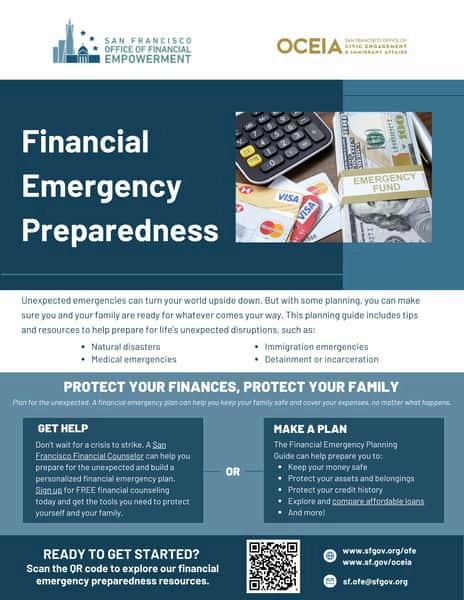
We’ve published a new toolkit to support San Franciscans prepare for financial emergencies, such as, safeguarding bank accounts, assets, and what to do if a loved one is detained or deported.
Advancing CalAccount Implementation
In collaboration with the CalAccount Community Coalition, we are engaging on implementation planning for CalAccount. This program will offer no-fee, no-penalty, federally-insured transaction accounts with debit cards, direct deposit, automatic bill pay, and recurring payment options. It also includes credit-building tools to help users establish or improve their credit history. The program will prioritize outreach to communities disproportionately impacted by financial exclusion, including Black, Latino, and immigrant households, as well as individuals experiencing homelessness or housing instability We are developing a template for regional roll-out strategy
CFE Coalition Meeting City Update, October 2025
OFE convenes, innovates, and advocates to strengthen the economic security and mobility of all San Franciscans
HIGHLIGHTS
Kindergarten to College
Successfully encouraged SF students to claim their K2C and CalKIDS college savings. The multi-lingual effort utilized diverse communication channels, including in-person outreach at graduations The campaign also leveraged an Instagram Reel featuring the Mayor and Treasurer to boost participation
To date, K2C has disbursed more than $2.8M to over 4,600 San Francisco graduates (Classes of 2023, 2024 & 2025) to use continuing their education after high school.
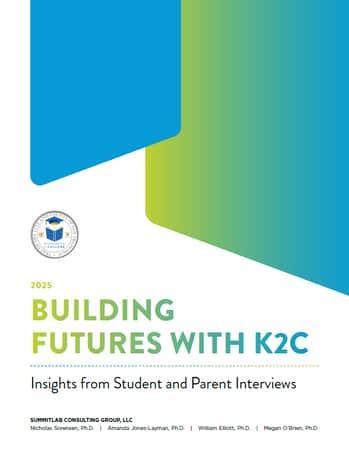
K2C program evaluation continues with qualitative findings released. We highlight students’ and parents' experiences with K2C in a new published report.
FEC
During this past year, San Francisco has served over 1,000 clients in 2,892 sessions since becoming an FEC in Sept 2024 That's a 67% increase in new clients
San Francisco's adoption of FECBOT has enabled counselors to collect more accurate data on the client impact they've had. For example, they've supported clients to achieve 1,195 official outcomes in the past year, which is about twice the number of outcomes they've been able to capture in previous years. This includes supporting clients to:
Increase savings by $946,374
Reduce more than $1M in non-mortgage debt
Working with County Assessor’s Office on rolling out the legacy planning module. They collaborate with a legal services provider to provide free estate plans for low-income homeowners.
Collaborating with Mayor’s Office on economic justice integration into RV Buyback Pilot, including financial counseling, banking access, and debt relief
Financial Justice
San Francisco contributed to a newly released strategy guide by Results for America on fine and fee reform
The Financial Justice Project has partnered with Results for America and the Fines and Fees Justice Center on Cities and Counties for Fine and Fee Justice (CCFFJ), a national leadership network of local places committed to meaningful fine and fee reform. In the last fiscal year, there were 203,594 San Francisco Museums for All admissions, or 8% of all SF museum admissions
In the last fiscal year, we issued about $640,700 in direct payments to over 2,000 jurors, through our Be The Jury program.
SF Lends
Since its launch in December 2023, SF Lends has helped 10 small businesses access over $2 million dollars in working capital ($1.56 million in loans and $500,000 in lines of credit) from four banks.
SF Lends banks are also actively referring small business owners to CDFIs and technical assistance providers for support
CFE Coalition Meeting City Update, October 2025
OFE convenes, innovates, and advocates to strengthen the economic security and mobility of all San Franciscans
NEW REPORTS
K2C Qualitative Results
This new qualitative evaluation of San Francisco’s K2C program reveals that early college savings accounts have a meaningful impact on students and families
Youth Banking Financial Emergency Guide
In a partnership with the SF Office of Community Engagement and Immigrant Affairs, we released a guide to promote economic security and financial resilience during times of uncertainty
This new brief advocates for expanding access to noncustodial youth bank accounts, which allow individuals under 18 to open and manage accounts independently
Socially Responsible Banking
In this new 2025 report, we outline San Francisco’s efforts to promote equitable access to financial services through its Socially Responsible Banking initiative
CFE COALITION UPDATE
OCTOBER
2025
Coming Soon: Drivers of Opportunity
The Office of Community Care and Empowerment is now the Office of Housing and Community Empowerment! As a part of the City of Dallas's focus on reimagining service, several departments were consolidated to create this new office, which will oversee the City's housing, homelessness and social services program. The new Office has been charged with advancing a new "Drivers of Opportunity" framework to advance financial empowerment and upward economic mobility for all Dallasites.
The FEC program was temporarily paused for strategic realignment during much of 2025. HCE is finalizing a new contract with a nonprofit to serve as a Financial Empowerment Center for FY26, whichwillrelaunchourprogram.Simultaneously,HCEis piloting internal service delivery in alignment with our re-entry services strategy, with staff completing training asofnow.
Volunteer Income Tax Assistance (VITA)
- 1,749 Dallas residents served
- 6,004 counseling sessions completed
- $514,102 total increased savings
- $1,168,715 total decreased non-mortgage debt
The City has continued its partnership with Foundation Communities for the Community Tax Centers. For the 2025 tax year, x returns were filed, with x EITC filers and $ in total refunds claimed
Other Programs
HCE has added two new partners, Housing Connector and Volunteers of America, in our reentry programming. This helps us to realize an updated to our programmatic model which is to align housing support, job training and placement, financial coaching and wraparound case management for clients.
City of Saint Paul Office of Financial Empowerment October 2025 Update
The Office of Financial Empowerment (OFE) advances economic democracy by ensuring that all Saint Paul residents have access to tools, resources, and opportunities that help them thrive financially. Our department leads innovative, community-rooted efforts to share in the city’s economic prosperity, supporting families in building wealth, accessing opportunity, and living with dignity and stability.
OFE’s work is guided by a Results Framework that seeks to achieve the following outcomes:
• Result 1: Saint Paul residents achieve financial health.
• Result 2: Saint Paul neighborhoods achieve community wealth.
• Result 3: Saint Paul residents live in stable, accessible, fair, and equitable housing.
• Result 4: Families with children in Saint Paul have a city that cares about their future.
• Result 5: Saint Paul residents are engaged in public decision-making.
Together, these results reflect OFE’s commitment to both individual opportunity and systemic change, ensuring our work meets people where they are, while building toward an inclusive and resilient local economy.
Recent Department Successes
CollegeBound Saint Paul
CollegeBound Saint Paul is the city’s children’s savings account program. The first “at-birth” citywide college savings account program of its kind, CollegeBound Saint Paul helps families build a strong foundation to invest in their children’s education and future.
The oldest CollegeBound Saint Paul participants will be starting Kindergarten this fall, 2025!
COLLEGEBOUND BY THE NUMBERS
• Launched on January 1, 2020
• 18,000+ babies enrolled in CollegeBound Saint Paul
• $3,600,000+ saved in seed deposits and other savings
• 20+ Community Outreach, Referral and Engagement Partners
• 24 Community Ambassadors
Other successes:
- Hosted fourth year of Money Action Day in partnership with Saint Paul nonprofit, Prepare + Prosper, where we connected over 300 people to financial health resources in the community and a day of fun for families.
City of Saint Paul Office of Financial Empowerment October 2025 Update
- Family Deposit Days: CollegeBound has been offering three Family Deposit Days a year for families to come to Bremer to make deposits for the first time in their children’s accounts. We have had 2 events in 2025 so far with over 200 families who made deposits totaling over $11,000
- Tax Promotion: CollegeBound Saint Paul promoted tax time savings through outreach efforts and mailers by offering an extra incentive to families who saved part of their tax refund into their child’s CollegeBound account; families made 517 deposits during the tax time in 242 unique accounts. Have started to think with our VITA partner about how we might use our tax-time promotion to inform families about IRS phasing out paper checks and connecting to bank accounts and to Bank On Minnesota.
CollegeBound Saint Paul Elementary
CollegeBound Saint Paul Elementary is entering its second year of partnership with Saint Paul Public Schools. As CollegeBound Saint Paul’s oldest participants enter Kindergarten, CollegeBound Elementary will continue to serve all enrolled Pre-K students, as well as all enrolled Kindergarten students in SPPS, adding 5 schools and more than doubling the number of students impacted. We are excited to continue our partnership with Saint Paul Public Schools to boost child savings, increase whole family wealth, and increase College and Career readiness opportunities for children and families. CollegeBound Elementary will be exploring potential partnerships with non-SPPS schools in an attempt to make sure all of Saint Paul’s children have access to the program.
Successes
• Held an in-school Deposit Day event in every Saint Paul Public Schools Pre-K classroom, serving over 1500 students and contributing $19,460 to CollegeBound accounts
• Brought on 8 Parent Champion volunteers to serve as CollegeBound Elementary liaisons at their child’s school
• Hosted its first Family Deposit Day specifically for Saint Paul Public School families
Priorities
City
• For the remainder of 2025 the CollegeBound Elementary Team will be focusing on:
o Generating awareness and excitement among school staff and parents
o Scaling up In-School Deposit Days to include Pre-K and Kindergarten
o Enrolling all Saint Paul Public Schools’ Pre-K and Kindergarten students in CollegeBound
o Kicking off and supporting Deposit Days in 5 more SPPS elementary schools
o Recruiting Parent Champions as each SPPS elementary school
• In 2026 the CollegeBound Elementary team will be:
o Piloting a 1st grade field trip to a bank
o Integrating CollegeBound Elementary curriculum into student Personalized Learning Plans
o Exploring partnerships with non-SPPS schools to expand the impact of CollegeBound Elementary
Guaranteed Income: CollegeBound Boost & Advocacy
• The City completed the monthly income payments to the 333 families that were selected to receive guaranteed income through CollegeBound Boost. As of August 15, 2025, families received $4,079,250 in unrestricted, regular income ($4 M in ARP funding, and the remaining was funded through private donations and a grant from MN DHS). We also deposited $789,000 into the CollegeBound accounts of the 789 children participating in Boost (who received quarterly progressive deposits totally $1,000 each).
• Research with the University of Michigan is ongoing, and the team have been collecting 24-month surveys from families. We have been providing offboarding services for participants: informing participants of their options to remove any remaining funds from their ReliaCard, referrals to partner organizations for financial counseling or coaching, and optional benefits counseling to review if there are additional resources for which families qualify that can help them with the transition of no longer receiving the monthly income.
• We are also working with partners to promote guaranteed income in Minnesota and at the national level:
o Mayor Carter leads national advocacy efforts as a co-chair of the Mayors for a Guaranteed Income network. The Office of Financial Empowerment is a member and on the steering committee of the Minnesota Financial Opportunity Coalition, which has advocated for state-funding for guaranteed income and cash assistance in the Minnesota legislature. We are also working with other basic income programs in the state to tell the story of cash transfer programs in Minnesota and lift up the stories from participants in the programs.
o The Coalition held a webinar on September 18 during US Basic Income Week to highlight impact of guaranteed income and the success stories from pilot programs across Minnesota. Also featured State Representative Athena Hollins and Mayor Carter.
o The City is also working with the Saint Paul & Minnesota Foundation to secure additional funding for additional guaranteed income programs locally. This year, we helped the Interfaith Fund secure funding from the Kresge Foundation to expand guaranteed income to a new cohort of 25 American Indian participants in their Economic Mobility Hub, an initiative to support economic stability and opportunity for American Indian families in the East Metro.
Medical Debt Reset Initiative
The City of Saint Paul is partnering with Undue Medical Debt to acquire and cancel medical debt from local health systems. Undue Medical Debt, a national, independent nonprofit organization, acquires medical debt portfolios from health systems. The City is allocating $1.1 million in American Rescue Plan funds to erase an estimated $100 million in medical debt for eligible Saint Paul residents with incomes below 400% FPL. Residents can not apply for debt cancelation, they will be notified by Undue Medical Debt through the mail if their debt has been canceled as a part of the initiative. To date, we have purchased medical debt from Fairview Health Services, and is working with Undue Medical Debt to expand the initiative to the other health systems and hospitals in Saint Paul so that we can bring debt relief to more Saint Paul residents.
Undue Medical Debt collected testimonies from some of the residents who had their debt relieved:
• The debt that was paid off by Undue Medical Debt was from 2015, when I was only 19 years old. I was battling drug addiction at that time and was in and out of the hospital for various reasons due to my addiction. I am now sober and work at a treatment facility helping people that are still struggling. I am so thankful for the relief that Undue Medical Debt has given me. – Jenna
• I am a single mother of five children, and this program has definitely relieved some stress and anxiety from my life. This program covered a medical debt of mine (about 10 years old) that I was not able to afford to pay off. I am above and beyond appreciative for this debt relief. – Anissa B.
Emergency Financial Empowerment Opportunity
Saint Paul is one of the cities participating in the CFE Emergency Financial Empowerment Initiative to embed financial stability strategies into the City’s existing emergency and disaster preparedness and response work to better support residents in prioritizing
City of Saint Paul Office of Financial Empowerment
financial concerns and mitigating financial disruptions during disasters. OFE is partnering with our Emergency Management Department to implement the project. We are working in partnership with the City’s Office of Technology & Communications to build a Financial Health Resource Hub that will include financial empowerment programs available to Saint Paul residents, but also emergency preparedness resources. We hope that the Resource Hub can also serve as a central communication hub for the City during an emergency.
LOCAL Fund: Worker & Community Ownership programs
As part of a Citywide strategy to build institutional commitment to community wealth building, the City created the LOCAL Fund which comprises of two programs: Worker Ownership and Community Ownership. The LOCAL Fund uses shared ownership models as approaches to build community wealth, anchor jobs locally, and grow the local economy and tax base. The Worker Ownership program offers grants and technical assistance for worker co-op startups, conversions of existing businesses, and existing co-ops. The Community Ownership program supports community-owned entities with grants and technical assistance for predevelopment, acquisition, demolition, and rehabilitation of commercial properties.
Successes
• The Worker Ownership program has given out four grants totaling $420,000 to four worker owned cooperatives in Saint Paul.
• Both the Worker Ownership and Community Ownership programs continue to provide technical assistance to interested small businesses and community groups that want to explore whether shared ownership models are the right fit.
Priorities for remainder of the year and 2026
• Continue to raise awareness and promote the LOCAL Fund and shared ownership models as forms of economic development.
• Award up to 3 more grants to small businesses that want to start up and/or transition into a worker owned cooperative.
• Award up to 6 grants to community owned groups that are interested in developing commercial real estate investment cooperatives.
FAIR HOUSING
Tenant Protections was passed in May 2025 by Saint Paul’s City Council. OFE and the Department of Safety and Inspections team are planning towards the implementation in May 2026.
October 2025 CFE Coalition City Update
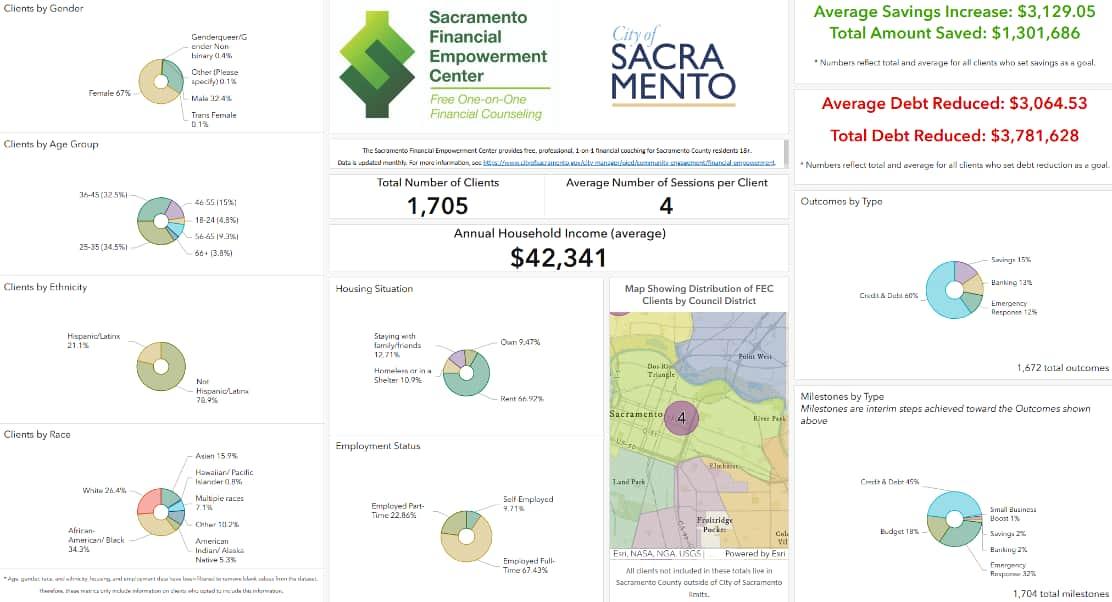
In line with our City’s policies around contract relationships, in early spring we put our Financial Empowerment Center lead partner role out for bid. The RFP process resulted in a decision to diversify our FEC partnerships. We have kept on our original and previously only partner, the Sacramento office of International Rescue Committee, and have added Health Education Council, a 35-year-old local organization with very stable leadership (the founding Executive Director is still at the helm) that focuses on the various social determinants of health, including financial wellbeing. We are working with HEC to get their coaching service up and running hopefully by the end of this year, and are excited about the potential of this new partnership while maintaining our original one as well.
IRC’s student loan counselor, who has become an integrated part of the FEC team thanks to Student Loan Empowerment Network funding from the California Department of Financial Protection and Innovation, continues to significantly boost the FEC’s debt reduction numbers, which are now approaching $4 million. Given the ongoing ever-changing landscape of student loans, we hope the state will be able to continue the SLEN program after current funding is set to end in January. Below are our FEC stats as of September 30, 2025.
In April our report included information about a potential new local Sacramento chapter of the Asset Funders Network, but that road came to a dead end when an insufficient number of funders were able to commit to the AFN membership fees. The FE Manager and a few colleagues at the City are working on an alternative no-cost entity around asset building work that we are calling Sac LIFT (Local Impact Funders Table), which would consist of quarterly funder gatherings of financial institutions and other philanthropic entities, at which members would share information and strategies and potentially build collaborative efforts. We plan to integrate conversations about implementing our CityStart and Financial Empowerment Cities strategic plans into this soon-to-emerge dialogue.
Our City’s Economic Development Department, in which the FE work is housed, is also embarking on a strategic plan for the first time in quite a while, and this dovetails well with both the recent appointment of a new City Manager who will start in January and a recent City Council priority-setting workshop in which Economic Development scored highest in the voting process. The new City Manager, Maraskeshia Smith, will be the first Black woman to ever hold the job in the City, coming to Sacramento from the same post in Santa Rosa and bringing experience from a long public service career that has included a focus on equity. Preliminarily this all bodes well for good potential FE progress in 2026.
After years of ultimately fruitless efforts to encourage Sacramento County to partner around Financial Empowerment, we had a breakthrough recently thanks to one of the members of our Economic Mobility Ambassadors team, through which we pay stipends to trusted local leaders to promote financial coaching, workforce, and small business support resources of the City and community partners, and to help people connect with those directly. At press time for this report the FE Manager was a few days from a key meeting with some County executives on this subject, and will hopefully have more to report in person at the Coalition convening.
After the subject came up in recent conversations with both the FEC coaching team and in a presentation that the FE Manager did for some new staff at Legal Services of Northern California, there is a fledgling effort to build local capacity for a campaign and associated assistance regarding fraud and scams. Hopefully more to come on that next time!
City of Rochester October 2025 Update
Rochester Financial Empowerment Center (FEC) provides free, 1-1 professional financial counseling as a public service.
• Small Business Boost: The City of Rochester was selected to participate in CFE Fund’s Small Business Boost Initiative. Originally piloted in 2022, we are excited to expand our financial counseling into the small business resources offered by the City of Rochester.
• Legacy Planning: We will be integrating financial counseling into estate planning services, including the new “Legacy Planning” component of FEC services and our existing estate planning program with the local legal aid nonprofit, Just Cause.
• Homeownership Pipeline: The FEC has been integrated into the City’s homeownership grants process, where clients who are not ready for homebuyer grants are referred to the FEC.
Bank On Rochester will improve access to safe and affordable bank products for communities who've been historically excluded from financial institutions.
• In talks with three financial institutions to become Bank On Certified: Canandaigua National Bank, Five Star Bank, and Community Bank
• Working with our local VITA program to offer Bank On account openings with Thompkins Bank on site for a 2nd year in a row
• Convening a community engagement committee to create an outreach strategy for the Modernizing Payments Executive Order, which will end paper checks for federal programs
• Special focus on youth banking access in partnership with our Department of Recreation & Youth Services. Participating in a variety of outreach events to engage youth and their families in financial education and account openings
Emergency Management Financial Empowerment: Rochester was selected to participate in CFE Fund’s first ever Emergency Management Financial Empowerment cohort. We are partnering with the Rochester’s first ever Emergency Manager to build financial preparedness into the City’s emergency management plan for the City of Rochester.
• We will begin offer a train-the-trainer series to local emergency management and lowincome service providers to train them on financial preparedness and recovery. We will offer 10 trainings over the next 12 months with the goal of reaching approximately 300 directservice professionals across the City. Participants will include partners such as 211, 311, local nonprofits, and government service providers.
R-Future Fund: Children Savings Account programs are growing in popularity across the United States. Research shows that $500 or less in the pockets of moderate and low income children increases their likelihood of attending college by three times, and graduating college by four times. RFuture Fund is aimed to reduce the disparity in wealth among Rochester youth - particularly for Black and Brown, low-income residents.
• After an extensive design and planning process, we are set to launch a 2 year pilot program, “R-Future Fund” in early 2026
• Children in Kindergarten who are signed up for existing City of Rochester Recreation Services will be automatically enrolled in the program. We are working with our charter schools and city school district to establish data sharing which would allow automatic enrollment for the 2nd year of the pilot. Automatic enrollment with our district seems unlikely at this point.
• R Future Fund will offer every Kindergartner a savings account with a $15 seed deposit, an additional $15 equity bonus for children living in poverty, and up to $30 a year in bonuses for eligible activities. Once the children finish school they will be able to use their savings account for anything related to increasing their economic mobility.
Positive Rent Reporting provides opportunities for residents with poor or no credit history to improve their credit scores and make progress towards mortgage readiness.
• In January we kicked off our partnership with the Credit Builders Alliance, who provided 6 months of comprehensive training and implementation guidance to three local housing providers: The Rochester Housing Authority, Hart Homes, and Rosey Property Management.
• We will be partnering with the Rochester Housing Authority to offer rent reporting and financial counseling to up to 400 public housing tenants in 2026
Homeowners Guide to Building Generational Wealth was launched this summer to consolidate information and resources for new homeowners related to preserving the wealth within their home. This includes tax and foreclosure resources, home repair and maintenance support, and estate planning.
• Guide is being distributed across City service centers and nonprofit housing counseling agencies
• We are hosting a Generational W ealth Summit this November to provide onsite resources related to home repair, maintenance, tax exemptions, foreclosure prevention, banking access, and more.
• We continue to partner with Just Cause, a local legal aid nonprofit, to provide free estate planning services to 100 income eligible homeowners
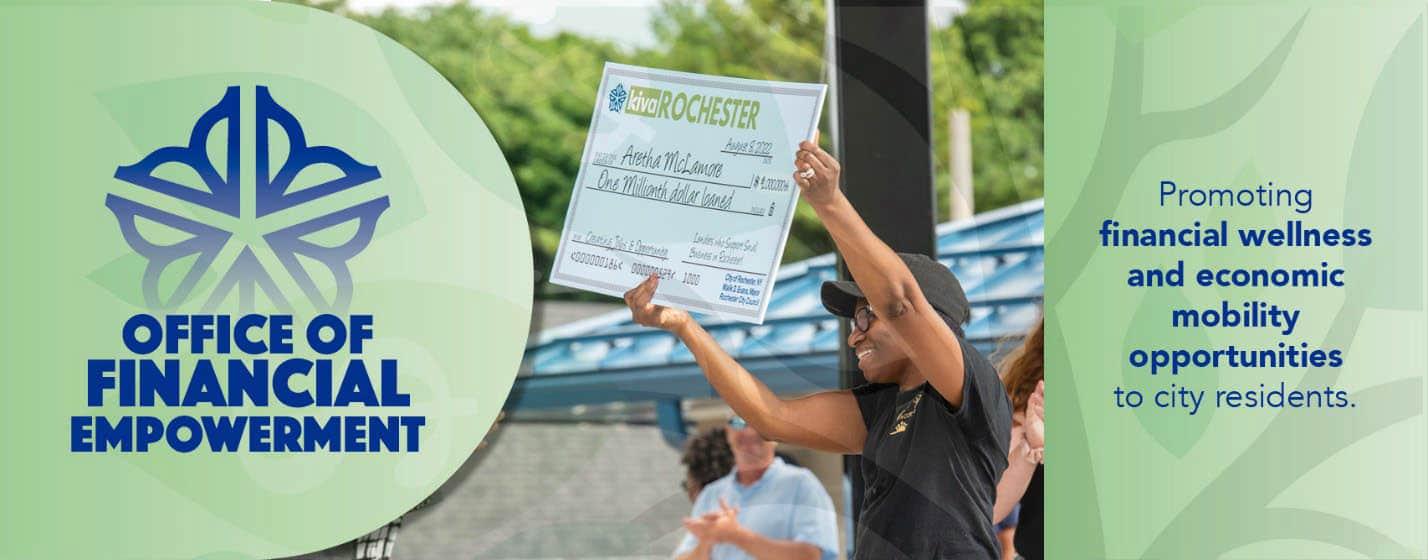
Kiva Rochester Small Business Loans are 0% interest small business loans from $1,000-$15,000 and crowdfunded $25 at a time. Since its launch in 2016, the City has funded over $1.2 million to over 200 small and micro businesses. Kiva is truly the first step of the capital ladder for these businesses.
• The OFE partners with over a dozen entrepreneurial programs to embed and advertise Kiva loans
• Kiva loan recipients are offered financial counseling, business coaching, and connected to larger financing options such as local CDFIs or the City’s Neighborhood and Business Development
Prepare to Prosper Business Academy has served 50 small minority owned businesses and will serve an additional 25 in 2026.
• This training provides participating businesses marketing plans, tax filing, bookkeeping training, MWBE certification, cash flow and projections, and business plans to thoroughly prepare them to take the next steps to grow and sustain their businesses. This program emphasizes relationship building among participants and more mature businesses in the community to develop authentic opportunities for mentorship.
• In 2026 we will add Human Resource & Branding services to the next cohort of participants
CFE Fund Updates – Fall 2025
Bank On
The Bank On movement has reached a significant milestone: there are now more than 500 publicly available accounts certified as meeting the Bank On National Account Standards (with many more on the way!) The Bank On team continues to work to bring new financial institutions into the movement, with extensive targeted outreach to credit unions and smaller financial institutions.
In August, we released two RFPs for coalition partners interested in building or strengthening their banking access efforts. Applications just closed for Bank On Academy (for prospective coalitions or coalitions with new leadership seeking foundational training) and the new Bank On Integration Accelerator Grant (for active coalitions). We received close to 20 applications for the Bank On Integration Accelerator opportunity; evaluations are underway with decisions to be announced later this month. We’ll also enroll a cohort of approximately 35 new and relaunching coalitions through Bank On Academy. Technical assistance to these new cohorts will begin in November, with a multi-phased approach of cohort-based learning and individual technical assistance. We also extended invitations to a select group of coalitions for the fifth cohort of the Bank On Fellowship, with grantees to be finalized this month. We select 5 organizations from this invitation-only opportunity to hire full-time Bank On coalition leadership. These technical assistance and grant opportunities are enhanced by our broader learning community offerings available to all active and prospective Bank On coalitions throughout the year.
Additionally, the Bank On team continues to expand our work building programmatic banking access integrations, including supporting partners building banking access moments into workforce, transit, unemployment, and prisoner reentry systems. Bank On team members are implementing creative new approaches to support coalitions in pivoting their efforts towards scalable integrations. In August, two team members traveled to Albuquerque, NM to facilitate a day-long strategy session with NM Department of Workforce Solutions officials and the three New Mexico-based Bank On coalitions This inperson session represents a new and promising approach to supporting state-level partners in integrating banking access into their public benefit and workforce systems. Summer Jobs Connect
In its 12th year, the Summer Jobs Connect initiative continues to support youth workforce programs in embedding banking access and financial education into their programs. The CFE Fund has welcomed the fourth cohort of SJC Academy, our Summer Jobs Connect entry point, in which we engage summer youth employment programs and other types of youth workforce programs with robust technical assistance to help them develop a plan for integrating banking access and financial empowerment services into their programs. The fourth cohort of SJC Academy includes Bronx, NY (which represents four workforce boards and four summer youth employment programs); Houston/Galveston, TX; Hopkins, MN; Hutchinson, KS; Long Beach, CA; Monroe, LA; San Diego, CA; and Tampa Bay, FL.
Financial Empowerment Center (FEC) Replication Initiative
The FEC Public movement continues to gain momentum; a total of 97 cities and counties have engaged in FEC Public, including 38 cities and counties who have already launched active local FEC public counseling initiatives. Recently, Jefferson County (WI) launched their FEC; Charleston (SC), Howard County (MD), and St. Louis (MO) also submitted Implementation proposals and have been approved to move into the “build phase.” An new cohort of FEC Academy began in October 2025 (Albuquerque, NM: Madison, MI; and Riverside County, CA).
The second phase of the Small Business Boost (SBB) FEC partnership program is underway. Participating FECs in this phase include: Akron, OH; Aurora, IL; Columbus, OH; Louisville, KY; Polk County, IA; Rochester, NY; and Sacramento, CA. Small Business Boost was initially piloted in 2022 with five cities to explore how FEC counseling could help entrepreneurs and small business people to stabilize and improve their personal finances as a foundation for building and growing a sustainable business. This second phase of SBB integrates FECs with small business development and entrepreneurship programs in an additional set of municipalities, while also diving deeper into the impact of FECs on the financial health and small business journey of early-stage entrepreneurs. The second phase of the pilot kicked off in December 2024. After an initial planning and training period, FECs launched targeted services for small business clients in March 2025. To date, financial counselors have facilitated over 700 sessions with 352 clients. The CFE Fund also was invited to present a workshop about the SBB pilot and the intersection of personal and business finances at the Prosperity Summit in Washington, DC earlier this month.
The CFE Fund also received funding from the Wells Fargo Foundation to create a new professional development opportunity for FEC Local Government Managers to further advance their FEC management skills: FEC Leadership Fellows. Selected Local Government Managers include those from Aurora, IL; Baltimore, MD; Greenville County, SC; Louisville, KY; and Polk County, IA. This new opportunity launched in May 2025 with an
in-person convening at the CFE Fund’s New York City office; after a series of additional cohort learning calls, the cohort convened one final time in-person in September 2025.
Finally, with funding from the Bloomberg Philanthropies’ Greenwood Initiative, the CFE Fund is continuing to work to incorporate legacy planning counseling services into the national FEC Public initiative. We are implementing legacy planning into the FECs across two cohorts in 2025; the first cohort of 13 FECs had their kickoff convening in New York in March, began training in May, and began providing legacy planning services in July 2025.
The second cohort of 18 FECs had their kickoff convening in New York in June 2025, began training in July, and launched services in September 2025. To date, more than 2,200 clients have been introduced to legacy planning and over 300 clients have begun working on legacy planning activities. The CFE Fund will coordinate a national and local announcement about this new legacy planning service as a core component of the FEC model at the end of October.
Financial Empowerment Cities
The CFE Fund continues to support local leaders through our FE Cities initiative as they work to launch and lead new local Offices of Financial Empowerment. While the first cohort of FE Cities (Jackson, TN; Pittsburgh, PA; Rochester, NY; and Tulsa, OK) have finished the core FE Cities grant engagement, we are continuing to work with Tulsa through an “accelerator fund” grant to supercharge a discrete project that supports OFE operations. Rochester and Jackson have wrapped up their accelerator fund projects, both focused on fundraising for CSA programs in their respective cities.
The second FE Cities cohort (Albuquerque, NM; Dallas, TX; Los Angeles, CA; and Sacramento, CA) has begun its second year of the engagement. All four have hosted the CFE Fund for site visits and are working to synthesize site visit findings and information from their landscape analysis to begin crafting their strategic plan, a key tool for launching the OFE in the second year of the grant. Each also used their site visit to build OFE momentum: for example, Albuquerque hosted a public launch of their OFE featuring the Mayor and other key stakeholders, and Sacramento combined it with their CityStart blueprint launch and their inaugural OFE Advisory Group meeting. The CFE Fund brought on five CFE Coalition members (Boston, MA; Denver, CO; Lansing, MI; New York, NY; and St. Paul, MN) to serve as expert mentors to FE Cities grantees, advising on topics such as program development, communications, and public funding strategies. We also are excited to welcome our third cohort of FE Cities (Little Rock, AR and Nashville, TN). Both cities joined our most recent CFE Coalition convening in Lansing. While Little Rock has their FE Leader in place and is in the process of conducting their landscape analysis and planning their site visit, we are playing an active role in guiding Nashville through their hiring
process. We plan to host all active FE Leaders for an in-person convening in New York in mid-January.
An RFP for fourth cohort of FE Cities grantee was released last month with applications due November 14th .
Consumer Financial Protection Initiative
The CFPI team is currently focused on developing new resources to support the local consumer financial protection movement. We recently received a new grant from the Annie E. Casey Foundation to support a new approach to our national convenings. We will host the first of two workshop-oriented convenings January 21-22 in Baltimore, MD focused on litigation and enforcement strategy; formal invitation with registration information will be available soon. The second convening, anticipated for late Spring, will focus on strategic communications that can amplify the impact of consumer protection efforts. We also highlighted essential local consumer protection work in Cuyahoga County, OH and Denver, CO in the most recent issue of our Skyline newsletter; both will participate in deep dive webinars in October and December.
CityStart
The CityStart team continues to work with local governments around a structured approach to identify financial empowerment goals, convene relevant stakeholders for sustainable success, develop actionable strategies, and ultimately craft a blueprint rooted in local insights and opportunities to consider and expand access to wealth and build wealth equity. The CityStart team is working closely with grantees to identify how best to speak about racial wealth equity work under the current political climate.
All partners from our fourth CityStart cohort with a wealth equity focus (Kansas City, MO; Memphis, TN; Milwaukee, WI; Savannah, GA; and St. Petersburg, FL) have completed their site visits. During each site visit, the CFE Fund facilitated roundtable discussions with a range of stakeholders as well as individual meetings with senior officials, including mayors and heads of departments, to gain a deeper understanding of the localities’ priorities and opportunities. This cohort will now build their “story of wealth,” which includes collecting data on current local wealth disparities and identifying data gaps, exploring local policies and practices that currently or historically have impacted wealth accumulation and extraction, and engaging residents to collect their input on these issues. To support this phase of their work, the CFE Fund convened the cohort in New York City on October 15th and 16th. The convening was an opportunity for grantees to share learnings and themes that
arose from their site visits and set up their story of wealth work. The convening also included a resident engagement session led by Third Space Labs and a narrative change session led by Race Forward.
Previous cohorts are focusing on finalizing their “story of wealth” as part of their eventual municipal financial empowerment blueprint and identifying actions to which the municipality can sustainably commit. Others are working to finalize their blueprints and release strategies to release this fall. As one example, Newark, NJ released their blueprint in July and created a framework highlighting a “financial well-being continuum.” Their framework and actions included:
• Stabilize: Focuses on a residents’ financial health by increasing their earning and income to cover essential living expense and improving their access to financial institutions, financial knowledge, and financial services
• Secure: Focuses on residents’ financial resilience by expanding access to programs, resources and services to increase their savings and net worth
• Sustain: Focuses on residents’ financial longevity by increasing their access to, knowledge of, and utilization of wealth building and estate-planning tools and on building residents’ power to accumulate and transfer wealth to their communities and future generations.
Emergency Financial Empowerment
The CFE Fund’s Emergency Financial Empowerment (EFE) initiative continues to work with Offices of Emergency Management, or the emergency management entity in a given locality, to build and expand emergency preparedness and recovery infrastructure to support the financial stability of residents and streamlined deployment of financial empowerment resources as part of their emergency response procedures.
All grantees from our first cohort (Dallas, TX; Gainesville, FL; Rochester, NY; St. Louis, MO; and St. Paul, MN) are currently developing Implementation Plans, which will include their ideas to integrate and enhance financial empowerment opportunities within local emergency processes and plans; galvanize or create partner networks (possibly launching local Financial Empowerment Networks); provide disaster preparedness trainings for community partners already doing financial empowerment work; and deploy public awareness tools and resources.
The CFE Fund team is currently accepting proposals for the second cohort of grantees, with applications due November 10.
Administrative Updates
Since the last CFE Coalition meeting, the CFE Fund has hired a new Senior Associate to support Financial Empowerment Center work; Zach Etzin joined the team in April.
In the fiscal year ending June 30, 2025, 2,754 households were referred to financial coaching services. Through personalized coaching sessions, 1,491 households improved their financial well-being, increasing their household income by $4,607,416. This was achieved through:
80 households successfully lowered their debt-to-incomeratioby$31,076. 80householdsimprovedtheircreditscore.
DepartmentalConsolidation
During this year ' s budget season, Mayor Karen Bass recommended consolidating the Department of Aging, Economic and Workforce Development Department, and Youth Development Department into the Community Investment for Families Department (CIFD). CIFD was instructed to present a roadmap for creating an integrated department that will deliver coordinated, equitable, and outcomedriven services to the residents and businesses of Los Angeles This effort is not simply a costsaving measure; it is driven by the need to streamline services by leveraging shared administrative infrastructure across departments with similar functions, freeing up resources to focus on service impact and outcomes.
CIFD leadership presented this report to the City Council in August, and the City's Chief Administrative Officer and Chief Legislative Analyst are preparing reports on the proposed consolidation'sfiscalandprogrammaticimpact.
Abigail R. Marquez General Manager
IPV/TAYGuaranteedIncome (STAYSAFE)
CityCouncilapprovedCIFD’sprogramdesignfor a new $2 million Guaranteed Income program, STAY SAFE - Supporting Transitional Aged Youth and Survivors Achieve Financial Empowerment. The program will provide 84 participants - 42 from Council District 9 and 13, the two funding Council Districts - with $24,000 in unconditional financial assistance distributed over two years Participants will choose between 24 months of $1,000 per month or a $6,000 lump sum payment accompanied by 18 months of $1,000 per month. We will also connect participants with workforce opportunities via the Los Angeles Hospitality Training Academy and other vital resources such as financial coaching, housing navigation, and more. Our goal is to release the program application in October and issue the first round of disbursements before the end of theyear.
ULAIncomeSupportProgram
CIFDispartneringwiththeLosAngelesHousing Department to administer a $14.6 million income support program for households with seniors and/or people with disabilities. Our joint report to the City Council is in its final stages. It will outline the proposed program design, priority populations, contracted partners for outreach and implementation, recommended staffing positions, and other key components necessary for successful programlaunch
RegionalEmergencyFund
In response to aggressive, ongoing federal immigration enforcement actions in Los Angeles, the Mayor’s Office worked with the LA Dodgers Foundation and the California Community Foundation to raise $1 million for emergency assistance for families financially impacted by immigration enforcement CIFD was responsible for program design, including eligibility criteria, the flow of funds, and the disbursement mechanism, and has worked with FamilySource Centers and other immigrant-focused community organizations to identify families and distribute funds efficientlyandeffectively.
CD13EmergencyFund
Councilmember Hugo Soto-Martinez has identified $350,000 of his discretionary funding to support additional families living within Council District (CD) 13 who have been financially impacted by immigration enforcement. CIFD is coordinating with the district, MoCaFi, and several FamilySource Centers on program design and creating a referral program to serve some of the most vulnerableCD13constituents
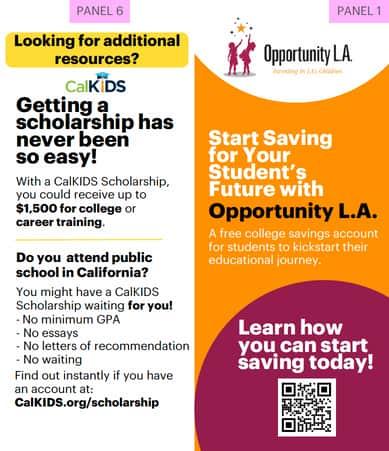
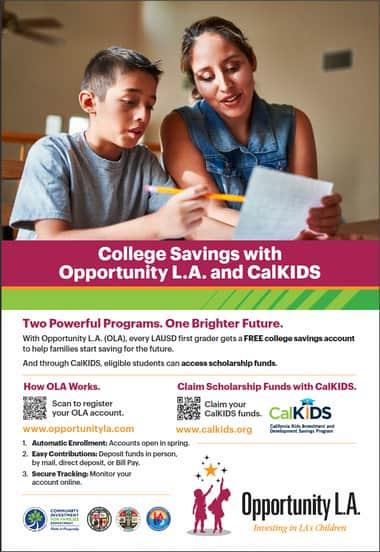
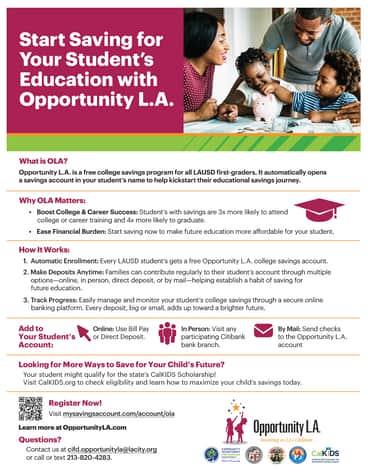
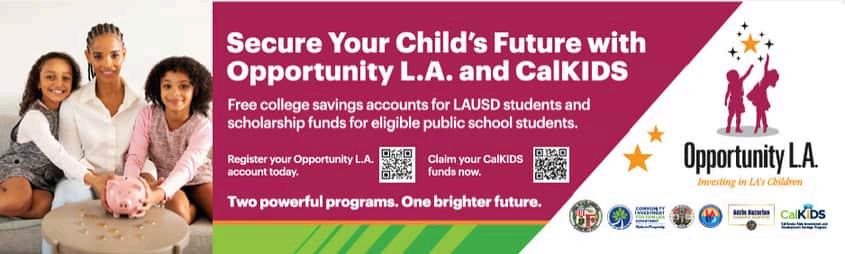
CIFD administers Opportunity L.A., one of the countrys largest universal Children's Savings Account programs.Itopensacollegesavingsaccountforeveryenrolledfirst-gradestudentatover500Los Angeles Unified School District public schools and affiliated charter schools, serving between 26,000 and 32,000 students annually. To get parents started, families receive a seed deposit of $50uponregistration. They can add their own savings, ultimately contributing to post-secondary expenses.
Therearecurrently 116,000 studentsintheprogram.Weareinthemidstofaregistrationdrivewith contract partners at the YMCA of Greater Los Angeles and Agency M Media, leveraging in-person interactions, community events, bus benches and shelters, neighborhood poster and flyer placements, and digital out-of-home advertisements. Our registration rate increased from 4.7%to 6.6%betweenJuneandAugust,puttinguswellonourend-of-year10%registrationgoal.
The program is also facing two significant operational challenges Due to ongoing budget constraints,neithertheCitynortheCountyofLA hasidentifiedadditionaldollarsforseeddeposits, resulting in our new approach that offers funds to parents only once they have registered This does not notably change the participant experience and allows us to sustain the program for multiple years while we seek new philanthropic and restored municipal funding. Furthermore, Citibank, our current banking partner, is exiting the Children's Savings Account space in 2026. Therefore,CIFDisinconversationwithseveralotherfinancialinstitutionsinanticipationofreleasing aRequestforProposallaterthisyear.
Seebelowexamplesofourprogramoutreachmaterials.
Free Tax Prep Los Angeles
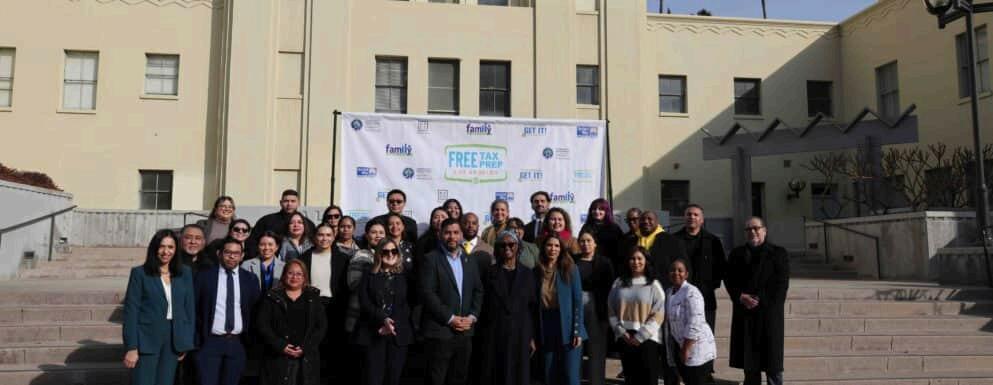
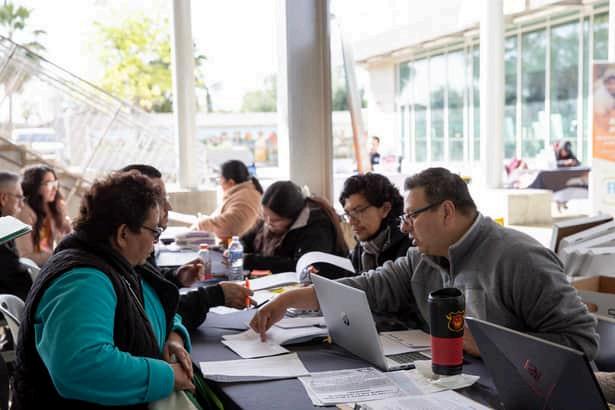
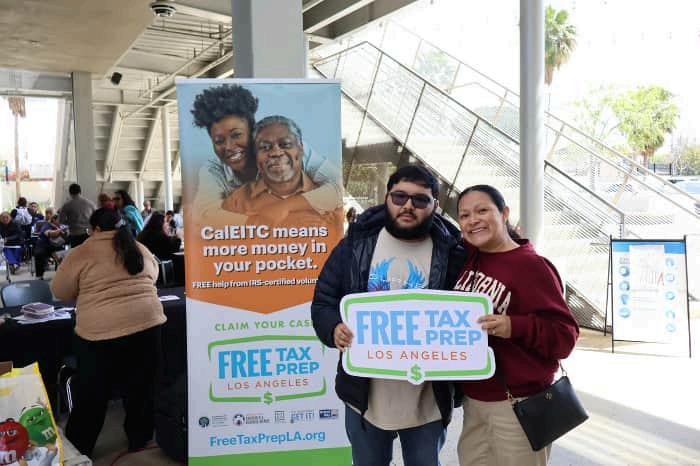
CIFD oversees the Free Tax Prep (FTPLA) coalition with County and FTPLAisapublicawarenesscampa to educate working Angeleno available federal and state tax provides free tax preparation ser earningunder$67,000annually.All FamilySource Center (FSC) locat Volunteer Income Tax Assistance whichtheCIFDteamhelpstocoord
The 2025 tax season was extended due to the January wildfires As o FTPLA Coalition has assisted over 15,000 households in filing their taxes, resulting in over $15.4Minreturns,includingtaxcredits.
CIFD also participated in a kickoff press conference, facilitated nine pop-up events in partnershipwithelectedofficesthatreachedover 200 clients and resulted in returns of $240,000, and placed five student interns with FSCs to expandtheircapacity.
Ensure that all FamilySource Centers are preparedtodeliverVITAservicesviatrained stafforsubcontractors
Plan a new series of community pop-up eventswithelectedofficesinVITAdeserts Expand the intern placement program basedonavailableMayor’sOfficefunding Advocate for policies that meet the needs ofITINholderswhoareafraidtofile
Darchelle Strickland Love, Local Government Manager - City of Detroit.
Previously, it was reported that two additional staff members were assigned to Detroit’s FEC and Bank On programs. We are working together to bring more visibility to both programs and are off to a good start.
1. We have begun the process of informing Detroit City Council Members about Bank On and FEC and how it connects to the councilmember’s existing committee, the Generational Wealth Taskforce.
2. During Estate Planning Month, a press release will be published to highlight the city’s existing Free Will and Estate Planning Program and how Bank On and FEC can complement family efforts to become financially solvent and establish a foundation for future generations.
3. Planning to refresh content on the city’s webpage for both programs is underway. The goal is to launch program updates and how Detroiters can connect to Bank On and the FEC using testimonials and social media posts.
4. We are considering ways to use FECBOT data to communicate the impact the FEC has on Detroiters who take advantage of the program. Opportunities exist to tell the story of someone who has successfully gone through the financial counseling process, reduced debt and accumulated savings. This info can also be adopted for social media posts.
5. We are also working with community non-profit organizations to develop a process to refer their clients to the FEC. These non-profits currently offer first time homebuyer workshops. The FEC could be helpful to those who want to own a home, but they are not financially ready to manage the responsibility of owning a home. More discussion is required to determine if this is a viable option to pursue.
Cities for Financial Empowerment Coalition
Update from the City of Boston, Fall 2025
Previously known as the Mayor’s Office of Financial Empowerment, the Center for Working Families (CWF) has completed more than three years as part of the Worker Empowerment Cabinet, which aims to advance the well-being of all Boston workers in the public and private sectors.
CWF’s mission continues to be to identify and implement programs and strategies that connect Boston residents with skills and resources to improve their economic wellbeing and financial empowerment. This includes providing access to financial empowerment through workforce development, so employment and related services are a key component of the assistance we offer.
Our current initiatives include:
o Boston Saves – Boston Saves, our Children’s Savings Account program, enrolls a new K2 class citywide every year, as well as adding students who have moved into the Boston Public Schools in grades 1 through 6 (about 3500/year). Our mission is to empower families to save and plan for their children’s future with the support of their city, schools, and community, and our vision is a citywide culture that supports the educational and career aspirations of Boston’s children and their families.
o 81 participating elementary schools, K2-Fourth Grade
o 21,500+ active accounts (this will increase in November when we add another group of Kindergartners)
o 33% of households have logged in at least once
o $50 seed funding held by the City of Boston until graduation
o Opportunities for families to earn $65 incentives in the first year to their COB account through saving in their own linked account, reading aloud, tax preparation, etc.
7 Palmer Street, Boston, MA 02119 (617) 918-5239 Boston.gov/Working-Families
o $1,449,800 allocated in seed and $466,605 in incentive funds as of June 30, 2025
o Most recently, a special promotion with families living in public housing allocated $500 each to the accounts of 485 Boston children.
o Evaluation being conducted by Dr. Willie Elliott, Summit Lab. Part 2 should be completed by end of year.
Boston Tax Help Coalition
The Boston Tax Help Coalition (BTHC), the CWF’s largest and best-known program, will be in its 25th year of serving Boston and surrounding areas. Its mission is to provide free tax preparation to LMI residents, ensuring that the fee they would have paid to commercial preparers goes back into their pocket/into the community, preventing them from being victimized by predatory organizations that would overcharge and possibly also provide substandard work, and to maximize access to the Earned Income Tax Credit. The goal is also to serve low-to-moderate income residents, limited-English proficiency residents, and disabled residents. Most households making $70,000/year or less are eligible. For the past two years, we served 12,000+ households in Greater Boston. The average annual income of our taxpayers is $30,000; 85% are people of color and 20% have limited English proficiency.
Both funding and support from the IRS were a challenge in 2025. The IRS cut our funding by 60% without explanation and several of our key contacts at IRS Spec have lost their jobs. There were a lot of rumors about immigrant families being afraid to file; however, our numbers are the same vs. last year. We operated 30 sites (including one at our main office in Roxbury), plus eight weekend sessions specifically for the disabled.
o The Financial Check-Up (FCU) continues to be a key asset building tool for CWF both during the tax season. The FCU is part of Mayor Wu's city-wide empowerment strategy to help LMI Boston residents receive financial coaching to build their credit and savings. During the 2024 tax season, we completed 1200 FCUs but interest in 2025 was less, which we attribute both to easier access to credit scores via Credit Karma, etc. and more tax sites doing drop off service (people just want to get in and out).
o The FCU is a cost-efficient, light-touch strategy, and financial tool. It is a one-time, approximately 20-minute session, intended to provide education, knowledge, and behavioral change about easy to implement activities that may improve an individual’s credit score and financial well-being. The FCU provides services in six core areas: credit review, credit advising, service referrals, voter registration (if applicable), financial products, and offers options for spending/saving the tax return.
7 Palmer Street, Boston, MA 02119 (617) 918-5239 Boston.gov/Working-Families
o Bank On Boston – Bank On Boston is part of a nationwide movement of Bank On programs led by the CFE Fund, which has supported our work over the last several years. Bank On Boston, like many of its peer programs around the country, works to raise public awareness, expand access to financial education, and help connect residents to other asset building initiatives, not merely our own programs but also this year we are focusing on summer youth partnerships. When we began Bank On Boston, the only account in Boston that met the Bank On National Standards was Bank of America and, distressingly, clients we sent there to open accounts received puzzled looks from staff unfamiliar with the concept or designated account. Since then, Chase established a banking presence in Boston with its Secure Banking account. In addition, the efforts of our Bank On Boston team has resulted in accounts being established at Berkshire Bank, Citizens Bank, Dedham Savings, Lending Club, The Cooperative Bank, Metro Credit Union, Reading Cooperative, and Wakefield Cooperative Banks. Capital One, Santander, Lending Club, and Webster also provide certified accounts now.
o We were finally able to hire a new Bank On Boston Manager, Norah Boyle. She has experience at Fidelity and Bank of America, and hit the ground running working on a ROTH IRA project to encourage 18 year olds to understand the importance of retirement. Northeastern University and J-PAL are partners on this project.
o Bank On Boston and Summer Jobs Connect
The City’s Youth Employment and Opportunity (YEO) Department manages and develops Boston’s future workforce and is part of our Worker Empowerment cabinet. We worked closely with them leading up to and during summer 2024 and 2025, with great support from the CFE Fund. Approximately 9,000 students received some type of paid summer job through the City both years, and we connected with nearly every summer employer to promote direct deposit and safe bank accounts. We estimate that 34% of our summer youth do not have a bank account, especially those who are 14 and 15.
Four local financial institutions offered non-custodial no-fee accounts for youth under 18 during Summer 2025. There were still challenges to overcome in account opening – primarily the lack of identification by many students although Metro Credit Union was willing to accept nearly anything reasonable, but we were extremely busy. We did not have metrics for summer available at press time but our work included opening accounts, providing workshops, and supporting the Summer Jobs program at events.
o Rachel Rodri, our indomitable grants manager, was inspired by Chicago and New York to create a new program we launched in April, Young Money Mentors. This was a stipended program for high school juniors and seniors in which they learned personal finance topics during the spring, chose a topic in which to become expert, and presented to students in our Learn & Earn community college program. Students also shadowed some of our banking
7 Palmer Street, Boston, MA 02119 (617) 918-5239 Boston.gov/Working-Families
partners, visited colleges, learned about financial aid, and became regulars in our office. One even serenaded us on his cello on their last day!
o Boston Builds Credit – This innovative citywide credit building initiative was created by our office and United Way to help Boston residents attain a prime credit score through financial education and coaching. Targeting LMI residents, small business owners, immigrants, youth, and large employers, we are using a place-based strategy to reach neighborhoods identified as high need and collaborate with community-based organizations to expand our reach. This program moved to a new partner in early 2025, Working Credit, although CWF continues to partner in this work.
Financial Empowerment
o Our office, in the heart of Boston’s Roxbury neighborhood, led by Alan Gentle, includes four financial coaches, and one outreach coordinator – and provides coaching in English, Spanish or Haitian Creole. We provide one-onone long-term financial and employment coaching to about 400-600 clients annually. The office also serves as one of the City’s busiest VITA tax sites so much crossover promotion takes place. We built some new partnerships over the past year, particularly in our work with Returning Citizens, a challenging but very important target group.
o Bridge to Hospitality Program – Preparing Boston residents for the 21stcentury workplace is a priority for Mayor Wu and the Center for Working Families. In the past, we have offered Culinary, Digital Literacy, and Green Jobs training programs. Our current collaboration is a Commercial Driver’s License “Bridge” and training program for ESOL individuals to augment the Office of Workforce Development’s traditional CDL training.
o Homebuyer Readiness – Several years ago, the City of Boston’s Home Ownership division asked us to work with them by offering workshops to help residents interested in home ownership but who did not know where to start – and were intimidated by or simply not ready for the City’s Home Ownership 101, which is required for home financing programs. We created a workshop curriculum that incorporates both credit building and home ownership strategies. Those interested are recruited to become financial coaching clients which helps them focus on the savings strategies needed to amass a down payment and the credit score needed to get a good mortgage rate.
o Summer Learn & Earn
The Summer Learn & Earn (SLE) program was created during the pandemic as a virtual, stipended opportunity for rising high school juniors and seniors to earn academic credit at local community and four-year colleges. Courses included Marketing, Communications, Web Design, and Criminal Justice. We
7 Palmer Street, Boston, MA 02119 (617) 918-5239 Boston.gov/Working-Families
moved to in-person classes on Tuesdays and Thursdays and “academic readiness” with OWD staff on Wednesdays. Students earn $250/week if they attended all sessions and our Bank On Boston staff worked with as many participants as possible to get them banked. This program is funded by the summer jobs division of Worker Empowerment so in 2025 SLE and its staff moved under Youth Engagement and Opportunity, which is still part of our Cabinet.
I am sorry to miss seeing everyone in Louisville!
7 Palmer Street, Boston, MA 02119 (617) 918-5239 Boston.gov/Working-Families
ConstanceMartin
www.cityoftulsa.org/ofe
BacKground
The City of Tulsa has embedded financial empowerment programs and policies into City services to improve individual and family financial resilience and stability. Financial empowerment is part of several strategic initiatives that the City of Tulsa has implemented to fulfill its mission to build a foundation for economic prosperity, improved health, and enhanced quality of life for all Tulsans
Tulsa launched its Financial Empowerment Center (FEC) planning process in February of 2020, just a few weeks before the pandemic shut down Tulsa and much of the world. Despite this challenge, the city continued to convene a large cross sector group of stakeholders to submit an implementation proposal that year to launch the Tulsa FEC before the end of 2020. The FEC operates within the Office of Financial Empowerment and Community Wealth (OFE), which was officially launched in January 2023. The Office now falls under the Department of Resilience and Equity.
In Tulsa, financial empowerment initiatives are an integral part of the department that oversees the city’s resilience strategy, Resilient Tulsa and New Tulsans Welcoming Plan, which include goals and actions to improve financial health and reduce economic disparities. Financial empowerment and resilience were embedded in the city’s COVID-19 response and relief efforts including grants that were distributed to over 60 local nonprofits as well as through emergency rental assistance integration.
The Tulsa OFE has successfully leveraged both public and private funding to support its operations, including Community Development Block Grant, Coronavirus Aid, Relief, and Economic Security Act, American Rescue Plan Act (ARPA), private foundation grants, and grantsfrom financial institutions.
office of financial empowerment and community wealth
The Office of Financial Empowerment and Community Wealth is the City of Tulsa’s centralized approach to provide programs and resources for Tulsans to achieve financial stability and resiliency. Through partnership development, strategic coordination, policy and advocacy, and long-term financial empowerment strategies, the OFE will optimize public and private funding streams while leveraging new financial investments to support its initiatives.
$330,000 arpa funding for fec operations
Institutionalizing the Work:
$95,000 funding from private local foundations
$150,000 additional funds for fiscal year 2026-27
• The Office of Financial Empowerment and Community Wealth was formally added to the City’s General Fund Budget for Fiscal Year 2026. Included in the previous year’s City budget were two positions in the Office of Financial Empowerment and Community Wealth: The Director of Office of Financial Empowerment and Community Wealth, and Financial Empowerment Program Assistant.
• The OFE secured $330,000 in ARPA funding for FEC operations.
• $95,000 in funding from private local foundations.
• For fiscal year 2026–2027, the office will receive an addition of $150,000.
Positioning the OFE as a Subject Matter Expert:
• The Director of OFE was a featured speaker at the 2024 Juneteenth – “Freedom Through Wealth” event and was highlighted again in 2025 for sharing insights on financial initiatives and sharing community enhancing programs.
• The Director of the OFE was featured in local news outlets and newspapers in Spring 2025, providing insights on the significance of financial counseling, its impact on upward mobility, and the importance of available services.
BanK on financial literacy classes
• Effective June 2024, the OFE officially assumed oversight of the Bank On program.
• In partnership with Arvest Bank and the Center for Employment Opportunity (CEO), the OFE offers monthly financial literacy workshops and visits to various Arvest Bank locations.
• In July 2024, the OFE collaborated with Tulsa CARES, a non-profit dedicated to supporting individuals affected by HIV and Hepatitis C through personalized care and comprehensive services that promote dignity, equity, and health. Together, they collaborated with Bank of America to host a workshop on income readiness and budgeting on a fixed income.
• The OFE partnered with the Tulsa Parks Department, Bank of Oklahoma and Chase Bank to offer financial education classes at two city parks. The sessions covered key topics such as understanding credit, pathways to homeownership, two-generation banking and budgeting for the holidays.
financial empowerment center
Overview of Tulsa FEC from December 1, 2020 to August 31, 2025:
6,675 total residents reached
7,291 official sessions
$877,614 total savings increased
1,828 total outcomes (27.16% of clients have at least one outcome)
$2,557,847 non-mortgage deBt reduced
$28,748 average household income
Clients Have 2+ Sessions
5 partners
co-locations for financial counseling sessions
2 local
financial empowerment centers
• In partnership with Tulsa Responds, the OFE opened a second Financial Empowerment Center in September 2024. Tulsa Responds is a nonprofit organization specializing in comprehensive enrollment services for key government benefits and has been a valued partner and provider of the Financial Empowerment Center and the Volunteer Income Tax Assistance (VITA) program. We are excited to enter our first full year with them as an official FEC provider.
• The City of Tulsa OFE is honored to collaborate with a variety of community partners through referral partnerships and Co-locations. Our Co-location sites include:
— Women in Recovery: Women in Recovery is an intensive outpatient alternative for eligible women facing long prison sentences. The program works closely with the criminal justice system and various community partners to provide participants with comprehensive support, including substance abuse and mental health treatment, education, workforce readiness training and family reunification services.
— Tulsa Dream Center: The Tulsa Dream Center is a trusted community resource that provides immediate and long-term needs to the community. The programs at the Tulsa Dream Center encompass four areas: economic empowerment, educational advancement, health and wellness, and character and leadership.
— Parent Resource Center: The Parent Resource Center, operated by Tulsa Public Schools, is a community hub that offers educational opportunities and resources to empower parents in supporting their children’s growth and success.
South Tulsa Community House: South Tulsa Community House serves families and individuals by addressing hunger, combating poverty, and providing pathways to empowerment. Through essential services and strategic collaborations, it works to improve their lives and foster lasting change.
• We also have a new partnership established with the FEC this year:
Tulsa County Social Services (TCSS) Transitional Housing Program: This program provides transitional living services to Tulsans who are in need of shelter. They serve men, women, couples, and families who are temporarily homeless. They help their clients with services such as job employment, paying off debt, saving plans for future housing expenses and emergencies, budget creation, and searching for affordable housing. The TCSS team partnered with one of the OFE’s Bank On partners, JP Morgan Chase Bank, to do onsite banking trips ensuring access to bank accounts that the clients do not normally have access to. JP Morgan Chase Bank also partnered with the Goodwill Industries of Tulsa, FEC team and the City of Tulsa’s OFE, to do onsite banking trips and conduct financial literacy workshops for referred clients.
continued focus on fec performance
• Thanks to successful collaborations and the dedicated support of local organizations, the City of Tulsa’s FECs have achieved significant impact in the Tulsa community. As of August 2025, the FEC has served over 6,675 residents, including over 2,300 individuals who have experienced measurable outcomes. The OFE will continue delivering high-impact services through our FEC, creating meaningful benefits for residents, while working alongside partner organizations to ensure excellent client experiences that transform financial outcomes.
financial empowerment center integrations
Financial counseling to help mitigate the burden of Municipal Court fines and fees:
747 referrals
540 active clients
366 pending clients
115 total fees waivers
$55,000 fines/fees waived
• FEC began offering financial counseling to court citizens who are assigned fines in February 2023. Citizens who choose to work with an FEC Counselor can earn a fine waiver of up to $250 after completing three FEC sessions; another $100 is waived for each subsequent session.
• Current Metrics from January 1, 2023 to August 1, 2025:
— 747 Referrals, 540 Active Clients, and 366 pending appointments
Number of Total Fee Waivers: 115
Total Amount of Fines/Fees Waived: $55,000
Establishing new student programing and workforce integration partnerships:
• The OFE is in the process of structuring a new summer youth employment program. The focus will be centered around workforce development for local youth, providing real world job experiences and foundational education around personal finance.
• This new programming will include partnerships with the Student Borrower Protection Center and Tulsa Higher Education Consortium.
Supporting Tulsans who are at risk of losing their homes:
$4,000 assistance for eligiBle homeowners
154 referrals to the save our homes initiative
• FEC integration with the Save Our Homes Initiative is a short-term program designed to empower under-resourced Tulsans by providing critical support for homeownership. The program offers up to $4,000 to assist eligible low-income households in Tulsa with clearing home titles or paying property taxes, helping to secure and stabilize their homes. This program is looking to secure additional funding, so that the work can continue beyond October 2025. As of August 6, 2025, there is a total of 154 referrals, 131 total sessions, 30 active clients, and 2 pending appointments.
• National Recognition for Tulsa’s Financial Empowerment Partnership
In July 2025, the City of Tulsa’s Office of Financial Empowerment was highlighted in a case study by the National Center for State Courts (NCSC) for its collaborative work with the City of Tulsa Municipal Courts. Through the Financial Empowerment Centers, in partnership with the City of Tulsa Municipal Courts, we are leveraging the power of partnerships to help residents reduce financial debts and break free from the judicial system’s cycle of poverty. As the NCSC noted, “This partnership helps mitigate the financial burden of legal obligation on residents and contributes to improved financial stability.”
— This recognition underscores the impact of our work and reaffirms the importance of building innovative partnerships that address both financial and legal challenges. We remain committed to expanding these efforts, ensuring Tulsa residents have the tools, resources and support needed to achieve lasting economic stability.
Announcement of First School Districts to Receive Financial Educators for Students & Families
On June 18, 2025, New York City Mayor Eric Adams, DCWP Commissioner Vilda Vera Mayuga, and New York City Public Schools Chancellor Melissa Aviles-Ramos unveiled key details of the Adams administration’s “Financial Literacy for Youth” initiative to make sure that every public school student can learn how to save and spend money by 2030.
Unveiled as part of the announcement, the first 15 public school districts to receive financial educators, who will provide students and their families with free counseling and workshops starting this upcoming school year. Financial educators will also help develop classroom resources to build responsible financial habits. Financial educators will have specialized skills in leading workshops and trainings, as well as experience working with young people and families; they will support teachers and families to foster a financially-healthy environment for all school children. More than 350,000 public school students and family members will be served by financial educators through counseling, workshops, and other resources in the first five years of the program.
Ultimately, the administration will place a financial educator in every single district by 2030 as part of its FLY initiative, making New York City one of the first public school systems in the United States to deploy financial educators directly to schools and support students with this valuable resource. First announced in Mayor Adams’ State of the City address earlier this year, FLY will also pilot in-school banking to give students real-world exposure to safe and affordable banking options and explore additional ways to give students handon experience learning about saving and managing money.
Districts & Schools for 2026 NYC Financial Literacy for Youth Pilot
District 2 Manhattan Chelsea, Clinton, and Upper East Side Urban Assembly Early College High School of Emergency Medicine
District 3 Manhattan Central Harlem and Upper West Side The Urban Assembly School for Green Careers
District 5 Manhattan Central Harlem Mott Hall High School
District 7 The Bronx Hunts Point, Longwood, and Melrose The Laboratory School of Finance and Technology
District 8 The Bronx
Belmont, Crotona Park East, and East Tremont Longwood Prep
District 9 The Bronx Concourse, Highbridge, and Mount Eden Bronx High School for Medical Science
District 10 The Bronx Bedford Park, Fordham North, and Norwood Fordham High School for the Arts
District 11 The Bronx Castle Hill, Clason Point, and Parkchester Bronx Lab School
District 12 The Bronx
Belmont, Crotona Park East, and East Tremont East Bronx Academy for the Future
District 14 Brooklyn Williamsburg, Greenpoint, and Bedford-Stuyvesant High School for Enterprise, Business and Technology
District 19 Brooklyn Brownsville and Canarsie World Academy for Total Community Health High School
District 21 Brooklyn Brighton Beach and Coney Island John Dewey High School
District 23 Brooklyn Brownsville Brooklyn Collegiate: A College Board School
District 30 Queens
Astoria, Long Island City, Jackson Heights, and North Corona Long Island City High School
District 31 Staten Island Staten Island
The Eagle Academy for Young Men of Staten Island
Link to City website: https://www.nyc.gov/site/dca/talk-money/fly-financial-literacy-for-youth.page Link to press release here: https://www.nyc.gov/assets/dca/downloads/pdf/partners/Research-HearingPolicy-Financially-Empower-NYC-Youth.pdf
In-School Banking Program
The in-school banking pilot will provide students and their families with exposure to safe and affordable banking options and hands-on experience learning about saving and managing money. In-school banking is recognized by the Federal Deposit Insurance Corporation as one of the “most promising frontiers” in developing young people’s financial skills, particularly among persistently-unbanked communities like those in the first 15 districts chosen for this pilot program.
In early October, the first 15 public schools were also announced. DCWP will work with NYCPS, district superintendents and principals to facilitate introductions to the financial educators and local financial institutions who have agreed to participate in the pilot program.
Financial Partners include:
1. Brooklyn Cooperative Federal Credit Union
2. Spring Bank
3. TD Bank
4. Urban Upbound Federal Credit Union
5. Citizens Bank
6. Ridgewood Savings Bank
7. Four Leaf Federal Credit Union
8. M&T Bank
9. PNC Bank
10. Neighborhood Trust Federal Credit Union
Families without a bank account are forced to rely on costly alternatives like check cashing, which can perpetuate cycles of poverty. The in-school banking pilot aims to address this disparity by bringing accessible financial services and education into school communities. Research shows that in-school banking offers benefits to program participants and financial institutions. For example, students with access to savings accounts are seven times more likely to attend college and are more financially capable overall. Ultimately, DCWP is seeking a total of 10-15 banks or credit unions to participate in the program.
Updated Research on Unbanked Households in NYC
DCWP Releases Updated Research Brief: 238,900 Households in NYC Are Unbanked On September 24, 2025 DCWP Commissioner Vilda Vera Mayuga released a brief identifying the number of unbanked households in New York City. The research brief, which is updated biennially, describes geographic and demographic characteristics of the city’s unbanked population, spotlighting systemic barriers to banking access. While 66,800 households have become banked since 2021, an estimated 238,900 NYC households (7.0%) have no bank account in 2023, higher than the national average of 4.2%.
Data Highlights:
• In NYC, 7.0%, or 238,900 households, have no bank account (unbanked).
• NYC households remain more likely than households nationally to be unbanked: 7.0% versus 4.2%.
• Both the NYC and national unbanked rates declined compared to 2021 rates.
• Despite some improvements, Bronx households still have a greater unbanked rate (13.5%) than households in all other boroughs.
• Across NYC in 2023, more than half (55.4%) of all adult residents reported using online banking. During the pandemic, about 10 in 33 adult residents reported using mobile banking services. In 2023, the proportion grew to 10 in 21 adult residents.
• For every pawnshop in the Bronx, there are about 1.7 bank or credit union branches, compared to 6.8 in Brooklyn, 7.4 in Manhattan, 7.6 in Queens, and 11.7 in Staten Island.
The report is an update to DCWP’s 2021 unbanked brief and uses data from a 2023 national survey, the most recent data available.
Updated brief attached and available here: https://www.nyc.gov/assets/dca/downloads/pdf/media/Research-UnbankedNYC-2023Data.pdf
NYC Financial Empowerment Centers
Health+Hospitals Locations
In July 2025, DCWP opened eight new ‘NYC Financial Empowerment Centers at select NYC Health + Hospitals locations across the health system to help New Yorkers better plan and avoid going into medical debt in the future. This expansion of the NYC Financial Empowerment Centers was first announced in Mayor Adams’ 2024 State of the City address and is part of the administration’s commitment to relieve $2 billion of New Yorkers’ medical debt. Embing additional financial counselors in New York City hospitals provides more New Yorkers with access to vital personalized financial guidance.
Building on DCWP and NYC Health + Hospitals’ existing partnership in providing access to free tax preparation services through NYC Free Tax Prep at select health system sites, this new expansion will offer all of the services available at NYC Financial Empowerment Centers across the city but now conveniently located where many New Yorkers receive health care. Research shows that offering financial counseling and coaching in clinical settings can improve quality of life and overall health outcomes. This collaboration ensures that more New Yorkers can access the financial care they need to improve their lives and achieve their goals.
New Yorkers can now access free one-on-one financial counseling and coaching services at the following NYC Health + Hospitals locations – all locations opened 2 days each week:
BRONX
NYC Health + Hospitals/Gotham Health, Tremont 1920 Webster Avenue, Bronx, NY 10457
NYC Health + Hospitals/Jacobi 1400 Pelham Pkwy S, Building 8 Atrium, Bronx, NY 10461
BROOKLYN
NYC Health + Hospitals/Gotham Health, East New York
2094 Pitkin Ave, 2nd Floor, Room 202, Brooklyn, NY 11207
NYC Health + Hospitals/Kings County 451 Clarkson Avenue, E Building, Main Lobby, Brooklyn, NY 11203
MANHATTAN
NYC Health + Hospitals/Bellevue
462 First Avenue, New York, NY 10016 Finance Department, First Floor, Hospital Building
NYC Health + Hospitals/Gotham Health, Gouverneur
227 Madison Street, 5th Floor Lobby, New York, NY 10002
QUEENS
NYC Health + Hospitals/Elmhurst
79-01 Broadway, Main Lobby, Broadway Entrance, Elmhurst, NY 11373
NYC Health + Hospitals/Queens
82-70 164th Street, Main Building, Conference Room D, Jamaica, NY 11434
Link to the Financial Empowerment at NYC Health+Hospitals Video featuring Patricia from Urban Upbound here: https://www.youtube.com/watch?v=1UDZWNhybhE
NYC Free Tax Prep Tax Season 2025
With more than 140 locations in 2025, over 110,000 tax returns were filed as part of NYC Free Tax Prep and $38 Million saved in tax preparation fees (*based on $346 as the cost per return from the Bureau of Labor Statistics (BLS) DCWP also expanded our tax campaign with new images to represent additional communities and entrepreneurs
DCWP also encouraged consumers to be on alert for predatory tax preparers that overcharge, charge hidden fees, or file their return without permission. This past tax season, DCWP issued more than 80 summonses to paid tax preparers for violating the city’s consumer protection laws.
While we have made significant improvements in our volunteer recruitment and retention efforts, New York still lags in our tax time volunteers.
Student Loan Debt Supports Expanded to All City Residents
Mayor Adams Expands Partnership With Student Loan Assistance Company Summer to Help New Yorkers Reduce Monthly Student Loan Payments
On August 7, 2025, New York City Mayor Eric Adams, New York City Department of Consumer and Worker Protection (DCWP) Commissioner Vilda Vera Mayuga, and New York City Department of Citywide Administrative Services (DCAS) Commissioner Louis Molina today announced a first-of-its-kind municipal student loan reduction and college savings assistance program is now available to all New York City residents. The program builds on the city’s recent partnership with Summer — a leading company that helps borrowers navigate student loan repayment options to help wipe out $360 million
in student loan debt for 100,000 public servants through enrollment in the federal government’s Income Driven Repayment Plans and the Public Service Loan Forgiveness program. The city’s program will now be expanded to also offer an estimated 1.4 million New Yorkers who have student loan debt or are enrolling in college with assistance on managing and paying down their existing loans with lower monthly payments
First announced in May, the city’s pilot program with Summer to provide comprehensive assistance for city employees to take advantage of the federal government’s Public Service Loan Forgiveness program is on track to already help wipe out more than $13.8 million in student loan debt for city employees. Since launching, the program has served more than 2,000 civil servants and helped over 380 civil servants apply for Public Service Loan Forgiveness and Income-Driven Repayment Plans at the three city agencies in the pilot program.
With the expansion of the program, city residents will have access to Summer’s online portal where residents can verify their eligibility for programs that lower payments, compare repayment options, manage their paperwork for enrollment in federal programs, and stay on track for loan forgiveness, if eligible. Through the partnership, city residents will be able to identify the best repayment and forgiveness strategy for their individual situation thanks to fast, free, and easy tools and customized recommendations.
City Website available here: https://www.nyc.gov/main/save-on-college
Full press release available here: https://www.nyc.gov/site/dca/news/025-25/mayor-adams-expandspartnership-student-loan-assistance-company-summer-help-new-yorkers
Consumer Protection
DCWP Announces the FARE Act Is Now in Effect
On June 11, 2025, DCWP Commissioner Vilda Vera Mayuga announced that the Fairness in Apartment Rental Expenses (FARE) Act, which was passed by the New York City Council last year and bans landlords from passing broker fees on to prospective tenants, is effective immediately. It is now illegal for landlords to charge real estate broker fees to renters. This ban applies even if a lease was signed before today’s effective date, but the broker fee has not been paid yet.
In addition to the ban on forcing tenants to pay the broker fees of agents hired by landlords, landlords and their agents must provide a written itemized list of all the fees a prospective tenant must pay before signing the lease, like background checks and credit checks. Every rental listing must also disclose all fees prospective tenants would have to pay to rent the property.
Landlords are liable for violations committed by the listing agents they have hired or authorized to post a listing. In addition to the civil penalties and restitution for consumers who are wrongfully charged brokers fees, the FARE Act also gives prospective tenants the right to sue in civil court
Press Release available here: https://www.nyc.gov/site/dca/news/018-25/dcwp-the-fare-act-now-effect
Worker Protection
Full Minimum Pay Rate for App-Based Restaurant Delivery Workers Is Now in Effect
On April 1, 2025, New York City announced that the city’s minimum pay rate for app-based restaurant delivery workers has increased to $21.44 per hour before tips following a phase in of the pay rate. The $21.44 rate reflects both the final phase in of the minimum pay rate for app-based delivery workers, which was set to increase to $19.96, as well as an additional inflation adjustment of 7.41 percent. The Adams administration initially set a first-of-its-kind minimum pay rate for app-based restaurant delivery workers in June 2023, which gradually phased in; today’s increase to $21.44 marks the final phase of increases. The rate provides parity with the state’s minimum wage, accounts for the benefits delivery workers lack access to, and covers the cost of some equipment. Before the minimum pay rate, workers made an average of just $5.39 per hour before tips. Since DCWP began enforcing the minimum pay rate in December 2023, apps have paid restaurant delivery workers an additional $700 million in wages.
Minimum Pay Rate Has Returned Over $700 Million to More Than 60,000 Delivery Workers Since Introduction in 2023.
History: In September 2021, the New York City Council passed Local Law 115, requiring DCWP to study the pay and working conditions of app-based restaurant delivery workers and to establish a minimum pay rate for their work based on the study results. DCWP published its study in 2022, drawing on data from restaurant delivery apps, surveys of delivery workers and restaurants, testimony, extensive discussions with stakeholders on all sides, and publicly available data. This minimum pay rate is just one part of the city’s holistic approach to improving working conditions for delivery workers.
Press release is available here: https://www.nyc.gov/site/dca/news/009-25/mayor-adams-full-minimumpay-rate-app-based-restaurant-delivery-workers-now-in
Understanding Changes in Federal Policy Federal Budget Timeline and Sources
The One Big Beautiful Bill Act (OBBBA) is a federal budget reconciliation bill passed by Congress that includes various spending and tax provisions signed into law by President Trump on July 4, 2025. This budget includes provisions that take effect immediately and others that phase in over subsequent years.
DCWP is sharing a timeline that covers temporary and permanent provisions, including:
• Tax Policies
• Student Loan and Higher Education Policies
• Medicaid Eligibility and Requirements
• SNAP Eligibility and Requirements
Temporary provisions start in 2025 and end within specific years Permanent provisions start in either the regular calendar year (Jan 1) or federal fiscal year (Oct 1) and are indefinite.
Please see attachment for specific timelines.
Where Are the Unbanked in NYC?
Updated Findings (2023 Data)
238,900 NYC Households are Unbanked
Every two years, the Department of Consumer and Worker Protection (DCWP) estimates the unbanked in NYC. This brief includes updated findings for 2023.1
Findings
1. In NYC, 7.0% of households have no bank account (unbanked).
Approximately 238,900 NYC households were unbanked in 2023.
NYC households remain more likely than households nationally to be unbanked: 7.0% versus 4.2%. 2
Both the NYC and national unbanked rates declined from their 2021 rates (9.4% and 4.5%, respectively).
The reduction in the citywide unbanked rate also meant decreases in borough unbanked rates compared to 2021.
y The Bronx rate decreased by 3.7 percentage points.
y The Brooklyn rate decreased by 2.5 percentage points.
y The Manhattan rate decreased by 2.0 percentage points.
y The Queens rate decreased by 1.8 percentage points.
y The Staten Island rate decreased by 0.3 percentage points.
Despite these improvements, Bronx households still have a greater unbanked rate (13.5%) than households in all other boroughs. Comparatively, the Bronx unbanked rate is:
y more than three times greater than the national rate;
y more than two times greater than Brooklyn which has the next highest unbanked rate (6.6%); and
y nearly two times greater than the citywide rate.
2. Adoption of tech-based financial management3 by traditional
banking institutions4 impacted unbanked rates.
Since the COVID-19 pandemic, mobile banking use has increased 63%, indicating improved access to new customers through streamlined account opening processes and enhanced customer service enabled by technology.5
Across NYC in 2023, more than half (55.4%) of all adult residents6 reported using online banking.
y During the pandemic, about 10 in 33 adult residents reported using mobile banking services. In 2023, the proportion grew to 10 in 21 adult residents.
y Though the Bronx had fewer adult residents who used mobile banking services compared to other boroughs in NYC (except Staten Island), it also had the highest percentage increase (77%) in mobile banking use since the pandemic.
y As of 2023, all neighborhoods in NYC recorded an increase of at least 34% or more in adult residents’ use of mobile banking compared to the pandemic period.
Map labeled with corresponding 59 Community District(s). See a detailed map of Community Districts by Borough here.
3 Defined as platforms that use software and digital tools to improve and/or automate financial processes by providing efficient, cost-effective, and accessible solutions.
4 Finding comes from DCWP analysis of data on mobile and online banking use across NYC neighborhoods. Source of data is ‘Retail Market Potential’ report in Arc GIS business analyst.
5 The Financial Brand. Improved Digital Account Opening Must Be a Top Priority. https://thefinancialbrand.com/news/bank-onboarding/improved-digital-account-opening-should-be-top-priority-for-2023-154854. October 31, 2022.
6 Defined as New Yorkers aged 18 and older.
7 Use of mobile banking per 100 adults.
Share of Households Who Are Unbanked and Mobile Banking Density7 in 2023
3. Connections between unbanked households and NYC neighborhoods with high rates of vulnerable residents still exist and, in many cases, have become more pronounced.8
Households in the Bronx account for just 16% of total households in NYC yet represent nearly a third of all unbanked households. The Bronx is the only borough with a double-digit unbanked rate since 2017.
y Compared to other NYC boroughs, the Bronx has the lowest rates of households with:
x broadband internet subscription (85.3%);
x high school graduates among residents aged 25 or older (75.3%); and
x residents aged 16 or older in the civilian labor force (58.3%).
y The Bronx has the lowest median household income in NYC and the lowest per capita income across the five boroughs.9
All of these factors are salient predictors of being unbanked.
Since 2015, the same nine neighborhoods10 still consistently rank among those with the highest unbanked rates in NYC, accounting for 33.2% of unbanked households citywide, a worse percentage compared to 2021 (32%).
The majority of neighborhoods (6) are in the Bronx, with five of them in the South Bronx.
8 In general, residents are categorized as vulnerable if, due to their demographics, they are more likely to be taken advantage of and/or experience adverse effects to their financial health; for example, residents with low incomes, high levels of debt distress, unemployment, etc. Also, certain racial and ethnic groups are vulnerable because of systemic patterns of oppression and racism that greatly harm financial health.
9 U.S. Census Bureau. 2023 American Community Survey 1-Year Estimates. Tables S1902-S1903. https://data.census.gov/table/ACSST1Y2023.S1902?q=Median+household+income&g=050XX00US36005,36047,36061,36081,36085 and https://data.census.gov/table/ACSST1Y2023.S1903?q=Median+household+income&g=050XX00US36005,36047,36061,36081,36085. Accessed August 18, 2025.
10 Information comes from Neighborhood Financial Health indicators of vulnerability which include families in poverty, working age adults unemployed, Black/Hispanic residents, no internet access, banks/credit unions per 10k adult residents, median household income. Census 2010 neighborhood names were loosely cross walked to Census 2020 neighborhood names shown in the data set linked in the “Data Sources” section. Neighborhoods are (1) Morrisania, Tremont, Belmont & West Farms; (2) Fordham, Bedford Park & Norwood; (3) Morris Heights & Mount Hope; (4) Highbridge & Concourse; (5) Soundview & Parkchester; (6) Melrose, Mott Haven, Longwood, & Hunts Point; (7) Harlem; (8) East Harlem; (9) Ocean Hill & Brownsville.
Households in the Bronx account for of all unbanked households in NYC 1/ 3
Since 2015, the same nine neighborhoods have accounted for of NYC’s unbanked households
33.2%
9 Neighborhoods with Consistently High Unbanked Rates Since 2015
Compared to NYC Boroughs, NYC Overall, New York State (NYS), and the U.S.
4. Use of high-cost, nonbank financial services remains prevalent in vulnerable neighborhoods.
The use of risky alternative financial services,11 which is higher among unbanked households,12 is particularly high in the Bronx.
Unbanked households are nearly five times more likely to be pawnshop borrowers compared to banked households.13
y In 2023, the ratio of pawnshops to FDIC-insured banks and credit union branches across NYC worsened slightly from 1 in 6 to 1 in 5.7.
y Four of the nine neighborhoods with consistently high unbanked rates have more pawnshops than banks or credit union branches;14 three of the four neighborhoods are in the Bronx.
y For every pawnshop in the Bronx, there are about 1.7 bank or credit union branches, compared to 6.8 in Brooklyn, 7.4 in Manhattan, 7.6 in Queens, and 11.7 in Staten Island. This is unsurprising since, as of 2023, the Bronx holds about 28% of all pawnshop licenses in NYC.
Bank/Credit Union Branches per Pawnshop by NYC Borough (2023)
11 Defined as financial products and/or services offered by institutions/providers that operate outside the traditional, federally regulated banking system.
12 New York City Comptroller. Access to Banking & Credit in New York City. https://comptroller.nyc.gov/reports/access-to-banking-credit-in-new-york-city/ February 11, 2025.
13 Woodstock Institute. Report: Pawn Loans and the Wealth Gap in Illinois. https://woodstockinst.org/predatory-lending/pawnbrokers-racial-wealth-gap-report/ January 2023.
14 The four neighborhoods are Morrisania, Tremont, Belmont & West Farms; Morris Heights & Mount Hope; Highbridge & Concourse; and Ocean Hill & Brownsville.
Unbanked households are nearly more likely to use pawnshops than banked households
Government Efforts to Reach Vulnerable Communities
Through targeted policies and programs, government at all levels has tried to attract individuals from vulnerable communities into the banking system. Examples:
Federal: During and after the pandemic, government benefits contributed to recently banked households’ decision to open a bank account.15 The American Rescue Plan expanded the Child Tax Credit (CTC), increasing the amount of the credit, making it fully refundable, and providing advance monthly payments.16 A 2022 report examined the impact of the expanded CTC. Although it made no conclusions about bank account opening, it did find that Black, Hispanic, and other minority families, along with families with low and moderate incomes, experienced decreased reliance on credit cards and other high-risk nonbank services.17
State: The New York State Department of Financial Services approved Bank On accounts as an alternative to New York Basic Banking accounts. Bank On accounts eliminate fees, such as overdraft, account activation, closure, dormancy, inactivity, and low balance, which makes them affordable, removing a barrier to banking.18
Local: The City expanded the NYC Earned Income Tax Credit (EITC) match, which has helped return an estimated $345 million to 1.7 million New Yorkers living in communities with some of the lowest incomes in NYC.19 Available to EITC-eligible New Yorkers, NYC Free Tax Prep refers clients to NYC Financial Empowerment Centers where they can get help opening an affordable bank or credit union account. The City promoted both programs during its efforts to raise awareness about the expanded CTC.
15 Federal Deposit Insurance Corporation. Despite COVID-19 Pandemic, Record 96% of U.S. Households Were Banked in 2021. https://www.fdic.gov/news/press-releases/2022/pr22075.html#:~:text=Importance%20of%20Bankable%20Moments.,certain%20segments%20of%20 the%20population. October 25, 2022.
16 See https://home.treasury.gov/policy-issues/coronavirus/assistance-for-american-families-and-workers/child-tax-credit
17 Global Economy and Development program at Brookings. The impacts of the 2021 expanded child tax credit on family employment, nutrition, and financial well-being: Findings from the Social Policy Institute’s Child Tax Credit Panel Survey (Wave 2). Brookings Global Working Paper #173. https://www.brookings.edu/wp-content/uploads/2022/04/Child-Tax-Credit-Report-Final_Updated.pdf. April 2022.
18 See https://www.dfs.ny.gov/industry_guidance/industry_letters/il20220415_offering_bank_on
19 See https://www.nyc.gov/mayors-office/news/2024/08/new-yorkers-claim-345-million-thanks-mayor-adams-push-enhanced-earned-income-tax-credit#/0
Data Sources
In 2015, DCWP commissioned the brief, Where Are the Unbanked and Underbanked in New York City. The 2015 brief used data from the 2013 FDIC National Survey of Unbanked and Underbanked Households. Unbanked rates for 2017 were estimates generated from a prediction model developed by Urban Institute. Unbanked rates for 2019, 2021, and 2023 are estimates generated from a prediction model similar to that developed by the Urban Institute. See data set.
Neighborhood socioeconomic demographics are population-weighted estimates using PUMA-level data from the U.S. Census Bureau, 2019-2023 American Community Survey 5-Year Estimates.
Bank data is from Federal Deposit Insurance Corporation (FDIC) Suite: API for Data Miners & Developers as of April 15, 2025.
Credit Union data is from NCUA Federally Insured Credit Unions Q4 2023 as of April 15, 2025.
Bank locations derived from a combination of geocoded locations and ZIP code cross walking.
nyc.gov/dcwp | @helloDCWP
EL GOODE-'r'lttj l,'Alli'l'
THE CITY OF NEW YORK LAW DEPARTMENT
mgoodett'iiilaw.nyc.
September 17,2025
RE: Public Service Loan Forgiveness Program Notice of Proposed Rulemaking. Docket rp ED-2025-OPE-0016
The City of New York (the City) submits this comment on the above-referenced Notice of proposed rulemaking on the Public Service Loan Forgiveness (PSLF) program issued by the U.S' Department of Education (ED). The PSLF program is a crucial resource for borrowers and directly supports the ability of our and other municipal governments to recruit and retain public sector workers, from police officers and firefighters, to health care and sanitation workers. This proposed rule would destabilize our public service workforce by creating administrative ambiguity, removing incentives for highly-qualified candidates to choose public sector roles, potentially increasing avoidable student loan debt among public servants, and discouraging young people from pursuing degrees, technical education or other career paths leading to public service. Accordingly, the City strongly urges ED to withdraw the proposed rule.
I. Background
The College Cost Reduction and Access Act of 2007, which established the PSLF program, provides that outstanding federal student loans of borrowers with a public service job will be -forgiven after ten years of qualiffing payments. The statute prescribes, without exception, the eligible public service jobs, namely, jobs in government and 501(cX3) nonprofit organizations, and certain other nonpr offt organizations.l Under governing regulations, these public service jobs are provided by a "qualifying employer."2
The proposed rule seeks to confer on the ED Secretary the ability to exclude employers, who have otherwise akeady been identified by Congress as eligible, from the PSLF program. Under the proposed rule, any employer that fails to certi$ that it does not engage in "activities that have a substantial illegal purpose"-or is determined by the ED Secretary to have engaged in such activities-would be subject to removal as a qualifring employer under the PSLF program' "substantial illegal purpose" is in turn defined in the proposed rule as:
(i) aiding or abetting violations of 8 U.S.C. 1325 or other Federal immigration laws;
(ii) supporting terrorism, including by facilitating funding to, or the operations of, cartels designaied as foreign Terrorist Organizations consistent with 8 U.S.C. 1189, or by engaging in
I U.S. Congress" House, College Cost Reduction and Access Act, H.R.2669,11Oth (2007-2008)
violence for the pu{pose of obstructing or influencing Federal Govemment policy;
(iii) engaging in the chemical and surgical castration or mutilation of children in violation of Federal or State law;
(iv) engaging in the trafficking of children to states for purposes of emancipation from their lawful parents in violation of Federal or State law;
(v) engaging in a pattern of aiding and abetting illegal discrimination; or
(vi) engaging in a pattern of violating State laws as defined in paragraph (34) of this subsection.3
The proposed rule further provides that an employer which the ED Secretary has determined to be ineligible may regain eligibility either in 10 years, or possibly sooner if the Secretary, in his or her discretion, approves a corrective action plan signed by the employer that includes the following: a certification that the employer is no longer engaging in such activities, a description of the employer's controls to prevent future engagement in such activities, and "any other terms or conditions imposed by the ED Secretary designed to ensure that employers do not engage in actions or activities that have a substantial illegal putpose."4
II. Irnpact of the Proposed Rule on the City of New York
As of March of 2025, nearly one in seven New Yorkers had student loan debt, with an averugebalance of $41,000.s According to a 2021 survey, about half of student loan holders in the City indicated that student loan debt had delayed or prevented them from making at least one major life choice like saving for retirement or purchasing a home.6 However, the PSLF program has provided borrowers with a critical avenue for loan reduction and relief. The City's Financial b*po*"*ent Centers report that 70o/o of clients with successful loan reductions are enrolled in income-driven repayment plans under the PSLF program, with an average reduction of $94,600'
New York City employs one of the largest municipal workforces in the United States, with over 300,000 fuIl-time employees and a total headcount of approximately 328,000 across full-time and full-time equivalent positions.T The PSLF program offers the City and our nonprofit partners
3 William D. Ford Federal Direct Loan (Direct Loan) Program, Notice ofproposed rulemaking, 90 Fed. Reg. 157,40175 (August 18,2025).
a Id. at 4ol7'.
5 New York City Cornptroller, Student Loans and the High Cost of Higher Education, June 12, 2025, available at https:llcomptroller. nyc.govheports/student-loans-and-the-high-cost-of-highereducation/.
6 New York City Department of Consumer and Worker Protection, Weighed Down: How Student Loan Debt Is Affecting Their Lives, City of New York,202I. Accessed August 27,2025. 202t.pdf.
7 City of New York, Mayor's Office of Management and Budgef Full-Time and Full-Time
a critical incentive for recruiting and retaining skilled professionals for whom a career in public service would otherwise be a financial impossibility.
Proposed changes to the PSLF program risk discouraging students from pursuing public service careers in fields like teaching, nursing, social work and medicine. This could reduce enrollment at the City's higher education institutions, weaken the pipeline of skilled graduates, and make it harder for local agencies and nonprofits to recruit qualified talent.
If eligibility for PSLF were lost or significantly reduced, it could have far-reaching consequences for not only the city workers it affects, but New Yorkers at large. The City could face greater difficulty filling critical positions that directly affect the quality of life for millions of New Yorkers. Higher turnover and recruitment challenges could lead to increased costs for training and hiring and diminished institutional expertise.
The proposed rule also introduces uncertainty for agencies and employees engaged with the PSLF program by tying employer eligibility to ambiguous definitions of illegal conduct. City agencies will need to navigate the vagueness of the proposed rule, adding administrative strain on human resources departments. The notice accompanying the proposed rule also observes that critical fields that provide the most basic services to City residents, like K-12 education, healthcare and "governance," may be especially impacted.
Additionally, the City is comprised of multiple agencies sharing one employer identification number (EIN), and the proposed rule raises the question of whether a determination by the ED Secretary regarding activities conducted by one agency could restrict PSLF employer "iigiUitity for employees of other agencies of the same government. While the proposed rule notes the possibility of considering agencies as "separate under one EIN," it does not detail how this would be operationalized, and notes that the "Secretary maintains ultimate authority" to consider City agencies as separate employers. Employers who lose their PSLF status will be able to regain eligibility after ten years or upon approval of a "corrective action plan," according to the proposed rule. However, the scope of the corrective action plan includes "any other terms or conditions imposed by the ED Secretary" designed to ensure compliance with the rule and raises concerns of whether an entity would be able to meet the requirements.
The City agrees that PSLF is a vital program that should be protected, and we acknowledge that operational reforms could improve efficiency and effectiveness for both ED and borrowers. But we urge reforms to focus on simplifliing access for public servants, not creating more complexity and uncertainty. The existing complicated rules have resulted in only 2.3o/o of proclssed-applications being accepted since Novemb er 2020.8 ED also appears unable to process current appiications in a timely manner, with a backlog of over 70,000 PSLF buyback requests as of August 2025.e With the recent reduction in staff at ED, we are concerned that even without this
Equivalent Stffing Levels as of June 30, 2025, Fiscal Years 2025 to 2029, available at:
8 Melanie Hanson, "student Loan Forgiveness Statistics Initiative, August 30, 2024. Accessed August 26,2025.
p02al: PSLF Data;' Education Data https ://educationdata.org/student-loanforgiveness-statistics.
sAmerican Federation of Teachers v. U.S. Department of Education, et al, l;25-cv-802-RB
proposed rule employee certification and application processing will be fuither burdened and delayed for borrowers.
III. The Proposed Rule is Unlawful
a. The Proposed Rule is Arbitrary and Capricious
The proposed rule violates the Administrative Procedure Act because it is arbitrary and capricious. An agency action is arbitrary or capricious where it is not "reasonable and reasonably explained."lo An agency must provide "a satisfactory explanation for its actionf,] including a rational connection between the facts found and the choice made."ll Here, while stating that there is "a critical and urgent need" to reform the PSLF program, because "the current regulatory framework has exposed the PSLF program to potential misuse," ED has made no finding that any organizations that are eligible under the current rules are actually engaging in unlawful activity, or that the existent laws regarding the conduct targeted by the rule are insufficient in protecting the PSLF program and American taxpayer. For example, ED prernises the rule on the illegality doctrine used by the Internal Revenue Service to deny or revoke an organization's tax-exempt status under Section 501(cX3) of the Internal Revenue Code. Under this doctrine, if a non-profit is in fact organized for an illegal pu{pose, the IRS could revoke the tax-exempt status of the nonprofit, thereby rendering it ineligible for the PSLF program. Similarly, the proposed rule seeks to prevent the indirect subsidization of employers who are purportedly engaging in conduct in uiolution of the Civil Rights Act of 1964. Under Title VI of that act, for example, the federal government can terminate federal funding of entities, including entities covered by this proposed rule, that engage in discrimination and thereby eliminate the direct subsidization of illegal activity.
There is also a mismatch between the certification required under the proposed rule and the employer eligibility determination to be made by the ED Secretary; an employer must certiff that they are not engaged in activities with a substantial illegal putpose, while the ED Secretary would only find an employer ineligible if those activities are "material" or somehow significant based on ih" "frequency and the severity of said activities." The rule provides that an employer who fails to make ihe certification would be deemed ineligible, even though the purportedly illegal activities of the employer may not be material. Under this framework, the certification, which must be made under penalty of perjury, appears to be nothing more than an improper attempt to influence the lawful activities of a qualiS'ing employer.
In its current form, the proposed rule could also render ineligible an entire city or state government. The rule apparently seeks to mitigate this concern by authorizing the ED Secretary to single out government agencies of a state or local government that engage in purportedly unlawful coniuct. Far from allaying concerns, this approach confers even greater authority on the ED
D.D.C. Filed Augu st 15, 2025. Accessed August 26, 2025
df. to Fed. Commc'ns Comm'n v. Prometheus Radio Project,5g2 U.S. 4I4,423 (2021).
tt Motor Vehicle Mfrs. Ass'n of U.5., Inc. v. State Farm Mut. Auto. Ins. Co.,463 U.S. 29,43 (1983) (internal quotation marks omitted).
Secretary to incentivize employment activities not only between state and local govemments, but also within state and local govemments. Although ED states that the proposed rule has no substantial effect on the distribution of power and responsibilities among the various level of governments, this type of meddling in the affairs of state and local goveffiments suggests otherwise.
An action is also arbitrary and capricious if the agency "failed to consider . . important aspects of the problem before" it.l2 An agency must "pay[] attention to the advantages and the disadvantages" of its decision.13 In addition, when an agency "rescinds a prior policy," the agency must, at minimum, "consider the 'alternatives' that are within the ambit of the existing policy," "assess whether there were reliance interests," and "weigh any such interests against competing policy concems."la ED has not taken into account that the proposed rule may undermine the purpose of its governing legislation by significantly hindering non-profits' and governments' ability to recruit highly-qualified public servants. Moreover, for nearly 20 years, PSLF employers and their employees have operated within and relied upon the framework of the College Cost Reduction and Access Act of 2007. Employers may suddenly find themselves ineligible for PSLF, when they had no prior indication that their conduct would now be considered illegal. And longtime employ€es may be forced to change jobs to benefit from loan cancelation. Nonprofits make up nearly 10 percent of the U.S. workforce - the proposed rule may result in job loss and potential gaps in much-needed services that New Yorkers rely on.
^. The Proposed Rule is Contrary to Law
In establishing the PSLF program, the College Cost Reduction and Access Act of 2007 provides, with no exceptions, that all government and 501(c)(3) qgnprofit organizations, and certain other nonprofit organizations are PSlF-qualifuing employers.ls "Public service job" in the Act is defined in part as a full-time job at "anorganization that is described in section 501(c)(3) of title 26 and exempt from taxation under section 501(a) of such title" or a job at a domestic government entity. ED does not have the authority to restrict eligibility of these enumerated employers under PSLF, and doing so is unlikely to pass judicial review. Courts approach an agency's interpretation of a statute with "traditional tools of statutory_construction" to "resolve rtut"to.y ambiguities" and "determine the best reading of the statute."l6 In determining the best reading, it is axiomatic that "[c]ourts may not engraft an unwritten exception" onto a statute.lT
t' Dnp't ofHomeland Sec. v. Regents of the Univ. of Calif,,59l U.S. 1,25 (2020) (citation omitted); see also id. at30.
t3 Michigan v. E.P.A.,576 U.S. 743,753 (2015).
t4 Regents,591 U.S. at 30, 33.
15 U.S. Congress. House, College Cost Reduction and Access Act, H.R.2669, 11Otl' (2007-2008). https ://www.consress. gov/bill/1 I 0th-coneress/house-bill/2669.
t6 Loper Bright Enters. v. Raimondo, 603 U'S. 369,400-Ol (2024).
17 Ross v. Blake,578 U.S. 632,648 (2016).
The p:oposed rule also grants the ED Secretary impermissibly broad discretion to make the legal determination that an employer has engaged in an activity with a "substantial illegal purpose," despite ED lacking the expertise or even authority to do so. In rendering such determinations, ED would be acting far afield from its statutory powers and duties. The provisions that govern the ED Secretary's determination are also improperly vague, which will result in confusion and uncertainty on the application of the rule. It is not clear, for example, which or how many employees' actions are required for an employer itself to be considered engaged in an activity with a substantial illegal purpose.
IV. Conclusion
With the last of the pandemic-era protections expiring, it is more urgent than ever to provide borrowers with a student loan system capable of delivering payment relief and debt forgiveness. According to a recent Federal Reserve Bank of New York report,l0.2yo of aggregate student loan debt was 90 or more days delinquent and student loan balances amounted to $1.64 trillion in the second quarter of 2025, indicating significant burdens on Americans and the economy.ls The City strongly urges ED to withdraw the proposed rule as it threatens to further burden borrowers, non-profits and local goveflrments, is arbitrary and capricious, and contrary to 1aw.
Sincerely,
Muriel Goode-Trufant
ts Househotd Debt and Credit Report (2025: Q2).2025. Federal Reserve Bank of New York.
The Office of Financial Empowerment (OFE) exists to create an inclusive and resilient City of Albuquerque (CABQ) where financial stability is a cornerstone of community well-being and long-term financial security.
Mission
The mission of the OFE to promote informed decision making, wealth building, and integration of financial empowerment strategies into city services to help eliminate systemic barriers and aid in closing the racial wealth gap.
Background
Funded by the Marijuana Equity Tax Legislation, Albuquerque’s GBI was approved by Albuquerque’s City Council in March 2025. With the Mayor’s support, OFE has maximized internal and external collaborative partners, community convenings, and collaborative design, development, and implementation in the promotion of this vital program for Albuquerque residents. The was officially launched in February 2025 during a leadership team meeting including members from CFE, (CABQ) leadership, the inaugural Financial Empowerment Advisory Board, a roundtable of funders, and schools who serve as partners of the first Guaranteed Basic Income (GBI) Cohort.
“The Why”…
• Housing and homelessness in Albuquerque face a severe housing and homelessness crisis with a significant increase in the homeless population (109% rise from 2022 to 2024)
• The median rent in Albuquerque is approximately $1,212 per month.
• The number of people experiencing homelessness in Albuquerque has been steadily rising with an 83% increase from 2022 to 2023 and a 108% jump from 2017 to 2024.
• Between 1,088 and 2,314 young people, aged 15-25, were housing in secure 2023.
• The unemployment rate in Albuquerque is approximately 5% as of July 2025
• For entry-level jobs in Albuquerque requiring a high school diploma, the average hourly wage is $18 with the national hourly wage nearly $3 more per hour. Nearly 70% of Albuquerque’s public-school students qualified for free or reduced lunch in recent years.
OFE’s Response…
□ GBI Cohort I: Family Support
• $750/month for 12 months in support for 72 families of 3rd graders at two elementary schools in the International District and South Valley areas of Albuquerque. In the International District, the poverty level ranges from 41% as high as 52%. In the South Valley, the poverty level is about 26%. For children in New Mexico, the poverty level is estimated at 27%.
□ GBI Cohort II: Job Training Assistance
• $750/month for 12 months for 27 individuals with early childhood development certification training. In September 2025, New Mexico was the first state in the country to provide free, highquality early childhood education through the NM Pre-K program for 3 and 4-year-olds. Through this bold systemic approach to childcare development, New Mexico offers child care assistance programs for many working families, making the state closest to the provision of "free" universal childcare. As a result of this “good problem”, New Mexico and Albuquerque needs more entrylevel early childhood development educators to address a significant child care shortage, support working parents, and ensure high-quality education for children, with a critical need for more providers in "child care deserts". The state also needs educators to provide culturally and linguistically responsive instruction, and to improve teacher wages while building a skilled workforce.
□
GBI Cohort III: Youth Support
$750/month for 12 months for 36 opportunity youth, ages 16 to 24, who are aging out of foster care and/or homeless, housing insecure youth. As of April 2024, there were about 2,000 children in foster care in New Mexico with 63 youth actually aging out of the system. Without support, youth aging out of foster care face significant risks, including homelessness (about 30%) and incarceration (1 in 4).
□ Bank On Burque
Economic inclusion initiative that connects individuals and families with safe and affordable banking accounts that aims to reduce the number of unbanked and underbanked individuals in the city
In New Mexico, 5.3% are “unbanked” (without checking or savings accounts), compared to 4.5% of U.S. households. 20.8% are “underbanked” (usage of check cashing, money order exchanges, title loans, international remittances, rent-to-own, pawn shop, tax refund anticipation, etc.), compared to 14.2 U.S. households. Nearly 29.2% of unbanked and 38.1% of underbanked households earn less than $30,000 per year.
Activities:
• Banking access sessions with re-entry population
• Two financial education convenings, one in partnership with New Mexico State Treasurer’s Office
• Partnership with United Way and Tax Help New Mexico to open accounts in lieu of paper checks
• Partnership with local domestic violence organizations for bank accounts and financial empowerment support
• Partnership with APS’ Career Academy and financial literacy model
□ Financial Education Convenings
Events and gatherings focused on bringing together various stakeholders to discuss and share strategies with community on financial well-being, security, and progression.
□ Fraud and Scam Prevention for Seniors
In collaboration with Wells Fargo and Bank of America, OFE has hosted five presentations throughout the city focused on educating seniors about common scams and frauds. The attendees are provided with free online resources through the financial institution and a copy of the Money Smart for Older Adults Resource Guide from the Consumer Financial Protection Bureau.
□ Home Ownership
This program will assist with the accessibility of homeownership, financial assistance, and support services targeting low-to-moderate income individuals and families. The aim is to revitalize neighborhoods and build generational wealth with the overall goal to increase housing supply and promoting access for all.
□
Summer Jobs Connect
Bank On Burque engaged with over 750 participants at the CABQ Youth Job Fair in February 2025. Representatives from the Bank On Burque Coalition, Rio Grande Credit Union, First Convenience Bank, BMO (local bank), and Nusenda Credit Union were also on hand to support attendees. Attending youth were provided information on budgeting, bank accounts, financial career exploration, and paid internship opportunities.
□ Financial Empowerment Center (FEC) - Proposed
Assistance to individuals and families as they gain financial stability and achieve upward mobility by providing free, one-on-one professional counseling on budgeting, debt reduction, credit building, savings, and navigating banking services through a city based and led center. FECs empower residents to improve their financial knowledge and skills, take control of their finances, and work towards personal financial goals such as homeownership and increased wealth. It is the intent for the center to also build community, confidence, and financial inclusion for all.
• Goals
o Improve financial knowledge and skills
o Reduce debt and improve credit
o Build savings and assets
o Increase access to safe banking
o Support homeownership and housing affordability across the continuum
o Provide referrals, resources, and community connections
o Foster financial stability and security for all city residents
o Serve as the hub and spoke for the City of Albuquerque for financial empowerment and viability
▪ Host center-focused activities that lend to financial education and training
• Proposed Activities and Next Steps
o Enrollment Form: submitted
□ Policy Advocacy & Sustainability
• Policy Initiatives
o Assist the State Treasurer to make Financial Literacy a graduation requirement in Albuquerque district schools
o Work with CABQ departments to address the predatory rental fee practices that prohibits excessive rental fees
o Partner with community implementation partners to coalesce GBI data in order to present for city council presentations for continued and increased funding
• Sustainability
o Submit CFE’s Emergency Financial Empowerment grant in partnership with appropriate CABQ departments, i.e., fire and police departments, and ACS
o Submit CFE Bank On Integration grant in partnership with BoB coalition, CABQ, and community organizations
o Identify and write appropriate grants in partnership with CABQ departments and/or community organizations that align with any and all of OFE’s menu of services
□ Lessons Learned to Date (to be shared verbally)
o One of the community implementation partners has a dedicated contractor for the work. It makes a difference in the implementation efforts and outcomes so far.
o Banking access and services through Bank On needs to be a constant and consistent element throughout the OFE menu of services.
o A trained/coached OFE team can legitimize the efficacy of the work and team.
o We have had to respond and acquiesce to political pressures and aggressive timelines due to the current mayoral election.
o A respected, non-profit fiscal partner is critical.
□ Request for Feedback (to be shared verbally)
o How does this OFE effectively and efficiently navigate and transition through a municipal electoral process?
o How do we successful sustain this work?
o How do we systemically strategically for maximum policy and legislative impact? How do we collect, partner, and effectively use data?
City of Lansing Office of Financial Empowerment
Fall 2025
A Lansing Legacy Secured
After more than a decade of service to the City of Lansing, Amber Paxton has retired and stepped down as the Director of the Office of Financial Empowerment. She is leaving a legacy of economic justice through her spearheading of many programs and initiatives to help improve the financial outlook of the citizens of Lansing. She will remain on contract for a short time during the transition with the Interim Director Tiffany Lemieux-McKissic.
Financial Empowerment Center
Board of Water and Light Lift-Up Campaign
BWL has partnered with the FEC to identify and refer customers who persistently fall behind on their electric and water bills to FEC counseling sessions. This intervention will prevent shutoff notices and collection referrals for households in the city of Lansing.
City of Lansing Office of Financial Empowerment
Fall 2025
FEC Partner Celebration
On August 5 , the OFE hosted an appreciation luncheon for our referring partners. Speakers included Mayor Andy Schor, and Jackson National th Life sponsored the event. We awarded our top referral partners with certificates of appreciation and prizes. Since the celebration, the OFE has seen referrals from partners that weren’t in the top five now refer their clients more vigorously.
Rent Smart
Rent Smart is a city run program that introduces Lansing residents who have blemishes on their rental history to second chance opportunities after completing 4 weekly held classes. It covers how to plan for expenses, finding affordable housing, rental applications, building a relationship with your landlord, and tenant rights and responsibilities. The FEC partners with the financial aspects of the program and enroll participants if they identify as needing more coaching and guidance.
City of Lansing Office of Financial Empowerment
Fall 2025
Lansing Economic Area Partnership (LEAP)
LEAP coordinates multiple cohorts every year under their One & All Initiative. Local entrepreneurs are educated on the ins and outs of building their own business and are provided with a $5,000 incentive on completion. LEAP has invited the FEC to address the group on building and understanding credit, business bank accounts, comparing loans and banking products, budgeting and planning, and identifying predatory products.
Marketing Campaign
The Office of Financial Empowerment secured a contract with Piper & Gold Public Relations to roll out a public facing marketing campaign. This will be spearheaded by two appeals: “The FEC is for me” and “Just get here”. Outreach is expected to start in late 2025.
Bank ON Lansing
The OFE continues to meet with local banking partners to educate counselors on safe and affordable products to assist our clients in rebuilding their relationship with their chosen bank. The office has also collaborated with the state’s Department of Insurance and Financial Services’ Open Account Coalition to advocate the development of accounts with banks that do not currently offer accounts with the standards of either program.
City of Lansing
Office of Financial Empowerment
Fall 2025
ARPA Initiatives
Driver’s License Restoration
The Office of Financial Empowerment partnered with the Secretary of State, municipal district courts, and volunteers to utilize ARPA funding in order to provide fine and fee payments to reinstate driver’s licenses for Lansing’s residents. To date, $37,689 have been spent to restore licenses for 136 recipients. The OFE has also partnered with the City’s Human Relations and Community Services Department and local housing providers to reach chronically homeless individuals living in encampments who need identification to secure housing.
Lansing SAVE
This fall marks an exciting milestone as the first Lansing SAVE cohort begins their junior year. The Office of Financial Empowerment is collaborating with our banking partner to establish a process that will allow these students to access their savings as they prepare for life after high school. The Class of 2027’s accounts currently average $177, supported by $327,000 raised through OFE’s fundraising efforts over the past three years.
Mayor’s Lansing SAVE Fall Golf Classic Tournament
The OFE held the Second Annual Mayor’s Lansing SAVE Fall Golf Classic Tournament in September to benefit students with a Lansing SAVE account at the local Groesbeck Golf Course. This year the event raised $27,000; an increase of $6,000 from last year!
City of Lansing Office of Financial Empowerment Fall 2025
Lansing SAVE/BOLD Lansing Youth Liaison Interns
Since hiring Xavier McKissic as a Student Liaison, the OFE have seen a marked increase in student engagement and school administration communication. Thanks to a CEDAM grant, the program has expanded to include all three Lansing high schools with a liaison at each. The OFE hopes this will increase student interactions and deposits with their accounts. Since Xavier has started his position, participation at Everett High School has increased from 9% to 18% in 4 months.
Todd Martin Youth Leadership Partnership
The OFE partnered with TMYL to offer matching dollars for their Spring tutoring program. This collaboration incentivized students to attend weekly tutoring with a $50 per month deposit, raising their balances by $200 for completing all four months.
City of Lansing
Office of Financial Empowerment
Fall 2025
Returning Citizens Program
The City of Lansing serves as the OS Reentry Services Administrative Agency for Ingham, Eaton, and Clinton counties, providing wraparound support services to returning citizens with limited available resources in the community.
Services include job training and placement, mental health resources, transitional housing, and general social supports such as bus passes and clothing vouchers.
In October 2025, OS Reentry exhausted the $10k grant from the US Conference of Mayors for transportation assistance by providing rideshare opportunities for those employed outside of public transportation operations. Initial analysis should be available next spring and ongoing 12-month employment retention results in 2026.
CFE Coalition City Update October 2025
The Greater Jackson FEC closed another successful year of service, empowering hundreds of residents with free, one-on-one financial counseling. This fiscal year, the City of Jackson continued to demonstrate its commitment by directly investing in the FEC putting dollars where priorities are. At the same time, with shifts in grant funding, we are actively working to raise additional support through trusted financial institutions, private partners, and regional funders. By leveraging these partnerships, we’re building a sustainable path forward to keep financial counseling accessible for every family who needs it.
Two exciting milestones for us are:
1. Five families who came through the FEC improved their credit, built savings, and became first-time homeowners—now investing in neighborhoods and generating long-term tax revenue for the city.
2. Soft return on investment research showed that our FEC generates $1.77 million in local economic activity through debt reduction, savings growth, and increased buying power. We are especially proud of this investment and it’s a clear signal that the FEC is paying dividends for both families and the broader economy.
This summer marked our first year of offering Summer Job Connect through the CFE Coalition for Jackson’s Summer Youth Employment Program. This was a great opportunity to ensure that young people not only earned a paycheck but also gained the financial skills to for current and future financial ventures.
Over the course of the summer there was nearly 12 hours of financial education, including workshops on banking basics, credit building, and saving strategies, as well as a lively reality fair that simulated realworld money decisions. As a result, 10% of youth without a bank account were able to open one for the first time, gaining safe access to direct deposit and a strong foundation for their financial futures. This was a great first summer with room to improve in future years.
As we look ahead, work on Smart Start, our children ’s savings account program, is slowing temporarily while we refine design and build a strong foundation for long-term sustainability. This pause gives us space to sharpen enrollment strategies, align with schools and partners, and ensure that when we launch fully, families will have a smooth and impactful experience.
At the same time, we are preparing to host a small roundtable with local financial institutions to continue advancing the Bank On conversation. By bringing trusted partners to the table, we aim to strengthen collaboration, identify gaps in access, and explore innovative ways to expand safe, affordable banking options for Jackson residents.
Tyler Carr
tylercarr@jacksontn.gov
Bios Coalition
CFE Coalition Forum Logistics
October 2 1st – 23rd, 2025
Bios: Louisville, KY
Winston Berkman-Breen
Legal Director
Protect Borrowers
winston@protectborrowers.org
Winston Berkman-Breen is the Legal Director at Protect Borrowers, where he leads the organization’s legal strategy, litigation, and state policy work. Previously, he was the Director of Consumer Advocacy and Student Loan Ombudsman for the State of New York at the state’s financial regulator, the Department of Financial Services. Prior to that, he was a legal services attorney with the New York Legal Assistance Group and with the Project on Predatory Student Lending, where he represented low-income clients in affirmative and defensive litigation related to debt collection, student loans, and foreclosure. In addition to his work at Protect Borrowers, Winston teaches a seminar on consumer law at NYU School of Law.
Winston has a bachelor’s degree in International Relations from Tufts University, is a graduate of NYU School of Law and the NYU Wagner Graduate School of Public Service, and is licensed to practice in New York.
Brandon Coffee-Borden
Senior Research Scientist
NORC at the University of Chicago coffee-borden-brand@norc.org
Brandon Coffee-Borden has over 17 years of experience in mixed methods evaluation and capacity-building. He has expertise in efforts designed to improve health and social outcomes through strategies such as policy change, community engagement, leadership development, community strengthening and resilience, and interorganizational collaboration and network-building. This work has spanned multiple areas, including community ownership, wealth-building, and workforce development. He is adept at working with nonprofits, foundations, and government agencies to build their capacity to translate data, research, and evaluation into actionable improvements. At NORC, he leads and supports projects evaluating complex system transformation initiatives. He serves as project manager for the Blueprint for Maryland’s Future Interim Evaluation, a multi-level, cross-sector effort to prepare Maryland students for success in college, career, and life. He recently completed a comprehensive assessment of the health services workforce pathway in the Greater Kansas City region, ranging from early career exposure to career advancement and wealth accumulation. For the Evaluation of Catalytic Communities, he
Co-Chairs
CFE Coalition Forum Logistics
October 2 1st – 23rd, 2025
Bios: Louisville, KY
led the implementation study of an initiative fostering community-led systemic reforms in education ecosystems within cities across the United States.
Jacob DuMez Fellow Protect Borrowers jacob@protectborrowers.org
Jacob DuMez is a Fellow with Protect Borrowers, focusing on strategies to empower municipalities and local government coalitions. Jacob previously spent over a decade with the San Francisco Office of Financial Empowerment, where he developed and implemented programs and policies to build economic security and mobility for low-income, disenfranchised, and oppressed communities. His areas of expertise include consumer financial protection broadly, including consumer banking and payments, child savings accounts, guaranteed income, and student loan debt.
Jacob graduated from Princeton University and received his MPP from the Goldman School of Public Policy at UC Berkeley.
Nicole George
Deputy Mayor of Public Health Louisville, KY
Nicole George serves as Deputy Mayor of Public Health and Public Services in the administration of Mayor Craig Greenberg in Louisville, KY.
Nicole’s 20 years of experience as a social work practitioner has enabled her to effect change at all levels of practice, and at both legislative and executive branches of government. Nicole’s career in child welfare with the Kentucky Cabinet for Health and Family Services laid the foundation for her understanding of comprehensive community need, the power of collective action, and the need for systems reform. In 2018, Nicole was elected to the Louisville Metro Council where she represented a diverse constituency focusing on legislative changes in housing, infrastructure, and environmental justice. When not serving Louisville Metro, Nicole spends time with her husband of 25 years, Ricky George. Nicole is an avid runner and podcast enthusiast.
Co-Chairs
CFE Coalition Forum Logistics
October 2 1st – 23rd, 2025
Bios: Louisville, KY
Carolina
Rodriguez
Director Education Debt Consumer Assistance Program
Carolina Rodriguez is the director of the Education Debt Consumer Assistance Program (EDCAP), a program that helps student loan debt borrowers in New York State. Prior to this position, Carolina was the associate supervising attorney of the Health Initiatives Department at CSS, where she oversaw a statewide network of community-based organizations and small businesses counseling consumers on health insurance and health care access issues. She also managed the largest health insurance enrollment network in New York State.
Carolina has a Master’s in social work from Columbia University and a J.D. from the University of California, Berkeley.
Rick Schute, CEM
Emergency Management Director City of Saint Paul rick.schute@ci.stpaul.mn.us
Rick Schute, CEM, serves as the Emergency Management Director for the City of Saint Paul, where he leads efforts to prepare for, respond to, and recover from emergencies that impact residents and local systems. With nearly three decades of combined experience in public safety, emergency management, and the military, Rick brings a pragmatic and partnership-focused approach to city resilience and crisis leadership.
Before joining the City in 2019, Rick served 24 years in the U.S. Army, retiring as a Colonel. His experience includes operational planning, interagency coordination, and leadership in complex environments all of which shape his work strengthening Saint Paul’s emergency management posture. Rick is particularly interested in how cities can build capacity through collaboration aligning public safety, social service, and financial systems to improve outcomes for residents before, during, and after emergencies.
Co-Chairs
New
Member Cities
Detroit
Jackson Lansing Los
Saint
San
Shreveport
Tulsa
CFE Coalition Forum Logistics
October 2 1st – 23rd, 2025
Bios: Louisville, KY
Cassandra Wallace Manager, Community Preparedness, Outreach & Recovery
City of Dallas Office of Emergency Management & Crisis Response cassandra.wallace@dallas.gov
Cassandra Wallace serves as the Manager of Community Preparedness, Outreach, and Recovery for the City of Dallas Office of Emergency Management & Crisis Response. With more than two decades of dedicated service to the City 19 of those within EM Cassandra has been a cornerstone of Dallas’s emergency management operations and community resilience initiatives.
Throughout her tenure, Cassandra has held key leadership roles in the City’s Emergency Operations Center (EOC), supporting dozens of activations including shelter operations, severe weather incidents, community emergencies, and major special events.
In her current role, Cassandra oversees the City of Dallas Community Disaster Preparedness Program, guiding public education, outreach, and volunteer engagement. She also manages the City’s Community Emergency Response Team (CERT) Program, which empowers residents to prepare for and respond to disasters. Under her leadership, nearly 5,000 Dallas residents have been trained through CERT and continue to serve as vital partners in community resilience efforts.
Beyond her work with the City, Cassandra serves on the Board of Directors for two nonprofit organizations and holds leadership positions on several regional emergency management committees throughout North Central Texas. She remains deeply committed to advancing disaster preparedness, public education, and cross-sector collaboration to strengthen community resilience across Dallas and the region.
Contacts Coalition
Co-Chairs
CFE Coalition Forum - Contacts
October 21 st -23 rd, 2025 - Louisville, KY
Nicole Agbayani Director
City and County of San Francisco Nicole.Agbayani@sfgov.org
Vanessa Arballo Bank on Burque Program Manager City of Albuquerque varballo@cabq.gov
Courtney Bettle
Principal CFE Fund cbettle@cfefund.org
Tyler Carr Director
City of Jackson tylercarr@jacksontn.gov
Hawai’i County
José Cisneros Treasurer
City and County of San Francisco jose.cisneros@sfgov.org (415) 554-4479
Nina Cooper Community Empowerment Officer
City of Albuquerque ncooper@cabq.gov (505) 768-4556
Cruz Correa Program Manager City of Dallas cruz.correa@dallascityhall.com (469) 745-9688
Nichole Davis Deputy Commissioner City of New York ndavis@dcwp.nyc.gov
Shreveport
Tulsa
Amelia Erwitt
Chief Operating Officer CFE Fund aerwitt@cfefund.org (202) 297-2403
Ce Garrison
Social Services Supervisor
Louisville Metro Government cynthia.garrison@louisvilleky.gov (502) 574-6827
Jessica Galleshaw Director
City of Dallas jessica.galleshaw@dallas.gov (469) 724-0750
Alan Gentle Executive Director
City of Boston alan.gentle@boston.gov (617) 541-2671
Co-Chairs
Member Cities
Hawai’i County
CFE Coalition Forum - Contacts
October 21 st -23 rd, 2025 - Louisville, KY
Amber Guipttons OFE Director
City of Tulsa aguipttons@cityoftulsa.org (918) 596-7712
Kaz Hover Program Manager
City of Saint Paul kaz.hover@ci.stpaul.mn.us (651) 266-8887
Mark Hunter Director of Operations CFE Fund mhunter@cfefund.org (516) 778-8676
Sharon Hirota Manager, Division Head Hawai'i County sharonl.hirota@hawaiicounty.gov (808) 959-4642
Verni Howard Director
City of Shreveport verni.howard@shreveportla.gov (318) 673-5900
Richard Keith Human Service Administrator
City of San Antonio Richard.Keith@sanantonio.gov (210) 207-4647
Ikram Koliso Director
City of Saint Paul Ikram.Koliso@ci.stpaul.mn.us
Sonya Lara Director City of Albuquerque slara@cabq.gov
San
Shreveport
Tulsa
Sara Lepori Director of Economic Mobility City of Philadelphia Sara.Lepori@phila.gov (215) 685-3614
Abigail Marquez Director
City of Los Angeles abigail.marquez@lacity.org (213) 978-1587
Tamara Lindsay Chief of Strategy CFE Fund tlindsay@cfefund.org (917) 968-1786
Vilda Vera Mayuga Commissioner
City of New York VMayuga@dcwp.nyc.gov
Co-Chairs
Hawai’i County
CFE Coalition Forum - Contacts
October 21 st -23 rd, 2025 - Louisville, KY
Beth McConnell
Deputy Executive Director of Policy and Program City of Philadelphia Beth.McConnell@Phila.gov
Jonathan Mintz President & CEO
CFE Fund jmintz@cfefund.org (917) 826-2423
Amber Paxton Director
City of Lansing Amber.Paxton@lansingmi.gov (517) 483-4530
Orlando Rendon Executive Director City of Philadelphia Orlando.Rendon@Phila.gov
Shreveport
Tulsa
Rachel Rodri
Fundraising and Development Manager City of Boston Racheal.rodri@boston.gov
Veronica McDonnell veronica.mcdonnell@lacity.org
Trinh Nguyen Chief of Worker Empowerment
City of Boston
Trinh.Nguyen@boston.gov (617) 918-5239
Katie Plat Senior Communications and Development Director CFE Fund kplat@cfefund.org (818) 970-2939
Krystal Reyes Chief Resilience Officer City of Tulsa kreyes@cityoftulsa.org (918) 596-7712
Angela Rollins Director of Financial Empowerment City of Rochester Angela.Rollins@CityofRochester.Gov
Charles Roltsch
Empowerment Program Manager
City of Lansing
charles.roltsch@lansingmi.gov (517) 855-1635
Jay Salas Director
City of Denver
jay.salas@denvergov.org (720) 913-8462
CFE Coalition Forum - Contacts
October 21 st -23 rd, 2025 - Louisville, KY
John Solano
Co-Chairs
Vicky Selkowe
Senior Principal CFE Fund Vselkowe@cfefund.org
Aaron Strauss
Financial Empowerment Leader
City of Los Angeles aaron.strauss@lacity.org
Hawai’i County
Josh Swetnam
Department Director
Louisville Metro Government Joshua.Swetnam@louisvilleky.gov
Director of Training and Technical Assistance CFE Fund jsolano@cfefund.org (516) 427-7783
Darchelle Strickland Love
Senior Program Coordinator - Financial Empowerment
City of Detroit darchelle.stricklandlove@detroitmi.gov (313) 802-6400
Mary Vann
Detroit Housing Network Manager City of Detroit mary.vann@detroitmi.gov
Sol Vilera Ramos Manager CFE Fund svileraramos@cfefund.org (347) 382-7001
Erin Waddell
Policy and Advocacy Manager Louisville Metro Government erin.waddell@louisvilleky.gov (502) 574-6827
Shreveport
Tulsa
Kasey Wiedrich
Financial Capability Manager City of Saint Paul Kasey.Wiedrich@ci.stpaul.mn.us
Amy Williamson Manager, Financial Empowerment City of Sacramento awilliamson@cityofsacramento.org