



Spring is traditionally a time of renewal and beginning, making it fortuitous that I am writing my first letter to you as chief executive editor of The Analyst. Using your member survey feedback as our compass, and under the direction of the Strategic Content Committee, our Editorial Committee volunteers and volunteer writers have been hard at work creating timely, relevant content guided by you, for you. This issue, themed “Strong Leader. Strong Brand,” aims to help you realize and hone your brand to thrive in today’s competitive job market.
Our cover story provides brand strategies from two of the Top 20 LinkedIn Top Voices in Canada, as well as a prominent financial industry leader and executive career coach. Additionally, a piece contributed by the Financial Modeling Institute emphasizes the importance of credibility before influence.
We also explore how AI is changing the hiring process and how you can gain a competitive edge by harnessing human judgment to stand out in a crowded marketplace.
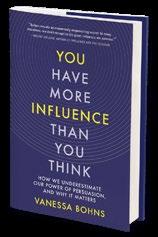
The review of social psychologist Vanessa Bohns’ book, You Have More Influence Than You Think, showcases the book’s insights on social perception, the power of persuasion, ethics in influence and the fear of embarrassment.
Wealth management specialists share their expertise in our feature article on the Great Wealth Transfer, digging into future implications for investment professionals and institutions as wealth is transferred from baby boomers to their children and grandchildren.
Value-conscious investors face the unique challenge of finding genuine opportunities. We draw on insights from experienced professionals, examining disciplined, long-term strategies to help value-oriented investors successfully navigate today’s stock market.
Have you ever wondered about the roles, structures and legal requirements of boards of directors? Our comprehensive summary demystifies board best practices, providing perspectives from international CFA Institute publications as well as Canadian legal requirements.
In this issue’s charterholder profile, Michael Sprung, CFA, speaks about professional independence and client alignment. His perspective spans a four-decade career in the industry, including two running his own investment firm.
Our practical career advice for professional development paths to investment quant roles would benefit professionals already working in the discipline and those considering entering it.
We also provide highlights from CFA Society Toronto’s video podcast series, Diverse Dividends, featuring Katy Boshart as she discusses her unconventional career journey. Her path to leadership has been guided by embracing change with an open mind.
Your feedback shapes our direction, and together we are building a publication that reflects and supports our dynamic investment community by providing relevant content.

Joanna Wolff, CFA
Portfolio Manager, Sionna Investment Managers Chair of Editorial Committee, Editor in Chief, The Analyst, CFA Society Toronto

In today’s finance and investment industry, leadership is less about your title and more about influence and how you show up. Influence is how you help others make sense of complexity, guide decisions and elevate the people and ideas around you. How you show up is the everyday proof: the way you listen, the questions you ask, the clarity you bring and the standards you hold yourself to, especially when the stakes are high. This matters in client conversations, team meetings, committee discussions, conference stages and the digital spaces where expectations continue to rise.
This spring issue of The Analyst focuses on a simple idea: strong leaders build influence with intention. That does not mean being the loudest voice in the room. It means earning trust over time through sound judgment, clear communication and consistency. For CFA charterholders, that intention is grounded in the values behind the designation: integrity, professional competence and a commitment to put clients’ interests first. It is the ability to frame a difficult message, navigate competing viewpoints and communicate with confidence when the outcome matters. It is also how you show up under pressure, with accountability and respect for others.
CFA Society Toronto exists to help you strengthen that kind of leadership at every stage of your career. Wherever you are on your path, membership connects you to people and resources that open doors, sharpen skills and build credibility. Community brings relationships with peers, mentors and leaders who understand your world and are willing to share hard-won insight. Competency supports future-ready development that helps you stay competitive, from technical depth to practical leadership skills. Content provides clear, practitioner-driven insight that cuts through the noise. And credibility comes from being part of a professional community grounded in high standards and the values of the CFA designation.
Influence also grows through participation. When you volunteer, mentor, speak, moderate or write an article, you are not only contributing to the profession but also building the capabilities that make leadership real. You expand your network, strengthen your communication and judgment and develop confidence for high-stakes moments, whether you are presenting to clients, engaging stakeholders, or stepping into governance discussions.
As you read this issue, I encourage you to choose one intentional step to build your influence this spring. Attend an event that broadens your perspective. Introduce yourself to someone new. Share an idea, ask a thoughtful question, volunteer for a committee or mentor a rising professional. Small actions add up, and the returns compound over time, for your career and for our profession.
Thank you for being part of this community and for the leadership you bring to our profession.
Sincerely,

Heather Cooke, CFA Chair, Board of Directors
CFA Society Toronto
The Analyst is published quarterly by CFA Society Toronto
120 Adelaide Street West, Suite 2205
Toronto, Ontario M5H 1T1
Telephone: 416.366.5755
Website: www.cfatoronto.ca
General questions: info@cfatoronto.ca
Management Office
Chief Executive Officer Fred Pinto, CFA
Director, Member Events & Experiences Jenny Yeo
Director, Operations Valerie Weddell
Director, Marketing & Communications Kenny Chan
Senior Manager, Education & Events Meredith Lowry
Senior Manager, Education & Events Mary-Margaret Courtney
Senior Manager, Infomation Technology Alexandra Pegg
Volunteer Relations Manager Leslie Venturino
Senior Manager, Corporate Relations & Business Development Aaron Ly
Manager, Leadership & Board Governance Calandra Muller
Marketing & Communications Manager Jessi-Lyna Wan Manager, Next Gen Program Sabina Cichy
Office & Membership Administrator Tania Lewis
Senior Associate, Education & Events Breanne Cheeseman
Senior Associate, Education & Events Amanda Black
Volunteers
Chair, The Analyst, Editorial Committee, Joanna Wolff, CFA
Editorial committee members
Alan Cody, CFA
Sanaz Danielle Fotoohi, CFA
Angha Gupta, CFA
Ben Jekiv, CFA
Winfred Lam, CFA
Attika Raj, CFA
Thomas Shen, CFA
Writers
Lauretta Chame, CFA
Sebastien Davies, CFA
Sanaz Danielle Fotoohi, CFA
Angha Gupta, CFA
Ed Ho, CFA
Lauren Huneault
Ria Patel, CFA
Ian Schnoor, CFA
Pathik Shah, CFA
Ryan Sheriff, CFA
Editor
Sara Maginn Pacella
Art director
Janet Sangalang
Opinions expressed in The Analyst do not necessarily represent those of the authors’ firms of employment or of CFA Society Toronto and do not constitute a solicitation for the purchase or sale of any financial instruments. Information herein is obtained from various sources and is not guaranteed for accuracy or completeness. The authors’ firms and CFA Society Toronto therefore disclaim any liability arising from the use of information in this publication. The information provided herein is intended only as general information that may or may not reflect the most current developments. The mention of particular companies or individuals does not represent an endorsement by CFA Society Toronto. Although professionals may prepare these materials or be quoted in them, this information should not be used as a substitute for professional services. If legal or other professional advice is required, the services of a professional should be sought.

One of the most meaningful ways CFA charterholders can demonstrate leadership is by mentoring the next generation. Most of us can point to someone early in our careers who took the time to help us see what was possible and how to get there. CFA Society Toronto’s Next Gen Program is about paying that forward, real-world exposure to the profession and the encouragement and support that turns talent into confidence and capability.
Our Next Gen Program is built to support the journey into the profession, from secondary school exploration through university and into the CFA Program as a candidate. It is guided by our Next Gen Steering Committee and delivered through three committees: Secondary School Relations, University Relations and Candidate Relations, with dedicated volunteer teams behind each stream.
Through our partnership with the Toronto District School Board, serving 579 schools, we offer a presentation on career pathways in finance and deliver virtual sessions that connect educators and students with practical insight into finance and investment careers. Through Ontario Career Lab, an initiative of the Ontario Ministry of Education, our volunteers participated in Career Conversations with Grade 9 and 10 students, sharing career stories and answering candid questions about what the work is really like.
At the university level, our focus is on applied experience and career readiness. Through our annual Embrace the Challenge event, we recognize our Undergraduate Finance and Economics Award winners and have student teams test their judgment and professionalism in real time through ethics and research competitions. A new initiative is CareerFest, where we give students practical “hiring literacy” on how early talent hiring works, what employers look for and how to stand out for the right reasons, paired with an “ask-me-anything” speed mentoring format that provides students with concrete next steps for resumes, interviews, networking and follow-through.
For candidates, Our Candidate Relations Committee is developing a Study Group Program in strategic partnership with the Rotman Finance Lab. The study group model is led by candidates and supported by CFA Society Toronto: students organize and run the groups on campus, and we provide the program backbone, templates, structure and guidebooks that candidates can use to organize and run their own study groups, wherever they are.
Our Next Gen Program’s most unique value is in the power of connecting students with CFA charterholders. Students often imagine our profession as a narrow set of roles. In reality, CFA charterholders work across research, risk management, private wealth, capital markets, corporate finance and strategy, compliance, fintech and more. Demand from schools and universities is growing, and we need more members willing to share their career journeys and offer practical advice by speaking in classrooms and at campus events.
If you’re looking for a meaningful way to lead, I invite you to volunteer as a speaker, mentor, judge, panellist or Next Gen committee volunteer. A few hours of your time can change a student’s trajectory.
Sincerely,

Fred Pinto, CFA, ICD.D CEO, CFA Society Toronto

By Lauretta Chame, CFA
A personal brand is the unique combination of skills, experiences and behaviours that shape how others perceive and remember you. We all have a brand. The real question is whether it reflects what you truly want to be known for. In today’s competitive professional landscape, owning your narrative matters.
This article aims to make personal branding less intimidating, while showing it in action across negotiation, influence and conflict management, drawing on insights from leading voices in Canada’s branding landscape.
A personal brand helps you stand out through credibility, influence and trust. It moves your career from reactive to proactive, allowing opportunities to come your way. Lissa Appiah, a Top 20 Career Coach, Top 20 LinkedIn Top Voice in Canada in 2025
In an era of automation, uniqueness becomes a powerful differentiator, particularly the ability to think across experiences.
and executive career coach for introverts, witnessed one of her clients move into an executive role and double her salary within 2.5 years of beginning to intentionally build her brand on LinkedIn. Importantly, a personal brand also provides a psychological anchor during uncertainty. “Your personal brand belongs to you, beyond any single role or employer,” affirms Estelle Chen, senior manager (chief of staff) at TD Bank Group and co-founder and president of La French Tech Toronto.
Skills: What you know and how you think
Hard skills are the foundation of your personal brand, reflecting domain expertise and establishing credibility. They are demonstrated through formal credentials, certifications, awards and tangible outputs such as reports, analyses or projects. These skills are essential, but no longer enough to differentiate yourself.
Human-centric skills shape how individuals interact and lead. Among them, problem-solving is a defining element of your brand.
Appiah says, “How each individual connects ideas and designs solutions is inherently unique.” In an era of automation, uniqueness becomes a powerful differentiator, particularly the ability to think across experiences.
Other key skills shaping a personal brand include resilience, empathy and adaptability. Together, these skills shape both a distinctive and resilient brand.
Staying ahead of the curve ensures your brand remains credible, and curiosity is paramount in that process. Fifty per cent of employers view curiosity and continuous learning as core skills, a share expected to rise by 2030. Nirupam Singh, a Top 20 LinkedIn Top Voice in Canada in 2025 and founder of The Commercial Table, reflects that “Curiosity brought me where I am today; it drives my momentum and never fades.” Chen concurs, emphasizing the importance of reading every day and applying two insights into practice in real life.
Network: Your brand amplifier
Your network can amplify your visibility and credibility and shape how others perceive you, but only if you cultivate it. Endorsements signal authority, mentors offer perspective and sponsors advocate for you when you are not in the room. Beyond mentorship and sponsorship, volunteering also offers opportunities to elevate your brand while giving back to the community.
Building relationships is a deliberate practice, and it’s most effective when you approach it in a way that feels natural to your personality. Appiah highlights that introverts can thrive in networking by prioritizing one-on-one conversations, connecting with attendees before events or asking meaningful questions that lead to deeper exchanges.
You must nurture your network by offering help, making introductions, celebrating others’ achievements and checking in regularly with no agenda. Ultimately, strong networks are built on consistency, generosity and authenticity. As Chen puts it, “Trust travels faster than titles.”
Purpose and goals
Building your personal brand starts from within, by reflecting on your purpose and goals. While your purpose sets your overall path, your goals turn it into concrete action.
Clarify your purpose:
• Which values or causes matter most to me? What energizes me?
• Which moments in my career felt like “This is exactly why I do this.”
• If money and titles didn’t matter, which career would I pursue?
Clarify your goals:
• What concrete steps do I need to take to reach my career goals?
• Which skills, credentials or certifications do I need to develop?
• What timeline am I targeting to get there?
Define your unique strengths
Uncover what will make your brand distinctive:
• What do people consistently praise me for?
• Which abilities feel effortless to me but challenging for others?
• How have my life experiences shaped who I am today?
After reflecting on these questions, it becomes clear that your brand isn’t something you invent: it reflects who you are. For instance, Chen’s brand emerged from her tri-cultural background, which once enabled her to facilitate a deal between Chinese and English counterparts by understanding and translating cultural expectations.
Define your audience
Clarify who you aim to influence:
Your network can amplify your visibility and credibility and shape how others perceive you, but only if you cultivate it.
• Who am I trying to reach? (Organizations, functions, leaders or decision-makers)
• What problems do they face? How do my strengths uniquely position me as a solution?
• Where do these people show up: which platforms or events do they engage with?
Express your brand
Once your purpose, goals, strengths and audience are defined, you can express your brand.
Purposeful visibility allows you to take control of your narrative and create value by sharing expertise, lessons learned and perspectives that can inform or inspire others.
Expression can take various forms, including LinkedIn posts, newsletters, public speaking, podcasts or videos. How you show up matters. Your communication should be consistent across time and settings and should match your actions. Most importantly, it should be authentic and aligned with your purpose.
Appiah reframes visibility as simply being known for something by the right people and reminds introverts that they can be just as visible by choosing settings that play to their strengths, such as writing or contributing in smaller rooms.
When your brand is clear, aligned and visible, it naturally becomes a foundation for your influence.
Influence and getting people to say yes
Influence is not forced; it begins with trust and rapport. One effective way to build this connection is through storytelling. Singh’s 3F framework illustrates this: “I combine Fact, Feeling and Fun to connect. Fact alone cannot build trust; people need to appreciate you as a human.”
Beyond rapport, influence deepens when people see that you stand for something larger than yourself. Chen, who takes a long-term view, asks, “What do you want to be remembered for?” Volunteering taught her to rely on influence, clarity and trust rather than authority.
Influence is also shaped by external context. For instance, in group settings, the next-in-line effect shows that people preparing to speak tend to focus inward, making them less receptive to your message. In contrast, open seating, natural light and calm environments can increase receptivity.
In any kind of negotiation or recruitment process, a credible personal brand plays a decisive role before the conversation even starts, Appiah says, as recruiters already recognize your value through your online content. This shifts the conversation from “Tell me about yourself” to “How do we make this work?”
How do you turn this credibility into a concrete “yes”? Rely on negotiation best practices, such as the PIER negotiation framework developed by J. Paul Nadeau, seasoned hostage negotiator: Preparation, Intention, Engagement and Relationship. Remember that first impressions matter: confident body language, eye contact, tone and presence establish trust.
Ultimately, negotiation is first and foremost a human connection experience, not just a deal-closing moment. With credibility as the pillar of her brand, Chen prioritizes long-term relationships and shared interests to connect with others in negotiation.
people: A leadership skill
Research shows that over 50 per cent of communication is nonverbal. By noticing shifts in facial expressions, gestures, posture and voice, you can better navigate interactions while signalling attentiveness, respect and emotional intelligence, qualities that reinforce your personal brand.
Interpreting these signals can be approached through the 5C framework:
• Context: Someone waiting outside in cold weather with tightly crossed arms and legs is likely keeping warm, whereas the same posture in a negotiation room may signal disagreement.
• Clusters: An index finger pointing up the cheek with the thumb supporting the chin, combined with a downward head tilt, crossed arms and legs, could collectively signal defensiveness.
• Congruence: When someone verbally agrees but their body language is closed, the signals don’t match. In this case, the body is usually the more reliable cue.
• Culture: In most eastern cultures, direct eye contact is perceived as rude or aggressive, while it signals trust and confidence in western countries.
• Consistency: Identifying someone’s baseline helps spot meaningful shifts. A usually smiling person who suddenly appears closed when a topic arises may be signaling discomfort with that subject.
Purposeful visibility allows you to take control of your narrative and create value by sharing expertise, lessons learned and perspectives that can inform or inspire others.
Research shows that over 50 per cent of communication is non-verbal. By noticing shifts in facial expressions, gestures, posture and voice, you can better navigate interactions while signalling attentiveness, respect and emotional intelligence, qualities that reinforce your personal brand.
Navigating those elements requires patience, curiosity, empathy and adaptability.
The ability to read people can also offer a mirror of how your brand is experienced. Repeated positive non-verbal cues toward you, such as authentic smiles or relaxed posture, signal trust. Conversely, consistent negative cues may indicate that your brand is not well received.
Your brand is most revealed during challenging moments. How you handle conflict, in particular, shapes how others perceive you. “Adversity is your friend and a key element in growing your personal brand”, says Singh.
Conflicts matter for your personal brand because they often stem from unmet psychological needs. Handling conflict well means addressing those needs and, ultimately, preserving human dignity. This leaves a lasting impression, strengthens bonds and reflects your brand in a deeply positive way.
For example, in the workplace, resistance to an imposed tight deadline may not be about the deadline itself, but rather from an unmet need for:
• Autonomy (receiving a deadline without being consulted)
• Psychological safety (not feeling safe to openly disagree)
• Recognition (not feeling valued)
An employee experiencing any of these may respond with defensiveness.
Asking, “How is your current workload?” or “I really appreciate your dedication; how can we agree on a reasonable deadline?” directly addresses underlying needs and can lead to a completely different outcome.
This exercise requires self-awareness and emotional regulation, creating space for empathy and curiosity to uncover unmet needs beneath the conflict.
Personal branding is more than a career tool. It can be a gateway to a healthier life.
When your brand reflects your values, it becomes a natural compass, connecting you to opportunities and people who resonate with who you truly are, fostering healthier relationships and experiences. The inner work required to uncover your uniqueness builds self-confidence. And when adversity hits, your established brand helps you rebound with greater resilience and less stress.
All of this supports your well-being, your sense of self, and your overall quality of life. But only if you are truly aligned. As Socrates said, “Be as you wish to seem.”
Lauretta Chame, CFA, is a volunteer with CFA Society Toronto’s Institutional Asset Management Committee.
By Pathik Shah, CFA
Have you ever left a meeting feeling like you spoke into a void? Or sat in silence and walked away assuming you were the most forgettable person in the room? Have you obsessed over awkward pauses or assumed others were indifferent to your voice?
You Have More Influence Than You Think, Vanessa Bohns demonstrates that we are rarely as invisible as we feel. Your mere presence can quietly shape a room. A random social media post or a passing interaction can lead others to mirror your actions and adopt your ideas without you knowing. Conversely, for those in power, influence can be an unintended weight: a whispered suggestion is heard as a shouted command. Bohns goes beyond building confidence; she reveals the unseen influence you already have and provides a framework for using it with intention.
At the heart of the book lies a profound cognitive dissonance. Bohns identifies the “invisibility cloak illusion,” our tendency to believe that, while we are busy observing others, they are not as interested in observing us. She cites research on mentalization – the act of thinking about what others are thinking – to show that we vastly underestimate how much others are “inhabiting” our minds. We assume our thoughts and presence are private, yet Bohns shows how our mere existence in a
space actively shapes the experiences and reflections of those around us.
This is countered by the “spotlight effect,” a concept pioneered by psychologist Thomas Gilovich and his colleagues. While the invisibility cloak makes us feel unseen, the spotlight effect makes us feel too seen in all the wrong ways. We believe our minor blunders – a stutter or a typo – are magnified under a harsh glare.
Bohns bridges these two concepts with research on the “liking gap”: the idea that after an initial interaction, people generally walk away with a much higher opinion of us than we realize. We are “visible in all the wrong ways” only to ourselves; we obsess over a coffee stain before a big presentation while others are simply taking away the gist of our content. By correcting these biases, we see that our voice carries more weight than we ever dared to claim.
The ‘yes gap’: Why we underestimate persuasion
Beyond mere presence, Bohns’ research uncovers a massive “compliance gap.”
We are chronically pessimistic about our persuasive powers, often failing to ask for what we need because we assume the answer will be no. Bohns’ own and other published studies have found that people are roughly twice as likely to agree to a request than the requester predicts.
The error in our logic is simple: we focus on the instrumental cost: the time or effort required for the other person to help us. We ignore the social cost: the immense psychological pressure and awkwardness of saying no. Because humans are fundamentally wired for cooperation and social harmony, we are predisposed to say yes. This suggests that the greatest barrier to our influence is not a lack of charisma, but our own reluctance to initiate the ask.
We are so afraid of looking foolish that we often stop ourselves from asking for what we need.
We are “visible in all the wrong ways” only to ourselves; we obsess over a coffee stain before a big presentation while others are simply taking away the gist of our content.
A striking takeaway from the book is our intense fear of social awkwardness. We are so afraid of looking foolish that we often stop ourselves from asking for what we need. Bohns cites studies where participants even disregard personal safety just to avoid a social scene.
Her examples reminded me of my own encounter with this exact fear. During an important virtual presentation recently, the office fire alarm went off. I was so worried about ending the meeting “abruptly” or looking unprofessional that I just kept talking. I apologized for the background noise, but the audience said they couldn’t hear a thing thanks to my noise-cancelling software.

So, I stayed in my chair, presenting to a silent screen while my colleagues started moving toward the exit. It took a senior manager telling me to get out before I finally ended the call.
In the latter half of the book, Bohns pivots toward responsibility. If we have more power than we realize, we also have the capacity to inadvertently pressure, coerce or intimidate others. For those in leadership positions, underestimating their status is a professional liability. A manager’s “thinking out loud” is frequently interpreted by subordinates as a direct order. Bohns warns against being the “maverick” leader who makes a bold suggestion and then tells a subordinate, “The decision is yours.” While the leader thinks they are granting agency, the subordinate often feels the opposite. They realize they don’t have a choice; they only have the burden of figuring out how to deliver exactly what the leader wants while pretending it was their own idea. This illusion of choice can be more coercive than a direct command because it masks the true
Bohns challenges leaders to perform an influence audit to realize that our status casts a long shadow. Sometimes, the most influential move a leader can make is to remain silent, creating space for others who feel as invisible as the leader once did.
In a digital age where influence is often measured by follower counts and blue checkmarks, Bohns reminds us that true influence is local, personal and inevitable. You don’t need a platform to change a mind; you just need to show up and speak up. By the final chapter, you realize that your voice carries further than you ever imagined. You aren’t just a face in the crowd; you are a catalyst for everyone around you. Now that you know how influential you are, how will you use it? The choice is yours!

, CFA, MBA, is vice president at J.P. Morgan Asset Management. He is an investment team member within MultiAsset Solutions, specializing in liability-aware and global asset allocation investment strategies.

By Sanaz Danielle Fotoohi, CFA, MBA, AFM
This article summarizes the third edition (2018) of CFA Institute’s publication, The Corporate Governance of Listed Companies, including supplementary briefs Role of Board of Directors and Board of Directors Structure, and highlights Canadian legal requirements under the Canada Business Corporation Act (CBCA).
Boards may adopt CFA Institute best practices voluntarily to enhance governance. Corporate governance is a set of control measures and procedures to manage companies. It defines the rights and responsibilities of management, board, controlling and minority shareholders and various stakeholders and minimizes and manages conflicts of interest among these groups. Good corporate governance practices ensure that:
• Boards act in the best interests of shareholders and independent of management and other influential groups
• A company acts lawfully and ethically with respect to all stakeholders
• Shareholders’ rights are respected and well communicated
• A company’s governance, financial and operating activities are reported to shareholders and relevant stakeholders in a fair, accurate, timely, reliable, relevant, complete and verifiable manner
Under CBCA, the board owes fiduciary duties to the corporation and not directly to shareholders. Ultimately, the strength of the shareholder voice through voting rights and an adequate structure of governance practices determines the success of its implementation.
The board of directors (hereafter “the board”) is the highest governing authority within the management structure of a corporation. Governance often affects the company value over a long timeframe, and the board is responsible for the overall strategy of the company. The board is accountable to select, evaluate and approve compensation for the company’s chief executive officer (CEO), evaluate the attractiveness of and approve dividends, recommend stock splits, oversee share repurchase, approve the company’s financial statements, recommend or reject mergers and acquisitions opportunities
and the like. The primary objective of a corporate board is to protect the assets of shareholders and ensure they receive a positive return on their investments. Under Canadian corporate law, directors owe their fiduciary duty to the corporation itself, rather than to shareholders directly. In fulfilling this duty, directors may consider the interests of multiple stakeholder groups, provided their decisions are made in the best interests of the corporation.
Boards are composed of individuals elected by a company’s shareholders annually or for multi-year terms (“staggered” or “classified” board). Boards often operate on a rotating system where only a few directors are up for election each year. This impedes a complete board change in the event of a hostile takeover and is used as an anti-takeover device. Conversely, companies that prevent shareholders from approving or rejecting board members annually limit their ability to change the board’s composition when needed for strategic or market shifts.
To serve shareholders’ and the company’s long-term interests, board members need four commitments: independence, experience, resources and accurate information about the company’s financial and operating position.
To serve shareholders’ and the company’s long-term interests, board members need four commitments: independence, experience, resources and accurate information about the company’s financial and operating position.
Independence:1 Company boards should have an independent majority (more than 50 per cent of the board) to mitigate conflicts of interest and foster independent decision-making of management. Except for the audit committee, Canadian rules emphasize disclosure rather than mandatory independence thresholds. To maintain independence, CFA Institute recommends current and former executives and directors of an issuer should not be permitted to sit as an independent nonexecutive director until five years after leaving the relevant positions. CFA Institute also recommends that independent non-executive directors should not have been connected to a director, CEO or substantial shareholder of the issuer within the preceding five years. Long-term participation of over 10 years may improve member’s knowledge of the company, but risks reduced independence. CFA Institute recommends boards limit the length of service of directors on a specific company to no more than 15 years.
Independent board members should meet at least annually without management or executive board members present and regularly report on their activities to shareholders. The board chair should not hold the title of CEO, as the separation of the chair and CEO positions is considered a best practice and ensures the board agenda is uninfluenced by the CEO and management team.
Experience: Boards should comprise of competent individuals and strive for diverse expertise and perspectives, including an increased investor focus. Directors should be able to make informed and independent decisions about company’s financial, accounting, strategic, business and legal matters and act with competence driven by their understanding of the company’s principal business. Boards should refrain from having members with many existing board representations so that members are not time-constrained.
Resources: Boards must have the authority to hire external auditors and other outside consultants without management’s intervention or approval. This mechanism alone provides the board with the ability to obtain expert help in specialized areas.
Accurate information: Board members must have access to complete and accurate information about the financial position of the company and its underlying value drivers to steer the company toward its best long-term interests.
CFA Institute has compiled A Checklist for Building Shareholder Value.
Board committees covered by national corporate governance codes or exchangemandated guidelines include the audit
committee, remuneration or compensation committee and nominations committee. The committee system is used to delegate specific tasks to committees of the board, all of which must have at least three members. A majority of the members must be either independent board members or non-executives. Committees examine specific issues, but the board retains final decision-making authority.
Audit committee: This committee ensures financial information reported by the company is complete, accurate, reliable, relevant and timely. This committee is responsible for hiring and supervising independent external auditors. In Canada, companies listed on the Toronto Stock Exchange are required to disclose whether the audit committee members are nonexecutive. Canadian securities rules require audit committee independence.
Remuneration or compensation committee: This committee ensures compensation and other awards encourage the board and management to enhance the company’s long-term profitability and value. This committee determines if the renumeration packages are commensurate with the level of responsibilities of the executives and if compensation drivers foster excessive risk-taking, manager entrenchment or abusive and unethical behaviours. The committee should link executive compensation to its longterm profitability and value relative to competitors and comparable companies and ensure alignment with company strategy, risk appetite and corporate culture. It is best that this committee include only independent board members. Canadian securities rules encourage compensation committee independence. In Canada, the Toronto Stock Exchange requires listed companies to report in their annual reports or their management
1 Independence, as it relates to board members, refers to the degree to which they are not biased or otherwise controlled by company management, other groups who exert control over management or shareholders.
information and proxy circulars whether they have a compensation committee and whether a majority of the board is independent.
Nominations committee: This committee identifies new board members and examines the performance, independence, skills and expertise of existing board members. They create nomination policies and procedures and oversee succession planning for executives and board members. This committee must remain independent to ensure the fairness of performance assessments and recruitment of individuals who work on behalf of the company.
Other board committees: These committees are tasked with addressing issues pertinent to the company’s specific industry, line of business and circumstances. These committees might be dedicated to risk management, ESG and sustainability, strategy or special situations critical for longterm shareholder value creation.
Continuous improvement model to enhance board effectiveness
Quality input from the management team is the most widely selected driver of exceptional board performance. Management provides information, and the board provides insight. Boards should invest 60 per cent of their time on strategy, talent and oversight, and the remaining on hindsight. Boards that work well with management require skills, proper board structure, a well-defined meeting agenda and post-meeting briefings. Great boards need great chairs, with the chair-CEO relationship at the heart of success. The continuous improvement model developed by Professor David Beatty at Rotman School of Management emphasizes key steps before, during and after board meetings.
Based on this model, the chair should draft a well-defined agenda in consultation with the CEO and solicit input from directors individually prior to meetings. The board meeting comprises two steps: 1) A directors-only meeting to discuss the agenda and 2) a directors and CEO meeting to discuss the CEO’s priorities. The board meeting concludes with the management team leaving, followed by the CEO, leaving the directors in camera. It is recommended that the chair directly solicit feedback from each director, while the CEO debriefs the management team on performance and areas for improvement. The chair and CEO should review the return on investment from the meeting and identify opportunities for improvement. The chair should also follow up with directors several days after the meeting to support the continuous improvement model and the return on the board’s invested time.
Corporate boards communicate with shareholders primarily through formal disclosures such as annual reports, management’s discussion and analysis, management information circulars, governance and compensation disclosures, shareholder meetings and direct engagements. A board should not breach its fiduciary duty to the company by acting in the interest of any specific shareholder or disclosing material nonpublic information.
Shareholders influence corporate governance through voting, electing or removing directors, approving major actions and holding the board accountable for oversight and long-term value creation.
Institutional investors can engage with boards on capital allocation, risk and board composition. Shareholders may also use activism, share sales or legal remedies (e.g., CBCA s.241 Oppression Remedy). Proxy access in the U.S. allows nominating directors; in Canada, large shareholders (five per cent or more) can submit proposals, including nominations, and requisition meetings. Ownership structures, including dual-class shares, can disproportionately affect voting rights and shareholder influence.
The board is the key oversight body linking management and shareholders and the primary mechanism for implementing corporate governance. Board members owe fiduciary duties of care, loyalty and good faith to the corporation, requiring them to act prudently, independently and in the best interests of the company and its shareholders. Active and prudent shareholder engagement is the most effective instrument for the successful execution of corporate governance.
Sanaz Danielle Fotoohi, CFA, MBA, AFM, is a volunteer member of CFA Society Toronto’s Strategic Content Committee and Editorial Committee and a contributor to The Analyst
By Angha Gupta, CFA
Many people are experiencing a sudden influx of money, property or other assets. Where is this wealth coming from and what are its impacts? The Chartered Professional Accountants of Canada said in 2023 that $1 trillion of wealth was expected to move between Canadian baby boomers and their millennial and generation X children from 2023 to 2026.
Now what should be done with that wealth? How much will the government tax? What is the best way to invest it? We have the pleasure today of answering these and other questions about the Great Wealth Transfer.
This article is based on insights from experts Warwick Bloore, CFA, MA, senior specialist at Vanguard Europe, Kamran Khan, CFA, chief operating officer at Sartorial Wealth Inc, SmartAsset AMP and Shawnee Grain & Feed.
The Great Wealth Transfer refers to the unprecedented shift of wealth from older generations – primarily baby boomers – to younger generations, including generation X, millennials and generation Z. Relative to historical norms, older generations hold a disproportionately large share of total wealth, much of which is expected to be transferred over the coming decades.
Several factors have contributed to this dynamic. Long-term appreciation in asset values, particularly in real estate and financial markets, has materially increased household wealth. At the same time, rising life expectancy has delayed the timing of transfers while allowing assets to compound further. Importantly, this wealth is not limited to cash holdings; it spans real
estate, public equities, commodities and alternative assets.
The significance of this transfer lies in its implications for future capital distribution and management. As wealth increasingly resides with younger generations, understanding their financial priorities, preferences and constraints becomes critical. For example, elevated housing prices have increased leverage for many younger households, making debt management and housing affordability more prominent objectives than in prior generations.
While generational trends exist, differences across individuals remain substantial, driven by variations in personal circumstances, financial goals and engagement with financial tools.
The Great Wealth Transfer presents both risks and opportunities for investment professionals. Advisors must adapt their service models to meet the evolving needs of younger investors while continuing to serve older clients effectively.
Wealth transfers do not necessarily result in a one-for-one continuation of existing portfolios. Assets received
through inheritance are often reallocated – real estate may be sold or retained, and financial assets may be redirected toward housing needs, debt reduction or alternative investments. Consequently, intergenerational transfers can lead to meaningful shifts in asset allocation rather than a simple pass-through of market exposure.
This dynamic introduces retention risk for advisors. While relationships with older clients may be well established, transferring assets to heirs can result in attrition if those relationships have not been cultivated. Early engagement with the next generation can help mitigate this risk, allowing advisors to demonstrate value and adapt their offerings to evolving priorities.
Younger investors may not initially require comprehensive financial planning. Many seek lower-cost, passive investment solutions or have objectives unrelated to portfolio growth in the early stages of wealth accumulation. Advisors can address this by offering tiered service models that maintain engagement while accommodating simpler needs.
Finally, advisors will also need to expand their offerings, as a large portion of younger people are not interested in traditional equity and fixed-income investments alone. There is a stronger pull toward private debt, private capital, alternative investments, commodities, digital assets and other such assets. Not to mention that many in the younger generations are more likely to trade on their own rather than stick to passive, publicmarket index funds. Additionally, younger generations are showing a bigger interest in sustainability and ESG practices, and not just performatively. Many in the younger
generations are looking hard at how an asset contributes to sustainability and ESG practices.
Portfolio preferences have also evolved. Greater access to digital platforms and investment information has enabled younger investors to engage more directly with markets, often through self-directed accounts or low-cost, passive exchangetraded funds. At the same time, interest has grown in thematic approaches, including ESG-oriented strategies and emerging asset classes such as digital assets. While public equities and fixed income are likely to remain the core building blocks of most portfolios, advisors will need to broaden their expertise and articulate a clear value proposition in order to remain relevant as investor preferences continue to diversify.
Effective tax management is a central consideration in wealth transfer planning. While strategies must be tailored to individual circumstances, several general principles apply. Importantly, estate planning should be undertaken with qualified professionals and revisited regularly.
It is important to note that none of the strategies should be used exclusively or tackled alone. Specialists can help effectively manage estates, no matter how small, and keep tax impacts to the lowest possible. However, it is important to engage with these professionals early and on an ongoing basis, and to find one with a good track record.
Below are a few examples of strategies for managing intergenerational wealth transfers.
Sudden inheritances can pose challenges for recipients who lack experience managing significant assets. Gradual involvement in
financial decision-making, combined with ongoing education, can reduce the risk of poor decisions, fraud or mismanagement. Phased transfers may also mitigate behavioural and tax-related risks.
Outdated or incomplete estate plans can result in unnecessary taxation, probate delays and unintended outcomes. Periodic reviews, coordinated among legal, tax and wealth advisors, are essential to ensure that wills, trusts and beneficiary designations remain aligned with objectives.
Clear communication among families and advisors can reduce tax inefficiencies and minimize the risk of disputes. Establishing expectations about beneficiary roles, governance structures and decision-making processes is particularly important in complex estates.
Trust structures can offer tax deferral, asset protection and control. In certain cases, estate freezes may allow future appreciation to accrue to beneficiaries while limiting tax exposure for the original owner.
Where multiple properties exist, strategic designation of the principal residence exemption can materially reduce capital gains tax. A variety of life insurance and other insurance strategies can also be incorporated to reduce tax impact upon death.
Tax efficiency remains highly relevant even beyond the initial transfer of wealth.
Different income types, interest, dividends and capital gains are taxed differently depending on the account structure. Optimizing asset location across registered
and non-registered accounts can meaningfully improve after-tax outcomes.
Tax-deferred accounts such as RRSPs and RRIFs shift taxation into the future, making withdrawal timing critical. Coordinating withdrawals with lower-income years and using Tax-Free Savings Accounts strategically can help smooth lifetime tax rates.
Integrating investment income with employment income, pensions and government benefits is essential to minimize taxes and avoid benefit clawbacks, particularly for programs such as Old Age Security. Advance planning for withdrawals from Registered Retirement Income Funds and the use of pension income splitting can further enhance tax efficiency.
Preparation for the Great Wealth Transfer is relevant at every stage of life. Early planning, clear communication and coordinated professional advice can help preserve wealth, reduce tax leakage and ensure continuity across generations. For investment professionals, adapting service models and engaging younger clients proactively will be critical to sustaining long-term relationships and assets under management in an evolving wealth landscape.
Angha Gupta, CFA, is a senior analyst at S&P Global Ratings. She holds an MBA from Ivey Business School and is an FSA Credential Holder from the IFRS Foundation. She is vice-chair of the Corporate Finance Committee at CFA Society Toronto, a member of the Editorial Committee at CFA Society Toronto and events director at Ascend Canada.
By Ed Ho, CFA
Careers in investment management are often described as journeys shaped by a series of decisions made under the constraints of the time. Markets change, institutions evolve and incentives shift, but the deeper challenge remains the same: how to exercise fiduciary judgment responsibly over long periods of time, often while resisting pressures to move faster, grow bigger or chase what appears to be working in the moment.
This article is a summary of a Q&A with Michael Sprung, CFA, and has been edited for length and clarity.
Michael Sprung’s career, spanning more than four decades, reflects a consistent commitment to that challenge. Over the course of his professional life, he has managed equity portfolios measured in the billions, worked inside large institutional environments and ultimately chosen independence to preserve alignment with his professional values. His path offers an instructive counterpoint to a profession increasingly driven by scale, speed and short horizons.
Learning markets the hard way
Sprung entered the investment industry in 1979, a formative period marked by volatility, institutional discipline and the lingering memory of how quickly markets can turn. Those early years coincided with events that left an imprint on an entire generation of investors: the 1982 recession, the 1987 market crash and, later, the rise and collapse of highly leveraged strategies such as Long-Term Capital Management.
He also witnessed cycles of enthusiasm and disappointment, including the gold boom and bust of the late 1970s and early 1980s.
Markets, Sprung learned early on, are not abstract systems governed by elegant theories, but human environments shaped by fear, greed, leverage and narrative. Cycles repeat, though never in identical form, and recognizing them requires having seen not only success, but failure.
Managing capital on behalf of pensions and public-sector entities imposes a discipline that extends beyond performance metrics. Over the course of his career, Sprung developed a grounding in value-oriented thinking, influenced by Benjamin Graham, that emphasized intrinsic value, margin of safety and the importance of knowing when markets are drifting away from fundamentals.
One of the advantages of experience is the ability to detect recurring market dynamics. Having lived through multiple market cycles, Sprung developed an instinct for when enthusiasm begins to outrun reality. Debt-fuelled frenzies, sell-side product innovation designed to meet market fads rather than genuine investor needs and the seductive confidence of bull markets all become easier to spot with repetition.
This grounding has informed his investment temperament. Rather than reacting to every new narrative, Sprung learned to ask familiar questions: What assumptions are being made? Where is leverage building? What happens if expectations are wrong? These questions are not a guarantee of success, but they provide ballast when markets become euphoric or fearful.
Importantly, this kind of judgment accumulates slowly, often uncomfortably, and often at odds with the prevailing mood of the moment. For Sprung, the value of experience lies not in predicting outcomes, but in identifying risk before it becomes obvious.
In 2005, well into his career, Sprung made one of the more consequential decisions of his professional life: founding Sprung Investment Management. That decision was driven by a desire for alignment between client and institutional goals and more freedom to choose what’s right for his clients without organizational pressures.
Large institutions offer resources, reach and brand, but they also impose constraints. Growth targets, sales pressures and internal politics can gradually distance decision-makers from the work that first drew them into the profession. For Sprung, independence offered a way to remain close to portfolio construction, client relationships and accountability.
The trade-offs were real. Running an independent firm meant assuming responsibility not only for investment decisions, but also for operations, compliance and the less visible burdens of entrepreneurship. Over the years, regulatory requirements have expanded significantly, increasing the cost and complexity of remaining independent. Compliance, once a manageable function, has become a major expense that favours scale and makes life more difficult for smaller, partner-owned firms.
Yet independence also brought clarity. Sprung could deliberately choose clients, align expectations honestly and avoid growth for its own sake. The firm he built was intentionally focused on private clients, non-profit organizations, endowments, foundations and small institutions. Its success would be measured by trust and continuity rather than solely by absolute asset growth.
Sprung’s decision to go independent also intersected with a reality that many professionals are reluctant to acknowledge openly: ageism remains a persistent feature of the investment industry. While experience is often praised in the abstract, it is frequently discounted in practice. Firms may choose to hire multiple younger professionals rather than a single seasoned investor, even when the latter brings judgment, historical perspective and the ability to foresee mistakes before they occur.
For Sprung, independence offered a way to step outside this dynamic. Rather than
Success becomes less about maximizing personal upside and more about maintaining coherence, purpose and autonomy.
competing within organizational structures that undervalued experience, he chose a model that rewarded it directly. Control over his time, clients and process became increasingly important as he moved through his career. Decisions were framed in terms of his values and focus: taking care of his clients by providing high-quality investment advice. Success becomes less about maximizing personal upside and more about maintaining coherence, purpose and autonomy.
One of the more human tensions in Sprung’s career is the contrast between his temperament and his public visibility. By his own description, he is an introvert. He does not enjoy marketing, self-promotion or sales in the conventional sense. And yet, over the years, he has become a familiar presence on business television and the financial press.
This was not a natural fit. Early media appearances were often uncomfortable, and he learned quickly that communication carries its own risks. An offhand remark or an imprecise phrase can have consequences. These experiences reinforced the importance of clarity, restraint and simplicity.
Sprung’s communication style evolved alongside his investment philosophy. Early in his career, like many professionals, he sometimes overcomplicated his explanations. With experience, he came to appreciate that the most respected investors explain their thinking plainly because clarity reflects understanding.

• Founder and president, Sprung Investment Management Ltd. 2005
• Vice-president, Fiera/YMG Capital Management
• Vice-president, Goodman & Company
• Portfolio manager at OTTPB and Ontario Hydro
• Volunteer experience: President, Rotary Club of Toronto Sunrise
Chair and director, Bellwoods Director, Hearing Foundation Canada President, Genesis Club of Toronto
• CFA charterholder
• MBA, Western University; B. Math Actuarial Science, University of Waterloo
At this stage of my life, having control over my time, my clients and my process matters more than anything else.
FUN FACTS:
Early influence:
Benjamin Graham- style value investing
First investment role:
Research and portfolio work at Confederation Life
Career throughline: Buy-side investing across institutional, pension and independent settings
Most underestimated skill in investing: Patience
What experience teaches: Markets repeat, but the narratives change
Favourite investing principle: Simplicity over cleverness
Early media presence:
One of the first guests on ROB-TV / BNN
What he’s doing outside the office: Cottage, photography and training a new rescue dog that hasn’t exactly warmed up to him
Independence also reshaped Sprung’s relationship with clients. In the early years of running his own firm, he did not have the luxury of being selective. Some client relationships were difficult, timeconsuming and misaligned. As the firm matured, he gained the ability to make more careful choices.
Today, Sprung views clients as partners rather than assets. Alignment matters. Investors seeking aggressive, highmaintenance strategies are often better served elsewhere, and he is comfortable saying so. This selectivity is an acknowledgment that successful longterm relationships depend on shared expectations and temperament.
Sprung’s long involvement with the CFA community gives him perspective on how the profession has changed. Early in his career, the CFA designation was a clear differentiator. Today, it remains essential, but its role has shifted. It is often the price of entry rather than a guarantee of distinction.
In a more crowded and competitive field, standing out requires more than credentials. Judgment, communication and endurance matter. Looking back, Sprung reflects that he may have changed roles more often than necessary earlier in his career. Staying longer, he suggests, might have allowed for deeper learning and continuity.
Progress is not always measured by a higher salary or a fancier title. Sometimes,
growth happens by patiently staying put long enough to understand the work, the culture and the consequences of decisions made over time.
When asked what advice he would offer younger professionals, Sprung’s guidance is practical. Getting a foot in the door matters more than landing the ideal role immediately. Exposure, proximity to decision-making and learning on the job create opportunities and a foundation for future growth.
Equally important is recognizing that discomfort is part of the process. Sales, communication and public accountability are unavoidable, even for introverts. Careers reward those willing to step into discomfort to do what is necessary.
For Sprung, the defining feature of a successful career is not any single achievement, but coherence as a whole. For him, independence was one expression of that coherence. Wisdom ultimately emerged from learning to live with uncertainty and choosing a work environment that aligned with his values for the long term.
Ed Ho, CFA, MSc, is an energy consultant specializing in strategy, policy and finance, focusing on the challenges and opportunities of the energy transition. He is a candid storyteller with the goal of driving consensus through fact-based diplomacy.

By Sebastien Davies, CFA
Quantitative finance is not a single profession. It spans research-driven systematic funds, discretionary investment teams with quantitative overlays, sell-side trading or structuring desks and infrastructure roles focused on pricing, risk and execution.
These environments operate under different objectives and constraints and therefore reward different skill sets.
At elite systematic funds, competition has intensified to the point where strong Python skills and a statistics degree no longer differentiate candidates. At the same time, traditional investment firms are hiring quantitatively trained professionals at an accelerating rate not to replace discretionary judgment, but to support it with better technology, monitoring and analysis.
For professionals considering quantitative finance as a career, or transitioning toward it from adjacent roles, the relevant question is not whether “quant” skills matter. It is which quantitative path you are targeting, and which skills will compound rather than commoditize.
A “quant” is a role that applies mathematical, statistical and computational knowledge to address financial problems. That definition covers a wide range of roles.
For professionals considering quantitative finance as a career, or transitioning toward it from adjacent roles, the relevant question is not whether “quant” skills matter. It is which quantitative path you are targeting, and which skills will compound rather than commoditize.
On the buy-side, quants work in systematic equity strategies, derivatives pricing, portfolio construction, volatility strategies and commodity curve modelling. On the sell-side, they sit within derivatives desks, structured products, risk management and electronic trading infrastructure.
What differentiates these roles is not technical sophistication alone, but proximity to decision-making, clients and live markets. A quant developing alpha signals for a systematic equity strategy operates under different constraints than a quant supporting interest rate derivatives pricing at a dealer. The work cadence, incentives and success drivers differ materially.
Asset classes shape the work
In equities and other cross-sectional strategies, emphasis falls on factor models, signal construction, portfolio optimization and execution. Data is large and noisy, and programming speed and iteration matter more than mathematical elegance.
A PhD can be a useful signal because it shows someone can do quantitative work and learn independently, but it is not the job. In practice, only a small portion of quant work is applied mathematics. Most of the effort is taking those insights and putting them into production.
Fixed income and derivatives place greater weight on term structure dynamics, pricing theory and model assumptions under stress. Economic intuition and market convention play a larger role, and structural relationships often dominate short-horizon signal analysis.
Commodities introduce physical constraints, seasonality and storage economics, rewarding hybrid skill sets that combine financial modelling with operational understanding.
The question “Do I need a PhD?” is poorly framed without specifying which segment of the market you are targeting. Xavier Robitaille, a quant with extensive sell-side experience, is explicit on this.
“A PhD can be a useful signal because it shows someone can do quantitative work and learn independently, but it is not the job. In practice, only a small portion of quant work is applied mathematics. Most of the effort is taking those insights and putting them into production. That means writing code, dealing with messy data, working through legacy systems and handling operational constraints. I’ve seen highly credentialed people struggle because they wanted to do theory, when the job is mostly applied.”
This perspective reflects hiring dynamics across much of the buy-side and sell-side. It contrasts with the most competitive research-driven systematic funds and proprietary trading firms, where academic credentials often serve as an initial screening mechanism. In those environments, candidates are differentiated less by general quantitative skill and more by their ability to contribute novel quantitative ideas, develop proprietary models or extend existing frameworks in non-trivial ways.
Both perspectives describe real conditions across different market segments. The mistake is treating quantitative finance as a single ladder with uniform requirements.
One instructive career pattern comes from an investment professional at a multistrategy fund who requested anonymity. She transitioned from a macro-analyst role, initially grounded in fundamental research and qualitative judgment, to a more quantitatively oriented investment role.
As quantitative models became more central to investment discussions, she upskilled deliberately. Her objective was not to compete with specialist researchers, but to understand the models sufficiently well to think about them critically and communicate their implications to portfolio managers.
“I didn’t need to outcompete PhDs,” she noted. “I needed to understand the models well enough to ask better questions, interpret the outputs and explain what mattered to people who didn’t live in the math.”
Her role now sits largely at the interface between quantitative teams and decisionmakers. The value lies in translation. If a model’s behaviour cannot be explained clearly, confidence in its use is limited.
This pattern becomes increasingly common as quantitative methods spread. The binding constraint is often integration rather than technical capability.
Communication, in this context, is not ancillary to quantitative work. An inability to translate concepts, assumptions and outputs into decision-relevant terms can become a limiting factor. Professionals who can clearly explain model behaviour, sensitivities and limitations have a disproportionate impact, even when they are not the most technically specialized contributors.
This advantage is underappreciated because it is rarely taught formally. In practice, it often determines whether quantitative insight is incorporated into decisions or sidelined.
Programming is no longer a specialist function. It is a working requirement, primarily to implement quantitative ideas, rather than an end in itself.
The relevant threshold is the ability to work independently. This includes writing and modifying Python code, querying data with SQL, understanding version control and reading others’ code to evaluate models and assumptions. These skills allow quantitative work to move from theory into computation.
Programming, however, does not substitute for a quantitative foundation. Mathematical finance and statistical reasoning are prerequisites for quant roles, not optional enhancements. Comfort with probability, optimization, time-series behaviour and model limitations is assumed. Without this grounding, it is difficult to assess whether a model is appropriate or whether results are meaningful.
Advanced training in mathematics, statistics, econometrics or financial engineering can be highly valuable, particularly for research-oriented roles. While credentials alone are not sufficient, they often provide the depth and structure required to operate credibly in quantitative environments.
Quantitative work also sits within a broader business context. Models support specific objectives related to risk, capital allocation, execution or client outcomes. Professionals who can situate their work within those objectives tend to be more effective than those who treat quantitative output as self-contained.
Understanding market structure is typically acquired through exposure rather than coursework. How orders execute, how liquidity behaves under stress and how derivatives are hedged in practice remain critical and under-taught.
Finally, communication and judgment cut across all these skills. Models that cannot be explained, challenged or trusted are unlikely to be used, regardless of technical sophistication.
Large language models reduce friction. They accelerate iteration but do not replace judgment.
If a model’s behaviour cannot be explained clearly, confidence in its use is limited.
Code generation is faster and exploration is easier, but the constraint shifts toward evaluation. The advantage accrues to professionals who can assess whether an approach is appropriate, whether assumptions are violated and whether outputs make sense in a market context.
In practice, AI is most useful to people who already know what questions to ask. It can help draft code or suggest methods, but it cannot define the problem or determine whether the result is meaningful. That still requires hands-on experience solving real quantitative financial problems.
From a development perspective, this reinforces the value of fundamentals. Proficiency is built by working through imperfect data, failed models and edge cases. However, this can be explored without a formal quant role. It requires doing the work and demonstrating that you can carry an analysis from question to implementation to interpretation.
Quantitative finance is expanding across functions rather than consolidating into a single specialist track.
For career development, this shifts the strategic choice. In research-heavy roles at the most quantitative end of the market, maximizing technical depth and pursuing the right credentials can be decisive. In other roles, particularly those closer to clients or decision-making, the constraint
is less about depth in isolation and more about applicability.
The objective, therefore, is not uniformly one of depth or credentials, but alignment. Effort should be directed toward the skills that are required in the roles you are targeting. That typically means building a strong quantitative foundation to evaluate models critically, developing programming independence to work without friction and learning to frame technical output in terms that matter to the business context in which it is used.
In practice, this also means pressuretesting your skill set outside of formal roles. Working through real problems, producing analysis that can be scrutinized and engaging with practitioners help clarify where your strengths compound and where gaps remain.
The durable advantage lies with professionals who understand where rigour is required, where application dominates and how to translate between the two, rather than optimizing exclusively for either extreme.
Sebastien Davies, CFA, is a partner at Primal Capital, investing in digital asset and financial infrastructure. He has a background in institutional capital markets and digital asset integration, and writes about how technology is reshaping financial systems, with an emphasis on real-world application rather than theory.
By Ryan Sheriff, CFA
The dawn, again
In 1999, on the cusp of a new century, stock markets rallied with the rise of the internet age. Art imitated life: that year also brought The Matrix, in which the protagonist takes a “red pill” and awakens to a world run by AI.
Today, markets are again energized by technological promise – the dawn of the AI era. The red pill has been replaced by what The Wall Street Journal dubs as getting “Claude pilled”: professionals testing Anthropic’s Claude Opus 4.5 and Claude Code, AI tools that complete, in a fraction of the time, tasks that traditionally took white-collar workers months to years to complete. Given access to users’ files, these AI tools delivered remarkable gains. Work that once took months was prototyped in days. Awe quickly gave way to anxiety as users realized that, projected forward, such tools could displace expertise that took entire careers to develop.
As the future of work shifts, it is natural to ask how hiring is changing and how candidates should respond. To explore these questions, The Analyst consulted leaders in recruiting and career counselling. The early evidence suggests a nuanced reality. While short term disruption is real, distinctly human capabilities will grow in value.
Human resources practices are evolving. A HireVue poll, reported by HRD Canada, found that 72 per cent of HR leaders globally used AI last year, with most planning to increase usage in 2026. Early adoption focuses on repetitive tasks such as drafting job descriptions and filtering the flood of applications. That mirrors the experience of seasoned recruitment leader Bill Vlaad, MBA,
What’s designed to improve efficiency can, paradoxically, create inefficiencies.
founder and CEO of Vlaad & Company, an executive recruitment firm focused on financial services. Large employers, he notes, continue to rely on applicant tracking systems to post roles and sift resumes, particularly for entry level positions where openings and applicant pools are broad.
Yet what’s designed to improve efficiency can, paradoxically, create inefficiencies. Mark Julien, PhD, professor of human resource management at the Goodman School of Business, Brock University, points to an absurd dynamic: candidates use AI to write their cover letters and resumes, and employers then use AI to screen them: “In essence, it’s one machine talking to another.” The result, he argues, helps explain today’s disconnect, in which driven young people send countless applications while employers say they cannot find qualified candidates. Technology widens the top of the funnel, but without human calibration, it amplifies noise.
While AI supports hiring in Canadian financial services, old school principles endure. Vlaad notes that his firm and many of its leading clients still rely on “the tactile, analogue, in person elements” when assessing candidates, mirroring return to office policies across financial institutions. “Seven to 10 years ago, I would have thought that data driven decision-making would have been more prevalent,” he reflects. “Although companies tried this for a time, they recognized that they lost out on the human element [in hiring decisions].” For all its advances, AI has yet to replicate human reasoning about candidate fit.
Julien concurs: “The consensus in the HR community is that, while AI is a tool, it should not be used to replace human judgement.” Employers are moving from keyword box ticking to competency

based hiring that demands evidence. For job seekers, this means that AI tools can help brainstorm, but it is authenticity and the ability to substantiate claims that make the difference.
Legislation is also shaping the Ontario hiring landscape. As of January 1, 2026, employers in Ontario with 25 or more employees must disclose whenever AI is used to screen or assess candidates. In addition, employers are no longer permitted to require “Canadian experience” as a qualification, broadening access to talent. The legislation also mandates that interviewees be notified as to whether a hiring decision has been made.
While questions remain about the enforcement of these measures, their purpose is clear. These laws are designed to promote transparency and fairness throughout the recruitment process. By requiring disclosure and prompt communication, the regulations implicitly support keeping a “human in the loop” to ensure that automated elements in hiring remain explainable and reviewable.
Vlaad and Julien offer practical guidance. Despite AI’s promise, the surest way to stand out is to not outsource your candidacy. After all, the operative word in human resources is “human.” These experts emphasize investing in your professional network and industry relationships. As Vlaad puts it, “Look at your network like an investment account. You have to continually invest in it.”
That means resisting transactional and short-term connection requests and instead providing value to your network. This could be by sharing relevant insights, research and news, or simply staying in touch to understand how others are doing. Julien’s advice is similar: get back to old school networking, build relationships, have real conversations and look for ways to add value. Those tried and true methods, he says, are even more relevant today.
Both also stress writing your own cover letter and the key points within your resume. It is tempting to stuff applications with keywords to game the applicant tracking system. However, an overuse of AI is easy to detect during an interview. Candidates stand out when they are genuine and can speak to key results and achievements.
Finally, for those jaded by sending out countless applications, there is another lever: target small and medium sized firms. The smaller the company, the less likely it is to rely heavily on AI to screen applications. This can help circumvent applicant tracking systems which may eliminate their applications for consideration at similar, larger firms, allowing them to tell a nuanced story and engage directly with decision makers. Industry events, alumni networks and personal introductions are still effective ways to navigate the sea of AI generated applications and differentiate your candidacy.
AI’s impact on hiring is still evolving, but a core theme is clear. Human judgement and relationships retain their premium in an age of intelligent tools. As Vlaad puts it, “Finance is a people business. It is putting people in front of people to find solutions.” Among all the AI supported applicants, the candidates who stand out will remain decidedly human.
Ryan Sheriff is a senior director in Manulife’s Global Manager Research team. He has over 12 years of experience in portfolio management and investment due diligence, including directing allocations across a range of public and private markets. Ryan holds an MBA from the Rotman School of Management at the University of Toronto and is both a CFA charterholder and a Chartered Alternative Investment Analyst
By Ria Patel, CFA, CPA, CA
Recent headlines highlight historically high market valuations, with standard benchmarks remaining unusually elevated. In this environment, investors are increasingly drawn to growth stocks, regardless of price.
For those focused on value, the unique challenge is finding real opportunities, balancing between the appeal of major large-cap companies and the promise of often-ignored small-cap stocks, while managing risk effectively. Drawing on insights from experienced professionals, this piece examines disciplined, long-term strategies to help value-oriented investors successfully navigate the current stock market.
A central challenge for investors seeking to extract value from their investments is determining the fair value of a stock when conventional metrics like price-toearnings ratio are at historic highs. The answer, according to experienced investors, is not to abandon traditional valuation approaches, but to refine your analysis.
Rather than relying only on headlines and trends observed in major indices, a prudent approach for value-conscious investors is to base investment decisions on expected returns that are computed by balancing revenue and earnings growth
expectations. For example, between October and December 2018, Apple Inc. (AAPL) saw its stock price drop nearly 30 per cent after a negative sales forecast and macroeconomic fears. However, Apple maintained a strong balance sheet with good future growth prospects. During this time, its price-to-earnings (P/E) ratio hit a historic low. Investors who understood the fundamentals and, rather than panic, focused on the long-term strategic prospects of Apple were rewarded as the stock rebounded sharply in the following months. This illustrates that even among large-caps, disciplined analysis can reveal value when the market overreacts.
In an interview with The Analyst, Jesse Gamble, MBA, CIM, vice-president and portfolio manager at Donville Kent Asset Management Inc., emphasized the importance of investors understanding effective value extraction and the distinction between paying 20 times the earnings for a company whose profits are growing at 30 per cent per year versus a company whose profits are growing at five
Factoring in the strength of balance sheets, profit margins, return on invested capital (ROIC) and growth prospects remains crucial.
per cent per year. Factoring in the strength of balance sheets, profit margins, return on invested capital (ROIC) and growth prospects remains crucial.
With broad market indices appearing expensive, where can value investors still find inefficiencies?
Gamble noted that while large-cap stocks often dominate headlines, historically, the best pockets of inefficiency have been found outside the major indices. Currently, the valuation gap between profitable large-cap and small-cap stocks is at a historic extreme. This discrepancy echoes past cycles, such as the dot-com bubble, when large-cap stocks declined sharply while small-caps rose. For instance, after the dot-com bubble peaked, large-cap stocks fell by 56 per cent, whereas smallcap stocks increased by 107 per cent. More recently, in July 2024, the Russell 2000 (small-cap index) had its largest five-day outperformance versus the S&P 500, highlighting the potential for rapid reversals when market leadership shifts.
Today, as in previous periods of extreme large-cap premiums, such as the tech bubble and the COVID-19 pandemic safety trades, small-cap stocks do seem to be poised for potential outperformance. Take NVIDIA for example: with a market capitalization of approximately US$980 million, it was a small-cap stock in 1999. Today, it has a market capitalization of US$4.53 trillion. We have also historically seen small-cap stocks outperform largecap stocks after recessions. For instance, in 2000, following the technology bubble, small-caps surged while large-caps languished.

On the other hand, large-caps shouldn’t be dismissed completely, as they often offer stability, global reach and strong balance sheets – qualities that can anchor a portfolio during turbulent times. For example, Warren Buffett’s investment in Coca-Cola in 1988, when the company was out of favour, grew from US$1.2 billion to over $22 billion by 2021. This classic large-cap value play underscores the importance of patience, timing the buy, discipline and a focus on intrinsic value rather than market sentiment.
The implication for value investors is to seek opportunities that are being discounted by the crowd because market cycles tend to revert to fundamentals in the long run.
In times when the opportunity set feels constrained, whether investing in small or large-cap stocks, maintaining discipline is paramount. Ranking opportunities by revenue growth, earnings growth and valuation keeps investors grounded in fundamentals and away from “story stocks” that may be driven more by narrative and hype than by substance. A well-defined investment strategy and process based on fundamental data analysis will help avoid poor investment decisions.
A hybrid approach focusing on individual company-specific fundamentals, while taking the macroeconomic conditions into considerations, remains essential in the longer term. Even among large-caps, careful research can uncover value when the crowd is distracted by short-term narratives.
As traditional valuation indicators have
become less predictive in recent cycles, diversification remains the most effective risk management strategy. A portfolio that blends large, stable companies with select small-cap opportunities in negatively correlated sectors can help manage volatility and capture upside potential in the long run.
Gamble says knowing what you own and staying within your realm of expertise is also crucial for success. This means conducting thorough research and understanding the companies in your portfolio and their business strategies, while resisting the temptation to chase trends outside your circle of competence. Valuations may not be reliable for timing market cycles, but deep knowledge of your holdings provides a margin of safety, regardless of the company size.
Investors in today’s market seem to have shorter holding periods and typically conduct less research prior to making stock purchases. Studies show that 30 to 50 per cent of retail investors spend less than an hour researching a stock before buying it. This shift in behaviour underscores the importance of maintaining rigorous research standards and not being swept up by prevailing narratives. In an investment landscape where fear of missing out seems to dominate investment decisions, value investors can distinguish themselves by digging deeper, asking tough questions and avoiding shortcuts.
Seasoned investors emphasize the importance of maintaining a spirit of curiosity and a commitment to lifelong learning. The market is always evolving, and the most prudent investors remain open to new ideas, continuously refine their process and never stop learning.
Value investing legends like Warren Buffett, Howard Marks and Seth Klarman have all emphasized the importance of patience, discipline and a willingness to go against the crowd. Their success stories are built on decades of adherence to sound investment principles, even when it was uncomfortable or unpopular. This investment philosophy is set apart due to its emphasis on deep understanding of the company and the stock being invested in rather than going with the flow.
Navigating the current stock market as a value-conscious investor means balancing the strengths of large-cap stability with the growth potential of small-cap opportunities. By focusing on fundamentals, maintaining discipline and managing risk through diversification and macroeconomic research, investors can position themselves for long-term success – even in a market that often seems irrational and volatile. A focus on fundamental value drivers and curiosity is the investor’s greatest ally.
Ria Patel, CFA, CPA, CA, is leader focused on enterprise risk management, with a decade of experience in banking. She brings a strategic and analytical lens to risk governance. She is an avid reader and a fitness and nutrition enthusiast.
Editor’s
The author has referenced information from the interview subject and subsequent research related to the topic. The information and opinions expressed in this article are for educational purposes only.
By Lauren Huneault
(Editor’s Note: This article is based on Season 1, Episode 2 (featuring Katy Boshart), of Diverse Dividends, CFA Society Toronto’s video podcast series.)
For Katy Boshart, the path to CEO of Manulife Bank of Canada wasn’t a straightforward one, but when you learn more about Boshart’s personal philosophy, it’s no surprise that she ended up in such a lauded position.
“It’s interesting because my passion is really around maximizing potential in every opportunity that I see,” she explains.
Boshart wasn’t always planning to join the finance world; she had mapped out a future in biomedical marketing or pharmaceuticals. But after completing her degree, she found herself in the same position as many young university graduates: unable to find work in her field of study and questioning whether she was on the right path.
Banking beginnings
After some reflection, Boshart made a major shift and embarked on her first
finance-focused position at MBNA. Here, the banking bug bit, and her upward trajectory included leadership roles at Chase Bank and TD Bank, where she led teams in technology, digital platforms, credit cards and branch banking.
So, how exactly did Boshart end up here, as one of the few female CEOs in the banking world? She says that making the most of every challenge and opportunity has been the driving force on her journey.
“I think my career has been defined by curiosity and chasing experiences,” says Boshart. “In fact, I started with a biology
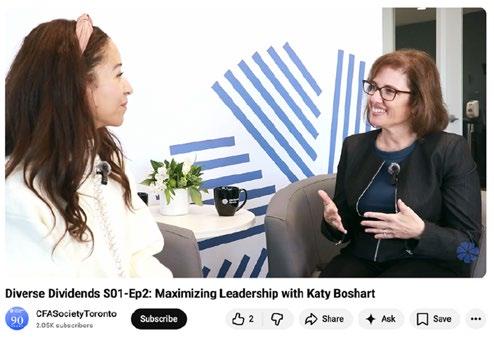
degree, and then I found myself unexpectedly in a banking career. But I seized that opportunity to find my passion and to go after experiences that were interesting to me. I also love solving problems, so I think the collection of those things helped to chart the course of my career.”
Leading with maximum impact
Boshart says that, as a leader, it’s important to embrace all challenges with an open mind.
“I view myself as a maximizer,” says Boshart. “What that means is I take every opportunity and either face that challenge
head-on and figure out what I can make out of it or make it into a stepping stone to something more.”
“My leadership style is really grounded in being an authentic leader with an energy and passion for people and a drive to maximize results,” she adds.
While Boshart has made her mark as a senior banking executive, she emphasizes that this is just one piece of the complete Katy Boshart puzzle.
“Every role that I have shapes who I am as a leader. I’m a musician, I’m a daughter, I’m a parent, I’m a sister, I’m a friend, I’m a colleague and of course, I’m a CEO. I think I bring pieces of myself from each of those roles into everything that I do.”
She also recognizes that her success as a leader comes from the ability to prioritize the right parts of herself at the right time.
“Balance is highly subjective, and I think that it’s more about equilibrium,” Boshart explains. “How do you find the way to operate between your professional and personal life in a way that works for you, that doesn’t allow them to bleed into each other too much?”
Boshart says she has always focused on staying true to herself as she charted her own path.
“When I was starting out in my career, I really felt there was a traditional mold that I had to fit in to be successful as a woman in finance,” says Boshart. “I’ve decided to reject that notion, and I think we’re in a world today where that authenticity, that ability to be who you are, is more valuable to driving results, driving benefits and, ultimately, to the bottom line when you’re in business.”
While Boshart has been primarily focused on growth, “About halfway into my career, I started realizing that as I got more influence,
there was a responsibility to be a role model, to show women there are paths for us. Particularly when you think about the number of female CEOs globally, and even women in senior leadership.”
Heading toward a bright new future Boshart, ever keen to take on a new challenge, is embracing the exciting future for Manulife Bank of Canada, as it looks to become the lead partner for financial advisors in banking by partnering with these advisors at the intersection of wealth and insurance.
“I think for me it’s not so much just about competing in the market, but creating a new paradigm,” she explains. “How do we create a modern, advisor-centric bank that enables financial advisors to really grow their practices? If we view ourselves as that trusted partner, we can actually take the space that’s not really focused on in the market today.”
Boshart has cemented her position as a formidable female force in the finance world, and offers the following advice to those looking to forge their own leadership path.
Top tips for leadership growth:
1. Embrace technology and change
2. Be ready to adapt by thinking creatively about how to harness each opportunity
3. Stay true to your whole self
4. Find ways to leave teams better than you found them
5. “Chase experience, not titles”
Lauren Huneault is a content and marketing professional with 15 years of experience in content creation and strategy. Lauren has spent the last 14 years focused on producing relevant educational content to help aspiring and current business owners successfully navigate the challenges of the Canadian business landscape. She has served as writer and editor of trade publications including Your Convenience Manager, Octane and Franchise Canada

Diverse Dividends is CFA Society Toronto’s new video podcast series from The Analyst, which aims to explore the rich mosaic of the finance and investment industry. Each month, Diverse Dividends features candid, indepth interviews with industry leaders across the finance and investment world as they share their insights on mindsets, strategies, and lessons that drive their success.
• Actionable insights: Gain concrete ideas to boost resilience, leadership, and innovation.
• Unfiltered dialogue: Learn how industry pioneers navigated setbacks and seized opportunity.
• Community connection: Join fellow members in thoughtful discussions that spark inclusive change.
Listen during your commute, enjoy it at home for a deep-dive session, or watch Diverse Dividends for a richer, more immersive experience. Join our growing community and take away actionable ideas that can transform both your mindset and your bottom line.
• Podcast apps: Subscribe on Apple Podcasts, Spotify, SoundCloud, or YouTube
• Online: Stream full episodes at cfatoronto.ca
Don’t miss a single episode! Tune in to Diverse Dividends wherever and however you love to listen and reap the dividends of diverse experience!
By Ian Schnoor, CFA, CFM
I grew up and went to university in Winnipeg at a time when professional development looked very different than it does today. This was the early days of the internet, when there were no online courses, no LinkedIn, and my professional community was almost non-existent.
If you wanted to learn, you relied on textbooks, formal programs and whatever opportunities you could access through your employer.
Today, learning is everywhere. Articles, videos, podcasts, courses, credentials and communities are available on demand, often at little or no cost. While open access to information is a positive and welcome shift, it has also introduced a new challenge for professionals, particularly in finance: When information is ubiquitous, how do you signal real expertise? How do you distinguish between consuming content and developing capability?
This question sits squarely at the intersection of leadership, credibility and personal brand. And it’s why credentials and ongoing professional development still matter, arguably more than ever.
Credibility before influence Leadership depends on influence, and influence depends on credibility. Whether advising clients, leading teams or presenting to a board, people form judgments about competence quickly, often with limited information.
Credentials help shorten that evaluation process. They provide third-party validation that you’ve demonstrated a certain level of competence and discipline. While credentials do not replace experience, they do contextualize it.
For years, while working as a financial modeling trainer, I was regularly contacted by employers reviewing resumes from candidates who listed one of our courses. They always asked the same question: Does this person really have strong financial modeling skills? And the honest answer was that I had no way to say. Completing a course doesn’t prove capability.
That experience exposed a broader challenge in the profession. Financial modeling skills are frequently claimed, but difficult to substantiate. Financial Modeling Institute was created, in part, to address that gap. Rigorous, proctored exams provide credible evidence of skill and move the conversation from assertion to proof. That’s why the Advanced Financial Modeler accreditation exam is experiential – it mimics real-world professional requirements. The same principle
underpins the CFA Program. Earning the charter demonstrates depth, discipline and sustained commitment over time. These credentials don’t just test knowledge; they signal rigour, skill and commitment.
Personal brand is often misunderstood as visibility or polish. But the strongest professional brands are grounded in substance. Credentials help align how you’re perceived with what you truly can do by anchoring reputation in tangible evidence.
In competitive finance environments, independent validation helps differentiate. It reinforces that your expertise has been assessed, not just described.
Credentials are not just about assessing technical knowledge. At their best, they develop the skills that inform critical decision-making.
In practice, developing skills through credentialing builds confidence in what you know, which impacts how you show up professionally. When someone has invested the time and effort to develop and validate their capabilities, that confidence is reflected in how they communicate, make decisions and respond to challenges. Over time, this consistency becomes part of a personal brand: a reputation for judgment and reliability that others recognize and trust.

development signals relevance
Because markets shift and tools continue to change, you may need to future-proof your career by relying on more than your job experience. Ongoing professional development demonstrates that you’re actively investing in staying relevant.
This matters for leaders as much as it might for early-stage professionals. Teams notice when leaders continue to learn. Ongoing learning signals that excellence is not static and that growth doesn’t stop with seniority. Credentials normalize growth as part of leadership and encourage others to approach their own development with similar curiosity.
Few careers follow a straight line. As roles and organizations change, credentials
help preserve continuity by signalling what remains consistent: how you think, the rigour you bring to your work and the expectations others can have of you. That continuity strengthens a personal brand that endures beyond any single role or employer.
Access to learning has never been greater, but leadership still depends on trust, credibility and judgment. Credentials and ongoing professional development help turn learning into leadership, and experience into influence. In a world full of content, credibility remains the differentiator.
Ian Schnoor, CFA, CFM is Executive Director at the Financial Modeling Institute.
Modeling Institute and CFA Society Toronto
Financial Modeling Institute is committed to preparing professionals for this evolving landscape supporting the next generation of finance leaders. The Advanced Financial Modeler (AFM) accreditation focuses on best practices to build world-class models that can be used as critical decision-making tools.
Our partnership with CFA Society Toronto reflects a shared mission to equip finance professionals with the technical, strategic and adaptive skills needed for the future. As the creators of the Financial Modeling Practical Skills Module for the CFA Programs, we look to ensure that professionals stay ahead.
Financial Modeling Institute (FMI) promotes excellence and discipline in financial modeling through rigorous accreditation programs and thought leadership.
The Advanced Financial Modeler (AFM) accreditation is the only exam that requires candidates to build a three-statement financial model of a company from scratch under time pressure, demonstrating their ability to translate data into actionable insights.
For CFA Society Toronto members, the AFM offers an accreditation that supports your professional credibility wherever your career takes you.
Professional development is often a business expense… if you ask
Many organizations allocate budget for employee development, even if it’s not always obvious. If a credential or program supports your role, there’s a good chance it can be expensed. Here are five tips on how to get your professional development paid for:
1. Frame it as a business investment
Explain how the program supports better decision-making, risk management or leadership effectiveness and not just personal growth.
2. Be specific about outcomes
Link the development to concrete skills your role requires today or will require next.
3. Show commitment
Make it clear you’re investing your own time and effort alongside the organization’s support.
4. Ask early
Professional development budgets are often set annually. Timing matters.
5. Make it easy to say yes
Provide cost, timing and a short written rationale so approval is straightforward.
Advancing investor protection, industry professionalism and market integrity across Canada, CFA Societies Canada focuses attention on pressing advocacy files dominating the regulatory agenda. Ensuring fair, equitable and sustainable outcomes for stakeholders is more important than ever. Through our growing relationships with policymakers and regulators, we are working on several important initiatives. Below is a summary of three areas where we have recently provided comment letters. To see the comprehensive catalogue of our commentary letters, visit us online at cfacanada.org/advocacy.
CIRO – Proposed new guidance on order execution only account services and activities
The Canadian Advocacy Council (CAC) responded to the Canadian Investment Regulatory Organization’s (CIRO) proposed new guidance on Order Execution Only account services and activities, expressing overall support for the shift toward a principles-based regulatory framework. The CAC welcomed CIRO’s responsiveness to prior recommendations, particularly regarding platform configuration oversight, enhanced model-portfolio functionality and caution around finfluencers and copy-trading tools. The CAC encouraged ongoing agile updates to the guidance in response to industry developments.
Key highlights from the CAC’s submission include:
Additional safeguards:
The CAC recommended multiple enhancements to bolster investor protection, including outcome-based justifications for dealer defaults, formal governance and documentation for configurations, conflict-of-interest controls, audit trails, monitoring frameworks, oversight for third-party content and opt-in/opt-out mechanics for defaults.
Sample portfolios and asset allocation tools:
While supportive of CIRO’s approach, the CAC urged added safeguards, such as neutral-shelf requirements, restrictions on promotional mechanics, monitoring for excessive trading tied to model updates and a preference for registrant-sourced models.
Examples of decision-making supports:
The CAC supported the idea of a living guidance document with illustrative analyses. It recommended decisiontree examples for tools such as model portfolios, self-assessments, filters, gamification and copy-trading, to help clarify what constitutes a prohibited recommendation.
Product shelf limitations and proprietary product conflicts:
The CAC agreed that restricting product offerings to proprietary or affiliated products effectively constitutes a recommendation and is inconsistent with the Order Execution Only model. Such business models should be reconsidered for a non-Order Execution Only dealer category. The CAC was critical of the idea that tools could remain compliant if offering only a few product options, reiterating the importance of product neutrality in the Order Execution Only space.
CSA – Venture issuer semi-annual reporting pilot
The CAC responded to the Canadian Standards Association’s (CSA) Semi-Annual Reporting Pilot proposal by reiterating its strong reservations about reducing financial reporting frequency. It emphasized that quarterly reporting is crucial for market transparency and investor protection, especially for smaller issuers. The CAC urged the CSA to set clear success metrics, consider sector-specific exclusions and modernize reporting using technologies such as eXtensible Business Reporting Language (XBRL). The CAC recommended rethinking the Semi-Annual Reporting Pilot within a broader reform strategy focused on strengthening Canada’s investment ecosystem.
CFA Institute – Exposure draft guide for best practices in return attribution reporting
The Canadian Investment Performance Council (CIPC) responded to CFA Institute’s Exposure Draft Guide for Best Practices in Return Attribution Reporting. The CIPC expressed strong support for the principles of fair presentation and full disclosure in return attribution practices. It acknowledged the challenges presented by differing attribution methodologies and offered targeted recommendations to enhance clarity, transparency and consistency across the industry.
Key highlights from the CIPC’s submission include that the CIPC:
• Mostly supported disclosing representative portfolio selection policies upon request, citing transparency and accountability benefits, while noting concerns about administrative burden and possible misinterpretation.
• Observed that multi-year attribution is not standard practice but can offer valuable insights when aligned with investment cycles. It recommended clearer guidance on when and how to present such data, including documenting smoothing methods and supplementing with annual results to improve client understanding.
• Recognized that firms use both cumulative and annualized attribution methods and advised that firms clearly disclose and consistently apply their chosen method, considering client preferences, interpretability and system capabilities.
• Recommended disclosing how cash is treated in attribution, especially when using transaction-based methods, to address its off-benchmark nature and ensure transparent reporting.
• Endorsed firm disclosure and documentation of their methods if currency effects are material. For actively managed currency exposures, models like Karnosky-Singer should be used; otherwise, simpler methods may suffice, provided the effects are explained if omitted.
• Emphasized documenting treatment in policies and distinguishing between long and short positions to aid interpretation. Disclosure regarding leverage and derivatives should be provided when material.
Other letters filed:
• CSA – Proposed amendments to nonGAAP and other financial measures disclosure requirements
Who is CFA Societies Canada?
CFA Societies Canada represents the 12 Canadian CFA Institute Member Societies and, ultimately, Canadian CFA charterholders. CFA Societies Canada’s Canadian Advocacy Council includes investment professionals from across the country who review regulatory, legislative, and standard-setting developments affecting investors, investment professionals, and Canadian capital markets. CFA Societies Canada through its advocacy efforts strives to advance market integrity, transparency, and investor protection, and actively engages Canada’s securities regulators, self-regulatory organizations, industry associations, legislators, and other stakeholders through thoughtful leadership, direct engagement, and the publication of comment letters.
Have your say
If you would like to participate in advocacy activity related to these letters or future policy and regulatory initiatives, provide comments on ongoing initiatives, or learn more about volunteer opportunities in advocacy, please contact info@cfacanada.org.
Follow CFA Societies Canada on LinkedIn.