
InHouse





Rome wasn’t built in a day. But we’ll give it a good crack.
With one of New Zealand’s biggest ranges of building supplies, hardware, tools, kitchens and bathrooms, you can count on Mitre 10 Trade to have everything you need to nail the job.
Backed by a massive supplier network, we bring together the trusted brands you know, all under one roof.
From the Chief Executive

MALCOLM FLEMING
Chief Executive
FOR A MEMBERSHIP ORGANISATION, there is an important balance to strike between being an effective voice within the ‘Wellington beltway’ and being visible and engaged with members across the country.
We have been mindful of feedback that we might not have had the balance quite right in the past, and that while we have become the dominant residential building industry voice in the media and are a trusted sounding board for government decision makers, we need to ensure we stay engaged with our membership.
We have responded accordingly, working closely with the regions to support their events and for representatives from NSO to attend as many of those events as possible. Regional presidents commented at a recent forum that they had seen a significant change, which was great to hear.
The day before sitting down to write this article was a good example of how we’re looking to balance these expectations.
In the morning, I met with government officials at MBIE’s offices in Wellington to receive an update on an imminent Cabinet decision on the Minister of Building and Construction’s proposal to change liability settings for residential building projects. This is new legislation that in my view represents the most significant change for the building industry in a generation, and it felt significant marking the moment with officials whom NZCB and Halo have engaged with extensively since the Minister first tested the industry’s appetite for the change seven months ago.
Later that day, I attended an NZCB Wairarapa event, spending a few hours with members and our Territory Manager at a Masterton pub, providing members
with an update on the year that was for NZCB, and some commentary on the state of the industry and pending regulatory changes. Bringing members together for a few hours to enjoy a catch-up with their peers are special events, and it’s always good to engage directly with members and hear first-hand how they are faring at the end of what has been a tough year for many in our industry.
Of course, the biggest opportunity to get members together comes with our annual conference, which returns to Auckland next year. With 40% of our membership based in Auckland, a great programme, and registration options that provide for a one-day-pass (for out-oftown members to come up for a single day only) – the 2026 Conference promises to be our biggest yet. If you have never attended a conference, I strongly encourage you to do so. Earlybird tickets are on sale through the conference website (nzcbconference.nz), so now is the time to book.
For many members, it will be a relief to see the back of 2025, with next year looking much more promising. We head into the Christmas break with recent news of a boost in government infrastructure investments in schools, defence housing, and hospital projects; a series of OCR cuts; and reports of a sustained rise in new dwelling consents across August and September.
But before we look ahead to 2026, we have Christmas. Personally, I’m looking forward to getting stuck into the garden, and a pair of classic-car rallies in the Far North and the Deep South. Whatever you have planned for summer break, I wish you, your families, and your employees well, and I hope you have a restful break. See you in the New Year.
NZCB

Comply with confidence


Designed to the New Zealand Building Code
Rigorously tested for our climates
Backed by a nationwide network of experts
Trusted by New Zealanders for over five decades
Proud to craft locally made windows and doors.

Exclusively available through:
▶ Find local products and helpful resources for your next project aplnz.co.nz/builder-resources






InHouse magazine, including the wrap, is 100% recyclable. InHouse is printed on PEFC-certified paper, supporting the growth of responsible forest management worldwide. The press used to print InHouse utilises a UV light drying system (LED), meaning there is no solvent to evaporate, and no environmental pollutants are formed. It also uses less power than traditional technology, which helps reduce overall CO2 emissions.


InHouse




The contents of InHouse may not be reproduced in any form, either in whole or in part, without written permission of the Editor. All material received will be assumed to be intended for publication unless clearly labelled 'Not for Publication' and will be published at the discretion of the Editor. Views expressed in articles in InHouse are not necessarily those of New Zealand Certified Builders Association. While every effort has been made to ensure the accuracy of the information included in this publication, the designers, publishers, and Editor take no responsibility for errors, omissions or for any consequences of reliance on this information. Articles are not intended to be relied upon as legal advice.


InHouse
Published quarterly in print and online, InHouse is the official magazine for New Zealand Certified Builders Association (NZCB). InHouse aims to educate and inform our members and their staff of the latest news from the Association and the Building and Construction Industry.
New Zealand Certified Builders PO Box 13405, Tauranga Central, Tauranga 3141 10 Marsh Street, Tauranga 3110
07 927 7720 0800 237 843 nzcb.nz
EDITOR
Andrew Smith andrew.smith@nzcb.nz
NZCB PARTNERSHIPS AND SERVICES
Nicola Airey nicola@nzcb.nz
ADVERTISING
Linda Moody linda@nzcb.nz
DESIGNERS
School Road Publishing
PRINT AND DISTRIBUTION
Kale Print Ltd kaleprint.co.nz
MAILING LIST
If you have received a copy of InHouse and wish to opt out, you would prefer to receive it via email, or would like to update your details please email membership@nzcb.nz


Cover photography: Luke Harvey
QUALIFICATIONS THAT FIT WHAT YOU DO
WORK SMARTER
Have your team work smarter, learn up-to-date skills.
TRAIN AN APPRENTICE
ALREADY HAVE THE EXPERIENCE?
Help them learn the skills and become qualified.
Get skills recognised with a formal qualification.
GROW YOUR BUSINESS THROUGH TRAINING
Training an apprentice is an investment in your business and the industry.
ARCHITECTURAL ALUMINIUM JOINERY INTERIOR CONSTRUCTION
BRICK AND BLOCK LAYING JOINERY
CARPENTRY KITCHEN AND BATHROOM DESIGN
CONCRETE PAINTING AND DECORATING
EXTERIOR PLASTERING RESIN FLOORING
FLOORING STONEMASONRY
FRAME AND TRUSS FABRICATION
SUPERVISOR
GLASS AND GLAZING TILING



The Apprentice and the Master
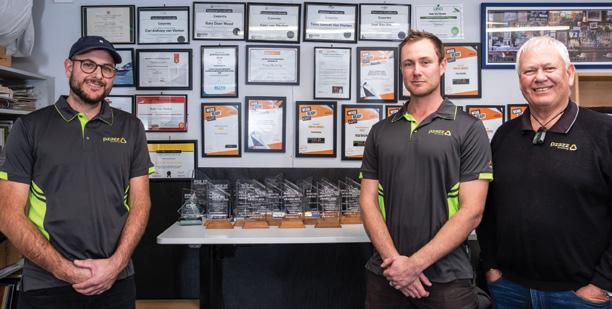
After more than two decades leading Pzazz Building’s Kāpiti branch, Rudy Van Vlerken is handing over the reins to the next generation. His sons Joel and Cory are carrying on the family business - and the same passion for quality craftsmanship. We talk to Rudy and Joel about family, business, and what it takes to build a lasting legacy.
APPRENTICE
Joel Van Vlerken
u Trade qualified builder and NZCB member
u Co-owner of Pzazz Building Kāpiti
u Winners of Pzazz Building’s Best Local Marketing, Customer Satisfaction and Top Overall Franchise awards
MASTER
Rudy Van Vlerken
u Founder and co-owner of Pzazz Building
u Former NZCB Wellington regional committee member
u Co-founder of Work Ready Kāpiti
From left, Cory, Joel, and Rudy Van Vlerken from Pzazz Building Kāpiti.
Joel Van Vlerken
InHouse: How does it feel to be taking over the business your dad built?
Joel Van Vlerken: It’s a good feeling. I feel fortunate that Dad has given us this opportunity. It wasn’t handed over on a platter though; there was a lot of hard slog to get into the position to take it over. There was a five-year period where Dad’s health wasn’t too good. He was struggling, so it was a natural progression for us to slowly start taking over.
IH: So building was always in your blood?
JV: Definitely. Dad’s a builder and his four sons are all qualified carpenters. We all did our apprenticeships with him.
IH: That must have made for an interesting dynamic in the workplace...
JV: Luckily, there’s a bit of an age gap between us kids, so we weren’t all learning the job at once. None of us did very well at school – we were all delinquents – and Dad’s a Dutchman with a strong work ethic. Once we left school, he wouldn’t have us just sitting around, so he put us to work straight away.
IH: Is work-talk banned at family dinners then?
JV: As soon as we sit down together, we always start rattling on about work, but my wife hates it, and so does Mum!
IH: What are some of the most valuable lessons you’ve learned from your dad?
JV: Staying consistent. Always being there for your customers – keeping the work flowing and the rapport right. Dad used to say to us, ‘If you do a good job the client will tell five [people], if you do a bad job the client will tell 20’. As long as the client is happy, that’s what matters.
IH: How do you, your brother Cory, and your dad work together?
JV: Dad’s been off the tools for a long time, so the office is the only time the three of us are working together. There are a lot of moving parts within the business and we all have our strong points and weak points, which are not the same. Cory is a numbers guy, and I’m more hands-on and good with the logistical side of things. Me, Dad and Cory are all such different people, but it seems to flow. Don’t get me wrong, there are arguments! But you walk away and come back, and it’s like it never happened.
IH: How does it feel to now be mentoring apprentices yourself, after starting out as one?
JV: We work with a programme called Work Ready Kāpiti – Dad was one of the founding members, and Pzazz Building is one of their major sponsors. The programme approaches kids in college and teaches them what it’s like to go to a job interview, to go to a job site, and to have work experience. We’ve picked up a few apprentices through that programme who we have taken all the way through to become qualified builders – one is now our junior foreman. They start out being awkward with clients, not knowing what to say, and over time they just become so comfortable and confident. You see them grow from boys to men. It’s awesome.
IH: Tell me about a project you and your dad were involved in that was particularly memorable.
“At the end of the build, Dad came down, and I just remember the look on his face. He said: ‘I can’t believe you built this – and you did it in the time allowed and kept it within budget. You’ve done it, you’re now a proper builder’.”
JV
u
JV: There was a house we built off the side of a hill in Wellington about nine years ago. It was the first major project that Dad let me run alone. It was a logistical nightmare – helicopter access, craning diggers in over the top of houses – your typical Wellington hill build site. It was the first big project where Dad said, ‘I’m not coming to site, I’m just going to let you run it’. It was winter, the weather was terrible and so was the site – we lost scaffolding, we
had diggers getting stuck. Everything that could go wrong, did. At the end of the build, Dad came down, and I just remember the look on his face. He said: ‘I can’t believe you built this – and you did it in the time allowed and kept it within budget. You’ve done it, you’re now a proper builder’. That was a huge moment.
IH: What does the future hold for your family business?
JV: Dad’s at retirement age. We want to make sure he’s set up for his retirement and can enjoy travelling and holidays. Me and Cory want to keep building the business and getting it to a point where it looks after itself with a good reputation. We still consider it a young business, with Dad stepping away and Cory stepping in. We’ve come into it with our own take on it and we’re still figuring things out, still learning. But we want it to be around for a long time to come.
Rudy Van Vlerken
InHouse: What inspired you to set up your own business?
Rudy Van Vlerken: I have been self-employed since the day after my apprenticeship finished. I was 21 and I thought I knew it all. As a third and fourth-year apprentice, I was running other apprentices, so building came naturally to me. I thought, ‘if I can build houses for my boss, I can do it for myself’. I was over-confident, you know? I fell in a few holes over my lifetime, but I’ve learned a lot through trial and error.
IH: You’ve been with NZCB for 28 years now. How has the construction industry changed since you started out?
RV: The only thing that has changed are the rules. We’ve become better builders over time by learning from our mistakes. We’ve become more rigid in what we do, and I believe it’s for the best. If you don’t set boundaries and rules in the industry, then the cowboys will rule, and we can’t have that. Quality, confidence, ability, and qualifications are key.
IH: What does it mean to you, to have your sons follow in your footsteps?
RV: You’ve almost got me in tears. When it comes to family, I’m passionate – I lead with my heart. I’ve trained my four sons. Two – Joel and Cory – have stepped up to take over the business, and that to me means the foundations I laid were good ones, because the boys wouldn’t have followed if I’d done a bad job. My moral objective has always been: Stand up, earn respect, pay your bills, move forward with your heads held high.
IH: What was it like training Joel up as an apprentice?
RV: Joel is seven years younger than his brother Cory, so in a way, he was trained more by his older brothers. I was told I wasn’t great to learn from because I am so strict, but I suppose you expect more from your own sons than you do anybody else. I teach differently too, I prefer to show them once, and leave them to work it out, rather than show them repeatedly. That’s how I was taught – my bosses made sure I was very hands-on, early on. They said, I’ll show you no more than twice, if you can’t figure it out, this trade is not for you. It was the best lesson I ever had because I really wanted that job.
IH: Is that the same approach you use for new apprentices now?
RV: Since I started building, I have put through 24 apprentices. I’ve sweated blood and tears to learn everything that I know, and I feel that if I don’t pass that knowledge on before I die, my life has been wasted. And that’s what I have pushed into the boys, and that’s what Joel now puts into his apprentices. For a young guy, at 32, the knowledge he’s got is highly respected by those he trains and works with.
IH: What challenges come with working with family?
RV: I was a dummy for about three years because my sons thought they knew it all and I knew nothing! A typical father-son relationship, and in my case, it was three against one. I don’t look at that as a challenge though, really. I haven’t found training sons too
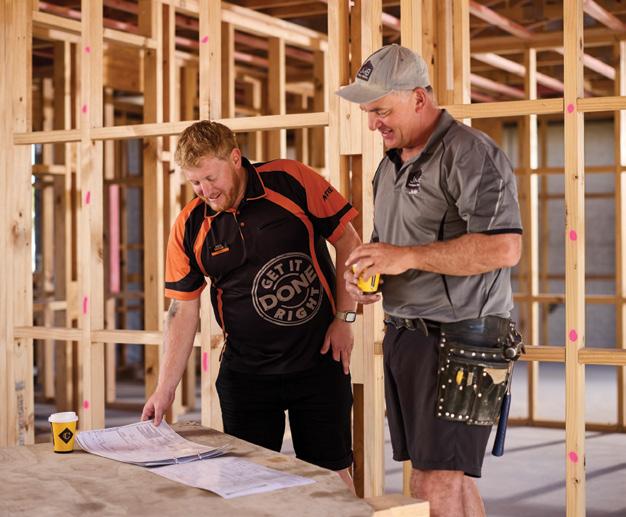
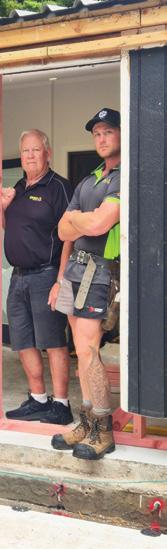
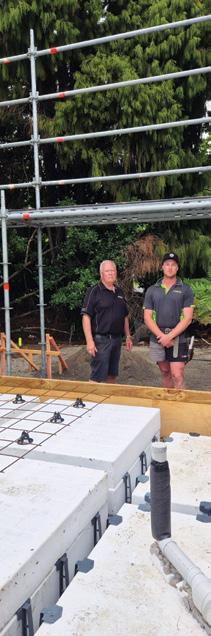
Rudy and Joel Van Vlerken on site.
different to training any other apprentice. It’s just that with sons, voices get raised and they will answer back.
IH: So equally, there must be plenty of benefits?
RV: There are. You can really trust your family to do what you ask, even if there’s pushback at the beginning. They hear what you say, don’t always listen straight away, but will go away and think about it. That’s family dynamics for you.
IH: How are you managing the transition as your sons take over the business?
RV: For the first 12 months, to put 100% trust in the boys, was hard. It was hard to let go. They had to prove to me they could do it at the start, and I just said right, ‘you’re in charge of the jobs now, run them’, and I would occasionally put my two cents in. Now, they don’t rely on me but they still refer back to me at times. That said, I’ve
just been on holiday for seven weeks and I didn’t get a single phone call!
IH: So you must be looking forward to more holidays now?
RV: Next year I will semi-retire at 70 so the company is theirs to run. I will go back down to 20 hours a week. I still enjoy the design aspect of jobs, and I want to carry on as long as I can – until the marbles start rolling around on the floor.
IH: What advice would you give Joel as he moves forward as a joint business owner with Cory?
RV: There’s nothing I can tell them they don’t already know. The single biggest rule in our company is: You’ll get two smiles from the client. One will be at the start; one will be at the finish. Not because we’re leaving, but because of the quality of the work. It’s not about the money; it’s about the satisfaction of a great job and a happy client.
“I was a dummy for about three years because my sons thought they knew it all and I knew nothing! A typical father-son relationship, and in my case it was three against one.”
RV

Trust a Resene Eco.Decorator to do your job just right!
When it comes to your decorating projects it helps to know you’ve got the right painter for the job as well as the right paint. So when you choose the services of an approved Resene Eco.Decorator you can be sure that the paintwork will be just as good as the paint.
A place in the sun
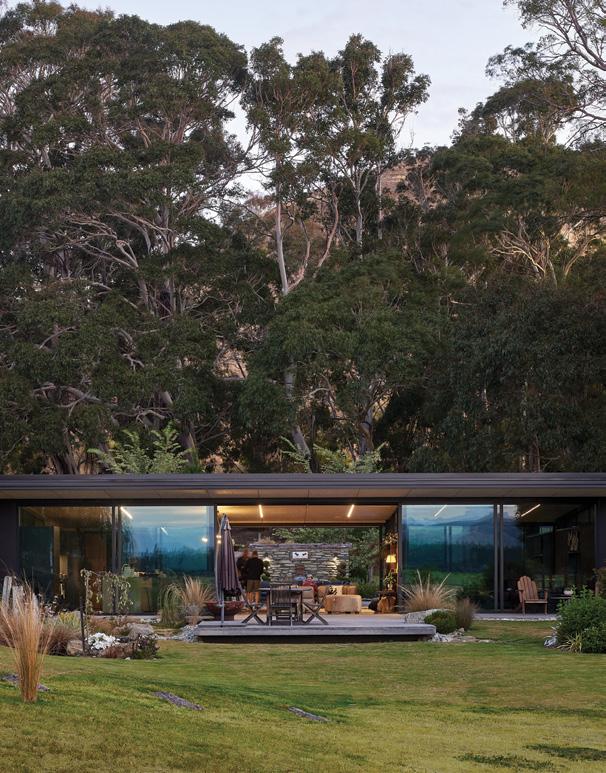
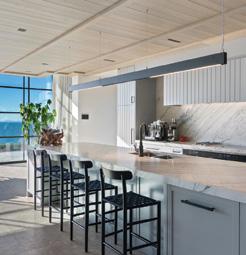
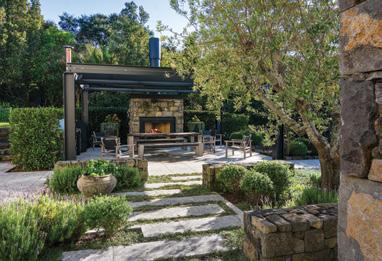
A quirky Rodney pod home is reimagined as a modern coastal sanctuary.
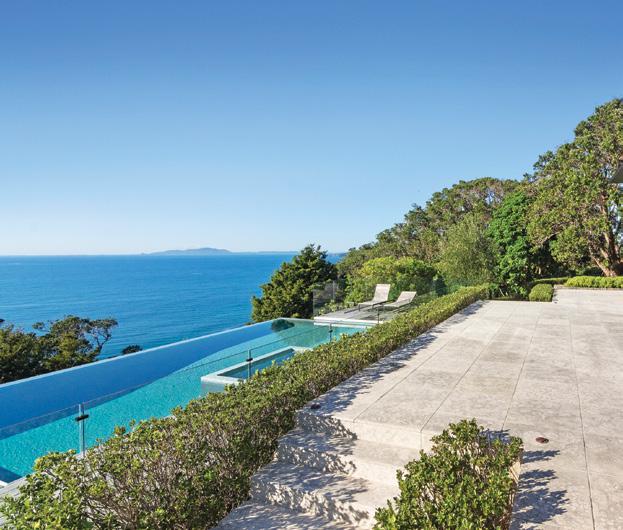
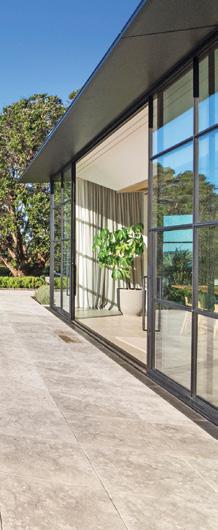
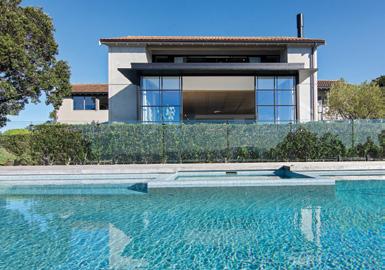
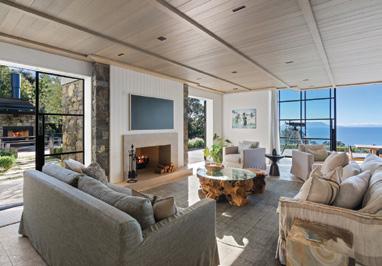
INITIALLY DESIGNED as a ‘village’ of three pods, with external staircases between them, the original house was classically beautiful, but the flow was awkward.
With a major Sumich Chaplin update, the owners called in their go-to builder: Peter Grant of Timbercraft.
The project involved the construction of a new double-storey living pod with a main suite to replace the original single-level structure and relocating the infinity pool.
Vertiginous topography made this a herculean job. There was concrete
required. Plenty of it. Piers that went 13 metres into the ground anchored the new pavilion to the cliff and the pool foundations were an engineering challenge. “I stopped counting when we got to 600 cubic metres of concrete,” says Peter.
The house retains its Italianate roots, only made modern, with glazed walkways linking the three pods.
Peter calls this a once-in-a-lifetime project and the owners agree: “Peter is essentially a one-man-band, but he has the knowledge, experience, integrity, intelligence and creativity to make it happen.”
BUILDER: Peter Grant, Timbercraft timbercraft.co.nz
LOCATION: Ti Point, Rodney
Read more at nzcb.nz/revere

2025: A year of growth and innovation
Ad campaign builds on connection
Here’s a look back at a standout year for NZCB.
Relationships are at the heart of a new advertising campaign for NZCB.
Relationships are at the heart of a new advertising campaign for NZCB.






Find a Builder You Click With campaign


THIS YEAR HAS BEEN a productive one for NZCB, as we looked to complete various projects noted in the 2023-2025 Strategic Plan, and got started on our new plan in October, which will run through to 2030.
Here are just a few of the highlights from 2025:
NZCB Learn ramps up
Education is a central part of NZCB’s work and 2025 saw the NZCB Learn programme ramp up in a big way. Over the course of the year, the Learn team added around ten new courses to the library, as well as
three Business Basics courses, covering GST, manging cash flow, and pricing. On top of this, the Coach the Crew workshops, supported by Mitre 10 Trade offered in-person learning around the country. In total, 375 courses have now been completed by more than 300 learners.
This work saw the NZCB Learn team named as finalists for two categories at the New Zealand Association for Training and Development Awards, held in September – Best Transformational Programme and Best Online Learning Programme.
In April, we went live with a new brand campaign based around the idea of homeowners finding a builder they click with. The ads emphasised that not only are NZCB members highly qualified builders, they’re the sort of people homeowners can relate to and would be comfortable having working around them and their families over the course of a build.
This campaign included TV and radio ads but a major emphasis was on social media. From April to November, our ads on Facebook, Instagram, YouTube and the like reached 4.8 million Kiwis and have been seen at least 24 million times. The campaign – combined with regular media commentary over the course of the year – has led to a 90% increase in our brand awareness.
SEE month, as our new campaign launches. the campaign, Click With”, is all the personality and how they’re a homeowners looking for trust. emphasise that not only have the skills great job, people relate to and can with over the project. Marketing and Manager Nicola campaign is all about business for members. are tough for but there are some there. With and business to pick up, more be starting to think projects scoped and the time to get there.

NZCB Conference
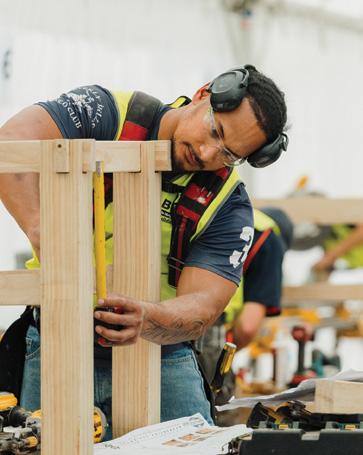
NZCB descended on the Claudelands Events Centre in Hamilton in June for the annual NZCB Conference and Expo. Over two days (three if you include the pre-conference events), members made their way around more than 60 trade stands, attended seminars covering everything from health and safety to marketing, and danced the night away at the gala dinner.
NZCB Apprentice Challenge
We welcomed BCITO as our new naming sponsor, and along with Mitre 10 Trade and Makita, they helped us deliver a reinvigorated Apprentice Challenge for 2025.
For the first time, we worked with Architectural Designers New Zealand to run a competition for their students – the task being to design the project that apprentices would have to complete and then gift back to their communities.
We had more than 100 apprentices compete at regional events in April, with 19 going through to the final at the NZCB Conference in June. Congratulations to national champion Scott Davies; second place Jack Mathis; third place Charlette Bone; and Chairman’s Personality Award winner Jake Dugdale.
Toolshed refresh
In March we kicked off an initiative to enhance the Toolshed, ensuring it continues to meet the evolving needs of our members. This work forms part of our wider commitment to delivering a best-in-class digital experience for NZCB members.
The first part of the initiative involved asking members what they valued most about the Toolshed and where there was room to improve. The feedback we received was invaluable and helped shape the direction of the project.
Then we spent several months designing the new look and feel with a focus on making the Toolshed easier to navigate and more enjoyable to use, launching the new site in October. This is just one of the ways we’re continuing to invest in digital tools that support our members’ day-to-day work and help them get the most from their NZCB membership.








We are learning more about sustainability in the construction industry through our partnership with the Sustainable Business Network, and working with Mutu to trial their waste reduction app with members in Auckland and Hawke’s Bay.
u
Partnerships
At the end of 2024, we put in place a new Partnership Plan and this year has been about deepening our relationship with existing partners and bringing on new ones to help support our initiatives.
Our Strategic Partnerships are the top partnership category, and these are limited to six at any one time. In January, Z Energy joined us as a Strategic Partner (in addition to remaining an Affinity Partner), and in October we welcomed Bunnings Trade as a completely new Strategic Partner. Throughout the year, we also brought on Hirepool and Scratch Design as Affinity Partners, joining fourteen other organisations in that category.
As well as bringing on financial partners, we also built relationships with other industry organisations. We are learning more about sustainability in the construction industry through our partnership with the Sustainable Business Network, and working with Mutu to trial their waste reduction app with members in Auckland and Hawke’s Bay.
In addition, we announced a partnership with Live Well Build Well in early October to help support our members’ mental wellbeing, formalising a strong relationship we’ve had with this organisation over the past year or so.
In November, we welcomed Andersen New Zealand as a partner to provide members with access to accountants and advisors who deliver practical, high-quality accounting, bookkeeping, and taxation support. This partnership will offer a
NZCB Studio
August saw the launch of NZCB Studio, a suite of house designs developed in collaboration with Designgroup Stapleton Elliott. We currently have two-bedroom (single storey) and three-bedroom (two-storey) designs available, with three specification tiers for clients to choose from. All plans and tiers are Homestar 6 ready, have been developed with passive design principles in mind, and are easily adaptable to a wide range of building sites. These designs are free for NZCB Business members to access but you must have done the Studio training on NZCB Learn to be accredited.
practical, low-barrier solution that supports both compliance and capability, giving builders the confidence to grow.
A big thank you to all our partners who support our work and help us help our members. Your continued support of NZCB is greatly appreciated.
Regulatory changes
The government has proposed some major reforms for the building and construction industry over the course of the year, mainly focused on bringing down construction costs and speeding up the consenting process.
NZCB worked with the government on announcements and made a number of submissions on issues ranging from increasing the range of building products from overseas suppliers; simplifying the consent process for granny flats; self-consenting and remote inspections; and reorganising the vocational education regime. Notable wins included persuading the government to finetune their approach to H1 insulation standards, adopting the more nuanced calculation method over the current blunt schedule method.
We have also been working closely with the government on their proposal to move from joint and several liability to proportionate liability for residential construction projects. As we go to print, the Government announced it will be making home warranties mandatory from 2027, which is a major change but will be a positive one for Kiwi homeowners.
New features coming for Halo Guarantee
One of the best things about being an NZCB member is exclusive use of the Halo 10-Year Residential Guarantee, a guarantee tailor-made for the best builders in New Zealand.

SHAUN RILEY Chief Executive Halo Guarantees Ltd

FROM NEXT YEAR, the Halo Guarantee will be even better, with deposit and non-completion cover being added as optional additions.


The Halo Guarantee has been developed in conjunction with and is tailormade for and exclusively available to members of New Zealand Certified Builders Association (NZCB)
Members have been keen to see these covers added for a while now, and with the Government’s proposed changes to the way building and construction liability is handled in New Zealand, strengthening the Halo Guarantee is even more important.
Deposit and non-completion cover
From April 2026, the Halo Guarantee will come with optional deposit and non-completion cover.
This will cover situations where a homeowner pays a deposit but the builder is unable to start the work, or where the work is under way and the builder is unable to complete,
typically because they have gone into liquidation.
This cover will be an add-on to the standard Halo Guarantee, and will attract an additional charge.
The Halo team will be developing these forms of cover – including all the legal work required to implement them – over the next few months, with the new features available from 1 April 2026.
The new cover benefits will only be available to new Halo Guarantees, and won’t apply to Halo Guarantees that have already been taken out.
Government introducing proportionate liability
The Government has announced major changes affecting the building and construction sector in New Zealand.
Under the current joint and several
liability system, if a problem arises with a building after it has been completed, building owners are able to make a claim against various parties involved in getting a building designed, consented and built.
The Government is proposing replacing this current liability system with what is known as proportionate liability. Under this model, each party will only be responsible for the share of work they carried out.
That means builders will need to be able to offer a form of cover like the Halo Guarantee that underwrites their performance, or the performance of the building work.
These proposals are still being developed and we’ll have more information to share about what this means for NZCB builders in the New Year.
Halo Guarantee training now available on NZCB Learn With all these changes on the horizon, homeowners will start asking for more information about building guarantees, so it’s important to make sure you understand how the product works.
This short online course provides a practical overview of the Halo Guarantee, giving you the confidence to discuss it with homeowners.
You’ll also learn how to meet the application requirements and accurately complete the submission process from start to finish.
The course only takes 30-40 minutes, and counts towards your LBP requirements.
For more information, email hello@halo.nz
The Government is proposing replacing this current liability system with what is known as proportionate liability. Under this model, each party will only be responsible for the share of work they carried out.
With
possible™



Cutting waste, not corners
Sustainability in construction is no longer a distant ideal –it’s becoming an everyday responsibility. We talk to sustainability advocates about just how achievable sustainable building can be when you start small, stay curious, and bring your team along for the journey.
WRITER: COURTNEY WHITAKER


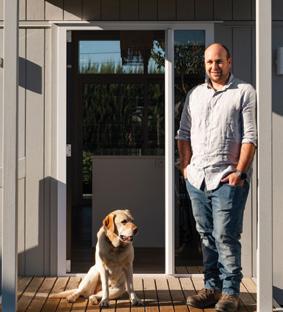
Paul Webster-Young on site.



SUSTAINABILITY IS OFTEN talked about as the future of building, but for many, it’s already part of everyday practice.
Across Aotearoa, builders are cutting waste, reducing carbon, and rethinking how homes are designed and delivered.
However, Sustainable Business Network’s James Griffin says there’s still a long road ahead before the industry can truly call itself sustainable.
“There are green shoots of innovation and leadership emerging, but the industry as a whole is still largely operating in a linear, wasteful way. We’re seeing more awareness and intent, but the pace of transformation is still far behind what’s needed.”
James says that overseas, many countries still continue to outpace Aotearoa in the race for a greener industry, and their examples can be looked to for inspiration.
“Northern Europe continues to lead the way. Countries like Denmark, Finland and the Netherlands have made circularity a national strategy, embedding low-carbon and reuse requirements into building codes and public procurement.
“What sets these countries apart is that they’ve moved beyond voluntary initiatives – government policy, standards, and finance now actively drive the shift to low-carbon, regenerative construction.”
Carbon offsetting a team effort
In Hastings, HB Homes has spent the past few years reshaping how it builds. Managing Director Mark Roil says it all began with a simple but essential step: finding out where they currently stood.
“We had an idea of offsetting our carbon, so we had a carbon assessment done over the 22/23 financial year, and we calculated how much CO 2 equivalent we were using. We really just wanted to get a base.”
That baseline shaped what came next. Rather than buying carbon credits, Mark wanted something more tangible – something his team could all get involved in.
u

“Instead of buying carbon credits, we wanted to do something cool like planting natives. So using it as a team-building exercise every year, we would offset our emissions by doing an annual planting day.”
MARK ROIL, HB HOMES
ABOVE FROM LEFT: At HB Homes & Commercial, Mark Roil and his team plant native trees every year as a team-building exercise and a way to offset their carbon emissions.

“Instead of buying carbon credits, we wanted to do something cool like planting natives. So using it as a team-building exercise every year, we would offset our emissions by doing an annual planting day. We planted about 3,000 trees after that financial year,” says Mark.
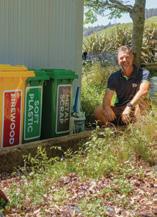
Once his team and subcontractors were on board, the concept took off. But Mark wasn’t content to stop there. He wanted to tackle one of the industry’s biggest sustainability challenges: waste. Construction waste makes up close to 40% of landfill in New Zealand, so HB Homes began to recycle materials inside their 1800m² factory.
“We now have multiple bins, waste streams, and recycling. Previously, we were getting our general waste bin emptied once a week, and now we’re down to once every three weeks. Seeing the results firsthand is great, and there are cost benefits to it as well.”
A second carbon assessment backed up Mark’s sense that they were making progress.
“We were able to cut our waste by between 40% and 50%, which was huge – even though we had increased the amount of buildings we were doing. Instead of us planting 3,000 native trees, we only needed to do 1,800.”
Designing waste out
In Auckland, Paul Webster-Young of Twin Solutions is taking sustainability in a similar direction. Rather than asking how to manage waste, he’s asking how to stop creating it in the first place. For him, change began with simple adjustments.
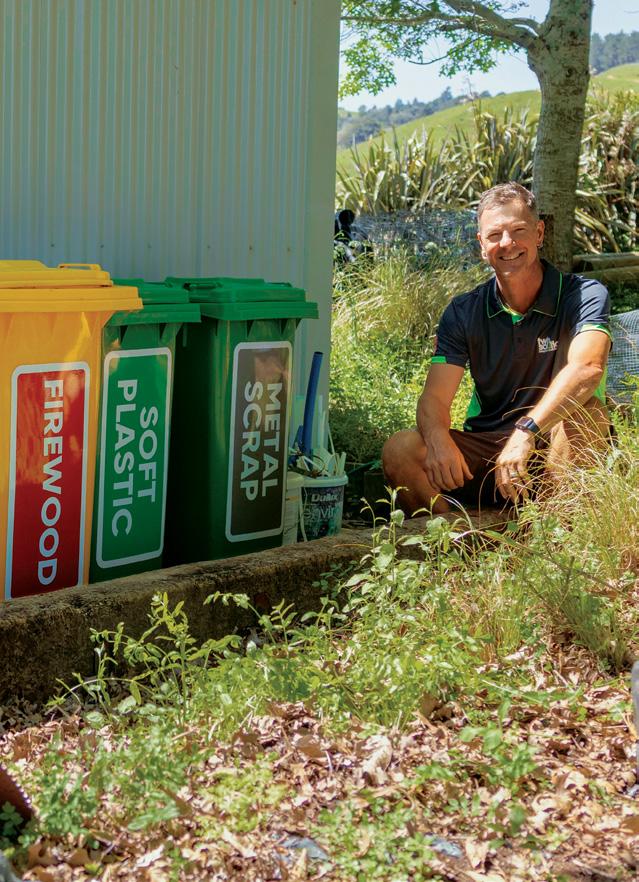
“We had our own wheelie bins; I got labels printed up, so everything had a bin to go to. We were separating out waste: timber, soft plastics, glass, metal. It was just a progression from there.”
That progression accelerated when Paul connected with the Sustainable Business Network.
“We’re getting more involved with the SBN and the seminars and workshops they’ve run with other industry leaders and Auckland Council on Waste Diversion.”
“One of the working groups we got involved with was about an integrated design process. Rather than having different people coming in at different stages of the design process, we’re asking how to have more people around the table from the start, and how that can then transfer into a group design effort to get rid of waste on sites.”
Twin Solutions now focuses heavily on early contractor involvement and decisions that prevent unnecessary


















“An average house build in New Zealand, in Auckland especially, throws away four skips of waste. That’s huge.”
PAUL WEBSTER-YOUNG, TWIN SOLUTIONS
t material arriving on site at all.
“My aim is 95% waste diversion; we may even exceed that,” says Paul.
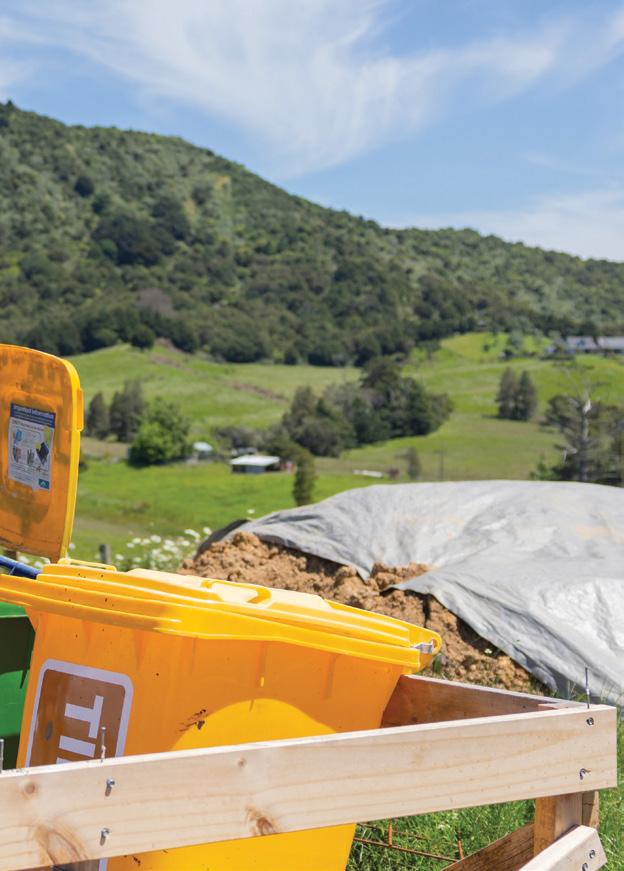
On recent projects the Twin Solutions team has used SIP panels, screw piles, and they recycle all the spoil from the building site, which goes to local farms. “We’ve had 45 truckloads of spoil, and none of it has gone more than 10 minutes from the site.”
James believes it’s smart for those who are unsure where to begin to start with practical, achievable changes that build momentum, just as Paul and Mark are doing.
“Design out waste early. Engage suppliers and subcontractors at the design stage to reduce offcuts and packaging,” he says.
Paul is working with NZCB, Auckland Council, and the Environmental Innovation Centre on how small to medium building companies can accurately record the
waste they have on site.
“It’s making it easy for builders to be able to easily record and report on what they’re actually sending offsite,” he says. He also wants to find solutions to the issues of reporting on and measuring targets.
“An average house build in New Zealand, in Auckland especially, throws away four skips of waste. That’s huge.”
Looking to the future of sustainability in New Zealand, Paul sees real potential in industry collaboration and sharing of ideas.
“I want people to realise it’s not as hard as it seems, and I think we can save clients money, too. The old way costs more, there’s a bigger environmental cost, and a bigger financial cost by having more skips and not thinking about how you’re reducing waste.”
Start now, start small
Mark says sustainability isn’t about perfection. The main thing is to find a place to start, look for smarter ways to go about things, and talk to others in the industry for support.
“My advice would be to reach out to local sustainability groups. NZCB are coming up with waste reduction ideas as well. Local councils are another one –find out what recycling stations they have at each of the landfills. It’s all about self-education,” he says.
James agrees: “Builders who innovate now will be better positioned as clients, financiers and regulators increasingly demand low-carbon, circular outcomes.”
“We have all the ingredients for success in Aotearoa – innovation, collaboration, and a deep connection to the environment. What’s needed now is the will to scale what works.”
Paul believes communication is key: “There are some guys doing some really cool stuff. A lot of it is people doing stuff in isolation. It’s important to get people together and actually be able to share that knowledge.”
Whether it’s sorting waste, measuring emissions, or rethinking design from the ground up, each step forward makes a difference. As more NZCB members take up the challenge, the industry is proving that sustainability isn’t just good practice, – it’s good business.
Read more about NZCB’s sustainable initiatives at nzcb.nz/sustainability
ABOVE: Paul Webster-Young sees the biggest opportunity in changing how projects are designed from day one.



- Easy to install.
- Proven fire and noise control performance.






From the ground up
Built from recycled materials and sheer perseverance, Fay Te Kira’s off-grid Earthship is the culmination of a 15-year dream.
WRITER: COURTNEY WHITAKER







FIFTEEN THOUSAND GLASS bottles lie beneath Fay Te Kira’s Ōtaki Earthship, each one carefully stuffed with a plastic bread bag for insulation.
“I went to the local RSA and hotels and got them to put aside all their stubbies,” Fay recalls.
But the path to building her sustainable home was far from easy. An Earthship is no ordinary build – it’s an off-grid, self-sufficient home designed to work with nature, not against it. These structures harness solar energy for power, rely on natural insulation for heating and cooling, and are constructed from recycled materials to minimise waste at every stage.
“I really was about to give up,” she says. “It took about five years for the paperwork to be developed and get through Council. It just wasn’t ticking any of their boxes.”
Builder and NZCB member Hayden Algar of Sharp Building Ltd joined the project, bringing his experience and craftsmanship to help turn Fay’s vision into reality.
“The outside-the-box style of building is right up my alley,” Hayden says.
The vision
“The site I had was on a hill and needed a retaining wall. My brother said to me, ‘well, why don’t you build an earthship, and use the back wall as a retaining wall’?” says Fay.
One of her motivations for the project was the dream of creating a home that, as well as being sustainable, could bring people together. “I’ve got quite a large family,” she explains. “When my parents passed away, we realised there was nowhere big enough for us all to gather. I wanted a space where everyone could come.”
From the very start, Fay knew she’d need expert help to turn her vision into reality. She brought an engineer on board early and enlisted an architect to translate her ideas into plans that could satisfy the Council.
“You need an architect who’s really in tune with the whole natural building concept,” she says. “The Council asked some very thorny questions.”

Once the plans were finally signed off and the foundations in place, progress slowed to a crawl. The first two winters were particularly tough. “You just can’t build with mud or earth in the rain,” Fay says.
As the years passed and the build eventually began to move ahead, Fay hosted WWOOFers – Willing Workers on Organic Farms – providing them with food and accommodation in exchange for help. The arrangement brought fresh energy to the project and work began to pick up pace.
Then Covid hit.
Volunteer help – and progress on the build – dried up.
The build
When work eventually resumed postCovid, Hayden and his crew got started on the technically challenging second storey. His experience with complex builds and carpentry qualifications proved a perfect fit. “I have some niche skills that can adapt to this sort of unconventional building environment.
“We had to form up structural concrete beams that sat over the top of rammedearth walls – we hand-drilled four metres into the bank to anchor them.
“We made most of the window frames and fitted them with old bits of aluminium
u

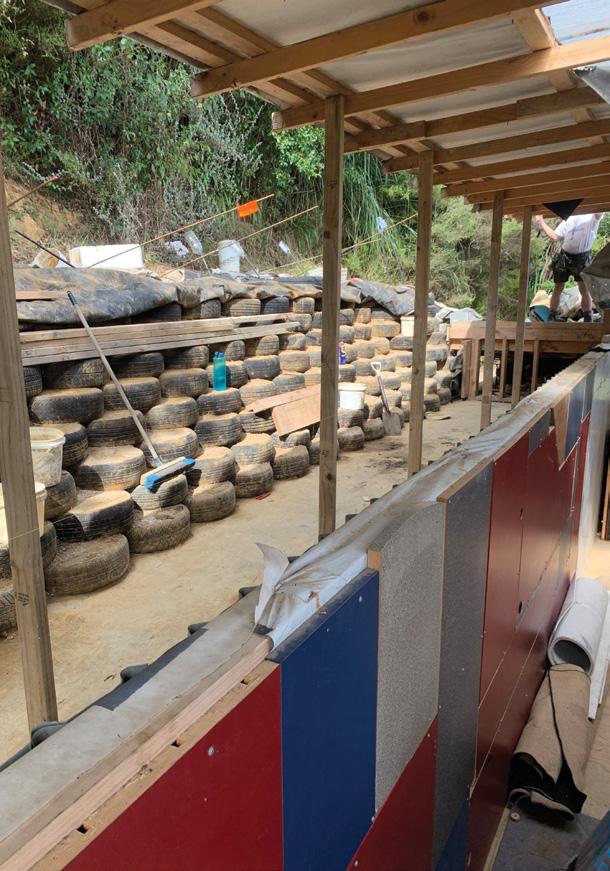
ABOVE LEFT: Hayden Algar of Sharp Building Ltd. LEFT: The back wall of the house is a retaining wall with drainage, waterproofing and insulation packed behind the tyres. The stairwell in the foreground is lined with laminated desktops and benches.
“It was pretty gnarly. We’d be getting calls at midnight saying water was getting in, or there was a rip in the tarp.”
HAYDEN
ALGAR, BUILDER
t
joinery; we made recycled stairs out of wooden pallets.”
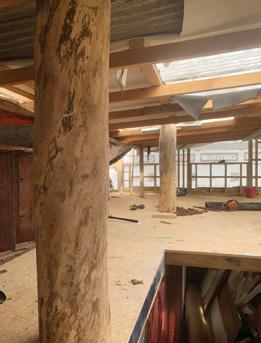
Huge eucalyptus trunks – again from the site – were hauled up on to the top floor and fitted as posts to support the roof. “We had to scrape all the bark off those, brush them down and sand them,” he says.
Hayden also helped create a winch and mounting so the engineer could test the ground anchors.
One of the most challenging aspects of the build however, was the weather. The mud used in the walls takes years to properly dry out, so keeping it protected was a constant battle.
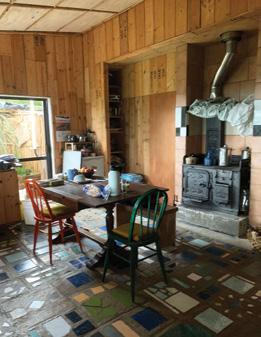
the home was carefully considered to ensure sustainable practices were followed. Solar panels power the home, while double-glazed windows help maintain warmth. A coal range is used for cooking and heating water, and a wood fire keeps the living room cosy in winter. Come summer, Fay throws open the veranda doors and lets the breeze cool the house naturally.
Material matters
Fay’s commitment to using recycled and natural materials shaped every part of her design.
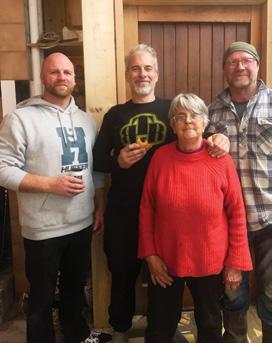
ABOVE FROM LEFT: Hayden Algar, Scott Bowater, plumber, Fay and right hand man
Wayne Chalmers (handyman/ builder). Huge eucalyptus trunks, from the site, were fitted as posts to support the roof.
“We had to keep everything dry with a series of big tarps. It was pretty gnarly. We’d be getting calls at midnight saying water was getting in, or there was a rip in the tarp. The earth couldn’t get wet, so that was really challenging,” says Hayden.
Fay agrees: “In the rain, the mud here just turns to jelly.”
Then there was the wildlife. “Up in the bush, you get lots of critters and creatures getting in, too,” says Hayden.
Throughout the build, every detail of
“The basic construction material for the walls is tyres, using them as bricks. They are stacked and rammed with earth and aluminium cans saved by friends and family. I went to tyre companies and they were always happy to give old tyres to me but I had to sort them, which was timeconsuming and daunting.”
Recycled pallets line parts of the walls, alongside bamboo harvested from the property. The tiled floors are a colourful patchwork of recycled tiles, glass and earth - each one painstakingly oiled by Fay with a mix of sunflower oil and citrus
u

Building the Future
NZCB Conference 2026
Two days of learning, inspiration, and connection.
Featuring keynotes from legendary mental skills coach Gilbert Enoka, leading economist Shamubeel Eaqub, and hosted by Jeremy Corbett.
Be part of shaping the future of building.
Register before 20 March to save with early bird rates.



5-6 June 2026
NZ International Convention Centre, Auckland www.nzcbconference.nz
And if Fay could do it all again?
“I would start sooner. I will be 76 in the next few months and it would have been nice to do it 10 years earlier.”
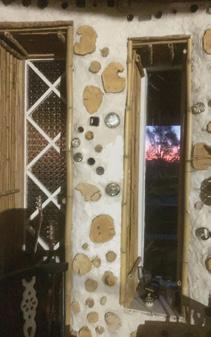
ABOVE FROM LEFT: Clay on cordwood walls finished with white clay to reflect the light. The kitchen has an 80-year-old refurbished coal range (now a wood stove). The walls are lined with wood from old pallets.
turpentine. To brighten the space, she’s painted some walls with white clay.
Friends and volunteers have added their own creative touches along the way, and the house continues to evolve. “Earth moves and cracks as it dries, so the walls need plastering and repair over time,” Fay says.
It’s all part of the home’s living, breathing charm.
The final leg
“You need to do it with the vacuum cleaner,” Fay calls out to her daughter, who’s trying to sweep cobwebs from the ceiling with a broom. “The cobwebs just stick to the earth, it’s one of those things.”
Living in an Earthship, she says, comes with quirks like that – but it also sparks bigger conversations about how the construction industry could rethink waste and recycling. Projects like this encourage builders to look at materials differently, showing that sustainability doesn’t have to come at the expense of durability or design.
“It’s opened my eyes, that’s for sure,” says Hayden. “Nothing is wasted. It really sets the bar for what sustainable building can look like.”
Though a few finishing touches remain, Fay is now happily settled in her home.
“It’s nice to have more space. It’s definitely more than what one retired lady needs!”
For Hayden, the greatest reward has been helping bring Fay’s vision to life with his experience and creativity. “The best part was getting to the stage where we could finally see light at the end of the tunnel.”
With exterior cladding now underway, the project is nearing completion – 15 years after it began. Fay credits the unwavering support of friends and family for seeing her through the long journey.
“It’s absolutely magnificent –dreamworthy – to live in a big space and enjoy the artwork of my own creation. At the drop of a pin, I can have people coming for dinner and not have to worry about having the space to host them.”
And if she could do it all again?
“I would start sooner. I will be 76 in the next few months and it would have been nice to do it 10 years earlier.”
If you have a story you’d like to share with NZCB members, let us know at marketing@nzcb.nz








Site Safe helps our members to confidently manage health and safety. Join over 5,000 New Zealand business in creating safer workplaces. Contact Site Safe today - call 0800 748 372 or visit sitesafe.org.nz

Smart design, sustainable future
Good design is one of the foundations of sustainable building, and the collaboration between NZCB and Designgroup Stapleton Elliott (DGSE) on NZCB Studio is putting this principle into practice.
WRITER: COURTNEY WHITAKER

DGSE Principal and National Sustainability Portfolio Lead



Designgroup Stapleton Elliott acknowledge the weight of our responsibility as Architects and approach every project with manaakitanga // care and respect. People, place, and culture are at the heart of our design processes, and it’s with a deep understanding of each that we can create architecture that deeply enriches lives.


WHEN IT COMES TO sustainability, builders can often carry the weight of making it happen on-site. But the process begins well before the first nail goes in or foundations are laid.
That’s the ethos behind the NZCB Studio initiative, which commenced in 2024. A collaboration between NZCB and Designgroup Stapleton Elliott (DGSE), the programme aims to make sustainable housing practical, achievable, and affordable by offering a series of home designs that are easily adaptable to clients’ needs and site features.
“Sustainability in the building and
construction industry is something that NZCB takes seriously,” says NZCB Chief Executive Malcolm Fleming.
“Last year, we pushed back strongly against government proposals to do away with recently updated H1 insulation standards, and managed to persuade decisionmakers to rethink this approach.
“A big factor in that change in direction was NZCB pointing to data about how sensible design could minimise unnecessary insulation while still achieving warm, dry homes with low operating costs for homeowners.
“We ran the numbers on the NZCB
SAM ELLIS Associate at DGSE
HANNAH ANDREW
Studio designs that were being developed, and made a compelling case that with smart design, you could build healthy homes without it costing the world.”
Partnership the key
To make this new initiative work, NZCB needed plans that would not only perform well from a sustainability point of view, but would also look good and be affordable. That’s when DGSE became involved.
“Sustainability was a key focus and driver of NZCB Studio, and that’s inherent in our values at DGSE,” says Hannah Andrew, DGSE Principal and National Sustainability Portfolio Lead.
“There was a lot of alignment from the outset. Partnering with NZCB allowed us to work together to look at how projects can exemplify sustainability or put into play sustainable practice through projects.”
Homestar 6 ready, these standardised designs offer builders a framework that is practical to create, while giving homeowners the flexibility to incorporate higher-performance or bespoke features, making sustainable, efficient homes more accessible to Kiwis.
“In the case of NZCB Studio, it was about pushing simplicity and efficiency in the designs so they have the ability to be adapted or up-specced in terms of their performance,” says Sam Ellis, Associate at DGSE.
“One key thing was partnerships. We made conscious design decisions to incorporate the latest and greatest,
readily available product advancements in the New Zealand market. We’re not specialising in a single, localised solution, it’s very much a national solution.”
Sustainability in focus
A number of considerations go into making NZCB Studio designs sustainable.
As well as features such as APL Thermal Heart Centrafix joinery, GIBFix Framing systems, clip-on solar shading, and centralised heat recovery ventilation options, NZCB Studio designs also consider site orientation, passive solar gain, wind direction, street access, and adaptable living spaces.
“One of the major considerations was to minimise construction waste,” says Malcolm. “We’ve introduced other initiatives over the past year to help members manage on-site wastage, such as our Site Waste Plan. But when we were developing NZCB Studio, we were also looking for smart ways to prevent waste before the construction phase even begins on these projects.”
That approach chimed with DGSE, who allocate a sustainability champion to identify and align opportunities and aspirations in their projects.
“It ensures we have someone involved in those upfront conversations around strategies that can be employed to get the most environmental benefit,” Hannah says.
“These champions, alongside touch points with working groups and
u

“Through conscious choices, we can reduce carbon, we can improve performance, we can build resilience.”
HANNAH ANDREW, PRINCIPAL, DGSE

“It can be as simple as the orientation of a building. Thoughtful placement helps harness natural light, improve airflow, and reduce reliance on energy-intensive heating and cooling, proving that sustainability starts with design fundamentals.”
HANNAH ANDREW, PRINCIPAL, DGSE
tcollaboration with builders, play a key role in guiding decisions on materials, layouts, and systems that deliver long-term environmental gains.
“It can be as simple as the orientation of a building, the way it sits on the land, the way it interacts with its place,” says Hannah.
“Thoughtful placement helps harness natural light, improve airflow, and reduce reliance on energyintensive heating and cooling, proving that sustainability starts with design fundamentals.”
People, place, and culture
DGSE embeds sustainability into every project, guided by their values of people, place, and culture. As a values-based practice, this approach is part of their day-to-day work and inform design decisions, making environmental responsibility a core, not optional, element of their architecture.
As well as environmental considerations, cultural authenticity is also embedded into all projects through DGSE’s Indigenous Design Rōpū (IDR). The IDR is an in-house collective of indigenous architects and designers, whose role is to ensure cultural integrity and agency prevail in the design process, enabled by nurturing genuine relationships with tangata whenua, clients, and all project partners.
“We work a lot with community
groups, iwi, charitable housing providers and local government, and it really develops a holistic understanding of the land,” says Sam. “It’s about being in touch with those people, those communities, and understanding how those spaces work. It’s not always about accreditation, but about process.”
But how can others in the industry start to follow this greener, cleaner path? And are we moving fast enough?
Designing the future
“I think, with New Zealand and sustainability, we need to recognise that everybody is at a different stage in their journey,” says Hannah. “One of the goals we have as a practice, is around advancing sustainability in projects and practice. Striving to be better every day.”
Through initiatives like NZCB Studio, DGSE demonstrates that sustainability in architecture is about more than energy performance; it’s about creating homes and spaces that enrich communities, connect to culture, and uplift the immediate environment.
But sustainability is not an issue that should only be pigeon-holed into new builds.
“The most sustainable building is the one that’s already built,” says Sam. “There’s obviously a lot of old housing in New Zealand, so rather than demolishing existing buildings and building new homes, which comes with an environmental impact, we also do a lot of retrofitting and redevelopment, which we consider very sustainable as well.”
Through careful upgrades to existing homes, sustainability can extend its reach. Regenerating older homes and improving their performance is also a crucial step towards a greener industry.
“Through conscious choices, we can reduce carbon, we can improve performance, we can build resilience, and we can move towards more regenerative architecture,” says Hannah.
No matter where anyone is on their journey, it’s knowing that we can constantly, continually strive for that improvement.”
For more information, visit nzcb.nz/studio or email membership@nzcb.nz.

















Workplace law updates: What employers need to know
Workplace law updates: What employers need to know
A wave of workplace law changes is on the way for 2025–2026.


AS 2025 DRAWS TO A CLOSE, the government is progressing a raft of changes to workplace laws, which are at various stages of policy design or legislative process.
From parental leave enhancements to pay equity reforms and upcoming proposals on employment law, privacy, and health and safety, the
landscape is evolving rapidly.
The tables right and on the following page explain which proposals have passed, are in the works, or are yet to come, and the team at Ashcroft Mitchell McGregor encourages you to call the NZCB helpline with questions about what these mean for your business.
Ashcroft Mitchell McGregor operates the NZCB Employment helpline, offering specialist advice, representation and support across employment, immigration and health and safety law, to businesses throughout New Zealand. Visit ammlaw.co.nz
KATE ASHCROFT Ashcroft Mitchell McGregor
WORKPLACE LAWS: PASSED
CATEGORY
Parental Leave (Passed)
KEY UPDATES
u Preterm baby payments added
u Broader primary carer definition
u Flexible eligibility even after leaving work
Partial Strike Reductions (Passed)
Pay Equity Changes (Passed)
Privacy and Payroll (Passed)
Pay Disclosure (Passed)
u Can deduct from pay for workers on partial strike
u Changes to pay equity claim rules
u IPP 3A notification for indirect data collection (from 1 May 2026)
u Theft by Employer Act (from 14 Mar 2025)
u KiwiSaver changes (from 1 Apr 2026)
u Employees can share pay info freely
u PGs allowed for unfair treatment due to disclosure
WORKPLACE LAWS: BILLS PROGRESSING
CATEGORY
Employment Law (Bill progressing)
KEY UPDATES
u Contractor Gateway test (5 criteria)
u Tougher personal grievance (PG) rules; $180k+ earners excluded from PGs
u Repeal of 30-day CA rule
EMPLOYER GUIDANCE
u Review parental leave policies
u Ensure payroll reflects new entitlements
u Seek advice for complex cases
u Seek advice for unionised workplaces
u Seek advice for pay equity issues
u Seek privacy advice and update policies/training for staff
u Review data practices
u Ensure wage compliance
u Remove pay secrecy clauses
u Update templates
u Seek advice for disputes
Ending Employment by Mutual Consent (Bill progressing)
u Formal written request required to start negotiations
u Employee consent needed before discussions
u Requests limited to once every six months unless genuine reasons
u Termination agreements must be written, signed, and include legal statements
u Agreements binding and cannot be cancelled under contract law
u Safeguards against unfair negotiations (e.g. undue influence)
u Breaches may lead to cancellation and penalties
u Confidentiality rules for pre-termination negotiations with exceptions for unfairness
EMPLOYER GUIDANCE
u Review contractor agreements
u Strengthen misconduct policies
u Update individual employment agreements (IEAs)
u Adjust onboarding
u Monitor Bill progress
u Update termination policies/templates
u Train managers on new process
u Review negotiation practices
u Employers should seek legal advice









Whether you need to update employment agreements, review payroll systems, or prepare for upcoming consultation periods, now is the time to act.
WORKPLACE LAWS: WATCH THIS SPACE
CATEGORY
Human Rights Act Changes (Watch this space)
KEY UPDATES
u Proposed extension of prohibited grounds of discrimination to include gender identity/variations of sex characteristics
EMPLOYER GUIDANCE
u Watch for Bill for more detail
u Prepare for submission period
u Review policies for compliance when law changes and consider training for managers
Ending employment by agreement (Watch this space)
u Policy proposal that employers and employees can agree to end employment
Modern Slavery (Watch this space)
Holidays Act Reform –Employment Leave Act (Watch this space)
u Two private membersʼ bills, not selected for consideration yet
u Watch for Bill for more detail
u Prepare for submission period
u Review policies and IEAs for compliance when law changes and consider training for managers
u Watch for Bill for more detail
u Prepare for submission period
u Review policies and commercial agreements for compliance when law changes and consider training for managers
u Shift to pro rata sick leave
u Casuals paid 12.5% loading; itemised pay statements
u Cash up 25% of annual leave
u Fixed allowances during leave
u Clearer public holiday test
u 21-day closedown notice
u Roster info in contracts
u Removal of ACC accrual of holiday pay
u Watch for Bill for more detail
u Prepare for submission period
u Review policies and payroll systems for compliance when law changes
Health & Safety (Watch this space)
u Simplified duties for small businesses
u Focus on serious risks
u Clarify overlapping duties
u Reduce WorkSafe notifications
u Adjust governance roles
u Reform Approved Codes of Practice (ACOPs)
tProactive planning is essential. Whether you need to update employment agreements, review payroll systems, or prepare for upcoming consultation periods, now is the time to act.
Ashcroft Mitchell McGregor delivers specialist advice, representation and support across employment, immigration and health and safety law to businesses throughout New Zealand. We can provide advice and
u Monitor legislative updates
u Review risk management plans
u Prepare for changes in liability and reporting
guidance pertaining to any of the changes mentioned above. Visit ammlaw.co.nz to subscribe to our newsletter, gain access to our free webinars, receive invitations to our workshop and seminar series and stay up to date with the latest developments.
If you have specific questions about how these changes affect your business, contact the NZCB helpline on 0800 354 821.




Wondering how to thrive in a slow market?
Wondering how to thrive in a slow market?
Look no further than your software to keep things running smoothly.

FreeUp/Released

JUST AS THE TOOLS in your toolbelt help you do your job on a site, the tools in your electronic devices can help you nail all of those background tasks that keep a business running. Saving time spent on administration means more time available for income-earning work.

FreeUp/Released is a NZCB National Partner (Starter) and tech advisor for builders – making the process quick and easy, from selecting the right software to setting up the system to training staff. FreeUp/Released also operates the NZCB Technology and Software helpline for members. Contact us at 09 887 9950 or hello@freeup.co.nz or visit freeup.co.nz
Automation in job management has been around for years but it’s being supercharged by AI. It’s likely the software you use has features you aren’t even aware of, and the ability to make running your business significantly easier. Unlocking all of this potential is the challenge; here are a few places to start.
Scheduling
Scheduling is an important aspect of any trades business. Automations and templates can make this much easier, helping to ensure that your scheduling is accurate.
To take just one example, Tradify allows automatic rescheduling of recurring jobs, integrates timesheets with job schedules, and allows an
accepted quote to be easily transformed into a scheduled job. Missing appointments is bad for productivity and also your professional reputation. So take full advantage of the scheduling tools your software offers.
Invoices and cash flow
Chasing up invoices is nobody’s favourite task, but sometimes clients and customers need a reminder or two to pay their bills. When invoices go unpaid, cash flow can suffer and this may cause financial troubles down the track.
Many job management software platforms offer automated reminders for this and other situations. ServiceM8, for example, has an automation add-on which you can use to send auto reminders following up on outstanding invoices. Set it at chosen intervals or set periods of time before and after an invoice due date; generate a polite message using Smart Assistant; and choose whether to send via SMS or email. Easy!
WithHome
KELLIE BEAUMONT
Customer comms
Communicating clearly and regularly with your customers before, during, and after a job can do wonders for your professional reputation. Keeping all parties well informed also makes projects run more smoothly, reducing costs. In some cases there is no replacement for plain old human interaction, but automation can certainly relieve some of the load.
Fergus, a popular choice with Kiwi tradies, has recently introduced SMS schedule reminders which will automatically drop people a text reminding them of a scheduled visit or appointment. These are easily tailored to suit you and are a great courtesy for your busy customers.
Financial reporting and forecasting
Using automation to pull data out of job cards and other places, job management software can make your reporting and financial forecasting
simple and quick, giving you time to spend elsewhere. As a business owner, it’s on you to make important financial decisions. Accurate reports are the foundation of good decision-making and can positively impact your profitability and success in the future.
Rave Build has robust reporting capabilities, offering business performance reports, sales and CRM reports, financial reporting, income projections, and more. If you’re using the software to its fullest extent, you’re capturing a treasure trove of information that can be recycled through automation for informative reporting.
Want to make sure you’re using your software tools to your utmost advantage? Not sure where to start when it comes to integrating tech and automation into your business systems? FreeUp is here to solve those problems.
Visit freeup.co.nz to find out more, and get your tech tools working harder for you.




Saving time spent on administration means more time available for incomeearning work.








Home App




Payment claims: “an invoice on steroids”
Tired of chasing unpaid invoices? A simple change in paperwork could make all the difference.



AT THE BUILDING DISPUTES
TRIBUNAL (BDT), our services have reliably helped builders get what they’re owed for over 30 years. But first we must take you back to a crucial first step – the payment claim.
The problem with invoices
Why a payment claim?
The CCA was designed with cash flow in mind. Among its methods of ensuring faster payment is the payment claim.
The BDT provides guidance to parties and their advisers as to the most appropriate dispute resolution process for their dispute. Call 09 486 7143 or 0508 284 534, email registrar@buildingdisputestribunal.co.nz or visit buildingdisputestribunal.co.nz
Imagine: you have been a working on a project for some time. You sent the invoice but days have gone by with no response. This is frustrating - you have done all the work with nothing yet to show for it in your bank account. Unfortunately, this is more than just a thought exercise. It is a reality that too many go through. Enter the Construction Contracts Act 2002 (CCA).
Described by Geoff Hardy of Martelli McKegg as an “invoice on steroids”, the CCA attaches legal rights to the payment claim. The recipient must respond with how much they plan to pay you. If they don’t do that in time, they must pay the whole payment claim amount. However, the payment claim must be presented in a certain way to be effective. Make sure your payment claim gets it right by following all these seven steps: u Put the payment claim in writing
ALEXANDER LYALL Resolution Specialist at BDT
MICHAEL JAMIESON Manager of Commercial Contracts at the ADR Centre also manages the Building Disputes Tribunal (BDT)
It doesn’t have to be particularly formal - if it’s in writing and covers the following points, it’s valid.
u Relate the payment claim to the construction contract Specify the contract and the exact section(s) you are referring to.
u Outline what work was done and when Identify the construction work and the relevant period for which you need to be paid. This may vary depending on the project’s size and whether you are invoicing at regular intervals (e.g. fortnightly) or based on milestones. In any case, you must detail the exact work covered by the payment claim.
u Include the amount owing and the date it needs to be paid State what is owed and when it needs to be paid. Make the date specific to the day. This date might already be stated in your contract, or the period may be specified there.
u Show your calculations How did you arrive at the total owed? Make this as clear as possible so they can understand what you have done and what you are charging for.
u State that the claim is made under the CCA
Simply state: “This is a Payment Claim made under the Construction Contracts Act 2002.”
u Attach a written “Form 1” notice This notice must describe how the intended payer should respond, and what the consequences are if they don’t respond. The notice is set out in schedule 1 of the Construction Contracts Regulations 2003 or in the BDT template. Your payment claim is invalid if this notice is not included.
What next?
The recipient may respond with their payment schedule. If you disagree with what’s in it or believe it is invalid, this is a good time to start the adjudication process. Also, if they don’t respond and don’t pay, then you can seek adjudication on a “payment default” basis as a starting point to collect the debt.
Adjudication is the quick, private and cost-effective alternative to court.
Check out our template
You can find a payment claim template under the Guides and Resources section of the BDT website (buildingdisputestribunal.co.nz/ guides-and-resources/). If you have any questions, please get in touch.
About us
The BDT provides the experts who will determine the outcome of your dispute. Our registry team cannot give legal advice, but they can discuss the process and requirements of adjudication, check if it is right for your dispute, and support and guide you and the other party through the process. Contact us at registrar@ buildingdisputestribunal.co.nz or phone: 0508 284 534

You sent the invoice but days have gone by with no response. This is frustrating – you have done all the work with nothing yet to show for it in your bank account.
Disclaimer: Information published in this article is not intended to be comprehensive. No person should act in reliance on any statement in the article and the Building Disputes Tribunal accordingly does not accept any responsibility. Readers are advised that specialist legal advice should be sought in relation to all matters covered in this article.
Don’t let a break-in ruin your post-holiday glow
Heading away this summer? Keep your home and building site safe with these simple pre-holiday security checks.

LET’S BE HONEST, at this time of the year we are all hanging out for Christmas and the summer holidays. Before you pack up the car or the boat to head away, it’s important to ensure that your building sites, premises, and your home are safe and secure. No one wants to come back from a relaxing break and find tools have gone from your vehicle or materials taken from an unsecured site. Here are our top tips to help you relax when you knock off for Christmas.
Check locks on gates and install cameras if possible.
Have someone visit work sites or spec homes for sale while you are gone. This can help to limit the extent of losses as thieves can target sites more than once, and malicious damage can be more extensive over time.
Clean up and remove any combustible materials to avoid fire risk and malicious damage risk.
Your work vehicle
Avoid leaving your vehicle on job sites during extended breaks unless the site is also secure.
If at home, park in a garage wherever possible or at least off the street.
Limit the tools/items left in work vehicles. Remove all high-value items or lock them in a secure box fixed inside the vehicle.
Your office/workshop
Remove visible packaging in bins (packing from new tools or appliances), as thieves can see what’s inside that might be worth stealing.
Ensure security alarms are activated and security lights switched on.
Check all doors and windows are locked.
Your home
Don’t leave any tools lying around the property that could be used to break in.
ICIB Brokerweb is the trusted insurance broker for NZCB and is proud to be celebrating 50 years of doing business in New Zealand. For a review of your commercial vehicle cove, call us on 0800 644 444 or visit icib.co.nz
Work
sites
Secure all building sites before heading away – especially for extended periods.
Tell trusted neighbours you won’t be around and perhaps ask them to collect your mail or any deliveries you are expecting.
Make sure windows and doors
are securely locked.
Turn off your water to avoid any potential flooding.
Don’t forget to set your alarm, if you have one.
You will need to advise your insurer or broker if you are away for more than 60 days as this may impact your insurance policy.
Proof of purchases
Due to the large increase in theft claim volumes over the summer break, claims can take longer to process. One of the things that makes a claim take longer is the need to search for proof of ownership. To help speed claims up, it is best to have some form of proof of ownership for as many items as possible. Some ways to do this are:
If you haven’t already, start a folder on your computer with copies of
invoices/receipts.
Have a tools register. Ideally this will include all relevant receipts and serial numbers, and also photos of high-value items.
Take photos of where your tools are kept, such as a wide-angle photo of the tools in the work van. This can help claims assessors see smaller items such as hand tools that may not have a receipt but would still prove you had the item.
Finally
From the team at ICIB, have a great Christmas and a super break. We know you’ve worked hard this year, so enjoy the time relaxing with your loved ones. See you in 2026!
ICIB Brokerweb is the trusted insurance broker for NZCB. If you are going away for more than 60 days give us a call on 0800 644 444.
No one wants to come back from a relaxing break and find tools have been stolen out of your vehicle or materials taken from an unsecured site.


Check





Preparing for the economic lift
Preparing for the economic lift
Using a downturn to prepare for what’s ahead is key. Here are practical ways to build momentum before the next upswing.


SLOW ECONOMIC PERIODS can be really tough for the building industry. Work is harder to come by, margins get tight and confidence often dips. But downturns don’t last forever. The businesses that come out flying are the ones using this time strategically: tightening operations, strengthening relationships and positioning themselves to hit the ground running when demand takes off.
Here are some practical steps you can take now to get your business ready for the inevitable upturn.

My Smart Office can help you get more done in less time. Then you can focus on what matters: growing your business. Amanda Chisholm runs a successful residential building company with her husband and has over 20 years of experience working with customers, sales and marketing, bookkeeping and administration. For more advice contact MySmartOffice on 021 886 120 or visit: mysmartoffice.co.nz
Cash
is king
Cash flow is the lifeblood of your business. Keep a close eye on what’s coming in and going out, and don’t let small issues snowball. Build a cash buffer to help cover shortfalls and give you the flexibility to take on new opportunities quickly.
Make sure you invoice promptly, stay payment claim compliant, and follow up overdue accounts. Getting paid on time is one of the simplest and most effective ways to strengthen your financial position.
Keep an eye on costs
Don’t let expenses creep up unnoticed. Regularly review your overheads, charge-out rates, and supplier pricing. Protecting your margins doesn’t mean cutting corners; it means staying disciplined and proactive about where your money is going.
Debt is dead weight
High-interest debt drains profitability. If possible, pay down loans and look at negotiating better terms with lenders. At the same time, maintain access to credit so you can act quickly if the right opportunity comes along. Strong finances today put you in a much better position tomorrow.
Keep your name out there
When times are slow, it can be tempting to cut back on marketing, but going quiet is a big mistake. Staying visible keeps you front of mind when clients are ready to commit.
Refresh your website and social media by showcasing stand-out projects, testimonials and case studies. Keep networking with architects,
AMANDA CHISHOLM
My Smart Office
developers and past clients, and don’t neglect your referral networks such as real estate agents. Consistency now will pay off later.
Work smarter
A slowdown is the perfect time to look inward. Are your workflows efficient? Are you losing hours to admin? Streamlining processes and adopting tools like project management or estimating software can help cut waste and make your business run smoother. These improvements mean you’ll be able to scale or outsource more easily when demand increases.
Hold on to your A-team
Skilled labour can be hard to find in boom times so identify gaps in your team now and plan ahead. It’s just as important to look after the good people you already have. Keep them engaged, supported and motivated so
they’re not tempted to move on. Upskilling staff during quieter periods ensures they’ll be ready to deliver at pace when things pick up.
Look after your suppliers and subcontractors
Good supplier and subcontractor relationships are critical for keeping projects on track. Stay professional, communicate regularly and, most importantly, pay promptly. Reliability goes both ways and when the upturn comes, those who value your partnership are more likely to prioritise your business. It’s also wise to have backup suppliers lined up to avoid bottlenecks.
Downturns test resilience but can also create opportunity. By managing cash well, keeping your people and systems strong and staying visible in the market, you’ll position your business to thrive when confidence returns.





Reliability goes both ways and when the upturn comes. Those who value your partnership are more likely to prioritise your business.






Apprentice Challenge 2026
Get ready for the 2026 Apprentice Challenge – a chance for apprentices to test their skills and give back to their communities.
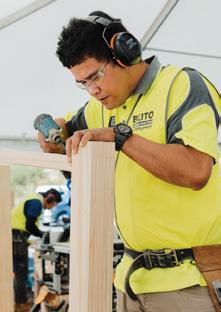
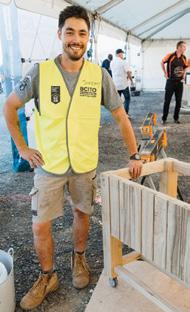
ADNZ students were invited to create concept designs for a Pātaka Pukapuka – a community sharing cupboard for books, toys, food, or any other local need.
THE APPRENTICE CHALLENGE is just around the corner and we’re proud to be partnering with BCITO and Mitre 10 Trade for the 2026 competition.
Entries open 27 January, and it’s free for NZCB members to enter. The competition has two stages: the regional heats and national final. Regional heats will be held on 18 April 2026, where apprentices around the country will put their practical skills and time management to the test. Each entrant will have eight hours to complete a build project that they must donate to their local community.
Top-performing apprentices will go on to compete at the national final,


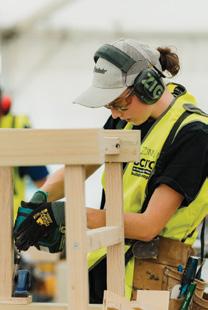
held at the NZCB Conference in Auckland on 5–6 June 2026.
We have collaborated with Architectural Designers New Zealand (ADNZ) on the design for the 2026 project. ADNZ students were invited to create concept designs for a Pātaka Pukapuka – a community sharing cupboard for books, toys, food, or any other local need.
We’ll be announcing the selected ADNZ student designer in the New Year, ahead of their concept being built at the regional heats in April 2026. Keep an eye on our social media channels and the Apprentice Challenge website for updates: apprenticechallenge.nz
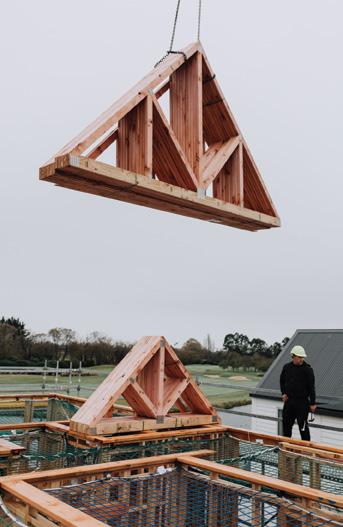
NZCB Learn: Education made easy
Stay up-to-date with our latest courses, designed to suit your schedule.


THE GOVERNMENT IS proposing changes to the way building liability is dealt with in New Zealand.
The good news is that the Halo Guarantee ticks all the boxes but it does mean you’re going to get a lot more enquiries from homeowners asking how the guarantee works.
We’ve put together a fantastic overview of the Halo Guarantee that will give you all you need to know. And don’t forget our course on the New Zealand Building Code, developed in collaboration with the Building Officials Institute of New Zealand (BOINZ).

The NZCB Learn platform is available exclusively to NZCB members, and it brings flexible learning to you. Access it via the NZCB Toolshed and find a range of day courses, online learning and health and safety resources. If you need extra support or have questions, email learn@nzcb.nz or call Marcie Hintz on 021 365 947
Understanding and applying the Halo Guarantee
The Halo Guarantee Essentials course gives builders and business owners the confidence to talk about and manage the Halo 10-Year Residential Guarantee with their clients.
Learn what the Halo Guarantee means for your business, how to explain its benefits clearly to homeowners, and how to complete and submit applications correctly every time.
Through practical examples and step-by-step guidance, you’ll gain the knowledge and confidence to integrate the Halo Guarantee into your projects, protecting both your clients and your reputation.
Learn about the Building Code
In collaboration with BOINZ, the NZ Building Code & Compliance for Builders course gives you a clear, practical grasp of how the Building Code shapes everyday construction work in New Zealand.
This course breaks down the key sections of the Building Code and explains how they connect to real-world building practice. You’ll explore the roles of the major industry players, from MBIE and councils to inspectors and builders, and understand how each contributes to Code compliance.
Through practical examples, you’ll also learn to apply recognised compliance pathways, including deemed-to-comply and alternative solutions, to make sure your building work always meets Code standards.
MARCIA HINTZ Education and Events Manager




Get ready for the 2026 NZCB Conference & Expo
The 2026 NZCB Conference & Expo returns on 5-6 June at the International Conference Centre in Auckland.



THE 2026 CONFERENCE will feature interactive learning sessions and panel discussions covering everything from emerging technologies and AI, to practical business operations, HR, and technical issues facing the building industry today.
A line-up you won’t want to miss
We’re thrilled to welcome Jeremy Corbett, comedian, broadcaster, and host of 7 Days, as our MC. Joining him are two powerhouse keynote speakers:
u Gilbert Enoka, mental skills coach to the All Blacks and high-performance advisor.
u Shamubeel Eaqub, leading economist and commentator on business, finance, and housing.
Together, they’ll deliver insights to inspire leadership, resilience, and success, both on and off the tools.
Save with early bird pricing
We’re committed to delivering a high-quality event while keeping costs affordable. Prices remain unchanged from last year. Register before 20 March 2026 to lock in early bird rates.
All NZCB members can register one guest at the new guest member rate instead of the additional delegate rate – perfect for a partner, colleague, or friend.
Find out more and register now at nzcbconference.nz
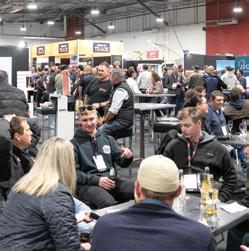
Early Bird Rates
NZCB MEMBER
u Full Conference: $330 (standard $415)
u Single Day: $220 (standard $275)
NZCB MEMBER GUEST
u Full Conference: $330 (standard $415)
u Single Day: $220 (standard $275)
ADDITIONAL DELEGATE
u Full Conference: $380 (standard $475)
u Single Day: $253 (standard $320)
GILBERT ENOKA Mental skills coach
SHAMUBEEL EAQUB Economist, author and media commentator
JEREMY CORBETT Comedian and broadcaster











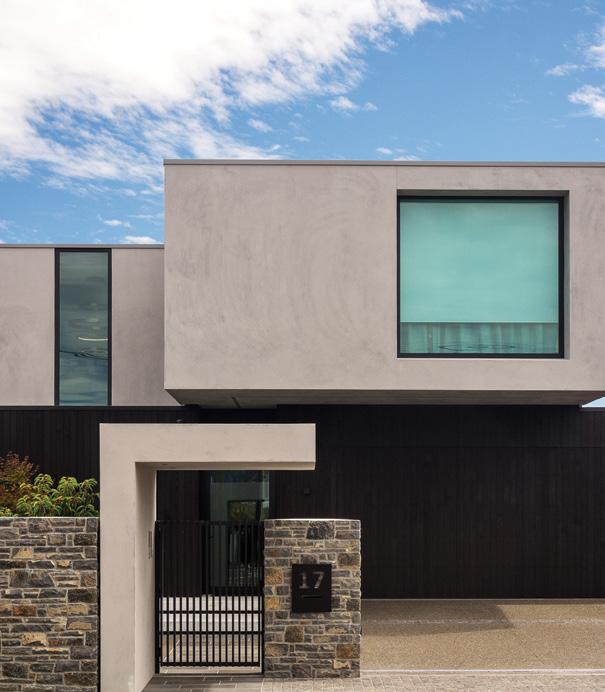











NZCB sponsoring NZ House & Garden Tours



We’re proud to announce our new partnership with the NZ House & Garden Tours for 2026.












OUR MEMBERS PLAY a huge part in bringing to life dream homes like the ones showcased on these tours, and surveys show that 98% of people who register for the tours are considering building or renovating their own homes in the next year.
That means partnering with NZ House & Garden Tours is a great way to get likely clients around the country thinking about NZCB when it comes to finding their builder. And it’s all in support of a great cause –Breast Cancer Foundation NZ.
Each regional event features a series of showcase homes, drawing thousands of attendees who are passionate about home design, renovation, and lifestyle. Attendees are encouraged to visit the central hub, where NZCB will have a stand to engage with visitors, and encourage them to find an NZCB member they click with.
DATE
13-14 February
20-21 February
13-14 March
27-28 March








LOCATION
Wānaka
Christchurch
Taupō
Auckland



Call for volunteers
We’re looking for members to join us for our “Ask a Builder” initiative at the NZCB stand at the NZ House & Garden hubs. You’ll be chatting with homeowners about who we are, what we do, and why choosing an NZCB builder makes all the difference.
With at least 8,000 visitors expected across the four events, it’s a great chance to meet people actively planning to build or renovate, showcase your skills, promote your business, and have a bit of fun representing NZCB.
If you’re keen to help at one of the hubs – even just for a few hours –please get in touch with the NZCB Marketing team marketing@nzcb.nz
nzhouseandgardentours.co.nz
HUB
Lake Wānaka Centre
TBC
Suncourt Hotel & Conference Centre
B:Hive at Smales Farm


| HDW15U3B1
| HPH60IMB2 | HCI604FTB4
| HWO60S14TPB2
Rough shots, big hearts
NZCB members have been missing greens around the country in support of local charities, including the NZCB Apprentice Trust.
While the golf itself left something to be desired, our Charity Golf days were great opportunities for NZCB members and their families to connect, share some laughs, and take a well deserved break in the busy lead-up to Christmas.
A special thank you to everyone involved in organising these events. Regional committees are the backbone of our Association, and these days wouldn’t happen without their hard work.
For full photo galleries, visit nzcb.nz/golfdays2025








Health and safety reforms: Why HazardCo is concerned
Proposed changes promise less red tape - but could they instead make sites more dangerous?

EVETTE McCLURE
Senior Health and Safety Advisor at HazardCo


HazardCo are your trusted safety partner, providing you with the tools and support you need to #SortYourSafety. They also operate the NZCB Health and Safety helpline for members and can be contacted on 0800 555 339
AS A LEADING health and safety provider in NZ, HazardCo is staying close to the proposed changes to the health and safety regulations and working to influence changes where we can. When new rules do come through, we’ll break them down –what’s changed, why it’s changed, and most importantly, how businesses can put the changes into practice, as we know one size doesn’t fit all.
You’ve probably seen the headlines about the government’s proposed health and safety reforms that aim to reduce red tape. But here’s the problem: these changes won’t make construction any safer. In fact, there’s a real risk they could do the opposite. Construction is one of the highest-
risk industries in New Zealand. Hard-won progress in health and safety hasn’t come about by chance; it’s been built over years of effort, investment, and learning from tragedy. Weakening the rules now risks undoing that progress and putting workers back in harm’s way.
Here’s what’s on the table for regulation changes: u Contractor management
Consistency in prequalification makes sense, and HazardCo supports reducing duplication and cost. But reforms must lift standards, not lower them. Cutting corners in this space risks creating a tick-box culture that looks good on paper but fails in practice.
u Falls from height As a country, New Zealand’s hard work in reducing injuries and fatalities from working at heights is paying off. In other countries, it still remains the most significant risk of injury on a construction site.
Relaxing scaffolding rules in “low-risk” situations could significantly affect the process made in this space, and caution should be taken in relaxing these rules.
u Overlapping duties Work is under way on an Approved Code of Practice to help clarify how overlapping duties should be managed on-site. We see this as a positive step, as there can be confusion between contractors, subcontractors, suppliers and other parties about who’s responsible for what. It’s important that while this Code is being developed, the focus remains on making it practical and workable for small to medium-sized businesses in the construction industry.
u Dust exposure Reviewing limits on wood dust and welding fumes to align with international standards is the right move. It will be important that these changes are practical for businesses to implement to make sure that workers are not exposed to dangerous levels of dust that can cause irreversible health problems.
u Machinery guarding Guarding saves lives. We support simplifying the guidance so businesses clearly understand what’s required and how to meet those requirements. But it’s just as important that this doesn’t come at the cost of weaker standards. Any reduction in guarding requirements could lead to more amputations, crush injuries, and even fatalities. Even small changes could have devastating consequences on-site.
HazardCo’s position is clear Construction needs strong, enforceable safety standards. Easing requirements in the name of reducing red tape might sound appealing, but it won’t protect workers. It risks repeating the mistakes of the past, where safety was treated as optional until disaster forced change.
Right now, there are too many different requirements, and what needs to be done often depends on who’s asking for the information. This creates confusion on-site. The focus needs to be on providing consistency, with clear guidelines developed by industry experts and enforced by WorkSafe. That way, everyone knows what’s expected, and we can reduce confusion while keeping people safe.
HazardCo members are already leading the way, being four times safer than the industry average, and we’ll keep supporting you with practical, effective systems and expert advice.
We’ve shared these concerns with the government because the voices of small and medium-sized building companies must be heard. You know better than anyone the pressure of time and cost, and you also know the price of a serious injury.
For now, nothing has changed; these reforms are still at the consultation stage. What matters most is having clarity and standards that builders and tradies can rely on. And we’ll keep pushing for guidelines that genuinely protect builders and tradies, not water them down.
In the meantime, keep doing what you do best: looking after your team, working safely, and documenting your safety actions. And know that we’ll keep you updated every step of the way.

Construction needs strong, enforceable safety standards. Easing requirements in the name of reducing red tape might sound appealing, but it won’t protect workers. It risks repeating the mistakes of the past, where safety was treated as optional until disaster forced change.
Wellbeing on the rise in construction
Stress is down and wellbeing is up across the trades in 2025 –though work-life balance remains a sticking point.


THE 2025 LIVE WELL BUILD WELL Wellbeing Survey offers the clearest picture yet of how New Zealand’s residential construction workforce is coping and changing when it comes to mental wellbeing.

Now in its third year and supported by Foundation Partner ITM, the independently run survey (by IPSOS) reveals slow but steady progress in areas like stress reduction, healthy habits, and awareness of mental fitness tools. It also pinpoints where pressure remains, particularly around work-life balance and economic instability for sole traders.
Stress levels are down
Only one in four tradies now report feeling stressed most of the time, which is the lowest figure since the programme began. In turn, more people are taking small but meaningful steps to support their wellbeing, including exercise, getting organised, and reaching out to workmates. Notably, those who use multiple wellbeing strategies report
significantly higher life satisfaction.
Work-life balance is improving slightly but still lags. While 94% say it’s important, only 66% feel they’ve got it right, which is a gap that’s held steady since 2023.
One standout finding is the increased engagement with Live Well Build Well itself:
u Awareness of the programme has jumped to 22%
u Use of resources (including tradie-led stories and stress tips) is up
u The number of workers saying the programme has helped them emotionally has doubled in the last year
“Tradies aren’t just more open to talking about mental fitness, they’re acting on it,” says Rafael Caso, Programme Lead at Live Well Build Well.
“We’re seeing a shift from awareness to habit. It’s daily actions that build resilience, not once-a-year campaigns.
“What’s exciting is that we now have three years of independent data showing what works. This isn’t just
Waihanga Ora Live Well Build Well. Our goal is to increase mental and physical wellbeing across the residential construction sector. We are a community where tradies lead the conversation of what wellbeing means to them and share their own personal stories on how they overcame tough times to inspire and educate their peers. live-well-build-well.com
RAFAEL CASO Live Well Build Well programme leader
good intentions. We’re starting to embed mental fitness as a norm in the trades, and that’s a big culture shift.”
Using data to drive change
The annual wellbeing survey plays a vital role in tracking progress, identifying new risks, and validating what works. The results are used to inform content development, champion training, Toolbox Talks, digital resources, and industry messaging.
The survey is a cornerstone of LWBW’s broader mission: to strengthen the culture of mental fitness across Aotearoa’s construction sector. Its strength lies not just in the data, but in how it reflects lived experience within the trades.
Looking ahead, the programme is seeking new industry partners for 2026 to scale its reach, resources, and on-site delivery. With the foundations laid, the focus is now on embedding mental fitness into the everyday
culture of building and construction.
The full 2025 report, along with insights from past years, is available to download at livewellbuildwell.com/research
About Live Well Build Well
Live Well Build Well is a sector-led mental fitness initiative designed specifically for New Zealand’s residential construction workforce. It promotes practical tools, peer stories, and industry-wide support systems to help builders and tradies build resilience on and off site.
Foundation Partner
This year’s wellbeing survey and report has been proudly supported by ITM, the first Industry Foundation Partner of the Live Well Build Well programme.
Partner with us
LWBW is currently seeking new industry partners to support national expansion in 2026. Learn more at livewellbuildwell.com/partner-with-us
“We’re seeing a shift from awareness to habit. It’s daily actions that build resilience, not once-a-year campaigns.”
RAFAEL CASO




Wrap-up
Your site needs MiTek
Now available on mobile or tablet, the MiTek Digital On-site Guide is a practical resource designed for busy construction sites.
The guide brings together technical details, installation instructions, compliance standards and bestpractice guidance for MiTek systems, all in a single digital format. The guide also refreshes itself automatically, so you know you’re getting the latest standards and compliance updates whenever you open it up.
The MiTek Digital On-site Guide supports builders, architects and specifiers with accurate and up-to-date information, helping streamline work processes and reduce the risk of errors.

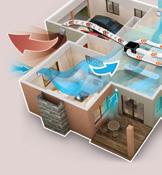
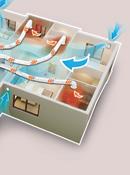
MultiVent: Making a difference in airtight homes
Modern airtight homes demand effective ventilation. Turning fans on and off and leaving windows ajar aren’t enough to remove moisture (especially when clothes are left out to dry), allowing mould and dampness to take hold.
The Manrose MultiVent makes a material difference for builders, putting them back in control. This centralised continuous extraction system runs 24/7, quietly removing damp air from multiple rooms and automatically boosting airflow when humidity climbs. Continuous extraction can also help with overheating issues during summer months.
The MultiVent can help homes achieve the healthy 0.35-0.5 air changes per hour recommended by BRANZ while meeting G4/AS1 and NZS4303:1990 standards. It’s a smart, low-maintenance way to protect your builds from moisture issues and client complaints.
You can’t control how people dry their clothes, but you can control how their homes breathe.

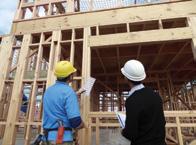
Flooring and window furnishings for all styles & budgets.
The smart lock by Kiwis, for Kiwis
In a market flooded with imported smart devices, the Yale Unity® Slim Smart Lock is a true local innovation. Built for New Zealand’s climate and homes, the Unity Slim tackles common smart lock issues – poor weather resistance, limited serviceability, and generic finishes. Its powder-coating is locally applied in-house, engineered to withstand UV, rain, and wear. It can be matched to the rest of your window and door hardware for a consistent look and feel. And customers can receive the Unity Slim – in the colour, handle style, and backset to suit their door – within just four days.
Every unit supports local jobs and capability, reinforcing our commitment to the New Zealand building industry. And the industry is right behind us: the Unity Slim won the Innovation Category at the 2025 Window and Glass Association Design Awards, and took Silver at the 2025 Best Awards in the Consumer Product category.
Sometimes, the best innovation isn’t shipped in – it’s built right here in our own backyard.

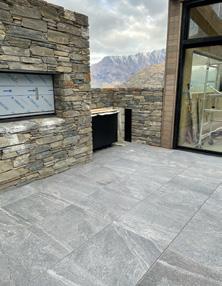
Revolutionary decking system raises the bar
Modern architecture increasingly demands seamless integration between indoor and outdoor spaces, and New Zealand's Silca/Buzon floating deck system delivers exactly that. This sustainable construction technology combines environmental responsibility with exceptional structural performance.
The Silca system features load-bearing grates manufactured entirely from 100% recycled, UV-stable engineered polymer. These durable components clip together to create uniform platforms for supporting tiled outdoor areas. Complying with New Zealand Building Code clauses for Structure (B1), Durability (B2), and External Moisture, it's the country's only structural grate floating deck system.
The system's versatility shines through its free-draining, permeable surface, perfect for pool areas and outdoor decks facing constant wet conditions while supporting tiles as thin as 15mm without adding excessive weight. Installation options include Buzon pedestals, timber joists, or aluminium framing.
For more information on the Silca/Buzon floating deck system, contact Viking Roofspec on vikingroofspec.co.nz
Pureseal PVC - the professional’s choice
The Pureseal PVC range is expertly designed for plumbers and drainlayers, offering trusted performance, ease of use, and long-lasting results. Each product is WaterMark certified and features colour-coded lids for quick selection and built-in applicators for mess-free use. Whether you’re working on high-pressure water mains or low-pressure drainage systems, Pureseal delivers secure, watertight joints every time.
Priming Fluid A crucial first step, Pureseal Priming Fluid cleans and softens PVC or ABS surfaces, removing contaminants to ensure a stronger, watertight bond.
Pipe Cement Type N Perfect for non-pressure systems like waste, and stormwater. Type N creates strong, permanent bonds for residential and commercial plumbing.
Pipe Cement Type P Engineered for high-pressure applications, Type P is perfect for water mains, irrigation, and hot water lines. Type P delivers maximum strength and durability.
Available now at leading plumbing stores nationwide. For more information, visit soudal.co.nz/pureseal-pvc



ThermoPine® – Locally Grown, Locally Modified
JSC ThermoPine is New Zealand-grown and modified Radiata Pine, offering a sustainable and locally made solution for interior panelling, ceilings, and feature battens. Modified using only heat and steam, the process enhances dimensional stability and enriches the timber’s tone and natural depth. The result is timber that brings warmth, variation, and lasting performance to interior spaces. ThermoPine can also be finished with JSC Coatings, including dark colours, for added protection and design versatility. Scan the QR code to learn more or request a free sample at jsc.co.nz/samples
New generation of dual thermal & acoustic glasswool insulation at highly competitive rates
CodeMark certified and designed for New Zealand conditions (CMNZ70114)
Made using up to 80% recycled glass
Compressed up to 15 times at packaging to reduce transport and CO2 emissions
70 year product Warranty



Find Eliment online on Smartspec, MasterSpec & Design Navigator
Available to order nationwide through ITM, PlaceMakers and other selected building merchants and installers
GreenTag Level A Certified, suitable for NZGBC Homestar & Green Star projects

NZCB Strategic Partners
New Zealand Certified Builders (NZCB) would like to thank our Strategic Partners who play a vital part in assisting in supporting our Association and the wider building community. Their contributions enable us to deliver key initiatives for members, including training, professional development, new programmes, marketing, and communications. They also bring valuable expertise and support at a national level, with opportunities to engage directly with members through a wide range of activities.

NZCB Affinity Partners
NZCB is proud to partner with the following companies, who are aligned with the Association to bring our members discounted services and products.





NZCB National Partners
New Zealand Certified Builders (NZCB) is proud to partner with the following companies who align with our Association and give NZCB members access to a wealth of expertise and support throughout New Zealand.
NATIONAL PARTNER (PREMIUM)
APL Window Solutions aplnz.co.nz
Carters carters.co.nz
Enveloped Solutions Ltd enveloped.co.nz
MiTek New Zealand miteknz.co.nz
PlaceMakers placemakers.co.nz
Red Stag Timber redstag.co.nz
Resene Construction Systems reseneconstruction.co.nz
NATIONAL PARTNER (PROFESSIONAL)
ASSA ABLOY Opening Solutions New Zealand assaabloy.co.nz
James Hardie New Zealand jameshardie.co.nz
Milwaukee Tool New Zealand milwaukeetools.co.nz
Resene Paints Ltd resene.co.nz
Utecture New Zealand Ltd utecture.com
NATIONAL PARTNER (STARTER)
Altus NZ Ltd altus.co.nz
Bowers Brothers Concrete Ltd bowersbrothers.co.nz
Builda Price (2016) Ltd buildaprice.co.nz
Comfortech Building Performance Solutions pinkbatts.co.nz
Connected Spaces connectedspacesjoinery.co.nz
CS Cavity Sliders cavitysliders.com/nz
CSR Building Products (NZ) Ltd csr.co.nz
FMI Building Innovation aslnz.co.nz
FreeUp/Released freeup.co.nz
Glass Vice Products glassvice.com
Green Light Escrow greenlightescrow.co.nz
Independent Building Supplies ibs.co.nz
Juken New Zealand Ltd jnl.co.nz
JSC Premium Architectural & Building Solutions jsc.co.nz
Kingspan Thermakraft Ltd thermakraft.co.nz
Kopine kopine.co.nz
Laminex New Zealand laminexnewzealand.co.nz
Marley New Zealand Ltd marley.co.nz
Marshall Innovations Ltd mwnz.com
Masada masada.co.nz
Metro Performance Glass metroglass.co.nz
My Smart Office Ltd mysmartoffice.co.nz
Open2view open2view.co.nz
Paslode New Zealand paslode.co.nz
Pro Clima New Zealand Ltd proclima.co.nz
Productspec Ltd productspec.net
Proven Systems Ltd (DVS) dvs.co.nz
Rave Build Management ravebuild.co.nz
Red LBP Ltd redlbp.co.nz
Schneider Electric pdl.co.nz
Simx Ltd simx.co.nz
Soudal Ltd soudal.co.nz
Viking Roofspec vikingroofspec.co.nz
Your QS Ltd yourqs.co.nz
Advantage