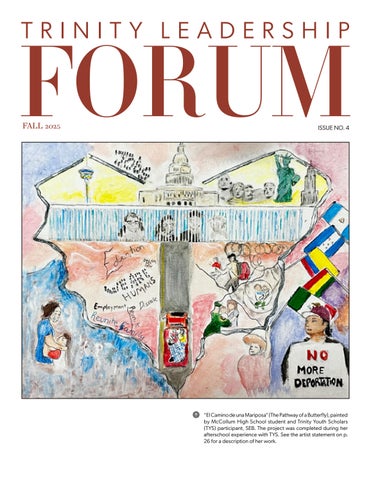
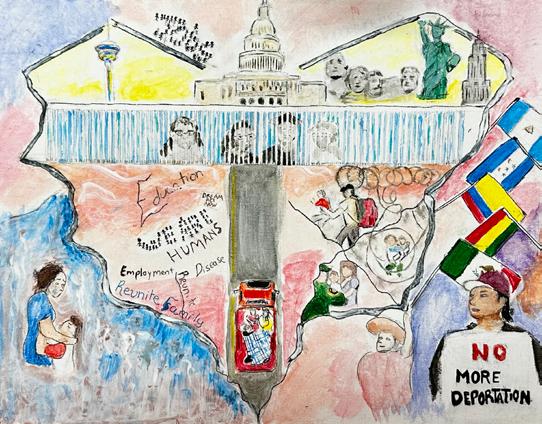
afterschool experience with TYS. See the artist statement on p. 26 for a description of her work.
“El Camino de una Mariposa” (The Pathway of a Butterfly), painted by McCollum High School student and Trinity Youth Scholars (TYS) participant, SEB. The project was completed during her
CEL MISSION
Leadership Development & Professional Services. The CEL develops and implements educational and professional development opportunities for school and community leaders, including offering seminars and aspiring leadership workshops for members of the San Antonio community.
Praxis-Oriented Research. The CEL facilitates and conducts research that is relevant to educational policy and practice, meaningful to the schools and communities of San Antonio and South Texas, and transformational for schools, communities, and students and their families.
Educational Initiatives & Partnerships. The CEL engages with partners to build leadership pathways across school-community contexts, and leads major educational transformation initiatives with non-profit, policy, research and philanthropic organizations across the P20 continuum.
Convenings & Events. The CEL convenes education and community thought leaders to share ideas, programs and approaches to improving education, and facilitates conversations on increasing educational opportunity, fostering transformational leadership, and promoting community-building and social justice praxis.
SUBMIT TO THE FORUM
The CEL invites authors to submit pieces of 1,500-2,000 words on topics related to educational leadership program innovations, educational policy, community building, and youth and teacher leadership. Any inquiries may be directed to CEL staff.
TRINITY LEADERSHIP FORUM
Editor Enrique Alemán, Jr., Ph.D
Associate Editors
Lisa Mendoza Knecht, Ph.D.
Vangie Aguilera, Ed.D.
Art Director
Genevieve Humphreys
Publication is published by the Center for Educational Leadership. Trinity’s Center for Educational Leadership provides regular cohortbased convenings, national speakers on critical education issues, as well as targeted learning seminars for continued leadership development. Since its establishment in 1982, CEL has provided thought leadership, innovative leadership programs, and professional development for school districts.
CENTER FOR EDUCATIONAL LEADERSHIP TEAM
Enrique Alemán, Jr., Ph.D. Lillian Radford Endowed Professor of Education Director, CEL Director, Trinity Tomorrow’s Leaders Program ealeman@trinity.edu
Angela Breidenstein, Ed.D. Professor and Chair, Department of Education abreiden@trinity.edu
Evangeline Aguilera, Ed.D. Assistant Director, CEL Faculty, Department of Education eaguiler@trinity.edu
Lisa Mendoza Knecht, Ph.D. Educational Research Associate, CEL lknecht@trinity.edu
Lisa Chavez, M.S. Senior Program Coordinator, CEL lchavez2@trinity.edu
CLASSROOM TO CAPITOL: CIVIC LEARNING UNDER LEGISLATIVE CONSTRAINT
Habiba Noor 1
Judith Espinoza 2
LATINAS LEADING WITH A SENSE OF BELONGING AND TRUST
LUCES, ALEGRÍA, Y COMUNIDAD: FIESTA FLAMBEAU AS A PEDAGOGY OF INCLUSION
Katherine Espinoza
Elaine Penagos
Mónica Ocasio-Vega
Lauren Wilks
Marisa Mendez 3
SENSEMAKING
AND THE LEADERSHIP JOURNEY OF THREE UNIVERSITY FACULTY
Angela Breidenstein
Jacob Tingle
Randall Griffiths 4
EL CAMINO DE UNA MARIPOSA: ARTIST’S STATEMENT SEB 5
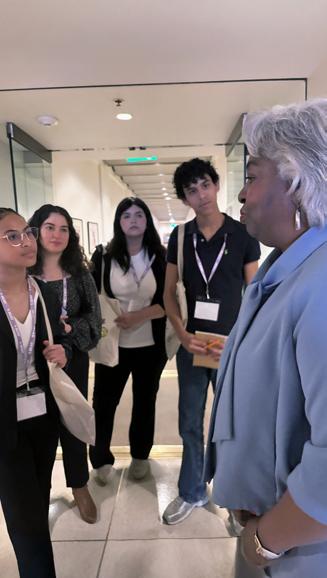
Students from the Trinity delegation during their visit to the Texas Capitol, meeting with Texas State Representative Barbara Gervin-Hawkins who represents the eastside of San Antonio.
1
HABIBA NOOR
CLASSROOM TO CAPITOL:
CIVIC LEARNING UNDER LEGISLATIVE CONSTRAINT
VISITING THE CAPITOL
If you visit the Texas State Capitol on any given weekday, you’re likely to see lines of buses parked along the streets and legions of children spilling out - most of them fourth or seventh graders, the years when Texas history is taught in public schools. They wear matching T-shirts, crowd the gift shop, and crane their necks beneath the great dome. Moving past them, you’ll see lawmakers and staffers from across the state - some in boots and hats, others in tailored suits, mirroring the diversity of the people they represent. The energy inside is unmistakably young. The students in the halls and the staffers in the offices offer a glimpse into a future Texas. During these visits, students are often drawn to the ornate architecture, the exhibits, or the portraits of Texas governors. They may learn about the structure and function of state government and garner respect for those who serve the state, but what’s often left out is that the people there, as residents of Texas, they too, have a voice in decision-making.
In 2021, during the Texas 87th legislative session, the state passed a bill that restricted active civic participation for course credit. The bill limits time-honored traditions of lessons in participatory civics where students may write to their legislator, speak at a school board meeting, or advocate for an issue they have identified. Senate Bill 3 (SB3) was far-reaching into
classroom teaching, but the restrictions on civic education have been overshadowed by news of CRT, book bans, and LGBTQ visibility in schools. Texas is the only state to have bundled civics restrictions into a bill that legislates against the teaching of the 1619 Project and teacher training on anti-racism. The removal of participatory civics pedagogy in Texas classrooms came only three years after a 2018 report that decried the “civic health” of Texas, citing some of the lowest voter registration in the U.S. and widespread political disengagement (Jennings & Bhandari, 2018). During that time, state leaders across the political spectrum sought to initiate legislation to bolster civic education. State Representative James Talarico, a former school teacher and current U.S. Senate candidate, entered politics in part to expand civic engagement to students around the state (Lehrer-Small, 2023) but in 2021, those efforts became moot.
Much of the pushback against participatory civics can be traced to Stanley Kurtz, a senior fellow at the Ethics and Public Policy Center, who authored the model legislation that inspired the student-advocacy restrictions in SB3. Kurtz rejected popular programs like Action Civics, a well-respected, research-based curriculum encouraging students to engage in real-world issues through advocacy (Pope, Stolte, & Cohen, 2011). Kurtz and others like David Randall, executive
director of the Civics Alliance, believed that issues-based participatory forms of civics politicize education and amount to “school-sponsored indoctrination” (Kurtz, 2021). His campaign influenced multiple state legislatures, but Texas became the first to adopt his restrictive model, redefining civics as learning about government rather than participating in it. The 2021 civics bill overturned prior efforts made through bipartisan efforts to bolster civic participation. It promotes a model of civic participation where students may be seen but not heard, which risks alienating the public from the halls of power. It’s crucial to note that the very roots of schooling in America tie back to preparation for civic engagement. The classroom has and will always play a central role in the making of active citizens. While literacy, history, and an understanding of local, state, and federal government can still be taught in the classroom, there’s no doubt that there are specific skills and knowledge around civic participation that would be better understood through actually having students engage in this process (Leihsing & Ryan, 2025; Pope, Stolte, & Cohen, 2011).
It is from this context of constrained civic practice that the Center for Educational Leadership (CEL) began exploring new partnerships to understand how students in Texas might engage in participatory civics and direct advocacy despite the constraints of a heavily regulated classroom.
The work I describe next illustrates how political advocacy can thrive in Texas through youth-led initiatives outside of traditional classroom settings. Rather than describing teachers’ efforts, I analyze and share how civic knowledge was activated through Trinity’s partnership with a high school and a student-run advocacy group called Students Engaged in Advancing Texas (SEAT). Founded by a high school student from Katy, SEAT has expanded into a statewide network that prepares students to engage with Texas education issues directly.
BRINGING THE CLASSROOM TO THE CAPITOL
At Trinity University, the Educational Leadership graduate program developed a model for preparing future school leaders that placed civic engagement at the center of professional formation. As part of this work, master’s students examined proposed education bills from the 88th Texas Legislature, looked at the research behind them, and wrote policy briefs translating their findings into actionable recommendations. They then presented these briefs at the Texas Capitol, transforming classroom study into real-world policy leadership and advocacy. The model created a rare synergy between study, research, and public service, allowing student work to carry meaning and consequence beyond the classroom. This initiative was described in previous issues of The Trinity Leadership Forum (Alemán & Aguilera, 2024; Cook, Garcia, & Conner, 2025; McLain, 2024).
Building on this model, and with the support of the CEL, I adapted the approach for an undergraduate setting. In my course Schooling in America, an upper-level education seminar, students spent several weeks examining the history of U.S. public schooling through the lens of Supreme Court cases. Drawing on Justin Driver’s The Schoolhouse Gate (2018), students explored how landmark decisions reveal enduring tensions within American education. They also analyzed First Amendment cases concerning religion in schools, student speech, and book bans, as well as Fourteenth Amendment cases addressing equal protection, including public education for undocumented
students and debates over school funding. Their study of precedent provided a foundation for examining current legislative issues in the 89th Texas Legislature, where students identified overlaps between historical court rulings and contemporary policy debates. Examples included Senate Bill 10 (SB10), which authorized the posting of the Ten Commandments in classrooms, and House Bill 160 (HB160) and House Bill 371 (HB371), which sought to revoke in-state tuition for undocumented students. Engaging with these and other bills, students analyzed the language and implications of proposed legislation while considering how their own perspectives as young people directly affected by education policy could inform public discourse. In the culminating phase of the project, students wrote policy briefs and designed infographics to communicate their findings. They shared this work with lawmakers during a visit to the Texas Capitol, experiencing firsthand how academic inquiry can become public action. The project reaffirmed that when students are treated as contributors to civic life rather than passive observers, classrooms can serve as laboratories for democratic participation.
STUDENTS ENGAGED IN ADVANCING TEXAS EDUCATIONAL POLICY
On April 21, the organization, Students Engaged in Advancing Texas (SEAT), hosted its third annual Day at the Capitol for high school students from across the state. SEAT describes itself as “a peer mentor network of young people learning advocacy and communication skills, transferable to any professional field.” The event brought together more than 300 students to connect with one another, share issues they face in their schools, hear from lawmakers, and visit legislative offices to advocate for the causes they cared about most. I coordinated our class’ own Capitol visit to coincide with this event. It offered the perfect opportunity to see our students’ work as part of a broader movement for student advocacy - a form of civic engagement that has been increasingly constrained within classroom settings. What stood out to me, and to most of the Trinity undergraduates, was that the entire event was organized and run
by high school students. Student leaders from across the state greeted participants, moderated panels, and managed logistics with striking professionalism. Cameron Samuels, the group’s founder, delivered a keynote address and mentored many of the attendees, but it was clear from the moment we arrived that the high school students were the ones leading us.
The Trinity University delegation consisting of twelve undergraduate students, one professor, two teacher observers, and three students in the Master of Arts in Teaching program, traveled to Austin for SEAT’s Day at the Capitol. Upon arrival, they were welcomed by SEAT’s volunteer committee, participated in a group orientation, and then divided into small teams to visit legislators. Each group met with state representatives and staffers to discuss education bills. The undergraduate students had rehearsed how to enter an office, request a meeting, and present their research. I accompanied a group tasked with sharing an infographic on two pieces of legislation: House Bill 1481 (HB1481), the cell phone bill, and House Bill 6 (HB6), the discipline bill. Different issues were discussed in other groups, including Senate Bill 2 (SB2) on school vouchers, Senate Bill 10 (SB10) on the Ten Commandments, Senate Bill 26 (SB26) on teacher pay, and House Bill 2548 (HB2548) on restricting Diversity, Equity and Inclusion (DEI) in higher education. Each visit varied depending on the tone of the office and the openness of the staffers, giving students a firsthand view of the dynamics that shape policymaking. After the visit, we gathered reflections from both the undergraduate and high school students to hear how they experienced the day in their own words. What follows are some of the insights and moments that resonated most with students.
HUMANIZING GOVERNMENT OFFICIALS
For both undergraduate and high school students, the experience of walking into lawmakers’ offices transformed their understanding of government from an abstraction into a human encounter. One student reflected, “My biggest takeaway from the day at the Capitol was how easily accessible policymakers are, and this experience really humanized government
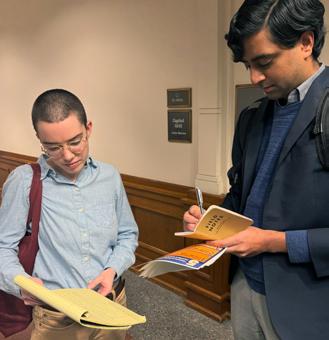
(Top) Trinity undergraduate, V. Rupp, shares notes with IDRA Policy Fellow, Vivek Datla, after a meeting on school vouchers.
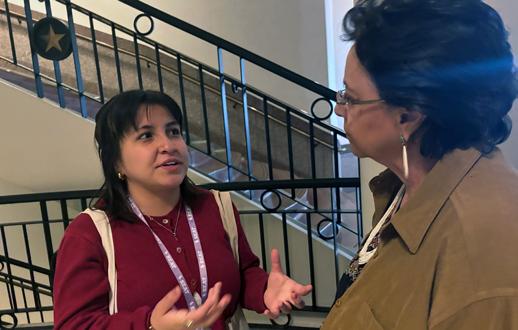
(Bottom) Trinity undergraduate, Kai Velasquez, discusses their research with UT professor, Dr. Angela Valenzuela, during S.E.A.T. Capitol Day.
officials for me.” Another echoed this insight, writing, “It was grounding to be reminded that, at the end of the day, our representatives are our representatives.” What had once been distant, read about in textbooks or glimpsed during Capitol tours, became personal, accessible, and real. Moreover, these encounters made visible the idea that the state becomes constitutive of social actors. One student recognized the collective dimension of government work, “. . . policies and bills take a whole team of people to produce and pass— not just one person deciding everything.” This understanding was underscored by her encounter with the multiple staffers in the legislative office.
EMPOWERING YOUNG CITIZENS
In her response to a guiding question, one student wrote, “This experience opened my eyes to how easy it is for citizens to come forward with their research and ideas if they put the time and effort into actually doing it.” Another reflected on how direct contact with policymakers countered the sense of confusion and apathy that often accompanies political discourse: “I’ve learned that the political pendulum swings back and forth, and it often feels like we are helpless to direct it. Maybe it’s too optimistic, but after visiting the Capitol I feel like I can be listened to—and make myself be listened to—by politicians, despite how bleak things may seem.”
The humanity of politicians, government, and the state more broadly is often masked by the legalese and policy language, which feel impenetrable to students and citizens more broadly. But what we see here is students experiencing a “blurred line between state and citizen.” The state, after all, is made of people, and they are invested with authority through the people. What these students are ultimately sensing is their own power as citizens. To recognize this is a form of education that can only be achieved through a more participatory approach to education.
These responses also suggest a shared sense of empowerment and hope. One student described the day as “truly empowering,” adding, “because of distance and the way politics normally work, it can be hard to visualize yourself as part of the
democratic process.” Walking through the Capitol’s grand doors allowed students to concretize the architecture of the state, but entering lawmakers’ offices illuminated an interpersonal dimension of democratic engagement.
While most students had positive experiences, some recounted otherwise. “My group unfortunately had some pretty dismissive experiences with the legislative offices we visited, several of which turned us away or treated us as an inconvenience, so one takeaway would be that there are relatively well-established, if unofficial, organizational practices that serve to limit citizen feedback. We did have some more positive experiences, and no one tried to ‘make’ us leave, but there were definitely certain offices that utilized appointments, scheduling issues, and passive interpersonal hostility to encourage us to leave on our own.” Such responses were to be expected since the students did not make appointments, and the interests of the offices may not have aligned with the students’ discussion points. But the lessons learned offer a lens into civic life that can only be learned through direct advocacy: the lesson that democracy in its most authentic form is a relational project. It’s that relational dimension that becomes a site of hope and optimism, rather than strife, polarization, and indoctrination, as suggested by the laws that remove direct advocacy from schools.
RECLAIMING PARTICIPATORY CIVICS
A Trinity student who hails originally from Seattle recalled visiting her state capitol as a child: “We just walked around; I had no idea I could advocate for myself and my education by simply knocking on someone’s door and talking…. I think it should be more common for high school and college students to visit policymakers and speak their minds, and it should be better incorporated into the curriculum.” Her comment captures the lost potential of participatory advocacy in schools. While Capitol field trips may appear to model active citizenship, they often lack the engagement and empowerment that come from authentic interaction. What this visit demonstrated for SEAT participants and the Trinity delegation was that civic education becomes most powerful when it moves beyond obser-
vation toward participation, transforming students from spectators of democracy into its active agents.
Another of the high school students reflected, “I also learned that it’s possible to make legitimate change and progress while being an advocate, and these projects are much bigger than just classwork.” The realization that civic engagement extends beyond the classroom is the heart of participatory civics. When we think about schooling for democracy, schools themselves come to serve democracy. Classrooms become training grounds for citizenship, where learning extends beyond demonstrating academic competencies. In fact, the student’s recognition that their schoolwork serves the larger purpose of public engagement represents the very outcome civic education should aspire to. And yet, this is precisely what thinkers like Stanley Kurtz and organizations such as the National Association of Scholars seek to curtail. The idea that classrooms can become sites of social change threatens the social order such efforts aim to preserve.
CONCLUSION
The shutting down of participatory civics is one of the least discussed casualties of the recent wave of educational restrictions in Texas. Only a few years ago, there was bipartisan momentum to reorient civic education toward more participatory, issue-based models. Before 2021, participatory civics enjoyed support from both sides of the aisle and was reflected in a bipartisan federal civics bill introduced in 2022. But that momentum was halted. Model legislation drafted by Stanley Kurtz and advanced through the conservative National Association of Scholars rolled back the participatory dimension of civics education (Kurtz, 2021).
The discourse opposing participatory civics did not emerge organically from communities, classrooms, or families. It was pre-scripted in model legislation and amplified through the broader anti–critical race theory movement, propelled by figures such as Representative Steve Toth, who reportedly consulted with Kurtz before SB3 was introduced (Kao, 2021).
As educators and leaders committed to the transformative potential of civic engagement, we must remember that while SB3 explicitly prohibits schools
from awarding credit for participatory civics, it does not prevent students from engaging in advocacy independently. The law does not prohibit them from conducting research, meeting with legislators, or pursuing advocacy projects on their own. What it restricts is institutional endorsement, not political imagination. Higher education has a responsibility to fill the gap. If K–12 schools are constrained from teaching participatory civics, colleges and universities can create spaces where students learn how to advocate, organize, and translate research into public action. The work of SEAT exemplifies what such student-led advocacy can look like— young people mobilizing without formal instruction, guided instead by conviction and collaboration.
Yes, there is a loss in excluding issue-based civic projects from public schools, particularly in a state already marked by low civic participation. Yet student movements continue to generate their own forms of civic learning, forms that often exceed what could be achieved through an assignment or curriculum. In this era of heightened educational restriction and political polarization, SEAT and other student-led initiatives remind us that when students take ownership of the issues that shape their lives, their energy is contagious - it cannot be contained or legislated away.
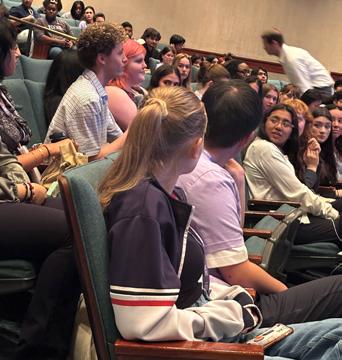
← High school students from around the state gathered in Austin for the S.E.A.T. Capitol Day, conversing with keynote speaker Rosie Stewart, Senior Manager for Public Policy at Penguin Random House and Co-founder of MOVE Texas.
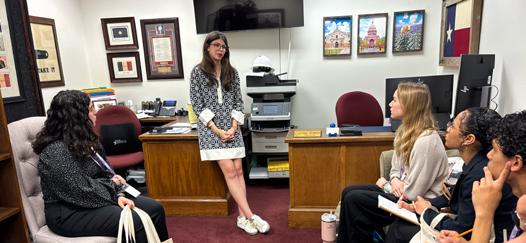
← Trinity delegation meets with a legislative staffer for a Texas Representative. Students presented their policy brief and discussed legislation with the staffer who shared details about her own education and current responsibilities.
REFERENCES
Alemán, E., Jr. & Aguilera, V. (2024). Social justice leadership for south Texas schools. Trinity Leadership Forum, Winter 2024, No. 1. Center for Educational Leadership.
Alemán, E., Jr., Mendoza Knecht, L. & Aguilera, V. (eds.) (2024). Trinity Leadership Forum, Fall 2024, No. 2. Center for Educational Leadership.
Driver, J. (2018). The schoolhouse gate: Public education, the Supreme Court, and the battle for the American mind. Pantheon.
Jennings, J., & Einsohn Bhandari, E. (2018). 2018 Texas Civic Health Index™ (J. Jennings & E. Einsohn Bhandari, Authors). Annette Strauss Institute for Civic Life, The University of Texas at Austin.
Kao, J. (2021, August 17). Texas’s controversial new social studies law prompts McKinney school officials to cancel youth and government class. The Texas Tribune.
Kurtz, S. (2021, January 26). “Action Civics” replaces citizenship with partisanship. The American Mind.
Kurtz, S. (2021, February 15). The Partisanship Out of Civics Act. National Association of Scholars.
Lehrer-Small, A. (2023, May 1). Texas guts ‘woke civics’. Now kids can’t engage in a key democratic process. The Guardian.
Leihsing, S., & Ryan, A. M. (2025). Social studies curriculum in an era of state-restricted civic participation: Responding to Texas Senate Bill 3 with the Rights of the Learner. Theory Into Practice, 64(1), 19-30.
McLain, E. (2024). My journey toward advocacy and humanization in the educational policy process. Trinity Leadership Forum, Fall 2024, No. 2. Center for Educational Leadership.
Pena Cook, Y., Garcia, J., O’Conner, M. (2025). Supporting teen mothers through policy advocacy. Trinity Leadership Forum, Spring 2025, No. 3. Center for Educational Leadership.
Pope, A., Stolte, L., & Cohen, A. (2011). Closing the civic engagement gap: The potential of action civics. Social Education, 75(5), 265-268.
Thomason, D., & Carroll, J. (2024, January 17). Civics education is important for the future of Texas. St. Edward’s University.
U.S. Senate. (2022, June 13). Civics Secures Democracy Act, S. 4384, 117th Cong. (2021–2022).
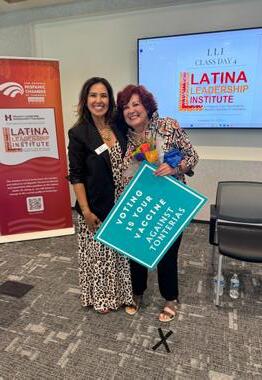
← Judith Espinoza with former Laredo Mayor Betty Flores following a LLI session.
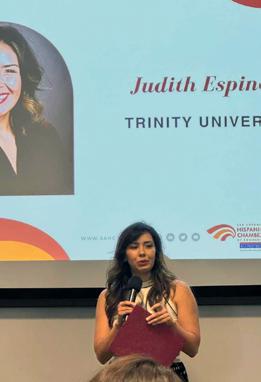
← Judith Espinoza presenting her work during an LLI session.
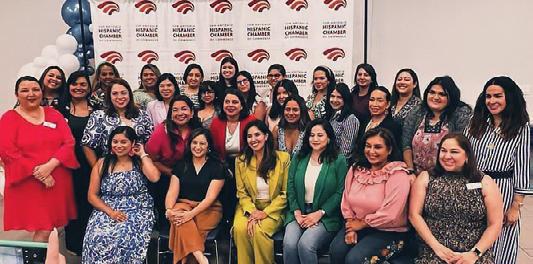
← Members of LLI’s Cohort 9 during their opening orientation.
JUDITH ESPINOZA
LATINAS LEADING WITH A SENSE OF BELONGING AND TRUST
“Do you know what Scott told me?” my husband once asked. “When you get to this level, it’s lonely on top. No one else knows what it’s like to carry this burden.” That line, shared by his mentor, lodged itself in my mind. I didn’t hear it firsthand, but it shaped how I viewed leadership. It helped me develop empathy for those above me—reminding me that decisions often carry unseen pressures. Yet it also planted something unhealthy: the idea that leadership is inherently solitary, a space reserved for “the other”; a power dynamic of me versus them.
Context, of course, matters. My husband’s mentor is an 80-year-old white, male millionaire. I will never share his experiences of age, culture, or race. Still, I absorbed his generation’s ethic—the baby-boomer belief that leadership is endurance, sacrifice, and hierarchy. I accepted it as truth until it was challenged on August 23, 2024, when I listened to Betty Flores, Laredo’s first Latina mayor, during a Latina Leadership panel. This 80 year old woman traveled close to 3 hours to tell a group of women, “I drove here to tell you that you are not alone. We are meant to bring others with us. Trust each other and trust yourself”.
Betty Flores and the Latina Leadership Institute (LLI), a program hosted by San Antonio’s Hispanic Chamber
REFERENCES
of Commerce, helped me form new perspectives and experiences around leadership. For six months, twenty women from across the city gathered monthly on Fridays to sharpen our leadership skills. We learned from city council members, CEOs, and board leaders about policy, governance, and advocacy. I discovered how to lead meetings using Robert’s Rules of Order (2020). One rule is for the leader of the meeting to ask each person to vote yes or no. When a vote is taken as a group, for example “all those in favor say aye,” it could create a situation where some members do not vote because they do not have the opportunity to be heard. This can then lead to the “garage meeting” where members congregate to vent or discuss their concerns because they did not feel heard in the first place. While this rule may be a bit time consuming, I learned that it does help ensure accountability, transparency, and cultivate a healthy culture.
Throughout the program, my greatest teachers were my peers—my hermanas. We cried together, admitted our fears of imposter syndrome, and celebrated each other’s wins. In that room, leadership was not lonely or solitary. It was alive, relational, and deeply human. It was a shared act of courage. In my experience, I have seen leaders encouraged to keep their humanity instead of sacrificing
it for the good of the cause. For the longest time, I thought leadership was leading to a destination, but my LLI experience showed me how leadership can and should be more about leading the journey.
Reflecting on these two models— the solitary “lonely at the top” view and the collective sisterhood I found through LLI—I realize now how my understanding of leadership has profoundly evolved. The spaces created by LLI dismantled the patriarchal, “babyboomer” narrative I had absorbed. My colleagues and the program revealed how leadership does not have to be a burden and that it can be more than just serving others. It is about “un manera de ser,” a way of being which requires an exchange of vulnerability and trust. This approach allows us to put our guard down to not only lead but to also be led. My LLI group doesn’t view leadership as a burden but rather, members view it as a shared responsibility which creates a sense of belonging. I have seen these Latina leaders show up for one another, encourage one another, and extend help without hesitation. They lead through collaboration rather than control, empathy rather than ego. Their actions, not just their words, highlight the differences I understand between wielding power and applying leadership.
Robert III, H. M., Honemann, D. H., Balch, T. J., Seabold, D. E., & Gerber, S. (2020). Robert’s rules of order newly revised. PublicAffairs.
KATHERINE ESPINOZA
ELAINE PENAGOS
MÓNICA
OCASIO-VEGA
LAUREN
WILKS
MARISA MENDEZ
LUCES, ALEGRÍA, Y COMUNIDAD:
FIESTA
FLAMBEAU AS A PEDAGOGY OF INCLUSION
FRAMING FIESTA AS PEDAGOGY
In 2023, Trinity University welcomed the largest cohort of new faculty in more than a decade. Nine new faculty members were hired as part of a cluster hiring initiative entitled Building Inclusive Communities (BIC). Spearheaded by Provost Megan Mustain, the cluster shared the broad charge of advancing inclusion, diversity, equity, and justice through their scholarship and teaching. Each faculty member carried the responsibility of collectively defining what building inclusive communities would mean at Trinity and beyond (Williams, Berger, & McClendon, 2005; Smith, 2020). They were also further tasked with imagining how a generous financial gift to the university could be strategically used to enact that vision, reflecting broader national trends in cluster hiring as a mechanism to address equity and foster interdisciplinary collaboration (Herman, 2024; Carter et al., 2025).
Serving the greater San Antonio area, Trinity’s Department of Education has an established professional development school with Hawthorne Academy in the San Antonio Independent School District (SAISD). In this piece, we highlight a specific collaboration our faculty had with
the school during Fiesta, the city’s 11-day cultural celebration that is held every spring. The grand finale, Fiesta Flambeau Parade, was established in 1948 and is famously known as “the people’s parade.” It stands out as a luminous celebration of collective joy and public spectacle (Fiesta San Antonio Commission, 2020). Unlike two other major Fiesta events, the Battle of Flowers Parade and the Texas Cavaliers River Parade, which carry aristocratic legacies, Fiesta Flambeau has been described as grassroots, accessible, and deeply tied to community participation (Montejano, 2010; Hernández-Ehrisman, 2016). It is in this space of celebration and cultural affirmation that our story of collaboration and partnership between Trinity University and Hawthorne Academy transpired.
A COMMUNITY WISH
During fall of 2024, Dr. Katherine Espinoza, Assistant Professor of Education and BIC cluster member, met with teachers who sponsor various afterschool clubs at Hawthorne Academy, including ballet folklórico, cheer, and sports. As a K–8 school and one of the district’s original eight junior high schools, teacher leaders from Hawthorne Academy expressed a desire for its students to participate in the
Fiesta Flambeau Parade. They described the proximity of the school and their wish to have students centered in this event. For Hawthorne students—many of whom come from working-class, Latinx, and bilingual families—participation in Fiesta represented more than an extracurricular activity. It was an opportunity to see themselves reflected in the cultural life of the city and to claim a space of pride, alegría (joy), and visibility alongside other San Antonians. Dr. Espinoza recognized the request not as a logistical matter but as an educational one, as well as an opportunity for collaboration that would expand definitions of civic education, affirm students’ cultural identities, and create a tangible bridge between the university and the community.
FIESTA FLAMBEAU AS PEDAGOGICAL FRAMEWORK
This university-school collaboration drew on multiple layers of support. Dr. Espinoza provided the pedagogical grounding, while all nine cluster members committed financial resources to fund Hawthorne’s participation. Four faculty members, Elaine Penagos, Mónica Ocasio-Vega, and Lauren Wilks, along with Provost Megan Mustain, joined the parade,
embodying solidarity through their presence. Together, these efforts showed that building inclusive communities requires both structural investment and lived participation.
Our collaboration is framed as a pedagogical act. The Fiesta Flambeau Parade became a site of experiential learning, identity affirmation, and community-university partnership. Drawing from the theoretical frameworks of community cultural wealth (Yosso, 2005) and authentic cariño (Bartolomé, 2008), we argue that cultural celebrations like Fiesta can be mobilized as vehicles for sustaining pedagogies and community empowerment. Community cultural wealth refers to the strengths and cultural assets found within communities of color that often go unnoticed and undervalued in education. The concept of authentic cariño in education centers on the relational commitment educators and stakeholders develop
with Latinx students. For this project, we saw community cultural wealth and authentic cariño as an opportunity to draw on alegría and hope. For Hawthorne students, the parade affirmed their familial and navigational capital—honoring family traditions while navigating new opportunities in collaboration with a university partner. For Trinity faculty, participation challenged “ivory tower” boundaries by centering relational, joyful, and non-traditional forms of scholarship.
Oftentimes, academic-community partnerships are framed around addressing deficits, crises, or urgent needs related to academics. The Fiesta Flambeau Parade reminded us that alegría, celebration, and cultural pride are equally powerful tools for education and inclusion. Paris and Alim (2017) describe culturally sustaining pedagogy as embracing cultural pluralism and ensuring that students’ languages, traditions, and practices are not only validated but
sustained. To treat alegría as pedagogy is to affirm that cultural celebrations like Fiesta cultivate belonging and strengthen bridges across institutions.
JOY, BELONGING, AND COMMUNITY CULTURAL WEALTH
The findings from this project demonstrate how a single local cultural event like the Fiesta Flambeau Parade can function as a powerful site of identitybuilding that consists of belonging, affirmation, and relationship-building between a local school and a university. Interrelated themes emerged: listening to community voices, resource allocation, embodied solidarity, joy as pedagogy, and sustainability. These themes were made visible through field notes and the reflections, voices, and lived experiences of Hawthorne students, families, and faculty participants that were ongoing throughout Fall 2024 and Spring 2025.
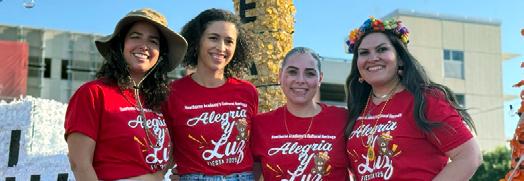
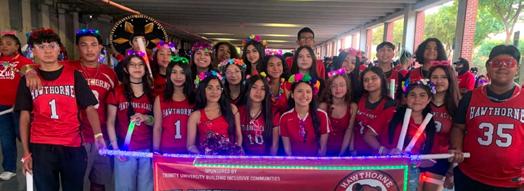
(Top) BIC Cluster professors Drs. Monica Ocasio Vega, Lauren Wilks, Elaine Penagos, and Katherine Espinoza during the Fiesta Flambeau Parade.
←
(Bottom) Hawthorne Academy 8th-grade students who marched in the parade as part of the Spirit Squad.
←
LISTENING TO COMMUNITY VOICES
The initiative began with a simple request from Hawthorne teachers and students, who expressed their desire to be included in the Fiesta Flambeau Parade. Rather than positioning the university as the driver of the project, BIC cluster members responded to the school community’s aspirations. As one student explained,“We always see the parade on TV, but I never thought I would be in it. Now people will see us.” This testimony underscores how starting with community-defined needs can disrupt the deficit-oriented narratives that often frame university–school partnerships (Moll et al., 1992).
RESOURCE ALLOCATION MATTERS
The allocation of funds for costumes, float materials, and float construction communicated to students and families that their cultural participation was valued. A parent reflected, “For us, it is expensive to do these things. When the university helped, it meant my child could shine. We felt respected.” In this way, the financial support exemplified how symbolic commitments to inclusion must be accompanied by material investment if they are to foster authentic solidarity (Yosso, 2005).
EMBODIED SOLIDARITY
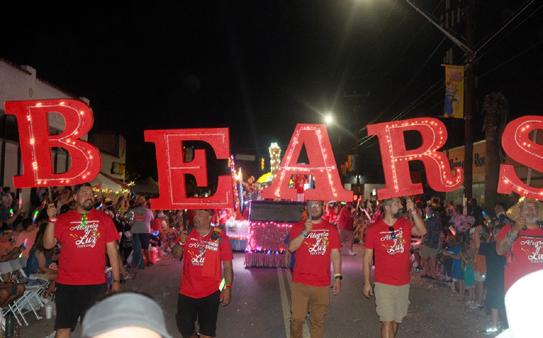
Beyond financial support, the physical presence of faculty and administrators in the parade demonstrated embodied solidarity. Provost Mustain, faculty members, and Hawthorne faculty, students, and parents shared the float and walked in the parade en conjunto, alongside one another, waving and celebrating together under the bright lights. One middle school student shared afterward, “I didn’t know professors would do something like this with us. It makes me feel like I can go to college one day.” His reflection reveals how representation and visibility matter in building inclusive pathways for students historically excluded from higher education.
ALEGRÍA AS PEDAGOGY
Perhaps the most powerful theme to emerge was the role of alegría (joy) as
a pedagogical tool. In the words of one elementary student, “This is the best day of my life!” The moment illustrates how alegría, visibility, and cultural affirmation can expand students’ sense of identity and belonging. Paris and Alim (2017) argue that culturally sustaining pedagogy requires embracing cultural pluralism not only in classrooms but in public celebrations of community life. The Fiesta Flambeau Parade provided such a stage, affirming students’ cultural practices and positioning joy as a legitimate form of learning.
SUSTAINABILITY AND CONTINUITY
Finally, participants emphasized the importance of continuity. While the parade created unforgettable memories, there was recognition that one event cannot bear the full weight of institutional transformation. As one parent expressed in Spanish, “Ojalá que no sea la última vez. Queremos que la escuela y la universidad sigan juntos en otras cosas también.” (“I hope this is not the last time. We want the school and the university to continue together in other things too.”) This call for ongoing engagement highlights the need for universities to commit to sustained partnerships that extend beyond singular events (Johnson, 2007). Building on this sentiment, Principal Marisa Mendez reflected:
“Watching our Hawthorne studentslightupthenightatthe Fiesta Flambeau, I realized this momentwasmorethanaparade. Itwasapromise.Foroneevening, ourchildrenstoodproudlyinthe fullness of their identities, free fromtheweightofassessments or outside expectations. They wereseenasdynamic,resilient, andpoisedforgreatness.Parents glowed with pride and alumni watched with a deep sense of connection, recognizing themselvesinthenextgeneration.
The Hawthorne community is deeply grateful to Trinity University,whosegenerosityand belief in our students turned a simplewishintoalastinglegacyof
prideandbelonging.”
LESSONS FOR HIGHER EDUCATION
The collaboration between Trinity University and Hawthorne Academy was deeply local and provides broader insights for institutions of higher learning that aspire to build inclusive communities based on partnerships. One of the most relevant lessons was that authentic partnership begins by listening to community voices. This project did not emerge from a university-designed initiative, but rather from a request articulated by Hawthorne teachers and students themselves. Their desire to participate in the Fiesta Flambeau Parade served as a reminder that building inclusive communities requires centering the aspirations and knowledge of the community—what Moll et al. (1992) call funds of knowledge—rather than privileging institutional agendas.
Equally important was the recognition that the allocation of resources matters. Symbolic gestures of support, while valuable, are insufficient unless paired with material and personal investment. By funding this experience, the Building Inclusive Communities cluster acknowledged the significance of Hawthorne’s participation and demonstrated a commitment to honoring the community’s cultural wealth (Yosso, 2005). This allocation of resources communicated respect not only for the parade as a cultural event but also for the educational value embedded in sustaining students’ traditions and identities.
The project also demonstrated the power of embodied solidarity. University faculty and administrators did not remain on the sidelines but joined the school in the parade. Their presence—marching alongside children and families, waving from the float, and celebrating under the lights—modeled that inclusion is not an abstract commitment but an enacted practice of authentic cariño (Bartolomé, 2008). This relational solidarity disrupted the image of the “ivory tower” as distant and instead made visible the possibility of shared alegría across institutional and community boundaries.
Finally, the project underscored
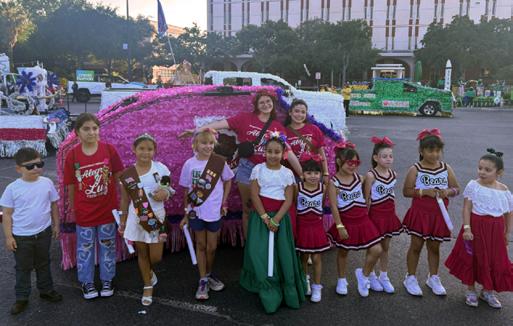
← Hawthorne Academy dads proudly lead the way for the float, Alegría y Luz.
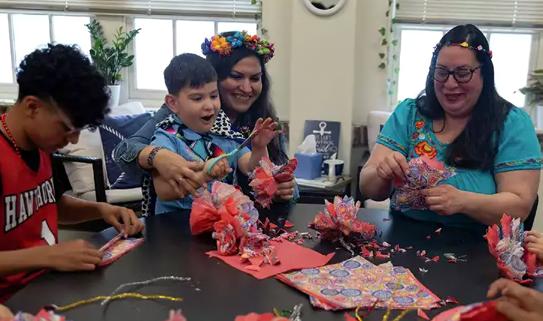
← Dr. Katherine Espinoza and Hawthorne Academy art teacher Lisa Dyer guide students in making paper flowers that were featured on the float.
the importance of sustainability and continuity. A single parade can open a door, but lasting partnerships demand more than one-off events. If universities wish to build truly inclusive communities, they must commit to ongoing engagement with local schools and families, ensuring that moments of shared celebration evolve into enduring relationships of mutual growth (Johnson, 2007).
TOWARD ANNUAL RITUALS OF INCLUSION
Trinity’s BIC collaboration during the Fiesta Flambeau demonstrates how cultural celebrations can function as powerful sites for building inclusive
communities. This event demonstrated that bridging the gap between a K–8 school and an “ivory tower,” can be done in culturally sustaining ways. This project affirmed students’ identities, challenged academic boundaries, and created possibilities for ongoing collaboration. For universities seeking to deepen their community partnerships, this work affirms that inclusion is not only built through policies and curricula but also through alegría, music, and light. These rituals of belonging, when embraced by institutions of higher education, remind us that building inclusive communities is not merely a mission statement—it is a lived, joyful practice.
← Trinity University undergraduate students Kay Cansino and Nayeli Alemán are pictured with Hawthorne Academy primary students in front of their float.
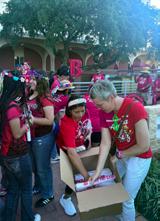
← Trinity University Vice President for Academic Affairs and Provost Megan Mustain attending the Fiesta parade and preparing with a volunteer.
ENDNOTES
1 Fiesta began at the end of the 19th century and remains a touchstone for communal belonging, cultural pride, and civic engagement (Tenorio-Trillo, 2016; Wolbert, 2019).
REFERENCES
Bartolomé, L. I. (2008). Authentic cariño and respect in minority education: The political and ideological dimensions of love. International Journal of Critical Pedagogy, 1(1), 1–17.
Carter, S., Asabor, E., Packard, G., Kenwood, M., Jordan, A., & Ross, R. A. (2025). A critical awareness approach to cluster hiring for academic inclusion. Journal of the National Medical Association.
Fiesta San Antonio Commission. (2020). History of Fiesta. https://fiestasanantonio.org/history
Herman, B. D. (2024). Inclusive faculty hiring: Promising practices for increasing higher education faculty diversity. Hernández-Ehrisman, L. (2016). Inventing the Fiesta City: Heritage and Carnival in San Antonio. University of New Mexico Press.
Johnson, L. (2007). Rethinking successful school leadership in challenging US schools: Culturally responsive practices in school-community relationships. International Studies in Educational Administration (Commonwealth Council for Educational Administration & Management (CCEAM)), 35(3).
Moll, L. C., Amanti, C., Neff, D., & González, N. (1992). Funds of knowledge for teaching: Using a qualitative approach to connect homes and classrooms. Theory Into Practice, 31(2), 132–141.
Montejano, D. (2010). Quixote’s soldiers: A local history of the Chicano movement, 1966–1981. University of Texas Press.
Paris, D., & Alim, H. S. (2017). Culturally sustaining pedagogies: Teaching and learning for justice in a changing world. Teachers College Press.
Smith, D. G. (2020). Diversity’s promise for higher education: Making it work. Johns Hopkins University Press. Tenorio-Trillo, M. (2016). I speak of the city: Mexico City at the turn of the twentieth century. University of Chicago Press.
Williams, D. A., Berger, J. B., & McClendon, S. A. (2005). Toward a model of inclusive excellence and change in postsecondary institutions. AAC&U.
Wolbert, W. A. (2019). Amor en Aztlán: Music, Movement, Performance, and Power in the Conjunto Dancehalls of the Texas—Mexico Borderlands (Doctoral dissertation, University of California, Berkeley).
Yosso, T. J. (2005). Whose culture has capital? A critical race theory discussion of community cultural wealth. Race Ethnicity and Education, 8(1), 69–91.
ANGELA BREIDENSTEIN
JACOB K. TINGLE
RANDALL J. GRIFFITHS1
SENSEMAKING AND THE LEADERSHIP JOURNEY OF THREE UNIVERSITY FACULTY
Throughout the ages it is diplomacy - not trade, statecraft, or armed force - that has been the difference between war and peace, chaos and order, suffering and progress. Murray, 2018, p. 19
It’s more in the future, but you’re co-constructing, constructing, designing, dreaming, hoping, something like that. Whether it’s programs [or] relationships . . . .
-From our conversations about being citizen diplomats
We agree with Murray’s (2018) above quote and would also add that it is the people who engage in diplomacy who make that difference. This is the second in a two part series focused on the experiences of citizen sport diplomats. Our first article in the Spring 2025 issue, “Examining the Experiences of Citizen Sport Diplomats: An Approach to Learning and Leadership,” provided the context for a two-way exchange between educators from the greater San Antonio area in Texas and educators
from cities across North Macedonia. That article described the incountry experiences we designed and enacted for North Macedonian volleyball coaches that took place in San Antonio in July 2023, as well as the in-country experiences our North Macedonian partners hosted in March 2024 for our delegation of Trinity undergraduate and graduate students, a Trinity assistant volleyball coach, local school district leaders and educators, a sport nonprofit leader, and university faculty from both Trinity University and
the University of Incarnate Word. In this article we share what we, the three university faculty on the exchange, learned by examining our own lived experiences using a collective self-ethnography methodology.
In that first article, we provided a brief explanation of citizen diplomacy and how increased engagement of citizen diplomats using sports (i.e., citizen sport diplomats) holds unique possibilities (Garamvölgyi, et al., 2020), including sport’s ability to disrupt
←
power dichotomies common in traditional state-centered diplomacy (Baker, et al., 2018). The belief that sport can bring communities together (Ubaidulloev, 2018) has led to a proliferation of citizen sport diplomacy in the last decade (Rofe, 2024). Although sport diplomacy has seen significant growth (European Commission, 2018; Murray, 2018), research investigating the conceptual and theoretical levels of this phenomenon is still in its nascent phase (Geis et al., 2022; Rofe & Postlethwaite, 2021). And, while it is growing, we observe that much of it focuses on high level programmatic outcomes and short-term impacts of the exchanges (Baker et al., 2018; Blom et al., 2020; Hansell et al., 2023). There was no literature directly exploring the lived experiences of the citizen sport diplomats that we could find. Because much of the sport diplomacy scholarship is quantitative
in nature, qualitative studies that humanize the stakeholders themselves are, we believe, key to developing this literature (Baker et al., 2018; Murray & Pigman, 2013; Pamment, 2016; Rofe & Postlethwaite, 2021). And, as Hansell et al. (2024) indicated, qualitative research can move “beyond outcome-based approaches that measure short-term, transactional ‘impact’ (e.g., pre- and post-tests) toward deeper reflection” (p. 28). Thus, our purpose was to document, explore, and reflect upon our personal experiences as citizen sport diplomats. This expands the knowledge base, both by exploring the experiences of citizen sport diplomats and using a unique methodology underrepresented in extant education and sport management literature. Our findings reveal the need for continued research to understand how planning, preparation, and
resource allocation impact the long-term success and sustainability of sport diplomacy exchanges. From a practical standpoint, each of the themes we present provide a framework for the required mental and physical resources of a sport diplomatic exchange and, importantly, our inquiry suggests that deep levels of transformational learning can occur during these programs.
(RE)SETTING THE CONTEXT
For the outbound phase, we served as both program leaders and participants. Our diplomatic trip to North Macedonia followed the inbound delegation of 12 youth volleyball coaches in July 2023 cited above. Our team was responsible for recruiting participants and coordinating the delegation’s travel logistics, while our counterparts designed and enacted the agenda of activities in North Macedonia. Our exchanges were supported through a grant from a non-governmental
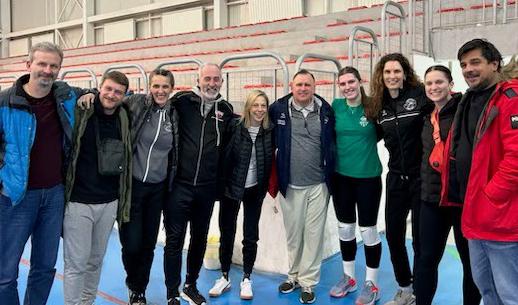
The authors with N. Macedonian volleyball coaches after a scrimmage between US and Macedonian volleyball players in Strumica, N. Macedonia. Pictured left to right: Marjan Trajkovski , Arso Zdravkovski, Emilija Terzievska, Randall Griffiths, Angela Breidenstein, Jacob Tingle, Ivana Belokozovska, Branka Kalenikova, Emily Ellis (U.S. delegate), and Dimitar Gjatovski.
organization (NGO), PH International, that serves as an intermediary for educational and cultural sport exchanges with the U.S. State Department’s Youth Leadership Through Sport program and the Bureau for Educational and Cultural Affairs.
METHODOLOGY
With the aim of capturing the phenomenon of being citizen sport diplomats and making sense of it to inform future practice, this research utilized a collaborative selfethnography approach (Buford May & Pattillo-McCoy 2000; Kerwin & Hoeber, 2015). This reflexive approach brings together: (a) analytic autoethnography (Anderson, 2006) as individuals themselves are engaged in the ethnography and study, and (b) collective ethnography as a team collects and makes sense of shared data regarding the same context and phenomena. We were interested in piloting this under-utilized methodology in a sport diplomacy setting, having studied it in the work of Kerwin and Hoeber (2015) in sport management in particular and others (Collinson, 2003), as well as discussions of reflexivity in research (Mignano, 2024). This methodology allows for exploration both in real time (during the experience) and with continued analysis thereafter. By sharing and interrogating our perspectives, we hoped to yield insights that illuminate opportunities and challenges of simultaneously participating in and leading a networked sport diplomatic activity (Murray, 2018). Collective self-ethnography acknowledges there is no one reality and recognizes that researchers’ positionality influences both how data are collected and interpreted (Buford May & Patillo-McCoy, 2000, p. 72). Before departing for North Macedonia, we met to outline our approach and focus, which included being prepared to discuss similarities, differences, possible changes in beliefs and relationships, and experiences we might identify as critical incidents (Anderson, 2006).
DATA COLLECTION AND ANALYSIS
Throughout the exchange, we recorded our daily, formal discussions, during which we identified, developed and refined themes. Preparation for these discussions came through individual journaling. Each of us wrote entries in a way that was individually meaningful. For example, Randall used bullet points, Angela wrote short notes, and Jacob wrote long, detailed paragraphs. These journal entries were not directly analyzed, but served as prompts for each person during the discussion, which allowed for organic discussion. During the iterative discussions we identified new possible themes and revisited previous themes for further refinement or dissolution. Each discussion began by asking if anyone had experienced critical incidents; uninterrupted, each of us described the incident and the questions it raised or how we perceived it impacted other delegates. This process was repeated nine times. We wrote our final journal entries on the day we returned to the U.S. Our recordings of these discussions were transcribed verbatim when we returned. Their average length was 52 minutes, with a range from 41-88 minutes. We coded and analyzed them using a reflexive thematic approach involving Braun & Clarke’s (2019) fluid, rather than rigid, phases: familiarizing, coding, theme development, refinement, naming, and writing. Our initial analysis revealed three main themes. Then, months later, as we prepared and presented our inprogress findings at an international sport management conference, our continued discussions of the data and its implications led us to identify a possible connection between our three themes and Kegan’s (1994) constructive-developmental theory of adult development. Because this phase used a pre-existing model to guide the analysis, we employed deductive thematic analysis (Naeem et al., 2023) to review our initial transcripts and code additional recorded discussions that took place after returning from the conference. That secondary thematic analysis yielded a fourth theme.
RESEARCHERS’ POSITIONALITY
Before continuing to the findings, recognizing that we are “part and parcel of the setting, context, and culture we are trying to understand and represent” (Altheide & Johnson, 1994, p. 486), we note we are both the focus of the study and those interpreting the data. Our individual journal entries engaged analytic reflexivity, and via the collaborative constant comparison method we shared and critiqued one another’s ideas and perspectives (Collinson 2003; Buford May & Pattillo-McCoy, 2000). This process required vulnerability and collective trust, as it demanded sharing openly and authentically (Hoeber & Kerwin, 2013).
We had to consider “. . . necessary connection(s) to the research situation and hence our effects upon it. This entails . . . a desire to better understand both self and others through examining one’s actions and perception in reference to and dialogue with those of others” (Anderson, 2006, p. 382). We found ourselves referencing our academic and researcher identities as we wrote our reflections and engaged in conversations about our daily experiences as citizen diplomats (Hoeber & Kerwin, 2013; Zanker & Gard, 2008). All three of us have: 1) familiarity with international sport and society, 2) taught study abroad courses, 3) professional experiences working in sport and education, and 4) athletic experiences - although importantly none of us have experience as volleyball players or coaches. Other aspects of reflexivity and positionality include being born, raised, and educated in the U.S. All three of us identify as cisgender and two identify as male and one female. We are upper-middle class, White, between the ages of 50-55, tenured faculty members at private universities, and speak predominantly English in work and social settings. Two of us are fluent in at least one European language (e.g., French, German), two are first generation college graduates, and one is a U.S. Army veteran. This combination of similar and diverse experiences provided “important axes of gender and personal experience” (Buford May & Pattillo-McCoy, 2000, p. 75) for how we approached the data.
Importantly, we are all experienced citizen sport diplomats, including previously participating together on a sport diplomacy program in Uzbekistan. With those and several other collaborative teaching and programmatic experiences between us, we had established the trust needed for the open and vulnerable sharing of experiences (Kerwin & Hoeber, 2015).
We recognize that, given many elements of our positionality, we often default to seeing the world through Western, Global North, colonial, and imperialist lenses. As such, it is important to acknowledge how power is situated in international relations (IR), at broad conceptual levels, between and among individuals and groups, and in our own positionality. This means attending to sources of authority and privilege, including social stratification of status, class, and political access and power (Peacock & Darnell, 2012). Chowdhry and
Nair (2002) describe that, “mainstream IR is premised on an understanding of power that privileges hierarchy, ‘nationality,’ and a predominantly Eurocentric worldview” (p. 3) and that even critical IR often reifies (neo)imperialism and fails to confront issues of intersectionality such as race, class, and gender in reproduction of power.
RESULTS AND DISCUSSION
Just as the end of a story is better because of the events which lead the reader to it, sharing the developmental and interactive nature of our method makes for more impactful final results. As we will see, the development of the first three themes was integral to the insights of the fourth theme, which was realized much later in the process. The development of themes happened in two distinct phases. Data analysis in the first phase yielded three themes: Odyssey, Border Straddling,
and Throwing Seeds/Planting Rows. Revisiting the work for a conference presentation resurfaced our role as leader-participants and yielded a fourth, leadership-focused theme, Brush Sets. The three initial themes, Odyssey, Border Straddling, Throwing Seeds/Planting Rows each provides a framework for the significant mental and physical resources required throughout a bidirectional diplomatic exchange. Rather than a quantitative measure of a funder or government-stated outcome, typical to many studies within this context (Baker et al., 2018; Blom et al., 2020; Hansell et al., 2023), these themes signal the constant negotiation and sense-making involved in this work.
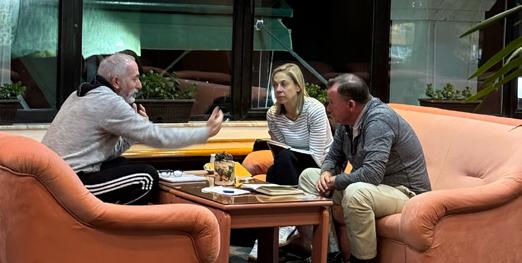
engaged in one
Pictured from left to right: Randall, Angela and Jacob
of the daily reflective discussions.
ODYSSEY
The Odyssey theme signals to delegates that their journey will be populated with many people and places beyond the prearranged sport partners. Attempting to connect with international exchange partners, those encountered along the journey, and even with delegation members themselves, may lead to intense focus on cultural sensitivity (Bennett, 2013) in addition to anticipated immersion in the cultures of the host country.
Randall: I’ll start. I came away withreallytwobigthemesoutof yesterday...oneisthedifficulty ofthejourney.So,inordertodo thiswork,weneedto:a)breakour normalroutine,b)travelaroundthe world,whichtakesafairbit,andc) encounterdifferentculturesthanthe onewewereinthepartnercountry. So,allofthesepeoplethatwemet alongtheroad,thatremindedme alotoftheOdysseyorsomething.
The theme of Odyssey surfaced within the first minute of the first discussion and had an important impact on our ability to move towards ethnorelativism (Bennett, 2013). It encompasses our experience of the people and physical spaces of the journey. These characters and settings can have positive to negative and small to large impacts on the experiences of the citizen diplomat and intercultural learner. The Odyssey is visceral and demands attention, and as a theme it came together quickly.
BORDER STRADDLING
Our second theme also appeared quickly. It began with ideas about inclusion and exclusion as a status, which provided benefit or restriction. The concept of actual borders talked about in initial discussions began to blend with inclusion/ exclusion as it applied not only with incountry experiences, but also within our
delegation and also to our roles as leaders and participants.
Randall:Ikindoflikedthatconcept thatyoujustsaid.That’swhere weputourselvesisthisincluded/ excluded.Weputourselvesonthe border between these, and that’s whatwe’redoingbycominghere. Thenwe’revisitors,butwe’retrying tobecloserandconnected...rather thanjustatouristwhocouldwalk throughallofthisandjustsay,“Oh, thisispretty.”
As Border Straddling matured as a theme, more instances of perceived differences between our nations and cultures were revealed. We recognized this phenomenon and discussed differences we experienced and witnessed. This information exchange and dialogue helped us consider ways to guide groups, and participate ourselves, in continued intercultural understanding.
Border Straddling as a theme encompassed our realization that our positionality as Western, Global North citizens will influence our perspectives and interpretations (Chowdhry & Nair, 2002), but that as citizen sport diplomats we
strive to understand the culture and lived experiences of our North Macedonian partners and one another in transnational community (Chatterji & Saha, 2017). We traversed that liminal space more fully than a tourist who is interested primarily in the “cool” experiences, fun people, or beautiful landscapes and differently than a formal diplomat with a specific state-sanctioned objective. Straddling also happened across intra-group borders such as: those with varying volleyball and coaching expertise, membership and affiliation with universities, and generational and gender differences. With that aim of deeper intercultural understanding, while we remained members of our own subgroup, we made the more challenging effort to negotiate power and status dynamics such as class, race, gender and political access to form relationships and develop new perspectives. Our Border Straddling theme may forewarn participants that their own culture is ever-present in negotiating status, understanding inclusion and exclusion, and in examining dynamics of class, political access and power, race, and gender (Chowdry & Nair, 2002; Peacock & Darnell, 2012). Given the dynamic nature of sport diplomacy goals (Nygård & Gates, 2013), and the concerns about imbalances in power, access, and opportunity (Peacock & Darnell, 2012), the challenge for leaders is establishing a flexible, adaptive environment that allows grassroots participants to feel confident conceptualizing and enacting interactions that are mutually beneficial.
THROWING SEEDS/PLANTING ROWS
And should the participant wonder if more or less planning would help them achieve the exchange’s goals, our Throwing Seeds/ Planting Rows theme should remind them that the answer is complex. Given the dynamic nature of sport diplomacy goals (Nygård & Gates, 2013), and the concerns about imbalances in power, access, and opportunity (Peacock & Darnell, 2012), a flexible, adaptive approach that feels right within the moment may be most appropriate, if the leader feels confident
conceptualizing and enacting in that way.
Jacob: I was like, oh man, I can’t believeI’mnot[assigningpre-trip readings].ButthenIwaslike,well, whatifit’sactuallybettertocomein withfresheyes?Becausethenhere’s whereI’mgoing.Ifwehaddoneall thatworkonthefrontend,what kindofculturalassumptionswould weoverlaybasedonourhistorical researchandbelookingforthings? Asopposedto-
Angela:No,Ithinkyou’reright.You wantthenaturalcuriositytotake over,right?...Orwhat’speople’s inclination? . . . How much do we preloadornot?
Ultimately, the ambiguity between intentionality and serendipity was the most durable feature of this theme, as we never fully resolved this tension. We attribute some of this tension to questions about diplomatic purpose and effectiveness, ethical participation as participants and leaders, and ultimately power (Chatterji & Saha, 2017; Chowdry & Nair, 2013). It has remained a continuous topic between the three of us during and after the diplomatic exchange.
BRUSH SETS
As we re-immersed ourselves in the data and analysis, our leadership role within the diplomatic exchange continually proved to be more than just an element of each of the original three themes. This theme of leadership, and with it the idea of developmental leadership, emerged as we continued to reflect on our experiences. The name Brush Sets is taken from the idea
that paint brushes in a set are larger and smaller, and that leaders might have one or several different paint brushes available to them to address different situations and to enact different courses of action, depending on their own developmental orientation. As two of us knew of Kegan’s (1994) model of adult development, we could see elements of the developmental orientations in each of the themes we identified. Kegan’s model suggests that individuals develop through five unique phases of meaning-making, which affect how they understand themselves and their place in the world. His model combines constructivism (i.e., that we are continuously constructing our reality) and developmental theory with a focus on meaning-making (i.e., how we make sense of our experiences, relationships, and ourselves). Ultimately, the model proposes that development is about transforming how one makes sense of experiences, not in the accumulation of knowledge and skills. Recognizing that these three themes represent developmental levels of our participation and leadership (instrumental - Odyssey; socializing - Border Straddling; and self-authoring - Planting Rows/ Throwing Seeds) led us to this theme, one prompted by our own continued inquiry, reflection, and ongoing dialogue. It even led Randall to dig back into a journal from his first State Department exchange to Tunisia and reflect.
Randall:Sothatitfinallycameout,I knewtherewassomethingthere,but Ididn’tquiteknowhowtophraseit. ButIwentbackallthewaytoTunisia actuallybeforeitfinallyhit.AndI called it smaller brushes, because what Tunisia taught me when I learnedabouthowtheydidn’twear hijabsandtheydidn’trespondtocall toprayerandallthesethings,that youcan’ttakeagiantbrushandpaint theentireMuslimworld-
Garrick(N.Macedoniandelegate) showed us different enthusiasm, differentwaystotackleproblems, differentattitude[s]aboutfunding [and]allthesethings.
This final theme can remind the leaders of sport diplomacy exchanges that their leadership will also vary in relation to ever-changing conditions. Understanding that tasks, like being on time or dressing appropriately, may focus on the certain expectations and intentions (Kegan’s instrumental knower), having participants engage in building relationships with the hosts as they choose to (Kegan’s socializing knower), and focusing on shared complex needs (Kegan’s self-authoring knower) will help sport diplomacy leaders recognize that everyone in the delegation is on their own personal developmental journey and may participate differently depending on their place in Kegan’s framework. Once operating as self-authoring knowers, leaders and delegates can use each of these brushes as appropriate for the situation.
FUTURE IMPLICATIONS
Each of the four themes has implications for future research and practice. As Kang and Svensson (2023) found, elements of collaborative or shared-leadership can “transcend the challenge of top-down decision-making” (p. 384) in international relations, specifically improving in the areas of organizational performance, effectiveness, and innovation. As we described in our Brush Sets theme, however, the nature of and challenges in enacting shared-leadership can be difficult to manage, especially if mission or valuesalignment is not fully present. Therefore, as grassroots sports diplomacy continues to grow - in practice - more research is needed to understand how planning, preparation, and resource allocation impact long-term success and sustainability. We also need to consider the role of the diplomat as a proxy for a state actor in a way that might compete with an individual’s personal values.
Another important outcome of this research was to utilize and subsequently evaluate the collaborative self-ethnography
method (Kerwin & Hoeber, 2015). Our implementation of the method included personal and collective exploration of common, shared experiences, e.g., all three of us walked into the same gymnasiums, mayors’ offices, and restaurants. Based on this inquiry, we see the potential of this highly reflexive methodology for intercultural sensitivity (Bennett, 2013) and transformational learning (May & Pattillo-McCoy, 2000) because we were able to explore individuals’ and the collective’s developmental evolution. For us, these findings make clear that adult development and adult learning (informational learning) are happening concurrently (Kegan, 1994). We believe that our own continuous reflection throughout the exchange, and simultaneously interacting with one another, opened intercultural pathways that would not have been realized using
ENDNOTES
either autoethnography or observational ethnography (Hoeber & Kerwin, 2013). The fourth theme, Brush Sets, exemplifies that interactive reflection can continue even after the experience concludes. For us, it resulted in acknowledging previously unrecognized leadership development which occurred during the diplomatic exchange and applying a theoretical framework to help us make sense of the experience. These successes in using this methodology indicate its promise in the context of future research on sport diplomacy exchanges. We recognize that this research was limited to the experiences of three academics who also held leadership roles within the sport exchange. Future research could use collaborative self-ethnography to investigate the experiences of the entire delegation.
In seeking to better understand the
experience of those heeding the call of citizen sport diplomacy, we came to better understand the range of experiences that stretch from practical problems to broader fundamental and conceptual questions about one’s positionality as a diplomat: ambiguities of the role; tensions regarding asymmetries of formal and informal power (Chatterji & Saha, 2017); possible role as an instrument in simply reifying governmental objectives; opportunities and challenges of grassroots efforts; and, questions about the work’s overall efficacy. The findings of this research provide an expanded picture of the possibilities and challenges for future citizen sport diplomats and how they might advance diplomatic core values such as human dignity, peace, and intercultural sensitivity (Parrish, et al., 2021; Ubaidulloev, 2018).
1 In addition to presenting this work at the 2024 European Sport Management Conference in Paris, France, and 2025 North American Society for Sport Management conference in San Diego, California, an extended version of this manuscript is under review at the European Sport Management Quarterly. See https://www.trinity.edu/news/trinity-hosts-sports-diplomacy-exchange-north-macedonia and https://www.trinity.edu/news/trinity-participates-sport-diplomacy-exchange-north-macedonia for two stories on our outbound and inbound experiences.
This work was supported by a grant from PH International (PH), an intermediary for educational and cultural sport exchanges.
REFERENCES
Altheide, D. L., & Johnson, J. M. (1994). Criteria for assessing interpretive validity in qualitative research. In N. K. Denzin & Y. S. Lincoln (Eds.), Handbook of qualitative research (pp. 485-499). Sage.
Anderson, L. (2006). Analytic autoethnography. Journal of Contemporary Ethnography, 35, 373-395. https://doi. org/10.1177/0891241605280449
Baker, R. E., Baker, P. H., Atwater, C., Esherick, C. (2018). U.S. sport diplomacy in Lati America and the Caribbean: A programme evaluation. Journal of Sport for Development, 6, 71-85.
Bennett, M. (2013). Basic concepts of intercultural communication: Paradigms, principles, & practices. Intercultural Press.
Blom, L. C., Magat, P., & Dichter, H. (2020). Grassroots diplomacy through coach education:\ Americans, Jordanians, and Tajiks. Soccer and Society, 21, 535-550. https://doi.org/10.1080/14660970.2019.1689125
Braun, V., & Clarke, V. (2019). Reflexing on reflexive thematic analysis. Qualitative Research in Sport, Exercise, and Health, 11, 589-597. https://doi.org/10.1080/2159676X.2019.1628806
Buford May, R. A., & Pattillo-McCoy, M. (2000). Do you see what I see? Examining a collaborative ethnography. Qualitative inquiry, 6, 65-87. https://doi.org/10.1177/107780040000600105
Chatterji, R., & Saha, S. (2017). Para-diplomacy: Concept and the context. India Quarterly, 73, 375-394. https://doi. org/10.1177/0974928417731638
Chowdhry, G., & Nair, S. (Eds.). (2002). Power, postcolonialism and international relations: Reading race, gender and class (1st ed.). Routledge. https://doi.org/10.4324/9781315017181
Collinson, J. A. (2003). Running into injury time: Distance running and temporality. Sociology of Sport Journal, 20, 331-370. https:// doi.org/10.1123/ssj.20.4.331 European Commission, Directorate-General for Education, Youth, Sport and Culture (2018). Sport diplomacy – Identifying good practices – A final report executive summary to the European Commission, Publications Office. https://data.europa.eu/doi/10.2766/879708
Garamvölgyi, B., Bardocz-Bencsik, M., & Dóczi, T. (2020). Mapping the role of grassroots sport in public diplomacy. Sport in Society, 25, 889–907. https://doi.org/10.1080/17430437.2020.1807955
Geis, A., Opitz, C., & Pfeifer, H. (2022). Recasting the role of citizens in diplomacy and foreign policy: Preliminary insights and a new research agenda. The Hague Journal of Diplomacy, 17, 614-627. https://doi.org/10.1163/1871191x-bja10136
Hansell, A., Voelker, D. K., España-Pérez, S., Watson, J. C., Luzynski, C., Bravo, G., Giacobbi, P. R. & Gonzalez-Gallegos, A. (2023). An exploration and reflection of Mexican perceptions of the United States and Americans following a short-term sport for development initiative. Journal of Sport for Development, 11(2), 67-77.
Hansell, A., Voelker, D. K., Blom, L., España-Pérez, S., Patton, A., Watson, J. C., Luzynski, C. & Diffenbach, K. (2024). Short-term international sport for development and peace programs: A retrospective analysis and critique informed by stakeholders’ perspectives in a two-year follow-up. Journal of Sport for Development, 12(1), 28-43.
Hoeber, L., & Kerwin, S. (2013). Exploring the experiences of female sport fans: A collaborative self-ethnography. Sport Management Review, 16, 326-336. https://doi.org/10.1016/j.smr.2012.12.002
Kang, S., & Svensson, P. G. (2022). The benefits and challenges of shared leadership in sport for development and peace colla oratives. Sport Management Review, 26, 383–404. \ https://doi.org/10.1080/14413523.2022.2085430
Kegan, R. (1994). In over our heads: The mental demands of modern life. Harvard University Press. https://doi. org/10.1177/0270467696016001109
Kerwin, S., & Hoeber, L. (2015). Collaborative self-ethnography: Navigating self-reflexivity in a sport management context. Journal of Sport Management, 29, 498-509. https://doi.org/10.1123/jsm.2014-0144
Mignano, M. J. (2024). Reflexivity. In P. M. Pedersen (Ed.) Encyclopedia of Sport Management (2nd ed.), pp. 794-796. Edward Elgar Publishing.
Murray, S. (2018). Sports diplomacy: Origins, theory and practice (1st ed.). Routledge. https://doi.org/10.4324/9781351126960
Murray, S., & Pigman, G. A. (2013). Mapping the relationship between international sport and diplomacy. Sport in Society, 17, 1098–1118. https://doi.org/10.1080/17430437.2013.856616
Naeem, M., Ozuem, W., Howell, K., & Ranfagni, S. (2023). A step-by-step process of thematic analysis to develop a conceptual model in qualitative research. International Journal of Qualitative Methods, 22. https://doi.org/10.1177/16094069231205789
Nygård, H. M., & Gates, S. (2013). Soft power at home and abroad: Sport diplomacy, politics and peace-building. International Area Studies Review, 16, 235-243. https://doi.org/10.1177/2233865913502971
Pamment, J. (2016). Rethinking diplomatic and development outcomes through sport: Toward a participatory paradigm of multistakeholder diplomacy. Diplomacy and Statecraft, 27, 231-250. https://doi.org/10.1080/09592296.2016.1169787
Parrish, R., Duval, A., Mitevska, S., Perez-Gonzalez, C., Smokvina, V., Sonntag, A., Zintz, T., & Cattane, A. (2021). Promoting a strategic approach to EU sport diplomacy. University of Rijeka. https://www.essca-knowledge.fr/wp-content/uploads/sites/4/2022/01/2021E-book-Promoting-Strategic-Approach-EU-Sport-Diplomacy.pdf
Peacock, B., & Darnell, S. C. (2012). Political celebrity and the Olympic movement: Exploring the charismatic authority of IOC presidents. Celebrity Studies, 3, 319–334. https://doi.org/10.1080/19392397.2012.717760
Rofe, J. S. (2024): Sport diplomacy and sport for development SfD: A discourse of challenges and opportunity. Journal of Global Sport Management, 9, 668-703. https://doi.org/10.1080/24704067.2021.2010024
Rofe, J. S., & Postlethwaite, V. (2021). Scholarship and sports diplomacy: The cases of Japan and the United Kingdom. Diplomatica, 3(2), 363-385.
Ubaidulloev, Z. (2018). Sport for peace: A new era of international cooperation and peace through sport. Asia-Pacific Review, 25, 104–126. https://doi.org/10.1080/13439006.2018.1548818
Zanker, C., & Gard, M. (2008). Fatness, fitness, and the moral universe of sport and physical activity. Sociology of Sport Journal, 25, 48-65. https://doi.org/10.1123/ssj.25.1.48
EL CAMINO DE UNA MARIPOSA: ARTIST’S STATEMENT 5 SEB
SEB is a high school senior and a member of Trinity Youth Scholars (TYS), a university community partnership between Trinity University and Harlandale ISD. Her painting, “El Camino de una Mariposa” (The Pathway of a Butterfly), was inspired by her father’s immigration journey to the U.S. and her childhood memories of it. During her participation in TYS, she studied immigration policy and its impact on children for the two years she was in the program. Her ultimate goal is to become an immigration lawyer. Her process in creating this piece involved working with her college mentors in conceptualizing research ideas, conducting research on immigrant rights and protests, and using music to inspire her during the creative process. “I first started with memories from my past investigations, trying to show the life of an immigrant just on one painting, then I asked my mentors from Trinity what comes to their minds when you say immigration. They all said ‘a butterfly,’ and that gave me the main idea of my painting - wanting to show butterflies without actually showing it, just like hidden gold.” She goes on to explain, “I wanted to show the steps that immigrants take to cross the border in pursuit of the ‘American dream,’ while also sharing a little bit of their stories, all expressed through paint.” When asked about the message of her artwork, SEB states, “I want them to see the feelings through my artwork. I want them to see what other people go through to get to the USA. For someone from other countries, the USA is like another planet on the other side of the border.” As an active member of the TYS program, SEB was able to research a topic that she was personally impacted by, and to represent her work in the form of art.
Members of the 202425 TYS program. Artist, SEB at the center with the peace sign.
SEB with the initial sketch of her imigration research project.
TYS participants during a chalk art activity in December 2024.