The following “Student Guide and Graduation Rules” is the official document of reference for the curriculum rules of the CEMS Master in International Management (CEMS MIM) Programme for the academic year 2026 27.
You will find brief descriptions of the different programme elements, and the requirements that need to be met in order to be eligible for graduation.
When in doubt about any specific rule or its application, please contact your home school CEMS MIM Programme Manager. Contact details can be found on the CEMS website or on the CEMS portal
DISCLAIMER
Whilst every effort has been made to ensure the accuracy of the information contained in this guide, CEMS cannot accept responsibility for errors. CEMS reserves the right to make changes to the information given and/or the content and availability of educational courses offered, without notice. Under no circumstances will CEMS be liable for damages arising out of or related to the information contained within these pages or pages of other CEMS websites or brochures.
CEMS MIM YEAR
The CEMS Master in International Management Guide
The CEMS MIM
CEMS is built on the foundational question “What do the global leaders of tomorrow need to learn today to be equipped to lead in an uncertain, volatile and changing world?” In a global business landscape that’s constantly changing, the most valuable skill a person can have is the ability to adapt.
The CEMS MIM is a compelling choice for those seeking a truly versatile and geographically mobile international career. The CEMS community is united by a shared vision, which embraces both diversity and collaboration at its core.
The joint curriculum is cocreated and refined by Academic Directors from each member school, in conjunction with input from its 70+ CEMS Corporate Partners, Social Partners, as well as students and alumni. CEMS offers students global yet simultaneously local exposure to people, cultures, languages, academic philosophies and business practices. Students receive support to develop into multilingual highlyfunctioning worldly professionals of high integrity. Graduates become part of a committed, active and rewarding CEMS worldwide alumni network.
CEMS GRADUATE PROFILE
At CEMS, the Graduate Profile reflects a shared ambition: preparing graduates who can navigate complexity, make informed decisions and act responsibly in an international environment.
Throughout the CEMS MIM journey, students progressively develop the ability to become:
Globally minded international business practitioners
Students learn to shape decisions across cultures, countries and contexts.
Skilled data and business technology advocates
Students learn to use data and technology to think critically and make decisions.
Bold business transformation agents
Students learn to lead change in all types of organisations.
Innovative and evidence-based problem-solvers
Students learn to approach complex challenges with an entrepreneurial spirit.
Ethical, responsible and inclusive citizens
Students learn to act with integrity and responsibility.
Reflective and resilient leaders
Students build the capacity to grow through selfreflection.
These capabilities are built progressively through the CEMS MIM experience from core courses and Skill and Block Seminars to international internships, Business Projects and other experiential learning opportunities. By studying in at least two CEMS schools, students are exposed to multiple perspectives. Combined with the worldwide recognition of the CEMS MIM, this helps shape a distinctive graduate profile with strong relevance on the global job market.
CEMS MIM CURRICULUM
The joint CEMS MIM is at the heart of achieving these goals. CEMS combines core curriculum elements shared among the schools, complemented with unique courses stemming from the strengths and diversity of the vast network.
At the core of the programme are three elements: Global Strategy, Global Leadership and Business Projects with Corporate and/or Social Partners, enhanced by an international professional experience, an international academic semester abroad and mandatory multilanguage competencies.
Global Strategy enables students to understand and navigate the international business environment.
Global Leadership equips students with the knowledge and skills to manage people across borders and within multinational teams, creating culturally savvy individuals that show empathy and can relate to and interact with people of all backgrounds.
Business Project conducted with Corporate and/or Social Partners, allows students to integrate theory and practice in multicultural diverse teams, tackling real business issues, across a range of fields.
The CEMS MIM emphasizes personal and social responsibility in business decisionmaking, leadership and citizenship, all informed by ethical reasoning, personal integrity, and respect for social diversity.
Global Citizenship Seminar enables students to explore their personal responsibility for global challenges by applying ethical thinking to realworld sustainability issues and responsible leadership.
Self-Leadership Skill Seminar develops selfawareness, selfmotivation and selfregulation through handson learning, forming the basis for students’ leadership development in the programme.
Fully aware of their personal responsibility and accountability and of the ethical and cultural framework in which leadership is exerted, CEMS MIM graduates can apply their multilingual, multicultural skills in the everchanging, dynamic world of international business and as responsible leaders can contribute to a more open, sustainable and inclusive world.
C
ost Considerations
When applying to the CEMS MIM, please refer to the relevant member school’s local website to review the school’s master’s degree offer. Before applying to the CEMS MIM, please consider the following cost considerations.
// Student Registration and Handling Fee: CEMS charges students with a fee of €110. The fee is used to fund central administrative and IT services provided by CEMS to students through www.cems.org, including a student portal, student records database, career services platforms, graduation checking, digital certificates & diplomas, etc. Please see details on the CEMS portal and contact your home school CEMS MIM Programme Manager for local details and the method of payment.
Financial Aid: While students are responsible to cover the tuition fee associated with their programme, the Student Board has created a Financial Aid Guide to provide information on possible funds and scholarships at CEMS schools.
Visas: In certain cases, students may need a visa to be allowed to study in the country of the home and/or host school. Schools provide all necessary information and guidance in the process. However, students are responsible for obtaining the visa themselves, and for any payments associated with visas and any other administrative or travel aspects of their education. It is important for students to obtain the necessary visa in a timely manner. Please contact your host school CEMS MIM Programme Manager, if in doubt.
Cost of Living: Students are responsible for the cost of living (food, accommodation, study materials, etc.) during their terms, taking into consideration the term abroad and varying differences in costs from country to country. Schools may have other financial requirements, such as health insurance, that students are responsible for. The CEMS school pages, which include each school’s fact sheet and other resources, are a valuable source of information for understanding the cost of living and finding relevant details about the cities where CEMS member schools are located.
Courses: Due to the considerable organizational and financial burden associated with hosting a Block Seminar, most member schools will request a financial contribution (between €100 and € 300) from students. Please contact the CEMS MIM Programme Manager for details on this and any possible financial contribution to Skill Seminars and the Global Citizenship Seminar.
Languages: Some member schools request a financial contribution for language teaching and/or testing. Students are also responsible for the costs of commercial tests and courses.
Career Forum and Regional Student Events: Students can benefit from participating in many student events within the CEMS network, which may involve travel costs and/or possible participation fees at their own expenses.
Graduation Ceremony: Students choosing to participate in the CEMS MIM graduation ceremony will be responsible for certain costs (travel, participation fee, dinner, invitation of guests, etc.) associated with the event.
A
pplication & Selection
REQUIREMENTS FOR ALL CEMS MIM CANDIDATES
Students applying to the CEMS MIM must: Be enrolled in a master’s programme in a selected CEMS member school by the start of their CEMS MIM studies.
// // //
Provide proof of academic preparation: have either received a Bachelor’s in Management or Economics or in a related field; or successfully passed minimum of 60 ECTS of studies in business education in any of these areas at the time of entry to the CEMS MIM Programme (to be presented at the programme start). If applicable, provide a minimum of 600 points in GMAT or 555 in GMAT Focus.
Provide proof of proficiency in English (if not mother tongue) through any of the following (minimum level): TOEFL iBT or TOEFL iBT Home Edition Test 100 (with a score of at least 20 in each section) *; IELTS Academic (on paper or on computer) or IELTS Online Test 7.0; CPE C; CAE B; BEC Higher B; Pearson test of English Academic (PTE) 68; have a Bachelor’s diploma entirely taught in English from an English speaking country or in a CEMS member school or EQUIS/AACSBaccredited institution; have passed one of the CEMSaccredited locally accepted English tests; Alevel GCSE issued in Singapore.
* As of 21 January 2026, the TOEFL iBT test has a new score scale.
Details about the updated scores will be available on the CEMS website
Hand in a mother tongue declaration form: mother tongues are not tested but have to be declared upon application to the programme and cannot be changed after admission (see page 19).
English mother tongue local applicants to the CEMS MIM at Cornell SC Johnson College of Business (USA), The University of Sydney Business School (Australia), and University of Cape Town Graduate School of Business (South Africa) should check with the home school CEMS MIM Programme Manager regarding their eligibility for a language exemption.
Please note:
CEMS does not accept TOEFL MyBest Scores or IELTS Academic One Skill Retake.
In order to apply, students must follow the local application and selection procedure. The application requirements for the local master’s programme may differ from the CEMS requirements. Please consult the CEMS website for application requirements, periods, deadlines and details at individual CEMS schools.
On the application form, students have to indicate preferred destinations for their academic term(s) abroad. Students may also indicate during which term they wish to study abroad.
The CEMS Database for Student Services on Abilities helps students and managers make informed decisions regarding allocation, ensuring that individual cases are handled with the appropriate resources and support as outlined in the database.
SELECTION PROCESS
CEMS member schools, together with Corporate Partners, select candidates locally for the CEMS MIM. Based on the documents provided by the candidates, they may be invited to a selection interview or an assessment centre. Candidates will be assessed based on the following CEMS-wide selection criteria:
INTELLECTUAL POTENTIAL & KNOWLEDGE
Intellectual Potential Academic Excellence
Prior Knowledge in the Business Field
ATTITUDE & SOFT SKILLS
Desire to Achieve Interpersonal Competencies
Integrity
Critical Thinking
Motivation for the CEMS MIM
GLOBAL ORIENTATION
Language Skills
International Openness and CrossCultural Aptitudes
The final decision on admission to the CEMS MIM is taken by the CEMS member schools based on the application material and the outcome of the interview/assessment centre.
Please note: In most schools, students are first selected for entry to the CEMS MIM, and then offered destinations for their term(s) abroad. Preferences for the location and the sequence are taken into consideration.
Once students are selected, they will be registered on the CEMS portal and automatically receive a welcome message with important information.
C
EMS MIM Terms
The CEMS MIM consists of three terms: two academic terms (Term 1 & Term 2) and the internship term (Term 3). The two academic terms must be consecutive (typically from August to July), while the internship (Term 3) can take place at any time during the graduate period of studies, but not overlapping with Term 1 and Term 2. Students must spend at least two out of the three terms abroad.
To complete an academic CEMS MIM term, students must successfully pass a minimum of 24 ECTS during each term. Students are responsible for taking a sufficient number of credits in each term
The total credit requirement for the CEMS MIM programme is 66 ECTS. Students must complete all core curriculum requirements during the CEMS MIM year.
Note: Accredited language courses do not contribute to the MIM term or total ECTS.
Please note: Based on the structure of the specific local master & MIM combination at the home schools, students spend one or two academic terms abroad.
Certain member schools’ term dates start earlier than other schools while some schools may have conflicts particularly in the January/ February period. The schools do their best to avoid overlapping of terms, but students should contact their home school CEMS MIM Programme Manager if in doubt. For exact term dates, please visit the “CEMS MIM Programme at This School“ tab of each member’s school page on the CEMS website.
Failing to fulfil the minimum term credit requirement and to complete the core curriculum elements during the CEMS MIM year will result in failing the CEMS MIM. For potential exceptions, see page 13
Block Seminars
The Block Seminar is a oneweek course that takes place at the beginning of Term 1.
Block Seminars bring together professors and students from various CEMS member schools.
Subjects derive from different cultural and academic perspectives; many topics are not a part of the member schools’ standard curricula.
Depending on when Term 1 begins at different member schools, Block Seminars can take place between late July and mid October. As the Block Seminar is a mandatory element of the programme that can, under no circumstances, be postponed, full class attendance is mandatory. It is the student’s responsibility to make sure that they attend a Block Seminar at the beginning of the programme. The Block Semi
nar may overlap with the CEMS International Internship only when a contractually agreed holiday from the internship is declared. The Block Seminar accounts for 3 ECTS and students receive a grade. The seminar grade can be affected if the learning objectives or full attendance requirements are not met.
Students are automatically assigned to the Block Seminar of their Term 1 school. In exceptional cases, with the permission of the school hosting the student during Term 1, students may apply for a Block Seminar different from the one held at their Term 1 school or a second Block Seminar, in coordination with their home school Programme Manager
Topics, dates and exact locations are announced in the “CEMS MIM Curriculum at This School” tab of each school’s page of the CEMS website during Term 2 of the preceding academic year.
G
lobal Citizenship Seminars
The Global Citizenship Seminar is a twoday course that takes place at the beginning of Term 2. The Global Citizenship Seminar brings together representatives from Corporate and/or Social Partners, professors and students for an experiential learning opportunity.
Within the Global Citizenship Seminar, students will have the opportunity to engage with the United Nations Sustainable Development Goals through experiential learning.
Depending on when Term 2 begins at different CEMS member schools, Global Citizenship Seminars can take place between January and April. As the Global Citizenship Seminar is a mandatory element of the programme that can under no circumstances be postponed, class attendance is mandatory. It is the student’s responsibility to make sure that they attend a Global Citizenship Seminar in Term 2. The Global Citizenship Seminar accounts for 1 ECTS. Students don’t receive a grade but the seminar can be failed if the learning objectives or full attendance requirements are not met.
Taking the Global Citizenship Seminar at a different school may in exceptional cases be allowed, but the student must obtain permission from the involved schools well in advance. Students must verify this possibility with their home school CEMS MIM Programme Manager.
Schools may include a social event in connection to the Global Citizenship Seminar, in which participation can be declared mandatory. Social events may be organized in cooperation with local CEMS Clubs.
Please note: Both the Block Seminar and the Global Citizenship seminar may include a fee. Please see “Cost Considerations” on page 7
CURRICULUM REQUIREMENTS
Every student has to participate in a Block Seminar at the start of the CEMS MIM. No exemption can be made, except for illness proven by a medical certificate or other serious, documented personal circumstances. In such cases, the student will have to complete a Block Seminar offered at another institution during the same academic year or, if that is not possible, take a Block Seminar in the following academic year.
Likewise, every student must participate in the Global Citizenship Seminar at the start of Term 2. No exemption can be made, except for illness proven by a medical certificate or other serious, documented personal circumstances, in which case the home school assists the student to find a seminar at another school or eventually postpones it until the following academic year.
CEMS Courses
Students must pass CEMS Courses accounting for 45 ECTS in the CEMS MIM.
During Term 1, students have to successfully complete a CEMS core course in the field of Global Strategy. During Term 2, similarly, students have to successfully complete a CEMS core course in the field of Global Leadership. These specified courses are offered exclusively to CEMS students and must be completed during the CEMS MIM year.
Students have to successfully complete elective CEMS course(s) of a total value of minimum 5 ECTS in the field of data analytics. The data analytics requirement reflects the growing dependence on digital skills, data analysis and analytical methods in the corporate world. Modern leaders need to have both technology awareness as well as develop skills around datainformed decisionmaking. The purpose of this requirement is thus to ensure that all CEMS graduates have acquired some training in relevant data analytics and methods, and have deepened their technology awareness.
The remaining Elective and Exclusive (Elective offered only to CEMS students) CEMS Courses are a selection of the best courses with an International Management profile chosen from the portfolio of the member schools.
Subject to the local programme portfolio, schools may also offer Open Elective Courses outside the Management/Business field in History/ Philosophy/Political Science etc. to develop a more holistic view. Open Elective Courses can only be taken during the CEMS MIM year, with a maximum allowance of 7.5 ECTS.
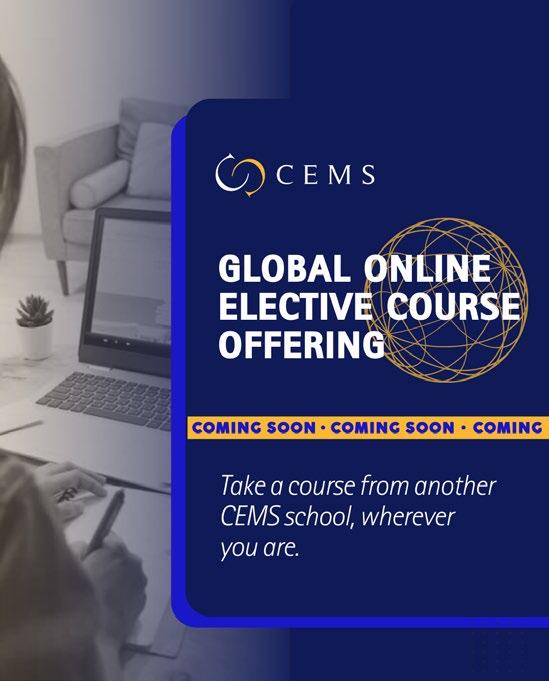
Students can also benefit from a CEMS Global Online Elective course offered in Term 1 of their CEMS MIM class year (see page 27). Member schools make a selection of CEMS Elective Courses available for all students of the current cohort in online format. Students can take one course from the selection and the ECTS received will count towards the CEMS MIM. However, whether the course will count for the home degree master’s programme is subject to local rules.
Lists of courses at all member schools can be found on the “CEMS MIM Curriculum at This School” tab of each school’s page on the CEMS website
FLEXIBILITY RULES APPLYING TO CEMS COURSES
During the CEMS MIM year only:
CEMS Electives accounting for a maximum of 7.5 ECTS can be substituted by a Research Project (see page 16).
Coursework can include Open Electives worth up to a total of 7.5 ECTS.
During the year before or the year after the CEMS MIM year:
CEMS Electives and Skill Seminars, accounting for a maximum of 15 ECTS, may be taken during the academic years directly before or directly after the CEMS MIM year.
This flexibility rule is subject to local regulation and may not be offered at all member schools. This flexibility does not apply to the SelfLeadership Skill Seminar (see page 15), which must be taken in Term 1.
Credits taken before the start of the CEMS MIM will not have any influence on the selection process, may not have been accredited for a Bachelor’s degree, and cannot be substituted by a Research Project as above.
A student must pass a minimum of 24 ECTS in each academic term, and will be able to credit a maximum of 37.5 ECTS per term.
This includes courses, the Block Seminar, SelfLeadership and Global Citizenship Seminars, Skill Seminars and the Business Project, as well as a possible Research Project and open electives. Credits taken prior to or after the CEMS MIM year do not affect this requirement.
The following are subject to local regulation:
Grade conversion
Allowance of course or exam resit
Class attendance during the term
Guidance on using AI in coursework
For further information please contact the CEMS MIM Programme Managers.
B
usiness Projects
Students must carry out a Business Project accounting for 15 ECTS during Term 2.
Business Projects reinforce the partnership between universities and companies in jointly shaping the students’ learning processes in international management.
They are consultancylike projects designed as a reallife learning experience for students: international student teams solve a real business problem as a oneterm, parttime activity. The amount of time spent on the project within the company may vary depending on its requirements. However, a Business Project will amount to about half of Term 2’s workload. Student teams work independently and are cotutored by academic and corporate representatives. Students receive a grade.
RULES, ROLES AND RELATIONS CONCERNING BUSINESS PROJECTS
Student teams consist of 35 students. Ideally, at least one student will come from another member school and at least one will be a local student. The school assigns students to individual projects, based on company preferences and didactical considerations.
Project results are evaluated by the academic and corporate advisors. Students may be required to submit a written report and/or deliver a presentation, both as a group. As part of this, they must develop a groupbased reflection on the sustainability impact of the business project. This sustainability impact assessment may be included in the final business project report submitted to the client and/or the school. The academic advisors may in addition require an individual process evaluation in order to gain a deeper understanding of the teambuilding process. Both the company and academic advisor evaluate the individual and team work.
Students gain insight into business life; training their analytical and problemsolving skills, applying research methods, transferring theoretical knowledge into practice, learning process management and acquiring intercultural social skills. They get to know potential employers and redefine their professional goals.
Students take responsibility for the project and strive for the best results. They share the workload within a team and communicate well with their advisors.. Each member of the team is expected to contribute their part to complete the Business Project. Peer evaluation is generally part of the evaluation process.
Organizer at University Tightening Links Between Universities and Companies Cooperation in the Educational Process
Providing an International and Practical Curriculum Element
The Challenge of Intercultural and Inter-organizational Learning Solving Real-Life Management Problems
S
kill Seminars
Students must attend Skill Seminars for a total value of minimum 2 ECTS (0.5 ECTS = 8 hours = 1 day).
Skill Seminars are training seminars in practical skills, which could be conducted online or in person. They are essential to kickstarting an effective professional career and fundamental to adjusting easily to an international management environment. Topics may include, but are not limited to:
Sustainability
Strategy skills
Personal and career development
Consulting skills
Marketing and communication skills
Teambuilding
Small groups ensure an interactive dimension. Skill Seminars are in most cases offered by the CEMS member schools, very often in close cooperation with Corporate Partners.
Within the total 2 ECTS required for Skill Seminars, students are required to attend a Self-Leadership Skill Seminar for a minimum of 0.5 ECTS (equivalent to 1 full day) during Term 1. The SelfLeadership Skill Seminar is a hands-on, experiential module focusing on developing
three core components of self-leadership: self-awareness, self-motivation, and selfregulation. As an early component of the CEMS curriculum to be delivered in Term 1, this seminar lays the groundwork for students’ personal development and provides a strong foundation for the concepts and frameworks explored more deeply in the Global Leadership course in Term 2.
Company training sessions or other practical external seminars taken during the CEMS MIM year or during the flexibility years can substitute CEMS Skill Seminars when validated by the home school Academic Director.
Skill Seminar offerings can be found on the “CEMS MIM Curriculum at This School” tab of each member school’s page on the CEMS website
Please note: Please contact the CEMS MIM Programme Manager in charge for registration to Skill Seminars and possible financial contributions.
Alternatively, students can also find Skill Seminars via the CEMS Career Center where member schools publish Skill Seminars that are open to all CEMS students.
Project Tutoring
Marriage of Theory and Practice Company
Academic Advisor Student Team Business Project
Bridge Between Research and Consulting
Joint
C
EMS Research Project
SKILL SEMINAR ATTENDANCE AND SANCTIONS
Due to Corporate and/or Social Partner involvement and/or the degree of planning required to organize Skill Seminars, CEMS takes Skill Seminar attendance very seriously. All CEMS students are required to adhere to the following policy:
Students must provide an advance notice of 5 working days to deregister from a Skill Seminar without explanation (length of advance notice may differ in the case of the CEMS Career Forum).
Closer to the start date, only serious personal reasons (proven by official documents) will be considered in approving late deregistration without a sanction.
When an exception for missing the SelfLeadership skill seminar is justified, the seminar must be completed at another school during Term 1 of the student’s MIM year, or, in exceptional cases, during the following year, subject to approval.
Students should be aware that each school may have different local rules that differ from the global CEMS Skill Seminar attendance sanction. Please consult with the Programme Manager for further information.
Students receive a pass/fail grade but the skill seminar can be failed if the learning objectives or full attendance requirements are not met.
For online Skill Seminars, students should have their cameras on and actively participate throughout the seminar to have it validated.
If none of the above applies and a student does NOT attend the seminar, they are NOT allowed to register for or to participate in Skill Seminars for the current and following term and earn credits. In addition, the student is put last place on the list of preference for Skill Seminars, Business Projects, and Block Seminars.
The student is removed from the CEMS MIM if 3 seminars are missed during the CEMS studies.
The Research Project is an optional programme element which can substitute CEMS Elective credits up to a maximum of 7.5 ECTS, and can only be done during the CEMS MIM year It can lead to the thesis for the home studies, but a master thesis cannot be validated for a Research Project. The student is responsible for finding the professor and the topic, and for having the project approved by the Academic Director of the home school.
The report is graded by the tutoring professor at either the home or host school.
Criteria for the CEMS Research Project:
Issue-focused: dealing with a concrete problem, be it a corporate, economic or theoretical.
Internationality: dealing with a question that applies to more than one country.
I
nternational Internship - International Professional Experience
The CEMS International Internship is an essential component of the CEMS MIM programme. It is designed to provide students with valuable international professional experience. The main objective is to turn academic experience and theoretical knowledge into a professional, multicultural experience. It must therefore be at the graduate level of studies to provide valuable business experience. There are four approved formats for fulfilling the professional experience requirement: Internship
Previous work experience
First 8 weeks of fulltime employment
Studentled startup/entrepreneurial experience
Regardless of the format, the requirements must be met. For detailed information on the rules and fulfilling requirements of the CEMS International Internship International Professional Experience, please see the complete guidelines
International Defined
“International” in the CEMS internship is understood as experiences in which students engage in international work in a professional setting. As a guideline, this may include cases where students interact and collaborate on shared objectives with people from different backgrounds who may have different cultural practices, languages, or work expectations. Building cross cultural skills, adapting and influencing, navigating crossborder issues and gaining global insights are key compontents of the international professional experience.
Students are responsible for finding their own internship. Internships can take place at a CEMS Corporate or Social Partner; however, this is not a requirement. If students wish to receive internship offers by email, they can sign up for announcement notifications at the CEMS Career Center
Students are responsible for all official documents required for employment. The “CEMS Internship Guide” gives help and information on internship
possibilities, visa and other regulations in each CEMS country. Students should research and be aware of visa requirements for working in the country where they plan to do the CEMS International internship.
Requirements
The CEMS Internship includes a minimum of 8-week full-time placement within one organization. The role may be paid or unpaid at a forprofit or notforprofit organization, public service, or non governmental organization.
The professional experience must be a fulltime activity at the professional level (first job level, although salaries may not be commensurate) where the student is given one or more challenging projects with a certain degree of autonomy.
The student’s work must be supervised within the company and the company supervisor must complete an online evaluation form at the end of the internship or at the end of the CEMS mandated minimum 8week period. In case of a studentled startup/entrepreneurial experience, an academic associated with the CEMS community should have the role as supervisor.
The professional experience must take place during the graduate level of studies (except during the two academic CEMS MIM terms), starting with the date when the student fulfilled all official bachelor’s degree study requirements.
Further conditions on the international internship are subject to local decisions based on home degree requirements.
Students must complete their professional experience by the first Sunday of November in the year of graduation. Furthermore, a maximum of 1.5 years can pass between graduation from the home degree and fulfilment of all other CEMS MIM requirements.
The professional experience must be approved by the home school before its start – except for Previous Work Experience (see “Registration and Validation”).
The professional experience can overlap with the Block Seminar only when a contractually agreed holiday is declared. The student is responsible for providing official documentation to the home school CEMS MIM Programme Manager.
Inperson work experience is the norm and is understood to include some online engagement as per respective organizational policies. Approval of an entirely online experience will involve additional requirements and expectations.
Fulfilling Requirements
Students can fulfil the CEMS MIM International Internship Professional Experience requirements in several ways.
1. Physical Relocation: Moving to a country that is neither their home school nor citizenship country for their internship.
2. Working in the Country Either of Their Citizenship OR Home School: Students can work in either their citizenship country or home school country, if they are not the same, if their professional work experience can be proven to meet the CEMS definition of international (see ‘International Defined’ section) and if the company operates in at least two countries.
3. Working in the Country of Their Citizenship AND Home School: If the citizenship and home school country are the same, students can work in this country if at least one of the following exceptions applies*:
*Note: Students must seek approval from their CEMS Academic Director to apply one of these exceptions and are still expected to work on a project and collaborate with team members that span at least two countries. Furthermore, the company that students work for must attest to these conditions in writing.
a. Students spent two academic CEMS terms away from their home school
b. Students completed all their high school or their complete bachelor’s degree programme in a country different from their citizenship and home school country
c. Students have medically documented special psychological or physical needs that require specific accommodations
d. Students can verify with documentation that they are from a country with issues in obtaining work visas or permits
4. Online Experience: In specific cases, an online only experience may be approved if it meets the necessary criteria*:
Students provide medical documentation to their Academic Director of special psychological or physical needs that require specific accommodations, or
Students prove that the position offered is online only as per the policy of the company, thus using virtual platforms to conduct all ways of working, interacting and outreaching.
Students physically relocate to a country that is neither their home school nor their citizenship country for a professional, online experience. Note that students are responsible for following all visa and work permit rules for the country to which they move.
Registration and Validation
Students must register their internship before its start on the CEMS portal for validation, providing the necessary information about the internship, including a valid work email of the supervisor. Once the home school manager confirms the internship, students can start.
In any cases where a student is not physically relocating to fulfil the requirements of their
internship/professional experience, students should demonstrate in the comment field:
a short description of how their internship/ professional experience meets the CEMS definition of international that the organization they will be working for operates in at least two countries
If additional exemption applies, due to nationality and home school country, the form of approval given by the CEMS Academic Director should also be indicated (see ‘Fulfilling Requirements’).
An online evaluation form is automatically sent to the supervisor at the end of the internship. The submission of an evaluation form is essential for graduation, therefore, students are to ensure company supervisors fill it in. When the supervisor submits the evaluation form, the internship will be validated and the evaluation is accessible via the CEMS portal. In case of studentled startups, supervision is carried out by an academic associated with the CEMS community. The student (owner) provides official founding documents on the company.
Acceptance of a previous work experience must be confirmed by the home school manager and registered into the CEMS portal. To validate it, the evaluation form must be filled in online or uploaded into the portal (see below).
Language Requirements
All CEMS MIM graduates must have language competence in three languages, one of which must be English.
The minimum CEMS language requirements are the following:
Please note: While these are the minimum requirements needed to pass the CEMS MIM, students are highly encouraged to take language or business communication courses and or tests at the highest level in as many languages as they master. The CEMS MIM certificate shows the levels passed in each language. Student should be aware that their home school programme’s language requirement may differ from the global CEMS language requirements. Please consult with your CEMS MIM Programme Manager for further information.
LANGUAGE COMBINATIONS
CEMS uses the Common European Framework of References (CEFR) for comparing language proficiency in languages.
There are six levels on the CEFR scale, where levels C2 and C1 describe a proficient user; levels B2 and B1 an intermediate user; and levels A2 and A1 a basic user of a language. CEMS defines A1, A2, B1 as the elementary level of studies.
Refer to Steps to Register Internship Information to the CEMS Database for more details.
Note: Many countries can only offer internships to individuals having a student status at a university. CEMS as an organization cannot legally offer student status.
Students may declare more than one mother tongue. Mother tongues are not tested but a “declaration of mother tongue” is to be filled in upon application to the programme. Students cannot change their mother tongue once they confirm it during application. A declaration form is to be filled in for each language declared. Certain combinations of similar languages will not be allowed to fulfil the requirements. These are: Bosnian/Croatian/Serbian/Montenegrin/ Slovenian, Czech/Slovak, Danish/Swedish/ Norwegian, Danish/Faroese, Dutch/Flemish/ Frisian/Afrikaans, German/Luxembourgish, Russian/Ukrainian/Belarusian, Russian/Kazak, Spanish/Catalan and Spanish/Galician.
Mother tongue or Proficiency (fulfilled through entry requirements to the CEMS MIM)
LANGUAGE ASSESSMENT OPTIONS AND VALIDITY
Language 2 Any language Language 3 Any language
Mother tongue
University Degree/ Secondary Education
Validity: Max 5 years before the start of the CEMS MIM year. A2/A1 Validity: Max 2 years before the start of the CEMS
Mother tongue declaration confirming the student’s ability to speak and write the language adequately is required.
Proof of secondary education/university degree completely fulfilled in a foreign language
Courses
Selected language courses at CEMS Universities
Commercial language courses at accredited cultural institutes Tests
Accredited inhouse tests at CEMS Universities (subject to availability)
Commercial language tests accredited by CEMS
Courses
Selected language courses at CEMS Universities
Commercial language courses at accredited cultural institutes Tests
Accredited inhouse tests at CEMS Universities (subject to availability)
Commercial language tests accredited by CEMS
Courses
Selected language courses at CEMS Universities
Commercial language courses at accredited cultural institutes Tests
Commercial language tests accredited by CEMS
Courses
Selected Language Courses at CEMS Universities
Commercial language courses at accredited cultural institutes
Note: Elementary level language courses (A1, A2, B1) must have a minimum of 5 ECTS or 60 contact hours. The start of the CEMS MIM year is defined by the start of Term 1.
Note: Accredited language courses do not contribute to the MIM term or total ECTS.
Grading
The CEMS MIM certificate will show grades using the ECTS grading scale. Based on the ECTS framework, a grading scale has been developed to facilitate the understanding and comparison of grades given according to different national systems. It has no national reference point and is intended to provide an objective evaluation of student abilities relative to those of other students within the same system. The ECTS grading scale is based on the rank of a student in a given assessment, i.e. how s/he performed relative to other students.
Those who have not achieved a sufficiently high level to be awarded a pass grade get:
F (Fail – considerable further work is required)
For Block Seminars, CEMS Courses and Business Projects, the ECTS “A to F” grading scale is used. Skill Seminars and the Global Citizenship Seminar use “Pass” and “Fail” grades.
Translation of local grades to this scale is up to the grading institution. Please refer to an indicative guide on the local grade conversion to CEMS grades.
For the language tests, the language levels of the CEFR for languages are used.
Adherence to Ethical Guidelines
CEMS requires that its students familiarize themselves with the codes of ethical behaviour outlined by member schools prior to the start of the CEMS MIM.
Students must not only familiarize themselves with their own university’s definition of fraud and disciplinary procedures for infraction, but must also be familiar with the ethical guidelines and procedures outlined by their host school.
Students who are uncertain where to find this information for either school should consult their Programme Manager(s) for guidance.
Students must read and follow the ethical guidelines outlined by member schools and all infractions concerning the master’s programme
of member schools are handled solely by the member schools. However, if a CEMS student commits an ethical misconduct in relation to the CEMS MIM, the CEMS Graduation Committee has the right to inquire further into the case and eventually decide whether the student should be allowed to graduate from the programme.
All students may follow the process of appeals designated by CEMS. For further information regarding CEMS handling ethical misconduct, please see the CEMS Ethical Guidelines
The CEMS MIM Graduation Rules
Rules
To graduate from the CEMS MIM, a CEMS student must successfully fulfil the following:
Have spent at least two of the three CEMS MIM terms abroad
Have graduated from a local master’s programme officially connected to the CEMS MIM
Have completed the following 66 ECTS of course type elements:
Block Seminar at the beginning of CEMS MIM Term 1: 3 ECTS
Courses including one course in Global Strategy and one course in Global Leadership during the CEMS MIM year, course(s) in data analytics of a total value of minimum 5 ECTS during the CEMS MIM: min. 45 ECTS
Self Leadership Skill Seminar in CEMS MIM Term 1: 0.5 ECTS
Global Citizenship Seminar in CEMS MIM Term 2: 1 ECTS
Business Project in CEMS MIM Term 2: 15 ECTS
Skill Seminars: min. 1.5 ECTS
In each academic term, a total value of minimum 24 and maximum 37.5 ECTS may be credited towards the CEMS MIM
No more than 15 ECTS in Elective and Skill Seminar credits may be taken outside the CEMS MIM year
Have validated a consecutive 8week International Internship on firstjob level
Minimum language requirements
Have passed a second language with a minimum level of B1 oral and B1 written
Have completed an elementary study of a third language
Graduation
The Graduation Ceremony takes place each year during the CEMS Annual Events, which are hosted by one of the CEMS member schools.
To graduate, the CEMS student must have successfully completed all obligatory components for the CEMS MIM including the home degree by midOctober of the graduation year at the latest.
Exempted from this deadline are: an internship started no later than the second Monday of September* and finished no later than the first Sunday of November (evaluation form to be submitted no later than the first Monday in November), the home degree to be passed by the second Friday of November at the latest (with written confirmation by mid October), and a pending language test result (result to be presented no later than the first Monday of November).
(*Exceptionally, the first Monday in September 2026, in order to complete 8 weeks before the first Sunday in November.)
Students have a maximum of 1.5 years to complete the CEMS MIM degree after graduating from their home school programme.
As an example, a student from CEMS MIM year 2026/27 graduating from the home school programme in June 2027 must fulfil all CEMS graduation requirements by November 2028.
However, in cases where home degree completion has been delayed, the period may be extended to a maximum of 5 years, counted from the end of the CEMS MIM year.
Failure to meet this deadline will result in loss of entitlement to graduate from the CEMS MIM. In case of serious reasons for a delay of more than 1.5 years after completion of the home degree, a student may request a postponement to be assessed casebycase by the CEMS Graduation Committee.
The CEMS MIM certificate is a digital credential, offering a secure and convenient way to verify qualifications online. Digital credentials not only reduce the environmental footprint but also streamline administrative procedures. Each digital document is equipped with an authenticity code, ensuring seamless verification for anyone scanning it. This enhances its security and accessibility, ultimately benefiting our stakeholders and reinforcing our commitment to technological advancement and sustainability. Upon completion of the CEMS MIM programme, each graduate will receive access to their certificate through the CEMS alumni platform and a unique link to their documents’ blockchain verification which can be shared through social media or through digital communication with potential employers.
Cross-School Initiatives
lobal Online Electives
The Global Online Elective course is an exclusive offer of regular elective courses (including data analytics courses) which has the same workload and participation requirement as other elective courses. Thus, it counts for the CEMS course credits. However, whether the course counts for the home degree master programme is subject to local rules. The course, along with the grade and ECTS obtained, appear on the CEMS transcript and certificate.
Model UNFCCC
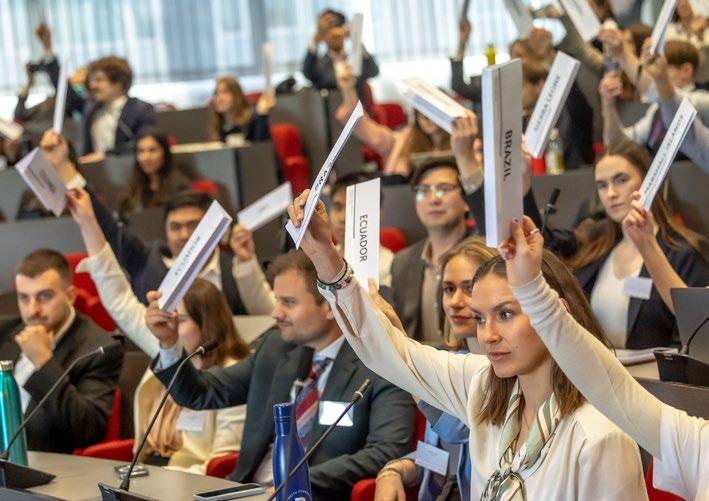
The CEMS Climate Change Course and its Model UNFCCC (United Nations Framework Convention on Climate Change) is a CEMS flagship semesterlong lecture series on the topic of climate change and climate policy. The lecture series is followed by a unique two day simulation of UN climate negotiations, where over 120 students from 10 CEMS universities play the roles of government, non government and industry representatives. During Term 2, the course curriculum at all universities is harmonized and comprises four modules, with the aim of levelling the knowledge of all students before the final climate change negotiation roleplay.
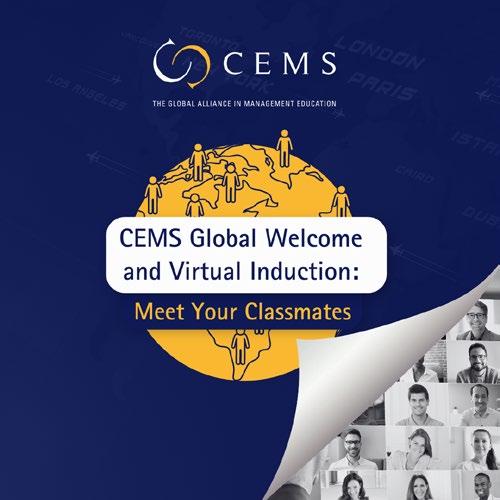
Global Welcome & Virtual Induction in depth information regarding both the academic and practical aspects of the programme. The online session is organised in June and all selected students for the upcoming class year receive an invitation.
The Global Welcome and Virtual Induction event welcomes students to their CEMS MIM year and gives them a better under standing of the global community of CEMS. Beyond a detailed introduction to the diverse components and global opportunities within CEMS, encompassing the CEMS MIM, Student Board, CEMS Clubs, Career Forum, and various events, the session offers students a unique chance to actively participate. Through a breakout room setting, students can engage in interactive discussions, pose questions with their respective home and/or host school(s), and gain
The CEMS Alliance
G
overning Bodies
The CEMS organization, being a nonprofit association under French law, is governed by the the Strategic Board, the General Assembly and the Management Council, composed of representatives from CEMS member schools, Corporate Partners, Social Partners, the Alumni Association and the Student Board.
Under the leadership of the CEMS Chair and Deputy Chair, the Strategic Board and the General Assembly convene once a year, while the Management Council convenes continually throughout the year to set the strategic and operational framework of the organization. The Chairs are supported in their responsibilities by Committees and the CEMS Global Office, led by the CEMS Executive Director.
The CEMS Global Office is the permanent organizational body of CEMS, comprising members of staff who are responsible for senior management of the network, academic/quality management and coordination, corporate relations and services, contact to social partners, events and communications, and working with the elected student representatives of the Student Board and the CEMS Alumni Network. The team liaises closely with the Chairs and the Committee chairs while supporting the implementation process of decisions taken by the boards.
The CEMS Academic Committee, formed by the local Academic Directors, the President of the Student Board and a representative of the Managers, takes decisions on CEMS MIM curriculumrelated questions with the aid of the Programme Subcommittee, which also acts as Graduation Committee, taking decisions on borderline cases.
Academic Directors, CEMS MIM Programme Managers, and Corporate Relations Managers
play an extremely important role. They are the driving force of CEMS in their local institutions. The CEMS MIM Programme and Corporate Relations Managers engage with students and companies on a daily basis while the Academic Directors are responsible for the implementation of the curriculum at the member schools. Schools may additionally appoint a Language Representative to the CEMS Language Advisory Committee who is available to answer questions related to examinations and language requirements, and eventually supports personal development.
C
EMS Programme Development and Quality Assurance
In order to maintain a high standard of teaching, CEMS constantly develops its curriculum. As part of this quality assurance process, all individual programme elements as well as the support services provided by the academic members are subject to regular evaluation.
Online student satisfaction surveys are sent to the students upon finishing every major programme element by the CEMS Global Office.
Students are strongly recommended to complete these surveys, the results of which serve as a resource for the work of the CEMS Academic Committee and for local Academic Directors to monitor and improve the programme.
Students are encouraged to complete these surveys as close to the completion of each programme element as possible and to provide constructive feedback through detailed comments, highlighting strengths and areas for improvement. These surveys offer students an opportunity to enhance and support the CEMS experience for current and future students.
The CEMS Student Board
The Student Board is the voice of students within the CEMS Alliance. It consists of one elected representative from each member school.
The Student Board focuses on advocacy, community building and best practice sharing among stakeholders while contributing to the overall development of the Alliance.
The Student Board achieves its goals through:
Gathering students’ opinions about the CEMS alliance and the CEMS MIM curriculum and providing recommendations to improve the programme and community life both locally and globally.
The CEMS Club Support team supports and guides CEMS Clubs, faciliting knowledge sharing and organizing the annual CEMS Club Conference.
The Responsible Leadership team fosters students’ awareness of global challenges and promotes responsible leadership through impactful initiatives.
The Alumni Relations team collaborates with the CEMS Alumni Network to strengthen ties between students, alumni and stakeholders.
Implementing and managing global projects that positively impact all CEMS students, with a focus on fostering social awareness, responsible leadership, and ethical conscience.
Supporting local CEMS Clubs by offering guidance, promoting best practice sharing, and building a stronger network to help clubs achieve their goals.
In fulfilling these responsibilities, the Student Board acts as the official voice of CEMS students, representing their interests before the Academic, Corporate and Administrative stakeholders of the CEMS alliance.
The Student Board operates through eight specialized teams, each with a district focus:
The MIM team enhances the quality of the CEMS MIM programme by gathering student feedback and providing actionable recommendations.
The Marketing & Communication team increases Student Board visibility and promotes CEMS through impactful campaigns and social media initiatives.
The Corporate & Social Partners team builds stronger engagement between students and CEMS Corporate and Social Partners through events and collaborations.
The Digital Innovation team tracks emerging tech trends and manages digital workspaces to improve task management and knowledge sharing within the Student Board.
The Global Integration Task Force team strengthens crossschool integration , ensuring that students, regardless of which school they are from, feel equally connected to and represented within the CEMS community.
For concerns or any confidentiality issues regarding the CEMS MIM experience, students may reach out to the Student Board MIM team via mim.studentboard@cemsmail.org The MIM team will facilitate the process of finding the right persons to resolve the issue.
C
EMS Clubs
CEMS students enjoy a very active student life at each school. CEMS Clubs constantly organize a variety of events on and around campuses as well as regional events yearly. The Clubs are integral in supporting the students’ CEMS experience as a whole and to ensure that the programme also provides a social and cultural learning experience for them on a local level.
CEMS Clubs have been set up to:
// // // // // //
Drive the international student community
Enhance CEMS’ reputation
Strengthen the international network between students
Foster strong links with alumni
Foster strong links with corporate and social partners
Foster innovative and progressive ideas to help CEMS grow
CEMS CLUB AWARDS
The CEMS Club Awards is organized by the Student Board to recognize and celebrate the outstanding achievements of CEMS Clubs across the alliance.
The CEMS Club Awards play a vital role in fostering a culture of excellence and collaboration across the CEMS network, motivating clubs to continue delivering impactful experiences for their members.
GLOBAL RESPONSIBILITY WEEK
Global Responsibility Week is an annual initiative organized by the Responsible Leadership Team. This weeklong event aims to foster sustainability, inclusivity, and diversity across the CEMS community. Global Responsibility Week emphasizes the importance of social responsibility and equips students with the tools to make a positive impact in their communities and beyond.
C
EMS Alumni Network (CAN)
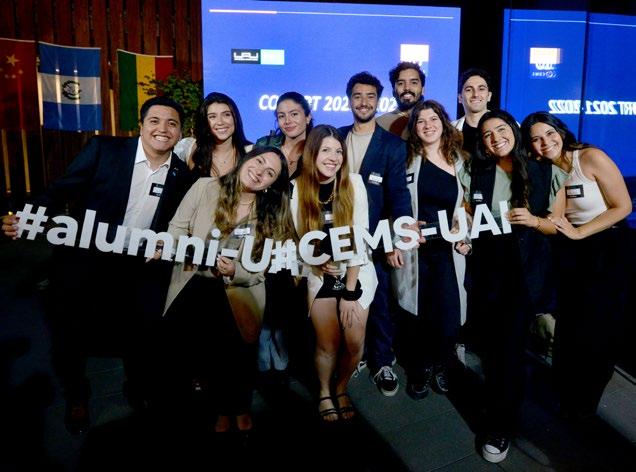
CEMS has an alumni network of 22,800+ alumni from 108+ countries, living and working in 75+ countries. This is indeed an incredible network of peers providing students with lifelong support from likeminded individuals throughout the world. During the CEMS student experience, alumni are readily available to network with students, mentor and support students’ endeavours and are always willing to share their experiences & career journeys.
CAREER ADVICE & MENTORING
Students benefit from the knowledge and experience of CEMS alumni via the online CEMS Mentoring Platform and the local StudentAlumni Mentorship Programmes (SAMP). These are vital
initiatives that enable alumni to provide guidance to future graduates on their career planning, personal development, and to provide support for a successful application and interview process.
Students can access over 1300+ alumni mentors via over 1300+ alumni mentors via the online CEMS Mentoring Platform with their cemsmail.org address via the CEMS Portal under the Career Services tab. Students should address their CEMS MIM Programme Manager, CEMS Club or Alumni Local Committee to find out more about the local SAMP.
If students are interested in entrepreneurship or the startup scene, then CEMS Entrepreneurs have just what they are looking for. If students are in need of advice or support, they can reach out to the CEMS Entrepreneurs for guidance.
LOCAL ALUMNI CHAPTERS & GLOBAL GROUPS
There are over 30+ CEMS Local Alumni Chapters located around the globe. Students can connect with local or global alumni groups to stay informed about upcoming events, network with likeminded individuals, connect with people close and far, and discover new paths for personal and professional growth. Students interested in entrepreneurship or the startup scene, may contact CEMS Entrepreneurs who acquire 100 student passes for the VivaTech conference held in Paris every year. In addition, CEMSies in Tech, offer students and alumni advice in this field. If students are in need of advice or support, they can reach out to the CEMS Entrepreneurs of CEMSies in Tech for guidance.
CEMS ALUMNI PLATFORM
Following graduation, students are automatically integrated into the network of peers. Students’ information is transferred from the CEMS portal
to the exclusive CEMS Alumni Platform where they can learn more about the CEMS alumni community, network, check in with alumni from around the globe, find old classmates, and join local chapters in their cities and/or global interest groups.
Please visit the CEMS Alumni Platform to check out current alumni events and see what Alumni Local Chapters and Global Groups are available.
Please feel free to review the CEMS Alumni Toolkit for further information, and connect with the local alumni chapter to start interacting with CEMS alumni and grow the network today.
GLOBAL ALUMNI WEEK
The CEMS Global Alumni Week (GAW) is a globally organized week of activities that involve all CEMS stakeholders: Alumni, Students, CEMS Member Schools; with a special focus on engaging alumni and students with the CEMS community. The objective of the GAW is to encourage professional network building & exchange, strengthen the interaction among students and alumni, and enhance the engagement and visibility of CEMS alumni. Read more about GAW 2025 and access the current agenda for GAW 2026
CEMS SOCIAL MEDIA CHANNELS TO REACH ALUMNI
Check out the CEMS YouTube Channel to watch webinars and open discussions organized by the CEMS Alumni Team and the Student Board featuring Alumni.
There are also a variety of CEMS Alumni Groups via LinkedIn and Facebook that students may join and follow, from CEMS Entrepreneurs to CEMS Alumni Finland, Australia & Singapore.
C
EMS Global Events
The CEMS Global Alliance offers a large range of events throughout the year for CEMS students. These events can be organised on various scales ranging from large global events to smallersized regional or local events.
These events are carefully designed by the CEMS Community to address the needs of CEMS students and can be related to career opportunities, recruitment fairs, networking & social activities, knowledgesharing conferences and so on.
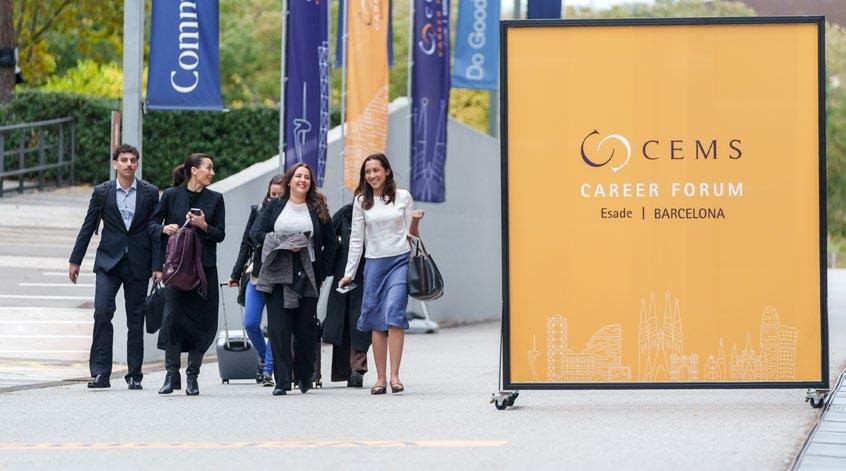
CEMS Global Events are exclusive CEMS recruitment and professional networking events. They are held twice a year in earlyNovember (CEMS Career Forum) and midMarch (CEMS Career Connect). Both career events are CEMS highlights for all students. The fairs are an ideal opportunity for CEMS students and young alumni to meet and interact with CEMS Corporate Partners, learn about opportunities for internships and permanent employment, and broaden their network.
The events comprise many activities:
Career trainings
Accredited halfday Skill Seminars
Prescheduled interviews
Coffee talks
Jobfair
Student networking events
All CEMS students as well as young CEMS alumni graduated within the last four years have the opportunity to attend these career events.
You can find the full list of events, activities, services, and platforms available to students in the CEMS Career Services Guide
Additionally, the CEMS Global Alliance organises the Annual Events. The CEMS Annual Events take place in late November / early December every year. Several events are organized over a fourday period: stakeholder meetings, the annual General Assembly and the CEMS MIM Graduation Ceremony. These events bring together around 2,000 people, including academics and administrators, alumni, students and their families.
Www.cems.org
Once students have entered the CEMS MIM programme, they are registered on the CEMS portal by their home school CEMS MIM Programme Manager. Students automatically receive a welcome message with a login and password and information on the host school and the CEMS MIM.
Most information is available on the public website, including the CEMS school pages , where students can find general information, details about the CEMS MIM programme, and the CEMS MIM curriculum for each school. On a school page, students typically find an overview of the school and campus, list of courses, information on the programme structure, as well as practical details related to student life and local support services in the different tabs. More personalized services are located on the CEMS portal, where students have to log in. The CEMS portal offers the students the option to:
Follow their curriculum/grades registered in the system
Register for Career Forum interviews and Skill Seminars // // // //
Get access to programme related documents in the Library
Pay the “Student Registration and Handling Fee“, if applicable
Note: Take a look at the onepager overview containing all the relevant platforms, tools and social media that are available for CEMS students. // // //
Access the CEMS Career Center including a CV creation tool, a job search engine, and useful career advice. This center is also used by CEMS Corporate Partners interested in finding CEMS students and graduates for job/internship opportunities
Receive news from the CEMS community as well as internship and job offers from Corporate Partners through the Career Center
Get information and register for community and regional events organized by the Student Clubs
MEMBER SCHOOLS - as of January 2026
Australia The University of Sydney Business School
Austria WU (Vienna University of Economics and Business)
Belgium Louvain School of Management
Brazil Escola de Administração de Empresas de São PauloFGV
Canada Ivey Business School
Chile Universidad Adolfo Ibáñez
China (Beijing) Tsinghua University School of Economics and Management
China (Hong Kong) HKUST Business School
Colombia Universidad de Los Andes School of Management
Czech Republic Prague University of Economics and Business
Denmark Copenhagen Business School
Egypt Onsi Sawiris School of Business at The American University in Cairo
Finland Aalto University School of Business
France HEC Paris
Germany University of Cologne
Hungary Corvinus University of Budapest
India Indian Institute of Management Calcutta
Ireland UCD Michael Smurfit Graduate Business School
Italy Bocconi University
Japan Keio University
Korea Korea University Business School
Norway Norwegian School of Economics
Poland SGH Warsaw School of Economics
Portugal Nova School of Business and Economics
Singapore National University of Singapore
South Africa University of Cape Town Graduate School of Business
Spain ESADE Business School
Sweden Stockholm School of Economics
Switzerland University of St.Gallen
The Netherlands Rotterdam School of Management, Erasmus University
Turkey Koç University Graduate School of Business
United Kingdom The London School of Economics and Political Science
United States of America Cornell SC Johnson College of Business