In Conversation with
Manpreet Kaur, Founder & CEO, Vivantaa Capital

In Conversation with
Manpreet Kaur, Founder & CEO, Vivantaa Capital
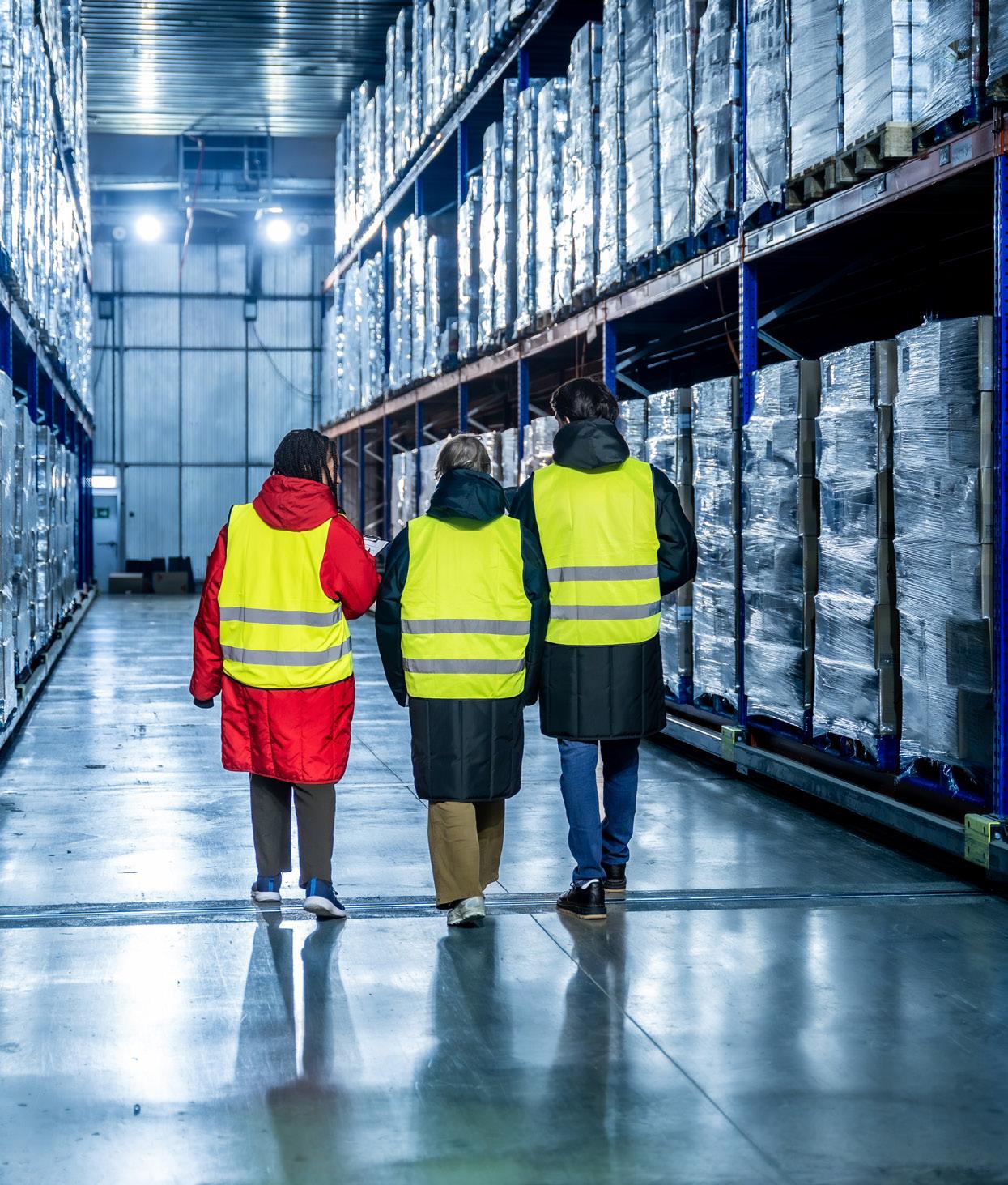
Operators and innovators explain why efficiency — not expansion — now drives value







Dear Readers,
Climate change is no longer a sustainability headline—it is an operational stress test. As summer approaches, temperature volatility will once again expose the weakest links in our supply chains.
This is why our Cover Story turns the spotlight on cold chain —not as infrastructure, but as strategy. The sector has entered its execution decade. Capacity creation alone will not suffice. Operators are redesigning networks for speed and resilience, embedding real-time intelligence into assets, and fiercely defending margins against energy costs and compliance pressures. In food, pharma, and emerging categories, cold chain performance will increasingly determine brand credibility and market access.
We also examine the Global Value Chains Outlook 2026 developed by the World Economic Forum and Kearney . Its message is unambiguous: resilience cannot be built in silos. In a world marked by fragmentation, geopolitical uncertainty, and rapid technological shifts, companies and governments must co-create adaptive systems—not just optimise for cost. The future belongs to those who design for volatility, not stability.
Our interview this month highlights trade and supply chain finance —reminding us that liquidity and risk management are as strategic as logistics networks. We also explore how collaboration has matured—from coordination meetings to disciplined alignment across functions, partners, and entire ecosystems.
Execution, financial agility, and aligned ecosystems will define competitive advantage in 2026 and beyond. The question is no longer whether supply chains will transform—but who will lead that transformation.
Published by: Charulata Bansal on behalf of Celerity India Marketing Services
Edited by: Prerna Lodaya e-mail: prerna.lodaya@celerityin.com
Designed by: Lakshminarayanan G e-mail: lakshdesign@gmail.com
Logistics Partner: Blue Dart Express Limited
Charulata Bansal Publisher Charulata.bansal@celerityin.com
www.supplychaintribe.com

The Global Value Chains Outlook 2026, developed by the World Economic Forum and Kearney, outlines how companies and governments must jointly build adaptive systems that can thrive amid fragmentation, volatility and rapid technological change.
From Permission to Authority: Redefining Power in Trade Finance
In this conversation, Manpreet Kaur, Founder & CEO, Vivantaa Capital, reflects on her journey across global markets and complex trade structures, and how competence, conviction, and economic ownership have shaped her leadership path.
India’s cold chain has moved from scarcity to scale in less than a decade. Temperature-controlled logistics now underpins how the country consumes, distributes and delivers — from vaccines and dairy to frozen foods and rapid grocery fulfilment. Infrastructure has expanded, networks have widened and demand continues to accelerate across organised retail, pharma and convenience-led consumption. Yet the industry’s central challenge has shifted. The next phase will not be defined by how much capacity is built, but by how intelligently it is deployed — a transition industry experts say will separate expansion from performance and determine cold chain leadership in the years ahead. This cover story explores how operators are redesigning networks, embedding intelligence and defending margins as cold chain enters its execution decade.
Collaboration is not a slogan; it is a structural choice. It shapes how information moves, how risk is shared, how inventory is positioned, and how organizations respond to volatility. Companies that embed collaboration deeply into their value chains report measurable gains — from lower inventories to stronger service levels. This feature revisits earlier discussions to examine collaboration not as aspiration, but as execution — and how it has evolved from coordination to disciplined alignment across functions and ecosystems.

Global value chains are no longer defined by expansion alone, but by redesign. As growth slows, geopolitics intensifies and technology accelerates, supply chains have become the primary arena where economic resilience and competitiveness are decided. What was once an operational function is now a strategic lever shaping national security, corporate performance and industrial policy. The Global Value Chains Outlook 2026, developed by the World Economic Forum and Kearney, outlines how companies and governments must jointly build adaptive systems that can thrive amid fragmentation, volatility and rapid technological change.

Fragmented outlook
Globalization is replaced by regional blocs with divergent rules, standards and alliances. Companies localize, duplicate and diversify networks to preserve market access and resilience.
Degraded outlook
Severe geopolitical fracture triggers production localization, restricted trade flows and chronic shortages. Efficiency gives way to security as supply assurance becomes the defining priority
GLOBAL supply chains stand at a structural inflection point. After decades defined by scale, cost efficiency and deep globalization, a more complex era has emerged—shaped by fragmentation, geopolitical realignment and systemic constraint. Predictable integration has given way to persistent volatility. The foundations that once enabled efficiency—stable institutions, open trade and tightly synchronized global networks—now expose vulnerabilities when disrupted.
Rising geopolitical tensions, assertive national industrial policies and uneven economic growth are forcing a fundamental redesign of production networks and the ecosystems that support them. Supply chains are no longer neutral conduits of trade; they have become instruments of economic security and competitive positioning.
The Global Value Chains Outlook 2026 provides a dual playbook for navigating this environment:
For the private sector: A strategic framework to orchestrate operations
with foresight, agility and trust— turning structural uncertainty into advantage.
For the public sector: A policy blueprint to strengthen industrial ecosystems and institutional readiness so adaptive industries can thrive.
Five interlocking forces are reshaping the outlook for global supply chains:
Slow expansion, persistent inflation and tighter capital markets are decoupling supply from demand. While growth stagnates in many advanced economies, select emerging regions continue to expand. Operations leaders are shifting from a model of supply chasing demand to one where demand is shaped by constrained supply, energy availability and infrastructure readiness. Network design now reflects local growth prospects and structural limits.
Transactional outlook
Bilateral deals replace multilateralism as a transaction-driven global order takes root. Supply chains balance collaboration with control, navigating contested access to energy, technology and critical inputs.
Volatile outlook
Growth persists but remains uneven. Frequent financial, policy and climate shocks force constant recalibration. Leading firms succeed through optionality and real-time responsiveness.
2. FRAGMENTED NETWORKS
Trade barriers, tariffs and localization mandates have accelerated economic fragmentation. Long, linear supply chains optimized purely for efficiency are evolving into digitally enabled ecosystems. Nearshoring, dual sourcing and AI-driven forecasting are becoming standard practice. Geopolitics and industrial policy are now embedded design variables requiring compliance agility, scenario modelling and policy foresight.
3.
Persistent conflicts across regions and the reordering of alliances are deepening global volatility. Globalization is splintering into semi-autonomous trade blocs anchored by major powers and influential “swing states.” In this environment, competitive advantage depends on optionality—the ability to pivot sourcing, production and logistics seamlessly across competing systems.
AI, automation and quantum computing are widening productivity gaps across sectors and nations. Early adopters of AI-enabled supply chains are already reporting measurable gains, including double-digit improvements in logistics efficiency, lead times and inventory reduction. Learning speed, rather than physical scale alone, is emerging as the decisive differentiator.
Heightened public scrutiny and geopolitical rivalry are placing companies under greater alignment pressure. Transparency, responsible data governance and corporate accountability have become strategic assets. Credibility across partners, regulators and ecosystems is now as critical as operational efficiency.
Individually, these forces are disruptive. Together, they are systemic— rewriting the operating conditions of global value chains. Uncertainty is no longer cyclical; it is structural.
To navigate this complexity, the World Economic Forum and Kearney examined a range of plausible outlooks that could emerge—often simultaneously—over the next three to five years. These overlapping realities are already shaping strategic decisions across industries and geographies. The resulting landscape is likely to be more transactional, more volatile and more fragmented than any period global leaders have experienced in the past four decades, with each scenario representing a distinct balance of risk, opportunity and operating conditions.
Winning supply chains in this new environment are undergoing a structural shift — from centralized commandand-control systems to decentralized, intelligence-led networks. Linear, vertically integrated models are giving way to interdependent ecosystems that connect suppliers, customers, regulators, financiers and digital platforms. Competitive advantage no longer
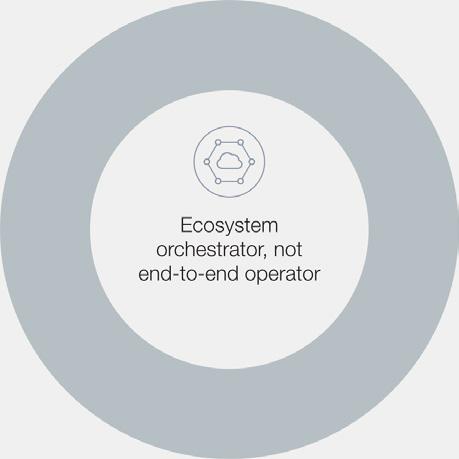


depends on end-to-end ownership, but on the ability to orchestrate value, data and trust across networks that extend well beyond direct control.
If the era of linear optimization has ended, sustained volatility requires a fundamentally different corporate playbook — one grounded in structural agility rather than static control. Success is increasingly defined by how rapidly organizations can sense disruption, reconfigure production and redeploy capital and capability. This marks the next frontier of operational leadership: a transition from efficiency to adaptability, from execution discipline to ecosystem orchestration.
Drawing on extensive research, survey data and executive dialogues with more than 100 global industry leaders, three interdependent imperatives emerge as the foundation of this new operating model. Each reframes uncertainty not as a constraint to manage, but as a catalyst for strategic renewal and competitive growth.
IMPERATIVE 1: BECOME AN ECOSYSTEM ORCHESTRATOR, NOT AN END-TO-END OPERATOR
The Rethinking: Traditional supply chain management evolved around a linear “plan–source–make–deliver” structure, focused primarily on managing internal assets and direct suppliers. That logic assumed relative geopolitical stability and predictable trade flows. In a multipolar economy characterized by fragmentation and policy intervention, no single company can achieve resilience independently. The modern supply chain leader must shift from managing what they own to shaping what they influence.
The Mandate: The imperative is to move from operational control to ecosystem orchestration — deliberately synchronizing capabilities across a diverse, agile network of suppliers, technology partners, logistics providers, contract manufacturers and public institutions. Orchestrators create coherence across systems that do not naturally align: private-sector incentives, national industrial strategies, digital infrastructures and social expectations. In this model, trust, transparency
and collaboration become measurable performance drivers rather than abstract values.
The transition from operator to orchestrator requires both organizational redesign and technological integration:
Curate the ecosystem: Develop a diversified portfolio of strategic partners whose capabilities complement one another. Replace transactional procurement relationships with co-development agreements, open innovation platforms and structured data-sharing frameworks that reinforce collective resilience.
Align incentives: Engineer commercial contracts, performance metrics and governance structures around shared outcomes — reliability, responsiveness, quality and innovation — instead of short-term cost reduction. Shared risk and shared reward models strengthen ecosystem cohesion.
Build a digital nervous system: Integrate real-time production data, logistics flows, supplier signals and policy intelligence into unified control towers. Advanced analytics and AI convert visibility into predictive insight, enabling organizations to anticipate disruptions before they cascade across the network.
Enable dynamic resource allocation: Treat capital, production capacity and talent as mobile strategic assets. Develop mechanisms to redeploy them fluidly across regions and partners as demand patterns, regulatory frameworks or geopolitical risks evolve.
Orchestration is ultimately a leadership discipline. Influencing outcomes without complete control requires strategic diplomacy, disciplined transparency and the ability to balance openness with competitive positioning.
For example, Microsoft has implemented a cloud-native operations tower to unify its Azure supply chain. By integrating digital twin capabilities with real-time data across logistics, assembly and deployment, the system provides a verified, end-to-end operational view for hundreds of decision-makers globally.
This visibility enables faster, data-driven decisions and proactive mitigation of supply disruptions across regions.
NOT CONCENTRATED SCALE
The Rethinking: Decades of relentless cost optimization led to highly concentrated mega-facilities designed to maximize economies of scale. While efficient in stable conditions, these centralized hubs have become critical single points of failure in a world defined by geopolitical rivalry, climate volatility and protectionist trade policies.
The Mandate: The strategic shift is from concentration to federation. Distributed scale involves constructing globally coordinated but regionally autonomous production and innovation hubs. These networks remain digitally connected and strategically aligned, yet capable of operating independently when disruptions occur.
Design federated architectures: Modularize production processes so capacity can shift seamlessly across geographies. Federated systems capture economies of learning and capability, not only physical scale, through a combination of internal assets and external partnerships.
Invest in flexible, technology-enabled facilities: Smaller, automated and energyefficient plants shorten supply lines and can be repurposed quickly to respond to localized demand shifts or disruptions. On-demand manufacturing technologies, including additive manufacturing, further enhance responsiveness.
Deploy modular production techniques: Standardize equipment and processes into repeatable modules that enable new facilities to be replicated rapidly. Modular design reduces expansion timelines and improves responsiveness to supply shocks and demand volatility.
Anchor capacity in policy opportunity hotspots: Evaluate industrial incentives, energy reliability, infrastructure strength and trade access as integral components
Cisco’s end-to-end supply chain risk management framework prioritizes mitigation efforts based on revenue impact and exposure to geopolitical, cyber and continuity risks. The framework evaluates six categories of risk with over 25 subcategories, using data-driven analysis to identify and address the most critical vulnerabilities. Its guiding principle is to mitigate vulnerabilities proactively and ensure continuity of supply to meet committed recovery times and avoid operational losses during disruptions. This approach positions risk management as a strategic value-protection function that informs annual planning and investment decisions.
of location strategy. Regulatory frameworks and public policy must be treated as strategic inputs, not external constraints.
Distributed scale does not represent a retreat from globalization. Rather, it rewires global integration into multiple, interconnected regional engines that collectively enhance resilience while preserving cross-border collaboration.
The Rethinking: Historically, resilience was viewed as insurance against rare disruption. Investments in redundancy were often justified defensively. In an environment of structural volatility, however, the companies that outperform are those that treat optionality as a proactive strategy — embedding flexibility not only to withstand shocks but to capitalize on them.
The Mandate: The objective is to build financial and operational elasticity that allows rapid reallocation of resources when conditions change. True resilience is measured not by the absence of disruption, but by the
Tamil Nadu has become one of India’s most reliable industrial destinations with political stability, consistent regulation, tailored incentives, strong infrastructure and skilled talent. For over 15 years, its predictable policies have attracted long-term global investments. Japanese firms cite ease of operations and quick approvals, while VinFast (a Vietnamese electric vehicle (EV) manufacturer) built its 400acre, 50,000-unit EV facility in just 17 months, far faster than the usual 24-36 months, crediting Tamil Nadu’s proactive policies and workforce readiness. This stable, investmentfriendly environment positions the state as a dependable hub in global supply chains.
speed and effectiveness of adaptation. When properly structured, optionality protects revenue streams while simultaneously unlocking new growth opportunities.
Quantify Return on Resilience (ROR):
Apply value-at-risk methodologies to demonstrate how investments in optional capacity and preparedness prevent disproportionate financial losses. By modeling past disruptions and simulating future shocks, organizations can make resilience investments economically explicit and defensible.
Codify scenario-based playbooks: Develop predefined trigger mechanisms that specify when to shift suppliers, redirect inventory or redesign product configurations. Clear response frameworks enable decisive action under pressure, minimizing operational paralysis.
Transform data into opportunity insight: Leverage the same analytical systems used to detect risk to uncover unmet demand, input arbitrage and emerging market openings. By integrating internal operational signals with external data on trade flows, commodity pricing and policy shifts, companies can identify growth inflection points ahead of competitors.
Resilience, when embedded strategically, ceases to be a cost center. It becomes a growth multiplier that converts foresight
into measurable financial performance.
For corporate leaders, sustained competitive advantage now rests on three interconnected supply chain imperatives:
Ecosystem orchestration — Aligning suppliers, partners, innovators and regulators around shared performance and resilience objectives.
Distributed scale — Designing modular, technology-enabled networks that balance efficiency with flexibility and reduce systemic concentration risk.
Growth-oriented optionality — Embedding strategic elasticity to capture upside opportunities amid disruption.
For policy-makers, the imperative is institutional readiness. Industrial competitiveness depends on the ability to convert policy vision into execution across infrastructure, talent development, regulatory coherence and trade access. Progress across these dimensions determines which economies
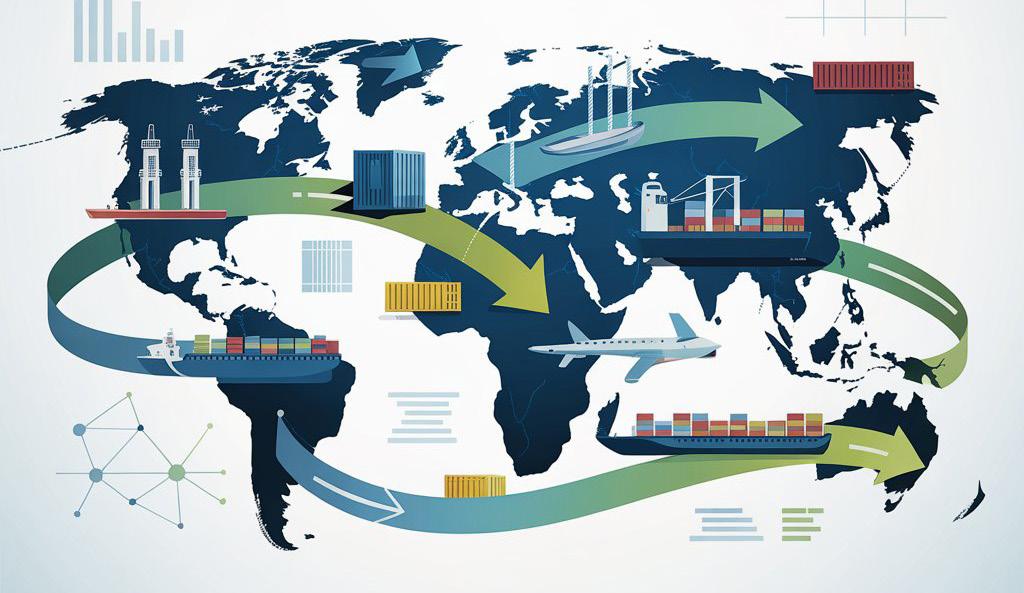
Winning supply chains in this new environment are undergoing a structural shift — from centralized command and control systems to decentralized, intelligence-led networks. Linear, vertically integrated models are giving way to interdependent ecosystems that connect suppliers, customers, regulators, financiers and digital platforms. Competitive advantage no longer depends on end-toend ownership, but on the ability to orchestrate value, data and trust across networks that extend well beyond direct control.
attract sustained investment, innovation and trust.
To support alignment between public and private decision-making, the report introduces the Manufacturing and Supply Chain Readiness Navigator, developed by the World Economic Forum in collaboration with Kearney. Built on recognized global datasets and the Country Readiness Framework, the Navigator provides a modular, interactive tool to assess national competitiveness across seven readiness factors.
For industry leaders, it serves as a strategic footprint design instrument, enabling customized weighting of readiness factors based on sector priorities, innovation intensity and risk tolerance. For governments, it functions as a diagnostic and benchmarking system, identifying ecosystem gaps and guiding targeted structural reforms.
By offering a shared, data-driven foundation, the Navigator transforms industrial strategy from abstract ambition into measurable execution.
Orchestration, distributed scale and optionality are not parallel initiatives; they form a reinforcing operating system. Distributed networks generate structural flexibility. Orchestration aligns and directs that flexibility across partners and regions. Optionality converts it into measurable financial performance and competitive acceleration.
When integrated, these capabilities redefine operational tempo. Structural agility — the ability to redeploy capital,
capability and production faster than volatility unfolds — becomes the true performance metric. Organizations that can reroute production within days, resource critical inputs within weeks and redesign product configurations within months shift from reacting to disruption to shaping competitive outcomes.
This integrated model replaces static efficiency with dynamic coordination. It prioritizes responsiveness over concentration, synchronization over ownership and adaptability over scale alone. Companies that master this loop do more than absorb shocks — they institutionalize learning, continuously recalibrating their networks as conditions evolve.
Yet even the most agile operating model depends on the broader ecosystem in which it functions. No enterprise can sustain adaptability without enabling infrastructure, regulatory clarity and institutional alignment. Corporate agility is powerful — but it is not autonomous.
The broader global system in which supply chains operate has irreversibly changed. Geopolitical fragmentation, technological divergence, capital constraints and policy activism are no longer temporary disruptions — they are structural features of the global economy. The challenge is not to restore the previous equilibrium, but to construct a new one. This is not a retreat from globalization. It is its redesign.
For businesses, competitiveness now requires embedding orchestration,
distributed scale and growth-oriented optionality as enduring design principles. For governments, it requires institutional agility — the capacity to align infrastructure, energy systems, workforce development, trade architecture and regulatory execution with the evolving geography of production.
The intersection of these ambitions demands a shared, data-driven framework. The Manufacturing and Supply Chain Readiness Navigator, developed by the World Economic Forum in collaboration with Kearney, provides that connective architecture. By assessing performance across seven readiness factors, it enables companies to calibrate global footprint decisions while helping governments identify structural competitiveness gaps and prioritize reform.
In doing so, the Navigator transforms industrial strategy from aspiration into measurable coordination — aligning corporate deployment decisions with national readiness signals. Ultimately, the next phase of global value chains will be defined by design, not prediction. A new operating logic is emerging: foresight over forecasting, orchestration over control and adaptability over static efficiency.
In a structurally volatile world, leadership will belong to those who build systems capable of thriving within divergence — converting uncertainty into durable competitive advantage through coordinated action across both enterprise and institution.


India’s cold chain has moved from scarcity to scale in less than a decade. Temperature-controlled logistics now underpins how the country consumes, distributes and delivers — from vaccines and dairy to frozen foods and rapid grocery fulfilment. Infrastructure has expanded, networks have widened and demand continues to accelerate across organised retail, pharma and convenience-led consumption. Yet the industry’s central challenge has shifted. Utilisation remains uneven, margins are tightening and response windows are shrinking as replenishment cycles compress and service expectations rise. The next phase will not be defined by how much capacity is built, but by how intelligently it is deployed — a transition industry experts say will separate expansion from performance and determine cold chain leadership in the years ahead. This cover story explores how operators are redesigning networks, embedding intelligence and defending margins as cold chain enters its execution decade.
IF India’s cold chain once struggled with gaps between nodes, the latest developments suggest the system is learning to close them. From specialised airside refrigerated trucks protecting cargo between terminal and aircraft to IoT-enabled monitoring that tracks temperature conditions in real time, the focus is shifting toward continuity rather than capacity. The launch of India’s first airside reefer truck at Hyderabad airport — designed to eliminate temperature exposure during ramp transfers and protect pharmaceutical and perishable cargo — illustrates how operators are targeting previously invisible breaks in the chain.
That shift is unfolding across segments. Pharma logistics is pushing in-city cold warehousing, agriculture supply chains are investing in farmto-market connectivity, and vaccine programmes continue to demonstrate how temperature integrity can be maintained at national scale when systems are designed around reliability. These developments suggest a sector moving from infrastructure creation to operational precision.
Against this backdrop, industry estimates of steady market growth alongside uneven utilisation reflect transition rather than contradiction. Operators are redesigning networks, embedding visibility and prioritising throughput consistency. The Q&A that follows explores how leaders across storage, logistics, technology and infrastructure are reframing performance — revealing a cold chain increasingly defined by coordination, responsiveness and intelligence rather than footprint alone.
Over the last several years, how would you characterise the performance of India’s cold chain industry in terms of growth, utilisation, and profitability? Which cold chain segments in India are delivering sustainable growth today—and which are structurally under pressure?
Kartik Jalan, Founder & CEO, Indicold
Pvt. Ltd.: Over the last several years, India’s cold chain industry has moved from a fragmented, subsidy-led
sector to a more demand-driven and organised growth phase. The market is expanding at a steady pace, with estimates indicating a 12–13% CAGR and significant long-term headroom as consumption of frozen, processed, and temperature-sensitive products rises. At the same time, utilisation and profitability remain uneven across segments.
A large part of the installed capacity continues to be single-commodity and seasonal, with more than 70% of storage still linked to crops such as potatoes. This creates volatility in utilisation and pricing, particularly in years of crop oversupply or weak farmgate prices. High energy costs and limited technology adoption continue to pressure margins in these traditional formats.
In contrast, structurally sustainable growth is emerging in frozen food, pharma, exports, and organised retail. These segments demand temperature integrity, traceability, and reliability, enabling year-round utilisation and stronger customer relationships. At Indicold, this shift is reflected in investments in automation, energyefficient infrastructure, and in-house technology. Automated frozen facilities are improving density, reducing energy intensity, and delivering predictable service outcomes.
Going forward, the industry’s next phase will be defined less by capacity creation and more by operational discipline, technology, and integrated supply chain capability.
Deep Khira, CEO, Sub Zero Insulation Tech Pvt. Ltd.: India’s cold chain has grown steadily, driven by organised retail, QSR, dairy, pharma, and the rise of e-commerce and quick commerce. Growth is visible, but performance varies widely by segment and geography. Utilisation is improving in established corridors and categories, while remaining uneven in seasonal and fragmented routes. Profitability in logistics remains challenging for many operators because the business is highly competitive and service expectations keep rising.
Segments showing relatively sustainable growth today include pharma, QSR, dairy, and organised food supply chains with predictable volumes and tighter compliance. Segments under
structural pressure include spot market agri and seasonal produce corridors where demand fluctuates, pricing is highly competitive, and service discipline across the ecosystem is inconsistent.
Pradeep Murugesan, Co-Founder, Just Deliveries: India’s cold chain industry has grown structurally and not cyclically but returns have not kept pace with expansion. Demand has been reshaped by three forces – changing urban consumption, organised food brands scaling nationally, and quick commerce compressing supply chain timelines. Urban consumers are spending less time in kitchens and more on convenience; frozen foods, ready-to-cook formats, pre-cut vegetables, and year-round availability of exotic produce. That shift alone has permanently increased temperature-controlled demand.
Pharma and QSR continue to deliver stable contract-backed growth. But quick commerce is the real disruptor, it has started to create metro-like demand density in Tier 2 cities and redefined replenishment frequency. That said, capacity has expanded faster than operational maturity. Utilisation remains uneven, and profitability is under pressure due to capital intensity and procurement-led pricing discipline. Cold chain in India is no longer constrained by demand, but it is constrained by efficiency.
How are cold chain 3PLs redesigning business models to balance pricing pressure, capex intensity, and service expectations?
Kartik Jalan: Over the past year, cold chain 3PLs in India have become significantly more disciplined about capital and returns. The focus has shifted from building capacity to building utilisation. Instead of standalone, assetheavy facilities, operators are developing multi-client, multi-commodity networks that improve throughput, reduce seasonality, and strengthen capital efficiency.
Pricing pressure from large FMCG, QSR, and pharma customers is real. The response has been to move beyond storage toward integrated solutions—transport, inventory visibility, packaging, and

Over the next decade, leadership in India’s cold chain will be defined by the ability to combine scale with AI-driven intelligence and automation. Globally, the sector is moving from asset-heavy infrastructure to digitally orchestrated networks, where real-time data, predictive analytics, and autonomous systems drive both efficiency and resilience. As capital, land, and energy become more constrained, competitive advantage will come less from building capacity and more from optimising it continuously. Deeper customer integration will remain critical, but it will increasingly be enabled by technology. Automation is improving throughput, consistency, and safety, while data platforms are enabling dynamic pricing, routing, and capacity allocation. These capabilities are shifting cold chain providers from storage vendors to intelligent supply chain partners.
planning. Increasingly, customers are paying for reliability, predictability, and service consistency rather than just space. This is also pushing providers toward long-term, contract-backed partnerships that support better planning and asset turns.
Automation and digital platforms are now central to the business model. They improve density, lower energy and labour intensity, and deliver traceability at scale—enabling operators to meet rising service expectations while protecting margins.
At Indicold, this approach has translated into investments in automation, in-house technology, and deep customer integration. The Indicold facility at Dholasan, India’s first fully automated frozen ASRS, and the Detroj site, India’s first four-way shuttle-based frozen facility, reflect this shift—toward higher utilisation, energy efficiency, and predictable service in Indian operating conditions.
Deep Khira: The strongest players are shifting away from purely asset-led growth toward models that improve asset productivity and reduce idle capacity. This includes hub-and-spoke networks and a sharper focus on route economics rather than generic capacity addition. We also see more modular expansion, adding capacity in phases tied to anchor customers and contracted volumes. Many 3PLs are also differentiating by offering packaged solutions such as storage plus transport plus monitoring, rather than competing only on per-kilometre rates.
This helps justify pricing and creates stickier relationships.
Pradeep Murugesan: The industry is moving from building assets to asset orchestration. Asset expansion is giving way to asset-light aggregation models. Instead of building everywhere, forward-looking operators are leveraging underutilised capacity and increasing network productivity. Cluster-based network densification is replacing scattered expansion. Technology now acts as the control layer; realtime temperature monitoring, route optimisation, ERP integration, and SLA governance are no longer optional. Operators who improve utilisation without proportionately increasing capital deployed will outperform. Speed has become a baseline expectation & efficiency is the real differentiator.
Which customer engagement models deliver stability for providers and flexibility for customers?
Kartik Jalan: In India’s cold chain market, customer engagement is evolving from transactional storage relationships to strategic, risk-sharing partnerships. Given demand volatility and supply chain disruptions, both providers and customers are prioritising stability without losing flexibility. Multi-year, volume-aligned agreements are emerging as a preferred model, particularly in frozen foods, QSR, and pharma. These structures provide predictable utilisation and cash flows for service providers, while
allowing customers to scale capacity based on demand cycles rather than investing in dedicated infrastructure.
Another important shift is toward joint planning and closer operational integration. Customers increasingly expect cold chain partners to participate in forecasting, inventory positioning, and network design. This reduces stockouts, improves service levels, and helps manage demand variability across geographies and seasons. Flexibility is being enabled through shared infrastructure, distributed networks, and dynamic capacity allocation rather than fixed contracts.
Technology is strengthening trust in these partnerships. Real-time visibility, traceability, and shared data platforms are enabling transparency, faster decisionmaking, and better risk management. Outcome-based models—linked to temperature integrity, turnaround time, and accuracy—are gradually replacing pure space-based pricing. At Indicold, this translates into longterm, collaborative partnerships built on transparency, responsiveness, and performance, supporting both stability for providers and agility for customers in a fast-evolving consumption and export ecosystem.
Deep Khira: Models that work well are those that align capacity planning with customer demand visibility. Mediumterm contracts with volume bands, agreed service levels, and clear escalation mechanisms tend to give stability without locking customers into rigid

To support the next phase of growth, India needs stronger regulatory clarity and enforcement across the entire cold chain ecosystem, particularly in temperature-controlled transport of food and pharmaceutical products. Today, standards for cold storage facilities are relatively structured, but transport compliance is uneven. There should be nationally defined and enforced norms for temperature control, vehicle insulation performance, monitoring systems, and hygiene protocols for food and pharma logistics. Certification mechanisms should ensure that vehicles and facilities meet defined thermal performance benchmarks before operating in sensitive categories. These standards should not remain advisory. Enforcement through regulatory authorities at the time of vehicle registration and periodic compliance checks would significantly improve discipline across the sector. This would protect product integrity, reduce wastage, and create a level playing field for responsible operators.
commitments. Dedicated fleet models are still the preferred strategy, while shared-user networks where providers can consolidate multiple customers on the same lanes are starting to get introduced. In practice, partnerships improve when there is transparency on demand forecasts, loading discipline, turnaround times, and performance scorecards. When customers and providers jointly manage these variables, both stability and flexibility improve.
Pradeep Murugesan: Long-term, multi-city B2B partnerships are the most resilient structure. Integrated warehousing and transportation offerings create alignment. Volumelinked commercial structures provide predictability. Quick commerce and organised retail require flexibility in replenishment cycles but flexibility does not come from idle capacity. It comes from network density and planning integration. The most successful cold chain providers are no longer vendors. They are embedded into their customers supply planning systems.
Given uneven infrastructure and demand volatility, which growth strategies help build resilience and defend margins?
Kartik Jalan: Cold chain providers in India are building resilience by moving from speculative infrastructure to disciplined, demand-linked capacity
expansion. While pallet creation remains essential in a structurally under-supplied market, the focus has shifted to building the right capacity—automated, energyefficient, and designed around longterm customer demand rather than seasonal cycles. This approach improves utilisation, reduces operating costs, and supports stable margins even in volatile environments.
Another important strategy is portfolio and segment balancing. Providers are combining steady, yearround sectors such as frozen and processed foods with more seasonal agrilinked demand. This reduces utilisation volatility and strengthens pricing power. Multi-temperature, multi-commodity infrastructure is also becoming critical, enabling operators to flex capacity and optimise asset productivity in a high fixed-cost business.
Technology and automation are emerging as core margin levers. Highdensity automated facilities, real-time visibility, and data-led planning improve throughput, reduce labour and energy intensity, and deliver consistency at scale. Strategic partnerships and contract-backed growth are further de-risking investments and improving capital efficiency.
At Indicold, this translates into automation-led pallet creation, in-house technology, and long-term customer alignment—reflecting the philosophy of building a future-ready, sustainable
cold supply chain that combines scale, efficiency, and reliability.
Deep Khira: Resilience comes from three levers. First, building density in select corridors before expanding nationally. Second, standardising operating processes to reduce variance in loading, handling, and temperature integrity. Third, investing in preventive maintenance and uptime, because breakdowns and rework destroy margins quickly in cold chain. Providers that combine disciplined network expansion with strong SOPs and measurable service quality are better able to defend pricing and avoid margin leakage.
Pradeep Murugesan: Given uneven infrastructure, fragmented consumption centres, and recurring demand volatility, the most effective growth strategies are those that strengthen network economics rather than simply expand footprint. In cold chain logistics, resilience is built through structural discipline — aligning capacity with real demand, protecting asset productivity, and avoiding capital drag. Margin defence begins with operational precision. In a sector where energy intensity, compliance standards, and service reliability directly influence profitability, the difference between growth and strain lies in how intelligently assets are orchestrated.
Resilient operators are focusing on:
a Multi-client load consolidation to improve truck fill rates and distribute fixed fleet and refrigeration costs across diversified demand pools
a Cross-docking and high-velocity flow-through models instead of over-investing in static storage that risks underutilisation during demand troughs
a Cluster-based geographic expansion, building density within defined corridors to balance inbound and outbound flows before expanding into new territories
a Data-led planning and predictive routing to minimise empty miles, improve turnaround times, and enhance asset sweating
a Dynamic capacity alignment to match seasonal spikes without permanently inflating the fixed cost base
Cold chain investment without granular demand mapping has historically led to underutilised warehouses, lane imbalances, and capital locked into lowyield infrastructure. Expansion without density dilutes margins; infrastructure without throughput erodes returns.
The next growth phase will reward utilisation optimisation over infrastructure proliferation. Operators who treat network design as a precision discipline — constantly recalibrating routes, loads, and storage footprints to demand signals — will build resilience that withstands volatility. In this industry, discipline creates margin. Scale amplifies returns only when supported by density, data, and utilisation integrity.
What policy interventions or ecosystem enablers would support the next phase of scale and sustainability?
Kartik Jalan: India’s cold chain sector will scale and become more sustainable when policy shifts from capacity creation to ecosystem productivity. While schemes such as Pradhan Mantri Kisan Sampada Yojana and 100% FDI have improved infrastructure, global benchmarks from countries like Netherlands and the
United States show that long-term value comes from integrated networks rather than standalone storage. The next phase in India will require viability-gap funding for farm-gate pre-cooling, multimodal refrigerated logistics, and stronger lastmile connectivity. Renewable energy incentives and carbon-linked financing can help reduce operating costs in an energy-intensive sector, while clusterbased cold chain zones aligned with export corridors can improve utilization and reduce demand volatility. Digital logistics infrastructure and data sharing—aligned with the National Logistics Policy—can further enable traceability, benchmarking, and access to institutional capital.
At the same time, contract decisions in India are increasingly shaped by capabilities that directly improve reliability and transparency. Large food, pharma, and quick-service customers now prioritize end-to-end temperature visibility, IoT-enabled monitoring,

Pradeep Murugesan, Co-Founder, JustDeliveries
predictive risk analytics, and control tower platforms that integrate operations, compliance, and inventory intelligence. Sustainability metrics such as energy efficiency, low-GWP refrigerants, and reusable packaging are also influencing procurement, as global customers align with frameworks promoted by bodies like the United Nations Environment Programme and Food and Agriculture Organization. As a result, technology, sustainability, and performance-linked models are moving from pilots to core differentiators in long-term cold chain partnerships.
Deep Khira: To support the next phase of growth, India needs stronger regulatory clarity and enforcement across the entire cold chain ecosystem, particularly in temperature-controlled transport of food and pharmaceutical products.
Today, standards for cold storage facilities are relatively structured,
Quick commerce is not stretching cold chain — it is redefining its operating physics. Here’s what the system must now get structurally right:
Build surge-ready networks, not “peak day” plans: Demand spikes won’t follow calendars anymore. The system has to handle unpredictability by design.
Shift from bulk efficiency to refill efficiency: Winning isn’t moving more in one trip. It’s refilling faster, more frequently, without temperature drift.
Replace fixed schedules with hourly operating rhythms: This is no longer a daily planning game. It’s a continuously adjusting operation.
Upgrade last-mile cold integrity from “support” to “core”: Last mile isn’t a final step anymore. It’s where reliability is won or lost.
These aren't upgrades, but the new baseline. They're necessary adapts for cold chain logistics to stand strong when quick commerce rewrites delivery physics.

While India certainly needs continued investment in quality cold storage infrastructure, as recognized in the 2025 Union Budget allocations, we’re focused on helping operators maximize the productivity of their existing assets through better decision-making. The issue isn’t just absolute capacity; it’s about dramatically improving how efficiently that capacity is utilized. If we can help a mid-sized operator improve utilization from 60% to 75%, that’s a 25% revenue increase with minimal capital investment. That operator becomes more profitable, can pay better rates for quality cargo, can invest in service improvements, and becomes more competitive. Multiply that across hundreds of operators, and you start solving the industry’s utilization problem while creating a sustainable business model for ourselves. The next 3-5 years aren’t going to be about who builds the most capacity. They’re going to be about who uses capacity most intelligently. That’s a very different game, and one where software and intelligence matter more than concrete and compressors.
but transport compliance is uneven. There should be nationally defined and enforced norms for temperature control, vehicle insulation performance, monitoring systems, and hygiene protocols for food and pharma logistics. Certification mechanisms should ensure that vehicles and facilities meet defined thermal performance benchmarks before operating in sensitive categories.
These standards should not remain advisory. Enforcement through regulatory authorities at the time of vehicle registration and periodic compliance checks would significantly improve discipline across the sector. This would protect product integrity, reduce wastage, and create a level playing field for responsible operators.
In addition, long-tenure financing support for cold chain assets, incentives for energy-efficient equipment, and skill development for refrigeration and cold chain technicians would strengthen operational reliability. The ecosystem would also benefit from stronger integration between producers, processors, logistics providers, and retailers, supported by traceability and digital documentation standards.
If India wants to reduce food wastage, improve pharma compliance, and scale cold chain sustainably, policy must move from encouragement to structured enforcement and ecosystem coordination.
Soumalya Mukherjee, CEO, Tan90:
The most impactful policy change would be infrastructure status with preferential lending rates. Cold chain operators pay 12-14% for capital today, when roads and ports get 8-9%. That gap is killing growth. The 4-5% difference isn’t a minor convenience; it’s killing the growth and making business expansion incredibly difficult, specifically in the case of midsized players. Think about what that means in practical terms: a 50-crore cold storage facility that could be viable at 9% interest becomes marginal at 13%. That difference determines whether you build in a tier-2 city where demand is emerging, or you don’t build at all. It’s the difference between taking a calculated risk on serving smaller food processors versus only chasing large, established clients in metros.
On incentives, subsidies for renewable energy integration specific to refrigeration would work, not generic solar subsidies, but ones tied to cold chain operations. Refrigeration is a continuous, high-load application. The business case for solar-plus-storage needs to account for 24/7 cooling requirements, monsoon backup, and peak demand charges.
When you structure incentives that recognize these operational realities, maybe viability gap funding for solarthermal battery combinations, or accelerated depreciation for energy-
efficient compressor retrofits, you make the business case close immediately. Right now, most operators view renewable energy as a nice-to-have in their ESG reports, not a core investment. The right policy changes that.
On technology, there’s often a gap between what gets discussed at industry events and what’s actually driving contract decisions on the ground. The technologies we see genuinely influencing contracts today are IoT-based temperature monitoring and route optimization systems. These address immediate client needs around compliance documentation and cost reduction. Clients want proof of compliance and lower freight costs. A pharmaceutical distributor needs documented, unbroken temperature logs for regulatory compliance. A retail chain needs to know their frozen products reached the store within temperature specifications. IoT sensors provide that assurance in a way that manual logging never could. At Tan90, we’ve seen operators with sophisticated route optimization winning bids even when their base rates are slightly higher, because the total landed cost comes out lower.
Other technologies like AI forecasting and blockchain traceability show promise, but they’re still in earlier stages of adoption. While there are some interesting pilot projects, widespread commercial deployment faces challenges
around ROI timelines and integration complexity. Most clients still need to see clear payback within 18-24 months before making these investments at scale. Why? Because clients need to see clear ROI within 18-24 months, and most of these advanced technologies haven’t proven that business case outside of controlled pilots.
AI demand forecasting faces a different problem: most clients still trust their own forecasts based on their market knowledge and relationships. They’re not yet ready to let an algorithm override their judgment, especially when the cost of stockouts or wastage falls on them. This doesn’t mean these technologies won’t matter; they will, eventually. But right now, there’s a big gap between innovation theater and actual implementation at scale. The operators winning business today are the ones focused on executing the basics exceptionally well, not chasing every new technology trend.
Pradeep Murugesan: For the next phase of scale, the cold chain ecosystem needs structural enablers that reduce capital strain while improving utilisation discipline. From a policy perspective, shared infrastructure incentives can significantly improve asset efficiency — especially in high-density urban clusters where duplication of cold storage and
handling capacity weakens returns across the system. Encouraging common-user facilities and multi-tenant hubs will help improve throughput economics rather than pushing fragmented build-outs.
Rationalised and predictable energy tariffs for cold storage are equally critical. Power remains one of the largest cost components in temperaturecontrolled operations. Policy clarity on industrial tariffs, peak load structures, and renewable integration would directly strengthen margin stability and sustainability outcomes.
Further, harmonised compliance norms across states — particularly around food safety, pharmaceutical handling, and transport documentation — would reduce administrative friction and improve inter-state velocity. Fragmented regulation adds cost and delays in a business where time and temperature sensitivity are non-negotiable.
Finally, stronger first-mile support — including aggregation centres, packhouse infrastructure, and farmer-level pre-cooling — will determine whether India’s cold chain scales with efficiency or with wastage embedded in the system.
The next phase of growth will depend not just on capital infusion, but on policy frameworks that encourage density, energy efficiency, and coordinated capacity development.
Cold chain maturity is increasingly being shaped by pharmaceutical requirements. Rising volumes of biologics, specialty injectables and vaccines are driving adoption of connected monitoring platforms, integrated quality systems and urban cold warehousing models. Continuous temperature tracking across storage and transit is becoming a core compliance requirement rather than an optional safeguard. This is pushing logistics providers toward end-to-end visibility, automated documentation and tighter coordination between warehousing, transport and quality teams. As pharma supply chains globalise, cold chain capability is emerging as a strategic differentiator — influencing gateway selection, network design and long-term logistics partnerships.
Which technology or intelligence capabilities genuinely influence contract decisions beyond pilots?
Deep Khira: In India today, buyers still prioritise reliability and execution. Technology influences contract decisions when it directly improves service outcomes and reduces risk. Capabilities that matter include real-time temperature monitoring, route and trip visibility, exception alerts, documented compliance, and strong maintenance systems that ensure uptime. Decision intelligence becomes valuable when it translates into measurable improvements such as fewer claims, fewer temperature excursions, better turnaround times, and higher vehicle availability. Buyers respond to outcomes more than dashboards.
Pradeep Murugesan: Technology in cold chain has moved beyond experimentation. Today, contract decisions are increasingly influenced by systems that demonstrate operational control, risk mitigation, and measurable accountability — not pilotstage innovation. Real-time temperature telemetry is now foundational. Clients expect continuous monitoring with deviation alerts, audit trails, and corrective action logs. This is no longer a premium feature — it is basic compliance assurance.
Integrated visibility dashboards that combine fleet movement, temperature
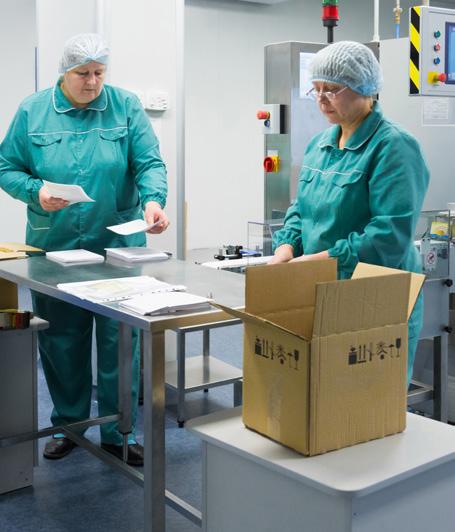
data, delivery timelines, and proofof-delivery documentation create transparency across stakeholders. Brands are prioritising partners who can provide a single operational truth across nodes.
More advanced capabilities such as predictive replenishment alignment, demand-linked dispatch planning, and data-led route optimisation are beginning to influence strategic contracts, especially in QSR, dairy, and pharma segments where shelf life and service levels directly affect revenue.
Additionally, automated compliance documentation and digital audit readiness reduce friction during inspections and corporate governance reviews — an increasingly important factor in longterm partnerships.
Visibility is no longer a differentiator. It is hygiene. The real differentiator now is intelligence — the ability to convert operational data into proactive control, reduced spoilage, higher utilisation, and measurable service reliability.
How is the sustainability push driving innovation, and what is commercially viable today?
Kartik Jalan: Sustainability in India’s cold chain is moving beyond ESG narratives to a sharper focus on cost, reliability, and long-term commercial value. For most operators, energy remains the single largest lever, as power volatility and rising tariffs directly affect margins. This is why commercially viable innovation today is centred on highefficiency design—advanced insulation, automation, variable-speed systems, and hybrid solar integration. These investments deliver measurable savings and are becoming the baseline for new facilities, similar to high-efficiency models seen in markets like Netherlands.
At the network level, sustainability is also shaping smarter capacity and distribution models. Multi-temperature, multi-commodity infrastructure, huband-spoke design, and closer integration with customer demand planning are improving utilisation and reducing waste. As demand shifts toward processed foods, pharma, and quick commerce, this flexibility is becoming critical to both resilience and profitability.
At Indicold, automation is central to this transition. Automated storage and
retrieval systems, data-led planning, and tighter temperature control reduce energy intensity per pallet, improve asset turns, and enhance traceability. Automation also improves worker safety by reducing manual exposure to extreme cold and enables upskilling toward higher-value technical roles, strengthening long-term workforce sustainability. Increasingly, large food and pharma customers are linking procurement to efficiency, reliability, and transparency, accelerating the shift toward automation-led, performancebacked cold chain models in India.
Deep Khira: Sustainability is pushing practical changes that also reduce operating costs. Energy-efficient refrigeration, improved insulation, better door and airflow design, and tighter operating discipline reduce refrigeration run-time and fuel consumption. Network optimisation, improved load planning, and reducing empty kilometres are also commercially attractive because they improve profitability directly. Electrification is emerging as a serious pathway for urban and short-haul cold chain, especially where charging access and predictable routes exist. Viability improves when vehicles are engineered end-to-end for cold chain, including payload, insulation, and refrigeration integration.
Soumalya Mukherjee: Empty runs is probably the biggest opportunity. Most cold chain operators are running vehicles back empty 35-40% of the time. That’s fuel burned, driver time paid, and vehicle depreciation for zero revenue. That’s fuel burned, driver time paid, and vehicle depreciation for zero revenue.
a Solar-powered cold storage in semiurban and rural areas is another win-win that’s viable right now. But notice the qualifier: it works where grid power is unreliable or expensive. In areas where operators are running diesel gensets for 8-10 hours a day because of power cuts, solar with battery storage pays for itself in 5-7 years even without subsidies. You’re replacing diesel that costs ₹80-90 per liter with solar that’s free after the initial investment.
a Ammonia refrigerants instead of HFCs is another example of sustainability and economics aligning. Ammonia is more energyefficient than HFC refrigerants, so operating costs drop. It’s also cheaper than newer synthetic refrigerants, and it meets environmental norms around phasing out high-GWP gases. For large cold storage facilities, ammonia retrofits make sense purely on operating cost grounds; the environmental benefit is almost a bonus.
What’s not viable yet:
a Electric refrigerated trucks at scale remain elusive. The technology exists, but the economics don’t work for most use cases. Battery weight reduces payload capacity. Charging infrastructure is inadequate, especially on intercity routes. Range anxiety is real when you’re carrying temperature-sensitive cargo worth crores. Maybe in 5-7 years, as battery technology improves and charging networks expand, but today? It’s mostly pilot projects and short urban delivery routes.
a Circular economy models for packaging- returnable containers, reusable insulation, etc sound great in theory. In practice, they require massive coordination across fragmented supply chains and reverse logistics that don’t exist yet. Who pays for collecting and sanitizing returned packaging? How do you track it across multiple handlers? The transaction costs currently exceed the sustainability benefits.
At Tan90, we help operators model these trade-offs- understanding when a greener solution actually improves their P&L versus simply meeting client ESG requirements.
The future of sustainability in the cold chain isn’t about virtue signalling; it’s about finding the innovations where environmental and economic incentives align, then scaling those ruthlessly.
Pradeep Murugesan: Sustainability in cold chain is no longer positioned as
a parallel agenda — it is increasingly being aligned with operational efficiency and cost discipline. In a temperature-controlled environment, every inefficiency directly translates into both margin erosion and higher carbon intensity. The commercial reality is simple: sustainability initiatives gain traction when they improve utilisation and reduce waste.
Today, several levers are already economically viable:
a Higher fill rates through multiclient consolidation, improving asset productivity per trip
a Advanced route optimisation, reducing fuel consumption and empty miles
a Energy-efficient refrigeration systems and better insulation design, lowering power intensity per pallet stored
a Reduced product wastage through tighter temperature control and faster turnaround times, protecting both revenue and resources
As convenience-led consumption grows — particularly in QSR, dairy, and pharma — supply chain intensity increases. More frequent deliveries, smaller batch sizes, and tighter service windows can inflate both cost structures and emissions if not carefully managed.
Without optimisation, convenience multiplies inefficiency. With disciplined network design, however, it creates structured throughput.
Efficient network architecture, asset sweating, and data-led planning are therefore not just environmental commitments — they are commercial imperatives. In cold chain logistics, sustainability becomes scalable only when it strengthens unit economics.
Over the next decade, will leadership be defined by scale, deeper integration, or superior intelligence?
Kartik Jalan: Over the next decade, leadership in India’s cold chain will be defined by the ability to combine scale with AI-driven intelligence and automation. Globally, the sector is moving from asset-heavy infrastructure to digitally orchestrated networks, where real-time data, predictive analytics, and autonomous systems drive both efficiency and resilience. As capital, land, and energy become more constrained, competitive advantage will come less from building capacity and more from optimising it continuously.
Deeper customer integration will remain critical, but it will increasingly be enabled by technology. AI-led forecasting, digital twins, and connected control towers are already transforming how mature markets such as Netherlands and Germany manage demand volatility, optimise inventory positioning,

and reduce food loss. Automation is improving throughput, consistency, and safety, while data platforms are enabling dynamic pricing, routing, and capacity allocation. These capabilities are shifting cold chain providers from storage vendors to intelligent supply chain partners.
In India, this transition is still early but accelerating as consumption, exports, and organised retail scale. At Indicold, the focus is on building a futureready, sustainable cold supply chain— leveraging automation, AI-led planning, and technology integration to improve utilisation, energy efficiency, and service predictability. The next decade will reward players who combine infrastructure, intelligence, and ecosystem collaboration to create resilient, responsive cold chain networks.
Deep Khira: It will be a combination, but the winners will be those who can scale with quality. Scale alone without service consistency will not sustain margins. Deeper integration with customers will matter, especially in categories where demand planning and service compliance are critical. Superior intelligence will become a differentiator when it helps providers improve asset productivity, reduce claims, and run more predictable networks. In other words, leadership will be defined by operational excellence supported by the right technology, not technology alone.
Soumalya Mukherjee: Different winners in different segments. Take pharmaceuticals and vaccines. That game is already decided. Scale and compliance infrastructure are what matter. You need pan-India reach because pharma distributors want one partner who can handle their entire network, not regional players they have to coordinate. You need GDP-certified facilities, validated processes, and the capital to maintain redundant systems because there’s zero tolerance for temperature excursions.
That’s why the pharma cold chain has already consolidated around a handful of players with national footprints. While a new entrant focused primarily on decision intelligence or customer integration would face significant challenges in displacing established players who’ve built strong compliance

infrastructure and relationships over many years, there’s certainly room for innovation in how services are delivered within this framework.
But fresh food and agriculture? Completely different story. Here, I think integration is what wins. The midsized food processor- let’s say someone processing mangoes in UP or Alphonso in Ratnagiri doesn’t want to manage five different vendors for pre-cooling, cold storage, ripening, transport, and last-mile. They want one partner who understands their product, their seasonality, and their customers and can offer a complete solution.
The player who can say “We’ll handle everything from farm-gate to retail shelf, and you only pay for products that reach the customer within spec”- that’s compelling. It shifts risk, simplifies operations, and aligns incentives. That’s not about having the most warehouses; it’s about deep integration into the customer’s business.
This is also where you start seeing cold chain operators offering ancillary services like inventory financing against stored goods, quality assessment, and even market intelligence on pricing. When you’re that integrated into a client’s operations, you become very hard to displace.
But here’s what I really believe: decision intelligence becomes the differentiator for everyone.
Whether you’re a large national
Technology partnerships are accelerating the move toward real-time cold chain visibility. New IoT temperature loggers and Bluetooth-enabled sensors can track shipments continuously, store large volumes of environmental data and trigger alerts when deviations occur. These systems provide operators with actionable insights rather than retrospective records, enabling faster interventions and stronger compliance. As regulatory expectations tighten and temperature-sensitive products increase, monitoring is evolving from a quality assurance function into an operational control layer. The emphasis is shifting from documenting excursions to preventing them — redefining how reliability is measured across cold chain networks.
player or a regional integrated operator, if you can’t predict demand patterns, optimize routing dynamically, time your inventory decisions, and allocate your assets intelligently, you’re leaving massive efficiency on the table. I’d estimate 20-30% in most cases.
Think about what better decision-making unlocks:
a Demand prediction lets you preposition inventory closer to where it’ll be needed, reducing emergency transport costs and improving freshness.
a Dynamic route optimization means you’re constantly finding better combinations of loads and routes, not just running the same routes you’ve run for years.
a Inventory timing helps you decide when to move products between storage, when to push them to market, and when to hold for better prices, especially critical for agricultural commodities with volatile pricing.
a Asset allocation ensures your most efficient facilities and vehicles are handling your highest-margin business, not randomly assigned.
Large players have been building internal data science teams to capture these benefits. But mid-sized operators
can’t afford to have the scale to justify a team of data scientists and engineers. That’s the gap Tan90 is focused on: bringing enterprise-grade decisionmaking capability to operators who can’t build it themselves.
In five years, I think you’ll see that the market leaders in every segment, whether they won through scale, integration, or specialization, will all have sophisticated decision intelligence. It’ll be table stakes. The operators still making decisions based on gut feel and spreadsheets will be the ones getting squeezed out.
One more prediction: I think we’ll see the rise of highly specialized vertical players who go incredibly deep in specific product categories or geographic corridors. Someone who owns the entire cold chain for seafood from Andhra Pradesh to export markets. Another player who dominates dairy in Gujarat. A specialist in Northeast vegetables for metropolitan markets. They’re not trying to be everything to everyone; they’re trying to be indispensable in one vertical.
Pradeep Murugesan: Leadership in the next decade will not be defined by fleet size alone. In cold chain logistics, asset ownership is visible — but operating architecture is decisive. True leadership will emerge at the intersection of scale, integration, and intelligence — but only when anchored in structural discipline.
It will be defined by:
a Network density across highconsumption corridors, where balanced inbound–outbound flows improve asset sweating and reduce cost per pallet moved
a Capital efficiency, ensuring that every refrigerated truck and warehouse pallet position generates measurable throughput
a Deep integration with customer planning systems, aligning replenishment cycles, demand forecasts, and dispatch schedules rather than reacting to variability
a Standardised operating frameworks, creating predictable quality across nodes instead of performance that depends on local experience
a Decision intelligence powered by real-time data, enabling proactive temperature control, routing adjustments, and exception management
India’s cold chain industry already has world-class assets in pockets — modern reefer fleets, advanced cold rooms, and high-grade monitoring systems. The inconsistency lies in operating standards and execution uniformity. Knowledge has traditionally been experience-driven
rather than framework-driven, resulting in performance variability across regions and partners.
The next structural leap will come from codifying execution — converting tacit operational know-how into scalable systems, measurable SOPs, and databacked decision layers. Scale without structure will struggle. Scale built on density, integration, and intelligence will define enduring leadership.
Over the next 3–5 years, what performance trends do you anticipate for demand, pricing, and capacity expansion?
Kartik Jalan:
Over the next decade, leadership in India’s cold chain will not be defined by who builds the most capacity, but by who deploys that capacity most intelligently. As capital becomes more expensive and demand remains uneven, scale without utilisation will become a liability. The winners will be those who move beyond infrastructure to deeper customer integration—embedding themselves in demand planning, inventory strategy, and network design. This shift is already visible across pharma, processed foods, exports, and quick commerce, where reliability, responsiveness, and transparency are becoming more important than price alone.
Scale will still matter, but only when it is flexible, multi-temperature, and supported by automation and real-time
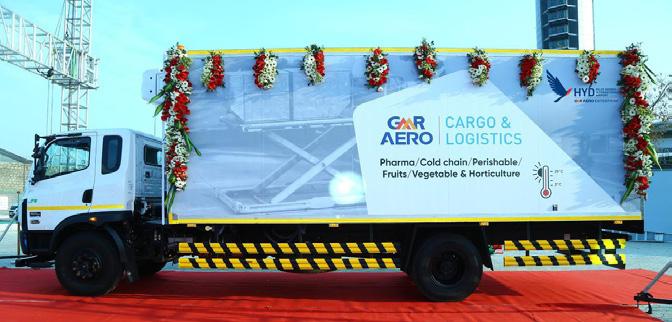
The launch of India’s first airside refrigerated truck at Hyderabad airport reflects a shift toward eliminating temperature breaks at the most vulnerable points in logistics. Designed to maintain conditions
decision intelligence. Mature markets such as Netherlands and Germany show that technology-led operations drive utilisation, energy efficiency, and customer stickiness. In India, this will separate long-term leaders from assetheavy players.
At Indicold, the focus is on building a future-ready, sustainable cold supply chain—combining automation, data, and energy-efficient infrastructure with long-term partnerships. The next decade will reward companies that evolve from storage providers to intelligence-led supply chain partners, creating resilience, improving service consistency, and delivering measurable value to customers and the broader food ecosystem.
Deep Khira: Demand should continue to rise as organised supply chains expand and customers demand more reliability and compliance. Pricing pressure will remain, but providers who can demonstrate consistent performance and lower total cost of ownership for customers will be better positioned to hold pricing. Capacity will expand, though the more disciplined players will add capacity selectively in lanes and segments where utilisation can be sustained. We will also see increased focus on higher-quality assets, better insulation standards, and more structured service-level contracting. This should gradually improve industry maturity and reduce wastage.
between roughly 2°C and 25°C, the vehicle protects pharmaceutical and perishable cargo during the critical transfer between terminal and aircraft — a stage historically exposed to temperature fluctuations. The innovation improves handling efficiency, reduces product risk and supports India’s positioning as a global hub for pharma and perishables. The development signals how cold chain investments are increasingly targeting continuity and reliability rather than capacity alone.
Soumalya Mukherjee: The demand picture for the next 3-5 years is really a story of two diverging markets growing at very different rates. On one side, you have quick commerce and D2C food brands, which are the explosive growth story. We’re probably looking at 3040% annual growth from a relatively small base today. Ten-minute delivery of fresh produce, ice cream delivered to your door, premium meats shipped directly from farm to consumer, all of this requires cold chain infrastructure that barely exists today.
The requirements are also different: more distributed micro-fulfillment centers, faster turnaround times, and smaller batch handling. This is creating opportunities for new entrants and forcing traditional players to adapt their models. On the other side, you have traditional retail cold chainsupermarkets, wholesale distribution, and conventional supply chains. This is still growing, but more sedately, probably 10-12% annually. It’s a mature market with established relationships and incremental improvements rather than disruption.
What’s interesting is that these two markets are creating very different asset requirements. Quick commerce needs agility and location- smaller facilities in urban cores with rapid turnover. Traditional retail needs scale and efficiency, large facilities with optimized operations. I don’t think one player easily serves both without essentially running two different businesses.
On pricing, I see a continued squeeze in the middle with divergence between premium and commodity segments. Premium players serving pharma, organized retail, and prepared foods with high service levels and compliance requirements will hold margins in the 8-10% range. Why? The complexity of what they do, the capital required, and the consequences of failure create natural barriers to competition. Clients will pay for reliability and compliance. But commodity cold storage basic warehousing for potatoes, onions, and general agricultural goods is going to see margin compression. We’re probably heading toward 4-5% margins as capacity oversupply continues.
Too many people saw cold storage
as a real estate play and built capacity without enough attention to demand quality, location strategy, or operational efficiency. That capacity still needs to earn some return, so it competes on price, which drags the whole segment down. The middle-tier players are not premium enough to command high prices, not low-cost enough to win on price; those are the ones in trouble. You’re going to see consolidation as some get acquired, others exit, and the survivors either move upmarket or downmarket.
On capacity, here’s the paradox: we’re going to see 12-15% annual capacity addition, but utilization will stay stuck around 65-70% on average. Why? Because capacity is being built in the wrong places, or at the wrong spec, or by developers who see it as infrastructure investment rather than an operating business. What really concerns me is the widening gap between best performers and average operators. Average operators are at 60% utilization, barely breaking even, and unable to invest in improvements.
This gap creates a vicious cycle: best performers can invest in better systems, attract better clients, and pull further ahead. Struggling operators cut prices to fill capacity, which makes it harder to invest, which makes them less competitive, which leads to more price cuts. The big strategic question for the industry is: whoever solves the utilization problem wins. And here’s the key insight: this isn’t about building more warehouses. We don’t need more capacity in aggregate; we need better utilization of existing capacity.
This is fundamentally a technology and marketplace problem, not an infrastructure problem. The physical assets exist; we’re just incredibly inefficient in how we utilize them. For Tan90, this is exactly the opportunity we’re pursuing. While India certainly needs continued investment in quality cold storage infrastructure, as it was recognized in the 2025 Union Budget allocations, what we’re focused on is helping operators maximize the productivity of their existing assets through better decision-making. The issue isn’t just absolute capacity; it’s about dramatically improving how efficiently that capacity is utilized.
If we can help a mid-sized operator
improve utilization from 60% to 75%, that’s a 25% revenue increase with minimal capital investment. That operator becomes more profitable, can pay better rates for quality cargo, can invest in service improvements, and becomes more competitive. Multiply that across hundreds of operators, and you start solving the industry’s utilization problem while creating a sustainable business model for ourselves. The next 3-5 years aren’t going to be about who builds the most capacity. They’re going to be about who uses capacity most intelligently. That’s a very different game, and one where software and intelligence matter more than concrete and compressors.
Pradeep Murugesan: Demand will remain structurally strong across frozen foods, organised fresh, pharma, QSR, and quick commerce, especially as Tier 2 markets mature. Historically, Tier 2 cold chain demand was led by agriculture, followed by pharma and QSR expansion. Quick commerce is now rapidly reshaping that hierarchy and accelerating demand density in non-metro cities. Pricing discipline will continue as enterprise procurement becomes more sophisticated.
Capacity expansion will shift from greenfield asset creation to utilisation optimisation and aggregation models. India’s cold chain industry is transitioning from infrastructure creation to intelligence creation. The next decade will reward orchestration over ownership, discipline over expansion, and intelligence over scale.
Quick commerce has made cold chain less about storage and more about responsiveness without losing control. This churns out the work systems of cold chain logistics. The old rules don’t work here. That’s the real challenge now. And that’s where the next competitive edge will come from.
Supply chains are entering a new phase. Linear, asset-heavy models are giving way to agile, orchestrated networks built for permanent volatility. Ecosystem coordination, distributed scale, early AI adoption, and resilience as a growth engine are now strategic imperatives, not future bets. This infographic, by Global Supply Chain Council (GSCC), captures the key shifts shaping supply chain strategy in 2026, from corporate operating models to national readiness.
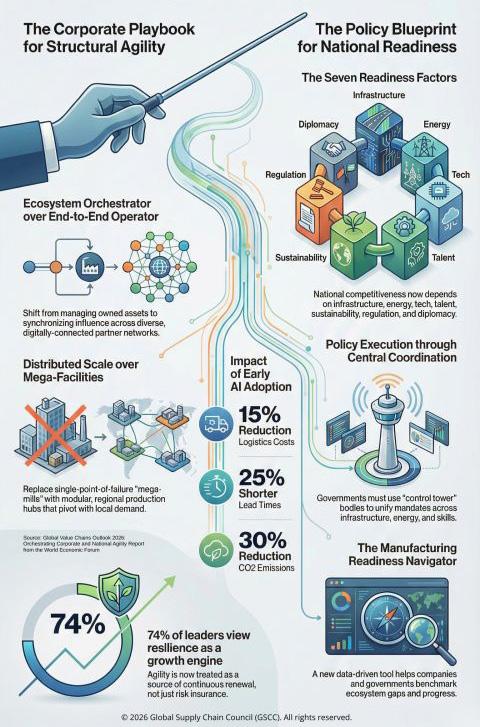
In capital-intensive sectors like trade and supply chain finance, authority is built through judgment, outcomes, and the ability to take risk responsibly. As the industry evolves toward greater transparency, data-led decision-making, and diversified capital participation, new leadership models are emerging—ones defined less by hierarchy and more by credibility and execution. In this conversation, Manpreet Kaur, Founder & CEO, Vivantaa Capital, reflects on her journey across global markets and complex trade structures, and how competence, conviction, and economic ownership have shaped her leadership path. She shares a grounded perspective on how power in finance is earned, why performance remains the most persuasive currency, and how the next generation of leaders—women included—are redefining influence by owning decisions, capital, and outcomes.


Manpreet Kaur is a seasoned BFSI professional for over 22 years with specialization in Trade Finance, Supply Chain, Commodity Finance, Structured Debt and Syndication. She has been in senior leadership positions with conglomerates like Cargill, Golden Agri and American Express, managing the corporate portfolio. Manpreet has been instrumental in operationalizing few start-up entities in India and developing the distribution network in overseas locations like China, UK, Switzerland, Dubai, Singapore, Africa, among others, covering a network of lenders including Tier I & II banks, Trade Funds, Hedge Funds and Family offices.
With over 16 years across trade finance, structured debt, and commodity finance, how has the supply chain financing landscape evolved in India and globally? What inflection points do you see shaping the next decade?
Over the last 16 years, supply chain finance has progressively advanced from a bankdominated, document-centric model to a multi-capital, data-driven financing ecosystem. Historically, trade finance relied heavily on static instruments such as letters of credit and bank guarantees, with credit decisions anchored primarily in balance-sheet strength, collateral coverage, and counterparty reputation rather than real-time trade performance. Today, that model has effectively inverted. Risk assessment is increasingly based on cash-flow predictability, transaction-level visibility, and control over underlying trade assets. This shift has expanded the capital base well beyond traditional banks to include alternative credit funds, insurers, development finance institutions, family offices, and trade-focused hedge funds—each participating based on differentiated risk appetite and return expectations.
Key inflection points shaping the next decade include:
The shift from single-bank dependency to multi-lender and alternative capital participation, which is reducing concentration risk and enabling capital to be matched far more precisely to specific tenors, asset classes, and risk profiles rather than being constrained by a single balance sheet.
The rise of commodity-backed, receivable-backed, and inventory monetization structures, as financing increasingly aligns with the physical and economic reality of trade flows, moving away from abstract credit limits toward asset- and transactionlinked funding models.
The transition from relationshipbased credit to data-led underwriting, where credit decisions are becoming more algorithmic, evidence-driven, and repeatable, materially reducing subjectivity while improving consistency and scalability.
India’s evolution from an import-dependent economy to a manufacturing- and export-led growth engine, which is driving demand for more sophisticated working capital solutions, preshipment finance, structured export finance, and cross-border risk mitigation tools.
The integration of ESG as a core credit qualifier rather than a peripheral compliance requirement, with sustainability metrics increasingly influencing pricing, eligibility, covenant structures, and tenor across trade and supply chain financing.
Taken together, these shifts suggest that the next decade of supply chain finance will reward speed, transparency, and intelligent risksharing far more than sheer balancesheet size or legacy relationships.
In a period of geo-economic volatility, what structural shifts are you noticing in the availability, cost, and risk appetite of capital for supply chain ecosystems?
In the current geo-economic environment, capital is not constrained by availability so much as by selectivity. Liquidity remains present across global markets, but it is being deployed with far greater discipline, structure sensitivity, and demand for control.
Traditional banks are steadily derisking exposure to long-dated and opaque trade structures, particularly where documentation is fragmented, asset control is weak, or exit optionality is unclear. Regulatory capital requirements and heightened geopolitical uncertainty have reinforced this shift. In contrast, hedge funds and specialist trade-finance funds are increasingly active in shorttenor, self-liquidating trade assets that offer yield alongside structural protection.
While the overall cost of capital has risen, the more significant development is the widening pricing dispersion between well-structured, transparent transactions and weaker, relationship-driven deals. Risk appetite has also evolved—from a primary focus on country or macro risk to a sharper emphasis on counterparty quality, execution capability, and operational control across the trade cycle.
Today, capital follows visibility, traceability, and the ability to intervene when risk deviates from plan. Structures that offer governance, realtime information, and exit optionality continue to attract funding even in volatile conditions.
Trade finance is moving decisively away from balance-sheet dominance toward control-led financing. Across banks, funds, and private capital, the common thread is a demand for visibility—into cash flows, inventory movement, counterparties, and execution risk. Capital today is not chasing volume; it is chasing predictability. Structures that embed transaction-level data, asset control, and clear exit pathways are attracting funding, while opaque, relationship-dependent models are steadily losing relevance. This shift is reshaping how supply chains are designed, financed, and governed—placing greater responsibility on operators to make their networks finance-ready, not just operationally efficient.
While banks remain central to trade finance, they are no longer the sole arbiters of capital. Trade funds, family offices, insurers, and private credit players are increasingly stepping into structured trade and commoditybacked deals. This diversification is not accidental—it reflects the ability of alternative capital to price short-tenor risk, move faster, and operate outside traditional regulatory constraints. The result is a more segmented but resilient ecosystem, where capital is matched more precisely to asset class, risk appetite, and transaction duration. For supply chain leaders, this means broader funding options—but also higher expectations around transparency and control.

How are AI-driven underwriting, digital documentation, blockchain trade rails, and IoT-enabled visibility changing the way lenders evaluate credit risk and structure financing?
Technology is no longer an incremental improvement in trade finance—it is fundamentally reshaping how credit risk is understood, priced, and managed. AIdriven underwriting enables lenders to monitor cash flows, pricing patterns, trade cycles, and behavioral signals on a continuous basis, shifting credit assessment from static analysis to dynamic risk management.
Blockchain-enabled trade rails are reducing structural vulnerabilities such as document fraud, duplicate financing, and reconciliation disputes by creating
immutable and auditable transaction records. At the same time, digital documentation—including electronic bills of lading and e-invoicing—is materially compressing trade cycles, often by 30–40 percent, improving both working-capital efficiency for borrowers and asset turnover for lenders.
IoT-enabled visibility adds another layer of assurance by allowing realtime tracking of inventory location, movement, and condition, transforming collateral from a static concept into a live risk-management tool.
Collectively, these technologies are driving a decisive shift from trust-based lending toward evidence-based financing, where risk is observed, measured, and managed continuously.
Despite multiple government and fintech interventions, the MSME working-capital gap persists. What innovations—product, risk models, or ecosystem partnerships—are most critical to bridging this gap?
The persistence of the MSME workingcapital gap is not a failure of intent, but a reflection of structural misalignment. While government schemes and fintech solutions have expanded access, many still approach MSME financing as a standalone credit problem rather than a supply-chain integration challenge.
Key constraints remain: limited formal credit histories, fragmented data across GST systems, banks, and buyers, and high underwriting and servicing costs relative to ticket size. As a result, traditional lending models struggle to scale sustainably.
What will bridge the gap is a shift toward ecosystem-led financing. Anchor-led models that leverage the credit strength of large buyers can materially de-risk MSME exposure. Hybrid bank–fintech partnerships combine balance-sheet depth with speed, analytics, and lower cost-toserve. AI-based alternative credit scoring using transaction-level and supply-chain data enables more accurate risk assessment, while embedded finance integrates credit directly into procurement and invoicing workflows.
Receivable and inventory marketplaces further improve liquidity and price discovery. Ultimately, MSME finance must move beyond loan products toward integrated, data-driven supply-
chain solutions.
With your experience across China, UK, Switzerland, Dubai, and Singapore, what emerging risks do you see in areas like KYC/AML, trade-based fraud, and commoditybacked financing?
Across major global trade and financial hubs, risk in trade and commodity finance has become increasingly sophisticated, cross-border, and difficult to detect through traditional controls. Trade-based money laundering, invoice manipulation, circular commodity trades, and synthetic collateral structures are no longer isolated incidents but systemic challenges.
These risks are often embedded within seemingly legitimate trade flows, making static, onboarding-based KYC frameworks inadequate. The response must therefore evolve toward continuous KYC, transaction-level monitoring, and independent verification of physical commodity flows. Equally important is alignment across jurisdictions. In an interconnected global trade environment, fragmented regulatory oversight creates blind spots that can be exploited. Effective risk management today requires real-time surveillance, crossborder coordination, and governance frameworks that are as dynamic as the trade flows they oversee.
From your leadership roles at Cargill and Golden Agri, how is deal origination evolving—with the rise of alternative capital providers, digital lenders, and new risk-sharing models?
Deal origination has undergone a structural shift from relationship-led sourcing to structure-led selection. While relationships remain important, capital today prioritizes certainty, control, and repeatability over familiarity alone. Platform-driven origination is enabling scale and standardization, while structured off-take-backed deals are gaining prominence by anchoring financing to predictable revenue streams. Risk-sharing mechanisms involving insurers and development finance institutions are helping to reduce capital intensity and extend tenor where appropriate.
At the same time, family offices and private credit funds are becoming more active participants, attracted by assetbacked structures with defined risk parameters. The common thread across successful origination today is structured certainty—capital wants clarity on cash flows, collateral, and exit, not just growth narratives.
Having operationalized start-up entities in India, how do you view the evolving relationship between banks, fintechs, trade-tech platforms, and alternative credit funds? Is the collaboration curve maturing?
The collaboration curve is maturing— but selectively. Each participant brings a distinct capability to the ecosystem. Banks contribute balance-sheet strength and regulatory confidence; fintechs bring speed, innovation, and customer-centric design; trade-tech platforms deliver transparency and transaction integrity; and credit funds provide flexibility and differentiated risk appetite. The most effective models are not competitive but collaborative, built around co-origination and risk-participation frameworks where incentives are aligned. Ecosystems that attempt to operate in silos struggle to scale, while those that integrate capital, technology, and governance are increasingly successful.
How are Tier I/II banks, hedge funds, trade funds, and family offices revisiting their exposure to structured trade, supply chain finance, and commodity-linked deals?
Capital providers are becoming far more segmented and deliberate in how they allocate exposure across trade and supply chain finance, reflecting both regulatory pressures and evolving risk-return expectations. Tier I and Tier II banks are increasingly narrowing their focus toward top-rated anchors, investmentgrade counterparties, and low-volatility structures that align with regulatory capital constraints and internal risk limits. Their emphasis is on predictability, documentation strength, and portfolio resilience rather than balance-sheet growth.
In contrast, hedge funds and specialist trade funds are leaning into short-cycle, self-liquidating trade opportunities
where turnover is high and risk can be tightly structured and monitored. These players are comfortable operating in narrower windows of visibility, provided they have strong control mechanisms and clear exit paths.
Family offices are emerging as a distinct and increasingly influential capital pool. They are selectively entering commodity-backed and asset-linked structures in search of yield stability, diversification from public markets, and tangible asset exposure. Unlike banks, they are less constrained by regulatory capital, and unlike hedge funds, they often have a longer investment horizon.
Across all capital types, the common shift is away from broad, countryled risk assessment toward asset-led, counterparty-specific, and transactionlevel risk frameworks. Capital today is not chasing geography—it is underwriting control, visibility, and execution certainty.
How is ESG influencing commodity supply chains? What new financing structures, covenants, or reporting standards are emerging as sustainability becomes central to trade flows?
ESG has moved decisively from the margins to the core economics of commodity supply chains and trade finance. It is no longer treated as a reputational or compliance overlay, but as a material factor influencing credit decisions, pricing, and deal eligibility. Sustainability performance increasingly affects margin levels, tenor, covenant packages, and even off-take access. Commodities that meet traceability, environmental, and labor standards are finding preferential access to capital, while non-compliant flows are facing higher costs or outright exclusion.
New financing structures are emerging in response. Sustainabilitylinked trade finance ties pricing or availability of capital to measurable ESG outcomes. Green inventory financing supports commodities with certified sustainable sourcing. Enhanced reporting and disclosure standards—often aligned with global frameworks—are becoming embedded within financing agreements. ESG-adjusted margin pricing reinforces a critical shift: sustainable behavior is not just ethically important, it is financially
material. Capital is increasingly rewarding supply chains that can demonstrate longterm resilience and responsible practices.
The industry is seeing consolidation among lenders, fintechs, credit funds, and trade platforms. What is driving this M&A wave—technology, capital efficiency, or regulatory tailwinds?
The current consolidation wave is being driven by structural necessity rather than opportunistic expansion. Technology investment, regulatory compliance, and data integration now carry high fixed costs that are difficult for standalone or sub-scale players to absorb. At the same time, regulatory scrutiny has intensified, requiring stronger governance, compliance infrastructure, and capital adequacy. This has made capital efficiency a strategic imperative rather than a financial optimization exercise.
As a result, platforms that combine capital provision, technology capability, and compliance infrastructure within a single operating framework are gaining a decisive advantage. M&A
is increasingly about building integrated, resilient ecosystems that can scale safely and sustainably. It is less about market share, and more about survival and relevance in a more regulated, data-driven environment.
Which parts of the supply chain— whether structural components (suppliers, manufacturers, distributors) or technology-led segments (digital procurement, visibility solutions, automated warehousing)—are attracting the strongest financing traction today, and why?
Financing traction is strongest in segments that offer predictability, operational control, and measurable risk outcomes. Digital procurement platforms are attracting capital because they provide transaction transparency, structured workflows, and reliable data trails. Warehousing and logistics automation is similarly favored, as it improves asset security, reduces operational leakage, and enhances collateral control.
Commodity aggregation platforms
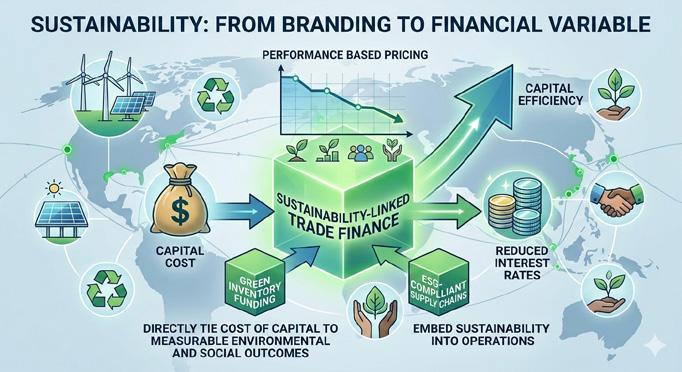
are gaining attention for their ability to consolidate fragmented supply, enforce quality standards, and create scale. Inventory visibility solutions further reduce information asymmetry by allowing real-time monitoring of stock levels, movement, and condition. Across all these segments, the underlying theme is control. Capital follows parts of the supply chain where risk can be observed, managed, and mitigated in real time— rather than assumed.
As India strengthens its position in global manufacturing and exports, what new opportunities do you see for India-based trade finance desks— something you’ve already built successfully at Golden Agri?
India’s manufacturing push, export incentives, entrepreneurial depth, and increasing diversification of global buyers position it well to evolve into a regional trade-finance hub. Indiabased trade finance desks can move beyond servicing domestic exporters to structuring and managing cross-border trade flows across Asia, the Middle East, and Africa. This includes opportunities in structured export finance, regional supply-chain financing, and commoditylinked trade flows. The evolution mirrors successful models seen in parts of Southeast Asia, where local desks became regional centers of expertise and execution. With the right talent, technology, and risk frameworks, India can materially enhance its role in global trade finance ecosystems—something I’ve seen firsthand through building such capabilities at Golden Agri.
Even with global liquidity, access for mid-market players remains constrained. What systemic
Sustainability in trade finance is no longer a branding exercise—it is becoming a financial variable. Structures such as sustainability-linked trade finance and green inventory funding directly tie cost of capital to measurable environmental and social outcomes. This shift is compelling companies to embed sustainability into operations rather than treat it as an external obligation. For supply chain leaders, ESG is increasingly a lever for capital efficiency, not just compliance—a change that is redefining how responsible trade is financed.
bottlenecks require urgent rethinking?
Despite ample global liquidity, midmarket access remains constrained due to persistent structural bottlenecks. The lack of standardized documentation increases legal and operational friction, making mid-sized transactions disproportionately costly to underwrite and manage. Internal risk concentration limits further restrict lender exposure, while the absence of deep secondary liquidity markets for trade assets limits capital recycling. As a result, capital remains available in theory but difficult to deploy at scale in practice. Addressing these constraints requires systemic redesign—standardization of documentation, development of secondary markets, and broader risksharing mechanisms—rather than incremental policy or product tweaks.
Which new financing models— dynamic discounting, inventory monetization, receivable marketplaces, tokenization—hold the most promise in the next five years?
Financing models that align closely with real trade flows are gaining the strongest traction. Dynamic discounting improves working-capital efficiency by allowing buyers to optimize payment timing. Inventory monetization unlocks value tied up in physical stock while maintaining control and visibility. Receivable marketplaces enhance liquidity and price discovery by broadening the investor base. Tokenization of trade assets also holds long-term promise, particularly for improving liquidity and transparency, provided regulatory frameworks evolve to ensure trust, standardization, and investor protection.
What type of mentorship, leadership culture, and organisational support is essential to accelerate the growth of women professionals in trade finance and supply chain financing?
Accelerating women’s growth in trade finance requires a shift from symbolic inclusion to real economic authority. Sponsorship—where senior leaders actively advocate for women in highstakes roles—matters far more than mentorship alone. Equally critical is direct deal exposure, ownership of
risk, and accountability for outcomes. Boardroom and investment-committee representation is essential to shift decision-making dynamics and normalize women’s presence in capital allocation roles. In finance, credibility is built through execution and responsibility, not permission.
Your journey spans global markets, complex deal structures, and high-stakes portfolios. What has your experience taught you about navigating—and reshaping—the space for women in finance and trade?
My journey across global markets, complex deal structures, and highstakes portfolios has taught me one fundamental truth: competence creates space—but conviction reshapes it.
Early in my career, particularly within trade and commodity finance, the landscape was unequivocally maledominated and deeply conservative in its willingness to entrust women with capital, negotiation authority, and structuring responsibility. I learned quickly that credibility in this world is neither assumed nor generously extended—it is constructed deliberately, deal by deal, through rigorous preparation, disciplined execution, and the ability to stay composed when risk is real and outcomes are irreversible. When you consistently demonstrate a sharper understanding of risk than the room—commercially, structurally, and ethically—gender begins to lose its primacy.
What genuinely reshapes the space, however, goes beyond technical competence. It requires ownership of intent and narrative. Too often, women are encouraged to assimilate rather than to lead authentically. I chose not to dilute my approach or temper my point of view—to be analytically precise yet intuitively grounded, assertive without being performative, and commercially decisive while remaining anchored in long-term value creation. Over time, that integrated leadership style has become a source of strength rather than a tradeoff.
One of the most important lessons has been understanding where real influence resides. In finance, authority
flows from economic control—who allocates capital, who accepts risk, and who is accountable for outcomes. When women are positioned primarily in advisory, coordination, or support roles, progress remains symbolic. When women lead transactions, sit across the table from lenders and investors, and take responsibility for balance-sheet decisions, the system adjusts—not through rhetoric, but through results.
Equally vital is the responsibility to lift others while climbing—not through well-intentioned mentorship alone, but by creating real exposure and consequence. That means placing women in highpressure negotiations, giving them P&L ownership, and standing behind them when decisions are difficult rather than convenient. The industry does not need more panels or promises; it needs more women trusted with judgment, capital, and risk.
Ultimately, reshaping this space is not about asking for inclusion or waiting for cultural change. It is about becoming indispensable. In finance, performance compounds credibility. And when outcomes speak consistently and decisively, the system has no choice but to recalibrate.
With your cross-sector global experience, what leadership traits are most essential to navigate the next wave of disruption in supply chain and trade finance?
The next wave of disruption will demand leaders who can operate across cultures, regulations, and market cycles with confidence. Cross-cultural intelligence and ethical resilience will be critical as geopolitical and compliance pressures intensify. Strong data-driven judgment must be paired with the ability to navigate ambiguity and make decisions without perfect information. Above all, leaders must have the courage to challenge legacy models that no longer reflect the realities of global trade. Adaptability, not scale alone, will define leadership success.
Certain themes do not fade. They deepen. In conversations over the years with leaders across procurement, supply chain, logistics, sustainability, consulting, retail, manufacturing, and digital functions, COLLABORATION has surfaced repeatedly — sometimes as the central focus, sometimes as the quiet driver of performance. The contexts shifted. The pressures intensified. Yet the underlying thinking remained consistent. Michael Dell once observed, “Collaboration equals Innovation.” In value chains, that idea carries operational weight. Collaboration is not a slogan; it is a structural choice. It shapes how information moves, how risk is shared, how inventory is positioned, and how organizations respond to volatility. Companies that embed collaboration deeply into their value chains report measurable gains — from lower inventories to stronger service levels. Yet effective collaboration remains uneven in practice. Alignment falters. Incentives diverge. Transparency stalls. This feature revisits earlier discussions to examine collaboration not as aspiration, but as execution — and how it has evolved from coordination to disciplined alignment across functions and ecosystems.
MOST supply chains believe they collaborate. Suppliers are onboarded. Forecasts are exchanged. S&OP meetings are conducted with disciplined regularity. Performance dashboards circulate across inboxes. Crossfunctional reviews are scheduled. During disruptions, teams convene and respond together. On paper, the mechanics of collaboration are present. Yet friction persists.
Inventory accumulates in one node while shortages surface in another. Procurement negotiates savings that later translate into operational risk. Commercial teams accelerate demand through promotions while production struggles to recalibrate capacity. Data moves in real time, but interpretation remains fragmented. Visibility improves, yet decision-making slows. The issue is rarely effort. It is alignment.
For years, supply chains operated with buffers that concealed misalignment. Safety stock absorbed forecasting inaccuracies. Lead times allowed
corrections before service levels were affected. Functional silos were inefficient but survivable. The system tolerated friction because it had room to do so. That room has narrowed.
Today, volatility is structural rather than situational. Demand patterns shift rapidly and often unpredictably. Geopolitical developments cascade across supplier tiers within days. Climate events disrupt sourcing geographies. Regulatory mandates extend accountability beyond Tier-1 suppliers into Scope 3 emissions and human rights compliance. At the same time, digital platforms create near-instant transparency, exposing inconsistencies between strategy and execution.
Under these conditions, coordination is insufficient. Information without shared interpretation amplifies confusion. Speed without synchronized governance introduces risk. Visibility without aligned incentives surfaces conflict rather than clarity. The performance frontier has moved.
Competitive advantage no longer resides solely within individual functions
Collaboration is ultimately a leadership choice. Not a program. Not a framework. Not a crossfunctional initiative. A choice. It reflects how leaders define success, how they distribute accountability, and how they balance authority with empowerment. When collaboration is treated as peripheral, teams operate in parallel. When it is embedded in leadership philosophy, alignment becomes instinctive rather than enforced. The depth of collaboration within any organization rarely exceeds the clarity of leadership intent behind it.
Leaders set the tone for how information is shared, how trade-offs are resolved, how conflicts are navigated, and how credit is distributed. They determine whether decisions optimize individual functions or strengthen the enterprise as a whole. Culture, in this context, is not declared — it is demonstrated through consistent behavior. Across conversations with senior executives, one principle emerges consistently: Collaboration does not cascade upward from teams. It is modelled downward.
— in procurement efficiency, planning accuracy, or logistics optimization. It resides in the quality of interconnection between them. The organizations that outperform are not those that simply connect systems, but those that align objectives, embed shared accountability, and design decision-making architectures that transcend departmental boundaries. This is where collaboration moves beyond the handshake.
It shifts from polite cooperation to structured interdependence. From periodic alignment to continuous synchronization. From reacting together to operating as one system.
The leaders whose reflections follow do not describe collaboration as abstract partnership. They describe it as discipline — aligning metrics before integrating platforms, defining ownership before escalating issues, embedding governance before pursuing speed. Their insights reveal that collaboration is not what happens when teams meet. It is what happens when teams are designed to move in the same direction — especially when pressure intensifies.

Somnath Chatterjee, Executive Vice President – Head of Procurement & Logistics (Foods Division), ITC, articulated this centrality: Collaboration sits at the center of effective leadership, particularly in complex functions like procurement and logistics where interdependencies are constant. Sustainable performance emerges when diverse expertise is aligned around a shared objective and supported by trust, transparency, and open communication. An environment that encourages constructive dialogue and shared problem-solving enables teams to move beyond functional silos and respond with agility. Empowered individuals who take ownership, while remaining connected to collective goals, strengthen execution and resilience. High-performing teams are not built on individual excellence alone, but on cohesion — where accountability is shared, perspectives are valued, and success is achieved together. The emphasis here is unmistakable: cohesion over individual brilliance.
Bheemanappa Manthale, President & Head of Operations, Parag Milk Foods Ltd., extended this view, framing collaboration as strategic amplification: Collaboration is a strategic force multiplier, especially in dynamic, demand-driven industries. When leaders consciously value diverse perspectives and align them to clear priorities, teams operate with sharper focus and stronger intent. It is not enough to assemble talent — what drives impact is the ability to connect capabilities across functions, encourage open exchange of ideas, and translate collective insight into disciplined execution. Strong professional networks further amplify this advantage. Engaging with varied stakeholders — across supply chains, markets, and internal teams — often surfaces solutions that would remain unseen in isolation. Collaboration fosters shared accountability, where individuals take ownership of outcomes while remaining aligned to the larger enterprise objective. In an increasingly interconnected ecosystem, sustained performance is built on trust, clarity, and the power of working together toward common goals. The shift is clear: from assembling capability to aligning capability.
Subodh Nagarsekar, VP – Procurement & Supply Chain, Rentokil Initial, distilled leadership responsibility into three operating anchors: I anchor my leadership philosophy around three simple words: CDC—Communicate, Delegate, Collaborate. Communication is about building a deep connect with stakeholders across the chain— internal colleagues, customers, and suppliers. If leaders truly understand ground-level challenges, half of the solution is already in sight. Delegation is about building ownership and trust. You cannot scale as a leader if you hold everything close. Empowering others to take responsibility creates a culture of accountability. And collaboration is non-negotiable. Whether within your own team, across business functions, or with suppliers and customers, success today depends on how seamlessly you can collaborate.


Arif Siddiqui, Founder & MD, Coign Consulting, addressed a persistent misconception around authority: Leadership is pivotal in fostering a culture of collaboration. True collaboration starts at the top, where leaders must champion transparency, trust, and shared objectives. The myth that collaboration dilutes authority or leads to loss of control needs to be dispelled. Instead, leadership should view collaboration as a strategic tool that enhances innovation, reduces risks, and accelerates growth. By setting clear expectations, encouraging open communication, and recognizing collaborative successes, leaders can create an environment where teams are motivated to work together across boundaries.



Similarly, Anil Tomar, COO, Aliaxis India Region, Member Board of Directors at Ashirvad, linked collaboration directly to execution: Collaboration sits at the heart of how I lead and how we create impact. It is about bringing diverse capabilities together with clarity of purpose, mutual respect, and a shared commitment to outcomes. When people feel heard, trusted, and empowered, they are more willing to challenge assumptions, contribute ideas, and take ownership beyond their defined roles. For me, the real strength of a team lies in its ability to operate as a connected ecosystem — where accountability is individual, but success is collective. Collaboration builds resilience under pressure, sharpens decision-making, and ensures the customer remains central to every action. It transforms ambition into aligned execution and enables sustained, high-quality performance.
According to Nikhil Puri, Vice President – Direct Purchase, Yokohama OffHighway Tires, leadership influence is decisive: Leaders empower cross-functional teams involved in procurement to make decisions and take ownership of projects. This promotes innovation and ensures diverse perspectives are considered. Leaders allocate adequate resources, including budget, technology, and personnel, to support collaborative initiatives in procurement. This demonstrates commitment and enables teams to execute effectively. Leaders need to articulate a clear vision and strategic objectives for procurement management. This includes aligning procurement goals with overall business objectives and growth targets. Leaders actively build relationships and foster trust between procurement teams and other departments such as finance, operations, and marketing. This enhances collaboration and reduces friction in achieving shared goals. Leaders have to lead by example. Their behavior, attitudes, and commitment to collaboration set the tone for the entire organization. By demonstrating a collaborative mindset themselves, leaders inspire others to follow suit and drive accelerated growth in procurement management through effective crosssectional collaboration.

And Seema Mohanty, Global Supplier Manager, Bayer, emphasized empowerment beyond hierarchy: Everyone in the organization should be aligned to its overall vision and goals and how these translate back to their sphere of activities. I would then look at how empowered every individual in the organization is to take decisions in their sphere. A common myth is that there are just a few leaders in the organization who are capable enough to take decisions. Rather, everyone in the organization should be empowered enough to take decisions that relate to the work they do. And they should collaborate with each other, as necessary, to take these decisions. This would bring in effectiveness, efficiency and would keep people motivated. Taken together, these perspectives converge on a consistent truth: collaboration is not delegated downward. It is modelled downward. And once modelled consistently, it shapes how organizations think, decide, and execute — not as isolated functions, but as aligned systems.
If leadership sets the ceiling, internal alignment determines whether collaboration sustains performance. External supplier partnerships often command attention. Technology integrations attract investment. Ecosystem alliances receive strategic visibility. Yet the durability of all external collaboration depends on what happens within the enterprise first. Misalignment internally is rarely dramatic — but it is consequential. Forecasts may be shared, but interpreted differently. Targets may be aligned, but incentives may not be. Functions may meet regularly, yet optimize locally. When this occurs, the organization moves in parallel rather than in sync. Internal collaboration is not about increased interaction. It is about integrated intent.
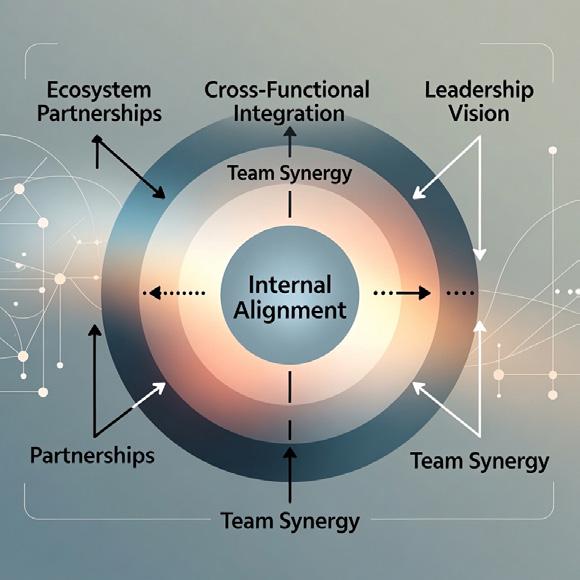
Sanjeev Suri, Senior Vice President - Global Omni Channel Logistics & CS, Amway India, underscores that alignment begins with people, not process: I have learnt that the best cross-functional collaborations are built on transparency, shared goals, and a deep sense of collective ownership. It is not just about aligning processes— it’s about aligning people. As a leader, I prioritise open communication, empathy, and active listening—especially between supply chain, marketing, and sales teams. These teams must talk, challenge, and support one another to drive meaningful outcomes. Collaboration doesn’t happen by chance—it’s a behaviour that must be encouraged and modelled. Trust grows when everyone is working toward the same KPIs and outcomes. It’s also important to stay curious, welcome diverse perspectives, and create space for honest dialogue. At Amway, we take this seriously. Across functions, we come together to solve challenges with one clear motto: One Team. One Goal! At Amway, this value creation is driven by deeper collaboration across functions, i.e., marketing, sales, and product management, resulting in faster speed-to-market and delivering a more seamless end-customer experience. The emphasis here is subtle but powerful: collaboration is behavioural before it is structural.

Sharmishtha Niyogi, Supply Chain Director, Merck Group, expands the lens by positioning supply chain as the enterprise’s connective intelligence: The supply chain of a thriving organization functions like the nervous system, managing the flow of information, product, and payment. In doing so, it interfaces with several internal and external stakeholders. The stronger the collaboration within this ecosystem, the greater the potential for enhanced customer experiences and business success.
Supply chain organizations generate and have access to sizable transaction-based data that can be leveraged by other functions in collaboration with supply chain teams to improve collective performance of the organization through all stages of the product lifecycle. For instance, customer preference data from last mile, point of purchase can support R&D in enhancing product design to better meet customer expectations, optimize demand forecasting for production and supply to align with evolving customer needs, and enable proactive communication with customers by the customer care organization during the phase-out stage of the product lifecycle.
Collaboration with commercial and marketing teams to gather market intelligence can significantly improve demand forecasting, leading to a more robust demand plan. This is critical for ensuring better material availability and creating a win-win for both the customer and the business. Working closely with trade compliance and finance ensures that supplies to customers are compliant and financially viable. Additionally, partnerships between supply chain and IT can drive efficient and timely implementation of advanced technologies like AI, machine learning, and automation platforms, boosting transaction efficiency. Supply chain teams can also support IT in data governance. The opportunities to stack and win through close collaboration with internal stakeholders are wide and large.
Strong partnerships with external stakeholders such as vendors and 3PL network partners enable the entire ecosystem to scale up, become efficient and sustainable. This collaboration reduces damage, improves quality, and ensures profitability. From an even broader perspective, supply chains have immense potential for adding diversity in workforce in manufacturing and distribution networks, positively impacting the overall economy of the regions in which they operate. By fostering inclusive practices and creating diverse job opportunities, supply chains can drive economic growth and social development in the areas they operate and serve.
Across the complete spectrum of plan, source, make, deliver, the supply chain partners with logistics providers, distributors, retailers, manufacturers, OEMs, vendors, and customers, and drives operational excellence through collaboration.
Her perspective reframes collaboration as an intelligence multiplier — where data, when shared and interpreted collectively, becomes strategic leverage.

Karthikeyan Subramanian, Senior Director – Consulting, GEP Worldwide, brings operational precision to this idea: Collaboration among various stakeholders within an organization—such as procurement, manufacturing, logistics, finance, marketing, and sales—plays a pivotal role in improving supply chain performance. Internal alignment ensures seamless operations, better decision-making, and the ability to adapt to disruptions.
Improved Demand Forecasting and Inventory Management: Close collaboration between sales, marketing, and supply chain teams ensures more accurate demand forecasts, avoiding overstocking or stockouts.
Faster Problem-Solving during Disruptions: Cross-functional teams can quickly address supply chain disruptions by pooling expertise and aligning on solutions. For example, during the global semiconductor shortage, internal collaboration between procurement, production planning, and R&D teams helped automakers prioritize models and redesign components to mitigate supply chain risks.
Cost Optimization through Joint Initiatives: Collaboration between finance and procurement teams identifies opportunities for bulk purchasing, supplier negotiations, or alternative sourcing strategies.
Enhanced Agility through Manufacturing-Logistics Coordination: Real-time coordination between manufacturing and logistics ensures faster response to demand changes, especially during peak seasons. Example: E-commerce Fulfillment
Improved Supplier Performance through Cross-Functional Collaboration: Joint efforts between procurement, quality control, and R&D ensure better supplier performance and alignment with organizational goals. For instance, a pharma company’s R&D and procurement teams collaborate with suppliers to co-develop new raw materials or packaging solutions, ensuring compliance with regulatory standards while reducing costs.
Driving Sustainability Goals: Collaboration between supply chain, sustainability, and operations teams enables the organization to meet environmental goals efficiently. To give you an instance, a power generation company’s supply chain and sustainability teams work together to source equipment from green-certified suppliers and optimize logistics to reduce carbon emissions.
Internal collaboration, in this framing, is not an abstract virtue. It is measurable in forecasting accuracy, cost structures, and response speed.
Rayapati Srinath Reddy, Head-S&OP, The HEINEKEN Company, illustrates how alignment becomes cadence: Fostering collaboration across supply chain, procurement, finance, and other functions is essential. We achieve this by aligning goals and ensuring all functions work towards shared metrics like forecast accuracy, BIAS, plan adherence and the associated service levels. We facilitate engagement by leading structured S&OP meetings and workshops that encourage open dialogue and joint problem-solving, discussing forecasts, risks, opportunities, and supply-demand alignment.
Driving transparency is equally critical, which we accomplish by utilizing tools like Power BI to provide real-time data sharing and centralized dashboards, ensuring visibility across departments and consistent access to accurate information for all stakeholders. We also focus on building culture by promoting trust, open communication, and crossfunctional understanding through initiatives like Talent as a Service.
Ensuring accountability remains central — clarifying roles, tracking progress, and celebrating joint achievements. This approach ensures alignment, efficiency, and agility in meeting business objectives. This approach ensures alignment, efficiency, and agility in meeting business objectives.
Here, collaboration is not episodic — it is institutionalized. At scale, the complexity intensifies. Across these perspectives, one insight becomes clear: internal collaboration is the mechanism through which strategy translates into resilience. When alignment is engineered across functions — planning, sourcing, manufacturing, logistics, finance, marketing — the enterprise does not simply respond faster. It responds coherently. And coherence, in today’s operating landscape, is advantage.

External collaboration is where internal maturity is tested. An organization may align flawlessly within its own walls, but performance ultimately depends on how effectively it engages beyond them. Suppliers are no longer peripheral actors in the value chain. They are integral to continuity, speed, innovation, and resilience. The shift is subtle but decisive: from transactional management to strategic partnership.


Tannistha Ganguly, Global Head, WMS (IT Delivery), Kimberly-Clark, makes this evolution explicit: There are many benefits of supplier & vendor collaboration. In today’s business world it is no longer a ‘Nice to Have’ strategy but has become a ‘Must Have’ tactic. Most common benefits are greater cost savings, better risk management, improved efficiency in operations, higher customer satisfaction, etc. All of these in return add to market share and more revenue. The more integrated we are with our vendors, the better control we have on our supply chains. It allows us to view data in real-time, helping us to take faster decisions in times of emergencies and otherwise too. The chances of innovating together with our vendors, especially in key areas increase if we are better integrated with them, sharing both information and risk. Collaboration can happen at a tactical level as well as at a more strategic level.
Her emphasis underscores a structural truth: integration is not only about visibility; it is about shared risk, shared innovation, and shared value creation.

Prashant Patel, Global Sourcing Leader, GE Vernova, reinforces the transparency imperative: Real-time data plays a critical role in ensuring supply chain efficiency. Every organization, whether in procurement, manufacturing, or logistics, seeks greater visibility into the movement of materials. The ability to track shipments, anticipate delays, and proactively resolve bottlenecks is no longer a competitive advantage but a necessity. However, having access to data alone is not sufficient—it needs to be structured, analyzed, and shared in a way that creates a fully integrated supply chain. The true challenge lies in ensuring that data transparency extends beyond a single organization and encompasses the entire supplier network, including Tier-1, Tier-2, and even Tier-3 suppliers.
Beyond technological integration, the key aspect of supply chain resilience is trust and reliability in supplier relationships. This is where organizations must shift their perspective from treating suppliers as mere vendors to viewing them as strategic partners. When suppliers are engaged as long-term partners, they become more
invested in the shared goal of delivering value to the end customer. This approach fosters collaboration, accountability, and mutual problem-solving, leading to a more robust and transparent supply chain.
The convergence here is unmistakable: trust, structured transparency, and aligned incentives form the foundation of durable supplier collaboration. Data enables visibility. Partnership sustains resilience. When suppliers are treated as strategic counterparts rather than cost variables, collaboration shifts from negotiation to co-creation.
The boundary of collaboration does not end with Tier1 suppliers. It extends across the broader ecosystem. As sustainability, regulatory accountability, and social responsibility gain prominence, value chains increasingly operate as interconnected networks rather than linear flows. Performance is no longer defined solely by cost, service, or efficiency. It is influenced by environmental impact, ethical sourcing, and community engagement.

Over the past decade, academic and industry research has increasingly shown that supply chain collaboration and sustainability are no longer parallel agendas — they are structurally intertwined. Studies tracking global supply chain practices indicate a marked rise in joint sustainability initiatives between buyers and suppliers, particularly around emissions transparency, circular material flows, responsible sourcing, and shared environmental targets. Rather than managing sustainability through compliance audits alone, organizations are embedding collaborative mechanisms — shared data platforms, co-developed decarbonization roadmaps, and multi-tier engagement models — into their value chains. The growing emphasis on Scope 3 emissions reporting has further accelerated this convergence, as companies recognize that environmental performance cannot be improved unilaterally. Sustainability outcomes now depend on synchronized action across procurement, operations, logistics, and supplier networks. Collaboration, in this context, shifts from operational efficiency tool to collective accountability framework — aligning economic performance with environmental responsibility.
Ashwin Kak, Partner - Circular Economy, Intellecap, highlights this expanded scope: Collaboration among stakeholders is vital to supply chain efficiency… With Scope 3 emissions becoming a priority, many companies will now need to work much closer with their supply-chain partners / suppliers, to ensure they work in tandem to reduce the larger value-chain carbon emissions, as also increase the human rights practices within it.
The implication is clear: collaboration now encompasses responsibility. Value chains require shared stewardship — across carbon accountability, human rights standards, and sustainable sourcing practices. What was once considered operational coordination has evolved into collective obligation. In this broader context, collaboration is not confined to enterprise performance. It shapes ecosystem resilience, environmental impact, and long-term viability.
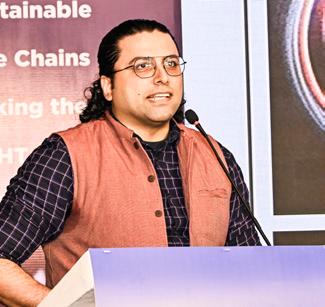

From these conversations, one thing is certain that collaboration, in its most mature form, is rarely visible. It does not announce itself in meetings or declarations. It appears in the quality of decisions made under pressure. In how quickly trade-offs are resolved without escalation. In whether information travels with context, not distortion. In whether partners anticipate together rather than react separately. What distinguishes enduring organizations is not the absence of disruption, but the absence of fragmentation when disruption occurs.
Across these perspectives, one truth emerges quietly but consistently: sustained performance is not the result of isolated excellence. It is the outcome of interconnected judgment — distributed, trusted, and exercised with shared intent. When that interconnectedness becomes habitual rather than negotiated, collaboration ceases to be an initiative. It becomes instinct. And instinct, in complex value chains, is what separates momentum from drift.
If the archived reflections reveal how collaboration has matured, the next question is how it will be tested. The coming phase of supply chain transformation will stretch collaboration in new directions. Artificial intelligence is steadily embedding itself into forecasting models, inventory positioning, risk sensing, supplier performance analytics, and network optimization. Decision-support tools now synthesize signals across demand variability, logistics constraints, and geopolitical shifts in near real time. Digital control towers aggregate visibility across multiple tiers, while automation platforms reduce the latency between signal and response.
As these technologies scale, the velocity of decision-making will accelerate. Collaboration, in this environment, cannot remain periodic or forum-driven alone. When AI systems recommend production reallocations, alternate sourcing strategies, or dynamic replenishment adjustments, alignment must occur at a different cadence. The clarity of decision rights, ownership boundaries, and cross-functional accountability becomes even more critical. Technology can surface insight; it cannot resolve ambiguity. At the same time, expanded transparency across value chains is reshaping expectations. Integrated supplier platforms, API-enabled data exchange, and shared dashboards are extending visibility beyond Tier-1 suppliers. Scope 3 reporting requirements are compelling organizations to synchronize environmental data across
partners. Cybersecurity considerations are introducing new layers of interdependence and risk governance across ecosystems.
In such a landscape, collaboration evolves again. It shifts from being primarily relational to being digitally enabled and structurally integrated. Leaders must orchestrate not only teams, but data flows and decision logic. Organizations must align human judgment with algorithmic intelligence, ensuring that speed does not compromise coherence.
The leaders featured in this archive spoke of clarity, trust, empowerment, and structured transparency. Those principles remain unchanged. What will change is the tempo at which they must operate. In a technology-accelerated supply chain, collaboration will not be defined by the presence of AI tools or digital dashboards alone. It will be defined by how effectively people interpret those signals together. Algorithms can detect patterns, optimize routes, and simulate risk scenarios. They cannot negotiate trade-offs across functions, build trust between partners, or reconcile competing priorities into a shared direction.
As decision cycles compress, the human dimension becomes more—not less— critical. Organizations will need teams capable of challenging algorithmic outputs, contextualizing data, and exercising judgment across functional boundaries. Leadership will be tested not just in deploying technology, but in ensuring that digital intelligence strengthens rather than fragments collective decision-making.
The future of collaboration will therefore be hybrid. Human insight and machine precision must move in concert. Where that harmony exists, technology becomes an accelerator. Where it does not, speed simply magnifies misalignment.
In the next chapter of value chains, advantage will not belong to those who automate fastest. It will belong to those who align people, partners, and platforms — and enable them to think, decide, and act as one integrated system.

Email: tech@celerityin.com | Mobile:
Website: www.supplychaintribe.com www.supplychaintribe.events