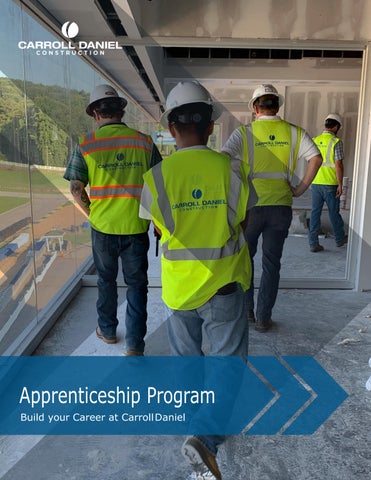
Apprenticeship Program

Build your Career at CarrollDaniel

WHAT’S INSIDE SECTION 1 Program Overview SECTION 2 Technical College Education SECTION 3 Carroll Daniel Academy SECTION 4 On the Job Training SECTION 5 Training Checklist SECTION 6 Career Paths, FAQs, & Testimonials
CARROLL DANIEL CONSTRUCTION APPRENTICESHIP PROGRAM
Carroll Daniel Construction’s Apprenticeship Program is available to high school students, trade school students, and all existing or prospective
The Carroll Daniel Apprenticeship Program is designed to create Construction Superintendents of the highest possible caliber.
employees desiring to become Construction Superintendents.
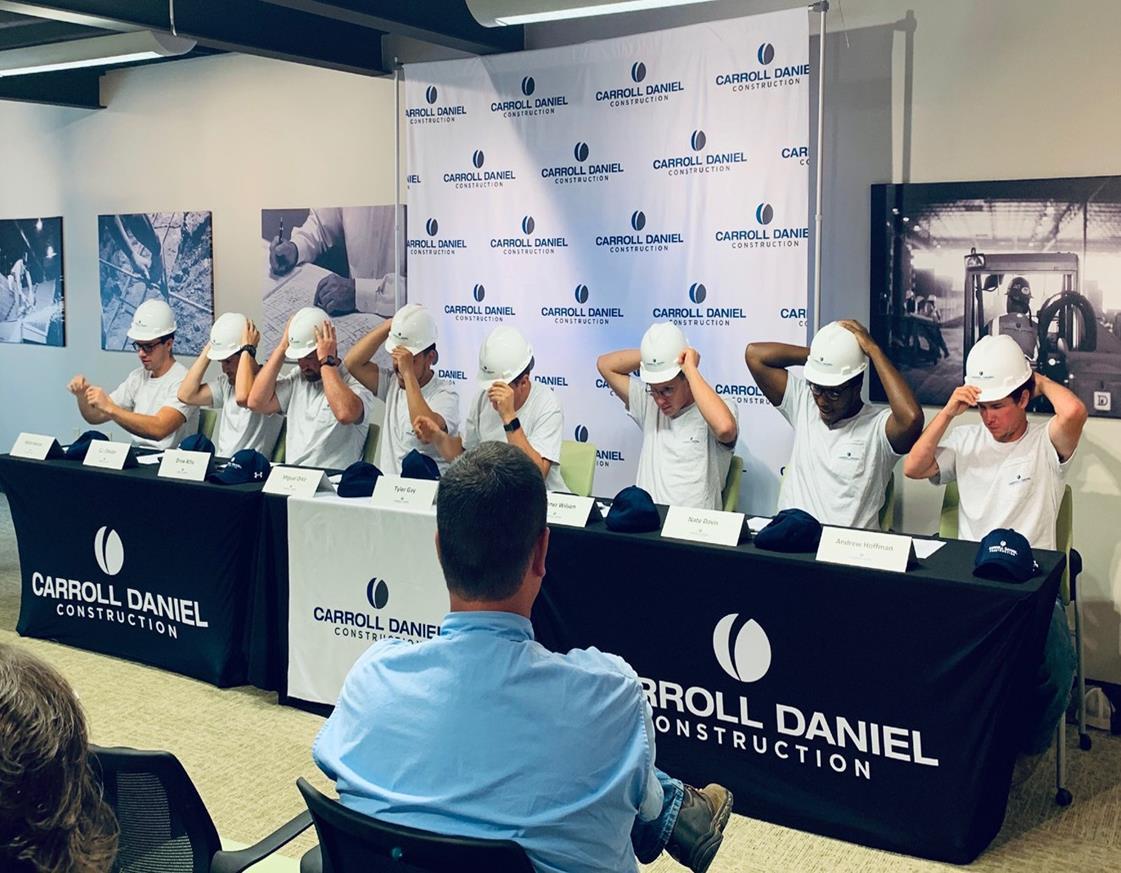
Our program will serve to provide supplemental in-house training combined with technical classroom learning and hands-on field training. The program typically requires two years to complete. Each apprentice receives a combination of Technical College Instruction, in-house education through the Carroll Daniel Academy, and on the job training.
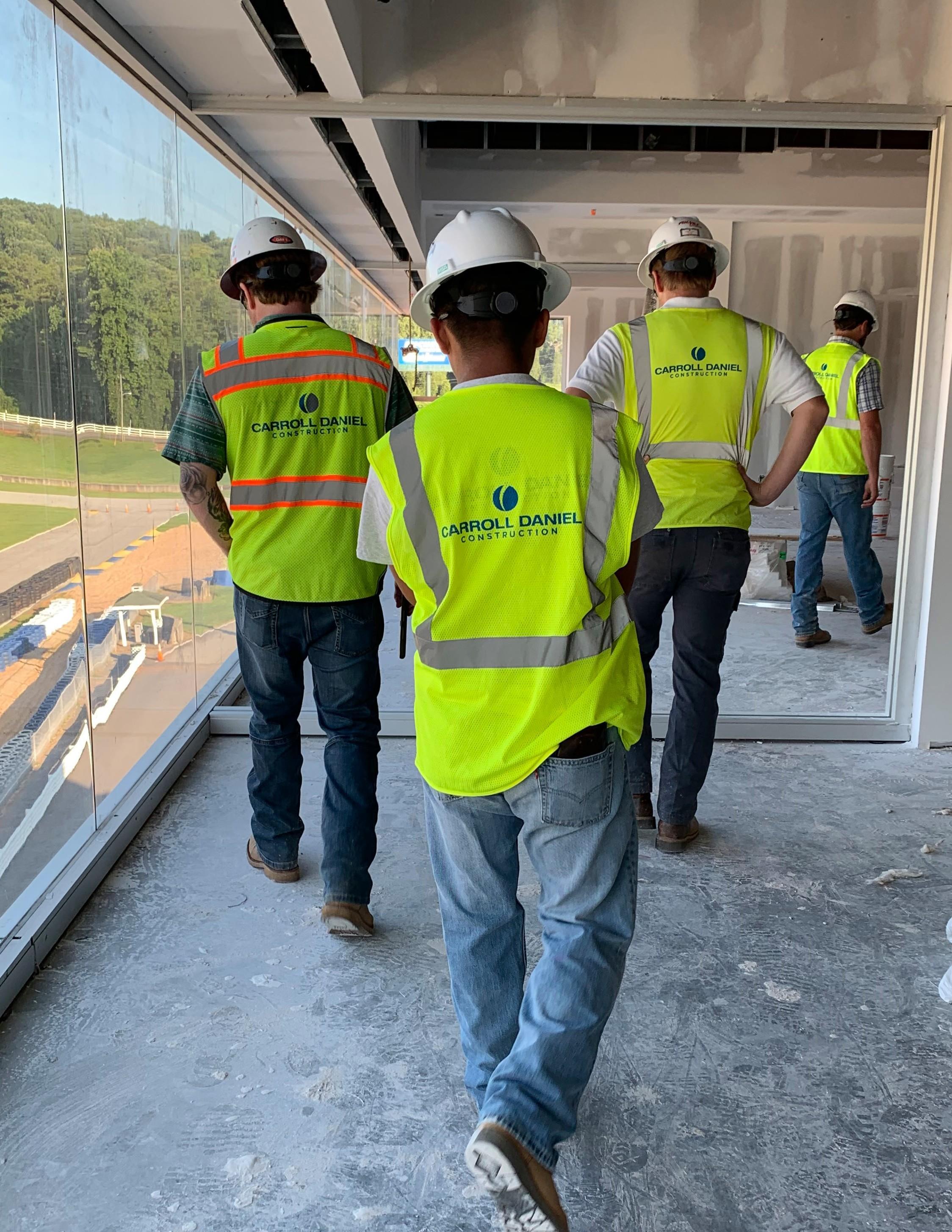
During the program, Apprentices will be given the opportunity to complete a minimum of 4,000 hours of supervised on the job training (OJT). This training will be supervised daily by a top tier, experienced Superintendent. The OJT hours are a combination of field and office training allowing the Apprentice to gain exposure to all aspects of our multi-faceted business through extensive crosstraining. This allows participants to become well-rounded and gain an understanding of all business sectors from Field Operations to Estimating.
In addition, each Apprentice will be assigned a mentor to help guide their journey during the program. The mentors will serve as a sounding board for each Apprentice, provide firsthand knowledge and experience, and help to mold our industry’s future leaders.
There is no cost to the apprentice for the training, and he/she will earn a starting wage of $16.00 per hour for work performed while enrolled in the program. Throughout the program, apprentices will be eligible for wage increases dependent on their progression in the program. Upon successful completion, the apprentice may be eligible to receive an offer of employment at Carroll Daniel Construction, at a predetermined rate.
The program culminates with a final capstone project where students complete an estimate of their building. Our Sitework, Structural Systems, Building Envelopes, and Mechanical and Electrical Systems courses will each have a BIM lesson and students will have exposure to varying areas of Building Information Modeling (BIM)
CARROLL DANIEL ACADEMY
Technical College Training
Carroll Daniel Academy
On the Job Training
apprentice
be required to complete a
hours of supervised on the job training, on a Carroll Daniel jobsite, under
receive exposure in the following
to Commercial Construction
Construction
Project Management
Safety & Health, OSHA
Jobsite Operations
Shane McClellon
 & Development Manager
Apprentices
Civil & Sitework Processes
Structural Systems
Building Envelopes
Mechanical & Electrical Systems
Jillian Ledford
 & Development Specialist
APPRENTICESHIP PROGRAM
The program requires completion of a curriculum designed to prepare the apprentice for the responsibilities of a Construction Superintendent. The following courses will be completed through The Technical College System of Georgia (TCSG): Construction Estimating I Construction Graphics Construction Project Management Construction Law Commercial Building Code
In conjunction with the Technical education received during the program, Apprentices will receive instruction at the Carroll Daniel Academy. The following curses will be completed through the Carroll Daniel Academy at Carroll Daniel’s training facility in Gainesville, Ga.: Introduction to Commercial Construction 101 Estimating 101 Project Management 101 Safety 101 Civil/Sitework 101 Structural Systems 101 Building Envelopes 101 Mechanical & Electrical Systems 101
Each
will
minimum of 4,000
the supervision of industry leading professionals.
will
areas.: Introduction
Estimating
&
Requirements Basic
PROGRAM CONTACTS:
Training
Training
CHOOSE YOUR EDUCATIONAL PATHWAY
Which educational pathway is right for you? Below you’ll find an overview of each option:
1EDUCATIONAL PATHWAY 1
Lanier Technical College Certification
Certificate programs are academic programs of study designed to prepare students for a particular career area, but not at the level required for an associate degree. Graduates of the program who choose pathway 1 will earn a Technical College Certificate at Graduation
EDUCATIONAL PATHWAY 2
2
Lanier Technical College Associate Degree
The Construction Management Technology degree program is designed for the student who wishes to prepare for a career in some aspect of construction supervision. The program provides background skills in several areas of construction. Supervision courses, print reading, project management, and accounting for construction businesses. In addition, this program will provide students with many hands-on carpentry classes, so that they get a full understanding of the construction industry. Graduates of program who choose pathway 2 will earn an Associate Degree in Applied Science with a Major in Construction Management Technology.
EDUCATIONAL PATHWAY 3
3Bachelor ’
s degree at an Accredited University
Further enhance your career and salary potential by earning a 4-year degree. You can learn the advanced skills needed to elevate your career within the construction industry. Graduates of the program who choose pathway 3 will receive an Associate Degree in Applied Science with a Major in Construction Management Technology and be eligible to transfer course work to an accredited university.
CARROLL DANIEL ACADEMY INTRO TO COMMERCIALCONSTRUCTION 101
General Information
This course is a study of the Commercial construction process, terminology, participant roles, and phases. Topics include project types, project stages, construction documents, marketing, contract procurement, estimating, bonding scheduling, mobilization, materials, methods, changes orders, claims, safety, organizational management, computers in construction, communication, contract types, liability, and loss control.
Learning Objectives
1) All students will gain a working knowledge of the Commercial Construction industry.
2) Student’s will learn the roles and expectations of the Project Team.
3) Student’s will gain an understanding of how to ensure quality, timely completion, cost control, and safety throughout the life of a project.
4) Illustrate the construction project life cycle.
5) Differentiate between various project delivery methods.
Course Schedule
Program Orientation
Communication
Processes
Week 1
Week 2 Technology &
Week 3 Commercial Construction
& Terminology Week 4 Project Types & Stages Week 5 Construction Documents Week 6 Contracts Week 7 Contract Procurement Bonding & Insurance Week 8 Scheduling & Mobilization Week 9 Sequencing & Methods
CARROLL DANIEL ACADEMY ESTIMATING 101
General Information
This course is designed to help polish the basic skills that are needed to make an accurate project estimate.
Learning Objectives
1)Learn how to read and interpret Construction Documents.
2)Learn separate components and materials of a building in a new structure (Master Format Divisions)
3)Learn how to take-off quantities of work in a project.
4)Project Cost Evaluation
Course Schedule
Week 1
Week 2
Week 3
Week 4
Week 5
Week 6
Week 7
Week 8
Week 9
Intro to Estimating: Business Role and Delivery Methods, Sitework, Civil
Discuss BidMaster and Begin Lanier Tech Project with Focus on Division 3
Discuss BidMaster and work on Lanier Tech Project with Focus on Division 4
Discuss BidMaster and work on Lanier Tech Project with Focus on Division 5-7
Discuss BidMaster and work on Lanier Tech Project with Focus on Division 8-9
Discuss BidMaster and work on Lanier Tech Project with Focus on Division 10-14
Discuss BidMaster and work on Lanier Tech Project with Focus on Division 15
Discuss BidMaster and work on Lanier Tech Project with Focus on Division 16-17
Discuss BidMaster and Finalize Lanier Tech Project with Focus on General Conditions
CARROLL DANIEL ACADEMY PROJECT MANAGEMENT 101
General Information
This course is a study of delivery methods, contract documents, supervision, working with owners and design professionals, control of cash flow, procurement, management of subcontractors, job records, contract changes, and payment procedures.
Learning Objectives
1)Identify the roles and importance of various stakeholders in a construction project.
2)Differentiate between various project delivery methods.
3)Gain a working knowledge of contract documents.
4)Identify schedule activities and assign reasonable durations of time.
5)Create the control mechanisms and learn to prepare accurate progress reports.
6)Create a comprehensive project management plan.
Course Schedule
Week
Week
Construction Types
Project Participants—Roles & Responsibilities
Delivery & Documents
Financing
Documents
Subcontractors &
Management Methods
1
Week 2
3 Project
Week 4 Project
Week 5 Contract
Week 6 Contract Documents Week 7
Suppliers Week 8 Project Closeout Week 9 Construction
CARROLL DANIEL ACADEMY SAFETY 101
General Information
This course is intended to provide an understanding of the hazards and controls of the various phases of construction. We will cover appropriate OSHA safety standards, requirements for safe workplaces, and regulations. You will learn the techniques of planning for safety during the construction process.
Learning Objectives
1)Students will understand OSHA’s minimum requirements for a safety and health program for construction activities.
2)Students will understand the basic hazards related to construction activities.
3)Students will be able to identify common hazards of construction.
4)Students will be able to recommend appropriate control measures to eliminate of minimize hazards.
5)Students will be able to develop and implement safety and health regulations as they pertain to construction activities.
6)Students will be able to conduct hazard assessments of projects.
7)Students will be able to evaluate hazards of construction and recommend appropriate PPE to control those hazards.
8)Students will be able to effectively identify and control hazardous materials commonly used in construction activities.
9)Students will be able to provide training to jobsite personnel pertaining to the hazards of construction activities and their control measures.
Course
Week
Introduction
CDCC Safety
Schedule
1
to
Week 2 Accident Prevention, Incident & Accident Reports Week 3 How to Conduct Safety Meetings Week 4 Hazard Awareness & Controls Week 5 Understanding Human Performance Week 6 Emergency Action Plan Project, Crisis Management Week 7 Fire Prevention Week 8 Project Presentation
CARROLL DANIEL ACADEMY CIVIL SITEWORK 101
General Information
This course is designed to give an overall understanding of civil sitework construction, materials, and general earthwork operations. You will learn how to understand/interpret civil drawings, the equipment used to perform sitework, and civil specifications. Topics of discussion will include soil investigation, testing, classification, engineering properties and modification techniques, excavation equipment, construction dewatering, slope stability and support, layout and grade staking, sediment and erosion control, foundations, underground utilities, and pavements.
Learning Objectives
1)Understand how aggregates are produced.
2)Explain concrete and asphalt mix designs and how they are used.
3)Differentiate between different pipe materials and fittings.
4)Illustrate how metals can be used in civil construction.
5)Describe how masonry and composite material are applied in civil construction.
Course Schedule
Week 1
Week 2
Week
Week
Week
Week
Week
Week
Week
Intro to Civil Drawings, Equipment, & Specs
Soil & Aggregates
Concrete & Asphalt
Excavation & Dewatering
Layout & Grade Staking
Hands-on Activity-Field Trip
Sediment & Erosion Control (All Day NPDES Certification)
Foundations & Underground Utilities
Introduction to BIM
3
4
5
6
7
8
9
CARROLL DANIEL ACADEMY STRUCTURAL SYSTEMS 101
General Information
Students should be able to understand the process of structural design and the loads and functional requirements associated with the design process.
Learning Objectives
1)Students will gain an understanding of stress and strain garnished from different material properties.
2)Students will gain a working knowledge of commonly used beams and columns.
3)Students will become familiar with bolted and welded connections.
4)Students will gain experience with different facets of the construction process through case study and the need to work as a team to complete the project ontime and on-budget.
Course Schedule
Week 1
Making Buildings, Foundations, & Sitework
Week 2 Wood Structures
Week 3 Masonry
Week 4
Heavy & Light Gauge Steel
Week 5 Concrete
Week 6
Week
Week
Week
Precast
Widows & Doors
Exterior Wall Systems
BIM
7
8
9
CARROLL DANIEL ACADEMY BUILDING ENVELOPES 101
General Information
This course will focus on the design of building exteriors, including the control of heat flow, air and moisture penetration, building movements, and deterioration. Students will be introduced to the design of building enclosures (i.e., “building envelopes”), elements of which include walls, floors, roofs, and intentional openings.
Learning Objectives
1)Design and assess building enclosure elements for heat transfer, airflow, and moisture control.
2)Be proficient in current building codes as they pertain to building enclosure design.
3)Critically analyze designs for advanced building enclosures for their impacts on energy use, airflow, and potential moisture issues.
4)Be proficient with several software tools used in building enclosure design.
Course Schedule
Week 1
Damp-proofing & Waterproofing
Week 2 Thermal Protection & Air Barriers Week 3 Roofing Week
Joint Protection Week
Doors & Frames Week
Hardware Week
Storefronts & Curtain Walls
Glass & Glazing
4
5
6
7
Week 8
Week 9 BIM
CARROLL DANIEL ACADEMY MECHANICAL & ELECTRICAL SYSTEMS 101
General Information
This course will introduce a basic knowledge of building mechanical and electrical systems at an entry-level. This will serve as an overview of the principles and applications of all basic mechanical and electrical systems with basic design examples. In addition, you will explore emerging technology and environmental issues.
Learning Objectives
1)Identify basic building mechanical systems, including heating, ventilating and air conditioning, plumbing, and fire protection.
2)Identify basic building electrical systems, including power and illumination.
3)Understand the scope of the mechanical and electrical system within buildings.
Course Schedule
Week 1 Fire Protection
Week
Week
Week
Week
Plumbing
Mechanical
Building Automation/Controls
Systems
Systems
Commissioning
Coordination
2
3
Week 4
5 Specialty
Week 6 Electrical
7 MEPF
Week 8 MEPF
Week 9 BIM
LANIER TECHNICAL COLLEGE
General Information
This course is a study of delivery methods, contract documents, and supervision, working with owners and design professionals, control cash flow, procurement, management of subcontractors, job records, contract changes, and payment procedures.
Learning Objectives
1a: History and classification of building codes
Describe the history of building codes
Explain the importance of building codes
proper building code usage
how IBC is divided
Unit 1b: Use and Occupancy
used
Identify the various occupancy groups
Determine an occupancy group for special use construction
Describe the role that designers and engineers play in following codes
Explain the importance of occupancy groups
Explain how to achieve the maximum performance level through design
Unit 2a: Construction Types and Fire Control
Understand the differences between the five IBC types of construction classes
Understand the use and differences between noncombustible and combustible materials
Determine the methods for determining fire resistance
Describe the impact of flame spread has on the selection of interior finishes
CCMN 1050 COMMERCIAL BUILDING CODE
Unit
o
o
o Identify
o Explain
and
o
o
o
o
o
o
o
o
o
Unit 2b: Fire Protection Systems, Egress and Accessibility
o
Identify the requirements of active fire-protection systems in the IBC
o Explain the means of fire notification required by the IBC
o Understand how means of egresses are created in a building and the minimum number required
Understand the requirements embedded in the IBC to meet ADA requirements
Unit 3: Interior Environment and Exterior Walls
Describe the minimum indoor air quality requirements
Identify minimum space requirements
Identify which code governs the minimum energy
of buildings
o Identify examples of acceptable exterior wall materials and wall coverings
Identify examples of acceptable window, door and trim components
Unit 4: Roof Assemblies, Structural Provisions and Special Inspections & Tests
o Understand the requirements for the design and construction of roofing assemblies
Describe requirements for commonly used commercial roofing systems
Describe the general design criteria for structural loads that are to be accommodated by the structural system
o Identify factors that must be included with structural load calculations
Determine the required inspection and approvals need for construction materials and building systems
Unit 5: Soils, Foundations and Building Materials
o Identify minimum provisions in the IBC to design and construction building foundation systems
o Describe the minimum requirements related to building wind pressure and wave action
o Identify structural requirements for concrete, masonry, steel, wood and aluminum
o Identify which code governs the regulation of existing structures
o
o
o
o
performance
o
o
o
o
Course Schedule
Week 1
Week 2
Week 3
Unit 1a: History and classification of building codes
Unit 1a: History and classification of building codes
Unit 1b: Use and Occupancy
Week 4 Unit 1b: Use and Occupancy
Week 5 Unit 2a: Construction Types and Fire Control
Week 6 Unit 2a: Construction Types and Fire Control
Week 7 Unit 3: Interior Environment and Exterior Walls
Week 8 Unit 3: Interior Environment and Exterior Walls
Week 9 Unit 3: Interior Environment and Exterior Walls
Week 10 Unit 4: Roof Assemblies, Structural Provisions and Special Inspections & Tests
Week 11 Unit 4: Roof Assemblies, Structural Provisions and Special Inspections & Tests
Week 12 Unit 4: Roof Assemblies, Structural Provisions and Special Inspections & Tests
Week13
Week 14
Week 15
Week 16
Unit 5: Soils, Foundations and Building Materials
Unit 5: Soils, Foundations and Building Materials
Unit 5: Soils, Foundations and Building Materials
Final Exam
LANIER TECHNICAL COLLEGE
1060 CONSTRUCTION ESTIMATING
General Information
This course provides the skills required to develop a material quantity estimate from commercial construction drawings and specifications. Completion of a quantity survey project is required.
Learning Objectives
Components and Stages of a Construction Estimate
1)
2)
3)
4)
Identify the components and stages of a construction estimate.
Discuss project requirements.
Discuss bidding requirements.
Identify components of working drawings.
CSI and Work Breakdown Structure Classifications
1)
2)
3)
4)
Classify component quantities into the appropriate CSI or Work Breakdown structure
Develop forms for estimating practices.
Develop a Work Breakdown Structure.
Calculate quantities for divisions of construction.
Material, Labor and Equipment Calculating
1)
2)
Calculate quantities of material, labor, and equipment from construction drawings and specifications.
Calculate quantities for the divisions of construction.
Cost Estimating
1)
2)
Create a detailed cost estimate.
Develop bid documents.
CCMN
Week
Week
Week
Week
Week
Week
Week
Week
Week 10
Week 11
Week 12
Week13
Week 14
Week 15
Estimating Methods , Specifications and Drawings
Contracting Requirements and General Requirements
Test Day
Earthwork, Concrete
Masonry, Metals
Wood, Plastics, and Composites
Openings, Finishes
Mechanical Systems, Electrical Systems
Specialty Items and Final Bid Preparation
Work on Estimate and Bidmaster Worksheet
Work on Estimate and Bidmaster Worksheet
Final Bid Submittal
Last Day of Scheduled Classes
Course Schedule
1 Estimating Practices Week 2 Estimating Practices
3
4
5
6
7
8
9
LANIER TECHNICAL COLLEGE
General Information
This course provides the skills to read and interpret commercial construction graphical documents. Topics include dimensioning practices, layout, abbreviations, symbol usage, line types, computer aided design, and principles of drawing.
Learning Objectives
Type of Construction Drawings
1)Identify the following types of construction drawings: plot plan, foundation, floor, elevation, section, detail, electrical, mechanical, framing, and plumbing.
2)Interpret plot foundation, commercial framing, plumbing, electrical, and welding prints.
Blueprint Lines and Types
1)Identify the following typical lines found on blueprints: dimension, extension, solid, hidden, grade, section, and border.
2)Prepare plot foundation prints, commercial framing, plumbing, electrical, and welding prints.
Plan Symbols
1)Identify basic plan symbols.
2)Identify materials and specifications.
3)Interpret plot foundation, commercial framing, plumbing, electrical, and welding prints.
Plan Notations
1)Interpret various plan notations.
2)Identify materials and specifications.
3)Solve mathematical applications.
CCMN 1030 CONSTRUCTION GRAPHICS
Course Schedule
Week 1
Week 2
Introduction
Type of Construction Drawings: plot plan, foundation, floor plans
Week 3
Week 4
Week 5
Week 6
Week 7
Week 8
Week 10
Week 11
Week 12
Week13
Week 14
Week 15
Week 16
detail, electrical, mechanical, framing, and plumbing.
, elevation, sectionplans,
Introduction to AutoCAD: Draw: Line/Circle/Erase
Foundationplans;Detaildrawings(reviewfloorplans)
Introduction to AutoCAD: Review Line/Circle/Erase Add: Rectangle/Hatch
Elevations;Sections
Introduction to AutoCAD: Review: Rectangle/Hatch Add: Modify pallet
Blueprint Lines and Types Identify the following typical lines found on blueprints: dimension, extension, solid, hidden, grade, section, and border. FramingPlans(&Welding)
Introduction to AutoCAD: Review: Modify pallet Add: Annotation
Reviews and revisions
Mid-Term Exam
TBD Week 9
Plumbing plans
Introduction to AutoCAD: Review: Annotation Add: Layers
Plan Symbols
Identify basic plan symbols. Identify materials and specifications.
Interpret plot foundation, commercial framing, plumbing, electrical, and welding prints. Mechanical plans
Introduction to AutoCAD: Review: Layers Add: Blocks
Plan Notations
Interpret various plan notations. Identify materials and specifications. Solve mathematical applications.
Introduction to AutoCAD: Review: Blocks Add: Properties
Electrical plans
Introduction to AutoCAD: Review: Properties Add: Utilities & Clipboard
Plotplans
Reviews and revisions
Reviews and revisions
Final Exam
LANIER TECHNICAL COLLEGE
2010-1 CONSTRUCTION LAW
General Information
This course is a study of the legal aspects of commercial construction contracting. Topics include: contracts, drug testing, sexual harassment, labor management relations, discrimination, worker compensation, bonding, claims, arbitration, mediation, business types, minority business enterprises, hiring and firing practices
Learning Objectives
1)Branches of Government and Jurisdictions in Dispute Resolution Order Description
2)Identify the branches of government and jurisdictions in dispute resolution, dispute resolution processes in the U.S.
3)Commercial Construction Contracts.
4)Identify common forms of contracts used in commercial construction.
5)Identify forms of doing business, project delivery methods, and contractual relationships common in construction projects.
6)Identify changes, additions, and delays, Identify the scope of the contract.
7)Discuss environmental, real, and intellectual property law.
8)Employment and Labor Laws Order Description Learning.
9)Discuss employment and labor laws.
10)Dispute Resolution -Discuss common disputes and resolution.
11)Discuss bonds, liens, and waivers.
12)Identify mistakes in bids, defective construction, and differing and unforeseen site conditions.
13)Discuss legal issues relating to plans and specifications.
14)Discuss contract formation, breach, and damages.
15)Discuss torts and warranties.
16)Discuss killer clauses.
CCMN
Course Schedule
Week
Week
Week
Week
Week 5
Week
Week
Week 8
Week 9
Week 10
Week 11
Legal Context of Construction
Alternative Contracting Methods
Competing for the Contract & Interpreting the Contract LAUNCH INDIVIDUAL RESERCH PROJECT
Authority and Responsibility of the Design Official LAUNCH GROUP PROJECT
Subcontract Administration and Dispute Avoidance
Contract Changes
Differing Site Conditions
Schedules, Delays, and Acceleration
Payment Bonds
Performance Bonds and Termination
Construction Industry Environmental and Safety Concerns
Group Project Due this Week Week 12
Construction Insurance
Labor and Employment Issues Affecting the Construction Industry Week 14
Week13
Week 15
Week 16
Week 17
Bankruptcy in the Construction Setting
Resolution of Construction Disputes
Course Review
Final Project Work Session
Final Exam Due Final Individual Research Project Due
1
2
3
4
6
7
LANIER TECHNICAL COLLEGE
CONSTRUCTION PROJECT MANAGEMENT
General Information
This course is a study of delivery methods, contract documents, and supervision, working with owners and design professionals, control cash flow, procurement, management of subcontractors, job records, contract changes, and payment procedures.
Learning Objectives
Project Delivery and Organization
1)
2)
3)
4)
5)
6)
7)
8)
9)
Discuss project delivery and organization.
Demonstrate an understanding of who the primary players are and their roles.
Demonstrate a working knowledge of the main components of a typical subcontract agreement.
Acquire an understanding of proper layout of a jobsite.
Demonstrate ability to recognize the primary types of AIA agreements used by the General Contractor.
Demonstrate a working knowledge of the project closeout process. Project Documentation
Discuss Project documentation
Demonstrate a working knowledge of the different components of a typical set of construction documents,
Demonstrate a working knowledge of the different components of a typical set of bid documents.
10)Demonstrate a working knowledge of the organization and primary components of written communication during the construction of a project.
11)
Demonstrate the ability to prepare change orders and progress payments.
Project Communication
1)
2)
Discuss project communications.
Demonstrate a working knowledge of the bid and initial CPM schedule preparation process as well as vendor/subcontractor procurement from the general contractor’s perspective.
CCMN 2040
Construction Management Methods
1)
3)
Course Schedule
Week
Week
Week
Week
Week
Week13
Identify construction management methods. 2) Demonstrate an understanding of the typical timeline for a commercial project.
Demonstrate ability to differentiate, analyze and make recommendations for contract delivery methods. 4) Demonstrate an understanding of time and scope related issues.
1 Construction Types
2 Construction Types
3 Construction Projects Participants
4 Construction Projects Participants; Project Delivery & Documentation Week 5 Construction Documents Week 6 Construction Contract Documents Week 7 Construction Project Management; Project Documentation Week 8 Construction Project Management
9 Subcontractors and Suppliers; Project Communication Week 10 Subcontractors and Suppliers Week 11 Subcontractors and Suppliers Week 12 Project Close out Documentation
Project Close out Documentation; Construction Management Methods Week 14 Project Close out Documentation Week 15 Open week for overflow Week 16 Last Day of Term Classes
WHAT IS YOUR CAREER PATH? SUPERINTENDENT TRACK General Superintendent Senior Superintendent Superintendent Assistant Superintendent Field Engineer APPRENTICE Work Based Learning Laborer Other
APPRENTICESHIP PROGRAM
WHAT IS CARROLL DANIEL’S APPRENTICESHIP PROGRAM?
Carroll Daniel’s Apprenticeship Program is available to high school graduates, trade school students and all existing or prospective employees desiring to become Construction Superintendents. The program typically requires two years to complete. Each apprentice receives a combination of Technical College Instruction and on the job training. There is no cost to the apprentice for the training, and he/she will earn a wage for work performed while enrolled in the program. Upon successful completion of the academic requirements and sustained good standing with mentors and supervisors, the apprentice may be eligible to receive an offer of full-time employment at Carroll Daniel Construction.
WHEN AND HOW CAN I APPLY FOR CARROLL DANIEL’S APPRENTICESHIP PROGRAM?
The application can be found under the Careers tab on the Carroll Daniel website (carrolldaniel.com). This application link is active annually on our website February 1st to April 30th.
HOW MANY APPRENTICES DO YOU HAVE EVERY YEAR?
Carroll Daniel maintains a maximum of 12 students in the program. Typically, we accept 5-7 new apprentices each year.
HOW LONG IS THE APPRENTICESHIP PROGRAM?
The standard certificate program requires two years to complete. Each apprentice receives a combination of Technical College Instruction, on the job training, as well as enrollment in the Carroll Daniel Academy.
IS IT A PAID APPRENTICESHIP?
Yes, our program is a paid apprenticeship. Each apprentice begins at a pre-determined rate and iseligible for periodic incremental increases every six months. These increases are not guaranteed and requireboth academic good-standing and a satisfactory employment evaluation.
WHAT MAKES CARROLL DANIEL’S APPRENTICESHIP UNIQUE?
Carroll Daniel’s Apprenticeship Program is the first of its kind with a direct focus on commercial construction competencies, as well as fast-tracking those interested in becoming commercial construction Superintendents.
WHAT ARE THE PERKS OF BEING AN APPRENTICE WITH CARROLL DANIEL CONSTRUCTION?
There is no cost to the apprentice throughout the program. The apprenticeship program allows an individual to fast track their career path. The two-year program teaches the necessary classroom instruction, in combination with 4,000 hours of on-the-job training required to receive a Technical College Certificate (TCC). At completion, the student can elect to continue coursework, and with additional hours, could receive an associate degree. If the student chooses to continue, the associate degree credits could be applied toward a four-year bachelor’s degree in construction, or any related field.
FAQ
PAST
Miguel Ortiz
APPRENTICE
“My Experience on this program at Carroll Daniel Construction has been incredible. I just completed my first year with the company, and it’s been an amazing experience working with different people at different places has taught me a lot of things. I came here with no experience, and I struggled at first, but thankfully I have had helpful mentors and teachers leading me along the way. This program is an amazing opportunity for guys like me that put a lot of effort into everything and want a good future in the construction industry. This is the best place to be.”


Mitch Beccue
APPRENTICE
“When I thought about my future, I thought about possibly sitting in an office and wasn’t really interested in that. I decided I’d rather be both physically and mentally challenged and get to see the tangible progress I’ve made throughout a project.”
TESTIMONIALS FROM
APPRENTICES
APPRENTICE WBLSTUDENT APPRENTICE
ON THE JOB EXPOSURE CHECKLIST
Intro to Commercial Construction
Understands Industry Sectors
Understands the basics of the different construction Delivery Methods (CM, DB, GC)
Has firm grasp and understanding of Plan Reading Understands the need for and practices use of appropriate Soft Skills
Construction Estimating
Completed two-week rotation in Estimating Understands Estimating Process & Procedures
Understands how to do Quantity Take-off Knows how to evaluate Subcontractor bids
Understands Estimating Systems (Onscreen Takeoff, RS Means, Timberline, Sage, etc.)
Project Management & Jobsite Operations
Completed 1 month of JHAs
Completed 1 month of Daily Reports
Completed 1 month of NPDES monitoring
Understands basic Construction Documents Has firm grasp on Contract documentation & Scope of Work
Understands RFI process Understands Procurement Process Understands Project Finance Understands applicable Technology and how to use and apply it to Jobsite Operations
Understands Scheduling & Sequencing Understands mock-ups, when they should be used, and the role they serve with Owners & Architects
Has experience with management of Field Operations
Completed rotation of Subcontractor management and/or labor management
Able to identify problems with jobsite labor force
Completed rotation of daily QA/QC Management
Completed daily QA/QC Reports & Pre-Install Meetings
Has experience with Commissioning
Safety & Health, OSHA Requirements
Has conducted and understands the importance of Safety Toolbox Talks
Completed Day 1 Safety Orientation
Understands Project Security Control
Understands Construction Accident Prevention Knows Safety Information Sources (OSHA, Ansi, Niosh)
Understands Weather Precautions
Understands importance of Emergency Planning
Basic Civil & Sitework Processes
Has experience with Stormwater Understands Site Utilities
Understands basics of Jobsite Surveying and the Limits of Disturbance
Understands basic Erosion Control
Understands Earthmoving Equipment and their functionality on the jobsite Understands Backfill & Compaction Has supervised Paving sequence Understands the concept and purpose of Dewatering
Structural Systems
Has been exposed to Structural Steel processes
Understands Concrete and placement of Concrete Understands Wood Framing Understands Masonry
Understands Foundations
Understands Various Types of Walls
Building Envelopes
Understands sequencing of trades
Understands Liquid Air Barriers—when they are applied and their purposes
Understands Waterproofing
Understands types of Flashings
Understands Masonry/Veneer Understands Glass & Glazing Systems
Understands Metal Panels
Understands Roofing Systems
Mechanical & Electrical Systems
Has shadowed Plumbing subcontractor
Has shadowed Mechanical subcontractor Has shadowed Electrical subcontractor
Understands Fire Protection in relation to UL Ratings of Walls, Doors, Material, etc. Has attended and shadowed a Fire Marshall Inspection Walk
TRAINING CHECKLIST
Intro to Commercial Construction
Has successfully completed Carroll Daniel Academy Intro to Construction course
Has completed Objectives & Goals information questionnaire
Has registered for classes and met with Academic Advisor at Lanier Technical College
Construction Estimating
Completed Lanier Tech Construction Estimating I Course CCMN 1060
Attended offered Estimating tutoring sessions
Project Management & Jobsite Operations
Completed Lanier Tech Construction Project Management Course CCMN 2040
Basic Civil & Sitework Processes
Completed course on layouts, staking, grades, benchmarks, and elevations
Completed course on site utilities, structures, and OCS
Passed NPDES Level 1A course
Completed GA811 Utility Course
Completed course section on Blueprint reading under Construction Project Management course
Structural Systems
Completed Structural Framing I & II at Lanier Tech OR completed CDCC Superintendent course on Structural Framing Building
Building Envelopes
Has attended offered CDCC Superintendent course on WeatherproofingSafety & Health, OSHA Requirements
Received OSHA 30
Completed Forklift Training Completed Scissor-lift Training Completed UTV Training
Completed Excavation & Trenching Competent Persons Training
Completed Fall Protection Competent Persons Training
Completed Silica Awareness Competent Persons Training
Completed Scaffolding & Competent Persons Training
Mechanical & Electrical Systems
Completed offered CDCC Superintendent course on Mechanical & Electrical Systems