This publication is intended for information purposes only and the information herein should not be applied to specific fact circumstances without the advice of counsel.
The British Columbia Branch of the Canadian Bar Association represents more than 6,700 BC members and is dedicated to improving and promoting access to justice, reviewing legislation, initiating law reform measures and advancing and improving the administration of justice.
BarTalk Publication Sales Agreement #40741008
SMITHERS
CRANBROOK
PRESENTED BY THE BC BRANCH OF THE CANADIAN BAR ASSOCIATION
Date: April 17, 2015
Location: Prestige Rocky Mountain Resort
PRESENTED BY THE BC BRANCH OF THE CANADIAN BAR ASSOCIATION
Date: May 2, 2015
Location: Perry & Company
COURTENAY
ABBOTSFORD
IN PARTNERSHIP WITH ABBOTSFORD & DISTRICT, CHILLIWACK, FRASER VALLEY, AND SURREY BAR ASSOCIATIONS
Date: May 8, 2015
Location: Best Western Plus Regency Inn & Conference Centre
IN PARTNERSHIP WITH CAMPBELL RIVER, COMOX VALLEY, COWICHAN VALLEY, NANAIMO CITY, NANAIMO COUNTY, PORT ALBERNI BAR ASSOCIATIONS
Date: May 22, 2015
Location: Crown Isle Resort & Golf Community
Email: ads@cbabc.org
Email: data@cbabc.org
your inbox! Subscribe by sending your full name and email address to subscribe@cbabc.org or go to cbabc.org/bartalk/subscribe
Email: lawyerreferral@cbabc.org
Inside This Issue
The proclamation of WESA on March 31, 2014, made some significant changes to the law in B.C. This issue highlights that not all of the legal boundaries have been settled due to the existence of the new Act, which may result in lawyers having to navigate, with some uncertainty, certain processes and provisions of the Act until such time as the courts or registries provide more clarity. Guest articles indicate that while eye-witness testimony continues to be inherently unreliable, self-representation may be reliable if proper preparation and assistance is provided.
News and Events
2 Attend a Full Day of CBABC Professional Development in Your Local Area
22 CLC – Calgary, Alberta
Building a Better Lawyer: The 2015 CBA
Legal Conference
CBABC Young Lawyers Wellness Challenge April 7-16, 2015
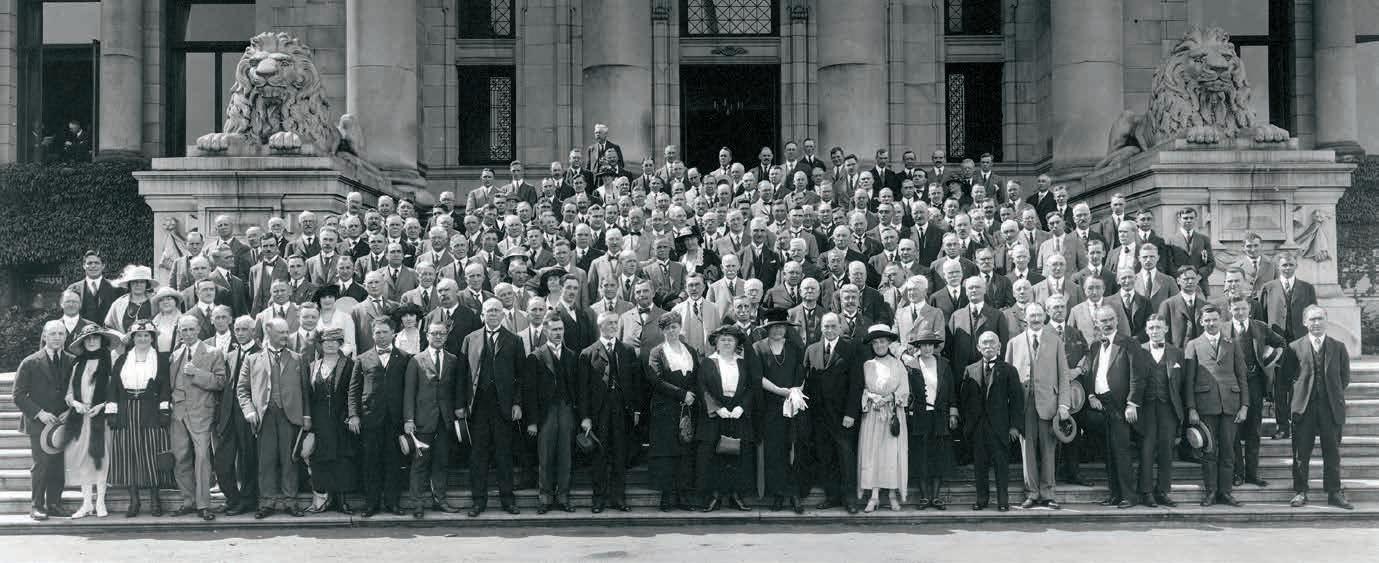
23 Photo of 1922 Annual CBA Meeting
Vancouver Community College needs your help! Rob McDiarmid and Sharon Matthews donate to TRU Faculty of Law Student Awards
24 2015 CBABC WLF Award Recipients
CLEBC Update
25 BC Legislative Update
Branch & Bar Calendar
26 Tips from Courthouse Libraries BC
Peter A. Allard, QC donates $30 million to UBC Faculty of Law
Day at the Races
FROM THE PRESIDENT
ALEX A. SHORTEN
Mid-Term Musings Lessons Learned
By the time you read this I will be more than half-way through my year as your President. Has it ever gone by quickly. I have been reflecting on some of the lessons learned.
THE IMPORTANCE OF CONTINUITY
To have any hope of making a contribution as President you need to have worked on the Branch Executive and learned from the actions and wisdom of prior Presidents and previous Executives.
ORGANIZATIONAL KNOWLEDGE
As a member of the Executive, in my case I am in my 4th year, you need to understand the history and context of the organization.
CBA IS COMPLICATED
I am also on the Board of the CBA. Last year, as Vice President, I was an observer on the Board. Without the benefit of the observer status, my contribution and perhaps the Branch’s contribution to the work of the Board would be less effective. The interaction between the CBA National and the 15 Branches is necessary, but at times can be complicated and puzzling.
NOT ALL INTERESTS ARE THE SAME
Members are not necessarily in agreement with the views of other members, Sections, Conferences or Forums, at the Branch or National levels or even with some of the priorities or activities of the organization. It is hard to please everyone.
DECISION-MAKING
Consensus is always the goal, but when you cannot reach unanimous agreement, majority rule is
how our decisions are made. Process is important, but so are results.
COMMUNICATIONS
and she remarked that she had never encountered such dedication to an organization and to a profession.
MEMBERSHIP PROFILE IS IMPORTANT
The CBA membership numbers are declining for a number of reasons. We need to understand what former and younger members want, and how to attract and keep them in the CBA.
Communication is important at all levels, but that is easier to say than to do in a large organization with so many parts. Technology will help us improve in the area. The impact of social media may help and can hinder.
Majority rule is how our decisions are made. Process is important, but so are results.
OUTSTANDING VOLUNTEERISM
Many have given a significant amount of time every year for many years to the CBA. Recently, I was talking with someone who is not a member and not a lawyer,
IMPROVEMENT
Every organization needs to learn from its mistakes and become better.
THE VALUE OF THE CBA IN CANADIAN SOCIETY
The CBA represents the interests of lawyers in Canada, but through its work it also protects and improves the lives of all Canadians – whether they have been here all their lives or are new arrivals. The work of our organization is extremely important to the fabric of Canada.
Maybe you are reflecting on lessons learned as a volunteer. Feel free to share them with me or any member of our Executive.
Alex A. Shorten president@cbabc.org
EXECUTIVE DIRECTOR
CAROLINE NEVIN
A Fine – Sometimes Precarious – Balance
The challenge of being the legal profession’s advocate
The Canadian Bar Association is the only professional association that represents the interests of lawyers, law students and judge members across this amazingly huge and diverse country – ad mare a mari usque ad mare. Given the breadth and depth of our membership, it should be no surprise that there is an ongoing, organic debate about how the CBA considers and presents those many views, opinions and priorities.
If what we were talking about were small, benign issues then conflicting views amongst a large membership might matter less; however, it’s almost never an inconsequential issue. We’re talking about the law, justice and governance of our society – in essence, issues at the core of what it means to be Canadian. Everything in this sphere matters to someone; some things matter to many, and to many they matter a lot.
Yes, there are big issues almost every CBA member can agree on:
Solicitor-client privilege? Sacrosanct. Legal representation for those who can’t pay and might suffer severely without it? Absolutely. Outrageous attacks on judges or lawyers? Speak louder! Those are the relatively easy ones.
But what about Omar Khadr? Terrorism/security and “tough on crime” laws – or just about anything that affects the balance between state power and individual rights?
What about Trinity Western University’s proposed law school? Politicization of judicial appointments (not to mention their compensation)? Corporate or other specific sector interests? How about taxation policy? International human rights abuses? Law Society regulation of notaries/paralegals/alternate business structures? The list of hotly debated topics goes on…
Every year, CBA National and its branches intervene in legal cases, make submissions to government,
courts and law societies, and advocate both publicly and privately on literally hundreds of issues. Those submissions, arguments and positions are generated through thousands of volunteer hours by passionate and intelligent members on all sides. As a result, the CBA has become a cauldron within which an amazing alchemy occurs almost daily, as many elements and perspectives merge together to form a new whole.
Often – very often – the outcome is pure gold. There are times, however, when the mix isn’t quite right, and the result leaves some members feeling disenfranchised or disconnected. That is a precarious position for a member-based advocacy organization; if it happens too frequently, we risk losing both relevance and impact. Yet, if we take no positions at all, we risk the same thing. So, the big question is: how do we ensure we’re striking the right balance?
The CBA is in the process of answering this question head-on. National President Michele Hollins created a cross-Canada Intervention Policy Review to ask tough questions of our members: When should the CBA stand up? On what basis? In what places? Who should decide? What should we do when members are strongly divided? And what’s the right process to follow to figure these things out?
The BC Branch responded to the Review with a submission, as did many individual members and Branch Sections. Together with branches and members across the country, we’re going to help strengthen the CBA’s role as a powerful advocate, and help ensure that the profession’s influence is used to good ends and through good process. Your views on this or any other topic are always welcome at cnevin@cbabc.org.
CBA advocacy exists because the legal profession, individually and collectively, is engaged firmly at the heart of every public debate about how our society should evolve. We are all the better for it. I hope that you will engage just as firmly in the current debate about how the CBA should evolve too.
Caroline Nevin cnevin@cbabc.org
practicetalk
DAVID J. BILINSKY
Death, Disability and Lawyers Planning for the worst…
r This is the end Beautiful friend This is the end
My only friend, the end... r
– Lyrics by Jim Morrison, music and recorded by The Doors
“Old lawyers never die, they just lose their appeal.”
While some lawyers have a nice long career capped by a comfortable retirement, some of us are not quite so lucky. All too often disease and accidents can bring our practices to an early end, rob us of our faculties or bring our lives to an all-to-early end.
There are several things that all of us can do to at least help minimize the impact of such an event on our
clients, partners, spouses, families and not the least of all, ourselves. The first of these is to ensure that you have adequate insurance such as:
LIFE INSURANCE
This type of insurance principally protects your family and beneficiaries against your premature death and illness.
DISABILITY INSURANCE
This provides compensation if you are unable to work in the event of an injury, disability or accident. It can protect you and your family.
MEDICAL AND HEALTH INSURANCE
Provides coverage for costs over and above the government health plan.
Once you have adequate insurance, you need to deal with the issues arising from your practice. You need to ensure that your clients are looked
after, your files and trust accounts are properly handled and your law corporation is dealt with after your passing.
Planning can allow the net value of your practice to flow back to you or your estate (rather than being eaten by custodian fees and other costs).
IF YOU DON’T HAVE A PLAN
The Law Society may have to arrange for practice coverage, possibly seeking court appointment of a custodian if necessary.
All too often disease and accidents can bring our practices to an early end.
YOU SHOULD ALSO ENSURE THAT YOU HAVE A PRACTICE AND SUCCESSION PLAN IN PLACE
Only a practising lawyer may deal with files and trust accounts. There are further complications if your practice is incorporated.
If the worst happens, you can minimize the stress on your family by having done your succession plan.
You can choose the lawyer and the financial terms governing the dealing with your practice.
The appointment of a custodian may negatively affect the value of your practice.
A custodian must protect the interests of your clients, but cannot continue to represent them; and may protect the value of the practice, but will not maximize it.
Custodianship fees and expenses are paid by your practice, yourself or your estate, possibly resulting in additional debt for you or your estate.
It may bring some solace to know that you have taken the time and the steps to protect all of those whom you care for when you are facing the end.
The views expressed herein are strictly those of David Bilinsky and do not reflect the opinions of the Law Society of British Columbia, CBABC, or their respective members.
David J. Bilinsky is the Practice Management Advisor for the Law Society of British Columbia. Email: daveb@lsbc.org Blog: thoughtfullaw.com
dave’s techtips
What resources are out on the web when it comes to planning the succession of your practice or lawyers in the firm?
Here is a selection:
Law Society of BC (lawsociety.bc.ca)
The Law Society has a host of documents, materials, precedents and information on their succession planning pages on their website. This is your first stop to building a succession plan and arranging practice coverage for your practice by starting with the precedents and due diligence necessary to arrange an orderly transition of your practice.
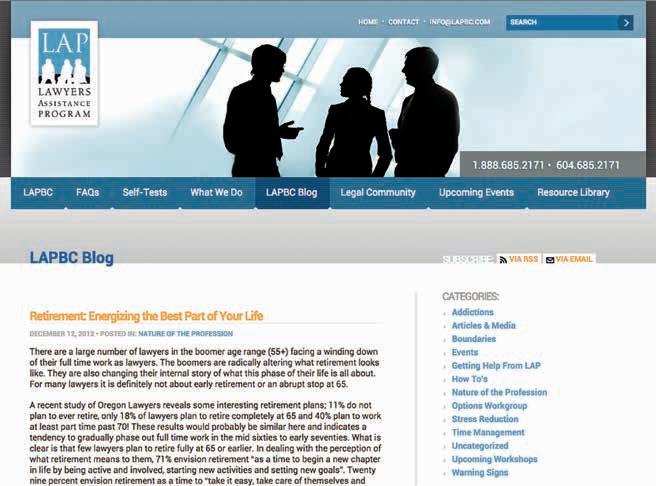
Lawyers Assistance Program of BC (LAP) (lapbc.com/nature-of-the-profession/refirement-energizingthe-best-part-of-your-life/)
The LAP has a great article on their LAPBC Blog entitled Retirement: Energizing the Best Part of Your Life. They quote an intriguing statistic: “A recent study of Oregon lawyers reveals some interesting retirement plans: 11% do not plan to ever retire, only 18% of lawyers plan to retire completely at 65 and 40% plan to work at least part-time past 70!” This article has some
CBA’s PracticeLink has a great article on how to get your succession plan started by Deborah Gillis. Her advice starts now with having great file organization and notes that allow for an orderly and hopefully inexpensive transition of your files.
very engaging advice about changing the story about yourself and looking at the process of retiring as a way to re-energize and redefine yourself.
The American Bar Association (alanet.org/careers/articles/ Law_Offices_Re_-_Examine_Traditional_Retirement_Model.pdf)
The American Bar Association
has a great article aimed at law offices and managing partners in terms of re-examining the traditional retirement model. This article looks at the firm as a whole and prompts the firm to consider retirement from an overall perspective. In particular, it looks at the transfer of knowledge of retiring lawyers in order to capture and retain the technical and business acumen, rainmaking skills, social capital, economic capital and, not the least of which, the professional contacts of seasoned lawyers. They outline a series of steps for the firm to develop strong succession plans.
CNBC.com (cnbc.com/ id/100755294#)
CNBC.com has an interesting article entitled The $1 Million Retirement Nest Egg Myth. While American in focus, the advice is independent of any country. It is important in terms of saying that one should not trust any headline that promotes cracking the wealth riddle in X steps. Your steps to retirement (at least financially) have as much to do with what you are doing now than trying to match Wall Street practices.
It all started with a cryptic note rather than a voicemail. I was in a hurry. My assistant was in a hurry. Everybody had deadlines. I was frazzled. “Can you give a speech… 40th anniversary... Saturday Night… Live.” Finally, I thought… Lorne Michaels has read my BarTalk columns! Maybe he saw my article in Canadian Lawyer about Conrad Black and the Carter decision (and Lord Black’s public takedown of me). Maybe Lorne saw me play The Black Knight in Spamalot a few years back and erroneously decided I was way funnier than Advocate Editor Michael Bain.
A millisecond later, my dreams of performing Bassomatic with Dan Aykroyd, King Tut with Steve Martin, the Killer Bees, and other sketches that may or may not have involved cheeseburgers, Pepsi, sharks and more cowbell for SNL’s 40th Anniversary evaporated in a puff of reality.
In fact, I was asked to speak at the 40th Anniversary of the UVic Law School at that “other job” I very happily do. (And yes, I was embellishing the above story for comic relief.)
The speech caused me to reflect on what a great place it was to get a law degree from, and how memorable my own experience was there. When the UVic Law School was established in 1975, the university itself had around 6,000 students. The new Law School operated from the McPherson Library. When I moved back to Victoria in 1980 after getting my BA in Ontario, UVic Law had undergone a huge transformation. A big faculty. A fabulous reputation. Clinical terms like “The Law Centre.” New teaching methods. In many ways it was (and still is) one of Canada’s most innovative law schools; boldly going where none had gone before. Indeed, UVic Law regularly comes out on top of law school surveys, ranking it among Canada’s finest.
Fast forward 40 years. By 2015, UVic had close to 20,000 full-time and part-time students. It’s become one of Canada’s leading universities and widely recognized for leadership in research, inspired teaching and community engagement; all while being less than a mile from the Pacific Ocean. That’s a big attraction for people in all sorts of disciplines from across Canada, even law students.
When I entered UVic Law School in 1982, a brand-new building had been built, subsequently renamed The Murray and Anne Fraser building in honour of our wonderful founding Dean, Murray Fraser and his wife Anne. Murray passed away, sadly, in 1997. His bad ties were the stuff of legend.
Before my time at UVic Law, I had never heard the terms Reductio ad absurdum or mutatis mutandis until Hamar Foster used them in first-year criminal law. I use them all the time thanks to him, frustrating
some lawyers who have to look the terms up. The late great Terry Wuester, who everyone knew as “The Woo,” may have made the most memorable comment I recall from law school: “I don’t own any life insurance,” he said in his best Kansas drawl. “I want it to be a sad day for everybody when I die.” And for some reason, I remember Donovan Waters talking about “a Rose on Lady Day.” After 33 years, I still don’t know when Lady Day is or why a rose is given out that day.
In its 40 years, UVic Law has produced some great lawyers, great judges, great legal educators and above all, lifelong friends for me and the majority of those I knew there. In fact, there’s an old story from Harvard Law School: “Look to the student on your left. Now look to the student on your right. One of them won’t make it.” At UVic Law, it was a little different. “Look to the student on your left. Now look to the student on your right. You’ll probably marry one of them.” (As I did). And of course, the odds doubled after the Civil Marriage Act of 2005. So, after 40 years of “boldly going where no Canadian law school had gone before,” may UVic Law live long and prosper.
guest
JOAN M c EWEN
Eye-Witness Testimony
Memory manipulation and implantation
One can only hope that it is, by now, a truism that evidence of eye-witness identification is inherently unreliable. Far less understood are the notions of “memory manipulation” and “memory implantation,” yet both have the potential of converting a wrongful conviction from a “miscarriage of justice” into an “abortion of justice.”1
In 1983, six of the eight women who claimed to have been sexually assaulted by wrongly-convicted Ivan Henry identified him as the culprit based on a biased, hopelessly flawed police lineup. Later that year, Henry was declared a dangerous offender. Behind bars for 27 years, he was acquitted by the BC Court of Appeal in 2010 on the basis of faulty identification evidence.2
The six women were not being dishonest; they actually believed that Henry was the perpetrator. When I asked memory expert Elizabeth Loftus how so many people could be mistaken, she said: “Witnesses do not encode all the information that a videotape does. Instead, memory rapidly and continuously decays. A witness’ retrieval of stored ‘memory’ can be impaired and distorted by a variety of factors, including suggestive interviewing and identification procedures conducted by the enforcement personnel.”3
In the Ivan Henry case, the VPD conducted, unbeknownst to the defence, lengthy “re-interviews” –including discussion of the lineup photo – shortly before the preliminary hearing. As well, a suppressed police document refers to witnesses having been exposed to photo lineups, physical lineups and so-called “brainstorming” sessions; as well as working with “several police artists for the purposes of drawing a composite of this person.”
Given this veritable petri dish for the cultivation of memory distortion – both peer and police/state contamination – small wonder that, at trial, the complainants’ (once variegated) descriptions of the at-
Greg Stutchman told me that the lineup photo produced at the preliminary hearing is a “composite of images,” and that the photo represented by the prosecutor at trial to be but an enlargement of the first photo, was in fact a re-doctored version thereof – re-doctored in order to hide the first doctoring.
Once again, how could six women honestly believe they’d seen something they had not?
In June 2010, Slate Magazine published an article about an experiment in which photos were fabricated to depict events that never happened – e.g., President Obama shaking hands with Iranian president Mahmoud Ahmadinejad. Though it had never happened, twenty-six percent of the participants remembered the event.4
Experts say that, though the average rate of false memories is about 30%, when visual images are used to substantiate the bogus memory, the number can increase.
Witnesses do not encode all the information that a videotape does. Instead, memory rapidly and continuously decays.
tacker had more or less coalesced. Regarding memory implantation, we now know that the lineup photo deemed by those same six women to be “accurate” was anything but. Asked to comment, leading forensic photography expert
Seeing is believing, even when what you’re seeing is fabricated.
1 Michael Naughton, The Innocent and the Criminal Justice System: A Sociological Analysis of Miscarriages of Justice (Basingstoke, UK: Palgrave Macmillan, 2013).
2 R. v. Henry, [2010] B.C.C.A. 462 (British Columbia Court of Appeal).
3 Elizabeth Loftus, Eyewitness Testimony (Cambridge, MA: Harvard University Press, 1996).
4 William Saletan, “The Memory Doctor,” Slate Magazine, June 4, 2010. slate. me/KyxWOV.
Joan McEwen is a lawyer, labour arbitrator and author of Innocence on Trial: The Framing of Ivan Henry
Keep Current A review of provincial Section meetings
uNicole Garton began the Wills Trust – Vancouver Section meeting with a case comment and a general discussion on recent cases involving s. 58 of the Wills, Estate and Succession Act. The main presentation by Amy Francis and Roselle Wu was on the topic “Ethics for Trust and Estate Practitioners: Managing Conflicts of Interest.” Roselle provided a summary of recent jurisprudence on conflicts of interest, both generally and in the context of estates, and presented a coloured diagram illustrating the three dimensions of the duty of loyalty to the client. Amy Francis discussed some conflict of interest issues that are unique to the Estate Bar, including acting for spouses on a joint retainer to prepare wills, and the conflicts that arise when a lawyer acts as legal advisor and executor. Because of the different roles that lawyers often play in the context of the administration of an estate, conflicts of interest are a common issue, and managing them appropriately and ethically is an important part of any estates practice.
Animal Law
uOn February 12, 2015, the Animal Law Section meeting focused on the development and creation of an Animal Charter of Rights in Canada. The talk was given by Anna Pippus, the Director of Farmed Animal Advocacy at Animal Justice Canada and Special Projects Manager at the Vancouver Humane Society.
Anna specifically spoke about animal standing in the courtroom, international efforts to have animals’ interests represented in court and the role Animal Justice Canada plays in its Animal Charter of Rights and Freedoms initiative. There were about 50 lawyers in attendance, both in person and online. Those who attended in person were treated to a tasty lunch sponsored by Boughton Law Corporation.
Civil Litigation
Vancouver
uOn Wednesday, March 4, 2015, Civil Litigation – Vancouver Section was privileged to host guest speaker The Right Honourable Madam Beverley McLachlin, PC, Chief Justice of Canada. This meeting was well-attended with more than 200 attendees. The Chief Justice discussed the topic of civility, including the reasons that we should be civil as lawyers and how we can practice civility. Within our modern society, we are bombarded with examples of uncivil behaviour. Unfortunately, the common conception of how lawyers behave fits with this trend. Yet, as the Chief Justice emphasized, the fact is that great lawyers – truly successful lawyers – are civil. In the course of her remarks, the Chief Justice gave some specific examples of those who, despite enormous difficulties, achieved civility.
CBABC Aboriginal Lawyers Forum (ALF)
uThis ALF retreat will be held on May 1-3, 2015 at Tulalip Casino Resort, USA. The ALF Executive has been working
hard to build on the success of past retreats to make the 4th annual retreat one to remember! This year’s theme, “Cross Border: Lands and Resources,” features an impressive lineup of speakers consisting of leading law professors from Canada and the USA, as well as Aboriginal legal practitioners and judges. The agenda features a wide array of topics, including the recent Supreme Court of Canada decision in Tsilhqot’in presented by Chief Roger William, of the Xeni Gwet’in, Tsilhqot’in People of Nemiah, along with legal counsel David Rosenberg. The ALF warmly invites and welcomes you to join them! Furthermore, the ALF is hosting the 8th National Aboriginal Day Online Auction & Reception to raise funds for the CBABC’s Aboriginal Law
UPCOMING CONFERENCE
Student Scholarship Trust to assist Aboriginal law students. To find out more on sponsorship and donation opportunities please contact the ALF Executive.
For enrolled CBA members, more detailed information and available minutes from the Section meetings are online at cbabc.org under CBABC Sections & Forums.
UPCOMING
SECTION MEETINGS
Looking for upcoming Section meetings? Check the online Sections Calendar or the CBA PD Resource site regularly as new meetings are added daily. Enrolled members automatically receive notice of their Section’s meetings by email. Enjoy the benefits of membership and enroll in Sections today. CBA members are reminded to keep their profile up to date with the Branch to ensure they receive notices.
Freedom of Information & Privacy
Section & PD Conference
Law
We are pleased to announce an all-day Freedom of Information & Privacy Law Section & PD Conference to be held on May 13, 2015. This year’s conference aims to provide the legal profession with a comprehensive update of privacy law trends in the two years since our last conference in 2013. Privacy is an ever-growing field – one that is still catching up with the myriad ways in which we live our lives online. We are delighted to have Information and Privacy Commissioner Elizabeth Denham as our keynote speaker this year. In addition to Ms. Denham, the Section looks forward to the vast cross-section of topics, ranging from the use of IP addresses in litigation, to health privacy trends, to cloud computing and data hosting. As privacy and freedom of information continue to evolve on a rapid basis, so will our field of practice. We encourage you to join us on May 13th for a conference you won’t want to miss!
features
FIONA HUNTER
The Brave New World of the WESA
And its effect on your practice
The proclamation on March 31, 2014 of the Wills Estates and Succession Act (the “WESA”), along with Part 25 of the Supreme Court Civil Rules, has brought significant changes to estate planning and administration. The new court forms, not to mention the myriad of new substantive law provisions in the WESA, create considerable uncertainty in the practice. It is therefore crucial that lawyers reconsider the standard advice they give to clients. This article outlines two discrete issues in advising a personal representative (PR) on the proper steps to administer an estate.
“testamentary instrument,” what then? Is it the PR’s duty to bring this document to the court’s attention (as was done in Estate of Young, 2015 BCSC 182)? Can the PR reply upon
First, the definition of a “record” in s. 58 of the WESA (which may represent testamentary intentions) requires something more than a search through the personal papers of the will-maker. The PR must now also review emails, documents and perhaps even videos saved in the deceased’s electronic devices in order to swear (as required in the court forms) that “a diligent search for a testamentary document of the deceased has been made in each place that could reasonably be considered to be a place where a testamentary document may be found.”
This search is, of course, only the first step. If the PR finds a “record” which might represent a
of ceasing to be a spouse is trickier. For married spouses, it is when “an event occurs that causes an interest in family property, as defined in Part 5 [Property Division] of the Family Law Act (FLA), to arise.” For unmarried spouses, it is when “one or both persons terminate the relationship.”
The PR must make the appropriate inquiries, and where there is doubt, consider whether his or her duties to the beneficiaries
a lawyer’s opinion on the efficacy of the document (and is a lawyer prepared to give that opinion, absent case law on the subject)? There are no easy answers, and much will depend upon the nature and potential effect of the record. Whilst it may be possible in some circumstances to reach an agreement amongst those beneficiaries affected, in others a court application with its attendant costs will be required.
Second, problems may arise where the will-maker’s marital status is uncertain. The law of giving notice to a spouse has not changed, but PRs must now consider s. 2 of the WESA. The test for a “spouse” has been somewhat simplified: marriage, or a “marriage-like relationship for at least two years” prior to death. However, the definition
named in the will conflict with those owed to a putative spouse. Moreover, where the spouse is separated, that spouse will have rights under the FLA, which may include an interest in the deceased’s property. This in turn will affect the valuation of the deceased’s interest in the property.
There are many other pitfalls in the new regime, and it will be several years before estates and wills lawyers regain the comfort level they previously may have enjoyed. Until then, best practices must be carefully reviewed and, in many situations, updated.
Fiona Hunter, partner at Horne Coupar in Victoria, BC. Fiona practises exclusively in the area of wills, trusts and estates.
A. M c ARTHUR
Dealing with the New BC Probate Rules
How to make the forms work for you
In conjunction with the new Wills, Estates and Succession Act, Rules 21-4 and 21-5 of the Supreme Court Civil Rules were repealed and replaced by Supreme Court Civil Rules, Part 25.
Part 25 introduced new forms for estate proceedings. While these forms now provide a standardized application process aimed at making the probate process more accessible to the public, the forms are not as intuitive and userfriendly as one might have hoped. Although it might be tempting to make minor amendments to the forms to fix grammatical issues or improve syntax, try to resist. It is time-consuming and frustrating for the registry staff who must comb through your documents to see if the changes are substantive.
In some circumstances, however, amendments to the forms are unavoidable: to correct errors, to suit the specific facts of the estate or simply to remove irrelevant sections.
The following is a summary of some (by no means all) of the more common amendments that will need to be made:
FORM P2: Submission for Estate Grant. Each paragraph has multiple options; delete any options not selected. When providing information about the deceased, list all aliases in which the deceased held property and indicate the property held in each name. Do not use “N/A” if there
is no person or property fitting a particular description – use “Nil” or “None.” Applications using “N/A” are being consistently bounced by most registries.
FORM P9: Affidavit of Delivery. Each person who receives notice must be listed in the P9 Affidavit of Delivery, and it is helpful to add a descriptor identifying each person’s relationship to the testator. Although there is no designated space for including the date on which notice was sent, it must be added to the form so that the registry can calculate the 21-day notice period.
note that this affidavit must be sworn by the person who actually puts the envelope in the mail – the registry will not accept an amendment to the affidavit stating that the person swearing the affidavit “caused the notice to be mailed” as was formerly standard practice.
FORM P10: Affidavit of Assets and Liabilities for Domiciled Estate. The value of all property of the deceased, along with the liabilities that charge or encumber that property, must be disclosed on this form. The registries will no longer accept “To be Determined” as an asset value. If third parties refuse to provide asset information, the incomplete application will need to be filed along with a Form P18: Authorization to Obtain Estate Information.
Although it might be tempting to make minor amendments to the forms to fix grammatical issues or improve syntax, try to resist.
In addition, the Rules referred to under “Delivery Information” are incorrect and must be changed: the reference to Rule 25-3(2) in column 2 should be 25-2(2) and the reference to Rule 25-3(6), (8) or (10) in column 3 should be Rule 25-2(8), (11) or (12). It is important to
There is no form of supplementary affidavit provided for circumstances such as an application to dispense with notice. Wherever a supplementary affidavit is required, Form P4 can be used as a template and then amended to suit the scenario at hand.
If you are in doubt about whether a particular amendment to the forms will be acceptable to the registry, consult your fellow practitioners. We are all working hard to master the new forms and should provide assistance and support to our colleagues in these uncertain times.
A. McArthur, lawyer
EMMA
Emma
in the Private Wealth group at Farris, Vaughan, Wills & Murphy LLP, Victoria office.
ANDREA E. FRISBY
Testamentary Intention and Section 58
A remedy to cure all wills
Section 58 of the Wills, Estate and Succession Act (the “WESA”) permits the court to cure a non-compliant will and to declare that any “record, document or writing or marking on a will or document” has testamentary effect if satisfied that the “record, document or writing” embodies the testamentary intention of the deceased. A record is defined to include data that (i) is recorded or stored electronically, (ii) can be read by a person, and (iii) is capable of reproduction in a visible form.
Increased responsibility falls on the executors who must, in an application for probate, swear to having searched diligently for other testamentary documents. Executors are advised to make an exhaustive hunt for writing or records of the deceased, which may include handwritten notes, a printed document, email correspondence and digital records on computers and tablets, in the event that a document exists that includes testamentary intentions of the deceased. If any such record, document or writing is found, that document, however unorthodox, should be put before the court.
In Estate of Young, 2015 BCSC 182, the court made its first section 58 judgment. In that case, three testamentary documents were put before the court: a formally executed will and two later
documents, one signed by the deceased and one unsigned. The court rejected the third document as a non-binding expression of wishes since it was not signed by the deceased nor provided to her personal representatives.
The Young court articulated a twoprong analysis based on the Manitoba authorities: (1) is the non-compliant document authentic? and (2) does the document record “a deliberate or fixed and final expression of intention as to the disposal of the deceased’s property upon death?” Factors supporting testamentary intention include the presence of the deceased’s signature, the deceased’s handwriting, witness signatures, revocation of previous documents and the title of the document. While this analysis supports a relatively rigorous approach to testamentary intention, it is not clear yet where the boundaries of “stored,” “read” and “capable of reproduction” will fall. A deceased’s electronic devices and computers will require scrutiny and the deceased’s access may be of critical importance in future estate administrations.
that was left on a deceased’s computer with the deceased’s name typed at its end, a testamentary disposition stored on an iPhone, and a DVD recording made by the deceased in contemplation of death and labelled “My Will” have all been admitted to probate (Australia: Alan Yazbek v. Ghosn Yazbek & Anor , [2012] NSWSC 594, Re Yu , [2013] QSC 322 and Mellino v. Wnuk & Ors , [2013] QSC 336). Similarly, a New Zealand court has used its curative provisions to find solicitor’s notes along with an email from the deceased were sufficient proof of the “skeleton for a will” expressing the testamentary intentions of the deceased ( Estate of Feron , [2012] NZHC 44). Already various handwritten lists and annotated copies of wills are emerging where the deceased has died after WESA; the executor does not know which document or documents comprise the will. Indeed, it is quite possible that a “record, document or writing” made subsequent to the will, for example a hand-annotated copy of the will signed again by the deceased or an iPad document with the deceased’s name typed at its conclusion, could purport to change the appointed personal representative, creating an even more difficult set of decisions at the front end of the administration.
In other jurisdictions with similar curative provisions, an electronic document named “Will.doc”
Andrea E. Frisby is an associate at Legacy Tax + Trust Lawyers. Estate planning and administration is the primary focus of Andrea’s practice.
#5 SOLOLINK
Get help when you need it. SoloLink connects sole practitioners, in-house counsel and lawyers in small firms.
#9
MEMBER SAVINGS
Use your Membership ID for discounts on travel, sporting events, gym memberships, investment advice and more.
UNLIMITED ACCESS
CBABC Membership includes unlimited access to all 78 BC and 41 National Sections and Forums.
#6
DISCUSSION BOARDS
Every Section and Forum has a discussion board on the CBABC website to discuss ideas, post questions and more.
#2
COMPLIMENTARY PD
CBABC has created a free online PD module to fulfill your required ethics and practice management obligation.
#10
JOB BOARD
Looking for a new job or a new hire? Visit our job board for new opportunities and member-discounted listings.
#3
SECTION MEETINGS
Get organized. CBABC Membership lets you register for meetings and receive all of the latest information for free.
#7
ON-DEMAND CPD
Catch up with CPD on your schedule. Webinar repeats are available on-demand to keep you up to date.
#8
LEGAL DIRECTORY
CBABC Members have free access to the Online Legal Directory and discounted rates on print copies.
#11
NEWS AND JOBS
Every Tuesday we send an exclusive update to Members with the latest news, jobs, PD, events and volunteer opportunities.
#4 NETWORKING
Looking to meet judges, fellow practitioners, and in-house counsel? The CBABC will help you get connected.
All information must be completed. Once this application has been processed, you will receive a follow up email or phone call from CBABC Member Services to activate your CBABC membership profile.
First Name(s) Middle Initial
Last Name Firm
PREFERRED ADDRESS & PROFILE
Telephone Email
Address
Work Home
City Prov Postal Code
Date of Birth (year/month/day)
Year of First Call/Anticipated Year of First Call
Province of First Call
BC ADVANTAGE
CBABC Membership includes unlimited access to all 78 BC and 41 National Sections and Forums, offering you the ability to earn all 12 CPD hours, including ethics, from a variety of Sections. To ensure you receive notifications on news relevant to your preferred Sections, you need to enroll in those Sections.
MEMBERSHIP FEES
The CBABC Membership year runs September 1 – August 31. New members can join at any time – contact us today to discuss the option that is best for you to start enjoying the benefits of CBABC membership.
Special 50% discounts are available for non-practicing, part-time, and retired lawyers. Other membership categories may qualify for discounts up to 75%. Check online at cbabc.org/Advantage.
Call us at (604) 687-3404 or toll-free in BC at 1 (888) 687-3404, or email us at membership@cbabc.org
Cheque enclosed, made payable to: The Canadian Bar Association
VISA Mastercard AMEX
Card no. Expiry
Name on card Signature
MAIL TO: CBABC Branch, 10th Floor - 845 Cambie Street, Vancouver, BC V6B 5T3
FAX TO: (604) 669-9601 or toll-free in BC 1 (877) 669-9601
NEED MORE INFO? (604) 687-3404 or toll-free in BC 1 (888) 687-3404, or email membership@cbabc.org
The CBABC reserves the right to change its membership fees at any time, without notice.
BT0415
SHAUNA TUCKER
Elder Law Mediation
Encompassing a broad range of issues
The Wills, Estate and Succession Act (the “WESA”) came into force two years after new statutory requirements were put in place concerning advance planning, substitute decision making and adult guardianship. Stopping to consider, “WESA, one year later” (which is the theme for this issue of BarTalk) is also an invitation to be reminded of these and other changes to ensure that the field of elder law is considered as a whole.
The topic of “Elder Mediation” demonstrates the need to watch the forest and the trees.
Elder Mediation can encompass a broad range of issues, from very “legal” matters such as succession planning, substitute decision making and the distribution of estates, to more family systems based matters such as developing care plans for aging adults with declining health who wish to stay in their homes.
In other words, at one level, Elder Mediation is simply a dispute resolution mechanism whose time has come. It is the place where the demographics of an aging population and the increasing popularity of Alternative Dispute Resolution converge.
As legislative change has come to elder and estates law, two critical questions have arisen in the face of this trend, neither of which has yet been fully answered.
First, who is the elder mediator? Alternatively stated, should Elder Mediators, like Family Mediators,
be subject to qualification and certification? Elder Mediation can involve law from a myriad of areas, including real estate, estates, family, insurance and health. Unique questions arise from working with one or more aging adults such as elder abuse and ageism, complex health issues, late in life marriage and the right to have sex in a care facility. Unlike most other mediations, elder mediations typically involve multiple parties and require work with “collaterals.” The relative complexity of Elder Mediation suggests that professional standards and education should inform an elder mediation practice.
Second, should the Elder Mediator have an official place in guardianship disputes? In 2007, the BC Legislature passed Bill 29, the Adult Guardianship and Planning Statutes Amendment Act, 2007. In the result, in 2011, the Adult Guardianship Act, the Health Care (Consent) and Care Facility (Admissions) Act, Power of Attorney Act and Representation Agreement Act were, more or less, substantially amended.
One significant change proposed by Bill 29, however, has not happened. If the Bill 29 amendments to the Adult Guardianship Act had come fully into force, the Patients Property Act would have been repealed and the province
would have a different legislative regime for determining how and whether to appoint a guardian over an individual’s affairs. The regime would require mandatory mediation of the adult guardianship issue in certain circumstances. Whether Elder Mediators should be subject to certification or other regulation is a stand-alone question, but is also linked to the second question. There are concerns that guardianship mediation should not become mandatory until there are standards or mandatory training in this field. In the bigger picture, there are questions about whether “mandatory” guardianship mediation is a model of dispute resolution that should be included within guardianship legislation. The drafters of Bill 29 clearly felt one way about this issue, but the fact that the Bill has not been proclaimed in its entirety means that many disagree. There is fairly universal opinion that the Patients Property Act is outdated and requires replacement. It also seems fairly clear that Elder Mediation is going to continue to grow as a practice area and to evolve to meet the demands of an aging population. How and whether the practice area will develop practice standards and play a role in the area of guardianship should be intentional and part of the ongoing review and discussion that takes place in the Elder Law community.
Shauna is a lawyer with Brown Henderson Melbye. She is a certified Family Mediator, with a Certificate in Advanced Elder Mediation from Marathon Mediation in Toronto.
DENICE BARRIE
guest Litigants Without Lawyers
Self-representation has its benefits
Common myth has it that being a SelfRepresented Litigant (SRL) in the justice system doesn’t work for anyone.
From a lawyer’s perspective, SRLs are even more difficult than the usual opposing party. For starters, they are not required to adhere to the same standards of conduct, nor are they accountable to an organization which governs their behaviour. And being unfamiliar with both substantive and procedural law they are prone to misunderstanding it or, just as annoying, asking opposing counsel to explain it to them. Many seem to have simply never heard of the concept of chronology in preparing pleadings, and when it comes to evidence, rather than entering what’s relevant, the “kitchen sink” approach frequently prevails. Over and over again SRLs make it clear that in almost every respect, they do not speak the language of the law.
Proof of the increasing pressure SRLs create goes beyond the anecdotes of frustrated counsel. Based on feedback she received from 49 Supreme Court Justices and 7 Masters, in 2013 Madam Justice Victoria Grey reported that the mistakes SRLs make with their evidence “cost the court system money, delay decisions, cost opposing litigants time and money, and cost Justices and Masters time.”
SRLs, on the other hand, largely appear to experience the justice system quite differently. Dr. Julie Macfarlane found that many report feeling like an “outsider” –shut out by unfamiliar courtroom customs and procedures and a language they don’t understand. Often they do not believe they were taken seriously by the judge, who preferred to talk with a lawyer and viewed them as a nuisance and irritation.
This confluence of dissatisfaction has the potential to create a perfect storm for the administration of justice in Canada. On the flip side, with the number of SRLs growing at an exponential rate, it also presents new possibilities for
function for those who find themselves facing the justice system without a lawyer, and must of necessity become conversant with its language and procedures. I have found that with strategic professional assistance, SRLs can achieve good outcomes and benefit in other ways as well from representing themselves. Some recent feedback perhaps captures this best:
“I went from scared of the legal system, my Ex’s lawyer and my Ex, to empowered. I have won many legal victories in the past year and many personal victories as well.”
Many report feeling like an “outsider” –shut out by unfamiliar courtroom customs and procedures.
lawyers willing to consider practising in a different way.
Since 2007, I have provided coaching and support to SRLs. I refer to this service as Assisted Self-Representation (ASR) because it goes beyond simply unbundling or acting on a Limited Scope Retainer: At its heart is a translation
Although not everyone may fare quite as well, this client’s story echoes that of many who have benefitted not just professionally, but also personally from the coaching and support they received from a lawyer.
Some people will always be able to afford the services of counsel, while others will continue to qualify for legal aid. But for the growing “sandwich class,” ASR provides a viable alternative. It frees up access to a system which SRLs might otherwise find overwhelming, and for the supporting lawyer, is gratifying to watch from the wings.
Much as we may not want to admit it, SRLs are here to stay. Acknowledging the legitimacy of their presence creates new opportunities for lawyers and is the first step in helping litigants without lawyers achieve a better quality of justice.
Denice Barrie is the president of Waymark Law, which focusses on providing coaching and support to Self-Represented Litigants.
Law Week 2015
u 2015 Law Week’s theme is Access to Justice: What does it mean to YOU? This year twelve locations across British Columbia are participating in Law Week activities, celebrating the 33rd anniversary of the Charter of Rights on Law Day, April 16. Check out BCLAWWEEK.ORG for all the details! Join the conversation on Facebook and Twitter (@bclawweek) using hashtag #bclawweek.
Province-Wide Activities
CRANBROOK
April 14
Key City Theatre
Activities include:
The always popular Mock Trial where the audience gets to be the jury
COWICHAN VALLEY
April 16
Duncan Courthouse
Activities include:
Mock Trial
Information kiosks
Presentations and Q&A
FORT ST.JOHN
April 25
Activities include:
Mock Trial
NORTH SHORE
April 18
North Vancouver Courthouse
Activities include:
Open House
Mock crime scene
Court orientation for newcomers to Canada
PENTICTON
April 17
Emergency vehicle displays
Justice System Partner information tables
KAMLOOPS
April 15
Kamloops Law Courts
Activities include:
Mock Trial
RCMP Dogs and Forensic Unit demonstrations
Detective Treasure Hunt for kids
Courthouse and Sheriffs’ cell tours
KELOWNA
April 25
Activities include:
Girl Guide arrests and Mock Trial
NANAIMO
April 18
Activities include:
Mock Trial
RCMP Presentation: Drugs on the Streets
Meet a Sheriff and tour the cells and van
Activities include:
Two Mock Trials
TERRACE
April 24
Activities include:
Mock Trial
Community service organization displays
VERNON
April 18
Activities include:
Mock Trial
Law-related groups information tables
VANCOUVER
Throughout April
Activities include:
“Meet the Chiefs” forum with the three Chiefs, CBC’s Ian Hanomansing and local high school students
Tours of the courthouse
Free public law classes throughout the Lower Mainland, with the support of the People’s Law School
Barry Sullivan Law Cup public speaking competition for secondary school students from across BC
VICTORIA
April 18
Victoria Courthouse
Activities include:
Mock Trial
Tours of Sheriff’s cells and vans
Victoria Police Department’s K-9 Unit demonstration
Judges’ presentation
Province-Wide
DIAL-A-LAWYER DAY
Saturday, April 18 10-11:45 am, 12:15-2:00 pm 604-687-3221 or 1-800-663-1919
Residents in British Columbia are invited to call and speak with a lawyer for up to 15 minutes at no cost in the following areas of law: Family, Wills & Estates, Tort & MVA, Immigration, Business and Criminal
LAW WEEK 2015
Partners
vancouver bar association
news&events
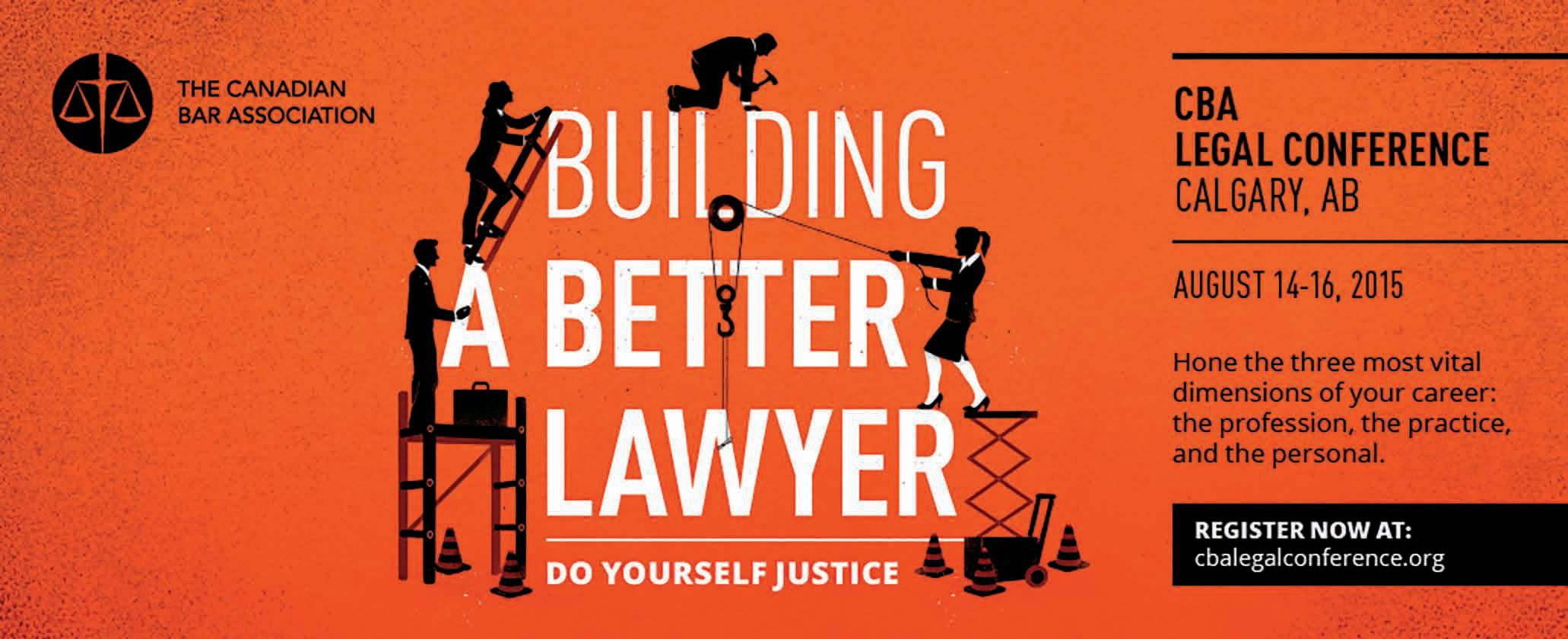
Building a Better Lawyer: The 2015 CBA Legal Conference
There’s no doubt: we could all be better. Better people. Better lawyers, who help build better practices and work for the betterment of Canada’s legal profession. And that’s precisely what this year’s CBA Legal Conference will help you achieve.
For three days this summer in Calgary, August 14 to 16, you’ll have a rare opportunity to meet colleagues from across the country in a dynamic setting that features the three most vital dimensions of your career: the practice, the profession and the personal. We’ve taken great steps to ensure every professional development stream offers tangible benefits to keep you at the top of your game. We’ve assembled compelling
speakers to challenge and inspire you, plus added a greater focus on emerging ideas shaping the future of Canadian law.
Join lawyers, corporate counsel, judges and law students from across Canada at this year’s CLC to explore the challenges facing your profession through interactive problem-solving sessions, practical in-depth workshops and presentations from the industry’s elite.
It’s a chance to connect, to grow, to learn and to thrive. Stay tuned for exciting updates in the coming months!
Do yourself justice – find out more or register today at: cbalegalconference.org
CHALLENGE CBABC Young Lawyers
Challenge April 7-16, 2015
Do you have a wellness goal? Why not share your achievements with your colleagues and challenge them to be well, too? For ten days in April, the CBABC Young Lawyers Wellness Committee is encouraging all members of the legal profession to dedicate some time to wellness in any area of life and to post about it on Facebook, Twitter or Instagram. We hope your achievements will motivate and inspire each other to become excited about treating yourself well. You will receive more than just the admiration of your colleagues and personal benefits of devoting time to wellness – there are prizes and a fun wrap-up event too!
Stay tuned for more details about the challenge and wrapup event. For now, start brainstorming ideas and challenge your friends and colleagues to participate!
cbabc.org/wellness
NATIONAL NEWS
MENTORING OPPORTUNITY NEWS
Vancouver Community College needs your help! They are looking for practicum hosts for their Legal Administrative Assistant students. In order to get practical experience and use their new skills, students will work for free from June 15 to 26.
If you can mentor a student in a variety of office activities, please contact Helen Roberts at 604-871-7000 ext. 8525 or hroberts@vcc.ca for more information.
Kelly Maw (left), a third year law student and TRU Law Society president, thanks Rob McDiarmid and Sharon Matthews for their gift of $50,000 toward the TRU Faculty of Law Student Awards on Jan. 23, 2015.
Read more
A blast from the past 7th Annual CBA Meeting August 16-18, 1922
news&events
2015 CBABC WLF Award Recipients
The CBABC WLF is pleased to announce that The Honourable Judge Patricia L. Janzen is the recipient of our WLF Award of Excellence and Carla L. Forth, QC is the recipient of our Debra Van Ginkel, QC Mentoring Award
Prior to her appointment to the Provincial Court in 2012, Judge Patricia Janzen was associate counsel with Harris & Co., specializing in the areas of labour law and human rights. Throughout her career, she has worked to raise awareness for sound harassment, discrimination and maternity policies in the workplace. In 1989, she was the first female partner of Fasken Martineau to take maternity leave, and helped create that firm’s maternity leave policy. Judge Janzen also worked with the Law Society to help develop its model maternity leave policy and its Ombudsperson program. Coupled with her commitment to her family and community, Judge Janzen truly exemplifies the ideals of the WLF Award of Excellence.
Carla Forth, QC has actively mentored women lawyers through the WLF Mentoring program for many years. She has practised in the areas of professional malpractice, health law and disability insurance with Guild Yule LLP for 28 years. Ms. Forth recently obtained her Masters in Law, specializing in Health Law. Her contributions to the profession were recognized in 2014 when she was awarded the Queen’s Counsel designation. Ms. Forth has devoted countless time, energy, compassion and commitment to her mentees. By maintaining a busy law practice with humour and common sense, and dedicating herself to her family, she has been an inspiration to her mentees.
Please join us to recognize our award recipients and hear our guest speaker, The Right Honourable Kim Campbell, at the WLF Awards Luncheon on April 23, 2015 at the Hyatt Regency.
For more details and registration information
professionals working in probate and estate administration.
Wills and Personal Planning
KEEPING UP TO DATE WITH WESA
CLEBC editors and trusted volunteers are working hard to ensure that all our wills and estates publications contain the latest developments under WESA. This spring, subscribers will receive updates to our four key wills and estates publications: The BC Probate and Estate Administration Practice Manual is the only practice-oriented guide for BC legal
Precedents has a new title to reflect the addition of important new content. Immensely popular since it was first published, this collection of will clauses and documents includes representation agreements and other BCfocused precedents. The book’s online version includes the document builder, allowing users to select clauses, create document templates and download the complete document.
The BC Estate Administration and Wealth Preservation Practice Manual is a comprehensive guide to effective estate planning strategies and tools.
Annotated Estates 2015 is the 11th edition of our popular consolidation of core wills and estates law materials, which is annotated by prominent estates lawyers who have prepared succinct summaries of the most relevant decisions. Some copies of CLEBC’s Wills, Estates and Succession Act Transition Guide are still available for those who need to get up to speed on the sweeping changes. Contact CLEBC customer service for more information.
IN FORCE
Current from December 17, 2014 to March 3, 2015
Legislative Update is provided as part of the CBABC legislative and law reform program. It is a service funded by CBA membership fees, and is therefore provided as a benefit of CBA membership. The full version of Legislative Update is now only published online and is available exclusively to CBA members at cbabc.org
ANIMAL HEALTH ACT, S.B.C. 2014, C. 16 (BILL 19)
The Act, except section 34(2) to (7), is in force January 19, 2015
CANADIAN PACIFIC RAILWAY (STONE AND TIMBER) SETTLEMENT ACT, S.B.C. 2014, C. 27 (BILL 3)
The Act is in force December 22, 2014
CONTAINER TRUCKING ACT, S.B.C. 2014, C. 28 (BILL 5)
The Act is in force December 22, 2014
FORESTS, LANDS AND NATURAL RESOURCE OPERATIONS STATUTES AMENDMENT ACT, 2014, S.B.C. 2014, C. 7 (BILL 5)
Sections 65(a), 66 to 69, 72, 77 to 80, 82(a), (c) and (e) and 83 are in force April 1, 2015
Sections 1, 4, 5, 6, other than as it amends section 3(2) of the Enforcement of Canadian Judgments and Decrees Act, and 8 to 12 are in force February 4, 2015
For a complete list of Acts in Force go to cbabc.org. BC LEGISLATIVE UPDATE
BRANCH & BAR Calendar
A PRIL
1-29 LAP: Mindfulness-Based Stress Reduction & Meditation for Lawyers — Vancouver — Wednesday 1, 8, 22 & 29
6-12 Make-A-Will Week
8 CBABC PD Webinar: Deja-Vu Part 2: PST, GST and HST – Double Taxation on Legal Services
9 Kamloops Bar Association Bench & Bar Cocktail Reception — Kamloops
10 Victoria Battle of the Bar Bands — Victoria
10-May 1 LAP: Boundaries for Lawyers — Vancouver Friday 10, 17, 24 & May 1
13 Freedom of Information & Privacy Law Section & PD Conference — Vancouver
14 CBABC PD Seminar: Drafting Effective Affidavits — IN PARTNERSHIP WITH CBABC YOUNG LAWYERS-LOWER MAINLAND SECTION — Vancouver
14 CBABC PD Webinar: Target June 1, 2015: You and the BC Limitation Act
15-May 2 CBA Ontario Foreign Conference Trip to South China — Toronto and South China, ON
16 Law Day 2015
17 CBABC PD Seminar: Dealing with Change and Learning to Love it! — Vancouver
21 CBABC PD Seminar: Dealing with Change and Learning to Love it! — Victoria
21 CBABC PD Webinar: Keys to the Castle: Starting Your Successful Solo Law Practice
23 WLF Awards Luncheon
28 CBABC PD Webinar: Unmasking Haters, Baiters and Trolls: Canada’s New Cyberbullying Law
29 CBABC PD Webinar: Who’s Going to Bark For Me? Pet Housing and Veterinary Negligence
29-May 2 The Lawyer Show 2015 – Dirty Rotten Scoundrels — Waterfront Theatre (Granville Island, Vancouver)
MAY
13 CBABC PD Seminar: Full Day Professional Development Conference — IN PARTNERSHIP WITH CBABC FREEDOM OF INFORMATION & PRIVACY LAW SECTION — Vancouver
15 Executive Committee Meeting — Vancouver
27 CBABC PD Seminar: DIY Justice: Dealing with Self-represented and Vexatious Litigants — IN PARTNERSHIP WITH THE DEPARTMENT OF JUSTICE — Vancouver
28 CBABC PD Seminar: Technology for the Rest of Us
— IN PARTNERSHIP WITH THE KELOWNA BAR ASSOCIATION — Kelowna
31 A Day at the Races CBABC Law School Scholarship Fundraiser Vancouver
news&events
TIPS FROM
Drafting a will to combine clients’ instructions and legislative requirements into a readable document is a fine art. The assistance you provide your client doesn’t need to end there. A will is just one of many important legal documents that your clients can make to get their affairs in order. There are also many options for how these documents can be stored and accessed in the future, during the very situations for which these documents are made in contemplation of. Here are a couple of great tools to help you bring all of this together for your clients:
CLE’S DOCUMENT BUILDER FOR WILLS & ESTATES: This handy tool makes it simple to draft a will or power of attorney that matches your client’s instructions. Visit any Courthouse Libraries BC location to access CLE Online for free. You’ll find the Document Builder within Wills Precedents, located in the Practice Manual collection. For a short video tutorial on how to access and use the Document Builder, visit the Courthouse Libraries’ Training and Tutorials page or follow this link: bit.ly/CLBCWillsVideo
NIDUS: You probably already know about the Wills Registry, but did you know that Nidus has an online registry for wills and personal planning documents? Nidus allows individuals or an appointed representative to create an online Personal Planning Registry Account where documents such as wills, memorial arrangements, representation agreements, powers of attorney and other personal documents can be stored in their entirety, in PDF format. With a Nidus account, the user has control over which third parties can access information about uploaded documents. Access rights can be granted to authorized third parties, such as provincial Health Authorities, the Public Guardian and Trustee or a personal representative. For more information visit nidus.ca/registry
NEWS
Peter A. Allard, QC donates $30 million to UBC Faculty of Law
UBC Law alumnus Peter A. Allard, QC, has donated $30 million to UBC’s Faculty of Law, the largest gift ever to a Canadian law school. In recognition of his gift, which will enable the faculty to build on its reputation for championing human rights and social justice, the university will rename the law school the Peter A. Allard School of Law. In addition, UBC’s law school has launched a $10-million fundraising campaign to encourage alumni and friends to join Allard in supporting the law school.
Read more
A Day at the Races
CBABC fundraiser for law school scholarships Sunday, May 31 Hastings Racecourse, Vancouver 1:30 pm ( rst post time 1:50 pm) Includes Cold Bu et, Silent Auction, and more… $60 + gst cbabc.org/races
Join the cheering crowds as your favourite horse thunders home, and help support students at BC’s three law schools. Derby attire is encouraged!
$125,000
The following grants were adjudicated at the March 7, 2015 Board of Governors’ meeting.
Funding totalling $5,000,000 was approved for the following 29 continuing programs:
COMMUNITY LEGAL ASSISTANCE SOCIETY
$870,000 Major Programs
$60,000 David Mossop QC, Public Interest Articling Fellowship
$450,000
BC PUBLIC INTEREST ADVOCACY CENTRE
Social and Regulatory Justice Programs
$425,000
WEST COAST ENVIRONMENTAL LAW ASSOCIATION Programs and EDRF
$415,000
ACCESS PRO BONO SOCIETY OF BC Major Programs
$360,000
BC LAW INSTITUTE Program Grant
$330,000
PEOPLE’S LAW SCHOOL SOCIETY Major Programs
$225,000
TENANT RESOURCE AND ADVISORY CENTRE SOCIETY Tenants’ Legal Advocacy Program
$190,000
JUSTICE EDUCATION SOCIETY OF BC Major Programs
$175,000
WEST COAST LEAF ASSOCIATION Litigation and Law Reform Program
$160,000
MEDIATE BC SOCIETY Major Programs
LAW FOUNDATION OF BRITISH COLUMBIA
LAW FOUNDATION OF BRITISH
WEST COAST DOMESTIC WORKERS’ ASSOCIATION
Legal Advocacy Program
$90,000 POVNET SOCIETY PovNet Program
$85,000
COMMUNITY CONNECTIONS SOCIETY OF SOUTHEAST BC Travelling Poverty Law Advocate Program
$75,000
ATIRA WOMEN’S RESOURCE SOCIETY
Legal Advocacy Program
$75,000
BATTERED WOMEN’S SUPPORT SERVICES
Legal Advocacy Program
$75,000
BC CENTRE FOR ELDER ADVOCACY AND SUPPORT
Legal Advocacy Program
$75,000
DZE L K’ANT FRIENDSHIP CENTRE SOCIETY Legal Advocacy Program
$75,000
MAPLE RIDGE/PITT MEADOWS COMMUNITY SERVICES
Poverty Law Advocacy Program
$75,000
NORTH SHORE COMMUNITY RESOURCES SOCIETY
North Shore Legal Advocacy Program
$75,000
QUESNEL TILLICUM SOCIETY
Legal Advocacy Program
$75,000
SHARE FAMILY AND COMMUNITY SERVICES
Poverty Law Advocacy Program
SOURCES COMMUNITY RESOURCES SOCIETY
$75,000 Legal Information and Advocacy Program
$75,000 Poverty Law Advocacy Program
$75,000 TERRACE AND DISTRICT
COMMUNITY SERVICES SOCIETY
Poverty Law Advocacy Program
$75,000
VANCOUVER ISLAND NORTH WOMEN’S RESOURCE SOCIETY Advocacy Services Centre Program
$60,000
UPPER SKEENA COUNSELLING & LEGAL ASSISTANCE SOCIETY Advocacy Program
$20,000
UNIVERSITY OF SASKATCHEWAN
Native Law Centre
$60,000
LAW FOUNDATION GRADUATE
FELLOWSHIPS
Alison Yule
Anna Fitzgerald
Brian Bird
Christopher Albinati Helene Love
Kathryn Thomson
Funding totalling $415,000 was approved for the following four grants:
$200,000
BC CENTRE FOR ELDER ADVOCACY AND SUPPORT
Elder Law Clinic
$75,000
VERNON WOMEN’S TRANSITION HOUSE SOCIETY
North Okanagan Legal Advocacy Program
$75,000
WATARI RESEARCH ASSOCIATION System Negotiator Program
$65,000
WACHIAY FRIENDSHIP CENTRE Wachiay Advocacy Outreach Program
Funding totalling $27,500 was approved for the following grant:
$27,500
JUSTICE EDUCATION SOCIETY OF BC
Schools Program Needs Assessment
For details of all programs and projects that received funding, please visit lawfoundationbc.org.
professionaldevelopment
\ EMAIL: PD@CBABC.ORG
\ WEBSITE: CBAPD.ORG
CBABC Professional Development offers a full range of CPD opportunities that provide a valuable skillsimprovement forum and an opportunity to exchange ideas with colleagues and Bar leaders from across Canada and around the world. Our conferences and seminars offer specialized resources and networking opportunities to advance your career, your practice and your business. For a full list of CBABC’s Professional Development offerings, please visit cbabc.org/CPD
Upcoming In-person Seminars
(See more Full Day Courses offered in your local areas on page 2.)
IN PARTNERSHIP WITH CBABC YOUNG LAWYERS-LOWER MAINLAND SECTION
Drafting Effective Affidavits
Please join us in this practical and informative session. Our speakers will share useful tips and advice on how to properly draft an affidavit, and on what pitfalls to avoid.
Date: April 14, 2015
Location: Law Courts Inn, Vancouver
Speakers: Master Heather M. MacNaughton, Supreme Court of British Columbia; Chilwin C. Cheng, Partner, Legal Process Solutions
IN PARTNERSHIP WITH CBABC FREEDOM OF INFORMATION & PRIVACY LAW SECTION
Full Day Professional Development Conference
Date: May 13, 2015
Location: SFU Segal Building, Vancouver
Dealing with Change and Learning to Love it!
Speaker: Dennis Hilton –Facilitator, Trainer, Consultant and Speaker
PRESENTED BY THE BC BRANCH OF THE CANADIAN BAR ASSOCIATION
Date: April 17, 2015
Location: Law Courts Inn, Vancouver
Date: April 21, 2015
Location: Marriott Inner Harbour, Victoria
IN PARTNERSHIP WITH THE DEPARTMENT OF JUSTICE
DIY Justice: Dealing with Self-represented and Vexatious Litigants
Date: May 27, 2015
Location: Best Western Plus Chateau Granville, Vancouver
IN PARTNERSHIP WITH THE KELOWNA BAR ASSOCIATION
Technology for the Rest of Us
Date: May 28, 2015
Location: Royal Anne Hotel, Kelowna
Upcoming Webinars
Deja-Vu Part 2: PST, GST and HST - Double Taxation on Legal Services
Date: April 8, 2015
Speakers: Alexander Coombes, Dentons Canada LLP; Katherine Zilinas, Couzin Taylor LLP
Target June 1, 2015: You and the BC Limitation Act
Date: April 14, 2015
Speakers: Vanessa Gauthier, Lindsay LLP; H. William Veenstra, Jenkins Marzban Logan LLP
Keys to the Castle: Starting Your Successful Solo Law Practice
Date: April 21, 2015
Speakers: Kathryn S. Sainty, Sainty Law; Marina L. Sedai, Sedai Law Office
Unmasking Haters, Baiters and Trolls: Canada’s New Cyberbullying Law
Correctly define all of the Internet slang terms in the course title for a chance to win a PRIZE!
Date: April 28, 2015
Speakers: Eric V. Gottardi, Criminal Defence Counsel, Peck and Company; Jim Hughes, Chief Legal Technology
Counsel, BC Ministry of Justice, Criminal Justice Branch
Who’s Going to Bark For Me? Pet Housing and Veterinary Negligence
Date: April 29, 2015
Speakers: Rebeka Breder, Boughton Law Corporation; Amber Prince, LLM (Animal Law), Atira Women’s Resource Society
Rebeka Breder ’s dog Tero.
PhototakenbyPete Pouli n
Warren
Lori
Steven
Daren
barmoves
Who’s Moving Where and When
Lisa Martz has moved her diverse commercial and public law litigation practice, which includes real estate, contract disputes of all kinds, technology and aboriginal rights from McCarthy Tétrault LLP to Gudmundseth Mickelson LLP.
Thomas McLachlan joined Reed Pope Law Corporation as a new associate.
John McLeod joined Reed Pope Business Lawyers in Victoria, BC where he acts as associate counsel and continues to advise clients on corporate and commercial matters.
Jean-Marc Hébert joined Whitelaw Twining Law Corporation as litigation counsel in the Personal Injury Claims group. Mr. Hébert is fluent in French.
Andrea Greenwood joined Branch MacMaster LLP, practising primarily in the areas of class actions and insurance litigation. Andrea articled at Richards Buell Sutton LLP and practised with Thorsteinssons LLP before joining Branch MacMaster.
Heather Hettiarachchi joined Kent Employment Law on February 2, 2015. Heather practises extensively in the areas of employment and labour law, and also provides employers with general human resources support.
Carl May joined Hammerberg Lawyers LLP as an associate lawyer practising in the areas of strata property and commercial litigation.
Arielle Lavender has joined Synergy Business Lawyers. Her practice focuses on general business law with a focus on corporate and commercial law, acquisitions and divestitures, real estate and wills and estates.
Gradin Tyler joined the partnership of Mathews Dinsdale & Clark LLP on January 1, 2015. Grady’s practice continues to focus on labour, employment, and human rights law.
Katie Van Nostrand has continued her immigration practice at Mathews Dinsdale & Clark LLP, which commenced February 16, 2015.
SPACE IS AT A PREMIUM AND AVAILABLE ON A FIRST-COME FIRST-SERVED BASIS SO SEND YOUR BAR MOVE (MAX. 30 WORDS) AND A HIGH-RESOLUTION PHOTO TO BARTALK@CBABC.ORG NOW. TO VIEW ALL BAR MOVES GO TO CBABC.ORG/BT/BM_1504
Natasha Jategaonkar
joined Mathews Dinsdale & Clark LLP as an associate upon completing a clerkship with the BC Supreme Court. She is practising in the areas of labour and employment law.
January & February 2015
Regular Members
Hannah J. Askew West Coast Environmental Law
Vancouver
Wannakuwattewaduge
Ransiri Fernando
Vancouver
Claire Hong Port Moody
Jennifer Marles
joined Oyen Wiggs Green & Mutala LLP as partner. Jennifer practises in all areas of intellectual property, with emphasis on prosecuting patent applications in biotechnology and chemistry.
Adam J. Barker has joined Edwards, Kenny & Bray LLP as an associate. He has a general corporate and commercial solicitor’s practice. He previously worked at another downtown Vancouver firm.
Paul G. Kent-Snowsell joined the partnership of Lindsay Kenney LLP practising civil litigation with an emphasis on contractual and tort litigation and “white-collar” criminal defence. Paul works primarily in the Langley office.
Matthew J. Straw
joined Eyford Macaulay Shaw & Padmanabhan LLP as an associate in November, 2014. He is practising in the areas of personal injury, insurance defence, and general civil litigation.
Sandeep K. Mann
Vancouver Coastal Health Authority
Vancouver
Silas Polkinghorne
Vancouver
Kelsey A. Robertson
Veronica Law
Vernon
Matthew J. Straw Eyford Macaulay Shaw & Padmanabhan LLP