This publication is intended for information purposes only and the information herein should not be applied to specific fact circumstances without the advice of counsel.
The British Columbia Branch of the Canadian Bar Association represents more than 6,900 B.C. members and is dedicated to improving and promoting access to justice, reviewing legislation, initiating law reform measures and advancing and improving the administration of justice.
BarTalk Publication Sales Agreement #40741008
news&events
LETTER TO THE EDITOR Tony Wilson
Please pass on how much I enjoy reading Tony’s articles, including the clever “The Sump of All Fears” which made me smile throughout.
— Richard Johnston
EVENT RECAP
Victoria’s 9th Annual Battle of the Bar Bands
Victoria’s 9th annual Battle of the Bar Bands was held on March 28, 2014 at the Victoria Edelweiss Club and raised more than $11,000 to support the CBA(BC) Benevolent Society. This event continues to be a tremendous success where lawyers have the opportunity (and the guts) to showcase their musical ability. Michelle Bourbonnais warmed up the crowd with an acoustic set, and we had six bands competing, including two new bands this year: Voire Dire Straits, the Hung Jury, the Boozefighters, the Oak Bay Ladies’ Baroque Ensemble, Blind Elmo, and Melanie and the Felonies. The band Hung Jury, led by Peter Jones, took the trophy for overall best band, with the Oak Bay Ladies’ Baroque Ensemble, led by Roger Holland, winning for the best Tom Petty cover, though Melanie and the Felonies weren’t far behind. Thank you to all of our firm and local sponsors who made the event such a success.
RESOURCES
Parenting After Separation Resources
The Justice Education Society has a number of resources for families going through a break up. FamiliesChange.ca is a leading source of information about how to make decisions in the best interest of the children. It includes guides for kids, teens, parents and professionals. The website also includes access to the provincially mandated course: Parenting After Separation (PAS) and it now includes the follow-up course: Parenting After Separation: Finances. For children under 10, there is also an interactive computer game – Changeville.ca – where kids explore the town of Changeville and learn to deal with the emotional aspects of their family break up. The Society is adapting this content for California courts and the first portion is already online: FamiliesChange.ca.gov.
The B.C. Branch of the Canadian Bar Association Fax: 604-669-9601
Toll-free fax: 1-877-669-9601
Email: bartalk@cbabc.org
Note: BarTalk undertakes every effort to publish letters to the editor, subject to space and editorial discretion. Letters to the editor can also be found in BarTalk Online at cbabc.org
Aboriginal Law – Vancouver Island and Family Law – Victoria
Family Law – Vancouver
Family Law – Okanagan in Association with CBA
Inside This Issue
Modern Family comes to BarTalk. We explore how conception technology has created new legal concepts of parentage with private and commercial surrogate arrangements. We also look at topical issues under the Family Law Act one year later and get an update on the benefits for mentor and mentee in a successful mentoring arrangement.
News and Events
2 Letter to the Editor re: Tony Wilson
Victoria’s 9th Annual Battle of the Bar Bands
Parenting After Separation Resources
18 Legal Health Checks: Law. You. Check it Out.
11 Former CBA Presidents Speak Up about Prime Minister’s Comments in Globe and Mail OpEd
CBA Speaks Out
19 Lawyers of the Future
The CBA Urges the Government to Amend Bill C-24
2014 CBA Legal Conference
20 Tips from Courthouse Libraries BC
VBA and CBABC 18th Annual Golf Tournament
CLEBC Update
21 Legislative Update
Branch & Bar Calendar
2014 Thompson Rivers University (TRU) Law
Student Award and Mentoring Reception
CBABC WLF News
CBA(BC) Benevolent Society
Lawyer Referral Service (LRS)
22 The 5th National Pro Bono Conference
BarTalk Moving Forward
Law Week 2014 Photos
Also In This Issue
FROM THE PRESIDENT
DEAN CRAWFORD
Diversity on the Bench What can we do about it?
Last summer, the Canadian Bar Association passed a resolution urging the federal government to address a lack of diversity in appointments to superior courts across the country.
Great strides have been made in ensuring law school and Bar admissions are more representative of the population, though there is more work to do. Women constitute more than half of the student population in many law schools and the number of non-white students is much more representative of the general population than it was 20 or even 10 years ago.
These very positive developments have not been reflected in appointments to the superior courts, however. Far from it.
To take one example, a Globe and Mail article this spring highlighted studies which showed that in the past five-anda-half years, the federal government has appointed three
non-white justices out of nearly 200 appointments to the superior and federal courts across the country. Of 94 appointments between April 2012 and March 2014, only one non-white justice was appointed by Ottawa.
While there are many reasons to be concerned about the marked lack of diversity in appointments, I could not put it any better than Chief Justice Beverley McLachlin, who said in 2012: “Many people, particularly women and visible minorities, may have less than complete trust in a system composed exclusively or predominantly of middle-aged white men in pinstriped trousers.”
TRANSPARENCY IS LACKING
There is something wrong with the system, yet we may not even be able to identify the root of the problem. Are lawyers from visible minorities not applying for judicial appointments in proportion to their numbers within the profession? Are they being recom-
mended for approval by the Judicial Advisory Committees in each province but not being appointed by the federal government?
The answer is, we don’t know. The federal government does not publish such statistics, and so we are left to speculate.
Is there a better way to get at the causes of the problem? Let’s start with more transparency. Why not publish the number of applicants from equality-seeking groups and the number of such applicants recommended for appointment by Judicial Advisory Committees? Indeed, that recommendation was made by the CBA in its resolution last summer, citing as a model the Judicial Council of British Columbia, which reviews applicants for the appointment to the B.C. Provincial Court.
There is much to be learned from such statistics, which would help us in addressing underrepresentation in the judiciary.
In our province, the B.C. Branch is sponsoring a forum, “Building Diversity on the Bench,” taking place in Vancouver on May 27 and available via webinar across the province. (The event will have already taken place by the time this issue of BarTalk hits your desk, but we are advertising the event throughout May in other venues). We are partnering with the Federation of Asian-Canadian Lawyers, the South Asian Bar Association, the Canadian Association of Black Lawyers and the Law Society of British Columbia.
At the forum, attendees will learn about the appointment process to the Provincial and Supreme Court of B.C. and will hear from several judges about their experience serving on the courts. This event follows on the heels of a similar successful event last year, “So You Want to be a Judge?”
I am proud that diversity in the profession and on the Bench is a core value of the Canadian Bar Association. I welcome any comments from our members on what we might do to improve our efforts in this area.
Dean Crawford president@cbabc.org
Twitter: @deancrawfordvan
EXECUTIVE DIRECTOR
CAROLINE NEVIN
Evolution and Revolution Change
comes slowly but is quickly embraced
The legal profession gets a bum rap for being resistant to change. It’s easy to understand why: combine stringent legal training with a strong sense of responsibility for protecting essential social institutions (the Justice System, Rule of Law, etc.) and the inevitable result is a cautiously lengthy period of examination, risk assessment and challenging questions when change is first proposed. However, once adopted, in a relatively short time whatever changed becomes the new “norm,” everyone adapts and life quickly moves on.
Just over a year ago, the courts, lawyers and disputing families braced themselves for the implementation of the new Family Law Act (FLA), which represented a significant change in perspective on family law principles and procedures.
In many ways, B.C. has been a great experimenter in this field, and the FLA has provoked much interest and attention across the country. Despite the long path it took to get the new Act in place, over the past 14 months, judges, lawyers, mediators, parenting coordinators and others have nurtured the seeds of its drafters’ intent, and have started to grow a substantively changed approach to the resolution of family law issues.
The evolution of family law has also fueled another kind of shift: there are now open conversations – both within and outside the profession – about the role of lawyers as preventers and resolvers of legal disputes, with a duty to keep all but exceptional matters out of court. Some people have gone so far as to suggest the need for changes to the Law Society Rules and Code of Conduct to strengthen the responsibility of lawyers to say “no” to clients who want to avoid resolution options in favour of aggressively pursuing litigation – and to
discipline lawyers who do not take a more active role in managing those clients. It’s also interesting to note that what used to be called Alternative Dispute Resolution (ADR) is now commonly referred to as CDR, or Consensual Dispute Resolution, because dispute resolution outside of the courtroom is now viewed as mainstream, rather than alternative.
Yet another example of evolution and adaptation: in a world where Self-Represented Litigants (SRLs) are part of the “new norm,” there continue to be significant changes in terms of dispute resolution and case management processes, and the role of judges and lawyers. Concepts such as “unbundled legal services,” “limited retainers” and specialty legal clinics, programs and resources to help SRLs are being adopted and delivered by lawyers and legal organizations across the country. Of course, none of these innovations excuse government from the responsibility
of funding legal aid – that is something that still needs to change in an entirely more positive direction. While we’re on the topic of change, your own lawyers’ association, the CBA, has been evolving too. Recognizing that many lawyers are actively transitioning into Non-Practising, PartTime or Retired status with the Law Society, we’ve announced new membership fees for people in those situations – at half price. Even more radical, B.C. is proposing to include access to all 78 B.C. Sections and Forums, and 42 National Sections and Conferences, within the cost of membership. There will be a modest increase in the Branch levy (which stays 100% in B.C. to fund services delivered directly to you here) and Section enrolment fees will be completely eliminated. You can sign up for meeting notices and minutes, attend any meeting, and access all archived materials, webinars and resources the Sections have online (a lot!). We’ve heard from lots of members that this is the best way to improve the real value you get from membership, and we’ve embraced that change too!
Caroline Nevin cnevin@cbabc.org
practicetalk
DAVID J. BILINSKY
Helping Yourself by Helping Others Mentoring is paying it forward...
r Make a difference now With your own two hands Plant a seed, watch it grow And you’ll give more back then you’ll ever know.... r – Music, lyrics and recorded by Tenille and Joni Delaurier.
Why mentor? Indeed, why go to the trouble since it only takes away from billable time and adds to your workload? Yet many people do mentor in their latter part of their career. There must be something at work here that transcends monetary gain.
According to the WISE program at UBC, the top five bene-
fits to the mentor in mentoring are as follows:
1. giving back some of the support and inspiration you have received throughout your career;
2. making contacts within your industry and build your professional network;
3. improving your communication and leadership skills;
4. developing or maintain connections to UBC and contribute to efforts to build a stronger industry and community; and
5. contributing to the future of your field or industry by assisting the next generation of leaders.
Mind Tools (mindtools.com) states: A mentoring partnership can be rewarding to both people, personally and professionally. It’s an opportunity to develop communication skills, expand your viewpoints, and consider new ways of approaching situations. Additionally, both partners can advance their careers in the process. Apparently there are worse things than falling into the role of being an
elder mentoring statesman (or woman).
What does it take to be a good mentor?
Mindtools.com states:
There is a longer-term benefit to mentoring. Many firms today are adopting a “Firm Alumni” perspective. CBA PracticeLink (tinyurl.com/m4vyage) states:
“We have a group of people who know us, we know them, and they’ve gone off and are doing interesting things at various corners of the business community,” explains Terry Burgoyne, a senior partner at Osler, Hoskin & Harcourt LLP who chairs the firm’s alumni committee. “Maintaining that network is just a good thing to do.”
To be an effective mentor, you need to:
1. have the desire to help;
2. be motivated to continue developing and growing;
3. have confidence and an assured manner;
4. ask the right questions;
5. listen actively; and
6. provide feedback.
There is a need for mentors today. Younger lawyers value the perspective that you can bring by allowing them to see the profession and practice through your eyes. Mentees can also help you stay current with technology and newer developments. You may also desire helping to generate the next level of leaders in the profession. Within your firm you can develop your reputation for identifying emerging talent – and build your network in the process.
The alumni network would be even stronger if the alumni had a good mentor/mentee relationship with the firm.
There are as many reasons to mentor as there are mentors and mentees around.
PracticeLink continues: “As lawyer coach Allison Wolf, who recently helped launch an alumni program for a Canadian firm, puts it: ‘It’s almost negligent to let those relationships drop.’”
Who knows? You might just get back more than you know.
The views expressed herein are strictly those of David Bilinsky and do not reflect the opinions of the Law Society of British Columbia, CBABC, or their respective members.
David J. Bilinsky is the Practice Management Advisor for the Law Society of British Columbia. Email: daveb@lsbc.org Blog: thoughtfullaw.com
dave’s techtips
Sites for Mentoring
TRAINING AUSTRALIA
MAGAZINE has an article (tinyurl.com/ohffqr6) on Thinking Mentoring: Consider the Online Option by Dr. Kim Rickard. While e-mentoring lacks faceto-face communication, there is research that suggests that emailbased communication can remove obstacles such as geographic dispersal and time constraints. It can also provide a forum for sophisticated and considered exchanges between participants thereby improving the chances of higher learning and has the benefits of mentor impartiality and interorganizational connections.
MICROMENTOR (micromentor.org) is an online site that connects entrepreneurs and mentors to build small businesses together. It has been written about in Forbes, Inc, Oprah, The New York Times, The Wall Street Journal and Entrepreneur Magazine. It is free and has a record of thousands of mentor-mentee matches.
They clearly demonstrate the benefits of mentoring: 82% of businesses that received mentoring survived for 1-2 years (versus 69% of those who did not). They also increased their revenues by $47,300 or 106%.
THE LAW SOCIETY OF B.C.
(tinyurl.com/kyv926t)
offers a mentoring program to earn CPD credit for the mentor. Mentoring can be face to face or by telephone, including real time videoconferencing or by electronic means. A lawyer who has engaged in the practice of law in Canada, full or part-time, for seven of the ten years immediately preceding the current calendar year, and who is not the subject of an order of the Credentials Committee under Rule 3-18.31(4)(c), is eligible to mentor. Six hours of credit can be earned. Mentors can claim a total of 12 hours maximum if mentoring two mentees separately (no credit is awarded for preparing for the mentoring session or training to be a mentor). Mentoring must not be file specific. tinyurl.com/n8m94hf
CBABC
offers a mentor registry at (tinyurl.com/njn3vhe). The CBABC states: Mentoring is a relationship in which a lawyer with experience or expertise in a practice area or practice skill (the “mentor”) provides guidance or advice in support of the professional or practice goals of another lawyer, or an articling student in another firm, who
requests assistance (the “mentee”). Mentoring plans must be approved by the Law Society for CPD credit.
THE LAW SOCIETY OF UPPER CANADA (LSUC)
(lsuc.on.ca)
offers four mentorship programs: an Equity and Diversity Mentorship Initiative that encourages high school and university students, including Aboriginal Peoples, Francophones and equity-seeking groups, to consider law as a career. The initiative also provides matches for new calls to the Bar, law school students and students-at-law. Lawyer mentors offer academic and career advice, job-shadowing and share their experiences and insights. The Articling Mentorship Initiative provides students-at-law seeking articling positions with a support link by pairing them with a lawyer who will provide advice, support and encouragement in their search for an articling position. LSUC also offers the Practice Mentoring Initiative that connects lawyers with experienced practitioners in relevant areas of law to help them deal with complex substantive legal issues or a specific procedural issues outside of their Practice Management Helpline mandate. The Practice Mentoring Initiative has been expanding to assist paralegals with similar substantive or procedural issues within the permitted scope of practice.
Remembering The Law Centre After 30 Years Training
excellent lawyers year after year
As I write this, I’ve just returned from my 40th High School Reunion in Victoria where my classmates and I reminisced about the shenanigans we got up to when we were all 16 and 17 and the extra 40 years (and the 40 pounds) all of us have put on since “Dark Side of the Moon” was released. And as it was an all boys’ school then, that last comment about weight gain shouldn’t offend the politically correct police.
Although 1974 is an important watershed year for me (Grade 12 and all that), I’d have to say 1984 was far more watersheddy. Why? I finished law at Christmas of that year. It’s the year I served my very last meal as a semi-professional Keg waiter. It’s the year I met my wife–to-be. And it was the year I first appeared in a courtroom as counsel doing a summer term at The Law Centre.
I took The Law Centre Term because I expected to be a litigator. (Ha!) Our group of 17 students was taken through litigation and skills training in UVic’s Moot Courtroom for two weeks before we moved to The Law Centre’s old offices on Broad Street in May of 1984 under the watchful eye of the phenomenal Glen Gallins.
I’ve never forgotten the day we moved into The Law Centre. Glen took all of us to a strip club around the corner. A few women in our group looked profoundly uncomfortable in a room filled with other women in various states of undress gyrating to Van Halen’s “Jump.” But Glen had a reason for taking us there. It was filled with (mostly) men who were either drunk, nearly drunk or profoundly drunk. Many were unemployed and on UIC or welfare, and whom Glen respectfully suggested, might also have been involved in petty or not-sopetty crime. “Look around,” he said, implying that we weren’t having tea at the Empress. “These are
your people.” It was a broad generalization, but we got the point.
I know it’s 30 years ago, but in those days, we weren’t supposed to handle any case that involved family law or a criminal charge where jail was a possibility. And because we were essentially doing legal aid, we had to assess the income of the clients to prevent us from giving free advice to people who somebody thought could afford it, such as anyone in the middle class, or who had a job.
been convicted of possession of one or two joints. As I said, we weren’t allowed to represent clients where there was a reasonable chance of jail, which is why she was very surprised when her client was led off to the hoosegow despite her outstanding speech to the judge about his excellent prospects for rehabilitation. “I didn’t even bring a toothbrush,” the surprised client said to her on the way to the slammer.
I tell these anecdotal stories because The Law Centre is integral to UVic Law and the Victoria community, delivering an outstanding clinical legal education and providing legal services to thousands of individuals who cannot afford a lawyer. So if you were ever a UVic law student, or did term at the Law Centre, now would be a good time to consider a donation.
I did a few criminal trials, a number of “speak to sentences,” a couple of small claims trials and a lot of remands. I visited prison a few times. I learned a lot about impaired driving, as well as marijuana possession and breaking and entering. (Not really useful for a franchise and IP lawyer today). I would be in court by day, and serving by night in a seafood restaurant owned by the Keg.
One of my colleagues spoke to sentence for an accused who had
I’d guess there may be close to 2000 former Law Centre alumni who got our first (and sometimes our last) taste of the courtrooms of B.C. as young legal aid lawyers at The Law Centre. So this year, when you get phoned for a donation, don’t forget the great experience you received on Broad Street years ago.
Send The Law Centre some money so it can keep doing the great work it does, decade after decade.
The views expressed herein are strictly those of Tony Wilson and do not reflect the opinions of the Law Society of British Columbia, CBABC, or their respective members.
feature
ARLENE H. HENRY, QC AND MARY E. MOUAT, QC
B.C. Hear the Child Society Children’s Voices in Family Law Disputes
The new Family Law Act, at section 37(2)(b), requires the parties to a family law dispute and the court to “consider the child’s views, unless it would be inappropriate to consider them,” as does the United Nations Conventions on the Rights of the Child. This duty is mandatory, unless rebutted, and family law lawyers, mediators, arbitrators, parenting coordinators and judges must ask themselves whether they are meeting their duty to ensure that children’s views have been considered in resolving each family law dispute.
By contrast, a Hear the Child (HTC) report, also called a Voice of the Child report, is a direct, often verbatim, record of the child’s expressed views. It does
Section 211 of the Family Law Act provides for the appointment of a person to “assess” the needs of the child, the views of the child and/or the ability and willingness of a party to satisfy the needs of the child. Views of the Child reports made under Section 211(1)(b) are typically prepared by a psychologist, psychiatrist, clinical counsellor or family justice counselor. These reports address not only the child’s views but also those of the parents and often those of other persons and professionals involved in the child’s life. The author of the report analyzes the information gathered, offers an opinion regarding the same and provides recommendations.
not offer an assessment or an opinion, and typically includes only information received from the child.
The purpose of these non-evaluative reports is to listen to the child, so that the child can express his or her views, and have those views considered in making decisions about his or her best interests.
The interviewer’s task is to simply obtain and relay the child’s views to adult decision-makers, without interpretation or analysis. The interviewer does not offer an assessment of the child or what may be in his or her best interests. HTC reports can be initiated by the request of both parents, by court orders under sections 202(b) or 224(1)(b) of the Family Law Act, or in some circumstances by the request of one parent alone. HTC reports are less costly than section 211 assessments and are completed more quickly. They are also a far less intrusive means of obtaining the child’s evidence than affidavits or oral testimony. If an HTC report has been prepared without a court order, a parent may rely on section 202(a) to have the report admitted as hearsay evidence. Arguably, these reports are not actually hearsay as they do not affirm the truth of what was said but merely report what was said.
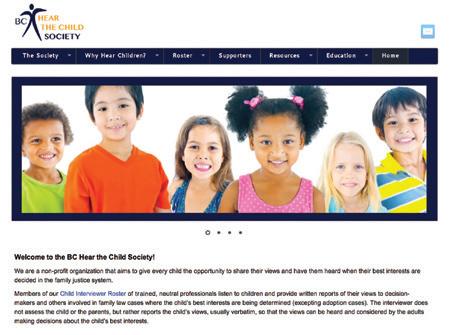
The B.C. Hear the Child Society is a non-profit society formed to support opportunities for children to share their views and be heard when their best interests are being determined in family justice decision-making forums. The Society manages a roster of non-evaluative child interviewers trained in interviewing children, provides ongoing training opportunities and may be contacted for more information about HTC reports.
Arlene H. Henry, QC and Mary E. Mouat, QC. hearthechild.ca
sections
Keep Current A review of provincial Section meetings.
Family Law – Nanaimo
Meeting in Review: February 20, 2014
Webinar: Broadcasted to all seven Family Law Sections in British Columbia
Speaker: Doug Runchey, DR Pensions
Consulting
Topic: CPP Credit Splitting
Aboriginal Law – Vancouver Island and Family Law – Victoria
Meeting in Review: March 26, 2014
Speaker: John Gailus, Devlin Gailus
Topic: Family Homes on Reserves and Matrimonial Interests or Rights Act
Family Law – Vancouver
Meeting in Review: May 8, 2014
Speakers: Anna Laing, Fasken Martineau LLP and Michelle Isaak, Davis LLP (pictured)
Topic: Wills and Estates – New Legislation and the Impact on Family Law
Family Law – Okanagan in Association with CBA Manitoba
Meeting in Review: April 23, 2014
Speakers from CBABC: The Honourable Chief Justice C.E. Hinkson and The Honourable Chief Judge Thomas Crabtree
Speakers from CBA Manitoba: The Honourable Madam Justice Laurie Allen; CBA Manitoba Family Law Section Executive’s Lawrence Pinsky and Robynne Kazina Topic: Dialogue with Manitoba Bar and Bench on the Manitoba Experience (Unified Family Division Court)
Family Law – Nanaimo
uOn Thursday February 20, the Family Law – Nanaimo Section hosted an all Family Law Section Meeting. The Guest Speaker was Doug Runchey, of DR Pensions Consulting. Doug presented on the government CPP splitting regime and proposed alternative options for separated or divorced couples. This meeting was hosted via webinar and broadcasted to all seven Family Law Sections in British Columbia. Doug provided information on DUPE, the “Division of unadjusted pensionable earnings.” He reviewed the history of DUPE, including various legislative and policy changes over the past 30-40 years. The recording and minutes are available to Family Law Section members online. CBABC Sections aims to conduct more joint Section meetings available via webinar for members across the province.
Aboriginal Law –Vancouver Island and Family Law – Victoria
uJohn Gailus presented a discussion paper co-authored with Leah DeForrest reviewing the Family Homes on Reserves and Matrimonial Interests or Rights Act (FHRMA). The first portion of the FHRMA, the First Nation law-making mechanism, which provides for the enactment of First Nation laws respecting on-reserve matrimonial property came into force on December 16, 2013. The second part of the FHRMA, which provides for provisional federal rules to fill the legislative gap in the absence of a First Nation enacting its own laws, will come into force in December 2014. Section members may access the minutes and paper online.
Family Law – Vancouver
uAnna Laing and Michelle Isaak spoke on “Wills and Estates –New Legislation and the Impact on Family Law.” Anna discussed implications for family law practitioners of the new Wills, Estates and Succession Act, including the intersection with the Family Law Act. Michelle discussed estate matters in the context of family practice, including beneficiary designations and the death of a litigant in matrimonial proceedings. Meeting minutes and the recording is available online for Family Law – Vancouver Section members.
Family Law – Okanagan in Association with CBA Manitoba
uOn April 23, 2014, the Family Law – Okanagan Section hosted a webinar which featured members of the Manitoba Family Bar Section Executive (Lawrence Pinsky & Robynne Kazina) and The Honourable Madam Justice Laurie Allen of the Winnipeg Queen’s Bench, Family Division who provided a presentation
on the Manitoba experience with a Unified Family Division and their case management process. The Section was privileged to have The Honourable Chief Justice Christopher Hinkson of the B.C. Supreme Court and The Honourable Chief Judge Thomas Crabtree of the B.C. Provincial Court to discuss how family law matters are dealt with in their respective courts.
This exclusive Section meeting was conducted via live webinar broadcasted from Manitoba and British Columbia. The discussions highlighted the similarities and differences in the way that the Manitoba and B.C. courts deal with family law matters. In addition, the panelist discussed some of the challenges that are currently being experienced in the court system and other challenges that need to be considered as our courts continue to make changes. The meeting was well received and the Justices encouraged questions from the online audience. Family Law Section members may access the webinar recording and minutes online.
memberservices
\ Exclusive offer from MERCEDES-BENZ CANADA! Mercedes-Benz Canada is now pleased to offer members of the CBABC discounts on the purchase or lease of new Mercedes-Benz and smart vehicles!
\ STILL CREEK PRESS is pleased to offer CBABC members preferential rates on all printing services. They look forward to assisting you with print solutions.
Call 1-888-687-3404 and get information on how to partner with CBABC!
CHATTER WITH CHAIRS
Rosalie Cress and Robyn Trask
LABOUR LAW SECTION
Save the Date!
Professor Kevin Banks will be our keynote speaker for the evening, presenting the topic “The Future of Labour Laws in Canada: Is a Race to the Bottom Inevitable?”
Professor Banks will address patterns of change in labour legislation during the last decade and whether globalization is likely to drive change in our labour and employment laws. Join us on June 10, 2014 at the Four Seasons Hotel, Vancouver for an informative and enjoyable evening connecting with others interested in this timely and engaging topic. Further details can be found at cbabc.org.
MEMBERS@CBABC.ORG
features
KEVIN CHIAROT
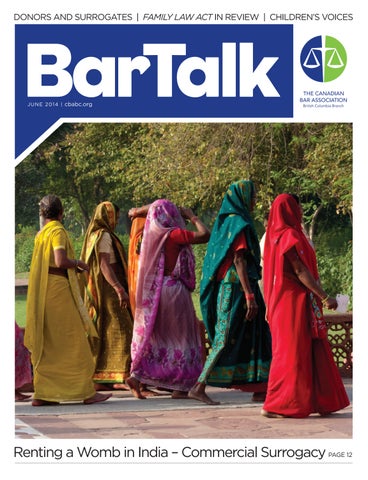
Renting a Womb in India Commercial surrogacy
from a lawyer’s perspective
Since its Supreme Court decided in 2002 to open India up to commercial surrogacy, India has become the preeminent destination for fertility tourism among Western couples. Two lawyers in the Lower Mainland recently welcomed a daughter into their family through the use of a surrogate in India. I spoke to one about their experience using a commercial surrogate, in order to provide information to B.C. practitioners whose clients may be interested in this service.
DID YOU REQUIRE A LAWYER IN CANADA OR INDIA?
We did not; my wife and I were able to manage the process ourselves.
HOW DID THIS PROCESS BEGIN?
Once we decided to use a surrogate, we searched on the Internet and found reputable clinics in India. The clinic we chose pre-screened all of their surrogates and required all surrogates to be married with children in order to minimize emotional attachment to the baby after birth.
AFTER CHOOSING THE CLINIC, WHAT STEPS WERE YOU REQUIRED TO TAKE TO BEGIN THE PROCESS?
Before going to India, we obtained a medical visa, which required us to have been married for at least two years and have a signed surrogacy contract. The clinic provided a copy of the signed contract to us. Once the visa had been approved,
we traveled to India, met the surrogate, and provided our sperm and egg samples. We then returned to Canada and the clinic kept us apprised of all developments.
WHAT
WAS
THE PROCESS AFTER THE CHILD WAS BORN?
Once our daughter was born, we were required to apply for her Canadian citizenship and a passport. This was a multi-step process that began back in Canada, which required:
1. a DNA test of both parents in Canada at an approved facility in Canada; and
clinic confirming the surrogacy and DNA results. This process can take up to several weeks to complete, however we hired a local agent, who was able to expedite the process.
WHAT RIGHTS DOES THE BIRTH MOTHER HAVE?
Our contract with the surrogate stated that after giving birth, she was required to provide breast milk for fifteen days. The birth certificate lists the child’s biological parents and not the birth mother; there is no indication that the pregnancy was via surrogate.
2. a DNA test of the Child after birth, to be performed at the same laboratory in Canada, which required us to have a sample taken in India and then couriered back to Canada. Once we received the results confirming the baby’s DNA, we applied for her citizenship and a temporary emergency passport, which was completed in less than seven business days.
AFTER OBTAINING HER CITIZENSHIP AND PASSPORT, WERE THERE ANY OTHER REQUIREMENTS BEFORE YOU COULD COME BACK TO CANADA?
Before we could bring our daughter to Canada, we obtained an exit visa, which necessitated a letter from the
WHAT
WAS THE TOTAL, APPROXIMATE COST FOR THIS PROCESS AND HOW LONG AFTER YOUR DAUGHTER WAS BORN, WERE YOU ABLE TO COME HOME TO CANADA?
Including clinic and surrogate fees, airfare, hotels, and agent fees, we spent approximately $50,000 to have our child. We were in India approximately six weeks after our daughter was born.
WHAT INFORMATION WOULD
BE USEFUL TO LAWYERS IN B.C. WHO PRACTICE IN THIS AREA?
Advise your clients that they must be in a marriage recognized by India for more than two years in order to qualify for the medical visa. As well, they must get DNA tests completed in Canada at an approved facility, before bringing the child to Canada. Ultimately though, it is a fairly straightforward process; we really did not have any problems.
Kevin Chiarot is an associate at Jamal Law Group, practising in the areas of family law and criminal defence.
ZARA SULEMAN
(Re)Conceiving Donors and Surrogates New realities in the Family Law Act
SCENARIO 1: THE “DONOR”
After living together for two years, Simi and Katherine decide to have a baby. Their friend Michael is their sperm donor and Simi will carry the child. In this scenario, Simi is the birth mother, Katherine is the child’s parent under s. 27 of the Family Law Act (the “Act”), and Michael is the donor.
SCENARIO 2: THE “SURROGATE”
Married couple Karim and Yee tried to have a child but Yee could not carry a child to term. Yee’s friend Sally agrees to be their gestational surrogate. In this scenario, Karim and Yee are the intended parents and Sally is the surrogate.
Conceiving children using assisted reproductive technology (ART) involves intention and planning. An agreement is undertaken to protect the legal rights of all involved parties.
Part 3 of the Family Law Act, “Legal Parentage” clarifies the legal status of donors, surrogates and intended parents. Below is a brief overview of donors and surrogates.
DONORS
A donor who provides their human reproductive material (sperm, ovum, or embryo) is presumptively not a parent and cannot be declared to be a parent by a court “by reason only of the donation.”1
Despite this, donor agreements remain important.
Donor agreements include many provisions, for example terms: to specify that no payment was made to a known donor for the donation of human reproductive material;
to address issues of screening, safety and transfer; and
to release and indemnify donors from any liability.
SURROGATES2
Surrogates include those who provide their own genetic material (e.g. eggs) and those not genetically related to the child they are carrying (gestational surrogates). For a surrogacy arrangement to apply under s. 29 all of the following are required:
long as the parties have a written agreement preconception and no party withdraws from the agreement; and
Postconception – the surrogate provides their written consent to “surrender the child to” the intended parent(s) who “take the child into” their care.5
Surrogacy agreements include many provisions, for example terms:
to specify that no payment will be made to the surrogate, other than “reasonable expenses” which must be detailed; and to release the intended parent(s) from all liability and any claims by the surrogate.
Before the child is conceived, the parties should have a written agreement;
The agreement should outline that the surrogate will be the birth mother3 of the child upon birth but that “the surrogate will not be a parent of the child,” will “surrender the child to the intended parent or intended parents,” and the “intended parent or intended parents will be the child’s parent or parents;”4
Preconception – the intended parent(s) will be the legal parents of the ART-conceived child so
The Family Law Act is modern in its conception of the baby-making process and helps to reconceive legal parentage.
1 Section 24, Family Law Act [S.B.C 2011] Chapter 25. Note: By written agreement drafted preconception between the parties, a donor can also be a parent to the ART-conceived child. See s. 30 – Parentage if other arrangement of the Act.
2 Surrogacy agreements are complex legal contracts that require legal and medical considerations associated with conception, pregnancy and birth. The provided information is only a brief overview.
3 A “birth mother” is basically the person from whom a child is born (phrasing thanks to barbara findlay, QC).
4 Section 29, Family Law Act
5 Ibid. Section 29 also provides for circumstances where intended parent(s) die after the child is conceived. Acknowledgement: Teresa Balogh for her editing assistance.
Zara Suleman practises exclusively in family law at Suleman Family Law
LARRY KAHN, QC
Surrogacy Agreements
Reproductive Law + one year in on the Family Law Act
Surrogacy Contracts are not governed by the Family Law Act. Contracts between intended parents and a surrogate are permitted by Section 6 of the Assisted Human Reproduction Act, S.C. 2004, c. 2 (the “Act”). However, Section 6 of the Act prohibits payment of a fee to a surrogate. Intended parents may reimburse a surrogate for expenses, but little guidance is provided by the Act and there is no case law. There is a presumption that intended parents who have entered into a written agreement with a surrogate before she becomes pregnant, are the legal parents of the baby born to the surrogate (s. 29 of the Family Law Act). As well, the surrogate or person who has donated reproductive material is not a parent (s. 24 of the Family Law Act).
A Surrogacy Contract includes:
RECITALS
These provide some background of the parties, statements describing risks associated with reproductive technology, information about the clinic, the composition of the embryos, and confirmation that, apart from reimbursing the surrogate for her expenses, the agreement is altruistic.
TERMS OF A CONTRACT
Screening and testing – required for the surrogate, her spouse, and the intended parent(s). Any
testing that is invasive, i.e. amniocentesis, is likely enforceable.
Surrogate and surrogate’s partner’s obligations.
Embryo transfer procedure.
Selective reduction – reducing the fetuses carried by the surrogate (not likely enforceable, or alternatively, unlikely to be prevented).
Termination of pregnancy – when there may be a termination (not likely enforceable, or alternatively, unlikely to be prevented).
Medical treatment –for the health of the fetus.
Confidentiality – privacy concerns.
Risks – primarily the surrogate assumes risks to herself.
Reimbursement of expenses (often to an agreed upon maximum amount of receipted expenses) and specified expenses that cannot be quantified:
wage loss (net of taxes);
bed rest, i.e. housekeeping, nanny and child care;
invasive procedures such as termination of pregnancy or selective reduction;
multiple birth; and
travel.
Custody/Guardianship – which passes to the intended parents immediately upon birth.
Section 6 of the Act prohibits payment of a fee to a surrogate. Intended parents may reimburse a surrogate for expenses.
Death or separation – contingencies for intended parents.
Dispute resolution – usually arbitration (although, this is very rare).
Termination of agreement –usually in force for one year.
Birth registration – the anticipated legal proceedings to have the intended parents named on the birth certificate, which differ between provinces.
Governing law (the province in which the surrogate resides).
Intended parents may obtain a birth certificate in British Columbia pursuant to the Family Law Act, which recognizes them as the parents of the baby (ss. 29 and 31). In B.C., the required documents are prescribed by the Family Law Act.
Other provinces require a Court Order to declare intended parents as parents of the baby. In few cases an adoption is required so that the parent who has not provided genetic material can become a legal parent.
Larry Kahn, QC is a founding partner at Kahn Zack Ehrlich Lithwick LLP. Larry has practised exclusively in the area of Family Law for more than 35 years.
JENNIFER BARRETT AND LAURA ATKINSON
Family Violence and Protection Orders
The courts’ interpretation
Protection Orders made pursuant to Part 9 (ss. 182-191) of the Family Law Act (“FLA”) are to address “family violence” and protect “at-risk family members.”
“At-risk family members” include parents, children, or other family members whose safety and security is or is likely at risk from family violence by a family member.
“Family Violence” is broadly defined in s. 1 and includes such things as physical, sexual, financial, psychological, and emotional abuse and a child’s direct or indirect exposure to family violence.
Protection Orders can be made as stand-alone orders and may be made without notice to the party against whom the order is sought.
In deciding these applications, courts must consider the factors set out in s. 184(1) as well as a child’s exposure to family violence if an order is not made.
The cases below provide us with some insight on how courts are interpreting and applying Part 9 of the FLA.
In J.C.P. v. J.B., 2013 BCPC 297, The Honourable Judge Merrick determined that the failure to pay child support could constitute “family violence” although not often. The father’s failure to pay child support on time and in full, combined with his other actions/ words, constituted a “calculated and deliberate act designed to inflict psychological and emotional harm
and to control Ms. B’s behaviour.” (para. [15]). Risk factors, in s. 184(1), were considered, including a pattern of coercive and controlling behaviour and any circumstance that may increase the at-risk family member’s vulnerability, including economic dependence.
In K. v. K., 2013 BCPC 0223, the court considered the meaning of “family member,” “at-risk family member” and “family violence” in granting a father’s application for a Protection Order against his 31-yearold son who was living with him.
In Dawson v. Dawson, 2014 BCSC 44, The Honourable Mr. Justice Barrow made a Protection Order on the basis that family violence was likely to occur. There was a historic serious incident of physical violence at the time of the parties’ separation. The court noted that “the predictive quality of that earlier act may not be diminished with the passage of time.” The gravity of the possible harm should be considered in “assessing the ‘likely’ threshold and a ‘sliding scale’ should be applied (para. [44], [45]).”
Courts have been able to apply an
In J.R.E. v. 07-----8 B.C. Ltd., 2013 BCSC 2038, the claimant honestly believed the respondent sexually abused their children. The court found no evidence of family violence or risk of future family violence.
The court was asked to make a Protection Order based on the claimant’s subjective perception of risk to her safety and the children’s safety alone. The court stated that the subjective focus of s. 184(1) “does not permit the court to abandon all objectivity and to conclude that it must act on the perceptions of the applicant alone.” (para. [17]).
The court also noted that confrontation, stress, provocation and engagement in arguments or demands do not necessarily constitute “family violence.”
expanded definition of “family violence” while also recognizing that “bad behaviour” does not always constitute “family violence” or create “risk.” The courts look at actual violence that has occurred in assessing current and likely risk, noting that the more serious the violence, the more protective the court may become toward vulnerable family members. Subjective, honestly held beliefs of risk and violence, alone, may not be sufficient for a court to make a Protection Order, which poses a challenge for counsel/clients given that family violence often occurs “behind closed doors.”
Jennifer Barrett’s practice focuses on family law, including child protection. Laura Atkinson is an associate at Brown Henderson Melbye.
CRISTEN L. GLEESON
The Family Law Act
Baby steps toward change feature
Most members of the judiciary will say that not much has changed in practice since the enactment of the Family Law Act (the “Act”).
A review of cases considering the Act demonstrates that the change is subtle in the 13 months since the Act came into force. However, judicial considerations of some of the more dramatic changes under the Act, such as the property regime and the family violence provisions, for example, are still relatively few. This leaves open the possibility that more change is to come.
There are several cases in which it is clear the court has difficulty grappling with the differences between guardianship set out in the Act and the Divorce Act, which refers only to custody where both acts have been pled. In some of these cases, the court opted to order custody rather than guardianship to put an end to the confusion. This is unfortunate given the expanded and detailed parental responsibilities which comprise guardianship under the Act as compared with custody, which is less defined.
Cases decided under the Act’s detailed relocation provisions, which address circumstances in which a parent wishes to relocate with a child, provide interesting commentary on the Act. The sections contain what could be the first explicit statutory requirement
for analysis of subjective intent in the B.C. family law context – the requirement for good faith. The requirement for good faith appears to have made relocation orders even more difficult to attain. For example, one case found that the mother’s stated wish to distance herself from the conflict with her former spouse and her already having moved to the desired location was evidence of a lack of good faith.
The Act mandates that where an applicant has failed to establish good faith the application must fail. More than one decision has found this inconsistent with the requirement that the best interests of the child
remains grounded in the best interests of the child.
The cases demonstrate that the courts are reluctant to make a finding of family violence on an interim application where the evidence is given most often by way of affidavit. While this is understandable given the reliability of such evidence is difficult to test on an interim application, this approach may also result in a failure to protect those genuinely in need of protection from family violence. There appears to be a hesitation on the part of the judiciary to stray from the approach established prior to the Act.
Change is subtle in the 13 months since the Act came into force.
must be considered on such applications irrespective of good faith. It is encouraging that the Supreme Court has relied on its parens patriae jurisdiction to, in effect, correct this incongruency in such cases to ensure the analysis
The property division regime under the Act requires the court to consider whether the equal division of family property and debt would be “significantly unfair” to either party. Satisfying this test could entitle a party to a greater than equal share of the family property. The term is undefined in the Act, causing one recent case to call for an intelligible definition. In that case, the judge simply stated that he “knows it when he sees it” and declared the test had not been met. Such cases clearly demonstrate the need for putting more flesh on the Act’s bones by way of judicial interpretation.
Overall, a review of the case law under the Act to date leaves one wondering how far-reaching the change will be in practice.
Cristen L. Gleeson, Partner, Baker Newby LLP. Ms. Gleeson concentrates her practice on property, child custody, divorce and adoption issues.
guest
CANDACE CHO AND TREVOR TODD
Mentorship Revisited The beacon of hope shines on in the practice of law
Three years after our article, “Mentorship: A Beacon of Hope in the Practice of Law” was published in the June 2011 issue of BarTalk, much has evolved in our mentorship association and in our respective legal careers.
THE MENTEE PERSPECTIVE –THE STORY OF CANDACE CHO
Since 2011, much has changed in my life. I have expanded my business from a sole practitioner practice to joining forces with my past mentor, Judith A. Janzen, to expand the firm and brand that I developed back in January 2010: Onyx Law. Together, Judith and I now manage a busy boutique family and estate litigation firm. We hung up our shingle in April 2012 and have been laughing and practising law together since then.
Professionally, my practice and experience has grown leaps and bounds thanks to the practical mentorship and awesome opportunities that Trevor has generously bestowed upon me. I have been lead counsel on cutting edge estate litigation cases with Trevor happily sitting in the backseat as my cheerleader and have been running many files independently.
Trevor and I continue to meet for our weekly dim sum lunches, and we continue to discuss litigation strategy, marketing, client management, politics, and anything else
under the sun that we wish to discuss on that particular day, except now we are often joined by Trevor’s son, Jackson Todd, who is articling with him, and my associate, Janis Ko. The table is more crowded, and the conversation even more lively. I have been extremely fortunate to have received such generous mentorship, and now have the pleasure of paying that forward in mentoring the members of my team at Onyx, and supporting other young counsel that have sought my advice. It is my firm view that mentorship is the way and the hope of lawyers being able to happily practice law into the future.
in several years when she was capable and no longer needed the hand holding of a mentor?
The answer was the evolution of our mentorship relationship into one more of sponsorship – I introduce Candace on a regular basis to senior counsel, give her cases way beyond what most young lawyers would ever get to handle on their own, and otherwise promote her at almost every opportunity I am given.
SPONSORSHIP has evolved as the eventual consequence of our very successful mentorship relationship
and something that can continue into the foreseeable future.
THE MENTOR PERSPECTIVE –THE STORY OF TREVOR TODD
As a forty-year call, watching Candace bloom into the very capable lawyer that she has become has been a rewarding experience that has motivated me to remain practising with renewed enthusiasm, while many of my classmates are in the process of retiring or have retired. I recognized Candace’s talents very early on and have considered myself the coach, mentor, and almost father-like figure to her over literally hundreds of lunches and thousands of emails.
From the outset, I raised the issue with her of what happens
Lastly, there is something great about the combination of young and old practitioners.
Candace is half my age but twice as bright and way more energetic. Our relationship has been completely symbiotic, with each of us growing both professionally and emotionally throughout the process.
I highly recommend the process of mentorship to senior lawyers especially, and suggest to both young and old practitioners to be open to and seek each other out, with the view of mentoring and seriously sharing the senior practitioner’s knowledge and experience as thousands of young lawyers are “drifting” for lack of proper guidance in sufficient numbers.
news&events
Legal Health Checks: Law. You. Check it Out.
An important part of improving access to justice is to ensure people have the information and tools they need to avoid legal problems in the first place, or to prevent those problems from becoming bigger than they might have been. As part of the CBA’s Reaching Equal Justice initiative, CBA is offering six Legal Health Checks for the public:
Five steps to legal wellness – speaks to the reasons why smaller legal problems can snowball into much larger and more complex problems, particularly for already vulnerable people.
On your own – youth – provides quick information on topics especially of interest to youth, with ways to find out more.
For more information, please email or go online CBA NATIONAL NEWS
Avoid surprises – builds awareness about the times when getting legal advice at an early stage can save money and aggravation later.
Breaking up – encourages separating couples to reduce costs and stress by taking a reasoned approach.
Breaking up: parenting – encourages separating couples to consider the impact of their next steps on their children.
Before you buy – alerts home buyers to questions they should be able to answer before they sign. The goal of the Checks is to encourage people to recognize legal problems early, and to take action when they do identify them. For lawyers, these materials are a way to start conversations with people about the law, how to get legal help and how to work effectively with a lawyer.
CBA NATIONAL NEWS
Eleven Former CBA Presidents Speak Up about Prime Minister’s Comments in Globe and Mail OpEd
“The recent comments by Prime Minister Stephen Harper, claiming that the Chief Justice of Canada attempted an inappropriate conversation with him, demonstrate a disrespect by the executive branch for the judicial branch of our constitutional democracy, and for the Chief Justice of Canada as the most senior member of the Canadian judiciary. This is so, despite the fact that the discussion in question involved a possible new appointment to the Supreme Court of Canada, a topic well within guidelines for appropriate conversations between prime ministers and chief justices.”
Read the full Globe and Mail opinion editorial online
CBA NATIONAL NEWS CBA
Speaks Out
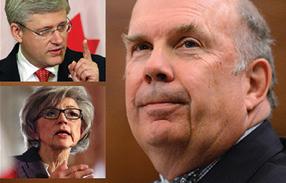
CBA expresses concern about disagreement between the Prime Minister’s Office and the Chief Justice and calls for clarification.
Photo credits: Harper – rcinet.ca; McLachlin – Fred Chartrand/The Canadian Press; Nadon – Sean Kilpatrick/The Canadian Press
THE EFFECT OF TECHNOLOGY ON THE FUTURE PRACTICE OF LAW HAS ONLY JUST BEGUN.
Maybe you’re light years away from using Google Glass, but there’s still plenty of less-intimidating technology available to power your practice. Discover who is creating new and easy-to use systems in the April-May edition of National magazine.
Find out more
For more info CBA
The CBA Urges the Government to Amend Bill C-24 to Ensure Fairer
and More Efficient Legislation
The Canadian Bar Association (CBA) says that changes are needed to Bill C-24, Strengthening Canadian Citizenship Act, and offers 20 recommendations that would improve key areas of the legislation.
The CBA welcomes the clarification of residency requirements and provision of citizenship retroactively to more “lost Canadians,” but raises concerns about other aspects of the Bill, including substantial increases to the government’s powers to revoke citizenship and requirements for applicants to demonstrate an intention to reside in Canada.
“The changes we are proposing would lead to a system that is fairer, easier to administer and one that more efficiently uses public resources,” says Barbara Jackman, member of the CBA’s
CLCAd6_875x8989.ai 1 5/9/2014 10:32:45 AM
Come learn, network and gain perspective about the legal landscape at the CBA Legal Conference – Converging Futures in St. John’s, Newfoundland and Labrador, August 15-17. This year’s conference offers unique and purposeful networking events, like:
Opening Night Reception: Start the conversation, and
National Immigration Law Section. “The CBA’s recommendations would provide the necessary safeguards to maintain the integrity of the Canadian citizenship process.”
The CBA’s 30-page submission urges the government to be more flexible in its requirement for physical residency in Canada. It notes that the requirements may act as a deterrent to some of our best and brightest immigrants representing Canadian businesses abroad, immigrants who may, in fact, be some of Canadian businesses’ best representatives due to their skills and connections to their countries of origin.
To read more, the CBA submission is available online
network at this tailgate-style event;
At-Home Dinners: Connect with like-minded professionals at a local colleague’s home for a meal and Newfoundland hospitality at its best;
CLC Kitchen Party: Enjoy headline entertainment at an East Coast Kitchen Party featuring the music of Newfoundland’s
own Alan Doyle of Great Big Sea; Lunches and receptions: Discuss national perspectives on relevant issues with people in similar practice or interest areas.
Illustration by Ryccio / iStockphoto
news&events
UPCOMING EVENT
TIPS FROM
DID YOU KNOW THAT YOU CAN GET AUTOMATIC CASE NOTE UPS IN YOUR OUTLOOK INBOX?
In a previous issue of Tips, we mentioned that RSS feeds are a great use of the power of CanLII. In this tip, we will look at one method of subscribing to RSS through your existing Outlook inbox. As this issue is all about the Family Law Act, we’ll look at how to find new cases on mobility coming out of the FLA. This same technique could be used for a wide variety of areas of law.
VBA & CBABC 18TH ANNUAL GOLF TOURNAMENT
The 18th annual Vancouver Bar Association/B.C. Branch of the Canadian Bar Association Golf Tournament is on Wednesday, July 16 at the University Golf Club. Check in at 11:30 am and tee off at 1:00 pm. Participate in this fun-filled day of golf and prizes, and support B.C. law student scholarships.
Registration Form
CLEBC FAMILY LAW RESOURCES
Family law poses unique challenges. From simple matters to the most complex cases, CLEBC has the information you need to provide the best service to your family law clients:
BC Family Practice Manual: CLEBC’s trusted practice-oriented manual gives you solid advice on all aspects of family law, from running your practice and managing relationships
START IN CANLII: In this case, we will select BC and then search “Family Law Act” AND (mobility OR relocat!) – this is clearly just one way of many you could structure this search so by all means, use your favourite. Once you press enter, CanLII will give you the option of adding the SCC cases that also match, which we recommend. On the toolbar across the top, press the RSS symbol – it looks like radio waves and should appear third from the right. Once you have clicked this button, copy the URL that appears in the box in the middle.
OPEN OUTLOOK: 1. Click the File tab; 2. Click Account Settings, and then click on the option of Account Settings; 3. On the RSS Feeds tab, click New; 4. In the box that comes up, paste the URL you just copied; and 5. Click Add and then OK.
Voila! You will have a new file folder titled “RSS Feeds” in your regular list of folders. Now every time a new case is entered in CanLII matching your search, it will show up here. For more details about using RSS feeds, you will find course materials from our course “RSS for Lawyers” in the Lawyers’ Reading Room at www.courthouselibrary.ca
with clients to screening for family violence, entering orders, and conducting appeals.
Family Law Sourcebook: Your starting point for B.C. family law research. Each chapter contains concise statements of the legal principles and identifies the leading cases.
Family Law Agreements –
Annotated Precedents: B.C.’s premiere collection of family law agreement clauses. This trusted resource is the package of tools you need to draft effective agreements for your family law client.
Family Law Deskbook: Designed for family law support staff of all
levels of experience, the Deskbook is an essential resource for managing the full range of family law topics.
Desk Order Divorce: Guides you step-by-step in assembling a successful desk order divorce package. Key documents that must be submitted with your application are annotated with sample provisions and practice tips. For more information, visit the CLEBC website at cle.bc.ca
BRANCH & BAR
B.C. LEGISLATIVE UPDATE
ACTS
IN FORCE
Current from March 5, 2014 to April 29, 2014
Legislative Update is provided as part of the CBABC legislative and law reform program. It is a service funded by CBA membership fees, and is, therefore, provided as a benefit of CBA membership. The full version of Legislative Update is now only published online and available to CBA members exclusively at cbabc.org
PROVINCIAL CAPITAL COMMISSION DISSOLUTION ACT, S.B.C. 2014, C. 1 (BILL 6) Act is in force March 25, 2014
SENIORS ADVOCATE ACT, S.B.C. 2013, C. 15 (BILL 10) Act is in force March 19, 2014
WILLS, ESTATES AND SUCCESSION ACT, S.B.C. 2009, C. 13 (BILL 4)
Section 268 is in force April 1, 2014
EVENT RECAP
2014 Thompson Rivers University (TRU) Law Student Award and Mentoring Reception
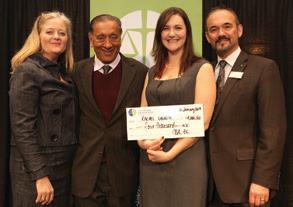
Photo L-R: Anne Pappas, TRU Faculty of Law Interim Dean; The Honourable Wally Oppal; Rachel Lagroix, from TRU, is awarded the CBA Entrance Scholarship; and Michael Welsh, CBABC Executive Committee Officer.
JUNE
4 CBABC PD Seminar: IP Law for the Non-IP Lawyer Victoria
4 CBABC PD Seminar: Identifying, Managing and Advocating for your Mentally Disordered Client Webinar
6 Stand Up for Scholarships – Comedy With a Cause Vancouver
10 CBABC Labour Law Section Annual Dinner: The Future of Labour Laws in Canada – Is a Race to the Bottom Inevitable? Vancouver
11 CBABC PD Seminar: Summary Proceedings and the SCC’s Decision in Hryniak Vancouver
13 Vancouver 13th Annual Battle of the Bar Bands Vancouver
20 The Lawyers Assistance Program 14th Annual “Gratitude Lunch” Vancouver
21 Provincial Council Meeting Vancouver
J ULY
1 Canada Day
16 VBA and CBABC 18th Annual Golf Tournament Vancouver
CBABC WLF NEWS
For information about upcoming CBABC Women Lawyers Forum programs and events
Providing assistance to lawyers and articled students who have suffered an illness or injury.
For more information
SERVICE
Lawyer Referral Service (LRS)
Be a part of the Lawyer Referral Service and gain access to a number of potential clients. The CBABC promotes this public service to residents throughout the province resulting in more than 35,000 referrals a year. The Lawyer Referral Service is open to all practising lawyers in the province. Call 604687-3221 (within the Lower Mainland) or 1-800-663-1919 (outside the Lower Mainland) or email lawyerreferral@cbabc.org.
news&events
The 5th National Pro Bono Conference will be held in Regina Saskatchewan, September 24-26, 2014, hosted in partnership by Pro Bono Law Saskatchewan, Access Pro Bono of British Columbia, Pro Bono Law Ontario, Pro Bono Law Alberta and Pro Bono Quebec.
This year’s Conference will bring together legal practitioners, the judiciary, the voluntary sector and academia from Canada, the United States and abroad to share ideas and best practices in pro bono legal services, to forge new pro bono partnerships, and to explore challenging issues that still lie ahead in the pro bono sphere.
Notable events include an opening reception sponsored by CBA Saskatchewan, a keynote address by The Honourable Justice Cromwell of the Supreme Court of Canada at lunch on the 25th sponsored by Dentons Canada LLP and an Awards Banquet the evening of the 25th featuring keynote speaker James Lockyer. probonoconference.ca
LAW WEEK 2014
BARRY SULLIVAN LAW CUP
Winners from left to right: Alex Payandeh, Vancouver College; Ciara O’Leary, Little Flower Academy; and Jamal Dumas, Burnaby Mountain Secondary School.
“MEET THE CHIEFS” STUDENT FORUM
Moving Forward
REMINDER
The August 2014 issue of BarTalk will be our next digital-only issue. Check cbabc.org on August 1 for the new issue.
New features to BarTalk Online
25 years of back issues are now available at cbabc.org
Plus tons of added content exclusively online – check out New Members, Bar Moves and Kudos
We welcome new authors, contributors and content suggestions – simply send your request to bartalk@cbabc.org.
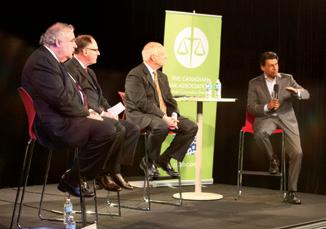
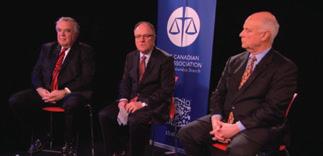
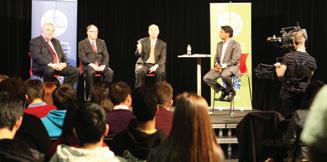
L-R: British Columbia’s three top chief judges: Chief Justice Christopher Hinkson of the Supreme Court; Chief Justice Robert Bauman of the Court of Appeal; Chief Judge Thomas Crabtree of the Provincial Court; and hosted by Ian Hanomansing, which was taped in CBC’s Studio 700.
Outlined below is a list of grants adjudicated at the April 5, 2014 Board of Governors’ meeting.
Funding totalling $4,990,000 was approved for the following 30 continuing programs:
$450,000
B.C. PUBLIC INTEREST ADVOCACY CENTRE
Social and Regulatory Justice Programs
$425,000
WEST COAST ENVIRONMENTAL LAW ASSOCIATION Programs and Environmental Dispute Resolution Fund
$430,000
ACCESS PRO BONO SOCIETY OF B.C. Major Programs
COMMUNITY LEGAL ASSISTANCE SOCIETY
$390,000 Poverty Law Services
$350,000 Community Law Program
$130,000 Community Advocate Support Line (CASL)
$340,000
UNIVERSITY OF VICTORIA Law Centre Clinical Program
$280,000
B.C. LAW INSTITUTE Program Grant
$240,000
PEOPLE’S LAW SCHOOL SOCIETY Major Programs
$225,000
TENANT RESOURCE AND ADVISORY CENTRE SOCIETY Tenants’ Legal Advocacy Program
$175,000
WEST COAST LEAF ASSOCIATION Litigation and Law Reform Program
$160,000
MEDIATE BC SOCIETY Major Program
JUSTICE EDUCATION SOCIETY OF B.C.
$125,000 Major Programs
$65,000 Northern Native Public Legal Education Program for Aboriginal Communities
$125,000
Legal Advocacy Program
$100,000
LAW FOUNDATION OF BRITISH
LAW FOUNDATION OF BRITISH COLUMBIA
WEST COAST DOMESTIC WORKERS’ ASSOCIATION
B.C. CENTRE FOR ELDER ADVOCACY AND SUPPORT Legal Advocacy Program
$90,000
POVNET SOCIETY PovNet Program
$75,000
ATIRA WOMEN’S RESOURCE SOCIETY Legal Advocacy Program
$75,000
BATTERED WOMEN’S SUPPORT SERVICES
Legal Advocacy Program
$75,000
DZE L K’ANT FRIENDSHIP CENTRE SOCIETY
Legal Advocacy Program
$75,000
MAPLE RIDGE/PITT MEADOWS COMMUNITY SERVICES
Poverty Law Advocacy Program
$75,000
NORTH SHORE COMMUNITY
RESOURCES SOCIETY North Shore Legal Advocacy Program
$75,000
QUESNEL TILLICUM SOCIETY Legal Advocacy Program
$75,000
SHARE FAMILY AND COMMUNITY SERVICES
Poverty Law Advocacy Program
SOURCES COMMUNITY RESOURCES SOCIETY
$75,000 Poverty Law Advocacy Program
$75,000 Legal Information and Advocacy Program
$75,000
TERRACE AND DISTRICT COMMUNITY SERVICES SOCIETY
Poverty Law Advocate Program
$60,000
UPPER SKEENA COUNSELLING & LEGAL ASSISTANCE SOCIETY Advocacy Program
$20,000
UNIVERSITY OF SASKATCHEWAN Native Law Centre
$60,000
LAW FOUNDATION GRADUATE FELLOWSHIPS
Jonathan Minnes
Kathryn Thomson
Miriam Polman
Richard Veerapen
Funding totalling $575,000 was approved for the following seven grants:
$200,000
B.C. CENTRE FOR ELDER ADVOCACY AND SUPPORT Elder Law Clinic
$75,000
VANCOUVER ISLAND NORTH WOMEN’S RESOURCE SOCIETY Advocacy Services Centre Program
$75,000
VERNON WOMEN’S TRANSITION HOUSE SOCIETY
North Okanagan Legal Advocacy Program
$75,000
WATARI RESEARCH ASSOCIATION Systems Negotiator Program
$60,000
COMMUNITY LEGAL ASSISTANCE SOCIETY
David Mossop, QC Public Interest Articling Fellowship
$50,000
UNIVERSITY OF BRITISH COLUMBIA Innocence Project
$40,000
WACHIAY FRIENDSHIP CENTRE Wachiay Advocacy Outreach Program
Transition funding totalling $77,500 was approved for the following eight organizations:
COMMUNITY LEGAL ASSISTANCE SOCIETY
WEST COAST ENVIRONMENTAL LAW ASSOCIATION
TENANT RESOURCE AND ADVISORY CENTRE SOCIETY
WEST COAST DOMESTIC WORKERS’ ASSOCIATION
B.C. CENTRE FOR ELDER ADVOCACY AND SUPPORT
B.C. PUBLIC INTEREST ADVOCACY CENTRE
MEDIATE BC SOCIETY POVNET SOCIETY
\ For details of all programs and projects that received funding, please visit lawfoundationbc.org.
professionaldevelopment
EMAIL: PD@CBABC.ORG
\ WEBSITE: CBAPD.ORG
CBABC Professional Development courses are designed to meet the needs of lawyers while still maintaining the opportunity to network and advance one’s career, practice and business. We pride ourselves in bringing courses to lawyers that will provide the required professional responsibility and ethics, client care and relations, and practice management component for 2014 Law Society of British Columbia reporting.
Webinar Repeats
Did you miss any of our recent live Webinars?
Buying or Selling A Solo/Small Firm Law Practice: Is that the Right Fit for You?
An Anatomy of the Civil Forfeiture File: From Opening to Closing
Civility in the Courtroom: Essentials for Trial Lawyers
Decoding Medical Records for Effective Trial and File Management
Managing the Process of the Hear the Child Report in Family Law
Walking that Fine Thin Line: Roadside Drug and Alcohol Testing in B.C.
Upcoming In-person Seminars
Identifying, Managing and Advocating for your Mentally Disordered Client
Date: June 4, 2014
Moderator: Stuart Rennie, Legislation and Law Reform Officer, CBABC Speakers: Lindsay Waddell, Community Legal Assistance Society, Vancouver; Dr. Brenda McCreight, Ph.D., RSW, RCC
IN PARTNERSHIP WITH THE LABOUR LAW SECTION
CBABC Labour Law Section Annual Dinner
The Future of Labour Laws in Canada: Is a Race to the Bottom Inevitable?
Date: June 10, 2014
Location: Four Seasons Hotel
Vancouver, 791 West Georgia Street, Vancouver
Speaker: Kevin Banks, Faculty of Law, Queen’s University
IN PARTNERSHIP WITH THE DEPARTMENT OF JUSTICE
Summary Proceedings and the SCC’s Decision in Hryniak
Date: June 11, 2014
Location: The Law Courts Inn, 4th Floor, 800 Smithe Street, Vancouver
Speakers: The Honourable Mr. Justice Bruce I. Cohen, Supreme Court of British Columbia; Gavin C. Crickmore, Hungerford Tomyn Lawrenson and Nichols; Jan Brongers, Department of Justice; Lorne Lachance, Department of Justice; Donnaree Nygard, Department of Justice
\ For a complete list of registration details and requirements, please contact the Professional Development Department 604-646-7866 or 1-888-687-3404 ext. 329 or email pd@cbabc.org.
Mark Your Calendar!
CBABC Ninth Annual Branch CONFERENCE November 14-16, 2014
LOCATION: The Westin Kierland Resort
Enjoy the Essence of Arizona
This year’s conference is taking place in beautiful Scottsdale, Arizona. Complete all 12 of your 2014 CPD credits, including the two hours required ethics, professional responsibility and practice management component.
KEYNOTE SPEAKER:
We are honoured to announce that the keynote speaker for this year’s Conference is former United States Supreme Court Justice Sandra Day O’Connor.
This inspiring retreat, located in the heart of “new” Scottsdale, will fill you with a sense of old Arizona and delight you with a fresh, modern destination.
SCOTTSDALE 2014
For more information
barmoves
Who’s Moving Where and When
Kate Jenkins joined Bilkey Law Corp., an insurance law boutique in Kamloops. Kate’s practice is focused on the interests of insurers and their insureds.
Ambrose Ng joined Bilkey Law Corp. in Kamloops. Ambrose’s practice focuses exclusively on insurance law.
Amy Carruthers a corporate commercial solicitor with extensive expertise in the energy industry, has joined Fasken Martineau DuMoulin LLP’s Global Energy group as counsel.
Dominic Therrien has joined Miller Thomson LLP’s Vancouver office. Dominic practises immigration law, focusing quasiexclusively on Canada’s “high-end” business immigration programs.
Eva Schmieg has joined Miller Thomson LLP’s Vancouver office. Eva’s practice is focused on entertainment, sports and media, and corporate and commercial law.
Kelly Samuels has joined the partnership of Edwards, Kenny & Bray LLP. She has a general corporate and commercial law practice, with emphasis on mining and securities law.
SPACE IS AT A PREMIUM AND AVAILABLE ON A FIRST-COME FIRST-SERVED BASIS SO SEND YOUR BAR MOVE (MAX. 30 WORDS) AND A HIGH-RESOLUTION PHOTO TO CBA@CBABC.ORG NOW. TO VIEW ALL BAR MOVES GO TO CBABC.ORG/BT/BM_1406
Angela L. Folino
has joined the partnership of Edwards, Kenny & Bray LLP. She has a general commercial litigation practice, and has experience in a wide range of areas.
March & April 2014
Associate
Janine Dethlefs Iridia Medical Inc. Vancouver
Regular Members
Alisa C. Bell Mackoff & Company
Henry Ka Faley Law Corporation
Richmond
Jacob E. Lord Singleton Urquhart LLP
Vancouver
Russell Sheppard Rockies Law Corporation Cranbrook
Aadam Tejpar
Elizabeth Dylke
joins McCullough O’Connor Irwin LLP as an associate after practising in New York and in-house for several years. She practises corporate and securities law, including private equity.
Alexis Marach
joins McCullough O’Connor Irwin LLP as an associate. Ms. Marach comes to us from the Vancouver office of a national firm and practises corporate and securities law with a focus on mining law.
Michelle Adams has joined Harper Grey LLP as an associate with the Family Law group. Called to the Bar in 2009, she focuses her practice on family law.
Jeremy Costin has joined Synergy Business Lawyers. His practice focuses on wills and estates, information technology and business law.
Vancouver
Philip Cote Phil Cote Barrister & Solicitor Surrey
Katie L. Diehl Robert E.C. Apps Personal Law Corporation Kimberley
Jean-Michel Fréchette Knight Litigation Vancouver
Arielle Lavender Gibsons
Casey S. Levental Anfield Sujir Kennedy & Durno LLP
Vancouver
Annie D. Zhang RWE Law Corporation Vancouver
Articling Students
Jaspal S. Bal Surrey
Irene Bihari Vancouver
Joel Diakow Darnell & Company Law Office Langley
Rupinder Gosal
Vancouver
Sangra Moller LLP
Vancouver
Eric Vandergriendt McQuarrie Hunter LLP
Surrey
Vanessa R. Wilson Bradford & Green
Surrey
Michelle F. Yung
Farris, Vaughan, Wills & Murphy LLP
Vancouver Law
Students
Prabhdeep S. Bal
Jeremy Bryant
Vin Chahal
Sonia Chauhan
Michael Cheon
Braden S. M. Greaves
Stefan Kruse
Alexia Majidi
Janice Park
Ravi Patel
Bettina L. Schendel
Sara Scott
Priya Singh
Andrew B. Stanger
Roger Tangry
Edward Wong
Institute a new company dress code.
Feel confident and prepared to conquer any professional challenge with the 2014 M-Class.