This publication is intended for information purposes only and the information herein should not be applied to specific fact circumstances without the advice of counsel.
The British Columbia Branch of the Canadian Bar Association represents more than 6,900 B.C. members and is dedicated to improving and promoting access to justice, reviewing legislation, initiating law reform measures and advancing and improving the administration of justice.
BarTalk Publication Sales Agreement #40741008
news&events
LETTER TO THE EDITOR
Tony Wilson
I’ve been reading BarTalk for many years. The first page I inevitably turn to when I receive this publication is Tony’s article, which always makes my day. Tony’s topics are current and interesting and he handles them with great insight and wit. His humour never fails to add joy to an otherwise uninteresting workday.
I appreciate the obvious thought and effort Tony puts into his work and your good sense to publish him.
— Lindsay Goldberg
Battle of the Bar Bands
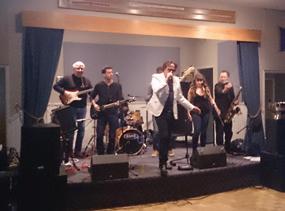
Nanaimo’s 6th Annual Battle of the Bar Bands, which took place on February 8, 2014, was a huge success! Hosted at the Nanaimo Yacht Club, the event raised approximately $2,000 for the CBA(BC) Benevolent Society. First time master of ceremonies, Ian McFadgen, kept the crowd entertained with his quick wit and comedic banter. Honourable mention goes to Standard of Hair, Blind Elmo, and Carpe Groovum, while House Arrest (above photo) took the first place honour. A big thanks goes out to the Nanaimo County Bar Planning Committee for this successful fundraising event.
SAVE THE DATE
for Vancouver’s Battle of the Bar Bands
Date: June 13, 2014 Time: Doors open at 7:00 p.m.
Location: Commodore Ballroom
B.C. LEGISLATIVE UPDATE
ACTS IN FORCE
Current from December 25, 2013 to March 4, 2014
Legislative Update is provided as part of the CBABC legislative and law reform program. It is a service funded by CBA membership fees, and is, therefore, provided as a benefit of CBA membership. The full version of Legislative Update is now only published online and available to CBA members exclusively at cbabc.org
ADULT GUARDIANSHIP AND PLANNING STATUTES
AMENDMENT ACT, 2007, S.B.C. 2007, C. 34 Provisions set out in Schedule in force December 1, 2014
Send your Letters to the Editor to: Deborah Carfrae BarTalk Editor
The B.C. Branch of the Canadian Bar Association
Fax: 604-669-9601
Toll-free fax: 1-877-669-9601
Email: bartalk@cbabc.org
Note: BarTalk undertakes every effort to publish letters to the editor, subject to space and editorial discretion. Letters to the editor can also be found in BarTalk Online at cbabc.org
Inside This Issue
This is a life and death issue for BarTalk. With the introduction of WESA last month, we explore its ramifications on survivorship presumptions, new rules regarding spouses in a Will or on intestacy and the expansion of a court’s ability to cure formal testamentary faults. We also get an update from the Justice Education Society of B.C. in time for Law Week and learn about anti-spam laws and inappropriate undertakings.
News and Events
2 Letter to the Editor re: Tony Wilson Battle of the Bar Bands – Nanaimo and Vancouver Legislative Update
18 CBA Panel on End-of-Life Decisions
Inter-Pacific Bar Association 24th Annual Meeting & Conference – May 8-11, 2014 Legal Aid by the Numbers
19 Cariboo Bar Association 2014 Mid-Winter Conference a Success Older Women’s Dialogue Project CBA Legal Conference – August 15-17, 2014
20 CBABC WLF – Lunching with Women Leaders Series Make-a-Will Week CLEBC Update
21 SoloLink – New Initiative Branch & Bar Calendar
22 CBABC Ninth Annual Branch Conference November 14-16, 2014 Clint Sadlemyer, QC – View From the the North
Also In This Issue
FROM THE PRESIDENT
DEAN CRAWFORD
Membership Has Its Privileges Section
activities fulfil PD obligations at considerable savings
Quick. How much money did you or your firm/employer spend last year for you to obtain all 12 of your professional development (PD) credits? $500?
$1,500? $3,000?
We are now five years into mandatory PD in British Columbia. To be sure, there are many good reasons for ensuring lawyers in our province are attending to their professional development. Our clients expect us to remain current in the areas of law in which we practise and to practise to the highest ethical standards. And getting together to improve our skills and knowledge, away from the stresses and adversity that sometimes characterizes our relationships when we are on the opposite sides of a file, is also beneficial.
But obtaining your mandatory hours can come at a considerable cost. If you are like most of those who recently responded to a survey from the CBABC, you spent at least $1,000 to $1,500 last year obtaining your professional development credits. That does not include additional costs if you travelled out of your community to attend a course. Add up the cost of flights and hotels and the amount could easily have hit $3,000.
$1,500, $3,000 – that’s a lot of money. But as a member of the CBABC, you can fulfill all of your PD credits for much less than that.
Why? Because all meetings of our Sections in B.C. are accredited for professional development by the Law Society. All regular memberships in B.C. – priced at about $650 – include membership in one Section and additional Sections cost $50 each, so for about $750 you can be a member of three Sections, attend 12 meetings over the course of the year and obtain all of your PD credits.
CBABC organizes excellent sessions throughout the year.
Two such events are worth mentioning. In early May, members of our three Wills and Trusts Sections from the Okanagan, Vancouver and Victoria will gather at the Sparkling Hills Resort in Vernon for a weekend of professional development and winery tours. (I find myself wishing I’d taken up this area of practice!)
Most Section meetings are presented by your fellow practitioners, who take pride in being asked to present before their peers. My experience, over nearly 20 years of attending Sections meetings, is that the quality of the sessions is very high.
More than half of our Section meetings are now broadcast by webinar.
Did you know that more than half of our Section meetings are now broadcast by webinar? That’s right, no matter where you are in the province, with a high-speed Internet connection you can take in Section meetings from the comfort of your desk.
Of course, lawyers like to get out of their offices or boardrooms. For those who prefer to obtain their professional development in a more relaxed setting, the
In November, our Annual Branch Conference will take place in Scottsdale, Arizona. If you prefer to obtain all of your 12 credits at once and would like to get away for some sun in November, this three-day event is for you. Our special guest speaker this year is former U.S. Supreme Court Justice Sandra Day O’Connor.
In the weeks and months to come, the CBABC Executive Committee and its staff will be focusing on how we can improve our PD offerings to members. With our Sections being the focal point of many practice areas in the province, we are uniquely positioned to offer considerable value for membership. Look for more to come on this subject in the near future.
Dean Crawford president@cbabc.org Twitter: @deancrawfordvan
EXECUTIVE DIRECTOR
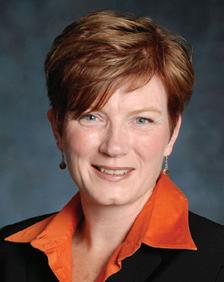
CAROLINE NEVIN
Be Your Own Future’s Guardian
Now is the time to plan
Life is full of milestones: the birth of a child, commitment to a life partner, purchase of a home, retirement and, finally, preparation for death. Through every stage of life, a wise person considers the valuable advice, expertise and risk management perspective of a lawyer. Why, then, do so many intelligent lawyers not apply those same skills to the task of looking after the lifecycle of their own career?
A new child in your arms elicits feelings of awe, excitement, trepidation and serious thought about your role as guardian. In the same way, being handed a license to practise law is the start of a lifelong responsibility to yourself and to the profession you chose. Luckily, you have access to lots of help along the way.
(Note: Marketers tell us it takes multiple exposures for a message to “cut through” the clutter and influence behaviour.
So, if what I’m about to tell you sounds familiar, it’s because you really HAVE heard it before. I challenge you not to tune out, but to actually think about what you personally can do to become a better guardian of your own future.)
Your first priority has to be financial planning. Lawyers are, for the most part, self-reliant when it comes to managing and saving money. Only a small proportion of lawyers have had the opportunity to earn pensions, and most of those are likely to have done so for only a portion of their working life. The majority of lawyers are self-employed, in small firms, or in non-equity positions within larger corporate structures. That makes most of you the only person responsible for thinking about – and planning for – your own future without employment income.
It’s important to engage a professional in managing your financial health in the same way that you look to other professionals to
help with your physical and mental wellbeing. Your banker is one resource, but as a lawyer you also have access to special financial and insurance services set up by lawyers for lawyers. CBA Financial Services (CBAF) and CBA Insurance Association (CBIA) have negotiated buying discounts with major institutions on your behalf, on business, home and life insurance, as well as investment and savings tools such as RESPs, TFSAs, and group RRSPs. Last year alone, CBIA paid out $8.8 million in premium refunds. Contact B.C. rep David Hodgson at d.hodgson@barinsurance.com to start the process of assessing your financial risks, aspirations and realistic options for delivering the financial security and future income you and your family need.
Your second priority should be succession planning, also known as crisis and/or end-of-career planning. Not to put too fine a
point on it, but nothing about life is guaranteed except death. The Law Society (LSBC) is well aware of that fact, and has made it your personal responsibility to protect your clients against anything that might disrupt their access to legal services. LSBC has some excellent resources available online, and great on-staff advisors who can talk to you about preparing for the possibility of crises and ensuring a smooth transition to retirement. CBA’s PracticeLink bank of articles offers some good tips too. Two good websites to start with: lawsociety. bc.ca and cba.org/practicelink –search “succession planning” to find out more. You might also be interested in real-life practitioners’ advice on buying or selling a practice, a CBABC May 7th PD program (email pd@cbabc.org for more info).
Whether you’re fresh out of law school, mid-career or looking forward to retirement after years of life in the law, it’s always a good time to turn your keen, risk-assessing eye to your own life, in the same way you do for clients.
Caroline Nevin cnevin@cbabc.org
practicetalk
DAVID J. BILINSKY
What Makes Lawyers Happy?
Perhaps we need to look inward…
r The landlord say your rent is late He may have to litigate Don’t worry, be happy.… r – Music, Lyrics and recorded by: Bobby McFerrin.
“Life, Liberty and the Pursuit of Happiness” is a phrase drafted by a certain lawyer by the name of Thomas Jefferson and is understood to be one of the “unalienable rights” to which all humans have been given (and if I may say so, it is much more distinctive than “Peace, Order and Good Government” which is the Canadian equivalent, but I digress…). The pursuit of happiness is a phrase with which lawyers the world over can identify. What makes lawyers happy is a question on which you
would think there would be some consensus. Money, status, fame – these you expect to be rated as fairly high up on the scale.
Up until now, the question was only subject to debate; that is until Lawrence S. Krieger at the Florida State University College of Law and Kennon M. Sheldon, University of Missouri at Columbia – Department of Psychological Sciences published their recent research paper: “What Makes Lawyers Happy? Transcending the Anacdotes with Data from 6200 Lawyers” (bit.ly/1hhoMCD).
The results may surprise you.
“Factors typically afforded most attention and concern, those relating to prestige and money (income, law school debt, class rank, law review, and USNWR law school ranking) showed zero to small correlations with lawyer well-being.”
Apparently achieving status and money does not correlate with happiness. So what else did the study find?
“Conversely, factors marginalized in law school and seen in previous
happier than those in the most prestigious positions and with the highest grades and incomes.”
What were the predictors of happiness?
research to erode in law students (psychological needs and motivation) were the very strongest predictors of lawyer happiness and satisfaction.”
The authors based their study on “a hierarchy of five tiers of factors for lawyer well-being, including choices in law school, legal career, and personal life, and psychological needs and motivations established by Self-Determination Theory (SDT).”
SDT evolved from examining intrinsic and extrinsic motivational factors on human behaviour.
“Intrinsic motivation refers to initiating an activity for its own sake because it is interesting and satisfying in itself, as opposed to doing an activity to obtain an external goal (extrinsic motivation).” (Wikipedia)
Who were the happiest lawyers?
“The group with the lowest incomes and grades in law school, public service lawyers, had stronger autonomy and purpose and were
“The most powerful predictors of well-being in these data, autonomy (r=.66), relatedness to others (.65), competence (.63), and internal motivation for work (.55) are also sources of professional behaviour and positive performance in lawyers; such lawyers are also likely to produce more, remain longer, and raise the morale of others.” Not surprisingly, the authors reported that their findings have important ramifications for lawyer ethics and professionalism.
Who were the happiest in the legal community?
“The judges reported the greatest well-being on all measures – net affect, life satisfaction, and subjective WB (worklife balance).”
The rock-bottom conclusions of the research?
The views expressed herein are strictly those of David Bilinsky and do not reflect the opinions of the Law Society of British Columbia, CBABC, or their respective members. Continued on page 7 >>>
David J. Bilinsky is the Practice Management Advisor for the Law Society of British Columbia. Email: daveb@lsbc.org Blog: thoughtfullaw.com
dave’s techtips
No matter what career or stage in life we are in, there are steps that we can take to improve our happiness
Accordingly, here is a list of websites that can help you in your quest for happiness:
WikiHow: How to be Happy wikihow.com/Be-Happy
This article lists 12 things that you can do now to increase your level of happiness. Not surprisingly, being optimistic ranks as #1. Other suggestions are “Follow your Gut” and “Own Yourself” (this one really was interesting since it focused on accepting yourself as you are and recognizing that there are people who like you for who you are now. It is all about building a deeper relationship with yourself.) Other suggestions are “Treat your body like it deserves to be happy” and “Be Compassionate.” The easiest suggestion is to just smile.
Huffpost Healthy Living has an article by Jacob Sokol on “12 Things Happy People Do Differently – And Why I Started Doing Them” huff.to/1liRVT7
This article is based on the studies conducted by positivity psychologist Sonja Lyubomirsky. A sampling of the 12 things happy people do differently are: “Express gratitude – When you appreciate what you have, what you have appreciates in value.” Another is “Learn to forgive.” I liked “Commit to your goals” where the author says: “Magical things start happening when we commit ourselves to doing whatever it takes to get somewhere.”
Here, “Avoiding deep and meaningful connections,” is #1 backed up by evidence that the people of Okinawa, Japan have incredible longevity despite being one of the poorest prefectures in the country. Their secret? They have strong family ties. Another way to stop being happy? “Ignoring your creative abilities.”
Another great article is “The 20 Things You Need To Let Go To Be Happy” by Ashley Fern elitedai.ly/1cT6822
A different approach was taken in the article “10 Things To Stop Doing Today to Be Happier, Backed by Science” by James Clear bit.ly/18ivNU9
The #1 thing to let go? “The approval of others.” Stop letting other people’s opinions dictate the way you should live. Other things to let go? “Anger and resentment” or as they say, “Life becomes easier when you learn to accept an apology you never got.” I think a very powerful message is in the phrase “Stop letting money be your sole motivator; find a career you are passionate about and immerse yourself in it completely.” Another powerful message: “Stop bitching and start doing.” I really liked the suggestion of stopping being so stubborn. “Think of all you could be exposed to if you stopped believing in opinions other than your own.”
“These data consistently indicate that a happy life as a lawyer is much less about grades, affluence, and prestige than about
finding work that is interesting, engaging, personally meaningful, and focused on providing needed help to others.”
Apparently, we are happiest when we as lawyers provide meaningful service to others.
nothingofficial
TONY WILSON
The Sump of All Fears
Does the law protect artificially intelligent appliances?
About a year ago, my wife and I went to a legal conference in the U.S., only to come home to a flooded basement. We have three sumps, three sump pumps, and another three backup sump pumps (a good start to a bad Dr. Seuss book, I suppose). All the sumps are alarmed, so they buzz annoyingly if a sump pump fails and water rises above a set level. But all that buzzing won’t help if no one’s home.
That’s why I installed three artificially intelligent sump pumps, which are wired into the phone lines. Not only will these smart pumps phone me on my cell so I can phone my handy neighbour to scope out the problem, each of the sumps will phone my plumber if I program them to.
Artificial intelligence, or AI, will profoundly change our
lives in the next 25 years. But will it also mean our smart coffeemakers, toasters (and indeed sump pumps) will have legal rights and need a CBA Subsection for AI lawyers?
I ask because I’m having some legal and ethical issues with my intelligent sump pumps. You see, I need three separate units for my three sumps and each intelligent sump pump has been programmed with its own distinctive telephone voice and personality. Sump #1 is in our garage, and he has the voice and the demeanour of a HAL 9000 computer that won’t open up the pod bay doors after he’s killed everyone on the ship and wants to kill me next. I call him HAL, because I’m totally unoriginal. “Call the neighbour,” I say to HAL when he phones me about rising water. “I’m afraid I can’t do that,” he says, in a dispassionately articulate, but menacing voice. Then he says: “This conversation can serve no purpose anymore. Goodbye,” and hangs up on me. I asked the manufacturer for help in reprogramming HAL so that he’s
less sociopathic. When I uploaded the patch, HAL kept phoning me and saying things like: “Stop, will you? My mind is going. I can feel it.” When he started singing “Daisy,” I wondered if I had committed a criminal offence and whether I should report myself to the police.
Sump #2 is programmed to emulate Marvin the Paranoid Android from the Hitchhikers Guide to the Galaxy “trilogy.” Sump #2 often bragged about how much smarter he was than the other two sump pumps and that he was happy that I had lobotomized HAL to put him in his place. However, he’s still depressed by his career choices, given how smart he is. When he phones me, he says: “I’d rather drown myself in the sump than spend eternity being a hyperintelligent sump pump in your furnace room.” What are the legal ramifications of assisted suicide for an artificially intelligent sump pump that wants to kill itself?
Sump #3 had a different issue: me. With a voice like Liberace, he phoned incessantly to brag about his “pumps” and how well he was “pumping.” I’d swear he downloaded “Relax” by Frankie Goes to Hollywood on a dialup network just so he could play it in the background when he called me. In fact, he phoned me so often, I thought he was falling in love with me (not that there’s anything wrong with that). I had to confront him when he created his own Facebook page and listed his status as “In a Relationship”… with me! When he confessed his feelings, I told him I was flattered, but I politely said I wasn’t that kind of man. And besides, I’m married. Sadly, he didn’t seem to get the message. He accused me of being a snob and that I didn’t love him because he lived and worked in a sump (which he did). Then he claimed that I thought he was “just software” (which he was). So when I offered to introduce him to the toaster, he accused me of microagression, and demanded that I apologize and undergo sensitivity training like they do at McGill. Just before I disconnected him, (not caring at this point if the basement flooded), he said: “I’ll be back.”
Should I be worried?
guest
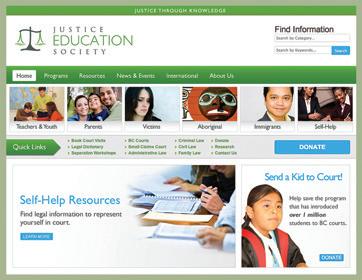
Improves Access to Justice Justice Education Society of B.C.
Once upon a time, a small organization stationed in the Robson Square courthouse started to introduce young people and community groups to our justice system through court visits. Established in 1989 as the Law Courts Education Society, the organization has grown substantially over the years and it is now called the Justice Education Society of B.C.
The Society has introduced over one million people to B.C. courts through its core program and it now reaches more than 400,000 people each year through a series of legal web resources.
The Society’s programs and resources serve the general public, teachers, youth, persons with disabilities, Aboriginal peoples and immigrants. These services help individuals better understand how our justice system works and how to address their legal matters.
YOUTH PROGRAMS AND RESOURCES
The Justice System Education Program (JSEP) provides school groups and community groups with an overview of the justice system, how it works, and who is involved. Experiential activities include court watching, court orientations, mock trials, and judge/lawyer sessions as well as career and personal planning.
The program promotes active citizenship and builds legal literacy skills.
It also develops and delivers continuing professional education seminars for teachers, annual Law Day activities and specialized programs for youth-at-risk and Aboriginal youth.
Several web resources complement these in-person sessions such as CourtsofBC.ca, GangPrevention.ca, LawProject.ca, YCJA.ca and LawLessons.ca
PARENT PROGRAMS AND RESOURCES
The Society provides programs and resources for separating parents, helping them to acquire legal information and to build skills that address both legal and interpersonal requirements of separation and divorce.
Working with the Ministry of Justice, the Society developed the Parenting After Separation (PAS) program. PAS workshops deal with family break-up issues of guardianship and/or support and PAS: Finances assists separated parents to deal with the financial issues of separation and divorce.
The Society delivers more than 85 of these three-hour, in-person workshops each year.
The Society developed Canada’s first online PAS course in 2010 and it is now developing the online PAS: Finances course. Find these on FamiliesChange.ca.
LEGAL HELP RESOURCES
The Society has become a recognized leader in using digital technologies to improve access to justice. The society developed these court websites: SmallClaimsBC.ca, ProvincialCourt.bc.ca, SupremeCourtBC.ca and CourtofAppealBC.ca. These sites provide information about the process of moving a case forward in the court, including helpful guidebooks, and access to rules, forms and legislation.
In addition, the Society has developed Canada’s first virtual assistant to help people address their Small Claims or Supreme Court matter. For civil cases, the Society provides three levels of triage. A virtual assistant helps website users to navigate to information on the website. Weekdays from 11:00 a.m. to 2:00 p.m., online chat is available for people to ask their questions and for complicated matters, a lawyer responds by phone or email.
The Society has just launched Online Dispute Resolution (ODR) on SmallClaimsBC.ca. Funded by CBA’s Law for the Future fund, the Society has developed a platform to help parties resolve issues before going to court. Pre-filing ODR is now live and it includes client intake, secure client messaging and agreement preparation, as well as basic case management.
Dave Nolette and Marylou Leung, Managers, Justice Education Society of B.C. JusticeEducation.ca
DAVE NOLETTE AND MARYLOU LEUNG
Keep Current A review of provincial Section meetings.
Wills & Trusts
Victoria
Meeting in Review: January 21, 2014
Speaker: Fiona Hunter, Horne Coupar
Topic: WESA Roundtable – Issues to Think About Now
Topic: The Use of Multiple Wills in Estate Planning
Solicitors General Practice
Central Vancouver Island
Meeting in Review: February 20, 2014
Speakers: Chuck Blanaru, Caroline Deane, Bill Younie, Mike Genge, Laura Berezan and Roderick Mont
Location: Tigh-Na-Mara Resort & Conference Centre, Parksville, B.C.
Wills & Trusts Victoria
uOn Tuesday, January 21, the Wills & Trusts – Victoria Section met to discuss WESA. Fiona Hunter of Horne Coupar led a roundtable discussion that focused on some of the issues left outstanding by the new Act. Issues on the agenda included the definition of “spouse” and the possibility of giving notice under the Family Law Act of your intention to terminate a relationship. Notice to a spouse was also discussed in relation to the issue of posthumous births and withdrawing consent to the use of stored reproductive material. Several practice tips and possible solutions were discussed in relation to initial interviews, reporting letters and testamentary records, the effect of section 47, and changes in survivorship. This sparked excellent discussion about the upcoming Act.
Charities and NotFor-Profit Law
uSandra L. Enticknap of Miller Thomson LLP discussed the definitions of charitable gifts by Will and by trust in a Will in her January presentation entitled “Charitable Gifts by Will.” Sandra pointed out during her discussion, there have been some unexpected and inequitable results. A CBA letter to the federal government in May 2012 proposed amendments to the Income Tax Act to make the rules and benefits of charitable giving by Will more “equitable, intuitive, accessible and rewarding.” In February, the 2014 Federal Budget introduced changes to the Income
Tax Act to address these issues. The proposals contemplate, in part, that where a gift is by Will, the executor/administrator will be able to allocate tax credits among the terminal and estate returns as they choose. Following the presentation, Sandra led a short discussion. This meeting was well-attended and Section members may access the minutes alongside the recording online.
Wills & Trusts Okanagan
uTheresa M. Arsenault, QC, of Pushor Mitchell LLP specializes in estate planning and trusts, First Nations transactions and land development, and business and real estate law. On January 15, Theresa spoke to the Wills & Trusts – Okanagan Section about multiple Wills. She discussed probate fee planning, the various uses of multiple Wills, technical requirements for effective multiple Wills, and other issues. Theresa’s presentation was well-received and a lively discussion ensued. The meeting was available by webinar
to remote participants. The recording can be found alongside the minutes online and is accessible to Section members.
Solicitors General Practice – Central Vancouver Island
uOn February 20, 2014, Solicitors General Practice – Central Vancouver Island Section partnered up with CBABC Professional Development to provide a riveting conference in Parksville, B.C. This five-hour conference was action packed with resourceful topics and experienced speakers. The agenda included six sessions on topics such as six valuable sessions, including topics such as foreclosure, solicitorclient privilege, guarantees, indemnities and independent legal advice. The conference sparked interesting dialogue among Solicitors in Central Vancouver Island and was positively reviewed.
Check out more joint PD and Section events online at cbapd.org
memberservices
CHATTER WITH CHAIRS
Christine Murray
WOMEN LAWYERS FORUM VANCOUVER ISLAND
On February 28, 2014, the Women Lawyers Forum – Vancouver Island held a dinner with three of our local women judges. We were lucky to hear Madam Justice Dorgan, Madam Justice Power and Madam Judge Wishart speak about their path to the Bench, effective advocacy and a day in the life of a judge. The event was well-attended with 30 lawyers from different practices. If you have any suggestions for future Women Lawyers Forum – Vancouver Island events, please contact Christine Murray at Christine@ casselsmurray.com
EMAIL: MEMBERS@CBABC.ORG
Visit cbabc.org for all activities and promotions. Check the CBABC News & Jobs weekly e-newsletter for seasonal promotions and special offers.
\ THE CANADIAN BAR INSURANCE ASSOCIATION (CBIA) is your one-stop shop for all your protection needs. You are invited to compare CBIA rates to other companies, including bank mortgage protection. You will be amazed at how much you could be saving. For more information about the CBIA, go to barinsurance.com
\ The CBA is pleased to announce their relationship with DAS CANADA (DAS) as the newest CBA Supporting Sponsor and partner in access to justice. A full-service specialist in legal expense insurance, DAS Canada offers access to affordable justice for individuals, groups and small and mid-sized businesses. For more information, please visit das.ca
HUGH S. MCLELLAN
Survivor British Columbia features A WESA challenge for lawyers
The Wills, Estates and Succession Act, S.B.C. 2009, c. 13 (“WESA”) is to be proclaimed in force on March 31, 2014. One of the changes that may catch lawyers off guard has to do with the new survivorship provisions in relation to joint tenancies. At present, if Person A outlived Person B, even if only by one split second, Person A is a survivor. Therefore, Person A would receive any assets jointly owned with Person B, any insurance, RRSP or RRIF proceeds under beneficiary designations made by Person B naming Person A, as well as any gifts made to Person A under Person B’s Will. WESA changes all that.
The Survivorship and Presumption of Death Act, R.B.C. 1996, c. 444 contains rules establishing the order of death when it cannot be determined who passed away first. In the Survivorship and Presumption of Death Act, subject to the terms of any applicable instrument, the younger person is presumed to have survived the elder person. WESA changes this presumption. (This article does not deal with the Insurance Act, R.S.B.C. 2012, c. 1, in which the insured is presumed to have survived the beneficiary, as WESA does not change this presumption.)
Survivorship is dealt with in Division 2 of Part 2 (Fundamental Rules) of WESA . Section 5
provides that if two or more persons die in circumstances where it cannot be determined who died first, the survivorship rights are determined as if each survived the other. Section 5 goes on to deal specifically with jointly owned assets. If joint tenants die and it cannot be determined who died first, each joint owner is deemed to have held the property as tenants in common with each other owner.
These provisions are subject to any terms in an instrument that may provide otherwise. An “instrument” is defined in WESA to include a testamentary instrument
another person by five days or longer. If a person fails to survive another person by at least five days, that person is conclusively deemed to have predeceased the other person for all purposes. This five-day period cannot be abridged by an instrument. A survivorship period longer than five days can be created, but not a shorter one. Pursuant to the Interpretation Act, R.S.B.C. 1996, c. 238, the first day is not counted, but the last day is counted; that is, five clear days are required.
Section 10 of WESA also specifically deals with joint tenancies. Therefore a joint tenants must survive the other joint owners by at least five clear days to take under the right of survivorship. If there are more than two joint owners who all died and it cannot be determined that any one of them survived by at least five clear days, the property is divided into equal shares between the estates of the owners.
To get the benefit of survivorship, a person must survive another person by five days or longer.
and other legal documents. Therefore, one may think that it would be easy to draft around this, if the client so wished. However, practitioners need to be aware of section 10 of WESA. This section provides that to get the benefit of survivorship, a person must survive
One effect of this deemed severance of the joint tenancy of real property is that multiple applications for probate will have to be made. Will drafters need to consider the effects of these new survivorship rules when preparing Wills. This is particularly so where there are gifts in Wills that might end up being doubled as a result of the lack of legal survivorship and two probates being required.
Hugh S. McLellan, a partner in the law firm of McLellan Herbert, practises in the areas of estate litigation, estate planning and elder law.
RULE
Love and Marriage (and WESA)
The Wills, Estates and Succession Act
(“WESA”) fundamentally changes the law in respect of the effects of marriage and separation on succession rights.
A marriage occurring on or after March 31, 2014, does not revoke a Will. There is no revocation provision similar to s. 15 of the Wills Act in the new legislation, but if the Will is revoked by a marriage before March 31, 2014, then WESA does not revive it (s. 186(3)).
As was the case under the Wills Act, if a spouse makes a Will leaving a gift to the other spouse, and after the Will is made, the spouses are divorced, the gift to that spouse in the Will is revoked. This is subject to a contrary intention expressed in the Will.
But section 56 of WESA goes much further. Subject to a contrary intention expressed in the Will, a gift in a Will to someone who is or becomes a spouse is revoked if “after the Will is made and before the Will-maker’s death the Willmaker and his or her spouse cease to be spouses under section 2(2).”
Section 2(2) (as amended by Bill 14 – 2014, which just passed First Reading at the time of writing) provides:
(2) Two persons cease being spouses of each other for the purposes of this Act if,
(a) in the case of a marriage, an event occurs that causes
an interest in family property, as defined in Part 5 [Property Division] of the Family Law Act, to arise, or (b) in the case of a marriage-like relationship, one or both persons terminate the relationship.
The Family Law Act has a similar provision in s. 83, the effect of which is that an interest in family property will not arise if spouses reconcile within one year in accordance with the above criteria.
But unless section 2.1 of WESA or section 83 of the Family Law Act applies such that the spouses are not considered to have separated, a future reconciliation does not revive a revoked gift. This is because section 56(3) of WESA says:
(3) Despite section 2(2.1), the
Even for a married spouse, a separation will be sufficient to revoke a gift, because Section 81 (b) of the Family Law Act provides that “on separation, each spouse has a right to an undivided half interest in all family property….”
What if the spouses subsequently reconcile?
Section 2(2.1), which was added in Bill 14, provides:
(2.1) For the purposes of this Act, spouses are not considered to have separated if, within one year after separation, (a) they begin to live together again and the primary purpose for doing so is to reconcile, and (b) they continue to live together for one or more periods, totalling at least 90 days.
operation of subsection (2) is not affected by a subsequent reconciliation of the Will-maker and the spouse.
Separation will have other significant implications under WESA. A separated spouse will no longer have any entitlement if her former spouse dies without a Will. Nor will she have the right to apply to vary her former spouse’s Will under Division 6 of WESA, which is the successor legislation to the Wills Variation Act.
Stan Rule is a partner at the Kelowna law firm of Sabey Rule LLP. Stan’s preferred areas of practice are wills, trusts, estates, and estate litigation. He writes a legal blog entitled “Rule of Law.”
STAN
features
GENEVIEVE N. TAYLOR
Intestacy Matters
Changes to Intestacy Under WESA
Lawyers are in the business of avoiding intestacy. So why should the Bar take notice that the Wills, Estates and Succession Act, S.B.C. 2009, c. 13 (“WESA”) changes intestacy in B.C. beginning March 31, 2014? Most obviously because people continue to die intestate. Even where there is a will, however, applications for probate and other proceedings require notice to intestate successors. It also appears as though intestate successors must consent to distribution of an estate within 210 days of a representation grant, whether probate or administration.
The biggest changes to intestacy under WESA affect spouses and remote relatives. Under both the new and old regimes there is a preferential share for a spouse. Pegged pre-WESA at $65,000, it required legislative change to be increased. WESA sets the preferential share by reference to whether the deceased’s descendants are common with the spouse (i.e. not a blended family). If so, the spouse receives $300,000 (or a greater amount set by regulation). If the descendants are not all common, the preferential share is reduced to $150,000. Half the residue then goes to the spouse regardless of the number of children. Spouses now lose their rights immediately on separation.
Pre-WESA a spouse received a life estate in the home. WESA provides
no such entitlement, but rather an option for the spouse to purchase the home from the estate. This recognizes the significant value that can exist in a home relative to an estate’s size. The proposed administrator must give notice of the option when applying for administration. The spouse then typically has 180 days after the date administration issues to exercise the same. The court sets the home’s value should there be a dispute. The spouse may “pay” by a registered charge where in the court’s view the spouse would suffer significant financial hardship if required to purchase the home and the spouse’s prejudice in
distribution to descendants, parents, and their descendants as under the old law, but changes the distribution for remoter relatives. Pre-WESA distribution is based on the table of consanguinity, looking to the closest relative or class to take the whole of the estate. Parentelic distribution divides an estate between relatives of the deceased’s parents (as the name hints) starting first with the grandparents and their descendants. If there are persons on both parents’ sides, the estate is divided between the two sides (e.g. equally to a maternal grandmother and paternal uncle). If there are no relatives at this level then one looks to the grandparents of the parents and their descendants in the same fashion.
WESA sets a limit on the degrees of relationship that will qualify as intestate successors.
leaving the home would be greater than the prejudice to the descendants by delaying their interest.
Another significant change is where there are no immediate family members. The new parentelic system results in the same
WESA sets a limit on the degrees of relationship that will qualify as intestate successors. Any persons (other than descendants) more than four degrees of separation from the deceased are excluded. Where this results in no heirs, the estate escheats to the Crown. This limitation is useful where intestate successors have no entitlement to share in the estate, but are entitled to notice. It does mean, however, that an intestate estate could “go to the government.”
While it is preferable to avoid intestacy through proper planning, there will always be those who, for fear of mortality (or of lawyers), avoid planning. Where intestacy happens or where intestate successors matter there is now WESA.
Genevieve N. Taylor, Legacy Tax + Trust Lawyers.
ANNIE CHEN
The Napkin Will
The new Wills, Estates and Succession Act
The new Wills, Estates and Succession Act (“WESA”) comes into force in B.C. on March 31, 2014. Some of the provisions in WESA preserve the existing laws; however, there are also some new provisions being introduced.
SECTION 58 CURATIVE PROVISION
One of these is the curative provision in section 58. This curative provision gives the court the power to offer relief in certain circumstances where the normally required testamentary formalities have not been met, whether in a Will or other testamentary disposition document.
Pre-WESA laws required strict compliance with testamentary formalities, which in some instances led to unfair results. The curative provision provides relief, added flexibility and powers for courts. On the downside, it can also lead to more uncertainty and will likely result in more litigation.
WHAT CAN BE ADMITTED?
Courts can consider any “record, document or writing or marking on a Will or document.” “Record” is defined as including data that “is recorded or stored electronically,” “can be read by a person” and “is capable of reproduction in a visible form.” This means that a record can be any form of writing or marking on any medium, whether
electronic, paper or otherwise (i.e. emails, text messages, napkins, scraps of paper). It is important to note that this is a non-exhaustive list and, therefore, it is wide open to the courts to consider other items as a “record.”
THE TEST
The court may make a curative order under section 58 if it determines that the record/ document represents a deceased person’s testamentary intentions or the intention to revoke, alter or revive a Will or testamentary disposition in a document other than a Will. There are other jurisdictions that have similar provisions (Manitoba, Saskatchewan, New Brunswick, P.E.I., Quebec and Australia). Manitoba has provisions that are the most similar to WESA. In determining whether to grant a “cure,” Manitoba courts generally take into consideration the finality of the record/document, and the authenticity and degree of connection of the record/document with the deceased.
OTHER ISSUES TO NOTE
Unlike the rectification provisions in section 59, there is no specified limitation period for the section 58 curative provision and no protection for a personal representative that distributes any part of an estate that may be affected by a subsequent section 58 court order. Personal representatives will have increased duties and obligations to search for records, documents or other items that may represent the deceased’s testamentary intentions. How far a personal representative will have to go to fulfill his/her due diligence will remain to be seen.
PRACTICAL CONSIDERATIONS
Practitioners will need to be more careful in keeping records/notes of their discussions with clients, their instructions and clearly mark draft documents as drafts. Practitioners should also be diligent in trying to get planning completed for clients and warn clients to be careful about the possible subsequent effects of section 58. With WESA, the pendulum has swung from strict compliance to the other far end of the spectrum. The potential broad expansive reach of the section 58 curative provision will likely lead to more litigation and create much uncertainty. However, one thing is clear; all eyes will be on the first cases under section 58.
If the test is met, the court can make an order that the record/ document is fully effective as the Will or part of a Will, as a revocation, alteration or revival of a Will or as the testamentary intention of the deceased person.
Annie Chen is an associate at Richards Buell Sutton LLP. Her practice is focused on creative estate planning (personal estate planning and corporate planning) and business law (practical advice for owner-managers).
MARTA DAVIDSON
Anti-Spam Law Finally Comes to Canada Spam, phishing and spyware targeted
Key elements of Canada’s anti-spam legislation (“CASL”) come into force on July 1, 2014. Globally, CASL may be the toughest legislation regulating commercial electronic messages (“CEMs”). It will affect any business, not for profit, securities registrant and individual who electronically communicates and markets to clients in Canada.
CASL targets three activities:
Spam – prohibits sending, causing or permitting to be sent CEMs without recipient’s consent, and introduces form and content requirements.
Phishing – prohibits altering transmission data in an electronic message without express consent.
Spyware/Malware – prohibits installation of computer programs on another’s computer, or causing electronic messages to be sent without express consent. “CEM” means any electronic message that encourages participation in a commercial activity, regardless of whether there is an expectation of profit. “Participation in a commercial activity” need only be one of the purposes of the CEM – it is not clear if it has to be the dominant purpose.
To determine if a message is a CEM, senders should consider the content and any included contact information and hyperlinks to websites. The technology-neutral
language in the definition of CEM means CASL is not limited to emails. It also applies to CEMs such as unsolicited text messages (“cellphone spam”). Voicemail and fax messages are excluded.
An entity does not need to be a spammer, or even be located in Canada, to be caught by CASL. Its scope is not limited to activities in Canada; it applies to CEMs where the computer system used to send or merely access the message is located in Canada.
the sender. To validly obtain express consent, detailed rules on content must be complied with, including a statement that consent may be withdrawn at any time. The CRTC Regulations accompanying CASL state that the consent request should be made separately from the CEM and should not be bundled with other terms and conditions (e.g. in terms of use or sale). Further, any electronic request for consent is itself a CEM, and must comply with the form and consent provisions.
CASL does sensibly include several exceptions. There is no form or consent requirement for certain communications, including: family/personal, business to business, social networking, charity fundraising and political solicitation communications.
If a sender determines its message is a CEM to which no exception applies, then all CASL requirements concerning consent, inclusion of prescribed information in a “clear and prominent” manner, and an unsubscribe mechanism must be complied with. The sender’s contact information and the unsubscribe mechanism must be valid for 60 days after the message is sent.
Consent to receipt of CEMs may be express or implied, and onus to prove consent rests with
Consent may be implied in certain limited cases where there is an existing business or nonbusiness relationship within the two years prior to the message being sent. Implied consent may also exist where someone has conspicuously published their email address, provided that person has not indicated that they do not want to receive these types of messages.
CASL will undoubtedly cause compliance headaches and the first test cases against spammers will be eagerly watched. While CASL will not eliminate spam altogether, a dramatic reduction in spam should occur fairly quickly. Australia passed similar legislation in 2004, and in 2005 it dropped out of the world’s top 10 spam originating countries. CASL should fulfil its intent to deter the most damaging forms of spam in Canada and help drive spammers out of Canada.
Marta Davidson practises in communications and securities law at Robertson Neil LLP.
Practice Point Inappropriate undertakings
INAPPROPRIATE
UNDERTAKINGS IN CIVIL LITIGATION
Undertakings are “solemn, if not sacred, promises made by lawyers.”1 Most lawyers are aware that a breach of undertaking triggers mandatory reporting to the Law Society of B.C. (LSBC), see 7.1-3 of the Code of Professional Conduct (“B.C. Code”). Less well-known is that it may also be considered professional misconduct to impose an unreasonable undertaking. When does an undertaking cross the line from merely inappropriate to professional misconduct?
OVERUSE OF INAPPROPRIATE UNDERTAKINGS
The overuse of undertakings erodes their solemnity in the profession. Counsel should refrain from routinely imposing undertakings:
where an agreement from opposing counsel ought to suffice;
which are the subject of existing professional obligations;
which concern common actions in litigation, such as responding to correspondence2; or
verbally and cavalierly, without confirming in writing to ensure the terms are absolutely unambiguous.3
Unless otherwise expressly stated, a lawyer is required to personally perform the undertaking. Thus, it is arguably improper to
impose an undertaking where one is aware that:
the action is outside opposing counsel’s supervision and control; or,
opposing counsel must rely on the client’s confirmation that the actions have been taken.4
To avoid imposing inappropriate undertakings, consider whether a “sacred” promise is necessary. Is there a reason that an agreement would not suffice? Does the subject of the undertaking truly require opposing counsel’s “most urgent and diligent attention possible in all of the circumstances?”5 If the answer is “no,” then an undertaking is inappropriate.
see B.C. Code Rules 2.1-4(b) and 7.2-11(a). Additionally, it is misconduct to impose an undertaking with an underlying improper motive, such as to gain unfair advantage over the opponent, to tie up settlement proceeds, or otherwise cause delay.6
WHAT TO DO UPON RECEIPT OF AN IMPROPER UNDERTAKING
Whether to accept an undertaking is voluntary. Thus, should counsel be on the receiving end of an inappropriate undertaking, or even an undertaking meriting disciplinary action, the reaction ought to be the same: respond forthwith, in writing, declining the undertaking and returning any accompanying subject matter. Even where the undertaking is “manifestly unfair” counsel cannot rely on this as a defence in disciplinary proceedings for breach of undertaking.7
1 Law Society of B.C. v. Heringa 2004
Undertaking are “solemn, if not sacred, promises made by lawyers.”
UNDERTAKINGS & PROFESSIONAL MISCONDUCT
Disciplinary action may result where counsel knowingly imposes an undertaking which cannot practically be fulfilled, or an undertaking that is “impossible, impractical or manifestly unfair,”
BCCA 97, quoting the LSBC hearing panel, para. 55
2 LSBC v. Boles 2007 LSBC 43
3 See commentary [1] to Rule 7.2-11 of the B.C. Code
4 LSBC v. Jeletzky, 2004 LSBC 17
5 Law Society of B.C. v. Heringa 2004
BCCA 97
6 LSBC v. Richardson, 2011 LSBC 04, para. 30
7 LSBC v. Richardson
Kate Jenkins is a lawyer at Bilkey Law Corp., and an adjunct professor of insurance law in the Faculty of Law at Thompson Rivers University. Kate offers pro bono advice and representation to counsel involved in disciplinary matters.
KATE JENKINS
news&events
CBA Panel on
End-of-Life Decisions
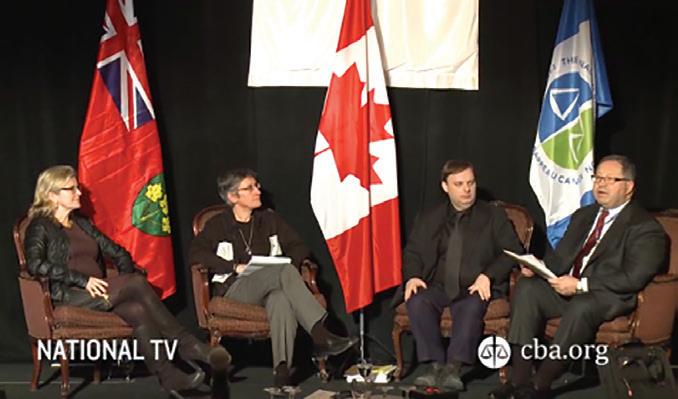
End of life decisions are once again on the public policy agenda as a result of recent court cases, Quebec’s proposed legislation and on-going scholarship. On Sunday February 23, National magazine hosted a live webcast of CBA’s End-of-Life panel discussion. Led by moderator Pierre Moreau, panelists discussed the
slippery slope, doctors’ need for clarity in the law and the role the CBA can take in shaping the discussion going forward.
If you missed it live, tune in to hear what they had to say and add your voice to the discussion
EVENT
Inter-Pacific Bar Association 24th Annual Meeting & Conference –May 8-11, 2014
The Annual Conference of the Inter-Pacific Bar Association (IPBA) is the pre-eminent gathering of lawyers with an Asia-Pacific focus. Taking place in Vancouver, B.C. from May 8-11, 2014, IPBA 2014 will feature more than 25 special guest speakers, leaders from the world of business, policy development, environmental awareness and the law, debating aspects of the Conference theme: Sustainability in a Finite World
Find out more
CBA
NATIONAL NEWS
Legal Aid by the Numbers
On March 11, Statistics Canada released its annual Legal Aid in Canada report, which states how much money the various levels of government are spending on legal aid, and details where that money is going.
Governments spent about $813-million in all the provinces and territories in 2012-2013, an average of about $23 a person, based on a federal population of 35 million. That’s up about a dollar from 2010/11, when $752-million spent on legal aid plans across the country averaged out to $22 per person. It should come as no surprise that more of that money went to criminal matters than to civil. According to the Statistics Canada report, of the $813-million spent in 2012-2013, $674-million went to direct legal aid expenditures, and of that number, more than half, $357-million, went to criminal matters, while $317-million went to civil. (“Direct” legal aid expenditures include fees for private and legal aid lawyers, as well as office expenses, such as staff salaries, benefits and overhead).
Most provincial and territorial legal aid programs ended the 2012/13 reporting year in the black: only Nova Scotia, Manitoba, British Columbia, Yukon and Nunavut were in deficit positions at the end of the period, while most of the others ran small surpluses
Read more
CBA NATIONAL NEWS
L-R: Dr. Angela Genge, Jocelyn Downie, Hugh R. Scher and Pierre E. Moreau
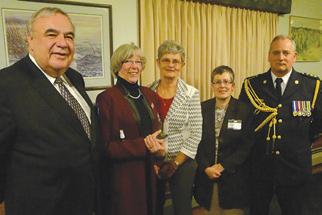
The highlight event of the conference was the Saturday Night dinner attended by The Honourable Judith Guichon, Lieutenant Governor of B.C., who gave a short address, and a Keynote Speech by The Honourable C.E. Hinkson, Chief Justice of the B.C. Supreme Court. The Chief Justice spoke on the current challenges and delays in the B.C. Court system, including issues of scheduling and demand throughout the province.
L-R: The Honourable Chief Justice Hinkson, The Honourable Judith Guichon, Lieutenant Governor of British Columbia, Donna A. Barnett, MLA, Heidi Zetzsche, Inspector Nathan Davies, Aide de Campe
INITIATIVE
Older Women’s Dialogue Project
In 2012, the United Way Lower Mainland provided the Canadian Centre for Elder Law (CCEL) with one year of funding for a community engaged research project focused on older women living in the Vancouver Lower Mainland. The goal of the initiative was to investigate and identify the barriers to well being for older women, and pinpoint some strategies for addressing these social policy and legal issues.
During this first year of work on the Older Women’s Dialogue Project, the CCEL collaborated with the West Coast Women’s Legal Education and Action Fund to hold a series of consultation events. With the generous assistance of local community organizations we held 22 consultation events in nine different languages. We met 314 women, hearing from women in their 50s, 60s, 70s and 80s. Events ranged in size from 5 to 27 participants.
The consultation events followed a focus group format, with an independent facilitator leading the women through a series of open questions asking women to identify current barriers to their well being and quality of life. The facilitators asked about barriers connected to:
poor treatment and discrimination; income security, poverty and pensions; legal systems;
family dynamics;
personal safety and abuse; housing; and immigration.
View the report Your Words are Worth Something: Identifying Barriers to the Well Being of Older Women that summarizes what CCEL learned from the women
news&events
Lunching with Women Leaders Series
The CBABC WLF in partnership with the Law Courts Inn has launched a new education series called “Lunching With Women Leaders.” The CBABC WLF has held a very popular annual Education Day for the past ten years but decided to hold three lunchtime education events this year in order to reach a larger audience. Reaching a larger audience was certainly achieved at the first event.
The first lunch held on February 7, 2014 was titled “Sheryl Sandberg’s book “Lean In”: Its relevance and significance to women lawyers.” The presenters were Allison Wolfe who coaches lawyers and Linda Robertson, a lawyer coach and current national WLF Co-Chair. Registration was so strong in the first few days that the event was moved to the large dining room at the Law Courts Inn. One hundred and forty women attended, including the WLF’s first provincial and national chair Kerry-Lynne Findlay, PC, QC, who is currently Minister of National Revenue.
There is clearly a great deal of interest amongst women to learn more about how to take on leadership roles and achieve greater success in the law. The presentation focused on four of the many challenges raised by Sandberg in her best-selling book “Lean In”: women and the imposter syndrome; asking and negotiating on our own behalf; the myth of doing it all; and taking a seat at the table. There were many good questions after the presentation.
The next two lunch events will be on Friday, April 11 “Leaning In Without Falling Over: How women lawyers can build resiliency to advance in the law” and on Friday, May 16 “Leaning In as Women Leaders: The strengths that women lawyers bring to leadership.”
NEWS
CLEBC Update
WILLS AND ESTATES PUBLICATIONS
New legislation means busy times for the CLEBC Publications Department. We’ve been hard at work publishing updates to all our Wills and Estates resources – both online and print.
The WESA Transition Guide includes overviews and full, annotated versions of the WESA and the Probate Rules, along with detailed tables of concordance.
The B.C. Probate and Estate Administration Practice Manual is the first resource for the B.C. legal profession when handling probate and estate administration matters.
B.C. Estate Planning and Wealth Preservation is a comprehensive guide to help you provide effective estate planning strategies and tools for your clients and their complex portfolios. Includes valuable overview commentary to details of tax planning techniques and drafting considerations.
Wills Precedents: an Annotated Guide is an immensely popular collection of sample Will clauses
The Government of B.C. has proclaimed March 31 - April 4 Makea-Will Week. Lawyers and the public can partake in a number of activities throughout March and April, including free law classes, online resources, workshops on WESA and section conferences. Read more
and documents that includes representation agreements and many other B.C.-focused precedents.
Annotated Estates Practice 2014, a portable consolidation of core Wills and Estates law materials, includes key statutes annotated by leading estates lawyers. The current edition includes the full consolidated text of the WESA, and of the new Probate Rules and forms.
For more information, visit the CLEBC website at cle.bc.ca.
CBABC WLF NEWS
for the people and charities you care about. Make a Will today.
New Initiative
The SoloLink project provides an opportunity for practitioners who are in a sole practitioner or small firm setting to pose questions, offer advice and share information with other lawyers. SoloLink is a positive, real-time resource which fills an immediate need for those practitioners who otherwise may have limited access to practice resources whether related to substantive or procedural legal matters, office management, general practice or otherwise. If you are interested in joining SoloLink please email sololink@cbabc.org.
resources
BRANCH
& BAR
Calendar
APRIL
10 Law Day 2014
15 CBABC PD: Don’t Get Lost at Sea – A Beacon for Law Practice Accounting Webinar
29 CBABC PD: Ethics in Action – Practice and Community North Van
30 CBABC PD: Non-Disclosure Agreements Webinar
MAY
2-3 CBABC PD: Joint Conference and Retreat with the Wills & Trusts Sections Vernon
6 CBABC PD: Judicial Bias – Say it isn’t So – Or is it? Vancouver
7 CBABC PD: Buying or Selling A Solo/Small Firm Law Practice – Is that the Right Fit for You? Webinar
8 CBABC PD: An Anatomy of the Civil Forfeiture File – From Opening to Closing Webinar
8-11 Inter-Pacific Bar Association’s 24th Annual Meeting and Conference Vancouver
13 CBABC PD: Ethics in Action – Practice and Community New West
13 CBABC PD: Decoding Medical Records for Effective Trial and File Management Webinar
15 CBABC PD: Civility in the Courtroom: Essentials for Trial Lawyers Webinar
22 CBABC PD: Interviewing Children in Family Law Webinar
29 CBABC PD: Ethics in Action – Practice and Community Kelowna
Resources on Wills, Estates and Succession Act, Power of Attorney and Elder Law
Many of the groups supported by the Law Foundation have worked on important issues regarding Wills and Estates over the past few years. One significant contributor in this area was the B.C. Law Institute, which wrote a report in 2006 (Wills, Estates and Succession: A Modern Legal Framework) that contained many recommendations adopted by the government in 2009 when it passed the new Wills, Estates and Succession Act. The Law Institute’s report resulted from the BCLI’s Succession Law Reform Project, which looked at several different issues arising in this area and proposed reforms. The B.C. Law Institute receives an annual grant from the Law Foundation that contributes to its legal research and law reform work. Other groups, such as People’s Law School (PLS), have responded to the change in legislation by creating information fact sheets for the general public about how the legislation changed. The People’s Law School also has several publications about writing a Will, Power of Attorney and general issues that arise when there is a death in the family and there are videos on Wills and Estates issues. All these resources are available on the PLS website at publiclegaled.bc.ca/topics/wills-and-estates. Another group funded by the Law Foundation, the B.C. Centre for Elder Advocacy and Support (BCCEAS), does not provide legal assistance in the area of Wills or Succession but is a valuable resource on other elder law issues and has lawyers on staff to provide information, advice and representation services.
LAW FOUNDATION OF BRITISH COLUMBIA
Mark Your Calendar! SCOTTSDALE 2014
Ninth Annual Branch CONFERENCE
November 14-16, 2014
The
Westin Kierland SCOTTSDALE, ARIZONA
Enjoy the essence of Arizona. Complete all 12 of your 2014 CPD credits, including the two hours required ethics, professional responsibility and practice management component. Don’t miss out!
KEYNOTE SPEAKER:
The Honourable Justice Sandra Day O’Connor, Supreme Court of the United States
\ For more information >>> cbabc-conference.org
View from the North
FROM NORTHEASTERN BRITISH COLUMBIA TO YOU
In-person PD opportunities are a great reason to get away from the office and from time to time they arise here in the north notwithstanding the great distances that often both the attendees and the speakers must travel. One such full-day CBABC PD opportunity recently arose in Prince George.
Our president Dean Crawford travelled from the south as did The Honourable Chief Judge Tom Crabtree and with getting to the airport, through check in and security, the trip from home takes somewhere in the neighbourhood of four or five hours.
Travelling by motor vehicle, the drive south to Prince George from the Alaska Highway is about a five-hour journey and there were at least three attendees that made that trip. Others from the west and south of Prince George also have to travel considerable distances to attend.
Those from Prince George, including the local Bencher, were able to enjoy the convenience of attending an all-day PD offering without the need to book flights and stay in a hotel as so many of our colleagues in the south are able to so often take advantage of.
The very real and true advantage of attending this PD event was of course meeting and networking with our far flung colleagues while at the same time learning and discussing the latest developments in the interrelationships between family and criminal law, emerging ethical issues and of course WESA
In my view, the personal interaction that happens at live PD events is an invaluable benefit that ought to be experienced on a regular basis no matter what your year of call or physical location. These events are worth the travel and when they occur in the north they are all the more valuable for bringing those of us, having the common experience of practising in the north, into the same room.
My View from the North Clint Sadlemyer, QC
Law Week 2014
u 2014 Law Week’s theme is Access to Justice: What does it mean to YOU? This year, nine locations across British Columbia are participating in Law Week activities celebrating the 32nd anniversary of the Charter of Rights on Law Day, April 10. Check out bclawweek.org for all the details! Join the conversation on Facebook using hashtag #bclawweek and Twitter @bclawweek.
Province-Wide Activities
VANCOUVER
April
Activities include:
“Meet the Chiefs” forum with the three Chiefs, CBC’s Ian Hanomansing, and local high school students
Tours of the courthouse
Free public law classes throughout the Lower Mainland, with the support of the People’s Law School
“Legal Health Checklist” blitz
Barry Sullivan Law Cup public speaking competition for secondary school students from across B.C.
NANAIMO
Saturday, April 5
Nanaimo Courthouse
Activities include:
Mock Trial
Police dog K-9 demonstrations
RCMP seminar: Drugs on the Streets of Nanaimo
Meet a sheriff and tour the cells and van
Community service organization displays
CRANBROOK
Thursday, April 10
7:00 p.m.
Key City Theatre
The always popular Mock Trial where the audience gets to be the jury
TERRACE
Thursday, April 10
Activities include:
Mock Trial
Tours
Community service organization displays
KELOWNA
Saturday, April 12
10:00 a.m. – 2:00 p.m.
Kelowna Law Courts
Activities include:
Girl Guide arrests and Mock Trial
Courthouse tours
Community service organization displays
NORTH SHORE
Saturday, April 12
North Vancouver Courthouse
Activities include:
Simulated “crime scene” with RCMP and WVPD
Panel discussions
Youth court workshop/Mock Trial
Community service organization displays
VERNON
Saturday, April 12
10:00 a.m. – 2:00 p.m.
Activities include:
Celebration of the 100th anniversary of the Vernon Courthouse
Courthouse tours
Grand Mock Trial
VICTORIA
Saturday, April 12
10:00 a.m. – 1:30 p.m.
Victoria Courthouse
Activities include:
Mock Trial of Cinderella’s Step-mother
Tours of sheriff’s cells and vans
Victoria Police Department’s K-9 Unit demonstration
Judges’ presentation
FORT ST.JOHN
Tentative Date: Saturday, April 26
Activities include:
Mock Trial
Tour the sheriff’s vans
Community service organization displays
Province-Wide
DIAL-A-LAWYER DAY
Saturday, April 12
10:00-11:45 a.m., 12:15-2:00 p.m. 604-687-3221 or 1-800-663-1919
Residents in British Columbia are invited to call and speak with a lawyer for up to 15 minutes at no cost in the following seven areas of law: Family, Wills & Estates, Tort & MVA, Immigration, Business, Employment and Criminal
LAW WEEK 2014
Partners
vancouver bar association
professionaldevelopment
EMAIL: PD@CBABC.ORG
\ WEBSITE: CBAPD.ORG
CBABC Professional Development courses are designed to meet the needs of lawyers while still maintaining the opportunity to network and advance one’s career, practice and business. We pride ourselves in bringing courses to lawyers that will provide the required professional responsibility and ethics, client care and relations, and practice management component for 2014 Law Society of British Columbia reporting.
Webinar Repeats
“It’s a New Dawn, It’s a New Day” WESA Webinar Modules
Module I: WESA & New Probate Rules
Module II: WESA & Will Drafting
Module III: WESA & Litigation
Upcoming In-person Seminars
Ethics in Action: Practice and Community
IN PARTNERSHIP WITH THE NORTH SHORE BAR ASSOCIATION
Date: April 29, 2014
Location: John Braithwaite Community Centre, North Van.
Speakers: Dean Crawford, President, CBABC, Coutts Pulver LLP and Jan Lindsay, QC, President, Law Society of B.C., Lindsay LLP
IN PARTNERSHIP WITH THE NEW WESTMINSTER BAR ASSOCIATION
Date: May 13, 2014
Location: The Network Hub, New Westminster
Speakers: Dean Crawford, President, CBABC, Coutts Pulver LLP and Jan Lindsay, QC, President, Law Society of B.C., Lindsay LLP
IN PARTNERSHIP WITH THE KELOWNA BAR ASSOCIATION
Date: May 29, 2014
Location: The Royal Anne Hotel, Kelowna
Speakers: Dean Crawford, President, CBABC, Coutts Pulver LLP and Thomas P. Fellhauer, Elected Bencher (Okanagan District), Pushor Mitchell LLP
IN PARTNERSHIP WITH THE CBABC WILLS & TRUSTS SECTIONS
CBABC Wills & Trusts Sections Professional Development Joint Conference & Retreat 2014
Attendance at this event will provide you with six CPD Hours
Date: May 2-3, 2014
Location: Sparkling Hills Resort, Vernon
Buying or Selling A Solo/ Small Firm Law Practice: Is that the Right Fit for You?
Date: May 7, 2014
IN PARTNERSHIP WITH THE DEPARTMENT OF JUSTICE
Judicial Bias – Say it isn’t So – Or is it?
Date: May 6, 2014
Location: The Law Courts Inn, Vancouver
Speakers: The Honourable Chief Justice Christopher E. Hinkson, Supreme Court of British Columbia and Craig E. Jones, QC, Branch MacMaster LLP
Upcoming Webinars
All webinars are moderated by Stuart Rennie, Legislation and Law Reform Officer, CBABC
Don’t Get Lost at Sea: A Beacon for Law Practice Accounting
Date: April 15, 2014
Speakers: Felicia Ciolfitto, Manager, Trust Regulation, Law Society of British Columbia and April De Vito, CGA, April M. De Vito Inc.
Non-Disclosure Agreements
Date: April 30, 2014
Speakers: Dean Crawford, Coutts Pulver LLP and Dierk Ullrich, Fasken Martineau DuMoulin LLP
Speakers: Gary Mitchell, On Trac Coach, Sheena M. Mitchell, Corporate Law For Small Business and Entrepreneurs, Kel Reid, CPA, CMA, Pinch & Reid and Victoria Starr, Starr Family Law
An Anatomy of the Civil Forfeiture File: From Opening to Closing Date: May 8, 2014
Speakers: Jay I. Solomon, Jay I Solomon Law Corp and J. Douglas Eastwood, QC, Ministry of Justice-Legal Services
Branch-Civil Litigation
Decoding Medical Records for Effective Trial and File Management
Date: May 13, 2014
Speakers: Kenneth Armstrong, Stewart & Company, Eileen Finnegan, Vancouver Litigation Support Services and Catherine A. Sas, QC, Miller Thomson LLP Civility in the Courtroom: Essentials for Trial Lawyers
Date: May 15, 2014
Speakers: Mr. Justice Frits E. Verhoeven, Supreme Court of B.C. and Claire E. Hunter, Hunter Litigation Chambers
Interviewing Children in Family Law
Date: May 22, 2014
Speakers: Trudi Lynne Brown, QC, Brown Henderson Melbye, Mary E Mouat, QC, Quadra Legal Centre and Bobbi Poushinsky C.Med., Bobbi Poushinsky Mediation
\ For a complete list of registration details and requirements, please contact the Professional Development Department 604-646-7866 or 1-888-687-3404 ext. 329 or email pd@cbabc.org.
barmoves
Who’s Moving Where and When
David Ford joins Miller Titerle LLP where he will focus on corporate commercial law, with an emphasis on advising technology companies. Prior to joining Miller Titerle, David practised at Fasken Martineau DuMoulin LLP.
Afeeza Sovani has joined Waterstone Law Group LLP’s Langley office. Afeeza will be practising personal injury litigation.
Michael S. Jones has joined Waterstone Law Group LLP’s Langley office. Michael will practising Family Law.
Rodney Urquhart has joined Edwards, Kenny & Bray LLP as a partner. His litigation practice is focused on commercial, real estate, insurance, estates, employment, administrative, personal injury, torts and construction litigation.
Sean Donovan has joined Edwards, Kenny & Bray LLP as associate counsel. His litigation practice is focused on commercial litigation, particularly in corporate governance, business and finance disputes.
Sarah Orr has joined Edwards, Kenny & Bray LLP as an associate. Her litigation practice is focused on insurance, product liability and personal injury litigation.
Matthew Schissel has joined Edwards, Kenny & Bray LLP as an associate. His litigation practice is focused on commercial litigation, shareholder disputes, personal injury, employment, torts and construction litigation.
Siobhan Sams has joined Harper Grey LLP as an associate with the Commercial Litigation group. Siobhan practises in the area of product liability with a focus on large scale cross-border litigation.
Gary Hagel joined the partnership of Pryke Lambert Leathley Russell LLP. Gary continues to practise primarily in the areas of Insurance and Personal Injury law.
Brian Corcoran joined the partnership of Pryke Lambert Leathley Russell LLP. Brian continues his Solicitors practice in the areas of Corporate Commercial, Finance and Real Estate law.
SPACE IS AT A PREMIUM AND AVAILABLE ON A FIRST-COME FIRST-SERVED BASIS SO SEND YOUR BAR MOVE (MAX. 30 WORDS) AND A HIGH-RESOLUTION PHOTO TO CBA@CBABC.ORG NOW. TO VIEW ALL BAR MOVES GO TO CBABC.ORG/BT/BM_1404
Vina Sayson joined the partnership of Pryke Lambert Leathley Russell LLP. Vina’s areas of practice include Commercial Leasing and Real Estate, Corporate Commercial, Estate and Incapacity Planning and Estate Administration.
Nicole C. Hamilton joined Waddell Raponi as an associate. Waddell Raponi offers a comprehensive range of legal and dispute resolution services.
Matthew Voell has joined Underhill, Boies Parker. Matthew practises in the area of public law, acting for clients in municipal, administrative, constitutional, aboriginal, labour, and human rights matters.
David Bilkey, QC is practising as Bilkey Law Corp. in beautiful Kamloops. David’s firm is devoted exclusively to insurance law.
January & February 2014
Associate
Robert Burton
Richmond
Regular Members
Jacqlin K. Anthony New Gold Inc.
Vancouver
Ahna Fernandez Pearkes & Fernandez
Nelson
James J. Fitzmaurice
James J. Fitzmaurice Law Corporation Smithers
Stephanie B. Gorner Baker Newby LLP Chilliwack
Lisa Jozsa
Victoria
Winston Kam
Remedios & Company
Vancouver
Lucya Kowalewski Clark Wilson LLP
Vancouver
Katherine C. McKey
Rose Keith Law Corp.
Vancouver
Jody K. Pihl
Pihl Law Corporation Kelowna
Patricia Weber
Oliver & Co.
Williams Lake
Articling Students
Juliana Dalley Community Legal Assistance Society
Vancouver
Harmon Hayden joined Bilkey Law Corp., an insurance boutique located in beautiful Kamloops. Harmon practises exclusively in insurance law and risk management.
William DeWolf Smithers
Allegra Geller
Daniel B. Geller Barrister & Solicitor West Vancouver
Amalia Gustergerling
Harper Grey LLP
Vancouver
Stephen Hawkshaw Tax Court of Canada
Ottawa
Renata Isenor
Webber Weiser
McKinley & Kay Kamloops
Pavan Jawanda
McCarthy Tétrault LLP
Vancouver
Kyle C. Johnson
Vancouver
Jennifer Lowson North Vancouver
Jessica A. Magalios
Vancouver
Andrew Park
Fasken Martineau
Vancouver
Sascha Paruk
McCarthy Tétrault LLP
Vancouver
Jason Pouya Shabestari
Morrison & Company
Surrey
Colin Simkus
Crease Harman LLP
Victoria
Alix A. Tolliday
Ritchie Sandford
Vancouver
Law
Students
Stefan Andretti
Lisa M. Barrett
Mark Dorner
Mosope Doris Fagbongbe
Ryan Gates
Bianca M. Kendregan
Dylan T. Mazur
Michael A. Mulroney
Iliad Nazhad
Warda Negyal
Sahasra Pedersen
Carolin Puettjer
Marcel A. Pytlewski
Elisabeth Sadowski
Jeremy Sapers
Pauline E.T. Storey
Liam T. Thomson
Ryan Walia
Print Made Easy.
You Want Print Made Easy
We are print experts – so you don’t have to be. Trust us to guide your firm through your next print project so you can spend more time on what you’re an expert at.
Scan the code to read how our customers have experienced print made easy or visit us at stillcreekpress.com/about/testimonials.