This publication is intended for information purposes only and the information herein should not be applied to specific fact circumstances without the advice of counsel.
The British Columbia Branch of the Canadian Bar Association represents more than 6,900 B.C. members and is dedicated to improving and promoting access to justice, reviewing legislation, initiating law reform measures and advancing and improving the administration of justice.
BarTalk Publication Sales Agreement #40741008
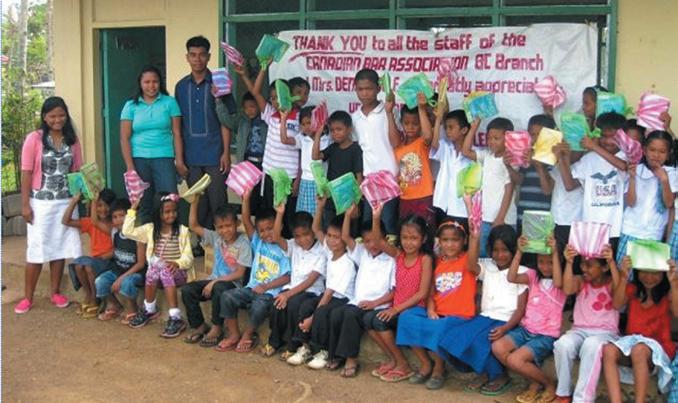
After the typhoon in the Philippines, CBABC staff held a small fundraising drive in the office in support of their colleague Juvy Self’s family. The above photo is of the re-opening of Juvy’s former elementary school on December 2, which benefited from supplies purchased from the contributions, and the assistance of re-building efforts by Canadian Forces Disaster Assistance members and local volunteers.
Letters to the Editor to:
Editor The B.C. Branch of the Canadian Bar Association
Note: BarTalk undertakes every effort to publish letters to the editor, subject to space and editorial discretion. Letters to the editor can also be found in BarTalk Online at cbabc.org.
Welcome to the “Stop the Pipelines” FAQ Page by
Inside This Issue
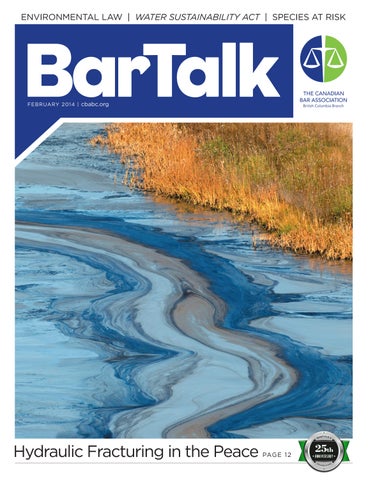
This month, BarTalk celebrates its 25th year and two faithful scribes, David and Tony, celebrate 20 and 10 years of columns. It is fitting that this is also the point at which we take a new direction with our online edition. This month’s theme is environmental law, always a topic of interest and controversy, and includes oil transportation, replacing the Water Act, “fracking,” species at risk and concerns about muzzling of scientific freedom of expression.
News and Events
2 CBABC Staff Give a Helping Hand in the Phillippines
CBABC WLF News
18 CBA Mid-Winter Meeting of Council February 22-23, 2014 in Ottawa
Conflict of Interest Act Amendments
The Whistleblower
19 Labour and Employment Law Amendments
Immigration and Refugee Protection Act Amendments
Proposed Amendments to Testamentary Trusts
Snowden’s Canadian Lawyer
Tech Resolutions for 2014
20 Upcoming Professional Development in Your Community
CLEBC Update
21 Legislative Update
Branch & Bar Calendar
BarTalk – Looking Back and Moving Forward
22 Call for Nominations
B.C. Law Week is April 2014! Courthouse Libraries BC Tips
Also In This Issue
FROM THE PRESIDENT
DEAN CRAWFORD
Advocacy on Your Behalf Standing Committee adopted CBABC’s recommendations
Last September, on behalf of the CBABC, I made a presentation to the Select Standing Committee on Finance and Government Services as part of its annual budget consultations. (Click here for the full presentation.)
In our submission, the CBABC called for incremental increases in legal aid funding as well as a government commitment to long-term, stable funding of the Court Services Branch of the Ministry of Justice.
There are several sound reasons for these recommendations. I am sure many of you can relate to them in your own practices. How many family lawyers have been involved with matters where the other party was an unrepresented litigant ineligible for legal aid? I would venture that most family lawyers in the province have been involved in matters that may
not have gone to trial had legal aid been available to the lay litigant, or in trials that were twice as long as necessary because of the unavailability of a legal aid lawyer.
In respect of the Court Services Branch, Chief Justice Bauman of the Court of Appeal, while he was the Chief Justice of the Supreme Court, noted that the Supreme Court has had courtrooms that cannot proceed because no clerk is available. Also, fewer registry staff are available and there has been a shortage of sheriffs to provide security. This leads to delays for all litigants in a timely resolution of disputes, whether your client is an individual or a corporation waiting for court time.
In mid-November, the Standing Committee issued its report. We were delighted that the Committee adopted the CBABC’s submission and recommended that the provincial government: 1. Commit to long-term and stable funding of the Court Services Branch.
2. Incrementally increase legal aid funding.
An important step, to be sure, but not the end of the process. As I write this article, the Executive Branch of government is putting the finishing touches on the 2014-2015 budget, which will be introduced on February 18, 2014. At the CBABC, we have been in discussions with both the Ministry of Finance and the Ministry of Justice about the budget to try to secure commitments on adequate funding of the justice system. We will all learn on February 18 what the government has decided.
Space does not permit me to review in detail all of the CBABC’s advocacy initiatives, but I will mention a few.
The Branch continues to engage with government to initiate several pieces of law reform, as articulated in the Agenda for Justice that we published in advance of last year’s provincial election.
Our Legislation and Law Reform Committee reviews legislation already proposed by the provincial government and provides substantive comment. Through our Court Services Committee, we are reviewing the allocation of judicial resources at the Supreme Court level in rural and remote communities to assess the effect this may be having on access to justice.
I highlight these activities because, first, it is important that you, our members, are aware that the CBABC is working hard on your behalf to ensure proper funding of the justice system. Second, this is a good example of the advocacy work that the CBABC does on behalf of the profession throughout the year.
If you are interested in learning more about the Branch’s advocacy initiatives, I encourage you to visit our website at cbabc.org or to contact me directly. We are a member-driven organization and your feedback and suggestions for advocacy initiatives is always appreciated.
Dean Crawford president@cbabc.org
Twitter: @deancrawfordvan
EXECUTIVE DIRECTOR
CAROLINE NEVIN
Is it Getting Hot in Here? A profession and practice in transition
When you are in the middle of a relatively slow evolution, it is sometimes difficult to see what’s changing – it takes a clear look back and an unbiased look around to understand what’s really been going on. In the case of the legal profession, demographic, social and economic changes have occurred that have affected the practice of law and the needs of those within it. Like the proverbial pot of boiling frogs, we don’t know that the water temperature has changed to any significant degree, we just know that the pot isn’t quite as comfortable as it was before.
At a recent meeting of the Law Society Benchers, staff presented current statistics on the demographics of the profession.
Many things we all know instinctively: the profession is aging, the proportion of women has increased, and more people are choosing careers outside of private practice. Other facts were more surprising: for example, the proportion of lawyers in rural versus urban areas has barely changed over the last ten years.
Here are a few highlights:
The number of lawyers in B.C. who are 60 or older has almost tripled since 2003. The numbers on the younger end of the spectrum have remained stagnant or declined in each age category.
The proportion of lawyers aged 65 or older in Kootenay County has grown from 2.5 per cent to 19.7 per cent since 2003. Nanaimo and Cariboo aren’t far behind, at 15.3 per cent and 14.8 per cent. Considering 65 used to be considered retirement age, this is extraordinary.
The proportion of lawyers choosing government or corporate positions over private practice has
more than doubled since 1986. Only 78 per cent of the profession is working in private practice now.
Since 1986, the proportion of the profession that is female has doubled, from 18 per cent to 36 per cent.
In 2010, half of all B.C. lawyers earned an income of under $107K.
On the economic side of things (and here’s where we start taking the temperature in the pot), growth in the profession in B.C. has more or less kept pace with growth in the general population; 1.8 per cent vs. 1.6 per cent average over the last ten years. So, contrary to some people’s views, we are not actually “over-lawyered” in terms of the number of lawyers per 1000 adults. Growth in the profession has also generally kept pace with growth in our economy (1.8 per cent vs. 1.9 per cent). However, it turns out that neither number is truly relevant to the question of why the economic
temperature is so much “hotter” now. The real number that matters is the dollar value of legal services accounted for in Gross Domestic Product (GDP) – in the last five years, not only has it not kept up with growth in either the profession or the general population, in B.C. it actually shrunk from $1.69 billion in 2008 to $1.475 billion in 2012. To complete our analogy, everything feels hotter right now because there are more frogs in a smaller pot.
At a recent meeting of law association executives from around the world, these facts were consistent across presentations from South Africa, Germany and Washington State, and I saw many nodding heads in the room. There is no question that the CBA and our international sister organizations are challenged to “step up” and be the best possible source of information and support to our members who are working hard to respond to the realities and challenges of practising law today. That is our goal, and I look forward to hearing from you at any time about your ideas for how we can help.
Caroline Nevin cnevin@cbabc.org
practicetalk
DAVID J. BILINSKY
Toxic Workplaces
Avoiding burnout while staying positive
r And if it’s bad Don’t let it get you down, you can take it... Hold your head up, oh hold your head high.… r – Music and Lyrics by R. Argent and C. White, recorded by Steppenwolf
When one thinks of toxic environments, one doesn’t tend to think of law offices as falling into that category. Yet I get calls from partners, associates and staff alike who are having to cope with working in such situations. In some offices matters are dire; the stress of working in these environments is taking its toll on the person’s health and well-being, on their careers
and certainly on their home life. After a time, some people reach the breaking point and leave their workplace. Others are not so fortunate and are looking for tips on how to cope with being in such a situation.
The first thing to remember if you are caught in such an office is that you cannot control other people’s behaviour; you can only control how you respond. Passiveaggressiveness, destructive and negative comments, conniving politics, terrible leadership, partners that are insensitive to personal boundaries or worse – these are not things that are a reflection of who you are; you are simply caught in the toxic vortex. Here is a collection of tips for coping in a toxic environment:
You need to stay positive and upbeat. The person you are most able to influence is yourself so don’t allow the toxicity to drag you down.
Learn from the experience. Every bad situation allows you to grow
bad environment only enhances your reputation, your work ethic and your character.
as an individual and take home lessons – even if those are about things that you would never repeat. Learn how to apply The Golden Rule – i.e. how to treat
Learn how to apply The Golden Rule – i.e. how to treat others as you yourself would wish to be treated.
others as you yourself would wish to be treated – as it is a powerful guide to help you grow when you are in such a situation.
Do the best that you can do. You want to preserve your integrity and your good name. It is no surprise that word gets around in the legal community and being able to cope in a
Create a “thank you” file. While it may perhaps be the thinnest file in the office, a collection of letters and cards that endorse the value of your work could be the most valuable file in the office. It will grow over time and leafing through the physical embodiment of good wishes and thanks is a personal validation of your own self-worth and assistance to others.
Get a supportive network outside of the office. Having someone to talk to about the situation certainly helps and their advice and support can get you through some dark days.
Continue to search for a better workplace while keeping your shoulders squared and your spirit up. Keep looking for a more positive situation. Remember that no matter what, continue to hold your head high.
The views expressed herein are strictly those of David Bilinsky and do not reflect the opinions of the Law Society of British Columbia, CBABC, or their respective members.
David J. Bilinsky is the Practice Management Advisor for the Law Society of British Columbia. Email: daveb@lsbc.org Blog: thoughtfullaw.com
dave’s techtips
What online resources are available if you find yourself in a toxic environment?
Here are a selection:
WORKPLACE BULLYING INSTITUTE (WBI) workplacebullying.org
“WBI is the first and only U.S. organization dedicated to the eradication of workplace bullying that combines help for individuals, research, books, public education, training for professionalsunions-employers, legislative advocacy, and consulting solutions for organizations.” It was founded by Drs. Gary & Ruth Namie. They state:
“Workplace Bullying is repeated, health-harming mistreatment of one or more persons (the targets) by one or more perpetrators that takes one or more of the following forms:
Verbal abuse
Offensive conduct/ behaviors (including nonverbal) which are threatening, humiliating or intimidating.”
This site has wonderful resources for people caught in these situations, including an “action plan,” which includes the great piece of advice: “Have your escape route planned….”
THE WORLD OF PSYCHOLOGY bit.ly/1gqacsu
The article entitled “When Your Workplace is Toxic” has this bit of advice regarding having a personal renewal program in place. They state: “We must have a self-care protocol in place that we can employ as a daily guide, while being alert to rationalizations and excuses for not doing it. Not to have such a personal renewal program may court disaster for both our personal and professional lives. It is also, at its core, an act of profound disrespect for the gift of life we have been given.”
decisions without the consideration of the people.”
It goes on and states: “A lack of real support for employees can be an issue: Who do you go to if there’s a problem with your boss or someone in a senior role? Often, there’s an ‘elephant in the room’ that no-one wants to address until the problem begins to spiral. Unhelpful behavior that leads to general gossip, can very quickly create a toxic environment.” If you are a leader in a firm that is starting to show signs of toxicity, this website has another good article that speaks about a four step methodology for analyzing, assessing, and redesigning the culture of an organization in a consistent manner (bit.ly/1d8jjhF).
THE FUTURE OF CIO
bit.ly/19iHavD
The article entitled “Five Characteristics of a Toxic Workplace” states:
“One of the most toxic characteristics of workplace, is that of management making
FORBES MAGAZINE onforb.es/1lZeicq
Lastly, when it comes time to craft your exit strategy from the toxic workplace, Forbes magazine has an article online entitled “Five Critical Steps to Finding a Job Fast!” (onforb. es/1lZeicq). It lists such things to consider as fine tuning your LinkedIn profile as well as checking any publically available information about yourself that may turn up on a Google search.
The anti-pipeline advocate’s guide to dealing with the media
Thank you for being “citizen advocates” and lending your voice to help stop the construction of more pipelines to ship Alberta oil to the B.C. coast. We need all of you to be available for radio and TV interviews to challenge the erroneous belief that oil pipelines will protect our standard of living, give badly needed jobs to northerners, help pay for our social services and allow us to keep driving to work. Here are some helpful hints to help you “stay on message.”
Most of you are not engineers or scientists. So what? Even though you may not have known there’s been a pipeline under your feet since the 1950’s shipping Alberta oil to Burnaby, remember to stay on message: all pipelines are bad. All oil is bad. All fossil fuels are bad. If the interviewer asks how Canadians will fuel their cars to get to work, or harvest crops, or manufac-
ture products without oil, blame the government, then mention windmills, and hope the interview ends.
You might be asked this question: “Given the horrible safety record of shipping oil by rail, aren’t pipelines much safer?” Say no, and immediately bring up the BP and the Exxon Valdez spills, which have nothing whatsoever to do with pipelines, but may use up your valuable interview time. If your time isn’t up yet, bring up windmills and powering cars with garbage using “Mr. Fusion.”
Some interviewers may use “Gotcha Journalism,” asking “do you drive your kids to hockey practice,” “how do you get to work today” or “you look so tanned… where did you just fly in from… Hawaii?” These are tricks so you admit that you still regularly use fossil fuels to drive your car and that you are personally adding to greenhouse gasses. So channel your inner Basil Faulty: “Don’t mention the war.” Tell them you bicycled to the interview, and you bicycle your
He said there is no ethical oil, just dirty and dirtier oil, which is a bogus answer given that he flies everywhere adding to greenhouse gasses, but it’s the only answer we have right now. So stick to that sound bite, or say Canadian oil is worse, and hope the interview ends.
kids to hockey practice at 4.30 a.m. in the snow. Tell them you’d gladly take the kids to hockey at 4:30 a.m. using transit, but shift blame to the local and provincial governments for not running electric busses that early or having Skytrain stations that go nonstop from your front door directly to the rink.
You might also be put on the spot by interviewers who have read Ezra Levant’s book “Ethical Oil,” where Levant says that oil from democratic, “Rule of Law” abiding Canada, is more ethical than oil from despotic theocracies that torture and murder their citizens, oppress women, discriminate against minorities, have non-existent environmental standards, support terrorism, and don’t follow the Rule of Law. This is an excellent argument, so throw some non-sequiturs around as countermeasures and quickly change the topic. Remember when Al Gore spoke in in Toronto and was asked the same question?
Someone is bound to say that pipeline expansion and the sale of tar sands oil to China will lead to more jobs and tax revenue in Canada that will help support healthcare and education and will give job opportunities to citizens of northern B.C.
Tell them, with righteous indignation, that “China can buy its oil from someone else,” “we don’t need dirty oil money” and that “citizens of Kitimat and Prince Rupert are solidly behind us.” “Solid” is a useful, squishy word that can mean anything. Use it a lot.
We all know oil is dirty, so you might be asked about the benefits of Hydro. Under no circumstances should you support the Site C Dam in your interview, so move the topic away from how many TVs, laptops, iPhones, microwaves, Xbox’s, toasters and other electronic devices you have in your home. Discuss the damage to fish and wildlife habitat. Bring up windmills again, speak glowingly about “Mr. Fusion,” and hope the interview ends.
The views expressed herein are strictly those of Tony Wilson and do not reflect the opinions of the Law Society of British Columbia, CBABC, or their respective members.
guest
PIERRE ROUSSEAU
Trial observations Lawyers Without Borders Canada
Lawyers Without Borders Canada also known under its French acronym “Avocats sans frontières” (LWBC –asfcanada.ca) brings together hundreds of Canadian lawyers and is supported by provincial and federal governments, the Quebec Law Society1 and several other institutions of the legal community. Its goal is to foster the rule of law and support human rights lawyers and vulnerable communities in countries where they face enormous challenges.
and compelled to wait for the investigators. The Nasa authorities feared that the investigation would be botched and, as is generally the case in Colombia, there
LWBC is involved with the most vulnerable communities, mostly indigenous, in Colombia, Guatemala and Haiti. Trial observation is one of the roles played by volunteers. As a LWBC volunteer, I participated in two trial observations, one in Colombia (six week trial) and one in Guatemala City (two week trial). In this article I will deal with the Colombia trial observation in Popayán (Cauca).
Edwin Legarda was the husband of an important leader of the Nasa people, Aida Quilcué, and while he was driving toward the airport to pick her up in the early morning of December 16, 2008, he was shot and killed at a roadblock set by the Colombian army. Fortunately, the Indigenous Guards were first on the scene and the soldiers were corralled
would be no prosecution since impunity is rampant. Yet, seven soldiers were eventually charged with murder and the Nasa and their lawyers (members of the “José Alvear Restrepo” Lawyers’ Collective 2) asked us to attend the trial so that the Colombian authorities would be mindful that the international community was interested in this matter and that due process, particularly for the victim’s family, would be followed.
The trial spanned more than six weeks, in two parts, the first in January, continuing in May and June 2010. At times I was by myself, at other times we were two or three international observers and it was a difficult task since we had to follow proceedings in a language that was for all of us a second language. Fortunately, Colombia
(like Guatemala) switched from a civil law system, inherited from Spanish colonial days in criminal matters, to an oral, adversarial system that is similar to the Canadian criminal law system and the proceedings were following rules that were very familiar to us. The most striking difference was the presence of the victim’s family as a party, an integral part of the proceedings, along with the prosecutor who had the latitude of calling its own witnesses.
Six of the seven soldiers were found guilty of the murder and sentenced to 40 years incarceration and a stiff fine, while one was acquitted. We were not only satisfied that due process had been followed but also that the victims’ rights were respected. A report3 was released after the trial, with numerous observations and recommendations. New volunteers are welcome, whether here at home or abroad.
1 Originally founded in Quebec City, most of its members are from that province, hence the involvement of the Quebec Law Society but LWBC wishes to extend its membership across Canada.
2 Known in Spanish as “Corporación Colectivo de Abogados José Alvear Restrepo – CCAJAR,” this human rights law firm is a long time partner of LWBC.
3 View this report online in French and in Spanish.
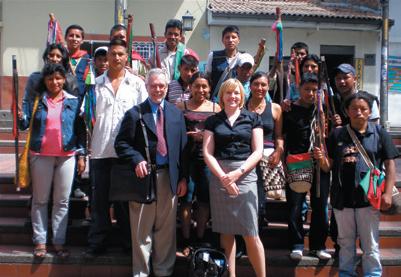
Pierre Rousseau LL.L., M.A., retired lawyer and LWBC volunteer (left front in Popayán), is standing beside Adonia Simpson who was also an international observer for Rights & Democracy Canada with the Indigenous Guards (Guardia Indígena) of the Nasa people, the nation of the victim’s family.
sections
Keep Current A review of provincial Section meetings.
Environmental Law
Meeting in Review: September 26, 2013
Speaker: John Ward, PhD, Manager, Land Remediation Section, Ministry of Environment
Topic: Possible Amendments to the B.C. Contaminated Sites
Legal Regime
Maritime Law
Meeting in Review: November 27, 2013
Speaker: Thomas F. Beasley, Bernard LLP
Topic: The Receiver of Wrecks v. Underwater Archeology
Commercial and Real Estate
Vancouver Island
Meeting in Review: December 5, 2013
Speaker: Jack Basey, QC, DeSouza Arnold LLP
Topic: Land Use and Development on B.C. First Nations Land
Environmental Law
uOn September 26, 2013, the Environmental Law Section welcomed John Ward, PhD, a Manager in the Land Remediation Section in the Ministry of Environment. Dr. Ward’s topic focused on possible changes to the contaminated sites legal regime in B.C. The changes would either be in the form of amendments to Parts 4 and 5 of the existing Environmental Management Act (EMA) or the introduction of a new statute to be called the Site Remediation Act, which would replace Parts 4 and 5 of the EMA. Changes being contemplated could include creating the ability for owners to transfer liability for contaminated sites remediation under the EMA to purchasers; removing rarely used provisions such as those for allocation panels and minor contributor liability; streamlining the way site profiles work; simplifying the Contaminated Soil Relocation Agreement regime; and clarifying wide area site provisions. For more details on Dr. Ward’s presentation, Section members are encouraged to view the webinar recording (available to members of the Environmental Law Section) which is included with the minutes posted online. Those interested in making suggestions for change to the Contaminated Site regime in B.C. are encouraged to forward their suggestion to Dr. Ward at the B.C. Ministry of Environment.
Maritime Law
u
The Maritime Section held its Annual General Meeting and Dinner at Hy’s Steakhouse on November 27, 2013 in Vancouver, B.C.
The Section was honoured to have Federal Court Registry staff and justices from the Federal Court, Court of Appeal, and the British Columbia Court of Appeal attend as their guests.
Guest speaker Thomas F. Beasley, Bernard LLP, presented the “Receiver of Wrecks v. Underwater Archaeology – An Exploration of the Murky World of Shipwreck Law and Underwater Archaeology in our ‘Emerald Seas’.” This meeting was very informative and well received.
The Section looks forward to hosting the next installment of this fun and informative annual event in November 2014.
Commercial and Real Estate Vancouver Island
uThe guest speaker Jack Basey, QC, who served more than 35 years as in-house counsel for local governments in B.C., Alberta and Ontario, explored the past, present and future of land use and development of B.C. First Nations Land.
Mr. Basey provided a legal background of First Nations Land Governance and Rights, reviewing the Federal Indian Act. He discussed the evolving land governance regimes in B.C. that permit Bands to enjoy more local management over land use and development. Mr Basey also spoke in detail about the implications for developers, First Nations, and local governments, as First Nations lands in B.C. are developed for industrial, commercial and residential uses. Mr. Basey’s presentation provided Section members with an insight to B.C. First Nations Land and concluded with examples and recommendations.
Commercial and Real Estate – Vancouver Island Section aims to provide remote accessibility for future meetings via webinar, encouraging members across the province to attend.
NOT YET ENROLLED IN SECTIONS?
Visit the Branch website at cbabc.org and use our online enrolment form!
memberservices
CHATTER WITH CHAIRS
Alison Oxtoby WILLS & TRUSTS OKANAGAN
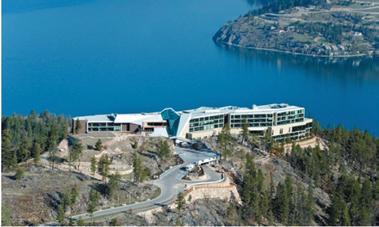
This year the Vancouver, Victoria and Okanagan Wills & Trusts Sections will be joining together for a relaxing and informative retreat at the Sparkling Hill Resort in Vernon, B.C. on May 2-4, 2014. Offering CPD hours with more than 10 experienced guest speakers, we plan on making this a weekend you won’t want to miss. Come prepared for an estates law trivia game and then unwind in the resort’s unique aromatherapy sauna and steam rooms and spa pools (included with your stay). Optional activities will include spa treatments, golf at neighboring Predator Ridge Resort, a tour of local Okanagan wineries, and dinner at one of the wineries. Join us for a fun relaxing weekend connecting with other Wills & Trusts practitioners from across the province. Further details can be found online at cbabc.org!
EMAIL: MEMBERS@CBABC.ORG
Visit cbabc.org for all activities and promotions. Check the CBABC News & Jobs weekly e-newsletter for seasonal promotions and special offers.
\ Exclusive offer from MERCEDES-BENZ CANADA! Mercedes-Benz Canada is now pleased to offer members of the B.C. Branch of the Canadian Bar Association discounts on the purchase or lease of new Mercedes-Benz and smart vehicles!
\ MEETINGMAX: Book B.C. Hotels Online! CBA members receive exclusive savings when they book hotel rooms through meetingmax. Members can view room rates, amenities and photos of hotels in British Columbia offering members exclusive discounts.
Call 1-888-687-3404 and get information on how to partner with CBABC!
ELLEN S. HONG AND LESLIE J. MACKOFF
Hydraulic Fracturing in the Peace Region features
Who speaks for those affected?
Over the past decade, the Montney formation in the northeast region of B.C. has established itself as a hotbed of oil and gas activity and is now home to one of the largest hydraulic fracturing regions in North America. These activities negatively affect private landownership and are one of the issues of gravest concern to First Nations, notwithstanding the government’s constitutional duty to consult.
Oil and gas activities on private land in B.C. are governed by the Oil and Gas Activities Act (“OGAA”) and the Petroleum and Natural Gas Act (“PNGA”). The British Columbia Oil and Gas Commission (“B.C. OGC”) oversees oil and gas operations, while the Surface Rights Board governs right of entry onto private land. Once an operator obtains approval by the B.C. OGC, it can either negotiate a surface rights lease with the landowner or, failing that, apply to the Surface Rights Board for a right of entry order. Right of entry is rarely denied.
The OGAA and PNGA create a quasi-expropriation model that favours industry at the expense of landowners and fails to adequately compensate affected parties for the changes wrought to the land. Landowners are presented with a right of entry order as a fait accompli and then are expected to marshall evidence to prove the negative financial effects to their lands
and operations. Understandably, they are not in a position of perpetual readiness for a compensation claim. They often lack the financial resources to obtain legal assistance and have difficulty locating appropriate experts to assist in quantifying their case. As such, the approaches to compensation over the years have remained fairly static. The PNGA includes provisions which assist landowners by creating a somewhat more level playing field – the oil and gas operator may be required to pay the landowner’s costs and landowners may be entitled to advance costs where right of entry has been granted. In cases where landowners have won an advance costs award, the companies have demonstrated their willingness to abandon the right of entry and simply access the deposit by horizontally drilling from a neighbouring property whose owner is less aware of or concerned with the effects of gas exploration on their land. The Surface Rights Board rarely awards advance costs and, in fact, to effectively obtain such an order may require a substantial expenditure of money simply to prove entitlement. The current scheme of compensation remains inadequate both by reason of the absolute numbers and the restrictive approach to compensation that has thus far
been followed. In the rush to capitalize on shale gas, productive agricultural lands, millennia-old ways of living, not to mention billions of litres of water, are being sacrificed to heavy industry. More fundamentally, the legislative landscape fails to address the potentially devastating and permanent changes to the air, soil, and water and the as-yet-unknown implications for the health of the residents who call northeastern B.C. home.
In a recent Cabinet Decision Summary Sheet, the recommendation was made to subsume the
Agricultural Land Commission into the B.C. OGC. Such a change would devalue large agricultural holdings and pave the way for exploitation of lands previously set aside for the food security of British Columbians. This short-term outlook raises incalculable risks to the environment and human health. Without a stronger legal framework to protect the environment and the peoples of the region from the effects of oil and gas activities, all British Columbians remain vulnerable to profound, fundamental, and long-term changes to the environment.
Ellen S. Hong, Associate, and Leslie J. Mackoff, Senior Partner, represent parties affected by oil and gas operations in the Peace Region.
ANDREW GAGE
B.C.’s New Water Sustainability Act Will it be sustainable?
British Columbia’s 104year old Water Act is about to get a longoverdue overhaul.
After several rounds of public consultation, spanning years, the B.C. government has pledged to introduce a new Water Sustainability Act in the spring session of the Legislature. But while the Act has been many years in the making, there are concerns that it does not live up to its name.
While details of the new Act won’t be known until the Bill is introduced, based on the government’s most recent consultations, the Act is not expected to fundamentally change the water licensing scheme found in the current Act. Instead, the proposal seeks to address some of the shortcomings of the current Act, by:
extending the licensing scheme to groundwater use (i.e. to wells – currently unregulated). This will be done by retroactively giving licenses to current well owners, based on the date and amount of their historic use of water (except for domestic well users, who will be exempt from the license requirement);
requiring environmental impact of water use to be considered in new government water allocation decisions;
making water use subject to minimum water efficiency standards;
expanding the ability of the government to create, and delegate powers to, local water governance
had included clear commitments related to sustainability, and West Coast Environmental Law (WCEL) and other environmental organizations had hoped that water sustainability and the public values associated with water would be more central to the new Act.
bodies (the details of which will be developed in future regulations);
giving government expanded powers to regulate in problem areas through “Water Sustainability Plans,” area-based regulations and emergency powers for addressing droughts; and providing for new enforcement powers in the form of administrative monetary penalties.
The proposed Act, by entrenching and expanding the current “First In Time, First In Right” licensing system, which gives priority to historic uses of water over new uses or environmental flows, raises concerns in light of the need to be flexible in addressing environmental needs, changing public values and changes in water availability due to climate change. Earlier government commitments
In addition, the government’s consultations with First Nations to date have been surprisingly sparse, and in WCEL’s view a failure to address First Nations’ concerns before
the legislation is brought into force could give rise to legal challenges to the Act and decisions made under the Act.
The advances being made here –in terms of regulating ground-water and considering environmental impacts – are important ones, but they are modest and long overdue. They bring B.C.’s water laws into line with what are minimum requirements in most other jurisdictions. Unless the final version of the Bill, once unveiled, includes new and strong additional provisions, it is our view that the Water Sustainability Act will not live up to the promise of its name.
Andrew Gage, staff lawyer, West Coast Environmental Law. Follow West Coast at @WCELaw or facebook.com/wcelaw.
features
CALVIN SANDBORN
Lawyers Should Defend Freedom of Information Government
scientists muzzled
“This is more than an attack on academic freedom. It is an attempt to guarantee public ignorance.”
— New York Times editorial on Canada muzzling scientists
“A democracy cannot be both ignorant and free.” — Thomas Jefferson
In recent years, Canada has turned its back on the principle that the free flow of information is the lifeblood of democracy. Canada’s access to information laws now rank 55th out of 93 countries – well below Yemen and Uganda. Worse, Ottawa is systematically concealing scientific information from the public.
Citizens cannot make wise choices about critical issues like climate change if we are not fully informed about the facts. Yet, research by the UVic Environmental Law Clinic demonstrates that Ottawa is systematically depriving the public of information about government scientific research –especially when the research raises questions about government policies on oil sands, environmental protection and climate change.
In sharp contrast to past practice, Ottawa has recently made concerted efforts to prevent media from speaking frankly to government scientists.
New federal policies routinely require political approval before scientists can speak to the media about their scientific findings. For example, Environment Canada policy
specifically bars scientists from speaking to the public on climate change or protection of polar bear and caribou without Privy Council Office approval.
Government scientists are routinely instructed to not speak publicly – or to respond with pre-scripted “approved media lines” crafted by PR specialists.
For example, Environment Canada scientists at a climate change conference were ordered to not answer journalists’ questions –as was a scientist who published research in Nature about the decline of sockeye salmon. Similarly, government scientists presenting tar sands pollution research at an international conference were instructed to follow a script from the Minister’s office.
A survey of federal scientists recently revealed that nearly half of those surveyed knew of cases where government has suppressed scientific information. And 86 per cent believed that they would face censure or retaliation if they publicly shared their concerns about a government decision or action that could harm public health, safety or the environment.
US policies are diametrically different. There, government scientists are told it is their duty to inform the public of their research. In Canada, scientists doing so can be fired.
The contrast between countries is instructive. A journalist writing about a US-Canada study on snow got all the information he needed from the NASA scientist in a 15 minute call. In Canada, he was shunted to Communications staff who delayed him past his deadline – and then responded with bizarre “approved media lines” that didn’t address his questions. Most disturbingly, a subsequent access to information request revealed that 11 Canadian officials exchanged 50 emails figuring out how to respond – and vetting the question of whether he was a “positive” reporter or not.
The new policies to muzzle science are troubling. The Supreme Court of Canada has emphasized the importance of access to information:
“Parliament and the public cannot hope to call the government to account without an adequate knowledge of what is going on, nor can they hope to participate in the decision-making process and contribute their talents to the formation of policy and legislation if that process is hidden from view.”
Increasingly, Canadian governments are hiding information from citizens behind a wall of spin doctors, “approved media lines” and rules that muzzle government scientists. As historic defenders of democratic process, lawyers need to address this critical issue.
Calvin Sandborn is the Legal Director of the UVic Environmental Law Clinic. The Clinic’s submission to the federal Information Commissioner on these issues is at elc.uvic.ca.
MORGAN BLAKLEY AND SUSAN PINKUS
Stand-Alone Species at Risk Legislation
There ought to be a law!
Scientists believe that the planet is experiencing the sixth mass species extinction event to occur in the last half billion years. This extinction event is being caused by the effects of humans, particularly by habitat destruction and unsustainable levels of animal harvesting.
Stand-alone species at risk legislation is the most focused legal approach to preventing extinction and providing for species recovery. Decades of implementation in other jurisdictions show that these laws work. Successful species protection legislation regulates threats to species and their habitat with the goal of achieving species’ survival and recovery.
Canada’s Species at Risk Act (“SARA”) has the structure to enable meaningful protection for species at risk. However, for most species, it provides no mandatory protections on provincial land. Instead, SARA is designed to work in conjunction with provincial or territorial species at risk legislation, as envisioned in the national Accord for the Protection of Species at Risk signed in 1996 by the provinces, territories and federal government. Nearly twenty years later, British Columbia is one of the few provinces that still lacks stand-alone species at risk legislation, despite being Canada’s most biologically rich province.
Due to its ecological diversity, British Columbia has an important
responsibility for protecting and recovering species at risk. It is home to 76 per cent of Canada’s bird species, 70 per cent of Canada’s freshwater fish species, and thousands of other plant and animal species. Unlike many North American jurisdictions, British Columbia still has most large mammal species that were present at the time of European colonization.
Yet in contrast to species-specific legislation such as SARA, the United States’ Endangered Species Act, or Ontario’s Endangered Species Act, British Columbia relies on a patchwork of legislative provisions in various statutes such as the Forest and Range Practices Act (“FRPA”) to manage species at risk. The ineffectiveness of this patchwork is manifest; the B.C. government’s data show that 43 per cent of B.C.’s species are at risk – in total, more than 1900 species and populations are at risk – primarily due to habitat destruction.
dividuals of these species, 3) protect the habitat these species need for survival and recovery, 4) plan and implement species recovery, and 5) transparently distinguish species’ scientifically determined biological needs for survival and recovery from political decisions about protection. The FRPA provides only limited habitat protection (this is interpreted in government policy to mean that habitat protection cannot reduce timber supply by more than one per cent) and has none of the other essential components of effective species at risk legislation.
FRPA is sometimes claimed to provide protection for species at risk, but it does not, on its own or in conjunction with other provincial legislation, meet the requirements for effective species at risk legislation. Effective species at risk legislation has five essential components, it must: 1) scientifically assess and identify species at risk, 2) prohibit killing and harassing in-
Even accounting for species partly “protected” by FRPA, currently, 88 per cent of British Columbia’s known threatened and endangered species are not protected under British Columbia’s laws or SARA. Worse, almost no species at risk in British Columbia have the legal protection needed to enable their recovery, because British Columbia has no stand-alone species protection legislation. The biodiversity we are losing is the engine of B.C.’s economy and culture, and of British Columbians’ wellbeing. There ought to be a law!
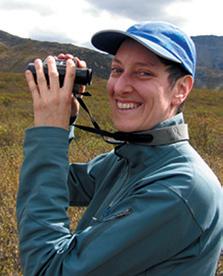
L-R: Morgan Blakley (staff lawyer) and Susan Pinkus (senior scientist) work at Ecojustice Canada, a charity providing free services to the public on environmental issues.
SELINA LEE-ANDERSEN
Safety by Design Transport Canada to introduce new regulations for oil-by-rail sector
In the 2013 Fall Report of the Auditor General of Canada, the Auditor General examined whether Transport Canada has adequately overseen the management of rail safety risks by federal railways. The report concluded that “Transport Canada needs to address significant weaknesses in its oversight of safety management systems implemented by federal railway companies to manage safety risks on a day-to-day basis.”
Following the derailment of a train carrying crude oil tankers at LacMégantic, Québec in July 2013, which killed 47 people and decimated the town’s centre, the safety of shipping crude oil by rail has come under intense scrutiny.
In November 2013, Transport Canada established three working groups to recommend actions for (i) classifying crude oil as a highly dangerous substance, (ii) developing emergency response assistance plans specifically for shipping crude oil, and (iii) tightening safety and testing procedures. Recommendations from the working groups are due at the end of January 2014 and proposed draft regulations are expected shortly thereafter. On January 10, 2014, Transport Canada also proposed new safety standards for certain rail tank cars.
The call for recommendations comes as the Transportation and Safety Board of Canada (TSB) continues its investigation into the LacMégantic accident. In September
2013, the TSB issued a safety advisory calling on regulators to review the processes for companies transporting or importing dangerous goods to ensure that goods are accurately classified and documented for safe transportation. Currently, petroleum crude oil is classified as a Class 3 Dangerous Good (flammable liquid), which is further divided into packing groups (PG), with PG I being most hazardous and PG III being least hazardous. TSB test results indicated that the oil being transported in the LacMégantic tank cars (which originated from the Bakken region straddling North Dakota and parts of Manitoba and Saskatchewan) was more flammable than identified by
requirement to properly test and classify hazardous materials prior to and during transportation. This announcement came several days after a train carrying Bakken oil derailed in North Dakota, causing explosions and forcing evacuations.
The need for bestin-class spill prevention and emergency response systems has never been more imperative.
its shipper. Specifically, the oil was identified by TSB as having the characteristics of a Class 3, PG II product; however the oil was transported as a Class 3, PG III product, which represents a less volatile good. On January 2, 2014, US regulators issued a safety advisory reinforcing the
The Lac-Mégantic accident and subsequent investigation have revealed regulatory weaknesses in the oil-by-rail sector, which has grown significantly in recent years. This sector’s rapid growth is attributed to: (i) increasing development of non-conventional crude, (ii) transmission pipelines that are operating at or near capacity with rail being used as an option for moving crude oil, and (iii) ability of rail to reach refineries that are either not served or underserved by pipelines. As new transmission pipeline capacity is being developed to accommodate increasing oil production, the transportation of oil by rail will continue to grow and help fill the capacity void. For B.C., stringent safety standards are important as Alberta bitumen is transported across B.C. en route to export markets. According to reports, Transport Canada has estimated that approximately 1,200 rail carloads of crude oil and petroleum products were sent to B.C. in 2012, up from fewer than 50 in 2011. This number is expected to grow significantly, especially in the absence of new pipeline infrastructure. Whether transporting crude oil by rail, tanker or pipeline, the need for best-in-class spill prevention and emergency response systems has never been more imperative.
Troubling Trends for First Nations Crown constraining duty to consult
Participation in environmental assessments and other regulatory proceedings has long been recognized as a means for aboriginal people to voice their concerns about potential adverse effects to their aboriginal and treaty rights arising from development. Environmental assessments have also been found to be a means through which the government can fulfill its duty to consult aboriginal people.1 While it is a matter of debate whether these regulatory processes are effective for meaningful aboriginal participation in natural resource decision making, recent legislative changes have left many First Nations wondering where to raise their concerns and where the adequacy of any consultation will be assessed. Options for raising concerns about natural resource development decisions for First Nations are dwindling. Recently, Parliament overhauled the federal environmental assessment processes through Bill C-38 and replaced them with the Canadian Environmental Assessment Act, 2012 (CEAA 2012). Among the many changes potentially detrimental to Aboriginal participation in environmental assessments are that minor projects (formerly “screenings”) now no longer need federal environmental impact assessments. In addition, recent changes to the Regulations Designating Physical Activities under CEAA 2012
exclude a number of significant projects from automatic federal environmental review, including heavy oil and oil sands processing facilities, certain pipelines, and a raft of industrial facilities.
Moreover, recent developments have limited the ability of some regulatory tribunals to assess whether First Nations have been adequately consulted before issuing regulatory approvals. For example, as of June 17, 2013, the new Alberta Energy Regulator (AER) was created by the Responsible Energy Development Act. Section 21 of that Act deprives the AER of the jurisdiction to assess the adequacy of Crown consultation, despite the AER having the ability to issue regulatory permits which may be detrimental to aboriginal interests and rights. This limitation has been challenged by a number of First Nations, including a challenge by the Athabasca Chipewyan First Nation in relation to the Jackpine Mine Expansion Project (which was dismissed by the Alberta Court of Appeal2 , leave to appeal to the Supreme Court of Canada denied). Further, the terms of reference provided to certain federal/provincial joint review panels have expressly deprived those panels of the ability to make findings on whether consultation has been adequate in relation to the proposed project
(see, for example, the Joint Review Panel Terms of Reference for the Site C Clean Energy Project). Despite the clawback in administrative tribunals both carrying out consultation through environmental impact assessments and assessing the adequacy of Crown consultation, the law is clear that the duty to consult is a constitutional one and that the assessment of adequacy in fulfilling that duty cannot preclude Court supervision.3 However, the trend of governments excluding consultation issues from administrative processes
is troubling. It adds additional uncertainty, expense, time and other barriers for First Nations to have their constitutional rights addressed. It is also contrary to the courts’ preference that specialized administrative bodies are in the best position to resolve constitutional issues related to their mandates.4
1 Haida Nation v. British Columbia (Minister of Forests), 2004 SCC 73 at para 53; Taku River Tlingit First Nation v British Columbia (Project Assessment Director), 2004 SCC 74, para 2
2 Métis Nation of Alberta Region 1 v Joint Review Panel, 2012 ABCA 35
3 Rio Tinto Alcan Inc. v. Carrier Sekani Tribal Council, 2010 SCC 43 , paras 62 and 63
4 R. v. Conway, 2010 SCC 22, para 6
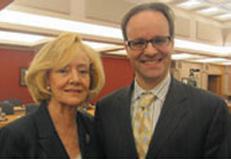
L-R: Karey Brooks and Jeff Langlois, Janes Freedman Kyle Law Corporation
news&events
CBA Mid-Winter Meeting of Council
February 22-23, 2014 in Ottawa
THE PUCK STOPS HERE!
National Council, the CBA’s governing body, meets twice a year to hear reports and to debate and vote on resolutions on current legal issues, public policy and CBA governance. The CBA welcomes participation from all members of Council, and observers. Non-voting Council members are invited to attend, and are encouraged to seek appointment as alternate voting members from their Branch.
At this year’s Mid-winter Meeting of Council, while voices are heard and decisions are made, the puck will also drop for the Winter Olympic Hockey finals. Join us for the business while celebrating Team Canada and our Nation’s favourite past time – hockey!
And the game doesn’t end there; be sure to participate in the CBA East vs. West shinny hockey game on Friday and wear your favourite team’s jersey at the hockey-themed Council Dinner on Saturday.
A CAPITAL EXPERIENCE AWAITS YOU
The allure of world class sites and the charm of national and local landmarks steeped in history await you in Canada’s vibrant national capital. Discover the home of the Parliament of Canada and the Supreme Court of Canada Take in the bustling Byward Market and skate the Rideau Canal – a UNESCO World Heritage site – just steps away from the hotel. Immerse yourself in the city’s many cultural attractions, including the National Gallery of Canada, the Canadian Museum of Civilization, the Canadian War Museum, the Royal Canadian Mint, and many more.
HEADQUARTERS HOTEL
Located next door to the Parliament Buildings, Ottawa’s landmark Fairmont Château Laurier hotel is a magnificent limestone edifice with turrets and masonry reminiscent of a French château.
For more info
CBA NATIONAL NEWS
Conflict of Interest Act Amendments
CBA’s National Administrative Law Section says proposed amendments to the Conflict of Interest Act contained in Bill C-4 would allow Cabinet to designate a person or class of persons subject to the Act with an open-ended and virtually unreviewable exercise of discretion. This goes against governmental transparency and accountability. The CBA Section makes specific recommendations to uphold integrity in public office and improve the administration of justice.
Read the letter
NATIONAL MAGAZINE
The Whistleblower
When Edgar Schmidt sued his own ministry over its process for vetting legislation, he exposed one of the ethical conundrums faced by government lawyers.
Read the article
CBA NATIONAL NEWS
Photo of Edgar Schmidt taken by Mike Pinder.
CBA NATIONAL
Labour and Employment Law Amendments
In a letter addressed to the Senate Committee on National Finance and House of Commons Finance Committee, the CBA National Labour and Employment Law Section expressed concerns about the process for legislative amendments to the Canada Labour Code and the Public Service Labour Relations Act contained in Bill C-4. Repeating its objections to omnibus legislation such as Bill C-4, the CBA noted that labour amendments were conceived and drafted without adhering to tripartite custom, placing all parties at a disadvantage when reviewing changes to the Bill.
For more info
Proposed Amendments to Testamentary Trusts
The Department of Finance proposed draft legislation that would eliminate graduated rate taxation of trusts and certain estates. Drawing from their experience in estate planning and tax, both the CBA National Wills, Trusts and Estates Law Section and the Joint Committee on Taxation of the Canadian Bar Association and Chartered Professional Accountants of Canada seek to keep the status quo in their recent submissions. While the proposed amendments appear to mitigate the perceived abuse of creating testamentary trusts upon death, the CBA states the Income Tax Act already has effective means to deal with abuse through existing anti-avoidance regimes applicable to trusts and their beneficiaries.
NATIONAL MAGAZINE Snowden’s Canadian Lawyer
Handling a case shrouded in mystery, Robert Tibbo played a major role in getting Edward Snowden out of Hong Kong.
Read the article
The CBA opposes regulatory amendments to the Immigration and Refugee Protection Act (IRPA) in Part 3, Division 16 of Bill C-4, arguing that important changes in diverse and unrelated subject areas in a single Bill precludes meaningful comment and debate. While the CBA National Immigration Law Section supports modernizing the selection system for economic class immigrants, it objects to the use of framework legislation to give the Minister unilateral authority to change programs through Ministerial Instructions, without Parliamentary oversight or need for public consultation.
Read the article
The new year can be an opportunity for solo and small practitioners to make technological advances in their practices – to improve productivity, reduce costs, and maybe catch up with the 21st century. Here are five great candidates for New Year’s tech resolution.
Get a password manager.
Get a tablet and network-connected storage device.
Make everyone compatible with each other, everywhere.
Master social media.
Say goodbye to Windows XP.
Read more
CBA NATIONAL NEWS Immigration and Refugee Protection Act Amendments
CBA NATIONAL NEWS
CBA NATIONAL NEWS Tech Resolutions for 2014
Photo of Robert Tibbo in Hong Kong taken by Pierre-Louis Mongeau.
Senator Raynell Andreychuk and Mario Bellissimo
NEWS
news&events
Upcoming Professional Development in Your Community
To register: Contact Professional Development Department at pd@cbabc.org or telephone 1-888-687-3404 ext. 329
SMITHERS
NELSON
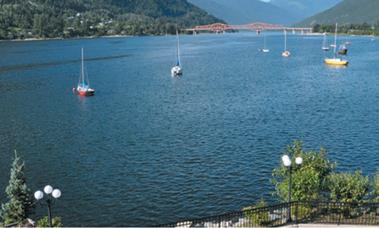
CBABC Full Day Professional Development in Nelson (5 CPD Hours)
Date: February 28, 2014
Location: Prestige Lakeside Resort & Convention Centre, Nelson
CBABC Full Day Professional Development in Smithers (6 CPD Hours)
Date: March 1, 2014
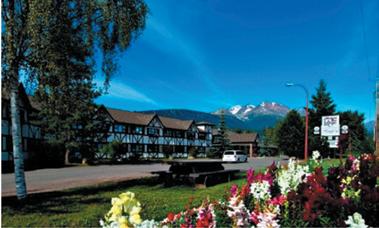
Location: Hudson Bay Lodge, 3251 E Hwy 16, Smithers
NEWS
CLEBC Update PD NEWS
KEEP UP-TO-DATE WITH CLEBC’S ANNUAL REVIEW
Every year, lawyers and other readers around B.C. turn to CLEBC’s Annual Review of Law & Practice to learn about key developments and trends in British Columbia law. Now in its 23rd annual edition, the Annual Review provides an easy, affordable, and reliable way to keep on top of pivotal issues and trends.
VERNON
IN PARTNERSHIP WITH THE CBABC WILLS & TRUSTS SECTIONS
Retreat & Full Day Professional Development Event in Vernon (6 CPD Hours)
Date: May 2-3, 2014
Location: Sparkling Hills Resort, Vernon
This year’s edition promises to be bigger and better than ever before. The book includes 34 chapters packed with accessible commentary about the main legislative, case law, and practice changes in British Columbia. The Annual Review is the essential updating tool for the busy practitioner. Chapters are written by B.C. lawyers who have recognized interests and knowledge in particular areas of law. The many contributors have enthusiastically embraced the concept of the book and have reduced the latest developments in law into
readable articles (no easy task). We’re grateful to our loyal volunteers for their commitment to CLEBC and the Annual Review
We hope that the Annual Review becomes an established part of the self-education process for all B.C. lawyers and those interested in monitoring substantive changes in legal practice each year.
To order your copy of the Annual Review, or for more information, visit the CLEBC website.
BRANCH & BAR
B.C. LEGISLATIVE UPDATE
ACTS
IN FORCE
Current from October 16 to December 24, 2013
Legislative Update is provided as part of the CBABC legislative and law reform program. It is a service funded by CBA membership fees, and is, therefore, provided as a benefit of CBA membership. The full version of Legislative Update is now only published online and available to CBA members exclusively at cbabc.org.
CIVIL RESOLUTION TRIBUNAL ACT, S.B.C. 2012, C. 25
Section 110 is in force December 12, 2013
CRIMINAL RECORDS REVIEW AMENDMENT ACT, 2013, S.B.C. 2013, C. 8
Sections 1 to 44 and 52 to 59 are in force November 30, 2013
MISCELLANEOUS STATUTES AMENDMENT ACT, 2004, S.B.C. 2004, C. 23
MOTOR VEHICLE AMENDMENT ACT, 2010, S.B.C. 2010, C. 14 Section 20 is in force February 26, 2014
STRATA PROPERTY AMENDMENT ACT, 2009, S.B.C. 2009, C. 17 Section 25 is in force December 12, 2013
FEBRUARY
8 Nanaimo Battle of the Bar Bands Nanaimo
18 CBABC PD: Primer on Canada’s New Anti-Spam Law (CASL) Webinar
20 CBABC PD: Managing for Results – Working with Your Staff Effectively Vancouver
28 CBABC PD: Full Day Professional Development Nelson
MARCH
1 CBABC PD: Full Day Professional Development Smithers
4 West Coast LEAF 27th Annual Equality Breakfast Vancouver
8 Provincial Council Meeting Richmond
BARTALK’S
news&events
AWARD NOMINATIONS
Call for Nominations
You are encouraged to honour a colleague and fellow CBABC member through their nomination for one of the following prestigious awards:
The Community Service Award recognizes the valuable contributions of CBABC members serving the communities in our province. The CBABC sponsors the Community Service Awards in each county biennially.
The Equality and Diversity Award celebrates the accomplishments of a CBABC member who has succeeded in advancing equality in the legal profession or generally in B.C.
The Harry Rankin, QC Pro Bono Award was established in
TIPS FROM
recognition of the immense contribution of Harry Rankin, QC in supporting access to justice for the poor. The Award recognizes outstanding contributions by a member of the CBABC in the area of pro bono work.
The Work Life Balance Award recognizes lawyers, law firms or organizations who demonstrate leadership in promoting work life balance within the practice of law.
Nominations for all awards must be submitted before 4:30 p.m. on April 25, 2014. Additional information on these awards and nomination forms are available on the home page at cbabc.org under “Call for Nominations.”
EVENT REMINDER B.C. Law Week
Law Day, in Canada, is April 10, 2014. Events will be held in various communities throughout B.C. in April, including open houses, law classes, a high school forum with the three Chiefs, the Barry Sullivan Law Cup and Dial-A-Lawyer Day on April 12. This year’s theme is Access to Justice: What does it mean to YOU?
For more information on 2014 Law Week activities and ways to get involved
This issue of BarTalk is dedicated to environmental law: an ever changing area with constitutional and international implications, complex data and a constant need to continue learning. If you don’t practice environmental law, we suspect this may still sound familiar. This gives us a perfect opportunity to highlight a great tool available to B.C. lawyers: the Lawyers’ Reading Room. In this tip, we’ll highlight three great ways to use the Reading Room for the environmental lawyer and beyond.
1. FIND A GREAT BOOK ON POINT: The Irwin online collection brings you more than 160 Canadian legal texts, including an excellent 2013 edition of the Environmental Law text by Jamie Benidickson. These ebooks are fully searchable and available on computers, tablets and e-readers. You can even highlight, save notes and come back later.
2. FIND A LEADING LEGAL JOURNAL: Whether you need to better understand the evolution of the laws relating to oil spills or you are interested in reading how the UK is handling similar issues, Hein Online offers access to 1000s of journal articles from Canada and beyond.
3. FIND A SENTENCING QUANTUM: Need to see a customized sentencing range on say, obstructing the police? You can select an offence from the Criminal Code and then layer on relevant factors for an efficient sentencing quantum from RangeFindr.
All of this is available to you through the Lawyers’ Reading Room through anywhere you have Internet. The best part? It’s free for Law Society members in B.C.! All of these products have an array of possibilities that we’d love to tell you more about. For more information and links to video tutorials, please visit the Courthouse Libraries BC’s blog, The Stream.
grantsapproved
$55,000
Outlined below is a list of grants adjudicated at the November 23, 2013 Board of Governors’ meeting.
Funding totalling $7,946,280 was approved for the following 23 continuing programs:
$3,599,750 LEGAL SERVICES SOCIETY Program Grant
$2,737,750
B.C. COURTHOUSE LIBRARY SOCIETY Program Grant
$313,600
B.C. CIVIL LIBERTIES ASSOCIATION Major Programs
LAW SOCIETY OF B.C.
$257,180 Professional Legal Training Course
$71,500 CanLII Virtual Library
UNIVERSITY OF BRITISH COLUMBIA
$210,000 Indigenous Community Legal Clinic (formerly: First Nations Legal Clinic)
$60,000 Graduate Fellowships
$45,000 Public Interest Work Placements
$29,000 Undergraduate Scholarships
$13,500 Entrance Awards
$75,000
HAIDA GWAII LEGAL PROJECT SOCIETY Legal Education/Advocacy Program
$75,000
NANAIMO CITIZEN ADVOCACY ASSOCIATION Legal Advocacy Program
$75,000
POWELL RIVER COMMUNITY SERVICES ASSOCIATION Poverty Law Advocacy Program
$70,000
B.C. FREEDOM OF INFORMATION AND PRIVACY ASSOCIATION Law Reform & Public Legal Education Program
PRINCE RUPERT UNEMPLOYED CENTRE SOCIETY Advocacy Program
$35,000
PRO BONO STUDENTS CANADA – UBC Community Placement Program
$30,000
PRO BONO STUDENTS CANADA – UVIC Student Placement Program
$20,000
DEBATE AND SPEECH ASSOCIATION OF B.C.
Law Foundation Cup
$5,000
QUESNEL TILLICUM SOCIETY Legal Advocacy Program
Funding totalling $495,000 was approved for the following six grants:
$175,000
FIRST UNITED CHURCH COMMUNITY MINISTRY SOCIETY Poverty Law Advocacy Program
THOMPSON RIVERS UNIVERSITY
$150,000 Entrance Scholarships (over 5 years)
$75,000 Legal Education and Research Projects (over 5 years)
$50,000
UNIVERSITY OF BRITISH COLUMBIA Law Foundation Awards
$25,000
UNIVERSITY OF VICTORIA Law Foundation Awards
$20,000
FOUNDATION FOR LEGAL RESEARCH Legal Research Program
Funding totalling $1,230,000 was approved for the following 12 grants that were approved for funding in June 2013 with their specific amounts set at the November 2013 meeting:
B.C. COALITION OF PEOPLE WITH DISABILITIES
$175,000 Advocacy Access Appeals Program
$75,000 CPP Disability Program
ABBOTSFORD COMMUNITY SERVICES SOCIETY
$150,000 Regional Community Legal Advocacy Program
$100,000 Legal Advocacy Program
$150,000 KETTLE FRIENDSHIP SOCIETY Mental Health Legal Advocacy Program
$110,000 MPA – MOTIVATION, POWER & ACHIEVEMENT SOCIETY Court Services Program
$90,000
B.C. FAMILIES IN TRANSITION Legal Support Services Program
$85,000 COMMUNITY CONNECTIONS SOCIETY OF SOUTHEAST B.C. Traveling Poverty Law Advocate Program
$80,000 NELSON CARES SOCIETY Legal Advocacy Program
$75,000
KI-LOW-NA FRIENDSHIP SOCIETY Aboriginal Legal Advocacy Program
$75,000 MOSAIC Legal Advocacy Program
$65,000 SOUTH PEACE COMMUNITY RESOURCES SOCIETY South Peace Outreach Legal Advocacy Program
Funding totalling $108,000 was approved for the following three Strategic Initiative Fund grants:
$75,000
LEGAL SERVICES SOCIETY Self Represented Litigants Family Law Resources
$19,000 DENICE BARRIE LAW CORPORATION Model for Specialized Family Law Advocacy Programs in B.C.
$14,000 ERIN SHAW
Exploring Early Neutral Evaluation in Family Law
Funding totalling $100,000 for six Legal Research grants was approved by the Fellowships and Research Committee.
For details of all programs and projects that received funding
professionaldevelopment
EMAIL: PD@CBABC.ORG
\ WEBSITE: CBAPD.ORG
CBABC Professional Development courses are designed to meet the needs of lawyers while still maintaining the opportunity to network and advance one’s career, practice and business. We pride ourselves in bringing courses to lawyers that will provide the required professional responsibility and ethics, client care and relations, and practice management component for 2014 Law Society of British Columbia reporting.
Upcoming In-person Seminars
Managing for Results
– Working with Your Staff Effectively
Date: February 20, 2014
Speaker: Dennis Hilton –Facilitator, Trainer, Consultant and Speaker
Location: The Law Courts Inn, Vancouver
Upcoming Webinar
Primer on Canada’s New Anti-Spam Law (CASL)
Date: February 18, 2014
Speakers: Jennifer A. Marles, Oyen Wiggs Green & Mutala LLP and Barry B. Sookman, McCarthy Tétrault LLP
Moderator: Stuart Rennie, Legislation & Law Reform Officer, CBABC
Some of the feedback from our past participants:
“Effective communicator and dynamic presentation. Three hours is a long time to keep interest and attention of an audience, but Dennis was organized and interesting throughout.”
“I was expecting generalizations and esoteric pseudo-science, and was pleasantly surprised at the grounded and practical approach taken.”
E-learning On Demand
Earn your CPD credits easily and conveniently, at the time that suits you best.
IN PARTNERSHIP WITH THE KOOTENAY BAR ASSOCIATION
CBABC Full Day Professional Development in Nelson Attendance at this event will provide you with 5 CPD hours
Date: February 28, 2014
Time: 11:00 a.m. – 4:45 p.m.
Location: Prestige Lakeside Resort & Convention Centre, Nelson
CBABC Full Day Professional Development in Smithers Attendance at this event will provide you with 6 CPD hours
Date: March 1, 2014
Time: 10:00 a.m. – 4:45 p.m.
Location: Hudson Bay Lodge, Smithers
IN PARTNERSHIP WITH THE CBABC WILLS & TRUSTS SECTIONS
Retreat & Full Day
Professional Development Event in Vernon Attendance at this event will provide you with 6 CPD hours
Date: May 2-3, 2014
Location: Sparkling Hills Resort, Vernon
\ Our online courses incorporate reading materials, quizzes, audio and video
\ Available 24/7 \ Requires Internet connection
Course Title: Introduction to Ethics and Professional Responsibility in British Columbia
\ Module 1 – Canons of Legal Ethics, Client Care (1 CPD hour)
\ Module 2 – Administration of Justice, Supervision, The Profession (1 CPD hour)
To register, visit www.cbapd.org (Search by keyword: E-Learning On Demand)
barmoves
Who’s Moving Where and When
SPACE IS AT A PREMIUM AND AVAILABLE ON A FIRST-COME FIRST-SERVED BASIS SO SEND YOUR BAR MOVE (MAX. 30 WORDS) AND A HIGH-RESOLUTION PHOTO TO BARTALK@CBABC.ORG NOW.
Dale Wilcox of Wilcox & Company Law Corporation has moved his practice to Synergy Business Lawyers. His practice focuses on real estate, real estate development, financing and corporate and commercial law.
Graeme Nunn has joined Rockies Law Corporation in Fernie. Graeme’s practice areas include real estate and development law, wills and estates, corporate and business law and commercial litigation.
Kora Paciorek has joined Harper Grey LLP as an associate with the Insurance Law group. Kora practises in the areas of subrogated property damage, personal injury and professional negligence.
Jason Z. Murray joined Eyford Macaulay Shaw & Padmanabhan LLP as an associate. He will be practising in the areas of commercial, insurance and product liability litigation and aboriginal law.
Sam Liang formerly of Thorsteinssons LLP Tax Lawyers, joined Legacy Tax & Trust Lawyers at the beginning of September. He is practising in the area of corporate and personal tax planning, estate planning and trusts.
Karen Tse has joined Rockies Law Corporation in Fernie. Karen practises in the areas of family, wills and estates, bankruptcy and general civil litigation.
Jennifer Wriley has recently commenced articles at Koffman Kalef LLP. She completed her J.D. and LL.M. at UBC and will be called to the B.C. Bar in late 2015.
Zara Suleman has recently launched her own law firm, Suleman Family Law. Previously Zara practised family law at North Shore Law LLP.
Brian Vick joined Miller Titerle LLP where he will focus on complex commercial transactions, securities law and executive compensation plans.
Drew Lawrenson joined Miller Titerle LLP in their Gastown offices where he will focus on corporate and education law. Drew most recently worked as General Counsel to the Eminata Group.
November & December 2013 newmembers
Regular Member
Cheri Dawn Carey
Vancouver
Maria Kourelis
Heenan Blaikie LLP
Vancouver
Monica F. McParland Pushor Mitchell LLP Kelowna
Jefferey B. Meyers Cox, VictoriaTaylor
Mary E. Murray Department of Justice Canada
Vancouver Sarah-Dawn Norris Department of Justice Canada
We are print experts – so you don’t have to be. Trust us to guide your firm through your next print project so you can spend more time on what you’re an expert at.
Scan the code to read how our customers have experienced print made easy or visit us at stillcreekpress.com/about/testimonials.