For the first time in 55 years, the Law Society of B .C. pract i ce fee will be put to a referendum rather than decided at an Annual General Meeting. There will be no forum for debate or participation from members other than a single "X" mark on a ballot For that reason, we ask all members to take time to read about the CBA and carefully consider what your vote will mean . There will be three options on the ballot: Resolution A, which is the status quo position, i ncludes fees payable to the Law Society, B .C . Courthouse Library Society, Lawyers Assistance Program , the Advocate and the Canadian Bar Association, B.C. Branch (CBABC) Resolution B includes all fees except the CBABC fee. And the third option is "To not set the practice fee at this time," thus return-
ing the decision to the Law Society Annual General Meeting in the Fall.
supportive legal decision in Gibbs v. Law Society of B.C A Membership Protocol was introduced, allowing lawyers to resign their CBA membership for principled reasons. Only 16 members have chosen to do so
Despite the constant majority support, a small group of voca l opponents has continued to make this an issue for the Law Society; thus the Benchers decided this year to forego the AGM as the venue for deciding the matter, and instead to put the question to referendum . The Benchers debated whether or not to take a position on the matter, and in end chose not to make any recommendation as to how members should vote .
In recognition that there are diverse views on this issue, and to assist in the promotion of debate, the BarTalk Editorial
"We ask all members to take time to read about the CBA and carefully
The referen - consider what your vote will mean ." dum ballot package will be mailed in late May, for return by June 22nd. The ballots will be counted on June 23rd A simple majority of the returned ballots will decide the fee to be paid for 2005
To date, through 55 annual meetings and a handful oflegal cases, the inclusion of a CBA fee has always been upheld. As recently as last year, there was a 2:1 majority vote at the AGM, and a strongly
Board invited Mr. John McAlpine , QC and Mr. Cameron Ward to provide their opposing per-
spectives on the matter. Members are encouraged to read both, and to read the other articles in this edition of Bar Talk that highlight the ongoing work of the Association.
Whether or not to continue to provide a un i versal levy to support the CBA is a critical decision , with consequences for the entire profession In the interests of ensuring an informed vote, take the time to consider it well. BT
The canadian Bar Association British Columbia
FEATURED THIS ISSUE
The Law Society is conducting a referendum in June on whether a CBA fee should be included in the Law Society practice fee. In this issue we asked two members to contribute their opposing views, to foster debate about the vote.
In support of the Can;dian Bar Association by John D. McAlpine, QC
Mandatory CBA payments no longer serve the profession by A. Cameron Ward
Active participation brings rewards by Susan Van Dyke
Be letter perfect with the help of this guide by Sarah Picciotto
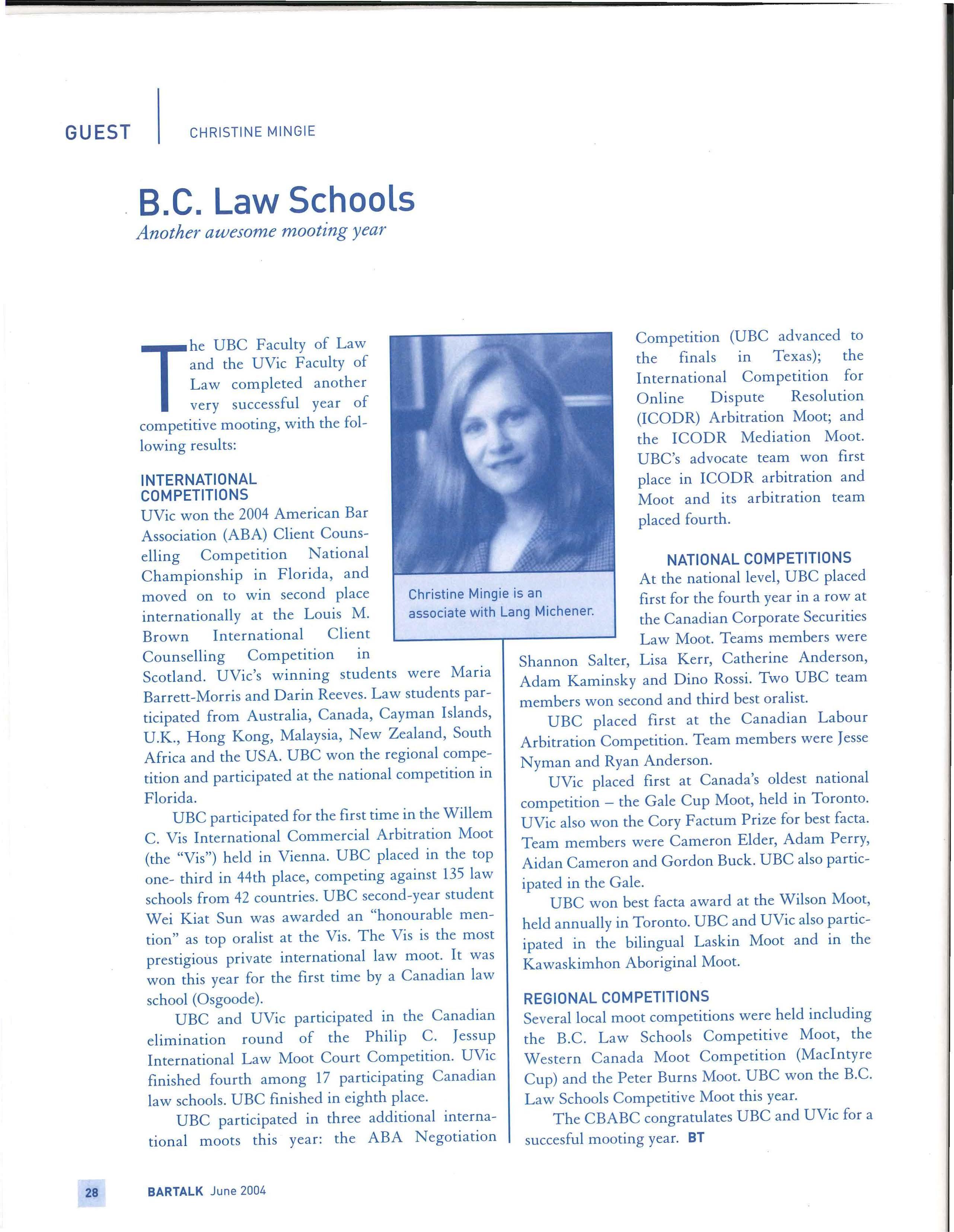
Another awesome mooting year by Christine Mingie
We regret that, due to time contraints, this issue does not include an article by Michael Van Klaveren, B.C. Crown Counsel Association President We lookforward to publishing his column in the August issue.
See related item on page 25.
1Oth Floor, 845 Cambie Street Vancouver, B.C. V6B 5T3
Tel: 604-687-3404
Toll Free [in B.C ): 1-888-687-3404
BarTalk is published six times per year by the Canadian Bar Association, British Columbia Branch.
This publication is intended for information purposes only and the information herein should not be applied to specific fact circumstances without the advice of counsel.
The Canadian Bar Association, British Columbia Branch represents 10,000 members within British Columbia and is dedicated to improving and promoting access to justice, to reviewing legislation, initiating law reform measures and advancing and improving the administration of justice.
BarTalk Publication Sales Agreement #40741008 The Canadian Bar Association British Columbia
CAROLINE NEV IN LETTERS TO THE EDITOR
ONCE YOU'VE HAD MAC, YOU NEVER GO BACK
That was a great article (Vol. 16/No. 2) on Tony's experience as the sole user of a Mac in
Send your LETTERS TO THE EDITOR to:
Caroline Nevin, BarTalk Senior Editor
Canadian Bar Association, B. C. Branch
Fax: 604-669-9601
Toll free fax: 1-877-669-9601
E-mail: cnevin@bccba.org
his office. However, that's nothing! Our firm, Staples McDannold Stewart, is fully on Macs- from iMacs to Powerbooks, programs to networks. And anything an IBM can do, Macs can do better.
More importantly, Macs for lawyers makes business sense. Lawyers are too busy to figure out how to make computers work, we just want to get the work done! Macs allow us to do that. We can focus on the big picture and not waste time being sidetracked with glitches (what's a virus?). This way, we spend more time serving our clients- and that's billable time.
-Troy DeSouza, Victoria
BarTalk Survey
Many BarTalk readers have sent in completed surveys Thank you! Some lawyers who don't read BarTalk have also returned completed surveys- we appreciate your comments too, for a rounded perspective We need your input to create a publication that is tailored to your interests. If you haven't yet shared your opinions, the survey is posted at www.bccba .org under "Your Voice Counts." We will continue to accept draw-eligible surveys until May 31, when we will draw for two CBA fleeces. Here are some of the suggestions we 've received :
• Have a page listing all companies offering deals to members in each issue with some examples.
- Great ideal We'll try that in the August issue.
• Include a column aimed at the 0-5 year call, specifically dealing with an issue facing these lawyers.
- Expect it soon.
• Blue ink on blue backgrounds is hard to read.
- We hope the new format will solve this problem as the backgrounds are much lighter.
Have you moved? Let us know!
If you have changed firms, changed addresses, have a new e-mail address or phone/fax number, you need to let us know. Letting the Law Society in on the secret is not enough! E-mail data@bccba.org, phone 604-687-3404 or fax 604-669-9601. Toll free phone 1-888-687-3404 or fax 1-877-669-9601.
FROM THE PRESIDENT ROBERT C BRUN
It's Your Choice
Defining the future of B.C. s legal profession
0n June 1, voting members of the Law Society will have the opportunity to set the practice fee for 2005 by referendum. The real question being asked is whether the CBA fee will be included in the practice fee as it has been for 55 years.
In other jurisdictions, selfregulation of the profession is being questioned and threatened. In Australia and England, the state has intervened to the detriment of self-regulation when law
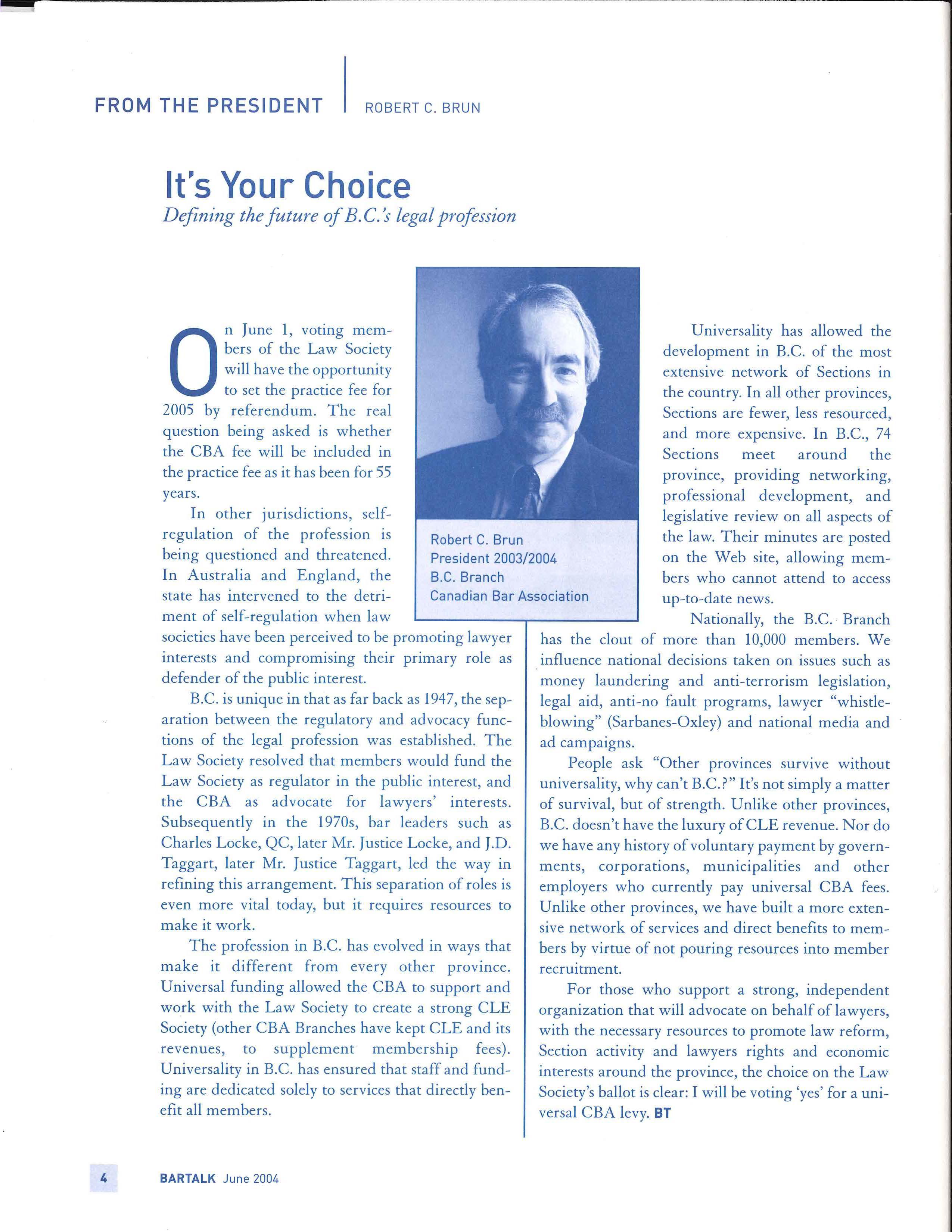
Robert
C Brun
President
2003/2004
B.C. Branch Canadian Bar Association
societies have been perceived to be promoting lawyer interests and compromising their primary r ole as defender of the public interest.
B.C. is unique in that as far back as 1947, the separation between the regulatory and advocacy functions of the legal profession was established. The Law Society resolved that members would fund the Law Society as regulator in the public interest, and the CBA as advocate for lawyers' interests.
Subsequently in the 1970s, bar leaders such as Charles Locke, QC, later Mr. Justice Locke, and J.D. Taggart, later Mr. Justice Taggart, led the way in refining this arrangement. This separation of roles is even more vital today, but it requires resources to make it work.
The profession in B.C has evolved in ways that make it different from every other province.
Universal funding allowed the CBA to support and work with the Law Society to create a strong CLE Society (other CBA Branches have kept CLE and its revenues, to supplement membership fees).
Universality in B.C. has ensured that staff and funding are dedicated solely to services that directly benefit all members.
has the clout
Universality has allowed the development in B.C. of the most extensive network of Sections in the country In all other provinces, Sections are fewer, less resourced, and more expensive. In B.C., 74 Section s meet around the province, providing networking, professional development, and legislative review on all aspects of the law. Their minutes are posted on the Web site, allowing members who cannot attend to access up - to - date news.
Nationally, the B.C. Bran ch of more than 10,000 members. We influence national decisions taken on issues such as money laundering and anti - terrorism legislation, legal aid, anti - no fault programs, lawyer "whi stleblowing" (Sarbanes - Oxley) and national media and ad campaigns.
People ask "Other provinces survive without universality, why can't B.C . ?" It's not simply a matter of survival, but of strength. Unlike other provinces, B.C. doesn't have the luxury ofCLE revenue. Nor do we have any history of voluntary payment by governments, corporations, municipalities and other employers who currently pay universal CBA fees. Unlike other provinces, we have built a more extensive network of services and direct benefits to members by virtue of not pouring resources into member recruitment.
For those who support a strong, independent organization that will advocate on behalf of lawyers, with the necessary resour ces to promote law reform, Section activity and lawyers rights and economic interests around the province, the choice on the Law Society's ballot is clear: I will be voting 'yes' for a universal CBA levy. BT
FRANK KRAEMER EXECUTIVE DIRECTOR
So What Does the CBA Do For Me?
Idon't see value for my CBA fees. I am concerned about the public image of the profession. I want my professional association to speak out for my interests and those of the profession; it should help me find ways to be happier in the practice of law and to achieve financial security. But I don't have time to read CBA faxes and e-mails."
These are some sentiments I recently heard from members who want to see that they receive value for their membership dollars, but have little time to read detailed
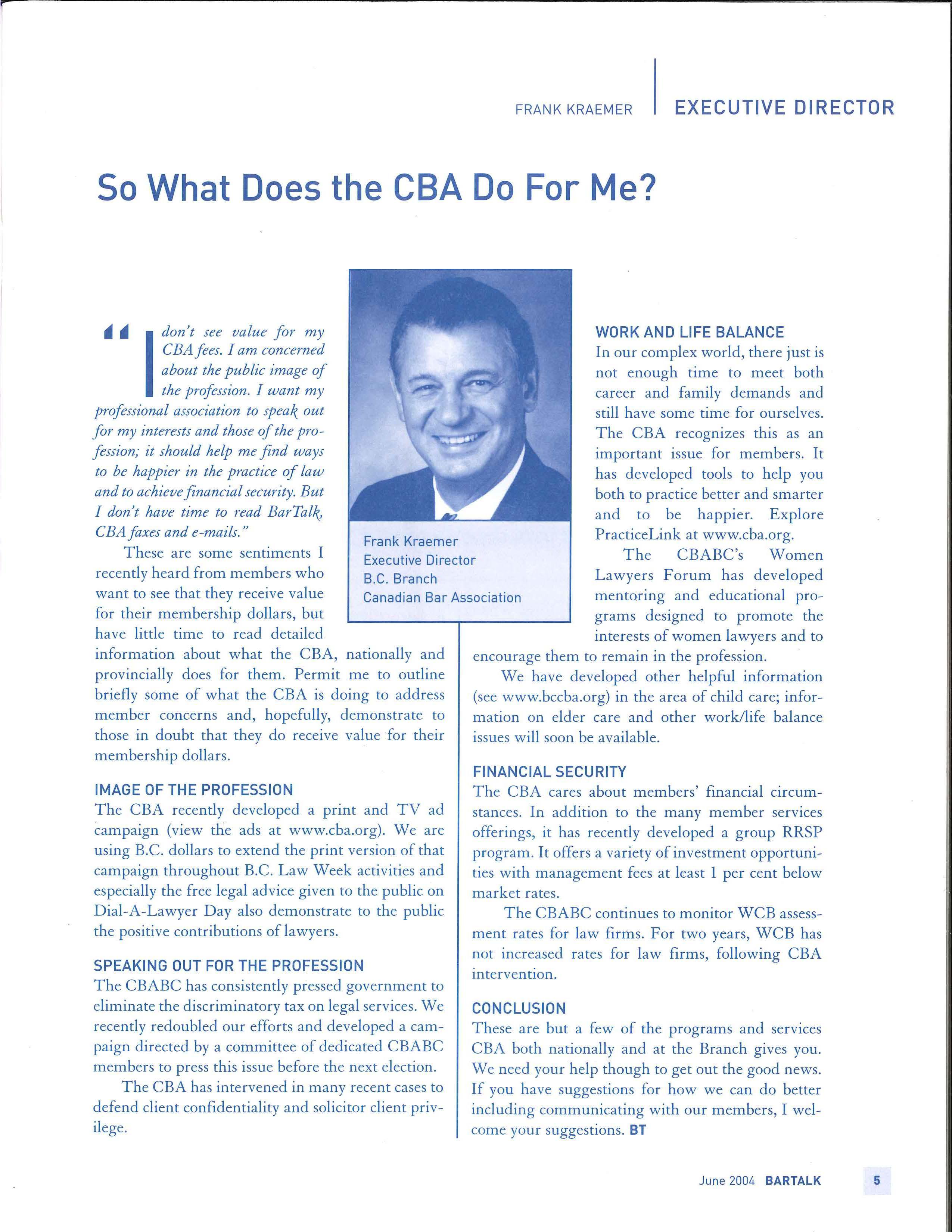
Frank Kraemer
Executive Director B.C Branch
WORK AND LIFE BALANCE
In our complex world, there just is not enough time to meet both career and fam ily demands and still have some time for ourselves.
The CBA recognizes this as an important issue for members. It has developed tools to help you both to practice better and smarter and to be happier. Explore PracticeLink at www.cba.org.
The CBABC's Women Lawyers Forum has developed mentoring and educational programs designed to promote the Canadian Bar Associat i on
information about what the CBA, nationally and provincially does for them. Permit me to outline briefly some of what the CBA is doing to address member concerns and, hopefully, demonstrate to those in doubt that they do receive value for their membership dollars.
IMAGE OF THE PROFESSION
The CBA recently developed a print and TV ad campaign (view the ads at www cba.org). We are using B.C . dollars to extend the print version of that campaign throughout B.C Law Week activities and especially the free legal advice given to the public on Dial-A-Lawyer Day also demonstrate to the public the positive contributions of lawyers.
SPEAKING OUT FOR THE PROFESSION
The CBABC has consistently pressed government to eliminate the discriminatory tax on legal services. We recently redoubled our efforts and developed a campaign directed by a committee of dedicated CBABC members to press this issue before the ne x t election.
The CBA has intervened in many recent cases to defend client confidentiality and solicitor client privilege .
interests of women lawyers and to encourage them to remain in the profession
We have developed other helpful informat ion (see www bccba org) in the area of child care; information on elder care and other work/life balance issues will soon be available
FINANCIAL SECURITY
The CBA cares about members' financial circumstances. In addition to the many member services offerings, it has recently developed a group RRSP program . It offers a variety of investment opportunities with management fees at least 1 per cent below market rates.
The CBABC continues to monitor WCB assessment rates for law firms. For two years, WCB has not increased rates for law firms, following CBA intervention.
CONCLUSION
These are but a few of the programs and services CBA both nationally and at the Branch gives you. We need your help though to get out the good news. If you have suggestions for how we can do better including communicating with our members, I welcome your suggestions. BT
SECTION TALK SHELLEY BENTLEY
The CBABC sponsors 74 Sections which play a vital role in keeping members informed both on changes i n the law, and legal and political issues affecting a given area of practice. They are the main resource utilized by the CBABC in legislative review, law r eform initiatives and in responding to matters affecting the profession . What follows is a sample of the r ecent activities of some Sections
ALTERNATE DISPUTE RESOLUTION-VANCOUVER
Sandra Polinsky and Peter Grove gave an informative overview of the history of collaborative law and then discussed issues surr o unding its application in nonfamily law settings.
The history of collaborative law begins with Stu Webb, an attorney in Minnesota who became disillusioned with his family litigation practice. Mr. Webb found mediation too neutral and
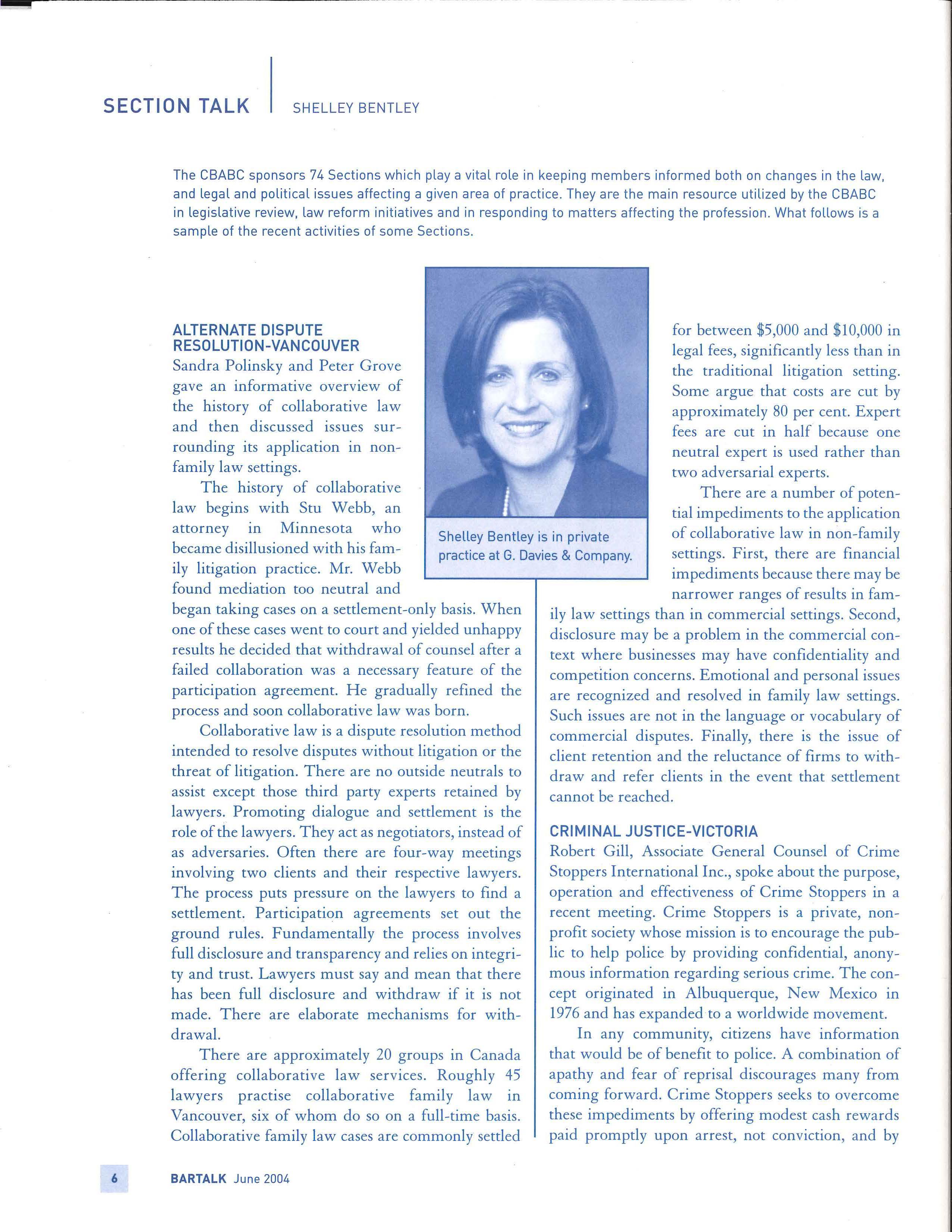
Bentley is in private practice at G. Davies & Company
began taking cases on a settlement- only basis When one of these cases went to court and yielded unhappy results he decided that withdrawal of counsel after a failed collaboration was a necessary feature of the participation agreement. He gradually refined the process and soon collaborative law was born Collaborative law is a dispute resolution method intended to re solve disputes without litigation or the threat of litigation. There are no outside neutrals to assist except those third party experts retained by lawyers. Promoting dialogue and settlement is the role of the lawyers. They act as negotiators, instead of as adversaries. Often there are four-way meetings involving two clients and their respective lawyers. The process puts pressure on the lawyers to find a settlement. Participation agreements set out the ground rules. Fundamentally the process involves full disclosure and transparency and relies on integrity and trust. Lawyers must say and mean that there ha s been full disclosure and withdraw if it is not made. There are elaborate mechanisms for withdrawal.
There are approximately 20 groups in Canada offering collaborative law services. Roughly 45 lawyers practise collaborative family law in Vancouver, six of whom do so on a full-time basis. Collaborative family law cases are commonly settled
for between $5,000 and $10,000 in legal fees, significantly less than in the traditional litigation setting. Some argue that costs are cut by approximately 80 per cent. Expert fees are cut in half because one neutral expert is used rather than two adversarial experts
There are a number of potential impediments to the application of collaborative law in non-family settings. First, there are financial impediments because there may be
narrower ranges of results in family law settings than in commercial settings. Second, disclosure may be a problem in the commercial context where businesses may have confidentiality and competition concerns Emotional and personal issues are recognized and resolved in family law settings. Such issues are not in the language or vocabulary of commercial disputes. Finally, there is the issue of client retention and the reluctance of firms to withdraw and refer clients in the event that settlement cannot be reached.
CRIMINAL JUSTICE-VICTORIA
Robert Gill, Associate General Counsel of Crime Stoppers International Inc., spoke about the purpose, operation and effectiveness of Crime Stoppers in a recent meeting. Crime Stoppers is a private, nonprofit society whose mission is to encourage the public to help police by providing confidential, anonymous information regarding serious crime. The concept originated in Albuquerque, New Mexico in 1976 and has expanded to a worldwide movement. In any community, citizens have information that would be of benefit to police. A combination of apathy and fear of reprisal discourages many from coming forward. Crime Stoppers seeks to overcome these impediments by offering modest cash rewards paid promptly upon arrest, not conviction , and by
Shelley
invoking police informer privilege . This privilege, in Canada, is most clearly set out in four decisions of the Supreme Court of Canada:
• R. v Garofoli, [1990] 2 SCR 1421- A search warrant or wiretap authorization must be supported by evidence at trial that is not subject to privilege.
• R. v Leipert, [1997 ] 1 SCR 182- Information provided to Crime Stoppers by anonymous informants must not be disclosed to the defence , in order to protect the informant's identity. The only exception is where disclosure is required to allow the accused person to demonstrate his or her innocence .
• R. v. Carosella, [1997] 1 SCR 80- Crime Stoppers and other organizations must retain their records for possible examination by a trial judge and failure to do so can lead to a stay of proceedings.
• R. v McClure, [2001] 1 SCR 445- Sets out a detailed procedure for the inquiry into whether the information is relevant to the issue of innocence and thus not subject to informer privilege.
Crime Stoppers has systems in place to preserve anonymity. Ca ll -takers advise tipste r s on their rights Names are not taken. There are no recordings or call display There is no face-to-face contact with the calltaker. There are also procedures in place to handle payment of rewards on an anonymous basis.
WILLS AND TRUSTS-VANCOUVER
Gary Wilson, counsel in Re: Bloom, 2004 BCSC 70 commented on this case concerning the application of probate fees and the situs test in the context of securities held by an estate.
He began by noting that the Probate Fee Act sets probate fees on the basis of the "va l ue of the estate situated m British Columbia " This has commonly been understood by practitioners to mean that the common law situs rules apply to determine what of the deceased's estate is within British Columbia. However, B.C. probate registries have deviated from these rules in applying the test, leading to confusion and frustration. Mr. Justice Ehrke's decision in this case has been lauded for its confirmation that common law principles are to be applied as well as for its clear analysis of the issues involved
SHELLEY
BENTLEY SECTION TALK
and the test to be applied.
In this case, securities were being held at the date of death by the Bank of Nov a Scotia Trust Company ("Scotiatrust") in Vancouver as Committee for Bessie Bloom . The securities had been purchased and were held through the book entry system maintained by the Canadian Depository for Securities Bessie Bloom's ownership of the securities was recorded on the books of the Securities Department of Scotia trust in Toronto. In decid ing that these securities were situated "without B.C.," Mr. Justice Ehrcke found that in a multi-tiered holding system, the account would be "situated" at the financial investment intermediary on whose books the interest of the debtor appears. Th is is the place where the record that determines title is to be found. It is also the place where the personal representative must go to effect the transmission. In this case, the securities were "situated" in the Securities Department of Scotiatrust in Toronto.
This decision is under appeal. If required by probate registry staff to pay probate fees on securities that could now be characterized as "without B.C ", Mr. Wilson recommended paying the fees "under protest." BT
"Collaborative
family law cases are commonly settled for between $5,000 and $10,000 in legal fees, significantly less than in the traditional litigation setting. Some argue that costs are cut by approximately 80 per cent. Expert fees are cut in half because one neutral expert is used rather than two adversarial experts."
DAVID J BILINSKY
A Financial Makeover
A new recipe for success
I work all night, I work all day, to pay the bills I have to pay Ain 't it sad
A nd still there never seems to be a single penny left for me Money, money, money Must be funny
In the rich man's world
-Words and mu sic by B. Andersson and B. Ul va eu s, r ecord e d by Abb a
While working harder is certainly an old-time recipe for success, it is not the only recipe. Indeed, all of us have heard th e catch-phrase "Work smarter, not harder.'' Like many bits of advice ,
David J Bilinsky is the Practice Management Adv isor at the Law Soc iety of British Columbia He can be reac h ed
on the Internet at dbili nsky@lsbc.org.
it is easier to say than to apply. So what can you do to improve your bottom line without working all night and all day? The secret appears to lie in financial analysis of what you do and how you do it Here are some suggestions put forward in this area and how they can be applied to your practice
PRUNE
Steven Campbell, CA, a consultant with Thomson Elite recently told me that they had been running the numbers on law firms While most firms work on the 80/20 rule (namely that 80 per cent of law firm income comes from only 20 per cent of the firm 's clients), in some cases the ratio can rise as high as 95/5 . The implications of this are profounddepending on your practice, you can drop up to 95 per cent of your client base and have a negligible effect on your bottom line - and work a whole lot less. Moreover, look at your clients in the bottom 20 per cent of your revenue curve and ask yourselfhow many of these clients may be conflicting you out of acquiring another star client that would place in
the top 20 per cent? The lost opportunity cost alone may drive you to start eliminating the bottom part of your revenue curve in order to provide the resources and the time to move your curve upwards .
Accordingly, to start your financial makeover, aggregate your income by client and rank it from largest to smallest (spreadsheets are useful here) Now create a column in your spreadsheet that lists the cumulative percentage of your total billings as you move downwards. Look at how many clients lie in the top 20 per cent
and in the bottom 20 per cent of the lis::ing Decide what can be done in terms of finding new homes for the bottom 20 per cent of your client base (ethically, of course).
TAKE INTEREST
Here is another analysis tool. Take your accounts paid and rank them in terms of days outstanding to date of payment. Unless you charge interest on your unpaid accounts, you are losing money for every day your accounts are unpaid - in effect you are providing financing for your clients at 0 per cent interest Again, look at the clients in the bottom 20 per cent of the list (and I would add in the clients with accounts outstanding here) . Ask yourself - it is worth it to carry these clients?
BE EFFECTIVE
A third analysis tool is to take your fees billed per client and divide it by the total hours put into the client's files (not the fees billed , but rather all time, billed or not). Rank order the results from largest to smallest . You are looking at your effective hourly
rate per client. Again ask yourself what benefits you are deriving from any client whose effective hourly rate is less than your stated hourly rate. Concentrating on this type of analysis should lead you to implement fixed-cost billing where the stated cost/file is higher than the typical time to complete its file times your stated hourly rate.
LEVER YOUR ASSETS
Here, take your clients and break out
total partners' time spent on the client and divide it by total associate's time logged against the same client Again, rank the result from smallest to largest. This will give you an indication of which clients are high-users of partner time and which clients can be leveraged downwards to use less-cost-
DAVID J BILINSKY
page spread over their lifetime.
BUILD YOUR PRECEDENTS
A solid business objective is to increase your margin on every file that you handle. Accordingly, build a set of continually reused precedents that minimizes your costs of handling a standard transaction to maximize your margin on every file handled after the first. Look at your files and inv est capital in your docu-
"Rather than working harder, take steps to change the mix of files in which you invest your time and energy and make your work environment one that supports greater profitability."
ly associate time. You may also want to repeat this analysis but instead of looking at clients , look at each partner and take their partner billable time divided by total associate time that was logged to their files, and again rank the results. This will show which partners push work downwards and which do not.
DISBURSE MISCONCEPTIONS
Here, take total client billings and divide by total disbursements incurred on their fi les. Rank the results. This gives you an idea of which clients require large capital investments relative to the fees earned . Files with large capital requirements should be priced accordingly to provide a return on the capital invested in the file in addition to a return on partner and associate time
LOOK AT LIFETIME COSTS
When acquiring an asset in your firm, estimate the Total Cost of Ownership (TCO). For example , when acquiring a printer, determine the maximum expected number of pages that the printer will generate over its lifetime. Calculate the cost of ink for those expected number of printed pages and add the initial cost of the printer Divide by the number of pages that you expect to receive from the printer This gives you an expected cost per page. While inkjet printers have a low initial cost, their TOC is much higher than laser printers which have a much lower cost per
ment generation system to quickly and efficiently handle your routine transactions. A corollary to this principle is to avoid one-off projects that do not play to the firm's strengths or strategic goals.
MOTIVATE EMPLOYEES
If you are working towa rds firm financial strategic goals, you already know your desired billing and profitability targets. Accordingly, create a win-win situation for you and your employees by explicitly outlining what the targets are, when you expect to reach them and how financial results that exceed the targets will be shared. By outlining what the rewards will be if the targets are exceeded and how an employee can personally benefit along with the organization, you are helping align everyone's interests towards a common goal.
Rather than working harder, take steps to change t he mix of files in which you invest your time and energy and make your work environment one that supports greater profitability. In this way, you should be able to avoid working all day and all night and still have some money left for yourself after paying all the bills you have to pay. BT
The views expressed herein are strictly the author's and m ay not be shared by the Law Society of B.C.
TONY WILSON
The Last Lawyer Joke I'LL Ever Tell
Ihate lawyer jokes, especially when they're told by someone whose experience with our profession is limited to L.A
Law reruns, O.J. Trial highlights, or the wonderfully oxymoronic "Celebrity Justice " Supposedly, we're all scoundrels somehow deserving of being the butt end of a punch line; not to mention we're also money-grubbing opportunists who make life far too complicated. An easy target, I suppose, since Shakespeare.
Yes, I've heard the one about the shark and professional courtesy. And I've heard the one about skid marks and the rat Burying
Tony Wilson is a Franchise and Intellectual property lawyer at Cawkell Brodie, and has written for The Globe and Mail, the
Vancouver Sun and Macleans magazine. His e-mail address is twilson@cawkell.com.
lawyers in sand? Heard it. Bicycles? Light bulbs? Cemeteries? Heard them all, like so much recycling on garbage day.
If I was clever enough, I'd come up with some witty Oscar Wildish retort every time I heard a lawyer joke that would turn the tables on the teller; the sort of thing Blackadder might say to Baldrick, or Marvin might say to Ford Prefect to put him in his place. But alas, I suffer from what the French call "!'esprit d'escallier," or "staircase wit." It 's when you think of the witty retort five minutes after the appropriately cunning moment while you're he a ding up the stairs, thinking "Damn . .. I wish I'd said that."
I suspect far too many of us suffer from staircase wit when some boob tells a bad lawyer joke a t our collective ethical expense. So rather than write some high-minded editorial on how bad these jokes are and how they malign the profession (I tried that It was resoundingly nuked), I'd like to sugg e st a cont est instead - not for the best or worst lawyer joke, but for the best response to one E-mail me your witty put downs and cutting responses to lawyer jokes and
I'll pick the best few, and put them in this column for all fellow sufferers. If I get one that's really good, I'll buy you lunch when Pirate Paks go on sale at White Spot. I'd like to prove that lawyers have a collective sense of humor. We ' re accused of so much, I'd hate to think we're guilty of not being funny.
Canadian doctors, I have recently learned, have their own magazine for humor. StitchesThe journal of Medical Humor has articles on hockey playing doctors, physicians who act on the side, and other pieces on the lighter side of
medicine, (which presumes, I suppose, that there is a lighter side to medicine). Every month they award a stethoscope to the funniest anecdote submitted by a doctor. The most surprising thing about Stitches is that it's targeted to a profession with about the same number of practitioners in Canada as ours, has a circulation of 38,000, and it's been around for 14 years. If doctors can afford to support a humor magazine for their profession, why can't lawyers support a humor magazine for ours? Somebody call Canadian Lawyer (offer them a Pirate Pak).
There's only one lawyer joke I like, and it has nothing to do with a misrepresentation of our ethics, and everything to do with our ridiculous propensity to take on more work. "The practise oflaw," the joke goes "is like a pizza eating contest, where the prize is more pizza." Whether it's funny or not isn't as important as how true it is. Do good work and you'll get more work. Get too much work, and you better find a good doctor for that triple bypass you'll need in a decade. If humor is, as the doctors say, a good healer, then we need all the laughs we can get. BT
PATRICIA JORDAN ON THE WEB
Sections Online
Everything to keep you informed on Section activity
Since the CBABC Web site went online in October 2000, CBABC has published thousands of Section-related documents at www.bccba.org. Section members can access meeting notices, minutes, case comments, speaker's notes, memos, announcements, letters, and annua l reports. If you missed a Section meeting, you can even view the Power Point presentation online (if applicable).
Do you need information on an upcoming Section meeting?
Your Home/Reception web page has your Section "meeting" linkclick on the link to access relevant information. A list of all upcoming Section meetings is available for all members in the Lawyer Lounge New "
Patricia Jordan is the CBABC
Manager, Interactive Media. She welcomes your comments, questions and suggestions. If you have a question about site
Strategies
• Client Services in the Legal Information Age
• Building a Better Web site
• Technologies for Solo, Home, and Mobile Lawyers
• Viruses, Hackers, and Spyware - Bandits on the Internet!
ASK THE WEBMASTER
Instant Messaging (IM) - what rist if any, does it pose to me and my computer?
As use of IM increases, the need for security becomes more vital. Associated risks of IM include security breaches, "spim" (instant messaging spam), an excessive drain of network resources and a reduction of users' productivity. content, or would like something added to the site, contact her at pjordan@cbabc.org or call 604-646-7861.
under "What's
Every Section also has an online message board (listserv). Your Section's listserv offers members the opportunity to pose questions, offer and share information on a variety of topics
NEW IN MEMBER PRODUCTS & SERV I CES
• Terminal City Club, look in "Business" under C l ubs
• The Electronic Courthouse, look in "Alternative Dispute Resolution" under Law Office Resources [Editor's note: See page 29 for a related article]
• FreeStay Getaways, look in "Accommodation" under Travel
TECHNOLOGY
AND YOUR PRACTICE
Check out PracticeLink at www.cba.org for information on these topics:
• Legal Practice and the Internet: Marketing
Content filtering tools from compames such as McAffee (www.mcaffee.com), Symantec (www.symantec. com), SurfControl (www.surfcontrol.com), Akonix (www.akonix.com) and IMlogic (www.imlogic.com) block messages with keywords or suspicious content. BT
The Access to Justice Network [ACJNet] is an electronic community that brings together people, information, and educational resources on justice and legal issues of interest to Canadians.
LEGISLATIVE UPDATE
STUART RENNIE
Every effort is made to ensure the accuracy of the information provided to you in this article but the information should not be relied upon Lawyers should refer to the specific legislative or regulatory provision You will see a reference in some cases to the number of the btll when it was introduced in the House This number may be different from the chapter number of the new Act which is quoted after the tttle of the Act and which is the proper citation for the Act The bill Number has been given to make it easier for you to note up the Bills you may have in your library
Additional detail on the Legislative Update can be found in the on l ine issue of June Bar Talk, posted at www.bccba.org.
Sections 1 to 18 amend the Accountants (Chartered) Act including amendments respecting the powers of the Council and Institute. Section 19 makes a consequential amendment to the Accountants (Chartered) Act to update references from the Company Act to the new Business Corporations Act In Force
Sections 1 to 18 in force March 24, 2004. Section 19 in force March 29, 2004
ADMINISTRATIVE TRIBUNALS APPOINTMENT AND ADMINISTRATION ACT, S.B.C. 2003, C. 47 (BILL 68)
Summary
Sections 59 and 60 make consequential amendments to the Safety Standards Act (Bill 19).
Stuart Rennie is the CBABC Legislation & Law Reform Officer. He can be reached at 604-949-1490 or by e-mail [srennie@bccba.orgl.
In Force
Sections 59 and 60 in force April 1,2004
ADVANCED
EDUCATION STATUTES AMENDMENT
ACT,2003,S.B.C.2003, C.48 (BILL 35)
Summary
Sections 2 to 5, 8 and 9 amend the College and Institute Act. Sections 15, 16, and 19 amend the Institute of Technology Act. Section 26 amends the Royal Roads University Act. Section 28 amends the Trinity Western University Foundation Act Sections 29 to 32 and 34 amend the University Act. Sections 36 to 39 amend the University Foundations Act. Section 40
amends the University ofVictoria Foundation Act, 1979.
In Force
Sections 2 to 5, 8, 9, 15, 16, 19, 26, 28 to 32, 34 and 36 to 40 are in force March 12, 2004
AGRICULTURE, FISHERIES
AND FOOD STATUTES AMENDMENT ACT, 1997, S.B.C. 1997, C. 14 (B ILL 11)
Summary
Sections 1 to 4 amend the Animal Disease Control Act Section 1 adds definitions Section 2 enacts a provision regarding licences required under the Act. Section 3 adds new offences Section 4 consolidates specified regulationmaking provisions respecting licences under the Act. Section 21 repeals the Livestock Public Sale Act.
In Force
Section 1 adding the definitions of "auctioneer", "farmer", "game", "operator", "public sale" and "public sale yard " to section 1 of the Animal Disease Control Act, section 2 as it enacts section 18.1 (1) (a) and (2) of the Animal Disease Control Act, section 3 as it enacts section 19 (2.1) (b), (c) concerning an auctioneer or operator, and (d) of the Animal Disease Control Act, section 4 (a) as it
enacts section 20 (2) (u), (v), (z.l), (z.2), (z.3) concerning auctioneers and operators and (z.4) of the Animal Disease Control Act and section 21, all in force April 1, 2004.
BUSINESS CORPORATIONS
ACT, S.B.C. 2002, C. 57 (BILL 47), BUSINESS CORPORATIONS AMENDMENT ACT, 2003, S.B.C. 2003, C. 70 (BILL 60). BUSINESS CORPORATIONS AMENDMENT ACT (NO.2). 2003,S.B.C.2003,C. 71 (BILL 86)
Summary
The Business Corporations Act repeals and rep laces the Company Act. The Business Corporations Amendment Act, 2003 and the Business Corporations Amendment Act (No. 2), 2003 both amend the Business Corporations Act and other statutes.
In Force
All Acts in force March 29, 2004
See Regulations to Note
BUSINESS PRACTICES AND CONSUMER PROTECTION AUTHORITY ACT, S.B.C. 2004, C. 3 (BILL 4)
Summary
Companion legislation to the Business Practices And Consumer Protection Act (Bill 2) (First Reading February 26, 2004), Bill 4 establishes the Business Practices and Consumer Protection Authority ("the
ACTS IN FORCE LEGISLATIVE UPDATE
Authority"). Bill 4 sets out the governance structure for the Authority. Bill 4 regulates conflicts of interests, provides for officers and employees and lays down financial requirements for the administration of the Authority.
In Force
Act in force March 31, 2004
MISCELLANEOUS STATUTES
AMENDMENT ACT, 2003, S.B .C. 2003, C. 7 (BILL 11 l
Summary
Section 2 amends the Agricultural Produce Grading Act to change a reference to the British Columbia Marketing Board to a reference to the provincial board under the Natural Products Marketing (B. C) Act. Section 3 amends the Agriculture, Fisheries and Food Statutes Amendment Act, 1997 to repeal "not in force" provisions amending the Natural Products Marketing (B.C.) Act. Section 31 amends the Livestock Act to continue the authority, under the Livestock Protection Act repealed by section 32 of Bill11, to kill a dog running at large and attacking or viciously pursuing livestock Section 32 repeals the Livestock Protection Act. Sections 34 to 37 amend the Local Government Act to make consequential amendments as a result of the repeal of the Livestock Protection Act.
In Force
Sections 2, 3, 31,32 and 34 to 37 are in force April1, 2004
MISCELLANEOUS STATUTES
AMENDMENT ACT (NO.3).
2003,S.B.C. 2003,C.96 (BILL 90)
Summary
Sections 28 to 36 amend the Health Care (Consent) and Care Facility (Admission) Act to eliminate the Health Care and Care Facility Review Board and references to it. Section 57 amends the Schedule to the Public Sector Employers Act to eliminate references to the Health Care and Care Facility Review Board.
Section 59 amends the Representation Agreement Act to eliminate references to the Health Care and Care Facility Review Board.
In Force
Sections 28 to 36, 57 insofar as it repeals "Health Care and Care Facility Review Board" from the Schedule to the Public Sector Employers Act, and 59 are in force March 12, 2004
MOTOR DEALER AMENDMENT ACT,
2003,
S.B.C. 2003, C. 61 (BILL 74)
Summary
Bill 74 amends the Motor Dealer Act to permit the Minister to delegate authority to administer the Act to the appointed Motor Dealer Council of B.C.
In Force
Act in force April 1, 2004
See Regulations to Note
REGULATIONS TO NOTE
(B.C. Reg. 146/2004))
PACIFIC NATIONAL SUSTAINABLE RESOURCE BUSINESS CORPORATIONS ACT EXHIBITION ENABLING AND MANAGEMENT STATUTES (COMPANY ACT), repeals the VALIDATING ACT, S.B.C. AMENDMENT ACT, 2003, Annual Report Filing Regulation 2003, C. 76 (BILL 831 S.B.C. 2003, C. 66 (BILL 731 (B.C. Reg. 89/2002), Company Act Summary Summary Regulation (B.C. Reg. 402/81)
Section 7(c) makes a consequen-
Sections 26, 27, 52, 55, 56, 58 to and Limited Liability Companies tial amendment to the Pacific 60 and 84 and sections 51 and 83 Regulation (B .C. Reg. 319/99)
National Exhibition Incorporation are amendments made as a result (effective March 29, 2004 (B.C. Act to update references from the of changes made to the Reg. 63/2004)) and creates the Company Act to the new Business Assessment Act. Business Corporations Corporations Act.
Section 7 (c) in force March 29, 60 and 84 are in force March 12, COAL ACT, rescinds B.C. Reg. 2004 2004. Sections 51 and 83 are 304/2000 (effective March 24, repealed March 12, 2004 2004 (B.C. Reg. 114/2004));
SAFETY STANDARDS ACT, rescinds B.C. Reg. 98/86 (effective March 24, 2004 (B.C. Reg. S.B.C. 2003, C. 39 (BILL 191 YOUTH JUSTICE ACT, S.B.C. 116/2004); amends coal land Summary 2003, C. 85 (BILL 631 reserves and various Mining Bill 19 repeals the Electrical Summary Divisions and Land Districts Safety Act, the Elevating Devices Following the new Canadian (effective March 24, 2004 (B.C. Safety Act, the Gas Safety Act and Youth Criminal Justice Act, S .B.C. Reg. 117/2004); amends B.C. the Power Engineers and Boiler 2002, c. 1 (in force April1, 2003) Reg. 117/2004 (effective March and Pressure Vessel Safety Act and which replaced the federal Youth 24, 2004 (B.C. Reg. 120/2004). See replaces them with the Safety Offenders Act, Bill 63 repeals and Regulations to Note For Mineral Standards Act. replaces the Young Offenders Tenure Act In Force (British Columbia) Act.
FREEDOM OF INFORMATION Act in force April1, 2004 In Force AND PROTECTION OF PRIVACY
See Regulations to Note Act in force April 1, 2004 ACT, amends the Committees of the Executive Council See Regulations to Note Regulation (B.C. Reg. 290/2002)
SECURITIES AMENDMENT (effective March 23, 2004 (B.C. ACT, 2003,S.B.C. 2003,C.24
REGULATIONS TO
NOTE Reg. 98/2004) and amends (BILL 241 Schedules 2 and 3 of the Act (effective March 26, 2004 (B.C. Summary
BRITISH COLUMBIA TRANSIT Reg . 147/2004)
Sections 5, 7, 8, 9 and 13 (c) ACT, amends the British amend the Securities Act regard- Columbia Transit Regulation
MINERAL TENURE ACT, rescinds ing insider trading provisions. (B.C. Reg. 30/91) (effective B.C. Regs. 244/96, 437/97, 12/98, 40/99, 22112000 and 304/2000 and In Force March 26, 2004 (B.C. Reg. amends B.C . Regs. 139/97, Sections 5, 7, 8, 9 and 13 (c) in 122/2004)) and creates the 221197, 11198 and 152/98 (effecforce February 28, 2004 Victoria Regional Transit tive March 24, 2004 (B.C. Commission Regulation No. 25- Reg.l14/2004)); rescinds B.C. 2004 (effective March 26, 2004 Regs. 210/73, 245/73, 345/73,
REGULAT I ONS TO NOTE
348173, 764/74, 366175, 531175 , Regulation (B C Reg 153/2004), Instrum e nt 52-107 Acceptable 43176 and 49/76 (effective March Administration Delegation Accounting Principl es, 24 , 2004 (B.C. Reg . 115/ 2004)) ; Regulation (B C Reg 154/ 2004), Commission Auditing Standards rescinds Orders in Council Railway Safety Act Transition and Reporting Currency (B.C. 2420/ 63, 2108/ 68 , 27173 and Regulation (B.C . Reg. 155/ 2004) Reg. 108/ 2004), amending 2991177 and rescinds B.C Regs. (all effective April! , 2004)
National Instrument 51 - 102 116/ 2004 (effective March 24, Regulation (B.C Reg. 99/2004), Continuous Disclosure 2004 (B.C. Reg.l16/2004)); variE lectrical Safety Regulation (B .C. Obligations (B C. Reg. 110/2004) , ous mineral and placer mineral Reg. 100/2004) , Elevating amending N a tional Instrument reserves and mining Divisions Devices Safety Regulation (B C 62-102 Disclosure of Outstanding and Land D istricts (effective Reg 10112004), F ee Setting Sh a re Dat a B.C (Reg. 82 / 2000) March 24, 2004 (B.C and National Instrument 62 - 103 Criteria Regulation (B C Reg. Reg.l1 7/2004)); rescinds B.C. 102/ 2004), G a s Safe ty Regulat ion The Early Warning System and Regs 14/70, 139170 , 503175, (B .C. Reg. 103/ 2004), Power Relat ed Take - Over Bid and 627175 , 670175, 671175,337176 , Engineers, Boiler, Pressure Insider Reporting Issues (B.C . 430176, 431176, 579176, 652176, Vessel and Refrigeration Safety Reg . 83 / 2000) (all effective March 225/69, 177/76,93/80 and 90/91 Regulation (B.C Reg. 104/2004), 30, 2004 (B.C. Reg . 111/2004)); and res cinds Order in Council Safety Standards General repeals the National Instrument 260/68 (effecti ve March 24 , 2004 Regulat ion (B .C . Reg. 105/2004), 62-102 Disclosure of Outstanding (B.C Reg.l18/2004)); amends Administration Delegation Share Data (B.C. Reg . 82/2000) B.C. Reg. 204/ 2000 (effective Regulation (B.C. Reg. 136/ 2004), (effective May 19, 2005 (B.C. March 24, 2004 (B.C. Reg. Safety Standards Act Repeal and Reg 11112004)); amends the 119/ 2004)); amends B.C. Reg. Transitional Provisions National Instrument 44 - 101 117/2004 (effe c tive March 24, Regulations (B.C Reg 137/ 2004) Short Form Prospectus 2004 (B.C Reg.l19 / 2004)) (all effective April1, 2004) Distributions (B C. Reg MORTGAGE BROKERS ACT, 424/2000) (part effective March amends the Mortgage Brokers SECURITIES ACT, creates the 30, 2004 and part effective May Nat ional Instrument 52-108 19, 2005 (B C. Reg. 112/2004)) Regulation (B.C Reg 100/73) Auditor Oversight (B.C. Reg and amends the Securities Rules (e ffective June 1, 2004 (B.C. Reg . 106/ 2004 ), superseding (B C R eg. 194/ 97) (part effective 97/ 2004 and 127/ 2004)) Multilateral Instrumen t 45 - 102 March 30, 2004 , June 1, 2004 , MOTOR DEALER ACT , creates the Resale of Securities (B.C. Reg. December 1, 2004 and May 20 , Motor Dealer Delegation 269/ 2001) , amending Mult i-later- 2005 (B.C. Reg. 113/2004))
Regulation (effective April1 , al Instrument 45-103 Capital WASTE MANAGEMENT ACT , 2004 (B. C. Reg 129/2004)) Raising Exemption, (B.C Reg 225/2003), amending Nationa l creates the Waste Management PENSION BENEFITS Permit Fees Regul a tion, amendSTANDARDS ACT, amends the Instrument 13-101 System for ing B.C. Reg. 299/ 92 (effective Pension Benefit s Standards Electronic Document Analysis March 30, 2004 (B.C. Reg. Regulation (B .C . Reg . 433 / 93) and Retrieval (SEDAR) (B. C. 149/ 2004)) a nd creates the Wood (effective Apri l 1, 2004 B.C. Reg. Reg. 378/ 96) and amending R esidu e Burne r and Incinerator National Instrument 62-101 131 / 2004)
Control Block Distribution
Regulation , a m e nding B.C. R eg RAILWAY SAFETY ACT, creates Issues (B.C Reg. 8112000) (all by 519/ 95 (effective March 30, 2004 the Fee Setting Criteria B C Reg. 107/2004), National (B C. Reg. 150/ 2004))
LEGISLATIVE UPDATE NEW BILLS TO NOTE
YOUTH JUSTICE ACT, repeals the Application of Legislation Regulation (B.C. Reg . 327/99) and creates the Youth Justice Application of Legislation Regulation (effective April1, 2004 (B.C Reg. 139/2004))
NEW BILLS TO NOTE
Inf o rmation is cu r re nt at th e t ime of p re pari ng t hi s a r ticle fro m Marc h 1 to Ap ril 23, 2004 Lawyers s h oul d re fer to t he orig inal vers io n of t he s pec if ic Bill fo r its c u rrent status at Fi rst, Seco nd or Th ir d Read ing or Royal Assent.
This is a new for ma t for the New Bill s to No t e Thi s new format lis t s GBABC Sec t ions a nd the new bi ll s w hi c h may be of in terest to those Secti on s .
ADMINISTRATIVE LAW
Education Statutes Amendment Act, 2004 (Bill 12) including amendments to permit school dis t ricts to employ generally accepted accounting principles and to require them to file financial reports. Act in force on Royal Assent or by regu lation or retroactive to February 1, 2004 for specified sections
Financial Administration
Amendment Act, 2004 (Bill 11) including amendments to financia l control systems. Act in force April 1, 2004
Motor Dealer Amendment Act, 2004 (Bill 24) including amendments affecting motor dealers and the Motor Dealer Customer Compensation Fund Board. In
force on Royal Assent except for specified sections which come into force by regulation or on April 1, 2004 as specified
Passenger Transportation Act (Bill 30) to repeal and replace the Motor Carrier Act, R.S.B.C . 1996, c. 315. Act in force by regulation
BUSINESS LAW
Society Amendment Act, 2004 (Bill 32) including amendments to eliminate filing requirements and restrictions regarding the operation of societies Act in force by regulation
Vancouver Tourism Levy Enab l ing Act (Bill 14) including amendments to prescribe a levy for Lower Mainland or Vancouver tourism businesses. Act in force by regulation
COMPUTER LAW
Mineral Tenure Amendment Act, 2004 (Bill 29) including amendments to eliminate ground staking of mineral claims in place of a new Mineral Titles Online Registry. Act in force on Royal Assent except for specified sections that come into force by regulation
CONSTITUTIONAL/CIVIL LIBERTIES
Railway Safety Act, S.B.C. 2004, c. 8 (Bill 20) including amendments to replace the safety provisions in the Railway Act, to create a registrar of railways and to permit the Minister to adopt railway safety
standards made by the federal government Act in force retroact ive to April 1, 2004, see Acts in Force and Regulations to Note
CORPORATE COUNSEL
Society Amendment Act, 2004 (Bill 32) see Business Law
ENVIRONMENTAL LAW
Environmental Management Amendment Act, 2004 (Bill 13) including amendments made to contaminated site remediation provisions. Act in force by regulation
Water, Land And Air Protection Statutes Amendment Act, 2004 (Bill16) including amendments made to the Ecological Reserve Act, R.S B.C. 1996, c. 103; Environmental Management Act, S.B C. 2003, c. 53; Integrated Pest Management Act, S.B.C. 2003, c. 58; Park Act, R.S.B.C. 1996, c. 344; Wildlife Act, R.S.B.C. 1996, c. 488. Act in force on Royal Assent for specified sections and by regulation for other specified sections
LABOUR LAW
Education Services Collective Agreement Amendment Act, 2004 (Bill19) including amendments to the Education Services Collective Agreement Act, S B.C 2002, c. 1 to implement recommendations made by the arbitrator. Act in force on Royal Assent, except for specified sections
which are in force January 28 , 2002 and are retroactive
Railway Safety Act, S.B.C. 2004, c. 8 (Bill 20) see Constitutional/ Civil Liberties
MUNICIPAL LAW
Nanaimo and South West Water Supply Act (Bill 31) to repeal the Greater Nanaimo Water District Act, S.B.C. 1953 (2nd Session), c. 41 and transfer the service, assets and liabilities of the Greater Nanaimo Water District to the city ofNanaimo Act in force on Royal Assent except for specified sections which come into force by regulation
NATURAL RESOURCES FORESTRY LAW
Coal Act (Bill 28) to repeal and replace the 1996 Coal Act. Act in force on Royal Assent for specified sections. Various in force dates for specified sections. Specified regulations to come into force by regulation
Mineral Tenure Amendment Act, 2004 (Bill 29) see Computer Law
Wildfire Act (Bill 25) to create a new statute to regulate wildfire matters. Act in force by regulation .
PUBLIC SECTOR LAWYERS
Financial Administration
Amendment Act, 2004 (Billll) including amendments to financial control systems. Act in force April1, 2004
NEW B I LLS TO NOTE LEGISLATIVE UPDATE
Ministe rial Accountability Bases, 2003-2004, Amendment Act, 2004 (Bill 23) including amendments to exempt the Minister of Community, Aboriginal and Women's Services from salary penalties set out in the Balanced Budget and Ministerial Accountability Act for the expenditures to fund the 2010 Winter Olympics Act in force on Royal Assent
Passenger Transportation Act (Bill 30) see Administrative Law Railway Safety Act, S.B.C. 2004, c. 8 (Bill 20) see Constitutional/ Civil Liberties
Society Amendment Act, 2004 (Bill 32) see Business Law
Supply Act, 2003-2004
(Supplementary Estimates No. 4), S.B C. 2004, c. 10 (Bill22) to provide a supply of funding for the operation of government programs for the 2003 - 04 fiscal year. Act in force on Royal As sent
Supply Act (No. 1), 2004, S.B.C. 2004, c. 11 (Bill 21) to provide for interim supply for the funding of government programs. Act in force on Royal Assent
TAXATION LAW
Vancouver Tourism Levy Enabling Act (Bill14) see Business Law
VARIOUS SECTIONS
Land Survey Statutes Amendment Act, 2004 (Bill 17) including amendments to the: Coal Act, R.S.B.C. 1996, c. 51; Freedom of Information and Protection of
Privacy Act, R.S .B.C. 1996, c. 165; Land Act , R S.B.C. 1996, c 245; Land Survey Act, R .S.B .C. 1996, c. 247; Land Surveyors Act , R.S.B .C. 1996, c. 248; Land Title Act, R S B C 1996, c. 250; Mineral Tenure Act, R S B C. 1996, c. 292; Petroleum and Natural Gas Act, R.S.B.C. 1996, c. 361; Pipeline Act, R.S.B C. 1996, c. 364; Strata Property Act, S.B.C. 1998,c.43
Specified sections come into force on Royal Assent or on January 21,2005
Miscellaneous Statutes Amendment Act, 2004 (Bill18) amendments made to the: Business Corporations Act, S.B.C. 2002, c. 57; College and Institute Act, R.S.B .C. 1996, c. 52; Community Care and Assisted Living Act, S.B.C. 2002, c. 75; Corporation Capital Tax Act, R S B.C. 1996, c 73; Crown Proceeding Act, R.S.B.C. 1996, c. 89; Finance and Corporate Relations Statutes Amendment Act, 1999, S B C 1999, c. 33; Financial Information Act, R.S.B C. 1996, c. 140; Freedom of Information and Protection of Privacy Act, R.S B.C. 1996, c. 165; Health Professions Amendment Act, 2003, S.B C. 2003, c. 57; Hydro and Power Authority Act, R.S.B .C. 1996, c. 212; Interpretation Act, R.S.B C. 1996, c. 238;Jury Act, R.S.B .C. 1996, c. 242; Land Title Act , R.S .B.C. 1996, c. 250; Miscellaneous Statutes Amendment Act (No 2) , 1999 , S B.C. 1999, c 38; Private Managed Forest Land Act, S B.C. 2003, c. 80; Royal Roads University Act, R S.B.C.
1996, c. 409; Social Workers Act, R.S.B .C. 1996, c. 432 ; Tobacco Sales Act, R.S.B.C. 1996, c. 451; Transmission Corporation Act , S.B.C. 2003, c. 44; Trinity Western University Act, S.B.C. 1969, c . 44; University Act, R.S B.C 1996, c. 468; Workers Compensation Act, R.S B.C. 1996, c. 492. Specified sections come into force on Royal Assent, on specified dates or by regulation
Sustainable Resource Management Statutes Amendment Act, 2004, S.B.C 2004, c. 12 (Bill15) amendments made to the: Assessment Act , R.S.B C. 1996, c 20 ; Freedom of Information and Protection of Privacy Act, R.S.B.C 1996, c. 165; Land Act, R.S.B C 1996, c. 245 ; Land Title Act, R.S.B.C. 1996, c. 250; Local Government Act, R.S.B C 1996, c.
323; Ministry of Lands, Parks and Housing Act, R S.B .C. 1996, c. 307; Property Transfer Tax Act, R.S.B C 1996, c 378; University Endowment Land Act, R.S.B.C. 1996, c. 469. In force on Royal Assent except for specified sections which come into force January 21, 2005
REPORTS AVAILABLE
BUILDING BETTER REPORTS: OUR REVIEW OF THE 2002/03 ANNUAL SERVICE PLAN REPORTS OF GOVERNMENT, REPORT 7 !MARCH 20041
Source : Office of the Auditor General. Available at: bcauditor com/AuditorGeneral.htm
2 Summer Conferences
The CANADIAN CORPORATE COUNSEL ASSOCIATION'S 16TH ANNUAL MEETING program will assist in-house counsel as they plot the new frontiers to deal with legal developments and global business challenges Set for August 15-17 in Winnipegconcurrent with the CBA CLC [below)- this year's program features exc iting approaches to workshops, including two-part training sessions on mastering negotiation, tackl ing tough drafting issues, and understanding financial statements and va luations. Details: e-mail cccaraccca-cba org or visit www.cancorpcounsel.org.
The 2004 CBA CANADIAN LEGAL CONFERENCE in Winnipeg, [August 15-17) will include 28 exciting educational programs. Topics offe r the latest in trends and developments in many areas of law, including: cross-border issues for snowbirds; practis ing before administrative tribunals; employment law developments; winning advocacy sk ills; and the fifth annual technology primer. Register before June 30 to save$. Details: ww .cba.org/CBA/annualmeeting/2004_annual/ .
FOLLOW-UP OF PERFORMANCE REPORTS REGARDING MANAGING INTERFACE FIRE RISKS, TRANSPORTATION IN GREATER VANCOUVER: A REVIEW OF AGREEMENTS BETWEEN THE PROVINCE AND TRANSLINK, AND OF TRANSLINK'S GOVERNANCE STRUCTURE,REPORT1 !APRIL 20041
Source: Office of the Auditor General. Available at: bcauditor. com/ AuditorGeneral.htm
INDUSTRIAL INQUIRY COMMISSION REPORT ON STUDY LABOUR ISSUES IN THE B.C. FILM INDUSTRY !MARCH 20041
Source: Ministry of Skills Development and Labour. Available at: www.labour.gov.bc.ca /reportswebsite!TysoeReport.pdf.
REPORT ON APPOINTING A GUARDIAN AND STANDBY GUARDIANSHIP !MARCH 20041
Source: BCLI. Available at: www.bcli.org/pages/ projects/ guardian/Appoint -Guardian. pdf.
TEST FOR PRODUCTION OF DOCUMENTS UNDER RULE 26111 OF THE SUPREME COURT RULES !MARCH 20041
Source: Supreme Court Rules Revision Committee Avai l able at: www.courts.gov bc.ca/sc/. BT
Limited Liability Partnerships
A reality at last in B. C.
In 1998, as a result of B.C. not having limited liability partnership (LLP) legislation, the CBABC Professional Liability Committee, chaired by William McAllister, QC of Vancouver, reviewed the viability of LLPs . The Committee recommended to the CBABC Provincial Council that a proposal be made to government to amend the Partnership Act to permit the creation of LLPs in order to provide sufficient protection to the public and to amend the Legal Profession Act to permit lawyers to carry on the practice of law within a LLP.
In 1999, the CBABC Provincial Council accepted the Committee's recommendations.
Under the auspices of the
CBABC Legislation and Law Reform Committee, a Limited Liability Partnership Committee, chaired by Carman Overholt, QC of Vancouver, began the complex work of reviewing law and policy and
On April 27, 2004, the B.C. Government introduced in First Reading the Partnership Amendment Act , 2004 (Bill 35). Bill 35 provides a full shield from liability to not only lawyers and other professionals, but to businesses as well. Under Bill35, an LLP partner is protected from legal liability except where there has been a negligent or wrongful act or omission of that partner or employees of the partnership. Under Bill35, to become an LLP requires a written partnership agreement and a certificate of registration by the registrar at the government corporate registry. To protect the public interest, Bill 35
"Bill 35 provides a full shield from
liability to not only lawyers and other professionals, but to businesses as well."
drafting legislation in order to implement the Provincial Council's recommendations.
In the Spring of 2001, the CBABC submitted a proposal to the B.C. Government to make amendments to the Partnership Act to permit lawyers and other professionals to enter into LLPs. The CBABC proposed to protect innocent partners from legal liability arising out of the misconduct of their partners while at the same time protecting the public interest . LLPs in general, provide legal protection from liability for partners in partnerships. That liability shield protects the debts of the partnership as well as for the actions of other partners. In this way, the liability protection is similar to that of incorporated companies. LLPs are common in other common law jurisdictions, including the United States. In Canada, notably Alberta and Ontario have had legislation for years permitting LLPs for lawyers B.C. has had no such LLP legislation.
requires all LLPs to register with corporate registry, to add the letters "LLP" to their business name and to notify clients of their change in status as an LLP. Bill 35 also permits extraprovincial LLPs.
For lawyers to become LLPs, Bill 35 amends the Legal Profession Act to expressly permit the Law Society of B.C. to regulate and authorize B.C. lawyers to register as LLPs in B.C. Accountants and notaries likewise have had their legislation amended to permit LLPs.
Bill 35 passed Third Reading on May 4, 2004. Bill 35 comes into force by regulation.
The time, energy and money invested by the CBABC and our volunteers, in developing and promoting this law reform proposal has yielded great success. We thank all those involved in helping achieve this result, and the Minister of Finance and his staff for making LLPs a priority in the current legislative agenda. BT
FEATURE JOHN D. MCALPINE, QC
Law Society Practice Fee Referendum
In support of the Canadian Bar Association
The determination as to whether the Law Society should require all practising lawyers to pay an amount equivalent to the Canadian Bar Association membership fee, whether or not they are members of the CBA, should be answered affirmatively.
I respectfully suggest that there are five criteria by which your deliberations should be governed I also strongly recommend that before casting your vote, you read the judgment of Mr. Justice
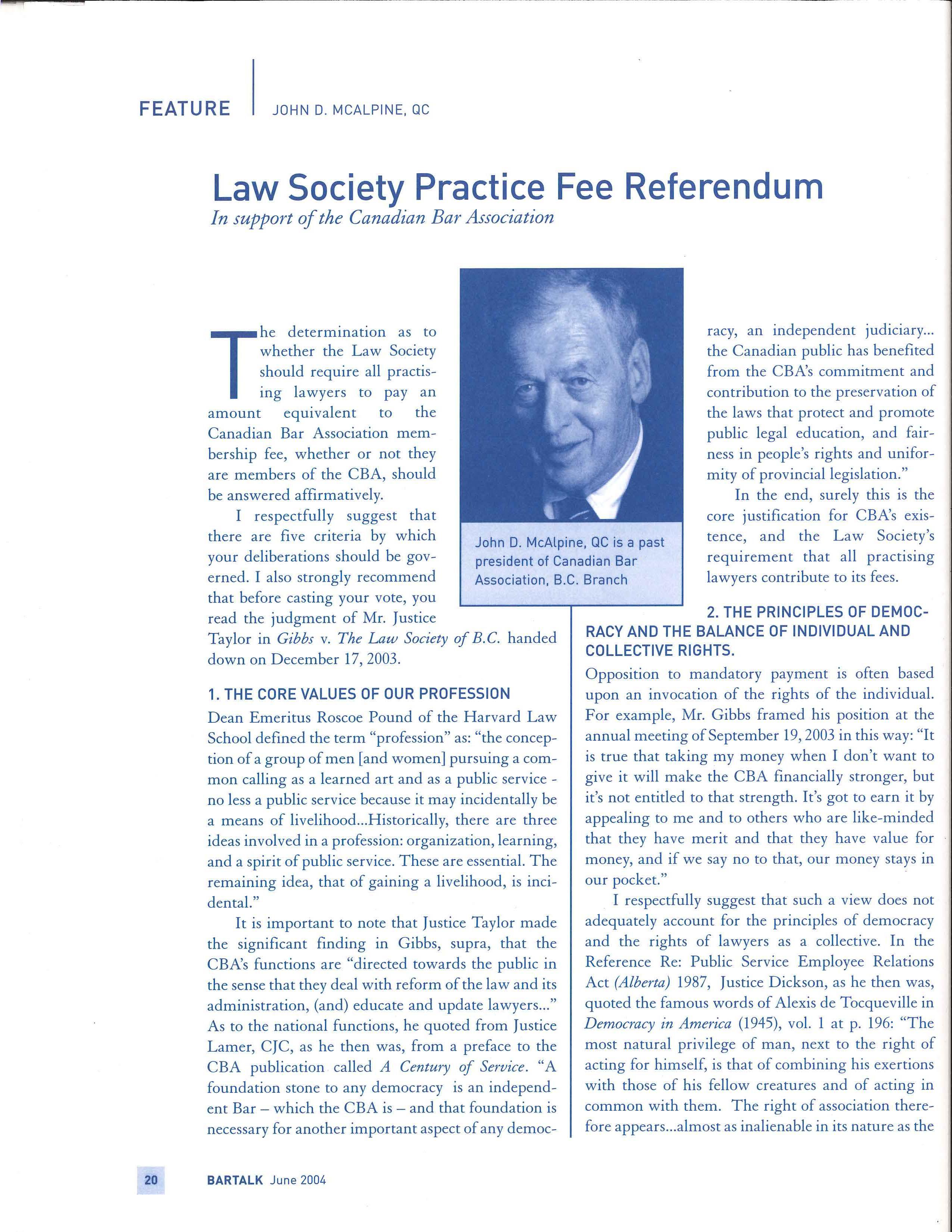
John D. McAlpine, QC is a past
racy, an independent judiciary the Canadian public has benefited from the CBA's commitment and contribution to the preservation of the laws that protect and promote public legal education, and fairness in people's rights and uniformity of provincial legislation."
In the end, surely this is the core justification for CBA's existence, and the Law Society's requirement that all practising lawyers contribute to its fees. president of Canadian Bar Association, B.C Branch
Taylor in Gibbs v. The Law Society of B.C. down on December 17, 2003. handed
1. THE CORE VALUES OF OUR PROFESSION
Dean Emeritus Roscoe Pound of the Harvard Law School defined the term "profession" as: "the conception of a group of men [and women] pursuing a common calling as a learned art and as a public serviceno less a public service because it may incidentally be a means of livelihood Historically, there are three ideas involved in a profession: organization, learning, and a spirit of public service. These are essential. The remaining idea, that of gaining a livelihood, is incidental."
It is important to note that Justice Taylor made the significant finding in Gibbs, supra, that the CBA's functions are "directed towards the public in the sense that they deal with reform of the law and its administration, (and) educate and update lawyers " As to the national functions, he quoted from Justice Lamer, CJC, as he then was, from a preface to the CBA publication called A Century of Service. "A foundation stone to any democracy is an independent Bar - which the CBA is - and that foundation is necessary for another important aspect of any democ-
2. THE PRINCIPLES OF DEMOCRACY AND THE BALANCE OF INDIVIDUAL AND COLLECTIVE RIGHTS.
Opposition to mandatory payment is often based upon an invocation of the rights of the individual. For example , Mr. Gibbs framed his position at the annual meeting of September 19,2003 in this way: "It is true that taking my money when I don ' t want to give it will make the CBA financially stronger, but it's not entitled to that strength. It 's got to earn it by appealing to me and to others who are like-minded that they have merit and that they have value for money, and if we say no to that, our money stays in our pocket."
I respectfully suggest that such a view does not adequately account for the principles of democracy and the rights of lawyers as a collective. In the Reference Re: Public Service Employee Relations Act (Alberta) 1987, Justice Dickson, as he then was, quoted the famous words of Alexis de Tocqueville in Democracy in America (1945) , vol. 1 at p. 196 : "The most natural privilege of m a n, next to the right of acting for himself, is that of combining his e xertions with those of his fellow creatures and of acting in common with them. The right of association therefore appears almost as in a lienable in its nature as the
right of personal liberty. No legislator can attack it without impairing the foundations of society."
Justice Dickson went on to say: "What Freedom of Association seeks to protect is not associational activities qua particular activities, but the freedom of individuals to interact with , support, and be supported by, their fellow humans in the varied activities in which they choose to engage."
In our daily lives , we exercise our collective right by meeting, engaging in vigorous debate and notwithstanding the diverse views expressed, the individual member governs himself by the vote of the majority. It is that underlying commitment of the individual to the process and to the result of democratic debate that governs our lives It is in this way, that for 55 years, without interruption, the principle of universal membership of the CBA has been affirmed and reaffirmed at the annual meetings of the Law Society
How best can the individual rights and the collective rights of members be balanced and reconciled consistent with the principles of democracy? I suggest that the CBA has already answered that question by adopting the formula devised by a great judge, Mr. Justice Rand, that fairly balances the rights of an individual with the collective rights of an organization .
3. CBA'S ACCOUNTABILITY TO ITS MEMBERS
Speaking in Montreal in 1972, the then President John L. Farris , QC, opined on the "value of discontent" saying : "The times in which we live are characterized by a challenge of old established standards, institutions, customs and canons of morality. Personally, I do not find this challenge disturbing. It seems to me quite legitimate that all institutions, all systems, all beliefs should be called upon to justify themselves and they are continually. To the extent that they fail, they should be abolished, changed or modified."
The accountability of the CBA to its members must be full and effective. Effective accountability is a cornerstone of democracy. If there are failures, then the CBA's feet should be put to the fire. But what changes or modifications should take place? The proper forum for criticism and advocating change is surely through debate and resolution. This is the
JOHN D MCALPINE, QC FEATURE
democratic way to bring about change and greater accountability.
4. THE VIRES ISSUE
In the result, Justice Taylor in Gibbs v Law Society of B.C. held that the universal contribution of lawyers practising in B.C to the funding of the work of the CBA was "not inconsistent with the objects and duties of the Society." The decision of the majority of the members at the annual meeting in favour of universal contribution was held to be intra vires The issue before the annual meeting is the identical issue posed in the referendum question today.
5. CAN WE AFFORD NOT TO SUPPORT THE CBA?
In July, 1947, the members of the Law Society cast their votes for universal membership. Elmore Meredith, a former President of the Law Society, spoke of the aim of creating a fully organised bar comprising not simply the members of the B.C. bar, but the bar of Canada. He foresaw that if the Bar of Canada spoke with one voice, it might well have a determining effect on national issues. He also saw the benefit of this step as relieving the B.C. branch of CBA from its almost primary concern and the constant pressure to recruit new members. He viewed this step as a way of removing membership from the elite to include the rank and file of the profess i on.
The CBA has a measure of independence that the Law Society, given its major role of governance, does not have On issues such as legal aid, solicitorclient privilege, money laundering and anti - terrorism legislation, Sarbanes - Oxley, WCB rates for lawyers, the PST on legal fees, and myriad other issues, the CBA has been the strong voice of our profession.
CONCLUDING REMARKS
I am conscious of the impact of fees upon the membership of our profession particularly in tough economic times However, the justification for an affirmative answer to the r eferendum question rests upon the fulfilment of core professional values both consistent with democratic principles and necessarily subject to CBA's full accountability to its members It is my hope that once the referendum vote is taken and a decision made, the issue can be placed behind us
Let us move on. There is much to be done. BT
Tradition or Free Choice?
Mandatory CBA payments no longer serve the profession
Agood first step in any debate is to define the question. The issue for consideration by the members of the Law Soc iety of British Co lumbia in the upcoming referendum is not whether the Canadian Bar Association is a worthy recipient of our financial contributions. (For the sake of argument, I am prepared to acknowledge that it is.) Rather, the question is whether the Law Society ought to compel every one of its members to pay an annual amount to the CBA as a condition
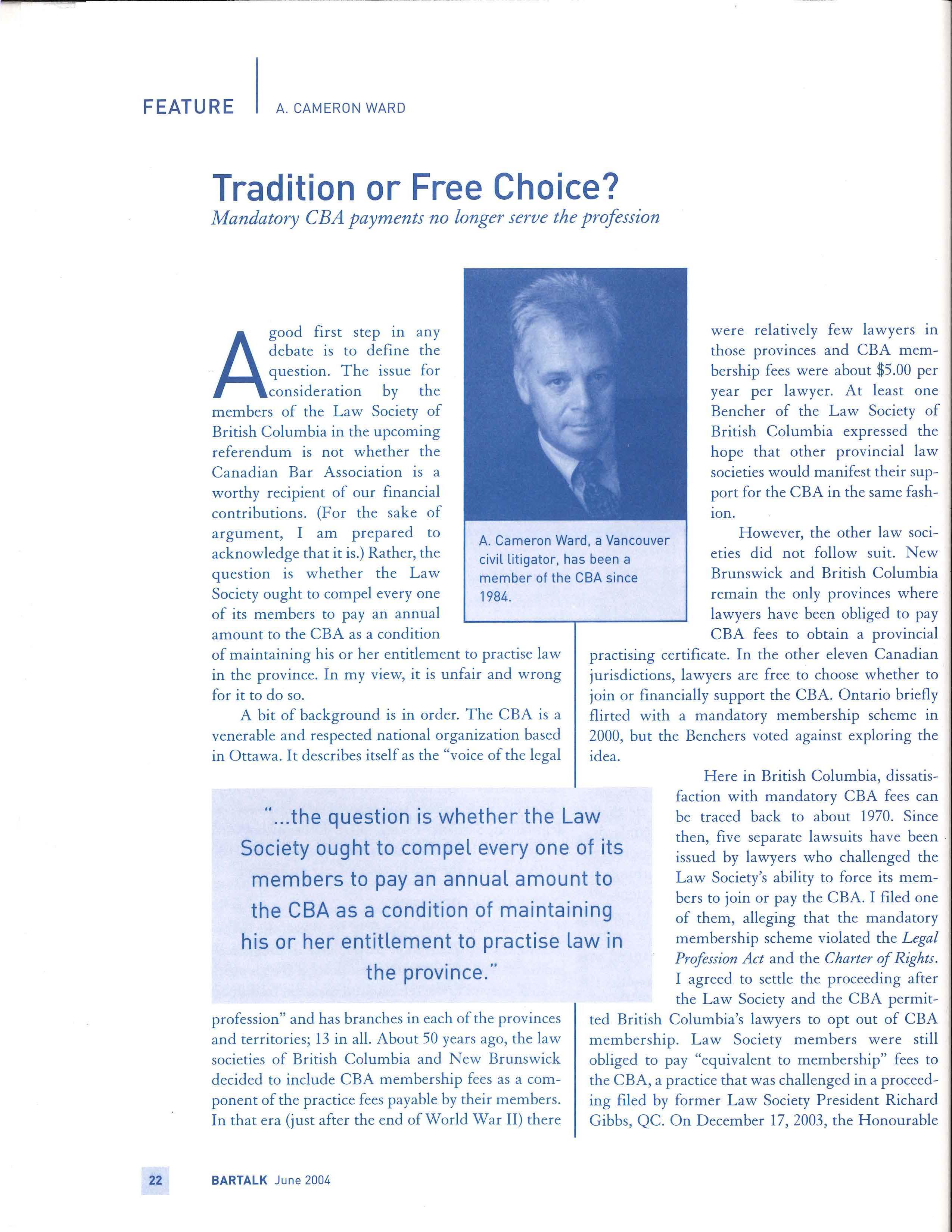
A. Cameron Ward, a Vancouver
were relatively few lawyers in those provinces and CBA membership fees were about $5 00 per year per lawyer. At least one Bencher of the Law Society of British Columbia expressed the hope that other provincial law societies would manifest their support for the CBA in the same fashwn.
However, the other law societies did not follow suit New Brunswick and British Columbia remain the only provinces where civil litigator, has been a member of the CBA since 1984.
of maintaining his or her entitlement to practise law in the province. In my view, it is unfair and wrong for it to do so
A bit of background is in order. The CBA is a venerable and respected national organization based in Ottawa. It describes itself as the "voice of the legal
lawyers have been obliged to pay CBA fees to obtain a provincial practising certificate. In the other eleven Canadian jurisdictions, lawyers are free to choose whether to join or financially support the CBA. Ontario briefly flirted with a mandatory membership scheme in 2000, but the Benchers voted against exploring the idea.
Here in British Columbia, dissatis -
"... the question is whether the Law
Society ought to compel every one of its members to pay an annual amount to the CBA as a condition of maintaining his or her entitlement to practise law in the province."
profession" and has branches in each of the provinces and territories; 13 in all. About 50 years ago, the law societies of British Columbia and New Brunswick decided to include CBA membership fees as a component of the practice fees payable by their members. In that era (just after the end of World War II) there
faction with mandatory CBA fees can be traced back to about 1970. Since then, five separate lawsuits have been issued by lawyers who challenged the Law Society's ability to force its members to join or pay the CBA. I filed one of them, alleging that the mandatory membership scheme violated the Legal Profession Act and the Charter of Rights.
I agreed to settle the proceeding after the Law Society and the CBA permitted British Columbia's lawyers to opt out of CBA membership. Law Society members were still obliged to pay "equivalent to membership" fees to the CBA, a practice that was challenged in a proceeding filed by former Law Society President Richard Gibbs, QC. On December 17, 2003, the Honourable
Mr. Justice Taylor dismissed Mr. Gibbs' Petition and Mr. Gibbs has appealed to the Court of Appeal. So , while the Supreme Court of British Columbia has decided (subject to appeal) that the Law Society can extract CBA payments from its members, the members themselves will be asked whether it should do so.
In my view, there seem to be two arguments in favour of retaining compulsory payments; tradition and need. That is to say, there is a 50 year tradition of all
British Columbia lawyers funding the CBA and the CBA says it needs these contributions in order to do its work
Neither of these arguments seem particularly compelling to me. If society remained bound by tradition, women would be denied admission to the Bar
A. CAMERON WARD FEATURE
(TLABC), the Legal Education and Action Fund (LEAF), the British Columbia Civil Liberties Association (BCCLA) are but a few examples of organizations who should enjoy more support from the legal profession. Why does the Law Society anoint only the CBA as the recipient of its members' largesse? To be impartial, the Law Society should decline to be a fundraiser for anyone
"A vote against mandatory CBA
payments is not a vote against the CBA; rather, it is a vote for free choice, progressiveness, fairness, logic, accountability and a stronger CBA."
and male lawyers would be wearing wigs in court. On the money issue, I am not aware of the CBA facing any budgetary challenges, even though lawyers in 11 of 13 national jurisdictions contribute to it on a purely voluntary basis. The CBA has about 38,000 members, about 10,000 of whom practise in British Columbia. If the average annual fee payment is, say, $400 per member, that means that the CBA receives about $15.2 million per year from Canadian lawyers, students and judges. Even though some of that money is shared with the branches, that is a pretty substantial budget. In the unlikely event that a third of this province 's Ia wyers stopped paying, the CBA should still manage to get by.
On the other hand, there are a number of reasons to allow members to choose for themselves whether to pay fees to the CBA. The Law Society and the CBA are, and should be, separate bodies. The Law Society has a distinctive regulatory role while the CBA is an advocacy group. If the demarcation between the two organizations becomes blurred, then the Law Society's ability to perform its governance function could be attacked.
There may be members of the Law Society who disagree with some or all of the CBA's policy positions. They should not have to pay up to $500 per year to support an organization whose views conflict with their own. There are plenty of advocacy groups that may be worthy of lawyers ' financial support. The Trial Lawyers Association of British Columbia
It is illogical for lawyers practtsmg m British Columbia to have to pay CBA fees when lawyers elsewhere in the country do not. This is especially the case now that lawyers enjoy increased mobility between provinces. Imagine two lawyers living a mile apart on opposite sides of the provincial boundary between British Columbia and Alberta. Each may have similar practices that require them to spend about half the year in the other province, as permitted by the new interprovincial mobility protocol. The British Columbia lawyer would have to pay about $500 to the CBA to stay in business, while the Alberta lawyer would not. For a profession that prides itself on logic, that seems a bit perverse .
Any society that enjoys a guaranteed revenue stream may become complacent, lose touch with its members and lack accountability. If the CBA knows that it will get $4 million from British Columbia lawyers no matter what it does with the money, both the national and branch offices could cease to be accountable to the membership. As Mr. Justice LaForest said, "society cannot expect meaningful contributions from groups or organizations that are not truly representative of their memberships' convictions and free choice."
A vote against mandatory CBA payments is not a vote against the CBA; rather, it is a vote for free choice , progressiveness, fairness, logic, accountability and a stronger CBA. BT
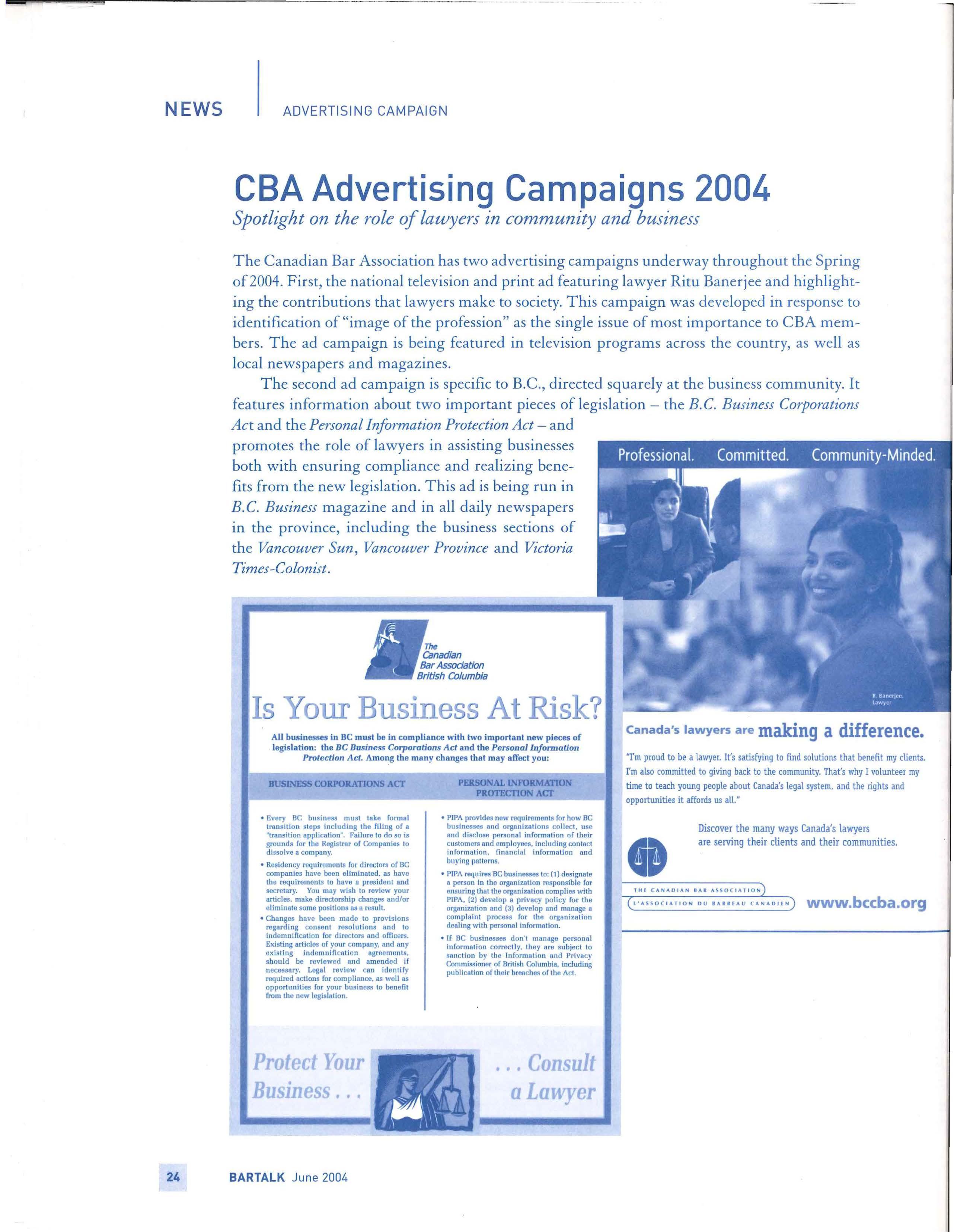
CBA Advertising Campaigns 2004
Spotlight on the role of lawyers in community and business
The Canadian B a r Ass o ci a tion has two advertising camp a igns underwa y through o ut th e S prin g of2004. First , the national television and print ad featuring l a wyer Ritu Ba n
g hting the contributions that lawyers make to society. This campaign was d e vel o ped in resp o ns e to identification of " image of the profession" as the single issue of most importance t o CBA m embers. The ad campaign is b e ing featured in television programs across th e countr y, as we ll as local newspapers and magazines
The second ad campaign is specific to B.C., directed squarely at th e business community. It features information about two important pieces of legislation - the B.C. Business Corpo rations Act and the Pe rsonal Information Protection Act - a nd promotes the role of lawyers in assisting businesses both with ensuring compliance and realizing benefits from t he new legislation. This ad is being run in B.C. Business magazine and in all daily newspapers in the provinc e , including the business sections of the Vancouver Sun, Vancouver Province a nd Victoria Times -Colonist.
Is Your Business At Risk?
existing ln d omnlficn t lon agrcomonts, should be rev iewed nn d amended If necessary. Legal rcl\'lew cnn identify required actions for compliance, as w e ll as opportunities for your busin ess to benefit from th o now logitllltlon
• PIPA provide! new for how BC buslnruJsos and organh.:atlons co lloct , use ancl disclo!!c pononnl information of their CUIItomcrll and omp loyoc11, I ncludi ng co ntnct informatlon, financial i n formation and buyi ng pnt loms
• PIPA requires BC busl ne!l.!ltM to: (1) designa te a person in tho orgoni7.ation 1'65ponsib lfl for ensuring that the orgonir.atio n co mplie." with PrPA, (2) develop a privscy policy for the organir.ation and {3) develop and manage a comp l aint proces s for the organization dea li ng wilh personal in formatio n
• If BC businesses don 't manage persona l in for mation corroct ly, they nre .'l ub jecl to j!Anct ion by the l nfonnntion Rnd Privacy Commissio ner o f British Co lumbia, inclu ding p ubl iCRtion of their brooches of the Ad Consult a
Canada's lawyers are ma ki ng a difference. "'I'm proud t o be a lawye r It's satisfying to find so lutions that benefit my clients I'm also committe d to giving back to the community. That's why I volun t eer my time t o teach young people about Canada's legal system. and the rights and opportunities it affords w all."
Discover the many ways Canada's lawyers are serving t heir clients and their communities.
IH ( C AHAOJAH IAI A!iSO(IAl/OH l' SIO(IAT I ON OU lo\lllAU (ANADI(N www.bccba.org
March 12, 2004
Dear Mr. Attorney:
I write to advise you that at its most recent meeting on March 6, 2004, the Provincial Council of the Canadian Bar Association BC Branch resolved overwhelmingly to support the members of the Crown Counsel Association and call on the Government of BC to implement the Taylor arbitration award .
Those who are elected to represent the 10,000 lawyers of British Columbia believe that the Crown Counsel of BC have conducted themselves in good
On February 12, 2004, the Attorney General filed in the Legislature the government's response to the arbitration award to Crown Counsel as proposed in the "Taylor Report." The response was a rejection of any increase in compensation for Crown Counsel, contrary to the Taylor award. The Crown Counsel Association presented the matter to CBABC Provincial Council on March 5, 2004, and Council directed that President Brun write to the Attorney General in support of Crown Counsel members. Here is the wording of the letter.
faith, binding themselves to the outcome of arbitration, and are long overdue for an adjustment in their salary range that not only reflects the market realities of their profession but also protects the government's ability to attract and retain high quality lawyers in service to the Crown.
We recognize that there are fiscal constraints upon the government However, we also recognize that the effective processing of legal disputes in criminal matters requires that the government provide adequate resources to support the legal expertise required for this task. In our view an efficient and experienced Crown Counsel service is also cost effective.
There are many facets to the justice system, but the work of Crown Counsel is the anchor on which all other parties rely. I can report to you that at the meeting at which this matter was discussed, there were representatives from all regions of the province, all areas oflaw, and perhaps, most significantly, from the defense bar, who rose to offer their unequivocal support and admiration for BC 's prosecutors . Without question, there is a recognition that this is a group of professionals that requires an urgent investment of resources for our justice system to work.
As a government which has declared itself dedicated to improving the justice system, and to improving outcomes inside and outside our courts, the Taylor arbitration award offers an opportunity to put that commitment into action. We ask that the government implement the Taylor award, without delay.
Yours truly,
Robert Brun, President Canadian Bar Association, British Columbia Branch
GUEST SUSAN VAN DYKE
Marketing & Memberships
Active participation brings rewards
Hands up, how many of you who are on a board or hold a membership want to get more from your invo l vement?
Evaluating how you spend your l im i ted non-bi ll able time could bring you significant business development rewards. Consider how you can make the most of the time you've committed to a board or organization. Hint: get involved. Really involved. Direct your energy toward the biggest return. Start by choosing one thing and do it big.
Susan Van Dyke, Pr in cipa l , Van Dyke Market i ng &
Communications, is a law f i rm market i ng consulta nt. S h e can be reached at 604-8 76 - 77 69 or svandyke@telus. net
Maximize the value you bring by making as significant a contribution as possiblebetter to have a productive, profile-building one-year term than a lukewarm couple of years. Make it your goal to be remembered as someone who is solutionoriented, knowledgeable and reliable. As you attend meet ings or events, ask yourself, "Am I a spectator or a participant?" (Warm seats count not, dear reader.)
Norman Streu of Alexander, Ho l burn, Beaudin & Lang knows how to go big. He chairs the CBABC Construction Section, and the Board of Vancouver Regional Construction Association and is a B.C. Construction Association director. Here's a lawyer who pens columns, emcees industry events and speaks at well-attended monthly meetings. He reaps enviable marketing, educational and collegial benefits . "I would never have met the industry leaders I now know without t he credibility of these roles Some people are hesitant to get involved because of the perceived work load, but it's worth it, " says Norm of his responsibilities "If you keep within your limits and make the most of your role the work's not onerous," he says "It's a great way to generate opportunities, but it's a cumulative effect.
People get discouraged too early I look at this as a long term approach that will bear fruit over the course of my career." Where to start? Try the CBABC. Consider the Lawyer Referra l Service, Section membership or presidency of a local or county bar association.
Oliver Hui, Wilson King & Company, has been President of the Prince George Bar Association for approximately seven years "As president, I've built networks that have provided indirect benefits ." In this role, O l iver welcomes new
appointments to the bench, attends socia l events for lawyers and generally gets to know others in the communi t y well.
He has positioned himself as a leader and undoubtedly received new work as a result How much, though, is anyone's guess. Agency business from other communities is an unexpected benefit. "Some areas of the province are under - serviced and firms need agents in other regions, " says Oliver. Paul Pearson of Mulligan Tam Pearson, became President of the Victoria Bar in January after four years on the executive Paul makes contact with others in the community he might not have otherwise met. "I've been making contact with other organizations- accountants, for instance- which, as a criminallawyer, I wouldn't normally do "
Victoria Shroff, Shroff & Associates, has part icipated in the Lawyer Referral Service since 1997. "I looked at this as a way of giving back," says Victoria of her involvement . I don't participate for the economic benefit. I do it to help callers understand their rights and responsibilities. That's my platform " Norm, Oliver, Pau l and Victoria: when they get involved, they go big. BT
SARAH PICCIOTTO
Top 10 Citation Tips
Be letter perfect with the help of this guide
While it may seem that only a stickler (or a legal research lawyer, which admittedly is often one and the same) would think that a properly cited case is really that important it actually is that important.
A complete and accurate citation makes it possible to locate the decision and also conveys important information a bout the case (date, court level, and jurisdiction).
If a citation is not complete , the reader might be clueless as to whether a case was heard in B.C. or Newfoundland, or by the Supreme Court of Canada or a provincial court.
The following 10 tips answer frequent queries about prop e r case citation:
1. The citation needs to give the reader the level and location of
Sarah Picciotto is the owner
and senior research lawyer of OnPoint Legal Research [www.oplr.coml. a firm that completes research projects and drafts memoranda and
argument for other lawyers in the both the private and public sector. She can be reached at 604-879-4280 or through spicciotto@oplr.com.
graph numbers rather than page numbers as pinpoint references.
5. It is permissible to include a copy of a case obtained from an electronic source (e g. , Quicklaw) in your book of authorities as long as you provide the citation for the reported version of the decision.
6 Quicklaw cases are cited as follows: Brigade v. Stempler [2001] B.C.J. No. 224 (Q.L.)(B.C.C.A.).
7. £Carswell cases are cited as follows: Bancroft v. Pierce, 2001 Carswell Ont 224 (C.A.)(WLeC).
8. Neutral citations are cited as follows: Ikeda v. Mitchell, 2000 BCSC 3; Hummings v. Richmond, 2001 BCCA 39. There is no punctuation other than the comma after the style of cause. A neutral citation with a paragraph reference is cited as follows: Crofton v Stilton, 1998 BCCA 11 ' 4.
9. If a case has been assigned a neutral citation, it should be provided to the Court, in addition to any other citation. the court. If the reporter series does not provide this information, e.g., B.C.L.R. gives the location, but not the court level), it must appear at the end of the citation (e.g., (C.A.)). As a further example, the reporter series C.P.C. gives neither location nor level, so both must appear at the end of the citation (e.g. , B.C. C. A.).
2. The comma appears before th e date where there are square brackets, e.g., Smith v. jones, [1999] 8 W W.R. 34 (Sask.C.A.).
3. The comma appears after the date where th e re are round brackets, e.g., Herbert v Thorton (1994) , 84 D.L.R. (4th) 214 (Ont.C.A.).
4. If a case is reported, you should cite the reported version. However, if you are referring to a case that is in electronic form, it is permissible to cite para-
10. Where there is no assigned neutral citation, unreported cases are cited as follows : Ming v. Windsor (12 November 1993), Vancouver Registry, C934562 (B.C S.C.). BT
This guide is not intended to be a complete source of legal citation For further information, consult the Canadian Guide to Uniform Legal Citation, 5th ed. [Toronto:Carswell, 2002). a.k.a. the "McGill Guide"
GUEST CHRISTINE MINGlE
B.C. Law Schools
Another awesome mooting year
The UBC Faculty of Law and the UVic Faculty of Law completed another very successful year of competitive mooting, with the following results:
INTERNATIONAL COMPETITIONS
UVic won the 2004 American Bar Association (ABA) Client Counselling Competition National Championship in Florida, and moved on to win second place internationally at the Louis M. Brown International Client
Counselling Competition m Scotland. UVic's winning students were Maria Barrett-Morris and Darin Reeves. Law students participated from Australia, Canada, Cayman Islands, U.K., Hong Kong, Malaysia, New Zealand, South Africa and the USA. UBC won the regional competition and participated at the national competition in Florida .
UBC participated for the first time in the Willem C. Vis International Commercial Arbitration Moot (the "Vis") held in Vienna. UBC placed in the top one - third in 44th place, competing against 135 law schools from 42 count r ies. UBC second-year student Wei Kiat Sun was awarded an "honour a ble mention" as top oralist at the Vis . The Vis is the most prestigious private international law moot It was won this year for the first time by a Canadian law school (Osgoode).
UBC and UVic participated in the Canadian elimination round of the Phi l ip C. Jessup International Law Moot Court Competition. UVic finished fourth among 17 participating Canadian law schools . UBC finished in eighth place .
UBC participated in three addition a l internationa l moots this year: the ABA Negot i ation
Competition (UBC advanced to the finals in Texas); the International Competition for Online Dispute Resolution (ICODR) Arbitration Moot; and the ICODR Mediation Moot
UBC 's advocate team won first place in ICODR arbitration and Moot and its arbitration team placed fourth.
NATIONAL COMPETITIONS
At the national level, UBC placed first for the fourth year in a row at the Canadian Corporate Securities
Law Moot. Teams members were Shannon Salter, Lisa Kerr, Catherine Anderson, Adam Kaminsky and Dino Rossi. Two UBC team members won second and third best oralist.
UBC placed first at the Canadian Labour Arbitration Competition Team members were Jesse Nyman and Ryan Anderson.
UVic placed first at Canada's oldest national competition - the Gale Cup Moot, held in Toronto UVic also won the Cory Factum Prize for best facta Team members were Cameron Elder, Adam Perry, Aidan Cameron and Gordon Buck UBC also participated in the Gale.
UBC won best facta award at the Wilson Moot, held annually in Toronto UBC and UVic also participated in the bilingual Laskin Moot and in the Ka waskimhon Aborigina l Moot.
REGIONAL COMPETITIONS
Several local moot competitions were held including the B.C. Law Schools Competitive Moot , the Western Canada Moot Competition (Macintyre Cup) and the Peter Burns Moot. UBC won the B.C . Law Schools Competitive Moot this year.
The CBABC congratulates UBC and UVic for a succesful mooting year. BT
Christine Mingie is an assoc iate with Lang Michener
Practicelink: Finding the Perfect Laptop
Sandra Schulz's popular "Packing My Own 'Chute" series continues with helpful hints and useful advice on buying the perfect laptop for your home office. PracticeLink has an ever-evolving collection of quick tips, covering topics such as client services, finances, technology; it's worth checking often.
View the "Packing My Own 'Chute" series and much more at www.cba.org/practicelink .
The Electronic Courthouse: ADR Online
With the click of a mouse, CBA members can access expert onlin e dispute resolution services. A CBA member service provider, Th e Electronic Courthouse combines the necessary tools to move from dispute to resolution - right from your desktop. Their service includes a roster of experts a nd resolution professionals drawn from top North American law firms and trading nations around the world
The El e ctronic Courthouse guides parties and counsel throu g h an eight-step process that mirrors conventional dispute resolution, but that incorporates forms , templates, model clauses , n egotiation support tools, online meeting rooms, translation ser vices, and credit reports - for a n attractive flat fee. Services include mediation, arbitration, expert evalu a tion and negotiation support.
To learn more, ple a se contact Andrew Putman a t 416-506-0456, or aputman@electroniccourthouse com or please visit www.electroniccourthouse com.
CLE Wins National Acclaim
Congratulations to B C.'s CLE Society, which has received national acclaim for its innovation and partnership with Microsoft in publishing online CLE materials (see http: // www.globeandmail.com/partners/microsoft/gmw/co2.html).
Seeking to "revolutionize legal research", the CLE Society wanted to develop a system that would make its massive reference books easily searchable and extensively hyperlinked , so that users could instantly click through to related information. Thus a lawyer could click directly from a chapter in CLE's
Once is never enough!
online "practice manual" to every other pertinent reference in the book, to relevant precedents, to a decision on a court Web site, or to the relevant legislation on a government site.
As a result of their work, six of CLE's most popular manuals will soon be avail a ble online (Re a l Estate Practice, Family Law Practice , Family Law Sourcebook, Company Law Practice, Motor Vehicle Accid e nt Claims Practice, and Probate and Estate Administration Practice). Watch for an announcement from CLE.
If you have changed firms, changed addresses, have a new e-mail address or phone/fax number, you need to let us know. Letting the Law Society in on the secret is not enough! Contact us at data@bccba.org, phone 604 - 6873404 or fax 604-669-9601. Or toll free phone 1-888-687-3404 or fax 1-877-669-9601
8th Annual CBA/VBA Golf Tournament Back FORE more, June 24!
Join fellow members of the legal profession on Thursday, June 24, 2004 in a funfilled day of golf and prizes at the 8th Annual CBA! VBA Golf Tournament! Hit the links, network with colleagues and support CBA Student Awards. Registration is $155 [incl. GST) and includes 18 holes of golf ["" Best Ball·· Format). lunch, beverage voucher, buffet d inner, silent auction and lots of prizes!
Registrat ion deadline is June 17, 2004- call your favourite golfers and assemble your foursome soon! Proceeds from this tournament fund an annual award for both a UBC and UVic Law Student who best exemplify the ideals served by the CBA. For more information contact Andrew Mugridge at 604-646-7855
[a mugridge@bccba.org)
Microsoft Strategist Meets Computer Law and Freedom of Information and Privacy Sections
A recent joint meeting of the Freedom of Information and Privacy Law and the Computer Law Sections featured guest speaker Peter Cullen, Chief Privacy Strategist of Microsoft and formerly Chief Privacy Officer of the Royal Bank of Canada. Members in attendance heard Mr. Cullen's presentation on the topic "A Canadian CPO at the frontiers of computer technology: Privacy, Customer Trust and Dilemmas - the new reality ."
Mr. Cullen raised several issues including the differences of Canada's provincial and federal privacy legislation and the U.S legislation. Various issues are at play, including state rights as opposed to federal rights and things being done for political reasons. A copy of Mr. Cullen's presentation at this March 25, 2004 joint meeting is available at www.bccba org for registered members in the Computer Law and Freedom of Information and Privacy Law Sections.
Lawyers Assistance Program
e e LAP provides confidential support, coun-
1Iselling and referalls for lawyers, their families, support staff, judges and stuLAPBC dents suffering from alcohol and/or chemical dependency, stress, depression or just about any type of personal problem.
For assistance or information on meetings and resources please call 604-685-2171 or toll free 1-888-685-2171. The LAP office address is: 415-1080 Mainland Street, Vancouver, B.C. V6B 2T4. Visit LAP online at www.lapbc.com.
New directions, terrific results
Law Week Committee Chair Stephen Cooke sums up the Law Week activities organized by the CBABC.
5K FUN RUN/WALK AT UBC
On Sunday, April 4 an inaugural Walk/Run was held About 60 people participated in what was, on a lovely Spring morning, a great family-oriented event. It went well for a first-time affair. Next year should see the wrinkles ironed out and, hopefully, a greater number of participants.
PUBLIC FORUM ON STREET CRIME AND THE JUSTICE SYSTEM
On Wednesday, April14, the CBA and the Street Crime Working Group co-sponsored a public forum on Street Crime and the Justice System, hosted by CBC's Ian Hanomansing. The Forum featured guest speakers Julius Lang, of the New York Center for Court Innovation, and James Hayden, a District Attorney from Oregon.
VANCOUVER OPEN HOUSE
On Saturday, April 17 (the anniversary of the Charter of Rights and Freedoms), we celebrated Law Week with an Open House at the Vancouver Law Courts. Use of that location enabled the Law Week Committee to hold a number of events : displayers in the Great Hall; the Barry Sullivan Public Speaking Competition; and an elementary-school mock trial in the courtrooms. But most fitting for this year's theme of Diversity: Celebrating Your Right to Be Unique was the Citizenship Court over which Thomas Berger QC, OC presided in which 80 individuals from 37 nations became Canadians. We were also delighted to hear from the chief judges from our three levels of courts, along with Attorney General Plant and President Robert Brun. The Law Foundation of B.C. and the Vancouver Bar Association, sponsors of Law Week with the CBA, were represented by, respectively, Professor Heather Raven and Michael Bain.
DIAL-A-LAWYER
Also on Saturday, April 17, we held the popular Dial-A-Lawyer Program. About 30 lawyers answered calls at the CBA office, giving free legal advice in a number of areas of law
STUDENT ACTIVITIES
There were several student activities. We tried a pared-down Student Mentor Program this year to ensure that we had enthusiastic participants. It worked well, but the Law Week Committee would like to see greater involvement from the legal community. The winners of the student contests were : Photo, Ashley Ekelund, South Kamloops; Public Speaking, John Dominic, Mission Secondary; and Short Story, Katrina Wiggins, Sardis Secondary.
Law Week moved in some new directions this year, with some terrific results. Many thanks to all those judges, lawyers, and members of the public, who volunteered their time to make Law Week 2004 such a great success. Thanks also to those who organized events in Duncan and Kelowna. BT
Top left: CBA members Tara Campbell and Jonathan McCullough participate in the Run/Walk with their three daughters.
Top right: A clerk addresses the citizenship ceremony.
Lower centre: Public speaking participants stand with Attorney General Geoff Plant (front, third from right) and Law Week Committee member Maggie O'Shaughnessy (front, third from left).
Bar Moves 1': 71
Have you recently changed firms or opened a new firm? Send submissions [maximum 25 wordsl to Bar Moves at cba@bccba.org.
After 16 years with Crown Counsel, OLIVER BUTTERFIELD has opened a law practice in Kelowna, restricted to criminal law and related areas.
LISA EASTWOOD has joined PricewaterhouseCoopers, Vancouver in their International Tax Practice.
JAMES S. HUTCHISON, LORENZO G. OSS-CECH and BARRI A. MARLATT, are pleased to announce the establishment of their new full service law firm, Hutchison Oss-Cech Marlatt. MISTY HILLARD joins them as an associate.
DONALD KISLOCK has resumed practice in Victoria.
What a move! Greg Pun !crouching) has returned from his Aikido sabbatical in Japan.
GLENN LAUGHLIN, formerly corporate counsel for Lordco Parts Ltd., has opened a new practice in Port Coquitlam focussing on business law and real es t ate law.
JOHN MCLEOD recently joined Irwin, White & Jennings where he will continue to practise in the areas of corporate and securities law.
GREG PUN recently returned to Alexander Holburn Beaudin & Lang and his practice in legal research and appellate advocacy work, following his 2003 sabbatical in Japan where he obtained his black belt and instructor licence in Yoshinkan Aikido.
JOHN ROBERTS has joined Sliman, Stander & Company's Langley office. He will continue to practise corporate/commercial litigation, construction law, and foreclosure law.
Since completing his articles at Lawson Lundell, * RYAN ROSENBERG has joined Larlee & Associates in Vancouver where he practises in all areas of immigration law.
MATTHEW TAYLOR recently joined Wilson & Partners LLP, a law firm affiliated with PricewaterhouseCoopers, where he will specialize in the law of corporate taxation .
CHARLES M. WEILER has joined the law firm of Laxton & Company as an associate in their litigation practice.
JASON KRUPA and LAURA DE MUNAIN, both of Davis & Company, have received Vancouver Police Certificates of Merit for their actions on May 27, 2002. The two were jogging in Vancouver's Stanley Park when they came across 22-year-old Ji-Won Park lying apparently lifeless in a ditch. While Laura went for help, Jason resuscitated Ji-Won. Jason and Laura were assisted by John Lightowlers who, unbeknownst to them, had pursued and detained Ms. Park's attacker.
Jason, Laura and John were recognized for their actions at the annual chief constable's commendation ceremony in April.
OBA Trip Delights Bar Members
Margaret Ostrowski, QC just returned from an OBA trip to southern India and Sri Lanka. This is a brief account of the trip.
The sun was hot, the five-star hotel rooms were cool and our fellow travelers became our friends. My husband and I recently returned from an 18-day convention organized by the Canadian Bar Association, Ontario Branch (OBA), in southern India and Sri Lanka. We highly recommend the trip to all members of the bar. It was a great group- 63 travelers in all- including 40 lawyers and three members of the judiciarythe youngest traveler was 14 and the oldest was an 82-year-old practising lawyer!
Our first stop was one of eight cities we visited on the convention and tour. After a 20-hour plane ride from Vancouver, we landed in Chennai and were whisked off in air-conditioned buses to a beach resort where we were greeted with flower lais and cold drinks. We were treated to an Indian buffet, a swimming pool on the
Bay of Bengal, and an introduction to Indian history and culture.
The next day, we traveled to the World Heritage Site of the shore temples of Mamallapuram, and then to a reception and dinner with guests from the Madras Bar Association This was one of many stops that included receptions and dinners with members of the bar in each city, panel discussions, a tour of the High Court of Kandy and Mumbai, visits to botanical gardens, temples, shrines, a synagogue in Goa, Mysore Palace, elephant orphanage, tea plantation, spice garden, small village, train r ide and of course , shopping for silks, carpets, gems, wooden elephants, and anything else you can think of. We all came back loaded down, and many had goods following by post
This is the 17th ann u al trip that the OBA has organized to diverse areas of the world; many members go every year. We are all invited- and their planning committee has already commenced work on the trip to South Africa in 2005. For those wondering about the value of bar associations, join us next time - you will be truly amazed and delighted in meeting and learning about the countries and culture of our fellow bar association members BT
Ostrowsk i , QC, a CBABC past president, v is its an elephant orphange.
Young Lawyers Enjoy Evening Event With Chief Justices
On Apri/20, 125 young lawyers gathered to hear from the Han. Chief justice Finch, the Han. Chief justice Brenner, and the Han. ChiefJudge Baird-Ellan. fohn Brine1; Section Treasurer, describes the event:
The evening was hosted by the CBABC Young Lawyers-Vancou ver Section, and offered a wonderful opportunity to socialize informally with the three justices and other young lawyers over cocktails and dinner. More importantly, the three justices provided important practice tips, hints, and lessons, by way of speeches and a lively Q & A session.
Chief Justice Brenner highlighted the qualities a lawyer must possess, includ i ng the importance of collegiality, and the ability to work and communicate with others in the legal community and i n front of the bench. Chief Judge Baird-Ellan provided practica l tips when appearing before the bench and gave useful accounts of courtroom "'transgressions" of both lay litigants and junior lawyers. Chief Justice Finch spoke of a young lawyer who, in one of his first trials, was assisted enormously by a judge who recognized his inexperience. The Chief Justice later revealed that he was the young lawyer.
Co-Chairs Karey Brooks and Angela Wa l ker closed the evening with some.Jmportant observations: As young lawyers, it is imp o rtant to interact both with other lawyers and members of the bench. As such, CBA-sponsored events such as these are impo rtant forums for young lawyers to hear from the bench and seasoned members of the bar how to become more effective advocates.
Margaret
•
The Continuing Legal Education
Society of British Columbia
CLE Update
BC BUSINESS CORPORATIONS ACT FOR LAWYERS- STEPS AFTER IMPLEMENTATION
The Act came into force on March 29, and now that all the provisions are finalized , yo u need to know how to apply it. CLE has the solution
On Thursday, June 10 , CLE will offer a practical course designed to give corporate lawyers an indepth framework detailing the first major steps that need to be addressed. Learn about transition , the process for changing articles, how to capitalize on optional changes to articles, amalgamations, and other essential information, from government advisor John Lundell, QC and others.
This course has three different learning options CLE is pleased to deliver B C. Business Corporations Act for Lawyers in a way that's best suited to your needs. This course will be available as a face - to - face live event in Vancouver, as a video repeat in your region, and as a real time online conference delivered straight to your desktop!
Visit www.cle bc.ca (courses section) for more information or call CLE at 604-893 - 2121 or 1- 800663-0437.
Integrated Training on Domestic Violence in South Africa Launched
More than 200 representatives of government, NGOs and funding organizations met in Pretoria, a o South Africa on March 29 to · launch the Integrated Training on '7,?> ..._$ Domestic Violence program :roN soc;
Funded by CIDA, the program was developed by the South African Sexual Offences and Community Affairs Unit in partnership with the Law Courts Education Society of B.C ., with the support of the Ministry of Attorney General and the Justice Institute of B.C. The goal of the program is to train more than 1,200 justice system personnel over the next few years
The launch represents the completion of several years of work to develop an integrated approach to training all sectors of the justice system on dealing with domestic violence. At the launch, representatives signed a pledge to end domestic violence. This year, Canadian partners and supporters will receive certificates in recognition of their contributions to the project.
Notice to the Profession: Video Conferencing
The Honourable ChiefJ u stice Donald Brenner issued a Notice to the Profession on April 6, 2004 regarding the availability of video conferencing. (To read the complete notice, please visit www.courts gov bc ca)
"Where the court grants an order allowing for the use of video conferen cing or both parties consent, this technology can be used to avo id the cost of travel for counsel, parties or witnesses to personally attend court hearings Where the intent is to use the technology in respect of witness testimony, regard should be had to the requirements in section 73 of the Evidence Act, R.S.B.C 1996 c. 124 and in section 714 2 of the Criminal Code," said ChiefJust ice Brenner.
Grants Approved
The Board of Governors of the Law Foundation ofBC met on March 20, 2004. Chair Heather Raven is pleased to announce that funding totalling $3,150,080 has been approved for the following 16 continuing programs:
Continuing Programs
$50,480 BATTERED WOMEN'S SUPPORT SERVICES (Legal Advocacy Program)
$134,300 B.C. CIVIL LIBERTIES ASSOCIATION (Operating 2004 / 2005)
$140,300 B.C. LAW INSTITUTE (Operating 2004/ 2005)
$654,500 COMMUNITY LEGAL ASSISTANCE SOCIETY (Operating 2004/2005)
$ 105,400 NELSON DISTRICT COMMUNITY RESOURCES SOC. (Legal Advocacy Program)
$84,600 NORTH ISLAND ADVOCACY COALITION SOCIETY (Legal Advocacy Program)
THE@LAW FOUNDATION OF
$55,000 LAW FOUNDATION GRADUATE FELLOWSHIPS (2004/ 2005)
BRITISH COLUMBIA
$233,800 LAW SOCIETY OF B.C. (Professional Legal Training Course)
$262,400 PEOPLE'S LAW SCHOOL (Operating 2004/ 2005)
$45,600 SEPARATION AND DIVORCE RESOURCE CENTRE (Volunteer and Legal Support Se rvices Program)
$218,600 TENANTS' RIGHTS ACTION COALITION (Leg al Advocacy Program)
$10,300 UNIVERSITY OF SASKATCHEWAN (Native Law Centre- Legal Studies Program, for B.C. Aboriginal students)
$203,400 UVIC, FACULTY OF LAW (L a w Centre Clinical Program)
$133,800 WEST COAST DOMESTIC WORKERS' ASSOCIATION (Legal Advocacy Program)
$705,900 WEST COAST ENVIRONMENTAL LAW ASSOCIATION (Operating 2004/ 2005 and Environmental Dispute Resolution Fund)
$111,700 WEST COAST LEAF (Operating 2004/ 2005)
Project
Grants
$100,000 ATIRA WOMEN'S RESOURCE SOCIETY (Two-year Legal Information and Advocacy Project)
SEEKING
See king so li cito r 's pr ac ti ce in r ea l es ta te a nd corporate la w in th e Vi ctori a a rea A ll co mmunic ati on s in st ri ct co nfi de n ce E- m ail r epli es to cba @bccba o rg (attenti o n " Box !OS ")
'85 Cap College legal asst. grad see ks co nt rac t work in pers injury Q L access 604 -852- 4954
SPACE AVAILABLE
OFFI C E SPAC E F O R SU B- LE AS E : T op floor, co rn er suite , 3,500 sq.ft (di visibl e), fa ntastic views, g rea t impro ve m ents in pl ace, located a t 777 Hornby Bel ow m a rk et p ri ci ng. Ca ll Norm Taylor 604 -661-0893
VACATION PROPERTY
WAILEA, MAUl RENTAL on Blu e co ur se, panoramic P acific views C all 303-376 -44 66
Advertising
CLASSIFIED/DISPLAY RATES
Per Line CBABC Members $25
Per Line Commercial Organizations $40 1/6 Page CBABC Members $450 1/6 Page Commercial Organizations $750 NEXT DEADLINE: July 9
INSERT RATES lall of BCI
CBABC Members $1 ,200
Commercial Organizations $2,000
NEXT DEADLINE : July 16
NEXT BARTALK MAILING: July 23
PERSONAL INJURY LAW
We seek an associate for our busy motor vehicle / personal injury practice group The successful candidate should have a minimum of three years litigation experience Competitive salary plus bonus, excellent benefits and working conditions. Fax, mail or e-mail replies in confidence to:
John L.Coyle , Business Administrator Klein Lyons
1100-1333 West Broadway Vancouver, B.C . V6H 4C1
Fax : 604 874-7180
Please direct advertising inquiries to : Sandra Webb, BarTalk Editor Tel: 604-646-7856