
13 Nov 2025 | Norris Conference Centers - Houston/CityCentre


13 Nov 2025 | Norris Conference Centers - Houston/CityCentre
The inaugural Future AI Conference in Houston brought together a diverse community of leaders, innovators and practitioners at a moment when artificial intelligence is beginning to play a decisive role in the future of the energy sector. With more than 350 delegates from over 170 organisations in attendance, the event provided a timely platform to explore how AI is moving from early experimentation to a critical operational capability across the industry.
Across the keynote contributions and discussions, one message was unmistakable. AI is no longer confined to pilots or isolated trials. It is being scaled across organisations, shaping decisions at industrial level and delivering meaningful improvements to performance and financial outcomes. Speakers from bp, Chevron, Dow Chemicals, ExxonMobil, Kongsberg Digital, Marathon and Motiva shared how intelligent systems are increasingly woven into everyday workflows, supporting thousands of users and influencing real time operations.
Much of the conversation centred on the need to align AI with business priorities rather than deploying technology for its own sake. Delegates emphasised that the success of AI depends on its relevance to the workforce, the clarity of the problems it is designed to address and the strength of the processes that support it. Trust, transparency and explainability emerged as essential components, ensuring teams understand not only what an AI system recommends but why it reaches those conclusions.
The event also highlighted a transformation in how organisations engage with their data. With the rise of
large language models and conversational interfaces, the industry is moving towards faster and more intuitive ways of working. Delegates noted that natural language access to data is enabling deeper analysis, reducing reliance on static dashboards and empowering teams to explore insights with far greater agility.
Security and governance remain central to this evolution. As AI applications develop at extraordinary speed, organisations must ensure their safeguards, oversight structures and data frameworks adapt just as rapidly. Several speakers stressed the importance of building on existing safety and risk management systems, extending them to support AI deployment while maintaining operational integrity.
What distinguished the Houston edition was the openness with which delegates shared both successes and challenges. This spirit of collaboration is essential as the industry navigates the complexities of AI adoption and seeks to modernise responsibly and effectively. Future AI exists to bring these voices together and to support a community committed to thoughtful, impactful innovation.
I extend my sincere thanks to our speakers, partners, sponsors and advisory contributors whose insight and expertise shaped this inaugural event. Above all, I want to thank our delegates. Your engagement and curiosity are what give this platform its purpose. As AI continues to advance, the opportunity before us is significant. We look forward to progressing this journey with you.
Adam Soroka CEO, Cavendish Group International
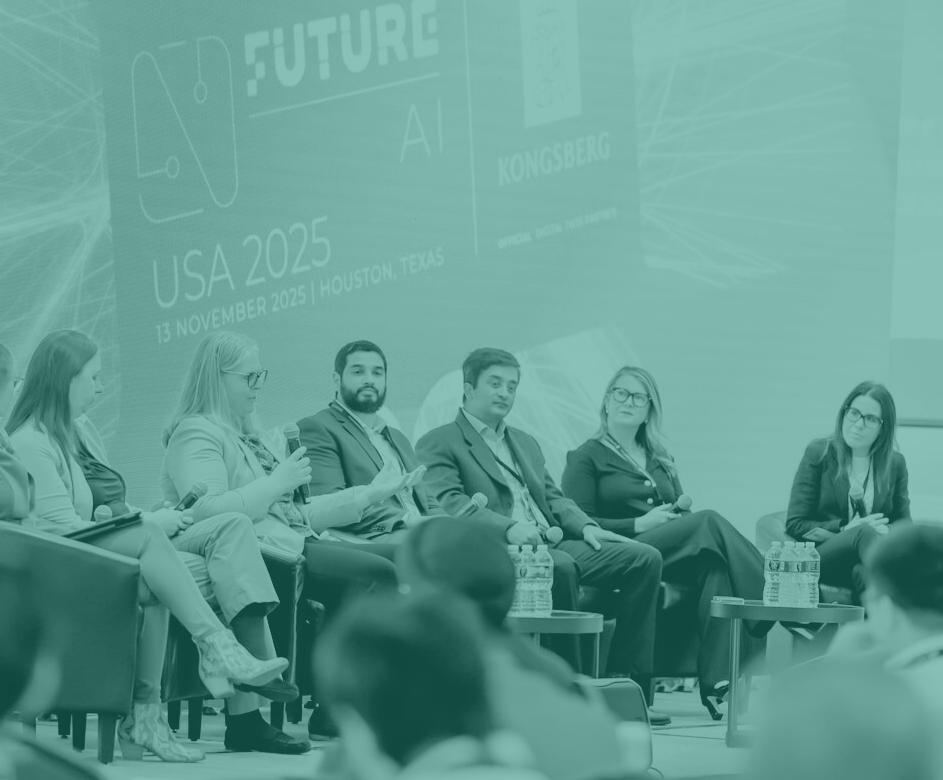
The pivotal and fast-growing role of AI and digital technologies in the energy sector was reflected in lively debate at the inaugural Future AI Conference, held on 13th November in Houston and organised by Cavendish Group International.
More than 350 delegates from over 172 organisations took advantage of opportunities to hear expert opinion, network, and exchange ideas at a busy event at the Norris Conference Centers - Houston/CityCentre.
Innovators and leading thinkers on AI from across the energy sector provided their valuable input across the conference sessions, including speakers from bp, Chevron, Dow Chemicals, ExxonMobil, Kongsberg Digital, Marathon and Motiva, among many others.
Themes up for discussion on stage reflected the impact being made by AI in every aspect of the industry.
Leading topics at this first staging of the event included how agentic AI systems are enabling greater accessibility to technology and real-time decision making, implementing AI in downstream operations, creating a corporate culture favourable to AI adoption and how to ensure that ethical and privacy consideration remain central to the whole process.
Adam Soroka, CEO, Cavendish Group and Future Events, said the conference provided a much-needed platform for energy companies under immense pressure to modernize their infrastructure to keep pace with the latest trends in rapidly evolving AI technology deployment.
“It’s clear that AI implementation is not about the latest shiny tool, it’s about integration, rollout, training and end-user empathy. We’re all aware AI is not perfect, but we have learned that the benefits clearly outweigh the shortcomings,” he said.
Haavard Oestensen, CCO & EVP at Kongsberg Digital, was one of the main speakers at the event. He told delegates, it was important to remember how much progress had been made in effective and safe scaling up of AI deployment by the energy industry and how it was starting to positively impact the bottom line.
“We’re now no longer talking about small use cases, with very limited funding for a single asset, we are talking about industrial scale. Thousands of users are saying these technologies are now impacting how they work and that they need more funding. We should start inviting more CFOs to these conferences to see the value in AI adoption,” he said.


HAAVARD OESTENSEN, CCO, Kongsberg Digital “We’re now no longer talking about small use cases… we are talking about industrial scale AI.”

VARUN ANAND, Enterprise Architect, Pemex
“There has to be explainability. Operators who are going to use an AI outcome should understand not just the what, but also the why behind it.”

AHMED FARAG, Business Development, Commercial, Gecko Robotics
“You can’t get to the pyramids in a Lamborghini –you might have amazing software, but if needs to be designed for the workflow in hand”

JUSTIN LO, Senior Technical Manager, Enterprise AI, Chevron
“The bigger value comes when AI is embedded into core workflows to deliver tangible business outcomes.”

KRISHNAN SANKARANARAYANAN, Director, Digital Transformation, SABIC “Rules relating to data security need to be agile and adapt faster, because the ecosystem we operate in is moving at breakneck speed.”
Attendees
Sessions
Organisations
Likely to attend event again 92%
Rated main-stage presentations as Excellent or Good. 92%
Rated the usefulness of the event as excellent or good 83%
would recommend the event 92%
Rated the venue as Excellent or Good. 84%
AI is now firmly embedded in the energy industry ecosystem
The energy industry is learning fast how to scale up pioneering AI projects, turning them into systemwide applications that speed up work and create financial efficiencies.
“Let’s remember how much progress we’ve made with AI.” Haavard Oestensen, CCO & EVP, Kongsberg Digital, told the conference.
“We’re now no longer talking about small use cases, with very limited funding for a single asset, we are talking about industrial scale. Thousands of users are saying these technologies are now impacting how they work and that they need more funding. We should start inviting more CFOs to these conferences to see the value in AI adoption,” he said.
“AI is already improving workforce productivity and the user experience, but the bigger value comes when it’s embedded into core workflows to deliver tangible business outcomes,” Justin Lo, Senior Technical Manager, Enterprise AI, at Chevron told delegates in a keynote speech.
AI is making everyone smarter.
“The ability to interact in natural language with your data – to say plot this time series, zoom into this or whatever you need to do – will make everyone a much more effective analyst – and it will probably mean we won’t need to use static dashboards in five or 10 years’ time,” the head of one AI-powered knowledge platform for energy companies told the event.

Make sure your AI applications are more than just sophisticated toys.
As Ahmed Farag, Head of Business Development, Oil, Gas & Chemicals, Gecko Robotics, put it: “You can’t get to the pyramids in a Lamborghini – it’s not going to take you through those sand dunes. You might have amazing software, but if the software is not designed for the workflow in hand, it’s not going to help you achieve your mission.”
Kongsberg Digital’s Haavard Oestensen agreed.
“Don’t run an AI project as a centralised R&D initiative with little connectivity to the rest of the kingdom. Ensure that AI initiatives are very much sourced from the business. Involve the business in selecting the problems to be solved – and have people validate the solution and its outcomes,” he said.
You need to bring the workforce on the AI journey
Gaining trust in AI and getting the most out of it means involving the whole workforce, according to Chevron’s Justin Lo.
“It’s been great to see our leaders link AI directly to financial performance in our most important assets. We also know that sustainable impact requires scaling thoughtfully, bringing the entire corporation along so AI drives efficiency and bottom-line results everywhere,” he told the Future AI event.
A culture of enabled change management is a huge competitive advantage. You need to adopt, adapt and learn quicky and then and reiterate if you don’t want to get left behind by your competitors.
“We need to invest more in change management. When trying to solve a problem, get a quick win, get on base to make sure that little win helps, then get another one and then it starts snowballing,” the leader of one energy consulting said.
AI decisions need to be understood not just acted on.
“There has to be explainability. Operators who are going to use an AI outcome should understand not just the what, but also the why behind it. Then, the escalation process has to be clearly defined, and you need an audit of how the decision was arrived at and who is taking the resulting actions,” Varun Anand, Enterprise Architect, Pemex, said.
And a culture of criticism is healthy – workers should be able to question AI output, Riad Efendi, PhD, Global HSE Manager, TechnipFMC, told delegates.
“AI can make mistakes, even if it is summarizing information verified by dozens of safety management professionals. Because of that, front-end employees should know they have the right, and even the obligation, to look at these suggestions critically,” he said
Take basic steps to make sure AI projects don’t fail
There has been a lot of talk recently over the high failure rate of early-stage AI adoption. To avoid failure, subject matter experts need to be involved right at the start in the development of AI models, so those models are more realistic and grounded, the event heard.
“You also need to make sure you have the right infrastructure and governance in place so you know you’re integrating data quality and other elements in a manner that’s cost effective and repeatable,” a director at a large global IT infrastructure services firm said.
Agility is essential to ensure that data remains secure in a fast-evolving AI landscape, according to Krishnan Sankaranarayanan, Director, Digital Transformation, SABIC.
“Rules relating to data security need to be agile and adapt faster, because the ecosystem we operate in is moving at breakneck speed and they are not keeping up. Every day, we need to make the guardrails higher or lower,” he said.
“We should utilize and extend the various many process safety management and other critical frameworks we already have, for AI, and not replace them,” Harvinder Singh, Staff Enterprise Tech Engg, Unified Data Platform, bp, told the event.
“You can classify AI risks in a very similar way to existing process safety management frameworks, from super critical tasks to more mundane, benign tasks,” he said.”
“Future AI is a great opportunity to meet and collaborate with experts in technology, AI, and leadership, and to better understand industry challenges and the adoption landscape.”
VARUN ANAND, Enterprise Architect, Pemex
“The event was an excellent transition from the relatively well-understood topic of digital twin to the still poorly understood world of artificial intelligence and machine learning. Keep up the good work, and keep digital twin on the agenda for next year.”
MARK WRZYSZCZYNSKI, Former Program Manager, Oxy
“The Future AI Conference delivered a strong programme and an even stronger group of participants. We openly discussed the real hurdles in AI adoption—from data and governance to trust and workforce readiness. The discussions were some of the most candid and solution-oriented conversations I’ve experienced in a conference setting.”
JULIE THYNE, Global Improvement Director, Dow
“What a fantastic event! Future AI Houston brought together brilliant minds and meaningful conversations about where AI is headed. The talks were relevant, the networking was valuable, and the energy in the room was incredible. Truly glad I attended.”
HARVINDER SINGH, Platform & Services Manager, Knowledge Management, bp
“The Future AI Conference is a great place to network, learn about the state of the art, and truly understand what is happening in the industry—without the sales pitch. The good, the bad, and the ugly are all openly discussed. I highly recommend it to anyone embarking on a serious AI journey and looking to extract value without reinventing the wheel.”
KRISHNAN SANKARANARAYANAN, Director, Digital Transformation, SABIC
“The Future of AI event continues to assemble the best practitioners and thought leaders in the industry to share their real-time insights, successes, and failures—enabling rapid learning and leverage for industry leaders. The agendas and speakers are always relevant for the times, with high audience engagement and thoughtprovoking questions.”
LISA WILLIAMS, Sr. Director, Global Operations Talent Strategy and Employee Experience, Dow
ADVISORY BOARD
Khaled Al Blooshi, VP, Digital Projects & Innovation, ADNOC
Nina Reiersgaard, Chief Engineer Data & Analytics, Equinor
Martin R. Gonzalez, PhD, Innovation & Technology Principal, bp
Ram Seetepalli, Director, Data & Analytics & Digital Innovation, Motiva Enterprises LLC
Rolf Einar Saeter, Global Digital Twin Innovation Lead, Shell
Reza Khaninezhad, Data Science Manager, Apache
Ram Nutakki, Digital Transformation Manager, INEOS
Seth Taylor, Digital Twin Advisor and Technical Manager, Chevron
Justin Piwetz, Asset Management Lead, bp
Shane McArdle, CEO, Kongsberg Digital
Justin Lo, Senior Technical Manager, Enterprise AI, Chevron
Ram Seetepalli, AI & Digital Enablement Director, Motiva Enterprises LLC
Krishnan Sankaranarayanan, Director, Digital Transformation, SABIC
Julie Thyne, Global Improvement Director, Dow
Judy Moses, Reservoir Management Director, Americas, Chevron
Harvinder Singh, Staff Enterprise Tech Engg, Unified Data Platform, bp
Lisa Williams, Senior Director, Operations Talent Strategy & Employee Experience, Dow
Adam Williams, Senior Manager, Engineering Technology & Design, Motiva Enterprises LLC
Thep Smith, Enterprise Maintenance & Reliability Program Manager, Chevron
Samuel Parra, North American Manufacturing Lead, BASF
Jack Hu, Process Automation Director, Dow Chemicals
Amit Jain, Advisor, Simulation, Chevron
Lisa Sacco, North America Marketing & Brand Manager, ExxonMobil
Bernardo Braunstein, Manager, Operational Technology, OT Data, Noble Corporation
Shan Pin Koh, Senior Architect, Digital Technology, Dow
Afonso Guimaraes, R2R Business Transformation Lead, Marathon Oil Corporation
Grace Chan, Venture Principal, bp
Amit Kumar, Exploration AI Research Program Manager, ExxonMobil
Raj Rapaka, Digital Transformation, Technology Scouting & Ventures Advisor, ExxonMobil
Habeib Al-Hashimi, Senior Innovation & PMO Manager, Noble Corporation
Adam P. Brown, Senior Counsel, IP Law, ExxonMobil
Reza Khaninezhad, Data Science Manager, Apache
Varun Anand, Enterprise Architect, Pemex
Ratna Bachu, Lead ML & Data Scientist, bp
Ahmed Farag, Head of Business Development, Oil, Gas & Chemicals, Gecko Robotics
Jackie Behles, Ph.D, Analytical Sciences Team Leader, Chevron Phillips
Dr. Gerhard Koch, Chief Software & Product Officer, Siemens Energy
Prashant Jagarlapudi, Senior Director, Portfolio Management, Industrial Data & Analytics, Honeywell
Donna King, CEO, Energy Point Consulting
Thomas Schoch, Technical Lead Engineer, Digital Products & Solutions, Siemens Energy
Riad Efendi, PhD, Global HSE Manager, TechnipFMC
Miguel Valdez, VP Growth, Americas, Kongsberg Digital
Gulshan Oshan, Director, Consult Partner, Utilities & AI, Kyndryl
Matthew David, Consult Partner, Manufacturing & Energy, Kyndryl
Todd Baker, VP, Alliance & Partnerships, Turnitin
Peter WJ Baxter, VP Operations, Visco
Haavard Oestensen, CCO & EVP, Kongsberg Digital
Joe McDonald, CEO, Hazid Technologies
Dr Bin Lau, AI Technology Manager, BKOAI
Diti Sood, Co-Founder & CEO, Bolo AI
Roger Rohatgi, CAIO, Chai