WHY? Course | Transcripts of Interviews and Questions for Further Reflection
Why is there something rather than nothing? Why is there order rather than disorder?
Page 3
Why God? Does God Exist?
Sunrise from space: the movements of planets and stars follow precise mathematical laws.
Living things evolve in a kind of creative tension, with harmony emerging from individual spontaneity and change.
The invisible world of mathematics has its own beauty revealed by modern computers.
The search for ‘because’ (the ‘cause-of-being’) and for a first or ultimate cause of all things
By nature we desire to know. Not just what things are but why they are. People ask such questions of the things around us. But many have dared to ask why is there something rather than nothing? Why am I here at all? Where am I going? These are big questions which need big answers.
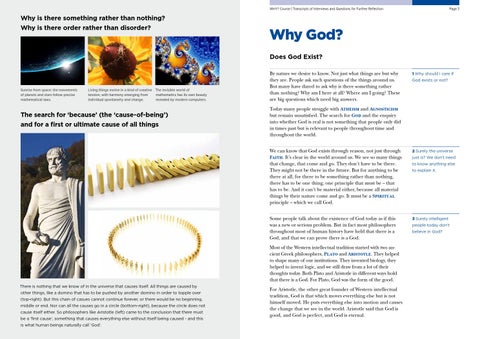
Some people talk about the existence of God today as if this was a new or serious problem. But in fact most philosophers throughout most of human history have held that there is a God, and that we can prove there is a God. Most of the Western intellectual tradition started with two ancient Greek philosophers, Plato and Aristotle. They helped to shape many of our institutions. They invented biology, they helped to invent logic, and we still draw from a lot of their thoughts today. Both Plato and Aristotle in different ways hold that there is a God. For Plato, God was the form of the good. other things, like a domino that has to be pushed by another domino in order to topple over (top-right). But this chain of casues cannot continue forever, or there would be no beginning, middle or end. Nor can all the causes go in a circle (bottom-right), because the circle does not cause itself either. So philosophers like Aristotle (left) came to the conclusion that there must be a ‘first cause’, something that causes everything else without itself being caused - and this is what human beings naturally call ‘God’.
God exists or not?
Today many people struggle with Atheism and Agnosticism but remain unsatisfied. The search for God and the enquiry into whether God is real is not something that people only did in times past but is relevant to people throughout time and throughout the world. We can know that God exists through reason, not just through Faith. It’s clear in the world around us. We see so many things that change, that come and go. They don’t have to be there. They might not be there in the future. But for anything to be there at all, for there to be something rather than nothing, there has to be one thing, one principle that must be – that has to be. And it can’t be material either, because all material things by their nature come and go. It must be a Spiritual principle – which we call God.
There is nothing that we know of in the universe that causes itself. All things are caused by
1 Why should I care if
For Aristotle, the other great founder of Western intellectual tradition, God is that which moves everything else but is not himself moved. He puts everything else into motion and causes the change that we see in the world. Aristotle said that God is good, and God is perfect, and God is eternal.
2 Surely the universe just is? We don’t need to know anything else to explain it.
3 Surely intelligent people today don’t believe in God?
WHY? Course | Transcripts of Interviews and Questions for Further Reflection
Page 5
Why do we need God when we have the Big Bang theory, genetics and evolution to explain existence?
All scientific theories, including the Big Bang theory, genetics and evolution, describe how some physical things are transformed into other physical things, but not why any things exist in the first place. So there is still a need for a ‘first cause’ or ‘God’. The order of the cosmos also strongly suggests intelligent creative action, even though God may bring about this order partly through
We can know there’s a God from we can see in the universe from the way that everything that is necessary holds together so perfectly - the oxygen, the water and so on. Everything holds together, not in a ghastly tension, but in a rich creative tension so that things grow, things Evolve. Everything that is in the universe is perfectly ordered. And man can know this – our own minds tell us that there is a great knowledge at work here – and so as man explores, as we now do, the stars, the solar system, we are discovering more and more how perfect this is. Yes, this speaks to us of God; this speaks to us of the great creative mind.
4 Isn’t the universe full
Einstein once said that God was the Cause of the intelligibility in the universe – a fancy phrase basically to say that the universe is filled with meaning and purpose, and we are amazing because we can understand it. In the Bible it is said that God makes the world: the word that’s used is poema (Eph 2:10), from which we get the word ‘poem’. It is from the poetry of the world that we understand the poet and from the artistry that we understand the artist. So many people come to a belief of God through just seeing and then knowing.
5 If the universe is filled
of chaos, disorder and blind chance?
with purpose, why can’t we see what it is?
natural processes with their own spontaneity. Moreover, Catholics have contributed in important ways to understanding these processes. For example, the Big Bang theory and genetics were first proposed by the Catholic priests Georges Lemaître and Gregor Mendel. In addition, one of the first persons to suggest that God’s creation ‘evolves’ (from a Latin word evolvere meaning ‘to unfold’) was St Augustine, Bishop of Hippo in North Africa in the early fifth century.
Fr Georges Lemaître with Albert Einstein, 1933. Fr Lemaître proposed what is now known as the ‘Big Bang’ theory of the origin of the Universe.
Fr Gregor Mendel, the ‘Father of Genetics’, c.1880. Mendel’s meticulous observations of the inherited characteristics of plants laid the foundations of modern genetics.
One of the most popular proofs of the existence of God is the so-called ‘Cosmological Proof’ and it works a little like this: everything that we see, that we know of in the universe doesn’t cause itself. It has to be caused by something else. And you can play a sort of game with this. Look at the things around us: none of them cause themselves, they’re all caused by something else. And as you work backwards, you ask, “What caused the things that caused those things, or what caused the things that caused the things that caused those things?” You work backwards and backwards but eventually you have to come to a stopping point, something which causes everything else, without itself being caused. What is interesting is that this very belief that the universe had a cause is very much part of Catholic philosophy. It may also have helped to influence our belief in the Big Bang, because the Big Bang theory was actually developed by a Catholic priest, Fr Georges Lemaître. It was not popular among atheists and many of them rejected the Big Bang theory for 30 or 40 years. This Catholic priest, however, had proposed the theory and for him it was perfectly logical and reasonable that the universe could have a beginning, a cause, and that it wasn’t always the way it is today.
6 If God causes everything, what caused God?
WHY? Course | Transcripts of Interviews and Questions for Further Reflection
Page 7
What is the problem of evil and suffering? The greatest minds in history believed in God. Aristotle saw God as the first mover. Plato said he was the unchangeable good. Isaac Newton said he was the architect of the laws of the universe. Louis Pasteur, the inventor of pasteurisation, once said that a little science estranges men from God, but much science brings them back to him. One of the best ways to discover God is looking at the creature we know best: the human creature, the human being. It’s there that we discover something more than we find in any other creature in the world, either animate or inanimate. We realise we have Freedom, Intellect, Love. These are spiritual capacities of the soul that point to God in a very direct way. We can realise that we’re made like God. God can’t be anything less than these qualities. He must have them in order to give them. The Penitent Magdalene by Georges de La Tour (left) and Job Rebuked by His Friends by William Blake (right) The figure of Mary Magdalene on the left illustrates the problem of death, symbolised by the skull, and the moral evil of sin or wrongdoing, suggested by the turning away of the face from the onlooker in shame and the mirror, a symbol of vanity. The solitary, burning candle may be a symbol of hope, but may also warn of the ebbing away of time until the light of life is extinguished and darkness descends. The image of Job on the right illustrates the moral challenge of the perfect man who is reduced to wretched misery, proclaiming his innocence while rebuked by his friends.
Although the study of physics, mathematics and cosmology may inspire wonder and even religious awe, the study of living things, including ourselves, raises some difficult questions. If there is a good and all-powerful God, why is there so much waste, suffering, disease and death? The problem is not just that good creatures go wrong but that so many creatures seem predetermined to cause suffering and death
7 Hasn’t modern science shown that human beings are simply clever animals?
Why is there evil in the world? For most people, it is not enough to state positive reasons why there must be a God; the question is much more personal. They ask, “What difference does this make?” And they struggle with feelings of distance and alienation from God. They see so much Suffering and Evil, which gives rise to doubts that there could be a good and loving God.
8 What if I don’t want to be with God, or don’t feel any alienation at all?
to other creatures. Moreover, human beings also appear predetermined to evil, not just in suffering but in inflicting harm. For instance, the same human race that has composed heart-wrenchingly beautiful music has also inflicted pointless cruelty, torture and death on millions of fellow human beings in concentration camps. Although some suffering may be praiseworthy, such as that of the athlete in training, and some may be grimly necessary, such as the punishments of heinous criminals, much appears to be endured against their will by those who are innocent. Why does God not intervene? One way to address this question is to see what God has to say about this problem in the revealed books of those who believe in him. Perhaps the most famous such account is the Book of Job, the Biblical story of a perfectly innocent man crushed by suffering. When God answers Job’s complaints at the end of the book (Job 38-41), he does so mainly by rhetorical questions about the grandeur of creation, “Where were you when I laid the foundation of the earth?...” (38:4). This larger perspective, the transformation of Job’s relationship to God and the fact he obtains new blessings in the end, hints at the beginning of one response to the problem of evil: we have to see the larger The Lord Answering Job out of the Whirlwind by William Blake
picture and the end of the story.
For most of us, the question of suffering is at the core of our questions about God and about religious faith. If there is a God, and if this God is good, how can he permit suffering? This question relates to our deepest experiences in our own lives, those of the people near to us, and to human history, which seems to be one long saga of suffering. As soon as we resolve one problem – we invent antibiotics or anaesthetics – we seem to come up with another one like nuclear war. We manage to eliminate torture in one country, only for it to bubble up in another. What is this ghastliness? It is something in us; there is an understanding that there is something in human beings that isn’t quite right. We aren’t at peace with ourselves. And nature isn’t at peace in the way that it should be – volcanic eruptions and so on. So this question of suffering is the deepest one; it relates to, “Is there a deity and, if so, of what nature is this God and does he care about us? How do we fit into that?” This is the big one – there is no question – this is the big one.
9 There may be a lack of peace in the world, but how can God be the answer when religions are so different from one another and bring so much division?
WHY? Course | Transcripts of Interviews and Questions for Further Reflection
Page 9
What else does religion say about evil and suffering? Had God wanted to, he could have given us no choice in life. He could have programmed us only for good, but then we would only have been robots. We would have been doing the will of another. Instead he gave us Free Will, a choice. He veiled himself that we may find him only if we seek. Of course, the downside of this is that people were given the ability to reject God, to turn away from what is good. Sadly throughout the world we see the result of this chaos, the suffering, the evil and the darkness that so often mars what God had intended.
The Garden of Eden by Jacob de Backer
The Fall of the Rebel Angels by Pieter Bruegel the Elder
Genesis, the first book of the Bible, begins with a revealed symbolic history in which the world is initially created good. When human beings chose freely to break God’s only command to them, eating the forbidden fruit, they also rejected God’s love, losing paradise and beginning a life of suffering, ignorance and discontent, ending in death (Gen 3). The last book of the Bible, Revelation, claims that some of the powerful, contingent spiritual beings that God has created, called ‘angels’, have also rebelled and are ultimately responsible for an on-going war against God on earth (Rev 12). From these
10 Even if the misuse of free will explains some human suffering, why do animals and the natural world suffer if God is good?
Yes, evil and suffering are problematic for us, but they are set alongside the other things we experience as humans: Joy, Compassion, love; the things that speak powerfully of the way in the world that God had intended. Furthermore we have to focus on the fact and ponder why it is that we find evil and darkness disordered. We want to put right the things that we find wrong. It suggests that we have within us an understanding of how the world would have been had man not chosen to walk from God.
narratives, at least two initial responses to the problem of evil and suffering emerge. First, that God is the first but not the only cause of all things that happen in the world, since intellectual beings have been given the dignity of free will. Second, the abuse of this freedom has evil consequences by means of the causes and effects that God has implanted in the world. Genesis does hint early on that God will offer a means of salvation for humanity (Gen 3:15), but there is no return to Eden (Gen 3:24).
The Garden of Earthly Delights by Hieronymus Bosch The painting above illustrates symbolically the degeneration of humanity separated from God. Created initially in a state of innocence and natural perfection (left), human beings lose friendship with God as a result of sin. At first, they continue to use their freedom and delight in the things that God has created (centre). Nevertheless, already there are signs of perversion and futility in this carnival of activity, which culminates in chaos and the tortures of damnation (right). This sequence suggests another response to the problem of at least some suffering: a God who loves us might well make use of suffering to suspend the carnival of delights, to help rescue us from a descent into destruction.
We never say that God actually wants suffering. He allows it. There must be a purpose now for it even though it wasn’t, according to the Bible, his original plan. He allows it: maybe it’s to bring out heroism; maybe it’s to purify us; maybe it’s to remind us that there are realities beyond this world, beyond this order. One useful image that can help us in understanding this problem of evil is when we look at the canvas of a masterpiece and we go right up to it: we only see blotches and brushstrokes; it looks all very unpleasant. We step a little bit away from it and suddenly it takes on form and texture. Then we stand at the requisite distance and suddenly we see its form, the complete picture: it makes sense. It can be like that with the suffering that is in this world: it has a short sell-by date; it won’t last forever. When we look at it later, with hindsight, we see that there’s actual meaning in those blotches, in those brushstrokes, in what looks pretty meaningless close up.
11 Some suffering may
As well as the problem of evil and suffering there’s also the problem of a kind of stubbornness in our own natures. We don’t do what we’re meant to do even for our own good. That’s a part of the consequence of what we call Original Sin. We are born in a state of spiritual stubbornness: we don’t do the things that we know that we ought to do, and we often do the things that we know we should not do; and we won’t say sorry; and we won’t listen when we’re meant to;
12 Surely we need to be
have a larger and good purpose, but surely a lot of suffering, like bad toothache, is just pointless and unpleasant?
stubborn and look out for ourselves?