Two Discourses on Our Lady
Two Discourses on Our Lady
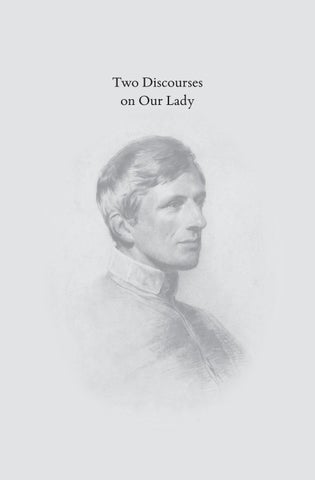
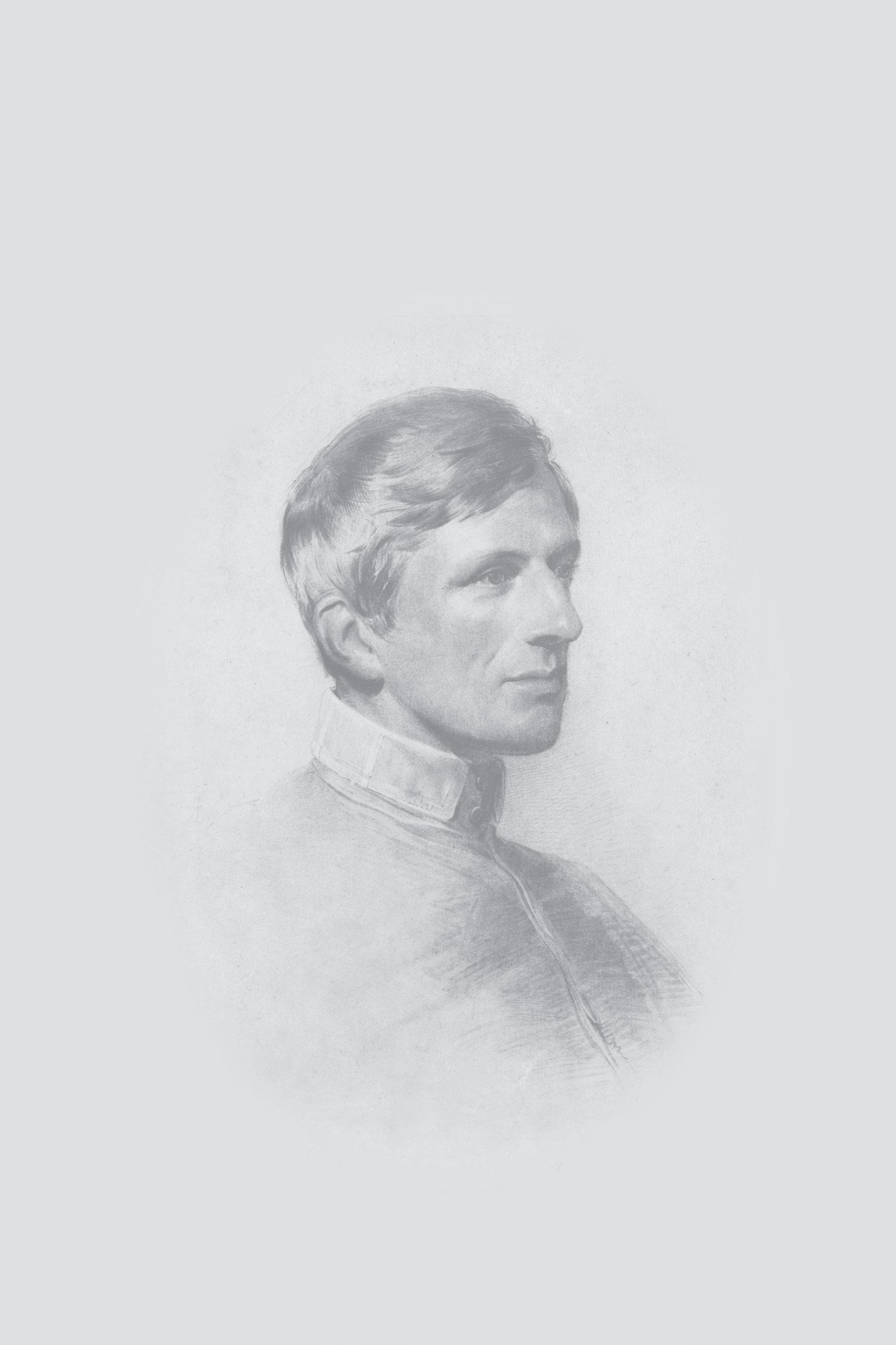
St John Henry Newman
Introduction by Rebekah Lamb Varela, PhD
About the Author
Dr Rebekah Lamb Varela is the Director of Teaching at the School of Divinity at the University of St Andrews and a Lecturer in theology, imagination and the arts. Her research specialities are in theology and the arts, particularly literature and visual culture, in late modernity. Key figures in her work include John Henry Newman, Thérèse of Lisieux, Gerard Manley Hopkins SJ, Christina Rossetti and the Pre-Raphaelites as well as their inheritors (JRR Tolkien, CS Lewis and Frances Blogg Chesterton, among others).
Introduction
Of the Vespers for the Forefeast of the Nativity in the Byzantine liturgy, John Saward observes how fitting it is that “the Church sings with” and through “the voice of the Theotokos”. The Vespers present to us an image of Mary cradling and adoring her son, marvelling at God’s use of the humble and hidden to proclaim the Good News of salvation: “And she, bending over [Christ]…like a handmaiden, worshipped him and said to him, as he lay in her arms: ‘How was thou sown a seed in me? And how hast thou grown within me, O my Deliverer and my God?’”1 This mysterious bond between Christ, the God-man, and his mother, the God-bearer (Theotokos), profoundly touched the heart of St John Henry Cardinal Newman (1801-1890) and enlivened his devotional life. It also illuminated his theological writings and homilies throughout his long life of preaching, teaching, and pastoral ministry. Central to Newman’s great affection for Mary as the Theotokos is his appreciation that any devout Mariology is a derivative of Christology. Mary’s greatness is due to her relation to the Trinity and her singular honour as Christ’s mother. Indeed, Newman’s profound, Marian devotion anticipates the Marian character of Pope St John Paul II’s life of piety and theological wisdom. As with Newman, John Paul II’s Marian devotion was one which grew, maturing as he entered ever more deeply and prayerfully into the heart of the Church’s teaching and heritage. In Crossing the
1 John Saward. Redeemer in the Womb: Jesus Living in Mary. (Illinois: Word on Fire, 2023), 7. For the Byzantine Vespers, themselves, see The Festal Manaion. Trans. Mother Mary and Kallistos Ware (London: Faber and Faber, 1969), 202.
TWO DISCOURSES ON OUR LADY
Threshold of Hope (1994), John Paul II reflected on the ways in which Marian devotion came ‘home’ to him, as it were, and started to make sense of Christology itself, in his early adulthood: “During the Second World War while I was employed as a factory worker, I came to be attracted to Marian devotion. At first, it seemed to me that I should distance myself a bit from the Marian devotion of my childhood, in order to focus more on Christ. Thanks to St Louis de Montfort [however], I came to understand that true devotion to the Mother of God is actually Christocentric, indeed, it is very profoundly rooted in the Mystery of the Blessed Trinity, and the mysteries of the Incarnation and Redemption”.2
As with John Paul II, Newman’s Marian devotion grew at different stages until it reached a deep maturation and became an abiding resource for his prayer and pastoral ministry – especially following on from his conversion to the Roman Catholic Church in 1845 and in his vocation as an Oratorian priest. However, his Marian devotion first began in earnest while he was still an Anglican priest and the vicar of Oxford’s University Church of St Mary the Virgin. An ancient church, part of which is Anglo-Saxon in origin, St Mary the Virgin served as “the heart” of the University of Oxford for worship, awarding of degrees, and core university business, from the 12th century onward.3 In Newman’s time, the church underwent extensive renovations to accommodate the university’s growing number of undergraduates. Among other transformations, an elevated pulpit was installed in 1827 to assist the preacher’s voice in reaching the church’s swelling congregation. Shortly thereafter, while a Fellow of Oriel College, Newman was appointed vicar of the University Church and used this new pulpit extensively, preaching on a wide and rich variety of subjects concerning the spiritual life and Christian doctrine, including several meditations
2 John Paul II. Crossing the Threshold of Hope (New York: 1994), 212-213.
3 https://www.universitychurch.ox.ac.uk/content/history-and-heritage accessed 23/10/2025.
Discourse 17. The Glories of Mary for the Sake of Her Son:
Seasons – Immaculate Conception
We know, my brethren, that in the natural world nothing is superfluous, nothing incomplete, nothing independent; but part answers to part, and all details combine to form one mighty whole. Order and harmony are among the first perfections which we discern in this visible creation; and the more we examine into it, the more widely and minutely they are found to belong to it. “All things are double,” says the Wise Man, “one against another; and He hath made nothing defective”. It is the very character and definition of “the heavens and the earth,” as contrasted with the void or chaos which preceded them, that everything is now subjected to fixed laws; and every motion, and influence, and effect can be accounted for, and, were our knowledge sufficient, could be anticipated. Moreover, it is plain, on the other hand, that it is only in proportion to our observation and our research that this truth becomes apparent; for though a number of things even at first sight are seen to proceed according to an established and beautiful order, yet in other instances the law to which they are conformed is with difficulty discovered; and the words “chance,” and “hazard,” and “fortune,” have come into use as expressions of our ignorance. Accordingly, you may fancy rash and irreligious minds who are engaged day after day in the business of the world, suddenly looking out into the heavens or upon the earth, and criticising the great Architect, arguing that there are creatures in existence which are rude or defective in their
constitution, and asking questions which would but evidence their want of scientific education.
The case is the same as regards the supernatural world. The great truths of Revelation are all connected together and form a whole. Every one can see this in a measure even at a glance, but to understand the full consistency and harmony of Catholic teaching requires study and meditation. Hence, as philosophers of this world bury themselves in museums and laboratories, descend into mines, or wander among woods or on the seashore, so the inquirer into heavenly truths dwells in the cell and the oratory, pouring forth his heart in prayer, collecting his thoughts in meditation, dwelling on the idea of Jesus, or of Mary, or of grace, or of eternity, and pondering the words of holy men who have gone before him, till before his mental sight arises the hidden wisdom of the perfect, “which God predestined before the world unto our glory,” and which He “reveals unto them by His Spirit”. And, as ignorant men may dispute the beauty and harmony of the visible creation, so men, who for six days in the week are absorbed in worldly toil, who live for wealth, or name, or self-indulgence, or profane knowledge, and do but give their leisure moments to the thought of religion, never raising their souls to God, never asking for His enlightening grace, never chastening their hearts and bodies, never steadily contemplating the objects of faith, but judging hastily and peremptorily according to their private views or the humour of the hour; such men, I say, in like manner, may easily, or will for certain, be surprised and shocked at portions of revealed truth, as if strange, or harsh, or extreme, or inconsistent, and will in whole or in part reject it.
I am going to apply this remark to the subject of the prerogatives with which the Church invests the Blessed Mother of God. They are startling and difficult to those whose imagination is not accustomed to them, and whose reason has not reflected on them; but the more carefully and religiously they are dwelt on, the more, I am sure, will they be found essential to the Catholic faith, and
Discourse 18. On the Fitness of the Glories of Mary: Seasons – Assumption
You may recollect, my brethren, our Lord’s words when on the day of His resurrection He had joined the two disciples on their way to Emmaus, and found them sad and perplexed in consequence of His death. He said, “Ought not Christ to suffer these things, and so enter into His glory?” He appealed to the fitness and congruity which existed between this otherwise surprising event and the other truths which had been revealed concerning the Divine purpose of saving the world. And so, too, St Paul, in speaking of the same wonderful appointment of God; “It became Him,” he says, “for whom are all things, and through whom are all things, who had brought many sons unto glory, to consummate the Author of their salvation by suffering”. Elsewhere, speaking of prophesying, or the exposition of what is latent in Divine truth, he bids his brethren exercise the gift “according to the analogy or rule of faith”; that is, so that the doctrine preached may correspond and fit into what is already received. Thus, you see, it is a great evidence of truth, in the case of revealed teaching, that it is so consistent, that it so hangs together, that one thing springs out of another, that each part requires and is required by the rest.
This great principle, which is exemplified so variously in the structure and history of Catholic doctrine, which will receive more and more illustrations the more carefully and minutely we examine the subject, is brought before us especially at this season, when
we are celebrating the Assumption of our Blessed Lady, the Mother of God, into heaven. We receive it on the belief of ages; but, viewed in the light of reason, it is the fitness of this termination of her earthly course which so persuasively recommends it to our minds: we feel it “ought” to be; that it “becomes” her Lord and Son thus to provide for one who was so singular and special, both in herself and her relations to Him. We find that it is simply in harmony with the substance and main outlines of the doctrine of the Incarnation, and that without it Catholic teaching would have a character of incompleteness, and would disappoint our pious expectations.
Let us direct our thoughts to this subject today, my brethren; and with a view of helping you to do so, I will first state what the Church has taught and defined from the first ages concerning the Blessed Virgin, and then you will see how naturally the devotion which her children show her, and the praises with which they honour her, follow from it.
Now, as you know, it has been held from the first, and defined from an early age, that Mary is the Mother of God. She is not merely the Mother of our Lord’s manhood, or of our Lord’s body, but she is to be considered the Mother of the Word Himself, the Word incarnate. God, in the person of the Word, the Second Person of the All-glorious Trinity, humbled Himself to become her Son. Non horruisti Virginis uterum, as the Church sings, “Thou didst not disdain the Virgin’s womb”. He took the substance of His human flesh from her, and clothed in it He lay within her; and He bore it about with Him after birth, as a sort of badge and witness that He, though God, was hers. He was nursed and tended by her; He was suckled by her; He lay in her arms. As time went on, He ministered to her, and obeyed her. He lived with her for thirty years, in one house, with an uninterrupted intercourse, and with only the saintly Joseph to share it with Him. She was the witness of His growth, of His joys, of His sorrows, of His prayers; she was blest with His smile, with the touch of His hand, with the whisper