Our nation 22
catholicnewsherald.com | July 4, 2014 CATHOLIC NEWS HERALD
Religious liberty advocates laud court’s Hobby Lobby ruling, but say fight continues WASHINGTON, D.C. — The Supreme Court’s June 30 ruling that certain businesses, based on their religious objections, can be exempted from a government requirement to include contraceptives in their employee health insurance coverage means “justice has prevailed,” said two U.S. archbishops. “We welcome the Supreme Court’s decision to recognize that Americans can continue to follow their faith when they run a family business,” said Archbishop Joseph E. Kurtz of Louisville, Ky., president of the U.S. Conference of Catholic Bishops and Archbishop William E. Lori of Baltimore, chairman of the U.S. bishops’ Ad Hoc Committee for Religious Liberty. “The court clearly did not decide whether the so-called ‘accommodation’ violates RFRA when applied to our charities, hospitals and schools, so many of which have challenged it as a burden on their religious exercise. We continue to hope that these great ministries of service, like the Little Sisters of the Poor and so many others, will prevail in their cases as well,” the statement said. Robert M. Gallagher, CEO of Good Will Publishers, which recently won a temporary injunction against the HHS contraception mandate for his for-profit religious business, said in a June 30 statement, “Good Will Publishers applauds the Supreme Court’s decision today forbidding the federal government from requiring closely-held businesses to violate their deeply held religious beliefs. This landmark ruling is a victory not only for my family-owned company, but for many others like it throughout the country. “We are thankful that our prayers and petitions have been answered. Subject to further review of the decision, this seems to be a hopeful but narrow ruling that offers a federal safe harbor for closely-held businesses who object to contraception. “Good Will Publishers was recently granted injunctive relief from the HHS mandate through our participation in the Catholic Benefits Association (CBA) litigation in the Federal District Court of Oklahoma. We believe the Hobby Lobby decision confirms our exempt status. “Today is a good day for Good Will Publishers, a good day for those who wish to protect religious liberty, and a good day for those who value life from conception until natural death. The battle for religious liberty, however, is far from over. Nevertheless, the Hobby Lobby decision is certainly a most important step in the right direction.” Belmont Abbey College’s leaders also said the Hobby Lobby ruling bodes well for their own case against the HHS mandate, which was the first lawsuit challenging the constitutionality of the mandate in 2011. It is now stayed and awaiting decisions from other cases in the D.C. Circuit Court of Appeals. “Today’s Supreme Court decision is an especially meaningful victory that sends a clear message to the current administration that our freedom is a God-given right and cannot be usurped by any group or individual,” said Belmont Abbey College President Dr. Bill Thierfelder. “It is heartening that the Supreme Court has upheld the right to the free exercise of religion guaranteed to American citizens by the First Amendment to the Constitution. We are confident that our 138 year-old Benedictine community will be able to continue to operate our college, as we always have, in accordance with the faith and teachings of the Catholic Church,” added Abbot Placid Solari, chancellor of Belmont Abbey College. — Catholic News Service, Catholic News Herald
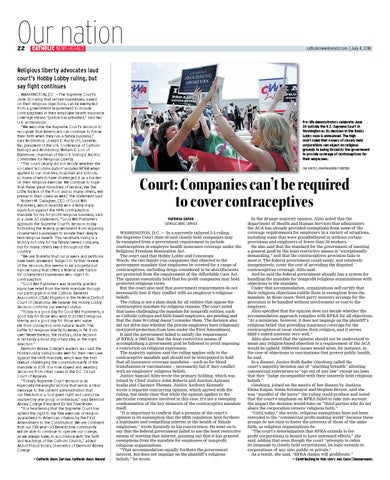
Pro-life demonstrators celebrate June 30 outside the U.S. Supreme Court in Washington as its decision in the Hobby Lobby case is announced. The high court ruled that owners of closely held corporations can object on religious grounds to being forced by the government to provide coverage of contraceptives for their employees. CNS photo | Jonathan Ernst, Reuters
Court: Companies can’t be required to cover contraceptives Patricia Zapor Catholic News Service
WASHINGTON, D.C. — In a narrowly tailored 5-4 ruling, the Supreme Court June 30 said closely held companies may be exempted from a government requirement to include contraceptives in employee health insurance coverage under the Religious Freedom Restoration Act. The court said that Hobby Lobby and Conestoga Woods, the two family-run companies that objected to the government mandate that employees be covered for a range of contraceptives, including drugs considered to be abortifacients, are protected from the requirement of the Affordable Care Act. The opinion essentially held that for-profit companies may hold protected religious views. But the court also said that government requirements do not necessarily lose if they conflict with an employer’s religious beliefs. The ruling is not a slam-dunk for all entities that oppose the contraceptive mandate for religious reasons. The court noted that cases challenging the mandate for nonprofit entities, such as Catholic colleges and faith-based employers, are pending and that the June 30 ruling doesn’t consider them. The decision also did not delve into whether the private employers have religiously motivated protection from laws under the First Amendment. It said the government failed to satisfy the requirement of RFRA, a 1993 law, that the least-restrictive means of accomplishing a government goal be followed to avoid imposing a restriction on religious expression. The majority opinion said the ruling applies only to the contraceptive mandate and should not be interpreted to hold that all insurance coverage mandates -- such as for blood transfusions or vaccinations -- necessarily fail if they conflict with an employers’ religious beliefs. Justice Samuel Alito wrote the primary holding, which was joined by Chief Justice John Roberts and Justices Antonin Scalia and Clarence Thomas. Justice Anthony Kennedy wrote a separate concurring opinion, which agreed with the ruling, but made clear that while the opinion applies to the particular companies involved in this case, it’s not a sweeping condemnation of the key elements of the contraceptive mandate itself. “It is important to confirm that a premise of the court’s opinion is its assumption that the HHS regulation here furthers a legitimate and compelling interest in the health of female employees,” wrote Kennedy in his concurrence. He went on to say that the federal government failed to use the least restrictive means of meeting that interest, pointing out that it has granted exemptions from the mandate for employees of nonprofit religious organizations. “That accommodation equally furthers the government interest, but does not impinge on the plaintiff’s religious beliefs,” he wrote.
In the 49-page majority opinion, Alito noted that the department of Health and Human Services that administers the ACA has already provided exemptions from some of the coverage requirements for employers in a variety of situations, including some that were grandfathered in without certain provisions and employers of fewer than 50 workers. He also said that the standard for the government of meeting a general good by the least restrictive means is “exceptionally demanding,” and that the contraceptives provision fails to meet it. The federal government could easily, and relatively inexpensively, cover the cost of providing the disputed contraceptives coverage, Alito said. And he said the federal government already has a system for handling the mandate for nonprofit religious organizations with objections to the mandate. Under that accommodation, organizations self-certify that their religious objections entitle them to exemption from the mandate. In those cases, third party insurers arrange for the provision to be handled without involvement or cost to the employer. Alito specified that the opinion does not decide whether the accommodation approach complies with RFRA for all objections. “At a minimum, however, it does not impinge on the plaintiff’s religious belief that providing insurance coverage for the contraceptives at issue violates their religion, and it serves HHS’s stated interests very well.” Alito also noted that the opinion should not be understood to mean any religion-based objection to a requirement of the ACA would be upheld. Different issues would arise, for instance, in the case of objections to vaccinations that protect public health, he said. In a dissent, Justice Ruth Bader Ginsburg called the court’s majority decision one of “startling breadth” allowing commercial enterprises to “opt out of any law” except tax laws that they “judge incompatible with their sincerely held religious beliefs.” Ginsburg, joined on the merits of her dissent by Justices Elena Kagan, Sonia Sotomayor and Stephen Breyer, said she was “mindful of the havoc” the ruling could produce and noted that the court’s emphasis on RFRA failed to take into account the impact the decision would have on “third parties who do not share the corporation owners’ religious faith.” “Until today,” she wrote, religious exemptions have not been extended to the “commercial profit-making world” because these groups do not exist to foster the interests of those of the same faith, as religious organizations do. “The court’s determination that RFRA extends to forprofit corporations is bound to have untoward effects,” she said, adding that even though the court “attempts to cabin its language to closely held corporations, its logic extends to corporations of any size, public or private.” As a result, she said, “RFRA claims will proliferate.” — Contributing to this story was Carol Zimmermann.