Families are the cradle of the future of humanity, pope says - p2
Popemobile converted into ambulance blocked from entering Gaza - p3
A Christian Perspective on Social Issues - p4
Sunday Scripture - p5
Video of dancing, beatboxing nuns goes viral, boosts interest in their ministry - p6
CELAM invites Pope to visit region - p7
Aishalton celebrates Laudato Si' week - p8
Church unity, mission must be at heart of all Catholic groups, pope says - p8
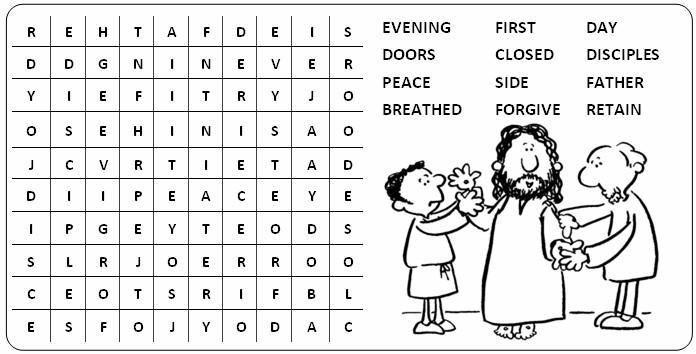
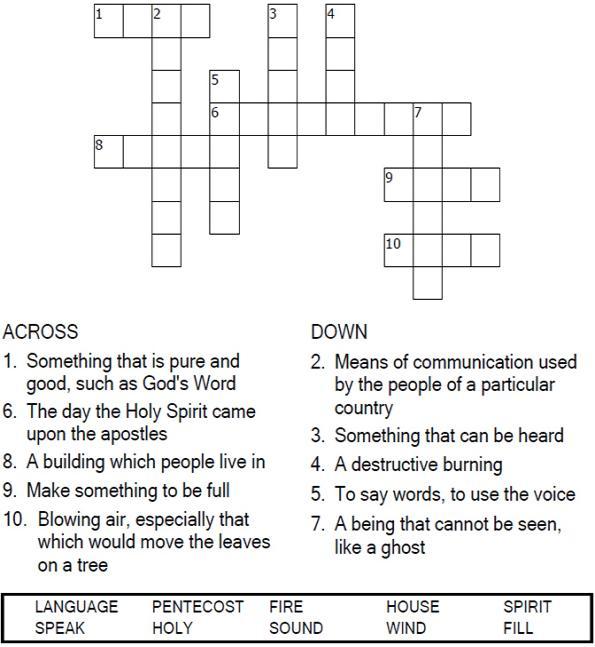
Children’s Page - p9
Pope’s prayer intention for June - p10
Council of Nicaea anniversary is call to Christian unity, speakers say - p12
CELAM at 70: A Church of the continent listening together - p13
Catholic Memory Lane: St. Peter’s, BV - p14
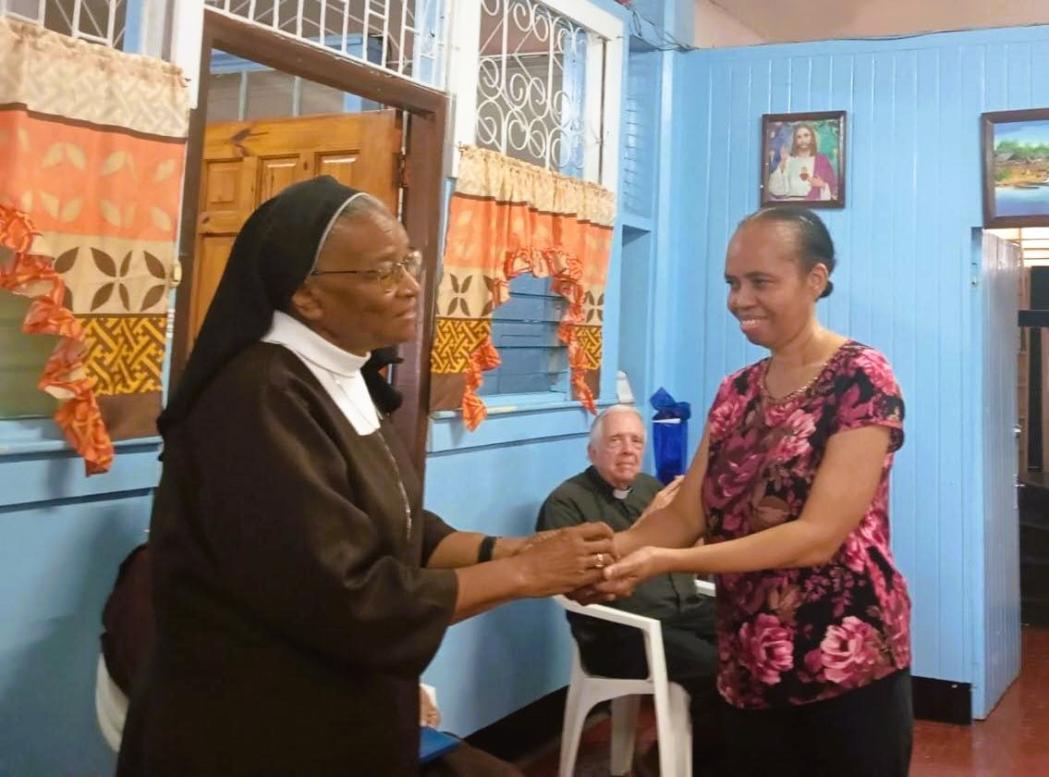
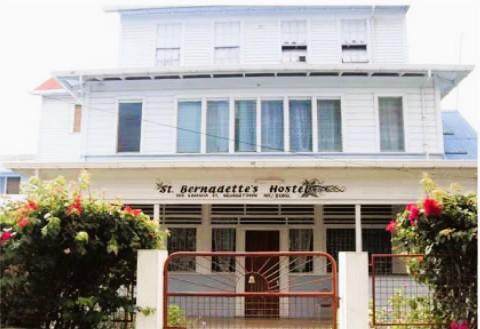
Sr. Katrina Charles, O. Carm. (left) hands over the keys to St. Bernadette’s Hostel to Sr. Julie Matthews, RSM, on Friday, May 30th, 2025. Looking on is Bishop Francis Alleyne OSB. (photo: Catholic Media Guyana FB page)
It was with joy and sorrow that the Sisters of Mercy and the Corpus Christi Carmelite Sisters gathered at St. Bernadette’s Hostel, Lamaha Street, Georgetown,
30th. A simple prayer service marked the conclusion of 75 years of service to the young women of St. Bernadette’s by the Carmelite
community, and the handing over of the ministry to the direction of the Sisters of Mercy.
(pleaseturntopage 7)
CELAM celebrates 70 years,
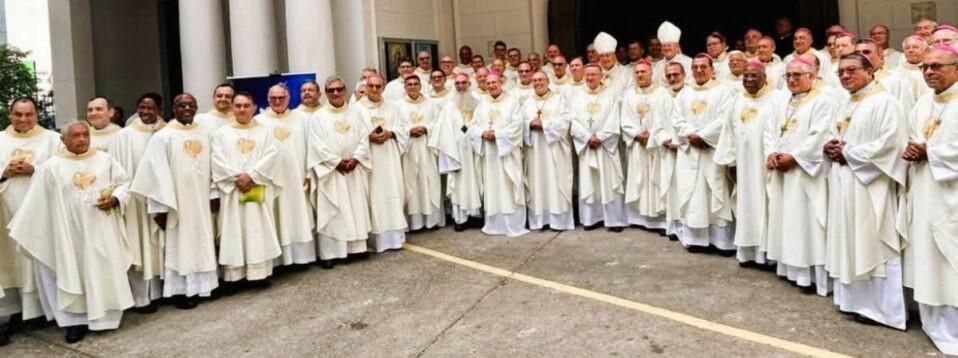
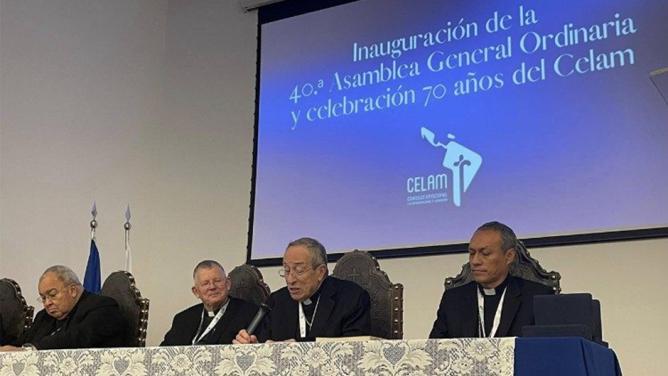
From May 25 - 30 in Rio de Janeiro, Brazil, the Latin American and Caribbean Episcopal Council (CELAM) held its 40th Ordinary General Assembly, which also marked its 70th anniversary. The Antilles Episcopal Conference (AEC) was represented by
Archbishop Charles Jason Gordon, the President of the AEC, and Fr. Donald Chambers, General Secretary of the AEC. Below is a reportfromVaticanNews: (Vatican News) - In a spiritofgratitude, living memory, and renewed commitment, the bishops of Latin
America and the Caribbean gathered for the 40th Ordinary General Assembly of the Latin American and Caribbean Episcopal Council (CELAM), marking 70 years since the first General Conference of the Episcopate, held in Rio de Janeiro in 1955. (pleaseturntopage11)
Sunday June 8th
07:30hrs – Mass and Confirmation at the Cathedral of the Immaculate Conception
Saturday, Jun 14th
16:00hrs – Travel to Bartica
Sunday, June 15th
08:00hrs – Mass at St. Anthony of Padua, Bartica
Francis Alleyne OSB
Families are the cradle of the future of humanity, pope says
The Jubilee Prayer
Father in heaven, may the faith you have given us in your son, Jesus Christ, our brother, and the flame of charity enkindled in our hearts by the Holy Spirit, reawaken in us the blessed hope for the coming of your Kingdom.
May your grace transform us into tireless cultivators of the seeds of the Gospel. May those seeds transform from within both humanity and the whole cosmos in the sure expectation of a new heaven and a new earth, when, with the powers of Evil vanquished, your glory will shine eternally.
May the grace of the Jubilee reawaken in us, Pilgrims of Hope, a yearning for the treasures of heaven. May that same grace spread the joy and peace of our Redeemer throughout the earth.
To you our God, eternally blessed, be glory and praise for ever.
Amen
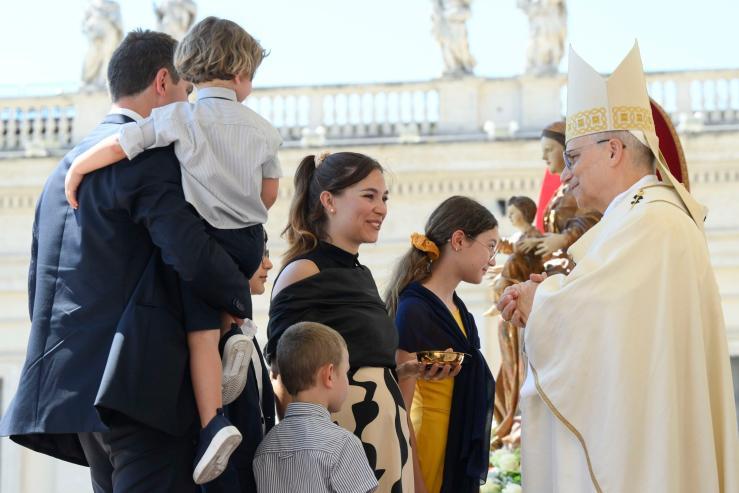
A family presents the offertory gifts to Pope Leo XIV during Mass marking the Jubilee of Families, Children, Grandparents and the Elderly in St. Peter’s Square at the Vatican June 1, 2025. (CNS photo/Vatican Media)
VATICAN CITY (CNS) Families are the cradle of the future of humanity, Pope Leo XIV said during a Mass concluding the Jubilee of Families, Children, Grandparents and the Elderly.
Today’s world needs the marriage covenant in order to know and accept God’s love and to defeat, thanks to its unifying and reconciling power, the forces that break down relationships and societies,” he said in his homily at the Mass celebrated June 1 in St. Peter’s Square.
The day also marked World Communications Day, and in remarks after the Mass Pope Leo thanked all “media workers who, by taking care of the ethical quality of messages, help families in their role as educators.”
Faith ‘Is Shared Like Food at FamilyTable’
In the family, he said in his homily, faith “is shared like food at the family table and like the love in our hearts. In this way, families become privileged places in which to encounter Jesus, who loves us and desires our good, always.”
Speaking to all married couples, the pope said that “marriage is not an ideal but the measure of true love between a man and a woman: a love that is total, faithful and fruitful,” and enables them, “in the image of God, to bestow the gift of life.”
“I encourage you, then, to be examples of integrity to your children, acting as you want them to act, educating them in freedom through obedience, always seeing the good in them and finding ways to nurture it,” he told married couples.
“And you, dear children, show gratitude to your parents. To say, ‘thank you’ each day for the gift of life and for all that comes with it is the first way to honor your father and your mother,” Pope Leo said.
places where we live, work and study. Different, yet one; many, yet one; always, in every situation and at every stage of life,” the pope said.
“If we love one another in this way, grounded in Christ,” he said, “we will be a sign of peace for everyone in society and the world. Let us not forget: Families are the cradle of the future of humanity.”
‘World Needs Marriage Covenant’
Watch Over Loved Ones ‘WithWisdom’
Speaking to grandparents and elderly people, he asked that they “watch over your loved ones with wisdom and compassion, and with the humility and patience that come with age.”
The pope focused his homily on “The Prayer of Jesus” in the day’s Gospel reading (John 17:20-26) in which Jesus prays to the Father that all of Christ’s disciples not only follow him but also seek to be in union with the Father.
He re-read portions of the Gospel to emphasize God’s plan of unity for all of humanity, particularly: “I have given them the glory you gave me, so that they may be one, as we are one, I in them and you in me, that they may be brought to perfection as one, that the world may know that you sent me, and that you loved them even as you loved me.”
“Jesus is telling us that God loves us as he loves him. The Father does not love us any less than he loves his only-begotten Son. In other words, with an infinite love,” Pope Leo said.
God Draws ‘All People to Himself’
“In his mercy, God has always desired to draw all people to himself. It is his life, bestowed upon us in Christ, that makes us one, uniting us with one another,” he said, connecting the Gospel reflection to how it relates to celebrating the Jubilee of families.
Jesus’ prayer “makes fully meaningful our experience of love for one another as parents, grandparents, sons and daughters,” he said.
“That is what we want to proclaim to the world: We are here in order to be ‘one’ as the Lord wants us to be ‘one,’ in our families and in those
By beatifying and canonizing married couples who gave exemplary witness of married life, such as Sts. Louis and Zélie Martin and the Blessed Ulma family mother, father and seven small children “the church tells us that today’s world needs the marriage covenant” in order to discover and embrace God’s love and to defeat that which breaks down relationships and communities, he said. No one chose to be born, he said, but someone was there to offer care. “All of us are alive today thanks to a relationship, a free and freeing relationship of human kindness and mutual care.”
However, “that human kindness is sometimes betrayed. As for example, whenever freedom is invoked not to give life, but to take it away, not to help, but to hurt,” he said.
Nonetheless, the pope said, “even in the face of the evil that opposes and takes life, Jesus continues to pray to the Father for us. His prayer acts as a balm for our wounds; it speaks to us of forgiveness and reconciliation.”
Over 70,000 People From 131Countries
More than 70,000 people from 131 countries gathered in the square after three days of jubilee events in Rome. Families of every age and size were present in the square; some were holding banners or flags, wearing matching hats or seeking shelter under umbrellas from the hot morning sun.
Pope Leo rode through the crowds before the start of Mass while temperatures were still in the high 70s. He broke from his usual blessing of infants and small children hoisted up to him when a young boy in the crowd held out his hand for a shake. The pope leaned far out from the popemobile to give him a “low five” to the cheers and fist pumps of the boy and his friends.
Before praying the “Regina Coeli” in the square, the pope prayed for all families, especially those “suffering due to war in the Middle East, in Ukraine and in other parts of the world. May the Mother of God help us to press forward together on the path of peace.”❖
turning country into ‘international prison’
(CathNews) - El Salvador’s Catholic bishops have warned of the risk of turning the Central American nation into a “large international prison”. Source:CNA.
In a May 29 pastoral letter, the Salvadoran Bishops’ Conference stated that their intention was not “to contradict the national authorities, as we are well aware of the efforts they are making to govern the country for the benefit of the people”.
They also make it clear that their observations are not in support of “any partisan ideological interest, nor to the interests of powerful groups. What truly moves us is the good of the people.”
“With our voice, we want to make audible the cries of the poor people and the vast majority whose rights are violated, perhaps not with malicious intent; but violated, because in the midst of such an intense reality, it can happen that their barely perceptible voice may not be audible,” the letter reads.
Specifically, the prelates asked Salvadoran authorities “not to use our country’s prisons for victims of the antiimmigrant policies of foreign powers.”
In their letter, they pointedly criticise the stance taken following the visit of United States Secretary of State Marco Rubio in February, when El Salvador’s President, Nayib Bukele, offered to
receive “dangerous American criminals, including US citizens,” as well as “illegal immigrants from any other country” at the Terrorism Confinement Centre (CECOT, by its Spanish acronym) instead of deporting them to their home country.
The CECOT, popularly known as the “mega-prison,” is a maximum-security prison inaugurated in January 2023 and
capable of holding up to 40,000 inmates.
“We ask our leaders not to promote this country as if it were a large international prison. We implore them to think carefully about what they’re doing. Bringing in major criminals could become a danger to our population as well as earn this nation a bad international reputation,” the bishops warned.
As an alternative, they called for “promoting a pro-migrant policy, with the borders open to migrants and integration into the economy as a labour force. Furthermore, a portion of the Salvadoran population is also migrants, and we would not like our fellow citizens to be imprisoned in other nations.”❖
Popemobile converted into ambulance blocked from entering Gaza
(CathNews) - Border restrictions have prevented a popemobile donated by Pope Francis and converted into an ambulance from entering Gaza.
Prior to his death, Pope Francis donated the popemobile he used during his 2014 visit to Bethlehem to be turned into a mobile clinic to assist children in Gaza.
The initiative was personally entrusted by the late pontiff to Caritas Jerusalem
to respond to the grave humanitarian emergency in Gaza, where nearly 1 million displaced children live without access to food, clean water, or basic medical care amid the conflict with Israel.
However, ongoing border restrictions, including the sealing of the Rafah crossing between Egypt and Gaza, have prevented the vehicle, which was refurbished with essential medical
equipment, from reaching its destination.
We are still working in coordination with government agencies to ensure the popemobile enters Gaza. But the borders remain closed, and in my opinion, it will not be possible in the near future,” Harout Bedrossian, press officer for Caritas Jerusalem, said.
Mr Bedrossian indicated that while some humanitarian aid is entering, “it is controlled by military distribution points” and is not effectiveas the situation remains “very chaotic”.
One of the main problems facing Caritas is the shortage of permits issued by the Israeli government to enter Gaza: Obtaining permits to enter Gaza from Israel is a very arduous and lengthy process. From Egypt, it is a little easier, butall borders are currently closed.”
Humanitarian aid to the population of Gaza is trickling in, but not without serious problems that have even led to bloodshed in recent days, according to authorities in Gaza.
According to local observers, Doctors Without Borders and the Red Crescent, Israeli soldiers fired on a Gaza Humanitarian Foundation-run aid distribution centre on Sunday, killing at least 31
people. However, the foundation denied this report and asserted that the aid was distributed without incident.
The BBC reported June 4 morning that a further 27 Palestinians have been killed by Israeli fire as they attempted to collect aid near another distribution site, according to local officials.❖
An aerial_view of the Terrorism Confinement Centre in El Salvador (Wikimedia La Prensa Grafica)
The popemobile before its conversion into a mobile medical clinic (Vatican Media/Caritas)
A Christian Perspective on Social Issues
By GHK Lall
Pentecostthe spirit is upon us
Jesus said to his disciples: “Receive the Holy Spirit” (John 20: 22). “And suddenly a sound came from heaven like the rush of a mighty wind. and it filled all the house where they were sitting. And there appeared to them tongues as of fire and resting on each one of them. And they were all filled with the Holy Spirit…” (Acts 2: 2-4). A miracle to one, many miracles to many, through this awesome manifestation of the promised Holy Spirit coming from heaven and settling on humble men. Whatever we do, let us do our best not to separate from the Holy Spirit. Or to engage in those behaviors that block the Holy Spirit from coming to us, resting in us, staying with us. When the gift of the Holy Spirit is received, a righteous, conscientious spirit is inside. The deeper it is, the better for the blessed recipient. The first Pentecost Sunday showed us that in a manner that removes all doubt, and electrifies the faithful to virtuous works. There is no language problem, when the language of Jesus is spoken. No barrier whatever, only the familiar in what is shared, what is heard, what is absorbed. And understood. We understand in the fullest measure that this call to Christian ministry is a grand blessing. There is the inspiration that, no matter the hardships encountered in obeying the commands of Jesus to spread the Good News of the Kingdom, the message will reach the ends of the earth. It has, hasn’t it? I think that a global congregation of believers, of some 1.4 billion Catholics, proves the power of the Holy Spirit to make possible a “great multitude that no one could count from every nation, tribe, people, and language standing before the throne and before the Lamb” (Rev 7: 9). This what the operation of the Holy
Spirit makes possible in those following in the footsteps of the man from Galilee.
What spirit is in us, sisters and brothers? The spirit of man, or the Holy Spirit coming from the Father and the Son? The spirit of man is hawklike, warlike, and could be full of dislike. When there should be none of that in the Church and in our hearts, there is too much of all three all over. The language of love is furthest from consideration. The language of hate proliferates, and it can take many disguises, possesses many skills. Hence, where there ought to be one body in Christ, there is the divisive. Unlike the language of Pentecost Sunday, the language of today is raw and wreaks havoc on the weak, the vulnerable, the anxious. A godly spirit is a peaceable spirit. This society could do with some peace, more peacemakers, more who are authentic princes of peace, in their own right, even though by a lesser reckoning.
At this time in this country there is a different spirit in the air. It is not the spirit of Christmas, nor a spirit of goodwill. It is the spirit of national elections. In Guyana, elections are all-consuming, all-convulsing, and frequently brings out manifestations of the devil from many of us. For sure, elections can be that crippling, that diminishing, even of pious men and women. In the little snippets
that come my way from Christian men and women, I often ask myself, where is Jesus? What happened to him? Why is he not the one most talked about, the one most closely followed, the one most believed, thus, trusted?
The Holy Spirit can be said to represent beauty and the heavenly. A bell is clanging loudly. Why are so many Catholics, so many Christians, so obsessed to the point of perverseness, with elections? We pray for the Holy Spirit often. Come, Holy Spirit, come. Let each one of us, therefore, take the greatest care that when the Advocate, the Counselor, comes, that we are ready. To receive. Then to be the conduit through which others are blessed. That is, they are touched and inspired. They are lifted up and carried away. They are of God and Jesus first, and of mortal man long after. That ly Spirit. When we speak, the pure of heart often listen. When we proclaim and then produce in close harmony, then the Holy Spirit is infused in us. Then the Word of the Lord rolls ever so caringly off our tongues. Men of the world have their own priorities, with the biggest one in Guyana right now being that of gathering votes. Men of a Christlike spirit gather disciples in the name of the Lord. Blessed Pentecost, everyone. ❖
Gracious and loving God, we thank your for the gift of our priests. Through them, we experience your presence in the sacraments.
Help our priests to be strong in their vocation.
Set their souls on fire with love for your people.
Grant them the wisdom, understanding, and strength they need to follow in the footsteps of Jesus. Inspire them with the vision of your Kingdom.
Give them the words they need to spread the Gospel.
Allow them to experience joy in their ministry.
Help them to become instruments of your divine grace.
We ask this through Jesus Christ, who lives and reigns as our Eternal Priest. Amen
FIRST READING: Acts 2:1-11
They were all filled with the Holy Spirit, and began to speak.
When Pentecost day came round, they had all met in one room, when suddenly they heard what sounded like a powerful wind from heaven, the noise of which filled the entire house in which they were sitting; and something appeared to them that seemed like tongues of fire; these separated and came to rest on the head of each of them. They were all filled with the Holy Spirit, and began to speak foreign languages as theSpirit gave them thegift of speech.
Now there were devout men living in Jerusalem from every nation under heaven, and at this sound they all assembled, each one bewildered to hear these men speaking his own language. They were amazed and astonished. ‘Surely’ they said ‘all these men speaking are Galileans? How does it happen that each of us hears them in his own native language? Parthians, Medes and Elamites; people from Mesopotamia, Judaea and Cappadocia, Pontus and Asia, Phrygia and Pamphylia, Egypt and the parts of Libya round Cyrene; as well as visitors from Rome - Jews and proselytes alike-Cretans and Arabs; we hear them preaching in our own languageabout the marvels of God.’
RESPONSORIAL PSALM: Psalm 103
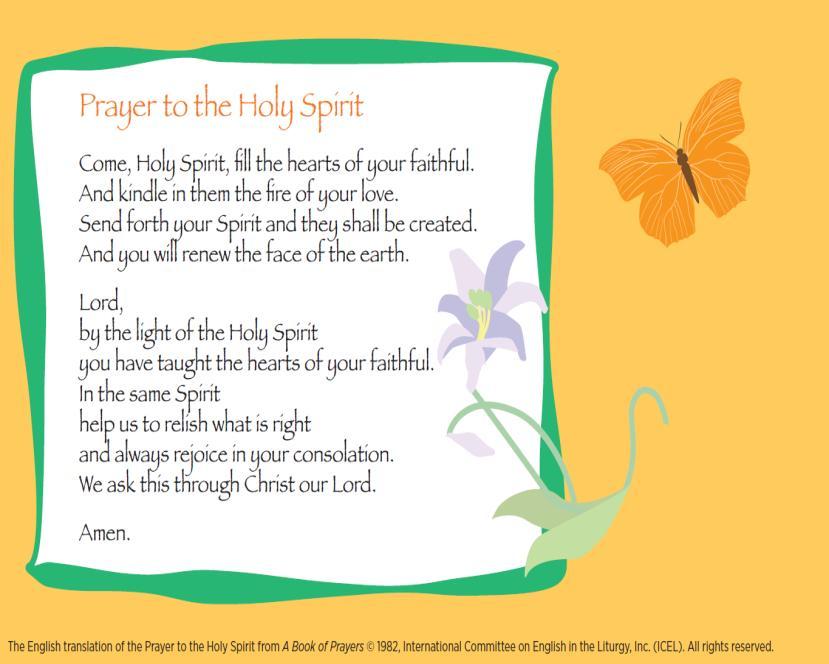
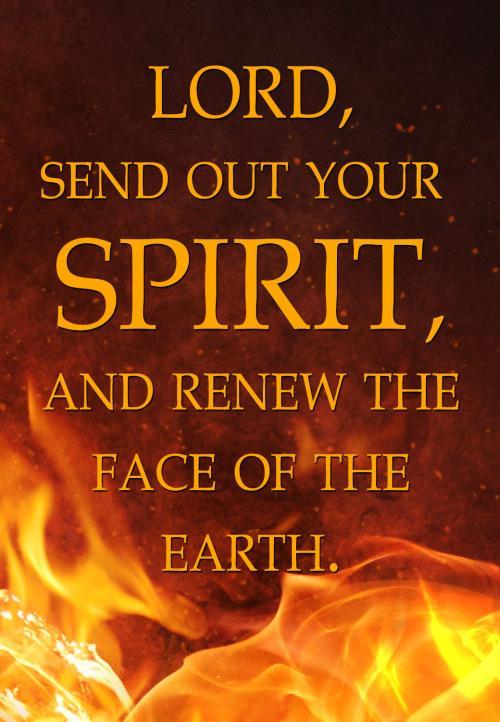
Response: Send forth your Spirit, O Lord, andrenewthefaceoftheearth.
1. Bless the Lord, my soul! Lord God, howgreat you are, How manyare your works,0 Lord!
The earth is full of your riches. Response
2. You takeback your spirit, they die, returning to the dust from which they came. You send forthyour spirit,they are created; and you renew the faceof the earth. Response
3. May theglory of the Lord last for ever! May the Lord rejoice in hisworks! May my thoughts bepleasing tohim.
I find my joy in the Lord. Response
SECOND READING: Romans 8:8-17
Everyone moved by the Spirit is a son of God
People who are interested only in unspiritual things can never be pleasing to God. Your interests, however, are not in the unspiritual, but in the spiritual, since the Spirit of God has made his home in you. In fact, unless you possessed the Spirit
Today we reach the finale of the Easter season with the celebration of the great Feast of Pentecost. Reflecting on today’s readings inspires a sense of awe as we consider the mighty power of the Holy Spirit at work giving birth to and sustaining our Church. Just as
Christ you would not belong to him. Though your Christ is in you then your spirit is life itself because you have Spirit of him who raised Jesus from the dead is living in you, then he who raised Jesus from the dead will give life to your own mortalbodies through hisSpirit living in you. So then, my brothers, there is no necessity for us to obey our unspiritual selves or to live unspiritual lives. If you do live in that way, you are doomed to die; but if by the Spirit you put an end to the misdeeds of the body you will live.
Everyone moved by the Spirit is a son of God. The spirit you received is not the spirit of slaves bringing fear into your lives again; itis the spirit of sons, and it makes us cry out, ‘Abba, Father!’ The Spirit himself and our spirit bear united witness that we are children of God. And if we are children we are heirs as well: heirs of God and coheirs with Christ, sharing his sufferings so as to share his glory.
SEQUENCE
Holy Spirit, Lord of light, From the clear celestial height Thy pure beaming radiance give.
awesome the same Spirit is calling to us this day to take up our part in the Church’s saving work.
In the first reading, from Acts, we see the creative genius of the Holy Spirit moving through the newly confirmed Apostles “who began to speak in different tongues as the Spirit enabled them to proclaim.” The large crowd, gathered from all over the world were “amazed” and “astounded” that each one could understand the Apostles speaking in their own language.
Come, thou Father of the poor, Come with treasures which endure; Come, thou light of all that live! Thou, of all consolers best, Thou, the soul’s delightful guest, Dost refreshing peace bestow; Thou in toil art comfort sweet; Pleasant coolness in the heat; Solace in the midst of woe.
Light immortal, light divine, Visit thou these hearts of thine, And our inmost being fill: If thou take thy grace away, Nothing pure in man will stay; All his good is turned to ill. Heal our wounds, our strength renew; On our dryness pour thy dew; Wash the stains of guilt away: Bend the stubborn heart and will; Melt the frozen, warm the chill; Guide the steps that go astray. Thou, on us who evermore Thee confess and thee adore, With thy sevenfold gifts descend: Give us comfort when we die; Give us life with thee on high; Give us joys that never end.
GOSPEL: John 14:15-16, 23-26
The Holy Spirit will teach you everything.
Jesus said to his disciples
‘If you love me youwill keep my commandments.I shall ask theFather, and he will give you another Advocateto be with you for ever,
‘If anyone loves me he will keep my word, and my Father will love him, and we shall come to himand makeour home with him.
Those who do not love medo not keep my words. And my word is not my own: it is the word of the one who sent me.
‘I have said these things toyou while still with you; but theAdvocate, the Holy Spirit, whom theFather will send in my name, will teach you everything and remind you ofall I have said to you.’ ❖
Each one of us, young and old alike, is personally called today by the Holy Spirit into the same mission as that of the first Apostles to advance the Kingdom of God in our corner of the world. Just as He did on that Pentecost day, the Holy Spirit speaks to us in our “own language” to give us the Good News of the Gospel and urge us to share it. We can think of our own language as the particular gifts, talents and passions we possess. We experience the presence of the Holy Spirit through them and we are meant
put them to the work in grateful service of the Kingdomof God. When we consider the stewardship way of life we are called to live, we often focus on the challenges it poses. Surrendering ourselves to God is indeed a challenging way to live. But it leads to a life that is exciting, creative and deeply rewarding. Stewardship allows us to experience life as a great adventure because it is a life guided and directed by the very source of power and creativity - the Holy Spirit! ❖ [www.catholicsteward.com/blog/ ]
Video of dancing, beatboxing nuns goes Gospel Reflection
The observance of Pentecost is the celebration of the gift of the Spirit to the Church. There is much drama and action with noise, wind and fire in the First Reading taken from the Acts of the Apostles. The result is immediate. The disciples receive the gift of effective preaching and they speak in a way that is understandable to all. The power of the Spirit breaks down the barriers of language and culture. The message of the Good News of Jesus the Christ now belongs to all people everywhere. And so a new community is born, a community that speaks a new language. It is the language of love and co-operation, a language that people everywhere can easily understand. Such a language is sorely needed today in our broken world for even though we have made great strides in the fields of science and technology, we still cannot speak to each other and so live at peace. It is no wonder that Jesus regularly greeted his friends with the words: “Peace be with you!”
It is said that Pentecost celebrates the birthday of the Church. This is because it is the first time we see the disciples lose their fear and timidity and become self-assured and ready to begin spreading the Good News of Jesus. We know from the Pentecost experience that the Spirit is alive and active in each of us, in the Church and in the world. We know that the presence of the Spirit brings peace, forgiveness and reconciliation. It is the Spirit that instils confidence in us and trust in others. Under the guidance of the Spirit we are free to choose to love and forgive and to share the peace of Christ with others. ❖
[From: Journeying with the Word of God, The Religious Education Department,DioceseofGeorgetown, Guyana ]
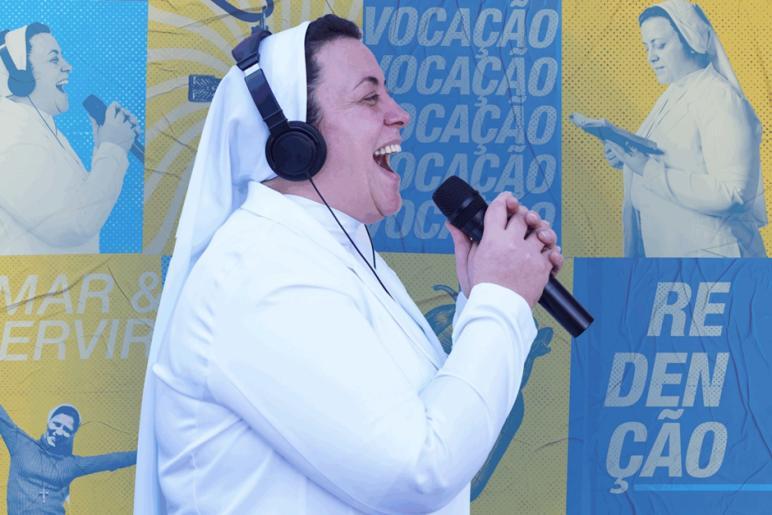
Brazilian Sister Marizele Isabel Cassiano Rego is seen in an undated photograph. Two Brazilian nuns have gone viral worldwide after a May 28, 2025, video showed them beatboxing and dancing hip hop on Catholic TV drawing comparisons to a real-life "Sister Act." (OSV News/courtesy Copiosa Redenção)
SÃO PAULO (OSV News) A video of Brazilian nuns beatboxing and dancing hip-hop, a scene taken from a local TV show and defined by celebrities like Whoopi Goldberg as “a real life ‘Sister Act,'” went viral on May 28, with millions of views all over the world.
Sisters Marizele Isabel Cassiano Rego, 46, and Marisa de Paula Neves, 41, were taking part May 20 in a TV show of the Catholic network Pai Eterno (Eternal Father), in Goiás state, in order to talk about a vocational encounter the two were attending in the region. As they mentioned their artistic ways of reaching the youth, they presented a song they wrote about God’s calling.
Sister Marizele sang it and Sister Marisa began to dance the whole act had a noticeable hip-hop nature. That’s when Sister Marizele began beatboxing.
The short clip went viral on social media and was reproduced by international news agencies on May 28. Actress Viola Davis shared it on her Instagram account, mentioning Sister Mary Clarence, Whoopi Goldberg’s character in the 1992 movie “Sister Act.”
On ABC’s “The View,” Goldberg commented on the clip, saying that “anytime you can praise the Lord with some music and you’re doing your thing, I think it’s a good sign.”
Workwithaddicts
Sister Marizele and Sister Marisa are members of the Brazilian congregation of the Sisters of the Copious Redemption, created in 1989 by Redemptorist
Father Wilton Lopes in the city of Ponta Grossa, Paraná state, where both of the sisters live today. Their mission is to work especially on the rehabilitation of drug addicts.
Father Lopes received a revelation in 1991, after which it was decided that every day each sister will pray for drug or alcohol addicts in front of the Blessed Sacrament.
“I’ve learned how to sing with my family. My grandfather was a player of
rhythms of the region, also connected to the Caipira culture and U.S. country music.
“But afterwards I joined the city’s dance group and took classes in ballet and street dance,” she explained.
As a nun, she worked with children and teens in a cultural center where she learned tap dancing and break dance.
“As they saw me learning how to dance those rhythms, they would be encouraged to join the classes too,” Sister Marisa explained.
The impact of such artistic activities in the sisters’ missionary work has been noticeable, they said. They both have been focusing on vocational initiatives and realized how the arts can break down barriers and bring the youth close to them.
“People usually think nuns are rigid, even grumpy women. When they see us singing and dancing, when they get to know us better, they realize we’re not,” Sister Marizele said.
Caipira guitar,” Sister Marizele told OSV News, mentioning a 10-string guitar developed in the colonial era in São Paulo state traditionally used for playing rhythms from the countryside. At home, she and her sisters would promote karaoke nights, something that further developed her abilities. Since her teens, she has been experimenting with mouth sounds as well.
“I’ve never had the opportunity to formally learn beatboxing, but somehow I managed to develop my own way of doing it. Experts told me it’s pretty fine,” said Sister Marizele.
As a young participant of Catholic charismatic renewal groups, she began singing at church before joining the congregation, which happened 21 years ago.
“In order to evangelize drug addicts, we would resort to beatboxing, dance, music, theater. We need to be rather creative,” described Sister Marizele, who has lived for nine years in therapeutic communities.
Breakingdownbarriers
Sister Marisa, in the convent for the last 14 years, told OSV News she has always liked to dance. Coming from a small city in Paraná state, she first learned to dance the traditional
Dear Editor, Goodness is contagious. The problem is, so is evil.
The challenge for you and me, as Christians in the midst of the modern world, is to be examples of good, and good living.
The same thing happens in different parishes and church groups, added Sister Marisa. Some of them promote contemplation, while others are more vivacious. People can be attracted by different styles.
“Our church is diverse. That is her beauty,” she said.
With its intense use of music and its particular spirituality, the Catholic charismatic renewal, to which both sisters are connected, is viewed by many analysts in Brazil as a way to halt the continuous erosion of Catholicism in the country.
Traditionally a Catholic nation, only 50% of Brazil’s population today is Catholic, while evangelicals make up 25% of the population. Scholars predict that by 2032 Brazil may become a predominantly evangelical country.
The charismatic renewal way may be productive drawing people back to the Catholic Church, indeed. According to Sister Marizele, since their video went viral, more and more people have been looking for them.
“Boys and girls who we meet in different locations have been asking us about our work and our congregation, including boys interested in beatboxing,” she said with a smile. ❖
Be good
None of us realize how much we influence others.
Everything you do people are watching, and everything you say, people are listening to.
The influence of your words and actions is contributing to the way they live their lives.
Be good for goodness sake, and befriend people who inspire you. Let your light shine!
Leon Jeetlall
CELAM invites Pope to visit region Journeying with the Word of God
(Vatican News) - Marking their 40th Ordinary General Assembly, the Latin American and Caribbean Episcopal Council (CELAM) sent a letter to Pope Leo XIV. In it, they express their joy at his election as the 266th Successor to St. Peter and their gratitude for the telegram he addressed to the Assembly two daysago.
“With hearts filled with joy, we, the participants of the 40th Ordinary Assembly of the Latin American and Caribbean Episcopal Council (CELAM), gathered in Rio de Janeiro, send you our fraternal greetings and heartfelt thanks for the message with which you have encouragedourepiscopalministry.”
Pope Leo’s election is a sign of hope In their message to the Pope, the
CELAM bishops stated they see in his election, “the providential work of God.” In the wake of fruits of Francis’ pontificate, the letter continued, “your election is a sign of hope.”
The bishops affirmed their renewal of their “full and filial communion” with the Pope and stress their commitment to serving as a missionary Church. “We humbly embrace the challenge of being a servant Church, one that enriches the center from the periphery, and proclaims with authenticity from a place of simplicity.”
Do not forget Latin America and the Caribbean
While the CELAM bishops held their 40th General Assembly, they also commemorated the 70th
anniversary of the First General Conference of the Latin American Episcopate in Rio de Janeiro in 1955. In light of this, the bishops reiterated their dedication to evangelization.
The bishops also pointed out the challenging sociopolitical reality of the region, saying it needs the Pope’s “prophetic voice to inspire justice and peace.” As families and communities face armed conflict, drug trafficking, and forced migration, the Assembly petitioned Pope Leo to remember the regionin his prayers.
“Migrants yearning for a dignified future, Indigenous peoples defending their identity and land, youth without opportunities, women victims of violence, abandoned and vulnerable children... all of them await from us words and gestures that comfort and liberate.”
The bishops' letter stressed their ongoing commitment to continuing the missionary and synodal mission of the Church and underscored their dedication to caring for all of Creation, following the legacy of Laudato si'.
Concluding their letter, the bishops formally invited Pope Leo XIV to visit Latin America and the Caribbean whenever he can as “our people long for your presence and apostolic blessing.”❖
Carmelites leave Guyana, entrust ministry to Sisters of
Mercy (From P1)
The service was led by Sr. Katrina Charles, O. Carm., Prioress General of the Carmelite community. Held on the eve of the Feast of the Visitation, Sr. Julie Matthews, RSM, Institute Minister of the Sisters of Mercy of the Americas, reflected that the evening was indeed a visitation – the Carmelites, pregnant with Compassion and Service, and the Mercies, pregnant with Hope and Mercy. Several current and past residents of St. Bernadette’s were in attendance, along with Bishop
Francis Alleyne, OSB. Sisters and residents shared memories and joys – the love of the Carmelite Sisters for the young women, and the young women’s mutual love for the Sisters was tangible.
Bishop Francis thanked the Carmelites for their decades of service to the people of Guyana, particularly the young women who sought refuge at St. Bernadette’s Hostel over the years.
The Corpus Christi Carmelites came to Guyana 75 years ago from Trinidad to manage St. Bernadette’s Hostel.
St. Bernadette’s was built in 1950 as a ‘home away from home’ for young women. It was officially opened on February 18th 1950 - the feast of St. Bernadette. In February of this year, the 75th anniversary of the establishment of St. Bernadette’s Hostel was celebrated, along with the celebration of the Carmelite Sisters’ 75 years of service in Guyana.
In addition to managing St. Bernadette’s, the Carmelites were also involved in counselling and education, which included at one time teaching catechism classes in several parishes, including Our Lady of Fatima; Peters Hall, EBD; Victoria and Mahaica, ECD; Malgretout, WBD; and Springlands, WCB.
After 75 years of dedicated service in Guyana, the Corpus Christi Carmelites have returned to Trinidad, as the majority of the five Sisters who were serving here are elderly. St. Bernadette’s Hostel will now be managed by the Sisters of Mercy.
We thank the Carmelite Sisters for the unconditional love and service they have given to the Diocese over the last 75 years.❖ (Adapted from Catholic Media GuyanaFacebook page)
MAKING THE WORD OF GOD YOUR OWN
Step 1: Lookattoday’sReadingsprayerfully.
1st Reading: A great day in the history of the Church when the Holy Spirit fills the disciples making them praise God before all nations.
2nd Reading: Thanks to the Spirit we are now capable of using the intimate name which a child use in calling out to its father – Abba.
Gospel: A true disciple cannot be just contented with words. We can only express our love for Christ by keeping his commandments.
1.The Spirit breathed new life into the disciples on that Pentecost day. In what way do you believe that the Lord breathes life in you?
2.Christ is so close to us that we can use the word a child says in calling out to its father – Abba! In what way do you see yourself as being close to our heavenly Father?
3.“The gift of the Holy Spirit is not a gift to be kept to oneself.” What is this statement saying to you?
4.Jesus said that those who love him keep his commandments. How do you see your community showing its love for Jesus? What makes keeping Jesus’ commandments difficult to keep?
Step 3: Accepting the message of God’s Wordinyourlifeoffaith
The Spirit was sent by Jesus to unite his followers into a strong community of believers – the Church. Pentecost is thus seen as the birthday of the Church. But more than a birthday celebration, Pentecost challenges us to bring about a rebirth of the Church so that all humanity may experience thewondersofGodatworkinourworld.
Step 4: Somethingtothink&prayabout
1.We have all benefited at some time in our lives from the gifts and talents of others. Think of three people who have been important in influencing who you are today. What would you say are the qualities, the gifts and talents that these people had and how they shared them with you? Do you think you were given the same or similar gifts to use in service of others?
2.Pray that the Holy Spirit will fill you with the kind of enthusiasm you need to help you understand and carry on the work of Christ in this world. ❖
[From: Journeying with the Word of God, The Religious Education Department, Diocese of Georgetown, Guyana ]
Aishalton celebrates
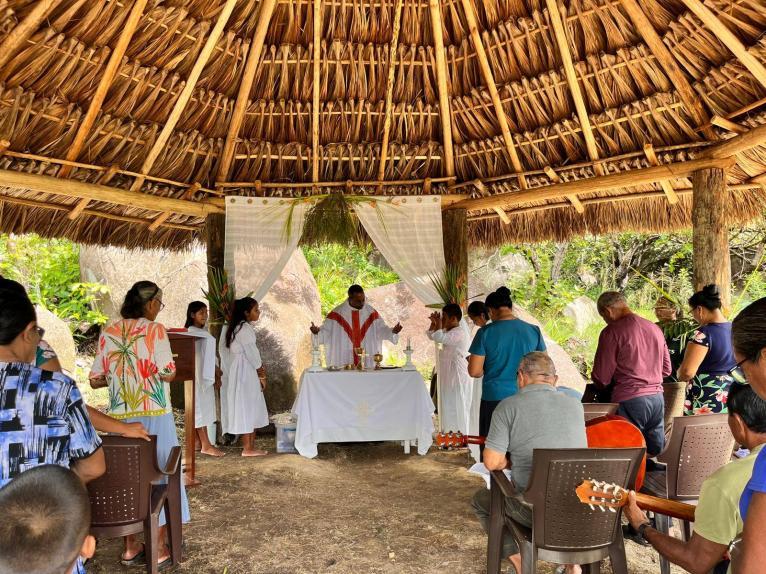
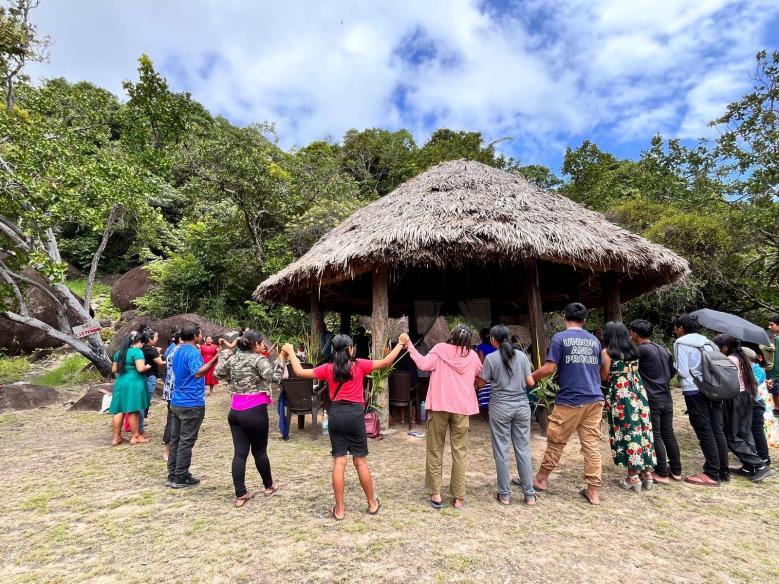
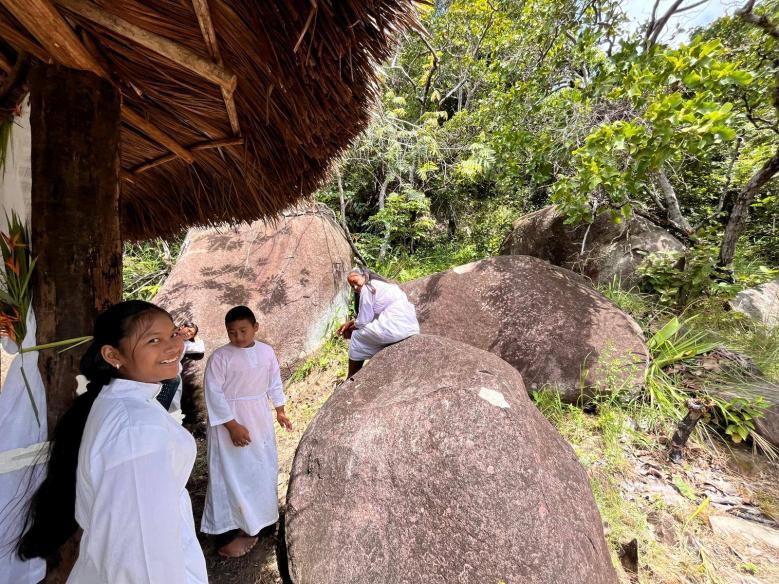
Last Sunday, May 31st, St Robert Bellarmine Church, Aishalton, Deep South Rupununi, Region 9, Essequibo, Guyana, celebrated Holy Mass outdoors at the Maoka Taawa Benab as part of our Laudato Si' week activities. It was wonderful to praise God with and in creation as we reflected on our call to care for our common home.
Caring for the Earth is not just an environmental issue it is a spiritual one as well. By coming together in prayer, learning, and community, we live out our faith in action.❖
(Adapted from Robert Bellarmine R.C ChurchAishaltonFacebookpage).
Church unity, mission must be at heart
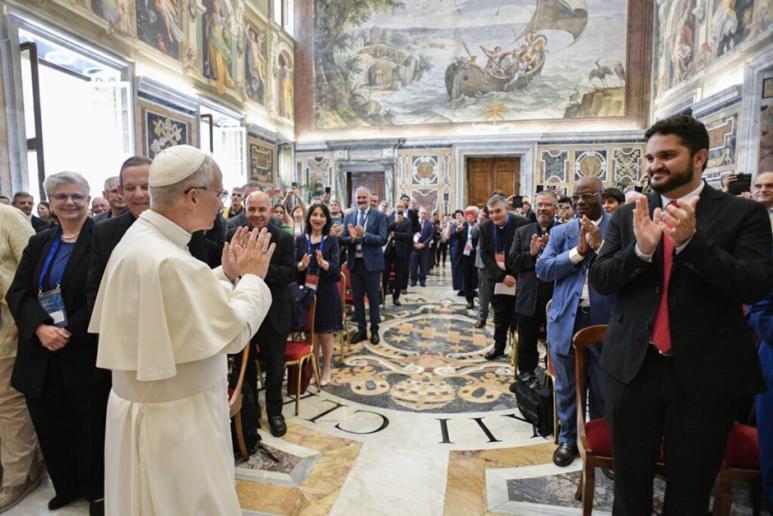
Pope Leo XIV waves as he arrives for a meeting with leaders of 115 international Catholic associations, ecclesial movements and new communities in the Vatican’s Clementine Hall June 6, 2025. (CNS photo/Vatican Media)
VATICAN CITY (CNS) With their specific forms of prayer, outreach or emphasis both the long-established groups of Catholic laypeople as well as the newer movements and communities are called to contribute to the unity and mission of the church, Pope Leo XIV said.
“Unity and mission are two essential aspects of the church’s life and two priorities of the Petrine ministry,” the pope said. “For this reason, I ask all
ecclesial associations and movements to cooperate faithfully and generously with the pope, above all in these two areas.”
Unity amid diverse charisms
The pope met June 6 with about 250 leaders of 115 international associations of the faithful, ecclesial movements and new communities recognized and supported by the Dicastery for Laity, the Family and Life. The groups included, for example, the
Legion of Mary, the Neocatechumenal Way, Communion and Liberation, a variety of charismatic communities and various Catholic scouting groups.
“Some were founded to carry out a common apostolic, charitable or liturgical project, or to support Christian witness in specific social settings,” Pope Leo noted. “Others, however, originated with a charismatic inspiration, an initial charism that gave rise to a movement, a new form of spirituality and of evangelization.”
All the groups, though, aim to help their members live the Christian life more deeply in service to God, to the church and to their brothers and sisters, he said.
“The desire to work together for a common purpose reflects an essential reality: no one is Christian alone,” the pope told the leaders. “We are part of a people, a body established by the Lord.”
“The Christian life is not lived in isolation, as a kind of intellectual or sentimental experience, confined to the mind and the heart,” he said. “It is lived with others, in a group and in community, because the risen Christ is present wherever disciples gather in his name.”
But within the church, the pope said, those groups cannot live in isolation either.
“Seek to spread everywhere this unity that you yourselves experience in your
groups and communities, always in communion with the church’s pastors and in solidarity with other ecclesial realities,” Pope Leo said.
“Draw close to all those whom you meet, so that your charisms may ever be at the service of the unity of the church, and be ‘a leaven of unity, communion and fraternity’ in our world, so torn by discord and violence,” he said, quoting from his homily May 18 at the Mass inaugurating his papacy.
A missionary church
The outward focus of the groups is also essential, he said, since the church is called to be missionary, sharing the love of God with the world.
“The church’s mission has been an important part of my own pastoral experience and has shaped my spiritual life,” said the pope, who spent decades as a missionary priest and bishop in Peru.
“You too have experienced this spiritual journey,” he said. “Your encounter with the Lord and the new life that filled your hearts gave rise to your desire to make him known to others.”
“Place your talents at the service of the church’s mission, whether in places of first evangelization or in your parishes and local ecclesial communities, in order to reach those who, albeit distant, are often waiting, without being aware of it, to hear God’s word of life,” Pope Leo told the groups.❖
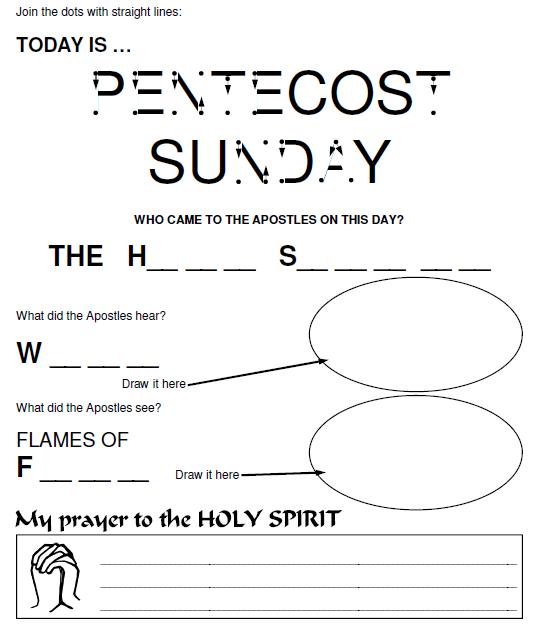
Dear Girls and Boys,
Today is the day that we celebrate the birthday of the Church. The day that the Church really got its start. We call it the day of Pentecost and it is when we remember the day when God sent the Holy Spirit to his people just as Jesus had promised that he would.
On the day of Pentecost tongues of fire came and rested upon the people in that place and they were filled with the Holy Spirit. They began to speak in other languages as the Spirit gave them ability. Just as on the day of Pentecost, we need the Holy Spirit to come and light our fire and give us the power to do things which will bring glory to God.
On the day of Pentecost, the Holy Spirit gave the early church the gifts of forgiveness, truth, and a new life. The Holy Spirit offers those same gifts today. The Spirit leads us to truth, forgives us, and gives us a better way to live.
Dear Father, we thank you for sending the Holy Spirit. Help us to remember that the Holy Spirit still fills the church with power today, just as he did on the day of Pentecost.InJesus'namewepray. Amen. ❖
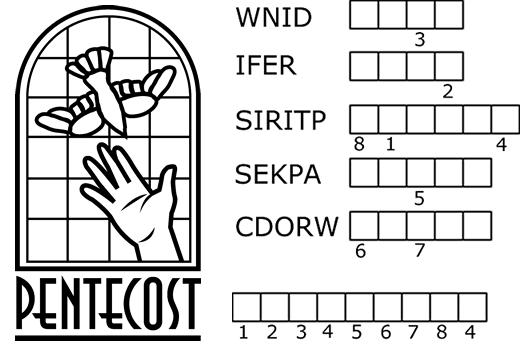
Unscramble each word and then place the numbered letters in the numbered boxes at the bottom to reveal the answer.
PUZZLE CLUES
1. A sound like the blowing of a violent _______ came from heaven.
2. They saw what seemed to be tongues of ______.
3. All of them were filled with the Holy _______.
4. They began to ______ in other tongues as the Spirit enabled them.
5. Peter stood up and spoke to the ______ of people.
Answer: All of these events took place on the day of _____________.
Check your answers in Acts 2:1-14 (NIV)
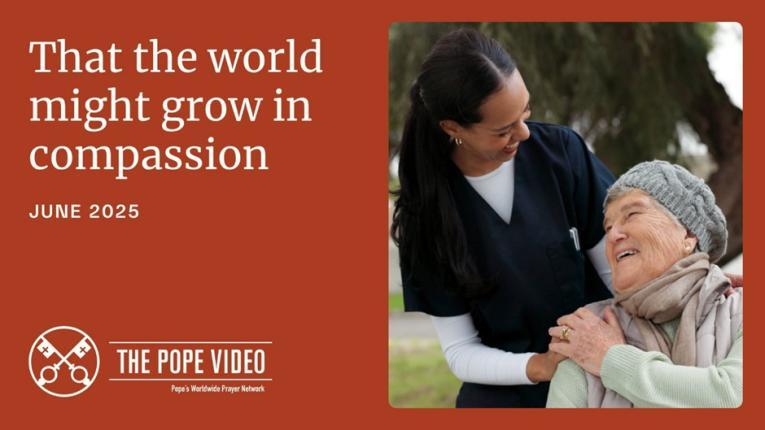
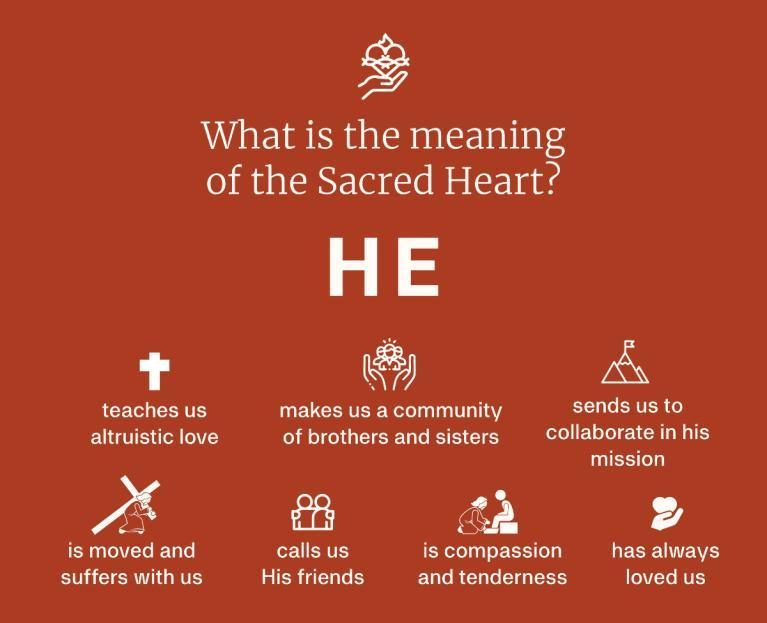
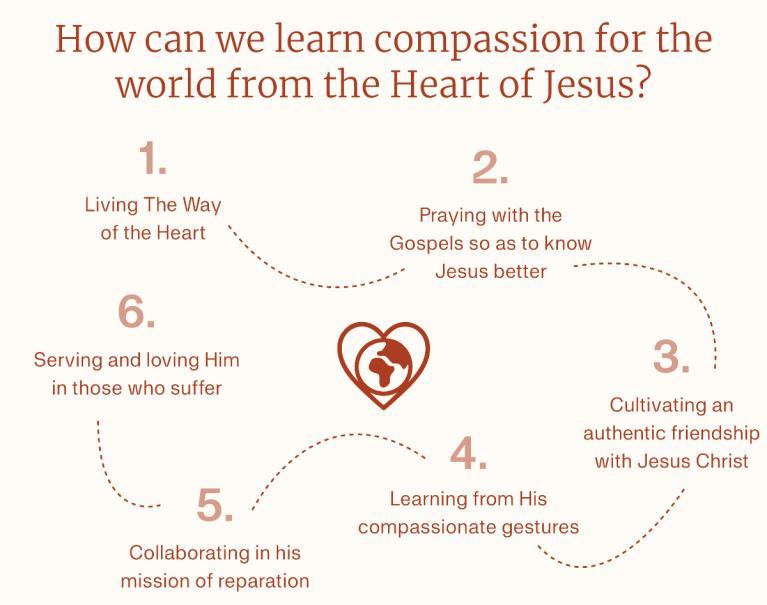
That the world grow in compassion
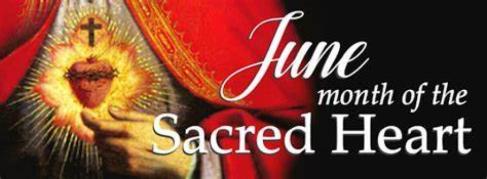
VATICAN CITY (CNS) Pope Leo XIV’s prayer intention for June, a month devoted to the Sacred Heart of Jesus, is “that the world might grow in compassion.”
“Let us pray that each one of us might find consolation in a personal relationship with Jesus, and from his heart, learn to have compassion on the world,” the pope prays in English in his first contribution to “The Pope Video,” a monthly reflection published by the Pope’s Worldwide PrayerNetwork.
The video, released June 3, also includes an original prayer people can recite daily during the month.
“You showed us the Father’s love by loving us without measure with Your divine and human Heart,” the prayer said.
“Grant all Your children the grace of encountering You. Change, shape and transform our plans, so that we seek only You in every circumstance: in prayer, in work, in encounters and in our daily routine,” the prayer continued. “From this encounter, send us out on mission, a mission of compassion for the world in which You are the source from which all consolation flows.”
The Pope’s Worldwide Prayer Network, formerly known as the Apostleship of Prayer, is a global movement of people who make a commitment each day to pray for thepope’s intentions.
Jesuit Father Cristóbal Fones, director of the prayer network, said Pope Leo’s intention “focuses on growing in compassion for the world through a personal relationship with Jesus.”
“By cultivating this truly close relationship, our hearts are more conformed to His. We grow in love and mercy, and we better learn what compassion is,” Father Fones said. “Jesus manifested an unconditional love for everyone, especially for the poor, the sick and those who were suffering. The pope encourages us to imitate this compassionate love by extending a hand to thosein need.”
In a statement accompanying the video, Father Fones also pointed out that during the Holy Year 2025, “The Pope Video acquires special relevance since through it we know the prayer intentions the pope holds in his heart. To properly receive the graces of the Jubilee indulgence, it is necessary to pray for thepope’s intentions.”
The prayer network also noted how four popes have devoted encyclicals to Catholics’ devotion to the Sacred Heart of Jesus.
“Pope Leo XIII, whose name the current pope took, wrote ‘Annum Sacrum‘ in 1899, in which he consecrated all of humanity to the Heart of Jesus. In 1928, Pope Pius XI, in ‘Miserentissimus Redemptor,’ invited us to make reparation through acts of love for the wounds our sins inflict on the Heart of
Christ,” thenetwork said.
“For his part, Pope Pius XII published ‘Haurietis Aquas‘ in 1956, in which he explores the theological basis for devotion to the Sacred Heart,” it said.
And “lastly, Pope Francis wrote ‘Dilexit Nos‘ in 2024, and proposed devotion to the Heart of Christ as a response to the throwaway culture and the culture of indifference.”❖
CELAM celebrates 70 (From P1)
To commemorate this occasion, Pope Leo XIV sent a telegram to Cardinal Jaime Spengler, Archbishop of Porto Alegre and president of CELAM, warmly greeting the Council and emphasizing the continuing importance of ecclesial communion.
The Pope’s message summarized the role CELAM has played in the life of the Church on the American continents: an expression of episcopal collegiality, an instrument of pastoral coordination, and a driving force for evangelization in diverse and often painful contexts.
“I join you all in giving thanks to the Lord,” the Holy Father stated, “for this joyful anniversary, which reminds us how the Latin American and Caribbean Episcopal Council is a sign of collegiality […] at the service of the holy and faithful People of God who journey on that beloved continent.”
A direct message
The message does not shy away from the painful reality facing Latin America where “a great number of men and women are suffering tribulation and poverty caused by ongoing crises at both the continental and global levels.”
In the face of these challenges, the Pope encouraged the bishops not to lose sight of the centrality of the Risen Christ, who “protects and guides the
Church, rekindling hope within her.”
His call is clear: go out and meet those who dwell in the peripheries, wounded by injustice, and proclaim to them the Gospel with “the joy that springs from a personal encounter with Him.”
Both witness and participant Since its foundation seven decades ago, CELAM has been both witness to and participant in crucial ecclesial conferences: Medellín in 1968, Puebla in 1979, Santo Domingo in 1992, and Aparecida in 2007. Each of these was an expression of communal discernment in light of the signs of the times. Today, in the era of synodality, this path takes on new dimensions and new challenges.
From Bogotá, Colombia where CELAM is headquartered the assembly not only looked back on its past, but projected itself forward with a missionary spirit. As Pope Leo noted, the aim is to “seek, in true and effective communion, pastoral initiatives that offer solutions grounded in the criteria of Sacred Scripture, Tradition, and the Magisterium.”
At the close of his telegram, the Pope entrusted the bishops to the intercession of Our Lady of Guadalupe, mother of the peoples of the Americas. He asked them to pray for him and imparted his apostolic blessing as a “pledge of abundant heavenly gifts.”❖
call to Christian unity, speakers say
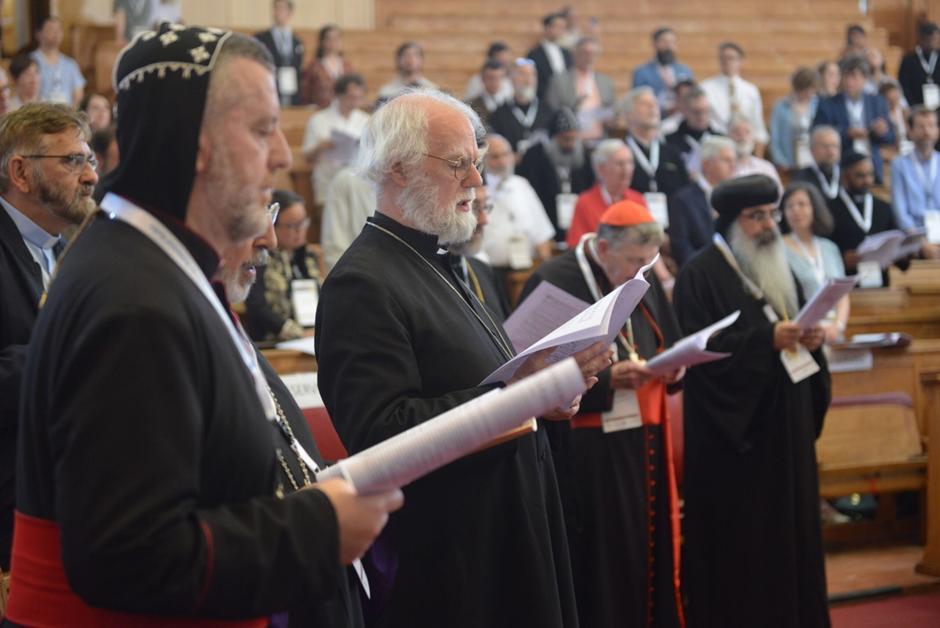
Church leaders pray at the beginning of an ecumenical conference about the 1,700th anniversary of the Council of Nicaea June 4, 2025, at Pontifical University of St. Thomas Aquinas in Rome. (CNS photo/courtesy Pontifical University of St. Thomas Aquinas)
ROME (CNS) The Council of Nicaea 1,700 years ago recognized that Christian unity had to be based on a common faith and should be demonstrated by a common celebration of Easter, the most sacred feast of the Christian year, said speakers at a Rome conference.
Yet as Christians mark the anniversary of the council, held in 325, they celebrate their common profession of the basics of faith in the Creed adopted at Nicaea while also continuing to experience division, said Paul L. Gavrilyuk, president of the International Orthodox Theological Association.
The association and the Institute for Ecumenical Studies of Rome’s Pontifical University of St. Thomas Aquinas organized the June 4-7 conference with the support of the Vatican Dicastery for Promoting Christian Unity
Gavrilyuk, who holds the Aquinas Chair in Theology and Philosophy at the University of St. Thomas in St. Paul, Minnesota, and the other speakers noted the coincidence of the anniversary year and the election of Pope Leo XIV whose episcopal motto is “In Illo uno unum,” an expression of St. Augustine meaning “In the One (Christ), we are one.”
“Nicaea was a landmark exercise in collective truth seeking and discernment with an enduring and universally
significant dogmatic outcome enshrined in its famous creed,” Gavrilyuk said.
The fact that Christians today continue to use the Nicene-Constantinopolitan Creed, not just liturgically but as a statement of orthodox Christian belief, means it is a continuing source of Christian unity, speakers said.
“The restoration of the unity of the church requires agreement on the essential content of the Christian faith, not only among the churches and ecclesial communities of today, but also in continuity with the church of tradition, and above all, with its apostolic origins,” said Cardinal Kurt Koch, prefect of the Dicastery for Promoting Christian Unity.
The Creed is “the strongest ecumenical bond of the Christian faith,” the cardinal said. “The Council of Nicaea took place at a time when Christianity had not yet been divided by so many subsequent schisms; its creed is therefore shared by all Christian churches and ecclesial communities, uniting them in a common confession in this day. Its ecumenical importance cannot be underestimated.”
Orthodox Metropolitan Job of Pisidia, a theologian and Orthodox co-chair of the Catholic-Orthodox theological dialogue, said the Council of Nicaea could serve as a model of Christian unity today because it determined the essential points of Christian faith while
celebrating Jesus’ resurrection on different dates. A common celebration of Easter held until Pope Gregory XIII reformed the calendar in 1582.
Cardinal Koch reminded his audience that since the 1960s, the Catholic Church has repeatedly said it would accept an ecumenical proposal for returning to a common date for Easter “on the condition that all Christian churches reach an agreement.”
“The endeavor to find a common date for Easter is an important pastoral concern, particularly for families of different denominations, and in light of the increasing mobility of people today,” the cardinal said. “Above all, a shared celebration of Easter would bear more credible witness to the profound conviction of the Christian faith that Easter is not only the oldest but also the central and most important feast of Christianity.”
At Nicaea, Metropolitan Job said, the bishops determined that the church would celebrate Easter on the first Sunday after the full moon after the spring equinox a formula based on “observable astronomical phenomena” and not on any specific calendar.
allowing differences on other matters.
“The Nicene Creed does not represent a confession of faith at a particular moment in the history of the church but rather manifests the confession of faith that transcends the limits of time and space,” he said. It was introduced into the liturgy at the turn of the sixth century, “which shows how much this text became a universal confession of the faith confessed by the one church, received from Christ through the apostles and handed down by the holy fathers.”
Cardinal Koch said the celebration of the Nicaea anniversary also is an occasion to make a renewed commitment to synodality shared listening, reflection and discernment and for members of different churches to learn from the synodal structures of each other’s churches.
“The creed of the Council of Nicaea is not merely the result of theological reflection, but the expression of a joint, more precisely, synodal struggle of bishops for an orthodox and doxologically appropriate formulation of the Christian faith,” Cardinal Koch said. At the time of Nicaea, there were about 1,800 Christian bishops, and most experts believe about 318 of them participated in the council.
The Council of Nicaea also is known for setting the formula for determining the date of Easter at a time when Christian communities were
“All Christians today, without exception, determine the date of Easter according to the Nicene rule,” he said, but with Western Christians using the more accurate Gregorian calendar and Eastern Christians using the Julian calendar, the celebrations only occasionally coincide.
A decision on a proposal for the Orthodox churches “to use the most accurate scientific data to determine the date of Easter, using as a reference the meridian of Jerusalem, place of death and resurrection of Christ,” has been postponed multiple times, he said.
Anglican Archbishop Rowan Williams, the former archbishop of Canterbury, looked specifically at how celebrating the Nicaean anniversary is a call to deeper faith and to greater unity.
To profess the Creed is to profess belief in the Trinity, a community of life that gives life to the church, the body of Christ, the archbishop said.
“The unity of the church is neither a goal toward which human negotiators struggle, nor a timelessly given identity untouched by history,” he said. Rather, “it is a constantly realized and constantly frustrated or denied movement between subjects, bringing one another alive in the one life of the eternal Son.”
“The faith articulated at Nicaea and later in Constantinople cannot, I would say, be understood just as a set of claims about the life of God in abstraction from the call of God into the life of the new creation,” he said. ❖
CELAM at 70: A Church of the
The following is from the Conversations with Archbishop J column by Archbishop Charles Jason Gordon in The Catholic News of Trinidad & Tobago of June 8-14. Archbishop Gordon, the President of the Antilles Episcopal Conference (AEC), represented the AEC at the 40th Ordinary General Assembly of CELAM, which marked 70 years of its establishment:
CELAM at 70: A Church of the continent listening together
Q: Archbishop J, what is CELAM?Whyisitimportant?
From May 25 to 30, the Latin American and Caribbean Episcopal Council (CELAM) celebrated its 70th anniversary in Rio de Janeiro, Brazil. Bishops from across the continent cardinals, archbishops and general secretaries of Episcopal Conferencesgathered at the site where it all began: Colegio Sagrado Coracao de Maria in Copacabana. It was a deeply moving and joyful celebration, one of prayer, memory, discernment, and listening. But why is CELAM important? And what does it mean for us in the Caribbean? To understand CELAM, we must grasp how the Church is structured; how it breathes in circles of communion, from the family to the global Church. These levels of belonging are not mere bureaucratic divisions; they are sacred spaces where the Spirit is at work, forming and reforming the Body ofChrist. The Church in circles
The Church exists in concentric circles of community and communion. The first and most basic is the domestic Church-the family, where faith is born and nurtured.
Beyond the family lies the parish, with its ministries and movements; and beyond the parish, clusters where neighbouring parishes collaborate pastorally. Several clusters form a vicariate, each overseen by a vicar who acts with delegated authority from the bishop.
A group of vicariates forms a diocese, and several dioceses make up an ecclesiastical province, with a leading diocese known as the metropolitan archdiocese.
The Archdiocese of Port of Spain is the metropolitan See for Georgetown, Paramaribo, Willemstad, and Bridgetown. Together, they form the Province of Port of Spain.
At the next level, several provinces form an episcopal conference. Ours is the Antilles Episcopal Conference (AEC) -comprising five provinces (Port of Spain, Castries, Fort-de-France, Kingston, and Nassau), 19 territories, two missions, and 18 bishops ministering across the English, French, and Dutch Caribbean.
And then comes CELAM-the great home of all the Episcopal Conferences of Latin America and the Caribbean. It includes Haiti, the Dominican Republic,
Puerto Rico, Cuba, and every country from Mexico to Argentina. Together, we form the ecclesial heart of the American continent.
These circles of belonging matter. They shape how the Church listens, responds, and grows. They reflect the mystery of the Church as communion manyparts, one body.
From local to universal: A Vatican II vision
Before Vatican II, the local Church was often seen as a part of the whole, secondary to the universal Church. But the Council introduced a profound theological shift.
As Fr Joseph Komonchak explains, the local Church is not simply a branch or subdivision. It is a full realisation of the one, holy,Catholic Church:
The one and universal Church is manifest in and through the variety of local churches; rather than as 'part' of some pre-existing 'whole' they are local realisations of all that the one Church is, and it is in them and out of them that the one and holy Catholic Church comes to exist. (Komonchak, 1987)
CELAM is one of the clearest continental expressions of this renewed vision of theChurch.
A pilgrimage of memory and mission
Returning to the site of CELAM's first gathering in 1955 was an act of gratitude and hope. That original meeting took place before the Second Vatican Council, before the independence of many of our nations, and long before air travel was routine. Yet those bishops came together to speak about the region, to dream, and to discern a path forward. It was the beginning of a new way of being Church on the continent.
At this year's celebration, each Episcopal Conference shared the key realities shaping their nations. It was sobering and unifying. While each country has its own context, many common themes emerged-what Pope Francis might call the "cries of the
migration, and the deterioration of education, housing, and judicial systems are pressing concerns.
The gathering lamented the growing inequality, erosion of human rights, and the fragility of democratic institutions. Yet amid the sorrow, a strong commitment emerged: the Church must remain present in the heart of these struggles, offering hope and calling people to pastoral conversion, as builders of justice, dialogue, and social peace. I sensed this deeply over lunch with two bishops from Haiti. Their narrative is one of lament and hope, inviting us to solidarity.
Synodality: a grace for our time
The most hopeful refrain of the week was synodality-the grace of walking together. The Church in Latin America and the Caribbean has embraced this asaspiritualandpastoralwayofbeing
Inspired by the Synod on the Amazon, also a CELAM initiative, we are learning to listen more deeply to the cries of the poor and to act in ways that reflect Christ's compassion and nearness.
A strong call for the ongoing formation of priests, religious, and laypeople emerged, especially as Catholic numbers decline in some regions. We must invest in forming missionary disciples who can witness in a changing world.
From Medellin to Aparecida: a living tradition
CELAM has not only responded to the signs of the times; it has helped shape the direction of the universal Church. Four continental assemblies have preceded last week's celebrations:
(1968): Introduced the preferential option for the poor, a (1979): Deepened reflection (1992): Reflected on (2007): Called the Church to missionary discipleship and
Each gathering has marked a significant moment. They have inspired global pastoral practice. Liberation theology, with its gifts and challenges, was born here. A Church rooted in context, dialogue, and discernment was cultivated here.
CELAM and the Papacy: a source church
Pope Francis himself was formed by CELAM. His leadership at Aparecida laid the foundation for the vision that shaped his papacy. As a son of CELAM, he brought the pastoral experience of LatinAmericatotheheartoftheChurch
And CELAM continues to shape leaders. Bishop Robert Francis Prevost, a former CELAM bishop, became the Prefect of the Dicastery for Bishops, and now Pope Leo XIV.
Remarkably, two popes have emerged from CELAM. It has become not only a pastoral body, but a theological and missionarysourcefortheglobalChurch
The Redeemer presides over us
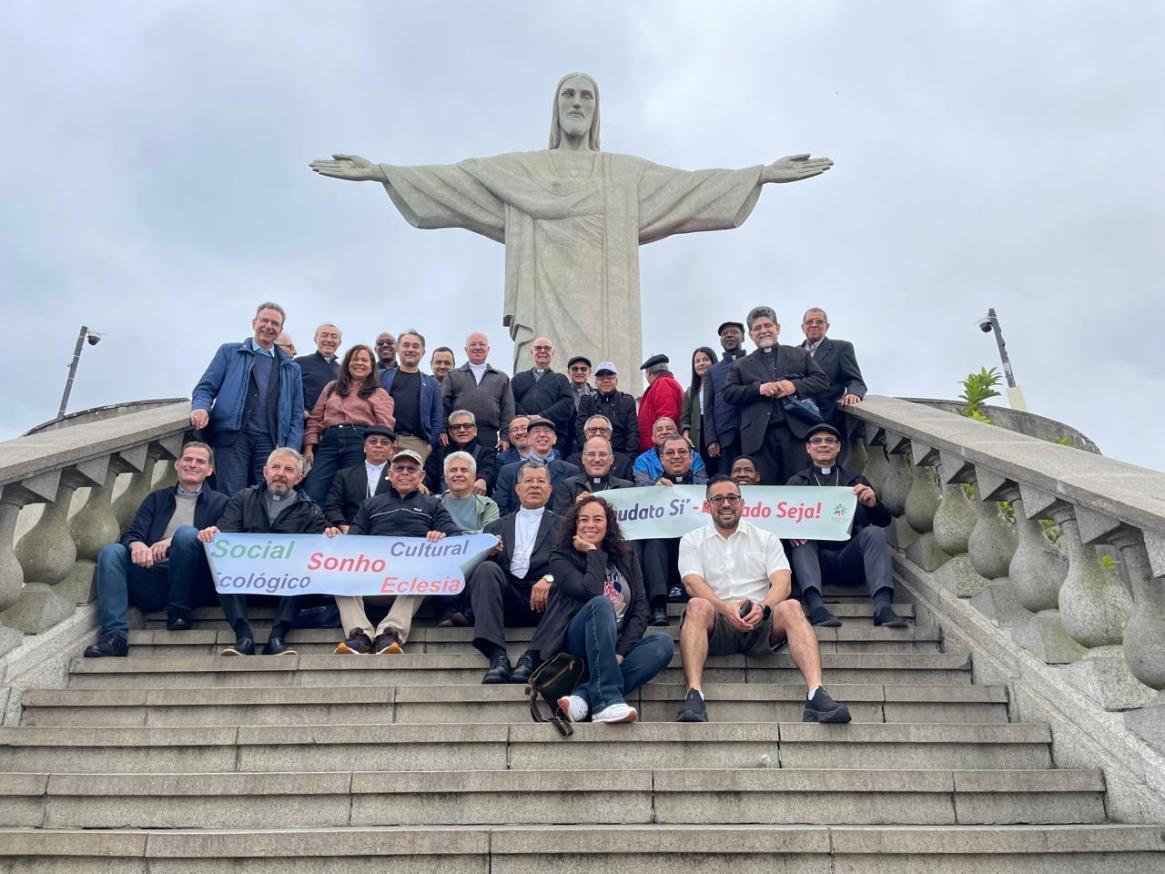
The week ended with a visit to Christ the Redeemer, the great statue that stands over Rio de Janeiro. It was a fitting and powerful close. As we gathered at His feet, we were reminded of the One who leads this Church, not from a distant throne, but from the cross, with arms outstretched over the nations.
Despite the darkness on the missionary path, it is Christ who redeems, renews, and calls us forward. CELAM at 70 is not only a moment to remember, but also a moment to recommit to a Church that listens, discerns, and walks humbly withher people. ❖
of the Week
World Environmental Day Green Walk
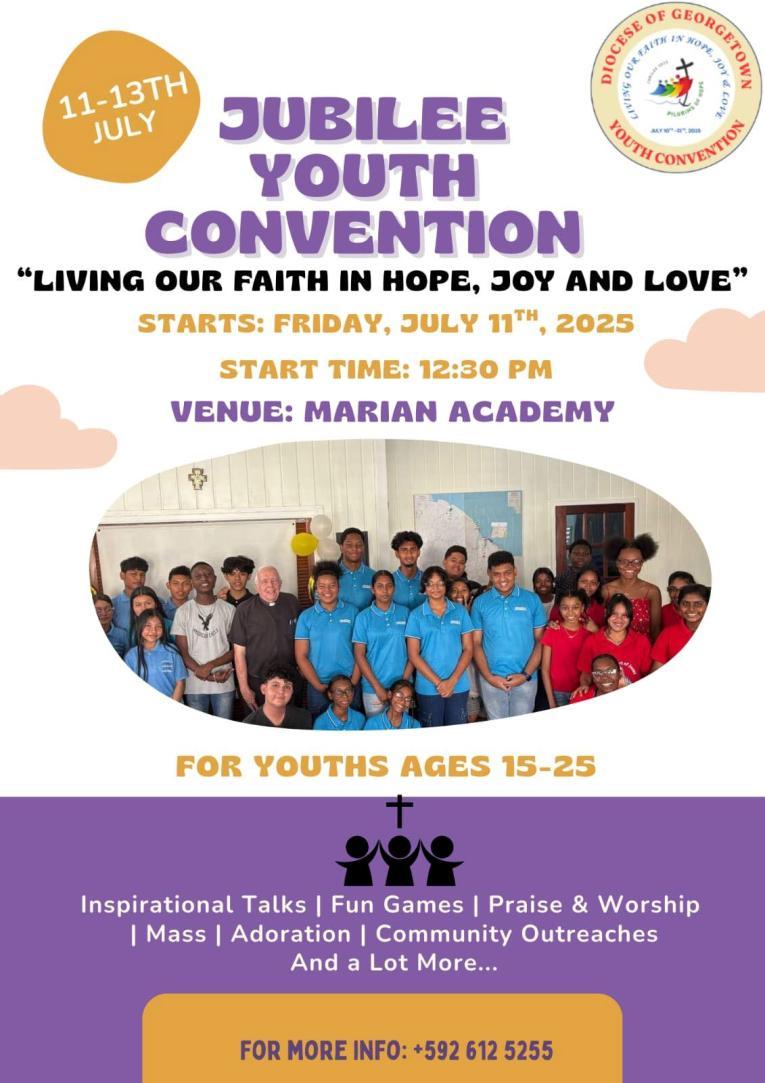
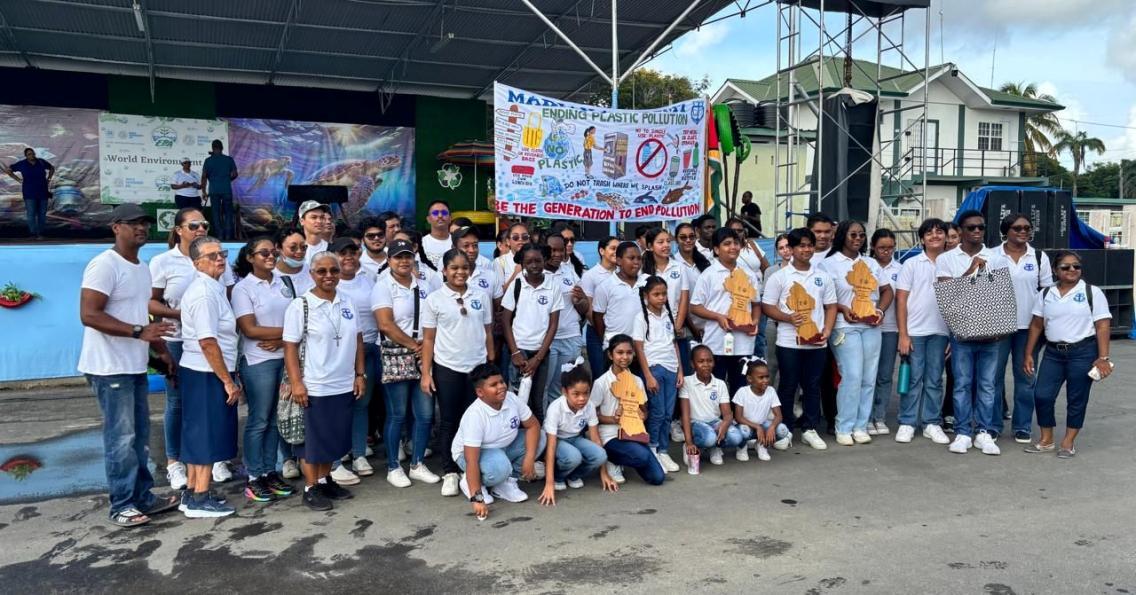
June 5th, under the theme Beat Plastic Pollution. On Sunday June 1st, Marian Academy participated in the World Environment Day Green Walk sponsored by the Environmental Protection Agency (EPA).
Four First Place prizes were awarded to Marian Academy: Best Banner, Best Chant, Most Uniformed,andLargestContingent.
Caring for the environment is a top priority at Marian Academy.
By Francis Canzius
St. Peter’s, BV – 150
Years on June 29, 2025
In September 1872, Bishop James Etheridge SJ and Fr. Aloysius Casati SJ visited the Beterverwagting E.C.D. area to identify land for a church and cemetery. The land for the church was later identified
and on the 29th of June 1875, the church was opened and dedicated to St. Peter. Their largest-ever confirmation took place in 1879 when 120 were confirmed by Bishop Etheridge, the first to be held. Fr. Casati served the BV community from 1875 to 1910, the longest a priest ever served. In 1904 a bell was presented by a parishioner. It is still in use today,
and is housed above the main entrance of the church. In 1920 an apse and side aisle were added. In 1948 the altars of Our Lady and St. Theresa were also erected. The first fundraising Fair was held in 1943.
The 75th anniversary was observed with many activities including the planting of a tree by Bishop George Weld SJ. In a similar way, the centenary in 1975 was celebrated. A crowded afternoon Mass was celebrated by Bishop Benedict Singh with confirmations.
As years passed, the church had deteriorated. In 2008 it was completely repaired and restored thanks to many benefactors and members of the parish community. It was blessed and reopened by Bishop Francis Alleyne OSB on the Feast day of that year.
The community at BV has produced four religious Sisters over the years: Sr. Angela Bacchus O Carm., Sr. Mary Gabriel O Carm., Sr. Cecilia Gonsalves OSU and Sr. Emelda Sherrett RSM.
In the 1980s Mr. Eric St. Lewis, the longest serving Caretaker/ Sacristan/Catechist was awarded the Medal of Merit by Pope John Paul II.❖
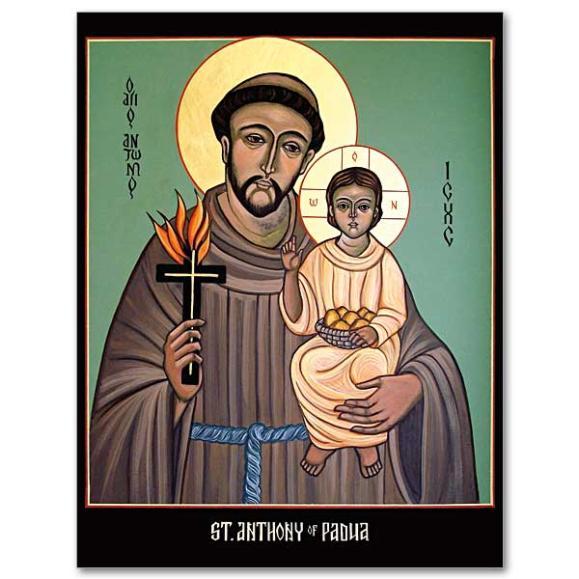
Lisbon, Portugal in 1195. By the age of fifteen he asked to be sent to the Abbey of Santa Cruz in Coimbra, the then capital of Portugal. Following his ordination to the priesthood, he was named guestmaster and was responsible for the abbey's hospitality. When Franciscan friars settled a small hermitage outside Coimbra dedicated to Saint Anthony of Egypt, Fernando felt a longing to join them. Fernando eventually received permission to leave the Abbey so he could join the new Franciscan Order. When he was admitted, he changed his name to Anthony. He went to Italy and was stationed in a small hermitage where he spent most of his time praying, reading the Scriptures and doing menial tasks. At an ordination where no one was prepared to speak, the humble and obedient Anthony hesitantly accepted the task. The years of searching for Jesus in prayer, of reading sacred Scripture and of serving him in poverty, chastity and obedience had prepared Anthony to allow the Spirit to use his talents. Anthony’s sermon was astounding to those who expected an unprepared speech and knew not the Spirit’s power to give people words.
Recognized as a great man of prayer and a great Scripture and theology scholar, Anthony became the first friar to teach theology to the other friars. Soon he was called from that post to preach to the Albigensians in France, using his profound knowledge of Scripture and theology to convert and reassure those who had been misled by their denial of Christ's divinity and of the sacraments.
After he led the friars in northern Italy for three years, he made his headquarters in the city of Padua. He resumed his preaching and began writing sermon notes to help other preachers. He was only 36 years old when he died in 1231 and was canonized less than one year afterward.