
together in hope, says Pope
In his Message for Lent 2025, Pope Francis invites the faithful to “journey together in hope," and to take the opportunity of the upcoming Lenten Season to ask ourselves whether we are truly willing to heed God's call to change our lives. The message, signed Feb. 6, before the pope was hospitalized Feb. 14 for treatment of double pneumonia, was released by the Vatican Feb. 25
(Vatican News) - The central theme of Pope Francis’ Lenten Message is encapsulated in the phrase "Let us journey together in hope," which ties into the broader theme of the Jubilee Year -"Pilgrims of Hope."
The Pope's reflection focuses (please turn to page 10)
Pope Francis presents with ‘sudden worsening of the respiratory picture’ on Friday - p2
‘Ukraine will rise’ as ‘Russia brings death,’ say Ukrainian Greek Catholic bishops - p3
A Christian Perspective on Social Issues - p4
Sunday Scripture - p5
Letters to the Editor - p6
Candlelight Vigil for victims of violence against women and girls to be held March 8th - p7
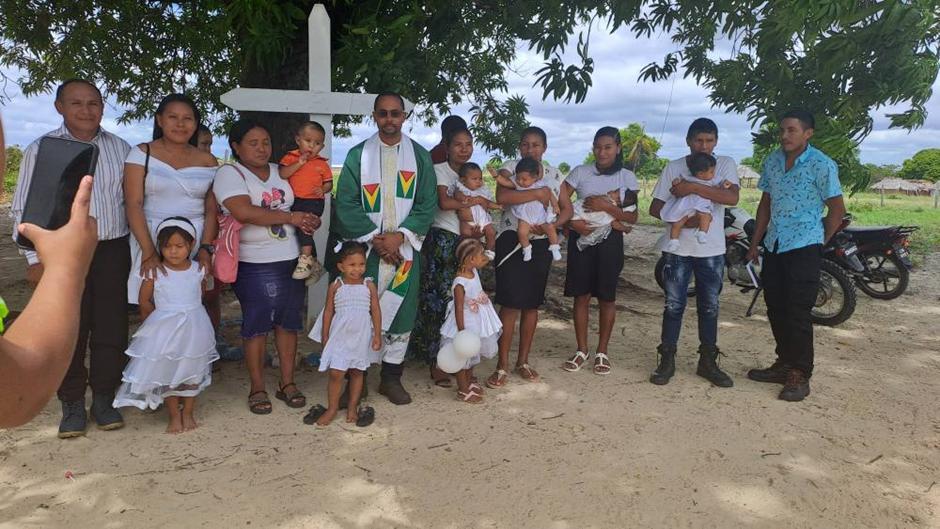
Baptism at Achawib - p7
The challenge of ecumenism in the Caribbean, a journey of unity and commitment - p8
Children’s Page - p9
Church in Jamaica mourns passing of Archbishop Emeritus Edgerton Clarke - p11
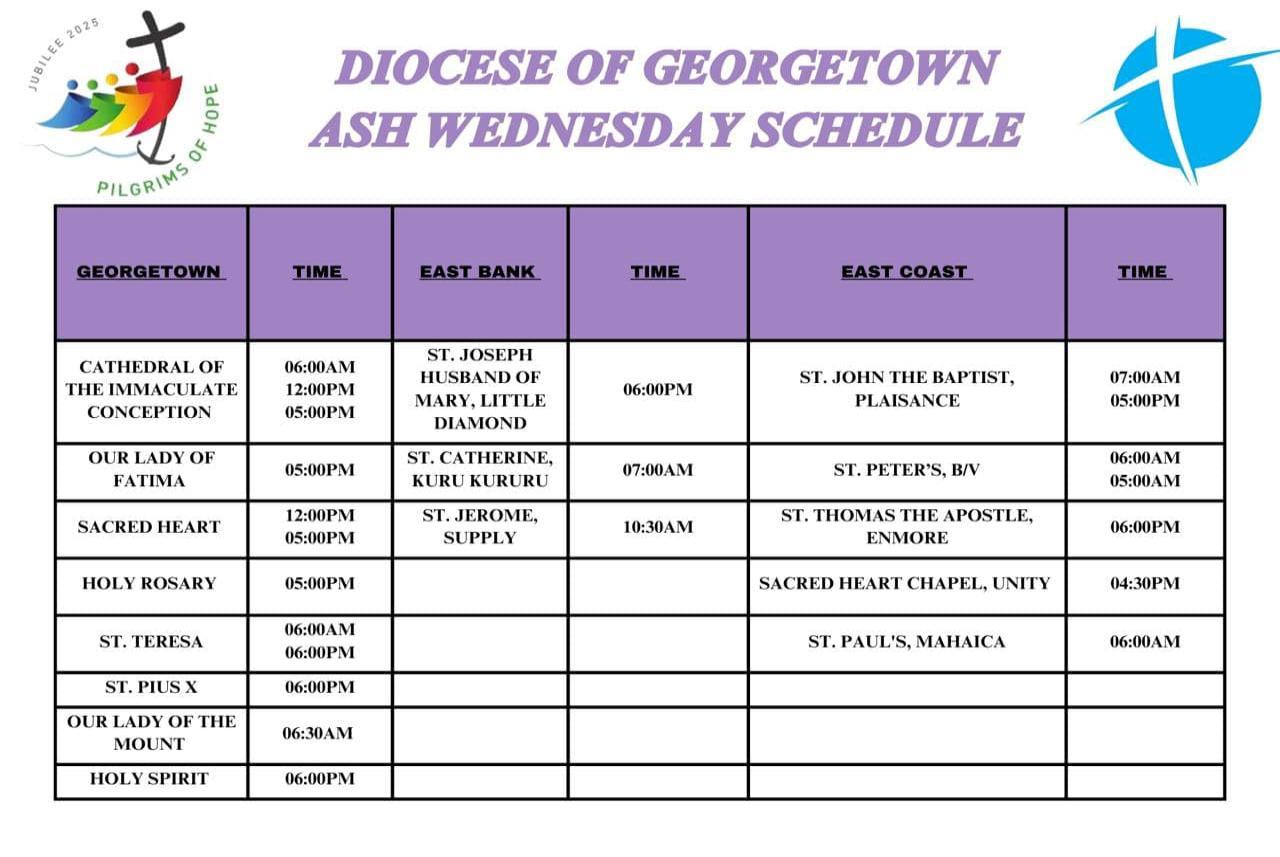
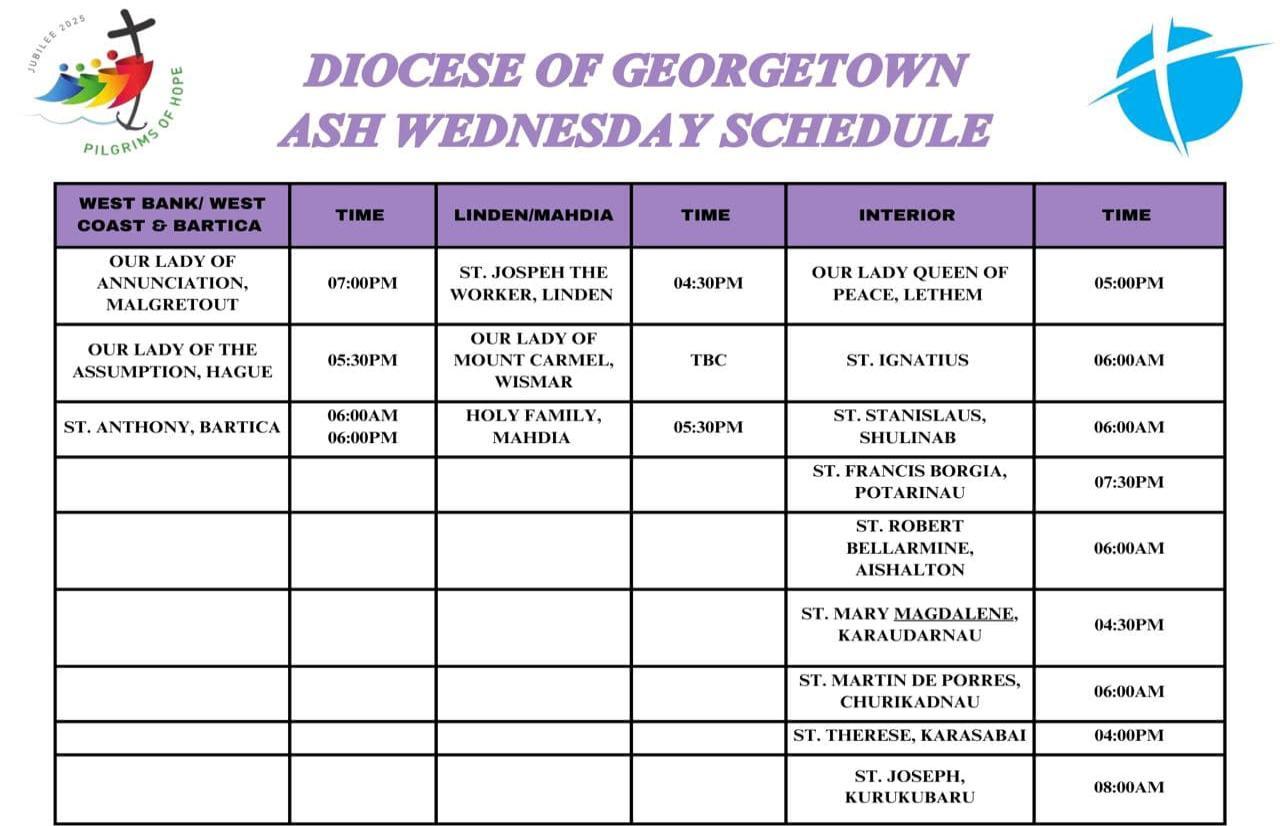
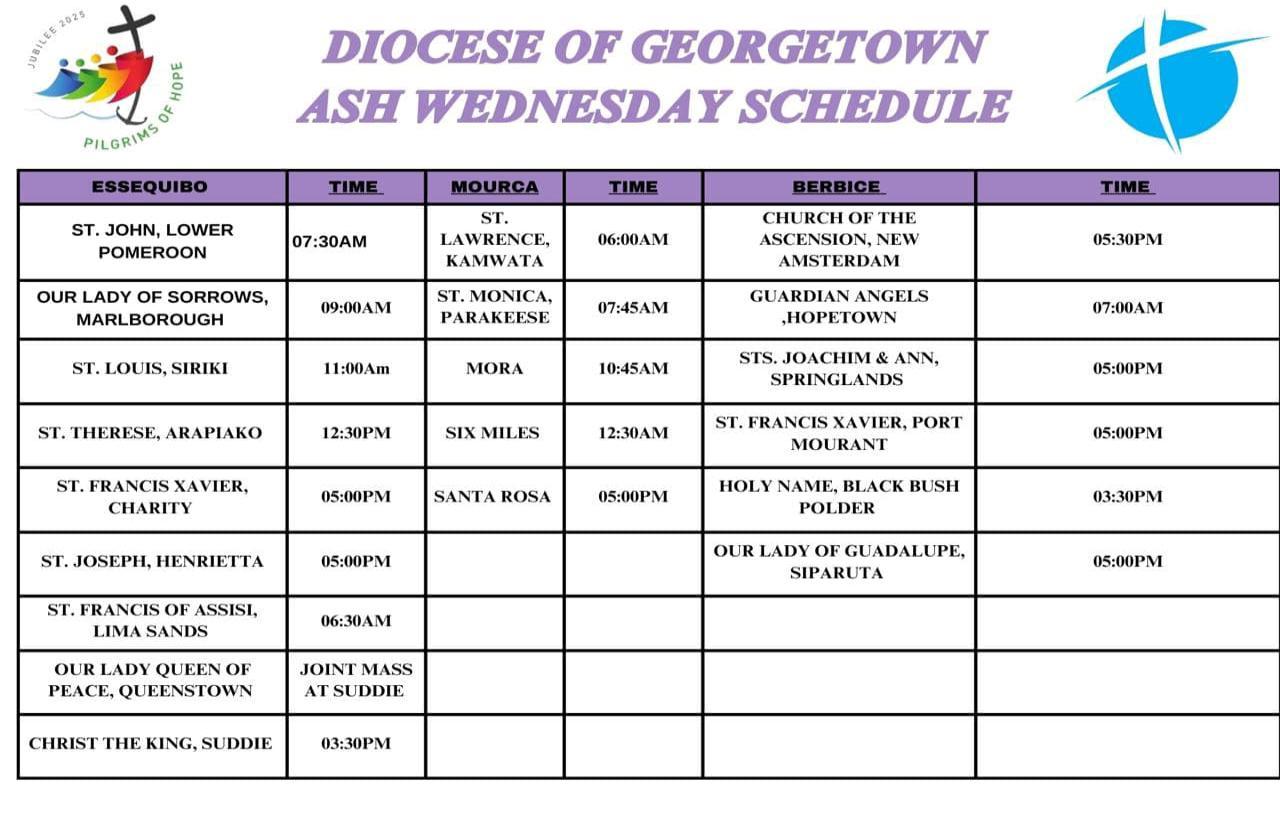
Ash Wednesday Schedule - p12
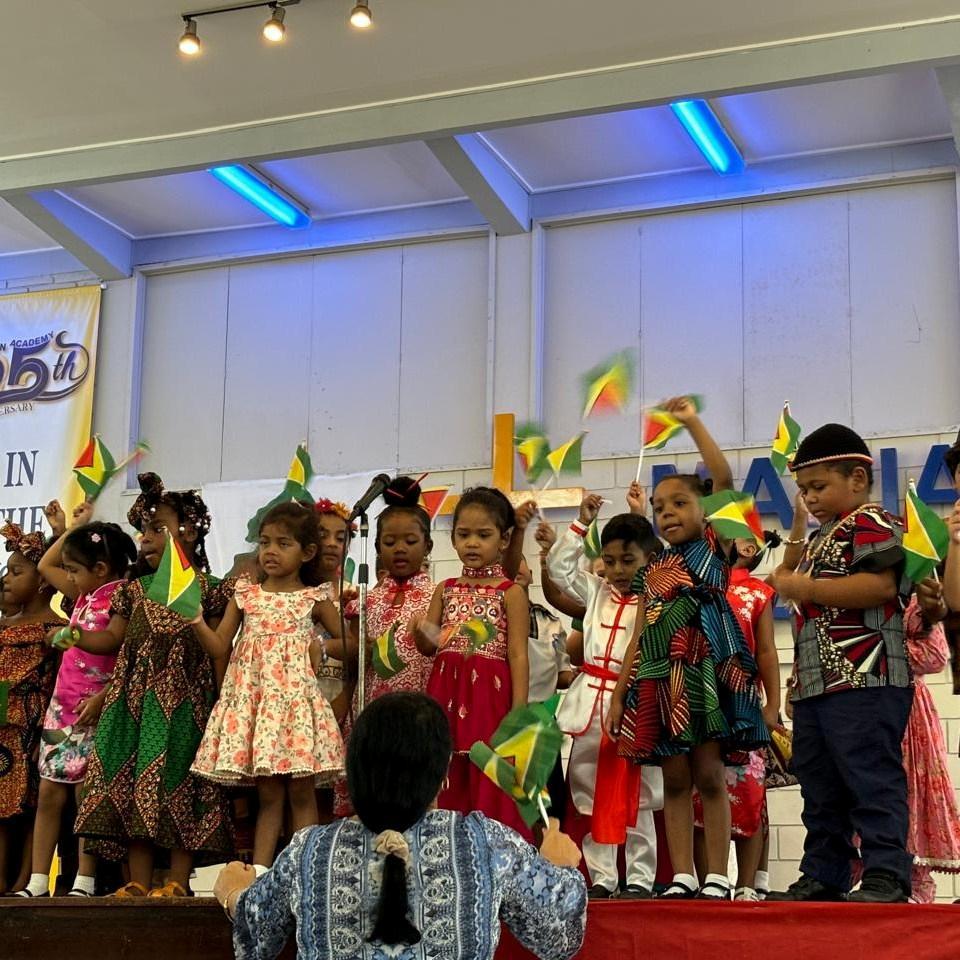
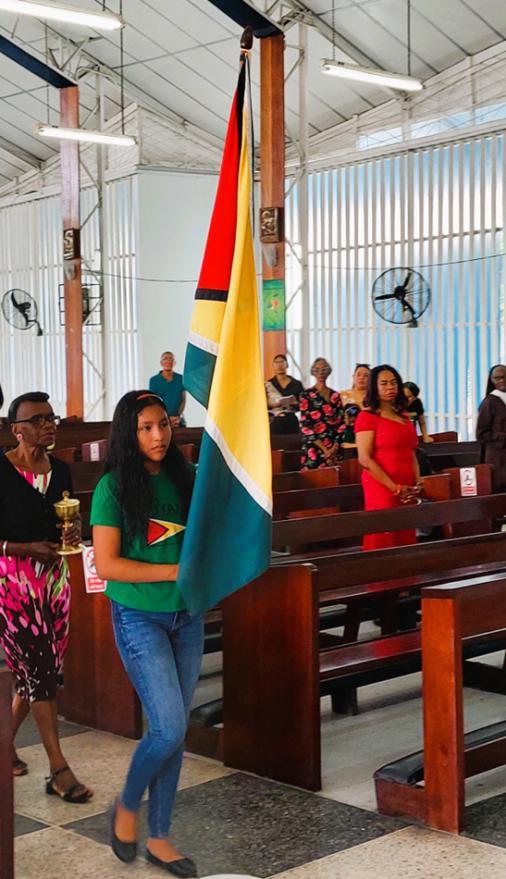
Republic Day celebrations in the Diocese - p13
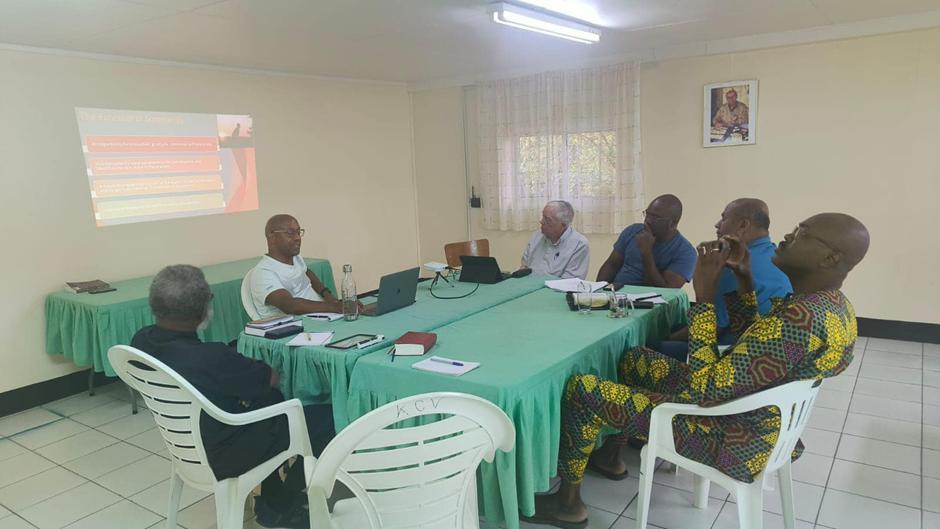
AEC bishops hold monthly meeting - p14
Fr. Ramesh Vanan appointed Sectional Superior for English-speaking Caribbean Jesuits - p14
March 5th

Bishop’s Engagements
Sunday, March 2nd
08:30hrs– Mass at St. Catherine, Kuru,Kururu
15:00hrs–BibleQuizparticipantstrainingsession
ASH WEDNESDAY: Wednesday, March 5th
08:30hrs– Mass atMarianAcademy, Carifesta Avenue
17:00hrs – Mass at the Cathedral of the ImmaculateConception,Brickdam
Saturday, March 8th
18:00hrs – Vigil for violence against Women, Brickdam
FIRST SUNDAY OF LENT: Sunday, March 9th
07:30hrs – Mass at the Cathedral of the ImmaculateConception,Brickdam

Pope presents with ‘sudden worsening
The Jubilee Prayer

Father in heaven, may the faith you have given us in your son, Jesus Christ, our brother, and the flame of charity enkindled in our hearts by the Holy Spirit, reawaken in us the blessed hope for the coming of your Kingdom.
May your grace transform us into tireless cultivators of the seeds of the Gospel.
May those seeds transform from within both humanity and the whole cosmos in the sure expectation of a new heaven and a new earth, when, with the powers of Evil vanquished, your glory will shine eternally.
May the grace of the Jubilee reawaken in us, Pilgrims of Hope, a yearning for the treasures of heaven. May that same grace spread the joy and peace of our Redeemer throughout the earth.
To you our God, eternally blessed, be glory and praise for ever.
Amen



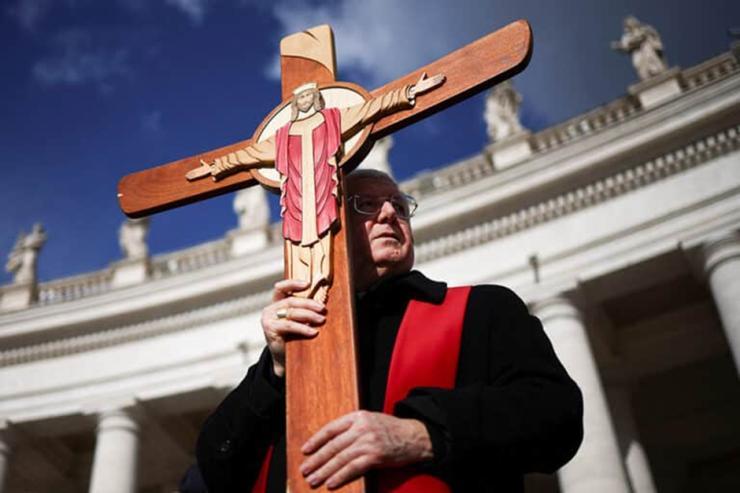
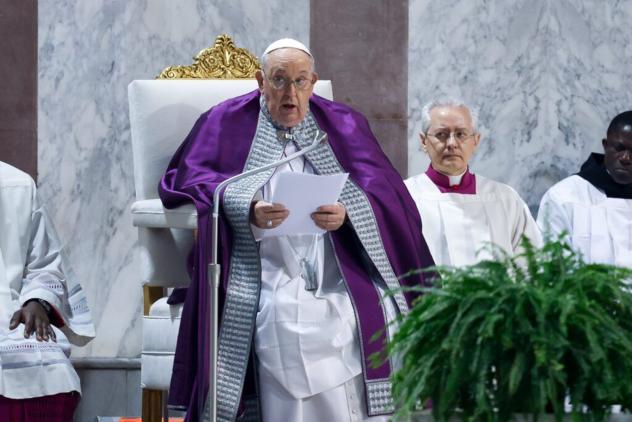
A prelate carries a crucifix during a procession St. Peter's Square at the Vatican Feb. 28, 2025, as Pope Francis continues his hospitalization. The Vatican said Feb. 28 that the 88-year-old pontiff has continued to improve but that he will not lead his traditional Ash Wednesday services in Rome March 5. (OSV News photo/Guglielmo Mangiapane, Reuters)
VATICAN CITY (CNS) After experiencing progressive improvement the past few days, Pope Francis experienced “an isolated crisis of bronchospasm” which led to coughing and “vomiting with inhalation,” which worsened his respiratory condition, the Vatican said.
The pope had spent the morning “alternating respiratory physiotherapy with prayer in the chapel” in his suite of rooms on the 10th floor of Rome’s Gemelli Hospital, according to the Vatican bulletin Feb. 28. He had also received the Eucharist.
However, around 2 p.m. local time, the pope experienced “an isolated crisis of bronchospasm” followed by “an episode of vomiting,” according to the Vatican’s evening medical bulletin.
Medical staff promptly aspirated the pope’s airways to remove any obstruction “and began noninvasive mechanical ventilation, with a good response on gas exchange,” that is, with his blood’s oxygen levels returning to the levels he had before the crisis.
The Vatican said, “The Holy Father remained alert and oriented at all times, cooperating with the therapeutic procedures.”
His prognosis remains guarded, which means, a Vatican source said, that the pope is still not out of danger.
The source said the mechanical ventilation entails pumping a greater amount of oxygen mixed with air delivered through a mask covering the pope’s nose and mouth. It offers a greater flow of oxygen than the “ventimask” that he had been using since Feb. 27 and the nasal cannula, which he had been using previously when he needed it.
Doctors will need another 24 to 48 hours to see if his condition worsens
Wednesday services in Rome March 5.
Instead, the Vatican said, the Ash Wednesday procession from the Rome Church of St. Anselm to the Basilica of Santa Sabina for Mass will be celebrated by Cardinal Angelo De Donatis, the major penitentiary or head of the Apostolic Penitentiary, a church court dealing with matters of conscience.
The Vatican announcement Feb. 28 came after a brief morning bulletin that said the pope had had a peaceful night and was resting.
A source later said the pope got out of bed, had breakfast, was reading newspapers and was continuing to receive his treatment and doing his respiratory physiotherapy. Pope Francis, 88, has been undergoing treatment for double pneumonia in Rome’s Gemelli hospital since Feb. 14.
from having inhaled vomit, the source said. Usually, people who experience this have “worse consequences,” but the pope overcame the crisis.
However, the source said, the pope is in good spirits, vigilant and reacts normally to his surroundings. The source added the pope has received “an incredible amount” of cards, letters, drawings and flowers from children and well-wishers.
The pope had experienced an asthmatic breathing crisis Feb. 22, in which the pope could not breathe, the source said. The crisis Feb. 28 was a coughing fit, which led to vomiting. Inhaling vomit can lead to irritation, infection or inflammation of lung tissue.
While Pope Francis’ condition had continued to improve, the Vatican announced Feb. 28 that he would not lead his traditional Ash
As of Feb. 26, the evening bulletins had no longer been describing the pope’s condition as “critical” as they had each day since Feb. 22 when he had the “asthmatic respiratory crisis.” He began receiving high-flow oxygen through a nasal cannula after that incident and, as of Feb. 27, after the pope’s breathing had improved enough, he was alternating between using the high-flow oxygen and using a “ventimask,” which offers a steady and controlled lower-flow of oxygen.
The Vatican also announced that Cardinal Víctor Manuel Fernández, prefect of the Dicastery for the Doctrine of the Faith and an Argentine like the pope, would lead the rosary in St. Peter’s Square Feb. 28. Cardinals have been leading a nightly rosary to pray for the pope since Feb. 24.
As of Feb. 28, the Vatican had not said what would happen with the midday recitation of the Angelus prayer March 2.❖
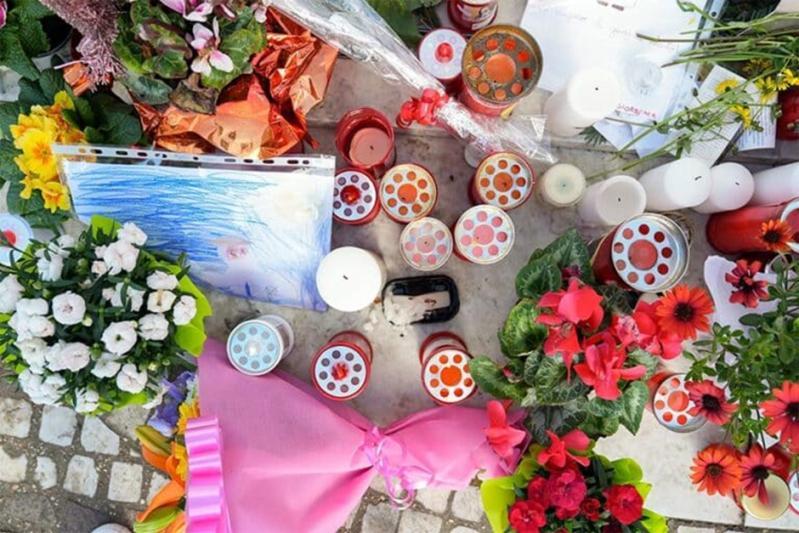
Votive candles and flowers are seen at the base of a statue of St. John Paul II outside Rome's Gemelli hospital Feb. 27, 2025, while Pope Francis is being treated at the hospital for double pneumonia. (CNS photo/Lola Gomez)
‘Ukraine will rise’ as ‘Russia brings death,’
“Even more difficult will be the restoration and healing of lives shattered by war,” they said, pointing to the “grievous wounds” and “unseen pain of trauma” suffered by an untold number of Ukrainians.
Compounding that anguish is Russia’s militaristic reeducation of captured Ukrainian children, who “are being raised to hate their homeland,” said the bishops, referring to Russia’s indoctrination of such children, many of whom are made to assemble Russian weapons and even, as teenagers, fight against Ukrainian soldiers.
With the war “a test of our humanity,” Ukrainians have responded “with selfsacrifice and resolve,” said the bishops, who expressed “deep reverence and gratitude” for Ukraine’s defenders, as well as “heartfelt gratitude to Catholics around the world” and thanks for “the solidarity of people of goodwill.
”
(OSV News) - As Ukraine marks the third anniversary of Russia’s full-scale invasion, the Ukrainian Greek Catholic bishops are affirming Ukrainians’ belief in “the triumph of God’s truth” and the recognition that “true peace cannot exist without justice.”
“Even amidst sorrow and ruin, we remain a people of hope. We believe in the Resurrection, for we know: God is with us with the persecuted, the oppressed, the mourning, and the suffering,” said the permanent synod of the Ukrainian Greek Catholic Church in a Feb. 24 appeal signed by Major Archbishop Sviatoslav Shevchuk, patriarchal head of the UGCC.
The bishops, currently meeting in Canada, reflected in their message on the Feb. 24, 2022, launch of the attack, which continues aggression Russia initiated in 2014 with assaults on Ukraine’s Crimea, Donetsk and Luhansk regions. The war has twice been declared a genocide in two joint reports from the New Lines Institute and the Raoul Wallenberg Center for Human Rights.
Since the 2022 invasion, at least 174,000 to 420,000 people have been killed during Russia’s war, with civilian deaths reported to be severely undercounted, according to research by Sweden’s Uppsala University. Those numbers do not include the 14,20014,400 slain from 2014-2021, as estimated by the United Nations Office of the High Commissioner for Human Rights.
Currently, 3.7 million people are internally displaced in Ukraine, with 6.9 million seeking refuge abroad, “unable to return to lives and livelihoods that no longer exist,” the U.N. stated in January.
At least 19,546 Ukrainian children have been forcibly deported by Russia although that number could be
more than 700,000, according to Russian child commissioner Maria Lvova-Belova, who along with Russian leader Vladimir Putin is the subject of one of six International Criminal Court arrest warrants for war crimes.
Russian forces have also systematically tortured, sexually violated and executed Ukrainian civilians and combatants. Among the atrocity survivors are a rape victim OSV News interviewed in June 2023 in a village near Kyiv and UGCC priests Father Ivan Levitsky and Father Bohdan Geleta, released in June 2024 from 18 months of captivity during which they were “mercilessly tortured,” as Major Archbishop Sviatoslav has previously said.
“The destruction, suffering, and trauma inflicted upon our nation are staggering,” and Ukraine has “become a nation on the Way of the Cross,” said the UGCC bishops in their appeal.
“Even if the war ended today, decades would be required to rebuild what has been damaged or destroyed: 3,500 school and university buildings, over 1,200 hospitals, 670 churches, thousands of kilometers of roads, hundreds of thousands of homes, power stations, and factories,” they said.
Russia has brought “death, devastation, and the eradication of religious freedom,” said the bishops, noting that 67 pastors of various Christian churches have been killed, with “clergy and faithful of various confessions” severely repressed by Russia which has demanded that Christians in occupied Ukraine, including Catholics, yield to the Russian Orthodox Church. While Ukrainians have “learned to navigate the harsh realities of fullscale war” saving lives, rebuilding after attacks and remaining “connected across borders” the scars of Russia’s war run far deeper than the “craters from rockets, mines, and drones,” said the bishops.
Yet as calls for a ceasefire and peace deals accelerate, the bishops warned that “Ukraine is not merely a land it is its people.”
“It is for their dignity and freedom that our best sons and daughters lay down their lives. And they do so not
only for Ukraine but for the dignity and freedom of all people,” they said. “This heroic sacrifice must never be forgotten, diminished, or betrayed.”
As “the voice of the persecuted,” the bishops said that they would ensure “in no peace agreement, in name only, will our faith, dignity, or freedom become a bargaining chip.”
“True peace cannot exist without justice. An unjust truce is a criminal mockery that will only lead to greater injustice and suffering,” they continued.
“Yet we, as Christians, know where this path leads to the Resurrection, to the fullness of life in the freedom and dignity of God’s children,” said the bishops. “We know that one morning, we will receive the long-awaited call:
‘The war is over,’ and we will offer our prayers of thanksgiving before the throne of the Almighty.”
The meeting of the permanent synod of the Ukrainian Greek Catholic Church followed Major Archbishop Shevchuk’s Feb. 15-21 Jubilee Year pastoral visit to the United States, with events in Philadelphia and Washington ❖

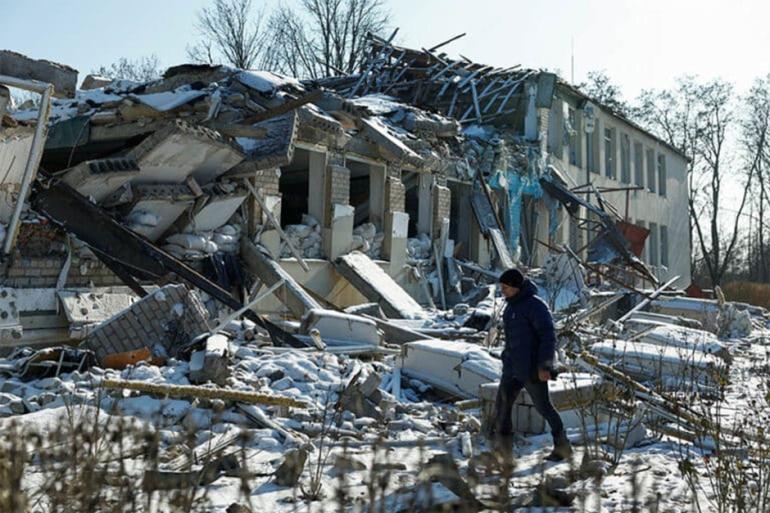
Yurii Bilyk, director of a local lyceum, walks next to the organization's building in Dnipropetrovsk region, Ukraine, Feb. 18, 2025. The structure was destroyed by a recent Russian airstrike. (OSV News photo/Valentyn Ogirenko, Reuters)
A Christian Perspective on Social Issues Lent cometh

By GHK Lall
Ash Wednesday is almost here. May this season of Lent beginning relatively late in early March be an interval of peace for believers. The peace that comes from connecting to the Divine One responsible for the existence of life, our presence on earth. The Lenten Season in a Jubilee Year. A year where hope ismade into a centralpillar of our worship, the call of Jesus to love where is hate. I hope for a better world. My hope is to be a better person: one who hears and believes. One who prays and is inspired by hope. When God promises, he does not disappoint (Spes non confundit). Lent cometh.
Lent is a season of hope. Hope in God’s mercy. Hope that the little works of penance done are blessed with divine favor. Hope that my repentance and the mercies received will inspire in me the joy of extending that mercy to those who have done wrong to me. There must be no wrong that is so terrible, that it is unforgivable. For then, all the prayers and the thanksgiving, utilizing different ways,are nothing but lip service. For if I can’t forgive, then what could be said of the life that I live? What could be said of how much listening there has been to Jesus with his revolutionary commandment: love one another. Love where there is hate. In this 2025 Jubilee Year, the darkness and toughness of a cruel world stun our consciousness. Mercy and forgiveness must be cornerstones of our endeavors. To know and to be about lip service leave believers in a rough place before God.
Boat people in Europe have touched hearts here. They are a source of argument and rejection in rich societies. Here, Guyanese have watched warily as economic migrants increase in numbers. There are Venezuelans and Haitians, with both raising levels of anxiousness. Will Guyana be overrun by them? How do their presence impact law and order, the quality of neighborhoods, and intensify the general anxiety about strangers? Strangers speaking a different language, those who have their own culture. The call to the followers of Jesus is to be hospitable to the alien. “I was a stranger, and you welcomed me….” (MT 25:35-40). Often, the thought occurs that there is
no other passage from scripture that says as well the way that the heart shouldbe for a believer.
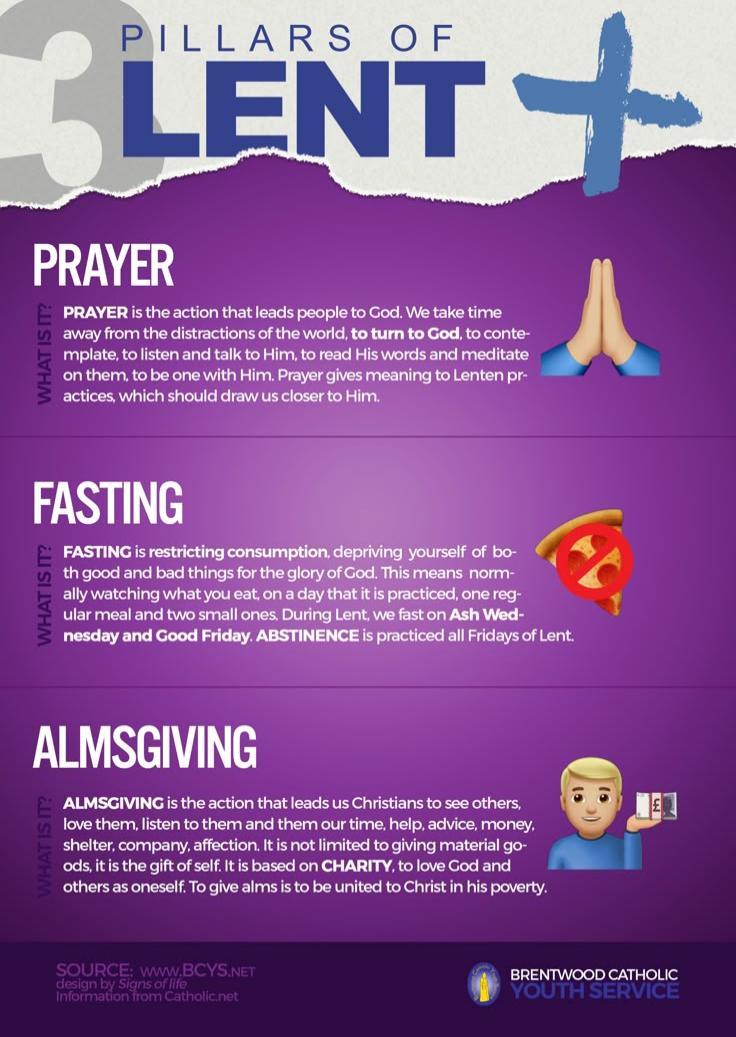
In Lent, one pillar is to extend a hand to those who are in need. Like a positive reception to the stranger, the migrant, reaching for the afflicted and wretched is living the mercy, giving hope, to those who have the most use for both. Giving during Lent (or at any other time) must not be seen as a compulsory duty because scripture says so, or the Church emphasizes it. Giving at anytime is an act of kindness, a work of love. There is no pity in it; there is the merciful grace of God Almighty, as first received by us, which is then extended to those in lesser circumstances. It should be, must be, how Lent is lived, then practiced beyond it. “God has given us two hands: one to receive with, and the other to give with” - Rev Billy Graham.
What the world needs now is love, and a lot of it. Love begets mercy, mercy begets care and kindness. Kindness usually has a ripple effect. Many in Guyana are hurting today, for one reason or another. Some are justifiable; some so inexplicable, as not to make much sense. My little recommendation to fellow citizens and fellow Catholics is that they cast their eyes
[and hopes] away from man, and make Almighty God their priority. It must be remembered: when man disappoints with infidelity, God anoints with hope. He must be our first call, our first stop, our first and primary sanctuary. Towards the closing months of this Jubilee Year, there is promised a certain kind of year in this country. May it not devour us. Let that be one of the prayers raised thisLenten Season. Lent at the beginning of a Jubilee Year, how to blend the two? When a heart is committed to truth, and a life is dedicated to sticking close to light, then as solid a start as could be, has been made. Not the unreliable truths of man, but those of heaven. Not the light of those who have a different kind in them, but the deep illumination of Jesus. If I have everything, if I have all these wondrous gifts, and I have no love in me, then who am I and what could I be? There were times that the Apostle Paul struck some incomparable notes, and 1 Cor 13: 1 majestic example. In Lent, there is this gracious provision to look inward, relate outward, and connect upward. Love is the connecting thread: for God and for man. From love springs so much more, and all that is good. Lent cometh. Let’s beready.❖

Gracious and loving God, we thank your for the gift of our priests.
Through them, we experience your presence in the sacraments. Help our priests to be strong in their vocation.
Set their souls on fire with love for your people.
Grant them the wisdom, understanding, and strength they need to follow in the footsteps of Jesus. Inspire them with the vision of your Kingdom.
Give them the words they need to spread the Gospel.
Allow them to experience joy in their ministry.
Help them to become instruments of your divine grace.
We ask this through Jesus Christ, who lives and reigns as our Eternal Priest. Amen



FIRST READING Ecclesiasticus 27:4-7
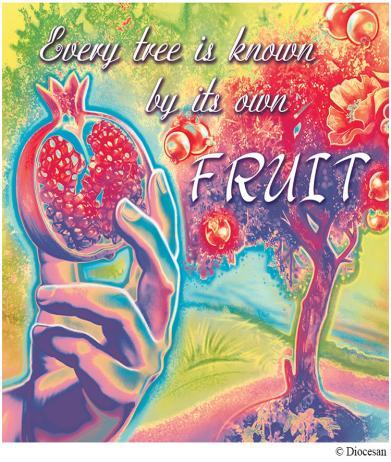
Do not praise a man before he has spoken. In a shaken sieve the rubbish is left behind, so too the defects of a man appear in his talk. The kiln tests the work of the potter, the test of a man is in his conversation. The orchard where the tree grows is judged on the quality of its fruit, similarly a man's words betray what he feels. Do not praise a man before he has spoken, since this is the test of men.
RESPONSORIAL PSALM Psalm 91
Response: It is good to give you thanks, O Lord.
1. It is good to give thanks to the Lord to make music to your name, O Most High, to proclaim your love in the morning and your truth in the watches of the night. Resp.
2. The just will flourish like the palm-tree and grow like a Lebanon cedar. Response
3. Planted in the house of the Lord they will flourish in the courts of our God, still bearing fruit when they are old, still full of sap, still green. In him, my rock, there is no wrong. Response
SECOND READING 1 Corinthians 15:54-58
He has given us the victory through our Lord Jesus Christ.
When this perishable nature has put on imperishability, and when this mortal nature has put on immortality, then the words of scripture will come true: Death is swallowed up in victory. Death, where is your victory? Death, where is your sting? Now the sting of death is sin, and sin gets its power from the Law. So let us thank God for giving us the victory through our Lord Jesus Christ. Never give in then, my dear brothers and sisters, never admit defeat; keep on working at the Lord’s work always, knowing that, in the Lord, you cannot be labouring in vain.
Gospel Acclamation Acts 16: 14
Alleluia, alleluia!
Open our heart, O Lord, to accept the words of your Son. Alleluia!
or Phil 2:15-16
Alleluia, alleluia!
you will shine in the world like bright stars because you are offering it the word of life. Alleluia!
GOSPEL Luke 6:39-45
A man’s words flow out of what fills his heart.
Jesus told a parable to them, “Can one blind man guide another? Surely both will fall into a pit? The disciple is not superior to his teacher; the fully
Today’s readings exhort us Christian disciples to form ourselves mind and heart in imitation of
Christ so we can better reflect His goodness in our daily lives.
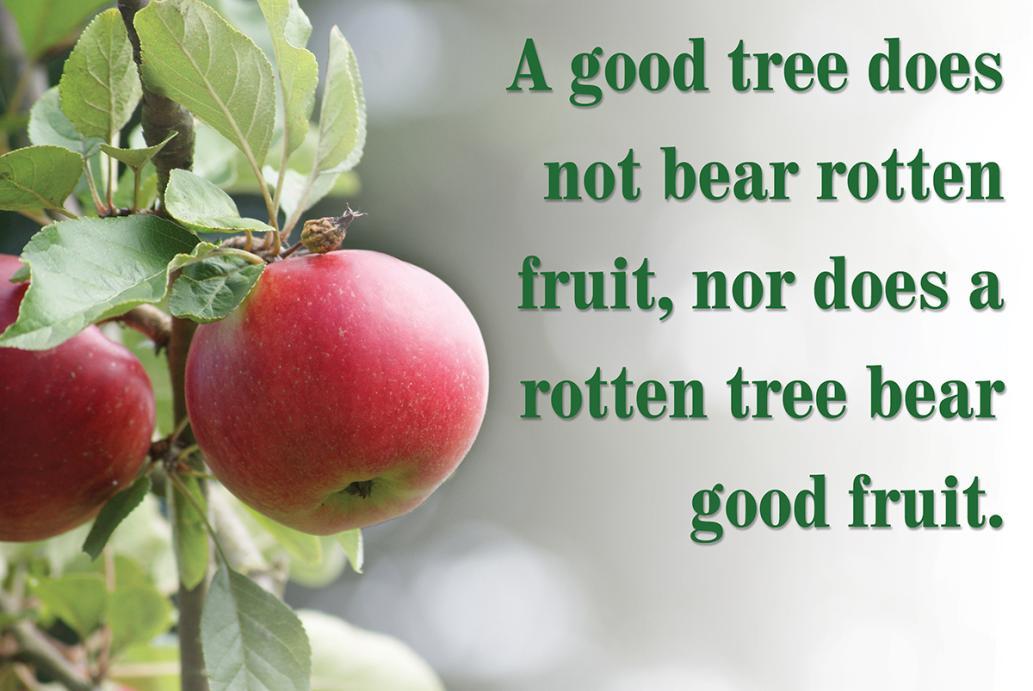
The first reading from Ecclesiasticus offers timeless counsel: “the fruit of a tree shows the care it has had: so too does one’s speech disclose the bent of one’s mind. Praise no one before he speaks.” Jesus uses the very same analogy in today’s Gospel reading from Luke: “A good tree does not bear rotten fruit, nor does a rotten tree bear good fruit. For every tree is known by its own fruit.”
trained disciple will always be like his teacher. Why do you observe the splinter in your brother’s eye and never notice the plank in your own? How can you say to your brother, ‘Brother let me take out the splinter that is in your eye,’ when you cannot see the plank in your own? Hypocrite! Take the plank out of your own eye first, and then you will see clearly enough to take out the splinter that is in your brother’s eye.
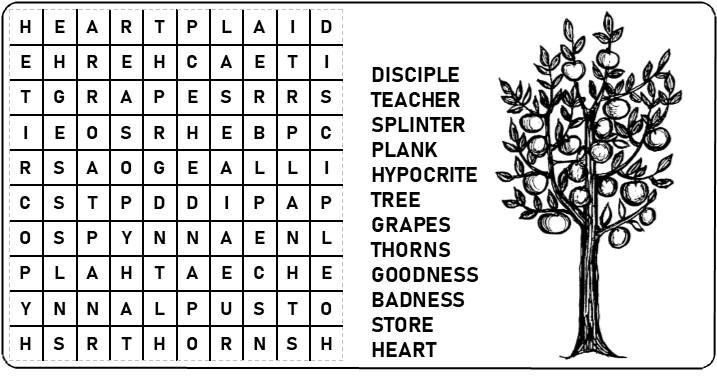
“There is no sound tree that produces rotten fruit, nor again a rotten tree that produces sound fruit. For every tree can be told by its own fruit: people do not pick figs from thorns, nor gather grapes from brambles. A good man draws what is good from the store of goodness in his heart; a bad man draws what is bad from the store of badness. For a man’s words flow out of what fills his heart.”❖
Everything we have is a gift from God to be used for His honour and glory. This includes the gift of speech and, even more broadly, all forms of modern-day communication email, text, Twitter, Facebook and the rest. What comes forth from our mouths, or keyboard, or phone, is a reflection of what is in our minds and hearts. Our ability to communicate with each other is itself a gift which we must steward well.
In the same Gospel passage, Jesus reminds us, “No disciple is superior to the teacher; but when fully trained, every disciple will be like his teacher.” The more time we spend with Jesus, our teacher, through regular prayer and a strong sacramental life, the more we will become like Him. Then all that we do and say (and tweet and post) will bring others to closer to Him. This is the life’s work of the Christian steward. It is privileged work indeed. ❖
[www.catholicsteward.com/blog/]
Gospel Reflection
One of the things that gives the most satisfaction to many people is being able to point out the mistakes and faults of others. This is probably because it is easier for us to recognise the weaknesses in other people while there is something in us that prevents us from seeing our own failings. It is clear that we can be blind to things about ourselves while other people who live or work closely with us can see them clearly. If we accept that none of us is perfect, then we can be sure that the faults we so readily see in others are very likely the faults existing in ourselves. Many of us are quick to correct others but we hate being corrected. Jesus warns about this when he tells us to first take the plank out of our own eye before we can even think of taking the splinter from our neighbour’s eye.
When we become taken up with the faults of others, you can be sure we will be totally blind to our own faults. We can be blind to certain things about ourselves that are quite clear to those around us. We are quick to see the fault in other people’s children while we are sure our children are blameless. Many times it takes someone else to point out our weaknesses and faults to us before we even begin to recognise we have them. People who are sensitive to criticisms (and we all know people who are like this, that is, if we ourselves aren’t like that) do not like having others point out their weaknesses. They just do not like being corrected. As Christians, however, we should always be concerned with being the best we can be, recognising our weaknesses and faults even if others have to point them out to us in love. Once we know where our weaknesses lie, we can work on them and move on from there.❖
[From: Journeying with the Word of God, The Religious Education Department,Dioceseof Georgetown, Guyana ]

DearEditor,
The fact that the gospels are not much cherished memories of someone who is dead and gone, as books filled with the presence of One who lives. They are a series of short passages, each of which is a sort of prism through which the whole person of Jesus can be seen, they are rather a complete presentation oftheLord.
The Gospels
Priests and doctors of the law Pharisees and publicans, the rich and the poor, the healthy and the sick, all are vividly drawn in the great events which constitute the encounter with Jesus, an encounter which each of them experiencesin hisownway.
We cannot fail to be struck by the fact that he is fully a part of the real world of his day, while observing also that he is completely distinct from it. The result is that we encounter Jesus in the gospels in a different way from other figures of the past, and raise no challenge. The person of Jesus is given
a quite different treatment. He is there inhisentirety,andhecallstous. Hence, a story from the gospel is not something that we can sit down and listen to in a detached way, with our legs crossed, as it were. It is something through which we are summoned to standup.
Our knowledge of the life of Jesus is derived, in fact, not from one but from fourparallelwritings,something uniquein the history of literature. Each of them comprises the good news as a whole. Thatiswhythey arecalledtheGospels. Leon Jeetlall
50th anniversary of AEC’s Pastoral Letter
“Justice and Peace in the New Caribbean”
DearEditor,
This year marks the 50th anniversary of the Antilles Episcopal Conference’s landmark Pastoral Letter, “Justice and Peace in the New Caribbean”. This document, published in 1975, offered a prophetic vision for justice, peace, and human dignity in the Caribbean. Its emphasis on addressing poverty, inequality, racial discrimination, true development, the role of the laity and its caution on the then dominant political systems, has inspired generations of Catholics to work toward a morejust and equitablesociety. The Pastoral Letter boldly confronted
the pressing issues of its time. It clamored for a renewed commitment to social justice, solidarity, and the empowerment of Caribbean peoples to shape their own destinies. These themes remain deeply relevant, and the document’s enduring legacy is a testament to the foresight and courage ofthebishopswhoauthored it. However, much has changed in the Caribbean over the past five decades. New challenges have emerged that demand a fresh response from the Church. Issues such as climate change and environmental degradation, globalization, migration, crime and violence and human trafficking were
not prominent concerns in 1975. These and other concerns require a renewed theologicalandpastoralresponse.
In light of these new realities, I urge the local diocese to advocate strongly for the updating and revision of “Justice and Peace in the New Caribbean”. A revised document would provide the Church in the Caribbean with a renewed framework for its social mission, one that addresses contemporary challenges while remaining rooted in theGospelandCatholicsocialteaching. I believe that the Antilles Episcopal Conference is uniquely positioned to leadthiseffort.
William Cox
GHRA: Guyana’s engagement with US deportee
DearEditor,
Media reports suggest that Guyana is engaged in discussions on receiving African and Asian deportees from the US. In the event there is substance to these reports, the Guyana Human Rights Association (GHRA) is concerned that the Guyana Government not be misled or flattered into entering any agreement, opportunistic favours or collaboration in the brutal exhibitionism playing out in the United States towardsallegedlyillegalmigrants.
Specifics of why the US found itself overwhelmed by the thousands of would-be refugees is beyond the scope of this release. The illegal migrant issue has its origins in a decades-old system of seasonal work permits to service the California agricultural industry, which morphed into massive uncontrolled migration aggravated by global economic inequality, regional wars and theCOVIDpandemic.
Along with illegal migrants a significant number of the persons targeted for deportation appear to fall into the category of ‘Temporary Protected Status’ which allows them toworklegally while their application for asylum is being considered – a process that can take years.
The GHRA isnot challenging theright of the US to change its policies and laws on migration, provided this is done legally and is applied impartially. What
is taking place at present is a war on people of colour, who in many cases appear to be legally in the US and enjoy ‘Temporary Protected Status’. The current campaign is being implemented in shameless disregard for the law, shameless disregard for family units, and shameless vilifying of people as rapists, murdersand criminally insane. Moreover, the concept of ‘refugee’, developed originally in international law to protect individuals threatened by political persecution in their own countries, is being invoked in circumstances it was never devised to address.
Our concern is that Guyanese citizens not be drawn into collaborating with any part of the forced relocation and mayhem being implemented by President Trump. The limit of Guyanese involvement must be to ensure humane treatment for re-located Guyanese nationals and adherence to regional andinternationalnormsand standards. Any proposal that Guyana associate itself with this lawless chaos should be approached with extreme caution or set aside. Moreover, any discussions the Government of Guyana may be forced to entertain should be guided by the following assurances and considerations:
• All relevant US laws are respected, including the Constitutional right to US citizenship of all persons born
there.
• All of Guyana’s immigration requirements for in-transit persons are respected.
• Written assurances that no person will be brought to Guyana against theirwillotherthanin-transitstatus.
• Adequate financial resources are made available to cover the cost of onwardtravel.
• Adequate resources are made available for any period of time spent by third country deportees in Guyana prior to in-transit to home countries inAsiaandAfrica.
• Guyana must guard against re-creation of bizarre arrangements, suchastheJonestownscenario.
• Assurances that non-Guyanese will not be brought to Guyana against their will - a message hopefully communicated to the large delegation of US marshals that recently visitedGuyana.
• Agreement from country of origin to receive back any deportee sent in-transittoGuyana.
• A warning to all airlines that no cruel, inhumane or degrading treatment will be tolerated by the Guyana Government.
and girls to be held March 8th
A Candlelight Vigil for victims of violence against women and girls will be held on Saturday, March 8th at Brickdam Cathedral from 6pm. Fr Carl Philadelphia, Parish Priest of the South Georgetown Cluster of Parishes, writes the following:
Dear Brothers and Sisters in Christ,
Greetings of peace and blessings to you. As a community of faith, we are called to be a voice for the voiceless and to stand up against injustice. Today, I write to invite you to a Candlelight Vigil in remembrance and prayer for all victims of violence against women and girls.
This vigil will take place on 8 March at 6:00 pm at Brickdam. It will be a time for us to come together in solidarity, raise our voices for those who suffer in silence, and offer our prayers for healing, justice, and protection for women everywhere.
As Catholics, we are reminded in scripture that "the Lord is near to the brokenhearted and saves those who are crushed in spirit" (Psalm 34:18).
This vigil will not only be an act of remembrance but also an expression of our commitment to standing against all forms of violence and supporting the dignity and worth of every woman and girl.
I ask that you bring a candle with you, symbolizing the light we seek in the darkness of this issue. Let us come together to pray, reflect, and ask God for the strength to work toward a world
where all women and girls are respected, loved, and protected. Please join us as we lift those affected by violence and reaffirm our commitment to justice, compassion, and peace. Together, we can be a beacon of hope.
In Christ's love, Fr. Carl Philadelphia Parish Priest St. Pius X, Holy Spirit & Our Lady of the Mount .❖

Baptism at Achawib
Journeying with the Word of God
MAKING THE WORD OF GOD YOUR OWN
Step 1: Lookattoday’sReadingsprayerfully.
1st Reading: While beauty is only skin deep, it is our words and conversations that tell who we really are. We should, therefore, always be conscious of the words that come out of our mouths.
2nd Reading: If we persevere in doing the Lord’s work, we need not fear death. When we die we will share in the victory of Jesus over sin and death.
Gospel: As Christians we have a duty to be concerned about others. However, we cannot guide another person unless we ourselves can see the way clearly.
Step 2: ApplyingthevaluesoftheReadings toyourdailylife.
1.At the start of every Mass we are called upon to examine our consciences and to call to mind our sins. How does this tie in with today’s Gospel?
2.“Our religion is not so much about making others better as it is about making ourselves better.” Is this statement connected in any way to the Gospel message?
3.What does Jesus mean when he said, “For a man’s words flow out of what fills his heart”?
4.Jesus says that there it is not a sound tree that produces rotten fruit. You can tell the kind of tree you are by the fruits you produce. How do you intend to be a sound tree that produces good fruit?
Step 3: Accepting the message of God’s Wordinyourlifeoffaith.
In today’s Gospel, Jesus warns us against judging others. He tells us to be true to ourselves, to identify and remove what is weak and faulty in ourselves so that as true disciples we will be able to see clearly to guide others. Unless we do this we will only be judgmental of others and see only their faults while at the same time being blind to our own faults. This is being hypocritical.
Step 4: Somethingtothink&prayabout
1.Reflect on your own life. What kind of fruit do you see on your own tree? Do the good fruits outnumber the bad? Do you feel it would be easy to remove the bad fruit? What are the things you feel you need to change in your life that would help you to produce good fruit?
2.Pray that you will always try to avoid the hypocrisy of seeing the faults of others while ignoring those same faults in yourself.❖
[From: Journeying with the Word of God, The Religious Education Department, Diocese of Georgetown, Guyana ]
celebrated Republic Day Sunday, Holy Communion. Prayers were offered for Guyana and for unity Adapted from St Ignatius
The challenge of ecumenism in the Caribbean,
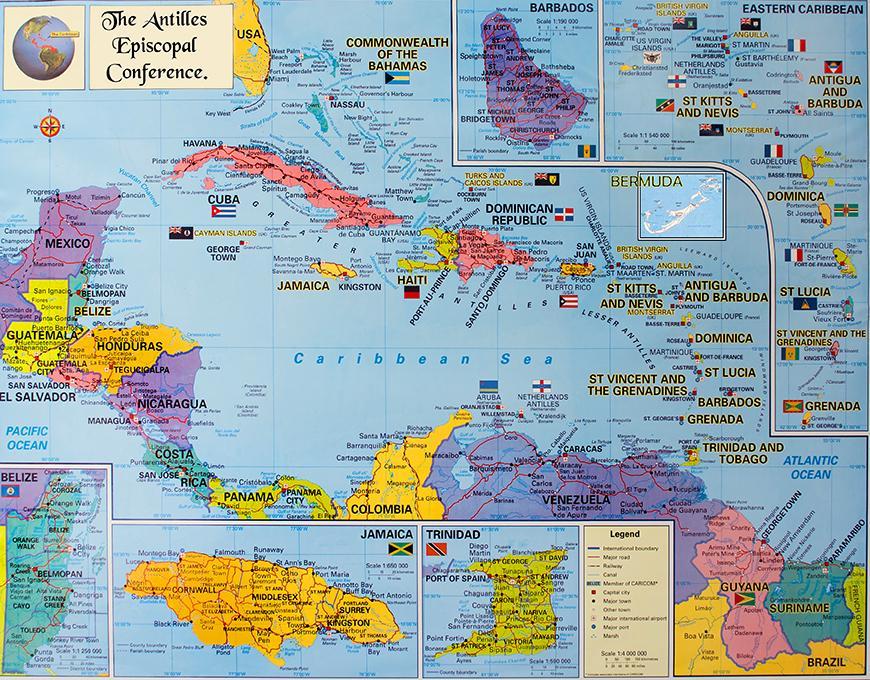
(ADN CELAM) - The Antilles Episcopal Conference (AEC) has played an outstanding role in strengthening dialogue and Christian unity in the Caribbean region. In a territory characterized by its cultural, historical and religious diversity, ecumenical work has become a pillar for the strengthening of faith and the construction of more inclusive and just societies.
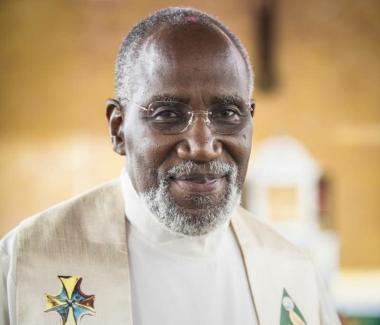
In an interview with ADN Celam, Bishop Clyde Martin Harvey, bishop of the diocese of St. George's-in-Grenada and in charge of ecumenical activities within the AEC, reflected on the challenges and advances of ecumenism in the region, highlighting the collaboration between the different Christian denominations and its impact on Caribbean society.
From the Second Vatican Council to the Present Archbishop Clyde Harvey explains that the Christian Churches in the Caribbean have evolved in their relationship with each other, especially since the Second Vatican Council, which promoted ecumenical dialogue throughout the world. During the processes of political decolonization in the region, Roman Catholic dioceses began to work together on both ecclesialandsocio-economic issues.
One of the historical moments that stands out on this path is the founding of the Caribbean Conference of Churches (CCC) in 1973. This ecumenical body, which once had33member churches in 34 Caribbean territories, served in the social transformation of the region between the 1970s and 2000s. Their work was largely supported by European agencies, which funded projects in the fieldofdevelopmentandChristianunity
However, from the 1990s onwards, the decrease in these funds led to the weakening of the CCC, leaving in the hands of the local Churches the responsibility of sustaining the ecumenical movement ineach territory.
The Current Reality of Ecumenism in the Caribbean
Today, ecumenism develops autonomously in each country of the Caribbean. Six of the territories have active Christian councils, which organize events during the Week of Prayer for Christian Unity and respond to situationsof nationalcrisis.
In nations such as Trinidad and Tobago, Guyana, Grenada, Jamaica, Saint Lucia and Martinique, governments have requested the support of churches to mediate in times of political or social
tension. Trust in religious institutions remains high, and the Church is seen as a fundamentalpillarwithincivil society. However, significant challenges remain. One of the main ones is the fragmentation among the Christian churches. According to Bishop Harvey, the Church in the region is divided into two large groups: The traditional Churches, including the Anglican, Baptist, Roman Catholic, Orthodox, Methodist and Presbyterian. They have been the main promoters of ecumenical dialogue. And the evangelical and Pentecostal churches, mostly of American origin and with strong financial backing. Many of these communities do not consider Christian unity as a priority and are not active participants inecumenicalactivities.
Christian unity
Bishop Harvey notes that the greatest challenge facing ecumenism in the Caribbean is the level of commitment of its leaders. Many ministers are overworked, which limits their ability to engage in interfaith dialogue initiatives. In addition, some missionaries who arrive in the region have little experience in ecumenical work, which makes it difficult for them to integrate into these activities. However, the rapid secularization of Caribbean society demands a unified response from the churches. In the face of this, several dioceses have begun to identify common problems and address them together. Some of the strategies beingconsideredincludethe appointment of a full-time ecumenical officer in local Christian councils, to strengthen coordinationandplanningofjointactivities
Another challenge is the lack of ecumenical initiatives aimed at young people. In Bishop Harvey's view, not enough has been done so far to promote Christian unity among the new generations. However, the recent visit of the Logos mission ship to several Caribbean islands provided an opportunity to focus on this area. It is hoped that this experience will bear fruit and motivate the creation of ecumenicalyouthprogrammesinthefuture Ecumenical projects and social action
Despite the challenges, ecumenical initiatives exist in countries such as Suriname, Guyana, Jamaica and Trinidad, where interdenominational social projects have been developed. Some communities have organized sports meetings between churches, promoting unity through sport and teamwork.
In addition, a theological debate has begun in several dioceses about the content of the Christian faith, inspired by the text of John 11:25 "I am the resurrection and the life." This dialogue has twomainobjectives:
To reflect among the clergy on the shared doctrinal content, to strengthen the common Christian identity.
To invite communities to deepen their understanding of the meaning of the resurrection and life through a yearlong exercise of reflection.
Interreligious dialogue, a way to go
In four dioceses in the Caribbean there is a strong non-Christian religious presence, which poses an additional challenge for interreligious dialogue.
During the Week of Prayer for Christian Unity, there are no interreligious
meetings, as the churches clearly distinguish between ecumenism (dialogue between Christians) and interreligiousdialogue
However, regular meetings with nonChristian religious communities are held in several dioceses. At public events, it is common for there to be an interfaith tone, reflecting the spirit of mutualrespectthatprevailsintheregion
Even so, Bishop Harvey acknowledges that there is still a "long way to go" to understand in depth thedifferent religious traditions present inthe Caribbean.
The Future of Ecumenism in the Caribbean
Despite the challenges, the spirit of interreligious unity and respect remains a characteristic of the Caribbean region. For more than 100 years, religious schools have trained leaders in various areas of society, contributing to social stability and the promotion of Christian values.
Bishop Harvey noted that although there are religious groups which aim to dominate, religious tolerance has remained intact in the Caribbean. However, he warns that churches should not fear the changes that the future brings, but should take up the challenge of preaching the Gospel with an open mind to technological advances and new ways of understandinghumanity.
"We must dare to preach the Gospel with an openness to the future, not only in its technology, but also in the ways in which it challenges our understanding of God and what it means to be human," he said.❖
Bishop Clyde Harvey

Dear Girls and boys,
In today’s Gospel reading, Jesus tells his followers that they are to bear fruit. What do you think Jesus meant when told his followers to bear fruit for him? He wasn’t talking about mangoes, oranges, and bananas. When Jesus says that good people produce good fruit, he doesn’t mean the kind of fruit that we eat. He means that if we are following him, we will want to do the things that make God happy. We will do good things, we will help people, we will share what we have with others, and we will treat other people with respect.
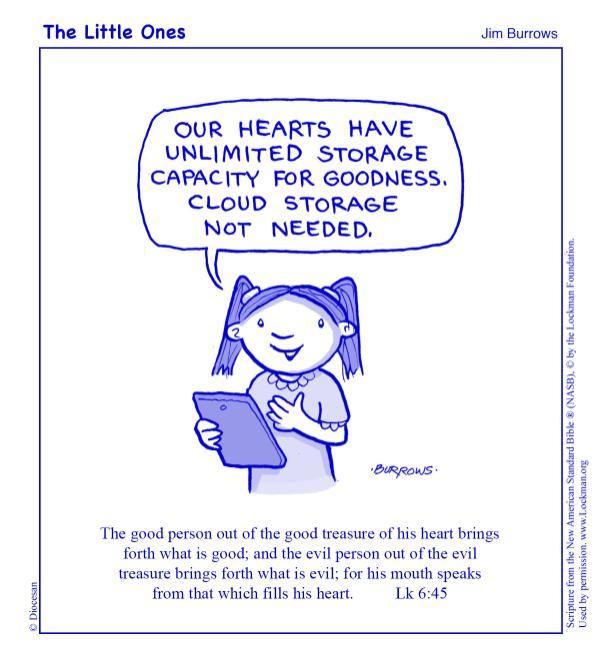
Jesus said, "A tree is identified by its fruit. A good person produces good things from a good heart, but an evil person will produce bad things from an evil heart. What kind of fruit tree do you want to be? A good tree producing good fruit, or an evil tree producing evil fruit?
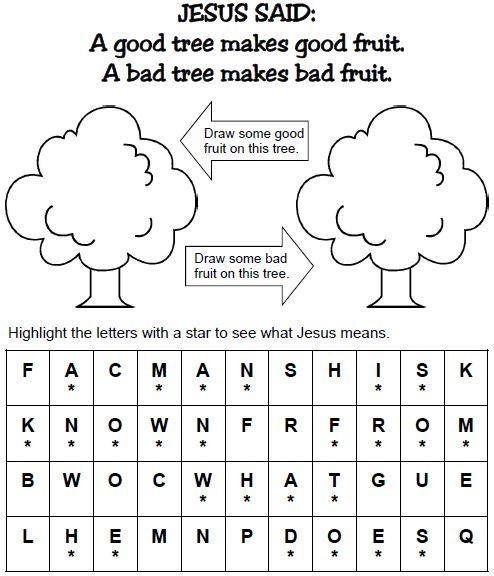
Father, we want to be identified as a good tree, producing good fruit. Help us to do the things we know will be pleasing to you. In the name of Jesus we pray. Amen.❖ God wants us to

Wednesday is March 5th
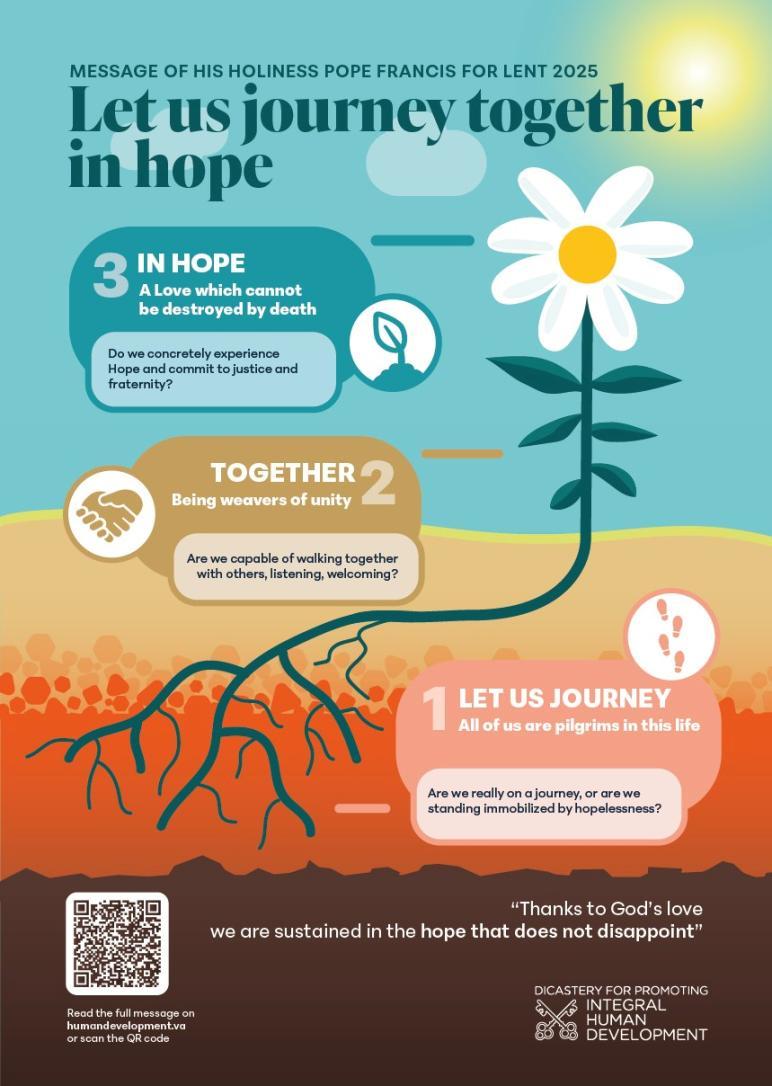
on conversion and unfolds in three key dimensions: the importance of journeying, journeying together, and journeying with hope.
Our life of faith is a journey of conversion
Recalling the biblical Exodus of the people of Israel from Egypt to the Promised Land, the Pope reminds us that our lives too are a journey one that should be directed toward God.
This journey is not merely a metaphorical one but involves a constant call to conversion, “to leave behind the occasions of sin” and situations that degrade our human dignity.
Pope Francis, therefore, urges the faithful during this Lenten Season to examine their own lives: are they actively progressing on the path of spiritual renewal or are they held back by fear and hopelessness or reluctant to move out of their comfort zone?
Drawing a parallel between the Hebrew people’s “arduous path from slavery to freedom” and the plight of modern migrants and refugees, the Pope invites us to use this period as an opportunity to consider how we relate our own lives with the struggles of those who are forced to flee “situations of misery and violence in search of a better life” and “in this way discover what God is asking of us." This, he writes, “would be a good ‘examination of conscience’ for all of us wayfarers.”
“It is hard to think of the biblical exodus without also thinking of those of our brothers and sisters who in our own day are fleeing situations of misery and violence in search of a better life for themselves and their loved ones. A first call to conversion thus comes from the realization that all of us are pilgrims in this life.”
The call to journey together: a summons to synodality
A fundamental aspect of the Lenten Message is the emphasis on community and synodality the idea that Christians must walk together rather than in isolation.
Pope Francis reminds us, “The Holy Spirit impels us not to remain self-absorbed, but to keep walking towards God and our brothers and sisters.”
“Journeying together,” he writes, “means consolidating the unity grounded in our common dignity as children of God (…) without letting anyone be left behind or excluded.”
Again, he challenges the faithful to reflect on whether we are capable of walking together with others in our families, workplaces, and communities, resisting the temptation to become self-absorbed. Are we welcoming to others? Do we include those who feel marginalized?
“Let us ask ourselves in the presence of the Lord whether, as bishops, priests, consecrated persons and laity in the service of the Kingdom of God, we cooperate with others. Whether we show ourselves welcoming, with concrete gestures, to those both near and far. Whether we make others feel a part of the community or keep them at a distance.”
The call to journey in hope
The third fundamental dimension of the Lenten journey is hope, anchored in God’s promise of salvation and eternal life fulfilled in Jesus' Resurrection, the victory over sin and death.
This hope is not abstract but must be lived concretely. Pope Francis invites us to examine whether we truly trust in God’s mercy. Do we believe in His forgiveness, or do we fall into the trap of self-reliance? And do we concretely experience the hope that inspires in us
“a commitment to justice and fraternity, to care for our common home and in such a way that no one feels excluded?”
Referencing Saint Teresa of Avila, the message urges the faithful to remain watchful and patient, understanding that God’s promises will be fulfilled in His time.
“This was the prayer of Saint Teresa of Avila: 'Hope, O my soul, hope. You know neither the day nor the hour. Watch carefully, for everything passes
quickly, even though your impatience makes doubtful what is certain, and turns a very short time into a long one.'”
Pope concludes by entrusting this journey of hope to the intercession of the Virgin Mary, "Mother of Hope," praying that she may accompany the faithful as we prepare to celebrate the joy of Easter. ❖
To read a copy of the Holy Father’s 2025 message, click here.



Church in Jamaica mourns passing of Archbishop Emeritus Edgerton Clarke
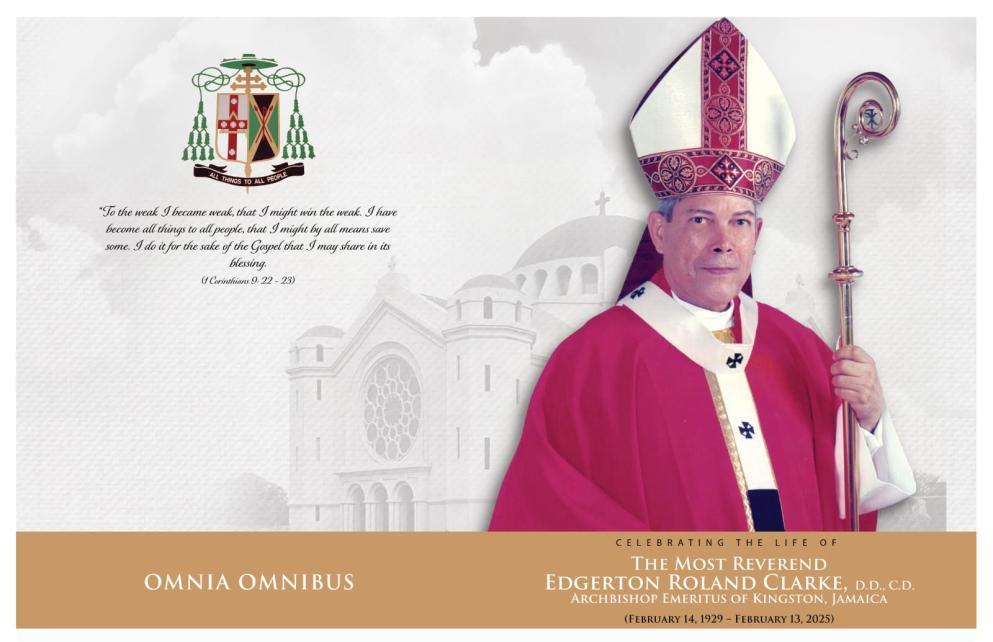
The Catholic Church in Jamaica lost one of its shepherds on Thursday, February 13, 2025, when the Most Rev. Edgerton Clarke D.D., Archbishop Emeritus of Kingston died, one day before his 96th birthday.
Born in 1929 in Cambridge, St. James, he was the son of Roland Clarke, Police Officer/Farmer, and
Helen Kameka-Clarke, School Teacher. He was educated at Marymount School, Excelsior High School, St. George’s College, St. John’s Seminary (Brighton, Mass., U.S.A.). He was ordained a priest 65 years ago, in February 1960. In September, 1967 he was appointed by Pope Paul VI to be the first Bishop of the then newly created Diocese of Montego Bay, and enthroned in December of that year at the Cathedral of the Blessed Sacrament by Richard Cardinal Cushing of Boston. He took the motto of “Omnia omnibus” –“All things to all.” He served in Montego Bay for 27 years. In 1983, he received the Prime Minister’s Medal of Appreciation, having served on many School Boards and giving services to several civic and public undertakings for human development in Western parishes.
In November, 1994, he was appointed Archbishop of the Archdiocese of Kingston in succession to Archbishop the Most Rev. Samuel Carter on his retirement. While in that office, in 1998, Archbishop Clarke established a committee to guide the process of restoring Holy Trinity Cathedral. He retired on February 17, 2004, on attaining the age of 75 to be succeeded by Archbishop Lawrence Burke. In his retirement, Archbishop Emeritus Clarke served in residence at Holy Cross church, ministering to the faithful in so many ways. He was a quiet, modest and unassuming person, pastoral in his focus. One of his homilies ends this way: “Baptism does not remove us from struggle and temptation; the Holy Spirit, who inspires the baptised, draws us to sorrow for sin and to deepened faith in the Good News of God’s Kingdom.” Eternal rest grant unto him, O Lord.❖ (Online Catholic Opinion of Jamaica)
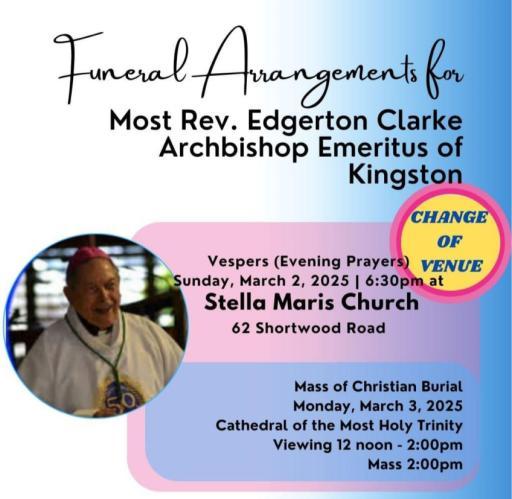
Link for the Vigil https://www.youtube.com/live/ioA0j8eMxc?si=7KkXw7k-ZuvsiE3R
Link for the Mass https://www.youtube.com/live/ T4umTU2Tl8I?si=tfL9ov_KrlR-K1Lf

55th Republic Day celebrations in the Diocese
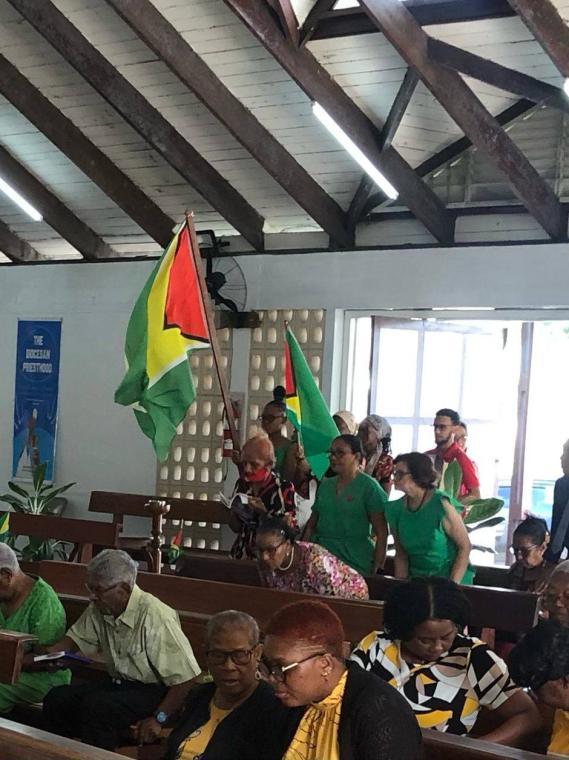
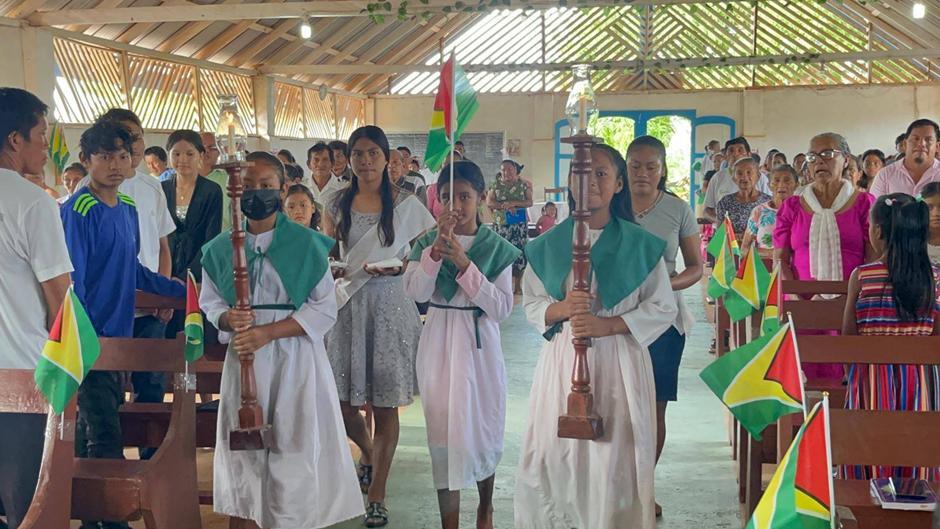
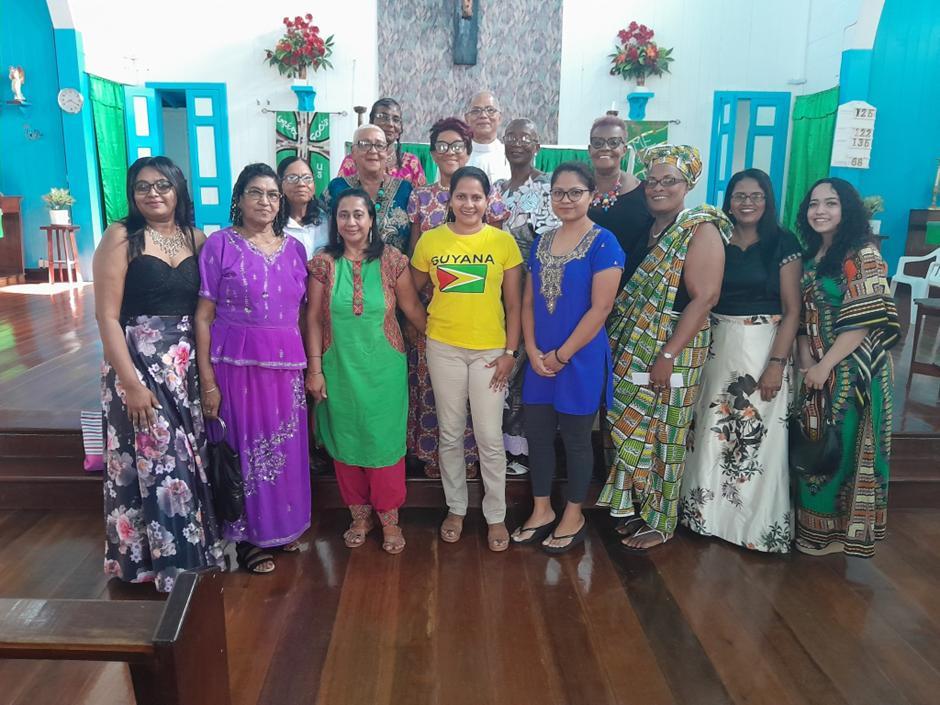
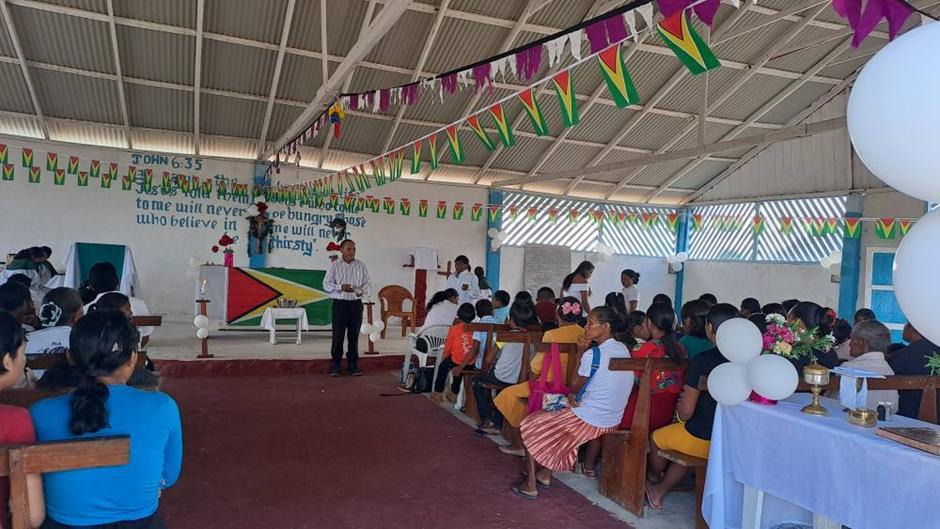
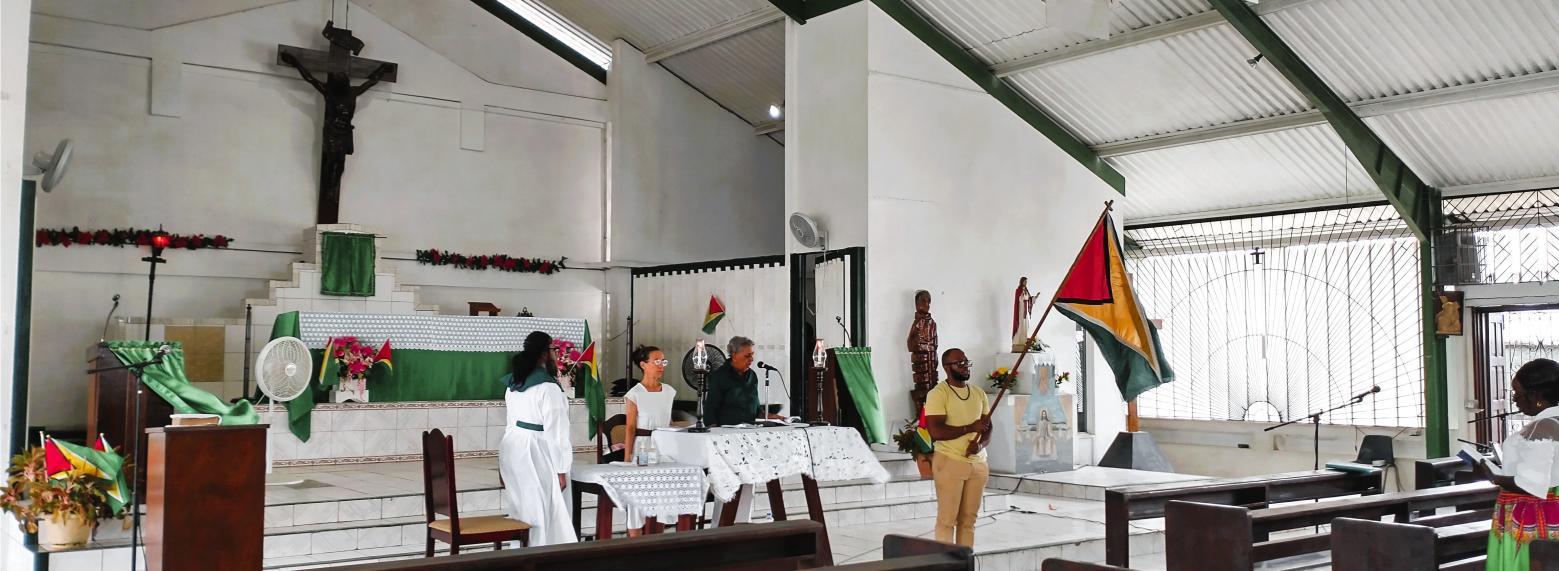
Plaisance
Aishalton
St. Pius X
Holy Spirit
Achawib
Fatima
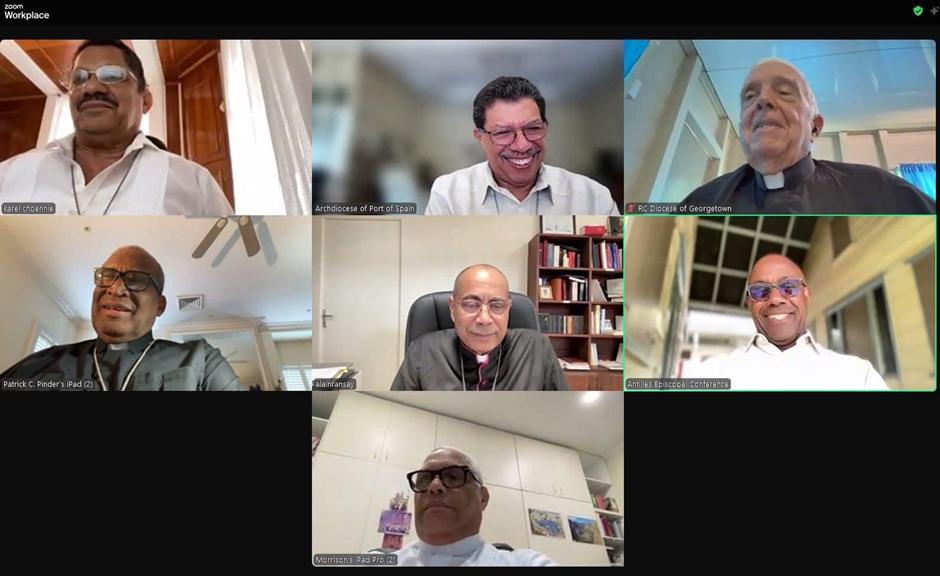
The bishops of the Antilles Episcopal Conference (AEC) held their monthly meeting on
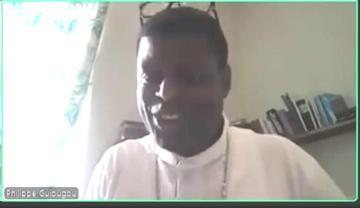
Wednesday, February 26th. The agenda looked at Conversation in the Spirit, Commission Reports and Fraternal Sharings.❖ (Adapted from Antilles Episcopal Conference – AEC Facebook page)
Fr. Ramesh Vanan SJ appointed Sectional Superior for English-
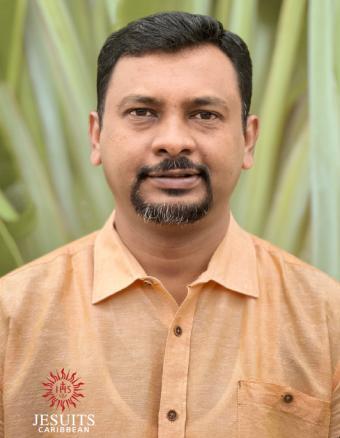
The Jesuits in the Caribbean announced: "On February 14, Fr. General informed Fr. Martin Lenk, SJ, Provincial of the Caribbean Province, that he had appointed Fr. Ramesh Vanan Aravanan, SJ, as the new Sectional Superior of the English-Speaking section of the Caribbean Province (Jamaica, Guyana and Trinidad). Fr Ramesh will take up his role on the 1st of March 2025. We thank Fr. Peter McIsaac, SJ, for his dedicated service."
Announcement of New Sectional Superior for the English-speaking Section of the Caribbean Province
Fr. Ramesh Vanan Aravanan, SJ, has been entrusted with the
responsibility of serving as the Sectional Superior for the EnglishSpeaking Section of the Caribbean Province (Guyana, Jamaica, Trinidad), an appointment conferred by Fr. Arturo Sosa, SJ, the Superior General of the Society of Jesus. At the age of 44, Fr. Ramesh embodies the Society’s enduring commitment to service, intellectual rigor, and pastoral engagement, shaping his vocation across diverse cultural and geographical landscapes.
Fr. Ramesh’s journey into the Society of Jesus began with his entry into the Novitiate of the Karnataka Province in Bangalore in June 1999. A deep-seated desire to integrate faith with service guided his formative years, leading him to Under Graduation in Mangalore and philosophical studies in Chennai. His intellectual curiosity and pastoral zeal soon broadened his horizon, drawing him to the Jesuit mission in Guyana, where he volunteered for regency in 2007. This marked the beginning of a long and enduring commitment to the people and Church in the Caribbean region.
Building upon his philosophical foundation, Fr. Ramesh further pursued theological studies at Heythrop College, London, followed by Leuven University and Boston University, where he was immersed in the Ignatian tradition of rigorous academic and spiritual
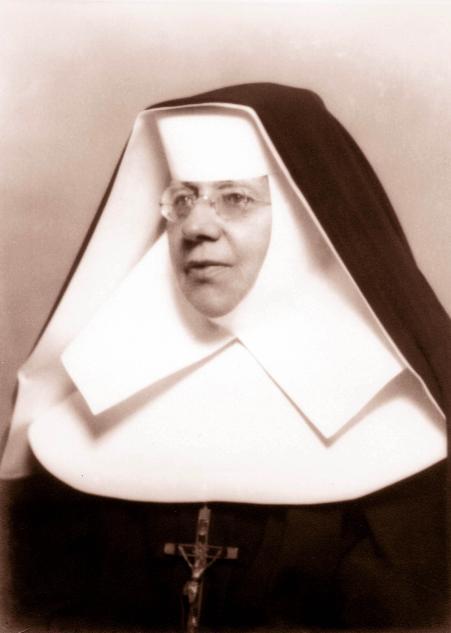
(November 26, 1858 -March 3, 1955 )
Katharine Drexel was born in Philadelphia, USA in 1858 to wealthy parents. She had an excellent education and traveled widely. In 1887, while on a European tour, she met Pope Leo XIII and asked him to send more missionaries to Wyoming. The pope replied, “Why don’t you become a missionary?”
formation. His ordination in Bangalore on November 9, 2013, was a moment of deep personal commitment, sealing his dedication to the priesthood and mission.
He served as a parish priest in Upper Corentyne, combining pastoral care with media evangelization as Chair of the Faith and Media Commission for the Diocese of Georgetown. A scholar at heart, he taught psychology at the University of Guyana, Berbice Campus, while also pursuing a Fine Arts degree in Los Angeles, winning the LMU University award for best documentary film in 2018.
Returning to Guyana, Fr. Ramesh assumed leadership roles in Jesuit youth ministry, communications, and vocational formation as the Director of Guyana Human Development Center.
His missionary presence in Guyana has deepened his love for the local Church, its people, and its culture. This connection has since expanded to the broader Caribbean region, where he continues to serve with dedication and humility. His final vows in 2023 sealed his commitment to the Society. Now, as Sectional Superior, he stands rooted in mission, ever ready to advance where the need is greatest Ad Majorem Dei Gloriam.❖
In 1889 she entered a convent. A newspaper carried a banner headline: "Miss Drexel Enters a Catholic Convent Gives Up Seven Million." In 1891, Katharine professed her first vows as a religious sister, dedicating herself to work among Native Americans and African-Americans. Joined by thirteen other women, she soon established a religious congregation, the Sisters of the Blessed Sacrament. She and her first band of nuns opened a boarding school in Santa Fe. A string of foundations followed. By 1942 she had a system of Black Catholic schools in 13 states, plus 40 mission centers and 23 rural schools. Segregationists harassed her work, even burning a school in Pennsylvania. In all, she established 50 missions for Native Americans. Her crowning achievement was the founding of Xavier University in New Orleans, the first Catholic university in the United States for African Americans. She died at 96 and was canonized in 2000.❖