
120, No. 30
120, No. 30
Bishop gives second message on the Just Electoral Peace in Guyana initiative - p2
Dialogue, 2-state solution must end IsraeliPalestinian conflict, Vatican tells UN - p3
A Christian Perspective on Social Issues - p4
SundayScripture p5
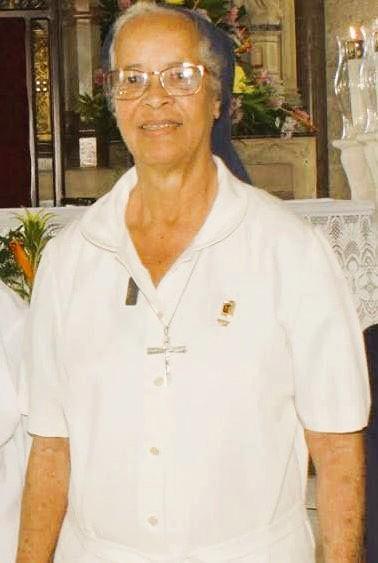
Sr. Mary Claire Zitman, OSU passed away on Monday, August 4th 2025 at the St. Joseph Mercy Hospital. She was 87. Born Nancy Claire Zitman on March 13th 1938 in Georgetown, she began her religious formation in 1957, and took vows as an Ursuline Sister in July 1959.
Over the years, Sr. Mary Claire served faithfully in Guyana, Venezuela, Jamaica, and Barbados before returning home to Guyana.
The Ursuline Sisters, to whom she dedicated her life, are especially known for their commitment to education and the formation of young minds.
The Catholic community extends sincere condolences to her family and the Ursuline Sisters. May her life of service and faith continue to inspire.
Her Funeral Mass was held on Friday, August 8th at 2:00 pm at the St. Joseph Ursuline Chapel, Camp Street, Georgetown. Burial took place at the La Repentir Cemetery.
Eternal rest grant unto her, O Lord, and let perpetual light shine upon her. May her soul, and the souls of all the faithful departed, through the mercy of God, rest in peace Amen. ❖
The Word and the World - p6
Pope Leo calls for peace, disarmament on 80th anniversary of Hiroshima bombing - p7
Pressing issues for the Antilles Church (3) - p8
p10
Growing in Grace Week 65 - p10
Next World Youth Day will be first in non-
Some of highlights of the Jubilee of Youth - p12 - p14
Attend Mass at St. Pius X, West La
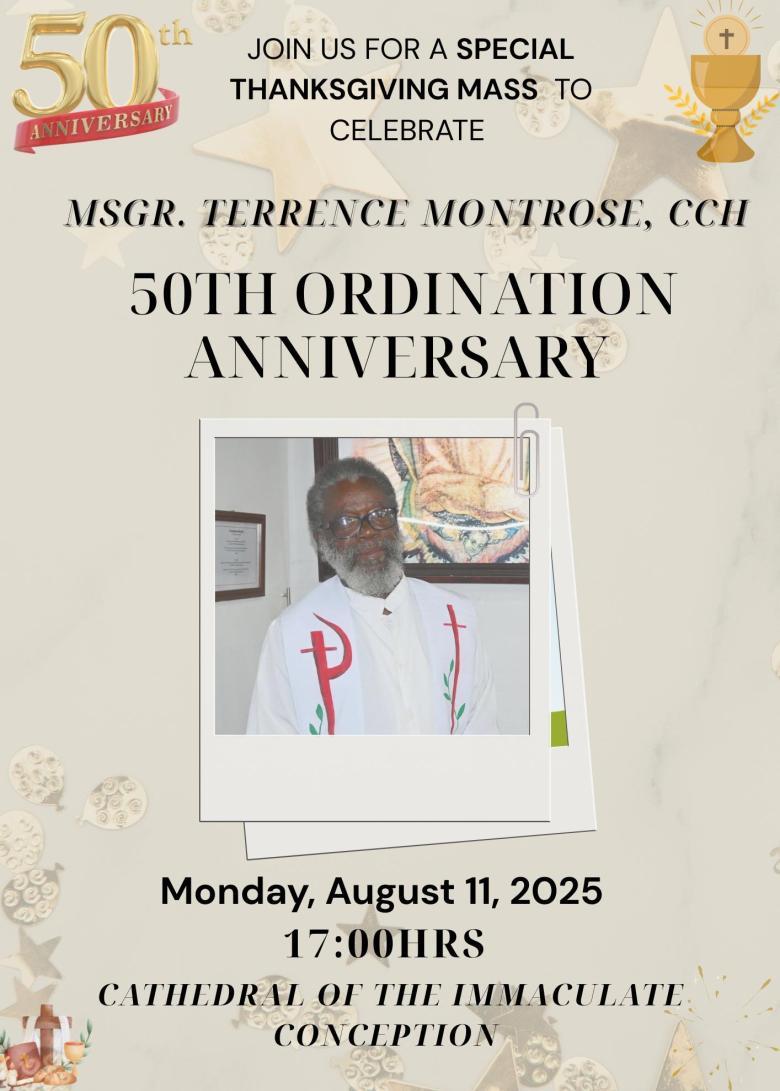
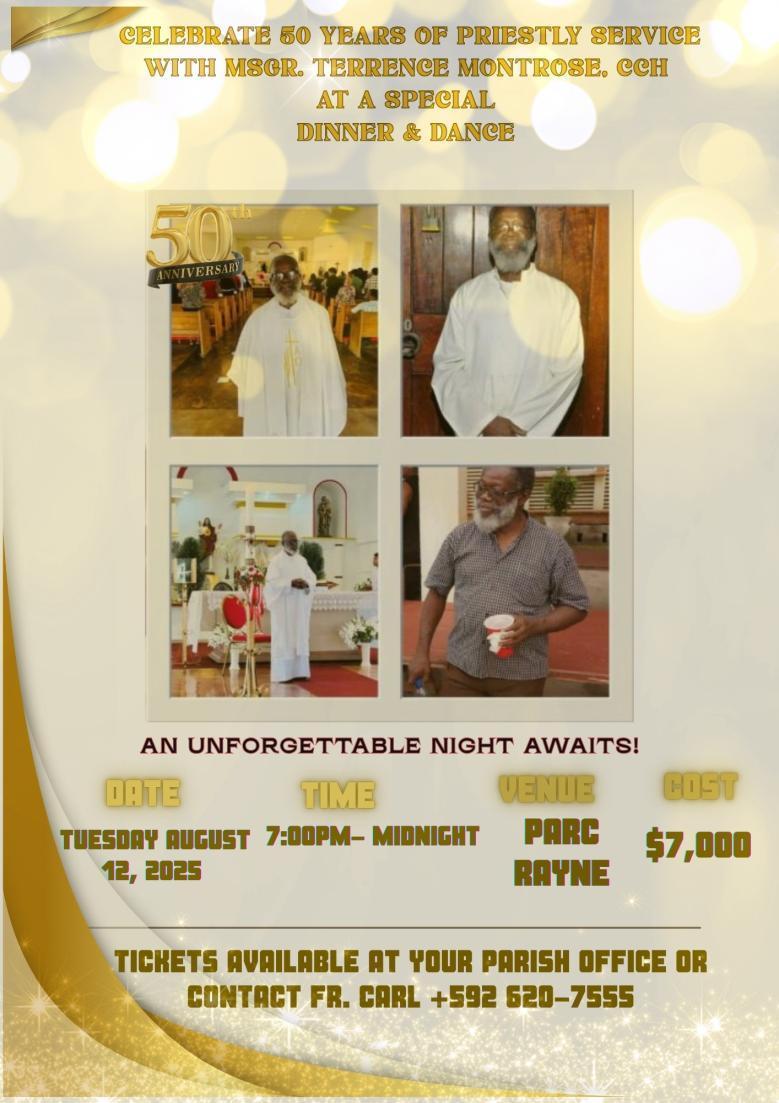
17:00hrs Monsignor Montrose’s 50th Anniversary mass at the Cathedral of the Immaculate Conception, Brickdam
Tuesday, August 12th
13:00hrs – Meet with Jesuit Provencial Superior
Saturday, August 16th
15:00hrs – Travel to Bogota, Colombia. Monday, August 17th to 21st: Attend the Ecclesial Conference of the Amazonia (CEAMA) I will be away from the Diocese during the period August 16th to 21st. During my absence Rev. Ronald Fernandes, SJ, Vicar General, will attend to matters on my behalf.
On Monday, August 4th, Bishop Francis Alleyne OSB gave a second video message on the Just Electoral Peace in Guyana initiative. Below is thetextofthatmessage:
Just Electoral Peace Webinar Series – Guyana 2025
“If you want peace, work for justice.” – Pope Paul VI
As Guyana approaches its September 1st elections, the stakes are high not just for votes, but for the soul of our democracy. With the possibilities of tensions arising before, during, and after election day, I am sharing with you an initiative that seeks to do more than call for peace it seeks to build just peace.
Father in heaven, may the faith you have given us in your son, Jesus Christ, our brother, and the flame of charity enkindled in our hearts by the Holy Spirit, reawaken in us the blessed hope for the coming of your Kingdom.
May your grace transform us into tireless cultivators of the seeds of the Gospel.
May those seeds transform from within both humanity and the whole cosmos in the sure expectation of a new heaven and a new earth, when, with the powers of Evil vanquished, your glory will shine eternally.
May the grace of the Jubilee reawaken in us, Pilgrims of Hope, a yearning for the treasures of heaven. May that same grace spread the joy and peace of our Redeemer throughout the earth.
To you our God, eternally blessed, be glory and praise for ever.
Amen


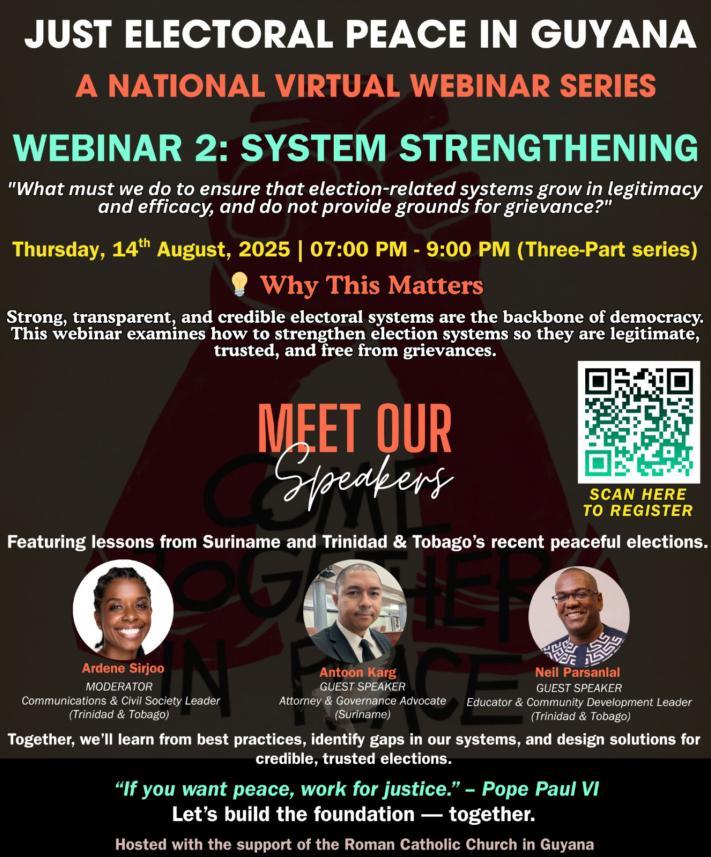
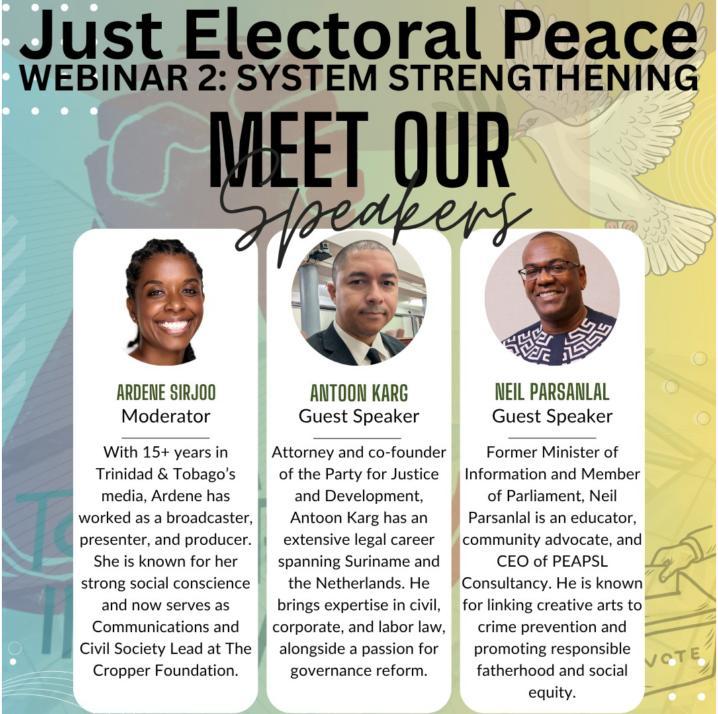
The Just Electoral Peace initiative invites you to join a powerful threepart webinar series happening this August. These dialogues are not just events; they are safe spaces where Guyanese voices diverse, passionate, and informed can come together to confront the deeper issues behind electoral conflict.
Dates:
• Thursday, August 7
• Thursday, August 14
• Thursday, August 21
Each of these will be at 7pm
Each webinar will feature a moderated panel discussion inspired by our Caribbean neighbors Suriname and Trinidad & Tobago who earlier this year demonstrated that peaceful elections are not only possible, but achievable.
Why Now?
Guyana continues to grapple with the unfinished work of constitutional reform and national reconciliation.
While short-term electoral efforts like voter education and codes of conduct are in motion, long-term healing has lagged. This initiative seeks to reawaken our commitment to sustained dialogue, rebuilding trust, and transforming howweapproach democracy
Each webinar will be held in a nonpartisan format, using structured discussion and audience participation to foster respectful, solutions-oriented dialogue. Inspired by a civil society framework born out of the 2020 postelection violence and UN-facilitated consultations, this series aims to identify and address the root causes of electoralconflict notjustthe symptoms Panelists and moderators will help us reflect, critique, and create a path forward. These sessions will also act as a launchpad for deeper civic work leading up to and well beyond Election Day.
Webinar Topics
Reconciliation and Trust
What must we do to ensure past hurt and mistrust no longer drive electoral pain that might manifest via violence?
System Strengthening
How do we build legitimacy and efficacy in our election-related systems to prevent grievances before they take root?
Rights and Values
How do we strengthen a shared national consensus on constitutional
values so that we engage one another peacefully at election time?
Supported by the Roman Catholic Church in Guyana, and rooted in Pope Francis’ call for political dialogue in his Encyclical Fratelli Tutti. This initiative brings together civil society leaders, thinkers, and changemakers with a singular purpose: peaceful, just elections in Guyana.
Join the conversation. Be part of the solution. Together, we can move beyond temporary peace and plant the seeds for lasting justice. Follow us for registration details and live-stream links. Let’s make history, peacefully.❖ Register here to attend the webinar series. Further details, including the Zoom link, will be shared after registration.
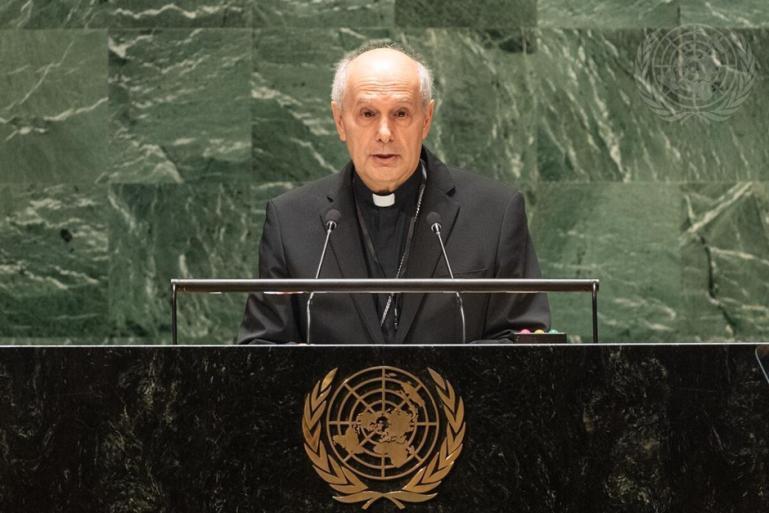
Archbishop Gabriele G. Caccia, the Holy See's permanent observer to the United Nations, is pictured in a 2023 photo addressing the General Assembly at U.N. headquarters in New York City. "Only through patient and inclusive dialogue" can "a just and lasting conflict resolution can be achieved" in the long-running conflict between Israelis and Palestinians, Archbishop Caccia said July 30, 2025. (OSV News photo/Rick Bajornas, courtesy United Nations)
(OSV News) “Only through patient and inclusive dialogue” can “a just and lasting conflict resolution can be achieved” in the long-running conflict between Israelis and Palestinians, said the Holy See’s permanent observer to theUnitedNations.
Archbishop Gabriele G. Caccia delivered a July 30 statement at the U.N.’s “High-Level International Conference for the Peaceful Settlement of the Question of Palestine and the ImplementationoftheTwo-StateSolution.”
The conference, led by co-chairsFrance and Saudi Arabia, took place July 2830.
The Holy See established diplomatic relations with the U.N. in 1957, representing the Vatican City State as well as the supreme authority of the Catholic Church,includingthepopeasbishopof Rome and the head of the college of bishops.
Humanitarian crisis in the region
In his statement, Archbishop Caccia pointing to the “profound anguish and terrible human suffering that has befallen the region” said the Holy See “reiterates its unequivocal condemnation of the heinous terrorist attack” launched by Hamas on Oct. 7, 2023, against Israel, in which some 1,200 Israelis were killed and 251 hostagestaken.
Currently, 50 remain in captivity, with only 20 of them believed to still be alive, and 83 ofthehostagesconfirmed killed to date. More than 100 were released later in 2023; eight were rescued by Israeli forces.
“Terrorism can never be justified,” said ArchbishopCaccia.
At the same time, he said, “the Holy See emphasizes that the right to self-defense should be exercised within the traditional limits of necessity and proportionality.”
SincethestartoftheIsrael-HamasWar, which was sparked by the latter’s
andlastingpeace.”
The solution, first advanced the U.N.’s 1947 partition plan for the region, initially sought to create both Palestinian and Israeli states, with Jerusalem internationalized. The state of Israel declared its independence the followingyear.
Over ensuing decades of wars, conflicts and geopolitical tensions, efforts to advance the plan have both continued and faltered, with the U.S., the European Union, Russia and the U.N. known as the Quartet releasing a road map to the two-state solution in 2003. Hamas’ armed takeover of Gaza in 2007 led to several rounds of fighting with Israel over the years, punctuated by internationally mediatedtalks.
The current Israel-Hamas war has led to increased polarization among several nations, particularly in the West, on the recognition of Palestine as a state, withBritain,FranceandCanadarecently indicating support for the solution, and the U.S. under President Donald Trump firmly insisting on its opposition tosuchrecognition.
their legitimate aspirations to live in freedom, security and dignity within an independentandsovereignstate.”
Transcending political divisions
Highlighting that Jerusalem “is sacred to Christians, Jews and Muslims alike,”
Archbishop Caccia said the city “requires a status that transcends political divisions and ensures the preservation of its unique identity,” and reiterated the Holy See’s “longstanding call foran internationally guaranteed special statute” that would ensure the rights and safety of inhabitants and heritage alike.
The archbishop stressed that such an accord “must ensure the protection of the Holy Places,” while guaranteeing unhindered access to and worship at them.
In particular, Archbishop Caccia called for the preservation of the Status Quo an informal agreement by which Israel provides overall security of the Temple Mount, while the Islamic Waqf religious trust administers the site and stewards its religious and cultural heritage.
attack, more than 60,000 Palestinians have died, according to the Hamas-run Gazahealthministry.
“The Holy See remains gravely concerned by the worsening humanitarian crisis in the Gaza Strip,” said Archbishop Caccia, noting that “the devastating impact on civilians, especially the number of children killed, has been compounded by the destruction of homes, hospitals,andplacesofworship.”
He highlighted the July 17 Israeli attack on Holy Family Church, Gaza’s only Catholic parish, which killed three and wounded more than 10 including the pastor, Father Gabriel Romanelli, who sustained a light leg injury. The Israel Defense Forces said the strike wastheresultofamisfiredmunition.
Archbishop Caccia said the strike on the church further scarred “an already distressed community” and was “deeply concerning given that Christians in the region have long played a vital role as a moderating and stabilizing presence, promoting dialogueandpeace.”
In his statement, the archbishop also lamented “the mass displacement of families, the breakdown of essential services, growing famine, and widespread deprivation shock the human conscience,” which he said “require an immediate, coordinated response from theinternationalcommunity.
“Therefore, the Holy See urgently calls for an immediate ceasefire, the release of all Israeli hostages, the restitution of the bodies of the deceased, the protection of all Palestinian civilians in accordance with international humanitarian law, and unhindered access to humanitarian assistance,” saidArchbishopCaccia.
Only viable path to peace
More broadly, he said, “The Holy See remains convinced that the Two-State Solution, based on secure and internationally recognized borders, is the only viable and equitable path toward a just
Archbishop Caccia said in his statement that “the Holy See has already taken meaningful steps” in support of the two-state solution, having “formally recognized the State of Israel through the 1993 Fundamental Agreement and the State of Palestine through the 2015 ComprehensiveAgreement.”
The latter document followed the signing of the 2000 Basic Agreement between the Holy See and the Palestinian LiberationOrganization.
Archbishop Caccia noted in his statement that the Holy See “continues to uphold the inalienable rights of the Palestinian people, including the right to self-determination,” and “supports
“In Jerusalem no one should be subjected to harassment,” he said, adding that “it is regrettable that Christians feel increasingly threatened in the Old City of Jerusalem.”
Archbishop Caccia concluded his remarks by quoting from Pope Leo XIV’s July 20 Angelus address, in which the pope repeated his plea for “an immediate halt to the barbarism of the war and for a peaceful resolution to theconflict.”
In that address, Pope Leo also urged respect for international humanitarian law, noting it bans attacks on civilians, collective punishment, the indiscriminate use of force and (with limited qualifications)forceddisplacement.❖
By GHK Lall
Salt seasons. Salt preserves. Salt knits and binds. Salt flavors. Salt strengthens.
“You are the salt of the earth…” Amen, Lord. Let it be. Let me be. My country needs me to be so. To be sea salt and kosher salt and fine salt. Salt of the earth, said Jesus. When this country needs knitting and healing, it goes the other way. Marching proudly along that route. Hurriedly and recklessly, too. Instead of salt, there is a lot of acid in the air of Guyana, with some toxins thrown in to stir up the environment still further. I can taste it, and it is not one that is rolled over the tongue, savored, welcomed. Why should anyone, any citizen, who answers to the name of Jesus be about anything else, but the salt of the earth?
Well, the terrain is laced through and through with that same sharp acid, that bitter vinegar. Elections. When elections arrive in Guyana, madness comes along with it. Men and women lose their sanity, their balance. Perhaps, they are shedding their skins, revealing their true selves. Christians are not exempt, though they have had powerful preparation. Catechism. Formation. Baptism. What did take
hold? Rather, the better question mightbethisone: whatisembraced?
Jesus said, my kingdom is not of this world. A fleet of minibuses may have been passing, so many citizens and many Catholics missed that message of Jesus. The blaring volumes of the world drowned out the message, lesson, of Jesus. My kingdom is not of this world. be careful with storing up earthly treasures. Beware of putting too much trust in earthly princes. No minibus passed this time, but it seems that the messages stillpassed over the heads of too many. Elections. It’s the most disturbing time of the year, Guyana’s own leap year that comes every five years, not four. Agitations flood town and village like a monsoon. Troubled spirits cloud time and place. Quarrels and calamities add up, then multiply.
Now that the precious blessing of divine providence fills an underwater reservoir 120 miles from Guyana’s coastline, the stakes are richer, the energies fiercer. What finds grace in being salt of the earth? A different kind of flavor, a more delicate type of seasoning. A knitter and healer. A strengthener and preserver of the resonant truthsofJesus. The Master said that I can and I must be the salt of the earth. I try. The try some more. Whenthereareno earthly masters,no earthly princes held aloft, then I can make itapriority, myduty,to try to be thesaltoftheearth.
Aconstructive voice, one lacking inthe intensities of the passions that electrify Guyana’s elections. A constructive voice is an honest voice. Jesus called out from Peter to James and John to Thomas, and made no bones about it. They were close to him; yet he spared them not, shrank not from standing
for the values of his way. Even the betrayer Judas Iscariot wasn nounced with thunderand damnation. But with gentle admonition: go do what has to be done. And after washing his feet. The same feet that now raced away to return and kick. Jesus didn’t lose histexture: pure, profound, peaceful. Do we need that or what overhereandrightnow in Guyana? I can hardly understand what is being said. So many are talking all at the same time that their words roll over one another and a great garbling result. The lusts and thrusts for power have those ingredients that reek of acids, even of what is poisonous for every citizen of this country. Part of the inanity is that even the Christians jump in feet first. The frenzies of elections drive some Catholics to places that they run from when the peace of Jesus is in the ascendancy.
Unfortunately, as some have said with some degree of disdain, election time is nah time fuh chuch. So, when is the time fuh chuch? Good Friday and Christmas Day? Salt is not one way today and another tomorrow. Salt, however, can be diluted, and when that is allowed to happen, then its uses come under pressure. Its flavor loses appeal. Its strengths are diminished. Its power to knit and bind and preserve is subject to indifference, if not resistance. Jesus, ever wise, ever visionary, warned: no one can serve two masters at the same time. ElectionsinGuyana revealthat like no other time. Who am I then? How will I be then? There is the prince of peace. And, there are the princes best left to their own devices. Be the salt of the earth, fellow Catholics, fellow citizens. Hear Jesus’s call. Let’s be the salt that knits, that strengthens, and preserves.
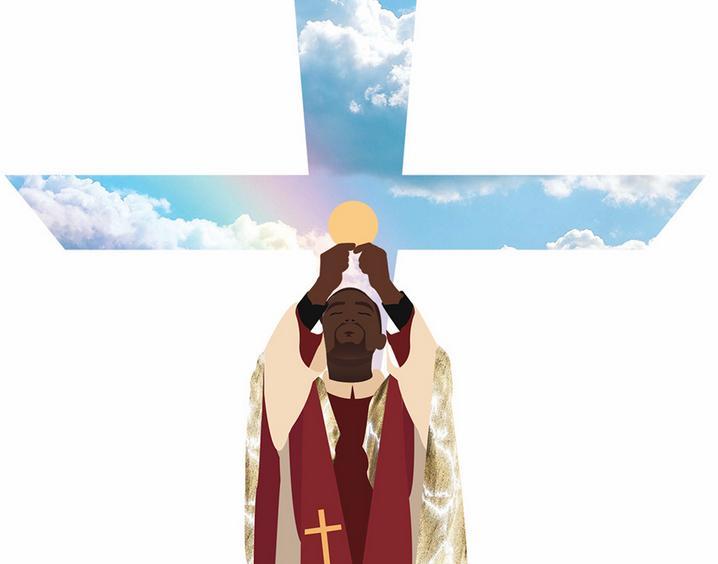
Gracious and loving God, we thank your for the gift of our priests. Through them, we experience your presence in the sacraments.
Help our priests to be strong in their vocation.
Set their souls on fire with love for your people.
Grant them the wisdom, understanding, and strength they need to follow in the footsteps of Jesus. Inspire them with the vision of your Kingdom.
Give them the words they need to spread the Gospel.
Allow them to experience joy in their ministry.


FIRST READING: Wisdom 18:6-9
By the same act with which you took vengeance on our foes you made us glorious by calling us to you.
That night had been foretold to our ancestors, so that, once they saw what kind of oaths they had put their trust in, they would joyfully take courage.
This was the expectation of your people, thesavingofthevirtuousandtheruinoftheirenemies; for by the same act with which you took vengeance on our foes you made us glorious by calling us to you.
The devout children of worthy men offered sacrifice in secret and this divine pact they struck with one accord: that the saints would share the same blessings and dangers alike; and forthwith they had begun to chantthehymnsofthefathers.
Responsorial Psalm: Ps 32:1,12,18-20,22
Response: Happy are the people the Lord has chosen as his own.
1. Ring out your joy to the Lord, O you just; for praise is fitting for loyal hearts. They are happy, whose God is the Lord, the people he has chosen as his own. Response
2. The Lord looks on those who revere him, on those who hope in his love, to rescue their souls from death, to keep them alive in famine. Response
3. Our soul is waiting for the Lord. The Lord is our help and our shield. May your love be upon us, O Lord, as we place all our hope in you. Response
SECOND READING: Hebrews 11: 1-2, 8-19
Abraham looked forward to a city founded, designed and built by God.
Only faith can guarantee the blessings that we hope for, or prove the existence of the realities that at present remain unseen. It was for faith that our ancestors were commended.
It was by faith that Abraham obeyed the call to set out for a country that was the inheritance given to him and his descendants, and that he set out without knowing where he was going. By faith he arrived, as a foreigner, in the Promised Land, and lived there as if in a strange country, with Isaac and Jacob, who were heirs with him of the same
Whether you are just beginning your stewardship journey or have been

promise. They lived there in tents while he looked forward to a city founded, designed and built by God.
It was equally by faith that Sarah, in spite of being past the age, was made able to conceive, because she believed that he who had made the promise would be faithful to it. Because of this, there came from one man, and one who was already as good as dead himself, more descendants than could be counted, as many as the stars of heaven or the grains of sand on the seashore.
All these died in faith, before receiving any of the things that had been promised, but they saw them in the far distance and welcomed them, recognising that they were only strangers and nomads on earth. People who use such terms about themselves make it quite plain that they are in search of their real homeland. They can hardly have meant the country they came from, since they had the opportunity to go back to it; but in fact they were longing for a better homeland, their heavenly homeland. That is why God is not ashamed to be called their God, since he has founded the city for them.
It was by faith that Abraham, when put to the test, offered up Isaac. He offered to sacrifice his only son even though the promises had been made to him and he had been told: It is through Isaac that your name will be carried on. He was confident that God had the power even to raise the dead; and so, figuratively speaking, he was given back Isaac from the dead.
(Shorter Form: Hebrews 11: 1-2. 8-12)
living a stewardship way of life for years, today’s readings invite us to ask ourselves an important question to ponder.
The questions is this: “What do you treasure?” Of course, we all know the “right” answer: we treasure our faith, our family, and our friendships. But Jesus tells us in the Gospel passage
You too must stand ready.
Jesus said to his disciples: ‘There is no need to be afraid, little flock, for it has pleased your Father to give you the kingdom.
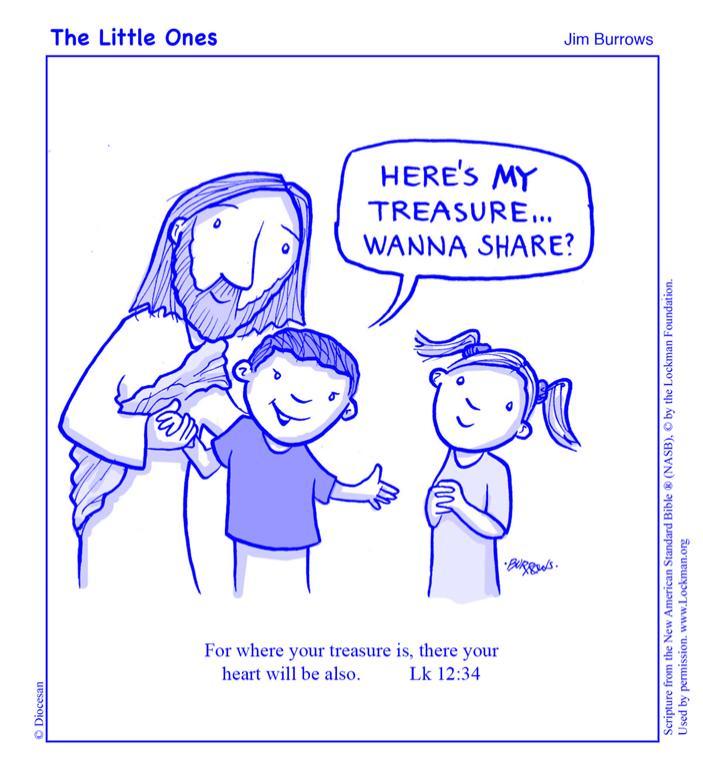
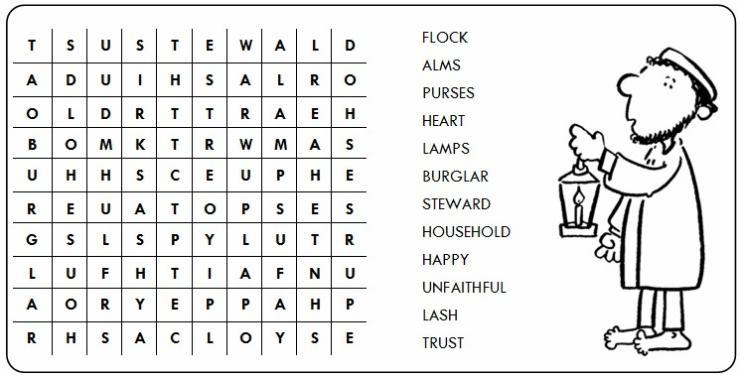
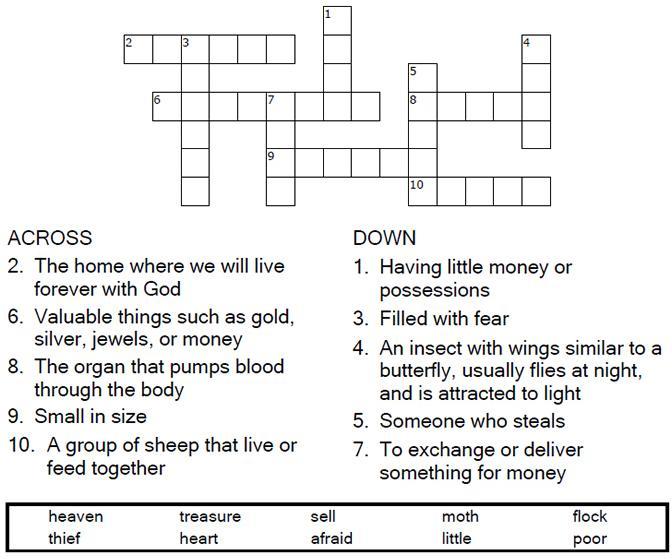
Sell your possessions and give alms. Get yourselves purses that do not wear out, treasure that will not fail you, in heaven where no thief can reach it and no moth destroy it. For where your treasure is, there will your heart be also.
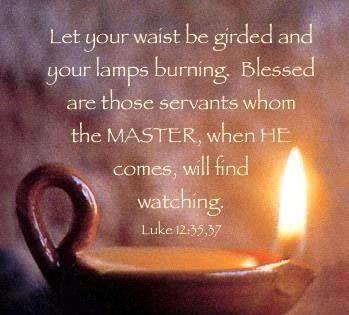
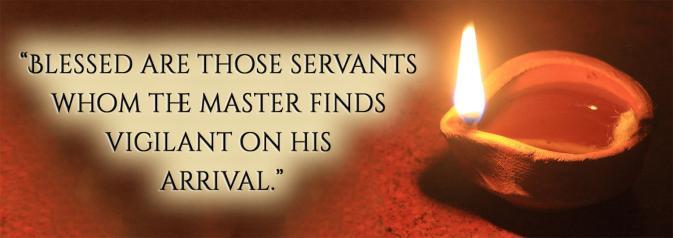
See that you are dressed for action and have your lamps lit. Be like men waiting for their master to return from the wedding feast, ready to open the door as soon as he comes and knocks. Happy those servants whom the master finds awake when he comes. I tell you solemnly, he will put on an apron, sit them down at table and wait on them. It may be in the second watch he comes, or in the third, but happy those servants if he finds them ready. You may be quite sure of this, that if the householder had known at what hour the burglar would come, he would not have let anyone break through the wall of his house. You too must stand ready, because the Son of Man is coming at an hour you do not expect.’
Peter said, ‘Lord, do you mean this parable for us, or for everyone?’ The Lord replied, ‘What sort of steward, then, is faithful and wise enough for the master to place him over his household to give them their allowance of food at the proper time? Happy that servant if his master’s arrival finds him at this employment. I tell you truly, he will place him over everything he owns. But as for the servant who says to himself, “My master is taking his time coming”, and sets about beating the menservants and the maids, and eating and drinking and getting drunk, his master will come on a day he does not expect and at an hour he does not know. The master will cut him off and send him to the same fate as the unfaithful.
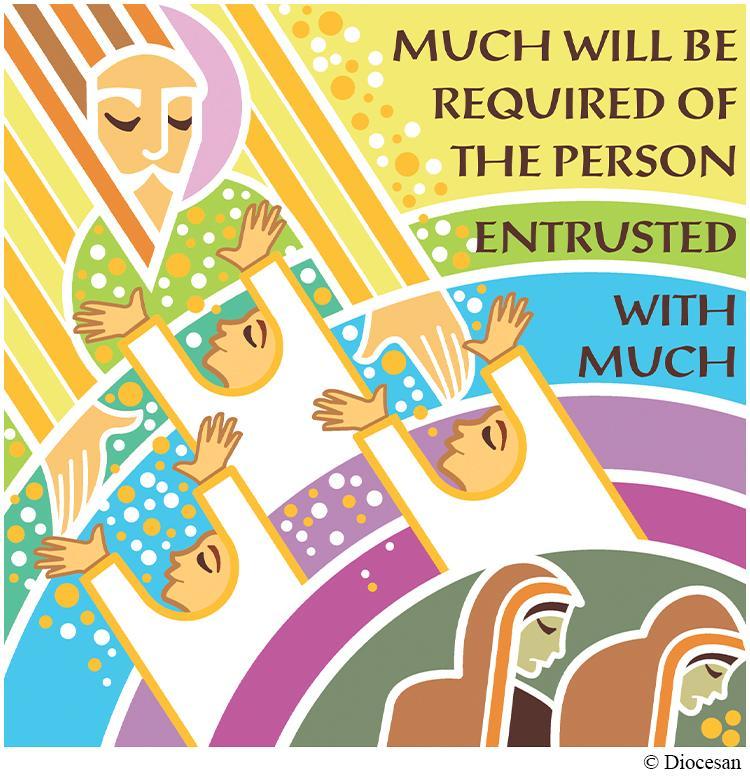
‘The servant who knows what his master wants, but has not even started to carry out those wishes, will receive very many strokes of the lash. The one who did not know, but deserves to be beaten for what he has done, will receive fewer strokes. When a man has had a great deal given him, a great deal will be demanded of him; when a man has had a great deal given him on trust, even more will be expected of him.’ ❖
(Shorter Form: Luke 12: 35-40)
from Luke how we can discover the real answer to this question. He says, “For where your treasure is, there also will your heart be.”
To discern what we really treasure, we need to do a check on our hearts. We can each ask ourselves, “Where do I spend the majority of my energy? Where do I find my thoughts dwelling?
How do I choose to spend my time when I find myself with a few spare moments? What do my spending habits reveal about my what is important to me?
As Christian stewards, we are called to live our lives in grateful response to all that God has given us. Do I recognize and treasure these gifts? ❖
Today’s Gospel contains the advice Jesus gave his disciples when he urged them to be like good and faithful servants who are ever watchful for the coming of their master. He describes the attitude of expectation that should identify his followers of every generation –they wait, prepared, amid difficulties, conflicts and the sameness of each day. Each of the four parables brings out images of Christian expectation – the treasure in heaven, the servants awaiting their master’s return, the burglar who comes when he is not expected and the faithful and unfaithful stewards. These parables are still relevant to each of us individually and to the Church of our day. They ask us to be expectant and at the ready.
“Enough, please!
The following is the first of a new series - The Word and the World - by Deacon Mike James, which will be published monthly in the Catholic Standard:
By Mike James
Last Sunday 3 August, in Sydney, Australia’s largest city, police, after they battled in the Courts and were forced to accept a Judge’s ruling, authorizing a public march across the city’s famous Harbour Bridge in support of the Palestinian people and against the current conduct by Israel of genocide in Gaza. Nevertheless, from buzzing helicopters the police ordered the marchers, ¾ way across the huge 1.15 Kilometer bridge to halt and reverse direction. Fortunately, the multitude, including Australians of all walks of life, with thousands of children obeyed with great discipline. The police, reiterating their opposition to the march, estimated the marchers at 100,000. Organisers estimated the throng at 300,000 (nearly half the entire population of Guyana).
As a reporter for the Manchester Guardian described it, “it felt like a collective wave of energy, hope and determination against institutional and governmental intransigence, denial, obfuscation and enabling that has so many of us feeling despairing, disgusted and disquieted.
“Why aren’t they listening? How is this horror continuing unabated with impunity? Why won’t Australia impose sanctions and call for arms embargos against Israel’s senseless murder of civilians, unleashed by some of the most methodical and lethal autonomous weaponry on Earth and AI machines directing bombs, as claimed by intelligence sources?
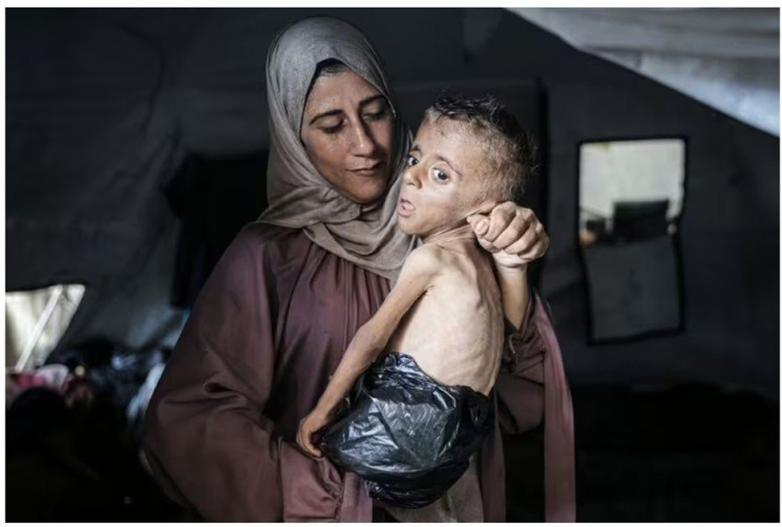
Also last week, The New York Times published on its front page the shocking image of Mohammed Zakaria al-Mutawaq,18 months old, wearing only a garbage bag and held by his mother with the headline "Young, old and sick starve to death in Gaza: There is nothing".
In a follow up article, the Times reported that in addition to malnutrition, the child also suffers from a background of genetic diseases, including cerebral palsy and a lack of oxygen in the blood. Articles on Mohammed Zakaria were carried hundreds of media around the world.
The World Health Organisation (WHO) says malnutrition in Gaza has reached "alarming levels".
There have been at least 74 malnutrition-related deaths in 2025, according to the WHO. Of this total, 63 occurred in July, including 24 children under five, a child over five, and 38 adults.
Land are suffering in a way that cries out to the world to pray for peace, to call for peace, to work for peace.
The historical persecutions of the Jewish people, climaxing in the Shoah, remain on the conscience of the world. For many centuries they have been scapegoated, and anti-Semitism has surged again recently, even in this country. To that too we say: Stop!
For their part, at least since 1948, the Palestinian people have suffered dispossession and discrimination of many kinds and have been victims of frequent violence, climaxing in the atrocities now unfolding. This too has to stop.
We believe that a just ceasefire with the release of all hostages and unhindered access for desperately needed aid are essential at this time. We support global efforts to negotiate a lasting peace.”
The Christian is one who accepts life as a gift that unfolds as we live it, for however hard we may try, we can never have complete control over what happens. The Christian is not discouraged by failures and disappointments but sees them as opportunities for spiritual growth. Our life is a journey into the unknown and is full of uncertainties. But we are conscious that we are not alone on this journey of life. We are journeying as members of a believing community and the faith of the community will support us when our own faith does not measure up. It is a great comfort knowing we can put our faith in God’s hands and so open ourselves to the full grace of God’s protection. ❖
[From: Journeying with the Word of God, The Religious Education Department, Diocese of Georgetown, Guyana ]
As doctors, aid workers and social media feeds document the livestreamed ruins of cities, we watch the killing of children, people killed in tents while sleeping, starving people fired upon and killed at aid stations, forced by their hunger to play Russian roulette with their lives.
Sixty thousand human souls, around half of them women and children, dead and tens of thousands more maimed, injured without mercy or relief. Twenty-one months of a nightmare for Palestinians that beggars belief.”
The whole city turned up, not just students and activists, but middleclass grandmothers and parents with prams. What was most striking were the children. Parents with toddlers astride their shoulders, holding little ones gently by the hand as they stood patiently in raincoats in the crowds, or cradling their small sleeping heads on their shoulders, holding signs, all saying the same thing: killing and starving children, children just like ours, is wrong and we do not consent.
"Most of these people were declared dead on arrival at health facilities or died shortly after, their bodies showing clear signs of severe wasting," the organisation said. "The crisis remains entirely preventable. Deliberate blocking and delay of large-scale food, health, and humanitarian aid has cost many lives."
In May 2024, the Australian Bishops issued a desperate call for the killing to stop in Gaza. They said in part:
“The violence in the Holy Land has shaken many people around the world. We too, have been shaken. We care deeply for the people of the Holy Land - Jews, Christians and Muslims. They are our brothers and sisters. We care for the Holy Land because it was the home of Jesus Christ and its story is unimaginable without Christianity. With Pope Francis, we put our faith in the possibility of a just resolution to the worsening crisis between Israelis and Palestinians. With him we say: “Enough, please! Let us all say: Stop! Please stop!”. The people of the Holy
The First Readings in the liturgy of the Word for the last two weeks have followed the “Chosen People” in the Book of Exodus from Egypt to the Promised land which included the then Land of the Philistines (from which the name Palestine is derived), which is today the area of Gaza. The Zionist “justification” for the current genocide in Gaza is partly based on their claim that this region is their inheritance given them from God through Abraham.
But in the New Testament, we are warned time and again, that true peace is not the inheritance of any race or group exclusively. John the Baptist in Matthew’s gospel 3: 911could not put it more bluntly:
“Produce fruit in keeping with repentance. Do not presume to tell yourselves, ‘We have Abraham as our father,’ because I tell you, God can raise children for Abraham from these stones. Even now the axe is being laid to the root of the trees, so that any treefailingtoproduce good fruit will be cut down and thrown on the fire.” A message for the entire world. ❖
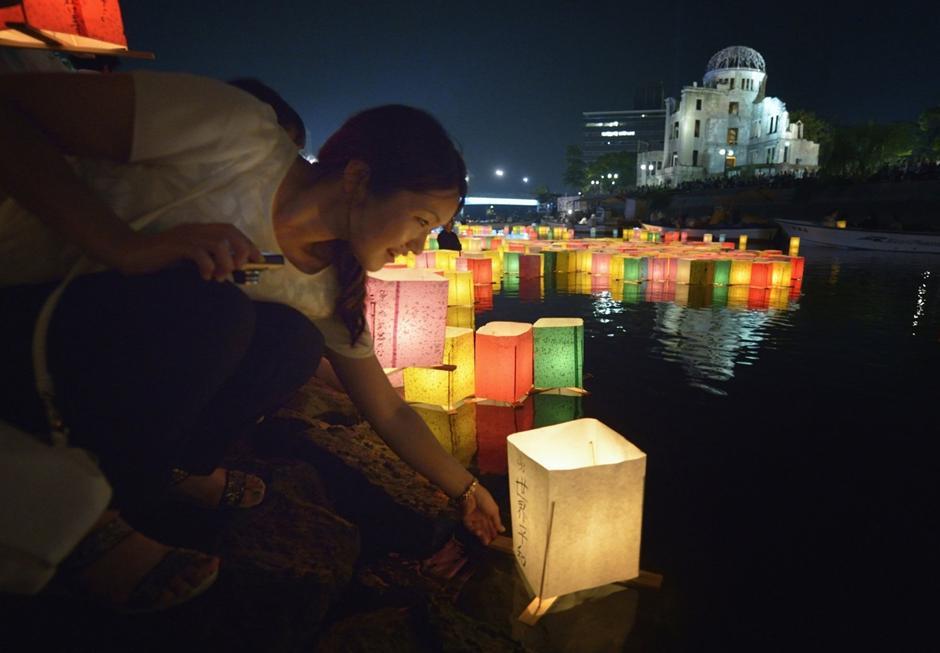
VATICAN CITY (CNS) The scars still borne by survivors of the atomic bombings of Hiroshima and Nagasaki and still visible on the cities’ streets and buildings are a plea to pursue peace and disarmament, Pope Leo XIV said.
“True peace demands the courageous laying down of weapons especially those with the power to cause an indescribable catastrophe,” the pope wrote in a message to Bishop Alexis Mitsuru Shirahama of Hiroshima.
“Nuclear arms offend our shared humanity and also betray the dignity of creation, whose harmony we are called to safeguard,” he wrote in the message released at the Vatican Aug. 5.
The pope’s message was sent as people gathered from around the world to solemnly mark the 80th anniversary of the U.S. bombing of Hiroshima Aug. 6, 1945,andNagasaki Aug.9,1945.
Pope Leo also marked the anniversary Aug. 6 at the end of his weekly general audience with thousands of people gathered in St. Peter’s Square.
“Despite the passing of the years, those tragic events remain a universal warning against the devastation caused by wars, and
in particular by nuclear weapons,” the pope said. “I hope that in today’s world the illusory security based on the threat of mutual destruction will give way to the tools of justice, the practice of dialogue and trust in fraternity.”
The bombings killed more than 150,000 people, mostly civilians, and left the cities in ruins.
In his message, Pope Leo conveyed “sentiments of respect and affection for the ‘hibakusha'” or survivors of the bombings, “whose stories of loss and suffering are a timely summons to all of us to build a safer world and foster a climate of peace.”
The pope noted how even after 80 years, “the two cities remain living reminders of the profound horrors wrought by nuclear weapons. Their streets, schools and homes still bear scars both visible and spiritual from that fateful August of 1945.”
“In this context,” he said, “I hasten to reiterate the words so often used by my beloved predecessor Pope Francis: ‘War is always a defeat for humanity.'
”
Today, at a time of “mounting global tensions and conflicts,” he wrote, Hiroshima and Nagasaki are signs “that urge us to reject the illusion of security founded on mutually assured destruction. Instead, we must forge a global ethic rooted in justice, fraternity and the common good.”
Pope Leo prayed that the 80th anniversary of the bombings would “serve as a call to the international community to renew its commitment to pursuing lasting peace for our whole human family ‘a peace that is unarmed and disarming,'” he said, quoting a phrase he used when addressing the crowd in St. Peter’s Square immediately after his election May 8.❖
MAKING THE WORD OF GOD YOUR OWN
Step 1: Lookattoday’sReadingsprayerfully.
1st Reading: Just as God came to the rescue of the Jews in Egypt, so he will save those who put their trust in him.
2nd Reading: We are called to imitate the faith of Abraham, our ‘father in faith’, who journeyed into the unknown while putting himself fully in God’s hands.
Gospel: The parables in today’s Gospel urge a constant watchfulness and faithfulness.
Step2:ApplyingthevaluesoftheReadings toyourdailylife.
1.Reflect honestly on your own life. Would you say youareopenandreadyforthecomingoftheLord?
2.What do you feel you need to change in your life, what baggage you need to let go of, in order to be more open and ready for the coming of the Lord?
3.How do you experience God’s kingdom breaking into your own life? Sometimes it is difficult to recognise this because we are not normally conscious of it.
4.“We are not remembered for how we die but rather for how we live.” What is this statement saying to you?
Step 3: Accepting the message of God’s Wordinyourlifeoffaith.
Today’s Gospel speaks of what a basic Christian attitude is like – the expectation and belief in the coming of God’s kingdom into our lives and into our world. It doesn’t matter whether or not we have done everything we would like to have done. All that matters is the spirit of our service to God and to others. As Mother Teresa said: “We are not called to be successful, only to be faithful.”
Step 4: Somethingtothink&prayabout
1.List all the things you need to change in your life and work diligently at making all the changes you have listed.
2.Try to cultivate an attitude of readiness as suggested in the Gospel message today. Think of ways you can help others to develop the same attitude.
3.How do you feel you are called to live out the Gospel message this coming week. How do you expect to put this into practice?
4.In what way do you hear the Lord asking to be invited into your life? Do you think there is anything keeping you from letting God into your life?
5.Pray thatyoumay never loseyour trustin God when facedwiththefearsandanxietiesofthefuture. ❖
[From: Journeying with the Word of God, The Religious Education Department, Diocese of Georgetown, Guyana ]
The Antilles Episcopal Conference (AEC) held their 69th Annual Plenary Meeting from May 11–16 in the Archdiocese of Kingston, Jamaica. The English-speaking Caribbean’s first professor of Caribbean Theology and Ethics, Professor Anna Kasafi Perkins addressed the bishops on May 15 on youth (part 1 – July 25 issue), social justice, and the evolving digital landscape (part 2 – August 1 issue). In this part 3 conclusion, she addresses theenvironment.
The fourth critical issue demanding our immediateand sustained attention is the escalating climate crisis and its profound impact on our Caribbean nations. Our islands are uniquely vulnerable to the devastating effects of climate change, facing rising sea levels, more intense hurricanes, prolonged droughts, and altered rainfallpatterns.
The consequences are already being felt across our communities, threatening livelihoods, infrastructure, andthevery fabricofourislandlife.
When Bob (Marley) laments that “there is so much trouble in the world”, he never envisioned the levels of devastation caused by the climate crisis, as PM Mottley calls it.
The scientific evidence is stark. We are the victims of “scientific atrocity” and “technological inhumanity in a world that forces lifelong insecurity”, as Marley mourns in ‘Black Survivors’. A world we did not make, as Mia Mottley remindsworld leaders.
Sea levels in the Caribbean are rising at a rate faster than the global average, with projections indicating a potential increase of up to one metre by the end of the century. This threatens coastal communities, contaminates freshwater sources, and erodes our shorelines, impacting vital sectorsliketourism.
We are also witnessing an increase in the frequency and intensity of extreme weather events. Hurricane Beryl, for example, reached Category 5 intensity earlier in the season than any storm on record, causing widespread destruction.
These events not only cause immediate devastation but also hinder long-term economic development, diverting scarce resources towards recoveryand reconstruction.
Our agricultural sector, a cornerstone of many Caribbean economies, is also under threat from changing rainfall patterns and prolonged droughts, impacting food security and livelihoods.
The AEC has already recognised the urgency of this crisis. Our 2005 Pastoral Letter, CaringfortheEarth–Our Responsibility, called for reflection and action on ecological challenges, emphasising our role as stewardsofGod’screation.
The 2015 Declaration on Climate Change further highlighted the significant threat to Caribbean life and

urged a global commitment to limit temperature increase. These statements align with Pope Francis’ encyclical Laudato Si’, which calls for an integral ecological conversion and emphasises the interconnectedness of allcreation.
To address this critical issue, we must strengthen our advocacy for climate justice at local, regional, and international levels. We need to promote sustainable practices within our Church communities and encourage our faithful to adopt more environmentally conscious lifestyles, echoing the call for simplicity in our pastoralletters.
(I have a PhD student looking at theocentric values and recycling. To my shame, I wasn’t able to point her to one Roman Catholic Church involved formally in recycling, and I haven’t done anything about it beyond continuing my personal efforts to recycle.)
Collaborating with governments, civil society organisations, and other faithbased groups is essential to develop and implement effective adaptation andmitigationstrategies.
We must also continue to raise awareness about the disproportionate impact of climate change on the poor and vulnerable within our societies, ensuring that climate action is rooted in principles of justice and equity. Furthermore, supporting initiatives that promote renewable energy and sustainable development across our islands is crucial for building a more resilient future.
In conclusion, my brother bishops and clergy, fellow panellists, the challenges before us are significant but not insurmountable. The diminishing engagement of our youth, the persistent scourge of crime and violence, the imperative to embrace
the digital landscape, and the escalatingclimatecrisisall demandour focused attention and concerted action.
However, as evidenced by our rich history of pastoral engagement and the insights gleaned from our recent synodal journey, the Church in the Antilles possesses the resilience, the
navigate these complex issues. Let us move forward with prayerful determination, drawing strength from our shared faith and working collaboratively to ensure a vibrant and impactful future for the Church in the Antilles and the safeguarding of our precious island homes, “for we’ve got no time to lose”, as Marley exhorts us in the ‘Black Survivors ❖ (From The
Dear Girls and Boys,
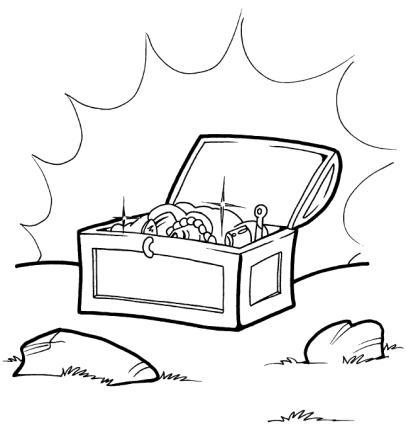
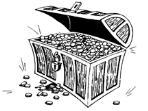
Hunting for treasure is something that has interested people for a long, long time. Have you ever been to a party where they played a Treasure Hunt game? It is great fun! The game is played by giving each player a list of clues which, if followed correctly, will lead them to find a "treasure." Many times the treasure is just a cheap toy or a sweet, so when you play the game, it is important to remember that the fun is in the hunt, not in the "treasure."
You might be surprised to know that Jesus had something to say about seeking treasure. One day he said to his followers, “Sell your possessions and give alms. Get yourselves purses that do not wear out, treasure that will not fail you, in heaven where no thief can reach it and no moth destroy it. For where your treasure is, there will your heart be also.” (Luke 12:33 So, how do we lay up treasures in heaven as Jesus said we should? We do it by taking our eyes off of our own selfish wants, and look at others and their needs. We give to the poor, we help those in need, we love others as we love ourselves. Those are things that will build treasures in heaven and there is nothing that can take them away.
Playing a Treasure Hunt game is fun, but building treasure in heaven is very serious business. Let's ask God to help us to search for the right kind of treasure.
Father, we sometimes look at all the treasures that this world offers and we lose sight of what you want from us. Help us to serve you by helping others and, in so doing, build our treasure chest in heaven. In Jesus' name we pray, Amen. ❖
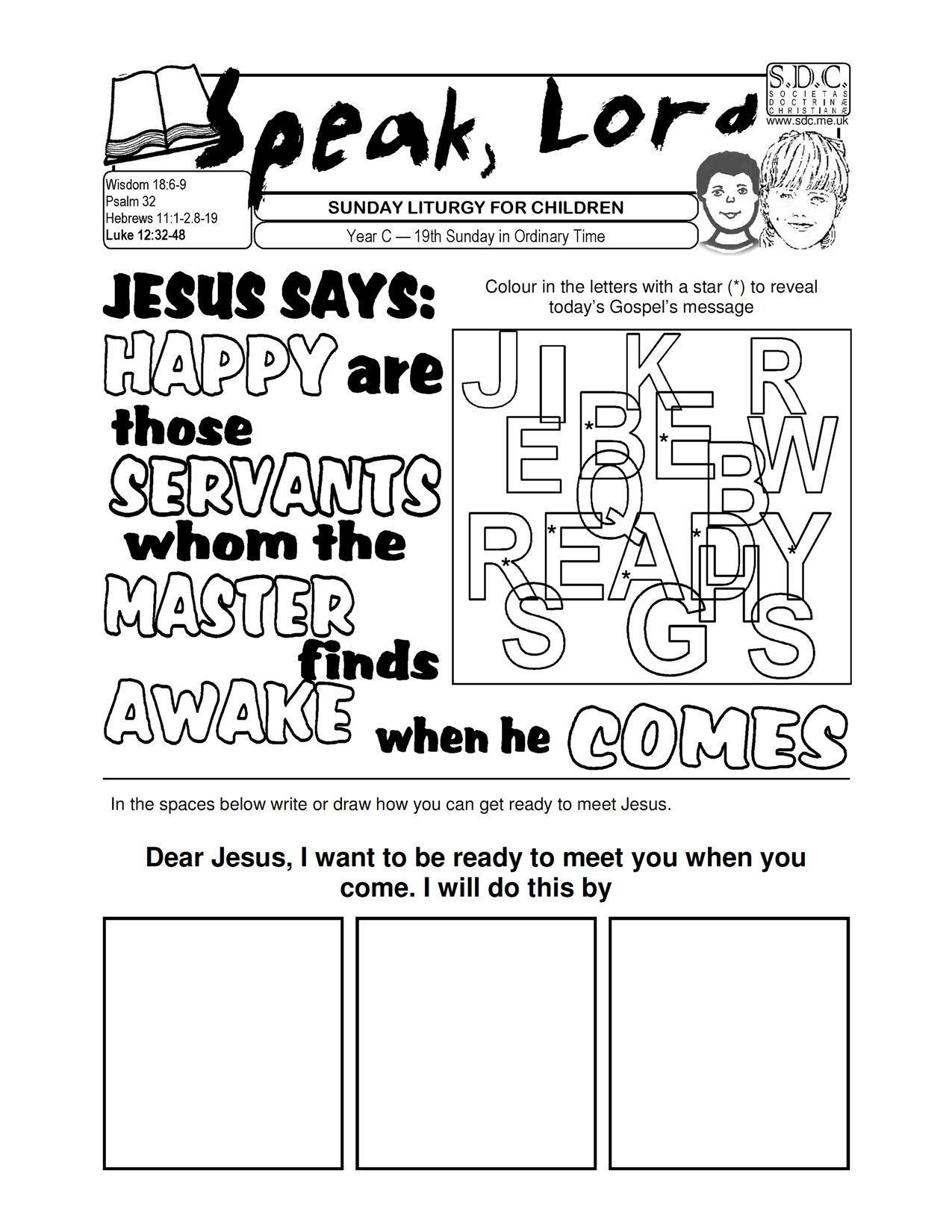
Treasures in Heaven
Get yourselves purses that do not wear out, treasure that will not fail you, in heaven where no thief can reach it and no moth destroy it. Luke 12:33b-34
[ NFC - Sources: http://www.sdc.me.uk , http://www.catholickidsbulletin.com/, http://www.sermons4kids.com , http://www.salfordliturgy.org.uk & https://thekidsbulletin ]

Dear Editor,
At different times, we are called upon as leaders. Some as mothers and fathers, others as CEOs and presidents and yet others as priests and bishops. Whatever form of leadership we are called to, let us exercise it with one thing in mind. People don’t fail because they want to fail. People fail because they don’t know how to succeed.
People need guidance to discover and realize their highest potential. Guidance can come from an authentic leader.
Authentic leaders lead by example men and women willing to lead humanity along the right path with the example of their own lives.
Authentic leadership have been universally proven throughout human history, whether in business, in battle, in the sporting arena, or in church. People would not mind the heat if you sweat with them, and they would not mind the cold if you shiver with them.
Our Lord Jesus Christ, the greatest leader of all time, did not come to be served. Jesus came to serve. Jesus washed his disciples’ feet and dried them with the towel around his waist. He said to them "you call me 'teacher' and 'master', and rightly so, for indeed I am.
If I therefore have washed your feet, you ought to wash one another's feet. I have given you a model to follow so that as I have done for you, you should also do." The model of leadership that our Lord Jesus Christ left us was one of service and sacrifice.
Leon Jeetlall
Dear Editor,
Greetings in the peace of Christ. I write not in criticism but out of a genuine concern as a member of our Diocesan family. It has come to my attention that several parish and group activities are often scheduled on the same day or weekend, creating overlaps that may unintentionally divide our participation and support. Recently, events such as those hosted by Meadowbank, Sacred Heart, Our Lady of Fatima, and the Charismatic
group were scheduled around the same time. While each activity is important and contributes meaningfully to the spiritual life of our Church, these scheduling overlaps make it difficult for the faithful to attend or support more than one initiative especially those who would love to show solidarity with multiple communities.
Perhaps, through your office , we could explore a simple coordination mechanism possibly encouraging parishes
and groups to submit their planned events ahead of time. This could help avoid scheduling conflicts and allow for greater participation across the Diocese.
As one Diocesan family, we all benefit when we can stand with and support each other.
Thank you for the continued good work in keeping us informed and connected.
Regards, Concerned Catholic
By Renika Anand
Wayne Dyer, an American author and speaker once said “If you change the way you look at things, the things you look at change.”
Each of us, during the course of our lives, begin to wear our own unique pair of tinted glasses. The colour of these glasses are shaped by our experiences, and the beliefs that we harbour as individuals. As we see the world through our glasses, everything around us takes on the colour of this tint.
Oftentimes, we can even forget that we are wearing glasses in the first place, and begin to believe that the world truly exists in the way they appear through our glasses.
Unfortunately, unlike a pair of real glasses, our perspective cannot be taken off at will. This means that there are some things thatwe willsimplynever see in the manner that it exists, or even in the manner that another person is seeing them. As we meet different people and encounter new situations, we must always remember that there is a different way to see everything we do.
Most importantly, as we see the world, we must understand that we may not always see the full picture, and always attempt to direct our perspectives to things that are not visible to us, or things that we do not yet fully understand.
So we fix our eyes not on what is seen, but on what is unseen, since what is seen is temporary, but what is unseen is eternal - 2 Corinthians 4:18 ❖


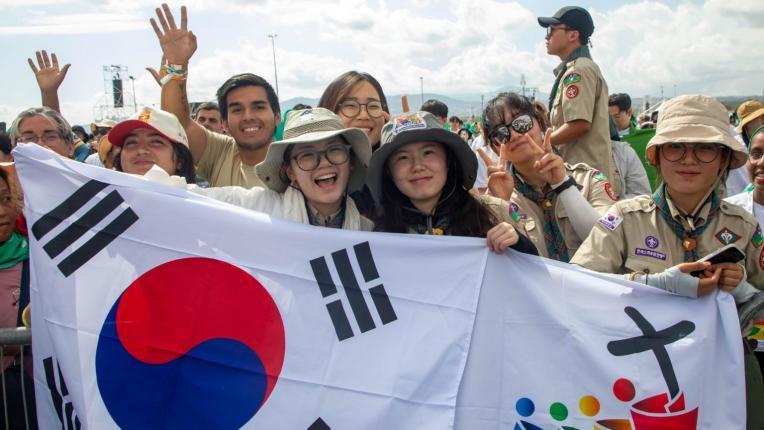
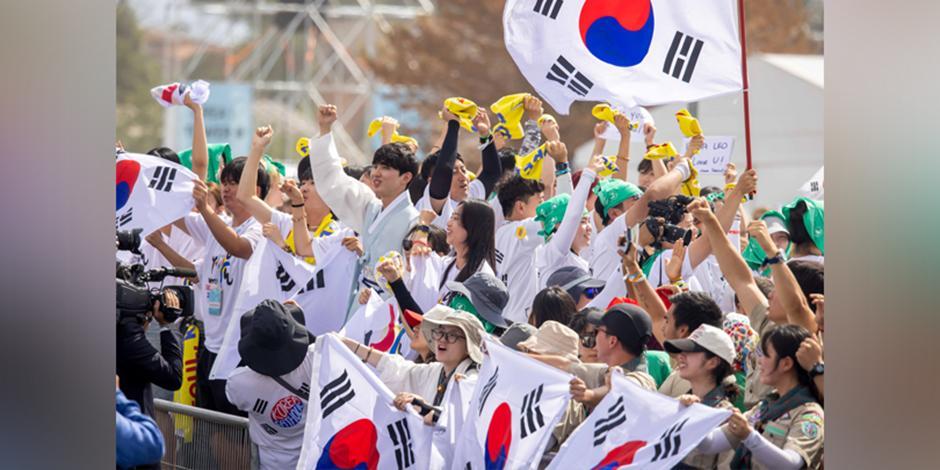
Pilgrims from South Korea wave flags and cheer as they participate in a Mass closing the Jubilee of Youth in Rome’s Tor Vergata neighborhood Aug. 3, 2025. (CNS/Pablo Esparza)
(CathNews) - The next World Youth Day, scheduled for August 3-8, 2027, will mark a historic milestone for the Church: the first time the global gathering of Catholic youth will be held in a non-Christian country. Source: CNA.
Bishop Paul Kyung-sang Lee, general coordinator of World Youth Day Seoul 2027 and auxiliary bishop of Seoul, emphasised the significance of the event during the recent Jubilee of Youth in Rome.
“Korea is the first non-Christian country to host World Youth Day,” Bishop Lee said. “At the same time, it’s the only nation that is divided in two. So, the main theme should be peace – peace between religions, peace between two countries.”
“I want to see the young people enjoying the immense love of God,” he added. “So that the next generation won’t send their children to war
This is my hope.”
South Korea, where approximately 31 per cent of the population is Christian and 51 per cent reports no religious affiliation, has seen a steady growth in conversions to Catholicism. Fr Isaac Severo, of Seoul’s Myeongdong
Cathedral, said about 40 young adults are baptised each month at the cathedral.
“They go to the church and they ask, ‘How can I receive the baptism?’” he said.
In 2023, more than 51,000 people in Koreawerebaptised.
Catholics make up about 11 per cent of South Korea’s population of 52 million people. More than half of the population lives in Seoul’s metropolitan area, making the city among the largest metropolitan areas in the world.
Pope Leo XIV formally announced the 2027 World Youth Day dates during the closing Mass of the Jubilee of Youth on August 3 in Tor Vergata in Rome in the presence of about 1 million young people.
“After this jubilee, the ‘pilgrimage of hope’ of young people continues and will take us to Asia,” Pope Leo said.
“You, young pilgrims of hope, will be witnesses of this to the ends of the earth! I look forward to seeing you in Seoul: Let us continue to dream together and to hope together.”❖
ROME (CNS)
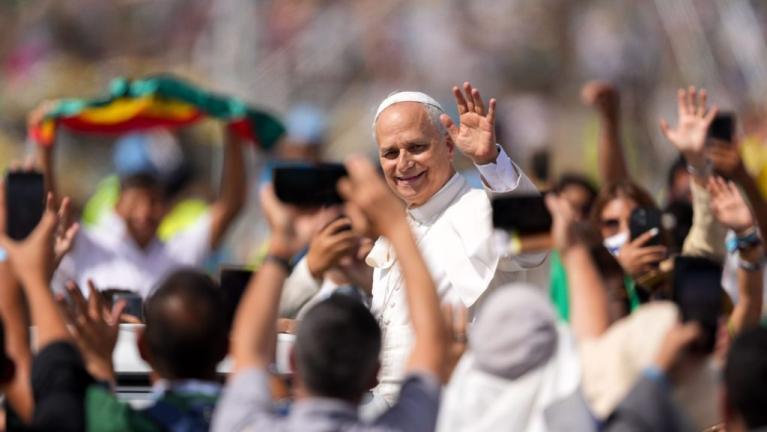
depends on how much one joyfully welcomes and shares in life while also living with a constant yearning for those things that only come from God, Pope Leo XIV told young people.
"Aspire to great things, to holiness, wherever you are. Do not settle for less. You will then see the light of the Gospel growing every day, in you and around you," he said in his homily during Mass concluding the Jubilee of Youth Aug. 3. The outdoor Mass, held in Rome's Tor Vergata neighborhood on the outskirts of the city, marked the culmination of a week-long series of events for the Jubilee of Youth.
More than 1 million people were estimated to be gathered across the 130 acres that had been prepared for the morning Mass, the prayer vigil the evening before, and for the hundreds of thousands of people sleeping overnight. After touching down by helicopter less than 12 hours after leaving the evening
vigil, the pope rode in the popemobile dotted with tents and tarps, and filled with young people, cheering, waving their nation's flag, and sometimes launching at him shirts and gifts.
"Good morning!" he said in six languages from the massive stage set up for the Mass.
"I hope you all rested a little bit," he said in English. "We will shortly begin the greatest celebration that Christ left us: his very presence in the Eucharist."
He said he hoped the concluding Mass would be "a truly memorable occasion for each and every one of us" because "when together, as Christ's church, we follow, we walk together, we live with Jesus Christ."
In his homily during the Mass, the pope again highlighted the importance of the Eucharist, as "the sacrament of the Lord's total gift of himself to us."
It is Christ, the Risen One, he said, "who transforms our lives and enlightens our affections, desires and thoughts."
"We are not made for a life where everything is taken for granted and static, but for an existence that is constantly renewed through the gift of self in love," he said.
Much like a field of flowers, where each small, delicate stem may dry out, become bent and crushed, he said, each flower is "immediately replaced by others that sprout up after them, generously nourished and fertilized by the first ones as they decay on the ground. This is how the field survives: through constant regeneration."
"This is why we continually aspire to something 'more' that no created reality can give us; we feel a deep and burning thirst that no drink in this world can satisfy," he said. "Knowing this, let us not deceive our hearts by trying to satisfy them with cheap imitations!"
Pope Leo urged the young people to listen to that yearning and "turn this thirst into a step stool, like children who stand on tiptoe, in order to peer through the window of encounter with God," who has been "waiting for us, knocking gently on the window of our soul."
"It is truly beautiful, especially at a young age, to open wide your hearts, to allow him to enter, and to set out on this adventure with him towards eternity,"hesaid.
Speaking briefly in English, the pope said, "There is a burning question in our
hearts, a need for truth that we cannot ignore, which leads us to ask ourselves: what is true happiness? What is the true meaning of life? What can free us from being trapped in meaninglessness, boredom and mediocrity?"
"Buying, hoarding and consuming are not enough," he said. The fullness of existence "has to do with what we joyfully welcome and share."
"We need to lift our eyes, to look upwards, to the 'things that are above,' to realize that everything in the world has meaning only insofar as it serves to unite us to God and to our brothers and sisters in charity, helping us to grow in 'compassion, kindness, humility, meekness and patience,' forgiveness and peace, all in imitation of Christ," he said.
Evoking St. John Paul II's words during the XV World Youth Day prayer vigil held in the same spot 25 years ago, Pope Leo reminded the young people that "Jesus is our hope."
"Let us remain united to him, let us remain in his friendship, always, cultivating it through prayer, adoration, Eucharistic communion, frequent confession, and generous charity, following the examples of Blessed Pier Giorgio Frassati and Blessed Carlo Acutis, who will soon be declared saints," he said.
Wishing everyone "a good trip home," he encouraged the young people to "continue to walk joyfully in the footsteps of the Savior, and spread your enthusiasm and the witness of your faith to everyone you meet!" ❖
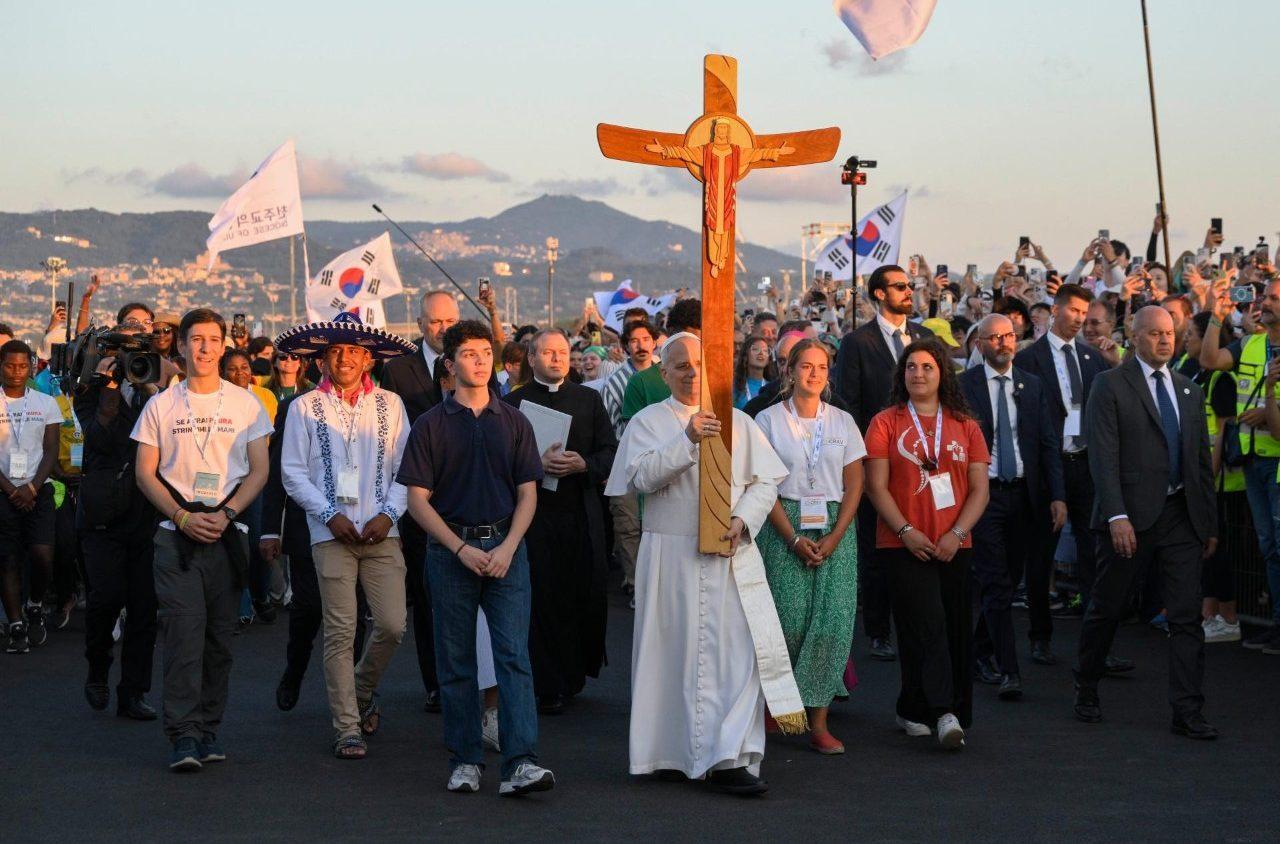
(CNA) - Roughly 1 million young adults from around the world filled the streets of Rome for the Jubilee of Youth, which took place July 28 to Aug. 3, part of the yearlong Jubilee of Hope. Each day was filled with different opportunities and events for the young people to experience the richness of the Catholic faith. Here are some of the best moments from the Jubilee of Youth: Pope Leo XIV arrives by helicopter at Tor Vergata
On Aug. 2, Pope Leo XIV was greeted by the largest crowd he has addressed during his pontificate so far for the evening vigil at Tor Vergata, an outdoor venue 10 miles east of Rome. An estimated 1 million people were in attendance. The Holy Father arrived by helicopter and then drove through the grounds on the popemobile, waving to the cheering young people before the prayer service began.
Pope Leo XIV carries the pilgrim cross of the Jubilee of Hope
After the Holy Father from the popemobile greeted the young people in attendance, he carried the pilgrim cross of the Jubilee of Hope on foot from the crowd up to the 15,000-square -foot stage for prayers and Eucharistic adoration.
Despite the sweltering heat, the Holy Father carried the cross with energy so much so that a video of Pope Leo walking briskly with the cross and the words “Life goals: Climbing the stairs like Pope Leo at age 69” went viral with over a million views.
Some of the comments on the post included: “imagine having Pope Leo as a workout buddy,” “the stairmaster of holiness,” and “his personal trainer must be proud.”
Eucharistic adoration with Pope Leo
The evening vigil concluded with Eucharistic adoration led by the Holy Father. Many were moved by the stillness and silence of all those in the presenceofChrist.
Pope Leo also imparted on the faithful gathered the Eucharistic Benediction. At the conclusion of the evening, he advised the young people gathered who would be camping for the evening to “take it easy” and “rest a bit. We have a date tomorrow morning here for holy Mass.”
Open-air confession at Circus Maximus
On Friday, Aug. 1, the Circus Maximus where Christians were once martyred for their faith was transformed into an open-air confessional for thousands of young pilgrims to receive the sacrament of reconciliation. Two hundred confessionals were set up from 10:30 a.m. to6 p.m. Rome time.
Closing Mass with Pope Leo
The Jubilee of Youth concluded on Aug. 3 with a Mass celebrated by Pope Leo on the 237-acre grounds of Tor Vergata, where more than a million young pilgrims had spent the night following a prayer vigil and Eucharistic adoration.
In his homily, Pope Leo invited the pilgrims to open their hearts to God and
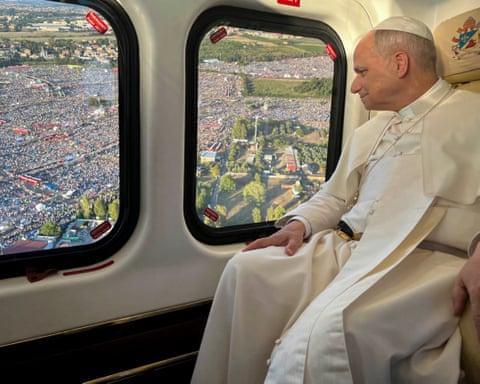
Pope Leo XIV arrives by helicopter to the Jubilee of Youth prayer vigil.
“It is he, as St. John Paul II said, ‘who stirs in you the desire to do something great with your lives ... to commit to improving yourselves and society, making the world more human and more fraternal,’” Leo said.
Remembering Jubilee 2000 at Tor Vergata 25 years later
In 2000, Pope John Paul II celebrated World Youth Day at Tor Vergata with over 2 million young people. Despite being physically weak at the time, the
beloved Polish pope made a connection five years later, it was Pope Leo who made a connection with the new generation of young Catholics. The similarities between the two events were unmistakable, and many of those who were in attendance in 2000 now watched along as their children attended the Jubilee of Youth.
On an Instagram post made by CNA, one user commented: “I was at Tor Vergata in 2000. Now my son is at the Jubilee of Youth. The Church is alive.”
Another wrote: “Attended WYD in 2000. Life-changing. Emmanuel - the Word was made flesh and dwelt among us.” ❖
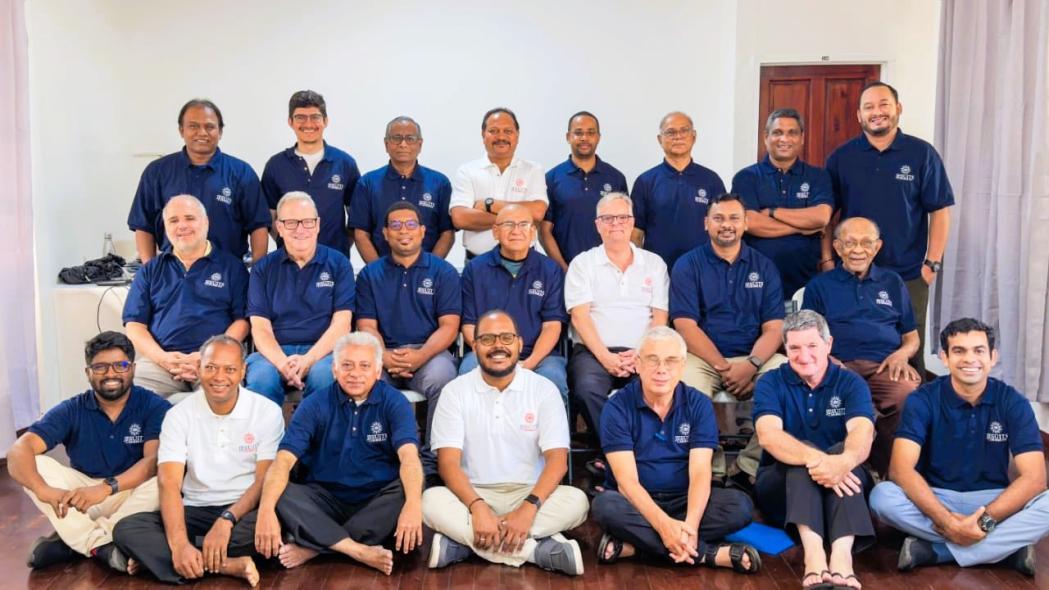
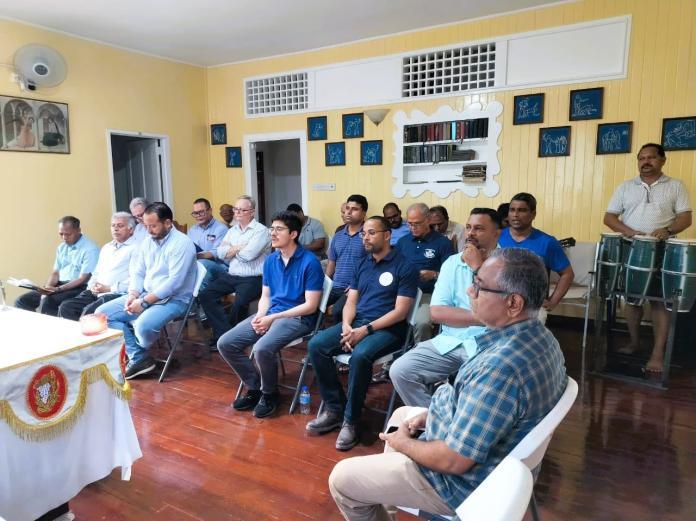
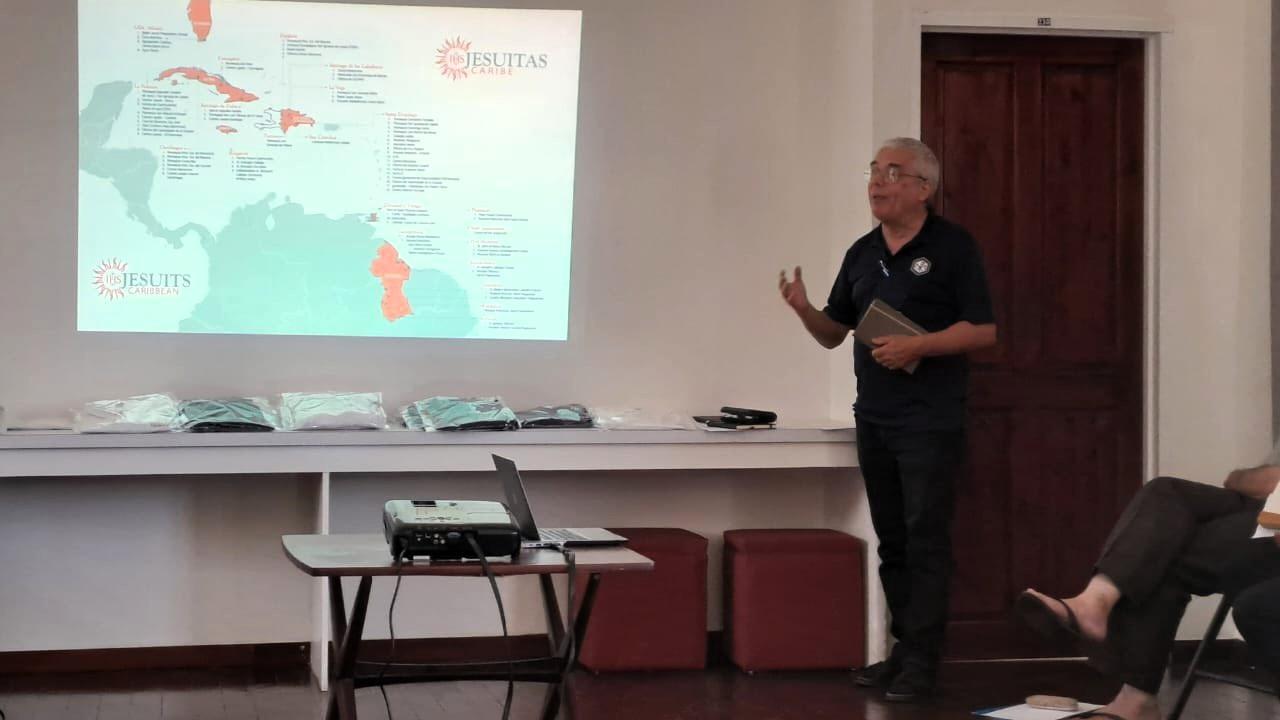
From August 4th to 8th, 21 Jesuits who are serving in the Caribbean Province came together in Georgetown for their annual meeting. The Caribbean Province is comprised of Jesuits from Cuba, Miami, Jamaica, Trinidad, Guyana, andtheDominicanRepublic. The Jesuits in the Caribbean serve in the areas of Spirituality, Parish Ministry, Education, Migrant MinistryandEcology. ❖
(1894 - 1941)
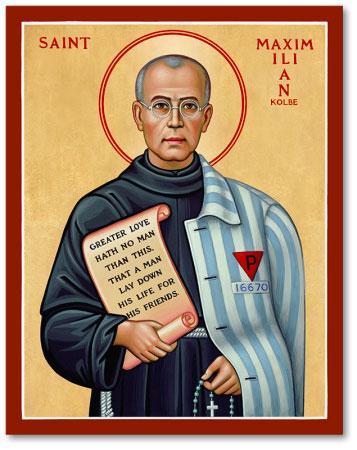
Saint Maximilian Mary Kolbe was born in Polandin1894andbecameaFranciscanin1910. He was arrested by the invading German forces in 1939 and sentenced to heavy labour in the extermination camp at Auschwitz. When a married man with children was one of ten men chosen to be executed because a prisoner had escaped, Maximilian volunteered to take his place. In the “block of death” they were ordered to strip naked, and their slow starvation began in darkness. But there was no the prisoners sang. By the eve of the Assumption four were left alive. The jailer came to finish Kolbe off as he sat in a corner praying: he was killed by lethal injection on He was canonised in 1982 in the presence of the man whose life he saved.
Comment: Father Kolbe’s death was not a sudden, last minute act of heroism. His whole life had been a preparation. His holiness was a limitless, passionate desire to convert the ❖
[franciscanmedia.org & salfordliturgy.org ]

sort of tax dodge?