
Just Electoral Peace in Guyana: Faith leaders &
civil society to launch initiative
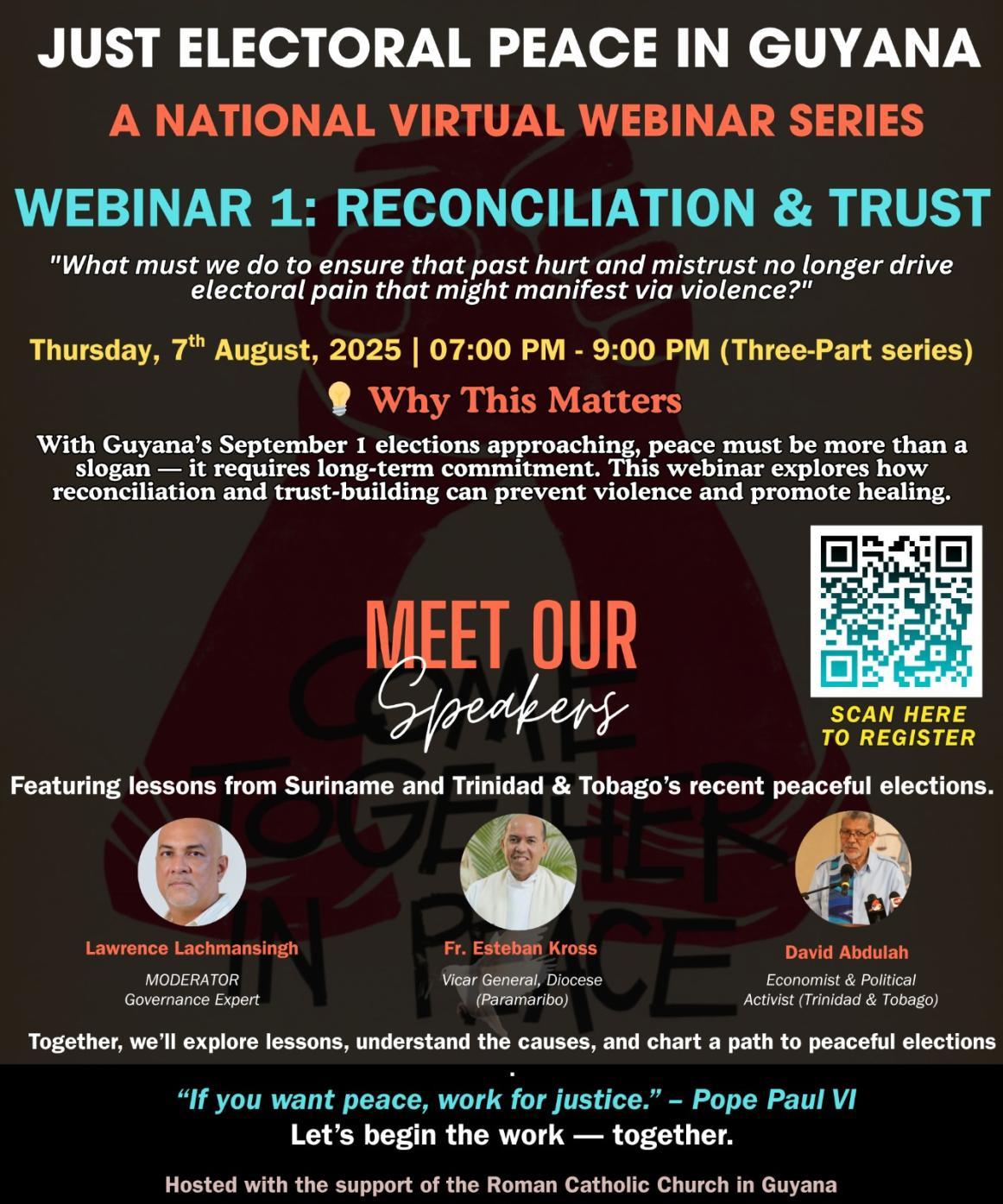
As Guyana approaches elections on September 1, a new civil society initiative backed by the Roman Catholic Church aimed at fostering a lasting and just electoral peace inGuyana will soonbe launched.
The initiative, titled "Just Electoral Peace in Guyana", will bring together political stakeholders, civil society leaders, and the wider public for a three-part webinar series focused on trust, system strengthening, and shared national values. The online dialogue begins August 7 and runs until August21.
The goal is to create safe spaces for Guyanese citizens and leaders to confront hard questions about reconciliation, constitutional reform, and trust in electoral systems issues that, if left unaddressed, risk fueling the tensions that often erupt before andafter elections.
The Roman Catholic Church in Guyana is lending its institutional support to the initiative, inspired by Pope Francis’ encyclical Fratelli Tutti, which calls for greater global use of dialogue to address political andsocial conflict.
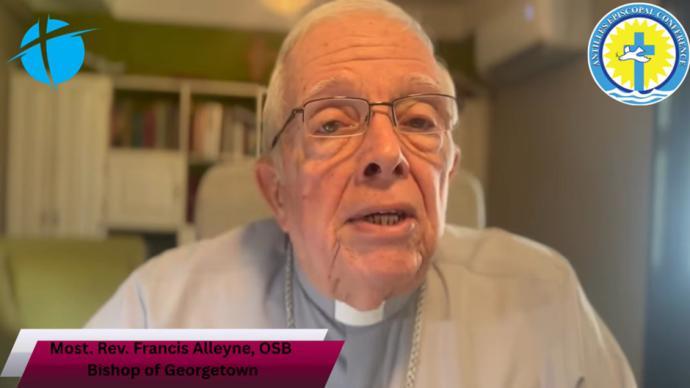
“The Church stands ready to help build bridges where divisions exist,” said Bishop Francis Alleyne OSB, who is part of the working group alongside Dr. David Singh, Lawrence Lachmansingh, Sara Bharrat,and Vanessa Williams.
Below is the text of a video message by Bishop Francis Alleyne ontheJustElectoralPeaceinitiative: Webinar Series | Towards Peaceful and Transparent ElectionsinGuyana
“Building Trust, Strengthening Systems,UpholdingValues”
Looking at the recent incident-free and democratic elections in our neighbouring countries Suriname and Trinidad & Tobago the time is ripe for Guyana to take decisive steps toward deepening its owndemocratic resilience.
I am Bishop Francis Alleyne, Bishop of the Catholic Diocese in Guyana. The Church along with other faiths and NGOs, invite you to join us for a timely and thoughtprovoking webinar series focused on fostering peaceful and transparent elections in Guyana. This three-part (please turn to page 15)
World will hear young people’s joy, shouting for peace onearth,pope says - p2
Massacre ‘of faithful in the house of God’ in Congolese Catholic church leaves 43 dead - p3
AChristianPerspective on Social Issues - p4
SundayScripture - p5
Young teen’s relics a reminder for pilgrims that holiness ‘is notimpossible’ - p6
St. John Henry Newman to be formally named doctor of the church - p7
Pressingissues for the Antilles Church(2) - p8
Children’s Page - p9
Caribbean bishops issue pastoral letter on natural disasters - p10
Our Lady of Peace church, Mahaicony, celebrates 100 Years of Faithand Service - p11
AEC 2025 Youth Leadership Conference Keynote Address - p12
Pope’s August prayer intention: For mutual coexistence - p14
St. Ignatius celebrates feastday - p16
Sunday,August3rd
07:30hrs – Mass at the Cathedral of the Immaculate Conception
Wednesday,August6th
17:15hrs - Mass at Arrupe House
Saturday,August9th
17:00hrs – Attend mass at Our Lady of the Mount, Meadowbank
Sunday,August10th
09:00hrs – Attend Mass at St. Pius X, West La Penitence
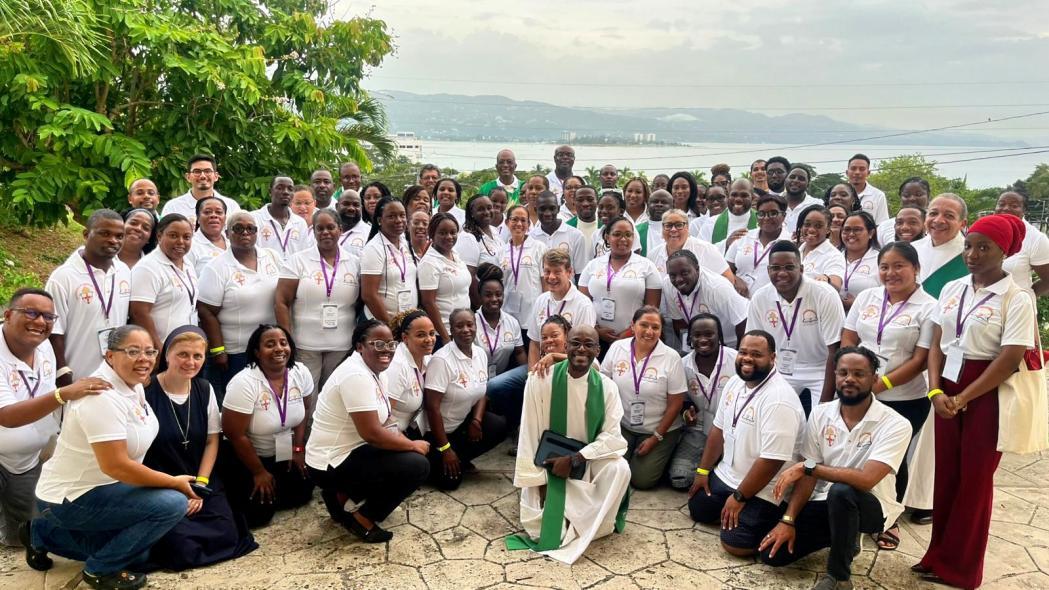
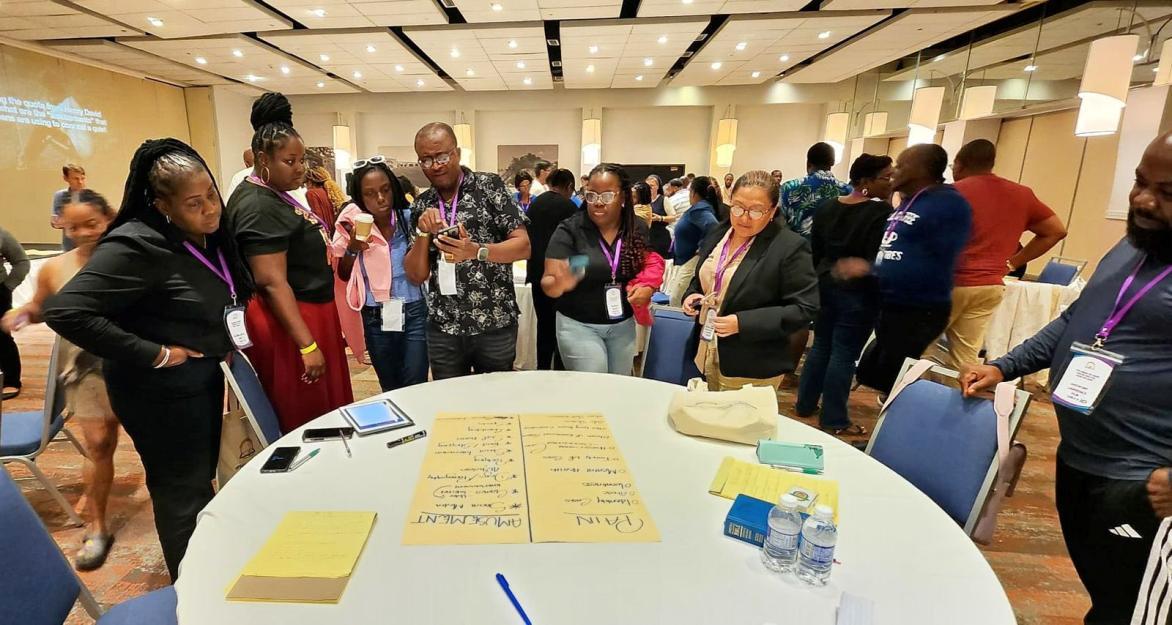
The week-long AEC Youth Leadership Conference 2025 was held in Montego Bay, Jamaica, from Sunday July 20th. It brought together more than 70 delegates from across the AEC. The photo above shows the delegates after daily Mass at the Blessed Sacrament Cathedral. Please see more on page 12 (Photo: AEC Facebook
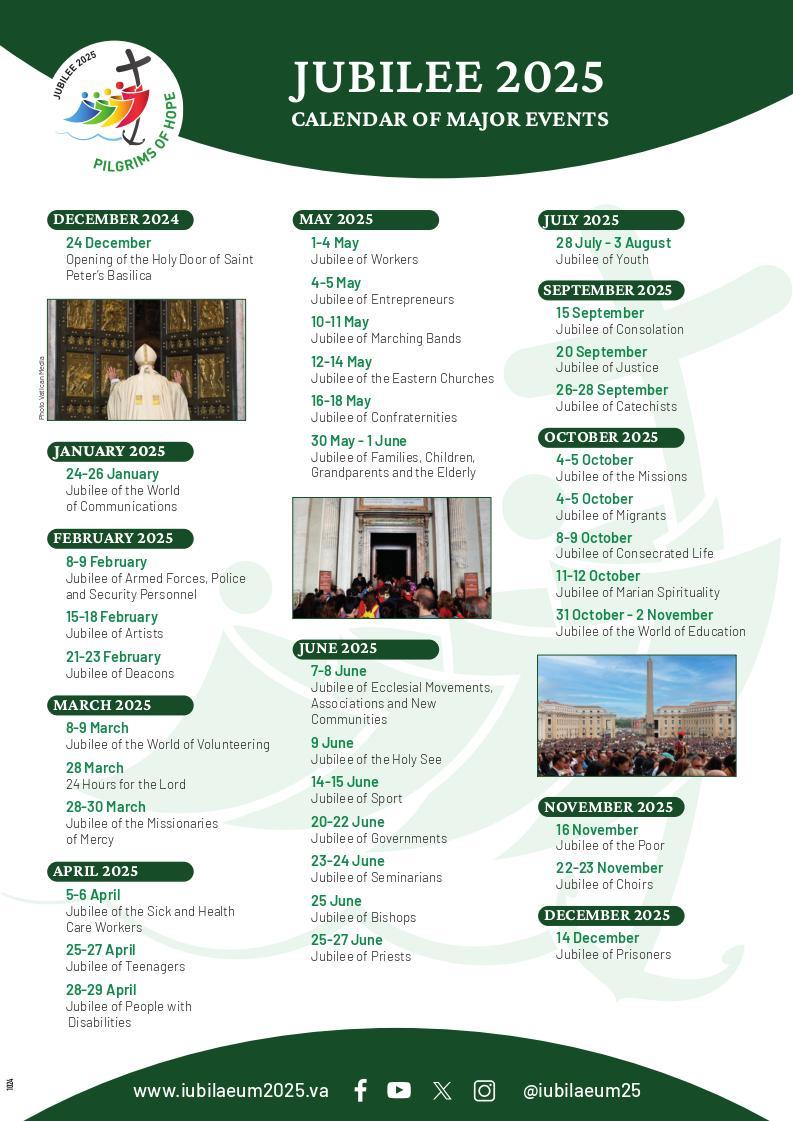
The Jubilee Prayer
shouting for peace on earth, pope says
(CathNews) - The enthusiastic joy of young people, who love Jesus and want all wars to stop, will be heard to the ends of the earth, Pope Leo XIV said when he welcomed tens of thousands of cheering young men and women to Rome for their Jubilee.
Source: OSV News.
“Buona sera, buenas tardes, good evening!” he said after finishing a long ride in the popemobile, waving to more than 120,000 ecstatic visitors filling St Peter’s Square and the long, wide boulevard that runs between the square and Castel Sant’Angelo by the Tiber River.
The pope appeared at the end of a Mass presided over by Archbishop Rino Fisichella in St Peter’s Square on Tuesday as part of a series of welcome celebrations for the weeklong Jubilee of Youth.
Father in heaven, may the faith you have given us in your son, Jesus Christ, our brother, and the flame of charity enkindled in our hearts by the Holy Spirit, reawaken in us the blessed hope for the coming of your Kingdom.
May your grace transform us into tireless cultivators of the seeds of the Gospel.
May those seeds transform from within both humanity and the whole cosmos in the sure expectation of a new heaven and a new earth, when, with the powers of Evil vanquished, your glory will shine eternally.
May the grace of the Jubilee reawaken in us, Pilgrims of Hope, a yearning for the treasures of heaven. May that same grace spread the joy and peace of our Redeemer throughout the earth.
To you our God, eternally blessed, be glory and praise for ever.
Amen



“Jesus tells us you are the salt of the earth. You are the light of the world,” Pope Leo said in English.
“And today, your voices, your enthusiasm, your cheers, which are all for Jesus Christ, will be heard until the ends of the earth,” he said in Spanish to huge cheers.
“Today marks the beginning of a journey, the Jubilee of Hope, and the world needs messages of hope. You are this message, and you must con-
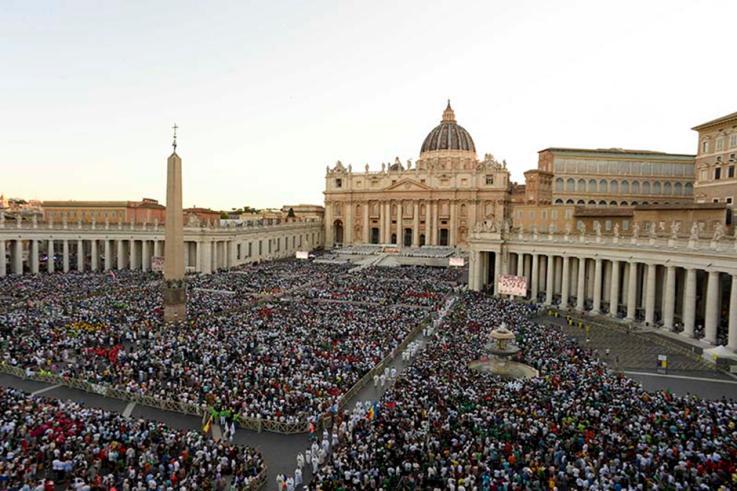
ing streets to participate in Mass, celebrated by Archbishop Rino Fisichella, pro-prefect of the Dicastery for Evanglization, and to see Pope Leo XIV at the conclusion of the evening Mass as part of the Jubilee of Youth at the Vatican July 29, 2025. (CNS photo/Vatican Media)
tinue to give hope to everyone,” he said. “Let us walk together with our faith in Jesus Christ,” he said in Italian.
“And our shouts must also be for peace in the world.
“Let’s all say it: We want peace in the world!” he shouted, as the crowd responded, “We want peace in the world.”
“Let us pray for peace” and be witnesses to “the peace of Jesus Christ,
the light of the world that we are all seeking,” he said, as the evening twilight turned to night and the waxing crescent moon appeared brightly.
It was Pope Leo’s second “surprise” appearance on Tuesday, after arriving to greet the faithful at the end of a morning Mass presided over by Cardinal Luis Antonio Tagle, marking the conclusion of the Jubilee of Digital Missionaries and Catholic Influencers, held on Monday and Tuesday ❖
friendships, and not focus on

(CRUX) - Pope Leo XIV admitted science and technology are influencing “the way we live in the world” in a speech on Tuesday to “Influencers and Digital Missionaries” in Rome for a special 2025 Jubilee event specially organized for them.
In the 21st century, the digital age has grown significantly, with millions of people listening to podcasts and watching videos on social media. Many of them are speaking about Catholicism, and the Vatican invited manyofthemtoRomeforthejubilee.
The Pope said the world needs peace “in these times marked by hostility and war” and this is the mission given to modern digital missionaries.
“You are here to renew your commitment to nourish Christian hope in social networks and online spaces,” he said.
“Peace needs to be sought, proclaimed, and shared everywhere, both in the places where we see the tragedy of war and in the empty hearts of those who have lost the meaning of life and the desire for introspection and the spiritual life.
“Perhaps, today more than ever, we need missionary disciples who convey the gift of the Risen Lord to the world.” He said there was another challenge in the mission of modern internet influencers.
“Always look for the ‘suffering flesh of Christ’ in every brother and sister you encounter online. Today, we find ourselves in a new culture, deeply characterised and formed by technology. It is up to us – to each one of you – to ensure that this culture remains human,” the pope said.
followers
“Science and technology influence the way we live in the world, even affecting how we understand ourselves and how we relate to God and others.
“But nothing that comes from man and his creativity should be used to undermine the dignity of others. Our mission – your mission – is to nurture a culture of Christian humanism, and to do so together.”
He warned the influencers their activities were not simply a matter of generating content, “but of creating an encounter between hearts”.
Pope Leo called on them to establish networks “that liberate and save; networks that help us rediscover the beauty of looking into each other’s eyes; networks of truth”.
He cautioned against forgetting real friendship, telling participants not to focus on the number of “followers” they might have, and instead to “experience the greatness of infinite Love in every encounter; networks that give space to others more than to ourselves, where no ‘bubble’ can silence the voices of the weakest.”
Pope Leo called on them to establish networks “that liberate and save; networks that help us rediscover the beauty of looking into each other’s eyes; networks of truth.”
“In this way, every story of shared goodness will be a knot in a single, immense network: the network of networks, the network of God,” the Pope said.❖
People use their cellphones to record Pope Leo XIV as he addresses them during the Jubilee of Digital Missionaries and Catholic Influencers in St. Peter’s Basilica at the Vatican July 29, 2025. (CNS photo/Lola Gomez)
Massacre ‘of faithful in the house of God’ in
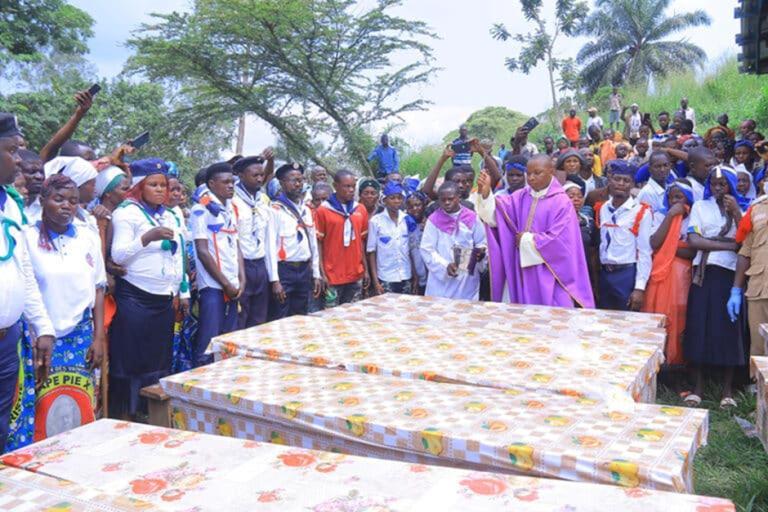
were shot or killed with machetes during an overnight vigil in the church July 27. (OSV News photo/courtesy Father Justin Zanamuzi)
(OSV News) At least 43 people, including children, were killed July 27 in a brutal overnight attack on a Catholic church in Komanda in eastern Congo.
Militants from the Allied Democratic Forces an Islamist group linked to the Islamic State group targeted faithful gathered for a youth retreat, opening fire and using machetes before looting homes and attacking displaced persons sheltering nearby.
The United Nations’ mission in the country called the attack a “heinous” act of violence in a July 27 statement. Victims were buried in a mass grave July 28 following a funeral Mass at the Komanda church with Father Aime Lokana Dhegoin presiding.
Pope Expresses Sorrow Over Massacre
Pope Leo expressed “deep sorrow” over the attack in a July 28 telegram, signed by Cardinal Pietro Parolin, Vatican’s secretary of state, and sent to Archbishop Fulgence Muteba Mugalu of Lubumbashi, who is president of Congo’s bishops’ conference.
The pope joined “the mourning of the families and the Christian community,” expressing his closeness and assurance of prayers.
“This tragedy invites us to work even harder for the integral human development of the wounded population of this region,” the pope said.
“His Holiness implores God that the blood of these martyrs may be a seed of peace, reconciliation, brotherhood and love forall the Congolese people.”
MilitiaGroupTargetingCatholics
According to reports, the Allied Democratic Forces, or ADF, descended on Komanda, a township about 46 miles southwest of the city of Bunia, the capital of the province, in the early morning hours of July 27. Targeted were Catholics gathering for a retreat in the Caritas hall of the Blessed Marie-Clémentine Anuarite Nengapeta Catholic Church in the township.
The militants had ambushed the night prayer vigil, catching by surprise the youth who were preparing for the Sunday service. The armed men gunned
down some of the worshippers, butchered others with machetes and abducted others.
Father Marcelo Oliveira, a Comboni missionary who has been in the Congo for many years, told the pontifical charity Aid to the Church in Need that the victims were part of a movement called Eucharistic Crusade and were participating in a prayer vigil as part of a summer holiday formation session.
MurdersInside&OutsideChurch
“The attack occurred at around 1 o’clock in the morning. The rebels entered the church and murdered a large number of children, both inside the church building and in the compound,” he said in a message sent to the Portuguese office ofACN.
Nearby homes, shops and banks were looted by the militia, who also attacked displaced people camping in the town’s hospital.
“The people both the youth and adults had gathered to celebrate the jubilee of the parish church, when the attack occurred. Those who came from other regions left, but the local worshippers converged in the church hall to wait for the Sunday service,”
Father Justin Zanamuzi, vicar general of the Diocese of Bunia, told OSV News in a telephone interview.
“As the church, we condemn this attack in the greatest terms possible. We feel thepain of thisattack.”
Militia Group Launched in Ugandain1995
ADF, an organization blamed for the attack, is a murderous militia group that was launched in Uganda in 1995, and currently operates in the mountainous region between Uganda and Congo. The group has been recruiting child soldiers, maiming, killing, and raping women and children. In 2019, the militant group pledged allegiance to the Islamic State and increased its attacks.
There is an ongoing joint military offensive against the group, but Father Zanamuzi explained that the militia had recently stepped up its violence and was still carrying out killings in villages and towns in the region.
The attack in Komanda, a commercial hub connecting Tshopo, North Kivu and Maniema provinces, is the latest one. The town is an easy target of the Congolese militias due to its geographical location and economic significance.
On July 26, the priest said, the militant group had earlier begun to attack villages before targeting the church gathering at night.
‘TheyAreMuslimExtremists’
“I think they are everywhere now. We cannot also rule out religious motivation. They are Muslim extremists and are known to attack Christians,” he said.
The Orthodox Public Affairs Committee, a New York-based global advocacy wing of Orthodox Christians worldwide, condemned the attack in Ituri, saying the members of the militant group had killed innocent worshippers during an overnightprayer vigil.
“The attackers used guns and machetes, setting the church ablaze and slaughtering those in the pews. This was not a battle. This was a massacre of faithful in the house of God,” said the committee in a statement dated July 27.
The United Nations’ mission in Congo, MONUSCO, detailed the 43 killed in the church, saying they included 19 women, 15 men and nine children.
‘Attacks Against Defenseless Civilians’
“These targeted attacks against defenseless civilians, particularly in places of worship, are not only appalling but also in violation of all human rights standards and international law,” said Vivian van de Perre, deputy special representative of the secretary general in Congo in a July 27 statement.
Days before the attack in Komanda, another militia known as CODECO, the Cooperative for the Development of the Congo, had desecrated the St. John of Capistrano in Lopa, in Ituri, on July 21.
The attack on the church came a day after the Congolese army and CODECO announced an alliance to fight a new militia known as the CRP, or the Convention for Popular Revolution.
In the attack, the tabernacle was violated, consecrated Hosts spilled, the Marian shrine vandalized, and sacred and liturgical objects destroyed.
‘
Deliberate Desecration of CatholicChurch’
“This serious and deliberate desecration of the Catholic church in Lopa is part of a series of violent attacks announced and claimed by the CODECO spokesperson in the trading centers of Lopa and Nizi,” said Bishop Dieudonné Uringi Uuci of Bunia in a July 26 statement, which also expressed great sorrow and dismay at the attack. “It can be recalled that since 2017, this militia has been responsible for numerous gruesome atrocities against Church facilities, members of the clergy, and pastoral workers.” These latest attacks are part of the deadly cycle of conflict that has
unfolded for decades in the provinces of Ituri, North Kivu and South Kivu of eastern Congo, a mineral-rich region the size of Western Europe. Fueling the conflict is an intricate mix of regional politics, ethnic and national rivalries, and a fight for control of the mineral resources, according to analysts.
In the July 28 statement, ACN said: “ACN urges all parties to strive to protect civilians and places of worship in the Democratic Republic of Congo and calls on its friends and benefactors to pray for the victims of this horrific attack, and for peace to finally arrive in this African country.”❖
Pope says Gaza is being ‘crushed by hunger’
(CathNews) - Pope Leo XIV on Sunday, July 27 said he was following the humanitarian crisis taking place in Gaza with “great concern,” saying the civilian population is being “crushed by hunger and continues to be exposed to violence and death”. Source: Crux.
The Pontiff was speaking after his Angelus in St Peter’s Square, soon after the Israeli military began a limited pause in fighting in three populated areas of the Gaza Strip, saying these pauses would last 10hours a day.
On Friday, the UN Office for the Coordination of Humanitarian Affairs said that the starvation crisis was deepening across Gaza.
The UN press service said that out of 15 attempts to coordinate humanitarian movements inside Gaza on Thursday, four were denied, three were impeded, one was postponed and two others had to be cancelled by the organisers, with only five missions facilitated.
In his address, Pope Leo renewed his “heartfelt appeal for a ceasefire” and called for the release of hostages and full respect for humanitarian law.
The Gaza War broke out following the October 7, 2023, surprise attack by Hamas militants that left 1200 Israelis dead and more than 250 taken as hostages.
Israel immediately launched a retaliatory offensive in Gaza to oust Hamas from leadership, with the subsequent conflict resulting in the deaths of over 70,000 people in Gaza, according to Palestinian estimates.
A peace deal made earlier this year has broken down, and Israel has increased its attacks on Gaza, killing thousands of people, most of them civilians.
“Every human person has an intrinsic dignity conferred on him or her by God himself. I urge the parties in all conflicts to recognise it and to stop any action contrary to it,” Pope Leo said.
“I urge you to negotiate a future of peace for all peoples and to reject anything that could jeopardise it. I entrust to Mary, Queen of Peace, the innocent victims of conflicts and the rulers who have the power to put an end to them,” he said.❖
A Christian Perspective on Social Issues

Love thine enemy
By GHK Lall
Are you serious, Lord Jesus? Love thine enemy. At this time, with September 1 so near, now that it is the beginning of August and the homestretch is filled with so many challenges, so many unknowns. Like who is going to walk away at the head of the competition, the winner of a bitter, grueling contest. Can love thine enemy wait until October? Or, better still, December when all those warm, embracing greetings about the birth of the Savior rise to the fore, mean so much?
This is trouble. Those who see me as their enemy hate me, Lord Jesus. They hatedyou, O Savior,O Redeemer. Have some understanding as to why this love thine enemy commandment is so, so, well, so challenging in the practice. If I am not about love thine enemy, am I then a lesser Christian, a weak and woeful Roman Catholic? The words are ours, and they do not hold us out in the best light. If father can be against son, and so forth, because of the call of Jesus, then it is easy as one, two, three to look with disfavor against enemy. I didn’t make them, hold them, as an enemy. They pushed me, made me, into that mold thatsuits their purposes.
When one man or woman is made into an enemy then I have just loved God and Jesus less. Personal note. Some men with considerable power in their hands decided that I am an enemy that must be taught a lesson, brought low. Because I show them for who they are before their own folks. So, they smeared andslandered in the belief that silence would follow. I am ashamed to admit, but I do so publicly: anger flared, thoughts of returning the insult took charge, identified how. Slowly,ever so slowly, then with increasing rapidity, love thine enemy grabbed hold, shook some sense in my head, and refused to let go. I pray for those who slurred and derogated. Not for their downfall, however deserving. But that they will be forgiven and given a chance to be different people.
To my fellow Christians, Catholics, let the words of Jesus surround and help to soar. Soar above what is ugly, the many obscenities, at this hour in Guyana. There is an obligation to be responsible citizens; and the kind of follower of Jesus that we are in our hearts will power forward to live to the hilt love thine enemy. If opponents are seen as enemies, then enemies multiply, with everyone not looking like ourselves, or not thinking like us, transformed into an enemy. When enemies are so abundant, then Guyanese are all strangers to each other: cold, cruel, and with being a
true Catholic the last thing considered.
I will say it. Politics must never compete with piety. Politics should never be given a single inch when the mysteries of our faith are involved. To God is given what is due. Caesar has his place. Once the Catholic is in firm command of his or her senses, and possesses an abiding sense of the Christian ethos, then Caesar’s place is down the line. Politics and Caesar must not be allowed to rise to that level of devouring priority, to what competes with and strains Christian virtue. Love thine enemy.
The words of Jesus, when taken seriously, assist Catholics in keeping a wise distance from those who mock and scoff at love thine enemy. Guyana is on edge, always drives itself to the topofthatdangerousabyss,when the season of elections comes around. It is a hard time and a harsh place. A time and place for searing memories to take hold, for easy exploitations to find fruitful soil, and for burning rage
to bare its face and spread its wings. Why should I seek a place, want admission, in such furnaces that overwhelm belief, lay waste to discipline, and identify me as a willing participant? Why should any believer in and follower of Jesus, anyone who calls themselves Catholic?
Beingabout love thine enemy helps to defuse tensions. Love thine enemy does something for a less hostile environment, even a peaceful one. The national constitution may not actually teach love thine enemy. My personal constitution commands it, insists upon it. So. should it be for every believer. There is the freedom of choice, of personal politics. But when love of enemy cannot be lived, can thought of, then that but slavery to the forces of darkness. When we bring ourselves to live love thine enemy, the love of Jesus is lived. I am Jesus in my little way, an authentic way, so help me God. Let that be our prayer. Let love thine enemy be our light thatmakes a difference.
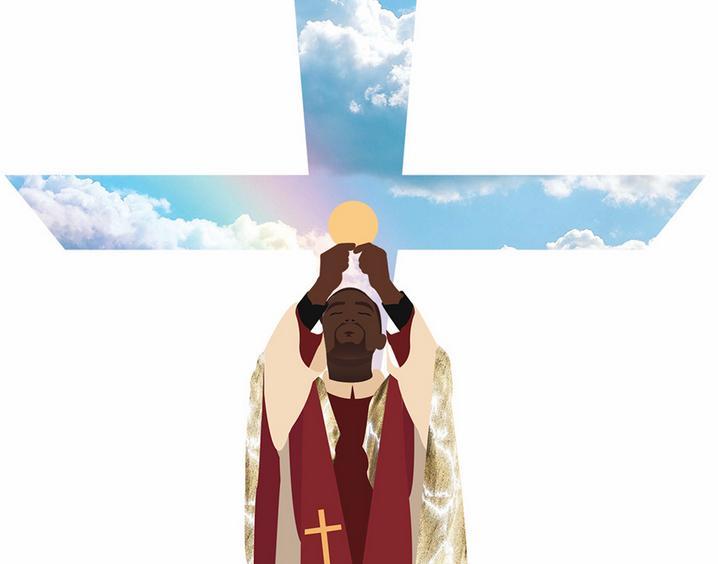
Gracious and loving God, we thank your for the gift of our priests. Through them, we experience your presence in the sacraments.
Help our priests to be strong in their vocation.
Set their souls on fire with love for your people.
Grant them the wisdom, understanding, and strength they need to follow in the footsteps of Jesus. Inspire them with the vision of your Kingdom.
Give them the words they need to spread the Gospel.
Allow them to experience joy in their ministry.
Help them to become instruments of your divine grace.
We ask this through Jesus Christ, who lives and reigns as our Eternal Priest. Amen



FIRST READING: Ecclesiastes1:2. 2:21-23
What does a man gain for all his toil?
Vanity of vanities, the Preacher says. Vanity of vanities. All is vanity!
For so it is that a man who has laboured wisely, skilfully and successfully must leave what is his own to someone who has not toiled for it at all. This, too, is vanity and great injustice; for what does he gain for all the toil and strain that he has undergone under the sun? What of all his laborious days, his caresofoffice,hisrestlessnights?This,too,isvanity
ResponsorialPsalm: Psalm89:3-6,12-14,17
(Alternative: Ps 94:1-2, 6-9)
Response: O Lord, you have been our refuge from one generation to the next.
1. Youturn menbackinto dust andsay:'Go back, sons of men.' To your eyesathousandyears are like yesterday, come andgone, no more thana watch inthe night. (R)
2. Yousweepmen away like adream, like grass whichsprings upin the morning. In the morningitsprings upand flowers:by evening itwithers and fades. (R)
3. Make us know the shortness of our life that we may gainwisdom of heart. Lord,relent! Is your anger for ever? Show pity to your servants. (R)
4. In the morning,fill us withyour love; we shall the Lord be upon us: give success to the work exultandrejoice all our days. Letthe favour of of our hands. (R)
SECONDREADING: Colossians 3:1-5.9-11
You must look to the things that are in heaven, where Christ is.
Since you have been brought back to true life with Christ, you must look for the things that are in heaven, where Christ is, sitting at God’s right hand. Let your thoughts be on heavenly things, not on the things that are on the earth, because you have died, and now the life you have is hidden with Christ in
That is why you must kill everything in you that belongs only to earthly life: fornication, impurity, guilty passion, evil desires and especially greed,
Today’s Gospel passage comes as a pat on the back from Heaven for all of us striving to live a stewardship way of
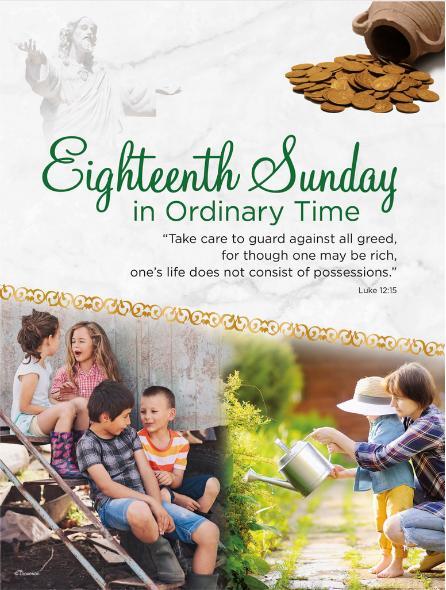
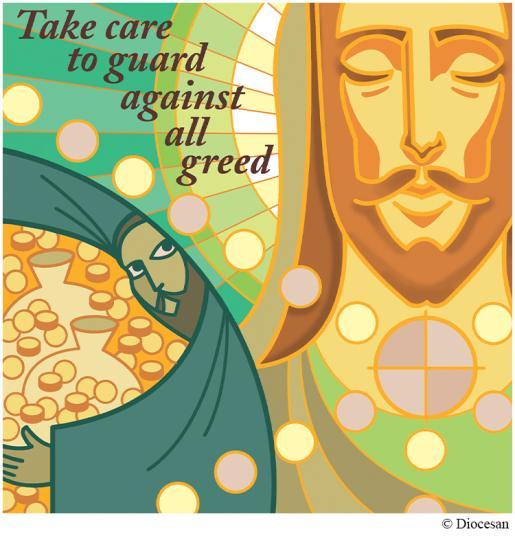
life. It reminds us why we live the way we do and why we make the choices we make. Let’s face it, if we truly embrace this way of life, there will be people who find our choices based on serving God and others downright foolish. But let’s see what God thinks. Spoiler alert: turns out Christianstewards are not the fools!
In this passage, Jesus makes it clear that life is not about “stuff” as he tells
which is the same thing as worshipping a false god; and never tell each other lies. You have stripped off your old behaviour with your old self, and you have put on a new self which will progress towards true knowledge the more it is renewed in the image of its creator; and in that image there is no room for distinction between Greek and Jew, between the circumcised or the uncircumcised, or between barbarian and Scythian, slave and free man. There is only Christ:he is everythingandhe is ineverything.
Gospel Acclamation Jn17: 17
Alleluia, alleluia!
Your word is truth, O Lord, consecrate us in the truth. Alleluia!
Or Mt5: 3
Alleluia, alleluia!
How happy are the poor in spirit; theirs is the kingdom of heaven. Alleluia!
GOSPEL: Luke 12:13-21
This hoard of yours, whose will it be?
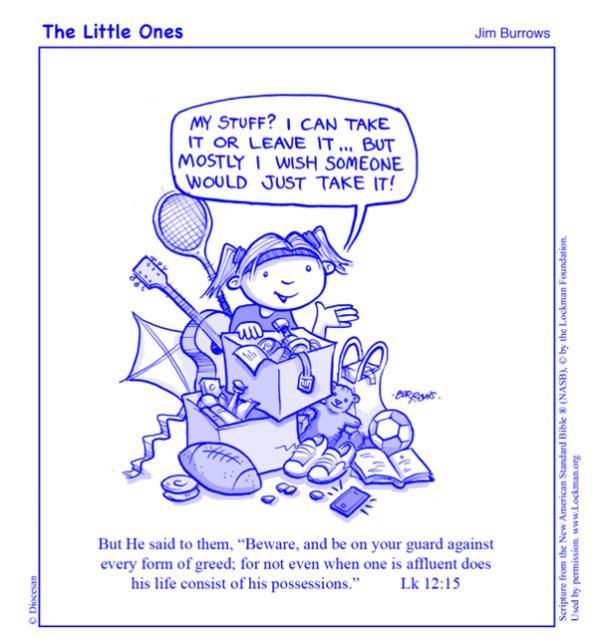
A man in the crowd said to him, ‘Master, tell my brother to give me a share of our inheritance.’‘My friend,’ he replied ‘who appointed me your judge, or the arbitrator of your claims?’ Then he said to them, ‘Watch, and be on your guard against avarice of any kind, for a man’s life is not made secure by what he owns, even when he has more than he needs.’
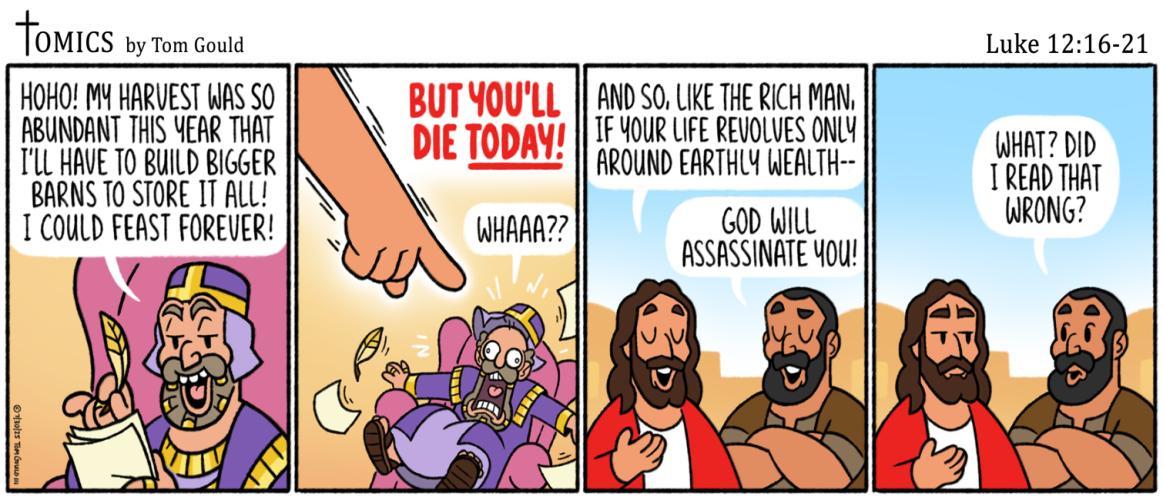
Then he told them a parable: ‘There was once a rich man who, having had a good harvest from his land, thought to himself, “What am I to do? I have not enough room to store my crops.” Then he said, “This is what I will do: I will pull down my barns and build bigger ones, and store all my grain and my goods in them, and I will say to my soul: My soul, you have plenty of good things laid by for many years to come; take things easy, eat, drink, have a good time.” But God said to him, “Fool! This very night the demand will be made for your soul; and this hoard of yours, whose will it be then?” So it is when a man stores up treasure for himself in place of makinghimself richinthe sight of God.’❖
the parable of the wealthy businessman who thought he had everything figured out. The man had such an abundance of stuff that he didn’t have room to store it all. So, thinking of earthly things and not on what is above, he decided to build a bigger place to store all that stuff. Patting himself on the back, he thought about what good times he would have in the years ahead. But, Jesus tells us that day would turn out to be the man’s
last day on the earth. And he had spent it thinking only of himself. How foolish!
Don’t be ashamed of living differently from the people around you. Be confident as you set priorities based on what is above. You are wise in God’s eyes, Christiansteward. And you will be richinwhatmatters most. ❖
[www.catholicsteward.com/blog/ ]
pilgrims that holiness ‘is not impossible’ Gospel Reflection
One of the greatest longing each one of us has is the desire for security. To look to the future and see old age coming is inevitable and to fear that perhaps there is nothing put aside as security for old age is indeed a frightening thought. It is not surprising that at some time in our lives we face the need to plan for the future, to try to make sure that security will be ours, especially when we have passed the age of being able to hold down a job and make aliving.
Jesus understands the desire of human beings for security but, as his parable shows, such a longing must be put in its proper place. What did the farmer in the parable do wrong? There is no indication that he was dishonestor that he cheated anyone out of what was rightfully theirs. His mistake was that he was greedy. Jesus’ parable was not about need but about greed. Greed leads a person to rely solely on material possessions for his or her security. It leads people to feel that they can depend only on themselves for their security. Even if such a person goes to church regularly, greed can easily lead to God being put asideand quicklyforgotten.
This kind of greed is not by any means confined to the wealthy. All of us can be guilty of it. Our society is such that it almost forces us to be preoccupied with the need to have more and more money and material things. The day-to-day struggle for survival in our society can easily occupy all our time and energies. Certainly we have to work and save and we need certain material possessions to make our lives easier but we are sadly mistaken if we think that possessions alone will give us the kind of security we really need. No matter how much money we may have saved up, the time will come when we have to go and leave it all behind. And what of our security then? ❖
[
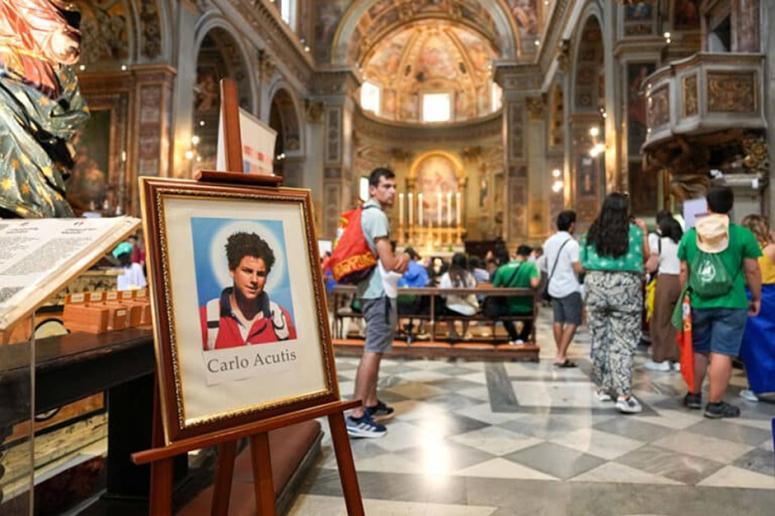
Pilgrims gather near a portrait of Blessed Carlo Acutis at the Church of San Marcello al Corso in Rome, where his relics are displayed July 31, 2025, during the Jubilee of Youth, ahead of his Sept. 7 canonization. (CNS photo/Lola Gomez)
ROME (CNS) Along one of Rome’s busiest streets, Via del Corso, traffic moves slowly as hundreds of pilgrims crisscross traffic on foot to get to their destination.
Amid the mayhem stands the Church of San Marcello al Corso, a small church built in the late 17th century that also houses several relics, includingone of the True Cross. However, on the occasion of the Jubilee of Youth, the church became the temporary home of a first-class relic of Blessed Carlo Acutis, who will become the Catholic Church’s first millennial saintinSeptember.
A steady stream of pilgrims entered the church July 31, signing prayer intention cards and kneeling in silent prayer in front of the Blessed Sacrament. To the left of the main altar was a small table bearing a golden reliquary housing a section Acutis’ pericardium, a membrane that surrounds the heart.
The display of the relic in Rome from July 29-31 was organized by Catholic Christian Outreach (CCO), a Canadian Catholic movement dedicated to campus ministry and evangelization. During the Jubilee of Youth, CCO hosted the relic at San Marcello al Corso as part of its “Young Saints A pilgrimage inRome” program.
The flow of visitors and curious onlookers viewing the relics was due in part to volunteers inviting people walking along Via del Corso to visit the church.
Donning gray shirts bearing the CCO logo, Canadian volunteers Kieran Bray of Halifax and John Paul Mirabel of Winnipeg handed out to those passing by tiny pamphlets on building a relationship withJesus.
“We’re a campus-based movement that aims to invite (people), students especially, to have Christ at the center of their life,” Mirabel told Catholic
teen was a role model for young people today who are often tempted by the traps of “self-absorption, isolationandempty pleasure.”
“Carlo was well-aware that the whole apparatus of communications, advertising and social networking can be used to lull us, to make us addicted to consumerism and buying the latest thing on the market, obsessed with our free time, caught up in negativity,” the pope wrote.
“Having the relic here, I feel like it has attracted lots of young people in the faith and people who are interested,” Bray added. “He’s really someone that we can look to and be like, ‘OK, we can be like this guy,right?'”
Mirabel told CNS that while he believes “Carlo would be so happy” seeing people flocking to the church temporarily housing his relics, he would be even happier knowing some people have become closer to the Eucharistbecause of him.
News Service July 31. “We’re here together for a mission to Rome, so we’ve gathered from all the campuses across Canada to invite people here in Rome in the Jubilee season to invite Christto the center of their life.”
Bray said that Blessed Acutis is “very attractive to young people in the faith” and that they “really feel connected to him because he’s someone (with whom) they can really relate.”
Before his death from leukemia in 2006, Acutis was just a normal teenager with a knack for computers who put that knowledge to use by creating an online database of Eucharistic miracles aroundthe world.
In his apostolic exhortation on young people, “Christus Vivit” (“Christ Lives”), the late Pope Francis said the

Dear Editor,
Books really do change our lives, because what we read today walks and talks withus tomorrow. Thought determines action, and some of the most powerful influences on thought are the materials we choose to read.
Reading is to the mind what exercise is to the body, and prayer to the soul. I would like to recommend Spiritual reading.
Spiritual reading is an ancient tradition. It existed in the Church long before we had books to read, when every manuscript had to be copied by hand because the printing press had not yet been invented. In those days,
“Sure, he is the attraction; he is the relic here in this church. But then, people are drawn to the Eucharist, and he points to the Eucharist. It’s just how his ministry was and his website with the Eucharistic miracles; just pointing everyonetoChrist.”
The Canadian volunteers told CNS they hope that through learning about the life of Blessed Acutis, visitors and pilgrims will learn that not only are they called to be saints, but that holiness is anachievable goal.
“I’ve noticed that people are saying, ‘OK, maybe I can’t be like St. Francis of Assisi, who did all these crazy things back a thousand years ago,'” Bray said. “But Blessed Carlo only lived 34 years ago. “So, it’s like, ‘OK, we can do that!’ And sainthood, it’s notimpossible!”❖
Spiritual Readings
this spiritual tradition was mostly confined to the monasteries where the monks had access to manuscripts of Scriptures and other great spiritual writings.
The goal of spiritual reading is to ignite the soul with a desire to grow in virtue, to encourage us to live a life of holiness.
Reading the Scriptures, especially the New Testament and in particular the four Gospels, obviously holds first place onour Spiritual readinglist. Men and women of good will take delight inthe Gospelsas they becomefamiliar with them. They are the best education of the life and teachings of our Lord Jesus Christ. Nothing ignites the soul to imitate the Divine Master more than an intimate familiarity with the story of His life, work and teachings.
Leon Jeetlall
From: Journeying with the Word of God, The Religious Education Department, Diocese of Georgetown, Guyana ]
Henry Newman to be formally
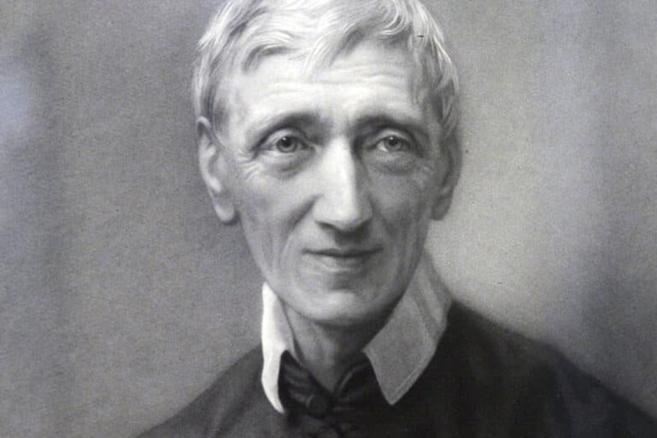
St. John Henry Newman, a British scholar who dedicated much of his life to the combination of faith and intellect at universities, is pictured in an undated portrait. The Vatican announced July 31, 2025, that Pope Leo XIV has paved the way for St. John Henry Newman to become the newest doctor of the church. (OSV News photo/courtesy of the Catholic Church of England and Wales)
(CathNews) - St John Henry Newman will soon be declared a Doctor of the Universal Church, the Vatican announced yesterday. Source: Crux.
Pope Leo XIV “confirmed the positive opinion” of the declaration during an audience with Cardinal Marcello Semeraro, the prefect of the Dicastery for the Causes of Saints.
St John Henry Newman was born in 1801, and was a member of the Anglican Church, becoming a
priest in 1825. He was a leader of the Oxford Movement, which sought to align the Church of England with its Catholic roots, and led to the formation of the so-called Anglo-Catholic wing of the Anglican Communion.
However, he controversially became a member of the Catholic Church in 1845, and was later ordaineda Catholic priest.
Pope Leo XIII made him a cardinal in 1879, although Cardinal Newman requested that he not be made a bishop. He died in
1890, and was beatified by Pope Benedict XVI in 2010 when the pontiff was in Birmingham, England. Pope Francis canonised him in2019.
After his canonisation, the bishops’ conference of England and Wales formally petitioned the Pope to name the saint a Doctor of the Church, a move supported by the bishops’ conferences of the United States, Ireland, and Scotland.
A Doctor of the Church is a title given by a Pope to a saint recognised as having made a significant contribution to theology or doctrine. Newman was noted for his teachings on conscience and doctrinal development.
Journeying with the Word of God
MAKING THE WORD OF GOD YOUR OWN
Step 1: Lookattoday’sReadingsprayerfully.
“The announcement that St John Henry Newman will become a Doctor of the Catholic Church will fill the hearts of English Catholics with so much joy. It will also be welcomed by Catholics around the world for whom St John Henry is an inspiring theologian and apologist for the Catholic faith,” Archbishop John WilsonofSouthwarksaid.
“For all his enormous intellect and learning, St John Henry above all lived the humility of a disciple, with a passion for truth. His life shines as an example of what it means to be a true follower of Christ,” the archbishopsaid.❖
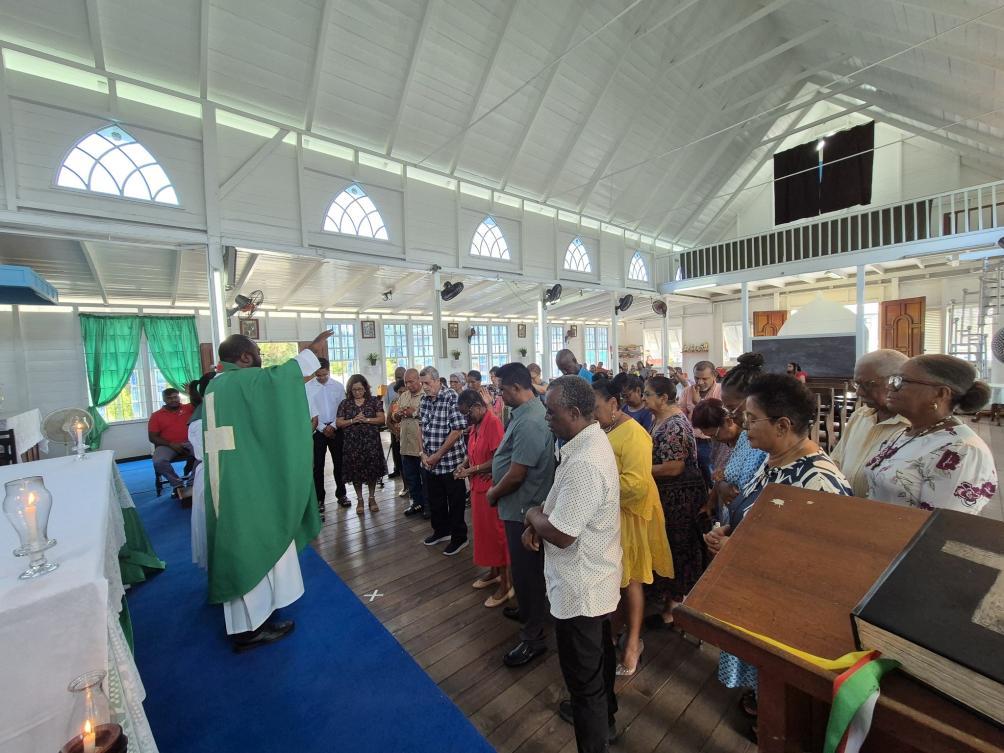
Last Sunday July 27th was the World day of Grandparents and the Elderly. In the photo above, Fr. Carl Philadelphia gives a
ents and
1st Reading: We are told that the things that are supposed to satisfy human beings do not in the end please them. They eventually have to leave all behind.
2nd Reading: Through baptism we share in the life of Christ. This Reading tells us of the conclusions thatfollowfromthis.
Gospel: Jesus’ parable is a warning against greed. We are urged to make ourselves rich, not in the goodsof thisworld, butin thesightofGod.
Step2:ApplyingthevaluesoftheReadings toyourdailylife.
1. The Gospel passage ends with Jesus’ words that we should make ourselves rich in the sight of God. Howcan we go aboutdoing this?
2. It is said that greed is like a fire – the more wood you pile on it, the hungrier it gets. What do youthink of this saying?
3. Do you think Jesus is telling us that we should never plan for the future and that we should not be worried about saving to pass on something to our lovedones?
4. Consider what drives people to do things. Is being ambitious all bad? What do you think of forces like greed and the pull of pleasure and power?
Step 3: Accepting the message of God’s Wordinyourlifeoffaith.
The things we own are not in themselves sinful. What is sinful is greed, that is, the desire to get more and more at any cost. Jesus warns about greed in his parable. This is why we should always consider the difference between what we need and what we want. One should strive for comfort in life rather than the desire to pile up possessions that we all have to leave behind when we die.
Step 4: Somethingtothink&prayabout
1.Ask yourself honestly if your activities in life are inspired by greed or the need to acquire things in this life.
2.If you are employed, discuss with someone close to you if you have begun to make your work the centre of your being. If so, make a conscious efforttochange thisattitude.
3.Make it your duty to encourage others who have the drive to work at overcoming problems, such as poverty andinjustice.
4.Pray for the strength to be ambitious in a positive way and not to be enticed by the desire for great wealthand excessive pleasure. ❖
[From: Journeying with the Word of God, The Religious Education Department, Diocese of Georgetown, Guyana ]
special blessing to the grandpar-
elderly of Our Lady of the Mount Parish, Meadow Bank.
(Photo: Our Lady of the Mount RC Church, Meadow Bank Facebook page). ❖
Pressing issues for the Antilles Church (Part 2)

The Antilles Episcopal Conference (AEC) held their 69th Annual Plenary Meeting from May 11–16 in the ArchdioceseofKingston,Jamaica.The English-speaking Caribbean’s first professor of Caribbean Theology and Ethics, Professor Anna Kasafi Perkins addressed the bishops on May 15 on several issues. In part 1 (July 25th issue), youth was identified as the first pressing issue. In part 2, she speaks to social justice, and the evolving digital landscape:
The second pressing issue demanding our urgent attention is the persistent challenge of social justice, particularly the pervasive problem of crime and violence that plagues our Caribbean societies.
Bob Marley’s music consistently promotes non-violent social justice, advocating for equality, liberation, and understanding as ways to overcome injustice and oppression.
In ‘Natural Mystic,’ Bob laments that “many more will have to suffer, many more will have to die. Don’t ask me why”. We must ask why and be able to tell the truthfrom the lie.
Tragically, the Latin American and Caribbean region is recognised as among the most violent in the world. Within our Antilles territories, several nations grapple with alarmingly high homicide rates.
For instance, in 2023, Jamaica recorded a homicide rate of 60.9 per 100,000; St Vincent and the Grenadines 50.1 per 100,000; St Lucia 41.7 per 100,000; and Trinidad and Tobago 37.6 per 100,000.
Furthermore, firearms are involved in a significant majority of these homicides,exacerbatingthe crisis. This violence disproportionately affects our young people, who are often both victims and perpetrators, particularly our young men, but increasingly our women and girls. Of concern, too, are the number of fatal shootings of civilians by the police.
The AEC has a long and commendable history of addressing social justice concerns. Our landmark 1975 Pastoral Letter, Justice and Peace in the New Caribbean, offered a prophetic vision

that continues to resonate today, even as new challenges emerge.
The call for updating this foundational document underscores its enduring relevance.
More recently, the AEC issued a powerful statement on domestic violence, recognising it as a grave issue demanding action. Our statements on capital punishment have consistently emphasised the importance of rehabilitation and the sanctity of life.
Indeed, individual bishops, such as Bishop of Bridgetown, Neil Scantlebury, have clearly articulated in the face of broken families and the murder of children, that “Christ is the answer,notcrime”.
To further the Church’s involvement in addressing social justice, we must strengthen our community outreach programmes that tackle the root causes of crime, including poverty, unemployment, and limited access to educationandopportunity.
Advocating for justice reform and promoting restorative justice practices, building upon the Church’s existing work within prisons and various peace management initiatives, iscrucial.
Providing comprehensive support and counselling for victims of crime and violence is a fundamental expression of our pastoral care. Collaborating with other faith-based organisations and community groups will amplify our impact and create a unified voice for peace and justice.
Above all, the Church must continue to foster dialogue and reconciliation within communities deeply affected by violence, offering pathways towards healingandrestoration.
Church in the digital realm
The third pressing issue that demands our strategic attention is effectively navigating the evolving digital landscape for evangelisation, selfactualisation, and communitybuilding.
Digital media has become an undeniable force shaping communication, information consumption, and the formation of communities in the 21st century. For the Church, this presents an
unparalleled opportunity to reach a wider audience, particularly the younger generations who are deeply immersedin the online world.
At the same time, the digital arena is undeniably a space of division, replicating the inequalities of the real world. Furthermore, it is replete with mis- and disinformation in ways that are damaging to building and sustaining human dignity and community.
Bob would not recognise this world of peril and possibility, yet his biblical riddims in ‘Small Axe’ remind us that digging pits is as much a peril for the digger as for the victim. We can dig pits to throw in garbage or wells to findwater.
The AEC has already demonstrated foresight in recognising the
significance of this digital shift. Again, our pastoral letter, New Ways of Being Church in the Digital Milieu, stands as a testament to this awareness. Furthermore, the AEC’s commissions recognise the potential of social media for evangelisation and vocations promotion.
To effectively engage in this digital realm, we must encourage the development of compelling and relevant online content. This includes live-streaming services to reach those unable to attend in person, creating engaging podcasts and social media initiatives to foster connection, and developing interactive platforms for dialogue andfaith sharing.
Providing comprehensive training and resources for our clergy and lay leaders to confidently and effectively utilise these digital tools for ministry andcommunicationis essential.
We must strive to foster vibrant online communities that offer genuine opportunities for fellowship, mutual support, and spiritual growth. Maintaining a consistent and authentic online presence that faithfully reflects the values and teachings of our Church is paramount. Finally, we should explore the potential of digital media to enhance faith formation and catechesis, making valuable resources more accessible to all. (From The Catholic News of T&T) CONCLUSION NEXT WEEK: The climatecrisisontheCaribbean ❖


The Parable of the Rich Fool
Dear Boys andGirls,
In today’s Gospel, Jesus tells a story about a manwho was selfishand greedy.
The man in Jesus' story was very rich. He had a large, fertile farm which produced very good crops. "What should I do?" the man said to himself. "I have had such a large harvest that I don't have room in my barns to store all of it."
What do you think the man did? He could have shared some of what he had with those who didn't have very much. Do you think that is what the man did? No, instead he said, "I know what I will do. I will tear down my barns and build bigger ones. Then I will say to myself, 'You have plenty of everything. Enjoy it. Eat, drink,and be merry.'" God said to the rich man, "You fool! You will die this very night. Then who will get everything?"
God is good and he has given most of us more than we need. The question is, what will we do with what God has given to us? Will we share it with those who don't have as much, or will we greedily keep it for ourselves? Remember the warning that Jesus gave to the listeners of his story. "Watch out! Be on your guard against all kinds of greed."
Father, you have blessed most of us with more than we need. Help us to be generous and to share with those who may not have as much. Amen. ❖


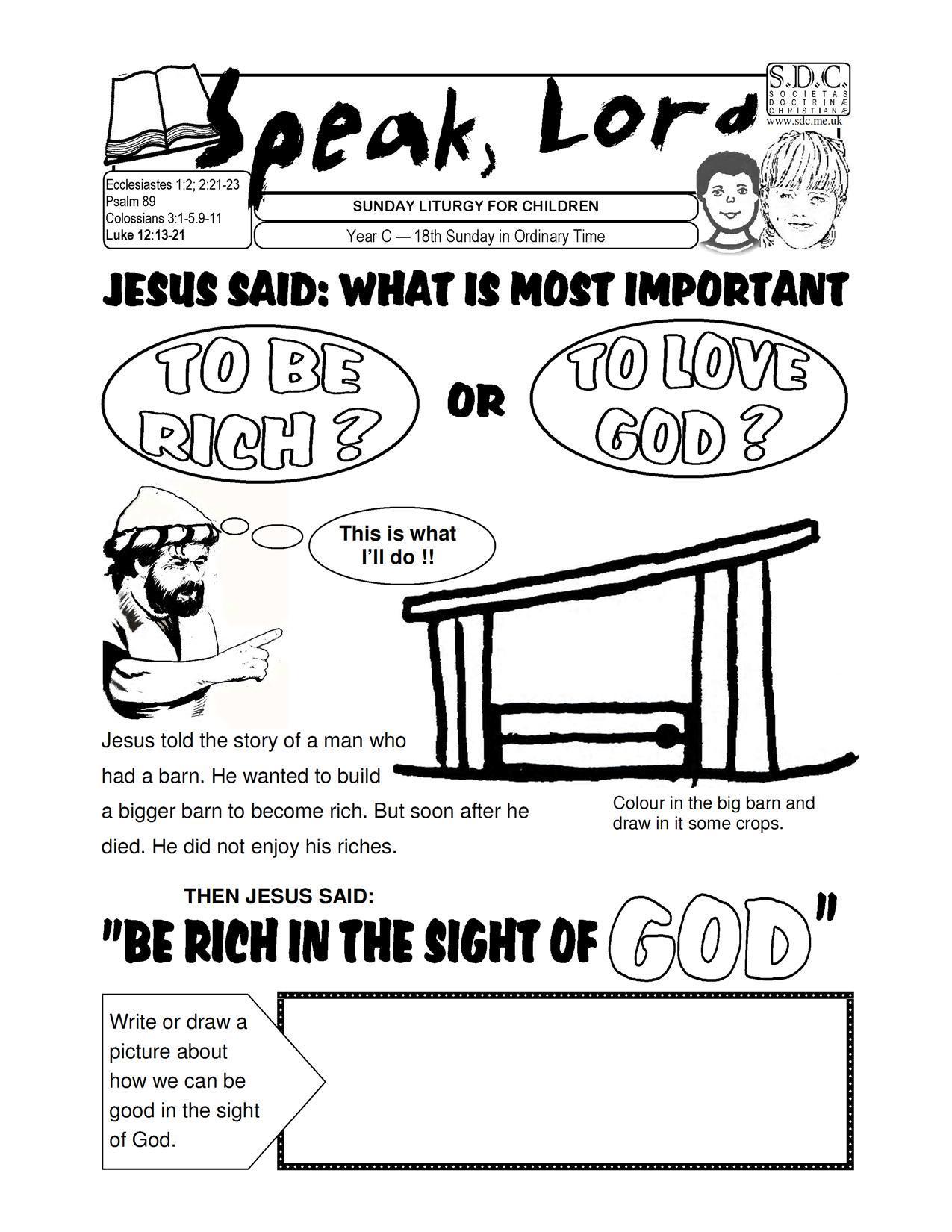
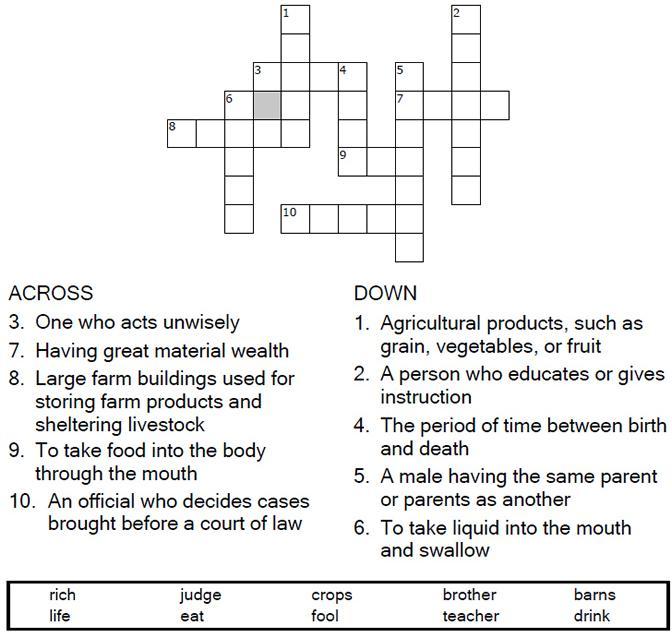
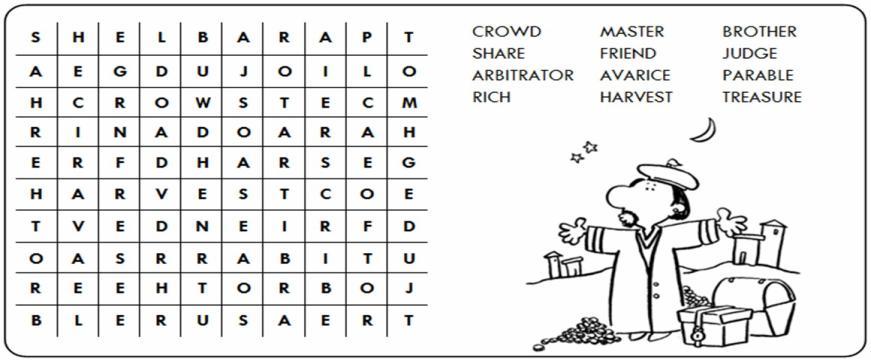
rich life judge eat crops fool brother teacher
The Parable of the Rich Fool
Then he said, 'This is what I'll do. I will tear down my barns and build bigger ones, and there I will store all my grain and my goods.’” Luke 12:18
As the Caribbean braces for another hurricane season, the Antilles Episcopal Conference (AEC) has issued a stirring pastoral letter urging the region’s people to face the growing threat of natural disasters with “faith, solidarity, and hope”.
Titled In the Eye of the Hurricane: Living the Rhythm of Natural Disasters
in the Caribbean with Faith, Solidarity, and Hope, the letter recognises the yearly challenges posed by hurricanes, floods, and other disasters especially for the most vulnerable in society.
“…hurricanes, floods, and other natural disasters are not distant possibilities but annual realities which especially impact the poor and vulnerable,” the
bishops write, reminding Caribbean Catholics that resilience begins with spiritual readinessand communal care. Drawing from Scripture, Catholic Social Teaching, and the lived experience of Caribbean peoples, the letter calls for all Caribbean Catholics “to reject fear, deepen solidarity, and build a culture of preparedness rooted infaith.”
The pastoral letter challenges a culture shift from reactive to proactive preparedness emphasising both practical action and spiritual grounding.
“We proclaim a God who journeys alongside us rather than above us,” the bishops write, urging the faithful to recognise Christ’s presence in everyday acts of compassion “in neighbours helping neighbours, shelters providing refuge, and communities rebuilding together.”
The pastoral letter offers concrete guidance for households, parishes, schools, communities, dioceses and across the wider Caribbean to prepare for disasters from forming local response teams and assembling emergency kits to caring for the elderly and supporting the work of Caritas Antilles and the AEC Disaster Fund.
The bishops also echo the message of Laudato Si’, Pope Francis’ encyclical on care for our common home, encouraging Catholics to embrace an ethic of ecological responsibility and solidarity with the vulnerable.
“With storms as our classroom,” the bishops write, “we are called to learn resilience, compassion, interdependence, and resourcefulness. Even in the eye of the hurricane, we hold on to hope a hope that does not disappoint.”
A formal press launch of the pastoral letter will be hosted on Trinity TV, with the date to be announced. The AEC encourages Catholics and all people of goodwill across the Caribbean to tune in and participate in this vital regional conversation.
In recognition of the region’s linguistic diversity, French and Dutch translations of the pastoral letter will be made
available to ensure full accessibility for all Caribbean communities. (The Catholic News of T&T)
The full text of In the letter, including detailed guidelines for preparedness and recovery, can beaccessed here: https://aecbishops.org/in-the-eye-ofthe-hurricane-living-the-rhythm-ofnatural-disasters-in-the-caribbean-with -faith-solidarity-and-hope/ ❖

In Memoriam
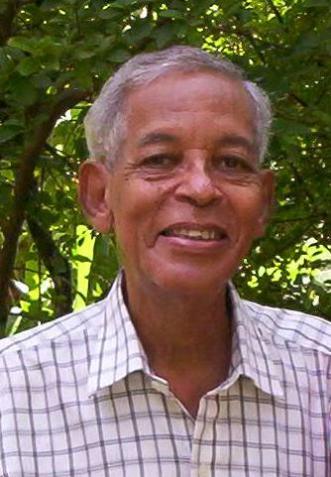
Aubrey Francis Collins
We remember our beloved Aubrey Francis on the fifteenth anniversary of his going to the Father on Monday, August 2nd 2010.
With thanksgiving for all he was to us:
Joan;Ian,Andrea,Naomi, Joanne;Rene,Serafin;Tatianna; andotherrelatives.
May God continue to grant him eternal happiness


celebrates 100 Years of Faith and Service
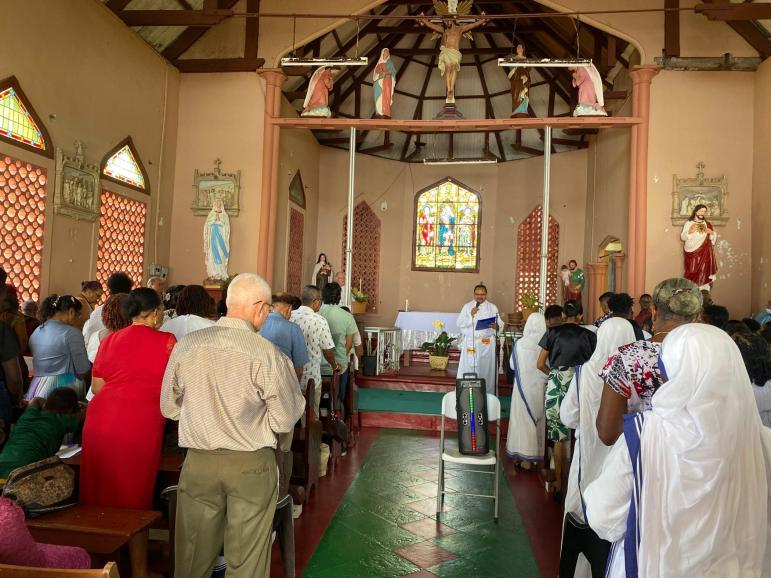
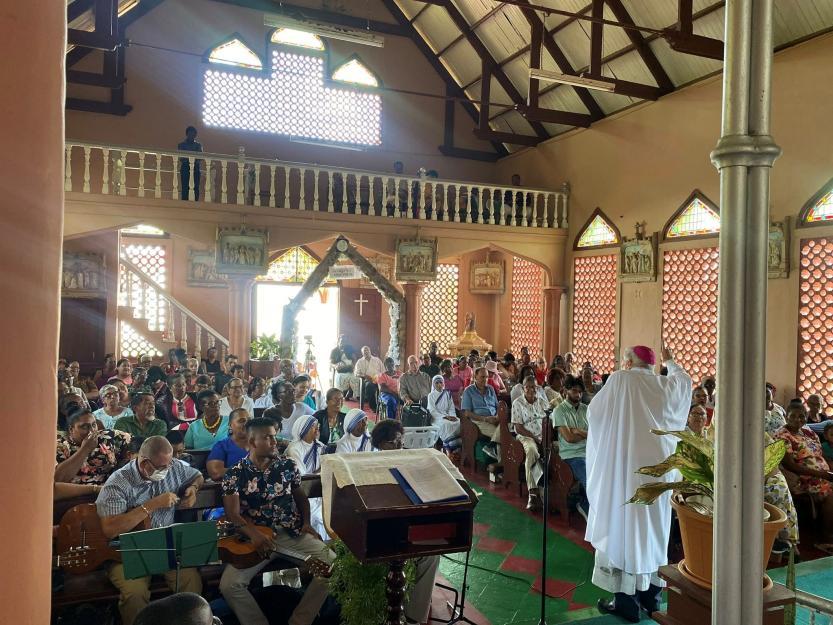
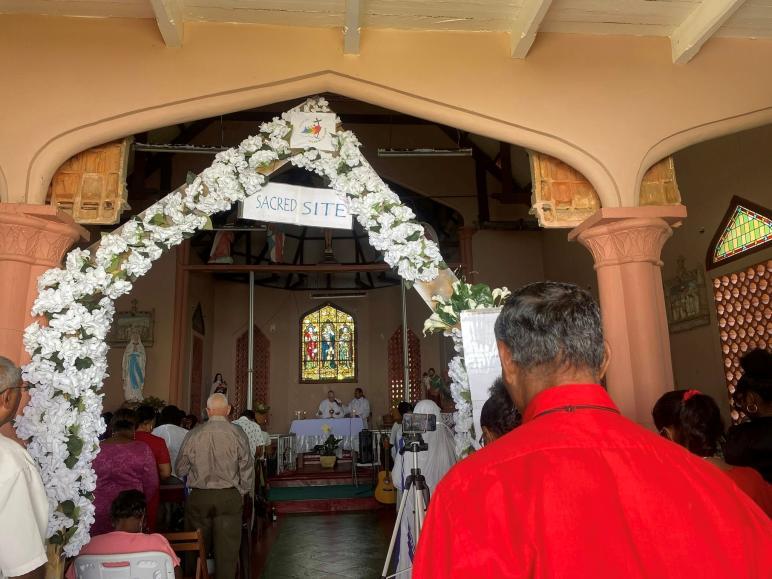
On Sunday July 7th, Our Lady of Peace Church, Zeskenderen, Mahaicony, Region 5 celebrated its centenary. The mass was celebrated by Bishop Francis Alleyne OSB, along with Fr. Amar Bage. Below is a report from Ms. Roxanne Douglas:
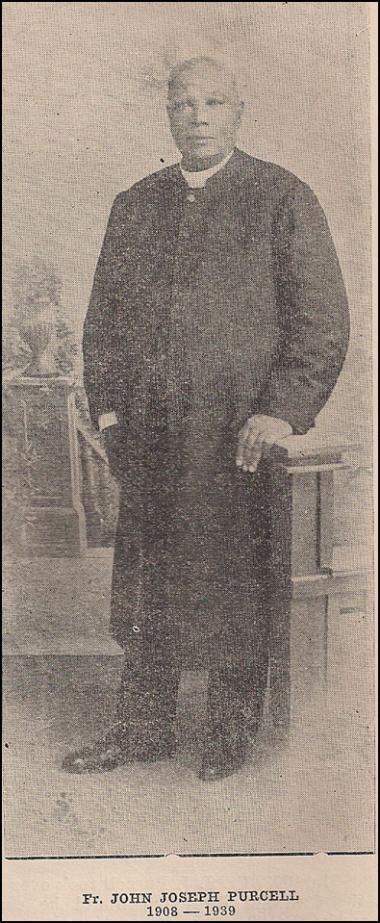
Our Lady of Peace Catholic Church, located in Zeskendren, Mahaicony, joyfully celebrates 100 years of service and worship in the Diocese. Founded in 1925 by Jamaican-born priest Fr. John Purcell, this sacred space has stood firm both physically and spiritually through a century of trials and triumphs.
A Church Built to Last Constructed at the cost of twenty-two thousand dollars, the church was built with reinforced concrete, a rare feat in the early 1900s. Its durability remains evident as it still stands solid and strong today, requiring only minor repairs to the roof, plumbing, and a freshcoatof paint.
ACommunityRootedinHistory
Though no elderly members remain to recount firsthand memories, the church’s sacred atmosphere and historical artifacts speak volumes about the community’s legacy. Fr. Purcell’s deep commitment to the people of Mahaica and Mahaicony is immortalized not only in this church but also in Purcell Street, located just east of the church, named in his honour.
While local membership has declined due to migration and the rise of other denominations, the church remains spiritually active. Monthly Masses continue to draw the faithful from across the Mahaica–Mahaicony region.
Centenary Year: A Time of Grace andCelebration
This Jubilee Year was marked by three major events:
Church continues to be a place of refuge, devotion, and spiritual renewal. As Matthew 16:18 reminds us: “And I tell you, you are Peter, and on this rock I will build my church, and the gates of hell shall not prevail against it.”
WithGratitude
Heartfelt thanks to all who participated, contributed financially, donated items, offered prayers, or supported these events in any way. Your dedication ensures that this sacred space continues to thrive into its next century.
Godbless youall! ❖
The church falls under the jurisdiction of St. Paul’s Parish, located in Helena #2, Mahaica, and serves parishioners from the Abary River to Mahaicony.
A Sacred Space of Beauty and Devotion
Visitors are greeted with a serene, sacred atmosphere. Along the congregation walls are 14 Stations of the Cross, intricately crafted from limestone. To the left of the entrance stands the baptismal font, an artistic limestone sculpture depicting the Baptism of Jesus at the top and the Twelve Apostles atits base. Life-sized statues of the Sacred Heart of Jesus, Our Lady, St. Joseph, and St. Thérèse of Lisieux further enhance the spiritual ambiance. Above the sanctuary is a moving depiction of the Crucifixion, flanked by Our Lady, St. John the Evangelist, and Two Archangels. On the eastern side, a stunning stained-glass window features Our Lady and the Infant Jesus, St. Ignatius of Loyola,and Joanof Arc.
• March 30, 2025: The Annual Lenten Pilgrimage under the theme “Forgiveness and Healing” gathered 75 pilgrims from Georgetown, East and West Bank Demerara, and East Coast communities.
• July 7, 2025: The Centenary Feast Day Mass of Our Lady of Peace brought together 175 pilgrims, including attendees from Berbice. Bishop Francis Alleyne, OSB, in his homily, praised the foundation laid by the early faithful and called on all present to follow the example of Our Blessed Mother in trustand dedication.
“As we look around, we see the fruits of their labor. This should be an inspiration for us too to give our best and to have total trust in God” said Bishop Francis.
• September 14, 2025: The next celebration will be a Pilgrimage on the Feast of the Exaltation of the Cross, themed “Reconciliation and Hope”. More details to follow.
AChurchStandingontheRockof Faith
Despite changing times and a shifting population, Our Lady of Peace Catholic
Centenary Mass held on Sunday July 7th 2025 (photo credit: Catholic Media)
Fr. John James Purcell, who hailed from Jamaica, built Our Lady of Peace church in 1925. Fr. Purcell was also the second and longest–serving Editor of the Catholic Standard, serving from 1908 until his death in 1939.
AEC 2025 Youth Leadership Conference
Catholic youth leaders from across the Caribbean gathered in Montego Bay, Jamaica for a powerful week of formation, strategy, and fellowship at the 2025 AEC Youth Leadership Conference.
With 19 dioceses represented, the conference is being hailed by Church leaders as a bold step toward closing the leadership gap in youth ministry and building a culture where young people are formed, supported, and sent.
The following is the Keynote Address given by Most Rev. Kenneth D. Richards, DD, Chairman of the AEC Youth & Vocation Commission on July 21, 2025.
AEC 2025 Youth Leadership Conference Keynote Address
Acknowledgements:
Most Rev. Charles Jason GordonPresidentof AEC
Most Rev. John Persaud, Bishop of Montego Bay
Mr. Robert Feduccia, EQSAINTS Facilitator
AEC Secretariat: Mr. Ellis Southwell, Mrs. Taresa Best-Downes, Mrs. Julie Ritchie-Bingham, Miss Lesley-Ann Walker, andFr. RohanTulloch,SJ
The AEC Leadership Conference for Diocesan Youth Leaders in 2025 stands as a transformational initiative poised to significantly impact the future of youth ministry across the Caribbean. Rooted in the Church’s Jubilee Year missionand guided by the theme “Pilgrims of Hope, Discipling the Now of God.” This conference is not merely an event; it is a strategic investment in the spiritual, pastoral, andsocial infrastructure of the region.
1. Building Human Capacity for SustainableMinistry
By gathering youth ministry leaders from 19 dioceses, this conference directly addresses a critical leadership gap in the Caribbean Church. The intention was/is that each Arch/ Diocesan delegation would be composed of laity, religious, and/or clergy, so that each Arch/Diocesan Youth Ministry Programme, would have protagonists who would be equipped with practical tools and pastoral frameworks designed to:
• Strengthen Arch/Diocesan and parish-level youthstructures.
• Promote collaboration between youth leaders, religious, clergy, and lay movements.
• Foster missionary discipleship that responds to the real needs of today’s youth.
• Foster Christian Leaders who are persons committed to personal spiritual growth: i.e., have a commitment to sacramental spirituality, and devotional practices for you are to be ministers enabling the Church’s Mission in this time, in this space.
In contrast to models of secular youth programme that can fall prey to
human behaviors that are contrary to Kingdom values, the youth ministry that is to be advanced must take a bold step toward changing that reality. The Collect for the Sixteenth Sunday of Ordinary Time, can be prayed to inspire this hope: “Show favor, O Lord, to your servants and mercifully increase the gifts of your grace, that, made fervent in hope, faith and charity, they may be ever watchful in keeping your commands.” And the antiphon of Psalm 15: He who does justice will live in the presence of the Lord.
MODELSFORYOUTH
Youth in the Bible (Christus Vivit 5–21)
• David: God chose the young shepherd David to be king, showing that age is no barrier to divine purpose (CV7).
• Joseph: A young dreamer whose faith and integrity played a pivotal roleinsalvationhistory (CV8).
• Gideon & Jeremiah: Both initially resisted God's call due to their youth, but God empowered them for greatmissions (CV 9–10).
• Mary of Nazareth: A courageous young woman whose 'yes' to God changedhistory (CV 43–48).
• Jesus Christ: Lived as a young man among us, maturing in wisdom and grace, close to everyday realities (CV 23–29).
YouthSaints(ChristusVivit 49–63)
• Saint Sebastian: A young Roman soldier martyred for his unwavering faithinChrist.
• Saint Francis of Assisi: Renounced wealth in his youth to live the Gospel radically.
• Saint Dominic Savio:Died before age 15, known for his joyful holiness and devotion.
• Saint Thérèse of Lisieux: Entered Carmel at 15, became a Doctor of the Church through her 'Little Way' of love.
• Blessed Pier Giorgio Frassati: Lived a vibrant life of faith and service, died at24.
• Blessed Carlo Acutis: A tech-savvy teen who evangelized online and died at 15, known for his devotion to the Eucharist.
“Many young saints have allowed the features of youth to shine forth in all their beauty, and in their day they were real trailblazers for others.”
2.StrategicMultiplicationofImpact
The purpose of this Training Conference cannot be allowed to be a one-time intervention. The experience is a seed-planting encounter. Each delegate is expected to return to their Arch/Diocese as a multiplying agent, equipped to:
• Trainyouth ministers.
• Mentor emergingyoungleaders.
• Launch or reinvigorate youthcentered initiatives rooted in Spirituality, Gospel witness, and Catholic Social Teaching.
Conservatively, if each delegate meaningfully impacts even 25 young people within the first year of returning home, the ripple effect would reach at least 2,375 youth directly. Over three years, this number could expand exponentially, especially through the active diocesan-level support structures the Antilles Episcopal Conference aims to catalyze.
3. Supporting Integral Human Development
By forming leaders who understand both spiritual formation and social action, this experience aims to build the human infrastructure necessary to:
• Mobilize young Catholics for community development, justice, and peace building.
• Sustain Arch/Diocesan and parishbased initiatives addressing vocation andfamily life.
4. Promote Unity across Language andCulture
For the first time in this format, the AEC brings together leaders from the English, French, and Dutch-speaking Caribbean, modeling the synodal spirit of the universal Church. This creates a uniquespacefor:
• Cross-cultural dialogue and cooperation.
• Sharing of best practices across linguistic andregional lines.
• Strengthening regional identity and solidarity in the mission of youth ministry.
5. Long-term Vision for a Church Led bytheYoung
AI estimates a Catholic youth population, ages 14 - 24, of 400,000 in the AEC region. Our commitment must be that they deserve leaders who not only minister to them, but who will also minister with and among them. Therefore, this conference lays the foundationfor:
• A youth-led Church that listens and responds to the “now of God.”
• A new generation of leaders who will guide their peers in faith, social engagement, and missionary outreach.
• Sustainable transformation ministry rooted in hope, formation, and the power of encounter.
InSummary
The 2025 Leadership Conference is a pivotal moment in the life of the Caribbean Church. It aims not only to form leaders, but to form formers of leaders, that is, young adults, religious, and clergy who will shape the present and future of Catholic life in our communities. With your support, this vision can become a reality, bringing renewed energy, deeper faith, and lasting impact to thousands of young Catholics throughout the region.❖
s August prayer intention: For mutual coexistence
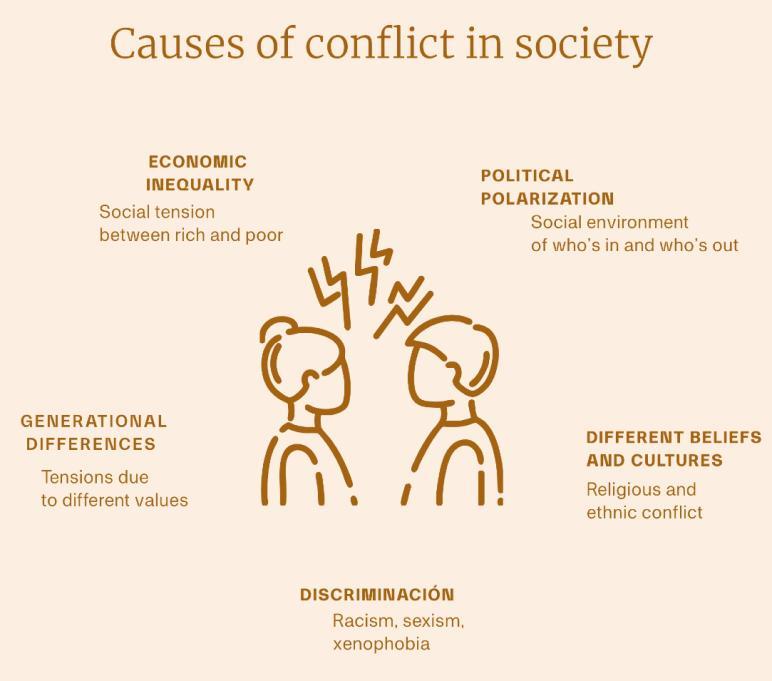
(Vatican News)“Let us pray that societies where coexistence seems more difficult might not succumb to the temptation of confrontation for ethnic, political, religious, or ideological reasons,” Pope Leo says in hisprayer intention for August, 2025.
In the prayer that follows, Pope Leo recalls that we stand in Jesus’ presence, in need of His peace.
“We live in times of fear and division,” the Pope says. “Sometimes we act as if we were alone, building walls that separate us from one another, forgetting that weare brothersand sisters.”
He calls on Jesus to send the Holy Spirit “to rekindle within us the desire to understand one another, to listen, to live together with respectand compassion.”
The Holy Father goes on to ask the Lord for “the courage to seek paths of dialogue, to respond to conflict with gestures of fraternity, to open our hearts to others without fear of difference.”
“Make us builders of bridges, able to overcome borders and ideologies, able to see others through the eyes of the heart, recognizing in every person an inviolable dignity,” Pope Leo prays, before concluding, “Help us to create spaces where hope can flourish, where diversity is not a threat but a richness that makes us morehuman.”
Promoting peaceful coexistence
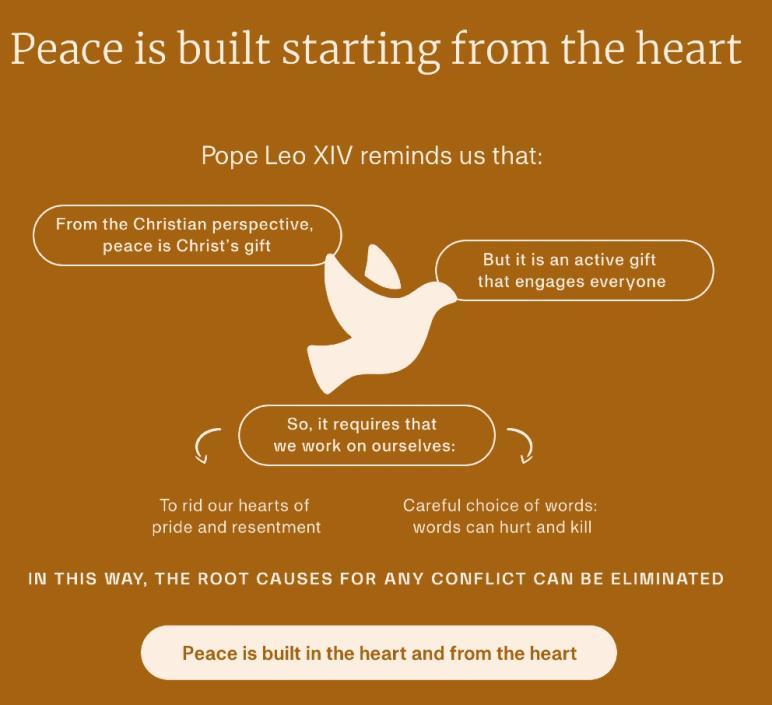
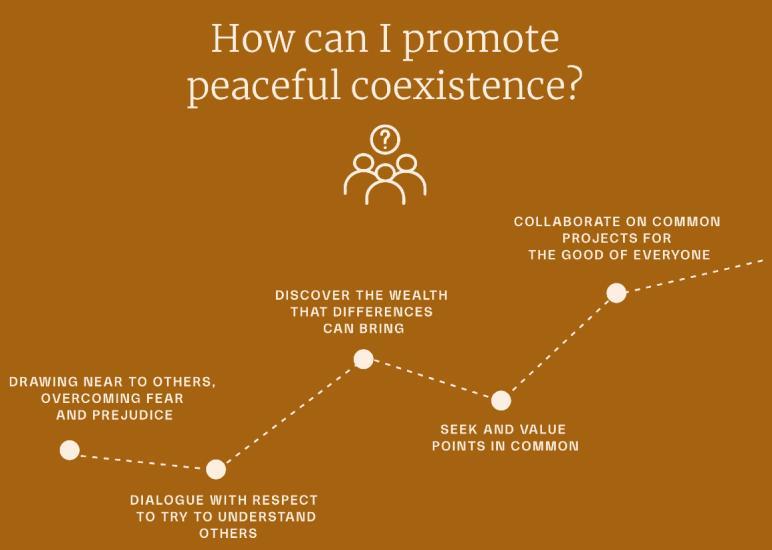
In the press release accompanying this month’s prayer intention, Father Cristóbal Fones, S.J. the International Director of the Pope’s Worldwide Prayer Network, which publishes the Holy Father’s prayer intention each month explains that “all of us can promote peaceful co’existence.
This, he said, entails, “the necessity of working on oneself first of all; to rid one’s heart of pride, and the expectations and negative words that hurt and kill. As Pope Leo XIV teaches us, peace is built in the heart and from the heart.”
Secondly, it is necessary to set aside prejudices and to acknowledge the fear of those who are ‘different’. “We need to respectfully approach others to listen since they always something unique to contribute,” Father Fones continues. “Through dialogue, it is possible to seek what unites us and open up ways to work together for the common good.”
Lastly, Father Fones reminds us that “Pope Leo XIV also points out that government leaders need to work toward building harmonious and peaceful societies. This can be done by: investing in the family; safeguarding the dignity of every person, especially the weakest and most defenseless; exercising justice; seeking to remedy inequalities; defending the truth, which is the basis
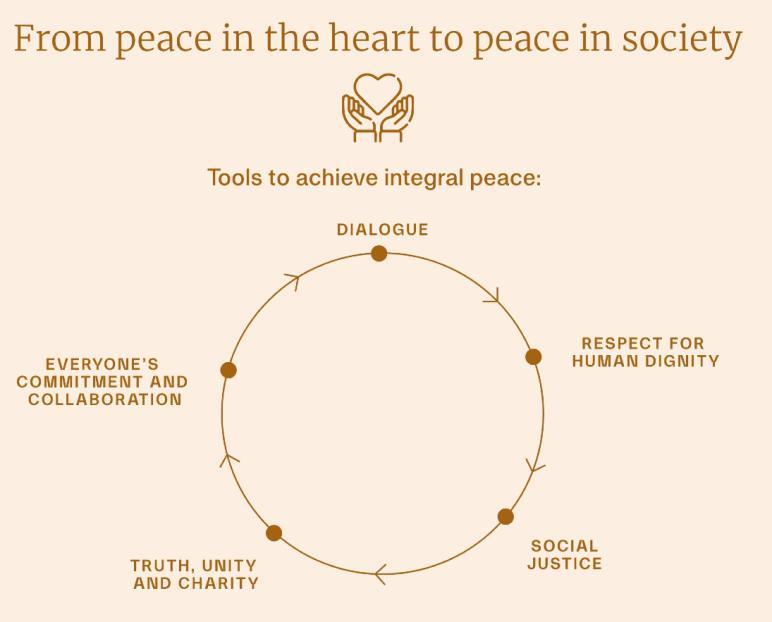
on which authentic relationships can be built.”
Finally, within the context of the Holy Year 2025, The Pope Video acquires special relevance since through it we
know the prayer intentions the Pope holds in his heart. To properly receive the graces of the Jubilee indulgence, it is necessary to pray for the Pope’s intentions. ❖
Just Electoral Peace in Guyana (From
series brings together civil society leaders, legal experts, community voices, and election stakeholders to explore how we can break cycles of mistrust, violence, and division during elections and instead build a future rooted in reconciliation, trust, legitimacy,andsharedvalues.
Webinar 1: Reconciliation and Trust
Topic: What must we do to ensure that past hurt and mistrust no longer drive electoral pain that might manifestvia violence?
Date:Thursday7thAugust2025
Time:7pm - 9pm
Description: Electoral tension in Guyana often reflects deeper historical wounds. This session examines the roots of mistrust and explores community-based and national strategies for healing, dialogue, andreconciliation How can we nurture this in Guyana?
Webinar 2: System Strengthening
Topic: What must we do to ensure that election-related systems grow in legitimacy and efficacy, and do not provide grounds for grievance?
Date:Thursday14thAugust2025
Time:7pm-9pm
Description: Strong systems build strong democracies. This session focuses on strengthening institutions to ensure they are seen as impartial, competent, and trustworthy. We’ll discuss reforms, capacity building, and how technology and transparency can help rebuild confidence in the process.
Webinar 3: Rights and Values
Topic: How do we strengthen a national consensus on constitutional values so that we engage each other peacefully atelectiontimes?
Date:Thursday21stAugust2025
Time:7pm-9pm
Description: A peaceful elections begins with a shared understanding of rights, responsibilities, and values. This final session asks: how can Guyana foster a culture of civic respect, constitutional literacy, and democratic engagement? Let’s talk about what unites us and how that canguide us duringelections.
Who Should Attend:
Civil society actors, educators, young leaders, political representatives, religious and community organizations, media professionals, and all citizens committedto democracy and peace.
Let’s come together to ensure that every election in Guyana is a celebration of democracy not a source of fear.
Peace is possible. Transparency is achievable. Trustcan be rebuilt.
Join the conversation. Be part of the change. ❖
Register here to attend the webinar series. Further details, including the Zoomlink,willbesharedafterregistration.
Front Page)
St. Ignatius celebrates feast day
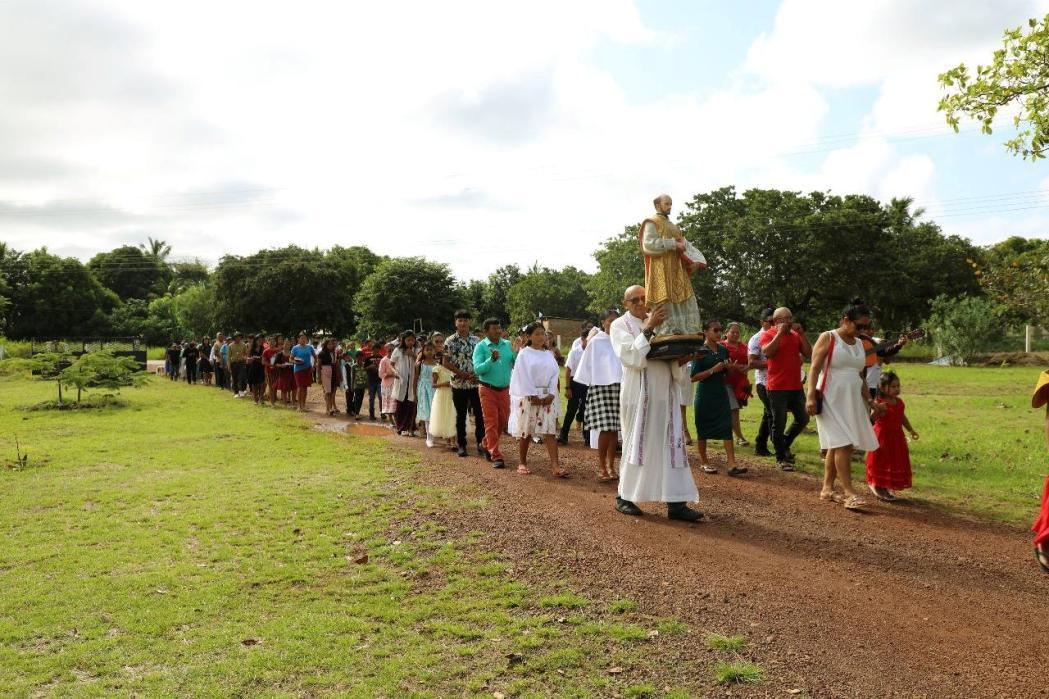
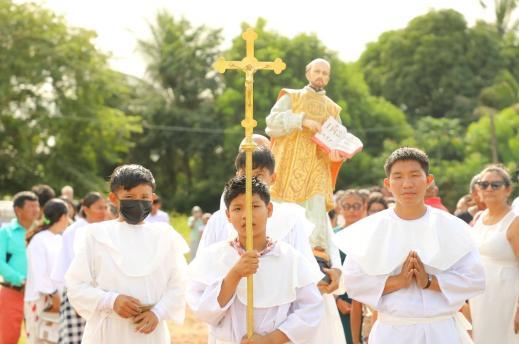
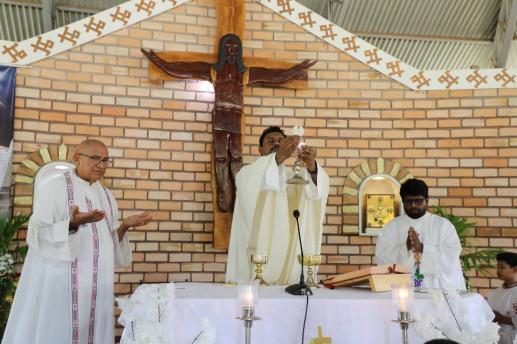
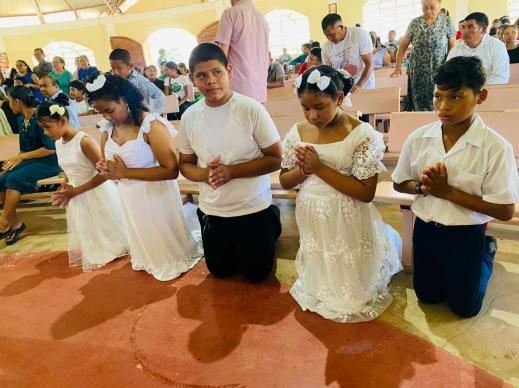
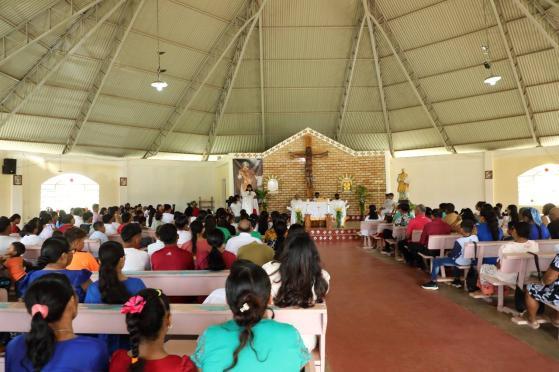
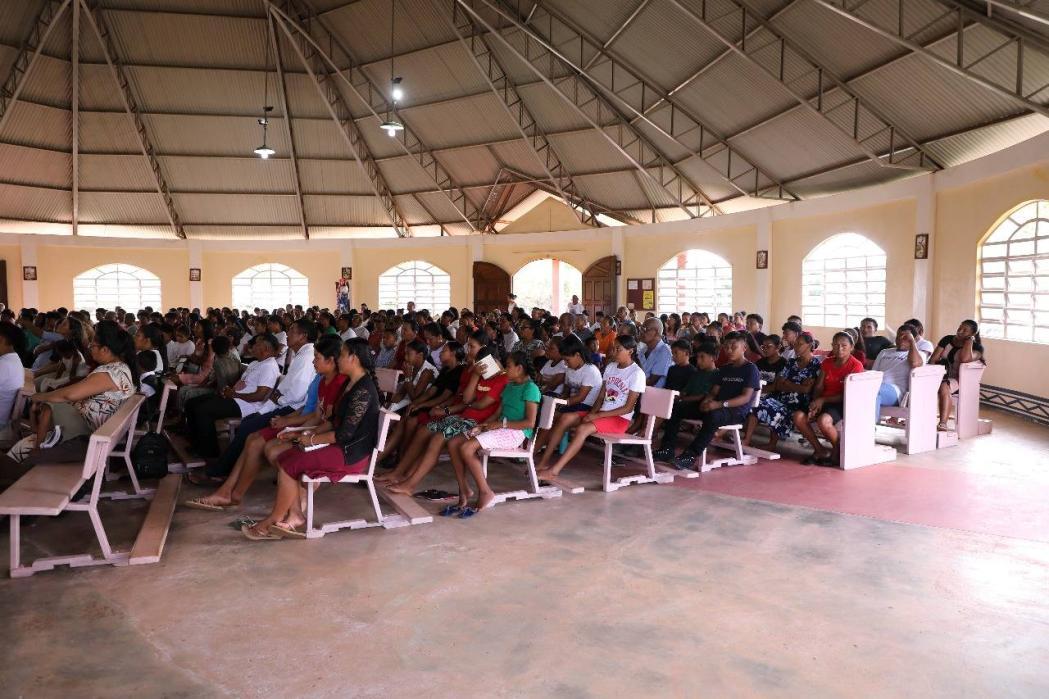
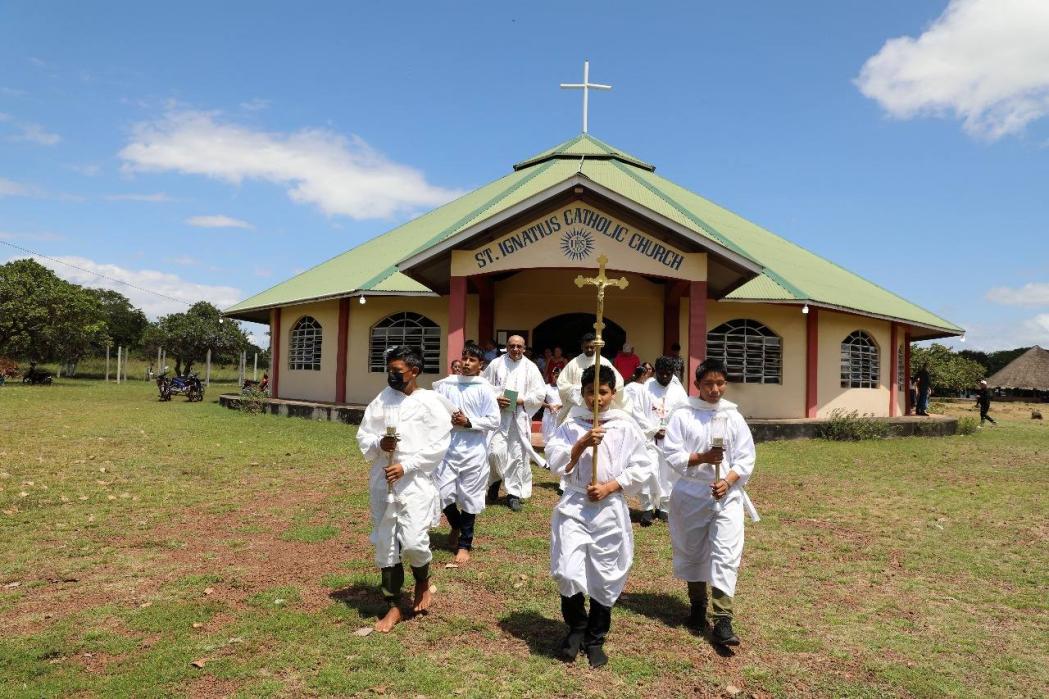
The community of St. Ignatius, Central Rupununi, Region 9, Essequibo, Guyana, on Sunday July 27th celebrated the Feast of St Ignatius ahead of its July 31st date. The community entered the Church with a grand procession, and five children made their First Holy Communion. ❖
Adapted from St Ignatius Mission Facebook page)
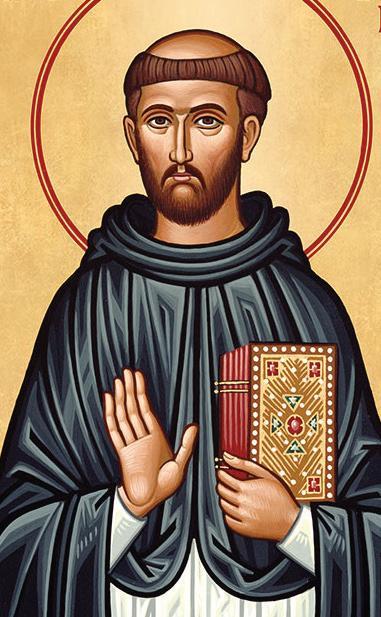
August 8th - St Dominic (August 8, 1170 - August 6, 1221)
Born in 1170 in Spain, Dominic became a priest and after strenuous preaching against the Albigensians he founded the Order of Preachers (Dominicans) to continue his work. He diedin1221.
Dominic's ideal, and that of his Order, was to organically link a life with God, study, and prayer in all forms, with a ministry of salvation to people by the word of God. His ideal: contemplata tradere: “to pass on the fruits of contemplation” or “to speak only of Godor withGod.”
Saint Dominic is the Patron Saint of Astronomers.❖
Side Saint of the Week
On the Lighter