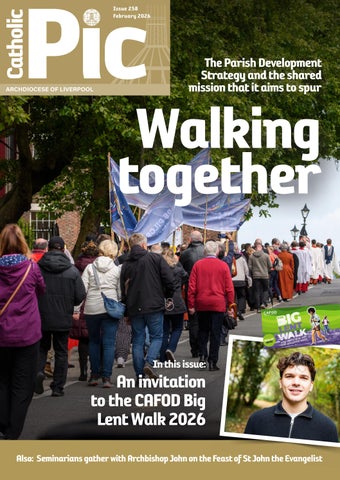
The Parish Development Strategy and the shared mission that it aims to spur
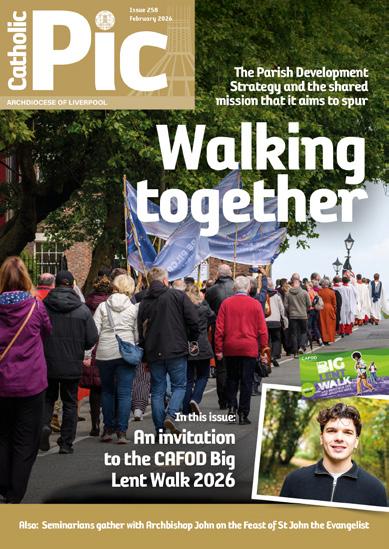
Walking together


Also: Seminarians gather with Archbishop John on the Feast of St John the Evangelist

Become an outstanding teacher with SJCMAT’s School-Centred Initial Teacher Training (SCITT)
Become an outstanding teacher with SJCMAT’s School-Centred Initial Teacher Training (SCITT)
Become an outstanding teacher with SJCMAT’s School-Centred Initial Teacher Training (SCITT)
At St Joseph Catholic Multi Academy Trust, we believe great teaching transforms lives. Our highly successful SCITT programme offers a hands-on, research-informed teacher training route designed for trainees ready to make a real difference from day one.
At St Joseph Catholic Multi Academy Trust, we believe great teaching transforms lives. Our highly successful SCITT programme offers a hands-on, research-informed teacher training route designed for trainees ready to make a real difference from day one.
At St Joseph Catholic Multi Academy Trust, we believe great teaching transforms lives. Our highly successful SCITT programme offers a hands-on, research-informed teacher training route designed for trainees ready to make a real difference from day one.
Learn where it matters – in real classrooms
Learn where it matters – in real classrooms
Learn where it matters – in real classrooms
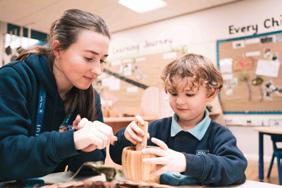
Our one-year SCITT course places trainees at the heart of school life from September, working in classrooms across Liverpool, St Helens and Wigan. With expert mentor support every step of the way, you’ll gain the confidence and capability that only genuine teaching experience can provide.
Our one-year SCITT course places trainees at the heart of school life from September, working in classrooms across Liverpool, St Helens and Wigan. With expert mentor support every step of the way, you’ll gain the confidence and capability that only genuine teaching experience can provide.
Our one-year SCITT course places trainees at the heart of school life from September, working in classrooms across Liverpool, St Helens and Wigan. With expert mentor support every step of the way, you’ll gain the confidence and capability that only genuine teaching experience can provide.
Outstanding training. Real impact.
Outstanding training. Real impact.
Outstanding training. Real impact.
You’ll receive:
You’ll receive:
You’ll receive:
• Two weeks of intensive training before you enter the classroom.
• Two weeks of intensive training before you enter the classroom.
• Two weeks of intensive training before you enter the classroom.
• Weekly training sessions designed by Teach First curriculum specialists.
• Weekly training sessions designed by Teach First curriculum specialists.
• Weekly training sessions designed by Teach First curriculum specialists.
• Six half-termly academic modules building deep expertise in teaching, learning, assessment and inclusion.
• Six half-termly academic modules building deep expertise in teaching, learning, assessment and inclusion.
• Six half-termly academic modules building deep expertise in teaching, learning, assessment and inclusion.
• A year-long main placement, alongside six weeks spent across at least two contrasting schools to broaden teaching experience.
• A year-long main placement, alongside six weeks spent across at least two contrasting schools to broaden teaching experience.
• A year-long main placement, alongside six weeks spent across at least two contrasting schools to broaden teaching experience.
• A supportive professional learning community across all SJCMAT schools.
• A supportive professional learning community across all SJCMAT schools.
• A supportive professional learning community across all SJCMAT schools.
Graduate ready to teach, ready to inspire
Graduate ready to teach, ready to inspire
Graduate ready to teach, ready to inspire
By the end of the programme, you’ll qualify with:
By the end of the programme, you’ll qualify with:
By the end of the programme, you’ll qualify with:
• Qualified Teacher Status (QTS)
• Qualified Teacher Status (QTS)
• Qualified Teacher Status (QTS)
• PGCE with Master’s-level credits
• PGCE with Master’s-level credits
• PGCE with Master’s-level credits
• Experience, confidence and classroom fluency
• Experience, confidence and classroom fluency
• Experience, confidence and classroom fluency
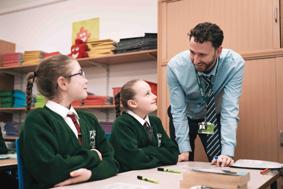
If you’re ready to inspire. Ready to grow. Ready to shape young lives in our region, we’d love to hear from you. Find out more:
If you’re ready to inspire. Ready to grow. Ready to shape young lives in our region, we’d love to hear from you. Find out more:
If you’re ready to inspire. Ready to grow. Ready to shape young lives in our region, we’d love to hear from you. Find out more:
Apply now
Apply now
Apply now
Visit gov.uk/apply-for-teacher-training and select St Joseph Catholic Multi Academy Trust as your provider.
Visit gov.uk/apply-for-teacher-training and select St Joseph Catholic Multi Academy Trust as your provider.
Visit gov.uk/apply-for-teacher-training and select St Joseph Catholic Multi Academy Trust as your provider.
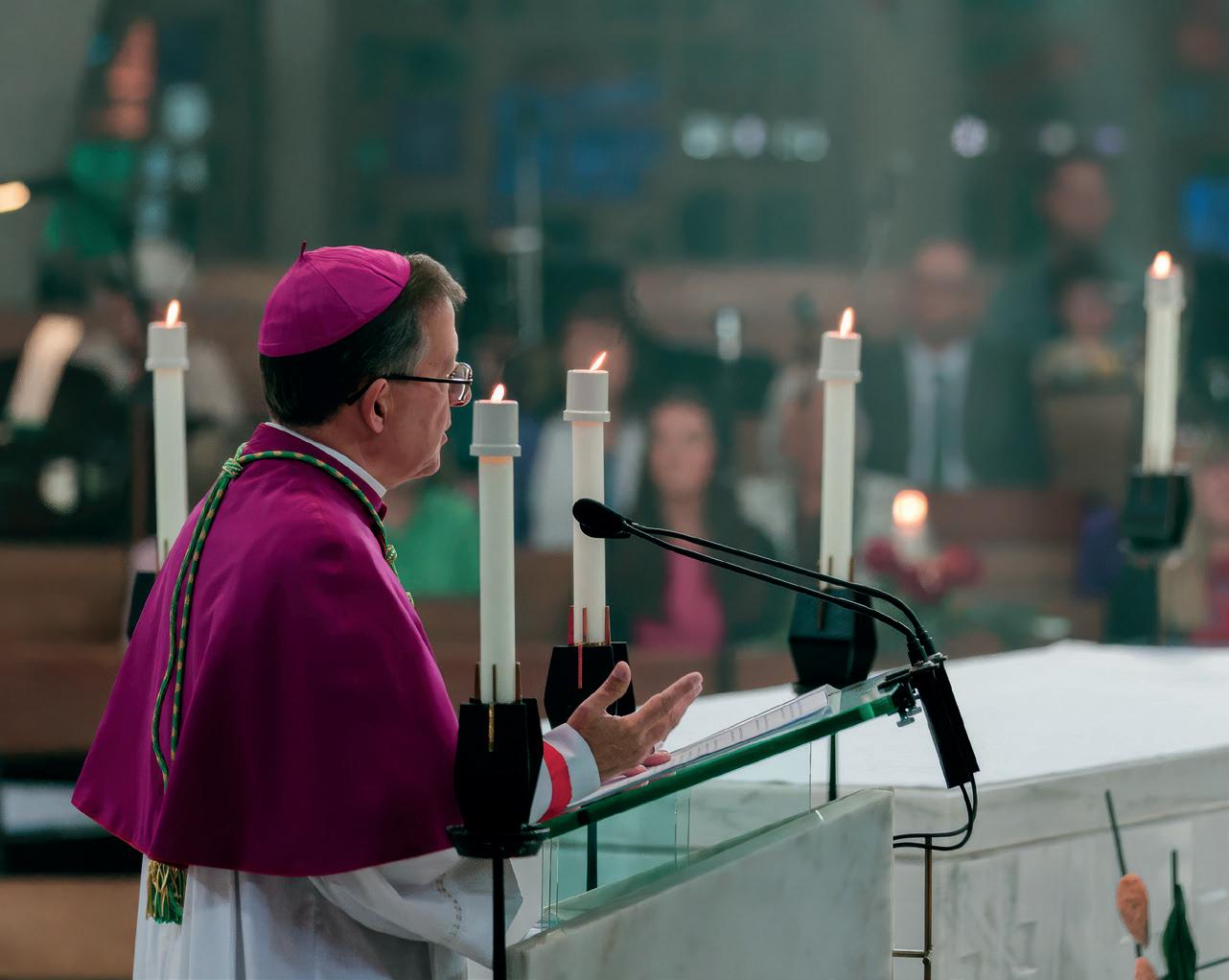
From the Archbishop’s Desk
February sees the days lengthen significantly and both warmth and light strengthen. The Feast of Candlemas, the Presentation of the Lord in the Temple, on 2 February, rejoices in the Light of Christ who shines into darkness and gives hope to the world. The light of Christ shines strongly into the heart of every baptised man and woman and calls us to use our gifts for the good of others.
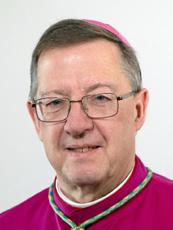
As St John Henry Newman wrote, “God has created me to do some definite service; God has committed some work to me which has not been committed to another. I have my mission – I may never know it in this life, but I shall be told it in the next.”
This month, we pray for the mission of many Christians in marriage and family, priesthood and religious life. We look forward to the celebration of the Annual Marriage Mass on Saturday 8 February. It is an opportunity to thank God for the call and gift of marriage and an opportunity to celebrate the significant anniversaries of marriage which are so important in the life of families and friends. We thank God for the gift of His grace to strengthen the love of husband and wife for each other and their families. It deepens the gift and call of baptism in a special way which makes God’s love real through both little and great acts of love, the daily give and take of life, and sacrifice and generosity. We also pray for those whose hopes for marriage have not continued and who often carry deep pain.
On Saturday 14 February we celebrate the annual Mass for Religious and Consecrated Life. The gathering of religious women and men from across the archdiocese with Bishop Tom Neylon celebrates God’s call in each of their lives for service to others, often education, healthcare, spiritual guidance, or bringing God’s love into people’s lives through friendship and charity. Sadly, this year the Sisters of the Cenacle, the Cross and Passion Sisters, and the Focolare Community have left the archdiocese. We pray for them and thank them for their service and gifts. On this day, I will be concelebrating the Mass of Installation for Archbishop-elect Richard Moth who succeeds Cardinal Vincent Nichols (from Crosby, once a Liverpool priest and ardent Liverpool fan) as Archbishop of Westminster. We wish him and Cardinal Vincent well for the next stage of their priestly lives.
Ash Wednesday falls a few days later, on 18 February. During Lent, we look forward to the women and men who will be baptised at the Easter Vigil, or receive the sacrament of Confirmation, or be received into full communion with the Catholic Church. It is a time when we can each try to deepen the living of the call of our baptism more fully so that we can celebrate the death and resurrection of Christ better at Easter. I invite you to join me at the Rite of Election on Sunday 22 February at 3pm when we welcome these prospective members of the Church to the Cathedral.
February provides an opportunity to celebrate God’s call in each of our lives and pray for young people who are preparing for Christian marriage or wondering about a call to priesthood and religious life. Please pray for them to discover their Godgiven mission in life.
Archbishop John Sherrington Archbishop of Liverpool
Monthly prayer intentions
FEBRUARY
For children with incurable diseases. Let us pray that children suffering from incurable diseases and their families receive the necessary medical care and support, never losing strength and hope.
Editor Harriet Anwyl
Editorial Catholic Pictorial Magazine, St Margaret Clitherow Centre, Liverpool Archdiocesan Office, Croxteth Drive, Liverpool L17 1AA Tel: 0151 522 1007 Email: CatholicPic@rcaol.org.uk
Advertising Sales team 0151 709 7567 sales@cpmmmedia.com
Contributor
Katie Parry
Pictures Nick Fairhurst (www.nickfairhurstphotographer.com)
Martin Cahill (cahill-photography.com)
Website: www.catholicpic.co.uk
Twitter: @PicCatholic
Youtube: CPMM Media
We are
‘Pilgrims of Hope’ who wish to share the hope of Jesus Christ with others
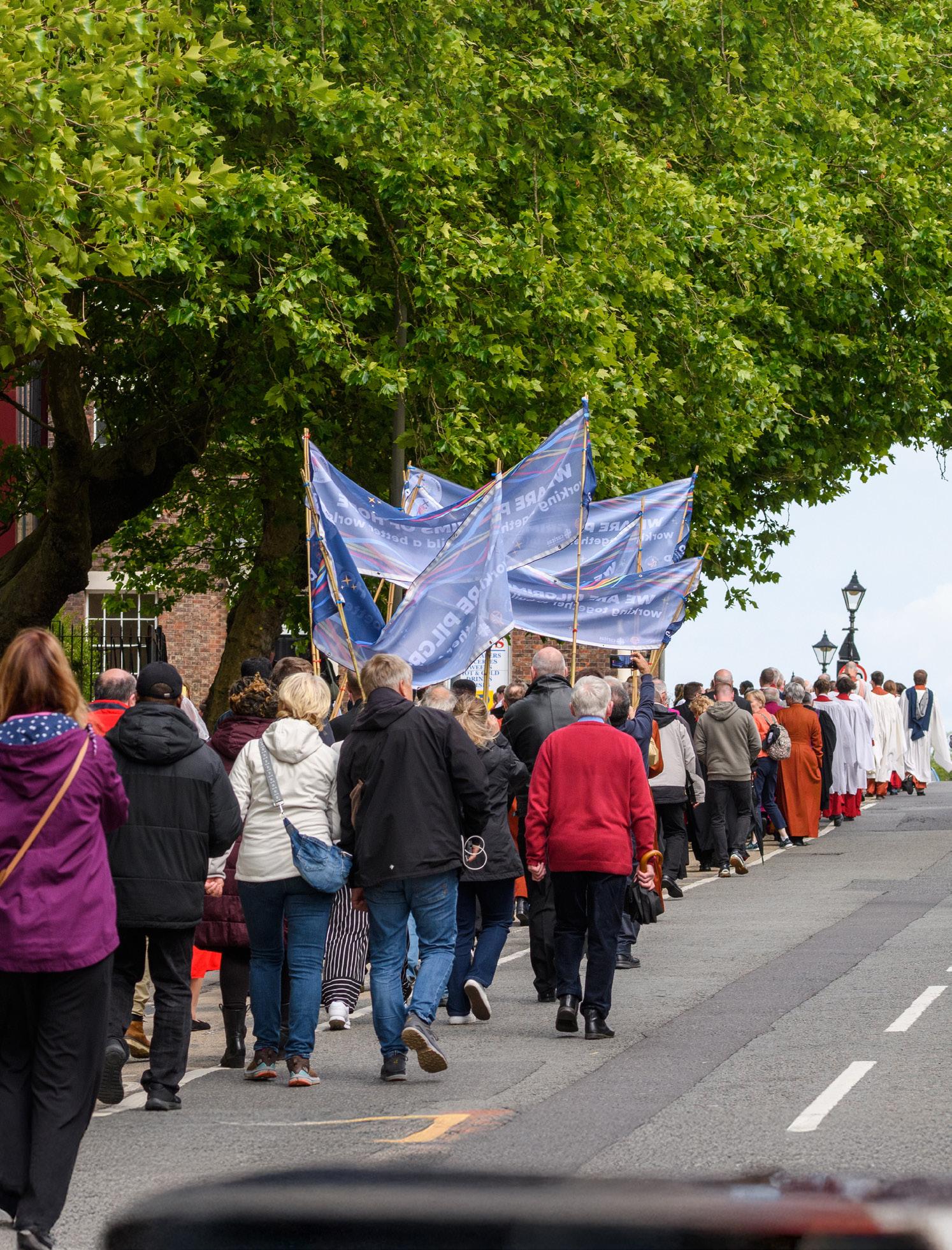
Walking together
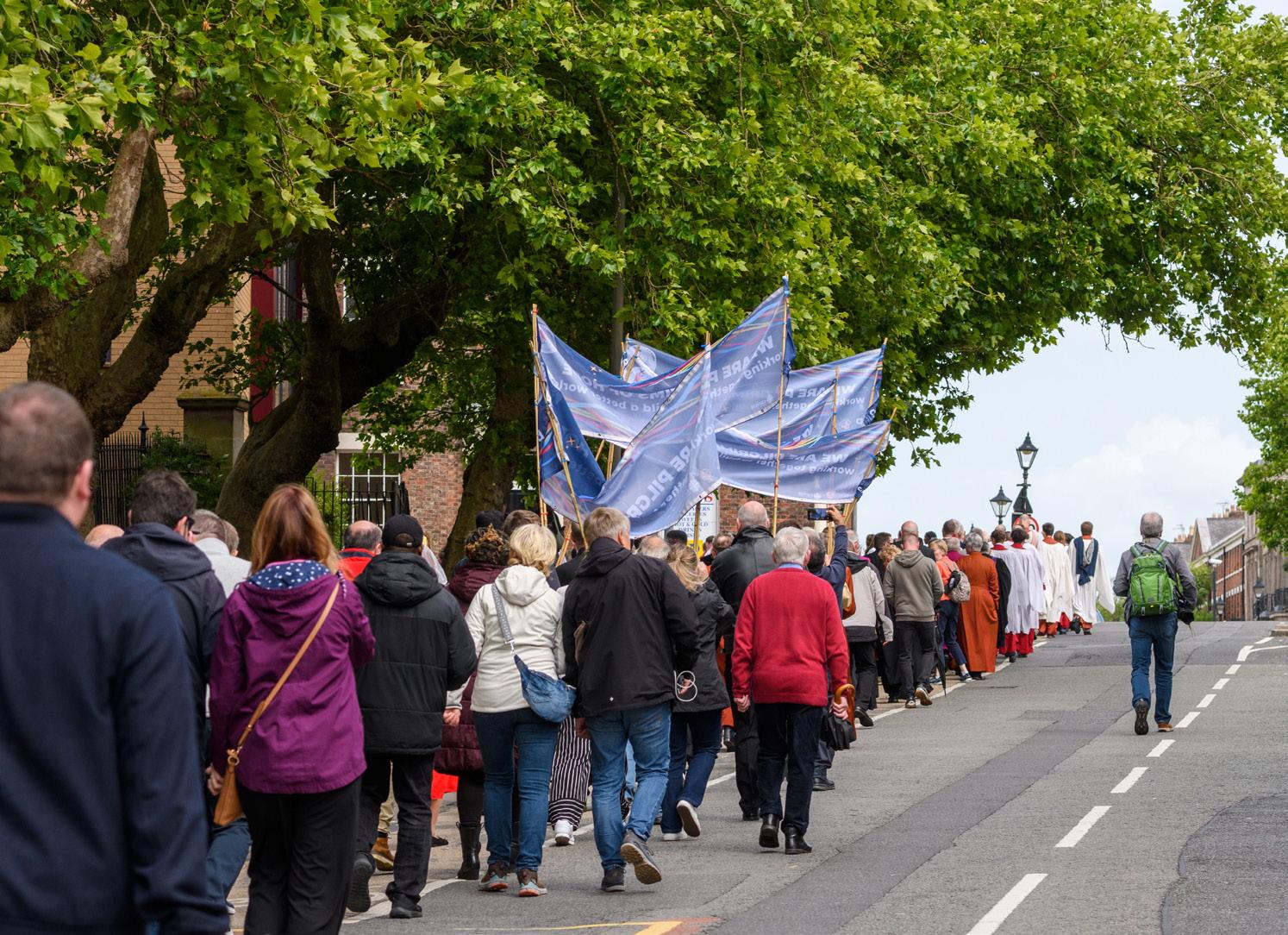
Chris Higgins, the Archdiocesan parish and deanery development adviser, shines a light on the Parish Development Strategy and the shared mission that it aims to spur.
The Archdiocese of Liverpool is embarking on a bold and hopeful journey through its Parish Development Strategy (PDS)—a process designed not only to respond to pressing challenges, but to renew our commitment to the mission of the Church: proclaiming Christ, nurturing believers, and serving communities, especially the poor.
Why change?
Archbishop John Sherrington tells us: “The Church exists to proclaim Jesus Christ to all peoples. This is her mission. Christ loves us, has saved us, walks with us and offers the hope of eternal life.”
To fulfil this mission today, there is a compelling case for altering our approach. Several realities are shaping this new direction:
• A deep desire to live out our missionary purpose: to proclaim Christ, worship, evangelise and serve.
• The hope for greater co-operation between parishes and deaneries to strengthen our mission and support one another.
• A sobering truth: the number of diocesan priests will fall from 100 today to fewer than 60 within seven years.
• The aspirations for a vibrant future for our children and young people.
• The flourishing life of Catholic schools and families.
• The urgent need to attract more vocations to the priesthood, diaconate and religious life.
• The call for all the baptised to actively serve the mission of the Church.
• The financial strain of maintaining too many buildings, leading to years of overspending.
• The burden of stewardship falling on fewer priests and parishioners.
• The challenge of engaging those who are indifferent or hostile to the Church.
Reflecting on the above points, Archbishop Sherrington adds: “We are ‘Pilgrims of Hope’ who wish to share the hope of Jesus Christ with others. The mission today, for tomorrow, needs realistic and forward-looking structures because people have moved, the cost of maintaining too many buildings is prohibitive and the number of clergy has reduced.”
The vision: A Church renewed The Parish Development Strategy has been put in place to allow us to embrace new possibilities. It calls us to walk together and shape a vibrant, mission-focused, healthy, and sustainable Church for today and tomorrow. This requires courage, creativity and, above all, faith.
The pastoral plan offers four signposts for the future:
• Be immersed in the joys and hopes, griefs and anxieties of humanity today;
• Be brave and creative in renewing local structures;
• Develop leadership to attend to changing needs;
• Embed synodality in every aspect of archdiocesan life.
These are not abstract ideals, but rather practical invitations to every parish to reimagine its life and mission.
How is it happening?
This process is being carried out at local level, deanery by deanery. A pilot began last year in the three Sefton deaneries: Sefton Coast North, Sefton Coast South and Sefton Inland. They are currently at stage two of a four-stage journey:
Stage 1: Review the current situation –each parish will conduct its own review at all levels, including clergy, ministers, liturgical provision, mission activity, finance buildings, demographics, consulting widely.
Stage 2: Discern future priorities –parishes and families of parishes will identify priorities and share findings at deanery synodal council level.
Stage 3: Making plans – local churches will create plans based on these priorities and present them to the Archbishop.
Stage 4: Action – agreed plans will be implemented within a set timeframe. This process will be embedded in prayer.
The Parish Development Strategy has been put in place to allow us to embrace new possibilities

Every stage will be underpinned by discernment and openness to the Holy Spirit. As Archbishop Sherrington reminds us: “We ask the help of the Holy Spirit to be with us and the prayer of Mary, Star of Evangelisation.”
The deaneries of Warrington & Widnes and Liverpool South (phase two) have started their parish reviews (stage one) last month and will begin their discernment process (stage two) after Easter. We hope that later in the year another two deaneries will begin the process, marking phase three.
A truly Synodal Church
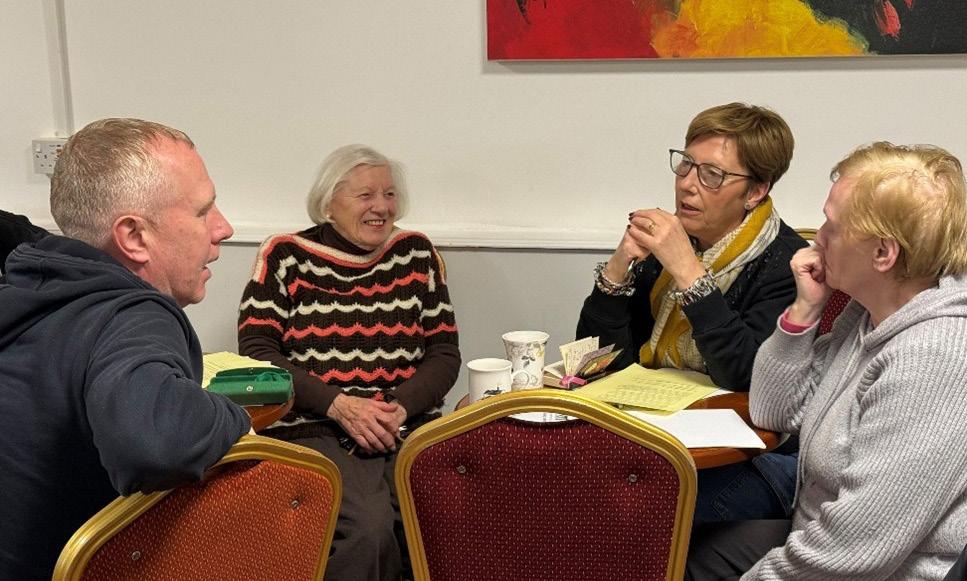
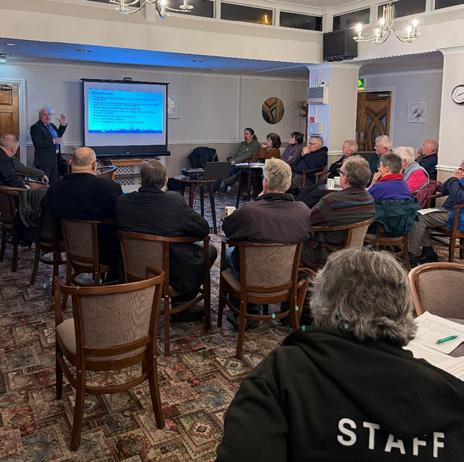
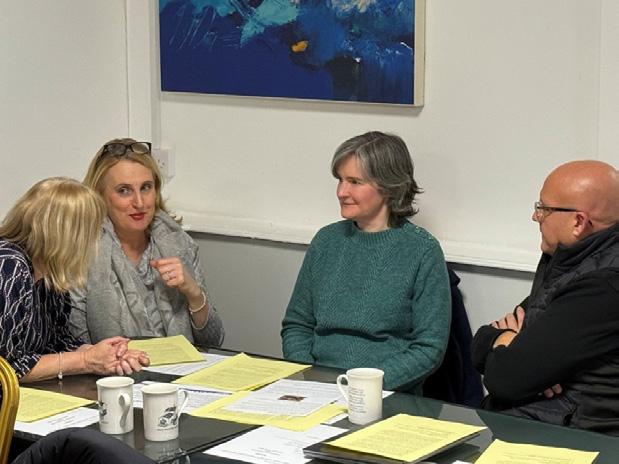
The PDS is a call to journey together. Every voice matters. Every parishioner has a role to play. This is not a top-down directive—it is a shared mission, rooted in listening, dialogue, and collaboration.
The following quotes, drawn from members of the pilot steering groups in Sefton, offer a reflection of that.
Voices from Sefton
“Using the synodal process of discernment has been empowering and a privilege to listen to others involved.”
“The process has been rewarding. To evaluate where Christ’s example is strong within the deanery and the good practice that has been shared gives hope for the future of the Church.”
“It’s very positive how common themes have emerged from many parishes through this process. And enlightening to listen to other parishes proposals and ideas.”
“This process has energised us to focus in on our true mission and purpose as a Christ-centred community ready for the opportunities to come. We welcome the responsibility to be an active part of this process.”
“As a pilot, there have been some glitches along the way but overall, it has been a fantastic process and essential to the future of our Church in Liverpool.”
“This process presents challenges in terms of facing the future for our archdiocese head on. A wonderful opportunity to work in a collaborative way to develop a new and refreshing vision. We pray that the Holy Spirit will guide us in the light of Christ.”
What’s next?
Look out for information in your parish about how you can participate in the process when your deanery begins this process. The full strategy document is available to view at www.liverpoolcatholic. org.uk/parishdevelopment.
For further information or queries, please contact our parish and deanery development adviser, Chris Higgins on the following email: c.higgins@rcaol.org.uk.
“The process has been rewarding. To evaluate where Christ’s example is strong within the deanery and the good practice that has been shared gives hope for the future of the Church.”


Raise a glass to St Arnold
part of the Cathedral’s calendar that it’s hard to believe it started accidentally, and with a good deal of controversy.
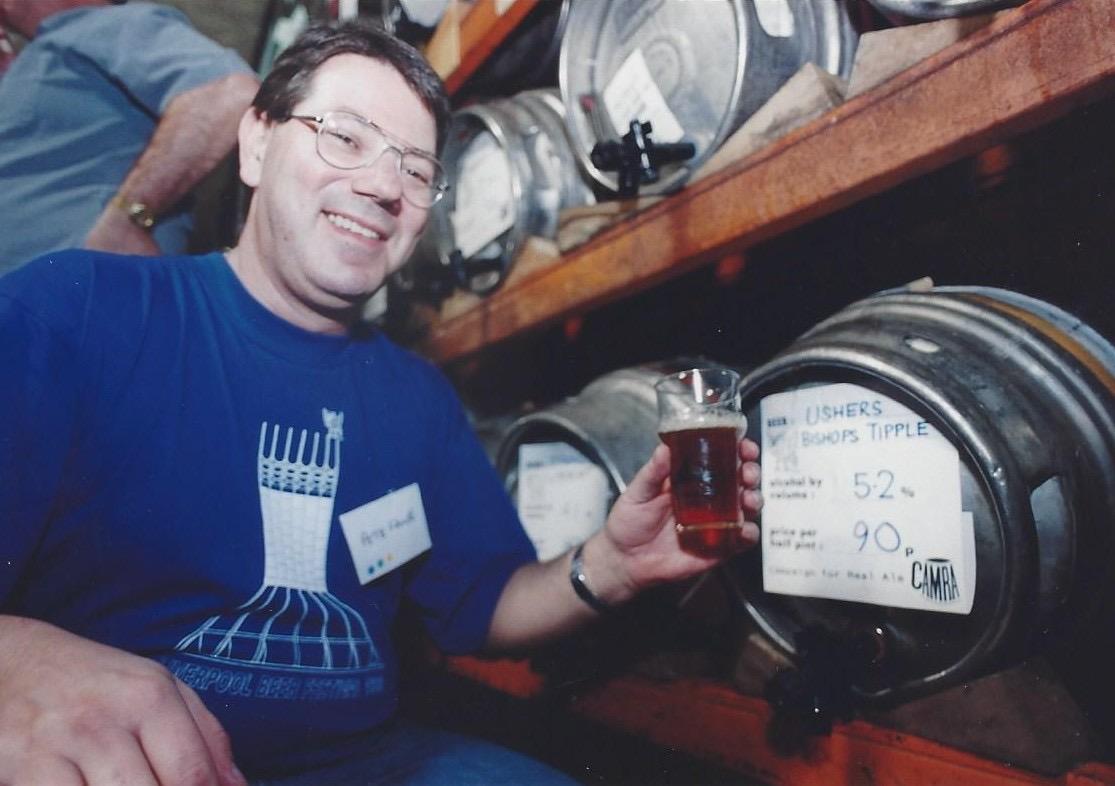
Real ale drinkers have relished the chance to sample a wide range of their favourite tipple in the impressive surroundings of the Lutyens Crypt for more than a quarter of a century, the first one being held there in 1999. The first Liverpool “Beer Exhibition” was actually held in 1974, when local members of the Campaign for Real Ale (CAMRA) booked the Everyman Theatre to offer some alternatives to the mass-produced and often bland fare sold by the “Big Six” major brewers.
In 1976, the venue was the University Catholic Chaplaincy next door to the Cathedral. Aintree Racecourse, the Adelphi Hotel and the Albert Dock were among other venues that hosted the festival, but in 1999, with little notice, the organisers were left desperately casting around for an alternative site. It was one of the Cathedral staff, also a CAMRA member, who suggested the Crypt as a suitable space, offering room for hundreds of kegs of beer and hundreds of people to mingle in.
The idea was not universally popular. Complaints came in both to the Cathedral authorities and to the Catholic Pictorial from those who saw this as an abuse of a sacred space. Pic Columnist Johnny Kennedy was dead set against the proposal and printed a few letters from objectors. “In my view,” he said, “a beautiful Catholic Cathedral is not a suitable venue to have such an event.” He acknowledged that the festival was not taking place within the Cathedral itself, and “that those who attend the Real Ale Festival will be decent people, genuine lovers of real ale drawn straight from the cask.” He knew too that the Cathedral needed to generate income, often by allowing its facilities to be used for nonreligious purposes such as graduations and music performances. Certainly Monsignor Peter Cookson, the Cathedral Administrator, thought that the Crypt was “separate from the main Cathedral building and its sacred spaces,” and that the Hall and Concert Room were “in effect our parish hall.” He sympathised greatly with those who had first-hand experience of dealing with alcohol addiction, but noted that the event would be “carefully monitored to ensure that there is no drunkenness or unseemly behaviour. It is not intended to promote excessive drinking but is more like a winetasting, to encourage discrimination and quality.” What it wouldn’t be, he said, was “a thigh-slapping orgy of men in Lederhosen banging Steins on the table in the Munich Bierfest tradition.”
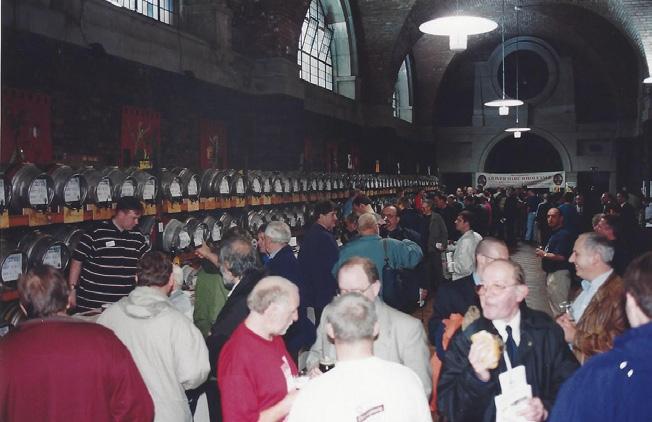
The first Crypt Beer Festival was deemed a success by its organisers - so much so that it has returned every year since. Peter Fane, Branch Chair of Merseyside CAMRA, said that “The Crypt was an ideal venue for the festival because it kept the beer so cool.” Some 3,000 devotees came to taste over 150 beers. Religious puns in the ales on offer were unavoidable: Vicar’s Ruin was available, as was Bishop’s Farewell, and the strongest beer to be had was the 11.5% brew with the precautionary name of Last Rites. Mr Fane thought the venue was entirely appropriate: “Beer drinking has a long tradition in religious communities,” he said. “Monks, we must remember, were the first people to brew beer commercially.” Trappist monks, of course, still produce bottled beer, often quite strong stuff. And Catholic clergy have been associated with the production of other alcoholic drinks: Dom Pérignon perfected the production of champagne, liqueurs come from Benedictine and Carthusian monasteries, and the wine/cassis aperitif Kir was invented by the French priest Fr Félix Kir. St Arnold, incidentally, is the patron saint of beer drinkers.
Allaying some of the fears expressed when the venue was announced, Mr Fane noted that “visitors showed great respect for the premises.” Cathedral staff were no doubt pleased to be called “marvellous” by him, but the Beer Festival still requires some tidying up, despite the foresight of the organisers: “We protected the floors with plastic sheeting and put boards down when we brought the barrels in.”
This year’s Beer Festival takes place in the Crypt from 19–21 February. Over 200 real ales and ciders will be available, and tickets may be obtained from the CAMRA website.



Crowds at the first Crypt Beer Festival, 1999
CAMRA Beer Festival programme, 1999
CAMRA Beer Festival programme, 2019
On a liturgical note
Canon Philip Gillespie

In the middle of this month – on 18 February – we celebrate Ash Wednesday and the beginning of the Lenten season.
It seems no time since we closed the Christmas season and, indeed, we have had a mere six Sundays of “Ordinary” Time in the green vestments. It is a stark reminder of the old adage that “time and tide wait for no-one” as the year already is well advanced. The call of the Lenten season is to repentance – yes, but repentance for a purpose. We look again at our Christian living so that the witness of it is better able to give a firm foundation to the accompaniment we give those who are preparing for their Baptism at Easter. We want to walk alongside those who are going to be baptised or received into the Church at Easter; we want to walk with them – it is indeed a synodal action – by renewing our own sense of being part of the “Pilgrim Church on Earth” (Eucharistic Prayer Number 3) through putting into practice the virtues of giving of ourselves for the good of others (almsgiving) as well as prayer and fasting.
Sunday thoughts
How’s Ordinary Time 2026 treating you so far? Business as usual means nightly bombing raids in Ukraine, heartbreaking destruction and desolation in Gaza, and brutal oppression in Sudan. More disturbing still is the abandonment of decent and enlightened leadership by our closest ally.
A lesson I learned in the seminary was that the priest preaches what he prays; or prays what he preaches – it’s a twoway street. In retirement I no longer preach. So what feeds my prayer?
Demanding parish life eats into the obligation to pray the Divine Office. Fidelity to the Liturgy of the Hours is often observed in the breach – just morning prayer and evening prayer on a good day…
In the luxury of retirement, I have rediscovered the richness of the Office of Readings. The Divine Office, and especially the Psalms, reacquaint me with a world of dictators and despots. As Saint Ignatius of Antioch tells us in today’s Office of Readings: vain, insecure and dangerous leaders inhabit the pages of the Old Testament and are also seen in the persons of Pontius Pilate and King Herod. The Jewish religious leaders were even worse because they imagined they were doing God’s will. Business as usual indeed.
Thus the Lenten prayer, the fasting and almsgiving, is all so that we can become better witnesses to the transforming and life-enhancing wisdom of the Gospel - and when we arrive at the Easter Vigil and the renewal of our own Baptismal promises, we are renewed and refreshed by the 40-day journey of Lent.
Robert Herrick, who wrote this poem back in the 17th century, may help us reflect on the purpose and content of that Lenten journey:
“Is this a Fast, to keep the larder lean and clean from fat of veal and sheep?
Is it to quit the dish of flesh, yet still to fill the platter high with fish? Is it to fast an hour, or ragged to go or show a downcast look or sour?
No; it is a fast to dole your sheaf or wheat and meat unto the hungry soul. It is to fast from strife, from old debate and hate; To circumcise your life; to show a heart grief-rent, to starve your sin, not bin; and that’s to keep your Lent.”
Grace is God’s first name
I met Margaret in my first parish in 1985. On my first morning as I left the sacristy, I noticed a couple. He wore a jacket and tie, and she a hat with a jaunty-looking feather. Then I listened to her voice. She had cut-glass vowels which were very clear and loud. Later we sang a hymn. This woman opened her mouth and very noticeably joined in. Flat, loud and quavery, she didn’t quite hit the notes.
Mass finished and she pursued me into the sacristy to invite me to afternoon tea. I stammered out yes before thinking about it. The next day I arrived and got Margaret’s life story. She had left school at 14 and become a hairdresser. Her real love was amateur dramatics. She showed me a number of old programmes advertising the “Thatto Heath Songbird” and showing a much younger Margaret on the front. After an attempt to go professional resulted in a nervous breakdown, she came home, ran a hairdresser’s salon from the front room, and later married Kevin.
The more she talked, the more I got the impression of a sad, lonely woman who, from childhood onwards, had had huge expectations of life; instead, she had faced pain and disappointment.
Mgr John Devine OBE
The powerful abuse their power to prove they can do so; and there’s no-one to stop them. Corrupt judges cave in. Politicians with eyes on their own careers stay mum. Jesus was on the receiving end of such evil. He suffers in solidarity with those in Gaza, Kyiv, Caracas, Minneapolis and, at the time of writing, maybe even Greenland… or Canada. Who’s next?
But I need to sound a health warning for myself. Compassion for the victims of brutality and injustice is one thing, but there may be a trace of superiority in my outrage. As both the Psalms and the news of the day assail me with the cries of the oppressed, I recognise there’s no evil that, given the right conditions, I’m not capable of myself. Damaged individuals make dangerous leaders, but is there an inner dictator and bully buried within my own subconscious? I may be helpless in the face of evil on a global scale but, with the grace of God, I can make a start with myself. The crucified and risen Christ is embedded in this sorry state of affairs. Lent is on the way to help us draw closer to him.
It would have been very easy for Margaret to become bitter, but she told of the importance of faith in her life. She had an experience of God that turned her life upside down. She and Kevin ran a small Christian fellowship and were extremely involved in the parish.
Most of us in our guts, at an unseen level, think that when bad things are happening then God doesn’t love us or that we’re being punished for what we’ve done wrong. What does that say about our image of God? That God is vengeful and angry? Margaret had nothing but love for her Lord and saw all the difficulties she had faced as simply the ups and downs of life.
She had learnt that God was good despite the mess that had been in her life. She was full of gratitude. As the years went by, Kevin and Margaret, with all her grand eccentricities, became firm friends and it was all because of the power of love, the gift God had poured into their hearts.
I think it would be fair to say that Jesus’ image of God is a God of loving tenderness and goodness, the God of the prodigal son and the shepherd who goes out looking for the sheep. His image is of a God who is the giver of every good thing.
Richard Rohr, in his book The Immortal Diamond, writes: “The goodness of God fills all the gaps of the universe, without discrimination or preference.” God is the “goodness glue” that holds the dark and light of things together, the free energy that carries all death across the Great Divide and transmutes it into life.
Basically, grace is God’s first name. Grace is poured out to hold all things in love, and alive forever. Grace is who God is. Can we open ourselves to grace and find new life?
Father Chris Thomas
News diary
If you’ve got any news from your parish that you’d like featured e-mail us with the details at: CatholicPic@rcaol.org.uk
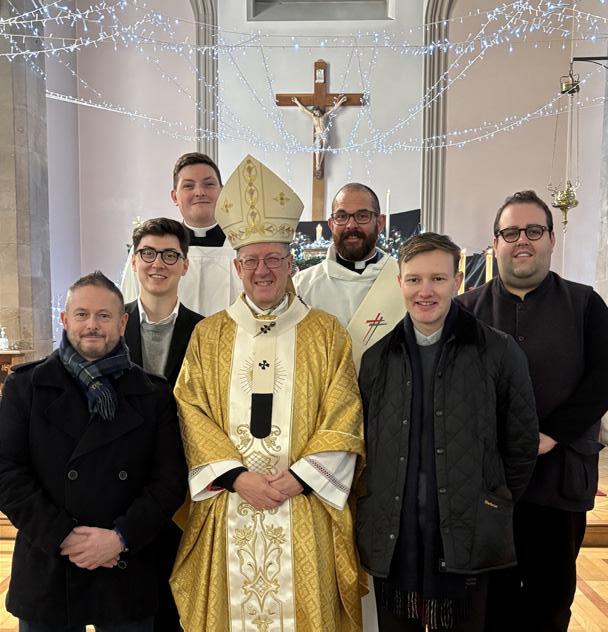
Seminarians gather with Archbishop John on the Feast of St John the Evangelist
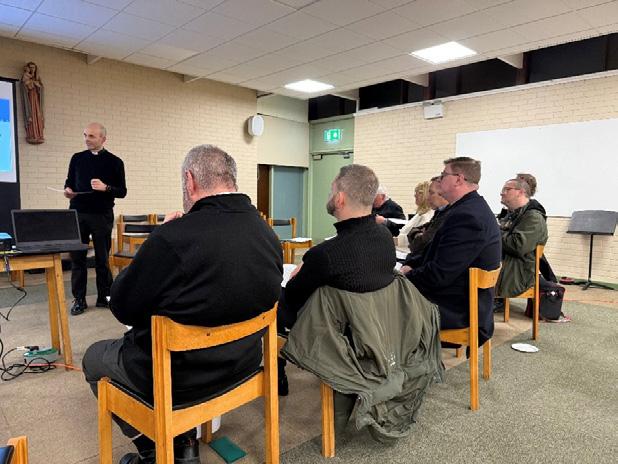
On 27 December, Archbishop John Sherrington gathered with six seminarians from the archdiocese for a time of prayer and fraternity.
The archbishop celebrated Holy Mass at Saint Charles Borromeo Church, Aigburth, with Bishop Thomas Neylon and Father Ron Johnson, vocations director, on the feast of Saint John the Evangelist, as the seminarians and members of the parish joined their prayers and intentions with his at the altar.
Archbishop John thanked each of our seminarians for their generosity in entering seminary and offering themselves to the formation programme of discernment and discipleship. Following Holy Mass, the archbishop met the seminarians and clergy for lunch at Saint Charles’ presbytery, when there was a time for conversation around the lunch table to share with each other the memorable moments of the past year.
We keep each of our seminarians in prayer as they continue their formation and preparation for priestly ministry, and we pray for more men to consider the Lord’s call to priestly ministry within the Archdiocese of Liverpool. We look forward to Rev Mr Daniel Howarth’s priestly ordination later in the year.
If anyone would like to explore where God is calling them, please feel free to contact Father Ron Johnson, vocations director, via email at r.johnson@rcaol.org.uk or by calling 0151 727 2493.
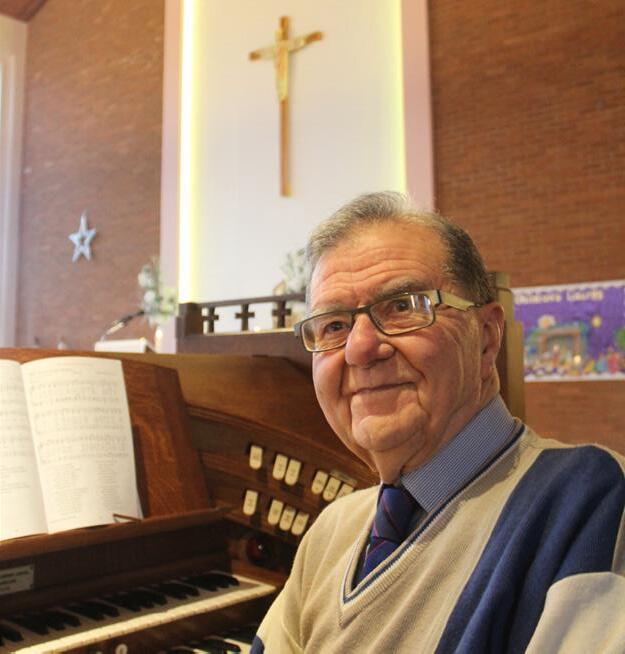
Organist Retires after 67 years’ service to two St Helen’s Churches
After an extraordinary 67 years of service, organist Paul Mather has retired from his long-standing ministry to two churches in St Helens.
Paul first played the organ at St Thomas of Canterbury, Windleshaw, in the 1950s, serving the parish for around three years before leaving the area to undertake teacher training. On his return to St Helens in 1961, he began playing for St Julie’s, Eccleston, initially in temporary accommodation before the opening of the new church building in 1964.
Alongside his musical ministry, Paul began his teaching career at West Park Grammar School for Boys, now part of De La Salle High School. Many former pupils remember Paul’s work with enormous affection.
This month, having recently turned 90, Paul is finally “pushing in all the stops” after a total of around 67 years’ service to the two churches. Paul would like to express his heartfelt thanks to many singers, parishioners and clergy who have supported him in his demanding but rewarding role over the years. Andrew Sharples, Organ Adviser to the Archdiocese of Liverpool, commented, “Paul has shown unrivalled commitment to the role of the organist as well as to that of a teacher. I have been aware of his outstanding contribution over a number of decades.”
The original organ at St Julie’s was modest in size, but in later years Paul became custodian of a fine three-manual instrument. This was installed through the inspired efforts of the parish priest, Fr Basil Walker, who is commemorated, along with his two brother priests, in a stained-glass window in the chapel on the north side of St Julie’s Church.
Paul’s service leaves a lasting legacy of faith, music and generosity that will be remembered with gratitude across both parishes.
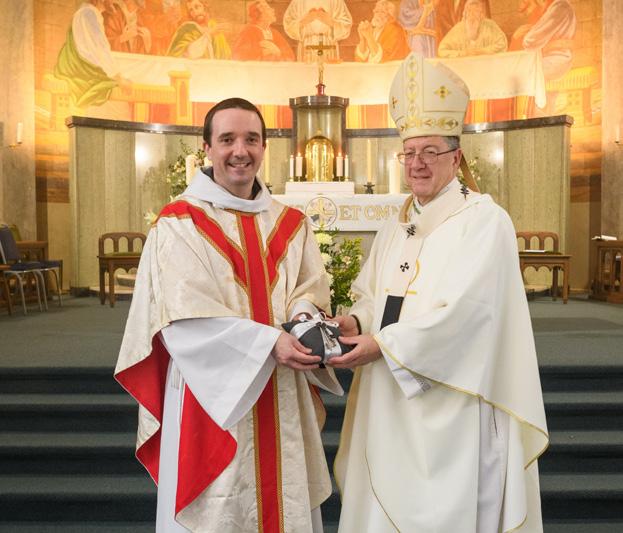
New parish priest installed at St Anthony of Padua, Mossley Hill
It was a time of celebration and reflection for the people of St Anthony of Padua parish in Mossley Hill, as they saw Fr Gerard Mary Toman OFM Conv, installed as their new parish priest on Friday 16 January.
Fr Gerard Mary was installed by Archbishop John Sherrington at a well-attended Mass.
The parish - which will celebrate it’s 100th anniversary later this year - welcomed Fr Gerard Mary towards the end of 2025, after he replaced Fr Terence Bateman, who had been the parish priest there since 2022.
Fr Gerard Mary was ordained as a priest in his hometown of Coventry at the Church of the Precious Blood and All Souls in 2018 and has served at the Shrine of Our Lady in Walsingham, and most recently as the Rector and Guardian of the Conventual Formation House in Oxford.
p01-17_covers 02/09/2022 15:32 Page 11
Upon his appointment, Fr Gerard Mary said: “I feel really blessed to be here in Liverpool and to have the opportunity of serving the people in parish of St Anthony of Padua. From my first day here, the parishioners have blessed me with kindness and with much help; I could not have been made feel more welcome. It is my prayer that I will be able to build upon the good work that has gone before me and, with God’s grace and with the assistance of many helping hands, I look forward to seeing the parish continue to grow and flourish.”
After Mass, it was then over to the parish hall for a celebration gathering where guests could help themselves to food, drink and enjoy good company.
The CAFOD Big Lent Walk 2026 – An Invitation
Colette Byrne, CAFOD Community Participation Coordinator
This Lent, the Catholic community in the Archdiocese of Liverpool are invited to walk together in faith and solidarity. By taking on the challenge of walking 200km in the 40 days of Lent, we join thousands of walkers to bring the gift of clean water to our neighbours who lack it.
Every £1 raised in sponsorship through the Big Lent Walk will help bring life-saving water to communities in places like Ethiopia and Peru. Communities like Mortikana’s.
Mortikana, aged 70, lives in a rural village in southern Ethiopia which did not have access to a water source, so she and the other women had to walk six hours each day to collect safe water. Thanks to a local organisation dedicated to women’s empowerment whom CAFOD works with, a cement water cistern was built. This not only ensured that water didn’t evaporate, but provided safe water close to her home. Now, Mortikana and her community are freed from the burden of long journeys, and their lives are renewed with dignity and hope.
We are incredibly excited about the Big Lent Walk 2026 and would love you to join us as we walk, run, or stroll 200km in the 40 days of Lent. You can walk when and where you choose – alone, with friends, fellow parishioners, or with your school!
To add to the excitement, Harry Clark, winner of the second series of The Traitors, will also be joining the Big Lent Walk, encouraging others to take part.
When you sign up, you’ll receive a Big Lent Walk wall chart and our new pin badge. We also have a Big Lent Walk Beanie Hat for those who raise over £200.
Let’s be part of a global community working together to bring safe water to our neighbours like Mortikana.
Lord, bless our steps as we walk in hope. May each mile be a prayer for justice, each stride a sign of love, and each breath a reminder of Your presence among us. Amen
Find out more here: walk.cafod.org.uk
Finally, we’d like to say a big thank you to everyone who came along and joined in our Christmas Fun Run! We had a great turnout despite the icy start to the day, and we are so grateful for your kind support in attending! A special big shout out to our fantastic team of volunteers who made the event happen - we couldn’t have done it without you!

New Book Celebrates 600 Years of Catholic Faith in Gillmoss
A new book has been published to mark 600 years of Catholic faith in Gillmoss, celebrating the rich religious and community life centred on St Swithin’s Catholic Church.
Titled “St Swithin’s Catholic Church, Gillmoss: A Celebration of 600 Years of the Catholic Faith in Gillmoss”, the 82-page book has been written by Kevin Roach in collaboration with the parishioners of St Swithin’s. Filled with photos and memories from parishioners, it tells the story of faith passed down through generations, reflecting on the parish’s enduring belief through times of change and challenge.
The book was formally launched on 14 December following Mass at Our Lady, Queen of Martyrs, Stonebridge Lane, Croxteth, where the St Swithin’s parish community now worships. The foreword has been written by parish priest Fr Anthony Kelly, who reflects on the parish’s long history and continuing legacy.
St Swithin’s Catholic Church served the Gillmoss area from the eighteenth century, with the modern church building erected in the 1950s. Although the church closed in 2004, the parish lives on through its merged community in Croxteth.
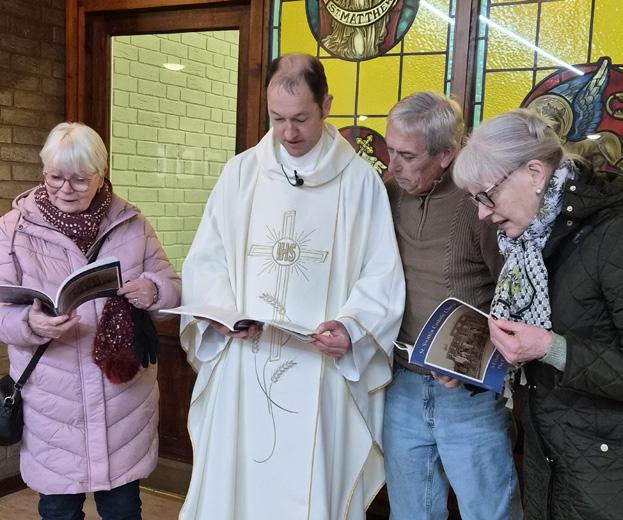
In the book, Fr Anthony observed, “it is remarkable to think that the parish we celebrate in this booklet goes all the way back to 1410, with the first Mass celebrated in 1425 – still over 100 years prior to the beginning of the English Reformation.”
Author Kevin Roach commented: “For over 600 years, St. Swithin Church has grown into a flourishing community, shared in its faith, beliefs, and values; functioning as a spiritual family
that worships together and supports each other. The people are what make St. Swithin’s, the parishioners who were and are living their faith. It is a community people have built up and take pride in.”
Published by Beatles Liverpool and More Ltd, the book is priced at £10, with all proceeds supporting church funds. It is available both at Our Lady, Queen of Martyrs’ piety stall, and online at BeatlesLiverpoolandMore.com.
Harry Clark, winner of Traitors Season 2, will be joining the CAFOD Big Lent Walk
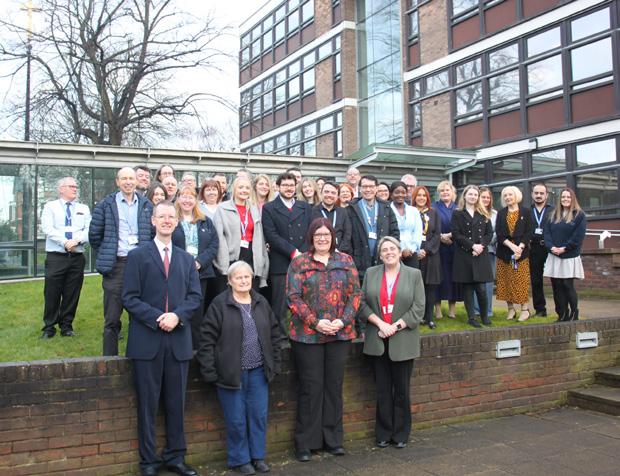
SMCC offices mark 25 years at the heart of archdiocesan life
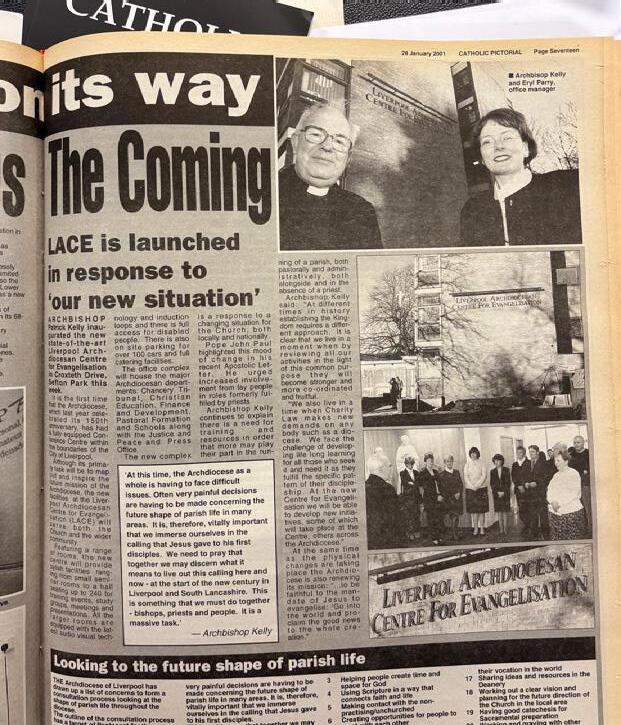
The Archdiocese of Liverpool celebrates 25 years since staff moved into the Liverpool Archdiocese Centre for Evangelisation (LACE), now St Margaret Clitherow Centre (SMCC).
On 22 January 2001, more than 30 members of staff relocated from a Victorian building on Brownlow Hill to the newly developed SMCC. Previously the site of St Margaret Clitherow school, the new building provided space for the team to grow, collaborate, and develop new programmes to support priests, parishes, and the wider diocesan community.
The site also included a chapel, allowing for regular Mass for staff and visitors. Since then, the staff supporting the archdiocese has doubled, enabling support for priests and parishes in all aspects of parish life.
As well as being the administrative base for the archdiocese, SMCC’s conference and events facilities have enabled the centre to welcome thousands of visitors and delegates each year, hosting meetings, training days, retreats, and gatherings for parishes, schools, organisations, and external partners.


Five current members of staff were among those who made the move in 2001 — Aaron Kiely, Maureen Stigberg, Elena Stopforth, John McMahon and Sandra Brennan — offering a living link between the centre’s earliest days and its present role at the heart of the archdiocese.
The offices were formally opened by Archbishop Patrick Kelly, who found the conference facilities a particularly useful addition: “At the new Centre for Evangelisation, we will be able to develop new initiatives, some of which will take place at the centre, others across the archdiocese”.
The 25th anniversary will be marked with a celebration of Mass, to be offered by Canon Aidan Prescott VG, bringing staff together in prayer and thanksgiving for the past, present and future of the centre.
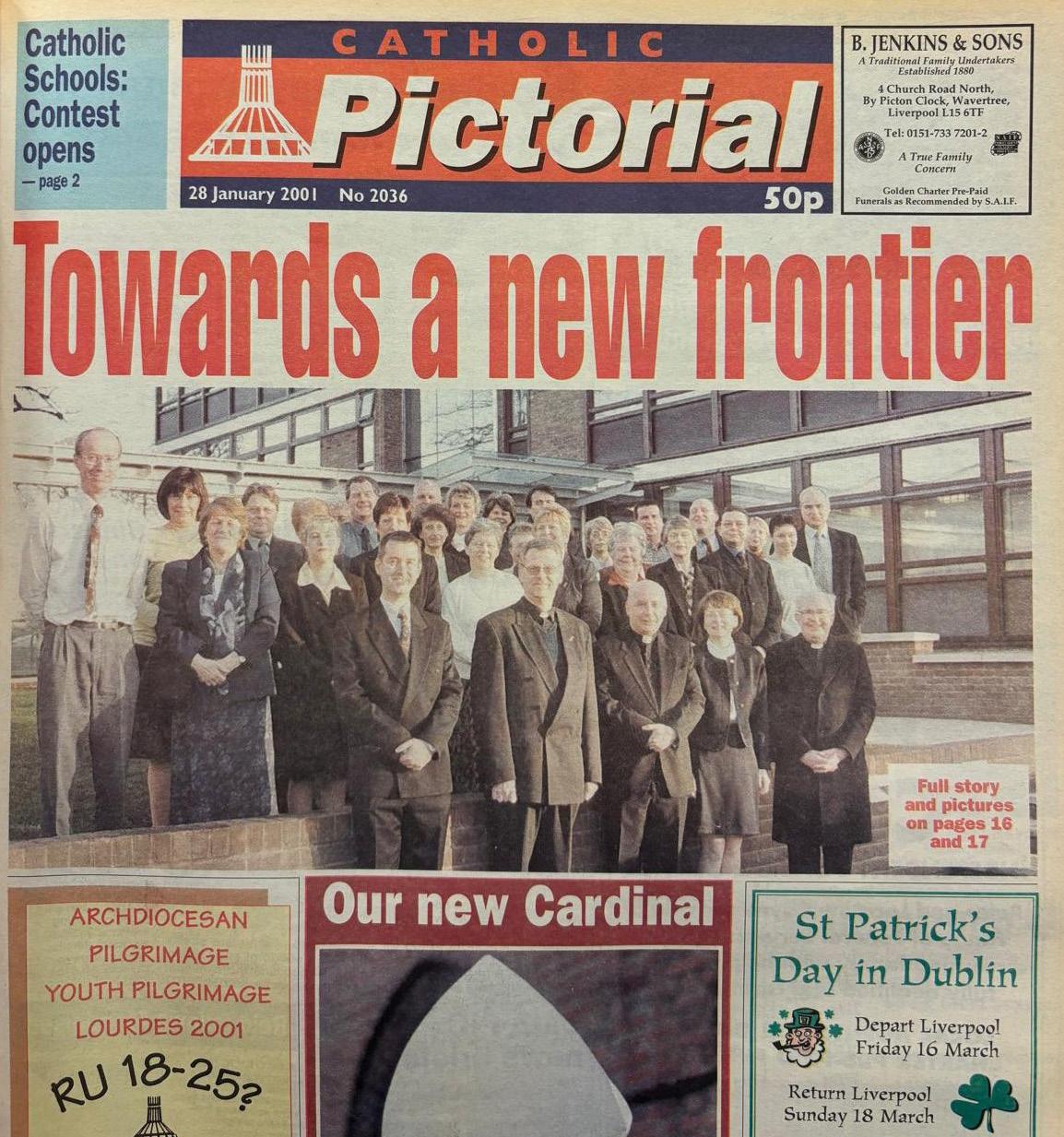
Jottings of a Roman Pilgrimage
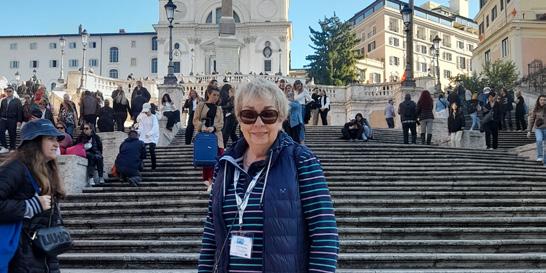
By Pat Murphy
So, after many months and years of preparation, the Jubilee Year 2025 is over.
I was interested to note on 6 January that Pope Leo closing the Holy Door at St Peter’s was announced on BBC National News. I had read a few days earlier that 33 million people had walked through the Holy Door of the Basilica during the year. That is roughly 90,000 every day of 2025, a huge number of pilgrims responding to the invitation to walk through the doors of St Peter’s.
Having spent six wonderful but very busy days in Rome a couple of months ago, I can well believe that number of pilgrims would have visited St Peter’s every day – the city was so busy and vibrant. The queue to visit St Peter’s snaked around the square, and numerous pilgrims, including myself, took part in a procession carrying a cross up the Via della Conciliazione through the square, into the Basilica, and to the tomb of St Peter to pray. The doors were blessed and opened by Pope Francis and closed by Pope Leo. It’s over 300 years since there was a change of Pope during the Jubilee Year. In fact, in 1700, Pope Innocent XII called a Jubilee Year but was in poor health and could not celebrate as he died during the year. In 1800, there was no Jubilee Year due to the Napoleonic War and the Pope having been deposed.
It’s always a joy to visit the four main Basilicas in Rome. St Mary Major of course this year has become not just a place of pilgrimage but something of a tourist destination to visit the tomb of Pope Francis. This will probably continue for a few years. I felt it was somewhat of a rugby scrum lining up to walk past the very simple tomb and marble plaque, and I think each visitor was given about 10 seconds to look and maybe photograph them before a security guard moved the continual procession along.
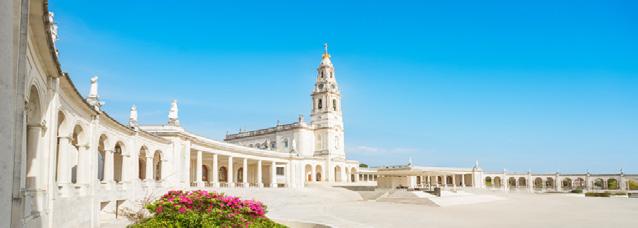
Walk in the footsteps of the shepherd children, celebrate Mass at the Chapel of the Apparitions and spend time in prayer and reflection at this world-famous Marian shrine.
Please quote ‘CATHPIC’ when calling.
The Basilica of St Mary Major was the first Marian shrine in the Western world, and has been known as Our Lady of the Snows and St Mary of the Crib. Its history is a lovely gentle story and the Blessed Virgin appearing to a nobleman and the Pope who had dreamt of a snowfall in Rome in August. Our Lady asked for a church to be built. Although it was partly destroyed by earthquake in the 14th century, the main structure remains. Under the high altar is a special place known as the crypt of the Nativity, said to contain wood from the holy crib of the Nativity. It’s always a privilege to descend the steps to kneel and say a prayer at this shrine.
If you want to have a few hours in Rome surrounded by church art, sculpture and architecture, St Mary Major is a good place to start, as you can walk to at least another four or five beautiful churches within a few minutes of each other.
Pastoral ponderings
by Dominic Redcliffe
Hello from Rome to all of you at home.
February is a quieter time of year here in Rome, both in the city and in the seminary. The excitement of returning after Christmas has settled, and the boxes of mince pies I brought back to keep me going through January are now, sadly, long gone!
February marks the conclusion of our lectures before exams begin, and once those are finished we enter into one of the most important moments of the academic year: our annual retreat. In my second year, this is a six-day silent retreat away from college. We travel to the hilltop town of Nemi, which overlooks a beautiful volcanic crater lake and is famous locally for its strawberries – even, apparently, in February.
Last year was my first experience of a longer retreat in silence, and I’ll be honest: it took some time to adjust. Apart from daily Mass and listening to the retreat reflections, there was complete silence. With far less structure than our usual seminary timetable, I wasn’t quite sure what to do at first.
One morning, even though the air was cool, I sat outside in the sunshine and decided to try some ‘prayer art’, something I had previously experienced at an evening organised by the Pastoral Development Department back in Liverpool. It doesn’t require any artistic skill at all. One simple method is to draw crisscrossing lines on a page and then fill the spaces with patterns, words, or symbols, praying in whatever way you wish to.
As I drew, I read passages from St Mark’s Gospel, which I was studying at the time. Inside the spaces on my design, I began writing words and short phrases that stood out to me. Slowly, a design emerged that reflected the feelings Jesus showed in His encounters with people: His compassionate love for those who were sick or burdened, His tenderness towards those who believe, His strength when challenged by authority, and even His frustration when His message was rejected.
By the end, I realised that I had come to know Jesus a little better in a way I hadn’t expected. Prayer doesn’t always have to be complicated. Sometimes, simply slowing down and trying something new allows the Lord to speak to us in fresh ways. Why not give it a try yourself? You never quite know where Jesus might lead you.
I will be praying for you all from Nemi.
Dominic
Accompaniment Matters in Marriage and Family Life

Moses Mui Training Coordinator
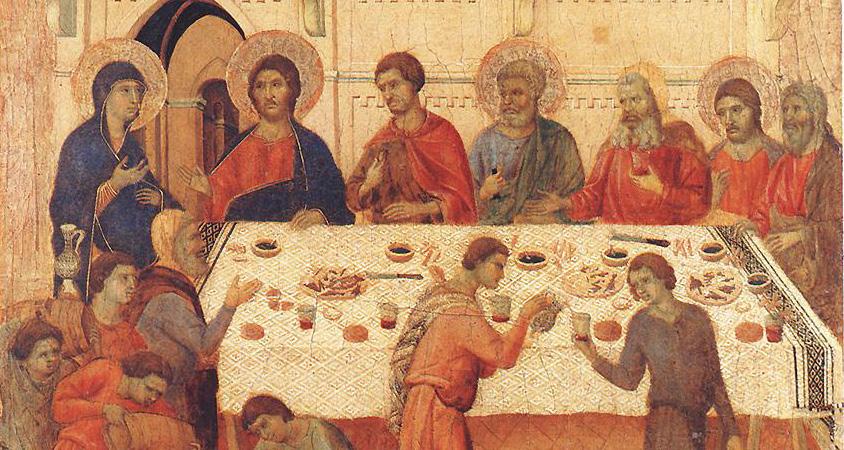
The Feast of St Joseph, 19 March 2026, will be the tenth anniversary of Pope Francis’ Post-Synodal Apostolic Exhortation Amoris Laetitia – “On Love in the Family.” Perhaps it is a good time for us to reflect on marriage and family life in our Church and in wider society.
In Catholic teaching, marriage and family life are understood not merely as social institutions, but as sacred vocations that unfold over time. Because these vocations involve growth, struggle, and grace, the Church emphasises the importance of accompaniment—walking patiently and compassionately with couples and families as they seek to live out God’s call. This vision is deeply rooted in Scripture and articulated clearly in Amoris Laetitia.
From the beginning, Scripture reveals that human beings are not meant to journey alone. “It is not good that the man should be alone” (Genesis 2:18). Marriage itself is a form of mutual accompaniment, where spouses support one another emotionally, spiritually, and practically. The Christian family, often called the “domestic Church” (cf. Lumen Gentium, 11), is a place where faith is nurtured through shared life, prayer, forgiveness, and love. Yet Scripture is honest about human weakness, reminding us that families require patience and mercy. St Paul exhorts believers to “bear one another’s burdens” (Galatians 6:2), a principle that applies powerfully within marriage and family relationships. Jesus’ own ministry provides the model for accompaniment. He walked with
His disciples, listened to their fears, corrected them gently, and remained with them even in moments of failure. The story of the disciples on the road to Emmaus (Luke 24:13–35) beautifully illustrates accompaniment: Jesus walks beside them, listens before teaching, and gradually opens their hearts to truth. This pastoral style informs the Church’s approach to families today.
In Amoris Laetitia, Pope Francis calls the Church to accompany families with realism and tenderness. He recognises that marriages and families exist in diverse and often challenging circumstances, and therefore accompaniment is especially important in times of crisis—during marital conflict, economic hardship, illness, or moments of failure. The Church, he writes, must be “a field hospital,” offering healing and encouragement rather than condemnation (AL, 291). Through pastoral care, community support, and spiritual guidance, families are strengthened to persevere and mature in love.
Ultimately, accompaniment reflects God’s own way of loving humanity: a love that is faithful, patient, and present. By embracing this core principle, marriage and family life become not only places of struggle, but privileged paths of holiness and grace.
Let us pray for those families who are struggling in their life. May they not despair, but trust in God’s presence amidst their pain to bring comfort in times to come, and provide them with good friends to accompany them.

Let us begin with a confession: Claire Hanlon did not actually feel she warranted a profile in these pages. Fortunately, many other people, from the Metropolitan Cathedral to the Vatican, would beg to differ.
After all, Claire has spent more than 30 years working at the cathedral, serving under deans and archbishops, supporting clergy and staff, and ensuring that all runs smoothly behind the scenes.
It was that cumulative effort that earned her a Papal award in November, with her investiture as a Dame of the Order of St Gregory the Great – an honour bestowed by the Pope for exemplary service to the Church.
In short, there is good reason to feature her here and to ask her about her award. “I felt so humbled and deeply grateful,” she begins. “It’s not something I ever thought about, and I don’t feel that it belongs to me alone – I work alongside a wonderful team who all contribute. I really received the honour as a recognition of shared faith, shared service and the faithful work of myself and others carried out over many years.
“I feel incredibly lucky to have had this wonderful career here at the Met. I work alongside people who are generous, kind, dedicated, patient, and who show their faith in so many different ways, and they have and will continue to inspire me.”
The occasion of her investiture, at choral evening prayer at the cathedral on 25 November last year, was poignant as it brought to mind her late mother and sister, Veronica and Kate, who both passed in recent years. “They would have been beside themselves with pride and delight,” she says.
profile Claire Hanlon
Keeper of the Cathedral
By Simon Hart
Her family’s connection to the cathedral is longstanding. Her youngest brother Andrew was a chorister there, and she would often drive him over from the family home in Tranmere, where Claire grew up attending Mass at St Joseph’s, Birkenhead – and football matches at Prenton Park following her beloved ‘Super White Army’.
Claire’s official job title at the cathedral is executive assistant to the dean, Monsignor Tony O’Brien. Her role involves the dayto-day running of the cathedral and the crypt. She elaborates: “When I started under the direction of Monsignor Cookson, he wrote of the role that ‘It is a strange and hybrid post, combining a latitude of functions and requiring considerable diplomatic skills to cope with the multitude of enquiries and demands from other departments of the cathedral and from the general public.’
“Not much has changed since he wrote that all those years ago,” she adds. “I hope he’d be proud of the work that I’ve done since he appointed me.”
There have been some memorable moments over the years, including working on the installations of three archbishops, and the Golden Jubilee in 2017, which entailed “delivering a flower festival, grand dinner, and celebratory Mass.” There have been interesting encounters along the way too. “One very famous singer asked me to iron his shirt for him as it had got creased in his case,” she smiles. “I can’t say what I told him, but his shirts remained creased!”
She knows the secrets of the building as well as anybody, revealing that “we have an underground dungeon under the crypt itself which used to house the archives. Don’t go down there –you may not get out!”
And finally – happily – the place still holds its mystique for Claire after all these years. She reflects: “The cathedral always feels alive to me. There’s always something happening which I find inspiring. It is just so beautiful inside anyway, and it can be so peaceful – particularly at the start or end of the day. When I get a chance, I’ll often pop up and find a little spot and just reflect on the day ahead or what has happened during the day. There is no more stunning space. I feel so privileged to work here and to have an impact on what happens in the life of the cathedral. It’s in my heart forever.”
what’s on February
Tuesday 3 February
Archdiocesan Young Adults Group: Faith-Based Talk with Fr Peter McGrail 6:30pm – 8:00pm at Pauline Book Centre, Liverpool
A faith-based talk hosted by the Archdiocesan Young Adults Group. All aged 18–35 are welcome!
Wednesday 4 February
Old and New: Reflections on the Gospel of Matthew 10:30am – 12:00pm at The Irenaeus Project, 32 Great Georges Road, Waterloo, L22 1RD
The latest Scripture Morning at the Irenaeus Project, offering reflections on the Gospel of Matthew. All are welcome. A Zoom link is also available, email jenny@irenaeus.co.uk for more information.
Saturday 7 February
Adventurous Accompaniment:
First Workshop (Option One)
10:00am – 2:00pm at St Margaret Clitherow Centre, Liverpool, Croxteth Drive, L17 1AA
This workshop forms part of a six-week programme exploring the principles and practice of accompaniment. All programme costs are covered by the archdiocese. Please register online if you are interested: archdioceseofliverpool.org/DSCAdventurous or contact Moses Mui at m.mui@rcaol.org.uk
Sunday 8 February
Marriage and Family Life Mass
11:00am at the Metropolitan Cathedral of Christ the King, Liverpool, Mount Pleasant, L3 5TQ
Archbishop John Sherrington will celebrate the Marriage and Family Life Mass, including the renewal of marriage vows and a special blessing for couples celebrating significant anniversaries. Refreshments will be served afterwards in the Gibberd Room. For those couples who are celebrating a significant wedding anniversary, please register online for a certificate which will be collected on the day. Register here: archdioceseofliverpool. org/MarriageMass
Sunday 8 February
Adventurous Accompaniment: First Workshop (Option Two) 12:00pm – 4:00pm at St Joseph’s Church, Penketh, Meeting Lane, Penketh, WA5 2BB
An alternative opportunity to attend the first workshop in the Adventurous Accompaniment programme. All programme costs are covered by the archdiocese. Please register online if you are interested: archdioceseofliverpool.org/DSCAdventurous or contact Moses Mui at m.mui@rcaol.org.uk
11 February
Feast of Our Lady of Lourdes Mass St Edmund’s Church, Waterloo, 7:00pm Along with our Lourdes Family, we warmly invite anyone who would like ot join us for this Mass, which will be celebrated by Mgr John Butchard.
Saturday 14 February
Chinese New Year Thanksgiving Mass 2:00pm at the Blessed Sacrament Chapel, Metropolitan Cathedral of Christ the King, Liverpool
All are welcome to join a Cantonese Thanksgiving Mass celebrated by Fr Hugh Donleavy for the Hong Kong Catholic Community in Liverpool, marking the Lunar New Year.
Saturday 14 – Sunday 22 February
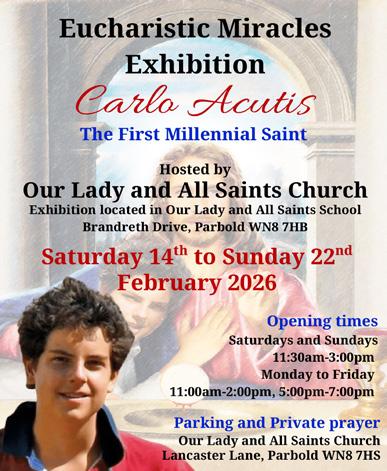
Eucharistic Miracles Exhibition
Hosted by Our Lady and All Saints Church, Parbold
A Eucharistic Miracles exhibition curated by Saint Carlo Acutis, featuring photographic panels of miracles from across the world. The exhibition will be located at Our Lady and All Saints School, Brandreth Drive, Parbold, WN8 7HB. The church will also be open for private prayer during exhibition hours.
Sunday 15 February
Johann Sebastian Bach: Wir mussen durch viel Trubsal in das Reich Gottes eingehen (We must go through many hardships to enter the kingdom of God) (Cantata 146)
6:30pm at Our Lady of Compassion Church, School Lane, Formby, L37 3LW
The Liverpool Bach Collective will be performing Cantata 146, as part of Choral Evensong and Cantata at Our Lady of Compassion church in Formby. All are welcome to attend.
Sunday 15 February
Civic Mass 2026
11:00am at the Metropolitan Cathedral of Christ the King, Liverpool, Mount Pleasant, L3 5TQ
You are warmly invited to the Annual Civic Mass, celebrated by Archbishop John Sherrington. Light refreshments will be served in the Gibberd Room following Mass. If you are able to attend, please RSVP to c.hanlon@metcathedral.org.uk.
Tuesday 17 February
Archdiocesan Young Adults Group:
Faith-Based Talk with Fr Ron Johnson
6:30pm – 8:00pm at Pauline Book Centre, Liverpool
A faith-based talk organised by the Archdiocesan Young Adults Group. All aged 18–35 are welcome!
Friday 20 – Sunday 22 February
Come Back to Me with All Your Heart: Silent Retreat
At The Irenaeus Project, Liverpool, 32 Great Georges Road, Waterloo, L22 1RD
A silent retreat led by Sr Moira Meeghan. Residential places are available - book early to avoid disappointment. Contact jenny@ irenaeus.co.uk or call 0151 949 1199
Monday 23 February
Marriage Preparation Catechist Training 6:30pm – 8:00pm at St Monica’s Church, Bootle, Fernhill Road, L20 9GA
Training for those interested in becoming marriage preparation catechists. The programme consists of five sessions, after which catechists will be invited to support marriage preparation courses. Please sign up here: archdioceseofliverpool. org/MarriagePrep26
Thursday 26 February
South Sefton Deanery Women’s Group: “Faith & Friendship”
7:00pm at St Helen’s Church, Crosby, Alexandra Road, Crosby, L23 7TG
A gathering open to women of all ages. All are welcome. For further information, contact Pat Murphy on mpmurphypat@aol.com
Saturday 28 February
Adventurous Accompaniment: Second Workshop (Option One) 10:00am – 2:00pm at St Margaret Clitherow Centre, Liverpool, Croxteth Drive, L17 1AA
The second workshop in the Adventurous Accompaniment programme, continuing the exploration of accompaniment and its application in ministry and parish life. Please register online if you are interested: archdioceseofliverpool.org/DSCAdventurous or contact Moses Mui at m.mui@rcaol.org.uk
A season of song

by Danny Townley Director of the Schools Singing Programme
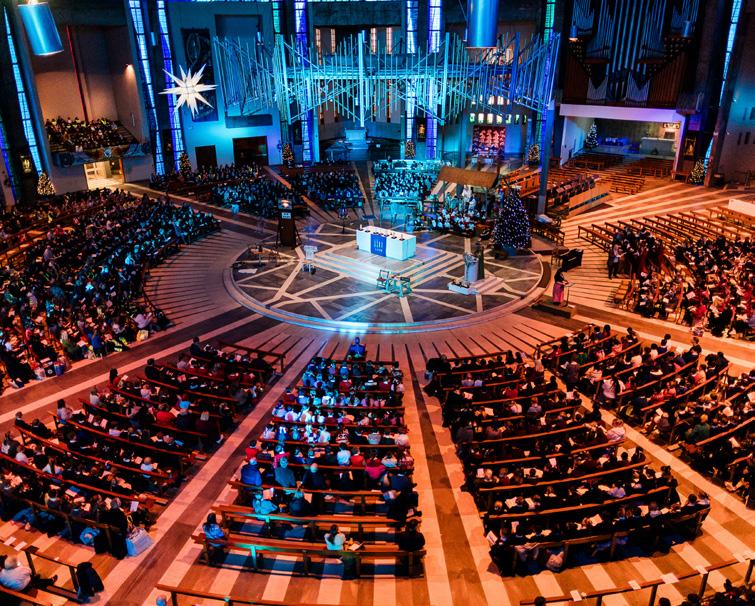
Advent is a hugely busy time of year for the Archdiocese of Liverpool Schools Singing Programme. Advent 2025 was no exception and, in fact, was the Singing Programme’s busiest ever!
The term culminated in the annual Schools Advent Services at the Cathedral on 10 December. The choir for the services was made up of nearly 1,200 children from 25 partnered schools, all the way from Widnes to Burscough.
The Choral Directors also led or assisted partner schools in 18 different local services, concerts and performances in school or churches during Advent. These performances involved over 1,500 children and ranged from Christingle services to carols in local care homes. The young people involved furthered their spiritual development and made a difference to their local communities by sharing their talent.
The Schools Singing Programme also runs area-based choirs in the archdiocese, Knowsley Catholic Children’s Choir and Widnes Catholic Children’s Choir. Both choirs combined to take part in the Celebration of Christmas concert hosted at the Cathedral on Saturday 13 December where they performed for an audience of over 1,400 people.
The programme was founded in January 2022 and has grown to partner with 37 schools, with nine Choral Directors currently delivering 74 hours of provision to over 4,000 children each week, making it the largest Schools Singing Programme founded since the creation of the National Schools Singing Programme. There are plans to further expand over the coming months to cover more areas, including establishing new area-based choirs and assisting schools in forming the spiritual life of young people in the Archdiocese of Liverpool.
Cathedral Record
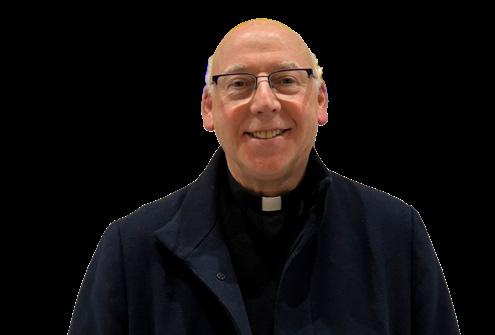
Canon Anthony O’Brien –Cathedral Dean
We are looking forward to the return and rehanging of the East Porch Cathedral doors on 4 February. These had been damaged by an external fire that had been started maliciously almost two years ago. They are the doors we used in the past as our Holy Doors in Jubilee Years and sadly, we were without them for the whole of last year. It will be good to have them back fully cleaned and refurbished.
Archbishop John Sherrington will celebrate the Marriage and Family Life Mass at the Metropolitan Cathedral of Christ the King on Sunday 8 February 2026 at 11:00am. The Mass will include the renewal of marriage vows and a special blessing for those celebrating significant anniversaries. Refreshments will be served afterwards in the Gibberd Room. For those couples who are celebrating a significant wedding anniversary, please register online here for a certificate which will be collected on the day: archdioceseofliverpool.org/ MarriageMass26
BBC Radio 4 will be at the Cathedral on 11 February to record Mass for the First Sunday of Lent. This will be broadcast on the morning service programme on 22 February.
Archbishop John will also be at the Cathedral for the start of Lent. He will celebrate the 5pm Evening Mass on Ash Wednesday, which is 18 February (our other Masses that day are 8am and 12:15pm, with a service of Word and Ashes at 7pm). He will also preside at the Service of Enrollment (also known as the Rite of Election) on the First Sunday of Lent at 3pm. This is always a very uplifting service, when the many individuals and families who have been preparing for baptism or admission into the Catholic Church from across the archdiocese are welcomed and enrolled in order to receive these sacraments and be welcomed as new Catholics at the Easter Services.
Walking Pilgrimage of the Month
FEBRUARY
As we get truly settled into the new year, it’s a good time to get involved with Families of Parishes pilgrimage walks.
During the Jubilee Year, we reflected on ways we can be Pilgrims of Hope, and this ties in closely with our Families of Parishes, which were announced in 2024 during the Year of Prayer.
This month, we turn our attention to the Kirkby Family of Parishes in the Knowsley Deanery, which includes the newly formed Parish of the Sacred Heart, created through the merging of the parishes of St Mary, Mother of God and Ss Peter and Paul.
Distance: 4.1 miles
Time: 1hr 30 mins
Families of Parishes pilgrimage walk – Kirkby Family of Parishes
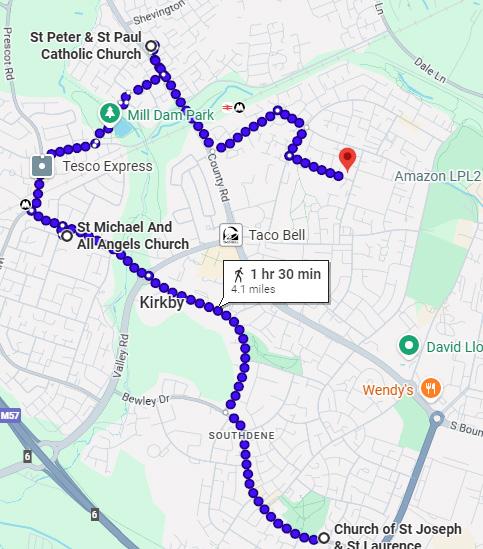
Credit: Google Maps
Start: St Joseph and St Laurence
Begin your journey at St Joseph and St Laurence, just off the East Lancs Road. Currently under the pastoral care of Canon Sean Kirwin, the missions date back to 1953 (St Laurence) and 1963 (St Joseph), with the parishes merging in 2006. It’s a handy place to start as well, with Sunday Mass starting at 11am, or 6pm if you want to do it later in the day. Take a moment here to pray for your intentions before setting out on the walk.
Stop 1: St Michael and All Angels
The longest leg of this walk is actually the first, so you can get that out the way early as you make your way to St Michael and All Angels. Make your way along Bewley Drive and then along Cherryfield Drive and over to Kirkby Row to complete this leg. This is another relatively new parish, having merged in 2005. Whilst you are here, take a moment to pray for Area Dean Fr Andrew Rowlands and the people of Knowsley that he serves.
Distance: 1.7 miles Time: 39 mins
Saint of the Month
Stop 2: SS Peter and Paul
The second stop sees you head to the first church in the newly formed parish of Sacred Heart. Head over the bridge by Kirkby train station and along Mill Lane, and you will reach the church. SS Peter and Paul recently celebrated 50 years since the church was built in its current location, so take a moment to pray for all those who have gone before, and for Fr William Egedegbe and the future of the parish.
Distance: 1.1 miles Time: 25 mins
Stop 3: St Mary Mother of God
Your final stop is St Mary, Mother of God, one of the oldest churches still standing in Kirkby, dating back to 1958. Head onto Bank Lane, continue straight until St Kevin’s Drive, then along Roughwood Drive and via Kennelwood Avenue to reach the church.
When you arrive, take time to pray for the parish community and reflect on your achievement in completing this Families of Parishes pilgrimage walk.
Distance: 1.2 miles Time: 26 mins
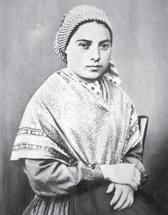
St Bernadette
Deanery Diary
Liverpool Central Deanery
Happy New Year to you all from Liverpool Central Synodal Council. We hope you and your families had a happy and holy Christmas. It’s a time when we all get together in families or communities, and a time when we particularly think of people who are less fortunate than ourselves.
Like most parishes, we all want to do our bit to make Christmas a happy time for everyone, and our DSC North Family of Parishes (consisting of St. Anthony’s and Our Lady’s, St. John’s, St. Michael’s and Sacred Heart, All Saints, and SFX) were no exception. We decided to ask the parishes to collect some small new toys or toiletries to be distributed to local charities. People really are so generous! The donations grew, and before long we had boxes and boxes in each church. As if this wasn’t enough, one of our council members also held a collection of new pyjamas at her workplace, which was added to our donations.
The Metropolitan Cathedral also holds a toys and pyjamas collection every year to be donated to the women’s refuges across Liverpool for women and children who have fled abusive relationships with nothing. Our council asked the Cathedral if we could combine our collection with theirs, and they said they would be happy to take what we collected. We started a relay of deliveries by some priests and synod council members, and when we had finished, the donations covered the floor in one of the rooms in Cathedral House!
Everyone was delighted. Claire Hanlon from the Cathedral confirmed the thanks of the women’s refuges, and we were told that everyone in the refuges received gifts and pyjamas, and that some pyjamas were taken to Alder Hey for the sick children and some toys were given to the food bank.
Our DSC South Family (consisting of St. Vincent’s, St. Anne and St. Bernard, and St. Patrick’s) were not sitting idly by either. The South Family have an SVP group through which lots of charitable work is done, but they also have an initiative through this group in partnership with Micah, the foodbank, and lots of generous donations came from the South parishes, not just of food, but household goods, toiletries, clothes, and suitcases, which are much in demand.
At the Archbishop’s Synod in November 2025, we talked about the Church as a whole and agreed we should prioritise relationships, be outward facing, and ensure everything is based in prayer and a renewed commitment to serving the poor. This is what our Liverpool Central Council has tried to do over the past year, and hopes to improve on in this New Year.
Pat Daly, Chair of the
Liverpool Central Synodal Council
Born in Lourdes, France, in 1844 to a poor miller’s family, St Bernadette knew poverty and hardship from a young age. In 1858, as a fourteen-year-old, she experienced apparitions of the Blessed Virgin Mary at the grotto of Massabielle. Bernadette never sought attention or status from these events, remaining humble and faithful even under intense questioning from both civil and Church authorities. Later in life she entered the Sisters of Charity at Nevers, where she lived a hidden life marked by humility, and quiet faith until her death in 1879. She is remembered not only as the visionary of Lourdes, but as a model of perseverance, trust, and fidelity in ordinary religious life. While the Vatican celebrates her feast day in April, she is celebrated on 18 February in France. St Bernadette, pray for us.
Living out faith through service at All Hallows Catholic High School
During the Advent season, All Hallows Catholic High School came together as a faith community to live out the Gospel call to love our neighbour. The Advent Appeal focused on supporting some of the most vulnerable members of our local community, particularly those experiencing homelessness in Preston.
One key element of the appeal was the ‘Buy a Homeless Person a Christmas Meal’ initiative, which supported the Metanoia Homeless Project based at St Wilfrid’s Church in Preston. Each form group was challenged to raise £5 to provide a Christmas meal for one homeless person. Thanks to the generosity and commitment of students, staff and families, an incredible total of £745 was raised.
This was the highest amount ever raised through the Advent Appeal. It enabled 149 Christmas meals to be provided at the Metanoia Homeless Christmas Dinner Day on 23 December 2025. This outstanding achievement was a powerful example of compassion in action.
Form groups also took part in a Reverse Advent Calendar. Students were encouraged to bring in 25 essential items to create Christmas boxes for those in need. All year groups responded with great care and generosity, filling boxes with food, toiletries, warm clothing, blankets and sleeping bags.
A cheque and the completed Christmas boxes were delivered to the Metanoia Project, where they were warmly received. Several boxes were donated by the SVP to families in need within the Penwortham area. These contributions made a real and practical difference to many lives during the Christmas period.
The Advent Appeal was a true reflection of the Catholic values at the heart of All Hallows, showing how faith, generosity and service can bring hope to others.

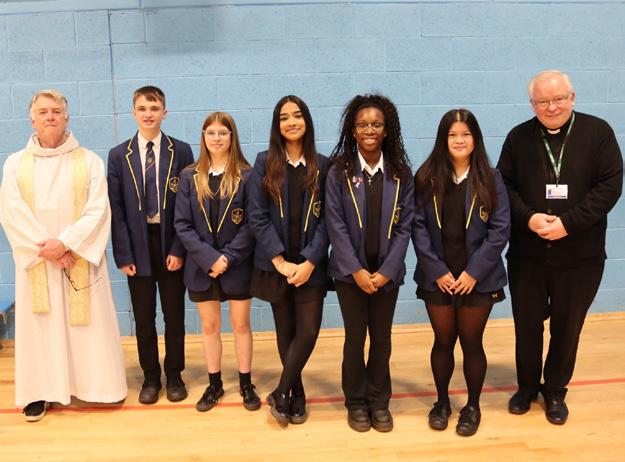
St Gregory’s celebrates newly trained Ministers of the Eucharist
Five students from St. Gregory’s Catholic High School have been congratulated after training to become Ministers of the Eucharist, marking an important milestone in their faith journey and service to the school and parish community.
The students have represented St Gregory’s with great pride and reverence throughout their preparation, demonstrating commitment and a strong sense of responsibility. Following this achievement, they went on to play an active role in St Gregory’s Advent Mass, where they assisted with the whole school celebration.
The Advent Mass was led by Fr Dave Heywood and Fr John Schofield and provided a meaningful opportunity for reflection and worship during the Advent season. Staff, students and parishioners alike praised the new Ministers of the Eucharist for their confidence and dedication.
The occasion was a joyful celebration of faith, service and community and the involvement of the students added a special sense of unity to the celebration. The students set a positive example for others within the school and reinforced the St. Gregory’s’ strong faith ethos.
Mrs Whitlow, school chaplain, applauded the maturity of the students. She said: “Our students have made St Gregory’s extremely proud and have represented the school beautifully.”
education news
All You Need Is Love
“All you need is love…” – a familiar lyric that reminds us how powerful love can be. In our Catholic school communities, we know that true love is rooted in Christ and lived out through faith, service, and compassion. February is a month that invites us to reflect on love. We are reminded that love is more than a feeling – it is a way of living that follows the example of Jesus Christ. In a world facing challenges such as division, conflict, poverty, and uncertainty, Catholic schools play a significant role in teaching students how to respond with faith, compassion, and hope. Catholic schools teach that true love, known as agape, is selfless, patient, and rooted in God. Students learn that love means caring for others, standing up for what is right, and treating every person with dignity and respect. Through prayer, Scripture, and the teachings of the Church, students discover how to live out Christ’s message of kindness and forgiveness in their daily lives.
Our schools are also committed to the promotion of Catholic Social Teaching, which encourages students to understand the world’s challenges through the values of human dignity, peace, justice, and solidarity. In ageappropriate ways, students are guided to learn about important global issues such as the situations in Iran, Gaza, and other current political dilemmas facing our world today.
It is important that children receive information from reliable sources and are supported in understanding these complex topics with care and sensitivity. In our Catholic schools, these discussions are always framed through the importance of love, respect, and prayer for peace. Students are encouraged to see every person as a child of God and to respond not with fear or division, but with compassion and hope.
As Pope Benedict XVI reminds us in Deus Caritas Est:
“Love of neighbour, grounded in the love of God, is first and foremost a responsibility for each individual member of the faithful.”
Pope Leo XIV also calls the Church to be a guiding light in challenging times: “We are called to draw new maps of hope for a world in need of God’s love.”
A key message we share with our students is that true love is unconditional. Christ’s love is freely given, without control, pressure, or expectation in return. Students are taught that healthy love is kind, respectful, and allows people to be themselves.
We also help children understand the dangers of coercive or controlling “love.” Love should never involve fear, manipulation, or pressure. St Paul reminds us of what true love looks like in his letter to the Corinthians: “Love is patient; love is kind… It does not insist on its own way.”
– 1 Corinthians 13:4–5
By learning the difference between healthy and unhealthy relationships, students are better equipped to build strong, respectful, and safe connections with others.
Within our school community, this message of love is lived out not only in the classroom, but also among our staff. Teachers and staff are encouraged to openly express care, respect, and appreciation for one another, creating a positive and supportive environment rooted in Christian values. By modelling kindness, encouragement, and unity, our educators show students what it means to live out Christ’s love in everyday relationships.
In our classrooms, students are encouraged to be peacemakers, to help those in need, and to show understanding toward others. Service projects, charitable efforts, and acts of kindness help students put their faith into action. These experiences teach them that love is not just something we say – it is something we do.
As the world continues to face many challenges, our Catholic schools remain places of faith, learning, and hope. By teaching students to lead with love, we are helping to shape a future rooted in Christ’s teachings.
“Love one another as I have loved you.” – John 13:34
Joan McCarthy Director of Education, Archdiocese of Liverpool
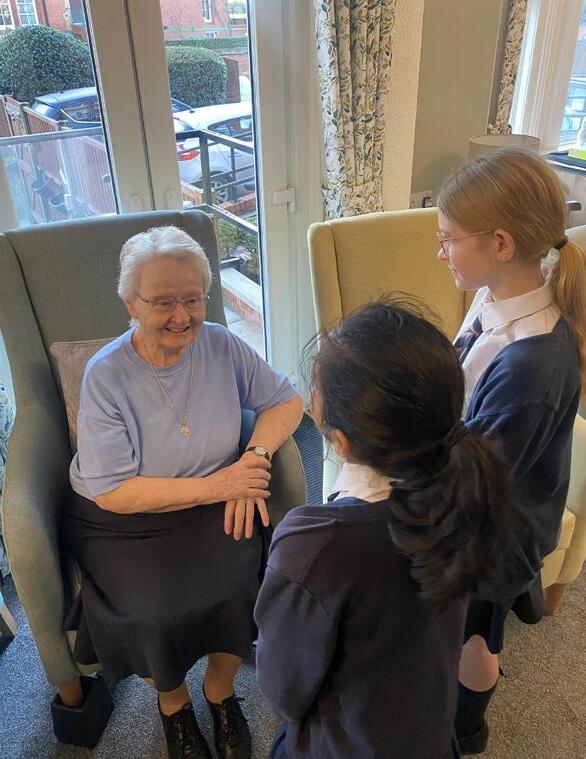
Year 6 pupils share joy with St Vincent’s Residential Care Home
A group of Year 6 pupils from Our Lady of Lourdes Catholic Nursery & Primary School recently brought joy to St Vincent’s Residential Care Home during a heart warming visit centred on music, friendship and community.
The children are all members of the school choir which is expertly led by Miss Jennifer Connaughton. The pupils performed a selection of traditional Christmas carols for the residents. Their singing filled the home with warmth and nostalgia, creating a reflective atmosphere as familiar melodies echoed through the room.
After the performance, the pupils spent time chatting with residents over refreshments. These conversations offered a valuable opportunity for intergenerational connection, allowing the children to listen to stories, share their own experiences and build meaningful relationships. The visit reflected the school’s commitment to living out Gospel values such as service, kindness and compassion, demonstrating how small gestures can have a profound impact on others.
Deputy headteacher Sam Gallagher praised the pupils for the way they represented the school and highlighted the importance of nurturing strong community partnerships.
He said: “This visit marks the start of a lovely relationship between Our Lady of Lourdes and St Vincent’s. The children brought so much joy to the residents, and we are excited to plan more events together in the future that will allow our pupils to continue serving others and strengthening these valuable community bonds.”
The visit was a memorable experience for all involved, highlighting the positive impact of simple acts of kindness.
Food pantry launched at Broughton Hall Catholic High School
Broughton Hall Catholic High School has announced the launch of its new school food pantry. A new initiative rooted in the teachings of Catherine McAuley to serve others and support those in need within the wider community.
The pantry was officially launched during the Advent season, a time of reflection, generosity, and preparation, making it a meaningful opportunity for the school to put faith into action. The project was made possible through the generosity of Broughton Hall students, staff and the wider community, as well as the valued support of a local supermarket, whose donation of essential food items helped to establish the pantry and ensure it could support families from the outset.
As part of Advent activities, students and staff took part in a ‘Twelve Days of Christmas’ initiative. Each day, members of the school community were invited to bring in specific food items, gradually building a wide and practical range of supplies. Their
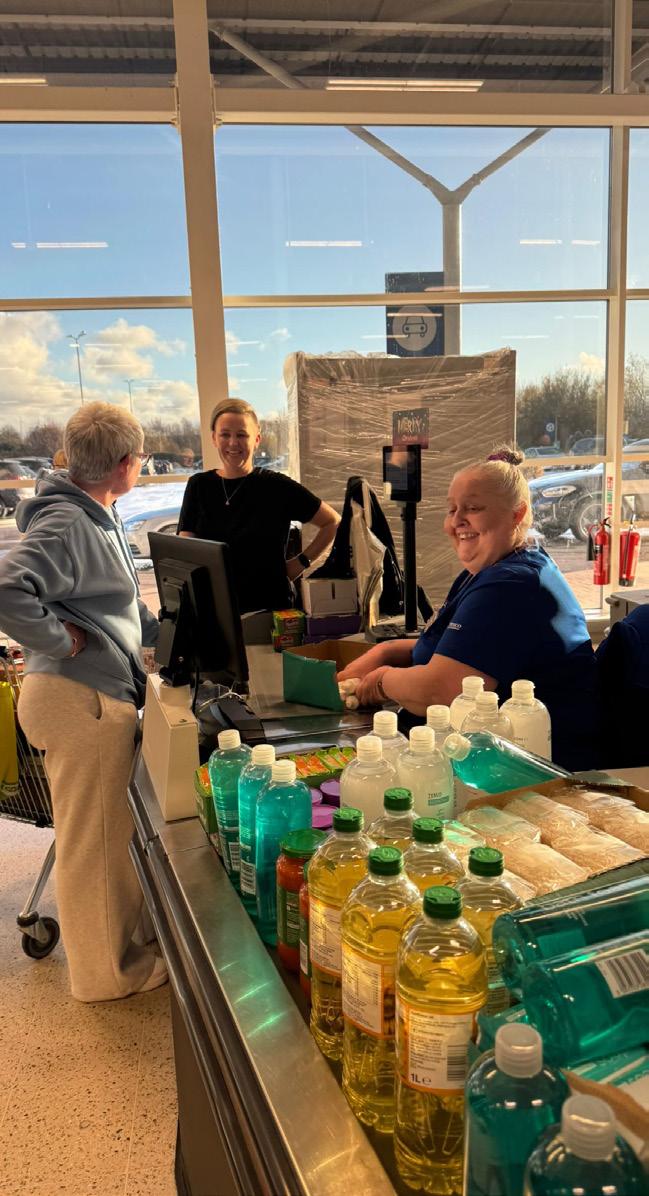
enthusiasm and kindness demonstrated the strong sense of compassion and social responsibility that lies at the heart of Broughton Hall.
Following its launch, the food pantry was opened to the school community, as well as local parishes and primary schools. Thanks to the incredible response, the school was able to support over 20 families throughout the Christmas period, offering practical help at a time when it was most needed.
The food pantry also forms an important part of the wider School Family Help offer, strengthening its safeguarding and wellbeing outreach. Through this provision, the school continues to reduce barriers to attendance, support household stability, and ensure that families feel supported, connected, and cared for.
The success of the food pantry has highlighted the power of community and collective action.

An interview with...
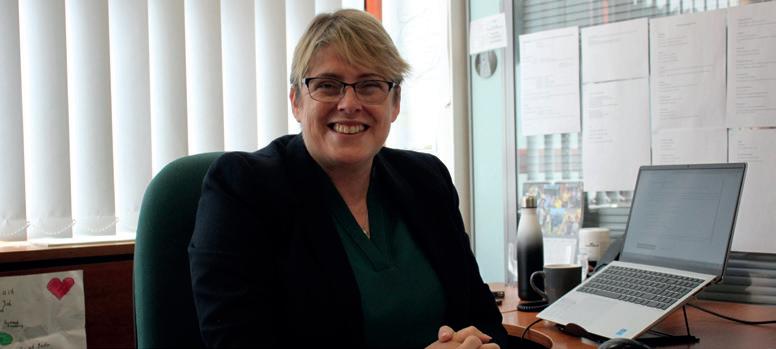
Alex McNeill, subject leader for science and associate assistant headteacher at St John Bosco Arts College
Alex McNeill’s teaching journey began at a crossroads while studying human physiology at university. She found herself torn between two futures: a career in healthcare or education.
“In my second year of university, I was torn between becoming a cardiac physiologist in a hospital or something outside of healthcare,” Alex explains. But a visit to a Train to Teach event with a housemate set her on a new trajectory.
After visiting other schools, Alex knew that St John Bosco was the right fit for her. “Nothing compared to the Salesian feeling you get as soon as you enter the building and meet SJB staff,” she says. A feeling that has kept her rooted there ever since.
Over the years, Alex has taken on a range of roles that have shaped her into the reflective, strategic leader she is today. As a research and development advocate, she explored evidence based strategies and trialled new approaches in the classroom.
Her time as Key Stage 5 coordinator strengthened her leadership, giving her responsibility for outcomes, curriculum planning, and pastoral support. “Leadership isn’t just about responsibility,” Alex reflects. “It’s about influencing others positively, building strong relationships, and always keeping student progress at the centre of decision-making.”
Despite her leadership responsibilities, the classroom remains at the heart of Alex’s work. “The classroom continues to inspire me because it’s where I can make the biggest difference,” she says. “I love the energy of teaching biology and seeing that moment when a student truly understands something new.”
Now subject leader for science and associate assistant headteacher, Alex is energised by shaping teaching and learning on a wider scale. She is passionate about clarity, consistency, and evidence informed practice.
Mentoring early career teachers has also become a defining part of her journey. She believes the most important qualities to nurture are “passion, resilience, reflective practice, and a commitment to continuous improvement.”
Looking ahead, Alex hopes to strengthen outcomes, build confidence in science, and contribute to a school culture where every student thrives academically, socially, and spiritually. Her ultimate aim is to ensure that students leave St John Bosco as “well rounded individuals who are prepared for the next stage of life.”

St John Bosco Arts College celebrates the Feast Day of its patron saint
Students and staff at St John Bosco Arts College, Croxteth, recently came together to celebrate and honour its school’s patron saint, St John Bosco.
Founder of the Salesians, St John Bosco is the patron saint of young people known for his dedication to education and inspiring children by captivating their interests in a loving and kindly manner, building strong relationships through respect and understanding.
With the official Feast Day taking place on Saturday, 31 January, St John Bosco Arts College began its celebrations on Friday, 30 January with a school-wide Mass, led by Father Tony Frain.
Each year group then participated in a variety of different activities that centred on the school’s five core values of love, faith, community, respect and hope.
Year 7s considered what it means to be part of the Salesian community, before creating their own Salesian superhero costumes and presenting them as part of a catwalk. Students in Year 8 and 9 attended the Showcase Cinema to watch a screening of ‘The SpongeBob Movie: Search for SquarePants’, whilst Year 10s stayed in school to play ‘Bosco’s Bingo’ and designed their own form mascots.
Higher up the school, Year 11 created bespoke dreamcatchers and had the opportunity to play inflatable games, whilst sixth formers went bowling at Hollywood Bowl on Edge Lane.
The carefully planned programme of activities gave students the opportunity to reflect on the importance of celebrating the life and work of St John Bosco beyond their everyday school experiences.
Headteacher, Mr Darren Gidman, said: “The Feast Day of St John Bosco is one of the most important dates in our school calendar and is always a special time for us to come together as a Salesian family to give thanks to St John Bosco.
“His commitment to young people and belief in the power of education continues to guide and inspire our mission as a school.”
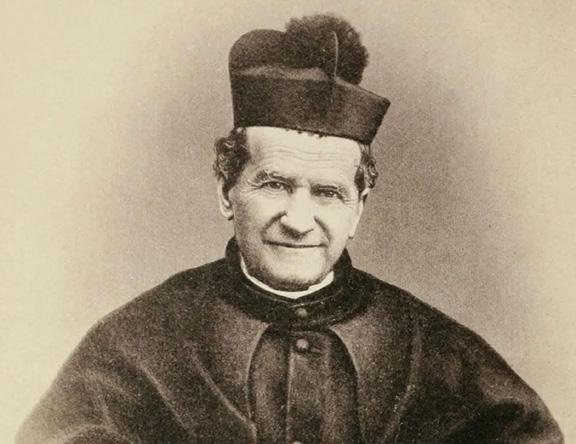
From transformation to thriving together
Over recent years, St Joseph Catholic Multi Academy Trust (CMAT) has built a reputation for courage, ambition and transformation. That spirit remains central to the trust but, as it looks ahead, the narrative has evolved.
Today, St Joseph CMAT stands as a confident, mature trust. Not only transforming where needed but enabling schools that are already strong to flourish even further.
In a period of significant national change, including curriculum review, evolving accountability frameworks, Ofsted inspection reform, and an imminent white paper, St Joseph CMAT provides a protective and supportive structure for its schools.
The trust offers a professional, values-led framework that allows leaders and staff to focus on what matters most: the children. Strong, responsive central services remove unnecessary pressures, reduce external distractions and provide clarity and reassurance at a time of uncertainty. Leaders are empowered, not burdened. Staff are supported, not overwhelmed. Pupils are nurtured, challenged and celebrated.
This culture of support is reflected in the trust’s recent staff satisfaction survey, where St Joseph CMAT achieved results significantly above national benchmarks. It is a powerful endorsement of a trust where people feel valued, listened to and proud to belong, because thriving schools are built by thriving staff. Across their family of academies, the focus is no longer simply about recovery or turnaround. It is about sustaining success, building confidence and strengthening what is already good.
Each school retains and celebrates its own identity, charism and community, while benefiting from being part of a wider family that supports, challenges and uplifts one another. This is not a one-size-fits-all model, but a shared commitment to flourishing together and ensuring the very best for every child.
This is now a trust defined by thriving communities, an ambitious curriculum, strong Catholic formation and sector-leading professional development. Where schools feel secure, valued and confident about their future and where families, parishes and communities know that education is not simply being safeguarded but continually enriched.
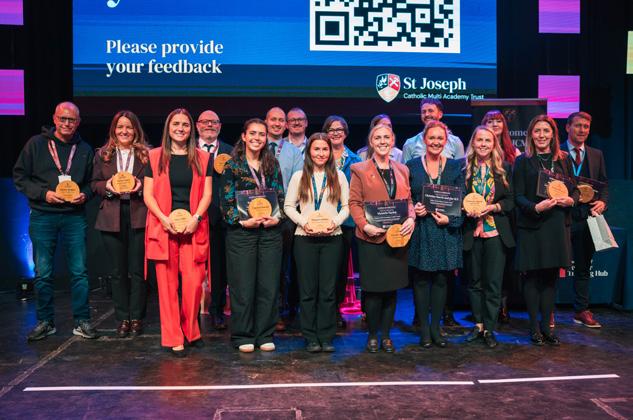

The archbishop visits Our Lady Queen of Peace
Our Lady Queen of Peace Catholic High School was honoured to welcome the Archbishop of Liverpool, Right Reverend John Sherrington, on Thursday 15 January 2026. His visit brought faith, joy and a strong sense of togetherness to the whole school community, creating a memorable moment of pride for students and staff.
The day began with a whole school Mass led by the Year 7 choir, whose confident singing filled the celebration with reverence and joy. In his homily, the archbishop reflected on the school’s mission statement, “In Christ we grow,” encouraging students to recognise and nurture the gifts and talents God has given them. After Mass, the archbishop toured the school, visiting lessons in maths, geography, textiles, science and history, and taking time to speak with students and staff. He then enjoyed a presentation from the chaplaincy teams, who showcased their inspiring work, including Faith in Action, the Live Simply sustainability project,
The archbishop also blessed the newly installed Stations of the Cross in the chapel, beautifully etched and designed by Mr Yarwood, design technology technician, with support from chaplain, Mr Baron. Their work now forms a lasting and meaningful part of the sacred space.
The visit concluded outdoors with the blessing of a newly cultivated area of land. Inspired by the Jubilee Year theme Pilgrims of Hope, this once neglected space has been transformed into the ‘Garden of Hope’ – a peaceful place of reflection created to honour students and staff who have sadly passed away. It stands as a gentle reminder of the profound impact they continue to have on the school community.
The archbishop’s visit was a wonderful celebration of faith in action and a powerful affirmation of the hope, compassion, and shared purpose that define Our Lady Queen of Peace Catholic High School.
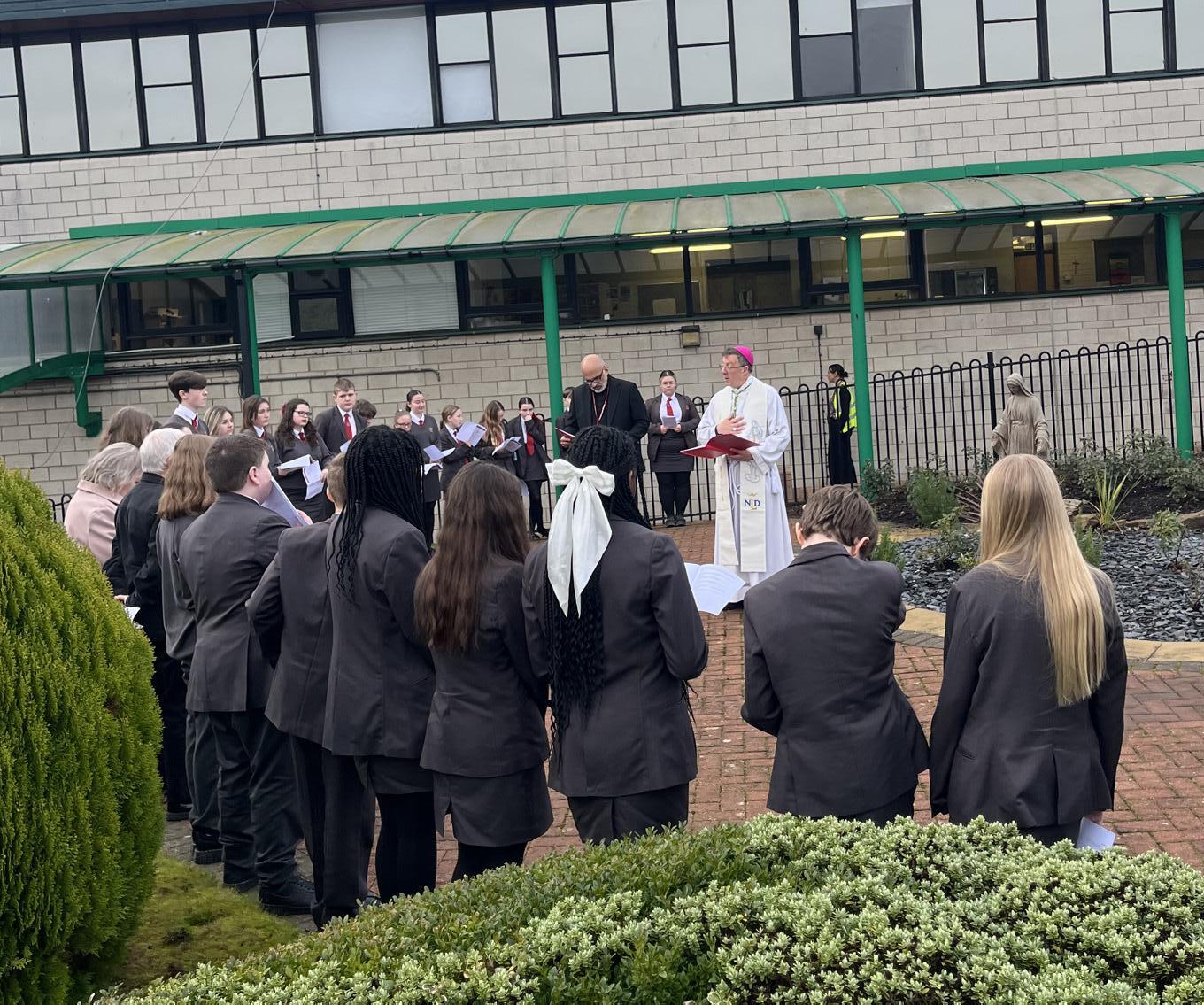
Archbishop John Sherrington blesses the new Garden of Hope
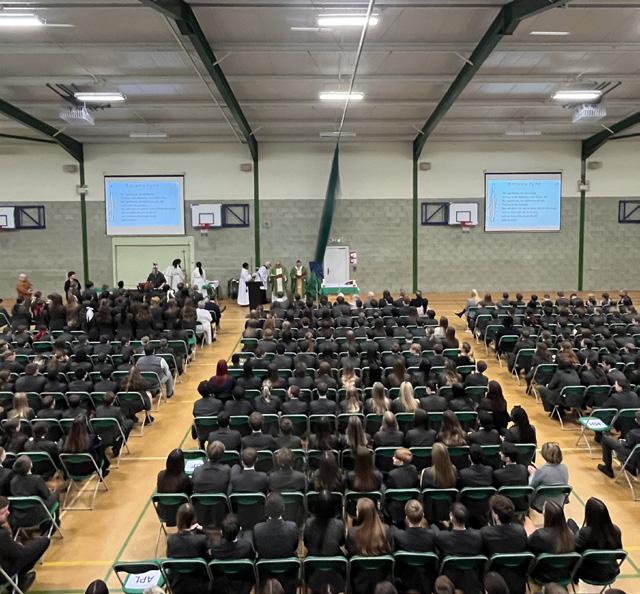
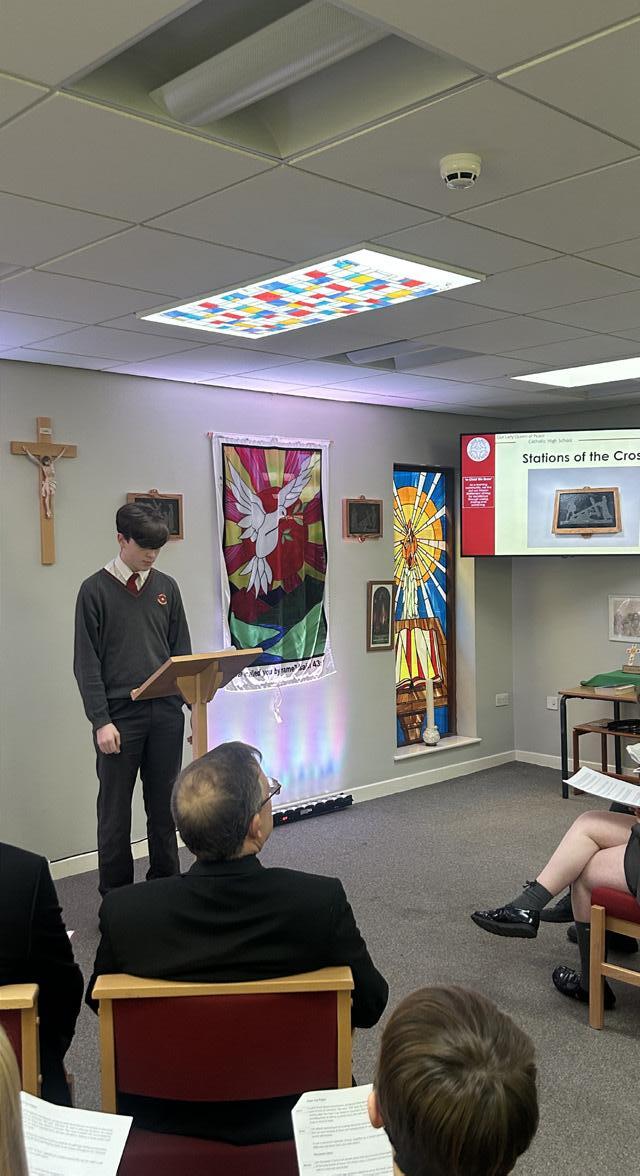
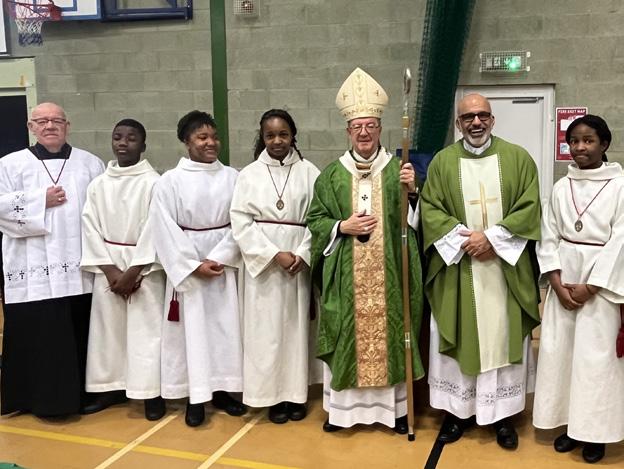
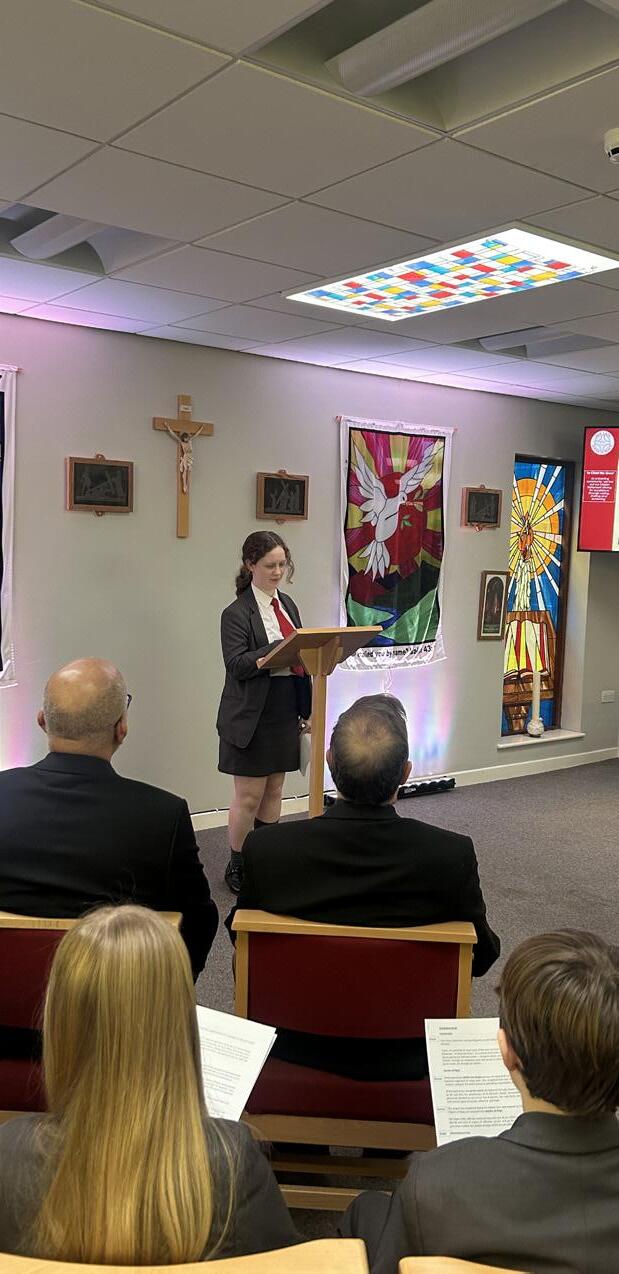
Blessing of the Stations of the Cross - Liam Dickinson
Whole school Mass
School Mission Statement - Evelyn Briggs
Left to right: Fr Paul Rowan, Desmond Amiaka, Michelle Amiaka, Theresa Kyazzike, Archbishop John Sherrington, Fr Kenny and Cissy Luwuliza
Mums the Word
February has always been thought of as one of the worst months. Christmas seems so long ago, and the promise of spring is yet to come. However, we do have some special dates ahead.
On 2 February, we celebrate the Feast of Candlemas, the Presentation of the Lord. Jesus was presented in the temple in Jerusalem and Mary was purified after the birth of Jesus. Then, on 11 February, comes the Feast of Our Lady of Lourdes. My nephew has a birthday on that day and I always envy him. What a lovely day on which to have your birthday. Many people travel to Lourdes for this special feast each year.
Of course, 14 February is the feast of St Valentine. A third-century saint, he was born in Terni in central Italy and died in Rome in 273 AD. St Valentine is the patron saint of bees. Known for his gentle and caring treatment of bees, he would often talk to them and bless them with his prayers.
On St Valentine’s Day, we will hold our business meeting in the Gibberd Room at the Metropolitan Cathedral. This meeting offers an important opportunity to focus on our new committee. In April we will hold our AGM and most of the present committee will end their term of office. We need a president, two vice-presidents, a media officer and a minuting secretary. These vacancies must be filled; otherwise we will not have an archdiocesan committee in Liverpool. Please think seriously about whether you can help. It is a commitment but a very pleasant one. I look forward to seeing you all there. Our next bi-monthly Mass will take place on 11 March at St Anne’s on Overbury Street. As it is our first Mass of the year, we will present Father Ron Johnson with a cheque for the Priests’ Training Fund.
Maureen Finnegan, Archdiocesan vice-president
Over a century of service News from the Liverpool Province of the Knights of St Columba
Thoughts for the year in front of us

As we step into a new year, we are reminded that time is one of God’s greatest giftsa chance to begin again, to renew our commitment to faith, and to deepen our service to others. For the Knights of Saint Columba, this is more than a calendar change; it is an invitation to live out our calling with renewed purpose.
The challenges of the past year have taught us resilience and unity, and now we look forward with hope, trusting that the Holy Spirit will guide our efforts in strengthening our parishes, supporting our communities, and defending the values we hold dear.
This year also calls us to be visible witnesses of Christ’s love in a world that often struggles to find peace. Whether through charitable works, prayer, or simply offering a listening ear, every act of kindness becomes a beacon of hope. Let us embrace this year with courage and humility, remembering that our mission is not only to serve but to inspire. May our fraternity continue to grow in faith and fellowship, and may our actions reflect the light of Christ to all we encounter.
As Pope Leo XIII wisely taught: “No-one is so rich that he does not need another’s help; no-one so poor as not to be useful in some way to his fellow man.”
A prayer for 2026
By Bishop Tom Neylon, KSC ecclesiastical adviser
On the first day of 2026, we celebrated the Feast of Mary, the Holy Mother of God. The beginning of a new year is an opportunity to reset our direction of travel as we continue our journey as Pilgrims of Hope. It is also the day on which we pray for the gift of peace for our deeply troubled, war-torn world. If peace is to come, we cannot be bystanders waiting for someone else to fix things. We must engage.
The best place to begin is on our knees in heartfelt prayer to the God who created each one of us. We also examine our lives and root out the hatred that lurks deep down within us. We seek forgiveness for the times when our thoughts, words and deeds have wounded others. Having done this, we can rise and begin to walk with our families, our fellow knights and all those we encounter, with hearts filled with peace.
As we begin this new year of 2026, I pray for God’s blessing on each one of you, your families and parishioners, that we may give credible witness to Christ, the Prince of Peace.
I hope you have found this information interesting. If you are interested in finding out more about The Knights of St Columba or arranging a visit to your local council meeting, then please don’t hesitate to contact me by email. Philonline2@btinternet.com
Phil Woods, Provincial Grand Knight - Province 2
Church pews –Half-empty or half-full?
By Sarah McGeehan, Youth training Co-ordinator
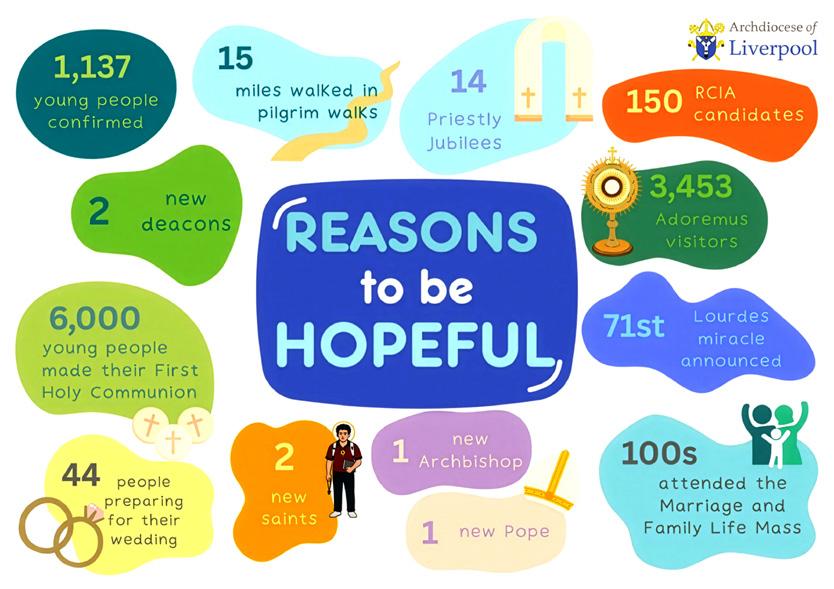
When I taught Religious Education in secondary school, there were times when I felt the odds were stacked against me. It was a struggle to engage some of my pupils with the curriculum.
I used to ask myself questions such as how can I teach this subject properly if many in the class don’t go to Mass regularly, if they are not familiar with the basic tenets of the faith, and show little interest in spiritual matters?
It isn’t always easy to encourage young people to think about the Incarnation, salvation, the preferential option for the poor and other such matters when there are so many other things going on for them – exams, new relationships, the distraction of social media and the fluctuations of the teenaged brain.
Some walk away from their youth without any meaningful connection with their faith. Similarly, it must be disheartening for parishes to see empty spaces in the pews where our youngsters should be sitting.
There were other times in school and in my parish, however, when I saw real glimmers of hope – teenagers going to Lourdes, joining SVP groups, singing in the choir at school liturgies, campaigning for the environment, supporting charities and justice and peace work, saying how much they had enjoyed meditating in the chapel, and writing heartfelt prayers.
I’m always elated to be contacted by past pupils who have become people of strong beliefs, who tell me that experiences they had in school or at church and those they met – chaplains, teachers, priests, youth ministers – nourished their spiritual lives and led to the faith they now have.
You win some, you lose some.
As a Church, do we consider our glass half-empty or half-full? Do we bemoan the lack of young people at Mass or do we celebrate those who do attend? Do we judge the ones who don’t go to Mass regularly or do we celebrate the ones who pray, read the Bible, serve on the altar, and do good works?
Like the contents of a glass, faith is fluid. We know as adults that our beliefs can be very strong some days while at other times doubt creeps in. Faith is not static – unchanging and fixed – and nor would we want it to be as real relationships are not like that, and we want our relationship with God to be real and honest. Faith, in its best form, is stable as opposed to static; steady, well-balanced, adaptable, and able to withstand disturbances.
We only need look at various studies and articles about the rising interest from young people in coming back to the Church to see that a new wave of faith is washing up on our spiritual shores. Around the world, Catholicism is increasing in numbers and the driving force behind this surge is young adults. People are converting to the Church from other denominations, other religions, and no religion at all. Young people are thinking and choosing for themselves instead of blindly following the path of their elders, which gives them ownership of their faith.
No doubt the Covid pandemic forced people to see life in a different way, to cherish connections, re-think values, and search for deeper meaning. There is also a reaction against the secular world which, filled with empty promises of satisfaction and happiness, leaves many people empty and hungry for something more.
Christianity, in particular Catholicism, is proving to be the harbour they find – one of stable values and morality, one that quenches their spiritual thirst.
Therefore, we must remain hopeful –about young people and the future of the Church. It might seem at times that many young people lack faith, but we can’t always see what’s happening under the surface. We must always be hopeful that God is at work.
The symbol of hope is the anchor – the purpose of which is to stabilise the ship, hold it steadfast at its location. And this is what our faith in Jesus Christ does, providing the stability and security we need to prevent us drifting away in life’s storms and keep us rooted in God’s love.
In Hebrews 6:19, hope is called a “sure and steadfast anchor of the soul.” And with God, there are always reasons to be hopeful. So, the question remains – is the glass half-full or half-empty? Is the Church half-empty or half-full? As a person of faith, I’d suggest the answer is: it’s refillable.
Dialogue and Unity The Josephine Butler 50+ awards
By Ultan Russell, Archdiocesan ecumenical officer
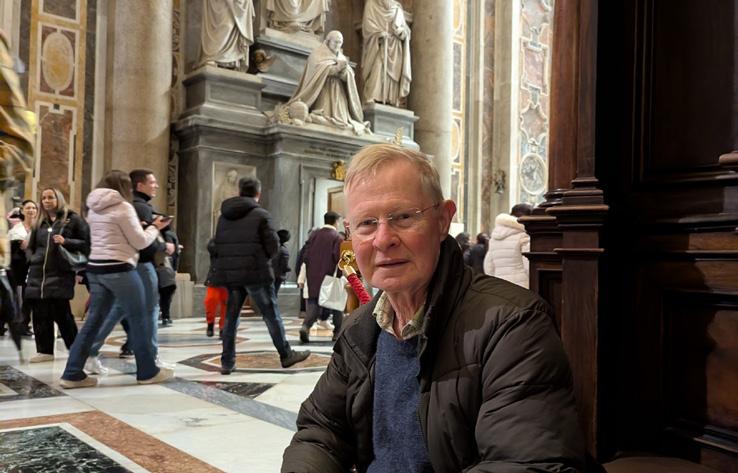
The evening of 20 January was a joyful one. The Josephine Butler Memorial Trust staged a dinner to celebrate having made 50 awards to outstanding Christian action projects and individuals over the last decade. Among those previous winners, five were shortlisted for a 50+ award, an award to celebrate the past 50 awards and the next ones to come.
The trust is committed to celebrating and affirming the relationship between faith and social action, reflecting the life of Josephine Elizabeth Butler (née Grey). Born in 1828, she campaigned for women’s suffrage; the right of women to better education; the repeal of the Contagious Diseases Act; the abolition of child prostitution; and an end to the human trafficking of young women and children into European prostitution.
The feminist leader Millicent Fawcett hailed her as “the most distinguished Englishwoman of the 19th century.”
Much of her life was spent in Liverpool, where her husband, Rev George Butler, was the principal of Liverpool College. She is commemorated in the Anglican Cathedral’s Lady Chapel, and the trust marks her life and work through awards and grants.
The awards dinner was attended by trustees, supporters, and award recipients. Guests included Bishop Ruth Worsley, who presented the awards; Rev Phil Jump, the Liverpool Free Church moderator and Baptist Association minister; Bishop Tom Neylon; and Pauline Lewis, who is chair of the trust and vice-president of the Anglican Diocese’s Mothers’ Union.
The five awards went to:
• Rev Sr Norma Nelson, a member of the Church Army, an Anglican mission movement. Sr Norma’s roles included chairing the national community’s work resources unit. With responsibility for the Church Army’s social work, she was nationally engaged in issues surrounding the pastoral care of sex workers. She worked with agencies, statutory bodies and sex workers’ groups to ensure fair treatment and creative approaches in managing prostitution. She was also a member of the clergy team in Kirkby and returned to live there. Today, in her nineties, she remains active. She has a special link with the trust too, having been a student at Josephine Butler College.

Josephine Butler Memorial Trust
• Marydale Lodge in St Helens is a 12-bed secure children’s home and part of Nugent. It aspires to create a warm, safe and caring environment for children and young people aged 10-18 who need extra support during difficult times. The quality of its care is recognised by its ‘outstanding’ rating from Ofsted – a reflection of the love and dedication of the staff team.
• Joyce Hunt, an Anglican living in Southport and the widow of a vicar, has led a life of volunteering: from establishing a fair-trade shop in central Liverpool to promoting the Anglican diocese’s international links via working in her parish as a committee member and treasurer. In 2014, she became involved with the Learning Room, a charity working alongside people with learning disabilities, serving as a volunteer, treasurer and trustee. She opened a charity shop for the Learning Rooms, which has had several moves as it expands, and now involves 20 volunteers.
Josephine Butler was a Victorian Christian social reformer and feminist.
The Josephine Butler Memorial Trust celebrates Christian social and community engagement.
Website: https://josephinebutlermemorialtrust.co.uk/
Email: Josephinebutlermemorialtrust@gmail.com
The Trust is a Charity registered in England and Wales. Charity Number: 220923
• Wigan Family Welfare is a charity established in 1958 in the Anglican deanery which provides free, confidential counselling, advocacy, and community support for adults, young people and children in Wigan Borough, focusing on mental health, bereavement, anger, and general life challenges. It works across schools and community hubs and offers support like the Comfort Café. From its early days, it has had support from Catholic parishes, and today Canon Conor Stainton-Polland is a trustee.
• Steve Atherton is a former Justice and Peace worker in the archdiocese and currently the vice-chair of the Archdiocesan Commission for Dialogue and Unity. He has been instrumental in developing the diocesan environment policy and ethical investment policy. At national level, he was an advocate for the canonisation of Archbishop Oscar Romero and supported work on justice and peace in other denominations. He lives in Wigan with his wife Anne, where they remain active in church and community initiatives.
Steve Atherton, one of the five winners of the award

All-in-one school video packages.
Promote your school with a professional video package. We handle everything, so you don’t have to. From storyboarding and scripting to scheduling and full production.

Whether you’re looking for a transition video, curriculum content, event coverage or a promotional video, we’ll create a high-quality video that showcases what makes your school unique and is ready to use across your website, social media and newsletters.
Bring your school’s story to life. Get in touch today.