What’s Inside



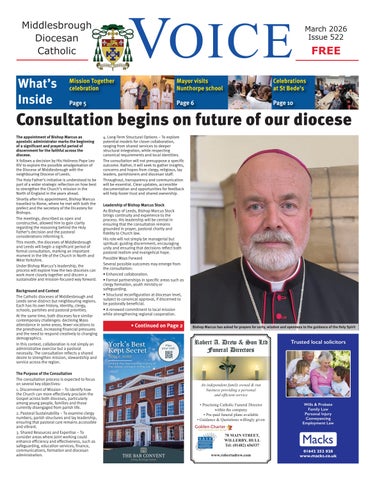
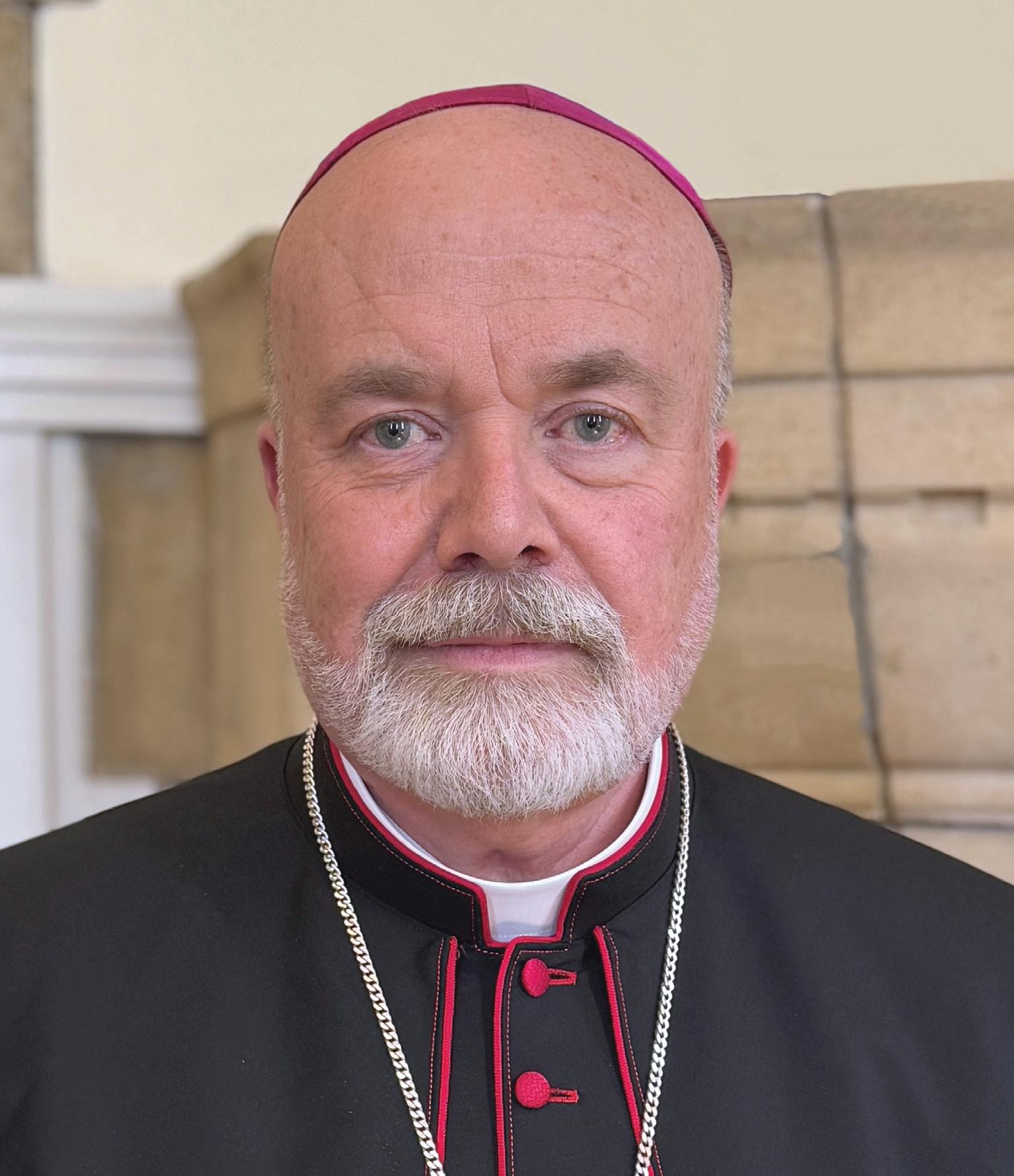
The appointment of Bishop Marcus as apostolic administrator marks the beginning of a significant and prayerful period of discernment for the faithful across the diocese.
It follows a decision by His Holiness Pope Leo XIV to explore the possible amalgamation of the Diocese of Middlesbrough with the neighbouring Diocese of Leeds.
The Holy Father’s initiative is understood to be part of a wider strategic reflection on how best to strengthen the Church’s mission in the North of England in the years ahead.
Shortly after his appointment, Bishop Marcus travelled to Rome, where he met with both the prefect and the secretary of the Dicastery for Bishops.
The meetings, described as open and constructive, allowed him to gain clarity regarding the reasoning behind the Holy Father’s decision and the pastoral considerations informing it.
This month, the dioceses of Middlesbrough and Leeds will begin a significant period of formal consultation, marking an important moment in the life of the Church in North and West Yorkshire.
Under Bishop Marcus’s leadership, the process will explore how the two dioceses can work more closely together and discern a sustainable and mission-focused way forward.
The Catholic dioceses of Middlesbrough and Leeds serve distinct but neighbouring regions. Each has its own history, identity, clergy, schools, parishes and pastoral priorities. At the same time, both dioceses face similar contemporary challenges: declining Mass attendance in some areas, fewer vocations to the priesthood, increasing financial pressures and the need to respond creatively to changing demographics.
In this context, collaboration is not simply an administrative exercise but a pastoral necessity. The consultation reflects a shared desire to strengthen mission, stewardship and service across the region.
The Purpose of the Consultation
The consultation process is expected to focus on several key objectives:
1. Discernment of Mission – To identify how the Church can more effectively proclaim the Gospel across both dioceses, particularly among young people, families and those currently disengaged from parish life.
2. Pastoral Sustainability – To examine clergy numbers, parish structures and lay leadership, ensuring that pastoral care remains accessible and vibrant.
3. Shared Resources and Expertise – To consider areas where joint working could enhance efficiency and effectiveness, such as safeguarding, education services, finance, communications, formation and diocesan administration.
4. Long-Term Structural Options – To explore potential models for closer collaboration, ranging from shared services to deeper structural integration, while respecting canonical requirements and local identities.
The consultation will not presuppose a specific outcome. Rather, it will seek to gather insights, concerns and hopes from clergy, religious, lay leaders, parishioners and diocesan staff. Throughout, transparency and communication will be essential. Clear updates, accessible documentation and opportunities for feedback will help foster trust and shared ownership.
As Bishop of Leeds, Bishop Marcus Stock brings continuity and experience to the process. His leadership will be central in ensuring that the consultation remains grounded in prayer, pastoral charity and fidelity to Church law.
His role will not simply be managerial but spiritual: guiding discernment, encouraging unity and ensuring that decisions reflect both pastoral realism and evangelical hope.
Possible Ways Forward
Several possible outcomes may emerge from the consultation:
• Enhanced collaboration.
• Formal partnerships in specific areas such as clergy formation, youth ministry or safeguarding.
• Structural reconfiguration at diocesan level, subject to canonical approval, if discerned to be pastorally beneficial.
• A renewed commitment to local mission while strengthening regional cooperation.
• Continued on Page 2

Any structural changes would require consultation with the Holy See and adherence to canon law. The emphasis, however, is likely to remain on mission rather than merely structural adjustment.
A Moment of Opportunity
While change can generate uncertainty, the consultation offers a significant opportunity. By working together, the dioceses of Middlesbrough and Leeds can pool strengths, support clergy and lay leaders more effectively and respond creatively to contemporary challenges.
Above all, the process beginning this month is
not simply about administration. It is about discerning how the Church in this region can remain faithful to its calling: proclaiming Christ, celebrating the sacraments and serving communities with hope.
If undertaken with openness, prayer and courage, this period of consultation could mark the beginning of a renewed chapter in the life of the Church across both dioceses – a chapter shaped by collaboration, clarity of mission and confident leadership.
Rooted in Christ’s Vision
At the heart of this process, Bishop Marcus has placed a renewed focus on the Church’s divine mission. Reflecting on the Church’s vision, he pointed to Christ’s priestly prayer in the Gospel of St John:
“I do not ask for these only, but also for those who will believe in me through their word, that they may all be one, just as you, Father, are in me, and I in you, that they also may be in us, so that the world may believe that you have sent me.”
“Ut unum sint – that they may be one.”
This is the vision entrusted to us. Unity is not simply about structure; it is about communion in Christ, so that the world may come to believe.
The mission of the Church was given explicitly by Christ before his Ascension: “Go, make disciples of all nations.”
Any consideration of diocesan structures must serve that enduring call to evangelisation. Our purpose is not preservation for its own sake, but to proclaim Christ and to invite others into friendship with him.
Hope for the Future
While the possibility of amalgamation represents a significant development, diocesan leaders encourage the faithful to see this moment as one of grace.
The outcome of the consultation process will eventually be presented to the Holy See for consideration. In the meantime, Bishop Marcus has asked for prayers for unity, wisdom and openness to the guidance of the Holy Spirit.
As members of Christ’s Church, we walk forward together – trusting not in ourselves, but in the Lord who calls us to be one, to make disciples and to live the Beatitudes in our time.
Monsignor Gerard Robinson, Vicar General
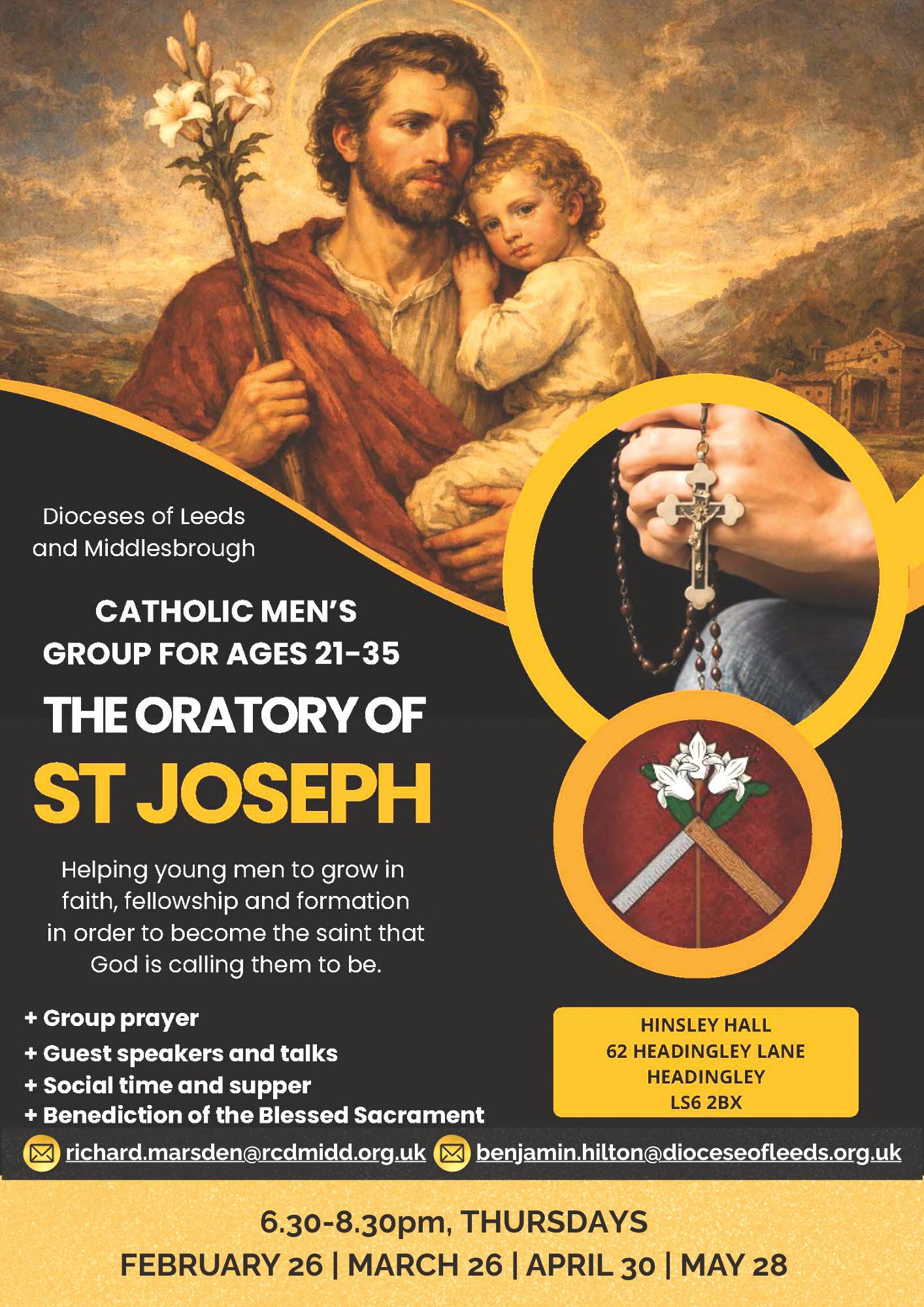
A new Catholic men’s group for the Diocese of Middlesbrough and Diocese of Leeds has been launched at the instruction of Bishop Marcus.
The first meeting of the Oratory of St Joseph, which is for 21- to 35-year-olds, was due to happen on February 26.
Gatherings, which take place on the last Thursday of each month (from 6.30-8.30pm), include a talk from guest speakers, group prayer, social time and supper and Benediction of the Blessed Sacrament.
The first series of meetings is at Hinsley Hall, Headingley. This initiative is one of the first collaborations between the two dioceses
since Bishop Marcus’s appointment as apostolic administrator of the Diocese of Middlesbrough.
The establishment of the group follows recent reports from around the country about an increase in young men being attracted to the Catholic Church. The Oratory of St Joseph has been set up to encourage them to grow in their faith in Christ and build friendships with each other.
For young men interested, Hinsley Hall may seem far away to get to. However, Leeds is very accessible, especially by train. Services from places such as York and Hull to Leeds are relatively short and there are return journeys available late into the evening.
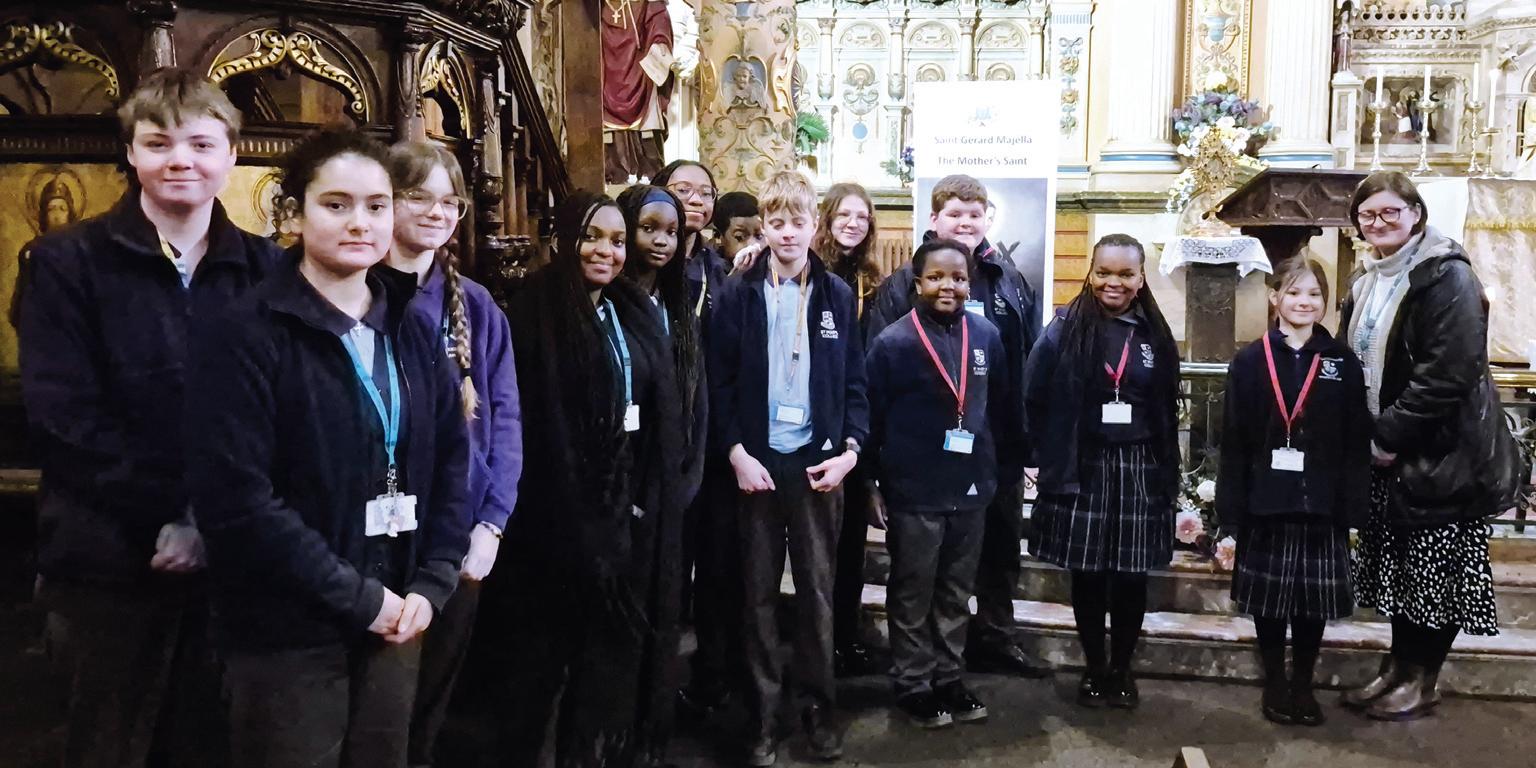
A group of students and staff representing all year groups at St Mary’s College in Hull had the privilege of visiting St Charles Borromeo Church to venerate the relics of St Gerard Majella, which were visiting the parish as part of the 300th anniversary of his birth.
During the visit, the college community had the opportunity to attend Mass and receive a blessing from the relics of St Gerard, a Redemptorist lay brother known for his humility, compassion and deep trust in God.
As the patron saint of mothers, expectant parents, families and those longing for children, St Gerard’s life and witness continue to inspire people across generations.
As part of the visit, students and staff were treated to a fascinating tour of the historic features of the church, led by Father Phil Cunnah.
Father Phil shared insights into the rich history and architecture of St Charles Borromeo, helping students appreciate the church not only as a place of worship but also as a living part of Hull’s heritage and the church’s mission.
This visit supported the chaplaincy mission at St Mary’s College, deepening students’ understanding of Catholic tradition while encouraging them to live out values of service, kindness and trust in God in their everyday lives.
• We’ll have more on the visit of the relics in next month’s Voice
From Leeds station, Hinsley Hall is just three miles away, accessible by bus or taxi. It is just 20 minutes’ walk from Burley Park railway station.
There is also plenty of car parking at Hinsley Hall (62 Headingley Lane, Headingley LS6 2BX).
Professor Maurice Whitehead will speak at the next meeting, on Thursday March 26, on the topic of young English and Welsh Catholic
laymen who built up the Church in London and Rome in the late 16th and early 17th centuries.
For more details, contact Father Benjamin Hilton (benjamin.hilton@dioceseofleeds.org.uk) or Father Richard Marsden (richard.marsden@rcdmidd.org.uk). Father Richard Marsden
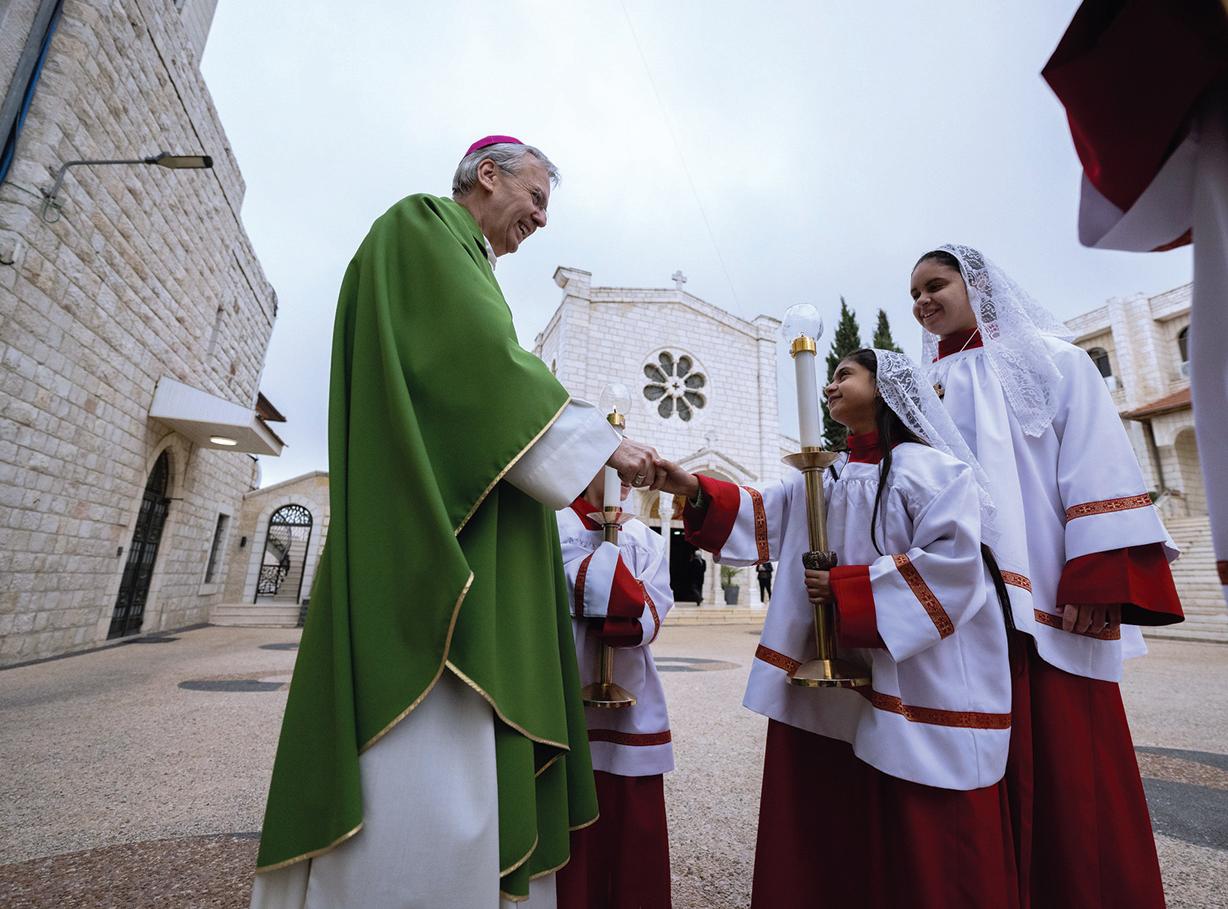
The Co-ordination of Episcopal Conferences in Support of the Church of the Holy Land, including Bishop of Plymouth Nicholas Hudson, chair of the Bishops’ Conference International Affairs Department, issued the following communique at the end of its visit earlier this year.
“You are the salt of the earth; you are the light of the world.” Matthew 5:13-14 Our pilgrimage was to a land where people are suffering trauma. We began with a visit to Bedouin communities living on the margins of society in the occupied West Bank.
They shared their experiences of a life on the periphery, being observed but often not encountered, their movement heavily restricted by rapidly expanding settlements encircling them on the surrounding hills.
We heard stories about Israeli settler attacks and their continual violence and intimidation, theft of livestock and demolition of property, leaving many unable to sleep at night for fear of further violence.
When we asked them who sees their struggles and their cry to live in peace with their neighbours, they replied: “Nobody sees us.”
Our journey continued with Mass in the only completely Christian town in Palestine. They, too, told us of their suffering: endless attacks from extremist settlers, uprooting of their olive trees, the seizure of their land and intimidatory acts that make their daily life unbearable, driving many into mass emigration.
In the twelve months since our last visit, the Land of Promise is being diminished and challenged. Gaza remains a catastrophic humanitarian crisis.
The people of the West Bank we encountered are demoralised and fearful. The courageous Israeli voices that speak out for human and civil rights are increasingly threatened; advocating for marginalised voices is a costly solidarity. We fear that soon they too will be silenced.
As Christians, it is our calling and duty to give a voice to the voiceless and to bear witness to their dignity, so that the world may know their suffering and be moved to advocate for justice and compassion.
The settlements in the West Bank, illegal under international law, continue to expand by commandeering the land of others.
The universality of human rights applies to all without exception. Instead, it is relentlessly replaced by a system where dignity and protection depend on one’s civil status.
We affirm Israel’s right to exist and for Israelis to live in peace and security; equally, we call for these same rights to be upheld for all those rooted in this land.
We hope that efforts for peace will prevail over violence, and that there will be no more acts of terrorism and war.
We also urge our governments to exert pressure on Israel to uphold the rules-based international order and to revive meaningful negotiations toward a two-state solution for the benefit and security of all.
We were deeply moved by the faith and steadfastness of local Christians and also by people of other faiths who work to sustain the hope of their communities. They remind us that it is our shared vocation to be “salt of the earth” and “light of the world” and to strive for peaceful coexistence and security across the Holy Land.
We also witnessed the courage of those Jewish and Palestinian voices who, despite immense challenges and their own trauma, continue to advocate for justice, dialogue and reconciliation.
Hearing from parents who have lost a child to conflict and can still find a way to forgive offers a powerful witness to the possibility of peace and reconciliation. Few experiences are more devastating. When such a mother or father pleads for an end to violence, the world must listen – and act.
The people of the Holy Land cry out for our help and prayers; they long for an end to their
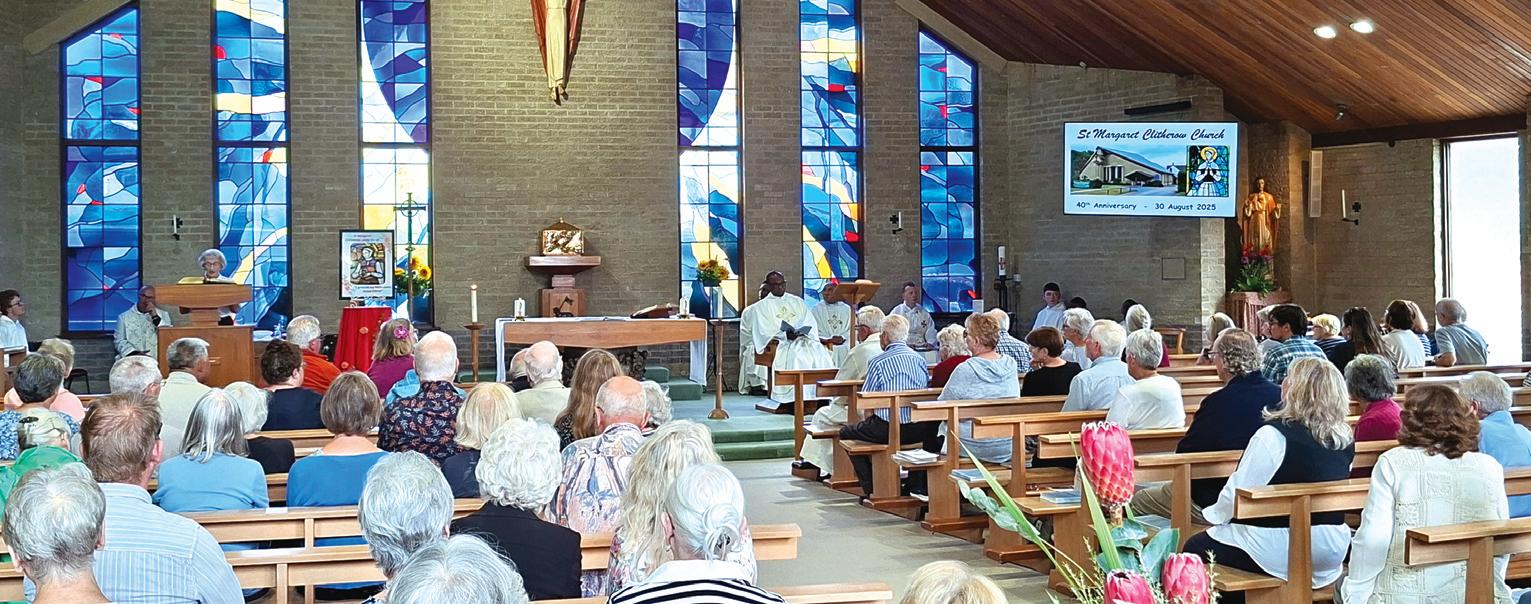
A special Mass celebrated on the feast day of its patron marked 40 years since the official opening of St Margaret Clitherow, Haxby. The service was led by parish priest Father Nicholas Ikpeme, retired priest Father Kevin Trehy, priests from the deanery and the Anglican vicar of St Mary’s, Rev Kathryn Jackson. Newly confirmed young people delivered the scripture readings and the youngest and oldest parishioners processed with the offertory gifts.
Sick people in the parish were anointed during the service.
After Mass, Kath Campbell gave a potted history of the parish and the building of the church, followed by a picture commentary on the parish screen.
The memorable spiritual occasion was followed by refreshments in the parish garden, with a toast to the next 40 years of loving and caring for our beautiful church and one another.
suffering. Stand with them. Recognise their plea for dignity. Help foster genuine dialogue between communities. Heed the call of Cardinal Pierbattista Pizzaballa, the Latin Patriarch of Jerusalem, to come on pilgrimage as a sign of our love, support and solidarity with them.
As we leave this land, we do so with our hearts full of compassion for those who are suffering and inspired by those who, by their pursuit of justice, keep the hope of peace alive.
Our Lady Queen of Palestine and of all the Holy Land, pray for us.
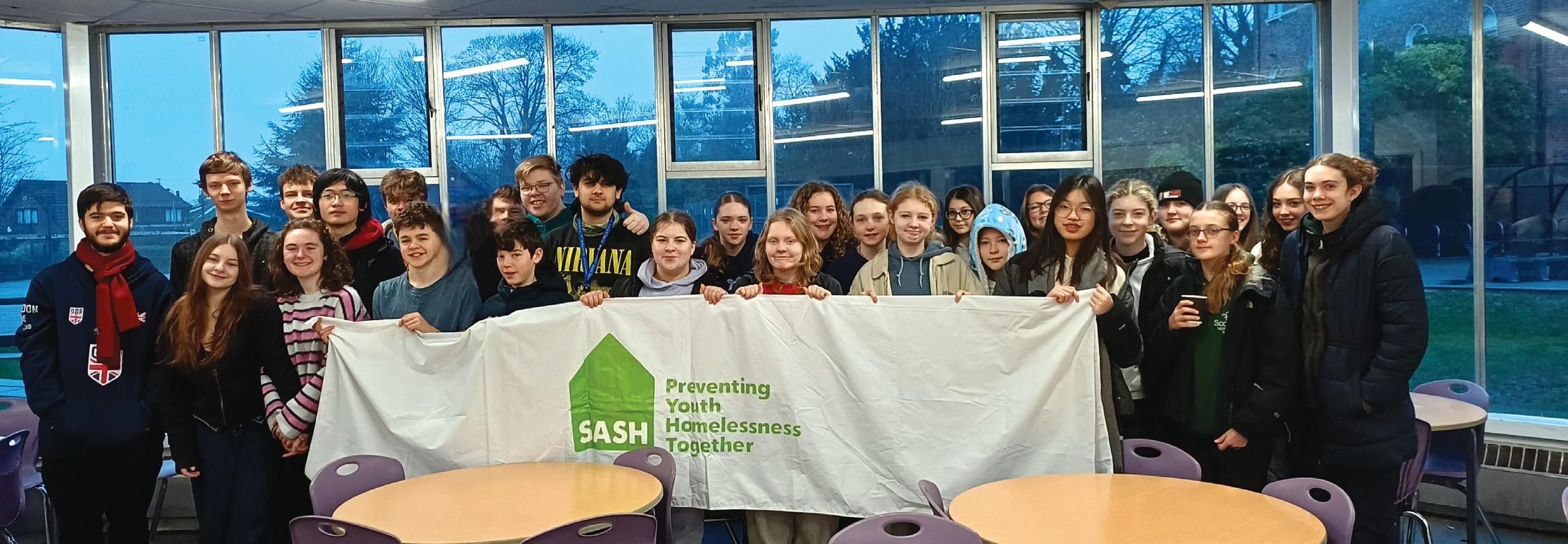
A group of 36 Year 9 to 13 students at All Saints Catholic School in York held their annual Big Sleep Out to raise funds for Safe and Sound Homes (SASH).
They heard about the charity and the support they offer to young people in our community from SASH volunteer Liz.
The students then built shelters and spent a chilly night sleeping outside.
In the morning they reflected on their experiences.
The event raised close to £1,000, their highest total ever for this event.
Rebecca Kramm Lay Chaplain
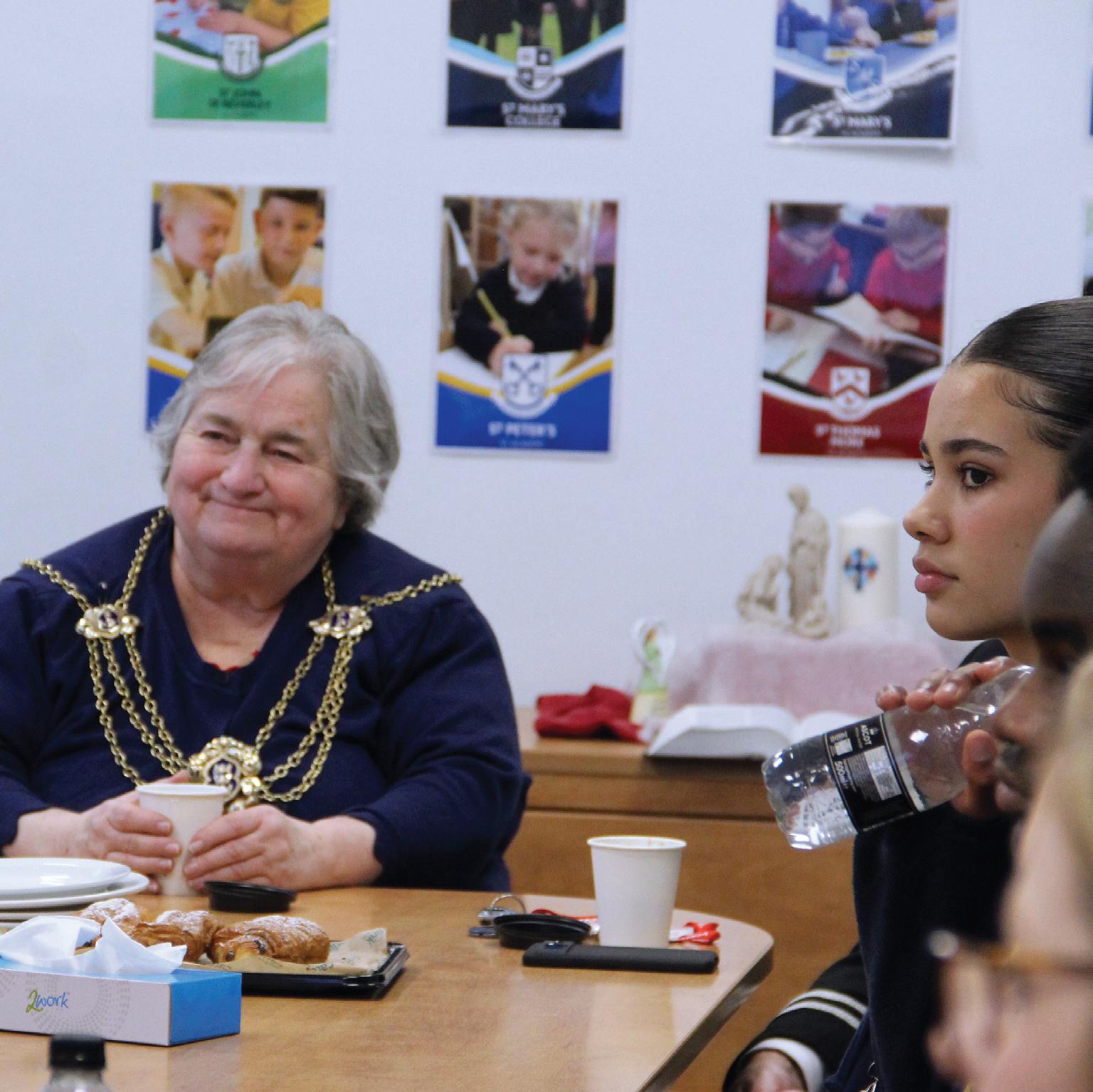
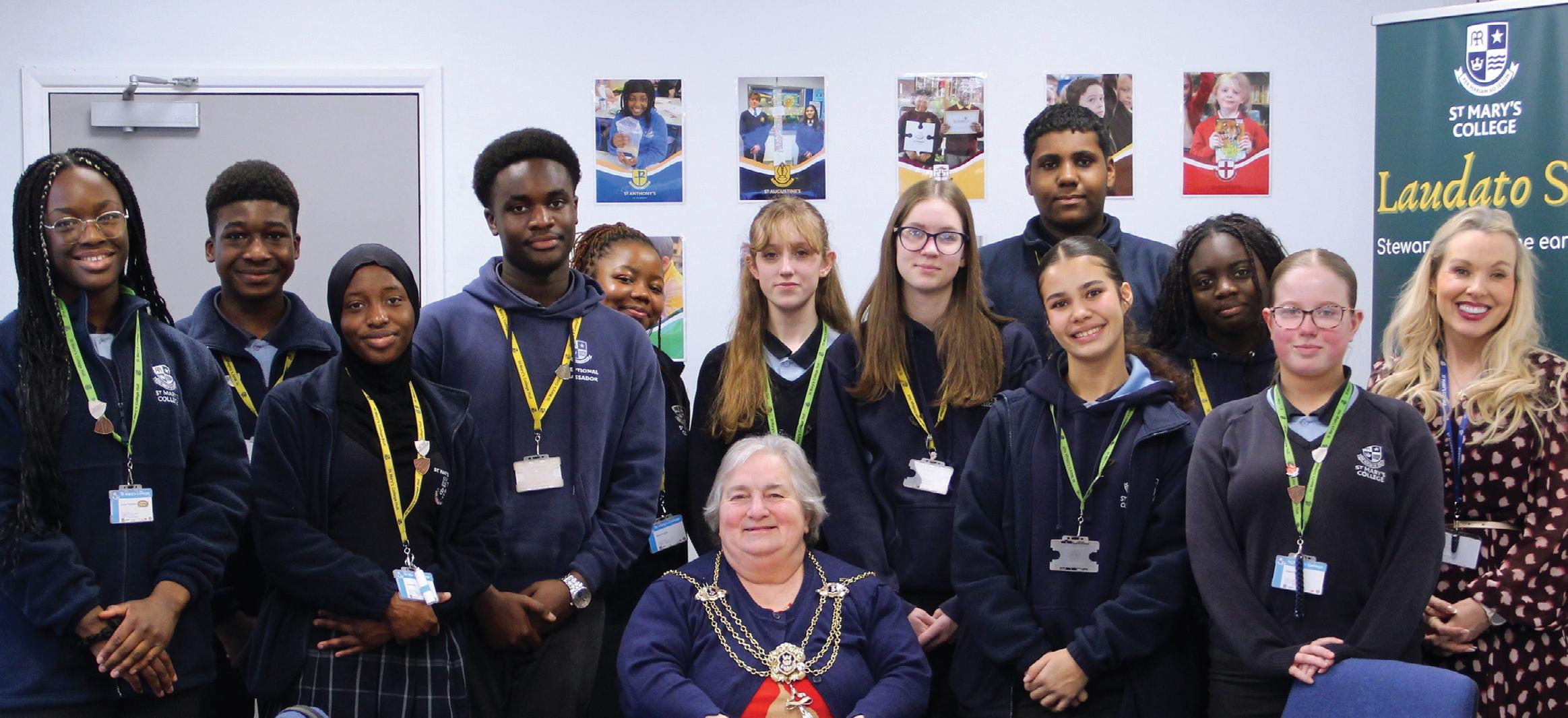
A visit from Lord Mayor of Hull Cheryl Payne provided a wonderful opportunity for St Mary’s College students to showcase the spirit of their community and the leadership initiatives that define daily school life.
The highlight of the visit was a formal meeting between the Lord Mayor and the school’s SMC Best Ambassadors.
These student leaders serve as the heartbeat of school culture and they took the



opportunity to explain their vital roles and responsibilities.
During their presentation the ambassadors spoke passionately about how they act as guardians of the school’s mission, vision and values.
A clear set of values guide the school community, supported by strong expectations. This is reflected in the school’s mission statement, chosen by students and staff: ‘With God All Things Are Possible’ which represents their Catholic beliefs and reminds us that in moments of struggle or upset, God is always there, even when we don’t realise it. They detailed their work in supporting their peers, fostering an inclusive environment, and ensuring the “SMC Way” is reflected in every corridor and classroom.
Their work is primarily focused on supporting younger students with behaviour, attendance or friendship concerns and they have set up a club to support other students who may want a space to talk to an older student about any problems.
After the presentation, the Lord Mayor was taken on a guided tour of the college grounds. During the tour, she was able to see our values in action and the focused learning environment of pupils.
It was an inspiring day for everyone involved, reinforcing students’ pride in being part of the Hull Catholic community and beyond.
Naomi Bedworth
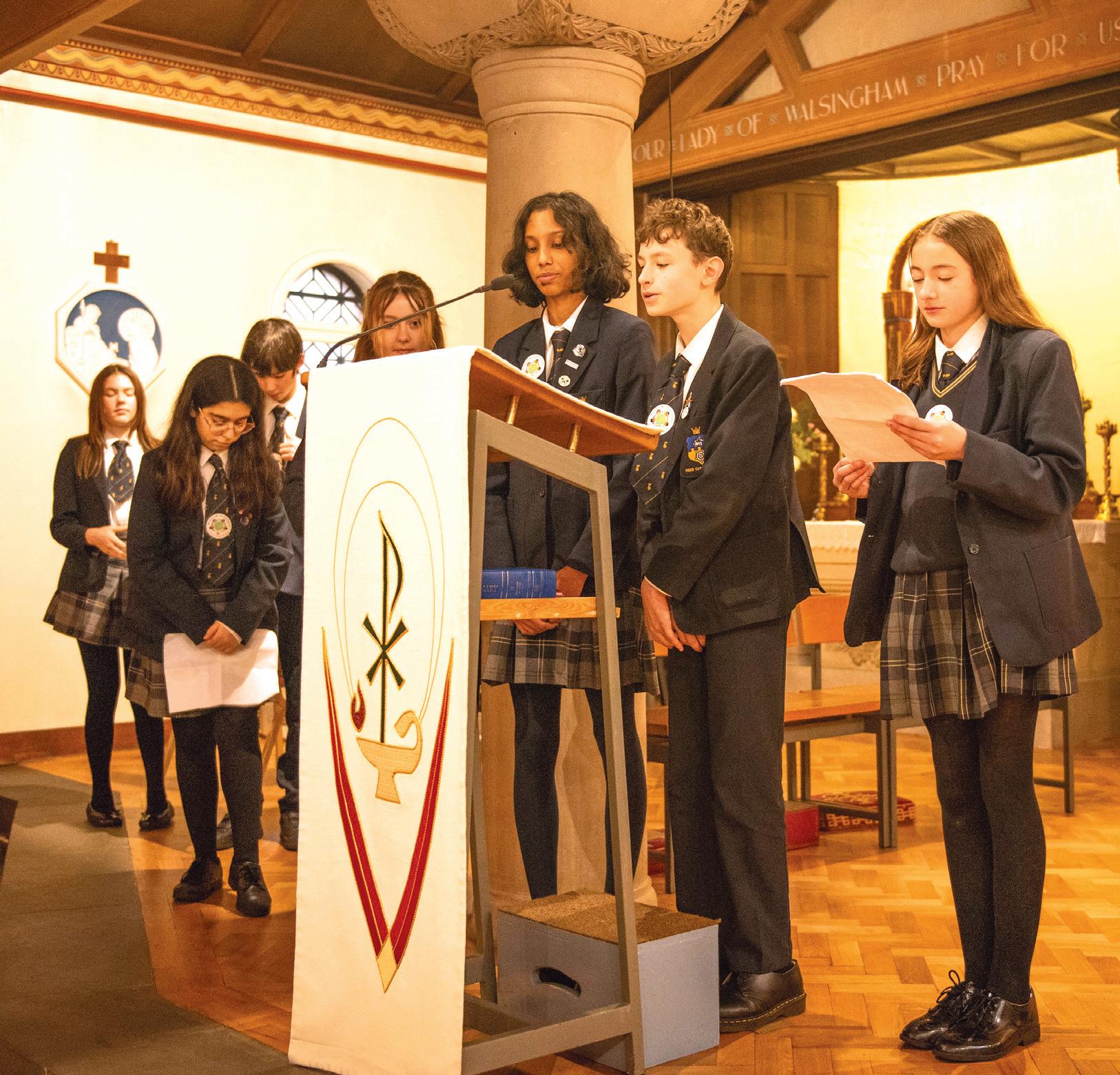
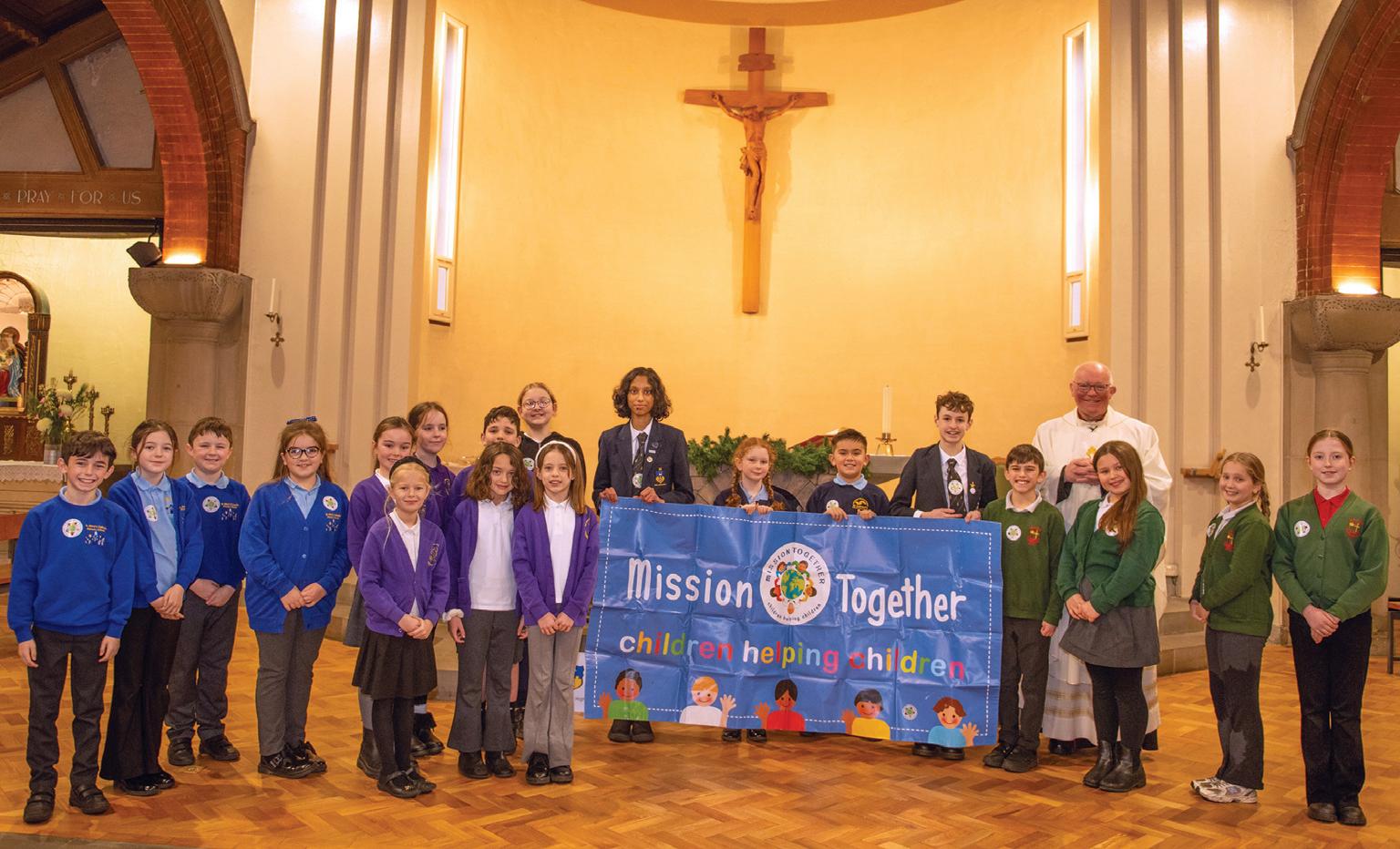
A fierce storm failed to dampen the spirits of pupils and staff who braved the wind and rain to join the Diocese of Middlesbrough’s first Mission Together Mass.
Six Catholic schools gathered at English Martyrs Parish, York, to pray, play and get inspired for mission.
Canon Michael Loughlin presided at this special and joyful celebration of the Pope’s charity Missio and its children’s branch, Mission Together.
He showed how, thanks to prayers and fundraising from our young supporters, Mission Together can share Christ’s love in places of poverty and conflict, through practical help and pastoral care.
Everybody helps
The Mass was a wonderful opportunity to thank everyone – pupils, staff, and all Missio’s parish and school volunteers – for helping make mission possible. And so many people helped make the day extra special!
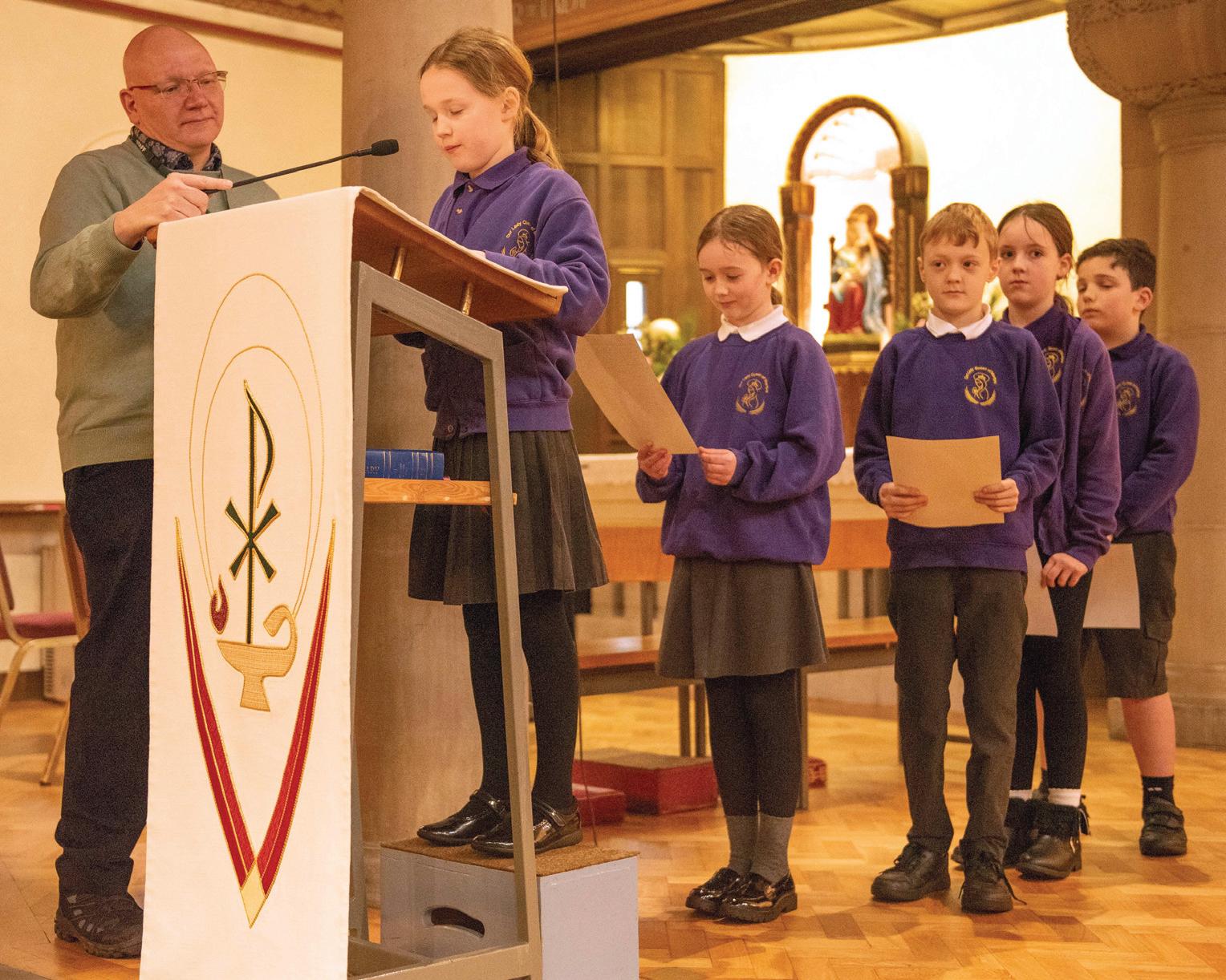
Canon Michael was ably assisted by altar servers Robbie and Niamh from All Saints School, pupils from Our Lady Queen of Martyrs Primary did a wonderful job delivering Scripture and bidding prayers, and more students from All Saints School dramatised the day’s Gospel (Luke 10:1-9), helping pupils to reflect on discipleship through history and today.
A local heart for mission
In his homily, Canon Michael expanded on the message of missionary discipleship, encouraging us all to consider the ways in which we can share the message of Christ’s love with everyone we meet.
One excellent example of this was local woman and hopefully future saint, Mary Ward. Mary’s story was woven into the Gospel drama and Canon Michael expanded upon this, explaining that Mary Ward lived during a time in Britain’s history when living one’s Catholic faith risked imprisonment or death. Despite this, Mary courageously shared the love of God through word and action, and the
order of sisters she founded – the Congregation of Jesus – continue to do so as missionary disciples around the world today.
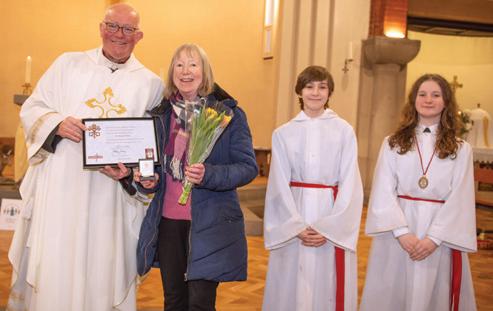
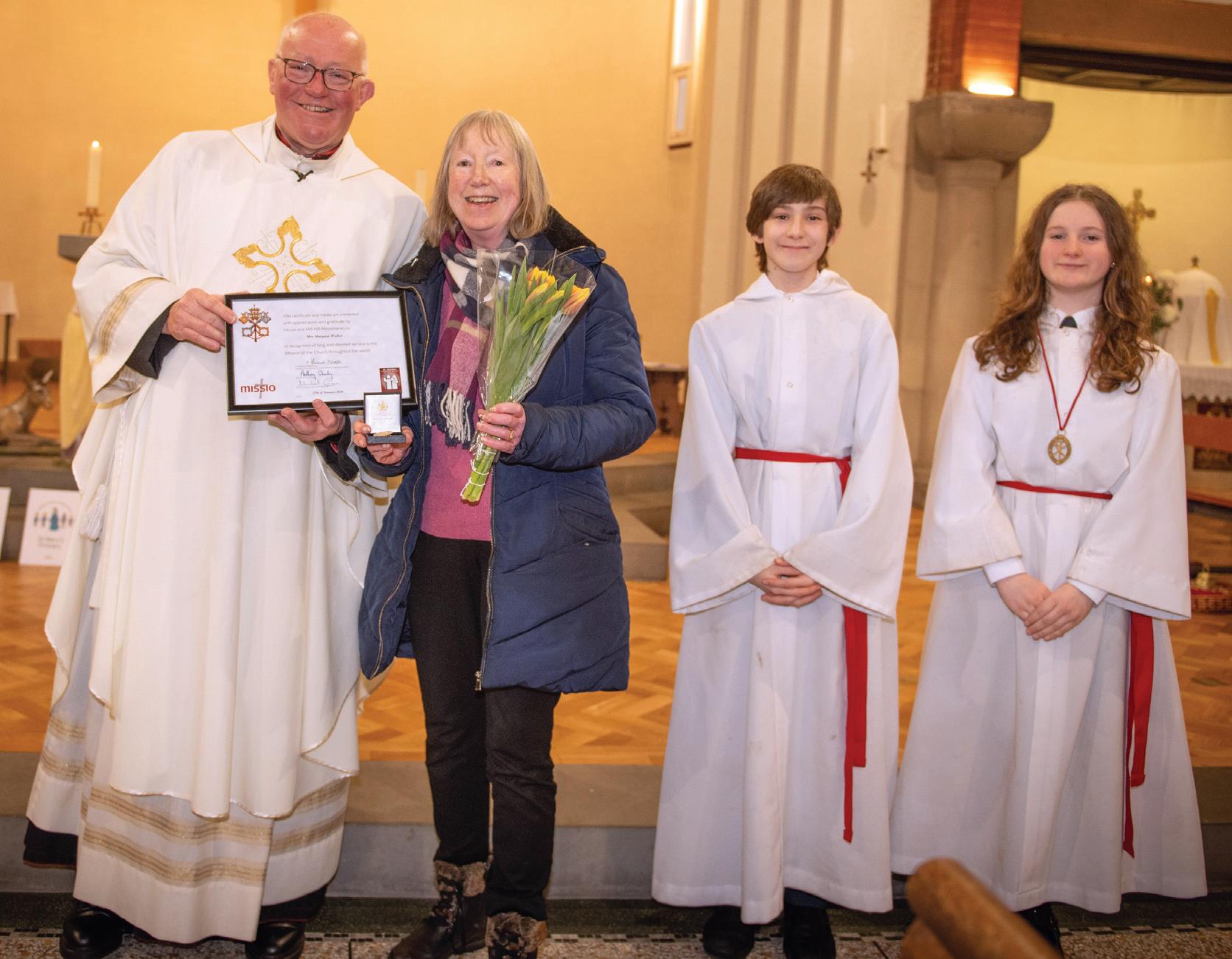
A special award for Margaret At the end of Mass, Mission Together volunteer Margaret Walker from St Margaret Clitherow Parish, Haxby, received a medal and certificate for her 43 years of service.
Margaret’s witness of faith and her commitment to share Christ’s love in the world was not lost on the young people gathered, who gave her a big round of applause.
Margaret joined pupils for refreshments in the parish hall after Mass, although she wisely stepped back from an energetic interactive activity designed to help pupils get to know each other.
St George’s class teacher, Mrs Humphries, who attended the Mass with her Faith in Action pupils, said: “Thank you so much for organising everything so well and inviting St George’s. Our pupils truly enjoyed the Mass and the activity in the church hall.”
Class teacher Mr Hartley, from Our Lady Queen of Martyrs, echoed this sentiment, saying: “Thank you so much for organising the Mass. The children had a lovely time and came back to school excited to share their experiences.”
We want to say a huge thank you to all the schools who attended and to the staff who practised and rehearsed with their children to ensure the Mission Together Mass was a great success.
Thank you also to local Missio volunteers and English Martyrs parishioners who came along to join us in prayer.
About Mission Together
As the children’s branch of Missio – the Pope’s official charity for world mission – the aim of Mission Together is two-fold.
We enable and empower young supporters in England and Wales to support Missio’s overseas children’s projects, through fundraising and prayer. We also support the
information please visit missiontogether.org.uk or email claire@missio.org.uk.
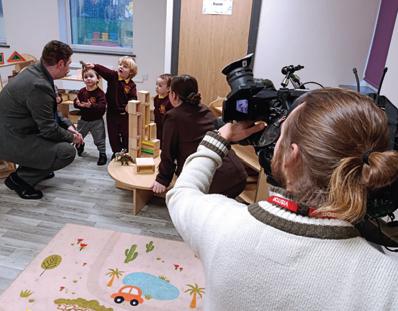
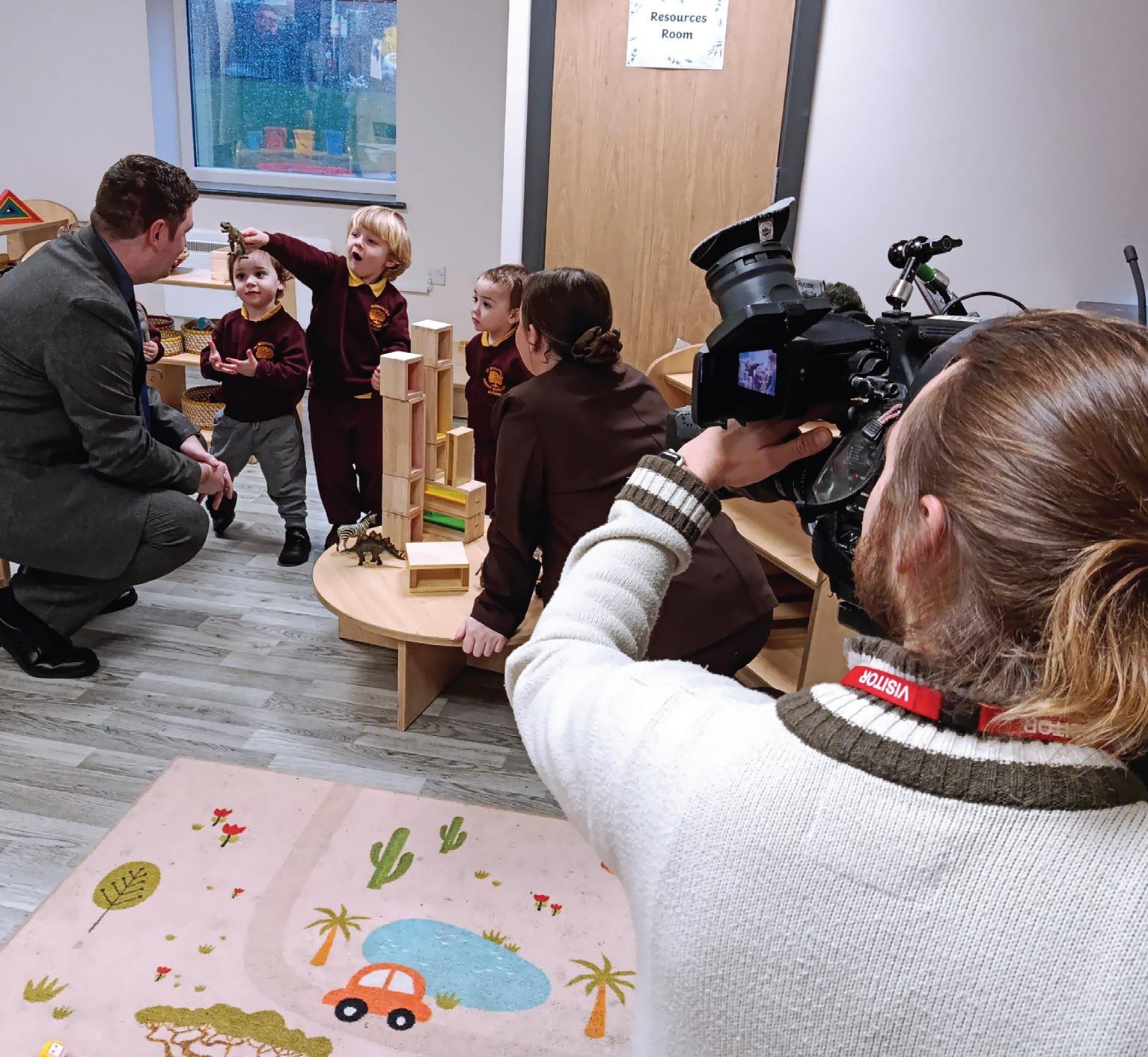
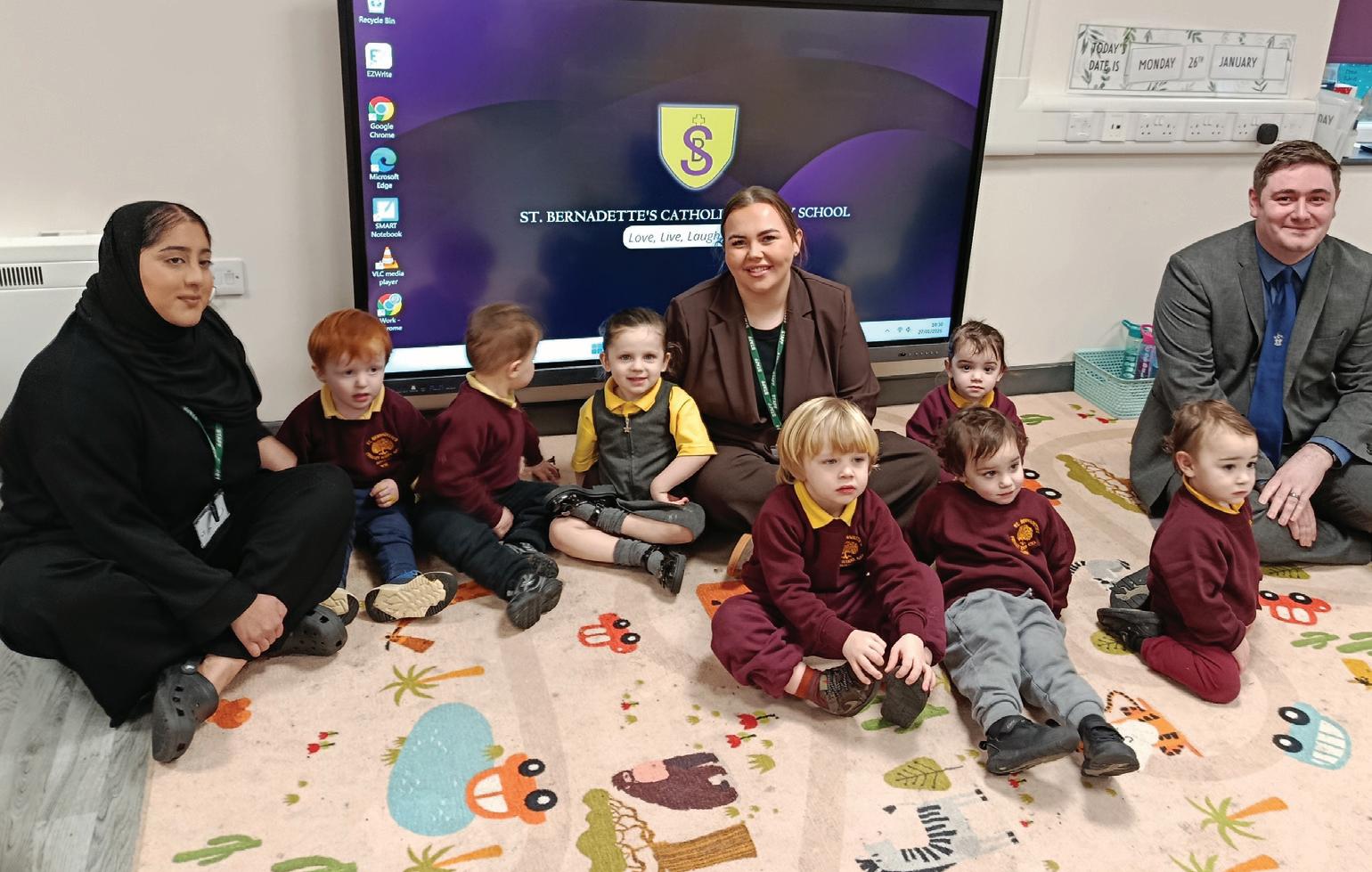
New provision for two-year-olds at St Bernadette’s Catholic Primary School in Nunthorpe is helping ensure children are up and running when the time comes to begin their full-time education.
Thanks to generous funding from housing developers, ten toddlers came into a brandnew building on the school site at the start of the school year.
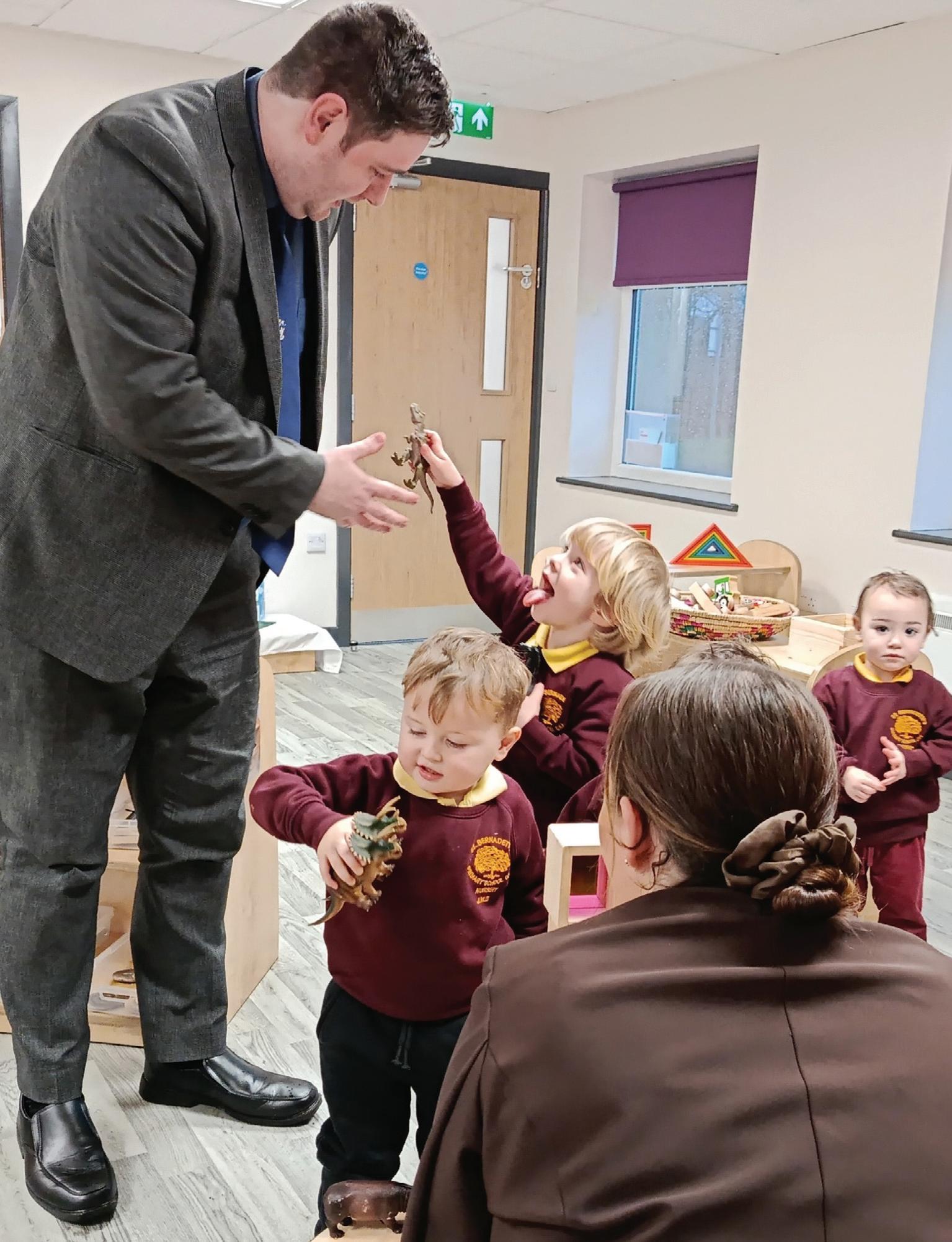
Middlesbrough Council added additional cash for outside play facilities, and the town’s Mayor Chris Cooke came along to meet the children and see the new set-up for himself.
Unfortunately, Storm Chandra decided to put in an appearance too, making playing in the new council-funded sandpit and mud kitchen impossible, but Mayor Cooke enjoyed a game of dinosaurs with the children instead.
“We set up our two-year-old provision at the end of September, so it’s only relatively new,” said headteacher Sarah Brady.
“We have places for 10 children and are almost full, but it’s quite a large space and we’d love to extend and offer more places.
“The funding from Middlesbrough Council has really helped improve our outdoor area, which we plan to build on over the next few years.
“We were delighted Chris was able to come in and see what we’re doing here, and the children certainly seemed to enjoy his visit.
“We’re planning to bid for more outdoor furniture and resources when the new funding becomes available in April.”
Mayor Cooke said: “It was great to visit the
children at St Bernadette’s and see first hand how ambitious Miss Brady and her team are for the students.
“The school grants we introduced were designed to help teachers create better environments and experiences. I had great fun meeting the nursery class and seeing them learn as they played.
“With more grants, extra holiday clubs and youth clubs in every ward, we’re pushing hard to create more opportunities for our young people right across Middlesbrough.”
The new early years building was paid for by Section 106 funding, which developers contribute to improve communities they build housing in.
It opened its doors at the start of the school year and is proving hugely popular.
“The children have settled in so well and come in happy and smiling every day. We can see them improving their communication and personal and social development, which has a positive impact as they move into nursery and the rest of the school.
“We also run a monthly toddler group for babies up to three-year-olds, when we invite anyone who wishes to come along to sessions run by our teaching staff and music lead.
“It’s all about giving the children a strong starting point and welcoming them into the St Bernadette’s family as soon as possible.
“We’re delighted to be able to offer more to the community and to have so many happy children here at St Bernadette’s.”
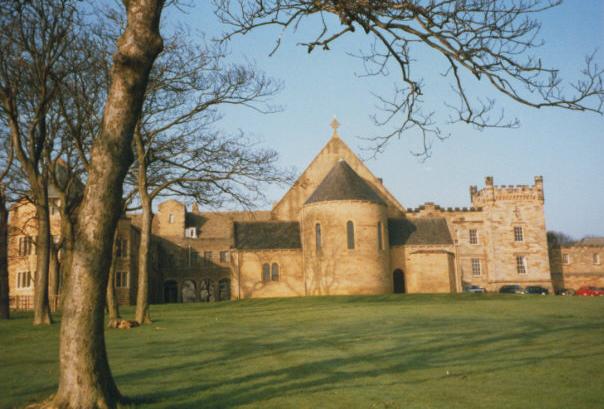
More than 100 people attended a day of reconciliation and healing at
The event was led by Father Bill Serplus, who generously made St Aelred’s available, together with Father Jose Michael, Canon Michael Loughlin and Gerry and Ann Connor. A packed day started with Mass celebrated by Father Bill before reflections on reconciliation and healing were interspersed with praise and worship.
There was adoration of the Blessed Sacrament and the priests were available for the Sacrament of Reconciliation.
Lunch was served in the parish hall and gave everyone the opportunity to chat. Some people had come from Harrogate, Hull, Guisborough and York.
In the afternoon there was a powerful and moving personal testimony that gave a deep insight into how reconciliation and healing go hand in hand. This was followed by an
opportunity for individual prayer.
The day concluded with the opportunity for Baptism in the Holy Spirit for a new infilling of the Holy Spirit and all his gifts.
Each of us needs healing, and we can only be fully healed by our Lord Jesus Christ. As seen at Pentecost, the Holy Spirit is the giver of gifts and continues to be the giver today.
It is through Baptism in the Holy Spirit that these gifts can be fully released in a person
and brought fully to life.
As Jesus said in Luke 11:13: “How much more will your Father in heaven give the Holy Spirit to those who ask him.”
If you like to be involved with the Middlesbrough Diocese Catholic Charismatic group and hear about upcoming events, contact Sharon Daniels at cdscmiddlesbrough@gmail.com.
Frances Redmore
The Oasis of Silence programme offers space and stillness to seek God with loving awareness in the present moment.
It includes a variety of opportunities to make retreats of different lengths in a peaceful and welcoming environment, away from our busy everyday lives.
It is for everyone seeking stillness and silence and who is interested in getting to know or deepening the practice of contemplative prayer.
We keep to the form and dynamics developed by the Jesuit, Franz Jalics SJ (19272021), which is also known as the Gries Path. Through a deepening awareness of the reality of the present moment by focusing on our breathing, our hands and God’s name, we are led to an ever-deeper encounter with Jesus Christ.
The Oasis of Silence programme is ecumenical and takes place at St Hilda’s Priory, Whitby, the mother house of an Anglican religious community for women, the Order of the Holy Paraclete.
Accommodation is in ensuite rooms (two
disability-friendly), with all meals and snacks provided.
We want anyone who feels called to make a contemplative retreat able to do so and our costs are therefore kept deliberately low. The suggested donation for a four-day retreat is £200 and for a ten-day retreat £600.
For more information or registration, please contact Sister Helen Stout, St Hilda’s Priory, Castle Road, Whitby YO21 3SL, email hospitality@ohpwhitby.org.uk or call 01947 899600 or 07595 215083.
Angela Simek
Ten-day Silent Retreat (Monday June 29 to Thursday July 9)
This course, conceived and developed by Franz Jalics SJ, invites retreatants to a long and intensive time of silence (during the whole retreat), a school of awareness leading to the Jesus prayer.
The only prerequisite for this form of retreat is a true longing to be one with God in prayer and a normal state of mental resilience.
After an introductory period, the daily schedule invites participants to several hours of silent meditation as a group as well as time spent outside in nature individually, and up to an hour of light manual work (either in the house or in the garden) daily.
An integral aid is our request for participants to switch off their mobile phones and refrain from other activities during the retreat. Individual accompaniment as well as times of sharing in the group are also an important part of the retreat. Participation in the Eucharist is whenever possible.
Four-day Tasting the Silence retreat (spring, Thursday May 28 to Sunday May 31; autumn, Monday October 26 to Thursday October 29).
This retreat is ideal for those beginning with contemplative prayer, as well as for those not used to spending extended time in silence.
It is simply and clearly led. We stay in silence before God in silent meditation as a group as well as individually outside in nature.
These days of prayer are a school of awareness: listening, looking, alert and open with all our senses to the here and now. What is important is to be willing to remain lovingly alert to the silence and to be open to God’s presence in each moment wherever you are.
A one-day retreat is held each month, usually on a Saturday. This is a regular meeting point for fellow contemplatives to spend a whole day in silence together.
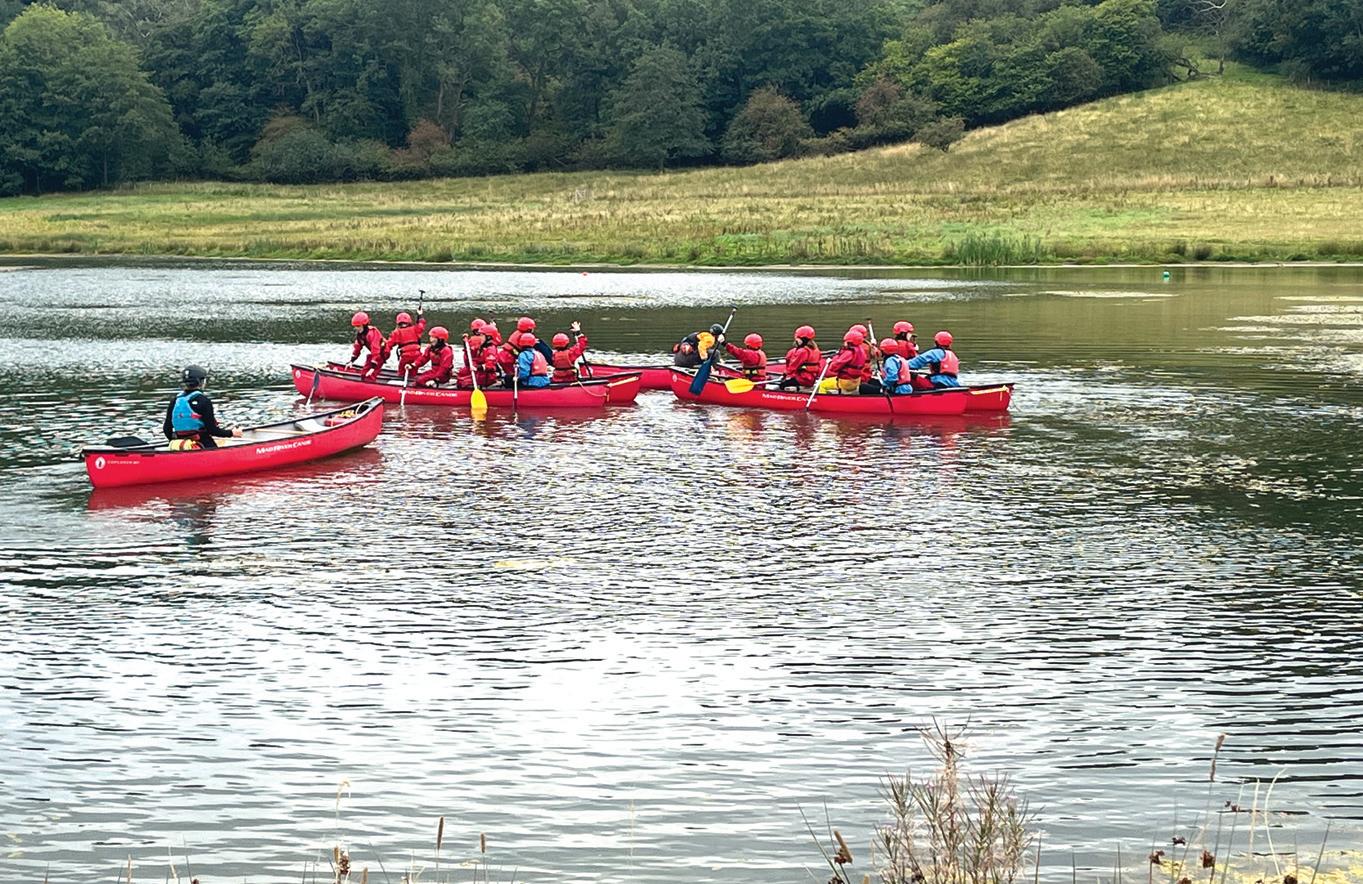
You may remember that last summer the St Vincent de Paul Society (SVP) in Middlesbrough ran our second Vinnie Camp.
This year the five-day residential break will run from Monday August 10 until Friday August 14 at Peat Rigg Outdoor Activity Centre, Pickering (peatrigg.org).
Thanks to the success of our shops and the fundraising events held by our SVP groups around the diocese, we should be able to offer the week cost-free to 20 children aged between nine and 11 years old and eight adult volunteers.
This includes all meals and accommodation, as well as transport to and from Peat Rigg. Activities will be led by Peat Rigg’s professionally qualified staff and volunteer SVP helpers will provide pastoral care. We will begin recruiting children through parishes and schools after February half term, but we need more helpers now. You can help a child make new friends, build their confidence, discover their
independence and make memories to treasure this summer.
The professionally led activities include bushcraft, archery, crate-climbing and canoeing. Helpers encourage participation, often by taking part in an activity themselves, although that’s not a requirement. Sometimes what’s needed is for helpers to sit back and let the children take the lead. The days can be long, typically starting at 7.30am and ending not much short of midnight, but it is a great privilege to see the children grow in confidence and self-esteem as they encounter and overcome challenges during the week.
You don’t need to be an existing member of an SVP group, but you must be over 18 with enhanced DBS clearance. All volunteers receive training from the SVP national team.
To find out more about the camp or to request an application form, email this year’s camp leader Patricia Nobbs at presidentc13@svp.org.uk.
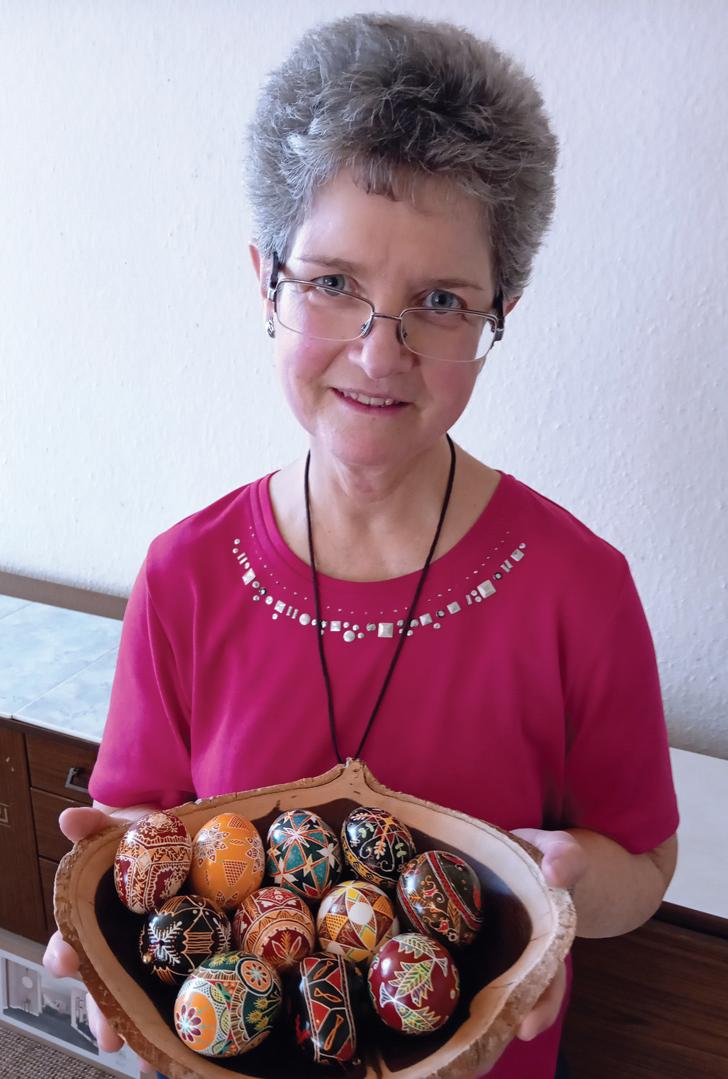
“Restore in me the joy of salvation…” This is a verse from Psalm 51, one of the most beautiful penitential psalms in the Bible.
It is attributed to King David, written after he had committed a serious sin. Having fallen into temptation, he tried to cover up what he had done, which made things even worse.
But God in his mercy confronted him through the prophet Nathan, and David, recognising his guilt, repented. This psalm is an expression of his sorrow and hope in God’s mercy.
If we look into our hearts, we too recognise that sin takes away our joy and brings us grief. Repentance and pardon, especially in the Sacrament of Confession, restore our peace and bring us back to right order with God and with our neighbour. But joy? What is this joy of salvation? What does it mean to experience Christ’s salvation?
It is something that seems more spontaneous in children. For a few years, I worked with three-to-five-year-olds, teaching them about Jesus, the Good Shepherd.
I used materials from the Catechesis of the Good Shepherd: a simple sheepfold model and small figures representing the Good Shepherd and several sheep.
During one presentation, I would hide one of the sheep, who thus became “lost”. The Good Shepherd would then count his sheep, notice that one was missing and go looking for him here, there and everywhere!
When he finally found him, one of the children would invariably squeal with delight and say, “Again!” Sometimes I was prodded to repeat this presentation three or four times.
The children experienced joy when the sheep was found by the Good Shepherd who loves them. But the successive realisation that they are the sheep, loved, sought after and saved, can be a longer process, and one that produces a deeper, more interior joy in them.
As adults, it sometimes takes us time and effort to discover our need of salvation, or to return to God after we have fallen into sin. Like Adam and Eve in the garden, we hide.
Like King David, we try to cover over our infidelities.
So our return to joy often requires an inner journey. The Church knows this and, especially during Lent, invites us to make a parallel journey through the Scriptures.
We read from the Book of Exodus about God’s Chosen People enslaved in Egypt. God hears their cries of misery. He does not save them immediately, but leads them, step by step, to liberation, and to trust in his care and power to save. He does the same with us.
Lent is a time to go on our own inner journey with determination. The second part of that verse from Psalm 51 is “…and uphold me with a willing spirit”. This prayer to recover joy is coupled with the desire for a willing spirit. During Lent, the Church encourages us to express this willingness by using the tools of prayer, fasting and almsgiving. With these, let us go forth into Lent with joy!
Jeanne Guillemette
If you think of a cross-carrying pilgrimage, you might conjure up images of long walks, aching feet and temporary accommodation –which is fine if you are an adult, but what if you are a family? Well, it can be done!
As a family of four from York, we have taken part in an Easter pilgrimage to Walsingham for many years, celebrating the mysteries of Holy Week and the wonders of the Resurrection with other families and pilgrims from across the UK.
This Easter pilgrimage, known as Pilgrim Cross (formerly Student Cross), has taken place annually for more than 75 years, starting from several points in the south-east of England and walking to the Shrine of Our Lady of Walsingham.
The pilgrimage consists of 13 groups (or legs) travelling distances of 15 miles to 120 miles during Holy Week, culminating in Easter celebrations at Walsingham with more than 250 pilgrims.
The pilgrimage week at a glance We take part in the family group, called “Peg Leg”, which carries its small cross a total of 17 miles. On Palm Sunday, we drive 180 miles from York to our starting point of Letton Hall near Shipdham in Norfolk, our accommodation base for the next five days. There we join seven or eight other families, a total of around 30 pilgrims with children from birth to 12 years. Unlike the non-family legs of Pilgrim Cross, our pilgrimage takes place in the local area, walking and returning each day to our family rooms at Letton Hall.
Each morning consists of a short drive to a nearby village, where, wearing hi-vis tops, we tread two or three along a pre-planned route on quiet roads, singing hymns and rousing
songs from our songbook.
Our rest stops always include a church, where adults and children take turns in leading family-centric reflections or “stations”. This is followed by a shared lunch of sandwiches, crisps, fruit and salad.
The afternoons include craft activities for the children that follow a Holy Week theme, while the adults enjoy a well-earned cuppa. After evening meal, there are prayer services for families and older children (age 10-plus), and later the adults have their own liturgy reflection and time to socialise with a good cheeseboard.
Playing facilities at Letton Hall include large, grassed areas and a go-kart track, where our girls love to whizz round on their scooters.
Highlights during the week include paddling in a ford, egg hunts and campfire marshmallows. Liturgically, we have a family foot-washing service and a shared Seder meal on Holy Thursday.
Our Easter weekend in Walsingham
On Good Friday we pack up and say goodbye to Letton Hall for another year, as we transfer to Walsingham to process from the National Catholic Shrine of Our Lady into Little Walsingham with all our crosses and the other legs of Pilgrim Cross.
Over the Easter weekend, we celebrate the death and resurrection of Jesus through wonderfully prepared music and liturgy, at a Good Friday Passion Service, a Liturgy Service, a Children’s Easter Vigil and the Pilgrim Cross Easter Vigil, late on Holy Saturday night.
On Easter Sunday morning, we attend Easter Eucharist at the Anglican Shrine, led by Pilgrim Cross, before a final procession with our crosses around Walsingham Priory, then
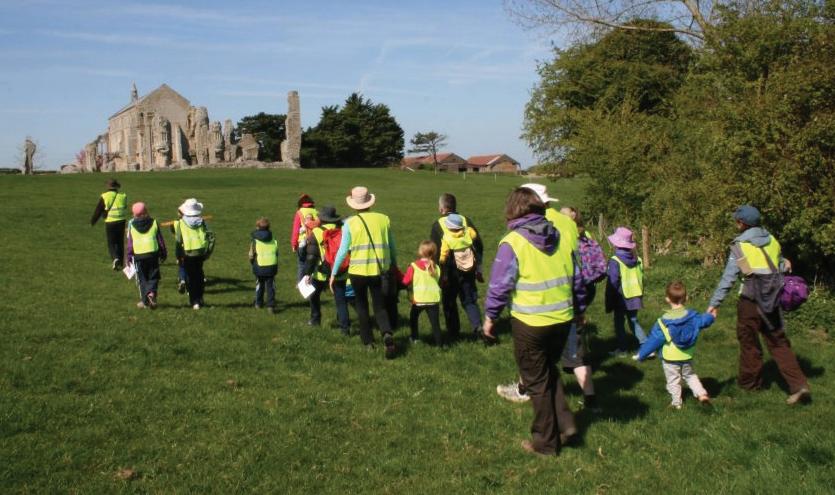
we start the journey back home to York. Pilgrim Cross is such a refreshing way to get away from our busy lives and spend time together, sharing Holy Week with like-minded families, topping it off with the massive celebration of Easter in Walsingham with the rest of the pilgrimage.
If your family would like to consider celebrating Holy Week and Easter with Peg Leg this year, there are still places available and we would love you to be there. Here’s what you need to know… Pilgrim Cross Peg Leg takes place from early evening on Palm Sunday (March 29) to lunchtime on Easter Sunday (April 3), staying at Letton Hall, Shipdham and the Anglican
Shrine in Walsingham.
All accommodation and meals (breakfast, lunch and evening meals at Letton Hall and breakfast and evening meals in Walsingham) are included in the cost.
Families can walk all week or part of the week (which is calculated pro rata).
Registration details and costs for Peg Leg can be found on the Pilgrim Cross website, pilgrimcross.org.uk/event/peg-2026/.
If the cost prohibits a family from participating, there is a tiered financial structure in place with the charitable arm of Pilgrim Cross to assist financially.
Neville Cameron, St Aelred’s, York
SHAWN RAS, a Dutch-born historian and parishioner of Our Lady of Lourdes and St Peter Chanel in Hull, continues his series of articles about Church history with a look at the great scholar and theologian Erasmus…
In the minds of Catholic history enthusiasts, few periods of history have been as troublesome for the Church as the Protestant Reformation, from the violent clashes of Iconoclasm to the seizing of Church holdings.
The Reformation brings names such as Luther, Calvin and Henry VIII to mind, but there are also the more obscure names, the reformers who laid some of the foundations for the Protestant Reformation and the Counter-Reformation.
People such as Wycliffe, Hus and today’s subject: Erasmus.
Desiderius Erasmus was a Catholic priest, born in the Low Countries, the modern-day Netherlands. Born in either Gouda or Rotterdam sometime around the 1460s, Erasmus was by no means a star student, appearing to struggle in grammar school and in seminary.
This is according to Erasmus’ own work, an autobiography written in his iconically accurate yet comfortably conversational Latin.
Named for St Erasmus of Formiae, the young Desiderius showed one curious attribute as he grew up. Besides his wit and large penchant for scepticism and criticism, Erasmus was blessed with great piety and admiration for the Church’s perpetuity.
The 15th century was one of great trouble for the Church, and Erasmus took issue with the order he served in, being especially upset about the vows of poverty not being taken seriously enough.
Erasmus, now a charismatic author and scholar, decided to travel Europe, under the patronage of various wealthy princes.
He visited the famous University of Leuven, to Paris, and stayed for some time at the Augustinian canonry at St Mary’s College in Oxford, where he quickly became friends with future martyr and saint, Thomas More.
In his many years of travel, Erasmus would return to England at various times, visiting Canterbury and Walsingham and
remaining close to More and being drawn by Holbein and Durer.
In England, Erasmus finished his famous work In Praise of Folly, a notoriously difficult text that was deeply critical of aspects of human life and society, of local superstitions and religious corruption. The work became his most famous, being enjoyed by scholars, monarchs and popes alike. Though critical of the Church, Erasmus was equally critical of Protestant opinions. Many scholars have written that Erasmus’ critiques in Folly and works such as Julius Excluded from Heaven (deeply critical of controversial Pope Julius II) have inspired later reformers including Martin Luther. But in truth, Erasmus was deeply disturbed by Luther’s writings, condemning them and opposing their publication. Though Erasmus believed in reforming the Church, he believed the Church ought to be reformed internally, that corruption should be curbed and institutions and fraternities be held more strictly accountable to their own founding laws. Erasmus famously started a major project in translating the New Testament, believing that reform within the Church could only be achieved by deeper study of the Bible.
But where Luther and the Protestants would in 1522 translate the Bible to German, Erasmus, some years earlier in 1516, had published his translation of the Greek New Testament into more accurate, classical Latin, in an attempt to correct the Vulgate, the medieval Latin text of the New Testament. Erasmus, as a scholar, had recognised that small, but hidden fact, unknown still to many: most people in the Roman Empire spoke more Greek than Latin. Again, in a twist of irony, Erasmus indirectly helped the Protestants, as his texts would subsequently be used in composing the King James Bible.
Erasmus’ close friends, such as Thomas More, Richard Reynolds and John Fisher, all important Catholics opposed to Henry VIII, would all end on the executioner’s block. Erasmus himself, considered the father of Humanism, died in Basel, Switzerland in 1536. He has since become the representative of Dutch intellectualism, being depicted on coins and having several monuments (especially around Rotterdam) and being
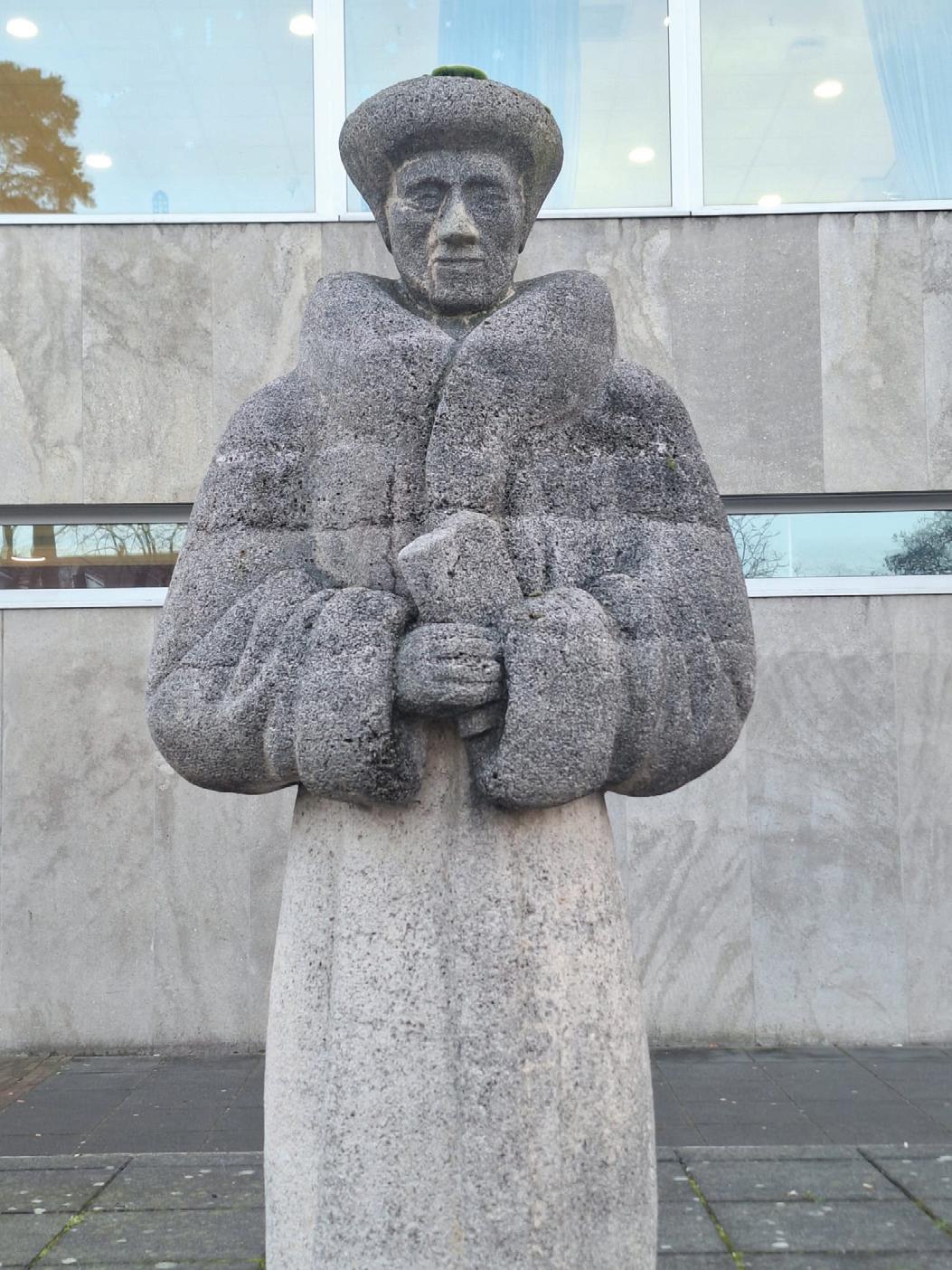
the namesake for universities and for the academic exchange programme of the EU.
Erasmus of Rotterdam remains one of the names most obscured in history outside of his home country. He was a scholar, a rhetorician and a writer of great wit. In the end he was, to Catholics, the Good Reformer.
St Mary’s Cathedral is celebrating four decades at the heart of the diocese’s Catholic community.
Since opening its doors in 1986 this remarkable building has stood as a beacon of faith and diocesan life.
To mark this milestone, a series of special celebrations is planned throughout 2026, inviting all to join in reflecting on the past and looking forward to the future.
Friday May 15 – Concelebrated Episcopal Mass
An evening Mass uniting clergy and parishioners from across the Diocese of Middlesbrough will serve as a heartfelt thanksgiving for 40 years of worship and community at the cathedral, while looking ahead to the next chapter in its history.
Thursday October 15 – The Sixteen Live in Concert
As part of their prestigious annual Choral Pilgrimage, the internationally celebrated choir The Sixteen, led by Harry Christophers, will perform within the cathedral’s resonant acoustics. Known for their precision and historically informed style, their performance promises to be a musical highlight of the year.
Friday November 6 – Gary Stewart’s Graceland
Celebrating the 40th anniversary of Paul Simon’s iconic album, Gary Stewart and his band will deliver a dynamic full-album performance. Expect energetic vocals, tight rhythms, and the vibrant spirit that has made this show a favourite on UK stages.
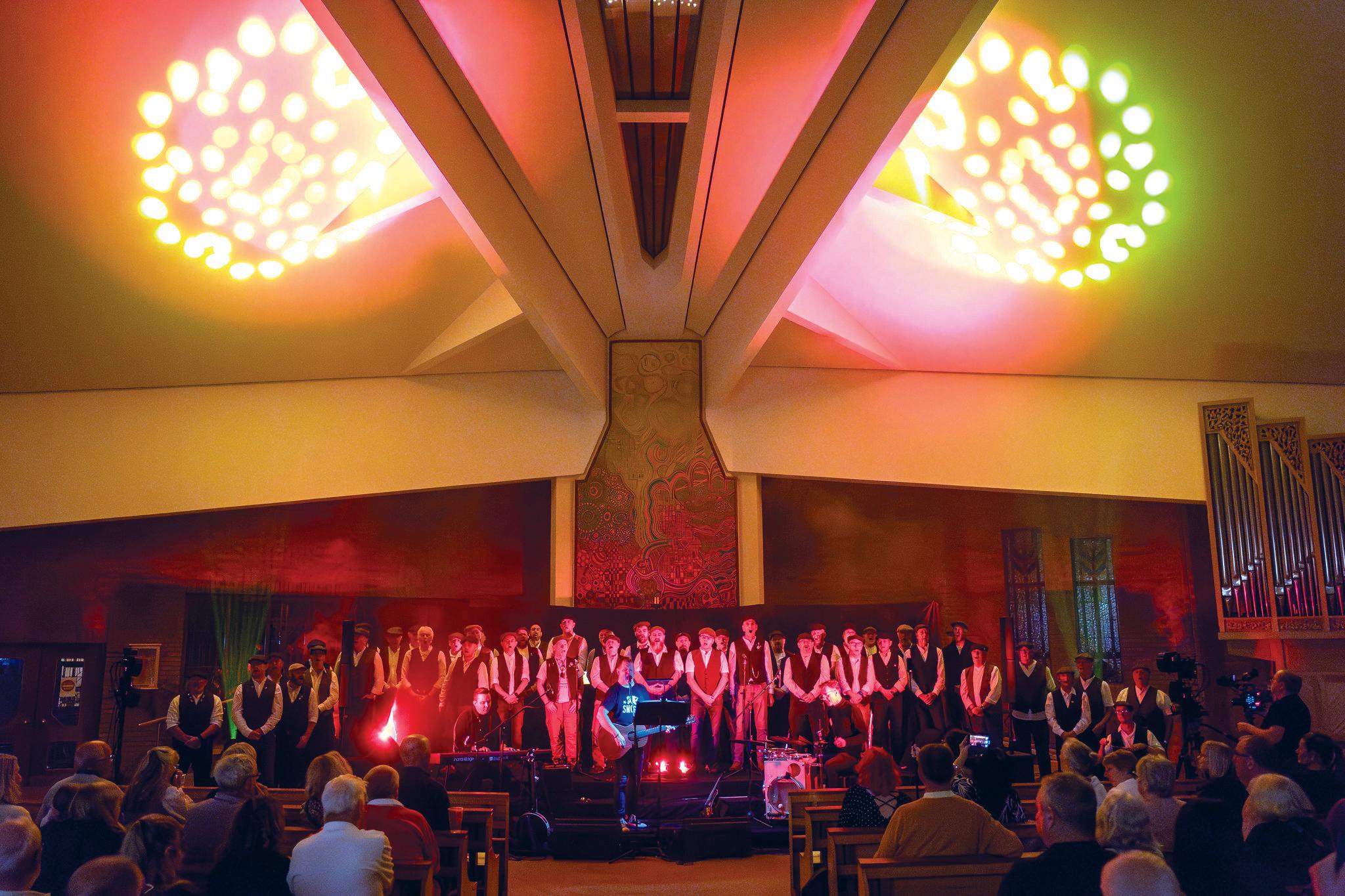
Saturday December 12 – Christmas at the Cathedral featuring Cantabile
Closing the jubilee celebrations with seasonal joy, the esteemed local choir Cantabile will present a festive concert brimming with hope and renewal, perfectly marking the transition into the new liturgical year. Tickets from middlesbroughrccathedral.org and ticketsource.co.uk/middlesbroughcathedral.
Catechesis lies at the heart of our diocesan life, guiding people from baptism through lifelong discipleship and mission.
The Directory for Catechesis reminds us that “catechists themselves must be formed so that they are able to transmit not only a teaching but also an integral Christian formation, so that they are simultaneously teachers, educators and witnesses of the faith.”
In response to this call, we are pleased to announce the launch of two new Catechist Formation Pathways.
Pathway 1 introduces the essential principles of catechesis and nurtures confidence in new or developing catechists. It is ideal for those new to catechesis, as well as anyone wishing to refresh and strengthen their practice. Sessions will be held fortnightly, beginning on Thursday May 7, with a final in-person session on Saturday June 20.
Pathway 2 is designed for those who have completed Pathway 1, or for experienced catechists seeking to deepen their understanding. This pathway focuses on developing a deeper knowledge of the Catholic faith and strengthening the skills needed for effective and engaging catechesis. Pathway 2 will be launched later in the year.
Both pathways will follow a hybrid model, with most sessions held online. Each pathway will conclude with an in-person afternoon gathering, providing an opportunity for participants to celebrate their learning, receive a certificate and be commissioned as catechists. These formation pathways are suitable for parish catechists, OCIA leaders and anyone involved in faith formation. Sessions will offer engaging and practical approaches to parish-based catechesis, with opportunities for prayer, reflection, discussion and evaluation.
Firmly grounded in Catholic teaching, each pathway is designed to build confidence in leading catechetical sessions while also supporting participants’ personal spiritual growth.
If you are interested and would like to find out more, please contact me at adultformation@rcdmidd.org.uk.
Nicola Sweetman, Adult Formation Coordinator
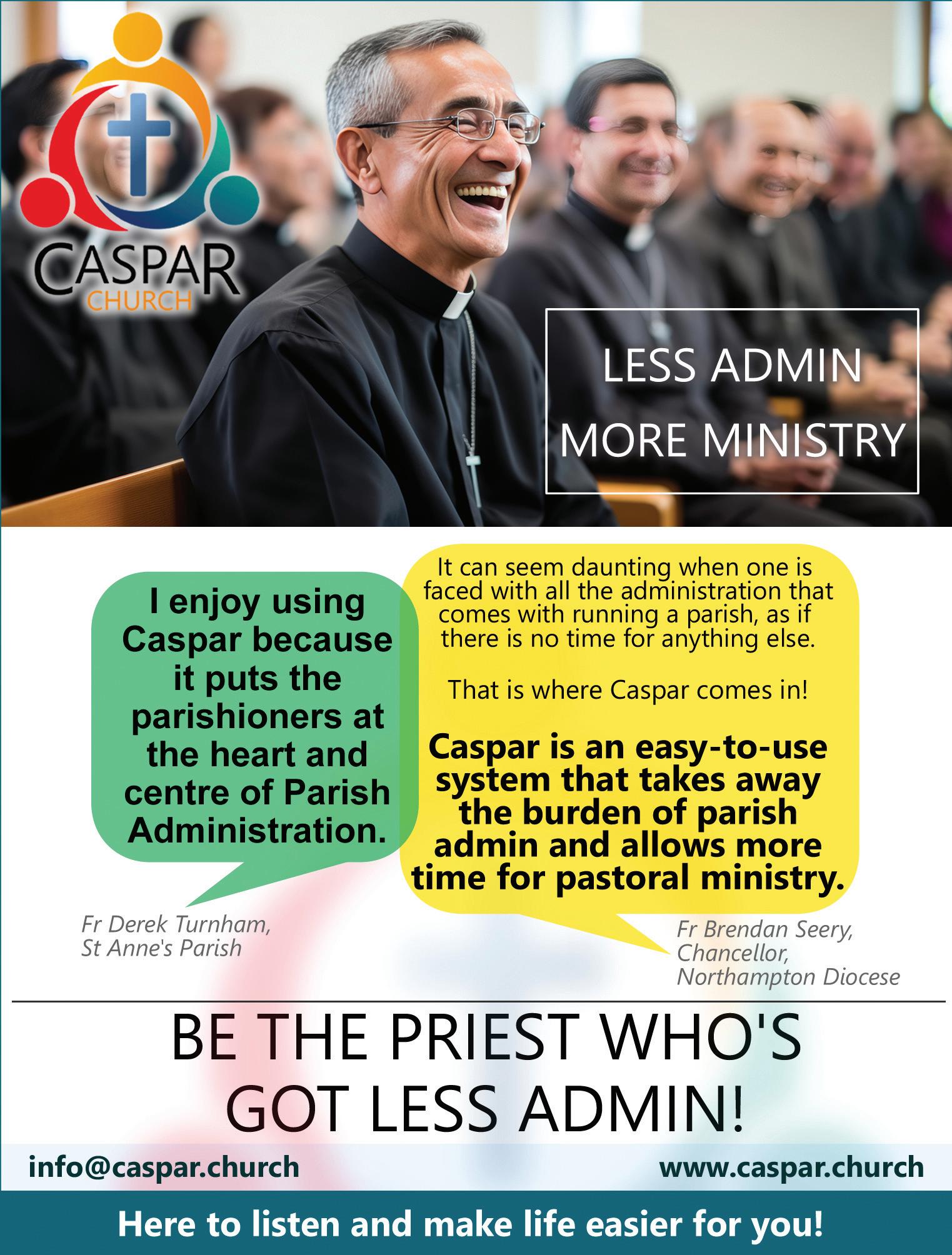
St Bede’s Church in Marske-by-the-Sea marked the 89th anniversary of its opening and dedication – a significant milestone in the life of the parish.
A church’s dedication is an important occasion, commemorating the day a building is set apart as a permanent place of worship, prayer and celebration of the Eucharist for its community.
The anniversary was celebrated with a special Mass celebrated by Father Philip Osuagwu. Parishioners gathered in good number and the liturgy was enriched by the singing of Faith of Our Fathers.
The celebration was made even more special by the presence of St Bede’s Primary School, with Year 6 joining the congregation and contributing to a joyful and prayerful atmosphere.
After Mass, parishioners came together for a coffee morning, offering an opportunity for fellowship and celebration.
The occasion coincided with a visit from diocesan fundraising officer Dan Woodgate, accompanied by diocesan building and environmental surveyor Glenn Melvin, who were welcomed to view the recently completed improvement works to the parish hall.
The improvement works were funded by Tees
Valley Mayor and Combined Authority through the UK Shared Prosperity Fund, with a grant of £8,894 awarded to support a range of energy and fabric upgrades.
Work included heating and lighting improvements, new front doors, damp proofing and external repointing, helping to make the hall more welcoming, efficient and sustainable for parish and community use.
Although representatives of the funder were unable to attend on the day, photographs were taken to pass on, enabling them to see the hall in use and appreciate the impact of their support.
Parishioners spoke warmly about the project, sharing how they had completed the final decorating themselves – a clear demonstration of pride, ownership and commitment to their parish facilities.
The welcome extended to visitors was generous and heartfelt, with parishioners providing homemade soup, tea and cakes.
The celebration of St Bede’s 89th year of dedication was a fitting moment to reflect not only on the church’s long history, but also on the strength of its present-day community –one marked by faith, hospitality and a shared commitment to sustaining parish life for generations to come.
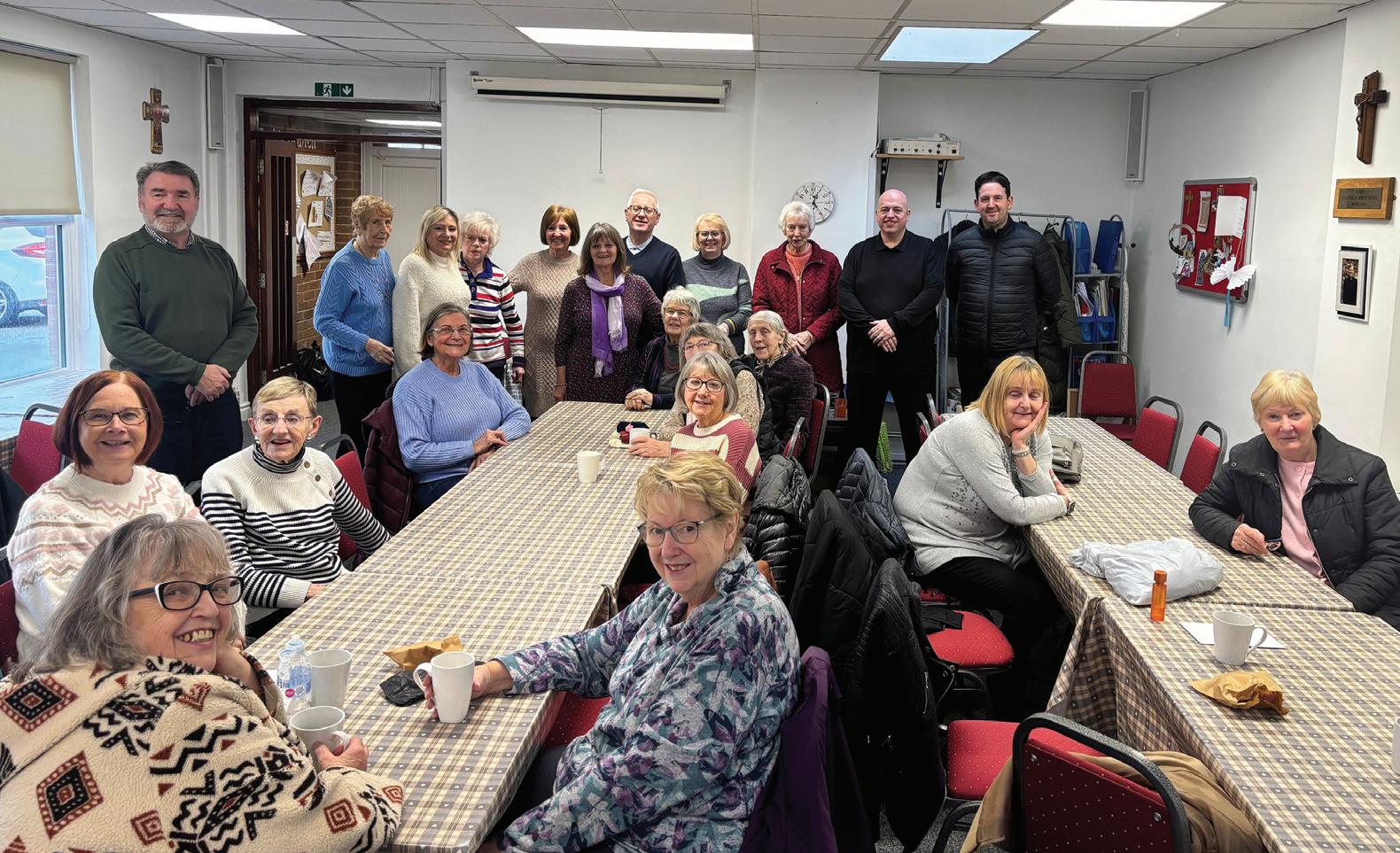
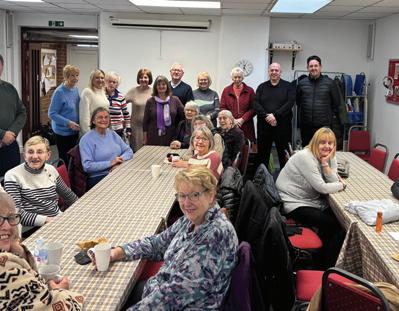
Two wonderful anniversaries were among the highlights of the 44th annual Hull Housebound and Elderly Leisure Day.
Allan and Sandra Reddy celebrated their diamond wedding anniversary having been married by Father William Carroll at St Mary’s Church, Wilton St, Hull, on January 1 1966.
They received a papal blessing from Pope Leo and a congratulatory message from King Charles and Queen Camilla.
Sandra and her sisters Margaret and Cath are regular helpers at our leisure day.
Secondly, Peter Nicholson celebrated 65 years of being an altar server at the Sacred Heart in Hull. Here Peter tells us how his six decades of service began…
In November 1960, I decided I wanted to be an altar boy. Father Austin Pippet arranged for me to start to learn the Latin responses of the Mass, so after school I went along to the presbytery and for the next six weeks was helped by Miss Bean, the parish housekeeper.
“Ad deum qui laetificat juventutem meam” was the opening response to the Mass. I was told the responses had to be said loud and
clearly.
In December I was allowed to go onto the altar and sit at the side to watch how the other altar servers served. The following year, on February 2 1961, I first served Holy Mass by myself.
Those days serving by yourself you had to do everything from moving the missal from one side of the altar to the other, taking up the water and wine at the offertory, hitting the gong at the consecration and putting on the white gloves and walking with the priest to hold the communion plate under people’s chins.
On top of all that you had to answer all the responses loud and clear so the congregation could hear you, as you were the only person responding to the priest.
Since then I have served on the altar continuously. In 1975, I took over as MC. Since the opening of the church in 1926, there have only been two MCs of the parish. I look forward to the parish centenary in June and, God willing, to be able to celebrate 70 years of service in 2031.
The word Lent has its roots in the Old English word lencten, meaning “spring.”
It describes that quiet, persistent season when the days begin to lengthen and the earth slowly wakes from its winter sleep. We began this journey with a stark reminder: “Remember that you are dust.” While these words can feel bleak, they contain an invitation to wonder.
We are intimately connected with the earth and everything on it – we are all members of
one human family sharing one common home, all beloved creations of God. As we acknowledge our interconnectedness and reliance on God, we create space for new growth.
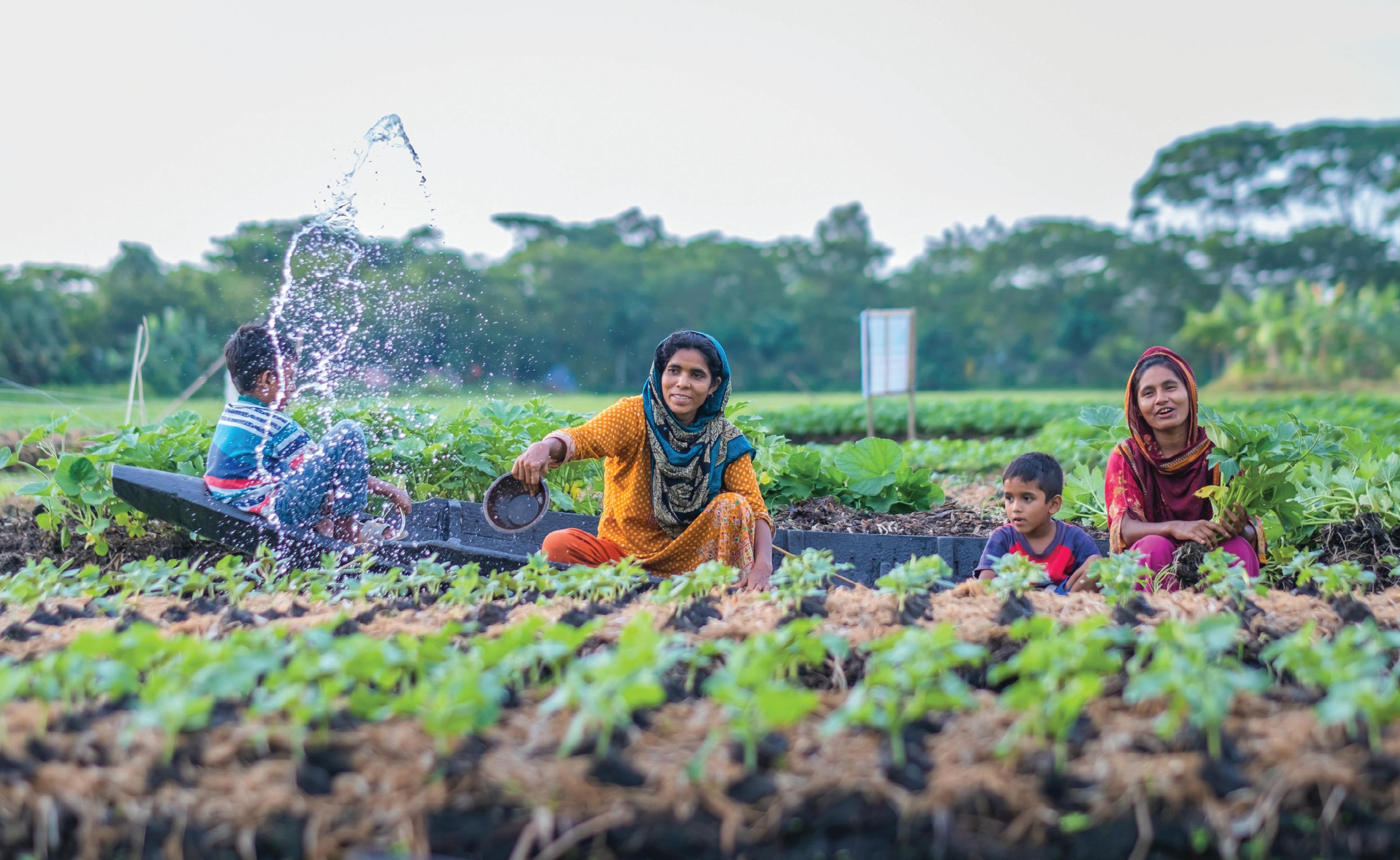
In the field and garden, this is a vulnerable, expectant time. Seeds are sown in an act of quiet trust – that a tiny grain, buried in the cold, dark earth, carries within it the potential for new life. Our Lent springtime calls us to such faith: that the seeds of hope and love that we plant even in the hardest soil will take
root and blossom.
Across the world our neighbours are also planting seeds. Yet climate change is making it harder for them to grow enough to eat. In parts of Zimbabwe there is too little rain. In parts of Bangladesh and South Sudan there is too much. The result is the same – seeds fail to grow, plants die and families go hungry.
Our fasting, giving and prayer in this season remind us of our dependence on God and our longing for a world in which all people flourish.
This Lent, as the days lengthen, may we stand in solidarity with our sisters and brothers throughout the world, knowing God can work through us to bring new life.
Find out more about how CAFOD’s Lent appeal is helping our global neighbours grow food in climate-resilient gardens at cafod.org.uk/lent.
Rachel Blaylock, Community Participation Coordinator






1 Sunday
Second Sunday in Lent
2 Monday
9.45am-10.25am Beverley Christian Meditation Group meets online. Further information from christianmeditation.beverley@gmail.com. This takes place every Monday.
7pm Catholic charismatic prayer group meets on first Monday each month at St Bede’s Pastoral Centre, Blossom Street, York. For more information, contact Sharon on cdscsmiddlesbrough@gmail.com or 07932 420809.
3 Tuesday
10am Coffee at the Cathedral. Tea, coffee and treats every Tuesday after 9.30am Mass. A warm welcome and friendly atmosphere. Make new friends and enjoy some fellowship. Those who are alone especially welcome.
10am Christian Meditation Group meets online. Further information from Terry Doyle terry-doyle@live.co.uk. This takes place every Tuesday.
7pm Knights of St Columba Council 29 meets at St Mary’s Cathedral, beginning with Mass at 7pm in the cathedral chapel.
4 Wednesday
5.30pm Sung Evening Prayer and Benediction at St Mary’s Cathedral. Join us every Wednesday for a time of prayer and quiet reflection before the Blessed Sacrament (term-time only).
6 Friday
Events, articles and photographs for the next edition of the Voice are due by this day.
7 Saturday
10am Lourdes Hospitalité Formation Day, Trinity Catholic College, Middlesbrough. 11am Catholic women are invited to share an hour of feminine communion including meditation, via Zoom. Text Barbara on 07796 117704 with your mobile number and email address so she can add you to the WhatsApp group, or email catholicwomenmdl@ gmail.com for Zoom link.
Copy and photographs for inclusion in the Catholic Voice should be sent to: The Editor, Middlesbrough Diocesan Catholic Voice, Curial Offices, 50a The Avenue, Linthorpe, Middlesbrough, TS5 6QT. Tel (01642) 850505, email catholicvoice@rcdmidd.org.uk
Deadline Friday March 6 for April edition.
Where possible please send articles in Word and photographs as jpegs. Please confirm when you send in your photographs that those who appear in them have given their permission for publication.
6pm Mass in Italian in the Father Kelly Room, Our Lady, Acomb, York. Followed by refreshments. All welcome.
8 Sunday
Third Sunday in Lent
3pm Mass for LGBT+ community, family and friends at the Chapel of the Bar Convent. Doors open 2.30pm.
10 Tuesday
12.45pm Catholic Women's Luncheon Club meets every second Tuesday of the month at the Kingston Theatre Hotel, Kingston Square, Hull. Gather at 12.45pm, lunch at 1pm. All ladies in the Hull and East Riding area welcome. Call 01482 446565 or email jayne.wilson24@ymail.com
11 Wednesday
7pm Hull Circle of the Catenian Association holds its monthly meeting at Lazaat Hotel, Cottingham, followed by Mass for Vocations and a buffet-style meal. Email Charles Cseh at hullcirclesecretary@gmail.com.
12 Thursday
7.45pm Middlesbrough Catenians meet at Middlesbrough Cricket Club, Green Lane, TS5 7SL. Contact Peter Carey on 01642 317772 or Chris Rhodes on 01642 319161.
14 Saturday
St Patrick’s Day Irish dance with Sally Glennon at the Erimus Club, Cumberland Road, Middlesbrough TS5 6JB. Admission by ticket only. Contact John Brown on 07871 958412.
15 Sunday
Fourth Sunday in Lent 3pm Catholic Fellowship Mass with Canon Paul Farrer at St Mary’s Cathedral, Middlesbrough.
22 Sunday
Fifth Sunday in Lent
26 Thursday
6.30pm-8.30pm Oratory of St Joseph meets at Hinsley Hall, 62 Headingley Lane, Headingley, LS6 2BX. All men aged 21-35 welcome. Includes group prayer, social time and supper and Benediction of the Blessed Sacrament. This month’s speaker is Professor Maurice Whitehead.
29 Sunday Palm Sunday
If you have any events you would like to be included in Out and About, please email heidi.cummins@rcdmidd.org.uk.


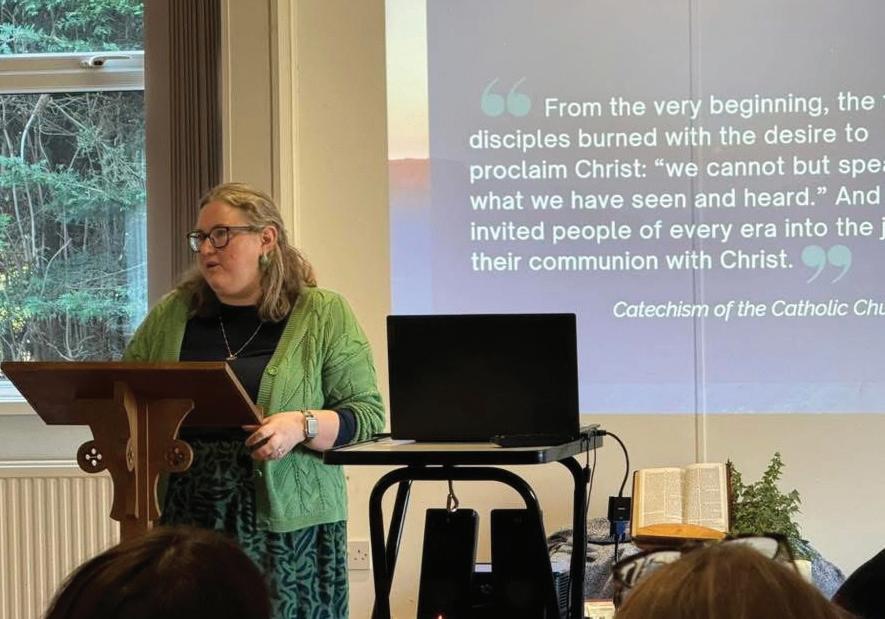
The first diocesan catechists meeting since the pandemic took place at Acomb Catholic Church, York.
Drawing in people from throughout the diocese, it was organised and led by Nicola Sweetman, the recently appointed adult formation coordinator.
It was an extremely enlightening and affirming day involving periods of prayerful reflection, teaching and sharing with others our current parish and community experiences, while also reflecting on the way forward.
The day began with the reading of the story from St John’s Gospel of the woman at the well, which Canon John Lumley “unpacked”, revealing it as a model for catechesis.
He highlighted Jesus’ challenging, yet compassionate conversation with the Samaritan woman that allowed her to share her story, to acknowledge her vulnerability, her woundedness.
This then led to her eventual desire to share this encounter, this transformation, with her friends and neighbours and bring them to Jesus.
Canon John explained that as catechists, we too are called to be companions at the well; companions who guide others to a personal encounter with Jesus, who truly knows us and loves us in all our complexities, our vulnerabilities, our brokenness and our joys.
After the introduction, Nicola explored in detail both the definition and role of the catechist. So many people are helping others in parishes in their formation through preparation for the sacraments, journeys in faith and prayer reflections, to name a few. It was good to look at this in more detail to share our stories, our experiences.
Drawing from Church documents, Nicola explained that a catechist is someone who echoes the word of God and shares this with others by faith, by word, example and by witness.
Catechists are responsible for the religious education and faith formation of children, youth and the whole Christian community, aiming to help individuals grow spiritually and deepen their relationship with Christ. We are all called to witness by sharing our faith and our gifts, and through kindness, compassion and integrity, inspire others to share their stories and their gifts.
A catechist’s role is one of accompaniment, someone to journey alongside, sharing their faith story, their gifts, their wounds, their joys and celebrations. Thus, guiding others to live their call to a deeper relationship with God through prayer, liturgy and sacraments.
After lunch we had the opportunity of moving out of our parish groups and had a deep sharing with others, looking at the strengths, weaknesses and opportunities that we meet
daily within our communities that we need to be aware of in order for catechesis and adult formation to grow deeper in our communities. We ended the day with a beautiful, prayerful reflection on being drawn to the well and
were encouraged to drink deeply of the gift within to enable us to reach out and share these gifts with others on their faith journey.
LUCA SETTIMO, Professor of Theology at the University of Nottingham, continues the series of reflections on the meaning of some key biblical words.
This month we continue our exploration of biblical words by examining the biblical notion of flesh.
In the Bible, this concept is expressed through two key terms: sárx in Greek (in the New Testament) and basàr in Hebrew (in the Old Testament). The word “flesh” has taken on specific connotations in our culture that are very different from the ancient times when the biblical texts were written: for us, in fact, beyond its immediate physiological meaning, flesh in our culture denotes sexuality – often in its most instinctive, “carnal” form – or it is opposed to the soul and to spirituality, as bodily materiality.
The Greek term sárx appears 147 times in the New Testament. This term seeks to underline the dimension of the living being insofar as it is linked to its fragility, to its immersion in the limited perimeter of time and space and to its mortal existence.
We will see that the equivalent Hebrew term basàr clarifies the contrast between the creature and God, who, in turn, is Spirit and eternal, infinite, and perfect Being.
In the Incarnation, the eternal Word and divine Creator becomes sárx in Jesus Christ, meaning that the uncreated Word (the Son of God) takes flesh and experiences the limitations of time and space, pain and even death: “And the Word became flesh and lived among us, and we have seen his glory, the glory as of a father’s only son, full of grace and truth” (John 1:14).
Similarly, Christ in the discourse on the bread of life at the synagogue of Capernaum, explains that the bread he will give is his flesh (see John 6). Jesus’ provocation is evident, and the reaction of his audience is understandable, given that one of the strongest biblical prohibitions regarding food was: “Only you shall not eat flesh with its life, that is, its blood” (Genesis 9:4).
For Christianity, sárx (flesh) refers to the real existence as human person by the intimate communion offered by Jesus to the faithful through the Eucharist. “Eating the flesh” of Christ then becomes a clear expression to outline the full communion between God and man. The bread and wine at the Eucharist enable the realisation of this profound union in human history.
Cardinal Gianfranco Ravasi explains that sárx acquires a radically different meaning in the Pauline perspective: according to this biblical scholar, this term in fact receives a strong negative connotation in Pauline theology.
In fact, for Paul the “flesh” is the principle of sin that works in us; instead, divine grace, which the faithful welcome through their faith, manages to overcome sin.
The “flesh”, which pushes us to perverse works or to the illusion of saving ourselves with the pure and simple observance of the law, is opposed by the divine Spirit who acts in us and leads us to vital communion with God: “If you sow to your own flesh, you will
reap corruption from the flesh; but if you sow to the Spirit, you will reap eternal life from the Spirit” (Galatians 6:8); “But you are not in the flesh; you are in the Spirit, since the Spirit of God dwells in you” (Romans 8:9).
It is because of this new meaning assumed by the word “flesh” that, writing to the Romans, Paul states that God sent “his own Son in the likeness of sinful flesh” (Romans 8:3).
The use of the term “likeness” does not mean that the Son of God only simply appears as a man, because, the apostle states, Christ “descended from David according to the flesh” (Romans 1:3), thus becoming a true man made of flesh in agreement with the teaching of the Ecumenical Council of Chalcedon (in 451 AD). Jesus, however, does not have in himself the negative destructive power which is the “flesh of sin”.
The equivalent Hebrew term for sárx is basàr. This term appears 270 times in the Old Testament and indicates the fragility and transience of our condition as mortal creatures. The expression of the prophet Isaiah is striking: “A voice says, ‘Cry!’ And I said, ‘What shall I cry?’ All flesh is [all people are] grass, and all its beauty is like the flower of the field” (40:6). It is only by relying on God that limited and weak humanity can find stability: only in this way, “Therefore my heart is glad, and my whole being rejoices; my flesh also dwells secure” (Psalm 16:9).
It is, on the contrary, like building on sand when one deludes oneself into thinking one is safe by choosing power and strength –even military strength – as one’s support.
Isaiah again warns the king of Judah, tempted by an alliance with the superpower of Egypt, that: “The Egyptians are human, and not God; their horses are flesh, and not spirit” (31:3a). The reality that unites all is, therefore, this limited creaturely condition, and for this reason Adam, before Eve, exclaims: “This at last is bone of my bones and flesh of my flesh” (Genesis 2:23); that is,

identical to myself.
I wish to acknowledge Cardinal Ravasi, former president of the Pontifical Council for Culture, for granting me permission to use his material originally published in Italian.
A YouTube video entitled “The Biblical Notion of Flesh”, which explores this biblical concept in greater detail, is available on my YouTube channel at the following link: youtube.com/@LucaSettimo-7 (this video also explains how to pronounce the Hebrew and Greek terms mentioned above).
Wisdom Years summer school to explore later life in York
A three-day “Wisdom Years” summer school led by Margaret Silf will take place at St Bede’s Pastoral Centre, 21 Blossom Street, York, from July 21 to 23, 10am–4.30pm. The programme invites participants to reflect on the challenges and blessings of later life, letting go of what no longer matters and celebrating what matters most. The cost is £100. To book, call Fiona Hill on 01904 464900 or email fiona@stbedes.org.uk.
A free 30-minute lunchtime talk titled Who is Mary Ward? will take place at the Bar Convent Living Heritage Centre on Thursday March 5 from 1pm to 1.30pm. Delivered by Dr Hannah Thomas, the event forms part of York International Women’s Week. No booking is required. For details please visit yorkwomen.org.uk.
The Christian Heritage Centre’s residential weekend marriage preparation course, from March 13 to 15, is intended for couples who wish to engage more deeply with the Catholic vision for marriage. Structured around the elements of the marriage rite, couples will reflect deeply on foundational Scriptural texts to gain a deeper understanding of both the natural and sacramental aspects of matrimony. The weekend is framed by prayer, time for reflection personally and as a couple, group discussion and a social. For more details visit christianheritagecentre.com/events/marria ge-preparation.
Bishop Nicholas Hudson has warned against “an unchecked arms race” after the New Strategic Arms Reduction Treaty expired in February, leaving no binding nuclear arms control framework between the US and Russia. The Catholic bishops’ lead bishop for conflict and peacebuilding called for multilateral cuts and renewed diplomacy. Pope Leo XIV has also urged efforts to secure a “concrete and effective follow-up” to avert a new arms race.
The Archbishop of Southwark, the Most Reverend John Wilson, ordained Bishop Gerard Bradley as an auxiliary bishop of Southwark in a packed St George’s Cathedral. The ordination followed the appointment by His Holiness Pope Leo XIV in December 2025, assigning Bishop Bradley the Titular See of Beverley, which has special significance for the archdiocese of Southwark, as it is the birthplace of St John Fisher, a former Catholic Bishop of Rochester.
A pro-life charity has called the NHS prenatal screening programme into question after newly released statistics showed there were 735 abortions where a baby had Down’s syndrome in 2023, an increase of 7.3% from 2019.
The Department of Health and Social Care statistics also show there were 10 late-term abortions at 24 weeks gestation or over where the baby had Down’s syndrome in England and Wales.
In all there were 3,205 abortions for babies with disabilities in 2023, an increase of 81 (2.59%) from 3,124 in the previous year.
The number of late-term abortions at 24 weeks gestation or over where the baby had a disability was 300 in 2023, an increase of 44 (17.19%) from 256 in the previous year.
In 2023, 40 babies with a cleft lip or cleft palate were aborted, with five late-term abortions at 24 weeks and over where a baby had the condition.
The abortion time limit under Section 1(1)(a) of the Abortion Act is set at 24 weeks, but for cases in which a baby is thought to have a disability, including Down’s syndrome, abortion is currently available up to birth.
A Sunday Times investigation found that the number of babies born with Down’s syndrome has fallen by 30% in NHS hospitals that have introduced a new advanced form of screening.
Polling has shown that the majority of people in England, Wales and Scotland think disability should not be a ground for abortion at all, with only one in three people thinking it is acceptable to ban abortion for gender or race but allow it for disability.
Lynn Murray, spokesperson for the Don’t Screen Us Out campaign, said around 90% of babies with Down’s syndrome in England and Wales are reported, with new screening techniques likely to increase that figure.
“As a mother of a 25-year-old daughter who has Down’s syndrome, I see every day the
unique joy she brings to our family and the continuing positive impact she has on others around her.
“It is deeply alarming that despite the leaps that advocacy groups have made in raising awareness in support of people with Down’s syndrome, abortion in the case of Down’s syndrome remains so commonplace and widespread in the UK.
“In fact, we hear from parents all the time how abortion was repeatedly presented to them in the hospital as the solution following the receipt of the news that their baby had Down’s syndrome.
“We rightly recognise that discrimination against people with Down’s syndrome is unacceptable after birth, but our abortion law allows direct discrimination before birth.”
Ms Murray said the high rate of abortions of babies with Down’s syndrome raises questions for the government about the purpose of prenatal screening.
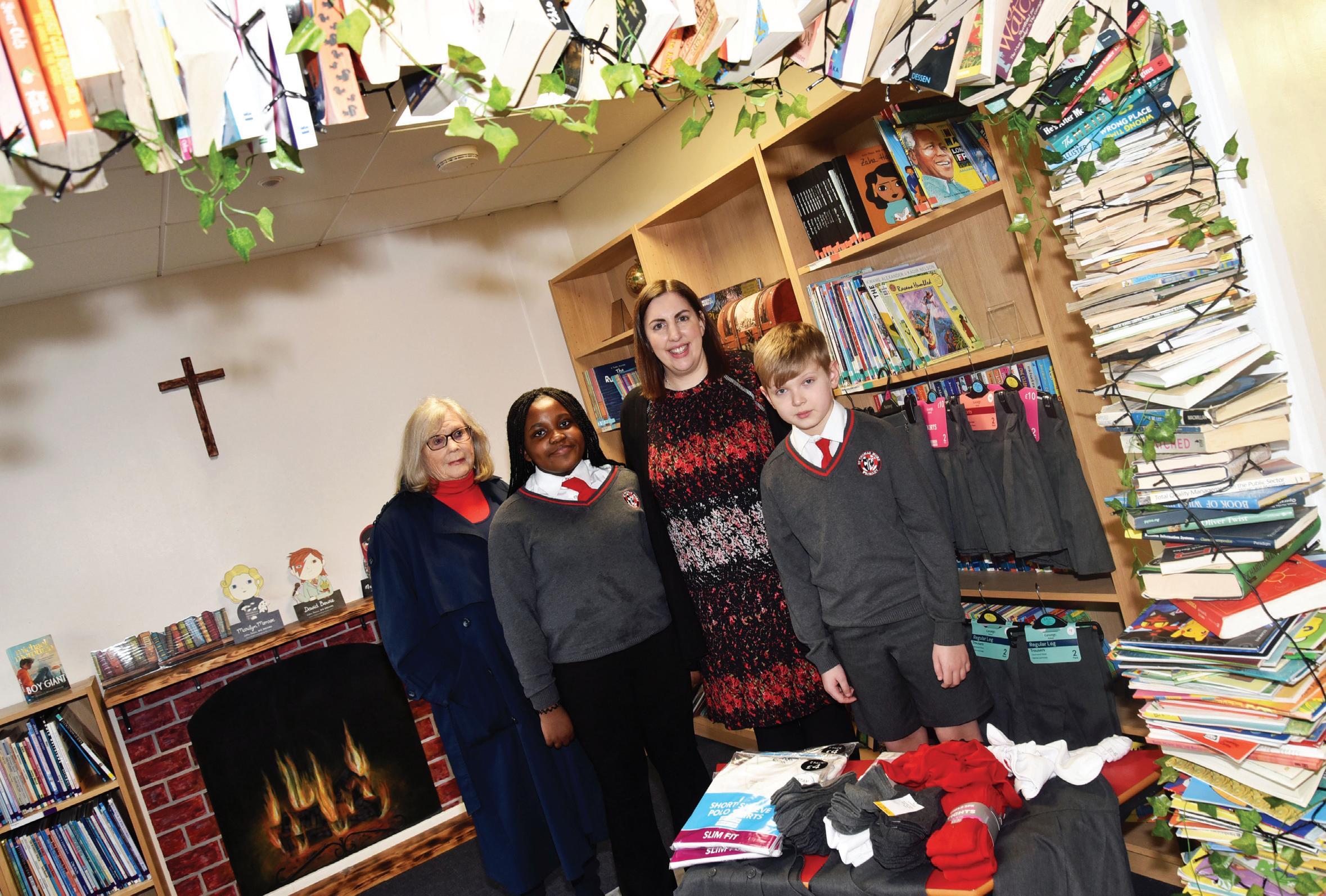
A Middlesbrough councillor is helping to ensure that no child at St Thomas More Catholic Primary School is left without a proper uniform as the cost of living continues to impact families.
Beechwood ward councillor and St Thomas More parishioner Joan McTigue asked for donations from the community to pay for items of clothing, including trousers, skirts, tights and socks.
“I think children look smart in the school uniform and it makes them all equal, but some parents struggle to pay for them,” said Joan, whose son attended the school.
Joan thanked everyone who contributed, with special praise for newsagent Bay Bashir, who provided a generous financial contribution.
Local resident Jackie Penrise helped out by scouring local sales to maximise the number of items bought.
Executive headteacher Liz King welcomed the donations, saying the uniform is central to the school’s identity.
“At St Thomas More, we consider ourselves a family,” she said. “We have such a distinct uniform and everyone knows that any child wearing it belongs to our community.
“These items will go to any families who for whatever reason find it hard to buy the uniform for their children, because the way things are just now, some families are really struggling.
“We constantly try to keep the uniform costs down and only have one school-specific item, which is the grey school jumper or cardigan with our logo on. The rest can all be purchased from supermarkets and similar places.
“It's lovely that Joan has thought of the school and we’re grateful to everyone who helped make this happen.”
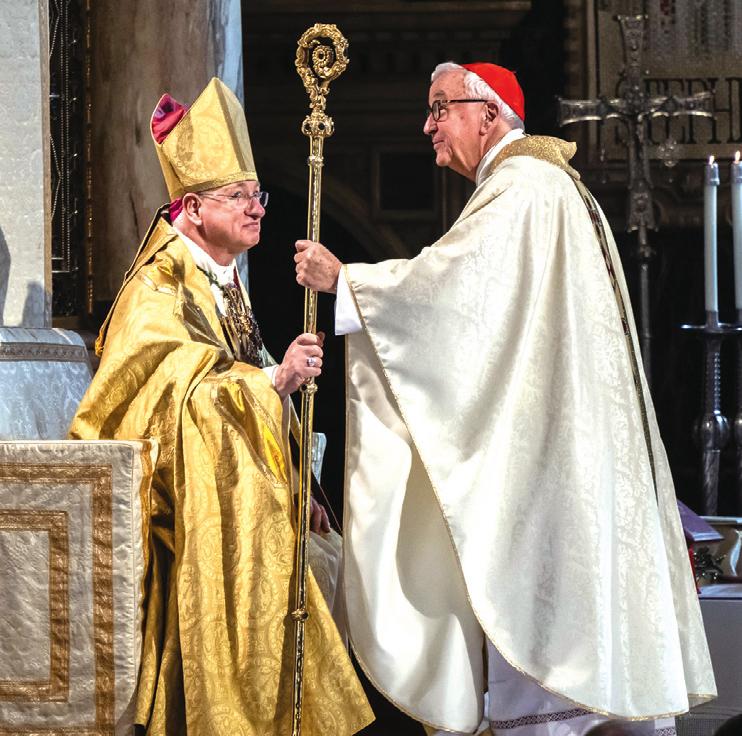
The Most Reverend Richard Moth has been installed as the twelfth Archbishop of Westminster during a ceremony at Westminster Cathedral.
To the sound of a fanfare specially composed by master of music Simon Johnson, Archbishop Moth entered the cathedral through the Great West Door and was greeted by the provost, Canon Shaun Lennard.
The rite of reception draws on an ancient pontifical used at Canterbury during the time of Archbishop Chichele (1414-1443). It has been customary in Westminster since the restoration of the Catholic hierarchy in England and Wales in 1850 and the appointment of Nicholas Wiseman as first Archbishop of Westminster.
The moment of Installation followed the public reading of Pope Leo XIV’s apostolic letter by Canon Jeremy Trood, chancellor of the Diocese of Westminster.
After the Installation, Archbishop-Emeritus Cardinal Vincent Nichols presented Archbishop Moth with the Westminster crozier, symbol of his office as bishop.
The provost and canons of the Metropolitan Chapter then greeted the new archbishop, followed by representatives of the diocesan clergy, ethnic chaplaincies and pastoral and administrative bodies.
The Archbishop of Canterbury, Dame Sarah Mullally, then greeted Archbishop Moth on behalf of the co-presidents of Churches Together in England, offering a word of welcome:
She said: “I stand here also as one who has recently been confirmed as Archbishop of Canterbury and who awaits installation.
“In the months ahead, you and I will share a particular responsibility as Presidents of Churches Together in England, and I very much look forward to working with you to deepen our relationships and to strengthen our shared Christian witness.”
After the conclusion of the installation rite, Archbishop Moth celebrated a Pontifical Mass.
The prayers and readings were those of the Feast of Saints Cyril, Monk, and Methodius,
Bishop.
The Gospel was proclaimed by Deacon Paul Christian, cathedral chaplain and family link worker for Caritas St Joseph’s.
The Mass deacons were Deacon Adrian Cullen, director of the diaconate programme for the Diocese of Westminster, and Deacon Jon Harman, formation and spirituality adviser for the Diocese of Arundel and Brighton.
In his homily, Archbishop Moth called on the diocese to “fan into flame the gift of God”, reflecting on St Paul’s exhortation that “God gave us a spirit not of fear, but of power and love and self-control.” He emphasised that the power given by the Holy Spirit is not one of domination, but of service, a self-giving love modelled on Christ.
He said the Church’s mission flows from prayer and the Eucharist, and that the gifts received in Baptism and Confirmation are to be lived out courageously in daily life. He called on the diocese to renew its commitment to evangelisation, ensuring that the light of the Gospel shines in parishes, schools, homes and workplaces and in the public square.
He encouraged engagement with the pressing issues of our time, including peace, human dignity, the right to life at every stage, the protection of the vulnerable, the plight of refugees and care for creation.
Acknowledging past failures, especially where the vulnerable have been harmed, the archbishop reaffirmed his commitment to safeguarding, accountability and learning from those who have suffered.
Marking the Feast of Saints Cyril and Methodius, he reminded the faithful that mission must be rooted in prayer, sustained by the Eucharist and marked by patience and perseverance.
He expressed hope that the Diocese of Westminster will continue to serve Christ and society by fanning into flame the gift of the Holy Spirit, nurtured through prayer.
The bidding prayers were read by representatives of diocesan services, including Caritas Westminster, the Education Service, Westminster Youth Ministry, the Safeguarding Service, the Agency for
Evangelisation and the Communications Office.
The altar frontal and vestments worn by Archbishop Moth and the deacons were made by Watts & Co in 2009 from specially woven gold fabric featuring Byzantine-inspired designs based on vestments in the cathedral collection created in 1928 for Cardinal Bourne.
The principal chalice used by the archbishop dates from 1529 and was crafted in silver-gilt during the reign of King Henry VIII, predating the Reformation. Donated to the cathedral by Baron Antonio French and his sisters, it has traditionally been used on Maundy Thursday and in recent years at the ordination of priests.
The archbishop’s crozier and other liturgical vessels form part of a distinguished set of Italian silver-gilt ecclesiastical plate that once belonged to Cardinal Edward Henry Howard (1829–1892), former Cardinal Archpriest of St Peter’s Basilica in Rome.
Towards the end of the Mass, during the singing of the Church’s great hymn of thanksgiving, the Te Deum, Archbishop Moth was led around the cathedral to bless the people, and in doing so, paused briefly for prayer at the tomb of one of his predecessors, Cardinal Cormac Murphy-O’Connor, the 10th Archbishop of Westminster (2000-2009), and third Bishop of Arundel and Brighton (19772000).
The Catholic Union Charitable Trust has launched the Catholic Young Artist Award for primary school pupils, themed Forgiveness and judged by Margaret Mizen MBE, founder of the Mizen Foundation. The winner, to be announced before the end of the academic year, will receive a cash prize, with runners-up also being recognised. Entries must be submitted by parents, guardians or teachers to info@catholicunion.org.uk by May 22, including the child’s first name, school year and school or parish. The award runs alongside the Catholic Young Writer Award for secondary pupils (years 8 to 11), focused on “Why do we go to confession”. Essays of up to 1,200 words must reference Scripture, the Catechism and relevant papal documents, including Reconciliatio et Paenitentia (1984). Post entries, preferably handwritten and with application form attached, to the Church of the Most Precious Blood, London SE1, by June 30. Cash and book prizes are available.
The Friends of Ushaw support and fundraise for projects at Ushaw Historic House and Gardens, Durham. Ushaw was the northern seminary for the training of Catholic priests (1808-2011) and today remains a place of rich spiritual, historical and cultural significance. The Friends warmly welcome new members who wish to support Ushaw’s ongoing work and future development. Membership includes free entry to Ushaw and its events, discounts, bespoke events and complimentary day passes. For further information, visit ushaw.org, email friends@ushaw.org or call 0191 373 8500.
A recent experience has given me a clear focus for this month’s Environment Corner.
Our oceans are in grave danger. The loss of biodiversity and continuing threats from industrial fishing, oil and gas drilling and plastic pollution all contribute to a situation that has reached extremely concerning levels.
The effects were brought home during a recent visit to an aquarium on Lanzarote that doubles as a rehabilitation centre for injured turtles rescued from the sea and that have either attempted to swallow floating plastic or have become totally entangled.
One million turtles, seals, dolphins and seabirds are killed by overfishing and “bottom trawling” each year and many more die from eating plastic or being entangled in it.
For turtles, the similarity between plastic bags and jellyfish is an added danger, as jellyfish are a major source of nutrition.
A few statistics:
• 200kgs of waste is thrown into the sea
every second – the same weight as a Harley Davidson!
• Plastic bottles will survive in the ocean for more than 500 years.
• A plastic bag will survive for around 55 years.
As we flew over the ocean, I was struck again by the beauty of the seas and by the true partnership the oceans have in the creative wonder that is our common home. To preserve this partnership for future generations becomes imperative.
ClientEarth is a campaigning organisation at the centre of action to protect the ocean. They have taken legal action on three fronts:
• To block new offshore fossil fuel projects.
• To prevent bottom trawling in ocean sanctuaries.
• To focus on Europe’s largest plastic facility to stop the flow of plastic at source.
More information can be accessed from its website, clientearth.org.
Perhaps an action for Lent could be to
support its campaigns and to examine again how we could all reduce our use of plastic.
God said, ‘Let the waters be alive with a swarm of living creatures, and let birds sing their way above the earth across the vault of
heaven.’ And so it was. God saw that it was good. (Genesis 1:20)


Members of Our Lady of Lourdes SVP in Hessle and their generous parishioners have supported the SVP-run Corner Store at Welcome House for many years.
Their donations have been particularly important over the last months since the sponsor, Morrisons, has had to limit the number of products it can donate. The cost of living has also decreased the amount of donations received.
So the members of St John of Beverley SVP, who run the Corner Store, would like to say a huge thank you to the wonderful young people in St Carlo Acutis Youth Group who dedicated so much time and effort to providing Christmas cheer to asylum seekers attending Welcome House.
The group started in Hessle at the end of October. St Carlo Acutis was an English-born Italian Catholic teenager known for his devotion to the Eucharist and his use of digital media to promote the Catholic faith. He was just 15 years old when he died in 2006 and was canonised on September 7 last year.
He has been referred to as the “patron saint of the internet”, “God’s Influencer” and the “first millennial saint”.
Following the example of St Carlo, the young members aim to go out and actively help their community. Our Lady of Lourdes Parish raised over £500, enabling the group to buy
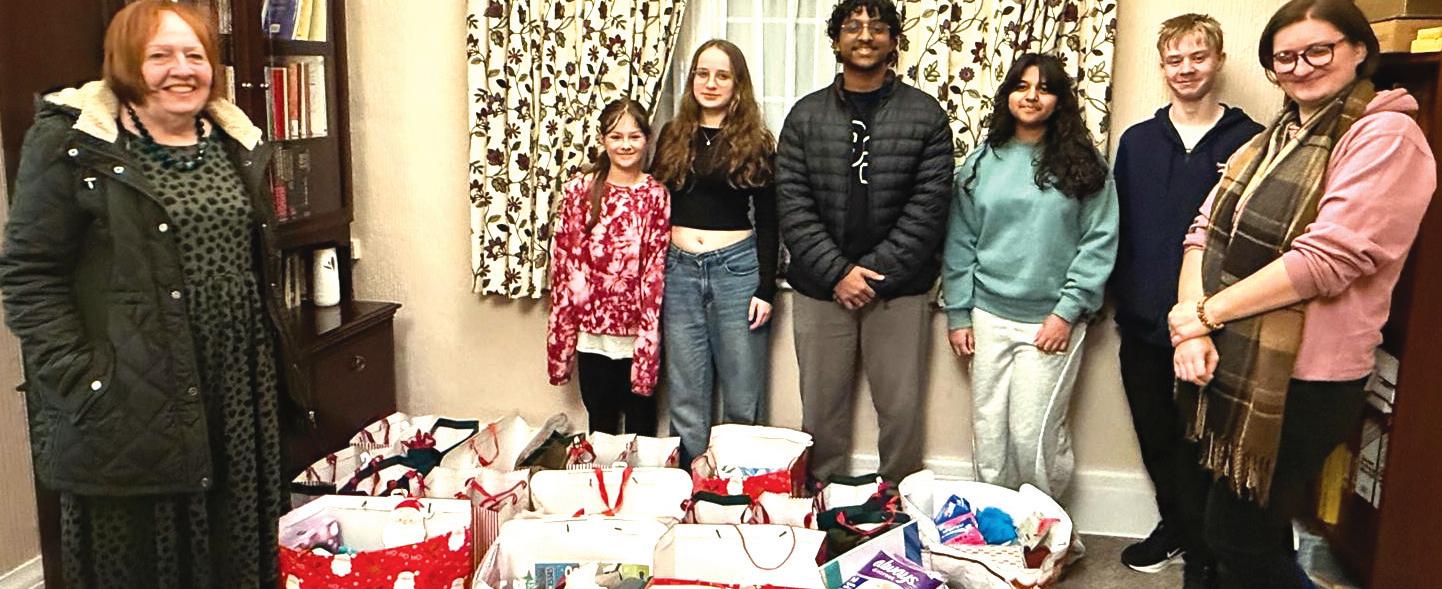
beautiful Christmas hamper items for families and individuals.
Across two meetings, 10 young people from the St Carlo Acutis Youth Group produced around 25 hampers for the Corner Store to distribute. There was something for everyone – mums, dads and children, with items selected with so much thought, to suit
babies, toddlers, primary, secondary age children as well as the adults.
Mums attending Welcome House were able to choose Christmas presents appropriate for their families. Their smiles were nothing compared to the smiles on their children’s faces on Christmas morning.
When St Carlo Acutis Youth Group members
visit Welcome House at half-term, they hope to meet some of the babies and children that they played Father Christmas to.
The group is already looking at ways to raise more money ready to put together spring hampers.
Maureen Mulligan and Brenda Watson