What’s Inside
Hull-born nun who defied the Nazis Page 2

Community shows love after statue is damaged Page 3

Looking for signs of spring Page 6

Hull-born nun who defied the Nazis Page 2
Community shows love after statue is damaged Page 3
Looking for signs of spring Page 6
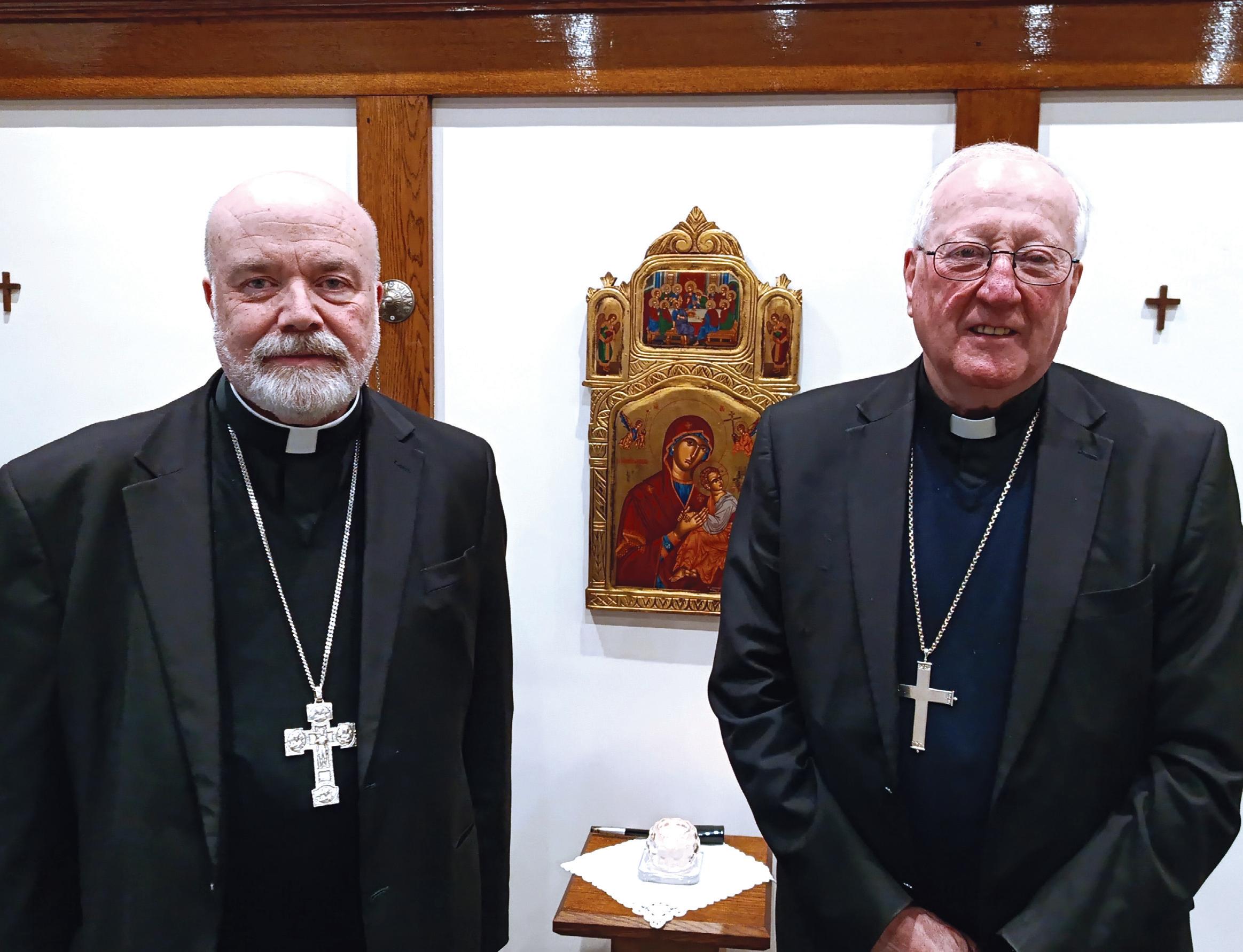
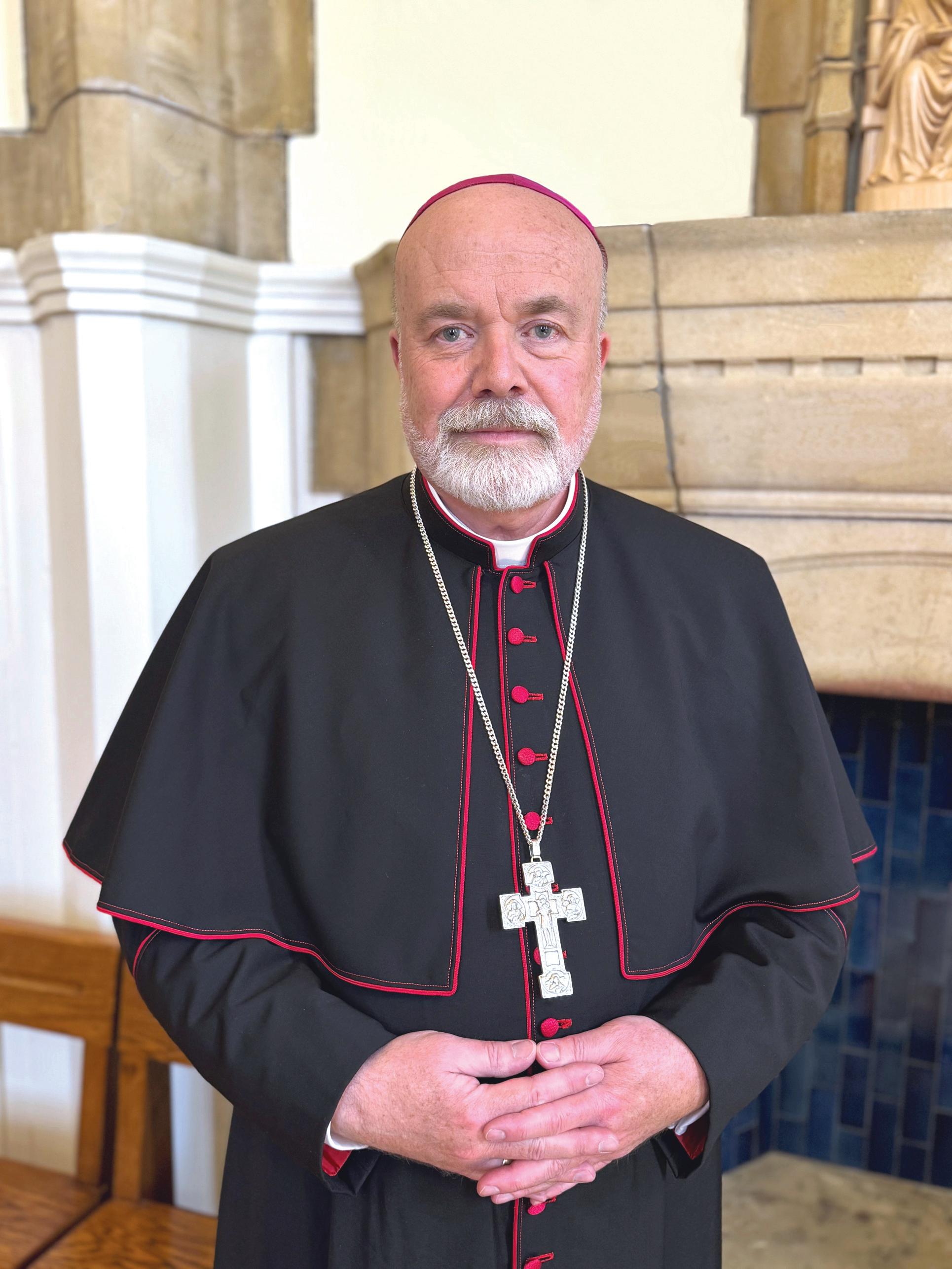
His Holiness Pope Leo XIV has appointed Bishop Marcus Stock as Apostolic Administrator of the Diocese of Middlesbrough.
The move came as the Holy Father accepted Bishop Terry’s resignation, which every bishop is requested to submit to the Vatican on reaching the age of 75.
Bishop Marcus immediately began his new duties, while also continuing in his office as Bishop of Leeds.
“Placing all my faith in our Lord Jesus Christ, and the prayers of His Blessed Mother, I will do my utmost to fulfil the mission which His Holiness Pope Leo XIV has entrusted to me as Apostolic Administrator of the Diocese of Middlesbrough in addition to my ministry as the Bishop of Leeds,” Bishop Marcus said.
“It is a comfort to know that in his retirement Bishop Drainey will continue to reside in the diocese and that I shall be able to call on his knowledge, wisdom and advice to assist me.
“It is the Holy Father’s wish that I explore with the clergy, lay faithful and religious of our two historic sister Dioceses of Middlesbrough and Leeds how we might journey together in mission, work in close collaboration and gain from each other’s strengths in order to secure the future of the Church’s witness to Christ across the regions we serve.
“I look forward to meeting and getting to know the priests, deacons and religious of the Diocese of Middlesbrough, and to serving both them and the lay faithful now entrusted to my care as Apostolic Administrator.
“Both Middlesbrough and Leeds dioceses share not only the saints and sacred places of the ancient Kingdom of Northumbria, but also the post-industrial heritage of Yorkshire’s historic North, East and West Ridings.
“We also share a common origin from 1878, when the Diocese of Beverley was divided into the current two sister dioceses by Pope Leo XIII. Trusting in God’s providence, I pray that the divine graces we have received in this Holy Year of Jubilee will guide us and shape us on our journey of hope and discover together the future that God wills for us.
“I humbly ask all those I am now called to serve, to pray for me; that Almighty God will grant me the spiritual fortitude I will need to undertake this new role.
“Through the intercession of Our Lady of Unfailing Help and St Wilfrid, patrons of both the Middlesbrough and Leeds dioceses, may Christ our Lord be our Way, our Truth and our Life.”
Bishop Terry said: “I am very grateful to His Holiness for having entrusted the care of this diocese to me for nearly 18 years. It has been a joy and privilege to serve the faithful, clergy and religious. I thank Bishop Stock for taking on the role that the Holy Father has given him and I have no doubt that his ministry among us will bring us many blessings and help us all to journey onwards in the light of the Gospel.”


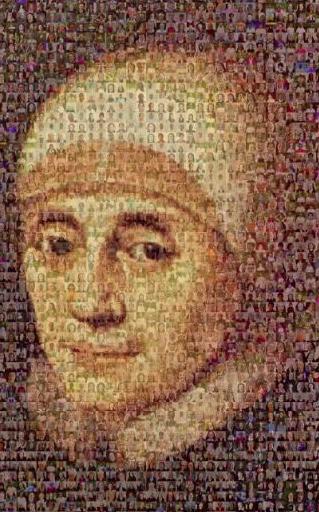

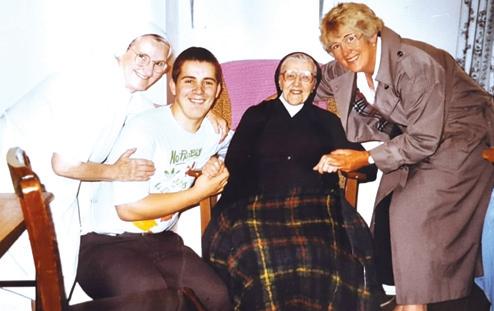
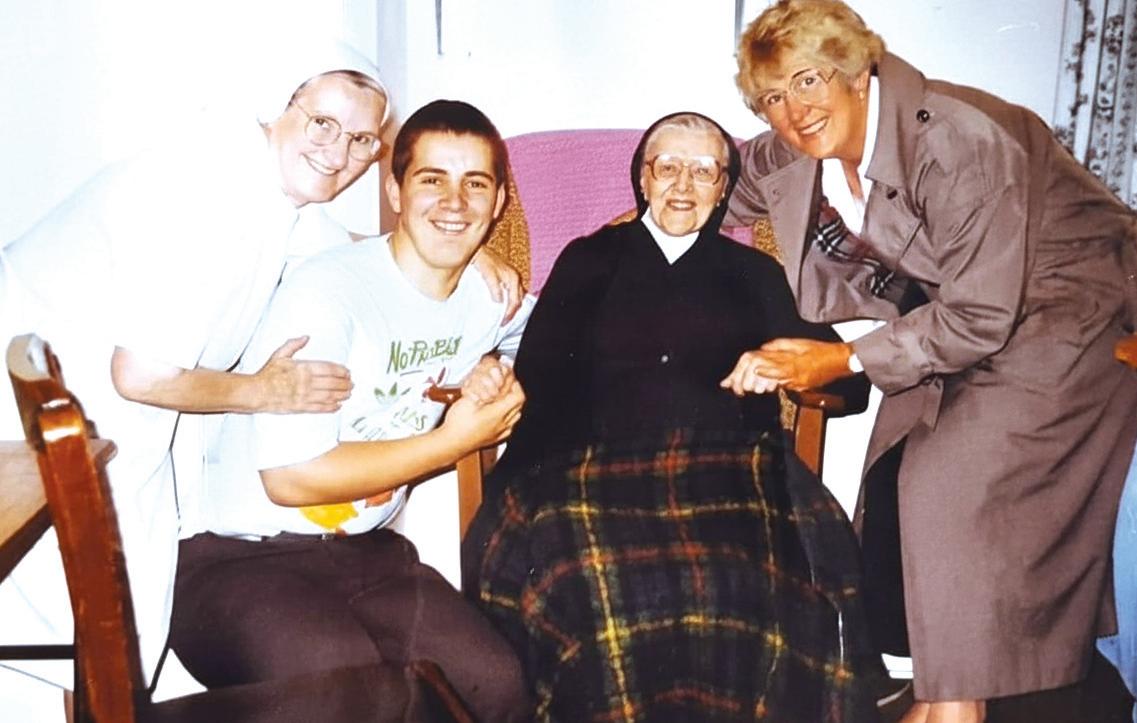
An exhibition has taken place in honour of a Hull-born nun who risked her life to hide a Jewish family in Nazi-occupied France.
Sister Agnes Walsh was born in Hull on March 27 1896, the third of five children, and spent her early childhood in Park Street before becoming a nun.
After working in several countries, she came to a convent at Cadouin in the Dordogne region. It was here during the war that Sister Agnes and her mother superior, Sister Louise Garnier, risked their lives by hiding a Jewish family in the convent.
The Crémieux family included a seven-year-old son, Alain, and ninemonth-old baby twins.
In November 1942, the father, Pierre, spoke to Sister Louise on a railway station platform and asked for help as the Nazis stepped up their searches for Jewish people.
The sisters treated the entire family devotedly and they remained safe
until France was liberated in 1944.
The family kept in close touch with Sister Agnes until her death in 1993.
Sister Agnes was awarded Yad Vashem Righteous Among Nations in 1990 and posthumously named a British Hero of the Holocaust in 2010.
A centenary cream plaque, unveiled in 2017 when Hull was UK City of Culture, marks the site of the house where Sister Agnes lived as a child.
Alain Crémieux and his wife Colette attended Hull History Centre for the exhibition, which was curated by Sister Agnes’s great-nephew, Ian Judson.
The exhibition is now on display at Sutton and Wawne Museum in Holderness. Ian is hoping it can help stop the museum from being closed.
Ian has also written a short biography of Sister Agnes, called Auntie Ada:
The Unlikeliest Hero of the Holocaust.
It can be ordered from barnthornpublishing.co.uk.
St Charles Borromeo Church in Hull received a remarkable and deeply significant gift that connects the parish directly with its patron saint in a way few communities ever experience.
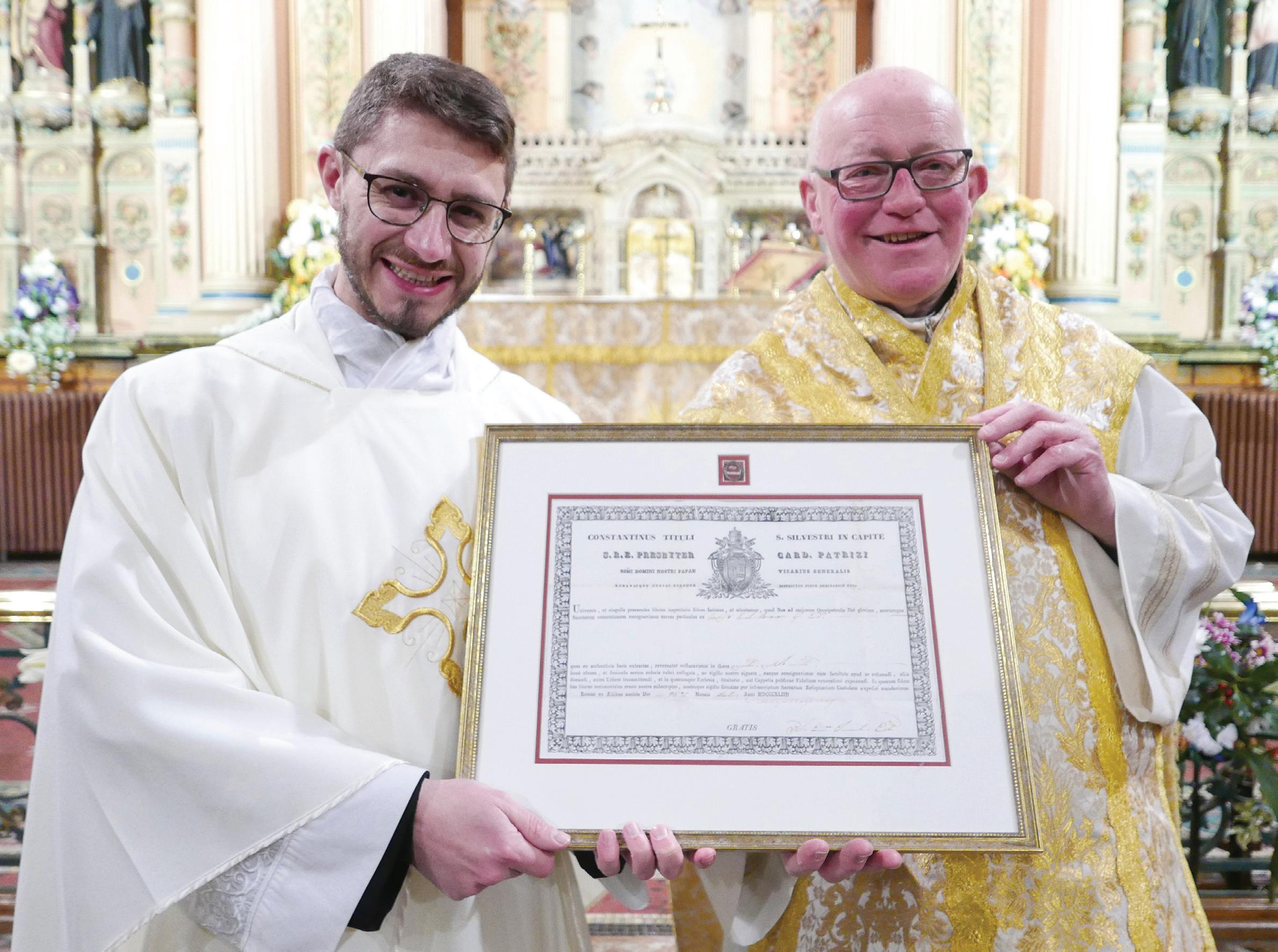
During his visit to celebrate the ruby jubilee of his priesthood, Canon Michael Loughlin formally gifted a beautifully preserved framed relic and certificate to the parish.
The frame contains a sealed theca holding a relic of St Charles Borromeo, together with its original papal authentication certificate dated 1853 and issued in Rome under the authority of Cardinal Costantino Patrizi.
The document itself is a striking example of the formal certificates produced in the 19th century by the Sacred Congregation of Relics. These certificates were issued only after careful verification by the Roman Curia. Each attested that a relic – usually a small, sealed fragment taken from an officially recognised reliquary – had been examined and authenticated, sealed in a theca with red silk thread, and approved for public veneration in churches or oratories.
The signature and seal of Cardinal Patrizi, who at the time was Vicar General of the Pope and Cardinal Priest of San Silvestro in Capite, confirm its authenticity beyond doubt.
What makes this certificate extraordinary is the saint it concerns. Relics of St Charles Borromeo, the great Archbishop of Milan and one of the leading figures of the Catholic Reformation, are exceptionally rare. His remains lie beneath the Milan Cathedral in a heavily guarded crypt, and only a few authenticated relics were ever released from Rome. For a parish to possess the original Roman certificate of such a relic is unusual. For it to be the parish that bears his name is profoundly meaningful.
The rediscovery and presentation of this document carries immense historical and spiritual weight for the parish, linking the community directly with its patron, not simply through prayer or tradition, but through a tangible piece of its heritage.
It also reflects the depth of continuity that exists between the universal Church and local communities – a document issued in Rome in 1853, entrusted to clergy over generations, has now found a lasting home in the parish
dedicated to the very saint it authenticates.
The congregation received the news with great warmth, aware that this was a moment of genuine significance for the church.
The certificate now stands as a treasured link to St Charles Borromeo, a saint whose life of reform, charity and pastoral commitment continues to inspire the parish that bears his name.
Its arrival on the feast of Christ the King, during the celebration of a priest’s 40 years of
ministry, will be remembered as a moment of blessing in the history of the parish.
Canon Michael’s visit was an opportunity to thank him for the 11 years he served at St Charles and reflect on a life of steady, faithful service. His priesthood has been marked by gentleness, calm authority and a consistent pastoral presence, with a gift for listening and guiding without drawing attention to himself. He became known as a priest people trusted, particularly in times of illness, bereavement
and family difficulty.
He is also a strong supporter of Catholic education, working closely with others to ensure that schools under his care flourish in their mission.
Canon David Grant, Father Michael Marsden, Father David Standen and St Charles’ parish priest Father Phil Cunnah concelebrated with Canon Michael, who is now parish priest of English Martyrs in York.
John Maffin
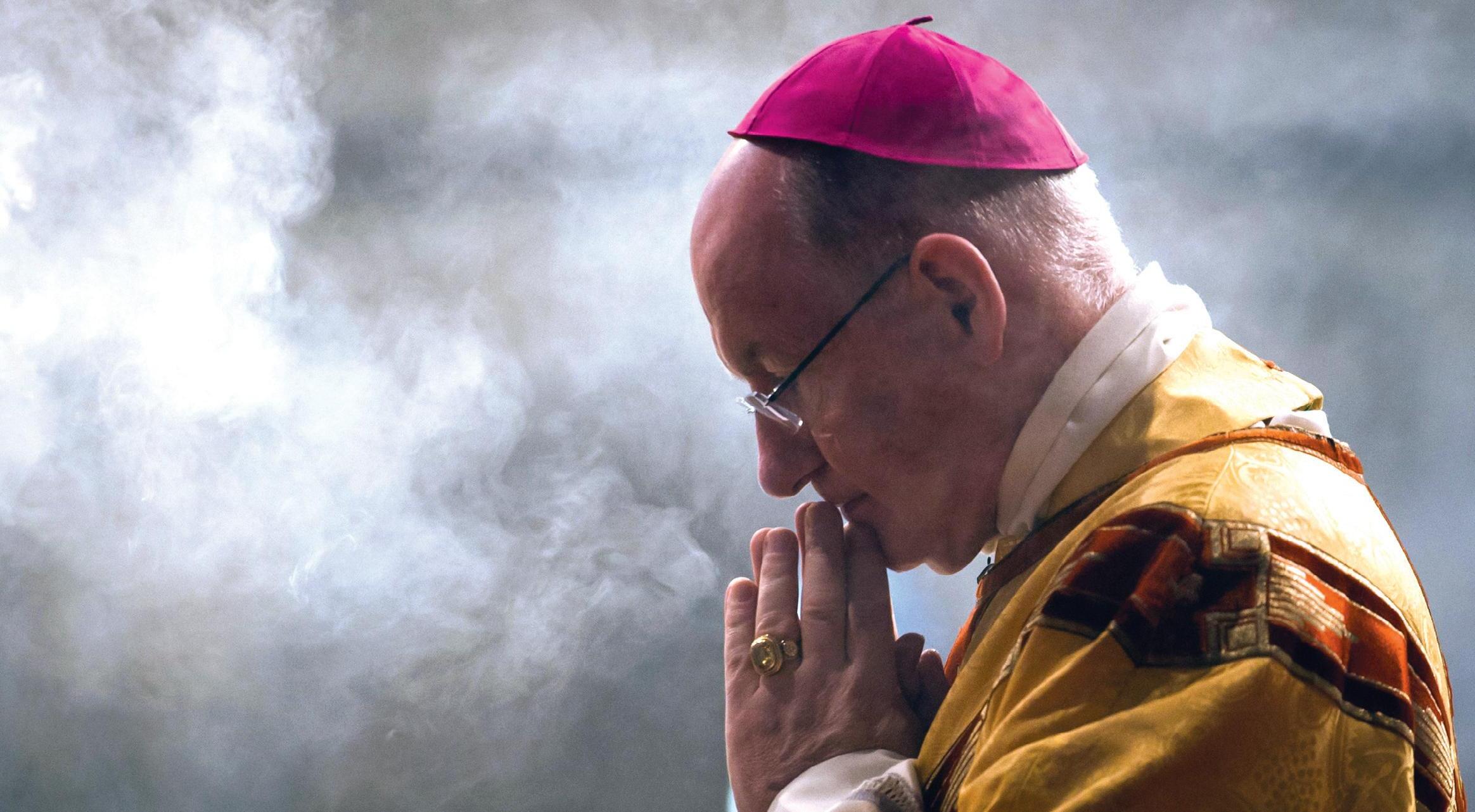
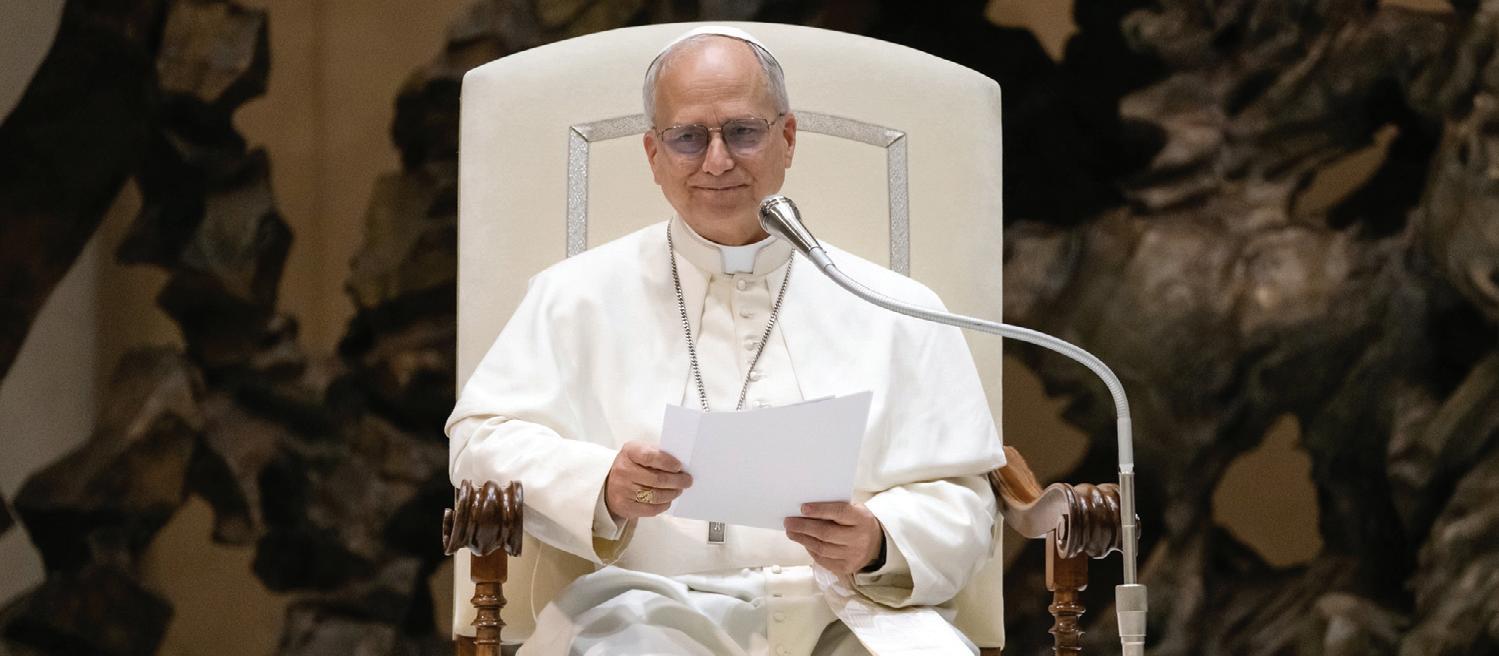
Pope Leo has appointed the Right Reverend Richard Moth as Archbishop of Westminster.
Archbishop-elect Moth has served as Bishop of Arundel and Brighton since 2015. Before that, he was the Catholic Bishop of the Forces from 2009 to 2015.
Archbishop-elect Moth will become the 12th Archbishop of Westminster, succeeding Cardinal Vincent Nichols, who has served in the role since 2009. Cardinal Nichols will now become Apostolic Administrator of the Diocese of Westminster until Archbishopelect Moth is installed at Westminster Cathedral on Saturday February 14.
On hearing of his appointment, Archbishopelect Moth said: “I am moved greatly by the trust that Pope Leo has placed in me, in appointing me to the Diocese of Westminster. As I prepare to move to the diocese, I am so grateful for the support being given to me by Cardinal Vincent Nichols at this time. He has given dedicated service to the diocese and will be missed greatly.
“Serving the Diocese of Arundel and Brighton has given me the wonderful opportunity of sharing the Church’s mission with lay faithful and clergy, and I give thanks for the many blessings of these last ten years.
“My first task will be to get to know the priests and people of Westminster and I look forward now to serving them. With them – and building on the firm foundations that have been laid by so many down the years – I look forward to continuing the great adventure that is the life of the Church and witness to the Gospel.”
Cardinal Vincent Nichols said: “I am delighted at this news. Archbishop-elect Richard will bring to our diocese many gifts and considerable episcopal experience from his years of ministry. I look forward very much to his installation on February 14. It is, of course, St Valentine’s Day, as well as the Feast of Saints Cyril and Methodius, co-patrons of Europe.
“I remember being present in Westminster Cathedral for the Episcopal Ordination of Bishop Richard as Bishop of the Forces. So today I can say: ‘Welcome back, dear Bishop Richard. You are most welcome indeed.’”
Archbishop-elect Moth was born in Chingola, Zambia, in 1958. He was brought up in Kent and began formation for the priesthood at St John’s Seminary, Wonersh. He was ordained priest for the Archdiocese of Southwark on June 3 1982.
He served as assistant priest at St Bede’s, Clapham Park, before pursuing studies in Canon Law at St Paul University, Ottawa. In 1987, he was appointed assistant priest at St
also serving as a territorial army chaplain.
He served as private secretary to Archbishop Michael Bowen from 1992 until 2001, during which time he was also president of the Interdiocesan Tribunal of Second Instance of Southwark and vocations director. In 2001 he was appointed vicar general and chancellor of the diocese.
He is chair of governors at St Mary’s University, Twickenham, chair of the Department for Social Justice of the Catholic Bishops’ Conference of England and Wales and liaison bishop for prisons. He chairs the Plater Trust, dedicated to the support of
projects across England and Wales that put into practice the principles of Catholic Social Teaching.
He is also a member of the Mixed Commission of the Bishops’ Conference – a body that brings together bishops and those living Religious Life.
Bishop Richard has been an Oblate of Pluscarden Abbey for over 40 years and is a member of the Equestrian Order of the Holy Sepulchre of Jerusalem, travelling many times to the Holy Land. In 2020 he was appointed prior of the Southern Section of the Lieutenancy of England and Wales. He enjoys horse riding and walking.
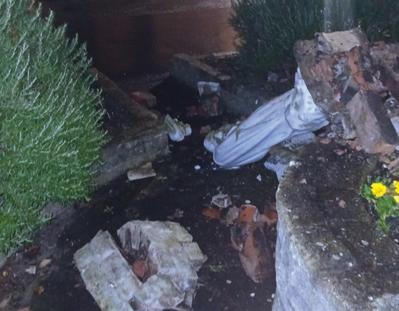
A Middlesbrough priest has praised the community that rallied round to offer help after a much-loved statue of Our Lady was pushed over and smashed.
The incident happened on the afternoon of December 30 in the grounds of St Alphonsus Church in North Ormesby.
Father John Idio, parish priest of the Sacred Heart in Middlesbrough, which includes St Alphonsus, spoke of his shock after hearing about the attack.
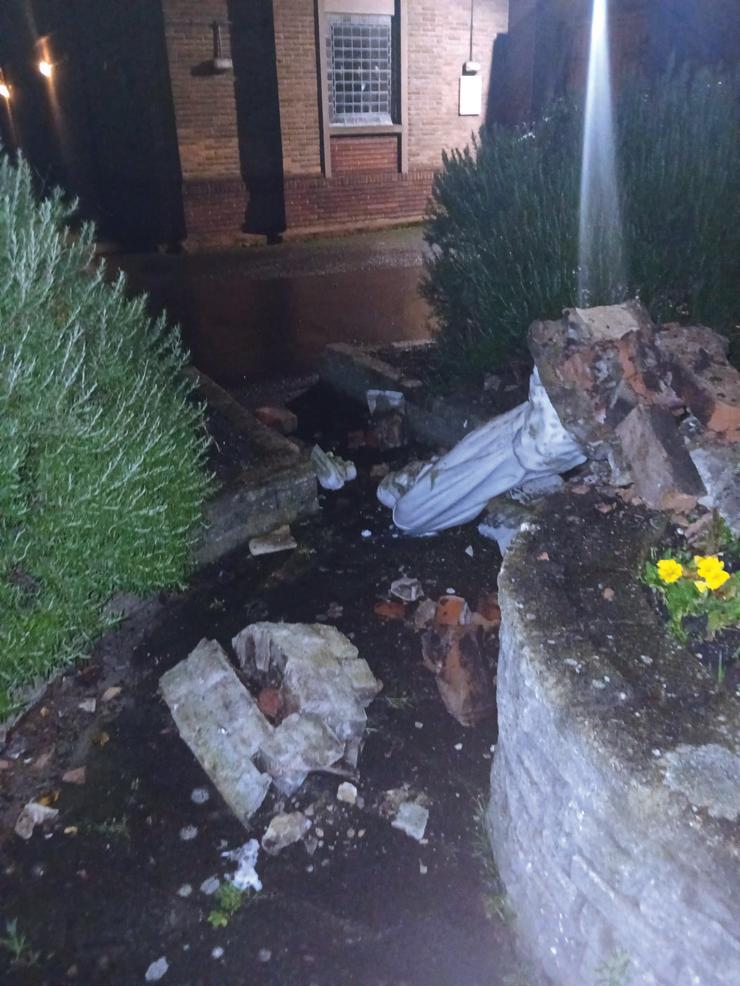
“A parishioner called me to say the statue had been damaged and I rushed over and saw it had been vandalised,” Father John said.
“Someone had pushed it to the ground and the head had been cut off and other parts broken.”
Father John immediately contacted the police.
“I also spoke to Monsignor Gerard Robinson, the Vicar General, who advised me to collect the pieces and keep them safe, with the hope that we can restore the statue.”
Just a few minutes later, Relph Funeral Directors, which is near the church, called Father John to express their sadness and offered to repair the damage free of charge.
Father John returned to the site accompanied by parishioners, and with the help of Relph’s team, they gathered the broken pieces.
“They have been so generous,” Father John added.
CCTV footage captured the incident at around 4.55pm. It shows a single hooded individual repeatedly pushing the statue until it fell over.
Father John said: “The statue wasn’t shattered, just pushed down by hand, resulting in the head and some parts breaking off. We don’t know why they did it, but we do not believe it was religiously motivated.”
The statue has been in place since 1954 and Father John emphasised its importance to the church and the wider community. The damage is estimated to run into thousands of pounds.
“It’s been part of countless memories, from
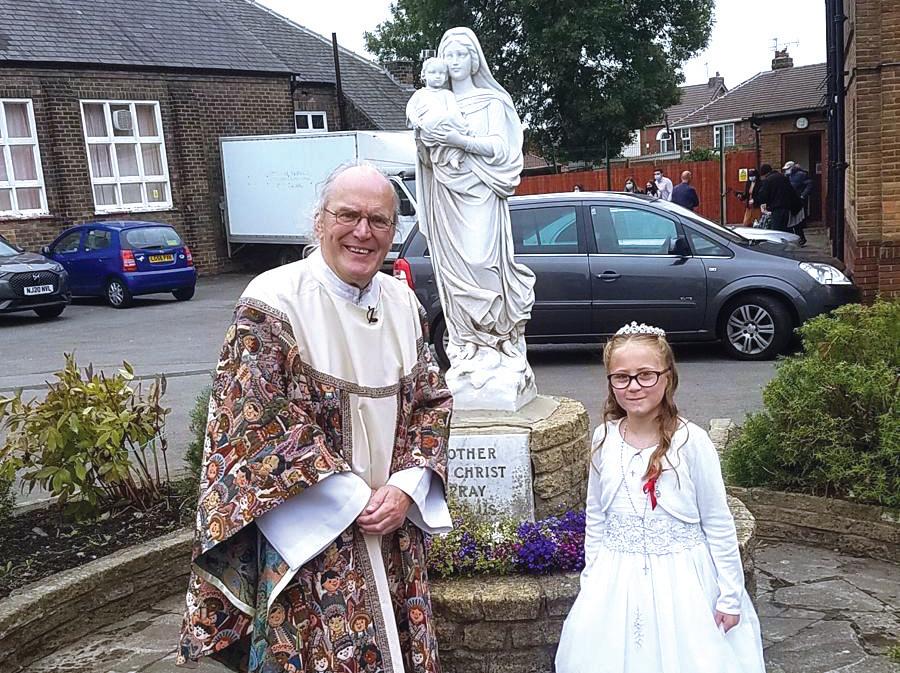
first holy communions to confirmations and weddings. It’s not just part of the church; it’s a valued part of North Ormesby.”
Father John has been inundated with phone calls and texts offering support and practical help. “I am so impressed by the community’s outrage and concern,” he said. “Many who
don’t attend church still see the statue as part of their heritage. While I feel saddened by this act, I am encouraged by the way people have come together.”
Cleveland Police said a 41-year-old man had been arrested on suspicion of criminal damage and bailed while enquiries continue.
Chess aces from a York primary school are celebrating success in the capital for the second year in a row.
Pupils from St Wilfrid’s Catholic Primary, Monkgate, secured first place at the London Chess Classic tournament amid the inspirational setting of Arsenal FC’s Emirates Stadium.
Their latest victory follows a first-place finish 12 months ago.
The event was organised by Chess in Schools and Communities (CSC), an educational charity that aims to get more state school children playing chess.
St Wilfrid’s chess tutor Dan Staples is CSC’s Yorkshire coordinator.
Mr Staples, who has been working with the children at St Wilfrid’s for a decade, said:
“The children did brilliantly to win yet again in London. They are a joy to teach and played really well. I’m glad they had this experience.
“Many thanks to the school for making these chess experiences possible for the children.”
At this year’s event, the children played against a grandmaster, world top 10 player from Uzbekistan, Javokhir Sindorov.
In an action-packed day they also met famous author Onjali Q Rauf, who wrote Boy at the Back of the Class and whose new book is all about chess, before playing in a tournament against schools from across the country in the

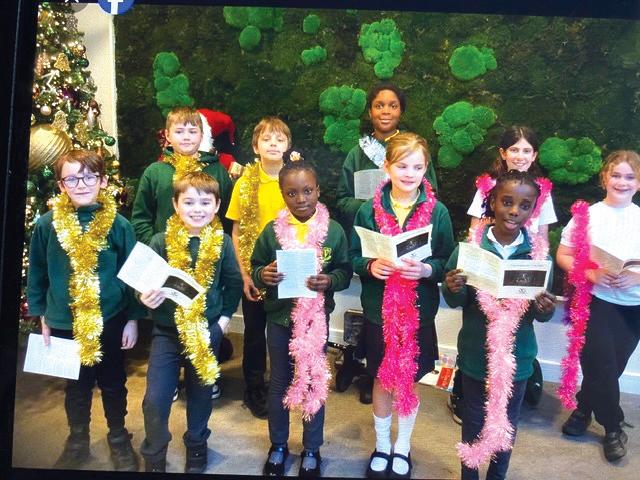
The Mini Vinnies from St Vincent’s VA Primary School in Hull were invited to sing Christmas carols and songs for the residents at St Mary’s Residential Nursing Home.
The children were fantastic and brought the festive spirit to everyone. We are so proud of them all and we are delighted to have received this feedback from the home.
“Our residents really enjoyed listening to them sing. The home has been alive with a



buzz of the residents talking about the visit. Your students were amazing, very polite, and their behaviour was exemplary.”
Before leaving the home, the Mini Vinnies were taken to the upper floor where residents
were all bed-bound.
We had the privilege of going into the bedroom of one of St Vincent’s Church's former parishioners. She smiled all the way
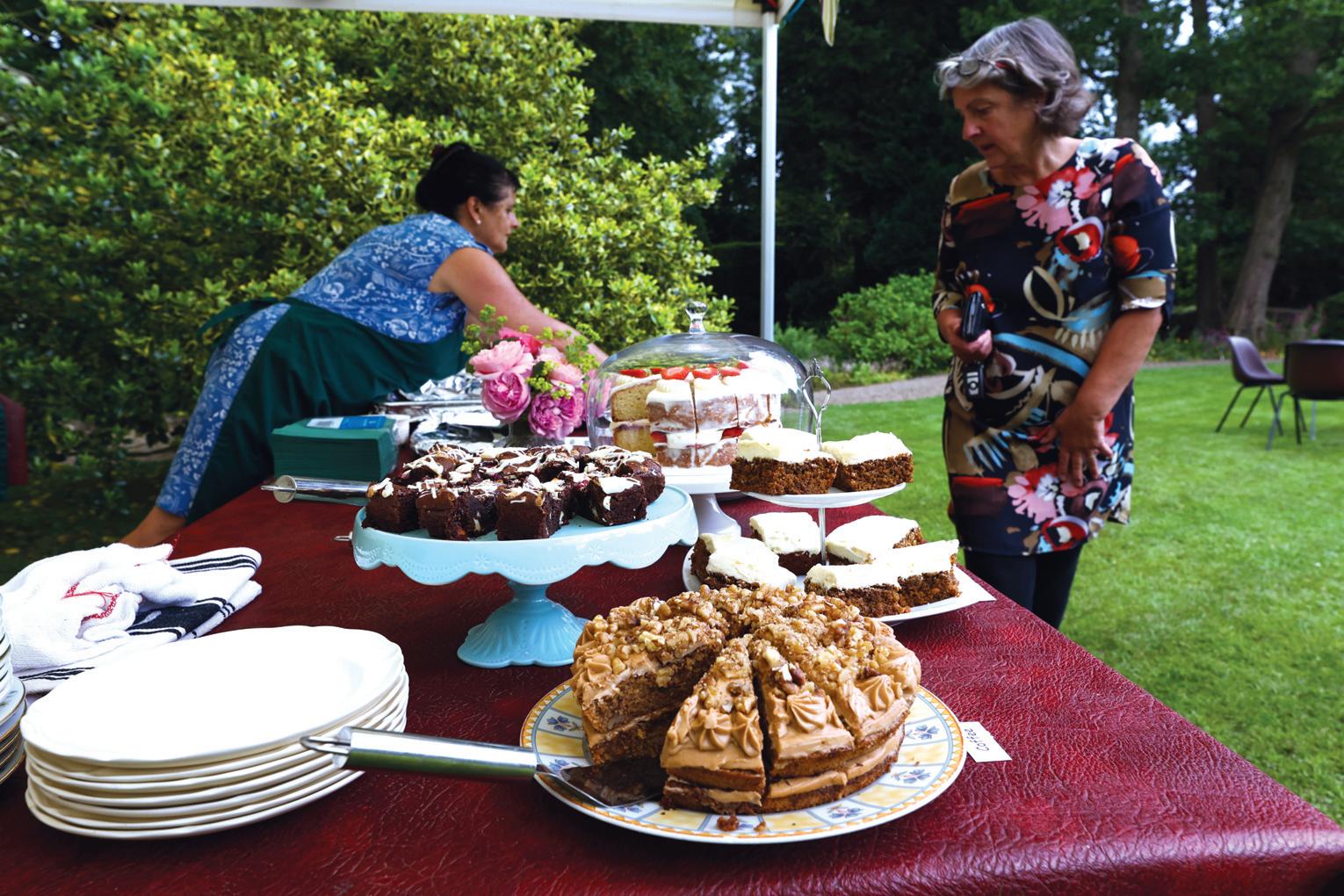
The owner of Teesside’s favourite garden says the granting of grade II-listed status will protect this very special location for generations to come.
Tudor Croft Garden on Stokesley Road in Guisborough is one of just five parks and gardens among the 199 heritage sites protected by Historic England during the year and is also the most northerly.
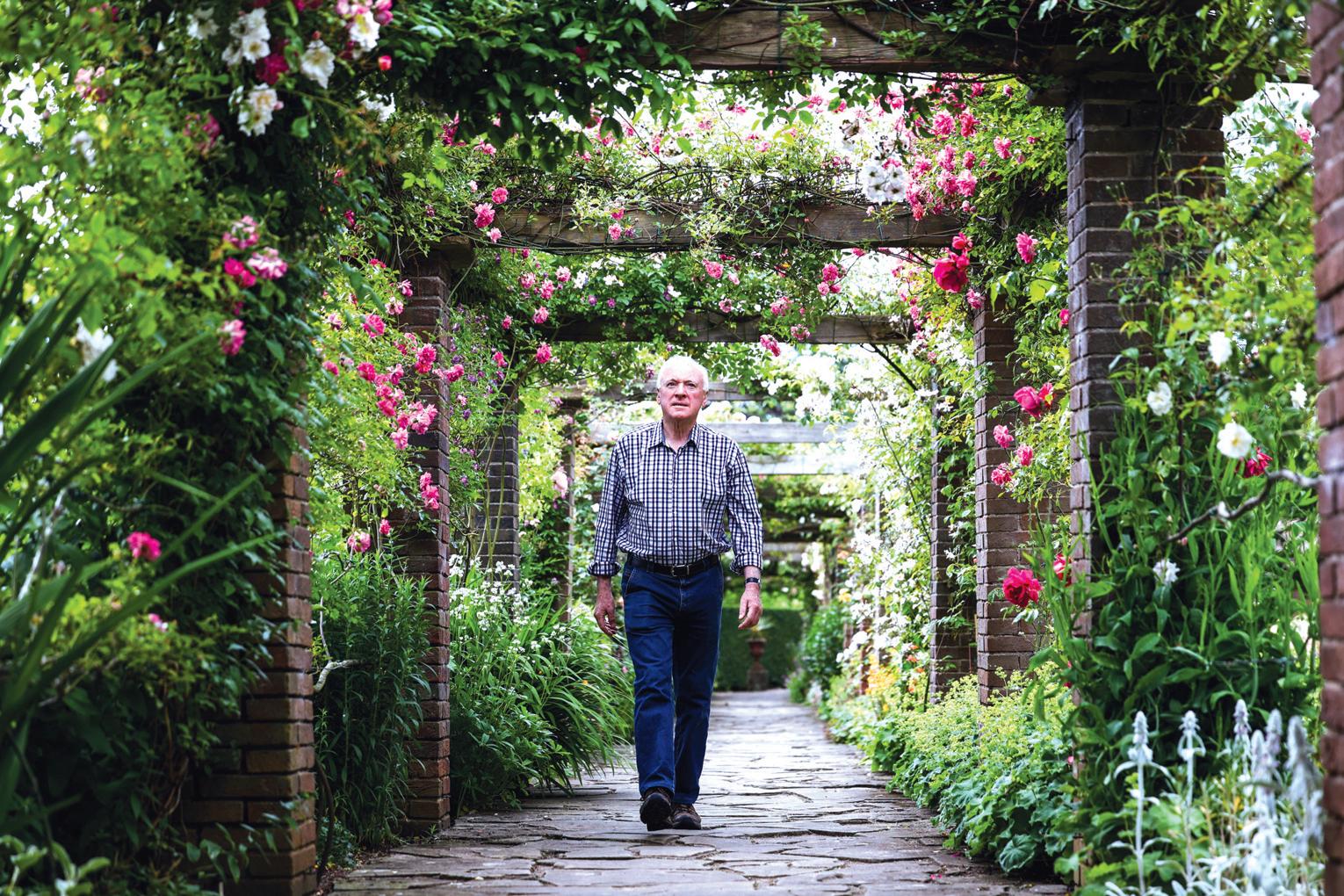
The organisation says the garden, created from 1934 for industrialist Ronald Crossley, is a rare survival of an inter-war suburban garden in a relaxed Arts and Crafts style. Designed to complement the family home, which has also been given grade II status, the garden remains intact, with the house overlooking the garden and the North York Moors.
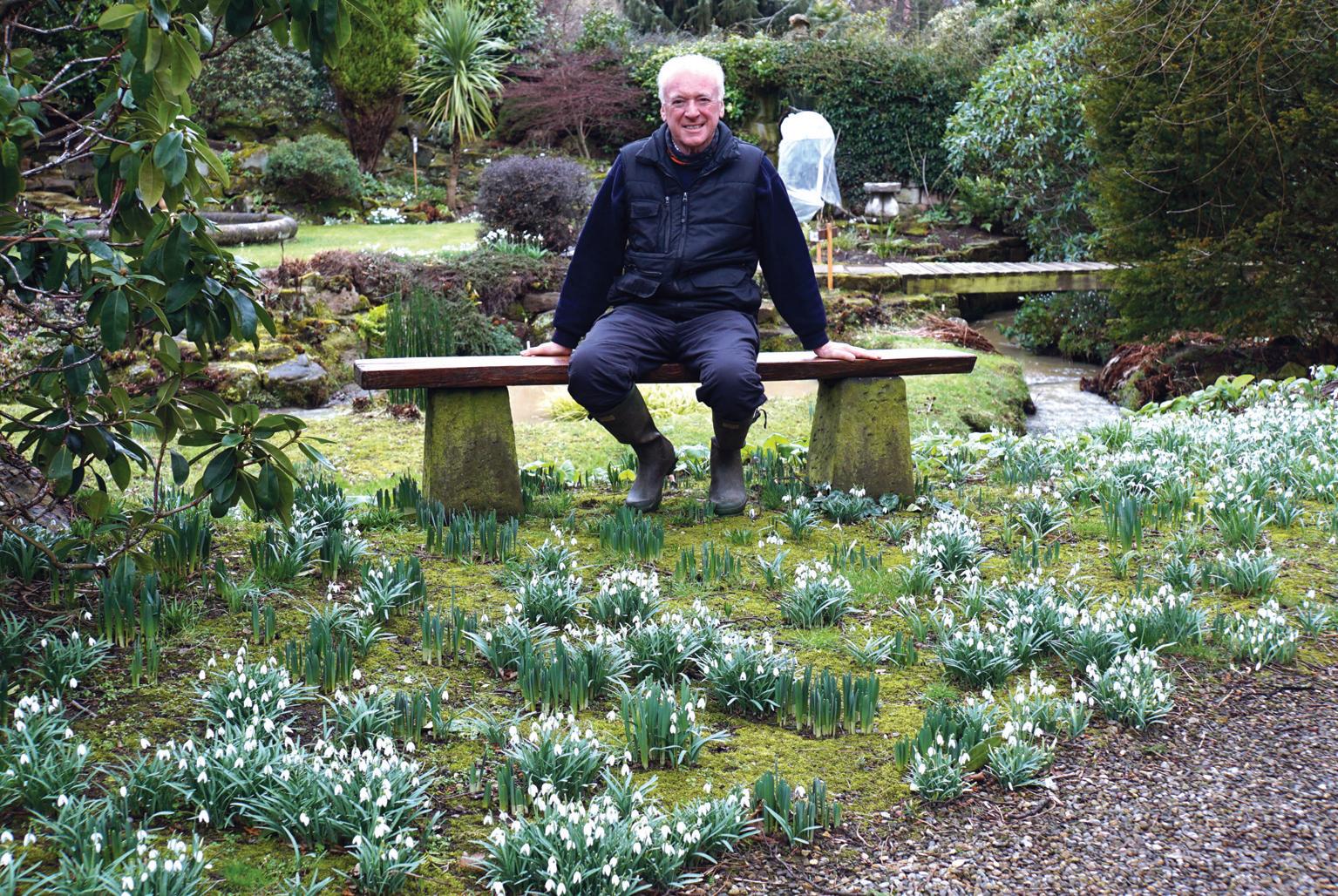
Among the highlights is the Gnome Garden, populated by magical beings including elves, gnomes playing instruments, pixies, birds and animals.
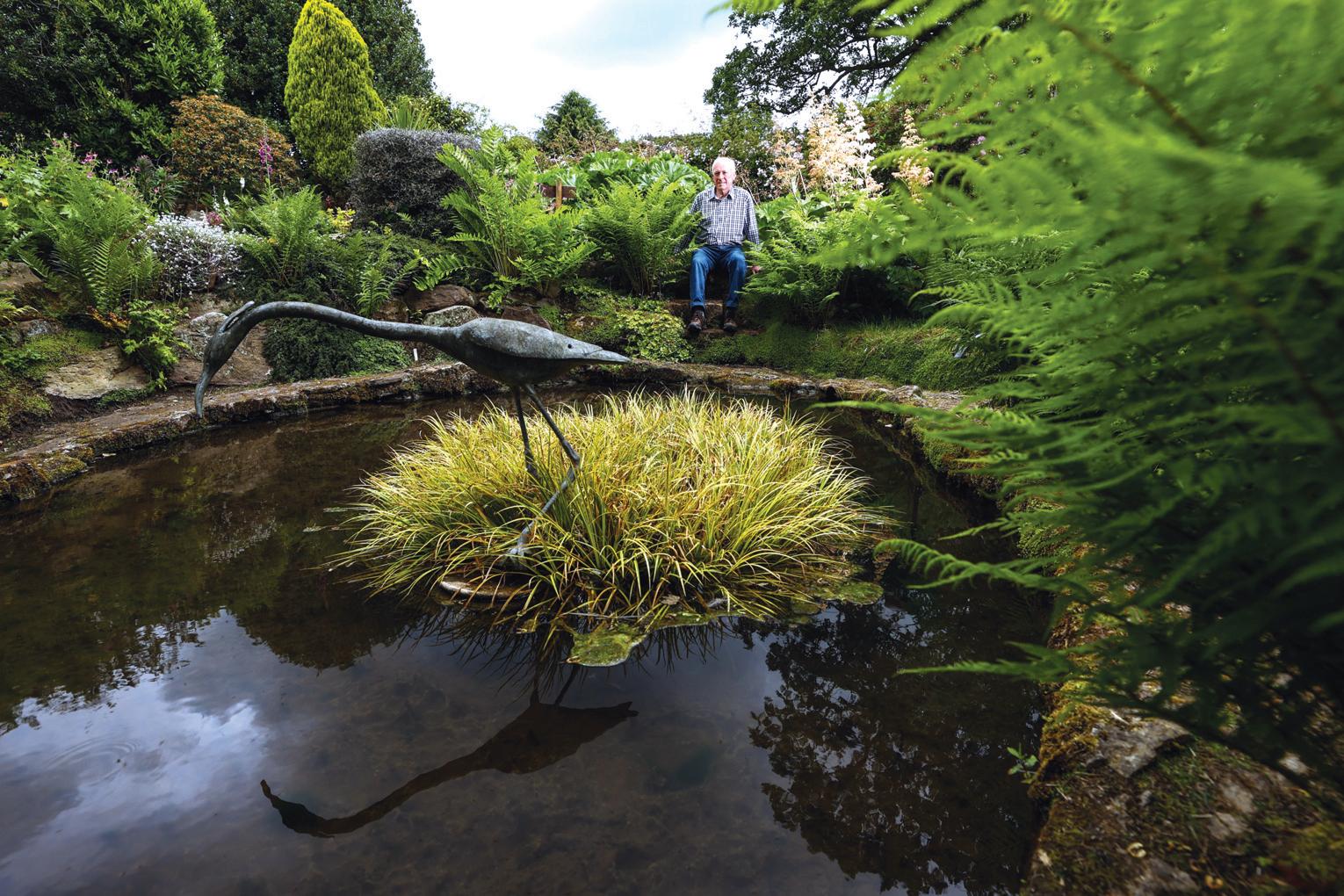
These hand-crafted terracotta ornaments by potter and sculptor Walter Scott were all produced at the Commondale brickworks. There is also a secret garden with a small stone-flagged bridge over a pond with a terracotta fisherman at the opposite end. It also features a rare, roofed fernery and intricate rockwork, probably by the acclaimed Backhouse Nursery of York, a curving rose pergola of Crossley bricks and a water garden.
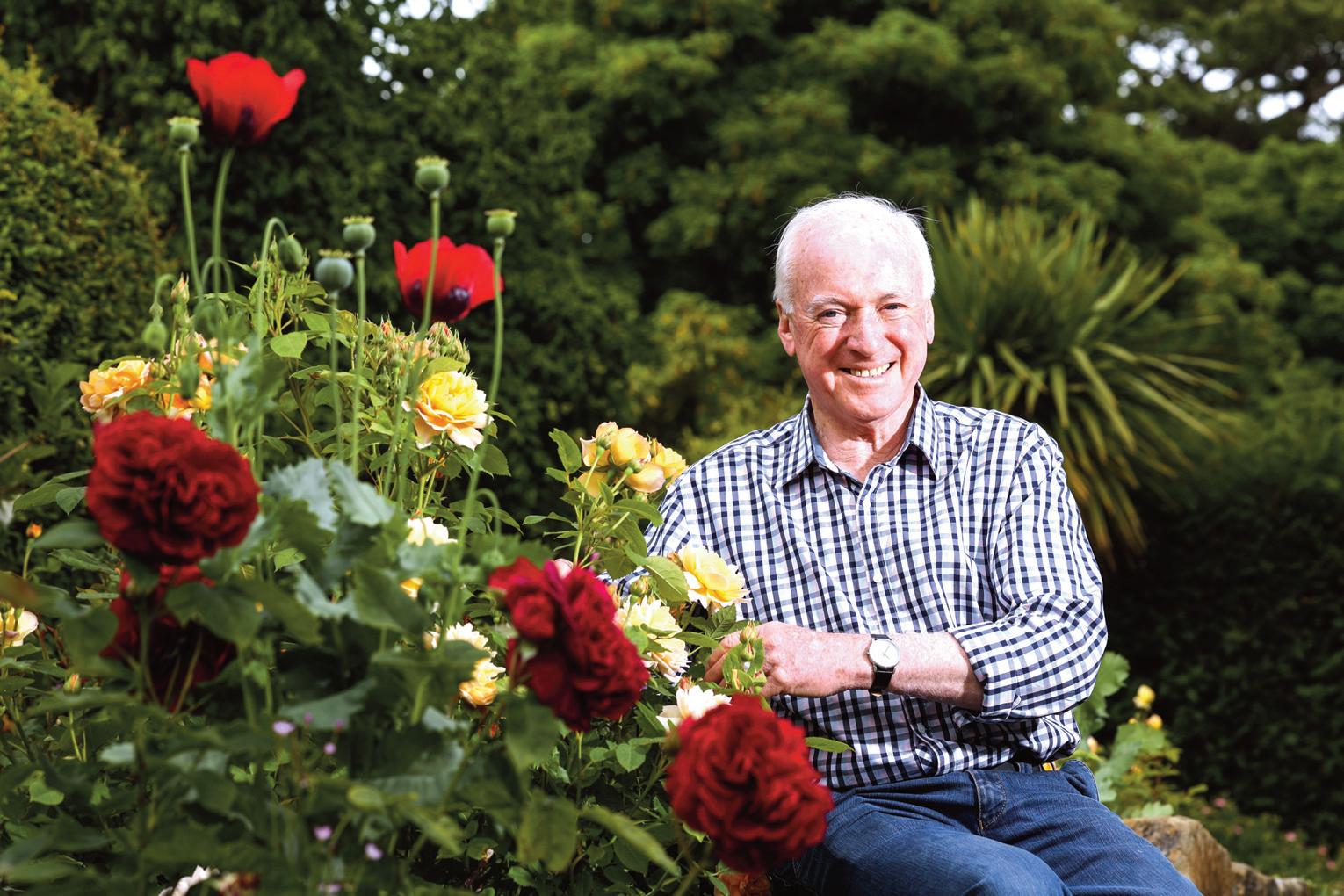
Owner Mike Heagney, a Lourdes brancardier and parishioner of St Paulinus, Guisborough, has raised well over £100,000 for charity by opening the garden to the public every spring
and summer.
He was informed about the listing some time ago but was sworn to secrecy until now.
“We’re delighted that Tudor Croft has been listed by Historic England and is now protected for future generations to enjoy,” said Mike.
“Because of the visual connection from the garden to the moors, this listing should also prevent new housing being built adjacent to the site, which would badly damage the garden.
“The garden was completely overgrown when my father, Tony Heagney, bought the house in 1952. My parents and five children moved in exactly 73 years ago this week, waking up the next morning to find the entire garden covered in snow!
“Tudor Croft now includes dozens of small gardens within the whole, featuring a trout stream, pools, fountains and the finest fernery in Britain.
“It brings us great joy, and we care for it with help from family, staff and our wonderful team of volunteers.
“Restoring Tudor Croft to its current beauty has been a magical journey. Thank you once again, Historic England, for this very special accolade.”
Tudor Croft is one of 19 “unusual historic buildings and places” highlighted by Historic England, gaining it publicity in most national newspapers.
Others in the list include a Neolithic burial mound in the Yorkshire Dales dating to 3400 BC, a rare shipwreck in Dorset lost in 1903
and the “Dragon’s Teeth” Second World War anti-tank defences in Surrey.
Heritage Minister Baroness Twycross said:
“Britain’s heritage is as varied as it is brilliant, with each of these buildings playing a part in shaping our national story over the centuries.
“This year alone we have protected 199 heritage sites, from Neolithic cairns in the Yorkshire Dales to the fabulous Catholic cathedral in the heart of Liverpool. I’m proud that we’re safeguarding our rich history so future generations can continue to enjoy it.”
A Historic England spokesperson added: “These newly protected places demonstrate the remarkable diversity of England’s
heritage. They connect us to the people and events that shaped our communities.”
The next open garden weekends at Tudor Croft Gardens are on the last Saturday of January and the first Sunday of February, and again the following weekend, when visitors can admire a collection of around 350 different snowdrops, including many rare varieties.
Admission is £10 (children free) and free parking is available. Refreshments including hot soup will be available for purchase, along with a range of plants.
This year's summer opening weekend dates are Saturday and Sunday June 13 and 14 and Saturday and Sunday June 20 and 21.
Jubilee Year of Hope comes to an end
On the Solemnity of the Epiphany of the Lord, Pope Leo XIV presided over Holy Mass in St Peter’s Basilica for some 5,800 faithful and closed the last Holy Door, marking the official end of the Jubilee Year of Hope. Almost 33.5m pilgrims came to Rome during the Holy Year from 185 countries.
Pope Leo has expressed concern over developments in Venezuela, where US forces arrested President Nicolás Maduro and took him to New York for trial. He said: “The good of the beloved Venezuelan people must prevail over every other consideration and lead us to overcome violence and to undertake paths of justice and peace, safeguarding the country’s sovereignty, ensuring the rule of law … respecting the human and civil rights of each person and … working to build together a serene future … with special attention to the poorest who suffer because of the difficult economic situation.” The Pope invited everyone to pray for the Venezuelan people, assuring them of his own prayers.
examines state of
The Ecological Conversion Group (ECG) charity, which was founded by three Catholics to help the Church understand and respond to encyclical letter Laudato Si’, is holding an in-person retreat called the Art of Limits, led by Sister MaryAnne Francalanza FCJ and illustrator ECG director John Paul de Quay. It will ask: “Is an artist a state of being rather than a profession?” The event is at the FCJ Centre for Spirituality and EcoJustice (seven minutes’ walk from Euston Station) on Saturday February 21 from 10am to 4pm. For further information and tickets, visit tinyurl.com/5btysupa.
Cardinal Charles Maung Bo, Archbishop of Yangon, Myanmar, has appealed for peace and disarmament. Reflecting on the conflict in his country and on wars worldwide, Cardinal Bo said: “The peace of the Risen Christ is peace without weapons.” With estimates putting global military spending at $2.718tn in 2024, he added: “The root of this crisis lies in relationships between nations that are built not on law, justice and trust, but on fear and domination. God bless all those who strive for peace in Myanmar through every possible means.” Pope Leo XIV has appealed for an immediate ceasefire in Myanmar.
Have you seen
any signs of spring yet? – Photo by PxHere
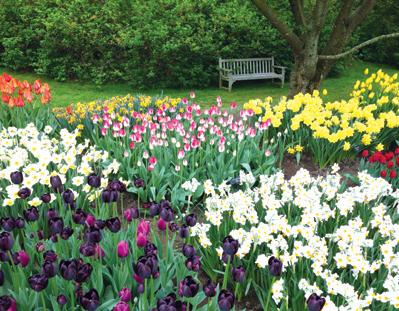
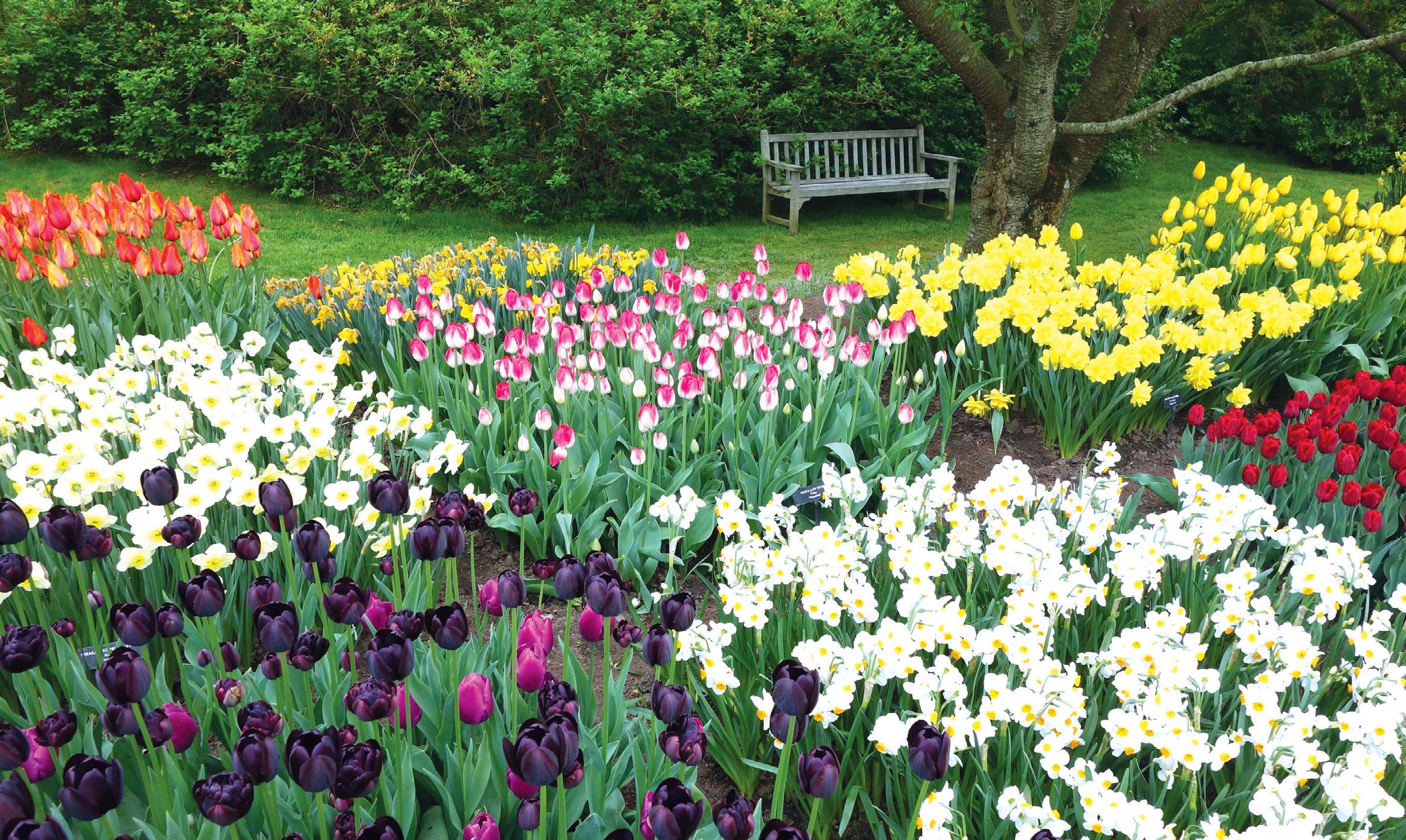
Have you spotted any signs of spring yet?
I am waiting patiently for my bulbs to bloom.
I’m not an avid gardener, though I hope to be one day, but even I find myself looking for those first hints of new life.
As winter slowly fades and Lent draws near with its call to pray, fast, and give alms, I’m reminded of St Teresa of Ávila’s beautiful insight: “A beginner must think of herself as one setting out to make a garden in which her Beloved Lord is to take his delight.”
In her Spiritual Autobiography, she uses the analogy of watering a garden to describe our growth in prayer.
St Teresa reflects on four different ways to water a garden, each illuminating a stage of the spiritual life.
1. Drawing water from a well
The first method is to carry water from a well –hard, deliberate work that demands both effort and trust. The gardener must lower the bucket into the unknown, hoping to draw up something life-giving.
Similarly, when we begin to pray regularly, it can feel like strenuous labour. We need
discipline to set aside time each day. We must learn to quiet the many distractions of modern life, no easy task when we carry the whole world in our pockets through our mobile phones. And above all, we learn to trust that God is present, even when we do not immediately sense him.
2. Using a waterwheel
The second method is to build a waterwheel. This still requires human effort, but it is gentler work. Here the water moves toward the garden on its own, flowing from higher ground.
At this stage, prayer begins to settle. Our conversations with the Lord grow deeper, quieter and more natural than before.
3. Receiving water from a stream
St Teresa then describes gardens nourished by a flowing stream or brook. The soil receives a generous soaking and no longer needs constant tending.
This represents a deepening surrender in prayer. We rely less on our own actions and become more open to God’s. The Lord takes the lead, and we learn to rest in his presence.
4. Being watered by rain
Finally, there is the rain, entirely beyond the gardener’s control. One can only entrust the garden to the heavens and trust that the rain will come.
This, St Teresa says, is the prayer of complete abandonment, the prayer of union. Just as a farmer trusts in the providence of rain, so we entrust ourselves wholly to God.
It is a beautiful ideal, and one I hope to grow into. Yet I often find myself back at the beginning, wrestling with everyday distractions. I find myself longing for rain, something we rarely lack in this part of the world!
As Lent approaches, you may already have chosen what to fast from, and our parishes will offer many opportunities to give alms. My invitation to you is this: consider how you might go deeper in prayer this season. Let us tend the gardens of our souls, trusting that God will bring forth new life in his time.
Nicola
Individuals, families and schools are encouraged to join the Friends of the Lady Chapel and support our diocesan Marian shrine.
Members are united in the spirituality of our diocesan Marian shrine through an annual Mass and daily prayers and also receive newsletters and invitations to events. A suggested membership donation is £10 a year for an individual or a family group. Visit ladychapel.org.uk/friends for more information.
Father Anthony Storey’s booklet describing the history of the Lady Chapel, which was updated by Father Neil McNicholas, is available from the Curial Office, St Mary’s Cathedral or the Lady Chapel itself, priced £1.
Have you ever thought about leaving a legacy to the Friends of the Lady Chapel in your will? By doing so you will help to preserve this important shrine to Our Lady for future generations and bequests are free of inheritance tax.
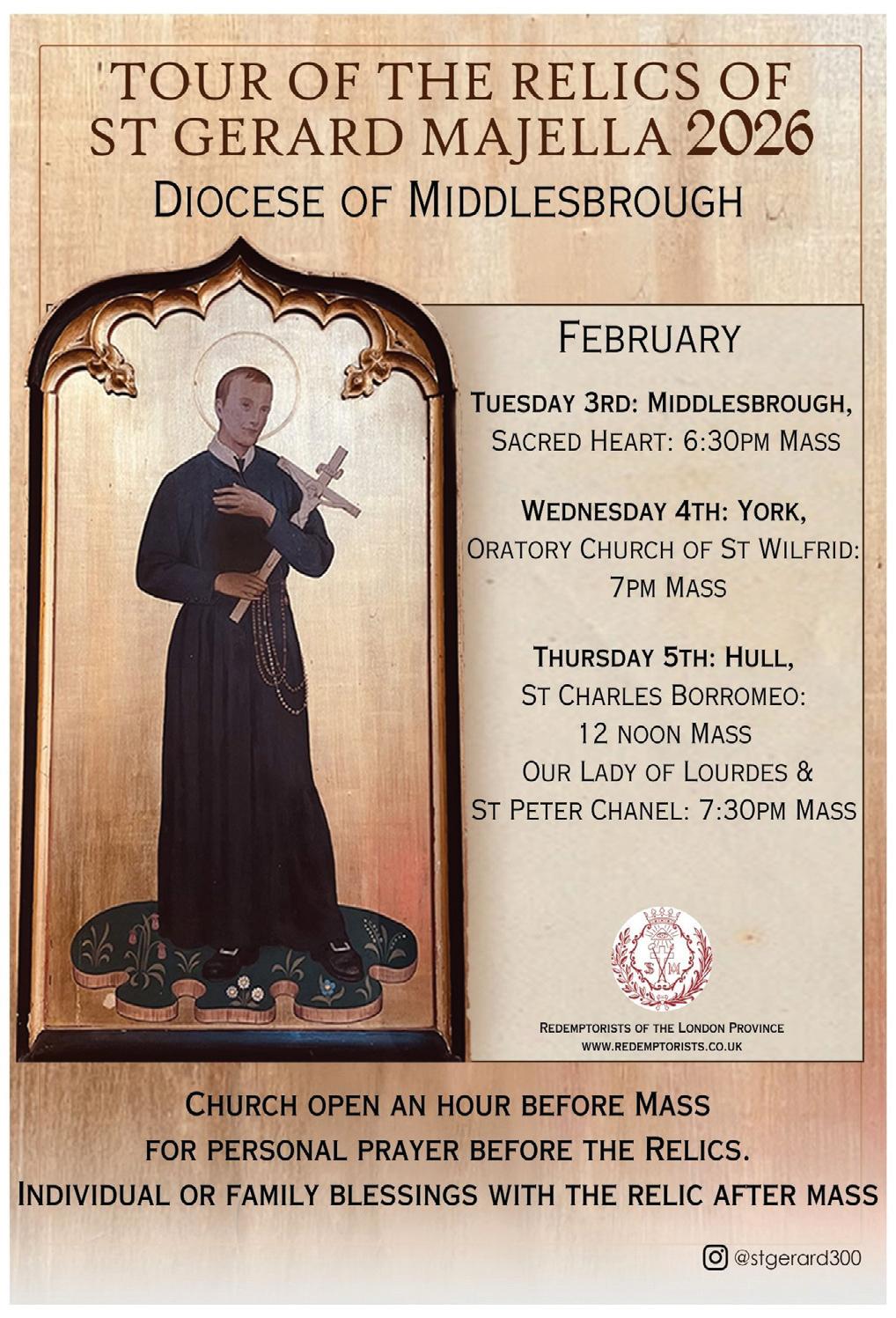
The relics of St Gerard Majella will visit four churches in the diocese this month as part of celebrations to mark the 300th anniversary of the saint’s birth.
The churches are Sacred Heart, Middlesbrough, the Oratory Church of St Wilfrid in York and St Charles Borromeo and Our Lady of Lourdes & St Peter Chanel churches in Hull.
All will open for an hour before Mass is celebrated so people can pray before the relics, and the Sacrament of Reconciliation will also be available.
Individual and family blessings will be given with the relic after Mass.
Gerard Majella was born in the town of Muro Lucano in southern Italy in April 1726. He came from a poor family and
had to work from the age of 12, when his father died.
Inspired by a Redemptorist parish mission, he joined the order as a lay brother when he was 23.
Brother Gerard worked as a tailor, cook, sacristan, gardener and carpenter in Redemptorist monasteries, maintaining a disciplined prayer life.
He always had a heart for those in need, giving generously to those who came begging at the monastery door and often visiting people to provide material and spiritual care.
He became particularly associated with children especially the unborn, couples hoping to have children and expectant mothers, thanks to several miracles.
He died of tuberculosis at the age of just 29 and was immediately hailed as a saint by the ordinary people and was beatified in 1893 and canonised in 1904.
Father Royston Price, a Redemptorist priest based in the order’s Clapham monastery, is hoping to take the relics to churches in every diocese in England and Wales as part of the anniversary celebrations.
Vicar General Monsignor Gerard Robinson, who was named after the saint, will celebrate the Mass at the Sacred Heart, Middlesbrough.
Looking for a fun, faith-filled way to start your Sunday? Bede’s Brunch might be just what you’ve been hoping for!
Here’s how this monthly gathering is helping children and families connect with the parish and with one another.
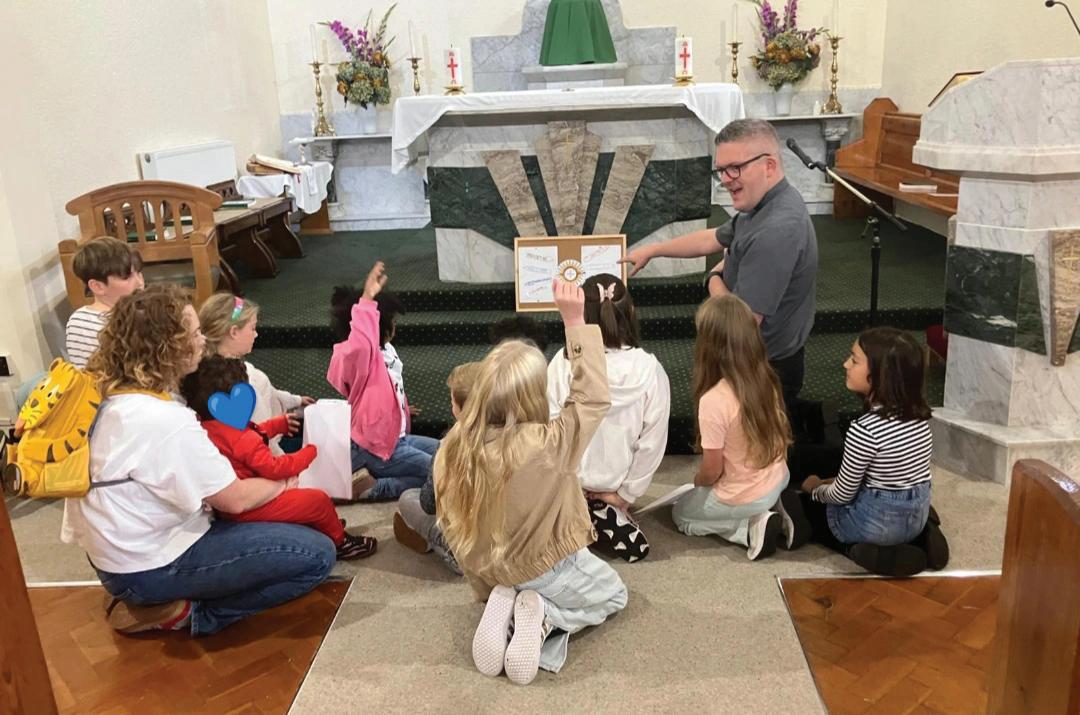
Bede’s Brunch began in September 2024 as a fruit of the Divine Renovation conference held earlier that year in Harrogate. The sessions take place before our 11.30am Mass once a month and aim to provide a bridge between our school community, families preparing for baptism, and those who may be curious about exploring their faith further. Each session is relaxed, friendly, and fun, and includes time for breakfast (bacon sandwiches, pastries, cereal, tea, coffee, juice, etc) before we begin a short children’sliturgy-style time of prayer. This includes
exploring the Word of God and, occasionally, a time of adoration of the Blessed Sacrament.
We then usually do a craft activity or a game relating to the Gospel, the liturgical season, or the week’s theme before closing with intercessory prayer and a blessing — not forgetting the important task of deciding who gets to take “Bede’s Bear” home until the next session!
We’ve found that having a time set aside specifically for our younger families has been extremely fruitful. Bede’s Brunch provides a natural opportunity for parents to share their faith and all that unites them, while offering a fun and welcoming environment for the children to engage with the Gospel.
Deacon Tom Rolfe Blessed Nicholas Postgate Parish
The Feast Day of Our Lady of Lourdes, on February 11, is a most special day for many of the dioceses in the United Kingdom. At Lourdes, people who are sick or who have disabilities are the centre of attention. It is a place where the dignity and the sanctity of the human person has place. It is a beautiful and life-changing message, which people imbibe there and take home and try to live
out in their respective homes. But there is another, more hidden, message from Lourdes seen in the title of Mary.
At Lourdes, Mary announced to Bernadette that she was the Immaculate Conception. This sounds like a name rather than a title. She said, “I am the Immaculate Conception.” This is who I am. She was the one free from all sin from the moment of conception.
A significant dimension of this announcement for our modern world is that Mary is saying her life began at conception. At that moment in human existence, which we moderns take so lightly and are so ready to abandon and abort, she was in the womb of her mother, full of grace.
I think that this is a plea for the sanctity of life at all stages of its existence. But we see this message about the sanctity of human life earlier than this.
When Mary appeared to Juan Diego in Mexico in 1531, she appeared as a young pregnant woman who overshadowed the sun. It was the Aztec practice to sacrifice young people, young girls, to the Aztec Sun god.
When Mary appeared as a young pregnant woman blocking out the sun, the Aztec people understood that she was greater than their sun and that the one she carried was greater than the sun. It was also a sign of the sacredness of human life. It was not to be sacrificed, for anything.
By all accounts this was taken seriously by the Aztec people and their human sacrifices ceased. At that time, it was sacrifice for a sun god. Today, we sacrifice our children, our babies in the womb, our seriously ill, for the gods of materialism, comfort and convenience.
The message of the sanctity, dignity and vitality of the child in the womb was not first announced at Lourdes or Guadalupe.
We see it in the Gospel of Luke when Mary goes to visit her cousin Elizabeth. Both women are with child. Elizabeth is six months pregnant and Mary has not been with child for very long.
Yet when she meets Elizabeth, the baby in her cousin’s womb
responds energetically to Mary’s voice, and Elizabeth knows immediately that Mary is with child. Life speaks to Life.
As we contemplate Our Lady at Lourdes, at Guadalupe, in the gospels and indeed in other moments, may we hear God’s cry in all these occasions. It is a cry for us to let go of idols and false gods, to turn to the true God who desires life for all of his children, not least the most vulnerable.
I have been volunteering with the SVP for just over a year now and it has been an amazing and very rewarding experience.
The highlight is undoubtedly the Peat Rigg Camp every August, when we take around 15 to 20 children from the diocese to a remote activity centre in the moors.
This year I was the deputy leader – so no pressure! – and once again had an amazing time. I improved many much-needed skills, such as organisation, while having a lot of fun taking part in activities including archery, canoeing and even abseiling, all while being able to work with children.
While it’s not always simple, there’s nothing quite like learning new dinosaur facts every evening with a small group of enthusiastic boys!
I always have a brilliant time and it’s lovely making long-lasting friendships with the other helpers. I am forever grateful that I first got the opportunity to go and I’m already looking forward to the one next summer. It was because of my first Peat Rigg camp that, after starting my first year at university down in London, I took the chance to volunteer with the SVP 30 group in Brixton. A few Saturdays a month I help out with the
Barbara Hungin will look for signs of hope ten years after Pope Francis’ letter “to all the peoples on the planet”, Laudato Si’, when she speaks at Cleveland Newman Circle. The talk is at St Mary’s Cathedral at 7.45pm on Wednesday February 25, with refreshments served beforehand. All are welcome.
art and cooking sessions for children, though my personal favourite was the sewing bee with adults on Wednesdays, when the group spent the course of several weeks decorating their own pillowcases.
Despite my very basic sewing skills, it’s always lovely chatting with women there and I can now say I am an expert at threading the needle in the sewing machine!
From bake sales to canoeing to sewing, I have really enjoyed my first year with the SVP and look forward to the future with them.
Cordelia, Yarm SVP
St Bede’s Pastoral Centre, Blossom Street, York, continues its spring programme throughout the month. Highlights include Sand Play and Prayer with Anne Harrison on Friday February 13 and Singing for the Soul with Mike Leigh on Tuesday February 17. There is also a series of Lenten talks. For more information visit stbedes.org.uk or to book a place contact Fiona Hill on 01904 464900 or fiona@stbedes.org.uk.
LUCA SETTIMO, Professor of Theology at the University of Nottingham, begins a new series of reflections on the hidden meaning of words found in Scripture.
I am grateful to the Diocese of Middlesbrough, within which I live, for enabling me to publish a series of reflections on biblical words found in Scripture. I also wish to acknowledge Cardinal Gianfranco Ravasi, former president of the Pontifical Council for Culture, for granting me permission to use his material originally published in Italian.
This month we begin our exploration of biblical words by examining the biblical notion of faith/faithfulness. In the Bible, this concept is expressed through two key terms: pístis in Greek (in the New Testament) and ’aman/èmet in Hebrew (in the Old Testament).
Faith is closely linked to grace, which is itself a manifestation of divine love. When human beings are enlightened and guided by divine grace, they can respond freely by adhering to God in faith.
Faith refers to a trust that rests upon the word and presence of a person. It involves belief in the revealed truths articulated by Scripture and deepened by Tradition, but it is also a personal and relational act: a subjective adherence to and trust in another person.
The Hebrew verb ’aman (from which èmet derives) expresses this idea of belief and is at the root of the word Amen used in Christian prayer and liturgy. Faith, therefore, is not merely intellectual assent but personal involvement.
Faith is not only an acceptance of doctrinal truths expressed in discursive terms; it is also a path of life. This is exemplified by the dramatic experience of Abraham as he ascends Mount Moriah in the episode of the binding of Isaac. In this moment, Abraham trusts and obeys God even when God’s word appears obscure and mysterious (Genesis 22:1-19; Hebrews 11:8).
Faith is also closely linked to reason, as discussed in the encyclical Fides et Ratio (Faith and Reason) by St John Paul II (1998). The Letter to the Hebrews states: “Faith is the assurance of things hoped for, the conviction of things not seen” (Hebrews 11:1). On the one hand, we trust because we have hope within us; on the other hand, we reason and search for a “proof” and a rational argument for what we believe. St Augustine insisted that faith without reflection and understanding risks becoming empty.
Faith is also inseparable from good works. Nevertheless, for St Paul, human works are not sufficient to obtain the transcendent gift of salvation, which is instead a divine gift and a participation in divine life. As he writes: “We know that a person is justified not by the works of the law but through faith in Jesus Christ. And we have come to believe in Christ Jesus, so that we might be justified by faith in Christ” (Galatians 2:16).
This does not diminish the importance of good deeds and good actions in Christian life; however, good works are not the causes but the fruits of salvation: “the fruit of the
Spirit is love, joy, peace, patience, kindness, generosity, faithfulness, gentleness and selfcontrol. There is no law against such things” (Galatians 5:22-23).
Therefore, for St Paul, faith is the decisive factor for salvation; without faith, religion is reduced to a social phenomenon, moralism, or a mere set of rituals.
The word Amen, so central to Christian prayer and liturgy, derives from the Hebrew roots ’aman/èmet that refer to faith. When we say amen, we express the idea of solidity and stability – being founded upon rock and, therefore, not swept away by the storm. This concept, well expressed by the Hebrew word èmet, can be translated as truth, fidelity, trust, faith, security or stability. This imagery is echoed in Matthew 7:24–27.
A French scholar, Georges Mounin, had titled one of his writings on the act of translating from one language to another with this motto: Les belles infidèles [the beautiful unfaithful]. In fact, the multiple nuances expressed through a language (especially when it belongs to a different culture, such as the Semitic one), cannot be compressed into a single word.
Thus, the risk of translation is that of “amputating” some meanings of the original term, to the point that the translated term might become somehow unfaithful to the original. In particular, èmet is related to hèsed (a Hebrew term that we will analyse in the future), which in turn means goodness, mercy and even faithfulness. Also hèsed describes the complexity of the bond that unites God and his people, expressed by ber”t (another Hebrew word which means covenant, commitment, pact). Ømet and hèsed can be considered the two sides of the same coin.
The psalmist in fact invokes the Lord with these words: “Your steadfast love [hèsed], O Lord, extends to the heavens, your faithfulness [èmet] to the clouds… Lead me in your truth [èmet/faithfulness], and teach me, for you are the God of my salvation; for you I wait all day long” (Psalms 36:5; 25:5).
In another Psalm, the two virtues hèsed and èmet run in parallel for the history of
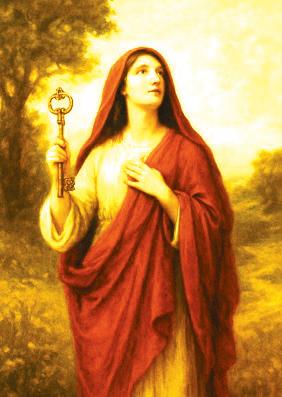
salvation: “Steadfast love [hèsed] and faithfulness [èmet] will meet; righteousness and peace will kiss each other” (Psalm 85:10).
Unlike the Greek concept of “truth”, which referred to the unveiling of what is hidden in various realities (alètheia), for the Bible truth is believing in what God reveals to us; it is within this framework that the faithful can rely on God with trust.
The most evocative image to understand our Amen and the word èmet is once again used by a psalmist in a poetic verse: “I have calmed and quieted my soul, like a weaned child with its mother; my soul is like the weaned child that is with me” (Psalm 131:2).
A YouTube video entitled “The Biblical Notion of Faith/Faithfulness,” which explores the biblical notion of faith and faithfulness in greater detail, is available on my YouTube channel at youtube.com/@LucaSettimo-7 – the video also explains how to pronounce the Hebrew and Greek terms mentioned above.
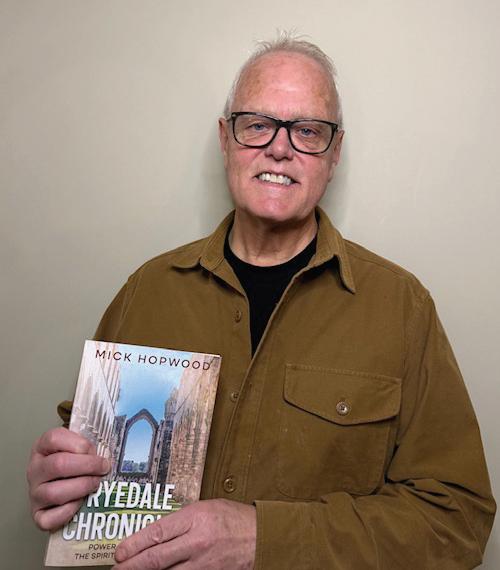
A new book written by a historian and retired police DCI shines new light on the story of religion and community in one of Yorkshire’s most historic regions.
Ryedale Chronicles, by Mick Hopwood, traces the evolution of faith in North Yorkshire across two millennia – from ancient Celtic and Roman influences to Viking incursions, the Norman conquest and the rise (and fall) of Yorkshire’s great monasteries.
“I wanted to uncover how faith in all its forms has guided, divided and ultimately sustained people here for centuries,” Mick said.
“The stones of Ryedale still speak if you know how to listen. Faith in Ryedale has always been more than doctrine – it’s been a living force shaping communities, inspiring resilience and sometimes fuelling rebellion.
“For countless generations of Yorkshire folk, belief has been a catalyst for both unity and change. I wanted to capture those moments where spirituality and society collide in ways that still echo today.
“Exploring Ryedale’s legacy wasn’t just about chronicling events; it was about understanding people’s everyday experiences – the struggles, hopes, and faith that sustained them through conquest, reform and revolution.
“This book is a tribute to those unsung voices and a reminder that history lives in the landscape and in our collective memory.”
Readers can journey through the foundation and dissolution of abbeys such as Rievaulx, Byland, Jervaulx and Fountains, through Reformation turmoil, and into the living traditions of modern
parish life.
Far from being a purely academic study, Ryedale Chronicles blends historical insight with vivid storytelling.
It invites readers to walk through a landscape where kings, saints, monks and villagers left their marks on the soil and the soul of Yorkshire’s northern heartland.
The author employs his extensive experience of detailed and complex investigations across his police career and after, bringing an eye for detail and a deep respect for truth to his exploration of the region’s spiritual heritage.
The book is available in ebook, paperback and hardback from thegreatbritishbookshop.co.uk and Amazon.
Pope Leo XIV donates three truckloads of humanitarian aid to regions of Ukraine most affected by bombing – a “small gesture”, according to papal almoner
Cardinal Konrad Krajewski, intended to support families that, like the Holy Family, “are travelling along the ‘via dolorosa’ of exile in search of refuge.” The lorries carried 100,000 food packets to make energy-rich soups. Cardinal Krajewski said Pope Leo “not only prays for peace but wants to be present in the families who are suffering”.
Despite the fragile US-brokered ceasefire, Gaza’s humanitarian crisis persists with widespread destruction, displacement and severe hunger. The truce brought a pause in fighting, but not in suffering. Families live in tents and improvised shelters, with the UN Development Programme warning of a critical need for safe, durable housing. The World Food Programme says most households cannot afford basic staples.
More than 500,000 people still face “emergency” levels of hunger and around 100,000 are classified as living in “catastrophe,” the highest level of alert.
The UN says Gaza needs potentially the largest post-war rebuilding effort since World War Two, with estimates placing the cost at more than $70bn.
St Mary’s Cathedral is celebrating four decades at the heart of the diocese’s Catholic community.
Since opening its doors in 1986 this remarkable building has stood as a beacon of faith and diocesan life.
To mark this milestone, a series of special celebrations is planned throughout 2026, inviting all to join in reflecting on the past and looking forward to the future.
Thursday February 26 – Night Falls by Riding Lights Theatre
The acclaimed Christian theatre company Riding Lights returns with Night Falls, a new passion play that offers a fresh, moving portrayal of the final days of Jesus. Renowned for their accessible and thought-provoking storytelling, the company promises an evening of profound reflection.
Friday May 15 – Concelebrated Episcopal Mass
An evening Mass uniting clergy and parishioners from across the Diocese of Middlesbrough will serve as a heartfelt thanksgiving for 40 years of worship and community at the cathedral, while looking ahead to the next chapter in its history.
Thursday October 15 – The Sixteen Live in Concert
As part of their prestigious annual Choral Pilgrimage, the internationally celebrated choir The Sixteen, led by Harry Christophers, will perform within the cathedral’s resonant acoustics. Known for their precision and historically informed style, their performance promises to be a musical highlight of the year.
Friday November 6 – Gary Stewart’s Graceland
Celebrating the 40th anniversary of Paul Simon’s iconic album, Gary Stewart and his band will deliver a dynamic full-album performance. Expect energetic vocals, tight rhythms, and the vibrant spirit that has made this show a favourite on UK stages.
Saturday December 12 – Christmas at the Cathedral featuring Cantabile
Closing the jubilee celebrations with seasonal joy, the esteemed local choir Cantabile will present a festive concert brimming with hope and renewal, perfectly marking the transition into the new liturgical year.
middlesbroughrccathedral.org ticketsource.co.uk/middlesbroughcathedral
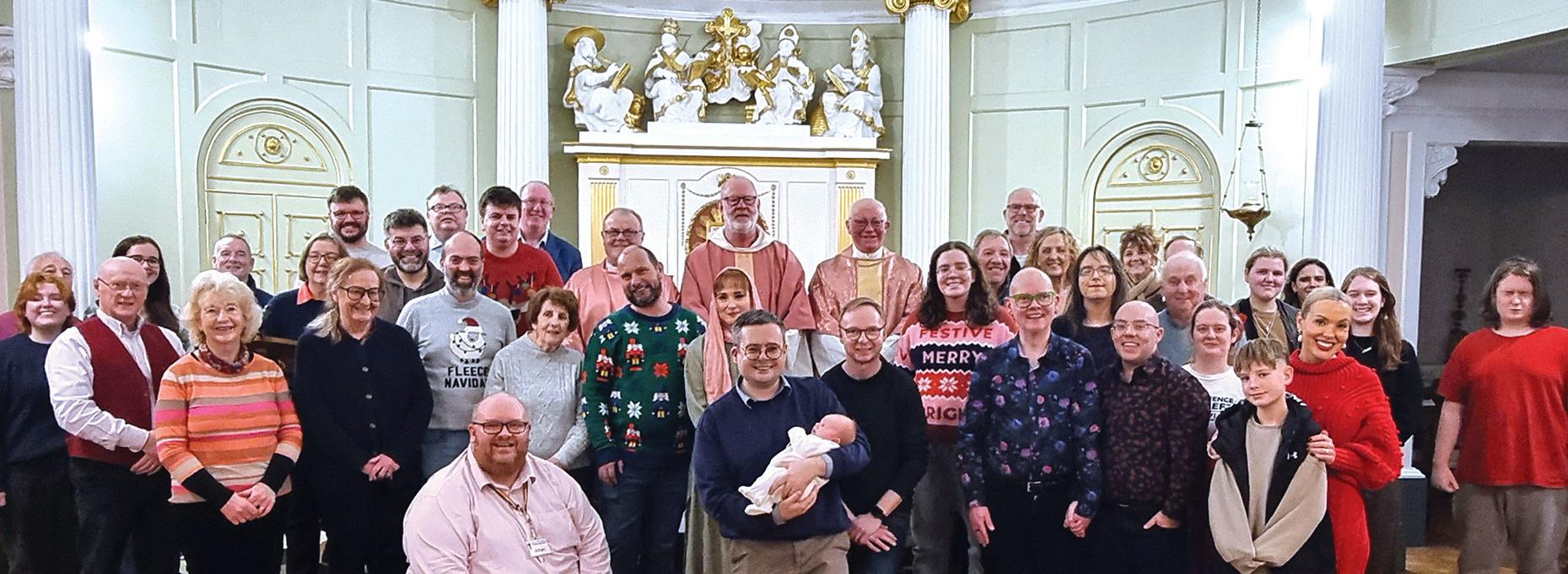
Father Tony said: “When the ministry first began in Advent 2017, nobody knew if there was a need or indeed any interest.
“That the ministry continues to flourish is in no small way due to the steady support given by Bishop Terry and the commitment of many individuals who make it possible. From the very beginning, the Congregation of Jesus Sisters at the Bar
Convent have shared the hospitality of their home and chapel, and the music group from Our Lady’s Church in Acomb have given their service to enrich the Liturgy.
“To quote Pope Francis: All are welcome – todos, todos, todos!”
This Lent, as we deepen and enliven our faith, we can reflect on Jesus’ call to “love your neighbour as yourself”
(Mark 12:31) and pray that we can give more help to families facing hunger today because of floods and droughts.
CAFOD director Christine Allen says: “Last year I travelled to South Sudan. I would like to tell you about one person our local experts have been working with there, a young mother named Rejoice.
“Rejoice fled conflict twice to protect her children. Imagine losing everything and starting from scratch, only to be forced to do it all again. Then, after all she’d been through, Rejoice’s new home was hit by severe flooding.
“The farmlands were submerged. Everything, including livestock, was completely destroyed.”
With support from our local experts, Rejoice and her community created floating gardens. These are simple beds that rise above floodwaters, so remarkably, they can grow food even when the land is underwater.
Whether there is too much rain or too little, crops around the world are being destroyed.
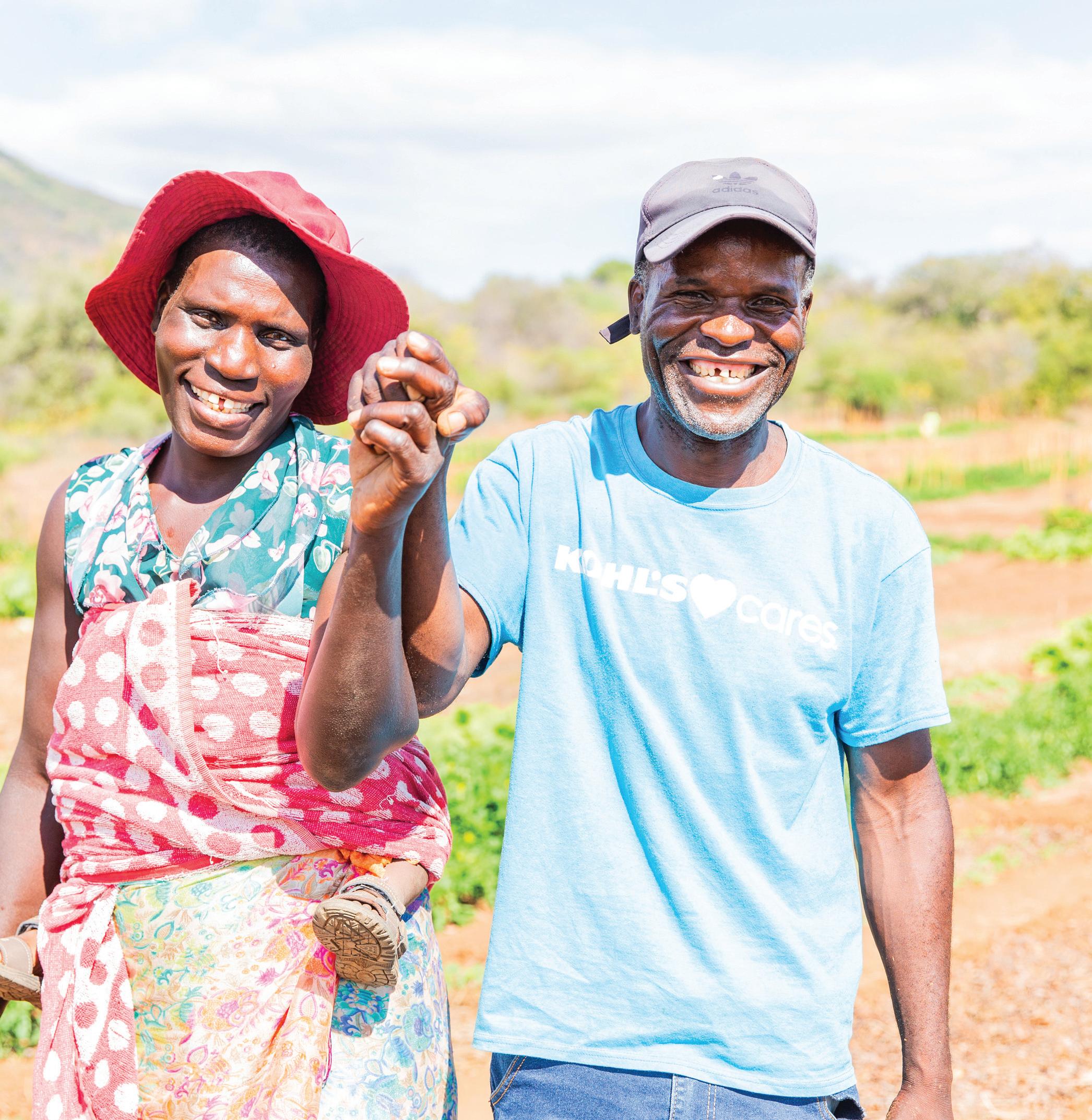
In Zimbabwe, drought left Shorai and Hamunyare with nothing. They told us how the solar-powered water pump, funded by donations from people like you, allowed their community to grow a thriving, drought-resistant ecogarden.
Now they can feed their family yearround and share food with neighbours.
Shorai said: “A good neighbour is someone who can help me in periods of need.”
By fasting and giving this Lent, you’ll be a good neighbour helping families find ways to grow enough food to eat. Donate online at cafod.org.uk or call 0303 303 3030 to help parents put food on the table today.
Rachel
Blaylock Community Participation Coordinator

Copy and photographs for inclusion in the Catholic Voice should be sent to: The Editor, Middlesbrough Diocesan Catholic Voice, Curial Offices, 50a The Avenue, Linthorpe, Middlesbrough, TS5 6QT. Tel (01642) 850505, email catholicvoice@rcdmidd.org.uk
Deadline Friday February 6 for March edition.
Where possible please send articles in Word and photographs as jpegs. Please confirm when you send in your photographs that those who appear in them have given their permission for publication.
1 Sunday 11am to 3pm Snowdrop open weekend at Tudor Croft Gardens, Stokesley Road, Guisborough. Admission £10 for adults, children free.
2 Monday
9.45am-10.25am Beverley Christian Meditation Group meets online. Further information from christianmeditation.beverley@gmail.com. This takes place every Monday.
7pm Catholic charismatic prayer group meets on first Monday each month at St Bede’s Pastoral Centre, Blossom Street, York. For more information, contact Sharon on cdscsmiddlesbrough@gmail.com or 07932 420809.
3 Tuesday
10am Coffee at the Cathedral. Tea, coffee and treats every Tuesday after 9.30am Mass. A warm welcome and friendly atmosphere. Make new friends and enjoy some fellowship. Those who are alone especially welcome. 10am Christian Meditation Group meets online. Further information from Terry Doyle terry-doyle@live.co.uk. This takes place every Tuesday.
7pm Knights of St Columba Council 29 meets at St Mary’s Cathedral, beginning with Mass at 7pm in the cathedral chapel.
4 Wednesday
5.30pm Sung Evening Prayer and Benediction at St Mary’s Cathedral. Join us every Wednesday for a time of prayer and quiet reflection before the Blessed Sacrament (term-time only).
6 Friday
Events, articles and photographs for the next edition of the Voice are due by this day.
7 Saturday
11am to 3pm Snowdrop open weekend at Tudor Croft Gardens, Stokesley Road, Guisborough. Admission £10 for adults, children free.
11am Catholic women are invited to share an hour of feminine communion including meditation, via Zoom. Text Barbara on 07796 117704 with your mobile number and email address so she can add you to the WhatsApp group, or email catholicwomenmdl@ gmail.com for Zoom link.
6pm Mass in Italian in the Father Kelly Room, Our Lady, Acomb, York. Followed by refreshments. All welcome.
8 Sunday
11am to 3pm Snowdrop open weekend at Tudor Croft Gardens, Stokesley Road, Guisborough. Admission £10 for adults, children free.
3pm Mass for LGBT+ community, family and friends at the Chapel of the Bar Convent. Doors open 2.30pm.
10 Tuesday
12.45pm Catholic Women's Luncheon Club meets every second Tuesday of the month at the Kingston Theatre Hotel, Kingston Square, Hull. Gather at 12.45pm, lunch at 1pm. All ladies in the Hull and East Riding area welcome. Call 01482 446565 or email jayne.wilson24@ymail.com
11 Wednesday
7pm Hull Circle of the Catenian Association holds its monthly meeting at Lazaat Hotel, Cottingham, followed by Mass for Vocations and a buffet-style meal. Email Charles Cseh at hullcirclesecretary@gmail.com
12 Thursday
7.45pm Middlesbrough Catenians meet at Middlesbrough Cricket Club, Green Lane, TS5 7SL. Contact Peter Carey on 01642 317772 or Chris Rhodes on 01642 319161.

13 Friday
9.30am to 3.30pm Sand Play and Prayer with Anne Harrison at St Bede’s Pastoral Centre, Blossom Street, York. Booking essential, cost £25. For more information visit stbedes.org.uk or to book a place contact Fiona Hill on 01904 464900 or fiona@stbedes.org.uk
15 Sunday
3pm Catholic Fellowship Mass with Canon John Loughlin at St Andrew’s, Teesville.
17 Tuesday
Singing for the Soul with Mike Leigh at St Bede’s Pastoral Centre, Blossom Street, York. For more information visit stbedes.org.uk or to book a place contact Fiona Hill on 01904 464900 or fiona@stbedes.org.uk
21 Saturday
Irish dance with Peter Mylett at the Erimus Club, Cumberland Road, Middlesbrough TS5 6JB. Contact John Brown on 07871 958412.
25 Wednesday
7.30pm for 7.45pm Barbara Hungin talks to Cleveland Newman Circle about signs of hope 10 years on from Laudato Si’ at St Mary’s Cathedral Hall.
26 Thursday
7.30pm Night Falls, a passion play performed by Riding Lights Theatre Company at St Mary’s Cathedral. Cathedral Box Office 01642 597750 or ticketsource.co.uk/ middlesbroughcathedral.
28 Saturday
Noon LGBT+ social gathering at the Bar Convent, York. All welcome. If you have any events you would like to include in Out and About, email heidi.cummins@rcdmidd.org.uk.

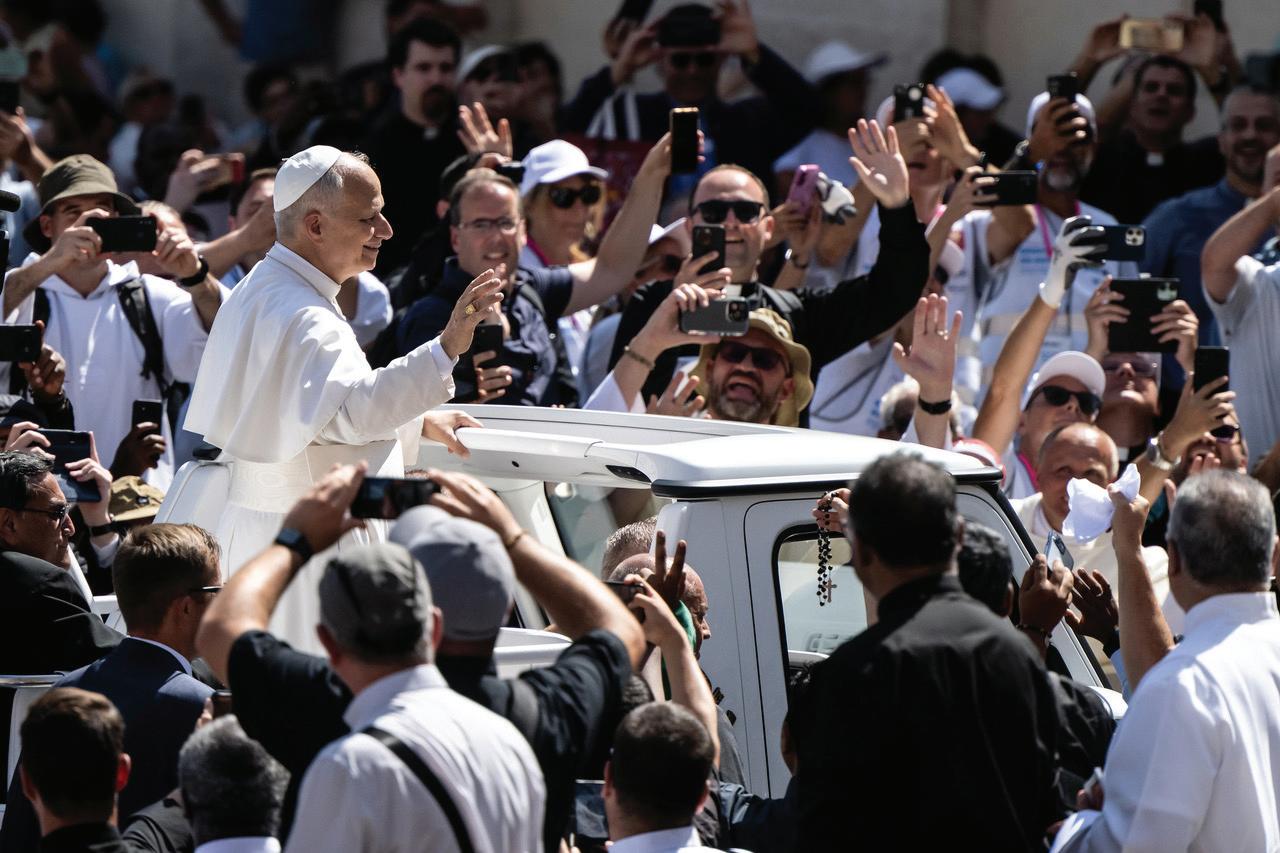
Pope Leo XIV begins a new catechesis series on the Second Vatican Council and its documents, emphasising that its teaching still serves as the guiding star of the Church’s journey.
“It is the Magisterium [of the Second Vatican Council] that still constitutes the guiding star of the Church’s journey today,” he said.
The new catechesis series is dedicated to Vatican Council II and a rereading of its documents, following the Jubilee Year's focus on the mysteries of the life of Jesus.
The Pope called this “a valuable opportunity to rediscover the beauty and the importance of this ecclesial event”, pointing to Pope St John Paul II's words at the end of the Jubilee 2000 when he said, “I feel more than ever in duty bound to point to the Council as the great grace bestowed on the Church in the twentieth century.”
Pope Leo remembered that, in 2025, along with the anniversary of the Council of Nicaea, the Church recalled the 60th anniversary of Vatican II.
He said that while the time that separates us from this event is not so long, it is true that the generation of bishops and theologians of Vatican II is no longer with us.
“Therefore, while we hear the call not to let its prophecy fade, and to continue to seek ways and means to implement its insights, it will be important to get to know it again closely, and to do so not through ‘hearsay’ or interpretations that have been given, but by rereading its documents and reflecting on their content.”
He quoted Pope Benedict XVI's words in 2005 that “as the years have passed, the conciliar documents have lost none of their timeliness; indeed, their teachings are proving particularly relevant to the new situation of
SHAWN RAS, a Dutch-born historian and parishioner of Our Lady of Lourdes and St Peter Chanel in Hull, continues his series of articles about Church history with a look at Pope Stephen VI and the infamous ‘Cadaver Synod’…
Pope Stephen VI, who was pope from 896 to 897, used to be known as Stephen VII. The history behind this is rather strange. When Pope Zachary died in 752, a cardinal named Stephen, who had been the priest of San Crisogono in Rome, was elected to the papacy. After Pope Zachary’s death in 752, a cardinal priest was unanimously elected to the chair as Pope Stephen II. After moving into the Lateran Palace on March 22, Stephen started to feel ill. On March 25, he suffered a stroke and he was dead by the following morning.
At that time, canon law acknowledged papal reign starting from consecration, which had not yet happened. But under later changes in canon law, papal reigns were counted from their election.
In 1961, Stephen II was removed from the papal directory Annuario Pontificio and has since been listed as “Pope-elect” Stephen and no longer counted as Stephen II.
The man who would be Pope Stephen VI was ordained by a predecessor called Pope Formosus (891-896). Formosus had become pope at a difficult time, having first been an emissary to the Bulgarians, and then being asked to mediate in affairs of the Eastern Church. Finally, and famously, Formosus had sided with Arnulf, the Duke of Carinthia (part of modern Austria and Slovenia), against the
the Church and the current globalised society.”
Pope Leo recalled that when Pope St John XXIII opened the council on October 11 1962, he spoke of it as the dawn of a day of light for the whole Church, adding: “The work of the numerous fathers convened from the Churches of all continents did indeed pave the way for a new ecclesial season.
“After a rich biblical, theological, and liturgical reflection spanning the 20th century, Vatican II rediscovered the face of God as the Father who, in Christ, calls us to be his children.
“It looked at the Church in the light of Christ, light of nations, as a mystery of communion and sacrament of unity between God and his people.
“It initiated important liturgical reform, placing at its centre the mystery of salvation and the active and conscious participation of the entire People of God.”
At the same time, the Pope reflected: “It helped us to open up to the world and to embrace the changes and challenges of the modern age in dialogue and coresponsibility" as a Church that “wishes to open her arms to humanity, to echo the hopes and anxieties of peoples, and to collaborate in building a more just and fraternal society.”
Thanks to the Second Vatican Council, Pope Leo underscored, quoting Pope St Paul VI's encyclical Ecclesiam suam, the Church “has something to say, a message to give, a communication to make,” striving to seek the truth by way of ecumenism, interreligious dialogue, and dialogue with people of goodwill.
“This spirit, this inner disposition, must characterise our spiritual life and the pastoral action of the Church, because we have yet to
achieve ecclesial reform more fully in a ministerial sense, and, in the face of today’s challenges, we are called to continue to be vigilant interpreters of the signs of the times, joyful proclaimers of the Gospel, courageous witnesses of justice and peace.”
He recalled then-Bishop Albino Luciani, the future Pope John Paul I, who wrote a note at the beginning of the council.
“As always,” wrote Bishop Luciani, “there is a need to achieve not so much organisations or methods or structures, but a deeper and more widespread holiness.”
Pope Leo noted that Pope Francis would later say the council helped the Church “restore primacy to God, to what is essential: to a
Church madly in love with its Lord and with all the men and women whom he loves.”
Finally, Pope Leo XIV concluded with an invitation to engage in a fresh reading of the Second Vatican Council's documents.
“As we approach the documents of Vatican II and rediscover their prophetic and contemporary relevance, we welcome the rich tradition of the life of the Church, and, at the same time, we question ourselves about the present and renew our joy in running towards the world to bring it the Gospel of the kingdom of God, a kingdom of love, justice, and peace.”
Source: Vatican News
ruling Holy Roman Emperor Guy III. Guy, the Duke of Spoleto in Italy, had deposed Charles the Fat as Emperor and forced Formosus to crown his son Lambert as co-emperor. As a result, it is said Formosus conspired with Arnulf to wrest Italy away from the emperor’s control.
Arnulf usurped the imperial crown and was crowned by Formosus in 895. Formosus died the following year and was interred in Old St Peter’s Basilica.
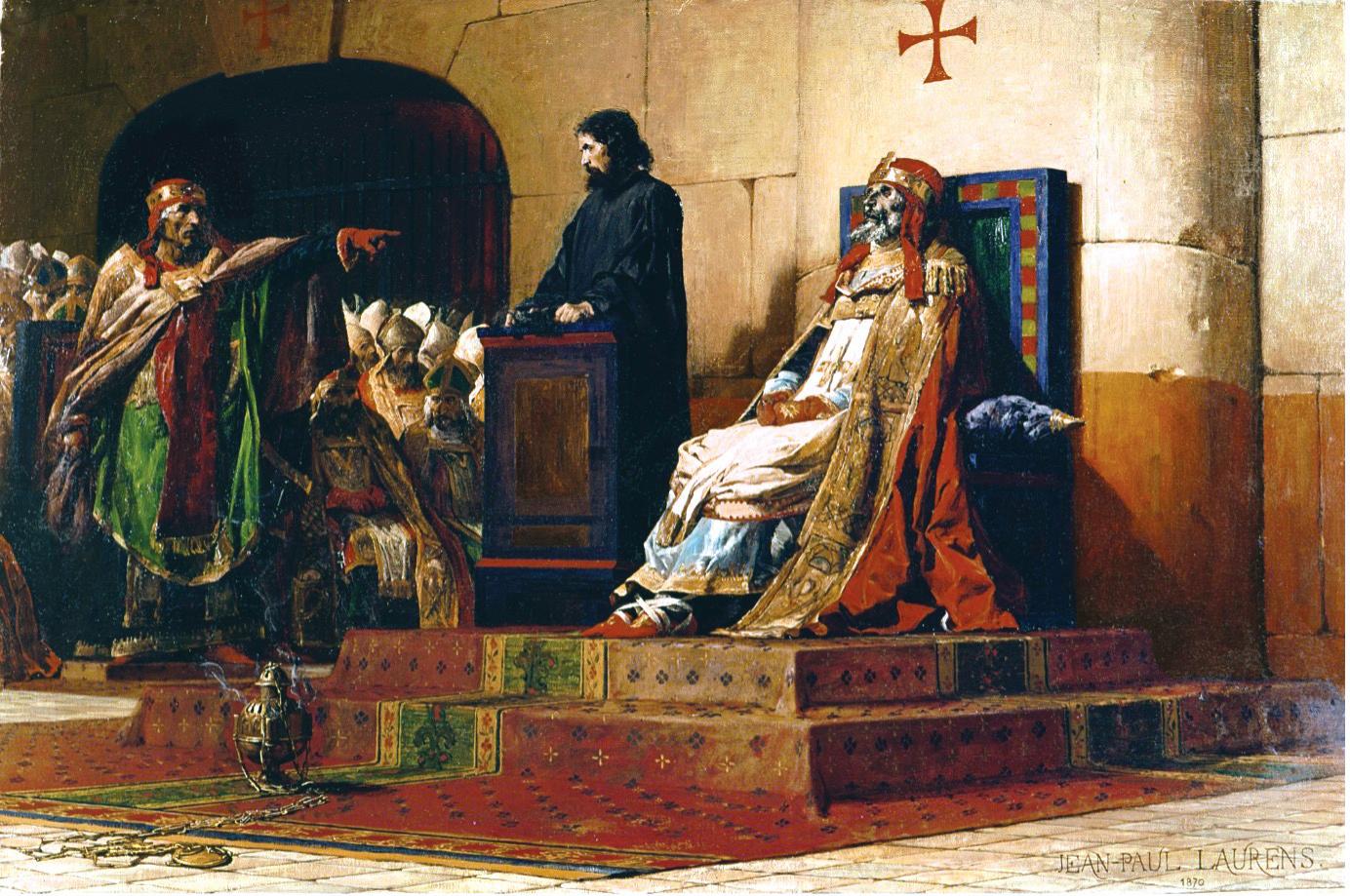
But the events of Formosus’ life are completely overshadowed by the events after his death. His successor, Boniface VI, had died of gout after only 15 days, although some scholars speculate he had been ousted by vengeful Spoletans. He was replaced by Stephen VI. It is uncertain who instigated the affair that followed, but it’s easy to think the Spoletans were still rather angry at having lost the imperial crown due to the actions of the late Pope Formosus. As a result, the tale goes that Stephen VI ordered an impromptu synod of the Roman clergy. In January 897, the priests, bishops and cardinals entered the papal court to a macabre display. There, seated on a throne, sat the lifeless corpse of the late Pope Formosus, dressed in papal vestments. A presumably rather disturbed and nervous deacon stood next to the corpse and answered Pope Stephen’s angry questions on behalf of the corpse.
He said canon law had been violated; Formosus had perjured himself and usurped the papacy. Stephen VI declared the cadaver guilty, stripped it of its vestments, and cut off three fingers of its right hand. The body
was then disposed of before being dug up again and tossed into the River Tiber. Suffice to say, the people of Rome were, as I imagine you are, incredibly disturbed by all of this. The whole affair hearkens back to the stories perpetuated by Pope St Symmachus (papacy 498-514) on behalf of Pope St Sylvester (papacy 314-335).
Symmachus’ work Constitutum Silvestri holds that no member of the clergy can be accused by anyone he outranks. Thus, only Stephen could accuse Formosus, and accuse he did. But the people of Rome would not suffer this disrespect of a dead pope gladly.
By August 897, having served little over a year in some of the papacy’s most tumultuous times, Stephen VI was deposed, imprisoned and died after being strangled. In the same year, Pope Theodore II (papacy 897), who himself only ruled for 20 days, had Pope Formosus’ body re-interred with full honours in Old St Peter’s Basilica. Theodore’s successor, John IX (papacy 898900) would convene two synods to nullify the now infamous “Cadaver Synod” held by Stephen VI. He excommunicated some of the clergy involved and outlawed forevermore a corpse being put on trial.
It is often a fruitful exercise for those of us who exercise any kind of ministry during Mass to revisit the General Instruction of the Roman Missal (GIRM).
This can be found at the front of every printed Missal as well as on the website of the Liturgy Office, with a link also available on the Music section of the diocesan website.
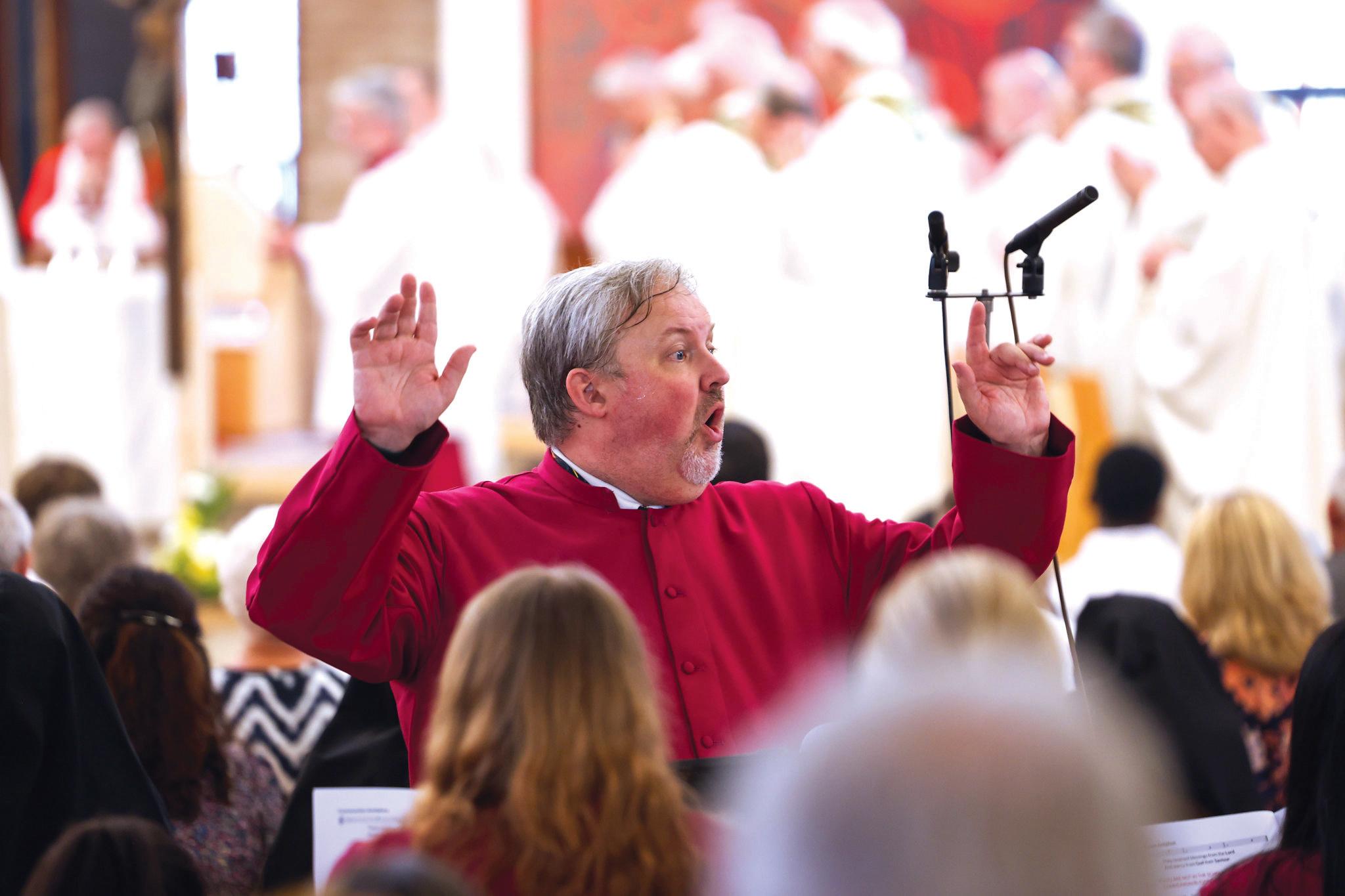
There are various sections of particular relevance to those involved in music ministry across our diocese; for example, paragraphs 39 -41, “On the importance of singing”.
As we approach Lent, however, parts of paragraph 313 become particularly relevant: “In Lent the playing of the organ and musical instruments is allowed only in order to support the singing. Exceptions, however, are Laetare Sunday (fourth Sunday of Lent), solemnities and feasts.”
This discipline means no instrumental music played before, during or after Mass, other than to support the singing, thereby differentiating the season from Ordinary Time, which precedes it, and the joy of Easter which is to come.
The most obvious consequence of this is a greater focus upon the role of silence in our worship.
We are used to the silences which form a natural part of the liturgy. For example, after the homily or after Holy Communion, and it is worth noting that the role and function of silence is mentioned several times in the GIRM.
The GIRM also notes that “even before the celebration itself, it is a praiseworthy practice for silence to be observed in the church, in the sacristy, in the vesting room and in adjacent areas, so that all may dispose themselves to carry out the sacred celebration in a devout and fitting manner”.
The temporary absence of music before or after Mass can focus all our minds upon the
wonder of the celebration to follow, as well as presenting an opportunity for us as musicians to focus upon the role of the music we normally play either side of Mass and, in particular, whether our music beforehand is enabling those in the building to prepare faithfully for Mass.
This Lent may be an opportunity to do just that.
Let us reflect upon this along with the words of St Teresa of Calcutta:
St John Paul II noted the relevance of this to us today: “In a society that lives at an increasingly frenetic pace, often deafened by noise and confused by the ephemeral, it is vital to rediscover the value of silence.”
“The fruit of silence is prayer. The fruit of prayer is faith. The fruit of faith is love. The fruit of love is service. The fruit of service is peace.”
Church ministers have called for prayers for peace after fatal clashes erupted when a fragile ceasefire broke down in northwest Syria.
At least seven people, mostly civilians, were killed and several others wounded in clashes between the government and Kurdish-led Syrian Democratic Forces in Aleppo.
Sister Annie Demerjian, of the Sisters of Jesus and Mary, told Catholic charity Aid to the Church in Need (ACN) that the “violence will not stop”.
She added: “There is no dialogue between the Kurds and the governments which makes them fight together, as they do not come to any agreement.
“We feel sad because the people are so tired after many, many years of war and conflicts and till now, the situation continues, which is unacceptable.
“We ask you to pray for the people in Syria, especially the people in Aleppo, those who are experiencing all kinds of fear, those who left their homes, and some who lost dear ones.”
According to Reuters, fighting with heavy machine gunfire and drone attacks resumed around two neighbourhoods, Sheikh Maqsoud and Ashrafiyah.
A fragile ceasefire took effect on December 23 2025 after clashes in both areas left civilians dead and wounded.
Father Alaniz, parish priest of Our Lady of the Assumption Melkite Church in Al-Jdeideh, Aleppo’s Christian quarter, added: “We are fine, we are still welcoming families and trying to get some food for the next few days.
“We do not know what will happen but we pray that everything calms down… so we also ask for your prayers.”
Civil war erupted in Syria in 2011. What started as protests against President Bashar Al-Assad’s government escalated into a complex multi-sided conflict involving government forces, Kurdish fighters and extremist organisations such as
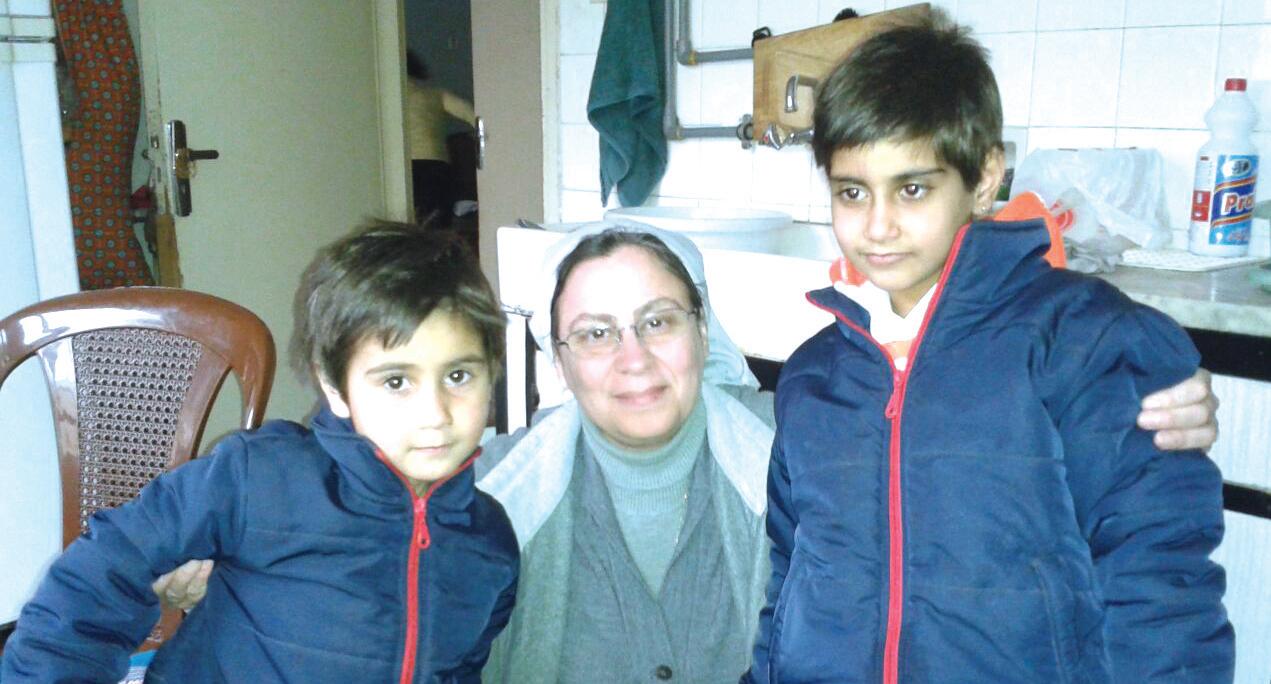
Syria-based Sister Annie Demerjian with displaced girls in Aleppo
Daesh (ISIS).
Father Alaniz said: “I ask for prayers that both parties may reach an agreement and that peace prevails over the country.
“We pray for the grace of a strong faith that is courageous in the face of trials and challenges.
“May we be able to imitate the simplicity and trust of the Holy Family, as we may enduring difficulties, that we may not lose our inner peace but embrace the opposite to grow in our faith by trusting in God’s paternal providence and presence.
“Please know that we entrust ourselves and our families to your prayers as we also pray for your intentions.”
Aid to the Church in Need’s project partners paid tribute to the support the charity has given to the country.
Sister Annie said to ACN benefactors: “Thank you because you’ve always been beside us, God bless you all.”
Nathalie Raffray
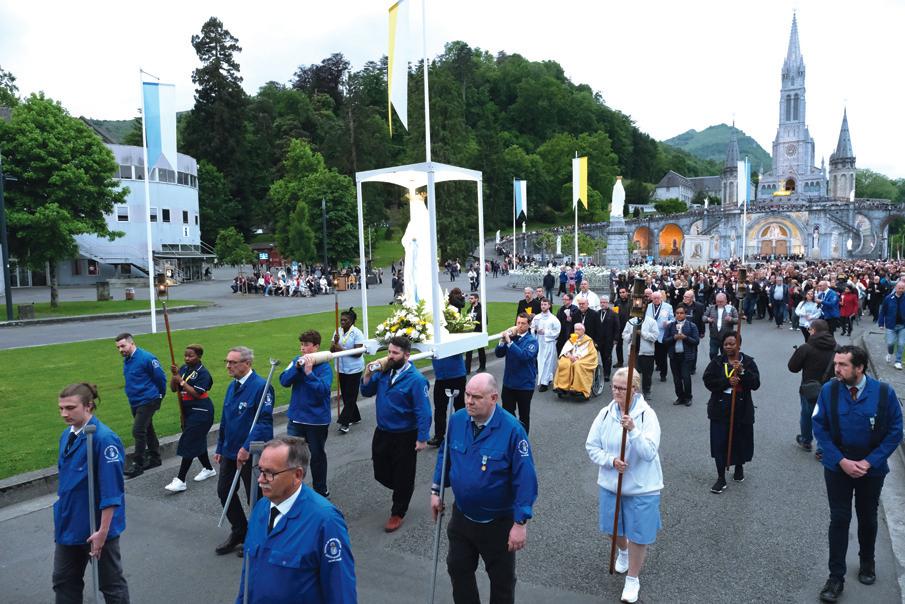
Bishop Marcus will join us in Lourdes for the first time when he leads our 73rd diocesan pilgrimage, which takes place from May 24 to 30.
The pilgrimage provides us with a unique opportunity to gather as a diocese with our bishop, to pray and journey together in faith. It is a time to stand apart from the rigours of life and seek the peace, healing and grace which a pilgrimage experience brings.
Pilgrims come from all parts of the diocese and beyond and in Lourdes we encounter pilgrims from all over the world.
Our supported pilgrims, those who may be elderly, frail or dependent, are supported by our own team of willing volunteers, including doctors, nurses, other allied health professionals and many others with different backgrounds and experiences.
All volunteers are self-funding and give up their own time to support those who are less able. They serve in a spirit inspired by love of God and love of neighbour.
Our schools make up a large part of our pilgrimage group, helping the supported pilgrims with wheelchair pushing, good company and friendship.
The pilgrimage meets all Catholic safeguarding requirements and fully implements the legislation, ensuring the well-being and safe care for all those in need.
A detailed religious programme has been organised by Joe Walsh Tours with the diocese, so pilgrims can enjoy a very special time at the sanctuary.
The pilgrimage includes direct return flights from Teesside Airport to Lourdes, airport transfers, six nights’ accommodation, full board and the services of Joe Walsh Tours guides and representatives throughout.
For more information call 0808 1890468, email info@joewalshtours.co.uk. or visit joewalshtours.co.uk/pilgrimages/group-diocesan-pilgrimages.
Supported pilgrims who would like to stay in the Accueil or hotels in Lourdes should get in touch with Lourdes secretary Pat Ling as soon as possible for an application form.
Pat can be contacted by email at lourdessecretary@rcdmidd.org.uk or by calling her on 01642 760105.
Insurance regulators now stipulate that all those who travel on pilgrimage with the diocese’s designated tour operator must have travel insurance in place.
Insurance can be booked from Joe Walsh Tours. If you choose another provider, you will be asked for your insurance reference number when you book, enabling us to activate your cover more easily if needed.
Saturday March 7: Hospitalité Formation Day, Trinity Catholic College, Middlesbrough
Tuesday May 5: Hospitalité Formation Evening, Trinity Catholic College, Middlesbrough
The Radio 4 programme Beyond Belief recently hosted a powerful discussion between Catholic theologian Carmody Grey, Rabbi Jonathan Wittenberg and Dr Shanon Shah, Muslim director of interfaith network Faith For The Climate.
The discussion focused on the overall global moral imperative of the encyclical Laudato Si’.
There was a consensus that Pope Francis had played a pivotal part in the Paris Agreement of 2015 and that the document had had a huge impact on the Jewish and Islamic communities and connected in a new way with all world religions and particularly with the Eastern Orthodox tradition.
Laudato Si’ provided a new synthesis of all the information that had been known before in what Pope Francis termed “integral ecology”, which blended several languages into a single narrative – encompassing science, theology, economics and justice into a single vision. It provided a global “moral ballast”.
The panellists referred to the recovery of
language of faith, encompassing everything.
The encyclical was indeed packed with science that was not in question but concentrated on the Book of Nature, with the revelation of all that is around us – its mystical and spiritual meaning, which challenges a mechanistic view of life.
Too many have a spiritually numbing lifestyle, shutting them off from both nature and the struggles of others.
One of the strongest messages of Laudato Si’ was for us to “pay attention”, in a similar way to the message of the Hebrew prophets. There was a call to hear, to listen and to tell the truth.
Assessing the last 10 years, there was a recognition of the failure of the necessary political leadership. There is a need to hold the different perspectives together as we go forward.
There is much to be hopeful for and much creative activity on a local level, such as annual bird counting, litter-picking, care of hedgehogs, replanting of hedgerows and
clearing of local waterways.
The programme ended with a powerful challenge for the future – to bring the different perspectives together, holding ourselves and our leadership to account. Not to let our imaginations be stifled and killed. Every action is worthwhile. Pope Leo is carrying the torch of integral ecology and in a recent speech called it “the path for the future”.
We must not be paralysed by the complex balance between personal and systemic action, as these must be complementary. We must do both.

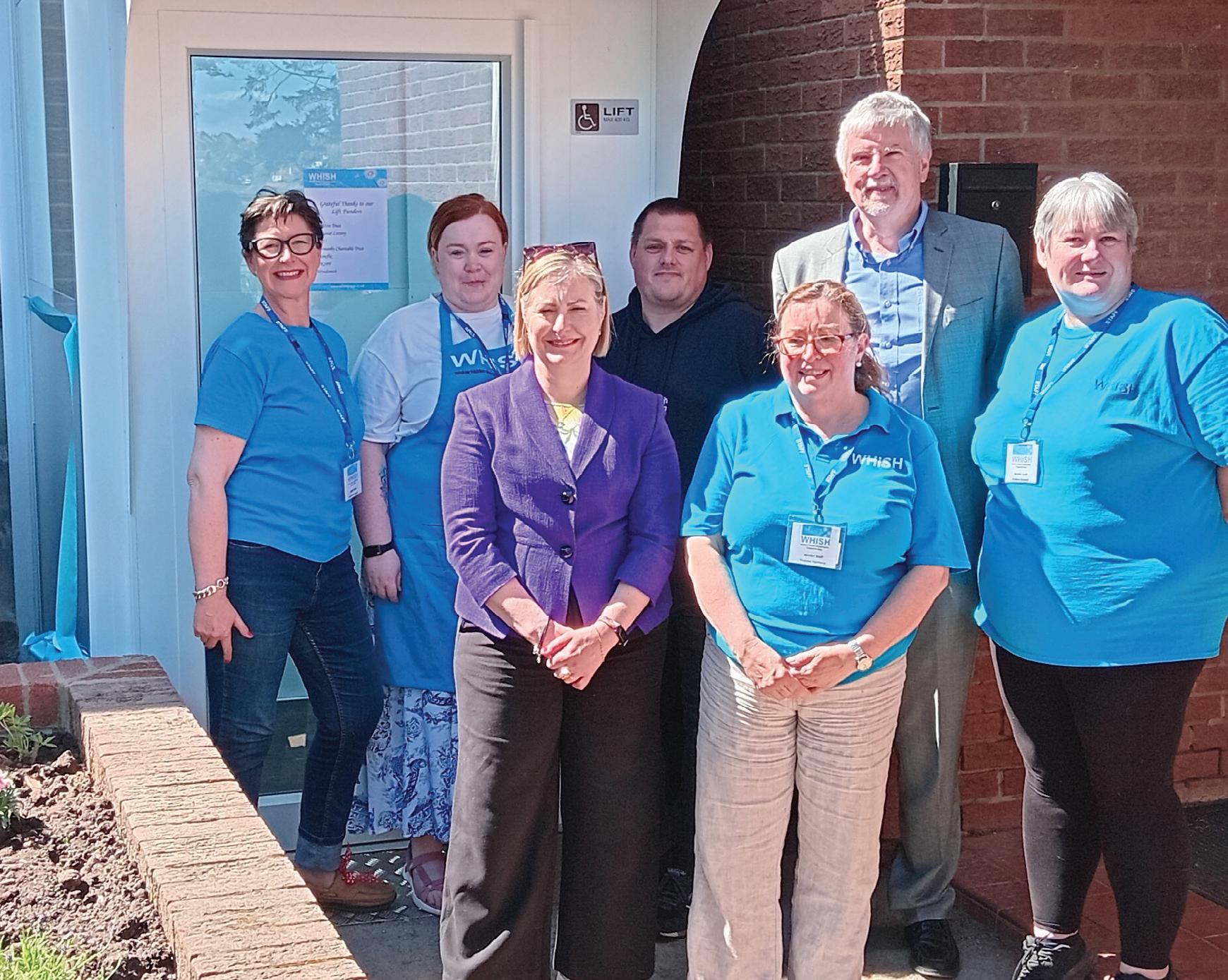
A parent-led charity that provides activities and support to more than 240 families in the Whitby and Esk Valley rural area has been awarded the King’s Award for Voluntary Service.
WHISH helps children and young people who have a disability, special educational need or hidden impairment. Siblings and parents also have access to services and facilities, including a sensory room.
Established as a voluntary group and completely self-funded, WHISH has been a registered charity since 2015. In 2023 the charity moved into St Hilda’s Hub in Whitby, which was previously St Hilda’s Roman Catholic Primary School and is owned by the Diocese of Middlesbrough.
WHISH was founded by volunteers and volunteers continue its work every day. Talking part in activities enhances the health and wellbeing of the young people and improves confidence and self-esteem, giving them the chance to access activities most children can take for granted, learning and having fun together.
This prestigious accolade recognises outstanding work by volunteer organisations that benefit their communities.
Chairman Steve Bremner said: “We are truly honoured to receive this award. It means a great deal to be recognised for helping young people and their families in our community.
“We share this with everyone who makes our charity what it is: our brilliant staff and volunteers, the parents who support us and our partners and funders who believe in what we do. We can’t wait to continue helping make a positive difference to young people with disabilities.
“This award is a celebration of community, compassion and commitment – and a tribute to everyone who helps WHISH make a lasting difference to children and young people in the Whitby and Esk Valley area.”
WHISH representatives will receive an award crystal and certificate from the Lord-Lieutenant of North Yorkshire.
The charity is currently completing an extensive £100,000-plus refurbishment programme, including installing an external lift and making all facilities wheelchair accessible.
To learn more about WHISH and how you can get involved, visit whishgroup.org.uk.