CEA March 26

Page 1


EastAnglia

Newspaper of the Diocese of East Anglia

Faith, power and legacy in Bury St Edmunds – page 3

Anointing of the Sick & Mass for Our Lady of Lourdes – page 6

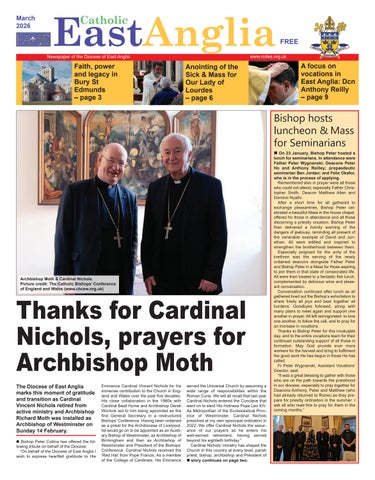
Archbishop Moth & Cardinal Nichols.

Picture credit: The Catholic Bishops’ Conference of England and Wales (www.cbcew.org.uk)

Thanks for Cardinal Nichols, prayers for Archbishop Moth

The Diocese of East Anglia marks this moment of gratitude and transition as Cardinal Vincent Nichols retired from active ministry and Archbishop Richard Moth was installed as Archbishop of Westminster on Sunday 14 February.

n Bishop Peter Collins has offered the following tribute on behalf of the Diocese:

“On behalf of the Diocese of East Anglia I wish to express heartfelt gratitude to His

Eminence Cardinal Vincent Nichols for his immense contribution to the Church in England and Wales over the past five decades. His close collaboration in the 1980s with Cardinal Basil Hume and Archbishop Derek Worlock led to him being appointed as the first General Secretary in a restructured Bishops’ Conference. Having been ordained as a priest for the Archdiocese of Liverpool, he would go on to be appointed as an Auxiliary Bishop of Westminster, as Archbishop of Birmingham and then as Archbishop of Westminster and President of the Bishops’ Conference. Cardinal Nichols received the ‘Red Hat’ from Pope Francis. As a member of the College of Cardinals, His Eminence

served the Universal Church by assuming a wide range of responsibilities within the Roman Curia. We will all recall that last year Cardinal Nichols entered the Conclave that went on to elect His Holiness Pope Leo XIV. As Metropolitan of the Ecclesiastical Province of Westminster, Cardinal Nichols preached at my own episcopal ordination in 2022. We offer Cardinal Nichols the assurance of our prayers as he enters his well-earned retirement, having served beyond his eightieth birthday.”

Cardinal Nichols’ ministry has shaped the Church in this country at every level, parish priest, bishop, archbishop and President of n story continues on page two.

A focus on vocations in East Anglia: Dcn Anthony Reilly – page 9

Bishop hosts luncheon & Mass for Seminarians

n On 23 January, Bishop Peter hosted a lunch for seminarians. In attendance were Father Peter Wygnanski; Deacons Peter Ho and Anthony Reilley; propaedeutic seminarian Ben Jordan; and Felix Okafor, who is in the process of applying.

Remembered also in prayer were all those who could not attend, especially Father Christopher Smith, Deacon Matthew Allen and Dominic Nyathi.

After a short time for all gathered to exchange pleasantries, Bishop Peter celebrated a beautiful Mass in the house chapel, offered for those in attendance and all those discerning a priestly vocation. Bishop Peter then delivered a homily warning of the dangers of jealousy, reminding all present of the venerable example of David and Jonathan. All were edified and inspired to strengthen the brotherhood between them. Especially poignant for the unity of the brethren was the serving of the newly ordained deacons alongside Father Peter and Bishop Peter in a Mass for those aspiring to join them in that state of consecrated life. All were then treated to a fantastic fish lunch, complemented by delicious wine and pleasant conversation.

Conversation continued after lunch as all gathered lived out the Bishop’s exhortation to share freely all joys and bear together all burdens. Goodbyes followed, along with many plans to meet again and support one another in prayer. All left reinvigorated: to love one another, to follow the call, and to pray for an increase in vocations.

Thanks to Bishop Peter for this invaluable day, and to the entire vocations team for their continued outstanding support of all those in formation. May God provide ever more workers for the harvest and bring to fulfilment the good work He has begun in those He has called.

Fr Peter Wygnanski, Assistant Vocations’ Director, said:

“It was a great blessing to gather with those who are on the path towards the priesthood in our diocese, especially to pray together for Deacons Anthony, Peter and Matthew (who had already returned to Rome) as they prepare for priestly ordination in the summer. I ask all who read this to pray for them in the coming months.”

Bishop Peter offers prayers for new Archbishop

n story continued from page one.

the Bishops’ Conference, marked by clarity and fidelity to the Gospel.

Those in East Anglia remember Archbishop Richard with particular affection, especially from Bishop Peter’s ordination in 2022 when he laid hands on him, a sign of shared mission and friendship. His ministry as Bishop of the Forces and Bishop of Arundel and Brighton, and his work with the Plater Trust, reflect a lived commitment to Catholic Social Teaching.

Bishop Peter adds:

“We extend our congratulations and the assurance of prayers to Archbishop Richard Moth as he assumes his new responsibilities as Archbishop of Westminster.”

The Diocese offers prayers for Cardinal Nichols in retirement and for Archbishop Moth as he begins this new ministry.

Catholic

EastAnglia

Newspaper of the Diocese of East Anglia

EDITOR: Charlie Bohan-Hurst

communications@rcdea.org.uk

Articles and photographs for the next edition are very welcome and should be sent to the editor, ideally via email, by Monday 9 March.

Diocese website: www.rcdea.org.uk

Advertising: Contact Nick at Cathcom on tel 01440 730399 or email him at ads@cathcom.org

Publisher: Cathcom Ltd, 0207 112 6710

Inclusion of adverts is the responsibility of Cathcom and does not imply endorsement by the Diocese of East Anglia.

A volunteer’s glimpse of hope in Bethlehem

At the beginning of October, Maria Grota, from St Peter and All Souls’ Parish, travelled to Palestine to spend three months volunteering at the Home of Peace orphanage in Bethlehem.

n The home is run by the Roman Catholic Sisters of St Elizabeth, whose charism is to care for children, following the example of St Elizabeth, mother of Our Lady. Situated in the West Bank, not far from the birthplace of Jesus, the orphanage provides a refuge for young people who have experienced loss, instability or hardship.

The Home of Peace currently supports forty-two Christian Arab children and young adults, aged between four and twenty-one. Fifteen of these are residents, while the rest attend daily for care and support. Most come from families facing profound difficulties such as bereavement, emotional trauma or the economic devastation caused by conflict. Some children are Palestinian or Israeli Arabs, while others have arrived in the past from countries such as Syria and Eritrea. The Sisters aim not only to keep the children safe but to help them grow in confidence, friendship and faith.

To support their mission, the Sisters employ Christian Arab care workers and teachers who assist with homework, provide pastoral care and help run daily activities. This enriches the children’s lives and also provides vital income for local families. The orphanage offers after-school clubs, outings and summer camps, simple experiences that many of the children may never have had. As Maria observed, ordinary joys become extraordinary gifts for these young people.

The work of the Sisters of St Elizabeth extends far beyond the orphanage walls. The decline of tourism since the Hamas attacks of 7 October 2023 has had a devastating impact on Bethlehem. The city relies heavily on pilgrimages and visitors, and its economy has collapsed. Shops, cafés and hotels that once thrived are now closed and boarded up, and many Christian families have emigrated in search of stability. Estimates suggest that since October 2023, around 260 Christian

families have left Bethlehem, reducing an already small community from eight per cent to around six per cent of the population. There are now said to be more Christians from Bethlehem living in Santiago, Chile, than in their own hometown.

In response to this deepening hardship, the Sisters support families who have lost their livelihoods or who can no longer cross into Jerusalem for work due to tightened security restrictions. They distribute food, clothing, educational supplies and other essentials, providing a quiet but vital lifeline. One message Maria frequently heard from Palestinian Christians was an appeal to the wider Church: “Come to the Holy Land and support us by visiting. Our livelihoods depend on you.”

population continues to decline.

The Sisters also continue to accompany the young people who leave the orphanage to pursue further education. Without access to student loans, these students face significant obstacles. The Sisters help by covering the cost of accommodation, books and laptops, and offer continuing spiritual guidance. Their efforts have already borne fruit. Several graduates have gone on to study subjects such as law and medicine, becoming witnesses to hope in a region greatly in need of it.

Maria was deeply moved by the strong Christian identity of the Arab community. While many in the UK may keep their faith private, the Christians she met, especially young men, declared it openly and proudly.

When asked their nationality, they often replied first, “I am Christian,” making faith the foundation of their identity. Yet this confidence exists against a challenging backdrop. Bethlehem, once a predominantly Christian town, is now largely Muslim, and the Christian

On her Sundays off, Maria travelled from Bethlehem into Jerusalem, passing through the tightly controlled Checkpoint 300. She was acutely aware that although she was permitted to cross the wall freely, none of the children or staff at the orphanage were allowed to do so, and Israeli citizens were equally unable to enter Bethlehem. These weekly journeys offered her a glimpse of another side of Christian life in the Holy Land.

In Jerusalem, Maria joined a vibrant international Catholic community at the Vatican Notre Dame Centre, where Mass was followed by social gatherings. Here she met workers from the Far East, students at the Pontifical Biblical Institute and Hebrew University, seminarians and embassy staff. Despite the conflict, this community continues to pray, study and support one another.

One Sunday she met an Israeli woman who had converted to Catholicism and who spoke of the need to practise her faith discreetly. She told Maria about a Sunday Mass celebrated in Hebrew for Israeli converts and invited her to experience it. That evening, Maria entered an unmarked building set back from the street, an intentionally inconspicuous church so as not to attract unwanted attention. Inside, a simple hall served as the worship space, its minimal decoration reflecting Jewish sensitivities regarding images.

The priest, an Italian fluent in Hebrew, wore vestments inspired by the Jewish tallit, a powerful reminder of the continuity between Christ and His people.

Maria found the Mass profoundly moving, especially during the consecration. “It felt,” she reflected, “as though I had come home, worshipping in our Lord’s Jerusalem with His countrymen and in their language.” Yet the parishioners shared a deep sorrow. Because of political restrictions, none of them were able to visit Bethlehem, the birthplace of the Saviour.

After three months, Maria left the Holy Land with great reluctance. She returned home carrying memories of sunlit hills, ancient stone buildings and the warm generosity of Israelis, Arabs and ex-pat Catholics alike. Above all, she remembers the children, their playfulness, resilience and exuberance. They are, she believes, the future of Christianity in Bethlehem, and the Sisters of St Elizabeth are ensuring that this future has hope.

Maria Grota outside the Garden of Gethsemane.
The orphanage in Bethlehem.
Archbishop Moth & Bishop Peter Collins at his ordination. Picture credit: www.cbcew.org.uk

Faith, power & legacy in Bury St Edmunds

The Diocese of East Anglia is marking its 50th anniversary with a Jubilee Year of celebrations, encouraging everyone to explore the places, history and growth that have shaped its Catholic life. John Saunders, a registered Bury St Edmunds tour guide, outlines the rich religious, political and cultural history of Bury St Edmunds and its Abbey.

n Around AD 630 Sigeberht ruled the AngloSaxon Kingdom of East Anglia. He invited Felix from Burgundy to establish an area of ecclesiastical jurisdiction at Dummoc (believed to be Walton near Felixstowe), leading to the conversion of the East Angles to Christianity.

The Christian and pacifist beliefs of Sigeberht led him to abdicate and create a small monastery in Beodricsworth (the Anglo-Saxon name of Bury St Edmunds). However, when Penda’s army attacked East Anglia, Sigeberht was persuaded to ‘cease retirement’ and lead his subjects into battle, armed only with a wand, and was killed. A Christian martyr, referred to in the Bury Psalter in the Vatican Library, his feast day is 29 October.

We move forward to AD 855. Edmund, at the age of 14, a devout Christian, was crowned King of East Anglia and became a wise and popular ruler. Around AD 869 his army fought the invading Danes near Thetford, but he retreated, not out of cowardice, but to save further bloodshed. He was hunted down by the Danes. Defying their demand to renounce his faith, he was tied to a tree, peppered with arrows and decapitated. Relying on the research of archaeologist Dr Stanley West in 1978, his martyrdom occurred at Bradfield St Clare, around five miles south of Beodricsworth.

On recovering his head from between the paws of a wolf, the first claimed miracle of St Edmund happened when it rejoined his body. He was initially buried nearby, but other claimed miracles occurred and within 30 years Edmund was proclaimed a saint and his body moved to Beodricsworth, a royal ville (town).

In 1020 King Canute decided to build a chapel within what we now know as the

Abbey grounds and it became a place of pilgrimage. Beodricsworth became St Edmundsbury, not because Edmund was buried there, but because the town was fortified (the word ‘burgh’ or ‘bury’ means a fortified place).

The Abbot of St Edmund’s Abbey held immense power because he was answerable to the Pope and outside the monarch’s control. Nevertheless, relationships between the Abbey and state were generally harmonious. In 1043 Edward the Confessor granted the Abbot 8½ hundreds of land, this being the land mass of West Suffolk known as the Liberty of St Edmund, adding to the Abbey’s wealth.

Building of the Abbey Church of St Edmund began in 1081, continuing over 200 years. It was the fourth largest abbey church in Europe, a place of pilgrimage and the home of 80 Benedictine monks (originally from Ely and Holme, Norfolk).

The Second Council of Nicaea decreed ‘every altar should contain a relic’. They became important and valuable and were traded both for money and as prestigious gifts. Relics ranged from whole bodies to bone fragments or items that had been in contact with a saint.

Edmund’s shrine in Bury’s Abbey was its focal point, but shrines there included Saints Botolph and Jurmin. Botolph, founder of a monastery at Iken, was represented by a relic of his arm. The body of Jurmin, the brother of St Ethelreda, was translated from Blythburgh during the abbacy of Anselm.

The fortification of the Abbey made it a ‘town within a town’. By the 12th century, St Edmund was internationally revered and the Abbey was one of the largest and most politically influential religious houses, linked into a network of shrines across Europe that combined prayer and economic success. He was patron saint of England until 1348.

Dissolved in 1539 by King Henry VIII, the Abbey provides an abundance of history:

In 1327 around 3,000 dissenters rioted, 400 of whom stood trial, although disorder continued with the kidnapping of Abbot de Draughton. The Abbey gate was destroyed, monks were attacked and the burgesses fined £14,000 (subsequently remitted to £4,000).

Built in 1347, the replacement Abbey Gate is an iconic structure in the town. The inner archway allowed the destitute to visit the almoner or pittancer for sustenance, the equivalent of a modern-day food bank.

Beyond the gated entrance was the Great Court and the Black Hostry where visitors would be welcomed.

The northern side was maintained for provisioning and stabling of horses. Lay people supported the skills and talents possessed by many of the monks. Weak beer was brewed as a safeguard against polluted water. Vinefields benefited from a warm climate and yielded plentiful grapes and wine.

The Abbot’s Palace was envied by the townspeople. Abbots were considered greedy in their excessive

water mill or Abbot’s Bridge and in the way they lavishly entertained.

All monarchs up to and including Henry VII came to the town, many for pilgrimage. Apartments existed for kings and queens. Parliament was held at the Abbey in the 1200s (twice) and 1400.

Erland Eystein, Archbishop of Nidaros, Norway, stayed six months at the Abbey whilst exiled and was influential at a time when there was no Abbot. He was proclaimed a Norwegian saint in 1229, papal approbation occurring in 2001 when his beatification was approved. His feast day is 26 January.

The abbots were not only academically gifted but they possessed the skills required for running a business, governing politically and creating infrastructure that would survive long after they had gone. Some gained notoriety for their success:

Baldwin established the mediaeval grid; started the Abbey Church and the Church of St Denys; constructed 342 houses on arable land in the Banleuca (the name given to the town’s jurisdiction of Bury St Edmunds); was Edward the Confessor’s royal physician.

Anselm built a church and tower dedicated to St James, now known as the Cathedral and Norman Tower.

John de Northwold created the Charnel House to provide dignity for the faithful departed.

Samson created the unique West Front of the Abbey Church. He commissioned the paintings and the Bury Cross (now in the Metropolitan Museum of Art in New York) of Master Hugo. He was responsible for building St Saviours Hospital.

Burials in the Abbey included: Alan, Earl of Bretagne, and his wife Constance, second daughter

of William the Conqueror; Thomas Brotherton, Earl of Norfolk and fifth son of Edward I; Thomas Beaufort, Duke of Exeter and uncle of Henry V; Mary Tudor, Queen of France, sister of Henry VIII.

Until his death in 2024, Stephen Ortiger was the Abbey’s titular abbot, the appointed abbot for a destroyed or suppressed abbey. His successor awaits appointment.

Delayed by Covid, Abbey 1000 eventually staged 43 events including pilgrimages; Benedictines reconvening; Mass in St Edmundsbury Cathedral in the presence of Bishops Alan Hopes and Martin Seeley; Vespers at which Abbot Geoffrey Scott of Douai preached; and a lighting spectacular. Abbey 1000 has now been replaced by Abbey of St Edmund, Reborn, a £9.9m project designed to bring together town, cathedral and abbey. St Edmund’s Catholic Parish is represented within this. The project’s patron is the 8th Marquess of Bristol, who also holds the hereditary position of High Steward of the Liberty of St Edmund, a title dating back to the bequest of Edward the Confessor.

So much history emanates from St Edmund’s Abbey, exposing its good times and those of justified criticism. Monasticism, names of saints and pilgrimage intermingle to generate the desire to explore more of Bury’s beacon of faith. If it has previously eluded your gaze, do come and see us, but do not expect to discover the body of St Edmund –that’s a completely different and lengthy saga!

The Abbey’s original size is reflected by its remaining ruins, all possessing their own stories.

Digital reconstruction by Historic England/ English Heritage Trust of the Abbey Church.
Digital reconstruction by Historic England/ English Heritage Trust of the West Front.

A rugby journey of faith and service

Séamus Farrelly reflects on 15 years of using rugby to serve children with special needs in East Anglia and beyond, culminating in a Vatican visit that celebrated inclusion, faith and international friendship.

n Over the past 15 years, I have been blessed to see how a simple love of rugby can become a powerful force for good, service and faith. During this time, I set up a regional branch of the Wooden Spoon Children’s Charity in East Anglia, through which we raised hundreds of thousands of pounds for special needs projects across the region. Supporting children and young people with additional needs has always been at the heart of this work.

Through my involvement with special needs youngsters, I was privileged to support a special needs rugby team in Ireland, the Barnhall Buffaloes, based in County Kildare. The spirit, joy and determination shown by the players quickly captured my heart, and I became determined to create opportunities that would recognise their dignity and celebrate their abilities.

On several occasions, I arranged visits to Rome with the Vatican so that members of the team could attend papal audiences. These trips were made with our sadly missed friend Francisco and were generously supported by the Italian Rugby Museum in Artena, just outside Rome. The museum also helped us organise inclusive tag rugby matches with teams from Napoli, moments of friendship and joy that none of us will ever forget.

This January marked another special mile-

Catholic East Anglia reaches over 7,000 Catholics in East Anglia. Contact Cathcom Ltd on 01440 730399 or at ads@cathcom.org

stone. I wrote to the Vatican to ask whether I might bring the founder and president of the Italian Rugby Museum, along with four of their volunteers, to a papal audience. Permission was kindly granted for 14 January 2026.

We went to the Vatican that morning and attended the audience, an experience filled with warmth and generosity. I had the great privilege of a personal conversation with Pope Leo, during which I presented him with shirts from the Barnhall Buffaloes and from

the Italian Rugby Museum. They were offered as small but heartfelt symbols of inclusion, solidarity and the shared values that unite faith and sport.

The journey, however, was not without its difficulties. Before arriving in Rome, I suffered a fall and injured my left arm. There was not enough time to attend hospital that day, but the following morning I was examined and discovered that I had fractured my left radius. It was duly plastered, and I carried on with a renewed sense of gratitude for

all that had already been achieved. Looking back, I am deeply thankful for the many people who have supported this work over the years. These experiences have shown me how sport can break down barriers, build community and reflect the Gospel message of inclusion and care for those most in need. It is a journey that began here in East Anglia but continues to reach far beyond, reminding us all of what can be achieved when faith, compassion and perseverance come together.

Pilgrimage to Lourdes 2026

You are warmly invited to Lourdes, where Our Lady appeared to Saint Bernadette Soubirous and where countless pilgrims have encountered Christ’s healing love.

n This is far more than travel; it is a true pilgrimage in which an outward journey becomes an inward transformation. You can see what took place last year by visiting the Catholic Association’s virtual pilgrimage online.

From 2026, the Sanctuary of Our Lady of Lourdes begins a new three-year spiritual journey inspired by the Gospel according to Saint Luke. These three years invite pilgrims to walk with Mary through her faith, her hope and her praise. The year 2026 stands at the threshold of the Annunciation, where it all began.

During the pilgrimage, pilgrims have the opportunity to visit the Grotto of Massabielle and pray at the very place of the apparitions of 1858, touching the rock as generations have done before them. Many take part in the Water Gesture, drinking from and washing at the fountains, or participating in the traditional guided immersion baths, for

which places are limited. Each evening, pilgrims may join the Torchlight Marian Procession, and during the day the Blessed Sacrament Procession offers a profound expression of faith. Candles may be lit in the chapels near the Grotto, Mass is celebrated daily in several languages, and priests are available for the Sacrament of Reconciliation. The Stations of the Cross along the hillside overlooking the Sanctuary provide a place of quiet reflection and prayer.

Within the Sanctuary are many places of prayer, including the Grotto of Massabielle, the Basilica of the Immaculate Conception, the Basilica of Our Lady of the Rosary, the Basilica of St Pius X, the Crypt, which was the first place of worship on the site, and the Church of Saint Bernadette. The Accueil Notre-Dame continues its vital work in supporting visiting sick pilgrims.

Pilgrims may also volunteer in practical service to assisted pilgrims, follow in the footsteps of Saint Bernadette with a visit to the Cachot where she lived at the time of the apparitions, and learn about recognised miracles at the Lourdes Medical Bureau Museum.

A distinctive feature of the East Anglia pilgrimage is the care given to Assisted Pilgrims, who are at the heart of the diocesan group. Young volunteers are

especially welcome to assist pilgrims with mobility needs, offering an unforgettable experience of Christian service. Healthcare professionals, including doctors, nurses and paramedics, are invited to offer gentle medical support, and companions are needed to push wheelchairs, offer a steady arm and share Christ’s love through practical care. This service transforms the pilgrimage for everyone involved. As one former youth volunteer reflected, “I came to help others, but I received far more than I gave.”

Financial limitations should never prevent a pilgrim from responding to this invitation, and assistance may be available for those who need support. For further information, please contact Deacon Huw Williams, Lourdes Pilgrimage Director for East Anglia, at huw.williams@rcdea.org.uk or on 07399 163718.

Whether you come seeking physical healing, spiritual renewal, or the opportunity to serve others, Lourdes offers grace for every heart. “Go, drink at the spring and wash yourself there.” Our Lady’s words to Bernadette now extend to you. You may register your interest through the Catholic Association website.

www.catholicassociation.co.uk/join2026

Pope Leo XIV and Séamus Farrelly in Rome. Picture courtesy of Vatican Media.

New organ for St Luke’s Church in Peterborough

After months of careful planning, consultation and craftsmanship, St Luke’s marked a joyful milestone on Sunday 18 January with the blessing and inauguration of a new church organ.

n The occasion was a fitting celebration for a parish with a strong and long-standing musical life at the heart of its worship.

The instrument, built by The Cotswold Hybrid Organ Company and overseen by the experienced organ expert Jeremy Meager, combines traditional craftsmanship with modern innovation. At its core lies a foundation of genuine pipework, enhanced and supported by the latest digital sound technology, all beautifully housed within a finely crafted oak case that sits harmoniously within the church. The adjacent mobile console, from which the organist plays, was built by Viscount Organs and offers both flexibility and precision for performance.

The resulting sound is rich, versatile and remarkably authentic, capable of supporting everything from gentle accompaniment for congregational singing to the fuller demands of choral repertoire. It is an instrument well

suited to the varied musical tradition of St Luke’s, where music plays an essential role in the celebration of the liturgy.

St Luke’s is blessed with an adult choir, a well-established junior choir and a contemporary music group.

Under the guidance of the choir director and an organist, music is provided across three Sunday Masses, enhancing the prayerful atmosphere of each celebration and encouraging the active participation of the congregation.

The project has been made possible through generous fundraising efforts and donations from parishioners and friends of the parish. There is a strong sense of

pride and gratitude within the community, not least among the musicians, who are already discovering the many possibilities the new

Candlelit Vespers at St Joseph’s, Sheringham

n More than 100 Christians from across North Norfolk gathered at St Joseph Church, Sheringham for a beautiful ecumenical celebration of Vespers on the Feast of Candlemas, hosted by Our Lady & St Joseph, Sheringham & Cromer.

The evening began with a candle-lit procession, setting a reflective tone for worship as 32 voices from the parish choir led the sung Vespers. In total, 110 people attended, including the Revd Dr Sally Myers, Rector of Trunch, and the Revd Canon Howard Stoker, Rector of Holt & High Kelling, who preached movingly on Christ as our High Priest.

Invitations had been extended to all Christian communities within the parish boundaries, and there was a strong representation from Anglican, Methodist and Baptist congregations across the region. Members of the Salvation Army were also warmly welcomed.

The celebration reflected the spirit of Candlemas: as we enter more deeply into the life of Christ, all Christians are called to be lights in the world, bearing witness to him before others.

The evening concluded with refreshments and fellowship in the parish hall, allowing those present to continue the sense of unity and shared faith.

The Catholic East Anglia newspaper depends upon the support of advertisers to pay for its production and distribution.

Would your business like to reach new customers?

Would your charity like to recruit new volunteers or supporters?

Would your school like to reach prospective pupils?

Catholic East Anglia regularly reaches an audience of over 6,500 Catholics across Norfolk, Suffolk, Cambridgeshire and Peterborough, delivered direct to parish churches and schools.

To explore the opportunities and value-for-money rates, please contact Zach at publishers Cathcom Ltd on tel 01440 730399 or email zach@cathcom.org

Cathcom Ltd is the largest publisher of Catholic diocesan newspapers in the UK, serving ten dioceses.

This new organ is not only a significant addition to the church building, but also an investment in the future of music and worship
The new organ in use at St Luke’s.
Picture credit: Richard McNulty.

A year of growth and grace for St John’s youth group

n Throughout 2025, St John’s Youth Group at St John’s Cathedral, Norwich, has continued to flourish as a vibrant centre of faith, fellowship and formation.

Every Tuesday evening, between 40 and 60 teenagers gather for prayer, teaching and community, a remarkable growth from just a handful of committed members only a few years ago. This increase is seen by many as a clear sign of the Holy Spirit at work, breathing new life into the young Church in East Anglia.

A key element of each weekly gathering is the talk or formation session, often led by members of the Ignite Team or by young leaders from within the group. These talks cover a wide range of topics and do not shy away from the challenging issues young Catholics face. One notable example was the four-week series on Theology of the Body in May 2025, entitled Love vs Lust, which offered honest discussion of real-life questions from a Catholic perspective.

Formation also comes through encounters with those working in important ministries. In September, Rachel from Rachel’s Vineyard, a charity dedicated to providing healing after abortion trauma, visited the group to speak about pro-life issues in a gentle and reflective setting. Such sessions help equip young people with a deeper understanding of their faith and its relevance to the world around them.

The group’s activity reaches well beyond the walls of the Cathedral. Each week, up to 15 young people serve at the Tuesday 5.30 pm Mass, witnessing through their commitment at the altar. They also put the Gospel into action through charitable works. One highlight of the year was their involvement in Operation Christmas Child, during which they packed an impressive 85 shoeboxes for children in need, a practical expression of the love and community spirit they strive to cultivate.

Alongside formation and service, the youth group is also a place of friendship and fun. Games at the start of each session and shared meals encourage a warm and welcoming atmosphere. A new initiative launching next term, a designated “games master” for each week, promises even more creativity and laughter.

Older members, from sixth form and university age, have also become involved in Enkindle, a new programme designed to equip young Catholics to share the Gospel confidently and live out their faith in daily life. The strong sense of fellowship developed within the youth group has enabled many to join Enkindle together, strengthening its fruitfulness. These young leaders are already serving the wider diocesan community by supporting events such as Hope and assisting with Confirmation and First Holy Communion programmes.

As the group looks ahead to the coming year, its members remain grateful for all that God has done and excited for all that He continues to inspire in the young Church of East Anglia.

Anointing of the Si for Our Lady of L

On Saturday 7 February, the Cathedral of St John the Baptist gathered clergy and faithful from across the Diocese for the Annual Mass in honour of Our Lady of Lourdes, a celebration marked by prayer, compassion and the Anointing of the Sick.

Charlie Bohan-Hurst reports.

n The Mass was led by Bishop Peter Collins and offered a powerful reminder of the Church’s ministry of healing and hope.

The liturgy opened with a spirit of quiet reverence, as many present came seeking comfort, strength and spiritual renewal. This annual celebration, inspired by the apparitions of Our Lady to Saint Bernadette in Lourdes, continues to hold a special place in the hearts of the faithful, particularly those carrying illness or the burdens of age.

The first reading from Isaiah (66:10–14) set

a tender tone. The prophet speaks of Jerusalem as a mother who comforts her children: “As a mother comforts her child, so will I comfort you.” These words resonated deeply in a cathedral filled with those in need of reassurance. The image of God’s maternal care reflected beautifully the compassion associated with Our Lady of Lourdes, whose intercession is sought by countless pilgrims each year. The promise of peace, consolation and renewal offered through Isaiah reminded all present that God’s care is intimate and personal, especially in times of suffering.

The Gospel reading from John (2:1–11), recounting the wedding feast at Cana, further enriched the message of the day. In this familiar passage, Mary notices a need before anyone else and brings it to the atten-

tion of her Son: “They have no wine.” Her quiet intercession leads to Christ’s first miracle, transforming water into wine. This Gospel beautifully mirrors the role of Our Lady in the lives of the faithful, attentive and compassionate, always directing hearts towards her Son. It also echoes the hope that Christ can transform situations of emptiness, illness or struggle into moments of grace and

Deacon Jonathan Callejo & Bishop Peter Collins stand in prayer with a statue of the Virgin Mary in the foreground.

ick & Mass Lourdes

renewal.

Following the homily, attention turned to the rite of Anointing. Bowls of oil were brought before Bishop Peter. Though the oil had already been blessed, the Bishop offered the prayer of thanksgiving over it, invoking God’s continued grace upon those who would receive this sacrament.

One by one, the faithful who wished to came forward. In a moving procession, they were anointed with the blessed oil by Bishop Peter or a priest. The atmosphere in the Cathedral was one of profound stillness and prayer. For many, this moment was deeply personal, an encounter with Christ’s healing presence through the ministry of the Church.

This annual Mass is always a poignant occasion in the diocesan calendar. It stands as a visible sign of the Church’s care for those who suffer and as a reminder that no one bears illness or frailty alone. In honouring Our Lady of Lourdes, the faithful were encouraged to place their trust in her intercession and in the healing grace of her Son.

As the congregation departed, there was a quiet sense of peace, a shared understanding that through prayer, sacrament and community, God’s comfort and strength had been made present in a very tangible way.

Bishop Peter’s engagements

FEBRUARY

Feb 22, Sun

Bishop to attend Rite of Election at 15:00 at the Cathedral.

Feb 24, Tues

Bishop to attend Lenten Station Mass at St Peter and All Souls, Peterborough.

Format:

18:00 Exposition and confession

19:00 Mass

20:00 Light buffet or Soup.

Feb 25, Wed

Bishop to attend Department of Dialogue & Unity meeting in London.

Feb 26, Thurs

Bishop to attend Diocesan School’s Service Commission Meeting at 10:45, Poringland.

Feb 26, Thurs

Bishop to attend Lenten Station Mass at Our Lady of the Assumption & the English Martyrs, Cambridge.

Format:

18:00 Exposition and confession

19:00 Mass 20:00 Light buffet or Soup.

Feb 27, Fri

Bishop to meet with Ignite Team at 18:00.

MARCH

Mar 1, Sun

Bishop Mass at Our Lady of Pity, Swaffham at 10:30am.

Mar 3, Tues

Bishop to attend Bishop’s Council Meeting in Poringland at 11:00.

Mar 3, Tues

Bishop to attend Lenten Station Mass at Church of the Holy Family, Gaywood.

Format:

18:00 Exposition and confession

19:00 Mass

20:00 Light buffet or Soup.

Mar 5, Thurs

Bishop to attend Lenten Station Mass at St Mary’s, Ipswich.

Mar 6, Fri

Bishop to attend Walsingham Trustees Meeting including Mass at Walsingham at 10:00.

Mar 10, Tues

Bishop to attend Lenten Station Mass within the parish of Bury St Edmunds.

Mar 12, Thurs

Bishop to Diocesan Board of Trustees Meeting at 10:30 in Poringland.

Mar 12, Thurs

Bishop to attend Lenten Station Mass at St Mary’s, Great Yarmouth.

Mar 14, Sat

Bishop to attend Diocesan Commission for Dialogue & Unity meeting at 11:00 in Poringland.

Mar 17, Tues

Bishop to attend Lenten Station Mass at the Cathedral, Norwich.

Mar 18, Weds

Bishop to attend Chapter of Canons Capitular Mass at 12:00 at the Cathedral, Norwich.

Mar 19, Thurs

Bishop to attend Vocations Committee Meeting at 11:00 in Poringland.

Mar 23 – 25, Mon – Weds

Bishop to perform the Triennial Canonical Visitation of Quidenham.

Mar 26, Thurs

Bishop to attend Council of Priests at 11:00 in Poringland.

Mar 27, Fri

Bishop to meet with Ignite Team at 18:00.

STORIES FROM OUR CATHOLIC SCHOOLS IN EAST ANGLIA

St John Fisher students honour faith and history of Katherine of Aragon

Representatives from St John Fisher Catholic High School Peterborough, including members of the Student Leadership Team and Chaplaincy Ambassadors, took part in the annual Katherine of Aragon Mass at Peterborough Cathedral.

n The Mass was led by Fr Karol and concelebrated by the deanery priests, as the faithful gathered to honour the life and witness of Katherine, once Queen of England, who is laid to rest within the Cathedral.

Mrs Goodfellow, Lay Chaplain, reflected on the visit:

“On Friday 30 January, students from St John Fisher Catholic High School Peterborough, including our Student Leadership Team and Chaplaincy Ambassadors, attended the annual Katherine of Aragon Mass at Peterborough Cathedral. The Mass, celebrated by the Deanery Priests, commemorated Katherine, once Queen of England, who is buried at the beautiful 12

Century Cathedral. She remained faithful to the Catholic church after King Henry VIII had their marriage annulled. Afterwards the congregation processed to her burial site with prayers of blessing led by Fr Karol from St Peter and All Souls and we joined together to say the Angelus. The students enjoyed the experience of visiting the Cathedral to attend Mass and see where Katherine was buried. As always, they represented our school with pride and professionalism.”

Dexter, Year 9, shared his impressions of the Cathedral and the celebration:

“As I walked into the Cathedral its size amazed me! The handcrafted mosaic tiles on the floor the woodcarvings were beautiful. During the Mass the priests explained the story of Queen Katherine which was really interesting. I was privileged to go as a Chaplaincy Ambassador.”

The visit offered students the opportunity not only to participate in a significant diocesan celebration of faith, but also to encounter first-hand the rich heritage of the Cathedral and the enduring example of Katherine’s fidelity.

Festive hampers bring Christmas joy

n Christmas at St John Fisher Catholic School would not be complete without the much-loved tradition of preparing festive hampers for the residents of Friary Court Care Home. What began as a simple act of kindness has grown into a joyful annual project that brings together staff, students and the wider community.

Headteacher Natasha Wilmore reflected on the importance of the tradition:

“Hampers at Christmas has become not only a tradition at St John Fisher Catholic School but a source of joy for our staff and students, who make and fill them, as well as

each of the 38 residents of Friary Court who receive them. Each year the designs become more extravagant and the hampers are always filled with treats to put a smile on anyone’s face. This year we had a 7ft Nutcracker, a carousel and a Coca-Cola van to name just a few of the hampers created. The hampers are delivered to the residents of the Care Home by our Chaplaincy Ambassadors and Lay Chaplain, Rowena Goodfellow, and our choir, led by Simona Pearson, also attends to sing some festive carols whilst they are being distributed.

We know that the residents (and employees) of Friary Court look forward to our special delivery each year just as much as we enjoy preparing them. This simple act of kindness is not only fun but reflects our mission statement:

‘I have come that they may have life and live it to the full’ (John10:10) and some of our key values of unity, love and faith. I wonder what next year’s creations will be!”

This annual initiative beautifully reflects the school’s mission, inspired by John 10:10, and its core values of unity, love and faith. More than festive gifts, the hampers represent connection, compassion and the joy of sharing Christ’s love in practical ways.

Students outside Peterborough Cathedral.

Timorese families celebrate Holy Family Mass in Cambridge

The Timorese Catholic community in Cambridge gathered at St Laurence’s to celebrate the Feast of the Holy Family, during which five children joyfully received their First Holy Communion. Adrito Do Nascimento reports.

n On 27 December 2025, members of the Timorese community in Cambridge gathered at the Church of St Laurence for a special end of year celebration marking the Feast of the Holy Family, a day devoted to honouring Jesus, Mary and Joseph. The Mass was celebrated by Fr Robert Verrill OP.

The occasion was especially joyful for five Timorese children, two boys and three girls, who received their First Holy Communion. This important milestone in the Catholic faith marks the first time they receive the Body of Christ in the Eucharist.

In his homily, Fr Robert addressed the children and their families, emphasising that receiving Holy Communion is a precious gift, drawing each of them closer to Jesus. He reminded the children that the Eucharist is spiritual nourishment that helps them grow into kind and faithful adults. He also encouraged parents to remain steadfast in prayer and regular attendance at Mass together as a family.

Following the Mass, the celebration continued in a nearby hall, where the families of the five children hosted a shared meal for Fr Robert and the wider Timorese community. It was a joyful time of food, conversation and fellowship, reflecting the strong bonds within the Timorese Catholic community in Cambridge.

The gathering provided a fitting conclusion to the year, celebrating both the deepening faith of the children and the unity and love shared among the community.

Vocations focus: Dcn Anthony Reilly

As the Diocese of East Anglia continues to celebrate its 50th Jubilee Year, we are shining a spotlight on the people who live out their vocations in service to our diocesan family. Each month, we meet a member of our clergy or someone in formation, reflecting on their call, their ministry and their hopes for the future.

n This month, we hear from Rev. Dr Anthony Reilly, Deacon at Our Lady & St Walstan's Parish in Costessey, who shares how his vocation first took shape, what inspires him in his ministry today, and why fostering vocations remains vital to the life of our diocese.

“I grew up in Ireland but stopped practising my faith as a teenager. I came back to the Church when I was living abroad and got involved in my local parish. I really felt drawn to the liturgy and eventually I had the idea of being a priest in the back of my head, but did not really think it was possible or right for me. As my faith became more important, I started praying for a vocation (any vocation!). What really helped me think about priesthood seriously was getting to know priests and their lives more, and particularly the encouragement and validation of friends, and even some strangers. That helped me to be open to taking the first steps and saying yes to God’s call. Since I’ve started my discernment, my love of the liturgy has certainly deepened and even in the last few months as a deacon it has been a joy to proclaim the Gospel, preach and give Benediction. However, I’ve also found that chaplaincy has become very important to me. Placements in hospitals and prisons, places I thought I

would struggle, have given me the moments where I’ve most felt the presence of God in my life and ministry.

I’m here in East Anglia firstly because I worked in Cambridge for several years and became very involved in my local parish. Beyond that, it was in the diocese that my vocation was encouraged and nurtured and where it felt that it made “sense” to discern priesthood. Priests are incardinated at ordination into a particular local Church or diocese and, while we benefit enormously from the great pastoral care of priests from outside the diocese and religious orders, that connection with the local Church is important. The best solution to the shortage of priests, albeit longer term, is to encour-

age more vocations in our diocese. I would say to those considering a vocation that my own journey involved many little steps and moments. If you’ve any sense of a vocation or feel drawn to the priesthood, talk to your parish priest, talk to those around you and explore it – it is a journey and it takes time. Each little step can build up to a clearer picture of what God wants you to do.

The support of others around me has been vital for my discernment. I think parishes can make an enormous difference. I have found a wonderful welcome in various parish placements in the diocese as a seminarian. I have genuinely felt prayed for and the grace from prayer during a few difficult

times. Having set times for prayer in parish (for example, periods of adoration or regular bidding prayers for vocations) can really make a difference. I think it is also vital for parishes to talk about vocations, to suggest to people that they might have a vocation. If it was not for others encouraging me, and a vocation being positive in their eyes, I think it would still be just in the back of my mind! Vocations take time to nurture but I’m hopeful for the future. I’ve met many people around the diocese who would make great priests, deacons or religious and I pray that as many people as possible will consider what their vocation is or encourage others in theirs.

Anthony Reilly at his ordination.
Fr Robert and the children receiving their First Holy Communion.

Caritas & CAFOD: Ukraine Response

On Saturday 17 January Caritas East Anglia and CAFOD supporters attended an event at St George’s parish hall in Norwich jointly organised by Caritas and CAFOD in East Anglia.

n During it Henry Wilson-Smith, CAFOD’s Emergency Programme Officer Ukraine explored CAFOD’s response to the current conflict in Ukraine, while Jane Crone from CAFOD in East Anglia talked about CAFOD’s long term development work.

Jane opened the meeting with prayer and explained that Caritas and CAFOD are both members of Caritas Internationalis, a global confederation of organisations working in more than 200 countries and territories. Caritas Internationalis is an expression of the Church’s mission to serve the poor, vulnerable and excluded, regardless of race or religion and to work for a just world.

Jane placed the work of Caritas within Catholic social teaching by drawing on the words of Pope Leo XIV to Caritas Internationalis on 21 November 2025. Pope Leo thanked Caritas for ‘steadfast service’ to the church and the world quoting the Apostolic Exhortation Dilexi te, ‘the love we receive from Christ is never a private treasure but always a mission entrusted to our hands.

Love sends us forth; love makes us servants; love opens our eyes to the wounds of others’.

Henry Wilson-Smith gave a vivid description of the current situation in Ukraine, based on his visits to the country and his relationships with CAFOD’s partners. He described what life is like in a war zone using photos of shattered infrastructure and people sheltering in underground stations during air raids. He told us that people receive the news of an imminent air raid via an alarm on their phone and played the chilling sound to us on his own phone. Although many people have moved away from areas where conflict is taking place older and more vulnerable people are unable to leave. He described some of the ways in which Caritas organisations support them. For example, by replacing the shattered glass windows of an elderly couple’s home after it had been shattered by an air raid.

Refugee Service. The response has developed over the four years of the conflict, and the priority is always the dignity and safety of individuals. We were moved by seeing the photo of a woman who has adopted three orphaned children and given them a safe home. Through the support of Caritas, she has received funding to cloth and feed them.

CAFOD’s response to the conflict has taken place in partnership with Caritas Ukraine, Poland, Slovakia, Romania and Moldova; De Paul Ukraine and the Jesuit

Henry concluded by explaining the role CAFOD staff are playing during this emergency. This work ranges from getting money

to partner organisations safely and ensuring that projects are viable to staff welfare and evaluating how work is going.

Jane concluded the meeting by illustrating how CAFOD supports long term development overseas. She did this through using three stories CAFOD is featuring during the 2026 Lent Fast Day appeal. These explore how CAFOD supported projects enable people in Zimbabwe, South Sudan and Bangladesh grow food in challenging climates.

One year with the Holy Family statue at St Pancras

As part of the celebrations of the Holy Year, the parish of St Pancras Parish embarked on a moving spiritual journey centred on a Posada statue of the Holy Family.

n At the beginning of the Holy Year in 2024, the parish was consecrated to the Holy Family and the statue was blessed on the Feast of the Holy Family. From that moment, the statue began a year-long pilgrimage around the parish, being welcomed into a different Catholic household each week. Over the course of the year, fifty-two households, including families, couples and people living alone, opened their doors to the Holy Family.

In each home, those hosting the statue prayed a specially chosen prayer, asking for God’s blessing on their own household and on all the Catholic homes of the parish. Many parishioners spoke of how this simple but powerful act of welcome helped to deepen prayer within the home and strengthened bonds across the parish community.

The first household to host the statue was that of Rosa Patten. Fittingly, the final week of the Holy Year saw the statue hosted by her twin sister, Lisa de Pasquale. On the Feast of the Holy Family in 2025, the statue was returned to St Pancras, where the parish gathered once more to reaffirm its consecration to the Holy Family.

The Posada journey proved to be a quiet but profound sign of faith lived out in daily life, reminding parishioners that the home is a place of prayer, welcome and God’s abiding presence.

Attendees at the Caritas/CAFOD event.
Rosa Patten (left) and her twin sister Lisa de Pasquale with the Holy Family statue that travelled to 52 homes during the Holy Year.

Faith in the Home St Joseph

n In this Faith in the Home article, Dr Antonia Braithwaite discusses the ways in which St Joseph and his quiet, faithful care for his family shows how holiness is found in ordinary daily life and offers a powerful model for modern families seeking to live with trust in God, love and hidden sanctity.

March brings the feast of St Joseph, husband of Mary and foster father of Jesus. He is an immensely loved saint and one who, despite his silence, speaks powerfully to modern families. Not a single word of his is recorded in the Bible, yet his actions reveal a deep trust in God and a steadfast commitment to his family.

St Joseph reminds us that holiness grows in ordinary, hidden moments, and Catholic tradition has long celebrated this “hidden holiness”. St Thérèse of Lisieux called it the Little Way: doing ordinary things with extraordinary love, patience and joy. She taught that sweeping a floor, offering a smile, or patiently caring for others could become acts of great holiness when done for love of God. Similarly, St Josemaría Escrivá emphasised the sanctification of daily life, teaching that work, family responsibilities and simple duties are paths to sainthood.

This vision is echoed in the Second Vatican Council document Lumen Gentium, which affirms the universal call to holiness: holiness is not just for priests and religious, but for parents, children and all the faithful. Holiness is not reserved for dramatic miracles or public achievements; it is woven into cooking meals, forgiving siblings, listening after a long day and praying together.

St Joseph embodies this theology. He did not preach or perform recorded miracles, yet his obedience, diligence and tenderness made his home a sanctuary where Jesus grew in wisdom and grace. His carpentry, his listening heart and his trust in God’s guidance were all acts of quiet sanctity.

The whole month of March is dedicated to St Joseph, and his feast is celebrated on 19 March. He is the patron of the Universal Church, unborn children, fathers, workers, travellers, immigrants and a happy death. He is recommended as a powerful intercessor and friend by countless saints and Popes.

“There are many saints to whom God has given the power to assist us in the necessities of life, but the power given to St Joseph is unlimited: it extends to all our needs, and all those who invoke him with confidence are sure to be heard.”

- St Thomas Aquinas

East Anglia Religious unite at Cathedral for Mass

n On Monday 2 February, Bishop Peter joined Religious from across the Diocese for the annual Mass marking the Presentation of the Lord and the World Day for Consecrated Life at the Cathedral of St John the Baptist.

This long-standing diocesan gathering brought together priests, brothers and sisters for prayer, fellowship and the renewal of their commitment to the evangelical counsels. Held each year close to the Feast of the Presentation, the Mass offered a valuable opportunity for Religious serving in different parts of East Anglia to meet with their Bishop and with one another.

Presided over by Bishop Peter, the celebration recognised the faithful witness of consecrated life within the Diocese and the quiet service offered by Religious communities in parishes, schools and ministries throughout the region.

Following the Mass, those present shared

time together, strengthening the bonds of support and fraternity that sustain their voca-

Fr Alvan: Forgiveness in Lent

In his regular column Fr Alvan Ibeh reflects on Lent as a time not only for repentance but for accepting God’s mercy fully by learning to forgive ourselves after we have been forgiven.

n Another season of Lent is here again. It’s not just one of those things that comes up every year whereby we want to give up something, whatever it may be. It is a time when we find ourselves asking, “What have you given up for Lent?” or being asked the same question. My answer is always this: “It is between God and me.” Can you keep whatever you are giving up this Lent between you and God, and let it not just be “as usual” but an act that will bring you closer to God and not just fulfil all righteousness?

Lent is a season when the Church emphasises the importance of repentance, prayer, fasting, and renewed faithfulness. Though these are actions we need daily in our lives if we are to grow deeper in our faith and relationship with God.

Though Scripture is uncompromising about the seriousness of sin, it is also uncompromising about the power of God’s mercy. We are reminded how rich God’s mercy is, which means that there is no sin too great for Him to forgive if it is acknowledged and truly repented of. If there were any sin too hard for God to forgive, it would

mean that the death of Jesus Christ on the cross was useless. Notwithstanding this assurance, many people today who have genuinely repented remain burdened by guilt long after forgiveness has been given. The sin is confessed, absolution received, amendment begun — yet the heart remains heavy. Many of us today find it difficult to forgive ourselves, even after we have received forgiveness from God, leaving us in a continuous battle with guilt over sins that no longer exist before God. Lent reveals a neglected spiritual task: learning to forgive ourselves in the light of God’s word.

It is very clear in the Bible that forgiveness is God’s work, not ours. John 1:9 clearly states that, “if we confess our sins, he who is faithful and just will forgive us our sins and cleanse us from all unrighteousness.” Did you notice the promise here? Forgiveness and cleansing, of course. This means that God does not just forgive us, but with His precious blood, which He shed on the cross, He cleanses us from all unrighteousness. He said all and not some. This means that once we are forgiven, whatever is called sin in our lives that has been confessed ceases to exist in the presence of God. Persistent guilt after repentance often ignores the second half of that promise in John 1:9. We believe God forgives, but we struggle to believe that He truly cleanses. We still struggle to believe that the past no longer defines us. We still prefer to listen to the enemy, whose work is to accuse and torment us with our past lives. In Revelation 12:10, Satan is given the title “the accuser of the brethren.” This describes his role in accusing believers before God day and night. He acts as an adversary who highlights sins and unworthiness to cause guilt, doubt, and fear regarding salvation. Does this tell you something?

Scripture, on several occasions, warns against living under condemnation once mercy has been given. In Romans 8:1, we are told that “there is therefore now no con-

demnation for those who are in Christ Jesus.” This is not just an emotional reassurance but a theological declaration. To still cling to guilt after forgiveness is, in effect, to live as though Christ’s sacrifice were incomplete.

In the parable of the prodigal son, Jesus confronts the danger of dwelling in guilt even after forgiveness has been granted. In the parable, we see the father interrupting the son’s rehearsed self-condemnation and restoring him publicly (Luke 15:11–32). The son is forgiven even before he finishes explaining himself. Thus, when we insist on remaining in shame after forgiveness, we are refusing the robe, the ring, and the feast. To forgive ourselves does not imply lowering moral standards but accepting God’s verdict over our own. His verdict is, “You are forgiven and cleansed.” Lent asks not only, have you repented? But also, have you believed the mercy you have received? Until we do, repentance remains unfinished. Grace has spoken its final words. The work of Lent is to live as though it is true.

Wishing you a Spirit-filled Lenten season.

tion and mission in East Anglia.
Bishop Peter Collins and the Religious community of East Anglia.

Picture gallery from parishes around the Diocese

n The Good Hope model displayed in a side chapel of the Cathedral of St John the Baptist, Norwich.

n Notre Dame Preparatory School is warmly inviting families from across the diocese to attend its upcoming Open Morning on Friday 13 March, from 9.00am to 11.00am.

Situated in the heart of the city, the school is known for its nurturing, inclusive environment where children are encouraged to grow in confidence, curiosity and character. With small class sizes and a strong emphasis on pastoral care, pupils are supported to flourish both academically and personally within a close-knit, caring community.

The school welcomes children from the age of two in its Nursery, offering a gentle introduction to school life through play-based learning that builds independence and a love of learning. Funded places are available, including 15 hours of government funding for three-year-olds, helping to make high-quality early years provision accessible to families.

There are currently spaces available for Reception starting in September 2026, and with no closing date for admissions, the school’s rolling admissions policy provides helpful flexibility for families new to the area or considering a change of school.

During the Open Morning, parents will be able to meet staff, tour the school, and find out more about the curriculum, ethos and pastoral support on offer. Wraparound care is available for working families, and competitive fees help ensure an independent education remains within reach.

Inspired by Catholic values and working closely with the Diocese of East Anglia, the school fosters respect, compassion and service throughout school life.

Parents are encouraged to register online at: www.notredameprepschool.co.uk/open-mornings

Alternatively, contact the School Office on 01603 625593. Parking is available on site via the West End Street entrance.

Notre Dame Preparatory School looks forward to welcoming new families on 13 March and supporting them as they begin the next stage of their children’s educational journey.

n The Diocesan Archives of the Roman Catholic Diocese of East Anglia have recently received a remarkable and evocative object: a model ship named La Buena Esperanza, Spanish for “The Good Hope”.

The model was donated by a parishioner who attended St John the Baptist from childhood through to the end of the last century. It was crafted in the early 1930s by his uncle, Edmund Hall, at the request of the Bishop of Northampton. For many years, the ship hung in one of the church’s side chapels near the main altar, clearly visible to generations of worshippers.

It is thought that the model was intended as a visual metaphor for the voyage of human life, a Christian soul journeying in hope, guided by faith, through calm seas and storm alike. Suspended within the sacred space of the chapel, the ship would have been a quiet but constant reminder of pilgrimage, perseverance and trust in God’s providence.

Beyond these details, however, little else is known.

When exactly was the model installed? How long did it remain in place? When and why was it taken down? Are there photographs that show it in situ, or memories of its presence among former parishioners?

The Archives would be delighted to learn more and, if possible, to complete the story of this beautiful artefact. Objects such as this often carry rich personal and parish histories that are not recorded in official documents but live on in photographs, recollections and family stories.

If you have any information about La Buena Esperanza, or images that show the model during its years at St John the Baptist, please consider sharing them with us.

Michael & Gill Hill, Archivists, Roman Catholic Diocese of East Anglia - archive@rcdea.org.uk

Turn static files into dynamic content formats.

Create a flipbook