CEA April 26

Page 1


EastAnglia

record & joyful Rite of Election in East Anglia – page 2 Solemn Ash Wednesday marks the start of Lent – page 6

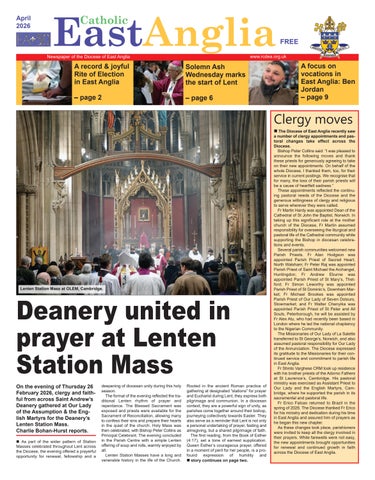
Deanery united in prayer at Lenten Station Mass

On the evening of Thursday 26 February 2026, clergy and faithful from across Saint Andrew’s Deanery gathered at Our Lady of the Assumption & the English Martyrs for the Deanery’s Lenten Station Mass. Charlie Bohan-Hurst reports.

n As part of the wider pattern of Station Masses celebrated throughout Lent across the Diocese, the evening offered a prayerful opportunity for renewal, fellowship and a

deepening of diocesan unity during this holy season.

The format of the evening reflected the traditional Lenten rhythm of prayer and repentance. The Blessed Sacrament was exposed and priests were available for the Sacrament of Reconciliation, allowing many to confess their sins and prepare their hearts in the quiet of the church. Holy Mass was then celebrated, with Bishop Peter Collins as Principal Celebrant. The evening concluded in the Parish Centre with a simple Lenten offering of soup and rolls, warmly enjoyed by all.

Lenten Station Masses have a long and venerable history in the life of the Church.

Rooted in the ancient Roman practice of gathering at designated “stations” for prayer and Eucharist during Lent, they express both pilgrimage and communion. In a diocesan context, they are a powerful sign of unity, as parishes come together around their bishop, journeying collectively towards Easter. They also serve as a reminder that Lent is not only a personal undertaking of prayer, fasting and almsgiving, but a shared pilgrimage of faith.

The first reading, from the Book of Esther (4:17), set a tone of earnest supplication.

Queen Esther’s courageous prayer, offered in a moment of peril for her people, is a profound expression of humility and n story continues on page two.

A focus on vocations in East Anglia: Ben Jordan – page 9

Clergy moves

n The Diocese of East Anglia recently saw a number of clergy appointments and pastoral changes take effect across the Diocese.

Bishop Peter Collins said: “I was pleased to announce the following moves and thank these priests for generously agreeing to take on their new appointments. On behalf of the whole Diocese, I thanked them, too, for their service in current postings. We recognise that for many, the loss of their parish priests will be a cause of heartfelt sadness.”

These appointments reflected the continuing pastoral needs of the Diocese and the generous willingness of clergy and religious to serve wherever they were called.

Fr Martin Hardy was appointed Dean of the Cathedral of St John the Baptist, Norwich. In taking up this significant role at the mother church of the Diocese, Fr Martin assumed responsibility for overseeing the liturgical and pastoral life of the Cathedral community while supporting the Bishop in diocesan celebrations and events.

Several parish communities welcomed new Parish Priests. Fr Alan Hodgson was appointed Parish Priest of Sacred Heart, North Walsham; Fr Peter Raj was appointed Parish Priest of Saint Michael the Archangel, Huntingdon; Fr Andrew Eburne was appointed Parish Priest of St Mary’s, Thetford; Fr Simon Leworthy was appointed Parish Priest of St Dominic’s, Downham Market; Fr Michael Brookes was appointed Parish Priest of Our Lady of Seven Dolours, Stowmarket; and Fr Walter Chenyika was appointed Parish Priest of St Peter and All Souls, Peterborough, he will be assisted by Fr Alex Atu, who had recently been based in London where he led the national chaplaincy to the Nigerian Community.

The Missionaries of Our Lady of La Salette transferred to St George’s, Norwich, and also assumed pastoral responsibility for Our Lady of the Annunciation. The Diocese expressed its gratitude to the Missionaries for their continued service and commitment to parish life in East Anglia.

Fr Shinto Varghese CRM took up residence with his brother priests of the Adorno Fathers at St Laurence’s, Cambridge. His pastoral ministry was exercised as Assistant Priest to Our Lady and the English Martyrs, Cambridge, where he supported the parish in its sacramental and pastoral life.

Fr Erico Falcao returned to Brazil in the spring of 2026. The Diocese thanked Fr Erico for his ministry and dedication during his time in East Anglia and assured him of prayers as he began this new chapter.

As these changes took place, parishioners were invited to keep all the clergy involved in their prayers. While farewells were not easy, the new appointments brought opportunities for renewal and continued growth in faith across the Diocese of East Anglia.

Lenten Station Mass at OLEM, Cambridge.

OLEM Station Mass

n story continued from page one. dependence upon God. Stripped of earthly security, she entrusts herself entirely to the Lord’s mercy. During Lent, the Church invites us into that same spirit, to recognise our need, to turn back to God with sincere hearts, and to intercede for the needs of the world.

The Gospel, from Saint Matthew (7:7–12), continued this theme of trust and confidence in prayer: “Ask, and it will be given to you; seek, and you will find; knock, and the door will be opened to you.” In the midst of Lenten discipline, these words are both encouragement and promise. Our fasting and penitence are not empty gestures, but acts of hopeful trust in a Father who knows how to give good things to His children. The passage concludes with the Golden Rule, calling us to treat others as we would wish to be treated, a fitting Lenten examination of conscience and a practical outworking of charity.

In his homily, Bishop Peter reflected on the enduring importance of the tradition of Lenten Station Masses. He spoke warmly of their role in strengthening diocesan identity and encouraging the faithful to look beyond their own parish boundaries. He urged greater attendance and engagement in future years, emphasising that these gatherings are not simply events in the calendar, but privileged moments of grace for the whole Diocese. He expressed his gratitude to all who had come, acknowledging the witness given by their presence.

The Bishop also took the opportunity to commend Mgr Canon E. Harkness and all at OLEM for their tremendous work around Midnight Mass at Christmas, which was broadcast live on the BBC. He described it as a shining example not only for the Diocese but for the entire country, a testament to reverent liturgy, careful preparation and the dedication of clergy and laity alike.

Following Mass, the congregation made their way to the Parish Centre, where simple soup and rolls were shared. The atmosphere was one of warmth and fellowship, conversations flowing easily as people from different parishes met and reconnected. In its simplicity, the meal echoed the spirit of Lent, modest, communal and centred on what truly matters.

Catholic

EastAnglia

Newspaper of the Diocese of East Anglia

EDITOR: Charlie Bohan-Hurst

communications@rcdea.org.uk

Articles and photographs for the next edition are very welcome and should be sent to the editor, ideally via email, by Friday, 10 April.

Diocese website: www.rcdea.org.uk

Advertising: Contact Nick at Cathcom on tel 01440 730399 or email him at ads@cathcom.org

Publisher: Cathcom Ltd, 0207 112 6710

Inclusion of adverts is the responsibility of Cathcom and does not imply endorsement by the Diocese of East Anglia.

A record & joyful Rite of Election in East Anglia

On the First Sunday of Lent, 22 February 2026, the Cathedral of St John the Baptist in Norwich was filled to capacity as Bishop Peter Collins led the Rite of Election and Affirmation for the Diocese of East Anglia.

Charlie Bohan-Hurst reports.

n This year’s celebration was marked by particularly large numbers. The cathedral was full with those preparing to be welcomed into the Church, accompanied by their godparents, sponsors, families and parish communities. Many more from across the diocese, unable to attend in person, are also preparing for reception into the Church at Easter. The same encouraging pattern has been seen throughout the country, with dioceses across England and Wales reporting significant numbers at their own Rites of Election, a powerful sign of the Holy Spirit at work in our time.

The Liturgy of the Word set before us two profound passages at the very beginning of Lent. The first reading, from Genesis 2:7–9; 3:1–7, recounted the creation of humanity and the account of the Fall. We heard how the Lord God formed man from the dust of the earth and breathed into him the breath of life, placing him in the garden in a state of harmony and grace. We also heard of temptation, disobedience and the rupture of that original friendship with God.

In contrast, the Gospel from St Matthew 4:1–11 presented Christ in the wilderness, fasting for forty days and confronted by the tempter. Where Adam yielded, Christ remained steadfast. Where humanity fell, Christ was faithful. In resisting the devil’s

new Adam, restoring what had been lost and opening once again the path to life.

These readings speak directly to the meaning of the Rite of Election. Lent begins with a reminder of both human weakness and divine grace. The catechumens, soon to be called the Elect, stand before the Church conscious of their need for salvation, like all of us, yet confident in Christ who conquers temptation and sin. Their journey mirrors the journey from the garden, through the wilderness, towards the promise of new life at Easter. The Rite of Election marks their decisive turning towards Christ, trusting in his victory.

Following the homily, the Rite of Election and Affirmation began with the Presentation of the Catechumens. Each catechumen was called by name. As they heard their name, they stood with their godparent beside them, a simple but deeply personal moment reflecting the Lord’s call to each disciple.

Their sponsors testified to their readiness, and the assembly gave its affirmation. The Church, gathered as one body, confirmed that these men and women had listened to the Word of God, begun to walk in faith, and were prepared to receive the sacraments of initiation.

The invitation and enrolment of names followed. One by one, the catechumens came forward with their sponsors to the Bishop’s throne. Each was greeted by Bishop Peter before writing his or her name in the Book of the Elect. This gesture signifies that their names are now inscribed among those chosen for the sacraments of Baptism, Confirmation and Eucharist at the Easter Vigil.

Once all had signed the Book, they were no longer referred to as catechumens but as the Elect.

During the Act of Election, Bishop Peter addressed the godparents and invited them to place a hand on the shoulder of the Elect entrusted to their care. This gesture

The Bishop then declared the catechumens to be members of the Elect, chosen to complete their initiation at Easter.

The celebration continued with the Presentation of Candidates for Reception into Full Communion, those already baptised in other Christian traditions who are now preparing to be received into the Catholic Church.

The candidates stood and presented themselves to the Bishop. Their sponsors and the assembly affirmed their readiness. At the invitation and request for admission, the candidates came forward in parish groups and were greeted personally by Bishop Peter.

In the Act of Recognition, sponsors placed a hand on the shoulder of the candidate they accompany. This mirrored the earlier gesture with the Elect and underlined the shared journey of faith, even as the candidates’ path differs sacramentally.

The Intercessions followed, entrusting both the Elect and the candidates to God’s grace as they enter this final period of preparation. The celebration concluded with the Sign of Peace, an expression of the communion into which they are being more fully incorporated.

The large numbers gathered at St John the Baptist Cathedral were a visible and heartening sign of growth and renewal within the Diocese of East Anglia. At a time when faith can often seem fragile in wider society, the sight of so many adults freely choosing Christ and his Church speaks of hope.

As Lent unfolds, the Elect now enter a period of purification and enlightenment, sustained by the prayers of the faithful. The candidates continue their preparation for full communion. All will be welcomed at Easter, when the Church celebrates Christ’s triumph over sin and death, the same victory proclaimed in the Gospel of the First Sunday of Lent.

Please keep the Elect and candidates of our diocese in your prayers as they journey

Bishop Peter Collins with those joining the Church this Easter.

The jewels of our Faith

As we celebrate our fifty years as the diocese of East Anglia, let us remember the great places and events that mark the living Faith of places and people here in East Anglia. This month Fr John Morrill reflects on the lived faith of the millions who have worshipped and prayed, individually, as parishes, or as a diocesan community at Walsingham in North Norfolk.

n “Of this chapel see here the foundation, Builded the year of Christ’s incarnation A thousand complete sixty one.

The time of Saint Edward King of this region.” - [written in the later Middle Ages and named after the printer Richard Pynson 1496]

That is just before William the Conqueror came and conquered, when Edward the Confessor was King and when (through the amazing researches of Fr Michael Rear) we can now be confident that a very young widow, barely in her twenties, had the vision of Our Lady telling her to build a replica of the Holy House in Nazareth, where she, Mary, was visited by Gabriel and invited to be the Mother of God. The story told in the above ballad tells us (this is uncorroborated but wonderful to contemplate) that after her workmen failed to build it, angels came and completed the task for them. From 1061 to 1538 it was indeed a place of wonder, growing from a small wooden chapel to the second most visited place of pilgrimage in Britain and one of the four great sites of the Catholic world, visited by 14 kings and their wives (to ask Our Lady to help them have children, to give thanks for the safe delivery of a child, to give thanks for victory in war (Henry VIII did all three) or – as a remorseful Henry VII did – to atone for his rapacity and greed, Henry spending time in penitence in Walsingham to coincide with his surrogates praying for him at

the Holy Places in Jerusalem). By then it was visited by tens of thousands every year, quite likely more popular than ever.

The Holy House was now contained within a larger chapel that was part of a vast priory church where 25 Augustinian friars prayed daily, and it was a kind of medieval theme park. Having walked 130 miles from London, stopping at religious houses along a well-beaten track, or the 26 miles from (King’s) Lynn, reached by many by ship from the North or from the continent of Europe, pilgrims had to decide in what order to visit and pray. Would it be the phial of the Virgin’s breast milk, the knuckle of St Peter, the glorious works of craftsmanship donated by grateful monarchs, the two holy (and healing) wells, and of course the Holy House itself and the magnificent statue of Our Lady enthroned and looking serenely at us as she points to her Son, alert on her knee? Would you want to keep the best for last, or go to her chapel when the queues were shortest?

And then in 1538 King Henry VIII, paranoid and vindictive, agreed to let his vandals descend on Walsingham (and 800 other monasteries and religious houses) and in a single day destroy the Holy House and strip it of everything of financial value. The statue, according to fairly reliable accounts, was carried off to London where it was first mutilated and then burned in front of the house of St Thomas More, martyred two years earlier for refusal to accept Henry’s adulterous marriage to Anne Boleyn and his schism from Rome. Fairly soon, almost all the stonework was (mis)appropriated to build lavish houses for those who bought the lands belonging to the Abbey.

For a century it was a site of contested

memory: a popular ballad recalled the vandalism and wilful destruction of Walsingham, and its tune became the basis for keyboard music by secret Catholic composers at the royal court (William Byrd and John Bull). More dramatically, Shakespeare’s plays and sonnets (many believe him to have been a secret Catholic) evoke memories of Walsingham and its ballad. (The most obvious is the first of Ophelia’s ‘mad’ songs in Hamlet, written in the same unusual metre, with its references to ‘cockle hat and staff, and his sandal shoon’ (i.e. a precise description of pilgrim’s garb), described by Gertrude as ‘snatches of old tunes’.) The most widely disseminated maps of England made in the period before 1630 all give prominence to Walsingham. It was remembered by some as a place of idolatry but by others as a holy place, vandalised by a rapacious monarch. The civil wars changed English ideas of what mattered in the past, and the ‘bare ruin’d choirs’ (Shakespeare’s phrase) lay gaunt and taken for granted for the next 200+ years.

And then the great restoration in 1850. First, as a late flowering of the Anglo-Catholic movement in the Church of England, and then by Catholics with a special devotion to Our Lady, deeply religious ladies and energetic priests began to create a new Walsingham to restore places of stillness, devotion and immanence. The site of the Priory Church, with its single surviving chancel arch and a marker on the ground where once the Holy House stood, remains a gaunt ruin. But over the Holy Wells the Anglicans built their shrine, with a reimagined Holy House and many sites of prayer and hospitality. The Catholics, inspired, focused on the Slipper Chapel, a 14th-century chapel one mile from the original shrine, where pilgrims paused and prayed before

their final barefoot walk to the Shrine itself. It survived because it was a useful farm building – cowshed – in the penal times. Beautifully restored, it became the Catholic National Shrine in 1934 and alongside it was, much later, built the large pilgrimage church where Masses are said daily to crowds of pilgrims, either in the building or – its glass doors thrown open – to large crowds outside.

“O England great cause hath thou to be glad to be

Compared to the land of promise, Zion, Thou attainest by grace to stand in that degree

Through glorious Lady’s support

To be called in every realm and region

The Holy Land, Our Lady’s Dowry; Thus art thou named in old antiquity.”

This is from the last part of the 1496 ballad and it is as much a call to us today as it was in 1496. What better way, as an individual, as a family, as a parish, to mark the Jubilee of the diocese than by following the millions of pilgrims over the past 965 years who have come to Walsingham to be with Our Lady, to celebrate her fiat, her ‘yes’ to God, and Richeldis’s ‘yes’ to building a shrine, and to renew our own faith and feel our own closeness to the one who draws us closer to her Son, our Saviour. Come to where the earth is saturated by prayer and devotion. Come for a time in the Slipper Chapel, take the ancient walk along the stream to the village, and come back by the old railway line, which is the new pilgrim way (or vice versa). Explore all the options to stay, to eat and drink, to embrace all that Walsingham has been, has suffered and has become. At the very least visit the website (www.walsingham.org.uk/ and the facilities in the village www.walsinghamvillage.org/) and, instead – or more sensibly, as well – come not only on your own, with the family or with a parish group, but on the Diocese of East Anglia pilgrimage on Bank Holiday Monday 4 May 2026. If you have never been (if you have been you will need no encouragement), do come in this very special year. For more, read Fr Michael Rear’s wonderful book Walsingham: Pilgrims and Pilgrimage (Gracewing, 2nd edn. 2019), £14.99 or so.

The Slipper Chapel at Walsingham.
The Statue of Our Lady carried in procession during the diocesan pilgrimage to Walsingham.

The Lunar New Year of the Horse

Dominic Chung, writing for the Cantonese Chaplaincy of the Diocese of East Anglia, recounts how the Cantonese Catholic community celebrated the Lunar New Year at Our Lady of Lourdes, Sawston, with Mass, cultural traditions and joyful fellowship.

n As many as 84 people from across the region and beyond gathered at Our Lady of Lourdes Church, Sawston, on Saturday 28 February 2026 to celebrate the Lunar New Year. Although New Year’s Day fell on 17 February, celebrations typically continue until at least the 15th day, much like the Christmas season.

The day began with a Thanksgiving Mass in Cantonese. The celebrant was Canon John Minh, parish priest of Our Lady of Lourdes and St John Fisher, Cambourne. Canon John has been celebrating Mass in Cantonese since 7 April 2022 and can now be described as an “old hand”. On this occasion he was assisted by Deacon Peter Ho, who will be ordained to the priesthood in July 2026.

Although we are in Lent, the vestments were red – an auspicious colour for Chinese people. Red may also be seen as representing the blood shed by the Catholic Martyrs of China, known and unknown, canonised or not.

For Deacon Peter, it was his first ever proclamation of the Gospel in Cantonese, and he also delivered the homily in Cantonese. The congregation was impressed by

Want to advertise?

Catholic East Anglia reaches over 7,000 Catholics in East Anglia. Contact Cathcom Ltd on 01440 730399 or at ads@cathcom.org

his missionary zeal and his willingness to take part despite having less than a day to practise, fitting preparation in between his training days at St Mary’s Oscott Seminary in Birmingham and his parish pastoral work. Indeed, the Cantonese community were so appreciative of his gracious effort that we offered to sinicise his name, which he has since accepted. He will henceforth be known to us as: Revd Deacon 何 (Ho) 庇德 (Peter). The two characters rhyme with Peter. 庇 means guarding or protecting; 德 means virtues – particularly Faith, Hope and Charity. We look forward to July when we can begin addressing him as Revd Father 何庇德!

Our Lunar New Year celebration is not merely about eating, drinking and being merry. For Hong Kong Catholics it blends an ancient tradition with Lenten devotion, reflection and penitence. It is about giving thanks for another year of love and care between and among the generations; about making amends in broken relationships and being reconciled with one another; and above all about gratitude for the redemption that Christ Jesus has brought and continues to bring to us all.

Like the reflections of Lent, the Lunar New Year invites us to think and live anew, casting off the old and embracing the new. 日新又新 (Renewal). It calls us to be more fully engaged in almsgiving and prayer, as was prayed in the Collect.

In the liturgy, the first reading was from Genesis (1:27–31). Even though our cultural lineage stretches back thousands of years, we recognise that everything began with the Almighty, our Creator. Our joy and gratitude were further reflected in the responsorial Psalm (Psalm 100:1–5). This theme of entrusting ourselves to God continued in St Paul’s letter to the Philippians (4:4–9). Dea-

con Peter then proclaimed the Gospel of John (1:1–5; 9–12). In his homily, he explained that Jesus’ unique genealogy reveals His origin: He was with God in the beginning. Through His incarnation He came as the light of the world, and we who believe in Him and follow Him are called to live as worthy children of God.

The Mass concluded with a solemn blessing, imploring God to keep and guide us through the Year of the Horse and beyond, granting us strengthening faith, persevering hope and unwavering charity.

Before the community moved to the parish hall to begin their traditional festivities, Canon John distributed to everyone a red envelope (laisee) containing a prayer card.

This symbolised his role as our pastor, caring for our growing “faith-based family”. Traditionally, at Lunar New Year elders give red envelopes to the younger members of the family.

A lively traditional celebration began in the hall with a lion dance. The troupe ensured that the first act was to bow in veneration before the Crucifix on the wall.

The drumbeat and the clanging of cymbals soon roused the lion from its stupor, and everyone – young and old alike – watched with delight at how well the amateur dancers performed. Many joined in, and even Canon John and Deacon Peter had a turn at beating the drum.

Next came the solving of riddles – a subtle and witty quiz game enjoyed for thousands of years. Among the riddles were some with biblical connections, alongside proverbs and the names of places in Hong Kong familiar to many at the party. This reflected our determination that cultural traditions can blend naturally and fruitfully with our Catholic faith.

We also held a collective calligraphy session to remind ourselves of this ancient

and beautiful art and to encourage younger generations to value their cultural heritage. Sadly, many of the children who immigrated four years ago have already begun to lose their linguistic skills and other elements of their cultural identity. This is one reason why we persevere in organising regular Cantonese Masses and celebrations, sometimes against considerable odds.

We are especially grateful to Bishop Peter Collins for his support. We treasure Canon John’s pastoral care and dedication over these years, and we are equally grateful to many parish priests throughout the diocese. Particular thanks go to the Vicar General, Canon David Bagstaff, and to Mgr Eugene Harkness, the Chancellor, who help visiting Hong Kong clergy obtain faculties for priestly ministry. There are many other priests, too numerous to mention here, who have helped us integrate into parish life while encouraging us to retain our distinctive connection with liturgy in Cantonese. As the Catholic Diocese of Hong Kong celebrates the 80th anniversary of its erection, such generous support carries special meaning.

The day concluded with a Cantonese song specially composed by one of our talented musicians, celebrating the blessings we receive from God each day.

Ipswich to host week­long Eucharistic Congress

Ipswich will host a week-long Eucharistic Congress from 6 to 13 September 2026 as part of the Golden Jubilee celebrations of the Diocese of East Anglia.

n The event will bring together parishes, schools, clergy and families from across the Ipswich Deanery for a shared act of thanksgiving and renewal centred on the Eucharist. The Congress is being planned collaboratively by three parish priests: Fr Luke Goymour, Dean of the Ipswich Deanery and parish priest of St Mark’s and St Mary Magdalen’s; Fr Joseph Welch, parish priest of St Pancras; and Fr Jude Belnas, parish priest of St Mary’s. They are being supported by an organising committee of laypeople drawn from across the deanery.

Fr Luke described the Jubilee as a moment of grace for the whole diocese. He said “it is an opportunity to return to the Eucharistic heart of the faith and to rediscover the Real Presence of Christ with

renewed devotion and purpose.”

The Congress will begin on Sunday 6 September with a soft launch across Ipswich’s Catholic parishes. From Monday to Wednesday the focus will turn to the town’s Catholic schools, before parishbased events take place from Thursday to Saturday. The week will conclude with a major diocesan gathering at the Ipswich Corn Exchange on Sunday 13 September. Bishop Peter Collins will celebrate the closing Mass and offer reflections as part of the final programme.

The aim of the Congress is to give thanks for fifty years of grace in the Diocese of East Anglia, while offering opportunities for prayer, teaching and reflection. Organisers hope the week will help Catholics deepen their love for Jesus in the Eucharist and strengthen the mission of parishes and schools as communities of welcome, service and evangelisation.

A coordinated programme will take place across the four Ipswich Catholic Trust primary schools – St Pancras, St Mark’s, St Mary’s and St Alban’s – in collaboration with St Alban’s Catholic High School. Plans

include a shared Schools’ Mass early in the week, with the gym at St Alban’s being considered as a possible venue.

Throughout the week, pupils will explore the theme Mary, Woman of the Eucharist. Schools will be encouraged to offer short catechesis on the Mass and the Real Presence, welcome visits from clergy and religious, and engage pupils in creative expressions of faith.

The Congress is rooted in the belief that renewal begins by returning to the Eucharist. As the diocese marks its fiftieth anniversary, the week offers an opportunity to give thanks for the past, rekindle devotion to Christ present in the Eucharist, and strengthen the Church’s mission for the future.

Further details will be released in the coming months, with opportunities for parishioners, families and local partners to take part in this significant moment for the Catholic community in Ipswich and the wider diocese.

More information and booking details can be found at eucharisticcongressipswich.org/

New portrait marks ongoing Diocesan Jubilee celebrations

As the Diocese of East Anglia continues to celebrate its Diocesan Jubilee, a new portrait of the Bishop of East Anglia, Peter Collins, has been completed and installed at Cathedral House, adding to the Diocese’s growing historical legacy.

n The portrait was commissioned from the artist Harriet Dahan-Bouchard, who previously painted the portrait of Alan Hopes. Building on that earlier work, this latest commission contributes to the visual record of episcopal ministry within the Diocese.

The process began in the spring of last year with a ninety-minute sitting, during which a series of digital photographs was taken in a variety of settings. These images informed the development of the final composition. The completed portrait, already varnished and framed, was delivered to the Cathedral last week and now hangs in the Cathedral Hallway.

In order to present a coherent sequence of episcopal leadership, arrangements will be made for the portrait of Alan Clark, currently displayed in the Cathedral Dining Room, to

be relocated to the Hallway. In addition, worthy photographs of Peter Smith and Michael Evans will be added so that the succession of bishops may be clearly represented.

The new arrangement offers clergy, parishioners and visitors an opportunity to reflect on the faithful service of those who have led the Diocese. Bishop Collins has expressed his gratitude to Harriet for her skill and dedication in bringing this important Jubilee commission to completion.

Bishop Peter Collins with artist Harriet Dahan-Bouchard.

Diocese to Celebrate Golden Jubilee with pilgrimage

n In October 2026, pilgrims from across the Diocese of East Anglia will travel to the heart of the Catholic Church to mark a momentous milestone, the 50th anniversary of our Diocese.

Bishop Peter Collins will lead this special Jubilee pilgrimage to Rome which promises to be a time of prayer, thanksgiving and deep spiritual renewal. He said: “I look forward greatly to leading the Diocesan Pilgrimage to Rome and the Holy See in October. I invite you to join me as fellow pilgrims as we celebrate our Golden Jubilee as a Diocese.”

The pilgrimage begins with a flight from Stansted to Rome, where pilgrims will visit the ancient Catacombs, learning about the courage and faith of the early Christians. Mass will be celebrated there, a moving way to begin our diocesan celebration, rooted in the witness of the Church’s earliest martyrs.

A highlight of the week will be attendance at the Papal Audience in St Peter’s Square, subject to the Holy Father’s schedule, with tickets provided for the group. Pilgrims will also have the opportunity to explore St Peter’s Basilica more fully, perhaps climbing the Dome or visiting the Vatican Museums.

During the pilgrimage, Mass will be celebrated at significant sites, including St Peter’s Basilica and the Basilica of St Paul Outside the Walls, where the group will have a final Mass before returning home.

The programme also includes a full day tour of Rome, with visits to St John Lateran, the Cathedral of the Bishop of Rome, and St Mary Major.

Alongside the spiritual programme, the pilgrimage offers time for fellowship and shared meals, with accommodation in a centrally located hotel on a half board basis. There will be free time for personal exploration, prayer and reflection, allowing pilgrims to enter more deeply into this Jubilee celebration.

The cost of the pilgrimage is £1,550 per person sharing a twin or double room, with a limited number of single rooms available for a supplement of £220. The price includes return airfare with 10kg carry on baggage, accommodation, transport in Italy, guiding services, gratuities and entrance fees. Please note that the itinerary is not suitable for less able travellers. A deposit of £400, together with a completed booking form, is required by 27 March 2026, with the balance due by 4 August 2026. The booking reference for this pilgrimage is RCDEA01.

As we approach the 50th anniversary of the Diocese of East Anglia, this pilgrimage offers a profound opportunity to give thanks for the faith that has been handed down to us, to pray for the future of our Diocese, and to deepen our communion with the Universal Church. All are warmly invited to consider joining Bishop Peter and fellow pilgrims for what promises to be a grace filled and memorable Jubilee journey to Rome.

To join the pilgrimage return and complete the form on the diocesan website.

Marked with ashes, ca

The holy season of Lent began in a spirit of prayer and solemnity as Bishop Peter celebrated the Ash Wednesday Solemn Mass at the Cathedral of St John the Baptist, Norwich.

Charlie Bohan-Hurst reports.

n At the beginning of the Mass, Bishop Peter warmly welcomed the new Cathedral Dean, Fr Martin, assuring him of the prayers and support of the diocesan community as he begins his ministry at the Cathedral.

Ash Wednesday holds deep importance not only for those present in Norwich but for every parish and community throughout the Diocese of East Anglia. It marks the beginning of a shared Lenten journey of prayer, fasting and almsgiving. Throughout the Diocese, the faithful gathered to receive ashes as a sign of repentance and a commitment to conversion of heart.

The Cathedral itself bore witness to the

strength of this faith. In addition to the Solemn Mass celebrated by Bishop Peter, three earlier Masses were also very well attended. From early morning onwards, a steady stream of people came to pray and receive ashes, making the Cathedral a place of quiet devotion and reflection throughout the day.

The readings proclaimed at Mass spoke powerfully to the meaning of the season. In the first reading from the prophet Joel, the Lord calls out, “Return to me with all your heart.” The prophet urges not merely outward signs of sorrow but a true interior turning back to God. It is a call to rend our hearts rather than our garments, reminding us that authentic repentance begins within.

St Paul’s words in the second reading from the Second Letter to the Corinthians reinforced this appeal. “We implore you

on Christ’s behalf, be reconciled to God. Now is the favourable time; this is the day of salvation.” Lent is presented not as a distant ideal but as a present opportunity. The Apostle’s message highlights the urgency of grace and invites the faithful to seek reconciliation, especially through the Sacrament of Confession, as a central part of their Lenten observance.

Bishop Peter Collins marks the faithful with the blessed ashes

lled to renewal

In the Gospel according to St Matthew, Jesus teaches about prayer, fasting and almsgiving. He calls His disciples to practise these works not for public recognition but with humility and sincerity. The Father who sees what is done in secret rewards the faithful heart. In a culture often focused on appearances, the Gospel directs attention to the hidden life of grace and the quiet faithfulness that pleases God. After the homily came the solemn blessing and distribution of ashes. In reverent silence, the faithful came forward to receive the ashes upon their foreheads, hearing the ancient words, “Remember that you are dust, and to dust you shall return,” or “Repent, and believe in the Gospel.” Marked with the sign of the cross, they returned to their places in quiet prayer.

The gesture was simple yet deeply moving. Young and old alike bore the visible sign of repentance, united in humility and trust in God’s mercy. As the Diocese of East Anglia now begins its Lenten pilgrimage, the call heard in the Cathedral echoes across every parish. The Lord invites His people to return to Him with all their hearts and to walk together towards the saving joy of Easter.

Bishop Peter’s engagements

MARCH

Mar 19, Thurs

Bishop to attend Vocations Committee Meeting at 11:00 in Poringland.

Mar 23 – 25, Mon – Weds

Bishop to perform the Triennial Canonical Visitation of Quidenham.

Mar 26, Thurs

Bishop to attend Council of Priests at 11:00 in Poringland.

Mar 26, Thurs

Bishop to attend Council of Priests at 11:00 in Poringland.

Mar 27, Fri

Bishop to meet with Ignite Team at 18:00.

Mar 29, Sun

Bishop to celebrate Solemn Procession and Pontifical Mass for Palm Sunday at 11:00 at the Cathedral.

Mar 31, Tues

Bishop to attend Chrism Mass (Solemn Pontifical Mass with Blessing of Oils) at 11:30 at the Cathedral.

APRIL

Apr 2, Thurs

Bishop to celebrate Mass Solemn of the Lord’s Supper for Maundy Thursday (Pontifical Mass with Washing of the Feet and Transfer of the Most Blessed Sacrament) at 19:00 at the Cathedral.

Apr 3, Fri

Bishop to attend Tenebrae at 10:00 at the Cathedral.

Apr 3, Fri

Bishop to attend Solemn Liturgy of the Passion at 15.00 at the Cathedral.

Apr 4, Sat

Bishop to attend Tenebrae at 10:00 at the Cathedral.

Apr 4, Sat

Bishop to attend Solemn Vigil and First Mass of Easter (with Baptisms and Confirmations) at 20:00 at the Cathedral.

Apr 5, Sun

Bishop to attend Solemn Pontifical Mass of Easter Sunday at 11:00 at the Cathedral.

Apr 5, Sun

Bishop to attend Solemn Pontifical Vespers of Easter Sunday at 16:30 at the Cathedral.

Apr 16, Thurs

Bishop to attend Commission for Catechesis and Formation in Poringland at 18:00.

Apr 17 – 24, Fri – Fri

Bishop to attend the Plenary Meeting of the Bishops’ Conference of England and Wales in Rome.

Apr 26, Sun

Bishop to celebrate Consecration Mass at St Philip Howard, Cambridge at 12:00.

Apr 27, Mon

Bishop to meet with Ignite Team at 18:00.

Apr 28, Tues

Bishop to attend Bishop’s Council in Poringland at 11:00.

Apr 30, Thurs

Bishop to attend Ecumenical Church Leaders meeting in Norwich at 15:00.

MAY

May 2, Sun

Bishop to Ignite Youth Festival in Bury St Edmunds.

May 4, Mon

Bishop to lead the Annual Diocesan Pilgrimage to Walsingham at 12:00.

STORIES FROM OUR CATHOLIC SCHOOLS IN EAST ANGLIA

Celebrating young talent in East Anglia

The Knights of St Columba continue to celebrate the creativity and faith of young people across the Diocese of East Anglia through their annual competitions.

n Two pupils from St Augustine’s Catholic Primary School achieved notable success in the Provincial Round of the Nativity Scene Painting Competition. Vivien Carrara (aged 8) was awarded first place at Key Stage 2 level, while Trixie Taylor (aged 6) achieved third place at Key Stage 1 level. Both were presented with their cash prizes and certificates at the school’s final Pilgrims of Hope assembly before half term. They also received National Participation Certificates in recognition of their excellent work.

This year’s only National winner from East Anglia & Brentwood Province 10 was Robert Hilland (aged 5) of Our Lady of Lourdes Church. Robert received a personally inscribed trophy together with first prize awards of cash and certificates at National, Provincial and Council levels. Chosen from four national entrants submitted by his council, Robert was also the overall national winner at Key Stage 1. As a result, Our Lady of Lourdes Church received a £150 suppor-

ting grant from the Knights of St Columba. Brother Christopher Brooks also presented cash awards and certificates at St Mary & St Peter Catholic Primary School, St Benet’s Catholic Primary School and St Mary’s Catholic Primary School. These awards recognised six winning entrants in the Lowestoft Council 518 round, with additional encouragement prizes presented to runnersup.

In the Knights of St Columba Christmas 2025 Photography Competition, entrants were invited to depict either an altar scene or a crib scene. Lowestoft Council 518 was once again the only council represented at Provincial level, submitting all twelve of its first and second place entries to the National round. Two entries went on to receive National awards, in addition to their local and provincial recognition. Neha Shiji achieved first place at Key Stage 2 in the crib category, and Kirushanya Yokithan was awarded second place at Key Stage 3, also in the crib category.

An awards presentation for Provincial winners was held in February at Our Lady Star of the Sea Church. In the front row of the group photograph are the National winners, Kirushanya (second from left) and Neha (centre). Behind them stand Brother Christopher Brooks, Province 10 Youth

Ignite Festival: A weekend to set your faith alight

n Young people from Year 8 upwards are warmly invited to take part in the Ignite Festival, taking place from 2 –3 May 2026 in Bury St Edmunds. This vibrant diocesan event promises an unforgettable weekend packed with inspiring talks, passionate prayer, live music and plenty of fun activities. The Ignite Festival offers young people a dynamic opportunity to deepen their faith, build friendships and encounter Christ in a joyful and welcoming atmosphere.

Hosted in the heart of our diocese, the festival has become a highlight of the year for many of our young people. Whether

attending for the first time or returning with friends, participants can look forward to a weekend that is both faith filled and full of energy.

There is also the opportunity to continue the journey by joining the Diocesan Pilgrimage to Walsingham on Bank Holiday Monday, 4 May. This is a beautiful way to conclude the weekend in prayer and fellowship.

Early bird rates are available for bookings made before 30 March 2026.

For full details and to book your place, please visit: www.ignitefestival.co.uk

Officer; Fr Stephen Bould, Council 518 Chaplain; Caroline Langdon, Parish Safeguarding Officer; Fr Padraig Hawkins, Parish Priest; and Brother Jason Wickard, Grand Knight of Council 518.

The Knights are now looking forward to receiving entries for the forthcoming Easter competitions, including Painting and Photography, as well as Prayer Writing and Essay Writing. These competitions are open to primary and secondary schools and parish entrants. Details were circulated by email before Christmas. Any late enquiries regarding Easter competition entries from parishes or individuals may be directed to Brother Christopher Brooks on 01502 563208.

KSC photo competition award winners.

The all-new Ignite team

Hamish MacQueen, Director of the Diocesan Youth Service, shares exciting new plans for the Ignite Team.

n In 2015, the Diocese of East Anglia launched the Ignite Team, a diocesan youth mission initiative in which young people share their faith with other young people not much younger than themselves. Over the past eleven years the team has had a profound impact on the faith of many young people across the diocese, working in schools and parishes and organising events that bring young people together to encounter Christ and grow in their faith.

As we look to the future, we are excited that this important mission will continue –and develop further with some significant new opportunities.

From September 2026, members of the Ignite Team will also become apprentices, combining hands-on ministry experience with formal training and recognised qualifications.

As part of the programme, Ignite Team members will:

- Spend one day each week in training with St Mary’s University, Twickenham.

- Work towards a Level 4 Certificate in Higher Education and a Young People’s Practitioner qualification, which can open doors to future employment and may count towards a degree.

- Receive a sal ary in line with the government apprentice wage.

These changes will allow young people to gain valuable profes sional training while continuing the Ignite Team’s mission of serv ing the Church and supporting the faith of others.

We are initially

looking for two new team members to join the programme.

If you are passionate about your faith, enjoy working with young people, and would like to spend a year serving the Church while

gaining recognised qualifications, this could be a wonderful opportunity.

To find out more and request an application pack, please visit: www.rcdea.org.uk/youth.

Vocations focus: Ben Jordan

As the Diocese of East Anglia continues to celebrate its 50th Jubilee Year, we are shining a spotlight on the people who live out their vocations in service to our diocesan family. Each month, we meet a member of our clergy or someone in formation, reflecting on their call, their ministry and their hopes for the future.

n This month, we hear from Ben Jordan, a seminarian in his Propaedeutic year, who shares how his vocation first took shape and why fostering vocations remains vital to the life of our diocese.

“My sense of vocation was deeply tied up in my conversion. The first whispers I heard began during RCIA. I had an unavoidable, incessant desire to serve others, to be a priest. I was told that this was common for men converting and that it would pass if it was just the zeal of conversion and remain if it was real. So I did not act on it and focused purely on growing in my new Catholic faith. I tried to ignore it; I tried to fight it, but the tug on my heart would not go away. Eventually I stopped fighting.

I could not do any of this on my own, however, and I owe so much to the Chaplaincy at UEA, the Community of Our Lady of Walsingham, the parishes of St John the Baptist and Waveney Valley, and the whole vocations team who have nourished my early vocation and buoyed me up in prayer.

Since I first felt the call, my vocation has matured and solidified. Time and formation have moulded it into something more tangible, more clear. It has also deepened; superficialities from early in the call have faded away and been replaced with an unbridled desire to dedicate my life to doing

nothing but bringing souls to Christ. Great peace has descended upon me. Feeling as though I have found my purpose in life, I have immense joy.

East Anglia is many things. It is a wonderful diocese full of faithful Catholics, but mostly for me, it is home. Each of us has a duty to “proclaim the Gospel”. Early in my conversion I thought of that only as overseas missionary work. I now see this, my home, as my mission ground. We must promote vocations in our parishes and schools because there are so many more men

whose calling is just like this and who have not yet found it.

And so, to anyone who is feeling that tug on their heart, I would tell them what a fantastic priest once told me in six profound words: why not give God a chance? Contact the vocations team, speak to your parish priest and give it into God’s hands.

To the parishes I would say: pray. Talking about vocations is great, catechesis programmes are great, and they should all be done, but when faced with this problem Jesus gave only one remedy: to “pray that

the Lord of the Harvest sends labourers”. I am filled with an immense hope for the future of vocations. In our time of uncertainty we can be certain that God will always call men to follow Him as priests. The rest is given to us to pray for and nurture. Through the example of Our Lady of Walsingham, Mother of vocations, I believe men will continue to say yes to God and parishes will say yes to supporting them. May our prayers be united with all our patron saints, and may an abundance of vocations be given to us by Christ the Good Shepherd.”

Ben Jordan.
The 2025/26 Ignite team.

Help the campaign against assisted suicide

Dr Richard Maguire, Heritage and Learning Officer at the Cathedral of St John the Baptist, urges people across East Anglia to contact their MPs in support of Right to Life UK’s campaign opposing the assisted suicide Bill, particularly efforts to use the Parliament Acts to bypass the House of Lords and force the legislation into law.

n Right to Life UK is asking people across England to support the on-going campaign against the assisted suicide bill and contact their MPs regarding unprecedented proposals by supporters of the Bill to use the Parliament Acts to bypass the House of Lords.

Last year saw the House of Commons vote on one of the most significant pieces of legislation to ever be considered in Parliament; an assisted suicide Bill (formally known as the Terminally Ill Adults (End of Life) Bill). The Bill was not mentioned in the Labour Party’s election manifesto and was presented to Parliament as a Private Members’ Bill; although it has received the Prime Minister’s personal support.

Despite significant opposition from many groups – including the Catholic Church and many disability rights organisations – who pointed out the deep flaws, both moral and practical, in the proposed legislation, the Bill passed its Third Reading in the House of Commons by a very small majority of 314 votes to 291, a majority of 23.

The Bill is currently under consideration in the House of Lords, where peers have undertaken scrutiny that was not possible in the House of Commons, where there was insufficient time at Report Stage for dozens of important amendments to be debated. So far, 131 Peers have either spoken against the Bill or signed amendments in the House of Lords because of concerns with the Bill. Because it is a Private Members’ Bill that was not a manifesto commitment, the House of Lords Constitution Committee has explained that “It is constitutionally appropriate for the House to scrutinise the Bill and, if so minded, vote to amend, or reject it.”

Although it is common for Private Members’ Bills to fall because of insufficient parliamentary time, the assisted suicide pressure group, Dignity in Dying, along with Lord Falconer and other campaigners, are now lobbying MPs to try to use what is known as the Parliament Acts to bypass the House of Lords and force the assisted suicide Bill into law in the next Parliamentary session. This would be unprecedented in British history. Only seven bills have be-

come Acts using this procedure and it would be the first time ever that the Parliament Acts were used for a Private Members’ Bill. Doing so would set a concerning precedent enabling future Governments to bypass the House of Lords in passing legislation. It is vital that MPs hear from constituents who do not support this attempt to bypass normal parliamentary procedure.

To help members of the public Right to Life UK have created an easy-to-use tool to help people to write to their MP and ask them to oppose attempts to force the assisted suicide Bill into law by using the Parliament Acts to bypass the House of Lords.

Fr Peter Leeming: A faithful servant of God

Father Peter, instinctively courteous, impeccably dressed and devoted to the prayerful dignity of the liturgy, was a priest of the old English Catholic mould.

n Born in Tunbridge Wells in 1953 and raised in Peterborough, he was an only child, much loved by his parents, Harry and Teresa. His mother’s family were of Lancashire recusant stock, and his father had become a Catholic to marry her. The seriousness and steadiness of that faith shaped their home, and shaped Peter.

That family fidelity perhaps helps to explain the care with which he approached the sacred mysteries and life itself. For him, the Mass was never casual; everything had to be ordered aright. Sloppiness, whether in music, in sanctuary style, or even in flower arrangements with one too many colours (or indeed any colour), jarred him.

Over his forty-eight years of priesthood, many retain a vivid memory of the humble and precise way in which he celebrated the Mass. He spoke of Our Lord and of sacred things with a quiet gravity that was neither heavy nor exaggerated, but life-giving. Even his “thank you” was deliberate and sincere.

Although he possessed many titles and honours, he knew that they were held by him in trust and not for self-aggrandisement. Once, a secretary answered the telephone brusquely and apologised when she realised she was speaking to a monsignor. But Peter replied that there was no need to apologise because of his title: courtesy was owed not to rank, but to every person.

Some mistook his old English reserve for aloofness, but in personal conversation he

displayed a gentleness and attentiveness that many found personally transformative. Peter had the rare gift of giving each person his complete and undivided attention, as though nothing and no-one else mattered in that moment. He did not measure people by ability, reputation or circumstance. In such pastoral encounters, Christ’s compassion was made tangible to those who came to meet Christ in the priest. This is why Peter was sometimes frustrated when he himself felt unheard or could not hear, because a deep hearing was central to his self-understanding and his priestly ministry. His pastoral care was often most deeply felt by those who were vulnerable and unnoticed, especially those for whom life was a battle. When someone once suggested installing a fish tank in a presbytery meeting room to help parishioners feel at ease, Peter replied, with mild annoyance, “I would hope that the priest himself would help them feel at ease!”

Those admitted into his confidence found him unwaveringly loyal, diligently attentive and patiently loving. In return, Peter became for them a close family member to the end.

Ordained in 1977 after formation at Oscott College as a seminarian for the Diocese of Northampton, Father Peter was among the first priests of the newly created Diocese of East Anglia. He would remain a proud and devoted priest of that diocese for the rest of his life. He served as curate in Bury St Edmunds, Sprowston and Cambridge. In 1986 he was appointed parish priest of Felixstowe. His father Harry died during those years, in 1992. In 1995, he became parish priest of St Mary’s, Ipswich, where he served for seventeen years. His mother Teresa died in 2005; many remember the composure with which he presided at her funeral. She was buried with

Harry in Felixstowe. In 2012, he returned to Cambridge as parish priest and Rector of Our Lady of the Assumption and the English Martyrs, the largest parish in the diocese. In 2018 he was appointed parish priest of St Mary’s, Thetford, his final parish. To these very different parishes, he brought his quiet kindness, gentleness and compassion.

Throughout his pastoral ministry he served the Diocesan Schools’ Commission and Schools’ Service, at various times as secretary, director and chairman.

Father Peter retired to Great Barton in Suffolk in 2022. There he continued to offer Mass in the chapel of the Benedictine Sisters of Our Lady of Grace and Compassion with the same loving care that had marked his priesthood. He died there on 16 February 2026, aged 72, having been cared for by the sisters in his final illness.

In life, Peter’s smile beamed, and he laughed with a low, mischievous growl. After Sunday Mass once, he said to a parishioner: “I’ve a joint of lamb roasting in the oven, a bottle of chilled white wine in the fridge, and after that I’m going to settle back and watch the rugby. There’s a lot to be

said for celibacy!”

Monsignor Peter Canon Leeming was a Canon of the Diocese of East Anglia, a Prelate of Honour of His Holiness, and a Knight of the Equestrian Order of the Holy Sepulchre.

Please contact your MP, using this QR Code, and ask them to oppose attempts to force the assisted suicide Bill into law by bypassing the House of Lords.
Fr Peter Leeming, RIP.

Faith in the Home Fight Those Dragons!

n In this Faith in the Home article, Dr Antonia Braithwaite reflects on the witness of St George, England’s patron saint and a courageous Catholic martyr, and suggests simple ways families can celebrate his feast day while encouraging children to grow in faith, courage, and loyalty to Christ.

23 April is the feast day of England’s patron saint, St George. While often associated with flags and dragon legends, St George is first and foremost a Catholic martyr who gave his life for Christ.

He lived in the early 4th century under Emperor Diocletian, a time when Christians were required to burn incense to the Emperor as a sign of loyalty and worship of him as a divine figure. Refusing was seen as defiance and could lead to arrest, torture, or execution. Many Christians gave in reluctantly out of fear, sprinkling a pinch of incense, but George boldly declared that he served only God and His Son, Jesus Christ. He endured imprisonment and torture and was ultimately beheaded on Good Friday in AD 304. The day was 23 April, and this, his heavenly birthday, became his feast day.

Within a century, devotion to St George spread from the Euphrates River in Iraq to Hadrian’s Wall in northern England. A church was dedicated to him in Doncaster in the 6th century. He became a true symbol of courage and faith: a warrior fighting the dragon of evil.

Catholic families today can celebrate St George’s Day by attending Mass and also in simple ways at home, such as reading his story aloud to children from books, or using free online stories or videos and talking about ways to show courage and stand up for what is right.

Children can craft symbols of St George, such as drawing or colouring pictures of dragons, crosses, or knights, or making a paper banner with a red cross on a white background.

A fun game to play is “Dragon Hunt!”, where children search for a hidden dragon toy or picture, or a “Bash the Dragon!” game, where a dragon piñata filled with sweets is bashed.

Celebrating with food such as cakes or cupcakes with red decorations or berries arranged in the shape of a cross, or traditional English desserts like trifle, always goes down well.

In St George we do not have a vague, semi-mythical figure as our patron saint, but a real warrior who reminds us that faith, courage, and loyalty to God matter above all else.

St George – pray for us!

St Felix receives CAFOD Live Simply award

n St Felix’s Church, Haverhill, has become the seventh parish in the Diocese of East Anglia to receive the Live Simply Award.

Supported by the Bishops’ Conference of England and Wales and run by CAFOD, the award enables Catholic parishes and schools to respond to what Laudato Si’ describes as the “cry of the earth and the cry of the poor”. This is achieved by living simply, sustainably and in solidarity with others.

Jane Crone, CAFOD’s representative in East Anglia, presented the award to the parish during Mass on Sunday 1 February. She thanked the parish Justice and Peace Group for their dedication and leadership, and highlighted several of the initiatives that led to the award being granted.

To live simply, the parish celebrates the annual Season of Creation and prays for global neighbours living in poverty or suffering from war and injustice. The community has also taken practical steps to live more sus-

tainably, including installing low-energy light bulbs and maximising recycling wherever possible.

Living in solidarity with the poor is reflected in the parish’s support for local charities such as Reach, as well as international causes including CAFOD and the Loreto School in Rumbek, South Sudan.

Jane concluded by saying that the award was richly deserved and that she looks forward to seeing how

website.

Fr Alvan Ibeh: The voice of prayer is never silent

In his regular column Fr Alvan Ibeh explains why prayer should be a constant attitude of the Christian heart, reminding us that even when God seems silent, every prayer offered according to His will is heard and never ignored.

n Prayer is one of the spiritual pillars of our Lenten journey. The fact that it is emphasised so much during Lent doesn’t mean that it is only during Lent that we should pray more, fast more, or give more. Prayer shouldn’t be something we are reminded to do only during Lent or Advent. Rather, as serious Christians who are not only interested in religious practices, it should be an attitude. It should be something I do every day, every hour, every moment. It is something I do consciously and unconsciously. Remember, no one reminds us that we should communicate with our friends and families. Some of them we can spend hours on the phone chatting with. But truth be told, if I am asked, “When was the last time you spent an hour in prayer, talking only to Him

whose love for you is immeasurable and invaluable?” what will my answer be? What will your answer be?

Sometimes we feel like not praying any more, perhaps because our prayers are not being answered or have not been answered. We feel like spending time praying over and over again for a particular thing is not worth it any more. Have you ever felt that way before? Surely, I have. There came a time when I said to myself that it was clear that God was either not interested in what I was asking Him, or that what I was praying for did not make any sense to Him. That very day, I made up my mind never to pray again. But it was still that same day that God proved to me that He had always been there with me, even without me noticing His presence. It was that one encounter on that faithful day that convinced me that God is ever present and does not leave nor forsake us.

He promises us in Hebrews 13:5, 1 Chronicles 28:20, and Deuteronomy 31 that He will never leave nor forsake us. Note that it does not say “I may never”, but “I will never”, which is a great assurance that can be trusted with all our hearts. Numbers 23:19 reminds us that “God is not human, that he should lie, not a human being, that he should change his mind. Does he speak and then not act? Does he promise and not fulfil?”

It was that same day that I realised that the voice of prayer is never silent. Whatever prayer we make according to God’s will is heard by Him. So the question is: what am I praying for? Is it according to God’s will for me? If we know that when we pray according to His will He hears us, then we should continue to pray and never lose heart (Luke 18:1). We will never lose our confidence in

asking for whatever we need, even when the answer is not coming when or how we want it (1 John 5:14).

In this season of Lent, dear friends, I want to remind you that even when lips cannot speak, in sickness, grief, exhaustion, or doubt, the heart still prays. Scripture reminds us that “the Spirit himself intercedes for us with groanings too deep for words” (Romans 8:26). God hears what others cannot hear: silent tears, hidden fears, and unspoken gratitude.

So when you feel that heaven is quiet, remember that prayer is not measured by noise but by presence. As long as the heart turns towards God, even wordlessly, the voice of prayer is still speaking, and when there is a voice speaking, there is surely an ear listening closely. So never get tired of raising your voice to the heavens in prayer. God sometimes takes His time so that He can give you something for which you will never stop being grateful. So keep praying until something happens.

Wishing you a blessed and glorious Easter.

St Felix’s continues its Live Simply journey. For more information about the Live Simply Award, visit CAFOD’s
St Felix receiving their award.

Picture gallery from parishes around the Diocese

n On Monday 2 February, more than thirty parishioners from St Henry Morse, Diss, travelled to London on pilgrimage to Tyburn Convent to mark the feast of their parish patron, St Henry Morse, one of the Tyburn Martyrs.

Established in 1903, Tyburn Convent honours the memory of the English Martyrs who were executed at the site of the Tyburn Tree. Situated beside Marble Arch, opposite Hyde Park, the convent offers a haven of peace and prayer amid the constant movement and noise of central London.

The pilgrims were warmly welcomed by Rita, a knowledgeable volunteer guide, who spoke about the origins of the religious order and the history of the convent. She also explained the significance of the many relics preserved in the Crypt of the Martyrs and recounted the stories of several men and women who suffered and died for their faith at Tyburn.

The group celebrated Mass in the Crypt, led by Fr Alex and Deacon David Croucher. They were assisted by Freia, a young altar server from the parish, who carried out her ministry with reverence and dedication. Many parishioners commented on the poignancy of celebrating the Eucharist surrounded by relics and memorials of the martyrs.

The pilgrims also spent time in prayer in the Chapel of Exposition, where perpetual Adoration of the Blessed Sacrament continues day and night. At every hour, a Sister – known as a Vigilant – is present in prayer for the needs of the world, and especially for England and Wales. During the day, the chapel is open to visitors for quiet prayer and reflection.

For many, the most powerful aspect of the visit was the opportunity to reflect on the courage and steadfast faith of the martyrs, who remained true to Christ even unto death. The group walked to the nearby plaque marking the site of the scaffold. Standing there – now a traffic island in the heart of London – they found it both sobering and inspiring to consider the number of people who bore witness to their faith at such great cost.

All agreed that it had been a rewarding and uplifting pilgrimage. Parishioners valued the opportunity to journey together in faith and were grateful that all the practical arrangements had enabled them to experience the unique character and spiritual depth of this historic shrine.

n Parishioners at Our Lady of Refuge Church were delighted to receive £142.50 from the Norfolk Churches Trust in January, thanks to the efforts of parishioner Meg Willins.

Meg completed a sponsored bike ride through the parish of Our Lady & St Joseph, Sheringham & Cromer and beyond, raising funds that were subsequently awarded to the parish by the Trust.

After Sunday Mass, Meg formally presented the cheque to the parish, pictured here with Fr Simon Davies.

Image credit: Richard McNulty

Turn static files into dynamic content formats.

Create a flipbook