
editorial
Paul Matthys, president/CEO, Cass County Electric Cooperative

Ask someone where their photos, videos, emails, and apps live, and they’ll likely say, “In the cloud.” While most people don’t know exactly how it works, the “magical” cloud always seems to have the data we need.
But here’s the not-so-secret truth: The cloud is very much on the ground. And it’s powered by something incredibly real, incredibly physical, and incredibly important: the electric grid.
Every swipe, every click, and every text relies on electricity flowing from power plants through substations, transmission lines, and distribution systems 24 hours a day. Behind every moment of digital convenience is a massive network of electrical
infrastructure, quietly humming along to keep modern life running.
When most people imagine “the cloud,” they picture something soft and floating. In reality, it’s rows and rows of servers inside sprawling data centers. These machines don’t take coffee breaks. They’re always on processing, calculating, storing, and sending information every second of the day.
And because they’re on 24/7, the electricity feeding them must also be available 24/7. That’s where the grid comes in.
The electric grid is one of the most complex machines ever built yet people rarely think about it. It stretches across thousands of miles, linking homes, businesses, farms, hospitals, and the digital backbone of the economy. Keeping it balanced requires constant attention. That’s why utilities operate control centers staffed around the clock, with operators monitoring power flows in real time.
Coal, natural gas, hydro, and nuclear energy provide the steady, always-available foundation the grid needs. They’re the power sources operators rely on when the wind calms down or clouds cover solar panels.
The digital world may feel fast and futuristic, but it’s grounded
in physical reality. Transformers, conductors, generators, and dispatchable power plants make the entire system possible. So the next time you FaceTime a friend, scroll through TikTok, check your bank balance, or ask a smart speaker to play your favorite song, remember the cloud is working because the electric grid is working.
For Cass County Electric, keeping that grid strong is more than a technical mission. It is a responsibility to the members who rely on safe, dependable power every hour of the day. Our crews, engineers, and system operators work year-round to maintain the infrastructure that supports both everyday life and the growing digital world. Whether it is replacing aging equipment, trimming trees to protect lines, or investing in modern grid technology, reliability remains our top priority.
Long before data centers and cloud computing, our cooperative was built by local families, farms, and businesses that needed electricity to thrive. Those legacy members remain at the heart of every decision we make. As new industries and technologies emerge, we continue to put member safety, service, and affordability first. Innovation will shape the future of the grid, but our commitment to the people and communities who built this cooperative will always guide the path forward.
12 impact
13 recipes 15 ads
14 safety
BOARD MEETING HIGHLIGHTS - DECEMBER 2025
The Cass County Electric board of directors met in person on Dec. 22, 2025, and discussed the following topics:
• Moved to approve the Nov. 2025 consent agenda of the regular board meeting consisting of minutes, monthly department reports, and the director expense report.
• Received the chairman’s report.
• President/CEO Paul Matthys gave the president’s report, providing updates from meetings and conferences attended.
• Received the Nov. 2025 financial report.
• Received the 2026 budget and 2027 preliminary budget.
• Approved the revenue deferral plan.
• Received reports from the Minnkota Power Cooperative and Square Butte Power Cooperative board meetings.
• Received a report from the Midwest Electric Consumers annual meeting.
• Approved Dec. 2025 capital credit estate payments.
• Reviewed upcoming meetings and events.
The next board meeting is scheduled for Tuesday, Feb. 24, 2026.
Communications:

Tom
Kalvin
Executive Staff:
FEELING THE CRUNCH
Story by Kaylee Cusack, Minnkota Power Cooperative
by Michael Hoeft, Minnkota Power Cooperative Design by Jennifer Erickson, Minnkota Power Cooperative
Keeping the lights on takes more than power lines and substations. It starts far upstream with the people, equipment and planning that ensure electricity is available when members need it.
As Cass County Electric Cooperative’s power supplier, Minnkota Power Cooperative works year-round to maintain the generating resources that serve our region. That work often happens out of sight, during carefully planned maintenance outages designed to improve reliability, efficiency and longterm affordability. This story takes members inside one of those efforts at the Milton R. Young Station, highlighting how behind-the-scenes investments help deliver dependable power to our community every day.
Hidden beneath the footprint of the Milton R. Young Station near Center, North Dakota, is a multi-ton piece of equipment that tour groups rarely see. Not because it’s not important. In fact, the Unit 2 primary crusher is one of the most crucial elements of the coal-based power plant process of electric generation.
It’s just a lot of stairs into the Earth to get to it – a journey Minnkota Plant Engineer Sam Schwanberg got used to as he facilitated the complicated work of replacing it.
“This has been my life for the last three months,” he said at the base of multiple levels of steps. “Here is the new crusher. We still have a little bit of work to do on it, but at this point it’s about 90% complete.”
Schwanberg’s primary crusher and feeder replacement project was one of several major undertakings on the docket for the Unit 2 planned maintenance outage, which occurs every three years at the Young Station. During the weekslong outage, the generating unit is taken offline for thorough inspection, maintenance and repairs, while its Unit 1 counterpart continues to provide power for the Minnkota membership. The triennial outage cycle ensures the plant remains reliable, efficient and up to date with the latest technology.
In the case of the primary crusher, Minnkota’s engineers knew that an updated design would prevent a lot of repair headaches (and extra costs) down the road.
Photography
“The old crusher had a sharper tooth design to it. Those teeth would break off when you put rocks through it, and that was a ton of work for us to maintain,”
Schwanberg explained. “This new crusher is more of a blunt tooth design and is more equipped to handle rocks specifically. We don’t want to crush the rocks, but we want to be able to pass them through and retrieve them before they reach our secondary crushers. The old crusher did not have that capability.”
Outage-time hustle
As Schwanberg and his team focused on their below-ground goals, the rest of the plant hummed with the daily activity of nearly 400 contractors and 100 Minnkota employees, all working extended hours to finish dozens of projects within the outage timeframe. The timeline was driven by three large “critical path projects,” project management lingo used to describe the longest tasks within the outage. The primary crusher replacement was one such project, along with replacing Unit 2’s protective relay system and several air heater modules.
“Those are probably the top three projects for this outage, but there’s so much more going on,” said Tim Michlitsch, Minnkota Plant Manager of Engineering & Reliability. “The other items just happen to be smaller in scale or perhaps won’t delay a startup if we don’t get it done by the end date. For example, we can’t operate without the air heater, so we don’t have the option to finish it later.”
The 2025 outage was also an opportunity to open up the massive Unit 2 turbine. This centerpiece equipment, which is responsible for the generation of electricity, is inspected during major outages every three years,
Minnkota Plant Engineer Sam Schwanberg looks over the new primary coal crusher and feeder system installed during the Unit 2 outage.

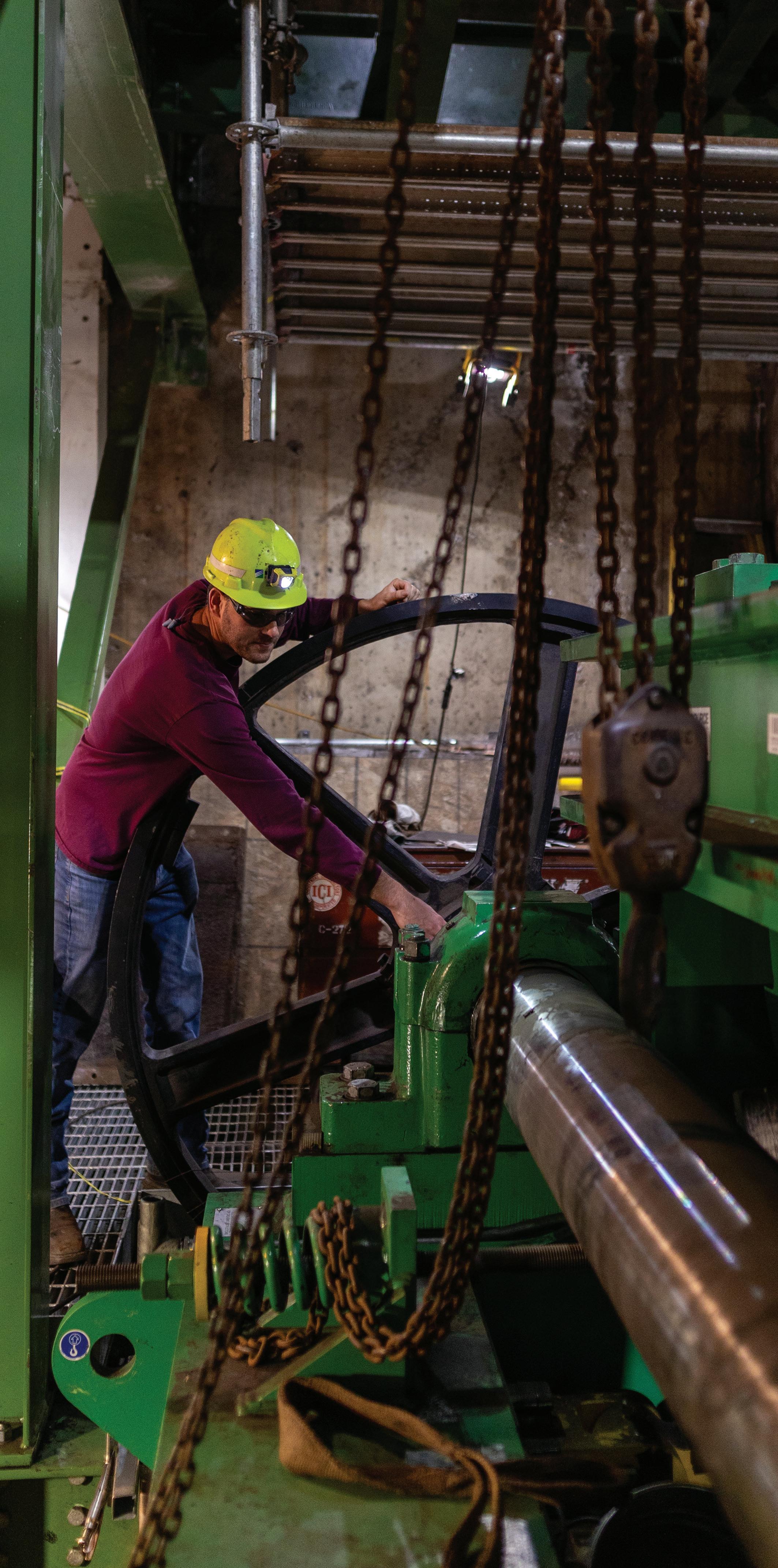
A contractor completes welding work during the Unit 2 outage.

with its major components having nine-year inspection intervals. This year, the high- and intermediatepressure rotors were inspected. In three years, the low-pressure rotors will get a look, and the generator itself will be inspected three years later.
“We don’t really know what we’re going to find, because it’s covered by several layers of casing,” Michlitsch said of the rotors inspected this year, which showed some erosion on the blades that would need repair. “That’s an example of a discoverable that there’s really no way we could
have had on the books as a repair without taking this time for the outage.”
Minnkota’s maintenance coordinators and project leaders ran into their share of typical challenges during the Unit
2 outage, managing newly discovered work and supply chain speedbumps. However, as happens with every Young Station outage, crews and contractors remained adaptable at every turn.
“Every day during the morning 9 a.m. meeting, I get to witness teamwork at its finest,” said Neil Kramar, Minnkota Plant Manager of Operations & Maintenance. “On the project manager level, it’s
Under pressure
Schwanberg has been an engineer at the Young Station for six years, and 2025 marked his fourth major planned outage. Although he’s one of the younger engineers, he’s already taken the helm of two major capital projects. This year’s primary crusher and feeder project was not only the largest venture of the outage, it was the most involved, requiring the coordination of a team of scaffold builders, electricians, millwrights, pipe fitters and iron workers.
“Sam has just moved right through the workload and stayed positive, and he’s done a great job,” Michlitsch said. “If you have a team member or a team leader that’s staying positive, I think it really helps keep everybody else going in the right direction.”
difficult to talk in front of a group of 40 others and have the courage to say your project is falling off pace and you may need help, or we will be looking at a schedule push. I observe true leadership when others step in and offer resources and time to help them understand their barriers and get back on track.”
Ultimately, Unit 2 was delayed in coming back online due to unforeseen hurdles. But the teamwork Kramar spoke of helped to minimize the impacts of the outage extension.

On top of that, Schwanberg took over the project from another engineer late in the nearly twoyear planning process, so he had to work even harder to wrap his arms around the complexity of the job.
“It’s kind of scary, to be honest, but I have a huge supporting team helping me,” he said, contractors buzzing around him. “All the planners, electricians, foremen out here, the contractors, superintendents: We’re all in it together. We all want the same thing.”
For the Young Station, a maintenance outage is an opportunity to observe and strengthen the many individual pieces of equipment that work together to supply power to the region. But more than that, outages are an opportunity to observe and strengthen the young leaders and teammates who will serve as the plant’s keepers for years to come.
“My proudest moments are when I see the smiles return to the faces of the employees when we realize the unit is finally up and running again,” Kramar said. “Each individual had their own unique circumstances where they contributed to the overall success.”
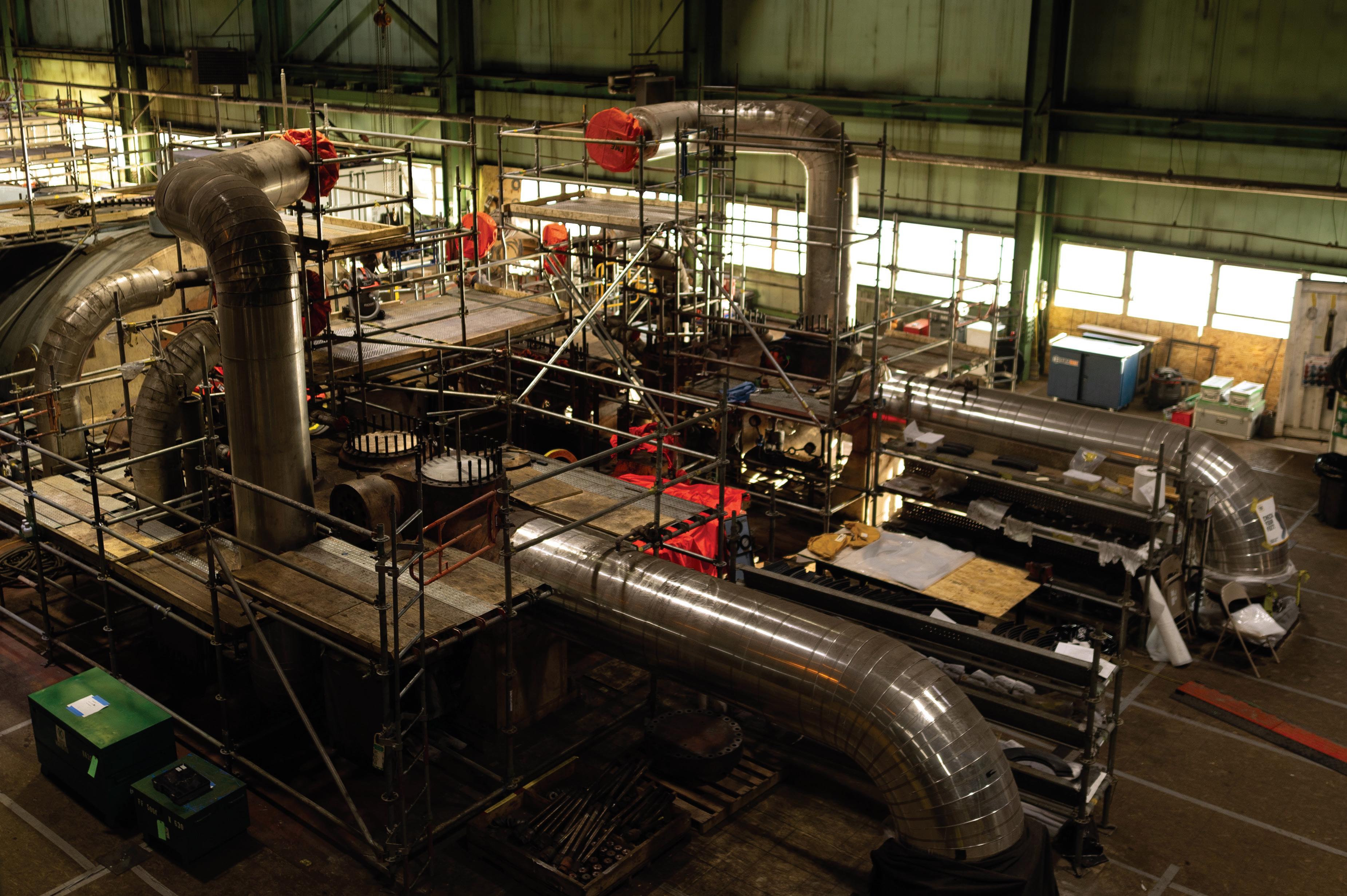
The Young Station’s turbine floor becomes a work zone during the Unit 2 outage.
Mind of an engineer, heart of a leader
Vice President of Engineering & Operations Jodi Bullinger to retire March 3
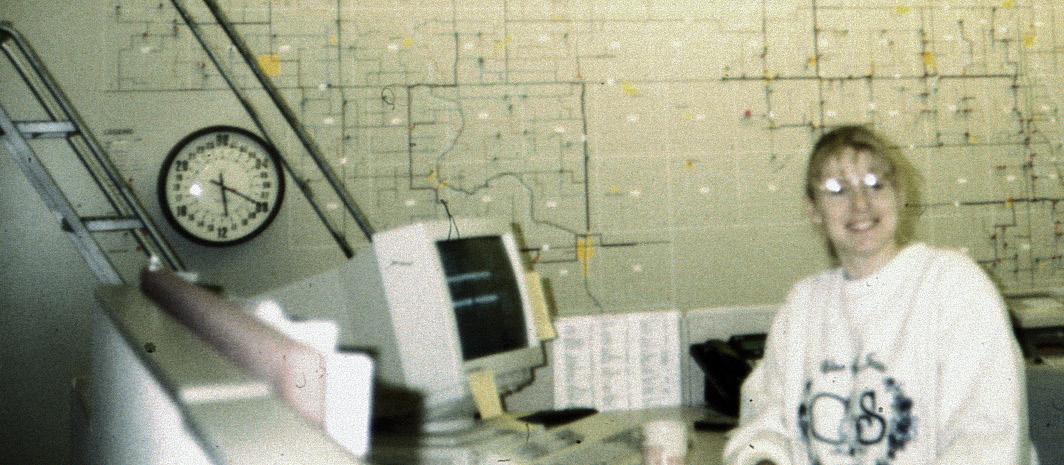
Jodi Bullinger, P.E., flipped through a photo album on her phone, one bright baby blanket snapshot after another. Each was adorned with a name – a Sloane here, an Easton there. It’s not in her job description as Vice President of Engineering and Operations for Cass County Electric Cooperative (CCEC), but Bullinger has been making quilts for every new baby born in her department since the year she took leadership in 2016.
“I was counting, and I think I was at 41 baby blankets over that time,” she said with motherly warmth. “A lot of young linemen starting families.”
Bullinger is a different breed of engineer. She was unique when she joined CCEC’s dispatch team in 1994 and will leave a distinct mark when she retires as vice president this March. She’s stitched together a legacy of power reliability and technology innovation, but also of deep care for those around her.
a knack for numbers. Her high school physics teacher recognized her mathematical promise and urged her to pursue a career in engineering. She would be the first in her family to attend college when she enrolled in the University of North Dakota’s engineering program.
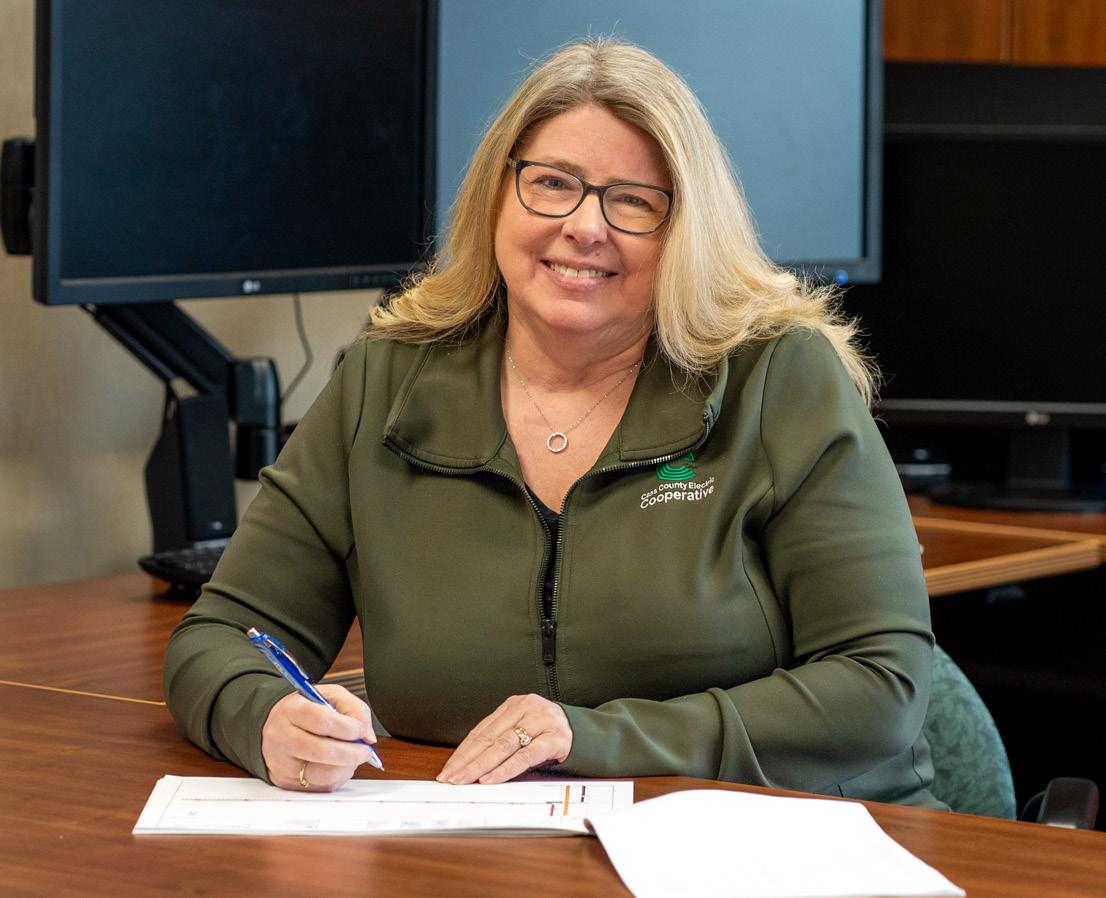
Bullinger became one of the first four people involved in the co-op’s new 24-hour power control center, which gave her a crash course in the operation of the entire system. She was quickly able to utilize her engineering background, writing several programs including a switching order program the co-op still uses today. Soon, she was offered the opportunity to move into the Engineering Department.
“You take those opportunities as they come. Just because you’re working in one area doesn’t mean you can’t keep moving forward with your career development,” she said.
“I wanted to see growth in their careers. I wanted to see them having a safe, healthy environment to work in,” she said, reflecting on her nearly 32 years with the co-op.
Finding her circuit
Growing up in Grand Marais, Minnesota, Bullinger always had
“I remember taking calculus my first year as a freshman. There were a lot of people in there, and the class kept dwindling and dwindling,” she recalled. “By the time I got done, I was the only gal left in the class. You get used to being a minority in a maledominated profession.”
With her electrical engineering degree in hand, Bullinger began the job hunt. She heard CCEC was a great place to start a career, so when she was hired in the dispatch center, she knew it was only the first step of her journey.
Just a couple of weeks after joining the Engineering department, Bullinger found herself with another opportunity. The manager of Engineering had just left the co-op, so someone needed to put together the two-year construction work plan necessary for Rural Utilities Service funding.
“I had never written one before and I didn’t know the process, but had a great team and a wonderful mentor (previous VP Brad Schmidt), so I dove right in,” she said, adding with nonchalance, “At the time, I was also pregnant with my first child.”
There were a lot of firsts to balance at once. With the help
of the experienced team around her, Bullinger wrote her first, $10 million work plan. The hours were long, but she was able to complete the plan and present it to the board of directors one week before the arrival of her son. “That was my first board presentation too, at nine months pregnant,” she laughed.
Tightening the seams
Bullinger’s career didn’t slow down. In 2016, she was named CCEC’s Vice President of Engineering and Operations. She pushed for technology that would enhance reliability across the system, including the implementation of Fault Location, Isolation, and Service Restoration (known as FLISR), an automated technology that minimizes outages by detecting and rerouting power around faults. Bullinger’s team continues to leverage Supervisory Control and Data Acquisition (SCADA), Advanced Metering Infrastructure (AMI), predictive reliability and other programs to decrease outage times.
Bullinger has been a vital part of leading the co-op to experience record reliability figure in 2024. In fact, since she’s joined the Engineering Department, cable faults have decreased from 200 a year to 38 cable faults in 2025.
“I wanted to have a reliable system for our members, but also for the employees at Cass County Electric,” she said. “It makes your job easier when you don’t have to deal with outages every day.”
As Bullinger prepares to leave the co-op on March 3, she’s reflecting on the relationships she’s built and the strong team that will continue the work she started. She speaks of the mentorship of former engineering leaders, the capabilities of her successor, current Manager of Engineering Troy Knutson, and the employeecentered vision of CEO Paul Matthys. “Paul is excellent and he really believes in the people, and you’re going to see the co-op continue in that direction,” she said.
With the co-op in good hands, Bullinger looks forward to spending more time with her husband and two adult children, resting at the lake and traveling the world. She’ll also be crossstitching and quilting, because a good leader’s work is never done.
“I had somebody ask, ‘If we have one more, would you make one more baby blanket?’ Because they have two blankets from me so far,” she said. “Of course I said yes, because I’ll have more time to do it now.”
Congratulations to the other CCEC employees who have or who will retire in the first quarter of 2026! Scan to read their stories:

Chris Erickson Manager of Technical Services Nov. 1993 - Jan. 2026

Darrell Hennemann Facility and Grounds Technician Apr. 2007 - Jan. 2026

Jim Collins Energy Services Technician May 1995 - Feb. 2026
- Understanding your energy bill -
Most of us skim our energy bill, note the amount due, and move on. It is easy to overlook the details printed below that total. But those line items tell an important story about how electricity is delivered to your home or business.
Spending a few minutes reviewing your bill can provide helpful insight. You can see how your energy use changes from month to month, learn how your charges are determined, and recognize patterns that may affect your costs. That understanding can be useful when you are looking for ways to manage usage or keep expenses in check.
To make it easier, this guide walks through the main sections of your electric bill and explains what each one means.
Statement Date:
Found in the upper right corner, the statement date shows the date the statement was issued.
Account Number:
Also located in the upper right corner, your account number is used to manage your account. You will need it to register for online access or to use the Cass County Electric mobile app. The app offers tools for account management and detailed energy usage information to help you better understand your consumption.
Important Messages:
This section includes updates from Cass County Electric, energy-saving tips and important notices related to your service or bill.
Location Information:
Here you will find your service address, rate class and the dates being billed. This section also includes meter readings, which are used to calculate your monthly energy usage.
kWh Usage History:
One of the most helpful sections of your bill, this chart shows your electricity use over the past year. It highlights changes in
usage, often tied to weather, and includes billing days, average temperature, total kilowatt-hours used and average daily use.
NEW – Demand (Informational):
Starting next month, residential members will see an informational line showing their individual electric demand. Demand represents the highest amount of electricity used at one time during the billing period. Residential members are not billed based on demand, but this added detail helps illustrate how your usage patterns can affect the electric system.
Details of Charges: Basic Charge:
This is a fixed monthly charge that covers the cost of maintaining the electric system and providing service to your location.
Energy Charges:
kWh Charge:
This is the cost of the electricity you used during the billing period, and is calculated by multiplying the quantity of kilowatt-hours by the unit cost.
Purchased Power Adjustment:
This charge is the variable

portion of wholesale power and is calculated by multiplying the quantity of kilowatt-hours by the unit cost.
Other Charges and Credits:
This section may include items such as Operation Round Up donations, typically less than $6 per year, franchise fees collected on behalf of cities, and other miscellaneous charges or credits. These can include renewable energy credits, capital credits, demand waivers, connection fees, or deposits.
Remittance Slip:
If you pay by mail, please include the bottom portion of your bill with your payment for ease of processing. Keeping your contact information current helps ensure you receive outage notifications and account updates. The Cass County Electric mobile app also allows you to manage settings, set usage alerts, report outages, and adjust billing preferences.
Understanding your bill goes beyond the total due. It gives you tools to track usage, recognize trends, and make informed decisions about how and when you use electricity.


2025 Impact
�� Participating Members
45,941 active accounts
�� Total Awarded
$252,460 invested locally in 2025
��️ Organizations Supported
65 local nonprofit organizations
�� Local Focus
$242,960 awarded directly to community organizations
Member Giving
�� Average Monthly Gift
$0.49 per member
�� Average Annual Gift
$5.83 per member
�� Maximum Annual Gift
$11.88 per account
Since 1993
�� Total Community Investment
$4.6 million returned to local communities
�� Member Powered Funded entirely by voluntary member participation
How It Works
➕ Round Up
Bills round up to the nearest dollar
�� Funds Stay Local Grants support nonprofit organizations in the service territory
⚖️ Independent Oversight Awards determined by a volunteer community board of CCEC members
impact
Operation Round Up
Cass County Electric Cooperative Foundation
As the new year begins, Cass County Electric Cooperative (CCEC) is reflecting on the impact members continue to make through Operation Round Up.
CCEC allows members to voluntarily round up their monthly electric bill to the nearest dollar. Those small contributions are collected through bills by CCEC and reinvested directly into the communities Cass County Electric serves. The Operation Round Up program supports local charitable organizations and community initiatives focused on strengthening the cooperative’s service territory.
While each individual donation is modest, the combined effect is powerful. Member participation makes it possible to provide meaningful support to nonprofits and community programs working to improve quality of life across the region.
In 2025, Operation Round Up helped fund dozens of local organizations, reinforcing the cooperative’s commitment to community and local decisionmaking. Since the program began in 1993, member contributions have returned
millions of dollars to communities served by Cass County Electric.
Grant funds are administered by a volunteer board of directors made up of community members and independent from Cass County Electric. This structure ensures transparency and fairness, with grants awarded according to established guidelines. Funds remain local and are not used to pay electric bills or support political or religious causes.
Participation in Operation Round Up is always voluntary, and members may opt out at any time.
Cass County Electric thanks the members who choose to round up each month. Their generosity continues to show how small change can make a lasting difference and how, together, we remain cooperative strong.
To learn more about Operation Round Up, view past grant recipients, or enroll in the program, visit CassCountyElectric. com/ORU. Members may also contact Cass County Electric Cooperative at 701-356-4400 or email oru@kwh.com.
“TOGETHER, MEMBER-OWNED GIVING HELPS STRENGTHEN THE COMMUNITIES WE SERVE.” - PAUL MATTHYS, PRESIDENT/CEO
Check out our Pinterest page for more recipes!

Chicken tzatziki rice bowls
Ingredients
1 cup uncooked jasmine rice
1 tsp dried oregano
1/2 tsp cumin
1/2 tsp smoked paprika
1/2 tsp salt
1/4 tsp black pepper
2 Tbsp olive oil
1/2 cup Greek yogurt
2 tsp lemon juice
1 tsp dill
1 cup cucumber, chopped
recipes
A new year is a great time to reset in the kitchen. These healthy, build-your-own rice bowls are perfect for meal prep, making it easy to plan ahead without sacrificing flavor. Simple ingredients, balanced portions and versatile toppings help take the stress out of weeknight meals while keeping your goals for the year on track. Each bowl is easy to customize, so you can mix in the vegetables you like best or use what you already have on hand.
Shrimp rice bowls
Ingredients
1 cup uncooked jasmine rice

1 pound boneless, skinless chicken breast
1 cup cherry tomatoes, halved
Sliced red onion
1/2 cup crumbled feta cheese (optional)
Lemon wedges (optional)
Instructions
Rinse rice, stir rice into 2 cups of water in a microwave-safe bowl. Cover and microwave for 5 minutes. Stir, then microwave 5 minutes more. Let rest while chicken cooks.
Heat olive oil in a large skillet over medium heat. Cut chicken to 1-inch cubes. Season chicken directly in the pan with oregano, cumin, paprika, salt, and black pepper. Cook chicken until fully cooked. Let rest.
Mix Greek yogurt, lemon juice, and dill to make tzatziki sauce.
Assemble bowls with rice, chicken, cucumber, tomatoes, red onion, and other toppings if using. Drizzle tzatziki over top.
1 pound shrimp, peeled and deveined (fresh or frozen)
1/2 tsp smoked paprika
1/2 tsp garlic powder
1/2 tsp onion powder
1/4 tsp salt
1/4 tsp black pepper
1/4 tsp cayenne pepper
2 Tbsp olive oil
1 cup shredded carrots
1 cup snap peas, chopped
Sliced green onions
1/2 cup mayonnaise
2 Tbsp sriracha
Sesame seeds
1 avocado, sliced (optional)
Instructions
Rinse rice, stir rice into 2 cups of water in a microwave-safe bowl. Cover and microwave for 5 minutes. Stir, then microwave 5 minutes more. Let rest while shrimp cooks.
Heat olive oil in a large skillet over medium heat. Sprinkle paprika, garlic powder, onion powder, salt, black pepper, and cayenne directly into the pan. Cook shrimp until they are pink and opaque.
Mix sour cream and sriracha and set aside.
Chop and combine carrots, snap peas, and green onions in a bowl and set aside.
Assemble bowls with rice, shrimp, and vegetables. Add sesame seeds and avocado if using. Drizzle sauce over top.
Warm smarter, heat safer. safety
Cold weather often sparks a familiar standoff over thermostat settings. One person is freezing, another is cracking a window, and comfort lands somewhere in the middle. Since everyone feels temperature differently, many members reach for space heaters or electric blankets to add warmth without heating the entire home. These devices can be effective when used properly, but they can also pose serious risks if safety precautions are not followed.
Space heaters are built to warm small, targeted areas, not whole houses. If you’re relying on one daily to heat a drafty room, it could be a sign your home is losing heat faster than it should. Space heaters can also have a noticeable impact on your electric bill. A typical 1,500-watt space heater costs more than 17 cents per hour to operate, which can add up quickly over the winter months. If you have questions about the cost of running a space heater or want help identifying the most cost-effective heating options for your home, our energy services team is available to help.
Before plugging in a heater, consider tackling efficiency upgrades first. Sealing drafts and improving insulation helps your home retain heat, reduces energy use, and makes supplemental heating sources safer and more effective.
Efficiency fixes don’t need to be complicated or expensive. High-impact steps include sealing air leaks around windows and exterior doors, adding insulation in key areas such as the attic, scheduling regular maintenance for your furnace or heat pump, and using a programmable thermostat to reduce energy waste. Once efficiency issues are addressed, a space heater can safely boost comfort in a home office or bedroom.
Use space heaters efficiently by heating only occupied rooms, closing doors to keep heat contained, checking sizing guides, and choosing models with thermostats and timers. When


Scan here for more safety tips!
purchasing a heater or electric blanket, look for current safety certification marks such as UL, ETL, or CSA labels. Avoid older or secondhand devices, which may lack modern safety features.
Proper placement is critical. Set space heaters on solid, flat, nonflammable surfaces. Never place them on carpets, furniture, or countertops. Plug heaters and blankets directly into wall outlets, not extension cords or power strips. Keep children, pets, curtains, bedding, and other flammable materials at least 3 feet away, and never leave these devices unattended or running while you sleep.
Routine checks matter, too. Inspect cords for cracking or fraying and discontinue use of any device showing damage or charring. Replace electric blankets that become worn or develop darkened spots, and store them flat or loosely rolled to protect internal wiring. Keep heaters and blankets away from water.
Safety goes beyond the devices themselves. Test smoke detectors monthly, change batteries twice a year, practice a home escape plan, and make sure pets are not sleeping on electric blankets. When disposing of old or damaged equipment, check with your local recycling facility for proper appliance disposal.
By improving efficiency first and following smart safety habits, you can keep your home comfortable, energy efficient, and strong all winter long.
Free:
ads
Member Market
All ads must be 40 words or fewer and will be abbreviated following our guidelines. No real estate or commercial ads will be accepted. Ads are published for members at no charge as space permits on a first-received, first-printed basis. Ads are due by the 10th of the month prior to publication. Members may submit only one ad per issue. Editor reserves the right to edit or reject any ad. Email ads to: ccec@kwh.com
Antique pump organ, MFGBeckwith Co. Chicago, IL. In working order, it needs a new home. 701-237-3991
For sale:
Little Machine Shop Model 3390 HiTorque mini mill, includes vise, various size collets, drill chuck, other accessories, $750. Little Machine Shop Model 5100 HiTorque mini lathe, 4” and 5” chucks, live & dead centers, $750. Both lightly used. 701-799-1649
1993 Westwood Campbell Soup Company Occupation Mugs, set of four, $35. 701-388-1107
Varmint rifle Howa model 1500, 204 Ruger caliber, Leupold VX-111 4.5-14, -40 power scope. Never been hunted with, like new, $750. 701-238-8119
Muck chore Boots like new, size 10, $60. 2 heavy duty tow ropes, each comes w/ high test chain, clevis, storage bag, & crate. 13’, $40. 14’, $50. 701-371-8111
Handicare Stairlifts (2) in great shape, for product info: HandicareStairlifts.com, $800/ea. 928-278-2891
Pickup cover, hard tonneau, 3 sections, 84 x 67, top will hold 800 lbs, never used, $500/OBO. Fish house, insulated, Eskimo brand, 6-man, never used, $500/OBO. 701-793-7841 or 612-296-0879
Assorted brass casings: 540 30-06, $18/50 or $185 for all. 64223, $15. 98-9mm, $9. Assorted shotgun casings: 619 12ga low base, $30. 300 12ga 2 ¾ hi-base, $30. 140 20ga 2 ¾ hi-base, $14. OBO. 701-427-9362
Contemporary & new 12-place settings (50 pieces) Portmeirion porcelain, Sophie Conran design in “pebble” (neutral tan/grayish) color, each setting includes11” dinner plate, 8” luncheon/ dessert plate, 4.25” mug, coupe cereal/dessert bowl, one serving platter, serving bowl. Eight settings in their boxes, view on Replacements.com. 701-306-7064
2 NFL Vikings winter caps: one new ($25), one used ($20). 701866-0218
Wanted:
Rear tractor tire, size 13.6-38 or a pair of smaller size 38”. 701-2825726
Buying guns, gun collections, estates, & taxidermy. All interactions will be kept confidential. 701-866-7246
Compact digital or film cameras, paying cash, compact cameras for students to use in photography class, Canon, Sony, Olympus, or Nikon cameras in working condition. 701-541-7852
Decades of value

Loaf of bread
1937... 8¢
2026... $3.65
Increase... 45x
Electricity 1937... 5¢/kWh
2026... 11¢/kWh
Increase... 2x
Affordable, reliable electricity is something you can count on as a cooperative member. While the cost of everyday items has increased, the cost of electricity has remained a powerful value.