Programme note
In November 1993 I was 14 years old and practising for my Grade 6 violin. My teacher, Marilyn Shearn, took me and three other pupils to play for her old teacher, Rudolf Botta. I played Bartók's Evening in the Village — a perennial favourite on the ABRSM Exam Syllabus. Marilyn videotaped the masterclass, and nearly 25 years later, I found this tape in a shoebox while my parents were moving out of our family home. This discovery started the process of researching and writing this concerto-of-sorts — a 'radio music drama' that celebrates the confluence of musical lives that led to and followed on from that moment in November 1993.
Rudolf Botta had a remarkable life. Born in 1918, he was prominent in the Hungarian Army during WWII, and then later in the anti-Soviet resistance between 1945 and 1956. As a result, in 1952 the Soviets sent him to a labour camp and, knowing he was a professional violinist, tortured him to the extent that he was never able to play again. He was released in 1953 in the amnesty following Stalin's death, only three years later to find himself a regional leader of the 1956 revolution. Following a tip-off about his imminent arrest, he fled Hungary with his wife Leonka and their two daughters, Alexandra (Emolke) and Genevieve. They found a warm welcome in the UK and, after a short stint as a window cleaner, Rudolf became a teacher at what is now the Royal Northern College of Music. Rudolf's gift was teaching, and over a 30year career he touched the lives of hundreds of violinists and future music teachers; Marilyn Shearn was one of them, and Botta's rigorous, pragmatic and inspiring teaching she, in turn, passed onto me.
Venables plays Bartók, written in 2018, is a series of musical postcards built around six of Bartók's arrangements of Hungarian or Romanian Folk Dances and two of his own miniatures (The Night's Music and The Chase):
1. Evening in the Village
2. Romanian Polka / Fast Dance — 1944, Bonyhád, Hungary
3. The Night's Music — 1946, Griffen, Austria
4. Stick Dance — 1956, Bonyhád, Hungary
5. The Chase — 1956, A refugee camp in Vienna
6. Dance from Bucsum — 1957, Burnley
7. Bear Dance — 1952, An unknown location in Hungary
8. Evening in the Village (reprise) — 1938, Bonyhád, Hungary
9. Standing Still
These postcards are paraphrased 'diary entries' that alternate between two timelines: the first is my own journey of working with Pekka, interviewing Botta's family members and ex-pupils and reading his extensive memoirs; the second is Botta's journey through WWII, imprisonment, fleeing Hungary and arriving in the UK. Those two histories meet at that moment when I played Bartók to Botta, 25 years ago. The hope is that I have created a piece that reflects on the 'violin genealogy' that connects me to Marilyn to Rudolf, and which ultimately allowed me to become a musician and to write this concerto.
Philip Venables, June 2018.
Instrumentation
Piccolo
Flute
2 Oboes
2 Clarinets in B♭ (Clarinet 2 doubling Bass Clarinet in B♭)
2 Bassoons
4 Horns in F
2 Trumpets in C (Trumpet 1 will require an E♭ or Piccolo Trumpet in some passages)
2 Tenor Trombones
Tuba
Timpani (4), also bowed Crotales on 28”–29” Timpano:
Percussion (see notes below)
Centre (main set-up):
Tubular Bells (up to G)
Large Tam-tam
Large Bass Drum (mounted horizontally)
Tambourine with skin
Crotales:
Marching / Military Snare Drum
5 Temple Blocks Medium Wood Block
*Whip Triangle Sandpaper Blocks
Stage right set-up:
*Whip
Hammer on Block of Wood optional: Bowed Crotales on 28”–29” Timpano**
Stage left set-up
*Whip Hammer on Block of Wood Tambourine with skin
Medium Wood Block
Piano
Tape (see notes below)
Solo Violin
Violin I
Violin II
Viola
Violoncello
Double Bass
Strings ideally 14.12.10.8.6 but a minimum of 12.10.8.6.4 (see notes about first violin solos, below).
*It is also necessary to carry the whips with the players as the players move between stations during the piece. If this is not desirable then there should be three Whips in the central station.
**The bowed crotales on a timpano are included in both the Percussion and the Timpani parts, and can be played by either player. If Percussion, this will be played by the player at the Percussion Right station. In this case, the Percussion Right Whip at Fig. 11 should be omitted.
The score is written in C
Duration: ca. 30 minutes
Performance Notes
Conductor
The passages of solo violin and piano should be performed as chamber music as far as possible. A separate violin and piano rehearsal is recommended in advance of the orchestral rehearsals.
Tempi should be observed reasonably accurately, especially in the faster sections. This ensures that the recorded text fits into the music properly. However, there is some margin for error/freedom.
All cuts at double barlines (usually signified by the Whip) are hard cuts. Make sure not to try to blend sections together: play right up to double barlines without diminuendo or rallentando, unless marked.
Clapping by the orchestra: the claps should be loud, as resonant as possible (usually by cupping the palms a little), and they should be as together as possible, sounding as one. This will undoubtedly require a little rehearsal. There is plenty of time for players to put down and pick up their instruments before and after the claps.
Violinist and Pianist
Many sections require the soloist to play with the pianist, quasi chamber music. Ideally, these sections will be rehearsed in advance, as chamber music, and the conductor should do as little as possible in these sections.
The soloist is required to introduce the piece from the stage, and also announce the titles of folk dances during the performance. They should feel free to adapt the introduction to their own style and the performance context (venue, audience, event, orchestra and conductor, etc). The announcements should feel natural and spontaneous.
The announcements of folk dances should be loud and clear; there is maximum only piano to overcome. Some of these should be announced whilst continuing a simple note or rhythm on the violin. The repeats are always marked to allow the announcements to take enough time to feel spontaneous, natural and fun. Repeat as many times as required; the pianist should wait for the soloist to indicate moving on.
Tape Part (Sound Cues)
The tape part consists primarily of two male spoken voiceovers. The sound files in English can be hired from the publisher. The two voices are:
Voice 1 (marked PV in the score): the composer, male, 30s, British accent
Voice 2 (marked RB in the score): an actor, playing Rudolf Botta. Male, 30s, with Hungarian accent. Additional sound:
audio footage of the composer playing to Rudolf Botta in 1993; a female computer-generated voice reading out an email; a loud censorship beep.
If performed in a country where English is not commonly fluently understood, then the two voiceover parts should be translated and recorded with two voice actors, as above. The recording should be close, with a little compression if required, and no reverb, in the style of a radio drama.
The audio footage from 1993 must be used regardless of language and cannot be replaced. The computer-generated voice can be re-made in any language using online tools.
Audio samples should be trimmed hard to the first sound of each phrase. Trim off breath intake before each phrase.
Use a cueing system such as QLab to arrange the samples, to be triggered by someone sitting in the orchestra with a part, under the guidance of the conductor. Cueing must be done precisely.
The score indicates pre-wait times in musical durations. These pre-waits should be pre-calculated depending on the tempi that conductor and soloist are using, and added into the cueing system. This allows cueing to be easier, falling almost always on a beat.
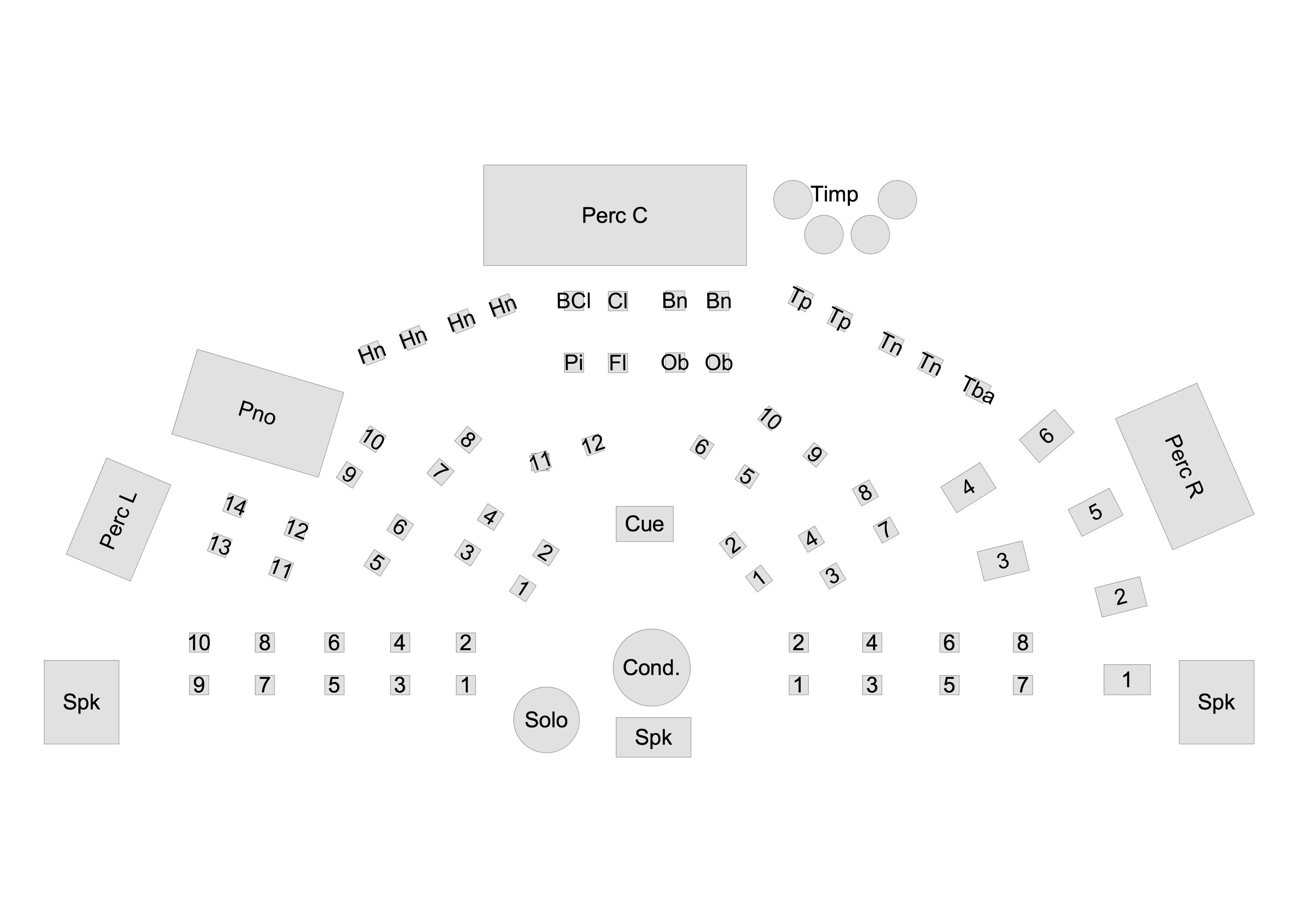
Speakers should be arranged close to the orchestra and to the soloist, so that a good blend between music and voice is achieved. Subtle fill-ins around the hall may be required, but the main sound source should be the stage. The samples should be carefully sound-checked in the performance venue and levels adjusted accordingly, so that there is an even balance between orchestra, soloist and recorded voice. The voices must be clear to the audience, but not overpower the music.
If the audio hire materials in English are used, please credit the following:
Voice actors: Jot Davies as Rudolf Botta; Philip Venables as himself.
Sound design: Philip Venables
With thanks to Benedict Warren (Producer) and Joe Yon (Recording Engineer)
Percussion
Percussion requires three set-ups on stage: a central/normal position at the back of the orchestra, and two small set-ups to the extreme left and right of the conductor, e.g. behind 2nd violins or piano (Left) and behind double basses or tuba (Right). There needs to be access for the players between these stations during the piece. See the suggested stage layout diagram.
The two satellite set-ups require a hammer on a block of wood. The wood should be hard so that it can take a beating without breaking. The hammer should be a conventional metal-headed hammer, suitable for banging nails / home DIY. The wood and hammers should be the same so that a similar sound is produced by each. The wood should be fixed secure, as the strokes in Bear Dance — 1952, An unknown location in Hungary should be large, loud, violent. These gestures are as much visual as they are aural.
Centre (main set-up):
Timpani (4)
*Whip
Large Bass Drum (mounted horizontally)
Tambourine with skin
5 Temple Blocks
Medium Wood Block
Crotales: Triangle
Large Tam-tam
Tubular Bells (up to G)
Sandpaper Blocks
Marching / Military Snare Drum Tambourine
Stage right set-up:
*Whip
Hammer on Block of Wood optional: Bowed Crotales on 28”–29” Timpano**
Stage left set-up
*Whip
Hammer on Block of Wood Tambourine with skin
Medium Wood Block
*It is also necessary to carry the whips with the players as the players move between stations during the piece. If this is not desirable then there should be three Whips in the central station.
**The bowed crotales on a timpano are included in both the Percussion and the Timpani parts, and can be played by either player. If Percussion, this will be played by the player at the Percussion Right station. In this case, the Percussion Right Whip at Fig. 11 should be omitted.
First Violins
First violin parts are divided by desk between Figures 41–47. The section divides as normal (a 2, a 3, a 4 etc) throughout. Between Figures 41–47, players play individually according to what is in their part.
The solo passages for Player 9 at Figures 3 and 7, and the passage for Players 7–10 at Figure 28, are included in just the parts for desks 3, 4 and 5. It is assumed that the outer flank of first violins on stage has five desks, but if there are only four desks on the outer flank, then the Player 9 addenda should be taken by Player 7 (e.g. outermost rear player) at Figures 3 and 7, and Figure 28 should be taken by Players 5–8 (the rear four players on the outer flank). This ensures that all these solo passages are visible to the audience but as far away as possible from the concerto soloist.
Player 9 should play a little detuned, or out of tune, as desired, and should retune at ease (if required) before rejoining the orchestra. The result should be the sound of a learner/child playing at Figure 3, and of a busker or street performer at Figure 7. Figure 28 should be in tune. Figures 3 and 7 are both completely independent of the orchestra. Tempi should be chosen so that this independence is obvious to the listener.
2.1 144 0.5 11.4 PV Mum found an old video tape labelled "Philip: Masterclass with Rudolf Botta, November 1993". On the tape, I'm playing a piece that must have been for Grade 6, but I'm not sure exactly what it is. Reflective
3.1 52 0.5 11.9 PV I make a rough transcription of the melody from the video tape and post it on Twitter. Stuart MacRae and Adam Swayne both tweet back — apparently it's Bartók Evening in the Village.
3.1 52 3 12.5 PV I download the sheet music, and try to play it. I haven't played my violin for at least a year. My intonation is awful and my left hand is stiff and quickly gets tired.
4.1 160 0.5 1.5 PV I just had lunch with Pekka More upbeat
5.1 160 0 1.7 PV On an island in Helsinki
5.2 160 0 3 PV that was used to de-magnetise ships during the war.
5.3 160 0 1.7 PV Completely out of the blue
5.4 160 0 2.7 PV we discussed David Oistrakh's vibrato.
7.1 44 0 7.4 RB Saturday 3rd June 1944. Bonyhád, occupied Hungary
7.2 94 0.5 6 RB We receive orders to throw a party for the German Officers stationed here.
7.3 138 0.5 2.2 RB They know they have already lost the war
7.4 144 0.5 1.7 RB But they don't dare say it
7.5 144 0.5 1.7 RB They just drink instead
8.1 80 0.5 3.7 RB A gypsy band plays the usual Hungarian stuff
8.2 120 0.5 2.5 RB A few Viennese Waltzes they know,
8.3 132 0.5 1.8 RB But the style is simple
8.4 144 0.5 3.6 RB I pick up a violin and go to the cellar to warm up my fingers:
8.5 144 0.5 4.3 RB for years I've hardly touched a violin, and my hand is stiff.
8.6 160 0.5 1.5 RB I tell the band a key
8.7 160 0.5 1.7 RB and they improvise an accompaniment for me.
9.1 90 0.5 5.7 RB I am still sober enough to tell them not to try any gypsy tricks while I play,
9.2 100 0.5 4.6 RB but to stick to strict harmony.
This section a party scene. Jolly.
9.3 104 0.5 1.8 RB The Germans are astonished. a little louder
9.4 104 0.5 3.4 RB They sing, and drown out my violin. louder, as if talking over a party noise
10.1 48 0.5 6.2 PV Francesca lets me hold the tiny violin that Rudolf had carved in the Soviet prison camp Reflective
10.2 48 0.5 7.3 PV It is so small, beautifully made, but she doesn’t want to string it properly in case the tension breaks it.
10.3 48 0 6.8 PV Having said that, I do remember my teacher Marilyn saying she had played it, years ago.
11.1 56 0 4.8 RB 26th January 1946 This section: calm, reflective.
11.2 56 0 3.9 RB Griffen, Austria
12.1 56 0.25 3.6 RB The snow is slowly melting Slow, austere, weighty.
12.2 56 0 7.7 RB In the new year, the British announce that our service as "police-deputies" is over.
12.3 56 0.25 5.5 RB They collect our uniforms back in, and stop giving us food.
12.4 56 0.33 8.4 RB I've eaten mainly potatoes for the last three days and haven't had meat in two weeks.
13.1 56 0 6.8 RB By chance I found a temporary job as a violin teacher in Klagenfurt.
13.2 56 0.33 2.6 RB The school is desperate
13.3 56 0 4.8 RB most of their music staff have been killed.
13.4 56 0.33 6.4 RB It's only one day a week, but it means finally I get ration cards.
13.5 56 0.75 1.2 RB They lend me a violin Wistful.
13.6 56 0.5 2.9 RB And I start to play again Wistful.
13.7 56 0.5 2.4 RB after six years Wistful.
15.1 72 0 9.8 PV Genevieve told me about her mother, Leonka... and how Rudolf used to swim the Danube every Sunday to see Leonka in Vértpuszta when they were dating. Reflective
15.2 72 0 6 PV There's a passage in his memoirs about how to swim against a strong river current.
15.3 72 0.25 5.8 PV Apparently Rudolf would strap his clothes and shoes to his head to swim across.
16.1 60 0 9 RB Tuesday 30th October, 1956. Bonyhád, Hungary
This section, a bit more defiant.
18.1 60 0.75 2 RB The unrest began seven days ago "seven days ago" spaced in crotchets, mm60 – see score for more details
18.2 60 0.75 6.1 RB On Wednesday, students started burning Russian books in the streets.
18.3 60 0.25 8.8 RB The Enamel Factory and the Mines stopped work last week, and the shoe factory shut down yesterday.
18.4 60 0.5 8.1 RB There were 4000 people in the town square on Saturday night, and gunfire since then.
19.1 60 0.5 4.1 RB Szabó Joszef was shot – he was only 16 name should be redacted with censor beep so just the very beginning and end of the name is audible.
19.2 76 0.5 7.8 RB The National Council met last night, and this morning they appointed me District Commander of our regional National Guard.
19.3 76 0 2.8 RB Almost all the men in the town joined up. a little louder
19.4 76 0 2.1 RB Hungary is fighting back! louder still, defiant
20.1 152 0.67 5.4 PV I’m on the train to Preston, after meeting Rudolf’s granddaughter, Francesca.
20.2 152 0 8.2 PV She had some newspaper clippings from 1957, with pictures of Rudolf, Leonka and their two girls.
21.1 152 0 5 PV Britain took 22,000 Hungarian refugees that year. Emphatic.
21.2 152 0 4.6 PV I also saw some photos of Rudolf fencing in his teens.
21.3 152 0 1.8 PV Quite a dashing guy
22.1 160 0.33 2.3 RB Thursday, 6th December
22.2 160 0.66 1.5 RB Nineteen fifty-six
22.3 160 0.33 1.6 RB A refugee camp
22.4 160 0.33 1.2 RB in Vienna
22.5 160 0.33 1.6 RB We fled Hungary
22.6 160 0.66 1.1 RB We had no choice
This scene: fast, a chase scene. Pace of text a little faster, and spoken louder, higher in the chest, a little more urgently.
23.1 160 0 1.5 RB Kovács Laszlo name should be redacted with censor beep so just the very beginning and end of the name is audible.
23.2 160 0.33 0.9 RB told me
23.3 160 0.33 0.9 RB that he had
23.4 160 0.67 1.5 RB heard that I would
23.5 160 0.67 1.8 RB that I would be arrested soon
23.6 160 0.67 1.8 RB We knew what that really meant
23.7 160 0.67 1.8 RB especially for my girls
23.8 160 0.75 0.8 RB and Leonka
23.9 160 0 1.4 RB Siberia weighty
24.1 160 0 1.4 RB Thirty-seven of us
24.2 160 0 1 RB left Bonyhád
24.3 160 0.5 1.9 RB in a miners' bus
24.4 160 0.5 1.4 RB I gave them instruments
24.5 160 0.5 1.5 RB from the music school
24.6 160 0.5 2.9 RB to pretend we were playing at a family wedding
25.1 160 0.5 5.2 RB This lie worked on the patrols, especially once we handed over our valuables
25.2 160 0.33 2.6 RB But the patrols split us up,
25.3 160 0.5 1.9 RB and we have not seen the others since.
26.1 160 0.5 1.7 RB I fear the worst. weighty
26.2 160 0.67 5.2 RB My poor girls had to trudge through snow and mud all night to the border
26.3 160 0.5 2.2 RB The sound of gunfire never stopped,
26.4 160 0.5 1.2 RB but we made it.
26.5 160 0 3 RB Coaches are coming from Manchester to take us
26.6 160 0 - RB They call them 'Happiness Coaches'. Take some time.
27.1 52 0.75 28.3 PV I met David Fielding today, Rudolf's son-in-law. He told me that Rudolf used to go most Thursdays to see the Halle. If it was a violin concerto, he would take along a copy of the part and write in the soloist's fingerings and bowings. Rudolf had all these different parts catalogued and numbered at home. He loved David Oistrakh, mainly because he could vary his vibrato so much.
29.1 60 0 76 RB "24th February 1957, Burnley, England. I got a letter this morning – in hungarian, would you believe – from the Royal Manchester College of Music. They saw me and Emolke playing on the TV, a documentary about refugees in Britain, and they said if I learn English quickly, they'll give me a job. Apparently ""it's enough that I'm a Hungarian violinist"". The local newspaper has photographed us, and made up their own British names for the girls. The caption under the photo says: “Only a few weeks ago the nine year old girl in this picture was called Emolke by her friends, now she is Maureen. Maureen is an infant prodigy on the piano, but until they can afford to get a piano at their new home she will have to practise her music on her father Rudolf's 250-year-old Italian violin, one of the few articles they could bring out of Hungary."
31.1
144 0.5 5.8 PV I found this article called "Bullfighting as an art form", by one of Rudolf's ex-students, Paul Hurt.
31.2 144 0.5 4.3 PV It’s not really that relevant to this piece, but I love it.
32.1 144 0.5 2.1 PV "The technique of Bullfighting," Like a circus ringmaster (PV, for entire section)
Reflective
A fast, violent scene. Sounding a little stressed, but defiant/resistant. Declamatory 32.3
32.4 144 0.5 2.1 RB In southwest Hungary
32.5 144 0.5 2.1 RB The secret police arrests me
32.6 144 0.5 1.7 RB They want information about
33.2
33.5 144 0.5 2.1 PV "Such as the action of the wrists"
33.6 144 0.5 2.1 RB They point a gun at my head.
33.7
name should be redacted with censor beep so just the very beginning and end of the name is audible.
1.7 RB They want information, 34.3
"intricate"
RB but I refuse
1.3 PV "and complex" 34.6 144 0.5 1.3 RB so they torture me
2.4 PV "as the technique of a developed skill" 35.1
1.7 RB They take a hammer
0.5 1.7 PV "such as violin playing" 35.3 144 0.5 2.4 RB They strike my left hand 35.4
again
35.5
0.5 0.6 RB again 35.6
0.5 0.6 RB again 35.7 144 0.5 0.6 RB again
35.8
and again
PV "which makes extraordinary demands"
RB They take a hammer.
144 0.5 1.7 RB They strike my hand.
36.3 144 0.5 2.1 RB The hammer breaks my wrist
36.4 144 0.5 3.2 PV "on neuro-muscular coordination,"
36.5 144 0 1.5 RB My hand is pulp
36.6 144 0.5 1.7 PV "not just of the fingers"
37.1 144 0.5 0.9 RB They strike
37.2 144 0 1.1 PV "and hand,"
37.3 144 0 1.1 RB again becoming more urgent with the repetition
37.4 144 0 1.1 PV "but the shoulders,"
37.5 144 0 0.8 RB again
37.6 144 0 0.8 PV "arm,"
37.7 144 0 0.8 RB again
37.8 144 0 0.8 PV "elbow"
37.9 144 0 0.8 RB again
37.10 144 0.5 0.6 PV "and wrist."
38.1 144 0.5 0.8 RB I cannot becoming more urgent with the repetition. WIth a regular rhythm
38.2 144 0.5 0.8 RB I cannot
38.3 144 0.5 0.8 RB I cannot
38.4 144 0.5 0.8 RB I cannot
38.5 144 0.5 1.5 RB I cannot feel my hand.
38.6 144 0.5 7.3 PV "My own studies with the Hungarian violinist Rudolf Botta have left an indelible impression."
40.1 60 0 7.2 RB I do not give in, so they send me to a prison camp. reflective, calm, quieter.
40.2 60 0 7.2 RB In the camp, I stay alive only for my daughters and Leonka. reflective, calm, quieter.
40.3
60 0.5 8.6 RB I carve a small violin out of wood, but I am careful to hide it from the guards. reflective, calm, quieter.
40.4 60 0.5 4.1 RB My hand is destroyed wistful
40.5 60 0.5 6.8 RB I am released the following year. But I never play again. wistful, very poignant.
41.1 - 0 - Audio footage of Philip Venables playing to Rudolf Botta in 1993. 3-second fade in and 5-second fade outs. Dip volume slightly for the following voiceover.
F/O 60 0 41 PV I take the train to Prague today to have lunch with my old teacher, Marilyn. We haven’t seen each other for 19 years. She told me stories about her studies with Rudolf, and said that he made a huge impact on her life – the kind of person you meet once in a lifetime, she said. I’m glad I’m writing this concerto about him, but I didn’t tell Marilyn that I am going to dedicate it to her. After lunch we watch the video of me playing Evening in the Village to Rudolf when I was 14.
43.1 120 0.5 6.1 RB 17th August 1938. Bonyhád, Hungary
45.1
This section: positive, happy, buoyant
120 0 12.6 RB I strained my left hand slightly in fencing practice this morning. A bit silly of me since I have another performance of the Vivaldi B minor tonight. I'm sure it'll be fine.
45.2 120 0 13.5 RB I've got five concerts this week and our quartet tour starts next week, and on top of that, I still have so much preparation to do before our move to Budapest.
46.1 120 0 4.1 RB Still, I'm feeling good about my playing at the moment.
46.2 120 0 9.5 RB We finished the Vivaldi rehearsal last night and I had one of those moments where you feel like everything is falling into place.
"everything is falling into place" is emphasised.
46.3 120 0 1.8 RB Life is good. slowly paced.
48.1 52 0 78.9 - Hi Hannah.
Thanks for your email. I have a title for the concerto for you now. "Venables plays Bartók", with a double credit: Venables, Bartók.
The concerto is about my violin teacher’s teacher, Rudolf Botta, who was a refugee who fled Hungary to the UK after the revolution. I met him when I was a teenager, and played one of the Hungarian Sketches for him – so I’m going to use those as a frame for the piece. I want to tell his life story alongside my story of learning the violin and researching this concerto, kind of like a violin ‘life stories’ piece.
I discussed with Anne and Paul the tech stuff for the recorded voiceover – I think it should be quite straightforward.
By the way, I had a lovely day with Pekka in Berlin last week. It turns out his first teacher in Helsinki was also a Hungarian emigré. A strange coincidence – I feel like we are all connected, in one big violin family.
All very best, Philip
A female, computer-generated voice. Applications for this can be found on the internet. A slow pace, british English accent. Ensure there is relatively good pronunciation, especially for the names.
Percussion Left (Hammer, whip)
Percussion Centre (main set-up)
Percussion Right (Hammer, whip, tambourine, woodblock)
Venables plays Bartók
You casually and warmly introduce the selection of 'Hungarian Sketches' , 'Romanian Folk Dances' and short piano pieces to the audience, perhaps mentioning some of the dances and a little bit about the origins of them, or the setting of the performance You might mention that folk songs are often put together to tell a short story and that this is what Philip wanted to do in this piece, and that you will call out the different dances as we go Finally, introduce 'Evening in the Village' , found in the Hungarian Sketches
(You could start playing this note during the end of the introduction, ad lib )
(You could also mention that 'Evening in the Village' also appeared in the 'Ten Easy Pieces' for piano)
PLAYER 9 (5th desk, outer player) SEE ADDENDUM
With practice mute
Play a little out of tune, folkish, like a busker, or a learner Use plenty of vibrato, perhaps even unmusical rubato, and very little vibrato, perhaps sometimes a little too near the bridge For added effect, the A and E strings could be tuned a little flat if you wish, but if detuning is not convenient or desired, play without open strings, slightly flat, quasi open string
The player omits Fig 4 6, plays the solo part at Fig 7, then retunes discreetly and joins in by Fig 10
I
ROMANIAN POLKA
Player 9 (with practice mute, as before, detuned if desired ) Player plays the Fast Dance independently to the orchestra, with rubato, etc See Addendum
PV: Francesca lets me hold the tiny violin that Rudolf had carved in the Soviet prison camp
PV: It is so small, beautifully made, but she doesn’t want to string it properly in case the tension breaks it
RB:
RB: The National Council met last night, and this morning they appointed me District Commander of our regional National Guard
PV: I met David Fielding today, Rudolf's son-in-law He told me that Rudolf used to go most Thursdays to see the Halle If it was a violin concerto, he would take along a copy of the part and write in the soloist's fingerings and bowings Rudolf had all these different parts catalogued and numbered at home He loved David Oistrakh, mainly because he could vary his vibrato so much
VIOLIN 1, PLAYERS 7 10 (4th and 5th desks) SEE ADDENDUM
With practice mute Play full and freely, tempo independent of the orchestra, with a gradual rallentando and diminuendo Starting tempo should be similar to the soloist
(If only four desks are at the front of the stage, then these parts are taken by the desks 3 and 4, players 5 8)
RB: 24th February 1957 Burnley, England
I got a letter this morning – in hungarian would you believe – from the Royal Manchester College of Music They saw me and Emolke playing on the TV, a documentary about refugees in Britain, and they said if I learn english quickly, they'll give me a job Apparently "it's enough that I'm a Hungarian violinist" The local newspaper has photographed us, and made up their own British names for the girls The caption says “Only a few weeks ago the nine year old girl in this picture was called Emolke by her friends, now she is Maureen Maureen is an infant prodigy on the piano, but until they can afford to get a piano at their new home she will have to practise her music on her father's 250-year-old Italian violin, one of the few articles they could bring out of Hungary "
PV: I found this article called "Bullfighting as an art form" by one of Rudolf's ex-students Paul Hurt
(follow on cue) PV: I take the train to Prague today to have lunch with my old teacher, Marilyn We haven’t seen each other for 19 years She told me stories about her studies with Rudolf, and said that he made a huge impact on her life – the kind of person you meet once in a lifetime, she said I’m glad I’m writing this concerto about him, but I didn’t tell Marilyn that I am going to dedicate it to her After lunch we watch the video of me playing Evening in the Village to Rudolf when I was 14 (violin recording fades a little to allow recorded voice through)
46.1
RB: Still, I'm feeling good about my playing at the moment
46.2
RB: We finished the Vivaldi rehearsal last night and I had one of those moments where you feel like everything is falling into place
[computer-generated female voice]
Hi Hannah
Thanks for your email I have a title for the concerto for you now "Venables plays Bartók", with a double credit: Venables, Bartók
The concerto is about my violin teacher s teacher, Rudolf Botta, who was a refugee who fled Hungary to the UK after the revolution I met him when I was a teenager, and played one of the Hungarian Sketches for him – so I’m going to use those as a frame for the piece I want to tell his life story alongside my story of learning the violin and researching this concerto, kind of like a violin ‘life stories’ piece
I discussed with Anne and Paul the tech stuff for the recorded voiceover – I think it should be quite straightforward
By the way, I had a lovely day with Pekka in Berlin last week It turns out his first teacher in Helsinki was also a Hungarian emigré A strange coincidence – I feel like we are all connected, in one big violin family
All very best, Philip
ADDENDUM for PLAYER 9, FIRST VIOLINS
PLAYER 9 (5th desk, outer player)
With practice mute
Play a little out of tune, folkish, like a busker, or a learner Use plenty of vibrato, perhaps even unmusical rubato, and very little vibrato, perhaps sometimes a little too near the bridge For added effect, the A and E strings could be tuned a little flat if you wish, but if detuning is not convenient or desired, play without open strings, slightly flat, quasi open string
The player omits Fig 4 6, plays the solo part at Fig 7, then retunes discreetly and joins in by Fig 10
(If only four desks are at the front of the stage, then this part should be taken by the outer player of the fourth desk Player 7)
cue)
63), freely, slightly faster than the soloist
cue)
VIOLIN 1, PLAYERS 7 10 (4th and 5th desks) SEE ADDENDUM
With practice mute Play full and freely, tempo independent of the orchestra, with a gradual rallentando and diminuendo Starting tempo should be similar to the soloist
(If only four desks are at the front of the stage, then these parts are taken by the