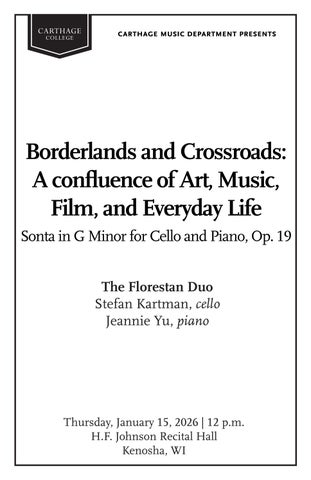
A confluence of Art, Music, Film, and Everyday Life
Sonta in G Minor for Cello and Piano, Op. 19
The Florestan Duo
Stefan Kartman, cello Jeannie Yu, piano
Thursday, January 15, 2026 | 12 p.m.
H.F. Johnson Recital Hall
Kenosha, WI
program
Sonata for Cello and Piano in G minor, Op. 19 Sergei Rachmaninoff
I. Lento-Allegro moderato (1873–1943)
II. Allegro scherzando
III. Andante
IV. Allegro mosso
Stefan Kartman, cello Jeannie Yu, piano
program notes
The Sonata for Piano and Cello in G minor, Op. 19 was written in 1901, and was first performed in December of that year by the composer and cellist Anatoly Brandukov, to whom the work is dedicated. Rachmaninoff had recently emerged from one of the most critical periods of his career as a composer following the dismal failure of the first performance of his Symphony No. 1 in D minor conducted by Alexander Glazunov in 1897. Rachmaninoff was twenty-four when his first symphony premiered. He was talented, high strung, and had put so much importance on the début that he could not even bear to be in the hall in Petersburg when it was performed, but hid on the stairs of the corridor that led to the balcony. Imagine what the effect would be on such a sensitive person when the Petersburg critics took full advantage of a poor performance (Glazunov was inebriated at the performance), of a work from Moscow.
“If there’s a Conservatory in Hell, and one of its gifted pupils was given the problem of writing a programmatic symphony on the Seven Plagues of Egypt, and if he should write a symphony resembling Mr. Rachmaninoff’s symphony, his problem would have been carried out brilliantly and would enchant all the inmates of Hell.” César Cui
Needless to say, Rachmaninoff did not easily recover from the night of March 15, 1897. It took a period of three years, a successful conducting post, and finally the help of a hypnotist to whom he dedicated his most enduringly beloved work, the Second Piano Concerto (1900-1901) before he was able to regain his confidence enough to compose effectively.
It is said that the pianist’s job in the Op. 19 Sonata is by far more difficult than the Second Concerto. While dealing with all of the technical difficulties contained in the Concerto, the pianist must somehow work with balance problems inherent in performing the work on a modern piano on equal terms with a cellist and without compromising the grand scale of the work. It is composed in full four-movement form with a soulful slow movement, a dark scherzo, and a heroic last movement. Rachmaninoff’s only recorded comment about the sonata is that the cello was not to dominate the performance, but rather that cellist and pianist were to be equal partners. Of Rachmaninoff’s sparse ventures into the realm of chamber music, the Op. 19 Sonata is his last and best. Though cellists and pianists alike complain that the writing is balanced in favor of the piano, the intensity and drama of the music can, in a sensitive performance, overcome any deficiencies of instrumental balance.
Stefan Kartman
The Florestan Duo
Stefan Kartman, cello - Jeannie Yu, piano
Stefan Kartman and Jeannie Yu began performing together as a duo during their studies at The Juilliard School of Music in 1987. As like-minded musicians with common pedagogical lineage, they shared the same concept of an ideal sound, musical expresiveness, and excellence as they began to carry on a tradition reaching back to the formation of the genre of cello and piano duo. This tradition is the basis of inspiration for their shared ideals.
Stefan and Jeannie have performed to critical acclaim in concert halls and educational institutions throughout the United States, Europe, and the Far East. Recordings of their performances have been aired on WQXR in New York, WFMT in Chicago, and Iowa Public Radio, and Wisconsin Public Radio.
Their recording of The Complete Works of Beethoven received many positive reviews including this from Fanfare Magazine...
“Stefan Kartman, cellist, and Jeannie Yu, pianist, the members of the Florestan Duo play them (Beethoven Works) with intensity, emotional gravitas, and technical brilliance...Kartman’s instrument sings with a warm vibrant voice...both Kartman and Yu play brilliantly...The sound on the disc is state of the art.”
Maria Nockin, Feature Review - Complete Works of Beethoven for Cello and Piano - Fanfare Magazine
Both members of the Florestan Duo are accomplished teachers and performers of chamber music and solo repertoire, having served on the faculties of Drake University, Illinios Wesleyan University, the Wisconsin Conservatory of Music, the MidAmerica Chamber Music Institute, the Alfred University Summer Chamber Music Institute, the Milwaukee Chamber Music Festival, the Green Mountain Chamber Music Festival, the Madeline Island Chamber Music Festival, Rembrandt Chamber Players, Midsummers Music Festival, and the Vianden Chamber Music Festval among many others.
Dr. Kartman is currently Professor of Cello and Chamber Music at University of Wisconsin - Milwaukee and Dr. Yu teaches and freelances in the Milwaukee and Chicago metropolitan areas.
upcoming events
Student Recital - Liam Karth
Thursday, February 5 • 6 p.m.
Campbell Student Union Auditorium
"Speakeasy" Gradate MT Recital
Saturday, February 7 • 4 p.m.
H. F. Johnson Recital Hall
Michael Hall Faculty Recital
Wednesday, February 11 • 7:30 p.m.
H. F. Johnson Recital Hall
Performing Arts Series: Alysha Umphress
Thursday, February 12 • 7:30 p.m.
H. F. Johnson Recital Hall
Student Recital: Vivian Alexander
Saturday, February 21 • 7:30 p.m.
H. F. Johnson Recital Hall
Arts at Carthage acknowledges that the land on which our building stands is part of the traditional Potawatomi, Sioux, Peoria, Kickapoo, and Miami peoples past, present, and future. These homelands reside along the southwest shores of Michigami, North America’s largest system of freshwater lakes. We honor with gratitude the land itself, and the people who have stewarded it throughout the generations. Many Indigenous peoples thrive in this place—alive and strong, and this calls us to commit to continuing to learn how to be better stewards of the land we inhabit as well.