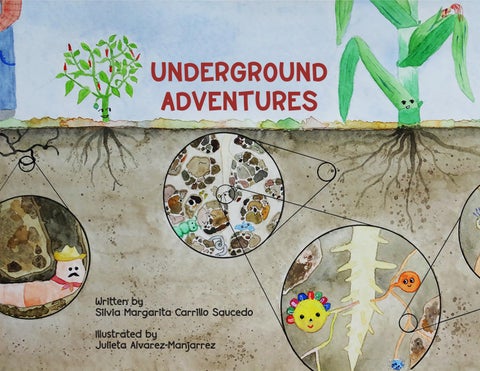
UNDERGROUND ADVENTURES
 Written by Silvia Margarita Carrillo Saucedo
Illustrated by Julieta Alvarez-Manjarrez
Presentation
This book was made with great care and is dedicated to all the children of the world. Through its pages you will learn the story of microscopic beings that are very important to sustain life on our planet.
We hope that through its reading you feel curious to know more about this fascinating microbial world and, why not? We hope to encourage you to become a soil scientist.
So, come join us in this underground adventure!
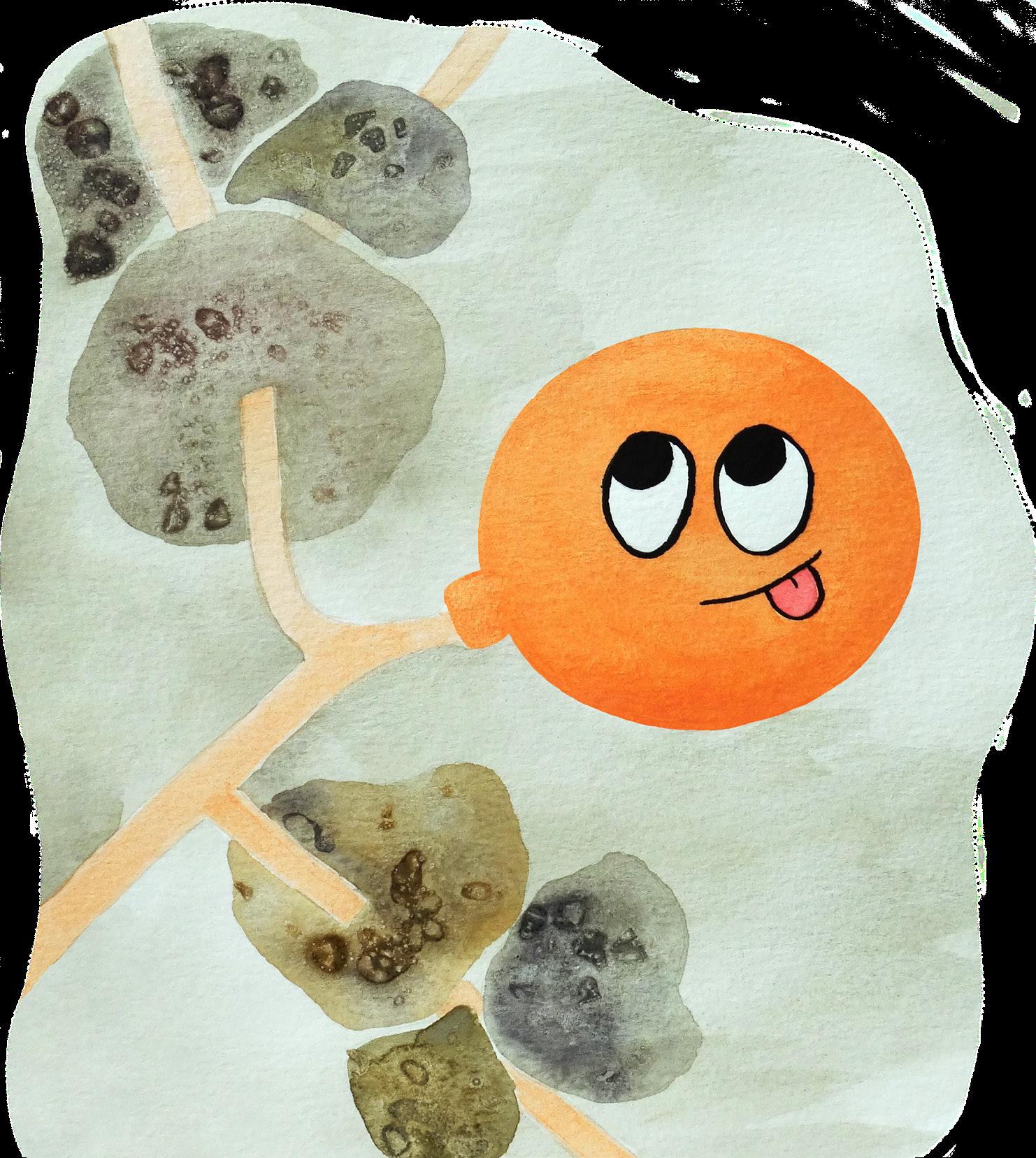
Hyphae
Content 1. Glomi’s village............................................................ 1 2. The strange object.................................................. 4 3. The rescue plan........................................................ 6 4. Weaving networks..................................................... 8 5. Final Thoughts........................................................... 11 6 Activity: Classify Glomi............................................... 12 7. If you want to know more........................................ 13
Glomi
Glomi’s village
There’s a place on Earth where tiny, strange creatures live and work together in harmony. Even though they are very small, their role in the ecosystems is of high importance. These are the beings that inhabit the soil. Let me take you to this underground adventure along with our friend, Glomi.
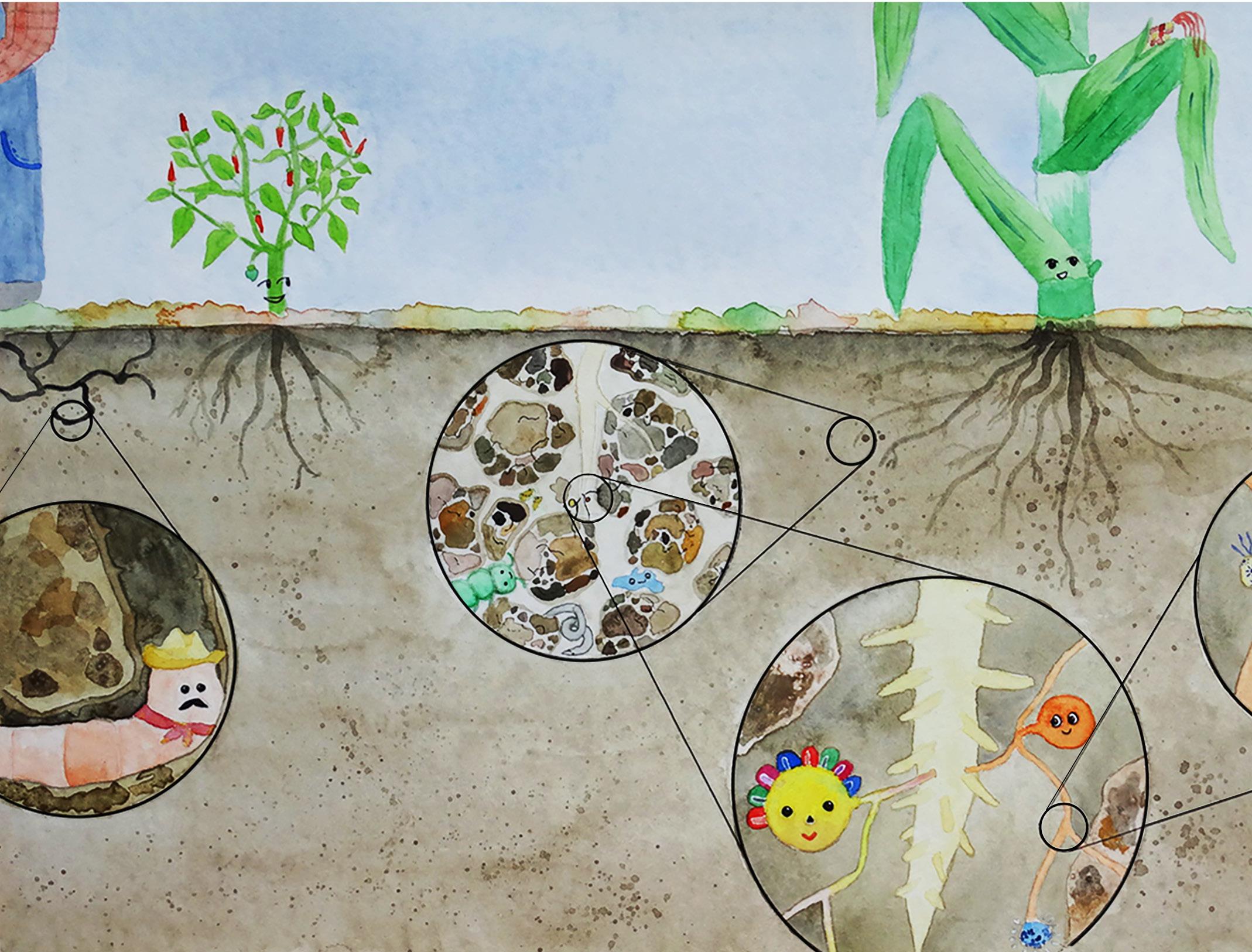
Glomi is a microscopic mycorrhizal fungus, this means that it is a fungus that lives in the roots. Glomi is tinier than a grain of salt. From its round-shaped body emerge some structures which look like shiny white very thin tubes, called hyphae. When the hyphae are numerous, they are called mycelium. The hyphae of the fungi grow into the soil by exploring the surroundings to obtain nutritious substances; besides, they are very sticky, which allows them to gather and attach the soil particles to form clods. So that Glomi survives, it needs friends to make alliances and exchange food with. This is called symbiosis. Glomi protects his friends and gets them very special nutritious food, which he carries through its hyphae.
The place where Glomi lives is quite unique. It is divided into several spheres, which are constructions made by little pieces of soil of various sizes. These are conformed by diverse groups of bacteria, fungi and other bugs. Each sphere is in charge of a specialized function.
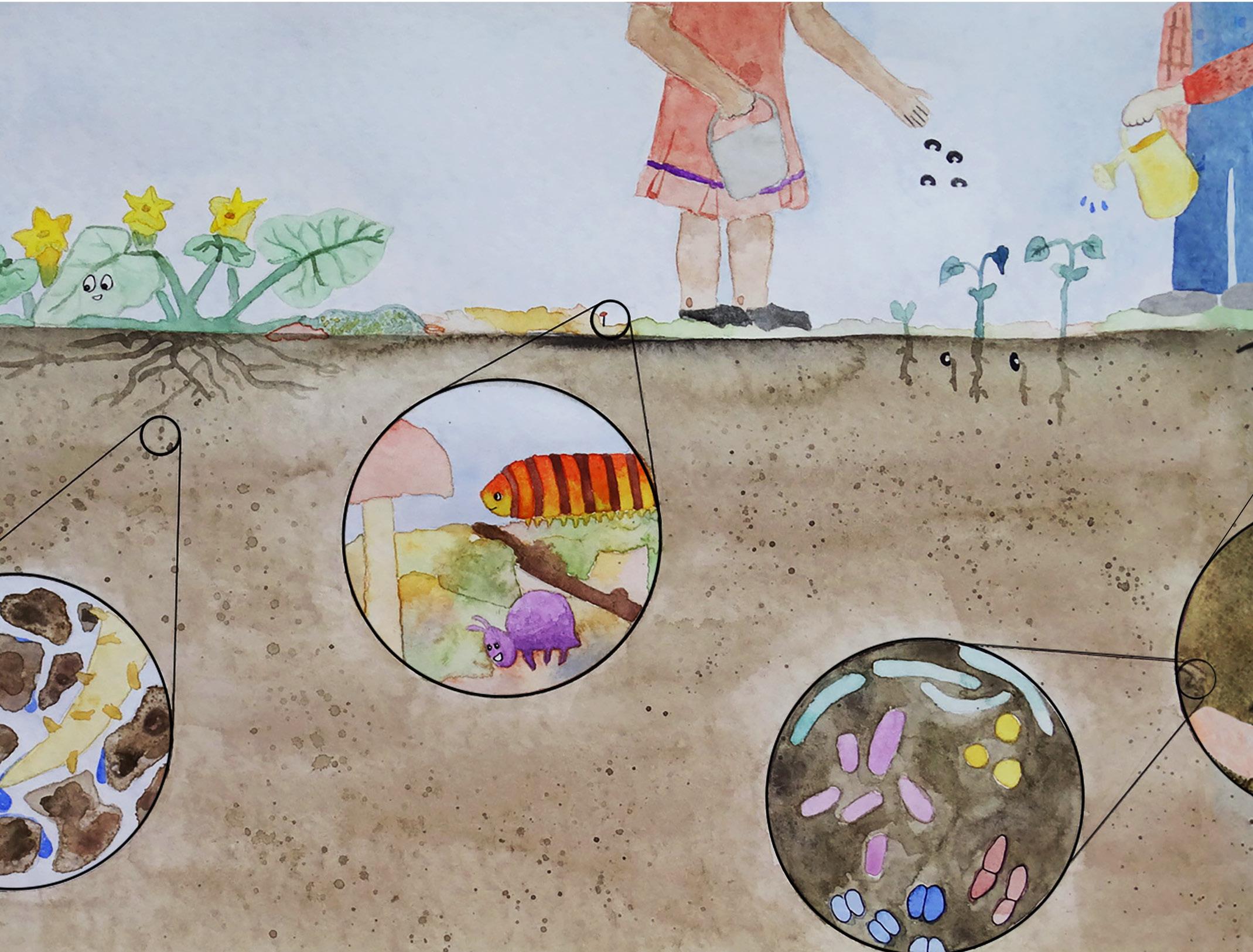
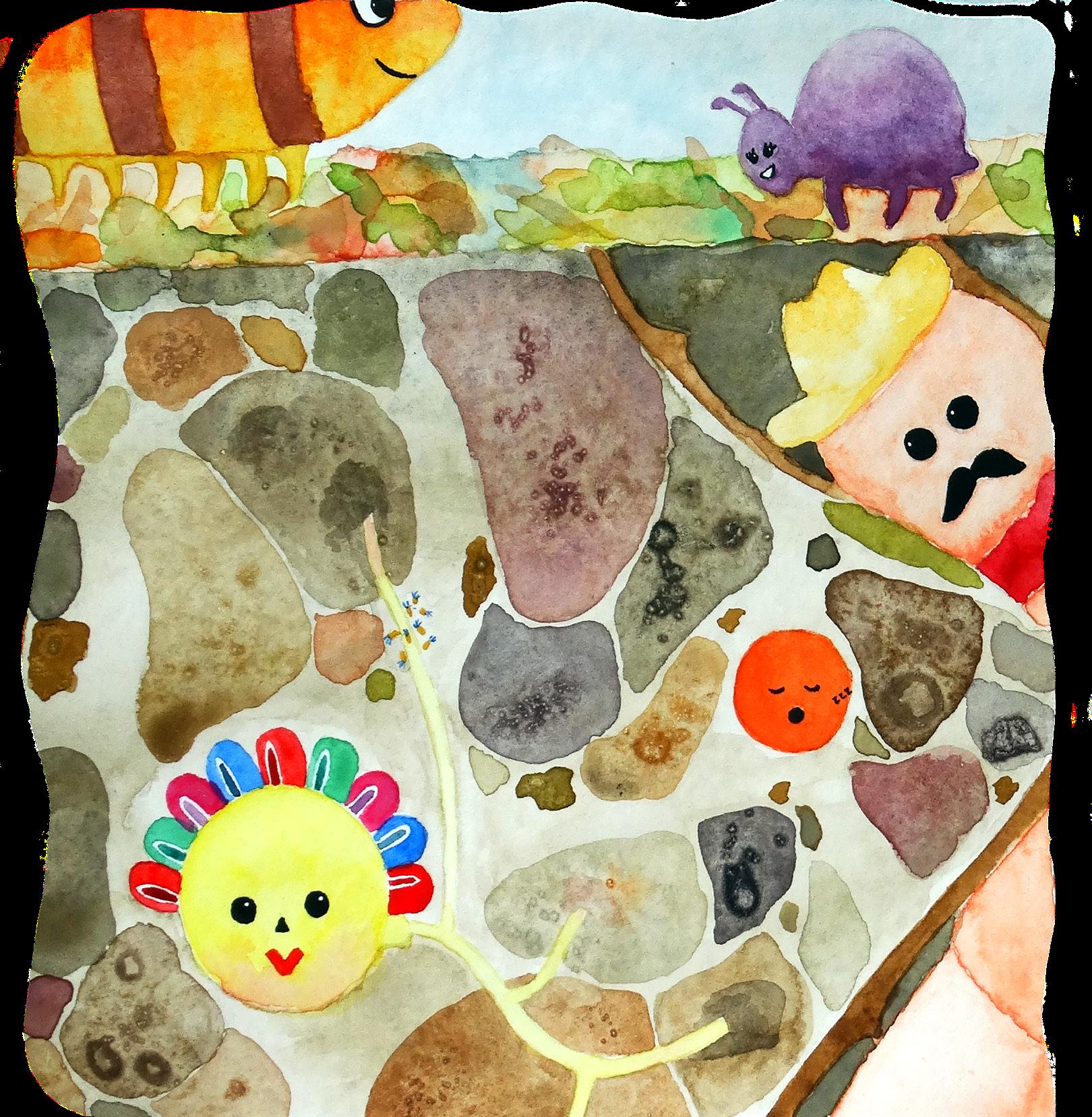
One of them, the detritosphere is inhabited by Mike, the millipede, Violet, the springtail, and their mushroom friends. Altogether, they eat from the dry leaves that fall down breaking them into small pieces.
1
Glomi
Martin
Mike Violet
Gigi
Another sphere is the drilosphere; here, you can find Martin, the earthworm. He is in charge of making underground tunnels, by eating soil, for the water and air to travel in. The sphere, known as aggregatosphere, is made up of soil particles. These particles are glued to clods or aggregates thanks to Glomi’s hyphae and a very nutritious yummy syrup that comes out from plants’ roots.
Finally, the mycorrhizosphere is a sphere conformed by Glomi’s hyphae (hyphosphere) and roots (rhizosphere). This is a very important sphere because it spreads across the ground for several meters, making it a cozy home for organisms like the soil microbiota .
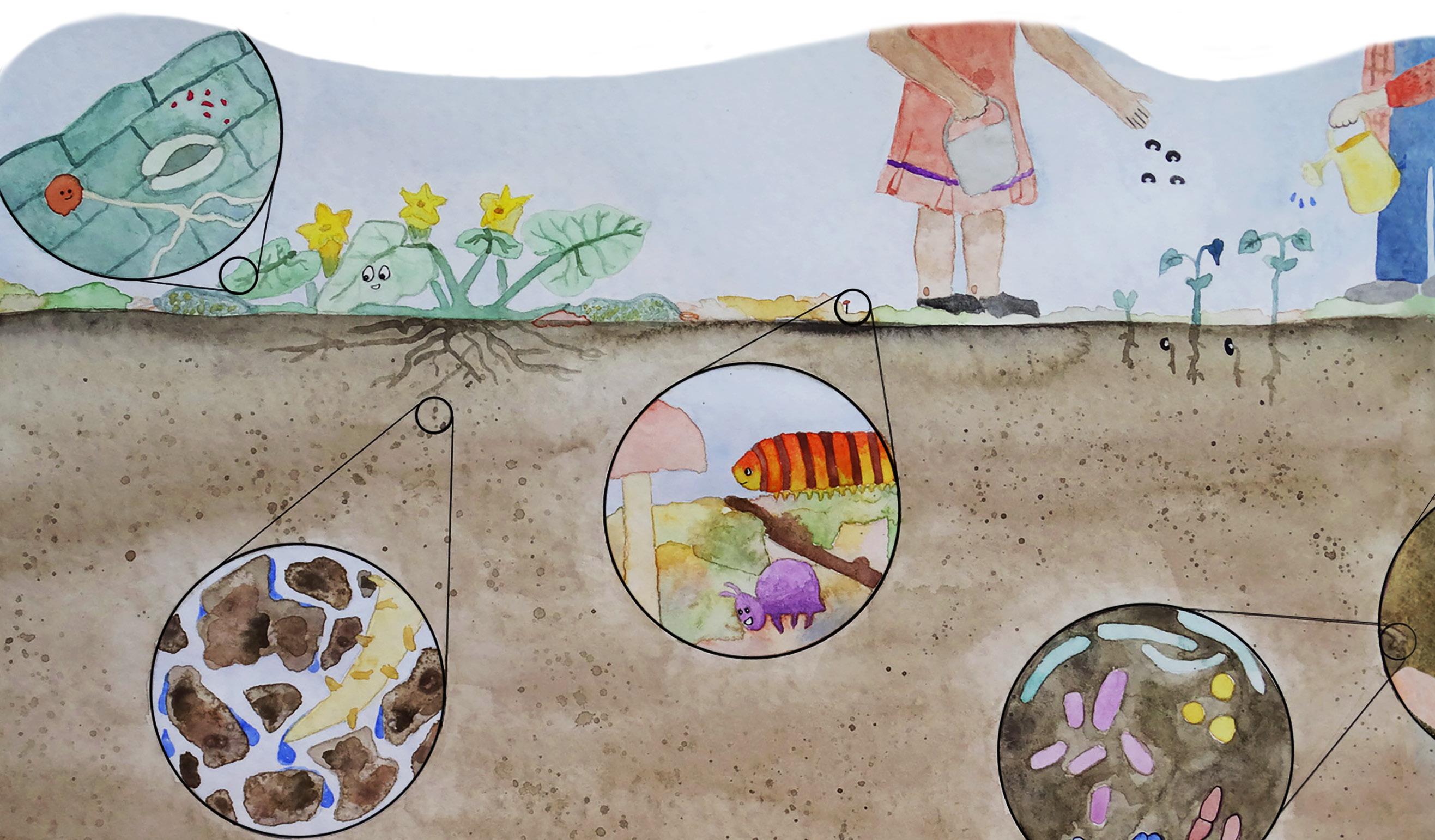
Porosphere**
Phyllosphere*
Detritosphere
*Microrganisms that live on leaves
**Holes of the soil filled with air and water
Microbiota
2
In the microbiota, we find the Purpurina friends, a very active group of bacteria and other microorganisms called protozoa that like to gather, and they process matter that Martin and other bugs get rid of; and storage it. We also find the Burkis, a bold group of bacteria that travels through the mycelium of organisms like Glomi, looking for nutritious substances that are hard to find.
Peace and cooperation were always present in Glomi’s village until one day a strange object fell down, and the alarms went off. What is this unfamiliar object? Is it a friend or a foe? Will the inhabitants in Glomi’s village be able to fight against this strange object? Let’s find it out in our next underground adventure.
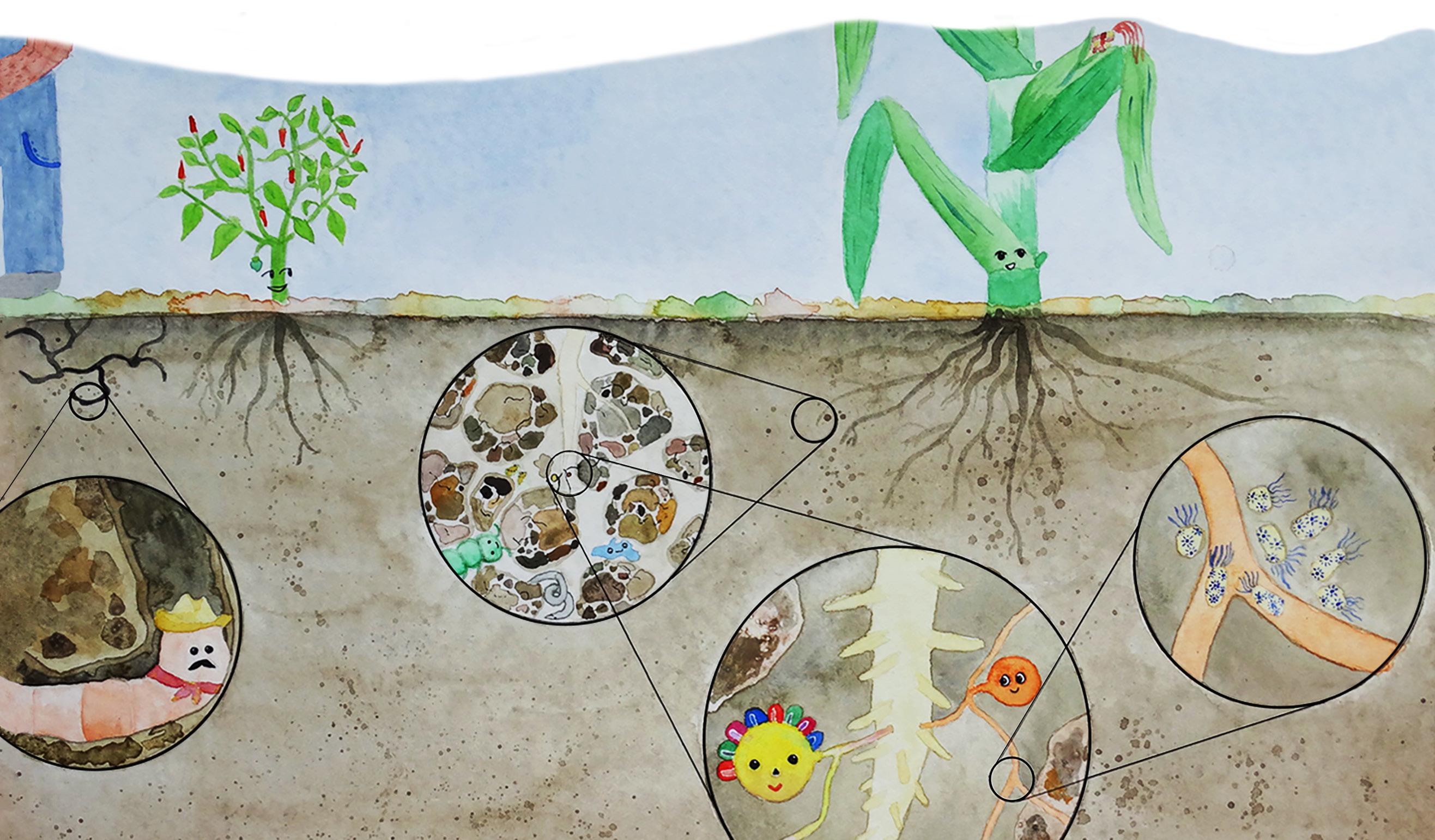
Drilosphere
Aggregatosphere

Rhizosphere + Hyphosphere
Mycorrhizosphere
Our story
3
The strange object
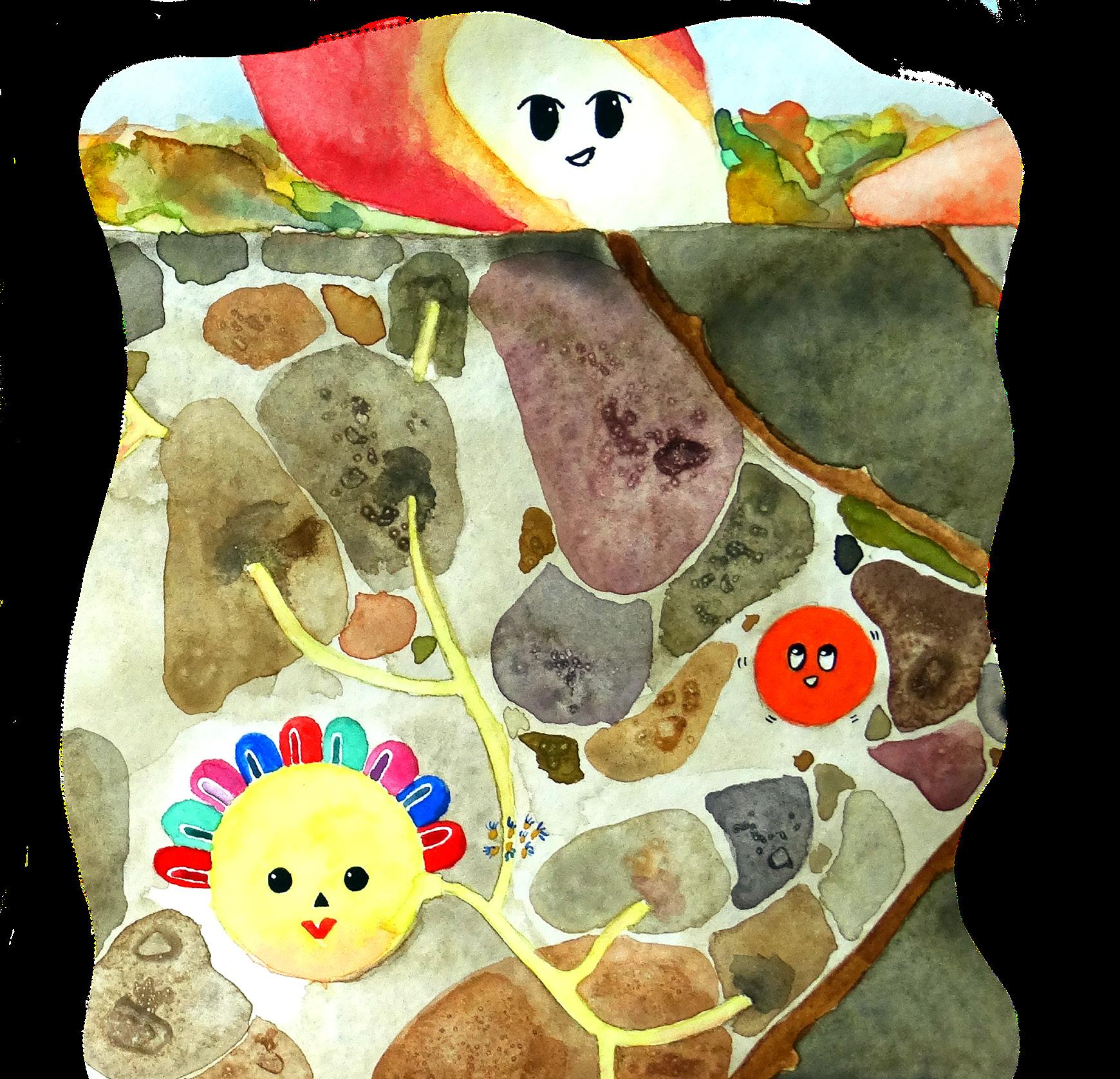
Several of our curious friends gathered in the area to examine the strange object. Martin, Glomi and a Purpurine friend were there. Days passed by and the object did not move at all, it remained exactly the same. As a result, some of our friends went back to their soil aggregates. However, Glomi kept waiting, he had a hunch and felt very curious and intrigued.
Suddenly, Glomi perceived a slight shake, he paid close attention and observed that a hairy thick thread was coming out from the strange object. Wow! – Glomi exclaimed – that thread looks like me, but bigger.
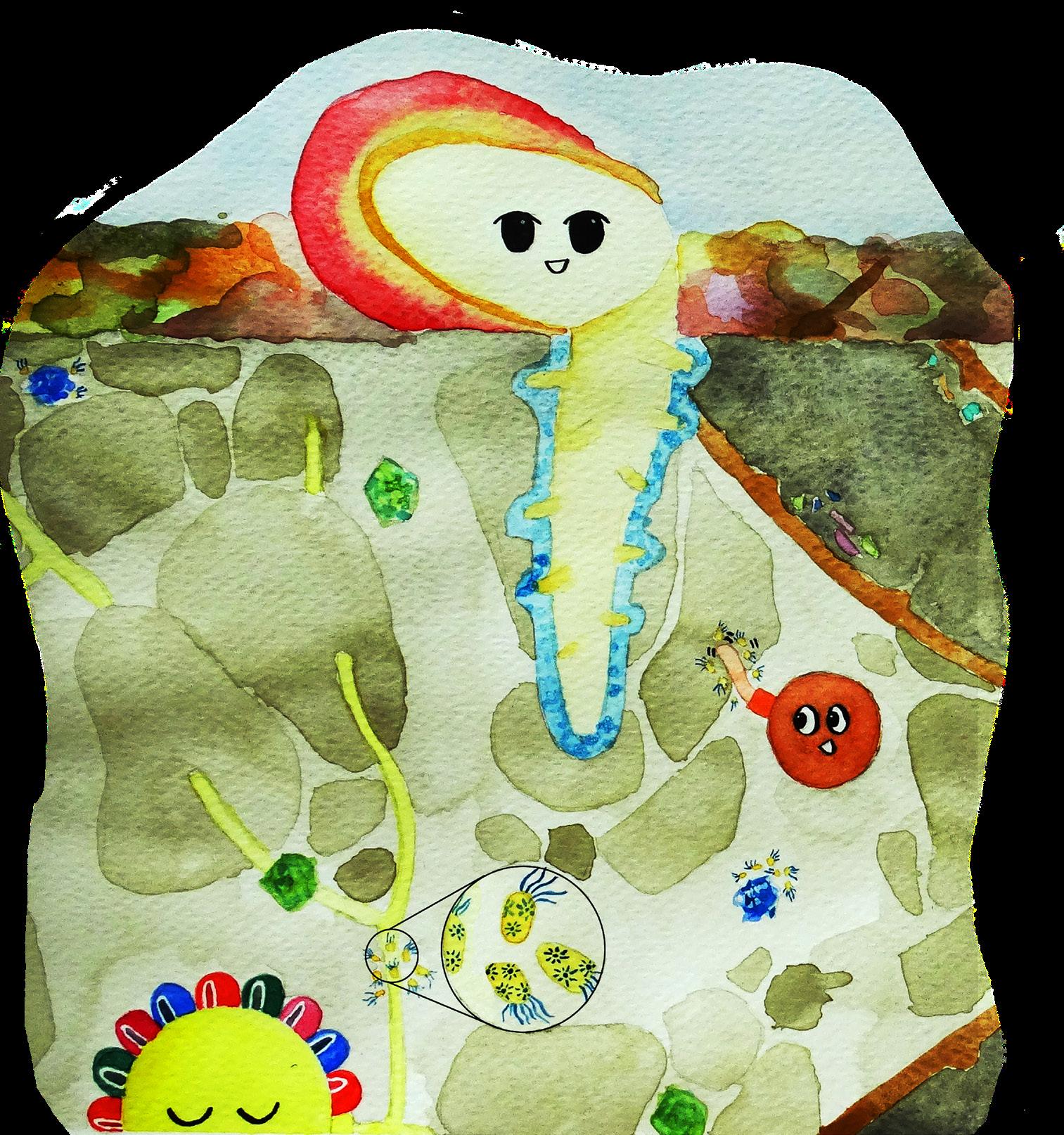
As days went by, the thread grew and grew until it reached the village boundaries. When Glomi saw this, he realized that it was a root and felt the need to talk to the new neighbor.
- What’s your name? – Glomi asked.
- My name is Planti, and I am a corn plant – she answered. Since the moment they met, they got along really well and became good friends.
4
Planti
P
P N N
Burkis
N
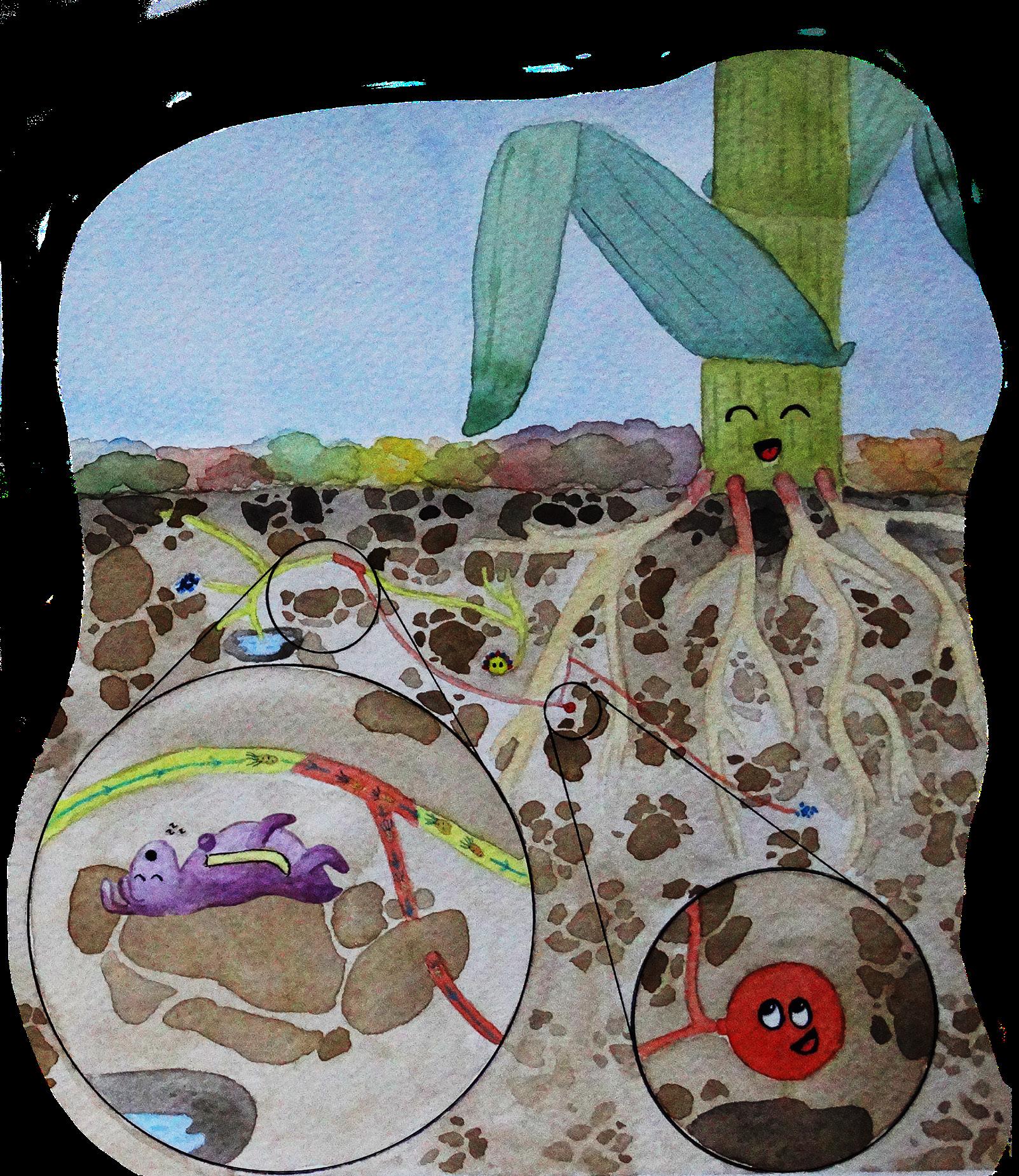
Planti invited Glomi to live with her, so Glomi moved into her roots to form a mycorrhiza. Glomi thought that Planti was a marvelous organism. Part of her lived underground as the rest of Glomis neighbors, but the other part, that is her cornstalk and leaves, were aboveground.
Planti was very sociable. She liked to organize big parties. She made a yummy nutritious syrup, named exudate, which she produced around her roots feeding everyone who lived nearby and wanted to grab a bite. Nonetheless, this exudate needed some ingredients.
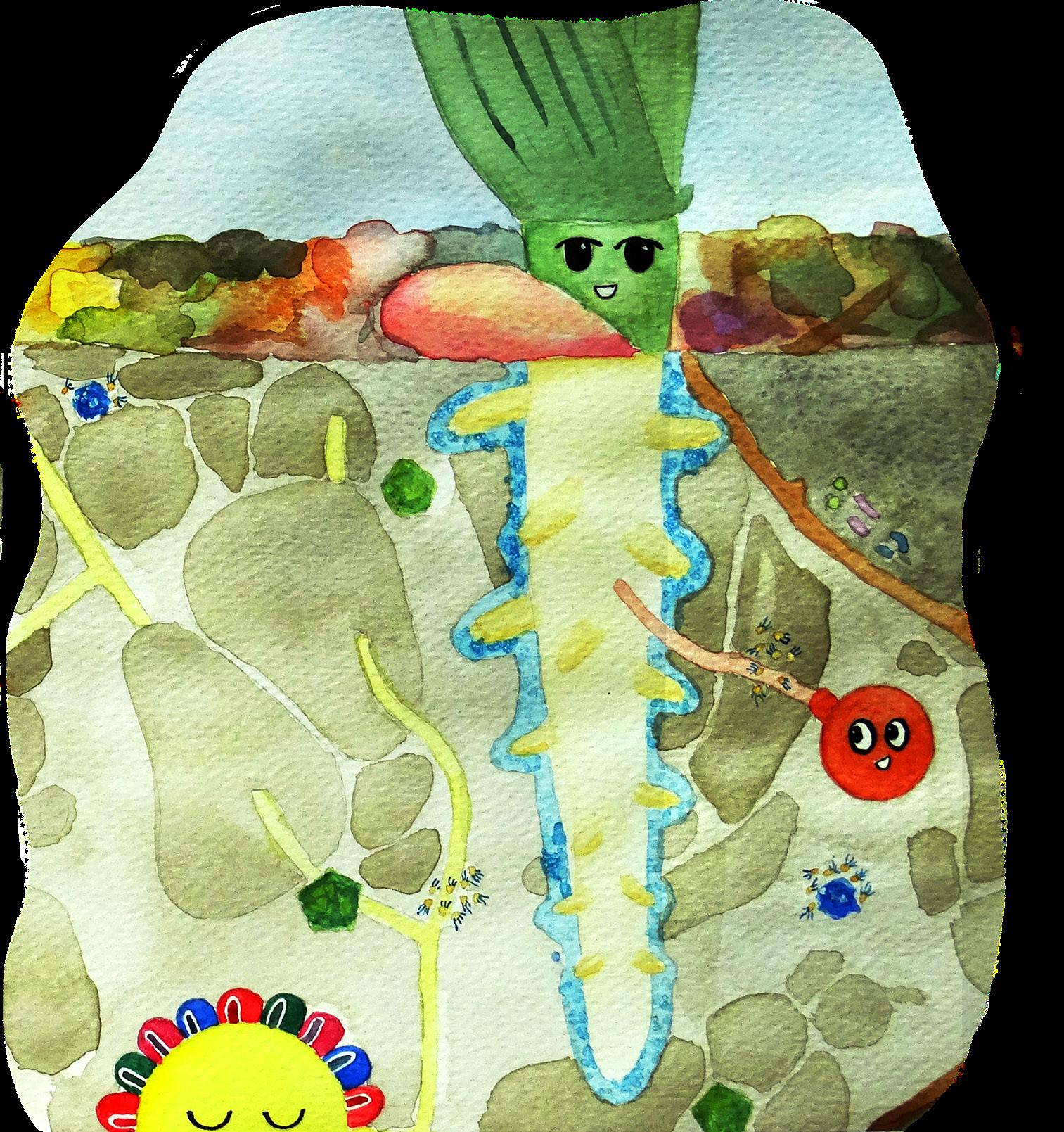
One of them was the carbon (C), which was absorbed and transformed through Planti’s leaves, with the air and sunlight. This process is called photosynthesis. The other materials, nitrogen (N) and phosphorus (P), were taken from the ground. The ingredients that came from the ground were not easy to get, but Glomi, who was a great dealer, and a fantastic explorer too, got them at a very good price from the Burkis and the Purpurin friends.
Soon, Planti’s mycorrhizosphere became the most important place in the village. It was the perfect place for parties and feasts, but also the meeting spot where important vital matters for the village were held. All was harmony and well-being.
But one day, the water and nutritious ingredients supply became scarce! Planti struggled to provide the rich syrup that fed the village, and problems arose. Some of the microscopic neighbors tried to move out from their clods, but, where? It did not seem that in the surrounding towns things were any better. The available resources had run out and the reserve wouldn’t last long! The microscopic creatures also believed that as they were so tiny, if they moved, it was very likely that the hard environment conditions would eventually kill them. Migration would be hard, the hostile conditions, lack of water and nutrients would end up making them disappear. What should they do? Find it out in our next underground adventure.
5
C C N P P N N
The rescue plan
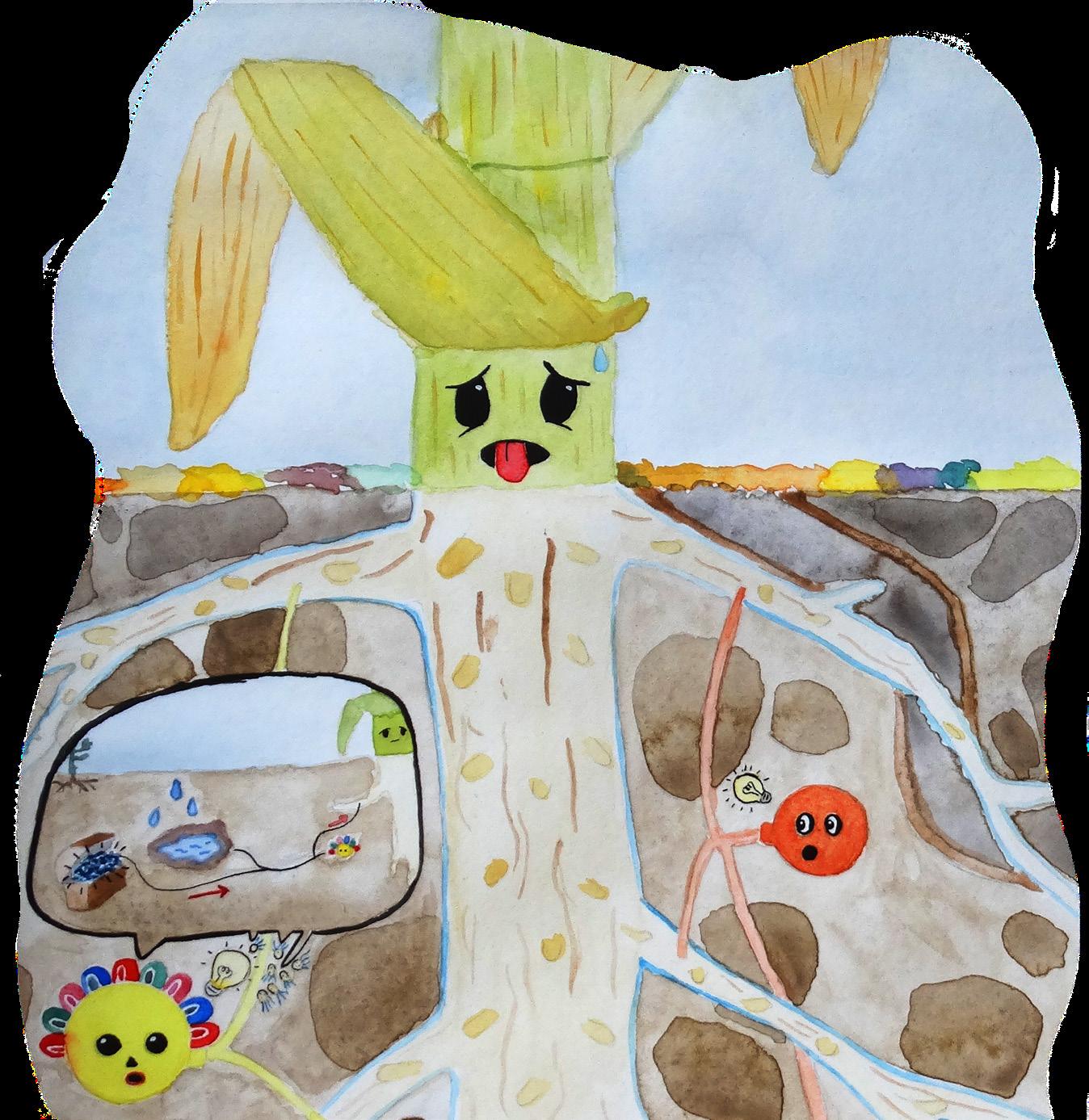
The situation was more serious than expected. The village was dying. The inhabitants from the little clods fell into a deep sleep, almost a mortal one, called lethargy. Glomi’s mycelium, before so juicy and sticky, now looked like empty pipes where the water did not flow anymore, and it seemed nothing could be done to turn things around. But, there is always a solution, isn’t there? – Glomi thought. So, he called all his neighbors for an emergency meeting.
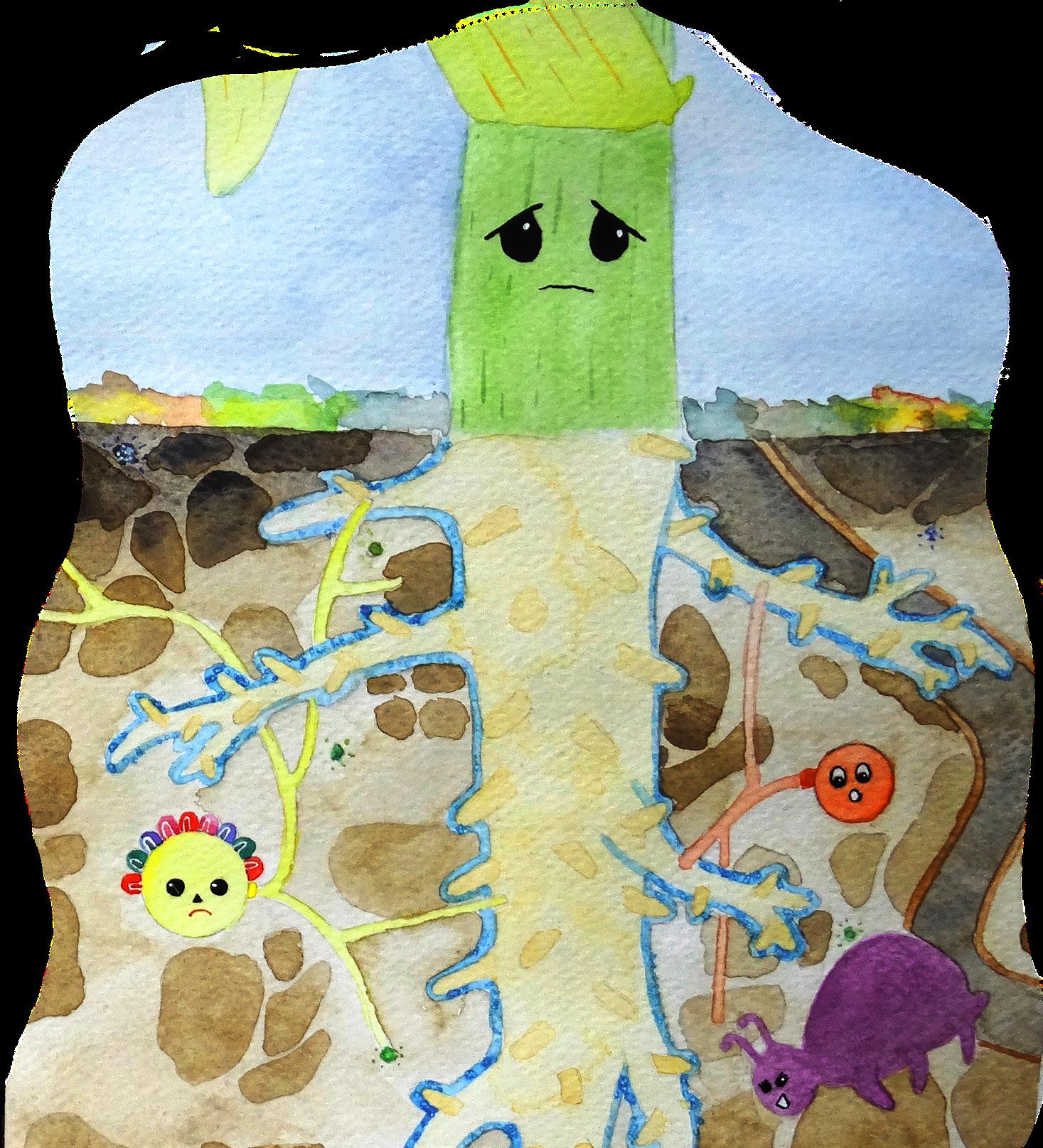
Glomi’s adventurous first cousin, Gigi, attended the meeting too. Gigi had an idea, - My dear friends, as you all know, I am a traveler and I enjoy going beyond the frontiers of our village. Some days ago, I was told about some water reserves and a big phosphorus rock. To get there, we all need to make a last effort and work together – she said.
After a long discussion, an agreement was achieved. The plan was the following: Planti had to use all her syrup reserves to feed Glomi and Gigi. Once they ate and recovered their strength, Gigi would extend her mycelium to the village boundaries, which was the furthest she could reach. The Burkis would climb up Glomi’s and Gigi’s hyphae and travel through them until they reached the phosphorus rock, which was the most valuable nutrient for Planti to produce the syrup.
6
The adventurous Gigi would be in charge of looking for water and carrying it inside her mycelium.
The Purpurin friends would share their nutrient reserves with Planti and stay inside their little clods, lowering their physical demands to the minimum. Thus, all the remaining reserves would keep Glomi and Gigi alive.
The plan was very ambitious and dangerous. They had never left the village nor explored an unknown territory. They did not know for sure if they would get anything in return, but they had to give it a try. Once everyone was ready, the plan started, and the adventure began.
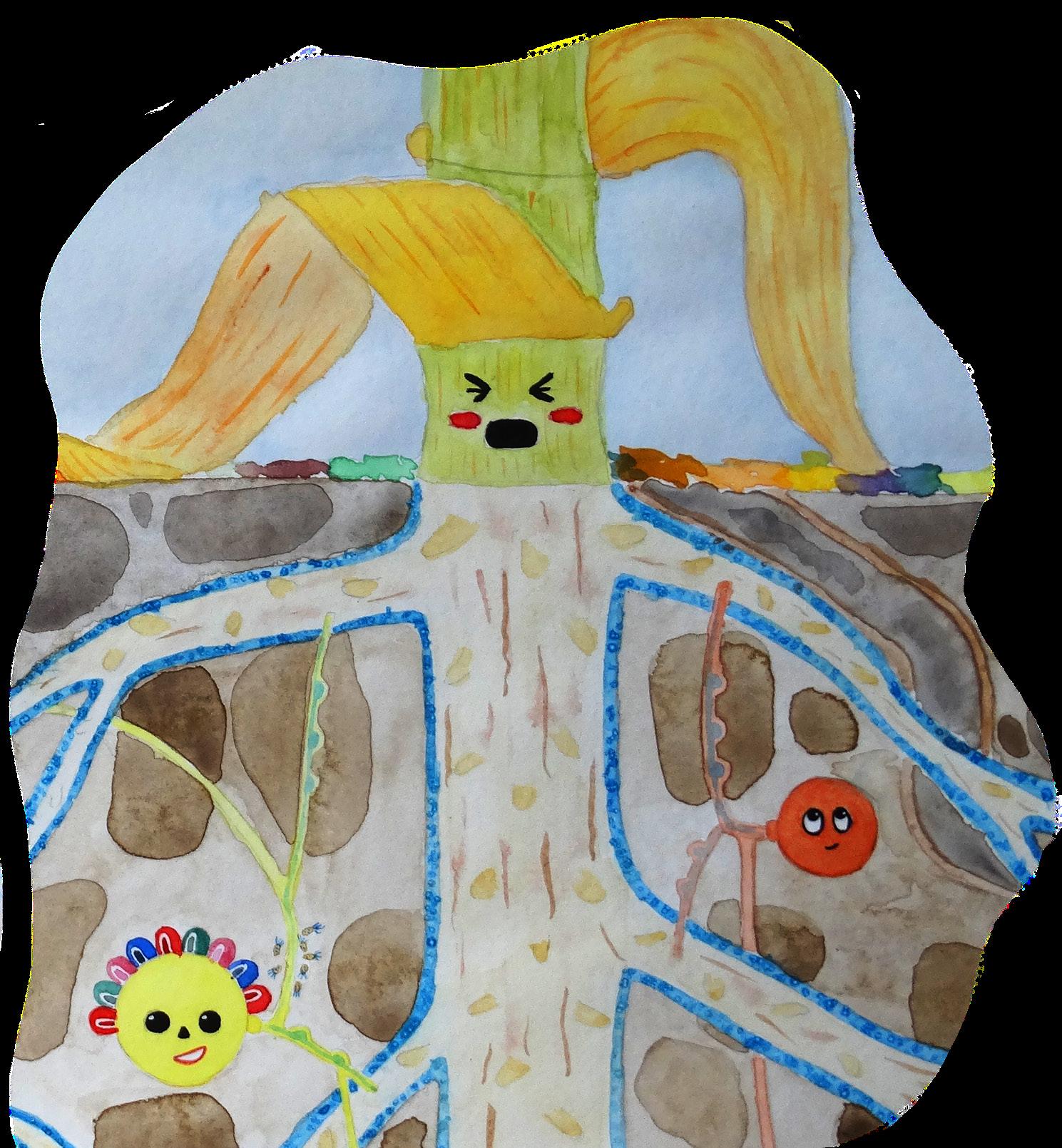
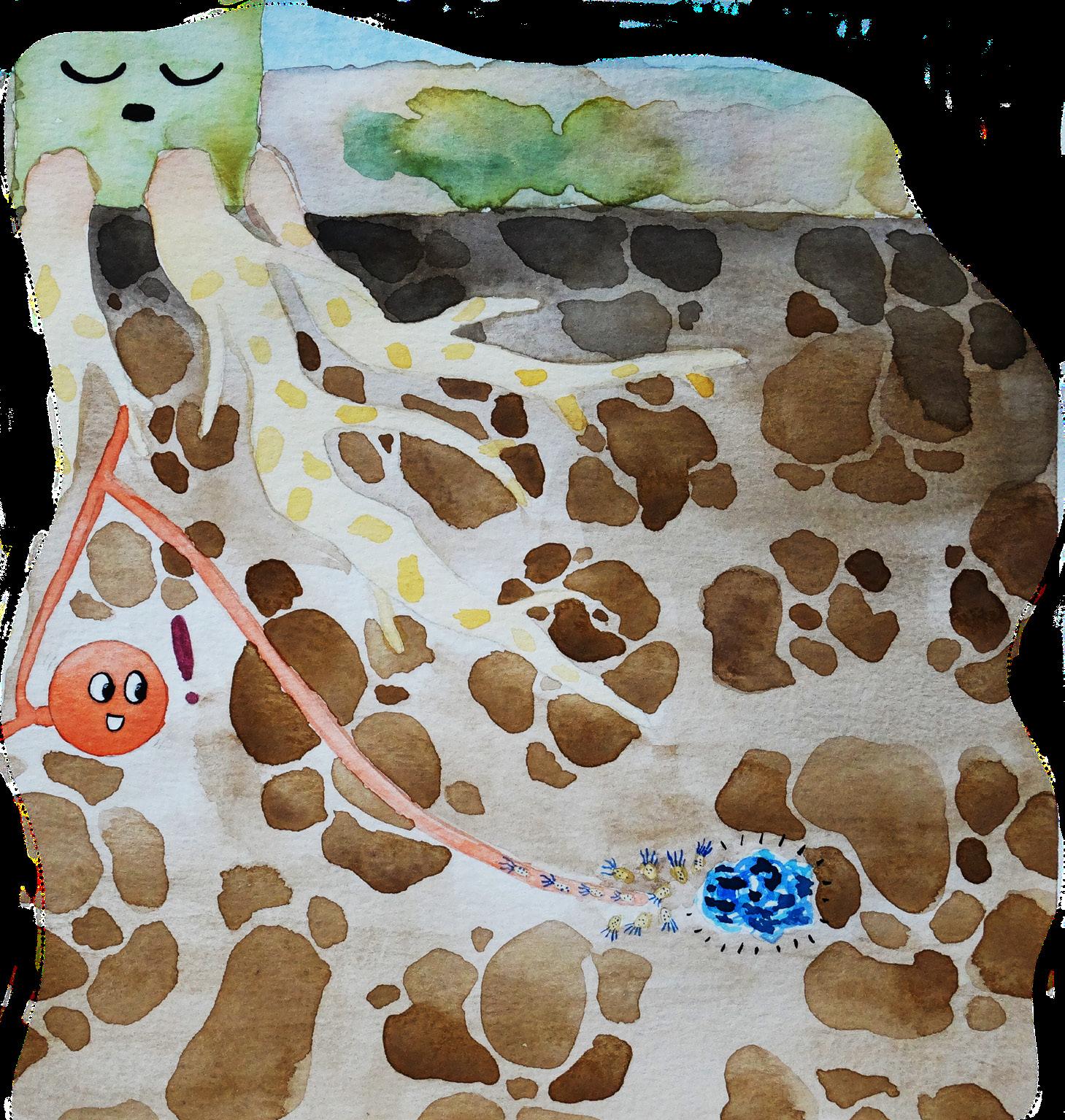
Planti grabbed Glomi and Gigi tightly, and gave them her last syrup drops. The cousins grew and extended their hyphae through the ground towards the place Gigi had pointed out earlier. The Burkis advanced through Glomi’s and Gigi’s hyphae tips carefully, making sure to explore every little piece of soil to find phosphorus. The members of the Purpurin friends, very well kept inside its little clods, shared its last reserve to keep Planti alive, so she could feed Glomi and Gigi. Those were difficult times, Glomi and Gigi grew exploring the soil looking for the last drop of water. Each one used its own skills to do the tasks they had to achieve.
Glomi almost lost his hope because as he was growing, he found Violet, the springtail, an insect-like creature who liked to feed from his mycelium. Luckily, Violet had a stomachache that day and did not even notice Glomi’s presence – Phew! That was close! – Glomi thought.
Suddenly, the Burkis started skipping and cheering up joyfully; they had found the phosphorus rock. With a renewed spirit, they recovered their lost strength little by little allowing Glomi’s mycelium to absorb the rest of the phosphorus. The only thing missing was that Gigi brought the water to finally take everything they had collected to Planti. But Gigi did not show up anywhere. Our dear friend Glomi was tired, worried and hopeless. Gigi has not appeared yet! Then, he remembered his village friends and with his renewed soul, decided to grow more to look for Gigi, even if this would take him beyond his capacity.
But what if Gigi has not found any water yet? What if something wrong happened to her? It doesn’t matter, I’ll take my chances – Glomi thinks. So, he decides to go on board on the search for her.
7
Weaving networks
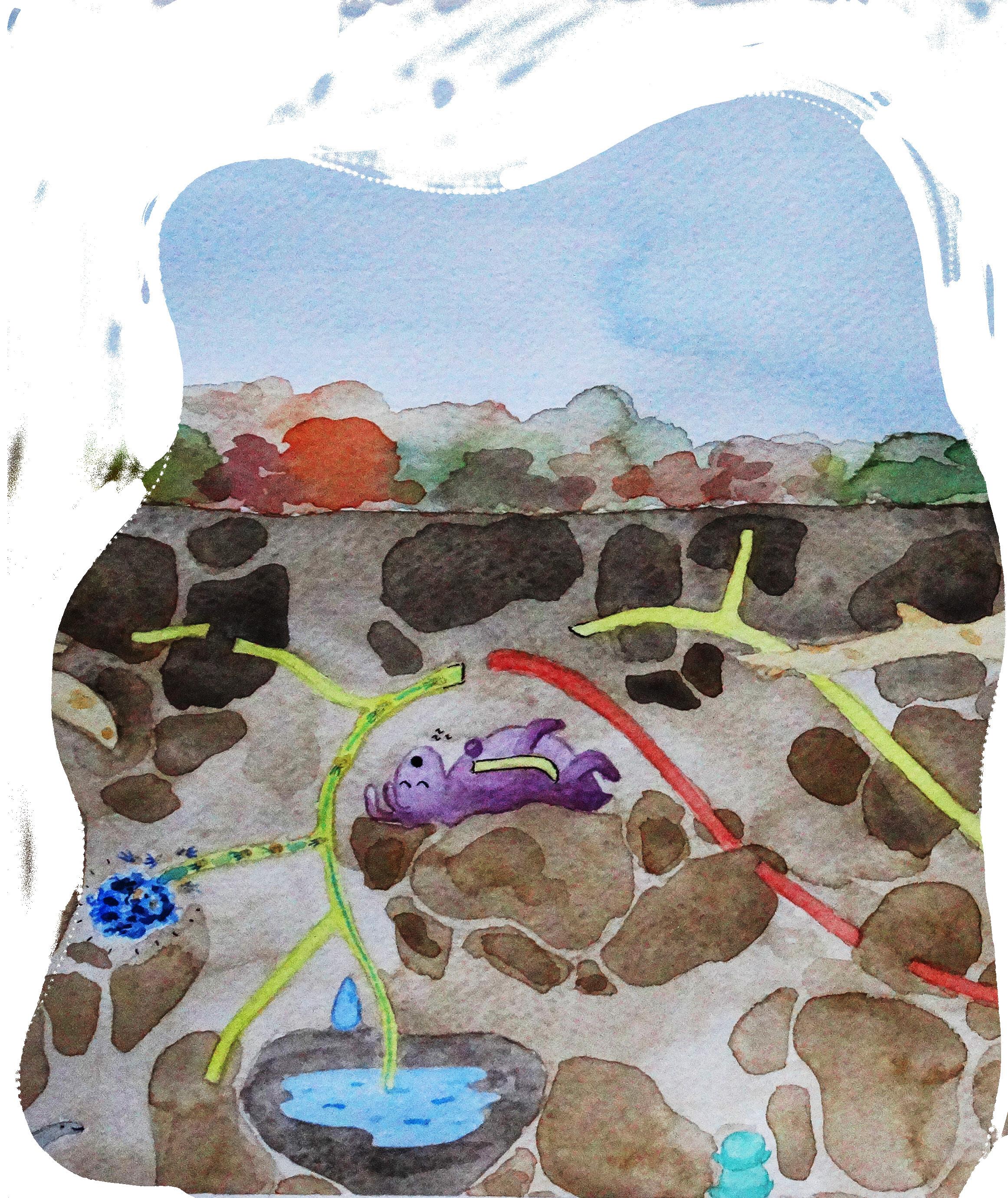
Oh, no! – Glomi exclaimed – Gigi’s hyphae are broken, so the water cannot be transported. What happened? What can we do? Suddenly, he remembered Violet, the springtail. She must had eaten Gigi’s hyphae, that is why she had a stomachache.
With his last strength, Glomi extended as much as he could and managed to reach Gigi’s broken hyphae, patching and joining them with his own little threads. Surprisingly, a noise similar to a pipe which is about to fill up was heard.
This was the most amazing sound they had heard in a long time. The water rapidly flew through Gigi’s repaired hyphae, who smiled when she saw her cousin’s effort had paid off and the plan had worked out. The water flew through Glomi’s and Gigi’s mycelium, which made them wider and sticky again. The dry soil was now surrounded by this juicy moistened mycelium. The pores were filled with water and the Purpurin friends were brought out from their lethargy more active than ever. Soon, the mixed water with phosphorus got to Planti and all the village.
8
After some days and with the beginning of the rainy season, the inhabitants of the soil returned to their normal life. Gigi kept growing in search for new adventures, but she did not go alone anymore. Now, some of the Burkis family travelled with her. Glomi continued nurturing his friendship with Planti for a long time. On her behalf, Planti fully recovered and produced the rich syrup for all the village again.
Planti got very healthy, thanks to the ingredients brought by her microscopic friends and a good dose of water.
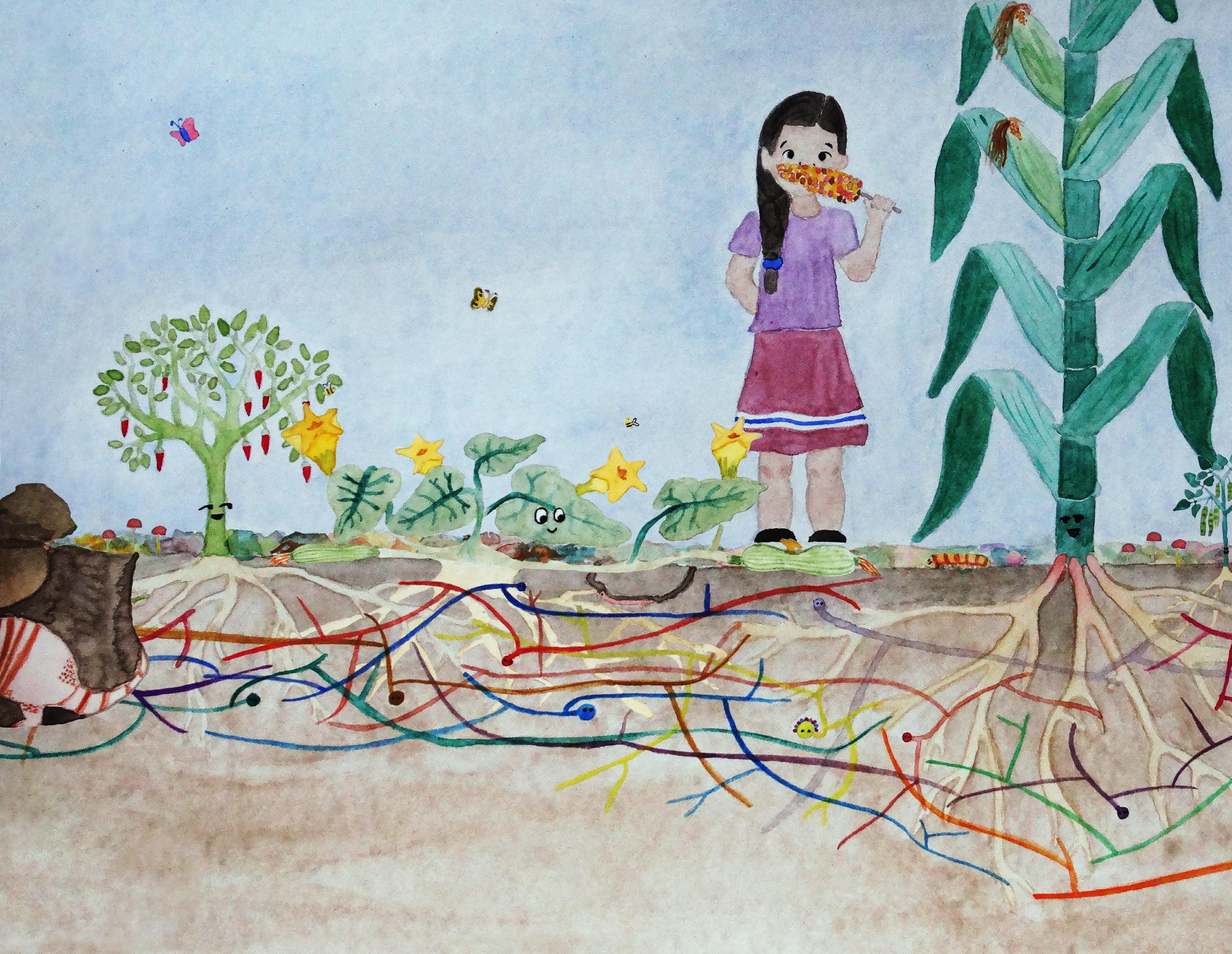
Planti also grew delicious corn above the ground for her human friends.
The village grews and flourished. Quickly, other bacteria families settled down in Planti’s neighborhood. Some specialized in storing water for difficult times, and others stored nutrients. The village frontier allowing them to realize the existence of other towns, like the Chilin, a spicy plant whose smell repels insect plagues. They get to know Joseph’s village too, this little bean’s town was full of nitrogen. The Nitrins, a group of bacteria that like to take off air nitrogen, loved to live in his roots. And they met Concha, the pumpkin, and her breezy neighborhood, where wide leaves grow at ground level keeping the soil fresh and moist, making it an ideal environment for the earthworms and fungi that degraded the organic matter to live happily.
Soon, a complete network of nutrients was established through Glomi’s and Gigi’s mycelium. This allowed every town and village to make agreements of collaboration to cope with difficult situations. They realized that by working together they could achieve more, no matter how tiny they were. Their roles were important for the entire planet.
Snip, snap, snout, this underground adventure tale’s told out.
9
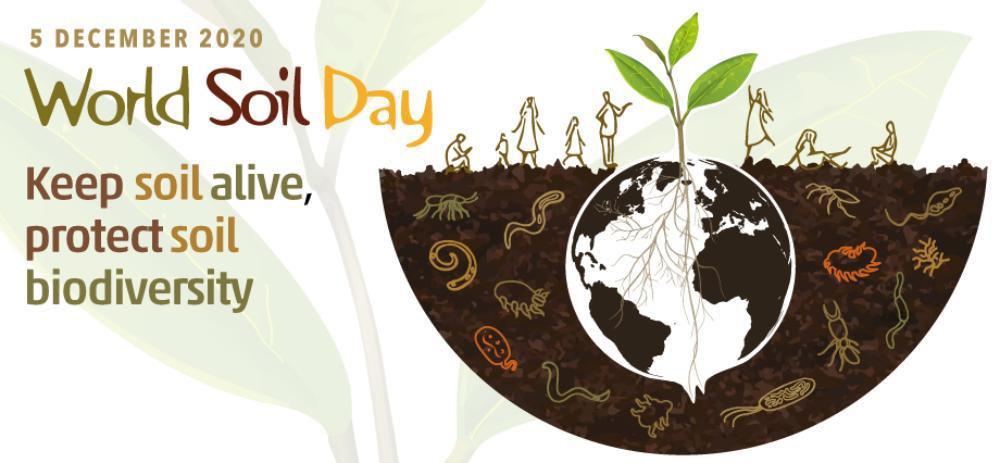
“Keep soil alive, protect soil biodiversity”
10
Final thoughts:
With this story, you have learned that plants and microscopic organisms live in a delicate equilibrium, called symbiosis, in the soil ecosystem. This means they help each other. Moreover, all living beings on the planet get their food from organisms like Planti. A good harvest, healthy forests, and fertile soils depend on harmonic symbiotic relations among microscopic creatures and plants, to clean the water and the air. By taking care of Glomi, Planti, and his friends, we will promote a sustainable and abundant life on our planet. So, keep soil alive, protect soil biodiversity.
How can we maintain the soil biodiversity?
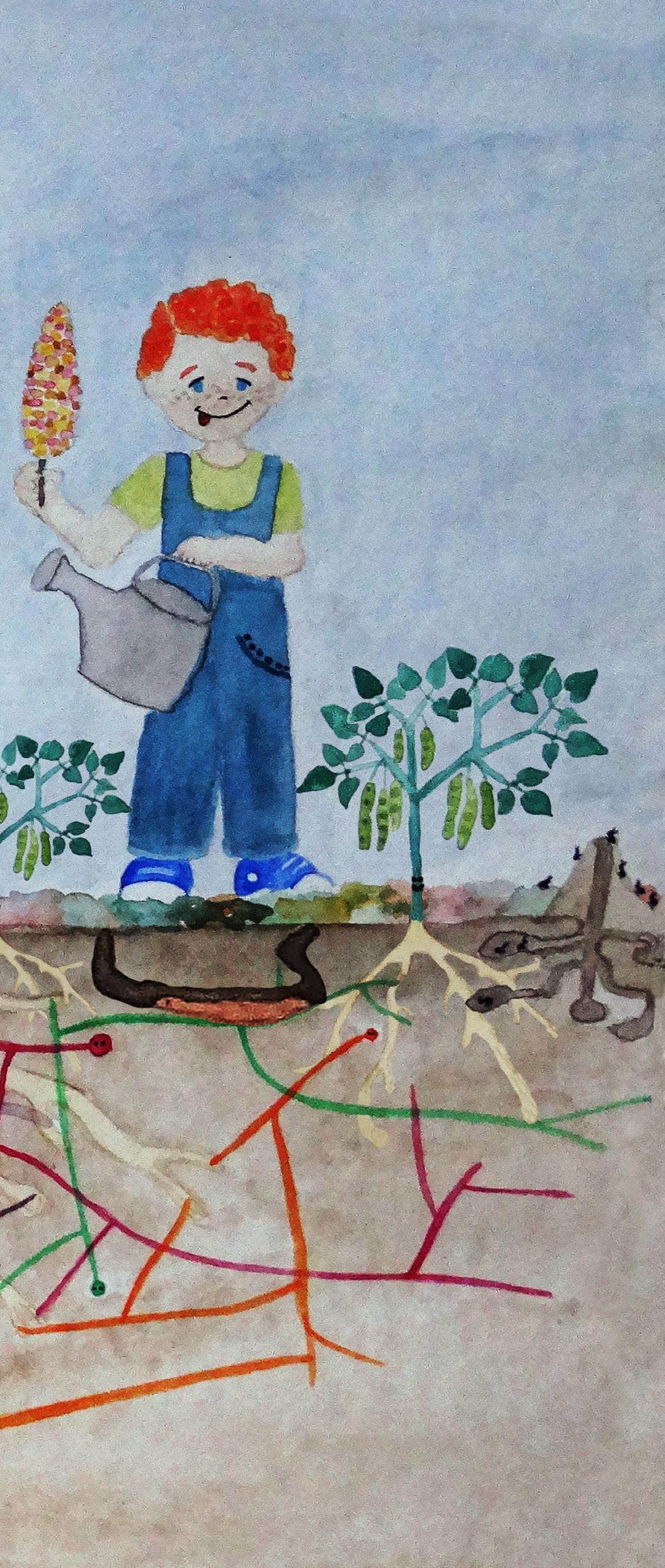
1. Connect with soils around you. When you go to the park, or if your house has a garden or flowerpots. Touch the soil, smell it, sow seeds, water them, and see what happens.
2. Learn about soils. Look at their colors, observe the plants that grow from them and the bugs you find in them.
3. Share what you have found in the soil with your friends. Take pictures, make drawings, build little roads with dry leaves, and share your experience with us by scanning our QR code.
4. Love the soil, protect it. It is the sustainer of life.
11
Activity: Classify Glomi
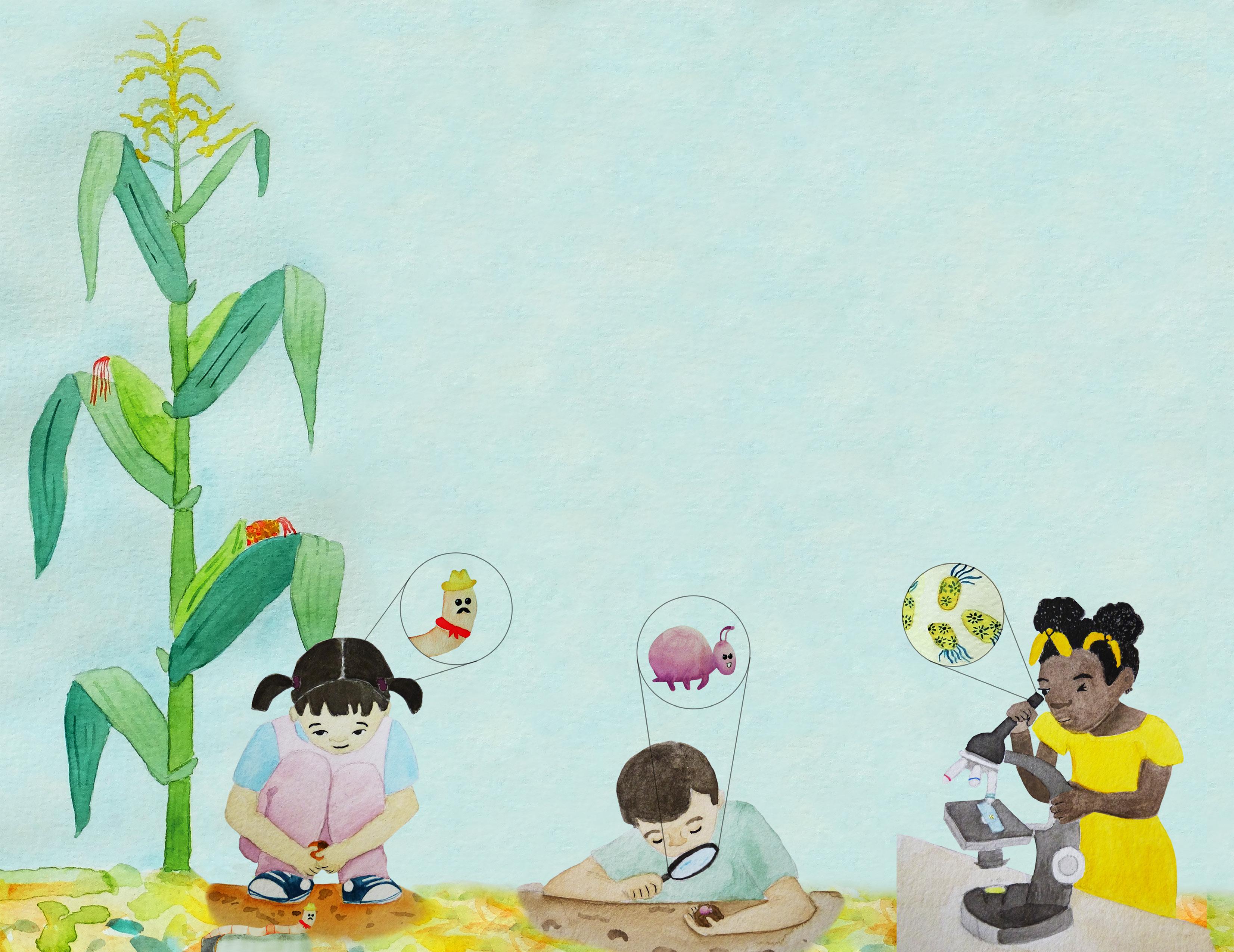
Planti is an organism that we can easily see because it measures more than two meters. How tall are you? _____________. However, in our story, our little friends live in the rhizosphere; and to see them, we need to look closely at the “underground”. Some of them like Martin, the earthworm, can be seen with the naked eye and those who are about their size are called macrobiota . If you look more closely and with the help of a magnifying glass, you will see Violet, the springtail, which can measure up to 10 mm and is known as part of the mesobiota . Finally, to see the Burkis, the group of phosphorus-degrading bacteria, we need a powerful laboratory microscope, because they are really tiny and belong to microbiota . If we compare it with the thickness of one of our hairs, they are 1000 times smaller.
If you would take a cup from the ground in your garden, how many of these organisms do you think you can find? Find it out and be surprised! Share with us your experience scanning the QR code that accompanies this book.
12
Macrobiota 2 – 20 mm
Mesobiota
0.1 - 20 mm
Microbiota
0.001 - 0.1 mm
Planti 2200 mm
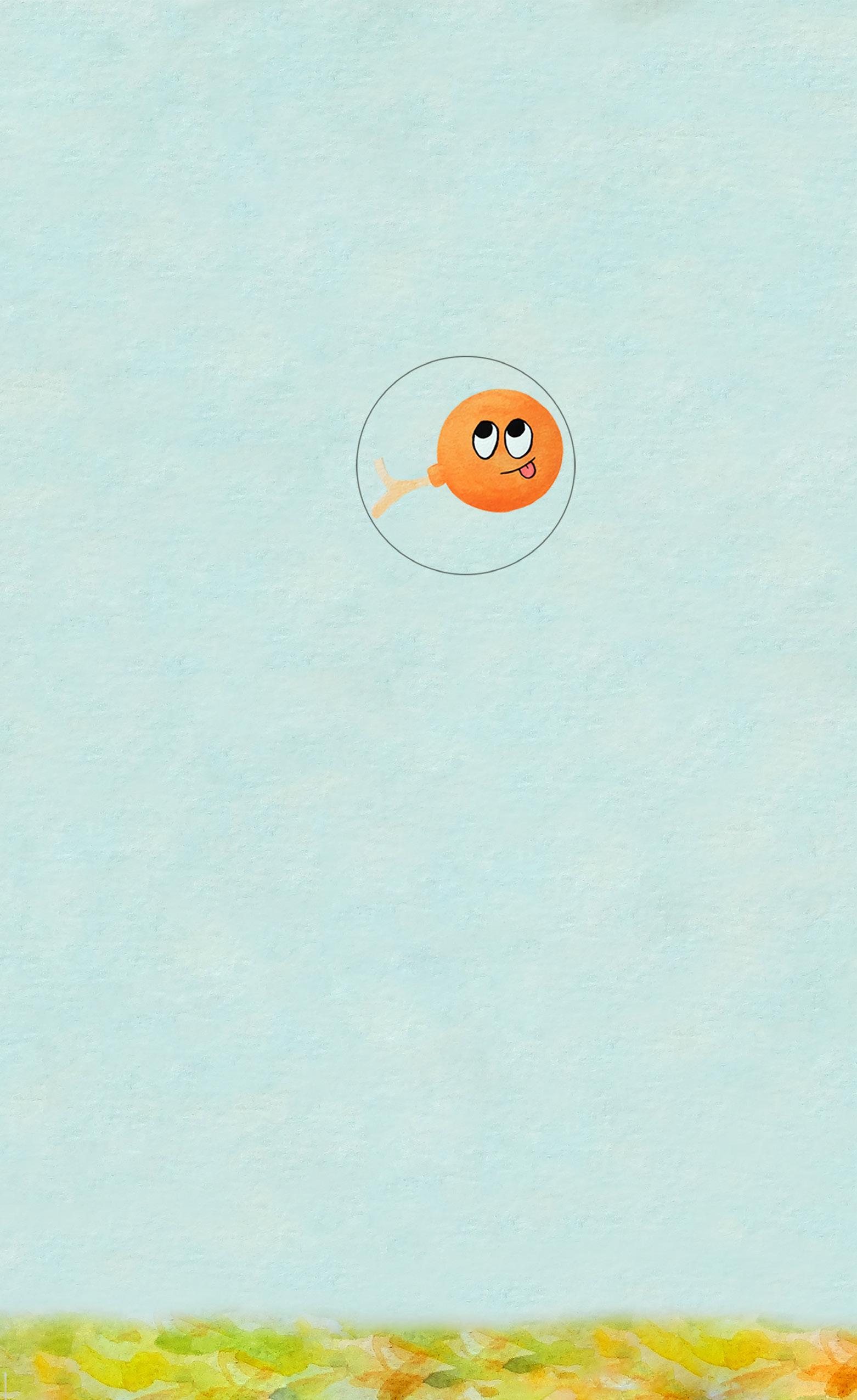
Equivalences
1 meter (m) 100 cm
1 centimeter (cm) 10 mm
1 millimeter (mm) 1000 microns
1 m 100 cm 1,000 mm 1,000,000 microns
Glomi measures 0.094 mm
Which group would Glomi be in?
Share your experience, keep in touch with us and learn more about this fascinating world beneath our feet by scanning this QR code:
NOTE: space for QR code
Contact: glomi.adventure@gmail.com
If you want to know more, you can consult the following links:
• Bacteria and Healthy food:
https://kids.frontiersin.org/article/10.3389/frym.2020.554161
• Superpowers bacteria:
https://kids.frontiersin.org/article/10.3389/frym.2019.00116
• Belowground communication:
https://kids.frontiersin.org/article/10.3389/frym.2020.547590
• Corn microbe’s partners:
https://kids.frontiersin.org/article/10.3389/frym.2017.00037
• Hidden microbial helpers:
https://kids.frontiersin.org/article/10.3389/frym.2019.00011
• Life in soils:
https://kids.frontiersin.org/article/10.3389/frym.2020.547630
• Soil Science:
https://www.soils4teachers.org/lessons-and-activities
• When bacteria go to sleep:
https://kids.frontiersin.org/article/10.3389/frym.2019.00045
13
Certificate of Participation
This certificate is awarded to Silvia Margarita Carrillo-Saucedo, Julieta Alvarez-Manjarrez, Rafael Márquez-Caballé, María del Pilar Ortega-Larrocea, Sarahí Alfaro Guzmán, Tzady Itzel Soria Escalante in recognition of his outstanding contribution to the IUSS book contest under the World Soil Day 2020 theme
“Keep Soil Alive, Protect Soil Biodiversity”

Ms. Laura Bertha Reyes Sanchez
President of the International Union of Soil Science (IUSS)

Mr. Ronald Vargas
Secretary of the Global Soil Partnership
FAO land and water officer
Rome, 5 December 2020
´
Book designed by Sarahi Alfaro
Translated by Tzady Itzel Soria Escalante
Collaborators: Rafael Márquez-Caballé and María del Pilar Ortega-Larrocea