Dan Tomkiewicz Advertising Dan@carolinacountry.com
Joseph P. Brannan Executive Vice President & CEO
Kristie Aldridge, CCC Senior Vice President & COO
Warren Kessler Director of Brand Strategy
North Carolina’s electric cooperatives provide reliable, safe and affordable electric service to 1 million homes and businesses. The 26 electric cooperatives are each member-owned, notfor-profit and overseen by a board of directors elected by the membership.
Why Do We Send You Carolina Country Magazine?
Your cooperative sends you Carolina Country as a convenient, economical way to share with its members information about services, director elections, meetings and management decisions. The magazine also carries legal notices that otherwise would be published in other media at greater cost.
Your co-op’s board of directors authorizes a subscription to Carolina Country on behalf of the membership at a cost of less than $6 per year.
Subscriptions: Individual subscriptions, $12 per year. Schools, libraries, $6.
Carolina Country is available on digital cartridge as a courtesy of volunteer services at the NC Department of Cultural Resources, Library for the Blind and Physically Handicapped, Raleigh, NC 888-388-2460.
Periodicals postage paid at Raleigh, NC, and additional mailing offices. Editorial offices: 3400 Sumner Blvd., Raleigh, NC 27616-2950. Carolina Country® is a registered trademark of the North Carolina Association of Electric Cooperatives, Inc.
POSTMASTER: Send all UAA to CFS. (See DMM 707.4.12.5); NON-POSTAL AND MILITARY FACILITIES: Send address corrections to Carolina Country, 3400 Sumner Blvd., Raleigh, NC 27616-2950.
Change of address: Please contact your electric co-op or go online to carolinacountry.com/address
Experiencing a power outage?
Please contact your electric co-op directly to ensure prompt service. Visit carolinacountry.com/co-ops to find yours online.
Compost Like a Pro
How to create your own batch of ‘black gold’
A new growing season promises to bring vibrant blooms, fresh crops and garden visitors, like this green anole enjoying a romp through a chrysanthemum bed. Photo by Leslie Johnson, Supply, a member of Brunswick Electric. 10
Blooming Backyard Bites
Grow more than herbs and veggies for your kitchen
Have you adopted or rescued a pet?
How do you prepare for a storm? Sometimes word-ofmouth tips rank among the best, and we want to hear yours for our May issue. Learn more on page 23.
From Our Readers
Avid Disc Golfer
I was excited to read the article about George Sappenfield and disc golf in the January 2026 issue (“The Disc Golf Visionary,” page 10)! I have played disc golf at the George Sappenfield course near Yadkinville and appreciated hearing some of the additional backstory about this visionary in the sport.
Disc golf is a great outdoor activity for all ages and abilities, and there are so many great courses across North Carolina to choose from (many located in cooperative service territories!). Most are free, don’t require a tee time, and the equipment needs are pretty minimal. I keep a bag of 3 or 4 discs in my car when traveling, and have even taken on flights with me, because you never know when you might find a course to play!
Thanks for highlighting this great and growing sport!
Tim Dodge, Regulatory Counsel North Carolina’s Electric Cooperatives
THIS MONTH: Carolina Gardens
Our March issue has traditionally been gardenthemed, which we start working on in January. This year, photos of colorful flowers, garden visitors (for our reader-submitted cover photo) and warm earth have been more than welcome as the state digs out from snow and ice. We hope you enjoy reading this as much as we did getting it to your mailbox. Also, electric co-ops are making remarkable contributions to communities via a federal funding program — read more about that on page 7.
—Scott Gates, editor
Art Inspiration
I so enjoyed the article about Mr. Seligman (“Strength Through Glass,” February 2026, page 10). He is an inspiration to many veterans. Art can surely help with physical and mental health issues. Thank you, David!
Vicki Morrison, Clyde, a member of Haywood EMC
Your Lineman Daddy
What a wonderful story (“A Father’s Hard Work Philosophy,” February 2026, page 27). We are sitting here in a nice warm house, and we know we need to be grateful for the men who made this possible especially during this cold weather. I really enjoyed reading about your Dad and the sacrifices he made so his family could be fed. If he were here, I would give him a handshake and a hug and a BIG thank you! Thank you for sharing this memory.
Kathryn Ransom, Maxton, a member of Lumbee River EMC
Carolina SNAPSHOTS
THEME Nightscapes
A Lisa Hall, Waxhaw,
A member of Union Power
B Colleen Noonkester, Oriental
A member of Tideland EMC
C Michael Drake, Nebo
D Daniel Brown, Mooresville
Submit your photo!
May theme: Flowers (Deadline March 20)
June theme: Insects (Deadline April 20)
July theme: Ice cream (Deadline May 20)
Send us your best shots based on an upcoming theme — we’ll pay $25 for those published. Submit high resolution digital photos and find full terms and conditions at carolinacountry.com/snapshots (no emails, please). We retain reprint and online rights for all submissions.
To those who support the
North Carolina Jaycee Burn Center
THANK YOU!
North Carolina’s electric cooperatives hosted their 25th annual golf tournament and fundraiser in September 2025, donating more than $185,000 to the North Carolina Jaycee Burn Center at UNC Hospitals.
More than 70 organizations and individuals contributed to this year’s record donation, pushing total contributions to more than $3 million raised for the Burn Center since 1999.
Beyond providing the very best in compassionate care, the Burn Center’s mission extends to advancing burn prevention education and outreach, innovative treatment, research, rehabilitation and life-long aftercare. Its success has led to the Burn Center’s recognition as one of the best comprehensive burn centers in the world.
North Carolina’s electric cooperatives are grateful to all of the organizations and individuals who contributed to the success of this fundraiser and the Burn Center.
With the help of generous donors like these, the Burn Center can continue its groundbreaking work in helping burn patients become burn survivors.
Advanced Energy | AEP Energy Partners | Mark Bartholomew
Terry Berge | Energy Reps | Ensales | KGPCo | Milsoft Utility
Solutions | The Okonite Company | Utility Reps
Powering the Future of Agriculture
Don Gatton
Agriculture has always been at the heart of our communities. Across many parts of rural North Carolina, farming isn’t just an industry — it’s a way of life that feeds our families, supports our local economy and connects generations.
National Ag Day on March 24 presents the opportunity to recognize not only the farmers who sustain us, but also the innovation shaping the future of agriculture across our state.
Four County EMC and North Carolina’s Electric Cooperatives. Beyond food production, the project supports education and workforce development, giving students hands-on experience with emerging agricultural technologies and preparing them for careers in modern agriculture right here in our community.
On National Ag Day, we celebrate the people and partnerships helping move agriculture forward.
North Carolina’s electric cooperatives are proud to support agricultural members and community partners who are finding new, smarter ways to grow and operate. Today’s farms look very different than they did even a decade ago. Technology, innovative electrification and controlled environments are playing an increasing role in food production as farmers work to manage rising costs, labor challenges and changing conditions.
One example of this innovation is a partnership between my co-op, Four County EMC, and James Sprunt Community College on its Indoor Agriculture
“Box to Bowl” project. This initiative uses a controlled, container-based growing system to produce fresh food year-round. By pairing modern agricultural techniques with reliable electric service, the project demonstrates how indoor agriculture can provide consistent yields while using space and resources efficiently (“From Box to Bowl,” October 2024, page 10).
The Box to Bowl project was made possible through collaborative funding from the North Carolina Tobacco Trust Fund, Duplin County,
At Four County EMC, we also recognize that innovation looks different for every operation. That’s why we have an innovative electrification specialist on staff to help connect members with new technologies in the agricultural space — from energy-efficient equipment and electrified processes to emerging tools that improve productivity and resilience. Having a dedicated resource allows us to work one-onone with members as they explore solutions that fit their unique needs.
Innovation in agriculture isn’t just about new tools — it’s about adaptability and long-term resilience. Electrification plays a growing role in powering precision systems, climate controls and indoor growing environments that help reduce risk and increase efficiency. Electric co-ops are partnering with local agricultural producers across the state, bringing innovation to everything from egg production in Hyde County (Tideland EMC and Rose Acre Farms) to an Anson County Farm (Pee Dee Electric and White Rock Farms), and a produce distributor in Western NC (Surry-Yadkin EMC and Hollar & Greene Produce).
On National Ag Day, we celebrate the people and partnerships helping move agriculture forward. North Carolina’s electric co-ops are proud to be part of that effort — today and for generations to come.
Don Gatton is president & CEO for Burgaw-based Four County EMC.
Visit ncelectriccooperatives.com/best-solutions to explore how electric co-op innovation could benefit your local business or farm.
March Quick Hits
Women in History
March is Women’s History Month, with International Women’s Day on March 8 — learn more at womenshistory.org or visit the National Women’s History Museum in Charlotte.
Peanut Innovations
March is also National Peanut Month. Ag pioneer Naomi Chapman Woodroof’s (1900–1989) work in Georgia led to a five-fold increase in peanut yields.
March Mathematics
Pi Day is 3/14, honoring the infinite number’s first three digits (3.14). In 2022, Emma Haruka used cloud computing to calculate pi to a record 100 trillion digits!
Lucky State
St. Patrick’s Day is March 17, and NC is a great place to celebrate, with the highest percentage of Scots-Irish ancestry (2.9%) of any state.
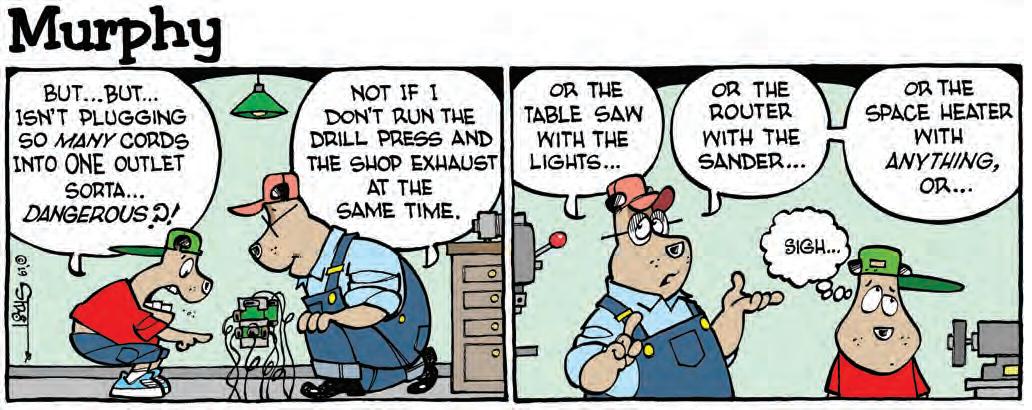
Q: Can I plug several cords into one outlet?
a: Power strips and multi-outlet converters make it possible to plug several devices into one outlet, which can be just fine for smaller, low-wattage devices that use less power. But when it comes to large or heat-producing appliances, it’s a different story — more than one on an outlet can be dangerous.
There are about 45,000 home electrical fires each year, half of which are caused by home wiring or lighting equipment, according to the U.S. Fire Administration. Here are some rules of thumb to use outlets safely and keep home circuits from overloading (we’re looking at you, Murphy):
Only plug one heat-producing appliance into an outlet at a time.
Never use extension cords or multi-outlet converters with appliances.
Signs of an overloaded circuit include flickering lights, frequent breaker trips, and warm or discolored wall plates.
If a breaker frequently trips, it likely means it’s working, but there’s an electrical issue on the circuit that needs investigating.
Stay safe! Learn more from the Electrical Safety Foundation (esfi.org) and the U.S. Fire Administration (usfa.fema.gov/prevention).
NC Co-ops Channel $8M to Critical Rural Services
Federal funding helped drive rural growth in 2025
North Carolina’s electric cooperatives’ commitment to their communities goes beyond ensuring reliable power for members. It also includes powering progress and growth through resources that benefit communities today and into the future.
One of those resources includes the U.S. Department of Agriculture’s Rural Economic Development Loan and Grant (REDLG) program. REDLG awards provide zero-interest, pass-through loans to rural cooperative utilities to fund local projects that create and retain jobs, boost economic growth and improve quality of life in rural America.
In 2025 North Carolina’s electric co-ops were awarded more than $8 million in funding across 17 projects.
“Cooperatives serve as a linchpin connecting communities to low-cost funding for projects that improve quality of life for rural residents,” said Ann Fitts, community development specialist and REDLG program lead for North Carolina’s Electric Cooperatives. “For the cooperatives, powering prosperity means enhancing public safety, increasing healthcare access and supporting opportunities that attract new business investment and quality jobs.”
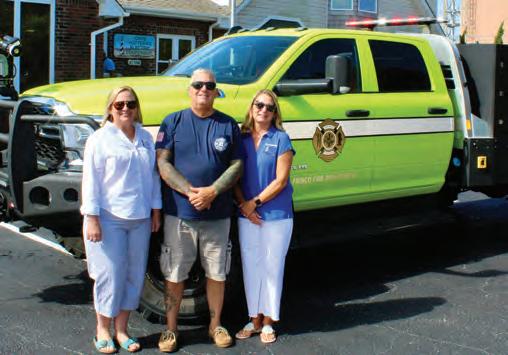
Through the funding, co-ops have helped emergency services, such as fire departments, EMS and police departments, strengthen their capabilities by purchasing new fire trucks and patrol cars and improve emergency service facilities.
REDLG funding has also supported employment growth in rural North Carolina by financing the construction of industrial buildings where businesses can relocate or expand their operations. These opportunities help create jobs, increase the tax base and attract investments in co-op communities.
Over the past five years, North Carolina’s electric cooperatives have received more than $47 million through 95 REDLG awards, demonstrating a continued commitment to supporting rural communities.
Spring into Small Surprises.
Experience the vibrant charm of spring as you explore unique shops, savor delicious seasonal cuisine and enjoy lively events. Discover the perfect blend of relaxation and adventure.
Save The Date:
Mebane Dogwood Festival – April 24 & 25
Burlington Carousel Festival – May 2 & 3
Arts Around the Square – May 16
You’ll find small surprises lead to big memories in Alamance County.
VISITALAMANCE.COM or call 800-637-3804
Mebane, NC
burlington Mebane Elon Graham Saxapahaw
Cape Hatteras Electric Cooperative helped fund a brush truck for Frisco Fire Department, one of more than a dozen co-op REDLG projects in 2025.
Frost-Focused Gardeners Plant for Success
How to avoid late-season freezes
Whether you’re planning your first vegetable garden or you’ve a seasoned green thumb, knowing North Carolina’s frost and freeze dates is the foundation of a successful growing season. Understanding when the last spring freeze occurs can mean the difference between a bountiful garden and one damaged by unexpected cold snaps.
A freeze occurs when temperatures dip to 32 degrees (Fahrenheit) or below. For gardeners, this is the critical threshold — the temperature at which tender plants begin to suffer damage or die. Your last spring freeze date tells you when it’s finally safe to plant warm-season crops. Frost formation can be a bit trickier, since there is no standard definition of what the threshold should be. Conditions can vary greatly across the state and frost can form when readings dip as low as 32 degrees but can be as high as 37 degrees. So for our purposes, we’ll discuss frosts and freezes as one event, as both can be damaging to early-season gardens.
North Carolina’s frost dates vary significantly depending on where you live in the state. The Coastal Plain experiences milder conditions and longer growing seasons, with an average last freeze date from late March to early April, while the mountains see later spring thaws with last freeze dates as late as May. Visit bit.ly/NC-frost for an interactive map with local average last-frost dates, as well as regional crop planting calendars from NC Cooperative Extension.
The time between your last spring freeze and first fall freeze is your growing season — the window when warm-weather plants can thrive. North Carolina’s growing season ranges from about 200 days in the mountains to 250 days in coastal
areas. This matters because it helps you choose the right crop varieties, selecting crops that mature within your local growing season.
But not all crops need to wait until after the last freeze. Cool-season vegetables, like lettuce, carrots and onions, are frost-hardy and can actually be planted weeks before your last spring freeze date. These crops thrive in cool soil and can withstand light frosts. Starting them early gives you a jump on the growing season and a spring harvest before summer heat arrives.
Warm-season crops, like tomatoes and squash, are sensitive to frost and cold soil. Planting these too early in cold soil can cause them to rot or fail to germinate. It can be tempting to get started on a 70-degree day in late February, but patience pays off with healthier, more productive plants if you wait until your region is in the safe zone.
Here’s the important part: frost dates are based on 30-year historical averages. Those dates are not a
guarantee! There’s still a 30% chance of frost after your listed “last spring freeze” date. What’s more, climate data shows that North Carolina’s growing season is expanding. The last spring freeze is arriving two to three days earlier per decade, while the first fall freeze is occurring about two days later per decade. This means gardeners are getting longer growing seasons — but it also means traditional frost dates may shift over time.
The bottom line? Stay tuned to your local meteorologist as spring approaches and pay close attention to the temperature forecast for guidance. Small shifts in temperature can have big impacts on your garden!
—Al Conklin is chief meteorologist for WBTV in Charlotte.
Digital Extra
How will this year’s frost dates affect your garden planning? Visit carolinacountry.com for Al’s Carolina Country Forecast.
In times of economic uncertainty—when inflation rises, markets fluctuate, and long-term financial stability feels less predictable—many investors turn to gold as a dependable store of value. By holding a portion of your wealth in gold, you can help safeguard your portfolio and preserve longterm financial security, even when broader economic conditions are unclear.
Since 2015, gold has surged over 400% — outpacing both the S&P 500 and the Dow during the same period.
American Gold Reserve is releasing government-issued $5 Gold American Eagles completely free of dealer markup for only $529 each. These beautiful $5 Gold American Eagles are a perfect way to enter the gold market. Set for immediate public release, availability is limited and supplies are expected to sell out quickly.
GOVERNMENT BACKED U.S. GOLD
• Free of dealer markup.
• Gold provides protection against inflation and deflation.
• Gold offers financial cover during geopolitical and macroeconomic uncertainty.
• A strong portfolio diversifier.
Compost
LIKE A p R o
How to create your own batch of black gold
Story and photos by L.A. Jackson
If I had a dollar for every time I mentioned the word “compost” in garden articles over the years, I would be writing this piece on my own private beach in the Caribbean. But since I’m not, the least I can do is explain what this garden “black gold” (another phrase yours truly has worn out) I’ve been harping on actually is — and how to make it.
To keep it simple, compost is nothing more than decomposed organic matter. However, mixing it in planting soil will improve the tilth (aka soil’s physical condition), aeration and water retention in your garden. And even if you don’t dig it into your growing ground, compost still makes great mulch.
Compost is also a natural fertilizer. While not packing the punch of commercial synthetic fertilizers,
it can constantly provide small amounts of the basic nutrients — Nitrogen-Phosphorus-Potassium — to your plants. And unlike a standard bag of 8-8-8 or 10-10-10, it is also supplies important micronutrients such as copper, manganese, iron, molybdenum and zinc. Also, as opposed to many store-bought fertilizers, you can’t burn plants using too much compost.
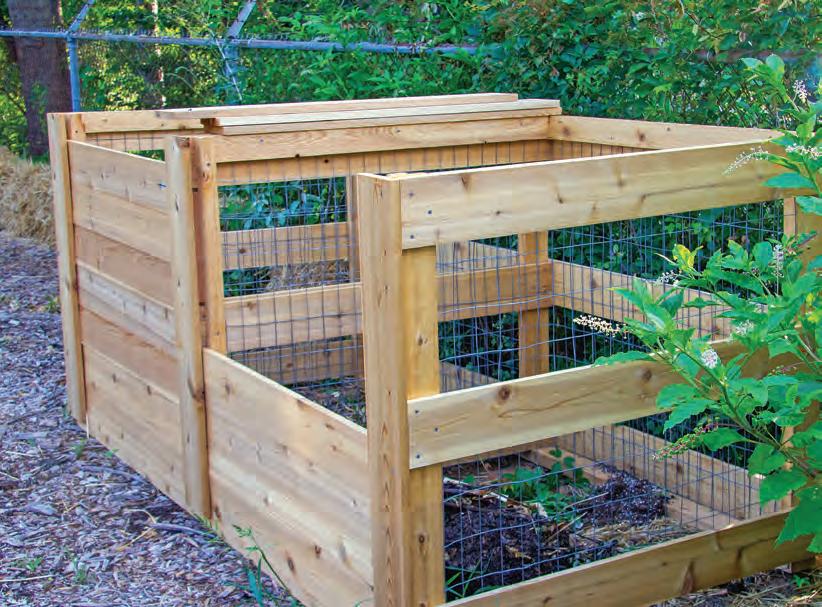
If landscape aesthetics are important, a wire or wood slat enclosure is a good option for a compost bin.
Dig in … to chemistry
So, are you ready to start a compost pile? Let’s talk carbon-to-nitrogen ratios first. You see, soil bacteria and other microbes are the little beasties responsible for breaking the organic matter down, so you certainly want them to be happy. A good way to do this is keep the tiny critters well supplied with proper amounts of carbohydrates (for energy) and nitrogen (for cell growth). An ideal ratio is about 30-to-one carbon-to-nitrogen, with “carbon” being used as a gauge for carbohydrate content.
Still keeping up with this technical oogum-boogum?
Fresh, succulent matter such as grass clippings, pruned leaves, spent flowers, and fruit or vegetable scraps have a carbon-to-nitrogen ratio of about 20-to-1, while dried material such as fallen leaves, hay and plant stems range from roughly 40–80-to-1 ratio. So, in order to get your pile around the magic 30-to-1 mark, a mix needs to be made.
OK, science lesson is over. Give your brain a rest and let’s simplify: Generally, if your compost pile is a mix of about two-thirds dry material to one-third fresh matter, you’ll be in the ballpark for a proper ratio that will crank up maximum decomposition.
Pile It On
Although you can just pile up organic goodies in your backyard and let ’er rip, if landscape aesthetics are important, a wire or wood slat enclosure is a good option. While plenty of compost bins can be found online (and even locally) for sale, it is a rather easy DIY project.
To start a compost pile, first spread a 4-foot square batch of small sticks on the ground or in your bin. This loose base will allow air (which helps decomposition) get into the pile from underneath. Next, form a layer of dried matter about 12 inches high and top it with 3 to 4 inches of fresh material. Then, sprinkle either a cup of complete
commercial fertilizer or, if available, a few helpings of farm manure (cow, horse, rabbit, goat — even llama if ya wanna — are good sources). Finish it off with a few handfuls of garden dirt for extra microbes.
Sprinkle the initial layer with water, and then add three to four more layers, repeating the steps above until you have a pile around 5 feet high. Basically, think of it as creating a large, organic Oreo cookie.
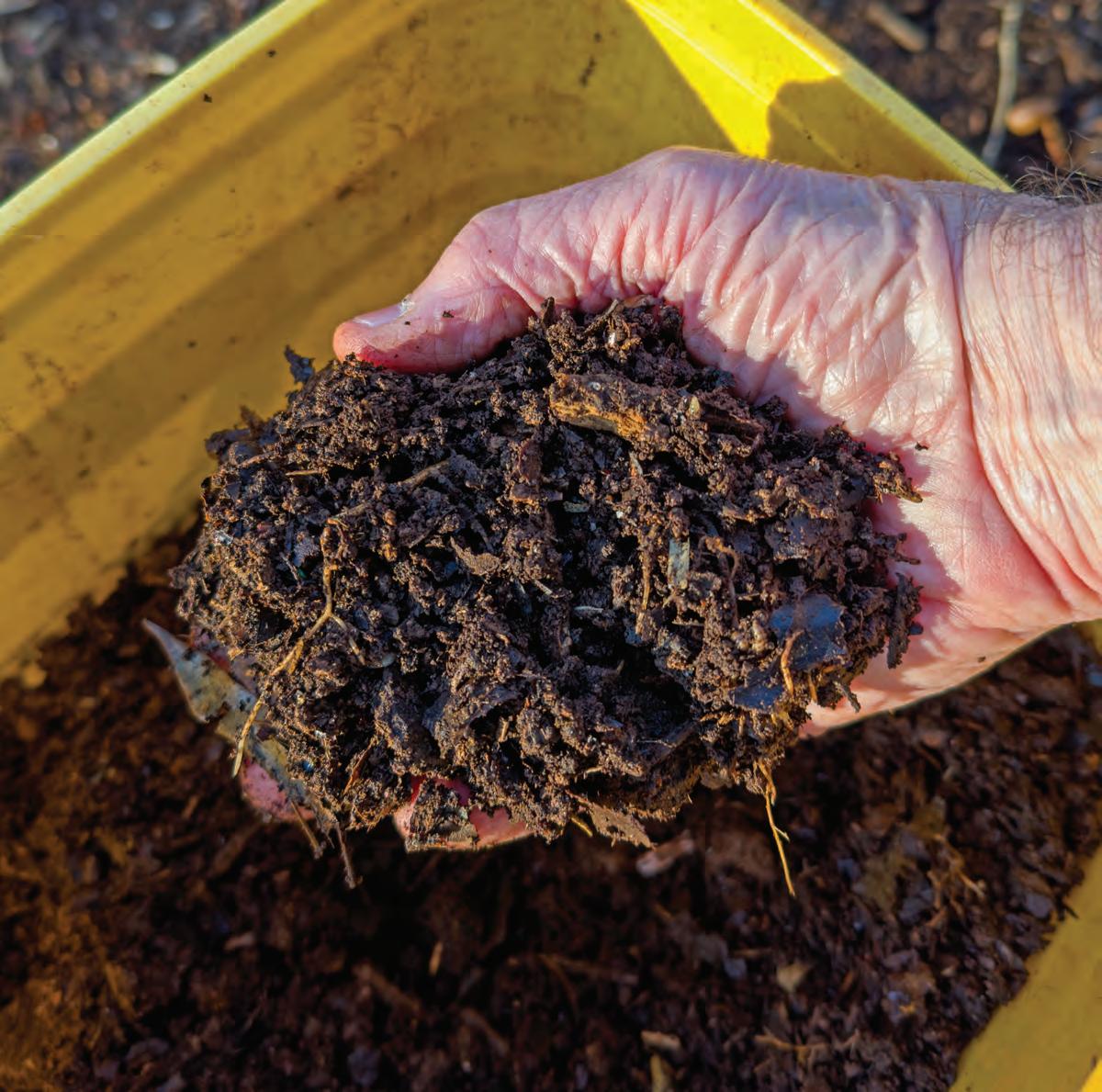
After finishing, wait about a week, and then plunge your hand into the, um, Oreo. If it is warm, the pile is on its way to breaking down. It might even feel hot, which indicates you hit the ideal mix right on the nose!
Turning Into Gold
You can speed up the decomposition process to produce organic black gold (I’m still stuck on that phrase) by occasionally turning over the ingredients. Start at the top and simply flip the material over with a pitchfork onto another rough base of sticks beside to the original pile.
I usually turn my compost about every two weeks, which might seem like a leisurely pace to some pro composters, but I still get good results in a few months.
Although moisture is a key component to breaking down the organic matter, during times of heavy rains, think about covering the compost-to-be with a plastic tarp to keep it from turning into a sloppy muck.
When the ingredients have decomposed enough so they look more like dirt and less like their former forms, you can then mix the results into your garden soil or just spread as nutrient-rich mulch. Either way, try to use it up by autumn, when tumblin’ leaves will provide an abundant dry component to start yet another compost pile to-be, ready for next spring!
L.A. Jackson is the former editor of Carolina Gardener Magazine.
Compost can be mixed into your garden soil or spread as nutrient-rich mulch.
Continued on page 14
Lemon Lavender Shortbread Cookies
with pressed flowers
Preheat the oven to 325 degrees. Line your baking sheets with parchment or a baking mat.
In a large mixing bowl, cream butter with your mixer for about 2–3 minutes until pale yellow. Add in the powdered sugar and beat for another minute. Next add in the flour and cornstarch and beat until combined. (Alternatively, you can knead the dough with your hands until the dough cracks.)
Gently mix in the lavender buds and lemon zest.
Turn out onto a lightly floured surface, roll to 1/2-inch thick and cut out using your favorite cutters.
Chill your cookies for about 20 minutes in the freezer. Don’t skip this step!
Bake for 20–30 minutes until just baked through and barely golden on the bottom. Allow to cool on the baking sheet.
For the glaze, mix together the sugar and lemon juice; adding a bit of each until you get the desired consistency. Not so thick that it doesn’t self-level, but not too thin that it drips right off the cookie.
Lightly dip each cooled cookie into the glaze trying to keep it level so that the glaze is evenly distributed. Turn over, let the icing settle for a few seconds and top with a pressed flower, gently pressing into the glaze. Using tweezers to pick up the flowers helps!
Let dry completely before storing in sealed containers, using wax or parchment between layers.
Yield: 4–6 dozen
Top picks
Here are some of the most common floral edibles: Violas, a daintier version of pansies, are one of Brie’s top choices for edible flowers. “People typically mix violas into salads or garnish an entrée or dessert with them,” she says. “Consider infusing them into syrups or vinegars, not only for the added color but their flavor, which is mildly sweet, a bit like lettuce with wintergreen or mint overtones.”
Calendula petals and foliage are edible, with the petals used either fresh or dried. Their bright yellow and orange hues add color to salads and make an attractive garnish for soups, sauces and rice dishes, where they lend a mild, saffron-like flavor. Dried petals tend to be more tart than nutty. The leaves are bitter and can be used sparingly in salads for a peppery note.
“For best flavor, avoid the center of the flower, which is unpleasantly bitter,” she says. “Instead, remove and use only the petals for garnish, flavor or color. Be sure you are growing a true calendula (Calendula officinalis) and confirm, as with all edible flowers and foliage, that the plants have not been treated with pesticides or other chemicals.”
Every part of the nasturtium its flowers ranging from bright reds to orange and yellow.
“The blossoms and the leaves have a very peppery taste that’s much like arugula or radishes, which makes them great for salads, or to make herb butter or pesto,” Brie says.
Chop the stems as a substitute for green onions or chives. Or purée the stems with basil, garlic and olive oil to use as a dip or a sandwich dressing.
Brie urges caution when preparing foraged florals and greens.
Long-time readers may remember Brie from our May 2021 profile on her. Visit carolinacountry.com/foodscaping-tips-from-a-pro for that article and other gardening tips.
Apply Now for a Cooperative All-Stars Sports Camp Scholarship to Attend Basketball Camp this Summer!
The shot clock is counting down for rising sixth- and seventh-graders to apply for a Cooperative All-Stars sports camp scholarship! Halifax EMC will select one young woman to attend the Wolfpack Women’s Basketball Camp at NC State University on June 14–17, and one young man to attend the Carolina Basketball School at the University of North Carolina at Chapel Hill on June 27–30.
The online applications include two short essays and require a parent or guardian’s signature. The application deadline is March 31.
Scholarship winners will receive an all-expenses-paid trip to camp, where they will experience life on a college campus, train with college coaches and athletes, and develop skills to help them excel on and off the court.
To learn more and apply online, visit ncelectriccooperatives.com/sports-camps.
Hali-facts
Comments, articles, and photographs are welcomed.
Tucker Lemley
Chief Executive Officer
Board of Directors
ROBIN WILLIAMS
President, District 7
BARBARA BRAYBOY
Vice President, District 3
MACON ROBERTSON
Sec.-Treas., District 8 At-Large
FREDERICK DUNN
Asst. Sec.-Treas.,
District 1
BASIL WILLIAMS District 2
HARRY WILLIAMS
District 4
ROBERT HARRIS
District 5
STANLEY BROTHERS
District 6
SANDERS COX
District 8 At-Large
Business Hours
8:30 a.m.–5 p.m.
Locations
Enfield/Macon: (252) 445-5111
halifaxemc.com
Tell Us...
Halifax EMC is your electric cooperative. Your comments and questions are very important to us. Please tell us how we may improve our service. Return your comments/ questions along with your payment, or e-mail them to tellus@ halifaxemc.com
Remember to include your account number for these types of questions.
This institution is an equal opportunity provider and employer.
“The board has decided to make certain changes for the 2026 Annual Meeting.”
As your board president, I want to share several important updates regarding the 2026 Annual Meeting. For many years, our cooperative has held an in-person annual meeting in Halifax County on the third Saturday in May. These gatherings traditionally feature entertainment, informational tables, and the cooperative business meeting, which includes Halifax EMC’s annual report and the results of the director elections.
In recent years, attendance at this event has steadily declined. We’ve also noticed that many of our members living in the Warren County area are choosing not to attend, which is understandable given the longer travel distance.
With these factors in mind, the board of your cooperative has decided to make certain changes for the 2026 Annual Meeting. The meeting is scheduled for Monday, May 18, at 5 p.m. at the cooperative’s Enfield office. This will be a business -only meeting, but we still welcome attendance from members interested in hearing the yearly reports from the board and management. Light refreshments will be provided in place of a full meal. The meeting will be recorded and made available on the Halifax
by Robin Williams President, Halifax EMC Board of Directors
EMC website and Facebook page for anyone unable to attend in person.
As a locally owned cooperative, we value the ability to share information and connect with our members. Therefore, we will be hosting district meetings later in the year across the service territory. These meetings will allow us to have more in depth conversations with you about important matters related to the cooperative. By offering multiple sessions in different locations, we hope to make participation more convenient for a greater number of our members.
During these district meetings, staff will discuss current projects and future plans that impact the cooperative and community. Members will also have the opportunity to ask staff questions, speak with their local Halifax EMC director representatives, and learn more about the programs and services available through Halifax EMC. Informational tables will be staffed by Halifax EMC employees who are ready to assist you one -on-one. Each attending member will receive a $10 electric service credit, and a small number of door prizes will be awarded.
continued on page 17
Our goal with these changes is simple: to create more meaningful and accessible opportunities for members to connect with their cooperative. Please look for additional details about the district meetings in the newsletter and on Facebook in the coming months. We hope you will consider attending one of these district meetings and engaging with us.
Presentation on History of Native Americans
Native Nations
Kathleen DuVal, Carl W. Ernst Distingued Professor of history at the University of North Carolina at Chapel Hill, will present a short glimpse in her Pulitzer Prize-winning book, Native Nations.
For more information, email: FOHH1776@gmail.com
Saturday, March 14 10:30 AM - 12:00 PM Halifax County Library, Halifax, NC
NORTH AMERICA’S
#1 Selling Walk-In Tub
The best walk-in tub just got better with breakthrough technology! Presenting the all new Safe Step Walk-In Tub featuring MicroSoothe. ® An air system so revolutionary, it oxygenates, softens and exfoliates skin, turning your bath into a spa-like experience. Constructed and built right here in America for safety and durability from the ground up, and with more standard features than any other tub.
✓ Heated seat providing warmth from beginning to end
✓ Carefully engineered hydro-massage jets strategically placed to target sore muscles and joints
✓ High-quality tub complete with a comprehensive lifetime warranty on the entire tub
✓ Top-of-the-line installation and service, all included at one low, affordable price
You’ll agree – there just isn’t a better, more affordable walk-in tub on the market.
Give Your Food Scraps a Second Life Benefits of
composting
By Jonathan Susser
Q:I’ve been reading up on composting and am thinking about giving it a try. I’m wondering if there are benefits or considerations that I may have missed or overlooked in my research.
A:It’s great that you’re exploring the world of composting. Adding that form of selfsufficiency can be highly rewarding.
You’ve probably already read about composting’s many benefits, including decreasing your waste. However, that benefit isn’t always framed around the potential monetary, time and fuel savings you might see if it lets you reduce the frequency of trash pickup or trips to the dump.
And when you begin to use your compost, those savings can continue, coming from your now fewer visits to the local garden center or landscaping supplier for fertilizer, mulch and the like.
So, those two perks can be slightly less advertised than, for example, the direct gardening, environmental and sustainability advantages of composting.
If you’re intrigued but still unsure whether to begin, consider starting small. There are some typical components and steps — checking it, turning it, keeping it moisture balanced, etc. — but its size and scope can vary.
Composting can also be a neat opportunity to involve kids or grandkids. They’ll get their hands dirty while learning about things like conservation, responsibility and ecology. Having a family champion might help get it off the ground, but before long, it may just become part of your routine.
A few other considerations come to mind. To keep your experience as pleasant as possible, you’ll want to deal with food scraps before they get too icky or attract critters indoors (if you wait too long, the smell may remind you to address them). At the same time, managing and maintaining your compost pile outside can limit wildlife from getting too interested (a farm cat may also be able to assist with that). For example, moisture is good, but too much can cause problems, so a cover could be a smart investment.
It also pays to remember that composting takes patience. The materials need time to break down and decompose, and you may end up with multiple piles or bins at different stages of completion. While the activity can be rather forgiving, using compost before it matures — it should look like soil or dirt — can potentially harm plants.
If you haven’t already, check out L.A. Jackson’s feature story in this month’s issue (page 10). It goes into detail about how to get the most out of your foray into composting and serves as a great resource.
Jonathan Susser is a lead content developer for Advanced Energy in Raleigh.
Geothermal. It’s easier than ever to score big with the nation’s best incentives.
WaterFurnace geothermal units use the stored energy in your backyard to provide luxurious comfort and dramatic savings on heating, cooling, and hot water. They’re 2x more efficient and last 40% longer (25yrs with geo vs 18yrs with ordinary) than any other HVAC system. Plus, many state, local, and utility programs offer incentives to lower installation costs. It’s never been easier to switch!
Visit waterfurnace.com to learn how to turn “Too Good To Be True” into “True.”
Ready to get started? Scan the QR to connect with your Geothermal Concierge today!
Have you CAROLINA
adopted or
rescued
a pet?
Have you ever taken a pet into your home, thinking that you were the rescuer, when in fact, you were the lucky one? Here are some of our favorite animal adoption stories shared by readers.
Penitentiary Pup
I previously worked as a probation/parole officer for 12 years, and I thought my days of going to a prison to parole someone were over but I was wrong. To celebrate 20 years of marriage, my husband and I went to the mountains. I always wanted to tour Brushy Mountain Penitentiary [tourbrushy.com], so we got tickets. MoCo Mutts Rescue Center is on the prison grounds, so we decided to check out the dogs. It was such a unique concept, they are in “solitary confinement,” so basically dog jail. I immediately fell in love with a long, but very short, large-eyed dog. We pondered the idea but ultimately left without him.
Twenty minutes later we were back signing the “inmate release” forms for our Bandit. I had some reservations because we had recently lost a dog, and we have a senior indoor dog. I wondered if we had made our decision based on emotions, but it didn’t matter, it was love at first sight. Now we couldn’t imagine our lives without him. He makes us laugh and keeps us on our toes. He is by far the easiest case of parole I’ve ever had!
Jennifer Bullins-Spivey, Thomasville, a member of EnergyUnited
a puppy from the Moore County Animal Services Center. We named him Waylon and were so excited to have him! We got him on a Thursday and noticed that he didn’t have a lot of energy for a puppy. By Friday night, we were at the emergency vet. Waylon had parvo and had to be left overnight. We were not given much hope about Waylon making it through the weekend. We kept calling the
vet to get updates on Waylon and were thrilled to learn that he was rapidly improving! We were able to bring Waylon home with us on Sunday afternoon.
Ever since, Waylon has been living life to the fullest! He continues to grow, loves to ride in the truck, visit the goats and loves to chew on bones! Even with all the worry Waylon gave us when we got him, we wouldn’t trade him for anything!
Victoria Seawell, Carthage A member of Randolph EMC
Barley’s Ruse
My husband and I have had a pack of rescue dogs over the past 30 years. Each has had their own qualities: smart, sweet, bossy — they’re all different, and every one has added their pawprint on our family lore. One dog, a Chesapeake Bay Retriever mix, was one of the smart ones. Barley was adopted from a shelter as a pup by a family who was not able to keep him, and we adopted him as a leggy one-year-old from the Chessie Relief and Rescue Service.
I’ve got a lot of Barley stories, but I’ll tell this one: Barley got to an age where a nap on the rug in the sun was a fine thing. But there was a younger
dog in the household, Riley, and she really wanted to play. She kept bugging him. His solution? He got up, ran to the door, and made it clear that he wanted out, because something really interesting was outside. Riley wanted out too. I shoved through bouncing dogs to open the door, Riley flew down the stairs, barking, and into the woods. Something exciting had to be out there. Barley stood on the front porch. He turned, wagged his tail, grinned his doggy grin, huffed a doggy laugh, and walked inside. Nap time.
Lucy Adams, Hillsborough A member of Piedmont Electric
Blue Eyes, Big Personality
Newly retired, I was visiting the SPCA in search of a roommate.
There was a cat still in his drop-off crate and beginning the process of introduction to shelter life. He had fleas, worms and was understandably scared.
He was two years old and didn’t look my way. He was/ is soft gray, beige with a blend of off-centered markings on his face as a backdrop to the bluest of eyes. It’s as if a watercolorist had painted beautiful, contrasting, but complimentary markings, but before the paint could dry, he sneezed, and the paint smeared to the right and dripped throwing off perspective as well as any hope for symmetry.
CALL FOR SUBMISSIONS
Carolina Voices
MAY'S QUESTION: How do you prepare for severe weather?
Submit your answer (up to 300 words) for a chance to be in an upcoming issue. We retain reprint rights, and we’ll pay $50 for those we publish in the print version of the magazine.
Shelters, rescuers and cat whisperers all talk about “adjustment periods” for the cat to adjust to their new home, but no one talks about this time as more of a period of compromise.
He chatters like a crazy squirrel, purrs like a HarleyDavidson warming up on a cold winter day and excessively meows like an attorney at trial. He sounds like a 300-pound lion hitting the floor with a thud, and zoomies sound like a runaway locomotive.
I called him fleabags, bobble-head, Punxsutawney and Harley before settling on Solomon, for peace and wisdom.
We hit a non-negotiable impasse: The 6:30 a.m. “chicken-drop.” In his arsenal of toys he has a “SmartyKat Hyper Hen Elastic Launcher Chicken-Sound Cat Toy.” Every morning, he drops this clucking chicken on my head to play fetch. I launch the chicken down the hallway, and he zooms, then slides after it like Tom Cruise in “Risky Business.”
Solomon’s contribution to the mortgage is all the laughs, feline shenanigans, unconditional love and willingness to make my casa his casa via compromise and adjustment.
Sharon Buttermore, Wake Forest A member of Wake Electric
Fields of Possibility
U-pick flower farms offer the freshest picks of the season
By Rue Reynold
Spring has a way of gently pulling us back outside. As fields awaken with color and pollinators return, U-pick flower farms across North Carolina open their gates for the season. These destinations blend natural beauty with hands-on experiences, allowing guests to connect with the land while creating something beautiful to take home.
The Never Ending Flower Farm May–October, Barnardsville theneverendingflowerfarm.com
Set against the backdrop of the Blue Ridge foothills, The Never Ending Flower Farm delivers a rustic, self-guided U-pick experience that feels both peaceful and personal. Open daily from Mother’s Day week through mid-October, the farm operates on an honor system, providing containers, tools and clear instructions so visitors can explore the fields at their own pace.
Dozens of flower varieties bloom throughout the season, and the unhurried setting encourages wandering, bouquet-building and soaking in mountain views. Beyond flower picking, the farm hosts monthly workshops, all-inclusive picnic experiences and seasonal Supper Club dinners featuring multi-course, wine-paired meals served among the blooms. The atmosphere is serene and intentional, offering a true escape into nature.
Dewberry Farm blends more than a century of family farming history with carefully curated flower experiences. Once a tobacco farm, the land now hosts expansive row-planted fields designed to make U-pick harvesting both easy and enjoyable. Dewberry is especially known for its spring tulip season and proudly holds the title of North
Carolina’s largest tulip farm.
Seasonal events guide the year, from U-pick tulips in early spring to summer sunflowers, lavender, zinnias and dahlias, followed by a fall festival featuring flowers and pumpkins. Guests can also enjoy workshops, farm-totable dinners, walking trails, animals and scenic photo spots. Advance ticketing ensures visits remain calm and uncrowded, preserving the farm’s magical, storybook feel.
A Bucket of Blossoms July–September, Clayton ABucketofBlossoms.com
A Bucket of Blossoms offers a cheerful, hands-on flowerpicking experience designed for creativity and ease. Visitors stroll through colorful fields filled with seasonal blooms, such as sunflowers, zinnias, cosmos, dahlias, snapdragons and more, filling a provided bucket with their favorites. Once finished, bouquets are wrapped onsite, making it simple to leave with a ready-to-enjoy arrangement.
The farm’s welcoming atmosphere makes it a popular stop for families, friends and casual outings. Photo areas throughout the property invite guests to linger, while pre-made bouquets and seasonal produce offer convenient options for those short on time. The overall vibe is relaxed, bright and joyful — perfect for a spring afternoon spent among the flowers.
In a season defined by renewal, U-pick flower farms capture the spirit of spring at its best. With fresh flowers, scenic settings, and welcoming atmospheres, these destinations remind us that sometimes the most meaningful moments are the ones we create ourselves.
Rue Reynold is the editorial assistant for Carolina Country magazine.
Tulips at Dewberry Farm
Never Ending Flower Farm
Katie Chappell at A Bucket of Blossoms
Josh Conner
Why have a stairlift when you can
a Homelift?
Stay in the home and neighborhood you love with a Stiltz Homelift.
THE MODERN SOLUTION
A Stiltz Homelift is a safe, attractive, & affordable alternative to stairlifts. It requires no special machine room, and no supporting walls.
ECONOMICAL
& FLEXIBLE
A Stiltz Homelift can t just about anywhere in your house. It has a compact footprint, similar in size to a small armchair.
A Stiltz Homelift plugs into a standard home electrical outlet, using less power than a coffee maker.
YOUR FOREVER HOME
Avoid the expense and distress of relocating, or the disruption of adapting
your home for downstairs living. A Stiltz Homelift helps you live safely and independently in the home you love.
IT’S NEVER TOO SOON
Some Stiltz customers need a Homelift immediately. But others want to “future-proof” their homes for when the stairs become a challenge.
HOMELIFT SPECIALISTS
Stiltz is a world leading Homelift manufacturer, so you’ll be in good hands. Your elevator will be installed and maintained by Stiltz trained professionals who truly care about your freedom.
“I can’t imagine what we’d do without it. I wish we had installed our Stiltz Homelift several years ago!”
– Mr. James, Roanoke, VA Falls are the leading cause of hospitalization for older adults in the US. More than a quarter of Americans age 65+ fall each year. The average hospital cost for a fall injury is $35,000.
• Affordable
• Small Footprint
• Full Safety Features
• Clean, Quiet Operation
• Low Power Consumption
• Freestanding Design
• Wheelchair Accessible
• Carry Laundry or Pets
• Fast Installation
• Full Warranty
Irish Roses
Bring a bit of the Emerald Isle to your garden
Story and photos by L.A.
Jackson
St. Patrick’s Day is March 17, which, of course, is when so many folks claim to have real or imaginary connections to the Emerald Isle. Well, if the idea of Ireland lingering in your mind is a pleasant thought, why not plant a few reminders in your garden?
There are several roses suitable for Carolina gardens that have names, notions or even provenance to remind you of the delight that is Ireland, and below are a few of my favorites. Erin go bragh, y’all!
St. Patrick. Named after the saint himself, this hybrid tea rose (a 1996 All-American Rose Selection) flaunts lightly fragrant, yellow flowers with hints of green. This green can be offsetting to gardeners expecting solid yellow coloration, but for backyard growers with (real or imaginary) Irish blood in them, no bloom can be “too green.”
Green Rose. Speaking of “too green,” there actually is a rose that is all green. A strange pretty that seems like it could have been conjured up by a mischievous leprechaun but, nope — it comes from China. The
blooms are odd little things because they don’t have petals, only crowded clusters of small, slightly spicy fragrant, leaf-like sepals, which are all green. Flamboyant it is not. A conversation piece it most certainly is, especially if you are Irish.
Galway Bay. The warm salmon pink from this climbing rose’s blooms is as cheerful as a sunny day on Galway Bay — an enjoyable destination on the west coast of Ireland. The moderately fragrant, repeating, double flowers are framed by glossy green foliage that is resistant to typical rose diseases.
Dublin. This beautiful hybrid tea rose that flaunts fragrant, rich red roses was developed by Astor Perry, a peanut specialist at N.C. State. Besides being a peanut guru, Perry was also skillful at developing new rose introductions, of which “Dublin” is one of his babies. Its name has a
L.A.’s website of the month:
circuitous origin, as Perry actually tagged it after the town of Dublin in peanut-centric Georgia, which got its name from Irish immigrants who settled there.
Killarney. Named after one of my favorite towns in Ireland, this hybrid tea rose has semi-double blooms flushed in deep pink with wispy white undertones. An older introduction, its Irish roots run deep — really, because it was bred and introduced by noted Irish rose hybridizer Alexander Dickson II in 1898.
L.A. Jackson is the former editor of Carolina Gardener Magazine.
If you enjoy “back to the future” gardening with popular plants from the past, the Eden Brothers (edenbrothers.com) e-nursery in Arden is worth checking out. It offers over 900 varieties of heirloom flower, herb and vegetable seeds.
Garden To-Do’s for March
Compared to a pot of gold at the end of a rainbow, Irish-themed roses are easier to find, but they still can take some searching to obtain. Don’t let this prevent you from at least asking your favorite local garden centers if they have any or can order them for you. Online e-nurseries are another option, including Antique Rose Emporium (antiqueroseemporium.com), Witherspoon Roses (witherspoonrose.com), Roses Unlimited (rosesunlimitedsc.com), Rogue Valley Roses (roguevalleyroses.com), Heirloom Roses (heirloomroses.com), and Jackson & Perkins (jacksonandperkins.com).
□ Mint is a versatile herb that tastes as good as it smells, but think twice about adding it to spring garden beds because it can easily crawl away and bully neighboring plants. Containment makes for behaved mint—grow it in pots instead.
□ While mulch is certainly a beneficial addition to garden beds, hold off on covering areas where summer annuals will be grown. Leave the ground bare until at least mid- to late-April so the strengthening spring sun can help warm the soil’s temperature to a comfortably cozy level for cold-sensitive seeds and young plants.
The rich red bloom of ‘Dublin
The Irish enticement of ‘St. Patrick’ rose
Advertising published in Carolina Country is accepted on the premise that the merchandise and services offered are accurately described and willingly sold to customers at the advertised price. All ads must adhere to Carolina Country’s advertising policy, which can be found in our media kit at carolinacountry.com/advertise/MediaKit. The magazine, North Carolina Association of Electric Cooperatives, Inc., and the member cooperatives do not necessarily endorse the products or services advertised. Advertising that does not conform to these standards or that is deceptive or misleading is never knowingly accepted. Should you encounter advertising that does not comply with these standards, please inform Carolina Country at 3400 Sumner Blvd., Raleigh, NC 27616. 919-875-3091.
NC-Style Kung Pao Chicken
We have so many great things grown and produced right here at home — including peanuts for National Peanut Month! Take advantage!
1¼ pounds chicken breast or thighs, cut in bite-size pieces
Marinade
1 tablespoon soy sauce
2 tablespoons oil
1 tablespoon cornstarch
½ teaspoon black pepper
Sauce
2 tablespoons soy sauce
4 teaspoons rice vinegar
2 tablespoons hoisin sauce
1 tablespoon local honey
2 teaspoons sesame oil
½ teaspoon black pepper
Stir-Fry
4 tablespoons neutral oil, divided
3 tablespoons water
2–3 tablespoons fresh minced garlic
1 tablespoon fresh grated ginger
5–6 dried chili peppers, seeded
From Your Kitchen
No-Bake Chocolate Peanut
Butter Oatmeal Cookies
Though no one votes them the most attractive cookies, chocolate peanut butter fans vote them number one!
1½ cups granulated sugar
½ cup butter
½ cup whole milk
3 tablespoons unsweetened cocoa powder
1 pinch salt
3 cups quick cooking oats
½ cup peanut butter
1 teaspoon vanilla extract
1 large colored bell pepper, cut in ½-inch pieces
Several shakes of hot sauce (we used Texas Pete)
4–5 scallions, cut into 1-inch pieces (plus extra for garnish)
½ cup chopped peanuts (we used 1949 Peanut Co. Zesty Spicy Sriracha)
Combine marinade ingredients and toss with chicken. Marinate 20–30 minutes. Whisk sauce ingredients together; set aside.
Heat 2 tablespoons of oil in a wok or large skillet over medium-high heat. Cook chicken in batches until just done, adding more oil as needed. Discard all but 2 tablespoons of oil and deglaze with water. Add garlic, ginger and chiles; stir-fry 1 minute. Add bell pepper and cook 1–2 minutes. Add hot sauce, chicken and sauce. Remove from heat and stir in scallions. Garnish with peanuts. Serve hot with noodles or rice.
Yield: 3–4 servings
Prepare a large wax or parchmentpaper-lined cookie sheet. Bring sugar, butter, milk, cocoa and salt to a full rolling boil in a saucepan for 2 minutes. Add oats, peanut butter and vanilla; mix well. Working quickly, drop by tablespoonfuls onto the paper-lined tray and let cool.
Submit your recipe online at: carolinacountry.com/myrecipe. Contributors whose recipes are published will receive $25.
Crisp veggies, sweet citrus and a little spice from the mustard seeds make this an easy side for most anything.
4–5 cups cabbage, roughly chopped*
2–3 stalks celery, shredded
½ long English cucumber, unpeeled, cut in chunks and lightly smashed
1 medium red onion, thinly sliced
½ cup fresh cilantro, chopped
3–4 clementines or mandarin oranges, peeled and segmented
3 cups iceberg lettuce, roughly chopped
Dressing
¼ cup mayonnaise (we prefer Duke’s)
2 tablespoons sugar
2 tablespoons sweet pickle juice or apple cider vinegar
1 tablespoon mustard seeds
1 tablespoon toasted sesame seeds (plus extra for garnish)
1½ teaspoons salt
1½ teaspoons white pepper
Combine dressing ingredients in a small jar and shake to mix.
Mix cabbage through cilantro in a large bowl. Pour in dressing and toss to moisten. Gently stir in orange segments. Refrigerate for at least 1 hour before serving. Stir in lettuce at serving time to keep it crisp. Scatter with toasted sesame seeds.
*If available, use tender pointy-head cabbage.
Yield: About 8 cups
Unless otherwise noted, all recipes are by Culinary Adventurist Wendy Perry, a home economist, blogger and NC food artisan. (WendyPerry.com)
Digital Extra
Visit carolinacountry.com/recipes to search more than 1,000 recipes by name or ingredient.
Recipe by Kathryn Ransom of Maxton, Lumbee River EMC
Various locations throughout Outer Banks, Nags Head
MARCH 14
St. Patrick’s Festival Emerald Plantation, Emerald Isle 252-354-6350
MARCH 14
Holi Town of Morrisville | 919-463-6200
January’s winner
MARCH 19
Yoga + Wine Night
Hinnant Family Vineyards, Pine Level 984-242-9190
MARCH 19–21
Hallowed Ground Lantern Tour
Reenactments, guided trail tours
New Bern Civil War Battlefield Park 252-638-8558
Mountain Film Festival Schaefer Center for the Performing Arts, Boone | 828-262-4046
MARCH 21
Choices for Life 5K
Smithfield Recreation and Aquatics Center | 919-989-9897
Latin Dance Night fizzEd, Boone | 828-832-8102
MARCH 27
MARCH 14–15
Carolina FiberFest
Jim Graham Building at NC State Fairgrounds 919-632-8077
MARCH 15–16
Double WAMY: Murder Mystery Fundraiser The Embers Hotel of Blowing Rock 828-264-2421
MARCH 15–22
Fringe Arts Festival Various locations, Asheville 828-258-6129
aLive in the ‘Boro Live music
Roseboro Common Stage 910-525-4121
MARCH 27–29
Orchid Festival: Orchid Kingdom North Carolina Arboretum, Asheville 828-665-2492
MARCH 28
Easter Eggstravaganza E. Carroll Joyner Park, Wake Forest 919-435-9558
MARCH 28–29
Feast Wilmington Festival Riverfront Park
Visit carolinacountry.com/calendar for more information about each event, including links to the most current information, or to submit your own event.
where in Carolina Country is this?
Send your answer by March 15, with your name, address and the name of your electric cooperative.
Online: carolinacountry.com/where
By mail: Where in Carolina Country? 3400 Sumner Blvd., Raleigh, NC 27616
Multiple entries from the same person will be disqualified. The winner, chosen at random and announced in our May issue, will receive $25.
Have a roadside gem you’d like to share? Submit a photo, plus a brief description and general location information, at carolinacountry.com/where
The January “Where Is This” photo sent by Destination McDowell County tourism folks features a concrete diamondback rattlesnake slithering along NC Highway 226A in front of the Books and Beans bookstore and coffee shop in Little Switzerland. The rattler represents the highway itself, a part of the Diamondback Highway Trail, a 38-mile loop that begins here (or ends), twisting and turning through the Blue Ridge Mountains along NC 226 (12 miles with 190 “snaking” curves), US 221, Toms Creek Road and NC 80, descending from 3,475 feet to 1,390. The concrete snake also serves a purpose by routing rainwater from the road away from the building. The winning entry chosen at random from all correct submissions came from Mary Doukas of Indian Trail, a Union Power Cooperative member.
As long as they’re here taking care of us, we’ll be here taking care of them. We’re Civic, a modern financial partner for today’s local government community. Learn more at civicfcu.org.
Local Power, Lasting Promise
A promise between neighbors still means something.
For your not-for-profit electric cooperative, it means supporting the community and local people — from students to teachers to business owners. It means being there in storms and sunshine.
It means providing power at the cost of doing business, not to make a profit. That’s our promise to you.