
Sarah Stephenson, NMFS-SERO Caribbean Branch
189th Caribbean Fishery Management Council Meeting
April 21-22, 2026
What actions are proposed:
• Refine the list of federally-managed species to include only those that are in need of federal conservation and management.
• From the species that no longer need federal conservation and management, reclassify any that should be retained as ecosystem component species (ECS) because of their importance to the ecosystem and remove any remaining species from the Fishery Management Plans (FMP).
Why:
• Some federally-managed stocks are not targeted by commercial or recreational fishers, but were included in the FMPs due to their importance to the ecosystem. These stocks may be better suited as ECS.
• To improve efficiency and effectiveness of federal fisheries management in the U.S. Caribbean.

• Comply with National Standard guidance (10 factors to consider)
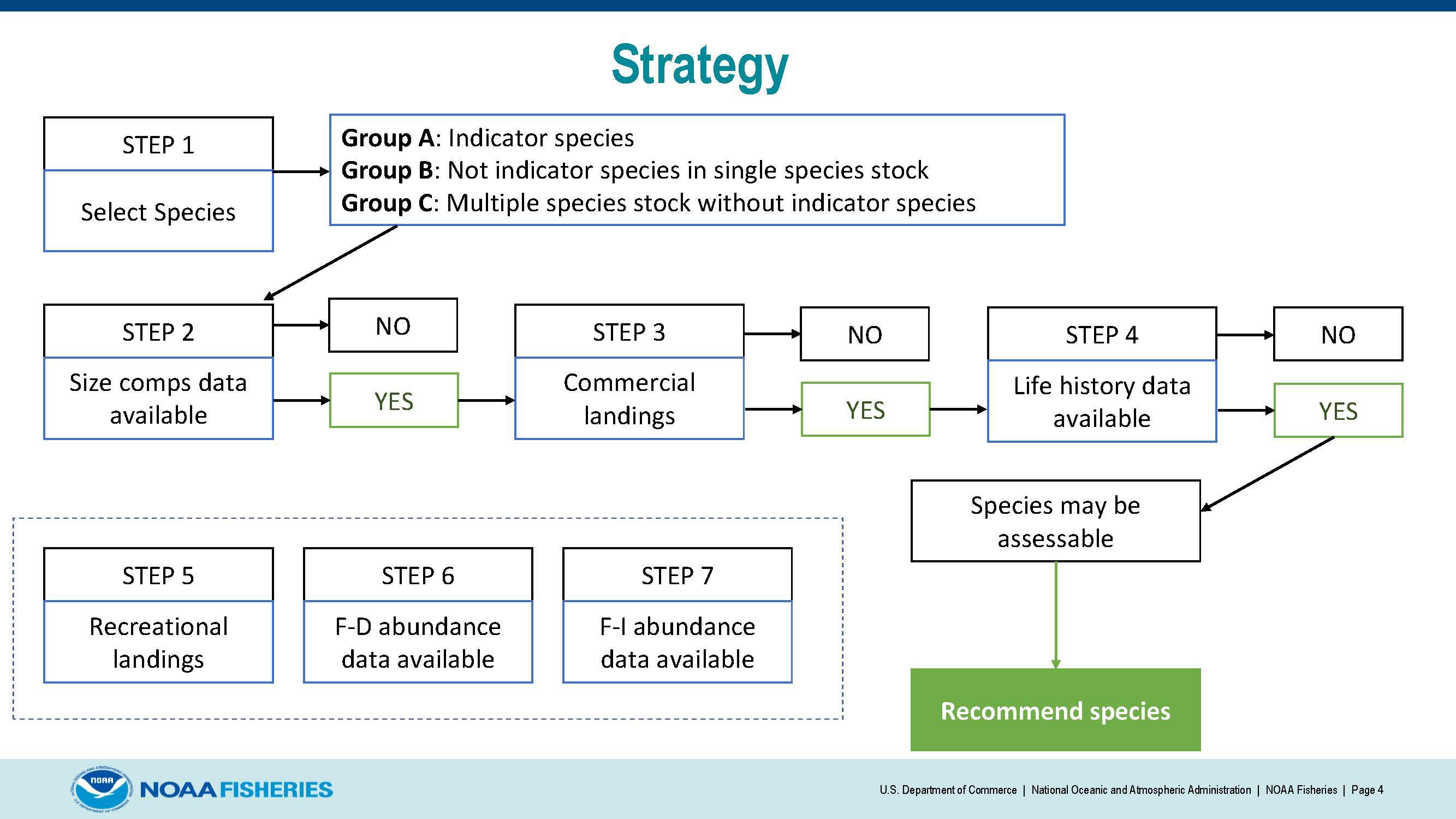
• Introduce a “decision tree” (i.e., flow chart that visualizes the process)
• Then use the “matrix” of available information/data for each managed species (i.e., the tool used in the process to select/not select species)
Example of a decision tree from the Southeast Fishery Science Center presentation “Caribbean Data Review for Stock Assessment” – April 2023 CFMC meeting
From each list of FMP-managed species:
• Step 1 - Retain species that are determined to be high value or high risk.
• Step 2 - Retain species that are targeted by the fisheries.
• Step 3 - Retain species that are benefitting or could benefit from the current management structure.
• Step 4 - Reclassify as ECS any remaining species that have an important ecosystem role.
risk
Start with the list of species under each FMP
• Species determined to be overfished
• Species listed under the Endangered Species Act
• Species/species group that are high value or considered to be high risk (Note – the productivity and susceptibility scores assigned to each species by the Scientific and Statistical Committee during development of the FMPs and the results from the July 2025 Ad Hoc Committee are included in the matrix)
Retain species that are targeted by the
fisheries.
• For species on the commercial catch reports, which are in the top X percent/rank/#trips
• For species not on the commercial catch reports, use other recent data to determine which are in the top X percent/rank/#trips (consider catch validation projects, MRIP recreational landings, other ?)
• Specify a de minimus threshold (level of landings that corresponds to non-targeted species)?
Note – again we can use previous information provided by the Ad Hoc committee and the District Advisory Panels
Step 3 - Retain species that are benefitting or could benefit from the current management structure.
Criteria
• Is the management structure (federal or federal+territorial) in place supporting the sustainability of the species. For example:
Fishing prohibitions for vulnerable species?
Size limits to protect juvenile individuals?
Seasonal closures to protect fish during critical spawning periods?
Limiting the number of fish removed through bag limits or trip limits?
Species-specific gear restrictions (e.g., no spear for spiny lobster)?
Step 4 - Reclassify as ECS any remaining species that have an important ecosystem role, such as:
Criteria (identify role of the species in the ecosystem):
• Habitat
• Grazers who provide settlement substrate for coral
• Habitat engineers who regenerate nutrients stored in coral reef sediments
• Bait for other managed species
• Other essential ecological value to consider?
Note – the selection criteria assigned to each species during development of the FMPs are included in the matrix.
• Get Council input on the proposed decision tree steps
• Get Council input on the criteria listed under the proposed decision tree steps
• NMFS and Council staff working group develops options paper for August meeting
Get input from Puerto Rico DNER and USVI DPNR
Incorporate, when available, results from SEFSC risk/value matrix
Thank you. Questions?