UPDATES CFMC
FEBRUARY 2026

The Caribbean Fishery Management Council (CFMC) newsletter contains activity announcements, facts on various marine species, and valuable information on fishing and the regulations that govern this activity in federal waters around Puerto Rico and the U.S. Virgin Islands.
ASSIST THE FISH ASSIST THE FISH:: DESCENDING DEVICES DESCENDING DEVICES
NOAA Fisheries approved Amendment 2, which requires that every fishing vessel fishing for reef fish carry a descending device on board
? Where does it apply? It applies in federal waters around Puerto Rico (9200 nautical miles), St Thomas/St John and St Croix (3-200 nautical miles)
? When is it required? It is required w hen fishing for or possessing reef f ish managed by the CFMC.
The goal To reduce mortality of federally managed reef fish affected by barotrauma. (pressure related injury that fish experience when reeled up from depth).

Availability: The equipment must be on board and ready for immediate use.
Selective Use: It is mandatory only when the fish is unable to submerge (e.g., signs of barotrauma).
Objective: To ensure that the specimen returns safely to the bottom, thereby increasing its survival rate.
Is it mandatory to use it at all times? No, but the law requires having it on board and ready for use if the fish cannot descend on its own
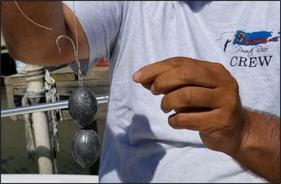
final regulation implementing Amendment 2 has been published he Federal Register. The descending device requirement will be ctive on April 1, 2026. It is important to remember that the ulation applies to both commercial and recreational fishers. Marcos Hanke / 787 Fishing Charters
BIT BY BIT!
What is a descending device?
It is an instrument with weights tied to a line (or fishing line) that, when used, helps fish overcome buoyancy by releasing them at depth, where they have a greater chance of surviving. In other words, the device helps the fish NOT float on the surface and be preyed upon.
Under this regulation, a descending device means:
An instrument to which is attached a minimum of 16 ounces of weight and a length of line that will release the fish at the depth from which the fish was caught or a minimum of 60 feet (18 meters).
The descending device attaches to the fish’s mouth or is a container that will hold the fish (for example, a milk crate with a weight).
The device MUST be capable of releasing the fish automatically, by the actions of the operator of the device, or by allowing the fish to escape on its own. Since minimizing surface time is critical to increasing survival, descending devices MUST be readily available for use while engaged in fishing for Council managed reef fish in federal waters.
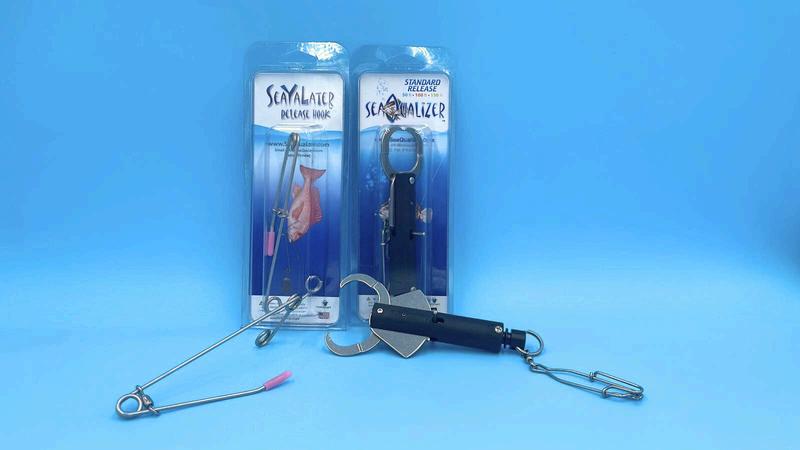
There are different types and brands of descending devices. Some of them are:
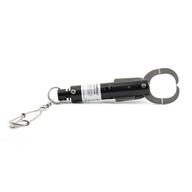
The Seaqualizer
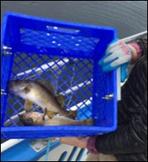
Milk crate with a weight
Photos: Seaqualizer / Marcos Hanke / 787 Fishing Charters
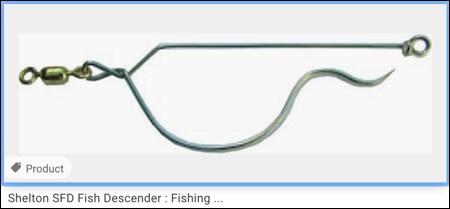
Inverted hook or Shelton Fish Descender
hook of hook of 'longliner' with 'longliner' with 'swivel' 'swivel'
weight from weight from 2 to 5 lb 2 to 5 lb
Homemade device
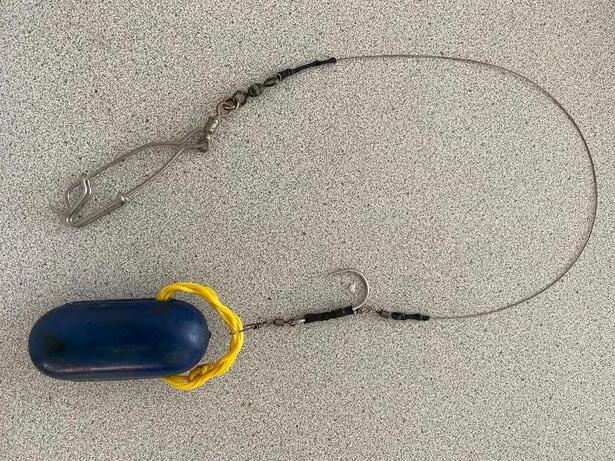
130 lb stainless 130 lb stainless steel cable steel cable
5/0 hook 5/0 hook without barb without barb
Which reef fish species are subject to this regulation?
In the Fishery Management Plans, managed fish species are divided in three categories based on functional groups: 1) reef fish, 2) coastal pelagics, and 3) rays
The reef fish group includes several species of snappers, groupers, parrotfishes, surgeonfishes, triggerfishes, wrasses, angelfishes, porgies, grunts, and jacks. At the end of this newsletter, we include a list of the reef fish managed by the CFMC in the U.S. Caribbean. Visit the NOAA Fisheries webpage, Caribbean fisheries section, to see the Fishery Management Plans (hyperlink below):
https://www.fisheries.noaa.gov/action/caribbean-island-based-fishery-management-plans
Also, visit the following Code of Federal Regulations links to see the most up to date lists of managed species:
Puerto Rico:
https://www.ecfr.gov/current/title-50/chapter-VI/part-622/subpart-S/section-622.431
St. Croix:
https://www.ecfr.gov/current/title-50/chapter-VI/part-622/subpart-T/section-622.471
St. Thomas/St. John:
https://www.ecfr.gov/current/title-50/chapter-VI/part-622/subpart-U/section-622.506
Photo: Marcos Hanke / 787 Fishing Charters
What is barotrauma and how can I identify it?
Barotrauma is a pressure related injury that fish experience when reeled up from depth
Barotrauma typically occurs in depths of 50 feet or greater, but can occur in shallower depths depending on the species caught. As fish are reeled up from deep water, gases in the body cavity and internal organs expands, often displacing the organs and leaving the fish severely bloated.
BAROTRAUMA
baro = pressure trauma = injury
barotrauma = injury caused by a change in pressure
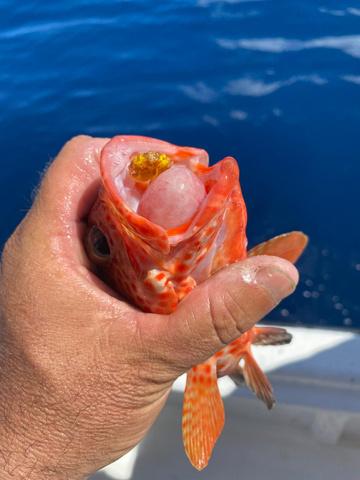
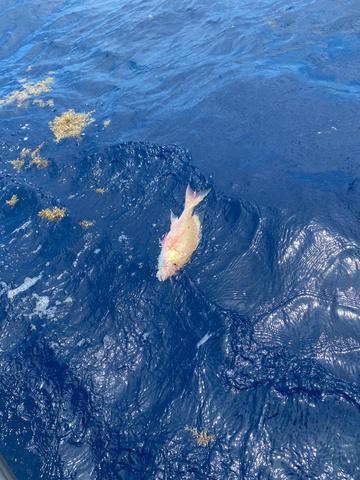
Barotrauma could be identified through the following symptoms:
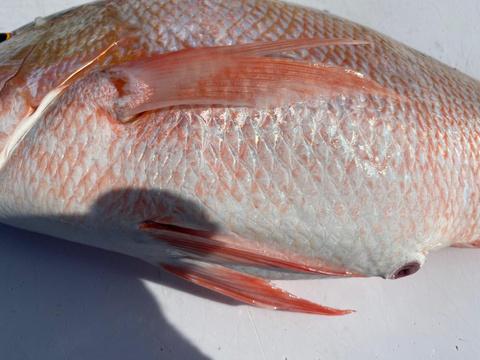
stomach protruding from mouth intestines protruding from anus bubbling scales
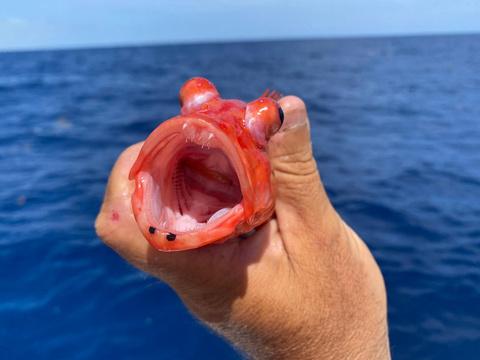
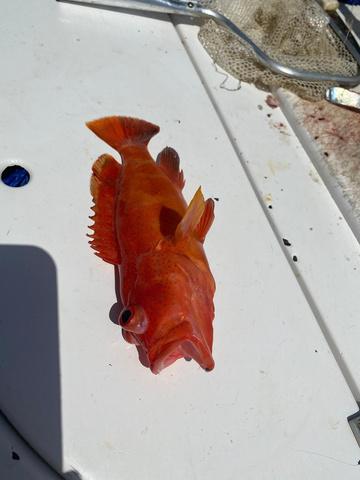
fish floating on surface
bulging eyes bloated belly
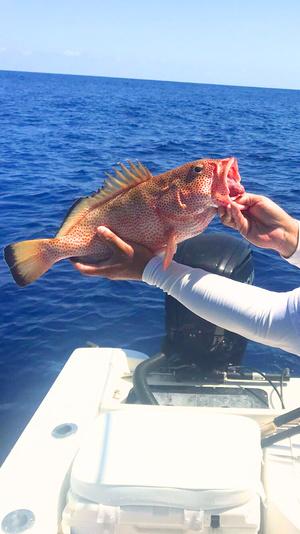
Photos: Marcos Hanke / 787 Fishing Charters
When should we use the descending device?
We can use it whenever a fish that we want to release or need to release shows signs of barotrauma. There are multiple reasons why you might release a fish. Here are some examples:
the species is regulated - That is, the species could be prohibited, have a seasonal closure, have a minimum size limit or have a bag/trip limit (which is the maximum amount that can be caught per fisher/boat per trip).
the species has no commercial or recreational value - For example, commercial fishers have no market for the species. Recreational fishers may not consume certain species or may just be fishing for catch and release.
Descending devices are an effective and low-cost tool that help properly return fish to the depth that they were caught, which increases the chances of survival. In this way, we protect the fisheries of tomorrow.
How can I get a descending device?
There are several ways to obtain a device:
Buy it in fishing supply stores.
Buy it online. Make it at home with materials you probably have on hand
We count on you to continue taking care and improving the health of our Caribbean fisheries!
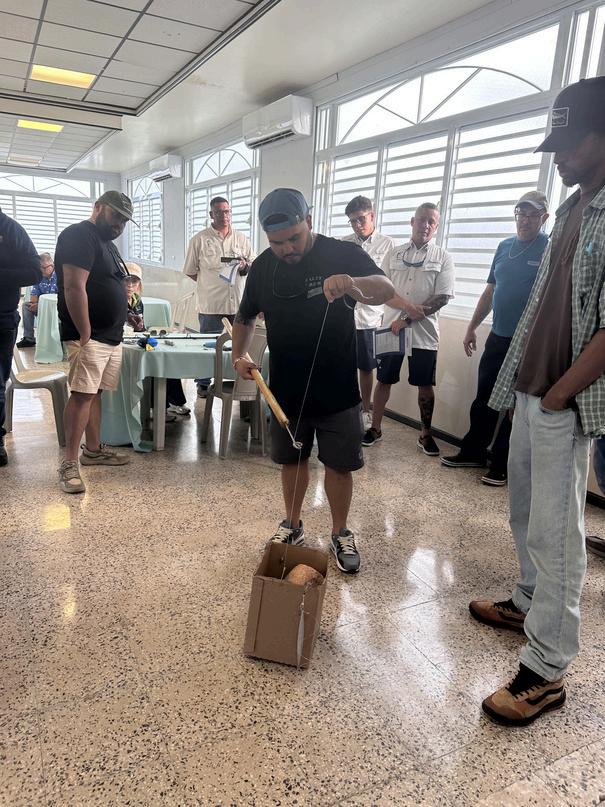
Photo: Raúl O. Ortiz, Burracas / CFMC
The workshops will continue to be offered throughout 2026. To coordinate a workshop for your fishing village, association, nautical club, or fishing community, please contact the liaison officers. Contact information is provided below:

Visit the CFMC Linktree and look for the SALVAPEJE section! REQUEST A REQUEST A
Wilson Santiago Soler
Wilson Santiago Soler
Puerto Rico Fisheries Liaison Officer
Email: wilson.santiago.cfmc@gmail.com
St. Croix Fisheries Liaison Officer
Email: olivia walton cfmc@gmail com

More information about descending devices
Salvapeje (video with English subtitles): https://bit.ly/4jq3bOt
Caribbean Fishery Management Council (webpage): www.caribbeanfmc.com
CFMC Updates, descending device issue -
https://issuu.com/caribbeanfmc/ docs/cfmc updates nov 2022
Return ’Em Right: https://returnemright.org/
Big Fish Initiative: https://bigfishinitiative.com/

Olivia L. Walton Olivia L. Walton
Reef
Fish Managed by the CFMC Reef Fish Managed by the CFMC
St. Croix Reef Fish
Snappers: black, blackfin, silk, vermilion, queen, lane, gray, mutton, schoolmaster, yellowtail
Groupers: Nassau, goliath, graysby, coney, red hind, rock hind, black, red, tiger, yellowfin, misty (fishing for Nassau and goliath groupers is prohibited in the U.S. Caribbean)
Parrotfishes: blue, midnight, rainbow, queen, princess, redtail, stoplight, redband, striped, redfin
Surgeonfishes (Médicos): blue tang (barbero), ocean surgeonfish (médico), doctorfish (cirujano)
Triggerfishes: queen
Angelfishes: queen, gray, French
Grunts: white grunt, bluestriped
Squirrelfish: longspine squirrelfish
Snappers: black, blackfin, silk, vermilion, queen, lane, mutton, yellowtail
Groupers: Nassau, goliath, coney, red hind, black, red, tiger, yellowfin, yellowmouth, yellowedge, misty (fishing for Nassau and goliath groupers is prohibited in the U.S. Caribbean)
Parrotfishes: blue, midnight, rainbow, queen, princess, redtail, stoplight, redband, striped, redfin (fishing for blue, midnight, and rainbow parrtfishes is prohibited in the U.S. Caribbean)
Surgeonfishes: blue tang, ocean surgeonfish, doctorfish
Triggerfishes: queen
Wrasses: hogfish
Angelfishes: queen, gray, French
Grunts: white grunt, bluestriped, margate
Jacks: Blue runner
Porgies: jolthead, saucereye, sheepshead, sea bream
St. Thomas/St. John Reef Fish
Puerto Rico Reef Fish – Peces de arrecife de Puerto Rico
Snappers (Pargos): black (prieto), blackfin (alinegra), silk (chillo ojo amarillo), vermilion (besugo), wenchman (muniama de adentro), cardinal (muniama de afuera), queen (cartucho), lane (arrayao, manchego), mutton (sama), dog (pargo colorao), schoolmaster (pargo amarillo), yellowtail (colirrubia), cubera (cubera)
Groupers (Meros): Nassau (cherna), goliath (batata), coney (mantequilla), graysby (mantequilla), black (negro), red (rojo), tiger (tigre), yellowfin (guajil), yellowmouth (guajil boquiamarillo), yellowedge (guasa aletiamarilla), misty (guasa), red hind (cabrilla), rock hind (cabra mora) (pescar meros cherna y batata está prohibido en el Caribe Estadounidense)
Parrotfishes (Loros): blue (azul), midnight (judío), rainbow (guacamayo), queen (cotorro), princess (princesa), redtail (colirrojo), stoplight (verde), redband (manchado), striped (rayado) (pescar loros azul, judío y guacamayo está prohibido en el Caribe Estadounidense)
Surgeonfishes (Médicos): blue tang (barbero), ocean surgeonfish (médico), doctorfish (cirujano)
Wrasses (Capitanes): hogfish (capitán), puddingwife (capitán de piedra), Spanish hogfish (loro capitán)
Angelfishes (Ángeles): queen (Isabelita), gray (Isabelita gris), French (Isabelita negra)
Grunts (Roncos): white grunt (cachicata, boquicolorao)
Jacks (Jureles): crevalle jack (jurel), African pompano (pompano), rainbow runner (salmón)
This newsletter was written by Cristina D Olán Martínez (CFMC), formatted by Rosana López Muñoz, and reviewed by NOAA Fisheries SERO Caribbean Branch (M. López-Mercer and S. Stephenson), by CFMC staff (M. Rolón and D. Martinó), by J. Ramos (OEAP Chair) and by the CMFC Fisheries Liaisons Officers for STT/STJ and Puerto Rico (N Greaux and W Santiago) We also acknowledge the guidance and pictures provided by Capt Marcos Hanke This bulletin has been prepared for educational purposes only and does not replace official documents related to Amendment 2 and/or federal regulations applicable to Amendment 2 and the fishery management plans. CFMC, NOAA Fisheries, nor any of their partners or collaborators endorse any particular brand of descending devices Mentions of products and brands in this newsletter have been made exclusively for educational and demonstration purposes
Triggerfishes (Pejepuercos): ocean (turco), queen (pejepuerco), gray (pejepuerco gris)