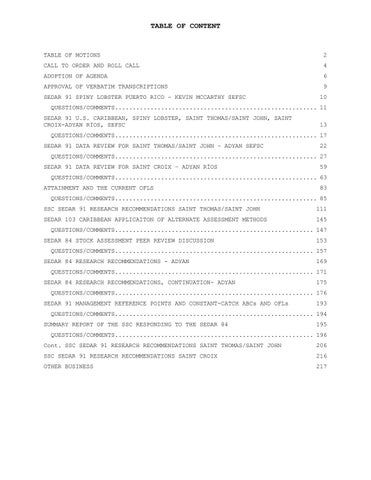
TABLE OF MOTIONS
PAGE 46: Motion: The SSC moves to recommend the assessment of SEDAR 91 U.S. Caribbean Spiny Lobster for Saint Thomas and Saint John as the best scientific information available. The motion carried on page 46.
PAGE 46: Motion: The results presented in the SEDAR 91 U.S. Caribbean spiny lobster for Saint Thomas and Saint John are useful for providing management advice and developing fishing level recommendations for the Council. The motion carried on page 46.
PAGE 47: Motion: The SSC recommends including years using the average of 2021-2023 as the provisional landing values for the 2024-2025 forecast for the SEDAR 91 U.S. Caribbean Spiny Lobster for Saint Thomas and Saint John. The motion carried on page 47.
PAGE 93: Motion: The SSC moves to recommend the assessment for SEDAR 91 U.S. Caribbean Spiny Lobster for Saint Croix as the best scientific information available. The motion carried on page 94.
PAGE 96: Motion: The results presented in the SEDAR 91 U.S. Caribbean Spiny Lobster for Saint Croix are useful for providing management advice and developing fishing level recommendations for the Council. The motion carried on page 97.
PAGE 98: The SSC recommends including years using the average of 2021-2023 as the provisional ladings’ values for the 2024-2025 forecast for the SEDAR 91 U.S. Caribbean Spiny Lobster for Saint Croix. The motion carried on page 101.
PAGE 105: Motion: The SSC recommends a sigma value of 0.5 for the SEDAR 91 U. S. Caribbean Spiny Lobster for Saint Thomas/Saint John and Saint Croix. The motion carried on page 107.
PAGE 205: Motion: The SSC reviewed documents associated with the SEDAR 84 stock assessment review and Center for Independent Experts (CIE) reports for Puerto Rico and Saint Thomas/Saint John yellowtail snapper and Saint Croix stoplight parrotfish. In anticipation of a full SSC review of these stock assessments, the SSC and the Southeast Fisheries Science Center Caribbean Branch discussed additional model runs for the full review. The suggested model runs include, one, exclusion of the National Coral Reef Monitoring Program data. Two, further exploration in parameter sensitivity to, with a soft prioritization of
selectivity; growth, including the possibility of using priors; three, natural mortality; four, steepness; five, equilibrium catch.
The SSC recognizes the limited capacity of the Southeast Fishery Science Center to do additional runs in light of the prioritization of completing the Puerto Rico Spiny Lobster stock assessment, SEDAR 91. The SSC will also look to the Southeast Fisheries Science Center analysts to determine the best exploration of uncertainty in the above list, as they expressed lessons learned from the review panel and ways to go about the above uncertainty exploration. The motion carried on page 206.
CARIBBEAN FISHERY MANAGEMENT COUNCIL SCIENTIFIC AND STATISTICAL COMMITTEE PUBLIC VIRTUAL MEETING
SEPTEMBER 23-25, 2025
The Scientific and Statistical Committees of the Caribbean Fishery Management Council convened via Zoom on Tuesday morning, September 23, 2025, and was called to order at 12:30 P.M. by the Council Chair, Vance Vicente.
CALL TO ORDER AND ROLL CALL
VANCE P. VICENTE CERNUDA: Well, good afternoon to all. We're ready to commence our first 2025 SSC meeting, which will begin today, September 24th , and will continue until September 25th . This is our first meeting in 2025 and also our first SSC virtual meeting, so I expect cooperation from all of you. This may be difficult, but it is possible.
We have a quorum. There are six members of the SSC that have signed in already. First, I want to say to Skyler Sagarese that we welcome him as a new member of the Caribbean Fishery Management Council, SSC. As you know, Eric Williams announced his resignation, due to all the changes in the federal government earlier this year.
And then, for the roll call. We're going to ask all the SSC members present at the moment to identify themselves. I need to stress this; keep all the microphones off. All the virtual guests, make sure you have the microphone set to mute. If in-person, please set your computer microphone to mute and ensure you have the face-to-face microphone on the red light. The green light is only for when you have the turn to speak.
Raise your hand to be granted a turn. You will be notified when it is your turn. You must speak out loudly, please, and clearly. That way, we can hear your testimony better and record it better. The meeting is being recorded. Please do not chew gum and/or sweets in the process of it. And lastly, it is very important to identify yourself with your name and last name each time you speak. There will be verbatim transcriptions of the meeting, and the transcriber needs to identify the speakers. So, thank you for your attention and cooperation.
First, I hope that everybody has a read schedule for today. If there are any suggested changes to the agenda, we're open to hearing it. So, please.
WALTER KEITHLY: Chairman?
VANCE P. VICENTE CERNUDA: Si.
WALTER KEITHLY: This is Walter Keithly. I had asked-- I had sent an email yesterday to Graciela asking if we could include just a brief discussion of why we will not be discussing the SEDAR report for Puerto Rico lobster. Thank you.
VANCE P. VICENTE CERNUDA: Yeah. I believe that Kevin may comment on this. Kevin?
KEVIN MCCARTHY: Yes. Thank you, Vance. Kevin McCarthy. Walter, we're going to talk about that right off the bat. So, once we get through the formalities of introducing everybody and all of that kind of stuff, I've got a couple of slides that'll talk about why we're at the place we're at.
VANCE P. VICENTE CERNUDA: So, we can begin with a roll call, please. Well--
JASON COPE: I'll go. This is Jason Cope, SSC.
VANCE P. VICENTE CERNUDA: Okay, Jason.
JORGE R. GARCÍA-SAIS: Reni García, SSC member.
ELIZABETH KADISON: Elizabeth Kadison, SSC member.
TODD GEDAMKE: Todd Gedamke, SSC member. Thanks for passing the link on, folks.
JUAN J. CRUZ-MOTTA: J.J. Cruz, SSC member. Good afternoon to everybody.
SKYLER ROSE SAGARESE: Skyler Sagarese, new SSC member.
TARSILA SEARA: Hi. This is Tarsila. Can you hear me? Okay. Good. I was having audio trouble.
Hi. Tarsila Seara, SSC member.
WALTER KEITHLY: Walter Keithly, SSC member.
VANCE P. VICENTE CERNUDA: Vance Vicente, Chair of the SSC. Good afternoon.
LIAJAY RIVERA GARCÍA: Liajay Rivera, Council Staff. Buenos días. KIARA M. MATÍAS ROJAS: Buenos días. Kiara Matías, Council Staff.
CRISTINA D. OLÁN-MARTÍNEZ: Saludos. Cristina Olán, Council Staff.
GRACIELA GARCÍA-MOLINER: Graciela García-Moliner, Council Staff.
GERSON N. MARTÍNEZ: Buenas tardes. Gerson Martínez, DAP Chair.
WILSON G. SANTIAGO SOLER: Good afternoon. Wilson Santiago, Puerto Rico Fisheries Liaison.
CARLOS FARCHETTE: Carlos Farchette, Council Chair.
VANESSA RAMÍREZ: Vanessa Ramírez, Vice-Chair.
JULIAN MAGRAS: Julia Magras, DEP Chair, Saint Thomas/Saint John. Good afternoon.
SENNAI HABTES: Afternoon, everybody. Sennai Habtes, DPNR, EBFM TAP Chair.
LIAJAY RIVERA GARCÍA: Mr. Chair, if I may. I can make roll calls. I can read them out loud through the list. Okay. I'll go ahead and read them from the list. In Zoom we have Adyan Ríos, Christina Olán, Kiara Matías, Elizabeth Kadison, Carlos Farchette, Derek Soto, Jesús Martínez, Jason Cope, Jesús Rivera-Hernández, J.J. Cruz-Motta, Jorge García, Julian Magras, Kate Zamboni, Katherine Godwin, Kevin McCarthy, Manuel Coffill-Rivera, María López, Nicole Greaux, Sarah Stephenson, Sennai Habtes, Walter Keithly, Wilson Santiago, and I believe that is all in my list.
If I miss anyone else, please speak out or write through the chat. Thank you.
ADOPTION OF AGENDA
VANCE P. VICENTE CERNUDA: Also, in addition to the agenda, Kevin, I believe, is going to give a small a short presentation on SEDAR 103, which is the Caribbean Application of Alternate Assessment Methods. And I believe that that's the only other thing. Also, I want to remind you that the Council is expecting some recommendations regarding Executive Order 14276, Restoring America's Competitiveness Seafood. I believe that Richard is going to be making some comments on this or writing some comments on this.
So, for today, we have a presentation from Adyan Ríos, regarding the U.S. Caribbean spiny lobster, Saint Thomas/Saint John. But before the presentation, I want to let the SSC members know that we have a very strong mandate to please try to think about these items that I'm going to mention so that we make sure that at the end of the meeting we can agree whether or not we have complied with our duties, which are as follows. The Council Scientific and Statistical Committee will review the stock assessment report, and we, SSC, are tasked: Number one, with recommending whether the assessment represents the best available science. Number two, whether the results presented in the stock assessment reports are useful for providing management advice and developing fishing level recommendations for the Council. An SSC may request additional analysis to be conducted or may use the information provided in the SAR, Stock Assessment Report, as the basis for their fishing level recommendations. For example, overfishing limit levels and acceptable biological catch. Four, the Caribbean Council SSC will review the assessment at its September 2025th meeting, which is today, which is this meeting, followed by the Council receiving that information at its December 2025 meeting. Documentation on SSC recommendation is not part of the SEDAR process and is handled through each Council.
I want to remind you all that, you know, even though we do not form a formal part of the SEDAR process, there are always three SSC members present in the three workshops. That is the data workshop, the assessment workshop, and the review workshop.
Are there any comments on the agenda? Any other specifics that you may want to add to the agenda before we carry on with Adyan Ríos’ presentation?
LIAJAY RIVERA GARCÍA: Mr. Chair, apologies. We missed Todd Gedamke and Skylar Sagarese from the list, from the roll call. And Richard just entered.
VANCE P. VICENTE CERNUDA: Okay. Thank you.
CRISTINA D. OLÁN-MARTÍNEZ: Kevin McCarthy raised his hand.
VANCE P. VICENTE CERNUDA: Okay. Kevin.
KEVIN MCCARTHY: Thank you, Vance. Kevin McCarthy. Two things. Minor issues with the schedule. One is that I'm going to start off with the review of why we're not-- to Walter Keithly's question about why we're not reviewing Puerto Rico's spiny
lobster. The SEDAR 103 conversation, I'd like to hold on the last day when we're talking about sort of scheduling and ways forward with SEDAR 84 and that kind of thing. So, if we could do those two things, that'd be great.
VANCE P. VICENTE CERNUDA: Any other changes to the agenda?
CRISTINA D. OLÁN-MARTÍNEZ: We have a question in the chat from Jason Cope. He asked, “For official purposes, do we need to approve the agenda?”
VANCE P. VICENTE CERNUDA: We need a motion to accept the agenda.
RICHARD APPELDOORN: Hey Vance, I'd like to add something to the agenda.
VANCE P. VICENTE CERNUDA: I need a second. No.
CRISTINA D. OLÁN-MARTÍNEZ: Rich is asking to add something to the agenda.
VANCE P. VICENTE CERNUDA: Yeah. Richard want to make a change to the agenda, an addition. Richard?
RICHARD APPELDOORN: And, Graciela, you can help me here because I forget what the actual number of the, I guess, Executive Order or something that we're dealing with, but we were notified of the desire from higher up to be able to boost productivity and output of the fishery, etcetera, and what kind of recommendations we would make. They had a whole list of the kinds of things that we should do.
This is something I don't think we should approach on an individual basis, but we don't have a lot of time. So, if there's time at the end of the meeting, I would like to get to that. Because I think there's things we could do, but it's something the SSC would have to discuss and agree to because they'd be large scale changes in what we're looking at and how we're looking at things.
GRACIELA GARCÍA-MOLINER: Thank you, Richard. So, he's referring to Executive Order 14276. The email that you all received comes from the higher up to the individual, so that's been widely distributed. The Council held an ad hoc committee and discussed the Executive Order at the last Council meeting also and is preparing a Council letter based on, more than anything else, everything that we have on the plates right now, amendments to the island-based FMPs, improvements to the science data
collection efforts, etcetera.
So, if you see fit and you can prepare points that you would like to present to the Council, there are two issues with the dates.
One is that the Council has to respond by the end of this week. I think it's September 30th or next week. The second is that the email that you received to get comments from the public, I think, ends October 28th . So, you do have more time to send comments to NMFS. But, hopefully, based on the research recommendations that the SSC had made previously and the discussions of the SEDAR, etcetera, hopefully all that has been captured in the letter that is being sent to Eugenio Piñeiro.
VANCE P. VICENTE CERNUDA: Okay, thank you, Graciela. Any other comments?
RICHARD APPELDOORN: Well, could we see a copy of that letter? When we get to this point in the discussion, Thursday.
GRACIELA GARCÍA-MOLINER: So, we're working on the table that we're enclosing. They sent a template for the Councils to send back to NMFS. So, we are preparing for that. Hopefully, it will be done today. And then, you should be able to see a draft of that letter.
RICHARD APPELDOORN: Thank you.
VANCE P. VICENTE CERNUDA: Okay. Thank you, Richard. Any other comments, please? If not, I guess that we can proceed with a—
Again, does anybody propose accepting the agenda? It needs to be seconded by somebody.
JASON COPE: I'll second the agenda. This is Jason Cope.
VANCE P. VICENTE CERNUDA: Thank you, Jason.
MICHELLE SCHÄRER-UMPIERRE: Motion to accept the agenda as amended.
APPROVAL OF VERBATIM TRANSCRIPTIONS
VANCE P. VICENTE CERNUDA: Okay. Thank you. Thank you very much. Are there any other issues that we need to discuss before our presentation of the day? Okay.
Hearing no objections, the agenda has been accepted.
Regarding the minutes, they have been available for some time. Are there any comments from the last meeting of the SSC in April? Any comments on that agenda or any changes? If not, at our next meeting we will be determining whether that April agenda, I mean, not the agenda, the minutes, and this meeting's minutes, are approved or not.
Okay. So, we will hold on until our next meeting. Kevin?
KEVIN MCCARTHY: Yep. Thanks, Vance. Good afternoon, everybody. Kevin McCarthy, Southeast Fisheries Science Center. I am going to share my screen.
Oh, could you allow me to share my screen?
VANCE P. VICENTE CERNUDA: Yes, please.
KEVIN MCCARTHY: Okay. Something just happened, so maybe it's ready to share.
KEVIN MCCARTHY: Are you able to see that?
LIAJAY RIVERA GARCÍA: Yes, we can.
KEVIN MCCARTHY: Okay. Terrific. So, just to get at the question of why we're not looking at Puerto Rico, I want to follow a few things through for SEDAR 91. Recall this is the spiny lobster, of course. So, the SEDAR 91 process was completed with the distribution of the assessment workshop reports. There was no CIE review workshop. There were a couple reasons for that.
One reason was that SEDAR 91 was an update of the SEDAR 57 and SEDAR 57 updates. Obviously, we updated all of the data inputs and things, but there wasn't a significant change in the nature of the data inputs. Also, that was during a period when contracts were just not going through. So, CIE contracts could not be executed.
So, we were able to do a CIE review workshop for SEDAR 84. But that was because those contracts had been cut months earlier. So, we entered this phase where there was no contracting happening. So, even if there had been a significant change to inputs for SEDAR 91, we couldn't get a CIE review process in place. Also note that during the period when assessment workshop
reports were being finalized, our lead assessment biologist for SEDAR 91, Matt Damiano, elected to leave federal service. Our loss is the state of North Carolina's gain. So that's where he is now. But he was kind enough to finish those assessment workshop reports.
So, that's where we were as of the last Council meeting. And then during the Council meeting, well, before the Council meeting, I should say, Puerto Rico DRNA produced a nominal index. So, what they did was to go in and just combine all the commercial data that had lobster landings. They weren't focused on where on the island this happened or what kind of gear was being used. So, they look at a very rudimentary catch per trip, pounds per trip of lobster. That was reviewed. That was presented and reviewed in the data workshop for SEDAR 91. But at that time, the panel did not recommend it for use.
So, we did not go forward with that as a data input for the assessment models. However, there were some further considerations. So, I've got here Science Center staff. That was me. Further investigated the use of the logbook for index construction. I didn't do anything more than a nominal either, but I did split it out by coast and by gear. That's going to require some more work. Anybody who's worked with fishery dependent data to put together an index of abundance will tell you it is not necessarily a straightforward process.
But anyway, at the request of the Council, during their August meeting, they wanted to prioritize spiny lobster over SEDAR 84. So, 84 is on hold. Recall that we're down to one lead assessment biologist in the group. So, Adyan is switching over from 84 to finalize and present SEDAR 91. And we are going to attempt to incorporate that index of abundance. We have to construct it. That's going to take a while. We're down people. And include that in the SEDAR 91 Puerto Rico assessment model.
So, that's why Puerto Rico we’re going to delay until we get that index incorporated, if possible. No guarantees, but we're certainly going to make our best effort to get that included. And so, what we're hoping to do is have that for you for your November meeting to review then. And we'll talk about how we move forward with 84 on the last day of this meeting. But that's where we stand.
So, that's why we're moving forward with the Virgin Islands. There were no additional data inputs that were recommended. But because of the work of Puerto Rico DRNA, even though the data workshop didn't recommend it to go forward, we're going to take
another look at those data, see what we can get out of them, and move forward from there, and include the index if at all possible.
So, that's where we're at. Any questions about that?
QUESTIONS/COMMENTS
VANCE P. VICENTE CERNUDA: Yes, Kevin. I have a question. So, the SSC, at this meeting, will be acting as a review panel for the Saint Thomas/Saint John, and Saint Croix Caribbean lobster assessment?
KEVIN MCCARTHY: Correct.
VANCE P. VICENTE CERNUDA: Okay.
KEVIN MCCARTHY: And we will see the Puerto Rico Spiny Lobster Assessment, at a future meeting. Any other questions, comments, concerns?
VANCE P. VICENTE CERNUDA: Okay. Well, thanks again. So, Graciela, I guess that we—
KEVIN MCCARTHY: Thank you.
VANCE P. VICENTE CERNUDA: Are there any other comments? So, we go back to the agenda and continue with our duties for September 23rd . I want to ask Adyan Ríos if she's ready to give her presentation.
Okay. Adyan, are you online? Yes, here she is. Okay. So, Adyan will be presenting the SEDAR 91, U.S. Caribbean Spiny Lobster, Saint Thomas/Saint John, Saint Croix Assessment Review.
So, Adyan, whenever you're ready, we're ready for you.
CRISTINA D. OLÁN-MARTÍNEZ: She's working with her audio.
ADYAN RÍOS: Okay. And do you guys see my screen?
LIAJAY RIVERA GARCÍA: Yes.
ADYAN RÍOS: Is Audio good?
CRISTINA D. OLÁN-MARTÍNEZ: Audio is good.
ADYAN RÍOS: Okay. I'll get started. I'm not sure if I hear you
guys. Could somebody just speak in the mic just to see if the sound is working on my end?
CRISTINA D. OLÁN-MARTÍNEZ: Can you hear me?
ADYAN RÍOS: I'm in Kevin's office, so we were switching the system over.
CRISTINA D. OLÁN-MARTÍNEZ: Adyan, can you hear me?
SKYLER ROSE SAGARESE: We hear you, Adyan. I don't know if you can hear us.
ADYAN RÍOS: Okay. So, I don't hear anyone. Let's see-- Oh, let's try here at audio settings. Default. Default.
GRACIELA GARCÍA-MOLINER: Hola. Hola. Hola. Hola. Hola. Can you hear us now?
ADYAN RÍOS: Are you guys speaking? Just to make sure--
GRACIELA GARCÍA-MOLINER: Yes, we are continually speaking, so that you can hear us. Yes.
ADYAN RÍOS: Okay. Yeah, I don’t hear you. Alright, I'll try rejoining.
VANCE P. VICENTE CERNUDA: Can you hear us? Hello? We'll keep us
GERSON N. MARTÍNEZ: We could hear you clearly, but you cannot hear us. But we can hear you.
ADYAN RÍOS: I can hear you now. The refresh worked. So, we are good. Let me reshare my screen.
GRACIELA GARCÍA-MOLINER Perfect.
SEDAR 91 U.S. CARIBBEAN, SPINY LOBSTER, SAINT THOMAS/SAINT JOHN, SAINT CROIX-ADYAN RÍOS, SEFSC
ADYAN RÍOS: Okay. Good morning, everyone. Adyan Ríos, Southeast Fisheries Science Center, presenting today the SEDAR 91, for the U.S. Virgin Island, for the models for the U.S. Virgin Islands. Just an outline of our presentation today.
So, we'll kind of go over some of-- we'll revisit the terms of reference from SEDAR 91, and review the approach used. Both of those are applicable to both the Saint Thomas/Saint John
platform, as well as Saint Croix. And so, we'll kind of discuss those topics as relevance, once today and, if necessary, again tomorrow as well. And then we'll go into the data review and the review of the results one island at a time, first with Saint Thomas/Saint John, and then, tomorrow, we'll pick up with Saint Croix.
So, starting with the summary of the Terms of Reference, we'll first take a quick look at a summary of the Data Workshop Terms of Reference, followed by the Assessment Workshop Terms of Reference.
So, the Data Workshop Terms were to review available data inputs, including but not limited to commercial and recreational catches and/or discards, length/age composition data, life history and ecological information, indices of abundance, to provide recommendations for future research, and to prepare the data workshop report.
Here's a summary of the sources of data that were recommended for the use in the assessment portion of SEDAR 91. So, those are landings from self-reported fisher logbooks, the length composition from the shore-based port sampling, and life history parameters carried over from SEDAR 57.
Next, we'll look at a summary of the assessment webinars or the Assessment Process Terms of Reference. Develop and apply assessment tools compatible with the available data and consistent standard practices; provide management benchmarks and status determination criteria to the extent possible; to the extent possible, develop projections to support estimates of MSY, OFL, and ABC; provide recommendations for future research; and provide an assessment workshop report.
Next, we'll continue with an overview of the SEDAR 91 assessment approach. So, this process iterated on existing SEDAR 57 and SEDAR 57 update models. Those were length based statistical catch at age models that were developed using stock synthesis. This was determined as the most appropriate framework given the data that are available for the current assessment. And the SEDAR 91 framework for the U.S. Virgin Islands is identical to the framework that was used for SEDAR 57 and the SEDAR 57 update.
So, this approach was developed using SS3, Stock Synthesis. SS3 was implemented as a length based statistical catch at age model. So, that is a forward projecting age structured population dynamics model that is fit to the landings, the
length composition, and if an index was available, then we would also have used that.
So, the principle of this model as we called it, an integrated analysis approach. It is to integrate as many sources as possible of data that are available and of interest that can help inform stock status, biomass, and fish immortality. And so, it has three main components, the population dynamics model, the data and associated observation model, and the estimation algorithm.
So, like any model, the results depend on the model fit to the data and the model parameters, which can be either estimated or fixed. And the estimation is accomplished by using a log-likelihood function. So, that calculates the match between the observed and the predicted data for each of the different data components to obtain the total of likelihood. And the estimation algorithm tries to minimize that difference in fitting the model to the data.
So, next, we'll provide a summary of the data and life history assumptions, which hold true for SEDAR 57, 57 update, and the current 91 for the U.S. Virgin Islands. The landings were modeled with log normal error, and the length compositions were modeled with multinomial error. There were no indices of abundance, and we have a two-sex model that assumes a 50/50 ratio between the sexes.
We have island-specific length-weight relationships, and we'll come back to that when we talk about sensitivities. We have Puerto Rico growth parameters estimated using von Bertalanffy growth function. And I'm sorry, that's the one we'll come back to. We have a point estimate for natural mortality. And we have fecundity relationships based on data from Southwest Cuba from SEDAR 8 and maturity parameters from a paper by David Die.
We'll continue summarizing some of the model assumptions that are documented and, again, for SEDAR 57 and for SEDAR 91. So, there are no recreational fishing incorporated. There's no recreational fishing data incorporated, and so, that's equivalent to assuming that, you know, the recreational fishing is constant, and it is ignored in the models.
There's no release mortality, so no discard mortality due to the selective nature of pots and traps and the dive gears. So, of the discards, there's no portion of the discards that are assumed to have also died.
The model, the age goes from 0 to 15, and the sizes go from 51 millimeters to 248 millimeters, which is approximately 2 to, 9.8 inches. We have a one area model with a single spawning population and a single associated stock recruitment function for each of the island platforms. And the selectivity functions to characterize, the fleets, the size of lobster, captured by each fleet is length based. And we also have a retention characterized as a length function as well. We're assuming a complete catch history and that the commercial landings are known precisely.
So, something that has been added for SEDAR 91 is a few more sensitivities, and two of those investigated the dome-shaped selectivity. The first selectivity, which will be referred to as Selects 1, looked at using a fixed-logistic selectivity, so forcing the model to use a logistic selectivity, instead of the dome-shaped selectivity that was used in SEDAR 57. And then Selects 2, initiates the model as logistic but allows it to be estimated. And then, we'll look at the results of that and how that model, Selects 2, ends up back with a very similar selectivity to the base model. And that's true for both island platforms.
And then lastly, we looked at a length-weight selectivity using the length-weight relationship with the data combined across all three island platforms. So, the length-weight relationship doesn't show a lot of difference across the islands. And so, as we kind of think about why we're using different parameters, we also wanted to see, like, how sensitive is the model to using a parameter that's survived using all of the length-weight relationship-- all of the length-weight data that are available for the region. And when we tease apart data and break it into different areas to use for the assessments, it'll be worthwhile as well to justify and understand if there's a difference between what we see with the length-weight relationship across the region versus in the three islands platforms.
So, we'll look at the results of those sensitivities. We'll also look at diagnostics. So, we'll talk about the fit of the data. We'll talk about the gradients and residuals are more in the report. Those are in a table in the report, but we'll look at the retrospectives, the likelihood profiles, and the figures that we also have for the jitters.
So, this slide is, kind of, a summary of the outcome. So, this is what we'll come back, you know, at the end of the presentation, but we also wanted to mention this upfront. So, this and the next slide kind of highlight the big picture of the
take home message, I guess.
For each island platform in the SEDAR 91 U.S. Virgin Island model, so Saint Thomas/Saint John, and Saint Croix, the results of SEDAR 91 indicate that overfishing is not occurring and that the stocks are not overfished. And the diagnostics indicate consistent and relatively robust model estimates. In the report, we also talk about how the models are relatively inflexible because if they're estimating few parameters, and we will be reviewing all of the diagnostics that support what's on the slide here today.
And then, we'll come back to this slide as well to discuss how to move forward. But after the review of the SEDAR 91 model and methods, and the determination as to if this is best scientific information available, the conversation would also need to inform-- we'd need decisions on how to move forward for the OFL. Those decisions are making assumptions for 2024 and 2025.
What has been done in the past, is using a 3-year average. So, one option to have preliminary values for 2024 and 2025 to begin our OFL in 2026 is to use the average of 2021, 2022, and 2023 for both 2024 and 2025. And then, the development of the OFL and the ABC as in past years, uses the approach of determining, well, the ABC control rule, which has two components, a P*, which is determined by the Council, which is the input for management uncertainty, and the sigma value, which is the SSC's input, to determine the level of scientific uncertainty. And the Caribbean Council ABC control rule has additional information on, you know, what that value needs to be or how it can be determined. But what was used in the SEDAR 57 and in the SEDAR 57 update was a sigma value of 0.5, and the Council used a P* of 0.45.
We have slides from previous discussions of when these were determined that we could present, but those are, kind of, something that we'll come back to and see if there's a request to look at those again. That kind of remind us as to how sigma affects the width of the distribution and how the application of the P* determines the outcome. So, being able to show that relationship and walk through a little bit more about how the ABC is determined from the OFL using those inputs.
Okay, so I'll stop there for any questions because the next part will be reviewing the data for Saint Thomas/Saint John and then reviewing the results from the models for Saint Thomas/Saint John. And then come back to any further discussion on this island platform, before we also determine how to move forward
with the rest of the agenda.
QUESTIONS/COMMENTS
VANCE P. VICENTE CERNUDA: Okay. Any questions? Well, I have a quick one, Adyan. Just going over the literature, there are different values for mortality. Why was it mortality .34 selected and others rejected? Is there a basis for that? Is that the mean of previous mortality estimates?
ADYAN RÍOS: No, it was a specific value with the citation, but I'll look into that and, remind, get a refresher on exactly why a single value was used. I believe we also looked at sensitivities to the other mortalities in SEDAR 57, and that was not further explored. The data workshop kind of recommended you continuing use of the core, the base value that was used in SEDAR 57. So, for SEDAR 91, the data workshop did not recommend looking at alternative natural mortality estimates.
VANCE P. VICENTE CERNUDA: Okay. Thank you, Adyan. I have Richard Appeldoorn.
RICHARD APPELDOORN: Yeah. Hi, all. Just two questions for clarification. So, the sex ratio you're taking is 50/50. Is this not subject to the generally assumed practice of not taking gravid females, which would tend to allow greater survival of females?
ADYAN RÍOS: It does--
RICHARD APPELDOORN: Yeah. Go ahead.
ADYAN RÍOS: No. Yeah. It doesn't take that into account, and I believe that's, like, a remaining opportunity for research as to what should that value be. So, presumably, the fishery would be capturing a lot more males than females when the females are gravid, and that sex ratio might not be 50/50, but 50/50 is a kind of an all-starting assumption for the model. So, we have not received a sex ratio to base that assumption on, thus far in the in the SEDAR process.
RICHARD APPELDOORN: Yeah. I fully understand that. The other question was your statement about you’re assuming that commercial landings are known precisely, and I'd just kind of-I don't have a problem with that statement, but I would kind of like to have your assessment or feeling about what we mean by precisely. Like, it's given or take something that we'll be okay with this.
ADYAN RÍOS: It's more of an interpretation of how the model is utilizing the information. And so, the model is fitting-- is estimating those to be precisely. So, we're not giving it a large uncertainty. There's not a lot of inputs to the model. So, that's kind of one of-- like, if you think of some of the different data inputs to the model. We've got the length data. We've got the catch dat-- we've got the catch data. And so, in order to kind of pin down--
We could increase the uncertainty on that, but then we're, I guess, I don't know, maybe Jason or Skyler can help me here in a moment because I'm kind of blanking. But there are very few data inputs, and so in order to fit a model with few data inputs, this is kind of, like, one of the assumptions that facilitates the model's convergence, by saying that one of the inputs is known well so that informs the rest of the fit of the model.
RICHARD APPELDOORN: Yeah. So, I fully understand that, and I don't have a problem with it. I'm just wondering whether, you know, once we have answers, we have to ask the question, you know, could we have been wrong? And so, I guess we'll come back to that when we get to the results. But, yeah, it would increase the amount of uncertainty, and that would possibly lead to not getting any results at all.
So, I understand why you made the assumption. I'm just kind of looking at the other end when we say, okay, how happy are we with that assumption? Because that's going to reflect how happy we are with the results.
ADYAN RÍOS: Exactly. And I think in the past when that's come up, it's also kind of that scientific uncertainty. There are different ways of incorporating scientific uncertainty. So, one way is through sigma, other ways are through, you know, like model averaging or looking at uncertainty grids. So, there's different ways of considering how that gets carried forward and reflected as a source of uncertainty.
RICHARD APPELDOORN: Right. Excellent. Thank you.
VANCE P. VICENTE CERNUDA: Okay. Thank you, Richard. Maybe Jason Cope can shed some light on this. Jason?
JASON COPE: Yeah, thank you Chair. Adyan, thank you. And I do want to acknowledge Adyan, thank you so much for your stepping in on this assessment that Matt did a great job working on and that I was able to do the reviews for. So, thank you for
stepping in on this.
I want to make sure, for clarification, I want to go back. Rich, you asked that really good question about the 50/50 sex ratio. And I think what that meant was, at birth there's an assumption that, at birth, there's a 50/50 sex ratio. So, I think that's what that is referring to. When it gets to this idea of what's being caught, there is a length-based selectivity that is being overlaid onto both the female and male population.
It's the same selectivity, but because males and females are growing differently, you are going to have a different sex ratio of males and females at older ages because that growth, because what's being caught is going to affect the populations differently. And again, you can, in these models, if you wanted to say, and females specifically have an even different selectivity than the males because they're protected or whatever it is, that can be implemented. So, those sorts of things you're definitely able to look at that.
But I think naturally through, if just one selectivity curve is being applied to males and females without any additional selectivity being put on females, you are going to get a different sex ratio at larger sizes. And there is a plot, there's a standard plot that comes out of the assessment that shows how sex ratio over age and length changes. But I think that initial 50/50 one is just at birth.
Adyan, does that sound-- does that sound right?
ADYAN RÍOS: Yes. That sounds right.
JASON COPE: Okay. Yeah. So, I just wanted to clarify that. And that seems, for me, completely, we have no reason to believe that they wouldn't be at a 50/50 ratio at birth.
And so, then this next question about uncertainty, I think, is an excellent one. And it's a fundamental one we’ve noted, and we're going to get to it, right? We're going to get to this result where it's one kind of best available science type model that does the best balance between fitting the data and estimating parameters and model behavior. So, it's kind of this one model. And out of that one model comes a measure of uncertainty conditioned on how you've set that model up. And that's where we get the sigma, and that's where we get the uncertainty.
Rich asked a really good question of, okay, what if that one
model setup, even though it fits the data and it passes all the diagnostics, which this model does, what if you gave it the wrong natural mortality? What if you gave it the wrong growth curve? And if you're not estimating those and including the uncertainty in those parameters, in the model's estimate of uncertainty, you're underestimating the total amount of uncertainty. And this is what we do, basically, in all stock assessments because at some point we are saying, we know some value, some parameter value, and we're not estimating it. And therefore, we're saying we know what it is, and we can't include the uncertainty around it.
What you will see in this assessment is that Matt did a bunch of sensitivity explorations saying, what if natural mortality was this value? What if we got it wrong? What if we got this steepness wrong? What if we got these other things wrong? And the fundamental question that Adyan has just pointed out is, so what do you do with those other models?
Right now, we're homing in on the best available scientific information from one model. And this is pretty standard across the U.S. on how we do most of our assessments. But there really is this question of could we incorporate these other potential models and have like maybe multiple models be the thing that characterizes sigma? And I'll finish off with this.
The trick with that is coming up with a weighting scheme. How much do you believe each of those models? I think what we typically do is we say this best fit model with the best treatment of the parameters that we can come up with, that is, right now, 100% of what we believe is the best fit model. If you bring in these other ones saying, well, what if it's a different natural mortality value or a different growth value? You're now going to have to assign less than a 100% to that best fit model and some amount of believability to the other ones and that's where it becomes really tricky. And I think that's where, in most places around the country, we've kind of stopped short and not really weighted them officially and done this model averaging or ensemble modeling, as Adyan mentioned.
So, I just want to emphasize that is doable. And Adyan mentioned you can do that. We typically are looking at this one model and then looking at the sensitivities to see how much it matters if we get these other things wrong. And then for us at the SSC, we kind of have to balance those things and say, what are we comfortable with when we do finally assign, sort of, whether it's a sigma or we have a discussion about the P*, those are two places where things, our risk tolerance can get adjusted a
little bit.
So, I hope that that's useful. I know that's a lot of information, but we have all of that information before us if we want to delve into those things. This assessment provides all of that information to talk about, if members of the SSC would like to.
Thanks.
VANCE P. VICENTE CERNUDA: Jason, I have a question. Wasn't the data used to determine the male and female ratio based on commercial data before the regulation, which prohibited catching bearing females?
JASON COPE: Adyan, do you want to go ahead and answer?
ADYAN RÍOS: So, there are two types of sex ratios. Right? There's the sex ratio of the catch, which is documented in the TIP data and allowed us to-- and as part of the reason we're able to have sex specific growth and sex specific-- so, there's a sex ratio of what you see in the landings, which could be informed before the regulations, presumably that if there was no, like, releasing of the females, then the sex ratio of the landings would reflect the sex ratio of the population.
I don't think that was looke-- I mean, it could have been looked into SEDAR 57. It sounds familiar. We'll have to investigate, but these models, SEDAR 57 and SEDAR 91, are not infor-- like, it's just a default null assumption of 50/50. So, yeah. So, that was not-- that was not used.
VANCE P. VICENTE CERNUDA: Okay. Thank you. I will look up for the reference and tell you later. Okay? Thank you.
Are there, any other questions? Okay. No? If not, well, Adyan, please proceed.
SEDAR 91 DATA REVIEW FOR SAINT THOMAS/SAINT JOHN – ADYAN SEFSC
ADYAN RÍOS: Okay. So, moving on to the review of the data. So, we have a summary here of the data inputs and the data that were updated. They include the landings from self-reported fisher logbooks. So, those were updated through 2023 as were the length composition data from the TIP shore-based sampling. The SEAMAP-C dive survey data was reviewed at the data workshop, but it was not recommended for use by the assessment workshop panel due to low sample sizes.
Here is the time series plotted of the landings. In the black line, we have the total landings in metric tons. In the blue line, which makes up the majority of the landings, we have the portion of the landings plotted over time that came from the pots and traps gear. And in the red line, have the portion that comes from diving.
Next, we have a plot that shows us when and, comparatively, how much data we have for the length composition data. And so, that's going to be the bottom half. So, the top shows us-- the size of the bubble over time shows us, like, you know, relatively, as we saw on the previous side slide, that the majority of the catches come from the pots and trap fleet. And that is also true that the majority of the length data also come from the pots and trap fleet. We see that there's some sporadic sampling from 1981 to 2023 and that the sample sizes are larger for the pots and trap.
Next, we have a quantile analysis which plots the TIP data. So, this is kind of an ancillary dive into the data, looking at it over time and looking at the quantiles of the data. So, what's happening at the tenth percentile, the twenty-fifth, the fiftieth, the seventieth, and the ninetieth, and looking at that over time. You see that there's some variability in this plot, which relates to the changes in sample sizes in some years. But overall, this is showing that there's a pretty steady trend in the size of lobster.
So, if we look at the fiftieth percentile, in the middle, you see that it does change slightly over time. But over the time-over the entire time period that we're looking at, we're not seeing a big increase or a big decrease over time in the size, in the mean size or in some of the quantiles that are plotted here.
So, this first plot is for the pot and trap fleet, and we have the females on the left and males on the right. And then, the plot for the dive fishery, it's doesn’t show up as-- well, we might want to factor in sample size when we show this in the future. So, some of these years where you see that collapse, that’s due to low sample size. Yeah. it’s still not showing a strong directional change over the over the time series. That's the overview of the data inputs that we have, which are the catch and the length composition data.
Next, we'll look at the selectivity, which we have the selectivity at length we have plotted here. I don't have the
selectivity at age, but the selectivity at length is the same for the males and females, but it’s reflected differently in their age because they grow differently given the growth inputs that are in the model. I didn't include those in this presentation, but I can add those for our presentation tomorrow.
We don't have we don't we do not have a way to age the lobster, so we're not incorporating direct ages. We're only using, lengths and a length/age equation to run the age structured model. And on the right, we have retention. It's a little difficult to interpret the 3D graph, but we have the length, as you see in the front, kind of on that first x axis. And then the axis that goes into the screen represents time. And the, I guess, the one that comes up or out of the screen represents the selectivity.
We start with full selection. So, there's a period of time where there was, like, no before the size limit, and then the size limit kicks in. But there's also a year that was documented as just having a lot of small individuals. And so, the selectivity, the retention changes to account for that to capture that year, small individuals were retained, and then we go back to the time block that has the retention associated with the size limit.
Okay. Moving on to some of the results from the model. Here we have the spawning biomass ratio, the spawning biomass in metric tons, the fishing mortality, and the recruitment. So, we'll start with A in the top left, which is the spawning biomass ratio.
Our model begins with fishing at 0, so when the stock is virgin, and that is reflected here in the plot. So, the relative spawning output, the biomass over the biomass before fishing, it starts at this ratio of one, and over time, we see that the fishing has passed and over time, the population, that spawning biomass, that ratio has gone down, but it's still above our management target. And this is very similar to the results and the trend that we have from SEDAR 57 and SEDAR 57 update.
This same information is what's plotted in the bottom last left, but instead of showing it as a ratio, it's just plotted as what the values are. And so, the top plot is effectively each year shown in this bottom left divided by what that first top point is in the top left.
In the top right, we have our estimates of annual fishing mortality. And in the bottom right, we have our recruitment, which we do not have a recruitment variation being modeled, so
we're not estimating recruitment. So, there's a fixed recruitment, as being estimated and utilized in this age structured stock assessment model.
These are the results from the jitter, which show that all of the jitters ended up at the same lowest likelihood. There were 40 jitters, and the values were changed by 50%. So, a pretty high, value to run the jitter on, to start off those values at different- start off the estimated parameter parameters at different initiations, and all of them still ended up at the same result.
Our next diagnostics is the retrospective, which shows the spawning output. So, that spawning biomass, it shows it in different colors, which reflect the number of years that were peeled off from the base model. So, the base model is shown in a darker blue, and then all the other colors show you the results when a single year of information is taken out and the model is refit without that year's information. And we see that the retrospective, the models are all very similar regardless of these individual years of information in the recent years.
So, next we're going to look at a different type of diagnostics that is related to the retrospective. It's called a Hindcast Cross-Validation. And there's more that we can talk about it because it's being recommended as a diagnostic to include when running these sorts of models by Felipe Carvalho, and that's a publication from 2021 that has kind of the process to develop the hind cross hindcast cross-validation. So, I'm just going to go into it a little bit further because it's a newer diagnostic that we've included in this assessment.
So, it's used to assess prediction scale. So, the model's ability to predict forward. It's got a similar algorithm to that used in the retrospective analysis. So, it's got the same procedure of peeling off a year of information and refitting the model. But it also involves a step of projecting forward to see what the model would predict that next year.
A value that is used to determine how the performance of that prediction is called the mean absolute scaled error. And it measures prediction skill by comparing the model's mean absolute error to the mean absolute error of a naive forecast. So, a naive forecast assuming, like, no change. So, an MASE of one, indicates that the model is more accurate than the naive benchmark. And if it's greater than one, it suggests that the naive forecast is better. So, your model doesn't have prediction skill if the MASE is greater than 1.
First, we're going to look at an example to help kind of really see how this is reflected clearly and what we mean by prediction scale, and this is from that 2001 paper. But it is for Pacific HAIC. And again, this is going to be showing-- we're going to be talking about the reference years, you know, those peeled off years, and then you also see a point that represents that forecast.
So, if we look at the top right panel associated with the hindcast cross-validation for an index of abundance, so peeling off information, you see the different colors like we did for the retrospective, and you also see the point that reflects the projected, the forecast year. And you'll see, in the center panel, there's a really good alignment between what the model is predicting and what the model actually, you know, obtained in that next year when we use the information of one more year of information.
So, the center here showing the effect of the information of the mean age and its prediction skill is really good in the center plot. We see how the those forecast years line up with the model, and the MASE, is a low value, close to .3 or .38, maybe. I can't see. But that shows that this model has good prediction scale. If you look at the one beneath it, that also has some years where the prediction scale looks good, but some years where it does not. And then in the top one, you can see that the value close to one is showing that a null model actually is predicting results that were closer to what the consecutive years of information showed, than what the model was projecting forward.
And so, this is a really great diagnostic tool that's being, recommended for use in in in SS models, and so we've incorporated it into our workflow for the Caribbean SEDARs.
So, here is the hindcast cross-validation for the information that we have for the Saint Thomas/Saint John model, and we have this only for the mean length components. On the left, we have the pots and traps, and on the right, we have the diving. And the values are, you know, they're not larger than one, but we're also not seeing a lot of contrast or change in these information, so we're seeing that, yeah, we have this diagnostic that shows us it's-- this still passes the diagnostic because it's not greater than one, but this result also aligns with what our main takeaway is, which is that we don't see a lot of contrast in the mean length information, and so our models are predicting pretty steady trends in what we have for the for the
mean length.
Next, we'll look at the observed and predicted length distributions. First, we'll look at the composite. So, this is aggregating the information across all years. And the observed are the gray portions, and the predicted are the red and the blue lines reflecting the females and the males. We also have this information by year. Might be a little bit easier to look at it in the report itself because they do show up low, but we can note that some years, like, I think here, if you look at where my mouse is, I'm not sure if you see my mouse, but 1995 is a year where there's fewer data.
So, SS knows that there's different amounts of information coming from different years, and that factors into the likelihood and the fit to the model of, you know, having more information in some years so it can fit information to those years with more weight than it does in years where it has very little information.
So, this is what we have from 1981 to 2023. I think there are some missing years where we didn't have length data, but we have this for the pots and traps on this slide. And we have it for the dive fleet here on this slide. Yeah. There is a smaller sample size for dive, and so that's captured in here in these plots as well. And I think much fewer years as well, many fewer.
Next, we have the likelihood profiles. And then, we have the likelihood profile for the virgin recruitment, which we call r-naught (R0). We have that on the left. The likelihood profile for steepness is on the right. And the model is using a steepness of 0.99, the base model, but this likelihood profile shows that the higher steepness is associated with lower log-likelihoods.
And then on the left, we see that the lowest-- we do see some definition in the likelihood profile telling us that the model is able to, you know, land on a best estimate of R0 because, you know, smaller values result in a larger log-likelihood. And so, a worse fit to the data, so the best fit is accomplished at the value predicted by the base model around a little under 5.6.
Here, we have the results of the sensitivities, which shows how similar the model interpretations are across the different sensitivities. Except for the top right, even though it is also quite similar, we can revisit why that one is slightly different. So, just to orient you, we have the base model in the top left. We have Selects 1 on the top right, Selects 2 in the
bottom left, and the sensitivity using the regional length-weight relationship in the bottom right. Selects 1 was the model where the selectivity was fixed too logistic. And the Selects 2 was the model where it was initiated as logistic, but it still estimated the selectivity as domed.
Part of the reason you see, you know, less uncertainty in the Selects 1 is because it's estimating fewer parameters. So, the model is carrying fewer sources of uncertainty through because, you know, in this model, we're estimating three parameters. We're estimating, two selectivity parameters and the R0. Lastly, so just the length-weight selectivity also has very similar results. So, our base, our selectivity two, and our length-weight are showing that, you know, the model is preferring and estimating based on the data, the dome-shaped selectivity, and that the difference between using a specific length-weight relationship versus the regional, the one associated for the entire region, doesn't have a big difference as, either.
And so, that brings us to the end of the slides that we have for today. We can come back to any of the slides or see what questions people have, but this captures, this summarizes all of the information that was included in the SEDAR 91 Saint Thomas/Saint John stock assessment report.
QUESTIONS/COMMENTS
VANCE P. VICENTE CERNUDA: Yes. I call for about a 10-minute break. Jason?
JASON COPE: Yeah. Thank you. Right before break, this is a great example, Adyan, of what we were saying before of different realizations of models from different assumptions of, in this case, selectivity. Right? And so, this is a great one that maybe as we go to break, people can think, “oh, this is how sensitive the model is to these different assumptions of selectivity.” And you can say in your mind whether that's making a big difference or not.
Whereas those error bars that you see, that is the within model uncertainty, and that's typically what we're using for our sigma. So, if you can imagine, what if we believed all four of these were possible? We would be taking all four of these results and their uncertainties, the little error bars in each, and then we would kind of mush them together somehow, weighting each of the models that we believe more than others. That's one way that you would have to come up with kind of a one ensembled
model.
So just something for folks to kind of look at and think about, whereas we typically are just taking that reference model, that best available science fit model, and using the error bars there and learning how sensitive the model is but ignoring that other uncertainty when we make our decisions. Thanks.
VANCE P. VICENTE CERNUDA: Thank you, Jason. Before we go to Richard, which I know has a whole bunch of questions, let's take a 10-minute break.
Okay. So, we'll be back around 2:05. Thank you.
(Whereupon, a brief recess was taken.)
(The start of the meeting is not audible on the audio recording.)
JASON COPE: (Part of Dr. Cope’s comments are inaudible on the audio recording.)
Being that there are lots of uncertainties that remain, And so, the other thing that we could talk about also is just research recommendations for next time that would get at some concerns that can't be handled here but really should be documented so the next time around those are something that can be dug into and addressed more just in a further fashion so we can look at those next time. Thanks.
VANCE P. VICENTE CERNUDA: Okay, Jason. So, you are suggesting, maybe as I interpret it, that they request additional analysis using a higher sigma value and rerun the models based on those higher levels of sigma. In other words, I am on the third item that we are supposed to look at, an SCC may request additional analysis be conducted or may use the information provided. I think that's the level that we're discussing right now, correct?
JASON COPE: Yeah, I'm not asking for additional analyses, just noting that the sigma value that has been talked about, a 0.5, that is going to be higher than what's coming out of the assessment. If you took the sigma value around the OFLs being estimated by this model, I'm not looking at the outputs. I'm highly certain that it's much below the sigma of 0.5. But I just wanted to make it clear to everyone that these models admittedly are underestimating the sigma value, so that's why we wouldn't just take it from the model, and that's why we would, by default, consider something like a sigma of 0.5, which does
account for the greater uncertainty isn't able to be shown by one model here. So, I just want to make that clear. Thanks.
VANCE P. VICENTE CERNUDA: Are there any other questions or comments? Oh, Richard.
RICHARD APPELDOORN: Yeah. This is, I guess, a comment, but it was because Adyan had the catch figure up there a second ago. And we do have to make a determination of what data we're going to use or what years we're going to use to project forward, I believe. And there's that uptick at the end, which is, you know, coming out of hurricanes and COVID. So, that's probably not reflective of an average condition, shall we say, and that we might want to just use the most recent years landings going forward.
VANCE P. VICENTE CERNUDA: Yeah.
ADYAN RÍOS: Year or years? The most recent three years as we've done before, or just the most recent year?
RICHARD APPELDOORN: Most recent year.
ADYAN RÍOS: Okay. So, 2023. Thank you.
VANCE P. VICENTE CERNUDA: Yeah. I have a question, Adyan, if I may.
ADYAN RÍOS: Yes.
VANCE P. VICENTE CERNUDA: Yeah. Going over the-- I'm not a statistician or a modeler. Nothing like it, you know. But I've been looking at the SS3, you know, the Size Structure Stock Assessment Model, and it says that it is made up of, and then different-- it says that the model simulates the following population processes, biology, recruitment, movement, fishery selectivity, natural and fishing mortality, which you have taken into consideration, and then responsiveness to environmental and predation factors. I have asked that question almost after every presentation where models of this kind have [inaudible].
My question is, is there some kind of a value, like for example, similar to a sigma value, which takes into consideration the environmental and predation factors, you know, density independent events, like Richard mentioned, you know, hurricanes, earthquakes, COVID, and factors like that?
ADYAN RÍOS: I'll ask for additional input from, Skyler and Jason
with their experience with SS. But my understanding is what the way that we're using SS with the data that we have available for spiny lobster is only really capturing natural mortality, fishing mortality, selectivity, growth, recruitment in simple-a recruitment in a in a single value. You know, there are examples of running assess where you have information for additional sources of mortality or additional information related to movement or additional information related to, yeah, like, environmental variables, but we are not currently incorporating that.
It would be really-- I think that’s a great research recommendation for identifying, for hypothesizing relationships and, incorporating the data to see whether that helps improve the dynamics that are being simulated and if that helps us really understand the fit to our data being driven by important dynamics, such as environmental factors.
For some species, it's a missing piece that has to be incorporated. And then for others, it's kind of just not included until we have the data and the mechanism to propose for how to model it. So, Skyler or Jason, do you guys want to talk of any examples of environmental--
SKYLER ROSE SAGARESE: Yeah. This is Skyler Sagarese, Southeast Fisheries Science Center. Just to follow-up, I think stock synthesis has the capability to incorporate environmental variability, but it always is on the burden of having the mechanisms, having hypotheses of what you could test in the model. So, in the Gulf of America, we've included episodic mortality from our red tide events. So, for example, if there were major hurricanes and you felt there was a big mass mortality event, there are ways that we can include that in the model.
There are ways to include environmental indices in the model, but it all comes down to having the data to quantify that and then having the mechanism and understanding what exactly how it would fit into the stock assessment model. So, stock synthesis has that capability, but I think at this point, it seems, like, I think one of the things about the conceptual modeling and the local ecological knowledge where that really helps us is kind of guide us on those hypotheses and then potentially testing them into the assessment. So, that could be a good research recommendation to review, you know, the environmental, maybe economic information, and then kind of think about how that could be tested in this assessment if stock synthesis is used. So, just some background on that. Thank you.
ADYAN RÍOS: Thank you.
VANCE P. VICENTE CERNUDA: Yes, Jason. Thank you, Skyler. Jason and then Reni.
JASON COPE: Yeah. Thank you. This is this is Jason. And just to build on what both Adyan and Skylar have said. The benefit of this framework that Adyan is presenting it in is exactly that, that it has the capability of exploring these. Now, you can explore them by setting up hypotheses through changing natural mortality through time.
So right now, the model assumes natural mortality is constant across time, a very common thing that we do in our stock assessments, unless we have additional data that say, no, it should be changing. And the reason it could be changing is through catastrophic events, increasing predation, lots of things. Stock synthesis also allows you to break up natural mortality into predation and then all other sources of natural mortality. And again, that's based on the fact that you have stomach samples or some sort of information that's telling you that predation has changed over time.
If you don't have that information, we just roll it all into natural mortality. But again, the framework allows for either inclusion of data to help estimate that or hypotheses that fix natural mortality at different values, different time varying values, maybe expert opinion that helps allow for exploration of these things.
So, the framework is there to do exactly, and I agree, these are great future research recommendations. And if folks have expert opinion that could set up hypotheses, The framework is already set up to where you can add those hypotheses directly into the modeling and see how it changes the results and changes the fit to the data that are there, and if there are additional data that could help inform, then we can put those in as well. Thanks.
VANCE P. VICENTE CERNUDA: Yeah, that's great. By using higher or lower mortality values, we could account for recent-- you know, for environmental, you know, stockade, things like that. I like that recommendation. Thank you. Reni, please.
JORGE R. GARCÍA-SAIS: Yes. Adyan how does the model deal with the variability in fishing mortality if you don't have any index of fishing effort in the model. Because I am not sure about San
Thomas and Saint John because I didn't analyze the data, but for Saint Croix, there is a very strong relationship between the commercial landings, historically, the commercial landings and the fishing trips. Actually, the fishing trips explain 97.2% of the total variability in the annual landings for Saint Croix.
So, I was wondering if the model ever considers because there is just evidently variability associated with the annual landings for Saint Thomas/Saint John. So, how does the model digest that variability? And what are the outcomes of that variability in terms of the uncertainty parameters? Thank you.
ADYAN RÍOS: So, we have the total landings, you know, shown here. And so, the model knows the total amount in metric tons that were removed each year. And then, we also have the length composition data, which essentially further characterizes those landings of what size were those landings. So, we have information about what was removed from the population being simulated along with the underlying population. And that, inherently, accounts, like, you can also include information related to effort, but effort is not being explicitly incorporated, but it's part-- you’re being explicit about how many lobsters were removed from the population and each year. And the model is predicting, you know, new lobster is born. They recruit into the population that can be fished.
And so, the model is keeping track of what's coming through in that whole population as well as what is being removed each year when we're coming up with the dynamics and the fit to the data, developing the parameters for selectivity and the initial virgin biomass. Those are the things that we're estimating to find a good match between that simulation and what we see in the landings and what we see in the length composition data. So, the way we would incorporate effort data, if we had it, would be through like an index of abundance or taking into account what's changing about the effort and the catch relationship.
But what we really care about in this age structured model, the way it's set up, is how much total is being removed. Because we're trying to ask whether or not that's a sustainable amount to be removed, or whether it's-- what's happening to the population at these levels of removal. And you know, in coming up with the full time series of information, we're able to-- you know, we make we make some assumptions about what's happening with growth, what's happening with recruitment, but that's what drives-- that's, I think, that's kind of just like a conceptual explanation of how this information drives what we what we aim to model and how we're using this tool.
JORGE R. GARCÍA-SAIS: Okay. Thank you. Yeah. I yeah. I get it, you know.
But what I was trying to come up with was with a way in which if the model could incorporate a factor that could help normalize the variability in the fishing mortality, you know, in such a way that we can explain, for example, well, lobster here is not very obvious. But you can take the case of Saint Croix, for example, the difference between the maximum and minimum landings is in the order of 15-fold, you know. So, there are huge differences, and we've seen this for several species as you recall from Fort Lauderdale.
And I am trying to see what ways models can incorporate factors that could normalize that sudden variability that doesn't have anything to do with the status of the of the stock, but actually for socioeconomic aspects, such as directly related to the number of fishing trips. In this case, the agreement with the Saint Croix lobster fisheries is amazingly strong, you know. I mean, 97.2%, you know, that's really, really a very strong relationship.
But then what drives, there's another driver for explaining those changes in fishing effort, which are actually socioeconomic, you know. If we could also incorporate that kind of factors, we would have a much wholesome, comprehensive model that could be immune to those variabilities that doesn't have anything to do with the fishery stock condition.
That that's my point. Thank you. I'm not a modeler and you know it, but I am trying to get into the ecological aspects and socioeconomical aspects of this fishery, which are probably some of the most important drivers of what we're seeing in the landings. So, thank you.
ADYAN RÍOS: Thanks, Reni.
VANCE P. VICENTE CERNUDA: Yep. I have a question, Adyan. Don't know. In your presentation, I didn't see any discussion hear any discussion on the Saint Thomas/Saint John aggregated density plots of length, nor the Saint Thomas/Saint John aggregated plot of length non-confidential, confidential gear. Could you say something about it? Is it necessary at this point?
JULIAN MAGRAS: Mr. Chair, this is Julian. Can I say something?
VANCE P. VICENTE CERNUDA: Yes, Julian. Go ahead.
JULIAN MAGRAS: Well, this is a question for Adyan and the team. In these models, have we found a way to incorporate the market driven fishery that we have here? And, you know, earlier, you were showing a drop in 1995. That drop was because of hurricane Marilyn. There are a lot of different factors that can show up or down in our fishery as it pertains to what the market is doing.
And I think at some point, you know, that we speak about this all the time. I think at some point, we need to find a way to incorporate this stuff into the models that the fishermen can get some kind of credit back for not fishing these stocks because there's no market. And that perfect example is right now. For the last three weeks, we scaled back to catching lobsters one day for the week because there's zero market, and we only could catch a little bit to sell to the local people. So, you know, it's a question out there.
I speak about it all the time, and, you know, I think it would make a big difference. You know? Also, we talk about recruitments and the berried lobsters. I know some fishers religiously report the berried lobsters and the shorts that they released. Has this been incorporated into the models also?
And I'll wait to get a response. Thank you.
VANCE P. VICENTE CERNUDA: Yeah. Thank you, Julian.
ADYAN RÍOS: Sorry, I was trying to unmute. Thanks, Julian. So, I'll start with the last question about the size of lobsters, like small lobsters being thrown out or large lobster or very large lobster not being targeted as well. That's captured in the model with the selectivity. So, we can see what sizes are being landed each year. And if that changes, that should be reflected in the size data that are measured and collected and used to inform each year's selectivity.
So, it would be great to have additional discard data in sizes of a particularly smaller lobster and to incorporate that. There's a research recommendation from SEDAR 57 that has actually been expanded, I think. It started in Puerto Rico and is being expanded to the Virgin Islands to obtain data about those shorts and about the lobster. It's not getting extended? So, Kevin's telling me that is no longer funded, because it was funded by IRA.
But that's a really important element, that could be made as a
research recommendation again, because right now what the model is using is only what's being landed. We're not telling it about other data or information that we have about lobster that we're seeing. And if it had that information, that would, you know, give it a bit more of a complete picture of what's in the water and allow that to be additional information that it can aim to fit to.
And so, if they've been observed and they are now part of the observations that are informing the model, the model will also know that those small lobsters were observed, so they must have existed. And if there were more in a given year than another year, that's a great source of information that tells us more about recruitment pulses and things like that.
So, currently that's not being used, but there are ways to use it if we have it available. And I saw Tarsila also shared a document, so I’ll also ask her to speak a little bit more about that. But it also relates to the, you know, the goals of incorporating socioeconomic information. Like, if we know that, you know, catch is being-- you know, fishermen are not catching as many lobsters as they can possibly catch because they're catching fewer lobster than they could possibly catch because they don't want to catch that many lobsters because there's no market for it.
So that's ancillary information that aligns with what we're seeing in this assessment because it's not saying that the fishery is over exploiting it. It's not saying that. It's saying that the current fishery is below level that would-- below at maximum sustainable yield, right, which is that level that is ideal for producing as many-- you know, that's the maximum amount of lobster that the population can produce sustainably year after year. You don't want to fish higher than that because, you know, in theory that causes the population to decline, and then it can't produce that much replacement year after year.
But if you're not fishing at MSY and you're catching less lobster than you could catch, the population remains healthy. And that’s what we're seeing in this, that the population is still above the level that we would-- you know, it’s not overfished, it's not experiencing overfishing. So, it's not directly incorporated into the model, but it aligns with what the model results are showing.
So, yeah. So, hopefully, that helps a little bit. And Tarsila, can you tell us more about the PDF that you shared?
VANCE P. VICENTE CERNUDA: Yeah. Thank you, Adyan. Again, I'm going back because there are two figures that were included in the assessment report for Saint Thomas/Saint John, which are the density plots, and they have not been discussed. And I would like to see what your interpretation is, and what are your recommendations based on the graphs, on the figures, specifically Figure 3.1.3 of the report, and figure 3.1.2, or is there anything-- Yes, tell me.
ADYAN RÍOS: Oh, I will pull that up, because I don't have it. I'm not seeing what you're seeing. I thought I-- was it in the slides? Was it not the density plot that I showed here?
VANCE P. VICENTE CERNUDA: Yeah. There are two plots. It's called Figure 3.1.2, Aggregated Density Plot of Length in Centimeters of Caribbean Spiny Lobster Saint Thomas/Saint John, All Gears Combined, And Dotted Line Represents the Mean Length. And then, Figure 3.1.3, Aggregated Density Plot of Length Centimeters of Non-Confidential Gears Recorded for Caribbean Spiny Lobster in Saint Thomas/Saint John From 1981 to 2023 With the Dotted Line Representing the Mean Length.
ADYAN RÍOS: I'm opening the stock assessment report. One second. Let me stop sharing.
VANCE P. VICENTE CERNUDA: No. We can discuss that later. We have we have, Tarsila first and then Jason. Thank you, Adyan.
TARSILA SEARA: Yes. This is Tarsila. I just wanted to add to the important points that were made about incorporating socioeconomic information. There is also a comment about incorporating some of the results of the conceptual models. I think these are all extremely valid points.
What I wanted to stress is that, really, what this points to is mostly the fact that we're currently not collecting socioeconomic information systematically and, you know, with enough frequency that these can be incorporated into the models. So, these are issues of resources, capacity, but also more exploration of what kinds of data and how these can be incorporated in the model.
So, I think that's a really key recommendation is, A, to increase collection of this important socioeconomic data, but also to have these types of conversations, which I think is one of the objectives of the SEDAR 103, if I'm not mistaken.
But what I put in the chat were the recommendations that came out of the strategic planning. An exercise that we did a few years back. And in that, there's many different points in terms of what kinds of recommendations would be helpful to increase incorporation of [inaudible] increased collection of data, but also incorporation into the stock assessment.
So, I think this is certainly a conversation that needs to continue and a really, really important recommendation that this group should be making.
ADYAN RÍOS: Thank you. I do have those plots on my screen, so I'll share those. But first, let's continue the discussion before we switch topics to the histograms.
LIAJAY RIVERA GARCÍA: Jason, can you hear us?
JASON COPE: Yes. I can. Yeah. I didn't want to jump the line. Okay. Thank you. Yeah. This is Jason.
I wanted to emphasize something that Adyan had mentioned in that these models are conditioned on what has already happened. So, it's not seeing anything that's happening now or into the future.
There are projections that you can set up to say under certain assumptions and conditions what would happen. But the assessment results as shown now are what was reported as happened. And what I mean by that is what were the reported removals out of the population. And so, if something caused, whether it's market forces, natural disasters, whatever it is that caused a catch to go down, the model is going to see that as less was taken out. So, it's going to account for that.
The other important part here, and I really want to emphasize folks' attention on what the selectivity is. The selectivity parameters are some of the most important things that come out of a stock assessment because it's literally how the assessment translates the amount, the biomass of catch, how is that getting assigned to take individuals out of the population? And in particular, this model is, I believe, for both the diver and the trap, these are dome-shaped. So, it's saying there are bigger individuals that just aren't being caught. Either they're caught and released and are still alive in the population or just aren't being caught at all.
And so, it's putting back a lot of individuals or keeping them in the population. This is really important. We call it cryptic
biomass. One of the challenging things, for this assessment, is that there isn't this survey that can go out and confirm that those older individuals are actually there. And that's one thing you would really, really want.
There's a big blind spot right now in the assessment that's saying, given you think that the selectivity of the of the fishery is not catching the big ones, it's going to leave a bunch of them out there. Now, are they truly out there? That is what the model cannot tell you because it has no data on that. That is where a future research recommendation could say, we need a survey that goes and does look at the bigger individuals to confirm they're truly out there. Because if they're not, the population would be in much worse shape than what the model is currently showing.
And so, I just wanted to make sure that folks appreciate this selectivity curve, how powerful it is in interpreting. It is also the place where a lot of that whether it's socioeconomic changes, the way people are changing fishery, targeting things, all of that is expressed in this selectivity curve. And so, that's another place where this really important expert opinion and or socioeconomic data can come and help inform the model as to have things changed in the fishery to where they're targeting different things. The model is flexible enough to take into consideration all of that, if that information is available. Thanks.
VANCE P. VICENTE CERNUDA: Yes. Thank you, Jason. Are there any other questions for Adyan?
JULIAN MAGRAS: Mr. Chair, can I make a comment, please? This is Mr. Julian Magras.
VANCE P. VICENTE CERNUDA: Yes, Julian. Go ahead. Okay.
JULIAN MAGRAS: So, what I wanted to say to exactly what was just said, you're not seeing the bigger lobsters in the landings. In our trap fishery, the biggest lobsters we catch are around six, seven pounds. Occasionally, you might catch an eight pounder. We have a very, very, very small diving industry in the Saint Thomas/Saint John District. Now that's where you would catch those lobsters 12, 14. I've seen them up to 18 pounds. Okay?
But we don't have anyone that does diving for lobsters. And then, the sale for those size lobsters is not there. Tell someone they're going to spend a $140 for one lobster 14 pounds, it doesn't happen. So, I agree that someway, somehow, we need to
try to collect that information in a future study. I just wanted to put that on the record.
VANCE P. VICENTE CERNUDA: Yeah. That's good, Julian. Thank you.
ADYAN RÍOS: So, Vance, I believe you were referring to, figures in the data workshop report. So, I focused the presentation on the assessment workshop report, but we can definitely take a quick look at these.
So, this is figures that were provided for the data workshop and summarizing the length composition data. And so, this is the section that talks about the TIP data, and first we see the sample size by different gears. And so, the TIP data are classified as coming from pots and traps that are from spiny lobster traps, pots and traps fish, many fewer, pots and traps combined, and diving.
And so, this is the breakdown of where of the gears that were recorded. And then, an analysis was conducted to look at the actual lengths, because this is just telling you how many lengths there were by each gear. This is a plot of all of the information, I believe. Yep, all gears combined. And so, this shows you the size of the carapace length that are being captured.
And that's also reflected in the plots. It's just shown differently. But then this data is what is used in the assessment model, and it's broken into two groups. It's broken, so the data for pots and traps are all combined, and the data for the diving reflects the diving gear. And an analysis was conducted to confirm that it was okay to do so, that we did not see significant differences in the distribution of the size of lobster landed across the different pots and traps gears.
And so, those gears were combined, and so that leaves us with one gear for pots and traps and one gear for diving as to how the data go into the stock assessment model. And so, these are the very same data that plotted-- that are used in the assessment report and plotted in later chapters. Here, we have pots and traps, and here we have diving. This is aggregated, and this is that same information but broken out by gear.
So, it's really great to look at the data in different ways and just taken-- I just wanted to tell that part of the story of the plots that you were referring to, were kind of like summary plots with the summary statistic of the mean, that were presented during the data workshop, to recommend using those
data in the stock assessment.
VANCE P. VICENTE CERNUDA: Yeah. Thank you. What I see in the first, two figures, tell me if I'm wrong, what I'm seeing is that there's a significant amount of lobster much larger than 3.5, because if you look at the 10-centimeter scale, 10 is 3.9 inches, which is a little bit larger than 3.5. So, does that give us any information? I mean, regarding what our recommendations would be for an ABC and an ACL?
ADYAN RÍOS: Absolutely. So, this information is used in the model to characterize selectivity. And so, it allows us to know that these lobsters are growing to, you know, the size that they're growing before they're exploited by the fishery. And so, this allows us to characterize the selectivity to understand-you know, that accomplishes that fit of the model to understanding that the population is at a place where there's still fish of these large sizes to be captured.
We also know that the fishery is not seeing some of these larger lobsters, but that's being taken into account in the model as well, because the model is not assuming that those fish don't exist. The model is interpreting that this relationship of the sizes that are captured by the fishery is related to, you know, what's targeted, and the size and the larger lobster continue to live in the water, as well as the smaller lobster. Right? And so, this is just the window of sizes that the fishery targets, and we're seeing that being estimated and matched between what we see in the data and what we see being modeled. And so, that's what allows the model to arrive at the estimates of the parameters. So, this is integral and part of the integrated assessment.
VANCE P. VICENTE CERNUDA:
Yep. Thanks. That’s good. I understand it now. Are there any other questions for Adyan?
Well, if not, what I suggest, is to go back to what the SSC role is supposed to do at this point, now that Adyan has given her presentation. I don't know, Kevin, if I'm proceeding the correct way or not, but I would like to go over each of the tasks that the SSC has been asked to do. Maybe we can go one by one and see if there is a consensus among the SSC members regarding whether, for example, number one, whether the assessment represent the best available science. And second, whether the results presented in the SARs are useful for providing management advice and developing fishing level recommendations for the Council. Three, the SSC may request a additional analysis in case that there are still some doubts about Adyan’s data presentation, if
we need to request further runs. For, the Caribbean Council will review the assessment at this, blah blah blah.
So, I don't know. I don't know how to proceed with this. Maybe, if we can ask for a motion to decide or vote whether we agree that the assessment represent the best available science, and two, whether the results presented in the SARs are useful for providing management advice and developing fishing level recommendations for the Council. So, that's a question I have for Kevin and something that I'm throwing on the floor to see if there are any comments on my suggestion.
Jason, please.
JASON COPE: Yeah. Maybe thank you, Chair. Maybe a clarifying question for my myself, having been on the review side of this. Am I able to do the motions or do I just kind of sit back at this point and allow the other SSC members to speak up?
VANCE P. VICENTE CERNUDA: Well, maybe we let the other SSC members speak up before you propose a motion.
JASON COPE: Sounds great. Thank you.
VANCE P. VICENTE CERNUDA: Thank you. Skyler, please.
SKYLER ROSE SAGARESE: Yeah. I just wanted to mention, now that we're evaluating the model, when I reviewed through the report for this assessment, for Saint Thomas and Saint John Caribbean spiny lobster. I didn't notice any concerning issues in diagnostics in the model fits. I do think that at this point in time, given the data available, given all the work that's been done in this SEDAR as well as previous SEDARs in terms of uncertainties. I do think this serves as best available science at this moment for the stock. I don't know if you need to write a motion, but-- this is my first meeting. So, I just want to state that I'm comfortable with this model at this point. I do think it represents best available science.
VANCE P. VICENTE CERNUDA: Yep. So, am I. So, Jason?
JASON COPE: Did you want me to-- Again, having been through the review and looked at this model quite a bit, I fully agree with Skyler that this is the best scientific information available for this stock and I would second that approval.
VANCE P. VICENTE CERNUDA: Are there any objections?
JORGE R. GARCÍA-SAIS: Vance, let me ask-- Sorry. I don't see my hand here in my Zoom.
I just wanted to clarify this. Are we talking about best science of this model as it applies to spiny lobster or are we generalizing.
VANCE P. VICENTE CERNUDA: No. Just to spiny lobster and specifically on the Saint Thomas/Saint John's stock based on the presentation that was given by Adyan Ríos and based on the review that all of the SSC members have conducted on the literature on this subject.
JORGE R. GARCÍA-SAIS: In that case, I'm okay with it. You know, I think that it's the best we have.
VANCE P. VICENTE CERNUDA: Thank you, Reni.
So, thanks, Adyan. I think this concludes, this section of the Saint Thomas/Saint John's stock assessment review panel opinion, and that's what was scheduled for today. So, are there any suggestion?
Who? Adyan.
ADYAN RÍOS: Yes. So, for kind of moving forward to the OFLs and the ABCs, I do need a recommendation for the 2024 and 2025. Rich suggested earlier using 2023. So, I just wanted to see if there's consensus on that for generating, using the model to provide that management advice, so moving forward after this first task. And then generating the ABC as well with the sigma of 0.05 or whether we want to revisit the value of sigma.
We could also, because I think that we are also-- this conversation and this question will also be relevant to Saint Thomas-- sorry, Saint Croix. So, it's something that we can also a conversation we can have tomorrow. But I just wanted to see if there's any agreement or disagreement about moving forward with how we would replace, or not replace, but use preliminary values for 2024 and 2025 based on 2023.
VANCE P. VICENTE CERNUDA: Thank you, Adyan. Richard Appeldoorn?
RICHARD APPELDOORN: Yeah. So, having stated that point about 2023, maybe I'd like to hear from Julian as an expert in this. In terms of in the Saint Thomas fishery, in the last couple of years, where do we make a break between coming out of the hurricanes and coming out of COVID to where you're in a-- I
don't want to say normal, but, you know, a normal-ish type of situation. Would it just be that last year, or would it be the last two years? And, you know, what's driving variability? Obviously is market demand, but if there's nothing structurally happening, like COVID or the hurricanes, then, you know, we should use whatever years are free of those effects.
JULIAN MAGRAS: That's what I [inaudible] the last couple years, we haven't had anything that has disrupted the way we fish except for the market. So, you know, I had that discussion earlier. Other than that, we haven't had-- you know, COVID is laxed, and we haven't, thanked God, haven't had any storms. You know? We've been fortunate. So that's been very positive for us.
So, I would say the last couple years, we can look at the numbers. You know? But like I said, you know, we're not fishing to where we want to be, because we don't have the market.
RICHARD APPELDOORN: Right. But so, are you saying 2022 and 2023 would be years that are not being disrupted by anything or 2021 through 2023? How far back would you go in that couple?
JULIAN MAGRAS: I would say '21 to '23.
RICHARD APPELDOORN: Okay. Thank you.
VANCE P. VICENTE CERNUDA: So, Julian, so we may think that between 2021 and 2023, the effort, the fishing effort has been more or less continuous?
JULIAN MAGRAS: Well, the effort is down. It catches where it needs to be. The effort is down due to the fact that the market during August, September, July-- the end of July, August, September is very, very slow. Very slow. We actually went to a complete drop dead two weeks ago. We're hoping for it to pick back up during the beginning of October, but how much is it going to really pick up?
So, you know, the fishers are-- you know, Daryl is my biggest fisher. He's the biggest lobster guy, and he went out once last week. He's been out once this week. It's only Tuesday. He didn't go out yesterday. He went out today, and he's considering not going back for lobsters because we don't have any sales this week. So, we can't keep them in the crawls because of all the rain that we are getting. Right now, we expected to get five inches of rain between this afternoon and tomorrow.
So, you know, that's why I was asking a question, where do we
fit this into the whole equation?
VANCE P. VICENTE CERNUDA: Adyan, I have a question regarding effort. Since we're using now the number of traps as an index of the effort, do we have any recent data where the catch per unit effort is based on the number of traps rather than the number of vessels? And furthermore, are those traps differentiated between baited traps and un-baited traps?
ADYAN RÍOS: I think that would need to be incorporated as a research recommendation because, you know, that's been reviewed at the data workshop to see if there could be a catch per unit effort to use, but it was not recommended for use at the data workshop.
So, that's kind of similar to what is going to be explored for Puerto Rico, but also what is going to be explored in SEDAR 103. A deeper dive into trying to understand for which species are catch per unit effort with specific, more specific information about effort, usable and recommended for use in the in the assessment modeling process?
JULIAN MAGRAS: Yeah, just a comment. In the lobster fishery, all the traps are baited. They're baited with [cowhide?]. So, there are no traps that go un-baited.
VANCE P. VICENTE CERNUDA: Okay. Good. That's good to know. Thank you, Julian. Kiara has something to say.
KIARA M. MATÍAS ROJAS: Thank you, Mr. Chair. We have a comment from Sarah Stephenson. “Also, for the record, will you vote if the assessment is useful for management advice?”
VANCE P. VICENTE CERNUDA: Okay. Kevin, please.
KEVIN MCCARTHY: [Echo] Sorry about that. Alright. Going to try it one more time. We got two people in the same room, so we get that echo effect. Sorry about that.
I just wanted to remind everybody that the terminal year for this stock assessment is 2023. Right? So, what happened in 2024, what is currently happening, as Jason mentioned earlier, doesn't really come into play for this model. So, let's just keep that in mind when we're-- you know, in the discussion that what's happening right this moment is going to be very useful for the next assessment. It doesn't really come into play for this one.
But having said that, we need to have some estimate of or some
idea of which years or single year or whatever you all decide for using in the projections. And so, that's how this conversation, where this conversation was going a few minutes ago. So, Adyan's going to need to know that information. I think I'm seeing from Sarah that it would be helpful for writing things up if you all went on record with a vote about the decisions you have to make. So, I will turn it back over to your capable hands, Mr. Chair.
Thank you.
VANCE P. VICENTE CERNUDA: Okay. Thank you. Any other comments? Any other additions or recommendations? Or is that--
Yes. Who? Richard Appeldoorn.
RICHARD APPELDOORN: Yeah. So, I would like to make a motion that we recommend based on Julian's knowledge and comments that, we include the years 2021 through 2023.
VANCE P. VICENTE CERNUDA: Second? I need a second for the motion.
JORGE R. GARCÍA-SAIS: Second.
VANCE P. VICENTE CERNUDA: Okay. Yeah. We'll have the motions presented on the screen.
LIAJAY RIVERA GARCÍA: Hi, Richard. This is Liajay. Could you repeat the motion so we can have it clear in the documents? Thank you.
RICHARD APPELDOORN: Oh, well, someone will have to flush this out, but I'm recommending that we use the years 2021 through 2023 as we're moving forward toward future assessment. Maybe Adyan can give the actual technical term for what we're trying to do here.
ADYAN RÍOS: Okay. So, the wording would be “using the average of 2021 to 2023 as the preliminary values for the 2024 and 2025 forecast.” Yes. So, we'll start-- the projection will be for 2026, 2027, and 2028.
RICHARD APPELDOORN: Thank you, Adyan. Thank you.
ADYAN RÍOS: I guess another good word is, “provisional landings.” The “provisional” instead of “preliminary.” This one looks good.
VANCE P. VICENTE CERNUDA: Okay. So, we're right now in motion number two, which reads, “The SSC recommends to include year’s using the average of 2021 through 2023 as the provisional landing values for the 2024-2025 forecast.” Skyler?
SKYLER ROSE SAGARESE: I was just wondering if we should fold in to say that we suggest it is appropriate for providing management advice before we go into the details. Would we want to fold that aspect in, or is that just implicit by saying what we suggest for landings? So, I don't know if that's a separate motion or if it can be folded into this one.
VANCE P. VICENTE CERNUDA: Yeah, Richard, can you answer that?
RICHARD APPELDOORN: I guess it should be separate. I kind of thought the second was packaged into the first motion, but we should probably make it a separate one.
ADYAN RÍOS: Can we revisit motion one, or has it been read in?
VANCE P. VICENTE CERNUDA: Okay. Motion one, reads, “The SSC moves to recommend the assessment of SEDAR 91, U.S. Caribbean spiny lobster for Saint Thomas and Saint John, as the best scientific information available.
RICHARD APPELDOORN: Yeah. So, we should have a separate motion addressing the question of whether, although it's the best available, is it good enough? And that's what the question is. Is it good enough to provide management advice?
VANCE P. VICENTE CERNUDA: Yes. Yep. I suggest-- yeah. Yeah. I would suggest that is good for management advice. Que si es suficientemente buenais useful-- are useful for-- oops. Se me acabo la computadora. ¿Yo estaba conectado?
RICHARD APPELDOORN: So, for the record, you'd want to make the current motion two, copy that down to motion thee, and we address the question of-- or we’ll have a motion on the results being suitable for management advice.
VANCE P. VICENTE CERNUDA: Are useful for providing management-for management advice and developing fishing level recommendations for the Council. Jason, please.
JASON COPE: Maybe a question on motion one and two. Is there any
benefit of making them completely separate rather than just rolling this secondary thing into the first motion. So, it's BSAI, and it is useful to make management decisions. I'm just, I guess, asking technically, that could be one motion, but we're making the decision here to separate the two out, so we need two more people to approve.
VANCE P. VICENTE CERNUDA: Well, the thing is, in the tasks, they're separate, okay?
JASON COPE: Okay.
VANCE P. VICENTE CERNUDA: So, let's keep them separate, I think.
JASON COPE: That's totally fine if that's the procedure. That's fine.
VANCE P. VICENTE CERNUDA: These are like the SSC ToRs. Terms Of References. That’s the way I see it.
JASON COPE: Yep.
ELIZABETH KADISON: I’m happy to make the motion for number two or second it.
RICHARD APPELDOORN: I think you just made it, so I'll second it.
ELIZABETH KADISON: Okay.
MICHELLE SCHÄRER-UMPIERRE: Yeah. Thank you, Mr. Chair. This is Michelle Schärer. Just the wording on motion two, we need to specify this is for Spiny Lobster, Saint Thomas/Saint John.
VANCE P. VICENTE CERNUDA: Yeah. Elizabeth, are you okay with the suggestion?
ELIZABETH KADISON: Yes, absolutely. For Spiny Lobster, Saint Thomas/Saint John. Yes. Thank you.
VANCE P. VICENTE CERNUDA: No, thank you. Okay. So, we have three motions on the floor. We'll go one by one and take a vote.
Motion, number one. It reads, “The SSC moves to recommend the assessment of SEDAR for SEDAR 91 U.S. Caribbean Spiny Lobster four, Saint Thomas and Saint John as the best scientific information, available.” So, we're open for voting.
RICHARD APPELDOORN: I think you just asked for opposition or
abstentions.
VANCE P. VICENTE CERNUDA: Yeah. Is there any abstention? Any opposition? Yeah.
Okay. Hearing none, the motion carries.
So, the SSC moves to recommend the assessment for SEDAR 91 U.S. Caribbean Spiny Lobster for Saint Thomas and Saint John as the best scientific information available. That motion has been approved.
So, we move to motion number 2.
Motion number two reads, “The results presented in the SEDAR 91 U.S. Caribbean spiny lobster for Saint Thomas and Saint John are useful for providing management advice and developing fishing level recommendations for the Council.”
Are there any abstentions? Are there any objections? Having none of the aforementioned, motion two carries. I, again, will read it, “The results presented in the SEDAR 91 U.S. Caribbean for Saint Thomas and Saint John are useful for providing management advice and developing fishing level recommendations for the Council.”
We move to motion number three. Motion number three “The SSC recommends to include the years using the average of 2021--
[Part of Dr. Vicente Cernuda’s comments are inaudible on the audio recording.]
--5 five forecast.” Are there any abstentions?
RICHARD APPELDOORN: Vance, in all of these, we have to specify that it is SEDAR 91 Saint Thomas/Saint John's spiny lobster.
VANCE P. VICENTE CERNUDA: Right. Yeah. Let's add that one, yeah. Thank you, Richard.
Okay. So, motion three reads, “The SSC recommends to include years using the average of 2021 through 2023 as the provisional landing values for the 2024-2025 forecast for the SEDAR 91 U.S. Caribbean Spiny Lobster for Saint Thomas and Saint John.”
So, motion number thee, carries on.
Adyan, is there anything you need from us?
ADYAN RÍOS: Can we also have a discussion about sigma? Sigma. Assign-- Yes.
VANCE P. VICENTE CERNUDA: Yeah. Sure. We can. Yeah.
Yeah. We can open the-- yeah. We can open the discussion for the different sigma values suggested by Jason. Jason, please.
JASON COPE: Yes. Thank you, chair. This is Jason. Just to clarify, last time, sigma of 0.5 was used. Is that correct?
Adyan, you might know? Yes.
ADYAN RÍOS: Yes.
JASON COPE: Yeah. Okay. And so, part of our discussion here could-and, again, to confirm, the sigma of 0.5 is significantly higher than what's coming out of this model. So, it is accounting for additional uncertainty that this model does not take into consideration. 0.5 is not an uncommon value to use. It's kind of on the lower end.
I can say from my side on the Pacific, it's the lowest sigma value that one would use. Just for some context, if others have other sigma values that are on the lower end, I would love to hear that. But I don't think you would want to go lower than sigma of 0.5. So, maybe we can start there.
VANCE P. VICENTE CERNUDA: Yeah. Thank you, Jason. Any other comment regarding the sigma values?
RICHARD APPELDOORN: Well, yeah, I mean, 0.5 is kind of where we drew the baseline when we were talking about developing all these rules in the first place, and that was based upon experience in the Pacific. If Jason would like to suggest that there's kind of like a new standard out there that would be still higher, maybe we should discuss that. But otherwise, we've been going with 0.5 in the lobster assessment. So, without a good rationale for shifting, I would say stay there.
VANCE P. VICENTE CERNUDA: Jason, I have a question for you, along the same line. Could we use mortalities for additional runs? Because in the literature, it ranges from .24 up to two, actually, which is reducing the tagging studies that was conducted in Saint Thomas. I don't know. I don't know enough about whether this will be useful or not. So, I would like to would like to have your opinion.
JASON COPE: Yeah. So, in regard to kind of characterizing uncertainty, I will say, and maybe I can answer both your question and Rich, as you mentioned, this sigma question is kind of ever evolving on how to best capture it. I will say a sigma of 0.5, if you're purely trying to capture out of an assessment a sigma of, like expecting a value of 0.5 to come out-- And maybe this is a good opportunity to also say, what is that variability measuring? It's measuring basically the uncertainty around your OFL.
So, it's a measure of biomass, let's say. And so, it's not a measure of do we think the stock is at 40% or 30%? It's more of a value of how much biomass is out there and how uncertain are we. And that's hard to measure.
A value of 0.5 is not a small amount. It's quite big. On the West Coast, we go up we have kind of a mid-tier level, kind of what we call maybe a data moderate. We use a value of sigma of 1 for the-- I'm sorry. Yeah. Of 1. And for our really data limited, we actually use a sigma of 2, which you're just never going to get that out of an assessment. That is just an enormous amount of uncertainty. So, is 1, to be honest.
So, purely estimating variance out of an assessment, 0.5 is not small. The buffer that comes out of it with the P* of 0.45 is not massive. I don't recall exactly what it is. I think it's a 6.5 percent buffer or something like that. So, it's not huge.
So, that's another way of thinking about it. How much are you buffering the ABC from the OFL even with this large CV? If the P* is 0.45, it really shrinks the effect of the sigma of 0.5. And so, to your question about natural mortality, one of the most important inputs to the model, one of the more sensitive ones-- and Vance, if you were saying that you heard an M of 2, that's probably not something we would want to look too much into. That’s like mosquitoes and stuff. that’s some wild high M.
But there is definitely uncertainty in it. I think the 0.5 probably captures a fair bit of that. But just remember, it's tied to a P*, and so the P* is going to it's going to constrain how much that sigma of 0.5 really plays into the buffer. And the P*, as far as I understand, is not in our purview. Right? We're just talking about scientific uncertainty.
And with that, yeah, there's other values out there. They're all kind of they're a bit arbitrary, to be honest. So, 0.5 is fairly standard. I do think there's a quite a bit of uncertainty in the
sense that do we actually know how much of that cryptic biomass is out there? This model, can tell us how much it thinks is out there given the data, and it's very conservative using that dome-shaped selectivity, which fits the data very well and fits the fishing. Julian—
(Part of Dr. Cope’s comments are inaudible on the audio recording.)
GRACIELA GARCÍA-MOLINER: Jason?
JASON COPE: Yeah.
GRACIELA GARCÍA-MOLINER: Sorry. We couldn't hear the last part.
JASON COPE: Okay. So, just maybe I'll be-- the Internet's probably telling me to wrap up. The dome-shape, right, I think is properly specified. What we would like-- but the blind spot, again, is we don't know how much of those big ones are out there. And so, that just adds a bit more uncertainty.
Should we increase the CV or the sigma because of that? I don't think that justific-- I mean, it's something there, but I just can't argue and say definitively it should be higher than 0.5. So, going around and around on this, 0.5, again, I think is the bottom line. I don't really have strong recommendation to have it bigger than 0.5 at this point. So, that's kind of where I land.
0.5 seems fine with me, noting that there might be a bit more uncertainty out there that we will learn about in future assessments.
VANCE P. VICENTE CERNUDA: Richard?
RICHARD APPELDOORN: Yeah, Jason. Thank you for jogging my memory. I think when we were doing our control rules, we set bounds for when things would be 0.5, 1 or 2. And lobster is probably going to always be our best case, but it'd be hard to argue that given the very simplified models and the assumptions that had to be made to work these, that 0.5, which would be our minimum case unless the analysis was so good that we could actually take all the variants that's in the model and use that. So, this would argue that it should be higher than 0.5, but then we get back to that, well, how much?
And, you know, I'm willing to say, I don't know. And I'd like to hear maybe the experience of other people who have dealt with
this and other Councils, but, you know, it seems like we should be 0.4, 0.6, 0.7.
VANCE P. VICENTE CERNUDA: Jason.
JASON COPE: Yeah, maybe just a little bit more perspective. And, Rich, I just finished an assessment, and it had one of the biggest scale uncertainties I’ve ever dealt with. And its sigma coming out of the model, which was just enormous, was 0.66 or near 0.7, I think, on the OFL. So, in that range, but it was ginormous. And I probably think that there's a little bit more here certainty than that assessment on biomass of spiny lobster. But again, I’m kind of just guessing.
And just to reiterate, the other place that the risk tolerance can play into, so if you argue scientific uncertainty around 0.5 is kind of a-- that's a decent place to land, one could pick a P* of 0.4 noting that there are other sources of uncertainty that might affect managing the catch as well as possible, which how well are we actually getting right the amount of landings.
And so, if there is any sort of implementation error or catch reporting error or something like that, that's probably most appropriately dealt with on the P* side. So, I don't know if us communicating that on the scientific uncertainty side, a sigma 0.5 makes sense. It could be higher, but at this point, we don't really have a strong reason to bump it up. But noting there are other things that might hold uncertainty that would be more appropriate in a P* consideration, and I believe that the Council has that opportunity to define that.
Is that true for P*? Is it coming from the Council?
GRACIELA GARCÍA-MOLINER: Yes.
JASON COPE: And maybe, Rich, again this is Jason. If you suggested 0.6 or 0.7, I'm not going to argue greatly against that as well. All of this is kind of, I think somewhere between 0.5 and 0.6 is probably the most appropriate thing, and I don't have personally a problem staying with 0.5 at this point and articulating that the P* could be another place for absorbing uncertainty.
RICHARD APPELDOORN: Yeah. I think asking the Council to adjust the P* value is a very optimistic point of view. So, I think we're either, going to stay with 0.5, which we used in the previous assessments that this is really just another update of. Or, you know, we're going to up it a little bit from your
comments now.
Yeah. It'd be more like a, you know, 0.52 or something. But at this point, I guess I could live with 0.5. I'll let someone else make the motion.
VANCE P. VICENTE CERNUDA: Skyler, do you have any comments on this?
SKYLER ROSE SAGARESE: I mean, I follow-- agree with what Jason said about the uncertainty in this model. It's almost a false sense of security because there are so many fixed parameters. So, I do agree that there's probably a lot more uncertainty than the model is admitting, and that's something for us, I think, to consider at this point. And I agree with Rich that it might be our prerogative now that if there is desire to change that sigma value, it's probably better for us to do it based on all the concerns of the uncertainty in this model and in the other ones we'll review. They [inaudible] just go [inaudible].
I see both sides, but I personally, as an assessment biologist, I'm always thinking that; I'm always concerned about the uncertainty. And this is definitely a data limited application and something that I would, you know, I'd be fine. I'd be comfortable with 0.5 as it's been used in the past, but I would also support increasing it a little bit to account for all these uncertainties that we're talking about at this point.
JULIAN MAGRAS: Mr. Chair, this is Julian. Can I say something?
VANCE P. VICENTE CERNUDA: Yes, Julian. Go ahead.
JULIAN MAGRAS: Well, as a commercial fisher here, Julia Magras, for the record, I think since 0.5 has worked for the last assessments, I think we would like to see 0.5 stay there, because of the uncertainty of us not being credited for us not fishing the way we supposed to be fished. You guys look at the uncertainty that you don't know what the stock is doing. The fishers know what the stock is doing, and we can’t harvest the stock because we are market driven. We don't export off the island. So, trying to increase this to cause us more of a reduction is just going to cause us more hardships.
I think we already have enough hardships. So, I would rather that we stay at 0.5 and we don't end up in the Council in December with a big back and forth over this issue. So, that's just my suggestion.
VANCE P. VICENTE CERNUDA: Thank you, Julian. Any other comments regarding the sigma value of 0.5? Who? Jason.
JASON COPE: Yeah. This is this is Jason. A question about attainment. When these ACLs are set, is there a 100% attainment of the ACL, or are the realized landings below what is being set, historically, over the last-- however-- whatever information we have over the last whatever many years.
ADYAN RÍOS: There is not attainment. I can show that in a plot tomorrow when I show the forecast in OFLs. And then, I think Sarah can also speak to the percentage of attainment in past years. She might maybe tomorrow as well, but I think that's also something that Sierra monitors.
JASON COPE: Okay. Yeah, because I wonder if that would help us understand when we apply these buffers. So, we're going from an OFL, which we don't want to go over. We just do not want that. Going to the ABC, which is our job as the SSC. And then there's the ACL, which might equal the ABC. It might be something different. Often, it's, I think, the same as the ABC. Are we actually getting there? Because if we're not even getting there and a P* 0.5 is being applied, that’s something to consider.
So, I wonder if do we want to see the attainment information and have this discussion rolled in with the Saint Croix model, or do we want to make a decision right now? I assume we'll have similar discussions on both of these spiny lobster assessments as far as the sigma goes.
ADYAN RÍOS: Yes. That's correct. So, I think that's a—
(Part of Ms. Ríos’ comments are inaudible on the audio recording.)
VANCE P. VICENTE CERNUDA: Adyan. Adyan, please, your call was-you know, we can not hear you.
ADYAN RÍOS: Can you hear me?
VANCE P. VICENTE CERNUDA: Yes. We can hear you now.
ADYAN RÍOS: Oh, I was just responding that, looking at the current values of OFL and the current landings of catch, we'll also kind of give context as to how close the fishery is to those limits. In both, Saint Thomas/Saint John, and in Saint Croix, the landings in recent years have been below that attainment, so we'll be able to show that.
In Saint Thomas/Saint John, that increase that we've seen in recent years, shows that it's closer to attainment. We see a decline in landings in Saint Croix. But instead of telling you that, I'd like to be able to show you that. And so, we can come back to thinking of, you know, talking about that in context for both islands after we've reviewed Saint Croix as well.
So, Jason suggested that as a potential way forward, and I just wanted to say that I think that that is also a good idea.
VANCE P. VICENTE CERNUDA: So that will be discussed tomorrow then. Correct?
ADYAN RÍOS: Correct. Yes. So, I think we have everything we need for today.
VANCE P. VICENTE CERNUDA: Okay. Thank you. Yes. Any other issues that want to be discussed before we close the meeting? Before today?
Adyan, please.
ADYAN RÍOS: Just a quick note. Just a quick note that Sarah posted in the chat that the ACLs for lobster are 0.95 times the ABC. So, that also accounts for the management buffer. So, we will be able to come back to that discussion. I just wanted to acknowledge that and how it relates to the conversation. So, thank you for that.
VANCE P. VICENTE CERNUDA: Okay. Thank you. Okay. Maria Lopez, please.
MARÍA LÓPEZ-MERCER: Sorry. Are you calling me? This is Maria. I cannot hear you.
VANCE P. VICENTE CERNUDA: Maria, I thought you wanted to make a comment.
MARÍA LÓPEZ-MERCER: Yeah, I had a comment. I put a comment in there, and this is just additional information from the Southeast Region to determine best scientific information available versus adequacy for management advice. I think it's something that SSC members may want to read just to just in case there are some questions or clarifications that are needed for that. Thanks.
VANCE P. VICENTE CERNUDA: Yeah. Thank you, Maria. I see Todd on
the screen. Todd, do you have anything to say? Yeah. Todd.
TODD GEDAMKE: There we go. Can you hear me now?
VANCE P. VICENTE CERNUDA: Yes.
TODD GEDAMKE: Okay. I just wanted to, again, and I think someone did it already, but, Adyan, thanks for stepping up and taking over on this one, jumping in like this, you know, I know how challenging that can be, and I appreciate it. I also just-Jason, Skyler, thank you for your comments and keeping a closer eye on this than I did.
I just wanted to pass that around because I have remained silent today. I agree with Richard's comments on it. I agreed with most of the discussion today. I didn't have anything major to say on it. I just, you know, thank you all for putting in the time on this one.
ADYAN RÍOS: Thank you.
VANCE P. VICENTE CERNUDA: Yeah. Thank you. Thank you, Todd. Who? Okay.
Yeah. Todd, thank you. I just read this morning from the body of marine science that there's a new stereo camera software measurement by comparing it with the actual length of fish. Do you have any comments on that? Have you read that article, or what do you think about it?
TODD GEDAMKE: No. I mean, honestly, we can do this another time, and part of the strategy that we're looking at on some of this stuff is using cheaper equipment on it. There's a lot of stereo stuff out there that we can discuss another time. I'm actually we’re working on some of this stuff right now. But I think this is part of another discussion that we can do another time.
VANCE P. VICENTE CERNUDA: Okay. Thank you. Sarah?
SARAH P. STEPHENSON: Hello. I just wanted to add in addition to what Maria put in the chat that specific to the motion where you accepted the stock assessment for management advice, that means that the stock assessment determined that the spiny lobster stock in Saint Thomas/Saint John was not undergoing overfishing and not overfished. And so, that will be put in a report and sent up to our headquarters. So, just kind of reminding you that that's wrapped up in this stock assessment too. So, thank you for making that motion and reading it for the record for me.
Thank you.
VANCE P. VICENTE CERNUDA: Yeah. Thank you, Sarah. Any other questions or comments? Well, in that case, we close the meeting.
We are adjourning for the day at 03:51 P.M. on September 23, 2025. We will renew our meeting tomorrow at 12:30.
Thank you all for all your contributions and your patience, with me. Thank you.
GERSON N. MARTÍNEZ: Good afternoon, people.
JASON COPE: Thank you, chair. Have a good day, everyone. Bye.
VANCE P. VICENTE CERNUDA: Great. Thank you.
KEVIN MCCARTHY: Thank you, Vance. Have a great day.
VANCE P. VICENTE CERNUDA: Thank you.
ELIZABETH KADISON: Thank you.
SKYLER ROSE SAGARESE: Yeah. Thanks, everyone.
ADYAN RÍOS: Thank you. Bye, everyone.
(Whereupon, the meeting recessed for the day on September 23, 2025.) - - -
SEPTEMBER 24, 2025
WEDNESDAY AFTERNOON SESSION - - -
VANCE P. VICENTE CERNUDA: Okay, good afternoon. This is Vance Vicente. Today is September 24th , 2025, and this is the second day of the September 2025 SSC meeting. Today is Wednesday, and we're beginning, specifically, at 12:32 P.M.
We'll begin with the roll call starting with the SSC members. Juan J. Cruz. J.J?
JUAN J. CRUZ-MOTTA: Good afternoon. Sorry, I couldn't find the mic button. J.J. Cruz, SSC member. Good afternoon. Thank you.
VANCE P. VICENTE CERNUDA: Thank you. Elizabeth Kadison?
ELIZABETH KADISON: Elizabeth Kadison, SSC member. Good afternoon.
VANCE P. VICENTE CERNUDA: Thank you. Michelle Schärer-Umpierre?
MICHELLE SCHÄRER-UMPIERRE: Buenas tardes. Michelle Schärer, presente.
VANCE P. VICENTE CERNUDA: Thank you, Michelle. Jason Cope.
JASON COPE: Hi, everyone. Jason Cope, SSC.
VANCE P. VICENTE CERNUDA: Thank you, Jason. Rani García? Jorge García? Richard Appeldoorn?
RICHARD APPELDOORN: Good afternoon, everybody. Richard Appeldoorn, SSC.
VANCE P. VICENTE CERNUDA: Thank you, Richard. Skyler Sagarese?
SKYLER ROSE SAGARESE: Skyler Sagarese, SSC. Hi, everyone.
VANCE P. VICENTE CERNUDA: Todd Gedamke?
TODD GEDAMKE: Todd Gedamke, SSC.
VANCE P. VICENTE CERNUDA: Walter Keithly?
WALTER KEITHLY: Good afternoon. Walter Keithly, SSC. And I want to apologize to everybody for missing most of the meeting yesterday. Had some technical problems with my Internet. Thank you.
VANCE P. VICENTE CERNUDA: Okay. We did it purposely. Tarsila Seara?
TARSILA SEARA: Hello. This is Tarsila, SSC.
VANCE P. VICENTE CERNUDA: Tarsila, thanks. Thank you. All right so now we want to have the other CFMC. If any CFMC Chair is present Carlos Farchette? No, no.
El Council Chair, ¿esta ahí? Okay. So, he's present. Okay. District advisory panels?
JULIAN MAGRAS: Julian Magras, present. Saint Thomas/Saint John
District Advisory Chair. Good afternoon, everyone.
VANCE P. VICENTE CERNUDA: Good afternoon. Thank you, Julian.
NELSON CRESPO: Good afternoon, everyone. Nelson Crespo DAP Chair, Puerto Rico.
GERSON N. MARTÍNEZ: Good afternoon, all. Gerson Martínez, DAP Chair, Saint Croix. Mr. Chair, can you please get a little closer to the mic? We can't hear you clearly.
VANCE P. VICENTE CERNUDA: Yes, okay. I will. Outreach and Education Advisory Panel? None? Okay. TAP. Technical Advisory Panel? None? Okay, so now we'll go around the table. The conference room attendees. Graciela?
GRACIELA GARCÍA-MOLINER: Graciela García-Moliner, Council Staff.
KIARA M. MATÍAS ROJAS: Buenos días. Kiara Matías, Council Staff.
LIAJAY RIVERA GARCÍA: Liajay Rivera García. Buenos días, Council Staff.
VANCE P. VICENTE CERNUDA: Vice Vicente, Chair of the SSC Committee.
Now we would like to hear from the Zoom participant list. The Zoom participants.
LIAJAY RIVERA GARCÍA: Mr. Chair, if I may, can I read the list?
So, in the Zoom list, we have Christina Olán, Adyan Ríos, Elizabeth Kadison, Gerson Martínez, Jason Cope, Jesús Rivera-Hernández, J.J., Julian Magras, Kate Zamboni, Kevin McCarthy, María López, Nelson Crespo, Rich Appeldoorn, Sarah Stephenson, Skyler Sagarese, Tarsila Seara, Todd Gedamke, Virginia Shervette, Walter Keithly, and Wilson Santiago. And that is all Mr. Chair. And
CARLOS FARCHETTE: Carlos Farchette, Council Chair.
VANCE P. VICENTE CERNUDA: Okay. Thank you, Liajay. Well, I was asked to give a brief recap of yesterday's achievements.
Well, number one, we had three motions approved. Number two, we went through and discussed the SEDAR 91 Saint Thomas/Saint John Caribbean Spiny Lobster Assessment Report. Okay. And then, I have to say something. We did not make any specific motion
regarding what our recommendations are. So, what I did, I pulled the recommendations made by the workshop, by the data workshop panel and by the assessment panels and I listed them. And then, I would like, at the end of the meeting, to go over them and see which ones we agree with, which ones we need to add, which ones we need to modify, and that's it regarding the recap of yesterday.
Now, is there any request for modification to the agenda? If not, we need a motion to approve today's agenda or not? No, we don't. Okay, so we will begin with today's agenda, and we will begin with, I believe, with the presentation by Adyan Ríos. Let's go right at it.
SEDAR 91 DATA REVIEW FOR SAINT CROIX – ADYAN RÍOS
ADYAN RÍOS: Thank you, Vance. All right. I do not see the “share my screen” option. Let me see if I need to refresh or be updated. Oh, now I see it.
Okay. So, today, we'll be continuing the presentation for SEDAR 91, and we'll be starting on Saint Croix. Here we go. We'll start with a data review, similar to how things were shown yesterday, for Saint Thomas/Saint John. And then we'll look at the model results and follow that same order.
So, to start, we'll look at the landings. And switching the main gear is now diving in Saint Croix. For Saint Thomas/Saint John, as we saw yesterday, the predominant gear for the landings was pots and traps. So, we have that switch just to keep track of that in our minds.
And so, this plot shows this time series that also is just different from Saint Thomas/Saint John. So, here we have an increase, a decrease, and then an increase in the most recent years. So, that's going to be reflected in the results and the, you know, the fishing mortality. So, I just wanted to allow us to digest this plot a little bit more.
Okay. Moving on. Here we have the relative amount of data coming from each of these two fleets. And so, we have that, as we saw on the previous slide. Similarly, that's also kind of reflected in this top part of this bubble plot. So, again, we see that the majority of the catches come from diving. We see how, you know, it increases and then decreases.
And then looking at where the length composition data are coming from, we see that early in the time series there's a lot of
lengths measured from pots and traps. But the majority of lengths in recent years are from the diving fleet with variable sample sizes. So, we see some missing years there when it comes to the availability of length samples from the port sampling program from the TIP data, particularly since 2010.
Here is the quantile analysis, and this is first showing for the pots and traps. So, this is the one that has very few samples in like, the more recent time series. And so, we know that, you know, it becomes difficult to interpret and use this ancillary plot of showing what's happening to the components of the data, but we don't see this as, you know, concerning. It's explained by the lack of sample size that leads to what we see, you know, these constraining of the information that are plotted. So, this is pots and traps.
Again, there's fewer information for pots and traps in recent years, but there's quite a bit of information in the earlier years. We have females on the left and males on the right. We'll take a look at that now for the dive gear, which has the majority of landings and the majority of lengths in the recent years. But we also have some years that are, again, associated with low sample sizes, or also there's some years being skipped in here. But this just allows us to take an interesting look at the lengths datas themselves over time and see, you know, are the largest lobsters, so that top line, you know, the maximum. How is the maximum changing?
How is, like, the ninetieth percentage of the largest lobsters, is that is that going up, is that going down, or is it staying consistent? And again, we see, despite the kind of complications that we have due to variable sample sizes, we see pretty steady trends across the time period in the sizes that are being caught by the fishery. And again, the 0.5 is the mean, so that one's tracking along, you know, the middle here. Looks like we do see a bit of an increase in the males but just a bit, and this is also the years with very few data.
So, I'll go back to showing just the amount of data that we have. So, not every year and smaller sample sizes in `some of these recent years.
VANCE P. VICENTE CERNUDA: Adyan, we have Jason. Mhmm.
ADYAN RÍOS: Yeah. Go ahead, Jason.
JASON COPE: Yeah. Thank you. This is Jason. I guess I just wanted to point out, just for folks, that if hearing that some
years are missing and there's lower sample sizes in some years and others, if that was triggering maybe kind of a troubled thought, just know that these models are used to handling and don't expect there to be data in every single year. And also, the model will fit the data more to the years that have more samples.
So, this kind of weighting of the data sources is an inherent feature of this type of modeling. So, I just wanted to make sure that people didn't feel uneasy. Of course, we would love to have every single year have lots of samples and stuff. I just personally don't ever see that in in any of the assessments I ever work with, and there's probably a handful on earth that might have that much data.
So, the modeling framework can handle this type of fluctuation in sample size and gaps in data. With all that said, for the future, you would love to have as much sampling as possible to have the best signal in the population. Thanks.
ADYAN RÍOS: Thank you, Jason. So, that covers just kind of like an overview of the data inputs. Next, we'll look at some of the modeling plots. And so, first, we have our selectivity, our length-based selectivity, as well as our retention, which reflects the size limit. This is similar to what we saw yesterday.
That brings us to some of the results, including the spawning biomass ratio, the spawning biomass, the fishing mortality, and recruitment, and the kind of explanations for what we talked about yesterday also hold today. So, plot A is showing the ratio of the spawning biomass in a given year divided by what it was at the start of the time series. And so, at the start of the time series, since we're starting from a virgin population, it is one. And then, plot B shows what that actual value is, that spawning output. Those values-- you know, the ratio to that first point on the left is what creates this plot in the top left.
As we saw with the kind of ramp up in landings and then the ramp down of landings, that's also, you know, captured in the fishing mortality. We see the fishing mortality increasing and then decreasing. And that's also reflected in, you know, the effect of fishing on the population. You know, the population was reduced as fishing mortality increased. And then, as fishing mortality decreased, the population increased.
We do see that there's quite a bit of uncertainty and that we
have our age 0 recruits, recruitment plotted here. We have our constant recruitment because we are not estimating recruitment variability. This model is a little more sensitive to the jitter. There are a few runs that do not end up at the same solution, but the majority of the 40 runs done with this really high jitter did end up at the same solution. And so, that's a good sign to see that repeatedly, despite how you initiate the model, it ends up at the same solution in almost all. I think there's two that look to be quite a little bit different.
Next, we have our retrospective, which is showing that, you know, adding individual years of data or peeling off individual years of data at the most recent end of our time series, does not have implications on our time series. It still, you know, estimates the same parameters and identifies kind of, like, the same dynamics, which is good to see for a model. And, for the hindcast cross-validation, we don't have MASEs that are larger than one. So, again, our model is projecting a value that is similar to what we actually see in the next year and then in the next run when the data are run with one more year of information.
So that's the getting at that model predictive capability. However, we're seeing that our models have a very flat mean length, and so that’s what it's predicting to forward. And so, we do see that there are some missing years here. So, just to kind of in case anyone's curious, if there is no data to peel off and to analyze, it doesn't show up. So, there's no mean length data in these years for these gears, and so, that's why the analysis is only being shown for some of the years plotted here.
Next, we have the fits to the length composition data. And so, we have females in red and males in blue. We have this for the diving fleet at the top and the pots and trap fleet in the bottom panel. We have these for the individual years.
So, as Jason was talking about earlier, the stock synthesis knows that, you know, years with more information carry more weight in as far as driving the fit to the parameters that are then estimated based on the match between the data and the predictions. So, this is pots and traps. Here we have the diving fleet.
Next, we have the likelihood profiles. And I had meant to do a zoom in panel on this one, because this is showing a very large y-axis range. But I'll just walk through what we have here. So, these are the likelihood profiles for R0 on the left and
steepness on the right.
And the relationship we see for steepness is similar to what we saw for Saint Thomas/Saint John in that the higher steepness is associated with lower log-likelihoods. However, not by a lot. So, this scale is quite small. Change in log-likelihood that we see over this range of steepness. And then we did see a nice definition of the likelihood profile for Saint Thomas/Saint John, and that's also something that we can zoom in. I think when we take our break later, I can provide the zoom in panel of this likelihood profile. In the model, we are estimating R0, and we are using a fixed steepness of 0.99.
Here we have the last slide, which shows us the sensitivity of the biomass ratios output for the base model and the three sensitivities. And one of the sensitivities was exploring the assumption of the initiating the model and allowing it to fit a dome-shaped selectivity as we have it for the base model. And so, the Selects 1 sensitivity looked at a fixed logistic selectivity, and the selectivity two looked at an initiating the model as logistic but allowing it to be estimated, and it estimates it back at the same values, quite similar.
There's a table in the report that shows that, but to the base model itself. And we also have the third sensitivity, which, uses the regional length-weight relationship with that information coming from all three island platforms instead of using island platform specific length-weight relationships. And so, that's just identifying whether the length-weight relationships differ between the islands or if they're all quite similar. And it's just a kind of simplification to use the same value in all three island platforms so long as there's no observed difference or justification for the for the values being meaningfully different across the region. So, that's just the how much a lobster weighs at a given length in the U.S. Caribbean.
Those are the slides I have to present and show the model. I think I'll see if we have questions, and, you know, I think it could be nice to see this likelihood profile a little bit closer up. But with that, I will just see if folks want to go back to a particular slide or have any specific questions about the Saint Croix SEDAR 91 spiny lobster stock assessment.
QUESTIONS/COMMENTS
VANCE P. VICENTE CERNUDA: Great. Thank you, Adyan. We have Walter.
WALTER KEITHLY: Thank you, Mr. Chairman. Adyan, again, I have a number of questions and I'm sorry if some of them were asked yesterday. Again, as I mentioned, I had some technical issues. I couldn't listen in very much.
My first question, and I've asked you this before, not with lobster, but another species, at least with Saint Thomas/Saint John you assumed recreational catch to be constant because we don't have it. Did you make the same assumption for Saint Croix?
ADYAN RÍOS: Yes.
WALTER KEITHLY: What has happened to the population of Saint Croix over the years? Do you have any idea?
ADYAN RÍOS: Please, tell us your understanding, or would you like me to ask somebody from Saint Croix?
WALTER KEITHLY: Well, I will answer it. I know it fell a good bit. It fell roughly 25%. I looked it up, between, I think it was 2010, 2020. I guess you have a commercial landing, which at least Saint Thomas, I think roughly same for Saint Croix. Maximum 125,000 – 130,000 pounds somewhere in that range. You have a population of 50,000.
I would think that there'd be a relatively large recreational catch, so only two pounds per capita. The recreational catch would equal or exceed the commercial catch or close to it, and especially when you see a population that's changing, which for the Virgin Islands certainly increased rapidly from the seventies onwards. And then, at least for Saint Croix fell pretty sharply.
This leads me to question an assumption of a constant recreational catch over whatever it is, 2021-to-2023-year period for Saint Thomas back in 1976 to 2023 for Saint Croix. So, I guess question comes down if the assumption of a constant recreational catch is not valid. And in fact, there's been some, I'll say, whatever one calls significant or large changes in recreational catch over time, either up or down. What would the effects of that be on your model results?
ADYAN RÍOS: So, if there were a substantially different catch time series that would, you know, need to be evaluated. This model has two data inputs. It's got length composition. Right? And so, we're seeing a really steady average size of the lobster, and we've got those data that inform the selectivity of
the fleet that's modeled. And then the other source of information that we have is catch. And so, the fit to both of those data inputs drives the parameter estimates.
And so, alternative catch time series or, you know, exploring uncertainty in the in this time series with additional input is a worthy research recommendation. But for now, it's what time series would we exp-- what time series or in what scale, would we want to use, I think, is really useful conversation to collect more data.
We've talked about, you know, wanting to incorporate socioeconomic data and potentially, incorporating it through LEK or estimates of what those recreational landings were, I think that continues to be a really important avenue forward.
WALTER KEITHLY: Okay. Thank you. Another question is--
ELIZABETH KADISON: Dr. I'll be back.
WALTER KEITHLY: --you mentioned a possible research recommendation. One of the research recommendations that was made for both the Saint Thomas model, and the Saint Croix model is to investigate the week/lack of correlation between the TIP and landings data. Could you explain what's meant by that? It was a little confusing to me. Well, I think I may know, but I want to make sure we have it on the record, what is meant by that.
ADYAN RÍOS: So, I'd love to know where which, you know, instance of that recommendation you're referring to, but I am aware of like the research question of ensuring that, like, the intention of the port sampling survey is representative of the fishery that it is surveying. And so, that's part of the intentional design of port sampling, which I think is being evaluated to be able to say what level of representativeness TIP has of the fishery itself.
I think J.J. has looked into that, and I know that other projects are very active in investigating the sources of variability for the correct design and implementation of the port sample data. As of right now the data inputs that we have and that are reviewed through each SEDAR data workshop process is, you know, taking the data that we have as best available and recommending it for use in the model.
I guess that level of deep dive into understanding whether there are concerns with how those data are collected, is still a
research question that is being looked into.
WALTER KEITHLY: Again, I remember on one of the other species, I think the yellowtail, but I can't remember. A comment was made by-- I can't remember who --at the very end of the meeting, which caught my attention, saying that the fishermen will call in and ask for their catch to be examined for the TIP data. Do you know anything about that? So, it seems strange. Hardly random when fishermen call in and ask for that data to be examined.
ADYAN RÍOS: Does someone from The Virgin Islands want to speak to the TIP sampling program? I can also elaborate on my understanding as well. No, that's correct. The requirement in the U.S. Virgin Islands is to be sampled four times a year. In order to be sampled, you have to let the port sampler know that you've gone fishing.
So, you are able to determine, you know, what day you want to be sampled as so long as you get sampled four times a year, to meet your requirement.
WALTER KEITHLY: Okay. Great. Well, another question I had that again may have been asked yesterday. The commercial data, you say it's the-- we have built a faith in the data certainty, so you don't have much of an error bound on it. Do you know if there's been any change in how that data is collected since 1975.
In other words, as I recall, I’m going to show my age here. I think that fishman in earlier years just had to turn in a logbook at the end of the year in order to get the license renewed. Now it's every month or something of that nature. And I ask if someone from DAP may want to weigh in on this, but would that change, possibly, the credibility of the landings data if that is in fact the case?
ADYAN RÍOS: So, changes in data collection in general are important to study for any implications they might have in how you interpret your time series. One example that comes to mind is the shift to electronic reporting that a lot of regions, not just the U.S. Caribbean, have been looking into. So, you ideally want to have some period of overlap to be able to kind of make that kind of evaluation. But going back to the U.S. Virgin Islands in particular, there have been changes in the forms that are used to complete the trip level logbooks.
My understanding is that the time series that we have for
logbooks in the U.S. Caribbean are trip specific. It was in Puerto Rico where you were able to turn in a multi trip, like a monthly report for a pretty significant part of the time series. This does potentially have implications, particularly for species that are on a form and then not on a form or weren't on a form and then were suddenly on a form.
Lobster is one of the species that has always been on the form. And so, the changes that you would expect to see from one form to the next, I think, are less so compared to what you would see for other species. But there's also, you know, this question has come up, and work has gone into really documenting what those changes have been. And I think that's going to be, a big part of 103, particularly how it relates to some of those species that are really going to be seeing some trends that are not reflective so much of catch, but more so of reporting and how reporting behavior or reporting, you know, for those species.
But lobster’s one that's always been on the list despite those changes. I think, you know, there's changes in the way the areas were coded. There are changes in, like, the way the gear would have been written in, but that's-- I don't know, Kevin, do you want to speak more to the work going on with reporting, like, analyzing changes in reporting?
KEVIN MCCARTHY: I don't know how much we're able to track the level of reporting. One good thing about lobster is that it's always been on the forms so we don't have that kind of, like, for some of the finfish species for example, there's been some major changes over time with the forms and what can be reported, but lobster does not have that limitation.
Getting at the completeness of reporting, I don't know that there's a good way to do that going back in time. And until we have-- and we're working on this in cooperation with DFW --until we have fully fledged port sampling there, we don't have a way to validate that the self-reported landings are what's seen coming over the dock.
Right now, the presumption is that everybody is reporting accurately. And that's what we're hearing from our DAP chairs, in the Virgin Islands. So, that's the only information we've got.
WALTER KEITHLY: That kind of goes back to the way I phrased the question. I'm showing my age, and again, DAP member may correct me, but you go back to the mid-seventies, early eighties, probably even to the late eighties, they only had to turn in
their logbooks once a year in order to renew their license. Now they have to turn the logbooks every month or something of that nature. I'm just wondering if that might have led to increased accuracy, I guess that's the way I put it.
KEVIN MCCARTHY: Right. So, the logbook forms that I have seen going back in time, back prior to, I'm not sure which date. But if you go back, certainly into the 80s and perhaps the 90s, those were monthly reports, right? So, you could fill out this logbook. There was a line for each day, and you report your catch. And how often people turn those in, I don't know. But it was a monthly report.
Now there are individual fishing reports and that certainly went in place by the changes in the reporting forms that began in the fishing year 2011-2012. How the speed at which they're meant to turn those in for each individual report, I don't know. I think on the books it's a week or two weeks or something like that. However, we do know that people show up at the end of the fishing year with a stack of reports to turn in and that results in a delay.
For example, I know this because it results in a delay in DFW getting those data entered for the preceding calendar year. If somebody shows up in June, we don't have the last half of the preceding year as part of their landings report. So, anyway, you know, people will show up late even now turning in things. So, yeah, you could argue, I don't know that we can put a number on it, but you could argue that over time reporting has become better. There may still be some issues. But if people only need to turn in once a month, on the books once a month, maybe they don't write down everyone. I don't know. I don't have any information to inform that, but one could certainly see that might be the case.
Does everybody turn in after every trip they ever make now? I don't know. We can't know that until we, like I said, we get people on the docks being able to cross validate.
WALTER KEITHLY: Right. So, I agree with that.
KEVIN MCCARTHY: It's a lot of issues that I don't think we have good-- we have no information for.
WALTER KEITHLY: Okay. Let me just ask one, I don't mean to take up all the time, and I know I've been monopolizing the time so far. I have a number of other questions, but I'm just going to ask one, then I'll open up the floor to everybody else.
The spawning biomass ratio that you showed, you know, declined quite a bit. It looked like it then increased again. I guess I'm just surprised at how much of a decline you see, if we consider, and it's stated in the report somewhere that we don't think it's a closed system. That a lot of it's coming from possibly, you know, the little bit that-- I'm not a biologist, so you correct me, but I hear that the larvae stage or whatever can float for a couple of months, so it could be coming from Brazil. In fact, I remember Bill Hogarth, the former AA from many, many years ago, had negotiations on the size to increase the import size limit, and I thought that partially to protect the U.S. fisheries, lobster fisheries, again, showing my age.
But if so much of it is coming from outside the closed area, outside the area, I'm just surprised how much the spawning biomass ratio fell over time and then increased again. Just logically, does such a large decline make sense to everybody, or it's just me?
ADYAN RÍOS: I think another way to get more insight into what was happening during this peak in fishing is to also ask where were people seeing any changes during the height of the fishery when the catches were highest? Because there is a big ramp, right? We do see catches increase and the question that we're trying to get at is whether that level of increase reached to a point that was, you know, leading to a smaller stock. Right? I don't want to use the word “depleting” because it never got to be depleted according to the model but leading to fishing down the available biomass.
And so, that's the question that we're trying to answer here. And what our current, like, what this model says is that level of catch was causing the biomass to decrease. We still have recruitment. The recruitment never declined.
We still have constant recruitment. We also know that recruitment is not constant in the region. Right? But that's not something that we have data to inform this model. If we did, if we had recruitment indices or environmental indices that we can link to recruitment, that could also help us estimate changes in recruitment, which drive those changes that we see. Like, that’s what enters the population and is in the region to be fished.
So, I'll still leave the floor-- Oh, I guess I was waiting to see if I saw a hand up. I see Jason has a hand up, so I'll turn it over.
WALTER KEITHLY: Thank you. And, again, I don't want to-- I got other questions, but I'll ask them possibly later. Thank you.
VANCE P. VICENTE CERNUDA: Walter, Jason has some input into your question.
JASON COPE: Yeah, thank you. This is Jason. Walter, these are good questions. I just want to make sure that Adyan, like you said, there was a data meeting that kind of solidified, okay, what's going to be used in the assessment? But Walter's bringing up, as you noted also, good questions that can be put into the making sure that this stuff is in the research recommendations so they can be kind of considered for next time.
I guess I just wanted to add a couple of modeling things that were done to address some of the things, Walter, that you brought up. One, this interconnectedness, which is a very tricky problem when you're doing a closed model but also knowing that it isn't a closed system.
I believe one of the modeling choices was to make the steepness value one, which what that means in real language is kind of a maximum ability to have productivity. The assumption there was giving it a much higher steepness than you would think an individual population would have, explicitly noting that this is probably an open system and that there are recruits coming from outside. That was the justification of giving this population a parameter for productivity that was much higher than you would give it for a closed system. So, that was one thing.
The other thing about the catch interacting with the population. The way that this model works is that there are lengths and those lengths we are assuming contain some information on how much the population has changed from an unfished size structure. And so, really what it's doing is it's looking over all of those signals for how the length structure has changed over time and saying okay if it's changed this much from an unfished length structure the population must have fluctuated given the catches.
Always remember, in these models, specifically catches, are fit exactly. So, this is assuming that you've got the catches exactly right and it's saying we need to remove those out of the population in this time series given those constraints and the signal in what the population looks like in its length structure different from an unfished length structure, this is how you get these results. Now, one of the challenges we mentioned yesterday is that these models are using a selectivity curve that has a dome-shapedness that's really strong. And so, again it's
missing-- it’s basically saying there's a lot of biomasses out there that the fishery does not see, which helps keep the stock status up.
One thing maybe just to bring up something that was mentioned also yesterday. In research it would be excellent to have some sort of fishery independent survey, some data collection system that could go out there and confirm that there are indeed bigger, larger individuals that are assumed by this model to be out there. If that sort of data collection was made, you could couple that information with this fishery dependent stuff that's being collected, and you would get a fuller picture of what's going on.
But right now, it's assuming there's a large amount of untouched big individuals out there because the fishery just doesn't get them. And it makes sense the way that people are fishing. So, as long as there's not illegal fishing on those big ones that isn't being put into the model, then things should work out alright.
Walter, I hope that added something to some--
WALTER KEITHLY: Thanks. I think I agree with everything you said. But, again, one of the research recommendations, that's why I brought this research recommendation up and asked what it meant is investigate weak/lack of correlation between TIP and landings data.
In other words, the length data is very important to these models. Length and catch are basically what's being used, but it does not sound as if there's been, or it's being done now. I heard that J.J.'s doing something, but from what I understand, there's been no clear examination as of yet as to how representative this size data is to what is actually being caught by the commercial sector in this case.
But that's again, I agree with just about everything you say, but I think it just raises more issues than it clears up.
JASON COPE: Yeah. Well, that's a key assumption is that these are representative data of what it is measuring. And if that is not true, then that’s trouble. So, you're absolutely right. You want to confirm these strong assumptions and research to do that is highly, highly recommended.
I agree.
WALTER KEITHLY: Thank you.
VANCE P. VICENTE CERNUDA: We have J.J.
JUAN J. CRUZ-MOTTA: Yeah. Hello. Since you have mentioned the study twice. Yeah, we looked at the correlation between the TIP data and the landings data and also fishery independent data, and they're not correlated at all. They're telling you different stories.
However, we did that correlation at a multi-specific level. We correlated the whole assemblage. We did not look specifically at lobster. But when you look at the whole assemblage, what the TIP tells you, and especially for Saint Croix, the lowest non-significant correlation was found in Saint Croix. At least in Puerto Rico, that correlation was significant, but low.
I hope that helps with whatever you want to, well, with the point you were trying to make.
Thank you.
VANCE P. VICENTE CERNUDA: We have Reni García, please.
JORGE R. GARCÍA-SAIS: Yes. Hello, Vance. I just sent Graciela a regression analysis that I did yesterday with Saint Croix landings, commercial catch landings versus a number of trips. And I think that kind of analysis is very useful in terms of seeing when you see higher fishing efficiency and what years you have to put more effort into getting a given landing. So, that measurement of capture per unit effort, which we are missing completely from this analysis of spiny lobster, I think is very important, you know, and it's very illustrative, you know. We're missing it completely.
I still don't understand why not, you know. I still don't understand why such a basic parameter, inference of this data, we are not looking at it. We have a perfect example here in Saint Croix, you know. I mean, I ran the regression analysis and it's 0.972, you know. So, it's a very tight relationship between catch and effort, you know.
But there are some months, there are some years in which you get more yield out of the effort and vice versa, you know. In those gaps, which in Saint Croix is really, really small because actually the catch is so tightly related to effort, you know, that even those instances where you have huge variations in annual landings can be perfectly explained by effort.
We are missing that analysis altogether here. I don't really-- I do not understand why we have to actually put all our eggs in the basket of a model, you know? That's something that I still don't get, you know? And when the model fails to match the kind of data that we have, then we are useless. We don't have anything to work with, which has happened before. All of us here know what I'm talking about, you know?
So, if you have another tool such as catch per unit effort, why don't you at least get that inference, you know, and see what it's telling us, you know? So maybe that kind of information may help answer Walter's concerns in that regard.
So, that's my ten cents. Thank you.
VANCE P. VICENTE CERNUDA: Thank you, Reni. Very good point. Well, we have Richard, then Kevin, and then Skyler.
RICHARD APPELDOORN: Okay. I just want to make a comment about TIP data collection relative to the catch and what's trying to be done. You know, historically, let's just say before we started doing port sampling in a statistically rigorous manner, starting with Todd's work and introducing these new AI techniques to rapidly get the data, the port samplers, you know, had basically a dual mission. They were trying to record what's coming in, in terms of species landed and how much, but they're also trying to get length samples from things.
Those two things aren't always compatible in the sense if you want to get the landings data from a fisherman who has a lot of lobster, you're going to measure all those, you're probably going to miss some other people coming in. I think this can lead to that lack of correlation between the TIP data and the catch record.
But the length data should actually, I think, be unaffected by that, unless there is some serious difference about how somebody with lots of lobsters is catching them and reporting them versus somebody who's not. As it would be trying to record the lengths of all the lobsters in a catch that would cause you to potentially not record other fishermen coming in at the same time.
VANCE P. VICENTE CERNUDA: Thank you, Richard. We have Kevin now, please.
KEVIN MCCARTHY: So, I think that-- I shouldn’t take precedence over one of the SSC members. So, I'm going to let Skyler go
first, but I'll keep my hand up. Maybe she's going to talk about the same thing I was going to talk about, but maybe not. So, I'll keep my hand up and yield to Skyler for the--
VANCE P. VICENTE CERNUDA: Okay, Kevin. Thank you. Skyler?
SKYLER ROSE SAGARESE: Yeah. Thanks, Kevin. Skyler Sagarese. I just wanted to bring up a couple of points. So, you know, it's great to look at correlations between pieces of data, but one of the points of using an integrated model like stock synthesis is you combine all the available data that have been vetted and recommended during the SEDAR data workshop, and you put it in the model. And, yes, it requires some assumptions that you're always kind of making, like, we know the catches, for example. We're assuming the TIP, the length data are representative.
The whole point of using this sort of framework is because it's going to fit those pieces, and it's going to give us the best estimate of where we think this stock of Caribbean spiny lobster for Saint Croix or whatever island platform we're modeling, what's going on with the stock. So, I just wanted to bring that up, that it's great to do data mining and look through all correlations, but the reason why we spend time building these models is because we use all the available information.
I also did just want to talk about so bringing up the catch per unit effort. So, I understand the hesitance that there's no index of abundance. But I remember in SEDAR 46, you know, since I've been involved, for the Science Center, the concern of those indices especially coming from the logbook data from a fishery dependent source, you are assuming that the index that you would get out of that data source is representative of the stock you're assessing. So, if there are changes in the market that's causing-- you know, maybe they're fishing in different areas or there's behavioral changes that are affecting that CPUE, you would not want to treat that in the stock assessment model as an index of the stock.
So, there's a lot of moving pieces, and I think a lot of this discussion maybe is more appropriate during a data workshop when those pieces of data are brought to the table and the data providers and experts are there to say, here's the concerns, you know, CPUE absolutely add this stuff for research recommendations, but I think for the point of this meeting now, we have an assessment.
There was a data workshop. Data were suggested. An analysis was put together. So, you know, in my view, we should be reviewing
what's been done, and we should be writing a list of all of our recommendations that will hopefully feed into the SEDAR 103 coming up. So, I just wanted to bring up those few points.
VANCE P. VICENTE CERNUDA: Kevin,
your turn.
KEVIN MCCARTHY: Okay. Thank you. I couldn’t hear you, Vance. Thanks. So, I think that Richard and Skyler sort of hit the points that I was going to make, but just to be on the record for it. Reni I completely agree that an index of abundance is an absolutely wonderful thing to have in this assessment or any assessment.
But for several of the reasons that Skyler brought up, the fishery dependent data is a real challenge because as she noted what the index should be telling you, if the data are correct for constructing an index and you do it properly, it should reflect the abundance of the animals in water. And the tricky thing with fishery dependent data is fishers are really good at catching, in this case, lobster. And so, you can get a biased view of the number of animals that are still in the habitat, that are still in the water.
If they're really good at catching things right up until the moment that there isn’t any left, that index is going to look really good until it crashes. Whereas as if you have a fishery independent index or an index derived from fishery independent data, it's going to be designed to get at more accurately, reflect the abundance of animals still in the habitat. So, it doesn't have that, you know, you don't necessarily go out to try and load up on lobster in your lobster fishery independent survey. What you want to know is the population moving around? Are there areas where you used to see lobster and you don't anymore? Or conversely, are there areas where there hadn't been lobster but there are now?
So, it's a very different kind of process and analysis when you have fishery independent data that are designed to track the abundance of the animals in the habitat. The fishermen are not doing that. They are responding to market forces. They are responding to where they know they can catch lobster versus well we don't them over there anymore so now I'm going to catch over here. So, it's a real challenge with the fishery dependent data, but I don't disagree about having an index of abundance.
The other thing I would say about the TIP data, and I think Richard's already kind of gotten at this, is it is designed to get-- I'm not surprised that it doesn't have strong correlation
with the landings because often they're subsampling, right? They're not always sampling everything that comes in. The goal there is to get a representative sample of the size composition of the landings, not to be able to calculate the landings from the TIP data. And sometimes there's a little confusion there.
So, I don't think, I don't know that I added anything to the discussion, but I wanted to reiterate those points that I thought I heard earlier. Thanks.
VANCE P. VICENTE CERNUDA: Thank you Kevin. Before we take Walter, yes it was too bad that the panel had concerns about using the fishery independent data collected from the National Park Service in Buck Island, as well as the Soul River National Park Historical Park in Saint Croix, as well as the University of the Virgin Islands. Is there any way that we can follow-up on these fisheries independent study Kevin?
KEVIN MCCARTHY: I think that the concern there was that those surveys are often in areas that are reserves, right? So, they may not reflect the abundance in fished areas. I think that was the concern that, you know, the National Park Service is only going into areas that fall under park jurisdiction, and it's a different dynamic. So, maybe some of the areas can be fished, but not all of them. Like, I don't think Buck Island can be fished, for example. So, I think there was concern there that it wouldn't be representative sampling.
VANCE P. VICENTE CERNUDA: Thank you. Walter?
WALTER KEITHLY: Thank you, Mr. Chairman. I just kind of feel a need to respond. I guess it's a philosophical issue. Something that Skyler said, she said, “We have a model. We have to review the model.” You know there's a quote often attributed to Stephen Hawkins, whether it's correct that he stated or not, I don't know, but it states that “The greatest enemy of knowledge is not ignorance, it is the illusion of knowledge,” and okay, we have a model, therefore we have this illusion of knowledge that this model can be used. It has some accuracy to it, but a model is only as good as the assumptions that go into the models. And that's what I've been asking questions about; are these assumptions valid or near valid? No assumption is ever perfect.
But again, I'm left feeling rather uncomfortable with both this the Saint Croix and Saint Thomas too, I wasn't there yesterday, regarding the models when there's so many assumptions that you can question. Thank you.
VANCE P. VICENTE CERNUDA: Gerson, can you hear me? Are you in? I guess we'll go to Skyler while Gerson gets connected. Skyler?
SKYLER ROSE SAGARESE: Yes. Thank you. So, just to follow-up on that. We are here to review a stock assessment model. I think all of your concerns are absolutely valid, but that should be built into the process. So, there are sensitivity runs that have been looked at in this assessment and past assessments.
We can look at those uncertainties in this framework to try to get a handle on how those results would affect the assessment. So, I just want to caution that, you know, we have a product in front of us. There are ways in the process that we can evaluate these uncertainties. I'm a little concerned now that we're starting to dig into the data pieces that were reviewed at the data workshop that were part of the assessment workshop.
And again, all these issues are totally valid, and I think will be great for the SEDAR 103 where we talk about, okay, the nitty gritty, landings, recreational landings, for example. Like, where are we at? What's the best available we can get? Can we build something with expert opinion? But I do just want to focus that just because we have a model, we're not-- no model is correct. Right?
No model is a 100% correct. But our task today is to say, this is the model that's been presented to us. If there's concerns that you have that can be addressed with the sensitivity runs or something like that, that's kind of where in the process that should be done. I just wanted to point that out. As an assessment person, you know, this is kind of where I would be going with this, and this is part of the process.
GERSON N. MARTÍNEZ: Mr. Chair, if I may--
VANCE P. VICENTE CERNUDA: Yes.
GERSON N. MARTÍNEZ: Gerson Martínez, for the record. I agree with Skyler. We have a model in front of you guys, and assuming it's not the right way to go. If you have the best available data, use that, and don't assume that the big lobsters are there or not. And toward the comment of divers go there, and we are good at catching stuff. It's not as easy as you say. There is a bit of visibility issues. There's a current issue. And when you go diving, you are not always successful at catching the amount of lobster that you need.
I will say this now. We cannot meet the quota of what we need
every day just by diving, and we also don't have a 100% of the divers that we had 10 years ago. In the fish trap industry, if there is 10% or 20% of trap fishermen out there, it's a lot. Because right now, trap fishing is one of the most expensive gears to put in the water. And when a hurricane hits us, we lose that gear completely.
Hurricanes come with pliers, welding machines, and cutters. They come with everything. They destroy that gear. So, I don't think that assuming that we are overfishing or catching everything out there or we are very good at catching everything, that's not what I need to hear in these meetings. Use the data that you have and stop assuming. Thank you.
VANCE P. VICENTE CERNUDA: Yeah, thank you very much, Gerson. We have Jason and then Adyan.
JASON COPE: Yeah, thank you. This is Jason. I mean, from those comments that I just heard, I feel like that is reflected in the assessment. The selectivity is highly dome-shaped and that's respecting the fact that these aren't easy to get. You can't just go out and get everyone you want. You're missing a lot of them.
Whether that's by the gear itself having a hard time getting to places, weather, whatever it is, the model is explicitly saying you can't get to all the fish. I think the other place that's reflected in is the catches that are going in here. They've gone down and you can see that in this plot here, the top right one, That's I believe that says fishing mortality, right? It's dropped. It's dropped.
So, everything that I'm hearing seems really consistent with what the model is doing. So, I just wanted to make sure that folks can see that there is a reflection of these realities which are tough. And we talked yesterday about attainment, and we'll talk again about attainment again here. Are we even attaining the ACLs from last time? It seemed like not even close.
And so, all of these things work in to different places that we make decisions, but for right now maybe we want to get back to Adyan’s presentation to see what the rest of this is presenting to us. She's already shown sensitivities and all these important things that Skylar's brought up. But for me, I feel like a lot of what I've heard is reflected back in the actual model results, and we can talk about those maybe once she's done with her complete presentation.
VANCE P. VICENTE CERNUDA: Yeah. Thank you, Jason. Adyan?
ADYAN RÍOS: Thank you, Jason. Yeah. I was having some of those exact same reflections about, you know, how what we're hearing is also reflected in the model. I did already go through all of the slides, and I do think that moving on to talk about attainment.
So, we know from our past stock assessment, you know, what our current OFL is, and it's much higher than what we're seeing in these recent years of landings. This is very low landings. And we've heard already here, today, that it's because, and we know it's because there's not a lot of fishers. There's not a lot of fishing. And so, that's also going to be shown with the attainment, the OFLs, the amount of catch that can be caught without causing the population to be in an overfished status is quite high, and it's not being attained in Saint Croix according to these models.
So, we've seen all the slides. What I would like to do is, I have it already running, the zoom in on these data, just to be able to show that on a better scale and then come back to talking about attainment. But that's if there's no further discussion on the model that we've seen so far.
I was assuming that for discussing OFL, we can go back to this slide where we spent some time discussing yesterday, with regard to the decisions necessary for how to move forward. So, we come back to whether we would make the same recommendation for the Saint Croix spiny lobster as to using a 3-year average for 2024-2025, as well as the sigma. And then, I also chatted with Sarah and given the likelihood of how soon management advice could be put in place. Maybe we won't-- oh, sorry. Okay.
So, I guess the SSC could also consider-- we'll look at the attainment as well because we already have an OFL on the books for 2026. So, whether we want these projections to start in 2027 or whether to assume that we want our projections to start in 2026 or whether we want to start in 2027, we just wanted to kind of highlight how long it takes to process, even though it's speedier when it's a simple adjustment following an assessment that's relatively an update. So--
VANCE P. VICENTE CERNUDA: Thank you, Adyan. Oh, I'm sorry.
ADYAN RÍOS: No. You're good. Go ahead.
VANCE P. VICENTE CERNUDA: I thought that we would take a 10-minute break and be back at 01:55.
ADYAN RÍOS: Sounds good. Thank you.
(Whereupon, a brief recess was taken.)
VANCE P. VICENTE CERNUDA: Well, good afternoon. We're back from the 10-minute break. It's 01:55 P.M., September 24th , 2025, and we will continue with Adyan's presentation and discussions herein. So, Adyan?
ADYAN RÍOS: Okay. One second. I'm just pulling something up.
VANCE P. VICENTE CERNUDA: Okay. Okay. No problem. Gerson, adelante.
GERSON N. MARTÍNEZ: Mr. Chair, if I may.
VANCE P. VICENTE CERNUDA: Gerson, adelante.
GERSON N. MARTÍNEZ: Yes. I got a question. I am a little confused here. We have an annual catch limit. We have less fishermen. We have less effort to catch from the resource. May I ask if we can be a little lenient towards the numbers that we are actually getting? Because if we are not, if we don't have the effort to catch the resource, and in the future for some reason, the demand is there again, then we are cutting our own legs by getting penalized for not having enough effort right now.
We don't have the amount of fishermen that we had 10 years ago, maybe five years ago. A lot of them left after the hurricanes. A lot of them died, some of them are in jail. The amount of fishermen I used to see out there to the amount of fishermen I see now is very, very low. So, I will ask you guys to be a little cautious or lenient towards penalizing us for not having the effort towards catching from that annual catch limit that we had. I don't know exactly what the numbers are right now, but I think in the last three years, if that information is used, I know we're going to lose a big chunk of ability to catch that resource in the future. So, please take that into consideration.
VANCE P. VICENTE CERNUDA: Yes, I agree, Gerson. That's the point that Reni brought up, that the fluctuations in Saint Croix appear to be the result of effort, not necessarily of population declines or populations increase. But regarding the ACLs and everything, that's something that needs to be discussed at the
end of the meeting, and we would like to have the Southeast Fisheries Science Center, Kevin, come in and see how we're going to deal with that because it appears that you're correct. It appears that.
GERSON N. MARTÍNEZ: I think--
VANCE P. VICENTE CERNUDA: It appears that the catch levels are a result of effort, so I don't know specifically how to deal with that. So, that will have to be under the discussion session.
GERSON N. MARTÍNEZ: We are a dying breed. I can tell you that. To be a fisherman nowadays, it takes a lot of money to get into this fishery. So, we are dying. We are the next endangered species, and I know a lot of NGOs are going to love that. Oh, we are getting rid of the fishermen. But really and truly, we are a dying breed. In the next 10 years, we're not going to have half of what we have right now, which is half of half, maybe less.
VANCE P. VICENTE CERNUDA: Yeah. Thank you, Gerson. We have Jason.
CRISTINA D. OLÁN-MARTÍNEZ: Vance, excuse me. We are not hearing you well. Some of our--
VANCE P. VICENTE CERNUDA: Oh. Okay. Okay. Yeah. Thank you, Gerson. We have Jason. I have a problem here with the volume.
JASON COPE: Vance, thank you.
VANCE P. VICENTE CERNUDA: Yes, Jason. Go ahead.
JASON COPE: I just want to address that. I I'm just I'm I want to make sure that there isn't confusion on how these catch limits are set because I know there has been implementation in The Caribbean in the past of using like average catch over time and I can absolutely see if you think that you're going to use average catches and the catches are going down because of all of these other issues that are not related to the population, I could see where you'd be scared about that. What I'm seeing here is a very robust population and I don't know how the size of the population has changed over time, like the absolute numbers, but the status of the stock is really high because fishing removals have gone down a lot over many, many years. And I would expect that that would not cause catches to go down even more. So, I just wanted to make sure that there wasn't any confusion on how these catch limits are set.
Because we're using this modeling framework that Adyan is presenting, it actually takes into account the fact that you've caught less, therefore, the population should be higher and there should be more to catch in the future because you've caught less in the past rather than those old ways that would use average catches and if you average catch over a low catch period, yeah, you are getting penalized for that. Is that helpful? I hope that addresses maybe some of the concern over setting the catch limits, because I agree there's a lot of evidence here that there shouldn't be drastic catch cuts.
VANCE P. VICENTE CERNUDA: Gerson, come in. I think we have to pay more attention to what the fishers say and suggest because they are the ones out there, and they are the ones that know where they fish and their habitats, the depths, and how things vary out there. So, Gerson, do you have anything to add?
GERSON N. MARTÍNEZ: ¿Están hablando conmigo?
JULIAN MAGRAS: This is Julian. Can I say something?
VANCE P. VICENTE CERNUDA: Okay, Julian.
JULIAN MAGRAS: This is Julian Magras for the record. So, I'm going to-- you know, I spoke with Gerson earlier while we were on break. So, you know, our greatest concern right now is the process and how it's being done. We follow it as best as we can. We're not scientists.
But we are like scientists with hands on the ocean every day. We just don't want to see that our annual catch limits are reduced, and in the future, we have created a way to sell more by more hotels opening up, more restaurants open up, which we are actually seeing the opposite right now. Because the annual catch limits that has been in place for the U.S.V.I for all of these years has never been met. It's never been met.
So, we must be doing something good. And with all the measures that have been put in place, especially about 10 years ago when we fought to keep our 3.5 carapace to length, instead of going to 3.0 like Florida, which would have flooded our markets, which they still import them illegally into the big hotels, would have created a major problem for us. We, the fishers, have put many regulations in place and supported many regulations to protect our fisheries. Our fishery is our livelihood. It's our future.
It's for future generations. It's the way we feed our people. God forbid there's a major disaster in the United States which
can happen any day right now. We got to feed the island. We're the ones that feed the island. We don't export anything out of the U.S.V.I. It's shared between our islands. We don't want to see what happened to Puerto Rico happen to us. Because back in 2000, I forgot what year it was, ‘12, ‘16 we set the annual catch limit too low for Puerto Rico, and now they are getting the overruns. We have been requesting for the last two years to revisit what was done by the SSC. And yet, to this day, have we revisited what was put on the record back then that it was said, on the record, at the SSC meeting, in the Council office, “we're going to set it to this number, but it actually can go as high as this number. But if it overruns, we're going to revisit it.” That has not been revisited. What Puerto Rico has received has been two consecutive accountability measures and is now headed to a third accountability measure. And I'm hoping when they see the process finalize what happened to Puerto Rico that is revisited. Revisit the old landings and come back because the fishers are always the ones at the end of the stick.
We fight to keep our fishery going. I think we have a very, very good working relationship, presently, with the federal managers, scientists, and the Council. We don't want to lose that and go back to where we were 22 years ago. So, I just want that. I know we still have to finish this before the conversation has started about setting the limits, but I needed to get this on the record while it was fresh on my mind.
Thank you.
VANCE P. VICENTE CERNUDA: Yeah. Thank you very much, Julian. Any response to Julian's and Gerson's comments from the public? Yes. Who is it? Adyan, please.
ADYAN RÍOS: No. I was just going to move forward. So, if there are responses to those comments, I can hold off.
VANCE P. VICENTE CERNUDA: Okay. Thank you.
ATTAINMENT AND THE CURRENT OFLS
ADYAN RÍOS: Are we ready to discuss, like, a little bit about attainment and the current OFLs? Okay. I’ll show that.
So, I was working on putting these into a plot, but it's going to take me another minute, so I just want to be able to share them. And so, what we have on this table is the OFL, the ABC, and the ACL in pounds, by year. For Saint Thomas/Saint John in 85
purple, and for Saint Croix in blue.
And so, for those OFLs, those ABCs, those ACLs, I also have identified where those came from and thank you to Sarah for helping provide this great summary and with the sources as well as with the SEDAR and when those values took place. You'll see it jumps from '21 to 2011 because those values were the same. Same for Saint Croix. And then, we went into the Island-Based Fishery Management Plans. Then we had our first framework amendment for SEDAR 57, followed by the second framework amendment for the SEDAR 57 update.
It'll be nice to see these, like, on a visual, but I think what we're really interested in knowing is, you know, how close the fishery is getting to these limits. And on the right here, we've got landings for 2021, 2022, and 2023, and what percentage they were of their ACL at the time, as well as what the average-- so the average of these landings is what we recommended for using as the placeholders for 2024 and 2025. And so, I also provided the percentage of, like, the ACL. So, that's still not even, you know, reaching the-- that's the ACL followed by-- so sorry.
So, Saint Thomas/Saint John is getting 82%-- We’re just following this math through. The average of the last three years for 2024 and 2025 is only 82% of that ACL limit. And in the Saint Croix region, the average of those three years compared to the limit for 2024 and 2025 is only 25%. Based on the trends that we saw and the results of the models, these values make sense. They’re not surprising to me. They correspond with, you know, what we see in Saint Croix where effort has gone down; landings have gone down. The stock still assumes that it's healthy, and that landings could be higher.
And so, the last stock assessment said that the OFL was actually a 163,000, and then we have the buffer for scientific uncertainty and the buffer for management uncertainty. Well, for scientific uncertainty and risk tolerance and then for management uncertainty. So, these are the values from the SEDAR 57 update. I also have the values for-- well, the OFL values for the current model depend on those final decisions, on moving forward for Saint Croix as well. You know, they're similar because the current models are similar to the previous model.
They're slightly different because the estimates of R0 are slightly different, and that scales your total population and your maximum sustainable yield. But this is kind of guiding us towards knowing that in both of these regions, you could argue that these resources are underutilized compared to the level
that the models predict are sustainable OFLs. And we also have the maximum sustainable yields that we can also compare to. But I also just want us to finalize, kind of, the recommendations for moving forward.
But essentially, when you don't catch as much as the model is saying you can catch, those lobsters stick around. They're still part of the population and they kind of carry over into the next year. Some of them die based on natural mortality, but you don't get penalized for not catching them. So, yeah, I just wanted to also state that and say that part of the reason, you know, we see some of these high values-- let's see.
I'm showing the constant values here because that was in the books. But when these were determined, they decline, and it's part of the reason because when you have a stock that is at a biomass higher than the biomass that produces MSY, there's additional biomass that can be removed. And then, once you're at the biomass that supports MSY, then the maximum sustainable yield is, you know, really where the fishery would want to stay at in order to maintain a sustainable fishery, you know, into the future at that level that indicated is the level of the yield that can sustain the highest amount of fishing, not the highest amount of fish in the water, the highest amount of fishing that can go on year after year going forward according to our understanding of the data.
So, I'll pause there for any questions regarding, you know, what has been on the books. That's what this table on the left shows us, where those numbers came from, as well as what our recent landings are, and then see if folks have questions about that or if this inspires new questions that we want to think about when it comes to, you know, additional questions that we have in order to move forward.
QUESTIONS/COMMENTS
VANCE P. VICENTE CERNUDA: Okay. Thank you, Adyan. We have Richard and then J.J.
RICHARD APPELDOORN: Thank you for that summary. It would have been nice to have that yesterday for Saint Thomas. But let's just look at Saint Croix because that's what we're looking at now. My first question is, in the years of peak landings, which are prior to 2010 where things were at 60, 70 metric tons, what is that in pounds so we can look at what the maximum levels that have been historically caught relative to what we're dealing with now?
ADYAN RÍOS: I will pull that up. One second. I'm sorry. I was talking. I don't think I unmuted.
Okay. So, I was talking about the Saint Croix landings being a maximum of 167,000 pounds and there being 11 years, so a decade. This was in 2007, and there's a decade there where landings were above 100,000 with a cluster of years around or above a 150. So, 2007 is that high point of 167,000 pounds.
RICHARD APPELDOORN: Okay. So, the reason I asked was because during that time, the population was on track to head toward overfishing and did not sustain that level of fishing and things have become fine. I just wanted to compare that with both the OFLs and ABCs. Those also seem to be okay. So, I think what we've seen in the model, in the past, is that the advice we're getting seems to be okay, which encourages me about what we're going to be getting out of the current model.
ADYAN RÍOS: Thanks, Rich. I see a few more hands.
VANCE P. VICENTE CERNUDA: Yes, we have J.J.
JUAN J. CRUZ-MOTTA: Thank you again. That table is very interesting. I just wanted to mention that this difference between the ACLs and actual landings is all over. 100% of the managed species have this pattern. ACLs are over the maximum historical catch of landings of all the managed species.
This is one thing that I wanted to mention, but the second and it's not to open the discussion right now, but it’s related to SEDAR 103. I think we're going to talk about that tomorrow. I want to bring it up now so that we remember tomorrow to come back to this table because the work we just finished and we're trying to publish, if the co-authors here send back the final comments. What we have shown is that if we increase all managed species to 100%, that means your purple and your blue numbers on the right, those percentages go to 100% to all managed species. The system cannot sustain that.
So, if we look only at the lobster, yeah, all the analyses are perfect. However, when we start bringing up all the other managed species that have exactly the same pattern and we state that we want to increase those 97, 50, 37, 26 to 100, for all the species, the system as a whole cannot sustain that. So, I am going to leave it there. When we talk about 103, we can talk about this again tomorrow. Thank you.
ADYAN RÍOS: Thank you, J.J. So, the majority of the species were established using the island-based fishery management, when the fish island-based fishery management plans were implemented, using the SYL approach. And so, our recent values are not higher than the maximum. So, that's true for most species, and it was true here when it was established.
Look, the OFL was 346,541 when the island-based fishery management plan went in with the scaler and SYL productivity susceptibility analysis. And so, I'm looking forward to seeing your work and seeing more about how we do want to take into account that information into SEDAR 103.
So, I think we come back to discussions of best scientific information being used as the best approach that we have available compatible with our data, back to that discussion for moving forward or if there's additional questions before we kind of also see basically what these values are from the current model.
VANCE P. VICENTE CERNUDA: Yes. Are there any more questions? Walter. And then Jason.
WALTER KEITHLY: Thank you, Mr. Chairman. Adyan, I don't have in front of me. The MSY proxy for Saint Croix was roughly 165,000 pounds, and that was the peak landings. What was the situation for Saint Thomas? I don't remember.
I don't seem to have it in my notes, relative-- MSY proxy relative to maximum landings.
ADYAN RÍOS: So, the ratio to the MSY instead of to the OFL?
WALTER KEITHLY: MSY proxy. Yeah. Just a year of maximum landings relative to the MSY proxy for Saint Thomas.
ADYAN RÍOS: I'll look those up. Yep. I will be back with that. I know that they're in the framework amendment. I was going to look up the model runs, but I think the framework amendment will be faster.
WALTER KEITHLY: Yeah. Well, yeah, you had it in the report. I just don't have the report. I can look it up myself.
Continue. I'm going to look up these numbers while-- again, where I'm driving and I’m just guessing, and I vaguely-- cause what we're finding is that the MSY proxy, both cases come very
close to what our maximum landings were. And is there a reason for that? I sure can't think of any. You know, and again, I spent my life modeling too, and I often find that's the case that-- but it does not necessarily mean that's the true MSY, if you even have it for these species where you have a lot of outside influence from other islands or nations. But I'll look it up while you continue.
ADYAN RÍOS: Okay. Well, I’m still just waiting for any other questions or comments on the discussion that we want to have before assessing scientific information. So, if this is going to help, then I will just focus on getting that.
VANCE P. VICENTE CERNUDA: Yes, Jason.
JASON COPE: Yes, thank you, Mr. Chair. This is Jason Cope. Question, an order of operation question. I feel like we've gotten into the important discussion about setting catch limits, but that's ahead of the first two things I think we need to do, is vote on whether this is best scientific information available and if it can be used to make management decisions.
I'm wondering if we want to do that first so then we can spend the appropriate time on the catch limit side sigma, which is getting into the discussion of sigma and so, forth?
VANCE P. VICENTE CERNUDA: Well, I think, at some point soon, we need to go over two things in this order. Number one, the terms of reference of SEDAR 91 and second the SSC mandate regarding SEDAR 91. So, if you want me to, I can begin reading them and see how much we agreed that we have complied with the terms of reference and I need the scientific-- and also, second, if the SSC members agree that we have also been complying with the requested mandates. So, maybe I will begin reading them I think it's the proper time now.
Yeah, they will be on the screen right now. Beginning with the TORs.
Okay. ToR 1, ToR 2, ToR 3. First, these are the terms of reference for SEDAR 91 as listed. Number one. “Terms of reference one, evaluate the data (data used in the Data Workshop) used in the assessment, addressing the following: A, our data decisions made by the Data Workshop and the Assessment Workshop, are they sound and robust? B, are data uncertainties acknowledged, reported, and within the normal or expected levels? C, are data applied properly within the assessment model? D, are input data series reliable and sufficient to
support the assessment approach and findings?
GERSON N. MARTÍNEZ: Mr. Chair, we lost your audio again.
VANCE P. VICENTE CERNUDA: Oh, I don't know. Hello. Okay. I can't get any closer because it will get in my mouth. Okay. So
GERSON N. MARTÍNEZ: No, no, I thought we lost your audio, but you're here.
VANCE P. VICENTE CERNUDA: Okay. ToR 2, evaluate the methods used to assess the stock, taking into account the available data. Are methods scientifically sound and robust? Are the assessment models configured properly and consistent with standard practices? Are the methods appropriate given the available data?
Now we go to ToR 3, which is the assessment. First the data, then the methods and now we evaluate the assessment findings with respect to the following: Can the results be used to inform management in the U.S. Caribbean, that is developing annual catch recommendations? Is it likely the stock is overfished? What information helps you reach this conclusion? Is it likely that the stock is undergoing overfishing? What information helps you reach this conclusion?
Terms of reference four. Comment on the degree to which methods used to evaluate uncertainty reflect and capture the significant sources of uncertainty in the population; that is the population of the Caribbean spiny lobster, data sources used, and the assessment methods applied. Ensure that the implications of uncertainty in technical conclusions are clearly stated.
Terms of reference five. Consider the research recommendations provided by the Data and Assessment Workshops and make any additional recommendations or prioritizations warranted. Clearly denote research and monitoring that could improve the reliability of, and information provided by future assessments. ToR 6. Provide guidance on key improvements in data or modeling approaches that should be considered when scheduling the next assessment.
Terms of reference seven. Provide recommendations on possible ways to improve the SEDAR process. And lastly, terms of reference eight. Prepare a peer review summary summarizing the Panel's overall conclusions and recommendations.
I guess that we have been mandated to do that, so we, serving as the review panel, have to prepare a review, a summary report.
Now, let’s go over to the Council’s Scientific and Statistical Committee Mandate, which will review the stock assessment report, thus acting as the review panel for SEDAR 91.
In this, the SSC is tasked, number one, with recommending whether the assessment represents the best available science. For me, that's being addressed as it goes confluent with the ToR 1 and ToR 2 because the best available science incorporates the best data, which is addressing ToR 1, and an up-to-date scientific method, which is the SS3, the stock analysis with the adjustment that Adyan made, so that's addressing ToR 2.
Second, determining whether the results presented in the SARs are useful for providing management advice and developing fishing level recommendations for the Council. That's addressing ToR 3. Number three, an SSC may request additional analysis.
Analysis additional analyses be conducted or may use the information provided in the SAR as a basis for their fishing level recommendations that is overfishing limit and acceptable biological catch, and this is addressing ToR 5 research recommendations. By the way, we did not prepare any recommendations yesterday so that's going to be the third item that I want to bring up.
Four. The Caribbean Council SSC will review the assessment at this meeting. And five, and this will be followed by the Council receiving that information in its December 2025 meeting.
That will go to-- Walter.
WALTER KEITHLY: Sorry, Mr. Chairman. I think I just failed to lower my hand after the last discussion.
VANCE P. VICENTE CERNUDA: Okay. So, regarding research recommendations, that's something that we did not cover yesterday, and we should have. It just passed by my head. We did talk about certain recommendations, but none of them were listed or written up and proposed as a motion.
So, what I did, I went over the SEDAR 91 report, and I pulled out what their recommendations were, first, for yesterday, for Saint Thomas/Saint John. So, these are the Saint Thomas/Saint John research recommendations as stated in the SEDAR 91 report.
When developing new research projects, consider how those projects can be designed to include data collection and/or
analysis that would inform ecosystem models and analysis. The original objectives of the project should not be compromised, however. Okay, the first set of recommendations is regarding the life history of the Caribbean lobster. One, that the life history study should be focused on the U.S. Caribbean. Generate region specific parameters for growth, fecundity, and natural mortality. Three, look for ongoing growth aging work via the SEAMAP-C program. Four, merge selectivity studies, life history data collection and fishery independent survey framework to determine how to get the best data for stock assessment.
And then, now, regarding commercial fishery statistics, length composition research recommendations. There were eight of them. Number one, compare SEAMAP-C to TIP size composition to better inform gear selectivity. Commercial landings research recommendations.
One, track number of fishers per year in relation to annual landings. Two, support connectivity studies consider spiny lobster as one stock. This has been reiterated in previous SEDAR meeting regarding finfish. Support connectivity studies consider spiny lobster as one stalk versus by island, metapopulation. Investigate weak/lack of correlation between TIP and landing data.
Four, conduct a supplemental exploratory analysis to look at the Saint Thomas/Saint John trap catch per unit effort in pounds per trap, per hour, and investigate species association with spiny lobsters. Five, demand analysis; Look at price per pound in the survey, market preferences, trends and correlation with landings and for all islands.
Six, market survey to determine whether the size of the lobsters being landed is a response to the market preference/availability. Seven, increase funding for port samplers to improve TIP data collection in Puerto Rico and the U.S. Virgin Islands. And proposed new gear type of “diving on traps” in TIP reports, larger conversation to be had among those collecting and collating the data. A, recommend that this be a conversation, including all jurisdictions and, B, periodically review gears on forms to ensure they're accurate.
Regarding discards and discard mortality research recommendations. Well, the panel decided that discard information in the catch reports does not allow data on length or sex in current reporting scheme.
Regarding indices of research recommendations. The panel recommended moving forward with planned lobster trap survey in the U.S. Virgin Islands. That's for Saint Thomas/Saint John. Yeah.
Before we go into the Saint Croix research recommendation, we want to hear from J.J.
JUAN J. CRUZ-MOTTA: Thank you, Mr. Chair. And please accept my apologies because I got lost at some stage. First, question is, did Adyan finish the whole presentation? Thats one.
And two, if positive, can we use the same format or may I suggest using the same format we used yesterday, which is basically what Jason said before? Let's go through the through the motion or through the decisions on whether it's good enough or not, and then go with the other steps and then eventually get into the research recommendation. It is just for clarification, Mr. Chair. Thank you very much.
VANCE P. VICENTE CERNUDA: Yes. Yes. Thank you, J.J. I believe Adyan presented the major points. Reading these ToRs and the research recommendations is the end. It goes at the end of the SEDAR process, actually. As you may remember in the SEDAR 84 meeting. So, let me finish going over the Saint Croix research recommendations and then we can go back to the discussion to see how we're going to deal with this. Well, first, Adyan, do you believe that you have presented the basic elements? I believe so.
ADYAN RÍOS: Yes, thank you.
VANCE P. VICENTE CERNUDA: Okay, thank you. So, before we go to Richard, let me finish this please. Saint Croix research recommendations. Stop.
RICHARD APPELDOORN: That's what I want to stop.
VANCE P. VICENTE CERNUDA: Do you want to stop now?
RICHARD APPELDOORN: Yeah. We haven't finished doing the assessments that we were asked for in Saint Croix. Yesterday, I believed you said we would address the resource recommendations for both Saint Thomas and Saint Croix after we finished with that, which we haven't done yet. So, I think it's premature to talk about the recommendations. Let's get on with the process that both Jason and J.J. have mentioned.
Finish that up, and then we'll come back to the recommendations.
VANCE P. VICENTE CERNUDA: Okay. Let's do that then. Jason?
JASON COPE: Yeah, did you-- well, I can put forward a motion if you'd like. I believe the first one is to move to say that this assessment is the best available scientific information. I think we stopped at that, right? Because we had a second one that actually said whether it was acceptable for management. Correct? But so however we worded the first one yesterday, I'm happy to make a motion for that same thing for the Saint Croix assessment.
VANCE P. VICENTE CERNUDA: Okay, there's a motion on the table.
RICHARD APPELDOORN: I would second it. This is Rich Appeldoorn.
VANCE P. VICENTE CERNUDA: Yes, Richard. Go ahead.
RICHARD APPELDOORN: I'm seconding that.
VANCE P. VICENTE CERNUDA: Richard seconds the motion that we accept the same motions that we presented for Saint Thomas/Saint John yesterday. The motion reads, “Motion number four. The SSC moves to recommend the assessment for SEDAR 91 U.S. Caribbean Spiny Lobster for Saint Croix as the best scientific information available.” So, we need to have a-- Richard just second this motion, correct?
RICHARD APPELDOORN: Yes.
VANCE P. VICENTE CERNUDA: Okay so if there are no changes to the motion we'll have-- Walter.
WALTER KEITHLY: Thank you, Mr. Chair. Can you go back so I can see the motions one by one again?
VANCE P. VICENTE CERNUDA: Motion number one, the SSC moves--
WALTER KEITHLY: I can read it. Okay. Are we going to vote on all motions at once or each individual motion?
VANCE P. VICENTE CERNUDA: All at once.
RICHARD APPELDOORN: No. We did it individual yesterday.
JUAN J. CRUZ-MOTTA: Yeah. And we already voted for the first three or two. Okay.
WALTER KEITHLY: Okay. I'm just going to lay it out. You know, even to suggest that the best scientific information available for Saint Croix. Again, Adyan did a very credible job with the information she had. However, again, we talked about the TIP data and its correlation or relation with landings data.
I think some work could have been done on that to improve it. Maybe even some work on the landing state itself to see if, when they just report once a year, whether there's consistency across time. So, I support the work that Adyan did, but I don't know if it is the best scientific information available. I think there's probably, it could be improved upon. My own personal opinion there.
And I know that you can always improve. Don't get me wrong. You know, you don't want to-- I'm not looking for perfection. But when I hear J.J.’s comment that there's absolutely no correlation between the TIP data and the landings data. I don't know exactly with correlation in what way he's talking about, whether it's higher TIP samplings, when you have higher landings or by port, whether there's correlation. But I'm troubled even by the first motion, accepting it.
Thank you, Mr. Chairman.
VANCE P. VICENTE CERNUDA: Yeah, thank you Walter. If you wanted to try to make a modification based on your comment, write it down, and then we can modify the motion and vote on it. But if you don't want to write something out, well, it will just be taken as a comment.
WALTER KEITHLY: The motion as stated, it's already been seconded. I could put an alternative motion, but it's something that we do not accept it. So, motion is fine as written.
VANCE P. VICENTE CERNUDA: Okay. Thank you. Richard?
RICHARD APPELDOORN: Yeah. I'm going to reiterate, again. There's no particular reason why, given the way port sampling has historically been done, which is not in a statistically rigorous manner that you would expect a great correlation between TIP data and landing's data. Now the question about how logbooks were entered historically and the consistency of that, that's another question that I think there's some further introspection, shall we say, but for me, that would be a research recommendation. There was a data workshop to address this stuff previously.
WALTER KEITHLY: Mr. Chair, may I follow-up with that?
VANCE P. VICENTE CERNUDA: That's the way I see it, Richard, also. Any weaknesses that we see in the motions or any things or any gaps that you feel that need to be refilled, that will go as a recommendation. Okay?
RICHARD APPELDOORN: Well, we are asked to evaluate the data used, etcetera, etcetera. So, I think Walter's comments are very valid.
WALTER KEITHLY: If I can follow up?
VANCE P. VICENTE CERNUDA: From my understanding, from Jason, is that motion one, two and three for Saint Thomas will be motion four, five and six for Saint Croix. Is that correct Jason or I misunderstood you?
JASON COPE: Yes. Thank you, Chair. This is Jason. I believe that. I am just following what we did yesterday just as an order of operation. So, that was my suggestion. Obviously, I'm open, if others think we're doing something out of order or we're missing something, but I felt like that was what we were supposed to be doing.
And like yesterday, we were voting on individual ones. At this point, I thought we would vote with two approved on the motion that we would then vote as an SSC on it.
VANCE P. VICENTE CERNUDA: Okay, so we're going to need a vote for motion four. So, it's open for voting motion four reads “The SSC moves to recommend the assessment for SEDAR 90 one U.S. Caribbean spiny lobster for Saint Croix as the best scientific information available.” Walter.
WALTER KEITHLY: Thank you, Mr. Chairman. May I ask for a roll call vote for these four different motions that we're going to put forth?
VANCE P. VICENTE CERNUDA: We didn't understand you.
WALTER KEITHLY: I would like each individual's vote to be on the record as how they're voting rather than just a voice vote with any opposition. Well--
--may have missed me, guys. So, go ahead and ask for voice vote and ask if there's any opposition because I am in opposition to
motion number four and I'll give my explanation if the motions be—
(Part of Dr. Keithly’s comment is inaudible on the audio recording)
VANCE P. VICENTE CERNUDA: Elizabeth? Please.
ELIZABETH KADISON: Yes. This is Elizabeth Kadison for the record. I vote yes on motion 4.
VANCE P. VICENTE CERNUDA: Okay. J.J? We're voting on motion four.
JUAN J. CRUZ-MOTTA: Yeah. J.J. Cruz for the record. I vote yes.
VANCE P. VICENTE CERNUDA: Yes. Okay. Michelle?
MICHELLE SCHÄRER-UMPIERRE: Michelle Schärer for the record. Yes.
VANCE P. VICENTE CERNUDA: Jason Cope?
JASON COPE: Jason Cope, for the record. Yes.
VANCE P. VICENTE CERNUDA: Reni?
JORGE R. GARCÍA-SAIS: Reni García, abstain.
VANCE P. VICENTE CERNUDA: Richard Appeldoorn?
RICHARD APPELDOORN: Richard Appeldoorn. Yes.
VANCE P. VICENTE CERNUDA: Yes. Okay. Skyler Sagarese?
SKYLER ROSE SAGARESE: Skyler Sagarese, for the record. Yes.
VANCE P. VICENTE CERNUDA: Okay, Todd?
TODD GEDAMKE: You call me Vance? Todd?
VANCE P. VICENTE CERNUDA: Yes. Todd Gedamke.
TODD GEDAMKE: Alright, just as a quick comment. I agree with and have agreed for 20 years with all of Walter's comments. And, with that being said, I vote yes.
VANCE P. VICENTE CERNUDA: Okay. Thank you. Thank you, Todd. Walter Keithly?
WALTER KEITHLY: For the record, I want to say that I think Adyan did a remarkable job for the data that are available. However, I don't think due diligence has been given to looking at least the TIP data to see if it is representative of the catch data. So, I will be voting no.
VANCE P. VICENTE CERNUDA: Okay. Tarsila Seara?
TARSILA SEARA: Tarsila, for the record. Yes.
VANCE P. VICENTE CERNUDA: Vance Vicente, yes. Okay so as a result we have for motion four, “The SSC moves to recommend the assessment for SEDAR 91 Spiny Lobster for Saint Croix as the best scientific information available.” We have voted and there are nine yes, one abstention and one no. So, the motion carries.
Walter, do you want to add something to the discussion or maybe a suggestion of what you said to be included as one of the recommendations?
TARSILA SEARA: You're muted, Walter.
VANCE P. VICENTE CERNUDA: Jason?
JASON COPE: I yeah. This is Jason--
VANCE P. VICENTE CERNUDA: Well Sorry. Sorry. Let's go back to Walter.
WALTER KEITHLY: I'm sorry, Chair. I am having trouble getting the mute off. Now, the motion is fine the way it's written. I have nothing to add. I gave my explanation for voting no and that's all that is required.
VANCE P. VICENTE CERNUDA: Okay, I just wanted to make sure that you don't want to suggest or include your comment as a possible research possible recommendation. Anyhow, Jason.
JASON COPE: Yes, thank you. This is Jason. I just wanted to point out that if we would have voted no, what that would have meant is that this would revert back to the previous assessment, correct? That previous assessment is structured, same data types, etcetera, except it just has less information.
And so, I wanted to highlight, if we were to say that this is not ready to be used and so forth, what we're also saying is that we default, go back to the previous one. So, there is some
sort of condition-- our answers are conditioned on the fact that we think that what we're doing now is an improvement over what was done last time. In my read about this is we're adding more information to the same model structure.
So, I just wanted to make that clear that is the result if we were to reject the assessment.
VANCE P. VICENTE CERNUDA: Yes, I agree, Jason. Okay, so we move forward to motion number five, which reads, “The results presented in the SEDAR 91 U.S. Caribbean Spiny Lobster for Saint Croix are useful for providing management advice and developing fishing level recommendations for the Council.” So, the floor is open for--
Okay. Yeah. We need a second. We need a second for this motion. The motion was proposed by Jason Cope.
ELIZABETH KADISON: Elizabeth Kadison, I second the motion.
VANCE P. VICENTE CERNUDA: So, okay. Okay, are there any questions? Now we go for the voting now. So, the floor is open. Oh no, any discussions?
So no discussions, so then the floor is open for voting. So, let's go J.J. Juan Cruz?
JUAN J. CRUZ-MOTTA: J.J. Cruz, for the record. I vote yes.
VANCE P. VICENTE CERNUDA: Elizabeth Kadison?
ELIZABETH KADISON: Elizabeth Kadison, for the record, yes.
VANCE P. VICENTE CERNUDA: Michelle Schärer?
MICHELLE SCHÄRER-UMPIERRE: Michelle Schärer. Yes.
VANCE P. VICENTE CERNUDA: Jason Cope?
JASON COPE: Jason Cope, for the record. Yes.
VANCE P. VICENTE CERNUDA: Reni García?
JORGE R. GARCÍA-SAIS: Reni García. Yes.
VANCE P. VICENTE CERNUDA: Richard Appeldoorn.
RICHARD APPELDOORN: Richard Appeldoorn. Yes.
VANCE P. VICENTE CERNUDA: Skyler Sagarese?
SKYLER ROSE SAGARESE: Skyler Sagarese, for the record, yes.
VANCE P. VICENTE CERNUDA: Todd Gedamke?
TODD GEDAMKE: Todd Gedamke. Yes.
VANCE P. VICENTE CERNUDA: Walter Keithly?
WALTER KEITHLY: Walter Keithly. First of I want to make point that Jason made an excellent point. It makes me somewhat conflicted on how I vote here and we fall back to the previous assessment, but I'm still going to vote no for reasons I discussed on previous motions as well as the fact that I think there's probably a significant recreational catch, unless somebody states otherwise and that given the change in the population of Saint Croix over time. I find the assumption that catch has been constant for 40-some years now, since 1976. I think he started on that one is not defensible.
So I'm voting no.
VANCE P. VICENTE CERNUDA: Tarsila Seara?
TARSILA SEARA: Tarsila Seara, for the record, yes.
VANCE P. VICENTE CERNUDA: And Vance Vicente, yes. And back to Walter really your comments are very valid, and I agree I mean the recreational data for example is extremely necessary and what I would do if I were you, I would suggest it as a recommendation when we enter the recommendation discussion. Okay, so now there are 10 yeses and one no
GERSON N. MARTÍNEZ: Mr. Chair if I may
VANCE P. VICENTE CERNUDA: So, motion five has carried. Motion has been revisited. “Results presented in the SEDAR 91 U.S. Caribbean Spiny Lobster for Saint Croix are useful for providing management advice and developing fishing level recommendations for the Council.” The motion carries.
Okay. Gerson, do have a comment?
GERSON N. MARTÍNEZ: Yes, Mr. Chair. If I'm not mistaken, it came out in the news and starting this year. I apologize that our government had a shutdown today, and Dr. Sennai is not on board to confirm what I'm just going to say. But starting this year,
it was put in the newspaper that recreational fishermen are going to have to fill out recreational catch reports. So, in the future, we will have information on all species of our resource.
VANCE P. VICENTE CERNUDA: That is great information, Gerson. Thank you.
KEVIN MCCARTHY: Vance, if you're speaking, I don't think anybody can hear you
VANCE P. VICENTE CERNUDA: No. I'm not speaking. Organizing things here. Can you hear me?
GROUP: Yes.
VANCE P. VICENTE CERNUDA: So, we have motion six on the screen, which reads, “The SSC recommends including years using the average of 2021-2023 as the provisional ladings’ values for the 2024 through 2025 forecast for the SEDAR 91 U.S. Caribbean Spiny Lobster for Saint Croix.” The motion was proposed by Jason, and we need a second.
JASON COPE: If I may, I noted that we needed this motion. I don't know if I want to be the first one to do it, and the reason being, I admit, this is where I don't know. There are many, many other people that know better than I about making this average. And so, I want to step back and make sure I listen to those experts on this and then I'm happy to do my vote but if someone else wants to make the motion, that's more of an expert than me, that would probably be preferable.
VANCE P. VICENTE CERNUDA: Yes, thank you Jason. This was Richard that proposed that motion for Saint Thomas/Saint John. So, we have J.J., Reni, and then Elizabeth.
JUAN J. CRUZ-MOTTA: Yeah, thank you, Mr. Chair. I was going to second the motion and like Jason, I don't know. I really don't know the actual data and what's the perception of the fishers and the people on the ground of what's going on.
However, the argument for me to support this motion is as follows. Given that the difference between the actual landings and the proposed or the estimated ACLs, that we haven't discussed yet, but based on the table that Adyan showed, we saw why that difference, we were talking between 30%- 20% difference, well, not difference, 80% difference. I think it would be safe to support this motion. Thank you.
VANCE P. VICENTE CERNUDA: Yeah. Thank you, J.J. Who's next? Reni, please.
JORGE R. GARCÍA-SAIS: Yeah, thank you, Mr. Chairman. My comment was in regards that I saw, if I can remember correctly, there was a substantial increase in landings between ‘22 and ‘23. I wanted to hear from the fishermen if this is a pattern that there has been an increased demand for lobster in Saint Croix, and we should, better than average, sort of follow the pattern of increase in landings that we are seeing for 2024.
I mean, if he would be expecting an increase in the landings results for 2024, given the fact that there was a substantial increase between 2022 and 2023, if I remember correctly from the graph that was presented before.
VANCE P. VICENTE CERNUDA: Yes, there is definitely an increase between 2017, 2019 and 2023. So, you're requesting for fishermen to come up with their opinion, so that would be Gerson who is the DAP for Saint Croix. So, Gerson can you respond to Reni?
GERSON N. MARTÍNEZ: I can say that our market is also driven by the restaurants that are open in certain season. I cannot say for a fact. I don't have the numbers that Fish and Wildlife can provide. But in my sector where I supply restaurants, right now, we are in the slow season. And from now until November, when the conk season opens again and when restaurants start to open again, it's going to be very slow. But those numbers can vary by years due to hurricanes, due to the demand.
I cannot say for a certainty. Only Fish and Wildlife can answer that number, but I know for a fact, right now it's very, very slow. I don't know if I answered that correctly or to your satisfaction.
VANCE P. VICENTE CERNUDA: No. That's what we needed. We needed your opinion. So, I would like to hear any further discussion on motion six. I haven't heard from Richard.
Richard, I think that you proposed it for Saint Thomas/Saint John. Do you have any additional comments or rethought about it?
RICHARD APPELDOORN: No. I'll go ahead and make this motion for Saint Croix.
VANCE P. VICENTE CERNUDA: Okay. So, the motion holds on. So, still motion 6.
WALTER KEITHLY: Mr. Chairman?
VANCE P. VICENTE CERNUDA: It has been proposed, the motion, by Richard Appeldoorn, and this needs to be second.
WALTER KEITHLY: Mr. Chairman, this--
VANCE P. VICENTE CERNUDA: We’re in the voting process right now.
WALTER KEITHLY: I will be glad to vote. Well, I'd be glad to second that.
VANCE P. VICENTE CERNUDA: We are in the voting process. Are you second?
WALTER KEITHLY: I'm fine with it. Yes. I'll second that motion.
VANCE P. VICENTE CERNUDA: Okay. So, seconded by Walter Riley.
WALTER KEITHLY: By who?
VANCE P. VICENTE CERNUDA: Keithly. I'm sorry. Who's next? Elizabeth?
ELIZABETH KADISON: Yes. Elizabeth Kadison for the record. Yes.
VANCE P. VICENTE CERNUDA: Yes. Who's next? Michelle?
MICHELLE SCHÄRER-UMPIERRE: Michelle Schärer, yes.
VANCE P. VICENTE CERNUDA: Jason?
JASON COPE: Jason Cope, for the record, yes.
VANCE P. VICENTE CERNUDA: Reni García?
JORGE R. GARCÍA-SAIS: Reni García. Yes.
VANCE P. VICENTE CERNUDA: Richard Appeldoorn?
RICHARD APPELDOORN: Yes.
VANCE P. VICENTE CERNUDA: Skyler.
SKYLER ROSE SAGARESE: Skyler Sagarese, for the record. Yes.
VANCE P. VICENTE CERNUDA: Todd?
TODD GEDAMKE: Todd Gedamke. Yes.
VANCE P. VICENTE CERNUDA: Walter?
WALTER KEITHLY: For the record, yes.
VANCE P. VICENTE CERNUDA: Tarsila?
TARSILA SEARA: Tarsila Seara. Yes.
VANCE P. VICENTE CERNUDA: Vance Vicente, I'm confused, but I vote yes. Oh, you guys all confused me. But, anyhow, I go for a yes.
JUAN J. CRUZ-MOTTA: Excuse me, Mr. Chair.
VANCE P. VICENTE CERNUDA: Now it's J.J.
JUAN J. CRUZ-MOTTA: Yes. J.J., for the record. Yes. Thank you.
VANCE P. VICENTE CERNUDA: Okay. Thank you. All yes, so motion six, which I'll read carries, which is “The SSC recommends including years using the average of 2021-2023 as the provisional ladings’ values for the 2024-2025 forecast for the SEDAR 91 U.S. Caribbean Spiny Lobster for Saint Croix.”
Are there any other motions that I might have missed in this discussion? Adyan, please.
ADYAN RÍOS: No, I was going to say that we can see those OFLs if we'd like, next now that that's been accepted. And
VANCE P. VICENTE CERNUDA: We couldn't hear you clearly. We hear you loudly but not clearly.
ADYAN RÍOS: Oh, okay. I was suggesting that we could show those OFLs or whatever is next on the agenda. Sorry. I was anticipating just getting ready to see where we go next, but I'll leave it to you to guide us.
VANCE P. VICENTE CERNUDA: Okay. Go ahead, Adyan. Thank you.
ADYAN RÍOS: Okay. So, it's basically the same tables I have available. So, let me share my screen.
So, I do have a comparison available, but this is just-- I'll go to the comparison first. So, we have SEDAR 57 and SEDAR 91. The models are very similar, so it's not surprising that results
came out very similar. We also have our OFLs. I just wanted to come back to-- so the OFL for SEDAR 91 is 5% lower than it was for SEDAR 57.
Remember that in SEDAR 91, we have additional years of information helping guide the estimation of the parameters. And so, the results for SEDAR 91 compared to SEDAR 57 on the OFL calculated with the approach just associated with the motion just now is a 13% increase for Saint Croix's OFL. And that also relates to the low landings. Right? So, that buildup of a carryover.
So, I'll just go and show what we've shown for past assessments, which is basically the values that were used to come up with the averages. So, we have 2021, 2022, and 2023 landings that were used to come up with the averages that were used to forecast, and that's how we generated these forecast values for 2026, 2027, 2028. We have the average, and then we also have the same approach as previously.
So, I guess we should stop there just on the OFL. But it does show you the effect of, you know, carrying forward this forecast with the method that was just approved via motion. So, that takes us to these OFLs. And then, I also have the MSYs noted here, between comparing, you know, the last assessment and the current assessment. And so, these are the numbers that I would that we would then share with the SSC for the report to the Council as well as share with Sarah for drafting how we move forward, you know, generating the management advice from this model given the outcome values that are used in the management process. And that just brings us back to the discussion.
I think the only discussion that we need to finalize for SEDAR 57 is how we apply the ABC control rule.
VANCE P. VICENTE CERNUDA: Okay. Adyan, can you summarize that in a statement and a table regarding the ABC, OFL, and ACLs?
ADYAN RÍOS: Well, the ABCs, we still have to finalize the methodology. So, I can show a brief presentation on--
Well, the sigma affects the width of the probability distribution used to characterize the scientific uncertainty. So, we just need a final decision on sigma. And then previously, the Council has used the P* of 0.45, which reflects to the tolerance for risk of overfishing. So, that puts you-- so, if you have your point estimate in your probability density function, so that bell curve, right, of uncertainty around that
central value, what percentage of risk are you willing to take?
If you put it right at the middle, that's 50% on each side. And so, that's how the P* works for that adjustment for that tolerance of risk. And the sigma reflects that the width of that bell curve reflecting the uncertainty around our OFL. And so, previously, we used a sigma of 0.5, and I think this is also where we left our discussion off yesterday with plans to pick it up again today.
So, previously, the Council and the SSC recommended the sigma of 0.5. We can discuss that further, but the yeah. So, I think that's where the discussion left off yesterday, and I think we wanted context before kind of having more of that discussion of the attainment and of what the OFLs are. And well, I don't know. Maybe I got ahead of myself here showing this, but I know-- you guys will still need to make a recommendation for sigma.
VANCE P. VICENTE CERNUDA: Yeah. Thank you, Adyan. Yeah. We will need also to have it as a statement. What are the management suggestions from the data that you have analyzed based on OFL for determining the OFL, ACL and ABC. Like a short statement that the committee, the Scientific and Statistic Committee can present to the Council in the next meeting. I’ll let you work and then condense it and--
ADYAN RÍOS: No. But to do that, I need the decision from you all.
VANCE P. VICENTE CERNUDA: I understand. That was brought up by Jason. Who's next? Yeah, Jason come in.
JASON COPE: Yes, this is Jason. Thank you. Adyan just a technical question on that spreadsheet you were showing, you were showing the projected catches, and it has the label ForeCatch, which is coming out of the report file. And that’s traditionally associated with the control rule being applied. Now, if your P* is 0.5, I think that makes the OFL and the ABC the same the same thing.
But in the report file, there is explicitly an OFL projection that's different than ForeCatch. I just wanted to make sure that the OFL and the ForeCatch were the same in that report file that you pulled it from. Because if they're not, you might be showing a control rule adjusted projection. But again, if you ran this with a default of a P* 0.5 then it doesn't matter what sigma is because you're ignoring scientific uncertainty.
ADYAN RÍOS: Yeah.
JASON COPE: Yeah. So, do you mind just double checking to make sure that that OFL and that ForeCatch projection is the exact same thing in that run?
ADYAN RÍOS: Yes. They are. So, if here we have 2025 49.75. Mhmm. Wait.
No. Okay. Cool. I need to fix this. Thank you for pointing that out.
You're right. I should've grabbed it from here.
JASON COPE: Yeah. That's always going to be OFL. And, again, you can set up the control rule to make OFL and ABC equal, and so, the ForeCatch and the OFL would be the same thing. But in this case, yeah, I would pull the OFL out.
And then, you have some sort of default control rule that is adjusting and it might be it might be the P* 0.45, sigma 0.5. Who knows? But, yeah, thanks for checking.
ADYAN RÍOS: Saint Croix is the same, but I'm really glad we pulled that up because it it’s not the same. It doesn't appear to be the same for Saint Thomas. So, thank you so much.
JASON COPE: Yes. Yep.
ADYAN RÍOS: So, I will rerun that those tables and provide them in, like, a one pager, PDF. But I will also, we still come back to moving forward to the ABC.
VANCE P. VICENTE CERNUDA: Yes, Adyan, thank you very much for such amount of work and good work. So, the floor is open for any further discussion before we at some time need to address the research recommendations which is a significant part of the SEDAR process. So, are there any other further discussion on the previous topics? Jason?
JASON COPE: Yes. Thank you, Mr. Chair. This is Jason. I think at this point we do want to get back to the sigma designation.
And so, I'll put a proposal out. It sounds like 0.5 is the default. For Sigma, I'm not talking about P*. So, for sigma, it's been 0.5. I’m not hearing any discussion or desire to go below 0.5, we had discussed that there could be reason to go above 0.5 given the attainment history and general health of the
population and so forth.
I don't have a real strong argument for raising the sigma above 0.5 so I would just put it out to the SSC as a possible choice that sigma equal 0.5.
VANCE P. VICENTE CERNUDA: Okay, so you want to make a motion on the sigma 0.5?
JASON COPE: Yeah. I think we had-- I think our third motion was on that topic and that would be mirrored for motion six for Saint Croix. So, I think we need to revisit motion three and motion six. They would both-- I just don't have an argument to raise the sigma for either at this point. Saint Croix, I mean the attainment is so far away from ACL. I mean, it almost doesn't matter even if we did make it higher. The attainment's probably not going to get anywhere near that recommended ABC, but I just don't see a reason to put it in right now.
I think there are other adjustments that could be done through P* for other reasons, but on the scientific uncertainty side, right now, 0.5 is not small, so it's a lot of uncertainty, and I just don't have an argument to raise it. Thanks.
VANCE P. VICENTE CERNUDA: Okay, thank you Jason. So, in other words we have to put on the screen motion three and six to add the sigma value of 0.5. Correct? That's what we need to do now Jason?
JASON COPE: Yes, I think so.
VANCE P. VICENTE CERNUDA: While we put that on the screen, we have J.J. J.J.?
JUAN J. CRUZ-MOTTA: Yeah. Thank you, Mr. Chair. Adyan, quick question. The numbers you showed before, do they already account for that 0.5?
ADYAN RÍOS: No. So, the numbers I showed before, I did have that already calculated. Yes. So, I did already preemptively applied this rule to the ABC.
JUAN J. CRUZ-MOTTA: Okay. And then, how much would it change if you go up to 0.6? You said 0.6. Yeah. You still
ADYAN RÍOS: I mean, technically, I can do that, but it's, like, not-- I mean, I can show you a plot. Let me show you something instead.
ADYAN RÍOS: Now that you have the motion supported and everything. So, recent.
This is a presentation that we've given before thinking about how the P* and sigma_min interact. Here is kind of the relationship for a different P*s and different sigmas. So, if you change the sigma to 0.6, it would fall somewhere between, depending on the P*, it would change, you know, less than 10% because you're seeing about a 10% change here between 0.5 and 0.75.
JUAN J. CRUZ-MOTTA: Thank you, Adyan. I would like to second Jason's motion.
VANCE P. VICENTE CERNUDA: Here we have a-- yeah before we go to Richard, we have motion seven on the screen. “The SSC recommends a sigma value of 0.5 for the SEDAR 91 U. S. Caribbean Spiny Lobster for Saint Thomas/Saint John.” So, what we would do here is “Spiny Lobster for Saint Thomas/Saint John” and Saint Croix correct? Is that the way you want to have the motion to be read, Jason?
JASON COPE: Well, what is our motion 3? Was that not about the sigma?
VANCE P. VICENTE CERNUDA: No, it was not. I'm sorry.
JASON COPE: Yeah. If this is fresh and if that's agreeable, I’m fine wrapping them all together.
VANCE P. VICENTE CERNUDA: Okay. So, we have to make a re-Richard.
RICHARD APPELDOORN: Yeah. Richard. I was actually going to say exact same thing, so I'll just second it.
VANCE P. VICENTE CERNUDA: Sorry. Thank you, Richard. Okay yeah second by and seconded by. Okay, so we have two seconds. We have a second and a third for the motion
RICHARD APPELDOORN: Leave J.J., that’s okay.
VANCE P. VICENTE CERNUDA: J.J., is that okay with you? J.J. is the amendment to the motion to your satisfaction?
JUAN J. CRUZ-MOTTA: Yes yes yes.
VANCE P. VICENTE CERNUDA: Okay, thank you. Any discussions? Any further discussion of motion 7? Hearing none, we open the floor for voting. Okay, so we're voting now for motion seven, which reads “The [inaudible] recommends a sigma value of 0.5--
(Part of Dr. Vicente Cernuda’s comment is inaudible on the audio recording.)
RICHARD APPELDOORN: Vance, you are breaking up.
JORGE R. GARCÍA-SAIS: Vance, te fuiste.
RICHARD APPELDOORN: Read it again.
VANCE P. VICENTE CERNUDA: I'll read it again. Motion seven reads “The SSC recommends a sigma value of 0.5 for the SEDAR 91 U. S. Caribbean Spiny Lobster for Saint Thomas/Saint John.”
ELIZABETH KADISON: Elizabeth Kadison, yes, for the record.
VANCE P. VICENTE CERNUDA: We began. Elizabeth Kadison says yes. J.J.?
JULIAN MAGRAS: Yes.
VANCE P. VICENTE CERNUDA: Michelle Schärer?
MICHELLE SCHÄRER-UMPIERRE: Michelle Schärer, for the record, yes.
VANCE P. VICENTE CERNUDA: Jason Cope?
JASON COPE: Jason Cope, for the record, yes.
VANCE P. VICENTE CERNUDA: Reni García?
JORGE R. GARCÍA-SAIS: Rene García. Yes.
VANCE P. VICENTE CERNUDA: Rachel Appeldoorn?
RICHARD APPELDOORN: Richard Appeldoorn. Yes.
VANCE P. VICENTE CERNUDA: Skyler?
SKYLER ROSE SAGARESE: Skyler Sagarese, for the record, yes.
VANCE P. VICENTE CERNUDA: Todd Gedamke?
TODD GEDAMKE: Todd Gedamke. Yes.
VANCE P. VICENTE CERNUDA: Walter Keithly?
WALTER KEITHLY: Walter Keithly, for the record. I abstain.
VANCE P. VICENTE CERNUDA: Okay. Walter abstains. Tarsila?
TARSILA SEARA: Tarsila Seara, for the record, yes.
VANCE P. VICENTE CERNUDA: And Vance Vicente, for the record, yes.
So, the results of the voting are 10 yes and there is one abstention from Richard. Okay. Wait, oh I'm sorry the abstention if from Walter. So, having the results of this vote motion seven, again, which reads, “The SSC recommends a sigma value of 0.5 for the SEDAR 91 U.S. Caribbean Spiny Lobster for Saint Thomas/Saint John and Saint Croix” carries.
JULIAN MAGRAS: Mr. Chair, can I ask a question? This is Julian.
VANCE P. VICENTE CERNUDA: Julian, go ahead. It's open for post-voting comments.
JULIAN MAGRAS: Well, I think this is outside of that. Julian Magras for the record. My question is, with the new annual catch limits, once they put in place, now that the Virgin Islands have implemented a recreational fishing license program, finally, and we start to collect data, is this going to affect the present ACL that is being set now, or this will be revisited once enough information has been collected from the recreational sector?
VANCE P. VICENTE CERNUDA: Adyan, you have to answer that. I believe that we need to have the data first and then it will be discussed in further meetings, either SEDAR meetings or SSC meetings or Caribbean Council meetings.
ADYAN RÍOS: I would defer to Maria or Sarah, but I can speak to my understanding of how new data are incorporated. Let's see. Based on what we see when the current ACLs are on the website, it does say that it is for commercial catch because there is no recreational data. So, my interpretation of that is that that value would still be relevant to only the commercial catch, and new data would need to be factored-- new sectors, right, would need to be factored in. But that's just my understanding.
So, let's see. Similar to the concept of if there's better
report—oh, Sarah's hands up and so is Kevin's. I'm sorry, guys.
SARAH P. STEPHENSON: Okay. I was just going to say that, yes, that's correct.
If new ACLs get set from this assessment, they would be like the current ACLs, and they would just apply to the commercial sector. When there's more recreational information available and the SSC goes through the process of setting up a recreational ACL, that's how that information would come into play. But Julian, your second part of that question was correct.
VANCE P. VICENTE CERNUDA: Yeah, thank you. So, we have Kevin, Walter, and then Graciela.
KEVIN MCCARTHY: Thank you, Mr. Chair. Julian, just the way we would handle that in the SEDAR process is looking at those new data as they come in from the recreational sector would get wrapped up in the terms of reference. So, there would be some very specific things that we'd lay out that we want to investigate. That's typically the way it happens, procedurally, in a SEDAR.
So it would be, as Adyan said, it's not going to affect the commercial side of the house. But as those data become more available, we definitely want to wrap them into future analyses. And that'd be captured in the terms of reference.
VANCE P. VICENTE CERNUDA: Yeah, thank you, Kevin. So, we have Sarah. I mean, Walter.
WALTER KEITHLY: Thank you, Mr. Chairman. Just a quick question, I guess Gerson or somebody else that might know about this legislation according to recreational data. Is that for lobsters or for everything?
GERSON N. MARTÍNEZ: If I may, Mr. Chair.
VANCE P. VICENTE CERNUDA: Yes.
GERSON N. MARTÍNEZ: Okay. Being a member of the Fisheries Advisory Committee, we have been talking for many years about collecting this data. Also, we have been talking about bag limits.
So, every species is going to have a bag limit. If I'm not mistaken, I think it's two lobsters per person, per boat, per day. But I cannot recall all that information, but we have been
talking about this for a long time, and we are not going to just open recreational fishing just for any and everybody as much as they like. So, we have been working on bag limits. So, I think the numbers are not going to exceed in any way the limit of, or to the level of fisheries-- of commercial fishing, sorry.
WALTER KEITHLY: Again, it's for all fisheries, not just lobsters. Am I correct there? What you're saying?
GERSON N. MARTÍNEZ: Yes, sir. For all.
WALTER KEITHLY: Thank you.
JULIAN MAGRAS: Yeah. If you go on to the-- Mr. Chair, this is Julian, can I just comment?
VANCE P. VICENTE CERNUDA: Go ahead, Julian.
JULIAN MAGRAS: Yeah. If you go on to the DPNR website, you're going to see the new mandatory recreational license permitting process. It's been implemented now for about three weeks. So, they're still feeling all the bugs and everything. But it's going to be collecting data for all species, all three islands. So, we're going to be collecting all of that from the charter industry, boats for higher industry, the person fishing along the waterfront or on the rocks. Everyone has to have a license going forward, and the bag limits are in place. All that was discussed already, so everything must be reported.
So, this is something that we've been working on for a long time, as everyone knows. It's finally implemented, so let's see how it goes.
VANCE P. VICENTE CERNUDA: Thank you, Julian. We go-- Walter, are you done? You're muted.
WALTER KEITHLY: Yes. I'm done. I'm sorry. Thank you. I lowered my hand.
VANCE P. VICENTE CERNUDA: Okay. So, then we go to Graciela. Please, Graciela.
GRACIELA GARCÍA-MOLINER: I think that Gerson mentioned the fact that they are thinking about a bag limit. So, in the EEZ, it's three spiny lobsters per person per day, not to exceed 10 spiny lobsters per vessel per day, whichever is less. So, that's already in the records. And since we've been talking about compatibility of regulations, that might be something of
interest for the V.I.
GERSON N. MARTÍNEZ: To that point, Chair?
VANCE P. VICENTE CERNUDA: Yes?
GERSON N. MARTÍNEZ: Okay. I think the numbers that Graciela just mentioned, I think we're piggie back from that. So, I think our numbers are equal to federal numbers. Yeah.
VANCE P. VICENTE CERNUDA: Thank you, Gerson. You were last on the list. You don't need to add anything. Any other comments?
GERSON N. MARTÍNEZ: No, sir.
SSC SEDAR 91 RESEARCH RECOMMENDATIONS SAINT THOMAS/SAINT JOHN
VANCE P. VICENTE CERNUDA: Okay, well thank you very much. Do we have any other hands up? No, no more hands up. So, I think it's time to-- let me see. Let's see what time it is. Yeah. It's 03:39.
So, are you ready to go into the recommendation phase, or do you still want to discuss anything else before we go through the list of recommendations as stated in the SEDAR 91 reports? Well, if not, we will put your recommendations on the screen. Just give me a second for that.
So, we have the Saint Thomas and John's research recommendations, as stated, listed in the SEDAR 91 report assessment reports. I'll give you some time to read it or do you want me to go one by one? I'll give you a chance, five minutes to go over it and think about it. Then we will go one by one and see what you decide or what your priorities would be in this listing.
They're divided into Life History Research Recommendations, and Commercial Fisheries Length Composition Research Recommendations. There were no others and they-- Can you go down a little bit. I believe that recommendations for discards, there were no recommendations because the catch doesn't allow data on length or sex in current reporting scheme. And then, there is the Indices Research Recommendations in which the panel recommended moving forward with the planned lobster trap surveys for the U.S. Virgin Islands. So, that has been decided, but do we agree with those?
So, in general what we want to do is see if we agree with these
research recommendations, to see if we agree with these recommendations, and then I will read them one by one and then you may--
MICHELLE SCHÄRER-UMPIERRE: I'm Michelle Schärer for the record. I just have an issue with the way some of these are written up. I think we need to focus on what the exact research needs are. Like, for example, number three in life history research recommendation, it says, “look for ongoing growth/aging work via SEAMAP-C.”
I think if there is a need for a data stream, we have to state that clearly. In this case, it would be data on age at length for spiny lobster in the Caribbean, and maybe we can write these up in a more RFP ready language.
VANCE P. VICENTE CERNUDA: Yes. So, what we're going to do is we're going to, at the end of each sentence, of each recommendation we will write in italics the name of the person suggesting, how it should be written or whether it should carry on or if the SSC believes that it's not a relevant recommendation. So, that will be written on the right, at the end of each of the recommendations and that will overall, at the end we will see what the general opinion is, from the SSC, regarding the SEDAR 91 written recommendations.
GERSON N. MARTÍNEZ: Mr. Chair, if I may. That proposal, number eight, reads “proposed new gear type and diving traps.” That's literally poaching. When that happens, it's divers poaching our traps. So, I don't think that's a new gear type. It's just people poaching our traps.
VANCE P. VICENTE CERNUDA: Okay, Michelle.
MICHELLE SCHÄRER-UMPIERRE: Yeah. Just below number eight, it says “this is a conversation that we have to develop, including all jurisdictions.” I think what Gerson is saying is that there is a problem with the way the code is written regarding the gears used to catch lobster, so this needs to be fleshed out and make sure we're not researching something that is not allowed currently in those waters.
VANCE P. VICENTE CERNUDA: Thank you, Michelle. That's a good point. Okay, so we have Richard, Jason, and Kevin.
RICHARD APPELDOORN: Well, I want to back up a minute and ask, where do these come from? Because when I reviewed the initial report, none of this was there. A lot of these are reading not
as recommendations. So, you know, if you go to the top, the very first one in your life history isn't even a recommendation for a spiny lobster. So, where do these come from?
GRACIELA GARCÍA-MOLINER: So, Richard, give us a second.
VANCE P. VICENTE CERNUDA: I'll tell you where it came from.
GRACIELA GARCÍA-MOLINER: Hold on. Give us a second, please. Wait. Richard, let me find out the report that you actually looked through because it is part of this final report, as it's on the SEDAR website. So, give me a second to go find out what the report that we sent you was, so that we can check that. Okay?
RICHARD APPELDOORN: Okay.
VANCE P. VICENTE CERNUDA: Yes, Jason and Kevin.
JASON COPE: Yeah, thank you. This is Jason. Maybe, well, one response to that question about the poaching fleet, and I was wondering if that was in the spirit of doing better tracking illegal take, which I'm curious if that is a significant removal source that is not currently in the assessment, if it is just like recreational, legal and recreational need to be fully accounted for in the whole time series. And so, something needs to happen there. So, I just wanted to flag that. Not legitimizing it as a gear, but it would be technically in the assessment called a fleet in order for us to track the illegal behavior going on. So, I wanted to flag that.
And then secondly, just as moving forward, would it be useful if-- I believe the SSC has access to this. We can go in and use the suggestions mode to go in and change wording and add things and modify things, and then we can see what we're left with, and we can determine whether we want to keep things or not. Would that be a more efficient way to kind of have us all kind of go through here and put our own opinions on these things and then step back as a team to look at it?
VANCE P. VICENTE CERNUDA: Yeah. Sounds like a good suggestion. I agree. I agree with you. But how do we do it? Graciela?
GRACIELA GARCÍA-MOLINER: So, Jason, because of the situation that we are now in responding to the executive order, can we at least get a couple of specific recommendations? For example, one need that we have is to find out if the larger lobsters are out there. So, can we have things like that we can put in our letter
to NMFS, so that, you know, yes, there will be a document that you can change and make comments on. But if I could request from the SSC a couple of recommendations specifically for these deepwater populations. So, if you can extract the survey to determine the presence/absence of large lobsters in Saint Croix, Saint Thomas, etc., I would really appreciate it.
JASON COPE: Yeah, this is Jason. That's exactly what-- on that 6.3 Indices Research Recommendations. I was going to add a second point about some sort of survey that would allow that blind spot in the assessment to have some information. So, Graciela, are you suggesting that you want me to put a second bullet there and write that out, or are you saying you want that in a different form?
GRACIELA GARCÍA-MOLINER: No. You can put a second bullet here. What I want is that, you know, within this week, we're sending out these requests. So, this would be extremely helpful because the SSC has already documented that for the Council, and we don't have a Council meeting until December. So, if we can move this forward, you know, whatever--
They are already in the document, so if it helps to clarify those points right now, I think that would be perfect.
VANCE P. VICENTE CERNUDA: Jason, I have a suggestion. I mean, don't know if we have time to rewrite each of these, rewrite each of these recommendations, or review them, and rewrite them. So, I mean, what I suggest is just to save time and to keep on going. What do you think if let's all take, let's say, 20 minutes to go over reviewing the recommendations and see which ones should immediately be stroking out or be modified. For the time being, before we do that, I mean, just think that we may want just to keep them, keep the recommendations as stated in the SEDAR 91 report with whatever modifications we're able to do now and we go read over them and see which ones need to be stricken out, which ones need to be modified and how. But to do what you say, Jason, we'll have to go one by one, is that what you suggest?
JASON COPE: Yeah. No. I was more suggesting as we're looking at it right now; people can just jump in and modify and strike out. They can do whatever they want, to what's there already. Add it like I'm trying to add something.
So, my recommendation was just everyone kind of just attack this as is, modify it, do whatever, and then we could step back. So, we could take, like, five minutes or so for everyone just to go
through, read these, and as you're reading them, adjust them as you see fit. And then at the end of those five minutes, we should have all the modifications, additions, etcetera on there, and then we could talk. Does anyone have any problems with any of the changes made any of the additions and then-- yeah.
VANCE P. VICENTE CERNUDA: I agree. But rather than five minutes, I give at least 15 minutes. Okay?
JASON COPE: Okay. Sure.
VANCE P. VICENTE CERNUDA: So, we’ll just close, and we reopen in in 15 minutes. Okay?
JASON COPE: And this one that we're looking at right now, at least I'm looking at; I think it's only for one. I think I'm looking at Saint Thomas/Saint John, but we're going to be-- this 15 minute is going through both of them. Correct?
VANCE P. VICENTE CERNUDA: Yes.
JASON COPE: Yes. Thank you.
VANCE P. VICENTE CERNUDA: First is a-- Yes, exactly. First is Saint Thomas/Saint John, and then the Saint Croix recommendations. They're separate. Okay.
JASON COPE: Yep. Thank you.
VANCE P. VICENTE CERNUDA: Kevin and Jason again.
KEVIN MCCARTHY: Yeah, thank you, Mr. Chair. So, Adyan and I are going to drop off the call and leave the research recommendations that come out of the SSC in your capable hands.
But thank you very much for working with us on these assessments and reviewing them. I think Adyan has what she needs to do some projection homework and bring that to the meeting tomorrow, so you'll have a look at those results.
One thing, obviously these are your recommendations, and I agree with you in that many of these can be improved, but this, you know, these are still going to remain because they’re part of the SEDAR documentation. But by all means make them better. Thank you very much and we will see you tomorrow.
VANCE P. VICENTE CERNUDA: Thank you Kevin, very much and thank you for all your help always. Gerson, before we shut down for
about 15 minutes, go ahead. We're listening.
GERSON N. MARTÍNEZ: Okay. I just wanted to add to what Jason said. I know it's important to cover all the trucks, but to the point, nobody that steals is going to admit in any way that they are stealing from either my myself or other trapped fishermen, but they will report that catch as dived. They are not going to say, I dived Nikki's spot or I dived Mr. Daley's spot or I dived Nick Junior's spot, but they will report that they caught 60 or 30 or 40 pounds, whatever amount they catch that day as they as an effort of four dives. That information is not going to be lost, but they are not going to say it came from our chops.
That's just the point.
VANCE P. VICENTE CERNUDA: Okay. Thank you, Gerson. So, we're going to shut down for 15 minutes, so we will reopen at 04:15 P.M.
So, hello everybody, it's 04:15. We're back to review the Saint Thomas/Saint John research recommendations as well as the Saint Croix research recommendations. If you went over, it the Saint Croix recommendations, research recommendations are the same as the Saint Thomas/Saint John recommendation except for recommendation number three under the commercial fishery statistic length composition, I mean under commercial landing research recommendations. Three, consider spiny lobster as one stock versus island population. That's not in the Saint Thomas/Saint John research recommendations. And number six, in Saint Croix, investigate recruitment connectivity between island platforms. Examples, Saint Croix seeding, Puerto Rico, and other hypotheses. And the only other difference for Saint Croix research recommendations is number seven. Survey to determine the presence/absence of large lobsters in Saint Croix, are they available and not harvested? Those are the only three that are different from Saint Thomas/Saint John.
So, if we begin with the Saint Thomas/Saint John research recommendations one by one, I would ask Jason to be the lead on this and to read them and then we all can comment on Jason's written modifications or additions. Jason, do you agree?
JASON COPE: That's fine. Yeah, this is Jason.
VANCE P. VICENTE CERNUDA: Thank you, Jason.
JASON COPE: Sure, so I will step through. I'll start with Saint Thomas/Saint John, start with life history research recommendations. I will just read each one and see if the
modifications are agreed upon, and we’ll go check and accept them or not.
VANCE P. VICENTE CERNUDA: Okay.
JASON COPE: So, the first one, life history studies focused on the U.S. Caribbean and then specifically generate region specific parameters for growth, fecundity, natural mortality.
VANCE P. VICENTE CERNUDA: I think we can all agree with that. Any opposition to that? I agree; it's critical.
JASON COPE: Yeah. Maybe what will, unless we hear otherwise, I will click good. So, I guess people can be ready. Yeah. Ready with your microphones to step in.
VANCE P. VICENTE CERNUDA: That sounds great.
RICHARD APPELDOORN: Is what's in red the text that you just read?
JASON COPE: Yes.
RICHARD APPELDOORN: Yeah. Can we change region to U.S. Caribbean? And then we're getting rid of that first part of life history studies focus. This thing is just the generate U.S. Caribbean specific.
JASON COPE: Yeah. We're going to have to-- it's going to be fun messing or trying to get this thing to keep the bullets and stuff, so we might have to just deal with that later. But let's see here. There we go. Okay. Does that look good?
VANCE P. VICENTE CERNUDA: Looks good.
JASON COPE: Okay. The second one, there was a comment about this one being maybe a little bit more explicit, but there weren't any changes made to it. So, do we want to take a moment to capture any changes that someone might want? On number 2?
MICHELLE SCHÄRER-UMPIERRE: Yeah, I'd like to recommend something. Specifically, the research recommendation would be to determine agent at length for lobster. It doesn't matter what program does it, or how it's made, but the need is. Age at growth, right-- I'm sorry, age at length.
ELIZABETH KADISON: Does this number two need to be a second bullet point, or can it be wrapped up in the first one? I mean, you’re doing the same thing, right?
RICHARD APPELDOORN: No, it's not.
JASON COPE: No? Is it different because it's SEAMAP-C? Is that specifically why it's different?
RICHARD APPELDOORN: Well, okay. If you just want to level growth as, you know, anything, we're specifically talking here about the use of gastric ossicles for determining age and determining an age/length relationship. That's what we want.
VANCE P. VICENTE CERNUDA: Oh, okay. Thank you, Richard. I'll--
RICHARD APPELDOORN: That's not necessarily growth.
JASON COPE: Yeah.
RICHARD APPELDOORN: Well, I guess it is. But
JASON COPE: So, I added a little qualifier on that first bullet. I can make it an “e.g.” like, “for example, age at length” or whatever.
ELIZABETH KADISON: I guess my question would be the work via SEAMAP-C. Does that need to be a second bullet point, or could number one mean generating parameters using SEAMAP data or, you know, life history, new life history studies? I just didn't know if you needed a second bullet for SEAMAP.
JASON COPE: Yep. I think that's a good clarification. Yeah. So, is it SEAMAP-C specific, or can we roll that as an example of a data source that could be useful?
JUAN J. CRUZ-MOTTA: If I may, Mr. Chair? J.J. Cruz here.
VANCE P. VICENTE CERNUDA: Yeah, J.J. and then Tarsila.
JUAN J. CRUZ-MOTTA: Yeah, useful to clarify, Elizabeth and Jason. SEAMAP-C, what it's exactly doing is using the ossicles to determine age, but that's at the stage of research. We're not sure if there actually is a relationship between the bands in the ossicles and the age of the lobster. So, that's like a very specific research project that SEAMAP-C is doing. Perhaps we could leave it as a separate dot for two reasons, given that that's already being done, I don't know if-- I mean, to make
sure that it's already being done so we do not duplicate efforts. Right? Perhaps just say, “support ongoing growth aging work with SEAMAP-C,” and that doesn't mean necessarily funds. But for example, any samples that any other programs, either funded by the Council or funded by the Science Center, could be given to SEAMAP-C, so the ossicles are read. No?
So, I look at this like the research is already happening to determine age, which is something very elusive for lobsters, and you support that research, I would say. Thank you.
VANCE P. VICENTE CERNUDA: Yeah, J.J. There are age/length studies using otoliths in bony fish, okay, in finfish. There is some data, you know, but not a complete dataset. What is important about this that Michelle brought up is that if you look at the SS3 stock system analysis, a stock analysis-whatever. The SS3 method, model method is an age size base model, so it is very relevant to look at this.
JUAN J. CRUZ-MOTTA: I totally agree with you, Vance. That's the whole point. In fish you can reliably say the age looking at the otoliths. We do not know if that can be done with lobsters using the ossicles, which is a different structure. The research is precisely that, to determine whether you can use the bands in the ossicles to determine age.
And then, I believe that that research needs to be supported, because if you have age, then you can do the length/age relationship, which is key, as you as you mentioned. I'm not saying delete it. I'm saying, no, it's very important. But we don't have yet any precise methods to determine age for lobsters. Thank you.
VANCE P. VICENTE CERNUDA: I agree. But there has been some initial work that has been done to use otoliths like structures in lobster, but it's in very, very early development stage. But yes, yes. Okay. Thank you. Tarsila?
TARSILA SEARA: Yes. I mean, we can come back to my point after discussion on what's on the screen has been made. I just wanted to, since given that it's almost 04:30, I would like to include some recommendations for developing strategies to incorporate ecosystem and socioeconomic information into the process. And I was wondering if it's, you know, okay to include something here, and then we can have some more discussion perhaps tomorrow, because this looks like a long list of recommendations that we're trying to get through.
VANCE P. VICENTE CERNUDA: Okay, thank you. Jason, let's continue.
JASON COPE: Yeah, yeah. And so, you probably noticed I've put that SEAMAP-C being a possible source as a sub-bullet to the main bullet. Hopefully that is in the spirit of what has been said to capture those things. So, I'll move on to number two. I had a question about this one, I did not understand what it meant by merging selectivity studies, life history data, and so forth.
I didn't know what it meant by merging them. Does anyone have a clarification on what that meant?
RICHARD APPELDOORN: No, but I have the exact same question.
JASON COPE: Yeah. Okay.
VANCE P. VICENTE CERNUDA: Maybe Adyan can answer because I don't have any idea. Yeah, and Adyan is off the meeting. So, and I don’t know either.
JASON COPE: Adyan and Kevin, I think, mercifully, we're able to go back and get other work done for us.
RICHARD APPELDOORN: Yeah. I can see why you'd want to have a coordinated life history data collection program that's coming out of both fishery independent and fishery dependent frameworks. I don't know how selectivity studies emerge with that. But--
JASON COPE: Mhmm. Yeah. I didn't understand if this is a coordination of a database, if there's coordination of--
RICHARD APPELDOORN: Well, I don't see in the presentations that we had or what I had read where lack of coordination in data collection and these things was identified as a problem.
JASON COPE: Well, how about this? As Kevin noted, these are in the assessment document. This reflects the analyst's list of research recommendation. We're kind of piggybacking on it and then kind of making them our own, adding things. Why don't we just delete this one? It'll still exist in their research recommendations, and then we can just move on. Does that seem alright? I agree. Yes.
GROUP: Yes.
JASON COPE: Alright.
VANCE P. VICENTE CERNUDA: Skyler, you have a comment?
SKYLER ROSE SAGARESE: Yeah. I agree with deleting it. I was just going to try to make a suggestion what it might have been, but I will refrain from that because I absolutely agree. It was a little confusing.
JASON COPE: Okay. Great. And it's not lost to time. It's it still exists just in a different document than the SSCs. So, okay.
Let's go on to 6.2. I know there's been some work kind of moving things around here. Okay. Commercial Fishery Statistic and Length Composition Research Recommendations. So, kind of a big thing. I'm going to accept that and just moving through.
VANCE P. VICENTE CERNUDA: Jason, Length Composition Research goes under commercial fishery statistic. 6.2 is Commercial Fishery Statistics and then under is Length Composition Research Recommendations.
JASON COPE: So, you're saying--
VANCE P. VICENTE CERNUDA: Under Commercial Fishery Statistics there's only one. Let me see if have it.
RICHARD APPELDOORN: We don't really need to follow that.
VANCE P. VICENTE CERNUDA: Yes, yes, under Commercial Fishery Statistic there's one, which is compare SEAMAP-C to TIP size composition to better inform your selectivity. That goes under Statistics. Then on the Commercial Landing Research Recommendations are the one through nine, or one through 10.
JASON COPE: Okay. So--
VANCE P. VICENTE CERNUDA: That's the way it's written in the SEDAR report.
JASON COPE: Yeah. Yeah.
RICHARD APPELDOORN: We don't have to follow that. We just need a list of recommendations and try to group them into some categories. That’s going to take up time.
VANCE P. VICENTE CERNUDA: That's right. Thank you.
JASON COPE: Yeah. And Skyler, looks like you're in there kind of moving stuff around. So, that's great. As you're moving stuff around, I'll just walk through some.
The first one was comparing SEAMAP-C to TIP size composition to better inform gear selectivity. K. The next one is track number of fishers per year in relation-- okay.
MICHELLE SCHÄRER-UMPIERRE: Sorry. One moment.
JASON COPE: Yeah.
MICHELLE SCHÄRER-UMPIERRE: This is Michelle. I would like to rephrase it to investigate gear selectivity, right? Because it's the research question that we want answered. It doesn't really matter how you're going to do it, because somebody else wants to come and do a selectivity study. That's still the data we need to move forward. Right?
JASON COPE: So, if I go investigate gear selectivity, and you want me to put that as a sub?
MICHELLE SCHÄRER-UMPIERRE: I would delete the rest because what we need is the parameters that come out of a selectivity study. Right?
JUAN J. CRUZ-MOTTA: Hold on there, Jason, before you delete.
JASON COPE: Yeah.
JUAN J. CRUZ-MOTTA: I disagree with this. We can make a new point to express Michelle's opinion. However, if we have ongoing fishery independent programs that have collected data, we should directly look at that data collected by those programs and compare with the fishery dependent we have.
So, there is a need, if you ask me, to compare fishery independent data with programs that exist and have a name, with those fisheries dependent that also have a name. In addition to that, to express Michelle's point, you can also do selectivity studies, or I forgot the exact way she put it. But I will strongly support leaving that in there. Thank you.
RICHARD APPELDOORN: Yeah. The difference here is that one has the data already available. The other one could be to start up a new program to do that. I mean, this is one of the one SEAMAP lobster studies [inaudible] supposed to be doing is looking at
what the real underlying population size structure is, if we give that pure selectivity. So, there's a number of things going on, but being specific about using data that we already have from two different programs, I think, is worth being specific about.
JASON COPE: So, the way that I'm trying to capture this is, the initial point, which is putting up front what you're trying to do and then having a sub bullet, which seems to be difficult for some reason in Google Docs to actually get a sub bullet. But that should be a sub-bullet, as an example of one source in which you could do this, if that's alright. And it kind of fits to the above life history one that we also did where we gave an example of where that could be done. Does that seem like a good compromise?
MICHELLE SCHÄRER-UMPIERRE: Yep.
RICHARD APPELDOORN: Yes.
JASON COPE: Yeah? Okay. And, well, I'm just going to put aside so maybe someone can help try to figure out why this thing won't go into a little a indented “a”, and why it says 1.2. But I'll move on from that.
The next part is Commercial Landings Research Recommendations. The first one, track number of fishers per year in relation to annual landings.
RICHARD APPELDOORN: Yeah. What's the research question that we're addressing by doing that?
JASON COPE: Yeah. That's actually yeah. Getting back to that good suggestion of putting forward, what's is-- what are you trying to get at and then how you get it?
MICHELLE SCHÄRER-UMPIERRE: Yeah, this is Michelle again. I think this goes to Reni's point about effort. If that's what it was getting to. Trying to develop a CPUE for this fishery is an important research question, right? But I'm not sure that's exactly what they were trying to get to here.
ELIZABETH KADISON: And I think number, like, four down there is kind of, I mean, that's addressing a CPUE. I don't know if you would combine those two.
JASON COPE: Yep. Yeah. So, I just, again, sort of measuring fishing effort. I have an “a” and a “b”. I'm not sure tracking
number of fishers per year in relation to annual landings. I'm not sure about that.
VANCE P. VICENTE CERNUDA: Maybe the number of traps also. I mean, that's what is being used now to determine CPUE. No number of vessels, no number of fishers. It's traps what has been suggested.
RICHARD APPELDOORN: I'd like to suggest that we're trying to workshop somebody else's recommendation--
JASON COPE: Right. That's exactly--
RICHARD APPELDOORN: --that we don't understand, and we should just back off that. It'll be in their record, and we can go with the ones where we want, which “b,” certainly makes sense.
JASON COPE: I also agree with that. We're trying to work around-- again, these things exist elsewhere. If we totally agree with them, let's pull them into our thing. If not, I don't think we should twist ourselves too much to try to fit them into our list. So, am I hearing just get rid of “a”? Because there's too--
GERSON N. MARTÍNEZ: Mr. Chair, if I may?
JASON COPE: Yeah.
GERSON N. MARTÍNEZ: Okay. That's one of my main concerns that you guys understand that don't change that wording to traps. The wording to fishermen is the right wording because my concern has always been that due to the fact that we don't have the amount of fishermen we had 10 years ago or five years ago, the effort is not there to catch the amount of annual catch limit that we used to catch before. That question is very important to me and to you guys, that that's the way you should look at it.
VANCE P. VICENTE CERNUDA: Well, we have Jason and then Walter. I mean Walter and then Tarsila.
WALTER KEITHLY: Okay, thank you, Mr. Chairman. I was going to say, we already track the number of fishers in both Saint Thomas and Saint Croix. And we track the landings, so I don't see a need for-- We don't look in relation maybe, but we have the data that we could easily--
GERSON N. MARTÍNEZ: Sorry, if I may, Mr. Chair.
ELIZABETH KADISON: I think also this is Saint John/Saint Thomas and whereas that you have a diving, you know, of commercial fishermen in Saint Croix. For Saint Thomas/Saint John, I think traps is sort of a better indicator of fishing level, fishing pressure.
GERSON N. MARTÍNEZ: If I may, Mr. Chair.
VANCE P. VICENTE CERNUDA: Gerson and then Tarsila.
GERSON N. MARTÍNEZ: The question is always asked, why are the numbers variating in different years? Why are the number of effort going down? And this is my point, because we don't have enough fishermen. I heard that you guys saying that that question is being answered, but you guys are always asking the same question. Why are the numbers lower now than before? That's why.
We have less fishermen, and every year we have less fishermen. It's so expensive to go there. And when these guys lose an engine or lose a truck or lose any part of the equipment, they either merge with somebody else or they just stop fishing. So, that number will always vary, not because the ability-- well, the ability to go out is the main one. So, those numbers will never be the same. Equipment is needed to go out there. If you don't have the equipment, you cannot go out there to make a catch.
VANCE P. VICENTE CERNUDA: Yeah, that's a good point, Gerson. We have Tarsila. Tarsila?
TARSILA SEARA: Yeah. I know. I just wanted to say, I think this is a very important point that Gerson is making. I support leaving that there. I don't think it is as trivial as it sounds, track number of fishermen year after year. So, I do think that an effort there is warranted.
JASON COPE: To Walter's point of it already being tracked, do we want to change this from tracked to considered? I guess one thing I'm struggling with is that this list, I feel like we're having a really important big picture discussion, whereas I think this list is more about how can the stock and stock assessment improve. And I think-- I'm trying to think how, unless you convert it into a catch per unit index sort of thing, how are tracking or looking at the number of fishers changing over time going to be immediately useful in the assessments? It's absolutely useful in understanding why fishing has changed, why you set catch limits, what is going on, what's the reality
the fishing community and the fishing that's going on.
I'm curious if it's something that's going to come into play specifically as an input to the stock assessment or, also importantly, is it going to change the way the analyst thinks about setting up the model? And so, anyway, I don't want to limit-- I guess I'm just trying to figure out what this list should be. Should it be specifically for the analysts on how can you improve the assessment? Or is it about context around the way that the assessment output is interpreted?
VANCE P. VICENTE CERNUDA: Yeah, Jason. That's a good point. We have Reni and Tarsila.
JORGE R. GARCÍA-SAIS: Yes. I was really impressed by Gerson's comments because if what he says is true, then fisheries are not demand driven anymore. Fisheries are not demand driven because then the demand is not being met. So, it's a whole new ballgame.
I, for myself, I try to play a little bit with the Saint Croix data, you know, and it fits perfectly for a number of trips. I mean, it's an amazing fit. You should look at that graph I made, Graciela has it. Maybe, I understand Kevin's point in what he says that the fishermen are going to try to meet that number, that demand, one way or another, maybe by lifting more traps one day than another. But I think that at the end, it's going to square out, you know, some days they'll lift more traps than other days. But on average, they'll be lifting an average number of traps, you know, considering that the fisheries and the demand is kind of stable, or at least it doesn't vary 100% from one week to the other, you know? So, there should be some stability in the process.
And in that regard, using the only effort measurement available in that dataset, which was the number of trips. I did the regression analysis, and it is an amazing fit, you know. I was not even expecting that, you know. I believe that considering that captured per unit effort relationship, that fisheries have been stable for decades.
That's, essentially, what the analysis says, you know. The residuals are something completely ridiculously low. So, you should, you know, take a look at the relationship and consider it at least for lobsters. I understand that it's much more complicated than that. That when you go fishing for yellowtail snappers, you know, that you go on a trip and you don't find them and you come up empty, but two days after, you go and you find a school and they're aggregated and you fish the hell out
of them, you know.
But, I mean, on average, when you consider it on an annual basis, you know, I think that some kind of pattern may come out of the number of trips. Because realistically, guys, I mean, to ask for fishermen to go into more specific data of effort than number of trips is going to be pushing it, you know. I mean, I doubt that the fishermen are going to be providing week after week or day after day the number of traps they lifted, you know, or the number of hooks that they sent down or the number of casts that they've made, you know, that's going to be-- I mean, look at it now, you know. I think that this number of trips data is about the best that I've seen ever in this program, you know, from, I don't know how many years I've been here, you know, about 20 years at least.
You know, so that's my take on that. You know, I believe that it provides an insight about the health of the fisheries that is much more pragmatic, you know, than the abstractions of a model that, frankly, only the guys that are working on this understand, you know. If you don't work with this model, you know, it's very difficult to grasp, you know, what are the intricacies of what can be going on, you know?
So, from my standpoint, you know, that's the remarks that I wanted to make. Thank you.
VANCE P. VICENTE CERNUDA: That's a great point, Reni.
JASON COPE: Okay. So, hopefully, I've added a bit here. It sounds like definitely tracking fishers, but also traps or trips or something like that, understanding how it changes per year. I've captured that, and then we have a specific CPUE recommendation there for “b.” Is that good?
Did we not leave out some important bits here from that discussion? Because, obviously, folks want this here. So, I want to make sure I caught everything.
RICHARD APPELDOORN: Not me, but I'll yield to them.
JASON COPE: Yeah. Okay.
VANCE P. VICENTE CERNUDA: We have Tarsila. Turn.
TARSILA SEARA: That's okay, Vance. Let's move on.
JASON COPE: Alright. Let's go to number two. This is about
connectivity. So, “support connectivity studies that consider spying lobster as one stock versus by island.” And then I added this part again in the spirit of understanding why we're doing this. “This can help specify how to define the stock for assessment or the productivity of the stock.” And right now, that's through the steepness parameter in the model, so I've added that here as well. Any additions, subtractions, or nullifications of that one? Alright.
WALTER KEITHLY: This is Walter Keithly. I'm perfectly fine with it, but it doesn't sound like it has nothing to do with commercial landings' research recommendations. I don’t know where put it but--
JASON COPE: Yeah. That's a really good point. If I could put it-- it's kind of a life history.
WALTER KEITHLY: Yeah. That's, well, that's the--
JASON COPE: Yeah. That's a really good observation. I'm going to-- I've now moved that up there. I think that's a great call. Okay. All right. So, that one is moved.
Let's move on to the next one, “Investigate weak or lack of correlation between TIP and landings data.”
WALTER KEITHLY: This is Walter Keithly again. I guess I'll start the discussion. I agree with this. Well, it basically has a conclusion already that there's a weak or slash lack of correlation. And I'm not the one to do it.
J.J. may have some idea on what type of correlation you want to look at. It has to be something beyond just sample size in TIP versus your total landings. Seems to me maybe by port or something. Again, just to see whether the TIP data reflects the landings data. If 90% of the landings are from the South Coast and 90% of the TIP data comes from the North Coast, you might figure there could be a problem.
So, I don't know exactly what correlation you want to look at, but simply say correlation is kind of a measly way out of specifying something.
VANCE P. VICENTE CERNUDA: Yeah. Walter, you have to wait for your turn. Now we have Michelle and then Richard.
MICHELLE SCHÄRER-UMPIERRE: Yeah. This is Michelle Schärer for the record. I think these are two different data streams, right?
Just because they're collected by the same people, they should be independent. I think the problem we had with the assumption is that TIP data were representative of what was being landed. So, if there's a weak correlation between those two, I don't think it's the problem. The problem went was the assumption, and maybe Rich can add to that.
VANCE P. VICENTE CERNUDA: Okay. Richard?
RICHARD APPELDOORN: Yeah. I'd sort of go along with that. What I was going to say, if we want to keep this recommendation, we can't use the measly way out of it.
What correlation are we having a problem with? And that's the one we can look at. Are we looking at frequency information? Are we looking at the catch records? You know, the amount that's coming in. You know, these data are used for several things. If there's a problem, what's the problem that we want to look at?
Because if you just say the correlation, I want to know the correlation between what.
VANCE P. VICENTE CERNUDA: Okay. I agree, Richard. Maybe we could put e.g., exempli gratia, length, data, and whatever else, etcetera. Just keep some examples. Maybe more than one.
JASON COPE: What would it be-- so I added the representativeness, which I feel like captures the essence of what we're talking about here.
Would it be better just to say, investigate whether the TIP data are representative of the landings data? This can be done through looking at the lengths, the land-- whatever that list of things is and take out the whole correlate-- “correlation” seems to be a measure of the representativeness that you ultimately care about. So, if we just go with “representativeness” right from the get-go, do we even need correlation?
WALTER KEITHLY: This is Walter Keithly, again. I'll say no.
Oops. I'm sorry. I should have raised my hand. I agree with what you say, Jason. Just saying.
VANCE P. VICENTE CERNUDA: We have Jason, J.J. and then Walter please raise your hand before you jump in.
WALTER KEITHLY: Yes, sir.
JASON COPE: J.J., I think that's you.
JUAN J. CRUZ-MOTTA: Yeah. Thank you. Yeah. I don't want to go into what the correlation means. It seems like different colleagues are using different views of it.
But since it's only 10 minutes, actually, if it causes-- I don’t know. “Investigate whether the TIP data are representative.” Yeah. If it's like that, I would support Michelle's point, that TIP is not supposed to represent the landings data because they're trying to capture different things.
Yeah, I don't know what-- I mean, I was going to even propose we eliminate altogether that point. But I raised my hand because it was only 10 minutes to 05:00. Tarsila just made a general recommendation perhaps that could be 6.3, which is the socioeconomic aspect, which was brought yesterday as an important source of information that we didn't have that could have solved an issue that we were discussing yesterday.
So, I know it's a very short time. It's only 10 minutes. So, my proposal is or the question for the group is whether we will have time to continue this tomorrow, because I strongly believe we need an amount of time to talk about these socioeconomic aspects that is constantly brought to the table, but never finally settled. Thank you.
VANCE P. VICENTE CERNUDA: Thank you, J.J. We have Gerson, then Walter. Thank you. Richard.
GERSON N. MARTÍNEZ: Thank you, Chair, that's me, right? I have a concern. I want to ask you guys to explain to me what you understand by “diving on traps,” because I said it already before, that is poaching.
My second concern is, what will be the effort when I set my traps for one week or two weeks? That's my effort. And then a diver comes in 10 minutes and harvests my catch or poach my catch. So, he will put that effort into 10 minutes or 45 minutes or half an hour dive. When I pull my traps, I have to pull more traps because somebody is poaching my traps, so I'm putting more effort into catching the amount of lobsters that I need that day. So, my effort is more than usual because it was poached.
Now if you invent this new diving on traps, which I want to hear from you guys, what do you understand of it, how will you determine that effort against my effort, which is going to be against myself? Do you understand the question?
VANCE P. VICENTE CERNUDA: Gerson, I don't know either what “diving on traps” is. Maybe one of the members that participated in the data workshop can explain this or maybe Reni, who has been present in many of these SEDAR workshops what-- I don't know myself what “diving on traps” is. Is it putting on a facemask and--
JORGE R. GARCÍA-SAIS: I don't know either, Vance. That’s the first time I’m hearing it. I don’t know.
VANCE P. VICENTE CERNUDA: --looking and counting. I would just erase it. Nobody knows. Let's just crush it out, Jason.
GERSON N. MARTÍNEZ: Well, you guys it is plain poaching.
JASON COPE: Well, maybe the thing we want to capture because I'm hearing a lot of I don't knows, but I'm also hearing that this is a problem and it might play into the assessment if indeed you are trying to set up a catch per unit effort using efforts that are messed up because you got 0 catch, but you had it in there all day And someone poached it in 10 minutes.
So, I think this is an issue. I think it just needs to be flagged. I don't think we need to solve it, say it has to be a different gear type. Sounds like we just need a discussion about how to best treat the problem of poaching traps and how it shows itself in the data. That seems to be the big modeling issue.
Like, because right now it's just, I guess it's-- I don't know. I guess it's just a-- we don't have-- we're not using indices of abundance, so it doesn't matter yet. But if you start developing that, it could. Right now, it's just hidden in the dive catches, I guess. But it could be a problem.
JORGE R. GARCÍA-SAIS: Let me clarify. I think I can clarify this.
JASON COPE: Yes.
JORGE R. GARCÍA-SAIS: The comment that was made in data workshop that I made was that in Puerto Rico, the fishermen were diving for lobsters on pre-established artificial traps that were the-como se llaman los drones?
GERSON N. MARTÍNEZ: Casitas.
MICHELLE SCHÄRER-UMPIERRE: Las casitas.
JORGE R. GARCÍA-SAIS: Casitas. Whatever they're called. They're basically metal wastebaskets; you know, that are planned, you know, put in a plane, and they're modified so that lobster would get inside there, and then the divers go and get them. I didn't say anything about diving on traps, fish traps, or poaching. That was not my point.
GERSON N. MARTÍNEZ: Mr. Chair, if I may.
VANCE P. VICENTE CERNUDA: Yes, we have now Walter and then Richard. Okay. That
JUAN J. CRUZ-MOTTA: Richard is gone, Vance.
VANCE P. VICENTE CERNUDA: No, we have Walter now.
JUAN J. CRUZ-MOTTA: Walter? Is he gone. Sorry. He is coming.
VANCE P. VICENTE CERNUDA: Yes, Walter, come in? We've been waiting.
WALTER KEITHLY: I'm sorry, I had to step out for a second. What was the question? On market demand?
VANCE P. VICENTE CERNUDA: Yes.
WALTER KEITHLY: It's fine with me the way it's worded.
GERSON N. MARTÍNEZ: Mr. Chair, if I may.
VANCE P. VICENTE CERNUDA: Walter, then Richard, and then J.J.
WALTER KEITHLY: I will pass.
VANCE P. VICENTE CERNUDA: Thank you. So, then we have Richard.
RICHARD APPELDOORN: Well, number six is a confusion of two different things, and none of which are playing to the assessment setup at the moment. And so, we could say something about having some kind of study that will look at the effect of effort between divers and traps or something like that.
Because there's obviously, as Reni was saying, there's different ways that divers are fishing with this new gear. And there's the poaching that's going on by divers on the lobster traps or fish traps. So, those are two different things, but it's circling
around the issue of trying to get a hand of what effective effort would be in the dive and trap fisheries.
VANCE P. VICENTE CERNUDA: Yeah. Thank you, Richard. Then J.J. and then Gerson. Yes, that's it. J.J. and then Gerson.
JUAN J. CRUZ-MOTTA: Yeah. Thank you, Mr. Chair. Coming back to this list, I would recommend deleting number two. We already know that TIP is not representative of landings.
And the other thing is a request, Mr. Chair. How are we going to attend the discussion on socioeconomic aspects? Are we going to extend today's meeting or are we going to continue this discussion tomorrow? Thank you.
VANCE P. VICENTE CERNUDA: You know, if you look at them before, there's a market survey to determine where the size of the lobster there. Have some type of economic thing. But as such, if you look at the very first before listing the covers the recommendations there's a statement there regarding can you go up to the very beginning? As you can see, right under this the research recommendation section it says, “when developing new research projects consider how those projects can be designed to include data collection and or analysis that would inform ecosystem models and analysis. Although, the original objectives of the project should not be compromised.” So, while they developed this, they had to keep in mind to include ecosystem and economic aspects of their recommendations.
JUAN J. CRUZ-MOTTA: So, what is that, apart from the market study, where is that explicitly stated? I'm sorry, I'm going to stop here. Right? Because I'm stepping in an area that is not mine, which is a socioeconomy. I don't know, Tarsila, if you have been hearing this. I was just trying to follow up on what you mentioned before. I don't know if what you were thinking is covered here, or we need to include something else. Thank you, Mr. Chair.
VANCE P. VICENTE CERNUDA: Yes, well, please, write up what are your-- how you want to state this to include these aspects economic and things. Can you write it down and we may put it on the screen and then include it and discuss it. Okay, Gerson, then Richard, then Tarsila.
GERSON N. MARTÍNEZ: Okay, since we now cleared what Reni had meant, I will explain a little bit about what a casita is. A casita is an artificial reef because they are practicing it. Now that I know what it is, they are practicing it in Saint Croix
too. It's an artificial reef that is open widely. They do not trap the lobster.
It's an artificial reef, like a-- como un garaje --like a garage, that has either one end or two ends opening where lobster can come underneath there and get shelter. To my knowledge, the guys that are practicing that check it every month. And the effort will be 30 days plus the effort of diving and catching the amount of lobster that is there that can be anywhere from 0 to-- I don't know what number, but the effort is every 30 days plus the diving time.
VANCE P. VICENTE CERNUDA: Yeah. Thank you, Gerson. Then Richard?
RICHARD APPELDOORN: Okay, Vance. Getting toward J.J. and Trasila's issues, there was a statement made, at least in the reports that I reviewed, but it wasn't in the final list of recommendations. It was in the text as a recommendation, and it went something like this. “Formalized local ecological knowledge-based data streams such that an index of relative perceived abundance could be developed.” And to me, that sounds like something that would be really valuable, but I defer to Tarsila about whether this would be sufficient, or she would like something more multi-part or elaborate or whatever.
VANCE P. VICENTE CERNUDA: Well, again, if you want to incorporate that item, I mean, write it down and then let's put it on the screen. Let's add it, because I believe I know it's important. Remember, we're just using this as a framework. This is what's been written down in the SEDAR 91 report and from there, you know, we can add and as an SSC you can put any injections in there, as you wish.
RICHARD APPELDOORN: You want me to read it again?
VANCE P. VICENTE CERNUDA: Okay. But go slowly because then we have to write it down. Kiara or Cristina will be writing it down. Kiara will be writing it down, so go slowly.
Yeah, Kiara is ready. Richard? Richard, are you in mute?
RICHARD APPELDOORN: Yeah. But I was muted by somebody else. Okay. “Formalized local ecological knowledge-based data streams such that an index of relative perceived abundance could be developed.
GRACIELA GARCÍA-MOLINER: Okay. Hi, Richard. Is this okay? Or do you need anything else?
RICHARD APPELDOORN: It's okay.
GRACIELA GARCÍA-MOLINER: That's it. Okay.
RICHARD APPELDOORN: But we should really hear from Tarsila.
VANCE P. VICENTE CERNUDA: Tarsila, can you come in?
TARSILA SEARA: Yes, thank you. Yeah, I think that's a good point. If now is the time to discuss adding some socioeconomic recommendations, I think what I would add to that is also investigation efficient behavior and perceptions. I think that's a key point that can add to the assessment process. So, if we want to add, you know, use social sciences methods to investigate fishing behavior, I would recommend that.
And I also think another important point is to recommend the actual investigation of methods to systematically integrate ecosystem and socioeconomic factors in the stock assessment. I don't think we have that figured out. I think it's, you know, something we discussed that we have to do, but there's a lot of work to be done in figuring out how to do it, and that's not exclusively an issue in the Caribbean. We're trying to do this pretty much everywhere.
And again, I think this is a major point of SEDAR 103, but I think that's a really important recommendation that we should make is for research and investigation into processes and methods for systematically integrating ecosystem and socioeconomic factors into the stock assessment.
LIAJAY RIVERA GARCÍA: So, this is Liajay Rivera from the Council. You can notice that Vance has stepped out for a minute. He'll be back, but you can proceed with the-- or you may hold off. But we wanted to make that note from here, from the conference room.
JASON COPE: Tarsila, do you have access to this document?
TARSILA SEARA: Yeah. I do. Can I add language? That's why I was asking before if it would be okay to just add to this. So, it wasn't clear to me that that was the case.
JASON COPE: Yeah. Yeah. Yeah. Absolutely. Yeah. Go ahead and add-- just add another bullet wherever you think it's most-whether that's under something already or it's a whole new section, which I think, J.J.
TARSILA SEARA: I would prefer for it to be a different section. Great. And I would move the local ecological knowledge bullet point under this section a new section. So, I'm happy to do it if that's okay that I do it.
JASON COPE: Yep. Yeah. Please do. I think a couple-- I know we're well past time, and we probably need to wrap up. There are, like, two of the hanging things that we've had multiple suggestions to delete point two and then on point seven, current point seven, the poaching, the trap poaching one. What were we doing with that one as well?
So, those are the two I did not know where we landed. Was there any guidance on the TIP being representative of landing data point?
WALTER KEITHLY: Oops. Well, I didn't raise my hand again. But are you suggesting we take out number two?
JASON COPE: That has been suggested a couple times, but I also know it's been suggested a couple times not to take it out. So, we’re kind of stuck between two points with that one; I was just curious where we wanted to land.
WALTER KEITHLY: I'll give you my 2¢. I think it's relatively important the way the stock assessments are going and that the length data is one of the critical factors. And we would like to make sure that the length data is representative--
JASON COPE: Yeah.
WALTER KEITHLY: --of the landings data. So, I would recommend leaving it in.
The other reason I say that is, this is something that can be done with existing data. Many of these other things we're talking about and that we will be talking about, the behavior of fishermen and all, which I have no problems with, I've done quite a bit of work on it in the Gulf here, but that's down the road.
The TIP representation of the TIP data, landings data can be done with existing data. And, you know, I may be looking at it wrong, but I just don't see why it should be a big, long project. So, I would recommend leaving it in.
JASON COPE: Any responses?
MICHELLE SCHÄRER-UMPIERRE: This is Michelle. I would agree, specifically if one of the important caveats is the assumptions that these models make, so I would leave it there.
RICHARD APPELDOORN: I'd like to point out that we have surveys going on, or done surveys going on in Puerto Rico and the Virgin Islands that are trying to put the TIP program into a statistical framework where it could start being representative of the landings, say, maybe even give us a better estimate of landing's data. So, maybe this is-- hopefully, this will all change, but maybe this is a SEDAR 103 issue.
JASON COPE: Okay. Well, what about point number seven there? Maybe this is the last one and then we can just-- sounds like we're going to have to pick this up at some point tomorrow. So, maybe we can finish on number seven since we had a lot of discussion about it. I have been changing it around many times. At this point, it was basically just trying to capture the idea that the phenomena of trapped data being infiltrated and basically adulterated by divers' poaching is something that happens and may be something that future assessments need to think about. That's all I was trying to capture.
Because it sounds like no one knows exactly what to do yet and that there needs to be a big discussion about it. Again, this point is already captured in the assessment version of research recommendations. So, if it dropped out, it's still there, but it also sounds like maybe we want to emphasize the fact that future assessments want to be aware that this behavior is happening.
VANCE P. VICENTE CERNUDA: Yes, we have J.J.
JUAN J. CRUZ-MOTTA: Thank you. You still-- perhaps for number seven. What do you think about writing actually “estimating the rate of poaching in Saint Croix”
JASON COPE: Is this an additional one or instead of what we already have?
GERSON N. MARTÍNEZ: Can you repeat that comment, please.
VANCE P. VICENTE CERNUDA:
JUAN J. CRUZ-MOTTA: The research recommendation would be to actually “estimate the rate of poaching.”
GERSON N. MARTÍNEZ: The answer to that will be an everyday
occurrence. They will mark, if I may, Mr. Chair; they will mark the traps where they left yesterday, and then they will continue the next day from that part on. Every dive, they poach a trap, and they continue diving. They come up, jump in the other trap, they continue diving until they do four or five dives. That is what was done to me.
JUAN J. CRUZ-MOTTA: So, 100% of your traps are poached?
GERSON N. MARTÍNEZ: No. Actually, we build five to get from one, So, when I used to have the 120 traps before the hurricanes, every four or five traps I had four to five traps without anything. We knew they were poached because the pots were clean, and they were empty. So, we knew a diver that dived four dives or five dives that day, poached those traps.
So, I will say maybe 20% to 30% of our catch was poached.
JUAN J. CRUZ-MOTTA: Perfect. Thank you, Jason. And then, this is a nice example of LEK, local ecological knowledge. You can actually estimate poaching out of going and asking the fishers and come up with another, and then you can translate that to the fleets, as we were discussing before. Thank you.
VANCE P. VICENTE CERNUDA: Yeah, thank you, J.J. I want to remind you all that we're discussing Saint Thomas/Saint John research recommendations and not Saint Croix. We have not jumped into Saint Croix yet, even though most of the Saint Croix recommendations are similar, except for the three that I pointed out at the beginning of this section.
JUAN J. CRUZ-MOTTA: Thank you, Mr. Chair. I was replying to Gerson, But, yeah, yeah, you're right. We're in Saint Thomas/Saint John. Thank you.
JASON COPE: But that was going to be my follow-up is how relevant is the-- it sounds like this is an issue across islands. It's not just one location, on one island. Is that fair to say?
JULIAN MAGRAS: No. This is Julian. I'm going to comment now.
JASON COPE: Yes.
JULIAN MAGRAS: That doesn't happen here. We don't have that issue here. All of our trap guys, we all respect each other's gear. It would be less than 1% and we don't have a diving industry in Saint Thomas/Saint John. And so, we don't have that
issue. As it pertains to the trap fishery, we don't have that issue.
VANCE P. VICENTE CERNUDA: Yeah. Good intervention. Thank you, Julian.
JULIAN MAGRAS: You're welcome.
JASON COPE: Alright. So, what I’m going to move that comment down then to the Saint Croix and then delete it from Saint Thomas/Saint John. Does that sound fair?
VANCE P. VICENTE CERNUDA: Yes.
JASON COPE: Yeah. Great. Okay. I will do that here in a minute. Again, I'm wrestling with formatting. Should we stop there and pick this up tomorrow?
ELIZABETH KADISON: Yes.
VANCE P. VICENTE CERNUDA: Okay. As you wish.
GERSON N. MARTÍNEZ: Thank you.
VANCE P. VICENTE CERNUDA: Walter?
WALTER KEITHLY: Yes. Thank you, Mr. Chairman. Since we're ending, I just want to make a comment that even though I voted against the motion on that SEDAR study was useful for management, I do believe that the fishery is very underfished, underutilized in Saint Croix.
I think the data clearly showed that along with the economic information that we have in terms of number of fishermen and everything else.
Just the basic information does, to me, tell me that we are nowhere near approaching OFL at this stage. Thank you very much. Well, have a good night.
VANCE P. VICENTE CERNUDA: Okay, thank you. So, we're going to-So, it's 05:18 P.M. September 25th and we'll reunite tomorrow at 12:30 and thank you all for all your contribution-- what? Oh, today is the 24th . Thank you.
Okay, so we'll meet tomorrow on the 25th . Well, thank you very much. The meeting-- any last comment before we adjourn?
GERSON N. MARTÍNEZ: Can we start a little bit earlier tomorrow in case we run over again? And then, we're not going to have power in Puerto Rico tomorrow from six in the morning until seven. I don't know if these guys--
VANCE P. VICENTE CERNUDA: I think we're going to carry on with this the proposed schedule for tomorrow, Puerto Rico. And then at some time at the end of the presentation and the discussion, we can go over the recommendations. That will give you also time to think about what you've said today and any other ideas that come up in the meantime. Okay, so the meeting is adjourned
JASON COPE: Alright. Bye. Thank you.
RICHARD APPELDOORN: Thank you.
GERSON N. MARTÍNEZ: Goodbye. Good night, people.
VANCE P. VICENTE CERNUDA: Bye bye. Have a good evening.
ELIZABETH KADISON: Bye bye.
(Whereupon, the meeting recessed for the day on September 24, 2025.) - -SEPTEMBER 25, 2025
THURSDAY AFTERNOON SESSION - - -
VANCE P. VICENTE CERNUDA: Good afternoon, all. We're about to begin the third and last day of our second 2025 SSC meeting. This is September 25th , 2025 and it is 12:31 P.M. The primary purpose of this meeting is to examine, review, and make recommendations on the SEDAR 84 U.S. Caribbean yellowtail snapper, Puerto Rico, Saint Thomas/Saint John, and the Stoplight Parrotfish, Saint Croix. So, we will begin with a roll call starting with the SSC members.
Tarsila Seara?
TARSILA SEARA: Tarsila Seara, SSC.
VANCE P. VICENTE CERNUDA: Juan J. Cruz?
JUAN J. CRUZ-MOTTA: Good afternoon. J.J. Cruz, SSC member.
VANCE P. VICENTE CERNUDA: Good afternoon, J.J. Elizabeth Kadison?
ELIZABETH KADISON: Elizabeth Kadison, SSC member.
VANCE P. VICENTE CERNUDA: Thank you. Michelle Schärer-Umpierre?
MICHELLE SCHÄRER-UMPIERRE: Michelle Schärer, SSC.
VANCE P. VICENTE CERNUDA: Thank you. Jason Cope?
JASON COPE: Jason Cope, SSC.
VANCE P. VICENTE CERNUDA: Thank you. Jorge García?
JORGE R. GARCÍA-SAIS: Reni García, SSC member. Buenas tardes a todos.
VANCE P. VICENTE CERNUDA: Richard Scott Appeldoorn?
RICHARD APPELDOORN: Richard Appeldoorn, SSC. Good afternoon.
VANCE P. VICENTE CERNUDA: Good afternoon, Richard. Skyler Sagarese?
SKYLER ROSE SAGARESE: Skyler Sagarese, SSC.
VANCE P. VICENTE CERNUDA: Thank you. Todd Gedamke?
TODD GEDAMKE: Buenas tardes. Todd Gedamke, SSC.
VANCE P. VICENTE CERNUDA: Buenas tardes, Todd. Walter Keithly?
WALTER KEITHLY: Walter Keithly, SSC member.
VANCE P. VICENTE CERNUDA: Okay. Thank you all. Now we're going to follow with the other CFMC Chairs if present.
NELSON CRESPO: Buenas tardes. Nelson Crespo, DAP Chair Puerto Rico.
VANCE P. VICENTE CERNUDA: Okay. Other Council Chairs, DAPs, OEAPs, EBFMTAP?
GERSON N. MARTÍNEZ: Gerson Martínez, buenas tardes. DAP Chair, Saint Croix.
JULIAN MAGRAS: Good afternoon, everyone. Julian Magras, DAP chair, Saint Thomas/Saint John.
VANCE P. VICENTE CERNUDA: Yeah, Julian. We recognize your voice. Next. Anybody else from the other CFMC Chairs?
CARLOS FARCHETTE: Carlos Farchette, Council Chair.
VANCE P. VICENTE CERNUDA: That's it. Now we will go through the conference room attendees beginning with Graciela García-Moliner.
GRACIELA GARCÍA-MOLINER: Graciela García-Moliner, Council Staff.
KIARA M. MATÍAS ROJAS: Buenos días. Kiara Matías Council Staff.
LIAJAY RIVERA GARCÍA: Buenos días. Liajay Rivera García, Council Staff.
VANCE P. VICENTE CERNUDA: Vance Vicente, SSC. Now we go through the Zoom participant list.
MARCOS HANKE: Marcos Hanke, present.
LIAJAY RIVERA GARCÍA: Mr. Chair, I will proceed to read out loud the Zoom participants.
VANCE P. VICENTE CERNUDA: What?
LIAJAY RIVERA GARCÍA: Zoom participants.
VANCE P. VICENTE CERNUDA: Yeah. Now with the Zoom participants, please.
LIAJAY RIVERA GARCÍA: Okay. Starting with Christina Olán, Adyan Ríos, Derek Soto, Jesús Rivera-Hernández, Kate Zamboni, Kevin McCarthy, María López, Sarah Stephenson, y Wilson Santiago. If I missed anyone else from the Zoom list, please say so or write it in the chat. That is all, Mr. Chair.
VANCE P. VICENTE CERNUDA: Okay. Well, thank you all for participating. I will go briefly on a recap of yesterday's meeting and the agenda for today. Well, yesterday, we spent a lot of time evaluating the SEDAR 91 spiny lobster for U.S. Virgin Islands as, well, for the U.S. Virgin Islands, Saint Thomas/Saint John, and Saint Croix. We went through all our tasks. We did not complete the research recommendations. We have
to do that sometime today, but I suggest that we begin with our main task for today, which is the SEDAR 84 U.S. Caribbean yellowtail snapper, that is Puerto Rico, Saint Thomas/Saint John, and the stoplight parrotfish for Saint Croix.
So, this is going to be a little bit complicated. We're dealing with two totally different reef fish. one is an herbivore; the other one is a carnivore. One has three sexes, the other one has separate sexes, and it's quite complicated. The whole life history and ecology of both are, and systematically, they're very different. So, if there are any comments for now, we would-- okay. There's a hand up. Kevin?
KEVIN MCCARTHY: Yeah. Good afternoon, everybody. Thank you, Mr. Chair. Kevin McCarthy, Southeast Fisheries Science Center. So, just a couple things to talk about before we get started, Vance, if I may. Excuse me.
Topics to be discussed. Right? So, there was a request to give a brief introduction to SEDAR 103. That's gearing up, so we have a presentation about that.
And then as far as stock assessments, now we're not going to-we're not prepared to review SEDAR 104. We are not going to be looking at models and all of that. What we want to do is review the comments from the CIE reports and talk about ways to move forward. Recall, we're down to one stock assessment biologist for the group right now, for the Caribbean Fisheries Branch.
And so, the Council has prioritized spiny lobster. So, we also need to talk about SEDAR 91, Puerto Rico spiny lobster and moving forward with that. We've talked about it a little bit already, but I want to make sure everybody's clear on where we're headed with that. So, really, 84, is to talk about options, not really to get into the modeling or any of that stuff because we're responding to the comments from the CIE review and want to get SSC guidance on how to proceed.
So, I don't have a preference for the order that we talk about this other than we'd like to talk about Puerto Rico SEDAR 91 spiny lobster last, and that gives us the 84 discussion and SEDAR 103.
So, I don't care what order you want to take those in, but I'd like to do 103 and 84 before we talk about 91.
VANCE P. VICENTE CERNUDA: Yes. That works.
KEVIN MCCARTHY: If that works.
VANCE P. VICENTE CERNUDA: Thank you, Kevin. Yeah. If you wish to cover now SEDAR 103, that would be fine. But I feel a little bit, you know, uploaded in dumping on us right now SEDAR 91, for Puerto Rico. I mean, if we had known before, we would have reviewed it and prepared for that. But just putting it in right now, I think that’s a little bit overloaded.
KEVIN MCCARTHY: Yeah. Mr. Chair, we're not asking you to review 91. I just wanted to make sure that everybody's clear from our conversation the other day on what the next steps are for 91. We're recommending reviewing 91 at the next meeting.
VANCE P. VICENTE CERNUDA: Okay. I got it. Next steps. No problem. So, Jason?
JASON COPE: Yeah. Good day, everyone. Jason Cope, for the record. Kevin, maybe just to just to say what you're telling us again, just to put it in my mind straight. There's a lot of balls in the air, and there's one person juggling all of them; that is what I understand.
Whereas you started with the snapper and the parrotfish or triggerfish. Sorry. The emergence of the need to finish Puerto Rico and the priority of the spiny lobster in Puerto Rico has kind of maybe put these other ones possibly in a back seat. And so, all three of these possibilities for the attention of the analysts; we're not reviewing any assessments right now. We're reviewing the potential to do these things and what would be needed and what's being asked, and that's why you're asking us to also include the Puerto Rican spiny lobster because that is likely going to take the analyst's initial attention and probably put the other two species on the on the back burner.
Am I hearing that correctly? So, we just put this all in perspective as we're talking through it?
KEVIN MCCARTHY: Yes. That is correct. So, 91 Puerto Rico is the top priority for the Council. So, that's the one we're pushing forward with. 84, we would like to wrap up before we're so deep into SEDAR 103 that it kind of gets pushed by the wayside, and we have a numb number of options that will suggest that the SSC may want to consider, about how to move forward with 84.
And the presentation I'm going to make today for SEDAR 103 is really just informational. Right? It's a similar presentation to the one I made for the Council in August. So, that's really just
here's what's coming up. We'd need to wrap up 91 as quickly as possible. And 84, we've got some options about how to move forward that we'd like some guidance from the SSC.
So you're exactly right, Jason. Thanks for clarifying.
VANCE P. VICENTE CERNUDA: Okay, Kevin. If you want, we can begin with SEDAR 103. Are you ready to present it?
KEVIN MCCARTHY: I am. And so, that'll be me.
VANCE P. VICENTE CERNUDA: Yes.
KEVIN MCCARTHY: So, I just need to get my screen sharing option available. Looks like that's what's happened. And Okay. Are you able to see my screen?
LIAJAY RIVERA GARCÍA: Yes, but it's not in full screen. Mhmm.
VANCE P. VICENTE CERNUDA: Yep.
KEVIN MCCARTHY: How about now?
LIAJAY RIVERA GARCÍA: Now. Perfect. Thank you.
SEDAR 103 CARIBBEAN APPLICAITON OF ALTERNATE ASSESSMENT METHODS
KEVIN MCCARTHY: Okay. So, again, good afternoon, everybody. We're can get as deep into this or as a broad overview as you like for the SEDAR 103 Caribbean Application Of Alternate Assessment Methods. That's always a tough title for me. I think there's too much alliteration there, but here's sort of a broad overview.
The idea behind 103 is to review and recommend options for alternative approaches to providing scientific advice to managers. We don't want to always be stuck in, well, all we can do is a stock synthesis model. Right? That's not flexible enough for what we need to do here. It is true that the approaches are likely to differ among species and species groups, but the ultimate goal is to have analytical approaches recommended for every federally managed species in the U.S. Caribbean.
Those may be, of course, island and species specific. They may be species groups. There's lots of different ways we can look at this. There was an organizing committee that included the Council staff, SSC, Science Center, CIMAS, and SEDAR staff. At the end of the day, we now have scheduled a scoping call for
October 24th , 2025, from 12 noon to 2 P.M., Atlantic Standard Time.
This is, like all SEDARs, a public meeting. It will be noticed in the Federal Register. I'll get more into the schedule in a second, but the but the punch line here is that there'll be an in-person meeting April 27th to May 1st , next year, 2026, in what SEDAR has called the Greater Miami area. So, we'll see what that means. The last time they said Greater Miami area, the meeting was in Fort Lauderdale, but we'll see how that plays out as they look for hotels and things.
So, the SSC participation. These are the people who are on the invitee list. J.J. was also on the planning team. The planning team is something that came out of what we call the toolbox working group. That was a working group from our strategic planning process that's been going down there for a number of years. You can see everybody who's on the list. I don't know if you've all been notified, but, hopefully, you've heard that your participation is being asked for. This is the rest of the participants who are invited or happen to be in.
The Caribbean Fisheries branch will be participating. You'll see some that are in yellow. Those are folks who were in that toolbox working group. And you'll also see some notes next to a few people. They were on the planning team. Derek Soto and Rachel Banton are going to be the Co-Chairs of the meeting, so they're going to try and keep this large group of folks on task. But we've got everyone from, Howard Townsend and Jason Link who are on the, you know, the ecosystem end of things to other folks who are more in the data limited camp and lots of people in between.
So, that's the idea to look at a broad array of approaches and see what we can use in the region, so that we can provide management advice for the 95% of species that are managed down there that are in Tier 4. We've had ACLs in place for 10 or 12 years on those. They were set by the SSC using the PSA analysis and some benchmark years of landings, and we developed a multiplier for those. And those are the ACLs, and they have remained unchanged since then.
So, how are we doing with those? My goal is, or one of the goals, I think, is do we have some way of providing more information than what we've done a dozen years ago or 10 years ago, whenever it was. But it's been a while. How are those ACLs-- How do they look in light of some new approaches?
So, here's the schedule. Very quickly, we've already done the ToRs, and the schedule was developed by the organizing committee. This says, “Workshop Appointments Final,” that didn't really happen in August. I think we're still finalizing a few folks. The data scoping webinar, this says the week of October 20th , I think I noted earlier that it's the 24th , so I need to update this calendar.
Then we're going to have a series of webinars. We're going to take November off. We can't really schedule anything then. It didn't look like a good month to schedule things, but we will have a data webinar on December 8th and another one on January 12th . This is to discuss data.
As we get through the data discussions, we'll start to bring more of the discussions of the proposed methods that various folks have been working on. And so, there's a third webinar and then what we're calling the pre-workshop webinar or data webinar IV. So, those will be February and March. But we're going to ask people, as always, to prepare working papers. Those will be due at the beginning of April, and then the in-person method devel-what we're calling the Method Development Workshop, from the 20th to the 1st .
So, we're not looking at a particular species. We're looking at methods. Now, folks will be using species or species groups as examples, in demonstrating the kinds of work they've been doing, but not really. You know, the goal at the end of this is to have the methods done. Ideally, we'll have gotten to a place for a number of species where we can actually have SSC review to discuss how they might be used for guiding management.
This is followed up by a whole bunch of webinars because we're going to have to follow-up on people to make sure now that we've got some recommended methods, we need to move forward with that work. So, there's a whole slew of webinars that follow this up. Going through the, more or less, end of next year.
You can see here we've got a review that'll also be in-person, in late 2026 or early 2027. And then there's just some workshop reporting that needs to come out of that. And so, it's an ambitious schedule, but I really think we've got an opportunity here to fundamentally change the way we do business when it comes to providing analyses that will help guide the management process.
Of course, as you may or may not be aware, there's a government shutdown looming. Depending upon if and how long that lasts, 151
this may all be in disarray, at least from the federal side. The other thing that we cannot control is what our budgets are going to look like. So, a number of folks are being funded through SEDAR, like most of the SSC members, unless they're federal employees.
The federal employees don't get funded through SEDAR, and so we all have to wait and see what our budgets are going to look like. So, we're fingers crossed for how this is going to move forward, but it's going to move forward one way or the other. If we have to do virtual meetings, that's what we'll have to do. If we have to have some sort of hybrid meeting, it's less than ideal, but that's what we'll do.
So, any questions so far?
QUESTIONS/COMMENTS
VANCE P. VICENTE CERNUDA: Jason raised his hand.
JASON COPE: Thank you, Mr. Chair. Yeah. This is Jason. Yeah. Kevin, thank you.
I really like the fact that you said this is ambitious. It has to be, and shooting for high ambition, I think, is the right thing to do here. I was impressed with that list of people to participate. I think that's incredible. The more people to bring in, the better.
I was wondering if there is-- there was someone in mind from Alaska who is doing really data limited stuff up there that
KEVIN MCCARTHY: Mhmm.
JASON COPE: If there's an interest to add someone else to that list, I have someone to recommend. So, you and I can talk later if that's still open. But they could bring some really interesting examples to the discussion.
KEVIN MCCARTHY: So, this is somebody at the Alaska Center? Alaska Fed?
JASON COPE: Yeah. Yes. Yes, it’s a Fed.
KEVIN MCCARTHY: Okay. So, Feds, we can bring on anytime. One of the idiosyncrasies about SEDAR is, you know, of course, they've got a limited number of people they can pay for. They gave us 15 slots. They can't pay for feds, but they gave us 15 slots.
We filled those. Then if we were to ask somebody else that isn't a fed, SEDAR says, “great, but you have to pay for them.” And, of course, if they're fed, then we have got to figure that out anyway. So, I'm happy to have additional people added. There's a couple of folks on here, if I can find their names again.
So, Marc and Marlowe are both in the Pacific Islands.
JASON COPE: Yep.
KEVIN MCCARTHY: So, I was talking to Todd and Felipe. And, you know, of course, they've got many of the same challenges that we have in the Caribbean, so I'm really excited to have them join as well. So, yeah, I'm happy to have additional folks in the room.
JASON COPE: Great. Yeah. Yeah. It's a Fed. So, yeah, and two more things I just wanted to throw in as well.
So, the National Stock Assessment Workshop has been announced for the end of January. I've been asked to kind of lead a data limited portion of that. What that means is completely open, and I'm wondering if we could brainstorm on how we could leverage that meeting, get-- I'm not sure who from, if Adyan and yourself or whomever is interested in attending, but I just wanted to get that on the radar. If we could leverage that meeting in the process here, that could be really great. So, I just want to stick that on the radar.
KEVIN MCCARTHY: Yeah. That sounds great.
JASON COPE: Yeah. End of January. Yeah. Very last week, I think, of January, I believe. And it's in San Diego. Is what it is.
And then lastly, maybe that's just a clarifying question. The end result-- this is a SEDAR, so there's data assessment and a review. So, I'm-- this is not just a method working workshop.
At the end of this, you actually want to have run through identified methods and gotten results that can be used for management. That is my understanding, or is it--
KEVIN MCCARTHY: That's correct.
JASON COPE: That is correct. Okay. Thank you.
KEVIN MCCARTHY: That is correct. Initially, we were thinking of 153
this as one of the-- so SEDAR sometimes will have these sorts of special topics workshops. They didn't want to call this one of those for some reason. So, we-- and I think it's good we're asking people to do all this work, we should certainly, on the other end, come out-- you know, we won't get through every species, but if we can come out with a number of species that we've looked at under these various recommended methods, recommended coming out of that in person workshop. Yeah. Let's not just come up with a method. Let's get some wins on the board for having some management advice.
JASON COPE: Great. Thank you for your clarification. Thanks.
KEVIN MCCARTHY: Yeah. I may not have been very clear, so sorry for that. Yes. Vance?
VANCE P. VICENTE CERNUDA: Yeah. Hi. Vance. Yeah. We have Tarsila. I want to ask a question. I mean, when I see the major purpose of developing alternative stock assessment methods, have you thought of what categories would you subdivide?
Because it's such a broad, you know, wide spectrum, topic. I mean, so we can start thinking about where to follow-up our thoughts. I really need some kind of a major--
KEVIN MCCARTHY: So, there's a little bit-- Vance, there's a little bit more information coming when we start to look at the terms of reference, so that might be helpful in answering your question.
VANCE P. VICENTE CERNUDA: Okay. Thank you. Tarsila.
TARSILA SEARA: Thank you. Yes. Can you hear me okay?
KEVIN MCCARTHY: Yes.
TARSILA SEARA: Okay. Sorry. Thank you, Kevin. This is really a fantastic effort. I'm very happy to see this much needed.
Just have a couple of quick, sort of logistical questions. You mentioned that there will be some reference documents that will be shared prior to the initial meetings. Is that correct?
KEVIN MCCARTHY: There will be some reference documents shared as working papers. At the beginning of the month. You know, at the beginning of April, and at the end of April is when the in-person workshop will be. It's a typical SEDAR process in that respect that we give folks, you know, working papers a few weeks
in advance. And because we expect quite a few and pretty detailed, we're trying to give everybody, you know, three or four weeks here.
TARSILA SEARA: Okay. Got it. Now, the other question, as far as other references, is it possible to suggest reading materials for participants at any--
KEVIN MCCARTHY: Absolutely.
TARSILA SEARA: Before the meeting? Okay. I have a couple of things in mind. The other very quickly. As this process, because this is sort of a long-term process, which is, you know, a good thing. But as this process sort of evolves, is it possible to bring participants or guests or people that we think would be good contributions to this process?
Because there's a lot of things that are happening right now that I can see, you know, that later, once these are developed, that these could be very good case studies perhaps or good examples or good people to come in and sort of discuss what they're doing. So, would that be possible? Is there flexibility there?
KEVIN MCCARTHY: As far as I'm concerned, there's flexibility. I usually just do what I want until SEDAR doesn't let me do it anymore. So, I'm more than willing to have people come in. You know, I mean, if we were going to really consider something for-- if the panel were to consider something and review it in a sort of a critical way, we'd want to have it on the books before that in-person workshop. I think that where we get into trouble, and this happens with normal SEDAR or with a regular SEDAR as well, is when somebody comes in at the eleventh hour with this “Wait, wait, I've got this great thing or this great dataset or this great approach,” that's when we run into trouble because they sort of jump ahead and haven't gone through the same kind of review process that everything else has. So, I'd want him to be on board before that end of May workshop, if at all possible.
TARSILA SEARA: It makes sense. Thank you.
VANCE P. VICENTE CERNUDA: Thank you. J.J., please.
JUAN J. CRUZ-MOTTA: Thank you, Mr. Chair. Kevin, just for clarification. When this presentation you concentrate it on species or group of species. Right? But during our discussion, a big chunk of what we talked about alternative methods and those multi-specific approaches.
KEVIN MCCARTHY: Yep. Absolutely.
JUAN J. CRUZ-MOTTA: Yeah. But-- Okay. The question if that is still the case. So, between the last meeting and the Council meeting something changed, and now we're going back to the traditional single species approach.
KEVIN MCCARTHY: No. No. No. I think everything, you know. If you look at Howard and Jason here and even Chris over here, you know, those are all ecosystem guys. Right? So, it's ecosystem down to some very data limited approach that might be good for a single species. I want to keep every option open.
JUAN J. CRUZ-MOTTA: Yeah. No. It's because what's not in the language of the other slide. But that's okay because there is a long road to go. So, it's okay. Thank you.
KEVIN MCCARTHY: Yep. I can't see hands. So--
JULIAN MAGRAS: I have a question. This is Julian.
KEVIN MCCARTHY: Hey, Julian.
JULIAN MAGRAS: My question is, I was looking at the list of people that you have all involved it is scientists and researchers and everything, but I'm not seeing two of the key people or at least one of the two key people that's been doing a lot of life history work here in the U.S.V.I., and that's Virginia Shervette and Jesus Hernandez. You know, I think it would be a great opportunity to have one of them involved in this process since a lot of the work that we do look back at the life history of the different stocks.
KEVIN MCCARTHY: Yeah. There are some life history people on this list. And I--
JULIAN MAGRAS: I see that, but they don't have no background in the U.S.V.I.
KEVIN MCCARTHY: Well, to be to be clear, I'm happy to have other people join the process. The tricky part is that the SEDAR money has been assigned already. Now, if there are people that can't make it, we could certainly look for other folks. I don't have the bud-- well, I don't even know what my budget's going to be, but I think it's unlikely that I would have the money to pay for other people. So, but I’m open to other people being involved as already discussed.
But I'm also not the one who chose all these people. So, this was a committee approach, so it's not up to me.
JULIAN MAGRAS: So, who do I need to speak to?
KEVIN MCCARTHY: Well, you can talk to Emily Ott right here. So, she's the SEDAR coordinator. Oops. Didn't mean to do that. So, Emily right here.
JULIAN MAGRAS: I know Emily.
KEVIN MCCARTHY: She is the SEDAR coordinator.
JULIAN MAGRAS: Okay. I just want to know because I think it's very important that we have that representation as this pertains to the fisher's livelihood. You know, we, the DAP Chairs, will be involved also, but we're going to be observers. So, you know, I just want to make sure that we have proper representation because this is our future here.
KEVIN MCCARTHY: Sure. I completely understand. Like I said, I've got no issue. The more the merrier as far as I'm concerned. Yeah.
JULIAN MAGRAS: I think at the end of the day, we are all trying to accomplish the same thing.
KEVIN MCCARTHY: Agree.
TARSILA SEARA: So, if we do it the right way the first time, then we won't have to redo it a second time.
KEVIN MCCARTHY: Yep. No question.
VANCE P. VICENTE CERNUDA: Okay. Okay. Kevin, thank you very much, but we have to cover the topics that we are obliged to cover today. Okay?
So, let's go back to the SSC meeting.
KEVIN MCCARTHY: Sure. No problem. I can make this available. There were lots of other slides that had the terms of reference and all of that. So, I'll send these slides to Liajay, and she can make them available to whoever is interested in looking at them.
VANCE P. VICENTE CERNUDA: Yeah. Thank you again. Alright. But we're ready to jump into our main task listed for today. If Adyan Ríos is ready, I would like her to commence her presentation.
This is a very complicated SEDAR. I mean, we're dealing with two totally different Caribbean reef fishes, both, in behavior, in life history, in ecological functions, etcetera. So, that's going to take a lot of time, and there's a lot of suggestions from the review panel, which we need to cover. Okay. Adyan, are you ready?
ADYAN RÍOS: Yes. Thank you. Thank you, Vance. Yeah. I am sharing my screen, and yes.
Wait. That's not right. I want to--
VANCE P. VICENTE CERNUDA: Yeah. We see it.
SEDAR 84 STOCK ASSESSMENT PEER REVIEW DISCUSSION
ADYAN RÍOS: Yeah, but I want to see it differently. One second. I guess that's fine. There we go. Okay.
So, we're at the portion for day three to discuss the SEDAR 84 Stock Assessment CIE Peer Review. This is the only slide I have to guide our discussion, but we will cover a lot of details.
I would like to start by just reminding folks that we're not going to be reviewing SEDAR 84, but we are going to be having, like, a strategic discussion just to really highlight, the transparency of how we move forward as well as setting realistic planning given the capacity that Kevin spoke about earlier. So, yeah.
So, the focus will be about the current status of where we are in this process and the next steps. To start, I'd also like to just thank everyone who participated in SEDAR 84 and especially in the review workshop, which was in July in Fort Lauderdale. It was on July 15th through the 19th , and we covered a lot. We talked about the data, the models, some of the caveats, and we ran some alternative models during the workshop that were then provided in the SEDAR 84 addendums.
Moving on to number two, I'll just kind of highlight some of the key findings that are in the review report, as well as that were covered in the SSC report to the Council. A really important caveat was the concern with the short time series. So, looking
at, you know, 11-12 years in the Virgin Island models compared to the lifespan of the species really raised some concerns.
Another main point, there's three main points that I'll talk about today. The second one is the models being sensitive to the assumptions and recommendations to really thoroughly explore those assumptions like natural mortality, dome-shaped selectivity, steepness, and the initial conditions. Lastly, some of the recommendations and some of the modeling adjustments that we attempted during the workshop really relate to some of the data decisions or the model structuring decisions, which happened very early in our SEDAR process. So, for example, the stock boundaries and whether or not to consider utilizing combined models for Puerto Rico and Saint Thomas/Saint John, as well as whether or not to use data, you know, historical time series.
And so, those recommendations kind of really differed from some of the decisions in our data workshop that really happened early in the process. So, that leaves us with a lot of really great recommendations and a lot of information of lessons learned when we think about how we move forward. But we still have to wrap this up, and we still have to, like, determine a plan for, you know, how much more do we explore and what are the critical additional explorations to do ahead of the November SSC meeting, where we'll be reviewing the SEDAR 91 Puerto Rico spiny lobster, as well as, SEDAR 84. And then later in this discussion, we will also talk about, well, SEDAR 84 as it is, as it came out of the review workshop, or with some of the additional explorations that are priority as well for these models.
So, speaking a little bit to the models that were developed at the review workshop, something that we explored at the review workshop was allowing the models to have higher uncertainty on the catch, and that related to some of the implications of the assumptions of the initial conditions. So, the model, you know, is trying to fit the three different data inputs that it has. We've got the catch, the lengths, and the indices of abundance. And we're trying to estimate these initial conditions because we're starting the models in a period of time where fishing has already been ongoing.
And so, that was something that we looked into. However, the models still were not showing good convergence and good diagnostics when we were exploring that. And in particular for the U.S. Virgin Islands, that also relates to that short time series concern.
Really thoughtfully extending the time series back in time. It's something we can do quickly and develop just, you know, we can draw a line back in time, but justifying the values that we would use really feels like something that more people should be involved in. So, that's also something to bring up again later, like, how we take some of our lessons learned moving forward. If we want to use a method like the age structured production model, really kind of thinking about the length of our time series versus the longevity of the species early in the process and using that to help determine the appropriate methods or path ahead.
We also explored combining Puerto Rico and Saint Thomas/Saint John. We went down this endeavor because Puerto Rico does have a longer time series, but it has fewer fishery independent data. So, it's got this kind of reverse situation compared to Saint Thomas/Saint John. Now this is a different framework. Right? The scope of a model is very different from what we have from our terms of reference as well as how our fisheries are managed when it comes to the Island-Based Fishery Management Plans. So, it’s definitely something that, you know, is worthy of research, but is it something that, you know, really results in the approach that we want to see for the Caribbean region?
Another kind of comment here is when you combine those two island platforms, you know, there's the landings. The time series that we have from Saint Thomas/Saint John is kind of like, it's smaller than Puerto Rico, right? The total landing? So, it doesn't drive the model results as much, but that's, you know, something to think about if we further go down this path of using the models together.
One of the reasons that drove us to trying this was the sensitivity of the Puerto Rico model to the assumptions, particularly the dome-shaped selectivity, which, you know, the dome-shaped selectivity for the fishery independent and for the fishery independent survey, which there's additional years and additional regions in the Saint Thomas region where they also have that deep NCRMP. So, they've got the NCRMP and the deep NCRMP. So, that was kind of brought in to try and help the model resolve what the sensitivity for that fishery independent survey should be. Because, otherwise, the model was having a hard time really predicting that and landing on that while at the same time predicting initial conditions and the other variables that we use, such as virgin recruitment that we're estimating.
Okay. So, I just wanted to talk about that a little bit because,
you know, as we come back to deciding how we move forward, that is one potential to kind of continue along that line of inquiry or that kind of exploration. Another option for Puerto Rico is to, again, just review what we have and where we are and just take those lessons learned further.
And another option which brings us back to just focusing on the Puerto Rico model without these additional data that we're, you know, trying to use to help the model resolve that selectivity, the dome-shape of the selectivity. Another way of doing that instead of, you know, like, incorporating the data from Saint Thomas/Saint John, another way of doing that could be using priors on the variables that we are seeing that sensitivity along. And we also can do that by borrowing priors from potentially other regions. Like, for example, there was recently a stock assessment for yellowtail snapper in the Florida Keys that also uses the fishery independent survey. So, we could use priors based on other regions to make some assumptions for some of these parameters and help the model towards convergence. But it's at the cost of making those assumptions and living with those assumptions.
But that is a very common practice in modeling. Right? No model is perfect. We're trying to just get information, get insights, and get an understanding of what we're seeing across the system, as well as what are the key sensitivities and key inputs that drive those insights and what the implications of those insights are. So, there's still utility in models that, you know, are making these assumptions as long as you're being transparent and communicating and exploring the sensitivity of the results to those assumptions.
Okay. So, that gets us through questions one through one through thee. I've got just two bullets in my own notes here for each of those topics ahead. But before I kind of move ahead with lessons learned, you know, coming back to discussing what's we already have planned for upcoming reviews. Also, you know, having a discussion about how we move forward with 84. Briefly, again, revisiting or just keeping in mind our capacity context, and then just coming back to a wider discussion. So, before we go towards the rest of this agenda, I'd just like to see if there are any comments or questions at this stage.
QUESTIONS/COMMENTS
VANCE P. VICENTE CERNUDA: Well, I'm going to say something first. The way the SEDAR process goes and what we're mandated to do is that once the review workshop reviews all the data,
workshop data, and all the assessment workshop, they prepare and we prepare-- I prepared the summary, by the way, of the review panel of SEDAR 84. Specifically, we're mandated to-- I mean, once the final stock assessment, which is this, this is the final review report, which integrates and summarizes everything that has been done before that, which is the data workshop data, the assessment workshop. The final stock assessment, which is yet completed, includes reports of all three aforementioned stages, along with all supporting documentation. Then, and last, the completed assessment report is then forwarded to the Council’s SSC, which is us right now, today, in this case, the Caribbean Fishery Management Council SSC, for certification as appropriate for management and development of specific management recommendations.
So, I mean, today, what we're supposed to be doing was to at least go through the review, panel report, which is a synthesis of the previous stages, and see, for example, if there is anything in that final completed assessment report that is going to be useful for the Council to establish management considerations, such as establishing, imposing, determining ABC levels, ACLs, and other management, options.
I don't see that coming up right now. I mean, so I suggest that we go, at least, through the terms of references quickly, see what they say, and see what we interpret or how we interpret it, whether they are adequate or not, or whether it's necessary to have further research on the several topics, and then go through what the review panel listed, the research recommendations that were very, very specific and very straight to the point where the gaps of life history and fisheries statistics are.
So, that's what I suggest that we do this morning because we have to comply with our obligations. Yesterday was different. Yesterday, we acted as the review panel. Okay? And that forced us to go through each ToR and everything; everything we did, and we have not completed the final stage, which is our recommendations, our final recommendations with the information.
This is different. This has been done. Now we have to look at the whole document, which is the data, stock data, the assessment data, and whatever the final review panel report, and see what it is that we recommend as a scientific committee, where should we be leading to improve the major gaps that you know that exist in this population analysis of the stoplight parrotfish and the yellowtail snapper.
So, thank you. I will have to start going through the summary of the review panel report. That's what I proposed.
JULIAN MAGRAS: Mr. Chair, this is Julian. Can I make a comment?
VANCE P. VICENTE CERNUDA: Wait. Kevin? Kevin first.
KEVIN MCCARTHY: Yeah. Thank you, Mr. Chair. Kevin McCarthy. So, I think that's really what we're asking you, and I guess we were a little muddled in the way we were asking for this. So, what we're asking from the SSC at this point, in light of the CIE review, how would you like to proceed with the rest of 84?
So, in my experience with SEDARs and with you, it is entirely your prerogative to take into account what the CIE said and accept it and make some recommendations for how we finalize the stock assessment. You can reject everything that the CIE said, or you can pick and choose something in between. But what we're asking for is SSC guidance on, is there something that the CIE recommended or that you would, you all as a committee, like to recommend at this point that we can act upon to finalize SEDAR 84 for your review at your next meeting, which I presume will be in November.
So, that's really what the ask is. I'm sorry that we weren't more clear about that, but I think you’re in the same-- I think we're talking about the same thing, Vance. So, that's what we're looking for. Thanks.
VANCE P. VICENTE CERNUDA: Yes, Kevin. Well, the minimum that we can do, I believe, and I would like to hear from the other SSC committee members, is to go through the research recommendations that the review panel listed in report, because that really condensates where are the major gaps and what the needs are in order to conduct a more precise and more directive stock assessments of these two species. So, at a minimum, we have to go through that. I'm not going to go through the ToRs and the process and everything.
That's all written down. So, they were generally—well, they said very clearly that we don't have sufficient length in the time series of the fisheries catch, and that there was a lot of minimal information that were not enough to satisfy the stock model, the SS3 stock assessment model, and they were very clear on that. In fact, they said that the data, so far, cannot be used to establish or propose to the Council any management advice. So, that's clear.
I mean, that's written down. That's done. So, I think that where we can contribute best is look at the research recommendation, but that summarizes where the gaps are and summarizes all of the above items and see if the SSC finds them adequate, if they are enough, or if we suggest that we include additional research that we may have missed, or if they, I mean, or if we feel that those research recommendations are apt, are adequate, or are enough to continue evolving in this stock assessment process for these two species, then fine. So, that's where I would go I have any objections from the SSC committee members, but that that's the way I would like to at least cover in the next hour or so. Okay.
We have, Skyler, then we have Julian, then we have Richard, and then we have Kevin. Please go ahead.
SKYLER ROSE SAGARESE: Thank you, Mr. Chair. Yeah. I just wanted to bring up that, I agree with your plan. I think that's a good path forward. I was under the impression that the question from the analysts was, do we have additional work on the assessment models that we want the Science Center to do at this point? Or as you said, do we accept the results of the review panel saying that none of these three models right now as developed were fit for providing management advice.
Because if we still want to try to get management advice out of these three models, we'd have to task the Science Center with basically major modifications to the models, essentially a redo. It would have to go back to peer review because there's going to be a lot more changes. I don't know if that would be a review on us or if there would be a review panel. So, I think the question at hand is do we want to continue this SEDAR 84?
Do we, as you said, do you put a pin in it and say, “This is the report, this is what we've got,” and let's focus on research recommendations, and then maybe bring that into 103? Or do we want to try to have the Science Center continue working on those models, which, I mean, my opinion is I think that given the resource limitations and how much work has already been done, it seems to me that the biggest bang for our buck at this point is really to focus on 103, and to kind of do this inventory of all the data that's available for these species as well as others.
I was definitely disappointed that there wasn't a model that was able to be produced for these species given how much available data there was. I thought stock synthesis would be feasible. So, I think this is just kind of a good cautionary tale of some of these species on paper might look like they have the amount of
data that's needed. But when you actually try to build these more comprehensive models, it may not work out. So, that's just my 2¢.
VANCE P. VICENTE CERNUDA: Yes. Thank you, Skyler. I agree with you. And let's see what Julian Magras has to say.
JULIAN MAGRAS: Yeah. Julian Magras, for the record. I just want to piggyback on what Skyler said. You know, it’s not pointing the finger at anyone. I sat in the room for the whole entire week and went through the entire process of this meeting. And at the end of the day, last minute, we tried to get a model to fit the data, and still we were struggling.
So, you know, the leader of the CIE report, you know, of the panel clearly stated, “Some species are not going to fit into our model, and this was a perfect example.” So, you know, I'm not going to elaborate more than that. You know, he said, “this is where you turn to your fishers who have the experience in a fishery,” such as the yellowtail fishery like we are talking about. It's such a delicate fishery, and it has so many different aspects to how it's driven by moon phase, size, current, how we fish for the different sides, how we jump, everything. Trying to get it to fit in the model was not working.
So, you know, I totally agree that right now I don't think there's enough advice for us to set another annual catch limit because we don't have that information. I think we need to focus, like Skyler said, on 103 and come back and revisit this once the 103 process is completed and stick with the annual catch limit that's in place right now until we do that.
VANCE P. VICENTE CERNUDA: Yeah. Thank you. Thank you, Julian. We have a long list of people from the SSC members that want to comment. Next is Richard, and then Kevin, and Reni, and then Jason.
So, we begin with Richard.
RICHARD APPELDOORN: Yeah. Just to maybe simplify what Skyler was saying. We have, like, two decisions to make. Do we want to make recommendations for further work? I think we're looking at an answer of no. And then we then have to say, is this the best available? Maybe yes. Is it suitable for management decisions? No.
Now we're, the SSC, obligated to make those calls. Even though they're stated in the CIE report, it's our responsibility to make those recommendations to the Council, as I understand it.
VANCE P. VICENTE CERNUDA: Yes. That's the way I understand it. But first, you know, we have to at least show on the screen; you know, what are the terms of reference that they use briefly, not evaluate. That's already written down in the final review panel report, but just go over them, which are the same as for SEDAR 91, but just go over them to see if there's any objections and then go through their research recommendations.
This is what they recommend based on the data that has been analyzed, ad nauseam, in the previous two reports.
So that’s my suggestion. Well, we have a--
RICHARD APPELDOORN: Well, the research recommendations are coming after we make our calls as to where we stand.
VANCE P. VICENTE CERNUDA: Well, in order to make a call about where we stand, we have to go through the reaction of the review panel, the experts, on the terms of reference. Otherwise, we cannot move forward. We have to look at what they said, and then we can follow, through the next steps. So, we have Kevin.
KEVIN MCCARTHY: Yeah. Thank you, Mr. Chair. Kevin McCarthy. So, I'm just going to-- I think what I was going to say is has been said by Skyler and Rich, and we'll just stand by to get some guidance from you all on how you want to proceed.
VANCE P. VICENTE CERNUDA: Well, at least I would like to cover, you know, who were the participants to recognize, their effort. It was a very complete team with very diverse experiences. I would like to do that first. And I also want to go through some of the document parts, some parts of the documents, to show the amount of work that was put into this. And then, of course, we have to decide-- I mean, we have to give our opinion on what the review panel concluded because we might differ.
Maybe we think that some of the assessments are proper. Maybe not enough to make management advice specifically, but I think that there is much more information there than just to conclude that the present stock analysis for the yellowtail snapper and the stoplight parrotfish, well, they're not useful. You know, there's a lot of work and a lot of money and time and effort involved in this, and I would just not like just to accept a 100% the review report panel, but we have to acknowledge where 166
the gaps are, and that's why I insist, you know, in going through, after just going over some basic stuff, going through what the research recommendations, because that reflects the gaps and the previous efforts of the data workshop, as well as the assessment workshop.
And then there-- the then we, as a committee, then we can say, well, we believe that these recommendations are adequate because they're needed, or we need to modify or expand one of them. In fact, they even prioritized the research recommendations. So that's critical. That I would like to present, minimum.
But then we have Reni, please.
JORGE R. GARCÍA-SAIS: Oh, yeah. Thanks. Thanks. Hello to all. Well, a few comments here.
Bottom line, let's start with the bottom line. I would, pretty much in favor of recommending that we accept the final recommendations. We look forward to making further examinations of these species with SEDAR 103. But we did put a lot of work, you know, in trying to analyze the different aspects of the database, in the application of this model. And it was really frustrating, particularly because of the conflicting and opposite management recommendations coming out of the different databases. For example, the commercial landings versus the NCRMP fishery independent surveys.
I'd like to, since I don't dominate the model thing; I'd like to comment a bit about the fishery independent database. And for a fish like yellowtail snapper, it is very, very difficult to provide any good data for a species that, to start with, is pretty much pelagic. You know?
So, you look at the cylinder, especially when you get to the deep NCRMP, which we're talking about 160 feet plus. It's impossible to survey the whole cylinder. You know? Even in the shallow areas when you’re looking essentially at a reef, in the bottom, benthic stuff, you know, it’s very difficult to come up to the water column and survey adequately quantitatively a fish that can be up to the surface. You know? So, the water column is just too high for a survey, a person making the survey to provide precise or adequate data for a fish that is that is pelagic, you know. To start with that.
Then, also, most of this, I wanted to provide this background for the other fish people that were not in the meeting. The
yellowtail snapper also is a fish that goes through an ontogenetic habitat transition when it's a juvenile, it's on the seagrass beds and so forth. At the end, in its adult life, it's pretty much at the shelf edge, you know?
So, when the NCRMP station allocations actually take position in several areas of the shelf and that includes a lot of the places where the juveniles are. So, it's very difficult to get commercially sized fish, you know, with the fishery independent process, because you end up looking at a lot of fish that are juvenile.
So, that's another limitation. Where I was more concerned was the fact that apparently, the limitations of the model to process or to analyze the fishery independent data came because, to start, the database is too small, it's too short. Then, aside from it being short, it's variable; it is highly variable in terms of the total amount of fish that were surveyed from year to year. You know, the annual variations were very high. That is of concern to me because it means that, well, that variation for me, that variation may very well be natural because the snappers in general are schooling fish, you know. Particularly yellowtail snapper, aggregates in huge schooling aggregation that may not be only reproductive.
I've seen different species of snapper aggregating for different reasons. They're even what we have seen cubera snappers in fishing aggregations, where they are predators, and they aggregate to fish and to go on predation of other species. So, that by itself, you know, carries on higher probabilities of interannual variability. Because if you hit different kinds of aggregations, that will contribute to interannual variability, you know, given the limitation of the sample size on the surveys.
So, that also brings me another concern. You know, when I was participating in this panel, for the commercial catch, we are also typically looking at pieces of the data where the data is pretty much stable. If you look at the yellowtail snapper and also stoplight parrotfish, the interannual variations, the historical catch has shown huge variations, a huge order of magnitude variations.
I am not sure that if we use those entire periods, incorporating such huge variations, inter annual variations, that the model is 168
going to be able to even process that adequately, because of a short example that we had with the fishery independent surveys. You know, for example, the model kit is sensitive to interannual variability, you know, and that interannual variability may be just natural and/or associated with strong socioeconomic aspects that have an impact on effort.
So, I think that we should reconsider the whole thing again. There are two things that are pretty clear to me, you know, regarding the status of these two species. One, most of the catch right now, over 85%, 90% of the catch, of the commercial catch is above the length of maturity of the species. Which tells me that they are mostly collecting or catching adult fish, you know, large fish. So, that is not much of a concern, in terms of the status of the fisheries. The other consideration that I believe is important is that the fishermen are nowhere near the ACL.
So, I am very comfortable on saying, “look, guys, you know, we have to revisit this thing.” And this is not only going to be applicable to yellowtail snapper. This is going to be applicable to a lot of fish and particularly the snappers. Because the snappers and the groupers, they look alike. It's like a cat and a dog. You know? They are alike, but they're different in behavior. You know?
So, I think that we should, you know, just leave things like they are, you know, accept the recommendations of the review panel and move forward to 103 and rethink this whole thing again, you know. So, in that way, I'm pretty much, in support of what other speakers were saying before me, Skyler and so on. Thank you, Mr. Chairman.
VANCE P. VICENTE CERNUDA: Yeah. Thank you, Reni. I really admire the amount of work that you and the other panel expert went through all these documents, you know, the data reports, the assessment reports, etcetera. And you did an analysis, I mean. But as you said, I mean, there is definitely they all agreed. There was an agreement that the data is not long enough. For example, how can how can you, with 12-year data, account for biology and the productivity of a species that last 30 years. You only have 12 years versus 30 years of maximum age, for example, for many of the lutjanidae. And we know that there were limitations, and they were listed.
But now, at this point, okay, we have the report, we know what their analysis is, and I think that we should jump into their
recommendations and the general objections to the data and to the models that did not make possible to come out to result in a management, advice of any kind at this stage. But with the research recommendations that they listed, I looked at them. I have them listed, actually, after that participant slide.
They're very specific, and we as an SSC committee, we have to, you know, or we should have to go over them and see if the implementation of those, to whatever level it can be done. Implementation of those research recommendation will result in filling up the gaps so that the SS3 stock assessment model or other models will be able to come out with adequate management advice because that’s the major goal of all this, of the SEDAR process. I mean, at least the final goal, it is that. How we, the analysts of all this data, can come up with a suggestion that will be useful in establishing fishing pressure limits if that is necessary.
It may not be necessary because, as you said, the fishers are fishing way, you know, below the annual catch limits. So, we still have to hear from, Jason, Elizabeth Kadison, then Kevin McCarthy, and J.J.
JASON COPE: This is Jason. Thank you, Mr. Chair. Could I request-- could I ask Elizabeth to speak first? Elizabeth was on the review panel, I would like to hold my comments, allow her to speak, and then maybe I can go after her.
ELIZABETH KADISON: Okay. Thank you, Jason.
VANCE P. VICENTE CERNUDA: Okay. Elizabeth?
ELIZABETH KADISON: Thank you. Thank you, Mr. Chairman. Thank you, Jason. I don't want to beat a dead horse here. I was on the review panel. I just want to reiterate what has been said by Reni and others.
We decided that because of the short time series because of what we saw as very strong limitations in the fisheries independent data, in the NCRMP data, the way it's collected, and the short time series on that particular dataset, that they're these models just, as much as we tried, and Adyan... my hats off to her. She worked so incredibly hard during this workshop, trying to tweak these models and rerunning them and just trying to do everything that she could to make the diagnostics, you know, better and make the models fit. Couldn't really sort of make models that were dependent on the commercial fisheries dependent data sort of match up with those that were more dependent on the
fisheries independent data. But she worked three days. We all worked three days trying to make these work.
And even though I think, you know, of course, we want to be able to create these models that can assist us and help us do all this stock assessment and determine fishing limits, etcetera, we're just not there yet with this with these species because of our lack of, just lack of the data to put in lack of what we're putting into the models. So, just Agreeing and I think this is it would be great to go to SEDAR 103 to try to look at different methods to do these stock assessments. Thank you.
VANCE P. VICENTE CERNUDA: Yeah, thank you. Now, Jason?
JASON COPE: Yeah, Mr. Chair, thank you. Elizabeth, thank you so much for saying that. I want to condition all my comments here on a couple of things. One, that I respect the process that we go through.
There's data, there's an assessment, then there's a review workshops. Right? A lot of people spending time working hard, applying their expertise. So, I respect those steps. And then you get to the review panel, and everyone's working really, really hard. The analyst is taking all these things and doing their best.
So, I was not there. I don't have a firsthand account of what was asked and what happened. And so, I completely respect the process that went through there. And, also, I want to condition with what I'm going to say on the fact that, because Adyan is the only one there, there's just no way we could follow up with more requests. So, I mean, it sounds like we've already closed that door, but I wanted to also put my comment in that I don't think we have a reasonable way moving forward to ask for additional runs to clarify anything. So, the review panel did a lot of that. There are no resources to go ahead and do more of that. So, we have that review.
I guess one of the things I wanted to highlight, and this gets back again to 103, is looking at the types of data and even in short time series and stuff, I don't see anything disqualifying the use of stock synthesis three in a scenario like this. That said, there seems to have been a lot of data issues and a lot of things that came up that really complicated how you even interpret it, and that is going to wreak havoc on anything that you apply.
And so, one of the things that we will have to face in 103 is
what do you do when your data is just all over the place. And these integrated models, the power is that they can put in a lot of different data types. If they are not representative and they are contradictory, you're going to get some rough things. On top of that, if you get your life history information is inaccurate or something like that, obviously, that's going to mbring problems.
Now, the hope, again, back to the process is that some of that stuff could get picked up in the data workshops and then maybe in the assessment part where the assessment's kind of getting worked through before it gets to the review panel. And so, I guess I don't know if I'm getting esoteric here, but I just want to point out that I think there's a robust process in place. And I think one of the things is you don't discover some of these issues until you start modeling, which kind of sends you back to square one sometimes, and that can be frustrating.
I think there's a lot to learn from this. And I think one of the things to learn from this SEDAR 84 is that we should not throw any of these options out. We should learn from the experts and the time put in that review and move forward with that. But if I just hope people aren't disqualifying anything yet but take these recommendations on what we can do.
Adyan, you mentioned building out a longer time series, and there's several things by which it sounds like there's the potential to make this a better assessment in the future and fit it into an integrated assessment framework, which is quite powerful under a lots of different data conditions. So, I just wanted to just emphasize, I hope no one's in their mind taking methods off the table for these species. I don't see anything disqualifying, but I do see a lot of people working hard, and we got to where we are now, and I don't think we need to recommend any further model runs, and we can look forward to taking these lessons into 103. Thanks.
VANCE P. VICENTE CERNUDA: Yeah. Thank you, Jason. I agree that we would not recommend more and more runs. I mean, Adyan went-I don't know how she handled it, but she, and also the assistant, what was his name? Let me see.
I don’t remember, but the Southeast Fisheries Science Center also had another assistant there.
ADYAN RÍOS: Nathan Vaughan.
VANCE P. VICENTE CERNUDA: Yeah. He was also really great.
Exactly. So, we're not going to be requesting more runs. The only thing that I think that we have to go through is, okay, let's see what the review panel recommendations are and what are their comments, their final synthesized comments and see if that will be enough for the our recommendations for future development of this modeling process.
So, let me see what else we have here. Yep. We have Kevin again.
KEVIN MCCARTHY: Yeah. Thank you, Mr. Chair. I think J.J. was, also had his hand up, so I would defer to the SSC member and then make my comments after.
JUAN J. CRUZ-MOTTA: You go ahead, Kevin.
KEVIN MCCARTHY: Oh, okay. Thanks, J.J. So, this is just sort of a procedural thing, I guess. And, obviously, you haven't made any final votes on this or anything. Is there-- so it sounds like you're all headed down the road of deciding, you know, looking at the CIE review and making a decision based on that.
I have no objection to that. You're entitled to do things however you want. I would just say, however, that most of the SSC has not been presented with the results, outside of a report, has not been presented with the results of SEDAR 84. I'm fine with if you want to skip that step, I guess that's your prerogative. I have no issues with it at all, and I do think that these species are good candidates for SEDAR 103.
I just want to make sure that procedurally, is there some obligation that the results be presented to the SSC and you make your decision after that? I don't know. I mean, that's generally the way we do business, but I don't know if that's a requirement or just what we've typically done. So, I would defer to someone with more knowledge than me about procedures.
VANCE P. VICENTE CERNUDA: Well, that would be-- I don't know. Skyler or Elizabeth. I don't know. But I still, we, as a committee, have to at least go make a quick or whatever overview of SEDAR 84 because that's what we were mandated to do today. And I just don't want to close the door right now.
So, right now, I think I would just go jump and see what we have regarding the review panel recommendations, go over them real quickly and see if that satisfies the SSC or if they feel that they need to add some other new tasks or not. So, that's the minimum that I believe we can do in order to comply with our obligations regarding the SEDAR process. J.J.?
JUAN J. CRUZ-MOTTA: Yeah, thank you. I know less than Kevin about procedures, so perhaps what I'm going to say is out of procedure totally. But I would like to second what Reni said, and few others have also supported. I know we have to make a decision about this report. However, is it possible to say, “Okay. Let's put it on hold until we do 103,” which is basically one of the few last sentences also of Reni?
Because I even though I agree with Jason on the thing that we shouldn't discard models, we also should bring to the table new approaches, which is what 103 is about. When I look at the landings, the yellowtail is about six or seven, more or less, in the three jurisdictions for the landings. Then when you look at the independent data, it's in the top 10 in terms of biomass or things that you see most. So, if we're troubled developing models where things are relatively abundant in both dependent and independent datasets, what is left will be actually hard to fit any model.
So, if what I'm saying is within the procedure, I mean if it's possible, I would say, “okay, let's put this on hold until we have alternative, we have reviewed alternative approaches.” Thank you very much.
SEDAR 84 RESEARCH RECOMMENDATIONS - ADYAN
VANCE P. VICENTE CERNUDA: Yeah. Thank you, J.J. Let's see what else we have. Let's put on the screen-- La pagina anterior.
Well, I'm not going to take more time.
Let's go over the-- there were some-- regarding terms of reference seven. Provide recommendations on possible ways to improve the SEDAR process. That's more of a SEDAR issue, but the review panel suggested a review of the current terms of references to avoid questions that are not possible to answer. For example, in terms of reference 3a, it asks if the “results can be used to inform management, like, the development of annual catch recommendations.” However, the review panel could not provide a response to this, as the review workshop focused primarily on the stock assessment, and any comments related to the management procedure fall outside the scope of the assessment.
Also, another comment that they made is that the review panel suggests including additional stock assessment experts in all of the workshops. Those are two separate research recommendations,
but specifically regarding research recommendations for the yellowtail snapper, they divide it into two, the short-term and long-term research. The short-term, number one is “Investigate the applicability of hindcasting for all parrotfish combined or other applicable future assessment (for Saint Thomas/Saint John commercial catch data.)” On their short-term, “further evaluate natural mortality and growth assumptions,” “explore the use of natural mortality at age.” Three, under short-term, “explore parameterizing retention to improve selectivity of the commercial fleet and interpret the apparent high selectivity of large individuals that are very poorly estimated by the current models.” Also, short term, the review panel requested for the U.S.V.I. fishers to provide their logbooks to further investigate the fishers behavior as an index assignment for catch per unit effort, CPUE. Five, “investigate stock connectivity to better understand local versus regional recruitment dynamics and their implications for informing steepness.”
Now, regarding long-term research. Number one, they stated that “There are several biases in the current NCRMP, the National Coral Reef Monitoring Program survey design. Notably, the survey is conducted over a limited time frame (for two weeks every two years), which would miss seasonal or environmental changes. Additionally, the survey may not be adequately capturing the full-size distribution of the population. For example, like upwelling/high turbulence areas that have a high density of larger fish under representation of young of the year, etcetera.) Currently, there is limited Deep Coral Reef Monitoring Program data, which would target larger, older fish that are in deeper waters and help complement the NCRMP survey. The review panel support the following recommendations for the National Coral Reef Monitoring Program and for the Deep Coral Reef Monitoring Program surveys.” One, “Ensure the continuation of fishery independent survey program, for example, National Coral Reef Monitoring Program, with consistent spatial, and temporal coverage.” Two, “Expand fishery-independent survey time series and resolution.” Three, “Continue the Deep Coral Reef Monitoring Program work in the future.”
Four, “Look into national parks transit data and compare to the national coral reef monitoring program data.” Also, “Maintain and expand commercial catch monitoring programs. Expand port sampling, and other fisheries-dependent collection data collection to fill the gaps in the length composition and effort data.” Like, “Increased port sampling is needed in Saint Thomas and Saint John to enable analyses required or quantifying removals.” Also, “Increase the collection efforts to increase
sample size in the TIP program.” And “Conduct recreational fisheries port sampling surveys to determine removals due to recreational fishing.”
The review panel also recommended the following for the Saint Croix stoplight parrotfish. “Conduct population structure studies through genetics, tagging, fish larvae, otolith microchemistry, or modeling; and improving the otolith samples.” For the Saint Thomas/Saint John, and Puerto Rico yellowtail snapper specifically. “Further investigate the population structure of those two stocks; and conduct population structure studies through genetics, tagging, fish larvae, otolith microchemistry, or modeling.” Also, “Improve otolith samples; and reconsider not removing the old National Coral Reef Monitoring Program survey data (before 2013/2014, like La Parquera.”
That's it. As far as I know, that's what I was able to pull out. There was a point where they prioritized the recommendation-Let me see if I can find it. But in the meantime, please, comments?
Okay. We've been requested to take a 10-minute break, so we'll be back at 02:15. Jason, before we go take a break, go ahead.
JASON COPE: I can wait until the break is done.
VANCE P. VICENTE CERNUDA: Okay.
(Whereupon, a brief recess was taken.)
JORGE R. GARCÍA-SAIS: No hay sonido.
KIARA M. MATÍAS ROJAS: We'll be back in two minutes.
QUESTIONS/COMMENTS
VANCE P. VICENTE CERNUDA: Okay. Good afternoon. We're back at the SSC September 25th meeting. Today is 02:20 P.M. So, we will continue with the discussion regarding the research recommendations listed by the review panel, see if we can prioritize those research recommendations to the Council, which one we think are half priority, from one to 10 or whatever.
That's one thing that we need to do. Also, we as an SSC committee, need to determine whether the review panel report, the data that has been used to come to the review panel report final recommendations, are they based on the best scientific
information available? That's something that we as a committee have to answer. And whether the information that has been used to develop the panel reports, do they finally-- do they offer management advice? Is this data solid enough for us to provide the Council with specific management advice?
Those are the three items that we have to think about before we conclude with the SEDAR 84 SSC review. Any comments? Jason?
JASON COPE: Yeah. Thank you, Mr. Chair. So, at risk of falling backwards on some things. While I was looking at these research recommendations and hoping we could be more specific about things such as where it says, “Evaluating natural mortality and growth,” which is like, of course, we never know what those are perfectly, so we should be very specific. Like, were values put in the model that were just absolutely wrong, or are we just saying we can always get better?
So, I was mulling that in my mind and then looking at the assessment to see if I could figure out what was going on. And looking at-- I guess I'm really struggling with the fact. I'm looking at the Puerto Rico snapper assessment, and that has quite a bit of data. It goes back in time. It's fitting the data. Looking at the diagnostics and the robustness tests, it gives a lot of consistent results.
And, yeah, you can make that model do a lot of things because there are some big assumptions in there, and that is common to basically any assessment on Earth. I guess I'm really struggling at this point to figure out how this exploration is not going to be more useful than what was used to come up with the original catch limits, which I believe was based on some sort of average catch approach, which those are just--
VANCE P. VICENTE CERNUDA: Jason, where specifically are you, in the short term, in the long term?
JASON COPE: No, that's the thing. I'm looking at these research recommendations, and I'm falling backwards saying we can talk about research recommendations, but you had mentioned that we also need to say whether these assessments are useful for management and so forth. I guess I'm personally struggling with the fact that I'm looking at these diagnostics; I'm looking at these assessment results. I find a lot here that would help a lot with management. Particularly, again, compared to ACLs that were set by average catches that were just guessed to be stable. Like, so unless there's something fundamentally flawed with the
data going into the assessment, these indices are being fit. Like, the length compositions are being fit. They’re kind of getting fairly consistent results. Now, there are some big assumptions in this model that are very interesting to explore. I guess I'm having a real struggle saying we're just going to reject these. These models aren't useful because of some reasons that I don't fully understand, and we're just going to go back to the old ACLs and hope SEDAR 103 is going to present a better way to go about things.
I'm just struggling with that right now, personally. So, let me stop talking and let me see if others can either help me with my worries or discuss how we can move forward. Thanks.
VANCE P. VICENTE CERNUDA: Yeah. Thank you, Jason. I'm struggling myself. So, Walter, come in, please.
WALTER KEITHLY: Thank you, Mr. Chairman. I just want to be put on the record agreeing with Jason. I was a little bit surprised when I reviewed, thoroughly reviewed the Puerto Rico SEDAR report. I thought it was quite well done. I was trying to vote on it actually to accept it, in part.
We had a good explanation or at least it appeared for recreational data or catch was relatively monitored based on tournament data. It at least gave some indication that the TIP data were representative of the commercial catch if you look at the proportion by gears and so, forth. So, anyway, to make it short, I would agree with Jason. I thought the report had quite a bit of useful information in it. Thank you.
VANCE P. VICENTE CERNUDA: Yeah. Thank you, Walter. I also believe that there's a lot of good information there and a lot of data that has been processed by the many, many runs that Adyan has made and with all the effort and all the data that we know, some of it, most of it, is good. There is good data.
It might be not enough from a time series point of view, but to come to the conclusion that we cannot come with any advice because of the limited time series data, because the time series, the years in the time series here are not compatible with the length of life of the two species. I don't know. I agree with you. I think that we cannot just accept that there's not enough information there for us to come up with a different opinion, and that's what we're trying to do. That's why I wanted to go through the list of research recommendations and see if we can go back.
Actually, by the way, have you also gone through the response to each of the terms of references in the review panel report? Has anybody gone specifically through each of the ToRs the responses of the review panel to the TORs? If not, I can go-- I have them here summarized. I can go quickly through them. If you want me to do that, I can do that, and that may help clear up some of your doubts.
JASON COPE: Yeah. Yeah. I mean, that's fine, and other SSC members that were part of the review and stuff, maybe their personal recollection and feelings on the model. And again, we always have to keep in mind that we're comparing what can we take out of this attempt to use the best available scientific information versus what was done before, and have we made progress in a significant way to help us make better decisions.
So, with that in mind, I would love to hear from others who-again, I am doing this from reading documents. I wasn't in the room. I wasn't there. And I really respect the people who went through the process. So, I would love to hear from folks.
VANCE P. VICENTE CERNUDA: Okay. Thank you, Jason, again. Kevin?
KEVIN MCCARTHY: Yeah. Thank you, Mr. Chair. I just wanted to remind the panel, unless I'm misremembering the report, the real concern about a short time series was for the Virgin Islands. Puerto Rico data goes back to 1983, I think. So, I think that was less of a concern, the length of the time series for Puerto Rico. But Adyan can correct me if I'm wrong on that one.
But, yeah, it is a real challenge with the short time series in the Virgin Islands, which began in 2012.
VANCE P. VICENTE CERNUDA: Okay. So, that would be a priority, extending the time series, or trying to see what we can do to respond to that limited data. Reni, we can hear from you.
JORGE R. GARCÍA-SAIS: Yeah. Let me see if I can make a comment that may help some of the other people that were not in the meeting come to pretty much the scenario that we had there. I believe that the crisis, you know, came when the model was predicting that using the commercial landings database, that there was, for both species, if I recall, were not undergoing overfishing. But when you use the fishery independent model, the model con-- sorry, the fishery independent database, the model concluded that the species were undergoing overfishing. That was the crisis, because the model was giving results, two contradicting results for the same species using two different
databases that were supposed to merge at the same, kind of, conclusion, you know.
So, from there, a lot of iterations of the model started being processed. And, I mean, no one better than Adyan can comment on that. Thank you.
VANCE P. VICENTE CERNUDA: Yeah. Thank you, Reni. Kevin?
KEVIN MCCARTHY: Sorry. I just forgot to lower my hand.
VANCE P. VICENTE CERNUDA: Okay. Thank you. In the meantime, what do people think before coming up with further comments? I will go through what the response of the review panel responded to the terms of reference one, I'll go quickly through this. “Evaluate the data--”
Pardon? Adyan, please.
ADYAN RÍOS: Thanks, Vance. It can wait till after, too, but I did have just a few more points on my slide. They're very in line just to kind of eventually wrap up finalizing the decision. So, I did want to just mention that we have just a few more bullets to guide a discussion that I can still contribute to; related to our capacity and things like that.
VANCE P. VICENTE CERNUDA: Okay. So, then we’ll wait. Do you have your slides ready?
ADYAN RÍOS: I can do that now?
VANCE P. VICENTE CERNUDA: Yes, please. We'll wait.
SEDAR 84 RESEARCH RECOMMENDATIONS, CONTINUATION- ADYAN
ADYAN RÍOS: Okay. So, just to kind of get through the rest of the list, we were moving into lessons learned, and we already identified, you know, one of the lessons learned going forward into 103 is longer time series for U.S.V.I. So, looking into that.
And then lessons learned. You know, how we characterize uncertainty and address convergence and how we can be explicit about additional assumptions or the way we set up the model, but communicate those assumptions and explore the uncertainty of that. Because we have really clear guidance from the CIE review as to what some of the caveats and concerns were so we could specifically explore uncertainty of the model to some of those,
given some of the additional assumptions that could be made.
And so, I do think that the Puerto Rico model could be, you know, explored in that approach. You know, responding to concerns and exploring uncertainty of them in a way, but it also relates back to capacity. Right? I know we have a lot of work to do with SEDAR 91 Puerto Rico, and we also have a lot of preparation for 103. It just, you know, as has been mentioned, the diagnostics of the Puerto Rico report, when we review it, do we want to review just what we have or whether we also want to review and attempt to address and explain some of the uncertainties identified by the CIE review. I guess, to me, that seems like a good idea.
I know it also comes back to the work we have going on and capacity, which we'll get to in a moment. But I, again, everything that we've done so far is so useful. There's a lot of lessons learned. There's a lot of information that is important for us to digest and be aware of as we go into 103. And that potentially could be, you know, something else that helps us better understand our uncertainties and our assumptions and the behavior of the model, at least for Puerto Rico, where it does have a longer time series, and it does have a lot of length data.
Upcoming reviews. This just reminds us of what we need to review moving forward. And so, we need to review SEDAR 84 together, all models, to just kind of be on the same page. And then also to what extent, potentially, incorporating additional work for explaining some of the caveats or the uncertainties and how that can be, potentially, still informative for Puerto Rico. We also have SEDAR 91, with the development of the Puerto Rico fishery dependent index of abundance.
Okay. So, that is a lot of the context of what we have going on, how to move forward. I think we've talked about the short time series of the U.S. Virgin Island models being, you know, something that we could review as is. Puerto Rico is also something we could review as is. But we could also, you know, I guess it comes back to if there's interest in seeing, you know, what additional uncertainties and sensitivities could be done on the Puerto Rico model, balancing all the work that needs to be done.
I guess that still comes back to the next topic, which is capacity. We've got our limited staffing and all that parallel
work, but it-- again, the Puerto Rico model does seem informative and almost, you know, something that if we spend more time on, we might be able to use. Is that something that we do ahead of the review? Is that something we do during 103? So, I just wanted to summarize these topics, as we move towards question should Puerto Rico be refined a little bit further, or do we just integrate everything we've learned and move on to 103?
And to summarize, like, I just want to have, like, a few bullets about what our next steps are. So, that's everything that I had on my notes that I wanted to share with you all.
QUESTIONS/COMMENTS
VANCE P. VICENTE CERNUDA: Okay. Thank you. What I would like to do is, like, for example, go ToR by ToR and read the bullets that I pulled out and see if that's going to be useful for us to continue thinking about what we will recommend as an SSC.
For example, this will be quick. You know, you go through ToR number one, how good is the data? Do it by species. Regarding the Saint Croix stoplight parrotfish. Okay. There are two taxa here that we're dealing with. We're dealing with the Saint Croix stoplight parrotfish and the Puerto Rico and U.S.V.I. yellowfin, I was going to say tuna, yellowfin snapper.
For the Saint Croix stoplight parrotfish, it says the panel says that for the commercial length distribution, a variety of gears were used, such as a generalized linear mix model was applied to find the most representative tier group for the commercial length composition data. This seems valid. An outlier remover was conducted, which they also believe is valid. And that for the Saint Croix stoplight parrotfish, it was recommended to only use commercial landings data starting in 2012 because it was not possible to hindcast the data while the rationale is reasonable. Then, also, there is concern about the time series of 12 years versus the maximum age of these stoplight parrotfish, which is 30 years. You know? And they also said, well, there's no CPU index before the commercial fishery was used, and they specified that there are no recreational catch records of stoplight parrotfish. Those were their concerns.
I'll just jump next to the yellowtail snapper models regarding how good is the data. Well, for the Saint Thomas/Saint John, and Puerto Rico yellowtail snapper model in Saint Thomas/Saint John, and Puerto Rico, the stock unit should have been explored further. Well, everything needs to be explored further.
182
The decision to separate the stock was made based on administrative needs, which is common when a management system is put in place. However, and they emphasized that the definition of the stock unit for assessment purposes needs to reflect the biology of the species and its dynamics. The management and the assessment units do not need to be the same and can be adjusted to the reality of the management process, which will be better supported if the stock assessment correctly reflects the dynamic of the stock and the reality of the fisheries exploiting the stock. Other island specific comments as follows, for Saint Thomas/Saint John specifically. The review panel stated that an outlier removal was conducted, which seems valid, and that the generalized model, the GLMM, was applied to find the most representative here; that was valid.
It was recommended to only use, again, similar to the previous the stoplight parrotfish. It was recommended to only use commercial landings data starting in 2012 because it was not possible to hindcast. They say that while the rationale is reasonable, this is Saint Thomas/Saint John. Okay? This seems this seems concerning for the stock assessment model as the yellowtail snapper has, again, a maximum age of 26, and this would only give 12 years of data, which does not cover the lifespan of the species, and that no CPU, catch per unit effort was used. And the low sample size, and while the rationale makes sense, it is concerning that there may not be enough information on the size structure of the population, cohort strength, and/or recruitment and mortality trends. And one of their recommendations was to fill up that gap, and that there are still some limitations and uncertainties about life history. Again, remember, we're talking about Saint Thomas/Saint John, yellowtail snapper, such as age specific natural mortality fecundity. The maximum age was set to 26. Blah blah blah.
More appropriate to set-- ah, okay. This is maybe important. It says, “The maximum age was set to 26. While it seems like this could be a possibility, this should not define what the plus group will be in the assessment. It should be based on available data, which seems like it would be more appropriate to set the plus group 10 to 15 plus, 2 to 10, 50 plus, given the available data.”
The National Coral Reef Monitoring Program data is restricted to 30 meters, so only represents shallow water fish, and that the majority of the fisheries are in deeper water from 30 to 65 meters. Those are the limitations of the NCRMP data that the panel said. The deep CRMP dataset was a survey meters to okay.
Okay. Let me finish this.
Ah, the review report. Pages-- I pulled out the highlights, but this is page eight and nine. Pages 8 and 9.
And I'm we're under ToR 1, going species by species. So, I'm reading up my highlights. Yes, for all the islands but they are broken up Saint Croix stoplight, Saint Thomas/Saint John--
So right now, we're under Saint Thomas/Saint John. So, let me just finish. This is the last for Saint Thomas/Saint John yellowtail snapper. Regarding the Deep Coral Reef Monitoring Program dataset, it was used with surveys up to 45 meters. To accommodate for that, however, both surveys were limited to the amount of data, time data, time series and length composition data. And then, they also mentioned-- before going to Puerto Rico and winding it up for the ToR number one where the data is the best whether it's good and robust, they also stated that for Saint Thomas/Saint John, that there were some older fisheries independent datasets that were not used, which could have been applied in the stock assessment.
So, let's think about that. I don't know why it was not used. It's fisheries independent data. Decisions about throwing away data should be made with consideration to the performance of the stock assessment data. Because of this decision, there were not enough length composition data, and historical trends could not be seen in the index data. There was a flat trend in the recent years when this was not the case in the overall time series.
Now we go to Puerto Rico. This is a yellowtail snapper. Nothing was done regarding the stoplight parrotfish. In Puerto Rico, the survey in Puerto Rico has been conducted since 2001, but only the time series from 2014 onward was used in the assessment. And although the sampling coverage before 2014 was different and only became island wide from that year, the panel team requested the analyst team to include the earlier time series as a separate index to provide information on the stock trend in the earlier years.
And again, the issue of the maximum age was set at 26. While it seems likely this could be a possibility, this should not define what the plus group, again, plus group came up, will be in the assessment. It should be based on available data, which seems like it would be more appropriate to set the plus group 10 to 15 plus given the available data.
Then, again, we're back in Puerto Rico, yellowtail snapper. The
NCRMP only covers a limited depth of 30 meters, again, and only represents shallow water. All their index and length data before 2014 was thrown out, which could have been applied in the stock assessment. The Southeast Area Monitoring and Assessment Program Caribbean, SEAMAP, the SEAMAP-C specifically, data was not used as the data was not consistent in terms of methodology, so the decision to exclude this dataset was reasonable.
And, again, recreational data is, again, comes back to one of the major gaps. Recreational catch data was also not used due to the two inconsistencies and mistrust of reporting. No catch per unit effort index was used for the commercial fishery. There was a valid reason not to use it. Gear hours were considered not the most appropriate effort measure.
Then under that same ToR one, are data uncertainties acknowledged, reported within normal and expected levels. Well, the panel believed that some uncertainties were acknowledged in the data workshop as well as in the assessment workshop reports, including short time series. But the criticism was that the difficulty in quantifying the fisher catch per unit effort, one. Two, distrust in commercial landings report data. Three, limited samples of fisheries dependent data, TIP length composition data, and incomplete datasets, not capturing juvenile trends.
However, other uncertainties were not blah blah. In Puerto Rico, again, the North, I mean, the National Coral Reef Monitoring, Program survey showed-- this is something that was discussed in the meeting --survey, they show a huge increase in yellowtail snapper population density in numbers per meter square in the year 2012 with high uncertainty, and the reason for this was not explained in the data workshop report. During the review workshop, it was found that this was because of a high density of fish at one of the sample events in 2012. So, it is unclear whether the result of this single large aggregation is a is an actual increase in the population effort.
So, I'm going to stop here. We have, Nelson and then, Jason.
NELSON CRESPO: Thank you, Mr. Chair. Regarding what you read and what Adyan asked. I think that the Puerto Rico data needs to be more refined, and I understand that it's necessary to move to SEDAR 103. Thank you.
VANCE P. VICENTE CERNUDA: Yes. Thank you, Nelson. Jason.
JASON COPE: Yes. Thank you, Mr. Chair. This is Jason. Again, I'm going to try to figure out how best-- I know we have about two
hours left in our allotted time, a little over that, and we got a lot of things to do. And I'm trying to figure out exactly how to focus in on how we can be, as an SSC, most focused and useful right now.
I think I was getting ahead of myself. We are not actually reviewing these assessments at this time, nor are we generating research recommendations, right? Because we would do that afterwards. One of the things I'm trying to balance in my mind, I mentioned before that the process is really important. There's a workshop, an assessment, and then there's a review panel. A lot of the things that I'm hearing in the report are going back to the data workshop and maybe alternative ways of thinking how that data should be processed or used or interpreted.
That is all fine stuff, and I think everything that we've been hearing is all valid points. But there's always this kind of dual question of there's the assessment that went through the process and ended up with the stock structure that was agreed upon and the data that were agreed upon. And then the analysts do their best to put together an assessment that explores uncertainty properly and that passes diagnostics. If it does those things, having gone through that process, it should be reviewed, and then the SSC should consider whether it's the best available information for management.
I feel like a lot of things that we're talking about are research recommendations that would absolutely make the process that would contribute through the next time this is done to make it even better. But I just have in my mind the question, like, trying to figure out what we're trying to do right now, which I feel is partly, are we going to review these assessments in a couple months? And if so, is there anything that we can ask the analytical team, which is basically Adyan who's balancing many things? Is there anything that would be critical for us to have, in addition to what's already in these documents, for us to evaluate whether this is ultimately going to be useful. It's the best available science, and it could be useful for setting catch limits.
I think that is our role right now. We're not trying to set out research recommendations. We're not trying to review the assessment. Am I on point that that's really what we're trying to focus in on? Is there any additional requests to the Science Center that will help our review come November or whenever our next meeting is? is that the way to focus in on this?
VANCE P. VICENTE CERNUDA: Yes, sir.
I mean, the way I see it if
all of the SSC members have reviewed at least the review panel’s report, and they feel that they can answer whether the best scientific information available was used, and does it offer management advice, and if we're able to prioritize the research recommendations, that's something that we also have to do. Then we may be ready to write up a summary of what the SSC feels regarding SEDAR 84 process. Maybe we're ready to--
JASON COPE: But we still would need a formal presentation of the assessments before we actually say whether it is the best available science. Isn't that typically what would happen? And the Science Center wasn't expected to do that here. They were maybe expected to do that in the next meeting. But here is a little bit of time where we could say, we've noticed a couple of other runs or sensitivities we'd like to see before we see the full review, having noted what came out of the review panel. Is that true?
VANCE P. VICENTE CERNUDA: I don't know. I would like Kevin to jump in on this. I guess--
KEVIN MCCARTHY: Sure. I can jump in. I mean, that was sort of our expectation coming in that there would be some recommendations for, you know, in light of the CIE review and their report, did that prompt any additional work that the SSC would like to see done? Or are you ready to just see the assessments as they were completed? Because most of your panel has not seen it. Some of you were at the CIE review, and you've heard from, I think, everybody, every SSC member who was there, and Julian was there as well, and you've heard from him. But the rest of the panel hasn't, you know, outside of a written report, hasn't seen the presentation of the results.
So, I mean, our expectation, I think, was that we were going to make sure that the SSC had an opportunity to make additional recommendations with the expectation we would see those at the next meeting. So, that was our expectation coming in. We sort of went down another path for a while, but I'm happy to entertain. We may or may not be able to do what all the recommendations are, but we can have a discussion about that.
Is that helpful, Vance?
VANCE P. VICENTE CERNUDA: Yes. That's true. I mean, there were only, well, of the SSC, it was me and Reni there, of the staff was Graciela, and Julian, and then Elizabeth was also there. So, what do you suggest? That for the next meeting, the Southeast Fishery Science Center, maybe Adyan can give us a presentation
of the assessment report of SEDAR 84 before we can make any final recommendations from an SSC point of view.
Is that what you're suggesting?
KEVIN MCCARTHY: Right. We would present results with any additional analyses the SSC would like to see. I mean, you could make decisions now about the Virgin Islands. You could make decisions about Puerto Rico, you know, any or all of them. And then we would prepare those analyses and if there are additional analyses and present them at, which I assume is going to be a November and move on from there. Because at the moment, what you've got are written reports. You haven't seen the results presented and had any real back and forth conversations with the analyst.
VANCE P. VICENTE CERNUDA: Okay. Well, we cannot make the analysis unless we are exposed to the assessment, method and report. So, what I think is more right to do is to wait until the November meeting, and then have your Center, yourself, and hopefully Adyan to present to the SSC the assessment report in detail, and then from there, then we can do the analysis. But we cannot do the analysis now because we're just using a fragmented information from the review panel report. So, I would suggest just to stop this SEDAR 84 discussion for the day and just let it go through the next meeting for an assessment report from you, from the Southeast Fishery Science Center. And then there, you know, we can divide the meeting, maybe an hour of presentation or two hours, and then one hour for the SSC to evaluate the assessment report, and then we'll write something more with a more solid basis.
KEVIN MCCARTHY: So, I guess I would ask, does the SSC, as a panel or individually have any recommendations coming out of those written reports that they would like to see us incorporate as additional analyses? We've talked about a couple of things primarily in Puerto Rico. What might be a very helpful approach is getting some priors on some of the some of the fixed assumptions for some of the fixed parameters, and we have ways of doing that. And we can talk about that some if you'd like. There may be other things.
I think we're all aware of the staffing limitations, but that doesn't mean there aren't a few things that we might be able to do, between now and November.
VANCE P. VICENTE CERNUDA: Okay. Graciela.
GRACIELA GARCÍA-MOLINER: Graciela here. So, Kevin, I'm going to turn the omelet around, and I'm going to ask you if there is anything specific given the limitations that are presently at the Science Center. What specifically from the conversation would you be able to do that will change, if you look at the review panel ToRs, specifically where it goes into the management advice, pages 15 onward, that might change what's in the review panel.
So, there are two separate things. One is what can be done to go into the 103, which is the next step. But what can be done regarding SEDAR 84 now, that would change the management advice basically? It's unknown if the stocks are overfished, it's unknown if they're undergoing overfishing. From the Council perspective, that's what we need to know. From the science perspective, we need to know what can you do from what you have heard here for the November meeting that would then finalize the review of SEDAR 84?
KEVIN MCCARTHY: I think the most-- I think the most straightforward thing we could do, which would be focused on Puerto Rico, is to look at priors on selectivity and possibly growth and run some sensitivities on those. So, this would be Puerto Rico yellowtail snapper. And I think the main concern, well, one of the concerns anyway for the Virgin Islands, both, Saint Thomas/Saint John as well as Saint Croix, was a short time series. I think the ability to go in and try and hindcast landings is kind of a big task. It's something that we want to do to inform species in SEDAR 103.
I'm not optimistic that we could get it done in time to present results in November. So, I’m sort of the opinion that there's limited things we can do in the Virgin Islands. I think we could do in a fairly straightforward way, look at those priors in Puerto Rico for Yellowtail Puerto Rico.
GRACIELA GARCÍA-MOLINER: So, that's what I'm asking because it needs to be divided into the end of SEDAR 84 and the acceptance or rejection of the review of the complete process by the SSC, and then telling the Council the stock is unknown for all the species that we've looked at. And then, you know, whatever we can do for SEDAR 103 that can come out of this and be useful. But, you know, in order to finish this SEDAR 84, what do you need from the SSC right now?
KEVIN MCCARTHY: Well, what I need from the SSC right now is, are there recommendations for how to proceed with 84 based on the results or the outcome of the CIE review, as well as the
assessment reports that I think everybody had access to?
So, if there are recommendations there, we can certainly talk about them. I think that there's-- I'd like to hear some, if there are any. Otherwise, I think that given that most of you all have not seen the results presented, at the very least, we could stand pat and present the assessments as is if there are no recommendations for additional analyses, we could present them as is.
I think that's the only, you know, reasonable-- well, you all would have to decide, but it seems to me that you'd all want to see them presented and be able to discuss them with the analyst before you voted on best available science and all the other motions that you need to have.
So, my recommendation would be the priors on selectivity and maybe growth in Puerto Rico. That's the most straightforward thing we could do. Anything else beyond that, I'm certainly happy to listen to, and we can discuss whether or not it's feasible.
VANCE P. VICENTE CERNUDA: Yes. Thank you. So, your recommendation is to emphasize on, well, how the SSC-- to recommend-- what are the recommendation from the SSC to proceed with the SEDAR 84? Okay? And then giving priority to selectivity studies in Puerto Rico. Am I correct? Is that what you wanted to say at the end? You said other things, but what--
KEVIN MCCARTHY: Yeah. I think the most straightforward thing we can do is to develop some priors on selectivity and maybe growth for Yellowtail because that was, I believe, a topic of discussion at the CIE review.
VANCE P. VICENTE CERNUDA: Okay. Thank you, Kevin. Let's see what-- we have Jason and then Skyler.
JORGE R. GARCÍA-SAIS: I was first.
JASON COPE: Yeah. Thank you, Mr. Chair. I'll try to make it brief. Yeah. I was--
VANCE P. VICENTE CERNUDA: I’m sorry. Yeah. Reni was first. I'm sorry.
JASON COPE: Okay. Yeah. Go ahead.
JORGE R. GARCÍA-SAIS: Yeah. Thanks, Vance. So, I just wanted to
bring this. This is probably going to hurt, considering the review panel conclusions regarding NCRMP, the NCRMP survey. At the time of the data workshop, I know because I was there, we agreed that the NCRMP database was suitable for this analysis. Now, after applying the model on the database, all the shortcomings of this database come about.
They were very difficult, if not impossible to predict or to see or to foresee when we were on the data workshop. But they were really evident after we did the SEDAR procedure and application of the SS3 model. Okay? So, my recommendation would be to reconsider the applicability of the NCRMP database and in of the applicability of this database for the model run, for the model runs. If we discard the NCRMP runs of the model and we focus only on the commercial landings database, my question for Adyan would be, would the results of the model based only on the commercial database would be suitable for recommending management of the species?
ADYAN RÍOS: The results of, what, alone?
JORGE R. GARCÍA-SAIS: Yes. Let's forget about NCRMP. Forget about all the NCRMP data. If we just focus on the results of the model on the commercial landings, I mean, would the model-- in your opinion, did the model run comfortably for Puerto Rico, Puerto Rico commercial landing database? Do you feel comfortable of the model run and the conclusions of the model on the Puerto Rico database yellowtail snapper for commercial landings data.
ADYAN RÍOS: So, something that can be--
VANCE P. VICENTE CERNUDA: I'm sorry. Identify yourself. This is Skyler?
ADYAN RÍOS: Oh, no. This is Adyan.
VANCE P. VICENTE CERNUDA: Who is it?
ADYAN RÍOS: Adyan, for the record.
VANCE P. VICENTE CERNUDA: Okay. Thank you.
ADYAN RÍOS: So, something that can be done is taking a source of data out and seeing how sensitive the model is without it. So, I think that's called a jackknife. So, that's something that, you know, can be a recommended sensitivity if there's interest. As far as how the model fits the data, it does fit the data. And we did kind of identify that the outcomes were sensitive to some of
the assumptions and some of the parameters. Like the level of domeness for the fishery independent survey.
So, I think that the diagnostics were not bad going into the review workshop, but the reviewers did identify concerns with, you know, when we fit the catch data, there's a bit of a worst fit to the index. And when we fit the index, there was a bit, like, a pretty vague difference in fit to the to the catch. But the model's also working pretty hard to estimate other parameters that piece that altogether to help those observed and estimated results be comparable and aligned in the estimation of the parameters.
So, I do think that, you know, we’re taking a data limited approach, and we're attempting to identify the sensitive points, understand them, and explore those concerns. And so, I do think that if the level of certainty or utility of a given input is in question, there's also ways to say, “Okay. Well, let's give that input less weight or let's take it out entirely,” and still try and understand what the implications of that are because the model is still allowing us to interpret what are potential realities that have been going on that tell the story that matches the data. And what we need to do is just understand what those sensitive toggles are that really change that story that it's suggesting.
And so, I do think that what we've talked about has the potential to help clarify some of these key concerns that were brought up during the review workshop, as well as generally inform us about some of the issues and caveats that we can also expect to run into with other species with similar data.
And then all that said, I still also think that despite, you know, some of the caveats of the NCRMP survey, and I think we'll come back to this when we dive into it fully, it’s still repeated. So, I think there's still discussion to be had about its utility, because it is still the best data that we have. Now that could potentially only be ancillary or not something that we aim to drive the fit to the model, but I think those are going to be really important things that we can discuss when we do the deep dive into the review.
And so, I guess, yeah, just going back to your question, I do think that the model is fitting the data, but some of the assumptions we had to make were sensitive to-- the results were sensitive to some of the assumptions we had to make. And so, if we can be explicit about those assumptions and communicate the uncertainty, perhaps there's still management advice therein.
JORGE R. GARCÍA-SAIS: Adyan, if we're going to-- if that dog is going to bite us again, the NCRMP, the application of the NCRMP database, which we're like, “okay. That's the best we have.” But if it's not applicable or it's not ideal to the model approach that we are deciding to go ahead with, then it is a waste of time, and it's going to happen again. You know, that’s my point. That's my concern.
That's my worry; that for another species, it's going to happen again. You know? Maybe we're not still ready since it is a data limited condition. You know? We are still not ready to use this fishery independent database as a source, as an import source in this model. That's my point.
And my question was, in my head, what if we didn't have to use the NCRMP database and just go with the commercial landings data? I mean, would we have been in this position right now?
ADYAN RÍOS: So, the model is, mostly fitting the commercial data. So, it’s a decision that we go into the assessment with, the data that we're going to explore. It is possible to run this model without the NCRMP data, but that's saying, like, “oh, we really think there's no information value in that. Let's take it out.” That's kind of like what a jackknife would be.
And I will use the models in Puerto Rico as an example for-sorry. The models in all three islands as an example for spiny lobster that do not have an index of abundance. They are just, you know, utilizing the time series of catch and the time series of landings.
JORGE R. GARCÍA-SAIS: Right. Right. I understand that. Yes.
VANCE P. VICENTE CERNUDA: Thank you, Reni and Adyan. We have--
JORGE R. GARCÍA-SAIS: We saw the fishery independent database. The lobster model worked really nice. No problems, whatsoever. And that's my point. Exactly my point. You just hit the right point in your last sentence.
VANCE P. VICENTE CERNUDA: Well, that's good, Reni. We have next on the list, Jason, before he cut me off while reading ToRs number two. Jason, I was just reading that in the meantime, while nobody was saying anything, so I was just trying to feed some information that could be useful. But anyhow, go ahead, please.
JASON COPE: Yeah. This is all good discussion. Just to make my comments very short. This is Jason. And to hopefully help wrap this up.
What Reni is saying is great. That is something that's very doable in the sense that it's not that hard to turn data off. Recommendations from us to say redo the data or to do a one area model, those things are way, way, way too much time. So, focusing in on things that are doable, I agree. The places where there might be the most uncertainty would be natural mortality, growth, steepness, and that initial assumption on equilibrium catch.
I know that Adyan has already thought through some of these. And so, I don't think you need our permission to go and do those. I think you do them as-- we look forward to being able to review these assessments fully. And so, I would just encourage the inspiration that you have on any of those topics where you see the main points-- oh, and selectivity is the other big, big one.
And so, I don't have specifics, like, do exactly this, but I think those categories are all very doable. They shouldn't take much time, hopefully. I know you have multiple assessments to look at along with other things. But I would highlight selectivity, growth, natural mortality, steepness, potentially, and initial equilibrium catches. And if there were things that came out of the review panel that you feel, in those categories, might deserve another look, I would encourage those. That's it. Thanks.
VANCE P. VICENTE CERNUDA: Thank you, Jason. We have Skyler.
SKYLER ROSE SAGARESE: Yeah. I'll make it quick. Jason pretty much said what I was going to say, but I do suggest, looking back through all the SEDAR documentation. It looks like, for example, the review workshop model one, RW1 for each of the stocks. It seems like there were some important corrections that were made. So, I would absolutely be in favor of building off of whichever model of that was run at the review workshop that Adyan and Kevin think is basically their best shot moving forward, trying to do any of those sensitivities into m or, you know, as Reni requested, the NCRMP survey. I do think that it that would be really valuable and come back to the SSC because at the end of the day, and Jason reiterated this and put it back in my head, what is currently on the books, what we have in front of our SEDAR models that could be considered. It's just that there might be additional work that if it could be done, it may be that we can actually get at some of those uncertainties
from these comments, have some sort of reruns as much as possible given current limitations, and then come back and address some of these uncertainties.
I think it's really important to remember that even though with NCRMP, there are concerns, it's a fishery independent survey that's trying to get at what's going on with the population. That's what is absolutely critical for stock assessments is fishery independent data. So, I would hate to just throw everything out.
And I, again, I want to emphasize, I think all of these issues that have come up, recreating historic catches, recreational landings, the utility of NCRMP, you know, these decisions are not unique just to these stocks. And I think all of these approaches should be first and foremost discussed at SEDAR 103, because if we can figure out ways to build historic catches, to decide on whether these NCRMP and DCRMP surveys are useful, like, what are the value of each of those for the region as a whole? I think these are discussions.
We just have the same discussion, it seems, in each assessment. And I feel like we could have one big discussion on how to do those data streams and use that moving forward. So, that's what I just wanted to mention.
VANCE P. VICENTE CERNUDA: Yeah. Thank you, Skyler. We have Julie Neer.
JULIE NEER: Yeah. Hi. This is Julie Neer. Just real quick in terms of procedure, SEDAR 84, the reports, those are finalized. They will not be updated. So, any additional runs that Adyan and team do moving forward, those will be documented in a separate documentation, and we can make them available on the SEDAR website. And, certainly, you guys can consider them in deciding how you wish to move forward with your management.
I just wanted to be clear that you can go ahead and keep reading the 84 reports. Those reports are not going to change, that's what went to the review workshop. Any additional work that they do will be put in in a separate document and made available to you guys, and we can post them on the SEDAR website under the post SEDAR documentation section. So, you'll be able to find them there in the future. Just a quick process note. Thanks. Bye.
VANCE P. VICENTE CERNUDA: Thank you, Julie. Yeah. We understand that the SEDAR process is completed. Nothing can be changed
within those documents, and that any other additional information oriented towards SEDAR 84 will be a separate document. We definitely, I would like to have it circulated around to all the SSC members to see how this process is progressing. But thank you, Julie.
So, I always go back to Jason. He's always synthesizing things real rapidly. Before we conclude the discussion of SEDAR 84, we have to get something written down. Like, the SSC has discussed the SEDAR 84 process.
JASON COPE: Yeah. If--
VANCE P. VICENTE CERNUDA: [crosstalk] Really, I would say, because we're waiting for the Southeast Fisheries Science Center to present to us in the next November meeting the assessment report of SEDAR 84. So, anything that we say right now is preliminary, and what those preliminary statements should be? Well, like number one, we have to, whether we, with what we have seen so far, can we even answer that at this point? The best scientific information is available. Is this the best?
Yeah. Well, the best information available has been used, but that is the best, although limited in certain senses, regarding temporal aspects and things like that and intensity aspects of it. We can say, yes. The best scientific information available was used in the SEDAR assessment report. [inaudible] point, we say, we will be waiting for further information, that [inaudible] comment on it [inaudible] enough information to have any advice. We don't know at this point from what I hear. If somebody hears it differently, please come up.
And then prioritize the research recommendations to the Council. Well, that way we would have to go to see what the list of research recommendation by the review panel and see which, from what we have talked about. Like, for example, we already have several times it has come up that the Puerto Rico data should be looked further into and emphasize more analysis or studies regarding growth, steepness, equilibrium catch, and other parameters of productivity that enter the model and write something like that up.
I hope Jason can put something together on that. If he can help me on that. And we have Jason?
JASON COPE: Yeah. Yeah. This is Jason. I'm happy to do that. What I envision as a simple statement would be that the SSC reviewed the assessment reports and the CIE reports for SEDAR 84
in anticipation of a full review of those assessments, the SSC talked with the Science Center about additional runs that could be completed before that review, which we anticipate being in November. Some of the topics that we brought up are treatment of NCRMP data, exploration of uncertainty in life history parameters such as growth and mortality and steepness and what the assumptions around initial equilibrium catch are. The SSC recognizes that the Science Center has limited resources to do all of the things that they may want. So, we will trust that with this guidance, they will be able to prioritize.
And maybe if we want to prioritize which of these runs we want, maybe we could do that to help with that. But I think turning it over to the Science Center to take that and do as much as they can in preparation for November, I think that's all we need to say because all of the research recommendations, the best available science, that's all going to come out of the next meeting. I don't think we need to say we didn't write that stuff down because I think it's implicit that that's what we do after we review the assessments. So, I just think we need a short statement saying we reviewed it, and we talked to the Science Center, and we provided some feedback on additional runs that could be useful in anticipation of a full review in November. Thanks.
VANCE P. VICENTE CERNUDA: Yeah. That's great. It was good to read them, to read the list of research recommendation by the review panel. I think it was useful, and that's beautiful. So, if you can, I'm demanding too much of you, but if you can write something up and put it in the screen and let's develop our SSC report regarding SEDAR 84, you know, preliminary report, and then we can discuss it. Do you need some time for that, Jason?
JASON COPE: You know what? If what I just said is a decent starting point, I can write that up really quick.
VANCE P. VICENTE CERNUDA: Yes. Okay.
JASON COPE: Maybe I can send it to someone, Liajay or somebody. I'm not sure who I should send it to. Then y'all can put it up on the screen for us.
LIAJAY RIVERA GARCÍA: Okay. So, you can send it through the chat. I think Kiara just sent you a link.
JASON COPE: Oh, okay. I'll check.
VANCE P. VICENTE CERNUDA: So, I think we just hold on for about
15 minutes. Jason, is that okay with you?
JASON COPE: Yeah. I mean, the other thing that we could-- So, the other order of business that we have, and I’m kind of involved in that one too, but also don't have to do it, is turning back to the research recommendations that we wanted to finish up. There were some great additions and edits to that. Someone else could start walking through those and working on those and then finish those off, and then we could come back to this statement. I mean, I'll have this written in about two minutes. But we could finish off those other research recommendations and come back to 84.
That said, I don't know if the science center wants to wait around for things or if they would like to see what that statement fully looks like, because I don't think they need to sit around for our research recommendations for SEDAR 91 discussion. So, if they'd prefer, we could do the 84 thing, try to wrap that up, and then go back to 91.
VANCE P. VICENTE CERNUDA: Yes. Thank you. Kevin?
KEVIN MCCARTHY: Thank you, Vance. Kevin McCarthy. Would be great for us is to is to wrap up the 84 text, so we can have that. Everybody agrees to it, and we'll have our marching orders, so to speak. And then the other thing that we have, Adyan has gone ahead and run the projections for U.S.V.I. SEDAR 91, and we could show you those to see based on the sigma that you all recommended.
And then just, I mean, the Council is free to change their mind about P*, but resuming a P* of what they've done in the past versus 0.45, we have those results as a table just for your information, we can present those.
So, if we can finish up 85 with the text Jason is going to propose to the committee, to the panel, and then we can show you that final pin in the SEDAR 91 U.S. Virgin Islands. You don't have to make any decisions. You've already made the decision of what your sigma was going to be. We just want to show you the results of that.
VANCE P. VICENTE CERNUDA: Okay. That’s fine, Kevin.
KEVIN MCCARTHY: And then we'll drop off and let you all, hash through, research recommendations and whatever other business you need that doesn't involve us. Thanks.
VANCE P. VICENTE CERNUDA: Okay. Thank you.
ADYAN RÍOS: Am I up?
VANCE P. VICENTE CERNUDA: Yes.
SEDAR 91 MANAGEMENT REFERENCE POINTS AND CONSTANT-CATCH ABCs AND OFLs
ADYAN RÍOS: Oh, okay. Sorry. Hi, everyone. So, I just compiled a table with kind of, like, the key points and the key numbers, resulting from the decisions that we looked at yesterday--
VANCE P. VICENTE CERNUDA: Adyan, hold on. We cannot see it in the screen. We cannot read it. It's too small.
ADYAN RÍOS: Oh, I will zoom in. Is that better?
VANCE P. VICENTE CERNUDA: Yes. Much better. Thank you.
ADYAN RÍOS: A bit more? Nope. Too much. Okay.
So, I just put together a one-page summary of all of the important points that resulted in these results, and this is also similar to the tables that are included in in framework amendment 2.
So we have the--
VANCE P. VICENTE CERNUDA: Wait. Wait. Adyan, is this for Saint Thomas/Saint John or Saint Croix or what?
ADYAN RÍOS: We have both of them in the table. So, umm...
VANCE P. VICENTE CERNUDA: Oh, you have-- okay. I'm sorry. I'm sorry. Thank you.
ADYAN RÍOS: No worries. And so, we have management reference points. So, we have the maximum sustainable yield proxy, the maximum fishing mortality threshold, and the minimum stock size threshold, for both Saint Thomas and Saint John. And these came from the SEDAR 91 stock assessment.
Next, we have the OFLs and the ABCs. These are shown as the constant catch overfishing limit and acceptable biological catch values, for 2026 to 2028. Those are in pounds whole weight. I did double check and ensured that these are coming from the OFL portion of the report and not the forecast portion. And so, we
have those values.
We have a note here that ABC was estimated using the SSC recommended sigma value of 0.5 for 91 U.S.V.I. And P*-- so the ones that are shown here are just using the provisional P* that was used in framework amendment 2. I'm just citing why we've used that as a provisional P* in this table.
And then lastly, we are providing the recent landings as well as the provisional landings that were used for 2024 and 2025. So, this short document, provides the context of those additional steps following the assessment report to conclude using the models from the assessment report with these provisional landings and this sigma is how we obtain these OFLs, or these catch limits.’
QUESTIONS/COMMENTS
KEVIN MCCARTHY: Adyan, I see what looks like a copy paste error. Your OFL and ABC for Saint Croix are the same number.
ADYAN RÍOS: Thank you. I will fix that immediately.
It's actually a reference error in my table that is getting the three-year average twice from the same location, so let's address that. It will be corrected in two seconds. Thank you, Kevin.
KEVIN MCCARTHY: You can thank Sarah Stephenson for that. She spotted it.
ADYAN RÍOS: Good eye. Good eye.
KEVIN MCCARTHY: Even when I reviewed it before you showed it.
VANCE P. VICENTE CERNUDA: Richard.
RICHARD APPELDOORN: Yeah. For Saint Croix, the ABC is surely, well, larger than the maximum ever recorded, which was getting us near where we should be worried.
ADYAN RÍOS: Yes. So, since the landings in Saint Croix have been so low in recent years and the stock that is being modeled or the results are saying that the stock is at well above the stock size that produces MSY. The OFL projection creates this ramp down to MSY, basically recommending a level of overfishing to get the stock down. And so, other regions have chosen not to use the OFL ramp and just use MSY when this happens. 200
RICHARD APPELDOORN: Yeah. I'm sorry. You mentioned this yesterday, and I forgot. So, that's fine.
ADYAN RÍOS: I guess we could add a plot or clarification to help folks, who also notice that, understand why that is. Does that seem like a good idea?
VANCE P. VICENTE CERNUDA: Yes. If you can. No problem.
ADYAN RÍOS: Yes. So, we can add that and then--
VANCE P. VICENTE CERNUDA: And meanwhile, we have Kevin with his hand up.
ADYAN RÍOS: Oh, sorry.
KEVIN MCCARTHY: Yeah. I think that's right, Adyan, that we need that for clarification for folks. And we're certainly going to need to want to explain it to the Council because it is counterintuitive in some ways, but it's actually a good thing.
ADYAN RÍOS: Okay. Once I do that, I'll send this to Graciela, and I'll cc to make sure that folks Vance and Sarah and Maria are cc'd. And then we can have this distributed to you all. Is it okay if I go ahead and stop sharing?
VANCE P. VICENTE CERNUDA: Kevin, are you coming in?
KEVIN MCCARTHY: I changed my mind. Thanks, Vance.
VANCE P. VICENTE CERNUDA: Okay. No problem. Adyan?
ADYAN RÍOS: Oh, if this looks good, I can go ahead and stop sharing? Just checking.
VANCE P. VICENTE CERNUDA: Okay. Then in the meantime, we're going to see what Jason came up regarding what the SSC report regarding SEDAR 84, and I'll just read it and see if we have any suggestions.
JASON COPE: Hack away at it.
VANCE P. VICENTE CERNUDA: Pardon?
JASON COPE: Oh, I said you can hack away at it. Hopefully, it is a good start.
SUMMARY REPORT OF THE SSC RESPONDING TO THE SEDAR 84
VANCE P. VICENTE CERNUDA: Okay. I'm going to read the summary report of the SSC responding to the SEDAR 84 in the September 25th , 2025 meeting.
It reads, the SSC reviewed documents associated with the SEDAR 84 stock assessment review and the CIE reports for Puerto Rico and Saint Thomas/Saint John yellowtail snapper and Saint Croix's stoplight parrotfish. In anticipation of a full SSC review of these stock assessments, the SSC and the Southeast Fishery Science Center Caribbean Branch discussed additional model runs for the full review. The suggested model runs include, one, exclusion of the National Coral Reef Monitoring Program data. Two, further exploration in parameter sensitivity to, with a soft prioritization of selectivity; growth, including the possibility of using priors; three, natural mortality; steepness; and equilibrium catch.
The SSC recognizes the limited capacity of the Southeast Fishery Science Center to do additional runs in light of the prioritization of completing the Puerto Rico spiny lobster stock assessment, SEDAR 91. The SSC will also look to the Southeast Fisheries Science Center analyst to determine the best exploration of uncertainty in the above list as they express lessons learned from the review panel and ways to go about the above uncertainty exploration.
Perfecto. Nice. Has every SSC member present in this meeting have gone over through Jason's brief report regarding the SSC opinion and report on SEDAR 84, or are there any comments to the writings? Yeah. Elizabeth, come in.
QUESTIONS/COMMENTS
ELIZABETH KADISON: Yes. Thank you. Elizabeth Kadison. I was wondering, the sentence where it says, “in anticipation of a full SSC review of the stock assessments,” is that what we're reviewing, the stock assessments themselves, or will we review the CIE reports, the review? Are we going to review the review or, you know, does that make sense? I thought Kevin said that they would put together a presentation of the stock assessment review report.
VANCE P. VICENTE CERNUDA: Yeah. Jason, please answer.
JASON COPE: Yeah. This is Jason. Thank you, Elizabeth. My understanding is that we would actually get to review the
assessments themselves in light of the review panel's responses and the CIE report and additional runs. The full SSC gets a chance to talk through the results as presented by the SEDAR 84 analysts.
ELIZABETH KADISON: Okay.
VANCE P. VICENTE CERNUDA: Yeah, we can say that we have reviewed the summary report of the review panel or something like that. The review panel report, that's what we went through.
ELIZABETH KADISON: Okay. Okay. I understand.
VANCE P. VICENTE CERNUDA: Kevin, please.
KEVIN MCCARTHY: Yeah. Kevin McCarthy. I may have misspoken. Yeah. What I meant was along the lines of what Jason said, that we'll be presenting, given this bit of guidance here that you all are working through, we'll take that, as well as the results of the CIE review and their output and do some additional analyses those that we’re able given the time and staffing limitations and all that stuff. And yes, it will be the assessment itself that you review. So, I may have miscommunicated that. Sorry about that.
VANCE P. VICENTE CERNUDA: Richard, do you have anything to add? We cannot hear you, Richard.
RICHARD APPELDOORN: I like it. I moved it. We adopt this language motion.
VANCE P. VICENTE CERNUDA: Yeah. Jason, let's put a little title on that, and then propose it as a motion.
JASON COPE: Yeah. This is Jason. I think Rich just did propose it as a motion. And if that's correct, I would second it, including the edits that Skyler has added. So, I would encourage us to just accept those.
Yeah. And whomever is controlling it at this point, if you want to move it around. But I'm happy to second it.
VANCE P. VICENTE CERNUDA: Okay. So, the motion is second. So, yeah. Let's see. So, I don't
JASON COPE: This is Jason. Maybe one final question. Just to the Science Center, is this helpful? I just want to make sure that this is helpful, or if it's so vague that they feel like they
have no guidance. I think the idea was to identify things that are definite-- things that could be done and trust that the Science Center has some ideas on how to do it. Do they need more from us as guidance, or is this sufficiently useful?
We want this statement to actually be useful.
VANCE P. VICENTE CERNUDA: Yeah. Kevin?
KEVIN MCCARTHY: Let me if we can take a quick look at it again. I think it probably is, Jason. And provided, you know-- okay. Let's take a look. You can scroll down a bit.
JASON COPE: The other thing, we also could leave-- I mean, obviously, you aren't limited to this. That's hopefully obvious. Do we need to state that? It's not like we control what you are able to work on at all. This is just some of the things that we noted from the review that people brought up and could be places to explore, but I don't think we need to say, that, and other things that are deemed useful or something like that.
Right?
KEVIN MCCARTHY: Okay. Right. Yeah. No. I mean, it's helpful to have this list so at least we know that these are the things that you all gleaned from the reports provided. We, you know, have a little bit of leeway in how we approach those, which you at the review can then agree or disagree with, certainly.
If you've got specifics you'd like to add here, I'm happy to hear those, provided we that we're not limited to that. But if you don't want to get into those specifics right at this point and maybe you're not prepared to, that's fine. We can take this and run with it.
VANCE P. VICENTE CERNUDA: Yeah. Let's hear from Walter.
WALTER KEITHLY: Thank you, Mr. Chairman. Just one quick question with respect to this motion. Is this specific to Puerto Rico or also Saint Thomas and Saint Croix? I may have missed it in here but it seems to me-- I think there's a lot of possibility with the assessment for Puerto Rico and I would think that most of the time, if not all of the time, by the Southeastern Fishery Science Center should be spent on looking at the Puerto Rico assessment making these potential recommended changes rather than spending time on the Virgin Island assessments, given that the short run nature of the data for the Virgin Islands, I suspect they will not get any satisfactory results, given
relatively short number of years being used. Thank you.
VANCE P. VICENTE CERNUDA: Yeah, thank you, Walter.
JULIAN MAGRAS: This is Julian Magras. Can I make a comment?
VANCE P. VICENTE CERNUDA: Sure, Julian.
JULIAN MAGRAS: Alright. Julian Magras for the record. So, I have a concern because SEDAR spent all of this money in doing a CIE report, and the report came back saying that there's not enough information for them to come up with to approve these models going forward. And here it is once again. We are still trying to fit information into our model to make it run, to come up with a number. It clearly stated what needs to be done in order to get the rest of the information that is needed in order to finish this assessment, and we don't have that information right now.
So, what I am seeing is we're wasting time and money once again, and I have a problem with that. You know, why spend all of this money to get a CIE report review, and they came back with a report, and here we are still trying to run models which is not going to be part of the report because the report is finalized already. I am totally lost, and I would like some kind of explanation why are we wasting all of this time when we can push it to 103 and, at that time, correct the issues that are at hand. I've watched us waste four hours this afternoon on this. So, I would like an explanation.
VANCE P. VICENTE CERNUDA: Yes. I understand you very, very well, Julian. I'll go back to Jason because I know that there are more, simpler models which can address less data like the limited [inaudible] then you're right. I mean, you have you have the right to request some [inaudible] after all your efforts, all the fishermen efforts, and all the management efforts, and all the analysts’ effort.
Is there some kind, Jason, that is a question for you, some models, some simpler model. I know there's the [inaudible] I don’t recall them right now, but I’ve gone over them that could use, to some extent, the data of the U.S. Virgin Islands. They come up with some idea of what's happening with their stock. So, it's a question.
JASON COPE: Well, it's a great question, and it's why 103 is going to be a very interesting discussion. Yeah. There's a variety of things, but I think what you need to keep in mind, and I'll try to keep this very short, is that anything that's
simpler than these integrated models means you're hanging all of your belief into basically one dataset, which is often what happens. And with that, these methods take on lots and lots of assumptions that may not be as explicit.
What's happening with these integrated models is that people are doing exactly what they should. They're being very critical about all of the assumptions, which are pretty obvious because you have got to you have got to make the model do a bunch of things in order to get them to work, and then those things are assumptions. And so, you can really get down and criticize them. What can be worrisome in some of these more simple, we'll call them simpler models is that they just have a lot more assumptions that may not be as obvious. And so, you have got to make some decisions about that, and that's what we will talk about in SEDAR 103.
I think, to the process here, we have-- Yeah. There's a CIE review, and they did their job, and the report. All of that is great. You never know what's going to come out of it, but the SSC always has this additional full SSC review to take into consideration those comments, to strongly look at them. But then as a group, we come up because we are the arbiters in the system of the best available scientific information. can we do something with it?
And, again, we have got to harken back to the fact that the current best available scientific information is average catch over years that were just kind of you did your best. Now that's a very data limited method that's has huge assumptions attached to it. If we want to have a CIE review of the assumptions based on an average catch approach, we can go ahead and do that, and it's going to look really ugly.
And so, I just think we need to keep it in mind. We're trying we're trying to progress forward. What this assessment puts forward are multiple datasets of varying issues. Right? Everything's going to always have issues, and we've talked through them. I think it's proper to have a full SSC review of those things, and we will be able to talk them out as we should. That's part of the process.
I don't think it's a waste of time for the SSC to take these already done reports as they should be and continue our job into evaluating, which is tricky business, what's the best available scientific information, which is always conditioned on what was done before. And so, I think that's our charge.
I hear what's being said, and these are hard decisions, but we do have a process, and I think we follow it through. The analysts are going to see if they can provide even more sort of sensitivities to these and come November or whenever we meet again, we'll have the opportunity to talk through it.
VANCE P. VICENTE CERNUDA: Yeah. Thank you, Jason. Well, the thing that what I was thinking with the U.S. Virgin Islands, is that their data, what they report, I mean, from what I hear, is very, very, solid.
In other words, the port what the port sample is fine is exactly what the fishermen are reporting. So, maybe we can rely more [inaudible] theoretical approach.
I don't know. Just a question or a comment.
(Part of Dr. Vicente Cernuda’s comments are inaudible on the audio recording.)
JULIAN MAGRAS: Mr. Chiar, can I make another comment? Julian.
VANCE P. VICENTE CERNUDA: Well, we have Walter first and then Julian, we'll go back to you.
JULIAN MAGRAS: Thank you.
WALTER KEITHLY: Thank you, Mr. Chairman. Again, I’ve raised a question a minute ago. Just a simple answer. Does this motion reflect all three islands or the Puerto Rico or only the Puerto Rico assessment? Again, my rationale being that I don't think you're going to get much more information out of Saint Thomas and Saint Croix given the life history of the fish being considered and the few years available for analysis.
Thank you.
VANCE P. VICENTE CERNUDA: Yeah. Thank you, Walter. Julian, back to Julian.
JULIAN MAGRAS: Yeah. I just want to make a comment one more time. Julian Magras for the record. I've been involved in the last three yellowtail SEDAR assessments, and we did so, so much work prior to this last assessment where the scientists in the room did not understand our fishery. It's a unique fishery, and it's unique because of how we're fishing by hand line, moon phase, tide, depths, size, everything.
When I explained this at the CIE review workshop, the guy was very impressed to understand all of this, and this cannot be fit into a model. That's why every species cannot be fit into a model. We are trying to make a model do something it cannot do. That model isn’t going to tell me, well, on new moon, I'm going to go and catch plate size yellowtail, and I'm going to fish it in a shallower depth, and I'm going to have [northern?] tide. And this is why it's so important when it comes to certain stocks that you sit down and understand.
We did demonstrations in San Juan at the Caribe Hilton Hotel where we went and we bought fishing lines, hooks, got sand off at the beach. A lot of the scientists who are sitting at the table were not there, but some were. And we did a presentation to the front of the room in the middle of a SEDAR meeting explaining them the process of how yellowtail fishing works.
When I arrived in Saint Croix at the first meeting, the first person I met was Juan Agar. I walked into the meeting, and they were talking about there was only two yellowtail left in the ocean. I went off. I had just left Saint Thomas with over 1000 pounds of yellowtail in the fish market. This was back in 2002. And I said, “Hold it. Hold it. Explain to me how you figure out there is only two.” “Well, we went, and we anchored, and we put some chicken skin on our hooks and we slack our line down to the bottom and we caught two yellowtail for the entire day.” That's not how we fish. And this is the problem that we, the fishers, are having.
The Caribbean is way different than the United States. We don't fish like how Florida does their fishing. Florida doesn't fish like how we fish. We continue getting looped into the whole process watching what other people are doing. We don't fish like that. We have our own unique way of fishing for every different species that we fish for.
That's why it's so important more than ever to sit down and talk with a fisherman and understand. The fishermen are not trying to pull wool over your eyes. The fishermen are trying to explain to you about their fishery, how unique it is, and how we're fishing. That's why I always continue arguing the points of certain things. How they're getting done, they are getting done wrong. We need to review that and stop trying to make a model do something that's going to affect the fishermen livelihood.
What I see coming out of all of this here in the last three days is a bunch of studies for all the scientists in the room to go and make a whole bunch of money to study the fishermen and the
fish one more time. That's what we see.
We talk outside of the meeting, and we are very frustrated because guess what? We sat here for the last three days, and we ain't making no money. I have last three full days of fishing to make sure that I can protect my fishery. This is why we get heated the way we get heated.
Thank you.
VANCE P. VICENTE CERNUDA: Yeah. I sympathize with you, Julian, and you've always been there, in all the meetings, always making good contributions with good basis. So, I have to congratulate you for that. Then we go to Jason, and then, Jason, remember, we have to go back to the voting table. You know, there's a vote on the table.
JASON COPE: Yes. Yeah. We can vote. Yeah. No.
I mean, obviously, Julian has a golden perspective that has to be part of not just a process, but we do want to incorporate that information. That's knowledge. Right? We have to. I think a big part of 103 is going to be, and this is one of the bigger discussions, just globally, about stock assessments is how do we best use information from the professionals who are out there fishing the resource. Right?
They're not randomly sampling, so that's different than scientific samples. And so, it's going to present something differently. But how do we use that information? And so, having Julian and others be a part of helping us understand. Because our models should be able to incorporate that information in some way. And if not, we need to understand why not.
And you are right. Modeling is not the only way to do things. There are model free things that you can do. We call them model free. There's still analyses, but none of these things are assumption free. Everything has assumptions. Everything has bias, and everything has variability.
I think we all need to just sit down and talk about how we best do this so people aren't feeling like they're wasting time or wasting their voice. But I can assure you that what we're trying to do with our models is fit all of the different unique types of data the best, most properly so those observations do say something while they are linked to the other observations that we get, so different data sources.
So, that's what we're trying to do. But you're right. Not everything is a model. There are model free, but nothing's assumption free. And talking to each other helps us understand all of the challenges to do this right. So, I appreciate all these comments, and I'm happy to start the voting if you want.
VANCE P. VICENTE CERNUDA: Okay. We have J.J. and Gerson. Remember, we have to go back to the motion. So, I hope that you can be brief, or you can wait until we vote, and then we go come back to you.
JUAN J. CRUZ-MOTTA: Yeah. No. Thank you, Mr. Chair. Very brief. Actually, I was going to say, let's go through the voting. But, Jason, yeah, there are analyses we can do that don't involve a model, and they are actually assumption free. You don't need assumptions to run those analysis. However, they're sensitive to viability, and that's the whole point to understand that variability.
But I really hope that-- not hope. I'm really looking forward for this discussion during 103 because I truly believe-- It's not a belief actually, there is evidence that we can do analyses that do not require a model and still have conclusions about how the fishery is doing. Just letting the data speak by itself if you want.
But, yeah, it is a short comment, and really looking forward to 103 because I believe that, if it goes right, it will solve a lot of these issues. Thank you very much. And, yes, let's go on with the voting.
VANCE P. VICENTE CERNUDA: Okay. Thank you, Gerson. Okay. We're back. Let's wrap--
We have a motion. Let's clear that up, and then we'll go back to J.J. and then Gerson and then back to Richard. Okay? So, the motion reads.
RICHARD APPELDOORN: I wanted to clarify the motion.
VANCE P. VICENTE CERNUDA: Okay. Go ahead.
RICHARD APPELDOORN: Okay. For the statement that Jason had put up, and this was questioned by somebody, and the question was right. It needs to specify, for the model runs, that this is specific to Puerto Rico yellowtail, as I understand it.
No, you do this down in “In anticipation of a full SSC review of
these stock assessments, the SSC and the Southeast Fisheries Science Center Caribbean Branch discussed additional model runs for the full review” Say just, “the model runs for Puerto Rico yellowtail snapper for the full review.” And Jason correct me if I'm wrong.
JASON COPE: Well, what I was going to say is we are going to be reviewing all of the assessments. If the Science Center-- my thought was if they felt that any of these things were pertinent to any of the assessments, that they would provide-- because this is really just to provide us more information on the sensitivity of the models. And so, if they wanted to do this, I don't see any reason to limit them only to Puerto Rico. Now these might be more relevant to that one, but I personally don't think we need to limit them in this statement. But--
RICHARD APPELDOORN: Okay. So, you're saying it’s their call?
JASON COPE: Yeah.
RICHARD APPELDOORN: Okay.
JASON COPE: I think these are the general things that could be looked at. Whether they apply to all three, I think the science center can definitely figure out. We're not demanding any of these things. We're saying that these are things that popped up in general, please apply these recommendations to as many models that you want to run and as many sensitivities as you can do given the constraints.
VANCE P. VICENTE CERNUDA: Okay. Thank you, Jason. I will read the motion as written. Okay.
RICHARD APPELDOORN: The motion is the whole written thing there that J.J. had. The motion is not to adopt it. The motion is that text.
VANCE P. VICENTE CERNUDA: So, we go for the-- Okay. We read it. The motion number eight. “The SSC reviewed documents associated with the SEDAR 84 stock assessment review and Center for Independent Experts (CIE) reports for Puerto Rico and Saint Thomas/Saint John yellowtail snapper and Saint Croix stoplight parrotfish. In anticipation of a full SSC review of these stock assessments, the SSC and the Southeast Fisheries Science Center Caribbean Branch discussed additional model runs for the full review. The suggested model runs include, one, exclusion of the National Coral Reef Monitoring Program data. Two, further exploration in parameter sensitivity to, with a soft
prioritization of selectivity; growth, including the possibility of using priors; three, natural mortality; four, steepness; five, equilibrium catch.
The SSC recognizes the limited capacity of the Southeast Fishery Science Center to do additional runs in light of the prioritization of completing the Puerto Rico Spiny Lobster stock assessment, SEDAR 91. The SSC will also look to the Southeast Fisheries Science Center analysts to determine the best exploration of uncertainty in the above list, as they expressed lessons learned from the review panel and ways to go about the above uncertainty exploration.”
The motion was proposed by Richard Appeldoorn. It was second by Jason Cope. Now we go through the voting process.
First, are there any oppositions at this point? Any further discussion? Any oppositions? Any abstention? If not, the motion carries.
Now we go to Nelson.
NELSON CRESPO: Thank you, Mr. Chair. Julian, Gerson, and me talk after meetings. All we talk about circles around all this that is happening. I support Julian's statements because [inaudible] and take some moment to go to the field and learn, you know, the process of how the fishers develop their fishing. You know?
Because this is the key to have, you know, better data and bring better management. It's so frustrating to us that day by day we find rocks in the middle of the road, and we have to go back. You know? That hurts a lot. It hurts, not only in our frustration because we cannot go through, but it also hurts in our pockets. So, I just strongly suggest you taking into consideration Julian’s statement.
Thank you, Mr. Chair. Cont. SSC SEDAR
VANCE P. VICENTE CERNUDA: Thank you. Thank you, Nelson. Okay. So, we're trying to complete what we began yesterday afternoon, regarding the Saint Thomas/Saint John research recommendations. So, I'm going to read them again and then see if there have been any thoughts, any changes, or suggestions, or additions.
For Saint Thomas/Saint John research recommendations, we
included the statement in the SEDAR report that “when developing new research projects, consider how those projects can be designed to include data collection and/or analyses that would inform ecosystem models and analyses. The original objectives of the project, however, should not be compromised. Regarding life history, research recommendations for Saint Thomas/Saint John.
Number one, generate U.S. Caribbean specific parameters for growth, exempli gratia, age at length, fecundity, natural mortality, and maturity. A, subtitle a, SEAMAP-C might be a source for age at length data.
Number two, connectivity studies that consider spiny lobster as one stock versus by island (metapopulation) as well as an open or closed system. This can help specify how to define the stock for assessment or the productivity of the stock (e.g., steepness parameters of the stock-recruit relationship). Number thee, monitor spiny lobster recruitment patterns and associated environmental data, id est, that is, seawater temperature, salinity, chlorophyll, sargassum inundation events, and brown tide.
So, we follow with the Commercial Fishery Statistic Research Recommendation. Again, we said Saint Thomas/Saint John, right? Yeah. Length Composition Research Reco-- y los que no están viendo, tienen que escucharlo.
Length Composition
Research Recommendation, investigate gear selectivity; compare SEAMAP-C to TIP size composition.
Commercial Landing Research Recommendations. Measuring fishing effort; consider how the number of fishers, trips, traps per year changes; conduct a supplemental exploratory analysis to look at the Saint Thomas/Saint John trap catch per unit in pounds, per trap, per hour. Investigate species associations with spiny lobster; investigate whether the TIP data are representative of the landings data.
Okay. Hold on. ¿Quien? ¿Richard? Oh, okay. There is a comment at this point by Michelle Schärer.
MICHELLE SCHÄRER-UMPIERRE: Yes. I had added some comments in the- if you click on it, you can see the comment that comes out. So, for number-- yeah. So, my doubt was primarily if we, as reviewers of SEDAR 91, are actually recommending research on the assessment. Right? Because these recommendations are already published. They're already there. What we need to do is something different, or just rehash these. And that's where I went into the comments.
VANCE P. VICENTE CERNUDA: Yes. Thank you, Michelle. Yeah. What we did, we used it as a framework. The recommendations are already written and approved in the final review, SEDAR 91 final review report, and we are using them as a backbone, and we're adding and modifying it to make it more useful for the Center and for the Council.
That's what we're doing. We haven't-- This is what we wrote up yesterday. So, any specific thing that you want us to change or to come to what or what?
MICHELLE SCHÄRER-UMPIERRE: Right. So, if the data workshop and the assessment workshop already had their recommendations and we are the reviewers of SEDAR 91, our recommendations should be different than the ones that are already there. Right?
VANCE P. VICENTE CERNUDA: Not necessarily. They can be very similar or the same as the recommendations of the data workshop as well as the assessment workshop. And usually, at the review, what they do at the review of the final report, they normally, I mean, like in SEDAR 84, they accepted the research recommendations of the previous data workshop and the previous data assessment workshop.
Yeah. We're still in Saint Thomas/Saint John. Then later, we'll go to Saint Croix, which are pretty much the same except for-we haven't gone through them. We have Walter.
WALTER KEITHLY: Yes. Thank you, Mr. Chairman. I may be jumping ahead just a little bit. I'm not sure. Item number three was “investigate whether TIP data are representative of the landings data.” In fact, I pushed for that yesterday and I went back last night and checked. That was the number one recommendation in SEDAR 46 on the data limited species. So, I think that is important, it was important back then and it still is.
I'm a little concerned with number six though, “increased funding for port samplers to improve data collection.”
VANCE P. VICENTE CERNUDA: That's not a research recommendation.
WALTER KEITHLY: Personally, I don't think we should be recommending increasing funding, but if you increase data collection does not necessarily mean that's being improved. You'd have to go into a little bit more detail than just that. That's all I have to say. Thank you.
VANCE P. VICENTE CERNUDA: Regarding the funding stuff. That was brought up to me by Michelle Schärer, and it's true. That’s not a research recommendation. It's a management recommendation of some other sort. It is nothing to investigate. It's just a comment. I agree. So, maybe we should erase the number six. Okay.
JUAN J. CRUZ-MOTTA: Mr. Chair, if I may?
VANCE P. VICENTE CERNUDA: Yes.
JUAN J. CRUZ-MOTTA: I still disagree with taking that out of the list.
VANCE P. VICENTE CERNUDA: Okay. Thank you.
JUAN J. CRUZ-MOTTA: Thank you.
VANCE P. VICENTE CERNUDA: Thank you. Michelle.
MICHELLE SCHÄRER-UMPIERRE: This is Michelle for the record. My suggestion was to eliminate where it says, “increase funding for port samplers,” and specify what we mean by improving TIP data collection, if it's more samples, if it's more randomized, if it's more representative, because we're not really giving a lot of guidance by just saying “improve.”
VANCE P. VICENTE CERNUDA: So, okay. So, what you're suggesting is to eliminate the “increased funding for port sampler,” but, as the beginning of the sentence, “improve the TIP data collection in Puerto Rico and the U.S.V.I.” regarding what? There were two sub recommendations, I remember, which was to improve the communication with the fishers that were being intercepted, interviewed. There were two subsets there. I don't know why we eliminated it. But, Jason, do you remember going back to number six?
GERSON N. MARTÍNEZ: Mr. Chair, if I may.
VANCE P. VICENTE CERNUDA: Okay. Hold on. Michelle has something to-- Yeah.
MICHELLE SCHÄRER-UMPIERRE: I think it would be useful to understand what the TIP data limitation for this assessment was. Therefore, what needs to be changed to improve it? And I think that way, we can give more guidance toward future assessments. We don't fall into the same trap.
VANCE P. VICENTE CERNUDA: Yep. I think the limitations were the limitations of the time of the time series. That's what I recall. That it was too short. That is what I remember. We can look back.
Okay? We have Richard, Gerson, Todd, and Walter.
RICHARD APPELDOORN: Okay. I'm sure Todd's going to cover this better than I could, but the limitations you know, what we want to achieve is a greater sample size, a greater number of species where the lengths are being measured, and have the sampling be conducted in rigorous statistical manner.
VANCE P. VICENTE CERNUDA: Okay. We’ll write it up. We need to write it up, and then you can repeat it slower. Okay? Yeah.
¿Tú puedes escribir? Si, ahí. En el número seis.
RICHARD APPELDOORN: Yeah, at the end of it.
VANCE P. VICENTE CERNUDA: At the end. Al final. Okay. Can you repeat and reiterate?
RICHARD APPELDOORN: To increase sample size to increase the number of individuals measured for length and to have sampling be based on a rigorous statistical design to reflect catch. As I said, I'm sure Todd can do this better than I can.
TODD GEDAMKE: Mr. Chair, may I just jump in?
VANCE P. VICENTE CERNUDA: Identify yourself. Who is who is this? Who jumped in?
TODD GEDAMKE: Sorry, Mr. Chair. This is Todd.
VANCE P. VICENTE CERNUDA: Okay, Todd. Go ahead.
TODD GEDAMKE: No. Richard, thank you. You got to the second part, and I'm not going to do it any better. I was just going to break it up. The first two words, basically, what we're saying is “to improve,” the two things are quality and quantity of the TIP data.
I think what Richard did was he brought the sub bullets out for both of those. So, just as a conceptual, what we're suggesting are things to improve the quality and quantity of TIP data. And then, Richard's statements fall under both of those two broader categories. Thank you, Mr. Chair.
VANCE P. VICENTE CERNUDA: So, let me reread number six, Commercial Landing Research Recommendations. Measuring fishing effort for Saint Thomas/Saint John. It reads, “Improve TIP data collection in P.R. and U.S.V.I.— Increase sample size to increase the number of individuals measured for length, and to have sampling be based on statistically sampling designs that reflect catch.” Gerson, come in.
GERSON N. MARTÍNEZ: Yes. You guys did everything perfect until you took out the part where it comes to pay somebody to do port sampling. I think you guys need to put that back. We have an issue right now in Saint Croix where when Ms. Liandry is not there, these people don't do the job. You have to make an appointment. You have to wait until they have the ability to come there to port sample your catch, and then they're making noise because we don't do the port samples that we needed to do by the end of the year.
It's very important that you get these people a fund. I've been hearing you guys talking the whole day about getting monies to do more studies. These people need to be paid. Right now, we don't have-- I think we only have one port sampler, and he's not doing it a 100%.
He has other jobs because they don't have the funds to pay him full time. So, you guys need to put back there the ability for these guys to get paid. You guys did everything well until you took out the monies.
VANCE P. VICENTE CERNUDA: Okay. Okay.
GERSON N. MARTÍNEZ: You guys need to get paid. These guys need to get paid, too.
VANCE P. VICENTE CERNUDA: Yeah. Gerson, the thing is-- I understand. I think that it should be somewhere, but not here because this is specifically on research, research recommendations. That will be a recommendation, I’ve recommended, that may be proposed by the Council, for example.
GERSON N. MARTÍNEZ: But TIP data is very important because they authenticate, when we turn in our CCRs, those four TIP data that they get from port samples are saying if we are doing it right or if we are just making up information. So, you need to get this across the board.
VANCE P. VICENTE CERNUDA: Yeah. We'll take that into 217
consideration, Gerson. Who? Tarsila, come in, please.
TARSILA SEARA: Yes. I think these recommendations are specific to Saint Thomas/Saint John. So, I think, I'm not sure why we put P.R. and U.S.V.I. there. I think it should just be Saint Thomas/Saint John. Correct?
VANCE P. VICENTE CERNUDA: I think that's correct. I was reading Saint Thomas/Saint John. And we are still-- Gerson, we're still not in Saint Croix. Okay? That's the next of recommendations.
GERSON N. MARTÍNEZ: No. I understand. I understand, but we are part of the Virgin Islands.
VANCE P. VICENTE CERNUDA: This is specifically for Saint Thomas/Saint John. Michelle?
MICHELLE SCHÄRER-UMPIERRE: Yeah. If we go up to 2.3, if you can highlight investigate species associations with spiny lobster, there's a comment there. I was wondering what the rationale behind this question was, if it's catch composition or if it's a landings question, just if somebody knows how this association of other species with spiny lobster is going to improve our next stock assessment specifically. I think we need to narrow down these so that they can be prioritized.
VANCE P. VICENTE CERNUDA: Yes. I don't know, who wrote that up. Maybe associated with some of the predators, presence, absence of predators. I don't know. I don't have any idea what it means?
Investigate species association with spiny lobster. Now, we need a part between parenthesis exempli gratia, example, okay?
GERSON N. MARTÍNEZ: Mr. Chair, if I may?
VANCE P. VICENTE CERNUDA: Yes.
GERSON N. MARTÍNEZ: It could be associated that when you're catching lobsters, you can catch snappers, lobsters, conch. Everything that goes in that trap gets pulled up, and that's the number one fishery in Saint Thomas' fish pods. Mr. Julian Magras has told me in the past that they do catch conch in their traps, and they do catch other species depending on what bait you use on your trap.
VANCE P. VICENTE CERNUDA: Thank you. Michelle.
MICHELLE SCHÄRER-UMPIERRE: Yeah. The question still remains. Is 218
this a catch composition question, which will come up in the landings when there's an evaluation of the catch, or if it's a question of bycatch. What specific information can we get from this type of research that will improve our next stock assessment?
VANCE P. VICENTE CERNUDA: Yeah. That's a very good point, Michelle. That's kind of hanging in there. If we're not able to specify what specifically, which contributes to improve the stock assessment, it should be crossed out. That's my opinion. Any other opinion?
Let's hold a 10-minute break, please. And let's come back at-We will have a 10-minute break. We'll be back at 04:47.
(Whereupon, a brief recess was taken.)
VANCE P. VICENTE CERNUDA: Okay. Good afternoon again. It's 04:48, September 25th , 2025. We're back from a 10-minute break, so we will continue reviewing the research recommendations for Saint Thomas/Saint John for SEDAR 91 spiny lobster.
Jason, do you have any input at this point?
JASON COPE: No. No. I was just noting-- sorry. This is Jason for the record. I was just noting that I have another meeting at the top of the hour that I have to leave for, but I don't have any comments remaining.
VANCE P. VICENTE CERNUDA: Okay. Thank you. I appreciate a lot your help on this. Michelle?
MICHELLE SCHÄRER-UMPIERRE: Yeah. I was going to suggest 6.2.3 to rephrase that in a research recommendation that I put there in bold. To substitute what's already there if that sounds more appropriate.
We're suggesting adding recreational effort and landings data to this 6.X recreational fishery statistics. If there's anybody.
VANCE P. VICENTE CERNUDA: Skylar, do you have any additions, comments?
SKYLER ROSE SAGARESE: Yeah. This is Skyler. I added this section in because given the discussions we've had this week, I know this is a big issue, and I was just surprised that there were no recommendations from the data or assessment phase on collecting recreational data. So, I thought this was important to add in.
RICHARD APPELDOORN: “quantifies recreational” and scratch “data.” Permanent monitoring program quantifying recreational effort and landings. Delete data at the end.
MICHELLE SCHÄRER-UMPIERRE: Yeah. I also added to the 6.3, 1 “Indices Research Recommendations” for it to read, “Collect data to generate a fishery independent abundance index.” I believe there's a comment there above that saying that one of the reasons we didn't use SEAMAP-C data for this assessment was low sample size. So, if data is already being collected, it's not really a research recommendation unless there's something different. Right?
I mean, collecting the data is always important and those streams of data are already coming in. I thought this was like rehashing what's already there. So, I rephrased it to collect data to generate a fishery independent abundance index. Just so that we don't lose sight that those things are needed.
Yeah. I had a question for Jason if this specifically is only for—Well, if anybody knows if Jason was intending-- This is only for larger?
JASON COPE: Yeah. Thank you. This is Jason. The intent here was to recognize that everything that's being caught and put in the model right now is hiding the big ones. It's that dome-shaped selectivity.
And so, there's a real blind spot in the assessment as to, are there really big ones out there? Because, the way that the fishery samples them, they don't get the big ones. So, you expect them to be out there, and the model says they are out there. If there was a fishery independent sampling program that could confirm, “yes, indeed, those older ones, older, bigger ones are out of the fishing area, deeper,” whatever it is, that would be supportive to the assessment and really help it. Now, there's just a blind spot, and you just can't tell if they're actually out there.
VANCE P. VICENTE CERNUDA: Yeah. That's a very good point. Thank you, Jason.
MICHELLE SCHÄRER-UMPIERRE: Yeah, I have a question for Tarsila maybe, how do you understand that these additional data streams are going to get into a stock synthesis model or is this more of a SEDAR 103 possibility?
TARSILA SEARA: Both, I guess. I mean, I think the SEDAR 103 point is 6.4.3, which is to “investigate methods and best practices for integration of this data” is a key component here because, you know, that needs to be discussed. I think that is one of the points of SEDAR 103. But the first two points, I mean, I can point to a lot of previous research and a lot of different discussions and references of interdisciplinary collaborations between stock assessment experts and natural and social scientists that those two types of data, are the two types of data that could actually be incorporated and help not only with the incorporation of the models, but interpretation of the models. So, that's why I prioritize those two points.
VANCE P. VICENTE CERNUDA: Ya se fue. Jason, are you still there or in the meeting?
JASON COPE: Oh, yeah. Yeah. Sorry. You may have cut out for a second on my side. Yeah.
A final comment before I leave here. There are, I guess, just to say, different information can be used in these assessments, different ways. There are data that go directly into the stock assessment and that are fit, and that's very powerful. But there's also the way that you set up the model. We call it model specifications.
But through listening to the people who are fishing, collecting this type of data, it might alter the way you actually set up and create your fleets, set up your selectivities, and do other things in the modeling. And so, I think it's really important to recognize that not just data going in, but information that can help us properly specify the model.
I think Julian was kind of getting at with a lot of his comments earlier, is really, really important. And so, even if this data can't directly go into stock synthesis, it may directly help us set the model up. And so, that's another way that we can consider this to be very useful in this modeling framework even if it doesn't go directly in as a dataset.
And thank you, everyone. Have a good rest of the week, and I look forward to talking to everyone soon.
VANCE P. VICENTE CERNUDA: Yeah. Thanks so much, Jason. I hope you have a good meeting.
JASON COPE: Thank you. Yeah. Thanks.
VANCE P. VICENTE CERNUDA: Elizabeth?
ELIZABETH KADISON: Yeah, I'm sorry. I'm jumping ahead, but just to keep things moving, I think we can combine 6.4.4 and 6.4.5. It's kind of the same point.
MICHELLE SCHÄRER-UMPIERRE: Yeah, I think that's a great idea. It's market preference, but then the part where it's correlated with landings is like a different thing. Right? one is how the preference is over time and then how the abundances of landings or our market demands drive the landings question. So, I mean, we could join them because they are a market question, but I think they're getting at two different things.
ELIZABETH KADISON: For the model though, or for the stock assessment, I mean, isn't one more important than the other? I just-- It just seems like for that, they could be rolled together.
VANCE P. VICENTE CERNUDA: Okay. Walter Keithly?
WALTER KEITHLY: Thank you, Mr. Chairman. The two are somewhat related, but I would recommend just keeping them as they are. 6.4.4 is really looking at a true demand function. Whereas 6.4.5 is looking more at some other issue. Do they prefer a given size of lobster, and so forth. So, you can, in a good model, you can combine them but for the purpose of this analysis, I just seem to keep them separate. Thank you.
SSC SEDAR 91 RESEARCH RECOMMENDATIONS SAINT CROIX
VANCE P. VICENTE CERNUDA: Thank you, Walter.
Yeah. Now, we will go over the Saint Croix Research Recommendations, SEDAR 91, the Caribbean lobster, spiny lobster. They are very similar. It's a very few differences. Again, we begin with the first statement that when developing new research projects to consider how those projects can be designed in such a way to include data collection and/or analyses that would inform ecosystem models and analysis. However, the original object objectives of the project cannot be compromised.
Regarding Life History Research Recommendations, they basically stay the same. Well, number one, “generate U.S. Caribbean specific parameters for growth (e.g., age at length), fecundity, natural mortality. Subtitle a, SEAMAP-C might be a source of age at length data. Then, connectivity studies are considered-- Yes.
RICHARD APPELDOORN: Mr. Chair, may I.
VANCE P. VICENTE CERNUDA: Yes.
RICHARD APPELDOORN: Okay. It's being added.
VANCE P. VICENTE CERNUDA: Okay. Now, “connectivity studies that consider spiny lobster as one stock versus island, metapopulations. This can help specify how to define the stock for assessment or the productivity of the stock. Exempli gratia, steepness parameter of the stock-recruit relationship. Monitor spiny lobster recruitment patterns.
All those are on their Life History Research Recommendation. Now, we move down to Commercial Fishery Statistic Research Recommendation.
“Length Composition Research Recommendations. One, compare SEAMAP-C to TIP size composition. Commercial Landings Research Recommendations. Track number of fishers per year in relation to annual landings. Support connectivity studies, consider spiny lobster as one stock versus by island. In other words, the metapopulation.
Excuse me. Michelle.
MICHELLE SCHÄRER-UMPIERRE: Yeah. I propose to move number three, “connectivity studies,” move it to life history because it's really about the lobster and not about the landings.
VANCE P. VICENTE CERNUDA: Richard?
RICHARD APPELDOORN: I suggest we just take the language we did for Saint Thomas and apply it to Saint Croix. There may be some things that are specific to Saint Croix. But most of what we're looking at here is language we've already edited.
VANCE P. VICENTE CERNUDA: Yes. Regarding Saint Croix, number six, “investigate recruitment connectivity between island platforms. Example, Saint Croix seeding Puerto Rico, and other hypotheses. That's the only one I see. That’s one and there's two more. But that one is different from Saint Thomas/Saint John.
Do you agree to keep it in there under Saint Croix, the way it reads? Also, number seven specifies in Saint Croix, “the survey to determine the presence/absence of large lobsters in Saint Croix. Are they available and not harvested?”
MICHELLE SCHÄRER-UMPIERRE: Yeah. Both of those recommendations were already addressed in Saint Thomas and Saint John. So, I think there's nothing that stands out here that is different for Saint Croix that we haven't already discussed for Saint Thomas. I don't know if anybody else has spotted something that's drastically different.
VANCE P. VICENTE CERNUDA: Well, that number 10, here we come again with the diving on traps. I don't know whether we solved that issue yesterday by the end of the meeting. Did we, Michelle? Eso de “diving on traps.” That wasn't that wasn't settled?
Oh, then it was eliminated then. Okay. I still happened in my original. So, okay.
MICHELLE SCHÄRER-UMPIERRE: So, Mr. Chair, this is Michelle. So, we have identical research recommendations for both island platforms. So, we can edit the title and say it's for all Saint Thomas/Saint John, and Saint Croix and just make it one list of recommendations.
OTHER BUSINESS
VANCE P. VICENTE CERNUDA: Yes, Michelle. Thank you.
So, if there are no objections to what's been written on the board, we go into other businesses. Any other business that we need to address? [inaudible] Well, hearing none, we need a motion to adjourn for the day, for the meeting.
(Part of Dr. Vicente Cernuda’s comments are inaudible on the audio recording.)
WALTER KEITHLY: This is Walter Keithly I will make the motion that we adjourn.
VANCE P. VICENTE CERNUDA: Can I get a second?
TARSILA SEARA: Happy to second that. This is Tarsila for the record.
VANCE P. VICENTE CERNUDA: In that case, the motion carries. Hello? Yes? Yeah.
In that case, the motion carries, and we adjourn.
And, really, thank you very much for all your efforts and your patience. And thanks very much. Have a good weekend.
ELIZABETH KADISON: Thank you.
TODD GEDAMKE: Thanks, chair. Bye all.
(Whereupon, the meeting adjourned on September 25, 2025.)