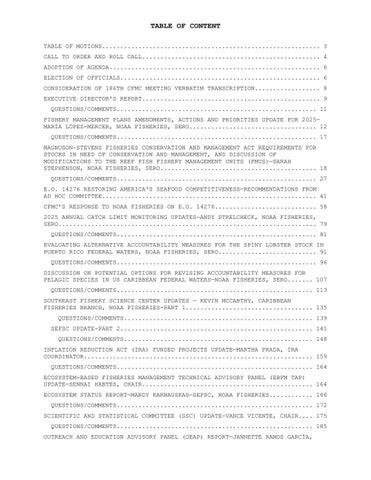
FISHERIES CONSERVATION AND MANAGEMENT ACT REQUIREMENTS FOR STOCKS IN NEED OF CONSERVATION AND MANAGEMENT, AND DISCUSSION OF MODIFICATIONS TO THE REEF FISH FISHERY MANAGEMENT UNITS (FMUS) SARAH
CATCH LIMIT MONITORING UPDATES ANDY STRELCHECK, NOAA FISHERIES,
ALTERNATIVE ACCOUNTABILITY MEASURES FOR THE SPINY LOBSTER STOCK IN PUERTO RICO
ON POTENTIAL OPTIONS FOR REVISING ACCOUNTABILITY MEASURES
PAGE 38: Motion to develop an amendment to move forward with the
framework presented by staff to evaluate and revise the FMUs. The
motion carried on page 40.
PAGE 104: Motion to develop an amendment to the U.S.V.I. and Puerto
Rico FMPs to address the SEDAR 91 stock assessments and modify
Puerto Rico’s accountability measures for spiny lobster. The
motion carried on page 105.
PAGE 127: Motion for staff to create an Interdisciplinary Planning
Team to develop recommendations on corrective actions for
accountability measures to pelagic in the Island-Based Fisheries
Management Plans. The motion carried on page 128.
PAGE 156: Motion to add text to the SEDAR 103 Terms of Reference
#3: “For the species listed in the island-based FMPs, provide
recommendations of specific analytical procedures for developing
management advice that can be used and implemented by the Council
and effectively monitored to best meet legal mandates when using
tools that are alternative or complementary to conventional stock
assessments.” The motion carried on page 156.
PAGE 157: Motion to approve the SEDAR 103 Terms of Reference as
amended. The motion carried on page 157.
PAGE 201: Motion for staff to prepare a letter to be signed by the
CFMC Chair to request a revision of present HMS regulations to
create and set a retention limit of twenty to twenty-five skipjack
tunas in the Atlantic HMS Commercial Caribbean Small Boat Permit
(CCSBP) and to allow for skipjack tuna to be used for bait among
Caribbean HMS tuna permit holders. The motion failed on page 217.
The Caribbean Fishery Management Council convened at The Embassy
Suite in San Juan, Puerto Rico on Tuesday morning, August 12, 2025,
and was called to order at 9:04 A.M. by the Council Chair, Carlos
Farchette.
CARLOS FARCHETTE: Good morning, everyone. We're going to get
started here shortly.
So, good morning, everyone. Welcome to the 187th Caribbean
Fisheries Management Council meeting held today, October I mean,
sorry, October, huh. August 12, 2025, at the Embassy Suite, San
Juan, Puerto Rico. We're calling this meeting to order. It's at
09:04AM. Let’s make the roll call. We're going to start on my right
with the Coast Guard.
ENS. JAMES BUTLER: Good morning. My name is Ensign James Butler.
I am stationed at Coast Guard Sector San Juan in San Juan, Puerto
Rico down the road. I am a member of the law enforcement division,
and I'll be speaking today on the Coast Guard's use of our five
cutters located here in San Juan to patrol mostly the Mona Passage
but also in the Greater Antilles over by Saint Thomas, Saint John
and Saint Croix. Thank you.
SARAH P. STEPHENSON: Good morning. Sarah Stephenson, NOAA
Fisheries.
Buenos días, María López, NOAA Fisheries.
ANNE M. KERSTING: Anne Kersting, NOAA GC Southeast.
ANDREW STRELCHECK: Andy Strelcheck, NOAA Fisheries Southeast
Regional Office, Regional Administrator.
DIANA T. MARTINÓ NOGUERAS: Diana Martino, Council Staff.
SAMUEL D. RAUCH III: Sam Rauch, Deputy Director, NOAA Fisheries,
Washington DC.
VANESSA RAMÍREZ: Vanessa Ramírez, Vice-Chair.
RICARDO LÓPEZ-ORTIZ: Ricardo López, Puerto Rico DNR.
SENNAI HABTES: Sennai Habtes, Virgin Islands Department of
Planning Natural Resources.
ROBERTO SABATER: Roberto Sabater, Council Member.
GRACIELA GARCÍA-MOLINER: Graciela García-Moliner, Council Staff.
LIAJAY RIVERA GARCÍA: Liajay Rivera García, Council Staff.
CRISTINA D. OLÁN-MARTÍNEZ: Buenos días. Cristina Olán-Martínez,
Council Staff.
JANNETTE RAMOS-GARCÍA: Buenos días. Jannette Ramos-García,
Outreach and Education Advisory Panel Chair.
GERSON MARTÍNEZ: Buenos días. Gerson Martínez, DAP Chair, Saint
Croix.
VANCE P. VICENTE CERNUDA: Vance Vicente, Scientific and
Statistical Committee. Thank you.
JULIAN MAGRAS: Julian Magras, DAP Chair, Saint Thomas/Saint John.
NELSON CRESPO: Good morning, everyone. Nelson Crespo, DAP Chair,
KEVIN MCCARTHY: Kevin McCarthy, Southeast Fishery Science Center.
LOUIS ANTHONY BLANCHARD: Tony Blanchard, U.S.V.I, DAP member
MIGUEL BORGES: Good morning. Miguel Borges, NOAA Office of Law
Enforcement.
MARÍA DE LOS A. IRIZARRY: Buenos días. María Irizarry, Council
Staff.
MARTHA C. PRADA: Buenos Días. Martha Prada, IRA Coordinator.
LIANDRY A. DE LA CRUZ QUIÑONES: Buenos Días. Liandry de la Cruz,
Saint Croix Fisheries Liaison.
DANIEL MATOS-CARABALLO: Good morning. Daniel Matos-Caraballo,
Puerto Rico Department of Natural and Environmental Resources.
WILSON G. SANTIAGO SOLER: Good morning. Wilson Santiago, Puerto
Rico Fisheries Liaison.
MAUREEN C. TRNKA: Good morning. Maureen Trnka, NOAA Fisheries
JOSHUA QUETEL: Good morning. Joshua Quetel, DAP member, Saint
Thomas.
JAMES R. KREGLO: Buenos días. James Kreglo, Commercial Fisherman.
MIGUEL A. ROLÓN: Miguel Rolón, Council Staff.
CARLOS FARCHETTE: Carlos Farchette, Council Member.
CRISTINA D. OLÁN-MARTÍNEZ: Good morning, Mr. Chair. We also need
to read the people in Zoom.
CARLOS FARCHETTE: Yes.
CRISTINA D. OLÁN-MARTÍNEZ: So, people in Zoom, we have Brendan
Let me open the list of participants. We have Maggie Ríos,
Guillermo Cordero, Áurea Rodríguez-Santiago, Brendan Mackesey,
Grisel Rodríguez-Ferrer, Jesús Rivera-Hernández, Kate Zamboni,
Nicole Greaux, Refik Orhun, Shirley Ledee, Virginia Shervette,
Yamitza Rodríguez, and a person with a phone number. Please, if
that person could identify himself or herself. That's all the
people that we have in Zoom.
ADOPTION OF AGENDA
CARLOS FARCHETTE: Okay. Thank you. Next on the agenda, the adoption
of the agenda. So, we will need a motion.
SENNAI HABTES: If there are no additions, I motion we accept the
agenda as it stands.
VANESSA RAMÍREZ: Vanessa Ramírez, second.
CARLOS FARCHETTE: Okay. Motion to accept, by Sennai Habtes, the
agenda and seconded by Vanessa Ramírez. All in favor say, “aye.”
CARLOS FARCHETTE: Next on the agenda is election of officials.
ENS. JAMES BUTLER: Good morning, from the Coast Guard. I am calling
for a nomination for the Chair.
SENNAI HABTES: Sennai Habtes, for the record. I nominate Carlos
Farchette for the Chair and Vanessa Ramírez for Vice-Chair.
ANDREW STRELCHECK: Andy Strelcheck. I'll second Sennai's motion.
ENS. JAMES BUTLER: Will there be any other nominations? Hearing
none, all in favor say, “aye.”
ENS. JAMES BUTLER: And the “ayes” have it. Congratulations.
[laughter]
CARLOS FARCHETTE: Thank you. Thank you. Okay. Next, we have Sam
Rauch. Sam, would you care to say anything?
SAMUEL D. RAUCH III: Thank you, newly elected Chair. I've met many
of you before. It's always a pleasure to come down here. I am Sam
Rauch. I am the Deputy Director of NOAA's National Marine Fisheries
Service.
I oversee the work of all the regions, and I bring you greetings
from Eugenio Piñeiro Soler, who, I'm sure many of you know, who's
my boss in DC. He oversees the entire National Marine Fisheries
Service. He regrets he's unable to attend. I always enjoy coming
down here to see where the real work of the fisheries is done.
Last time I came down here, I think, was in December. Gave I you
a number of statistics nationally. I'm not going to do that again.
But we operate the most transparent science-based fishery
management system in the world. We, unlike most other countries,
we monitor all our fisheries. We can tell you what is caught, where
it's caught, who's catching it, and make legitimate scientific
based predictions about how much can be caught and what the trends
are.
We monitor all kinds of data, and then it all feeds into you all
here at the Council, which does the delicate work of looking at
both the science, the economic and social impacts of the science
and making recommendations as to how we should manage the
fisheries. We could not collectively do this without the work of
the Council. This is where everything happens. This is the linchpin
of everything that we do, and you all are the ones that do it.
You come prepared to these meetings. You make difficult decisions.
You debate difficult issues, and you provide extremely valuable
recommendations to the Fisheries Service for how to implement the
various provisions of the statute and we appreciate all of that.
I'm not going to take up more time. I've seen that your agenda is
quite packed. I'm happy to have any discussions or to answer any
questions, but it is always a pleasure to be here.
CARLOS FARCHETTE: Thank you, Sam. Next, we have the consideration
of the 186th , Council meeting verbatim transcriptions. Yeah.
So, we lost the father of Tony Blanchard not too long ago here, so
we would like to have a moment of silence in his recognition.
(Whereupon, a moment of silence was held in memory of Louis "Lewie"
Blanchard.)
CARLOS FARCHETTE: Okay. Thank you. Miguel?
MIGUEL A. ROLÓN: Okay. We are lucky that his son is still a member
of the Council. Due to some delays, Tony Blanchard is here with
us, as a member of the public. He will have a hell of a time trying
to keep his mouth shut when we discuss everything that we have to
discuss. But let me assure you, we will allow you to participate
one way or the other.
And then, we want to also recognize James Kreglo. James’ term
expired on August 10, but he'll be with us. If we follow the policy
that we have so far, we will switch. James Kreglo could be a member
of the DAP, that will be discussed this evening and Tony Blanchard
will be a new council member.
So, by the September meeting, you're going to be sitting right
here, next to Andy. Sorry. It's an inside joke that we’ve had since
a long time ago. Thank you, Mr. Chair.
CARLOS FARCHETTE: Thank you. So, consideration of the 186th Council
meeting verbatim transcriptions? Any additions, corrections?
VANESSA RAMÍREZ: Thank you, Mr. Chair. Vanessa Ramírez, for the
record. I already sent by email to Diana. It's a small, on page
nine, mistaken name. It says “James” it is supposed to be “Carlos”
as Chair, and it's already sent, just for the record. Thanks.
CARLOS FARCHETTE: Any other corrections? Hearing none
RICARDO LÓPEZ-ORTIZ: Ricardo López, for the record. I second.
CARLOS FARCHETTE: So, motion made by Vanessa with a correction and
amendment to the verbatim transcriptions seconded by Ricardo
López. All in favor say, “aye.”
EXECUTIVE DIRECTOR'S REPORT
CARLOS FARCHETTE: The motion carries. Next on the agenda is
executive director's report.
MIGUEL A. ROLÓN: Thank you, Mr. Chairman. I want to be brief
because we have a lot to discuss. People were asking me about the
budget situation. We’ve received notification that we have less
than what was approved originally. We are losing 340-something
thousand dollars and we lost 1.12 compared to 2024.
That means that all the Councils and all the other Councils are
on the same boat. So, that means that we have to be cautious as to
the way that we spend the money. We will have more virtual meetings
than in person meeting, as you know, to save some time, and then
we will be mindful about our needs and the budget for the 2025-
2026. We may receive another extra funding. We don't know yet, but
it's in the works.
For 2026, it is uncertain at this time, and the budget is also
affecting National Marine Fishery Service. So, we have to also
keep in mind that, in our case, Center and the Regional Office,
they are doing their best with what they have, the same with the
Washington office. So, we will let you know more about the budget
in December. But at this time, we can rest assured that we can
continue the doors open, the staff until December 31, and the
meetings that we need to really undertake to move forward with the
management actions that we need under the Magnuson Act.
At the international arena, as you know, we participate in WECAFC,
the Western Central Atlantic Fishery Commission since the
beginning. However, due to budgetary constraint, we can no longer
host those meetings. Probably, we will receive some extra funding
for 2025. The working group on spawning aggregation could meet
with our assistance. Rome also is running low on money, so WECAFC
is really looking at ways to save money while at the same time
fulfilling their obligation.
The last meeting of the sessions, WECAFC every two years was held
in Jamaica. Carlos and I participated virtually, from NMFS. We had
María López present in Jamaica. At that meeting, they set, for the
next two years, activities and between sessions, they have the
working group.
So, if we receive some fundings, then we can assist in the working
groups that we have. We have a working group for queen conch,
another for spawning aggregation. The recent one was for
flyingfish/dolphin. The flyingfish/dolphin was something that the
U.S. was very much interested. They gave us some money through the
Grants Office, and we were able to have the first meeting of the
working group.
For 2026 it is uncertain if we can continue doing that, but we're
waiting to see if there is some good news in 2025. Remember that
the fiscal year of the federal government runs from October 1st
through September 30th. The fiscal year for the Council is the
calendar year, January-December. So, we will know more about the
situation of the 2026 budget and so forth that by the December
meeting.
The Councils will meet in October virtually because we don't have
[inaudible] the CCC, the Coordinating Committee, and we are going
to discuss issues related to the budgets and the needs under the
Magnuson Act. The CCC is hoping that with the monies that we have
available, we will be able to undertake some of the action across
the Nation, all the Council that we have. But there's an issue
that they were discussing, and I can relate that. We would like to
ask for more support to the Regions and the Centers because those
are the people that interact with the Council directly. When you
see the presentation by Martha today regarding the area of funding,
there's a component that is key to complement the monies that were
given to all the Councils for this important project.
The legislators of Virgin Islands and Puerto Rico invited me to
give a presentation in November. The presentation is about the
economics of the fishery in the U.S. Caribbean and how the Council
relates to those components in the U.S. Virgin Islands that have
a bearing on the economy of the fishers of the U.S. Virgin Islands
and the industry. So, we are going to present that on behalf of
the Council. I'm the one who represent the Council at these
meetings, but I usually like to come to the Council so that you
will know that this is happening.
In the case of Puerto Rico, they are revising a project for the
better management of the coral reef and associated species. And
they cited me, but I couldn't go because the meeting was in August,
and the senate and the house wanted to meet in April and May. But
we sent all the information that they needed, and I’m waiting to
see if they are in need of more information or presentation by us.
But I wanted to include that on the record, so everybody will be
on the same page.
The project in Puerto Rico is project 551 of the Senate, PS 551 of
the Senate. They’ve had several projects in the past. One of them
was kind of interesting. They wanted to amend the law and there
was a paragraph that said any management measure that is adopted
by the Caribbean Fishery Management Council through the Secretary
of Commerce will be adopted as presented by the government of
Puerto Rico for compatible regulation. That didn't fly that well.
But we always look for compatible regulation for the species, and
that's why the representation of Ricardo and other representatives
before participated in all the discussions that we have here.
That's what I have at this time, Mr. Chairman. I have other things,
but we are going to discuss it when we get into the agenda items.
Thank you.
QUESTIONS/COMMENTS
CARLOS FARCHETTE: Thank you, Miguel. Questions from Miguel?
Hearing none, next on the agenda is official I'm sorry. Sabater?
ROBERTO SABATER: Are there going to be more cuts in our budget?
Have you heard or anything like that?
MIGUEL A. ROLÓN: Well, if I tell you, I have to kill you. But,
anyway, no. The official word from the office in Washington is
that the Councils got the approval at this time, so that will get
us all the way until December. We don't expect any further cuts.
But in reality, and this is common to everybody, we have 2.9
inflation rates. The hotel now went from 147 average to 340
something average. Air tickets and airfares are going higher.
So, the executive directors, when we met, we looked at the big
picture around the nation, you go from maybe 11 to 15% cuts. Just
in that component. And that's why people are really scratching
their heads on how we can accomplish what we need to do under the
Magnuson Act with the money that we have at this time.
At the CCC meeting, that was put forward very clear by Sam, the
group, Mr. Piñeiro, Kelly, and Emily, they are the top people in
Washington who manage the operations of the Councils, and the
fisheries in general at a national level. So, the long answer to
you is no, but that's what we thought last year and didn't happen.
ANDREW STRELCHECK: Yeah. And I'll just add. Great question. So,
the Fishery Service has a budget, typically, of over a billion
dollars nationwide of which the fishery management Councils
represent about $45,000,000 of that budget. Right now, they're
going through the FY '26 budget process in Congress, the House and
Senate have both, essentially made their marks on the budget, and
they are hundreds of millions of dollars apart from one another.
So, in terms of whether we have budget reductions or not, how that
affects the Councils will really depend on reconciliation of those
budgets between the house and senate marks.
CARLOS FARCHETTE: Any more questions from Miguel? Okay. Hearing
none. Next on the agenda is Fishery Management Plans Amendments,
Actions and Priorities Update for 2025. María?
FISHERY MANAGEMENT PLANS AMENDMENTS, ACTIONS AND PRIORITIES
UPDATE FOR 2025 MARÍA LÓPEZ-MERCER, NOAA FISHERIES, SERO
MARÍA LÓPEZ-MERCER: Thank you, Mr. Chair. We have some slides, but
I will request perhaps that the light is lowered a little bit
because it's very difficult to see from over here. Okay, thank
you.
Okay. So, my name is María López with NOAA Fisheries Southeast
Regional Office, and I will be presenting an update on the
amendments and actions up to date for everything that the Caribbean
Fishery Management Council and NOAA Fisheries have been doing on
the plan for the next months. Next slide.
This first slide shows the amendments, the actions that the Council
had been working throughout the last couple of years, and I wanted
to give you an update of where we are with these amendments.
Amendment 2 to all of the FMPs: trawl, net gear, and descending
devices is an amendment that was approved and submitted by the
Council earlier this year. Right now, the final rule, is being
reviewed.
The other amendment is Amendment 3 to all the FMPs. These are the
management measures for Dolphin and Wahoo. This amendment
establishes size limits for the dolphin and wahoo in all the three
islands, as well as bag limits for these two species. The final
rule became effective on July 25th, so that means that the
regulation is currently in place. The Council continues to work
with constituents in outreach and education to ensure that these
regulations are out. And if there are any questions about the bag
limits or the size limits that apply to federal waters that they
The next one is Framework 3 to the Puerto Rico FMP: updates based
on the SEDAR 80, the Queen Triggerfish Assessment. That final rule
also became effective on July 25
The next one is Framework 3 to the U.S. Virgin Islands fishery
management plans. SEDAR 80. Also, from the results of the queen
triggerfish assessment. That one we have a proposed rule that is
currently under review.
Amendment 4 to the Puerto Rico FMP reclassification of the rainbow
runner as a pelagic species. This is an amendment that was
submitted by the Council back in May. That proposed rule is
currently being under development in our office.
Okay, so those are the actions that the Council worked with, and
NMFS took over for the preparation of the regulation. That's the
update on those one, two, three, four, five, five actions.
Okay, let's go to the next slide, please.
Okay. So, if you recall, we had several actions that the Council
wanted to prioritize for this 2025, and these are the actions that
we discussed during April. So, the first one is actions to take
when pelagic accountability measures are triggered. This is a
priority for 2025. This is because the aim for pelagic fish stocks,
and this is on all three islands, requires that NOAA Fisheries and
the Council review the overage from the ACL to determine if any
corrective action is needed. But the Council has not established
a process for determining what, if any corrective actions are
necessary when the ACT, the annual catch target or the ACL are
exceeded.
So, there's no corrective actions at this point because there are
no specific corrective actions defining the regulations. So, at
this meeting, later on today, the Council will discuss actions to
take when the ACT or the ACLs are exceeded. This is something that
we will be discussing later in the afternoon. And the idea here is
that if the Council agrees, the Council can task staff to start an
amendment to start working on that.
The next action that we set as a priority for 2025 is a revision
of the accountability measures for the spiny lobster in Puerto
Rico. The Puerto Rico spiny lobster stock has exceeded their ACL
multiple times during the last few years. As you all know, the AMs
are not necessarily working for the spiny lobster in Puerto Rico,
one of the reasons is because most of the harvest is from state
waters and the AM based closure, which is the corrective measure
that is in place in our regulations when the ACL is exceeded, that
AM based closure occurs only in federal water.
So, at this meeting, the Council will discuss how to modify those
accountability measures so that they more effectively constrain
harvest to the ACL, allow better consideration of landing trends
and environmental or economic conditions for spiny lobster, and
also modify the revision of accountability measures for spiny
lobster to be inclusive for ending overfishing. So, one of the
things that the Council will be discussing is also taking into
consideration that we have an assessment, SEDAR 91, that is ongoing
right now. And one of the things that we want to bring to the
Councils attention is that instead of discussing options at this
time to modify the AM, perhaps it will be good to hear, from the
Council, ideas on how to address this issue knowing also that the
assessment is being conducted, concluded. So, this is something
that we'll be discussing, I think, after the break this afternoon.
The last two actions that are in there, revision of catch limits
for species with enhanced reporting and status of species with
prohibited harvest. This last two we discussed during the past
Council meeting that we're going to be discussing, taking the
opportunity to review the species to determine the need for
conservation, but not just these ones, but all of the other species
that are managed. So, not just the ones that have prohibited
harvest. And then also for the revision of catch limits for species
with enhanced reporting, we will also be reviewing all species to
determine the need for conservation of management.
So, bottom line is that these two actions fall within what the
Council started working and it's a matrix that Sarah, my colleague
Sarah Stephenson is going to be presenting after this talk. It's
a comprehensive summary matrix of qualitative and quantitative
information on managed stock. And the intent is that the Council
is informed can make an informed decision regarding stock
classification and the need for conservation and management under
each FMP for all of the species, not just to the ones that are
mentioned in this table.
So, this also will align with the discussion that the Council had
on July 25th through an Ad hoc Committee where they were discussing
recommendations to address the request for E.O. 14276. So, this is
something that we will be spending some time this morning. Sarah's
going to be presenting that matrix with all of that information
and with the idea that this is a topic that we can continue
discussing through the next Council meeting. Next slide.
Okay. So, during the last meeting, NMFS presented results for the
evaluation, the monitoring of the ACL for its U.S. Virgin Island
stocks. At this time, we will be presenting the results of NMFS
evaluation of landings from Puerto Rico to determine any needed
response to ACL averages in 2025.
At this time, NMFS is also going to discuss with the Council the
determination for undergoing overfishing for the Puerto Rico spiny
lobster Stock, the SEDAR 91 Stock Assessment, and also discuss
what are NMFS and Council responsibilities. So, this will happen
also this morning. The idea here is that the Council will have a
discussion on ACL overages for spiny lobster, overfishing
determination, and then we can have a really good discussion about
that. So, this is something that I believe will happen in the
afternoon.
SEDAR 84, yellowtail snapper in Puerto Rico, Saint Thomas/Saint
John, and stoplight parrotfish in Saint Croix in SEDAR 91, spiny
lobster in all three islands. This is something that the Science
Center will be discussing during their presentation tomorrow. We
will touch on some of the SEDAR 91 on spiny lobster today when we
discuss the ACL and the OFL overages for spiny lobster in Puerto
Rico. SEDAR 91 is scheduled to be discussed by the SSC in
September.
The last topic in here is the U. S. Virgin Island compatibility of
regulations with the EEZ. This is something that we have been
working with the U.S. Virgin Islands on. At this time, I don't
know, Sennai, if you have an update that you want to, or Carlos,
an update that you want to give us. This is something that we will,
NMFS would like to work with you guys, and we're just waiting to
see, with that you guys were fixing some things in-house and then
were going to contact us. I just wanted to mention that because I
want to see if we leave it for the year 2025 or if this is something
that the Council can consider for 2026.
SENNAI HABTES: No, it's fine. You're talking about compatible regs?
SENNAI HABTES: Sure. We've passed one commissioner declaration so
far to address making compatibility. We're working through the
list of the ones that were approved by our FACs and moving forward.
So, our goal was to find what are the easiest actions to take to
reach compatibility. From our standpoint, that's through
commissioner declarations. I think as we run through those and
have completed those and gotten approval through the FACs we'll
move on to the more difficult ones which would require changes to
either promulgation of new rules and regulations through the
governor's office or trying to move towards changes to regulations
in the V.I. code.
I think if you guys wanted to discuss the ones that would require
changes to federal code, we can do that with you at any time, but
we were just moving forward on the ones that are in our direction.
So, I think we have five planned for 2025. Those are the ones that
can be done through commissioner declaration.
MARÍA LÓPEZ-MERCER: Okay. Thank you for the update. We will be
happy to discuss with you whenever you think you’re ready. Go
ahead, Andy.
ANDREW STRELCHECK: Yeah. Thanks, Sennai. So, yeah. I'd be very
interested in getting a list of things that would need to be
changed from federal regulations if it would be extended to be
compatible with the state regulations, and then we could start
figuring out, you know, what to bring before the Council for
discussion and whether we want to make those changes or not.
SENNAI HABTES: Sure. I think, María, I've shared with you the
spreadsheet that had the summary. So, those have the ones in it
that would require federal changes. And, if you need help, I can
go through that and highlight those specific ones for you, and
then I can send it to the two of you.
MARÍA LÓPEZ-MERCER: Thank you. Carlos? You had a comment? No? Okay.
Okay. So, moving on. This is the last slide. Just want to if you
can move to the next slide.
This is a reminder. Just the two items that we discussed in the
past meeting that the Council decided to table for now. One is the
federal permits, the development of a federal permit. As you
recall, NMFS staff presented, during previous meetings, explaining
what a federal permit would include, different ways of how a
federal permit could work for management of species in federal
waters. However, there's other priorities at this time that the
Council will want to work with. So, for right now that was set
aside, maybe it will be taken back in the future.
The other one that was discussed was the response to STFA questions
regarding Grammanik Bank management. There was a discussion back
then and that's something that the Council also decided to work on
other priorities at this time, so it will be set aside until the
Council would want to bring it back.
So, that's all I have. This is what we're going to be discussing
today pertaining to the amendments and actions. Similarly to April
and December, the Council may want to come back at the end of the
meeting tomorrow and go back to this list and just see if there's
any changes and see how we're going to be moving forward in some
of the actions so can update this.
Okay. So, I'm done. I'm going to pass the microphone to my
colleague, Sarah Stephenson, for the next presentation about the
matrix for species that I was just discussing. Thank you.
QUESTIONS/COMMENTS
CARLOS FARCHETTE: Okay. Before Sarah, I think we have a question
for María from Tony Blanchard. Tony?
LOUIS ANTHONY BLANCHARD: Tony Blanchard, for the record. Just to
make sure I’m on the same page, what is the matrix?
MARÍA LÓPEZ-MERCER: Sarah's going to explain that right now. Okay?
In the next presentation, she has way much more details than I
had. Nelson, go ahead.
NELSON CRESPO: Thank you. Just a quick comment. During the last
descending devices workshop that we are developing around the
island we learnt that there is general support from fishers about
Amendment 3 for wahoo and mahi, but there is a concern between the
fishers that it is necessary to implement compatibile regulations
with the local government because if that does not occur, it's
going to be hard to do enforcement when the fishers land on shore.
Because you're not going to have proof of where those fish were
caught. So, I recommend, you know, to Ricardo. I know that Wilson
talked to you about that already. So, I really appreciate, you
know, the attention that you give on this matter.
MARÍA LÓPEZ-MERCER: Thank you, Nelson. Yeah, we're aware of it.
During the discussions that were conducted when this amendment was
developed, that was one of the things that the Council discussed.
After discussing, they still went with the decision they made a
decision to implement a different bag limit for these two species
based on other considerations.
But yeah, that's something the Council did discuss when they were
developing the amendment.
Okay, so thank you for that. Okay, so I'm going to leave it with
Sarah Stephenson. She's going to explain what the matrix, what we
UNITS (FMUS) SARAH STEPHENSON, NOAA FISHERIES, SERO
ANDREW STRELCHECK: Yeah. So, before we jump into Sarah's
presentation, I wanted to just say a few things to set this up.
So, a few years back, we implemented the island-based FMPs. At
that time, you reevaluated species in need of conservation and
management. We updated the list of species.
Obviously, it hasn't been that long since we did that. So, we're
coming back to the table to have that discussion again. We felt it
was really important to, both, get input like Miguel was seeking
through this ad hoc committee, as well as a more kind of
quantitative approach with regard to how we evaluate species in
need of conservation and management. And so, Sarah has done an
outstanding job of starting to put together some data and
information to evaluate all the species we manage and determine
what metrics we want to use to determine are we managing these
species or are we essentially just including them in our management
plan but don't really have an ability to adequately affect their
management, right?
And so, today's presentation is really to give a high-level
overview of the process, see what questions you have, get input
from you on ideas, and with the goal of starting an options paper
going forward. And I'll caveat this that Sarah's going to provide
an example in the presentation, and I just ask people not to react
to that example because it's going to show species that could be
removed from the management plan, but it's based on just some
example metrics that we're considering, you know, as part of
showing this example today. Right?
This is the start of a longer process, and so, we will really want
to take our time to really evaluate all the species and determine
which species are adequately managed already. They don't need
federal management. What are, you know, species that are in need
of conservation manager that fall under our purview. But the reason
we're doing this is what we talked about earlier with Roberto's
comments. We've had major budget reductions. We've had reductions
in the science. We don't know where the Council's heading. We don't
know with regard to how much we're going to have in terms of
resources. And so, we can't manage this laundry list of extensive
species adequately, and we really need to pair that back and
dedicate our resources to a targeted set of species that are most
valued,
And so, we're doing this not only in the Caribbean, but throughout
the country. And today is just the start of a broader conversation
that Sarah will share the input on.
SARAH P. STEPHENSON: Okay. Thank you. That was a very nice
introduction. My name is Sarah Stephenson. So, next slide.
Just as a background, at the December 2024 meeting we discussed
some issues that María mentioned in her slide, like, for instance,
some of the species not having reference points set. So, at the
April meeting, we discussed the SERO staff preparing, for each
species that we manage on their FMPs, a summary matrix. And so,
what that means is just a spreadsheet of all the information we
know for each species. So, like, the list is like 100 and so long.
Just everything that we know about that species kind of condensed
into a quick and easy cell.
So, some of it was qualitative, like, is it on the form? Yes, or
no? Some of it was quantitative, like, what's the average landing
of a period? So, we just have this major spreadsheet, which I'm
not going to show today because it's boring, but I'm going to show
you how that Excel spreadsheet, that matrix could be used to maybe
revise the selection criteria for including species or, in this
instance, retaining, removing, or moving to ecosystem.
So, that's kind of what the matrix is. It's just this giant
spreadsheet that's a tool that we can use to revise criteria
matrix. So, hopefully, that answers your questions about what it
is.
So, we said we would prepare this matrix and then bring it to the
Council in order to help determine which stocks should remain
managed, which stocks could maybe be moved to ecosystem component,
which we discussed at our December meeting in detail kind of what
that meant, and I have a refresher slide. And then which stocks
could maybe be removed. This discussion today does align with that
ad hoc committee meeting. A lot of discussion from those fits
nicely into this discussion today. And so, I think Graciela is
going to present on those recommendations a little bit later, so
you'll kind of hopefully see the parallels here. Next slide,
please.
Just as a high-level, NMFS in 2016 revised National Standard
Guidelines, which kind of help clarify what does it mean for stocks
that need conservation and management. I included the FR number
there in case anybody wants to go look it up. But basically, NMFS
acknowledges that not every fishery requires conservation and
management. However, stocks that are predominantly caught in
federal waters or overfished or subject to overfishing or are
likely to become either of those statuses need to be included in
the FMP. And then, next slide.
They also provided a list of factors that the Council could
consider when determining which stocks need to go into the FMP.
So, these are not new. they were in there before, but I just want
to run through them. So, number one, it's an important component
of the marine environment. Number two, it's caught by the fishery.
Number three, whether a fishery management plan can improve or
maintain the condition of the stock. Number four, the stock is a
target of the fishery. Number five, the stock is important to
commercial, recreational, or subsistence users. Number six, the
fishery is important to the nation or to the regional economy.
Number seven, the need to resolve competing interests and conflicts
between user groups and whether or not an FMP can actually further
that resolution that can help with that conflict. Number eight,
the economic condition of the fishery and whether an FMP can
produce more efficient use. Number nine, the needs of a developing
fishery and whether a fishery management plan can help with growth
of that fishery. And then lastly, the extent to which the fishery
is already adequately managed by the states or state federal
agency.
So, those are the factors. I know it's a lot, and they're going to
keep popping back up through this thing. So, I've printed out some
a list here that María will pass around so you guys can have them
right at your hands as I refer back to these. Next slide, please.
So, the Island-Based Fishery Management Plans were finalized in
2019, and the regulations for those were implemented in 2022. An
objective of each of the FMPs was to update federal management to
better represent the individual island areas, including the
economically and ecologically important species that incur in
federal waters around those areas. During development of the FMPs,
the Council and NMFS considered those 10 factors, those 10 National
Standard factors to determine which species should be included.
Next slide, please.
They also came up with a list of criterions, selection criterion,
which we'll read through. This is also in the handout that I
provided. So, the first one, and they kind of go in order.
Criterion A, you're going to include species that are classified
as overfished in federal waters, or for which harvest is prohibited
already because of their ecological importance as habitat, so that
was the corals, or as habitat engineers, which were your three 1 large-bodied parrotfish, or those species that already had
seasonal closures or size limits in place. So, those all came in
with Criterion A.
Then the next step was to exclude the remaining species that
infrequently occur in federal waters, and that was based on expert
analysis and available data. So, that was the second step. The
third step, Criterion C, was from your remaining list include
species that are biologically vulnerable, constrained to a habitat
that makes them vulnerable, or they have an essential ecological
value. And, again, based on expert analysis. Criterion D from
what's remaining again, so the list is getting shorter and shorter,
include species that are important to the national or regional
economy for any of the sectors, including aquarium trade as
appropriate. And those species that are an important component of
bycatch. Again, based on expert analysis. And then lastly, are
there any other species that the Council wanted to include?
So, the next slide shows you from these five criteria and those
factors, those NS 10 factors, how the species for each FMP fell
under which criterion. So, you can see that the majority of species
were included either under criterion A or C, fewer for D and then
only two species for each FMP under Criterion E.
But this is how they all shook out. So, if you add up the numbers,
you'll get how many species we're managing under each FMP. And as
Andy mentioned, it’s a lot, and maybe now is a good time to kind
of take a step back and review those again. I believe you also
have this sheet in your handout, just because it's a lot. Next
slide.
This brings us to where we are today and some current issues that
we've already discussed already and maybe someone's to revisit.
So, the overfishing limit, that sustainable yield level, which is
a proxy for our Tier 4 species, which most of the species in our
FMPs, it wasn't set for select species. And we talked about this
in December. We have an ABC and an ACL value set, but we didn't
have the SYL, that sustainable yield level set. So, we would need
to develop an amendment to fix that. So, this is a good time to
maybe take a look and maybe decide, could those species be removed
or moved to ecosystem?
The next issue is some of the species that we currently manage
aren't present on the current commercial catch report form, which
just means that those species would need to be written in in order
for the landings to be accounted for. The next one is some species
were not on those commercial catch forms during the reference
period that was used to set the ACLs, but they now are on the
forms, which kind of gets us into that scenario where if landings
exceed the ACL, then an accountability measure might not be applied
because it's due to enhanced reporting. But that might mask issues
arising with the fishery that we might not notice. We might not
bring that information to the Council. So, that could be an issue.
Next is for the species that are on the catch report forms and for
which we have information on where that was caught. For example,
was it caught in territorial or federal waters? Sometimes the
majority of the catch occurs in territorial waters, and that's
especially true for Puerto Rico where it's a larger, it's that
zero to nine nautical miles. So, there's more potential for the
species to be caught in territorial waters. So, in those instances,
if we had to apply an accountability measure, compatible closures
with the state agencies might be required in order to address the
issue.
And then lastly, data availability challenges continue, most
notably that we don't have recreational landings anymore being
collected. And so, that's more of an issue for Puerto Rico because
we did establish recreational ACLs in addition to commercial ACLs,
and the accountability measures were set up in a way that they
kind of were tied together. So, without that data, the commercial
ACL becomes the ACL for the entire stock. And for some species,
those are very low numbers. And so, it’s just something that we
would want to address.
So those are kind of current issues that hopefully maybe revisiting
the criteria and maybe rethinking about what we're managing and
how we're managing. Some of these might be addressed. Next slide,
please.
The National Standard Guidelines did recommend that Councils
periodically review their FMPs and the best scientific information
available and determine if the stocks that are managed are
appropriately identified. So, they could be reclassified or
removed through an amendment, really documenting the rationale of
why you're doing that.
Councils should prepare an analysis of those 10 factors, the 10
factors that are on your sheet, and any other considerations that
were relevant to the stock. And so, those guidelines recommend
kind of looking at the 10 factors weighted. So, factors one through
three on your sheet should maybe be considered first for including
stocks because they address maintaining a fishery resource and the
marine environment. The next is you could look at factors four
through nine, again, for including stocks because they set forth
the economic, social, and other reasons under the MSA that you
might want to include a stock for conservation and management. And
then finally, you could consider factor 10 for maybe not including
a stock if there's adequate management of that stock, by the states
or another program, or even another federal FMP. Next slide.
This is just a quick review of the ecosystem component species.
You, the Council can obviously choose to do that. We didn't during
the last FMP because we were trying to finish up that process, and
this discussion is very important, and it could have slowed down
the process. So, we discussed it at that time, but we didn't
actually implement it.
So, EC species, ecosystem component species do not require
conservation and management, but are included in an FMP to achieve
certain ecosystem objectives. And we talked about those before in
December. The species do not require ACLs or other reference points
or accountability measures. So, you could keep an eye on them, but
not be required to, for instance, monitor to ACL or OFLs or report
their stock status every year. So, that's one of the benefits of
ecosystem component species.
They can be identified at the stock level and may be grouped into
complexes. So, you can do lots of different things with them. And
then lastly, consistent with National Standard 9, which is to
minimize bycatch. Management measures can be adopted for the
ecosystem component species that we want to have. For instance, if
we wanted to collect data on them or to minimize bycatch of that
species or to protect the associated role of the species in the
ecosystem. This would be a good example of maybe moving corals to
an ecosystem component because they do play an essential ecological
role, but nobody's harvesting them. So that would be a good example
of that.
Next slide. And now we'll just get to the matrix. So, next slide
again.
So, what was our objective. It was just to summarize all the
information that we have, both qualitative and quantitative for
each managed species that we have or managed stock, to present to
the Council to help you determine if they still require
conservation and management.
We wanted to focus on those that are targeted by the fisheries in
federal waters. We wanted to consider those for which resources or
data are available to help us manage effectively. And then also,
it can be used to help maybe determine which species could be
This matrix provides a framework for the Council to modify and
improve upon the criteria that were used, those A through E, for
determining which species are in need of conservation and
management.
slide.
And I believe you have this. This is the last one, I think, on
your handout. It's just a summary of all of the variables that
we've included in the matrix so far, and I'll just run through
them really quick.
So, on the qualitative side, what was the selection criteria used
in the FMPs, those A through E? B is not here because B was species
that were excluded. So just was it A, C, D, or E? Is it an indicator
stock for the complex if it's managed in a complex? What control
rule Tier is it under? Currently, we have three options there.
Most of ours are 4a, we have a couple with accepted stock
assessments, so those are going to be 3. And then, a few that are
data limited and vulnerable species. Those are 4b. Was the species
listed on the current commercial catch report form? Yes or no. Is
it an endangered species act listed species for our area? Yeah.
And if so, does it have a 4(d)rule in place? What are the lists of
federal and territorial regulations applicable to the species,
such as size limits? What's the stock status if there is one? For
instance, overfished or overfishing.
Has there already been identified in the FMP critical role in
either the ecosystem, like a grazer species, or in the fishery?
For example, is it used as bait? Any years that annual catch limits
or overfishing limits or their proxies were exceeded? And then, is
the species on the SEDAR assessment schedule?
For quantitative, we looked at or we compiled the number of years
that the species was reported in commercial landings during a
historical, which we're defining as 2012 through 2023, and a
recent, which is the last five years period. And I'll point out
that we at SERO don't have the 2024 or 2025 data yet. They're still
preliminary. So, we wanted to use complete available data, so
that's why it stops at 2023.
We also looked at average commercial landings during those same
two periods, the percent of those landings reported in federal
waters for those same two periods, and then the rank of the species
in the commercial landings during those same two species. And
that's the rank against everything that was caught, not just what's
managed.
We also, for Puerto Rico, did the same analysis using the 1 recreational landings, which those years are a little bit
different. What we have available is 2000 to 2016. We also included
the productivity and susceptibility scores that were assigned by
the SSC and are included in our FMPs. And then we're waiting on
some additional information such as length data, biomass or
abundance trend data, and then hopefully price per pound. So, those
will eventually go into the matrix, too and could be used for
upgrading your criterion your selection criteria. Next.
So as Andy mentioned, this is just an example. It does kind of
walk through a few steps and end up with a result of species, but
it's just an example. It can be modified pretty much at every step.
So, next slide.
First off, though, any stocks that are overfished or undergoing
overfishing are going to be retained in the FMP. And then next, we
wanted to look at using those landings to kind of try to get at
the NS's. It should actually be maybe two, three, and four. Is it
caught by the fishery? Can an FMP maintain or improve condition?
And then is it a target of the fishery?
So, we looked at the commercial landings, the longer period of
landings, and recreational for Puerto Rico, and we just asked the
matrix, to retain the species that occur in federal waters, 25% or
more of the time. Also, is the species present in the landings,
the annual landings data 75% or more of the year? So, for the
commercial dataset, that means does the species show up in the
commercial landings nine or more years? And then for the
recreational, does it show up in thirteen or more of the years?
And then lastly, are the average landings above a certain limit?
So, for commercial, we just picked 7,500 pounds on for an annual
average. And then for recreational, we just picked 10,000 pounds.
So, all the numbers in green here are just examples, and they could
be changed based on Council input today or advisory input later or
developed as options by the interdisciplinary planning team, that
IPT that we form to kind of prepare options. So, anything in green
can be updated. Next slide.
One other thing that we looked at for this example today, which
aligns with that National Standard factor five, which is it's
important to the fishers, both commercials, recreational and
subsistence, is we looked at the rank of the species. So, we used
commercial landings again from that longer period of time, and we
looked at the rank. So, the threshold kind of example that we used
was if that rank is .5% or higher of the commercial catch, which
for Puerto Rico
Oh, sorry. You're back. Sorry. Slide 16. Sorry. I was yeah. What
back one more. Yes. This guy. Thank you.
So, we wanted to look at the rank. So, the threshold that we pick
kind of aligns with for commercial landings for Puerto Rico, it's
the top 29 species. For Saint Croix, it would be in the top 34
species. And then for Saint Thomas and Saint John, the top 31. So,
during that year period, each one of those FMPs, like, there were
hundreds of species. So, this kind of tells you that it's pretty
much the top 30 for each FMP.
And then, of course, a further step that we haven't done which
would align with that factor number six, which is the importance
to the economy, is we are hoping to use the average price data
over some time limit to help with that one. But we don't have it
yet, so that would be to be determined.
Again, anything in green here could be changed, either today or
through the IPT process. Next slide.
So, in using this matrix for this example today, here's kind of
how the species fell out. So, the first step, the first row are
your list of species that are either listed as overfished or
undergoing overfishing for each FMP. So, they automatically get
included.
The second row are the ones that are kind of the target of the
federal fishery. So, that's, again, based mostly on landings over
time. And then the third row is the ones that were important to
fishers. So, that's your rank. And so, anywhere where a species is
listed in bold means it occurred in both row two and row three.
So, you can kind of see there's a lot of overlap between what's
caught and what's important to the fishers.
In row two under Puerto Rico, you have three species that are also
in italics, and those were results from the recreational landings.
So, they obviously aren't quite the same all the time. They don't,
line up with what was caught by the commercial or important to the
commercial, but we wanted to include those here just for inclusion.
So, here's how that all broke out.
So, next slide will kind of focus on putting that, synthesizing
all of that together.
So, using this example that we did for Puerto Rico, if you updated
your criteria or using a similar type of selection, what you might
end up with. So, species that you could retain and then compared
to the remaining list of species managed under the Puerto Rico FMP 1 that you could either consider removing or moving to ecosystem
component. And if we wanted to do that, we should think of maybe
other criterion that we could come up with to help us assist with
those two steps.
So, I'm not going to go through it, but you can see how you could
end up updating your criteria. You really could, depending on the
criteria that you use, you could kind of streamline the species
that you manage.
Next slide is a summary for Saint Croix. So, again, I'm not going
to walk through them all. We can leave them back up if people want
to come back and look at them. But it is the same kind of setup.
What you could retain if you updated your criteria using these
types of selection thresholds or, what you could maybe consider
removing. And then the next slide is same information for Saint
Thomas/Saint John.
And then next slide brings us to kind of the discussion to have
today. So, first off is do we want to update the selection criteria
that were used? And then if yes, why do we want to do that?
I've provided some examples on some issues that we're running into
where maybe updating the criterion could assist with those, but
you don't have to. And then next, based on this matrix, this
collection of information, are there any other criteria, either
qualitative or quantitative, that wasn't in that list that you
would like to be considered? And then if you had an idea of the
thresholds, meaning the numbers that were used in this example
that you know you would rather recommend for the IPT to consider
when preparing options, you could that too.
And then for species that don't meet the criteria for retention,
are there any other criteria that you could think of for removing
them or moving them to EC species? And then after we've had that
kind of discussion, if you would like, you could task us to develop
an options paper to modify the criterion, which would in turn
modify the list of managed stocks. And it would probably require
that we update annual catch limits, and we could review that in
December. And then, we could also review that options paper with
the advisory groups after the December meeting.
So, this is my last slide. I'll open it up for discussion and take
any questions because I know that was a lot.
CARLOS FARCHETTE: Thank you, Sarah. Any question for Sarah? Tony.
LOUIS ANTHONY BLANCHARD: Tony Blanchard, for the record. I was
looking at, I believe it was slide 16, you had where there was
overfished, and you had the goliath, the queen conch, and I believe
it was a nassau. That information was supposed to be just as an
example or to be accurate.
SARAH P. STEPHENSON: This is Sarah. I believe it's slide 17. So,
that one is accurate. That is what's currently on the book as
either overfished or undergoing overfishing.
CARLOS FARCHETTE: Okay. Follow-up, Tony.
LOUIS ANTHONY BLANCHARD: I can't debate the point.
CARLOS FARCHETTE: I got a question. I noticed that you had the
midnight blue and rainbow under EC. Those species would not be
managed. Is that the recommendation?
SARAH P. STEPHENSON: This is Sarah. So, there's no recommendation
from this presentation. There's a question of do you want to
revisit the selection criteria? And if you did, then that might
result in an update. So, I'm trying to think where you saw those.
The very next slide? This was it, like, this slide?
CARLOS FARCHETTE: For Saint Croix.
SARAH P. STEPHENSON: For Saint Croix? Yeah. So, right. So, those
four parrotfish, could stripe this if you use a criterion that was
like the example that we presented, then those were not a target
or important to the fishers based on the thresholds that we chose
today, which are in no way set in stone. Those can be changed and
probably would be through the IPT amendment development process.
But based on just what we did for today to show you how you could
use it; they would fall into that category. So, you could decide,
do you want to move them to ecosystem component, or do you want to
remove it? And if you wanted to move them, actually, either way,
you would just provide rationale for why you wanted to do either
decision.
CARLOS FARCHETTE: Okay. Andy?
ANDREW STRELCHECK: Yeah. Can you go back to slide 15? Yeah. And
so, just to further emphasize, this is an example. And what you
were mentioning, Carlos, I think is an important point. Right?
So, if you use quantitative criteria. Right? So, on this slide,
we're using certain thresholds, either percentages or landings.
You potentially remove species from the fishery management plan
because it's not meeting those thresholds. Right?
If Sarah, for example, said rather than 7,500 pounds commercials
landed, but it's 5,000 or it's 2,500, it's going to kick in more
species that would be in the fishery management plan to be managed.
Right? And so, I think, you know, from our vantage point, we're
not coming in here today to say, this is the absolute list. Right?
This is just one way we can use this tool, and we think that we
will want to explore options.
I think there's also going to be a situation or two or many that
we might ultimately use criteria, and there's still going to be
species on that right side of the slide that are being kicked out
of the management plan, but that you deem is important to continue
to manage. Right? And so, we'll have to have those conversations.
So, really today is, one, are you in agreement with at least the
matrix approach? And then two, what are some of the criteria that
we want to be looking at knowing that these are just examples and
not an absolute range and that we can look at more alternatives?
CARLOS FARCHETTE: Miguel?
MIGUEL A. ROLÓN: Yeah. Perhaps we should hear what Graciela's
presentation has. The annual committee met to discuss what we call
the Kelly’s Cross. But remember that we were instructed to go over
the species that we have in the management unit to look at those
who were high risk/high value, low risk/low value. And we need to,
by September, provide the response to Mr. Piñeiro’s memorandum as
to what species we recommend being kept in the management unit and
what other species we are going to recommend being classified as
ecosystem based or ecosystem species.
However, the mechanisms for doing that is amendment of the
management plans. And what you have here is the tool that you can
use to work on those amendments, to work on those management plans,
because you cannot tell the secretary, “I want to drop the species.
I want to keep this other one” with a rationale. You have to have
a rationale that could be or a rationale that will meet the
criteria under the Magnuson-Stevens Act. So, this matrix that Sarah
is presenting today will give you that tool.
So, at this time, we don't want to have specific recommendation
from you because we have a long way to doing that. But I tell you,
Mr. Chairman, that perhaps we can hear Dr. Graciela García-
Moliner’s presentation, look at the species at least. So, we have
a common ground to disclose those species. And remember, in the ad
hoc committee we discussed issues. But if we keep concentrated, at
this time, on the list of species and then compare those species
with the tool that we have here, that would be a good thing.
But at this time, probably you can Sarah, can we go to the last
slide where you have the next steps?
Okay. Do the species selection criteria in the FMP need to be
updated? That's a question that you can answer today. Yes or no.
Based on the matrix, are these criteria (quantitative), etcetera,
etcetera.
So, those things there, you can answer today because that's a
general approach. That's what will give the IPT the direction that
you want them to go. And remember, we need to prepare sort of a
white paper that will discuss all these options.
So, at this time, what we need from the Council is to tell us
whether you think this approach, this tool, is the way to go and
how you would like to modify. The example tends to confuse people,
because if I'm a fisher, I’d want to know what species I can catch
next year or this year, and what species I should drop because of
whatever reason. So, that's our suggestion. So, if you can go and
see the list, then we can come back and discuss it.
KATHERINE M. ZAMBONI: Thank you. Kate Zamboni, for the record. I
just want to note, like, whatever you decide to do today, you know,
changing the criteria and the species that are managed would
require an FMP amendment. So, it's not as though taking some sort
of vote today is going to result in suddenly not managing the
species.
would be a process with it.
But I think that the thing that the Council needs to respond to
the assistant administrator by September, it's really that they've
got to respond to the letter and look at the letter that the
Council prepared in 2020 and see if that needs to be updated. And
if that includes maybe revisiting what species are managed, I think
that would be appropriate. But I don't think you have to present
a list by September with what species are in or out. And I think
what Sarah is suggesting is that staff can come back with an
options paper to look at how this criterion plays out, or what is
the feedback today on the criteria that she's presented? Is this
the direction you want to go, or do you want to modify some of
those criteria?
FARCHETTE: I got Sarah.
MIGUEL A. ROLÓN: Yeah. Have a question for Andy and Kate. That's
a little bit different from what they told us at the meeting at
the CCC. So, if everybody happy with not having the list, that's
okay. And, also, we all met, and we decided, you know, this process
can take all the way to 2028. Because the amendment of the plan,
if you go very quick, it's one year. So, it's one year to three
years before you amend a plan. You have to go to public hearing,
etcetera, etcetera.
But if we don't need to submit the list, which I need to check
with Kelly, then that’s better. But what Mr. Eugenio Piñeiro sent
to us was a template with the action that the Council proposed to
take on the E.O. 14276.
CARLOS FARCHETTE: So, I got Andy, Sarah, and then Julian.
ANDREW STRELCHECK: Yeah. I'll look to my boss, Sam, if he wants to
weigh in further. But in terms of the requests, I think it would
be great for the Council in your letter to the Fishery Service to
acknowledge that you are working on changes to the fishery
management unit. As Kate noted, think the most important part here
it's going be a process. As Sam mentioned in his comments, we have
this public input. We really need to be kind of thoughtful and
careful with regard to how we're deciding what species are in need
of conservation and management, which ones are being removed from
the management plan.
And then with the seafood competitiveness Executive Order, it's
also broader than just the species we're managing. So, to the
extent that the Council's going to have input or the stakeholders
on deregulatory actions, things that are on the books currently
that we, you want us to consider removing from regulations or the
Council could potentially consider removing from regulations in
the future for justified reasons, then we would want to get that
input.
So, I'd I want to just emphasize, I don't think there's a sense of
urgency to provide a comprehensive list of species to remove, but
I think it'll be beneficial to, one, know that the Council's
working on this, assuming you're in agreement with that. And then,
two, we would continue to work with you to kind of prioritize
MIGUEL A. ROLÓN: I'm glad that you said that and not me because
what I propose, Mr. Chairman, is to start with preparing the
response to not just National Marine Fisheries Services, but I'd
like to also see if we can get the help of the Regional Office so
they can look at the draft and make sure that we comply with
whatever is needed, and then follow this. The importance of
Anyway, the Executive Order that we have from the President, 14276,
remember, Make the Fishery Great Again, now has an implementation
phase, and this is the beginning of it. But we all, all the
Councils, we already told them, you know, this is not overnight.
So, the first step is this one. Do you want to and this is part
of it. Do you want then to adopt the matrix as the tool that you
want to use for examining the species? To give you an idea, some
of the Council have discussed sending x many species to be managed
by the states for whatever reason. Some people believe that that's
not a good idea. Others are looking at the possibility of reducing
the number of species that you manage to see if you save any money.
Well, in some cases, you don't save a penny.
So whatever criteria we use has to be sustained under the Magnuson-
Stevens Act, has to follow the regulations that we have here. So,
I don't know what you would like to do, Mr. Chairman. Do you want
to get this to get more information? But I would like to hear from
the council members.
SARAH P. STEPHENSON: My comment was just that I saw that Julian
had a question.
CARLOS FARCHETTE: Julian?
JULIAN MAGRAS: Can we go back to slide 17, please? So just a
question for clarification. When did queen conch and goliath
grouper became overfished in the Saint Thomas/Saint John District?
SARAH P. STEPHENSON: So that was part of the 2005 Sustainable
Fisheries Act amendment. It got listed around that time. So, since
then, and it had a rebuilding plan, and so, the status of the stock
hasn't changed since that time. So, it’s a determination of
overfished. It doesn't necessarily mean, I think, what you think
is overfished. So, it's a status.
JULIAN MAGRAS: Well, I asked that question because we don't have
a queen fish. I mean, queen conch fishery in the Saint Thomas/Saint
John district. So, what that falls under from what I can see is
when the whole U.S.V.I. was a whole before we went to the island-
based fishery management plans. So, in that case, that should be
addressed, and we never had a goliath fishery. So, Sennai?
SENNAI HABTES: I may. Essentially, if you look at it from the
standpoint of how things have to be listed, these are all three
species that are now under ESA. Right? Like two of them. Not queen
conch, it's only threatened. Correct? It's Goliath and Nassau?
SARAH P. STEPHENSON: Goliath is not.
SENNAI HABTES: But under the sustainable fisheries, that was when
Goliath was added?
SARAH P. STEPHENSON: Those three were added, and they were you're
right. They were added at the U.S. Caribbean level.
SENNAI HABTES: Yeah.
SARAH P. STEPHENSON: And so, that's where they're still at that
level.
MARÍA LÓPEZ-MERCER: If I may, this is María López. I just want to
make a clarification. So, back in, 2005 with the SFA amendment,
there was a determination at the time that queen conch, nassau
gtouper, goliath, the other four groupers were overfished, right?
So, that means that they were put in a rebuilding plan.
The management measures that came out of that rebuilding plan is
what we see today, right? So, we have the goliath grouper. That
there is no harvest of goliath grouper, no harvest or possession.
The U.S. Virgin Islands and Puerto Rico did compatible regulations.
The queen conch, part of the rebuilding plan is what we currently
have in place right now. There's no fishing in Federal Waters of
Saint Thomas and Puerto Rico. There's fishing in Saint Croix in
the area of Lang Bank. The U.S. Virgin Islands have compatible
regulations or have their own regulations for the queen conch.
Nassau grouper has prohibited harvest. That provision on the nassau
grouper did not come from the ESA, it came from the MSA, from that
rebuilding plant. Same as the Goliath, etcetera. The species are
considered to be under that status until it is reevaluated. The
rebuilding of the species revaluated is determined that the species
has been rebuilt. So, it has to be that we have been, the Council
has made adequate, NMFS has made adequate progress on the 1 rebuilding of the species.
For example, the queen conch, we talk about projects that are
ongoing that will allow the Council and NMFS to evaluate the status
of the queen conch, etcetera.
So, until that evaluation is done, the status continues. Nothing
has been done yet to remove the species from that. So, that is
what that means. It should say step one overfished or undergoing
overfishing, and that's why it ended up in that category. I hope
that helps to clarify.
CARLOS FARCHETTE: Okay. I have got to follow-up with Julian, and
then we're going to take a ten-minute break and come back to this.
JULIAN MAGRAS: Julian Magras, for the record. Back at María. So,
it's been twenty years since the SFA has been put into effect. How
long more is it going to take for us to do an assessment to see
what the stock is doing? This is the problem that the fishers have
all the time. We put management on a species or species, and we
are not doing no assessments.
A perfect example is all the seasonal closures that are in effect
and have been in effect. And it clearly states in the SFA documents
that seasonal closures or closures sometimes do more harm to the
stock than actually having it fished. So, here it is. We continue
to ask, but we continue to suffer where we can harvest these
species because the powers that be haven’t been doing their job to
do the assessments and see what the stock is actually doing.
So, you know, I don't mean to throw the ball at you guys, but, you
know, this needs to stop at some point, and something needs to
happen to ease the pain on the fishermen. Because we seem to be
the ones that are always taking the hit. And, you know, it can't
continue because just like everyone pockets get hurts when rules
or Executive Orders get put in place. I'm going to use that as an
example. The same way we are, our pockets are hurt every day. So,
can I get some kind of clarification on what direction we plan to
move with these issues? Thank you.
CARLOS FARCHETTE: Okay. We're going to take a quick ten-minute
break. We'll come back to this topic.
(Whereupon, a brief recess was taken.)
CRISTINA D. OLÁN-MARTÍNEZ: Good morning. We are going to do some
arrangements with Internet connection at the room. So, people in
Zoom will loss connection for a few minutes, but you can rejoin
the meeting as soon as we finish to do the reconnection in the
room. Thank you.
Estamos haciendo una reconexión de Internet en el salón. El
internet se va a caer por unos momentos. Tan pronto nosotros
terminemos de hacer esta reconexión, ya ustedes pueden reunirse
nuevamente en la reunión, en el Zoom. Gracias.
CARLOS FARCHETTE: Okay. After a little glitch on the Internet, I
think we're back. Oh, I guess not. ¿Si? Okay. Andy?
ANDREW STRELCHECK: Yeah. Thanks, Carlos. So, I wanted to suggest
maybe a path forward here coming out of the break. But first, I
felt Julian's comments were worth responding to.
So, thank you, Julian, for your comments. You know, I think a few
thoughts I have is, one, you know, when we have species that are
status listed, you know, over extended period of time, I don't
disagree with you that maybe that should be revisited. And even if
we don't know the status, the list that is unknown. That's
something that obviously can be reviewed and considered.
You also mentioned the adequacy of the science. And we're often
challenged by the adequacy of the science, either because the data
isn't collected or isn't available, or even for species that are
much more prevalent than some of those on the list. And so, we are
doing quite a bit of work right now on queen conch, on data
collection in the U.S.V.I. and Puerto Rico. I know, my ESA team
has been looking at a lot of data collection information on nassau
and grouper. So, that's something that, obviously, we can be
committed to bringing back more information to this Council with
regard to those species as well.
In terms of the matrix, my suggestion is, one, it would be good to
hear from the council members. Are we all in agreement that it
will be good to revisit the list of species in need of conservation
and management? I haven't heard anyone say “no,” but it would be
good to confirm that. And then it would be worthwhile to at least
hear some general input on some of the factors, things that if you
want us to move forward in narrowing the scope of species for
management, what factors we should be looking at and not
necessarily be prescriptive with regard to landing's amounts or
percentages, but, you know, do you agree that it's worthwhile
looking at, you know, the value to the fishery based on, you know,
landing's thresholds or the fact that it's recorded or not recorded
on the landing sheets as part of our, you know, measures that we
could look at determining whether a species should be included or
not.
So, I just offer that as a suggestion and would love to get, you
know, input from the Council on path forward.
Sennai.
SENNAI HABTES: Thanks, Mr. Chair. I would say overall I think
there's no problem in revisiting our Fishery Management Plans. I
do think that we have a lot of ongoing efforts that are currently
trying to develop systems that will allow us to better understand
how we manage our fisheries. There's the Ecosystems-Based
Fisheries Management Technical Advisory Panel.
There are several independent projects that are being done to look
at, you know, CVAs and like climate vulnerability analysis for
certain species that are in the management plan. I think we did a
lot of work to create these Island-Based Fisheries Management
Plans, and they currently have a mechanism in place, unless I'm
incorrect on that, for evaluating how we include species in
management.
My concern is that we are constantly coming up or reinventing the
wheel with new processes that are only developed at the Council
level, not going through the processes that we've already created
like the SSC to evaluate the process by which we're doing things
that we've all agreed on through development of the Island-Based
Fisheries Management Plans. So, I think I just need to have a
better understanding of why, like, we are looking at narrowing the
scope of the fish stocks that are included in the Fisheries
Management Plans. And two, I would say I am this to me seems
like, you know, in all benefit to Sarah's use of the term matrix,
seems more like a framework to me. So, I just wanted to put that
on the record.
CARLOS FARCHETTE: Andy?
ANDREW STRELCHECK: Yeah. Thanks for that, Sennai. And whether we
would call it a matrix or a framework, right, I think it provides
a structure for us to make informed decision making. And you asked
in terms of I think you said you were okay with revisiting the
fishery management unit. I see this as a stepwise process that's
going to involve the Council developing an amendment to the
management plan that's then going to be inclusive of our District
Advisory Panels providing input, as well as the SSC, right?
And so, I think there's a sequential order that we would want to
go through, and that the SSC should be, you know, providing
sufficient and helpful input as we refine this framework and make
decisions about what species should or shouldn't be managed.
CARLOS
Nelson? Tony?
NELSON CRESPO: Just a quick comment. I think that the DAPs need to
review this presentation and discuss the next steps. It's very
important, you know, to have everything clear.
CARLOS
Miguel?
MIGUEL A. ROLÓN: Yeah. To Nelson. The next meeting of the DAPs
will be the three DAPs together, and, exactly, that will be our
first topic of the agenda. The matrix so that we can get the input
from the DAPs at the meeting. And it's supposed to be between here
and before November.
NELSON CRESPO: Thank you.
CARLOS FARCHETTE: Tony?
LOUIS ANTHONY BLANCHARD: Tony Blanchard. I just have a point of
clarification that I need made. Does the Endangered Species Act?
The Highly Migratory Species Department, do they supersede the
FMPs that was put in place by the territories?
ANDREW STRELCHECK: So, with the highly migratory species, that's
separate authority and management than falls to the Council. So,
that's done through the National Marine Fishery Service. In terms
of the ESA, there's listing decisions. There's also what are called
4(d)regulations that can be imposed on species. So, those, I don't
know if I'd say supersede, but at least can, obviously, be
compatible with, you know, some of the regulations at the Council
level.
But we do have listed species that are also allowed for harvest
that are regulated by this body such as queen conch. Right? So,
there is that compatible, you know, regulatory framework between
the ESA and Council management.
CARLOS
LOUIS ANTHONY
who.
CARLOS
I still a little confused as to who trumps
Miguel.
MIGUEL A. ROLÓN: Yeah. That's a little bit beyond what we're
supposed to be doing here. But in the case of the MSC, every time
that you prepare a management plan, you have to comply with
ancillary laws and regulations and one of them is ESA. I'm not
sure what you're referring to.
But ESA, let's say that you could declare this species in danger
or threatened, that's above the management plans. However, you
have to, in order for that to happen, there's a mechanism for you
to prepare for the recovery of the species under the Magnuson Act
and under the ESA, those two.
So, let's say that a species is considered under the ESA, it
doesn't mean that it's going to be treated like a rhino or an
elephant. So, well, elephants are not included there. But the point
is, regarding your questions, we have to be mindful of all the
regulations that we need to be aware of. They are also addressed
at each management plan, at each amendment that we have. We have
to comply with those rules and regulations.
CARLOS FARCHETTE: Any more questions? Sennai?
SENNAI HABTES: So, I just want to make clear that I think I'm fine
with us moving forward and reevaluating the FMUs, but I think what
would be beneficial is a discussion on the process by which we're
going to do that. And having the Council make a decision and then
stick to that process by which we're evaluating and redeveloping
the FMUs. Because, you know, that was the process we went through
for developing the IBFMPs, and I'm a little worried that, you know,
in five years, we're just going to reevaluate and do the same thing
over again. And we have a lot of management needs, I think, and it
requires focus and sticking to priorities in order to get all of
these things done. And I don't want to see us spinning our wheels
and just redeveloping the same thing over and over again every
five years.
CARLOS FARCHETTE: Andy?
ANDREW STRELCHECK: Yeah. That's a valid point, Sennai. Here's, I
guess, what I was going to suggest and see if the Council's in
agreement. First of all, the why. We're narrowing the scope of
species we manage. One, so that hopefully we can dedicate more
resources and better resources toward managing those species and
have more of an impact on those. And to the extent that there's
other regulatory mechanisms in place that it falls within the
regulatory jurisdiction. So, for example, if it's a dominant state
waters harvested species, right, and there's adequate regulations
in place for the state or territory, then we could turn that back
to the state to manage.
With Sarah's presentation, to me, the most important factors, and
this has to be considered within the National Standards, is one,
its predominance in federal waters, right? We're a federal
management body. Two, the state management regulatory framework
and what supports management already at the state level. Three
would be health status of the population, both from an ESA and MSA
standpoint. Four, as Sarah's laid out, the target or importance of
the fishery for management. Then five, which is where Kevin and
team come in, our ability to monitor and assess the population.
That's to me a key component to all of this, both now as well into
the future.
Those are at least to me the main takeaways that I feel like would
really be well informed by the matrix, the framework, whatever we
want to call it, and then we can start looking at the various
criteria that could whittle down or add to the list of species
that we're managing.
CARLOS FARCHETTE: I think Graciela?
GRACIELA GARCÍA-MOLINER: If I may, a point of clarification. So,
meaning the predominance in the EEZ would mean the fishery itself
or the adults? Do we deal with the life history and that dependence
on habitat and distance from shore, etcetera? Is that all included
in that?
ANDREW STRELCHECK: That's a great point. I think it'll be all
inclusive. Right? We'd want to look at not only where the fishery
is, the fisherman, but also the species.
CARLOS FARCHETTE: So, I think what we need from the Council or
from the members is a motion to move forward with this matrix. Is
everybody agreeing with that? Sennai?
SENNAI HABTES: I'm motion that we move forward with using the
framework, that Sarah developed to evaluate revising the FMUs for
the Caribbean Fisheries Management Council.
CARLOS FARCHETTE: Can we get that up on the screen, that motion?
MIGUEL A. ROLÓN: Mr. Chairman, while we wait for it, do we need a
second? Do we have a second?
MIGUEL A. ROLÓN: Mira a ver si lo puedes poner más grande.
CARLOS FARCHETTE: Andy?
ANDREW STRELCHECK: And just to be clear, this would be to develop
an amendment to move forward with the framework.
MIGUEL A. ROLÓN: Do you have correction to the language?
ANDREW STRELCHECK: So, Sennai and Vanessa are okay with my
seriousness to add to develop an amendment to move forward.
MIGUEL A. ROLÓN: Is that correct, Andy? Mr. Chairman, can you read
that for the recommendation, Mr. Chairman?
CARLOS FARCHETTE: So, the motion is “to develop an amendment to
move forward with the framework presented by Sarah Stephenson to
evaluate and revise the FMU.” Andy?
ANDREW STRELCHECK: Just one other suggestion. Could we remove
Sarah's name and just say presented by staff? Yeah.
MIGUEL A. ROLÓN: We wanted to blame it on her.
CARLOS FARCHETTE: So, it's been amended to say, “to develop an
amendment to move forward with the framework presented by staff to
evaluate and revise the FMUs.” Are Sennai and Vanessa good with
that language?
MIGUEL A. ROLÓN: Okay. We need a roll call.
CARLOS FARCHETTE: Roll call vote. I'll start on my left with
Sabater.
SENNAI
VANESSA
Habtes, aye.
Vanessa Ramírez, aye.
Any nays? Any abstentions? Hearing none, motion carries. Sarah?
SARAH P. STEPHENSON: Hi. This is Sarah. Can we just put on the
record that we are down a voting member because Mr. Blanchard isn't
actually on the Council yet and voting?
MIGUEL A. ROLÓN: We don't need that, but we can do it for
clarification. So, Mr. Chairman, can you say that?
CARLOS FARCHETTE: About the missing members?
MIGUEL A. ROLÓN: Six voting members, one six voting member,
period.
CARLOS FARCHETTE: Voting member. Okay. Right. Six voting members.
Okay.
MIGUEL A. ROLÓN: Thank you, Sarah.
CARLOS FARCHETTE: Okay. So, we got through that. Next on the agenda
is the E.O. 14276 Restore America Seafood Competitiveness
Recommendation from the Ad Hoc Committee.
MIGUEL A. ROLÓN: Mr. Chairman, while is putting together her
presentation? This was an ad hoc committee. Somebody asked me what
an ad hoc committee is versus a standing committee. A standing
committee is a committee that the Council put together and will
address certain issues until the Council decides it is no longer
needed. The ad hoc committee is for a particular topic, and then
once the ad hoc committee is met, that's it, unless the Council
wants to continue it.
But the the three bodies that you have to address this issue from
the point of view of the industry are the DAPs. The presentation
that you'll receive from Graciela, the suggestions or
recommendation from this group, by no means we are saying that the
ad hoc committee is a committee of the whole that makes decision
on behalf of the Council.
What you're going to see here is a result of the discussion of the
members present at that meeting, and then the Council has to decide
about the next steps. The reason for the ad hoc committee is that
in order to comply with Executive Order 14276, there's a lot of
complex issues involved all at the same time; it is difficult to
grab them at one time. So, we have 14276 plus some other business
that were addressed by the group that Graciela is going to present
today for Council consideration.
GRACIELA GARCÍA-MOLINER: Thank you, Miguel. Can I just have the
next slide, please?
So, the ad hoc was called to look at the E.O. 14276, and
specifically in the email that was sent to all of the ad hoc
members and those were María López, Sarah Stephenson from the
Regional Office, Kevin McCarthy from the Southeast Fishery Science
Center, Carlos Farchette and Vanessa Ramírez, the three DAP Chairs,
Julian Magras, Nelson Crespo and Gerson Martínez. And I think that
was the ad hoc group participating. From staff, it was Miguel
Liajay and myself participating in the group.
So, in the email, we had identified quite a number of tables and
sections in the island-based FMPs, one each, for Puerto Rico, Saint
Thomas, Saint John and Saint Croix, that had the information that
Sarah has turned wonderfully into that Excel matrix that we've
known exist and she presented today. But the main topic really was
to prioritize in terms of science and management regarding those
species that are currently under management that could be kept or
removed from the FMPs.
As one of the main complaints that have resulted from the
discussion of this Executive Order is that there are way too many
species and stocks under management in the nation and it's
impossible to pursue science for all of those species and stocks
throughout the nation. So, this is where the beginning of this
priority list comes in. And because we really would like to reduce
the burden on the domestic fishing fleets and increase productivity
if we could.
The main topic was to actually look at everything that we had in
place. That included the criteria that was used to develop the
much-reduced management lists that we have in the island-based
FMPs from all of the other four FMPs that we had in place before
2022. So, that was greatly reduced due to the use of the criterion
that Sarah talked about. Can I have the next one? Thank you.
And the development of the annual catch limits for that reduced
number of species. In the that's completely out of focus. If I
may. No one can see it. So, I'll tell you what it is.
It's just an example of the ACLs that are in place. The reason for
this is because the SSC with the collaboration of the DAPs went
through the process of creating a productivity susceptibility
analysis that gave us information on the life history of the
Based on all that information that now has been turned into that
Excel file, we were going to go through the list of species that
we have in the island-based FMPs, and we had very specific
questions. That's where the idea of prioritizing those species
that really need to be managed or conserved within the EEZ. Can I
have the next one please?
Okay. So, this was the basis of the Ad Hoc Committee. That's what
we wanted to get at. And by no means, the group that was represented
there, is the only people that would be bringing information to
the Council. As Miguel said, we're going to have the DAPs also
meet and go over this information. But really the people who were
represented the ad hoc have quite a bit of information that could
be brought to the table and could be discussed based on the
information that we were given at the CCC to look at how valuable
is that fishery, both for the commercial or the recreational, for
the social aspect of the fisheries in the islands, and what risks
categories could be used?
One of the things that you know that has been used is the ratio of
the catch to the ACL. When that's overrun, then you're getting to
the accountability measures. The biomass and rebuilding status,
that's something that the EBFM Technical Advisory Panel has been
working on, for example. The ecosystem role, which is basically
one of the criteria that we have used before. And then the current
and forecasted ecosystem and social and economic conditions, which
we already know that a lot of the data it's not available and has
not been collected, although there are ongoing efforts to collect
information on prices and on the social aspect.
The idea was to look at what species or stocks had a high risk and
a high value. Which ones of those had low risk and high value? Low
risk and low value? And high risk and low value? Those were the
categories that we were using for the ad hoc committee. Can I have
the next one please?
So based on that, the discussion took most of the day, but I'm
going to summarize for you what we had talked about. So, in terms
of the U.S. Caribbean, I think that all the groups kind of agreed
that the ones that were already with an ACL equals to zero, those
that had a prohibition on the take, really should remain in the
status quo. Now, there is something very interesting about this
and that it's a nassau grouper, for example. It's one that there
was a comment that there might be a potential for the redevelopment
of that fishery if the numbers keep coming up, if the protection
is still in place. So, that's one aspect to consider, but that's
also under ESA. So, it has to obey two masters, a rebuilding and
a recovery plan.
Other than that, the parrotfish are significant for the ecosystem,
cucumbers, urchins and corals. and then for Puerto Rico
specifically, to keep the manta rays in that category. And that is
because most the rays are used for filling turnovers and things
like that, so they are harvested.
Now, it was also brought to the attention of the group that for
some of these species, there is no data collection efforts ongoing
right now. So, they are not in the catch reports. There is no
specific effort to collect any information on those. So, we
acknowledge as a group that that's a problem. Can I have the next
one, please?
So, I'm going to present to you, basically it mirrors what Sarah
had presented earlier using the matrix, under which category the
species fell when the group discussed their status. You see, I'm
going to start with queen conch. Queen conch is in red because
there is, we received from the Saint Thomas Fisherman Association
and from the Puerto Rico Department of National Environmental
Resources information on a number of species and the reasons why
they should be in any one of these categories.
So, there is a bit of a difference between what the state agency
sees as high risk/high value, and what the participants saw as low
risk/high value. One of the main concerns is that there are too
many regulations that try to achieve the same result. So, for
example, there was great discussion about the fact that there are
seasonal closures in place. There are area seasonal closures in
place and there are annual catch limits in place, which seem to be
a little bit redundant and overburdening to the fishers. That was
one of the things that came out. It came out in the queen conch,
it came out for some of the deep-water snappers, for the groupers.
I'm not going to read everything that is on the screen, but you
can see that the group looked at telling the Council that under
low risk and high value, high value in most cases for the
commercial harvest or for the combined commercial and recreational
harvest includes things like the queen snapper and cardinal
snapper, the mutton snapper, yellowtail snapper, etcetera. So, for
Puerto Rico specifically, some of the issues that came up had to
do with the potential, since most of these species have been under
management for so long, of exporting yellowtail snapper, for
example, to other jurisdictions.
So, that is a concern because that would make, in terms of the
economy of the commercial fishery, it would be an increase into
their pocket and showing that the species has been well managed.
So, they do have a 12 inches minimum size and apparently that is
paying off. So, these are the things that need to be evaluated in
order to go ahead and think in terms of exporting any of these
species to other jurisdictions.
The other thing is the group discussed if these fisheries were
really part of the EEZ or were really state fisheries. So, I'm
going to show you one list that shows everything that they wanted
to remove to the state. This is one other column that could be
added to the framework to look at that consideration between what
we consider low risk and high value and that kind of thing, I think
that would fit in very nicely with what we saw earlier. Let's see.
Can I have the next one, please?
One of the things, and there is more information that came out of
that meeting, but I'm going to give you a summary only, is that it
was suggested that the species that you see on the screen now,
cardinal, dog, schoolmaster snapper, the coney, graysby, rockhind,
the grunt, the surgeonfish, the hogfish, and that unit, the
angelfish, barracuda, tripletail, crevalle jack, and african
pompano be removed from federal management. And that basically is
a mirror image of what Sarah presented to you today.
The reasons for wanting that kind of change are that they are state
waters fisheries in most cases. They might not be harvested in the
EEZ and that's part of the issue that we had been discussing. That
there is no actual fishery for some of these species in Puerto
Rico, and I'm speaking specifically of Puerto Rico, such as the
angelfish and there is a prohibition on the take of great
barracuda. So, really, I mean, it is no, actually, on the sale of
barracuda.
So, these are fisheries that are not really providing anything
really positive to the EEZ management of our fisheries. Can I have
the next one, please?
These are some of the ones that actually surprised me, but they
were specifically requested by all three islands, and that has to
do with the groupers that are mostly from deeper areas. And the
reason for that is that it's considered that most of these species
would be within the state waters. They're mostly territorial in
the case of Saint Thomas and Saint John, the same thing for Saint
Croix. Now, it was acknowledged that they do aggregate for
spawning, so that's when they become vulnerable. And that they
would, most rather not have them in the management unit, especially
because there might be a lot of misidentifications. And when the
fisheries are very targeted for some of the groupers that are under
federal management, then it detracts from getting the actual
information that you need to manage that one grouper that is the
important species in the EEZ.
MIGUEL A. ROLÓN: Graciela, can you clarify, for the purpose here
for the discussion, remove it from federal management with the
recommendation to do what with that? Disappear, send it to the
local states or what?
GRACIELA GARCÍA-MOLINER: So, in most cases, yes, that they would
be part of the local government handling of those species. There
was a lot of discussion about how many of these species are really
in the catch reports and how many reports are really coming in
with any of these. So, that was part of the discussion. Andy?
CARLOS FARCHETTE: Andy?
ANDREW STRELCHECK: Yeah, just maybe a specific question for
U.S.V.I. Yellowedged grouper surprises me in terms of listed as
state waters. I mean, that's a fairly deep-water species, so I'm
surprised it'll be caught in state waters.
JULIAN MAGRAS: Well, in our presentation that we gave here for the
meeting from the Fisherman's Association, which consisted of five
DAP members, we asked for the catch report form to be revisited.
And because the trap industry is about 90% of the fishery, we asked
for it to be revised. And there was a certain list of species that
we asked to be removed from the catch report form because we rarely
catch them. So, we don't see an importance with them right now, so
it would make it easier for us in the reporting process.
Also, with that said, we had asked for the seasonal closures to be
removed because they are already managed by an annual catch limit.
So, we are managing species in more than one different way. So, if
we have a seasonal closure, why do we have an ACL? If we have an
ACL, we shouldn't need a seasonal closure.
And in most cases, like the groupers, the yellowfin grouper, the
nassau grouper, the yellowedge grouper, I don't consider it to be
an inshore fish, but they are all protected in the area of the
Grammanik Bank closure. So, you know, there's no bottom gear,
unique fish in there with line, etcetera. So, it's close to that
period of time during the spawning aggregation time. So, that was
the reason that we asked for it to be removed.
So, you know, there are several other species that we see on the
list, you know, that we find it that shouldn't be on the list. And
it's in the presentation that we gave. I can sit down with anyone,
and we can go over it if we need to go into more depth to have a
clearer picture of what's going on.
But we sat down, you know, two of the heaviest hitting fishermen
in that fishery was in attendance and, you know, they feel it would
make it a lot easier and you'll be able to get more accurate
information. And then some of the species, if you as a fisher don't
know the difference between the groupers, the tendency of you
reporting is not going to be correct. Most of those groupers might
be reported under the yellowfin grouper. So, when you have, you
know, the tiger grouper, the rockhind, yellowfin, yellowmouth,
yellowedge. Those are all on our catch report form. So, the fishers
don't know. It's hard to identify them. When come to reporting,
they're just going to jot down anything. And 90% of the time, it's
going to fall under the Grammanik, the yellowfin grouper, which is
your what do you call it? The indicator species of that group.
So, it's just like the red hind in the coney. The red hind is your
indicator species. So, you know, those are our reasons.
GRACIELA GARCÍA-MOLINER: Okay. So, I mean, there is that concern
of the vulnerability of these species when they aggregate. So, be
it in the state or be it in the EEZ, it comes back to maintaining
a fishery in place or not. But again, there has been little
monitoring of any of these other species in the area.
The fisheries, however let me finish this one thing have
provided information. I think that Sarah mentioned that they
actually provided information on whether these species are caught
in the state or in the EEZ. So, that information should really be
part of this discussion. And also, if we have any information on
the life history of these species, that should also be part of
this discussion. María?
MARÍA LÓPEZ-MERCER: Thank you. This is María López. Can you go
back one slide, please? So, I just want to remind the Council that
many of the species that are in this list were included in the
Island-Based Fishery Management Plans either in The U.S. Virgin
Island once or Puerto Rico because of the importance that they had
to the ecosystem.
There is rationale included in the fishery management plans when
in the action we were discussing under which criteria they were
going to be included. Some of the species it even says, this
species is not directly targeted by commercial or recreational
fishers, however, it is important to the ecosystem. So, this is
one good example of species that, yes, recognizing the importance
to the whole ecosystem for the fishery, that could be something
that the Council could consider then reclassifying it as an
ecosystem component species in recognition of that importance to
the actual ecosystem rather than being a species that is directly
and actively managed.
Just wanted to bring that to the Council's attention so they remind
them why some of them were included and it's showing over here,
right? Some of those species, for example, depending on the island,
right? For example, the angelfish. And again, said depending on
the islands because in some islands, the species will be part of
the catch, but in some other islands, it's more included as the
role that they had in the ecosystem. Thank you.
GRACIELA GARCÍA-MOLINER: Thank you for that.
CARLOS FARCHETTE: Miguel?
MIGUEL A. ROLÓN: For María and for the record. Just so you can say
it again for the record. Once, let's say that the Council decide
these species are no longer well, or that we recommend that they
will not be part of the management unit. We have two options.
Ecosystem component, put them there or send them to the local
states, local jurisdiction for managing.
What is the for the record, what is the mechanism that we have?
Amendments to FMPs, how long will it take? Can you just say that
again, because they asked me that during the coffee break.
MARÍA LÓPEZ-MERCER: Yeah. Thank you, Miguel. I don't know how long
it will take. However, I want to everybody to understand that this
is a process. Right?
This is something that Sarah discussed earlier today as part of
that framework that she presented. Nothing is set in stone, right?
So, we'll bring to the Council different options. If the Council
is interested in changing the criteria that they used before, if
they want to keep using the criteria and changing some things, for
example, the thresholds that were used to make the cut, if they
want to include something that we didn't have before, which is
classification to ecosystem component species, if they want to use
some of the criteria that were developed in the matrix that Sarah
developed in here. So, this is a process, right?
And what this is doing is giving us an idea of what to be looking
at, right? This is based on the input that was provided by council
members, DAP members, other staff that was participating in here.
The information that Sarah presented is the quantitative and the
qualitative information that is available for all of the species
that are managed, including what was included in the FMP.
So, I don't know how long it will take, but I will tell you that
it's a regular Council process, that we are expecting and
encouraging a lot of discussion and a lot of participation because
this is going to set the future of what the resources that are
available are going to be used for managing the species, right?
So, I don't know if that answers your question, Miguel, but the
next option, like what we said in the previous motion is the first
step.
The first step is to prepare an amendment and for creating an
amendment, the staff will have to, well, the Council is basically
saying let's put together an interdisciplinary planning team and
start working on a document and options and refining. And then,
hopefully we can bring something to the Council meeting in December
with some options, more refined options so that the Council can
take a look at that. I hope that answers the question. Thank you.
MIGUEL A. ROLÓN: That’s it. Thank you very much. Mr. Chairman?
SARAH P. STEPHENSON: I just wanted to add the FMP amendment
process. We have to follow that. The Executive Order does not
exempt us from that process.
CARLOS FARCHETTE: Yeah. The next slide that was up for
GRACIELA GARCÍA-MOLINER: Can I have the next one, please? So, this
one's specifically for the groupers.
CARLOS FARCHETTE: Right. So, I know a question was asked about
those groupers. I know for Saint Croix, and Sennai can probably
correct me if I'm wrong, because I don't see catch reports, but
I'm always at the different selling sites on Saint Croix where the
fishermen sell their catch. I've never seen red, black, tiger,
yellowedge, yellowmouth, yellowfin groupers. Never seen them at
all for over thirty years.
GRACIELA GARCÍA-MOLINER: So, that was part of the discussion that
the group had and the fact that the distribution might be
different. Also, it might be different in terms of the depth that
they are found at the different islands and there might not be a
fisher for it. In addition to that, I discussed the issue of
ciguatera. So, some of these larger groupers could be ciguatoxic.
I think that Nelson also brought up the fact that these deeper
water groupers are not really economically viable in terms of what
they get paid when they bring them back. So, if you're targeting
the deep-water snappers, you might not really want to be in places
where there are groupers because it just doesn't pay to bring back
so much grouper that you're not going to get the price that you
wanted for the snappers, for example.
So, the one main concern throughout all of these is the economy of
the fisheries. What's the best price that you can get for the
species that you're targeting? The other issue with that is that
they do deserve management and conservation, but then they are in
very much deeper waters than scuba divers and regular surveys go
to. So, there is that gap in the data collection efforts. So, they
might not be hitting the actual aggregation of those groupers at
depth because they're not really interested in bringing them back.
Or they might not really be using any of this area for spawning.
So, these are concerns.
And one additional issue has to do with inter jurisdictions with
the Department of Interior, for example, where most of the red
grouper would be found South of Saint John rather than any other
place. And they do have fishing regulation South of Saint John.
So, these are all the issues that were discussed at the meeting.
Can I have the next one, please?
For Saint Thomas, basically, I mean, this is a well reduced, how
do you call it, list of species. It's missing all of the rockhind
and the coney and the graysby that the Saint Thomas Fisherman
Association had requested. And so, this would be the kind of
information that they would like to see in their catch reports.
So, targeting the species that they are targeting, having the
information for the gears that they are using, and then that
reduces all those other species that might not be part of the
fishery that they are prosecuting.
Is that correct, Julian? So, we do have it in writing for all the
other species that they are concerned with regarding that they
were either part of the state waters or that they are not really
part of the everyday fishing.
Now for the queen conch, which includes the closure in the EEZ of
Saint Thomas. Saint Thomas does have a queen conch population that
appears to be viable, etcetera. So, that should be a continued
conversation to establish whether that population, although it's
not fished because Saint Thomas doesn't have really a dive fishery
as they do in Saint Croix and Puerto Rico, but it might be a
potential fishery to develop in the islands. But then again, we're
back to being under a recovery and a rebuilding plan. So, these
are issues that we need to discuss. Can I have the next one,
please?
So, this would be the list for Saint Croix. Saint Croix does have
a different list of species under low risk and low value, but that
are part of their fishery in terms of the local markets, etcetera.
This one doesn't quite fit with what Sarah had presented earlier.
It leaves many of the species to be part of the federal management.
And that's something, you know, that the combination of the two
efforts would be very handy to determine what in fact needs to be
under federal management or not. And can I have the next one,
please? Sorry. Mr. Chair?
CARLOS FARCHETTE: If I may. Gerson.
GERSON MARTÍNEZ: Gerson Martínez, for the record. Why the previous
slide, why do I not see the queen conch there. I don't know if I
misread, but I don't see the queen conch anywhere there. And that's
a very important fishery over there, and we discussed queen conch
that day.
GRACIELA GARCÍA-MOLINER: So, it should be there because it's
definitely one of the main species in Saint Croix. So, I apologize
for that. I think that it was left from my copy and paste here.
So, queen conch in Saint Croix, it's open in the EEZ. It has an
animal catch limit. It has a size limit. It has a no females with
eggs can be landed. So, there are quite a number of regulations
that are already in place for the EEZ and that are actually
compatible with the state waters.
So again, it brings us to that impasse of considering it low or
medium risk, I think might be in the next slide. So, consider it-
- and it is, can I have that one?
So that's the new category that was developed different from low
and high that we had. So, there was this discussion about some of
them being medium risk but very high value, right, for each of the
islands. That's where a queen conch would fit for Puerto Rico and
Saint Croix. And that's where your angelfish and a misty grouper
and the like would fit for Saint Thomas. And then the low
risk/medium value, all of the other, the lane snapper, white grunt,
etcetera.
So, the group developed this new category and DNER also had
reported that they would like to consider one of these intermediate
categories to discuss these species.
So, does that fit into? Any questions about these new categories?
I don't think it would be a problem adding them to matrix because
it really describes that intermediate stage that everyone
recognizes that could happen. Okay. So, finally, some additional
comments.
So there was a bit of discussion and going back and forth regarding
the MPAs, that's the area closures that we have in place, to keep
them closed as they are right now, to open the water column in
some of them, to actually open a place like Tourmaline that's been
closed since the '90s, but really doesn't respond to protecting
any of the red hind aggregations that were supposed to be there,
to keep the Hind Bank and the Grammanik in place, acknowledging
that there has been little monitoring of many of the species that
are within these areas.
However, it just happened that the Coral Reef Conservation Program
had provided some funds for the Council to look at Tourmaline
specifically, to determine whether it's being effective in
actually protecting the red hind aggregation at that site. And the
way that the proposal was developed had to do with having the
fishers be part of the site selection process, use technologies of
different kinds so that the scientists will be teaching the fishers
how to use all this technology, but they would be involved in all
of the process of data collection and actually management advice
to the Council. So, that's in place right now. We do have the
authorized funding available for that.
So, there was discussion about the monuments and the monuments are
under the purview of the Department of Interior. So, these have no
take, no fishing restrictions. There might be some specific species
that can be harvested from these areas, but that they are a source
of recruits to the fishery in the U.S. Virgin Islands.
The issue that we mentioned at the beginning of the ACLs versus
the seasonal closures versus the overprotection of these species
that needs to be revised. They catch reports that Julian mentioned
earlier and the same thing for the deep-water snappers of Puerto
Rico. And then a lot of discussion had to do with what fishers
call the market driven fisheries that really need to be assessed
as such.
There is variability in the amount of fish that the restaurants
require. There is variability in the number of tourists that come
through the islands. There is a specific request from those who
buy in great quantities from the fishers of sizes, etcetera. So,
these things really have a lot to do with what you see in the data
that are reported by them to the local authorities and to the
Science Center. So, that was a big part of the discussion
throughout all of the determination of whether a species should be
maintained in the EEZ FMU or not.
And then there had been a request for a very long time to start
looking at that variability in prices because that really will
lead to whatever you are going to be landing. So, your landings
will go up and down depending on what you expect to receive in
return from that work.
And finally, the discussion on the imports for certain species
that are iconic to the islands, but are being drowned by the
imports, which offer, in some cases, a lower price or offer the
species that is under a seasonal closure to be available at a
higher price. So, it makes a really complex situation for the
fishers and a burden that they do have to carry. And not only for
that period of time, but for the continuation, once the fisheries
open again, there is still that problem of imports and price
competition to the local fishers.
And finally, if I can have the next one, I think I mentioned most
everything that we discussed. This you can read, but this is the
Excel file that we forwarded from Genio's communication. So, it's
not only the reasoning why, but if there are any regulations that
are in place that need to be taken off the table, that's what we
really are moving towards, to answer these questions.
So, this exercise of the Ad Hoc Committee, it's by no means the
determination that it's made and presented to the Council, but
it's a suggestion in terms of those species that the group
considers should and should not be part of that management. So,
that alongside that matrix that Sarah presented, I think that the
Council will be in a very good position to put all that information
together and provide us with the Excel data.
MIGUEL A. ROLÓN: Yeah. But we also need to make clear that the
two the immediate thing is to fill that table and send it back
to Washington. And as Andy said, we don't need to have a list of
all the species. It is just the actions that we are going to
undertake or propose to undertake. That had to be submitted by
September this year.
So, Graciela, with the information that we have, the discussion
that we had today, do we have enough to fill that table or at least
begin to work on it so we can submit it on time?
GRACIELA GARCÍA-MOLINER: With the information that we have,
especially with Sarah’s table where it actually records the
regulations that are in place for any of these species, if there
is compatibility or not, and that kind of thing, I think that we
can provide you with some information. I don't know if this
includes what gaps we have in the data, because the first one that
comes to the table is the lack of recreational information we have.
MIGUEL A. ROLÓN: But we can also say that in our communication.
And for the record, that's what is being required from us, to list
the as an example that you have on the screen that you cannot
see list of the actions that we can take, a list that we already
have. And don't worry, we're going to send that to everybody, and
it is in our web page. But that's what they need. In a conversation
with Mr. Piñeiro, he said, “Yeah. That's what we like to see.”
Regarding the Kelly's Cross, they don't want to call it Kelly's
Cross anymore, but at least we need to put that into a language
that would address, you know, we have species that follow these
categories, and these are the actions that we want to undertake to
address those.
GARCÍA-MOLINER: So, what María had said earlier?
MIGUEL A. ROLÓN: Graci, Sennai has a question.
SENNAI HABTES: So, have some concerns about simply stating that
we're going to make amendments to the FMPs as part of our response
to this request for the E.O. without it going through the process
that we go through to make amendments to our FMUs and FMPs.
And, you know, unless I am seeing specific directives from National
Marine Fisheries Service with that is what they want, then I'm
hesitant to do that. My understanding and what I read in the EO,
the letter, which is the only directive that I, you know,
representing the Virgin Islands as a council member, has received
was that we will commit to a work plan and a schedule for
implementation to ensure these actions are prioritized.
I think we can easily identify this process in the letter that
we're going to go through to reevaluate the FMUs and describe the
process by which we're going to evaluate what we're going to make
amendments to the FMUs, but I see no directive that tells us that
we need to specify a list of fish that we are going to take out of
the FMUs. And I don't think that without it going through the
process that we've established as a Council by which we do that,
it's necessary to do that at this time.
MIGUEL A. ROLÓN: To that point? You're right. Actually, that's
what we were discussing with Kelly and the others. At the
beginning, they thought that we had to have this list and
everything, but the thing is more complicated than they thought.
There are some works that have been done actually, and they can
address that.
But you’re right on point. You know? This is this is a process
that they started. Also, we are going to discuss it at the October
meeting with the CCC. Where are we?
But at least I would like to see some progress being made regarding
this, well, process. And that's what we're going to do. Actually,
the more you talk, the more I think that I will send you the track
so you can work on it with the staff so we can send the essence of
the sentiment of the Council to comply with.
CARLOS FARCHETTE: I have a chat. Oh, Andy.
ANDREW STRELCHECK: Yeah. So, first, I wanted to agree with Sennai's
comment. If we get back up to the recommendations of the ad hoc,
it was the written recommendations. It was a couple slides back.
Or is this This might be the spreadsheet, that is something
separate.
So, I know we're scheduled to take a lunch break, and then we're
going to come back and talk about the Executive Order
recommendations. Yeah. That slide that you just passed. That one.
I'm going to share during the break with Graciela and Miguel, and
I can share with the rest of the council members just some of the
initial input that we received from the Gulf Council and South
Atlantic Council. It's a very high level, but it's more along the
lines of what you have here on the screen from the Ad Hoc Committee.
And I think, you know, if we could spend some time after lunch,
then looking at a comprehensive list of ideas that you would want
to move forward for consideration to address the Executive Order.
That gets also to Sennai’s point with regard to, we'll maybe
committing to looking at this. Whether or not we make changes would
depend obviously on this body and the work that we put in to
obviously evaluate whether or not the changes need to be made. But
this to me provides some good input from the fishers as some
direction that the Council may want to look at. And I'm sure
there's other ideas that people have that could add to this list
as well as the Fishery Management Unit changes.
CARLOS FARCHETTE: I had somebody on the chat, I think.
CRISTINA D. OLÁN-MARTÍNEZ: No. There is nobody on the chat. When
I raised my hand, it was because there were some people asking me
for the presentation. It's already on ISSUU. Mhmm.
CARLOS FARCHETTE: Okay.
CRISTINA D. OLÁN-MARTÍNEZ: So, for those that ask, you can go to
ISSUU, and you can get it.
GRACIELA GARCÍA-MOLINER: Okay. So, that's what we have for you.
CARLOS FARCHETTE: Miguel?
MIGUEL A. ROLÓN: Mr. Chairman, do you want to say something? Go
ahead.
MARÍA LÓPEZ-MERCER: Thank you. This is María López. So, if I
understand correctly, then, after we break for lunch, we continue
the discussion, and my understanding is that there is other
information that wants to be shared by other council members in
terms of ideas to potentially include in here and discuss. Also,
maybe some progress on evaluations for the reserves and things
like that, for example a CRCP project that was approved, etcetera.
So, things like that will help us to populate this list of
priorities. Is that correct?
GRACIELA GARCÍA-MOLINER: So that's going to be very short. But
then again, mean, are going to hear from the Science Center
tomorrow. One of the main, the very, very important things that is
happening is the data triage exercises that are so important to
this whole process. And secondly, the SEDAR 103, which is going to
change the game a little bit because it's not single stock species
assessment. It's looking at alternative methods to do that.
So, if there are any specific ideas that have come out of the
development of the SEDAR 103, this would also be a good time to
bring them up.
CARLOS FARCHETTE: I guess in this discussion, I would also like to
maybe find out what happens to these species that we're going to
put under the ecosystem plan. Because I just don't want to forget
about them since, you know, we have important species that are
grazers, and we just can't abandon them. And then those that the
state will manage or put to the state to manage, you know, the
Saint Croix Fisheries Advisory Committee would make
recommendations to the state as to what we would like to see maybe
in catch limits or so.
SARAH P. STEPHENSON: Hi, this is Sarah. In response to the
ecosystem component, the IPT process would likely probably,
develop some criteria for those ecosystem component species. They
could be different based on the rationale of what you want to do
for them. For instance, the corals, the urchins, the parrotfish,
the ones that are grazers, you might want to, you know, come up
with a criterion that is specific to their role in the ecosystem.
There might be other species that you want to maybe keep as
ecosystem component species because maybe you don't want bycatch
of those species to get out of control, so you want to keep an eye
on them.
So those types of criteria, again, for ecosystem component species
could be developed along with criteria for why you might remove
completely. So, all of that's probably going to be packaged and
brought back to you to look at, to chew on to say, like this
option, not at that option. So, they're not being removed. They're
not even being pushed to ecosystem yet. They're going to be the
IPT process will put together options for you to consider, and
then you can then you can decide as a Council at that time what
you might like to do with them.
JULIAN MAGRAS: Julian Magras, for the record. I just heard Graciela
mention SEDAR 103. And, of course, right away, my phone lights up
from my people that are following. What is SEDAR 103?
KEVIN MCCARTHY: I'm going to tell you all this is Kevin McCarthy,
for the record. I'm going to tell you all about it tomorrow
morning, and you're going to hear more than you ever want to hear
because one of the things we have to do, the Council needs to do
is approve the terms of reference.
And so, we're going to go through all of those. You'll see what
it's all about. But the headline is we want to look at all different
kinds of ways to analyze the available data to provide management
advice. Whether that's something very data limited or whether
that's ecosystem based and everything in between.
Because, you know, 95% of our species, right, are in that Tier 4
where what we've got is an ACL based on expert opinion. And so,
we've had those ACLs for ten, twelve years. And one of the things
we'd like to do is to go back and look at that with some of these
analyses and say, is that ACL does it make sense? After ten, twelve
years, is it in the right place? Are there are there indicators
that suggest it should go up, it should go down?
And we want to have that recommendation for every managed species
across all the islands. So, that's the goal. That's the headline.
ROBERTO SABATER: I think I understand most of what you're saying,
but we're talking mostly here about seafood competitiveness. We're
talking about food. And I think that we have to get a report, or
I don't know if they did it in the ad hoc or not, whether we are
eliminating things that are wanted by the people to eat, that we
can export to other places, and that we are commercially getting
better by doing what we're doing. That's one thing that I think we
should be aware of, because we're talking about food, not about
the species or anything. We're talking about creating more jobs,
creating more work and exportation of ore. What do we eat in Puerto
Rico, what do we eat in the Virgin Islands, and I think we should
focus on that too. Thank you.
MIGUEL A. ROLÓN: Talking about eating, Mr. Chairman, can we go for
lunch?
CARLOS FARCHETTE: Lunch? Okay. Sure. So, we'll break for lunch for
one hour. We'll be back at 01:15. Okay. 01:30.
Lunch is on your own but try not to go too far because the hour
goes by real fast.
(Whereupon, the meeting recessed for lunch on August 12, 2025.)
CARLOS FARCHETTE: Alrighty. We're going to get started again so if
you all can find your seats.
So, the next thing on the agenda is the CFMC's Response to NOAA
Fisheries on the E.O. 14276. Who does that?
GRACIELA GARCÍA-MOLINER: So, we received an email from Andy
Strelcheck with the information from the South Atlantic and the
Gulf of Mexico. We've also reviewed the 2020 reply to the Executive
Order 13921, which is the original issue. So, with the information
that we have, and I think if the Council is agreeable to that, as
soon as possible get the DAPs together to work on both the matrix
and the framework and the information that they provided through
the ad hoc. So, that would be one thing to do. The other thing
would be to review what has come under review now, because I see
that there is a couple of places where they want to remove species
from management, and they also want to transfer the management of
the spiny lobster to the state rather than to keep it under federal
management for Florida.
So how high level we want to discuss that, that would be I mean
these are bullet points, what they provided here. So, I was trying
to figure out, you know, think that the DAPs are extremely
important. They should put, I think that what Roberto said before
we left on the side of, you know, this is to push forward the
availability of seafood, the economics, the commerce of those
species, and with the export information that we got for the
yellowtail snapper are things that the Council might want to
consider.
CARLOS FARCHETTE: Andy?
ANDREW STRELCHECK: Yeah. Thanks, Graciela. And so, I shared before
the lunch just the preliminary information that those two Councils
have put together and as Graciela points out, it is a simple
bulleted list right. It's a list of ideas that the council members
had through just kind of a round table discussion.
So, you know, I would certainly encourage the Council if you have
any input or thoughts today, in terms of deregulatory actions that
this Council might want to consider, that you offer those up for
consideration. I agree with you, Graciela, that involving the
advisory panels, getting input, going forward, obviously, it'll be
critical.
But the timing of this response is, what? September 30. So, we
essentially have a little over a month to gather that information
and provide a response at this point based on what you have.
CARLOS FARCHETTE: Miguel?
MIGUEL A. ROLÓN: Yeah. And this is the tricky part. If we are going
to meet the DAPs, we need to announce it in the Federal Register.
And then, we need forty days to send the agenda to the Federal 1 Register. So, Graciela had to be kind of ingenious in order to
backtrack. So, it's thirty days in September. So, probably by this
week, we have to put together the agenda and send it out.
In the case of the DAPs, what we'd like to have is the presentation
by Graciela, the presentation by Sarah, and also all the topics
that we discussed here. So, we will then inform the DAPs in
advance. So, the three Chairs will be there. Actually, probably
that meeting could be Chaired by you, Julian, or Julian. So, the
thumb indicated that the Chair of the three DAP meeting would be
Julian Magras.
And then we have to hurry up to see how we can incorporate whatever
comes out of the DAPs into the discussion, not in the discussion,
but into the document that we are going to submit to Washington.
A question I have for, probably, with Sam here. In that document,
can we just list the topics, talk about the regulations that we
want to modify, the management plan we have to modify. But we don't
need to write exactly what we're going to do. Is that true? Or do
we have to have an indication in that document of “this is what we
would like to do.”
SAMUEL D. RAUCH III: Thank you, Mr. Chair. The Executive Order
envisions that the Council will both identify actions that it
believes should be undertaken and commit to a work plan to do that.
But we recognize that it's difficult for many Councils to actually
do that, for the reasons you stated to go through all that process.
So, the Executive Order suggests a work plan. I think that most
Councils will be unable to completely fill that out with a full
well, thought out how we're going to get from here to there or
many of these things.
We will accept all the letters, but I just wanted to be clear that
the Executive Order does seem to imply a work plan. I do not think
you will be the only one having difficulty preparing such a work
plan. Thank you.
CARLOS FARCHETTE: So, when talking about bullets, I want to maybe
recommend to the DAPs when they meet to I looked at that document
from Andy, especially for the what The Gulf had. That's something
that we tried years ago, maybe ten years ago or something like
that to allow for rollover of our ACLs if they're not used. I think
I saw something in the Gulf regarding that. Except for queen conch.
We don't want to roll over queen conch overages. But other species,
maybe we can consider that.
And also, I know that actually, I can only speak for Saint Croix,
but we don't really target sharks, but access to some sharks would
be something that maybe the DAP could consider as deregulatory.
They are caught once in a while incidentally, so we don't want the
fishermen to get in trouble because they have a hammerhead. Those
are two of my points for now.
And I think what Gerson mentioned in the April meeting No. Not
in the April meeting. He mentioned it in the ad hoc that the
fishermen don't want to open any monuments or expand or I mean,
they don't want any more closed seasons, but they don't want to
open the monuments or the closed areas. They want to protect those
because those are nurseries for reproduction. But Gerson can speak
on that later.
Graciela?
GRACIELA GARCÍA-MOLINER: So, for example, one of the things that
we have been discussing has been this low priority species or
species that belong to the state. Would that make it into the plan
such that the Council discussed at this meeting the consideration
of these species. Now we have to go and talk to the Science Center
and the Regional Office and make sure that these species really
are not in the EEZ. So, that by December, we would have something
to present to the Council and move forward with that, but that
requires an amendment, and the same thing with the ecosystem
component species.
So those bullets are already on the table. It's a matter of putting
them in the schedule, so do we have the time to meet with the DAPs?
It will have to be the week of September 15th if we send the agenda
this week. So, that gives us, you know, three days of the DAPs and
turn over to respond.
MIGUEL A. ROLÓN: That should be included in the work plan and
outlined because we had to inform the Council by December. Here we
are and here is where we're going to go, and these are the steps
that we have to take.
Also be mindful that every one of these steps cost money and
people. And in some cases, we don't have neither the money nor the
people. And that's something that had to be included in the
equation.
CARLOS FARCHETTE: Andy? And then, María.
MARÍA LÓPEZ-MERCER: Hi, this is María López. So, regarding what
Graciela just said. Earlier we made a motion, or the Council made
a motion where is it? Yeah, so we made a motion saying, “Develop
an amendment to move forward with the framework presented by staff
to evaluate and revise the FMUs.
To me, that's an action, right? So, there's already a plan that
can be included in the list. And the schedule for that, we already
talked about bringing this in December, bringing options for
December and I think that constitutes something that the Council
already made a decision, that we're going to be looking at the
species that are going to be managed. So, that to me that's one
action and we can just put it like that and then staff can develop
it further as needed. I don't know if you agree.
And then other things that can be included if council members want
to discuss now other actions. For example, when we were at the Ad
Hoc, I remember Nelson as the DAP Chair mentioning some things
that they would like to see as deregulatory actions maybe, this
is just a suggestion. I'm not a council member. But just a
recommendation or suggestion that maybe those things can be
discussed now, and the Council can discuss further and decide if
this is something that we want to at least explore, right?
Because I would think that considering something doesn't mean
committing to it. So, consideration of something that they would
like to deregulate is a plan, to me, and then the Council is
obviously not going to look into it in the next three months, but
it will have a plan to look into it and determine if it's something
that has merit to move forward with or not.
ANDREW STRELCHECK: Yeah. Knowing that, you know, funding resources
are limiting, I guess a couple of thoughts. One, if you're going
to convene the DAPs, do it virtually right. I don't know if that's
what your plan was in the first place. If you can't because of
timing in terms of a notice, then maybe you could at least solicit
input from the DAPs. That could be, you know, providing written
comments. Right?
These are just recommendations. You have to synthesize that and
then put it together in terms of a letter that comes to the Fishery
Service.
And then kind of a broader deregulatory action, which right now,
I don't think we know what it would be, but it was mentioned
earlier. You know, we have catch limits in place. We had some
regulations that were kind of pre-catch limits that are
constraining harvest. Right? So, kind of looking at the network of
management measures in relation to kind of our manager regime and
determining whether some of them are no longer needed. Right? And
so, that's a broad brush generalized, but I think that's really
good interest for the fishermen in terms of other things that are
constraining harvest more than we need them to.
CARLOS FARCHETTE: I got a question. These deregulations
recommendation, that's strictly in the EEZ. Right? Nothing
involving state waters, local waters? No? Okay. Well Graciela?
GRACIELA GARCÍA-MOLINER: Well, I do have a question, because in
terms of fisheries, it would be kind of a cumulative action because
you do have the state waters jurisdiction and regulations. In
addition to that federal government within the state waters,
especially in the Virgin Islands, and on top of that, the EEZ under
the Department of Commerce.
So, my question was to see if we could address, I mean, one thing
would be the ACLs and the size limits, etcetera. The other thing
would be areas that are already under management, seasonally
closed, no take zones, etcetera. So, the Department of Interior
does not close them for fisheries reasons, but they have a no
fishing or no take in place for many of these areas.
So, you know, how do we bring all that into the picture? Is it
possible to bring it into Fisheries Management Council, SERO
Science Center.
JULIAN MAGRAS: Yeah. Julian Magras, for the record. So, how do the
Executive Order, you know, they're asking, well, how can we restore
the American Seafood Competitiveness? Well, in order for us to do
more than what we are doing as fishers, because we are market
driven is we need to relax some of the rules that are in place, if
possible, like what the Saint Thomas Fisherman Association put
forward for the Saint Thomas/Saint John District, and cut back on
the amount of imports that are coming in.
Every time a regulation is put in place in this room or whichever
room we have in the meetings, all of a sudden, that product shows
up in our supermarkets. And that's competition for us as fishers
that slows us from selling our product, our fresh locally caught
product. Because it's not enforced by our local government that
the businesses, the restaurants, the hotel must buy fresh local
first before buying imports. And the fresh local product is way
cheaper than the imported products. Imagine that.
But because we are tied to a lot of different regulations, the
competition is there. So, let's use grouper as a perfect example.
Thousands and thousands of pounds of grouper, cases and cases come
in weekly into our islands, and it is sold as fresh local grouper
on the menu. But we're not catching no grouper. That's a perfect
example.
The yellowtail snapper, we put the size limit in place for federal,
and the locals were going to make that compatible because that's
what the fishers want. 12-inch carapace with the 12-inch length
with the tip of the tail. Next thing, what shows up in our big
supermarkets? A case is a yellowtail from Nicaragua and Belize.
Exact rules that are in place, that have been put in place, show
up in our market.
We fought for the lobsters to a high extent, to keep our 3.5
carapace length a few years back. They were trying to get us to go
to 3.0. The fishers fought, “No. We want to keep the 3.5.” Three
months later Florida got a 3,000,000-pound increase on their
lobster annual catch limit. Where do you think those lobster tails
were going to end up? Into our market. Are they still ending up in
our market? Yes.
There's plenty of undersized tails that are coming into our market,
and it's not regulated because there's no enforcement. No
enforcement. We had a federal enforcement officer, Alex, who was
well on the tail of these people, and all of a sudden, he's gone,
and there's no one left. We got two local enforcement officers,
and one of them is the assistant director in the Saint Thomas/Saint
John District. So, here it is, the fishers are fighting a battle.
I read the Executive Order over and over and over. How can we
enhance? Well, we need to be able to catch more and sell more, but
we have got to find some way to slow the imports coming in. It's
killing us. We want to make the money, but we have got to come up
with some rules. I know you guys are mandated through congress to
follow the rules and regs that has to keep healthy fisheries. And
that's what we should be focusing on, and we ease over regulating.
I would really like this Council to take into consideration, at
least for the Saint Thomas/Saint John District, the letter that
was provided by the Saint Thomas Fisherman's Association. Which
was that meeting was held with five DAP members. We just pulled
together five of us, out of 13 of us. We didn't get paid. We just
did it because we needed to be prepared for the ad hoc committee
meeting to have something to present to you guys.
And today, present, I have the vice-president of the Fisherman's
Association, Joshua Quetell. He's actually a DAP member and Louis
Blanchard. So, we had Daryl Bryan, we had Shirley Ledee. We had a
group of all, and we sat down there, and we came up with This is
what we thought would be best as a starting point for the Saint
Thomas/Saint John District.
I know you guys want to put something together to present, but I
think that's a great starting point for us to start with. Thank
you.
Miguel?
MIGUEL A. ROLÓN: Well, we are discussing the response. And so,
far, a couple of things. If we don't need to have the DAP meeting
to respond because we are talking about generalities, and we
believe that we have all the information that we need, then the
meeting of the DAP will be focusing on the presentation that
Graciela put together, the matrix. So, by the December meeting, we
have, better understanding what it this is all about.
Or if you want to wait until we meet with the DAP, the quickest
that we can do it now, using the 40 days, is September 26th . The
agenda will be just that. The presentation by Graciela. The
presentation by Sarah Stephenson, and then some recommendations
there.
But probably, we don't need that for the response to Washington,
because the letter that Julian was talking about is very good. It
has all the elements that we need to put together the response to
Washington. We also have the example of the Gulf Council and the
South Atlantic that we can use. And as everybody is saying here,
this is a process.
So, the question to the Council is, do you think that in this
agenda item, we have enough to respond to National Marine Fisheries
Service request on the E.O. 14276 and then follow-up with the
procedures that we are discussing?
CARLOS FARCHETTE: Andy?
ANDREW STRELCHECK: Yeah. I mean, I would say we have a good start.
I think what Julian was saying is helpful. I need to re-review the
letter and maybe collectively the Council agrees with most but not
all of the suggestions. That's where it becomes important as to
what are we putting forward as a Council. Not just because the
Saint Thomas Fisherman's Association submitted it, we agree that
we're going to put forth everything.
So, I think there has to be some review and vetting process. I'd
love to obviously get information from Saint Croix and Puerto Rico,
from Puerto Rico DNER, from the U.S.V.I. government.
You know, the more we can collect all of that information input,
have you draft a letter, even share it around with the council
members before the thirtieth deadline, I think it would be helpful
to then best inform, obviously, the Executive Order input.
But, yeah, we’ve all been, I think, taking some notes here, and I
think there's certainly a good starting list of things that can be
further refined.
MIGUEL A. ROLÓN: So, Mr. Chairman, if we follow what we just said,
then the staff should prepare some draft response. Circulate it
among the council members, everybody, the DAP Chairs, and then
once we have the input of everybody, we can fine tune the letter
and send it to Washington on time. In the meantime, we will
continue with the schedule with the DAPs in September. And
everything that we have said that we are going to bring to your
attention at the December meeting.
Graciela, do you have a question about what we're supposed to do?
Okay.
SENNAI HABTES: I have a couple of questions. One, this to me is
far too open ended of something that needs a response for the
thirtieth. And part of the reason we have meetings is so that we
as a Council make the decisions as to what is going to happen with
responses to these. We're here now. I think we should identify the
specific actions that we are recommending as a Council that the
council staff in conjunction with NOAA puts together into a letter
as a response and identify the structure of what we want that
response to be. We're here to do that; we should do it now. That
is my recommendation.
The only thing that I have heard that we made a clear decision on
was amending the FMUs. That is the only thing that we have taken
a vote as a Council and decided. And I don't like the idea of,
like, you know, taking a letter from here and there and ideas from
here and there and then saying that is the decision that the
Council has made, because it is not.
So, I think what we should do now is put up a sheet of paper, have
someone take notes, identify the main points that we are thinking
or how we're going to respond to the E.O., and then, you know,
give a recommended plan as to how we're addressing it, and then
have the staff in conjunction with NOAA's staff put together a
recommendation that each of these groups then review, give their
agreement on, and then the council members do as well, which we
can do through email, even if we need to have a vote or convene
in, like, video conference, after reviewing it, before it gets
sent out. I think every one of the council members would agree,
like, to do it.
MIGUEL A. ROLÓN: Yeah. Probably, you need to lead the discussion
yourself but remember the timing that we have. Even if I have a
one-day virtual meeting, it has to be on September 26th. So, can
you just start the discussion? How would you like to see it
discussed this time? Because I believe that you're right. You know,
once we have that in the in the right direction, that's the way to
go.
SENNAI HABTES: Yeah. I mean, for me, I think one of the things we
did was we recommended we'd have an amendment to the FMUs. Right?
So that is something that we as a Council are agreeing to look at.
And we can describe the process by which we're going to do that,
which I think we have a good understanding of. And that's one of
the action items that we're going to put.
We should have a timeline that we are identifying whether it be
twelve months, eighteen months that we'll have a decision on. The
second thing that I heard just now from, you know, the Saint
Thomas/Saint John DAPs is imports. Right? That's not something
that we've discussed. From my understanding, what I've seen in
federal law, the one thing that would address that is the seafood
import monitoring program. That's one option.
But that wouldn't mean removing regulations. That would actually
be a recommendation to add, which would be to identify species
that are within our FMUs in which the fishermen are getting
affected by improper or illegal or legal importation that is making
it hard for them to compete. Right?
Right now, the majority of the higher numbered fish in our FMUs
that we monitor are not included in that program. Right? And so,
that means that is why you have a lot of these other species that
can come in through importation and they don't have to meet a lot
of the same bureaucratic requirements that our commercial fishers
do. So, that's one thing that I would recommend, but that might
not be something we want to put into the E.O., but that's something
that we can look at.
But I would say another action item that we are going to focus on
would be to create a plan that identifies bureaucratic hurdles
that are reducing our fisher's ability to compete with imported
seafood in The United States. And we will identify specific actions
that we will do as a Council to limit that. Right? That's the
second thing. Put a timeline on it. How we're going to address it?
I don't remember what the other ones that we were talking about
is, but I would like to see those other ones from either other
council members or other people that are in the room listed out so
that we all know what are the ones we're agreeing to before we
leave for the day. That would be my recommendation on how we do
that.
MIGUEL A. ROLÓN: Yeah. Let's take the one on imports. We have been
discussing imports over the last forty years. The only thing that
we can do is recommend to the higher up authorities, to look at
it. But I believe that following your train of thought, we need to
identify those issues regarding imports that affect the local
fisheries. So, do you have a line or two that we can add for the
discussion, probably?
MARÍA LÓPEZ-MERCER: This is María. I'm going to suggest, that a
document is started, and we put it on the screen so we can start
throwing ideas in there. Then, once an idea is in there, we can
add a little bit. It doesn't have to be perfect. It just has to be
an idea and see if there is consensus among council members as if
that is something that we can move forward with.
So, Cristina or Liajay do you think that will be possible. Thank
you. Sorry for the interruptions, Sennai.
SENNAI HABTES: No. I appreciate that. That’s what I would like to
see as well.
MIGUEL A. ROLÓN: ¿Estas lista Cristina? ¿Liajay?
CARLOS FARCHETTE: While we wait for that, Julian.
JULIAN MAGRAS: Julian Magras, for the record. I just wanted to
say, well, I agree with what Andy was saying and what Sennai just
said, and María followed up with it. I think this is the best
opportunity we have right now with us being in a room together,
and we start.
We have to start at some place. I think once we get started, what
I have seen over time, in many meetings, is that once we get
started, we make progress. We might not finish, but it's going to
be a start, and we have a guidance on where we headed. Some kind
of foothold on where we headed, and then it also would make the
process easier to gather the information from the other groups
that we need information from. So, I agree that we get started and
try something.
MIGUEL A. ROLÓN: Okay. Mr. Chairman, probably now Sennai can
dictate a line or two regarding the topic about the imports so
that everybody will have an opportunity to share it.
SENNAI HABTES: Yeah. I think, we could say develop an action plan
to identify bureaucratic hurdles or bureaucracy No, no. Numero
dos.
MIGUEL A. ROLÓN: Liajay. Liajay. Ponlo there.
SENNAI HABTES: Develop an action plan to improve local fisher
competitiveness against exports or imports. Right? That's what
we're talking about. We can work around or “develop an action
plan to reduce bureaucratic burdens on local fishers.” How about
that? Is that better? “To improve local fisher competitiveness.”
Yeah.
works.
So, after hurdles, just put “to”. And then underneath, I would say
do a sub bullet. Right. And then under “4, ” do “4a. ” And then I'd
“specifically identify ways” or “specifically” yeah “identify ways
to change species in SIMP.” You can just yeah. “Associated with
Caribbean.”
MIGUEL A. ROLÓN: You have to spell it out, Sennai?
SENNAI HABTES: Yeah. So, you could do, so “SIMP” is for “Seafood
Import Monitoring Program.” Because I think that although we cannot
directly change that, I think we can make recommendations and
explain how it impacts our fishers. And so, that's one, right?
Like, lobster is not on there, yellowtail. Conch isn't on there,
and conch is now, you know, ESA listed. So, all of those are things
I think that highly affect our fisher's competitiveness.
CARLOS FARCHETTE: Andy?
ANDREW STRELCHECK: Yeah. So, with regard to number four. I think
this is general enough, but what I would emphasize is this can
also be a whole of government approach. Right? So, it doesn't
necessarily have to rest with this Caribbean Council or the Fishery
Service. If you have concerns about imports that could be more
broadly addressed by other agencies, right, that could be part of
the response. I'm not understanding bullets two and three.
I well, I was just going to suggest, yeah, we maybe add some
other so a few other things that I've written down. Carlos
mentioned carryover of unused quota. Right? Mhmm.
And then, Carlos, help me out here. You were mentioning, I can
say, expanded harvest of sharks or alleviating some shark
restrictions?
CARLOS FARCHETTE: Right. Some shark. Things like tiger and
hammerhead. Is tiger protected?
SENNAI
They're not.
CARLOS FARCHETTE: Okay. Well, hammerhead, then.
SENNAI HABTES: Hammerhead is.
ANDREW
And then I mentioned reviewing let's see, how
do I say it? It's, essentially, revising regulations that are not
compatible between federal and state. María, you want to add
others.
MARÍA LÓPEZ-MERCER: Yeah. Something that was mentioned earlier
today. Revising regulations that are duplicative in their
objective. For example, and correct me if I'm wrong, I believe you
mentioned seasonal closures for a species with already an area
closure that is already set up for the species. Julian, I think
you were the one mentioning something like that.
JULIAN MAGRAS: Yeah. Seasonal closure. To get rid of the seasonal
closure that already have either the area closure or annual catch
limit targeted to it.
MARÍA LÓPEZ-MERCER: Okay. So, we can phrase this as “revise
regulations that are duplicative in their objective,” and that
could involve a myriad of things that can be explored.
CARLOS FARCHETTE: What about Martha?
MARTHA C. PRADA: Thank you. I just remember that when the Council
was doing the IRA proposals, there was one proposal specifically
for this issue. So, I, perhaps, want to include the possibility to
liaise with some of the IRA projects that are already implemented
because we may have some synergetic actions that can provide and
support this activity. Thank you.
MARÍA LÓPEZ-MERCER: I'm sorry, Martha. Could you come back and
repeat? We couldn't hear you very well. What project are you
referring to so we can capture it in the document?
MARTHA C. PRADA: Yes, we are working with consultores educativos
[educational counselors] in liaison with fishers on identifying
some actions and potential future plans to evaluate how extreme
events are influencing their activities. And so, part of that
refers to the potential in affected markets and so on.
So, we may have some linking activities where we can support this
Council’s task. Thank you.
CARLOS FARCHETTE: Nelson?
NELSON CRESPO: Thank you, Mr. Chair. Nelson Crespo, for the record.
At one moment, I brought the issue about importations and also the
problem that we have in Puerto Rico with the misidentification of
the species with the importation. In some moment, they brought
some species and served it as another type of species, and I think
that it is necessary to revisit that too.
CARLOS FARCHETTE: Are we going to include in there the letter from
the Saint Thomas Fisherman Association? Are we going to include
that to review that also. Or is that already up in the notes?
SENNAI HABTES: You're asking should we review it to look for other
things to add?
Yeah.
SENNAI HABTES: So, I mean, I think two of the things that Julian
had mentioned were included on that.
CARLOS
Okay.
SENNAI HABTES: I think if you want to have it read on to the record
again, I think that we can do that.
CARLOS FARCHETTE: No, I just want to make sure that
SENNAI HABTES: I would just ask him to make sure that we're
CARLOS FARCHETTE: Right. I just want to make sure we're capturing
what they said. Vanessa?
VANESSA RAMÍREZ: Yes. Thank you, Mr. Chair. Vanessa Ramírez, for
the record. Just to put in the record that also the situation that
he exposed from Saint Thomas is the same situation that we have
and are present in the markets of Puerto Rico.
With the importation, especially with the high target species as
the lobster, especially, with the tails and the queen conch fillet
that is imported is practically taking our market. And in this
time that we're in a closure, you can go everywhere, and you will
find it.
CARLOS
María?
MARÍA LÓPEZ-MERCER: Vanessa, thank you. For clarification, when
you're talking about the closures, are you referring to the
availability of imports when there's a seasonal closure for that
determined species? Can you elaborate and if this is something
Because this is a little bit different than what Sennai mentioned
before, and it's extremely important too, so maybe we can
articulate it better in this document.
VANESSA RAMÍREZ: Yes. Thank you María. Especially, in the example
of the queen conch. During the time that we are in a closure, the
importation of the fillet, clean fillet, that’s something that hit
us directly, not only because the price is lower than the usual
price that we have in the market, but also because once the
restaurants use that kind of fillet and see that for the restaurant
is going to be a lower cost, once the closure is open, then we
still lose that restaurant, and we still have issues to deal with
the price and getting more people that can or want to buy our
product.
Also, in the supermarkets we can find a variety of species. Not
only with the queen conch or the lobster tail, also with the
snapper, the mutton snapper, and the line snapper which they are
bringing in at a very low price. Once we are in the fish market it
is very hard for us, for example, to have the ability to take the
food stamps, for example. But the supermarkets can do it. So,
people prefer to go to the supermarkets and use their food stamp
to buy the imported fish instead of buying the local catch. Thanks.
CARLOS FARCHETTE: Sabater and then Julian. I mean Crespo.
ROBERTO SABATER: I assume that you're suggesting that whenever we
have a veda, all imports stop for that item. That's what you're
suggesting. I believe so, yes. Because right now in Puerto Rico,
the only fish that I think you’d know is going to be fresh, fresh,
fresh is salmon. And we don't catch it here. Let's face it.
VANESSA RAMÍREZ: That's a great example. But yes, it's practically
a direct hit to our fishermen. We can’t sell, not even the
inventory that we have in the freezers. We need to close that, and
then the importations come and take advantage of the people and
the restaurants.
JULIAN MAGRAS: Julian Magras, for the record. A couple of the other
things that we have here in the letter, I'm looking at it, one of
the things was the removal of the dolphin and wahoo from the
managed species list because it's a highly migratory species. I
know we had a lot of discussion about this before, but I would
like us to revisit that one.
One thing we want to put on the record to make sure that it's
clear, we don't want to see any more area closures. And I don't
know if this is the proper place about the revision of the CCR
trap, to have a trap CCR for itself so we can gather correct
information for when we're doing assessments.
I gave Graciela a copy of what we would like to see that she can
share with everyone, but those are some of the other items. Thank
you.
NELSON CRESPO: Thank you, Mr. Chairman. On same line as Vanessa
said, it is important to evaluate all the species that have closed
season or are under management here regarding the importation.
Because right now we have an abundance of lobster in the Caribbean,
and it's really hard to sell. What happened? We raised the ACL,
and we are going to afford accountability measure, but the reality
is that the abundance is so high. We can’t compete with
importation. So, it's hard, you know, to develop a good market and
make money with all the penalties we have to afford.
CARLOS FARCHETTE: I just remember something that listening to
Crespo. I don't know if this is going to fall within this or not,
but I think Crespo mentioned increase the bag limit for skip jacks
in the Caribbean Small Boat Permit. But I don't know if we can
really do that. Because that's HMS.
MIGUEL A. ROLÓN: That's something for the Council to send to HMS
for consideration. It is not part of this. We included it in the
ad hoc committee because we wanted to incorporate it into the
record.
Nelson, do you care to repeat what is the issue with that
particular point at the AD? Because we need to send a letter to
the appropriate people.
NELSON CRESPO: The problem we have with the small boat permit and
the skipjack is that the bag limit assigned to it is too low. The
skipjacks are a very important species for the commercial fishers
and now for the restaurant, because the restaurant started offering
them as a part of their menu. It's hard for us, when we find a
school of skipjacks, we don't catch skipjacks every day. But when
the schools are there, we can easily catch thirty, forty of them.
And then maybe a few weeks will pass until we find it again.
That species is really important for bait, and now for food. And
it is key, you know, for making our money with the deep-water
snapper because that's the main bait that we use it for it. It's
necessary to increase the bag limit or take it out from the Small
Boat Permit. Because most of the fishers prefer to take the other
permit which is the HMS permit that has no limitation for that
species.
MIGUEL A. ROLÓN: So, the question is, Mr. Chairman, and that's why
I said that it is not part of the list that we have here. Two
avenues. One, Nelson can write directly to the HMS officials about
that point with or without the endorsement of the Council. So, the
question, Mr. Chairman, is do you want to endorse what Nelson is
bringing to our discussion? Because that's the only thing that you
can do, either endorse it or not. It's not within your authorities
to work with HMS.
CARLOS FARCHETTE: Yeah. Yeah. I do endorse it, and I would like to
get a response to Nelson's question years ago about using skipjack
for bait that HMS never did respond. They wanted to be able to cut
it because you have got to land them whole or something. Sennai?
SENNAI HABTES: So, don't we have a Caribbean rep on, like, the
HMS, like, count like, who is that, currently?
MARÍA LÓPEZ-MERCER: So, I don't know if we have a Caribbean rep,
but we do have representation from HMS typically at Council
meetings and we have been in constant communication with our
colleagues from HMS.
We are, I'm not sure if she's here at this time virtually, but she
was certainly planning to participate in the discussion. We were
going to discuss that tomorrow under other business. So, if you
would like to wait until tomorrow to further discuss so they can
clarify some questions and then the Council can decide if they
would like to endorse a letter for NMFS to request this or if this
is something that can happen as a separate item, like, for example,
like Miguel was saying that it would come directly from a
fisherman.
But yes, we have been in constant communication with HMS, and they
will address this as requested by the Council. So, if
MIGUEL A. ROLÓN: Marcos is still representing HMS. Yeah. HMS. So,
anyway, you can table this until tomorrow as, María suggested, and
then you can take a decision.
SENNAI HABTES: I think we can table it till tomorrow. I also think,
like, that's one thing, like, when these issues come up, it would
be a good idea to summarize them and send them to Marcos and make
sure that he is also including that in his discussions when he's
in their meetings. You know?
MIGUEL A. ROLÓN: Actually, you're right. Usually, what we do is
when we send a letter to HMS for an issue, we send a copy to him.
Of course, at that time, he was the Chair of the Council, but he
is willing and able. He said it's no problem.
We still have Carlos. We can ask him to send the Chair the letter
too.
FARCHETTE: Nelson?
NELSON CRESPO: I'm pretty sure that Marcos, at one moment, sent a
letter to Randy Blankinship and we didn't receive any response
from them.
MIGUEL A. ROLÓN: Yeah, but that's the point. By the way, you're
talking and discussing this. In 1975, I made a whole study of
import/exports. And then I prepared this for my boss. And almost
every single item that you have here in your report, I got in my
report. That was in 1975. I'm still waiting for the response from
my secretary. So, anyway and then a lawyer in Washington told me
to forget about it because I was anyway, that's a long story.
But, Mr. Chairman, I believe that if we do what is being suggested,
then tomorrow we can address the HMS. Probably we won't even need
a letter, probably the lady representing HMS can take notes and be
able to respond to us. At least we might have a response before
December so we can have it in the agenda for the December meeting.
CARLOS FARCHETTE: Vanessa?
VANESSA RAMÍREZ: Thank you, Mr. Chair. Vanessa Ramírez, for the
record. I just want to make a comment about the importance of
checking on this, especially for the commercial fishermen when
they need it for bait. And I will give you an example that we had
last week.
We had our commercial fishermen that couldn’t go out because they
didn’t have bait and they needed to start buying small mackerel,
imported, to supply as bait. So, we run around with the situation.
We couldn’t find our bait. We had it over there, but we aren’t
able to catch it in the way that we need it. And then had to go
back to the import bay. So, thank you.
CARLOS FARCHETTE: Andy?
ANDREW STRELCHECK: Yes, a couple of clarifications on the list.
With number seven, is that separate and distinct with what we're
proposing in number six or are those one and the same? I'm reading
them as accomplishing the same thing, but I want to confirm I'm
not missing something. Are they duplicative?
SENNAI HABTES: Yeah. I agree with Andy. They're duplicative, and
I think what happened was we made six more general and left seven
there. So, I would recommend removing seven.
ANDREW STRELCHECK: Yeah. Okay. Then with Julian's comment about
removing dolphin and wahoo, that's very specific. I think that's
addressed with our first bullet, which is evaluating the species
in the Fishery Management Unit. So, I just wanted to comment on
that specifically.
CARLOS FARCHETTE: So, do we have anything else for the list?
SENNAI HABTES: I have a question that I wanted to ask. So, this
isn't directly related to reducing burdens, but I think it really
does have a lot to do with how much we can provide the fishers in
support, specifically focused towards, like, you know, the
management that they want to see happen.
Currently, the rules regarding administration of, like, awards and
the bureaucracy that we have to go through for things in the U.S.
Caribbean doesn't fit the area that we're in. Our agencies are
generally small. They don't have the same administrative ability,
and we have a lot of burdens that make it very difficult for us to
really work directly with the fishermen which is what this requires
in an area like this.
Are there aspects to, you know, the burdens that we have from
administrative and bureaucratic rules that we can address through
this Executive Order, or is it something that maybe we should just
continue to talk about and find other avenues? Because I know, for
us, every time we get a new award, that's something else I have to
administrate, and that takes time away from the things that they
want to see.
In addition, trying to get that money to fishermen to help with
like doing the science, which they really want to see, is almost
impossible. Right? And so, I think those are two things that we
should are there ways that we can look at that and address that
under this E.O. or maybe not? I mean, I don't know.
CARLOS FARCHETTE: Andy?
ANDREW STRELCHECK: Yes. I've been thinking about this maybe a
little bit different, but similar perspective, Sennai. So, that
could be, if you wanted to add some challenges for the region,
description of things that maybe aren't regulatory in nature but
burdensome that could go into this letter, that would be helpful.
The other aspect, once again, is not regulatory, is data
collection, right? We are really challenged by data collection in
this region.
So, acknowledging the importance of we could better manage our
resources if we had fishery independent monitoring or more port
sampling. Right? Expanding upon that, even though it's not
something that we're going to be able to do around this table that
requires funding, acknowledging those limitations and where we
need help would be beneficial. Sennai, do you have input on what's
being written over there?
MARÍA LÓPEZ-MERCER: Sorry, Sennai. I just wanted to remember,
this is not going to go out like this, but as long as we have the
right idea, we can develop. So, I said, “Consider adding challenges
for the region, including data collection and monitoring and the
lack of infrastructure,” which is what I think you have. Or
“support for infrastructure to
SENNAI HABTES: I would say, “manage and administer fisheries
CARLOS
JULIAN MAGRAS: Yeah. Julian Magras, for the record. And to go along
with what Andy was just saying. For the data, where we mentioned
“to create a form,” a CCR for the trap alone, you know, because
90% or more of the Saint Thomas/Saint John Landings are traps and 1 having the right form where we collect as much information and 2 then to go along with that, to have the port samples and everything
else would help us greatly in our process. And that would improve
where you set your annual catch limits, etcetera, etcetera. You
would be able to say, well, “maybe we can move this from a Tier 4,
eventually, five years, eight years, whatever it takes, to a Tier
3.
It's not impossible, but what makes it impossible right now is we
don't have the data to support it. So, that would be part of
improving everything.
MIGUEL A. ROLÓN: Carlos, do we agree with the language?
CARLOS FARCHETTE: Yeah.
MIGUEL A. ROLÓN: Do we need anything else that the Council wishes
to bless for the staff? Okay. In that case, Mr. Chairman, I guess
we finished with this part of the agenda, and I think that the
staff has enough guidance.
María and Graciela, do you have any questions? Do we have enough?
MARÍA LÓPEZ-MERCER: Thank you. I think that's something that staff
can work with. Obviously, this is a process. I would think that if
there's anything else throughout the discussions that the Council
will be doing today, that the Council would like to include in the
list, I think that's something that can always be revised.
We can go back to it tomorrow before the end of the day. We still
have an afternoon and another one full day of discussion of
different topics. So, something may come up as a priority for the
Council.
CARLOS FARCHETTE: Okay. Sabater?
ROBERTO SABATER: I don't see there the suggestion by Vanessa of
having a way of being able to control the imports with the vedas
in Puerto Rico, or the United States, or any place, you know, just
to control the imports so that does not harm the commercial fisher
money.
MARÍA LÓPEZ-MERCER: Right. Thank you, Mr. Sabater. So, number 2 in
letter b says, “regulate imports of species during their seasonal
closures. For example, the availability of the species in markets
during the closure. I think that addresses part of what you are
expressing, and that will be something that we can develop from
there. Thank you for your input.
CARLOS FARCHETTE: Okay. Continuing with the agenda. 2025 Annual
Andy?
ANDREW
So, we can talk specifically spiny lobster in
general or all catch limit monitoring? María, is it just spiny?
MARÍA LÓPEZ-MERCER: Give us one moment so we can bring up the
information.
ANDREW STRELCHECK: Well, yeah, we’ll just speak to spiny lobster
right now. Yeah. Yeah. Let's wait for people to come back to the
table.
MARÍA LÓPEZ-MERCER: Okay, thank you. This is María López. I'm just
going to give you a summary of the 2025 annual catch limit
monitoring for Puerto Rico stocks and stock complexes.
NMFS evaluated the landings from Puerto Rico to determine any
needed response to annual catch limit overages in 2025. Landings
exceeded the ACLs for three reef fish stocks, which is jacks 1,
which is crevalle jack, jacks 3, which is rainbow runner, and
snapper 6, cubera. However, the overages were determined to be
from enhanced reporting, therefore, no accountability measures are
required. So, that's for the reef fish.
Landings of the pelagic fish stocks, barracuda and wahoo exceeded
their annual catch target and their ACL. The AM for pelagic fish
stocks requires that NMFS and the Council review the overage to
determine if any corrective action is needed. However, at this
time, as I mentioned earlier, today, the Council has not
established a process for determining what, if any, corrective
actions are necessary for ACT and ACL overages. So, we can talk
about that later this afternoon. That's for the pelagic.
Now for the spiny lobster, the ACL for the spiny lobster stock was
exceeded. It's 144% over of the ACL. And NMFS determined that the
exceeding was not attributed to improved reporting. So, as a
result, accountability measures will need to be implemented for
the species.
So, that's the summary of the annual catch limit monitoring. I
think Andy would like to discuss some about the spiny lobster.
Thanks.
ANDREW STRELCHECK: Thanks, María. So, we've had a lot of good
conversations leading up to the meeting and even over lunch as
early as today. So, the as María mentioned, we received landings
data. Our most recent landings data indicates that the overfishing
limit of 426,000 for spiny lobster was exceeded. That triggers a
determination of overfishing.
We have an accountability measure then that would implement a
federal waters closure of spiny lobster that works backward from
September 30th. And if we don't have sufficient time in the year
to close from going backwards from September 30th, then we implement
the closure going forward after September 30th. That closure would
be only in federal waters. Right now, we are working on a closure
notice given the overage.
With that said, kind of a great timely opportunity. We have a new
stock assessment, SEDAR 91, that is pending. We had notified both
the Council that overfishing is occurring and I had reached out to
Puerto Rico DNER to ask for compatible regulations. There's been
a lot of conversation around the actual assessment itself, some of
the information and data that, goes into that assessment. After
talking with the Science Center and talking with Puerto Rico DNER,
we think the most prudent course of action for Puerto Rico's spiny
lobster assessment is for the Science Center to work on developing
some fishery dependent indices of abundance that come from the
commercial sampling data that's collected by Puerto Rico.
There seems to be indication that catch rates have been increasing
over time despite effort being fairly stable or level. And so,
that will help us better inform the stock assessment. That would
mean that the SSC meeting in September, Miguel, would not review
the Puerto Rico stock assessment, and we would wait until the new
information is available from the Science Center.
But we feel it's really important that we get this right in terms
of this overfishing determination, how the catch limits are set.
And so, we think this new information needs to be explored. We
don't obviously know what the outcome of that'll be, but we'll
integrate it into the assessment.
For Saint Thomas, Saint John, Saint Croix. We don't see the same
concerns with regard to the spiny lobster assessment. We don't
expect that the status will be overfishing for those islands. We
need obviously to have the peer review done with the SSC and
recommend that those assessments go forward for peer review in
September.
So, I wanted to acknowledge all this because we were going to come
here today to talk about really two things. One was because you're
overfishing, the Magnuson Act requires you to end overfishing
immediately. It doesn't define immediately, but essentially it
sets the Council on a path that you have to work on an amendment
to end the overfishing. We think that that's going to be best
informed based on the stock assessment, right? We've already taken
action to trigger the accountability measure.
The second aspect of this, which I think is going to be important,
and María will be able to discuss here in a minute, is the
accountability measure as designed is not really working, right?
Because it closes federal waters, but it's not constraining catch.
Now you could argue that catch is set too low, or it doesn't need
to be constrained, but the reality is that without compatible
regulations from Puerto Rico or buy in from fishers and Puerto
Rico with regard to the accountability measure, we're not able to
constrain the catch to the level that's specified for overfishing.
And so, we want to obviously look at something that would be an
improvement to the accountability measure that everyone can be on
board with, that we're going to cooperatively be able to develop
that's goes beyond obviously the seasonal closure that only occurs
in federal waters.
So that's what we're really going to focus on today with the need
to come back and discuss the overfishing as soon as the SEDAR 91
stock assessment is made available. So, I know there's a lot there.
I want to just pause. Ricardo, we had lunch. I don't know if
there's anything you'd love to add, or Kevin McCarthy sitting
behind me with regard to the science and the overfishing
determination.
QUESTIONS/COMMENTS
MIGUEL A. ROLÓN: So, one question. The accountability measure for
the spiny lobster of Puerto Rico in 2025, that would be postponed?
Or are we forced to have that closure of dates beginning September
backwards?
ANDREW STRELCHECK: So, because right now we don't have a new
assessment to tell us what's going on with spiny lobster, the
accountability measure has been triggered. And so, we have moved
forward, obviously, the closure notice for consideration. Whether
that gets implemented or not, to be determined, but that's under
review.
That's non-Council action. In terms of the SEDAR 91 stock
assessment, that would be pending the results and next steps by
the Council.
MIGUEL A. ROLÓN: Okay. Because I think I got confused by the
fisherman asking the same question. Once we receive the letter,
what is the next step? They just wanted to have a yea and nay. Are
we going to be closing September 30th backwards, or are we talking
about 2026?
ANDREW STRELCHECK: So, that would be an accountability measure
that's implemented by the fishery service this year. Anything that
happened in 2026 would be informed by the results of SEDAR '91 and
the stock assessment of work that would be going on, with the
Council, like, in December and afterward.
MIGUEL A. ROLÓN: So, we can answer to them. You know, 2025, yes.
You have the accountability measures. 2026, it will be reviewed
based on the discussion that we have today. Thank you.
CARLOS FARCHETTE: Julian?
JULIAN MAGRAS: Well, I have many questions. Maybe I could get some
clarifications today. Julian Magras, for the record. So, the
426,000-pound limit, is that both recreational and commercial for
Puerto Rico?
ANDREW STRELCHECK: Commercial.
JULIAN MAGRAS: Okay. So, I'm here looking over the 2018 document
that was that was prepared by Bill Arnold when we were looking at
the Tier levels and the SYL and I’m saying this because I would
like some clarification. The SYL for spiny lobster was 924,968
pounds. And the ABC was set at 554,981. So, that clearly tells me,
and I remember it and I continue bringing up at every meeting, and
I still can't get a clear answer on the process of.
It was said, at that meeting, that we were setting the annual catch
limit at this amount, but if there were overruns, we would go back
and revisit the data that was used to set the annual catch limit
and make changes from there. It was set lower. In the minutes of
the 2018 SSC meeting, which took place in April 2018, it stated,
in those minutes, that if there were overruns, we would revisit,
the SSC would revisit, with NMFS with the Southeast Fishery
Science Center, I should say. revisit and see if a different
outcome, different annual catch limit can be set.
We have never seen that in all the overruns that have taken place
for Puerto Rico. What we have seen is accountability measures.
From that same document, it shows, in one of the slides, the
landings of Puerto Rico and the carapace length which clearly
identifies, from what I'm seeing, I'm not a scientist but I'm a
fisherman scientist, that because of the sizes of the carapace
length, we have a very healthy fishery.
And with that said, we are catching lobsters in the range of the
carapace length from 3.5 all the way to almost 4.25. Those are,
for me as a fisherman, those lobsters that are ranging from a pound
and a half all the way up to four-pound lobsters.
So, we're not seeing the small lobsters. We're not seeing under
the 3.5. What we are seeing is a healthy fishery that's been
consistent from 1980 up to 2015. This is why I continue asking.
I'm fighting for my Puerto Rico fishermen because they've been
getting hammered with this, and I think the reason why they're
getting hammered is because the limit is set too low. Now maybe it
might be set correct, but I think that is a directive that should
be given to the right person, which I think is the SSC, to review
the documents and review those minutes from 2018 and see if
something can be done.
CARLOS FARCHETTE: Go ahead, Andy.
ANDREW STRELCHECK: Yeah. Thanks for your comments, Julian. A few
things. So, we have, obviously, had the SSC review SEDAR 57, the
update assessment. They're going to review SEDAR 91. I think the
bigger issue or question here is with regard to what the assessment
is telling us and whether or not we can integrate these fishery
dependent survey estimates into that assessment. Because that
could very well change the catch levels, based on, you know, the
way that those catch rates are trending, and better inform
obviously how those catch limits are set.
So, that's essentially what I was discussing earlier and what we've
talked about with the Center and with Ricardo and others that there
was information that was brought forward during the stock
assessment process. It wasn't brought forward in a level of detail
that could be readily used. There had to be more analysis and work
to be done. But we feel like now is a good time to step back,
really carefully take a look at that data and integrate it into
this assessment and then have the SSC do their review thereafter.
CARLOS FARCHETTE: Julian?
JULIAN MAGRAS: Okay. That sounds great. So, as it pertains to SEDAR
91. On the SEDAR website, it says right now that the final review,
which is your external review outside of the SSC looking at it.
This is a hired group of scientists that come in and look at all
the information that was collected for the entire process. It says
on the website that it has been canceled.
Now the DAP members have received an email saying that the SSC is
going to be the one to do the final review. What I would like to
know is in the SEDAR process where does it say that if they don't
have the money to pay for the final review, which is an external
review outside of the people who see the data every day, that the
SSC should be tasked with the outcome of the review.
So, I'm just trying to understand, so I could answer to my peers
that process.
KEVIN MCCARTHY: Yeah. Thanks. Kevin McCarthy. So, let me talk you
through the SEDAR process. Great question, Julian, because it's
confusing.
So, in the SEDAR process, let's say this is the first time we've
done a stock assessment for Species X. There's going to be a data
workshop. Some of you have participated in those. There's going to
be then a series and there are decisions made at that data
workshop.
Then following that, there's a series usually of webinars. That's
the assessment part of it, where you're talking about the modeling.
Some of you participate in those. And then, if this is a brand-
new species, you would have what's called the CIE review, the
Center for Independent Experts. It's those outside experts that
come in and do the review.
At that point, that's the end of the SEDAR process. You get a
report from each one of those. The CIE were like the one we were
at a couple of weeks ago for Yellowtail. They're going to write a
report, and then that's the end of the SEDAR process. And then
always, always, it goes to the SSC. Because the SSC can say, you
know, CIE people, great job, we disagree.
So, the end of the day, it's always the SSC that gets to say, we
think this is useful for management or we don't. Not that the CIE
isn't important, they're going to read those reports. It's going
to be very informative. They are experts, no question about it.
In the case of spiny lobster this time, for SEDAR 91, we did the
data workshop, we did the series of webinars for the modeling part,
and then the decision was made, I think, primarily financial, but
also because there were not a lot of changes to that assessment
compared to 57. There weren't a lot of new data sources brought
in, although we'll get to that in a second and Andy's already
spoken to it.
So, the decision was made way above my pay grade that we weren't
going to do a CIE review. So, the assessment workshop report was
the final part of the SEDAR phase and then it goes to the SSC just
like it always would. We've just taken out that CIE review.
Primarily, because there were not a lot of differences in the way
that stock assessment was run compared to 57 and the 57 update.
What Andy just mentioned was we think, in collaboration with our
DRNA colleagues, that there is some additional data we can bring
to the table for Puerto Rico, specifically that may or may not
change the result, but we certainly need to look at it. And I think
it's still appropriate that the SSC be the reviewers of that.
They're going to review it anyway, right? Ultimately, they're the
final reviewers before it goes to the Council, always.
So, the recommendation that I'm suggesting and that I think Andy
just put forward is let's go ahead in September with the Virgin
Islands. We'll do those two. Those are going to be, hopefully,
non-controversial. It's essentially an update of what was done in
57. The results are essentially the same.
But with Puerto Rico, we've got some additional analysis that we're
going to work on between now and whenever we get it done to get it
right. And then the SSC would review that. So, I hope that was
helpful, but that's the process in a nutshell, and I think where
we need to go with 91. And that would then inform the results or
the decisions for the Council to make in 2026.
JULIAN MAGRAS: Okay. Well, you know, I’m just asking these
questions because the Council voted on doing a term of references
that included an external review. So, I'm learning the process as
I go along, and I know how important the CIE report is because I
experienced the one in 57. I was there. I just did the yellowtail
and a stoplight parrotfish where we saw what took place for three
days with the models. Okay? Last day, we got something figured
out.
But and that's my great concern. Here it is. We're going to bring
it again without that external review to the SSC who has vetted
this more than once. And I'm just concerned that sometimes someone
from the outside looking in sees something different than we see.
And because it's part of the process, you know
Who made the decision? who made the actual decision not to do the
peer review and send it straight to the SSC because of funding?
That's the question I would like answered. And then I'll leave it
alone until we have the meeting in September. Thank you.
CARLOS FARCHETTE: Kevin?
KEVIN MCCARTHY: Yeah. One follow-up, Julian. Unfortunately, I
don't have the answer to that question. I just know it was at a
much higher level than me, which you don't have to go very high up
the ladder to be at a much higher level than me. But still, somebody
farther up the chain who worries about those kinds of budgets made
that call. I don't disagree with you.
But what I will say in the case of SEDAR 91 spiny lobster in
particular, we did have two, both on the SSC, but recognized stock
assessment experts, Jason Cope and Eric Williams. And that's kind
of different than sometimes what you see in an assessment workshop.
So, not always during the assessment phase, even though it's the
modeling part, and we're talking about those assessment models,
not always do you have reviewers at that phase that are at the
level of Jason and Eric. So, there is that going for 91. So, I'm
pretty confident in their ability to take things in.
And they, you know, they both happen to be NOAA, but they're not
going to pull any punches, not those two guys. If they think we
were on the wrong track, they weren’t and part of the reason for
them being involved is to get us on the right track. You know,
it's not to beat up on the model. It's like, “Hey, we think you're
doing the wrong thing here. Let's try something else.”
So, the whole process is meant to improve the thing, not just
criticize. So, I think in the case of 91, we're on a good path
with that.
JULIAN MAGRAS: Okay. Thank you.
CARLOS FARCHETTE: Vanessa?
VANESSA RAMÍREZ: Thank you, Mr. Chair. Vanessa Ramírez, for the
record. Thank you, Julian, for bringing the point of Puerto Rico's
situation. Kevin, I just wanted to know for the number that you
received about the spiny lobster for Puerto Rico, does that number
only include the amount that is caught on federal waters or is it
all within state waters?
KEVIN MCCARTHY: It's the whole commercial landings. So, wherever
they caught it, it's part of the total.
VANESSA RAMÍREZ: Okay. And so, knowing that practically 90% of our
spiny lobster came from state waters, not only because the deep
waters that are in the EEZ zone, also because the small boats and
because most of our fishermen in Puerto Rico are divers, is there
any way for us to divide those numbers to see how much was caught
in federal waters?
KEVIN MCCARTHY: I think some of those have been estimated. I don't
know if it's completely always clear, but your number is about
right. I think what some of the folks that looked into this found
was that it was about 7% in the EEZ. So, it's pretty close to what
you were saying.
VANESSA RAMÍREZ: Okay. I have been working as a volunteer with
some of the sampling that has been made during the past years. One
of the things I have in my mind is that I’ve worked on this since
2011 in one of the main ports of Puerto Rico for lobster,
especially spiny lobster. What we saw was totally different. The
amount of pounds that we move every day, between the numbers and
quota that we have. Especially because our divers, most of them
are from state waters.
One of the things in sampling is that a couple of times I have
asked why they are not sampling from the divers, and they are only
sampling from the traps. So, definitely the amount of lobster and
also the size of those lobsters is going to be smaller than the
size that we really receive daily. So, every day we see seven,
eight, up to 11 pounds, sampling of lobsters in those sizes.
We know that many of the restaurants are not asking anymore for
the biggest lobster. They are usually asking for two to three-
pound lobsters. So, that's something that the divers keep in mind
when they go out for the spiny lobster. Because we already know
our buyers, the restaurants don't want them.
So, is there any way that we can go back and review those numbers
that we have? Because as Julian said, we are really low on the
reality of our spiny lobster in Puerto Rico and what we move daily.
Thanks.
KEVIN MCCARTHY: Yeah, just a quick response. So, one of the
challenges when you're dealing with what we'd call fishery
dependent data, right, information coming from the fishery itself,
is caught up in the way the fishery operates, right? So, if there
is a desire to have a particular size of lobster, say, and you
don't want it to be too big, you're limited to how small it can be
by the regulations, that tends to give you sort of a size
composition that kind of never changes, right, because of the way
the fishery operates and the and the demand. So, size composition
from the fishery may not be always the best indicator. It may just
be flat.
So, what DRNA has found is the catch rate is going up. And so,
that's the thing that we want to look at, because if we can work
it all out, that will be a big informant to the model. Because
there is what we call contrast; it's not just flat. It's doing
something. And so, that's going to be very informative for the
model.
That's what we're proposing to work with with Ricardo's staff,
with Daniel. Can we get the data in a way that's going to help
inform the model? So that's what we're going to try. And that's
why we want this delay with the Puerto Rico assessment so that we
can thoroughly investigate that. And I think we have a good way
forward.
But you're right. What would be good is a fishery independent
survey where you've got divers, or you've got we've got one going
on right now. A trap study where you're going to see the full range
of sizes. Because we're not worried about what the If you're
doing a fishery independent survey, you don't care what the
restaurant wants. You're just measuring everything that's out
there. And that's the way to go with getting that complete size
information. And that would be very helpful. And we're working on
it.
We've had about eighteen months of sampling and we're moving on to
another year. And as long as funding stays good, we're going to
keep doing it. And that's based in Puerto Rico with the fishers.
VANESSA RAMÍREZ: Thank you for that, Kevin. I also want to mention
for the record that after 2019 and 2020, we received the migration
from recreational fishermen. That’s when they go and make their
license process to go commercial. So, that also increased the
numbers, not only for the paper reports, also in eReporting. That's
why we are seeing the increasing as well.
I could say that we have, at least coming back, the new generation
of young fishermen, not only in the West Coast, but in the East
Coast, Vieques and Culebra Island. So, those things are going to
increase the numbers as well, because we are bringing more people
to the fishery. Thanks.
CARLOS FARCHETTE: Kevin?
KEVIN MCCARTHY: I swear it's the last thing. So, just so that I
give proper recognition. So, Grisel Rodríguez, right, we're
working with her on the recreational side. If they bring back an
animal or they bring back anything that they caught in the ocean,
they're measuring it, and they're getting a count on it. So, that
includes lobsters from the recreational side. And the same is true
with Sennai's group in the Virgin Islands getting at the commercial
and the recreational fleet and the for-hire fleets.
So, if they're bringing it back, lobster, oysters, squid, whatever,
they're getting a count and a measurement on it. And recall years
ago when there was the MRIP, the MRF study, if it was a lobster,
they want to measure it. It was only fish. So, this is a big
improvement over that.
So, the data are starting to come together. I wish it was five
years from now, and then we'd have all that information, but we're
building it now. And largely, it's the local agencies that are
doing all the work.
FARCHETTE: Nelson?
NELSON CRESPO: Thank you, Mr. Chair. Nelson Crespo, for the record.
First of all, Julian, thank you very much for your support of the
Puerto Rico fishers. Thank you to Jesús Rivera for the support.
There have been weeks of intensive reading. I’ve never read so
many minutes in my life to get this through. We’ve prepared a
letter that I want to read to you.
Considering a recent Executive Order from the President of the
United States promoting the fishing industry, it is paradoxical
that we are currently discussing the potential implementation of
accountability measure for spiny lobster. I sincerely hope we are
not disregarding a presidential directive, especially when the
available evidence does not support the notion that spiny lobster
is at risk of overfishing.
Since 2019, the number of commercial fishers has increased
significantly, largely due to job displacement caused by the COVID-
19 pandemic. Puerto Rico has lost approximately 1,000,000
residents due to hurricanes, earthquakes, and worsening economic
situation exacerbated by the disasters and the pandemic. This
results in a reduction of price for lobster because there's more
lobster than people buying. For that reason, lobster fishers had
to reduce the volume of lobster harvested per trip to avoid market 1 saturation, which would severely impact their income.
Unfortunately, we continue to face long lasting challenges in
fisheries' management.
The increase in fishers has not been matched by a corresponding
increase in enforcement personnel. We lack clarity on the impact
of the correction factor on total lobster catch, whether it
positively or negatively affects the stock assessment. Enforcement
remains a critical issue, and while we now have an electronic data
collection system that has improved the reporting of fishing trips,
it does not fully address the system gaps.
Concerns about the accuracy of the annual catch limit have
persisted since the SEDAR 57 assessment and its 2022 update. The
ACL was notably lower than those calculated between 2011 and 2020.
Key issues include the absence of local biological data, unreliable
abundance indices and underestimated recruitment rates. Despite
this concern, the decision was made to proceed with the assessment.
The SSC recommend a new assessment, SEDAR 91, incorporating the
updated age and growth data on a trap study by Doctor Gedamke.
However, it is unclear whether this data was included and
regrettably by the review process has been cancelled.
This leaves us with only one path forward, demonstrating improved
data collection and monitoring by NMFS. Fisher have consistently
supported the Council initiative including new management plans,
regulatory compatibility, and even promoting elimination of
certain fishing gear to protect the marine species and ecosystems.
However, the only guaranteed outcome of implementing an
accountability measure under current conditions is an increase in
imports, which benefit large importers while harming the
socioeconomic aspect of the fishing communities. It's risk eroding
trust between fishers, scientists, and managers, potentially
compromising catch reporting, scientific collaboration, and most
concerning the credibility and support of the Caribbean Fishery
Management Council to the fishing community.
Given that, according to SERO, only 4% of the spinning lobster
catch occurs in federal waters and 96% in state water. I strongly
believe that this species should be managed at the local level. I
hope these measures are not part of a hidden agenda aimed at
restricting our livelihood through closure or other accountability
mechanisms.
To be absolutely clear, Puerto Rico’s lobster fishers do not
support enacting more intrusive regulation that will lead to
economic hardship for our local fishing industry without rigorous
and clear scientific evidence to support such regulation.
CARLOS
Thank you, Crespo. Andy?
ANDREW STRELCHECK: Yes. Thanks, Carlos. So, this has been a good
discussion and appreciate all the comments around this. So, I think
we have a path forward for the science right now in terms of SEDAR
91. My recommendation is for María to go through a quick discussion
of the accountability measures and then we can kind of wrap this
up and take a break before we move on to the next topic, if you're
good with that.
MARÍA LÓPEZ-MERCER: Thank you. Okay. Alright. So, nope. This is
the wrong one. So, if you can please put the accountability
measures for the spiny lobster. Okay. Can you go to the next slide,
please?
So, some of the topics that I was planning to discuss in this
presentation in the first few slides had to do with the overfishing
determination, but that is something that Andy Strelcheck already
discussed in terms of what are the Council responsibilities and
NMFS responsibilities. So, I'm just going to focus, at this time,
on the second bullet here, annual catch limit overages,
accountability measures, and NMFS and Council responsibilities.
This is kind of like an outline. This is going to be a short
presentation. What are the current AMs and why are they not working
for the Puerto Rico spiny lobster and what needs to be done?
We can consider some options to change AMs. We can consider, also,
additional management measures to end overfishing, which is
something that we will set aside for now, right, because we're
waiting for SEDAR 91. And other ongoing stock assessment, which we
already discussed. And the new catch advice that is expected from
there.
So, this is meant to start the conversation. So, we can go to the
next slide. And let's move to the next one. This is overfishing
what I talked about earlier that Andy already discussed. Can we go
to the next one? Next one. And the next. I apologize for that.
Okay. Let's stay here.
Let's see here. Okay. So, this is basically a summary of what are
the responsibilities and the requirements for annual catch limit
and accountability measures. So, Section 303(a)(15) of the
Magnuson-Stevens Act requires the FMP to establish a mechanism for
specifying ACLs at a level that ensures overfishing does not occur
in the fishery, including measures to ensure accountability. So,
what do we do for that? For spiny lobster, the ACL is based on the
combined federal and territorial landings reported by Puerto Rico
commercial fishermen, and NMFS uses those data to monitor landings
relative to that reference points.
The ACLs for Puerto Rico were first established in 2012 and then
revised in the Puerto Rico FMP implemented in 2022. ACLs for spiny
lobster were again revised through Framework Action 1, which was
implemented in 2023 and later on through Framework Action 2, which
was in 2024.
In terms of annual catch limit monitoring, commercial landing for
spiny lobster in Puerto Rico are not monitored in-season, only
post-season. Recreational landings are not currently monitored or
reported. The commercial and recreational sectors are managed
under stock ACL and a post-season accountability measure for the
entire stocks. That means that that AM applies for the whole entire
stock, recreational and commercial sectors.
The commercial landings are provided by the Puerto Rico Department
of Natural Environmental Resources, and we know that they
experience a one-to-two-year delay in availability. Puerto Rico
landings are adjusted using an expansion factor, which is
determined by the DNER, which is based on intercept sampling of
commercial fishermen. Next slide.
So, why are we discussing the spiny lobster today? Well, the MSA
or the Magnuson-Stevens Act requires that AMs be established for
all federally managed stocks. These AMs are management controls to
prevent ACLs from being exceeded and to correct or mitigate
overages of the ACL if they occur.
Now, as we know, AMs are separated into two parts, the trigger,
which is what activates the AM, and the application, which is the
corrective actions that is applied because the ACL was exceeded.
So, this is what the current AM for spiny lobster says. “For the
spiny lobster stocks, the most recent 3-year average landings are
compared to the average ACLs during that same time period. If
average landings exceed the average ACL and the exceedance is due
to increased catch and not enhanced reporting, then NMFS will
reduce the length of the fishing season within the current fishing
year by the amount necessary to prevent average landings from
exceeding the ACL for the current fishing year.”
Now, as you all know, that AM based closure only applies to the
federal waters around Puerto Rico, which is nine to 200 nautical
miles. And you also know that the vast majority of that harvest
occurs in state waters, which remains open to harvest of spiny
lobster.
The issue is that applying an AM that closes harvest in federal
waters is not sufficient to fully constrain total spiny lobster
landings to the applicable ACL, and, as you know as well, unless
there are compatible regulations in state waters. Now, let's go to
the next slide.
So, this slide is just to show you I know we cannot see it very
well. At least I can't. It's just to show you the comparison
between the landings that come from federal, state, and unknown
areas for the period of 2012 and 2023. With the blue being federal
waters, which is the less amount, then state waters, which is the
green, and then unknown, which, as you can see, there is more
landings that are unknown at the end, and this is because there
are some issues with the e-Reporting. The landings that come from
the eReporting they are not capturing where the lobster is being
landed.
So, this is just to give you an idea of the discrepancies among
the three areas in terms of where lobster is being reported that
is being fished from. Next slide.
Now in this slide, we wanted to show you the ACL average that's
had happened in recent years. So, we have in 2016, the fishery in
federal waters was closed for twenty-two days. In 2017, it was
closed for twenty-four days. In 2019, there was no closure due to
hurricane recovery. In 2020, there was no closure due to pandemic
and earthquakes. In 2021, the fishery was closed forty days. In
2022, it was closed eighty-one days. In 2024, there was no closure
due to delays in data.
In 2025, which is currently the three-year average of the most
recent commercial landings of Puerto Rico's spiny lobster exceeded
the three-year average of the applicable ACLs, which is what Andy
explained to you earlier. And that exceedance was attributed to
increases in harvest rather than improved data collection of
monitoring. However, if you see this based on current harvest
patterns, it is expected that landings will continue to exceed the
applicable ACL under current regulations. And this is something
that we have been discussing throughout the whole entire day for
all of the reasons that the Council has been mentioning and
participants have been mentioning throughout the day. So, let's go
to the next slide.
Now, National Standard 1 guidelines state that if the ACL is
exceeded more than once in a four-year period, then the system of
ACLs and AMs should be reevaluated and modified as necessary to
improve its performance and effectiveness. Because of the recent
overages of the ACL, in addition to time lags in receiving
commercial landings data, the Council and NMFS need to consider
new management measures and alternatives to the current AM to
ensure that ACLs are not exceeded on a regular basis.
Now let's keep in mind, as we talked earlier, that SEDAR 91 for
Puerto Rico, San Croix and San Thomas is currently in progress and
that if accepted for management use, the result from that SEDAR
91, including an updated ACL, would be considered as best
scientific information, again, if accepted for management, for the
spiny lobster stock and could be incorporated into an amendment to
each one of the FMPs.
So, we also talked about, as Andy mentioned earlier, that for
Puerto Rico, I'm sorry, the U.S. Virgin Islands, the SSC will be
discussing the assessment in September, and then there were going
to be other information that is going to be reviewed for the SEDAR
91 for Puerto Rico, and then it will be reviewed later on for the
SSC.
So many of the things that need to be done with the spiny lobster
are going to be pending, right, the results or what comes and what
information comes from the SEDAR 91. However, as you see from this
slide and from the discussion that we have been having, we have a
responsibility to revise the system of AMs to improve the
effectiveness. So, give me one moment here. Okay, go to the Next
slide, please.
Okay, so based on all the discussions that we have been having
today, so rather than presenting options to modify both the trigger
and a corrective action, we would like to hear from the Council
ideas on how to address the issue. And we're talking specifically
about the issue for the accountability measures, knowing that the
assessment is out there, right?
So, we wanted to put this out there, and what this slide is showing
as potential options to modify the trigger. Right now, you know,
the trigger is when the average landings from the most recent three
years exceed the average ACLs in place during those years, and
then it's determined that it's due to increased catch and not
enhanced reporting. And I'm not talking about the action that is
implemented, the corrective action. I'm talking about what
triggers, what creates those events that right now the way that it
is said, it closes the fishery.
So, this slide is showing you, like it says, number one, no action,
what we currently do right now. And it has some pros and then some
cons that you already know about. So, one of the good things about
this one is it's already established. We don't have to do anything
else. However, one of the things that doesn't work for it is that
if landings data are not available in a timely manner, then the
monitoring occurs later in the year and may not be able to
constrain landings as needed.
As you know, we were recently only able to obtain the data in a
way that we could be used for monitoring, just recently. So, that
means that if there is a closure, we only have a certain amount of
time that could be used for this closure until the end of the year
and that is not ideal. That amount of time may not be enough to
constrain landings as needed.
Another option that the Council could consider is to trigger an AM
if the ACL is exceeded, using the trigger that we have in process,
which is the exceedance of the average of the landings, and the
fishery dependent abundance trend, that means it could be size
composition or CPUE, is declining over the same time period.
So, you have two things in here and that fishery dependent
abundance trend, you know, based on the information that we would
have available, and this is something that will require the IPT to
work with the Science Center and the Department of Natural
Environmental Resources to determine what information is
available. It would be an opportunity to include information that
comes from the fishery that could help explain why those landings
are declining over the time period that is being evaluated.
So, what are the pros of this option? It uses additional data to
inform the trigger that may better reflect the actual condition
and trends of the spiny lobster population. What are the cons of
this option? That fishery dependent data for spiny lobster is
limited, may be insufficient, may not be timely, or similarly,
annual differences in lobster size might not be substantial due to
existing limits.
So, this is just an option of something that could be done instead
of the current process that we have. Something that can be added
to it that would consider the information that may already be out
there, that may have already been collected that could be utilized
for this AM process. Okay, just go to the next slide, please.
As I mentioned earlier, rather than going through a document and
putting up there options of what to do instead of closing the
fishery the way that we're doing it, because we know this is a
conversation that needs a little bit more discussion than just
throwing options in there, right? We need to take this opportunity
to, as a Council, discuss what would you like to see, understanding
that we do have a responsibility to implement accountability
measures, but those accountability measures have to make sense.
They have to work in constraining those landings and the way to do
this is something that we'll have to discuss.
So, I think the next step will be for an IPT to amend the FMP to
address, obviously there's going to be a part that will be
addressing the SEDAR 91 stock assessment. Whatever comes out of
that, there's management advice that would prompt for changing,
for modifying reference points. And maybe in that same amendment,
we can adjust AMs to, like I said, something that will work better
for this fishery.
The Council can also discuss a timeline for the development of the
action and options to be included in the amendment. Are there any
options you would like to consider for addressing overfishing? We
already talked about overfishing. There are several tools that are
in the management toolbox that can be discussed. However, I think
that it's something that we can keep in mind, but let's wait until
the SEDAR 91 continues its course and it's discussed, etcetera.
But in terms of the accountability measures, are there additional
ideas you have for adjusting accountability measures? So that's
what we would like to discuss today. This was a short presentation,
just something that we need to consider, keep in mind, and aligns
very well with everything else that we have this been discussing
about the spiny lobster. That's it.
QUESTIONS/COMMENTS
FARCHETTE: Crespo?
NELSON CRESPO: Thank you, Mr. Chair. María, I got two questions.
Can you go back to the to the table that you presented? You said
that the gray ones are from unknown, can you explain that to me?
about the gray ones.
SARAH P. STEPHENSON: Hi. This is Sarah. I'll take a stab at that.
So, when we get the data, I've noticed that the eReported landings,
the package that we get, that data field is not filled out. It's
just blank.
So, that means when we're making graphs like this, we just code it
as unknown. But in talking to Vanessa, I've realized that that
information is available. I just need to work with the Science
Center to make sure that the chunk of data that we get that we
then crunch has that information.
So, I think it's available. It just wasn't at the time that we
prepared this graph. So, it's likely going to turn out that those
gray bars are probably green, but we just need to work on that.
NELSON CRESPO: Yeah. Thank you. Because it's weird to me because
we often use the electronic reporting and if you don't fill out
all the requirements on each page, they don’t allow you to pass to
the next step. So, I think that, how you said it, that information
has to be available. And can you go to the last slide?
Regarding the planning teams, who's going to be part of that team
if it's established?
MARÍA LÓPEZ-MERCER: Yeah, so the planning team is something that
is created every time that there's an action, an amendment to a
fishery management plan. Okay?
So, the interdisciplinary planning team is composed of staff from
NMFS and from the Council. It usually has from NMFS, a plan
coordinator, which in the case of the Caribbean would be either
Sarah or myself, will have somebody from General Counsel, which
will be Anne or Kate. We will have OLE, which would usually be
Miguel Borges or one of his colleagues. It will be either Graciela
or Liajay from the Council. We will have an economist, which will
be an economist from NOAA Fisheries SERO and an economist from the
Council, a social scientist from NMFS, and another one from the
Council.
We would also have somebody from NOAA Fisheries Protected
Resources, and somebody from NOAA Fisheries Habitat Conservation.
This is because many of the actions that involve changing
management measures may or may not have effects either in protected
species or in habitat, etcetera. Depending on the action, we may
have people from different ones too. Am I missing somebody? And
then we will have a regulations writer also from the NOAA fisheries
team.
This is not something that is created. This is something that we
always do whenever there is an amendment. And the idea for the
IPT sorry, I want to say a couple more things.
So, the IPT has the task to take the information that comes from
the Council, the mandates from the Council. The Council says,
“Let's start working on an options paper. We want the option papers
to include this and that” or “Bring me back some actions,” then we
start with that. We all sit down, we discuss, we go through
whatever the Council discussed, and then we start developing
options. And as part of the options, we also analyze what are the
environmental effects of each one of those options. And then we
bring all of that back to the Council, including the economic
analysis, social analysis, etcetera, based on the information that
we have.
I'm sorry, I forgot to say that we also have a scientist from the
Science Center I apologize for that within this process. And
then they also review the information and the data and provide the
data that we will be using.
So, we will have access to the data that is provided by the DNER
or the DPNR provided by the Science Center. And then we bring all
of that. Whenever you see us with a presentation here saying,
“option 1, these are the pros, these are the cons,” or “these are
the effects,” all of that came from an IPT.
The idea is to bring everything in front of the Council so that
the Council can make an informed decision by weighing all of the
different effects.
NELSON CRESPO: Thank you. External people cannot be part of that
team?
MARÍA LÓPEZ-MERCER: No. This is a team that is part of NOAA
Fisheries and the Council. However, the Council benefits from
inputs by their advisory panels and from persons from the public,
right? So that's why there's the District Advisory Panels and the
SSC and they provide recommendations to the Council so that they
can incorporate that onto their documents. They also have public
comments, and the public can comment on anything and all of those
things are considered by the IPT when they're creating the
document.
NELSON CRESPO: Thank you.
CARLOS FARCHETTE: What's next? The next steps? Andy?
ANDREW STRELCHECK: Yeah. So, you've heard, obviously, some ideas
with regard to the accountability measure trigger. We thought that
would obviously be at least beneficial, not only looking at
landings data, but trends in the fishery. So, if you're okay with
that or if you have other ideas, we'd like to hear that. And then
if you would want us to proceed, we would, you know, want a motion
essentially to establish the IPT and move forward with an
accountability measures amendment.
One other thing I'll add is I think it would be worth so right
now, because of the timing of when we get the Puerto Rico DNER
data, that any sort of accountability measure rather than being,
you know, triggered in the fishing year in which we are getting
that data, because it often comes in middle to two thirds of way
through the year, that we actually started it on January 1 in terms
of any accountability measures or implement the accountability
measure for the following year on January 1. Just suggesting that
for consideration. We don't have to obviously adopt that, but I
think it's worth evaluating from a timing perspective.
SENNAI HABTES: María, Sarah, can I just ask a question? You
indicated we don't believe that the trigger is being caused by
increased reporting. Do we have a good idea from the landings data
and trends, what is triggering the overfishing? Is it increased
landings that is, and it's been a trend that we're seeing with an
increase in landings occurring regularly. Right?
ANDREW STRELCHECK: Right. And so, that's obviously why SEDAR 91 is
important because is that trend in landings increasing because
more people are going on harvesting lobster, and they're more
abundant. Right? And is the abundance up because of increased
recruitment or other factors? So, we need to obviously understand
all that, because our catch limits could be set too low relative
to the current size of the population, and we're triggering an
overfishing determination simply based on the catch limit being
exceeded or the overfishing limit being exceeded.
CARLOS
Ricardo.
RICARDO LÓPEZ-ORTIZ: Yes. Ricardo, for the record. Dr. Sennai, I
want to answer part of your question. Yes. It could be triggered
because we are getting close to the ACL. But, also, what I
discussed with Kevin and Andy is that it also could be triggered
because the ACL is not well calculated. And that is my concern
that the basic statistic to calculate the ACL, one of it is an
abundance estimate. And as far as I know, we don't have an
abundance estimate of the deep-water and all the habitats that we
have in Puerto Rico in federal waters.
I can understand that in the past we didn't have the technology to
do that. I guess that now with the different robot types of
machines and the new technology, the RVs and all that, we can do
an effort to start calculating and storing the habitat of the
lobster deeper. Where we don't have divers, we cannot use cage
traps. That is an unknown for us. We don't know how many lobsters
we have in the in the complete habitat. So, what I'm asking for is
for a better representative sample of the abundance, mostly.
Thanks.
CARLOS FARCHETTE: I got Sabater.
ROBERTO SABATER: In these samplings I used to dive. I remember
we used to use a speargun. Okay? Now you have to use a nozzle.
Now, when did we change the way we measure from pounds to specimen?
And like she was saying, now we choose what we want to get. We
don't get what is not going to be sold.
So, is the data that we have scoped in the same page as how the
fishermen are collecting a specimen to be sold. Are they letting
the big ones stay there and just taking the little ones? And that's
why the big ones are reproducing more, so we have more lobster now
than before and then our limits are too low.
I think that's something that we should check out to see if our
data is correct.
CARLOS FARCHETTE: Kevin?
KEVIN MCCARTHY: Miguel, did you want to respond to that? Okay.
So, a couple things going back to Sennai's question. So, the
straightforward way to say, is it better reporting? Is to look at
the reporting forms back in the day when we set the ACLs, and I
was on the SSC when that happened, and we had landings from that
time that may or may not have had the species on the form.
If the species was not on the form back then when the ACL was set,
it was likely set too low, right, because it entirely relied on
write ins for that species. So, if it wasn't on the form then and
it's on the form now and they exceeded the ACL, that's better
reporting. Anything else, we don't know.
Getting at Ricardo's comments, and we spoke about this at lunch
too, but just for the group. With the fishery independent trap
survey that we have ongoing now in Puerto Rico, the intent is to
sample all lobster habitat, deep, shallow, wherever we can,
wherever we are likely to have lobster habitat.
And as far as the I mean, the fishers would have to answer if
they're doing any sort of grading on the boat and putting the large
lobsters back because there's no market for them. That's what I
hear, but they're better qualified to answer that than I am.
But the TIP sampling should be So, the dock side sampling for
sizes should be getting a representative sample of everybody who's
coming in. It shouldn't matter what the gear is. They’re not
sampling absolutely everybody, but they should be sampling, a
representative way. And my understanding is that's what's
happening. But if they're but if the fishers are grading to get a
particular size range of lobsters, then that's what they're going
to see.
But fishery independent sampling should allow for all sizes of
lobsters that are occurring in the population to be sampled,
because they’re going to measure everything to catch, because
they're not worried about selling it.
Miguel?
MIGUEL A. ROLÓN: Yeah. I have exactly that question for Kevin.
When do you think that report of that study would be available?
2026?
KEVIN MCCARTHY: Which study are we talking about?
MIGUEL A. ROLÓN: The one that you mentioned. The survey.
KEVIN MCCARTHY: Oh, so that's going to be ongoing. So, we have the
results from the first year, which probably the first round of
sampling maybe took about eighteen months. That was just a setup
and dealing with the logistics of working with the fishers and
getting everybody out there. So, we didn't have a standardized
trap design. They could fish whatever they wanted. We just wanted
to get it going.
Now, there's a standardized trap design agreed to by all the
fishers. In fact, they designed it. So, everybody's using the same
design. We have a standard trap that has the regulation size mesh,
and then we have another trap that has smaller mesh with the
intention of catching the small lobster because the whole idea is
to have a recruit index. You know, would these small lobsters next
year or in two years are going to molt and be legal size. So, we're
trying to get a recruit index. So, the first year that is happening
now.
So, they're building the traps or maybe they're already built.
Once we get through hurricane season, they're going to put them in
the water, and we'll get our first true survey year in.
But we do have information from the survey. It was incorporated
into, SEDAR 91 for the size composition because they measured
everything that came on the boat. But we didn't have a standard
trap then so it's not exactly part of the time series yet, but it
is providing useful information that was included in the
assessment.
MIGUEL A. ROLÓN: Yeah, thank you, Kevin. Yeah, my point is that
until we have that information, we're stuck with action one. So,
we want to make sure that everybody understand that we need to
abide by the law of the regulation that we have so far. And one of
the reasons we have this issue with the ACL is because the fishmen,
decided that they only report 50% of what they catch, and I had
that on record from the DAP in Puerto Rico. They were laughing
about it, but you're going to be shooting yourself in the foot.
Okay. We have that.
So, option two, we need to have that report or a similar report in
order for us to move forward with that, option two. When we had
the first management plan of the spiny lobster, we compared the
data that was collected by Puerto Rico and the Virgin Island that
was sent to the fisheries, the Southeast Fisheries Science Center
for report. And, also, we had a biologist fisher who took the areas
around Puerto Rico that had habitat that could be used by lobster
that were already at the first age in the fishery. The size of the
lobster that can be caught by the fishing gear.
It was amazing because he came within a few pounds to the same
maximum sustainable level that we got. At that time, I was a member
of the task team for the spiny lobster. But that was a long time
ago. I don't think that we can use that approach again, although
it could be useful to somebody get the habitat that is available
for lobster and see if we can have an estimate of the availability
of lobster.
Also, you guys discussed this some years ago, and five fisher who
visit our office committed themselves to catch the lobster,
actually, they were catching it, but to send all the information
to the fishery research laboratory. Carlos Velasquez was the first
one who did it.
They sent the information to the laboratory, and then he's still
waiting for the report. Something happened, it disappeared. At
that time, we had three of the top catchers of fish, fishermen in
Puerto Rico, and they all agreed that the size that they had was
way beyond the 3.5 carapace length. They were saying that the
abundance of the lobster indicated to them that it was a healthy
fishery.
So, anyway, all this is to make sure that for the record, this is
a process that we're having, but probably in 2026, we will have
another closure unless we have better information that will address
the issue that we have now with the AM. So, for 2025, we have the
AM in Puerto Rico. 2026, unless we have some more information and
the situation is similar to what we have here, we will have another
closure in the EEZ in 2026.
So, I don't want to rain in neighborhood parade, but we have to be
mindful about the regulations, the information that we have, and
what we can do.
CARLOS FARCHETTE: Okay. So, are we going to do this motion to
create an IPT for SEDAR 91? I hear you.
SENNAI HABTES: So, Cristina or Liajay, can you just leave up the
presentation with the two options on the screen for a minute? Just
for discussion.
SENNAI HABTES: So, I mean, based on the available data, it doesn't
seem to me like option two would be likely. Like, I don't know if
we have enough from either, fishery dependent or independent to
develop, you know, that way of monitoring the trigger for the AM.
So, you know, I think it would be difficult and may not really be
an appropriate way of identifying if that's looking at the
population. And, you know, if we're going with the best available
science to make our management decisions, I really don't I have
not been able to come up with another AM that we could enact. So,
based on what's available to us, I think no action would likely be
the best available option.
I would also recommend though if we are going with that, that we
take Andy's recommendation to move the accountability measure to
the following year given how long it takes to compile the data
from the dependent monitoring to make that identification of the
AM being triggered?
ANDREW
Yeah. The size composition data is obviously
more readily available for use. I agree in terms of a catch per
unit effort index for Puerto Rico that's under exploration, right?
So that's something that may be viable. We're not certain.
You know, I think it's something that the IPT could continue to
explore, and we could come back to you in December or April next
year, depending on timing and advise, on whether we think that is
something the Science Center, SSC, others would recommend moving
forward with or not. But I don't think I'd want to eliminate it
right now if we can figure out something.
And then, we're not suggesting changing the accountability
measures for U.S.V.I. at this point. Right? It'd just be for Puerto
Rico.
Kevin?
KEVIN MCCARTHY: So, I would remind everyone, we've got fishery
dependent abundance trend up there, but right now the one fishery
independent survey that we've got, that is of a sufficient length
of time, is the NCRMP dive survey. Right? That's been used they
don't look at lobster, but they look at reef fish. So, and all of
the recent assessments of fish that has been included as part of
the data for analysis. And they look at a whole lot of different
species. Many of them are not managed, but many of them are.
So, may be abundance trend data there. It's fishery independent,
which in some ways is an advantage, compared to fishery dependent
because we've talked about it a little bit, but it is another data
source that could be considered. It's not going to work for
everything, but it could work for some.
I would also point out that as I mentioned earlier today, SEDAR
103 is looking at different ways to analyze the available data.
And I know that when we talk here in the Caribbean, especially me,
you know, things are almost there. They're almost there. I know
that's frustrating, but, you know, the Gulf has a lot of these
things in place, but they didn't thirty years ago. So, they were
at the almost their stage too. Ahat's kind of where we are for a
lot of things. A lot of things are coming online. It doesn't solve
your immediate problem.
There is this review that's going to happen in the next year. It's
scheduled for next spring. So, we'll have some recommended ways to
provide additional information for this Council. But one that is
already online is the NCRMP data, the dive survey data. So that's
another thing to look at.
So, whether or not you want to leave it as fishery dependent
abundance trend or make that more general, that's up to you. But
that information is there. Again, it won't be informative for
everything, but it will be for some species.
CARLOS
Andy?
ANDREW STRELCHECK: Well, I'd like to make a motion unless there's
questions. Alright. Motion would be to develop an amendment to the
U.S.V.I. and Puerto Rico FMPs to address the SEDAR 91 stock
assessments. And modify Puerto Rico accountability measures for
spiny lobster.
SENNAI HABTES: So, we don't need to identify a specific action to
take in terms of AMs between one or two at this moment? Alright.
ANDREW STRELCHECK: I mean, if there's anything that you are opposed
to that wouldn't want to be considered at this point, then we'd
like to hear that now. But otherwise, we'll bring back an options
paper or a draft that you can consider further.
CARLOS FARCHETTE: Well, I need a second before we discuss it. Is
there a second to the motion?
SENNAI HABTES: Sennai Habtes, I second.
CARLOS FARCHETTE: Okay. The motion is to develop an amendment to
the U.S.V.I., and PR FMPs to address the SEDAR 91 stock assessment
and modify Puerto Rico's accountability measures for spiny
lobster. Motion by Andy, second by Sennai. Discussion? Julian?
JULIAN MAGRAS: Just a suggestion. Julian Magras, for the record.
I think it should be two separate motions. The Puerto Rico issue
should be the Puerto Rico issue, and then the FMPs should be the
FMPs. At least, I think it would read clearer. I don't know how
you guys feel. Just a suggestion.
CARLOS FARCHETTE: Miguel.
MIGUEL A. ROLÓN: Actually, you only need one that’s why I said the
Council’s desire is already complied with there. You can go either
way. But this one, you are saying to develop an amendment to the
U.S.V.I. and Puerto Rico. Those will be separate. Remember, the
amendment goes to each one of the FMPs that we have. We cannot
So, what you're saying here is that you have to look at the
U.S.V.I., Puerto Rico. In the case of U.S.V.I., you have Saint
Croix, Saint Thomas/Saint John and Puerto Rico. Those three plans
have to be considered for any possible amendments.
Liajay, the spiny lobster es en minúsculas.
Any further discussion y que voten.
CARLOS FARCHETTE: Any further discussion? Okay. Well, roll call
vote. Roberto?
ROBERTO SABATER: What is your question again?
MIGUEL A. ROLÓN: Aye or nay?
ROBERTO SABATER: Aye.
SENNAI HABTES: Sennai Habtes, Aye.
RICARDO LÓPEZ-ORTIZ: I abstain.
VANESSA RAMÍREZ: Vanessa Ramírez, abstain.
ANDREW STRELCHECK: Andy Strelcheck, yes.
CARLOS FARCHETTE: Carlo Farchette, yes.
Two abstentions. María? No. That's Oh, okay.
So, we have two abstentions, four yes. Any nays? Hearing none.
Motion carries.
MARÍA LÓPEZ-MERCER: Thank you, Mr. Chair. I just wanted to clarify
what this means in case there are some questions. So, the amendment
to the Saint Thomas/Saint John FMP and the Saint Croix FMP and the
Puerto Rico FMP to address the SEDAR 91 is because when the SEDAR
91 assessment is reviewed by the SSC, and if there is a
recommendation that the results from the assessment are acceptable
for management advice, that means that new reference points are
going to come after that and then new ACLs, right, at the end that
the Council recommends. So, that will need an amendment to be
developed so those numbers can be implemented. Okay, so that's one
thing.
And the other thing that we were just discussing is that the
Council needs to modify the accountability measures for the spiny
lobster for Puerto Rico so they can better constraint catches to
the ACL based on the discussion that we had before. So, the SEDAR
91 is going to be this is just a recap.
SEDAR 91 is going to be discussed by the SSC for Saint Thomas/Saint
John, Saint Croix in September. And then there are going to be
other processes that are going to be done with the data. The
Science Center is going to be working with that in SEDAR. And then
that means that the SSC is not going to be looking at the Puerto
Rico in September, but later on.
So, I just wanted to bring that to your attention, so you know
what to expect and what the staff is going to be working on. Also,
we are going to be working on, the IPT is going to be working on
an options paper related to accountability measures, of course,
taking into consideration what's coming out the SEDAR 91. Thanks.
CARLOS FARCHETTE: We're going to take a ten-minute break.
(Whereupon, a brief recess was taken.)
CARLOS
Alright. Let's get going.
SENNAI HABTES: Carlos. You got a gavel?
CARLOS FARCHETTE: Yeah. Yeah. Yeah. Yeah. The mighty Thor.
So, next thing on the agenda is the Discussion on Potential Options
for Revising Accountability Measures for Pelagic Species in the
U.S.
Waters. SERO.
MARÍA
Good afternoon, everybody. This is the last
presentation of the afternoon. We're going to be talking about
modification of accountability measures for pelagic stocks that
are managed under each one of the Puerto Rico, Saint Thomas, and
Saint John, and Saint Croix fishery management plans. Next slide.
So, why is the Council discussing accounting measures for Pelagic
stocks? As you know, the Pelagic stocks under each one of the FMPs
are new to federal management. For Puerto Rico, the Pelagic stocks
that are federally managed include dolphinfish, pompano
dolphinfish, wahoo, little tunny, blackfin tuna, king mackerel, 1 cero mackerel, great barracuda, and the tripletail. For Saint Croix
and in Saint Thomas/Saint John, under each one of the FMPs, the
pelagic species that are managed under those plants are just
dolphinfish and wahoo.
So, the Council relied on existing landings data to develop
management reference points for pelagic fish included in those
FMPs. Now, during the reference period of landings that was used
to set those referring points, the data collection for some of
those stocks may have been less complete, likely missing key
temporal and spatial variations in the fisheries.
Because of that reason, the Council used a different approach for
setting accountability measures for pelagic stocks until a more
complete understanding of these important fisheries was obtained.
Here I'm singling out the economic and cultural considerations
because those are things that are very important to this fishery
for this particular species. So, next slide.
I am in the wrong one. Hold on. Excuse me.
Okay. So, as required under the Magnuson-Stevens Act, Section
303(a)(15), FMPs need to establish a mechanism for specifying ACLs,
which we already did in the island-based FMPs, at the level that
ensures overfishing does not occur in the fishery, including
measures to ensure accountability.
So, how were the annual catch limits determined for the species?
They were based on the combined federal and territorial landings
reported by each of Puerto Rico and the U.S. Virgin Islands for
commercial fishermen. These ACL for pelagic stocks were first
implemented in 2022, as I mentioned, through the fishery management
plans, island-based fishery management plans.
What are the accountability measures for the pelagic stocks, the
ones that are effective right now? What is the trigger and the
application? So, the Council established an annual catch target
that would serve as the AM trigger. Meaning, that once that ACT is
exceeded, NMFS and the Council will determine corrective action.
However, as I mentioned earlier today, no corrective actions are
identified in the regulations, so there is a need for the Council
to specify AM corrective actions when an ACT overage occurs. Next
slide.
Okay, so talking a little bit more about the current AM triggers
for pelagic stocks. The ACT was established to address uncertainty
in the landings of this species, all of which are new to management
and are consistent with the National Standard 1 guidelines of the 1 Magnuson-Stevens Act. So, that ACT serves as a target below the 2 ACL, but it provides stability for fisheries that are apt to
fluctuate around a target catch rate.
The ACTs for each of one of these pelagic stocks in all three FMPs
were set at 90% of the applicable ACL and served as the AM trigger.
Again, the AM would be triggered if the applicable landings, for
example, sector landings, as available, that's where Puerto Rico,
exceed the applicable ACT for that stock or stock complex.
So, in the case of Puerto Rico, I just wanted to know that when
landings for one sector are not available for comparison to that
sector's ACL and ACT. The ACL and ACT for the sector with the
available landings are the ACL and ACT for the stock or stock
complex. Basically, that's the one that we are going to be using
for monitoring purposes. Next slide.
Okay, so this is how the annual catch monitoring process for
pelagic species goes. So, the first step is that as soon as
landings are available each year, SERO, the Southeast Regional
Office, compares each pelagic stock or complex landings to the
applicable ACT. If landings are less than the ACT, then there's no
corrective action. If the landings exceed the ACT, then NMFS
notifies the Council of the overage.
The next step, although not required by the AM, it is not specified
on the regulations, we'll still do it, SERO staff sends a summary
memo listing those pelagic stocks with ACT overage to the Science
Center for their review. The same way that they conduct reviews
for reef fish and spiny lobster. And then the next step, NMFS and
the Council discuss and determined appropriate corrective action,
which is something that we are asking the Council at this time to
make decisions on. Okay, next slide.
So, let's go to the issue. Need for the Council to specify
corrective actions when an AM is triggered. The recent monitoring
of pelagic species landings has triggered AMs for some species. If
you recall earlier today, I mentioned that for 2025 there were two
pelagic stocks in Puerto Rico that went over their ACT and their
ACL. No corrective actions have been taken to date because there
are no specific corrective actions currently identifyied in the
regulations.
Note that for many of these stocks, both the ACT and the ACL were
exceeded, which may emphasize the need to review the use of an ACT
as to whether it is serving its purpose. That is, we have an ACT
that will be a buffer before the ACL is exceeded, and in many of
the cases that ACT has been exceeded too. That's something that
the Council may want to review, if the ACT is fulfilling its
purpose, serving its purpose.
Commercial landings of pelagic stocks in Puerto Rico and the
U.S.V.I are not monitored in-season, only post-season. These are
some of the things that we need to keep in consideration when
determining corrective actions. That recreational landings are not
currently monitored or reported for federal management. Commercial
landings experience a one-to-two-year delay in availability for
federal management use. And then the Council may want to consider
removing the ACT and use the ACL as the trigger for the pelagic AM
or implementing other management measures that may constrain
harvest to the ACT or ACL. For instance, NMFS recently implemented
new size limits for dolphin and wahoo that may be sufficient to
constrain touches to the ACT and or ACL. Okay, so let's go to the
next slide.
I just want to show you. In this next slide is a summary of ACL
monitoring for pelagic stocks, many of them that exceeded the ACT
or the ACL since implementation of the island-based FMPs. If you
see the first column it has three species, dolphin for Saint
Thomas, barracuda for Puerto Rico, and wahoo for Puerto Rico. And
the year when the determination was made, either, ‘23, ‘24 and
‘25. The year of landings evaluated, the applicable landings in
pounds, the applicable ACL, the applicable ACT, which is 10% less
than ACL, and the percentage that the ACT went over, and the
percentage that the ACL went over.
What I want to show in this graph is that if you see all the three
stocks, all of those three stocks not only went over the ACT, but
most of them were over the ACL in almost all of the year except
for the wahoo in 2022. And this is why we were mentioning earlier
that, you know, that's something that the Council may want to
consider continuing using the ACT. Okay, so next slide.
So, these are some options that present alternatives to the current
AM that the Council could consider for the stock to better address
the ACL overages. So, the first one says, potential options if the
ACT is exceeded. This is what we currently have. If the ACL is not
exceeded, then no corrective action is required. If the ACL is
exceeded, remember this is if the ACT is exceeded first and the
ACL is exceeded as well, NMFS implements corrective action as
recommended by the Council. If the corrective action is needed,
NMFS would implement a corrective action as recommended by the
Council through an amendment to the FMP.
What are the pros of that? That the AM could be implemented
following the years of an overage and would define a clear AM
corrective measure without further consultation with the Council.
This is an option that we could do. It's a little bit different
than what we have right now because right now what we have is if
the ACT is exceeded, then the Council will determine what
corrective action to take, but nothing has been determined yet. In
this option, if the ACL is exceeded, then there is a corrective
action that will be already established in the regulations. So,
there's not going to be any further consultation. It's something
that can be decided right now.
The cons for this one is that any delays in landings could limit
how quickly an AM can be implemented following an average. This is
the same issue that we have with monitoring of other species
depending on when the landings are available for monitoring. And
changing corrective actions each year could create confusion among
fishers. Okay?
So those are some pros and cons, and I just noted the differences
between this one and what we have currently have. So, the next
slide, if you can go to the Next slide, please.
This one, this slide shows some corrective actions that the Council
could consider and by no means this is the only thing that they
can do. These are just suggested recommendation and the idea here
is to start conversations and see what the Council would like to
do. Because again, it would be advisable to have a corrective
action to take that is in tune with the characteristics of the
pelagic fishery.
One of the reasons that it wasn't done before, right. We have
pelagic stocks that vary a lot, they are seasonal. Sometimes we
have a lot of influxes depending on certain things. For example,
the influx of sargassum, etcetera. So, these are stocks that their
abundance in a certain year may vary. So, it's important that
whatever measures are taken, we take many different things into
consideration.
So, a corrective action could be something that would be specified
in the AM, which is something that we don't currently have. And
the following measures that I'm going to mention here, potential
options could be considered as a post-season corrective action,
meaning that it will happen the year after that the determination
is done.
One example of one management tool that is used, that could be
used is a temporary fishery closure, which could be similar to
that established in the process for the reef fish application.
What are the pros of that? That it reduces the rate of harvest in 1 federal waters. What are the cons? It may not have the intended
effect due to temporal and spatial variability of pelagic fish, as
you know. It would also require territories to adopt compatible
regulations to be fully effective.
I want to note that we are listing here the pros and the cons so
that you know whenever and this is part of what the process is
when, right now we don't have an IPT for this action obviously,
but when we are going through all of these alternatives and trying
to think about ways of how to address a certain problem, it's
important to list the things that would be of benefit and things
that would not necessarily be, that will perhaps not allow this to
go the way that it should go. So, it's important for us to list
all of those things so that the Council, when they're making the
decisions, have all the best information to do that.
Another option for Pelagic stocks is a trip/bag limits adjustment.
This is something that we can implement or modify existing
commercial trip or recreational bag limits. This is something that
we already have in place as recent as July 25th for dolphin and
wahoo for the recreational bag limit. And a commercial trip limit
could slow the rate of harvest, if that was something that's
something that I know that you guys already discussed when we were
doing the Amendment 3.
So, what are the cons for a commercial trip limit or changes to
existing recreational bag limits to be effectively implemented? It
will need, obviously need support from territorial natural
resource agencies. Establish a commercial trip limit as an
accountability measure could increase informing issues and require
additional communication with fishermen. Imposing changes in trip
limits in-season or from year-to-year will require also increased
communication with fishers and could create confusion about
existing restrictions. So, let's go to the next step. Next one.
Another option remember, these are corrective actions for AM
purposes. Size limit adjustment, implement or modify current size
limit for stocks. A pro is that it could slow the rate of harvest.
And we also know that we have some size limit recently implemented
for dolphin and wahoo in all of the islands.
What are the cons? May need support from territorial natural
research agencies to be fully effective. Remember, we have a size
limit right now for dolphin and wahoo in Puerto Rico and the U.S.
Virgin Islands. Puerto Rico also manages other species, pelagic
species that are not in the U.S. Virgin Islands. So, keep that in
consideration. What this option is basically saying is if the
current size limit well, they're evaluating if there has to be
an adjustment to the size limits, current size limits. Imposing
changes in size limits in-season or from year-to-year would require
increased communication with fishers and could create confusion
about existing restrictions.
And then, obviously we're basically opening this for your
consideration in terms of do you have any other measures that could
be considered for an accountability measure, assuming that the
Council will want to specify something in the regulations to do
when that ACT or the ACL is exceeded. Understanding obviously, you
know, the limitations in the data, understanding that now we have
more data than we had before when the island-based FMPs were
implemented, and that there are characteristics of pelagic species
such as temporal and spatial variation. So, for an AM to be
effective we have to take that into consideration. Then let's go
to the next slide.
This is just an additional consideration. This is not necessarily-
- this is not an AM, but it is something to think about. You can
decrease discard mortality for small fish release, and this is
another way perhaps of adjusting for some gear modification that
would help with those fish that you release. Obviously, this is
not for fish that you catch. So, just something to throw out there.
The last slide, please.
So, at this time, we just want to discuss the issue. Include input
on some of those options presented, as I said, and others that you
may have, suggestions that you may have. Also, the Council can set
an IPT to develop an action to amend the AMs to specify what would
be the appropriate corrective action. And also, we can discuss the
timeline for developing of the action.
And again, there is an AM for the pelagic stocks because that's
one of the requirements. The difference here, what is lacking is
that there's no corrective action. And that's something that given
the past history of the pelagics going over the ACT and ACL, the
Council may want to look into that and specify something that they
want to do. Understanding of course what I mentioned before about
the temporal and spatial variability of this species.
Okay. So, with that, I want to open to comments, discussion of the
Council, Mr. Chair.
CARLOS FARCHETTE:
NELSON CRESPO: Thank you, Mr. Chair. María, I'm a little confused
regarding the barracuda. Are you're talking about the stinky, as
we call it, the one that has a provision that we cannot sell or
are you talking about the one we call the picudilla, that is a
small-scale fishery by artisanal fishers.
MARÍA LÓPEZ-MERCER: The barracuda is the great barracuda,
sphyraena barracuda. This is the one that it's managed, federally
managed. The picudilla is not federally managed.
NELSON CRESPO: Because I don't see any reason to manage the great
barracuda because we have a provision to not sell. So, the people
that take it to the house is at their own risk. And I don't think
many people do that because, you know, of its highly ciguatoxic.
MARÍA LÓPEZ-MERCER: Yep. And so, this is one of those species that
would benefit from what we were discussing this morning, the
matrix, the framework to reevaluate the species that are currently
being managed. However, that species is currently managed.
It's included on the federal management. It has AMs and it has
ACLs. However, it's one of the species, like, if you had a chance
to look at the matrix that Sarah put together, it will be one of
those that, based on the reasons that you're saying, maybe you
wanted the Council to consider further management of that species.
Okay?
Ricardo?
RICARDO LÓPEZ-ORTIZ: Yes. Just to add to the conversation about
the barracuda. The trip tickets that we feel that the fishermen
fill they talk about the picudilla. They are not talking about the
Great Barracuda. We don't have data from the great barracuda.
So, if we go back to the table that you presented, my question is,
is that table talking about the well, it has to be talking about
the picudilla and not the great barracuda?
MARÍA LÓPEZ-MERCER: Thank you, Ricardo. No, the only species that
is managed under the fishery management plan, Puerto Rico Fishery
Management Plan, is the great barracuda. The reason the rationale
that is included in the FMP for that one was because of the
importance of the barracuda for the recreational sector.
RICARDO LÓPEZ-ORTIZ: So, it's not taking into consideration the
information of the commercial sector, because we don't have that
data.
MARÍA LÓPEZ-MERCER: All of those things were included. It should
be in the Fisher Management Plan, but some of the species, I think
that was one of the criterions. I don't know if it's criterion B
or D that were used. When the SSC and other persons went through
the list and they were reviewing the information that was available
and went through the process, it is kind of like the same process
that went through the ad hoc and going to the species, what data
is available, etcetera, they consider including that species
because of the importance to the recreational sector.
So, maybe some species were included because of the importance for
the commercial and that was a decision that was made by the Council
with the FMP. But again, if this is a species
This is why it's important to go through this process. If this is
not something that the Council is interested in continuing to
manage, then that's something that can definitely be done.
CARLOS FARCHETTE: Okay. I know I have Gerson, but I'm going to
hold Gerson off for a minute to give Kevin a chance [inaudible]
talking barracuda.
KEVIN MCCARTHY: Thank you. Yeah, this is directly to that question.
So, I'm wondering if what we've got here is not species confusion
by the fisher, but there's species confusion when we're compiling
the statistics. So, I think that's something we need to look at to
make sure that it's reported as one. It's meant to be that. It
somehow becomes barracuda, just a group, and then that gets
confused. So, I think we need to investigate that.
RICARDO LÓPEZ-ORTIZ: Thank you, Kevin. That is exactly my point.
Because what we have in commercial fishery is called the spanish
picudilla, but in English, it called barracuda, and that could
create some confusion. Thanks.
CARLOS FARCHETTE: Okay. I got Gerson and then somebody on chat.
GERSON MARTÍNEZ: Gerson Martínez, for the record. I'm very
frustrated to hear more regulations on pelagic fish. In the Virgin
Islands, we get the leftovers of the Lesser Antilles because they
have the Chinese fleet down there. A fisherman spends more than
$4,000 in gas to go out fishing every day to try and catch these
pelagic species. To put this burden on them and us, I include
myself, is ridiculous. This species is not an important species
for a reef. It's a pelagic species that just comes through our
waters and end up someplace else.
I'm very disappointed that we have been going to limits to even
put burden on these guys. I admire the people who run fishing
because it's so expensive to go out there and I always said, and
I know this will sound harsh, only drug people could run fish
because they could afford it. But the people that don't run drugs
that need to survive from these species, you are putting so much
pressure on us.
Farchette, this is what really frustrates me about these meetings.
This is why sometimes I just say I cannot represent fishermen if
I go and get a heart attack in one of these meetings. Because as
a fisherman, I'm not saying that we're going to get rich from
fishing, but you guys are making it difficult for us to make an
honest living. I'm not saying that I'm going to do illegal stuff
neither. But then there needs to be a stop where we can say, “let
me let the fisherman live,” especially for species that don't have
to do nothing with the reef.
I think you guys need to get a different approach. This section
needs to be left alone. I think you guys should just throw away
this part and work on the reef. The reefs are very important. But
when you are taking fisherman from the reef and putting them to
run fish, and then put all these burners on running the fish too.
So, what are we going to end up doing?
Fishermen are the only people that are told you can only make this;
you can only fish to this amount. I don't think there's any agency
that tells their workers you can only work nine months out of the
year and just stay home and find a way to live for the rest of the
year.
Right now, we have a big issue with conch closure. Five months
closure. I don't really live out of diving the conch, but I buy
the conch from the other fishermen, and that makes an economy for
my people that I can support by buying from them. And now that is
a slow season, we can go and run fish and yet... bag limits, size
limits.
When is enough going to be enough? I think we have given our soul
to this to this committee, and we have given too much and yet,
still today, we are taking away more from the fishermen. And I
hope I didn't offend nobody, but that's how I feel. Enough is
enough.
CARLOS FARCHETTE: Somebody on chat? No? Okay. Sabater and then
Julian.
ROBERTO SABATER: I have mixed feelings because we spent two years
discussing sizes of dolphin, wahoo, behavior, everything, and we
came up with some restrictions on sizes and catch. And all of a
sudden, the chapter comes back. So, you know, why don't we stop
right now and see if what we did did something? But if we start
discussing this and then come up with more restrictions, then we
never know if what we did was right or wrong.
So, I think we should just press the delete button and think about
this thing because we just discussed for two years what we were
going to do and now... what did we do? How are we going to find
out we did the right thing or the wrong thing or we should have
kept on mouth shut or whatever. I don't know.
I don't think I don't know the direction this is going, but I
know the direction we came all the way to certain sizes, certain
limits of these two fish, and now I don't know. It seems to me
that I'm going back two years from now.
CARLOS FARCHETTE: Andy?
Yes. So, you bring up a good point, Roberto. I
had asked my team to look at wahoo, for example, the overage and
how much we're estimating based on the new restrictions to reduce
harvest. Right? And so, it may be sufficient to reduce catches
back within the catch limit, which is a good thing. Right? That's
where we want to be. We want to be not busting the catch limit.
So, the reason we're talking about this today is because right now
we have a trigger. We're hitting that trigger for some species
periodically, but we don't have a corrective action. That's what's
missing. Right? So, we can talk about it as a Council, but that's
not a corrective action.
Our goal obviously is to not have to trigger these accountability
measures, but when we do and we have exceedances, then we need to
have something that's available and in place in order to consider
obviously for implementation.
As Gerson is putting it out, right, we're not trying to be
punitive. Right? We're trying to maintain these fisheries at
sustainable levels. That's why the catch limits are set where
they're at. But if we exceed catch limits, then we need to have
some sort of accountability measure in order to implement.
So, that's why we're bringing this back before the Council. They're
newly managed species. There was some unknown about them. Now that
we're obviously gaining more information, we just want to tweak
the accountability measure and improve upon what currently exists.
JULIAN MAGRAS: Julian Magras, for the record. The dolphin and wahoo 1 are perfect examples of the Executive Order. We spent like Mr.
Sabater said, correct me if I'm saying it wrong. We spent two years
studying this fish.
At one point, Andy, you said you wouldn't have a problem if it
wasn't managed. We still ended up putting management on them. At
the SSC meetings back in 2018, I go right back to that same year,
there was no recreational data. We set it off of a small number.
It was set at that meeting, if there were overruns, we needed to
go back and revisit what the issues were in the overruns.
The Virgin Islands lifted the moratorium and fishing licenses for
line fishing. These two species might be part of this. I don't
know. Maybe at some point Sennai can answer that, but by lifting
the moratorium and the fishing licenses for line fishing only,
this would be two of the species that fishers would target.
We don't have any recreational data to this day. These fish are
passing through. Like Mr. Martínez says, we get the leftovers from
the Dong'ao Island from what the Chinese, the Japanese, the
Taiwanese, all of them leave come through. They are allowed to
fish them down there with the nets and give the government money
for their infrastructure, while we, down the stream, suffer.
So, what's passing through? We might have a good year, a good
month, a good week, and that's it. And that's why we feel that
under the Executive Order that these two species should be removed.
Now I don't have a problem, and I'm sure none of my fishers have
a problem, with keeping a size limit and a bag limit in place. But
as it pertains to a number where it will trigger an accountability
measure, that's a problem. That's a big, big, big problem.
Because in Saint Croix, I can speak a little bit for Saint Croix.
They depend heavily on these fish during the closure of their conch
season. In the Virgin Islands, we depend on it to keep our tourism
going. The tourist come and they want to get out there in the
boats, and this is what they're going to go catch. This is what
they're going to eat.
But here, once again, if we can't land them, they are imported.
Mahi-mahi is imported by the hundreds of thousands of pounds into
these islands. When you go to the restaurant, fresh mahi locally
caught. How much of it is actually locally caught? A very small
percentage.
And we need to revisit the dolphin and the wahoo. I am not saying
we don't keep something in place, but we don't need accountability
measures. It should be monitored like Mr. Sabater said for a while,
and let's see actually what's going to go on, maybe for the next
five years and then make a decision from there and see if by then
we have the recreational, for all sectors, information being
collected again and what information from the commercial has been
landed and move forward from there. But for right now, to say that
we need to put accountability measures in place, you're killing
us. You're killing us.
And like President Trump said, for every new rule you put in place,
take away 10. What 10 do we have to give up? None. We don't have
10 for every new rule. And all I'm seeing every time I come to
these meetings is a new rule to be put in place. So, I'm asking
for this to be con reconsidered once again. I understand a lot of
hard work went in with María and Sarah to put all of these stuff
in place, but it needs to be revisited. Thank you.
Right. So, thanks, Julian, for your comments.
So, just to be clear, the Magnuson Act requires annual catch limits
and accountability measures. So, it's not a choice that we cannot
implement an accountability measure. What we have is flexibility
though in terms of how we implement that accountability measure
and that's why we're talking about this right.
So, we did not implement essentially a functional accountability
measure. We essentially said we'll talk to the Council, but then
we're not doing anything about it right or we are not making any
changes so that's why we're talking about this. This is not to
come back and be punitive. It's not to come back because we like
to do this. It's a requirement of the Magnuson Act. That's a
federal law.
In terms of the deregulatory action you commented, the 10 for one
applies to rules that are deemed significant, which is $100,000,000
threshold or some other factors, right? So, in terms of regulatory
actions, yes, we can implement regulatory actions, but we have to
account for the cost of those and we have to also look at whether
or not it's a routine action. That something that is done as part
of the Council process. In this instance, obviously, this is
something that is mandated and required, and we are looking to the
Council to help us make adjustments and improvements to that
accountability measure.
CARLOS FARCHETTE: Julian?
JULIAN MAGRAS: Follow-up. So, again, the SSC and this Council is
who approved these two species to be on the managed species list.
And this same group can take them off of the managed species list.
Just like we have done before, they can be taken off. They don't
have to stay on the managed species list.
If they're not in the managed species list, then we don't need to
set accountability measures for any overruns. This is what we're
asking for. We said so from the very, very beginning. We want these
two species not to be on the list.
ANDREW STRELCHECK: Right, Julian. I appreciate that. We talked
about the species within the Fishery Management Unit this morning,
and we're moving forward with an amendment to look at that. Right
now, dolphin and wahoo are included in the Fishery Management Plan.
If this Council ultimately decides that they should be excluded
from the Fishery Management Plan, then you're exactly right.
This amendment or this action would go away because we wouldn't
need it at that point. But I don't have that luxury right now to
say we aren't going to move forward with it until a decision is
made as to whether or not those species will or won't be included
in the Fishery Management Unit.
What we do know with dolphin and wahoo is that they're commonly
caught in federal waters. Right? And so, they are species that we
should be looking at carefully as to whether or not they should
continue to be managed with this Council and body.
FARCHETTE: Gerson.
GERSON MARTÍNEZ: I see us going backwards. I see this presidential
mandate spitted on because the President is looking out for his
people, and his own people are tying the fisherman's hands from
making a living. If we continue setting these measurements or
measures to protect a resource from whom is my question, because
they're only passing through. We are just cutting our legs. We are
not doing anything for our presidential mandate. We are not doing
nothing for fishermen.
Since I became a fisherman and I've been involved in these
meetings, I’ve always seen us being looked down as the problem
that we have. The people who are taking and never putting back
into the resource. I've learned to fish with the regulations that
have been in place. I've never went to no government agencies to
ask for help. I've known to sustain my family and be glorious to
God that he will always supply me.
But you guys are putting us in a bad position. When you put an
animal in a corner, he's going to bite back. I'm not threatening
nobody. But eventually, you're going to have fishermen breaking
the law to survive. If you make 100 regulations and you don't have
enforcement to enforce them. I know Coast Guard is here today, and
we have that issue.
If you don't see enforcement out there, you're just wasting our
time coming here to this meeting, getting stressed, going back
home. Wife asking us what is wrong with you, and we cannot tell
them they are taking away more from our plate today because then
we affect them too. We affect our family. You are affecting our,
what's the word I can use? Our happiness.
You're taken away from us. Every single time I come to this meeting
is the same thing. I think you guys should consider and reconsider
what you guys are doing. I respect what Andy is saying that you
have to protect the resource, but to what limit? From whom is my
question. Not for us.
If we are protecting the birds that are flying into our garden,
and then when they fly to my neighbor’s, my neighbor is eating
them. Who am I doing a benefit for? Me or the neighbor? I think
enough is enough. I think you guys should start considering and
stop sitting down on a table and making up regulations.
You’re taking away from our pocket. And I think that should come
into consideration when you're making these decisions.
CARLOS FARCHETTE: Crespo?
NELSON CRESPO: Thank you, Mr. Chair. The way I see it, of all the
fisheries Councils we have in U.S., this is the smallest one. I
know we are in the Caribbean, but this is the Council that has the
biggest amount of species under management, and we have to I
support the comments of my counterparts. I think it's time to sit
and think about what is worth, and we don't have to. Because, like,
Gerson and Julian said, that's too much. Thank you.
CARLOS FARCHETTE: Vanessa.
VANESSA RAMÍREZ: Thank you, Mr. Chairman. Vanessa Ramírez, for the
record. Thank you all for all the nice information that you are
bringing to the table. Me, as you, my house depends on the fishery
also. So, I know that this is very, very inside of our hearts, but
hearing what Andy explained, we moved on the past action to include
the mahi and the wahoo in management, and please correct me, Andy,
if I'm wrong. Now, we have to take an option just in case next
year the numbers go above that quota. So, today we need to take
ANDREW STRELCHECK: So, there's no immediate action, right? This is
essentially modifying the regulations that exist now to adjust the
accountability measure. We'd have to go through an amendment like
we would be doing for spiny lobster we just passed.
The point here is if we go over and we repeatedly go over or
exceeding the catch limit, we need to account, you know, adjust
for the overages. And how we adjust for that depends obviously on
any sort of changes that we make here around this table.
VANESSA RAMÍREZ: So, for today, do we need to present a motion
based on the presentation that we have? Or can we leave this for
the December meeting?
ANDREW STRELCHECK: So, we had as far as next steps starting to
develop amendment or action that would look at adjustments to the
accountability measures, right? So, if the Council would like to
do that, you could make that motion today. María, Sarah and the
team would work with the council staff on bringing back a document
for you for consideration and we'd go through the amendment process
like we normally do, over the next several meetings.
Sabater.
ROBERTO SABATER: We are doing this or talking about this because
something was triggered. Right? The fact that there is some
regulation or some law that says that when this happens, you have
to do this. Right? Well, that's what I thought you said.
Then, if we already did something before this was triggered and it
just came into a solution, why don't we just wait to see if what
we did is correct or not? Because we'll never know then if we now
we start doing changes and changes and changes, and we are going
to end up not knowing if what we did is right or wrong, and we are
not going to be following the directive that says less regulation
and let's look at things, how they develop.
That's what we should be doing, waiting to see if what we did prior
to the problem that you're naming happened. So, let's see if what
we did is correct or not.
CARLOS FARCHETTE: Andy?
ANDREW STRELCHECK: Yeah. So, we have a catch limit, a quota that
we set, and then you have management measures that help to control
the amount or rate of harvest. Right? Whether it's a size limit,
a bag limit, a trip limit. I mean, it varies depending on the
species we manage. Right? Those are all intended to manage the
rate of harvest, and then total landings at the end of the year
are calculated and compared against that catch limit, typically
over a multi-year period to determine if the catch limit or in
this case the catch target was exceeded.
So, you're right in terms of we just implemented dolphin and wahoo
regulations. If those are successful, they're going to bring down
catches and we will not trigger the catch limit or the catch target
from being exceeded. But if they're not sufficient, right, the
problem is once it's triggered, we don't have then an action of
how we're addressing the overage going forward. And so, that's
what we're essentially suggesting here, that despite the new
restrictions that are being put in place, which may be successful.
In the event that we have future overages, right, we still need a
mechanism in terms of how to address them like we do with all the
other species we manage in the Caribbean or Gulf or South Atlantic.
And so, this would just be starting the exploratory phase as to
how we could adjust that in a way that makes the most sense,
obviously, for these fisheries and these fishermen.
CARLOS FARCHETTE: Sennai.
SENNAI HABTES: I just want to help understand. Right? So, like, we
created these IBFMPs. That is a choice that we as a Council made.
This is a part of that. Right?
What we're doing now is evaluating what action we can take that
would be the best one. Right? We only have those choices because
of what's been already enacted. That we enacted. Right?
I think that needs to be made clear. That is our Fishery-Based
Management Plan that has, “if this happens, this will occur.”
Right? This isn't something that was instituted by NMFS. It's
something that we put into our management plan.
So, we're at a stage now where we can decide upon what type of
accountability measure is enacted. So, that also means we can look
at the impacts that it would have and find the one that works best
within the options that we have. In addition to that, whenever
there are changes to data collection, meaning there'll be increased
reporting that can show us more information about the population
of the stock, or there are things that are showing us what other
management actions we put in place are impacting those levels, we
can take that information into account and make a decision. But if
we don't make a decision on what type of accountability measures,
we're going to be right back at the table, and we'll have less
options that we can decide upon what accountability measure to
take.
We can also discuss removing these things from the management plan,
but that's not the stage that we're at now. The stage that we're
at now is identifying what is the best type of action we want to
take for accountability measures that we are recommending.
But if we simply say, I don't want to do it, that, both, denigrates
the Fishery-Based Management Plans that we as a Council developed
and denigrates the process by which we go through to make the
decisions. That makes it less important for anyone to take any of
the decisions that we make seriously. And so, I think it's
important for us to understand those things when we are discussing
these questions at this table.
CARLOS
VANESSA RAMÍREZ: Thank you, Sennai, for that information. So, I
want to know if I can present a motion specifically for Puerto
Rico or does it have to be for all the FMPs.
be relevant for all the FMPs.
VANESSA RAMÍREZ: Okay. Well, hearing that, I want to present a
motion. Cristina, please, could you put option B in there? Okay,
I would like to present a motion to select option B as the less
worse that we have in here.
CARLOS FARCHETTE: María.
MARÍA LÓPEZ-MERCER: Hi, thank you. This is María. I just want to
clarify. We're not making selections of options right now or
anything like that. This is just examples of things that you can
look at.
At this point, we're just presenting that there is a need for the
Council to do something that is mandated. The process of what ends
up being the result of that, we're not there right now. The mandate
will be right now.
What the Council should be doing right now is just saying, “hey,
let's look into this, right? Let's set up an IPT, let's come up
with options and things like that.
Does that help a little bit, Vanessa? In the sense that, I mean,
it's good that we're looking into this. I think that's something
that we can take into consideration when there's a document done.
VANESSA RAMÍREZ: Yes, because the information that the DAP members
here, Roberto, and everyone it looks like we need to move for
something. So, I am confused with this because if we can leave
this until December, it's going to be better having more time. But
if we need to decide something now, then please clarify on that.
MARÍA LÓPEZ-MERCER: Yes, of course. Let me clarify. Yes. So, what
we are doing here is just presenting to you that there is a need
to address something. So, at this stage, it's basically that the
Council will task staff to look into it. That's it.
They can create a white paper, a discussion paper. There are things
that are ongoing right now. You just put a size limit and a bag
limit. We want to know if there's a possibility that can constrain
catch to the ACL. So, we don't know that yet because we just put
it in place, right?
So, this is not something that we have to do immediately. We just
have to take action and start the process so we can look into those
things. So, right now, what the Council could do is, say, maybe
pass the motion to task staff that to look into creating an options
paper to address the modification of AMs for pelagics to set a
corrective action, something like that.
And then in December, if the Council wants, we can bring options
for the Council to discuss in December. And in December, you can
decide, “okay, we're not ready to take action. We can. We want
different actions. We are okay with these options.” Or the Council
can move forward and develop this into an amendment, etcetera.
So, just something like that. But it's not an urgency to make a
decision right now. It's just starting the path to move forward.
clarifies.
MIGUEL A. ROLÓN: I was going to say the same thing because that
motion will be jumping ahead of what we need to do. Actually, what
we need from the Council is approval of the Puedes poner el slide
ese que tenia los Next steps.
Just follow. What María was saying is a way to go. You know? You
need to have an IPT look at this. Then, at the December meeting,
you’ll have other options to take. What you cannot do is to remove
anything without following the process. So, what the staff is
presenting to you, we already had the discussion. We already got
that done. The next step will be the IPT. And then, once the IPT
developes the information that you need, it will be presented to
you at the December meeting.
The other thing that we need to do is to discuss the timeline. So,
at the December meeting you’ll have this document. Then in 2026,
you will continue developing the strategy for this. If at the end
of the process, you can convince the Secretary of Commerce that
you can remove these species without nothing happening to the
stock, fine. Since the beginning, I have had my own personal idea
about these two species, but I’m not supposed to say anything.
So, Mr. Chairman, what we need to know from you guys is, as a
Council, do we want the IPT or not? Do you want to have a timeline
to have this meeting in December, discuss the outcome of the IPT,
and then what is the next step for you after December? Are you
going to pursue this alternative?
Because there is always a no action alternative. Actually, if you
have the no action here then we stop with what we have. The one we
have already. So, what is the pleasure of the Council regarding
this.
CARLOS FARCHETTE: Sennai?
SENNAI HABTES: So, can I just get clarification where you're
looking for generalized IPT to evaluate all potential AMs for all
pelagics or for the ones that have been identified as possible
overages?
MARÍA LÓPEZ-MERCER: Thank you, Sennai. So, for the U.S. Virgin
Islands it will be dolphin and wahoo. Those are the only ones that
you manage. Puerto Rico has others other pelagic species. The
pelagic species are managed as a group. AMs. The AMs will be
specified for all the pelagics, right? So that would be something
that the Council may be looking at.
And again, that doesn't mean there were two options included,
two or three options in there, but that doesn't mean that those
have to be the options. There could be other things. There could
be more discussions at the next Council meeting. There could be
public hearing, whatever you want to do as a council member, you
know, that’s part of the process.
CARLOS FARCHETTE: Ricardo.
RICARDO LÓPEZ-ORTIZ: Yes. Ricardo López, for the record. My
question is not about the process, but I would like to review the
table that you presented with the dolphin and the barracuda and
the wahoo. Can we see that on the presentation?
Yeah. That one. I don't quite understand. How did you calculate
the last two columns, percentages. How did you get to those
numbers?
Yeah.
SARAH P. STEPHENSON: Hi. This is Sarah. So, to get to that, you
would, for instance, the first-row dolphin in Saint Thomas, you
would divide the 10,000 pounds, 10,035 is what they landed, by the
applicable ACT, the 8,800, and that would be, basically, a 114%.
So, it's just 14% over what they're allowed, which is a 100%. Does
that make sense? Let me do it.
RICARDO LÓPEZ-ORTIZ: You say that will divide the 10,035 by 8,800,
and that will give me 14%.
SARAH P. STEPHENSON: Yes. Let me wait. Let me do it.
LÓPEZ-ORTIZ: She's calculating that now.
KEVIN MCCARTHY: I already did it. It's 114. So, you're 14% over
100. Right? If you exactly hit the ACT, you'd be at 100% and okay.
But this is 114%, so that's where that 14 comes from, if that makes
sense.
RICARDO LÓPEZ-ORTIZ: So, is this same as if we subtracted the 8,800
subtracted from the 10,035, and then divided by 10,035, it should
give me the 14%. Is it not the same?
KEVIN MCCARTHY: You divide it by the 8,800. You could do that
subtraction and divide by the 8,800.
RICARDO LÓPEZ-ORTIZ: Alright. Thank you.
KEVIN MCCARTHY: And I would have done it that way too, Ricardo,
because that's the way my mind works.
CARLOS FARCHETTE: Okay. So, I believe that we should go through
the exercise that they mentioned and if somebody wants to make a
motion to have the IPT develop so we can start this discussion and
come up with all the options and all the recommendations, and then
we’ll see what we got from there and make our selections after
that. But I can't make a motion.
SENNAI HABTES: Sennai Habtes, I motion that the Council recommends
staff to develop an IPT and provide recommendations for
accountability measures for pelagic species in the Island-Based
Fisheries Management Plans for the U.S. Virgin Islands in Puerto
Rico.
CARLOS FARCHETTE: I need a second.
VANESSA RAMÍREZ: Vanessa Ramírez, second.
CARLOS FARCHETTE: Okay. Motion to recommend staff to create an
Interdisciplinary Planning Team to develop an action to amend
pelagic accountability measures in the Island-Based FMP to specify
the appropriate corrective action. Moved by Sennai, seconded by
Vanessa. Sabater? Discussion.
ROBERTO SABATER: You're putting there, “amend.” I would change the
word amend to study or look into it, but not amend because you are
already telling them to do something.
CARLOS FARCHETTE: Does the motion person wants to accept that or
go back? Andy?
ANDREW STRELCHECK: Yes. Sennai, do you want to accept that as a
friendly amendment or were you okay with “amend”?
SENNAI HABTES: Yeah. I’m fine. I actually have some revisions. I
would just say motion for staff to create an Interdisciplinary
Planning Team to develop recommendations on pelagic accountability
measures for the island-based FMPs.
So, aren't AMs already corrective actions? So, I think you don't
you don't need to specify the appropriate do we need to put that
in there, or is it clear enough as is?
MARÍA LÓPEZ-MERCER: So, basically, what this is doing is specifying
the corrective action in the AM. So, the AM includes a corrective
action we just haven't specified that. And also, basically, the
staff doesn't create the IPTs. Basically, the Council mandates the
creation of an IPT.
So, the AM is already specified NMFS, and the Council identify
what the corrective action is. So, that’s the thing that is
missing. So, however you want to fix it. I’ll help you.
So, to develop
SENNAI HABTES: So, you are saying that the recommendations need to
be for corrective actions to be taken in accountability measures.
MARÍA LÓPEZ-MERCER: Yes. Thank you.
SENNAI HABTES: Let's put that. Recommendations on corrective
actions for accountability measures to pelagics in the Island-
Based Fisheries Management Plans. And then delete everything after
FMPs. Andy does that address what we need to address.
VANESSA RAMÍREZ: Yes, I agree.
CARLOS
roll call vote.
VANESSA
Okay. No further discussion. We'll take it to a
Vanessa Ramírez, yes.
ANDREW STRELCHECK: Andy, yes.
CARLOS FARCHETTE: Yes.
RICARDO LÓPEZ-ORTIZ: Ricardo López, yes.
CARLOS FARCHETTE: Any further discussion? No “no” votes, no
abstentions, motion carries.
Okay. Now we're going to have the public comment period. We have
Virginia Shervette. she’s there?
VIRGINIA SHERVETTE: Thank you. This is Virginia Shervette,
director of the USC Fisheries Conservation Lab at the University
of South Carolina. I just wanted to revisit something relatively
quickly. As a scientist that works collaboratively with U.S.
Caribbean fishers on addressing research needs for management, I'm
concerned about some statements made earlier in this meeting and
have a question that hopefully we can further discuss tomorrow at
some point, because I know we're at the end of the day.
Kevin McCarthy stated that the SEDAR process doesn't really include
external review for species with prior assessments, but that is
contradicted by two clear facts. First, SEDAR 91 terms of reference
included an external review of the lobster assessments. I thought
when we discussed this at the meeting, the Council meeting that
y'all voted on that, the reason was because it's such an important
species, and the original review was done a while ago and then 1 revisited several years ago, and then an update was done. So, it
seemed appropriate. Everyone seemed like they agreed it was
appropriate to have an external review.
Number two, SEDAR 84 just did an external review panel for
yellowtail snapper and stoplight parrotfish, two species that were
reviewed previously through assessments. And the external review
panel workshop that occurred a few weeks ago was actually extremely
insightful, and several of the fishers that I work with commented
that they thought it was super valuable to go through that process
for those two species and were looking forward to actually having
that same process for lobster, which is an incredibly important
species for all three platforms.
The Science Center committed to an external review panel for the
lobster assessment as part of the SEDAR 91 terms of reference.
That was voted on and approved by the Council, the Caribbean
Fishery Management Council. With all of the concerns that we have
heard expressed today for lobster, and I'm sure additional concerns
will be expressed, in the future, as we go further on to discuss
this stuff when Kevin presents something, an update on what's going
on with the lobster assessment tomorrow. And then, the fact that
y'all indicated multiple times today via Andy, Kevin, and María
that new additional data that was not reviewed in the data workshop
for the lobster assessment, and for which there's no working paper
or any sort of paper for the public and fishers to review
concerning what that data is, where it came from, how it was
collected, will be somehow now added to the assessment model, or
evaluation process. It just seems super important to stick to your
original commitment for an external review, an external peer review
of the process.
Both Nelson and Julian already expressed concern about the
assessment without any of us fully knowing what the assessment
model or assessment report actually says yet, because it hasn't
been released publicly, at least on the SEDAR website, the last
time that I checked. From my experience, if we want fishers to
trust results of an assessment or of any scientific study, and we
believe in the science behind it, we want the fishermen to trust
the science behind it, then we don’t go back on a commitment for
peer review of our efforts.
So, essentially, my question for future discussion is, can the
Council please request additional information on ensuring that
SEDAR 91 follows through on its original commitments or some sort
of statement that is not vague about higher ups, and so on, that
decided without any discussion, including the Council or the
fishers that contributed to the whole stock assessment process, 1 can we please go back and revisit those terms of reference and
discuss why it is valid for a commitment that was made by the
Science Center to do a very important peer review of their work to
ensure scientific integrity, ensure that the trust is maintained
with the fishers.
Like, can we at least discuss this in a sincere way that is not
just an arbitrary “Oh, someone decided this, so that's what we're
doing.” That's my concern. That's my question. It's always good to
be reviewed have your work peer reviewed.
CARLOS FARCHETTE: Okay. Thank you, Virginia, for your comments. We
have another person here. Tony?
LOUIS ANTHONY BLANCHARD: Good evening, folks. Tony Blanchard, for
the record. I'd like to be very clear as to who I am representing.
I am representing me, the commercial fisher. I would have to give
thumbs up to the previous person that just gave their statements,
Virginia. Thumbs up.
I think that the managers of the fishery need to take a close look
as to how the fishery is being managed. Perfect example is the
lobsters of Puerto Rico. We are asking Puerto Rico to basically
take cuts on 100% of their catch when really 7% of the catch of
the lobster come out of the EEZ. But we wanted to suffer penalties
for 100% of the fishery.
I mean, they I mean, to me, it doesn’t sound fair. Then we are
asking the Puerto Rican government to buy into this, which I really
don't know how they would I mean, if they think it through, I
don't know how they would agree to that. Because I think they're
getting the sharp end of the stick.
I don't want to sound like a harbinger because, really, I'm not.
But you know, some of us here at the table are worried about our
jobs with NOAA and whatever part of the fishery they're involved
in. Now this is where we stand by every day when regulations come
down the pipe and we are on a sharp end. Now we have got to figure
out where our money coming from.
Just like regulations, they go on the books, they don't ever be
revised, they don't ever be looked at most of the time. So, if you
make a foolish decision, you never go back and fix it. And that's
the problem with regulations. When you have a fool in the Chair
not thinking it through and just think it's a vote and they vote
on something that they don't really understand. These consequences
last for years.
Me as going to be one of the managers of this fishery, I think we
need to take a close look at what we're doing, how we're doing it,
and what we actually are asking of the fishers and the other user
groups that are involved in these fisheries. Because I guarantee
you if some of us sitting at the table was in their position, they
would have a whole different take on it.
So, what I'm saying is we need to think clear as to what we're
asking, think it through and just not think, “well, okay, we can
vote on it.” Because remember that vote lasts forever in some
circumstances. We make decisions on close areas that really are
not manage properly in my opinion. It's impossible to manage a 14
square mile area just sampling one part of the reef or two parts
of the reef. Impossible. And although I'm not a scientist, I'm not
a fool either.
So, the message here is before we make a decision, we need to put
ourselves in the shoes of the people that we are making decisions
on and ask ourselves if this was me how would I take it? And I'm
going to leave you on that note today.
CARLOS FARCHETTE: Well, thank you, Tony. So, we will go on recess
until tomorrow morning, 09:00. We have a closed session in about
ten minutes. Only council members are in the closed session.
(Whereupon, the meeting recessed for the day on August 12, 2025.)
CRISTINA D. OLÁN-MARTÍNEZ: Buenos días, esta es una prueba para el
intérprete. We are testing. Good morning, Guillermo.
CARLOS FARCHETTE: So good morning, everyone. This is the
continuation of the 187th Caribbean Fishery Management Council
meeting, we'll do a quick roll call. I'm going to start on my left
with Cristina Olán.
CRISTINA D. OLÁN-MARTÍNEZ: Good morning. Cristina Olán, Council
Staff.
LIAJAY RIVERA GARCÍA: Buenos días. Liajay Rivera García, Council
Staff.
GRACIELA GARCÍA-MOLINER: Graciela García-Moliner, Council Staff.
ROBERTO SABATER: Roberto Sabater, Director.
SENNAI HABTES: Sennai Habtes, DPNR, Designee for Commissioner
Oriol, Council Member and EBFM TAP Chair.
RICARDO LÓPEZ-ORTIZ: Good morning. Ricardo López, Puerto Rico DNR,
Council Member.
VANESSA
CARLOS
Good morning. Vanessa Ramírez, Vice-Chair.
Carlos Farchette, Council Chair.
SAMUEL D. RAUCH III: Sam Rauch, Deputy Director of National Marine
Fishery Service.
MIGUEL A. ROLÓN: Miguel Rolón, Council Staff.
DIANA T. MARTINÓ NOGUERAS: Good morning. Diana Martino, Council
Staff.
ANNE M. KERSTING: Anne Kersting, NOAA GC Southeast.
MARÍA LÓPEZ-MERCER: María López, NOAA Fisheries.
SARAH P. STEPHENSON: Sarah Stephenson, NOAA Fisheries.
JAMES BUTLER: Good morning. James Butler, U.S. Coast Guard.
MIGUEL BORGES: Good morning. Miguel Borges, NOAA Office of Law
MAUREEN C. TRNKA: Maureen Trnka, NOAA Fisheries Headquarters.
LOUIS ANTHONY BLANCHARD: Good morning. Tony Blanchard, U.S.V.I.
KEVIN MCCARTHY: Good morning. Kevin McCarthy, Southeast Fisheries
NELSON CRESPO: Good morning, everyone. Nelson Crespo, DAP Chair of
Puerto Rico.
JULIAN MAGRAS: Good morning, everyone. Julian Magras, DAP Chair of
Saint Thomas/Saint John.
VANCE P. VICENTE CERNUDA: Okay. Vance Vicente, Scientific and
Statistical Committee.
GERSON MARTÍNEZ: Gerson Martínez, Saint Croix DAP Chair.
JANNETTE RAMOS-GARCÍA: Good morning. Jannette Ramos-García,
Outreach and Education Advisory Panel Chair.
ANDREW STRELCHECK: Good morning. Andy Strelcheck, NOAA Fisheries.
MARÍA DE LOS A. IRIZARRY: Good morning. María Irizarry, Council
Staff.
DANIEL MATOS-CARABALLO: Good morning. Daniel Matos-Caraballo,
Puerto Rico Department of Natural and Environmental Resources.
RICHARD APPELDOORN: Rich Appeldoorn, SSC.
WILSON G. SANTIAGO SOLER: Good morning. Wilson Santiago, Puerto
Rico Fisheries Liaison.
JAMES R. KREGLO: Good morning. James Kreglo, Commercial Fisher,
Saint Thomas/Saint John.
MARTHA C. PRADA: Si. Buenos días. Martha Prada, IRA Coordinator.
LIANDRY A. DE LA CRUZ QUIÑONES: Good Morning. Liandry de la Cruz,
Saint Croix Fisheries Liaison.
JOSHUA QUETEL: Good morning. Joshua Quetel, Saint Thomas/Saint
John, DAP member.
HELENA ANTOUN: Good morning. Helena Antoun, Protected Resources
Division, NOAA Fisheries.
CARLOS FARCHETTE: Okay. Thank you. First on the agenda is the
Southeast Fisheries Science Center updates. Kevin McCarthy.
CRISTINA D. OLÁN-MARTÍNEZ: Mr. Chair I am having some issues with
the internet connection and I'm trying to download the
presentation, but I'm still trying.
CARLOS FARCHETTE: Okay. I also forgot; can you mention the people
that are online.
CRISTINA D. OLÁN-MARTÍNEZ: I have to read their names. We have
online Mandy let me open the list. We have Carissa Gervasi, Grisel
Rodríguez-Ferrer, Heather Blough, Kate Zamboni, Mandy Karnauskas,
Mick Walsh, Nicole Greaux, Rachel Banton, Refik Orhun, Shirley
Ledee, Carmen Kevard, Virginia Shervette and Jesús Rivera-
Hernández.
CARLOS
Okay. Kevin, it's all yours.
KEVIN MCCARTHY: Alright. Thank you. Kevin McCarthy, Southeast
Fishery Science Center. Good morning, everybody. I do
unfortunately have to start with, some concern about the errors
that the Council and the council staff has made. You've both given
me forty-five minutes to speak, and you let me start first thing
in the morning. So, buckle up. Next slide, please.
Okay. So, brief topics. I'm going to go through the stock
assessment updates. These will be quick. SEDARs 84, 91 and then
103. Something that I do need input from the Council on are the
SEDAR 103 terms of reference. So, we'll need to have some, you
know, a thumbs up, thumbs down kind of thing. And if you all have
edits or suggestions or anything like that, by all means, let's
get those noted.
Then we'll go through some social science projects that the Center
is doing, some strategic planning progress, update report, data
and analytical improvements update, and collaborative projects
with the U.S. Caribbean partners. Next slide.
So, a couple things. You've seen this slide before or versions of
it. This is the Caribbean Fisheries Branch. Since I'm giving a
presentation, I get to be biased towards my own group. So, you get
to see everybody's face there. You'll note, we do work with the
strategic planning, the data collection. This is often in
collaboration with regional partners and local fishers. We do a
bunch of data analysis and provisioning, and we do the stock
assessments for the region.
You will note that, unfortunately, Matt Damiano has elected to
leave federal service, which is a great loss to us, but it is the
state of North Carolina's gain. But we do have Derek Soto, the
snazzy photo there with the hat and sunglasses. Derek, some of you
may know him. He's worked with us on various projects here in
Puerto Rico. He's still located in Puerto Rico, and his job will
be to help coordinate the many fisheries independent surveys that
are happening in the region.
He'll do some other stuff too, but this is a primary job. And he,
you know, he's not going to go in and tell people what to do, but
often there are parallel efforts that are unaware of one another,
or they could share resources or that we could in some way make
things more efficient and get more bang for the buck in these days
of limited funding. I think that's a good thing. Pretty much
everybody else you all have seen and met before. Next slide,
please.
So, let's start with the assessment updates. Next slide.
First, with SEDAR 84. So, the assessment workshop reports. That's
the part where we talk about the modeling. Those have been released
to the public. If you go to the SEDAR website there, SEDARweb.org,
you could find those. They're available now. We went through the
review workshop. A few folks in the room were participants in that.
Vance, in fact, the Chair of that committee.
So, there was a combination of CIE and SSC reviewers. That workshop
has been completed. It was back in July. The review reports are
being prepared by the CIE and SSC combined panel. Also, individual
CIE reviewers will also provide their own reports.
As a result of that workshop, a number of additional analyses were
recommended. They were done at the workshop, and so that's what
those addenda added to the AW report means. So, if you look at
those assessment workshop reports, you will see some additional
analyses tacked onto the end that were done as a result of the
workshop.
In addition to that, there were other model runs that were
recommended by the panel, and those will be explored before SSC
review. That's sort of the way this process works. Anything that
was done during the workshop gets added to the assessment workshop
reports as an addendum, but any other additional guidance we would
do between now and the SSC reports.
So, I think we've talked about this a little bit. What we're
thinking now and what I'm proposing is that this assessment be
reviewed at the November SSC meeting. So, that'll be three
assessments. Yellowtail snapper Puerto Rico, yellowtail snapper
Saint Thomas/Saint John, stoplight parrotfish in Saint Croix. And
if we follow true to pattern after that SSC review, the SSC will
present the results and their recommendations to the Council in
December. Next slide.
So, SEDAR 91. The assessment workshop reports have been reviewed
by the panel. I'm doing the final edits with Matt Damiano, who's
been kind enough to continue to do that work. But once these
assessment reports are done, he'll Adyan will take over for the
remainder of presenting those results.
We've talked a little bit about '91. The recommendation right now
is for the review of the Virgin Islands assessment to happen
September 23rd-25th and present those results, well, the SSC will
present the results Council in December as well as the SEDAR 84
results. There'll be a lot of stuff for the Council to consider.
That'll be five assessments. That's a lot. And we will be working
on, as I noted, with our colleagues at DRNA to build an index of
abundance that can inform the Puerto Rico assessment. So that is
a work in progress.
So, a lot of things were said about SEDAR 91 yesterday and I feel
compelled to respond. I was due to this agenda I was not able to
respond yesterday. So, let's be clear. It is the policy and the
practice of the Caribbean Fisheries Branch and the Southeast
Fisheries Science Center to welcome peer review of everything we
do.
It is a fundamental part of the SEDAR process. I started in SEDAR
4. Now we're talking about SEDAR 103. I wasn't, luckily, involved
in all 99 of those, but I've been doing this a long time. It's
always been part of the process, and it remains part of the
process, and we welcome it. So, let's make no mistake about that.
As far as 91 and the CIE review, full disclosure, I happened to be
out of the country when those decisions were being made. However,
I was asked is there a fundamental change in this assessment versus
SEDAR 57 and SEDAR 57 Update and in fact it is not fundamentally
changed. So, as it is essentially an update, it is not common
practice to do have a CIE review of an update assessment.
Now what I will also say is at the Science Center's initiative, we
are going back and relooking at a decision by the data workshop
panel, and several people in this room were part of that panel,
and that panel decided that we're not going to go forward with the
DRNA CPUE series. The Science Center has reconsidered that and
we're now working with our colleagues from DRNA to have another
look at that, see how we can incorporate those data, and it may be
a fundamental data input to that assessment.
The Council is welcome to ask further about why that CIE was
canceled. My understanding, and Andy and council staff can correct
me if I'm wrong, I think at that time there were some real concerns
and real difficulties with getting contracts in place. I wasn't
around when that was happening; I was out of the country. My part
of it was, is this a fundamental change? My answer was no.
It will now be a fundamental change because we were about to
incorporate a new data stream. So, how we want to handle that is
open for discussion. If we have concerns about the SSC and I think
I heard some yesterday about being independent, and competent to
make these reviews, if that's a problem we've got a bigger problem
than SEDAR 91. Anyway, enough of that. Let's move on to the next,
Next slide, please.
So, let's talk about 103, and here's where I need some Council
input. Next slide.
So, just to go over the goals. We're going to review options for
alternative approaches for providing scientific advice to you all,
to the managers. The approaches are likely to differ among species
or species groups; there's not going to be a one size fits all.
People are coming in with a lot of different options and things
they've been working on, and there's going to be a single answer.
But what we want to have is an analytical approach that is
recommended for every managed species in the region. So, that's my
goal coming out of this.
The organizing committee that put these terms of reference together
are we had council staff. We had SSC. We had Science Center. We
had people from CIMAS, and we had the SEDAR staff as well. Next
slide.
So here we're going to dive into the terms of reference. Next
slide.
So, this is broken up into two sections. So, SEDAR 103 is going to
be a bit different than our standard approach to a stock
assessment. It's kind of following the same general format, but
it's going to differ in some significant ways.
So, the first part we're calling the methods development, and we’ll
go through the terms of reference there, and then we're going to
have an application of those methods. I think that'll become clear
as we go through the terms of reference. So, the workshop's going
to begin with a scoping webinar on October 7. These are all going
to be public meetings, but it will be a webinar. And so, there'll
be noticed in federal register and all of that.
Then there'll be an in-person workshop on April 27th to May 1st
Between that October meeting and the April meeting, we will have
another series of webinars, again, public meetings. But we're going
to dig into the kinds of work that people are doing, and see if we
can come up with some recommendations for how we do stock
assessments and/or other approaches to provide management advice.
We haven't worked out the entire timeline, so when this report
will be done is not yet clear. It will be a slightly different
timeline than you would normally see at, say, a data workshop
report. But anyway, we want to have everything wrapped up by the
end of the year. Next slide.
So, here's the terms of reference. The first one, and you've heard
about this before, review the Science Center data triage efforts
for the U.S. Caribbean species and determine what types of
alternative methods may be feasible for implementation. So, we're
going to dig down into the available data, the kinds of really
thorough review that my group is doing right now. Next slide.
So, we'll take that, and then we'll examine some nontraditional
approaches to single species assessments to provide information
for consideration and management. Additionally, we'll consider
novel ecosystem-based fishery management approaches that have not
been applied in the U.S. Caribbean. Approaches to be evaluated
might include, but not be limited to, ecosystem reference points,
ecosystem productivity or biodiversity approaches, portfolio
approach, and empirical management procedures. Next slide.
For the species listed in the island-based FMPs, we're going to
provide recommendations for specific analytical procedures for
developing management advice that will meet legal mandates when
using tools that are alternative or complementary to conventional
stock assessment. So, the point here is we don't want to just talk
about theoretical things we could do. We want to provide useful
information for you all to manage the fisheries. Next slide.
We'll also be providing research recommendations to advance
development and implementation of other methods and necessary data
collection that could be most easily applied in U.S. Caribbean.
For example, or in other words, tools that are alternative or
complementary to conventional stock assessments. So, we may find
as we go along, “hey, if we had one more piece of data, there might
be another analysis we could do.” We can't do it now, so we want
to bring those out and leave them as research recommendations, and
then we'll prepare a report documenting the methods and analyses
reviewed and the recommendations made by the panel. So, that's the
terms of reference for the first part. So, I want to pause here if
there are questions, concerns, edits for this first part because
we're going to dive into the next phase.
CARLOS FARCHETTE: Andy?
ANDREW STRELCHECK: Yeah, thanks Kevin. Can we go back a slide? I
guess it is maybe two slides back, you can leave it on this one.
So, Kevin, first question, I assume one of the outcomes could be
you can't come up with an analytical method or there's going to be
so much with limitation of the data that we may not be able to
actually establish an analytical method. Is that correct?
KEVIN MCCARTHY: That's right. So, what the main goal is, and I
don't think I said it very well earlier, is 95% of our species are
Tier 4. So, that's based primarily on some benchmark years of
landings and some expert opinion. I think we can do better than
that. I think we can inform those a little bit better.
So, we've got ten to twelve years of an ACL. Even if we use a very
basic data limited approach, what does that tell us about where
that ACL is? You know, do we have an index of abundance that says,
“hey, know what, everything's okay. That ACL looks pretty good.”
Or is there or is there size comp information that suggests, “yeah,
maybe we want to rethink that ACL, whether it's up or down.”
So, this isn't necessarily going to take those Tier 4 species and
move them up into tier three, but it may better inform them where
they sit at Tier 4 or at least give us some confidence. And you're
right, Andy, there may be some that we can't do anything with. And
so, that's where some ecosystem approaches might come in, to kind
of scoop those species up and provide some advice in that way.
ANDREW STRELCHECK: All right, thanks for that. And then you and I
have talked briefly about this. One of the concerns I have is not
only developing the management advice, but us being able to
actually implement and monitor and execute on that management
advice. Is that part of the terms of reference as well that you
haven't gotten to or is that a component of maybe this one that we
should further flesh out?
KEVIN MCCARTHY: I think maybe we need to flesh that out because I
don't think it's the group that's going to be assembled for this
and we're working on the list of people who ought to be involved
or who we think ought to be involved, it's not going to be a bunch
of managers. It's going to be a bunch of analytical types. But I
do think that we need to figure out, as a region, how do we use
this information in management. So, not only do we want to provide
you the information you need, but then what do you do? What's are
your decision tools going to be? So, I do think that should happen
in parallel or pick up at some stage of this process.
ANDREW STRELCHECK: And then, just maybe one suggestion then could
be to modify this to say for developing, implementing, and
monitoring management advice. Would that cover the sufficient
KEVIN MCCARTHY: Yeah. I don't know if we have a way to copy this
and add those words on a different slide. I mean, what you're
looking at here is a PDF.
ANDREW STRELCHECK: Okay. We can come back to a motion maybe later
or something that documents that. Thanks.
KEVIN MCCARTHY: Okay. Any other questions or comments about this
first part? If not, we can move on to the next phase. The yep.
This one.
Okay. So now, after the workshop, the in-person workshop in April,
we'll move on to this method of application. So, we've made some
decisions about which species we want to try with different kinds
of analyses. So, the terms of reference here are: apply approach
is recommended at the model development workshop to some or all of
the species listed in the island-based FMPs. We're using some or
all because as Andy noted, there may be a few that we don't really
have any data that we can do much with them.
So, we didn't want to say all of the species. We wanted to make
sure that we didn't fail to meet a term of reference if the data
are insufficient for something. But I'm pretty optimistic we're
going to be able to wrap up most of the species in one way or
another. Second term is review and recommend analytical approaches
to ensure that the results are scientifically sound, and following
the review and consent of the SSC, will provide information useful
for management advice. I keep harping on this because I'm very
insistent that what we do, that what comes out of this is going to
be useful and not an academic exercise. Next slide.
Provide recommendations to guide future SEDAR assessments in the
U.S. Caribbean. Provide recommendations to further the development
of analytical methods and necessary data collection that could be
most easily applied to the U. S. Caribbean. In other words, tools
that are alternative or complementary to conventional stock
assessment. This looks very like a tour that was in the first
section, only this is focused on the analytical methods and what
necessary data may be of the ones that we tried are there
additional recommendations. Next slide.
And finally, we're going to write a report because that's one of
the things that SEDAR does. And we want to document this. So,
prepare a report documenting the application of recommended
approaches to species listed in the island-based FMPs. Evaluate
and discuss the strengths and weaknesses of the methods used given
the available data. So, those are all the terms of reference. I'm
happy to adjust them as this group thinks would be helpful.
We could come back at the end of this presentation and tinker with
it if that's what you'd like to do. We could put up a different
slide that we can edit, however you want to approach it.
Just keep going and we'll come back. Alright. Next slide, please.
So, let's talk about some of the work that the Science Center is
doing. Much of it is in collaboration with our partners down here.
So, I think you've all heard about the oral history project that
Brent Stoffel and now I'm blanking on names. Sorry about that,
Suzana. Suzana Blake are working on.
So, I think Brent presented at the last Council meeting. The next
round is to do oral histories, interviews in Saint Croix. That
will happen in September. Suzana will then come down to Puerto
Rico. I don't think the dates are set for that, but it will be
sometime this year, to collect additional oral histories.
The Saint Thomas oral histories are now in what's called the Voices
Database, and I can get you a link to that if you're interested.
And also, some existing Puerto Rico histories will be added to
that
The team is writing a paper that discusses the use of oral
histories as a means of incorporating local ecological knowledge
into fisheries management. They're examining perceived and
experienced changes in the marine environment, particularly
regarding the sargassum inundations. And they're interviewing
Saint Croix fishermen in September, not only for the oral
histories, but also to get the history of lobster fishing in Saint
Croix. Next slide.
So, there have also been some workshops, involving stakeholders
discussing queen conch and spiny lobster, looking to identifying
the main environmental and socioeconomic factors affecting lobster
and conch fisheries. Looking to understand changes in the ecology,
biology, economy, and commerce of lobster and conch. Understanding
the annual fishing practices and routines and reliance on other
species throughout the year. So how does the fishery operate, in
other words, over the course of the year. Understanding overall
management preferences and management objectives for lobster and
conch fishery. So, these are stakeholder workshops. Some of you
may have participated in those. This is Mandy Karnauskas and Juan
A number of you were involved in this. I just don't want to go
through all the words on here, but you'll see that our objective
was to collaboratively identify data improvements and strategies
to enhance stock assessment and fisheries management advice for
the region. There were 53 short-term projects total. So, short-
term for us means it's not going to take five years or ten years,
but it might take a year or two. 37 of those have been completed,
10 are in progress, and six remain.
You could see that link there that will take you to more
information. I'm a little concerned about time, so we'll keep
going. But I will say that strategic planning really guides the
way the Caribbean Fisheries Branch operates.
So, I want to highlight two of the working groups. One is called
the Toolbox Working Group, and that's meant to support the
management bodies in the region by determining appropriate
alternative methods and approaches to informing management. That
sounds awful lot like SEDAR 103, and in fact, much of SEDAR 103 is
coming out of the work of this Toolbox Working Group. So, we've
got SSC members on there, we've got Science Center, we've got a
number of partners who are involved in that working group. Next
slide.
Then there's what's called the Governance Working Group. This one
is really to define the needs and mechanisms for establishing
funding governance. So even when we can get some money it is often
difficult to move it down to the people down here who are doing
the work. That is a challenge. So, one of the things we're doing
is creating these conceptual models of how the current funding
flow works, and I'll show you an example on the next slide. But
what we want to do is map out. You can see how the Council gets
money, how does CIMAS get money, because so much of our work
involves those folks that are CIMAS affiliates, and we also fund
students through CIMAS. There's a number of things that we want to
map out. So, Next slide, please.
And this is what it looks like. So, this is the CRP money and some
of you have been involved in this. So, this involves working with
folks in the industry and they could be commercial fishers, they
could be recreational fishers for-hire, they could be people who
own pescaderías, they can be all kinds of groups, but they have to
be involved in the industry and you can see it can be a fairly
complicated process.
Those red x's are what we call pain points, and the idea is to map
out the process and where do we run into problems. This is only
just that we haven't completely filled this one out because as
anybody who's tried to get CRP money can tell you, this should be
filled with red x's. So, once we identify the worst pain points,
then we want to figure out, “well, how do we solve them or how do
we reduce that level of pain and agony to try and get it through
the system.” So, that's where we're at with that. Next slide.
Let's quickly go through some data and analytical improvements.
We talked about the data triage process. Here it is sort of mapped
out. In the past we went very methodically through these steps,
and we would drop species along the way as they had insufficient
data. Now we want to know, okay, maybe there's not a lot of
commercial landings, but do we have recreational landings? Maybe
there's not fishery dependent abundance data, but maybe there's
fishery independent data. We have got to have life history for a
lot of the things we do. Is there a life history? Do we need to
drop back and maybe try some other kind of metric? So, several
folks in the Caribbean Fisheries Branch are working very diligently
on this. Next slide.
And that will be used to inform SEDAR 103 as I mentioned earlier.
So, some other analytical improvements. All the fishers here are
familiar with the trip interview program. That is the port sampling
that is getting length and species composition of the catch. It's
a very complicated long-term dataset. It needed a lot of work to
make sure we got rid of some errors and improve the data quality
and accuracy and how we actually analyze those data, so that
project is complete.
We had a CIMAS affiliate who is working on WECAFC data
provisioning, and recall, WECAFC isn't just the Caribbean, it goes
from the East Coast of the Mainland U.S. all the way down to
Brazil. So, that involves a lot of datasets from The U.S. That can
be provided to WECAFC. So, that's been a long-term project.
However, funding was not renewed in FY25. So, we're going to have
a real hard time supporting WECAFC moving forward, especially in
the data provisioning side.
In SEDAR 91, we did a lot of outlier analysis. This was part of
the data workshop, and that was a collaboration between DRNA and
Science Center. I think there's more work to do there because we're
focused on spiny lobster, but we got a lot of species. So, there's
always ways to improve these big data sets. Oh, and I would say
that it has ACL implications. When you take out some outliers,
that's going to change your landings, right? Next slide.
So also, there's the Puerto Rico correction factors. We're working
again with DRNA to try and modernize, in the sense that we want it
automated, and that's also coming out of SEDAR 91. Also, if you go
through and you make some corrections to the correction factors,
that's going to have ACL implications as well, at least the
monitoring of them.
And also, and this has a big impact in the Virgin Islands, species
and gears that were on the catch reporting forms. Those have
changed a lot over the years as any one of the fishermen can tell
you, and that has implications for ACLs. Was it on the form species
X or was it not? Was it on the form and then it was taken off? Lot
of changes over time, so we're trying to get a good history of
that and its effects on ACLs. Next slide.
The form changes in Puerto Rico have been less dramatic over time,
but there have been a few, and we'll investigate those as well.
So, some of the recommendations are systematic review of trip level
landing outliers across all the islands. It's not just a Puerto
Rico issue we want to look at. We want to do the same thing in the
Virgin Islands. We also want to do the systematic review of the
commercial landings’ correction factors.
Resolve database incompatibilities and calculate the correction
factors by year and coast in an automated way, and a systematic
review of those catch reports as I was talking about. And then, of
course, the Council's prerogative, but in light of all of that
work, it might be a good idea to have a look at the ACLs as a
result of all of this work. Next slide.
Okay. A couple other things that I want to tell you about, that
are not Caribbean specific but are initiatives at the Science
Center that the Caribbean will benefit from. One is what we're
calling our Morphometric Database, really morphometric
conversions. So, we need these kinds of things like length and
weights and fork length to total length and that kind of thing.
We're building a database of those that's primarily coming from
the published literature or whatever was used in a SEDAR.
Building the actual database, which I'm not a database person, but
it turns out that's a challenge as it might not surprise you. That
part is complete. These are funded by external money, external to
the Science Center anyway. And we're in phase two now which is to
develop a decision tool to identify what we're calling Recommended
Equation. So, a lot of that has to do with sample size and where
were the data taken and collected and all those kinds of things.
It's not saying you must use this, but it is flagging what we're
calling “recommended” based on that decision tool that we're
developing. So, we're trying to incorporate across the board in
the data or in the published literature, rather, to incorporate
that data into the database. Next slide.
And this one may be of interest to our SERO colleagues and our
council staff colleagues which is a management history database.
So, this began a number of years ago and to have a complete and
accurate time series of fishery management actions. These are
federal actions that are necessary to do stock assessments. What
I found years ago was we would get management histories, and they
were filled with errors. So, we wrote a proposal and got it funded
and little did we know what we were stepping into, but it turns
out that we built the database, and those management actions are
now up to date as of today.
They're complete and up to date as of this moment. That work was
completed by some of our CIMAS affiliates that were hired who
worked on this for a number of years. In fact, that's how we hired
Rachel Banton, who you all know. But it was completed by SERO staff
and others. So, a big thanks to you all who worked on that. And
this is not just for the Caribbean, it includes all of the
Southeast. It doesn't have HMS because that is its own special
challenge, their management history. Next slide.
Okay. So, let's talk about some fishery independent projects. Next
slide.
These of the first batch, we'll talk about some collaborative
projects with partners here in the region.
So, a couple that we have ongoing are fishery independent lobster
trap survey. This is in Puerto Rico and is in collaboration with
commercial fishers and a local scientific consulting firm. We're
now in our second year of sampling. This is to develop an index of
recruitment to that fishery. This is a huge gap in our knowledge
of the population dynamics of spiny lobster.
We're also collecting life history samples in Puerto Rico. Some of
those samples have been sent to Panama City, some to the University
of South Carolina in Aiken. In fact, Jesús Rivera used some of
these parrotfish samples, and some of those, I believe, were used
in SEDAR 84, but I do think it was incorporated into his
dissertation, all the parrotfish. Jesús could tell you more about
that, but we did supply them those samples to him. Next slide.
Couple of other ongoing projects. I've mentioned, I think
yesterday, this Puerto Rico recreational port sampling with Grisel
Rodríguez and her staff. It began fully in 2024, and it is ongoing.
The focus right now is on the vessel mode. We'll try and figure
out how to sample the shore-based fishers if we can get some
additional funding support. Always a challenge.
In the Virgin Islands working with Sennai and his team. Primarily,
they've been working on field testing electronic measuring system
but they're getting people out into the field as they're bringing
more port samplers on board. And there, we're not necessarily
focused just on the recreational fishery like we are here in Puerto
Rico. We're going across all sectors of fishery. Next slide.
So, I've mentioned before, I think this deep-water snapper survey
it's a combination of hook and line and video survey. That is also
in cooperation with Puerto Rico Fishers and a local consulting
firm. We got two years of sampling that were limited to the depths
of 450 to 50 meters and then we got some additional money and we're
able to move I don't know why I'm saying we. I don't have anything
to do with this. This is Kate Overly who's doing all this work. -
-but additional years, moved that survey up. The shallow step was
20 meters, so it now overlaps with the diver survey, the NCRMP
diver survey. Next slide.
Which is this survey right here. It's conducted every two years in
the U.S. Caribbean. On the off years, they do the Florida Keys.
Sampling is happening, this year. I don't know if it's completed
yet. I think they still have work to do. They may even be in the
field right now. This goes from 0 to 30 meters.
A few years they had, I think, three years of data which were
incorporated into some other SEDARs. They did depths of 50 meters.
And right now, we're working on other ones, but right now this is
the only long-term fishery independent survey that has supplied
abundance indices for stock assessments. Others are coming online,
but this is the one that we've used successfully so far. Next
slide.
So, we've talked a little bit about this queen conch surveys. This
is a fishery independent diver survey. This is Jennifer Doerr who's
doing this with others. I'm not certain if there are regional
partners involved. I assume there are. Anyway, these population
surveys are in their last years. She had three years of funding.
In 2023, they were diving in Saint Thomas/Saint John, '24 with
Saint Croix and they're planning for September in Puerto Rico, and
they are doing it in conjunction with SEAMAP-C.
They had a delay in the funding and so they had planned on being
out there before September, but that's when they're going now.
They've also been doing sampling for a genetic connectivity study
where they're sequencing and bioinformatic analysis of samples
from the Florida Keys, Dry Tortugas, Virgin Islands, Puerto Rico,
which that's nearly complete. And then, they're collecting
additional samples, and you can see here it is everywhere from
British Virgin Islands to Tobago and Belize, and Bermuda. So,
they’re all over the Greater Caribbean region. Next slide.
So, these are some projects that were begun, and additional work
is contingent upon continued funding. I mentioned Derek was hired
through CIMAS. So, we have hired that research associate to
coordinate fishery independent sampling. We were also working on
a project to incorporate AI and machine learning to improve fishery
independent queen conch surveys.
Basically, what this is a prototype camera system that you pull
behind a small boat. It's a small system. You can man handle it
over the side of the of the boat. We've got the prototype built,
and that's when funding was pulled. So, the field testing and the
AI development is all dependent upon additional funding. And the
idea here is you pull this behind the boat, you can cover a whole
bunch of area, and the AI is going to say that's a conch, that's
a rock, and that's the plan.
Let's go back to the previous slide.
LOUIS ANTHONY BLANCHARD: You see you're doing a there's a queen
conch survey being done in Saint Thomas. Right? Well, my question
is yesterday when one of the slides was brought up and I questioned
why conch was mentioned that it was endangered, basically, that
there was a no take in Saint Thomas, why are we studying the conch
Thomas?
KEVIN
So, it's not my survey, and I'm not involved, but
I'll give you my guess. That is that you still have to do a survey
if there's any conch at all. You have got to quantify the
population so that you know what kind of shape it's in. So, whether
there's a handful or there's a million, you want to quantify that.
LOUIS ANTHONY BLANCHARD: I understand what you're saying, but it's
like there's a no take on it. Right? So even if the population is
good or not, it doesn't really make a difference because there's
no take on it. For you to my thing is this. In a way, we're
wasting time monitoring something that we have a no take on. That's
what I think.
ANDREW STRELCHECK: Yeah. Thanks, Tony. We are conducting these
surveys as well as part of We're conducting these surveys as
part of also our ESA listing determination. So, it's listed as
threatened. Right? What we want to obviously know is information
about the health status and abundance of our U.S. domestically
managed populations of conch.
Even though there's no take in Saint Thomas at this time, right,
it's helpful information to know about how the population is doing,
how that compares to previous surveys, and gives us a Caribbean
wide, a U.S. Caribbean wide basis for looking at the overall
population health.
LOUIS ANTHONY BLANCHARD: Okay. What's the depth of water that you
guys are looking at these conchs in? Because are you guys just
studying them in the EEZ, or are you studying them in territorial
waters too?
KEVIN MCCARTHY: So, my understanding of this is, the way they're
doing it, they're doing it in conjunction. I don't know about any
of these in particular, but I've oh, you've got it, Sennai?
SENNAI HABTES: So, there are two sets of surveys being done. DPNR
does a territorial survey within territorial waters out to 90 feet.
And then there's a group of divers from NOAA that have come down
to do another survey that they're doing, and they focus on the
deeper waters out to a 120.
Now what Kevin is talking about here is identifying other ways of
targeting conch in waters using AI and other approaches that would
allow us to cover more ground and go in deeper areas. To answer
your first question, conch is not closed completely in Saint Thomas
Waters. It is for the commercial, but there is some recreational
harvest that still occurs both in national park waters and in
territorial waters. So, that is some take that is occurring of a
managed species.
In addition, once it's put on a management plan where there's a
rebuilding plan, there is a requirement to actually monitor the
population because otherwise you will not know when it reaches a
level where you could change the actual rules associated with it 1 and take it off of any sort of listing. So, I think those are the
those would be the reasons as to why.
CARLOS FARCHETTE: Graciela, do you still have something? Okay.
KEVIN MCCARTHY: Okay. Let's move on. Next slide.
I talked about this So a little bit. So, these are other projects
that we’ve lost to funding cuts. I mentioned the lobster recruit
survey. That was the lobster trap study that's happening in Puerto
Rico. That's ongoing. We still have funding for that, but the move
to the Virgin Islands to have the same kind of survey, we lost to
funding cuts. And the same for that hook and line survey that goes
from 450 to 20 meters, we lost that to funding cuts. So, we don't
have those two fishery independent surveys in the Virgin Islands
that we'd hope to get started. They continue in Puerto Rico because
they're funded out of a different source that remains, at least
this year. Next slide.
And that's it. So, thanks everybody. I think we want to go back
and talk about the terms of reference because I do need an up or
down, or edits, as the Council sees fit. But I think, yeah, we
want to I think it was number three that we were talking about.
I don't know if you can edit that.
LIAJAY RIVERA GARCÍA: Liajay Rivera, for the record. We can put it
either in the motions document or if you give me a minute, I can
open it in a PDF, which is a little bit more difficult to write
on.
you guys want.
CARLOS FARCHETTE: I think I got a question somewhere in the chat,
Cristina.
CRISTINA D. OLÁN-MARTÍNEZ: Yes. Ricardo Lugo. Question. Is the
Puerto Rico queen survey island wide? And number two, how many
states use correction factors?
KEVIN MCCARTHY: I assume that the queen conch survey is island
wide for Puerto Rico. I know that because they're getting a late
start, it’s going to be not as extensive as they would like. But
I don't have any of the real details. But we can ask Jennifer.
When I asked her for some talking points yesterday, she was working
on the survey design. So, she should know pretty soon all they're
going to survey.
To my knowledge, well, I know that Puerto Rico has those correction
factors. Virgin Islands does not. I don't know if any other state
in the Southeast use correction factors, but I could be wrong.
VANCE P. VICENTE CERNUDA: Vance Vicente, SSC. Kevin, you mentioned
the cooperative research program, and I am a reviewer of their
proposals, and I was told that it was not funded for next year.
KEVIN MCCARTHY: Well, that's distressing because we rely on that
for a lot of things. Now it could be so there's two versions of
that. There's an internal to NOAA one, and then there's the
external funding. And it could be that you were a reviewer for the
externally funded ones, so we'll have to wait and see how that
stands up to internal, you know, what that remains.
VANCE P. VICENTE CERNUDA: It's a crucial program for me. It
integrates the fishers with science in a way that no other program
does.
KEVIN MCCARTHY: It is. Yeah. And it's the best way that I can think
of to get work done on the water.
VANCE P. VICENTE CERNUDA: Thank you.
FARCHETTE: Julian?
JULIAN MAGRAS: Yeah. Julian Magras, for the record. A question
about a correction factor. How often is it updated? The reason why
I say so because I know Puerto Rico has been working diligently to
enhance better reporting.
If you do have better reporting and the correction factor is not
changed, that can cause the landing numbers to be way higher than
they are actually supposed to be. So, that's the question I got
out there. How is that evaluated? to correct for that.
KEVIN MCCARTHY: Yeah. I'm going to defer to the DRNA folks because
it's their program. But I can offer my thoughts as well, but I’ll
defer to Ricardo.
RICARDO LÓPEZ-ORTIZ: Yeah. Thank you for the question. As far as
I know, we have a correction factor globally for all these species.
What I would like to know is how different it will be if we do a
correction factor for each species that we have enough data for.
I don't know if that will give us a resource that will be higher
or lower. As you said, it could be low also lower. I don't know
that. We don't know that.
MIGUEL A. ROLÓN: Carlos? Carlos?
MIGUEL A. ROLÓN: Yeah. But the correction factor, we established
this in the beginning when we started the program. The whole idea
was to look at the escapement count data from the fisher port
agent. That information was kept only for Puerto Rico.
For the Southeast Fisheries Science Center, in order to be able to
compare the data, we sent the raw data, table three, no correction
factor whatsoever. So, in one particular year, you may have a
correction factor of, let's say, about 3% because the port agents-
- And the way that we did that was, let's say I sent a port agent
to Guayama, Puerto Rico, two ports. Unbeknownst to him, I will
send also a data collector that he didn't know, or she didn't know
was a data collector person. And that person would sit there the
whole day asking everybody, “What have you got there?” So, he
measured every fish, every species as much as possible or group of
species.
That was what we called the correction factor. We didn't use it
for fishery management. We used it for administration purposes in
order to pay for the people who are doing that and also to have an
estimate of escapement. So, the correction factor is applied by
region to all the species. But the analysis made by the center is
applied, let's say, for example, the lobster. So, they have the
raw data that we send and also, they may have somebody looking at
the correction factor to set the difference there.
So, back to Julian. In some cases, Julian, you're right. In some
cases, if we have a correction factor and it's included in the
analysis, you may see a landing higher than the actual landings.
In some cases, and usually most of the cases, the landing is higher
than what is reported. Because I have people sitting at the DAP
Puerto Rico telling me that they only report 50% of what they
catch, and they're so happy about it. But what happened with that
is then the ACL will be based on the 50%. So, when you look at the
total landings, you were above that landing level, and you will be
penalized with the accountable measures.
But anyway, that’s more or less, if you have more information,
Daniel can send you a copy of whatever they do at this time as we
speak. Thank you, Mr. Chair.
CARLOS FARCHETTE: Julian?
JULIAN MAGRAS: Yeah. Follow-up. I looked at the raw numbers of the
lobsters yesterday. I use that as an example. When I looked at
what was actually presented, it's, like, over 150,000 pounds to
250,000 pounds higher in some cases. And that's why I asked the
question, because I know with the lobster and the deep-water
snappers the Puerto Rico fishermen have been working diligently to
try to get better reporting in those two areas. So, that's why I
asked the question because when I see raw numbers and I see where
the expansion factor comes in and it drives it, that's why I asked
the question, well, how does the expansion factor change?
Okay. Ricardo says right now he think it's 75, not 50, but that
really would drive it higher, or it could drive it lower. So, I
know it was a and Vance, you could correct me if I'm wrong. Last
year, when we had the SSC meeting, there was a heavy discussion at
the table about the whole expansion factor process and when last
has it been evaluated.
Now it could be good. It could be bad, but I'm just bringing it up
as something that I think should be looked at. Because it's only
used here. You know? I'm not looking for it to be used in the
Virgin Islands, but I'm concerned for my fishers, through talking
with them, that it can drive it where it affects them and drive
them into accountability measure. So, I'm just throwing it out
there. Thank you.
MIGUEL A. ROLÓN: Yeah. And I believe that's a good point that we
should allow the laboratory in Puerto Rico to take a look at it
and consult with the Center. And then, by the December meeting, we
will be able to then have a clearer idea.
By the way, that correction factor we are recording, but I don't
care. In some cases, that was pushed because of politics. When I
was the director of the fishery research firm, the secretary of
Puerto Rico said, “well, the industry of agriculture has increased
3% this month.” Then they would call me to say that the fishery
had increased a 3% this month. No, to hell with you, I'm not going
to fabricate the numbers.
The whole point is that we have to be mindful and careful about
this correction factor. In order for you to have a validated
correction factor, you have to hire people to sit down under the
tree and check everybody is coming in and out. And even that won’t
give you you won't be able to get the actual number for the
species. You know, these groupers, these snappers, you need a
biologist next to you to be able to tell them apart.
For some well, it's a long story, but I remember one guy, he
described a different new species of parrotfish. And they were all
the same. Juveniles, females, and males are the same darn animal.
And we found that problem when collecting the fishery data. And
that's why we rely mostly on the fisher's knowledge so they can
tell us this is this and this is that.
So, Ricardo, I don't know if you can use liaison funds for that
between here and December and you will be able then to give us a
report, “okay, this is where we are with the correction factors.’
RICARDO LÓPEZ-ORTIZ: Thank you for that. I think Kevin wanted to
say something.
KEVIN MCCARTHY: Yeah, thank you. So, to respond directly. Julian,
the correction factors are updated every year. There's a survey
that's run every year. So, that's one thing.
Also, recall from the recommendations and some of the work that's
being done we're absolutely working. My group is working with
Ricardo's group to address the very things you're concerned about.
And as Ricardo mentioned, we want to start looking at things and
we can start with lobster directly to get a species-specific
correction factor, right? Because one of the things that I've heard
from the lobster fishers is that they report at a different rate
than the fishery as a whole. And if that's true, then a general
correction factor is going to blow that up.
Now if they've always done that, that doesn't matter. Right?
Because then you’re still working with the same currency. But if
they've ramped up, as you're saying, if they've ramped up their
completeness of reporting, that change is going to mess them up.
That's a problem. So, that's what we need to look at. And that was
one of the recommendations.
VANCE P. VICENTE CERNUDA: Kevin answered what I wanted to ask.
But, yes, Julian, we did discuss this in the last meeting. I
remember that one of the SSC members, Reni García particularly,
vehemently pointed that out, that we need to really look at that
much better.
I would also like to have Daniel Matos opinion on this.
CARLOS FARCHETTE: Daniel?
DANIEL MATOS-CARABALLO: Okay. Well, Miguel explained it very good
and Ricardo too. We do the correction factor to estimate the
underreports. So, we send people to every fishing center. The
people there, they observe all the landings for the day, and we
have this data. Then, we compare that with the data we receive via
the trip tickets.
So, we collect the species and the weight for the day, and we
compare that. Then we estimate the underreports. Okay? So
basically, we do that to estimate the underreports. Any question?
Thank you.
CARLOS
Miguel.
MIGUEL A. ROLÓN: Daniel, it's not the underreporting necessarily.
The escapement of reporting from the point of view of the liaison
officer I mean, not the liaison officer but the fisheries port
agent. So, we have two.
But now that you're standing there, do you still send the
information, as collected, to the Center, or do you send the
information plus the correction factor, both, so they can analyze
it?
DANIEL MATOS-CARABALLO: Oh, we send the raw data. So, they receive
the raw data and also, we send them the correction factor or
expansion factor.
Right now, NOAA fishery is developed the Caribbean Commercial
Landings, and in this application or this software there is a
platform where we are able to input or enter all the correction
factor data. So, we have both databases, the raw data and we also
send the correction factor to them.
CARLOS FARCHETTE: Miguel, go ahead.
MIGUEL A. ROLÓN: To Kevin. Kevin, what is the timeline for the
analysis that you just mentioned regarding the correction factor
for the lobster? Will it be this year, next year?
KEVIN MCCARTHY: So, I think that's something that Ricardo and I
have to negotiate and figure out what kind of staff time we can
devote to that and that sort of thing. I would like to do it sooner
rather than later, for sure. But I don't want to commit to a date
until Ricardo and I figure that out.
DANIEL MATOS-CARABALLO: We are behind the schedule with the
correction factor because now we have two databases. The electronic
reporting trip ticket and the paper trip ticket. So, NOAA fisheries
is working to merge both the databases.
In our last meeting with Kim Johnson, we think we are very close 1 to have the merge completely very, very soon. So, we are very happy
for that.
CARLOS FARCHETTE: Vanessa?
VANESSA RAMÍREZ: Thank you, Mr. Chair. Vanessa Ramírez, for the
record. I just want to make a comment to give some information
about what Daniel is saying, how it works daily in our fish
markets.
So, practically, in the administration area, receive the
fishermen. We make a ticket for each fisherman and when the
personnel from the DRNA gets there, they compare it. They spend
the day there not only measuring and checking the catch of the
day, but they also compare and check the information from our
books. So, once they receive the report from the fishermen, they
compare if that day they reported what was really taken there to
the fish market.
So, it works different for the U.S.V.I. because I know that they
are more independent there. But in Puerto Rico most of the
fishermen-a sell directly to a fish market or stakeholder. Usually,
they visit us weekly, and they take this information to the lab
and then they can make those correction factor.
I have to say, at least in the West Side, where I work, they make
a great job. I have to say, Luis Daniel, the one that usually
visits us, he has a great relation with all the fish markets there,
and he's practically opened doors over there to take the real
information.
It's not the same in other areas where some stakeholder or fish
markets are not as open to receive them. I know it's hard work
sometime, but they are doing their best, and I can have that.
Thanks.
CARLOS FARCHETTE: Any more question for Kevin? Okay. We have a
motion up there. Andy?
ANDREW STRELCHECK: Yes. I'll look to Kevin for some help, but I am
suggesting that after “developing management advice,” we say
analytical procedure for developing management advice, “that can
be implemented.” So, starting with that yeah. Okay. Yeah.
Let's change it for so, delete that. Yep. “Developing management
advice that can be implemented and effectively monitored to best
meet ” Well, yeah, you can delete “will meet” “ legal mandates.”
Delete “meet.” Yeah. Should I take out “effectively?”
KEVIN MCCARTHY: Yeah. Guess the thing that Yeah. I think this
language is fine. I guess, is it capturing the notion that the
Council has to come to grips with how to use the advice? Because
I think that's the parallel process that needs to happen.
Let's say we come in and we've got an index of abundance relative
to and we can help This team that's going to be doing this
work can help guide some of this, but we have to come to some
mechanism for the Council to use the information. Because we're
not going to come in, in many cases, we're not going to come in
with an OFL. There's not going to be an MSY or an MSY proxy. So,
what do you do with that information that doesn't get you to that?
Right?
Whether it needs to be in the terms of reference or if it needs to
be a separate process that the Council undergoes is up to you all.
But I think that's the process that we need to figure out.
ANDREW STRELCHECK: So, Kevin, what if we said here “that can be
used and implemented by the Council and effectively monitored to
best meet legal mandates.”
KEVIN MCCARTHY: I think that captures it without being too
And I'd also like to point out to the to the Council that I ended
my talk on time, and all these valuable discussions are what's
overrunning. I just want that on the record.
ANDREW STRELCHECK: After “implemented,” let's put “by the
Council.”
So, that's my motion. Can I get a second?
SENNAI HABTES: I got it. Second. Sennai Habtes.
CARLOS FARCHETTE: Okay. So, the motion reads, for the species
listed in the island-based FMPs provide recommendations of
specific analytical procedures for developing management advice
that can be used and implemented by the Council and effectively
monitored to best meet legal mandates when using tools that are
alternative or complementary to conventional stock assessments.
Motion by Andy, seconded by Sennai Habtes. So, all in favor, say
aye.
CARLOS FARCHETTE: Any nays? Any abstentions? Hearing none, motion
KEVIN MCCARTHY: Just a procedural question. So, this needs to go
to SEDAR. Does that come from the Council? I think that's the
proper thing. It doesn't need to come from me. This is now yours.
You've now taken ownership of this document. You’ve okayed it and
made, I think, an important adjustment. So, maybe it ought to I
don't know, Carlos, if it comes from you or council staff or
whatever's appropriate to go to SEDAR staff.
CARLOS FARCHETTE: Yeah.
LIAJAY RIVERA GARCÍA: Mr. Chair, Liajay Rivera, for the record.
So, what follows is to sorry. Audio problems. What follows is
for the terms of reference of SEDAR 103, a decision for approval,
and then it's going to be forwarded to SEDAR. So, that's what will
proceed. So, you will need to approve the TORs
CARLOS FARCHETTE: Yeah. I approve. Okay. Kevin?
KEVIN MCCARTHY: So, do we need does that need to be another motion?
That the TORs, as a total, are approved? Is that what I just heard?
ANDREW STRELCHECK: Yeah. I think that's the cleanest approach.
I'll make another motion to approve the SEDAR 103 terms of
reference as amended.
CARLOS FARCHETTE: Okay. We need a second.
CARLOS FARCHETTE: So, the motion reads to approve the SEDAR 103
terms of reference as amended. Motion by Andy Strelcheck, Seconded
by Sennai Habter. All in favor, say “aye.”
CARLOS FARCHETTE: Any nays? Any abstentions? Hearing none, motion
carries.
So, next on the agenda, we have the Inflation Reduction Act. That
would be Martha Prada.
MARTHA C. PRADA: Hi. Good morning. Thank you all for being here.
It's my pleasure to provide you with another update of how the
Council is implementing different proposals under the IRA
initiative.
So, let's start with my presentation. My last update was at the
previous Council meeting presenting the data on the updates up to
April 15th . So now I'm moving on to presenting what has been
happening since then up to July 31st. Next.
So, as you can see, this is a global summary of the progress on
the technical aspects as well as the financial aspects of the
contracts that have been signed with the Council in relation to
implement six different projects.
So, right now, we went from 18% reported last April to 26% in the
technical aspects. We are also making progress in the financial
aspects from 16% up to 20%. So how is this integrated through all
the different projects? This table summarizes more or less what
the total grant is for different projects, approximately the
percentage advance in the technical aspects as well as the
financial aspects.
So, new in this report is that we were finally able to sign the
contract with DPNR in the U.S. Virgin Islands and now that contract
is about to start. They are fixing the administrative procedures
because this is a new way to conduct things and contracting with
them. So, that requires specific adjustments.
I'm going to talk about the different projects and present to you
a brief summary of the activities that are being conducted on the
different projects.
So, let's start with the one that is under the leadership of Dr.
Álida Ortiz. This project is about the education of extreme events
and how that can be better understood throughout the fishing
community and with the schoolteachers. So, right now, the storybook
is comprised of three main chapters. Text for the three main
chapters have been completed in a first draft. Experts drafted
that. They went through the evaluation review on the technical
aspects to verify that the language used is simple and good enough
to explain perhaps some complex processes in relatively simple
words.
Then, the next phase is the completion of illustration and graphic 1 design that is attractive. So, the first chapter is completed with
that. The artist is working on the second chapter. Perhaps in the
next two or three weeks, all three chapters will be completed.
The team also decided to add additional sections to the storybook.
Very interesting they added a glossary and want to add a very
important one with the tools. So, viewers of this storybook can
look on the internet and will be invite them to be more interactive
and look at specific videos, specific data portals, specific
shares. Also, interviews and conversations with fishers within
Puerto Rico and the U.S. Virgin Islands are being conducted. Some
of the video clips are planned to be recorded and perhaps in the
future we can have them in the second and final version of the
storybook. We can have interactive videos with them.
Right now, this is the plan. We are working on that and I'm very
happy to see this project moving very good and fast. Next.
So, another very interesting process and advance is from Dr. Wess
Merten. He is studying the movements of dolphinfish. So, the
project’s aim is to at least deploy 30 satellite tags within Puerto
Rico, the U.S. Virgin Islands, and the Mid Atlantic in the U.S.
So, right now, 30% of those tags have been deployed. The purchase
of additional tags is being completed and so it's moving on.
Some interesting results. Right now, this project has a lot of
data, and it's starting with the analysis. Two things may be
highlighted. One, is that we are very excited to see how the
tagging, conventional tagging and satellite tagging are being with
high recapture rate. So, this is good because it demonstrates how
the connectivity is actually happening, and we have the data.
Indeed, in one of the individuals that was marked at the beginning
of this year, off of La Parguera, was recently recorded around the
offshores of the Mississippi River. So, that is more or less 2,000
nautical miles in 114 days. So, this movement and migration is
very impressive. Still, data is being collected. It’s recording
depth and additional environmental information comprised of sea
surface temperature and perhaps other issues that can affect
dolphinfish migration, such as sargassum for instance.
So, very interesting to see this, but also a little bit concerning
because it indicates the high recapture rate that species have,
giving them a relatively high fishing pressure. So those are two
aspects to consider in the future as we collect data. Very
interesting.
Another significant preliminary result is that the project has
been able to demonstrate that one dolphinfish that was tagged and
released off of Rhode Island was recaptured in Cape Canaveral
indicating that the fish moved and returned to the area more or
less when they leave. So, it's a very interesting because it is
what he's calling the first return migrant. So, it's been theorized
that this was happening, but now we have the data to prove it.
It's also interesting to see that the fish grew. At the beginning
when it was tagged, it was 18 inched in fork length, and when he
was recaptured in measure 34 inches. So, it is interesting to start
providing data from the field and that this project is allowing
for this kind of analysis. It's early in the process, but we’ve
already started looking at our results.
Another project is about conducting climate vulnerability
analysis. That is being done under the leadership of Dr. Chelsea
Harms-Tuohy.
This project has been a long process in trying to select what will
be the final species, where they're being analyzed, how
environmental changes affects, or the vulnerability affects them
through their life cycles. And so, 24 species have been consulted
with fishers, with experts, with some scientists, with people that
participate in this initial exercise. And so, they have the 24
species selected and include fish invertebrates of different
importance. All of them were selected to specific criteria.
An additional person was hired to support the literature search
for information that can be used to detect the vulnerability for
these species. Then, an in-person workshop was set to analyze the
situation in Puerto Rico and has now been agreed to meet in
November this year. There will be another one in The U.S. Virgin
Island next year.
So, let's move to another project. This project is also really
interesting and is providing a preliminary process. We haven't
done the analysis yet, but the way the data is being collected it
is proving that, together, fishers and scientists do good things.
Together they were able to adapt the field service protocols.
Together they were able to better understand how the habitat
changes through time and that can affect the recruitment of the
queen conch and the nassau grouper, which are the two main species
selected for this project.
Data is being collected. Sensors have been there to collect data
on sea surface temperature and other environmental information.
And then, the field surveys were adapted. Right now, that’s taking
place, so it's moving along very well. And so far, the inclusion
of local ecological knowledge, has proven highly important. So,
this project the previous project is under the leadership of Dr.
Michelle Schärer and Dr. Héctor Ruiz and also with the
participation of Dr. Rich Appeldoorn.
This project has been under the leadership Bob Glazer and Alejandro
Acosta from GCFI in addition to a scientific team that they hired
for the project. It is expected to develop climate change scenarios
for the red hind and for the spiny lobster in Puerto Rico and the
U.S. Virgin Islands.
So, in the previous update, they were talking about how they gather
information to select the factors that are going to be studied and
then the dimensions they are working on. Through this period, the
main progress was on how to include the social information into
the other scientific analysis. So, they are validating some of the
socioeconomical data that is outside and are working on defining
three different scenarios. One, a positive scenario where in the
future environmental conditions improve; a negative scenario,
like, what would happen if the opposite happened; and then, what
would happen if nothing happened. So, those scenarios are currently
being done.
And so, this is the last project that we are working on. This is
the one that has not actually started. They are still on the
administrative phase of the implementation of the project. But the
preparation on how the project will move, I guess, is more or less
decided. So, it's a matter of concluding the administrative issues
and then moving quickly on completing the activities that are
considered under this project. Those are related to completing the
Ecosystem Fisheries Management Plan. It has taken a while with the
Council under the leadership of Dr. Sennai Habtes. But through
this project, that will be able to be completed.
Most importantly, the creation of a special interactive online
platform for connecting what the different institutions,
organizations are doing towards that implementation and planning
and providing information. So, it's a kind of hub, an interactive
platform that is being projected and that is based on the very
interactive participation. So, a series of workshops to secure the
inclusion of different perspectives are also included when this
project starts implementation.
So, in general, I guess I prepared this because last time you asked
me what were the barriers or things that can be highlighted. So,
I prepared this slide, and I think it's very good.
So, in green are the things that we feel very positive, very nice
about and all this effort that so many people are conducting right
now is being reflected and is starting to look very promising.
Perhaps by the December meeting, some of the actual resources could
be presented because at that time, the majority of the project we
have will have their first years of implementation. Remember that
these projects are planned to be completed in two and a half years
more or less.
So, the ones in the red are the more challenging things that we
are having. I'd like to mention that the loss of support from the
Science Center, particularly for the CEFI team, has proven,
particularly for the project that is developing the climate change
scenarios, very highly concerning. They are looking for options.
So, losing the computational capacity for conducting the modeling
that is required to do two species, three different islands, and
at least three scenarios with so many datasets. It demands a
specific, not just scientific support, but also computational
support. So, its initial plans will now need to be adjusted, and
we are looking for options, help, recommendations. If that is
possible to see how we can overcome this limitation?
MIGUEL A. ROLÓN: Martha, have you been able to identify
alternatives for the first one?
MARTHA C. PRADA: Well, right now, they are looking at it, but they
haven’t secured one. So, they are looking for options. And so, I
think bringing this point to this table, it might help us in
identifying possible sources where we can start looking for
support. But right now, we are in the process.
The next one is particularly for the dolphinfish project that
requires ahead of time planning to go offshore. Those environmental
conditions can change suddenly or become very dangerous to be
offshore. And that is an implication not just for the logistics,
but in particular for the financial, because it is planned for a
trip that it will cost more or less x amount. Then, you have to
have a last time flight, and last time changes and expand another
day waiting for good condition.
So, that is not a limitation, but it's a thing that...it is what
it is. So, it's just to raise the attention that he is integrating
recommendations from fishers, he's looking at the predictions for
weather and everything, and despite everything, conditions at sea
can change suddenly. Maybe this is an indication that these extreme
events are perhaps happening at a faster rate than we are able to
And then, some administrative issues can be time consuming and
that delays the implementation of a project.
So, one last thing that I forgot to mention in my green text here
is that thanks Cristina and the team that is working with the
Council, now in the Council’s web page there is a special page for
our initiative. So, you can see it on there, Advancing Sustainable
Fisheries. If you go to that window, that window will present the
projects, will connect to the links of the implementers, will
present additional information as well.
We are developing bulletins. Those bulletins will start sharing
with the open public things that are being developed through these
IRA initiatives in a way that is attractive, that is easy to follow
and keep the attention of everybody.
So, that's all that I have to say for now. Thank you for your
attention. If you have any question, I'm happy to answer if I can.
QUESTIONS/COMMENTS
CARLOS FARCHETTE: Any question for Martha? Vanessa?
VANESSA RAMÍREZ: Thank you, Mr. Chairman. Vanessa Ramírez, for the
record. Thank you, Martha, and all the staff that are working on
these projects. Also, for the updates. I think these projects are
very important, especially for our fishermen and coastal
communities. I think that point you brought, especially with the
challenges that you have, I know all the people that are in this
room, and especially the Council, are supporting your efforts.
We will keep an eye on this, and I hope that sometime between here
and December, we have better information about how we can help you
with those challenges. Thanks.
MARTHA C. PRADA: Thank you.
CARLOS FARCHETTE: Okay. Thank you, Martha.
MARTHA C. PRADA: Okay. Thank you.
CARLOS FARCHETTE: Next, we have, the Ecosystem-Based Fisheries
Sennai.
SENNAI HABTES: Thanks, Mr. Chair. Morning all. Just a short verbal
update. I don't have a presentation because I'm too busy working
on the stuff for the EBFM TAP, trying to get things done.
Mainly, at present, we're in the process, as Martha said, of doing
the administrative process to get a contract set up for the
subaward, with DPNR so that we can administrate the award. Once
that's finished, I think we can go ahead and get the workshops
going.
In the interim, what I've been doing is working on the data
management component for that. We have identified vendors that can
help us build the systems, and they're in the process of setting
those things up. In addition to that, you'll hear a little bit
more after this presentation from Mandy regarding the ecosystem
services report, which I believe is completed.
So, our sub-working group is working on taking that information
and putting it into a format so it can be into the fisheries
ecosystem plan. The same is happening, with the completed risk
assessment framework that was done by our contractor Lee Fletcher
earlier this year. So, that was compiled. It's being reviewed by
the sub-working group for risk assessment within the EBFM TAP. And
our hope is that those two components along with the other three
components from the outline that I presented last will be completed
by the end of the year, and we should have a draft fisheries
ecosystem plan that'll be undergoing review by the EBFM TAP, for
hopeful presentation to the SSC and then the Council some point
next year.
So, that's all I've got. If you have any questions, I'm happy to
answer.
CARLOS FARCHETTE: Any questions for Sennai? There are none. Okay.
Thank you, Sennai.
Next, we have, the Ecosystem Status Report, Mandy Karnauskas,
Southeast Fisheries Science Center.
MANDY KARNAUSKAS: Good morning, everyone. Can you hear me okay?
CARLOS FARCHETTE: Yeah. Yes.
MANDY KARNAUSKAS: Okay. I am sharing my screen. Can you see it,
okay?
CRISTINA D. OLÁN-MARTÍNEZ:
We see it okay, but it looks very
little. I am looking here to see if it is on my end.
MANDY KARNAUSKAS: Okay. Yeah. I have three different screens. If
you want to try and pull it up on your end, I think that's fine.
Let me try and fix this.
I'm sorry. It's just I have three screens, and it pulls up the
Let's just go with that. I think that's easier. Okay. Thanks.
Alright. Well, thank you for the opportunity to present this
morning. I'm sorry I couldn't join y'all in person. I'm just going
to give a brief overview on the Caribbean ecosystem status report
and note that I gave a detailed presentation on that content of
the report to the EBFM Technical Advisory Panel last year. So,
this is just going to be a high-level overview for you.
So, moving right into the next slide. The report has been published
and we have NOAA technical memo static versions as well as an
online web version that's a little bit more interactive and you
can access the report. There's links there. And then looking at
the green box on the left there, I just wanted to draw your
attention to the organization of the report.
So, we have two sections that deal with the indicators, which I'll
talk about in a second. And then we have a synthesis section as
well as research recommendations and acknowledgments. You can move
on.
So, the indicator suite is organized into two sections. There are
two types of indicators. There are indicators that are tracking
progress on fishery management objectives. So, these objectives
were pulled from the island-based fishery management plans. So,
things like food production and stock sustainability and
protection of ecosystems, trophic integrity, engagement and
participation. So, those sets of indicators are tracking progress
toward those objectives. And then we have a separate set of
indicators that are tracking risks to meeting fishery management
objectives. So, what are external shocks in the environment or the
economy that might limit fishery managers abilities to meet the
objectives effectively? Next slide, please.
And I just wanted to mention that we've been taking, made some
great strides using the OpenScapes framework, which is an open-
source approach to science. So, all of the underlying processes in
the report and the pieces out of the report are available on
All the pieces have been published. They're transparent. All the
code and the data are reproducible with the exception of
confidential data. Of course, we're not putting confidential data
online. But we've created this new automated workflow that's going
to allow us to update the report on an annual basis. We're very
excited about that.
Essentially, the code on GitHub that serves to access the data
directly from the data source, usually. It will calculate the
indicator or visualize the indicator, integrate the text and then
publish the report. So, most of the data sources, I won't go
through these in detail, but just to give you an idea of where the
code is pulling data from.
So, most of these are automated. So, data sources in the darker
blue are data sources where we're able to just pull the data
directly from the source using an API. Essentially, with a click
of a button we can update the report for an additional year of
data. There are a few data sources in the lighter blue where we
don't have a fully automated workflow but it's a semi-automated
workflow. So, we’re very excited to be able to provide this
information on a yearly basis to the Council. Next slide.
Okay. And then, if you look within the indicator section you'll
see the various indicators, usually a time series, and then we've
got these little dots and arrows on the right side of the plots
which tell you a little bit about recent trends, whether or not
the trends are below average or the indicator value is above or
below average and decreasing or increasing in trend in the last
five years. And then there's, of course, supporting text in the
report to talk about the recent trends and why these are going on.
Next slide.
Okay, so I'm just going to go over, in a very high level, some of
the main findings from the report. So, for the whole U.S.
Caribbean, what we've seen is that there are various risk
indicators showing some increasing stressors to the system and
there's been a number of major disturbances in the last decade and
that there's more volatility in that indicator. The ecosystem is
changing more rapidly in the last few years than it was in the
past.
We also saw notable impacts from the 2017 hurricane season as well
as pandemic disturbances. This was on the social and economic
indicators. But these disturbances also carried through to the
fishing activity. So, we see the impacts of these disturbances on
the fishing activity and manifesting in the fishery dependent 1 indicators as well.
I will note that there are some potential confounding factors with
changes in reporting. So, for example, moving to the ShellCatch,
the e-Reporting in Puerto Rico around 2020, that could be
confounded with impacts from the pandemic, for example. So, there
is some disentangling to be done with the reporting artifacts.
That's just as a caveat. And then next slide moving into sort of
an island-based look.
I'll go through these sorts of five categories of indicators. So,
for Puerto Rico, we saw that ocean temperatures and coral bleaching
are increasing and they're well above average in recent years. We
see coral cover decreasing and we see Puerto Rico impacted by the
2017 hurricanes and pandemic to the lesser extent. In terms of the
economy, the human population is below average since 2017, but
it's now stabilized. Tourism has more or less increased back to
pre-pandemic levels. The gross domestic product is above average,
and employment is decreasing.
In terms of fishing practices, we see the commercial efforts stable
overall. There is an increasing percentage of diving trips and a
decreasing percentage of trips using net and trap gear. In terms
of the landings, we see an increasing dependence on the demersal
species and the maximum length in the demersal catch is stable.
We see landings of lobster increasing. Conch landings are well
below average but have stabilized. And there's more deep-water
snappers, yellowtail snapper and red hind in the landings. There's
fewer large parrotfish and large grouper in the landings. The
revenue dependence on lobster has been slightly increasing. And we
also see an increase in inequality of revenues.
And then finally, looking at fishery independent data, the
community level response. We do see commercial finfish density
increasing and there's a select suite indicator species that we've
chosen, and these are all stable and we actually see queen
triggerfish and red hind abundance above average in recent years.
Moving on to Saint Thomas/Saint John. Stressors are very similar.
Ocean temperatures, coral bleaching increasing and above average
and coral cover decreasing. On Saint Thomas/Saint John, saw that
the 2017 hurricanes seem to have created a major disturbance. The
human population in the U.S.V.I. is gradually declining, and some
aspects of tourism have not yet recovered back to pre-pandemic
levels. The GDP is increasing and an unemployment decreasing.
In terms of the fishing practices, effort has been stable in recent 1 years, although there was a slight drop in the 2017-2018 fishing
year. And there's no trend in gear type use in Saint Thomas/Saint
John.
In the landings, we see the maximum length in the demersal catch
is increasing so that indicates that fishermen are targeting larger
bodied species basically. There's lesser targeting of small
species like queen trigger, angelfish and grunt and there's more
targeting of red hind, yellowtail snapper and blue runner. We see
the that the landings of lobster are increasing, and finfish
landings are well below average. Actually, the revenue dependence
on lobster has doubled in the past decade.
And then, finally we see commercial fish density and slope the
size spectrum increasing in the fishery independent data that also
indicates that there's larger bodied fish presence or abundance of
larger bodied fish is increasing, and the abundance of indicator
species is stable. We see yellowtail snapper abundance increasing
and well above average.
And then lastly, Saint Croix. Very similar pattern in terms of the
stressors, although we see a slightly bigger impact with the
pandemic in the Saint Croix, which differs from Saint John and
Saint Thomas. The economy is based on the U.S.V.I., so that's the
same as the previous slide.
Fishing practices in Saint Croix. The effort's been stable in
recent years, but there was a drop in the 2018-2019 fishing year.
There's been an increasing percentage of diving trips, and the use
of nets and traps is below average and also decreasing. In terms
of the landings, we see increasing dependence on pelagics and
increasing revenue from tunas and mackerels over time. The maximum
length of the demersal in the catches increasing, similar to the
other islands. Finfish landings are well below average.
There's also been a shift from targeting small parrotfishes to
larger bodied parrotfishes, and there's been a decrease in
inequality in revenues. And then finally, we see the commercial
fish density and the slope of the size spectrum increasing and the
abundance of stoplight parrotfish is well below average, but the
other species are either stable or increasing in terms of that
indicator species suite. Next slide, please.
So, now I'll move briefly into how the report can be used by
management. You can flip to the next slide.
So again, the most direct way to use this report, given that the
indicators are tied to the management goals stated in the Island-
Based Fishery Management Plans, we can use these indicators to
assess progress towards management goals. Again, they're tracking
things like socioeconomic health, equality, ecosystem services.
And so, this would allow fisheries managers to look at the
indicators and get a sense for whether or not management is having
the desired effect. Moving to the next slide.
We can also use the indicators to assess the risk in the fishery
system and as Sennai mentioned, you know, there's a framework that
Lee Fletcher has proposed which I know is undergoing review by the
EBFM TAP. But just a couple examples of how other Councils have
used ESR indicators to assess risk.
The example on the left is from the Eastern Bering Sea. So, in the
North Pacific they tie specific indicators to certain stocks and
then the annual catch limits can be increased or decreased based
on the level of risk that is apparent in the indicators. And then,
on the right, there's an example from the Mid Atlantic Fishery
Management Council where they use ESR indicators to do sort of a
rapid risk assessment at an ecosystem scale and this is used to
prioritize issues that need to be addressed. I think that's more
along the lines of what the EBFM TAP is sort of thinking for the
risk assessment for the Caribbean. Next slide.
Another way to use the indicators is that they can reveal important
drivers in the fishery system. So, here's an example from the U.S.
South Atlantic bight. If you look on the right, these are
recruitment deviations for nine fish species, demersal fish
species in the South Atlantic. So basically, looking at indicator
stock productivity. In the green are summer spawning species and
in the red are winter spawner species.
What we observed in that region is that there's been this sort of
wholesale decline in productivity for all of the winter spawning
species, which led us to think that there's probably some
underlying ecosystems change if we're seeing coincident change
among multiple species. And so, looking at the ecosystem status
report, we saw that there are a number of indicators relating to
productivity, primary productivity that were also changing around
the same timeframe as the recruitment was declining. So, we're
able to kind of piece this together and there's still some ongoing
research to understand the exact dynamics of what's going on. But
again, the ESR allows you to sort of put those sorts of hypotheses
together for future research. Next slide.
Okay, and then another way to use the indicators is to understand
the overall ecosystem conditions. Putting the indicators together
in sort of a synthesis allows you to get a quick snapshot for 1 things like the rate of change. So, this is actually a figure
that's included in the synthesis section. This is a traffic light
plot. So, what we have are all of the indicators in the report,
categorized into these four different categories. And then they're
color coded in terms of if they're below average in red or above
average in blue.
And then, there's a statistical method, a principal components
analysis that sort of puts the indicators that have more similar
trends next to each other. So, what you can see if you kind of
squint is that in that 2017 to 2021 timeframe, which is where, of
course, we have the hurricanes and the pandemic, you can see a lot
of things changing from blue to red very quickly. And so, that's,
again, where I talked about some of that increasing volatility.
So, this was a period of big ecosystem change and you can see how
that change echoes across the various components of the ecosystem.
So, there's a couple other types of synthesis plots that we've
included in the report. And again, those can be used to understand
through the overall backdrop against which managers are trying to
make management decisions. And then, I think one more slide.
And then lastly, the ESR is a great way to elevate local knowledge
in management. I wanted to point out that the risk indicators that
we selected were largely based on the conceptual modeling exercise
that was done some years ago. And so, basically, we're taking these
indicators for quantifying concerns from the fishing industry and
putting numbers to those concerns. So, things like pollution and
coral bleaching and sargassum, which have come up in conversation,
we're now able to actually quantify those concerns and by doing so
take a better look at how much of an impact these processes are
having on the larger ecosystem and the fisheries. And then one
more slide.
So, next steps, the report is done. Again, we'll be doing annual
updates to the report as planned. We are working on an executive
summary, and we'd like to produce, like, an easily digestible
summary of indicator trends. I'm interested in hearing feedback
from the Council in terms of what would be most useful or what
you'd like to see, if there's any sort of particular products you'd
like to see.
I mentioned the annual updates that is pending, no additional loss
of staff. We did lose some staff who were kind of critical in some
of this work, but we do have a few staff left and we think that
with that capacity we will be able to provide the annual updates,
but if we lose those staff, we'll be in trouble.
Report again is automated and modular. We welcome ideas for new
indicators to be included. It's very easy to make updates on the
annual update process. If we have additional time, some research
that I'd like to see, we do need some further analysis of fishery
independent data to disentangle those artifacts of misreporting.
So, again, many of the indicators that are in this report are based
on the Caribbean commercial logbook and landings database. And so,
of course any sort of misreporting can cause some of the indicators
to have trends that they wouldn't otherwise if they didn't have
the misreporting. Some of that needs to be disentangled.
And then we're also actively working to expand the suite of social
indicators. We'd like to be able to present a broader suite of
those social indicators to better capture what's going on in the
economic environment.
I think I just have one last acknowledgment slide. Thanks for
everyone who contributed this. It was definitely a big team effort,
and if there's time, I can take any questions. Thank you.
QUESTIONS/COMMENTS
Thank you, Mandy. Andy?
ANDREW STRELCHECK: Hey, Mandy, Andy Strelcheck. Appreciate the
report and update and look forward to digging into it further.
Curious from the standpoint of, kind of, comparing the variables
to an average condition? How does that, especially for things that
relate to management by the Caribbean Council, how do you factor
in essentially changes management to that? Are you essentially
just using, kind of, the period of time for your average and
comparing it against previous, you know, or average conditions,
both
negative?
MANDY KARNAUSKAS: Yeah. Thanks, Andy, for the question. I'm not
sure I fully understood. We have a time series, and then we look
at the window over the last five years to look at, like, recent
trends. So, I'm not sure if you're the full time series would be
kind of the average, and then we're comparing the recent change.
The five years is kind of arbitrary. It's just been used in many
ecosystem status reports. That can definitely be changed if a
different time window is of interest. But the indicator plots
there, are showing the last five years versus the full time series.
I'm not sure if that answers your question.
ANDREW STRELCHECK: Yeah, I mean, that's helpful. I was thinking,
for example, when we implemented annual catch limits, right,
there's a transition in terms of the authorized amount of harvest
kind of pre-imposed to annual catch limits, that, at least for
management, that would be more of a distinction in terms of shifts
or changes above or below an average.
MANDY KARNAUSKAS: Yeah. We do see a lot of decreasing reporting
once the ACLs are put into place. So, in the early twenty tens,
you see a lot of decreasing reporting. That's likely related to
the implementation of the ACLs. And we do discuss that in the
report. So, that is one of the artifacts that I mentioned when
we're looking at the Caribbean landings data that you have to take
into account that there's probably been some changes in the
reporting over time.
So that is discussed in the report, in some of the text.
Kevin.
KEVIN MCCARTHY: Thanks. Kevin McCarthy. Hey, Mandy. Nice
presentation. It's more of a comment than a question.
I'm really looking forward to seeing how this kind of work gets
tied into SEDAR 103. I think everything's very timely. So, thanks
for the presentation.
MANDY KARNAUSKAS: Thank you, Kevin. I'm looking forward to that as
well.
CARLOS FARCHETTE: Any other questions or comments for Mandy? María?
MARÍA LÓPEZ-MERCER: Hi, Mandy. Thank you. This is María López. You
were asking for suggestions or things that will be helpful for
management. I think the summary that you provided, I think it's
slides seven, eight, and nine. The summary for each one of the
islands.
You said that you were going to be the plan is to make some
updates annually, I think having that kind of information will be
very useful to include in the amendments and the actions that we
are preparing for the Council.
MANDY KARNAUSKAS: Okay. Thank you, María. That's very helpful.
Other regions have done that sort of summary, then they have some
sort of graphics and sometimes even an interactive graphic. So,
those are things that we're exploring.
But thanks for that feedback. That's helpful.
GRACIELA GARCÍA-MOLINER: Mandy, Graciela here. So, we have, you
know, apparently in 2025, now, the highest inundation of sargassum
that is being reported. We have a little bit of information on
fish kills that I had not seen before. We're trying to get people
to when they record videos to show us what fish species are being
killed by the sargassum. But it appears that it's mostly the
sardines and herrings. You know, close to shore species that are
used for bait and that kind of thing.
Are we thinking about doing something between this amount of
sargassum and estimating the biomass that we lose every time we
have these events?
MANDY KARNAUSKAS: Thanks, Graciela. I hadn't thought about that,
but that strikes me as sort of a red tide type of problem, which,
of course, we've been working in the Gulf on trying to estimate
biomass losses due to red tide and harmful algal blooms. When we
started doing that was when it became very apparent that, in the
stock assessment process, we needed to account for that excess
source of mortality, right?
When we had our red grouper assessment, we saw this huge decline
in catch per unit effort and abundance indices from 2005 to 2006,
and it was apparent that wasn't caused by fishing.
So, I'm not sure if we would want to go down that road without,
you know, a clear use for the information. Right? but it's
certainly something that we could consider doing. Yeah.
CARLOS FARCHETTE: Any more questions for Mandy? No. Okay. Thank
you, Mandy.
MANDY
CARLOS
Thank you very much.
Next, we have Vance Vicente SSC.
VANCE P. VICENTE CERNUDA: Yeah. I thought that we were going to
have a little break, but that's okay. I'll go ahead.
CARLOS FARCHETTE: Yeah. Let's do that because let's do a quick
break.
VANCE P. VICENTE CERNUDA: Thank you.
CARLOS FARCHETTE: Yeah. Ten minutes.
CARLOS
Vicente
going to get started again. We have Vance
VANCE P. VICENTE CERNUDA: Good morning, everybody. I'm Vance
Vicente, Chairman of the Scientific and Statistical Committee.
Thank you for inviting me to the Caribbean Fisher Management
Council, 187th Caribbean Fishery Management Council meeting. Most
of my talk, in fact, all of it related to my participation in the
SEDAR 84 U.S. Caribbean Yellowtail Snapper and Stoplight
Parrotfish Stock Assessment Review Workshop.
This review workshop took place between July 15th and July 18th of
2025 at Fort Lauderdale, Florida, U.S.A. I also want to acknowledge
that in this meeting Julian had an excellent participation in the
meeting. There were also other members from the Council, and those
were Graciela García-Moliner and Reni García, which was one of the
review panel members, and myself. I don't know if I missed anybody
else there. All the others many of the others were present in
the webinar. Oh, and Elizabeth. Right. Thank you.
So, first, I mean, it's always good to revise what's the purpose
of SEDAR and what does SEDAR consist of. Well, the template of
SEDAR is the following. It consists of three workshops and follows
five steps. The first step is the data workshop during which
fisheries dependent and fisheries independent monitoring and life
history data of a fish stock are reviewed and compiled. The second
workshop is the assessment process which utilizes the data that
gets synthesized during the first data workshop.
The third step is the review workshop, which is the one I tried to
summarize the best I could, which is the subject of this report,
during which independent experts review the input data, the
assessment methods, in other words, models, assessments, stock
models that are used, and the assessment products, like what do we
do with all these models that I'm going to try to explain. Fourth.
The fourth step of SEDAR is the final completed assessment, which
includes the reports of all the three aforementioned stages and of
all supporting documentation. Finally, or fifth, the fifth step is
the completed assessment report, which is then forwarded to the
Council, the Scientific and Statistics Committee of the Caribbean
Fishery Management Council for certification as appropriate for
management and development of specific management recommendations.
The slides that I'm going to be using are a little bit saturated,
so I'm going to go over them. The reason why I put up as much
information as possible is so that the SSC members have a source
of this meeting in a summarized way for the next SSC meeting when
I suppose that we're going to be discussing the final report.
The following components of the SEDAR 84 consisted of a review
panel, which consisted of six panel members, two from the Council
and SSC members, and four from other institutions, U.S. Virgin
Islands, Elizabeth, MSU, IFC, and COV.
The analytic team is the second team, consisted of two members,
both from the Southeast Fisheries Science Center of the National
Marine Fisheries Service. There were four appointed observers,
three from the Caribbean Fishery Management Council District
Advisory Panel of Saint Croix, U.S.V.I., and one from the CFMC
District Advisory Panel of Saint Thomas/Saint John, U.S. Virgin
Islands. There were also additional observers. There were 14
additional observers which included, among others, three from
NOAA, two from the Regional Office from SERO, two from the Science
Centers at the Southwest Fisheries Science Center, two staff
members, one from SEDAR and one from the CFMC, and one workshop
observer from the Southeast Fisheries Science Center [inaudible].
What were the species in questions? Well, there were two species.
The yellowtail snapper, ocyurus chrysurus, and the stoplight
parrotfish, sparisoma viride. The Caribbean yellowtail snapper is
interesting. The snapper stock has been addressed in two previous
SEDAR stock assessment processes. That is SEDAR 8 and in SEDAR 46.
In addition, in the latter, in the SEDAR 46, the stoplight
parrotfish stock was also previously assessed. Both of these taxa,
at present, are classified as reef fish unit, fishery management
units, and managed on their respective island-based fishery
management program as data limited species.
What about these species? Well, these species are very contrasting.
One, for example, they differ in their life history
characteristics. The yellowtail snapper is dioecious. That means
they have separate sexes, male and females, while the stoplight
parrotfish is a protandrous sequential hermaphrodite, and
therefore with three sexes.
Their feeling habits, their behavior and their ecological
functions differ. The yellowtail snapper is carnivorous and preys
on the water column, on small fish and squids as well as on benthic
reefing vertebrates such as decapod crustaceans, that is shrimps,
The spotlight parrotfish on the other hand is a macroalgal grazer,
herbivorous, and feeds almost exclusively on algae. On large and
sparse turfs of algae growing over dead corals and endolithic algae
which live within the coral skeleton. And they both have similar,
biographic distribution. That's just to give you a little bit of
biological background on these two species.
In the process, there were four different stock assessment models
used. Model one, model two, model three, and model four. On the
right of each model, model one was applied to the Saint Croix,
stoplight parrotfish, and Saint Thomas/Saint John yellowtail
snapper and the Puerto Rico yellowtail snapper. And for the Puerto
Rico, Saint Thomas/Saint John yellowtail snapper, which data was
combined. Model two was used for Saint Croix, Saint Thomas/Saint
John, Puerto Rico. And for Puerto Rico, Saint Thomas/Saint John,
yellowtail snapper stock. Model three for Saint Thomas/Saint John,
and two for Puerto Rico. And model four for Puerto Rico, which was
a test model to test for convergence.
For each model, among other parameters, which I will list in the
next slide, the key spawning potential ratio, SPR, plots are
provided with specific horizontal red lines indicating the MSY
proxy of 40% of SPR. The next slide.
The population parameters plotted for each model were 15. These
models are very complex, and they take into consideration a lot of
variables which are very confusing for non-modelers and non-
mathematicians like myself. So, that's the list.
Size at age; observe and expected landing; size selectivity; SPR;
SPR phase; SPR ratio; length fit aggregated across time; length
fit; mean length, NCRMP for the National Coral Reef Monitoring
Program; recruitment deviations; unfished ratio; fishing
mortality; parameters; length composition; and the index of the
NCRMP, index of abundance of the National Coral Reef Monitoring
Program.
The whole SEDAR process is based on terms of references. There
were eight terms of reference which the panel followed in order to
conduct the model analysis. Under the SEDAR 84 Caribbean yellowtail
snapper and stoplight parrotfish section V, a review workshop the
review panel reported, report, submitted, responded to the eight
mandated terms of reference. I mean, are the legal things that
need to be addressed during the SEDAR process.
Terms of reference one, essentially what it does, it evaluates the
data from the data workshop. How good is the data? How well does
it apply to assess the stock of the species in question?
For Saint Thomas, Saint John, and Puerto Rico Yellowtail Snapper,
the panel recommended that for the Yellowtail Snapper model, the
stock unit should have been explored further and needs to reflect
the biology of the species and its dynamics. So, that was one of
the criticisms. The panel also believed that the time series for
Saint Thomas and Saint John fisheries is too short for this
species. And the reason for that is that the longevity, the life
expectancy for a species that is twenty to thirty years, using a
time series of twelve years, the panel believes that it's not
enough. In Puerto Rico, decision to drop the initial NCRMP survey
time series was thought to be premature.
Uncertainties were acknowledged, such as too short of a time series
in the landing efforts. Two, difficulty in quantifying fishers
catch per unit effort. Three, distrust in the landing report data.
Four, limited samples of fisheries dependent of the trip interview
program, length composition data. Five, incomplete data sets, in
other words, not capturing the juvenile trends. And six, uncertain
connectivity.
Other uncertainties were not acknowledged, such as the
uncertainties in the NCRMP seasonality and the limitations of the
NCRMP in capturing indices of abundance for the larger yellowtail
snapper or the juvenile parrotfish. However, on the other hand,
the panel did agree that based on the model requirements, the best
available data used was appropriately applied.
Regarding the evaluation of data for the Saint Croix stoplight
parrotfish, the panel did not agree that the data was reliable.
Because again, due to the short time series for the parrotfish to
support the assessment approach and findings. Furthermore, the
panel is concerned about the very limited trip interview program
length composition data and there was an overall distrust in the
catch report data.
The panel also believed that there are biases associated with the
index data used by the NCRMP program, potentially missing seasonal
or environmental changes in the parrotfish abundance. Remember,
for Saint Croix only the stoplight parrotfish stock was addressed,
not the yellowtail snapper. Okay. The NCRMP methodology certainly
misses a significant portion of young of the year stoplight
parrotfish.
slide.
The evaluation of the data for the Saint Thomas/Saint John
Yellowtail Snapper, the panel believed that the input data series
for the Saint Thomas/Saint John yellowtail snapper is unreliable 1 as well as insufficient to support the assessment approach and 2 findings. The reason for this disagreement is that the historic
landing data used is only twelve years in a fish that lives for
twenty to thirty years. In addition, the panel believes that the
fisheries independent index data used for the model includes the
seasonality NCRMP data collection, two weeks in August every two
years, which potentially misses the seasonal or environmental
changes in the yellowtail abundance and misses larger older fish
that are found in highest abundance.
The panel believes that the DCRNP, the District Coral Reef
Monitoring Program data is helpful in capturing this subset, but
the DCRMP time series and sample size was also considered to be
too small.
The evaluation of the data for the Puerto Rico yellowtail snapper.
The panel believes that the input series for the Puerto Rico
yellowtail snapper is unreliable and insufficient to support the
assessment approach and findings. The reasoning behind this
disagreement is, one, that there is no recreational data available
in Puerto Rico, and the NCRMP methodology misses larger older fish
among other reasons.
In the next slide, TOR two. The terms of reference two is to
evaluate, not the data now, but the methods used to assess the
stock, taking into account the available data. The panel agreed
that the stock synthesis three, SS3, was correctly applied for all
three stock assessments, Saint Croix's stoplight parrotfish, Saint
Thomas/Saint John's yellowtail, and Puerto Rico yellowtail
snapper.
The configurations and assumptions of the models, for example,
fixed versus estimated parameters which options were selected
within SS3 were not all documented in the assessment workshop
report. For all three assessments, there were a few changes in the
configuration and inputs of the SS3 during the review workshop.
The evaluation of the methods utilized for the stock assessment of
the Saint Croix stoplight parrotfish. The panel believes, one, the
standard deviation around the estimate of fishing mortality were
really high, indicating that the model was not able to estimate
fishing mortality well. This could either be an indication of model
misspecifications or data quality issue. Third, there was also a
very poor convergence of FMSY in both models runs.
The panel also believe that the method used for the Saint
Thomas/Saint John yellowtail snapper, they believe that the dome
shaped selectivity for the two fisheries independent surveys,
NCRMP and DCRMP, was questioned as this assumption has strong
implications for the representation of large fish in the population
and the fishery.
After the review workshop, again, for Saint Thomas/Saint John
yellowtail snapper, it remained unclear if other model
configurations were correctly specified based on the diagnostics
or issues were related to data quality. See more details in TOR
four. Similar issues to those observed with the Saint Croix
stoplight parrotfish model were evident for this model as well,
including high uncertainty around fishing mortality again and
recruitment estimates and the poor convergence of the FMSY. Next
slide.
The evaluation of the methods used for the Puerto Rico yellowtail
snapper. Well, the review panel raised concerns about the use of
dome shaped selectivity for the NCRMP survey and the choice of the
age 26 plus as the plus group. After the review workshop, it
remained unclear if other model configurations were correctly
specified based on the diagnostics.
Three, there was high uncertainty around the fishing mortality and
the recruit estimates. There was also high uncertainty around
fishing mortality and recruitment estimates and poor convergence
of FMSY. Next slide.
Alright. The evaluation of the method used for Saint Croix
stoplight parrotfish. Again, the review panel was concerned about
the short time series, commercial catch and length composition,
index of abundance. While SS3 is a flexible and powerful stock
assessment model, its performance depends on having sufficient
data to inform the model. In this case, data appears insufficient
to support the model complexity. Additionally, only five years of
survey
were available.
The SS3 is still, ultimately, an age-structure model that converts
length to ages, which this assessment does not have enough
information or data for. That was a major criticism. Also, the
workshop also shows how sensitive the model outputs were to the
tradeoff of fits between the commercial catch and the fishery
independent index numbers and estimation of growth parameters. The
two model runs also show opposite signals in overfishing and
overfished status.
The evaluation of the data for Saint Thomas and Saint John
yellowtail snapper. The review panel was concerned again about the
short time series and the data appears insufficient to support the
complexity of the model, of the SS3 model. In other words, the
data was found to be not sufficient enough for them to produce a
final assessment model.
The method used for the Puerto Rico yellowtail snappers indicates
that either the model was not configured correctly or the SS3 model
is still too complex given the data quality. Sensitivity analysis
conducted during the review workshop showed how sensitivity model
outputs were to the tradeoff of fits between the commercial catch
and the NCRMP plus NCRMP La Parguera survey, which was the longest
time series. Given that it is unclear if the model is sensitive
because of model misspecifications or data quality issues and
considering the sufficient length of data, it remains uncertain if
the model used, the SS3 model, is the appropriate model for this
assessment.
SEDAR 84, Saint Thomas/Saint John yellowtail snapper and the Puerto
Rico Yellowtail Snapper. The question, is it likely the stock is
overfished? What information helps you reach this conclusion about
the Saint Thomas/Saint John yellowtail snapper and the Puerto Rico
yellowtail snapper? Unknown. The results are too sensitive to model
assumptions to allow for a conclusion about this topic.
Second question, is it likely that stock is undergoing overfishing?
What information helps you reach this conclusion? Unknown. The
results are too sensitive to model assumptions to allow for
conclusion about this topic.
Terms of reference four is to comment on the degree to which
methods used to evaluate uncertainty reflect and capture the
significant sources of uncertainty in the population, data
sources, and assessment methods. One, stock synthesis, SS3,
include a set of standard approaches to investigate uncertainties.
These tools were applied to the assessment and a standard set of
diagnostics was used to evaluate model stability for the three
stocks. These diagnostics include checks for convergence,
correlation analysis, variance evaluation, jitter analysis,
residual analysis, retrospective analysis, and likelihood
profiles.
Additionally, sensitivity runs were conducted. Many of them, by
the way. The base models from the AW were changed during the review
workshop due to some mistakes detected in the configurations. The
new base model and sensitivity runs are documented in annex one.
Note that these full set of diagnostics were not updated for the
new base model agreed upon during the review workshop.
Uncertainty regarding the stoplight parrotfish. Well, in summary,
because I'm not going to read all the small letters because, first,
I cannot read them myself. So. But In summary, while appropriate
diagnostics and sensitivity runs were conducted, the combination
of model instability and interacting uncertainties made it
difficult to confidently attribute outcomes to specific sources.
This makes it difficult to reach clear conclusions due to the
various sources of uncertainty. Further investigation of model
assumptions, alternative parameterizations, and potential data
conflicts is necessary.
Regarding uncertainties with the Puerto Rico yellowtail snapper.
Again, in summary, the combination of model instability and
interacting uncertainties made it difficult to confidently
attribute outcomes to specific sources. As a result, drawing clear
conclusions remains challenging. To address this, improvements in
data quality, increased data collection, extension of the time
series and combining this stock with Saint John/Saint Thomas data
are recommended. Next slide.
Uncertainty regarding the combined Saint Thomas/Saint John, with
the Puerto Rico yellowtail snapper. One, due to uncertainties in
the model structure, the recognition that the stocks from PR and
Saint Thomas/Saint John are part of a larger population. This was
criticized, like, why were we looking at it, it should be the same
stock in two different locations when they're all part of the same
stock. The short time series available for the stock is Saint
John/Saint Thomas and looking into the survey indices that peaked
in 2012.
The review panel recommended to build a combined model using data
from both Puerto Rico and Saint Thomas/Saint John. Efforts were
initiated, presented, and discussed during the review workshop.
While the first combined models did not converge, a second attempt
successfully converged and provided a basis for further research.
Terms of reference five are the recommendations. First, for Saint
Croix stoplight parrotfish. Population structure studies could be
conducted through genetics, tagging, fish larvae, otolith
microchemistry, or modeling. Second, to consider increasing the
time series with data available back in time.
Three, to increase the sample size of the length composition. Four,
to continue the efforts and explore alternative survey sampling
designs. Five, reevaluate the assumptions using the models of
steepness and SR. Six, alternative method for estimating
mortality. And seven, to improve the otolith samples and try to
convert length composition into ages, which what this SS3 model is
used for.
The recommendation for Saint Thomas, Saint John, and Puerto Rico 1 yellowtail snapper. The recommendations are the following. One, 2 further investigate the population structure of these two stocks.
Two, alternative methods for estimating, again, mortality. Three,
increased sample size for commercial length compositions. Four, to
collect data from the recreational fleet in Puerto Rico. Five,
models were very sensitive to growth and length at age. It is
recommended to increase otolith readings and try to produce age
length keys for some years to try to feed the model.
TOR six. Terms of reference six. Provide guidance on the key
improvements in data or modeling approaches that should be
considered when scheduling the next assessment. U.S. Caribbean's
stoplight parrotfish, that's Saint Croix. One, to consider
increasing the time series. Two, to consider the use of data
limited methods to provide advice.
For the yellowtail snapper. Include the two area/unit model
recommendation. And two, model-based survey estimated, explore
spatial temporal models that could combine the National Coral Reef
Monitoring Program indices from both islands.
TOR seven. Provide recommendations on possible ways to improve the
SEDAR process. That was not addressed, at least not in the report.
And TOR eight prepared a peer review summary summarizing the
panel's overall discussions and recommendations.
This is just a table showing what the different models, model one,
two, and three, and four, and what parameters were use for each of
these models. I'm not going to go into details, first, because I
don't understand it. I included just a few of the plots to show
you how diverged the results are using two different models with
same data. For example, here in figure one, we show the depletion
level, that is the fraction of unfished spawning output, estimated
by the base run model, one, and the sensitivity run model two on
the right. You can use as reference of the FSPR of 0.4, which is
the management target, and look at the variability, the differences
in the results by using two different models.
Again, we see a similar pattern in differences. In the spawning
potential ratio, SPR estimated by the base run on the left and the
sensitivity run on the right. On the third figure, we show the
depletion level, fraction of unfished spawning output, estimated
by the base run on the left and the sensitivity run on the right.
Overall, the combination of model sensitivity to assumptions, data
conflicts, and uncertain historical trends limits the assessment's
utility for informing robust, science-based management measures.
That that's all I have with regards to SEDAR 84. Yeah. That's the
last slide, I was building up on that a little more. But
For the next SSC meeting, well, again, I believe that we have to
discuss it's up to the to the Council the SEDAR 84. No? There's
a no on that. The SEDAR 91 SSC? Yes! Okay.
And just a note on the species matrix ecosystem components that
was being discussed earlier. I mean, like Sennai said, we've done
this before, several times. One, we spent a lot of time during SSC
meetings, as well as a meeting that we had at the Southeast
Fisheries Science Center establishing the vulnerability of each of
the species, each of the FMUs that we managed in the Caribbean.
And that was based on life history characteristics, whether the
species was a stenotopic, or eurytopic regarding changes in
temperature, salinity, pH, and other parameters that we use.
I don't know. We should really look back into that to see how much
of that information is going to be useful to reevaluate the status
of the stocks and the fishery management plans now. But there is
there's a lot of information on that.
And regarding to specifying which species fall under criteria,
three, four, five. I mean, there are some ecological accepted
concepts. For example, I suggest that we just apply the keystone
species concept of Robert T. Paine, but that's in regard to the
importance of a species on the ecosystem. And as an example, this
is a species, any taxon does not necessarily have to be abundant
in order to exert major changes in the structure and function of
the ecosystem. Okay. And one example of this that we know of is
the diadema, that a certain population density is beneficial in
preventing the dominance of macroalgae over other components,
coral reef, corals, sponges, etcetera, at certain intermediate
density levels. That was an example for invertebrates.
And then, as an example for a fish, well, several of the sparisoma
species. Okay. Depending on the species, because, for example, you
have the bucktooth parrotfish, sparisoma radians, which is a
grazer, but it fits very lightly on the seagrass leaves, and they
leave some very specific half lunar scars on it. But then, the
others such as sparisoma viride, which is the subject, one of the
species used for this stock assessment, they can very well, at
certain densities, act as a keystone predator. In other words, by
preventing algal growth to outcompete other major components of
the ecosystem.
And also, other criteria can be used where that species that is 1 being evaluated, you know, produces bioherm habitats, the
functions, ecological functions like stabilization of
unconsolidated substrates, ability to adapt to climate changes,
primary production. And a lot of these have been addressed in the
past.
What I suggest regarding this topic is that we look back at our
data and what conclusions have we come up regarding whether a
species can be or is an ecosystem component or needs to be added
to the ecosystem component column. A species can be in various
column on the criteria, like, one, two, or three. But to make sure
that we use these ecological functions to make the proper decision
regarding whether a species is or how important it is as an
ecosystem component.
I think I've talked enough. So, if you have any questions on the
model, Kevin, will be very happy to answer the question. [laughter]
Kevin, go ahead.
QUESTIONS/COMMENTS
KEVIN MCCARTHY: Yeah. Thanks, Vance, for that good summary of the
review process. A lot of the conclusions of the panel, we don't
disagree with. I'm having a hard time using the term “instability.”
Adyan and I were chatting back and forth here, and I agree with
what she's saying here. The models are very sensitive to initial
conditions which a lot of that has to be assumptions, right, given
the length of time of the time series. Instability is not the same
thing as sensitive to inputs or lacking convergence. In other
words, not able to arrive at estimates for various parameters.
Instability in my mind implies other things.
We talked about this a little bit at the workshop and the way some
of the panel was using that term, and the way I think of that term,
but it's their review. They get to write whatever they want, so we
can agree to disagree on the use of that term. I don't disagree
that the results are very sensitive to assumptions. And a lot of
that is, you know, the data limited nature of this. So, I'm not
surprised by a lot of this.
Now we haven't seen the reports yet, so we haven't had a chance to
go through it and I suspect there'll be plenty of things that we
can build upon coming out of their recommendations. And so, the
reason when you were talking about the next SSC meeting, I think
what I'm suggesting is that we wrap up SEDAR 91 for the Virgin
Islands. We then move on to, at a future date, a future SSC meeting,
we move on to SEDAR 91 spiny lobster for Puerto Rico given the 1 analysis we're going to work with DRNA staff with, because that,
I would think, the spiny lobster assessment takes precedent over
this one.
Certainly, there are fishers who are interested in SEDAR 84 as
well. But given sort of the value and the landing levels that spiny
lobster represents, that would be my recommendation. And then we
did come out of it, and we'll see even more when we see the reports
of recommendations for moving forward. I don't disagree with a lot
of these, you know, this first-time hearing of some of the
recommendations.
You know, these may be, given the data limitations, more
appropriate species for SEDAR 103 where we're looking at some
alternatives. Right? Especially in the Virgin Islands where we've
got that shorter time series, and that shorter time series is
driven by species specific landings only going back to 2012. And
that's a real problem for models.
Anyway, I we could talk about this all day, but I'll spare you.
But thanks for the debrief.
ANDREW STRELCHECK: Yeah. Two comments. One, I was struck by some
of the model results that were shared. So, first, thank you, Vance,
for the, you know, very detailed briefing with regard to the
review. I think it was very helpful.
I think my takeaway is not all models are created equal. Right?
And so, some models are better than others. All are wrong. Right?
There were certainly some things in there that definitely didn't
look right with regard to spawning potential ratio trends. You
don't see these knife edge changes, right, in some of the
sensitivity runs that would be realistic in the first place. Right?
And so, I don't know enough about the details of the assessment,
but I think that's something that Kevin and team obviously are
much more familiar with, and it'll be something that'll be
important for the review going forward with the SSC to consider
any sort of changes there.
My comment is really with your last bullet on this slide, and my
recommendation is the SSC hold off on discussing the species matrix
and the fishery management unit changes.
I don't decidedly disagree with your concepts and what you're
laying out there, but I think it's important that this Council
further develops the amendment, and then you're able to provide
input and refine and react to that information. So, I'll talk to
Miguel and others, but that's my recommendation is not to get too
far out ahead of the process right now where it stands.
VANCE P. VICENTE CERNUDA: Yeah. Thank you, Andy.
JULIAN MAGRAS: Julian Magras, for the record. Excellent
presentation, Vance. I was there with you along with the rest of
the group. It was a very intense week. Three solid days of running
models trying to make the model fit the data, and it was very
stressful for everyone. Very, very stressful.
But one thing I want to say is this shows the importance of this
review with external people who actually don't know what's taking
place. Like, the guy said on the last day, I don't remember his
name, but he was the lead of the group. His last words were, “The
biggest asset in the room was me as the fisher. The fishers must
be used more when doing the entire process.” He says, “Every
species is not built to be fit in a model. There are other ways to
get away from running the process without models.” And I can see
why he said so, because we spent three days, ten hours a day
running models.
I felt for Kevin and the team because they were left with a lot of
homework every day. Trying to get the data to fit the model. But,
you know, the outcome is these people see things that we don't
see. They had a lot of questions, and I was able to answer a lot
of the questions by communicating with the fishers in Puerto Rico
and in Saint Croix.
He had questions and they weren't in the room. I was the only one
in the room. I could've spoken with Saint Thomas. I spoke with
Sennai’s team; I had questions. I called into his, well, texted
into his office. The guy says, “Once you have my answer, raise
your hand.”
I communicated with five fishers, including Carlos from Saint
Croix, asking how many fishers do this, how many fishers and all
of those answers was very helpful. That's the importance of us
being involved. Spoke with Nelson. Nelson contacted the guy who
got sick last minute that couldn't be at the meeting. I was able
to get his answers.
So out of the entire process, I find this review the most
important. I sat on the lobster 57. We did that one in Florida
also. I went there with vertigo. They used to walk me up to the
table to answer the questions. But we did it. I had two other
fishers. Gerson was there, and Velasquez was there at that meeting.
So, I just wanted to put that there, you know. I think it was a
long weekend. It was a very productive week, but it’s really a lot
to go through in a short period of time trying to get stuff to
work.
So, you know, I was thankful that I was able to be there as part
of the process and look forward to continuing being part of the
process. Thank you.
VANCE P. VICENTE CERNUDA: Yep. One thing that I forgot to thank
you, Julian. There was one comment, I think, was by the president
of the panel, what was his name, Carlos? The Portuguese guy. Yeah.
Yeah. He said, “Oh, by the way, you know, these models are not the
only things that can be used to assess a stock. There are other
ways of looking at a stock, like putting more effort into the
collection of data, improving the quality of data, involving the
fishers more on this aspect,” which goes along with what Kevin was
saying earlier this morning. You know they're changing the ways of
us evaluating what the fishery status is. But, anyhow, that did
come up in that meeting.
CARLOS FARCHETTE: Okay. Anything for Vance? Alright. Hearing none.
What we're going to do is we're going to break for lunch, and then
we'll be back at 01:30 and continue on with the OEAP.
(Whereupon, the meeting recessed for lunch on August 13, 2025.)
CARLOS FARCHETTE: Okay. We're going to get started again. Next on
the agenda is the Outreach and Education Advisory Panel Report by
the Chairperson, Jannette Ramos-García.
OUTREACH AND EDUCATION ADVISORY PANEL (OEAP) REPORT
RAMOS GARCÍA, CHAIR
JANNETTE RAMOS-GARCÍA: Good afternoon, everyone. Today, I will
share Cristina, the presentation, please.
Today, I will share a report that highlights our recent activities,
the projects we have underway and the priorities that will guide
our work in the months ahead. Next slide, Cristina.
I will begin with an overview of the Outreach Education Advisory
Panel, recent activities and meetings. This will give you a picture
of the work we have done and how we have continued our outreach
and education efforts through partnerships and community
engagement. Next slide.
One of our key activities has been our participation in the MREP
planning unit team meetings. As part of these efforts, we organized
a small expo on lesser used fish species during the June 2025 MREP
meeting. This event was co-hosted by Chef Loraine Arroyo and
myself.
Last year, Chef Arroyo completed the continuing education course
on lesser used fish species for culinary professionals. A course
made possible thanks to the collaboration between the CFMC, the
Puerto Rico Sea Grant Program, and the University of Puerto Rico
at Mayagüez. By connecting culinary expertise with fisheries
education, we aim to promote the consumption of less used fish
species, diversify consumer demand and relieve pressure on
overfished stocks. Next slide.
Another highlight was our work with children from the annual summer
camp organized by Protectores de Cuencas in Guánica.
We took them by boat, following all the safety protocols, to Los
Pozos Beach in Cabo Rojo. Cabo Rojo is in the Southwest Coast of
the island. Once there, they participated in educational talks
about marine ecosystems, protected species, and the local history
that shapes this coastal area. Hands on learning like this is a
powerful tool. It inspires awareness, environmental awareness, and
builds appreciation for marine resources in the generations that
will inherit them. Next slide, Cristina.
On July 23rd , 2025, we held our scheduled OEAP meeting. Beforehand,
members and fisheries liaisons were asked to submit a list of needs
from the fishing communities they represent. This allowed us to
compile a broad and diverse set of concerns covering both urgent
challenges and long-term priorities. Our discussion generated
strong ideas and clearly defined priorities that will guide our
strategic actions in the months ahead.
A table compiling all the ideas and proposed projects for the new
year was created. I brought two printed copies with me in case
anyone would like to review them. I have it here with me. Next
slide.
From this process came our recommendations. The development of
educational materials, training sessions, and communication
resources targeted to commercial and recreational fishers,
educators, youth, and coastal community members across Puerto Rico
and the U.S. Virgin Islands. These will be distributed through
community organizations, regional workshops, school visits, CFMC
events, and online platforms ensuring broad, meaningful, and
lasting access. Next slide.
Now, let's move into our ongoing projects. Initiatives that reflect
our commitment to outreach and education. One project we are
especially proud of is the 2026 calendar. This work will highlight
the contributions of fishing families whose livelihoods depend on
the sea. These are families who pass down fishing skills and
knowledge through generations. As you can see in this photo, we
have the son, the father and the grandfather. This family is from
Puerto Real in Cabo Rojo.
It will recognize not only their role in supplying fresh local
seafood, but also their commitment to preserving coastal knowledge
and sustaining a way of life that supports the cultural and
economic well-being of our communities.
We have another family in the calendar from the town of Ceiba in
the East Coast of the island. Fishing has been their way of life
for many years. The father cannot read or write, but he's a skilled
and responsible fisherman and also an artisan. His wife cooks the
fresh catch he brings to the restaurant in the fishing village.
Their children also take part in the work. The son goes fishing
and the daughter saves the fish. The grandmother helps in the
kitchen. In this family, the son fishes with his father. It was
encouraging to hear that they still use a traditional method from
past generation, sinking the traps and later finding them by
reading simple signs in nature.
Another family you will see in the calendar is that of our dear
Gerson Martínez from San Croix and his family. He's going to be
there with his son and other members of the family. Next slide,
Cristina.
This is a little presentation. This concludes my presentation. And 1 now, another project. I'm sorry. I'm sorry.
The next slide, projects in process, is the book Bajo la Luna
written by Tania Marrero Rodríguez and illustrated by Paco López
Mujica. It's a collection of stories that invites children to
explore the wonders beneath the seas and learn what we must do to
protect marine life. It highlights the importance of respect and
of learning to coexist with another species. Next slide.
The fish catalog of Puerto Rico and the U.S.V.I., Dr. Álida Ortiz
is still working on it. It's a comprehensive reference book that
documents the rich diversity of fish species in the region and is
now in its final stage of development. Next slide.
Questions? Next slide. Thanks. Thank you very much.
QUESTIONS/COMMENTS
CARLOS FARCHETTE: Thank you, Jannette. Questions or comments for
Jannette?
MIGUEL A. ROLÓN: Jannette, the book, the last one that Jannette
presented is in collaboration with the fishers of the DAP, Saint
Thomas/Saint John, San Croix, Puerto Rico. The fish book that Álida
is putting together. The idea came from the group in Saint Thomas,
which was to illustrate the species that are important to the
commercial and recreational fishers with information that they
would like to see in that book. Hopefully, we get the fundings and
we will publish the calendar and those two books by 2025-2026.
JANNETTE
Thank you, Miguel.
CARLOS FARCHETTE: Any more questions for Jannette? Thank you,
Jannette.
JANNETTE
: Thank you.
CARLOS FARCHETTE: Next we have Cristina Olán with the social
network.
CRISTINA D. OLÁN-MARTÍNEZ: Thank you. Good afternoon. Buenas
tardes. Thank you for this opportunity to share and present what
we have been doing with our social media platforms in the Council.
I'm going to share some of the highlights in our social media.
Feel free, at the end, to ask me any questions, recommendations,
or comments. Thank you.
We have, in terms of the social media platforms, we have Facebook,
Instagram, X, LinkedIn, Threads, YouTube, Blue Sky, and ISSUU which
you are using now for documents, for the meetings and also books,
newsletters, and other documents that are related to the Council's
mission. As usual, the content that we share is mostly focused on
seasonal closures, local and federal regulations, meetings and
workshops, outreach and education activities, marine species,
shared content that we share from other agencies and organizations
that are collaborating with the Council as well as the ones that
are sharing content related to the Council's mission.
Collaborative content, followers request, like people that write
to us and ask questions, funding opportunities, bulletins, Big
Fish Initiative, and also, of course, the DM and the inbox that we
receive messages from people asking for materials, trying to
clarify some doubts, or asking questions about the marine
environment in general.
We have some examples of great collabs, shares, and mentions.
Again, those are some examples, but there are many, many followers
and people that are also contributing to spreading our message to
our social media. One of the most successful collaborations is the
one that we have with Big Fish Initiative which is focused on
protecting the fish spawning aggregations in the wider Caribbean.
Also, this year, we had a collaborative post that we did with
Puerto Rico Sea Grant and with the fishers from Puerto Real. We
have also the example of Isla Mar and MerosPR in a collaborative
post where Isla Mar used some of the information that was included
in the nassau grouper poster.
The Programa de Estadística de Pesca Recreativa Marina that we are
continuing collaborating with to spreading their message and also
ours. We have the 787 Fishing Charters by Captain Marcos Hanke. We
showed some videos releasing mutton snapper during the close
season.
Mentions. One that Coral PR did to us while Wilson was having an
exhibition there in one of their activities. Costa Marine PR is a
store that is closed still but will open soon. Miguel and Diana
visited Costa Marine PR, and they also brought some materials this
week. They brought the materials and did a reel also collaborating
with us. The owner of Costa Marine was a participant at the MREP,
Puerto Rico. Also, Chef Loraine Arroyo, doing MREP. Ritmicano,
Elizo, who is also a Puerto Rico DAP member.
La Fresca PR is always sharing our posts, especially when we 1 announce seasonal closures. Pescadores comerciales y el ambiente,
which is a successful, long-time collaboration, too.
Some new collabs. We are posting collaboratively with Reef
Responsible VI. And also, the most successful one was the one with
Chispa. He's the owner of The Drop Fishing Charters. This was when
we announced the new regulations regarding bag limits and size
limits of the wahoo and dolphinfish.
Those are the posts, in English and Spanish. We always do our
posting in English and Spanish, both languages. Again, those were
only some examples, and we are totally grateful for all the
continued support and collaboration from the followers.
WhatsApp. Wilson Santiago has a broadcast list that we use to send
messages. Also, the broadcast list has been very successful for a
long, long time. And also, Gerson Martínez has two chats, and they
allowed us to post information there as well for the people in
Saint Croix.
We have this new section that Martha already mentioned about the
IRA projects, Advancing Sustainable Fisheries. It is on our
website, and it includes a summary of the projects that are
undergoing and also the newsletter of the projects, in English and
Spanish too. Those are examples of the newsletter. CFMC Takes
Action, CFMC Toma Acción.
Also, we do collaborative work with other Councils, with the U.S.
Regional Fisher Management Councils. This is a document about
developing effective motions which was prepared by the outreach
and communications team from the U.S. Regional Fisher Management
Councils.
We translated it to Spanish here in Puerto Rico. The person that
was doing the layout, Nick Smillie from the South Atlantic Future
Management Council, he also did the layout for the Spanish version.
It is also included in our ISSUU, and it was announced in our
social media platforms.
We also have the MREP. We have been collaborating with this
wonderful program for years now. Also, specifically in terms of
the social media, every time that we post something regarding MREP,
it attracts a lot of people. That is because it is focused on
fishers. It is focused on how fishers can become involved. It's
from fishers to fishers. It's a great educational program to
continue spreading the word and promoting the action. So, it is
always very good when we share content regarding MREP. We also do
some collaborative announcements with MREP, MREP U.S.V.I., MREP
Puerto Rico.
In terms of activities, workshops that we announced, we have
Salvapeje, Assist the Fish, which is the Saint Thomas version of
Salvapeje, and PEPCO, El Programa de Educación para Pescadores
Comerciales. Every time that we have these activities, because we
have also an attendance list, we get information from fishers, and
this information is included in the CFMC master list. So, now those
fishers that are attending the workshops, they are also included
in the master list, and they receive the emails. The emails from
the CFMC.
We also collaborated with MerosPR providing audiovisual support,
providing copies of the descending device's newsletter. And also,
it was a very good opportunity to share CFMC outreach and education
materials.
And again, it's not about myself or what I can do alone. It's a
matter of people.
So, I'm very thankful for all the people that help me to create
this content, for all the support, all the followers. So, thanks
to all the staff members, panel members, committee members,
fishers, followers, scientists, managers, people in NOAA,
collaborators, friends, among many other people for all the
support, information, and ideas. Thank you very much.
QUESTIONS/COMMENTS
CARLOS
CRISTINA D. OLÁN-MARTÍNEZ: If you have any questions, I'm here. Or
CARLOS FARCHETTE: Questions? Yes. Vanessa?
VANESSA RAMÍREZ: Thank you, Vanessa Ramírez. Cristina, I want to
thank you and also Jannette, Wilson, Gerson, and all the guys that
work in the staff for education programs.
As always, I have to thank you personally because you're always in
the hotspot with me in the different things that we do, especially
in the West Coast. I want to also ask to my partners here that we
need to support more education programs, and we need to put some
money on that, especially for the things that they need to develop.
It's the only way that the fishermen can get the information that
we manage here.
The first thing that they usually ask is how we communicate with
them, and this group is making a great job with that. Thank you.
NELSON CRESPO: One question to Cristina. How are you doing? I
always think that you are in front of computer like an octopus,
you know, pushing so many bottoms because I can't figure out how
you do it, but thank you for that.
On the same lines as Cristina, thank you to all of you because you
are doing an excellent job. I think it's appropriate because, like
I said in the ad hoc meeting, it is necessary to provide more
outreach and education because I think that is the future of the
management. I think we need more outreach instead of more species
under management. That is the key for the future. I think it's
going to work better, and the fisherman like that. Thank you.
CARLOS FARCHETTE: Miguel?
MIGUEL A. ROLÓN: Cristina, thank you for your work. I know that
you do a lot of things besides your personal things. She a teacher
of a taekwondo or jujitsu.
CRISTINA D. OLÁN-MARTÍNEZ: Taekwondo.
MIGUEL A. ROLÓN: She worked with a farmer. Works with everybody
and his brother. But according to your experience and based on the
method that you have, besides WhatsApp, what is the most effective
way of communicating through social media with the fishers?
CRISTINA D. OLÁN-MARTÍNEZ: Through social media. Right now,
WhatsApp is the first one, but Instagram. Instagram is growing a
lot. They use Facebook and Instagram. We have a lot of other
platforms that we use to reach other audiences, but the main ones
are Instagram, Facebook, and WhatsApp.
MIGUEL A. ROLÓN: Do you think that more fishers are coming into
Instagram, communicating with us?
CRISTINA D. OLÁN-MARTÍNEZ: They're coming more to Instagram. Yeah.
And in terms of all the Councils, regarding the numbers of
followers, we are the first one on followers, and it's growing a
lot. So, yeah.
MIGUEL A. ROLÓN: Thank you.
CRISTINA D. OLÁN-MARTÍNEZ: Thanks. And, again, thank you very much
for all your support and, yeah, on this great opportunity of
spreading the word.
MIGUEL A. ROLÓN: It is teamwork. We have good people.
CRISTINA D. OLÁN-MARTÍNEZ: Mhmm.
MIGUEL A. ROLÓN: Thank you, Mr. Chair.
CARLOS FARCHETTE: Okay. Anything further for Cristina? Thank you
very much, Cristina.
Before we continue on with the liaison reports, we want to give
the opportunity. We have a representative here from the HMS group,
Delisse Ortiz, and we have a concern from Crespo.
– QUESTIONS AND COMMENTS WITH DELISSE ORTIZ
DELISSE M. ORTIZ: Hi everybody. Like Miguel said, my name is
Delisse Ortiz and I'm with the HMS management division and just
kind of stop by to answer any questions concerning the management
of Atlantic HMS.
In yesterday's meeting, at the end, there was some comments made
and request on increasing the limit for skipjack under the HMS
Commercial Caribbean Small Boat Permit. There was a request, a
letter that was sent by the fisherman from Aguadilla making this
request in addition to being able to use Skipjack as bait as it's
used a lot in the snapper fishery here in Puerto Rico.
Our response was that there were other options that might
facilitate the need to have a higher retention limit, such as the
use of the general Atlantic Tunas Sorry. The Atlantic Tuna
General Category Permit, which does not have a retention limit for
tunas. The tricky part about that permit though is that instead of
being able to catch and sell the product, like the Commercial
Caribbean Small Boat Permit allows, when you have an Atlantic Tuna
General Category Permit, you can only sell the tuna to a federally
permitted dealer.
So, that requires that you have an individual at shore that has a
Federal Tuna Dealer Permit and buys your product. You can either
sell to an individual or you can be the dealer yourself and remove
the middleman. But that means that any reporting requirements, any
requirements to have all the necessary permits fall on that
individual. And the question at the end of our response was that
would that solve some of these issues regarding upping the
The reason the 10-tuna limit under the Commercial Caribbean Small
Boat Permit was established back in 2013 was just based on public
hearings and scoping that we did all through the island at the
time. That's not to say that it can't be changed, but that was the
reasoning and that was our response. I'm just wondering if there's
any additional comments or request from this body.
NELSON CRESPO: Thank you, Delisse, for that info. I have another
question, because commercial fishermen, after knowing about the
Executive Order, they asked me about the possibility of allowing
the catch and sale of marlin just like in Hawaii.
Currently, this fishing is well regulated. Large numbers of them
are no longer landed in fishing tournaments and there is a great
abundance of these species. Now, the routine at the tournament is
to catch and release most of the time. Also, there is what we might
call a black market for these species and some restaurants buy it
and offer it to the customers. Allowing the controled capture and
sale of this fish by the commercial fishermen could benefit the
commercial sector and at the same time help to achieve the
expectation of this Executive Order.
DELISSE M. ORTIZ: So, what I'm hearing is that there's a request
to allow for the sale of marlin in the island. Is that correct?
DELISSE M. ORTIZ: Obviously, that's not something that I can answer
right now, but what I would encourage is for any request for
changes to HMS regulations that the Council make a formal request
to the division pertaining to various things that I've heard today,
which is the increase in the retention limit for skipjack under
the Commercial Caribbean Small Boat Permit, the ability to use
skipjack as bait, and also to allow for the sale of marlin.
NELSON CRESPO: Also, I have another comment because there is a gap
that is not clear. Is it allowed for the commercial fishers to
catch merlin by handline? I think in the regulation, there is a
gap that is not clear because they talk about rod reel, but they
never talk about handline for the commercial fishers.
DELISSE M. ORTIZ: I would have to double check, but under our
regulations, in terms of the gears allowed under the recreational
fishery, it's usually rod and reel, and handline are the
recreational gears, but I would have to double check on that, and 1 I can clarify that.
CARLOS
WILSON G. SANTIAGO SOLER: Yes. Thank you, Mr. Chair. Wilson
Santiago, for the record. With whom or where does the Council have
to address or for because I know that for the Caribbean Small
Boat Permit, in the past, they changed the bag limit for the
swordfish from two to two eighteen. I haven't known any fisher
that in one trip can get 18. So maybe it's the same process they
can do.
And another thing, just thank you for everything, Delisse. Really.
All these past months, I have been calling Delisse regarding
fishers’ renovation, and the HMS permit. Just yesterday, I sent
Delisse 11 people from the Cataño Fishing Village, and they were
attended.
She's always helping Puerto Rico Spanish speaker fishers.
DELISSE M. ORTIZ: Thank you, Wilson. You know, I love helping my
people out. That's what I'm here for.
So, with regards to who the request would go to, I would address
it to Randy Blankenship and send it to the HMS Management
Division's Office, and I can provide you, you know, the information
of how you can send it.
And then, yeah, the same process with the The swordfish stemmed
from we have several swordfish permits, and they all had different
retention limits. So, it in part was to increase fishing
opportunities, but also make all the retention limits consistent
among permits. So, that was, you know, the intent of that. Not
that we figured somebody with a vessel that's less than 45 would
catch 18 swordfish, but that was some of the rationale background
for that change. But that stemmed also from a request from
fishermen and Councils. So, thank you.
MIGUEL A. ROLÓN: Yeah. To clarify. We sent a letter on behalf of
the Council taking these points that have been discussed today.
But remember, the Council cannot tell HMS, “You should do this and
that.” It's just that we submit to HMS the topics so they can
evaluate that part. But just to clarify the point that Nelson made,
you're talking about opening the sale of recreational caught fish
or opening the sale and catch by commercial fishers or both?
NELSON
MIGUEL A.
NELSON
Handline and rod and reel. Yeah.
NELSON CRESPO: Well, most of the time, the commercial fishers, you
know, it's not common but we do encounter marlins when we are
fishing. You know, maybe we are fishing for mahi, maybe we are
fishing for deep-water snapper and the marlin is hanging around,
and that is an opportunity to have bycatch that maybe we can have
an income because not always the catch is good. Catching a marlin,
maybe, if possible, we can implement a regulated catch and sale of
marlin. We don't want a big quantity, maybe one per day or a few
amounts per month.
Something because we don't target them; it's just like an
occasional encounter. That is a good option, you know, to make
some income.
DELISSE M. ORTIZ: Yeah, like an incidental catch. Your question is
of accidental catch.
MIGUEL A. ROLÓN: Yeah, but it is an incidental catch until you
open it. Because before 1990, the reason why the marlin was closed
is because it was caught by commercial fishers a lot.
Handline also had to be defined because the only handline fisherman
I met was a guy from Saint John. The rest of what we call handline,
they had the Coca Cola reel or the plastic one. So, okay, you have
in the hand, but actually you’re not using your hand. At that time,
the recreational fishery, remember, was all the way from New
England to Texas. They agreed to handline as long as it was
handlined, not nothing else.
The reason for that is because we knew they were not you know,
The Old Man and The Sea was out in the novel, but the very people
The Chair, then with Graciela and myself, we need to put together
a draft, and I would like to share that draft with Wilson and
Nelson. Make sure that we capture what you intend to ask, and then
we'll send it to, Blankenship with the signature of the Chair.
And it will be, “At this meeting, we had this topic discussed. I
would like the HMS to consider possible actions, i.e., a quota for
marlin caught by commercial fishers” or “The quota of the
swordfish,” etcetera. And then when we get the reply, we will bring
it back to the Council and discuss it. Hopefully, you can visit
us.
DELISSE M. ORTIZ: That's my hope too.
MIGUEL A. ROLÓN: Yep. Thank you, Mr. Chairman.
CARLOS FARCHETTE: Ricardo?
RICARDO LÓPEZ-ORTIZ: Ricardo López, for the record. Thank you for
the opportunity. I only have one concern, at this moment, about
having more fishing pressure in these pelagic species. Those
species like the marlin and the mahi-mahi and the tuna fishes are
very, very important for the ecology of the oceanic big seabirds.
The seabirds, the big ones, cannot feed. Their population cannot
grow properly if they don't have the help of these big fishes. I
just wanted to add that comment because to me it's very important
and that doesn't happen in the territorial waters.
MIGUEL A. ROLÓN: Ricardo, can you explain. You have a lot of
experience on this. Can you explain in general terms why they need
that help and how they help?
RICARDO LÓPEZ-ORTIZ: Yes, Miguel. Thanks for the opportunity.
Specifically, the Sula species. The three Sula species that we
have in the Caribbean, they can dive up to 60 feet down in the
water, and they eat different kind of fishes.
For example, the Sula sula, which is the smallest one, will eat
mostly flying squids and flying fishes, both of small sizes. On
the other hand, the big one, the Sula dactylatra, which is the
masked booby, that one will eat the biggest flying fishes, and a
small, for example, small mahi-mahi. Fishes of about 10 to 12
inches will be part of the food of the big Sula dactylatra. That
one is more vulnerable than the other two species.
In the mid-size, we have the Sula leucogaster, which is the brown
booby, also known as boba prieta. That one is more generalistic.
That one may feed closer to the coast, and the amount of fish is
huge. That one can eat small fish and medium sized fish. But
without the help of the marlins and the mahi-mahi, which will be
pushing the school of fishes upward, then the birds cannot go deep
enough to catch those fishes. They can’t get the fish if they don't
have the help of those big animals we are trying to catch. Is that
enough? Okay. Thank you.
CARLOS FARCHETTE: Any more questions for Delisse? Yes, Anne?
ANNE M. KERSTING: I don't have a question, but if the Council is
going to draft a letter to the HMS rep, I would recommend that we
make a motion to do so.
CARLOS FARCHETTE: Recommend? I didn’t get that.
SARAH P. STEPHENSON: A motion to do so.
CARLOS FARCHETTE: Okay. So, somebody wants to make a motion for
that letter?
VANESSA RAMÍREZ: Yes, the motion is going to be for the staff to
prepare a letter presenting the points that we discussed today in
this meeting.
SENNAI HABTES: I think we need to be specific. What are the points?
If we're going to vote on a motion where we're sending a letter to
a different agency, essentially, we need to be very clear on what
we're telling the staff to write. So, I would say let's specify
those specific points.
I think we should have Nelson because he was the one that
recommended that that's something we should do. Let's have him
list out what the concerns were, and then we can revise the motion.
VANESSA RAMÍREZ: Yes, Nelson, the two points that you brought to
the table, the skipjack and the marlin.
NELSON CRESPO: Thank you. Present a letter to evaluate the
possibility to increase the bycatch of the skipjack in the small
boat permits and evaluate the possibility to open the marlin
fishery for commercial fishermen.
VANESSA RAMÍREZ: Instead of bycatch, it should be bag limit.
NELSON CRESPO: To open the marlin fishery, one marlin per boat per
day as a bycatch. Huh? No bycatch? Okay.
CARLOS FARCHETTE: Okay. So, that's what we'll do. We'll continue
with the agenda while Graciela assists Nelson in the preparation
of the motion.
When it comes to the marlin, remember that recreational people can
catch marlin and take it home at the 99-inch measurement. They
just can't sell it, but what they're trying to do is get the
commercial sector to be able to get a 99-inch or bigger and sell
it. For when you're preparing that letter, or that motion.
So, while they hammer that out, we're going to continue with the
liaison’s reports. We're starting with Saint Croix, Liandry de la
Cruz.
LIANDRY A. DE LA CRUZ QUIÑONES: Morning. Afternoon. Sorry. My brain
just woke up, so it's morning for me.
So, as a lot of you guys know, my contract was renewed for the
summer. I was in school for the last year. But while I was in
school, I still had tons of calls from fishermen and rec fishers
that needed help with just all kinds of things. And so, I kept
pretty active and people like express interest that they really
were waiting for me to come back. And when I came, I actually had
an internship to work for another agency, but I really wanted to
be back here. I'm not going to lie to you. It was for, like, Coral.
I'm like, I'm really done with Coral. I'm not going to lie. But
yeah.
So yes. So, my contract is finishing this week. But it was fun. It
was a very, very productive summer, and it's something that I'm
going to do again. So, yes. Can I please get the first slide? Cool.
So, in terms of the projects and tasks, when I came back, there
was tons and tons to do. So, like, the bulk of what I was doing
was definitely preparing fishers again for registration, samples
and CCRs. That's not like exact numbers, but that's like the ones
I was able to get before I left Saint Croix. A little over 50
samples and a little over 200 CCR. And there's like a ton more and
there were a ton of fishers that still wanted samples before I
left as well.
But I was able to get enough fishers ready so that when pre-
registration and registration time came around that they were
ready. Because, again, we have between 100 and some fishers. So,
yeah, so a lot of people were very active as soon as they found
out I was back, everyone was ready to get back into it, which I
was glad about. They wanted to be ready to renew their licenses
and just not miss the opportunity to do that while I was here.
Yeah, I have pictures, but I didn't add it. This slide is small.
So, another thing was MREP. I was at the ports all the time. I was
talking to them all the time about everything. Not only MREP, but
about the descending device workshops. They expressed a lot of
interest in wanting to go, wanting to be active, wanting to be a
part of these events. They learn a lot from it, and they bring
their families, they have a great time, and they talk to other
fishes about it. So much so that when it came around again, there
were even more people that had learned about it, that wanted to
apply, that wanted to be a part of that. So, that was really great
to see because even while I wasn't there, they were talking amongst
themselves. And they were just ready for it by the next year. And
younger fishers too that had known about it as well, because I got
some of them involved before I had lived.
Lionfish Derby. The Lionfish Derby was probably the first event
that I did, community event that I did. It was rescheduled for
later that same month because of weather issues, but we still had
a great turnout. I think, if I'm not mistaken, don't quote me,
like three, four groups. The majority of them being rec fishers,
so for the past two years, there's been even more commercial
fishers that have been joining. But this time, because of the
change, it was rec fishers. But we were able to accumulate more
than 500 pounds of lionfish that I had to weigh and measure the
entire time.
We did the ceremony, the award ceremony at same day and like, in
the middle of all of it, we had a chef there cooking the lionfish
at the same time. So, it was hectic, but it was fun. Everyone had
a great time. It's something that even more people start to join
as the years go by. Tons of families and kids were there. There
was a lady selling jewelry there as well. There's only one lady on
Saint Croix that she makes jewelry out of lionfish, and she's there
all the time. And she does great work.
We had the kid’s handline tournament. That was the very last event
that I did. It was amazing, and it's always put on by the Golden
Hook Fish Club who's become really good, close friends to me and
who has expressed a lot of interest in what we do as well and our
presence at their events.
Their target for this tournament was to have at least 50 kids,
especially from minority locations. It wasn't something that was,
how to say, put on their social medias and stuff like that. Like,
it wasn't advocated too much until the very end so that they could
make sure that they targeted specific locations where certain
groups of kids could become involved in it. And we had a great
turnout. We had tons of family there. I'm under the tree. I know
it's hard to see, but I had other pictures, but this is like the
picture I had with everyone together. But it was awesome. We had
a great turnout.
That was like the week before the descending device workshop. And 2 I had brought the devices out. There were rec fishers there as
well. Some of them had access to it. I brought the pamphlets that
were made by the CFMC. So, I had already talked a good bit of them
about it as well. And that's also where I talked to the Golden
Hook Fish Club about helping me set up the workshop just so I made
sure that they were there as well. But yeah, can I get the next
slide?
So yes, another thing I'm really proud about was the STEAM
initiative. So, that is an initiative done by Kai Nielsen from
V.I. EPSCoR, who's a really great friend of mine. He gets me very
involved with all of the stuff that he is putting on because he
does tons of events and things having to do with youth groups.
So, his team initiative was put on like at the last minute, they
asked him to put it on. It was the very last event. It was a week-
long event at the library where tons of different youth groups on
the islands like the Caribbean Centers for Boys and Girls, the
Ocean Explorers, the Terrestrial Explorers, I mean Earth
Explorers, they all came out and it was like kind of like a field
day for them.
There were tons of presenters, people that they could like talk to
and learn from as the day went by. I was put in a room with smaller
kids, with a small group of kids, and then I was moved to a room
with tons more kids, and I was able to interact with more than a
100 kids a day. The reason why I saw how much they were learning
was because once I moved over, then I had to re-teach everything
that I had taught the smaller group.
The first thing I started was with asking them questions and
talking to them about what I had just taught them, and they were
teaching their friends. Like, they were talking about everything.
Because I didn't only talk about the reef responsible program, I
talked about everything to do with the reef fish balance, with
conch, with fishermen, what they do. I talked about what you guys
do. These are little kids, and they just remembered everything.
They were just regurgitating it. It was awesome to see.
Videos of it were taken and pictures and it was posted on Facebook.
It was posted on the Saint Croix Times. It was a great, great,
great event. Yeah, and I gave all the coloring books and stuff; it
was cool. They went back, some of their families were present, and
the last thing that we did on the last day was present certificates
to the older kids because they were the ones that hosted the entire
event, which is really great to see as well.
I was a lot more active on the social media channels on WhatsApp.
We mentioned two WhatsApp groups that Gerson manages, and I was
added to an extra two with, like, little groups made by the
fishermen themselves. So, also in those other groups, I post all
the information. I make sure that I reach as much people as
possible. So, every time I did post stuff, people would call me,
people would text me, and they were very active, and they made
sure they understood what was happening always, which is awesome.
And the, one of the last things I worked on as well was assisting
with the new fisher family calendar. I thought I was late. They
said I wasn't late, so we're just going to go with that. I have
friends that are photographers, and I brought them out. We did
like little shoots, so we either caught them right at the ports or
I set it up with whatever they had on hands, rods, boats, whatever.
And I did about three families and I did them selling their catch,
dealing with their catch, fishing with their families, things like
that. I worked with Jannette. I also interviewed them so that their
responses and their experiences in the fishery could be included
in the calendar. It was great. They were very, very, involved.
They really worked with me on that. So, I was really happy about
that, and I got it in. And they look great. So, yes. Can I get the
next one?
So, yeah, those are some of the pictures. That's from the first
day of the STEAM initiative. You can't see, but I'm holding a conch
shell. I even taught them how fishermen take out the conch from
the shell as well. It's something they were talking about, like
they understood what I was saying, which I didn't think they would,
but they did. And those were the older groups that we certified,
and I acted as a representative for DPNR.
We shake their hands. We made them feel appreciated for all the
work that they did with us, and it was awesome. Those were some of
the pictures that I took. Those are like, how's it said, blooper
pictures, but I thought it was cute. Okay. You can move on.
Awesome. So, the last thing is a descending device workshop. I
planned this in like two weeks, maybe a week and a half, but I did
it and it was awesome. I had about, when I like rechecked the
numbers, it was 25 commercial fishers. It was one rec fisher, two
helpers. I was sad because I wanted a lot more recreational
fishers, but the Golden Hook Fish Club expressed that they also
wanted these workshops at their tournaments so that they could
have a bigger exposure to the devices themselves.
They were asking questions, they were active. The location was
right next to a bar, so they liked that. But it was fun. That's
not even counting the other attendees, which family members, loved
ones, wives and kids that they were also, which obviously they're
also training to be fishermen and stuff like that. So, it was a
really great turnout and it's something that they keep asking more
about.
You know, afterwards, they were asking me questions about it. They
were asking if they could bring other people so they could also
have the device, on their vessels as well and stuff like that. So,
it went pretty great.
My hope for the future really is that we have more events like
that. Events like MREP events like the workshops, because I took
the opportunity to also talk about that, about the CFMC to add on
you guys' social medias on my slides as well. I made like an extra
little, tiny presentation. I just talked to them about the
importance of staying informed because that's something that they
really don't know. They know about DPNR, they know about Fish and
Wildlife, but they don't know a lot about what you guys do and
what part you guys play in their livelihoods. It is some that they
were interested in, it was something that they took note of,
definitely.
These events bring them together because the biggest thing for
real is that they want consistency. That's one of the reasons why
they were really glad I was back because they have somebody to
talk to constantly even if it's at seven in the morning, which is
amazing.
But yeah, more materials, which we're definitely working on for
Reef Responsible and for Marine Education. I've been saving up on
my materials just to make sure I had them at the events, but it's
something that we do need. People have been asking me about the
grouper guides, about the lobster gauges, stuff like that. They
really enjoy it, and it's handy for them to have it on board.
And more direct interaction with the general community. Like, the
general community events, not just like fishery events. Because
the community also asks a lot of questions and they like to know
about what's going on as well, which is cool. Thank you. Any
question? Any comments, concerns?
QUESTIONS/COMMENTS
CARLOS FARCHETTE: Julian and then somebody else on the chat.
Julian?
JULIAN MAGRAS: Julian Magras, for the record. So, Liandry,
excellent job once again. Before I make a couple of my comments,
I want to ask a question. All what you did there, how long did it
take you to do? Because I know you've been in school in Saint
Thomas. So approximately, all that you covered there, in what time
period did you cover that?
LIANDRY A. DE LA CRUZ QUIÑONES: Like, two and a half months. Two
and a half months.
JULIAN MAGRAS: Excellent. So, that's why I wanted everybody to
hear. So, all that you saw that she just presented right there,
she went, and she saved Saint Croix for their registration. She
went over there and helped them to get the port sampling done,
helped the guys get the CCR, make sure they were turned in, make
sure the guys were in compliance. And, you know, kudos to you
because I know in that short period of time, that's a lot to
accomplish.
The group of people that you have surrounding you there, that
attend your events, is great. I know we had a conversation here
yesterday. We had one today. I really hope that she's here and
considering on her break to fly back over to Saint Croix and do
the descending device for the Game Fish Club Tournament. And that's
powerful, you know, to take your time, personal time and go over
there and do that. That's excellent.
Then, also, she's going to take on the task of interviewing a
couple families for the calendar, for the CFMC calendar in Saint
Thomas, and she actually spoke with Joshua Quetell because he has
a fishing family. He has kids, his wife, all engaged in fishing.
So, I just want to say a special thank you for extending that and
being so involved in our fishery. Thank you.
CARLOS FARCHETTE: On the chat.
CRISTINA D. OLÁN-MARTÍNEZ: It's me, Cristina Olán, for the record.
Thank you. Thank you, Liandry, for all the great work that you do.
Especially, thank you, and Eva María, for all the content that you
produce for social media during the descending device workshop,
and sharing it with us, with the CFMC.
So, thanks for that because if I'm not there personally, I need
people to do that. I'm so grateful to have you onboard and
providing that content. And, again, si necesitas algo, if you need
anything else from us, as always, feel free to contact, to write,
to make a phone call. I truly appreciate what you're doing. Thanks.
LIANDRY
MIGUEL A. ROLÓN: Well, she's finished this week, so I hope that we
get her back next summer.
CARLOS FARCHETTE: Okay. Thank you, Liandry.
MIGUEL A. ROLÓN: Mr. Chairman, we have the motion. Yeah. Ms.
Delisse Ortiz is going to help us with the key phrases. So, yeah.
Because, that way it will be easier for HMS to respond.
CARLOS FARCHETTE: Okay. So, before we move on to Nicole Greaux’s
presentation, we're going to bring that motion up on the screen.
DELISSE M. ORTIZ: So, I guess one question that I have, and this
is mostly for clarity. So, the retention limit for the HMS
Commercial Caribbean Small Boat Permit is for all the groups of
tunas that we have under that permit. It's not solely for Skipjack.
So, it's 10 in total per vessel per day tunas that you're allowed
to catch, and those tunas include all the ones that we manage
except for bluefin tuna. So, that's skipjack, albacore, big eye,
and yellowfin.
So, one of the questions that comes up immediately is that increase
in the retention limit, like, create a separate skipjack retention
limit or just increase the overall total retention limit that
includes all the tunas. So, that would be one thing that I would
give some thought.
NELSON CRESPO: Separate. The main intention is to increase the bag
limit for skipjack. That is the complaint that the fishers bring
to me.
DELISSE M. ORTIZ: Right. But there's not a separate retention limit
for skipjack. It’s all the species together.
WILSON G. SANTIAGO SOLER: Wilson Santiago here. Yes. My
recommendation is lifting the yellowfin tuna, the albacore, maybe,
like, 5 or 10. Like, five, for example. Five bag limit. And the
skipjack which they're asking to use them as bait.
You know? They can sell it too but increase the bag limit for the
skipjack. And the other the other one, like, put a different bag
DELISSE M. ORTIZ: So, what I'm hearing you is that you want to
keep. Let's just say, keep the 10, the existing 10 tuna limit for
all other tunas except skipjack. Have a separate bag limit for
skipjack with a limit of you said five? I mean, sorry, like, 15 to
20, so higher than the
WILSON G. SANTIAGO SOLER: Nelson, what you think?
DELISSE M. ORTIZ: So, that's just, you know, I'm not Right, I'm
just encouraging you to think to be specific
WILSON G. SANTIAGO SOLER: That exactly what I was saying and
thinking. Yeah.
DELISSE M. ORTIZ: about, one, if it's a separate skipjack
retention limit that you want, and also if there's a specific
maximum, a range. You know, I think the more specific you can be
in terms of what the needs of the fishery are, the better it is
for us to research and take into consideration the request.
NELSON CRESPO: For skipjack, at least, no less than 25. Because
that is the average when we find the school. We catch between
twenty, thirty, 40 when we find the school, but then we never find
it again maybe in a few weeks. So, that allows the fisher, you
know, to catch as much as they can to keep fishing the deep-water
snappers.
DELISSE M. ORTIZ: Also, something to consider. You know, if, say,
using skipjack is off the question, and you can get the retention
limit, but not using skipjack, I mean, cutting it up on the vessel
as it is not permitted right now. Would it still work to have an
increased limit or is the limit only for tuna that can be used as
bait on the same vessel.
You know? Say I'm going out, I'm getting my 25 skipjacks that I
can retain per vessel per day, and then I want to cut it up right
there and then use it as bait. Is that what the fishery is asking,
or are you asking for a retention limit and just then the ability
to
You know, I'm trying to separate the two issues. Trying to see if
they're both together. If you only want the increasing retention
limit if you can use it as bait, or if you still want a recreation
limit if using it as bait, say, is not possible because of
enforcement concerns, which is why it was established in the first
place. Does that make sense?
NELSON CRESPO: Right. Now, I got confused.
DELISSE M. ORTIZ: I'm probably making it more confusing.
NELSON CRESPO: So, the intention is, you know, the fishers got
certain areas where we can go for tunas, and then we have
encounters with the skipjacks. Or when we are on the way to fish
deep-water snapper, we have encounters with schools of skipjack.
We want to have the ability to catch as much as we can. I think
twenty, twenty-five, you know. And keep our role to fish for the
snappers. So, I mean, to be allowed to catch twenty, twenty-five
skipjacks.
But on the other hand, when we are not fishing skipjacks, we bring
skipjacks when we are going out to fish, but we don't bring that
much. Maybe we bring five, ten. I remember the controversy when we
talked a long time ago regarding if we are allowed to cut the tuna
because we cannot put the whole tuna, you know, to catch snappers.
No. That's what we’ve always done, since I can remember, when we
fish, because we need to have the ability or the permission to cut
the bait. You said that tuna is bait, the skipjack.
MIGUEL A. ROLÓN: Mr. Chairman, I propose to see the language of
the you know, increase the bag limit to at least twenty, twenty-
five? ¿Le puedes añadir eso, Liajay? “Increase the bag limit
retention of skipjack (twenty - twenty-five.)”
DELISSE M. ORTIZ: And I would suggest adding, it’s not really
increasing the bag limit because we don't have a separate skipjack
limit. So, it's creating a retention limit for skipjack and setting
it at 20 to 25 in the Atlantic HMS Commercial Caribbean's Small
Boat Permit.
MIGUEL A. ROLÓN: Le puedes dictar lo que dijiste a Liajay para que
lo ponga ahí en vez de eso. Create
DELISSE M. ORTIZ: Create and set a retention limit for skipjack
tunas in the Atlantic HMS CCSB permit. Or you can spell it out,
Atlantic HMS Commercial Caribbean Small Boat Permit. We like to
make permits names very long.
MIGUEL A. ROLÓN: ¿Así está bien, Delisse?
DELISSE M. ORTIZ: It's HMS Commercial. The official name is HMS
Commercial Caribbean Small Boat Permit. CCSB as in boat.
MIGUEL A. ROLÓN: Okay. That number one then would take care of
that part?
CARLOS FARCHETTE: Didn't you want to put a retention limit of 20
or 25 skipjack.
DELISSE M. ORTIZ: Yes. I suggest as it would be probably
informative. “Create and set a retention limit of 20 to 25 skipjack
tunas in the Atlantic HMS Commercial Caribbean Small Boat Permit.”
SENNAI HABTES: Yep. I don't understand. That still isn't going to
allow them to use it as bait. Right? Like, right now, the
commercial requirements, if you have a Caribbean small boat, you
cannot cut up a skipped jack tuna at sea.
CARLOS FARCHETTE: And that's what they want.
DELISSE M. ORTIZ: Well, that’s any vessel, actually. For any
commercial vessel, the landing form is either round or it has to
be eviscerated with the head cut off and at least one pectoral fin
and the tail on.
SENNAI HABTES:
the tail.
DELISSE M. ORTIZ: Right, Miguel? Again, I'm just making sure I got
that right in my brain.
RICARDO LÓPEZ-ORTIZ: So, I believe the tail, it could be as long
as the base is on, but you can cut off the fins of the tail and
one pectoral. Correct?
SENNAI HABTES: So, if the justification of the increased bag limit
is so that it can be used for bait, us simply requesting this and
them considering it will not allow that to happen. Right? So, we
really have to think about what we're requesting. If our purpose
here is to justify the use of bait, and the whole purpose for the
expanded bag limit is the use of bait, so they can use it at sea
while they're doing snapper fishing, which is what Nelson just
said.
No. No.
SENNAI HABTES: There would also need to be a requirement that they
could, you know, fillet or cut into pieces at sea.
CARLOS FARCHETTE: What I think Yeah. But I think what
SENNAI HABTES: Which that is changing a federal regulation. That
has to be written into law because that's what this is.
CARLOS FARCHETTE: Right. But I think Nelson's comment yesterday
was to also allow the sale of skipjack. Not only for bait, but to
allow for the sale because in Puerto Rico it has become a
SENNAI HABTES: You can sell skipjack if you have a commercial boat
permit.
But you can only get 10.
SENNAI HABTES: Wait. What?
CARLOS FARCHETTE: You can only get 10 tunas in the small boat
permit. You can only get 10 tunas.
They want not only the 10 tunas, but they also want the 25
skipjacks.
SENNAI HABTES: So, they want an increased bag limit.
CARLOS
For the skipjacks.
SENNAI HABTES: For skipjacks. And the purpose to be able to sell
more at a single time.
CARLOS FARCHETTE: For sale and also, right, and also to use for
bait.
SENNAI HABTES: Right. But then we would need to do something for
the bait.
CARLOS FARCHETTE: Right. Right. Right.
SENNAI
CARLOS
Which we're not doing.
Right. I don't understand how how
DELISSE M. ORTIZ: Right. That has to be a second. That would be
number two, and then the marlin would be number three based on the
information that I received today. Right? You said you wanted a
separate create and set a retention limit of 20 to 25 skipjack
tunas in the commercial small boat permit.
Then the second is allow for skipjack tunas to be used for bait in
the Atlantic HMS Commercial Caribbean Small Boat Permit.
And then the third one is the to allow the catching sell for
commercial fishermen of one marlin per day per boat. Was it using
rod and reel? Right?
MIGUEL A. ROLÓN: Handline and rod and reel.
DELISSE M. ORTIZ: And what? Rod and reel? Handline and Rod and
reel.
CARLOS
Is the Caribbean Small Boat Permit an HMS permit?
MIGUEL A. ROLÓN: Yes. Sí, es lo mismo.
CARLOS
Oh, it is. Okay.
LIAJAY RIVERA GARCÍA: Sorry, Delisse. Liajay, for the record. Are
we modifying the third point? I couldn't capture that.
WILSON G. SANTIAGO SOLER: Okay. Just really quick about the marlin.
And Delisse, correct me if I'm wrong. When the fishers got the
Caribbean Small Boat Permit, they are not allowed to have another
permit from HMS.
So, regarding the marlin, I recommend that in the letter we ask if
the marlin can be added to the Caribbean's Small Boat Permit
because if
MIGUEL A. ROLÓN: Wait. Wait. You don't tell that to HMS. Number
two, what they're saying is to consider the possibility of allowing
the catch of one Marlin in this area. The mechanism of how they do
it is up to them. I can tell you what they're going to say to you
when you get that letter to the office there.
But, anyway, Delisse, number three, is that okay for consideration
by the HMS?
DELISSE M. ORTIZ: It says “to allow the catch and sell for
commercial fishermen or fisher of one marlin per day per boat. And
then I add the pertinent gears and permits under that.
No. Actually list them. Do not say what I just said. Like, if it's
rod and reel, handline.
And, Nelson, I think you had specified earlier with Miguel,
regarding the marlin. When Miguel asked you who it was for.
NELSON CRESPO: Yeah. That's my intention, how number three is set
right now. But I have a question on number two because we have a
great number of fishers that do not have the Caribbean Small Boat
Permit, and it says allow the skipjack tuna to be used for bait in
the Caribbean Small Boat Permit? What about the person, the deep-
water snapper fisher who don't have the Caribbean Small Boat
Permit? Are they allowed to use it as bait?
DELISSE M. ORTIZ: Well, out of all the species, tunas are a
different one, because we have jurisdiction to the shore. So, any
person in Puerto Rico, in the Caribbean, the U.S.V.I. that wants
to fish for tunas has to have an HMS Commercial Caribbean's Small
Boat Permit. I mean, sorry, an Atlantic HMS permit for tunas,
whether that's the Commercial Caribbean's Small Boat Permit or the
Atlantic Tunas General Category Permit.
NELSON CRESPO: Does that mean, how it is stated, if the fishermen
have the HMS permit, they are allowed to use, if that is approved,
they're allowed to use the skipjack for bait. Correct?
DELISSE M. ORTIZ: That's what you want to add, you said?
DELISSE M. ORTIZ: Not specifically the small boat permit, just an
Atlantic
CRESPO:
DELISSE M. ORTIZ: You can leave it more general and stay safe.
NELSON CRESPO: Because most of the fisherman, the deep-water
snapper fisherman doesn't have the Caribbean Small Boat Permit.
They most that they have is the HMS permit because they
DELISSE M. ORTIZ: Well, the Caribbean Small Boat Permit is an HMS
permit. It's a commercial.
NELSON CRESPO: No. But I mean the HMS general.
DELISSE M. ORTIZ: Oh, the general category. Gotcha. Okay. Yeah.
So, I would suggest then if you want to keep it general, not
specific to the Commercial Caribbean Small Boat Permit to say “to
be used for bait
VANESSA RAMÍREZ: With any HMS permit?
DELISSE M. ORTIZ: Oh, “allow for skipjacks to be used for bait
among HMS tuna permit holders.” What? Oh, “to be used for bait”
and then “among HMS tuna permit holders” and remove the rest. Your
vision.
MIGUEL A. ROLÓN: It is too late in the day. Vanessa?
VANESSA
MIGUEL A.
CARLOS
Estoy leyendo.
Is there any need to put a minimum size for
marlin? Because I know there is a minimum size for marlin.
MIGUEL A.
CARLOS FARCHETTE:
No. No. No.
is.
MIGUEL A. ROLÓN: Dice Delisse que esto es suficiente para ellos
tomar acción.
CARLOS FARCHETTE: Ah, okay.
VANESSA RAMÍREZ: O sea que es solo para pedirle eso.
MIGUEL A. ROLÓN: Eso es para pedir eso. Si. Entonces tú tienes que
decir que están de acuerdo con el language y que necesitamos un
second.
VANESSA RAMÍREZ: ¿Y dónde están los Council aquí?
DELISSE M. ORTIZ: Liajay, I would specify, since this is coming
from this region, for bait among Caribbean HMS tuna permit holders
or HMS tuna permit holders in the Caribbean. Yeah. Okay.
VANESSA RAMÍREZ: Vanessa Ramírez, for the record. Yes. Thank you
with the help with the language. I think that this covers what we
want to present on that letter. Do I need to read it? Or
CARLOS
I'll read it.
MIGUEL A. ROLÓN: The Chair will read it for the record.
VANESSA RAMÍREZ: Okay.
CARLOS FARCHETTE: You need to say, “You move.”
VANESSA RAMÍREZ: Yeah. Please. So, move.
CARLOS FARCHETTE: So, we need a second. ¿Sabater, segundo para la
moción? ¿quieres secundar la moción?
VANESSA RAMÍREZ: No, él va a votar que no.
CARLOS
VANESSA
No? Okay.
Nos faltan dos votantes.
CARLOS FARCHETTE: Since we don't have a second for the motion.
VANESSA RAMÍREZ: Pero es que la gente no esta aquí. No están ni
siquiera en el salón.
MIGUEL A. ROLÓN: No están aquí porque no quieren votar.
VANESSA RAMÍREZ: Pues entonces simplemente en el momento de votar
dicen que no, pero no es levantarse de la mesa.
CARLOS FARCHETTE: Alright. We're going to take a five-minute break.
(Whereupon, a brief recess was taken.)
MIGUEL A. ROLÓN: Okay. We are all back. Two points. First, the
Council doesn't tell HMS what to do. What we are doing here is
requesting some action that they can consider.
If you follow Robert's Rules of Order, you can have a motion, then
you can second that motion, or you can have a substitute motion,
and you can split the question. And you can have one motion for
the first two, then you can have a motion that you will present
and second, and then you have a second motion which addresses item
number three. And the same follows, you know, present a motion and
second a motion. Is that something that you want to say?
If you don't want to take any action at this time, then you don't
second the motion, the motion dies. The staff is offering to help
Nelson to write directly to the HMS people with everything that
you want on behalf of the Puerto Rico fishers. I can do that.
Graciela and I can help you with that letter. And Delisse told me
that, yes, we can do that.
So, I don't have any say here. I just wanted to tell the Robert's
Rules and how we can do it. But, anyway enough said, you decide
what you want to do.
VANESSA RAMÍREZ: Thank you, Miguel, for the clarification.
I will want, then, to remove point number three and present the
motion with only number one and number two.
Motion for staff to prepare yeah? “Motion for staff to prepare
a letter to be signed by the CFMC Chair to request a revision of
present HMS regulations to, number one, create and set a retention
limit of 20 or 25 skipjack tunas in the Atlantic HMS Commercial
Caribbean Small Boat Permit. And number two, allow for skipjack
tunas to be used for bait among Caribbean HMS tuna permit holders.
CARLOS FARCHETTE: Do we have a second?
ROBERTO SABATER: Roberto Sabater, I second.
CARLOS FARCHETTE: Any further discussion? No discussion. Roll call
vote. I'll start on my left with Sabater.
ROBERTO SABATER: Aye.
SENNAI HABTES: Sennai, abstain.
RICARDO LÓPEZ-ORTIZ: Ricardo López, I abstain.
VANESSA RAMÍREZ: Vanessa Ramírez, yes.
ANDREW STRELCHECK: Andy Strelcheck, abstain.
CARLOS FARCHETTE: Carlos Farchette, yes. So, we have three
abstentions. We have three yeses, three abstentions, motion
carriers.
SARAH P. STEPHENSON: The motion did not carry. The motion fails.
You have to have a majority. It has to be a majority of the council
members that are present.
CARLOS FARCHETTE: Okay. So, motion failed. So, next item in the
agenda is Nick . Oh, yeah. What are you going to do with the
marlin?
VANESSA RAMÍREZ: Just leave it out.
CARLOS FARCHETTE: No. It's dead. So, the next person on the agenda
for liaison reports is Nicole Greaux.
SENNAI HABTES: Yeah. I don't think Nicole is available anymore. I
think she had to leave for an appointment. So, I'd go on to the
RICO
WILSON G. SANTIAGO SOLER: Yes. Thank you, Mr. Chair. Wilson
Santiago, for the record. Puerto Rico Fisheries Liaison.
This is my report from the activities I have been participating in
as a liaison from mid-April to date. Next slide, Cristina, please.
So, for the outreach and education participation, we have been
given the descending devices workshop in various fishing
communities. We have a lot of good feedback, a lot of participants
that have been going to the workshops. We gave the educational
workshop for commercial fishers, the PEPCO program in Cataño. That
workshop, we mixed it with the descending device workshop. So, it
was the educational commercial workshop and the descending device
workshop, and it was a pretty good workshop.
So, we continue delivering the Council’s educational materials to
fishers around the island. Right now, we are not doing that
anymore. We are out of materials. So, that's another point we
talked about in the OEAP meeting.
I participated in the MREP Puerto Rico workshop in June. Over
there, we had a table of the descending device workshop too. Like
Cristina said, we are participating with the educational table in
the DNER Coral Week Symposium in Caguas. That day was very special.
We attended a lot of kids, adults. I was writing with Cristina
regarding because every person that went to the table was very
aware of the QR code of the Council’s social medias. So, I was
talking with Cristina, and that day went up. Right? The
CRISTINA D. OLÁN-MARTÍNEZ: [inaudible] and ISSUU also.
WILSON G. SANTIAGO SOLER: Okay. that’s good. So, we are attending
calls from fishers with questions regarding Puerto Rico state and
federal waters. All day, I’m attending calls, messages, listening
to fishers, looking for answers to their questions about state
waters, licenses process, and federal waters. Also, from the
Council office, Kiara Matías addresses people, fishers, American
fishers that come visit Puerto Rico or other fishers. They call
over there with doubts, so they direct them to me, and we assist
them too.
For the descending device workshop. The workshops given have been
seven workshops, in this past two, three months. Naguabo, Guayama, 1 Cataño, Río Grande, Aguadilla, Rincón Dorado. For future locations 2 we have already coordinated in Ceiba and in Puerto Real, Cabo Rojo.
Just today, I spoke with Roberto Sabater, and he's willing to help
me coordinate Club Nautical of San Juan and Cangrejo Club in
Carolina. Right, Roberto? Carolina. Yeah.
So, Club Náutico de Arecibo, Villa Pesquera de Culebra, and Vieques
Island. I am waiting on my connection in those areas so they can
meet with their members, the fisher members, so they can choose a
date. What we did was, I just gave them a date, which I just adjust
to whatever the need of the fishers is.
In this workshop, I have the privilege to be with Nelson Crespo,
DAP Chair. Our dynamic in each workshop has been better, really.
We start presenting each other. And when I present Nelson, I
present him as a DAP Chair. And in that part, Nelson, I know you're
going to talk more about this in your report, but Nelson start
talking about the process of the DAP, and we continue talking about
the Council process. So, in past workshops, we have had a lot of
attention and question about the process of the Council and the
DAP, the SSC, the Outreach and Education panel.
So, the participants have been very interested in the process. So,
for that, I spoked to Cristina. In the OEAP meeting the what you
presented about the process of the Council? yeah.
CRISTINA D. OLÁN-MARTÍNEZ: [inaudible]
WILSON G. SANTIAGO SOLER: So, yeah. To make a [inaudible]. Yeah.
So, I requested Cristina so we can sit and make something
explaining the DAP process and the Council process. So, we are we
are going to be working on that.
Okay. Fisher’s interest and concern, like I said, interest in the
DAP, OEAP, SSC, and Council process. On the charter's license
process too. This past couple of months, federal law enforcement
and state law enforcement, the rangers and FURA have been targeting
illegal charters. So, a lot of my fishers, commercial fishers,
have been calling me regarding the process of the charter license.
Thanks to that, my partners in DNER and Caza y Pesca office, we
are working together, and they made, like, a paper with the
requirements that the charters need. Okay? So, we will make their
lives easier for them.
So, state and fishing license process and federal waters
regulations proposed. Like, almost all this feedback, I got it in
the descending device workshop. In all my workshops, there are new 1 talks, new invention, new comments from the fishers. So, I got all
that feedback. Nelson and I were writing it down. So, next slide,
please.
So, my next steps. To continue with the descending device workshop,
continue with the educational program, PEPCO. Also, on August 19,
our next presentation, Helena Antoun is going to talk about the
educational program for recreational fishers. So, August 19 we’re
going to meet with different stakeholders. Back in the day, Elena
and I gave this workshop in two places and virtually. So, I am
still waiting for the educational materials to be available to
continue with the educational tables.
And that will be all for my report. If you have any questions?
QUESTIONS/COMMENTS
CARLOS FARCHETTE: Nelson?
NELSON CRESPO: Thank you, Mr. Chair. Regarding the descending
device, it's a rewarding experience. You know? Be at Fisherman
Villages, Nautica clubs. The feedback we have from fishers, you
know, is awesome. The way they get involved and the way they share
their concerns is really impressive.
I want to thank this Council for the opportunity to be with Wilson,
you know, around the island, giving this workshop. I think this is
the correct way to go, outreach and education. Maybe this Council
should consider developing small workshops like this for other
things or maybe improve this workshop, adding other things because
the feedback we have from the fishers is huge, and all of them are
good.
Curiously, the community that asked for the descending device
workshop, most of them are commercial fishermen. In the beginning,
I thought the recreational was going to be the sector that was
going to be more interested in this matter, but it surprised me
really deeply. You know? Listening to the commercial fisher asking
how to use this, how to build it, you know, it's really impressive
and so rewarding. Thank you, Wilson.
WILSON G. SANTIAGO SOLER: Thank you, Nelson.
CARLOS FARCHETTE: Any further comments or questions for Wilson?
Andy?
ANDREW STRELCHECK: Yeah. I just wanted to say thank you to both
the liaisons today who spoke about descending devices, the
fishermen that are contributing to these workshops. It's, to me,
awesome that you're being so proactive in advance of any sort of
regulatory requirements and encouraging obviously that there's a
lot of support and buy into this. So, I think one of the things
that we'll want to work with you on is if/when this rule is finally
approved and we'll be going into effect being able to communicate
out to you on the requirements, making sure there's no questions
or concerns, and if there are, how we can obviously work together
to resolve those. So, we'll keep you posted as that rule is
finalized.
WILSON G. SANTIAGO SOLER: Thank you, Andy.
CRISTINA D. OLÁN-MARTÍNEZ: Julian and Gerson also visited us during
the workshop in Aguadilla.
WILSON G. SANTIAGO SOLER: Ah, si.
CARLOS FARCHETTE: Okay. Thank you, Wilson. Next on the agenda is
The Recreational Fisheries Engagement Outreach Initiative by
HELENA ANTOUN: Good afternoon, everyone. My name is Helena Antoun.
I am the Puerto Rico fishery liaison, and I work with the Protected
Resources Division and NOAA Fisheries. I don't have a presentation.
I'm just going to be giving a very quick update on what we're doing
regarding our outreach and education efforts for recreational
fishers.
Since it's been a while that I've talked about this, I thought it
would be good to give a quick recap and bring everybody up speed.
So, back in 2018, 2019, when I first started as fishery liaison,
I met with DNER and one of the top priorities that was identified
in terms of tasks that they wanted to work on was addressing
recreational fisheries and the outreach and education gaps and a
lot of compliance issues that they've been having in terms of
recreational fisheries. So, I did some scoping meetings, met with
some fishermen, met with the managers, and basically from the
feedback that I got from folks was that there's definitely a need
to reach out to the recreational fishers, provide them with the
information, resources, contacts, and something very similar to
what we did with PEPCO, which is the commercial fishers education
program that Wilson runs.
So, I partnered up with Wilson. We got together, and we started to
put together the program very similar to what PEPCO is and started
to get all the pieces together and start giving our workshops. We
did a pilot workshop back in 2020, and it went very well. This was
in Arecibo. And then COVID hit, and so, we couldn't do any more
in-person workshops. But then we transferred to virtual, and we
did a few virtual workshops. They were okay. We didn't have a great
participation, but it was something.
But then finally in 2023 we kicked off again with our in-person
workshops with fishermen, and we've had mixed results. So, in some
cases, the workshops were very well attended. In some cases, not
so much. One thing that Wilson and I learned very quickly is that
engagement in the recreational fishing sector is very different to
the commercial fishing sector, and we needed to reassess our
strategy. So, this is where we are today.
We are going to be having a meeting next week, August 19, and we'll
be bringing together different partners in different areas and
different agencies, state and federal, as well as a few
recreational fishers that were identified by the DNER folks. And
just sit down at the table and talk about what sort of outreach
activities have been done, have a discussion on what has been
working, what has not been working, lessons learned.
The goal and purpose of this is several things. One, it's to try
to avoid duplication of efforts, because there's a lot of things
that are going on and a lot of us don't know what the other is
doing. So, it will be good to try to reduce the duplication of
efforts and also see how we can partner with each other and help
each other and support each other. And also get the feedback from
the recreational fishermen to see how we can reassess our strategy
for engagement in this group.
So, hopefully, I'll be able to report back sometime in the future
and let you all know how that meeting went and any changes that
have been implemented and hopefully give you guys an update on
what we were able to accomplish. So, I don't know if there's any
questions.
QUESTIONS/COMMENTS
CARLOS FARCHETTE: Any more questions for Helena? Comments? Hearing
none. Thank you, Helena.
HELENA ANTOUN: You're welcome.
CARLOS FARCHETTE: Next, we have The District Advisory Panel Reports
starting with Julian Magras, Saint Thomas District.
JULIAN MAGRAS: Julian Magras, for the record, I don't have a
report, but just an update. We haven't had a meeting in a while,
but my updates are I attended the Puerto Rico MREP workshop to see
how that went, and it went excellent. It was great being part of
that group and see how the Puerto Rico fishers, the fishers, put
off that workshop, and it was excellent. Good experience. Met a
lot of new people.
I'm so happy that we have this program that's taking place
throughout the U.S. It's not only in Puerto Rico and the U.S.
Virgin Islands, but throughout the entire U.S. I sit in the
national steering committee also. So, it’s great to see that we
continue to push to train the fishers in all different sectors.
It's not only the commercial fishers, but recreational,
commercial, charter, you name it. So, that’s a great experience.
Our workshop is coming up in September 29th, 30th, and October 1st
in Saint Thomas this year. So right now, we are in the process of
pulling that together. The only other meeting that I attended since
the last meeting was what I spoke about earlier was the yellowtail
and parrotfish SEDAR assessment. So, that's my report. Thank you.
QUESTIONS/COMMENTS
CARLOS FARCHETTE: Thank you, Julian. Questions for Julian?
CRISTINA D. OLÁN-MARTÍNEZ: Julian in MREP, Puerto Rico.
CARLOS FARCHETTE: Nobody escapes Cristina. Next is Gerson
Martínez, Saint Croix District.
ST. CROIX, U.S.V.I. GERSON MARTÍNEZ, CHAIR
GERSON MARTÍNEZ: Good afternoon, everybody. Gerson Martínez, for
the record. We didn't have any meetings.
Can you guys hear me? Let me get closer.
We didn't have any meetings with the DAP committee, but I have
some information for you guys. Due to the ability of having the
two WhatsApp chats. It was Okay. Yo me muevo para allá. Can you
hear me now? Okay, locutor, ahora me oye, ¿verdad? Bien.
Good afternoon, everybody, again. Gerson Martínez, for the record.
I don't have any report on the DAP meetings because we haven't
met, but due to the ability of the two chats that I have, it was
a great success that we invited some fishermen to the descending
device. We had a good outcome of both commercial and recreational
fishermen. With that said, in that chat I also have Fish and
Wildlife and MREP. Through that ability, we have had a good outcome
in people applying for the next MREP in Saint Thomas, which is
going to happen at the end of September or October? Yes.
So, we had a meeting last week. We had a good amount of Saint Croix
fishermen and Saint Thomas fishermen that are interested in
participating. It's a great honor to see both old and young people
engaging in what we do here. It's very important that they know
because sometimes they blame me for everything. One time a person
asked me to step down and I had to explain to them that what I do
here is not just looking out for my benefits, I look out for all
my fisherman's ability to continue doing this in the future.
So, by them participating in these meetings like MREP, they see
what really happens in these meetings and how they can engage in
coming to this meeting and participating even by just writing a
little letter stating their concerns.
So, this is my second attempt at WhatsApp. The first one was a
disaster. I know a lot of you know what I'm talking about. Wilson
showed me a way of having those chats again, but not giving the
public the ability to do what they did to destroy the first one.
But it's a learning process and it's good being able to communicate
to others about what's going to happen in these future meetings or
these future workshops. Let me see if I am not forgetting anything.
CRISTINA D. OLÁN-MARTÍNEZ: MREP, Puerto Rico.
GERSON MARTÍNEZ: We had one in Aguadilla a couple weeks ago where
those pictures were taken. We also participated there in the
descending device with these guys. There, they were mad at me
because I was literally giving the fisherman too much information
in how to make a working plan on the what was the species that
they were using as the fish that was in trouble? I can't remember.
It was a made-up name. But the fishermen were engaging, and some
of them were a little mad. Some of them were the passions that we
get in these meetings. And they all felt a little bit of
everything. And I'm grateful that Courtney has invited me to all
these workshops and to interact with other cultures and other
fishermen that involve themselves in different types of fishing.
So, as I said before, don't have too much to say.
And then, in these platforms, I have given Fish and Wildlife,
Cristina, Ms. De La Cruz. I can't remember who else. I think I
have it here. MREP, they have the ability, as admins, to carry out
the agenda and let the general public know about these workshops.
A lot of fishermen drop out because, either, they don't have the
ability to communicate to others, they just receive information.
But I think we have over 200 members in those two chats and a lot
of outreach and education has been getting out there.
Before I discovered this, it was on a one-to-one basis. I had to
text all these fishermen one by one. So, the ones that don't get
the information, tell them, “Why did you drop out of the chat,
that's on you.”
One last thing. I would like to see, which I haven't seen during
these two days, for the people who take the decisions, and I speak
this from my heart, I would like to see you guys put yourself in
our shoes. I know you guys have a mandate, and I know you guys
have a job to do. But I respect very much everybody that takes the
decisions here, and I know everybody has their own beliefs. But
the fishermen are the ones that are out there bringing a fresh
local catch of the day to our restaurants and to our general
public.
All of us are not monsters. We believe in conservation. We believe
in being part of this decision making, and we would like a little
more to be given to us. I know we don't do this to get rich. I was
born to be a fisherman to bring seafood to people's tables. I know
how to do a lot of things. I used to work in the refinery. I know
how to operate heavy equipment, but my passion I want my children
and my grandchildren to practice it too is fishing.
I give everybody here thanks for this opportunity to speak to you
guys. I hope in the future, we can work together and continue doing
this, protecting our resource, first and all, and then permitting
us to continue doing what we do best. God bless you and thank you.
CARLOS FARCHETTE: Thank you, Gerson. Any question or comment for
Gerson? Hearing none. Nelson Crespo, Puerto Rico District.
PUERTO RICO NELSON CRESPO, CHAIR
NELSON CRESPO: Thank you, Mr. Chair. For the past few months,
Wilson and I have been offering the Salvapeje workshop for the
Amendment 2 regulation proposed. The name of Salvapeje was given
to the descending device by fishers at the MREP workshop two years
ago. In addition to providing guidance and alternative on how to
make it at home with materials available, during the last
workshops, we took the opportunity to make a small turn, dedicating
some time to teach the participant about the advisory panel and
how they can address their concerns. This has sparked great
interest among participants, and the call from associations,
nautical clubs and individual fishermen to participate in the
workshop has increased considerably.
Among the issues they have brought to our attention is that many
fishermen are concerned about the new wahoo and dorado regulation.
Despite supporting them, they demand that the local government
implement compatibility regulation of this matter. Otherwise,
there will be no way for this regulation to work. Fishermen can
claim that these species were caught in state waters and there
will be no way to determine where they were caught, and nothing
will happen. Other matters were under the statehood jurisdiction
and Wilson had already submitted them to the DNER.
I have also been receiving calls from fishermen regarding the issue
of the traps in the Corona del Sur and in conjunction with several
Fishing Association and Fishing Village in the northwest of the
island. I have helped them channel their compliance to the Council
and the DNER.
I want to thank María and Dr. Schärer, for helping on the way that
we have to build the letter and address the issues we want to put
in the letter. And I also want to thank Dr. Ricardo López for
welcoming me to his office and guiding me on this matter because
the jurisdiction in Corona del Sur is shared between the federal
and state governments.
Also, I had the opportunity to attend the MREP meeting and I gave
a presentation regarding the fishery management and effective
participation for fishers. And on the last two MREP, especially
the last one, I want to thank Vanessa and Wilson for the selections
of the participants. That was the cream of the cream. The feedback
from the fisherman, the selection you made, the engagement of the
fisherman, you know, in all the process was really impressive.
That mean that the MREP is working, and I think we have a lot of
future with them.
So, this concludes my report. If you have any questions, more than
welcome.
CARLOS FARCHETTE: Thank you, Nelson. Questions, comments for
Nelson? Hearing none. Next on the agenda is to revisit the CFMC
priorities 2025-2026.
MARÍA LÓPEZ-MERCER: This is María. Cristina, I sent you Thank
you. Give me one moment until they can put it in the Okay. You
can go to the next slide.
So, what we did in this slide is we updated the slide that we
presented yesterday morning with the actions that we were going to
be discussing during this meeting and adding some of the decisions,
moving forward, that were decided by the Council. So, all of this
is just going to be one slide. Everything it's in here. We can
read it, go through it and let's discuss if there's anything that
needs to be adjusted or needs some more clarification.
So, the first item that is listed is actions to take when pelagic
AMs are triggered. We are in the column in the middle, the yellow
one, August Council meeting. We went through some options. The
Council made a motion to create an IPT and to evaluate, consider
development of some options for the Council's consideration to
bring to the Council meeting in December based on the discussions
that were conducted here with the Council on participants. So,
that's what's going to happen in December. This is going to be a
discussion.
The next action that is listed. The second row, Revision of
Accountability Measure for the Spiny Lobster in Puerto Rico. There
was a discussion not only of the accountability measures, but other
aspects of the management on the spiny lobster. There was an
understanding that there was going to be some updates done to the
SEDAR 91 for Puerto Rico to incorporate or to revise some
additional data. Then after that, there was going to be a review
by the SSC, which was supposed to be taking place in September for
Puerto Rico, and for the other islands. However, Puerto Rico,
that's going to happen later.
But related to this particular action, to the accountability
measures, things that are discussed or come up from that SEDAR 91
are going to be also very relevant to the determination of what
accountability measures, changes to the accountability measures
can be taken for the spiny lobster. So, that's why that is included
in there. There was a motion to develop an amendment that included
that AM modification. However, that amendment will possibly
include also, whenever the SEDAR 91 is discussed and if there is
a recommendation from the SSC that the assessment can provide
management advice, then that will prompt an amendment to the FMP,
the Puerto Rico FMP to get new reference points. So, all of this
is to be determined. However, at the December meeting, we can
continue the discussion based on, again, on the outcomes of the
SEDAR 91 and all of the things that needs to be done for that.
Then next, we talked about a matrix. That matrix reviews
qualitative and quantitative information for stocks that are being
managed under each one of the FMPs. The objective of this matrix
is for the Council to consider and reevaluate those stocks for the
need for conservation and management.
That matrix was developed during the past months conducive to this
meeting. The matrix was presented and there was guidance to move
forward with an action, a motion to create an IPT and a development
of options for the Council consideration at the December meeting.
The next one is SEDAR 84, yellowtail snapper in Puerto Rico and
Saint Thomas and Saint John and stoplight parrotfish in Saint
Croix. There was, we heard from Vance Vicente, we heard a report
on the review panel and an overview of that. They have an SSC
review plan for November for all the islands that are included in
that SEDAR 84. And based on the outcomes of that, there will be
recommendations that are going to be discussed in the Caribbean
Fishery Management Council meeting in December.
If again, those recommendations are conducive to recommendations
saying that this is good for management advice, then there would
be an amendment. If that is not the case, then that second part
that says potential amendment, is not going to happen.
The last one in here is SEDAR 91, spiny lobster Puerto Rico, Saint
Thomas, Saint John and Saint Croix. We had an extensive discussion
about SEDAR 91 and data and management of the spiny lobster in
Puerto Rico. It was also a discussion that the SEDAR 91 for Saint
Thomas/Saint John and Saint Croix, that review can move forward.
The SSC is scheduled to review the SEDAR 91 for Saint Thomas/Saint
John and Saint Croix in September. And it is expected that in the
December meeting, there will be a discussion with recommendations
to the Council. And then if it's appropriate for management advice,
then the Council can work on a potential amendment to the U.S.
Virgin Islands FMP, to each one of them, to incorporate this new
management advice.
So, the last thing, I don't have any other slide, but one another
thing that we wanted to bring to the attention of the Council at
this point is that there was the response to the request for E.O.
14276. Executive order 14276. The Council worked on a list of
actions that they wanted to include in this response and that staff
was going to be working at putting together a work plan with
listing those actions and also listing some of the challenges that
were discussed during the meeting.
We also talked about if there was anything that wanted to or needed
to be added. Or if there was interest form the Council to adding
something else to this list before the meeting ended and that they
can do that. At this time, we may want to ask the Council to
consider making a motion to establish what's going to happen with
this response in terms of list that was done yesterday in the next
steps.
Oh, and another thing that I would like to request the Council is
to go through this list. Maybe we can go through and prioritize
because there's a lot of things in here that staff has to work
with. However, we understand that some of these actions are waiting
for some other things to happen before we can move forward, but
it's important for the Council to set the things that are more
important for them, priorities. Thank you.
QUESTIONS/COMMENTS
KEVIN MCCARTHY: Yeah. Thanks, Kevin McCarthy. So, María, question
about the
of these assessments.
So, I think where we ended up was, yes, September SSC meeting for
the Virgin Islands, SEDAR 91. I don't know that we have and then
I think we're prioritizing finishing with some additional data
examination with DRNA for SEDAR 91 Puerto Rico. We don't know when
that's going to be completed. So, Ricardo and I are going to get
together and figure out some timelines and staffing and that kind
of stuff. So, I don't know what's going to happen in November.
But what's likely not to happen is a review of SEDAR 84 and I
thought there was general agreement that was the way forward. I
have requested that we take some time in the September meeting
with the SSC to discuss ways forward for 84 but not take any
action. Essentially, get some feedback. They'll have had time to
read the reports and all that kind of stuff. Give us some direction
of where they would like to see things go. There are some options
that will, no doubt, come out of the reports, which I haven't seen
yet, from the review workshop. And then, we'll kind of figure out
some timelines, but I think that the priority, as I recall, was
Puerto Rico spiny lobster.
MARÍA LÓPEZ-MERCER: Okay. Sounds good. Cristina, can you go back
to the this is a PowerPoint, right? You can fix it? I think
that's how I sent it to you. Oh, okay. So, we'll just adjust it
right now. So, no problem. Also make sure that I capture
everything, how it was, but I think this is an easy fix.
And then in the meantime, maybe well, you're already here. Okay.
So, Kevin, will you say then, for SEDAR 84 in November, the SSC
review, all that is not happening at this time?
KEVIN MCCARTHY: Correct. So, I don't know, from the Science Center
perspective, if we need to have an SSC meeting. I think that we
won't know that Ricardo and I will get together as soon as we
can
MARÍA LÓPEZ-MERCER: For SEDAR 84?
KEVIN
For anything.
MARÍA LÓPEZ-MERCER: Okay.
KEVIN MCCARTHY: Because I don't know if we'll have Puerto Rico
done. It it's all down to staffing. And I'm down an assessment
biologist. So, that really slows us down.
MARÍA LÓPEZ-MERCER: Okay. So, Cristina, if you don't mind, deleting
that text that you have highlighted right now. And then, next to
it, it says “Discussion, Recommendations, potential Amendment. ”
We’re still this is TBD, right, at this point, for SEDAR. You
will still discuss?
Sorry. Kevin, did you expect Council to be able to discuss anything
about the SEDAR or that's
KEVIN MCCARTHY: In December?
MARÍA LÓPEZ-MERCER: Uh-huh.
KEVIN MCCARTHY: The Virgin Islands, SEDAR 91, Spiny Lobster.
MARÍA LÓPEZ-MERCER: Okay. So, you can remove all of that as well.
And then for SEDAR 91, just for the U.S. Virgin Islands in
September stays the same. Correct?
KEVIN
MARÍA LÓPEZ-MERCER: Okay. And then If
KEVIN MCCARTHY: If I mentioned changing it, Graciela would kill me
right now.
MARÍA LÓPEZ-MERCER: That's fine. And then, for my clarification,
then the December meeting under SEDAR 91, is that still
appropriate? This says “Discussion, Recommendations, potential
Amendment.” This is for U.S. Virgin Islands.
KEVIN MCCARTHY: For December, yes.
MARÍA LÓPEZ-MERCER: Okay. Can you add, after the word amendment,
can you add U.S.V.I. just to be clear? Okay. Anything else, Kevin?
KEVIN MCCARTHY: Not at this moment. Thank you.
MARÍA LÓPEZ-MERCER: Okay. Thank you.
Alright. So, with that said, can we go back to the main points and
with the response to E.O. 14276. And, again, if the Council would
make a motion to move forward with the guidance that was provided
yesterday.
ANDREW
Yeah. While we're waiting on that, so a couple
of thoughts. You asked about priorities. At least from my
viewpoint, I would say the work on the framework to look at the
species in the fishery management unit would be a top priority, as
well as response to stock assessments that we actually have
completed and ready to be responded to.
The way you presented it, María, you have all those kinds of broken
out into separate amendments. And so, one of the things I think we
could think about is whether or not we could combine some of those
into, you know, a joint amendment that addresses multiple species,
where it makes sense. We can, you know, adequately describe the
goals and objectives consistently with one another. So, that's
something we can work on.
And then I agree with the recommendation. Obviously, was some high-
level input with regard to a letter that'll be sent to NOAA
Fisheries with regard to deregulatory actions. You know, the
Fishery Service is not going to be the ones fully responsible for
implementing all those deregulatory actions. So, the onus is on
the Council, if you want to proceed to start looking at some of
those. I think it's important that we build that into a work plan,
but we haven't provided a lot of details, in terms of, specifically
what we want to look at.
So, that would really be, I think, the next step is if we're going
to undergo some sort of review and start looking at some of our
regulations, how we go about doing that, and then ultimately how
we reconsider those regulations and management.
MIGUEL A. ROLÓN: Andy, that will be included in the response to
Washington for the September, somehow, that language.
ANDREW STRELCHECK: So, if you bring up the list that we had earlier
in the week, that's what you would be providing, obviously, to
Eugenio in terms of a work plan, as well as other ideas that might
fall outside the Council's responsibilities. But obviously, there
are things within your purview that you could work toward
implementing. So, that's what we're essentially asking is, do you
want to move forward with starting to put that in the queue to
work on? And then we would start steps, obviously, to look at
deregulatory actions that are under the control of this Council
that would be part of an amendment to the fishery management plans
going forward.
MARÍA LÓPEZ-MERCER: Cristina, would you be able to put on the
screen the main points in response to the E.O. document? Thank
you.
ANDREW STRELCHECK: What's on the screen is what we discussed
yesterday that would be part of the letter that Miguel and team
sends the Fishery Service. Number one, we're working on, or, you
know, are in progress. Number two, really is outside the scope of
what we can do as a Council, with regard to imports. It looks like
three, five, and six are items that this Council could work on, if
we want to add those to the work plan. They don't have to be
separate amendments. They can be all considered at once as in terms
of like a deregulatory action.
And then we could begin work on that based on, as time allows in
our schedule and prioritize, you know, what we would want to
consider more specifically with those items. So, I’m interested if
the Council's agreeable to that, right. Then, I don't know, María,
are you asking for a motion or just direction at this point that
would include this in the work plan?
MARÍA LÓPEZ-MERCER: Yes. So, Andy, what we would like is to have
a motion that would guide staff to include the things that are
included in here. And so, these are the items that will be
included, basically, on that list or letter spreadsheet. If you
think, like you mentioned, that there are some things in there
that, like you said number three, number five, and number six,
those are things that are under control of the Council and
something that can be done. Then three, five and six will be
something that we could add to the list of actions like you
mentioned.
And then, we can at the office figure out what would be the best
way of doing that. Again, this is a plan that doesn't mean that it
has to be something that needs to be done by now, because of course
this is a very general list of items. Then, it will be nice if we
had time to provide something more concrete at some point, but
then the Council will need to prioritize that.
So, yes, so I think three, five and six we can add to the slide
that we had before. And then, number seven is something that the
Council I think that motion did not pass. So, perhaps that is
something that needs to be removed from here. Yeah? Removed. Andy?
ANDREW STRELCHECK: Yeah. And I'm seeing this as, like, one item on
the work plan that would encompass three, five, and six, at this
stage. And then if that action grows to be very large, we could
start splitting it up. I think the question would be timing for
the work plan and staff capacity. Right?
So, looking at you, Sarah, the Caribbean team, you know, is this
something that we would want to prioritize for starting in April?
Do we have some capacity to do it between now and December? I want
to be realistic about our capacity.
CARLOS FARCHETTE: Sarah?
SARAH P. STEPHENSON: This is Sarah. I think, probably what we would
want to do is go back to the office and see what some of the other
members that would end up being on that IPT, where this might fall
within their priorities too, since they do the Gulf and the South
Atlantic branches as well. But for us, yes, it would probably be
one of the higher priorities, just for María and I, but we would
need to check with the other staff, especially the economists.
CARLOS FARCHETTE: Miguel.
MIGUEL A. ROLÓN: We still have the question of what we're going to
tell Eugenio in response to his memo. So, it seems that with the
discussion we had, you know, general, let's say, language, for
doctor and other work, that we can fill that table and send it.
And then, as María said, when you go back to the office, you can
look at what is needed to be done so we start the work plan. And
that follows what Andy suggested, I believe.
ANDREW STRELCHECK: The way I view this is everything that's up on
that list, with the exception of number seven because we voted
against it today, would be part of the letter to Eugenio as well
as, you know, some of the other notes we have at the bottom of
that. But because some of that falls outside the scope of the work
we do, we don't work on sharks here at the Caribbean Council, for
example, or we don't work with the import program. Those are
recommendations to the Fishery Service and other sections of the
agency that would have to work on those deregulatory actions.
Whereas the items that I mentioned, three, five, and six, we're
here to assist you in trying to accomplish those, and that's why
we're asking to prioritize them. And then, the question becomes
the specifics of that. So, we will want to come back and say,
“okay, well, what are the regulations that are not compatible
between federal and state? Let's look at those and determine, you
know, what changes we can make. Are there ways that we can carry
over unused ACL and how would we go about doing that?” So, we would
work through a more detailed process.
I think this is very responsive to a lot of comments I've heard
from the fishermen this week, right, and the concerns that they've
had about we often regulate them, but we don't often alleviate
regulations that we've imposed on them. And so, prioritizing this,
I think, is good and important, and then we have to evaluate the
need for those regulations against, you know, the lack of,
essentially, meeting those regulations.
So, if that makes sense.
CARLOS FARCHETTE: So, yeah, you want that as a motion?
ANDREW STRELCHECK: My suggestion is we not have a motion if the
Council's agreeable that staff will take this as direction to begin
working towards more information and options that could be brought
back at a future Council meeting. We leave it then open ended.
We'll work with you, Miguel, and team to prioritize that. I'm not
seeing any opposition, so I just want to confirm that. And then,
we can always officially kind of put it as a motion based on
bringing back some more details around how we could approach this.
Does that work? Okay.
MIGUEL A. ROLÓN: Are we all clear, Mr. Chairman?
CARLOS FARCHETTE: Yes. What happens if down the road some other
ideas come up? Could that still be presented in the future? Okay.
That's fine. We're good with that, I think.
MIGUEL A. ROLÓN: And, actually, Mr. Piñeiro was very clear on that,
at the meeting of the CCC, that this is not the end of it. This is
the beginning of it. So, they want to implement it. So, yes,
officially, they are open for any additional significant change
that are deemed necessary. They are open to include it.
MARÍA LÓPEZ-MERCER: Okay. Thank you, Cristina, and thank you,
Liajay, for putting all this information on the screen. Okay.
Thanks.
CRISTINA D. OLÁN-MARTÍNEZ: Cristina Olán, for the record. I have
a question. Can I share the updated presentation? Can I share it
on the briefing book, the updated presentation? Yeah. Okay. Thanks.
CARLOS FARCHETTE: Okay. So next on the agenda, we have The
Enforcement Reports. We're going to start with Puerto Rico DNER.
ENFORCEMENT REPORTS
RICARDO LÓPEZ-ORTIZ: Yes. Good afternoon to all of you, and thanks
for the opportunity. Today, to me, it's the first time that we
have the DNER Commissioner connected through Zoom, and the DNER
Secretary is also connected by YouTube. And for me, this is the
first time, so it’s something that I wanted to share with all of
you.
CRISTINA D. OLÁN-MARTÍNEZ: Ricardo, sorry to interrupt. I'm having
a little bit of trouble with the presentation on PowerPoint that
has the videos. Do you prefer that I share the one that is in a
PDF? Liajay is telling me that she can help me on that. Thank you.
RICARDO LÓPEZ-ORTIZ: Pero no ven los videos. No, ella dijo que la
van a ayudar.
So, you're going to get help for that, or you want me to decide?
LIAJAY RIVERA GARCÍA: I'm going to upload it.
RICARDO LÓPEZ-ORTIZ: Alright.
LIAJAY RIVERA GARCÍA:
RICARDO LÓPEZ-ORTIZ: Thanks. Okay. Let's give them five minutes or
something like that. Secretary Nelson is connected with video. So,
we can see you.
Thanks for being here. I mean, he's also the Subsecretary of DNER.
He has two positions.
CARLOS FARCHETTE: Okay. So, if the Commissioner or the Secretary
would like to say a few words, you’re more than welcome. The floor
is yours.
PUERTO RICO DNER
RICARDO LÓPEZ-ORTIZ: Okay. We're back again.
Again, thanks to the Subsecretary and Commissioner Nelson Cruz,
Subcommissioner Edwin Rodríguez, and DNER ranger Yamiré Pérez, I
was able to prepare this presentation for you today. As you can
see on that small movie or clip, you can see over 40 lobsters that
were seized not by a ranger, but by the commissioner.
The commissioner stopped a vehicle in the road. He saw that the
vehicle, it was like a pickup truck, was full of lobsters and had
an Igloo cooler also. The cooler was also full of queen conch.
When he stopped the driver, he found that some of the lobsters
were too small. So, he sees all the lobsters and the queen conch,
and now the person is in a process of interview to see what was
going on. The person that was driving was not a fisherman. It was
just a person that was transporting the lobsters and the queen
conch. So, this is under investigation as we're talking. Next,
please.
This is usually the table that I provide you with in every meeting.
In green, you can see Law 278, the Puerto Rico Fisheries Law, and
Regulation 7949. You can see some numbers that I highlighted in
yellow because those number are extremely high compared to any
other presentation that I have given to you. We are talking about
529 cases of Puerto Rico Water Navigation and Safety Act. 50 cases
of the Regulation on Fisheries, and 210 cases of Regulations for
Registration, Navigation, and Aquatic Safety in Puerto Rico.
You are probably asking yourself why these numbers are so high
this season. I asked myself that same question, but the answer is
multifactorial. We have multiple factors. We have a new secretary
with a new commissioner, both with new strategies. We also have a
vessel in each of the maritime unit, new vessels. For many years,
we didn't have the opportunity to have that kind of equipment
available. We also have many jet skis, vehicles, and DNER
commissioner just said to me, via WhatsApp, to please consider
that we have 300 Rangers now, and they will be available to work
not only with the with wildlife and fisheries, but he wanted the
rangers from wildlife also to be able to work with fisheries. So,
so he has some suggestions at the end of my presentation. Please,
next.
You can see in this figure; I also highlighted the two laws that
are more important for this Council. You can see that number, 50
that is way, way larger than in previous presentations. I am
comparing it there, for the same season two more years, and for
the previous season and you can see the big difference. Please,
next.
In this slide, can see how DNER rangers, in company with the Coast
Guard, are following some of the vessels to interact with the
fisherman to see what what's going on. Right? In both clips, those
are done in the EEZ, the Exclusive Economic Zone. So, it's over
the nine miles. We have also worked with FURA and with Fish and
Wildlife, with the Coast Guard, with NOAA, and they are trying to
make a task force in Vieques in order to increase the surveillance
in that zone, in that area.
We have two new academies. That is also important to take into
consideration. With two additional academies, we have more eyes,
more people in the field trying to make the enforcement. We are
talking also about having eight drones deployed, with a pilot and
with thermal vision, which will be used not only for terrestrial
purposes, but also in the water.
DNER will be trying to get surveillance and evidence from those
drones, that could be piloted, from the road to the coast. So, we
don't have to be in the water in order to follow what's going on
in the water, in the ocean. That is completely new to us. Please,
next.
We also have a new a new unit of rangers that will be undercover.
They will be working in vehicles that are unmarked. We have two of
those in Arecibo, two in Mayagüez, and two in Humacao.
In this case, this intervention was with three persons. One was a
female in the getaway car, and two were fishermen fishing on the
coast when the rangers went closer to them. They didn't want to
move out of the water, so they followed them until they had to.
They were very tired. The commissioner was there personally. And
as you can see, they have lobsters that were ripped full of eggs,
and that is illegal. So, everything was ceased.
At the end, the two persons were not documented. They didn't have
the documentation to be in Puerto Rico legally, so they were
arrested. Please consider that they had 83 queen conchs and 10
lobsters, and they were swimming from the coast. They were not in
a boat. They were not going far, and they got so many lobsters in
in a few times. Please, next.
Okay. This was the first intervention that I talked about. 47
lobsters, many of them very small, and a significant quantity of
queen conch. When I talked about this with Vanessa, she explained
to me that the amount you can see there is because the person was
more like a dealer or transportation. He was collecting all these
lobsters and queen conch from different fishermen and was
transporting all of these animals to the restaurant. That's why
you see such a big amount. Next.
In this case, the fisherman was a commercial fisherman using nets.
You can see how many snooks he caught. Obviously, he was very close
to the river, and some of those snooks were too small to be legal.
So, everything was ceased. You can see the net in the picture
below, in the small picture below, as well as the other fishes he
caught that were in the cooler. That was in Loiza. Please, next.
This case was a rescue. So, DNER rangers are not only following
criminals or people that might be criminals. In this case, they
rescued a big turtle that went under a cave and got into that
crevice. They had to pull it out and try to move it below the cave
so that the turtle could go to the water again. That was Sergeant
Toro from Cabo Rojo. He was off duty at that moment when he received
the call. Without uniform, he just moved with the biologist and
other rangers and immediately did the rescue near the lighthouse
in Cabo Rojo. Please, next.
Okay. As you can see in the left picture, that is the commissioner
being careful with the person that was tired because of so much
swimming for such a long time trying to avoid the rangers.
In the bullets, you can see some of the words that the commissioner
told me during this week. He has been writing and talking to me
very often. That is not common. I feel an honor to be in this
position. So, this morning, the commissioner expressed a strong
interest in improving species identification capacity among DNER
rangers, especially those from non-marine units. For example, the
wildlife units. He wants all the rangers to be able, if they are
close to the beach, if they are close to the coast, to be able to
identify the fish. He's asking if it is possible for NOAA or for
the Council to try considering making an application or a computer
program in order for them to easily identify the species,
especially those that could be very confusing. He also explained
to me that they already have the computers, all they would need is
the program.
Also, if we can provide them with additional materials, like,
calipers and materials to measure the fish; they would love to
have that in order to do better their job. So, support from NOAA
will be instrumental in scaling these tools and ensure the
effective consistent enforcement across all divisions. Next.
On that small clip, you can see the turtle moving down the big
rocks through the cave in order to get to the beach. I put that
there because I found it nice to see.
You can connect with us. You can see there our emails and our
telephone numbers. And that is the end. If you have any question,
I'm here.
QUESTIONS/COMMENTS
WILSON G. SANTIAGO SOLER: Yeah. Wilson Santiago, for the record.
Ricardo, for the fish ID, I think the Council, Cristina and Miguel
can correct me if I'm wrong. We are in the fish app. Right?
Fish rules. It's an app that is called Fish Rules. The Council is
in there, and it has all of the size limits and everything in the
Caribbean. Also, we have the guidebooks that we made, too. I have
been distributing them to a lot of rangers around the island and
also the stickers that we made. Yeah.
RICARDO LÓPEZ-ORTIZ: Is that application ready to be used, and it
can be used in a computer or in cellular?
WILSON G. SANTIAGO SOLER: Android cell phones.
RICARDO
WILSON G. SANTIAGO SOLER: Okay. Yeah. It can be used in computers
and cell phones.
RICARDO LÓPEZ-ORTIZ: Okay. Yeah. I will like if
WILSON G. SANTIAGO SOLER: Fish rules. I will send it to you.
RICARDO LÓPEZ-ORTIZ: I would like if we can make a small meeting
with the commissioner to explain to him what we have to see if
with that application we can comply with what he needs. What I'm
looking at right now is that with that application, they will be
they will be using their private phones. Right? They don’t have a
phone from DNER, but we can talk about that later.
WILSON G. SANTIAGO SOLER: Yeah. Just to specify, it has federal
and state regulations also.
RICARDO LÓPEZ-ORTIZ: That's excellent. Thank you.
CARLOS FARCHETTE: Any more questions for Ricardo, comments?
Hearing none. Thank you, Ricardo.
Well, we don't have anything from DPNR enforcement. So, we'll go
to U.S. Coast Guard.
U.S. COAST GUARD
ENS. JAMES BUTLER: Good afternoon, everyone. Can you hear me? Test?
No. Yes. Good. Good. Thank you.
My name is James Butler. I'm from the enforcement division over at
Coast Guard sector San Juan. I want to start by saying it's been
an absolute pleasure to be here and witness this process going on.
I have a slide to present. It's not quite as robust as Mr. López's
presentation, but I am armed with a script here to read to you all
on the enforcement activities fisheries related from Sector San
Juan since the last meeting. Seems we're a little out of focus.
LIAJAY RIVERA GARCÍA: If you allow us a moment, I can upload it
from my computer. I think it's Internet issues.
ENS. JAMES BUTLER: Of course. Perfect. Thank you.
Alright. From Coast Guard sector San Juan. While Sector San Juan's
patrol boats are primarily responsible for alien and drug
interdiction, the Coast Guard's fast response cutters have
effectively enforced fisheries regulations by strategically
aligning their illicit trafficking patrol vectors with the key
living marine resource areas, including Bajo De Sico, Tourmaline
Bank, and Abril La Sierra Bank, and the water surrounding Desecheo,
Mona, and Monito Island.
This alignment allows Sector San Juan to maintain constant force
projection and a living marine resource boarding officer present 1 in the vicinity of these regulated areas 24/7 with an underway law
enforcement presence. For example, the Coast Guard cutter
Heriberto Hernández patrolled the Hind Bank Marine Conservation
and Grammanik Bank area providing a visible enforcement presence.
And in May, the Coast Guard cutter Joseph Napier conducted five
marine boardings in the West by Northwest region of Puerto Rico,
all of which resulted in no violations.
In addition, to the enforcement efforts, Sector San Juan has hosted
a Caribbean Living Marine Resource boarding officer training on
April 28th, and this training equipped 17 personnel with knowledge
of applicable federal regulations, species identification, and
relevant procedures. Thank you.
QUESTIONS/COMMENTS
CARLOS FARCHETTE: Thank you. Any question or comment for the Coast
Guard? Julian?
JULIAN MAGRAS: Yeah. Julian Magras, for the record. I know the
Coast Guard is responsible for repairing the lights on the buoys,
the navigation buoys, and we have had an issue with two of them in
Saint Thomas for a while now. The Buck Island in Saint Thomas, not
Saint Croix. The light hasn't been working for months. And, also,
the light and the propane, the propane mothership that used to
moor off the South of Saint Thomas right at the beginning of
federal waters. It's right in federal waters. That light hasn't
been working at all either. So, I don't know if there's anyone
that you kind of reach out to from your sector.
You know, us as fishers, we know where they are, but there's a lot
of boat traffic in that area. So, thank God we haven't had any
instances with anyone hidden, but I think it's a great concern.
ENS. JAMES BUTLER: Good afternoon, sir. Thank you for the question.
Speaking as a nonexpert in aids to navigation, I can tell you that
the team that services the aids in the Virgin Islands is located
out of San Juan, and I absolutely have their contact information.
So, if we could meet offline and you could give me the details for
these specific aids, I can get that moved on to the relevant teams
in San Juan.
VANESSA RAMÍREZ: Yes. Thank you. Julian, we have the same situation
a couple of years ago in the West Coast. What we did was, we need
to send an email to the contact information that he will bring
specifying what are the issues with those. And every year, during
the same time, they go around. So, just need to check if it's
enough time for bringing the email and that they don't pass it on
to the next year, that situation. Thanks.
CARLOS FARCHETTE: Thank you. NOAA OLE.
CRISTINA D. OLÁN-MARTÍNEZ: Mr. Chair. We have a comment in the
chat from Nelson Cruz. I want to read it for the record. “We are
really proud and glad to be part of this project,” referring to
the presentation that was given by Ricardo López. “We hope to have
you in Puerto Rico soon. I want to take a minute to thank Ricardo
and Daniel for the great job. Thanks, Nelson Cruz.”
CARLOS FARCHETTE: Okay. Thank you. Next is NOAA OLE.
MIGUEL BORGES: Yes. Thank you, Mr. Chair. Miguel Borges, special
agent with NOAA, Office of Law Enforcement. Okay.
Here's a short presentation. I know it's one of the last ones, so
it should be pretty quick. I'm going to talk a little bit about
trainings, cases, and some enforcement updates. So, we've done
some training in this period. One of them was with the U.S. Coast
Guard Living Marine Resource training, which is their fisheries
training. That's their fishery training. I went for one day. It's
a very good training they do. It's a three-day training. The Coast
Guard hosts. Thus, I will go for one day and give federal
regulations, case package, trends, etcetera.
Also, the DNER academy they, thankfully, have another one right
now. So, we're glad to see new officers for the DNER. I went for
one day as well and gave my presentation on case packages, federal
regulations. I'm very glad to be there.
Also, I wanted to inform about port inspections that we've done.
Seafood imports. At the seaport, I've done several inspections of
spiny lobster, yellowtail snapper, lane snapper, and several
others. We have cases open right now of the SIMP cases, which is
the Seafood Import Monitoring Program that was briefly talked about
yesterday, which requires some traceability paperwork from the
importers to be held and to be given to NOAA. So, we have open
cases on some SIMP cases. Go ahead next, please.
And other cases that some are ongoing, and some where we've already
issued some fines are conch cases. We have one where a fine has
been issued already. We did another case on deep-water snapper in
closed area. That one had 25 deep-water snappers in the closed
area. That fine has also been issued.
We have several ongoing cases of egg bearing lobsters and conch in
the EEZ. These cases have been in conjunction with Coast Guard and
with DNER. One of them was directly referred to us by DNER, so I
could attest to what Ricardo said earlier that they've been more
active in working and doing more patrols on the water. So, we're
glad to see that as well. Okay. Go ahead. Next.
Okay. Some enforcement reminders that we wanted to give also is
about the queen conch closure. It's closed year-round on almost
all the EEZ except East of Saint Croix, which is closed right now
as well. The dolphin/wahoo regulation that recently came into
effect on July 25th just a few weeks ago, that regulates the
mahi/wahoo by size and bag limit for the recreational.
Also, another reminder is about the fish traps. We've mentioned
here as well that they have to be properly labeled with the labeled
buoy. And if not, they can be removed from the water. Okay? Just
a reminder for that.
And next. And that's all our presentation. If you have any
questions, we'd be glad to answer them.
CARLOS FARCHETTE: Great. Thank you. Any questions for NOAA OLE?
Hearing none. Thank you.
MIGUEL A. ROLÓN: Mr. Chairman, the Council, as you know, made a
closed session yesterday, and they have four recommendations. The
way we do this is we open this to a motion and then you accept or
not the recommendation of the group. Diana has the
DIANA T. MARTINÓ NOGUERAS: Okay. For the DAPs?
MIGUEL A. ROLÓN: has the list of the recommendation, and she will
read it all for the record, or you can take it one at a time. But
at this time, please allow her to read for the record each one of
the recommendations from the group.
DIANA T. MARTINÓ NOGUERAS: For the DAPs, for Saint Thomas DAPs,
there are two seats available. James Kreglo will occupy open seat
left by Anthony Blanchard.
MIGUEL A. ROLÓN: If they decide to do that. The proposal is,
remember, we have the Chairman a long time ago, the Council
approved that when we have the term of a council member expire, we
allow them to participate in the appropriate DAP. In this case,
Mr. James Kreglo accepted to be member of the DAP Saint Thomas
given that Mr. Tony Blanchard, as of August 15th , will be a new
council member representing that area.
DIANA T. MARTINÓ NOGUERAS: Okay. Also, Sennai, you said yesterday
you would contact Calvin Jr. to see if he would agree to
SENNAI HABTES: Yeah. I'm still in contact with him. He hasn't given
me a yes or no yet. But if he does, I'll let you guys know.
DIANA T. MARTINÓ NOGUERAS: Okay.
SENNAI HABTES: So, for that for right now, that's still open. We
need to find a member to fill it.
DIANA T. MARTINÓ NOGUERAS: Okay. Then for the Saint Croix DAP,
there's one seat available.
CARLOS FARCHETTE: Sennai and I are working on that.
DIANA T. MARTINÓ NOGUERAS: Okay. And for
MIGUEL A. ROLÓN: So, the first motion will be to accept as member
of the DAP, Saint Thomas/Saint John, Mr. Tony Blanchard’s vacancy
be filled by Mr. James Kreglo. And we can also say that Mr. Calvin
will be appointed subject his confirmation to meet Mr. Habtes about
his participation. Is that something that can be done?
SENNAI HABTES: I'd say let's leave it open until we get a
confirmation. Okay? And I'll let you know, and then we can review
that at the next meeting or do it via email book.
MIGUEL A. ROLÓN: So, now that you're talking, can you have a motion
from you accepting the change of Tony and
DIANA T. MARTINÓ NOGUERAS: James Kreglo.
SENNAI HABTES: So, I move that we accept James Kreglo's position
on the DAP as a member in the vacancy left by Mr. Tony Blanchard's
movement up to the Council seat.
VANESSA RAMÍREZ: Second.
CARLOS FARCHETTE: All in favor, say “Aye.”
GROUP: Aye.
CARLOS FARCHETTE: Any nays? Any abstentions? Hearing none, motion
carries.
DIANA T. MARTINÓ NOGUERAS: Okay. For the Puerto Rico DAP, Vanessa,
you agreed to contact Genius to see if he is still interested in
participating and being a member.
MIGUEL A. ROLÓN: Yeah. He can be considered at the December
meeting.
DIANA T. MARTINÓ NOGUERAS: Yeah. He should be considered at the
December meeting.
Then in the Outreach and Education Advisory Panel to appoint
Liandry de la
MIGUEL A. ROLÓN: Motion to appoint Liandry de la Cruz.
CARLOS FARCHETTE: Is there a motion?
SENNAI HABTES: Move that we appoint Liandry de la Cruz to the OEAP.
CARLOS FARCHETTE: Second?
VANESSA RAMÍREZ: Vanessa Ramírez, second.
CARLOS FARCHETTE: Any nays? Any abstentions? Hearing none, motion
MIGUEL A. ROLÓN: Mr. Chairman, the last part. We have one of an
Ex-Officio Member from the Southeast Fisheries Science Center.
Yesterday the group considered or recommended the council to accept
Dr. Skyler Sagarese as a new member of the SSC of this council.
Graciela, can you tell us who is she?
GRACIELA GARCÍA-MOLINER: Yes. She's been part of the Gulf and
Caribbean branch at the Science Center. Now she's with the Gulf
branch, but she has participated in SEDAR 57, for example. So,
she's been a part of the SEDAR process and other stock assessment
analysis. She also has a background on ecosystem approaches to
management. So, she comes in very handy at this time for the SSC.
CARLOS FARCHETTE: So, we need a motion.
ANDREW STRELCHECK: Motion to appoint Skyler Sagarese to the
Statistical Committee.
CARLOS FARCHETTE: Need a second.
VANESSA RAMÍREZ: Vanessa Ramírez, second.
CARLOS FARCHETTE: All in favor, say “aye.”
CARLOS FARCHETTE: Any nays? Any abstentions? Hearing none. Motion
carries.
So, other business. We have a letter to the CFMC on the use of
fish traps in the Puerto Rico, EEZ by Mr. Edwin Font. The letter
is going to be read by Nelson Crespo. Or just to mention the
concern from Font.
NELSON CRESPO: I think you want to read it. I can’t see it.
MIGUEL A. ROLÓN: No. But you can tell us the essence of the letter,
and we can see the letter as submitted.
NELSON CRESPO: The fishers from the Northwest side of the island
come to me because they have a concern regarding the traps that
were dropped in the area that we named Corona del Sur. They are
really concerned because this is an area that the fishermen used
to fish early in the morning and late afternoon for deep-water
snapper, but during the rest of the day, we don't usually fish it
there because we consider that area as a nursery. Those traps are
not allowing the fishermen to do their job.
And also, it is a problem for the navigation because we have a
situation with the hard winds. One fisherman got tangled, the
engine got tangled with one of the traps and the lower unit of the
boat blew up and he had to tow it to shore. Also, as I mentioned,
is dangerous for navigation.
Also, that area, is also an area that is a very important area for
pelagic species. Charter fishers, recreational fishers. Also,
commercial fishers developed that area early in the morning, you
know, to catch bait, to catch mahis, you know, wahoo all related
to pelagic species. And because those traps are set in the middle
of the it is crossing the Corona del Sur from one side to another,
you know, interrupting the activity from other fishers.
You know, they are really concerned for many things. The worst
part that they are concerned about is that those traps are killing
the juveniles because
The worst thing is that Corona del Sur is an area recognized for
its hard currents. If one of those traps gets lost, it's going to
be a silent killer, and it is going to kill so many species that
you cannot imagine, and we don't know for how long.
So, we request to this Council, you know, to implement the same
regulation we have in Abrir la Sierra and put a restriction for
bottom gear in Corona Del Sur, just to avoid the drop-off traps in
this area.
Also, the letter was signed by around six Fisherman Association
and Fisherman Village from the Northwest side of the island.
QUESTIONS/COMMENTS
MIGUEL A. ROLÓN: So, in essence, the letter is requesting the
Council and DNER Puerto Rico to prohibit the use of bottom-line
gears, such as traps over those concerns. And we don't have to
decide it now. It's just for you to do you want to consider that
as [inaudible] the possible amendment. Thank you, Kevin.
it.
CARLOS FARCHETTE: I don't know how much people have interest in
prohibiting the use of those traps in that area to protect the
habitat.
SENNAI HABTES: It's territorial water. No? It's federal water?
CARLOS FARCHETTE: No, it is Federal.
SENNAI HABTES: So, it's federal. It's both. Okay.
MIGUEL A. ROLÓN: Abrir la Sierra is federal. Tourmaline is federal
and local, mostly local. And Bajo de Sico is federal and local.
SENNAI HABTES: The coordinates he put in the letter seems like
they’re boxed entirely in federal waters.
GRACIELA GARCÍA-MOLINER: Mhmm. So that's Tourmaline. That's Abrir
la Sierra. These are federal waters here. There is a little bit of
territorial waters up here. If that red is also included in the
I think that this is also EEZ.
So, I do have a question of clarification, if I may. So, is this
a group of people who are fishing this area, or is this someone
specifically who's putting the traps out there?
NELSON CRESPO: To our best understanding, it is only one person
who is dropping the traps in this area. In the past, we usually
saw traps in that area, but not as many as we see now. You know?
That's weird. You know? We want to protect it because it is true
that when we are fishing hook and line, maybe we can catch some
juveniles when we are searching for the big ones. But can you
imagine, with the amount of traps in this area, the huge amount of
juveniles that are going to be killed when you pull all those traps
up?
GRACIELA GARCÍA-MOLINER: So, my next question would be, are there
any other unmarked traps or other people fishing in the area? That
would be something for enforcement to address. The second thing
would be there is already regulations in place regarding the size
and shape, etcetera, of the traps.
MIGUEL A. ROLÓN: One of the issues the fishermen have is that the
deployment of those traps is legal at this time. So, they wanted
to consider, first, whether this is true or not, and that's where
the staff can look at and report back at the next meeting. And
then whether it is true or not that is not a prohibition for that
activity within the area of jurisdiction of the DNER. Just that.
FARCHETTE: Ricardo?
RICARDO LÓPEZ-ORTIZ: Yes. I did the exercise in my office. I took
the coordinates that Nelson provided us. One of the corners was
the closest to any territorial waters, and it was in Desecheo. I
believe the whole square is in I'm not a geographer, right, but
I believe the whole square is in federal waters.
My question for Nelson, if he can clarify and provide us more
information, is about the legal issues in that activity. Is there
any evidence? Is there someone that have seen those cages that are
not following the regulations of federal waters? Like, are they
taking the cages out and being vigilant of those cages that are
doing the work correctly, or they are leaving those cages there
without any supervision. As far as you know, what's going on?
NELSON CRESPO: No. In reality, the person has, at this moment,
with the status quo, he has all the rights to drop the traps in
the area. The guy has the buoys and everything. The problem that
we are bringing here is that it's a problem for navigation. That
area is considered, by the fisherman of the Northwest side of the
island, a nursery. We want to protect the juveniles that are in
this area.
And, also, it's a problem for the navigation because the amount of
traps is a considerable amount of traps. I drop a line that's
supposed to be on the other side, but when I'm looking for the for
the map, I have it in the opposite side, but the yellow line maybe
reflects the way that the traps cross from one side to the other.
So, fishermen cannot trawl because the traps are in the middle.
Deep-water snapper you cannot fish it because you have to avoid
the gear getting tangled. And also, I guarantee you that all those
traps are catching small fish. The fish that we have been
protecting for so many years that the fishermen support the Snapper
Unit One closure, you know, closed season. And now all that work
can be lost because one guy is dropping that amount of traps that
are catching the juveniles that we pretend to protect to keep
fishing, you know, for the upcoming generations. It's so sad. You
know?
FARCHETTE: Andy and then Graciela.
ANDREW STRELCHECK: So, I feel like I don't have enough information.
Right? I don't want to proceed with an action until we get more
information. And so, my recommendation is the council staff working
with Ricardo, his team, Nelson, others to gather more information
about the specific issue.
You know, I'd like to understand, is he really bringing up
undersized fish? Is that a major problem? Get a better
understanding and handle the navigation issues, the ability to
obviously move around in this area. So, I feel like we need more
time to discuss this and would suggest we bring this back as we
have more information at a future meeting.
CARLOS FARCHETTE: Graciela?
GRACIELA GARCÍA-MOLINER: So, the only area for which you have a
complete prohibition of setting traps is Bajo de Sico. So, that
right there. Anything within that area, and that's both state and
MARÍA LÓPEZ-MERCER: In addition to Bajo de Sico, Graciela, I think
we also have a provision of all bottom tending gear in all of the
areas. So, Bajo de Sico, which is shared jurisdiction, then we
have a Abrir la Sierra and Tourmaline as well.
GRACIELA GARCÍA-MOLINER: But we are not I mean, there is nothing
in Tourmaline, and there is nothing in Abril La Sierra. So, in
this case, is Bajo de Sico that can be looked at immediately
because if there is any traps fishing there, they should be
removed. I mean, that's something that it's
MIGUEL A. ROLÓN: Yeah, I suggest following the guidance from Andy.
Let the staff collect the information, look at the regulation that
we have in place. That way we will know, and then we'll all be in
the same place to determine what we were talking about. That can
be done in the next meeting or the following meeting. But at least
this way, you will have all the elements of judgment, all the
information that you need.
So, I suggest, Mr. Chairman, you don't need a motion for this. You
just follow what Andy said and the staff will talk to Nelson,
Ricardo, all the appropriate people so we can get the information
at the next meeting. And also, we need to look at the applicable
regulation at this time. So, we'll have both sections, the whole
information for you to decide the next steps. Miguel?
MIGUEL BORGES: Thank you, Mr. Chair. Miguel Borges, law
enforcement.
Law Enforcement.
So, two things, quickly. When we got that information a few months
ago, I coordinated with the DNER, and they did patrol the area
because, like, Graciela and Mr. Miguel, director, correctly said,
so far, nothing illegal has been said or been alleged here. It's
legal for them to fish with those fish traps there.
The only thing they have to as long as they follow the marked
buoy, like I said in my presentation. If they have a marked buoy
correctly labeled, then it's legal. If it's not, then I can remove
them. But we did put two patrols with DNER verifying if there were
straps in the area. So, far, we haven't found any inside Bajo de
Sico.
All the three protected areas are close to fish traps year-round.
Like Graciela said, the closest one is Bajo de Sico. Nonetheless,
we'll continue to do the patrols in that area to make sure they're
not inside the closed area and that they're properly labeled. If
they're not labeled, we will remove them. So, that’s it. Thanks.
Nelson?
NELSON CRESPO: I'm pretty sure that the guy right now is not
fishing that area because he's in the States. He removed all the
traps because he fished there for seasons. So, he fishes that area
for a few months and then moved the traps to another area.
CARLOS FARCHETTE: Vanessa?
VANESSA RAMÍREZ: Thank you, Mr. Chair. Just to make some points in
here. I think that maybe this will be addressed to Miguel. I feel
that this is more that he needs more education. He's practically
a two-year commercial fisherman coming. He lives already here in
the West Coast, but as Nelson explained, he goes, for the season,
to harvest crabs in the States.
So, I already know the information that Nelson provided. He's a
commercial fisherman from Cabo Rojo. The boat is in the
association, so maybe we can arrange, as soon as he comes back, a
meeting so you can explain everything to him. But yes, he has all
the permits and everything that the law requires. I think that
it's more that he doesn't recognize the area or the value of the
area for the other fishermen.
It's something that we can get a meeting with him as soon as he
comes back. I can provide you the name and the phone number.
Thanks.
MIGUEL BORGES: Okay. Thank you for that.
CARLOS FARCHETTE: Okay. Ricardo?
RICARDO LÓPEZ-ORTIZ: Yes. Another thing Ricardo, for the record.
Another thing that we can do is we can look for the statistics of
this fisherman. If we have the measurements, we can estimate the
size distribution of what he's catching.
Why am I saying this? Let's say that we talk to him, and he stops
fishing there, but what stops other fishermen from doing the same
thing in the future? And that is Nelson’s concern of Nelson. That
bring us to the next question, which I believe is, should we
protect those areas where there are juveniles? We don't know the
answer for that question, but it is something to think about.
MIGUEL A. ROLÓN: You know, I was talking to the translator, and
it's too late. Can we just drop this until December or some other
CARLOS FARCHETTE: Okay. So, we have a five-minute comment period,
public comment. Nobody here. Okay. So, Okay.
So, this brings us to the end of our 187th Caribbean Council
meeting. Sennai?
SENNAI HABTES: Sorry, Mr. Chair. Just one comment on the record.
I made a mistake earlier in answer to Tony's question regarding
the ACLs within territorial waters in Saint Thomas/Saint John.
It's the same in both districts and territorial waters. It's only
in federal waters that it's zero ACL for the Saint Thomas/Saint
John District. Conch. Yeah. So, I just wanted to make that clear
on the record so there's no confusion.
CARLOS FARCHETTE: Okay. Done?
MIGUEL A. ROLÓN: No. Next meeting. Very quick.
Okay.
MIGUEL A.
Next meeting in the agenda.
The next meeting will be in Saint Thomas on December 3rd and 4th .
CARLOS FARCHETTE: Okay. So, next meeting will be December 3rd and
4th in Saint Thomas. Hybrid and in person.
So, I want to I want to thank our translator and his staff for all
the good work that they do for us. I also want to give a special
thank you to Cristina for all the hard work she does with Social
Network and Liajay for keeping us straight on the screen, and also
to Alberto Font, our IT guy back here. He does some good work for
us.
Okay. So, meeting adjourned. Have a safe trip.
(Whereupon, the meeting adjourned on August 13, 2025.)