TOR Carey Community News
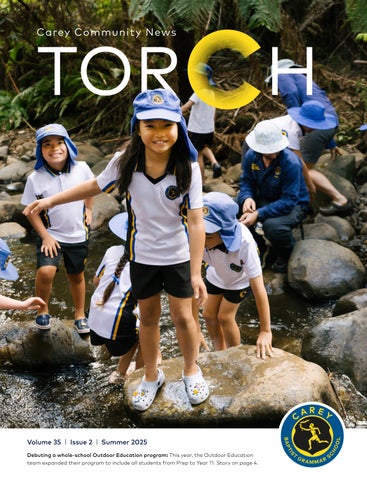
Volume 35 | Issue 2 | Summer 2025 Debuting a whole-school Outdoor Education program: This year, the Outdoor Education team expanded their program to include all students from Prep to Year 11. Story on page 4.
H
Torch Volume 35, Issue 2, Summer 2025 Publisher Carey Baptist Grammar School 349 Barkers Road, Kew Victoria 3101 Australia 03 9816 1222 Editor Kelly Southworth Graphic Design Felix Lam Kelly Southworth Cover Photography Fiona Sexton Inquiries communityengagement@carey. com.au
We acknowledge the Wurundjeri people, the Traditional Custodians of the land on which Torch was created, and we honour their continuing connection to land, sea and community. We respect their Elders past and present, and recognise the injustices endured by the First Nations peoples of this country. 2 | Torch
Nature navigators
Photo by Fiona Sexton Story on page 4
Contents
2
16 How far to equality?:
From the Principal
29 A bright future for Gramlick Oval:
a student symposium
FEATURES 4
Carey’s whole-school Outdoor Education program
6
A foundation of belonging: Year 7 transition
thank you John Hands
18 A decade of C Change
30 We did it!: Camp Toonallook
20 A celebration of creativity and community
20
8
refresh begins
32 The end of an era 33 Carey’s unsung heroes 34 Honouring a century: the story of Raymond Hall
34 22 Humans of Carey
8
How Carey built a girls’ footy powerhouse
10 Carey Academy: connecting learning, careers and community
12 Orchestrating a career in music
12
OUR COMMUNITY 26 More than a sausage sizzle: the power of Carey parents
26
36 Donations to the archive ALUMNI NEWS 38 Happy birthday, OCGA! 40 The Old Carey Hockey Club: teamwork on and off the field
42 Where are they now? 27 Tinsel, trivia and winter joy 27 Celebrating a vibrant year 28 A community wellbeing legacy
44 Reunions and events 46 Announcements 48 Calendar and contacts
Torch | 1
From the Principal
A united vision for Carey’s future Jonathan Walter Principal
This year has been a momentous one for our community. We have celebrated the centenary of the Old Carey Grammarians Association (OCGA), commemorated on 1 December in a wonderful occasion to honour our community’s enduring membership beyond school years. You can read more on the OCGA on page 38. We have farewelled many of our long-serving staff whose contributions have greatly enriched our school – read about them on page 32. We recognise their dedication to Carey and remain committed to building upon their legacy. We also made important headway in developing a masterplan for the future of Carey’s physical spaces. To ensure our future direction aligns with the needs of current students and parents, we have continued to solicit feedback from our community. Engagement with the parent body through surveys, parent forums and parent association meetings has provided valuable insights into what our priorities for the future should be. In pursuit of delivering an exceptional Junior School learning experience for all students, this year we made the strategic decision to consolidate our two Junior School campuses at Kew in 2028, transitioning Donvale students to the Kew campus and closing the Donvale campus. The Donvale campus 2 | Torch
will operate through 2026 and 2027, allowing a two-year transition period for students, families and staff. This initiative is fundamentally educational in nature. Unifying our Junior School at Kew will strengthen academic and wellbeing programs, align curriculum and pastoral care, and expand daily access to specialist learning areas and co-curricular activities. Our goal is to foster a dynamic, future-oriented Carey by bringing together our community on a single campus. Moving forward, all children will benefit from specialised facilities and expert staff who are dedicated to personalised learning.
This development is supported by substantial investment in Carey’s future. Following constructive discussions with our neighbours at Preshil, we were delighted to reach an agreement to acquire the Blackhall property, thereby completing the Kew campus block. Full possession of the site will commence in December 2027, after a two-year transition. The recent acquisitions of Blackhall and the adjacent Kalimna property increase our Kew campus footprint by 17% and present outstanding opportunities for the School. The additional space will facilitate the advancement of the masterplan
Our goal is to foster a dynamic, future-oriented Carey by bringing together our community on a single campus.
for Kew, further updates from which will be presented to the community in the coming year. The first projects to commence will be the construction of the Years 5–6 Centre, a refurbishment of the Prep Centre and Hickman Building, a new underground car park and an outdoor play space for the Junior School. The new Years 5–6 Centre is designed as a state-of-the-art environment for young adolescents, supporting a refreshed curriculum that integrates science, technology, and the creative and performing arts. We also look forward to beginning work on a new Sports and Wellbeing Centre, which will provide multipurpose courts, movement studios and versatile learning spaces. Integrating these vital physical education and health facilities on campus will enhance timetable flexibility and decrease reliance on off-site transportation.
These future facilities developments will support our ongoing work to refresh the curriculum, allowing us to best prepare our students for tomorrow’s world. This work takes place across all sections of Carey – Junior, Middle and Senior School. We have also commenced a capital works planning process for the Carey Sports Complex – Bulleen, and I am grateful to members of the OCGA for their input into these plans. Bulleen will remain a critical part of our infrastructure that supports a thriving sports culture in our school, which builds pathways of excellence for many of our students as they move beyond Carey. We are very excited about the future of our school and these developments ahead of us. I look forward to sharing the progress of both curriculum and facilities as we build a stronger, more united community. Torch | 3
Feature
Carey’s whole-school Outdoor Education program Josh Edwards Fiona Sherar Head of Outdoor Education Deputy Head of Outdoor Education
‘Look deep into nature, and then you will understand everything better.’ – Albert Einstein The Outdoor Education team is excited to announce that we held the first year of our whole-school program, where every student from Prep to Year 9 engaged in age-appropriate outdoor learning experiences! At Carey, we design our Outdoor Education experiences by critically considering the social, cultural, historical and geographical stories of the places we visit. Through purposeful facilitation of and participation in outdoor learning journeys, staff and students learn to respond to the unique character of each place, engaging both physically and intellectually as they grow more attuned and connected to the environments they explore. Ongoing Outdoor Education experiences throughout a student’s journey can inspire, nurture and develop people who are equipped for life and have a sense of responsibility for the world around them. This in turn builds an inclusive community that values the development of each individual and supports them to have a positive impact in our society. This whole-school approach allows for a more cohesive and continuous learning journey; one that evolves as students 4 | Torch
Year 1 students visited Westerfolds Park, where they became Nature Navigators. develop, and their skills and interests expand. Whether searching for water bugs at Darebin Parklands, playing in creeks at Badger Weir, navigating with a compass in Hattah or reflecting quietly by a riverbank on the Wabonga program, students build confidence and competence year by year.
Lower Primary to Middle School During the lower primary experiences, the Outdoor Education program is focussed on play, exploration and sensory engagement. Students are encouraged to use their imagination as they develop motor skills and begin
to notice the patterns, colours and rhythms of the natural world. As students progress into the upper primary years, outdoor learning gradually becomes more structured as each program builds upon the skills and capacity from the previous year. Students may spend their first night away from home, learn basic bushwalking and camping skills, and explore the rich knowledge and connection to land held by First Nations peoples. Emphasising cultural respect and environmental stewardship alongside practical skills prepares students for greater
Year 9s kayaking on the William Hovell Dam during their Wabonga program.
responsibility and confidence in living away from home, often within their own class community. By the time students reach Middle School, the programs explore each place through a journey. Students and staff form independent expedition groups and travel slowly through each location by walking, paddling or cycling where possible. Students are guided to take meaningful, responsible action within their expedition group as well as in the communities they travel through on the program. This might include participating in local conservation efforts, leading group initiatives to reduce waste or working collaboratively on group tasks. Through these experiences, and understanding the stories that sit across each landscape, students cultivate a strong sense of identity, responsibility and respect for themselves, others and the environment.
Senior School opportunities The opportunities don’t end at Year 9! As part of the curriculum, students in Year 10 can choose to head up to Queensland for the 21-day Zero Journey. This presents a further opportunity to engage in hands-on, nature-based learning that builds upon their previous outdoor learning and immersive learning experiences. For students who wish to continue their outdoor learning journey, an optional Year 11 Outdoor Leadership program is available. Drawing on their own previous
The Year 2s explored Coranderrk Creek on their day trip. Photos by Fiona Sexton. experiences, these students bring valuable knowledge and insight that enhance their capacity to teach and support younger students effectively. These Year 11 leaders truly embody the whole-school Outdoor Education journey, serving as role models who confidently guide and support their younger peers through activities and help nurture a positive and inclusive Outdoor Education community.
Building skills for life and creating positive change We design Outdoor Education programs that integrate with other learning areas to support the whole
student experience. Educators actively connect classroom learning with embodied experiences of place, recognising that learning is shaped by how students participate in the world around them. By engaging with the natural world in meaningful ways, students cultivate resilience, empathy and a strong sense of identity. In embedding Outdoor Education across the whole school, we are not only enriching the Carey community, we are fostering a culture that values adventure, reflection and the power of learning through nature.
Torch | 5
Feature
A foundation of belonging: Year 7 transition Sarah Cassidy Year 7 Co-ordinator
Transitioning into Year 7 is a significant milestone in a young person’s life. It marks both the culmination of their primary years and the beginning of the next chapter: new routines, new expectations and new friendships. At Carey, we see this transition as a chance to set our students on their path with confidence. It is normal for students to feel trepidation, but we are always encouraged by the resilience and enthusiasm they show in the face of a new challenge. Our mission is to meet our students where they’re at. Because each cohort is different, our transition program remains flexible, thoughtful and always student centred. What remains
Sailing with new friends at Camp Toonallook. 6 | Torch
constant is our commitment to belonging and creating the opportunities for students to feel connected from the outset.
Starting early Our transition process begins long before students arrive in January. In July, we welcome new and current families to our Parent Information Night. This session is characteristically warm and highly informative; it sets the tone for the journey ahead and allows families to get a feel for the energy and culture of Middle School. We then host an orientation day for the full incoming cohort, as well as opportunities for Carey Junior School
Kayaking at Camp Toonallook: the ultimate collaboration!
students to visit the Middle School and an afternoon for students who will be joining Carey without any peers from their primary school. We even treat testing days and device pickup sessions as opportunities to experience the Middle School environment. Each touchpoint ensures that, once students begin Year 7, there will be a host of friendly and familiar faces. Our Middle School building is expansive, so for the first week of the year, we have a help desk set up in an obvious location where students can go if they are lost or unsure. We also reinforce a whole-school culture where every staff member and older student has a responsibility to look after our Year 7s.
Environment Week in Term 3 is a highlight of the Year 7 program.
This ensures that what could be a daunting start to the new adventure is instead an exciting, positive and friendly experience where they are supported to be themselves, find like-minded peers and feel proud of their new school.
Building belonging The sense of belonging is one of the hallmarks of the Carey experience, and our House system is at the centre. Houses form a vertical community across Years 7, 8 and 9, giving younger students insight into what lies ahead and older students an opportunity to lead and support. The House becomes a family that students carry with them throughout their Middle School years and often beyond; even decades later, Old Carey Grammarians will tell me how much their House meant to them. At Year 7, students are also assigned a homeroom, where learning and wellbeing directly overlap. Homeroom teachers apply for their role because they genuinely love working with Year 7s, and they recognise the power of building culture at this point in the school journey. Because they teach several core subjects, homeroom teachers have multiple touchpoints each week to support the development of a safe space. They also get to know their students through Camp Toonallook and the immersive programs outside of the typical classroom environment.
Learning how to learn Preparing students for Middle School is not only about emotional readiness; it also equips them with the skills to manage a more complex academic environment. Our Learning Skills program now has three 75-minute periods a fortnight, giving students space in the curriculum to understand themselves as learners. From developing organisational habits to exploring stress management, respectful relationships, digital literacy and proactive peer feedback, Learning Skills supports students to build a stong foundation for the years ahead.
What remains constant is our commitment to belonging and creating the opportunities for students to feel connected from the outset. This program sits alongside our immersive learning weeks – Camp Toonallook in Term 1, Enterprise Week in Term 2 and Environment Week in Term 3. Throughout Term 4, students undertake reflection on their schooling journey so far, culminating in the creation a time capsule they will open on their final day of Year 12.
Balancing tradition with innovation One of Carey’s strengths is our commitment to improving, innovating and adapting. Each transition touchpoint is evaluated, refined and adjusted based on feedback from the community. This continuous improvement ensures our programs remain relevant and responsive to the evolving needs of our young people. At the same time, we cherish traditions that matter. The return of the physical planner is one example. While digital tools have their place, the practice of handwriting builds neural connections
and helps students retain information in ways typing does not. For Year 7s learning to manage deadlines, classes and responsibilities, a reliable, tangible planner is invaluable – and it never runs out of battery! We are also navigating an educational landscape where artificial intelligence is increasingly woven into everyday learning. Rather than resisting this shift, we are building awareness and digital literacy into our conversations with students. Our goal is to ensure they engage with technology thoughtfully and responsibly, while still developing the human skills that will always matter, like organisation, initiative, collaboration and empathy. Starting Year 7 is a milestone, and our role is to help students step into it with confidence, curiosity and joy. When students feel they belong, everything else becomes possible. The transition into Year 7 is not simply about starting a new chapter; it is about ensuring every student can find their place. Torch | 7
Feature
How Carey built a girls’ footy powerhouse Kelly Southworth Editor
After 121 years of Aussie Rules football, the AFL inaugurated its women’s league, changing the game forever. In 2025, we witnessed the 10th season of AFLW and the eighth year of Carey’s Girls Football program. In that time, the Carey girls have accelerated to success, and we now celebrate a Girls Football culture that is envied by other APS schools and closely watched by AFLW scouts. This year also saw the first APS grand final for the Girls First XVIII Football Teams, as in previous years the premiership winner had been determined by the ladder alone. Although the Carey girls ultimately didn’t take out the win, we are incredibly proud of how hard they fought at the inaugural Girls Football grand final.
A fledgling program In 2016, as excitement was building for the new AFLW league, a passionate group of Carey staff began working towards developing one of their own.
The success of the team is due to their focus, intensity and ferocity on game day, complemented by the social attitude to training. Ben Harrison had been coaching boys’ football at Carey and had helped facilitate a few friendly girls’ football matches against local schools during that time. Then-Principal, Philip Grutzner, was looking for innovative ideas from staff, and Ben approached him with the idea to formalise a girls’ football program. The following year, the APS also began working towards the same goal.
‘It was a great challenge, starting from scratch,’ Rhys says. ‘I was inspired by my daughter – I wanted to develop a program that she would be proud to take part in one day.’
Jack Joslin, our current Head of Sports and Activities but then-Head of Football, immediately jumped at the opportunity. He asked Ben and Rhys Adams, who also had been coaching in the boys’ football program, to head up the intermediate and senior girls’ teams, respectively.
Chelsea Pozzobon, our first ever Senior Girls Football Captain, said in her Captain’s Report for the Chronicle that year, ‘From eager footballers to girls who’d never touched a ball in their life, a family was born. Being part of the first ever APS Girls Football Team at Carey was a legacy that we hope will never be forgotten.’
The Middle School girls won their first premiership in 2019.
In 2018, Girls Football at Carey began. There still weren’t enough other APS/ AGSV teams to accommodate a First competition, but this season set a tone for the grit, dedication and ruthlessness we would see going forward.
Along with Annabelle Grigg as Team Manager, Rhys coached 26 girls in a fantastic season where they won all but two games. The program was off to a strong start. The following year, the senior program grew to 38 girls, allowing them to split the group into a First and a Second team. Nicola Xenos, who is now one of nine Carey girls to be drafted into the AFLW, captained Carey’s first official First Girls XVIII Football Team the following year.
8 | Torch
The inaugural Senior Girls Football Team, 2018. the best school football teams in the state are nominated to compete.
Laying the foundation In 2018, our first Middle School Girls Football Team also competed in the APS/AGSV. Under the guidance of coach Ben Harrison, the team quickly saw results, completing an undefeated season in only their second year. Throughout his time as coach, the team won 43 out of 49 games. Ben is one of many Carey staff who have professional experience in elite sport. Having coached women’s teams in the Coates Talent League and at VFL and AFLW clubs, Ben was able to draw on his expertise to enhance the Carey Girls Football program and begin developing the basis of a strong team. This led to some exciting achievements. In 2023 and 2024, the Middle School Girls Football Team made it to the Herald Sun Shield grand final. The Shield is the longest-running school football competition in Victoria, where
In 2025, Ben handed the baton to Ali Rock as he began assistant coaching the senior team. Ali credits the welcoming and competitive nature of the team to Ben and Rhys’s leadership, and says the success of the team is due to their focus, intensity and ferocity on game day, complemented by the social attitude to training. ‘Being part of a sporting team is valuable for social belonging and connection,’ Ali says. ‘It’s important not to discourage that social element, but to find the balance – when it’s time to switch on, they switch on.’
Girls Football in 2025 This year, the School brought in Ben Friggi, who is also a Development Coach for the Western Bulldogs AFLW team, to be Head Coach of the First Girls Football Team. Working alongside Carey’s Head of Football and former Collingwood Captain, Gavin Brown, Ben coached the team to the first ever APS Girls Football Grand Final. Throughout the season, the team won eight of their 10 games, giving them
second place on the ladder and a spot in the grand final. The Middle School Team saw similar success in 2025, only losing two games across the entire season. The final round of the year was the most memorable, as a last-minute goal achieved a threepoint win. There is no denying the power of Carey’s football girls. The dedication of the staff, support from the School and APS, and the talent and commitment of the players themselves have established a favourable girls’ football culture. ‘Lots of the players in the Carey teams grew up seeing football as a “boy’s sport”, but now young girls can see what they can be a part of,’ Rhys says. ‘I now have a nine-yearold daughter who only knows a world where girls are playing footy. That’s impact.’ Torch | 9
Feature
Carey Academy: connecting learning, careers and community
Kaushini Fernando Alumni and Community Manager
In today’s rapidly changing world, preparing young people for life beyond the classroom means more than academic achievement. It requires real-world experiences, career insights and strong community networks. Carey Baptist Grammar School is meeting this challenge through Carey Academy, an initiative that unites learning, connection and career exploration under one banner. Carey Academy represents the best of what a school community can offer: shared knowledge, intergenerational support and opportunities to grow at every stage of life. It serves as a community learning hub for alumni, parents, students, staff and friends of the School. It offers networking events, internships, entrepreneurship programs, a business directory and professional development workshops designed to foster lifelong learning and meaningful connections.
Industry Week The official launch of Carey Academy took place during Industry Week. The week brought together parents, alumni, students and industry professionals for a series of inspiring panels, networking sessions and workshops. The week began with the OCGA Networking Night, where alumni from 1980 to 2024 came together in 10 | Torch
Carey Academy represents the best of what a school community can offer: shared knowledge, intergenerational support and opportunities to grow at every stage of life. Melbourne CBD to connect across industries spanning law, finance, design, technology and more. The panel discussion, featuring Belinda Coates (1995), Robert Di Pietro (2000), Nisha Karna (2007) and Harley Thomas (1998), sparked vibrant conversation on brand strategy, the impact of deepfakes and how organisations are retaining top talent. Up next was the Future Focussed Careers Seminar where we explored the future of work, with speakers Rachel Hosking (GO.FARM), Sonya Rand (Bunnings) and Alistair Jones (Swinburne University) highlighting opportunities in sustainability, agriculture and space innovation. Their insights encouraged attendees to think
creatively about emerging industries and the skills needed to thrive in them. On day four we hosted the Level Up Your LinkedIn workshop, led by strategist Sue Ellson. Participants learnt how to improve their online presence, showcase their strengths and grow their networks. Attendees also had the opportunity to take professional headshots courtesy of Fiona Sexton Photography, a current Carey parent. Finally, the week culminated in the Business Breakfast and official launch of Carey Academy, featuring guest speaker Cam McIntyre (1988), CEO of REA Group. Cam spoke about leadership, adaptability and the value of investing in young talent. He also
Top: The Level Up Your LinkedIn workshop. Middle: The Future Focussed Careers Seminar panel: Amanda Siva (Facilitator), Rachel Hosking (GO.FARM), Sonya Rand (Bunnings) and Alistair Jones (Swinburne University). Bottom: Current Carey parents Natalie Pryles, David Pryles, Craig Hynes and Caroline Elliott at the Business Breakfast. encouraged the Carey community to embrace Carey Academy as a platform for connection and opportunity. It was a perfect ending to a jam-packed week.
Creating a network for life Carey Academy extends the success of Industry Week year-round through its Internship Program, Startup Sprint and networking opportunities. The Internship Program offers young alumni short-term placements with
Top: 2025 Startup Sprint cohort with facilitator Irene Tseng, Founder of LIFT Women and panel judges Craig Hynes, Ian Boyd and Kaushini Fernando. Bottom: Cam McIntyre (1988 and current parent) presents at the Business Breakfast.
organisations across the Carey community, giving them a chance to apply their skills while businesses benefit from the insight and creativity of emerging talent. The Startup Sprint supports budding entrepreneurs to refine and pitch their business or social enterprise ideas with guidance from experienced mentors. Carey Academy is built on the belief that every member of the community has something to learn and something
valuable to share. Whether it’s through mentoring, hosting an intern, speaking at an event or attending a workshop, we are all supporting each other’s professional and personal journeys. As schools across Australia look for ways to prepare students for an uncertain future, Carey Academy stands as a model for communitydriven education and blends learning, leadership and connection to support career confidence and lifelong growth. Learn more about Carey Academy. Torch | 11
Feature
Orchestrating a career
in music
At Carey, we are surrounded by so much talent. We spoke with a selection of some of our young musicians, both current students and recent graduates, about their successes, goals for the future and advice for other budding Carey musicians!
Christina Su Year 5 You recently performed at the Sydney Opera House. How did you prepare for such a big performance? It was really cool. I was so excited and I practised a lot because I wanted to be my best for the performance. So before you go on stage for a performance, what do you do to get yourself in the headspace to perform? I think of relaxing things and I just imagine that I’m at home. Then, when I’m on stage, I just focus and I don’t really notice the audience. I don’t get that nervous anymore. I was for my first performance, but over time, performing in front of big audiences started to feel normal. How long have you been playing piano for? Six years. I love it. I practise every single night. What are your hopes for the future with piano? I think I want to be a piano teacher to teach my strategies for playing and performing. Who is your piano teacher at Carey? Christine Luo. She’s really nice and she’s really talented as well. I really like learning from her and it’s always exciting to learn new pieces. Do you have a favourite memory from your piano playing? Probably my first competition in 2023, the Golden Classical Music Awards international competition. I had to record a video of me playing and send it in, and I won first prize. I was invited to perform at Carnegie Hall in New York City. I had to practise so much and it was really tough, but it was such a good experience. We went to Florida to celebrate. We went to Disneyland and swam with dolphins! What other competitions have you been a part of? A few months ago, I won first prize at the same competition, and this time I got to travel to Tokyo to perform. It was really fun. The next competition I’m going to enter will be in Paris! What is your favourite music to listen to? K-pop – my favourite band is called Stray Kids. I also love K-pop dancing, which I do in my mum’s dancing school.
12 | Torch
Ishan Merchant (aka ISHAN) Class of 2021 When did you know a career in music was what you wanted to pursue? I’ve loved songwriting ever since I began it as a hobby at 15, so throughout my time at Carey I always felt like music was going to be my life’s greatest passion. However, I was also a realist, and knew that most artists simply don’t make it. It was only 18 months into my plan-B engineering/science degree when my songs started reaching an audience on Spotify, and Rolling Stone started talking about me, that I realised it was either now or never. I love being an artist and so I’m just going for it. How would you describe your music to someone who has never heard it before? I make singer-songwriter pop music with a strong emphasis on storytelling and personal and intricate narratives. What does it feel like to perform your music to an international audience? In one word: amazing. I got back from my first headline tour of Europe a few months ago and, while it was a small tour, having folks in London, Berlin and Amsterdam scream every word of every song is humbling and I am still struggling to get my head around it. Performing live and writing songs gives me a buzz like nothing else. What’s next for you? I’m currently recording my second studio album and planning for a larger international tour next year. And, making sure I love the journey and don’t lose myself along the way. Putting yourself out in the public domain comes with lots of positives and negatives so ensuring balance for me is critical. Who are you listening to right now? Very much enjoying Lizzie McAlpine, Amine and Liang Lawrence at the moment. Any advice for Carey’s current music students? If you can create a career out of something you are passionate about, then work doesn’t really feel like work. Then, to completely contradict what I just said, I’d also want them to know that I ‘work’ really long hours every day. Many industry mentors of mine made it clear to me early on that talent alone doesn’t get you very far. Where can we follow your journey? You can type in ISHAN or ishanincaps and find me most places online!
Callum Chong Year 11 This year, you received the Callisto Family Award at Generations at Jazz. What did it feel like to receive this recognition? When first given the award, I was in complete disbelief. I was thrilled, but equally questioning ‘am I really the one?’ Now I’ve come to appreciate the privilege of gaining such a special award, and I will cherish it for a long time to come. What has your journey with piano been like? I’ve played piano for a long time now. When I was 6, my mum thought I should try some piano lessons after I showed interest in our digital piano, and I’ve never looked back. Since then, I’ve progressed through AMEB exams and taken a keen interest in jazz through the Carey program. Continued next page...
Torch | 13
Callum Chong continued What is your favourite style of music to play on the piano? Over the years, I’ve taken a liking to many different styles of piano, from Beethoven to musical theatre. However, as of now, my favourite genre is impressionism, particularly works by French composer Maurice Ravel – a beautiful style of piano that I highly recommend listening to. Who inspires you the most in music? I think it would be my music teachers – my piano teacher and the music staff at Carey. To me, it’s really inspiring to see how they’ve pursued their passion into a professional setting, and how they want to share all their love of music with the next generation.
Ciara Wrede Class of 2021 This year, you joined the Melbourne Symphony Orchestra (MSO) as a casual french hornist. What did it feel like to get that news? Receiving the call that I had passed the audition was incredibly exciting. I was then invited to start playing with the orchestra almost immediately, which I did not expect but of course I could not wait to play and perform. What might surprise people about working in a professional orchestra? There is an intense level of preparation that goes into each performance. Musicians are expected to come to the first rehearsal fully prepared, having already learnt their parts in detail. Typically, we have just three full orchestra (tutti) rehearsals in the week leading up to a concert, so individual preparation is really crucial to the ensemble’s success. Were there any mentors or inspirations that shaped your path? Absolutely. My university lecturer, Carla Blackwood, has been a major influence throughout my studies, from my first year at the Conservatorium right through to my Honours year. I’ve also been fortunate to be mentored by Nico Fleury, Principal Horn of the MSO, especially in the lead-up to my audition. His positivity and encouragement have meant a great deal. Another inspiration is Sarah Willis of the Berlin Philharmonic. Her impact on the horn community, both musically and through her outreach and media presence, is incredible. Where do you see your musical career heading? Playing casually with the MSO is proving to be an invaluable professional experience. In the long term, my goal is to secure a permanent position in a professional orchestra. Perhaps with the MSO or with another orchestra in Australian or even overseas. I’m excited to see where this path leads. Who are you listening to right now? Lately, I’ve been listening to Mahler’s Symphony No. 7. It’s quite a distinctive work within his repertoire that is less frequently performed and a bit unconventional in character, which makes it especially fascinating to study and enjoy. Any advice for Carey’s current music students? Carey was where my musical journey began, and it played a huge role in shaping who I am today. My advice would be to make the most of every opportunity offered to you. Ask questions, be curious and seek guidance from your teachers, they are incredibly knowledgeable and passionate about what they do. The support and resources you have at Carey are truly exceptional. Where can we follow your journey? I’m on LinkedIn, and you can follow my chamber group on Instagram: @auralis_ensemble 14 | Torch
Angus Pace Class of 2020 You have performed trombone with several prestigious Australian orchestras. Any highlights? Performing Schoenberg’s ‘Gurre Lieder’ with the Sydney Symphony Orchestra at the start of 2024 as part of a side-by-side program with the Australian National Academy of Music (ANAM), where I study. It is one of the biggest works in the repertoire with a huge orchestra, four choirs and six soloists. It is an amazing late-Romantic work which is barely ever performed because of the forces required. We played it in the Sydney Opera House – the first time it has ever been played in Sydney – and in was only my second week at ANAM. It was so special to be a part of. What were rehearsals like? The atmosphere during rehearsals was electric, as this was a project that was new and exciting for everyone in the room, even the seasoned professionals. The stage was extended so far back that the conductor Simone Young had a PA system set up. I was incredibly nervous. Playing in a new orchestra in an unfamiliar hall is a big adjustment; it’s not as natural as playing in the same orchestra every week. What was the best part of 2025 in your music career? This year, I went on a tour of Europe with the Australian Youth Orchestra. I travelled early before the rest of the orchestra and spent a week in Germany getting lessons from a few teachers. I then spent a week in Tuscany learning from Jörgan van Rijen, Principal Trombone of the Royal Concertgebouw Orchestra in Amsterdam. I met up with the rest of the orchestra in the Netherlands, where we stayed for around 10 days rehearsing. We performed in Lübeck, Vienna, Graz, Amsterdam, Wiesbaden, Berlin and, finally, the Sydney Opera House. How did your journey with the trombone begin? It began at Carey with the Year 7 mandatory music program – otherwise I might not have picked up the instrument at all. But when I experienced the band program at Carey, I had my eyes opened. From then on I tried to spend as much time as possible playing music. Carey was amazingly supportive. Going to Generations in Jazz with Carey’s Big Band was when I realised I wanted to pursue jazz. What’s next for you? I’m hoping to continue my studies after ANAM, possibly overseas. I would love to study with some of the teachers in Europe who I was able to learn from and play for, but there are lots of opportunities in Australia as well. I would like to continue playing with orchestras and continue to develop my solo playing, putting on the occasional recital. Any advice for Carey’s current music students? Take as much from Carey’s music program as you can. The staff and programs we have at Carey are at a really high level, and there is a lot of expertise here that you should try to soak up as much as you can.
Torch | 15
Feature
How far to equality?: a student symposium Simon Carver Leader of Learning – Art and Design; 2025 Gender and Sexuality Interschool Student Symposium Co-ordinator
In August, Carey was proud to host the 2025 Gender and Sexuality Interschool Student Symposium. This year, more than 130 students and 40 educators and school leaders from over 20 schools attended. This annual event, the hosting of which is shared across several schools, aims to inspire students and schools to embrace authenticity, inclusivity and resilience. This year’s theme, ‘How far to equality?’, provided a provocation for all attendees to consider. Our goal was to equip students with the tools and inspiration to drive meaningful change in their school.
Our inspiring panel.
Keynote speaker Archie Beetle.
Powerful stories from guest speakers One of our 2026 School Captains, Bonnie Lee, opened the event with a poem entitled ‘Her voice, our power’, which challenges societal and patriarchal judgments about women’s clothing and the double standards in how women are expected to present themselves. It set the tone for the day: passionate and inspired to advocate for positive change. Our keynote speaker was Archie Beetle, a respected thought leader in LGBTIQ+ advocacy and the visionary founder and CEO of Queer Town. Queer Town supports workplaces, schools and communities to become more inclusive environments through innovative 16 | Torch
Carey alum Ruby Mountford (2008) speaking as part of the panel discussion. training and education, with clients including City of Melbourne, Australian Ballet, Federation Square and Cotton On Group. Archie’s charismatic address and personal story shaped many conversations. Many participants were inspired by Archie’s message to be one’s true authentic self. ‘Just being surrounded by likeminded people … made for a safe and comfortable environment where everyone could be themselves without fear of judgement.’ – Year 10 student
A moving Q&A panel The Q&A panel was facilitated by Katie Sprout from the Reach Foundation. Our first panel member to speak was Carey alum Ruby Mountford (2008). Ruby shared their work in the human rights field and sensitively spoke of the positive changes they had observed being back at Carey after many years. Daniel Cash, a former Melbourne Grammar School Captain now studying at the ANU, shared his experience as an openly gay school captain. Being open
Year 10 student: Just being surrounded by likeminded people … made for a safe and comfortable environment where everyone could be themselves without fear of judgement. and authentic in your identity was one of his key messages. Ethan McKenzie-Howell, an Honours student from the University of Melbourne, shared his research into a topic that is now described as the ‘Manosphere’ – online groups promoting a harmful type of masculinity that is to the detriment of women and healthy role modelling. Aimy Skym, from the Victorian Department of Education, spoke about the Education Department’s priority of Respectful Relationships and carefully considered wellbeing programs and highlighted Carey’s exemplary work in this area. Finally, academic friend of Carey, Dr Victoria Rawlings from the University of Sydney, outlined the huge steps forward schools like Carey have made to create inclusive educational programs and support gender and sexuality in secondary education.
Thought-provoking workshops The core of the 2025 symposium was the numerous school-led workshops. Topics included human rights, marginalisation, trans visibility and positive role modelling for young men, among many others, presented as provocations for student reflection. The energy and agency shown by the leaders of these workshops and the participation of attendees was commendable. Teachers attended a session to introduce STIR – A resource book for schools, designed to give teachers an additional resource for navigating conversations about gender and sexuality with care and assurance. The day culminated in plenary overviews and our final presentation from Minus18, a charity dedicated to improving the lives of LGBTIQ+ youth. The Minus18 research highlighted how student agency and engagement supports a dynamic and open school culture, and emphasised the need for all schools to run programs focussed on supporting all students.
‘The symposium shed light on the fact that … it’s good for me to stand up, ask people why they believe a certain view and have conversations with people to understand where they’re coming from and why they may have certain beliefs.’ – Year 11 student Safe and inclusive educational practice sits at the heart of a school’s moral purpose. After hearing from researchers, youth thought leaders, student leaders, a range of schools and brave educators willing to take risks, it is clear that a move toward true inclusion is underway. Carey is grateful to the generous donors who help make our mission to support all students and celebrate Pride a reality. We also thank the Carey staff who helped organise this important event, especially Jacquie Jones, Rev. Tim Edwards and Principal Jonathan Walter, as well as Jackson Howe who ran a fun lunchtime dance activity for all students and staff on the day. We look forward to the 2026 Gender and Sexuality Interschool Student Symposium, to be hosted by Caulfield Grammar School. Torch | 17
Feature
A decade of Sally Nelson
C Change
Head of Integrated and Immersive Learning
This year, Carey proudly celebrated a decade of C Change, a transformative program that has shaped cohorts of students into thoughtful, capable and socially responsible individuals. Since its launch, C Change has demonstrated that education is about far more than content knowledge, it is about equipping young people with the skills, mindset and courage to navigate an increasingly complex, uncertain and interconnected world. The program encourages students to see change – C Change – in themselves, their peers and their communities across the course of a year. With an emphasis on reflection, students explore the fundamental beliefs that guide and motivate their attitudes and learn to act with integrity, empathy and a strong sense of purpose.
C Change in ourselves C Change is an experiential program that creates opportunities for students to explore a broad range of C-themed concepts (e.g. communication, choice, care, courage), grounded in real-world issues and challenges. By focussing on inquiry-based learning, handson experiences and cross-curricular connections, the C Change program equips students with the skills, knowledge and attitudes necessary to become thoughtful, engaged and responsible citizens. Throughout Year 9, all students take part in the four components that make up the program: 18 | Torch
‘C Change taught me to step out of my comfort zone, work with a team effectively, and be open to new ideas.’ – Finley
‘C Change has made me more aware of others in the community and more considerate of what they may be experiencing.’ – Grace
• Theme-Based Learning (fortnightly): students take part in engaging and challenging experiential learning days based on themes starting with the letter C, where they think, question, wonder, act, reflect and connect. • Ideas Worth Sharing (semesterlong): over two terms, students work individually or in pairs to develop a five-minute TED-style talk undertaking the following steps: ideate » research » plan » develop script » rehearse » present. • Community Project (semesterlong): during the alternate semester, students work on a project of their choice to raise awareness about and make a positive difference to a local, national or international issue.
• C Change City Challenge (final week of the year): Year 9 culminates in an immersive learning experience where students can demonstrate the skills and values they’ve developed throughout the program through a series of challenges.
C Change in others C Change encourages students to step beyond the classroom and engage with real-world challenges. Through authentic problem-solving tasks and community projects, students learn to apply knowledge, collaborate effectively and take purposeful action. These experiences allow them to learn from the past, respond to the present and contribute meaningfully to the future.
‘The theme days are full of transferrable skills that will be useful in the future.’ – Beatrice
‘I learnt how to communicate better and share my ideas clearly. I also developed teamwork and leadership skills by working with different people to reach common goals.’ – Flynn
While developing personal agency, ethical awareness and social responsibility, C Change also supports students’ overall wellbeing by helping them grow in mind, body and spirit. Rather than simply learning about wellbeing strategies, students actively apply them in real-life contexts, strengthening the skills and resilience needed for life beyond school. The program is designed around integrated and collaborative pedagogy. Team-teaching and co-designed learning experiences bring together multiple perspectives, encouraging students to think critically, question assumptions and explore creative possibilities. This approach develops deeper understanding and highlights the importance of collective action and shared responsibility.
C Change in the community As the OECD (Organisation for Economic Co-operation and Development) has emphasised, schools play a pivotal role in preparing the global citizens of the future. Education today is no longer just about acquiring content; it is about cultivating identity, agency and purpose. It is about nurturing curiosity, compassion and the courage to apply cognitive, social and emotional thinking to real challenges. For the past 10 years, the Carey C Change program has embodied this vision. It has enabled students to see themselves not only as learners but also as changemakers, equipped with the confidence and skills to contribute to a more inclusive, cohesive and productive society.
As Carey celebrates 10 years of the C Change program, the School community is proud of what C Change has achieved and inspired by its ongoing potential. The program’s first decade has demonstrated the power of education that goes beyond grades and test scores. It has shown what can happen when students are given opportunities to engage deeply, reflect critically and act meaningfully. By evolving with research, global trends and the needs of young people, C Change remains an important part of a Carey education. We acknowledge the many students who have embraced its challenges, the teachers who have guided its growth and the vision that continues to drive it forward. Here’s to the next decade of inspiring learning, meaningful action and positive change. Torch | 19
‘Loosen up’ by Bernadette Luker, Executive Assistant – Finance and Operations.
‘The Great Exhibition’ by Peter Schmidli, Middle and Senior School Art teacher.
‘The mental load’ by Isa Coello, Spanish, Drama and Theatre teacher.
‘The calmness’ by Felix Lam, Creative Design Lead.
‘Ceramics’ by Felicity McNamara, Product Design and Technologies teacher.
‘Gargoyle’ by Graham Harwood, Grounds and Maintenance.
‘Glimpse of sunset’ by Annie Yang, School Psychologist.
‘A study of roses and anemones’ by Claire Tumilovics, Year 11 Co-ordinator.
20 | Torch
Feature
A celebration of and community
creativity
Kelly Southworth Editor
Our Staff Art and Design Exhibition returned this year and featured more than 60 works from over 40 Carey staff. It was great to see and celebrate the talent of our staff in this week-long exhibition showcasing a diverse range of artwork including paintings, drawings, 3D-printed models, ceramics, crochet, photography, woodwork and textiles. The exhibition featured artworks and designs created by staff from all areas of the School, including educators, administrators and assistants from Junior School to Senior School and across all departments of our professional staff: Accounts, Community Engagement, People and Talent, Property and Tech Services. The first Carey staff art show was held in 2014, organised and managed by Senior School Media teacher Kim Baumann. It ran successfully for three years, and we were excited to see Felicity McNamara, Product Design and Technologies teacher, take up the mantle to revive this creative tradition. A lot of work and organisation goes into the exhibition, including co-ordinating entries and keeping the artworks appropriately stored, arranging the set-up, curating the layout of the exhibition, and organising prizes and awards. Felicity’s efforts to bring this event back to life is a reflection of strength and commitment of the Carey staff community.
The artworks on display offered a unique perspective into the hearts and minds of Carey staff and was a reminder of the wealth and breadth of experience across the School. The artists also deserve recognition: creating art can be a deeply personal experience and, especially for those who are not accustomed to exhibiting their work, it requires vulnerability and courage to put it on display. Congratulations to all Carey staff who entered an artwork into the exhibition. The exhibition opening event was soundtracked by expressions of surprise, awe and joy from staff as they explored the exhibition. Many were discovering the talents, hobbies and passions of colleagues they had worked alongside for years. The artworks on display offered a unique perspective into the hearts and minds of Carey staff and was a reminder of the wealth and breadth of experience across the School. Throughout the week, the exhibition was open to students, who delighted in seeing their teachers’ creativity on display, and visitors to the School.
A People’s Choice Award was set up for everyone who viewed the exhibition to vote for their favourite works. The award went to Peter Schmidli, Middle and Senior School Art teacher, for his exquisitely detailed oil painting titled ‘The Great Exhibition’. The runnerup People’s Choice Award went to Bernadette Luker, Executive Assistant – Finance and Operations, for her charcoal drawing ‘Loosen up’. Year 11 students who helped set up the exhibition awarded Packing Room Prizes to their favourite artworks, which they gave to School Psychologist Annie Yang; Tech Services Project Manager Giri Gangadhara; and Manager – Engineering, Courtney O’Sullivan. The exhibition was a powerful example of the creativity that thrives at Carey and the joy that comes from sharing it. We can’t wait to see what our staff artists bring to the next showcase. Torch | 21
Humans of Carey
Parth Chitroda Year 9 student
Carey’s First Boys Tennis Team. Parth is in the back row, second from left. My journey at Carey began in 2023 when I joined as a new student in Year 7. I’ve had a really good experience at Carey, being exposed to lots of new environments and opportunities, like school camps, excursions and more. My highlight has been the Year 8 camp in Hattah. I really enjoyed the camping and hiking parts of it, and I became a lot closer with some of my friends. I got into tennis when I was around six years old and I’ve been playing it for about eight years. The part that I enjoy about tennis the most is training – I love pushing myself really hard every day and looking to improve in every session. Winning the 14/U Australian Claycourt Championships this year was an amazing experience. It was a big growth opportunity: from the pressures and expectations to the professionalism of the tournament and the players in it, it has truly shaped my approach to my tennis.
22 | Torch
Being able to play in such great facilities with multiple umpires for every match was also a blessing. Nationals showed me how much work has to be put into each and every match, especially with the pressure of a tournament and the expectation to be able to consistently back it up, game after game, win after win. You need to become untouchable, which makes you a target. After everything I put into it, winning Nationals was an unbelievable feeling. Getting such a big title brings new opportunities and exposure to different international tournaments, preparing me for the future. I’ve competed in other international events and I’m currently 2500 in the world for 19/U. I’m aspiring to play the Australian Open Junior Championships in the future. I’m also part of the Carey First Tennis Team and was awarded Most Valuable Player in 2024 and 2025.
Outside of tennis, I enjoy going to the gym, playing basketball, playing video games and going out with friends. I’m a strong believer in the idea that it’s not what you do, it’s who you do it with. In the future, if the pro-tennis career doesn’t happen, I would love to go to the US to experience the college system there, especially for the team tennis programs.
Humans of Carey
Kathy He Parent to Jennifer (Year 8) and Cathy (2024)
My path to Carey began far from Australia. I was born in Hunan Province, China, but my parents moved the family to Zhuhai, Guangdong when I was in Year 7, as part of China’s new ‘open-door’ policy. This reform opened China to global trade and transformed Zhuhai into a hub for manufacturing and innovation. My father established a company producing industrial heating and cooling systems, laying a foundation of entrepreneurship in my family. With plans to one day lead the family business, I studied Industrial International Trade at Southeast University in China and later completed a master’s degree in International Business at Lancaster University in England. English is my second language, but it wasn’t until I was in a challenging graduate program that I really learnt the nuances of the language and its application to foreign trade. After working for multiple Fortune 500 companies in Asia, running the family business and starting up a
manufacturing company, I migrated to Sydney in 2015 on a skilled migration visa with my family. A short trip to Melbourne convinced me to relocate again, and we settled in Balwyn, where we still live today. As a qualified education agent counsellor, I now run an international education consultancy and assist international families with Australian school enrolment. I understood the need for this kind of service when I came here with my own children, and I knew I could do something to help other families with this significant transition. I am also an education support assistant in classrooms for students of diverse backgrounds. I have two daughters (pictured above with Kathy in 2013), Jennifer and Cathy. Jennifer has attended Carey since ELC and Cathy is now studying literature at Monash University. I believe strongly in co-education. Carey’s approach has enabled Cathy to confidently interact with and learn amongst both women and men in her university studies,
preparing her with vital social skills for the real-world workplace. With balancing business, family and volunteer commitments, Carey has been central to my family’s experience in Melbourne. The School has been so supportive of us, so it has been important to me to give back to the community. I served as President of Carey’s Local and Overseas Student Association (CLOSA) for three years. CLOSA helps international families adapt to a different culture and supports community building among parents who are often newly arrived in Australia for the sole purpose of their children attending Carey. At present, I am also a member of the School’s Advancement Committee, which guides the School’s fundraising strategy for programs like needs-based scholarships. To me, Carey is much more than a school. It is a place where everyone can feel at home.
Torch | 23
Humans of Carey
Gavin Brown Head of Football
As a professional footballer, I was
and I realised that I might be capable of
conscious of not forcing my kids into
making the AFL if I put in the hard work.
football. I got this great piece of
I was over the moon to be recruited
advice that I followed throughout their whole childhood: match their enthusiasm. If they come to me and say they want to go have a kick of the footy, then absolutely, I’m there. But if they weren’t that into it, I was never going to make them do something I was more interested in than them. As it turned out, all three ended up following in my footsteps playing some AFL football with Collingwood: Callum played 70 games for Collingwood, Tyler
by Collingwood Football Club into their U19s side for the 1985 season. We won the premiership in 1986, and I was brought up into the Reserves. My first AFL game for Collingwood was in 1987. It was such a thrill to make it after dedicating so much of myself to football over the years. I played for Collingwood for 15 years, including five years as Captain, from 1994 to 1998. I then coached for 23 years: 10 years at Collingwood, followed by
has played about 30, and Tarni was the
stints at Carlton and North Melbourne.
first father–daughter recruit for the
There were so many high points during
Collingwood AFLW team. Watching them play is still a great joy for me.
that time – in particular, winning the 1990 premiership, making the
My own interest in football started
All-Australian Team three times
because my parents would take me
and winning the Copeland Award
down to the local club to play football
three times. I was inducted into the
with some of my friends. My dad didn’t
Collingwood Hall of Fame in 2004 and
play, but he liked the game and just
the AFL Hall of Fame in 2008, which
wanted me to play a sport.
was very humbling. I’m so grateful to
As I got older and progressed through
Collingwood Football Club for shaping
the ranks at that same local club –
that period of my life.
Templestowe – I really started to get a
This year was my first at Carey heading up the football program. I’ve thoroughly
taste for it. My skills were developing 24 | Torch
enjoyed my first year here, the kids, the teachers, the sports staff – they’re all brilliant and I feel extremely lucky. We’re also lucky here that we have a great group of coaches who have fantastic relationships with the players. The boys’ program has always been really well-run and I’m hoping to continue to grow and improve it. We’ve also got some really talented girls and a good appetite for growth so I’m looking forward to seeing that program go from strength to strength. A big focus for me is bringing a bit more structure to the way we play, starting with the foundational years in 7, 8 and 9. AFL is a win-at-all-costs environment, so it’s refreshing to come here and remind myself that not everyone’s playing football to play in the AFL or VFL. Some kids just love playing footy because they’re having a kick with their friends. It’s really important that that we can provide engagement and enjoyment for all students. We want to develop teams and of course we want to win games, but we’re also developing individuals, and we want them to have a great football experience at Carey.
Humans of Carey
Vanessa Gomes Business Analyst – Project Co-ordinator
When I was younger, I was an obedient kid but with a streak of rebellion and mischief that kept life interesting! Working at Carey now and seeing the students often takes me back to those days and makes me feel young at heart (and maybe even in age!). I joined Carey in August 2025 as a Business Analyst – Project Coordinator in the Tech Services team. My role involves translating business needs into practical solutions, making sure every project not only works but also aligns beautifully with Carey’s mission and values. Since joining, I’ve loved collaborating with different teams and contributing to projects that enhance user experience. One of the most rewarding aspects of working at Carey is the strong sense of community and collaboration. It’s not just about delivering projects, it’s about creating solutions that make a real difference for staff and, especially, students.
Outside of work, I am an explorer at heart. I love discovering new places, trying different cuisines, travelling, journaling, staying active and experimenting with photography. Living in Melbourne is a blessing as there are always events happening. From hidden cafes or restaurants to vibrant laneways and festivals I didn’t even know existed, the city never runs out of surprises (including the weather!). My camera roll is a colourful mix of sunsets, coffee cups, food and the occasional attempt at ‘artistic’ angles that don’t always work out.
create meaningful, thoughtful solutions that push innovation forward. Carey has already given me a platform to learn and contribute, and I am excited about what’s next. Every project is an opportunity to make things better, and I look forward to building more connections and creating solutions that truly matter.
A fun fact that surprises people: I do not like chocolate. Yes, you read that correctly! But give me a hot chocolate with marshy and I’m in heaven. Looking ahead, I’m excited about the next chapter of my career. I want to dive deeper into digital transformation and human-centered design and take on projects where technology and empathy work together to make a real impact. I am driven by the chance to
Torch | 25
Our community
More than a sau sage sizzle: the power of Carey parents Sarah Broadbent President of the Junior School Parents Association – Kew
If you’ve ever served a snag in bread at the end-of-term sausage sizzle, wrangled tissue paper table decorations in the Quad or delivered cupcakes in the rain for the Literature Festival – congratulations, you’re part of the magic that keeps our Junior School – Kew campus community vibrant. This year, the Junior School Parent Association – Kew (JSPAK) has once again shown that, when parents pitch in – in big ways or small – incredible things happen. From Prep to Year 6, our parent volunteers have brought energy, creativity and a lot of good humour to events across the school calendar. We’ve shared early-morning smiles at the Mothers and Fathers Day breakfasts, brought joy (and cupcakes) to the Literature Festival in collaboration with the Library team, and welcomed new and returning families at the start of the year with a sunny Welcome Picnic. And, of course, we’ve kept the fire going with our muchloved end-of-term sausage sizzles. Key to the success of community building are our parent volunteer Class Representatives, who play a vital role in co-ordinating class and year-level activities. From organising teacher gifts and plays in the park to rallying helpers for school events, our Reps help create a sense of connection within each class and keep everyone in the loop. Their valuable effort builds the smaller, everyday bridges that make the School feel like one big family. 26 | Torch
Parent volunteers at the JSPAK end-of year sausage sizzle in December. Behind the scenes, our monthly committee meetings have been full of ideas and insights, with just the right amount of spreadsheet action to keep everything running smoothly. It’s this steady, often unseen, commitment from parents that creates such a strong and connected community. Volunteering isn’t just about giving time – it’s also about gaining something meaningful. For many of us, it’s been a way to meet other families, feel a sense of belonging and be more connected to our children. It also sets a powerful example for our kids: when they see adults contributing, collaborating and having fun along the way, they learn what community really means. The funds raised have gone toward projects chosen by the students themselves – and this year is no exception with some brand-new table
tennis tables now installed outside Metcalfe Hall. Through their votes and voices, the children are shaping their school experience, and we’re proud to support their choices. In addition to giving back to the School, we also look outward – making donations to the Baptcare Sanctuary Program to support people seeking asylum. It’s a powerful reminder that our community care reaches beyond the school gates. So, to every decoration-creator, note-sender, barbecue-flipper, saucesqueezer, table-mover and meetingattender – thank you. Your time, effort and enthusiasm have made a real difference. You’ve shown our children what generosity, teamwork and community spirit look like in action. Here’s to more years ahead of fun, connection and, yes – more sausages.
Our community
Tinsel, trivia and winter Jessica Lightfoot
joy
Friday of Term 3 at Carey’s Kew Sports
faux fireplace and glowing Christmas tree, the event captured the spirit of community and celebration.
Complex – fittingly, on 25 July! With
Thank you to everyone who generously
The MSPA’s Year 7 Christmas in July: Tinsel and Trivia was held on the first
around 100 parents and students in attendance, this joyful mid-winter gathering offered a memorable opportunity for the Year 7 community to come together in a festive setting.
contributed to the Foodbank Victoria food drive. Your donations help support individuals and families doing it tough. This event would not have been possible without the dedication and
We held a reindeer relay and parents
hard work of our wonderful MSPA
vs kids trivia (yes, the kids came out
members, volunteers and the dynamic
on top!), while pizza, hot chocolate,
duo who brought the evening to life,
candy canes and – the biggest hit
our fantastic MC and engaging trivia
– gingerbread Christmas tree table
host. Their energy, humour and ability
centres were eagerly demolished.
to keep the crowd entertained played
From laughter shared over trivia rounds
a huge role in creating such a fun and
to the warmth of mingling near the
Photo by Madeleine Jones
President of the Middle School Parents Association
memorable atmosphere.
Celebrating a Chris Reece
A heartfelt thanks to everyone who contributed, whether it was planning behind the scenes, organising the festive fare, setting up the venue or helping shape the lively trivia competition. Your time, effort and creativity made it all happen. Events like these not only bring joy, but also strengthen the sense of connection and belonging within our school community.
vibrant year
President of the Junior School Parents Association – Donvale
The Junior School at Donvale has enjoyed a wonderfully energetic and connected year, thanks to the strong partnership between families, staff and the Parents Association. We began with our Term 1 Welcome Picnic, bringing new and returning families together for a relaxed afternoon on the Mullum Mullum flats. Early in the term, students also enjoyed a First Aid Workshop, learning practical safety skills in a fun way. Mid-year, our lively Silent Disco (pictured) lit up the hall with dancing, laughter and fun at the photobooth, with more than 100 students joining in.
In Terms 3 and 4, students explored science through a series of handson experiences. Mad About Science workshops invited children to experiment, create and investigate, and we hosted a high-energy Science Show in the hall, featuring giant smoke rings, air-zooka blasts, a toilet paper canon and hair-raising static electricity. Our ever popular sausage sizzles kept students happily fed while raising valuable funds for future programs, while Mothers and Fathers Day Stalls gave students the joy of choosing thoughtful gifts for loved ones. To recognise our dedicated educators, the
Parent Association hosted a Teacher Appreciation Morning Tea, thanking staff for their care and guidance. Our cheerful end-of-year picnic celebrated achievements, friendships, and the strong community spirit that defines the Donvale campus. A sincere thank you to all parents, volunteers and staff for their support. We look forward to creating even more special moments next year. Torch | 27
Our community
A community wellbeing Megan Lawton
legacy
Carey parent and Carey Community Forum committee member
Carey parent Kate Gentilin was Chair of the Carey Community Forum for nine years, and has been involved far longer. Her commitment to wellbeing, both physical and emotional, has shaped her life and career. Kate is a trained podiatrist who pivoted into community health and paediatrics, and now works at St Vincent’s Hospital supporting patients after Emergency Department discharge and reducing unnecessary emergency readmissions. Kate recently stepped down from her role as Chair, so I caught up with her to chat about her experience of the Carey Community Forum over the years. Megan: Tell me a little bit about you and your connection with Carey. Kate: Although neither my husband nor I attended Carey, we had always heard wonderful things about it. In 2008 we enrolled our eldest daughter, Milly, in ELC at Donvale and it was immediately clear we’d made the right choice. She thrived in the nurturing environment, developed a strong sense of curiosity and formed wonderful friendships. It felt only natural to enrol our younger daughter, Charlotte, soon after. From those early days through to Charlotte completing Year 12 this year, Carey has been a constant and special part of our lives. The community, teachers and values have shaped our girls in ways we’re deeply grateful for. M: What is the Carey Community Forum and how did you get involved? K: The Carey Community Forum (CCF) brings together representatives from all sections of the School, working with Student Wellbeing and Community 28 | Torch
Engagement to deliver sessions on child development, education, social and emotional wellbeing, parenting and adolescent issues. My connection with CCF began when a fellow Donvale parent encouraged me to join so the campus could have stronger representation. Many of the initiatives championed by the CCF before my time were adopted by the School and are now embedded in the curriculum. I grew to love being part of it and was soon fortunate to be elected Chair. M: Were there any surprises from participating in the CCF? K: COVID-19 certainly changed the landscape. With in-person meetings and on-campus events no longer possible, we shifted to Microsoft Teams. Unexpectedly, the online format often increased attendance – when you remove travel time, especially on a cold July night, more parents can join. It was a good reminder that accessibility matters. M: Why is student wellbeing important and what role does community play? K: The strength of the CCF lies in the partnership between parents and staff. I’ve always believed student wellbeing underpins all meaningful learning, and the CCF allows us to approach that holistically. Parents bring insight into what their children are discussing at home; teachers share what they’re seeing at school. Together, we identify themes and invite speakers who reflect the current needs of the community. Some topics – like managing anxiety – are evergreen. Others arise quickly,
Kate Gentilin and Megan Lawton. such as vaping overtaking alcohol consumption among teens. Having experts guide parents through these issues has been invaluable. Our recent event on the importance of sleep was a perfect example, resonating with families right across the School. M: Would you recommend participating in a Carey committee? K: I would encourage any parent to consider joining a Carey committee. Being part of the CCF introduced me to teachers and parents I might never have met otherwise, and many of us keep in touch. The relationships formed have been a real highlight. You can also contribute at a level that suits you – for me, supporting student wellbeing was a priority, and the CCF provided a meaningful way to do that. Because the committee only meets a handful of times a year – and much of the organisation can be done online – it has been very manageable alongside my work. Being part of the CCF has been genuinely meaningful, and I feel privileged to have played my part.
Advancement
A bright future for Gramlick Oval: thank you John Hands Jack Joslin Rebekah Trachsel Head of Sport and Activities
Head of Advancement
Carey is proud to announce the exciting upgrade of Gramlick Oval with the installation of state-of-the-art lighting and a brand-new electronic scoreboard. This major enhancement of one of Carey’s most loved sporting grounds marks a new chapter in the life of the oval, and it has been made possible thanks to the extraordinary generosity of Carey alum and Old Carey Football Club Life Member John Hands (1977), who made a significant gift to bring the project to life.
donation is more than a financial gift – it’s a legacy that will benefit generations of students and alumni to come.
For decades, Gramlick Oval has played host to memorable sporting moments, fierce competition and the joy of team spirit. With these latest upgrades, the oval is now positioned to offer an even more dynamic and professional experience for Carey’s student athletes and wider community.
Michael Tarrant, President of the Old Carey Football Club, shared his appreciation: ‘The club is so grateful for John’s contribution. The upgrade of the lights will add so much value to the football program.’ At Carey, we believe that facilities play a key role in nurturing talent, encouraging participation and building lifelong memories. The revitalisation of Gramlick Oval is a proud example of how the strength of our community – and the generosity of our alumni – continues to enrich the Carey experience for today’s students. We extend our deepest thanks to John Hands for his remarkable support.
If you would like to discuss a meaningful donation to support Carey Sport, or another area of the School, please contact Rebekah Trachsel at rebekah.trachsel@carey.com.au
The Old Carey Football Club won the 2024 Premiership! Pictured here is Michael Tarrant (President), John Hands and Aaron Bailey.
The new lighting system is a gamechanger – literally. Not only will it extend training hours, particularly during the winter months, but it also opens the door to twilight and night matches. ‘I’m so pleased for the opportunity to work with the School and contribute to the lighting upgrades which will be of great benefit to Old Grammarians clubs, particularly the Old Carey Football Club, and to current school students,’ John said. ‘It is a win/win scenario to me, and a very satisfying outcome.’ John’s ongoing support of Carey and the Old Carey Football Club reflects his deep commitment to the value of sport in education and community. His
The 1976 First XVIII Football Team: John Hands is in the middle row, third from the left. Torch | 29
Want to see Camp Toonallook in action? Watch our video to discover more about the exciting activities and beautiful surroundings that make it so special.
30 | Torch
Watch the video
Advancement
We did it!: Camp Toonallook
refresh begins Rebekah Trachsel Head of Advancement
Outdoor Education is an important part of the Carey learning journey, and Camp Toonallook serves as a home away from home for our students in Years 4 to 7, who visit each year to explore and learn within our 10 acres of natural bushland. ‘I have such fond memories of Toona as a student, some 35 to 40 years ago! My mum, along with other parents, used to cook meals for the students and teachers. My daughter, Charlotte, recently found Mum’s name in the volunteer book that still resides at Lyall Hall. It has such wonderful memories for our family and we were happy to support it.’ – Chris Batrouney (1994) Over the years, Carey has maintained Toona as a basic yet functional camp to meet the educational needs of our students. The goal of our 2025 Community Giving Appeal was to elevate Toona and refresh the site, including purpose-built gathering spaces, a new outdoor chapel and sustainable irrigation systems, ensuring the site remains relevant and valued into the future. ‘When I was a student, I benefitted from a donor’s generosity and received a scholarship. My gift was a means for me to help pay it forward for students now and in the future.’ – Lucy Moore (1995)
Thanks to the generosity of our community ... we have been able to begin construction! Thanks to the generosity of our community, with many families and alumni making a gift, we’ve exceeded our fundraising goal of $100,000. Together with Carey’s matched funds, we have been able to begin construction! The upgrade of Toona is on track for completion by February 2026. Thank you for being such an important part of this journey.
‘As an Old Carey Grammarian, and with my children now going to Carey from Prep onwards, Toona is one of my fondest memories. I made a gift for all up-and-coming students so they can experience the same – but with some improvements. Thanks to Carey and all the teachers that make it special.’ – David Cantor (1978)
There’s still time to make a gift and join the reopening celebration at Camp Toona in 2026!
Click here to make a gift carey.com.au/giving Torch | 31
Long-serving staff farewells
The end of an era
In 2025, we farewell several valued members of the Carey staff. The following includes some of our longest-serving members of staff, but we thank and acknowledge the impact of all staff who are concluding their time at Carey.
Kate Croft (5 years)
Peter Robson
As Deputy Principal – Student Learning, Kate has led the academic learning program across the School, and has facilitated a review of and changes in our timetable, curriculum offerings, the operations of the Learning Development department and, perhaps most notably, led the work of our Research and Innovation Team. During her time, we have progressed the work of adopting new metrics and we are grateful for her lasting impact.
(23 years)
David Crawshaw (44 years) Beloved teacher of English, Music and Religious Studies, as well as VCE Ethics and IB Theory of Knowledge, David’s classrooms are places of good humour and effective learning. David coached cricket and hockey and was Head of Sutton House in the 1980s. He is well known for his love of music, having established the Senior School choir and an elite A Cappella choir. He was involved in the creation and organisation of many Carey events that run annually to this day. Notably, David was Musical Co-ordinator for Carey’s first six Senior School Musicals, and took over as Musical Director in 1991, a role he held for 19 years to great acclaim.
Peter has held a number of significant leadership positions, including Director of Activities, Director of Positive Education and Wellbeing, and, for the past five years, Deputy Principal – Wellbeing. In each of these roles, Robbo has shaped the fabric of our community by devoting himself to enriching every part of school life.
Staff leaving Carey after 15 or more years of service Timothy Barker (17 years) Robert Brum (20 years) Chris Butler (37 years) Lesley Collins (16 years) Hattie Cao (16 years) Jason Digby (37 years)
Ben Jones (17 years) Whether co-ordinating national and Mikl Longstaff (20 years) international sporting tours; championing Marg Moran (15 years) social justice initiatives; celebrating Tony Pappas (32 years) achievements in music, performing arts Tahnee Wood (17 years) and sport; or leading the development of the innovative Year 10 Zero Program, Peter ‘Robbo’ Robson’s influence has been profound.
Mick Calder (44 years) Mick came to Carey as an apprentice gardener in 1981 and rose to become Property Manager in 2004, a position he held for two decades. Mick is a real people person; he led a team of around 20 staff across all campuses and was an important liaison for contractors, including in the construction of some of Carey’s most significant facilities. From attending countless after-hours issues (including on Christmas Day!) to being the first person onsite every year when the School reopened in January, Mick’s dedication, personality and unique approach will be missed.
Bruce Oakley (22 years)
Mandie Long (37 years)
Classroom teacher of Years 5 and 6 at our Donvale campus, Bruce was Numeracy Co-ordinator and, for 14 years, Head of Shinkfield House. He coached an array of APS sports and fully committed to ‘student versus staff’ House Swimming and Athletics relays. He accompanied students on many camps, interstate experiences and overseas trips, and facilitated the annual fundraising bike ride for Year 6, raising approximately $10,000 for Tour de Cure since 2019.
The first female alum to come back to Carey to teach, Mandie has certainly left her mark on the Carey community. Over almost four decades, she held the roles of Year 10 Co-ordinator, Acting Head of House and House mentor, though her true passion is for teaching Maths.
32 | Torch
An advocate for girls’ sport, Mandie was Carey’s APS Girls Delegate, as well as SMIC of Softball and Coach of the Girls’ First Softball Team, and SMIC of Basketball as well as Girls First Coach – including five successive APS First Girls Basketball Premierships.
Archives
Carey’s
unsung
heroes Carolyn Apostolou Chair of the Carey Heritage Committee
Carey Baptist Grammar School has been shaped by countless individuals whose contributions have often gone unrecognised. While many notable figures, such as those in positions of responsibility, have been honoured in the past, there are many others who work behind the scenes, significantly impacting our school community without ever stepping into the limelight. Recognising this, a movement began to honour these remarkable individuals. The Carey Heritage Committee has taken the initiative of compiling biographies of these unsung heroes, capturing their stories for future generations. This collection is a tribute to those who have played a vital role in our school’s history since its founding in 1923. By sharing their stories, we both acknowledge their efforts and deepen our understanding of Carey’s rich heritage. The collection is a work in progress, with many inspiring stories already recorded and many more waiting to be told. We invite the entire Carey community to contribute by submitting the names and stories of those who have made a difference. Whether it’s a teacher, student, parent or staff member, every contribution is valuable in building a comprehensive history of our school. By contributing to this collection, you help ensure that stories like Sharon’s are not lost to time. To submit a suggestion or share a story, please email archives@carey.com.au. Together, we can ensure these legacies are preserved for years to come. You can read more stories on Carey Collections, at archives.carey.com.au
Sharon Alley Carey Staff, 2005–present Since 2005, Sharon Alley has shared her culinary skills, sense of humour and love of children in the tuckshop at Carey’s Donvale campus. The Donvale tuckshop is situated below the main building, away from general school traffic. At first, Sharon felt a bit isolated in her new job after the busyness of her previous roles in aged care facilities. After some trepidation, volunteer rosters were made up, paper bag orders rolled in and she was on her way. In Sharon’s words, ‘I cannot imagine doing anything else now. I come down to the tuckshop in the morning, and breathe in the fresh, beautiful, treed environment and feel truly blessed.’ Sharon shares her skills across campuses. She regularly works at Bulleen on Saturdays, helps with morning teas for production rehearsals at Kew, and a particular highlight is the staff Christmas function. This huge event involves two days of planning and many of us have been the beneficiaries of her speciality desserts. These days, the paper bag system has been replaced with online ordering, and Sharon has assistants to make her job easier. The one thing that hasn’t changed is Sharon’s special relationships with the students, who love her sense of fun and genuine warmth. She always gets involved in dress-up days and can often be seen wearing decorative gifts the students have made her. Across many generations, Sharon has not only kept the students well fed, but nurtured their spirits. This generous staff member has provided happy memories and experiences for so many. We are grateful to Sharon and the entire Carey hospitality team whose hard work and culinary skills support Carey staff and students every day. Written by Jeannette Jennings Torch | 33
Archives
Honouring a century: the story of Raymond Hall Helen Wolff Archivist
This year marks a century since the official opening of Carey’s Preparatory School building on Saturday 30 May 1925. The original building comprised three classrooms, an assembly hall, a staffroom and an open-air room. Facing Wrixon Street, the new Preparatory School was initially positioned with its back to the rest of the campus. A report in the August 1925 Chronicle described the grand opening ceremony: Before a large crowd assembled in front of the new building, Mr FP Morris, President of the Baptist Union, presented JG Latham, Esq, KC, MHR, with a suitably inscribed key and asked him to open the doors of the building. This was done, and the ceremony was continued in the Raymond Hall. Mr FP Morris presided in the unavoidable absence of Mr AF Fullard. After delivering a few introductory remarks, Mr Morris called on Mr Latham to formally open the Preparatory School.
While Raymond Hall’s role has evolved over the years, its legacy endures.
The total construction cost of £5000 was met through a fundraising appeal, with naming rights granted to donors who contributed to specific rooms. At the suggestion of William Cartwright, the internal hall was named in honour of George Nelson Raymond, a prominent Baptist and successful boot factory owner who had passed away in 1910. In memory of their father, the Raymond family had generously donated £2940 to Carey’s fundraising efforts.
The Raymond legacy George Nelson Raymond, a Canadianborn US citizen, established a bespoke boot and shoemaking business in Smith Street, Collingwood, during the 1870s. Advertising himself as a ‘fashionable boot and shoe maker’, Raymond soon recognised the potential of the mechanised footwear industry and shifted his focus to the production of shoe lasts – the mechanical form of a foot used in the manufacture of shoes. By 1887, he had set up a factory in Reilly Street (now Alexandra Parade) and resided nearby in Council Street. From these humble beginnings, Raymond’s enterprise flourished. By 1899, Easey Street in Collingwood
In the course of an interesting speech, Mr Latham expressed pleasure at being present on that occasion. He stressed the importance of educational institutions such as ours and wished the School every success. Afternoon tea was served by the Victorian Baptist Women’s Association, after which visitors made a tour of inspection of the new rooms. This event marked the beginning of a century of growth and change at Carey. 34 | Torch
An invitation to the opening of the Preparatory School, 1925.
A whole-school assembly in front of Raymond Hall in 1938.
George Nelson Raymond, for whom Raymond Hall is named. was still a quiet residential area, but by 1906, it was undergoing transformation. Raymond’s business, which specialised in the manufacture of lasts and knives, was established at number 10 Easey Street. Following Raymond’s death in 1910, his sons took over and continued to expand the company under the name GN Raymond Pty Ltd. By 1930, their business occupied multiple properties in Easey Street, manufacturing wooden heels, steel shanks, moulded fibre components and insoles. They also diversified into the production of board games such as Railway Riot, a strategy game requiring players to locate key cards based on a set schedule.
The company was listed on the
School students. As enrolments grew,
stock market in 1949. A report in The
the hall was further adapted in 1942,
Adelaide Advertiser on 30 August 1949
with movable partitions creating an
highlighted GN Raymond’s prominence,
additional classroom to accommodate
noting that the company held over
nearly 100 boys.
60% of the market share in footwear
Over time, the Preparatory School site evolved, eventually becoming home to the Middle School. In 2020, a major redevelopment that transformed the entire site was opened, including an upgrade to the Memorial Great Hall. Today, Raymond Hall remains a key part of the School, serving as both a classroom downstairs and a staffroom upstairs within the Centre for Creativity and Collaboration.
components and was a significant manufacturer of cardboard boxes, cartons and casein plastics. By 1968, the company had annual sales exceeding $9 million across its three divisions: footwear components, printing and packaging, and timber. It was eventually acquired by Marogi Pty Ltd in 1972 and delisted from the stock exchange.
Raymond Hall and the Preparatory School
While Raymond Hall’s role has evolved over the years, its legacy endures.
Raymond Hall played a vital role in
As we mark 100 years since the opening of Carey’s Preparatory School, we reflect on the legacy of those who shaped its early years and the lasting impact of their contributions, which continue to benefit generations of Carey students.
Carey’s early years, serving as the venue for daily assemblies, concerts and other significant events until the opening of the Memorial Great Hall in December 1954. In 1936, a section of Raymond Hall was converted into a small library, featuring bookshelves, tables and white chairs for Preparatory
Thank you to Pamela Hore for assisting with the initial research for this article. Torch | 35
Archives
Donations to the archives June to November 2025
List of donors Anonymous
Ms Fiona Huber
Handcrafted fabric doll dressed in Carey
Hammer used by former staff member
school uniform, c. 1970s.
Mrs Joan Ryan to christen the rowing boat
Mr Howard Bown
The Torch on 6 February 1999.
Colour photograph of Jonathan Walter
Mr Owen Jenkin
and donor at Hattah camp, 1992.
School prospectus, c. 1930.
Mr Robert Craven (1960)
Carey Chronicle, December 1955, July 1956,
Donor’s list of organ venues played, 1957–2016.
December 1956, July 1957, December 1957 and July 1958.
Donor’s list of Carey organists, 1952–1990s
Mr David Kemp
(from MGH opening).
Songs, hymns, prayers, readings booklets,
Obituary ‘A Master of Maths and Music’ by
1957, 1964.
Paul Nicholls, The Age, 23 Apr 1997.
Religious education and social studies
Obituary ‘Vale – Peter Nicholls (1936–1997)’
workbooks, 1963–67.
by Paul Nicholls, Victorian Organ Journal,
Form 11 French, Year 10 Maths and Year 11
Jun 1997.
Maths workbooks, 1966–67.
Society of Organists Annual Report
Speech Night programs, 1963–69
1965–66.
(including 46th, 1968).
List of Carey organists who are Society of
Combined Baptist Grammar Schools
Organists (Victoria) members.
Annual Service programs, 1966, 1968.
Handcrafted fabric doll dressed in Carey school uniform, c. 1970s. Anonymous donation.
Mr David Crawshaw Group photos of Sutton House for 1985, 1988 and 1989. Photo of the Girls’ Hockey Premiers, 2011. Ms Eliza Dyer (2010) School-issued rowing ‘zoot’ suit and lightweight long-sleeve pullover. Mr Tim Farmilo Set of commemorative Carey spoons, 1998. Artwork titled Junior School by Bettina B Guthridge: limited edition architectural print of the old Preparatory School, signed and numbered 7/100 by the artist, 1988. Mrs Vivien Hill Carey Chronicles 1953–60. New Testament presented to donor’s husband, Malcolm Hill, on his leaving school, December 1960.
36 | Torch
Junior School by Bettina B Guthridge, 1988. Donated by Mr Tim Farmilo.
Commemorative oar used in the School’s firstever victory in the APS Head of the River regatta, 1985. Donated by the Wyatt family.
awards, certificates and book prizes, 2011–18. OCGA documents, 2023–24. Middle School and Junior School performing arts programs and concerts, 2011–16. Scientific calculator. School services, speeches and ceremonies programs, 2011–17.
The opening of the new Scout den, 1967. Donated by Mr Eric Smith. General Meeting and dinner, 1973–74.
Jonathan Walter (left) and donor at Hattah camp, 1992. Donated by Mr Howard Bown.
Carey Chronic student publication, key issues 1964–66. Field Naturalists’ Club camp and
Mr Eric Smith (1969) Speech Night programs, 1963, 1966–68. 35mm colour slides depicting Carey school life 1961–64, including Carey Scouts, House Athletics on Sandell Oval and Tranter House excursion to Studley Park, Kew.
identification guide, c. 1965.
Mr Simon Spivak (1980)
statements, 1968–72.
Mrs Kathryn Moss
School-issued uniform: blazer, grey
Old Carey magazines, Vols. 5–10, 1968–73.
Carey Cadet Corps badge worn by donor’s
Tranter Times newsletter, second edition,
husband, Robert ‘Bob’ Moss (1948),
The Wyatt family
Term 3, 1964.
grandson of Dr William Moore.
Commemorative oar used in the School’s
Junior School form certificate awarded to
Dr Alex Papanotas (1980)
first-ever victory in the APS Head of the
OCGA annual reports and financial
David Kemp (Form VIID), 1963.
Old Carey magazine issues: January 1983,
Record book, weekly report and school
trousers, tie and belt.
River regatta, 1985.
April 1983, April 1985
Mr Stewart Whiffin (1973)
Advance Carey brochure, c. 1974.
Mr Sam Ponsford (2017)
Newspaper article relating to Carey
APS Athletic Sports Meeting program, 1967.
Various coursework material, 2015–17.
The 100th Head of the River regatta
Carey musical programs: Oliver! (2017), In
program, 1967.
the Heights (2022), Seussical (2024), 13: the
Senior School curriculum and Leaving
Musical (2024), Legally Blonde (2024).
Mathematics II exam papers, 1967.
Blazer pocket embroidery: English
Historical and thematic workbooks on
literature, debating and music.
social studies, history, maths and religious
School-issued uniform: tailored grey shorts
Miss Emma Young (2015)
education, 1960s.
and short sleeve shirt with Carey logo.
School-issued black trackpants worn by
Minutes and flyers for OCGA Annual
Various correspondence, speeches,
donor from Years 7–12.
diary, mid-1960s.
rowing: Hobbs, G. (1971). ‘Now hear this’. The Herald. Black and white photograph of rowing team, 1971. Circular Carey vinyl sticker, 1980s. Head of the River program, 1970.
Click here to explore the photographs and documents listed here and more on our digital archives, Carey Collections. If you have any special Carey items that you would like to donate, contact our Archivist, Helen Wolff, on 03 9816 1331.
Torch | 37
Alumni news
Happy birthday, OCGA! Paul McKenry (1989) President of the Old Carey Grammarians Association
In 1925, Foundation Scholar Rod Booth penned a letter to Chronicle editor S L Hickman, suggesting the formation of ‘a society of old scholars’. His vision was simple, yet profound: to support current students, preserve the friendships forged during school years and help build Carey’s legacy through an alumni association. Just a few months later, on 10 July 1925, that idea became reality. Under the leadership of Harold Steele, with Howard Jenkin, Rod Booth, Stuart Hickman and Kingsley ‘Rex’ Rees as the first committee, the Old Carey Grammarians Association (OCGA) was born. Those pioneers could never have imagined that their fledgling group would one day grow into a thriving community of nearly 20,000 alumni, based in Australia and across the globe.
Grammarians served their country, with 40 making the ultimate sacrifice. Their memory lives on in the Memorial Great Hall (MGH), opened in 1954 as a lasting tribute.
Those pioneers could never have imagined that their fledgling group would one day grow into a thriving community of nearly 20,000 alumni, based in Australia and across the globe. From the outset, the OCGA blended philanthropy with camaraderie. Early alumni came together in spirited contests against the School – tennis in 1926, cricket and football in 1927, and debating the following year. Though some traditions faded, the spirit of friendly competition endures to this day. The shadows of history also shaped our journey. During World War II, 511
That same year marked a turning point in sporting life, when Arnold Wilcox (then-OCGA Secretary) brought to fruition a movement of several years to form the Old Carey Football Club. First based at Yarra Bend, then moving to Carey’s Bulleen facilities in 1962, the Club has flourished into one of the most vibrant in the Victorian Amateur Football Association, now fielding multiple men’s and women’s teams. A year later, in 1955, David Lord (1953; OCGA and OCCC life member) established the Old Carey Cricket Club. What began as a single side is now a powerhouse in the Eastern Cricket
1962
1954
Carey Sports Complex – Bulleen opens
Memorial Great Hall is opened in honour of alumni who served and died in World War II
1923
1925
1954
1955
Carey Baptist Grammar School opens
The OCGA is formed
The Old Carey Football Club is formed
The Old Carey Cricket Club is formed
1961
Old Carey Athletics Club (now the Cross CountryClub) is formed
1962
Old Carey Hockey Club is formed
38 | Torch
Association, with six senior teams, including two women’s, playing out of Carey’s Bulleen grounds. Today, the First XI proudly holds back-to-back Dunstan Shield premierships. Sport has always been at the heart of alumni life. Over time, OCGA has proudly supported the establishment of many more affiliated clubs – the Old Carey Hockey Club, Old Carey Cross Country Club, Boroondara–Carey Eagles Soccer Club, Old Carey Lawn Bowls Club and the Old Gold Rowing Club, which has recently seen a revival. Together, they embody the energy, teamwork and lifelong friendships our community is renowned for. The arts, too, have always held an important place in our story. Early collaborations between the School and OCGA produced a symphony orchestra, and, in 2009, the Old Carey Performing Arts Club was founded. Its annual productions, such as last year’s Seussical, draw enthusiastic crowds and keep creativity alive in the OCGA spirit. Of course, our strongest connections are often the simplest ones; the friendships forged in school corridors that go on to last a lifetime. To nurture these bonds, the OCGA hosts dinners, networking nights, golf days and mentorship programs, and supports the School’s organisation of peer-year
reunions and international chapter reunions. Each event strengthens our commitment to not only Carey, but also each other. In 1981, the OCGA proudly welcomed its first female alumni cohort, one of whom would go on to become the OCGA’s first female president – Sally Richards (1980) in 1992. Though women have been part of our association for less than half its history, their impact has been profound, and today they make up a significant and growing share of our community. As we look back with pride at a century of the OCGA, we also look forward with purpose – to maintain friendships, foster inclusive involvement and champion the wellbeing of our members, clubs and the wider Carey community. Together, we strive to embody our vision of ‘One Carey community, connected for life’. The OCGA would not be what it is without its members and the countless volunteers who generously give their time and energy. We are deeply grateful for their contributions. If you’d like to get involved, whether on council, with our clubs or on a sub-committee, we would love to hear from you.
An OCGA annual membership receipt, 1926.
Class of 1985 20-year reunion, 2005.
OCGA Dance, December 1967.
Here’s to the next 100 years and keeping the torch held high!
1980
The Old Carey Football Club women’s team after a recent win.
First cohort of female OCGA members
1987
2023
Old Carey Soccer Club is formed
Carey celebrates its centenary
1992
2009
2025
OCGA’s first female president
The Old Carey Performing Arts Club is formed
The OCGA turns 100!
Sally Richards (1980)
2008
1979 Co-education begins: girls are enrolled at Carey for the first time
2007
Old Carey Basketball Club is formed
First overseas OCGA Chapters are formed
Torch | 39
OCGA Club in Focus
The Old Carey Hockey Club: teamwork on and off the field Sam Mason-Smith (2005) President of the Old Carey Hockey Club
Our club was founded in 1961 as the Carey Old Boys Hockey Club on the initiative of Old Carey Grammarians Phipps Gay (1958) and Stan Rees (1932), making its debut in the 1962 winter season. Credit is also owed to teacher Brian Baird, who introduced the game to the school in 1956. The sport of hockey has undergone many changes since those days. AstroTurf has replaced grass (or, more often than not, mud) as the playing surface of choice. Field players wear more protective equipment now than even goalkeepers did back then. The ‘bully’ – the starting of play by intentionally clashing sticks together – has gone from the way every game
40 | Torch
was started to an extremely rare event caused by a breakdown in play without penalty. Even in the last decade or two, there have been a whole host of rule changes intended to keep the game fast paced and interesting to watch while remaining safe and fun to play. What has not changed over the decades is the basic appeal of hockey as a sport – it is still a game that tests the mind and body, requiring agility, fitness, teamwork and technique. Our club still provides a place for alumni and others to enjoy the challenge and thrill of the game in a social, familyfriendly environment. Our club is proud to be an affiliate of the Old Carey Grammarians
Association, and we are thankful to Carey and the OCGA for their support over the years.
Recent successes The club has kept up our strong performance in recent years, and we are excited about what the future will bring. The 2019 grand final at Elgar Park was an absolute nail-biter – our First Team came back from three goals behind to beat Old Melburnians, the alumni club for Melbourne Grammar. We remained (technically, at least) the reigning champions for two more years, since the COVID-19 pandemic caused the 2020 winter season to be cancelled
What has not changed over the decades is the basic appeal of hockey as a sport ... Our club still provides a place for alumni and others to enjoy the challenge and thrill of the game in a social, family-friendly environment.
altogether, with 2021 being cut short only a few weeks before the finals rounds could take place. We unfortunately failed to remain on top in 2022, when we fell shy of the top four teams that went on to compete in the finals rounds. We managed to rebound in 2023, when our First Team again faced Old Melburnians in the grand final – this time on a scorching hot, sunny day at Hawthorn – and achieved a decisive 3–0 win. Our First and Second Teams happened to play in the same competition that year, with the latter only just missing out on the finals themselves. Last year, our Second Team came to the fore with a very strong performance, making it to the grand final in their competition and getting agonisingly close, only to be pipped to the post by Toorak East Malvern with a 5–6 loss.
The 2025 season The club fielded three teams for the 2025 winter season: two on weekends (First and Second) and one on Monday nights. Once again, our First Team entered the finals, having won 3–1 in the semi-final and then taking the flag with a hardfought 3–2 grand final victory against the strong second-place team from the Croydon Ranges Hockey Club. Our weekly training at Monash University helped us to hone our skills and stay fit, which made regaining the pennant possible. Outside of games and training, we hosted a range of social gatherings involving friends and family of the club. With the winter season over, we have entered two teams in the summer competition offered by Hockey Victoria. This is a more casual affair than the winter season, allowing new players a chance to try out the game and helping the rest of us to keep our skills alive until the main competitions return next April.
Join us! Whether you are a current hockey player, a former player looking to get back into the game, or even if you have never played and are keen to give it a try, we would be glad to have you join us. We are a dynamic and inclusive hockey club and cater to players of all ages and skill levels, from absolute beginners to seasoned veterans. Our club prides itself on fostering a strong sense of community and sportsmanship, both on and off the field. If you are looking to improve your fitness and make new friends while enjoying a fun and challenging game, Old Carey Hockey Club is the place for you. Join our team today and experience the camaraderie, excitement and joy of playing hockey. To get in touch, please join our Facebook page or email us at oldcareyhockeyclub@gmail.com Special thanks to David Morgan for his knowledge of the club’s history.
Torch | 41
Where are they now?
Laura Moresi (2012) Reflecting on my time at Carey, I am grateful for the many wonderful memories I have of friends, dedicated teachers and the supportive community that surrounded me. I am fortunate that my parents strongly value education and that I had educators who nurtured my curiosity and creativity, qualities that continue to shape my professional life today. At university, I was eager to explore a range of subjects, despite not knowing how they would shape into a career. I made a conscious effort to step outside my comfort zone, embracing new opportunities, diverse activities and varied work experiences. Through these experiences, I developed an enduring passion for equity in healthcare and for working with people to understand
their unique perspectives, leading me to pursue a career in psychology. I am now an endorsed Educational and Developmental Psychologist. I have had the privilege of working in a variety of settings, including public, community, educational and private sectors. A highlight of my work is being part of a children’s community health team, where I support children up to age six
experiencing developmental delays, as well as their carers. While this is not a common psychologist role, I see great value in helping young children develop foundational skills to support their mental health, wellbeing and brain development, and empowering families to better understand and meet their child’s unique needs. I also work as a College Psychologist in a P–12 school and facilitate mental health workshops as part of the Tackle Your Feelings program, delivering sessions to football clubs across Australia. Outside of work, my personal life remains busy with sport, travel, catch ups with old Carey friends and, most recently, getting engaged to my partner, Cam, and welcoming beautiful toy cavoodle, Winnie, to the family.
Dr John Barton Furness AO (1963) I was a scholarship boy at Carey, 1959–63. These years had a great, positive effect on my career, and I owe a lot to Carey teachers, especially Alan Smith and John Sykes. Other influences of note were Arthur Sandell, whose knowledge and wonderful ability to discuss in many spheres was an inspiration, and Bunny Gramlick, a superb educator in mathematics. I am an experimental biologist. I graduated in Physics and Mathematics at the University of Melbourne. The first scientific publication with which I was involved was in 1968 on chromosomal recombination. This links me to one of the scientists whose life influenced mine, JBS Haldane, who published on a similar subject in 1922. It linked also to the work of Barbara McClintock who studied chromosomal recombination (jumping genes) in maize. She was awarded the Nobel Prize in 1983, but her work was not well accepted at the 42 | Torch
I then worked at the Institute of Animal Physiology in Cambridge. This was a fascinating year. Richard Keynes, related to Charles Darwin, was director, and I learnt an enormous amount, gaining an appreciation of studies of agricultural animals. Then followed a move to Flinders University in South Australia, where I had a time. She wrote, ‘If you know you are on the right track, if you have this inner knowledge, then nobody can turn you off... no matter what they say.’ From jumping genes at the Cancer Institute, I moved to Zoology, although I have no formal training in biology. Don’t be afraid to follow your interests. I then moved into Physiology in Birmingham, UK. I booked my travel with my wife, Lynne, and our baby, before securing a proper job. I was relieved to receive an offer of a Fellowship three days before departure.
productive period of research. I am now returned to Melbourne. My work here has been in basic biology – how things work, particularly in digestive physiology and the roles of nerves in controlling peripheral organs. I continue to enjoy experimental biology. I am grateful to have received numerous qualifications and honours. These combine to make my full title of post-nominals: John Barton Furness, AO, FAA, FAHMS, Centenary Medallist, Fellow L’accademia delle scienze dell’istituto di Bologna, MSc, PhD.
Where are they now?
Samuel Heard (2016) I was born at just 24 weeks, weighing only 724 grams – small enough that a wedding ring could slide all the way up my arm to my shoulder (pictured right). Within the first 24 hours of my life, my parents were told to consider turning off life support. Medically, the outlook was bleak: doctors said I would be blind, deaf and suffer from severe cerebral palsy. But against all odds, I survived – the only lasting impact being vision loss in one eye. My Carey journey began in the Early Learning Centre with Wendy Seidler. If it weren’t for her determination to convince my parents to enrol me, I truly believe I wouldn’t be where I am today. Her support was the first in a long line of teachers and staff throughout the School who supported and challenged me to be and do my best.
my way. But the resilience, values and encouragement I received at Carey laid the foundation for everything I’ve achieved. Carey wasn’t just a school – it was a place that believed in me, even when I doubted myself. Relationships with fellow students and some staff continue to this day.
After my time at Carey concluded in 2016, I completed a Diploma in Information Technology Networking. As part of that, I had the incredible opportunity to spend three weeks on exchange in South Korea. I graduated in December 2019 and, in 2021, relocated to Perth for work. I’m now employed full-time at Curtin University in IT. The road hasn’t always been smooth – life has thrown plenty of challenges
Looking back, I know I wouldn’t have come this far without the support of the dedicated staff, the friendships and the nurturing environment at Carey. It shaped not only my academic path but also who I am today, both personally and professionally. To any current student facing tough times: don’t underestimate where determination, faith and the right support can take you. I’m living proof that even the smallest beginnings can lead to the biggest dreams.
Catherine Jeffries (Adam, 1981) I was part of the second intake of girls at Carey, graduating in 1981. Those two years were some of the happiest of my life. I made lifelong friendships and found a sense of belonging that shaped who I am. With only 60 girls in the whole school, I found myself in every sports team and event. It was daunting at first, but it taught me the value of showing up, giving things a go and daring to try. After school, I trained as a Registered Nurse at the Alfred Hospital. It didn’t take long to realise that night duty wasn’t for me! I pivoted into Occupational Health and Safety, completed some further study, and built a career across industries – from running my own consultancy to working with major organisations like BP Australia, St Vincent’s Health and Coles. Today, I’m proud to be the Director of Health, Safety
and Wellbeing at Monash Health, Australia’s largest public health service. I lead a team supporting 25,000 employees. We’ve launched programs like Move Smart to reduce manual handling injuries and Thrive, which focusses on employee wellbeing. I am passionate about making a difference for our incredible healthcare workers and inspired by the service they provide to our community. Outside of work, I am a proud mother to three amazing daughters, Annabelle, Sophie and Georgie, and a very happy
grandmother to baby Emilia, who has brought so much joy to our family. I love golf and have discovered a love for hiking, which has taken me to many different destinations, including an over-200km trek around Mont Blanc through France, Italy and Switzerland. The scenery was breathtaking, the terrain tough and the experience life changing. I also love exploring the Australian outback and coastline. I am a member of the Australian Institute of Health and Safety and recently completed the Company Directors Course with the Australian Institute of Company Directors. I aim to join the board of a not-for-profit in the health sector, where I can continue contributing to meaningful change. Carey gave me more than an education – it gave me courage. To today’s students: don’t be afraid to try. You never know where it might lead. Torch | 43
Reunions and events
2015 10-year reunion
L–R: Cassie Wasenko, Davina Cavill.
L–R: Ibrahim Ikbarieh, Jessica Ellis, Johanna Tachas, Joshua De Felice.
L–R: Grace Elliott, Rebecca Cain, Liam Barnes.
L–R: Tom Wood, Hugh Curtis, Liam Campbell, Alexander De Vincentis, Nathan Neofytou, Jordan Schonberg, Dean Kyriakos.
2020 5-year reunion
Class of 2020 reunion attendees.
New York reunion
New York reunion attendees. 44 | Torch
L–R: Ed Simpson, Jasmine Millar.
Reunions and events
2005 20-year reunion
Class of 2005 reunion attendees.
L–R: Angadh Oberoi, Haydn Wilkins.
L–R: Leah Wolf, Rosie Frankish, Kate Foley.
Esteemed Luncheon
Natalie Gray (1979).
L–R: Tony McCutcheon (1951), Annette Hicks, Julie Peake, John Peake (1954), Roger Killmier (1949).
L–R: Toni Joel OAM (1982), Russell Corlett AM (1960).
L–R: Liz Murray, Bruce Murray OAM (1960).
Torch | 45
Announcements
Kira Khoo
Romy Harper Fisher
Hugh Houghton Hannah
4 January 2025. A daughter for Ken Li Khoo (2008) and Kristina Low, pictured with Koda.
23 January 2025. A daughter for Jazzmin Fisher (Borg, 2015) and James Fisher (2012).
22 April 2025. A son for Emma RossEdwards (2006) and Jason Hannah, and a brother for William.
Oliver Peter Weekley
Christos Banias
Clara Grace Rassool
3 April 2025. A son for Julian Weekley (2011) and Geraldine Weekley.
3 July 2025. A son for Billy Dean Banias (2011) and Ravayna Banias.
31 January 2025. A daughter for Laura Constable (2010) and Kevin Rassool (2010).
Jack Edward Shedden
Zoe Esther Jones
Selenna Belle Dunshea
15 June 2025. A son for Andrew Shedden (2003) and Lauren Turner, and a brother for Abbie and Millie.
5 June 2025. A daughter for Lucy Jones (Arthur, 2008) and Cameron Jones (2007).
6 July 2025. A son for Micah Dunshea (2010) and Rebecca Dunshea, and a brother for Zari. Hugo Barry Williams
Are you expecting a future Carey Grammarian? Carey receives a high volume of applications for enrolment. We encourage you to apply for your child as early as possible after birth. For more information about enrolment, and to apply online, go to www.carey.com.au
46 | Torch
19 June 2025. A son for Mitchell Williams (2015) and Nicole Williams.
Lily Fox Walters
Elsie Mae Amos 5 September 2025. A daughter for Alexandra Amos (Stewart, 2009) and Dale Amos.
11 September 2025. A daughter for Josh Walters (2008) and Caitlin Goldblatt, and a sister for Jack.
Announcements
In memory of Rev. William Gordon Pugh David Morgan OAM and Rev. Ivan Poole In his epic, Agamemnon, Aeschylus stated: ‘God looks kindly upon a gentle master.’ If ever there was a gentle master, beloved of God, students and colleagues alike, it was Bill Pugh.
He served as Year 8 Co-ordinator, Year 9 Co-ordinator, Head of Newnham House, Secretary to the Common Room Association and, from time to time, Acting Senior Chaplain.
He arrived from Haileybury in 1975 and quickly established his hallmark: a quiet, dignified demeanour; a trenchant yet self-deprecating sense of humour; an utter sincerity of purpose; and a deepseated concern for his fellows. He drew his inspiration from his Christian faith and has always remained steadfast in the proclamation of the Gospel.
He co-ordinated debating, tournament of minds, junior cricket and basketball. He embraced Outdoor Education wholeheartedly and served at Hattah Lakes camps an astonishing 18 times! He inaugurated the Carey Heritage Committee and served as its first Chair. He solemnised countless Carey weddings and officiated at funeral services with dignity and grace. In all his time at Carey, Bill never had a disparaging – nor discouraging – word for anyone. He embodied the scriptural injunction that ‘a soft answer turneth away wrath’.
He brought to his classrooms a profound love of learning. He believed passionately that true humanity is enhanced by a study of the great thinkers and writers, and that the fabric of civilisation itself is woven from their insights. He taught a plethora of subjects (he would prefer the word ‘discipline’, with its connotations of discipleship and rigorous application). Consider this: English, General Studies, History, Latin, Religious Education, Biblical Studies and Classical Civilisations. A true renaissance man!
In 1990, Bill was awarded the Staff Travel Scholarship. It is a measure of his commitment that he used this grant to conduct a missionary endeavour in Nauru. With his charming wife, Lesley – whose inspiration and support he was always the first to acknowledge – he taught, assisted and preached to, particularly, but by no means
Rev. Bill Pugh in 1994, his final year at Carey. exclusively, the people of the Methodist faith. He loved them as well, and they loved him. Robert Bolt, in his play A man for all seasons, had Sir Thomas More advise a young man: ‘Be a teacher; you’d be a good teacher – perhaps a great one.’ The young man responded: ‘If I were, who would know it?’ More declared: ‘You, your students, your friends, God. Not a bad public, that!’ Bill had that public. Sursum corda
In memory We extend our sincere condolences to the family and friends of the following people: Matthew Ian Squire (1980) on 24 August 2024
David John McKittrick (1956) on 26 June 2025
Malcolm James MacNaughtan (1956) on 24 September 2025
Derek Maxwell Ryan (1963) on 12 January 2025
Douglas Lindsay Sheehan (1963) on 26 June 2025
Eslyn Herbert Shutie (Past staff) on 8 October 2025
John Lindsay Lord (1959) on 5 June 2025
Rev Bill (William) Pugh (Past staff) on 29 July 2025
Bryan Francis Kenealy (1974) on 12 October 2025
John Daryl Clarke (1961) on 7 June 2025
David Herbert Meller (1958) on 5 August 2025
Sam Teed (1939) on 6 December 2025
Karen Gek Ching Morris (1986) on 11 June 2025
Dimitrious (Jimmy) Kritsonis (1985) on 20 August 2025 Torch | 47
Calendar and contacts
Alumni Calendar 2026 1 February
Midsumma Pride March
13 February
Class of 2016 10-year reunion
20 February
Class of 1976 50-year reunion
27 February
Class of 1986 40-year reunion
8 March
Shanghai reunion
12 March
International Women’s Day Dinner
14 March
Hong Kong reunion
20 March
Class of 1996 30-year reunion
27 March
Class of 2006 20-year reunion
17 April
Class of 2021 5-year reunion
24 April
Anzac Day Morning Tea and Service
16 September
Esteemed Luncheon
5 November
Community Memorial Service
Please refer to the OCGA website at ocga.com.au for more events and the most up-to-date details relating to a particular scheduled event. If you have any inquiries, please contact Alumni and Community Manager, Kaushini Fernando, at communityengagement@carey.com.au
Contacts Senior School seniorschooloffice@carey.com.au
Principal, Jonathan Walter principal@carey.com.au
Middle School middle@carey.com.au
Community Engagement communityengagement@carey.com.au
Junior School – Kew campus jskew@carey.com.au
Archives archives@carey.com.au
Junior School – Donvale campus donvale@carey.com.au
Advancement advancement@carey.com.au
Carey Sports Complex – Bulleen bulleen@carey.com.au
Admissions admissions@carey.com.au
48 | Torch
Kew campus ELC, Junior, Middle and Senior Schools 349 Barkers Road Kew Victoria 3101 Australia Telephone: +61 3 9816 1222
Donvale campus ELC and Junior School 9 Era Court Donvale Victoria 3111 Australia Telephone: +61 3 8877 8500
Connect with Carey Website:
carey.com.au
Intranet:
careylink.com.au
Facebook:
@CareyBaptist
Instagram: @CareyGrammar
Connect with the OCGA Website:
ocga.com.au
Email:
ocga@carey.com.au
Facebook:
@OldCarey
LinkedIn:
CareyGrammar
Instagram: @oldcareygrammarians
with us
e c a l p r u o y d Fin Scholarship applications for 2027 are now open
CRICOS CRICOS # # 00135G 00135G •• ABN ABN 83 83 051 051 576 576 062 062
Apply now