The Hawai’i Captive Insurance Council (HCIC) serves as the leading voice and steward of Hawai‘i’s captive insurance industry – one of the most respected and enduring domiciles in the United States and globally. For more than four decades, HCIC has played a central role in shaping a regulatory and business environment that balances innovation, stability, and long-term strategic value for captive owners.
Established to promote, support, and protect Hawai‘i’s captive insurance sector, HCIC works in close collaboration with the Hawai’i Insurance Division, policymakers, and industry stakeholders to ensure that the domicile remains competitive, responsive, and aligned with global best practices. This public-private partnership has been instrumental in fostering a regulatory framework grounded in integrity, transparency, and pragmatic oversight – qualities that continue to distinguish Hawai‘i among captive domiciles.
Beyond advocacy, HCIC is deeply committed to education and industry advancement. Through its conferences, international outreach initiatives, and technical programming, HCIC provides a platform for thought leadership and the exchange of ideas across a diverse and sophisticated global audience. Its efforts have strengthened Hawai‘i’s position as a gateway between the United States and Asia-Pacific markets, while reinforcing the domicile’s reputation for excellence in governance and regulatory credibility.
As the captive insurance landscape continues to evolve – shaped by emerging risks, changing regulatory expectations, and innovative risk financing strategies – HCIC remains focused on guiding the industry forward. This report reflects that commitment: offering insight, analysis, and practical guidance to support informed decision-making and the continued success of captive insurance programs.
In honoring its past while building for the future – “I ka wā ma mua, i ka wā ma hope” (the future is found in the past) – HCIC stands as both a trusted advocate and a forward-looking partner to the global captive insurance community.
Captive Intelligence was launched in December 2022 to meet the growing demand for credible and relevant news and analysis of the global captive insurance market. Through a combination of exclusive news stories, in-depth long reads, and data-driven analysis, Captive Intelligence provides valued insight to captive owners, risk managers, service providers and regulators around the world.
Executive Summary
Over the past four decades, Hawai’i has evolved from an emerging jurisdiction responding to a challenging global insurance market into one of the world’s most respected and trusted captive insurance domiciles. The journey described in this report reflects not only legislative foresight and regulatory innovation, but also the collective commitment of industry leaders, policymakers, and practitioners who believed that Hawai’i could build a sustainable, globally relevant risk-finance ecosystem grounded in partnership and long-term value.
At its core, Hawai’i’s captive program was founded on a uniquely collaborative philosophy. From the earliest days following enactment of the State’s captive legislation in the late 1980s, regulators and private-sector professionals worked side-byside to refine governance frameworks, ensure compliance discipline, and foster a culture of transparency and innovation. This approach helped establish credibility with captive owners and positioned the domicile as a pragmatic alternative to both traditional onshore regimes and offshore jurisdictions.
What distinguishes Hawai’i from other domiciles is not simply longevity, but intentional design. Hawai’i has consistently positioned itself as a high-quality, partnership-driven domicile –prioritizing regulatory credibility, disciplined growth, and longterm sustainability over volume. This has resulted in a jurisdiction that is widely regarded not merely as an option, but as a trusted, premium platform for sophisticated captive programs.
Today, Hawai’i’s captive industry stands as a mature and sophisticated risk-finance platform serving organizations across diverse sectors, from higher education and transportation to advanced technology and global manufacturing. The State’s regulatory stability, experienced and multilingual professional services community, and geographic bridge between Asia and North America have enabled Hawai’i to cultivate enduring relationships with multinational enterprises and emerging innovators alike.
Looking forward, Hawai’i’s next chapter will be defined by its ability to harness emerging tools such as advanced analytics, artificial intelligence, and new capital structures while remaining faithful to the collaborative ethos that has guided its growth. As global risks become more complex and interconnected, captive insurance will continue to play a central role in enterprise risk strategy, and Hawai’i is well positioned to remain a trusted partner in that evolution.
Ultimately, the State’s forty-year captive journey is a testament to resilience, adaptability, and shared vision. Hawai’i stands not merely as a participant in the global captive insurance industry, but as a model for what a modern domicile can and should be – collaborative yet disciplined, innovative yet credible, and globally connected while deeply anchored in principled regulation. Guided by this enduring truth: “I ka wā ma mua, i ka wā ma hope,” Hawai’i advances with a future shaped by the wisdom of its past.
Paul Shimomoto President, HCIC
Birth of a captive domicile
Hawai’i has established itself as one of the world’s most highly respected captive domiciles. In its forty-year history, the domicile has attracted hundreds of captive owners to its shores and established an enviable reputation as the standard setter in the industry.
Not achieved overnight, the past four decades have seen Hawai’i’s captive community work continually to support those established in the State as well as attract newcomers. “Honoring the past, while building for the future” is the key message for the Hawai’i Captive Insurance Council (HCIC) and, to mark this milestone, it’s important to look back to how it all started.
Setting the scene
In 1986, insurers were facing several challenges.
In addition to “hard” market characteristics in the United States, volatility was being created by a combination of financial, underwriting and macroeconomic pressures. Previous years had seen insurers engage heavily in cashflow underwriting, keeping premiums artificially low despite rising inflation, while high interest rates allowed them to offset underwriting losses with investment income. However, declining interest rates reduced these returns, exposing the under-pricing that had accumulated over the years and triggering sharp corrections across global insurance markets. Substantial operating losses were recorded among many insurers, forcing reinsurers to tighten terms, capacity to shrink and policy limits to contract.
At the same time, Hawai’i was undergoing a period of political change. Governor George Ariyoshi was nearing the end of his tenure and though he had guided the State through its first major post-statehood recession, his administration was facing growing criticism. Change was in the air, which was conducive to innovation.
“The captive option was a decidedly calculated step to change the narrative and bring a low cost/high potential business sector into Hawai’i,” says Ward Ching, vice president and director at the HCIC, who is also a managing director in Aon’s Global Risk Finance Practice. “The Governor and Insurance Commissioner made the right bet.”
“I’m personally grateful to have met and worked (and played) with some of the brilliant minds that shaped the foundation for captive insurance in the US and abroad.”
Craig Watanabe
Enter captives
At that time, there were only four other states in the US with captive-enabling legislation in place. While this gave Hawai’i a healthy degree of early-mover advantage, there was a great deal of education in the beginning for those tasked with establishing the Aloha State as a domicile.
“I‘m not sure whether legislators were aware of the future economic potential of captive insurance,” reflects Jerry Yoshida, partner at Goodsill Anderson Quinn & Stifel and past chair, president and director at the HCIC. “At the time it appeared that they came upon a potential solution to solve hard market problems that were affecting Hawai’i businesses. Nothing was mentioned about captives being a promising economic diversification initiative.”
The aim was to create a regulatory framework that would combine the best qualities of both offshore and onshore captive regimes. This was about emphasizing a collaborative regulatory philosophy, where regulators would work closely with captive owners as business partners. Moreover, Hawai’i’s well-defined premium tax structure – featuring tiered, low tax rates and no minimum premium tax, capped at a maximum of $200,000 –differed from Bermuda’s offshore model, which relied less on formal premium taxation and more on fees, and from Vermont’s earlier 1981 statute, which, while competitive, did not initially offer the same tax-cap features.
Specifically, Vermont’s captive legislation provided a helpful steer on how Hawai’i should look and feel as a captive domicile. Hawai’i’s lawmakers were keen to put their own stamp on things however, and this was evident with Hawai’i’s premium tax which was set at 0.25% of premiums maintained in a captive.
“Essentially, we wanted to create some degree of financial differentiation and it lent to a strong argument around Hawai’i as a cooperating domicile,” adds Ward. “In other words, we were trying very hard to create a more ‘Hawai’ian style’ approach to business development.”
Sitting around a table, those working on Hawai’i’s captive legislation specifically designed this to support broader economic development goals by encouraging organizations to base financial and insurance-related activities in the state.
Hawai’i’s forty year – and counting – captive journey began when initial legislation was introduced in the 1986 Regular Session of the Hawai’i State Legislature. House Bill 1694-86, or HB1694, gained strong support from inception across both sides of the aisle and was then passed along to be vetted by the various committees. Though HB1694 received healthy backing, changes were made during its legislative journey. This included amendments to establish greater protections against insolvencies. HB1694 was then passed out of the Senate and referred to a House-Senate conference committee, after which it was approved by both houses of the Legislative and transmitted to the Governor for action.
During this legislative process, Robin Campaniano had entered the fold. Previously in private practice, 1987 saw Robin appointed Insurance Commissioner for Hawai’i. He has since been described as a “key captive visionary” and was a vocal supporter of the legislation and how captives could be of a benefit to the state. One of his first responsibilities as Commissioner saw Robin tasked with re-codifying the insurance regulatory provisions of the Hawai’i Revised Statutes. Jerry, who had worked with Robin in the attorney general’s department, saw first-hand his friend seize the captive opportunity.
“Robin had a broad understanding of insurance and the code itself – he was really a champion of the program,” says Jerry. “Robin was trying to explore ways to promote the program, to understand better what it was all about and he had a great interest in making sure the program was successful.”
As set forth in Act 347 of the 1987 Session Laws of Hawai’i, the provisions of Act 253 were incorporated as Article 19 as part of what is now Chapter 431 of the Hawai’i Revised Statutes (otherwise known as the Hawai’i Insurance Code). Governor Ariyoshi signed HB1694 into law as Act 253 on May 29, 1986, and the provisions establishing a new chapter relating to captive insurance companies took effect on July 1, 1987.
From the outset, Hawai’i was not attempting to replicate existing domiciles. Instead, it deliberately positioned itself between traditional onshore regimes and offshore jurisdictions – combining U.S. regulatory credibility with a more responsive, solutions-oriented approach. This intentional balance became one of Hawai’i’s defining competitive advantages and remains central to its identity today.
“Hawai’i has so much to offer captives and their owners. It’s up to us and the next generation of leaders and practitioners to carry the innovation process forward. I’m especially grateful for the friendships I have made and fostered over the years. Jerry, Craig and so many others have had a meaningful and positive impact on my life. Mahalo.”
Ward Ching
Open for business
The legislative work was done, now Hawai’i just had to establish itself as a captive domicile. While the state’s reputation would be crafted over several years, there wasn’t long to wait before the first captive opportunity came knocking. Looking back, Jerry remembers the day vividly.
“A tall white-haired gentleman by the name of Jerry Apperton, a broker from Fred S. James in San Francisco, walked through the door in mid-1987, and asked if I could help with the formation and licensure of a captive insurance company for his client, Fuller O’Brien Paint Company, pursuant to Hawai’i’s new captive insurance law,” says Jerry. “When Jerry walked in the door in 1987, I never would have imagined where that would take me personally and professionally.”
Crucially, there was still work to be done even after Hawai’i’s captive-enabling legislation was passed. A Captive Insurance Task Force was immediately established to assist the commissioner’s office and help oversee how these new captive laws were administered. The aim was to ensure everything was done correctly and that any mistakes in the domicile’s formative years would be promptly identified.
For the first few years post-legislation, “we were all learning as we went,” says Ward. “I remember the State asking [current HCIC President] Paul Shimomoto, me and Jerry to work quietly behind the scenes to ‘clean up or correct’ captive formation mistakes with the first few captives. Everyone was moving quickly to get captives formed in Hawai’i and core tax, accounting, insurance program and regulatory mistakes were happening.”
The task force was an important step as, aside from Vermont, no other US states at the time had specialist units to deal with captive insurance. In 1999, Craig Watanabe was appointed deputy insurance commissioner and captive insurance administrator, and he recalls immediately seeing the global opportunities for Hawai’i’s burgeoning captive industry. This involved capitalizing on Hawai’i’s unique geographic location between Asia and the Mainland US.
“As soon as I started in 1999 we did a briefing in Tokyo and it was really the first time the Japanese were exposed to the open market,” says Craig, who now works as a consultant. “Before then, the Japanese insurance market was very closed but towards the end of the millennium they had this ‘big bang’ where they opened up their financial services sector. We said, hey, this is a good opportunity, because we already had some US subsidiaries of Japanese companies in Hawai’i.”
This helped grow the State’s captive industry and further spread the message about what was being created in the Aloha State, and how this could benefit corporates. In 2000 Hawai’i welcomed its first foreign owned captive and, six years later, hosted the RIMS Annual Conference.
“It’s a major event and was a big step for Hawai’i, because typically RIMS only stays in big cities,” says Craig. “This helped legitimize Hawai’i on the global captive stage.”
Despite these developments, unlike other domiciles, Hawai’i has not chased growth for the sake of growth itself. The State has developed organically with a reputation spreading through the industry during this time. This isn’t to say achieving this was Source: Department
easy, and the founders of Hawai’i’s captive community stress how much work – and experimentation – was required to get the domicile off the ground.
“It was kind of like flying an airplane, over the ocean, in a massive rainstorm, while actually putting the plane together and not knowing exactly how far we could fly and whether we would hit something fatal along the way!” admits Ward. “But being a little scared was good for us. We learned a lot.”
Building for the future
As a captive domicile, Hawai’i has been able to establish an envied reputation. This uniquely combines the credibility, legal certainty, and regulatory rigor of a U.S. jurisdiction with the flexibility and commercial practicality often associated with leading offshore domiciles – a balance that few jurisdictions have successfully achieved.
The tireless work of Hawai’i’s captive domicile has maintained that innovative spirit since 1986, and helped the State maintain its position throughout the evolution of the wider captive industry.
“It’s exceeded my expectations how much the captive industry worldwide has developed from being an alternative risk transfer to mainstream risk financing for the commercial risk market, and Hawai’i’s evolution and position in that marketplace,” says Jerry. “Over the years, the vision has grown as the industry has evolved and grown, and continues to grow as new horizons are explored.”
Looking ahead, Hawai’i has the benefit of four decades’ worth of experience in the captive world, meaning it is extremely wellplaced to help corporates and their captives alike navigate an ever-changing world. In the years since Hawai’i passed its captive legislation, countless other domiciles have entered the fray around the world, but the Aloha State has stayed true to the ethos it was founded on and these stand out today more than ever.
“The journey has been both amazing and humbling. To be a part of the industry for the past 40 years has been a privilege and an honor.”
Jerry Yoshida
Hawai’i Today
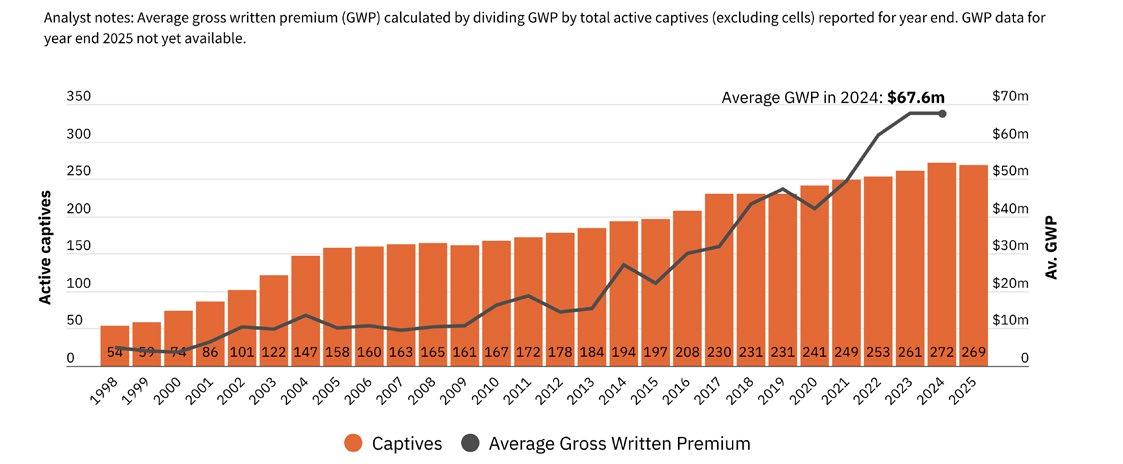
As of 2025, Hawai’i is home to approximately 269 actively licensed captives, ranking among the top five domiciles in the United States and top ten globally. These captives represent approximately $44.8 billion in assets under management and over $11 billion in capital and surplus, underscoring the scale, sophistication, and financial strength of Hawai’i-based programs.
Beyond industry metrics, Hawai’i’s captive sector contributes an estimated $140 million annually to the State’s economy, reflecting its role as a meaningful and sustainable component of Hawai’i’s broader economic diversification strategy.
Despite its global reputation, Hawai’i has occasionally faced outdated perceptions that its appeal is driven more by location than substance. The data and experience of captive owners tell a very different story. Hawai’i today supports a diverse portfolio of sophisticated captive programs across industries including technology, higher education, healthcare, transportation, and global manufacturing, many of which involve complex, multijurisdictional risk structures.
“If we were advising a new captive owner considering domicile options, we would say that Hawai’i is a domicile with which one can build a long-term relationship with confidence. The regulators’ approach, high quality of professional advisors and strong presence of Japanese companies create an environment that is very accessible.”
H&M spokesperson.
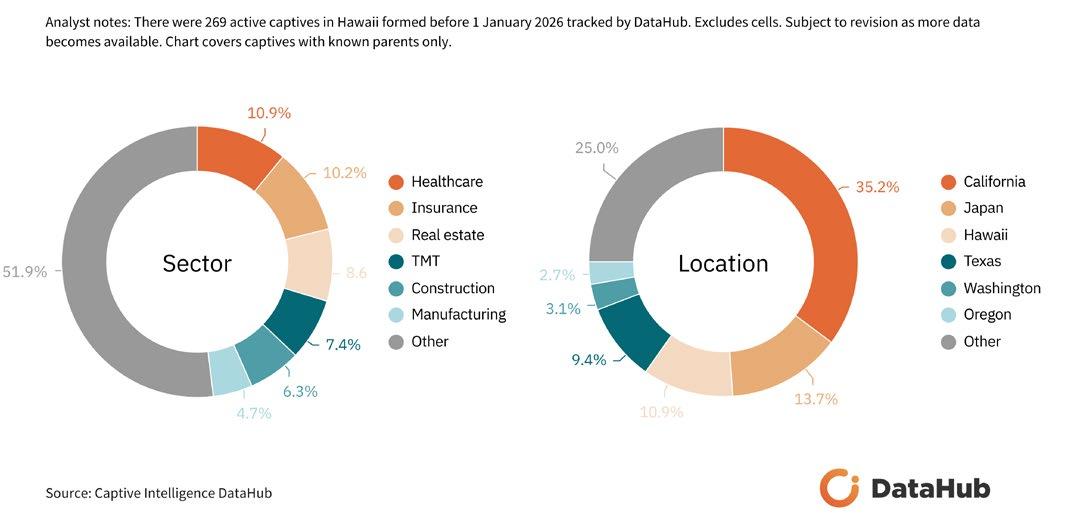
Hawai’i captives at the end 2025, breakdown by sector and parent location
Source: Captive Intelligence DataHub
Leading global companies – including those operating at the forefront of innovation – have selected Hawai’i not for convenience, but for regulatory quality, strategic alignment, and long-term reliability.
In Hawai’i’s forty-year history as a captive domicile, numerous other locations have entered the market in a bid to create a competitive edge. Many have come and gone but Hawai’i remains one of the most established domiciles in the market today, so how has the Aloha State remained at the forefront of the market?
The Hawai’i choice
As covered, in the late eighties, a campaign was launched to establish Hawai’i as an attractive captive domicile. Vermont’s captive laws were used as a helpful framework, and after this the State’s captive community worked hard to establish an attractive environment for corporates seeking flexible and innovation solutions to their risk. This is evident in the regulatory culture in the State, where the onus has been placed on ensuring captive owners feel supported in communicating with the HCIC.
Lynn Valenter, vice president of finance and treasurer at Reed College, recognises this quality and explains this is partly what drew CLIC to incorporate in the state in 1988. CLIC is a risk retention group, of which Reed College is a founding subscriber, that provides liability coverage to a number of private colleges and universities on the West Coast
“Hawai’i brings the `ohana [family] of caring about others to its role as a regulatory agency with significant responsibilities,” says Lynn. “The history of providing regulatory oversight to captives is reflected in responsiveness to staff inquiries, permissible exceptions with a clear process and strong communications. Hawai’i is invested in ensuring compliance with the long-term view to partnership.”
HOW HAWAI’I EDGES THE COMPETITION
In contrast to jurisdictions that emphasize speed to market or minimal oversight, Hawai’i’s approach is grounded in long-term viability and regulatory credibility – attributes that are increasingly valued by boards, regulators, and global stakeholders.
When it was exploring captive domicile options in 2001, the Kinki Nippon Tourist Company was spoilt for choice. However, the value of Hawai’i extended beyond geographic and cultural affinity according to a
A state at the forefront of innovation
With its proximity to the US West Coast, Hawai’i has increasingly become a domicile of choice for companies operating in complex and evolving risk environments, including technology platforms, mobility, and digital economy businesses. These organizations require regulators who understand non-traditional risk models and are willing to engage constructively – capabilities that have become a hallmark of the Hawai’i Insurance Division.
The latest insights from Ci DataHub show that while high profile technology giants such as Meta, NVIDIA, Alphabet and Uber feature prominently among Hawai’i’s captive cohort, the jurisdiction is also well diversified and utilised by companies across sectors, including Healthcare, Financial Services, Real Estate construction.
Hawai’i’s open-minded approach towards insurance has made it stand out, especially to companies such as these with disruptive business models. Uber – a taxi company without cars that helped establish the rideshare model as we know it today – found commercial capacity and understanding scarce in its early days. Brian Benbow, Uber’s senior manager of insurance strategy and operations, explains that Hawai’i’s refreshingly different attitude could not have been more helpful.
“When we established [our Hawai’i captive Aleka in 2014], Uber was a new and developing business,” reflects Brian. “We needed regulators who were knowledgeable, flexible, and fostered a business-friendly environment.
“The Hawai’i Insurance Division delivered - their accessibility and willingness to understand our unique business model have been paramount to our success. HID’s reasonableness in reviewing capital requirements and openness in approving alternative mechanisms to meet minimum capital obligations, has reduced the financial burden and liquidity constraints of managing our retained risk pool.”
This success has been built on the collaborative environment Hawai’i has fostered between regulators and the industry.
company spokesperson, who picks out three points that distinguished the state from other domiciles:
• Clarity and consistency of regulatory philosophy. A balanced supervisory approach that is not overly formalistic but grounded in practical realities.
• Quality and experience of service providers. A strong group of accounting, legal and management professionals with extensive
experience in operating captives for Japanese companies.
• Peace of mind as a captive owner. A long-standing concentration of Japanese companies, resulting in low cultural and language barriers.
The combination of these factors has enabled to establish a solid position as a domicile that is “easy to operate in, easy to consult with, and easy to continue in’,” they add.
Should an issue arise, the HID and HCIC want parties to come together early and discuss potential solutions – a departure from rigid or overly prescriptive legislation in other domiciles.
“Hawai’i has a depth of experience as an alternative risk finance innovation center, particularly for the transportation, technology and digital economy sectors,” adds Brian. “The HID’s regulatory philosophy is centered on partnership and collaboration; maintaining dialogue with captive owners to assist in nextgeneration captive evolution, rather than a rigid, one-size-fits-all approach.”
Global appeal
Hawai’i’s reputation as a captive domicile has extended far beyond its shores, and today it is the domicile of choice for captive owners from throughout the US, Europe and Asia. The State’s unique location – between mainland North America and Asia – has also seen it carve out a niche among captive owners in Japan. Today, many Japanese companies – Aisin Corporation, NTT, Epson and Otsuka to name a few – use Hawai’i as the base of their captive operations. Kinki Nippon Tourist Company is one of these.
“Hawai’i’s regulators have consistently maintained a transparent supervisory approach over many years and have responded promptly and thoughtfully when needed,” explains a Kinki Nippon Tourist Company spokesperson. “In particular, the accessibility of decision-makers and deep understanding of Japanese companies provide significant reassurance, even for relatively
simple captives like ours. Thanks to this environment, we have been able to operate our captive stably over many years, and Hawai’i has truly earned our trust as a long-term partner.”
“The regulators will take the time to truly understand your business model and are willing to work with you to find solutions that support your organizational goals. It is an ideal, forward-thinking environment for companies in dynamic industries looking to build a sustainable, long-term captive strategy.”
Brian Benbow, Uber
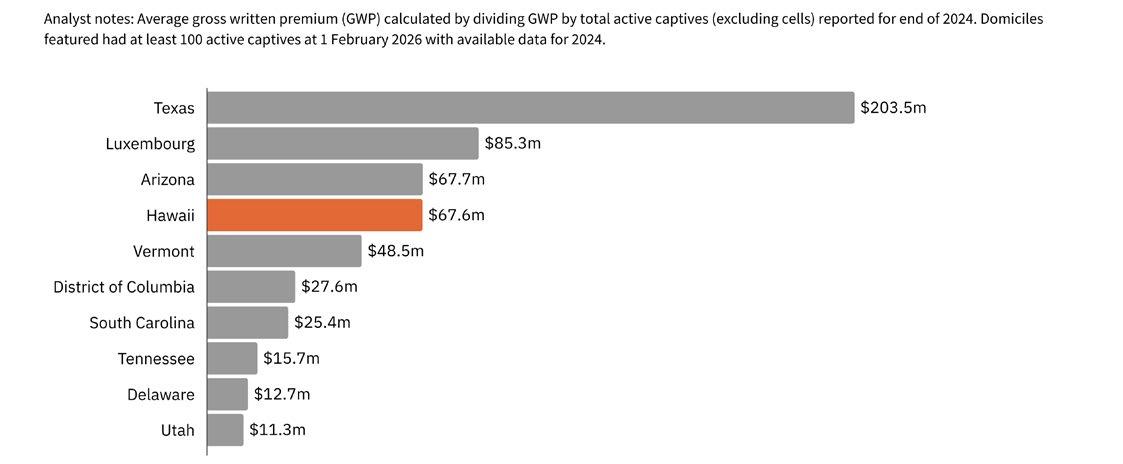
Source: Captive Intelligence DataHub
Average gross written premium for 100 Club domiciles in 2024
INTEL’S 20+ YEARS IN HAWAI’I
In 2004, Intel licensed its captive Technology Assurance Limited in Hawai’i. Intel’s director of risk management Lora Figgat explains this was originally formed to be a reinsurance mechanism to support the group’s worldwide corporate insurance program. Since that time, Intel has also utilized Hawai’i to meet Department of Labor requirements to have an onshore, benefits-insuring captive.
“Open communication with the regulator and the flexibility with captive owners to help them achieve their business goals has always been appreciated,” remarks Lora. “The easy
nature of working with the Hawai’i regulatory team, open collaboration and quick communication has led to continued satisfaction with the jurisdiction and no feeling of a need to investigate or move to other jurisdictions.”
In time, Intel also added international employee benefits to its captive, which allowed it to take the risk margin as a savings, while also streamlining workflow for its HR Benefits team, stabilizing premiums for employees and broadening benefits for a One Intel approach across jurisdictions as much as possible. Overall, this has allowed
Intel to balance coverage terms & pricing with key insurance partners on large programs.
This has all seen Hawai’i being a safe home for Intel’s captive for over two decades, and Lora sees this continuing through the strong relationships the State and the corporate have formed during this time: “We feel there is continued flexibility going forward as we look at new and innovative ways to manage our risks internally and how we access reinsurance players in the market to make the best financial and coverage decisions going forward.”
“The State of Hawai’i, through its HCIC, provides expertise, oversight and infrastructure to support captives through all compliance elements, which allows them to devote resources to serving their primary missions. We value them as a thought partner, lending expertise and oversight to our group for the last 38 years.”
Lynn Valenter, Reed College
The Next 40 Years and Beyond
As the global risk landscape becomes more complex, the role of leading captive domiciles is evolving. Hawai’i is uniquely positioned not just to participate in this evolution, but to help shape the future of captive insurance globally.
For the past four decades, Hawai’i has provided a base of operations to companies around the world through many challenging periods. This has included market crashes, a global pandemic and the numerous catastrophes that regularly trigger sudden losses and claims.
However, amid all of this, Hawai’i’s security and certainty has seen it present an oasis of calm to captive owners. The State’s ability to maintain itself as a stable, experienced and highly credible regulatory environment, even throughout changes in leadership, has helped it provide a level of consistency that captive owners see as invaluable.
“Businesses rely on predictability and the ability to meet customer needs,” says Lynn. “Hawai’i’s steady hand with regard to regulations and compliance allows for change as needed, partnership to consider alternatives and a shared investment in meeting the mission of the captives, which in turn, supports the mission of the participating organizations.”
The power of innovation
When Hawai’i took its first steps into the captive world, back in 1986, only four other US states had captive-enabling legislation. The Aloha State was entering unchartered territory as it carved out its own niche in this relatively unexplored market.
Over the next four decades, this has paid dividends and Hawai’i’s captive community remains at the edge of innovation. Hawai’i’s flexibility and open-mindedness has already seen it win friends among some of the biggest – and most disruptive – names in tech, and bold new frontiers in the world of AI potentially suggest a new era for the domicile.
Captives are at the forefront of new and expanded risk finance and risk capital development activities, according to Ward, and with advanced data management, analytics and agentic AI tools, captive insurance designs are now at the cutting edge of innovation.
“Hawai’i has done well to position itself as a prime domicile for disruptive innovation companies to bring new products, services and capital structures to market,” says Ward. “Captive AI can process vast insurance cost and transactional datasets to generate faster, more precise risk analyses and pricing insights. Captive AI can also support claims management through intelligent triage, fraud detection, and real-time decision assistance.
“We are only at the beginning of a massive transformation of the risk finance space.”
“Hawai’i prides itself on being at the leading edge of captive development. We look forward to many more years of stability and growth, partnering with HID to explore new use cases, program structures, and capital efficiencies that will support Uber’s ongoing expansion and emerging risk management needs.”
Brian Benbow
“The easy nature of working with the Hawai’i regulatory team, open collaboration and quick communication has led to continued satisfaction with the jurisdiction.”
Lora Figgat, Intel
An oasis in uncertain times
The domicile is not forgetting what, culturally, has helped it attract and retain so many captive owners over the years. Looking ahead to uncertain times, the ethos of collaboration across the industry – between owner and regulator – will still be championed and this is crucial according to those who helped build what Hawai’i is today.
This is perhaps more relevant than ever, given the geopolitical uncertainty gripping insurance and financial markets alike in the world today, something not lost on those first founding fathers. A testament to the HCIC’s goal of honoring the past, while building for the future.
In the past decade, this has included enhancing relationships with the global captive industry with HCIC being a vocal entity at the table. This has included the Council being recognised as an active and involved participant via events such as the European Captive Forum in Luxembourg, the Captive Insurance Companies Association’s International Conference, and annual educational seminars and carrier collaboration in Japan.
Continued collaboration with the global captive community is an important part of HCIC’s work, imparting the experiences from the State’s 40 years as a leading domicile while helping others innovate and prepare for future challenges.
“Embrace the legacy and be a part of its future evolution,” says Jerry, when asked about what Hawai’i needs to do going forward. “Overall, we have to continue to be deeply engaged in the industry, and that’s not only the private sector, but also for the government to be responsive to the applicants, be up to date on the issues that are confronting the industry.”
“We have to keep our eyes on what’s going on, listen to what people are saying and try to stay ahead of the game.”