



THE OUTLOOK FOR INVESTMENT IN AFRICA: RISKS AND REWARDS
WHERE TO INVEST IN AFRICA 2020: EGYPT TOP DESTINATION
AFRICAN INSTITUTIONAL INVESTORS
FINANCING GAP IN AFRICA




THE RULE OF LAW’S ROLE IN ATTRACTING FOREIGN INVESTMENT
AFRICA’S CITIES ARE ABOUT TO BOOM OR EXPLODE
CHARTING AFRICA’S BUSINESS TER
RAIN: GHANA, BOTSWANA, ETHIOPIA, NIGERIA, SOUTH AFRICA, WAEMU

Editor Tunde Akodu
Associate Editor
Michael Osu
Feranmi Akodu
Advertising & Sales
Tola Ketiku
FEATURED ARTICLES
The Outlook for Investment in Africa Risks and Rewards
Where To Invest In Africa 2020: Egypt Top Destination
African Institutional Investors Financing Gap in Africa
Charting Africa’s Business Terrain Uncovering Botswana Opportunities
Doing Business in Ethiopia Legal and Regulatory Viewpoints
Doing Business in Ghana Perspective on Ghana as an Investment Location
Doing Business in Nigeria Some Tax Perspectives
Doing Business in South Africa Charting the Tax Landscape
Doing Business in West African Economic and Monetary Union: Issues Related to Financial Services and Banking
The Rise of Mauritius as a Family Office Destination
The Rule of Law’s Role in Attracting Foreign Investment
Funding Model for the Development of Mineral Resources in Africa
Investing in Rwanda: Finding Opportunity in the Land of a Thousand Hills
SPECIAL FEATURE
Why Africa’s Industrialization Won’t Look Like China’s
Africa’s Cities Are About to Boom or Explode
The Carbon Tax Act Makes South Africa’s Position Clear
A Hawk’s View on Commencement and Termination of Business Rescue Proceedings Will Companies Be Rescued Under the Companies Act of 2008, Act No 71?

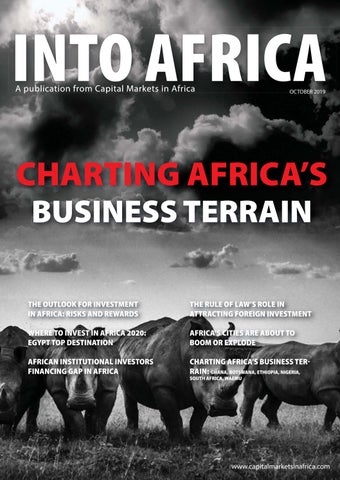
Welcome to the October 2019 edition of INTO AFRICA, a publication written by the professionals, for professionals, investors, policymakers … Advancing and providing fresh insight into Africa’s emerging markets through renowned thought leadership and peer-to-peer knowledge-sharing. The edition is titled: Charting Africa’s Business Terrain.
Africa’s business potential is tremendous and in various sectors, including energy, infrastructure, agriculture, natural resources, and information and communications, offering opportunities for investors. However, these business opportunities come with many challenges to doing business – which are not differ from other continents. The question is how to balance risk, reward, and regret, as there are massive opportunities for growth across the continent. Also, the perceived risk is often exceeded real risk and doing business environment is improving rapidly in several countries such as Mauritius, Rwanda, Botswana, Nigeria, South Africa, and Kenya all offering ease in doing business through conducive environments and incentives. In the World Bank Group’s 2019 Doing Business Report, Mauritius remains the leader in the ease of doing business rankings in Africa as its ranking progressed from 25th to 20th, for the first time an African country to join other economies in the top twenty rankings worldwide
Opening the discourse, BARNABY FLETCHER (Associate Director, Control Risks) examines the risk and reward of investment in Africa. He pointed out that change is occurring, and this is creating new investment opportunities, as the economic role of the state is shrinking as countries. In parallel, CELESTE FAUCONNIER (Sub-Saharan Africa Economist, Rand Merchant Bank South Africa) looks at where to invest in Africa in 2020 and she identified these six key sectors: resources, retail, finance, ICT, manufacturing, and construction. Besides, GUILLAUME ARDITTI (Founding Partner, Belvedere Africa Partners Paris) postulates that African institutional investors (such as pension funds and sovereign wealth funds) are key to close the continent's financing gaps
Exploring further, TEMO NTAPU (Director of Business Intelligence, The Botswana Investment and Trade Centre) discusses doing business in Botswana and providing some key facts on the country. In addition, MEKDES MEZGEBU (Senior Associate, Mesfin Tafesse & Associates Ethiopia) and DEBORAH HADDIS (Associate, Mesfin Tafesse & Associates Ethiopia) explore doing business in Ethiopia from a legal and regulatory viewpoint. Besides, GEORGE KWATIA (Head, Tax Line of Service, PwC Ghana and Sierra Leone), CHINEDU EZOMIKE (Partner & Head, Commercial Practice, Andersen Tax, Nigeria) and VELI NTOMBELLA (Head of Tax Advisory Services, SNG Grant Thornton South Africa) provide a tax element to doing business in Ghana, Nigeria and South Africa respectively. JONATHAN MAZUMDAR (Strategic Advisor, Rwanda Development Board) and GUY BARON (Chief Investment Officer, Rwanda Development Board) write on investing in Rwanda.
Proving more insight, MAME NGONE SOW (Senior Associate, GENI & KEBE, Senegal) addresses the key issues relating to repatriating proceeds from the sale of mining and oil and gas products in the West African Economic and Monetary Union (WAEMU) member states. As well, she examines the funding options for the development of mineral resources in Africa. While JIMMY HOW SAW KENG (Client Director, Ocorian Mauritius) and KENNY CURPEN (Private Client Director, Ocorian Mauritius) showcase Mauritius as a family office destination. Also, NDUBUISI EKEKWE (Founder African Institution of Technology and Chairman of Fasmicro Group) discusses the reason why Africa’s industrialisation would not look like the China’s industrialisation. Likewise, ANDREW SKIPPER (Partner and Head of Africa, Hogan Lovells South Africa) write on the rule of law’s role in attracting foreign investment.
And still more, ATHI JARA (Director, Gwina Attorneys South Africa) looks at South Africa’s carbon tax law and BONGANI MEMANI (LNP Attorneys Inc. South Africa) provide a hawk’s view on commencement and termination of business rescue resolution. In parallel, JUDD DEVERON (Director, Center for Strategic and International Studies) and TODD MOSS (Executive Director, Energy for Growth Hub) argue that Africa is increasingly urbanized, and its future will be shaped not in sleepy remote spaces but in the dense vibrant clusters of Lagos, Addis Ababa, and Kinshasa.
Cover Image: By Laurent Baheux african-wildlife-photography-20
to the accuracy of the information contained and opinions expressed therein.
Editor
Connect with The Editor on Linkedin. Follow us on twitter @capitaMKTafrica. Subscribe to INTO AFRICA at http://eepurl.com/buHhNv or please send an email to intoafrica@capitalmarketsinafrica.com.
Please visit our website at www.capitalmarketsinafrica.com for the latest news, bespoke analysis, investment events and outlooks.
By Barnaby Fletcher, Associate Director, Control Risks

fter a difficult few years, Africa is on the path to recovery. In 2016 sub-Saharan Africa experienced its lowest GDP growth in almost 25 years, as it struggled with low commodity prices and stagnant politics. But growth rates are starting to recover and so is investor interest. In 2018 foreign direct investment (FDI) into Africa rose by 11%, even as global FDI flows fell. The underlying attractiveness of Africa as an investment destination – its demographics, natural resource wealth and ability to leapfrog technological paradigms in areas such as telecommunications or finance – have long been known. But its current recovery is based on more recent trends.
To track these trends and how they manifest across the continent, Control Risks and our economics partners Oxford Economics have developed the Africa Risk-Reward Index1. This aims to provide an independent assessment of Africa’s challenges and opportunities based on the underlying political and economic structures in each country, rather than on the high-profile but
transient events that typically dominate headlines. The results in the fourth edition reflect the improvement in Africa’s overall attractiveness as an investment destination and highlight the trends behind this.
The trend that has garnered the most headlines has been the reformist vanguard. From Prime Minister Abiy Ahmed of Ethiopia to President João Lourenço of Angola, a new generation of leaders have put forward ambitious reform agendas that have fuelled significant investor excitement. But the real political lesson from the past few years has been not to underestimate the strength of other political structures. Africa is not the “Big Man” continent of stereotypes and leaders cannot simply transform a country’s structure on a whim. Reform agendas are already slowing as leaders are forced to navigate through a web of influential stakeholders with competing objectives.
Change is occurring and this is creating new investment opportunities. The economic role of the
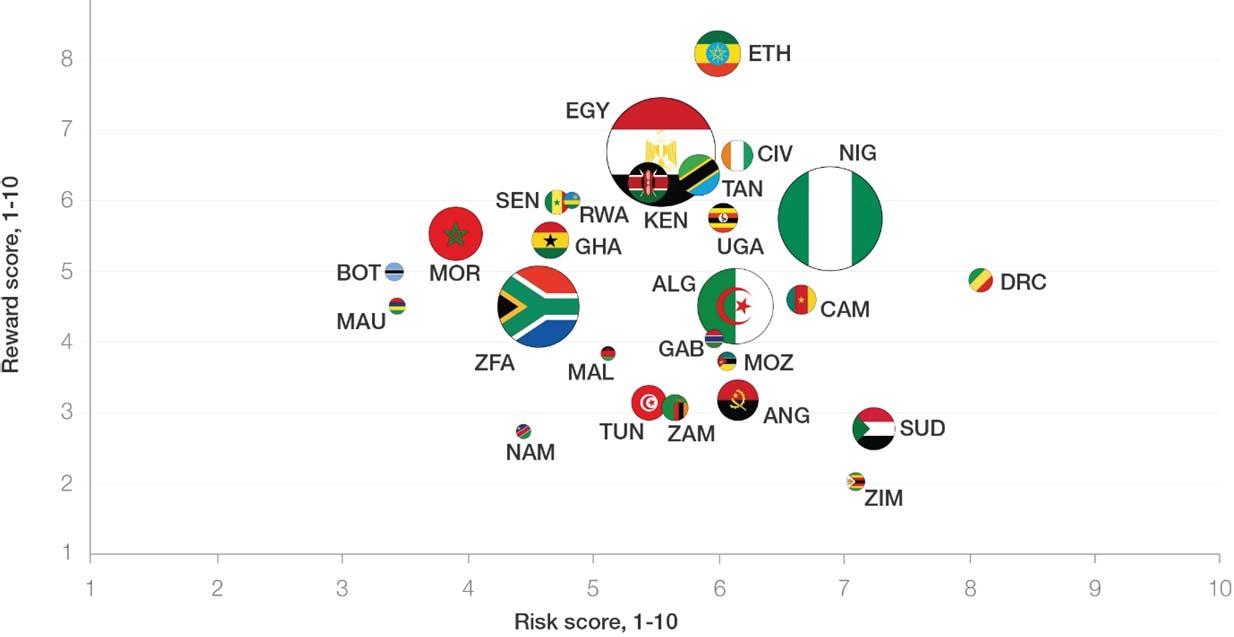
state is shrinking as countries such as Mozambique and Zambia engage in privatisation programmes, which is opening up space for the private sector. But different sectors in different countries will open up at different rates and in different ways depending on vested interests and political considerations. Investors who have so far profited from the reforms initiated in Angola and Ethiopia have taken the time to understand the overlay of political and commercial interests and used this understanding to identify which reforms will proceed and which will stagnate. In contrast, those who take announced reforms at face value and assume they will proceed as planned risk losing out.
Another trend that has received attention is the progress being made towards unlocking the huge potential long promised by increased intra-Africa cooperation. Media attention has been attracted to the ratification of the African Continental Free Trade Area, which is undoubtedly an important milestone but the implementation of which will undoubtedly be long and torturous. More substantial – albeit often unheralded – unheralded progress has already been made among Africa’s various regional bloc such as the Southern African Development Community (SADC) and the Economic Community of West African States (ECOWAS).
One of the most successful of these blocs is the East African Community (EAC). The EAC may not contain any of the continent’s giants, but the region as a whole continues to register the highest levels of economic growth on the continent. In recent years, the EAC’s Common Market has led to a modest increase in intra-regional trade by slowly easing restrictions on the movement of goods and people across borders, especially benefitting its landlocked member Uganda, Rwanda and Burundi. The international community has bought into the idea of the EAC, with multilateral institutions such as the World Bank and African Development Bank extensively and enthusiastically funding capacity building initiatives for EAC institutions as well as transport, energy and communication infrastructure to better link the EAC member states.
Alongside growing intra-Africa cooperation there is also growing geopolitical competition, the third major trend highlighted in the fourth edition of the Africa Risk-Reward Index1. The standard narrative of geopolitics in Africa may still be around the US-China rivalry, but in reality, this focus on bipolar competition was always simplistic and distracts from an increasingly multipolar landscape. The
European Union (EU) is acting as an ever-more unified and hugely influential force, while the past decade has seen a surge of interest in Africa from smaller geopolitical players such as Russia, India, the Gulf states and Turkey.
This competition is driving flows of development finance towards the continent and prompting a change in how that finance is allocated. Both new and old geopolitical players are actively seeking political influence and aggressively promoting commercial interests. There is certainly a risk that this crowds out private-sector investment, or that private-sector investors find themselves unable to compete unless they tie themselves to wider geopolitical objectives; a strategy that carries its own risks. But it also drives growth and opportunities for those investors able to understand and navigate the new geopolitical landscape.
These three trends are by far from the only ones driving change in Africa. Much could be written about the impact of technology, transnational regulations, growing financial inclusion or any number of other trends. These trends are also far from being applicable across the entire continent and manifest themselves differently in every country. Similarly, the African Risk-Reward Index –just as any ranking or index – will never capture all the nuance and complexity of an individual country that must be understood to ensure investment success. Nonetheless, they are important, and they do contribute to Africa’s ongoing economic recovery.
Contributor’s Profile
Barnaby Fletcher is Control Risks’ Senior Analyst for Southern Africa. He is a regular contributor to Control Risks’ subscription services, as well as responding to regular ad-hoc sector-specific queries from Control Risks’ clients operating in wider region. Barnaby also works on bespoke consulting projects for clients.
Prior to joining Control Risks, Barnaby was a contributing analyst to the Economist Intelligence Unit, focusing on political and economic developments within sub-Saharan Africa. He also worked as executive editor of Global Business Reports, a business media company focused on the energy and mining industries and has contributed work to publications including Engineering & Mining Journal, Hart’s E&P, and Oil & Gas Investor. He has previously worked with AKE Group and Africa Confidential.
By Celeste Fauconnier, Sub-Saharan Africa Economist, Rand Merchant Bank

gypt is the top investment destination in Africa If you were to invest in Africa right now, where would you take your money? According to the latest 2020 RMB Where to Invest in Africa Report1 , it’s Egypt. Egypt’s sophisticated business sector, market size and increase in investment from the private sector has made it the most attractive investment in Africa right now. South Africa has fallen to the third place, overtaken by Morocco. These are some of the many useful insights contained in the latest Where to Invest in Africa Report, compiled by authors Celeste Fauconnier, Neville Mandimika and Nema Ramkhelawan-Bhana from the RMB Global Markets Research team.
The much-coveted Report showcases the top ten investment destinations in Africa. The Report is based on RMB’s Investment Attractiveness Index which provides a means with which to discern the most appealing of these destinations by overlaying macroeconomic fundamentals with the practicalities of doing business on the continent.
The top ten most attractive countries to invest in according to the 2020 Report are: (#1) Egypt, (#2) Morocco, (#3) South Africa, (#4) Kenya, (#5) Rwanda, (#6) Ghana, (#7) Côte d’Ivoire, (#8) Nigeria, (#9) Ethiopia and (#10) Tunisia.
Key
This year, the Research team focused on six sectors: resources, retail, finance, ICT, manufacturing and construction which they believe are key to inclusive growth in Africa.
According to the Report, manufacturing is set to take centre stage as Africa (with its abundance of natural resources) is focusing on turning its raw materials into manufactured goods to boost exports and reduce reliance on imports. Financial services continue to play a critical role in supporting project development in key areas such as infrastructure, healthcare and energy projects, while the ICT sector and Internet access, longviewed as a luxury in Africa, are fast becoming crucial to inclusive economies.
Construction activity is surging as countries attempt to bridge the funding chasm between what’s needed and what’s actually being spent, while mining, energy and agriculture all offer vast opportunities for the savvy investor. Turning to retail, it’s all about playing the long game. While the middle class is not growing as fast as expected, the potential is still evident in the numbers.
Taking a tumble
South Africa, Ethiopia and Tanzania are among the more prominent countries to have taken a tumble. A deterioration in the ease of doing business has contributed to their relative underperformance and, in addition, South Africa is enduring a cyclical downturn.
Tanzania’s fall from grace has reshuffled the top ten investment destinations, with Tunisia returning to the fold at number ten, while Côte d’Ivoire and Ghana edge ever-closer to the top five. North Africa remains dominant with Morocco displacing South Africa in the rankings, rising to second place.
There is an even split of countries from the north, east and west within the top ten rankings, with only South Africa representing the southern tip of the continent, as a result of its dominance in terms of market size.
The Top 10 most attractive investment destinations
The authors said that after nine years of publishing they never fail to be both pleased and surprised by the extent of improvement in countries that are not necessarily perceived as strong investment destinations. This year, Guinea, Mozambique and Djibouti recorded the strongest gains in the rankings, with notable advancements in their operating environments.
#1 Egypt: The enormity of the market paired with a sophisticated business sector relative to other countries makes Egypt the most attractive invest-
ment destination in Africa. The improvement in Egypt’s business environment, facilitated through government programmes, combined with the progressive increase in investment from the private sector has enhanced economic growth and assisted in repositioning Egypt on the global investment map.
#2 Morocco: While only Africa's fifth-largest market, Morocco’s expected growth rate of 4% over the medium term and its greatly-enhanced operating environment has served the country well since the Arab Spring. Its reintegration into the African Union and accession to the Economic Community of West African States (ECOWAS) have enhanced its investment appeal.
#3 South Africa: South Africa has slipped another place in this year’s rankings, stymied by depressed levels of growth and a lack of structural reform. Yet it remains Africa's hotspot for portfolio investment. With many countries facing severe liquidity constraints, South Africa’s financial markets and level of financial inclusion are still a cut above the rest.
#4 Kenya: The above 5% expected growth rates, helped by favourable weather and political reconciliation after 2017’s disputed elections, has propelled Kenya one spot higher than 2019. The economy benefits from diversity as well as a sustained expansion in consumer demand, urbanisation, East African Community (EAC) integration, structural reforms and investment in infrastructure, including an oil pipeline, railways, ports and power generation.
#5 Rwanda: Rwanda has the second-best business environment in Africa. According to the World Bank’s operating environment scoring, the country has more than doubled the efficiency of its business environment in less than a decade. The government has also invested heavily into its domestic industries, while FDI has increased over the same period, pushing Rwanda to being one of the five fastest-growing economies on the continent.
#6 Ghana: The growth outlook is strong, concentrated around the oil and gas sector. Non-oil growth will pick up again, supported by probusiness reforms and a steady improvement in power supply. Political stability will remain underpinned by Ghana's strong democratic credentials. Regardless of a recent deterioration in its operating
environment rankings, Ghana remains one of the easier business environments in Africa.
#7 Côte d'Ivoire: Côte d'Ivoire is one of the more diversified economies in francophone Africa. Its strong growth rates are supported by the government's pro-business reforms and a relatively stable political context. Large infrastructure projects, particularly in transport and energy (financed by foreign investment, aid inflows and the government) also support the country's strong position in the rankings.
#8 Nigeria: Nigeria retains its top ten ranking due to improved macroeconomics, supported by recovering oil prices and production. As the largest economy in Africa in nominal terms, the possibility for investment cannot be overlooked; and with the largest population on the continent, domestic demand continues to rise. Resources and favourable demographics are attracting strong flow of FDI. The liquidity crunch has subsided since 2017 as commodity prices have recovered and changes in FX regulations have been implemented.
#9 Ethiopia: Ethiopia is the fastest-growing economy on the continent. With a population of almost 100 million people, demand for goods and services is rising significantly. The prohibition of foreign ownership in key sectors is still a constraint for investment, but this is slowly changing. The government has announced shake-ups across industries, including plans to open up the once closely-guarded telecommunications and power monopolies.
#10 Tunisia: Tunisia re-enters within the top ten supported by a reasonable market size and favourable operating environment. The government's encouragement of foreign investment, through its new simplified investment code, has made the country increasingly attractive to multinational manufacturers.
Contributor’s Profile
Celeste Fauconnier is a Sub-Saharan Africa Economist for the Global Markets Research team at Rand Merchant Bank for the past thirteen years. She finished her under-graduate degree in International Relations at the University of Stellenbosch and completed her honours at Wits University. Celeste formulates macroeconomic and financial market views for various sub-Saharan African countries. Her team has won multiple awards in the past decade for the best Africa Research House.
By Guillaume Arditti, Founding Partner, Belvedere Africa Partners Paris
he financing gap in Africa remains a recurring theme on the continent’s investment landscape. Within the infrastructure sector alone, estimates increase year on year: currently, they range from $100bn1 to $140 bn p.a. whereas available resources cover only half of the continent’s infrastructure needs. In 2017, the IFC estimated that Sub-Saharan micro-enterprises and SMEs were in a dire need of an estimated $330bn2 , widening the already existing financing gap.
The difficulties are well-known and multi-dimensional: it is difficult for domestic banking systems to lend on a long term basis, resources tend to be allocated in favour of government paper to the detriment of the SMEs, and financing conditions remain generally expensive, as Central Banks seek to counter inflation through high interest rates. Additionally, the lack of market depth and liquidity in capital markets limits the available equity and fluidity for IPOs or M&A transactions while on the international side most of the large banks have tended to retreat from the continent in the last years. Development Finance Institutions (DFIs) have been trying to extend their footprint through multiple initiatives but official development aid globally remains stable or tends to slightly decline on the back of budgetary restrictions3
There is no silver bullet to solve the financing gap issue and it is only through the improvement of each of the financial sub-sectors that it will be possible to finance the needs of the different economic segments and create robust, diversified and resilient financial sectors.
Now if one focuses on one of the segments, the availability of international resources, African institutional investors might have the opportunity to play a decisive role in bringing new sources of liquidities to the continent.
Let’s step back on why major international banks
1. http://www.africaneconomicoutlook.org/

retreated. One of the main reasons was that, to meet the prudential ratios defined by the regulation post 2008 Global Financial Crisis, their capital consumption increased exponentially for transactions in non-investment grade countries: for two transactions with identical counterparty risk, the one in a lower-rated country needs to pay a premium not only the same return on capital but a higher one in order to compensate for intangible costs: remote monitoring, reputation risk, knowledge acquisition, etc. The premium needed to overcompensate the risk differential has become so high that it either jeopardises the viability of the project or undermines profitability to a point where investors retreat.
Protecting financial institutions from country-risk volatility is laudable, but one of the few advantages of being rated lower is a lower downside (mirroring greater growth potential). Take Greece and Egypt: Greece went down from A-rated at the end of 2008 to C-rated by mid-2011, losing 15 notches in less than three years; Egypt was rated BB+ in January 2011 and it took a revolution to take it 6 notches down to CCC+ in May 2013, before recovering to B- by year-end, where it has stabilised so far4 There is simply far less volatility in non-investment grade countries, which should be acknowledged in one way or another.
Unfortunately, regulation is not close to evolving but the situation nevertheless says something: that for international players who used to work in Africa, the main deterrent has not been a credit risk. There is, therefore, a unique opportunity to bring in a new breed of investors, not submitted to the same type of regulations, such as large Asset Managers, Funds or HNWIs.
For the last years, liquidity has been amassing on a large scale in Europe and the US, only to provide unsatisfying low yields. Consequently, investors are now increasingly eyeing the African markets. They are nevertheless still shying from making their
2. https://www.avca-africa.org/research-publications/data-reports/avca-private-credit-strategies-in-africa/
3. http://www.africaneconomicoutlook.org/en
4. https://ieconomics.com/credit-rating
first steps essentially for fear of political and image risk.
The situation was the same over twenty years ago with equity investors: DFIs successfully promoted the development of the Private Equity industry on the continent, as their presence at the round tables reassured and attracted the private sector LPs.
African institutional investors, particularly pension funds, could replicate this strategy using a new asset class, Private Debt, with a long-term focus. It would be the perfect tool to complement the existing offer and compensate for the lack of international financing. This asset class remains largely untapped on the continent – out of $107bn raised in 20175 close to nothing went to Africa, while it is widely used in Europe and the US.
Pension Funds undoubtedly have the credibility and legitimacy to play this role as DFIs did with PE. Amounts under management are now significant: South Africa obviously stands out with over $320bn, but other countries have increasingly significant amounts under management, out of which a small portion - around 15% of a Debt Fund - can be potentially used to leverage much larger ones: Nigeria, Botswana and Kenya for example, have over $25bn, $6bn and $7bn respectively under management6 .
One of the main limitations pensions funds used to face was the obligation to invest domestically. While it made political sense from a resource allocation perspective viewpoint, perspectives have been progressively shifting towards an investors’ one: benefiting from geographic diversification improves the risk profiles, while it also promotes the development of intra-African relation at a time where the AFTCA is making the headlines. South Africa7 has been paving the way, followed by Kenya, Botswana or Namibia – and many others are also considering this kind of evolution.
The DFI’s success in the PE industry rested on an essential pillar: the wide recognition that their presence at a round table provides implied protection. Indeed, the likelihood or probability of an investee or a borrower (whether public or private) defaulting on financing provided by an institution for political reasons or mismanagement is significantly much lower than with a completely
private counterpart. Pension funds could catalyse international investment the same way, if not to a larger scale: reputational damage for a project holder in Africa defaulting on African pensioners could prove worse than the one caused by defaulting on the international institution.
Furthermore, the presence of African institutional investors would also present a unique operational advantage: who better than African investors have an intimate knowledge of the domestic ecosystem, that could be leveraged to fine-tune due diligences, benefit from market intelligence, or provide support through their networks in negotiations during crisis times?
To reiterate, there is no silver bullet to tackle the financing gap in Africa. However, there is a fantastic opportunity to address a portion of it through the partnerships of African and international investors where both will fulfil their objectives bringing new sources of cash to the continent for the former, finding new markets with decent yields for the latter, in an as secured environment as it could be for both.
“African institutional investors might have the opportunity to play a decisive role in bringing new sources of liquidities to the continent.”
Contributor’s Profile
Guillaume Arditti is the founder of Belvedere Africa Partners, a financial and strategy advisory firm focused on Africa. He started his career in RSA, with the French Development Agency (AFD), then joined major financial institutions such as NATIXIS and BNP PARIBAS. His focus was always on Africa, working on landmark transactions, leading strategy and business development initiatives.
Guillaume also sits at the Ghana-France Business Club (thegfbc.fr) Advisory Board, is a lecturer in International Relations and African Studies at the Political Sciences Institute of Paris (Sciences Po) and frequently shares his analyses in international media.
5. https://docs.preqin.com/samples/2018-Preqin-Global-Private-Debt-Report-Sample-Pages.pdf
6. https://www.avca-africa.org/media/1329/pension_funds_and_private_equity_2014.pdf
7. idem
By Temo Ntapu, Director Business Intelligence, The Botswana Investment and Trade Centre

bout Botswana – A Synopsis
Botswana is an upper income middle country, with a GDP per capita of USD 7,570 (Global Competitiveness Report 2019). The country boasts a mature and peaceful democracy with an excellent track record for good governance as well as a stable political and macro-economic environment. Botswana is the most transparent country in Africa according to Transparency International. It is centrally located in the heart of Southern Africa and shares borders with Zambia in the north, Namibia in the west and north, Zimbabwe in the north-east and South Africa in the south and south-east. The country’s geographical positioning makes it a perfect gateway to access the Southern African Development Community (SADC) region. The country is 581,730 square kilometers, roughly the size of France with a population of just over 2 million people.
Given its sustained high growth rates, the country has often been hailed as Africa’s sparkling model economy.
Invest in Botswana
Living conditions in Botswana are comparable to some of the leading economies in Africa. Gaborone, Botswana’s capital city is a fast-developing city with an up-market suburb, internationally comparable golf centers, word repute hotels and resorts, an international airport, shopping malls and cinemas.
Below are some of the summary points on infrastructure and the quality of life in Botswana;
• Excellent infrastructure - the road, rail and air network is well developed, making it easy to access export markets. A sophisticated microwave and fibre optic telecommunications network enable

widespread internal and international communication by telephone, facsimile and electronic mail. In addition, three cellular companies operate in the country.
• Botswana is a cosmopolitan and peaceful country where people of all races live together in peace and harmony. In short, it is a good place to live and work in.
• Excellent education facilities, public and private.
• Very good medical facilities. The healthcare delivery system is made up of government and private health institutions, missionary, mine and private medical practitioners. There is a modern private hospital in Gaborone.
i. Transparent and Attractive Tax Code
o General corporate tax:
o Financial services corporate tax:
o Low personal income tax:
o Value added tax (VAT):
o Possible tax holidays:
o Foreign exchange controls:
o Repatriation of profits:
o Ease of paying taxes: 22% 15%
Up to 25% 12% 5-10 years
None Free to home country 6th easiest country in Africa to pay taxes in
ii. High Regard by Global Citizens Table 1: Botswana’s International Rankings
iii. Easy Access to SADC and Africa
Access to huge SADC (Southern African Development Community) market of 300 million people, Europe and the USA.
• SADC headquarters is in Botswana. Southern African Customs Union (SACU) allows
movement of goods amongst South Africa, Swaziland, Lesotho, Namibia and Botswana free of customs duty
• Botswana has duty free and quota free access Europe
• African Growth Opportunities Act enables Botswana to export to the USA on a liberal basis.
• COMESA-EAC-SADC Agreement facilitates access to Southern and East African markets
iv. Vibrant Financial Markets
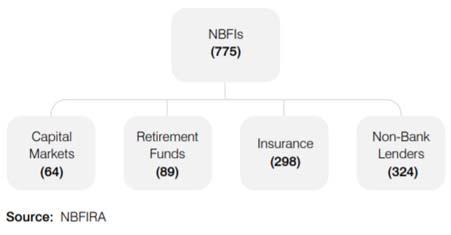
As at March 31, 2018, the non-bank financial institutions sector recorded a total of 775 active entities, reflecting a growth of 11% from 698 entities recorded in the previous year. The net increase in regulated entities is mainly due to the positive movement in all industries, with the Micro Lending industry dominating the sector with 324 players in 2018 from 311 players in 2017, followed by the Insurance industry recording 298 players in 2018 from 246 players in 2017, then Capital Markets industry with 64 players in 2018 from 53 in 2017 and, lastly, the Retirement Funds industry with 89 players in 2018 from 88 in 2017 (see figure 1).
Table 2: Structure of the Botswana Financial System Assets, as at December 31, 2018
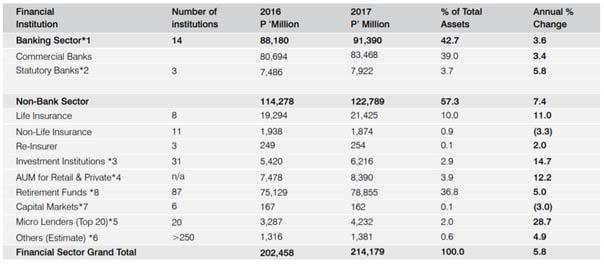
Source: NBFIRA
Figure 1: Structure of the Non-Bank Financial Institutions (2018)
Investment Opportunities in Botswana
Key Priority Sectors- Some of the investment opportunities that are actively promoted by BITC include but are not limited to:
• Mining Sector: Mining and base metals, such as
gold, uranium, copper, nickel, coal, manganese and Mining services. Also includes prospecting, expansion of existing mining projects, new mining projects, beneficiation of minerals and business opportunities relating from links with other sectors.
• Cargo, freight and logistics: Consolidation, deconsolidation, distribution, transport services, handling, warehouse management and integrated systems.
• Leather and leather goods: high premium leather production, high premium leather goods production, preferential market access through trade agreements to key growth markets for leather and leather products and exporting leather and leather goods to high growth markets.
• Automotive sector: Supply of parts and components to South Africa’s automotive sector, supply of replacement parts for vehicles of large scale projects, expansion of existing component manufacturing industries, R&D services, diversification of after-sales services for private and commercial vehicles and the establishment of skills development / training facilities for auto mechanics and technicians.
• Information Communication Technology (ICT) sector: Innovative money operations, e-Waste, TV White Space, TV Broadcasting, e-Health, BPO and Call Centres and e-Commerce, software and app development and ICT in agriculture.
• Health sector: Diagnostic facilities (imaging and laboratory), pharmaceutical manufacturing, manufacturing of biomedical equipment, medical tourism
• Education Sector: photographic safari tourism training, mining and energy technical schools, medical and health sciences school, business school, lifelong training institutions and education services for special needs students.
• Energy Sector: Power generation, extraction of coal bed methane and renewable energy projects such as solar PV plants and solar power generators as well as bio-fuel projects.
• Agriculture: Grain, fruit and vegetables, irrigation, dairy farming, leather (raw hides and skins), pork and beef products.
• Diamonds Beneficiation: Diamond trading, cutting and polishing, jewellery manufacturing and diamond related services such as security, banking, insurance, and certification and brokerage services.
• Infrastructure: Transportation and logistics
• Financial and Business Services sector: Banking, insurance and investment funds.
By Mekdes Mezgebu, Senior Associate, Mesfin Tafesse & Associates Ethiopia
Deborah Haddis, Associate, Mesfin Tafesse & Associates Ethiopia
Since the appointment of Prime Minister Abiy Ahmed as the new Prime Minister of Ethiopia in April 2018, several economic and political reforms have been introduced. Most of the legislations and policies surrounding business in Ethiopia are undergoing amendments as a result of these reforms. As part the Prime Minister’s vision of expanding the role of the private sector in the Ethiopian economy, the office of the Prime Minister launched a “Doing Business Initiative” laying out priority policy, regulatory and administrative reforms that will be adopted by various offices of the Ethiopian government. In this piece, we present a general background of the main laws that regulate doing business in Ethiopia followed by a summary of the legislative reforms that are currently underway.
The Commercial Code and the Civil Code of Ethiopia generally govern key aspects of trade such as forms of business organization, contracts, property, bankruptcy and agency1. Moreover, the Investment Laws2 regulate foreign investment with particular emphasis on sectors allowed for foreign investors and minimum requirements for investment licensing in Ethiopia. Additional relevant legislations are, the Income Tax Proclamation & Federal Tax Administration Proclamation that govern the tax and the tax administration procedures and the National Bank of Ethiopia (NBE) directives regulating foreign exchange regime in Ethiopia. The authorities responsible for business registration and operations are the Ministry of Trade and Industry (MoTI) and the Ethiopian Investment Commission (EIC) for local entities and foreign investors respectively.
Starting a Business
a. Registration and licensing
Registration and licensing are the dual obligations of any business person planning to operate in Ethiopia. A business organization acquires a legal personality when its registration is entered in the


commericial Register. Commercial registration is a pre-requirement to acquiring a business license in Ethiopia. The registration of a company in the Commercial Register results in the issuance of a Commercial Registration Certificate by the registering authority that certifies the legal incorporation of an entity. After the legal registration of the entity, in order to commence its business and start earning income the entity is required to obtain a business license. No person shall engage in a business activity without having a valid business license. Moreover, some business sectors are required to acquire a competence certification from the sector regulating authority prior to applying for a business license.
The Commercial Code recognizes 6 forms of business organizations. These business organizations can be broadly classified into partnerships and companies limited by shares. Partnership may take the form of an ordinary, general, limited partnership or a joint venture. These forms are different in the extent of the liability of the partners to the partnership.
Companies limited by shares are the most common form of business structure in Ethiopia. Limited liability companies may take the form of a share company or a private limited company (PLC). Share Companies are formed by a minimum of five members and unlimited number of maximum members. Share companies are required to have a formal management structure and are more regulated by the Commericial Code. Whereas PLCs may be formed by a minimum of two and maximum of fifty members with capital that is fully paid at the point of formation. Unlike a share company, a PLCs may be operated by a manager responsible to the shareholders, rather than having to adopt a formal management structure, such as a board.
The Investment Law categorizes investment
sectors into four broad categories of (i) sectors open to foreign investors (ii) sectors open only for joint investment with the government of Ethiopia (iii) sectors that are exclusively reserved for the government and (iv) sectors that are exclusively reserved for domestic investors. Prior to acquiring a commercial registration certificate, all foreign investors are required to get an investment permit from the EIC which is an approval and a registration of the planned investment project in Ethiopia. Furthermore, investors must fulfill a minimum investment capital requirement of USD 200,000 if it is a wholly foreign owned and USD 150,000 if it is a joint investment with local investors. The Investment Laws offer investors tax holidays and customs duties exemptions in certain sectors of the economy that are considered vital for future economic growth and investment in specified underdeveloped regions of Ethiopia.
a.
In Ethiopia, foreign exchange is centrally regulated by the NBE. The NBE fixes the daily buying price of currencies and communicates it to commercial banks on daily basis whereas the daily selling price is determined by commercial banks which should not be less than the daily buying price fixed by the NBE. Foreign investors are entitled to remit profits, dividends, principal and interest on foreign loans, and technology transfer-related fees. Foreign investors may also freely remit proceeds from the sale or liquidation of an enterprise, compensation paid to an investor, or from the sale or transfer of shares or partial ownership of a business to a domestic investor. Repatriation of company profits are often delayed due to low reserves of hard currency available in the country.
The major direct and indirect taxes applicable to businesses are the following:
The liquidation of a business entity requires a verification from the Ministry of Revenue that the entity does not have any outstanding tax and can proceed to return its licenses to the relevant issuing authority. After the tax clearance is acquired, the business entity is required to go through a formal liquidation process with the involvement of the courts. This usually may take up-to a period of 2 years.
The Prime Minister’s Doing Business Initiative aims at increasing investment, lowering costs of business formation and increasing productivity. As part to the Doing Business Initiative the following reforms are currently underway with the aim of putting Ethiopia in the top 100 for ease of doing business:
I. The Commercial Registration and Licensing law was amended to reduce procedural steps and days required to start a business in Ethiopia. The amendment also reduces the frequency of renewal of business license.
II. The Commercial Code is currently being amended by a team of local and international experts to recognize additional forms of business entities.
III. The Federal Supreme Court enacted new procedures for commericial disputes with a view to expediting adjudication procedures.
IV. The Investment Laws are being amended with a view to attracting more foreign direct investment.
V. Ethiopia became one of the first 22 countries to sign and ratify the African Continental Free Trade Agreement (AcFTA).
By George Kwatia, Head, Tax Line of Service, PwC Ghana and Sierra Leone

hana’s Economy at a glance
Ghana recorded a real GDP growth of 5.4% from January to September 2018 compared to global economy growth of 3.7% for the same period. The services sector remains the largest contributor to GDP with 44.5% and was followed by the industry and agricultural sectors with 34.2% and 21.3% respectively as at September 2018.
Following implementation of production-driven programmes such as One District One Factory, Planting for Food and Jobs and other productiondriven initiatives by the current government, 2019 economic growth is projected at 7.1%. With single digit inflation, relatively political stability and availability of vast agricultural and natural resources, Ghana remains an attractive investment destination. The government has recently introduced tax incentives for its industrialisation programme to further enhance the country’s attractiveness to foreign investors.
Sectorial performance and outlook for investment
The 2019 Mid-Year Budget Review estimates growth in all the three sectors of the economy and anticipates that the continuous implementation of the production-driven programmes mentioned will propel with growth in the Agricultural and Industry sectors.
recorded a 22.3% improvement in profit-after-tax of GHS 1.95b in October 2018 relative to GHS 1.59b in October 2017. Additionally, the sector saw a decline in Non-Performing Loans ratio from 22.6% in June 2018 to 18.1% in June 2019. The improved performance is attributed to the reforms by the government to improve investor confidence and shore up the banking sector’s ability to finance big-ticket transactions.
The Ghana Stock Exchange (GSE) and Security and Exchange Commission (SEC) are key participants of the capital market in Ghana. GSE provides a platform for the for purchase and sale of shares while SEC regulates and promote the growth and development of an efficient, fair and transparent securities market in which both the interest of investors and the integrity of the market are protected.
Doing business in Ghana and what to look out for
Setting Up or acquiring an entity
In Ghana, a foreign investor can conduct business by setting up a subsidiary limited liability company, registering an external company (branch) or forming a Joint venture (JV) with a local partner. The business must be registered at the Registrar General Department and a Tax Identification Number (TIN) obtained for the entity. The registration fee is GHS 330 (approximately US$ 70) and a stamp duty of 0.5% is payable on the stated capital of the company.
Also, all entities with foreign participation are required to register with the Ghana Investment Promotion Centre (GIPC). A Joint Venture must have at least 10% Ghanaian participation and the foreign partner is required to contribute not less than US$ 200,000 either in cash or capital goods relevant to the investment. A wholly owned foreign entity is required to have a minimum capital of US$ 500,000 and a trading entity, wholly or partly owned by a non-Ghanaian needs a minimum capital of US$ 1,000,000. These minimum amounts may be increased depending on the sector the foreign investor seeks to participate in. So, for instance, a foreign investor seeking to set up a bank in Ghana would require a minimum capital of GHS 400m (approximately US$ 75m).
A general investor seeking to invest in Ghana should be concerned about income tax (including withholding tax) and Value Added Tax. These taxes if not carefully managed could affect the expect rate of return on investments.
Ghana operates a tax system, in which income from residents are aggregated from all sources and subject to income tax. Companies are taxed on their income from business or investment reduced by allowable deductions. The corporate tax rate is 25% for companies in general with some start-up and/or location incentives. Mining and upstream companies are taxed at 35%, subject to terms of the applicable petroleum agreements.
Payments by resident companies that are considered to have a source in the country are subject to withholding tax. The withholding tax rate ranges from 3% to 20% depending on the tax residency status of the recipient of funds and type of transaction.
A resident company can claim a foreign tax credit for any income tax it pays to a foreign country in respect of foreign sourced income subject to certain conditions. Also, there are reliefs from double taxation. These relief could be obtained unilaterally or under in-force treaties Ghana has with France, Germany, United Kingdom, South Africa, Italy, Belgium, The Netherlands, Switzerland, Denmark and Mauritius. The treaties with the Czech Republic, Ireland, Morocco, and Singapore are not yet in force.
In addition to withholding tax on employees’
income (under PAYE), every employer is required to register with the Social Security and National Insurance Trust (SSNIT) and pay the mandatory contributions in respect of its employees. Resident individuals are taxed on a graduated scale from 0 to 30% and non-residents at a flat rate of 25%. All taxpayers, including individuals are required to obtain a TIN. Employers of foreign nationals are also required to obtain work and resident permits for their expatriate from Ghana Immigration Service (GIS), renew same and file returns on the status of their expatriate.
Ghana principally follows the credit system of Value Added Tax (VAT), as pertains in various countries across Africa. However, there are significant differences. Chief among these are the straight levies (National Health Insurance Levy and Ghana Education Fund Levy of standard rates of 2.5% each), which are administered along with the VAT but are not subject to the credit system. VAT is charged at each stage of production/distribution as goods and services change hands. It is generally charged by the person making the supply and borne by the final consumer. The three VAT rates in Ghana are 0%, 3% and 12.5%. Other indirect taxes are Communication Service Tax, Special Petroleum Tax, Environmental tax and excise duties.
Residents and non-residents are permitted to maintain a Foreign Exchange Account (FEA) and transfer funds from FEA’s to Foreign Currency Accounts (FCA’s) or cedi accounts. FEA’s should be credited with foreign exchange generated from activities in Ghana such as proceeds from exports. The threshold for transfers to abroad without initial documentation is US$ 50,000. Subsequent transfers must be supported with documents. FCA’s are free from restrictions and transfer to and from these accounts may be made freely by authorised dealer banks in convertible currency.
Repatriation of branch profits, repayment of loans, dividend and management technical fees can be made in foreign currency after appropriate withholding taxes have been paid. Transfers in this case must be backed by requisite supporting documentation.
By Chinedu Ezomike, Partner & Head, Commercial Practice, Andersen Tax, Nigeria
ntroduction
Benjamin Franklin once said that nothing can be said to be certain, except death and taxes. Tax obligations are statutory in Nigeria and there have been renewed efforts to enforce tax payments in recent times.
In the past, there was no deliberate focus on adequately subjecting the economically active citizens to tax because the Nigerian government expenditure was being traditionally funded by income from sale of crude oil. However, when the global oil price dipped, it became very clear that the economy could no longer be sustained by revenue from crude oil sales. Thus, the Government has been making concerted effort to raise the required funds through tax revenue, as this appears to be the only sustainable source of Government funding.
The current tax to GDP ratio has been hovering around 6%, but the government intends to increase it to 15%, over time. According to a World Bank report on “making taxes work for Sustaining Development Goals”, maintaining the 15% benchmark is critical for any country that aims to provide basic services to its citizens. To achieve this, the tax authorities are employing a mixture of carrot and stick approach to enhance and improve the level of tax compliance. The Government is also using tax incentives to encourage more investments in some specific aspects of the economy.
In this article, we have highlighted some tax incentives, the challenges of the recent tax drive and potential ways of addressing them to ensure the objectives are met.
Using tax incentives to drive investments
Over the years, the Nigerian government has attempted to drive investments into the country by granting tax holidays and several other tax-related incentives. These include the pioneer status incentive, which is targeted at businesses that are considered nascent and of national economic interest. There are also export incentives, which are applicable to export oriented businesses and

aimed at improving the Country’s balance of trade.
More recently, the Government put in place an Executive Order to encourage companies to invest in critical road infrastructure projects across Nigeria. The Order is known as the Road Infrastructure Development and Refurbishment Investment Tax Credit Scheme (Scheme). It provides a platform for private companies to undertake the construction and refurbishment of eligible road infrastructure projects. The Scheme guarantees full and timely recovery of the project costs through a tax credit mechanism. The advantage of this scheme is that taxpayers can essentially chose to fund road projects that are critical to their businesses, with their future tax payments.
Another tax incentive is the “Free Trade Zone” (FTZ) Regime. FTZs were established to boost national exports, create jobs and help in diversifying the Nigerian economy. Companies operating in the FTZ are exempt from income tax, custom duties and other levies applicable in Nigeria.
Nigeria has also signed Double Tax Treaties with certain countries to improve trade relations. The countries include Belgium, Canada, China, France, the Netherlands, Pakistan, Philippines, Romania, South Africa, and the United Kingdom. These treaties provide relief to businesses from double taxation in respect of international transactions.
Solving funding challenges through increased taxation
In recent times, the Nigerian Government has made several efforts to generate additional revenue to fund key institutions in the country through taxes and levies. For instance, a Police Trust Fund Levy was just signed into law. This introduced a levy of 0.005% of net profits, payable by all companies operating in Nigeria and targeted at raising revenue to strengthen the operations of the Nigerian Police Force. This is similar to the establishment of the Tertiary Education Trust Fund which imposes 2% on the assessable profits of companies to fund tertiary institutions in Nigeria.
In addition, the Federal Executive Council recently approved an increase in Value Added Tax (VAT) rate from 5% to 7.5%. This is said to have become necessary to enable government fund a recent increase in the minimum wage of Government workers that was agreed with the labour union in 2018. In a bid to strengthen its tax drive, the tax authorities have been conducting tax audit and investigation exercises on taxpayers’ records. In fact, they recently adopted an approach of placing lien on the bank accounts of several alleged tax defaulters, requiring them to regularize their tax affairs before removal of such liens.
In Nigeria’s oil and gas sector, companies are exposed to a host of levies imposed by other laws and government bodies, apart from the taxes imposed on their profits. These include the deduction of 1% Nigerian Content Development Levy on invoices of companies operating in the upstream sector of the oil and gas industry, cabotage levy, contributions to the Niger Delta Development Commission Fund, Oil terminal dues etc.
The penchant to establish new taxes and levies whenever there is a need to fund a project has invariably led to multiplicity of taxes and increased challenges with tax compliance. A number of tax practitioners have counseled on the imperative to streamline the tax systems to ensure efficiency and improve the ease of paying taxes in Nigeria.
Taxation challenges facing businesses in Nigeria
Aside from the multiplicity of taxes and the obvious challenge of keeping abreast of all the tax compliance requirements, there are other tax-related challenges plaguing businesses in Nigeria. One recurring issue for profitable businesses in Nigeria relates to double taxation of dividends distributed by companies as provided for in Section 19 of Companies Income Tax (CIT) Act. The literal interpretation of the provisions of the Section requires CIT to be payable on any dividends paid in excess of the taxable profit of a company in any given year. This has created a challenge as profits which have been previously subjected to tax may be taxed twice if paid out as dividends in subsequent years.
In addition to this, there are varying issues that could affect businesses negatively such as the commencement rule under the CIT Act. The
commencement rule has been an unnecessary burden to new companies as it exposes them to the risk of double taxation within their first three years of business. Companies are also required to pay minimum tax under the CIT Act even where such companies are loss making. These requirements tend to stifle new businesses and increase their risk of failures.
Another challenge faced by businesses is the bureaucracy involved in claiming tax refunds. Although the FIRS (Establishment) Act requires the tax authorities to settle a taxpayer's refund claim within 90 days of the application subject to appropriate audit, these audits have proven to be slow, time consuming and frustrating.
Notwithstanding the rising compliance obligations and several tax issues that businesses in Nigeria may be faced with, the tax officials are undergoing continuous trainings to ensure seamless service delivery to taxpayers. Businesses with long-term views are also able to plan their tax affairs and manage potential tax risks through proper tax governance frameworks without interference from external parties.
Conclusion
From the above, it is necessary that the government takes positive steps towards addressing the varying challenges in the Nigerian tax regime to ensure the prosperity of businesses and investments within the country. Applicable taxes should be streamlined to eliminate multiplicity of taxes. Although there are a number of bills which aim to address some of the highlighted tax issues, it is important that the legislature increases its focus on taxation and ensure speedy passage of tax bills that will create a better tax climate and enhance investments and businesses in Nigeria.
The importance of an enabling environment for businesses to thrive cannot be over emphasized. While the Nigerian government moves to achieve a conducive tax environment by reviewing the current tax practices and enabling laws in Nigeria, it is pertinent for taxpayers doing business in Nigeria or seeking to do business in Nigeria to constantly seek professional advice in navigating the Nigerian regulatory and compliance requirements.
By Veli Ntombella, Head of Tax Advisory Services, SNG Grant Thornton South Africa
ntroduction
In 2001 South Africa changed its tax system from source to residence based. Like other residence based tax systems, this meant that South African Residence are taxed on their world -wide income regardless of the source of income. However, nonresidence are taxed on their income which is derived from a South African source.
The framework for calculation of tax is based on “gross income” which in terms of Section 1 of the Income Tax Act1 is defined as:
“in relation to any year or period of assessment, means-
(i) In the case of any resident, the total amount in cash or otherwise, received by or accrued to or in favour of such resident; or
(ii) In the case of any person other than a resident, the total amount, in cash or otherwise, received by or accrued to or in favour of such person from a source within the Republic, during such year or period of assessment, excluding receipts or accruals of a capital nature..”
Phillip Haupt2 on “Notes on South African Income Tax” says that:
“if the asset is a revenue asset like (like trading stock) the amount received on its sale is revenue. If the asset is a capital asset (like a holiday house) the amount received on its sale is capital”.

The Department of Statistics South Africa published in the second quarter of 2019 that the South Africa’s unemployment rate increased from 27.6% in the first quarter to 29% in the second quarter. Youth unemployment rate also increased from 55.2% in the first quarter to 56.4% in the second quarter. It is clear that as the global economic environmental and business challenges gives rise to acute unemployment, there is a growing need for governments to find more innovative ways of attracting investors. In South Africa there are several tax incentives and allowances geared to attracting investment and promoting employment creation.
(ETI)
The Employment Tax Incentive came into effect on January 1, 2014. The program was initially supposed to end on December 31, 2016 but due to consultation and discussions with the National Economic Development and Labour Council (“NEDLAC”) the program has been further extended to 28 February 2029. According to the Government this program is intended to reduce the cost of employing the youth between the ages of 18 and 29 through a cost sharing mechanism with Government. The Incentive amount which is deductible by employers from their PAYE liability is calculated based on a formular taking into account the employees’ monthly remuneration.
The trade union movement argued that the ETI would encourage employers to get rid of the existing employees and replace them with inexperienced young people in order to take advantage of the incentive, and thus it would have no real effect on employment creation. However, existing employees are protected against unfair dismissal. I believe that the ETI can provide a good platform for the employment of inexperienced young people, some of whom have academic qualifications but are unable to find employment due to a lack of practical working experience, which is a crucial factor in the labour market.
The Learnership allowance was introduced in 2002. It allows employers to claim an allowance in respect of recognised learnership agreements entered into between employers and learners, and is intended to be an incentive for employers to train employees in a regulated environment to encourage skills development and job creation. Eligible training contracts that qualify employers for deduction are those that constitute agreements and apprenticeships registered with Sector Education Training Authority (SETA) established under the Skills Development Act No. 97 of 1988.
The allowance, to be deducted by the employer, concerns annual allowance, completion allowance, learners with disability, reporting requirements and the company income tax return. The conditions for qualifying for the deduction may seem onerous but are worthwhile, considering the generosity of the allowance, especially for organisations that employ a large number of learners.
Long delays in registrations with the various SETAs, caused by the administrative burden, resulted in an amendment – effective January 1, 2013 – that any learnership agreement not registered from the inception of the agreement will be deemed to have been registered on the date it was entered into, so long as it is registered within 12 months of the last day of the employer’s year of assessment.
Section 12J was introduced in 2009. The purpose of the section is to provide a deduction to investors Venture Capital businesses an upfront deduction of their investment in the shares of a Venture Capital Company that are issued to them, without any recoupment implications if the shares are sold after a period of five (5) years or if capital is returned to the investor after a period of more than five (5) years. In terms of section 12J, the investor is afforded a deduction of hundred percent (100%) of the cost of the Venture Capital shares issued by a Venture Capital Company.
Although power outages have reduced in the last two years, various reports link South African businesses’ lost competitive edge to continued power outages that disrupt business activities, especially in mining and manufacturing. Although electricity is still relatively cheap in South Africa, outages are a serious concern for both local businesses and potential foreign investors. It is
therefore not surprising that the authorities introduced the innovative incentive contained in Section 12L of the Income Tax Act.
Section 12L came into effect on November 1, 2013 and operates for years of assessment ending before 1 January 2020. The section affords a deduction in respect of energy-efficient savings. The deduction was initially calculated at 45% per KWh or equivalent of energy-efficiency savings. In 2015 the 45% deduction was increased to 95%, possibly as a result of scepticism that there was no real benefit in the incentive as the deduction is subject to tax at the corporate rate, which is currently 28%. In our view the taxation of the rebate was largely neutralised by the proposed increase of the 45% deduction to 95%. The only obstacle is the process of verifying the energy savings, as there are very few organisations or individuals in the country with this capability. These organisations prescribed by the regulations are expected to issue a certificate to the taxpayer before claiming the allowance. The certificate must reflect the following details:
• The baseline at the beginning of the year of assessment
• The reporting period energy use at the end of the year of assessment
• The annual energy efficiency saving expressed in kilowatt hours for the year of assessment
• The full criteria and methodology used to do the calculation of energy efficiency savings
• Any other information that may be prescribed in the regulations
If the available tax incentives and allowances were the main or sole consideration for investors, South Africa would be among the preferred countries. These incentives could help promote trade and business in the country, thereby creating jobs opportunities.
It is my view that the South African Government has successfully demonstrated that Governments can effectively come up with creative methods of boosting their respective economies and create employment opportunities without necessarily eroding the tax base. Although there are a number of the tax incentives and allowances that could attract investors in South Africa, we have only highlighted a few due to space limitation of this article.
By Mame Ngone Sow, Senior Associate, GENI & KEBE, Senegal
ntroduction
This article addresses the key issues relating to the obligation to repatriate proceeds from the sale of mining and oil and gas products, the financial setbacks that may derive from such an obligation, and potential solutions to mitigate risks in the West African Economic and Monetary Union (WAEMU) member states.
It is intended to give foreign investors operating in the WAEMU zone an insight of some financial concerns and issues they may encounter while projecting to invest in the WAEMU zone, concerns and issues they will have to deal with, in due course, in order make informed and sound financial decisions.
The obligation to repatriate proceeds from the sale of mined and oil and gas products may cause financial setbacks to investors if they do not anticipate the potential issues and risks beforehand.
Doing business in foreign countries is not an easy task and the decision to invest in such countries should not be taken lightly. Foreign investors may be exposed to currency risks, especially when they plan to export products.
Corporate entities and foreign investors, in general, have to assess risks and find effective ways to mitigate them before any decision to invest in those countries is taken.
Such risks are not to be underestimated, especially when one is dealing with banking and financial services.
The case of the obligation to repatriate proceeds from the sale of mining and oil and gas products is no exception.

The obligation to repatriate proceeds from the sale of mining and oil and gas products has been a recurrent point in discussions and negotiations in the mining and oil and gas industries.
Investors face stringent foreign exchange control rules and regulations in the WAEMU zone that may have significant implications on their financial projections. An early assessment of these implications will help focus discussions on ways to mitigate the risks and will give them a head start while conceiving mechanisms and tools that will help them manage those risks, take control over the currency fluctuations, limit their losses and maximise their return-on-capital gains. To this end, they need to find ways to comply with such an obligation whilst incurring minimum costs and expenses.
The obligation to repatriate is translated into practice by the “actual collection”1, in the country of origin, of income from export proceeds. This must be evidenced by foreign currency sales certificate drawn up by the depository bank, or any other document attesting to the settlement of the export transaction from abroad.
Foreign investors are required to collect their proceeds from foreign sales2, return them to the country of origin to be deposited with their domiciling bank. That bank is then required to carry out the effective repatriation through the Central Bank of the West African State (BCEAO).
Repatriation is effective when the domiciled bank transfers the corresponding currencies to BCEAO.
Needless to say, that it may be quite costly for foreign investors to carry out such repatriation of funds from export sales as, theoretically, the funds have to be converted from a foreign currency (USD for example) into CFA Francs and transferred to the
BCEAO. Then, the funds will have to be converted back to a foreign currency for transfer purposes.
Under Articles 4, 7, and 11 of Regulation 09/2010, some types of payments are allowed to be made freely. Those provisions are not always clear-cut, leaving room for interpretation and re-characterisation by national authorities.
The WAEMU States are also subject to relevant Community Regulations. As such, they are not, in principle, allowed to provide for derogations on the obligation to repatriate income from export proceeds and on certain types of payments to be made offshore.
They do so in practice and one has to look at the rationale behind such an attitude.
Foreign investors, though at times allowed by national regulators to keep a portion3 of their sale proceeds abroad to make payments such as those to contractors and the servicing of offshore debts, may still face currency exchange risks when their revenues are transferred back.
They will need to look for ways to mitigate those currency exchange risks, such as through the design of the financial structure and recourse to hedging mechanisms.
An offshore hedging structure may need to be envisaged
Though WAEMU residents are allowed to open domestic accounts in foreign currency and foreign accounts abroad4, under Article 43 of Schedule II, Chapter VI of Regulation 09/2010, they may still encounter problems or have their application to open such an account refused. If practitioners in the mining and oil and gas sectors are to be believed, the rationale behind such a refusal may be based on the need for national or community regulators to combat capital flights. The overall repatriation rate of foreign currencies is said to be very low.
Cognisant of the extent and stakes of such a phenomenon, governmental, institutional and sub-regional authorities are keen to impose strict compliance with exchange control regulations to prevent massive capital outflows from WAEMU member states.
To this end, they sometimes tend to impose stronger exchange control mechanisms on administrative, banking and financial institutions that do not comply with applicable regulations even under the threat of national financial sanctions.
Contributor’s Profile
Mame Ngoné Sow brings years of work experience in Canada and the USA back to her hometown of Dakar. She assists foreign investors with the legal requirements and opportunities in their corporate transactions in Senegal and other countries in the West African Economic and Monetary Union, including advising on the extension of global lines of credit, syndicated loan facilities and swap transactions. She also oversees complex legal matters, due diligence and regulatory compliance transactions embracing sectors as diverse as aviation, banking, and finance, as well as energy, oil, and gas.

3. ARTICLE 57, Senegalese Petroleum code: Subject to compliance with the provisions in force in terms of exchange regulations in the Republic of Senegal, and the derogations granted by the Minister of Finance, the holders of conventions or service contracts may benefit from the following guarantees: - the right to collect and freely dispose of funds acquired or borrowed abroad, including revenues from the sale of their share of production, up to the amounts exceeding their tax obligations and their local requirements for oil operations in the Republic of Senegal;
4. Schedule II, Article 43 In any other case not listed in Articles 41 and 42 above, the opening of accounts abroad by WAEMU



n line with a diversification strategy underpinning wealth management as a new alley for growth for the Mauritius international financial centre (IFC) the Overseas Family Office licence was announced in the 2016-2017 Budget Speech. Adding to the country's foundation and trust structures the licence matches the emergence of a growing ultra-high-net-worth segment (net worth of at least USD 30 million) both locally and in the wider region.
Of late Mauritius has attracted a number of ultra-high net worth individuals (UHNWIs) mainly from France and South Africa through investments in dedicated up-market real estate associated with residence permits. The beneficial owners of the 20 000 or so global business companies active in the jurisdiction also constitute a potential pool of highly affluent individuals.
However, Mauritius has a keen eye on the African market. The number of multi-millionaires on the continent is growing at a faster pace than anywhere else in the world. Africa as a whole will see its UHNWI segment grow by 31% to reach close to 2 600 individuals by 2023. Countries like Egypt Nigeria South Africa and Kenya are set to be the largest wealth hubs on the continent.
Subsequent to the Budget announcement amendments in 2016 to the Financial Services Act 2007 introduced both an Overseas Family Office
(Single) Licence and an Overseas Family Office (Multiple) Licence. Given the current dynamics of the market, the potential for multi-family offices with a sharing of administrative costs might be higher than for single-family offices. As an incentive however both will benefit from a five year tax holiday under the condition that they meet the substance requirements of the Financial Services Commission. Additionally, each family's asset/estate entrusted to a single or multi-family office should be at least USD five million. Other requirements apply namely in terms of the minimum stated unimpaired capital.
The classic vehicles to establish a family office are a trust foundation or a limited liability company. Generally the services provided by a family office are quite broad and fall within the following: trusteeship services, wealth and estate/succession planning, portfolio management/investment services, fund management and advisory performance monitoring, tax optimisation and structuring, legal services, asset protection, philanthropy and charitable work coordination, family education and dedicated concierge services (real estate management organisation of private events yacht and aircraft management etc.).
Typically, family offices are exclusively for family members and family related trusts foundations charities and venture capital companies. As a
fast-growing wealth management segment around the world they offer a more personalised service than wealth managers and private banks. Single-family offices usually take the form of a private company managing the investments of ultra-wealthy individuals with net assets worth more than USD 100 million and their extended family. Multiple-family offices cater to families with net worth between USD 30 million and USD 100 million that do not have the economies of scale to establish single-family offices.
Risk mitigation and confidentiality is paramount to African UHNWIs
In spite of a growing number of affluent individuals, Africa remains prone to geopolitical and currency risks whilst ease-of-doing-business and economic freedom often lags behind the rest of the world. For the continent's 'nouveaux riches' risk mitigation is top of mind especially due to the family's assets often being located in their country of residence. Together with the quest for safer jurisdictions confidentiality comes as a bonus when choosing overseas family offices to manage the family's wealth.
There is no single ideal jurisdiction to house a family office. Depending on the needs of UHNWIs a host of factors come into play including low taxation, no exchange control and free flow of capital, sound legal system, political stability, data protection and confidentiality, qualified workforce and location and proximity.
Africa's hub for private wealth?
Mauritius ticks the box on all of the above attributes. In particular it satisfies the prospective family office client on the two uppermost criteria of risk mitigation and confidentiality. The Mauritius Data Protection Act of 2017 aligns with international benchmarks. Our legal system a hybrid of English Common Law and French Code Civil gives predictability to all from English-speaking as well as French-speaking Africa. There is also no lack of professionals in Mauritius whether accountants, lawyers or investment specialists.
Location and proximity are practical considerations that may limit our field of traction relative to Africa the continent closest to us. Indeed, they bear their weight in the decision process on the principle that family office services are highly personalised. As such they involve frequent face-to-face meetings
between the client and the service provider. With regular air connections with Africa set to expand further Mauritius scores well on the proximity factor too.
It will take some time for Mauritius to be recognised as a family office destination to the same tune as the most established wealth management jurisdictions of this world. However, if its ambition is regional it will find in Africa ground to grow.
“The number of multimillionaires on the continent is growing at a faster pace than anywhere else in the world.”

Jimmy How Saw Keng is the Client Director at Client Director, Ocorian Mauritius, Jimmy has over eight years’ experience in the Corporate Services sector. Since 2009 he has overseen business development, client relationship management, company formation, regulatory and compliance matters, and the management of ICT in Mauritius.
Jimmy started his career in the civil and environmental engineering sector in the US. He now has over seven years' experience in site due diligence, identifying environmental liabilities for real estate holdings, site investigation, risk assessment, design and construction management.

Kenny Curpen, Private Client Director, Ocorian Mauritius. Kenny is responsible for promoting and delivering Ocorian private wealth solutions, namely in terms of trusts, foundations and other structures.
Prior to joining Ocorian, Kenny spent almost 10 years' as Senior Manager in the trust solutions division of a global bank. His duties included assisting the division head in the day-to-day management of the division. In this capacity, he was also involved in the setting up of many trust structures and companies in various jurisdictions. Kenny is bilingual in English and French.
By Ndubuisi Ekekwe, Founder African Institution of Technology
hina designed and executed a policy that shrank the industrialization process in a mere 25 years — something that many economies took at least a century to do. That redesign has brought immense dislocation in global commerce and industry, enabling China to become one of the world’s leading economies.
China’s success has led many African capitals to pursue the country’s same industrialization trajectory. Over the last few years, African leaders have been pursuing policies designed to mimic the path China took. Some of these policies include creating special economic zones after China’s Shenzhen and positioning the manufacturing sector as a fulcrum to attract investments and create new jobs. Despite these efforts, Africa has yet to advance in its industrialization at the same speed China did.
Put simply, the things that worked for China will not work for Africa.
China had already won sizable global manufacturing, accounting for more than 32% of the world’s industrial production as of May 2019. It became the world’s manufacturing capital through a combination of factors, including optimal infrastructure and price-competitive local manufacturing talent. In doing so, China created a well-differentiated comparative advantage that made companies from the U.S. and Europe — and later, other parts of the world — outsource manufacturing activities to China.
For more than three dozen years, a virtuous circle was created: The availability of demand from the U.S. and Europe provided China the opportunity to invest to meet its needs. And over time, China moved from basic manufacturing into advanced manufacturing domains, where state-of-the-art technologies are used to improve processes and many lower-skill processes are automated. Consequently, China has improved its capabilities in robotics and broad emerging technologies like virtual reality, augmented reality, and artificial intelligence. Today China is recognized as a
leading AI player.

It is in these technological advancements that China can continue to dominate while Africa may struggle. AI is expected to distort the equilibrium of the global labour market, eliminating many factory jobs. Most Western companies will use AI to do most of the manufacturing jobs that they are currently outsourcing to China. Indeed, AI will create a massive shift in how products and services of the 21st century are developed, manufactured, and distributed.
If the manufacturing jobs by global entities like Dell, HP, and Siemens do not need to be outsourced, the expected opportunity Africa is banking on may not materialize. African leaders have expected that as China rises further, its wage levels will create disincentives for global manufacturers to continue sending work there. As that happens, they hope countries like Ethiopia, Rwanda, and Kenya can be seen as reliable alternatives that provide affordable labour with enough infrastructures for basic manufacturing. But with AI advancements decreasing outsourcing, the availability of cheap wage becomes irrelevant. China understands that, and is investing heavily to win the race of advanced manufacturing, tapping into the capabilities it acquired by making things for the world. If any outsourced manufacturing will remain, it is the advanced manufacturing. Based on available reports, Africa is not preparing for that level yet, as it continues to struggle with basic enablers like electricity, challenges that many countries solved many decades ago.
Africa can find the paths to industrialization, but in ways that do not mimic China’s. Here are some of the paths for the continent; some are already in progress and need to be deepened:
Encourage internal consumption and intra-trade Africa should build processes to improve internal consumption, rather than focusing on using cheap labour as a comparative advantage for global manufacturing. If Africa expands internal consump-
tion by trading more among member states, decoupling from old colonial trade routes, it can industrialize, as it has sizable markets to support the growth of companies. Today, the share of intra-African exports as a percentage of total African exports is about 17%, well below the 69% recorded for Europe and 59% for Asia. Improving intra-African commerce will advance the continent.
The African Continental Free Trade Agreement, which entered its operational phase on July 7, will remove some inherent barriers for intra-continental trade that have caused most African countries to favour trade with European countries and other global counterparts, rather than with African nations. The agreement has been designed to make goods produced in Africa move within the continent at negligible tariffs. The expectation is that manufacturers will be incentivized to invest in Africa in order to have access to the integrated market. If it works as planned, the trade agreement will be a catalyst to African industrialization.
The planned currency got a boost when a regional economy, the Economic Community of West African States, announced plans to launch the ECO as a regional currency in 2020. The expectation is that once regional economies have monetary union convergence, a continental-level monetary union will be formed. A single currency will reduce barriers in trade by eliminating multiple exchanges, wherein currencies have to be converted to one of the leading global currencies, like the U.S. dollar, euro, or British pound sterling, before trading in Africa. This drastic reduction on trade frictions will boost industrialization.
There are risks to these structural redesigns, however, which must be managed. A union arising out of the single currency will require a supranational bank to coordinate monetary policies, depriving member countries of individual flexibility on areas of monetary policies. The implication is that some bigger economies will have undue influence on the performance of the union. Without careful management, the smaller economies affected could experience welfare losses, making them worse off than before the integration.
In its 2019 African Economic Outlook, the African Development Bank wrote that “trade costs due to
poorly functioning logistics markets may be a greater barrier to trade than tariffs and nontariff barriers.” Africa needs more deep seaports, railway lines, airports, and other critical enablers of modern commerce in order to advance. It remains more expensive for an operating factory in Accra, Ghana, to import coffee from Rwanda than from a Paris-based company, for instance. And most exports outside Africa are unprocessed raw materials that, because of supply chains and the disparate natures of the markets, have not stimulated local processing. Investment in infrastructures will close the gaps.
Africa also needs to invest in education to compete and advance its citizens so that it can boost internal consumption. The continent must make primary and secondary education compulsory — and free — while boosting quality by committing more resources to education. Unless Africa can educate its citizens to compete with the best in the world, it will struggle to rise.
As robotics and AI advance, most countries will keep their production processes at home, eliminating the need for cheaper labour abroad. In this redesign, Africa’s competitor is not China; robots and AI are the real competitors. Africa can no longer depend on global manufacturing to become industrialized, nor can it simply mimic China’s policies. But if Africa educates its citizens, integrates effectively on trade and currency, and improves intra-African trade, its industries can compete at least to serve its local markets. Where that happens, Africa can attain industrialization faster by scaling indigenous innovations and utilizing AI as enablers.
Ndubuisi Ekekwe is a founder of the non-profit African Institution of Technology and Chairman of Fasmicro Group. He invented and patented a robotic system used in minimal invasive medical robots. The United States Government acquired assignee rights to the technology in 2017. Dr Ekekwe holds two doctoral and four master’s degrees including PhD in electrical and computer engineering from the Johns Hopkins University, USA. He earned B.Eng electrical and electronics engineering from Federal University of Technology Owerri where he graduated as his class best graduating student.
By Andrew Skipper, Partner and Head of Africa, Hogan Lovells South Africa
he strength of the Rule of Law in a country ranks among the top three considerations when multinationals make decisions about where to locate foreign direct investment – above considerations such as the cost of doing business and access to national and regional markets.
In its simplest form, the Rule of Law means that "no one is above the law". It is the foundation for the development of peaceful, equitable and prosperous societies.
For the Rule of Law to be effective, there must be: Equality under the law; transparency of law; an independent judiciary; and access to legal remedy1
Where investors experienced Rule of Law challenges – particularly political instability, arbitrary or discriminatory treatment and intellectual property violations – it also revealed that they are liable to reduce or even withdraw investment.
These are some of the findings of "Risk and Return: Foreign Direct Investment and the Rule of Law", based on a survey of over 300 senior decision makers at Forbes 2000 companies with global annual revenues of at least US$1 billion. Hogan Lovells alongside the Bingham Centre for the Rule of Law and the Investment Treaty Forum at BICIL, the Economist Intelligence Unit and the British Institute of International Comparative Law published Risk and Return in 2015.
The foundational values of South Africa’s constitutional democracy include human dignity, equality, freedom, transparency and accountability, and the rule of law.
However, the latest Rule of Law Index, released by The World Justice Project (WJP), which measures rule of law adherence, shows that over the last year South Africa dropped three positions for overall rule of law performance to 44 out of 126 countries.
The new WJP Rule of Law Index scores show that more countries declined than improved in overall rule of law performance for the second year in a row, continuing a negative slide toward weaker rule of law around the world.
The top three overall performers were Denmark, Norway, and Finland; the bottom three were the
1

Democratic Republic of the Congo, Cambodia, and Venezuela. These top performing countries are generally prosperous and peaceful, in stark contrast to the bottom performers.
The Business for the Rule of Law Framework from the UN Global Compact seeks to engage businesses to support the building and strengthening of legal frameworks and accountable institutions. It acknowledges that all stakeholders, including government and business, must recognize that there is a compelling business case for respecting and supporting the rule of law.
Rule of Law 2030 builds on the empirical research presented in Risk and Return and takes on the challenge set out in the Sustainable Development Goals (SDGs) and UN Global Compact in the Business for Rule of Law Framework by forming strategic, sustainable partnerships with business and government to strengthen the Rule of Law.
The Framework quotes the Risk and Return in support of its conclusion that: "For businesses, an operating environment which is governed by the rule of law, provides the basis for commercial certainty and creates the foundation for long term investment and growth, and sustainable development for all".
Contributor’s Profile
Andrew Skipper leads Hogan Lovells' Africa practice, overseeing one of the most dynamic and entrepreneurial groups within the firm. With his roots in commercial law, Andrew has and continues to act for a wide range of businesses, from sports to consumer, agribusiness, and pharmaceuticals. Most recently, this has involved him advising on complicated and sophisticated contracts across various countries in Africa, in addition to assisting multinational corporates all over the world.
As a partner in the Corporate Commercial practice, Andrew is renowned for his work and considered by clients as a 'star...very calming influence...has the ability to crack through difficult negotiations' in the Legal 500 2013. Clients often comment on how much they enjoy working with him, not only because of his excellent legal skills covering joint venture agreements, outsourcing, and supply and distribution arrangements, but also because of his problem-solving approach and down-to-earth manner.
By Mame Ngone Sow, Senior Associate, GENI & KEBE, Senegal
ntroduction
Africa is rich in mineral resources and its existence represents real potential and significant financing needs.
The mining sector continues to attract many investors even if it turns out to be a risky sector.
Faced with significant financial needs and the narrowness of the banking and financial market on the African continent, holders of mining projects tend to resort to innovative financing mechanisms, given sometimes, limitations of the traditional methods.
Different financing options are possible for mining projects and are often linked to the different phases of the mining project, namely the exploration, development and production phases.
Traditional financing mechanisms
Traditional mechanisms include equity financing and debts or bank loans, which are two common financing methods that can be combined.
Companies do generally have a choice between seeking debt or equity financing. The choice, most often, depends on the most easily accessible source of financing, its cash flow and the importance of its ability to maintain a certain level of control.
Equity financing: The company uses private investors or investment companies to find the equity it needs for its activities.
The advantages of such a method include:
The company is safe from the high cost of credit when rates are high
It is not required to make a monthly payment to repay a loan, which can be advantageous, especially when the company does not initially generate a profit.
No payment or interest charges, unlike in debt financing.
Beneficial when the company wants to maintain a certain autonomy in its management.
Disadvantages include:
The price to pay for this kind of financing is a limit to the ability of the company to maintain a certain level of control.
The existence of potential conflicts as having to work with other partners can create disagreements and tensions when stakeholders do not share the same management methods.
Debts or bank loans: The classic bank loan is usually accompanied by the taking of collateral (s) which limits the risks for the lender (s) in case of difficulties of repayment.
Syndicated loan: It gathers a pool of banks which decide to provide financing to a borrower where:
The funds to be mobilized are considerable
Banks are subject to ceilings related to the financial capacity of the borrower
They are often reluctant to take, alone, risks for which they do not always master the specifics unless they have a real expertise in the sector through the presence of experts in gold and other metals.
Some advantages of the syndicated loan include:
The borrower retains some control and autonomy as to how it is managed
Planning is easier and the amount of capital and interest to be repaid each month is known in advance. This facilitates budgeting and financial planning.
Debt financing has its limits and disadvantages which can range from:
High costs
Qualification requirements, the need to have a good credit rating to access funding.
Need for financial discipline to make repayments on time.
As a result of the narrowness of the banking and financial market in Africa, holders of mining projects tend to resort to alternative financing mechanisms.
Alternative financing mechanisms
Alternative financing mechanisms may include:
Financing in the form of IPO or bond issue
Financing via investment funds or sovereign wealth funds
Convertible bonds
Royalties
Streaming
We’ll put the stress on Streaming and Royalties as alternative financing mechanisms as they have caught up our attention in recent years.
Streaming: It is often used during the development phase.
In return for a financing advance made to the company, the investor is granted the right to purchase a portion of the future production of the mine, up to 20% of the production.
Royalty Financing: The mechanism works as follows:
Funds are allocated to the Mining Company for a percentage of the future gross revenues that will be generated on the mining project;
Applies on 100% of the production.
Has no limit in time or maximum production;
Such a financing mechanism can be used earlier in the development phase of the project and is often combined with other means of financing.
It presents appreciable advantages that include:
For the Company, there is no payment to be made until the project is in production.
No risk of default other than non-payment of royalties;
For the investor, royalties can be quite substantial in the long run if the resources are large and can be increased. However, the future nature of cash inflows can make it difficult to obtain an attractive rate of return on this funding.
As mentioned earlier, royalties as an alternative financing mechanism have caught up our attention in recent years.
Illustration
A mining company incorporated under Senegalese law resorted to royalty financing to obtain a long-term loan of a maximum of 100 million US dollars to enable it to proceed to the construction and the development of its mine in Senegal. In return, the Foreign Investment Fund was to earn interest on the principal amount of the Loan as well as royalties, which were to be calculated based on the basis of the gross proceeds from the sale of gold. These royalties were to represent 1.1% of these revenues.
Two main concerns were raised at the legal level:
Are these royalty payments to the foreign investment fund authorized under Articles 4 and 7 of Regulation No. 09/2010 / CM WAEMU on the external financial relations of Member States of the WAEMU?
If they are, are they subject to the authorization of the Minister in charge of finance (MoF) and the BCEAO?
The royalty payments to the foreign investment fund were authorized payments under Articles 4 and 7 of said Regulation.
They were granted in return for the repayment of a loan repayment authorized under Article 7.
The transfer abroad of sums required for the payment of royalties by a resident is not subject to the prior authorization of the Minister in charge of Finance (MoF) in accordance with the provisions of Article 7 of this Regulation.
The representatives of the MoF carefully reminded some prerequisites in the following terms:
The repayment of a loan contracted abroad by a resident can only be realized if the borrowed money is made available to the borrower in the country in accordance with the provisions of Article 11 (Chapter II, Annex II to said Regulation).
Finally, they also pointed out that the repayment of a loan granted by a non-resident cannot be directly realized on the export revenues before their actual repatriation to the country of origin of the resident economic operator.
This mechanism may be advantageous when the repayment of a non-resident loan is based on royalties to be calculated on the gross revenues from the sale of goods made locally.
It will be less advantageous, more expensive if the repayment of the loan was to be made on export earnings, in which case they have to be repatriated to Senegal (additional exchange costs ...) before they can be used to repay the loan through royalties.
Royalty financing entails some benefits, at least compared to debt and equity financings, for borrowers needing financing without being obliged to submit significant collaterals, diluting its equity interests, compromising control over ownership. It’s a funding model that may be applied to other sectors, it’s not specific to the mining sector.
By Judd Deveron, Director, Center for Strategic and International Studies
Todd Moss, Executive Director, Energy for Growth Hub
frica is rural. Or that’s what senior Western officials envision when they talk about the continent. America’s top diplomat for the region, Tibor Nagy, recently said that Africa is “by and large an agricultural society.” He isn’t alone: Germany’s recent Marshall Plan with Africa insists that “rural areas will determine Africa’s future.”
This is wrong. Dangerously wrong Africa is increasingly urbanized, and its future will be shaped not in sleepy remote spaces but in the dense vibrant clusters of Lagos, Addis Ababa and Kinshasa. Big cities are becoming the engine of the continent, with huge implications for future energy needs, security, governance and public services –as well as rising risks if urban growth is poorly managed.
According to the World Bank, urbanization is the single most important transformation the African continent will undergo this century. Sub-Saharan Africa is already 40 percent urban, while tens of millions of people are flooding into cities every year. By 2050, it’s estimated that the continent will host at least nine “megacities” of more than 10 million people and more than two dozen in excess of 5 million, about the size of metropolitan Washington. Many are far off the current radar: Antananarivo in Madagascar; Guinea’s capital of Conakry; and N'Djamena, Chad.
Cities, of course, have for millennia been the locus of economic activity, wealth creation and especially jobs. By one detailed measure, Africa’s consumer class is already more than 300 million and heavily concentrated in a handful of large metropolitan areas such as Cairo, Johannesburg, Kinshasa, Lagos and Luanda. The African Development Bank estimates that up to 12 million young Africans finish school and join the job market each year. The most attractive, well-paid and high-productivity jobs - in finance, information technology, creative arts, data processing and even manufacturing – will nearly all be in densely populated clusters.
But, of course, urbanization has serious downsides. On average, 60 percent of Africa’s city dwellers live in slums, and they suffer disproportionately from


communicable and non-communicable diseases. AIDS prevalence is generally higher for urban populations than rural peers, and obesity is rising.
Africa’s path to joining the global economy rests on the success or failure of its cities, not on its rural communities. Despite breathless press – such as a New York Times article on efforts to “make farming sexy” - agriculture provides poor employment prospects, especially for the young and educated. Similarly, a wave of new donor efforts to electrify Africa are mostly focused on delivering small solar home systems in rural areas. These can provide a few lights for poor remote households, but they are inadequate for the needs of city lifestyles and useless for industry and commerce where jobs are created. Given all this, it’s shocking that Western efforts to aid the continent continue to be focused on an outdated rural paradigm; they must reorient toward the cities.
According to the United States Agency for International Development’s foreign aid dashboard, Washington spends more than twice as much on rural areas than urban areas in sub-Saharan Africa. Out of the 16 compacts made by the Millennium Challenge Corporation that don’t directly address energy, only Zambia’s program is focused on urban challenges rather than rural poverty, agriculture, health services and the like. Among individual donors, only the U.K.’s Department for International Development is committing significant resources to programme and research targeted at municipalities.
Meanwhile, U.S. security forces are fixated on ungoverned spaces in the Sahel or Somalia, while some of the most devastating terrorist attacks have occurred in cities, including in Bamako in 2017 and Nairobi in 2013. This is only going to get worse as extremist groups base operations in urban areas to tap into financial networks, get access to airports and other ways to transit international borders and waterways, and exploit a rich set of soft targets such as hotels, shopping centers and diplomatic facilities.
How can the U.S. and its allies change their approaches to face the challenge Africa’s
burgeoning urban areas will pose? Here are four good ways to start:
First, U.S. policy and investments should be shifted heavily toward major urban clusters, rather than to countries as a whole. USAID could program more funds to tackle urban development, while the Millennium Challenge’s city program in Zambia could be replicated with subnational compacts across the continent. The new U.S. Development Finance Corporation, launched by the Trump administration, will have even more tools at its disposal to support investments in urban infrastructure, technology and services. It could even organize a Smart City initiative to accelerate partnerships between African cities and U.S. technology companies on security, traffic, water and power services, and more.
Second, the U.S. could boost diplomatic engagement with municipal leaders. U.S. embassies can develop closer ties to the region’s governors and mayors, while senior U.S. policymakers could welcome high-performing municipal leaders to Washington and visit African city halls during foreign trips. In February 2019, the Mayor of Paris hosted her counterparts from Cape Town and Durban, South Africa, and other international cities led by women to discuss climate-change challenges.
Third, Power Africa, a multi-agency U.S. government electrification initiative launched in 2013, needs to make large-scale power for big cities a priority. All successful urban areas are energy-intensive, while the cost and reliability of energy is a top constraint to job creation. Much of Power Africa’s attention has been on “last mile” rural connections. Indeed, it’s important to get electricity to communities that have never had it, and energy-intensive agriculture will be needed to boost food production to feed all the new city dwellers. But in too many places, rural electrification has come at the expense of tackling high costs and low reliability for industrial and commercial energy consumers – they are the anchors for any modern power system and will be the lifeblood of the rising megacities.
Finally, the U.S. has to increase the money and training it provides to African police forces, not just militaries. According to the Security Assistance Monitor, police received less than 2% percent of U.S. funding for sub-Saharan security services. Of the five sub-Saharan African countries in the Security Governance Initiative, a joint endeavor launched by the Barack Obama administration to
increase counterterrorism capacity, only Kenya has a policing component. Far more funding should be redirected from the military to police, as well as to enhanced police participation in U.N. missions. There's also utility in producing more city-level analysis of security trends (one of us, Judd, previously worked in the intelligence community, although his opinions here are strictly his own).
American and other Western aid for African economic growth and security isn’t simply a giveaway to poor nations – it can create new markets for companies and be a vital component of national security in the age of global terrorism. Yet U.S. policies are badly misaligned with Africa’s future. Washington must shed outdated notions that Africa is composed of farming villages and empty deserts, and follow the data showing the continent is becoming younger, more dynamic, more energy-intensive, and undeniably urban.
Judd Devermont is the director of the Africa program at the Center for Strategic and International Studies and an adviser to African investment platforms. Prior to joining CSIS, he served as the national intelligence officer for Africa from 2015 to 2018. In this position, he led the U.S. intelligence community’s analytic efforts on sub-Saharan African issues and served as the DNI’s personal representative at interagency policy meetings. From 2013 to 2015, he was the Central Intelligence Agency’s senior political analyst on sub-Saharan Africa. Devermont also served as the National Security Council director for Somalia, Nigeria, the Sahel, and the African Union from 2011 to 2013. He has a master’s degree in African studies from Yale University and a bachelor’s degree in history from the University of California, Los Angeles.
Todd Moss is the founder and executive director of the Energy for Growth Hub. He is also a visiting fellow at the Center for Global Development, a non-resident scholar at the Center for Energy Studies at Rice University’s Baker Institute, and a fellow at the Colorado School of Mines’ Payne Institute. Previously, Todd served as U.S. Deputy Assistant Secretary of State for African Affairs, as the chief operating officer of CGD, and has worked at the London School of Economics, Georgetown University, the World Bank, and the EIU. He is a widely recognized expert on energy, development finance, and foreign policy who has testified to the U.S. Congress ten times. He holds a PhD and MSc from the University of London’s SOAS and a BA from Tufts University.
By Athi Jara, Director, Gwina Attorneys South Africa

n 22 May 2019, the President signed into law the Carbon Tax Act 15 of 2019, which came into effect on 1 June 2019. The Act aims to impose a carbon tax on emitters of greenhouse gases. The Act is illustrative of South Africa’s view on global issues such as climate change and global warming. In particular, the preamble of the Act recognises that global climate change is “scientifically confirmed” and that greenhouse gas emissions in the atmosphere are due to “anthropogenic” or human activities.
In the spirit of this recognition, the Act states that it has become necessary to contribute to global efforts to stabilise greenhouse gas concentrations in the atmosphere. The preamble of the Act also recognises the polluter pays principle – i.e. that the costs of remedying pollution, environmental degradation and consequent adverse health effects must be paid for by those responsible for harming the environment.
Interestingly, the Carbon Tax Act does not distinguish the role played by mostly developed countries in contributing to global warming and climate change from the lesser role that has been played by developing countries. This is particularly relevant in light of the fact that (i) South Africa itself
is a developing country; and (ii) the fact that international treaties, such as the Paris Agreement (which South Africa ratified), recognise the principle of common but differentiated responsibilities between developed and developing countries. This principle essentially assigns different responsibilities (including financial responsibilities) for combatting climate change between developing and developed countries. In doing so, the Paris Agreement and other international environmental law treaties recognise the need for developing countries to develop their economies and address important developmental issues that may not necessarily be a priority in the more developed countries. South Africa is a developing country that is experiencing unemployment, recent slow economic growth and the need to address poverty alleviation. It is through the lens of these factors and differences that the provisions of the Carbon Tax Act must be considered.
The Act provides for the levying and collection of the carbon tax for the benefit of the National Revenue Fund. To this extent, companies or entities who conduct activities which result in greenhouse gas emissions in South Africa are liable to pay the carbon tax.
The carbon tax is levied in respect of the sum of greenhouse gas emissions of a company in a tax period expressed as the carbon dioxide equivalent of those greenhouse gas emissions resulting from fuel combustion and industrial processes, and fugitive emissions
The rate of the carbon tax on greenhouse gas emissions is imposed at an amount of R120 per carbon dioxide equivalent on the greenhouse gas emissions of the company involved. This rate of tax is to be increased by CPI plus 2% per year until 31 December 2022. After 31 December 2022, the rate of tax will increase by CPI.
The Act provides for the calculation of the amount of tax payable. This calculation takes into account the total fuel combustion related greenhouse gas emissions of the company, the petrol and diesel related greenhouse gas emissions of the company, the total industrial process related greenhouse gas emissions of the company and the total fugitive greenhouse gas emissions of the entity involved.
The Act also provides for a special carbon tax calculation for those entities who generate electricity from fossil fuels. In this regard, the renewable energy premium and the environmental levy imposed by the Customs and Excise Act 91 of 1964 is deducted from the carbon tax payable.
Certain “allowances” are made in respect of, amongst others, fossil fuel combustion, industrial process emissions and fugitive emissions. The Act also provides for the use of carbon offsets which will reduce the amount of carbon tax payable by the taxpayer.
In terms of the Carbon Tax Act, the current tax period begins on 1 June 2019 and ends on 31 December 2019, and the following periods will commence on 1 January of each year and end on 31 December of that year. Carbon tax is payable for every tax period.
While South Africa must be applauded for the strides that the country has taken in order to contribute to addressing the global issue of climate change – such as the tabling of the Climate Change Bill in June 2018 and now the signing into law of the Carbon Tax Act – such strides should always be mindful of the everyday realities and challenges facing the country. These challenges include recent slow economic growth, growing
rates of unemployment and the need to address poverty levels in the country. South Africa, as a developing country, should always prioritise development. Although this development should not be at the expense of the environment, particularly in light of the environmental protection in the Bill of Rights (in section 24 of our Constitution). However, a more developmentoriented approach to achieving sustainable development should be adopted.
Whether the implementation of the Carbon Tax Act will achieve a reduction in greenhouse gas emissions or instead, present a further obstacle to our development and economic growth as a country, is yet to be seen.
“The Act provides for the levying and collection of the carbon tax for the benefit of the National Revenue Fund. To this extent, companies or entities who conduct activities which result in greenhouse gas emissions in South Africa are liable to pay the carbon tax.”
Contributor’s Profile

Athi Jara is a Director at Gwina Attorneys and heads the Mining and Environmental law focus area. Athi is an expert on mining and environmental law. She was part of the team of experts that advised the Department of Energy and National Treasury on how to roll out and implement South Africa’s Renewable Energy Independent Power Producers Programme. She concentrates on mining, environmental and climate change, occupational health and safety, labour, energy and public procurement law.
In 2019, at 32, she was featured as one of the Mail and Guardian’s 200 young thinkers to watch. Athi did her articles at Eversheds (Routledge Modise Inc.) from 2009 to 2011. In 2011, she moved to Bowman Gilfillan as an associate.
From 2014 to 2017, she was a senior associate at Edward Nathan Sonnenberg Inc. She then moved to LNP Attorneys Inc., where she was a Director and head of Mining and Environmental Law Department.






By Bongani Memani, LNP Attorneys Inc. South Africa


usiness rescue proceedings may be commenced in one of two ways, namely: by a board resolution1 or by an application to court by any affected person to place a company under business rescue.2 An affected person includes: a shareholder, a creditor and any registered trade union representing employees or each non-unionised employee with their representative.3
A board resolution commencement, as provided for by section 129 of the Act.4 Before the business rescue proceedings commence, there must be a board resolution by the company’s directors.5 For that resolution to be passed, the board must be satisfied on reasonable grounds that the company is financially distressed and that it appears that through the application of the business rescue mechanism, the company may potentially be resuscitated.6 The existence of reasonable grounds to support a conclusion that a company is financially distressed depends largely on whether it is reasonable that the company would be able to pay its debts in the ensuing six months.
Given the amount of power that section 129 confers on directors, the soundness of their





business judgment assumes paramount importance to ensure the sustainability of a business. Relying on information provided to them by various specialists in the employ of the business, the directors would then make the decision to commence business rescue proceedings. However, the irony of conferring utmost power to resuscitate a company, on the people under whose management the company ended up in financial distress, the power to resuscitate is remarkable. The granting of that power is also negative to its success because directors are inclined to want the company to trade out of difficulties through liquidations. Meaning that they can have a reluctance to seek help and commence business rescue proceedings because of the fact that they know that an outsider will be brought forward to take over all their managerial functions.7
If a company fails to comply with all of the above mentioned requirements, the resolution of a business rescue becomes a nullity and a company may not file another resolution unless a period of three years has elapsed.8 The three year requirement is rather a bit harsh, onerous and
perhaps unreasonable for the reason that it is unlikely that a company, especially in a developing country in the mold of South Africa, would survive 3 years in financial distress while waiting to commence business rescue proceedings. Section 129 (7) gives a disadvantage to the financially distressed company as it states that if the board has reasonable grounds that the company would be financially distressed but does not adopt a resolution it must deliver written notices to the affected persons setting out the financially distressed test in s128(1)(f).9
That disadvantage is from the fact that even though the company is not yet placed under business rescue, the moment the affected people get the notices they would cancel all the overdrafts and credit facilities, the company has and creditors would only insist on cash transactions.10 A smaller proportion of entities would want to do business with that company feared to be under financial distress. This suggests that the business rescue procedure is accompanied by a potential loss of business. Moreover, lost business opportunity in South African companies could inflict a serious blow on the company as our economy has not reached that point where companies get many business deals without competing for them. Relating to the other procedure, i.e. the one by which commencement is made by the court as per s131 of the Act.11 The court procedure starts by an affected person applying to court to place a company under business rescue proceedings.12 Similar to s129, such an application must be filed with the Companies and Intellectual Property Commission (the ‘‘Commission’’) the company and all affected persons.13
However, the court procedure raises concerns: one of the main purposes of a business rescue is to make sure that the continuity of the business is preserved for many years.14 When it comes to creditors which are also included as affected persons and who are entitled to make an application for a business rescue for the best interests of the business to continue as a going concern, the s131 procedure becomes very ironic. This is so because if it is the case of once-off
creditors, the intention for them applying for a business rescue will necessarily be based on short term reasons, meaning that their interests always only lie on achieving the secondary goal as opposed to the primary goal of a business rescue as per s128 (b) (iii),15 to:
“facilitate the rehabilitation of a company that is financially distressed by providing for the development and implementation, if approved, of a plan to rescue the company by restructuring its affairs, business, property debt and other liabilities and equity in a manner that results in a better return for the company’s creditors or shareholders than would result from the immediate liquidation of the company.”16
The above seems to suggest that once off creditors would only have interest in the immediate time the company manages to pay their debt, what happens in the long run of the company would not concern those once off creditors as their main interests would have been satisfied since their debt would have been paid up. That being said, those creditors as affected persons would always misuse that section of putting the company under a business rescue in favour of their interests only as opposed to the main aim of a business rescue of saving the company as a going concern. Cases like Oakdene Square Properties17 show in practice how a creditors' aim may not be to rehabilitate the company but to get their debts paid back immediately.18 I submit that the Act should have clarified the difference between once off creditors and long term creditors and only long term creditors who have an interest of working with the financially distressed company in the future should be the only ones regarded as affected persons under the Act. The courts should give principal emphasis to the first goal under s128 (b) (iii) which aims at maximising the likelihood of the company continuing in existence on a solvent basis.
Moreover the court method under section 131 to commence business rescue could also operate even if the company is already under liquidation proceedings as it can suspend these liquidation proceedings,19 however a board resolution cannot
suspend liquidation proceedings.20 It seems unreasonable for a court to be able to suspend liquidation procedures and a board resolution to be unable to do so when liquidation proceedings have already started because this provision indirectly undermines the autonomy or freedom of directors needed to exercise their business judgment21 and as I interpret it, it could mean that the directors are not allowed to make bona fide mistakes as their decisions are irreversible. I also submit that it can only be expected that the court sets aside liquidation proceedings because they invariably derive from a court decision and, as such, a court can be able to review its own decision.
The court in making a decision on whether to grant an order commencing business rescue must consider the following: (i) whether the company is financially distressed22; (ii) whether the company has defaulted on its public regulation, contractual or labour-related obligations; or (iii)‘whether any obligations emanating from public regulations, contracts or labour-related matters have been defaulted on by the company’.23 Section 131(4) (a)(ii)24 which talks about a business defaulting is quite vague and unclear because it produces floodgates of interpretations, meaning that a single default may also suffice, rather than a series of defaults. This renders insignificant the requirement of whether the company would be able to pay its debts in the ensuing period of 6 months. The fact that the company defaulted for a month does not mean that it will continue failing to pay its debts in the upcoming periods.
When considering the fact of whether the company could be reasonably rescued in terms of a court order, the South African jurisprudence of the courts on the determination of it rather raises a higher benchmark on the affected person, an example could be recited in the Oakdene Square Properties case, where the court required the affected person to produce information of the pending litigation actions where the company was involved in so as to calculate the financial implication for a business rescue to commence.25 Fidelis Manyuchi gave an example of how the difficulty of access to asymmetric information by affected persons could
20 Section 129 (6)
affect the business rescue by stating that, what if the company was a litigating one which is involved in numerous pending litigations, they would not just publicise their information since they must adhere to the private and confidentiality principle.26 With that a business rescue would not commence since the information would not be readily available to an affected person.
Section 131 of the business rescue proceedings makes the task onerous to an affected person to challenge the resolution. Can all affected persons have the expertise of interpreting the documents which give evidence that the business rescue would succeed or not? In other words, would the survival of the company be dependent on the one creditor who is able to understand the concepts underlying business rescue? This concern was apparent in the Midnight Storm Investment27 case, where one of the factors the court considered for the refusal of business rescue proceedings to commence was because of the fact that the creditor (the affected person in the case) on applying failed to obtain the evidence of the operational costs of the company as he had less information or intellectuality to understand the internal affairs of the company.28
In the court driven procedure, after it has been determined that the company is financially distressed, the court must make an order appointing an interim business rescue practitioner nominated by the affected person with prior ratification from the majority of creditors and someone who satisfies the requirements of section 138 which is going to be explained below.29 However, giving power to affected persons to nominate a practitioner is again risky in this s 131 (5) provision even though the Act gives guidelines of who qualifies to be a practitioner.
The nomination process in business rescue could be biased or fraudulent, for example an affected person could use that power to nominate to their advantage by nominating someone that they secretly know will support their interests at all times regardless of the requirement that practitioners must be independent. In addition to
21 Section 76 (4) states that , ‘In respect of any particular matter arising in the exercise of the powers or the performance of the functions of director, a particular director of a company- (a) will have satisfied the obligations of subsection (3) (b) and (c) if- (i)the director has taken reasonably diligent steps to become informed about the matter; (ii)………………
22 Section 131 (4)(a)(i)
23 Section 131 (4)(a)(ii)
24 Section 131 (4)(a)(ii) states that, court order to begin business rescue proceedings- (4) After considering an application in terms of subsection (1),the court may- (a) make an order placing the company has failed to pay over any amount in terms of an obligation under or in terms of an obligation under or in terms of a public regulation, or contract, with respect to employment-related matters or ……
25 Fidelis Manyuchi, ‘A Critique to rescuing failing businesses: A Legal Perspective (2014) Journal and Commercial Law & Practice (forthcoming) at 7
26 Supra (note 44) para 19-48
27 Southern Palace Investments 265 (Pty) Ltd v Midnight Storm Investments 368 Ltd 386 Ltd 2012 (20) SA 423 (WCC)
28 Ibid para 24
29 Section 131 (5)
that, it is obvious the affected person would dispute the independence of a practitioner if he or she is acting to support his or her personal interests. I submit that it is viable to grant the duty of nominating the business rescue practitioner to the directors mainly because directors always have an important duty to act in the best interests of the company because of the fiduciary duties that the directors owe to a company as per the Act.30
Analysing the two procedures in a nutshell, it is quite difficult to differentiate the board resolution from the court order. That is so because the board resolution is a cycle of reaching also to a court order as it could be challenged by an affected person of which it is taken back to the realms of the court to make a final decision upon it. The South African business rescue proceedings are at a risk of not rescuing any company in a financial distress situation because it is quite difficult to take away power from someone who really knows how a company internally functions and give power to a stranger i.e. the practitioner who barely knows anything about the company to decide what is really the best thing for it. Another issue is that the provision that grants the court the power to remove the company under supervision and resort to liquidation proceedings , has a negative effect on creditors getting a return owed to them, as the company has to incur double expenses with the appointment of a liquidator and further the previous appointment of a practitioner in business rescue.
Much criticism could be leveled on differentiating the two methods of starting the business rescue proceedings as it seems that the power of the court is a determinative factor and its limitation by the board resolution is just a pretentious concept as on both procedures, the court has the power to set aside a resolution to place a company under liquidation when there is no reasonable prospect of rescuing it. Thus, there is very little support or justification for having two separate business rescue procedures if court intervention assumes such a significant role in both.
When does a South African Business Rescue Process Really Begin and End?
The start of a business rescue and its end must be determined so as to establish the time when the claim by the creditors to the company under supervision is suspended. Starting with the board resolution procedure, the process commences by the board of the company filing the resolution with the Commission.31 If the company does not comply with the requirements specified in s129 (3) and (4), the company must file a further resolution after the elapse of 3 months after the first resolution was filed.32 When it comes to a court order in terms of section 131, the proceedings commence when an affected person applies to the court and ends when the court suspends the liquidation process in place for a company to be under supervision.
33
Furthermore, the way the proceedings end is also in the court’s realms of power because the first way they could end it is by the court setting aside a resolution of the directors and placing the company under liquidation proceedings.
34 How is it viable for the judiciary to be the sole controller of financial matters when it is such a slow organisation which makes a decision after many documents have been filed and after many arguments have been made for and against a claim? Judicial processes are just onerous procedures, and with that, the corporate rescue regime has a potential of getting delayed, resulting to an inevitable demise of the business.
35 In addition, during those procedures, what would be the state of the financially distressed business in a developing country like South Africa with a slowly growing economy, since courts have many procedures which tend to be costly, indirectly meaning that business rescue proceedings increase bankruptcy costs because of their long duration. Once more the South African business rescue regime needs to be given a hawk’s view for it to be successful.
By Jonathan Mazumdar, Strategic Advisor, Rwanda Development Board Guy Baron, Chief Investment Officer, Rwanda Development Board
n 1994 few would have contemplated investing in Rwanda. A quarter century onwards, much has changed.
Last year, Rwanda was the fastest growing economy in Africa, with GDP growth of 8.6%.1 But this was no surprise – the country has sustained 7.5% growth for the last decade, driving a steady and rapid economic transformation built on the foundations of political stability, strong macroeconomic fundamentals, and a conducive investment climate. Rwanda now ranks 29th globally in the World Bank Doing Business index – 2nd in Africa and the only low-income country in the top 30 – and attracts foreign direct investment (FDI) inflows of 4% of GDP.2
Change of this nature does not happen by chance; it requires long-term vision and commitment. Following the period of relief and reconstruction, the Government of Rwanda initiated a series of coordinated national development strategies, which articulated clear targets for economic and social performance. This process continues today, with the impending Vision 2050 setting out the ambition to become a high-income country by 2050, building on the National Strategy for Transformation (NST1) which details the current period through to 2024. Rwanda may be limited in land size but its aspirations stretch far beyond the horizon.
While public investment has underpinned economic growth for many years, achieving such ambitious objectives will undoubtedly be driven by private-sector investment and growth. Recognizing this early, in 2008 the government created the Rwanda Development Board (RDB), the agency tasked with accelerating economic development in Rwanda by enabling private-sector growth. RDB is the one stop shop for investors doing business in the country, and home to business registration, investment promotion, and sector development.
Among RDB’s key mandates is to foster an attractive investment environment against the backdrop of strong macroeconomic fundamentals –prudent fiscal policy, stable prices, and sustainable


external balances. Rwanda was one of only five countries in Sub-Saharan Africa rated by the IMF with a low risk of debt distress in 2018 (out of 35 total) and has steadily reduced dependence on foreign aid by increasing domestic tax revenues to 16% of GDP.3 Inflation is low – 1.4% in 2018 – and well within the central bank medium-term inflation target of 5%, while over two-thirds of external debt is concessional. As external validation, Rwanda maintains steady and improving sovereign credit ratings: B+ from S&P and Fitch, and B2 from Moody’s.
Of course, an attractive investment climate requires efficient regulation and business-oriented policy, and Rwanda delivers here as well. Starting a business is easy; today online systems allow for new business registration in under six hours. Setting up is streamlined; the One Stop Center at RDB consolidates key license and permit processes under one roof, including visa application, environmental certification, notary services, and intellectual property registration. Foreign investment is welcome; there are no restrictions on foreign ownership or profit repatriation and US dollars are readily available. Furthermore, investors registered at RDB gain access to attractive incentives outlined in the Investment Code and a dedicated customer care representative. Together these efforts and reforms have propelled Rwanda’s rise in the World Bank Doing Business rankings from a low of 150th in 2008 to 29th globally in 2019, ahead of countries such as Japan, Belgium, and Israel, dispelling the notion that developing countries can’t be competitively investor-friendly.
The focus on creating an attractive investment environment and accelerating targeted investments has produced results. The value of investments registered at RDB, a prospective measure of investor commitments, has rocketed from $400M in 2010 to over $2B in 2018. But after all the analysis of business climate, ultimately investors seek opportunities for returns. Rwanda offers many such compelling investment opportunities based on two intersecting theses – an emerging business and innovation hub for East Africa and focus on
As a relatively small, logistically constrained nation, Rwanda offers a different value proposition than the giants of the continent like Nigeria and Ethiopia. Strategic location in the heart of East Africa, the fastest-growing region on the continent with five economies growing above 5%, provides access to a large regional market. Rwanda is uniquely situated to serve nearly 200M people across neighbouring Democratic Republic of Congo, Uganda, Burundi, and Tanzania, especially proximity sub-regions more easily reached from Kigali than other national capitals. Manufacturing and export access are offered to even larger markets, under Rwanda’s inclusion in free trade areas, such as the East African Community (EAC) and the Common Market for Eastern and Southern Africa (COMESA). Value-added light manufacturing, such as high-tech electronics assembly, is just one example – in October the very first “Made in Rwanda” smartphone manufacturing plant opened in the Kigali Special Economic Zone.
Increasing flight connectivity, through the expansion of RwandAir and entry of international airlines, opens new opportunities to export directly to developed markets in Europe, the Middle East, and Asia. Beyond traditional exports such as tea and coffee, which continue to grow and attract quality premiums in international markets, Rwanda is rapidly diversifying agriculture production into high-value horticulture products including cut flowers, fruits and vegetables, and items such as nuts and chillies. The flagship Gabiro Agribusiness Hub – a 15,600 hectare modern irrigated farm planned to be launched in partnership with a global agricultural technology firm – and new weekly commercial cargo flights to Europe put these opportunities within immediate reach of investors.
Strong governance, focused positioning, and complementary public investment also create the potential for sustainable, premium services. In the early 2000s, Rwanda committed to conservation and invested in the recovery of Volcanoes National Park, home to the endangered mountain gorillas. Few would have bet on tourism at that time. Yet today the gorilla population is thriving and tourism is the country’s largest earner of foreign exchange, generating over $370M of export revenue in 2018. The country has set an ambitious goal of doubling tourism-related revenues by 2024.
Building from that base, the Rwanda Convention
Bureau was established and in 2016 the country inaugurated the Kigali Convention Center, a world-class conference venue that forms an iconic part of the cityscape. Just three years later, Kigali is now the 2nd most popular destination in Africa for international business meetings and events, behind only Cape Town.4 Rwanda has quickly established itself as both a leisure and business tourism destination, fuelling growth in accommodation and services and creating increasing demand for upstream investment opportunities in construction and building materials.
More broadly, services, which now contribute nearly half of GDP, present clear investment opportunities and pathways for structural change. Modern ICT infrastructure and a young, increasingly educated workforce forms the basis for growth in technology and professional services. Rwanda features 95% 4G LTE coverage and ranks 1st in East Africa for network readiness.5 Over 70% of the population is under the age of 30 and nearly a third is fluent in English or French. In response, leading educational institutions have established a presence in Rwanda, including Carnegie Mellon University, African Leadership University, and the African Institute for Mathematical Sciences. Together with corporate clients these universities will anchor the planned Kigali Innovation City, a pan-African technology and innovation hub.
ICT companies are following already, with a number of high-profile examples. After launching in Nigeria, Andela, a software development outsourcing organization, has set up its African hub in Kigali to train and place software engineers. Startups also view Rwanda as an attractive proof of concept destination to test business model innovations before scaling to other markets. Adaptable policymaking attracted Zipline, a commercial drone delivery company for urgent medicine, to launch in Rwanda; the company now boasts a ‘unicorn’ valuation and is expanding to new geographies. Within its rapidly growing innovation ecosystem, locally grown startups are also emerging to tackle a range of challenges across sectors such as agriculture, energy, transportation, healthcare and others.
While Rwanda has already travelled far, the journey is just beginning. The country is on the move and options for private investment to contribute to the economic transformation ahead abound. The land of a thousand hills is increasingly a land of a thousand opportunities.