




INVESTMENT IN ZAMBIA: EMERGING OPPORTUNITIES

MAURITIUS AS AN INVESTMENT HUB FOR AFRICA
INVESTMENT IN MALAWI: EMERGING OPPORTUNITIES

NIGERIAN BANKING SECTOR: EMERGED STRONGER POSTCRISIS
THE KENYAN BANKING SECTOR: CURRENT TRENDS & PROSPECTS
AFRICA’S INSURANCE MARKET: WHERE IS THE BOOM?

Editor Tunde Akodu
Associate Editor
Michael Osu
Feranmi Akodu
Advertising & Sales
Tola Ketiku
FEATURED ARTICLES
Achieving growth in Africa: The challenges and how trade and trade finance can help Investment in Zambia: Emerging Opportunities
Mauritius as an investment hub for Africa Investment in Malawi: Emerging Opportunities
Investment case for listed property in South Africa
The Alpha Story in Africa
Nigerian Banking Sector: Emerged Stronger Post - Crisis
The Kenyan Banking Sector: Current trends & prospects
Africa’s Insurance Market: Where is the boom?
Establishing Operational Resilience in Financial Institutions
The Development of Capital Markets in Sub - Saharan Africa from an Insurance Perspective
Leveraging Digital Technology in African Financial Services
Regulation of the ICO: Sitting in the Waiting Room
Africa Could Drive a Globally New Stock Exchange Model
SPONSORED FEATURE Best Years Ahead for Capital Raising in Africa
SPECIAL FEATURE
African Renewal Energy: Discovering the Potentials
Uganda Oil and Gas: Regulatory Landscape

Cover Image : Photo of Gray Concrete Road in the Middle of Jungle during Daylight-775199 Image Source: www.Pexels.com
DISCLAIMER: The contents of this publication are general discussions reflecting the authors’ opinions of the typical issues involved in
Welcome to the August 2018 edition of INTO AFRICA, a publication with fresh insight into Africa’s emerging capital markets. This month’s edition, titled: Driving Africa Opportunities and explores investment opportunities as well as banking and insurance sectors in Africa.
Many investors are familiar with the African growth story. The young demographic, growing middle class and attractive GDP growth prospects have been recited before and I am sure we can agree that the long-term growth story sounds superb. However, It has been a difficult time economically for much of Africa over the last few years resulting in, with some exceptions, economic growth that has not lived up to hope or expectation. The reasons for this are many and diverse, differing from country to country and this article will be looking at some of the main investments opportunities across the continent.
SIMON COOK (Partner, Trade & Export Finance Group, Sullivan & Worcester London) explores some of the main challenges facing the Africa and attempting to show how trade and trade finance can be a part of the solution. At the same time, BRYSON KACHA (Pangaea Securities Limited Zambia) looks at the emerging investment opportunities in Zambia as well as challenges. Likewise, GRAHAM SHEWARD (Managing Director, SGG Mauritius) offers his views on investment in African and opines that using Mauritius as an investment hub allows investors to generate growth while mitigating risk
MARK MIKWAMBA (Managing Director, Old Mutual Investment Group Malawi,) try to answer the question: what investment opportunities are there in Malawi? He identifies agricultures and power as key sectors as well as emphasis the investment friendly environment.
AKINTUNDE MAJEKODUNMI (Vice president and Banking analyst at Moody’s) deciphers what Nigeria’s modest economic means for Nigerian banks.
Furthermore, MAGNUS DE WET (Managing Director, Vista Wealth Management South Africa) moves the article forward by examining the investment case for listed property in South Africa. In addition, JACLYN PETRONE (Director of Business Development, Laurium Capital South Africa) points that Africa is a perfect investment destination for long-term investors and the reward outweigh the risk. While AYODEJI EBO (Managing Director, Afrinvest Securities Limited Nigeria) investigates how Nigeria’s emerged stronger after the 2008 global financial crisis.
CALEB MUGENDI (Senior Investment Analyst, Cytonn Investments Management Kenya.) features in “The Kenyan Banking Sector: Current Trends and Prospects” and VICTOR MUGUTO (Partner and Insurance Industry Leader PricewaterhouseCoopers South Africa) in “Africa’s Insurance Markets: Where us the Boom?”. In a similar light, SHRESTI BIJOU (Group Head Operational Risk Management, FirstRand Group South Africa) explores how operational resilience can be established in financial institutions. In parallel, PETER BARTLETT (Partner, GML Capital LLP) looks at the emerging opportunities in African capital markets and trade finance. We also bring you features from JENS KÖKE (Chief Investment Officer, Allianz Africa, Morocco) and GHITA SQALLI (Head of Product Marketing, RedCloud Technology) in “The Development of Capital Markets in Sub-Saharan Africa from an Insurance Perspective” and “Leverage Digital Technology in African Financial Services” respectively. As well as write-ups “Regulation of the ICO: Sitting in the Waiting Room” by MILI SONI (Senior Associate, Bowmans South Africa.) and “Africa could drives a Globally New Stock Exchange Model” by ETIENNE NEL (Co-founder and CEO of ZAR X South Africa).
Still more, we bring you special features, CONRAD PURCELL (Partner, Eversheds Sutherland London) and GHJUVANA LUIGI (Principal Associate, Eversheds Sutherland France) feature in “African Renewal Energy: Discovering the Potentials” as well as FIONA NALWANGA MAGONA (Partner, MMAKS Advocates Uganda) and MARION ANGOM (Legal Assistant, MMAKS Advocates Uganda) who dissect Uganda oil and gas sector laws and regulations as well as emerging opportunities. They hinted that the oil and gas sector is regulated by three main laws that cater for upstream, downstream and midstream activities.
As usual, we provide you with timely updates on African Capital Markets and commodity updates
Associate Editor
Connect with The Editor on Linkedin. Follow us on twitter @capitaMKTafrica. Subscribe to INTO AFRICA at http://eepurl.com/buHhNv or please send an email to intoafrica@capitalmarketsinafrica.com.
Please visit our website at www.capitalmarketsinafrica.com for the latest news, bespoke analysis, investment events and outlooks.
ENJOY!
AFRICA or the authors or authors’ organisations as to the accuracy of the information contained and opinions expressed therein.

t has been a difficult time economically for much of Africa over the last few years resulting in, with some exceptions, economic growth that has not lived up to hope or expectation. The reasons for this are many and diverse, differing from country to country and this article will be looking at some of the main challenges facing the continent and attempting to show how trade and trade finance can be a part of the solution.
Over the last few years political developments have hindered progress in a number of countries, notably in Zimbabwe where the actions of the previous government discouraged outside investment and caused severe economic problems. In Kenya the disputed (and re-run) election in 2017 caused much disruption to the Kenyan economy. There were other significant issues in South Africa, at the top of government causing economic problems which ultimately resulted in a change in the ANC leadership and subsequently the South African presidency. At the same time, Mozambique was dealing with the fallout from the hidden loans scandal. Political developments such as these almost always cause a drop off in inward investment levels and reduce growth.
From an economic perspective, there have been issues too. Tax shortfalls have been common across Africa over the last few years, the result in part of lower growth and therefore lower corporate profits. This meant there was less money available
for governments to spend on projects which could promoted growth through trade. One major issue for African farmers and producers/exporters is the lack of transport infrastructure. It is incredibly difficult to move goods from region to region and more so to export from the continent, resulting in a much more limited marketplace for both the farmers and SME producers as well as the larger corporates to sell their goods and services.
A key driver for growth is the ability to borrow both to maintain businesses and to fund their expansion. It has been difficult for borrowers in certain countries to obtain sufficient funding for a number of reasons. It may be because hard currency funding is required but the level of hard currency reserves when combined with exchange control restrictions has meant it has been difficult to ensure borrowings could be repaid offshore in hard currency. This was the case in Ghana and, to a lesser extent Nigeria. Both had reduced hard currency revenues due to the lower oil price and, in Nigeria’s case, the theft of oil assets “up country”. With less hard currency liquidity in these countries, hard currency loans have been hard to come by as lenders look elsewhere rather than risk (as has happened) having to convert hard currency loans into local currency loans in order to be repaid or having to wait until cash is allocated from the limited reserves available.
It is not just hard currency loans that have proved
difficult to come by however. In Kenya for example, there remains an interest rate cap in place. As the cap has been set at a rate which is below the level lenders require for financing SME producer / exporter risk but at, or above, the market rate for government securities, lenders have been financing the latter – same return for less risk. This is good for raising cash at government level but it doesn’t help private businesses looking to build and expand that are unable to access funds. Even though the rate has recently been reduced slightly, it is still too high.
The lack of available funds is exacerbated by many in the international lending market not being able to find borrowers with financeable deals. As many international banks have de-risked, in part by ending correspondent banking arrangements on the continent, they have neither the contacts nor the ability to carry out sufficient due diligence for deals which may well be financeable. Even where these challenges do not apply, the extent of the regulatory framework that applies now and the need for yields to be higher, due to capital relief reductions, means that many deals can only be done on a highly structured basis or for yields which are not feasible economically for the borrower. When you consider that those most in need of finance on the continent are likely to be SMEs and perhaps even individual farmers it is easy to see how problems can arise. As an international bank, how do you finance an individual farmer or even an SME? The deal value alone would not warrant the time and cost of structuring a deal in such a way as to make it economically viable for the bank. Additionally, the very fact that the potential borrowers are SMEs with no or limited track record means it is more difficult to due diligence them raising concerns from a reputational risk perspective.
So, what can be done to try to overcome these challenges? Well, the oil price has recovered somewhat recently so revenues for the oil producing countries have increased and unsurprisingly at the same time growth in those countries has increased commensurately. However, this is not yet sufficient to allow for massive investment in capital and infrastructure projects which would do much more to help promote trade and growth.
There also appears to be more stability now in the key markets of Nigeria, Zimbabwe, Kenya and South Africa whilst Mozambique is beginning to
recover its international reputation. It is also finding alternatives to government borrowing to finance the massive potential for growth which the country has. More investment and an upturn in economic performance in these countries is starting to follow and should trigger a ripple effect of increased trade and growth into surrounding countries.
Other areas for improvement include the need for a consolidated approach by financial institutions, corporates, governments and regulators to provide an environment where growth can happen. Improved lobbying of, and discussion with, regulators by the financial institutions is vital to keep regulatory costs down as much as possible. This appears to be happening in parts of Europe, including the UK where a recent regulatory paper from the regulator on unfunded credit protections threatened to destroy the credit insurance market. There was a huge and consistent response from all corners of the financing industry (insurance, banking associations, trade industry bodies as well as major institutions individually) and there is an expectation that the regulator will listen this time. Whilst perhaps not reducing regulatory costs, it is hoped these can stabilise now and allow the lending markets to adapt and help create higher levels of growth in the future.
Another area where help is forthcoming is with organised finance programmes and technology. For the latter, much has been written and the possibilities are certainly very positive. It will take some time for the legal frameworks to catch up with the technology but the fintech revolution is gathering pace and should help to give those lower down the supply chain more access to the much needed funds previously unavailable to them. Of equal assistance to those same parties is the growth in warehouse receipt programmes, particularly on the agri side, and commodity exchanges such as those in Ethiopia and Ghana (and soon to be elsewhere). Governments have assisted by bringing in legislation to smooth the way for these initiatives, allowing better access to markets for the SME borrowers with more benchmark pricing so they get the full benefit for their goods. They could do more to reduce financing costs by also removing (or sufficiently lowering) interest rate caps, reducing stamp duty and relaxing exchange controls in connection with the financing of trade as well as allowing for the provision of self-help remedies in certain civil jurisdictions to help mitigate lender enforcement risk.
What is clear though is that significant increases in growth are most likely to come from increases in intra-regional trade and for that there needs to be major advances in transport infrastructure to allow for efficient movement of goods and the development of trade agreements between countries and regions within the continent. For both to happen, there has to be much more co-operation and for the former to happen there needs to be huge amounts invested into transport infrastructure projects. There is an element of catch-22 about the latter. However, the continental free trade association is taking steps to try to increase intra-regional trade which is a positive step and can provide a platform to assist future growth. Transport options must follow.
“It has been a difficult time economically for much of Africa over the last few years resulting in, with some exceptions, economic growth that has not lived up to hope or expectation.”
The ability to add value to supply chains is also a key component of driving exponential growth. Not just adding value on exports from the continent but regional exports too. The more of the value chain that can be completed within the continent and sold within the continent can only be a good thing for achieving higher growth. This is by no means an easy task, but it is one which should generate a lot more focus than it has in the past.
The financiers can do more too. By working together, it should be possible to provide the levels of funding required whilst at the same time having different categories of lender assisting with different areas of risk thus providing lower overall risk profiles. The non-bank financial institutions are able to fund the lower value deals more than the larger banks but the yields they require are still too high for some. Can the risks and therefore the yields be reduced? By working with other types of investors, say banks or Development Finance Institutions (DFI) on more of a portfolio basis with lower returns for those investors so it works for all financiers, this could enable the larger institutions to fund lower value deals without the cost implications, thus increasing liquidity in the market overall.
It is up to borrowers to play their part too, though. For example, one European DFI and one European ECA have lending programmes designed for emerging market borrowers which today are largely unused.
There are a lot of misconceptions about the difficulties of doing business in Africa. Certainly, it is not without its issues, but it is after all a large and diverse group of emerging market countries and dealing with these types of issues is part and parcel of working in these markets. The legal regimes are generally sound and there is a lot of positive news with many more institutions focusing on Africa. With all interested parties taking a co-operative approach and with proper due diligence and structuring it ought to be possible to make a success of African growth over the coming 5-10 years.
Contributor’s Profile

Simon Cook is a partner in the Trade & Export Finance Group in law firm Sullivan & Worcester’s London office. He has experience in a wide variety of banking and finance transactions, including structured trade finance, trade finance, commodity finance, project finance, invoice discounting facilities, warehouse finance, supply chain finance, ECA finance and borrowing-base facilities. He advises on transactions across Africa, the Middle East, Asia and the CIS. His work covers a range of financings acting for both lenders (including multilateral agencies, development finance institutions and investment funds, as well as commercial lenders) and borrowers notably in the oil, telecoms, soft commodities and metals sectors in Africa and the Middle East, where he was based for four years. Simon also acts for industry bodies such as the International Trade and Forfaiting Association (ITFA) and is a member of ITFA’s Africa Regional Committee.
Simon has recently authored a chapter on Trade Finance in Globe Law and Business’ new book entitled Oil and Gas Trading and chapters for Sweet & Maxwell’s book entitled A Practitioner’s Guide to Trade and Commodity Finance. In Chambers UK, 2018 Simon is a Ranked Lawyer for Commodities: Trade Finance and in the UK Legal 500, 2017 he is recognised as a Leading Individual.
By Bryson Kacha, Pangaea Securities Limited Zambia
ambia’s economy has experienced a turnaround following the recovery of commodity prices (especially copper), better rainfall resulting in greater agricultural and hydroelectricity output, strong central bank measures to stabilize the economy, and robust pro-business fiscal policies. Specifically, copper has risen from US$5,000/tonne to over US$7,000/tonne, the Bank of Zambia has lowered the policy rate from 15.5% to 9.75%, and government has removed fuel subsidies and increased electricity tariffs. Consequently, the World Bank projects real GDP growth will be 4.1% in 2018, while Moody’s and the IMF anticipate +4% and 4% growth respectively. As a result of these improved macroeconomic conditions, there are opportunities for both domestic and foreign investors in various sectors including agriculture, energy, mining, telecoms, and financial services.
The following factors make Zambia a prime investment destination:
1.Absence of exchange controls – Zambia has no exchange controls thus investors are free to move capital into and out of the country. A relatively stable exchange rate over the years translates into reduced foreign exchange risk.
2.Political stability – Zambia is a politically stable country with relatively peaceful transitions of power. Furthermore, the current government has proven to be very probusiness, instituting austerity measures such as the removal of fuel subsidies and hiking of electricity tariffs.
3.Ease of doing business – Zambia ranks 6th in Sub-Saharan Africa on the World Bank’s ease of doing business index, up from 7th in 2016. There have been significant strides made to reduce the cost of doing business. For example, registering a company now takes no more than five days, while payment of taxes and customs can be done online.
4.Growing non-traditional exports – Although

Zambia is largely dependent on copper, other sectors of the economy such as FMCG, telecoms, construction, and agriculture have been growing rapidly and have seen increased investment. The stockfeed industry, for example, has been growing in excess of 20% per annum driven by strong poultry demand.
5.Positive demographics – Zambia has a young, rapidly growing population (3% in 2016) and a fast growing urban population (4.11% in 2016). These trends combine to create greater demand for goods and services.
6.A hub for the region – Zambia’s central location and membership in both COMESA and SADC give it unparalleled access to all eight of its neighbours and other markets beyond.
Nonetheless, Zambia has its share of challenges, including:
•Liquidity squeeze – Banks have been slow in passing on the effects of the reduced monetary policy rate to the private sector. Limited liquidity in the market has slowed recovery.
•Reduced reserves – There is a diminished reserve buffering as payments on external debt fall due despite copper hovering around US$7,000/tonne.
•Investor concerns – External debt is sustainable but the portfolio has become costlier on concerns about possible “hidden debt”, following undisclosed debt revelations in other African countries. These concerns have dampened investor confidence causing a spike in Eurobond yields.
Despite these challenges in the macroeconomic picture, we see opportunities in the following sectors.
Zambian copper output has rebounded after the rally in prices. Mining companies have reopened previously closed mines and embarked on new ones especially in the North Western Province.
Mine Capacity Increase (tonnes) Date Pledged Investment
FQM (Kansanshi) 250K to 450K2018/19 US$1.0B
FQM (Sentinel) 190Kto270K 2018
Mopani120K to 250K2018US$1.3B
KCM 180K to 300K 2021US$1.0B 100K from the DRC
NFCA/CMP60K to 100K2019US$0.8B
Source: ZCCM-IH, FQM, Vendetta, GRZ & Pangaea
We see many opportunities for investment in mining operations of different ticket sizes. These include emerald, copper, cobalt, and other mining operations. Our current deal pipeline includes several smaller mining operations with a ticket range of between US$10.0M and US$30.0M.
This sector is expected to remain one of the fastest growing driven by an expanding urban population, a significant drop in cement prices, a serious infrastructure deficit, and an ambitious government infrastructure programme.
As opposed to the commercial space, we see untapped potential in the lower to middle income property market which remains largely underserved. Borrowing costs, high initial down payments, and other attendant fees prohibit potential home owners in this market segment from accessing mortgages.
Furthermore, there are opportunities in the property market for student housing because of a shortage of on-campus accommodation at most universities and colleges. As a result, residential properties around universities and colleges have been converted into sub-standard student housing. There is potential for developers and funders to build affordable, standard student housing.
On a larger scale, the country has a need to revitalize its railway to transport cargo to market and reduce pressure on the roads. We anticipate that the railway authority needs as much as US$700M to make needed improvements.
There are opportunities across the value chain from primary agriculture to processing and manufacturing.
In primary agriculture, there remains potential to farm non-traditional crops such as soya, cashews, pecans, fruits, etc. Unlike maize, prices and margins for these crops are higher, both locally and regionally, because they are less cultivated.
There also continues to be a significant need for storage, especially in rural areas. With a bumper maize harvest of 3.6M tonnes, Zambia has only 1.0M tonnes of serviceable storage out of a total installed capacity of 2.0M tonnes. There is significant need for maintenance and upgrades to the current infrastructure.
Potential investors can partner with existing storage providers to avail this capacity to farmers. Such partnerships would impact farmers by reducing wastage and enabling them to realize full value as they would be able to hold onto their crop and sell only when prices are higher.
To that end, in conjunction with Musika, Pangaea has developed a warehouse receipt grain programme (PaMusika) to help farmers reduce waste and realize full value for their crops through Zambia Commodity Exchange (ZAMACE) warehouse receipts.
Moreover, Pangaea sees potential for value-add through manufacturing and processing across commodities such as maize and wheat. For instance, wheat products have experienced tremendous growth driven by increasing disposable income and a change in diet. We see a gap in the market for locally produced flour pre-mixes to
cater to bakeries and end-user customers.
Energy
Zambia has tremendous potential in the energy sector especially in hydroelectricity and other renewable sources of energy such as solar. Holding 40% of SADC water resources, Zambia has potential to produce 6,000MW of hydro-power but currently only has an installed capacity of 2,827MW. The region has experienced severe power shortages as result of low rainfall and lack of infrastructure, thereby creating a ready export market.
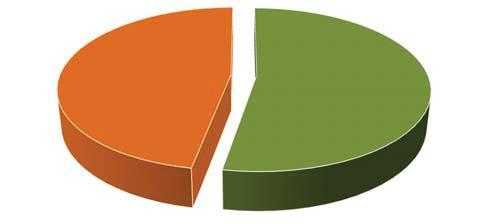
Higher tariffs introduced by the Energy Regulation Board (ERB) in 2017 have made local energy competitive in the region as shown below:
The sector has seen improvements following the loosening of monetary policy. The policy rate was reduced from 15.5% in 2017 to 9.75% in 2018 causing interest rates to fall significantly. Despite reduced rates, there is limited liquidity in the market as banks are not lending as much as they once did. The liquidity squeeze is exacerbated by the paucity of alternative sources of funding. Making matters worse is the fact that nonperforming loans (NPLs) have increased as shown below:
Consequently, we see potential for increased public private partnerships and independent power producers to enter the market. Local demand already exists with medium to large corporates looking for off grid solutions to reduce their reliance on the national grid.
We see potential to offer bespoke funding in addition to traditional commercial bank loans. Such financing products can be tailored to the specific needs of the targeted clients. Investors with balance sheet can acquire the companies and/or loan books at a significant discount, restructure them, and offload them at a premium and/or hold them to maturity.
In conclusion, there are many lucrative opportunities in various sectors besides those discussed for investors with balance sheet, a higher than average risk appetite, and an interest in and willingness to work through the challenges that Zambia presents.
Contributor’s Profile:
Bryson Kacha is an associate at Pangaea Securities Limited. Pangaea is a leading Zambian full-service investment advisory and brokerage firm combining local knowledge with world-class expertise. The firm has raised over US$3.0 billion across Sub - Saharan Africa for clients in real estate, mining, FMCG, agriculture, TMT, financial services and hospitality sectors. Get in touch at www.pangaea.co.zm
By Graham Sheward, Managing Director, SGG Mauritius

Investing in Africa poses huge opportunities and challenges in areas such as energy and infrastructure. Using Mauritius as an investment hub allows investors to generate growth while mitigating risk.
hat role can Mauritius play as an investment hub for Africa, at a time where the continent continues to face financing gaps when it comes to the future development of its infrastructure? Energy projects are currently consuming around 60% of African infrastructure investment, and there continues to be significant demand for public and private investment to address the water supply, sanitation and ICT amongst others.
It has been estimated by Deloitte that Government and traditional donor financing could at best meet 50% of the requirements of infrastructure financing, and so innovative solutions combining international and domestic and public/private sources will need to be devised and implemented.
Private Equity financing is already becoming part of the solution, with the African Private Equity and Venture Capital Association noting that 86 Private Equity infrastructure deals were concluded in Africa between 2011 and 2016, with a total value of US$ 10.6bn, and it is interesting to note that 45% of PE infrastructure investment was in utilities, while only 10% was in energy.
Private Equity players are very much aware of infrastructure opportunities on the African continent, and GPs are already investing from both PE infrastructure-specific and generalist funds. A survey conducted in 2017 by the African Private Equity and Venture Capital Association revealed that African LPs actually identified infrastructure as the most attractive sector for PE investment over the next three years, while non-African LPs saw consumer goods as the most attractive, which suggests an interesting divergence of perspectives.
PE investments in infrastructure projects to date have included Amandi Energy (ARM-Harith Infra-
structure Investment Ltd and other investors, 2016) and Sindila Micro-Hydro (Metier Sustainable Capital Practice, 2016) and there have also been a number of successful exits such as Bakwena Platinum Corridor Concessionaire (African Infrastructure Investment Managers, 2016) and HTN Towers (Helios Investment Partners, 2016).
Mauritius as a tried and tested investment hub Private equity will clearly have a vital role to play in financing African infrastructure development in the future, and in order to attract Private Equity funding, there is a need for a tried and trusted investment hub. This is where Mauritius comes into the picture, with a highly conducive framework to generate growth and mitigate risk.
While in the past Mauritius has been noted for its favourable tax regime, the country is now moving into a new phase, away from tax-centric services and towards adding real value added services. Investors look beyond tax incentives when they invest through an IFC. In fact, more than 40% of the total investments from Mauritius into Africa are directed towards countries with which Mauritius does not have a tax treaty (or where the tax treaty is not yet into force).
So why Mauritius? Private equity investors can draw comfort from the fact that Mauritius leads Africa across a host of indices for political stability (1st in Africa for the Democracy Index 2017, The Economist Intelligence Unit); good governance (1st in Africa for the Mo Ibrahim Index of African Governance 2017); ease of doing business (1st in Africa in the World Bank Doing Business 2018); and economic democracy (1st in Africa for the Index of Economic Freedom - Heritage Foundation, and 1st in Africa in the Economic Freedom of the World – Fraser Institute).
Investors will also be keen to draw upon the many benefits of the wider eco-system of the Mauritius International Financial Centre (IFC), which offers a plethora of services, which enable successful cross-border investments into the African continent. The Mauritius IFC also offers full protection of foreign investments through its network of Investment Promotion and Protection Agreements (IPPAs), possesses a skilled and bilingual workforce, and a modern hybrid legislative framework. Its transparent legal regime, competitive operational costs, and efficient financial and legal professionals are amongst some of the factors that have emboldened investors to use the Mauritius IFC as a platform to invest in Africa.
Leading Africa as a well-regulated and compliant jurisdiction
If we look at the wider context, investors can take note that the Mauritius IFC is a well-regulated jurisdiction when it comes to international fiscal matters and the combatting of illicit flows.
For example, the OECD’s Global Forum on Transparency and Exchange of Information for Tax Purposes rated the Mauritius IFC as a “Compliant” jurisdiction alongside Norway and Ireland, which is the highest rating, in August 2017, whereas Australia, Canada and Germany, for example, are only regarded as “Largely Compliant”, and furthermore Mauritius was not included on the European Union of non-cooperative jurisdictions.
Mauritius has actively engaged with the OECD across a range of fronts in recent years to keep pace with international practices, having signed last year the “Multilateral Convention to Implement Tax Treaty Related Measures to Prevent Base Erosion and Profit Shifting” (MLI) and also joined the Inclusive Framework to implement the BEPS Recommendations and the new initiative on exchange of Beneficial Ownership information. In June 2015, the country signed the OECD’s Multilateral Convention on Mutual Administrative Assistance in Tax Matters, and it currently has an exchange information mechanism with 127 jurisdictions. Furthermore, Mauritius is a member of the Early Adopters Group committed to the implementation, as from 2018, of the Common Reporting Standard (CRS) on the automatic exchange of tax and financial information on a global level, which the OECD developed in 2014.
In terms of its leading position in Africa, Mauritius was the first African country to have signed the
Intergovernmental Agreement with the United States for the implementation of the Foreign Accounts Tax Compliance Act (FATCA) in December 2017. It is also a founding member of the Eastern and Southern Africa Anti Money Laundering Group (ESAAMLG), which looks at combatting money laundering, the financing of terrorism and other forms of financial crimes.
Mauritius is currently finalising procedures to join the Yaoundé declaration, which is accompanied by a call for action that requests African Heads of State to support the substantial reduction of illicit financial flows through international tax cooperation. The Yaoundé declaration was made in the margins of the 10th plenary meeting of the OECD Global Forum on Transparency and Exchange of Information for Tax Purposes.
Contributing to African infrastructure development
As the preferred investment hub for the continent, Mauritus is poised to play an important role in facilitating investment and FDI flows into Africa as a strategic development partner. Recent research published by SEO Amsterdam (Commissioned by the Investment Facilitation Forum (IFF)) shows that invest-ment hubs are associated with higher inward FDI and economic growth. In the case that investors can no longer make use of investment hubs, the distance to possible investees is increased and FDI is reduced and diverted.
So if, for example, an investor in a developed country can no longer make use of Mauritius as a hub for investments in Africa, the following effects could materialise.
•First, part of the investments will flow directly from the developed country to the African developing countries.
•Second, part of the investments will flow through other hubs or havens
•Third, part of the investments will no longer be profitable and will cease (FDI destruction).
•The overall effect is re-routed and reduced FDI. As a consequence, productivity gains associated with FDI may be lost by FDI recipient countries, and investment opportunities may be lost by investors.
Building the Africa of tomorrow cannot be achieved overnight, but in Mauritius we are ready to facilitate the investments that will lead to sustained growth for the long term.
By Mark Mikwamba, Managing Director, Old Mutual Investment Group Malawi
hat investment opportunities are there in a land that extends to 118 484 sq. km in size with a population size of 17.2 million? The answer is that there are many investment opportunities! And the economic environment has so far been supportive of investments in Malawi. In 2017 for example, Real GDP growth came at 5.1% and is projected to slow down to 4.0% in 2018 due to challenges in agricultural production. Inflation averaged 11.6% in 2017 and the year-on year rate has decelerated to 8.9% as at May 2018. What also should give investors more confidence is the Reserve Bank of Malawi’s inflation target set in 2016 at 5% for the medium term – the first time Malawi has expressly set an inflation target!
On the currency front, the Malawi Kwacha was stable against the United States Dollar and appreciated against the British Pound Sterling by 1.81% from the beginning of year to 05 July 2018. These macroeconomic indicators augur well with investment.
From a sectoral perspective, Malawi’s economy is agricultural driven, as agriculture accounts for a large contribution to GDP. In 2017 for example, agriculture accounted for over 28% of GDP followed by the Wholesale and retail sector, which accounted for 16% of GDP, while the manufacturing sector contributed just over 9%. These and many other sectors require investment and are opportunities for investors.
Given the sectors spread of the economy, the first opportunity that naturally comes to mind is therefore the agricultural sector. Why? Well although the economy is largely dependent on agriculture, the farming is at a subsistence level where subsistence farmers year-in year-out rely on the Government to provide them with subsidized farm inputs and using hoes grow staple food for the family once a year and nothing more.
Yet this country called the Warm Heart of Africa, has two things that strongly supports commercial agriculture that can feed the SADC region and even the rest of Africa if used well. The first is

fresh water. Malawi has 24 208 sq km of fresh water, the two largest bodies of water being Lake Malawi (one of the biggest lakes in Africa) and the river that flows from it, Shire. These and the many other inland lakes provides an opportunity for irrigation of farmland. Given that there is minimal irrigation at present is in itself an opportunity for would be investors. The second but equally important resource is the weather. Malawi’s weather is tropical, which means many crops can grow several times in the year. The land is generally fertile too. These factors make Malawi very suitable for large-scale commercial farming activities and this awaits serious investors that can bring in technology an innovation.
Already there are some visible initiatives by the Government of Malawi to encourage investors in agriculture along Lake Malawi and the river Shire with land earmarked for commercial agriculture. Many crops ranging from fruits and vegetables to legumes and rice can all grow in Malawi at a large commercial scale.
The second investment opportunity is currently a problem – power. Electricity is major problem due to both over reliance on one source of electricity –hydro, as well as under investment into the sector over the years. Malawi’s installed energy capacity is estimated at only 347 megawatts and during summer, when water levels are low, generation can reduce by over 40% of installed capacity. The estimated demand for electricity is currently at 700 megawatts. Given initiatives to explore mining, demand for electricity in the medium term can easily reach over 2000 megawatts. This challenge is where great opportunities lie for would be investors. In order to attract investors there are initiatives to come up with a framework on tariff to make it attractive for investors.
When you talk to visitors, whether investors or tourists who come in the country, the first comment given about the country is that Malawi is a beautiful and indeed, it is. The green sceneries, beautiful beaches, mountains and friendly people support growth in tourism. Mulanje Mountain,
commonly known as an ‘island in the sky’ with an elevation of 3000 meters, is a home for a variety of rare life forms, in addition to being one of the highest mountains in Africa. Lake Malawi, the third largest lake in Africa boosts over 4000 different fish species. Indeed, there is great tourism potential that needs investment together with related infrastructure.
For those that prefer the listed markets, well we have the Malawi Stock Exchange. In 2017, the Malawi Stock Exchange all share index return was 62.09% in United States Dollar terms. As at 06 July 2018, the All Share Index was 42.31% in United States Dollars – making it over 100% return in 18 months! Of course, we all know that past performance is not a guide to future performance; but macro-economic indicators for Malawi seem to support the future of the Malawi stock market as well.
If risk is a major consideration in one’s investment strategy, well there are treasury bills for investment as an alternative. These Government of Malawi backed securities, were as at 06 July 2018, trading at a yield of 14% in local currency and this has been the average for year to date as well. Factoring in foreign exchange movements, this yield translates to 14% return in United States Dollars and 15.91% in British Pound Sterling as at that date -
competitive returns indeed!
Of course, politics and economics are now more interrelated than ever before. Malawi is going into an election next year in May 2019 and some may be concerned about this. The good thing though is that history shows that Malawi has respect for liberties and well-established electoral processes. Although there is always political bickering in the run up to and during elections, Malawi generally respects the rule of law, elections are largely peaceful, and that is what all expect during the forthcoming elections.
There are many investment opportunities in Malawi, from the treasury market through the Malawi Stock Exchange to unlisted investments –opportunities are waiting for investors. For foreign investors, getting the right partner on the ground is key. Pick the right partner on the ground and you will be ready to enjoy your investment experience in the Warm Heart of Africa.
Contributor’s Profile
Mark Mikwamba is the Managing Director of Old Mutual Investment Group in Malawi, is responsible for assets under management c. USD420m invested into equity, interest bearing assets and property. Mark is a CFA Charter holder and a Chartered Accountant.
By Akintunde Majekodunmi, Vice president and Banking analyst at Moody’s

Nigeria's (B2 stable) economy emerged from a 15-month recession over a year ago, with a primarily oil-driven rebound in growth that we expect to last until 2019. Although the recovery will support credit profiles across various sectors, we expect it to remain modest, and for fiscal pressures to persist.
Nigeria’s oil sector continues to support its economy but the country’s non-oil revenue generation remains weak. An increase in oil production and higher oil prices underpin Nigeria's economic recovery and the 2.8% growth we expect to see in 2018. Other sectors, including agriculture, will also contribute to higher growth, although many remain constrained by capital controls. Public finances are likely to improve modestly alongside this growth, but efforts to improve non-oil revenue generation continue to underperform. In the longer term, the government's diversification efforts should improve the resiliency of the economy and public finances to oil price volatility.
The modest economic recovery is however still credit positive for Nigerian banks. We expect the acceleration in GDP growth to support a 10% increase in banks' loan books this year following the 15.4% contraction in lending in 2017 (when adjusted for the naira devaluation). Increased lending will support banks' interest and fee income and mitigate lower interest income from an 8 percentage points fall in treasury bill yields from their peak in 2017; Nigerian banks hold large amounts of treasuries for liquidity reasons.
Growth should also lead to modest improvements in Nigerian banks’ asset quality in the long run. Weak or negative growth in 2016-17 and the naira devaluation increased asset risks in the system. Nigerian banks' nonperforming loan (NPL) ratios, at an average of 15.1% in September 2017, were among the highest of the sub-Saharan African banks Moody’s rate. That said, delinquent ratios (loans past due by less than 90 days as a proportion of gross loans) for some large banks fell substantially as of December 2017. Higher GDP growth, improved access to foreign currency, and currently higher oil prices will all increase
borrowers' cash flow and improve their capacity to repay loans. We expect the NPL ratio to range between 15.5% and 18% over the next 12-18 months, before falling, as the negative effects of the 2016 recession begin to wane.
We also expect dollar liquidity to improve. Nigerian banks have faced foreign currency shortages over the last few years primarily due to lower oil revenues and capital outflows. However, recovering oil prices, improved economic activity and a rise in capital inflows following last year’s introduction of an investor-friendly foreign exchange regime (the Investor and Exporter Foreign Exchange window), will improve the banks' dollar liquidity. The decline in foreign-currency deposits bottomed out towards the end of 2017.
Overall, our outlook for the Nigerian banking system is stable as we expect banks’ credit profiles to remain within the thresholds assumed by their current ratings over the next 12 to 18 months.
By Magnus de Wet, Managing Director, Vista Wealth Management South Africa
isted property has been South Africa’s top performing asset class in the last 16 years. During this time it has returned over 18% per year (in Rand terms) as measured by the Johannesburg Stock Exchange’s (JSE) SA Listed Property total return index. It slightly outperformed the South African industrial sector which returned 17.85% per year during the same period. The returns from the industrial sector were however thanks to local market favorite Naspers and their over 30% investment in Chinese tech giant Tencent. But that’s a South African success story for another day.
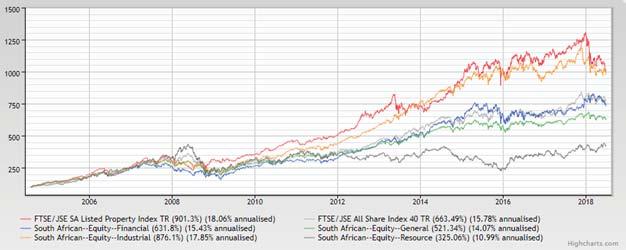
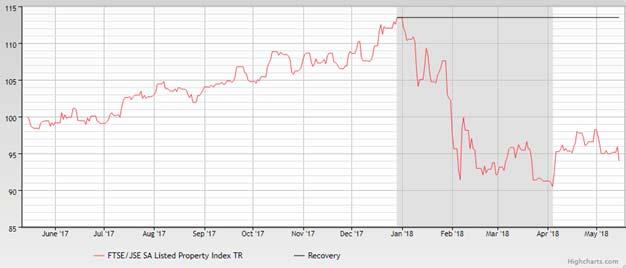
In recent months however, the South African listed property has had a massive market correction. It has lost more than 20% of its value in a drawdown that started on 29 December 2017. It has still not recovered by 30 June 2018. The graph below indicates it has only recovered 4% from its lowest point during this 6 month period.
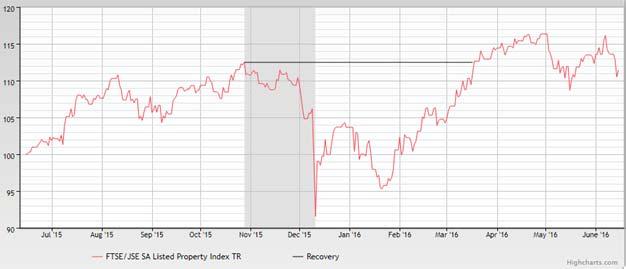
The current drawdown might be the worst the SA Listed Property Sector has seen but is not the first time this sector has had a massive correction. Between 27 October 2015 and 18 March 2016, the sector also lost 20% at its worst point in a drawdown that lasted 5 and a half months.
So what caused the latest correction? It all started

in early January 2018 with speculation that US research firm Viceroy, famed for their report that brought down Steinhoff International, will be releasing a damning report into SA listed property Group Resilient. Panic selling occurred across the entire listed property sector in sympathy for the property giant.
But who is Resilient and why are they so important that the entire SA listed property market will go down in sympathy? At the time when the Viceroy speculation started the Resilient Group represented almost 45% of the SA Listed Property index weighting. The group are made up of a few companies with inter shareholding between them. As indicated in the picture below, Resilient owns 16% of Fortress, which in turn owns 9% of Resilient. Resilient is also a shareholder in Nepi Rockcastle and Greenbay, owing 12% and 23% respectively.
The above structure indirectly caused Resilient and its associated companies to buy shares in each other which inflated their share prices. This led to the companies being mispriced and trading at large premiums to their net asset values. This latest correction has however unwound this mispricing and today the Resilient Group only represents 25% (down from 45%) of the SA listed property index. Investors therefore now buying into the SA Listed
Property index are buying less of the Resilient Group and more companies that were pulled down in sympathy with them.
The latest state of play with the Resilient Group is a black economic empowerment (BEE) trusts (Siyakha Education) that needed to be accounted for. Resilient is currently busy restating its interim results for the six months that ended December 2017. The restatement resulted in Resilient’s total liabilities increasing as Siyakha’s debt was moved to its parent company’s books.
The South African listed property sector can be grouped into 3 groups of companies depending on their property portfolios:
- Companies that only have exposure to local South African properties – For example Liberty2Degrees and Dipula
- Foreign companies listed on the JSE only invested in offshore properties – For example Capital & Counties and NEPI Rockcastle PLC
- Local companies that have exposure to both local and offshore properties – For example Growthpoint and Redefine
In order to create better access to the above groups, the JSE in conjunction with FTSE (the JSE’s index provider) has in the last year introduced 3 new indices to supplement the SA Listed Property index. The 3 new indices provide more choices for potential investors:
- SA REIT Index – This index will focus on companies that are classified as SA REITs by the JSE. The index includes 19 companies and has approximately 80% local exposure. This index has the highest risk due to its high exposure to local SA listed property companies but therefore also has the highest estimated dividend yield of over 9%
- All Property Index – As the name suggests, this index will include all listed property companies that’s included in the FTSE/JSE All Share index. The index currently includes 34 companies and the volatility of this index is less due to the number of foreign listed property companies included in the index. As a result of the larger foreign exposure in the index, it has a lower estimated dividend of just over 7%
- Tradable Property Index – The small compa
nies included in the All Property Index above is detracting from the liquidity and tradability of the index. The Tradable Property index aims to address this liquidity dilemma as it only includes 16 large and mid-cap property companies. As with the All Property Index, it has more foreign exposure but because of the limited number of constituents it might have more volatility. It has an estimated dividend yield of about 6.5%
It is true that retail shopping centres makes up at least 35% of the exposure of local listed property companies. This is a concern for investors worried about online shopping and the abandoned ghost malls seen in the US. Great research by Phillip de Wet in the Business Insider SA however addresses this concern highlighting distinct differences between the SA and US retail markets:
- The anchor stores in US malls are department stores like Macy’s (In SA Macy’s equivalent would be something like the now belly-up Stuttafords). In SA the anchor stores are supermarkets like Pick and Pay or Woolworths. These anchors are aligned with the convenience culture of South Africans to buy for example supper on the way home from work
- In the US a big contractor from shopping malls was safe public places like parks and museums. SA has a problem with bankrupt municipalities for who’s priority will not be for a long time to safe and upgrade our green and public spaces
- Lastly in Africa, the social interaction that comes from ancient markets where families and friends meet up will continue. It will not be replaced overnight by the online internet shopping that threatens the US and other developed countries
In closing, listed property has low correlations to other asset classes with high dividend yields which make it a critical asset class to have in any diversified portfolio. These general facts plus the recent market correction and other positive developments in the South African listed property market, makes it a great addition to any portfolio.
“Listed property has been South Africa’s top performing asset class and has returned over 18% per year (in rand terms) in the last 16 years.”




any investors are familiar with the African growth story. The young demographic, growing middle class and attractive GDP growth prospects have been recited before and I am sure we can agree that the long-term growth story sounds superb.
For investors with a long-term horizon, these fundamentals make Africa the perfect place to invest your money for the next 10-20 years especially as most of the developed regions do not possess the same fundamental characteristics.
Many investors we meet across the world, who have recognized the attractive opportunity that Africa offers, tend to contemplate the same question: “What is the best way to invest in Africa?”
Private equity is often the initial favourite; long-term investors taking a multi-year view on accessing specific opportunities they feel will come to fruition over time. Infrastructure also resonates with investors since Africa still requires a lot of investment in building roads, railways, and other commercial projects. While both types of strategies hold promise, a lot of money has already flown into these somewhat limited spaces, with increased competition for assets leading to elevated entry multiples compared to other frontier markets.
One space which still offers significant alpha, and which many investors overlook at first, is in the more liquid end of the capital structure. We believe that listed equities, still a developing asset class
across Africa, offer exciting opportunities at more attractive valuations. Currently the MSCI Africa ex-South Africa Index is trading at a 13x Adjusted Positive P/E versus MSCI World which is on a 17.4x multiple. And unlike most developed markets there are many factors about the overall market which provide additional alpha generating opportunities.
A few things investors should keep in mind when considering investing in African equity markets:
The entire Africa ex-South African equity universe is close to 800 stocks. When accounting for liquidity, quality of management and ESG factors you would get a realistic universe of 150-200 names. If one includes companies listed on other global exchanges, which have a meaningful portion of their revenues coming from the continent, the universe is broadened by a handful of mining names.
The lack of sell-side coverage in Africa provides an opportunity to gain asymmetric information through deep fundamental analysis and on the ground research. Another characteristic of the African markets is the notable amount of dual-listed stocks. There are about 21 different stocks on nine different exchanges that have dual-listings on larger, more liquid exchanges such as London, South Africa or another regional bourse.
Due to foreign investment limits imposed on local
investors in many of these markets, local investors are often restricted in where they can buy stocks even if the constituent is dual-listed and trading at a discount in another market. These foreign controls create price dislocation and produce attractive arbitrage opportunities.
Africa is often perceived as an investment destination where the risks outweigh the reward. For the short-term investor this may be true, but for those with a long-term horizon the higher volatility does produce interesting price dislocations and profitable investment opportunities. Over the past few years investors have experienced temporary repatriation issues in various African countries. For example, in 2016 many Egyptians were looking to take their money offshore in anticipation of a devaluation. Many investors did this through dual-listed stocks traded on the London Stock Exchange. The outflows by locals (and some foreigners) caused the London-line of a liquid stock to be depressed and trade at a 40% discount to the Egyptian line. For those investors who didn’t mind holding Egyptian Pounds and had a longer time horizon, they were able to buy stock in London and move it over to Egypt, locking in a 66% gain on day one, with the opportunity to invest the proceeds in various “hedge” stocks on the Egyptian exchange i.e. those stock that have USD linked earnings
Another recent example of this was in Nigeria in 2016 and early 2017. Dollar liquidity in Nigeria had been under pressure since the decline in oil prices in late 2014 and became further impacted when the Central Bank of Nigerian maintained an unsustainable Naira peg to the US Dollar which reduced foreign portfolio inflows. As money waited on the side-lines for the Naira to depreciate, the Central Bank of Nigeria introduced an OTC FX Futures Market (“FMDQ”) to attract and retain foreign currency flows back into Nigeria. Portfolio investors were incentivized to bring money back into Nigeria by being able to hedge their onshore Naira exposure at very attractive rates. When this new market was initially introduced investors could hedge their Naira and make up to a 50% return on your money within less than 12 months. The mechanics of this trade were not straightforward but those who were able to participate and hedge their Nigerian exposure were able to generate outsized profitable returns.
Size Matters
No matter who you are and what strategy you are trying to employ it is hard to successfully manage US$1b in Africa. In African equity markets, that is almost 10x the total average daily volume traded in Africa ex-South Africa. Larger equity managers are thus limited to the Top 50 names in Africa which also restricts the opportunity set to the largest names on the largest bourses such as Egypt, Morocco, Nigeria and Kenya. These larger, more liquid stocks often get bid up to high premium when investors take a bullish view on Africa. That is why if you are a smaller manager in Africa you not only have a wider opportunity set but the ability to play in the mid-cap space, a segment of the market which tends to offer more attractive value, especially since they are generally ignored by the Street. Furthermore, the opportunities to capitalize on the markets’ inefficiencies tend to occur in smaller sizes which are not big enough to matter for larger funds, but are meaningful enough for smaller, more nimble managers.
Flexible Mandate
Investing in Africa requires a flexible approach no matter what type of investment route you choose. Traditional investment styles that work in developed markets aren’t always the best way to make money in Africa. Investors would do well to look for managers who have a different perspective on the Africa opportunity set and look to express it in alternative ways. The large long-only, buy-and-hold managers may find it difficult to generate Alpha in Africa. Finding a nimble manager who uses tactical trading approaches as well as the use of derivatives to deliver returns, with the aim of protecting capital while tapping into the genuine market inefficiencies pays dividends when investing in Africa. After all, they do call it the final frontier for a reason.
Contributor’s Profile

Jaclyn Petrone, Director of Business Development for Laurium Capital. Jaclyn joined Laurium Capital in January 2015 and is responsible for international business development and marketing. Prior to joining the Firm, Jaclyn spent almost eight years at PineBridge investments on the hedge fund and private equity allocation side.
By Ayodeji Ebo, Managing Director, Afrinvest Securities Limited Nigeria

In the words of Jerome Powell, current head of the US Federal Reserve: “The financial crisis revealed important weaknesses in many areas of our financial system.”
igerian banking regulators, like most of their global counterparts, took away three key lessons from the 2008 global financial crisis: 1) big banks can and do fail, 2) markets are not always efficient and, 3) risk management and corporate governance structures of banks are as important to financial system stability as balance sheet size. The global crisis uncovered the weakness of Nigeria’s hitherto prevalent universal banking model which permitted the banks to set up subsidiaries involved in capital market related businesses. Drawing lessons from the challenges of past years, regulators have stepped up their game to address systemic vulnerabilities. The result is a much stronger industry with a well capitalised market, which survived Nigeria’s harshest economic climate in nearly two decades without neither liquidity crunch nor systemic failure.
Examining the Nigerian banking sector in terms of financial performance and profitability levels, laudable improvements have been recorded post-crisis era, particularly in the Tier-1 segment which has become an attractive investment opportunity to Foreign Portfolio Investors (FPIs). These solid performances have been recorded in spite of stringent prudential regulations from the Central Bank of Nigeria (CBN) and stiff competition amongst peers amidst unfavourable macroeconomic conditions. One of the recent policies from the CBN aimed at financial system stability is the check placed on dividend payment by banks with low level of capital adequacy and/or weak asset quality.
Investors have certainly rewarded banks for the improvement in fundamentals, with data showing that the sector has outperformed the benchmark twice in the last 4 years and is outperforming the market as at 6th of August 2018. Comparing the Return on Equity (ROE) for the Nigerian banking sector - at 15.9% - to average ROE for Emerging and Frontier markets' banks - at 17.9% (selecting an average of Egypt, South Africa, Morocco and Kenya) - the Nigerian banking sector compares
favourably. Shining the spotlight on Nigerian Tier-1 Banks (GUARANTY – 32.6% and ZENITH -26.4%), this performance shows solid corporate profitability given that other banks - Skye Bank, Unity Bank, Wema Bank, etc. - dragged overall sector performance down.
Meanwhile, the CBN has acted in line with its objective to ensure financial system stability as seen in deepening prudential regulations of the banking industry over the years. Recent concerns have been raised regarding the financial soundness of some banks particularly in terms of asset quality asset quality. Recent data from the CBN’s Financial Stability Report (FSR) buttressed these fears as industry asset quality for the banking sector deteriorated.
Due to exposure to the Oil & Gas and Power sector –the former suffering from the oil price shock of 2014 - Non-Performing Loans (NPLs) rose from 12.8% as at FY:2016 to 15.0% as at H1:2017. Average baseline Capital Adequacy Ratio (CAR) for the banking sector also declined to 11.5% largely due to two outliers amongst the Tier-2 lenders. The sector also remains highly exposed to the Oil & Gas sector -29.0% of credit distribution. Interestingly, despite the high exposure, NPL growth has been curtailed largely due to the rising oil prices which have enabled Oil & Gas firms to meet obligations. The efforts of the CBN to curtail NPL as well as maintain financial system stability is, however, noteworthy. The apex bank's tough stance on ensuring banks satisfy the minimum set Key Performance Indicators (KPIs) before dividends can be paid out is commendable. This has forced several banks to strive to achieve these minimum conditions in order to create value for their shareholders.
Despite calls to allay fears of rise in NPLs, the high level of NPLs in the Nigerian banking sector and government crowding out of private sector borrowers has weakened banks’ willingness and capacity to create credit. Banks’ disposition to give out
loans tapered particularly in 2017 partly due to higher yields on short-term, risk-free government securities – up to 22%. The higher yield environment encouraged banks to rather lend to the government by investing in Treasury Bills than lending to the private sector. Essentially, active borrowing by the Federal Government led to crowding out of the private sector. This lack of access to credit has, however, become a significant impediment to real sector growth.
Examining the loan book growth of Tier-1 banks in Nigeria for 2017, it shows a measly 0.3% growth. Breaking these figures down further, only 2 out of 6 Tier-1 banks actually grew their loan books as ACCESS and UBA grew by 11.6% and 9.8% respectively, while loan books for ETI, FBNH, GUARANTY and ZENITH declined 1.4%, 4.8%, 2.4% and 4.9% respectively.
Exploring the Islamic Banking model thus becomes necessary for the banking sector going forward. The Islamic banking model in simple terms operates a model where both the lender and borrower share the risks generated from extending the credit. The process of Islamic finance forces banks to conduct necessary due diligence before lending out because the borrower pays no interest, requires no collateral, and bears no charge on late payments.
Implementing Islamic banking in Nigeria, however, poses a great challenge because interest charged on loans form the core of income for commercial banks under the current system; whereas the Islamic finance system compensates banks by sharing from the proceeds of the purpose the credit was extended. Regardless, its successful implementation will be a landmark achievement in the banking sector because it will stimulate significant and sustainable growth in the real sector in the coming years.
Financial inclusion – the hot topic in the financial and banking sector – has formed the focal point of most discussions around reforms in the banking sector. In simple terms, financial inclusion defines providing affordable banking services to all individuals or businesses in the society. The Nigerian banking sector has largely underperformed in terms of ensuring financial inclusion for the Nigerian populace. The number of bank accounts in Nigeria stands at 97m without considering unique Biometric Verification Number (BVN) statistics.
Taking unique BVN into consideration, the number of banked individuals in Nigeria as at December 31st 2017 stood at 31.4m, which when compared with the Nigerian population prints at 17.2% assuming a population of 180m. Data from the World Bank puts the percentage of Nigerian adults with a financial service provider at 40%, while Nigeria remains among the 7 countries that contribute nearly half of the globe’s unbanked population figure of 1.7bn people.
While the CBN quoted that financial exclusion level in Nigeria stood at 41.6% in 2016, the World Bank reported a conflicting figure of 65%. Looking beyond the discrepancy, it remains a mystery how the CBN will achieve the target of 80% financial inclusion by 2020 it set in 2017. It is especially worrying considering financial exclusion numbers only improved marginally from 46.3% in 2010 to 41.6% in 2016.
To improve financial inclusion in Nigeria, continuous efforts at ensuring financial literacy amongst the Nigerian populace should be a priority and this should not be left alone in the hands of financial institutions. Financial and capital market regulators also have a stern role to play in ensuring financial education in Nigeria. The obvious struggles of Nigeria with financial inclusion is described in the words of Dan Schulman, President of PayPal:
“Most governments want their citizens to be part of the financial system, to be productive citizens as a result of having access to be able to manage and move money in a seamless way. But the traditional financial services infrastructure is not designed to handle that because, predominantly, it's an expensive infrastructure. ”
In conclusion, while efforts by all parties in the banking and financial system should be applauded, it is certain that the Nigerian banking sector is a far cry from perfect. While efforts seems to be focused on ensuring financial system stability, the drive for financial inclusion cannot be ignored as it also facilitates the process of improving financial system stability. Also, the lending process of the banking sector requires extensive review and reformation as relying on the current model will continue to limit real sector growth. It, therefore, requires all stakeholders in the coming years to take a critical look at the Islamic banking model for implementation even if modifications would have to be made to the system.
By Caleb Mugendi, Senior Investment Analyst, Cytonn Investments Management Kenya

enya’s banking sector has proven resilient over the last few years, continuing to deliver growth despite the tougher operating environment. The country has a total of 42 commercial banks, of which 11 are listed on the Nairobi Securities Exchange; with 1 mortgage finance company, 13 microfinance banks and 3 credit reference bureaus, all regulated by the Central Bank of Kenya. Financial inclusion continues to rise, reaching 75.3% in 2016 from 26.7% in 2006, mainly driven by digitization as evidenced by the increased adoption of mobile money in the economy. The increased adoption of technology to enhance banks’ efficiency, focus on alternative distribution channels and the growth of Kenya’s middle class that puts a lot of emphasis on convenience, has increased the demand for banking services in Kenya, and contributed to growth in the sector.
Some of the pertinent issues in the banking sector are highlighted below:
The banking sector has experienced a deterioration in asset quality, with the gross non-performing loans (NPL) ratio for the banking sector worsening to 12.4% in April 2018, from 10.7% in December 2017. The Central Bank of Kenya (CBK) attributes the deterioration in asset quality to the effects of drought, compounded by the prolonged election period last year. In addition, the rising NPLs are due to delays in payments to suppliers by county governments, as well as the private sector, according to the latest CBK Credit Survey Report. However, banks expect the level of NPLs to decrease in Q2’2018, and going forward, driven by a conducive business environment, as well as improved credit recovery efforts. On the other hand, there lies the possibility of repeal of the rate cap legislation, which would likely increase interest rates on loans and put more pressure on customers already struggling to service existing loans.
The interest rate cap came into law in September
2016, following the enactment of the Banking (Amendment) Act 2015, which placed a ceiling on interest rates on loans at 4.0% above the Central Bank Rate, in order to spur credit access to the private sector. The effect of this has been the opposite of what was anticipated as:
i)Private sector credit growth slowed dramatically to 2.8% in April 2018 from 21.2% in July 2015, as shown in the graph below, as the law made it difficult for banks to price some of the borrowers within the set margins, a majority being MSMEs, as they were perceived “risky borrowers”. Banks thus invested in assets classes with higher returns on a risk-adjusted basis, such as government securities, and
ii)Loan accessibility actually reduced, as the increase in demand for loans by customers was not matched with supply of loans by banks, who instead opted to lend to the government.
The decline in private sector credit growth prompted calls from both local players and the international community to repeal or, at least, make amendments to the law to enable credit flow back to the private sector to stimulate economic expansion. In response, the Treasury proposed a draft Financial Markets Conduct Bill, 2018 that will see the establishment of the Financial Markets Conduct Authority that will:
i)Regulate the cost of credit with the aim of protecting consumers,
ii)Promote a fair, non-discriminatory environment for credit access, and
iii) Ensure uniformity in standards and practices in the issue of financial products and services.
Calls to repeal the rate cap law have, however, been met with hostility from legislators who have vowed to keep the law intact, citing unfair credit practices by banks in the event of repeal of the legislation.
IFRS 9 came into effect at the start of 2018, and requires banks to adopt a forward looking approach in credit risk assessment i.e., lenders are required to anticipate probability of loan defaults and create impairment provisions at the beginning of the loan cycle, rather than when actual default occurs, which was previously the case. The implementation of the standard forced banks to review their business models, strategic objectives and credit policies, with banks adopting more stringent lending policies that are skewed towards collateral-based lending as opposed to unsecured lending. Banks’ reluctance to lend to the private sector is therefore likely to persist, so as to avoid the high provisioning levels that would be required as a consequence.
Revenue expansion through product diversification is one of the core opportunities of the banking sector in the quest to achieve sustainable growth. With banks registering compressed net interest margins, much of the attention has shifted to non-funded income, as this section of the bank’s revenue is not affected by the interest rate caps. Banks are increasingly adopting the use of mobile banking platforms to create convenience for customers, hence increasing fee income from more transaction volumes. Bancassurance has also taken root in the sector, with lenders collaborating
with insurance companies to deliver insurance products to existing customers through cross selling. Lenders are also investing in data analytics with the aim of increasing their share of wallet by enabling customers access a number of services through the same platform.
Following the Banking (Amendment) Act 2015, banks have taken proactive measures with the goal of increasing operational efficiency and maintaining profit margins in the wake of dwindling interest revenue.
The use of alternative channels such as agency banking has increased, with banks investing in digital platforms to migrate client transactions away from the branches in order to reduce operating and maintenance costs associated with traditional brick-and-mortar structures. Going forward, most banks are looking to have over 90% of transactions done away from the branches. This may be done through innovation in the digital space to create convenience for customers and hence encourage them to utilize these alternative channels to carry out transactions.
The banking sector has witnessed consolidation over the past 4 years, with the latest acquisition being that of Chase Bank Limited (previously under receivership) by SBM Bank Kenya Limited. The acquisition was facilitated by the transfer of 75% of the value of all moratorium deposits to SBM Bank Kenya from Chase Bank, with the remaining 25% to stay at Chase Bank. The full value of the transaction is yet to be disclosed by the CBK. Other recent transactions are summarized in the table below:
From the table above, key to note is that acquisitions are happening at much cheaper valuations compared to earlier bank acquisitions. For example, Fina, K-Rep and Equatorial Commercial Bank were acquired at 3.2x, 1.8x and 2.3x P/B, respectively, while recent acquisitions are happening at between 0.8x to 1.7x P/B, hence it is a great time to be an acquirer. We thus expect consolidation in the industry to pick up going forward.
i) Robin Hood Tax - In the FY2018/2019 Budget presented to Parliament, the Treasury proposed a Robin Hood Tax, which will require banks to remit a 0.05% excise duty on transfer of amounts above Kshs 500,000, with the proceeds of the taxes to be channelled towards financing the universal healthcare plan. This is expected to have an impact on high value client transactions and the inter-bank lending market, which typically transacts millions of shillings in a given day. As expected, banks have strongly opposed the directive, citing that they do not have the requisite infrastructure to support the charges.
We believe the banking sector is well poised to grow in the future. However, the challenges that the banking sector has been facing, primarily (i) the deteriorating asset quality brought about by a challenging operating environment, and (ii) the capping of interest rates, has led to subdued growth in credit extended to the private sector. We believe the key factors banks will consider going forward are asset quality management, revenue diversification, prudence, and efficiency. To grow
profitability amidst the tighter regulated environment, banks will:
i) Diversify their income sources by growing their fee-income businesses, bancassurance, asset management and advisory services,
ii) Be more prudent in loan disbursement, as well as enhancing their risk assessment framework to improve asset quality, so as to tame any rising financial impairments arising from implementation of IFRS 9, and, Improve efficiency by leveraging on mobile and internet banking, for cost reduction especially on staff numbers and revenue expansion from transaction income, with all these strategies aimed at improving their profit margins.
Contributor’s Profile: Caleb Mugendi serves as Senior Investment Analyst at Cytonn Investments Management PLC. He is a graduate of the Cytonn Young Leaders Program, a prestigious hands-on training on finance and investment management. His experience ranges from specialization in fixed income analysis, currencies and the financial services industry, having focused largely on the banking sector. He has participated in the publication of several public markets reports including; Quarterly Kenya Banking Sector Reports, Half-Yearly Kenya Insurance Sector Reports, Kenya Corporate Governance Index Report, and Sub Saharan Africa Financial Services Report, among other more frequent weekly reports. He holds a Bachelor of Economics from Kenyatta University and is currently a Chartered Financial Analyst (CFA) level II candidate.
Kenya’s Monetary Policy Committee unexpectedly cut its benchmark rate for the second time this year to spur private-sector lending and economic growth.
After signaling room for a more accommodative monetary policy at its May meeting, the MPC reduced the gauge to 9 percent, the lowest in three years, from 9.5 percent, according to a statement published Monday on the Nairobibased central bank’s verified Twitter account. Only two of seven analysts surveyed by Bloomberg had predicted a reduction.
“The MPC noted that inflation expectations were well anchored within the target range, and that economic growth prospects were improving,” Governor Patrick Njoroge said in the statement. “Economic output was below its potential level.”
Rate Caps
The central bank last trimmed borrowing costs in
March as it sought to spur lending in an economy that expanded at the slowest pace in five years in 2017 and where credit advanced to the private sector is constrained by a law limiting what banks can charge for loans. Economic growth picked up in the first quarter and Treasury Secretary Henry Rotich proposed repealing the rate-cap legislation in his June budget speech.
Lawmakers are yet to accept the proposal to abolish the law that limits commercial lending rates to 400 basis point above the central bank rate.
“I thought they would hold now, and then cut when they decide on a date to remove the caps on commercial interest rates,” Jacques Nel, an economist at NKC African Economics in Paarl, South Africa, said by phone. “The MPC noted that the previous cut didn’t have the impact that
they would have liked it to have, so it was unexpected that they would implement another cut with those regulatory caps still in place.”
Inflation has accelerated to 4.3 percent in June from the five-year low it reach in April. The statistics office will publish the July data on Tuesday. The bank targets price growth in a range of 2.5 percent to 7.5 percent and said on Monday it will remain within this band due to lower food costs.
The regulator has forecast economic growth will accelerate to 6.3 percent this year.
“The timing of the CBK cut is odd -- ostensibly with growth well-supported and with inflation soon to rise,” Razia Khan, head of Africa macroeconomic research at Standard Chartered Bank Plc, said by email. “It is difficult to see scope for any further easing.
By Victor Muguto, Partner and Insurance Industry Leader PricewaterhouseCoopers South Africa
y global standards, Africa’s insurance market remains relatively underdeveloped, accounting for just under 1.2% (0.06 trillion USD) of insurance premiums written globally in 20171. Insurance penetration rates averaged 2.77% in 2016, compared to global averages of 6.28%. Penetration rates in some of the more developed markets such as Cayman Islands topped 22.60% and the UK 10.16%, while the least developed markets such as Nigeria were as low as 0.27%2. Insurance penetration, which measures the percentage of total GDP spent on insurance premiums is a good indicator of the level of insurance development in a country.
In Africa, the insurance market is highly concentrated and dominated by South Africa, with premium volumes of 41 962 million USD or 69.12% of the total African insurance market2. Insurance penetration rates in South Africa stood at 14.27% in 2016, which shows the relatively high level of market maturity compared to the rest of the continent. Kenya’s penetration rates stood at 2.80% and Nigeria at 0.27%2. While South Africa is up there with the more developed markets, the rest of the continent is un(der)insured. Even in South Africa itself, the insurance penetration is highly concentrated on a very small percentage of high net worth individuals, and most of the majority are poor and un(der)insured. South Africa is a very unequal society, with a Gini coefficient of 0.63 in 20153
There are many reasons for the low level of insurance uptake across Africa, some of them cultural, some of them related to access issues, but to a large extent it comes down to economic and affordability issues. To improve insurance uptake to global levels, the continent will need significant economic growth and wealth creation for its citizens. It will also need to close the gaps between the rich and the poor, to grow the middle class and create a more equal environment for its citizens. Insurance is a grudge purchase. Given lower wealth levels, insurance in Africa has to be sold and is not readily bought.

Africa’s economic growth depends largely on the global economy, being predominantly a commodity exporting continent. Global Economic growth rates have been sluggish since the 2008 financial crisis, when global GDP growth rates dropped below 0% from averages of 5% in 20074. Drops in commodity prices, following reduced global demand in 2016 severely dented Africa’s hopes for economic recovery.
The global commodity price improvements in 2017 and 2018 bring new hope of economic recovery for Africa, if sustained. Africa itself also needs to do more, to diversify its economics away from overreliance on commodities.
Aside from economic growth, there are other global trends that we have observed in our various PwC Insurance surveys since 2008, which we believe will significantly reshape the insurance landscape globally and across Africa. These trends include, the significant changes in technology, mobile phone and social media penetration, unrelenting insurance regulatory changes, rapid urbanisation and demographic changes.
All these present some challenges, but predominantly, they bring huge opportunities for growth if insurers take full advantage of them.
The main barriers to insurance growth across the continent have in the past been:
• Cultural beliefs, which prevent certain communities from buying life and funeral insurance.
• Low financial literacy and awareness of the need for insurance.
• Miss-selling and other practices in the past, resulting in mistrust of insurers and brokers.
• Inappropriately designed products, not suited to customers’ needs.
• Huge commission costs associated with intermediated distribution models, making insurance unaffordable for the poor majority.
• Affordability issues associated with commodity type insurance products that are not customized to needs of the poor majority.
• Access issues, due to Africa’s population being largely rural, with limited access to bricks and mortar branches in urban areas.
• Un-intended financial exclusion, due to expensive regulatory solvency capital requirements borrowed from the first world, which have not in the past accommodated lower income insurance groups in Africa.
Despite the challenges, there are various opportunities that arise from the global trends mentioned above, and also interventions that will be expected of governments, insurers and the insurance customers themselves, to achieve the kind of insurance growth and increase in penetration levels that Africa needs.
Governments across Africa could do more to encourage financial inclusion in their countries. They could so by putting in place enabling environments that encourage GDP growth in the first place, but also focusing on building infrastructure to speed up growth in urbanisation, to speed up growth in the middle class. This would speed up the growth in aspirational assets, and also increase insurable lives.
Programs to improve financial literacy among citizens, in conjunction with local insurance associations would also help to overcome some of the barriers. More specific Microinsurance legislation, to lower some of the capital and regulatory barriers and costs associated with traditional insurance, would also go a long way in bringing more lower income groups into the insurance cycle.
Insurers probably have a bigger role to play in generating insurance growth. Technology advancements now offer insurers a “fresh start” and the tools to focus more on the changing needs of insurers, by harnessing and analyzing customer data, to understand changing needs and behaviours. This would be powerful in designing more relevant, simpler products, that are easier for customers to understand, and that could be sold through cheaper, direct channels using mobile smartphones and internet platforms. This would in effect reduce the reliance on the more expensive intermediary based channels, which are probably still needed for the more complex insurance products. Direct channels for simple insurance
products would solve the problem with access to rural customers.
Where insurers lack the scale or in-house capabilities to invest in the required technology, they could consider partnering with technology companies that already specialise in new-age data driven insurance delivery platforms.
Insurers also need to consider other interventions that help them to more proactively manage their risks, by investing in devices that can be embedded in cars, humans and other areas to enable them to detect or communicate early warning signals for impending risks. Reducing risks would lower insurance claims and ultimately make insurance more affordable.
Insurers who are transforming themselves into technology and data driven organisations will create a competitive advantage for themselves.
Customers have already embraced smartphone technology. Mobile phone penetration continues to grow at exponential rates across the continent. Social networks are getting stronger and becoming pools of information, useful for improving financial literacy and awareness. Customers are sharing experiences, and discovering cheaper insurance alternatives in the market. In addition, rapid urbanisation and rising literacy levels across Africa are creating a larger middle class, with more wealth aspirations to acquire assets and financial products.
So it is now up to governments and insurers to take advantage of the improving awareness and make the right kinds of priority investments that will increase insurance penetration rates across our continent. The boom in Africa’s insurance sector will not only depend on its economic fortunes, but will need solid investments into more responsive, data driven insurance organisations, working closely with insurance regulators to lower costs and increase access to insurance by the un(der)insured majority.
If Africa’s insurers fail to respond quickly, then other service providers will do so for them. The banks, retailers, internet companies and mobile network operators now converging on their customers are already piling up to acquire insurance licenses.
By Shresti Bijou, Group Head: Operational Risk Management, FirstRand Group South Africa
Historically, financial institutions focussed on internal business resilience management (i.e. business continuity plans and testing thereof) and this was generally enough to ensure operational resilience. However, mass protest actions, terrorism, social and/or political unrest, ailing national infrastructure, interconnectedness of financial systems, increase in denial of service attacks and increasing use of and/or reliance on third parties to support key operations are forcing financial institutions to change the way in which they assess and ensure their operational resilience today.
Interconnectedness of financial systems and its sensitivity to external factors have become clear in the last decade given the global financial crisis and the impact of occasional technology breakdowns in systemically important financial institutions and Financial Market Infrastructures (“FMIs”) in the financial eco-system. Strong FMI’s and systemically important financial institutions play key roles in ensuring operational resilience of and confidence in the financial system but by implication also pose systemic risk.
Every financial institution and FMI in the financial system has to ensure its operational resilience and expect other financial institutions and FMI’s to do the same.
Operational resilience risk associated with outsourcing and 3rd party service providers
Operational resilience is an increasing challenge for financial institutions who use or rely on third parties to conduct or support them in the delivery of their key operational and IT capabilities. Whilst the business case for outsourcing certain core functions, business activities, systems and/or infrastructure may be sound, the financial institution still remains accountable for the resilience of the operations outsourced. This poses a risk management challenge as third party risk management in the context of operational resilience is relatively immature and challenging due to:
• Complexity of the financial ecosystem within

which financial institutions operate;
• Financial institutions outsourcing the activity/function/system/infrastructure have no direct oversight or control over the outsourced activity/function/system/ infrastructure;
• Third party service providers may further outsource the activity/function/system/ infrastructure to 4th and 5th parties and hence, the financial institution’s line of sight over the outsourced activity becomes almost impossible; and
• Financial institutions may have limited ability to negotiate terms of service (including obtaining guarantees on resilience) with large global 3rd party service providers (particularly IT service providers);
• Many financial institutions may be using the same service providers, thereby creating concentration risk in the financial market in the event of such service provider having an operational failure;
• There are multiple single points of failure in the operational chain which are not regulated by financial regulators e.g. communication network providers, fuel suppliers, etc. Accordingly, a failure in the operational resilience of any one of these critical service providers will affect the operational resilience of the financial institution and/or an entire financial market.
Operational resilience risk management in the context of 3rd party management
The risks described above cannot be completely eliminated to ensure operational resilience, however, they can be mitigated by financial institutions through:
• Establishment of clear ownership of the relationship with the third party service provider – this requires effective and efficient internal co-ordination and communication to ensure that all risks are being managed;
• Regular reviews of the terms of engagement with the third party service provider from individual financial institution and financial services industry perspectives;
• Single view of organisational exposure per third party service provider (service, ownership, transaction values and volumes, issues, performance, business continuity planning and testing, etc.)
• Develop and test operational resilience plans - this should include, amongst other things, the recovery time objectives, required fail-over capability, reporting and escalation requirements, and communication plans.
• Performance and risk management monitoring of third party service provider;
• Identify and investigate alternate service providers who can provide a similar service within a short period of time and/or develop in-house capability and plans to perform the outsourced service; and
• Proactive participation in industry bodies/ associations to:
• drive resolution of issues/concerns with common third party service providers
• Look after the interests of the industry
• Proactively drive the regulation of third party risk management (through industry commentary and representations) to regulators
• Regular and coordinated testing of opera tional resilience plans across financial market participants and FMI’s based on industry agreed crisis scenarios (includes crisis simulation
Identification, documentation and coverage of internal system and operational interdependencies
Within financial institutions, system and operational interdependencies between business areas need to be identified and documented and should be used as input into the development of the financial institution’s business continuity plans to ensure a holistic approach to business resilience management that considers and incorporates all areas of dependency. Development and testing of siloedbased business continuity plans no longer suffice in financial institutions with complex systems and multiple interdependencies.
Development of specific contingency plans
Unique circumstances in a geographic location sometimes require the development of specific contingency plans to mitigate particular resilience risks, for example, in South Africa in 2015 when the national electricity supplier, Eskom, was experiencing electricity supply constraints, financial institutions developed their own power resilience plans to ensure that they had the capability to switch to alternative electricity supply (e.g. diesel powered generators) at their key locations for operational resilience in the event of prolonged power cuts. Water shortages and pandemic outbreaks are other examples of events that trigger operational resilience risk assessments and require specific contingency plans based on multiple possible scenarios playing out. These contingency plans should be regularly reviewed, updated and tested.
of emerging resilience risks
Given the ever-changing internal and external environment, resilience risk must be assessed on an on-going basis by scanning both the internal and external environments to identify emerging operational resilience risks and changes in factors that already influence the financial institution’s resilience risk profile. This will enable the organization to assess its risk exposure and put in place appropriate measures to mitigate the risks identified.
Traditional business continuity plans were based on the assumption that staff would be available to act on the defined plans in the event of a disruptive event. However, the nature of disruptive events are changing as socio-economic and political circumstances change in a particular geographic location. These changes challenge traditional assumptions made about the availability of staff. Accordingly, contingency plans to manage very specific operational resilience risks will not necessarily succeed when activated if the general Human Resources (HR) Policy of the financial institution has not been updated to cater for what staff will be required to do when a specific operational resilience contingency plan is activated. These updates are required as the general HR Policy is usually based on “business-as-usual” circumstance. For example, it will not cater for how management can incentivize critical staff to come to work in the event of national disaster to
keep critical operations running.
The ability of staff to work from home or any other location other than their usual place of work, must be considered in the development of business continuity plans and is of particular benefit when there is a disruptive event that is restricted to a particular area / region. Workforce mobility can be effectively used to keep operations running where staff are unable to physically work from their usual offices. Whilst there are advantages in maintaining alternate work-area recovery sites, this is both expensive for the financial institution and may not be appropriate in cases where the disruptive event is not restricted to one location but affects the main premises and alternate work area recovery site as well. Financial institutions with multiple premises across various areas should consider using their various premises as work area recovery sites in the event of disruptive events. However, necessary infrastructure, system and physical access arrangements need to be put in place as part of the business continuity planning process
and these arrangements need to be tested to ensure that should the business continuity plan be invoked, it works.
Conclusion
The rate of change both internally and in the external environment is challenging the traditional approach to the establishment, maintenance and review of business continuity plans and financial institutions need to take cognizance of these changes to ensure effective operational resilience on an ongoing basis.
Shresti Bijou is an experienced senior financial services risk management specialist having worked across retail, investment and commercial banking and asset management at major financial institutions both in South Africa and internationally over the past 17 years. In addition, Shresti is a nonexecutive director on the board of ORX (the largest global operational risk association in the financial sector) since April 2016.
By Peter Bartlett, Partner at GML Capital LLP
Africa trade finance has been neglected as an asset class, because the yields have been modest relative to African sovereign bond markets and because investors had been attracted to the high beta African investments, like the local currency bonds.
The volatility and recent sell-off in EM hard-currency and local-currency bonds in 2018 has changed investors’ appetite significantly. EM fixed income investors are changing their preference towards low beta and shorter duration investment, especially as benchmark EM funds suffered redemptions throughout May and June thus driving bond prices lower. With growing concerns about rising US$ interest rates, elevated African sovereign debt stocks and destabilizing US-initiated trade wars, global investor risk appetite has retreated. We recommend investment in African trade finance as an ideal diversification for EM fixed income investors because it offers:-
• Low volatility, low default levels and high recovery rates
• Attractive returns that naturally adjust upwards as USD interest-rates rise
• Participation in some of the world’s fastest –growing qeconomies
• Uncorrelated returns that have little relationship with moves in other markets
• Short duration and selfliquidating repayment schedules
• Intrinsically improved credit-risk because most transactions are secured
• An asset class with growth potential and elasticity
Finally another attraction of African trade finance as an asset class is that it offers investors the chance to invest with impact because trade finance has very positive developmental effects in Africa, particularly in supporting agriculture, financing SMEs and industry, which are the main drivers of employment growth and skills acquisition on the continent.

The African Development Bank estimates a shortfall in capital available for African trade finance of $120 billion. The withdrawal of a number of international banks as correspondent banks and providers of trade-related funding owing to increased compliance and other costs contributed to this growing trade finance gap.
GML Capital and the Eastern and Southern African Trade Development Bank (“TDB”) will be launching an investment fund this month which will provide trade finance funding to exporters and importers in Eastern and Southern Africa. It is an open-ended fund domiciled in Mauritius which seeks to deliver returns of USD LIBOR + 3-5% (after fees & expenses) to investors. Partnering with TDB will ensure high level access across the COMESA region as well as conferring on the fund preferred creditor status for a number of the investments made.
By Dr. Jens KÖKE, Chief Investment Officer, Allianz Africa Morocco
hen we talk about growth in Africa and all its opportunities and challenges, we probably do not relate this to insurance. When I think back to my old days at school, insurance was something for risk-averse people and probably had little to contribute to growth and development. This article argues that the impact of insurance on growth is indeed significant, but that this impact could be even stronger if capital markets – specifically in Sub-Saharan Africa – developed further.
Economic theory says that an economy grows more quickly if its labor force or factor productivity grows. The so-called Solow model extends this notion: To attain a higher standard of living (e.g. measured by GDP per capita), an economy needs to increase its savings rate to enable higher accumulation of capital (e.g. more investment into machines or infrastructure), which in turn will increase output (and hence consumption) per capita. Post-war Germany and Japan are good examples: Both economies started with a low capital stock (due to war time destruction), but high savings rates pushed up their growth rates and, in turn, increased their standards of living.
But how to achieve higher savings rates? Here financial intermediaries come into play: banks, asset managers, and insurance companies. All financial intermediaries have in common that they collect savings, and that they invest those savings. Typically, banks provide credit to retail and corporate customers, and asset managers invest into publicly-traded stocks or bonds. But what about insurance companies?
The products of insurance companies (e.g. car, housing, health, retirement insurance) are well-known, while their investment activity much less. One guiding principle is to invest policyholder funds such that all obligations and promises to policyholders are met at all times with high certainty. This translates into an asset allocation which is rather conservative: Long maturity bonds are preferred to hedge interest rate risk, higher -

grade bonds are preferred to reduce default risk, and equity is kept limited due to its larger volatility. That’s why we find 80% or higher allocation to fixed income in developed markets such as Germany and France, or all across Western and Central Africa. In contrast, in markets such as the UK equity allocation is much higher, which is explained by the predominance of unit-linked products (i.e. no guarantees, investment risk born by policyholder).
Let’s have a closer look at Africa and its capital markets. While African insurance portfolios also have a high allocation to fixed income assets, the composition of these fixed income portfolios is strikingly different from developed markets. In Morocco local government bonds are the heavy weight, in Sub-Saharan Africa it’s term deposits, and in some countries such as the Central African Republic or Madagascar not even T-bills can be found in insurance portfolios. This compares with highly diversified portfolios in developed markets, which are composed of publicly-listed government, securitized and corporate bonds, and which are increasingly shifting towards non-listed debt (e.g. corporate loans, infrastructure debt). Why this striking difference?
A key explanation of low diversification and high cash ratios in Africa are the poorly developed capital markets. In the Western African Economic and Monetary Union (WAEMU), Côte d’Ivoire has the most developed market with government bonds up to ten-year maturities, but even here primary auctions do not happen more than once per month, and the secondary market is highly illiquid and not transparent to the public (e.g. trading happens via banks’ intermediation). At the same time, the Ivorian corporate bond market is very small, and the regional stock exchange BRVM features only ten percent of trading volume and capitalization compared to the Casablanca stock exchange, which in turn is a small fraction of the global MSCI Emerging Market index. Matters are worse in all other countries of WAEMU and
CEMAC: Bonds are issued only irregularly, a secondary market almost absent, and the maturity spectrum mostly three years or below. The same holds true for most English-speaking countries –with South Africa and Nigeria being the notable exceptions.
One might argue that all these deficits do not really matter because African clients do have access to insurance cover, insurance companies do invest the premiums, and hence growth shall be supported according to the textbook. I would argue that clients and insurance companies are in a state of ‘satisfactory underperformance’ and both could be much better off.
Regarding clients, they would benefit from a larger product range or higher returns/lower risk. For example, unit-linked products, which are almost absent in most African countries, offer clients protection while at the same time allow them to participate in capital markets. Regulatory authorities play a pivotal role to develop this sector. Higher returns would be feasible if insurance companies had a broader choice of investment alternatives and would be able to diversify away some idiosyncratic risks. For example, if regulation permitted to invest outside the WAEMU zone, a local insurer would be able to reduce credit risk. Likewise, if tax rates were equal for domestic and non-domestic securities (e.g. in Senegal), local insurers’ diversification efforts
If suppliers were to offer African companies payment terms of 30 days after delivery of goods and services, rather than demand payment in cash in advance, this could release more than USD 33.5bn of additional working capital to be put to more productive use in 2018, according to Euler Hermes.
In 2015, Euler Hermes estimated that if a payment term of 30 days were to be granted on the share of imports paid in cash (cash in advance), then it would free up over USD 40bn of working capital for African companies.
Since then, the trade picture has changed; a commodity shock hit resource-rich African countries and slashed their exports revenues, reducing further their capacity to finance imports even further. This contributed to the -22% fall in African import values from USD 800bn in 2014 to USD 623bn in 2016.
“Taking into account the new trade picture, our estimate stands at USD 33.5bn of working capital freed up for African companies in 2018. Lower imports combined with lower payment terms
would be supported.
Regarding insurance companies, they would benefit from more developed capital markets in several ways. A longer and more granular maturity spectrum of bonds would allow them to reduce interest rate risk stemming from asset-liability mismatching. Here issuance activity of local governments are the key determinant. A more liquid and publicly transparent secondary market would reduce trading costs, facilitate portfolio optimization, and attract new types of investors (e.g. from abroad). A broader spectrum of publicly traded corporate or securitized bonds would enhance diversification (and hence reduce portfolio risks) and enable more corporate borrowers to seek less expensive financing (compared to sometimes expensive or not available bank credit). Finally, more integrated capital markets (e.g. less administrative hurdles to transfer liquidity from CEMAC to WAEMU) would significantly reduce transaction costs and enable better diversification.
To summarize, the positive impact of insurance on savings, and in turn on growth is certainly present on the African continent. However, steady development of the regulatory and fiscal framework as well as innovative and courageous development of capital markets - actively supported by institutional investors such as banks and insurance companies - would further deepen capital markets, and in turn accelerate growth.
(64% of imports are paid in advance) explains this result,” Euler Hermes Chief Economist Ludovic Subran said.
Euler Hermes expects imports to grow at a +8% annual rate in this region. Should suppliers lengthen their payment term by 30 days, this would free about USD 45bn by 2020. The parallel development of trade finance is key to seize this great opportunity for the African continent.
This huge amount of money wasted each year is a clear argument to develop domestic production capacity, since imports come with a cost due to low DSO1
·Oil exporters (Algeria, Nigeria, Angola, Libya…) account for USD 14bn wasted in cash vaults as a result of short DSOs, with Algeria (USD 5bn, 3% of GDP) at the top of this ranking. Republic of Congo for instance would free up the equivalent of 11% of its GDP (USD 0.9bn) with longer DSOs.
·In fast growing East African economies, greater DSOs would also be a non-negligible growth boost. In Kenya for instance, it would free USD
1.6bn (2% of GDP), and about the same amount in Ethiopia.
Potential gains are weaker in value in West Africa (USD 0.4bn in Senegal, 0.7bn in Côte d’Ivoire) but range from 2 to 2.5% of GDP. On the contrary, it means that these gains are lower in relative terms in countries with the highest income level: South Africa (0.4% of GDP), Morocco (1% of GDP).
The world is suffering from too long DSO in many places, but African figures show some divergence.
Stéphane Colliac, senior economist for Africa at Euler Hermes, said: “Big players are often bad payers, when small players have no opportunity to pay late. It is especially true in Africa: there is a paradox when we see that key State Owned Enterprises are able to postpone their payments by several years (e.g. in Angola or in the past in Egypt) while others have no other choice than cash payment. As an example, Moroccan main corporates have 84 days of DSO but 30% of the transactions (those involving smaller ones) are still paid in cash.”
By Ghita Sqalli, Head of Product Marketing, RedCloud Technology
efore technology was as accessible as it is today, cash and cards consisted the main ways to access finance on a mass scale. However today, in many of the African economies, most of the population still does not have the ability to open a bank account, due to the lack of the required source of revenue and the challenge with many Africans not having the necessary information to sign up for an official bank account – such as the lack of proof of address or no proof of stable income to be able to put on the bank forms. Bank accounts are still unattainable to the average person, making it difficult for small businesses to retrieve loans and grow into bigger and more impactful structures. The most basic form of transaction, cash, is bringing challenges when used for every transaction between individuals, companies and government institutions: actors of the economy have no reliable way to track cash usage and the credit-worthiness of businesses and individuals. Living day to day on each pay check and hiding money in their homes is how a big part of the African population manages their finance. “On average, less than 20 percent of households have access to formal financial services”1 showing a disconnect between the people and the banks. This gap in the market has to be attended to because of the disconnect causing millions of dollars to the economy and holding the economy at a standstill.
A few ways have emerged for SMEs in Africa to receive loans and grow. Crowdfunding has become a way for SME’s to receive money for projects and tasks needed for their development. But in 2016, only 1% of the capital raised went to African businesses and institutions, with the majority staying in North America. Large challenges being the lack of regulations, as well as the lack of clarity about legality of crowdfunding in African nations2. Micro-financing is also a significant resource to low-income countries and clients, giving small loans to try and stimulate small business growth. A major issue with micro-loans has been to disburse funds to customers with no background data - as majority are unbanked, investors must give blindly with hope of a return on their investment. Due to this, Africa is often
1. https://themarketmogul.com/microfinance-africa/
2. https://www.forbesafrica.com/investment-guide/2018/03/13/africa-ripe-crowdfunding/
3. https://mag.n26.com/m-pesa-how-kenya-revolutionized-mobile-payments-56786bc09ef
4. http://www.cgap.org/blog/replication-limits-m-pesa-latin-america
5. https://nairametrics.com/why-the-m-pesa-miracle-has-failed-to-work-in-nigeria/

overshadowed by other countries receiving much more financial services and support.
In recent years, the emergence of mobile payments has broken ground in a few African markets and has been showing a positive impact on the economy, giving people access to financial services without the actual obtainment of a bank account. The pioneer in digital financial services in Kenya, M-PESA, has reached “48.76% share of Kenya’s GDP”3. Mobile payments are becoming the way of financial transactions in Africa, but still have limitations. Replicating the power of M-PESA in other economies has proven to be a difficult task. Although other countries are active with digital payments, the impact has not been nearly as powerful as it has been in Kenya and M-PESA has not proven to be the solution outside of Kenya, despite its significant impact. In other countries it has lacked the infrastructure and value to be successful. Other markets and businesses need more than what is offered from the platforms already out in the market. Proximity and simplicity was what Kenya needed and M-PESA was able to offer them exactly that, however the “diversity of players delivering proximity and simplicity is a powerful explanation for the replication limits of M-PESA across markets and regions”4. The proposed value needs to be better than what other financial services offer and needs to address the fact that different countries have different needs.
Building up a mobile finance ecosystem that is scalable and compliant with local regulations has been a challenge faced in particular by Nigeria, where “50 million … [are] unbanked”5 – because of the inability to coincide with the government. Local regulation is preventing telecom companies to take the monopoly that M-PESA has achieved in Kenya and banks lack the infrastructure and reach to grasp the market for a shift towards mobile financial services. Fintech companies have also been trying to negotiate partnerships with banks, which has created limitations to how fast and far companies can go, as banks face “slowness in approving products and bringing them to market”. “Banks must learn to collaborate better, become more willing to share data with platform partners,
restructure internally, and become more agile”6 but since banks have restricted flexibility for change, their involvement is a limitation for many fintech companies.
Challenges to digital payments will always be there, if companies do not offer a better and more advanced solution than what they are offering today.
Another limitation that has come with the growth of digital payments is the target market being almost entirely consumer-facing. The focus on consumers has not eliminated the real cash problem, but only prolonged it further up the supply chain for the businesses. The B2C market although powerful is not where the problems lie. There is much more than just the small everyday transactions that digital technology can revolutionize: the entire financial system as we know it today can be disrupted. Targeting the merchants to utilise digital payments to pay suppliers cash will no longer be an item going up and down the supply chain. Going digital and creating a common platform will reduce cash transactions which will not only ease payments for consumers, but for large businesses as well. FMCG and manufacturing companies situated at the top of the supply chain are a substantial market that undergo a significant cash management problem, alongside their partners and customers throughout the chain. As thousands of merchants sell goods and pay their suppliers in cash, the accumulation of physical money gets larger and larger, bringing unsafety and inconvenience to manage. Digital payments can transform cash at a lower stage in the supply chain and create a solution to the cash problem for the entire ecosystem including businesses of all sizes, institutions and individuals.
Using a digital financial platform is the basis for a new concept: an open marketplace for businesses to create a completely integrated entire supply chain, making transactions safer and cheaper along the entire distribution channel. This new business-focused approach can impact cashflow in a way that has not been done before thanks to a broader target audience, more substantial than just targeting consumer-based transactions. To have one platform for all participants can transform the cashflow process from when a manufacturer develops a product, all the way down to the consumer paying for this same good. Merchants pay their suppliers in a digital way and eliminate the inconvenience, risk and duration of exchanging goods and services against cash.
With digital transactions, not only is the inconvenience leveraged but the monetary flow can track all transaction data, from their status throughout the supply chain to when transactions are made. Creating data is a vital point for merchants all the way up to distribution companies and manufacturers. Real-time reports and the ability to crunch and segment data allow deep learning about sales and product behaviour. Businesses throughout the supply chain have a clear view on what is selling and what isn’t in the market and at their individual level – allowing to ease reordering and other supply-side frictions.
These digital transactions, processed outside of the traditional banking system and tracked all the way, create substantial growth in the marketplace. Algorithms and Artificial Intelligence are used in order to develop an alternative credit scoring system, allowing small businesses to apply for and receive loans - which they are not able to do in a cash-based environment. The financial data received gives manufacturers and financial institutions the information required to deploy financial resources with confidence of a reliable return on their investment. Financing is a significant pillar in the digital ecosystem: having the ability to access insurance, defer payments and acquire a trust - worthy credit score creates a system that can offer a future for SME companies and consumers. This is their opportunity to use the investment to grow and develop into something sustainable that can stimulate tthe economy.
Marketing actions can also be leveraged through digital technology. A single platform becomes the way to communicate with customers easily and build strong relationships, as well as create targeted ad trackable actions. The more information available from customers to FMCG companies, the more accurate advertising and Marketing campaigns - improving in turn sales and business.
With all these aspects being integrated into one system, the digital financial marketplace is cost-effective and provides the information that businesses need to survive and prosper – which is currently prevented by the use of cash. Digital payments will achieve great customer experience, be intelligent and eliminate inefficiencies that have been in the supply chain for years. The use of Artificial Intelligence within the marketplace will also generate smarter business insights to drive business operations and make decisions supported by data..
6. https://www.raconteur.net/finance/complicated-collaborations-between-big-banks-and-fintech-startups
By Mili Soni, senior associate, Bowmans South Africa
lthough the debate about whether or not to regulate initial coin offerings (ICOs) is in full swing, many key regulators are hot on its heels, and even if we are in the first paragraph, ‘in summary’, they are going to be regulated. The challenge, of course, will be to regulate appropriately without stifling growth and innovation.
The volatility of certain tokens (also traditionally referred to as cryptocurrencies or coins) can be quite alarming. It is one of the predominant factors in the drive to regulate this space and protect the ordinary investor. There is also the fact that ICOs are usually initiated by start-ups, and participants who are not used to venture capital investing stand to lose all of their investment if the project is unsuccessful.
As things stand, it is generally standard for the issuer of a new token to produce a white paper, although the related process and its content are unregulated. It is good practice – though not mandatory – for a white paper to outline the status of the project, along with its prospects, key leaders, founders and advisors as well as the financial, commercial and technical information of its blockchain project. It has also become common to publish the source code for the public, online, in order for participants to assess its security and functionality at an early stage. However, ICOs being unregulated, the issuer may include or omit information as it sees fit.
There are likely to be obvious problems in regulation. One of the main difficulties with regulating this area is that an ICO does not commonly accept fiat currency (government-declared legal tender) in its fundraising process. Although it is understandable why the public would want to see the token issued in an ICO being regulated, the regulators cannot ignore the fact that ICOs are almost always conducted to receive predominantly Bitcoin and Ether: the most difficult-to-regulate tokens on the market, because of how decentralised they inherently are. It is virtually impossible to properly regulate specifically those two, because no one person or entity can control either of them. Simply

put, how do you regulate only half of the relevant process?
US announcement provokes reaction
One of the common concerns raised in all interested jurisdictions is whether or not tokens amount to securities.
A few weeks ago, the United States Securities and Exchange Commission (SEC) announced that it does not consider Bitcoin and Ether to be securities. It is not clear why this announcement hit the media with the force that it did (and why it impacted the price of Ether the way that it did), since Ether had already been declared as virtual currency in statements made by the SEC a year ago in July 2017 in “the Report of Investigation Pursuant to Section 21(a) of the Securities Exchange Act of 1934: The DAO”.
However, what has been made exponentially clearer in recent SEC statements is that the level at which a coin is decentralised could cause it to be declared not to be a security in the US. This introduces the potential for a new way of thinking, in which a token which could start out as a security during a capital raise, could later in its life cease to be a security.
For the most part, over the past year or two, the rest of the world has indicated that it finds the US approach too strict under the “Howey” test, which “Venus fly traps” almost every cryptocurrency into a security, since most models of cryptocurrencies are seen to create investment contracts. This triggers the need for expensive regulatory filings that are not feasible for start-ups on many levels.
In the event that South Africa takes a similarly strict approach, there is definite scope for some cushioning from IPO consequences in having Simple Agreements for Future Tokens (SAFTs) which are akin to private placings, provided that only accredited investors become involved and all of the funds be raised only from a few investors who are willing to commit to a take-up of a minimum of R1 million each. Although this should not be a challenge for
the larger players in the market, it still fails to resolve the issue for start-ups who may find it challenging to get enough uptake from only sophisticated investors. We would not want regulation that is a poor fit to disrupt something that is already disruptive. If we land up with a blanket approach of applying existing legislation to all ICOs, it could end up feeling like fitting a square peg into a round triangle.
Tokens in the capital markets space
It would be puzzling to treat ICOs in exactly the same manner as IPOs. There are differences in the manner in which digital currency exchanges and stock exchanges operate, the most apparent being that traditionally, stock exchanges are designed to give an issuer access to the market in a particular jurisdiction, whereas digital currency exchanges aim to provide access to several jurisdictions at the same time. In addition, the process of an ICO, in practice, is not designed to be slotted into most IPO mechanics, largely because ICOs are a startup haven, whereas IPOs of the same size are reserved for the established elite.
That is not to say no universe is available in the capital markets crypto-space for large corporates and stock exchanges.
The New York Stock Exchange appears to be taking a bullish move in creating a digital currency exchange of its own. There has been no indication of similar activity taking place on the South African horizon.
As for the corporates, maybe the future is in the futures. Activity on the Chicago Boards Options Exchange involves futures contracts, where investors can bet on whether they believe the price of Bitcoin will rise or fall, allowing investors to bet that the price of Bitcoin will drop (known as shorting). If well-established stock exchanges like the JSE venture into a similar arena and allow for trading of products based on the value of underlying cryptos, it could open up a whole new market. For the time being, we are all just a pack of mongooses: wideeyed, watching and waiting.
Are we there yet? #inthistogether
At the launch on 5 June 2018 of the Project Khokha report on emerging technological innovations in South Africa’s financial sector, it was evident that the South African Reserve Bank (SARB) has taken the time to appreciate, sandbox and roll out use of blockchain that will introduce efficiencies. The introduction of the tokenised
Rand, which grants the holder a palpable claim against SARB, could well soon be used in closing deals in M&A activity, which will eliminate the delays transactors are used to in “pushing the button”.
Although it will take a considerable amount of time before the long-term South African regulatory approach to ICOs is settled, I have been impressed with the responsible approach of many of the regulators in following a systematic process in its initiative to assimilate blockchain into the national payment system and understand ICOs. This complimentary response has been echoed several times in recent public forums, where the financial regulators have invited the public to speak freely regarding cryptos: outright, unprompted appreciation, and we all know that the public does not do that easily. All that being said, in the ICO space, sceptics do exist and a lot of people think it is too soon for regulation, since barely anyone has a proper understanding of what the blockchain really is and the extent of its capabilities.
Where we are for the time being is that the tax position has been expressed (income tax and CGT will apply), the financial markets regulations are being carefully considered, and we are being directed away from referring to tokens as “currencies” (“crypto-assets” being SARB’s preference).
The Companies and Intellectual Property Commission (CIPC) has not yet had any visible public interactions in this space, but we look forward to seeing if they will take an approach as responsible as the financial regulators, dedicating special teams to investigate and properly understand the nature of tokens, how they are used, and precisely where the risk areas are. Sure, there are several fraudulent ICOs out there, and they must be prevented, but not every ICO is sinister. We hope that the CIPC succeeds in pitching it appropriately when they do become publicly involved in this space, and that they give it a measured response in order to avoid over-regulation. Where this has not happened in other jurisdictions, the ICO industry has been crippled, and with it, so has the potential for job creation, attracting international investment activity and economic growth. Closing off that potential, without careful consideration of all relevant factors, would be an inappropriate regulatory response. The public awaits the next regulatory steps with anticipation, and is hopeful for the end result of applicable fintech legislation to be a world-class South African regime.
By Etienne Nel, Co-founder and CEO of ZAR X South Africa
or decades, analysts and influencers have believed that Africa would emerge from its colonised past most powerfully by developing new business and economic models.
The global economy had evolved in the West and could therefore not hope to accurately serve the needs of nations that had been bereft of wealth and self-determination for so long.
Africa would need to leapfrog Western habits of thinking, creating new approaches to politics, economics, business, and trade. In the process, its fresh view could be world leading and, very likely, world changing.
One such example already exists – in the stock markets.
Empowering innovation
Africa is increasingly finding the confidence to abandon outdated and irrelevant economic and business rules and trust its own wisdom. The advent of technology, particularly mobile devices, has provided the tools African entrepreneurs could most easily use to innovate in order to bring services and financial access to the broader population. Africans living in America can do instant money transfers to their relatives in remote areas of their home countries. The Kenyan stock exchange enabled mobile trading some years ago. Thanks to Ushahidi, election disruption can be reported in real time. E-learning is improving education across the continent. E-health is enabling healthcare delivery to remote communities. Some of the continent’s largest banks are creating mobilephone based mini branches on the streets and in markets, bringing the unbanked into the mainstream economy.
But, until recently, profound and truly transformative change in the financial markets has remained elusive.
Because of the large sums of money needed to trade corporate shares, the vast majority of Africans are still excluded from the ability to buy and sell shares on stock exchanges. And, the vast majority of small and medium sized businesses cannot afford the complex and costly procedures needed to be able to list on exchanges.
In other words, the simplest way of building wealth –by owning shares – remains out of the reach of most

people. The means to access capital through which to build their businesses remains out of the reach of most businesses.
There is still an inertia among the established market players, many of whom believe that they will lose control of the markets if they are opened up. And they believe that that loss of control will make them less profitable.
They couldn’t be more wrong.
The sensible option Capital markets need liquidity. They need people who can afford to invest. But, people can develop wealth only if they have the freedom to make the decisions that influence their financial circumstances.
It is true that some financial decisions call for high levels of education. However, most people know how to spend their own grocery money. Most know enough about money to prefer to keep their R1 000 monthly income in a coffee jar rather than spending R50 of it on bank account fees. People who can barely read and write are nonetheless immensely skillful at manipulating air time deals to their advantage.
Just because someone is poor does not mean they are stupid.
In the same way, entrepreneurs go into business because they want to make money. They may be driven by a great idea but, ultimately, monetising it is the end game. Again, although the mechanics of bookkeeping and accounting may be unfamiliar territory to them, entrepreneurs do have a clear understanding of the difference between profit and loss.
The South African Financial Services Conduct Authority (FSCA) has acknowledged the fact that, by and large, people can be trusted to make decisions in their own best interest. In the past two years, it has licensed four new stock exchanges, breaking a 70 year monopoly by the continent’s largest stock exchange, the JSE, and creating the potential for people and business owners to begin to take control of their financial destiny. However, four new exchanges all doing things the same way as the incumbent just repeats the elitism of the past. In order to change the financial markets at all and in order to
create access and inclusion on a broad enough basis, some exchanges, at least, would have to innovate.
Only one has.
Being the (ex)change you want to see South Africa’s five exchanges all have different listing offerings because they prioritise different outcomes.
ZAR X, the JSE, and 4AX can do primary listings of domestic companies and secondary listings of foreign companies. However, because of its extremely onerous listing requirements, only very large companies can afford to list on the JSE. 4AX has an exclusive emphasis on SMEs.
A2X is restricted to secondary listings of companies primarily listed on other SA exchanges. It does not bring new companies into the market.
EESE is authorised to do primary listings of restricted share schemes of domestic companies only.
ZAR X is the only exchange that caters for a comprehensive range of company sizes – small, medium, and large, restricted or otherwise - to list side by side
It’s business model is founded on asking the question on which all of Africa’s innovation will ultimately be founded: ‘why not?’.
Why shouldn’t a stock exchange be a regulated expression of crowd funding?
What possible reason can there be for a company not to populate an electronic prospectus, demonstrating its financial viability, and self publish it on an exchange that runs a principles rather than a selflimiting rules based listing regime? If the exchange has the technological granularity and agility to impose relevant governance right the way down to an individual investor, where is the risk to the market or the economy?
Why shouldn’t an individual investor be able to buy and sell shares for as little as R1 000 – using a mobile app that tells him or her the precise value of the shares in real time? Why drive someone into the arms of a loan shark because he or she can’t trade on the go and make a profit from shares in the small or medium-sized businesses on which the economy rests?
What would we rather have, money going into a loan shark’s pocket or retail capital going into the expansion of innovative businesses?
What are we afraid of, when it comes to democratisation – or decentralisation - of the financial markets:
that we’ll have more liquidity than we could ever have dreamed of? That small and medium cap businesses will mushroom and create thousands of jobs in industries we never knew were possible? That a savings and investment culture will flourish? That the economy will boom?
Just do it
The future not only of Africa’s but the world’s financial markets lies in a democratised, decentralised environment held firmly in the hands of those whose contribution to it would be most essential.
How would such an environment be achieved?
Simplicity. A holistic approach. One that capable of including everyone’s input by simplifying processes, thereby making them accessible even to grassroots communities. Simplification inevitably strips out the cost of complexity, also increasing access.
All you need is one core concept that enables simplification across the board. For instance, if you enable trades to be cleared and settled in less than 10 seconds, no-one in the transaction chain has to hold vast sums of money. The cost of trading is slashed. Small transactions become profitable. Retail investors can get into the market. They don’t risk losing tens of thousands on a single expensive share. They develop a portfolio of wealth. In the process, they create an entirely new pool of capital for all sizes of businesses.
On the same principle, you can slash the cost of listing by eliminating unnecessary criteria. Empower organisations to do their own distribution. Trust the Companies Act to guide boards of directors in achieving business sustainability. Don’t treat executives like children.
It’s integrated, synergistic, holistic, organic, selffulfilling Simplification and affordability become the keys to expansion. If your processes are simple and based on principles rather than the rigidity of rules, you can on-board any kind of company that can prove its viability. You can support the digital economy as well as the traditional one. No matter where your potential issuers and investors touch your exchange, they have consistency of inclusion and access. You enable any sustainable financial product or business package to raise capital and any investor, no matter how financially educated, to invest in sustainability.
South Africa’s stock market is on the brink of profound disruption that will change the country, proving that an inclusive approach to share trading creates shared value. It will translate African values into financial value.

omestic and cross-border Initial Public Offering (IPO) capital raising by African issuers in the first half of 2018 (H1) increased by 33% year - on-year to USD 396 million, while volume grew by 25% to 5 IPOs. This is according to Baker McKenzie’s Cross-Border Index for H1.
However, the Index also shows that when compared to the same period in previous years, IPO activity in H1 2018 is low: compared with H1 2016, capital raising is lower by 35%; compared with H1 2015 and H1 2014, value is down by around 70%.
Wildu du Plessis, Head of the Capital Markets Group at Baker McKenzie in Johannesburg says “We have noted an increase in enquiries from our clients around listings and IPOS on the Johannesburg Stock Exchange, as well as interest in listing in other jurisdictions in Africa. Cross border capital raising is seen as a good way for investors to raise money in Africa.
“In South Africa, the mood has been mostly positive since Cyril Ramaphosa took over as president in February. He is seen as business friendly and we are hoping that urgent issues regarding policy and regulatory uncertainty will be addressed soon. Recent negative economic news regarding first quarter contractions notwithstanding, South Africa is regarded as a very desirable destination for capital raising.
During the first half of 2018, the largest IPO deal in Africa was Libstar Holding Ltd's launch on the
Johannesburg Stock Exchange (JSE), raising USD 243.8 million in early May 2018. One of the most anticipated IPOs in the region is MTN Group's Ghana offering, which could raise as much as USD 500 million when it closes by 31 July 2018. This year, one of most talked about IPOs, dual listed on the London Stock Exchange and the JSE, was Vivo Energy's floatation, which raised over USD 740 million in May. This was the largest listing of an Africa-focused business since 2005.
Du Plessis, who is also the Head of Africa at Baker McKenzie in Johannesburg, notes further that a number of African companies are planning to list in the near future.
“It looks like the coming years could be the best for capital raising in Africa since the global financial crisis,” he says.
He says that Lagos, Nigeria, in particular has been identified as a must watch market for 2018.
“More companies are lining up to list on the Lagos stock exchange, kick starting Nigeria’s IPO market after a long drought,” he explains.
Sources familiar with the matter said two companies – Skyway Aviation Handling Company (SAHCOL) and Nigerian Reinsurance Corporation –were preparing for initial public offerings this year, while Singapore-owned Indorama Eleme Petrochemicals Ltd planned a public float in Lagos next year.
“IPOs dried up in Nigeria after a 2008 crash, aggravated by the global financial crisis, wiped more than 60 percent off the stock market’s capitalization. The benchmark share index has since recovered, gaining 42 percent last year but IPOs have yet to resume, apart from oil company Seplat’s dual listing in Lagos and London in 2014,” du Plessis says.
“In general, investors are beginning to delve deeper into African markets than they have before, they are making sure they know and understand each specific target market. They are looking at a target country’s approach to governance and corruption; is there rule of law? They look at the GDP and how that impacts on population growth and economic growth and the interplay between them. They look at policy and regulation, location, infrastructure and pricing. They are aware that no two countries are the same in Africa, that each market is unique and that they have to be nimble and adaptable in their approach,” he adds.
America's deep capital markets led the charge, with foreign issuers seemingly perfectly happy to list in the US despite protectionist rhetoric and just under half of the billion-dollar IPOs successfully launched in the US.
Issuers raised more than USD 16.6 billion, an increase of around 15% on the same time last year. The number of cross-border deals also climbed, up 18% to 85, with three of the top ten cross-border IPOs debuting on North America exchanges. While the US proved attractive to 13 Chinese cross-border issuers, Hong Kong continues to be favoured with 18 deals. This resulted in Baker McKenzie's Cross-border Index value rising to 17.4 from 13.2 in H1 2017, just below the highest recorded of 18.7 in H1 2014.
"While domestic issuers are adopting a ‘wait and see’ approach in light of various political issues, fears over globalisation going backwards and economic nationalism haven't reached the crossborder market," said Koen Vanhaerents, global head of capital markets at Baker McKenzie. "To see cross-border activity going up shows a good degree of health in global equity markets, despite quieter domestic markets.
Globally, political concerns and market volatility have dampened the IPO market in the first half of 2018, mainly as a result of lower capital raising in Asia Pacific and EMEA. A total of 676 listings have taken place so far in H1 2018, down 19% on the comparable period last year. The value of listings has also fallen 15% to USD 90 billion.
Worries around geopolitics – in particular US President Trump’s protectionist policies, as well as a lack of progress around Brexit negotiations and prolonged political uncertainty in Italy – weighed on investors’ minds and dented the headline numbers. Market volatility peaked early in the year to levels not seen in 2017, adding to the challenge of finding the right time to launch an IPO. However, cross-border IPOs significantly outperformed. A surge in capital-raising in North
The dip in Asia Pacific and EMEA is slightly offset by stronger cross-border capital raising in North America and higher domestic listings in Latin America. EMEA lost top spot for billion-dollar listings to North America, with only two recorded in the first half of the year. However, markets in EMEA remain active and the volume of crossborder deals remains consistent.
The number of withdrawn IPOs in the first half of the year also more than halved to 11 compared to 23 in H1 2017 as potential issuers and their advisers have become more skilled in navigating uncertainty.
Dealmakers will however be hoping for a less turbulent second half to get more deals away, as economic fundamentals remain reasonably strong with a decline in the global economy not forecast to impact until 2020.
By Conrad Purcell, Partner, Eversheds Sutherland London
Ghjuvana Luigi, Principal Associate, Eversheds Sutherland France
frica has both an abundance of renewable energy resources and a huge unmet energy demand. This is due to historic and current political, regulatory, financial and administrative barriers and risks which manifest themselves in different ways across the continent. When evaluating independent power producer (IPP) power projects, different African governments and utilities take different approaches ranging from those who focus solely on the electricity tariff to those who look at the wider macro - economic and sectoral factors such as the broader energy mix and opportunities to maximise local content.
Although developers are competing hard to deliver projects across the continent, African Governments do need to promote de-risking and incentivising policies to foster new opportunities in the clean energy sector or projects will not get financed and built in their countries.
In common with complex projects in emerging markets outside Africa, developers of African projects must get themselves comfortable, and persuade their funders to get comfortable, with key risks relating to matters such as; interconnection, site access, testing risks arising during the construction phase or offtaker’s obligations, foreign exchange, and performance risks arising during the operational phase. Stakeholders must therefore conduct a detailed upfront assessment to determine how to allocate those risks and to price them and the outcome of this process will impact on the pricing that can be offered in a given jurisdiction.
Within the lenders group, DFIs participation in IPP projects is often essential in Africa where local banking markets are often shallow and lacking in liquidity. DFIs can play an important role on the bankability of the projects, by providing credit enhancement and mitigating the financial risks and there are certain DFIs who are supporting the rapid deployment of renewables in Africa.
In addition, initiatives such as USAID’s Power Africa programme provide an important part to the mix of funders and advisers who are growing power generation capacity on the continent. In the case of Power Africa they aim to double the access to electricity in Sub-Saharan Africa by adding 30,000MW of cleaner energy.


Of course no industry operates in a vacuum and an increase in electricity generation from renewable sources will have an impact on related parts of the economy. If an increasing number of governments across Africa pursue a sustainable energy transition as a central aspect of their climate strategies, the oil and gas discoveries in many African countries may mean that countries that were net oil importers turn into net oil exporters as domestic oil usage is displaced by the increase in renewables.
These African States should therefore finely balance the exploitation of their new fossil fuel discoveries and the deployment of renewables if they wish to foster new opportunities in the clean energy sector and favour renewables as a significant proportion of the overall energy mix in Africa.
Contributors’ Profiles
Conrad Purcell is a projects and energy lawyer based in London. His practice covers all aspects of financing energy and infrastructure projects with a particular focus over recent years on renewable energy projects. Conrad advises developers, lenders, contractors and public bodies in both well established and emerging markets, drawing on his experience of simple and bespoke funding plans. He also advises on the construction, acquisition and disposal of energy and infrastructure projects. As well as working in private practice Conrad spent nearly four years working for the developer Renewable Energy Systems in-house.
Ghjuvana Luigi is a Senior Associate in our Projects/Africa group, based in Paris. She has been a member of the Paris Bar since 2008. She joined the Projects, Energy and Africa team of Eversheds Paris in 2015, after working for several years for Fasken Martineau, in their Projects / Energy / Africa department, and for Lazareff Le Bars. She specialises in mining, energy, and infrastructure projects, in project financing, in commercial law, and in mergers & acquisitions in Sub-Saharan Africa.
Ghjuvana advises clients in various industrial sectors, such as telecommunications, construction, energy, natural resources, and mining. She has particular expertise in the implementation and development of projects in Africa, and in dealing with any litigation or arbitration (CCJA, ICC, ad hoc proceedings) that may arise in relation to such projects.
By Fiona Nalwanga Magona, Partner, MMAKS Advocates Uganda
Marion Angom, Legal Assistant, MMAKS Advocates Uganda
Following the commercial discovery of oil in 2006, Uganda’s oil and gas sector has been awash with activity from both local and foreign sector players alike. Oil exploration in Uganda is mainly conducted in the Albertine Graben located in the western arm of the Great East African Rift Valley. It currently houses 6 exploration blocks operated by Total E & P Uganda, Tullow Uganda Operations Pty Limited and China National Offshore Oil Corporation Uganda Limited (CNOOC) under a joint venture agreement signed in 2012. With an estimated 6.5 billion barrels of oil, 1.4 billion of which are recoverable, the Government is taking steps to ensure it is ready for first oil by 2020. Key among these is a robust regulatory framework.
Legal, Regulatory and Policy framework
The oil and gas sector is regulated by three main laws that cater for upstream, downstream and midstream activities. The Petroleum Supply Act 2003; Petroleum (Exploration, Development and Production) Act No. 3 of 2013; and the Petroleum (Refining, Conversion, Transmission and Midstream Storage) Act No. 4 of 2013. These Acts are supplemented by a host of regulations which include but are not limited to: the Petroleum (Refining, Conversion, Transmission and Midstream) (Storage) Regulations 2016; the Petroleum (Exploration, Development and Production) (National Content) Regulations 2016; and the Petroleum (Refining Conversion and Storage) (Health and Safety) Regulations 2016.
The Ministry of Energy and Mineral Development (the “Ministry”), has also developed a National Oil and Gas Policy that serves as a key guiding document for the sector on issues like licensing, local content, environment e.t.c. The Ministry works closely with the Petroleum Authority of Uganda (the “PAU”) and the Uganda National Oil Company (the “UNOC”). PAU plays a regulatory role and is in charge of monitoring and compliance in the oil sector at the upstream, midstream and downstream levels. UNOC handles the Government’s participation and commercial interests in the sector, while the Ministry of Finance, Planning and Economic Development manages the fiscal regime around the oil and gas sector.


National Content Regulations
The Petroleum (Exploration, Development and Production) (National Content) Regulations 2016 (the “National Content Regulations”) came into force on 6th May 2016. Their primary objective is to promote local businesses by ensuring participation of indigenous Ugandan citizens and entities in the oil and gas sector.
The National Content Regulations require any licensee, contractor, sub-contractor or other entity involved in the oil and gas sector in Uganda to prioritize the procurement of goods and services produced or available in Uganda, and manufactured or offered by Ugandan citizens, businesses and companies. The regulations ring-fence specific services as the strict reserve for Ugandan citizens, businesses and companies. These include security, catering, hotel accommodation, transport, clearing and forwarding etc. Where goods and services are not readily available in Uganda, a joint venture with a foreign company, in which the Ugandan company holds at least 48% of the JV issued share capital suffices, subject to approval of the joint venture by PAU.
Under these regulations, a Ugandan company is defined as a company incorporated under the Companies Act No. 1 of 2012 and which provides value addition in Uganda, uses locally available materials, has at least 70% of its employees as Ugandans and is approved by the PAU. Although the regulations also set out local staff quotas at management, technical and support staff levels, local shareholding is not a criteria for qualifying as a Ugandan company, thereby raising questions about the ultimate effectiveness of these regulations. This remains to be tested in view of the objectives of the regulations, the East African Community Common Market Protocol which advocates for free movement of goods and services, and the draft Local Content Bill 2017.
Local Content Bill 2017
This draft Bill seeks to establish a National Local Content Committee that will ensure optimal valueaddition and job creation through the use of local
expertise, goods and services, businesses and financing in all undertakings where public funds are used. It will apply to any body or individual carrying out procurements using public funds, procurements by a local government or authority, private party under a public private partnership agreement, public works financed through public borrowing and procurements under the Public Procurement and Disposal of Public Assets Act, 2003.
Unlike the National Content Regulations, the Bill defines a Ugandan individual as a citizen of Uganda, except a dual citizen; and a Ugandan company as a company incorporated under the laws of Uganda in which shares are wholly owned by Ugandan individuals and controlled in Uganda by Ugandan individuals. It is believed that the Bill will cultivate meaningful participation by Ugandans in not only oil and gas, but other key sectors like infrastructure.
National Supplier Database
PAU is mandated under the National Content Regulations to establish and maintain a National Supplier Database. This database currently exists and contains a list of qualified Ugandan companies, registered entities and foreign companies who seek to participate in the oil and gas sector in Uganda. A company (whether local or foreign) can only provide goods, services and works in this sector after successful registration on the database. The registration is online at (https://pau.go.ug/public/) during prescribed periods advised by the PAU from time to time, the next period being 1st September – 31st October 2018.
Exploration and Production Licences
No new exploration licences have been issued since the Production Sharing Agreement with Armour Energy Limited in September 2017, and the two subsequent agreements with Oranto Petroleum International Limited in October 2017. A total of nine production licenses are in issue. CNOOC has one. Tullow Uganda Operations Pty Limited has five and Total holds three. These were issued in August 2016.
Oil refinery
The Oil Refinery Project Framework Agreement (the “PFA”) was signed between the Government and the Albertine Graben Refinery Consortium on 10th April 2018, crystalizing the Government’s commitment to the oil refinery project. The consortium consists of YAATRA Africa, Lionworks Group Limited, Nuovo Pignone International SRL (a
General Electric Company located in Italy) and SAIPEM SPA.
The PFA sets out key aspects of the refinery project (construction, financing, design, maintenance), and the parameters within which the consortium and the Government will co-operate to enable the successful operation of the refinery. The refinery will have a capacity of 60,000 barrels per day and is expected to cost between USD 3 to 4 billion. A Front End Engineering Design (the “FEED”) study will be undertaken by SAIPEM SPA to identify preliminary technical and engineering designs, cost estimates and standards for materials, equipment, contractors under the project. It is expected to be completed within fifteen months from the date of satisfaction of all the conditions under the PFA, and the results will inform the economic viability of the project. The parties to the PFA are expected to issue their final investment decision on the refinery within nine months from the completion of the FEED.
East African Crude Oil Pipeline (EACOP)
The proposed 1,445km pipeline, with capacity of 216 kilo barrels per day will run from Hoima in Uganda to Tanga in Tanzania. 296km will be on the Ugandan side. Gulf Interstate Engineering a USA based engineering and design company completed the FEED on the EACOP project in January 2018 and the Inter-Governmental Agreement (the “IGA”) between the Uganda Government and the Government of Tanzania was signed in May 2017. The signature of the IGA provides a backdrop for the negotiation and execution of the host government agreements envisaged for the close of June 2018.
The Government’s goal to have first oil between 2020 and 2022 is said to be an ambitious one in view of the pending foreign investment decision by the 3 upstream oil companies (Tullow, TOTAL and CNOOC). Uganda is also faced with an unprecedented scale of supporting infrastructure critical to enable a fully functional eco system for the refinery. This will among others include a petrochemicals industrial park, crude oil storage facilities, pipelines, oil pads, feeder roads and an airport.
Notwithstanding the uncertain timelines for first oil, an enabling and favourable regulatory framework is in place to support a sector brimming with opportunities for both local and international players in transport, catering, logistics, clearing and forwarding, road construction, storage and warehousing, housing, human resource among others.
UgandaShilling3,699.384.89-1.52-2.503,552.253,905.006.892
ZambiaKwacha9,9530.35170.2331-9.928,77110,40010.752
Angola12-Nov-25113.5867.075-0.748-1.794106.177118.576USD
Cameroon19-Nov-25107.6318.090-0.373-10.571104.997122.002USD
Congo30-Jun-2982.0308.567-0.057-7.25869.56989.100USD
Cameroon19-Nov-25107.6318.090-0.373-10.571104.997122.002USD
Egypt30-Apr-4092.3737.596-0.723-8.80284.329103.215USD
Ethiopia11-Dec-24101.6566.303-0.718-3.24495.515107.070USD
Gabon16-Jun-2594.7447.955-0.827-9.02089.703106.780USD
Ghana14-Oct-30129.1337.131-0.806-6.375118.065141.231USD
Kenya24-Jun-22101.9436.471-0.620-4.47597.997108.350USD
Ivory Coast31-Dec-3295.1696.568-0.357-5.03990.123101.626USD
Morocco11-Dec-42106.6915.020-0.350-6.245101.586116.038USD
Namibia29-Oct-2596.5845.834-0.709-5.52791.459105.604USD
Nigeria12-Jul-23102.5165.781-0.822-3.64297.582107.418USD
Rwanda02-May-23102.5555.996-0.682-2.33599.522106.237USD
Senegal30-Jul-24101.3855.972-0.603-6.47196.631109.777USD
South Africa24-Jul-4490.7326.090-0.253-9.71985.053103.430USD
Tanzania09-Mar-20102.2517.0383.240-2.773101.792105.657USD
Tunisia19-Sep-27107.6887.0900.003-2.602107.306111.481USD
Zambia30-Jul-2788.30611.0550.155-21.60186.667114.654USD