




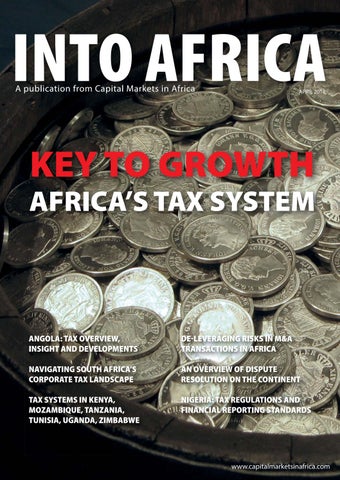

ANGOLA: TAX OVERVIEW, INSIGHT AND DEVELOPMENTS

NAVIGATING SOUTH AFRICA’S CORPORATE TAX LANDSCAPE
TAX SYSTEMS IN KENYA, MOZAMBIQUE, TANZANIA, TUNISIA, UGANDA, ZIMBABWE


DELEVERAGING RISKS IN M&A TRANSACTIONS IN AFRICA
AN OVERVIEW OF DISPUTE RESOLUTION ON THE CONTINENT
NIGERIA: TAX REGULATIONS AND FINANCIAL REPORTING STANDARDS




Editor
Tunde Akodu
Associate Editor
Michael Osu
Advertising & Sales
Tola Ketiku
FEATURED ARTICLES
Angola: Tax Overview, Insight and Developments
An overview of the Mozambican Tax System
Insight on Corporate and Investment Taxation in Kenya
Nigeria: Tax Regulations and Financial Reporting Standards
Navigating South Africa’s corporate tax landscape
Tanzania: Tax Overview, Insight and Developments
Tunisia: Tax Overview, Insight and Developments
Uganda Business and Investment Tax System in a Nutshell
Zimbabwe: A Snapshot of Business and Investment Tax Structure
SPECIAL FEATURES
Africa’s Infrastructure Financing: Currency Risks
De-Leveraging Risks in M&A Transactions in Africa
An Overview of Dispute Resolution on the Continent
South Africas 2018 Budget: Incentivize Local Debt Markets
Where Do Opportunities Lie in BRVM Equity Markets?
Welcome to the April edition of INTO AFRICA the publication with fresh insight into Africa’s emerging markets. This month’s edition, titled: Key to growth: Africa’s Tax System explores the tax laws and regulations across African countries.
In the global environment of scarce economic activity and resources, investors are increasingly looking to new sources of growth. Africa is one of these areas. However, navigating differing business customs across a continent as vast and diverse as Africa, will present particular opportunities and challenges, for new companies seeking to expand their existing operations. Therefore, investors need to understand different tax laws and regulations of African countries and look for ways to manoeuvre the complexity, while minimising the risks and optimise the opportunities.
We open this edition, with a discourse from SAMUEL ALMEIDA (Tax lawyer, Vieira de Almeida & Associados Portugal), JOANA LOBATO HEITOR (Senior Associate, Vieira de Almeida & Associados Portugal) on the Angolan tax system - basically construed on oil and mining tax revenues, disregarding other sources of fiscal revenues. In parallel, TANIA SANTHIM (Senior Consultant, SAL & Caldeira Advogados) and JENIFFER BIZARRO (Junior Consultant, SAL & Caldeira Advogados) offer an overview of the Mozambican tax system and point that the current tax system is divided into national and municipal taxes.
From the east coast, PETER MOMANYI (Head of Tax, Mazars Kenya) reviews Kenya’s tax regulations in “Insight on corporate and business taxation in Kenya” CELIA BECKER (Africa Tax Executive, ENSafrica South Africa) takes a look at the tax regime in Tanzania, which are administered by the Tanzania Revenue Authority. Alongside that, DORIS AKOL (Commissioner General, Uganda Revenue Authority) contributes “Uganda Business and Investment Tax System in a Nutshell” to the archive of information.
Still on Africa’s tax structure, TAIWO OYEDELE (West Africa Tax Leader, PricewaterhouseCoopers Nigeria) explains tax and financial reporting rules in “Nigeria: Tax Regulations and Financial Reporting Standards”. While HYLTON CAMERON (Director of Tax, Grant Thornton South Africa) gives us a tour through South Africa’s corporate tax landscape. Furthermore, ALICK MUTANDIRO (Manager Research and Development, Zimbabwe Revenue Authority) gives a snapshot of business and investment tax structure in Zimbabwe. At the same time, ADEL CHAABANE (Partner, Mazars Tunisia) features in “Tunisia: Tax Overview, Insight and Developments”
And we’re not yet done yet. PHILIP SKINNER and DENESH SRISHANKER, both Senior Investment Officers at GuarantCo, look at managing currency volatility in Infrastructure finance in Africa. On the other hand, GUY MILLER (Managing Director, Risk Capital Advisors Sydney) and SIMLA RAMDAYAL (Director, Risk Capital Advisors Johannesburg) enumerate how to de-leverage risks in merger and acquisition transactions in Africa. JONATHAN RIPLEY-EVANS (Herbert Smith Freehills South Africa LLP) and FIORELLA NORIEGA DEL VALLE (Associate, Herbert Smith Freehills South Africa LLP) present an overview of dispute resolution in Africa.
And there’s more … in this edition, WALTER DE WET (Senior Fixed Income Strategist, Nedbank South Africa) provides an insight on South Africa’s 2018 budget and of the opinion that the budget delivers greater certainty to local debt markets. In addition, AXEL ZABO (Senior Financial Analyst, SOGEBOURSE, SOCIETE GENERALE Group subsidiary) enumerates challenges and opportunities in the Regional Stock Exchange (BRVM). Editor
Cover Image : barrel of cash/coins-164580 Image Source: Pexels.com
DISCLAIMER:
The contents of this publication are general discussions reflecting the authors’ opinions of the typical issues involved in the respective subject areas and should not be relied upon as detailed or specific advice, or as professional advice of any kind. Whilst every care has been taken in preparing this document, no representation, warranty or undertaking (expressed or implied) is given and no responsibility or liability is accepted by CAPITAL MARKETS IN AFRICA or the authors or authors’ organisations as to the accuracy of the information contained and opinions expressed therein.
Connect with The Editor on Linkedin. Follow us on twitter @capitaMKTafrica. Subscribe to INTO AFRICA at http://eepurl.com/buHhNv or please send an email to intoafrica@capitalmarketsinafrica.com.
Please visit our website at www.capitalmarketsinafrica.com for the latest news, bespoke analysis, investment events and outlooks. ENJOY!
By Samuel Almeida, Tax lawyer, Vieira de Almeida & Associados Portugal
Joana Lobato Heitor, Senior Associate, Vieira de Almeida & Associados Portugal
ver the past decades, the Angolan tax system was basically construed on oil and mining tax revenues, disregarding other sources of fiscal revenues. The tax regime was still based on the Portuguese colonial tax system, full of inconsistencies and loopholes allowing for significant losses of revenue.
With the decrease of the oil prices and foreign investment, the Angolan Authorities have been progressively implementing a new tax package, with the purpose of enlarging the taxable basis and promote the increase of fiscal revenues. As a result, in the end of 2014, a package of new legislation was enacted, with the revision of the main tax statutes, such as the Industrial Tax Code, the Stamp Duty Code, the Investment Income Tax Code and a new Consumption Tax Code. Moreover, the authorities approved new transfer pricing regulations, alongside with a special tax regime for major taxpayers. Reportedly, VAT will be introduced in the near future. Angola is smoothly entering in a new tax era, with more sophistication, increasingly complex tax audits and more scrutiny by the authorities. The good news is that the country has finally put in place the first specialized tax and custom court in Luanda, ensuring further guarantees for taxpayers allowing for a progressive separation from the administrative and the judicial system. In the next lines, we will depict some of these new measures in further detail.
The FACTA regime is now fully implemented. In fact, following the approval of the agreement between Angola and the USA, Presidential Decree No. 1/17, of 20 June, has approved the legal framework applicable to the Tax Reporting of Financial Data within the framework of the Foreign Account Tax Compliance Act, setting the rules for disclosure of information by financial institutions to the tax authorities. According to the latest information made available by the end of 2017, the Angolan financial institutions have already started to collect information and comply with its reporting obligations.


Presidential Decree No. 147/13 of 1st October approved the Major Taxpayers Act, setting a new package of tax provisions applicable to major taxpayers, notably a special regime for corporate tax groups – allowing for group losses being surrendered as a single taxpayer. Please note, though, that companies obtaining tax losses for two consecutive years before integrating the consolidation perimeter and companies granted with tax incentives under the Private Investment Law cannot benefit from the regime. Another major tax advantage applicable to these entities, is the possibility of benefiting from a tax neutrality regime applicable to mergers and de-mergers between resident entities in Angola.
Pursuant to Order No. 316/17, of 17 July, 373 companies were listed as major taxpayers. The following entities are deemed as Major taxpayers: large dimension public companies, banking institutions, insurance and reinsurance companies, pension funds and pension funds managing companies, paying services companies, microcredit companies, oil companies, diamonds companies with a turnover of more than 5 billion Kwanzas, telecom companies and companies operating in monopoly markets
Alongside with the enactment of the Major Taxpayers Statute, a comprehensive transfer pricing regime was also approved, adopting basically the OECD Guidelines. As a side comment, this may lead to further discussions, since Angola is not an OECD member and the country has not adopted any Double Tax Treaty allowing for a direct transposition of international law to domestic legislation in Angola. This may pose some additional constraints for interpretation purposes, as it is not clear whether the Angolan authorities and the courts shall accept in the future the guidelines set by the OECD or the comments to the OECD Convention Model for purposes of interpretation and enforcement of the Angolan transfer pricing regime.
Under Angolan law, and for transfer pricing purposes, two companies are deemed related whenever they engage in business transactions that represent 80% or more of the other company’s turnover and also whenever one is providing funding representing 80% or more of the other company’s financial indebtedness. Also, the concept of ‘material influence’ is a key factor for purposes of defining ‘related parties’, including notably companies holding in 10% or more of the issued share capital or voting rights, or companies with common board members. It is not clear whether permanent establishments are also included within the scope of the transfer pricing provisions.
The transfer pricing methods accepted for the purpose of determining the arm's length price are as follows, no alternative methods being allowed:
o Comparable Market Price method;
o Reduced Resale Price method; and
o Cost Plus method.
Additionally, taxpayers with an annual turnover above AKZ 7 (seven) billion are required to maintain a transfer pricing file, identifying all transactions and deals with related entities.
The transfer file should include, among other items:
• Macroeconomic environment;
• Functional analysis;
• Full identification of transactions with related entities ; and
• Economic analysis.
The transfer pricing file must be submitted to the tax authorities within 6 months after closure of the tax year, being such obligation applicable as from the 2014’s tax year, first submission occurred by June, 30, 2015.
To the best of our knowledge, the enforcement of the new regime has been quite incipient, mostly due to the lack of preparation of the tax authorities and the absence of reliable comparable information.
“The tax
regime was still based on the Portuguese colonial tax system, full of inconsistencies and loopholes allowing for significant losses of revenue.”
This notwithstanding, according to a press release from the Angolan Tax Authorities made public last year-end, an ad-hoc technical administrative committee has been put in place at the Major Taxpayers’ tax office with the purpose of enforcing the regime and conduct through tax audits with the purpose of verifying compliance of transfer pricing requirements, notably the existence of proper documentation and transfer pricing files.
It seems relatively safe to conclude that the Angolan authorities will focus most likely in the oil and gas sector and the telecoms and financial sectors. These are priority sectors that will be subject to further scrutiny and increasingly more sophisticated tax audits. Tax litigation will certainly increase. The adoption of a comprehensive VAT system will require significant investments in training and technological tools to ensure proper collection of taxes.
These may still be incipient signs, but a new era from a tax standpoint is about to begin in Angola and taxpayers and foreign investors must be prepared to further invest in tax compliance and proper tax planning. Although Angola is not yet part of any mechanism of international cooperation, non-compliant tax policies may be tackled from outside cooperant jurisdictions.
Contributors’ Profiles
Samuel Fernandes de Almeida joined Vieira de Almeida & Associados in 2015. Samuel is a tax arbitrator and recognized as an expert in tax litigation, where he has been representing major clients during tax inspections, transfer pricing, and tax proceedings in domestic and the ECJ. Samuel has also an extensive experience in tax advisory, in Portugal and African countries (Angola, Mozambique and Cape Verde), including the oil industry and LNG projects. Samuel has been over the years a tax lecturer in several tax chairs.
Joana Lobato Heitor joined Vieira de Almeida & Associados in August 2015. She is senior associate at the tax practice area where she has been actively involved in tax litigation issues, international tax planning and tax consultancy. Before joining the firm she worked at Miranda Correia Amendoeira & Associados in the Tax Department. She holds a postgraduate degree in Accounting Rules (Lisbon University) and in Tax Law (ISG Institute).
By Tânia Cristina Santhim, Senior Consultant, SAL & Caldeira Advogados
Jeniffer Jenice Bizarro, Junior Consultant, SAL & Caldeira Advogados
n Mozambique, taxes are created or modified by law. The term “law” is understood to refer to normative acts of the Assembly of the Republic. Thus, the incidence and rates of tax, fiscal benefits and taxpayers’ guarantees may only be established by acts of the Assembly of the Republic (i.e. laws). This chosen constitutional option effectively precluded the historical ability of the Government, whose normative acts, under Mozambican hierarchy of law principles, are subordinate to the normative acts of the Assembly of the Republic, to grant special tax exemptions.
The current Mozambican Tax System, is divided in national and municipal taxes. National taxes, in turn, can be of three categories.
Direct taxation of income and wealth is accomplished through the Corporate Income Tax (CIT) and Personal Income Tax (PIT). Indirect taxation on expenditure includes the Value Added Tax (VAT), excise duty (ICE) and Customs Duties
Direct Taxation of Income and Wealth
Corporate Income Tax (“CIT”)
Companies and similar entities that are tax resident in Mozambique are liable to corporate income tax, which is levied on taxable profits, defined as accounting profits adjusted to comply with tax law rules.
CIT is a direct tax that focuses on income obtained during the relevant tax period of legal entities, even when such income is obtained by illicit means.
Persons classified as residents for CIT purposes (i.e. legal persons and other entities whose headquarters or effective management are located in Mozambican territory) are taxed on their worldwide income. By contrast, non-residents (i.e. legal persons and other entities without headquarters or effective management within the Mozambican territory with or without a branch office) are subject to CIT only on their income obtained in Mozambique
Personal Income Tax (“PIT”)
PIT is levied on the income pertaining to natural


persons either: (i) residents in the Mozambican territory, with respect to income obtained in Mozambique and abroad; and (ii) non-residents, on income obtained in Mozambique.
Individuals are considered residents in Mozambique in any given fiscal year if they remain in the country for more than 180 days, continuously or in aggregate, or if they stay for less time, but possess a residence in the country and are deemed to have the intention to use it as place of habitual residence.
The income referred to above is derived from the following categories:
1st Category: Employment income;
2nd Category: Business and professional income;
3rd Category: Income from investments and capital gains;
4th Category: Income from real estate; 5th Category: Other income.
PIT is levied on a steeply graduated basis. The rates applicable to annual income in meticais vary from 10% to 32%, depending on the amount of the taxable income. Income derived by individuals which are non-residents in Mozambique are subject to withholding tax at a single flat rate of 20%.
Indirect Taxation on Expenditure Value Added Tax (“VAT”)
VAT is levied on the (i) supply of goods or (ii) services, carried out in the national territory by a taxpayer acting as such and, in any case, on (iii) the import of goods. Mozambique VAT rate is 17%.
The import and export of goods to the Mozambican customs territory is subject to the payment of customs duties and other charges. Customs duties vary between 0% to 20% depending on the economic classification of imported products, as described on the Customs Tariff Schedule.
Specific Consumption Tax (“ICE”)
ICE is levied on certain goods, manufactured in the national territory or imported, that are considered to be luxuries, superfluous, toxic, dangerous to health or dangerous for human consumption or to the environment, as is the case of motor vehicles, alcoholic beverages, beer and tobacco. The ICE rates are variable from 5% to 75%, and are contained in the tables attached to the ICE Code.
Other taxes
Stamp Duty
Stamp Duty is charged on all documents, books, papers and instruments referred to in the respective table attached to Stamp Duty Code, which includes relevant rates and exclusions. The rates of stamp duty are provided in the Stamp Duty Table attached to the Stamp Duty Code.
Real Property Transfer Tax ( “SISA”)
It is due in respect of the transfer, on a nongratuitous basis, of the right of ownership or other incidental rights on real property; real property is understood to be “urban buildings” located within the national territory. Whenever SISA applies on a real property located within a municipal area, it becomes a municipal tax
Vehicles Tax
Vehicles Tax it focuses on the use and enjoyment of certain vehicles licensed and registered in the country. For the purpose of this tax the taxpayers are the owners of vehicles. Similarly to the SISA, the vehicles tax may become a municipal tax when it refers to vehicles registered in a municipal area.
National Reconstruction Tax (“IRN”)
Is levied on all national citizens or resident foreigners who earn income subject to PIT, even if exempt, except for taxpayers undertaking agricultural, forestry or livestock activity, and are aged between 18 and 60 years. Note that foreigners and non-resident nationals become subject to IRN the year following the one in which they establish residence in the national territory, and the rate approved for 2018 is MZN 260,00. Bear in mind that the IRN is replaced by the Municipal Individual Tax within the municipal areas, as stated below.
Petroleum Production Tax (“PPT”)
Is levied on the oil & gas produced in Mozambican territory from the development and production areas. The tax rates for Crude Oil is 10% and for Natural Gas is 6%.
Mining Production Tax (“MPT”)
Is levied on the extracted mineral product, the
concentrates and the mineral water, arising from mining activity within Mozambican territory with or without mining title. The MPT rates vary between 1,5% to 8% depending on the mineral.
Surface Tax
Is an annual tax levied on reconnaissance and exploration licenses, concessions and mining certificates, and its rates vary depending on the hectares covered.
Mineral Resource Rent Tax (“MRRT”)
MRRT is due when the net cash gains originates an internal return rate equal or above 18% before CIT, and is due at the end of the fiscal year, at a tax rate of 20%.
Municipal Taxes
Municipal governments in Mozambique have limited taxing powers. Municipal taxes include those set forth below.
Municipal Individual Tax (“IPA”)
It is charged on every national or foreign individual, aged between 18 and 60 years who, among other conditions provided by law, resides within the municipal territory. It is levied on the salary of the employees. This tax is payable in March of each financial year, and must be withheld from the employees’ salary during February. The rate of the IPA is established by the Municipal Assembly on an annual basis.
Municipal Tax on Real Estate (“IPRA”)
Which is levied on buildings situated within a municipality. The rates applicable are 0.4% for buildings used for habitation purposes and 0.7% for buildings used for commercial purposes. Currently, the value of immovable property is determined on the grounds of a formula that is subject to periodic assessment by the Municipal Council.
Municipal Tax on Economic Activities
It is due by taxpayers that carry out commercial or industrial activities or services in Municipalities. The rates are to be established annually by each Municipality. Please note that the according to the law this tax is levied upon each premises where the activities are carried out, and considering the (i) nature of the activities carried out, (ii) location of the premises and (iii) area occupied.
Municipality tax for vehicles
It is due by all vehicles of the municipality and respective rates are calculated in accordance with
the vehicle capacity and manufacturing year, varying from MZM 50.00 (fifty Meticais), approximately USD 0.80 (eighty cents) to MZM 4,400.00 (four thousand and four hundred Meticais), approximately USD 70.73 (seventy United State Dollars and seventy three cents) per vehicle.
Double Taxation Treaty Agreement (“DTTA”)
In order to avoid international double taxation on income, Mozambique has entered into bilateral agreements with the following countries: Portugal, Italy, Mauritius, United Arab Emirates, the Government of the Macau Special Administrative Region of the Republic of China, the Republic of South Africa, India, Botswana and Vietnam. These double taxation treaties intend to avoid double taxation in respect of income, including business profits, interest, royalties, dividends and capital gains.
This report supplied an overview of the tax system in the Republic of Mozambique. We hope that you found it useful. Should you require any clarification or further information, please do not hesitate to contact us.
Contributor’s Profile:
Tânia Cristina Santhim Lawyer. Graduated in Law from the Law Faculty of Eduardo Mondlane University. She have good experience in Corporate
and Individual Taxation and Investment legal regime in Mozambique. She has a deep experience on tax due diligences and tax compliance reviews and is also providing assistance to clients that have foreign investments in Mozambique. Additionally, she has contributed to legal reform processes in the tax area in general and especially in the extractive industry. She has also been involved in the reform of VAT Code and tax framework of Oil & Gas and Mining sectors. As such, has a largest experience in assignments related with tax matters in extractive industry. Member of the Bar Association of Mozambique.
Jeniffer Jenice Bizarro Graduated in Law from the Instituto Superior de Ciências e Tecnologia de Moçambique (ISCTEM). Has experience in the areas of banking and foreign exchange law and tax law. Currently provides legal advice in the tax area, in matters related to the application of tax law in Mozambique, assistance in processes of commencement and closure of activities, as well as in obtaining tax quitclaim certificate and Unique Tax Identification Number (NUIT) and requesting binding opinions, with the Tax Authority. Has solid knowledge in areas of Civil and Civil Procedure, Labour and Labour Procedure, Criminal and Criminal Procedure, Banking and Insurance, and Tax.
Developments in the second half of 2017 indicate that a slowdown in Mozambique’s economic performance may be taking hold, shifting this once fast-growing economy to a more modest pace of economic growth barely above that of population growth.
GDP growth is set to dip to 3.1 percent in 2017 despite substantial growth in the country’s coal and aluminum exports. Whilst these have boomed, Mozambique’s small and medium enterprise sector has fallen even further behind, especially manufacturing, which has contracted for the first time since 1994.
The World Bank’s new Mozambique Economic Update (MEU) notes that small and medium enterprises are crowded out, and that not even the sizable growth of commodity exports is sufficient to counteract the effects this is having on the economy. The level of concentration has also increased in 2017: Just a few commodities dominate exports, representing a larger share of foreign currency inflows, which heightens the country’s exposure to external shocks.
Hence, the trends observed in 2017 make it clear that Mozambique needs to redouble its efforts to support small and medium enterprise, and to look beyond the extractive sector for more balanced growth.
Making the most of demographic change
In order to examine future demands on Mozambique’s economy, the special focus of this update discusses the challenge of transforming the country’s young population into a demographic dividend for future growth.
This is a more urgent than ever given the drift towards an economy based on the extraction of natural resources, with an otherwise low generation of employment.
Mozambique lags behind other sub-Saharan African countries in kicking off a demographic transition. From about 2000–2010, there was no progress at all toward a demographic transformation: In fact, already high fertility levels appeared to have risen. By 2011, the country’s total fertility rate was estimated at 5.9 children per woman on average—one of the highest rates in the world.
“Transforming Mozambique’s population trends into a demographic dividend is an immense challenge, but so are the potential gains,” said Peter Holland, World Bank Program Leader for Human Development. “Our analysis estimates that reducing fertility levels would represent an enormous boost: an estimated increase in real per capita GDP of 31 percent by 2050.”
To turn this into an economic opportunity, Mozambique needs to actively promote policies that would trigger a transition for women—job opportunities, better family planning services, and delaying the onset of early marriage.
The Bank’s new Economic Update also calls for a sharper focus on building skills for youth, with particular emphasis again on women and an economy that grows whilst generating productive jobs for the next generation of Mozambicans.
This report emphasizes that more needs to be done to stabilize the macroeconomic outlook and rebalance the policy mix with definitive fiscal policy measures. And, though monetary policy has been decisive, and contributed to stabilizing the currency at a critical time, it has also heightened the cost of credit.
Space is now opening for the monetary policy cycle to begin easing as inflation continues to fall, which would improve the private sector’s access to financing. This requires a tighter fiscal policy response and more sustainable levels of debt. It would also require a more proactive approach to tackling the fiscal risks coming from weak state-owned enterprises, as well as necessitating increased transparency in the handling of the investigation into Mozambique’s hidden debts to restore both investor and donor confidence.
By Peter Momanyi, Head of Tax, Mazars Kenya
he republic of Kenya remains one of the premier destinations for foreign direct investment in Africa. In 2015, Kenya saw a 49% increase in FDI measured in terms of the numbers of FDI supported projects from 57 in 2014 to 85 in 2015. Kenya claimed 12% of all FDI inflows into Africa in 2015 and now boasts 4% of the total overall FDI into Africa1 .
Kenya has taken steps to improve the business environment in the country and this has culminated in an improvement of 16 places in the World Bank ease of doing business ranking. There have been measures to encourage investment in industries that the government views as being underdeveloped and having the potential to contribute significantly to the country’s GDP and create employment for the citizenry. Spending on infrastructure and alternative and green energy has increased significantly with the country investing in the standard gauge railway, rolling out of modern multi-lane roads and in coal, solar and wind power plants.
Kenya has sought to strike a delicate balance between tax incentivization measures to attract investment and the imposition of the appropriate taxation to ensure the government collects its fair share of revenue from the projects on its territory without causing any investor flight.
Upstream petroleum activity
The discovery of oil in Kenya generated excitement across the country with the prospect of budgetary independence appearing to be a reasonable expectation. The expectation of financial independence percolated down to the county government (Kenya runs a devolved system of governance) and to the local communities. The issue of sharing of revenues expected to be realized once the petroleum industry moves from exploration and evaluation to development and production has remained a thorny issue. The Petroleum Development Bill 2015 proposed that the county government be allocated 20% and the local community receive 5% of profits from upstream petroleum activity. The bill was rejected by President Kenyatta on account of the revenue sharing ratios with the national government seeking a larger share of the revenue. The current petroleum exploration act

was enacted before the Kenya promulgated a new constitution and it vests all petroleum revenue with the national government.
The government moved to enhance the taxation of upstream petroleum activity by overhauling the taxation regime for upstream petroleum activity in 2015. The new tax regime enhanced some tax measures while allowing investors to obtain a measure of fiscal relief.
Petroleum prospectors are allowed to claim 100% of the cost incurred on exploration expenditure under an investment deduction scheme. This includes the cost of machinery purchased for the sole purpose of petroleum exploration.
Development expenditure, which is usually incurred once a well has been deemed to be viable, is allowed a capital allowance at the rate of 20% per year. This allows a developer to recoup the costs of developing a well within 5 years.
Ring fencing of petroleum activity is done at the level of oil blocks – losses and expenses incurred in one oil block are not allowed to be offset against income generated in a different block. It is thus possible for a petroleum company to pay income tax in respect of one block while suffering tax losses on another block.
Offset of accumulated tax losses is allowed indefinitely to allow operators to recover their costs in instances where development work takes longer than anticipated. By comparison, other tax payers are only allowed to carry forward their accumulated tax losses for 9 years.
Disposal of interest in an oil block (popularly referred to as farm out) are subject to tax as business income.
Where a petroleum company’s debt exceeds more than twice its equity, the company is considered to be thinly capitalized and is not allowed to claim a deduction for its interest expense. Other companies are allowed to carry a debt of three times their equity before being considered to be thinly capitalized.
The industry enjoys an import duty and VAT exemption on inputs purchased for use in the exploitation and development of petroleum.
The upstream petroleum industry in Kenya is dominated by multinational companies with the state corporation mandated to invest in upstream activity – the National Oil Corporation of Kenya, concentrating on petroleum retail activity instead.
Kenya has progressively advanced the rural electrification agenda, even establishing a Rural Electrification Authority to accelerate the process. In 2016, Kenya added 1.3 million households to its electricity grid and bringing the coverage in the country to 55%, up from a mere 27% in 2013. Kenya hopes to provide universal access to electricity by 2020 with an estimated 60% of the electricity being sourced from renewable sources.
To support the pace of electrification, Kenya has put in place fiscal and contractual measures to guarantee investors in the sector a return on their investment.
Material and machinery imported into the country for use in the generation of electricity to supply the national grid is exempt from import duty and VAT.
Machinery employed for use in the generation, transformation and distribution of electricity enjoys investment deduction at the rate of 100% allowing an investor to claim the entire cost of the machinery in the year the expenditure was incurred.
The VAT Act 2013 increased the VAT rate for domestic electricity supply from 12% to 16% and eliminated zero rating for electricity supply not exceeding 200 kilowatt hours. The Act also undid the tax privileged status of the Rural Electrification Authority enshrined in the previous VAT Act.
Equipment and material used in connection with renewable energy is generally VAT exempt. This includes:
1. Biogas
2. Biogas digesters and equipment used for production of biogas
3. Solar equipment and accessories such as heaters and batteries
4. Input and material used by solar equipment manufacturers
5. Input and material purchased for the manufacture of clean energy stoves
Agriculture
Agriculture has long been the backbone of the
economy with the sector estimated to employ, either directly or indirectly, 75% of gainfully employed Kenyan population. The sector also contributes an estimated 25% of the Kenya’s GDP. In view of the sector’s immense importance to the country, the sector has attracted a lot of FDI with investors setting up green houses for the production of agricultural products for export. Multinationals play a crucial role in this sector with the largest tracts of agricultural lands in Kenya being owned or managed by multinationals.
Agriculture benefits from the VAT exemption of almost all unprocessed agricultural products including milk, pyrethrum, live animals, maize, beans, groundnuts and several other products.
Agricultural inputs including fertilizer and pesticides and raw materials and machinery used for the local manufacture of pesticides, are exempt from VAT.
Services provided to support farmers such as veterinary services, pest control, coffee and tea brokerage and agricultural consultancy services do not attract VAT.
Input or raw materials purchased for use in the manufacture of agricultural machinery are also exempt from VAT.
Further tax relief is provided for farmers availing their coffee and tea to an auction house intended to procure produce for export. Tea and coffee supplied in this manner qualifies for VAT zero rating with farmers being eligible to receive VAT refund on all input tax incurred in production. The government gives preference to agricultural companies in the processing of VAT refunds even though scarcity of funds results in huge back logs of VAT refunds for exporters.
Investors deriving more than 66% of their income from agriculture or horticulture are allowed to pay 2 installments of corporation tax in a year of income, with the first installment being made 9 months after the end of the year of income. Other businesses are required to pay 4 installments in a year of income, with the first installment being made 4 months after the end of the year end.
Farmers are allowed to claim 100% of expenditure on farm works in the year that the expenditure is incurred. Farm works refers to agricultural structures such as cattle dips, gabions, terraces and housing for livestock.
Agricultural property of an area of less than 100 acres is exempt from capital gains tax.
Income tax exemption has been extended to
regulators and overseers of the agricultural sectors including the National Irrigation Board, Tea Board of Kenya, Pyrethrum Board of Kenya, The Sisal Board of Kenya and other organizations concerned with the promotion of agriculture in Kenya.
Income from Agriculture is ring fenced and thus any losses arising from agricultural activity may not be offset against other income and vice versa.
Maritime activity
Kenya has long viewed the maritime sector as an area with a high growth potential. Investors committing money into the maritime sector can expect an investment deduction of 150% in the year of expenditure. The investment deduction will also to high cost acquisitions such as ships.
The government hasmoved to reduce the port charges for shipping vessels. Kenya is expected to push for the elimination of import duty charges on equipment for underwater tourism which currently attracts import duty at 25%.
Taxable goods supplied to marine fisheries and fish processors will also qualify for exemption from VAT.
Motor vehicle assembly
Kenya has seen dealerships for established brands set up in the country with manufacturers such as BMW, Mercedes Benz, Volkswagen, Chevrolet, Toyota, Nissan and even marquee outfits such as Porsche and Jaguar setting up dealerships in the country. In an attempt to incentivize the manufacturers to set up assembly plants in the country, the government recently introduced a reduced corporate tax rate for investors setting up assembly plants in the country. Motor vehicle assemblers will pay corporate tax at the rate of 15% for 5 years as opposed to the standard corporate tax rate of 30%.
In addition, locally assembled vehicles specially designed for the transportation of tourists and used exclusively by tour operators qualify for exemption from VAT.
The Kenyan movie industry has remained resilient despite the existential threat posed by Nollywood, which is very popular in Kenya and the general indifference of the populace towards local produced content. The plight of the industry is best illustrated by the bankruptcy and eventual auctioning of the once upon a time untouchable Phoenix Players theatre outfit.
To remedy the demise, Kenya introduced a tax exemption scheme for items purchased for use by
film producers and filming agents. Investment into a structure for use for the training of film producers, actors and crew attracts investment deduction at the rate of 100%. Payment made to foreign actors and crew members involved in the production of films in Kenya are exempt from withholding tax which would ordinarily apply at 20%.
Kenya employs a compensating tax scheme which seeks to ensure that any dividends distributed by a company are sourced from taxed income. Where a company enjoys a tax holiday, preferential income tax rates and tax subsidies, the company could be profitable and cash rich without actually paying commensurate income tax. The rate for compensating tax is 43% of the dividends distributed and this makes it unattractive for investors in subsidized sectors to repatriate their returns as dividend.
Kenya also employs a cap on deduction of interest where an investor funds a company predominantly through equity. The allowed ratio of debt to equity is 3 units of debt for each unit of equity. A company that does not achieve this ratio is considered to be thinly capitalized and will only be allowed a proportionate deduction of interest expense.
The current Income Tax Act is expected to be repealed and replaced in the next year with a New Act and we expect that the new Act will better address the issue of compensating tax and thin capitalization.
Kenya has opted not to impose and foreign exchange restrictions and this has made in much easier for investors into the country to move money into and out of the country.
In a nutshell, Kenya remains an attractive investment destination with the country making laudable efforts to improve the ease of doing business. Kenya has the lowest VAT rate in the EAC region (16%) and charges the lowest capital gains tax rate in the region (5%). Tax incentives and taxation measures are designed to operate on a sector by sector basis with ring fencing of income being a common feature of the Kenya tax regime.
Contributor’s Profile
Peter Momanyi is the head of tax at Mazars Kenya. He is a lawyer and chartered accountant, with over 14 years experience in tax management. Peter provides comprehensive tax solutions to investors in varied sectors looking to set up in Kenya including pre-investment advice and tax planning.
By Taiwo Oyedele, West Africa Tax Leader, PricewaterhouseCoopers Nigeria

Imagine a restaurant that only serves a standard 3-course meal at a fixed price, but you only want a piece of fried fish and a drink. The chef will spend more resources to prepare the standard meal for you and you will have to pay more than if your specific order is obliged rather than surpassed. This is somehow similar to the way financial reports are currently prepared and presented – quite standardised rather than customised.
ax and financial reporting rules are changing Stewardship is a critical element in every facet of human life. In the corporate world, this may be done in different ways or take various forms but one thing that is common to all is the requirement for financial reporting. Although the primary purpose of financial reporting, which is to provide useful information for stakeholders, has remained the same; the way this is achieved has continued to evolve through the ages.
As the world changes and becomes more complex but better connected, regulators issue new rules while the broader stakeholder group demands simpler ways to comprehend the business world as they seek faster and easier access to useful information.
From the days when there were no laws that mandated financial reporting to the present time when almost everything that matters needed to be included in the annual reports, financial reporting and tax regulations fit perfectly into the popular saying that “the only constant thing is change”. Recent developments in the tax space have equally led to calls for more transparency and accountability with questions now being asked about not just compliance with laws but tax morality. Some major requirements in this regard include Country by Country Reporting as well as Non Compliance with Laws and Regulations (NOCLAR).
Indeed, there is a lot going on in the financial reporting space but I have decided to focus on three major trending issues. These are, the widespread adoption of uniform reporting standards; the impact of technology on reporting; and how we bring everything that matters together under integrated reporting.
Given the importance of consistency and compara-
bility, the world is moving towards a global standard of reporting and convergence. According to the International Accounting Standards Board (IASB), about 120 jurisdictions now require International Financial Reporting Standards (IFRS) for all or most publicly accountable entities while most other jurisdictions permit the use of IFRS. Nigeria is, of course one of the jurisdictions that require IFRS effective from 2012.
Some of the major trends under IFRS include recent changes to fair value measurement to provide more useful information for users of financial statements. While historical information is more reliable, there is a major shortcoming in using past information to predict future performance.
IFRS 13 defines fair value as “the price that would be received to sell an asset or paid to transfer a liability in an orderly transaction between market participants at the measurement date.”
Although fair value measurement is still a grey area (or even different shades of grey) but the concept is no doubt a step in the right direction.
Perhaps the most complex area of reporting is financial instruments. One of the most recent standards on the subject (IFRS 9) includes requirements for recognition and measurement, derecognition and hedge accounting. The IASB is adding to the standard as it completes the various phases of its comprehensive project on financial instruments, and so it will eventually form a complete replacement for IAS 39 Financial Instruments: Recognition and Measurement.
Another important aspect of financial reporting under IFRS is consolidation of group entities. IFRS 10, which takes effect from 2016, introduces a new definition of control which is determined by factors such as the extent of power over investee which is
described as having existing rights that give the current ability to direct the activities of the investee that significantly affect the investee’s returns, exposure, or rights to variable returns from its involvement with the investee. It also includes ability to exercise power over the investee to affect the amount of the investor’s returns.
IFRS 10 also introduces a significant change relating to the unit of account for which control is assessed. It goes beyond generally assessing whether there is control over an investee in its entirety, and requires an investor to also consider whether it has power over a portion of an investee. That is, whether the investor has power over specified assets of an investee, and whether this portion of an investee is considered to be a separate ‘deemed entity’. In substance, if all of the assets, liabilities and equity of the deemed entity are ring-fenced from the rest of the investee, control over such portion is assessed separately.
Thus, under IFRS 10, control could exist at a level below a legal entity (say a division), resulting in consolidation or deconsolidation of those specified assets, but not the entire legal entity.
There remains a gap to be addressed by the standard in a situation where two or more entities are controlled by individuals rather than a company or companies having shares and other direct interest in one another. Under this scenario, the individuals who control the companies can influence the operating and financial decisions of the entities. They could, for instance, use one of the entities as a special purpose vehicle to hide losses or raise capital for another entity and not have to worry about consolidation. Pending when new rules will be introduced to address this gap, one can only rely on IAS 24 which requires disclosures of related party transactions.
“A la carte” financial reports
Imagine a restaurant that only serves a standard 3-course meal at a fixed price, but you only want a piece of fried fish and a drink. The chef will spend more resources to prepare the standard meal for you and you will have to pay more than if your specific order is obliged rather than surpassed. This is somehow similar to the way financial reports are currently prepared and presented –quite standardised rather than customised.
Technology continues to revolutionise the world in every aspect of human endeavour and financial reporting is not left out of this. As more information
is provided, many users suffer from financial information overload as they have to sieve through long reports to find what is most useful to them.
Extensible Business Reporting Language (XBRL) is a member of the family of languages based on Extensible Markup Language (XML), which is a standard for the electronic exchange of data between businesses over the internet. Under XML, identifying tags are applied to items of data so that they can be processed efficiently by computer software. It enables unique identifying tags to be applied to items of financial data, such as ‘net profit’. However, these are more than simple identifiers. They provide a range of information about the item, such as whether it is a monetary item, percentage or fraction. XBRL allows labels in any language to be applied to items, as well as accounting references or other subsidiary information. XBRL is a classic point of where financial reporting meets technology.
Although XBRL is currently being used for different purposes, it is hoped that it will further develop to a point where users of financial information will be able to query and generate the information they need from the database of a company’s financial reports. This will make financial reporting more relevant and cost effective.
In a recent PwC Survey (PwC 17th Annual CEO Survey), 75% of CEOs said that measuring and reporting the total impact of their company’s activities across social, environmental, fiscal and economic dimensions contributes to the long-term success of their organisation. Interestingly investors agree that disclosures about strategy, risks, opportunities and other value drivers are important.
Integrated reporting (IR) has emerged as an important development in corporate reporting since the onset of the global financial crisis. There is a strategic steering committee of the high-level International Integrated Reporting Council (IIRC) which issued a consultation document on a draft framework in September 2011. This framework is now gaining ground with about 80 organisations selected initially for the pilot phase with a few more now adopting the framework.
The emerging integrated reporting model is intended to reflect the interconnected nature of economic and financial performance with environmental, social and governance factors in organisations’ annual reporting.
The IIRC describes IR as being ‘a holistic approach to enable investors and other stakeholders to understand how an organisation is really performing. Addressing the longer-term consequences of decisions and actions, an integrated report makes clear the link between social, economic and environmental value’.
Rather than provide different reports in a disjointed manner as is currently the case, IR advocates communicating the relationship between an organisation’s strategy, governance, and business model alongside an analysis of the impacts and interconnections of material financial and non-financial opportunities, risks and performance. As a matter of fact, this concept actually goes beyond just integrating different reports; it requires an integrated approach to business strategy and integrated thinking about how the organisation is managed.
Peter Bakker, Chairman World Business Council for Sustainable Development and Vice President IIRC seemed to have summed it up nicely when he said “Financial capital is disproportionate in the way in which a company is valued. Social and environmental impacts are not recognised to the extent they need to be in investment and capital allocation decisions. Integrated Reporting is also about giving credit where credit is due. A company that leaves the environment and the community better off than when it started should have this reflected in its true value proposition”.
It is impossible to tell but certainly the world will continue to evolve and people will always chal-
lenge the status quo to move mankind to the next level. A likely change that will revolutionise the world of reporting is blockchain technology and the current-value proposition. Blockchain is using new technology to build a radically better financial system while the “current-value” concept advocates reporting of current rather than historical values in the financial statements. Proponents of this type of accounting argue that historical cost financial statements are flawed because they provide information about the past rather than the present, which is more relevant to investors. Current-value reporting is expected to provide financial statements that are more reflective of a company’s value, although it is likely to be more susceptible to manipulation and hence less reliable.
Reporting entities, especially public interest entities, need to embrace the trends in financial reporting, tax and technology beyond what is legally required. For instance, they should adopt integrated reporting and begin to consider how and what impact technology will play in how they make financial information highly customised, more relevant, transparent and easily accessible to their diverse users.
Contributor’s Profile
Taiwo Oyedele is a partner at PwC and a fellow of the Institute of Chartered Accountants of Nigeria, Chartered Institute of Taxation of Nigeria and ACCA. He is also a fellow of the Nigeria Leadership Initiative and member of the Corporate Governance Society Nigeria. He is the Founder & President of Impact Africa Foundation.
A clock on a Nigerian government website shows it’s less than 48 hours before the end of an amnesty for tax defaulters that the finance minister announced nine months ago in the hopes of boosting revenue collection.
The government seeks to collect $1 billion from thousands of taxpayers who declared arrears in return for a waiver of penalties, audits and prosecutions under the so-called Voluntary Assets and Income Declaration Scheme. Those who failed to declare will be prosecuted, Finance Minister Kemi Adeosun said.
“They will definitely prosecute defaulters, but they should prosecute billionaires, and not only people owing below 5 million naira ($13,900) so we know they are serious,” Ogho Okiti, chief executive officer of Abuja-based Time Economics Ltd., said by phone. “The program has been a success in that it has brought millions of people into the tax net, although I doubt they got the money they targeted.”
The tax amnesty is one of the measures the government of Africa’s largest oil-producer is trying to triple its non-crude revenue to help fund this year’s spending plans, which President Muhammadu Buhari raised by 16 percent to 8.6 trillion naira. Out of 71 million adults, only 14 million pay taxes in the continent’s most populous nation of 180 million people, according to Adeosun.
Besides improving tax compliance, other fundraising plans include increasing excise duties on alcohol and tobacco from June 4 and a move to raise levies on luxury goods and disposing of shares in some public assets. The government has sued an energy company for alleged unpaid taxes and royalties of $6 billion, the local Daily Post newspaper reported March 3, citing court documents.
“The government’s capacity to go after tax defaulters will depend on the credibility of information they have on them,” Michael Famoroti, an economist at Lagos-based Vetiva Capital
Management Ltd., said by phone. “We understand the government is partly depending on consultants who put up a list of thousands of individuals and firms they think should be paying more.”
Nigeria wants to double its ratio of tax to gross domestic product by 2020 from the current 6 percent. That compares with South Africa at about 27 percent and Ghana at 16 percent.
Authorities should broaden the pool of products subject to excise duties, increase value-added tax and reduce exemptions, the International Monetary Fund said in a report earlier this month.
While the amnesty is welcome, it doesn’t address the structural issues with Nigeria’s tax policy, Okiti said.
“They should integrate personal-income tax and corporate tax, and integrate the federal and state government’s tax platforms to close loopholes,” he said.
By Hylton Cameron, Director of Tax, Grant Thornton South Africa
n the global environment of scarce economic activity and resources, investors are increasingly looking to new sources of growth. Africa is one of these areas and South Africa is often one of the first countries that companies consider setting up their operations. There are various reasons for this, which include the relative sophistication of the economy and financial services in particular. In addition the country has good infrastructure, as well as sound legal and accounting principles.
While some wealthier South African taxpayers have expressed concern at high personal income tax rates, corporate tax rates are generally still considered competitive by global standards, so as to maintain an investor-friendly regulatory regime in an emerging economy. Still, there are various taxation factors companies need to take into consideration before setting up a base in South Africa.
The South African Companies Act requires a foreign company that wishes to conduct business in South Africa to set up a formal local business. Therefore, the starting point for most companies is deciding on the structure of their South Africa operations, namely whether the office will be a branch of the existing company, or set up as a new subsidiary company. There are some other types of hybrid structures, but these are limited and rarely suit the needs of companies looking to expand to Africa.
The South African tax authorities have become increasingly sophisticated and have been known to levy stringent penalties on those few companies that conduct business in the country, without regard or consideration for the laws it needs to comply with.
The main differences between a registered branch – or ‘external company’ as referred to in corporate law – and an incorporated subsidiary, is the legal liabilities and responsibilities that the parent company may face owing to the form of the South African structure.
In terms of tax alone, registering a branch is the more efficient option. While a branch and subsidi-

ary are taxed at the company tax rate of 28%, a branch will not be subject to a further dividend withholding tax, should the local operations realise a profit. Subsidiaries that turn a profit, on the other hand, have to levy dividend withholding tax of 20%, and if the full dividend tax is paid, the effective tax rate moves up to 42.4%.
Furthermore: companies incorporated in South Africa are subject to tax on their worldwide income, while non-resident companies are only taxed on their South African source – or deemed source –income.
However, a registered branch is an extension of the foreign company and not a separate entity. Therefore, the foreign company is legally liable for any actions of the branch.
For this reason – regardless of the tax implications – most foreign businesses choose to set up a subsidiary when starting operations in South Africa. In this way, the local subsidiary is liable for its own actions and the foreign parent is – at worst – exposed to losing its investment, ignoring possible goodwill issues.
Other than these factors, there are no significant tax differences between branches and subsidiaries.
Companies looking to enter South African waters also need to decide on whether the local operations will be considered a tax resident. An entity is a resident if it is incorporated in South Africa or has its place of effective management (POEM) in South Africa.
The latter matter of POEM is often a tricky decision, but a strong indication is usually to look at the place where the senior managers or directors are based and make their decisions from.
Any decision regarding the tax residency of a company is subject to the provisions of a Double Taxation Agreement (DTA), should such company be resident of another country with which South Africa has a DTA.
South Africa has numerous Double Taxation Agreements (DTAs) with other countries, and the general principal behind these agreements is that a company should only be taxed once. If it is taxed in both jurisdictions, a credit should be given for the tax paid in one country.
This is also applicable to branch and subsidiary structures: if a registered branch conducts business in South Africa and there is a DTA with the country where the foreign parent company resides, the branch can only be taxed if it constitutes a “permanent establishment” (PE).
This refers to a fixed base through which the foreign company conducts its business. Usually the foreign company will not create a PE if it is involved in preparatory or auxiliary activities, for example if it is simply marketing the foreign company’s goods. However, when the marketing employee becomes a sales person, this could easily lead to the creation of a PE.
Should a subsidiary be incorporated in South Africa, many DTAs reduce the dividend withholding tax rate to 5%. This in turn reduces the effective tax rate to 31.6% (as opposed to 42.4%). While a DTA can therefore make a subsidiary structure more attractive, it is still not as efficient – from a tax perspective – as registering a branch.
At the time of writing there is some controversy regarding the dividend withholding tax rate in the Netherlands and Sweden, where the rate is arguably 0%. This should change to, at least, a definitive 5%, but the change is taking longer than expected.
Another technical matter to consider is whether South African tax residents own more than 50% of a foreign company. In this case, such a company will be a controlled foreign company (CFC).
The income of the CFC has to be included in the South African shareholder’s income – in proportion to the shareholding it holds in the CFC. There are various exemptions and exceptions to this rule, the two main of which are if the CFC has a ‘foreign business establishment’ – essentially an office with its own employees who can perform the functions of the CFC, and secondly, if the CFC is located in a high tax jurisdiction.
This is a simple concept in South Africa, as there is no group taxation; each company is subject to tax. However where there is a 70% held on-shore group, there is the potential to move assets around the group without any immediate tax consequences (a kind of group tax exemption).
Some other transactions can also be achieved on a tax-neutral basis, if the so-called intra-group rules are applied. In certain scenarios, parties that are not connected can apply the rules provided they subsequently become connected.
Companies operating in various jurisdictions often have the challenge of complying with the different rules and stipulations in each jurisdiction. One of the main points in the South African context, is the tax payments required from entities operating locally. A company needs to pay provisional tax and submit provisional tax returns, in addition to a corporate tax return.
The first provisional tax payment is made six months after the previous year-end. Such payment is essentially an estimate of the tax due on the first 6 months. However, usually the actual payment and return is based on the last tax return that was assessed, so the tax paid could be somewhat different. The second payment is made at year-end, the tax year-end being the same as the financial year-end. If the taxable income for this second payment is less than 80% of the taxable income per the final tax calculation (which is usually finalised almost a year later), an underestimation penalty will be levied.
Finally, there is a third payment due within six months of the year end – or seven months if the year-end is February. This payment is to cover any shortfall between the second payment and the actual tax that was due.
The actual tax return must be submitted within 12 months of the financial year-end.
For some businesses, the South African tax world can be relatively simple to navigate, but if a company is looking to enter the country for the first time, or if the business has more complicated structures, then it is advisable to seek tax advice from a professional in order to avoid penalties or fines, and simply to remain compliant.
By Celia Becker, Africa Tax Executive, ENSafrica South Africa
he tax regime in Tanzania consists of a number of direct and indirect taxes including income tax, value-added tax (“VAT”), import duty, excise duty and stamp duty, which are administered by the Tanzania Revenue Authority (“TRA”). There are also some minor taxes levied at local government level. The Tanzanian tax system is residence-based, with Tanzanian tax residents subject to income tax on their worldwide income, whereas non-residents are subject to tax on income from a source in Tanzania. A company is a Tanzanian tax resident if it is incorporated or formed under the laws of the United Republic of Tanzania or has its management and control exercised in Tanzania at any time during the year of income.
The standard corporate income tax rate is 30%, but newly listed companies on the Dar es Salaam Stock Exchange that have issued at least 30% of their shares to the public are taxed at 25% for three consecutive years from the date of listing. With effect from 1 July 2017, new assemblers of vehicles, tractors and fishing boats in Tanzania qualifies for a reduced corporate income tax rate of 10% for the first five years of operation. Special tax rates are applicable to mining companies that have entered into specific agreements with the government.
Investors holding a “certificate of incentives” from the Tanzania Investment Centre in terms of the Investment Act qualify for tax relief and an investment deduction in the form of an initial allowance is granted on the cost of qualifying plant and machinery.
Alternative minimum tax is payable by entities that have been in an income tax loss position for the current year and three previous years, calculated at 0.3% of gross revenues.
Assessed losses may be carried forward indefinitely, but, unless a company carries on the same business(es) for a period of at least two years after an ownership change, restrictions exist in respect of the claiming of losses when the underlying ownership of a company (as compared to the last

three years) changes by more than 50%.
Capital gains are aggregated with business income and taxed at the standard corporate income tax rate of 30%. Shares listed on the Dar es Salaam Stock Exchange and units in approved collective investment schemes may qualify for exemption and rollover relief is available in respect of transfers between associated resident companies with a shareholding of at least 50%.
In terms of anti-avoidance provisions in the Tanzanian Income Tax Act, where the underlying ownership of a Tanzanian entity changes by more than 50%, as compared to that ownership at any time in the previous three years, the entity is deemed to have realised any assets owned and liabilities owed by it immediately before the change, at the market value at the time of the change in control, giving rise to Tanzanian corporate income tax on the indirect disposal of shares in a Tanzanian company.
The TRA issued Transfer Pricing Regulations on 7 February 2014, applicable to transactions entered into between “associates”, including a person who either alone or together with an associate/s directly or indirectly controls or may benefit from 50% or more of the rights to income or capital or voting power of the entity. In terms of the Income Tax Act, exempt-controlled resident entities are subject to thin capitalisation regulations of a maximum debt/equity ratio of 7:3. An “exempt-controlled resident entity” is defined to include, inter alia, a resident entity in which 25% or more of the underlying ownership is held by non-residents or their associates.
Withholding tax is applicable to specified payments made to resident and non-resident companies. In respect of payments to resident companies, this tax is generally an advance tax and the withholding tax rates on payments to non-residents may be reduced or eliminated in terms of a double tax agreement entered into by Tanzania. Tanzania currently has treaties in force with Canada, Denmark, Finland, India, Italy, Norway, South Africa,
Sweden and Zambia.
Dividends paid to residents and non-resident are generally subject to 10% withholding tax, but a reduced rate of 5% applies to companies listed on the Dar es Salaam Stock Exchange. The reduced rate also applies if a recipient corporation controls 25% or more of the shares and voting rights in the resident corporation distributing the dividends. A branch profit remittance tax is levied at 10% on profits deemed to have been repatriated according to a specified formula. Interest paid to residents and non-residents is subject to a 10% withholding tax, whereas royalty payments to both residents non-residents are subject to 15% withholding tax. Payments for technical, management and professional services rendered by a non-resident are subject to a final 15% withholding tax. Services rendered by residents are subject to 5% withholding tax, which is a final tax if the service is rendered to a mining company.
VAT at a standard rate of 18% is imposed on the supply of goods or services by taxable persons in Tanzania and the importation of goods into the country. 18% reverse VAT is levied on imported services if 10% or more of a taxpayer’s total supplies consists of exempt supplies. The annual registration threshold for VAT purposes is TZS100-million.
Both resident and non-resident individuals are subject to personal income tax at graduated rates ranging from 0% to 30%. Employers and employees are each obliged to contribute 10% of the employee’s wages on a monthly basis to an
approved social security fund, ie, Parastatal Pension Fund, National Social Security Fund, Public Service Pension Fund or Local Authorities Pension Fund.
The Vocational Education and Training Act, 1994 imposes a skills and development levy on any employer employing more than four employees, chargeable on a monthly basis at a rate of 4.5% of the total gross monthly employee emoluments. Concerns have been raised regarding the aggressive approach of the TRA to taxpayers, especially in the mining sector, following the issuing of a USD190-billion tax assessment to the Acacia Mining group in June 2017, far exceeding the company’s annual turnover. In November 2017 the government also formed a committee to audit the natural gas sector and evaluate contributions by operators to national GDP. Production sharing agreements are to be reviewed and potentially re-negotiated. Tanzania already tabled three bills in June 2017 enabling the government to review any mineral development agreement or production sharing agreement, bypassing contractual barriers in this regard. Investors in affected industries are monitoring developments with interest.
Contributor’s Profile
Celia Becker is an executive at ENSafrica, and an expert in African tax, regulatory and business intelligence. She advises large multi-nationals on expanding into Africa in terms of investment and business regulations, including country risk profiles and tax and regulatory requirements of countries throughout sub-Saharan Africa, as well as the in-country application of legislative provisions.
The government will review some taxes and levies with the view of improving Tanzania's business environment.
The move will be a key factor in attracting more investments and hence give the much-needed boost to the country's industrialization agenda, the minister for Industry, Trade and Investments, Mr Charles Mwijage, observed on Thursday 5th April 2018 in Dar es Salaam.
Tanzania's second Five-Year Development Plan (FYDP-II) 2016/17-2020/21 shows that the country needs at least Sh107 trillion to earnestly embark upon its industrialization agenda.
The money is to be sourced from internal sources. Raising concerns over the existing tax regime at the 11th Tanzania National Business Council (TNBC) meeting chaired by President John Magufuli in Dar es Salaam on Monday 2nd April 2018, members of the business community pointed out a number of taxes that they said were rendering them uncompetitive.
Giving assurances, Mr Mwijage said the government will review the taxes and levies in
order to improve ease of doing business in the country. He said the concerns raised during the TNBC meeting deserved proper attention from the government.
"We don't want taxes to be barriers to our products in the global markets. I will personally oversee this exercise and ensure this problem ends," he vowed.
At TNBC meeting, businesses complained of delays in the refund of the 15 per cent additional import duty charged on industrial sugar.
In the beverage and cosmetics industries, the Tanzania Revenue Authority (TRA) wants to install electronic tax stamps machines at a cost of Sh350 billion annually to be paid by companies but businesses argue that the same system can be obtained at a lower cost.
Business owners also lamented that some operations were exposed to multiple taxes, with tour operators saying the tourism sector attracts 39 different taxes.
For its part, the Tanzania Private Sector Founda-
tion (TPSF) advised that the government should consider changing the taxing system from the current presumptive one to self-assessment one so as to ensure that TRA was charging the right amounts in tax.
The managing director of the Iringa-based Asas Dairies, Mr Faud Abri, called for the government's intervention, saying high taxes were making Tanzania's milk and related products uncompetitive against similar products made in neighbouring Kenya. At the same time, sunflower oil processors complained of the Value Added Tax (VAT) on sunflower seeds, saying it was difficult to implement because farmers were not VAT registered.
Furthermore, business owners proposed that crude oil should be charged $200 per tonne instead of the current 10 per cent.
Mr Mwijage yesterday promised that he would consult with his Finance and Planning counterpart, Dr Phillip Mpango, on the issue so that all the concerns raised would be properly addressed.
By Adel Mohsen Chaabane, Partner, Mazars Tunisia
A new investment law entered into force from April 1st 2017offers the following advantages:
• Total freedom of foreign participation in the capital of offshore companies,
• Reduction in the number of authorizations and revision of specifications,
• Free access to land ownership for the realization of investment,
• Guarantees to the investor in accordance with international standards on fair and equitable treatment and industrial and intellectual property,
• Freedom to transfer funds (profits, dividends and assets) abroad,
• Possibility to recruit 30% of foreign executives during the first 3 years upon simple declaration and 10% of executives guaranteed thereafter in all cases.
On 14 February 2017, a new tax incentives law was promulgated, with the objectives of reform and simplifying the old tax incentives system to promote investment in Tunisia and to encourage the creation of enterprises.
• Investment in regional development areas:
- Full deduction of profits or incomes:
o For the first 5 years for the project located in the first group of regional development area.
o For the first 10 years for the project located in the second group of regional development area.
- After the expiry of the exemption period:
o Deduction of 2/3 of incomes from direct investment in the regional development area.
o Submission of profits from direct investment in the regional development area to corporate income tax (CIT) at the reduced rate 10%.
• Agriculture and Fisheries:
- Full deduction of incomes and profits from direct investment in agricultural sector for a period of 10 years
- After the expiry of the exemption period:
o Deduction of 2/3 of incomes from direct investment in agricultural sector.
o Submission of profits from direct investment in agricultural sector to CIT at the reduced rate 10%.
• Export operation:
- Deduction of 2/3 of incomes from export.
- Submission of profits from export operations to CIT at rate of 10%.
• Support and depollution activities:
- Deduction of 2/3 of incomes from direct invest-

ment in support and depollution activities.
- Submission of profits from direct investment in support and depollution activities at rate of 10%.
• Newly created companies:
Promotion of newly created companies (start-ups) operating in specific sectors of activities by providing for the deduction of their profits and incomes in the first four years of activity by 100%, 75%, 50% and 25%.
Investor can choose one of the following legal entities:
• Public Limited Company “SA”:
This requires at least seven shareholders who can be either natural persons or legal entities. The minimum capital is TND 5,000 for companies which have no publicly listed debt the minimum capital is TND 50,000 for companies with publicly listed debt.
• Limited Liability Company:
This type of company can be set up with one, two or more shareholders whose liability is limited to their capital contributions. An individual Limited company is formed exclusively with natural persons. The minimum capital for a Limited Liability Company is TND 1,000.
• Partnership Company Limited by Shares: The rules of its incorporation and operation are identical to those of a Public Limited Company. This type of company is rare in Tunisia.
• Joint Venture:
There is no specific legal statute for joint ventures in Tunisia. Generally, joint ventures operate as partnerships in the form of a company. However there is a law regarding temporary consortium of companies which is commonly used for tax purposes.
• Branch / Representative Office / Permanent establishment:
The procedure and timetable for setting up this kind of entity depend on its purpose.
Corporation Tax
• Taxes rates:
• A minimum corporate tax is due:
- At the rate of 0.2% of the local turnover.
- At the rate of 0.1% of the export turnover.
Permanent establishments (PEs) of Non-Tunisianresident companies are subject to corporate tax in the same way and under the same conditions as
Tunisian-resident companies.
Resident company
Exporting and agriculture company.
Banks, financial institution, investment funds insurance companies, Telecommunication companies hydrocarbon producer, hydrocarbon service providers and petroleum refinery.
Companies newly listed on Tunisian stock exchange (TSE)
Subject to international treaties and special agreements, income tax is payable by any individual person who is:
• A resident in Tunisia with regard to all income earned in the previous year,
• A non-resident in respect of the income earned in Tunisia. The income tax is payable on 1st January each year.
The following are considered resident individuals:
• Persons who have their habitual residence in Tunisia.
• Persons who live in a continuous or discontinuous period in Tunisia for at least 183 days per calendar year if it is not their primary residence.
In Tunisia, income tax is divided in seven categories:
1) Property income.
2) Income from capital and movable property.
3) Industrial and commercial profits,
4) Profit from non-commercial professions,
5) Profits of farms and fisheries,
6) Salaries and annuities.
7) Other income including income from foreign sources not taxed in the source country and gains from lottery games.
Income tax is assessed on the total annual income derived from Tunisia or abroad if the foreign income was not subject to tax in the source country. Non-residents are subject to income tax in Tunisia.
gain is the difference between sale price (or the quoted price in stock exchange of Tunis) and cost price or purchase price.
The withholding tax (WHT) is to be declared and repaid by the paying entity each month before the 28th day of the following month.
The rates of the WHT differ according to the nature of the goods/services and the rates applicable within the framework of the DTTs.
Payments exceeding TND 1,000 (including VAT) made for the acquisition of goods and services necessary to the activity and that are not subject to a specific WHT rate.
Remunerations derived from exportation, or payment made to companies subject to corporate tax at the rate of 10%.
The gross amount of the invoices related to fees, commissions, brokerage fees, rentals, payment of non-commercial activities.
Fees and hotel rentals when these amounts are paid to entities subject to corporate tax and individuals who keep proper accounts in accordance with the Tunisian accounting principles.
Fees, commissions, rentals, and non-commercial remunerations deriving from exportation.
The income from movable capital, with the exception of interests of deposits denominated in foreign currency and convertible dinars.
The price of the transfer of the buildings, of social rights in real estate companies.
Dividends distributed by Tunisian-resident companies to non-resident, non-established companies, to non-resident individuals, and to resident individuals.
Payments made to persons resident in tax havens.
Lottery and gambling gain
Double Taxation Treaty (DTT)
The DTT rate is applicable in case it is lower than the local law rate, provided that the beneficiary of the payment provides a tax residency certificate. In case of failure, the local law will be applied.
Capital gain tax
For non-resident legal entities, gains from disposal of buildings established in Tunisia or rights related to them are subject to corporate income tax. A capital
VAT is due on all transactions made in Tunisia. The supply of goods is considered as made in Tunisia and thus subject to VAT if the goods sold are delivered in Tunisia. The supply of services is considered as taking place in Tunisia and thus subject to VAT if the services sold are used in Tunisia.
By Doris Akol, Commissioner General, Uganda Revenue Authority
Uganda continues to be a preferred home of several international and local investors as it offers an exceptional opportunity for business in the heart of Africa. In addition to sound macroeconomic and political stability, the country is recognized as one of the most liberal countries for foreign investment in Africa. Uganda is commonly referred to as the “pearl of Africa” because of its natural beauty, good weather, and other natural resource endowments. In FY2015/16 for example about 353 new projects were licensed by the Uganda Investment Authority registering an 8% growth rate. Of these, 69.7 percent were foreign owned, 4.5 percent joint ventures and 25.8% locally owned. These, attracted an investment of US $ 1,522 million, in 2015/16-an 8.2 percent increase from US $ 1,406 million in 2014/151
Besides the licensed projects, thousands of new businesses are started in various places of the country making Uganda achieve the rank of one of the most entrepreneurial countries in the world2 . Similarly, Foreign Direct Investment in millions of US dollars annually flows into the country as seen below
Source: Word Bank database
All this, can largely be attributed to not only stable and consistent macro-economic policies, political stability, liberalized business environment, proximity as a logistical hub within the Great lakes
1 Uganda Investment Authority, 2016: Annual Investment Abstract FY2015/16

region and increased regional trade but also to government’s and non-government organizations’ support aimed at promoting the private sector.
For any business man/woman or investor in Uganda, as it with the rest of the world, has to interface with the tax system. At first glance, taxes are seen as a threat to business growth and a number of studies have indeed concluded that taxes reduce financial performance of businesses3 they are a cost and hence reduce corporate profits. However, it’s also true that business won’t survive if taxes are not levied. For example, a business to prosper it needs better infrastructure such as paved roads, electricity, and security among others. These are usually provided by the government as public goods and since no business man/ woman can avoid using such public services we all have to contribute to them through paying taxes. Yes, paying taxes is painful and many of us hate it but we can’t opt out of it-let us all face it!
What Taxes are applicable to a business/ an investment in Uganda?
Any business in Uganda is subject to both direct and indirect taxes. Direct Taxes are imposed on income arising from business, employment, property and the burden of the tax is borne by the individual or business entity. Examples of direct taxes include Corporation tax, Individual Income Tax, e.g. Pay As You Earn, capital gains tax and rental tax. Indirect Taxes are taxes levied on consumption of goods and services collected by an Agent (Taxpayer). Notable indirect taxes include Value Added Taxes (VAT), excise duty, import duty. A few of the taxes are briefly explained below as extracted from URA taxation handbook4
a) Income Tax: This is tax imposed on a person’s taxable income at specific rates. A person includes an individual, company, partnership, trustee, Government and sub divisions of Government. Income tax is charged on every
https://www.virgin.com/entrepreneur/uganda-named-worlds-most-entrepreneurial-country 3 Andreea Laura, Tax impact on the financial performance of companies (undated): http://www.academia.edu/28153257/Tax_impact_on_the_financial_performance_of_companies
Uganda Revenue Authority, 2015: Taxation Handbook: A Guide to Taxation in Uganda
person who has chargeable income for each year of income. Chargeable income is derived from three main types of income, namely; business, employment and property. Income tax is administered under the Income Tax Act (1997) Cap 340.
b) Withholding Tax: The Income Tax Act Cap 340 specifies the persons who are required to withhold the tax as well as those upon whom the tax should be imposed, depending on the nature of the transaction. This tax is deducted at source by a withholding agent upon making payment to another person. A withholding agent is the person making payment and obliged to withhold tax; and the recipient of the payment is the payee. This is a system of collecting tax by a withholding agent on a specified range of payments. These include:
(i) Employment income
(ii) International payments
(iii) Payments to non-resident Contractors or professionals
(iv) Payments on dividends
(v) Payment for Goods and services by Governnment, Government institutions and designated withholding agents
(vi) Payments on professional fees (vii) Payment on imports
c) Value-added tax (VAT): VAT was introduced in Uganda in July 1996 to replace Sales Tax and Commercial Transactions Levy (CTL). VAT is paid by a person who consumes or imports goods and/or services in Uganda. The Tax is charged on the value added at different stages of production or supply of goods and services.
d) Local Excise Duty: It is charged in respect to the supply of specified locally manufactured goods and provision of specified services in Uganda. It is also levied on specified imported goods. This tax is administered under the Excise Act, 2014 while the changes in the rates of duty are listed in the 2nd schedule of the Excise Duty Act 2014 of the Law of Uganda as amended.
e) Non tax Revenues: This refers to duties, fees, and levies that are charged by Government for the provision of specific services and penalties for specified offences. Non-Tax Revenues (NTR) are imposed by specific Acts of Parliament and administered by ministries and other govern -ment departments. The NTR directly administered by URA includes stamp duty and motor vehicle transaction fees.
For details on the different taxes, refer to the URA taxation handbook5 and the tax laws of Uganda6
Is Uganda’s Tax system favorable for Business and Investment?
Uganda’s tax system has undergone various administrative and legal reforms all geared towards in addition to raising more revenue, making tax payment as simple and as less costly as possible. On the administrative side, for example, these reforms include the restructuring of the URA in 2004 to reflect functional ideals, automating some internal and external services, developing human capacity and re-engineering business processes among others. All these, have indeed simplified the ease of paying taxes in Uganda compared her neighbors (Uganda and Kenya). For example, Uganda ranked 84 in the world in terms of ease of paying taxes while Kenya ranked 92 and Tanzania 154 as seen in table below7 .
On the legal frame work, a number of tax incentives are granted in the tax laws that are targeted towards supporting businesses to grow. Key of these include:
a) Free trade zones: Industrial zones for the production of exports are set up and more are being setup, investors locating in these zones are entitled to a ten-year corporation tax holiday; duty exemption on raw materials, plant and machinery and other inputs; stamp duty exemption; duty drawback to apply on import of goods from domestic tariff area; no export tax on goods exported; exemption of withholding
5 https://www.ura.go.ug/Resources/webuploads/INLB/TAXATION%20HANDBOOK%20.pdf
6 https://www.ura.go.ug
7 World bank 2018: Doing Business Report. Available http://www.doingbusiness.org/~/media/WBG/DoingBusiness/Documents/Annual-Reports/English/DB2018-Full-Report.pdf
8 URA 2017: A Tax Incentives Guide for Investors in Uganda: Available on https://www.ura.go.ug/Resources/webuploads/GNRART/A%20Tax%20Incentives%20Guide%20for%20Investors%20in%20Uganda.pdf
tax on interest on external loans; and dividends repatriated to get relief from double taxation.
b) Mining operations are granted a 100 percent deduction for any expenditure of a capital nature incurred in the exploration of, discovery, testing or gaining access to mineral deposits in Uganda.
c) A 50 percent initial allowance is available in respect of plant and machinery, which is increased to 75 percent if such assets are outside the areas of Kampala, Entebbe, Namanve, Jinja and Njeru. 20 percent of the
cost of a new industrial building or expansion to an existing industrial building is available as an allowance during the year of income the building is brought into use for the first time.
For more reading on tax incentives/ exemptions refer to URA 2017 publication on tax incentives8 .
Conclusion
As long as government intervention is still relevant in business and investment growth, taxation of businesses is justifiable. The question for policy makers across the globe now is “what tax system is favorable for investors?”
President Yoweri Museveni has stressed that the African continent that lacked unity in the past, has now woken up after the industrial revolution and will not miss out on the digital revolution. He said Africans will now be part of global trade on equal terms.
“One of the weaknesses was lack of unity among Africans and as a result, Africa missed out on the industrial revolution except the Iron Age. Now Africa has woken up; we are going to the industrial and digital revolution. I want to assure you that Africa will not miss out again. It is going to be part of the global trade on equal terms,” he stressed.
President Museveni made the remarks while opening the 4th World Customs Organization (WCO) Global Authorised Economic Operator (AEO) Conference at the Kampala Serena Hotel on Wednesday. The 3-day conference is being attended by over 1,000 delegates from several countries worldwide and is organised by the Uganda Revenue Authority (URA).
The conference is running under the theme ‘Promoting Mutual Recognition of AEO to Strengthen and Secure
Global Trade’ and is slated to discuss customs and trade facilitation. Officials said Uganda was chosen to host the first ever conference in Africa because of the country’s mature and successful Authorized Economic Operator (AEO) Programme on the whole continent.
Why Africa was weak before Museveni observed that Africa had for the past 500 years never been part of the global trade because of several challenges that included, among others, slave trade that emerged out of internal weaknesses. He added that the situation was exploited by foreigners and aggravated by the era of colonialism and neo-colonialism.
Museveni further explained that as a result of the challenges that included lack of unity, Africa missed out on industrial revolution except the Iron Age.
“Now, Africa has woken up and we are handling these weaknesses such as disunity. That is why you heard 2 Anthems being played; one of Uganda and that of East Africa. When you come here, you are not only guests of Uganda but also of the East Africa Community,” he said.
The President, at this juncture, introduced members of the East African Legislative Assembly to guests at the conference. He extended an invitation to the delegates to visit other parts of the country and also told them that East Africa, whose population is 180 million and still growing, is a Customs Union that is moving to industrial and digital revolution.
He commended the Uganda Revenue Authority for inviting a powerful group of people to Uganda.
“When you come here and talk about customs and trade, you are in the right place at the right time. Apart from your customs’ conference, don’t miss out on tourism. Uganda has the best climate because it is right on the Equator. I want to thank the Uganda Revenue Authority for inviting such a wonderful group of people from all over the world,” he added.
The 4th World Customs Global AEO Conference, is also attended by State Minister for Privatization and Investment, Evelyne Anite, the Secretary General of World Customs Organization (WCO), Kunio Mikuriya and the Commissioner General of Uganda Revenue Authority, Doris Akol.
By Alick M. Mutandiro, Manager Research and Development, Zimbabwe Revenue Authority
imbabwe’s Economic Operating Environment
Zimbabwe’s economic environment is characterised by an evolving political and business landscape following the changes to government in November 2017.
The Central Government has taken a more liberal investment approach underlined by the review of restrictive investment instruments and increased engagement and participation at regional and international level.
These measures are meant to improve the country’s investment climate and make it an attractive investment destination for global business. This in turn will increase production, employment creation, economic growth and other socio-economic factors within the country’s economy.
A new progressive work ethic has reshaped the ethos of both private and public sector players, led from the front by the country’s new president with the catch phrase “hit the ground running” driving the shift. International investment overtures, riding on the mantra “Zimbabwe is open for business”, emphasize the efforts that Central Government has put in place to attract foreign direct investment and encourage its own business players, both local and diasporic, to invest in the country.
Background
Zimbabwe’s revenue inflows come largely from taxes collected on business and private income and duties collected on importation. The Zimbabwe Revenue Authority, ZIMRA, an organization formed in 2001 by merging the former Taxes Department with the then Department of Customs and Excise, handles Zimbabwe’s tax administration including the collection of duties and taxes.
The Authority falls under the Ministry of Finance and Economic Development and is headed by a Commissioner General, Ms F Mazani, who took office with effect from 1 February 2018. The

Authority’s sister organizations are the Reserve Bank of Zimbabwe and the National Economic Conduct Inspectorate which both fall under the Ministry of Finance and Economic Development. Major tax heads are Company Income Tax (CIT), Personal Income Tax (PIT) [covering income from employment and trade] and Value Added Tax (VAT). Other charges such as mining royalties, withholding taxes, presumptive taxes and various levies complement revenue collections.
The Authority’s mandate is derived from Section 4 of the Revenue Authority Act [Chapter 23:11] where the Acts administered by ZIMRA are:-
• Capital Gains Tax Act (Chapter 23:01)
• Customs and Excise Act (Chapter 23:02)
• Finance Act (Chapter 23:04)
• Income Tax Act (Chapter 23:06)
• Stamp Duty Act (Chapter 23:09)
• Value Added Tax Act (Chap 23:12)
These are complemented by various subsidiary legislation. The Authority also enforces legal provisions, by extension, from other Government Ministries & Bodies
The Zimbabwe Revenue Authority’s administrative arrangements fall under two Divisions1:
1. The Domestic Taxes Division, which handles the administration of income tax, capital gains tax, value added tax and other internal tax revenues.
2. The Customs and Excise Division, which handles the importation and exportation of goods as well as the management of the production of excisable goods in the country.
Broadly, the administration of taxation in Zimbabwe covers cross border trade and business operations within the country.
The Authority’s Mission Statement, “To promote economic development through efficient revenue generation, collection and trade facilitation”, gives the main thrust of the administration.
To achieve this, the Authority ensures the management of taxpayer obligations and rights, including the administration of incentives applicable to various business and investments in the country2
Broad tax obligations for taxpayers include the following:
• Compliance with fiscal laws relating to customs or domestic taxes.
• Compliance with procedural requirements administered by the Zimbabwe Revenue Authority or other related government bodies relating to trade including registration and the maintenance of records.
• Submission of required declarations and tax returns.
• Payment and/or remittance of duties, taxes and levies due.
• As value added tax registered operators, to charge and remit value added tax.
• Registered employers to withhold and remit employee’s tax in respect of those employees that earn salaries and wages above the tax-free threshold.
• All businesses are required to pay duties and taxes unless they are covered by tax concessions or a rebate of duty.
25% general rate + 3% AIDS levy
0% for the first 5 years and 15% for the next 5 years for investors with concessions.
Income from Trade - 25% + 3% AIDS levy
Income from Employment (PAYE)3 – ranging from 0% for annual income of USD3, 600.00 or less to 50% for annual income above USD240,000.00.
VAT Exemption for most raw materials or intermediary goods, importations covered by a rebate of duty and goods and services for special national projects.
0% for most basic goods and services
15% (standard rate) for all other goods and services
The Authority has made the following commitments to ensure taxpayer access the following rights4;
• The right to impartial application of the tax law to business and non-discriminatory treatment in matters related to interaction with the
Authority.
• The right to be represented by an authorized /licensed agent of his/her choice.
• The right to enjoy tax concessions and rebates applicable to them where they meet the required conditions.
• The right to appeal to the Commissioner General of the Zimbabwe Revenue Authority against decisions by the Authority where they feel such decisions are not fair or proper.
• The right to appeal to a court of law against the Commissioner General of the Zimbabwe Revenue Authority’s decisions where they feel such decisions are not fair or proper.
The Zimbabwe Revenue Authority administers various tax incentives aimed at promoting investment while the Ministry of Industry and International Trade, the Industrial Development Corporation and the Zimbabwe Investment Authority are the main administrators of non-tax incentives.
Revenue incentives for business in Zimbabwe apply equally to both domestic and foreign investors and the major goals of incentives in place are: -
• Income generation
• Export promotion
• Employment creation and skills transfer
• Small business development
• Industrial development
• Revenue inflows
Like many other developing countries, Zimbabwe offers a number of tax and customs incentives in the form of tax holidays, reduced tax rates, tax deductions (allowable deductions), exemptions and rebates. The incentives are given by sector, type of activity, form of organization, and geographical location of investment as follows:-
Own Operate and Transfer (BOOT) and BOT Arrangements
This is where a contractor enters into a contract with the state or a statutory corporation under which he undertakes to construct infrastructure for the state or statutory corporation. The contractor has a right to operate the facility for a specified period after which he transfers the ownership to
the state or statutory corporation. The contractor enjoys a 5 year tax holiday and reduced rate of tax at 15% for a further 5 years.
Manufacturing Companies
Rates of tax for manufacturing or processing companies that export their products are set on a sliding scale as follows5:
• more than 30% or more of its output but less than 41% - 20%
• more than 41% or more of its output but less than 51% - 17.5%
• more than 51% - 15%
Mining Companies
All capital expenditure on exploration, development, and operating incurred wholly and exclusively for mining operations is allowed in full. There is no restriction on carryover of tax losses, i.e. these can be carried forward for an indefinite period. The holder of a special mining lease is taxed at a special rate of 15%.
Special Initial Allowance (SIA)
This is a capital allowance, which ranks as a deduction which reduces taxable income and has the effect of reducing the tax payable. It is allowed on expenditure incurred on construction of new industrial buildings, farm improvements, railway lines, staff housing and tobacco barns, including additions or alterations to existing structures. Other articles such as implements, machinery and utensils purchased for purposes of trade are also eligible for this allowance. The eligible business is eligible for 100% allowance spread over time.
Value Added Tax
Services supplied by designated tourist facility operator
Tourist facility operators conducting business in approved tourism development zones and operators of hunting safaris are required to charge VAT at 0% for services offered to persons who are not residents of Zimbabwe. This enables the facility operator to claim input tax from the Authority, which is paid back to him as a refund.
Deferment of collection of VAT on the importation of capital goods [Section 12A]
Value added tax can be deferred on the importation of specified capital equipment for the exclusive use in mining, manufacturing, agricultural and aviation industries whose investment generally
5
relies on imported capital. The importing business is given a period within which to pay the deferred value added tax ranging from 90 to 180 days after the date of importation.
Zimbabwe has signed several Double Taxation Agreements with other countries to avoid or mitigate double taxation of the same income in the two countries to the agreement, that is, where a business entity operates in the two territories. The agreements restrict some withholding taxes to specific amounts, thus reducing the tax payable by business. This encourages cross border investments and movement of capital for mutual benefit.
Customs Rebates/ Concessions for Business Preferential Rates of Duty on Imports
These vary and are provided for under the SADC and COMESA Trade Agreements and bilateral trade agreements with Zimbabwe’s neighboring countries.
Rebate and/or Suspension of Duty on Imports
These are applicable to various industries in Zimbabwe including those operated by foreign companies covering the duty free importation of capital equipment and raw materials specific to the industry. These rebates of duty also suppress the charging of value added tax on the rebated importations.
Concessions under domestic taxes and customs are open to all investors, which means the any one investor is eligible for applicable concessions under both regimes at the same time. These arrangements have a huge positive impact on investments, as they improve cash flows and attract both local and foreign investors with socio-economic benefits for the investment destination.
Additional and detailed information required by prospective investors can be obtained at: www.zimra.co.zw.
“Zimbabwe’s economic environment is characterised by an evolving political and business landscape following the changes to government in November 2017.”
By Philip Skinner, Senior Investment Officer, GuarantCo Denesh Srishanker, Senior Investment Officer, GuarantCo


usinesses are often attracted by the perceived ‘low’ cost offered by hard currency financing. However, when a business’ revenues are denominated in local currency and hard currency borrowing is unhedged it puts the company in the position of a currency speculator. But is raising local currency debt really a viable alternative? In this article we explore examples from two key markets, Ghana and Nigeria, to illustrate how the cost of local currency financing may not be as ‘high’ as it first may seem.
In recent years Africa has seen many examples of sudden and rapid currency devaluations – the nature of such volatility can lead to rapid increase in the cost of hard currency borrowing, in some cases to the point of company default. In December 2013, GuarantCo supported an African corporate in raising debt to finance a greenfield infrastructure project in Ghana. The project secured a USD 12 million, 7-year dual currency debt facility from a commercial bank split equally between USD and Ghanaian Cedis (“GHS”). GuarantCo provided a 100% guarantee to the commercial bank for the GHS tranche. The project itself earned revenues denominated in GHS.
At the outset the USD tranche was priced at circa. 7% per annum in comparison to circa. 30% per annum for the GHS tranche. The USD/GHS rate was 2.00. The prevalent view of the currency at the time was that of stability given the outlook for Ghana and many businesses saw USD debt as an attractive financing option. However, GuarantCo advised the borrower to take at least 50% of its borrowings in GHS as a partial natural hedge against potential GHS depreciation.
Within months of financial close the GHS started to depreciate significantly and currently stands circa. USD/GHS rate of 4.46, (55% depreciation in value). The extent of this depreciation has made the annual cost of servicing the USD tranche higher than the GHS tranche, despite the ‘lower’ initial interest rate. The effective annual cost of the USD
tranche in 2017 was 38%, and assuming no further change to the exchange rate the average cost of the USD tranche over the life of the facility would be 45.5% per annum. The chart below helps to illustrate the realised cost of debt service for the USD and GHS tranches.
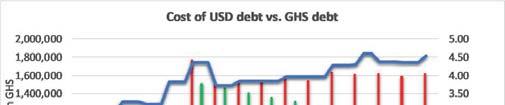
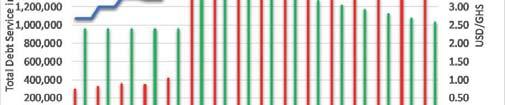
The partial hedge proved to be prudent in hindsight – thanks to it the business has able to withstand currency depreciation of 55% and remain current with debt service (and profitable). This may not have been the case if borrowings were entirely in USD.
In other markets, GuarantCo has seen its clients suffer not only from currency depreciation but also currency convertibility risk when borrowing in hard currency. In June 2016, Nigeria abandoned its currency peg against the US dollar of NGN/USD 200. This resulted in an immediate depreciation of circa.30% followed by a further circa.7% a month later. Despite Central Bank of Nigeria (“CBN”) attempts to stabilise the currency a full blown convertibility crisis had developed by the beginning of 2017. Most corporates were unable to access the CBN rate of circa. NGN/USD 310. USD on the black market, which reached peaks of around NGN/USD 520, was prohibitively expensive to be able to service debts taken on board when the Naira was at 200. As a result, 2017 ended up in one of the largest USD debt restructuring exercises the Nigerian banking market has ever seen.
GuarantCo has been helping companies raise local currency in Nigeria since 2011 and has seen a surge of interest in raising local currency in the aftermath of the currency crisis in 2016 and 2017. However, prima facie cost has not been the only factor putting business’ off borrowing in local currency. It is often cited that the quantum of local currency debt required is simply not available and tenors are too short. This is particularly the case for infrastructure, which has been chronically under-invested in Nigeria for decades and is characterised by long payback periods.
Working with the Nigerian Sovereign Investment Authority (“NSIA”), GuarantCo identified the institutional investor market as a significant pool of un-tapped long-term local currency finance that should be well suited to financing infrastructure. With pension fund assets estimated at circa. NGN 7.5 trillion and an average maturity of liabilities at 30 years the potential was clear but the industry had no experience of investing in infrastructure. It was clear that an instrument was needed to kick start the market.
In 2017 GuarantCo and the NSIA established InfraCredit as a local currency guarantor with a specific objective of unlocking this pool of finance. Given support from its founding sponsors, InfraCredit has been accorded a ‘AAA’ rating from local rating agencies, a first for a local currency guarantor in sub-Saharan Africa. InfraCredit can use this rating to credit enhance bonds issued by infrastructure providers to a rating level that permits pension funds and other institutional investors to invest. This model was demonstrated successfully for the first time in December 2017 when InfraCredit supported a Naria 10 billion, ten-year bond for Viathan Group, a captive power provider. This was the first ever ten-year corporate bond in Nigeria and was oversubscribed despite Viathan being a first-time issuer.
“Businesses are often attracted by the perceived ‘low’ cost offered by hard currency financing. However, when a business’ revenues are denominated in local currency and hard currency borrowing is unhedged it puts the company in the position of a currency speculator”
Recent history has shown that sudden currency devaluation, even in perceived ‘stronger’ African economies, is not an unrealistic prospect. Many companies that borrowed at low USD rates in the past are now struggling with meeting debt service requirements in the face of currency depreciation and convertibility issues.
The benefits of local currency financing are not always apparent but form a core part of prudent risk management. The typically ‘higher’ interest rates of local currency financing should be considered as a hedging cost against currency devaluation and convertibility risk, providing a valuable risk mitigation tool for businesses in such economies.
“GuarantCo has seen its clients suffer not only from currency depreciation but also currency convertibility risk when borrowing in hard currency.”
Contributors’ Profiles
Philip Skinner is a Senior Investment Officer with GuarantCo responsible for originating, structuring and executing transactions. GuarantCo encourages infrastructure development in low-income countries through the provision of credit guarantees that enable infrastructure projects to raise debt finance. In particular, GuarantCo seeks to mobilise local currency debt to mitigate the FX risks many hard currency financed projects are typically exposed to. Prior to joining GuarantCo, Phil worked for the Green Investment Bank and DNB Bank where he specialised in power and renewable energy transactions. Phil holds a MSc in Development Economics from Oxford University.
Denesh Srishanker is a Senior Investment Officer with GuarantCo responsible for originating, structuring and executing transactions. Prior to joining GuarantCo, Denesh worked for Standard Bank and Barclays Capital focusing on structured credit and derivatives. Denesh holds a MSc in Finance from Cass Business School and a BSc in Mathematics from Imperial College.
By Guy Miller, Managing Director, Risk Capital Advisors (Sydney)
Simla Ramdayal, Director, Risk Capital Advisors (Johannesburg)
&A transaction risk insurance products have historically been utilised by private equity funds and other more 'sophisticated' investors to de-risk transactions. A transaction risk insurance policy transfers the risk associated with any loss arising out of a breach of a representation or warranty in an agreed transaction document (for example, a Sale Agreement) to an insurer’s balance sheet relieving the buyer and seller from residual contingent transaction risk. It is widely used in Australia, New Zealand, UK, Europe and the USA where it is commonplace for private market M&A transactions to be insured in order to ring fence financial exposure arising out of breach of representations and warranties in the transaction document. It is becoming increasingly popular in emerging markets where dealmakers are enjoying the commercial benefits of transaction risk insurance to enhance their position. For example, transaction risk insurance is now regularly used on South African transactions, both local and panAfrican acquisitions and exits.
There are many strategic reasons for either a seller or a buyer taking out transaction risk insurance. These include:
• It allows for a ‘clean exit’ from the transaction for a seller (other than in specified circumstances e.g. fraud) as there is no recourse by the buyer or the insurer to the seller.
• The proceeds realised from the disposal can be distributed by the private equity fund to its investors immediately and without the investors or the fund having to provide any security in respect of any residual contingent transaction risk arising out of the transaction.
• Buyers in a competitive auction process often use transaction risk insurance to enhance their bidder status by offering sellers diminished risk exposure and in many cases a ‘clean exit’ thus distinguishing their bids from other competing bids.
• Buyers investing in a new or unfamiliar jurisdiction or industry sector in Africa may want security in regard to the investment. Lack of political stability or legal uncertainty


could pose a risk in doing business in Africa.
• For foreign investors and fund managers, it constitutes best practice risk management and corporate governance especially when faced with challenges of running businesses in Africa.
• It provides the ability to claim on insurance rather than from management or fellow shareholders in a joint venture transaction.
There are various forms of transaction risk insurance available to cover risks arising from a transaction. These include: warranty and indemnity insurance (W&I Insurance), tax liability insurance, environmental liability insurance and contingent liability insurance. This article will focus on W&I insurance.
W&I Insurance is the best known and most widely utilised of these transaction risk solutions. It is a tool for a buyer or seller to transfer the risk of liability created by loss arising out of a breach of the warranties and indemnities that form part of the sale and purchase agreement. Transaction risk is transferred from the seller or the buyer to the insurer.
W&I Insurance is a cost-effective alternative to the ‘traditional’ means of addressing transaction risks and issues, namely, purchase price adjustments, escrow, hold-back, indemnities, walk-away rights, parent company or bank guarantee.
It is not meant to replace thorough and complete due diligence required on a transaction and appropriate disclosure by the seller. It also does not cover issues already known to the insured as would be the case under any typical transaction document. The general rule is that where a warranty is requested, the W&I insurer will expect the subject matter of that warranty to be adequately diligenced in order to provide coverage for that warranty. W&I insurers will want to ensure that the M&A transaction has been negotiated on arm’s length terms and that the proposed W&I insurance hasn’t materially changed the behaviour of the parties.
W&I Insurance can be procured by or on behalf of either a buyer or a seller. Where the indemnity policy is between the seller and the W&I insurer, the seller and the insurer will work together to defend any claims brought by the buyer and where liability is established or a settlement is reached, the insurer will pay any loss directly to the buyer.
Where the buyer is the insured party, there is no need for the buyer to pursue a claim against the seller for a breach of warranty or indemnity. Instead, the buyer has direct recourse to recover financial loss from the W&I insurer. With a buy-side policy, the buyer also has protection against fraud of the seller. This gives the seller a clean exit as the buyer will have no recourse for warranty breach against the seller.
Typically, the W&I policy will provide cover of 2-3 years for claims under general/business type warranties in a sale agreement. The period of cover for title warranties, tax warranties or a tax indemnity can extend for as long as 5-6 years from completion.
Usually, a bespoke policy is drafted for each transaction. The policy premium can range between 1.4%-1.85% of the insured limit for African transactions. The premium rate is less for South African or Pan African transactions with a strong presence in South Africa. The insurer will weigh the risks associated with the transaction in determining whether a transaction is insurable. Factors such as the value of the transaction, the level and quality of the buyer due diligence undertaken, jurisdiction of target business, nature of target business and corporate governance. Appropriate warranty caps and limitations are taken into account when determining the amount of the policy premium which is expressed as a percentage of the insured limit.
It is important to engage with an insurer early in a sale process to structure the W&I Policy and to implement the policy timeously in alignment with the transaction timeline agreed between the parties. If a specialist W&I advisor is engaged, the more likely it is that the parties will secure the broadest possible cover under the W&I policy.
“M&A transaction risk insurance products have historically been utilised by private equity funds and other more 'sophisticated' investors to de-risk transactions.”
A seller can incorporate a W&I insurance solution into a transaction at the same time as it prepares a target or asset for sale. W&I insurance can be built into the first seller draft of a share or asset purchase agreement so that prospective buyers are aware from the outset that the sole or primary recourse for breach of warranty and indemnity claims will be to a W&I insurance policy rather than the seller. The W&I insurer will require access to the data room and disclosure materials prepared by the seller, including any seller due diligence reports or disclosure letter. It is recommended that W&I transaction risk advisors such as Risk Capital Advisors are engaged early on to ensure that the securing and implementation of the W&I insurance is properly executed.
Levels of M&A activity in Africa have been increasing in recent years and are expected to continue to grow in the future. Transaction risk insurance is an innovative tool that can be used as a method to eliminate risks in African transactions. It is a valuable tool when doing business in Africa to bridge any negotiation gaps between sellers and buyers.
“W&I Insurance is a cost-effective alternative to the ‘traditional’ means of addressing transaction risks.”
Contributors’ Profiles
Guy Miller, Managing Director: Guy is a co-founder of RCA having been in private practice (M&A/PE lawyer) in London (9 years) and Sydney (3 years) – Clayton Utz and Chang, Pistilli & Simmons (now Clifford Chance, Sydney). Guy was also the Legal Counsel for Aon’s Mergers & Acquisitions Group for the Asia Pacific Region prior to RCA. Guy is qualified to practice as a lawyer in South Africa, Ireland, England & Wales and NSW and holds a LLM (Master of Laws, London).
Simla Ramdayal, Director of RCA Africa: Simla joined RCA Africa in February 2018. Prior to joining RCA Africa, she practiced as a Partner at Dentons in Johannesburg and has 10 years corporate M&A experience. Simla has also worked as an M&A lawyer in England & Wales where she worked for CMS Cameron McKenna. She is considered to be a specialist in corporate, commercial and regulatory law. She was recognised as a Rising Star in 2017 by IFLR1000.
By Jonathan Ripley-Evans, Herbert Smith Freehills South Africa LLP
Fiorella Noriega Del Valle, Associate, Herbert Smith Freehills South Africa LLP
frica is the world's second largest continent; it is therefore no surprise that it has always attracted the eye of the potential investor in a wide range of industries, most notably oil, gas and mining. But with investment in a region, comes risk. That risk is somewhat mitigated by the availability of reliable dispute resolution processes and services in that region.
It is important to bear in mind that Africa is a continent comprising 54 independent countries, each having their own approach to dispute resolution. Formal methods of dispute resolution in African countries (including court litigation and arbitration) remain strongly influenced by external legal systems and cultures.
The graphic below illustrates the prevalence of civil law, common law, and mixed legal systems on the continent.
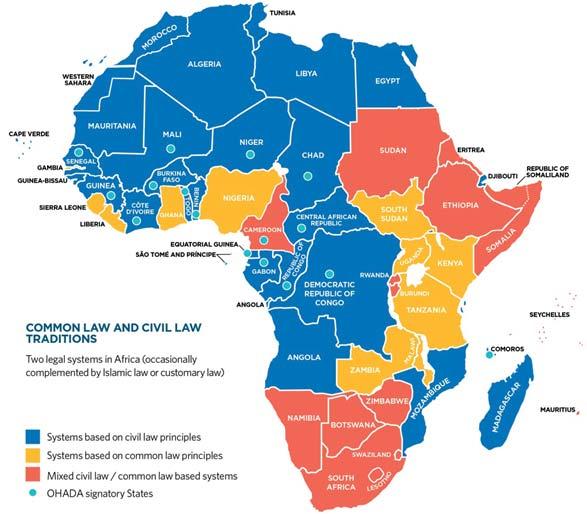
Trans-National Law in African Jurisdictions
Over the years, attempts have been made to codify commercial law on the continent by the implementation of various inter-governmental agreements. The most influential and far reaching of those is arguably the Organisation pour l'harmonisation en Afrique du droit des affaires (Organization for the Harmonisation of Business


Law in Africa or "OHADA") having influence over seventeen central and western African states. OHADA brings into force a number of "Uniform Acts" which are enforceable in each of the signatory states. For example, any arbitration seated in an OHADA member state will be governed by the Uniform Act on Arbitration and any national law applicable to the arbitral procedure is to be interpreted subject to that Uniform Act.
Other significant inter-governmental agreements include: the Economic Community of West African States (ECOWAS), the Common Market for Eastern and Southern Africa (COMESA), the Central African Economic and Monetary Community (CAEMC), and the Southern African Development Community (SADC)
Methods of Dispute Resolution in Africa
Informal methods
Various forms of negotiation, mediation and settlement have historically been popular methods of resolving disputes on the continent.
Although mediation and conciliation are generally contractually agreed processes, many African jurisdictions, such as Algeria, Chad, Malawi, Ghana, Tanzania and Gabon, have incorporated mandatory alternative dispute resolution mechanisms into their civil litigation procedures.
Formal proceedings through courts
The resolution of disputes through African court structures is often a challenging process, especially if one of the parties hails from outside the jurisdiction of the court or if a foreign legal system governs the relationship between the parties.
Difficulties which are often encountered include –Protracted litigation due to procedural hurdles.
• Misalignment of expectations due to parties coming from civil and common law backgrounds.
• If there is no statute governing the enforcement of a foreign civil judgment or the existence of some form of reciprocity agreement between the countries concerned, the enforcement of any judgment may be problematic.
• State immunity protecting assets at execution stage.
• Recovery of the costs of litigation is not applied consistently.
• Many jurisdictions require the appointment of local attorneys and counsel to appear before the courts.
Whilst these challenges are certainly not African specific, they are often encountered on the continent when resolving cross border disputes through the courts.
International Arbitration
It is not surprising when regard is had to the challenges mentioned above, that international arbitration has risen in popularity over recent years. Arbitration is recognized in all African countries; however, the degree of experience, implementation, efficacy and enforceability of awards differs substantially from country to country.
Many African countries have aligned their arbitration laws and rules with international standards, such as through –
1. By incorporating the principles of the United Nations Commission on International Trade Law's ("UNCITRAL") Model Law into local law;
2. Participation in OHADA (or similar inter-governmental agreements as set out above); and/or
3. Ratifying the New York Convention on the Enforcement of Foreign Arbitral Awards ("New York Convention").
The Model Law provides the framework upon which local laws can be built and is intended to supplement or give effect to the rules of procedure adopted for a particular arbitration by the parties. As an example, South Africa has incorporated the Model Law in its International Arbitration Act 15 of 2017 ("Act") and is also a signatory to the New York Convention. The Act has aligned South African international arbitration law with international best practice which development has boosted South Africa's drive to become the seat of choice for international commercial arbitrations in
Southern Africa.
Although a number of African countries claim to have domestic legislation based upon the Model Law, not all have incorporated the provisions of the Model Law in a comprehensive or meaningful manner. It is therefore important to scrutinize firstly whether the country in question has incorporated the Model Law into local legislation and secondly, to determine the extent of any deviations from the standard text of the Model Law.
The New York Convention requires signatory states to give effect to private arbitration agreements and to recognize and enforce foreign arbitral awards. It has been ratified in 35 of Africa's 54 jurisdictions. Whilst it is not impossible to enforce a foreign arbitral award in the remaining 19 countries (who are not signatories to the New York Convention) enforcement is likely to be more difficult, such awards are likely to be equated to foreign court judgments.
The OHADA Uniform Act on Arbitration Law ("UAA") governs almost the entire arbitral procedure, where the seat of the arbitration is in one of the OHADA member states. In this regard, it is compulsory for all OHADA member states to adopt the provisions of the UAA in its entirety. More often than not, parties involved in an international commercial dispute will resort to institutional arbitration in accordance with the rules of a well-known arbitral body, such as the International Chamber of Commerce (ICC) or the London Court of International Arbitration (LCIA). Africa is no exception.
Various African jurisdictions have established their own arbitral bodies that may be more efficient or cost-effective, in light of their proximity to the source of the dispute. Examples of such arbitral bodies include the Arbitration Foundation of South Africa (AFSA), the Cairo Regional Centre for International Commercial Arbitration (CRCICA), the Kigali International Arbitration Centre (KIAC), the Nairobi Centre International Arbitration (NCIA), the Lagos Court or Arbitration (LCA) and the Mauritius International Arbitration Centre (LCIA-MIAC).
Alternatively, parties may choose to submit the dispute to "ad-hoc" arbitration, which is coordinated by the parties in accordance with rules prepared, adapted or chosen by agreement between them. Whilst ad-hoc arbitration provides the parties a greater degree of flexibility, it comes
without the support of an institutional secretariat and related services and may also pose difficulties at the stage of enforcement of an award.
Whilst International Arbitration provides an extremely attractive alternative to formal court proceedings, one should take care when choosing a governing law of a contract, the type of arbitration to be initiated and very importantly, the legal place (or seat) of the arbitration.
The procedural aspects of an arbitration are governed by the law of the seat of the arbitration. What is regarded as "procedural" varies from jurisdiction to jurisdiction, but normally procedural matters include –
1. the role of the courts in the arbitration;
2. methods of obtaining emergency relief;
3. flexibility in the process;
4. often, the question of arbitrability and prescription;
5. validity of the arbitration clause; and
6. challenges to the arbitration award.
Although a large number of international arbitrations involving African and non-African parties are seated outside of Africa, there is a growing drive to bring these arbitrations to the continent. The decision as to the appropriateness of this will largely depend upon which African country is being considered as a potential seat for the arbitration.
Importantly, only a relatively small number of African countries have incorporated the principles of the Model Law in their local legislation. In comparison, a larger number of countries are signatories to the New York Convention. This may explain the perceived reluctance to have international arbitrations administered on the continent where procedural aspects may not be aligned with the Model Law. This notwithstanding, international arbitration remains popular mainly due to the fact that international arbitral awards are readily enforced due to the prevalence of the New York Convention on the continent.
Bilateral investment treaties ("BITs") are common in most, if not all, African countries. These treaties were implemented in an effort to attract foreign investment into Africa. In order to protect such investments, bilateral investment treaties typically provide for the referral of investment disputes to
some form of independent tribunal, most commonly to international arbitration.
Certain African countries are signatories to the International Convention for the Settlement of Investment Disputes ("ICSID") which provides a facility for the resolution of investment disputes by referral to international arbitration. By ratifying the ICSID Convention, member states agree to treat an ICSID award as equivalent to a final judgment of a court in their country and such awards are directly enforceable in that country.
In apparent contrast to this, certain African countries, such as South Africa, have taken steps to exclude international arbitration for investment disputes (by either terminating certain BITs or enacting local legislation excluding international arbitration for investment disputes). These countries have instead proposed that such investment disputes be resolved by domestic forms of dispute resolution.
It is clear that many African countries are taking a closer look at their existing BITs to determine whether the terms continue to benefit the country concerned, but the reality is that many countries continue to conclude new BITs, on a regular basis. It is therefore too early to tell whether the exclusion of international arbitration for investment disputes has become a trend on the continent.
One of the biggest risks in doing business on the continent is the unpredictability of dispute resolution processes, in particular through domestic court structures. Careful consideration is required regarding the attitude of a particular country towards dispute resolution and in particular, an investor dispute.
Obtaining a judgment or award is only part of the issue – it is equally important, if not more important, that the judgment or award obtained is enforceable and effective. Due to the prevalence of the New York Convention on the continent, international arbitration remains the most appropriate option for most regions.
In order to reduce the risk of doing business on the continent, attention needs to be paid towards dispute resolution clauses when drafting contracts, and not only once a dispute has arisen.
By Walter de Wet, Senior Fixed Income Strategist, Nedbank South Africa
ver the past 12 months South Africa has gone from being an investment grade country according to S&P, Fitch and Moody’s, to being rated a non-investment grade country by both S&P and Fitch. Of the three rating agencies, only Moody’s still rates South Africa’s local and foreign currency debt as investment grade. However, even Moody’s has South Africa (at the time of writing) on a negative watch for a possible downgrade to non-investment grade. This negative watch is set to be resolved on 23 March 2018.
The string of negative ratings actions did not come as a major surprise to the South African government debt market. A key driver of the multiple downgrades was the decline in the country’s fiscal flexibility (as South Africa saw large and growing revenue shortfalls in recent years). In a quest to remedy these revenue shortfalls, government announced a raft of new tax measures in the last three years.
As these revenue measures disappointed, expenditure pressures simultaneously rose sharply on various fronts, including the compensation of public employees and perhaps most notably, debt servicing cost. While debt servicing cost constitutes a relatively small 11% of the main budget expenditure (compared to the 36% that employee compensation constitutes), it is one of the fastest growing expenditure items in the Budget. Furthermore, over and above expenditure pressures that the country faced, State Owned Companies (SOCs) such as Eskom and South African Airways depended (and still depend) heavily on cash injections and/or government guarantees to continue operating as going concerns.
The above factors culminated in rising debt levels which, according to projections by National Treasury (NT) in last year’s Medium Term Budget Policy Statement in October, were forecasted to reach 60% of GDP by 2020/21 (excluding the contingent liabilities of the SOCs). To put this in perspective: As recently as 2012/13 the country’s gross debt levels stood at only 41% of GDP.

With the above as background, it goes without saying that South Africa and the NT headed into the 2018 Budget on the back foot. From a debt sustainability perspective, fiscal consolidation in South Africa had become a major challenge and if no serious intervention was imposed the pace of deterioration was, in our view, set to accelerate. This acceleration was most likely to culminate in higher debt-servicing costs, lower business and consumer confidence, and continued low economic growth. Low economic growth and less fiscal flexibility would, in turn, limit government’s ability to alleviate socioeconomic challenges such as high unemployment and access to higher education.
“Moody’s said the recovery of institutions in South Africa would, if sustained, kick-start the economy as well as provide a stabilisation of fiscal strength.”
Given the realities and pressures that South Africa’s fiscal position faced (and to a large degree still faces), the NT had to deliver on three fronts in the 2018 Budget. Firstly, it had to ensure that fiscal consolidation remained in place by keeping unnecessary expenditures under control; secondly it had to ensure additional tax revenue is raised from sources that are predictable and more certain than past revenue measure; and thirdly, NT had to put measures in place to boost low consumer and business confidence. In our view, given the manoeuvrability at its disposal, NT managed to achieve all three objectives in the 2018 Budget.
On the revenue side, and perhaps the boldest move of the 2018 Budget, the VAT rate was raised from 14% to 15%. This VAT increase is expected to generate almost two thirds of all new revenue measures announced for 2018/19. However, it is not the size of the revenue that matters as much as the fact that other revenue measures have in the recent past fallen short of their targets Specifically, the reliance in the past on personal income tax measures to generate enough revenue to plug the
budget gap, failed spectacularly. In contrast, because the VAT base is broad and fairly inelastic, we have much greater confidence that the VAT hike will deliver the necessary revenue needed to compress the budget deficit in line with expectations.
“Over the past 12 months South Africa has gone from being an investment grade country to being rated a non-investment grade country.”
On the expenditure side, to maintain a fiscal anchor, the NT prudently decided to keep the expenditure ceiling framework intact. In short, the expenditure ceiling is a self-imposed ceiling for the Budget, beyond which NT has committed not to extend government expenditure. In this regard, the Budget needed significant expenditure reprioritisation (of budget allocations). One of the most glaring spending increases (at the expense of other line items) was the allocation to higher education, which has been increased substantially over the MTEF. In fact, higher education spend is now, alongside debt service costs, one of the two fastest-growing expenditure items. Also worth noting is that in order to make the VAT increase more progressive, NT budgeted for an increase in social grants that is to offset the impact of a higher VAT rate on the most vulnerable in South Africa.
A range of other, more general, confidenceboosting measures were also announced. Specifically, there is a renewed commitment to stabilise the finances of SOCs. SOCs pose not only a financial risk, but arguably also a systemic risk, to the South African economy. While these initiatives will take time to bear fruit, work is underway to clarify the regulatory framework for SOCs, improve governance and profitability, and open up the local debt capital markets for these companies (these markets have largely been inaccessible to them for several months now).
The 2018 Budget measures culminated in a forecast that the budget deficit as a percent of GDP is set to compress to 3.5% by 2020/21. This is down from the current deficit of 4.3%, and down from the previously projected deficit for 2020/21 of 3.9%. Most importantly, the gross debt levels as a percent of GDP are seen to stabilise by 2020/21 at 56%. Debt stabilisation is a key precondition in avoiding further downgrades and thus higher borrowing costs to fund South Africa’s expenditure needs.
In our view, the 2018 Budget managed to deliver a path for government finances that appears to be more sustainable than the one that was in the offing six months ago. This, in itself, should boost business and consumer confidence, which in turn is likely to culminate in higher economic growth.
Furthermore, a Budget that provides for more fiscal prudence and less uncertainty has, in our view, opened the door for more accommodative monetary policy. The current fiscal and monetary policy outlook should provide support for the local debt markets in general, and government bonds specifically. As such, we believe the Budget should reinforce the positive momentum in the local bond and currency market that has been in place for most of 2018.
Lastly, when looking at the local debt market, we remain cognizant that the South African economy still faces major challenges, both cyclically and structurally. In this regard, what would be the three key developments we closely monitor over the next 12 months to determine whether South Africa’s pursuit for fiscal consolidation can be maintained?
Firstly, we will closely monitor the upcoming government employee wage negotiations. As pointed out above, employee compensation constitute 36% of total expenditure, and as such the government wage bill remains a major risk to fiscal consolidation. Secondly, we will closely monitor the land reform policy that government has embarked on. As with any government policy, implementation is key. This policy, depending on implementation, could either boost or slow down economic growth. Lastly, we will monitor South Africa’s contingent liabilities, specifically those relating to Eskom. Failure to address Eskom’s financial predicament could be detrimental to South Africa’s fiscal sustainability.
Contributor’s Profile
Walter de Wet (Senior Fixed Income and Currency Strategist): He has more than 10 years’ experience as a macroeconomic strategist within a Global Markets environment, focusing on macroeconomic modelling, commodities, fixed income and foreign exchange markets in both London and Johannesburg. Walter was rated first for best FX research in the 2017 and 2016 JSE Spires Awards. Walter holds an MA in Economics (University of Toronto) and a PhD in Econometrics (University of Pretoria). He is also a Chartered Financial Analyst.
By Axel Zabo, Senior Financial Analyst, SOGEBOURSE (SOCIETE GENERALE Group subsidiary)
he Regional Stock Exchange (BRVM) is the common stock market of the 8 countries of the West African Economic and Monetary Union (WAEMU) that are Benin, Burkina Faso, Côte d'Ivoire, Guinea Bissau, Mali, Niger, Senegal and Togo. As such, BRVM is the 6th largest stock market in Africa in terms of capitalization (FCFA 9,725 billion or EUR 14.82 billion on 03/25/2018). In 2014, Morgan Stanley Capital International (MSCI) created a "Standalone" index dedicated to WAEMU financial market and included BRVM in its MSCI Frontier Markets index (1). BRVM also joined the S & P Dow Jones Index in 2014.
This integration of BRVM in MSCI and S & P Dow Jones indexes reflects the growing attraction of global finance professionals for WAEMU's stock exchange. It shows the reinforcement of investor confidence in WAEMU economic outlook and financial reliability of listed companies on BRVM. Indeed, BRVM 10 index (gathering the 10 most liquid shares) and BRVM Composite (for all listed companies) have never deviated sustainably from their long-term upward trends.
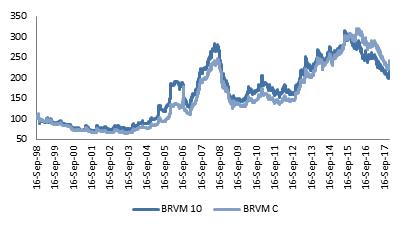
Source: BRVM
Investors attractiveness for shares listed on BRVM could be explained by five main reasons:
Long-term market growth supported by resilient economies
This long-term growth of the West African financial market is supported by strong economic growth in the region. In the current context of falling commodities prices, WAEMU zone, which has an

agricultural vocation, experienced economic growth of 6.5% in 2017 against 6.8% in 2016 (according to IMF data). This real GDP growth rate remains high despite negative terms-of-trade shocks and security concerns. Inflation has remained low due to good agricultural production.
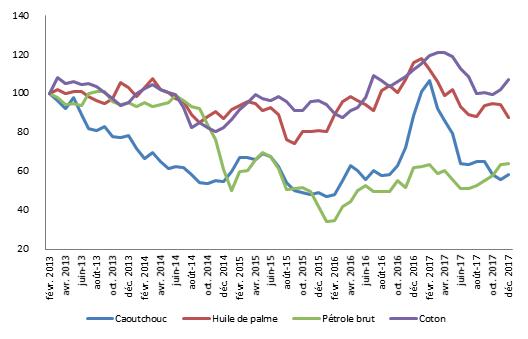
Source: SOGEBOURSE/INDEXMUNDI
Investment in companies with high growth potential
In order to offer SMEs access to long-term capital in order to accelerate their growth and make them champions of the economies of the region, BRVM launched in 2017 its third compartment dedicated to Small and Medium Enterprises (SMEs) and companies with high growth potential. This compartment, which represents a major step forward for the WAEMU Regional Financial Market, is a contribution by BRVM to the problem of financing SMEs in WAEMU. Twelve SMEs are already being approached to integrate this compartment.
In addition of long-term growth supported by a resilient economy, the Regional Stock Exchange is also characterized by the low volatility of its securities. For a given trading day, the quoted price of a security or debt security cannot deviate by more than 7.5%, up or down, from the reference price, in accordance with the BRVM's trading rules.
Chart 3: Changes in daily return and 20 days - volatility
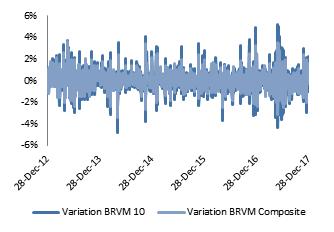
Source : BRVM/SOGEBOURSE
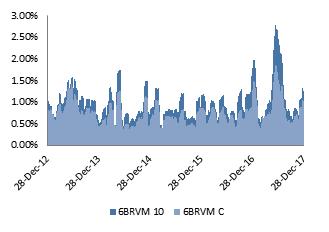
Constant exchange rate between the FCFA and the Euro
For a non-resident investor in the WAEMU zone, BRVM is positioned as a prime location given the very low risk of change inherent in an investment in the CFA Zone. Since 1994 devaluation, the exchange rate CFA Franc / French Franc and then Franc CFA / Euro has remained constant. This mechanism has the advantage, compared to other places on the continent, of bringing stability and visibility to foreign investment.
Chart 4: Exchange rates: XOF / USD and XOF / EUR
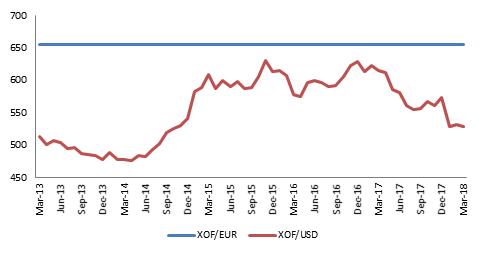
Source : Investing.com
Recovery signals after a period of decline
Finally, the last reason for investing in BRVM now is related to market conditions. Indeed, over the years 2016 and 2017, we witnessed a downward correction of stocks after the sharp increases of the 2012-2015 period. Most listed companies have their prices at their lowest today (end of March 2018); and some signals of recovery are seen at the end of the 1st quarter of 2018. For example, in the industrial sector, the shares NEI-CEDA, AIR LIQUID CI, SMB increased respectively by + 400%, + 76% and + 162%. There is also a very strong increase in the retail sector with CFAO CI and VIVO ENERGY CI, which respectively gained 96% and 55%.
Chart 5: Top 10 shares in 2018 (Source: BRVM)
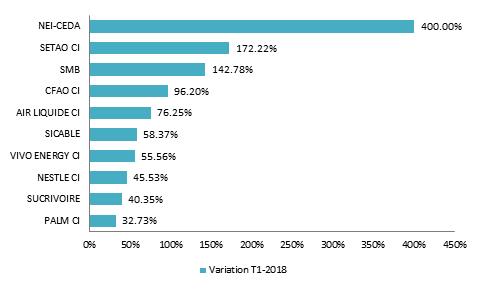
Investors are overlooking attractive opportunities in West Africa’s regional stock market -- and the companies listed there are partly to blame, according to the head of the exchange.
The 45 companies from eight countries that trade on the Bourse Regionale des Valeurs Mobilieres, or BRVM, need to step up on disclosure and transparency to win over investors, Chief Executive Officer Edoh Kossi Amenounve said in an interview in Johannesburg. South Africa is among Amenounve’s stops on an international tour to promote the bourse. “We need to have our listed companies
disclose more information, communicate more, because their results are very good and the projections for the future are very good,” Amenounve said. “We need to communicate on these advantages.”
A dearth of information on listed companies is a common complaint among frontier-market investors and constrains the allocation of funds to exchanges like the BRVM, based in the Ivorian commercial capital of Abidjan. Those who have bet on the market may be witnessing a turnaround: the benchmark index is up 2.4 percent in dollar terms in 2018 after two years of
The exchange has three potential initial public offerings and Amenounve expects at least one to be completed this year. Societe des Telecommunications du Mali, a unit of Maroc Telecom’s unit in the West African nation, is among prospective listings, he said. The BRVM also expects two listings this year on its board dedicated to small and mediumsized companies that opened in 2017, Amenounve said. The bourse has identified a further 10 companies that could start trading there, he said.
BotswanaBSE
MauritiusSEMDEX 2,279-0.603.4718.161,9222,3103.879
MoroccoMORALSI 13,011-1.005.0211.8511,21013,3885.498
NamibiaLocal 1,378-3.886.0526.30121,46119.538
NigeriaNIG ALSI41,505-4.218.5364.2625,15945,32214.653
RwandaRSEASI1330.15-0.274.081241330.848
South AfricaJSE ALSI55,475-4.89-6.775.7850,75061,77715.544
SwazilandSSX ALSI4141.571.777.213864143.249
TanzaniaDAR ALSI2,4091.750.535.554042,43016.554
TunisiaTUNIS 7,1116.1613.2028.045,5177,1305.007
UgandaUSE ALSI2,2037.7610.1044.651,5232,2039.144
ZambiaLuSE ALSI5,548-0.694.1425.874,3065,6083.086
RwandaFranc852.680.150.15-3.25425.00864.638.738
South AfricaRand11.85-0.464.5010.0511.5114.5711.047
TanzaniaShilling2,255.94-0.51-0.94-0.932,137.002,258.602.991 TunisiaDinar2.43-0.141.19-5.702.272.5812.935 UgandaShilling3,691.16-1.25-1.30-2.083,552.253,695.731.779
ZambiaKwacha9,6890.69982.9643-1.178,76610,3887.662
Angola12-Nov-25113.2897.199-0.169-2.092102.227118.750USD
Cameroon19-Nov-25115.0096.9310.039-4.376112.542122.048USD
Congo30-Jun-2981.1218.6580.349-8.38168.20788.833USD
Cameroon19-Nov-25115.0096.9310.039-4.376112.542122.048USD
Egypt30-Apr-4097.9537.0590.176-2.90691.704103.317USD
Ethiopia11-Dec-24103.1866.037-0.493-1.96395.743107.036USD
Gabon16-Jun-25101.6156.662-0.190-2.52995.427106.582USD
Ghana14-Oct-30131.0646.9880.342-5.056116.696141.370USD
Kenya24-Jun-22104.8395.932-0.250-1.86698.690108.410USD
Ivory Coast31-Dec-3296.3116.3600.151-3.96992.493101.781USD
Morocco11-Dec-42106.8095.0150.129-6.275105.885116.210USD
Namibia29-Oct-2599.4395.3400.172-2.69797.865105.480USD
Nigeria12-Jul-23105.4195.1850.015-0.943100.097107.530USD
Rwanda02-May-23103.6505.7840.048-1.326100.700106.276USD
Senegal30-Jul-24104.3935.4190.093-3.750100.842109.728USD
South Africa24-Jul-4496.0105.6680.047-4.46890.553103.430USD
Tanzania09-Mar-20103.8676.2744.646-1.276103.790106.505USD
Tunisia19-Sep-27110.1596.777-0.069-0.494108.910111.534USD
Zambia30-Jul-27105.9888.0420.162-5.946103.300114.636USD